A rigorous undergraduate sequence exploring the mathematical axioms of compound probability, focusing on set theory, independence, and conditional logic.
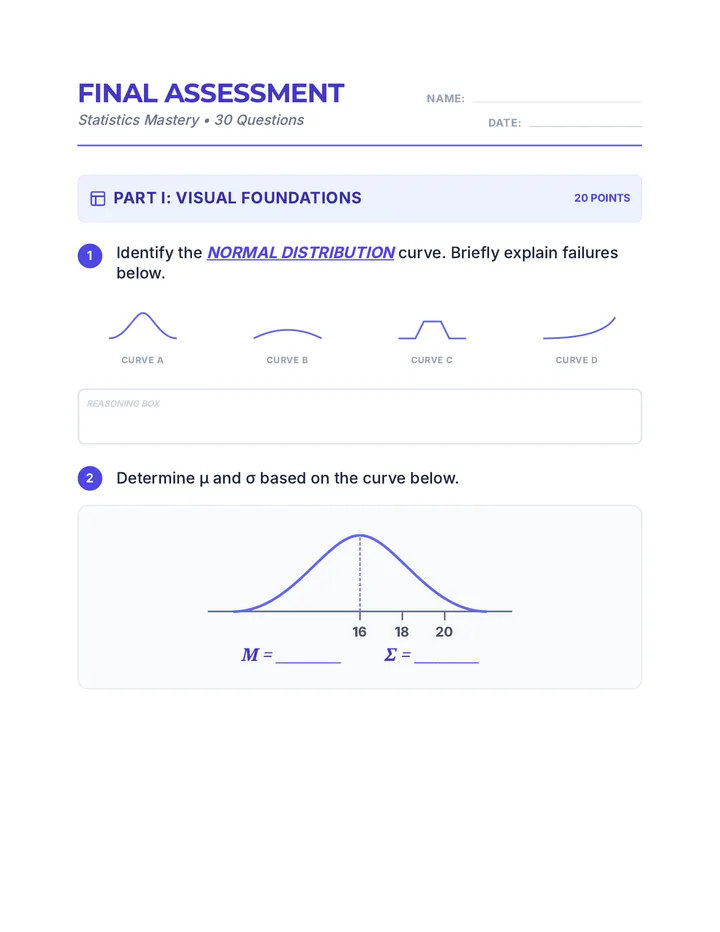
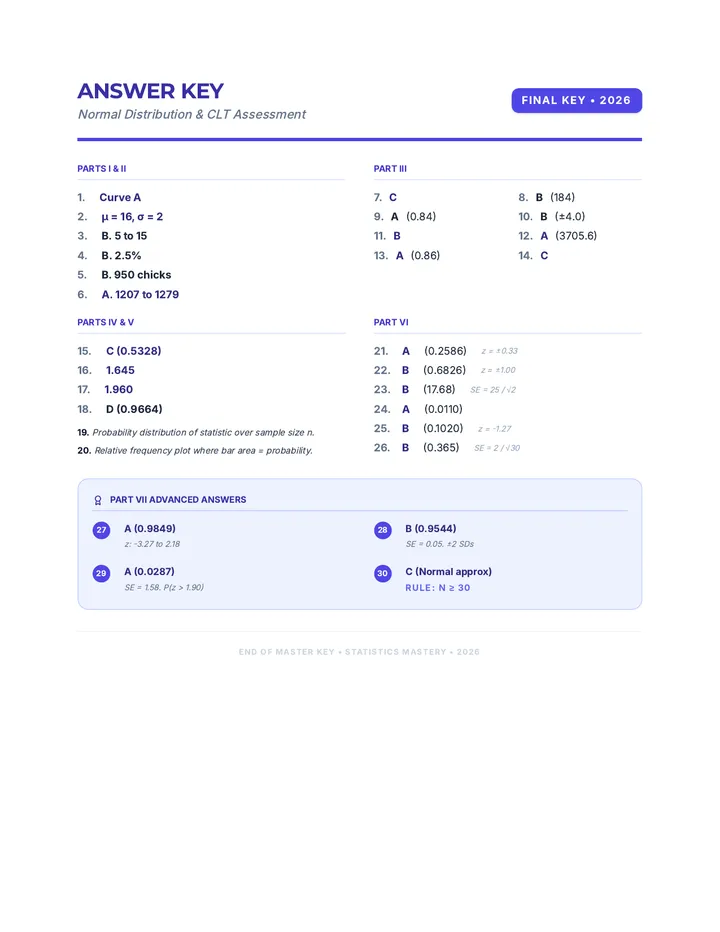
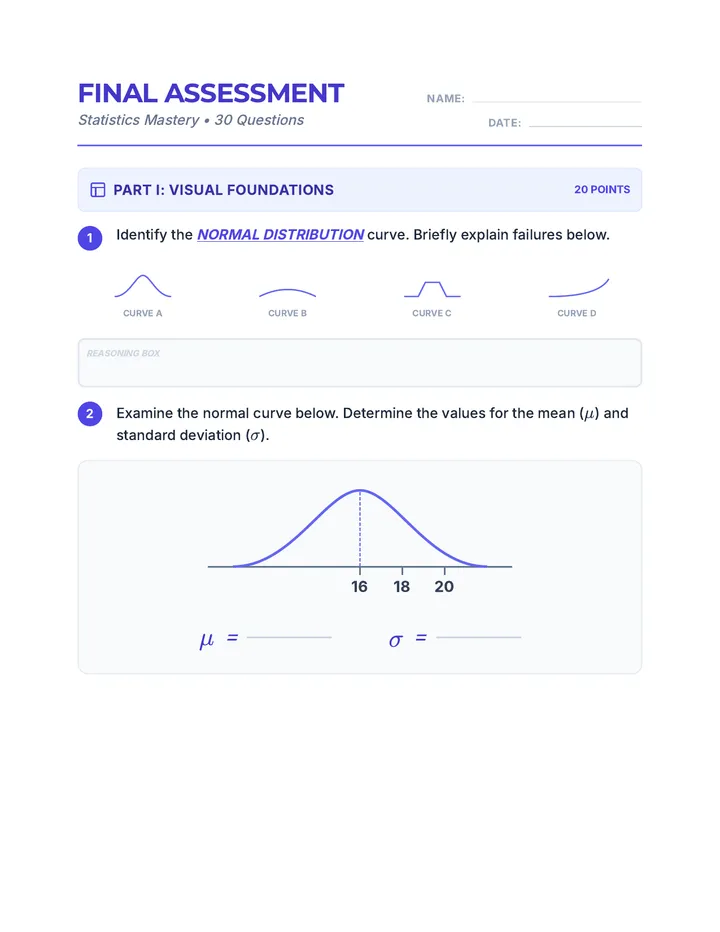
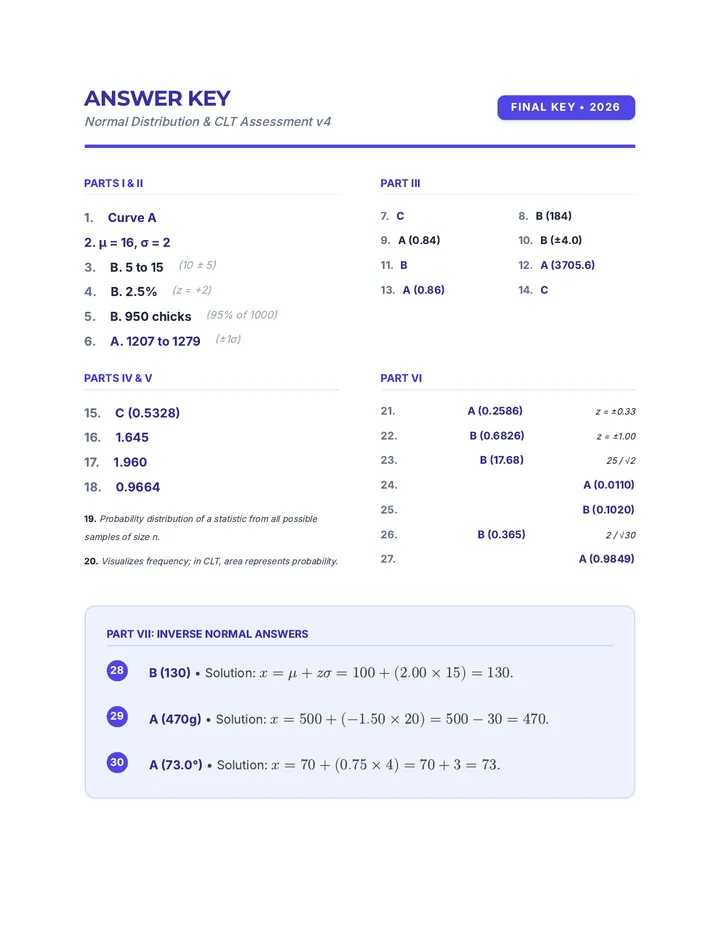
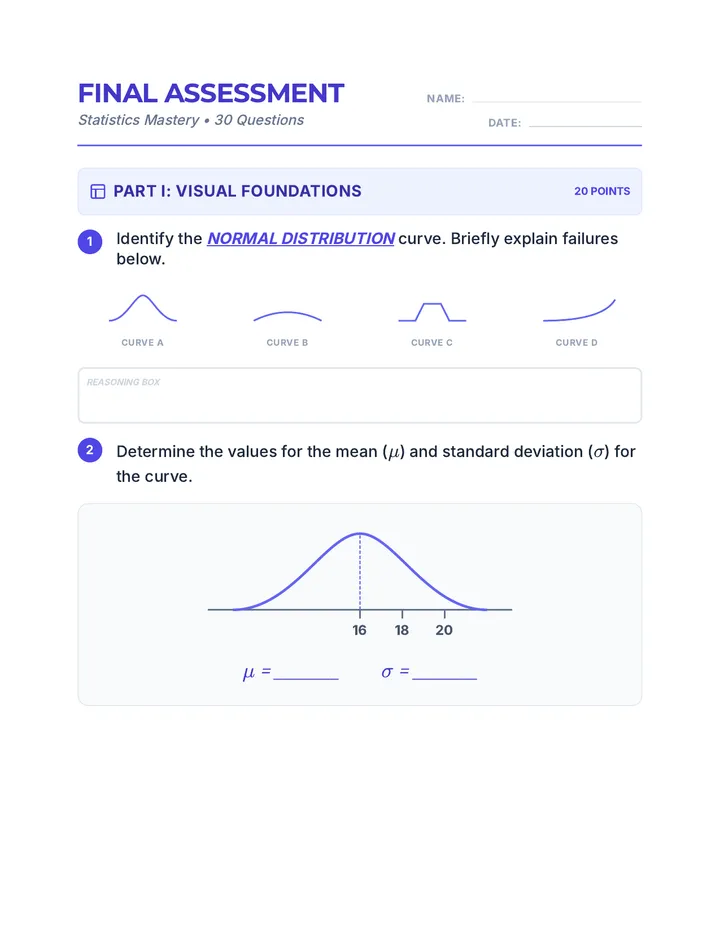
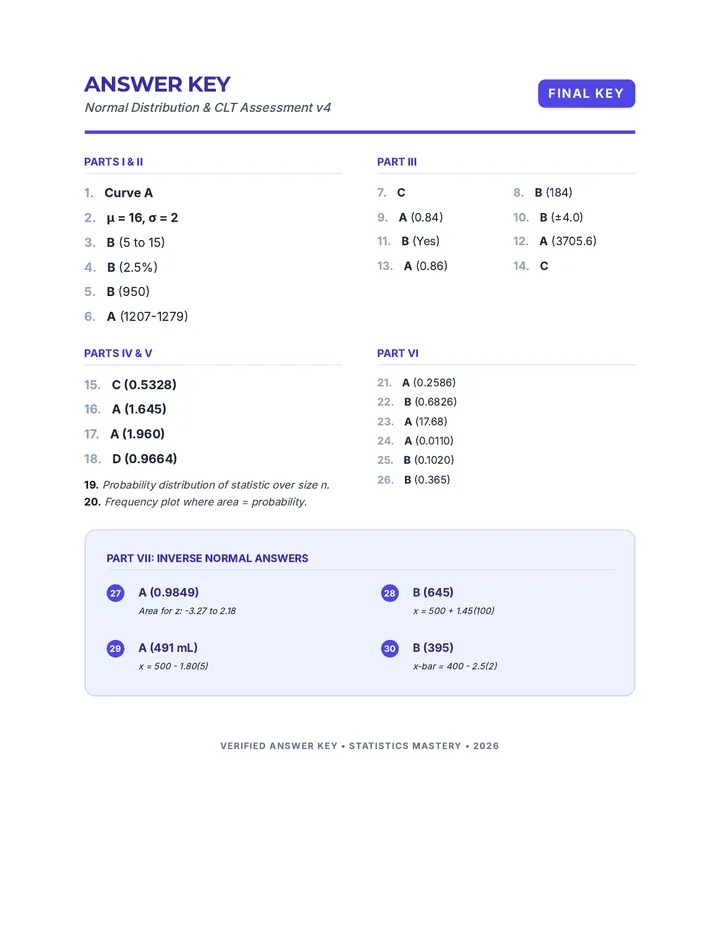
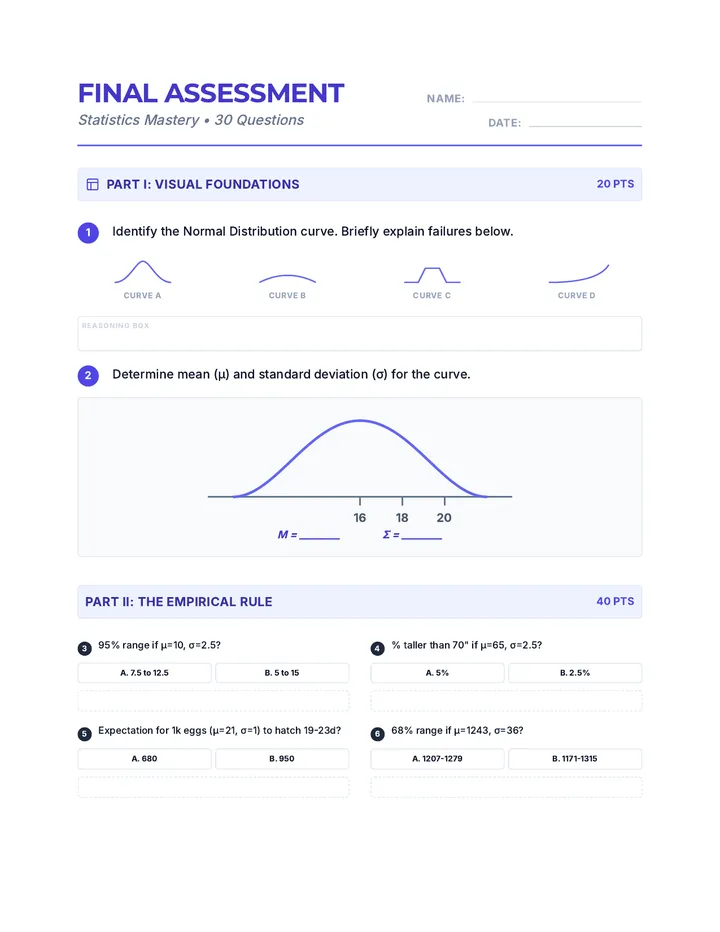
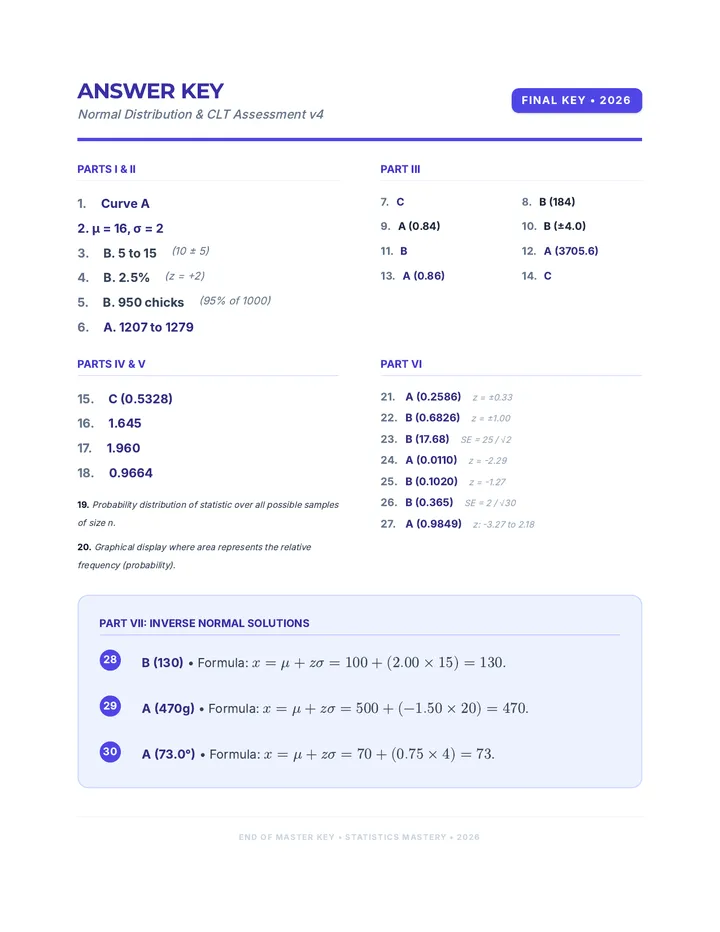
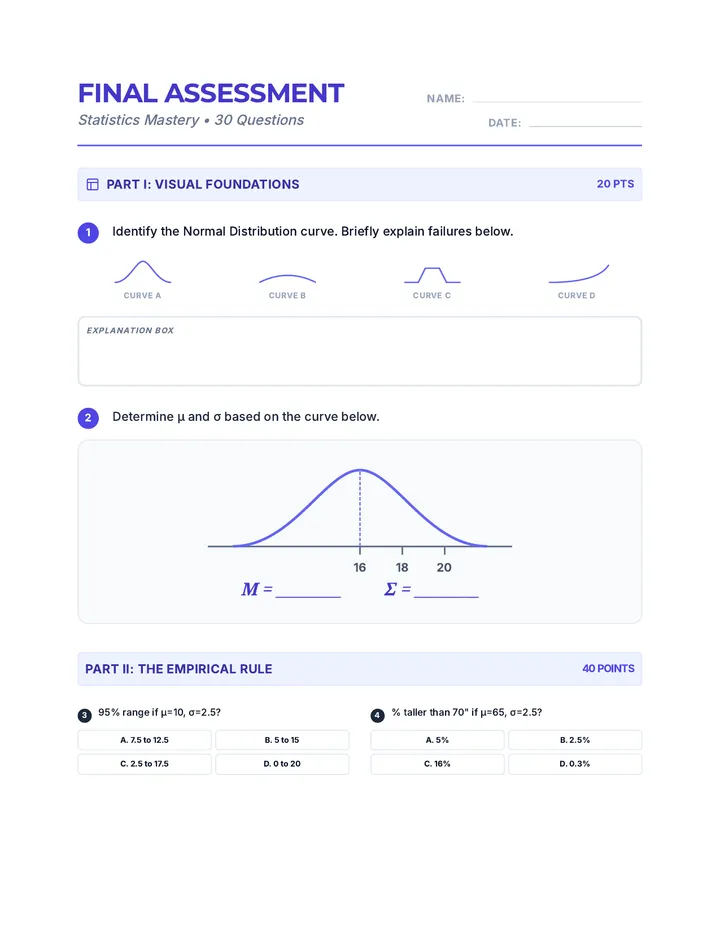
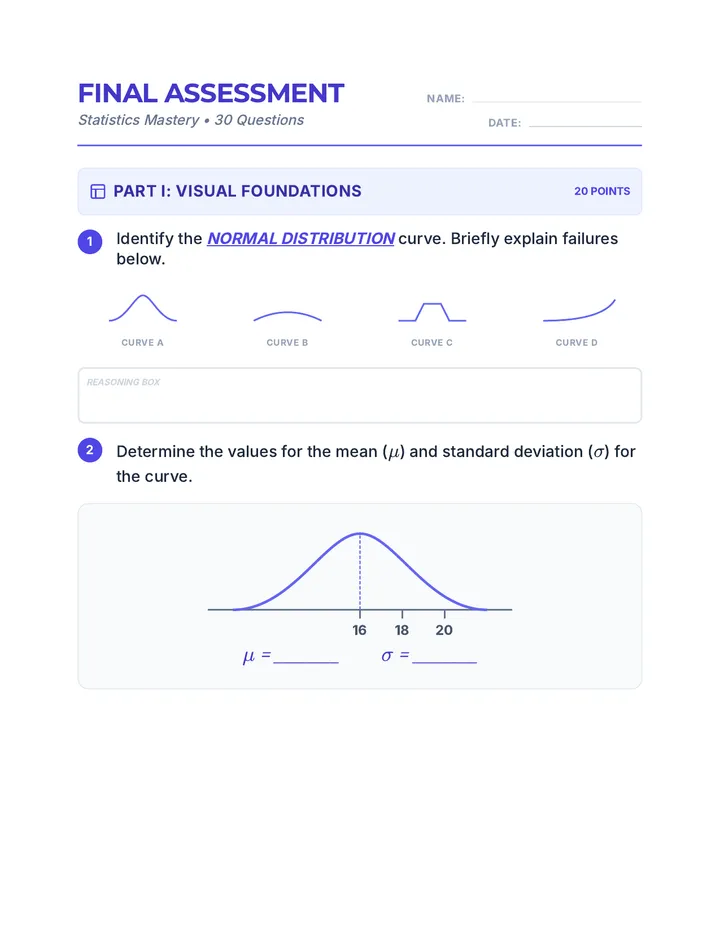
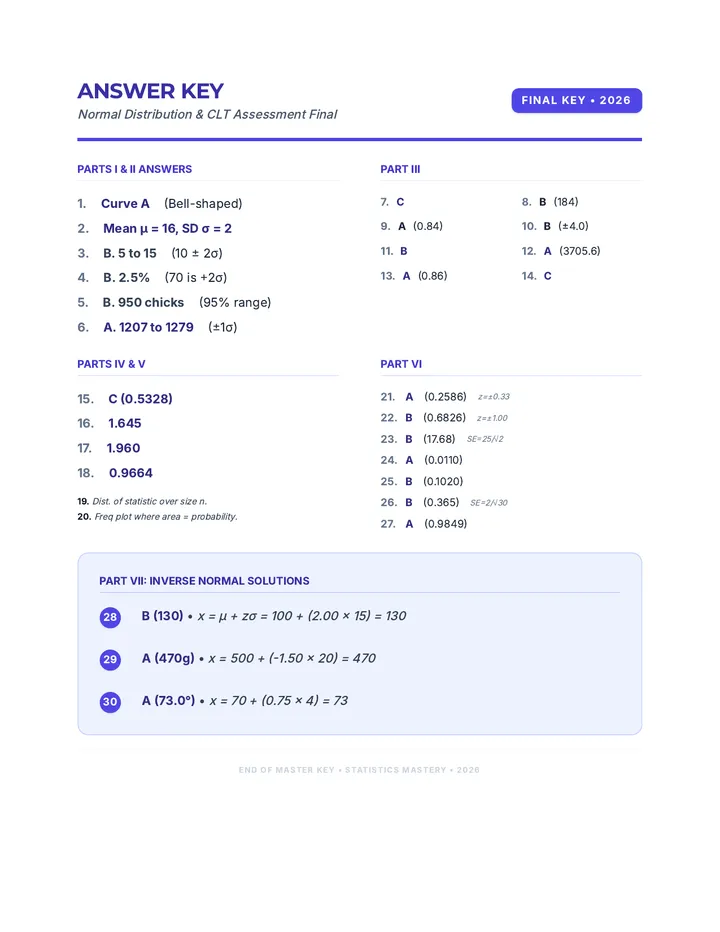
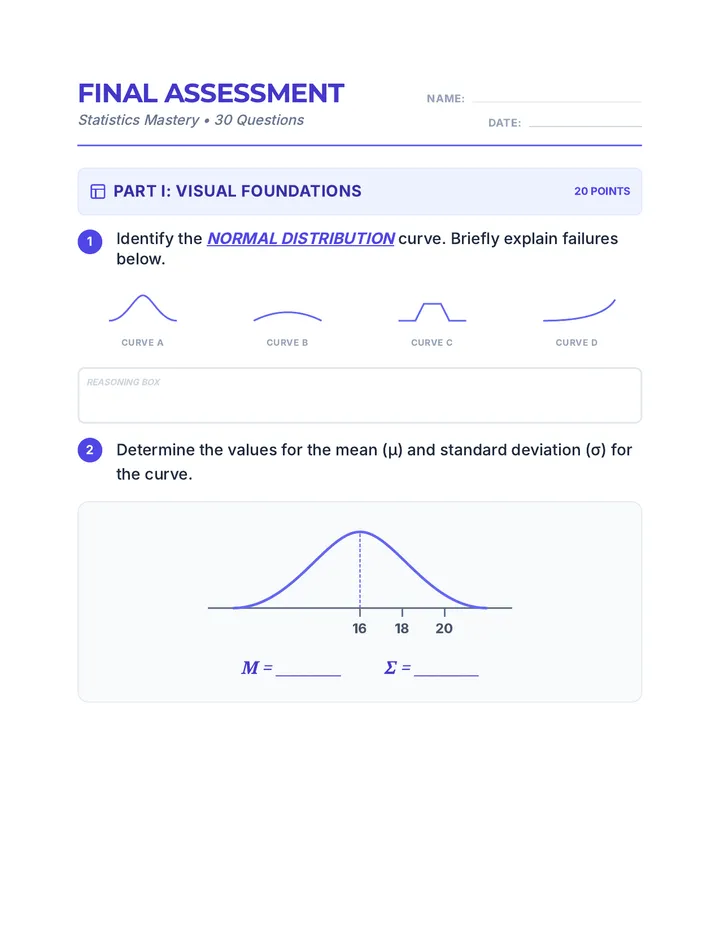
Une introduction complète aux statistiques universitaires, couvrant la classification des données, les mesures descriptives, la visualisation et les fondements de la loi normale. L'approche est axée sur l'analyse de données réelles et la compréhension conceptuelle.
A lesson sequence focusing on the algebraic and graphical properties of radical equations, bridging the gap between symbolic manipulation and visual intersection points.
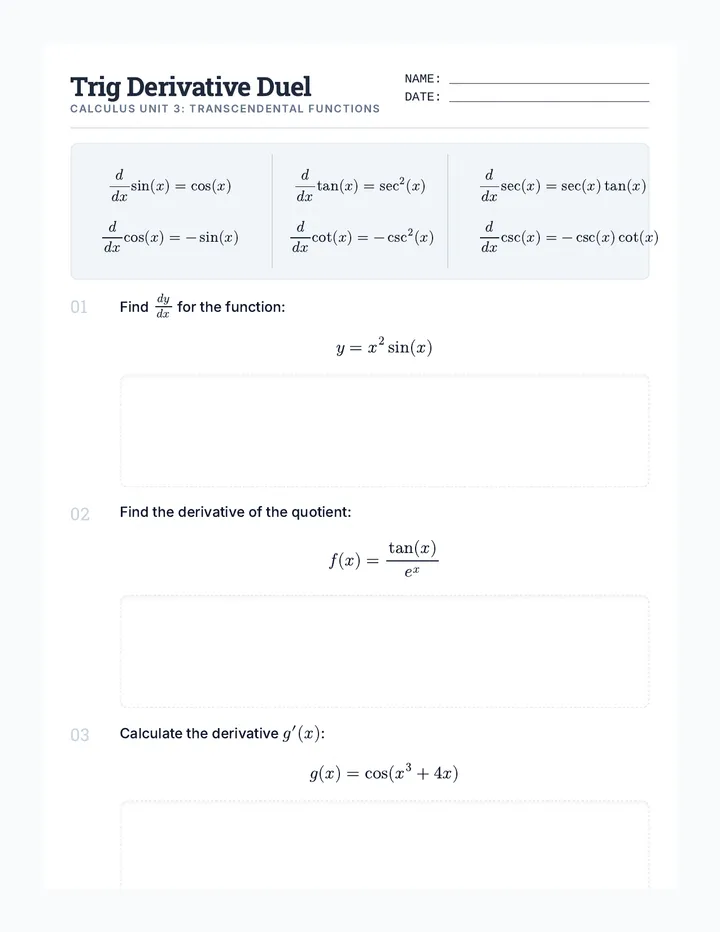
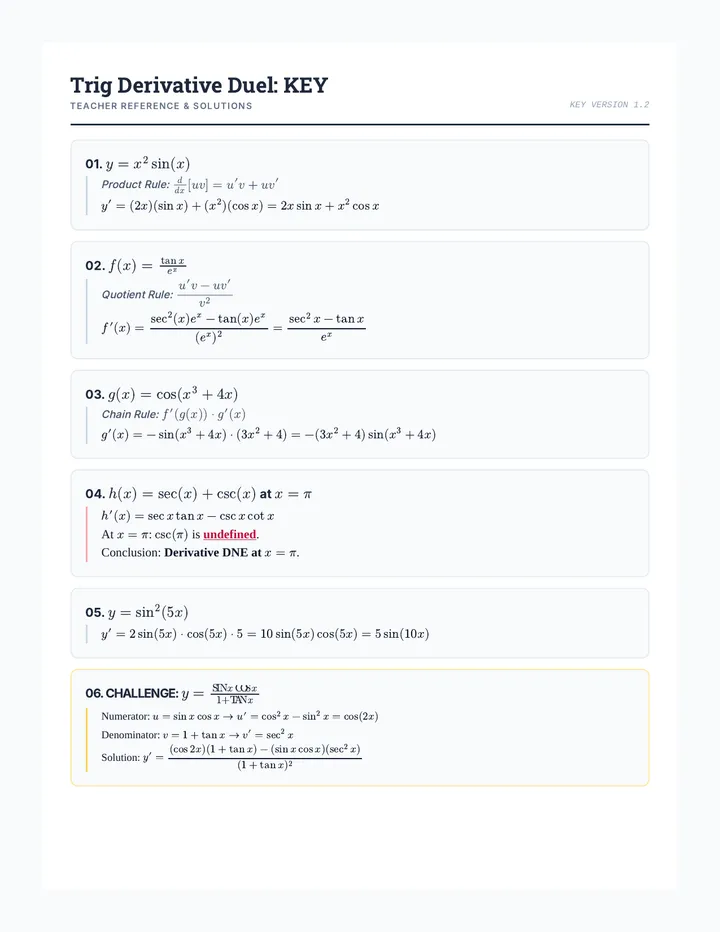
A series of higher-level mathematics lessons exploring calculus foundations through engaging, thematic activities and visual demonstrations.
A specialized unit focused on identifying and correcting algebraic misconceptions in function transformations, specifically reflections. Students develop critical analysis skills by acting as "Error Doctors" to diagnose and treat common mathematical pitfalls.
A lesson sequence focusing on the transition from expanded ellipsis notation to formal Sigma notation within the context of arithmetic series proofs. Students analyze a standard proof and reformulate it using summation properties.
A comprehensive lesson sequence for Undergraduate College Algebra focused on synthesizing and selecting the most efficient strategies for solving exponential equations, utilizing common bases, logarithms, and quadratic forms.
A scaffolded sequence for 10th-grade academic support, focusing on using two-color counters and algebra tiles to master integer operations and transition to algebraic reasoning. This sequence moves from concrete manipulation to representational drawing and finally to abstract procedural fluency.
A specialized math sequence for 11th-grade students focusing on practical fraction operations and ratios through the lens of construction and design. Students move from basic measurement precision to complex scaling tasks using physical manipulatives like tape measures and Cuisenaire rods.
A specialized math sequence for 9th-grade academic support, focusing on fraction mastery through concrete manipulatives and visual models. It follows the CRA framework to bridge gaps in foundational understanding for high school success.
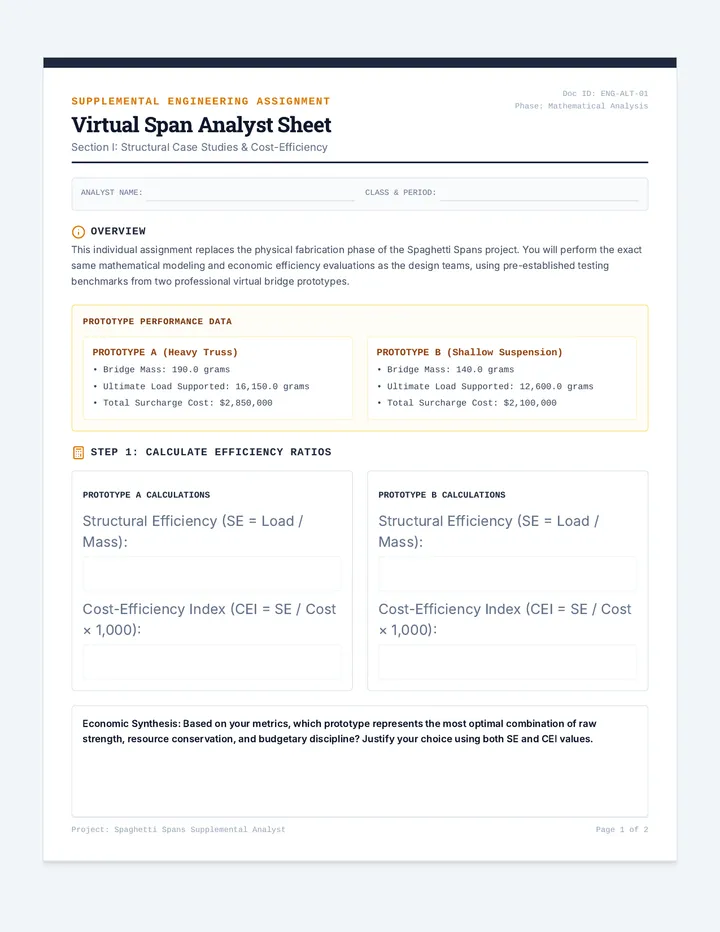
This sequence explores the intersection of geometry and engineering, focusing on 3D visualization, technical drawing, and the optimization of physical forms. Students develop spatial reasoning skills through orthographic and isometric sketching and apply geometric modeling to solve real-world design constraints.
This mathematical physics sequence explores the coordinate systems necessary for solving problems involving complex shapes, moving beyond Cartesian coordinates to General Curvilinear systems. Students derive scale factors, volume elements, and differential operators, culminating in solving Laplace's equation and understanding metric tensors.
This sequence provides a rigorous foundation in the formal mechanics of logical argumentation, distinguishing sharply between deductive certainty and inductive probability. Students move from categorical syllogisms to complex propositional logic, then transition into inductive and abductive frameworks to evaluate strength, cogency, and explanatory power in academic contexts.
An undergraduate-level introduction to Real Analysis focusing on the formal epsilon-N definition of limits, proof construction, Cauchy sequences, and the Bolzano-Weierstrass Theorem. Students transition from computational calculus to rigorous mathematical proof.
This sequence explores numerical analysis through the lens of sequences, focusing on iterative methods to approximate solutions to complex equations. Students investigate fixed-point iteration, Newton's method, convergence rates, and the transition into chaotic behavior.
A comprehensive exploration of linear recurrence relations, from first-order foundations to complex second-order systems and real-world predator-prey modeling. Undergraduate students transition from recursive thinking to closed-form solutions, applying discrete math to algorithm analysis and biology.
This sequence guides undergraduate students from an intuitive understanding of sequence limits to rigorous analysis using algebraic laws, the Squeeze Theorem, L'Hôpital's Rule, and the Monotone Convergence Theorem. Students will explore how infinite processes behave as they approach infinity, bridging the gap between discrete sequences and continuous calculus.
A comprehensive unit for undergraduate students on arithmetic and geometric sequences, moving from basic pattern recognition to complex financial and biological modeling. Students will explore linear and exponential growth through real-world applications like simple interest, depreciation, compound growth, and annuities.
This graduate-level sequence explores the pedagogical content knowledge (PCK) needed to teach mathematical sequences and limits. It traces the historical development from Zeno's paradoxes to modern rigor, equipping educators to address common student misconceptions through inquiry-based instruction.
This graduate-level sequence explores analytic combinatorics through the lens of generating functions. Students will master the transformation of discrete sequences into formal power series, solving complex recurrence relations and evaluating combinatorial identities using advanced algebraic techniques.
A graduate-level exploration of discrete dynamical systems, moving from linear growth models to the complex, chaotic behavior of the logistic map. Students apply recursive sequences to model biological and economic phenomena, emphasizing stability analysis and bifurcation theory.
This sequence bridges the gap between discrete mathematics and quantitative finance, focusing on the application of geometric series to asset valuation, loan amortization, and risk management. Graduate students will develop the mathematical foundations for pricing complex financial instruments and understanding market dynamics.
A rigorous graduate-level exploration of real-valued sequences, bridging computational calculus and formal real analysis through epsilon-N proofs, Cauchy sequences, and topological theorems.
This sequence introduces 11th-grade students to the behavior of sequences and series as they approach infinity. Students explore convergence, divergence, summation notation, and the paradoxes of infinite geometric series and fractals.
An 11th-grade mathematics sequence that bridges the gap between abstract sequences and real-world applications in finance and physics. Students explore arithmetic and geometric models through interest, depreciation, projectile rebounds, and loan amortization.
A high school trigonometry sequence that uses the physics of sound waves to teach modeling with trigonometric functions. Students explore pitch as frequency, volume as amplitude, and the superposition of waves to create harmonies and digital tones.
A comprehensive unit on modeling real-world periodic phenomena using trigonometric functions across physics, biology, and astronomy. Students master identifying amplitude, midline, and period from contextual data to build and solve predictive equations.
A comprehensive unit where students act as data scientists to model real-world environmental phenomena using trigonometric functions. They progress from visual estimation to precise algebraic modeling and technological regression to predict future environmental conditions.
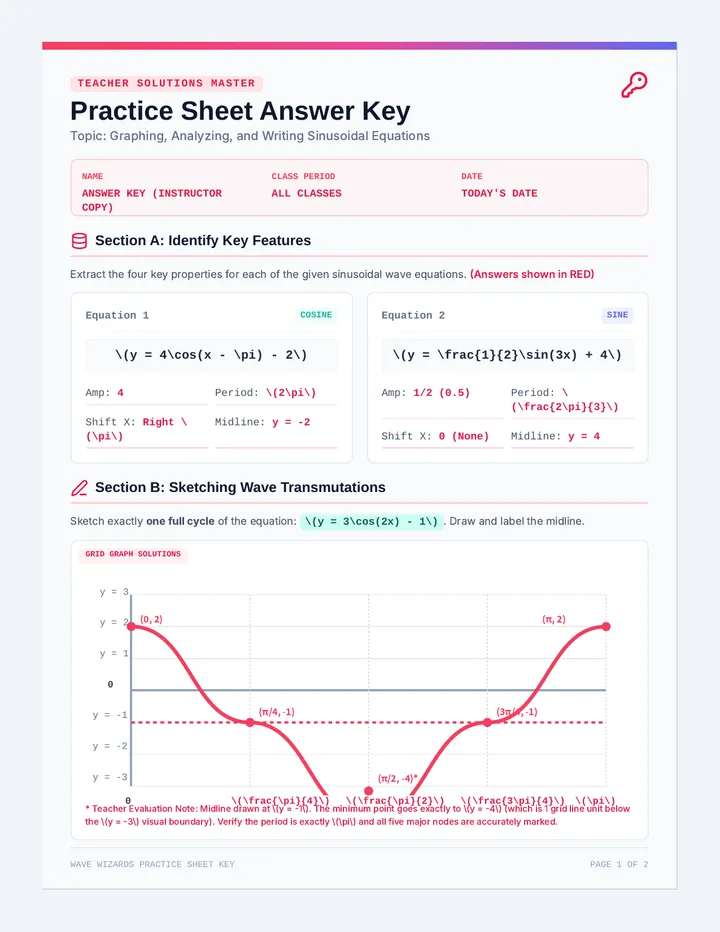
A comprehensive unit on trigonometric transformations, focusing on how parameters A, B, C, and D modify the parent sine and cosine functions. Students progress from simple vertical shifts to complex multi-parameter modeling.
An advanced exploration of vector-valued functions and their applications in modeling 2D motion and force, preparing students for multivariable calculus.
A comprehensive unit for 12th Grade Calculus students focusing on the integration of polar functions to find area, arc length, and surface area. Students transition from Cartesian thinking to radial accumulation, mastering the geometry of circular sectors and polar coordinate transformations.
A comprehensive unit for 12th Grade Calculus students focusing on the derivation and application of derivatives in polar coordinates. Students transition from Cartesian slope to polar slope, analyze horizontal and vertical tangency, investigate behavior at the pole, and solve optimization problems involving polar curves.
Students transition from Cartesian to polar coordinates, exploring the geometry of circular grids and the equations that define complex curves like roses and lima\u00e7ons. The unit covers plotting, conversion, and advanced graphing analysis with a focus on symmetry and intersection.
A comprehensive unit on parametric equations and their applications in modeling motion. Students move from the basics of parametric curves to advanced calculus concepts like derivatives, concavity, vectors, and arc length.
A gamified approach to mastering rational exponents through competition, collaboration, and high-stakes simulations. Students move from basic radical conversions to complex multi-variable simplification in a fast-paced 'Power Play' environment.
This sequence explores the relationship between rational exponents and the geometric behavior of power functions. Students analyze how numerators and denominators dictate domain, range, shape, and growth rates through inquiry and visual sketching.
This sequence investigates real-world applications of rational exponents in biology, finance, music, and physics. Students explore how fractional powers model growth, scaling, and harmonic relationships, culminating in a data-modeling project.
An advanced 11th-grade Calculus unit focusing on the integration of parametric and polar coordinate systems. Students analyze motion, calculate complex areas, perform error analysis, and complete a final synthesis project based on particle kinematics.
This sequence bridges the gap between radical notation and exponential notation, establishing a unified system for algebraic manipulation. Students begin by defining rational exponents through the lens of roots and powers, then systematically apply the laws of exponents to simplify expressions containing fractional powers.
This calculus sequence guides 11th-grade students through the integration techniques required to calculate area and arc length within polar coordinate systems. From the geometric derivation of the polar sector formula to complex multi-curve regions and boundary measurements, students apply integral calculus to circular geometries.
This sequence explores the calculus of polar functions, focusing on differentiation techniques. Students will learn to calculate slopes of tangent lines, identify horizontal and vertical tangents, analyze behavior at the pole, and apply optimization to find maximum and minimum distances from the origin.
A comprehensive unit on polar coordinates and functions, moving from basic plotting to complex intersections and symmetry. Students explore the geometric beauty of curves like roses and lima\u00e7ons while mastering the algebraic conversions between rectangular and polar systems.
This sequence introduces students to parametric equations through the lens of particle motion and physics simulations. Students progress from basic plotting and parameter elimination to advanced calculus applications involving derivatives, vectors, and arc length.
A graduate-level exploration of expected value applications in finance, covering utility theory, portfolio optimization, risk-neutral pricing, and tail risk metrics. Students transition from theoretical foundations to computational implementation using Monte Carlo methods.
A graduate-level exploration of expected value through the lens of measure theory, covering Lebesgue integration, fundamental inequalities, convergence theorems, and conditional expectation using Sigma-algebras.