A comprehensive unit for 10th-grade students exploring matrix operations, from basic dimensions and notation to complex multiplication and real-world applications in inventory management.
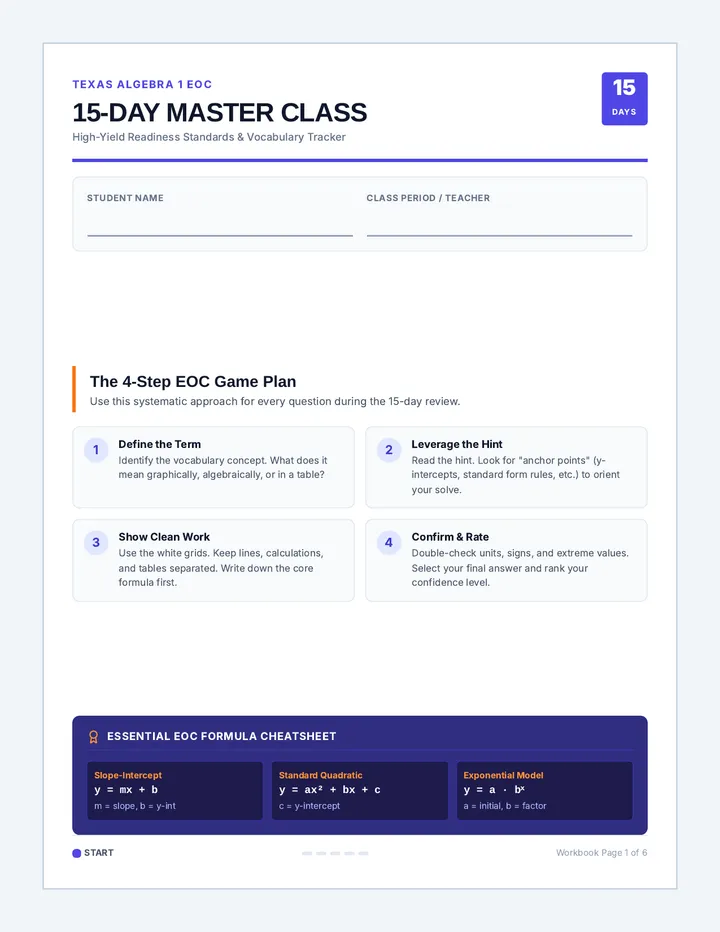
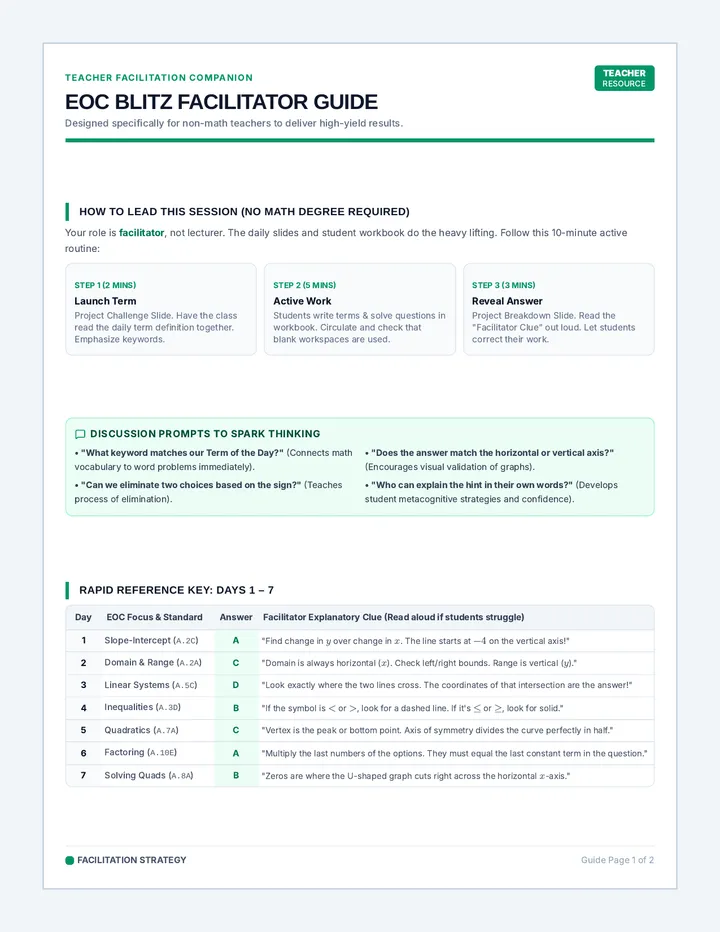
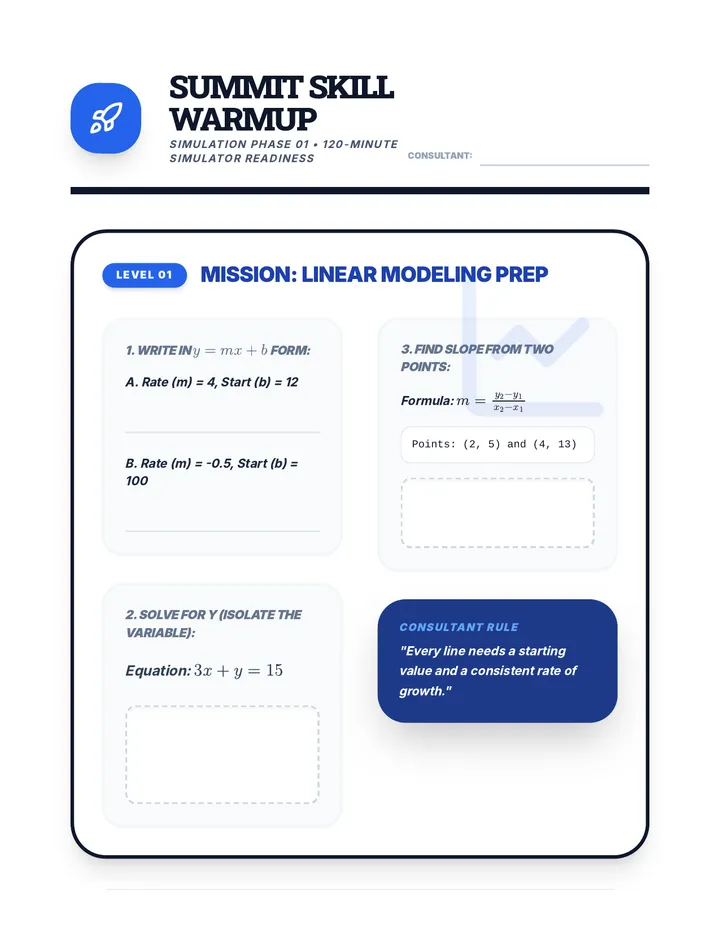
A specialized intervention sequence designed for Algebra I students to master TEKS A2A and A6A, focusing on the domain and range of linear and quadratic functions through tiered small-group instruction.
A series of geometry lessons focused on points of concurrency and their real-world applications in urban planning and design.
A lesson sequence for Algebra 2 focusing on the relationship between rational exponents and radical expressions, including conversion, simplification, and negative exponents.
A series of lessons exploring exponential functions, their components, graphs, and real-world applications in Algebra 1.
A lesson sequence focusing on advanced factoring techniques, specifically targeting the difference of squares with higher-degree exponents (4, 6, 8) through visual recognition and verification.
A high-level Honors Algebra lesson focused on complex recursive sequences where students analyze notation, explore the Fibonacci sequence, and engage in a 'Sequence Maker' activity to reverse-engineer formulas.
A specialized unit on advanced exponent rules, focusing on simplifying complex algebraic expressions involving fractions and negative powers.
A specialized unit exploring the geometric properties of slope, connecting algebraic rates of change to trigonometric functions and the geometry of inclination.
A targeted remediation sequence focused on identifying, analyzing, and correcting high-frequency algebra errors in polynomial operations.
A lesson sequence focused on identifying and correcting domain restriction errors for 9th-10th grade algebra students. Students act as 'Error Doctors' to diagnose and treat mathematical misconceptions using video-based instruction and peer review.
A high school geometry and algebra sequence focused on applying 3D geometry formulas to real-world optimization problems, specifically focusing on cones.
A comprehensive lesson on calculating slope using both the algebraic formula and the visual rise-over-run method, featuring guided video notes and a competitive group activity.
A unit focused on mastering polynomial operations, from long division to advanced shortcuts like the Remainder and Factor Theorems. Students move from laborious calculation to strategic evaluation.
A lesson sequence focusing on the geometric properties of quadratic functions, specifically using symmetry to locate key features like the vertex and axis of symmetry.
An Algebra intervention sequence focusing on the critical distinction between vertical and horizontal line equations ($x=c$ vs $y=c$). This sequence targets common misconceptions through visual analysis, coordinate consistency, and guided practice.
A lesson sequence focusing on analyzing and manipulating exponential functions to reveal true growth rates, using real-world financial contexts and exponent rules.
A unit focused on linear inequalities, boundary logic, and systems of constraints, moving from basic graphing to multi-variable solution regions and real-world scenarios.
A comprehensive unit exploring circle geometry, vocabulary, arcs, angles, and properties through visual and hands-on investigation.
A comprehensive math sequence for 10th-grade academic support focused on using base-ten manipulatives to master decimal operations through a financial lens. Students progress from foundational place value to complex budgeting simulations, bridging concrete understanding with abstract calculations.
A scaffolded sequence for 10th-grade academic support, focusing on using two-color counters and algebra tiles to master integer operations and transition to algebraic reasoning. This sequence moves from concrete manipulation to representational drawing and finally to abstract procedural fluency.
A mastery-based sequence using base-ten blocks and area models to build conceptual understanding of multi-digit multiplication and division for high school students. This sequence bridges the gap between concrete manipulatives and abstract algorithms through the visual scaffold of area.
This sequence supports 10th-grade students in mastering inequalities and functions through visual modeling. By progressing from 1D number lines to 2D coordinate planes, students build a concrete understanding of constraints, domain, and range using shading and geometric reasoning.
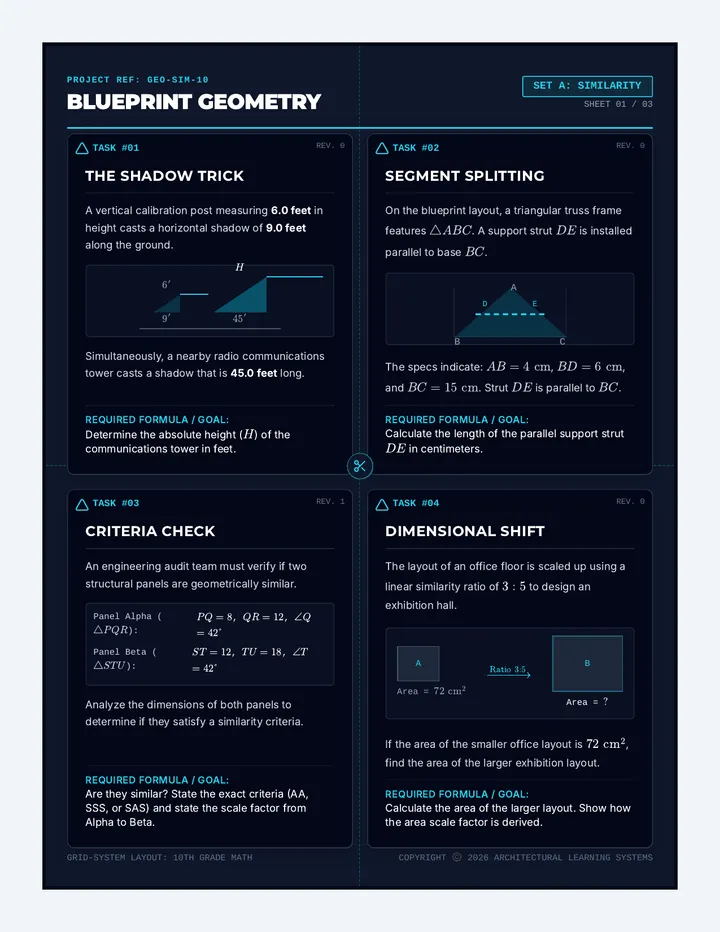
This sequence teaches 10th-grade students with academic support needs how to translate complex geometric text descriptions into accurate, solvable visual representations. It covers geometric vocabulary, 2D blueprints from word problems, 3D nets/transformations, and similarity modeling, culminating in a synthesis project.
A sequence designed for 10th-grade students to master algebraic word problems using bar modeling. This visual approach scaffolds the transition from text-based problems to symbolic algebra, specifically supporting students who struggle with abstract math concepts.
This sequence uses geometric area models (algebra tiles and the box method) to provide a concrete foundation for polynomial arithmetic and factoring, specifically designed for students needing academic support.
This sequence explores the geometric logic of polygons, focusing on the relationship between sides and angles. Students will derive formulas for interior and exterior angles and apply this knowledge to determine which shapes can tessellate a plane, culminating in the creation of original geometric art.
This sequence applies coordinate geometry to the classification of polygons, moving students from visual estimation to mathematical proof using distance and slope formulas. Students act as geometric investigators, verifying the properties of triangles and quadrilaterals through rigorous calculation.
This sequence explores spatial visualization through the study of cross-sections and solids of revolution. Students learn to translate between 2D and 3D representations, a critical skill for engineering, physics, and advanced mathematics.
This sequence investigates the mathematical properties of polygons and their structural applications in engineering and architecture. Students explore interior and exterior angles, the unique attributes of regular polygons, and the fundamental reasons why triangles provide structural rigidity where other polygons fail.
A 10th-grade sequence focusing on the cognitive skill of spatial visualization. Students explore 3D objects through 2D cross-sections and conceptualize how 2D shapes create 3D forms when rotated around an axis, bridging geometry and engineering.
A comprehensive 10th-grade physics and geometry sequence exploring symmetry, transformations, and their applications in engineering, crystallography, and design. Students progress from 2D reflectional symmetry to 3D spatial reasoning and professional design synthesis.
This sequence bridges geometry and physics, investigating the structural properties of 2D and 3D shapes. Students analyze rigidity, tessellation, and surface area-to-volume ratios to understand how geometric attributes influence physical performance in engineering and nature.
This sequence bridges algebra and geometry by applying coordinate methods to the classification of geometric figures. Students use distance, midpoint, and slope formulas to verify properties of triangles and quadrilaterals, preparing them for vector physics and computer-aided design.
A 10th-grade physics and geometry sequence exploring the transition from 2D planar representations to 3D solids, focusing on polyhedra, curved surfaces, and engineering design through Euler's Formula and net construction.
Students explore symmetry and rigid transformations (reflections, rotations, translations) through simulations, coordinate mapping, and creative projects. The unit culminates in the design of complex tessellations using transformation composition.
This sequence explores the intersection of geometry and engineering, focusing on 3D visualization, technical drawing, and the optimization of physical forms. Students develop spatial reasoning skills through orthographic and isometric sketching and apply geometric modeling to solve real-world design constraints.
A high school geometry unit that integrates algebra and geometry by using coordinate systems to verify geometric properties. Students use distance, midpoint, and slope formulas to classify shapes and prove properties with algebraic rigor.
This sequence introduces students to arithmetic and geometric sequences, moving from visual patterns to formal algebraic formulas. Students explore the connections between sequences and linear or exponential functions, analyze complex non-standard patterns, and apply their knowledge in a culminating mastery assessment.
This sequence explores arithmetic and geometric sequences through inquiry, algebraic modeling, and real-world applications. Students transition from pattern recognition to formalizing recursive and explicit formulas to predict outcomes in linear and exponential systems.
A high school trigonometry sequence that uses the physics of sound waves to teach modeling with trigonometric functions. Students explore pitch as frequency, volume as amplitude, and the superposition of waves to create harmonies and digital tones.
A comprehensive unit on modeling real-world periodic phenomena using trigonometric functions across physics, biology, and astronomy. Students master identifying amplitude, midline, and period from contextual data to build and solve predictive equations.
A comprehensive unit where students act as data scientists to model real-world environmental phenomena using trigonometric functions. They progress from visual estimation to precise algebraic modeling and technological regression to predict future environmental conditions.
A 10th-grade trigonometry unit where students model circular motion using Ferris wheels, translating physical dimensions like radius, hub height, and speed into sine and cosine functions.
A comprehensive unit on trigonometric transformations, focusing on how parameters A, B, C, and D modify the parent sine and cosine functions. Students progress from simple vertical shifts to complex multi-parameter modeling.
Students transition from Cartesian to polar coordinates, exploring the geometry of circular grids and the equations that define complex curves like roses and lima\u00e7ons. The unit covers plotting, conversion, and advanced graphing analysis with a focus on symmetry and intersection.
An advanced look at rational exponents through the lens of mathematical proof, equivalence, and error analysis for 10th grade students. Students act as mathematical investigators to justify transformations and identify logical fallacies.
A gamified approach to mastering rational exponents through competition, collaboration, and high-stakes simulations. Students move from basic radical conversions to complex multi-variable simplification in a fast-paced 'Power Play' environment.
This sequence explores the relationship between rational exponents and the geometric behavior of power functions. Students analyze how numerators and denominators dictate domain, range, shape, and growth rates through inquiry and visual sketching.
This sequence explores real-world applications of rational exponents across biology, astronomy, music, finance, and physics. Students transition from abstract algebraic manipulation to applying fractional powers to model complex natural and human-made systems.
A workshop-style sequence for 10th-grade algebra focusing on the mechanics of simplifying expressions with rational exponents. Students develop fluency in applying exponent properties (product, quotient, power) to fractional exponents through targeted practice and multi-step problem-solving.