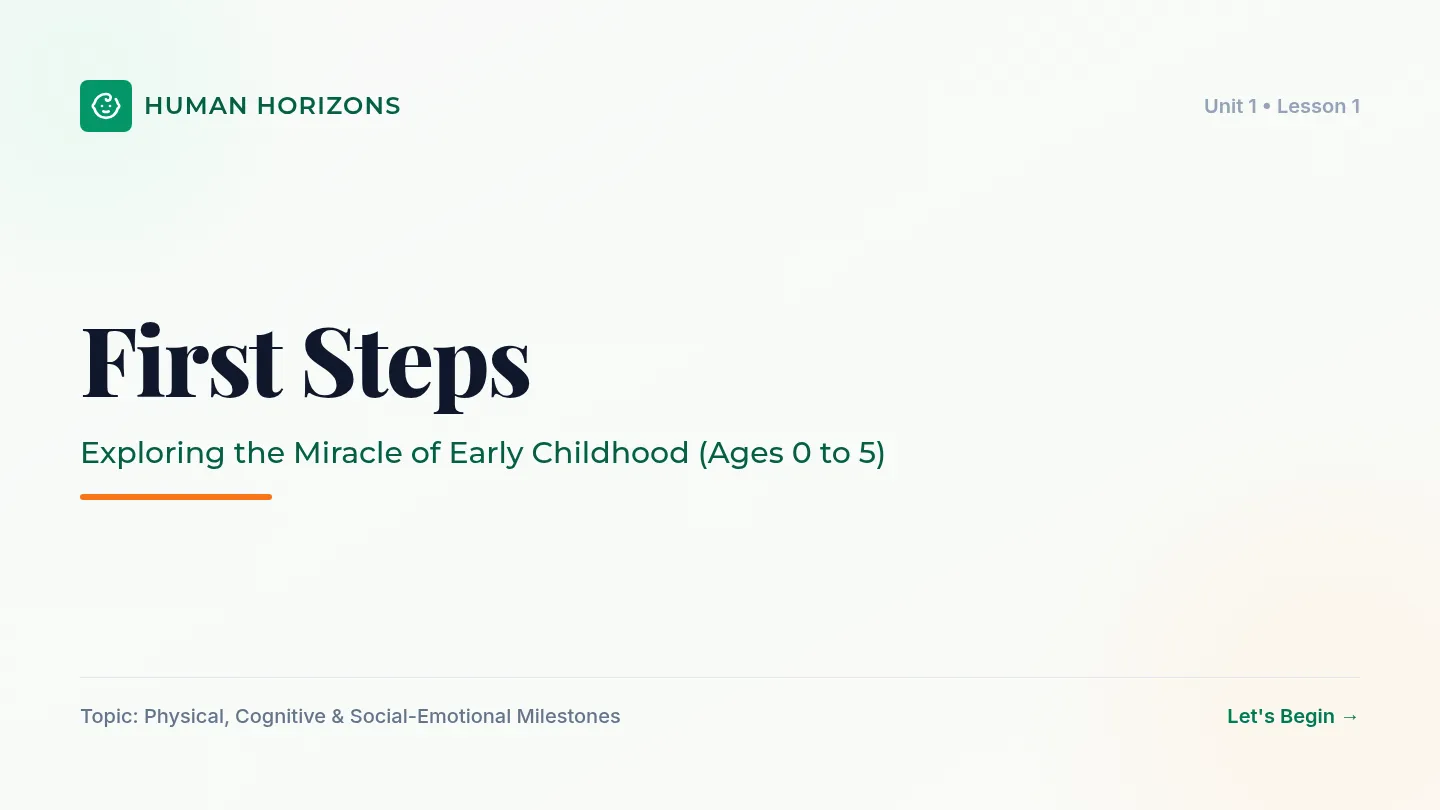
Modern Milestone Slides The Modern Milestone
Emerging Adulthood & The Social Clock
Developmental Psychology: Unit 4.1
The "Social Clock"
The culturally preferred timing of social events such as marriage, parenthood, and retirement.
Key Question:
"Am I on time or am I behind?"
Culturally Defined
Generational Shifts
Psychological Pressure
Emerging Adulthood (Ages 18–25)
Identity Exploration
Working out who they are, especially in love and work.
Instability
Frequent moves, job changes, and relationship shifts.
Self-Focused
Few ties that entail daily obligations to others.
Feeling In-Between
Neither an adolescent nor a full adult.
Possibilities
Optimism; the belief that life will turn out well.
Jeffrey Arnett argues that industrialization and the need for more education have created this new developmental stage between adolescence and full adulthood.
Erikson's Stage 6
Intimacy vs. Isolation
The challenge of forming deep, committed relationships versus the risk of social withdrawal.
Successful outcome: Love
Prerequisite: Strong sense of Identity
Why Identity First?
"To have a firm identity is to know who you are and where you are going. Without it, the fear of 'losing yourself' in another person makes true intimacy impossible."
The Shifting Timeline: 1960 vs. Today
1960 Averages
Median Marriage Age (M) 22.8
Median Marriage Age (F) 20.3
Home Ownership (by 25) ~40%
Today Averages
Median Marriage Age (M) 30.5
Median Marriage Age (F) 28.6
Home Ownership (by 25) ~25%
How does this delay impact psychological development?
Social Clock Tracker Worksheet Social Clock Tracker
Milestone Analysis Worksheet
NAME:
DATE:
Part 1: Your Timeline of Expectations
Based on your current goals and cultural influences, at what age do you expect to achieve the following milestones? If a milestone is not part of your plan, write "N/A".
Finish Formal Education
Enter Your Preferred Career
Move Out of Parents' Home
Become "Financially Independent"
Get Married (if desired)
Buy Your First Home
Have Your First Child (if desired)
Feel Like a "True Adult"
Part 2: Comparative Analysis
Milestone 1960 National Avg. Modern National Avg. Class Avg. Marriage (Men/Women) 23 / 20 30 / 28 Home Ownership Age 24 Age 33 Birth of First Child Age 21 Age 27
Reflection: Why has the "Social Clock" shifted so significantly in the last 60 years?
Part 3: Arnett's Characteristics
Choose one of Arnett’s five characteristics (Identity Exploration, Instability, Self-Focused, Feeling In-Between, Possibilities) and explain how it manifests in your own life or the lives of young adults you know.
Characteristic:
Emerging Adulthood Teacher Guide Teacher Resource
Emerging Adulthood Guide
Lesson 1: The Transition to Young Adulthood
Sequence: Longitudinal Development
Time Allotment: 60-90 Minutes
Learning Objectives
Define the "Social Clock" and explain how it varies by culture and era.
Identify and analyze Jeffrey Arnett's five characteristics of "Emerging Adulthood."
Explain Erikson's stage of Intimacy vs. Isolation and its relationship to identity development.
Materials Needed
• Modern Milestone Slides
• Social Clock Tracker Worksheet
• Student access to classroom data (whiteboard/polling)
Instructional Flow
0-15m
The Hook: Expectations
Students complete Part 1 of the Social Clock Tracker Worksheet . Encourage them to be honest—this is their personal expectation, not necessarily the "right" answer. Collect class averages for marriage age and home ownership anonymously.
15-40m
Direct Instruction: Modern Milestones
Present the Modern Milestone Slides . Contrast the class averages with the 1960 vs. Today statistics. Focus on the psychological impact of the "delay" in milestones (education debt, career searching, etc.).
40-60m
Deep Dive: Arnett & Erikson
Discuss Erikson's Stage 6. Key Concept: Why must a person "know themselves" (Identity) before they can truly "give themselves" (Intimacy)? Transition to Arnett's characteristics. Is emerging adulthood a new stage or just delayed adolescence?
Discussion Questions
"If the social clock no longer exerts pressure to marry by age 22, does that reduce or increase anxiety for your generation?"
"Is 'Emerging Adulthood' a phenomenon limited to wealthy industrialized nations? Why or why not?"
"How does social media influence our perception of the social clock? Does seeing peers' milestones make you feel 'behind'?"
"In Erikson's model, can a person skip Intimacy and still achieve psychological growth?"
Evaluation: The reflection question on Part 2 of the worksheet serves as the primary formative assessment for this lesson.
Middle Adulthood Slides The Purposeful Years
Middle Adulthood & The Drive for Generativity
Developmental Psychology: Unit 4.2
Erikson's Stage 7 (Ages 40–65)
Generativity
A concern for establishing and guiding the next generation.
• Parenting and mentoring
• Community involvement
• Creative production
Stagnation
A sense of failure or absence of meaningful participation.
• Self-absorption
• Lack of interest in young people
• "What's in it for me?"
The Virtue: Care
Successful navigation leads to a capacity for unconditional concern for others.
The Midlife Crisis: Myth vs. Reality
The Pop-Culture Myth
A period of radical upheaval (quitting jobs, buying sports cars) triggered by the fear of aging and death.
Data check: 90% of people DO NOT experience a crisis.
The Psychological Reality
A Midlife Transition . A period of reflection where individuals re-evaluate goals and priorities.
Focus on "time left" vs. "time lived"
High life satisfaction for most
Gradual adjustments, not abrupt crises
The Sandwich Generation
Aging Parents
Health care, emotional support, financial aid
YOU
(Middle Adulthood)
Children / Young Adults
Education, guidance, "Emerging" support
The psychological stress of middle adulthood often comes from being pulled in two directions by those who need care.
Dear Adulthood Advice Worksheet Dear Adulthood
Midlife Psychology Case Studies
NAME:
DATE:
Instructions: You are a leading developmental psychologist with a syndicated advice column. Below are three letters from individuals in middle adulthood (ages 40–65). For each letter, diagnose the psychological state using Erikson's theories or midlife crisis/transition concepts, then provide actionable advice .
Case #1: "The Empty Nest"
"Dear Dr. Psych, I'm 52 years old. My youngest just left for college, and my house feels silent. I’ve spent 25 years building my career and raising kids, and now I feel... nothing. I look at my younger coworkers and feel annoyed by their energy. I don't see the point in starting new projects at work. It feels like I've reached the end of my 'useful' life. Is this it?" — Searching in Seattle
Theoretical Diagnosis
(Apply Erikson's Stage 7 concepts here)
Advice for the Client
(How can they move toward generativity?)
Case #2: "The Sudden Shift"
"Dear Dr. Psych, I'm 46. Last month, I quit my job at the bank, sold my minivan, and bought a vintage motorcycle. My wife thinks I’m losing my mind. I just felt like I was suffocating under the weight of my bills and my routine. I need to feel 'alive' again before it's too late. I’m not crazy, I’m just... finding myself. Right?" — Revving in Richmond
Theoretical Diagnosis
(Is this a 'Crisis' or a 'Transition'? Explain why.)
Advice for the Client
(What are the risks/benefits of this shift?)
Case #3: "The Squeeze"
"Dear Dr. Psych, I’m 49 and I’m exhausted. I work 50 hours a week, then go straight to my parents' house to help my dad with his physical therapy and manage my mom's dementia care. Meanwhile, my 22-year-old son just moved back into his old bedroom because he can’t find a job. I feel like I’m being crushed from both sides. When do I get to live for me?" — Squeezed in St. Louis
Theoretical Diagnosis
(Identify the specific generational phenomenon here.)
Advice for the Client
(Suggest a psychological coping mechanism.)
Concluding Synthesis
Based on these three cases, why do many psychologists now prefer the term "Midlife Transition" over "Midlife Crisis" ?
Midlife Advice Answer Key Teacher Resource
Dear Adulthood Answer Key
Lesson 2: Midlife Transitions & Generativity
Instructional Key & Discussion Guide
Case #1: "The Empty Nest" (Searching in Seattle)
Theoretical Diagnosis
Stagnation. The client is experiencing a lack of purpose after their primary "generative" role (parenting) has shifted. Their annoyance with younger coworkers indicates a disconnect from the "next generation," a hallmark of stagnation.
Advice for the Client
Encourage the client to find new avenues for Generativity . This could include mentoring younger coworkers, volunteering, or engaging in creative hobbies that leave a "legacy." Reframe the "Empty Nest" as an opportunity for expansion, not an end.
Case #2: "The Sudden Shift" (Revving in Richmond)
Theoretical Diagnosis
Midlife Transition (Pop-Culture Crisis). While this looks like a stereotypical "crisis," psychologists would analyze if this is a healthy re-evaluation of identity or an impulsive escape. The client is reacting to a sense of "suffocation" by routine.
Advice for the Client
Validate the need for Self-Actualization but advise against permanent destructive changes (quitting job without a plan). Suggest incremental changes that provide a sense of freedom without destroying the support systems built in early adulthood.
Case #3: "The Squeeze" (Squeezed in St. Louis)
Theoretical Diagnosis
The Sandwich Generation. The client is under extreme psychological stress due to "multigenerational caregiving." They are providing for both an emerging adult child and aging parents simultaneously, leading to burnout.
Advice for the Client
Recommend Respite Care and setting boundaries. The son should be encouraged to contribute (Emerging Adulthood responsibility). Psychologically, the client needs to acknowledge their limits to avoid Stagnation caused by overwhelming burden.
Synthesis Discussion Points
Transition vs. Crisis: Transition implies growth and adjustment; Crisis implies breakdown. Most middle-aged people report high satisfaction.
Gender Differences: Historically, men were viewed through career/identity "crises," while women were viewed through the "empty nest." Modern research shows these experiences are becoming more similar as social roles converge.
Cognitive Aging Slides The Aging Mind
Cognitive Trajectories & Intelligence
Developmental Psychology: Unit 4.3
Cattell's Dual Intelligence Model
Fluid Intelligence
Our ability to reason speedily and abstractly; used when solving novel logic problems.
Logic Puzzles
Mental Rotation
Tends to decrease with age
Crystallized Intelligence
Our accumulated knowledge and verbal skills; increases with experience and education.
Vocabulary
Historical Facts
Tends to increase with age
How We Study Aging Minds
Cross-Sectional Method
Testing different people of various ages at the same time.
Bias: Cohort effects (Education, Nutrition).
Longitudinal Method
Retesting the same people over a long period.
Discovery: Intelligence remains stable until late in life.
Crystallized Fluid
Age 25 Age 50 Age 75
Debunking Stereotypes
"Senile" at 70?
Only 5% of adults over 65 suffer from dementia. Aging does not equal cognitive loss.
No New Tricks?
Neuroplasticity continues throughout life. Older adults can learn complex skills; it just takes longer.
The Wisdom Gap
Social expertise and empathy often PEAK in late adulthood.
Cognitive Intelligence Lab Worksheet Cognitive Lab 4.3
Measuring Dual Intelligence Types
NAME:
DATE:
Part 1: The Speed & Logic Challenge
TIME LIMIT: 2 MINUTES
This section measures Fluid Intelligence : your ability to reason abstractly and solve novel problems under time pressure.
1. Mental Rotation:
Imagine a 3D letter "L". Rotate it 90 degrees clockwise, then flip it horizontally. Draw what it looks like now:
2. Pattern Completion:
Sequence: 2, 4, 8, 16, 32, ... What is the 10th number in this sequence?
3. Logical Analogies:
Lighthouse : Ships :: Radar : ________
Composer : Symphony :: Architect : ________
Part 2: The Knowledge & Vocabulary Vault
NO TIME LIMIT
This section measures Crystallized Intelligence : your accumulated knowledge and verbal skills.
Define the following terms:
Ambivalent:
Paradigm:
Loquacious:
General Knowledge:
Who wrote "The Republic"?
In what year did the French Revolution begin?
Laboratory Analysis
Hypothesis Comparison:
If you gave this lab to your grandparents, in which part would they likely outperform you? Why?
Biological Conclusion:
Explain how the "aging" of the nervous system specifically affects the results of Part 1.
Cognitive Intelligence Lab Key Teacher Resource
Cognitive Lab Answer Key
Lesson 3: Cognitive Trajectories
Scoring & Discussion Facilitation
Part 1: Fluid Intelligence (Fluidity/Speed)
1. Mental Rotation: The "L" should be a backwards/inverted horizontal "L". Note: Older adults struggle with this due to slower neural processing speed in the parietal lobes.
2. Pattern Completion: 1,024. (Sequence is \(2^n\). The 10th number is \(2^{10}\)).
3. Logical Analogies:
Radar : Airplanes/Pilots
Architect : Building/Blueprint
Part 2: Crystallized Intelligence (Accumulated Knowledge)
Vocabulary Definitions:
Ambivalent: Having mixed feelings or contradictory ideas about something.
Paradigm: A typical example or pattern of something; a model.
Loquacious: Tending to talk a great deal; talkative.
General Knowledge:
Who wrote "The Republic"? Plato
French Revolution Date: 1789
Laboratory Analysis: Discussion Guide
Why do grandparents win Part 2?
Crystallized Intelligence is cumulative. It relies on the semantic memory system, which actually strengthens over decades of reading, conversing, and living. Older adults have a larger "mental library" to pull from.
Why do teens win Part 1?
Fluid Intelligence is highly dependent on Processing Speed and Working Memory capacity. Biological aging involves a gradual slowing of neural transmission (myelin degradation) and a slight decrease in frontal lobe efficiency, affecting tasks that require rapid, novel reasoning.
Late Adulthood Slides The Golden Harvest
Late Adulthood & The Search for Integrity
Developmental Psychology: Unit 4.4
Erikson's Stage 8 (Ages 65+)
Integrity vs. Despair
A life review. Can I look back on my life and say, "It was good"?
The Virtue: Wisdom
Informed and detached concern with life itself in the face of death.
Integrity
Acceptance of one's one and only life cycle as something that had to be and that, by necessity, permitted no substitutions.
Despair
The feeling that time is now too short to attempt another life or to try out alternate roads to integrity.
Theories of Social Adjustment
Activity Theory
The more active and involved older adults are, the more likely they are to be satisfied with their lives.
"Stay busy, stay happy."
Disengagement Theory
Aging is an inevitable, mutual withdrawal resulting in decreased interaction between the person and society.
"Stepping back gracefully."
Which theory fits the centenarians we observed better?
Socioemotional Selectivity Theory
As we age, we become more selective about our social networks.
Focus on meaningful relationships
Discarding high-conflict ties
Maximizing positive emotional gain
Inner Circle Only
Aging Resilience Organizer Worksheet The Resilience Matrix
Late Adulthood & Successful Aging
NAME:
DATE:
Part 1: Theoretical Landscapes
Theory Core Definition Psychological Outcome Activity Theory Disengagement Theory Socioemotional Selectivity
Part 2: The Resilience Checklist
As you view the interviews with centenarians, identify examples of the following types of resilience:
Biological Resilience
(Diet, activity, genetics, sensory compensation)
Psychological Resilience
(Optimism, sense of control, Erikson's "Integrity")
Part 3: Integrity Analysis
Based on Erikson's Stage 8, how does a person differentiate between a life of Integrity and a life of Despair ? Provide one specific indicator for each.
Indicator of Integrity:
Indicator of Despair:
Ref: Erikson (1950), Cummings & Henry (1961), Carstensen (1991).
Late Adulthood Discussion Cards Centenarian Analysis Cards
Discussion prompts for analyzing late adulthood interviews.
The Life Review
"When the individual looks back, do they highlight specific accomplishments or specific relationships? How do they frame their mistakes?"
Erikson: Integrity Analysis
Social Selectivity
"Who does the person mention most frequently? Do they discuss a large circle of acquaintances or a small, deeply intimate group of family and friends?"
Carstensen: Social Networks
Emotional Balance
"Does the interviewee focus more on positive memories (The Positivity Effect) or do they dwell on grievances and hardships? Why might this shift occur in late life?"
Psychological Resilience
Legacy Advice
"What advice does this centenarian offer to 18-year-olds? How does this advice reflect their attainment of 'Wisdom'?"
Virtue: Wisdom
Teacher Note:
Use these cards for small group discussion after viewing the centenarian interviews. Each group can be assigned one card to present their findings back to the class, linking the qualitative interview data to the psychological theories from the slide deck.
Biographical Mapping Slides The Human Trajectory
Synthesizing the Adult Lifespan
Biographical Analysis Project
The Capstone Challenge
Your goal is to apply every theory we've learned to a real life story.
Required Elements:
Arnett's Emerging Adulthood
Erikson's Stages 6, 7, & 8
The Social Clock Analysis
Cognitive Aging Types
Option A: The Public Figure
Research a historical or public figure with a completed or near-completed life trajectory.
Option B: The Senior Community Member
Conduct a structured interview with an elder to map their unique journey.
Analysis Levels
Chronicle
What happened?
Listing major life events: jobs, marriages, births, relocations.
Application
Why did it happen?
Linking events to Erikson's crises or the pressure of the Social Clock.
Synthesis
What does it mean?
Evaluating successful aging and the attainment of Wisdom vs. Despair.
"A life is more than a list of facts; it is a psychological narrative."
Lifespan Mapping Project Template Developmental Dossier
Biographical Lifespan Analysis : Case File #
RESEARCHER:
SUBJECT NAME:
Subject Demographics
Birth Year:
Current Age/Status:
Key Occupation:
Social Era:
Insert Image/Sketch
Phase I: Emerging & Early Adulthood
The Social Clock
Did the subject meet milestones "on time" for their era?
Intimacy vs. Isolation
Describe the formation of primary long-term relationships.
Phase II: Generativity & Stability
Generativity Type
How did they contribute to the next generation? (Kids, work, mentorship)
The Midlife Transition
Did they experience a period of re-evaluation? Describe the outcome.
Phase III: Integrity & Wisdom
Aging Theory Application
Does the subject best fit Activity, Disengagement, or Selectivity?
Integrity vs. Despair
Evidence for the subject's final psychological resolution.
Researcher's Summary: The Core Narrative
Synthesize the subject's life. What was the defining developmental theme?
Biographical Analysis Teacher Guide Teacher Resource
Project Guide & Hook
Lesson 5: Biographical Analysis Culmination
The Hook: Mystery Subject #01
Read these developmental clues to the class. Students must identify the figure and the developmental stage being described.
Clue 1 (Early Adulthood): "At 24, I was an aspiring writer and performer in Egypt, searching for my voice after a traumatic childhood. I struggled with the 'Identity' stage but found 'Intimacy' in the vibrant artistic community of the 1950s."
Clue 2 (Middle Adulthood): "In my 40s, I became a professor and a global activist. My 'Generativity' was expressed through my autobiography, I Know Why the Caged Bird Sings , which mentored millions of young people."
Clue 3 (Late Adulthood): "I lived to 86, becoming a 'Wise Elder.' I focused my social energy only on those who brought light into my life (Social Selectivity) and looked back with immense 'Integrity' at my journey."
Answer: Maya Angelou
Lifespan Dossier Rubric
Criteria Exceeds (4) Meets (3) Approaching (2) Theoretical Accuracy All stages (Erikson, Arnett) correctly applied with specific evidence from the subject's life. Most stages applied correctly; evidence is generally relevant. Theories mentioned but misapplied or lacking supporting evidence. Social Clock Analysis Deep analysis of how the subject's era influenced their timing and psychological pressure. Identifies era-appropriate milestones; links to Social Clock concept. Lists milestones without era-specific context or psychological analysis. Cognitive & Social Synthesis Comprehensive link between late-life theories (Activity/Selectivity) and the subject's behavior. Identifies at least one late-life theory and applies it to the subject. Late-life analysis is superficial or missing theoretical terminology. Dossier Presentation Narrative is cohesive, insightful, and presented with professional "archival" care. Information is organized and clear; follow the dossier structure. Organization is confusing; sections are incomplete or rushed.