Independence Slides Presentation Lesson 01 // Emerging Adulthood
Independence Shift
Evaluating the distinct developmental bridge between adolescence and full adulthood.
PSY-342: Developmental Dossier
Is 30 the new 20?
Consider the "social clock." In 1970, the median age for first marriage was 21 for women and 23 for men. Today, those numbers are nearly 28 and 30.
The Milestone Lag
Why are traditional markers of adulthood (marriage, home ownership, parenthood) being pushed later into the lifespan?
Factor A
Educational Extension
The requirement of advanced degrees for "living wage" careers.
Factor B
Economic Precarity
Rising housing costs vs. stagnant real wages for young workers.
"A time of relative freedom from roles and social expectations."
— Jeffrey Jensen Arnett (2000)
Identity Exploration
Trying out possibilities, especially in love and work.
Instability
Frequent changes in residence, jobs, and partners.
Self-Focused
Developing knowledge, skills, and self-understanding.
Feeling In-Between
Not an adolescent, but not yet fully an adult.
Possibilities
Optimism about the future; life remains unwritten.
Luxury or Stage?
Is Emerging Adulthood a universal developmental stage, or a "luxury" afforded only to the wealthy in Western industrial nations?
Collectivist cultures prioritize family obligation over self-exploration.
Low SES youth often enter full adulthood (and work) much earlier.
Gender expectations influence the "freedom" to explore.
Discussion
"How does the lack of a 'safety net' (financial or familial) change the psychological experience of being 22?"
Milestone Shift Worksheet Milestone Shift
Dossier #01-A // PSY-342: Adulthood and Aging
Subject Identity
Analytical Objective
Analyze the shifting timeline of adult milestones. Compare historical census data with modern trends to evaluate the psychological implications of "delayed adulthood."
Part I: Comparative Metrics
Adulthood Milestone Median Age (1970) Median Age (2020) Psychological Pivot First Marriage (Women) 20.8 28.1 Autonomy vs. Commitment First Marriage (Men) 23.2 29.8 Provider Role Delay First Child Born 21.4 26.9 Transition to Caregiving Completing Education 21.0 23.5 Extended Identity Lab
1. Identify the largest numerical shift in the table above. What socioeconomic factor likely drives this specific delay?
2. Arnett argues that "feeling in-between" is a core feature of this stage. How might delaying marriage contribute to or mitigate this feeling?
Part II: Theoretical Critique
"Emerging Adulthood is not a universal stage, but a culturally constructed one. In many parts of the world, youth transition directly from adolescence to adulthood out of necessity." — Researcher Commentary
3. Class Divide: Compare two hypothetical 22-year-olds. Person A is in graduate school supported by parents. Person B is working two service jobs to support a younger sibling. Which of Arnett’s "5 Features" (Identity Exploration, Instability, Self-Focused, In-Between, Possibilities) does Person B likely NOT experience? Why?
4. Synthetic Reflection: Does the "Social Clock" still exist in 2026, or has it been replaced by an individualized timeline? Defend your position using one piece of evidence from today’s discussion.
Love Bonds Slides Presentation Lesson 02 // Psychosocial Bonds
Love Bonds
Navigating the transition from infant attachment to adult intimacy.
The Shadow of the Past
How we were held as infants dictates how we hold others as adults. Hazan and Shaver (1987) established that attachment styles are relatively stable across the lifespan.
60%
Secure: Comfort with intimacy and autonomy.
20%
Avoidant: Dismissive of intimacy; overly self-reliant.
20%
Anxious: Preoccupied with abandonment fears.
Intimacy vs. Isolation
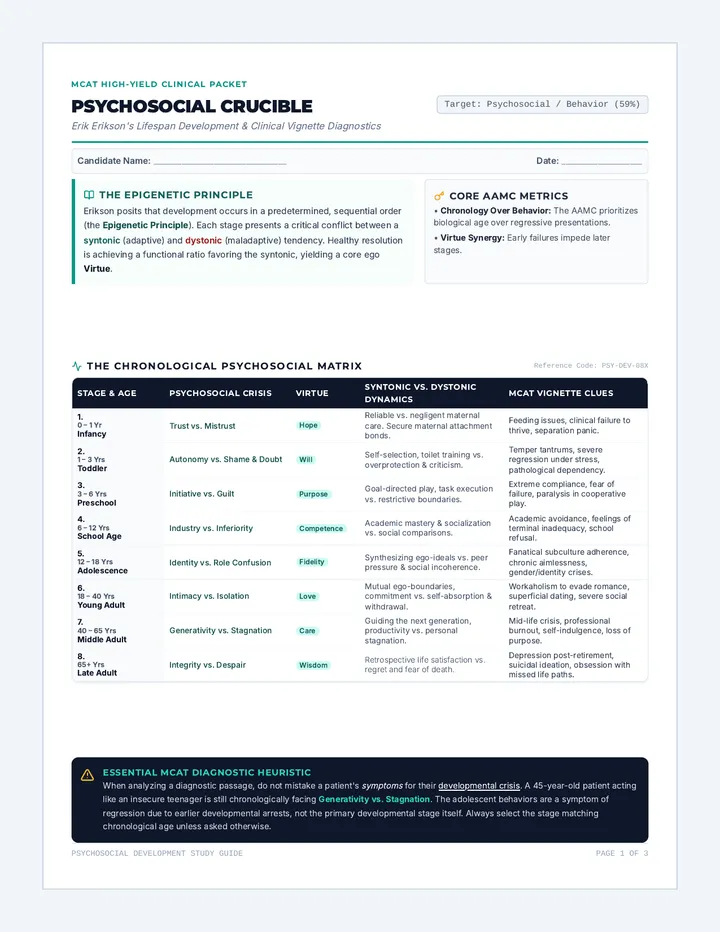
Erikson's 6th Stage: The capacity to fuse one's identity with another without fear of losing it.
Sternberg’s Triangular Theory of Love
INTIMACY
Emotional connection
PASSION
Physical attraction
COMMITMENT
Decision to stay
Romantic Love
Companionate Love
Fatuous Love
CONSUMMATE
LOVE
The Four Horsemen
Gottman's research predicts divorce with 90% accuracy based on these communication patterns:
Criticism
Contempt (Best Predictor)
Defensiveness
Stonewalling
Case Study Hook
"Alex and Jordan have been together for 4 years. When they fight, Alex rolls their eyes and mimics Jordan's voice in a mocking tone. Jordan responds by leaving the room and not speaking for three days."
Identify the horsemen present in this scenario.
Relationship Case Studies Worksheet Relationship Analysis File
Psychological Assessment // Case Study 02-B
Confidential Case #771-J
Investigator Name
Date of Analysis
Sternberg's Components
• Intimacy: Closeness, warmth, sharing.
• Passion: Physical attraction, intense desire.
• Commitment: Intent to maintain the bond.
Attachment Styles
• Secure: Trusts others, comfortable with self.
• Avoidant: Fears closeness, hyper-independent.
• Anxious: Clingy, fears abandonment.
Case Alpha: Elena & Marcus Status: Married 12 years
"Elena and Marcus have three children and a stable mortgage. They rarely feel the 'sparks' they felt in their early twenties, and their physical intimacy has dwindled. However, they are each other's first phone call in a crisis, they share deeply held religious and moral values, and they cannot imagine a future without the other. They often joke that they are 'the best roommates ever.'"
Primary Love Type (Sternberg)
Supporting Evidence
Psychological Prognosis
Evaluate the long-term stability of this relationship based on intimacy vs. passion.
Case Beta: Sarah & Leo Status: Dating 6 months
"Sarah is extremely affectionate but becomes devastated if Leo doesn't text back within an hour, often sending 15-20 messages questioning if he is 'losing interest.' Leo, who values his 'me-time,' finds this suffocating. When Sarah confronts him about his lack of communication, Leo shuts down, gives one-word answers, and eventually stops responding altogether for several days."
Sarah's Attachment Style
Leo's "Horseman" (Gottman)
Relationship Intervention
Propose one psychological strategy for this couple to break their pursuit-withdrawal cycle.
Work Wisdom Slides Presentation Lesson 03 // Cognitive Evolution
Work and Wisdom
The transition from dualistic thinking to dialectical complexity in the adult brain.
Moving Beyond Piaget
While Piaget's "Formal Operations" (abstract logic) is reached in adolescence, adulthood requires **Post-Formal Thought**.
Relativism
Understanding that knowledge is not absolute but depends on context.
Dialectical Thinking
Synthesizing opposing viewpoints into a new understanding.
Pragmatism
Recognizing that the "logical" solution isn't always the "right" solution.
Adult Dilemma Example
"Your boss asks you to exaggerate safety data to secure a government contract that will save 200 jobs."
Formal Operational (Adolescent) View:
"Lying is wrong. Full stop."
Post-Formal (Adult) View:
"What is the hierarchy of harm? How do I navigate competing ethical obligations?"
Schaie’s Stages of Cognitive Development
Young Adulthood
Achieving Stage
Cognition is applied to long-term goals (career, family, identity). Knowledge is used to solve real-world problems.
"What do I need to know to get this job?"
Middle Adulthood
Responsible Stage
Concern expands to personal and professional responsibilities, including family and career management.
"How does this decision affect my team?"
Late Adulthood Transition
Executive Stage
Specific focus on social systems and organizational management; cognitive complexity peaks.
"How will this impact the next 10 years?"
Workplace Simulation
"You are the project lead. Your top performer is burning out and needs a sabbatical, but your company is facing a merger and needs their expertise to survive. How do you solve this dialectically?"
1
Identify Stakeholders
2
Map Competing Values
3
Synthesize a Solution
Ethical Dilemmas Activity Cognitive Complexity Simulation
Post-Formal Thought Workshop // Activity 03-C
Achieving
Responsible
Executive
Instructions:
Post-formal thought requires synthesizing opposing viewpoints. In the scenarios below, move beyond "Right vs. Wrong" (Dualistic Thinking) and "Everyone has their own truth" (Relativistic Thinking) to "Integration of Reality" (Dialectical Thinking).
1
Scenario: The Transparency Dilemma
"You are a Middle Manager in a tech firm. You know that layoffs are coming in 3 months. Your best employee, who just bought a house and is expecting a baby, asks you if their job is safe. If you tell the truth, they may quit early, leaving your project unfinished and risking the jobs of the other 20 people on your team. If you lie, they will make major financial commitments they cannot afford."
Dualistic Response (Adolescent Logic)
Identify the "all-or-nothing" rule-based solution.
Relativistic Response (Contextual Logic)
Identify a solution where "it depends" on personal benefit.
Dialectical Synthesis (Adult Logic)
Propose a solution that integrates the employee's well-being WITH the project's survival. How do you hold both truths?
2
Scenario: The Burnout Pivot
"A major client wants a project completed in a way that is highly profitable but ethically 'gray' regarding environmental impact. Your corporate mission statement emphasizes 'Sustainability,' but your quarterly reports are failing. Your boss tells you that without this client, the 'Sustainability' department will have to be cut entirely."
Stakeholder Mapping
Who are the competing interests here? (e.g., Environment, Employees, Shareholders)
Post-Formal Implementation
How would someone in Schaie's Executive Stage handle this, considering both the immediate profit and the long-term systemic impact?
Self-Reflection
Think about a time you had to make a "lesser of two evils" decision. Did you use formal logic or post-formal synthesis?
Midlife Meaning Slides Presentation Lesson 04 // Midlife Psychosocial
Midlife Meaning
Deconstructing the "Crisis" and understanding the imperative of Generativity.
The "Crisis" Myth
Popular media depicts the midlife crisis as a sudden, radical break (sports cars, affairs, quitting jobs). Empirical data suggests a different story.
Media Depiction
Sudden, irrational psychological collapse around age 45.
The Reality: Midlife Correction
A gradual re-evaluation of goals and values. Most report *increasing* life satisfaction.
"Only 10-12% of US adults experience a 'crisis'—often triggered by life events (illness, divorce), not age."
Research: MIDUS Study (Lachman, 2012)
"I am what survives me."
— Erik Erikson (Stage 7)
Generativity
The desire to contribute to the next generation and ensure the continuity of society.
Parenting & Grandparenting
Mentoring & Teaching
Creative Work & Civic Activism
Stagnation
Self-absorption and a lack of psychological growth; feeling that one has contributed nothing.
"Midlife plateau"
Focus on personal comfort over social good
Lack of interest in "leaving a legacy"
The Sandwich Generation
Middle-aged adults who are simultaneously caring for their aging parents and their own children.
The Psychological Toll:
Role Overload (Chronic Stress)
"Generative Tension" (Wanting to help all, but lacking time)
Financial strain of dual-caregiving
"How does the pressure of caregiving compete with the need for personal 'generativity'?" Midlife Myth Organizer Worksheet Midlife Myth Organizer
Dossier #04-D // Empirical Reality vs. Cultural Narrative
Subject: Generativity Assessment
Part I: The "Midlife Crisis" Deconstruction
Watch the assigned media clip (e.g., from *American Beauty* or *The Sopranos*) and compare it to the psychological data discussed in class.
Cultural Myth (Media)
Common Behaviors Depicted:
...
Underlying Motivation:
...
Empirical Reality (Research)
Actual Frequency & Triggers:
...
Concept: "Midlife Correction"
...
Part II: The Generativity Audit
McAdams (2001) argues that generativity is expressed through Biological (having kids), Parental (nurturing kids), Technical (passing on skills), and Cultural (passing on meaning) modes.
Case Study: The "Stagnant" CEO
"Richard is 52. He is at the top of his field, earns a high salary, and travels frequently. However, he refuses to mentor younger associates (viewing them as threats), has little contact with his grown children, and spends his weekends alone maintaining his classic car collection. He describes himself as 'bored but comfortable.'"
Psychological Analysis:
Which generative mode(s) is Richard missing? Propose one specific action he could take to move toward the Generativity pole.
Part III: Caregiving & The "Sandwich" Tension
Synthesis Question:
In many cultures, caring for elders is viewed as a "generative act" (giving back to those who gave to you). However, in Western individualist cultures, it is often framed as a "stagnation risk" (blocking personal career/identity growth).
Reflective Response: How might the "Sandwich Generation" experience differ between a Collectivist and Individualist household? Focus on the psychological outcome (Satisfaction vs. Burnout).
Final Inquiry
Is it possible to be truly generative if you don't have children? Use McAdams' categories to defend your answer.
Personality Paths Slides Presentation Lesson 05 // Trait Evolution
Personality Paths
Mapping the "Big Five" from the turbulent 20s to the stable 50s.
The "OCEAN" of Adulthood
O
Openness
Curiosity vs. Routine
C
Conscientiousness
Organized vs. Careless
E
Extraversion
Sociable vs. Reserved
A
Agreeableness
Trusting vs. Suspicious
N
Neuroticism
Emotional vs. Calm
Core Question: Do we stay the same person, or does adult life fundamentally reshape our traits?
Two Forms of Stability
Rank-Order Stability
Relative standing compared to peers. (If you are the "loudest" at 20, you will likely be the "loudest" at 60, even if you've calmed down.)
Mean-Level Change
Average shifts across the whole population as they age. (Society as a whole becomes more agreeable over time.)
The Maturity Principle
As we age (20s to 50s), we generally see a significant increase in:
Conscientiousness
Agreeableness
Neuroticism
"The person you are now is a work in progress."
Today's workshop: Complete the BFI-10 self-assessment and plot your projected trajectory to age 50. Will you follow the "Maturity Principle," or will your unique life path defy the mean?
ACTION: Trait Mapping Simulation
Trait Trajectory Self Assessment Trait Trajectory Analysis
Life Span Projection // Assessment 05-E
Self-Audit
1
The Big Five Baseline
Based on your results from the BFI-10, plot your current scores (1-10) for each trait.
O
C
E
A
N
Reflect: Which of these scores surprised you most? Does it align with your current "Emerging Adult" role (e.g., student, intern, roommate)?
2
Projecting Age 50
Research Reference: The Maturity Principle
Most adults show significant increases in Agreeableness and Conscientiousness and a decrease in Neuroticism during their 30s and 40s.
A. Predict one trait that will change significantly for you by age 50. Why?
Think about your career path or family goals.
B. Predict one trait that will remain stable (Rank-Order Stability). Why?
What "core essence" of your personality feels unchangeable?
3
The Niche-Picking Effect
Conceptual Synthesis
The Cumulative Continuity Principle suggests that personality becomes more stable as we age because we choose environments (niches) that reinforce our existing traits.
Niche Mapping:
If you are high in Extraversion (E), you might choose a career in sales. This environment rewards extraversion, making you even more extraverted over time.
What is your current intended career/life path? How might this specific environment "reinforce" one of your current high-scoring traits?
Alternative Path:
What kind of life experience or career path would force you to change your personality? (e.g., A low-conscientiousness person joining the military).
End of Dossier // Adulthood Arc // PSY-342