An interactive exploration of Earth's shifting plates, boundary types, and the evidence for continental drift. Students will analyze how the lithosphere moves and the landforms created by these massive geological forces.
A beginner-friendly introduction to Blender 4.0, focusing on navigation, object transformations, and essential edit mode tools for 3D modeling.
A field-based science lesson where students investigate urban ecosystems, identifying and documenting plant and animal life in developed environments to understand biodiversity and environmental stewardship.
A comprehensive lesson on chemical bonding, covering ionic, covalent, and metallic bonds, electron transfer/sharing, and Lewis Dot Structures.
A hands-on laboratory investigation where students explore how varying wire coils, voltage, and core materials affect the strength of an electromagnet.
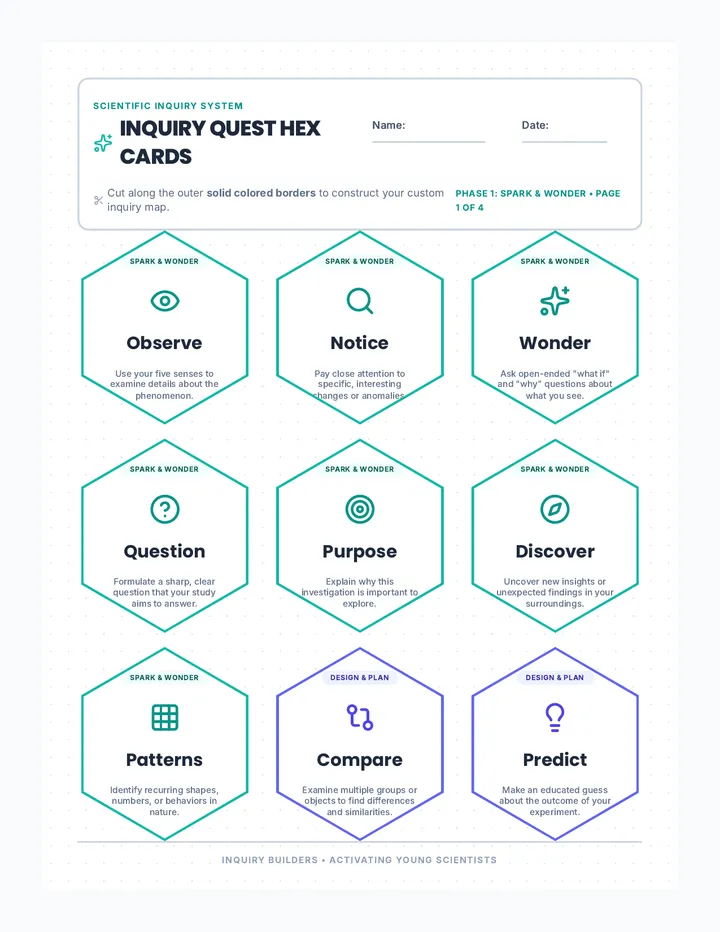
A project-based lesson where students explore the ethical hacking lifecycle. It includes research, planning, and creation phases designed for independent student work.
A 2-day independent project where students act as business managers to solve a critical company problem using the rational decision-making model. Students will research a scenario, evaluate alternatives, and present their final decision in a professional slide deck.
A comprehensive lesson to inspire and equip students to organize their own neighborhood or park cleanup for Earth Day. Includes background on Earth Day, the impact of waste, and a practical planning framework for student-led action.
A chemistry-meets-art lesson where students use aluminum foil and cola to explore hydrophobia and surface tension through lithographic printmaking. Students create their own hand-drawn designs and produce multiple editions while learning the molecular science behind the process.
A lesson teaching students how to manage and conserve Earth's vital resources (air, water, soil, energy) and the difference between point and nonpoint source pollution.
A gripping exploration of the 2010 Chilean mining disaster and the miraculous 69-day survival and rescue of 33 miners. Students will analyze the leadership, engineering, and psychological resilience required for this unprecedented operation.
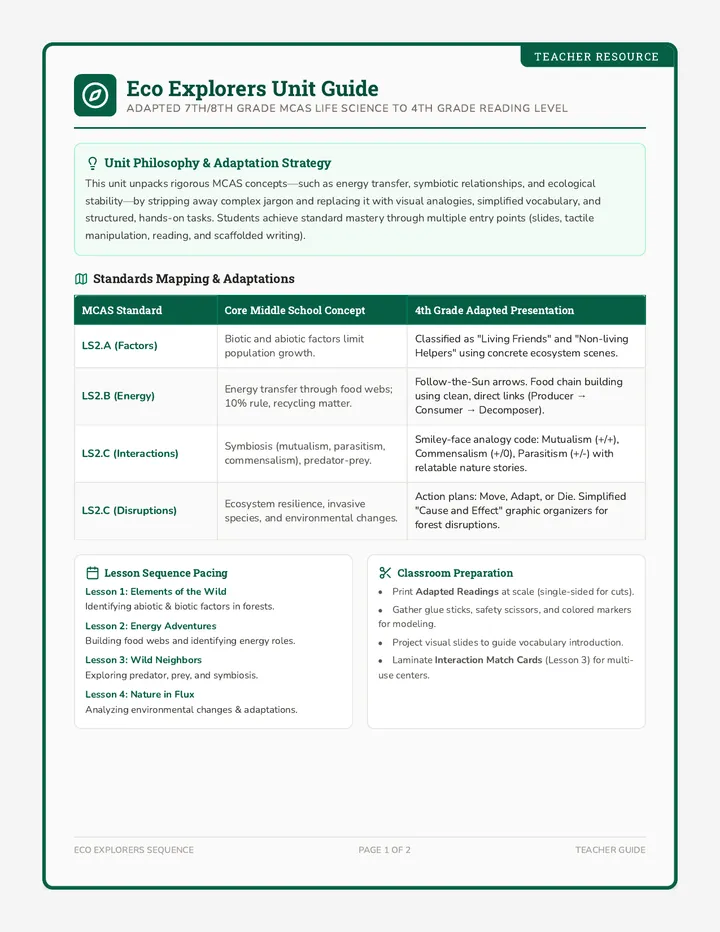
A comprehensive lesson exploring ecosystems as complex systems, focusing on food webs and subsystems across four major biomes: North American Forests, Oceans/Coral Reefs, Deserts, and Tropical Rainforests.
An outdoor-based physics lesson where high school students analyze energy transfer, friction, and momentum through real-world data collection and mathematical modeling in a courtyard setting.
A visual, step-by-step guide to mastering copper sweat soldering, designed for remedial support and multi-level learners. The lesson focuses on safety, preparation, and the physics of capillary action through clear visual cues.
Students demonstrate their mastery of plant adaptations through a creative project and a summative assessment.
Students examine structural adaptations for defense and the role of stomata in gas exchange, understanding how plants protect themselves and breathe.
Students investigate plant behaviors and tropisms, exploring how plants respond to light, gravity, touch, and temperature to optimize growth and survival.
这是一套关于动物细胞结构的教学资源,包括课堂演示文稿、标注练习和功能匹配活动,重点讲解细胞核、核糖体、高尔基体和溶酶体。
Final unit synthesis assessment and cumulative benchmark test.
Full unit review connecting molecular structures to observable pedigree patterns.
Constructing a family pedigree from a written narrative, including generation and genotype labels.
Determining dominant vs. recessive inheritance patterns from multi-generational family charts.
Identifying relationships and trait status using standardized pedigree symbols.
Final mastery benchmark for monohybrid crosses and probability scenarios.
Calculating carrier ratios and solving advanced genetic inheritance scenarios.
Probability lab using beans to compare experimental results with theoretical Punnett Square predictions.
Decoding complex monohybrid cross word problems to identify parent genotypes.
Calculating genotype and phenotype ratios and percentages from Punnett Square results.
Formative assessment on basic inheritance vocabulary and simple Punnett Square setup.
Introduction to setting up and filling in monohybrid Punnett Squares.
Simulation of random inheritance using coin flips to determine genotypes and phenotypes for a critter.
Mastering the distinction between genotype and phenotype and using homo/heterozygous prefixes.
Introduction to alleles and the history of Gregor Mendel's pea plant experiments.
Summative assessment on the differences between asexual/sexual reproduction and genetic diversity.
Comparing mitosis and meiosis, focusing on daughter cell counts and chromosome distributions.
Simulation activity comparing population growth and survival of asexual vs. sexual species during environmental crises.
Introduction to sexual reproduction, gametes, and the role of fertilization in creating genetic diversity.
Introduction to asexual reproduction, identifying organisms that use budding, fission, and fragmentation.
Summative assessment covering DNA function, genetic hierarchy, and inheritability.
Synthesis of DNA, genes, and chromosomes through vocabulary application and conceptual modeling.
Hands-on extraction of DNA from strawberries to visualize the physical substance of genetic code.
Exploration of how DNA is organized into genes and chromosomes, focusing on the hierarchy of genetic information.
Students identify the nucleus as the site of genetic material and describe the basic function of DNA as the cell's blueprint.
Students act as the final editorial team for their digital magazine, performing rigorous quality control checks on layout, links, and media to ensure the publication is ready for its public launch. This lesson concludes the magazine project with a focus on professional standards and technical accuracy.
Students learn the fundamentals of digital site architecture by planning and building the framework for their digital publication, focusing on navigation, page hierarchy, and cohesive theme selection.
A hands-on investigation into the global journey of microplastics through ocean currents, where students simulate marine gyres and design localized reduction strategies.