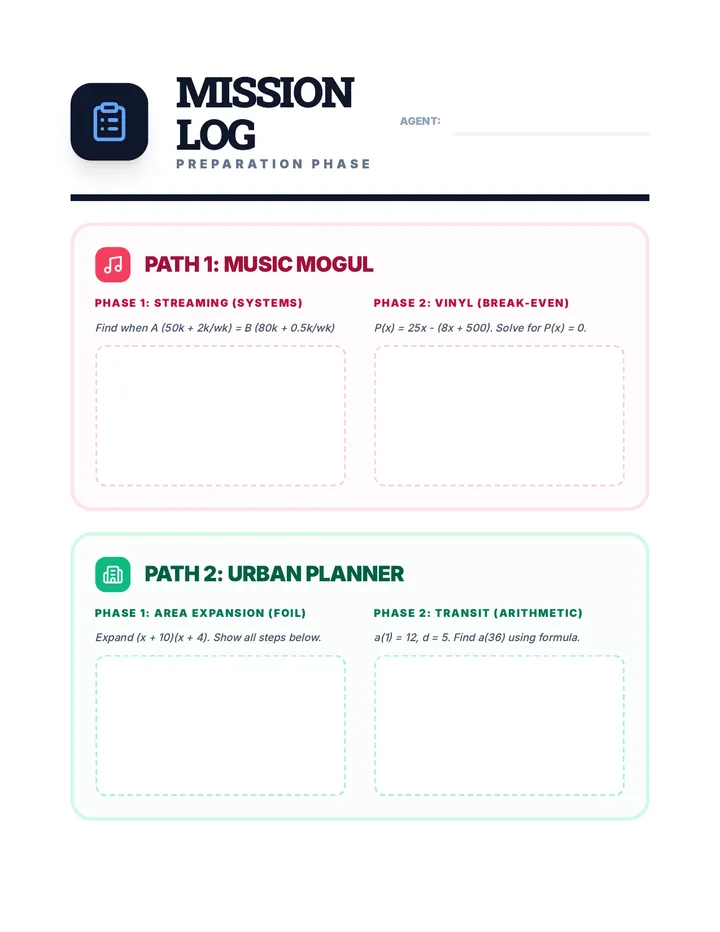
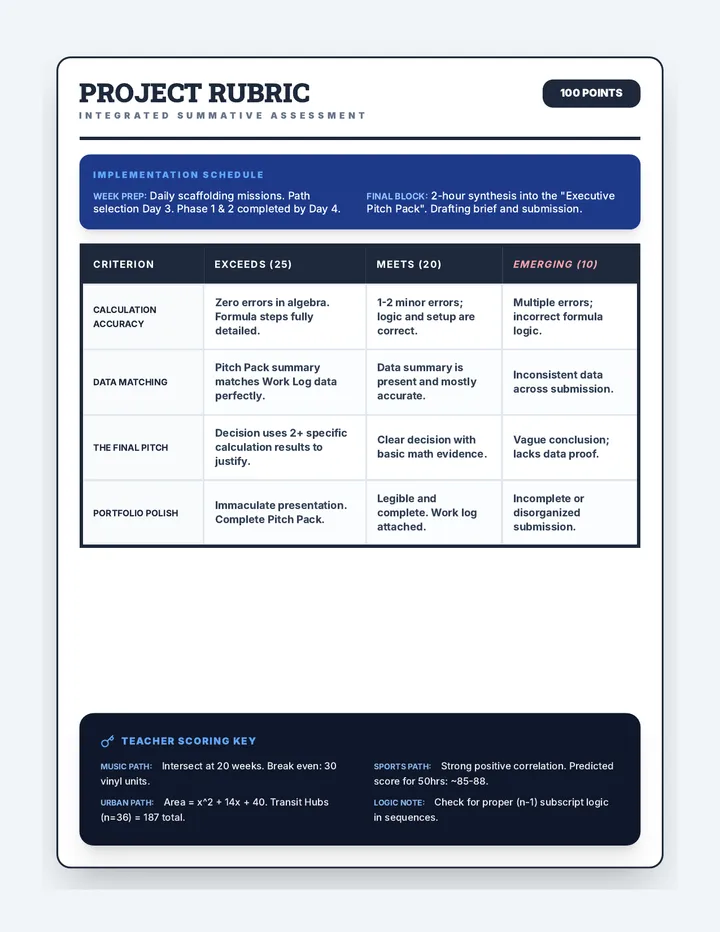
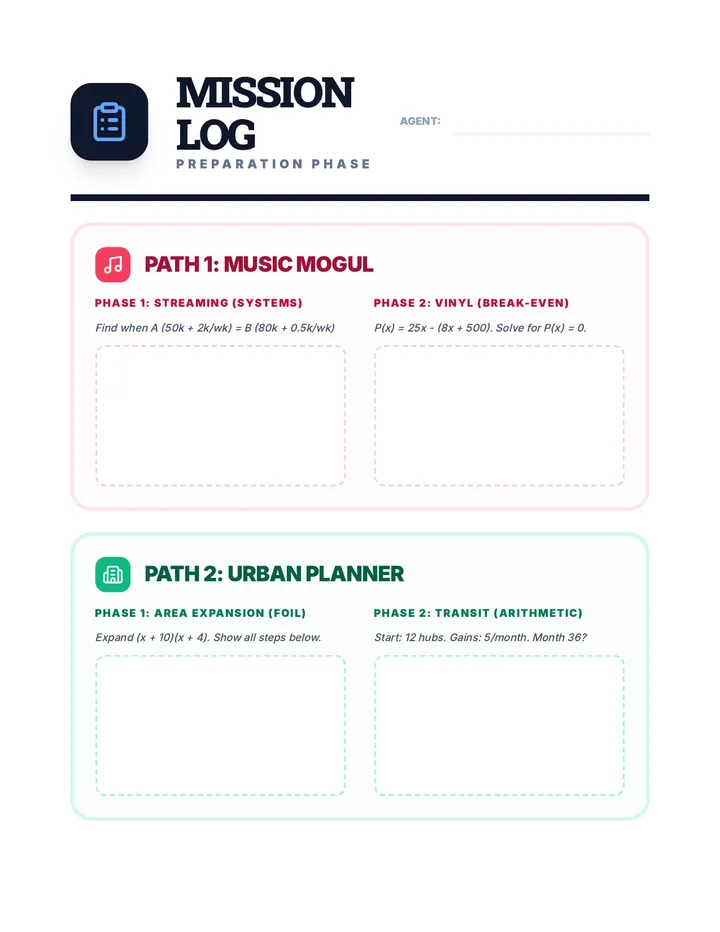
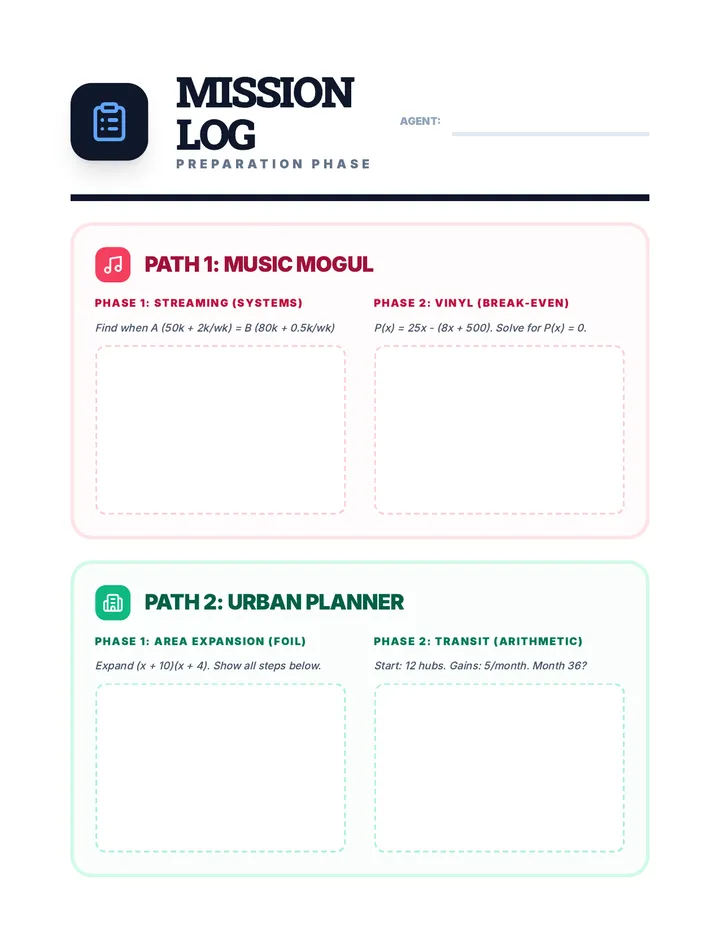
A high school math lesson focused on identifying and generalizing the pattern for factoring the difference of odd powers, using the difference of cubes and fifth powers as a foundation.

Une leçon complète sur les statistiques à une variable, couvrant la collecte de données, l'organisation en tableaux et la représentation graphique à travers divers exercices pratiques et activités d'introduction.
A comprehensive lesson covering geometric transformations (translations, reflections, rotations, and dilations) and the fundamentals of geometric proofs, including logical reasoning and triangle congruence.
A comprehensive review of exponential and logarithmic functions, focusing on graphing attributes, transformations, inverse relationships, solving equations, and data modeling based on Texas Algebra 2 standards.
A quick assessment focusing on solving quadratic equations that result in complex solutions using the Quadratic Formula and Completing the Square.
A lesson focusing on the practical application of the Distance Formula and the logical structure of SAS and ASA congruence proofs.
A comprehensive 35-minute lesson on graphing quadratic functions in standard form, covering vertex, axis of symmetry, end behavior, and zeros.
A lesson focused on the product and quotient properties of logarithms, specifically adding and subtracting logs. Designed with heavy scaffolding for a math resource setting.
This lesson introduces exponential growth and decay functions, focusing on modeling real-life situations, identifying growth and decay factors, and analyzing key attributes of exponential models. Students will transition from Algebra 1 foundations to advanced Algebra 2 applications using the standard model \(y = ab^x\).
Summative assessment covering intercepts, vertex, AOS, and solving quadratic equations using various methods.
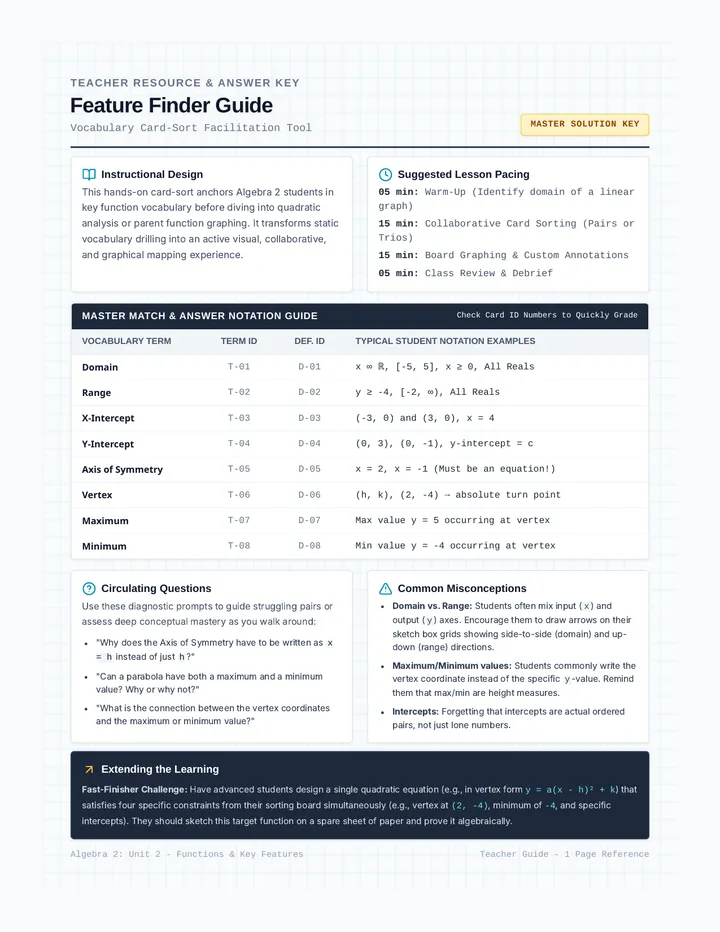
Comprehensive review of unit targets including graphing features and all solving methods.
Synthesizing solving methods (graphing, factoring, formula) and choosing the most efficient strategy for different quadratic forms.
Using the quadratic formula to solve equations and the discriminant to determine the nature of the roots.
Solving quadratic equations by factoring and identifying x-intercepts using the Zero Product Property.
Finding the vertex, axis of symmetry, and intercepts of quadratic functions from standard form equations and graphs.
A high-speed reconnaissance of basic function families, including linear, quadratic, cubic, quartic, absolute value, and radical parent functions.
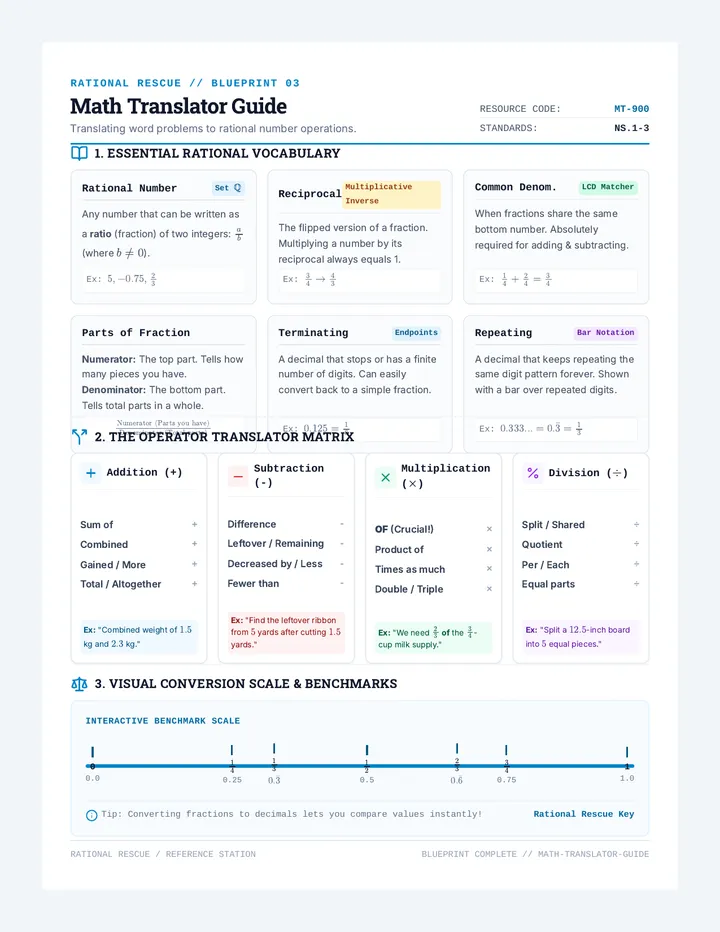
A comprehensive review of percentages for HSED learners, covering conversions, visual models, and real-world applications like tipping and discounts.
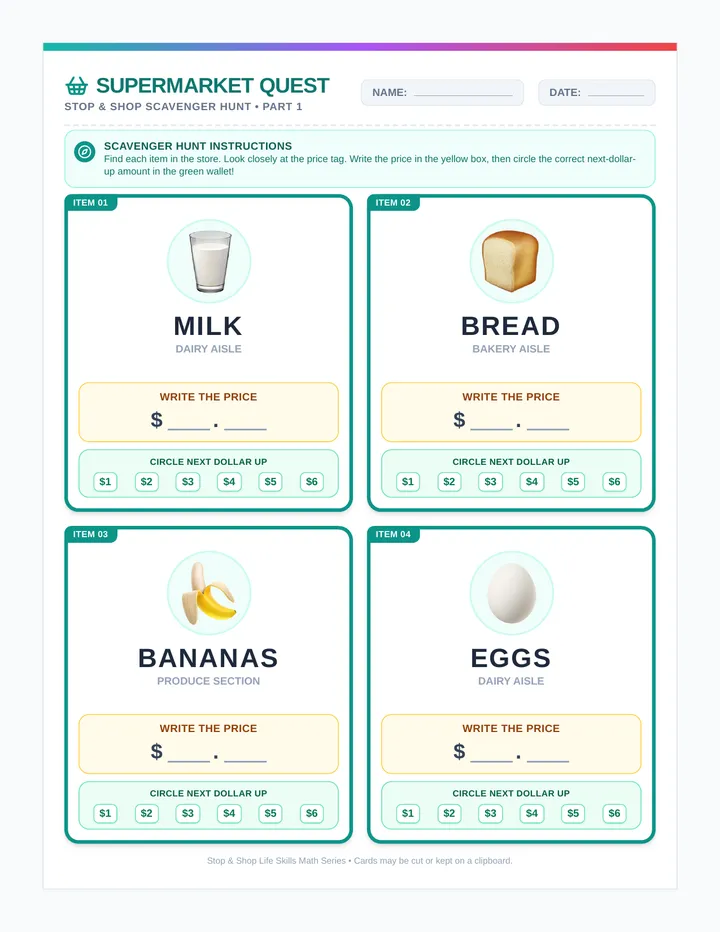
A high-energy collaborative review day. Students participate in a 'Relay Race' of unit rate tasks, moving through stations that cover whole numbers, fractions, consumer math, and measurement to reinforce skills before the final assessment.
A summative assessment covering the identification of graph features and solving quadratic equations using multiple methods.
A comprehensive review of all three methods (graphing, factoring, formula) and identifying key features to prepare for the unit assessment.
Students use the quadratic formula to solve equations that are not easily factorable, with an emphasis on identifying coefficients and simplifying the result.