Emotion recognition ranging from basic feelings to complex nuances and mixed states. Strengthens accurate self-assessment through identity exploration, strength identification, and values-based decision making.
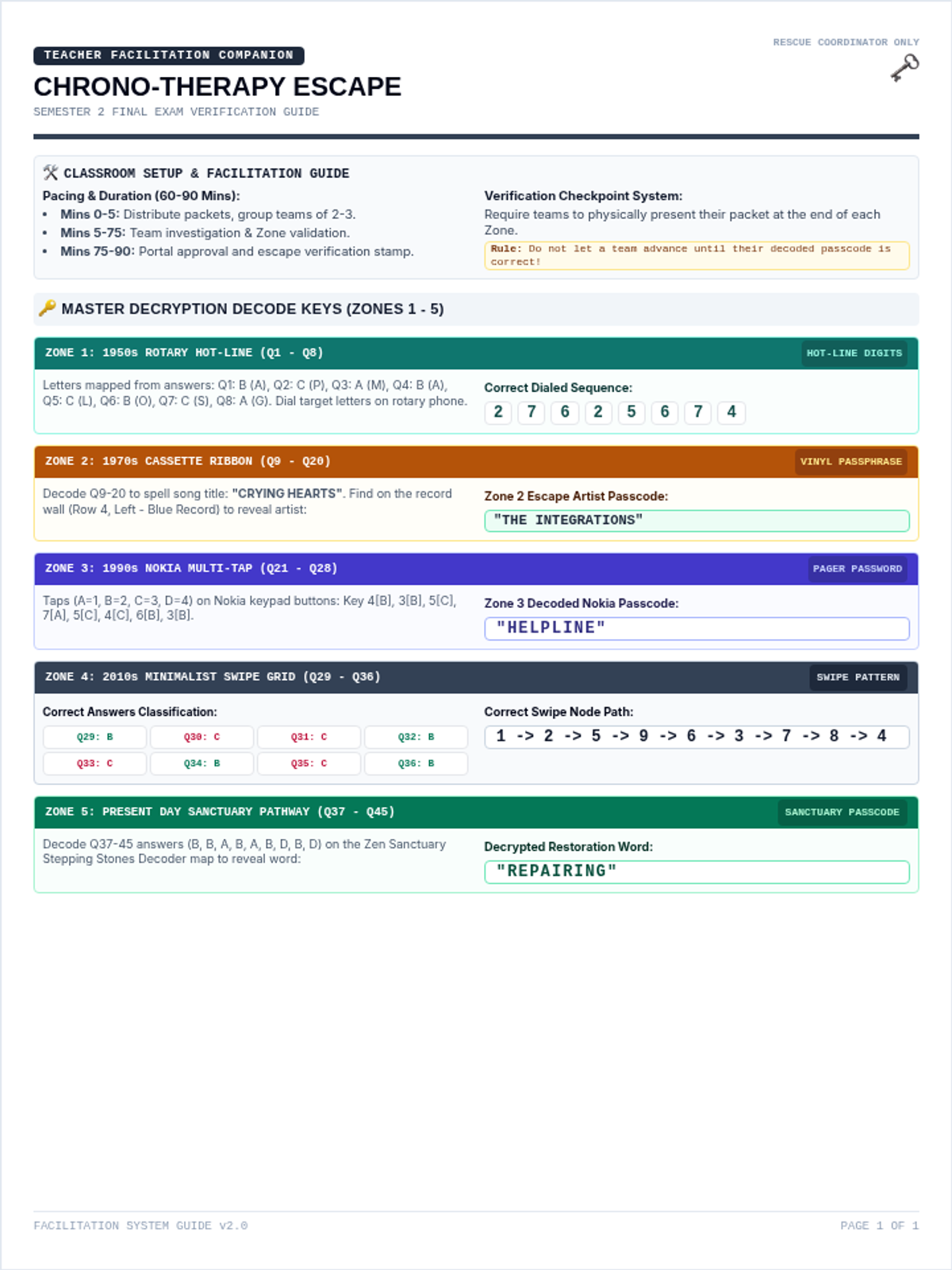
A comprehensive teacher manual for the Chrono-Therapy escape room exam. Contains the precise lock keys, rotary dials, page codes, and high-scoring exemplars for all 50 questions.
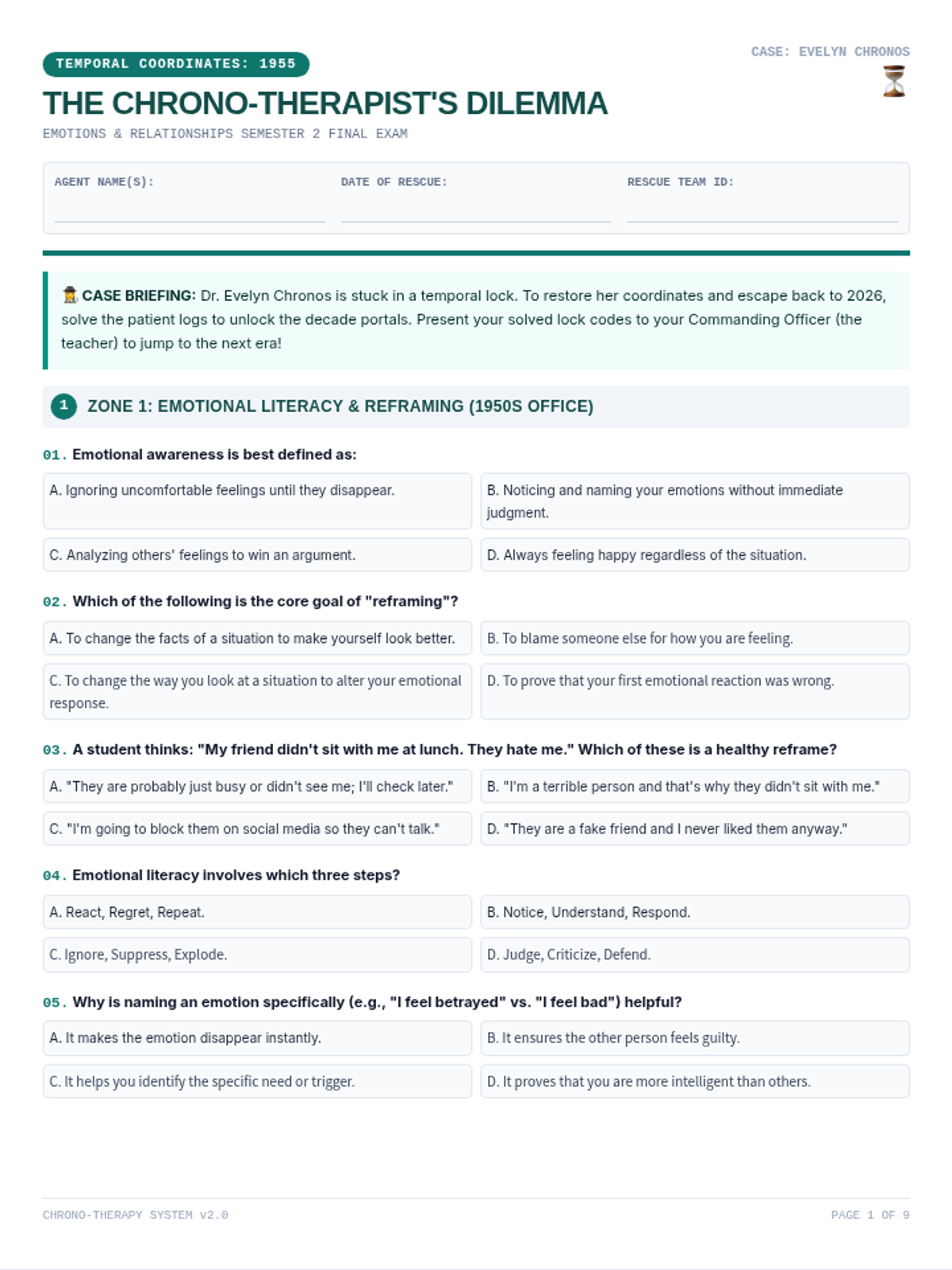
The full student-facing final exam packet styled as an immersive escape room. Includes 50 questions across 5 historical therapist offices, directional puzzles, lock codes, and short-answer scenario-solving spaces.
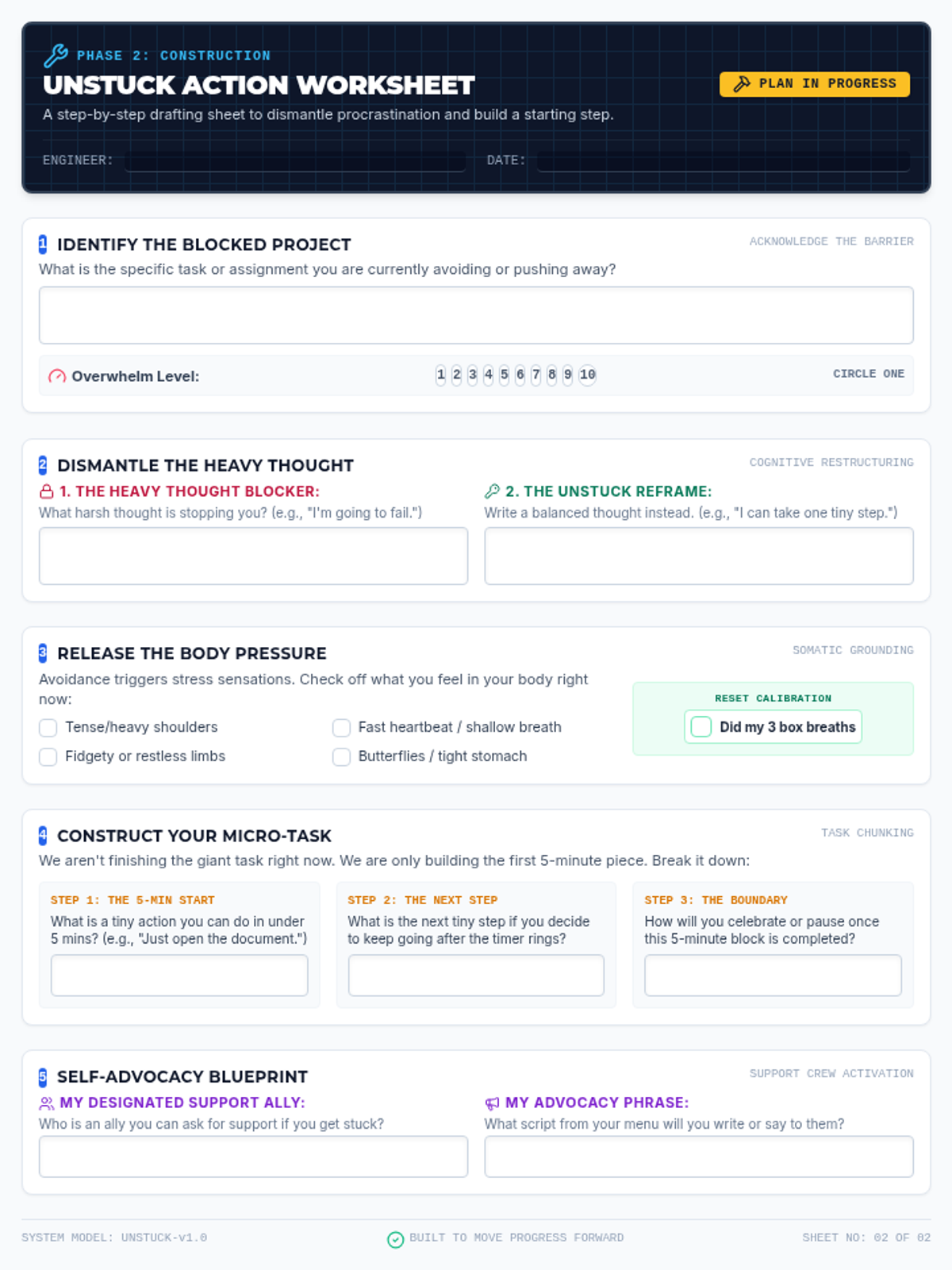
An interactive problem-solving worksheet matching the "Unstuck Blueprint" drafting theme. It guides students step-by-step to identify their current blocked task, rate their level of overwhelm, reframe heavy thoughts, perform sensory and somatic breathing, and construct a detailed 5-minute micro-task to kickstart momentum.
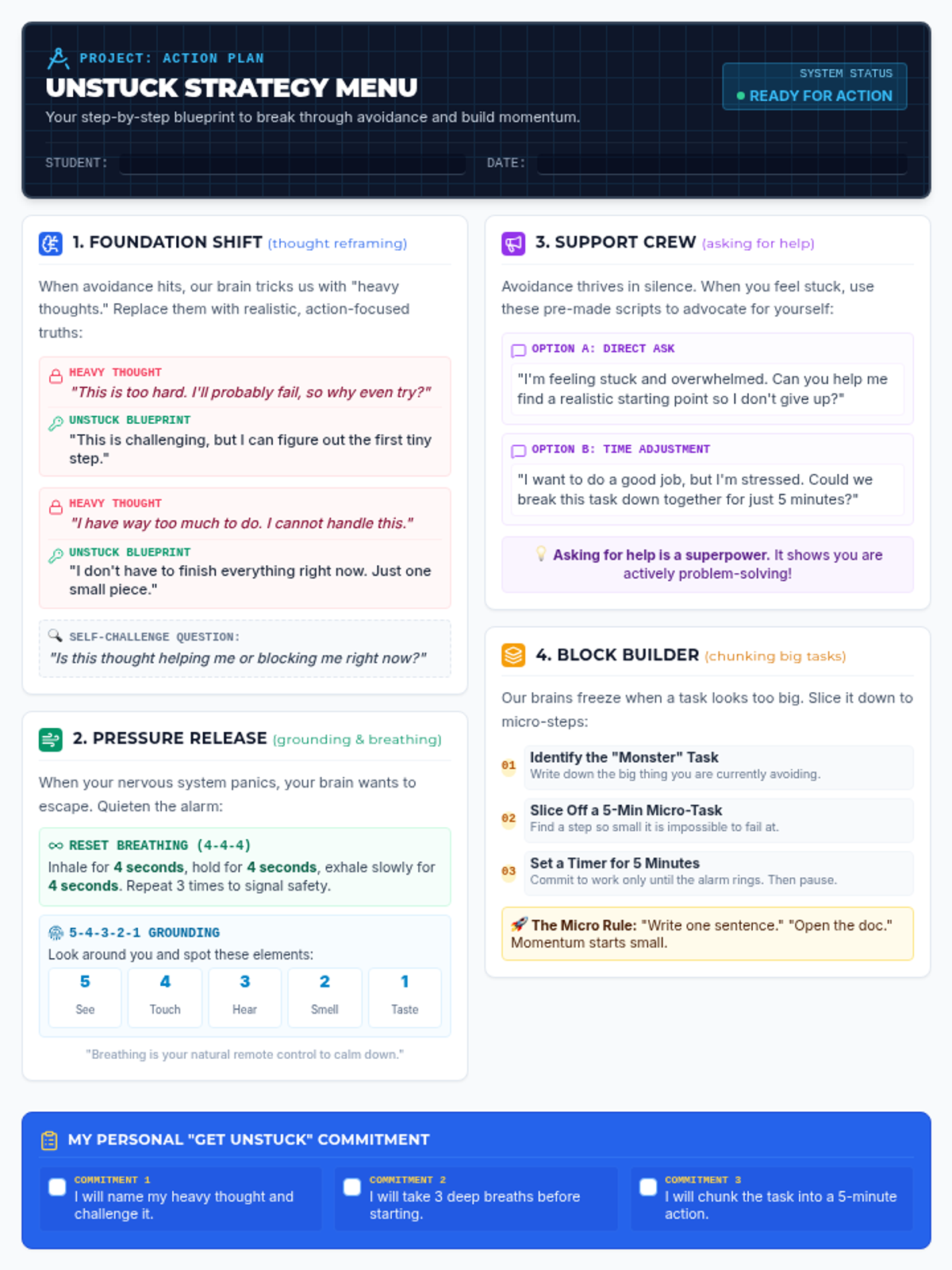
A 1-page visual coping strategy menu and checklist using a crisp "Unstuck Blueprint" drafting theme. It provides actionable cognitive reframing pairs, box-breathing/grounding routines, self-advocacy scripts, and task-chunking guides to move students from avoidant freezing to action.
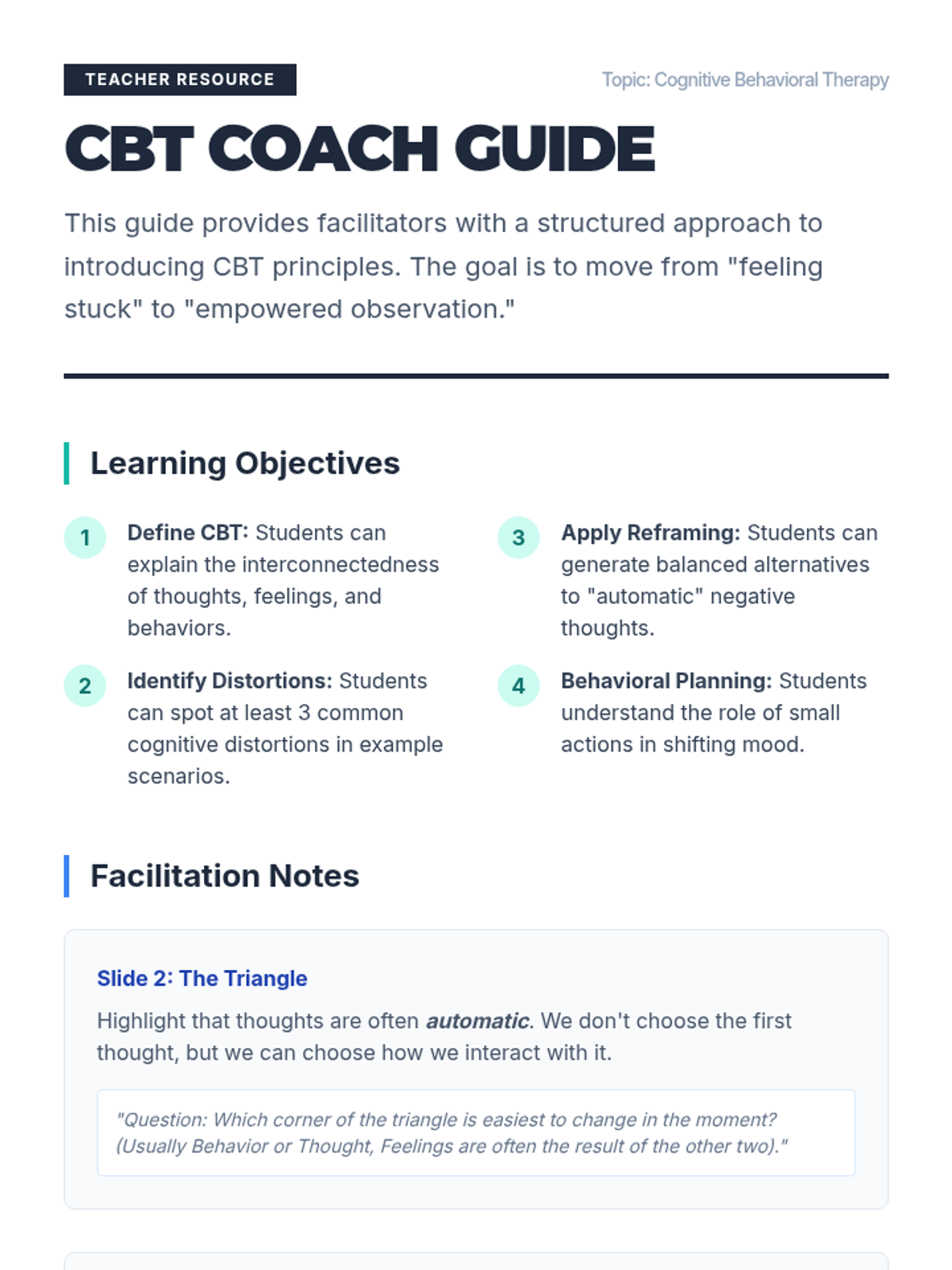
A comprehensive facilitator guide for teaching Cognitive Behavioral Therapy (CBT). It includes learning objectives, slide-by-slide talking points, guidance on addressing common student misconceptions, and an answer key for the Thought Tracker worksheet.
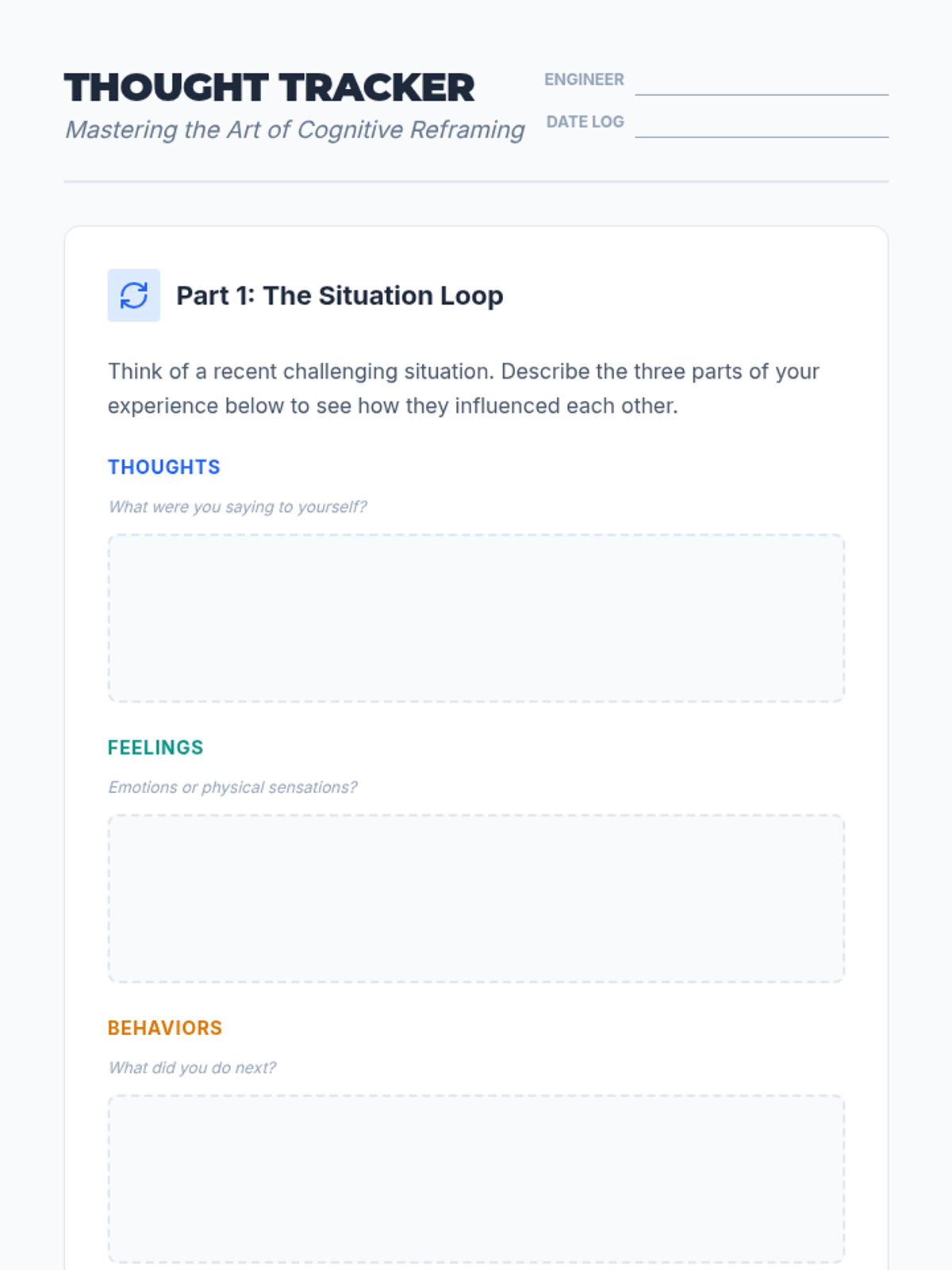
A practical student worksheet for practicing Cognitive Behavioral Therapy skills. It includes sections for mapping the thoughts-feelings-behaviors triangle, identifying common thinking traps, and performing cognitive reframing on challenging thoughts.
A visual slide deck introducing the core components of Cognitive Behavioral Therapy (CBT). It covers the CBT triangle (thoughts, feelings, behaviors), common cognitive distortions, and practical reframing techniques.
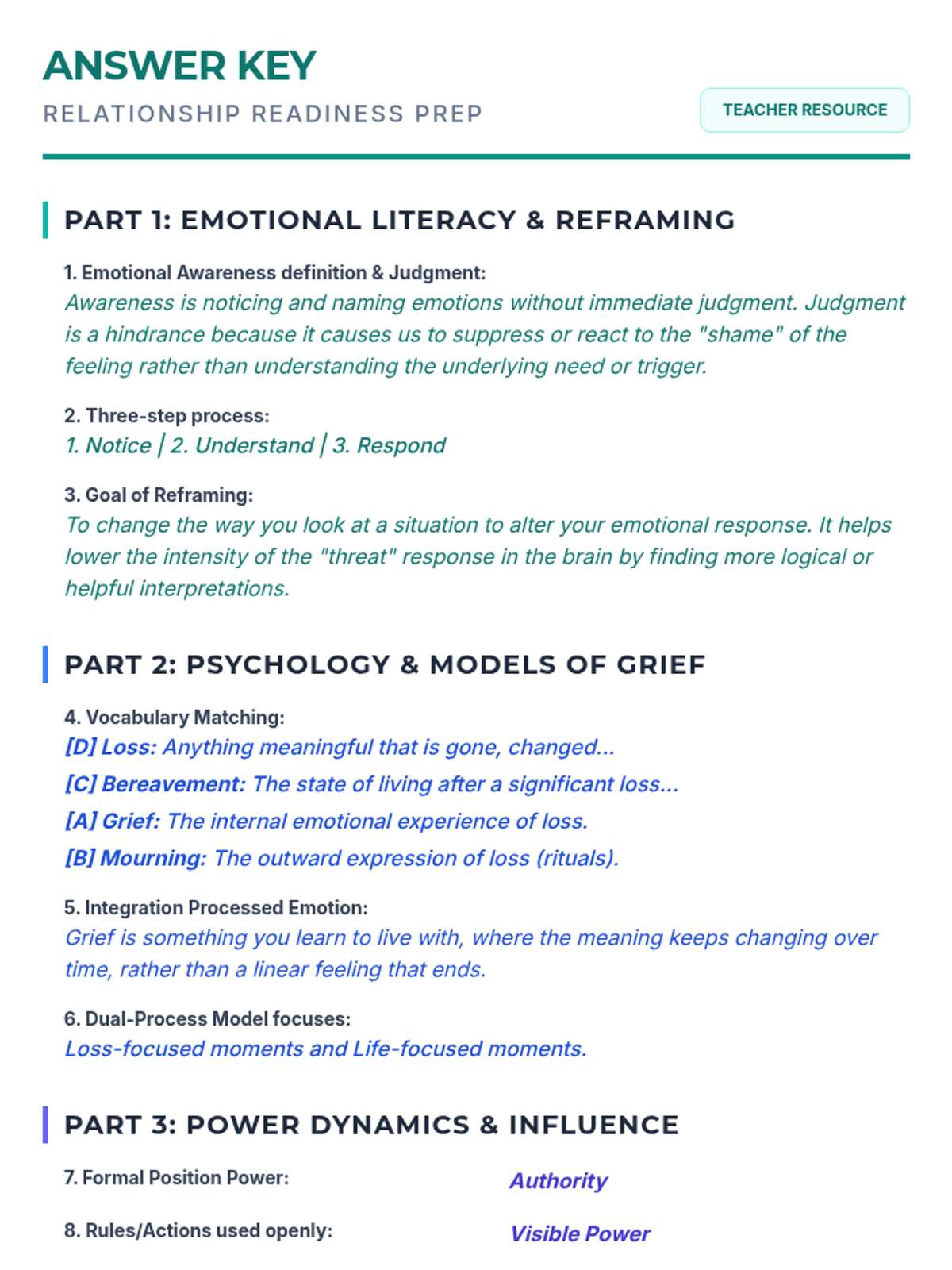
Teacher's answer key for the Relationship Mastery Study Guide. Revised to fix layout issues, improve text contrast, and ensure stable page breaks across sections.
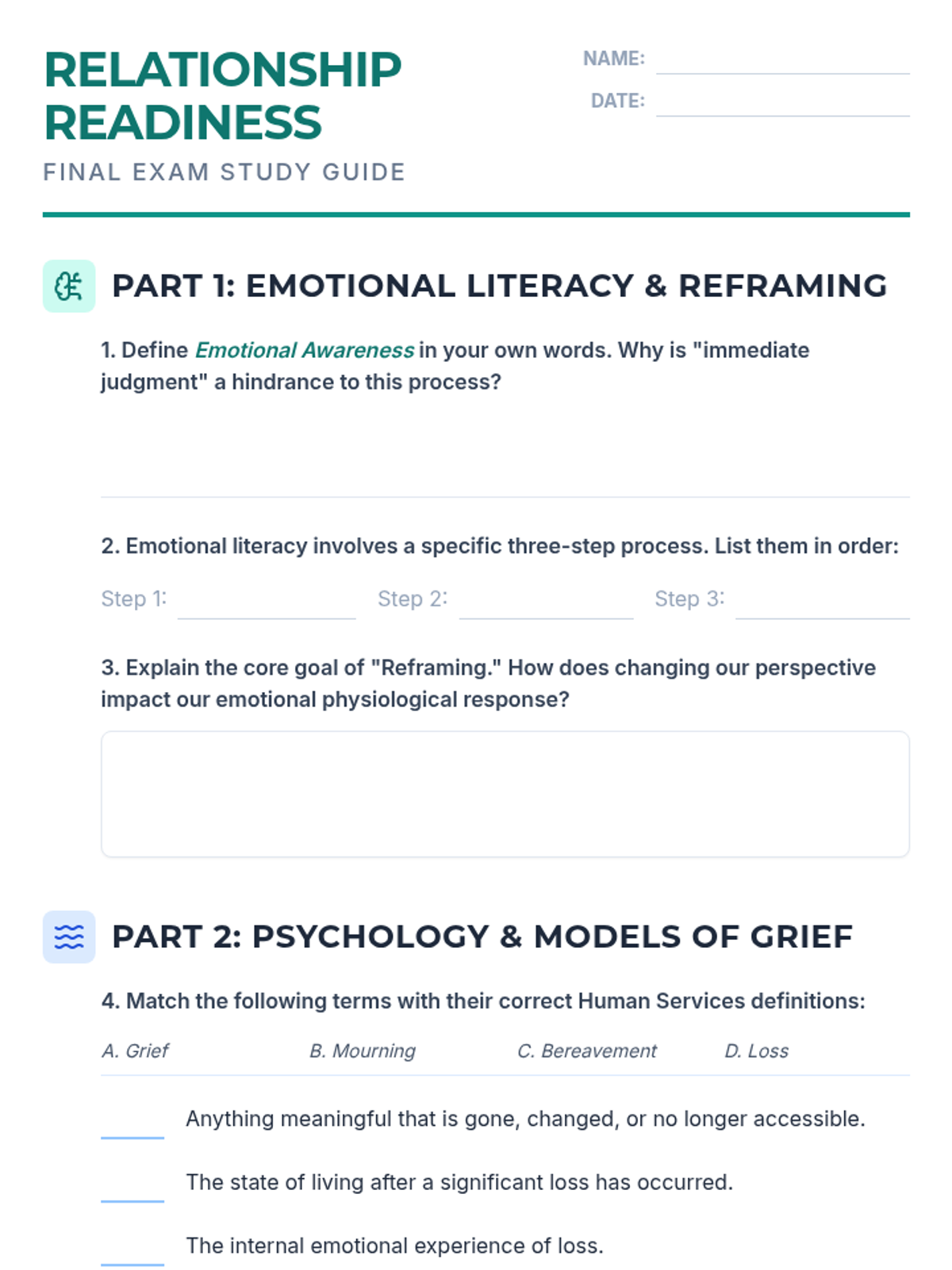
A comprehensive study guide for the Relationships and Emotions final exam, covering emotional literacy, grief models, power dynamics, and boundary setting through short answer and matching tasks. Revised for layout and legibility.
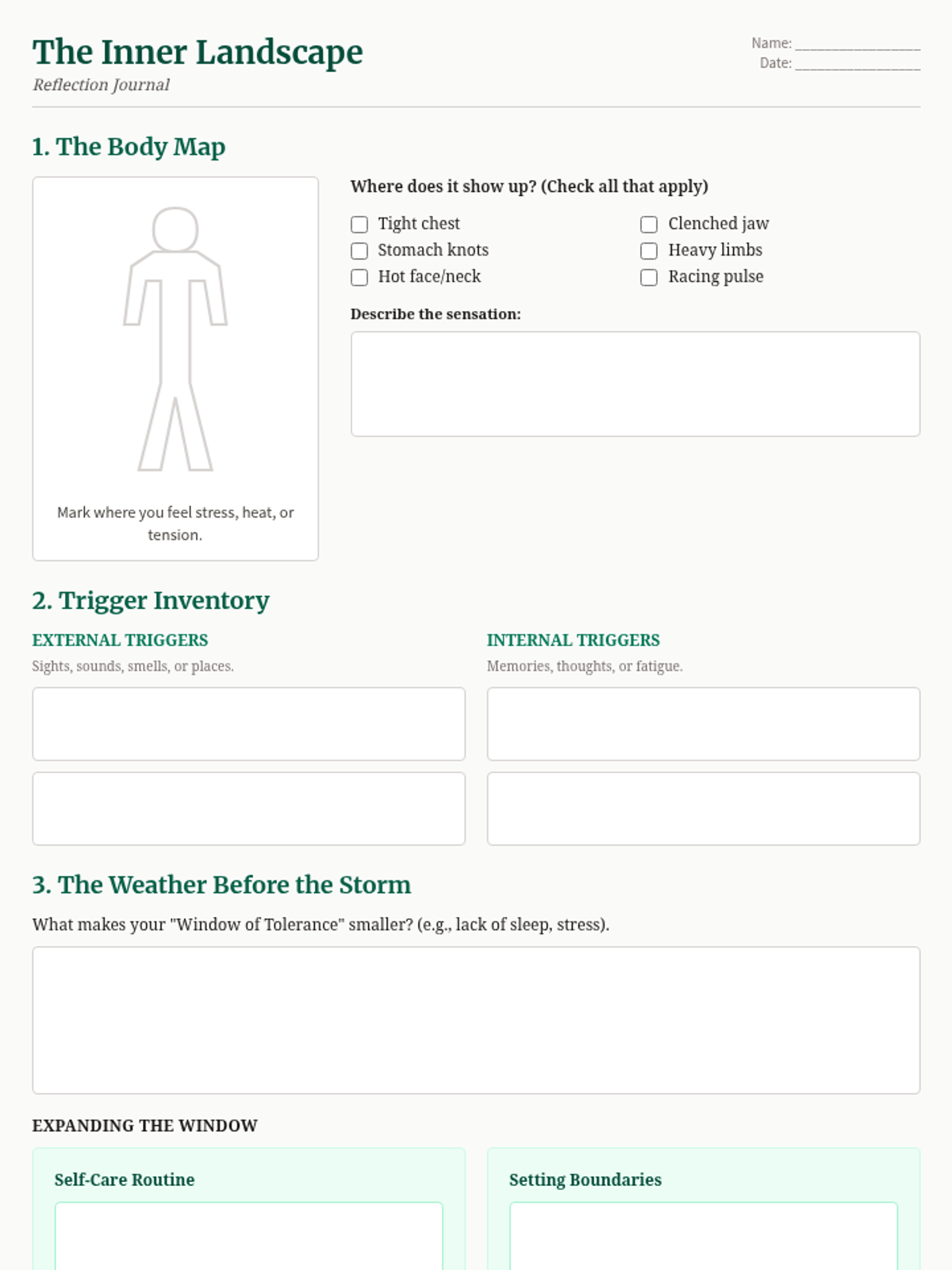
A 2-page reflection journal for students to map their physical sensations, identify triggers, and create a personalized safety plan.
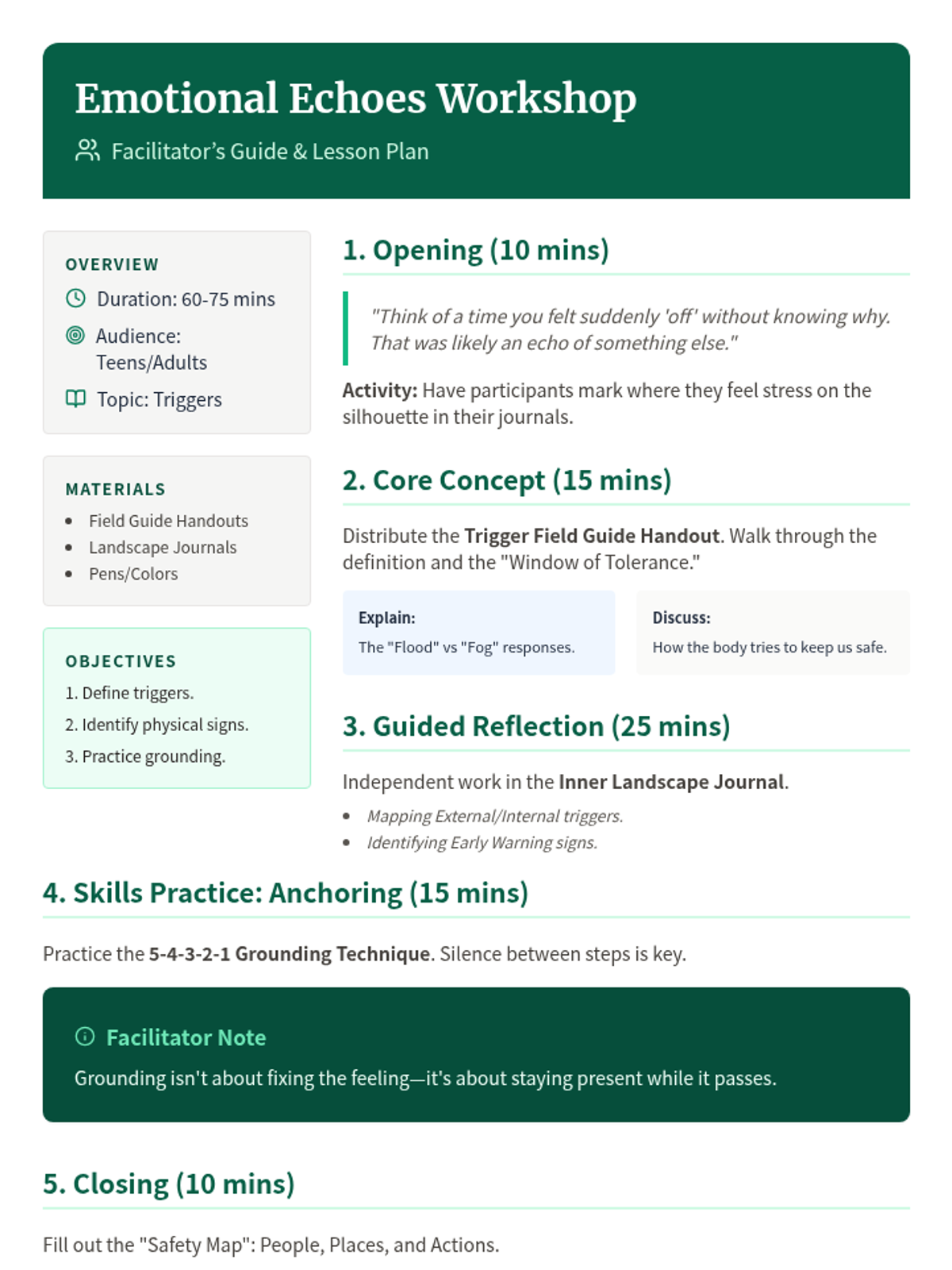
A facilitator's guide for a 60-75 minute workshop on mental health triggers, including scripts, activity breakdowns, and safety considerations.
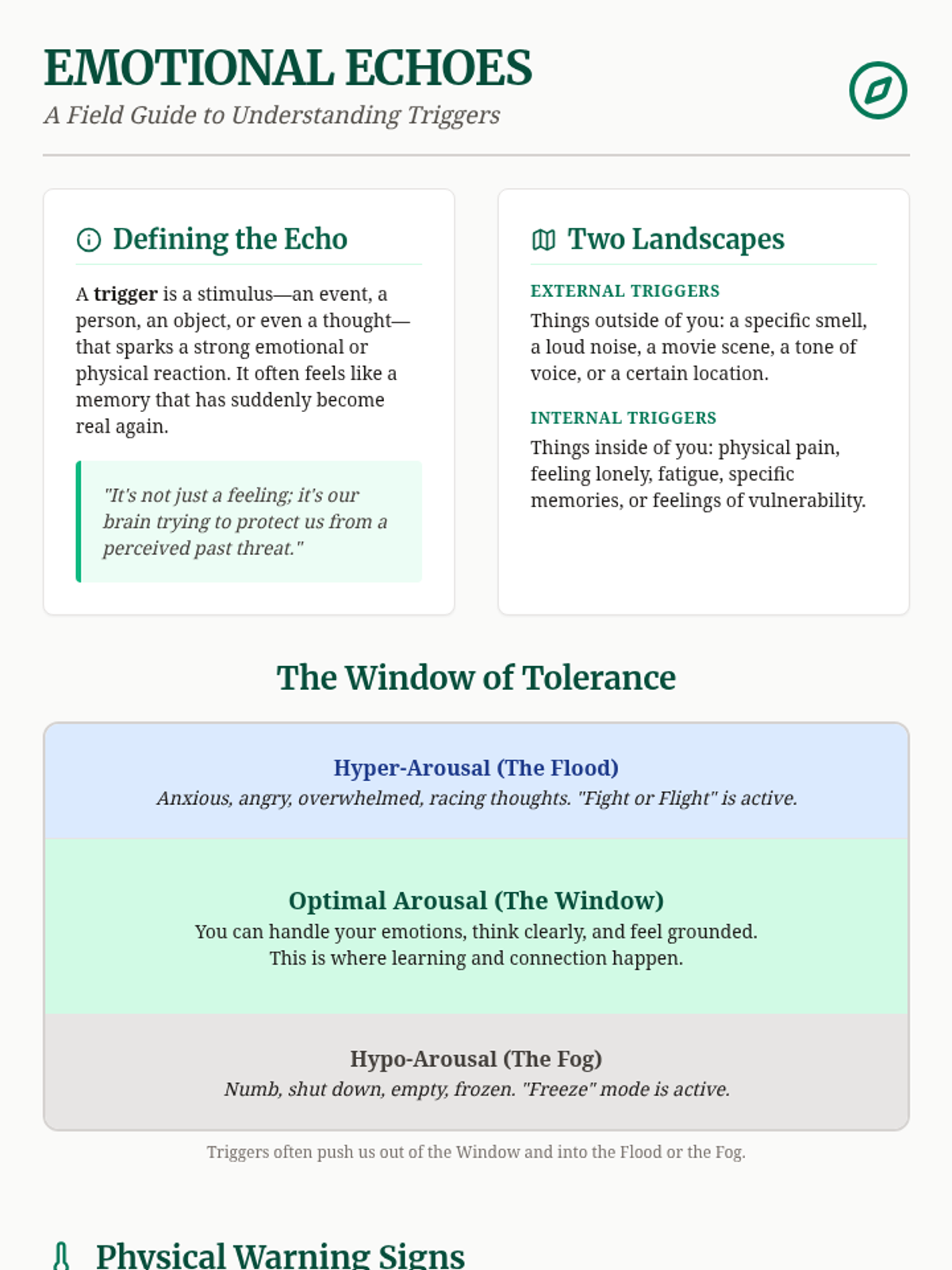
A 2-page informational handout explaining mental health triggers, the Window of Tolerance, physical warning signs, and immediate grounding techniques.
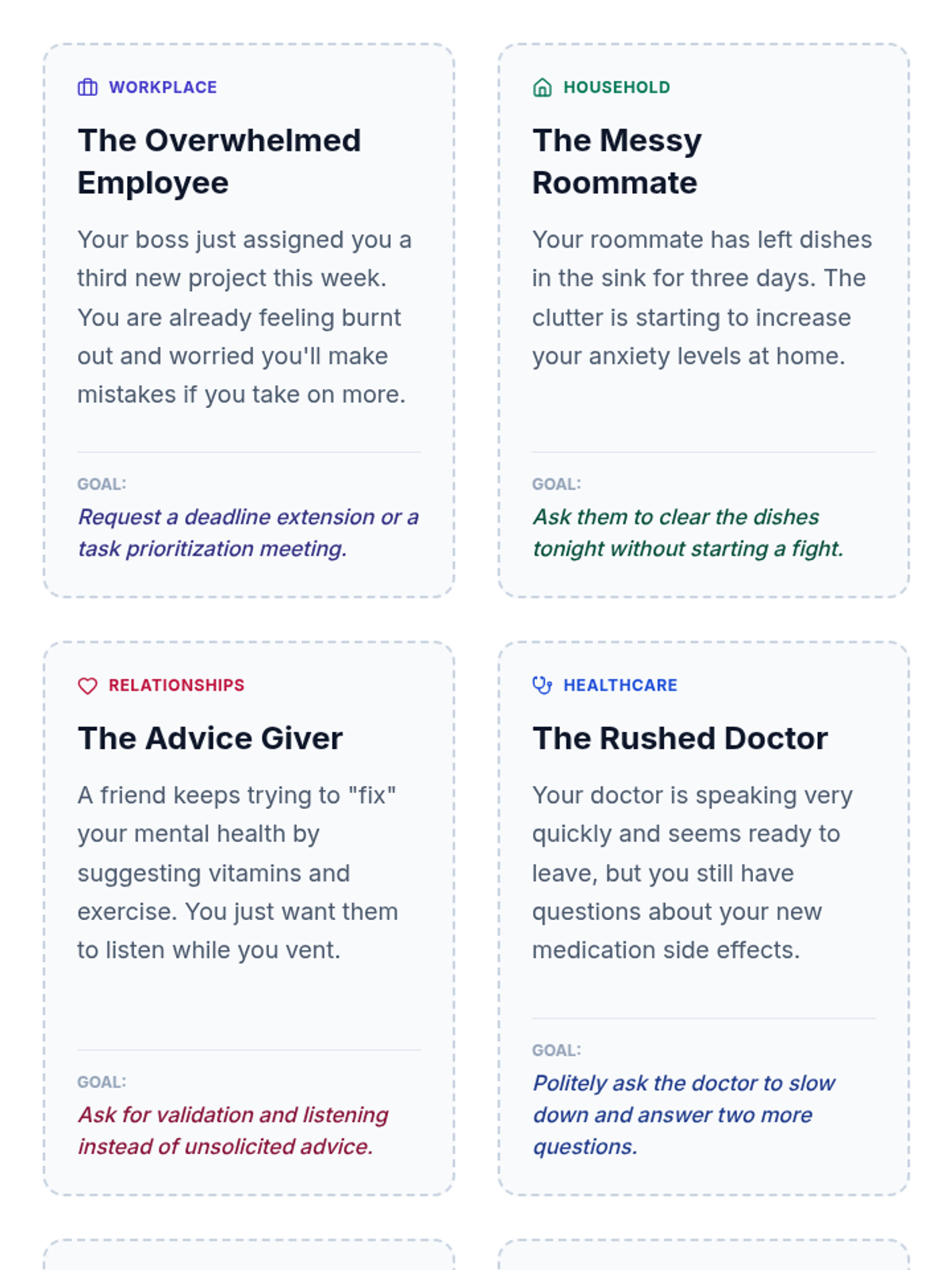
A set of 8 printable scenario cards depicting realistic adult situations where assertive communication is needed, categorized by life domain (work, home, healthcare, etc.).
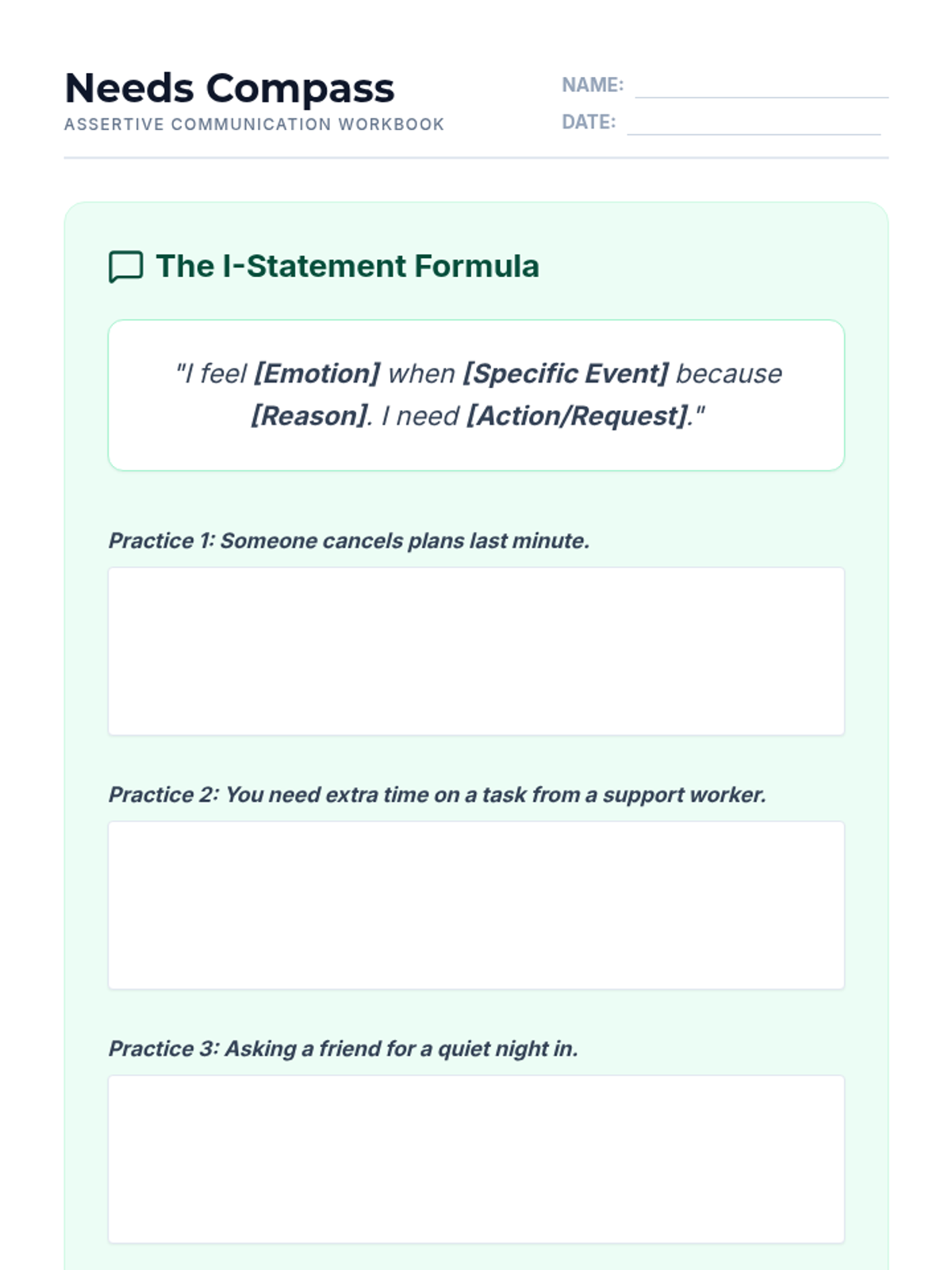
A student-facing worksheet for practicing I-statements and the DEAR MAN communication framework, featuring clear instructional prompts and dedicated work areas for handwriting.
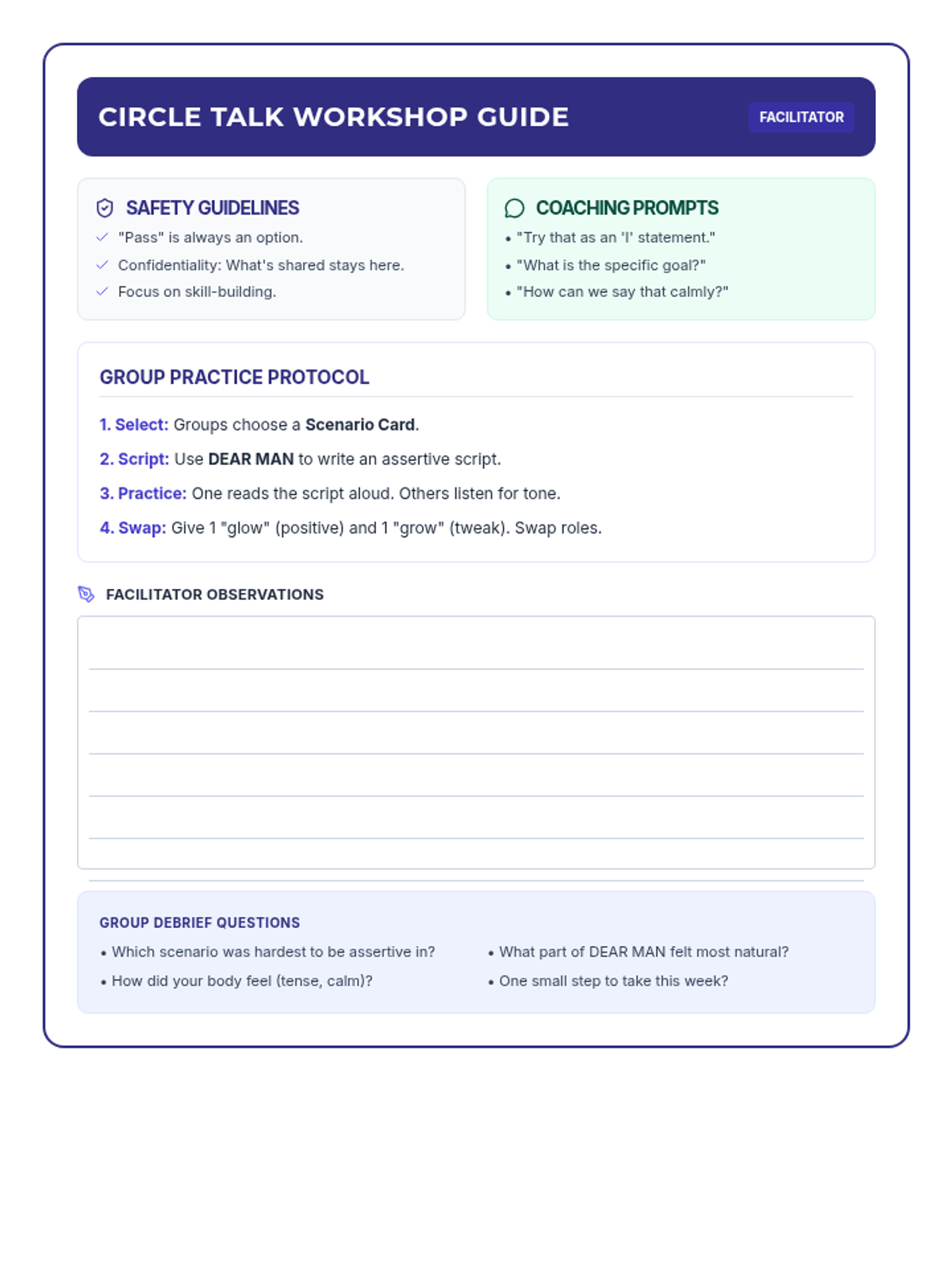
A facilitator's guide for leading small-group workshops focused on practicing assertive communication through structured role-play and collaborative script-writing.
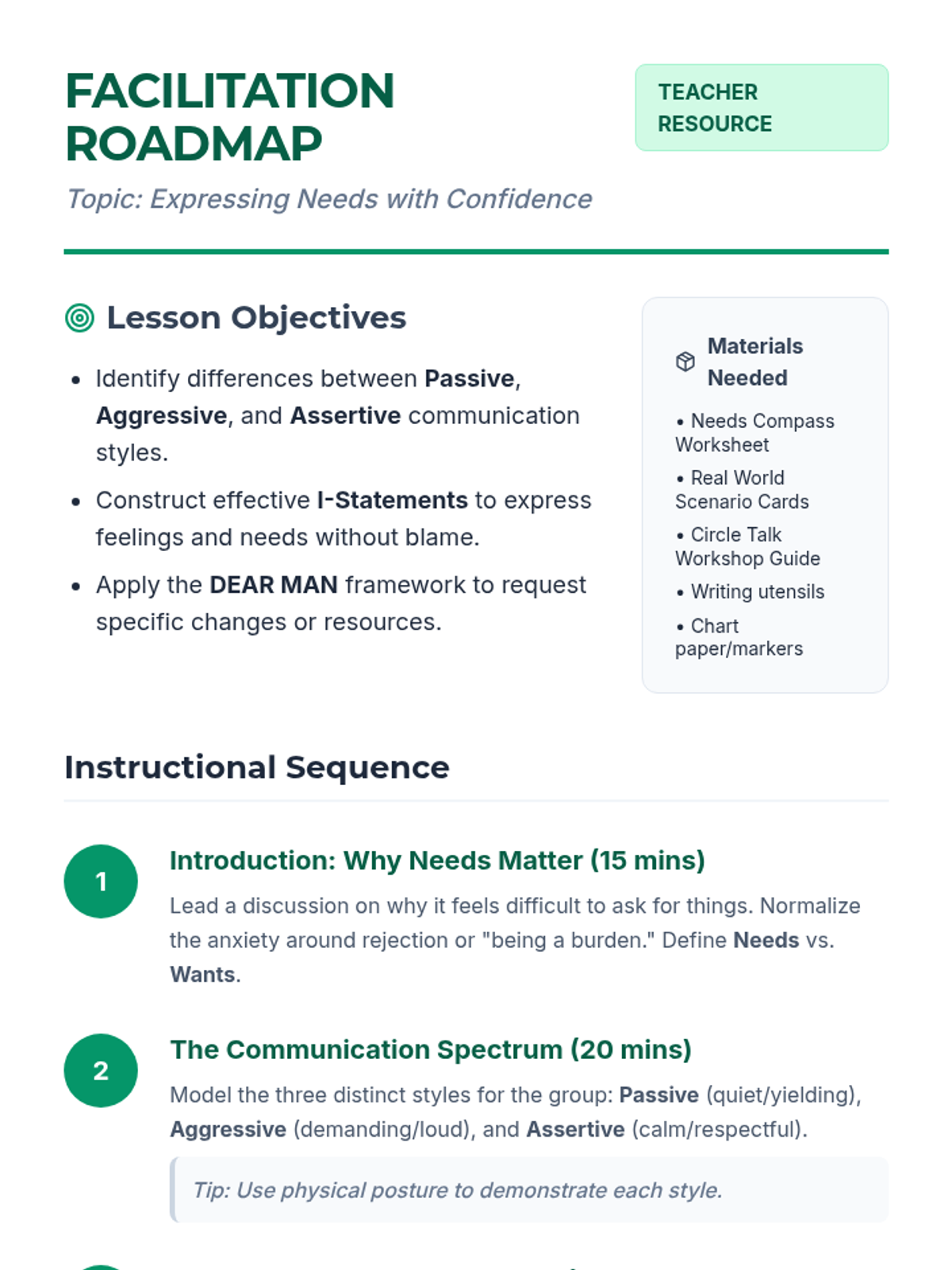
A step-by-step facilitation guide for teachers, outlining the lesson sequence, objectives, and specific instructional strategies for teaching assertive communication to adults.
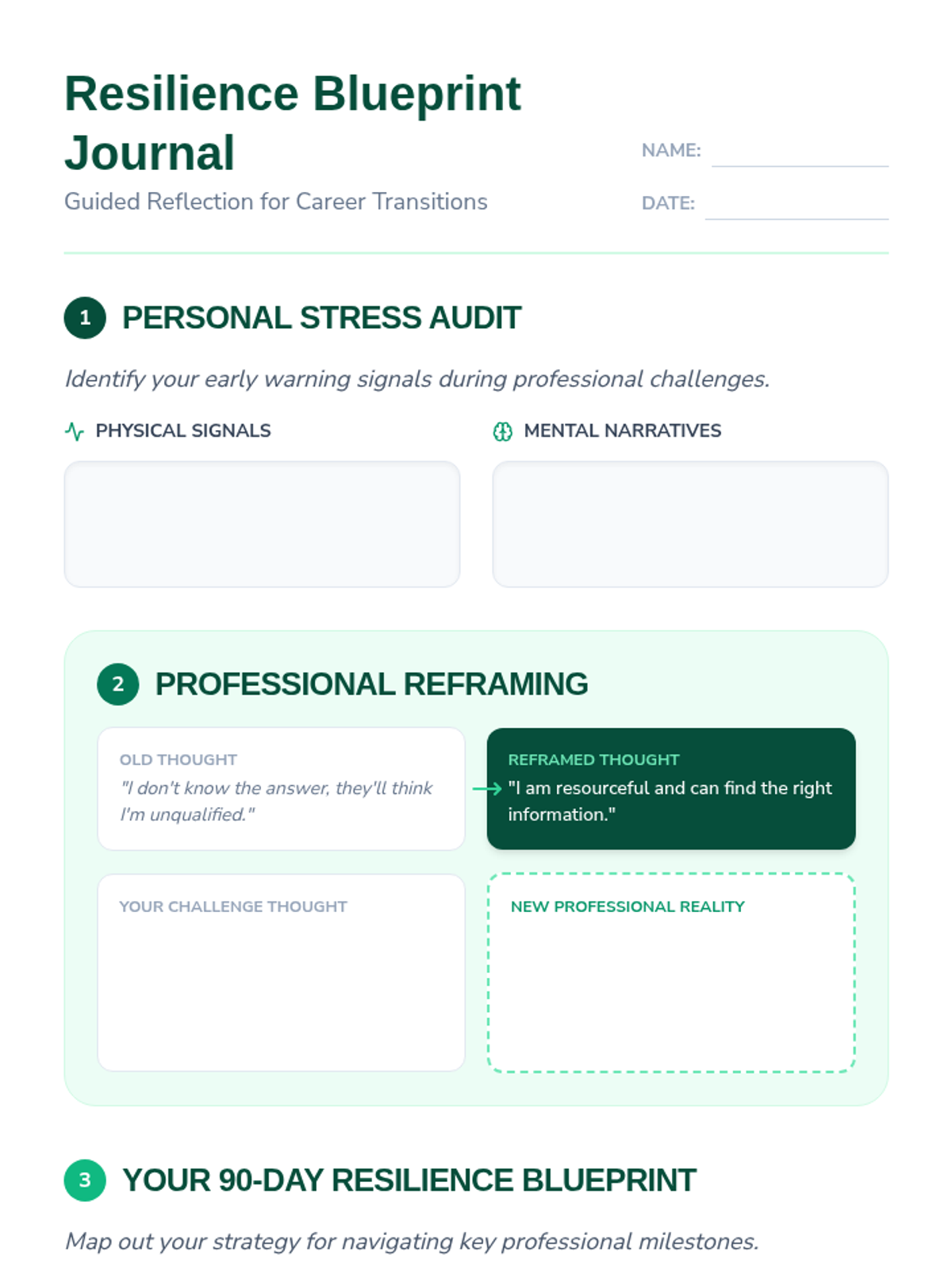
A guided reflection journal for students to document their personal stress triggers and create a customized 90-day resilience plan for their transition into the workforce.
A modern, minimalist slide deck for adult learners that visualizes the psychological transition to the workforce and provides instructional graphics for stress-management techniques.
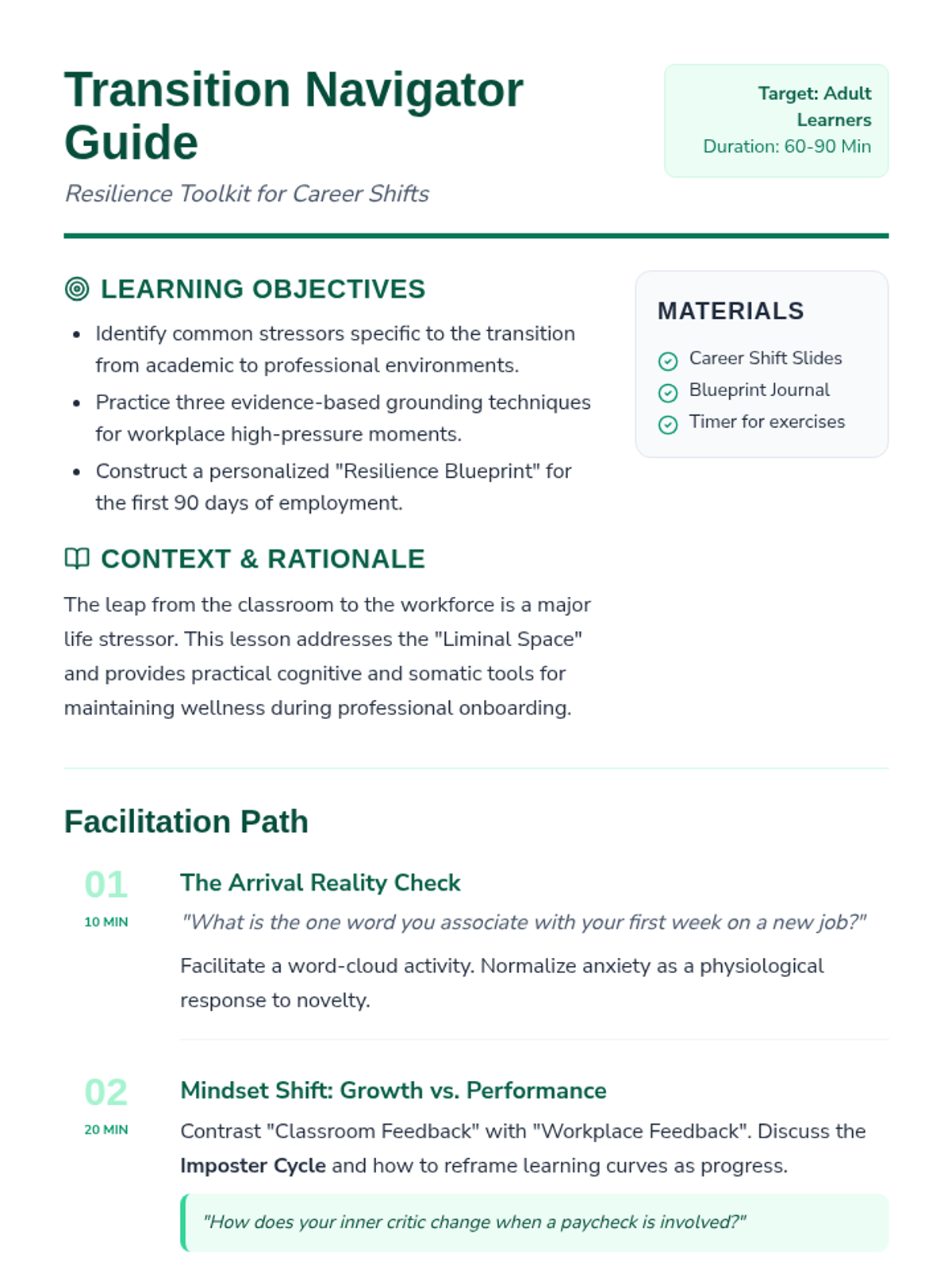
A comprehensive teacher guide for leading a wellness session on career transitions. It includes learning objectives, a timed instructional sequence, and facilitation tips specifically for adult learners.
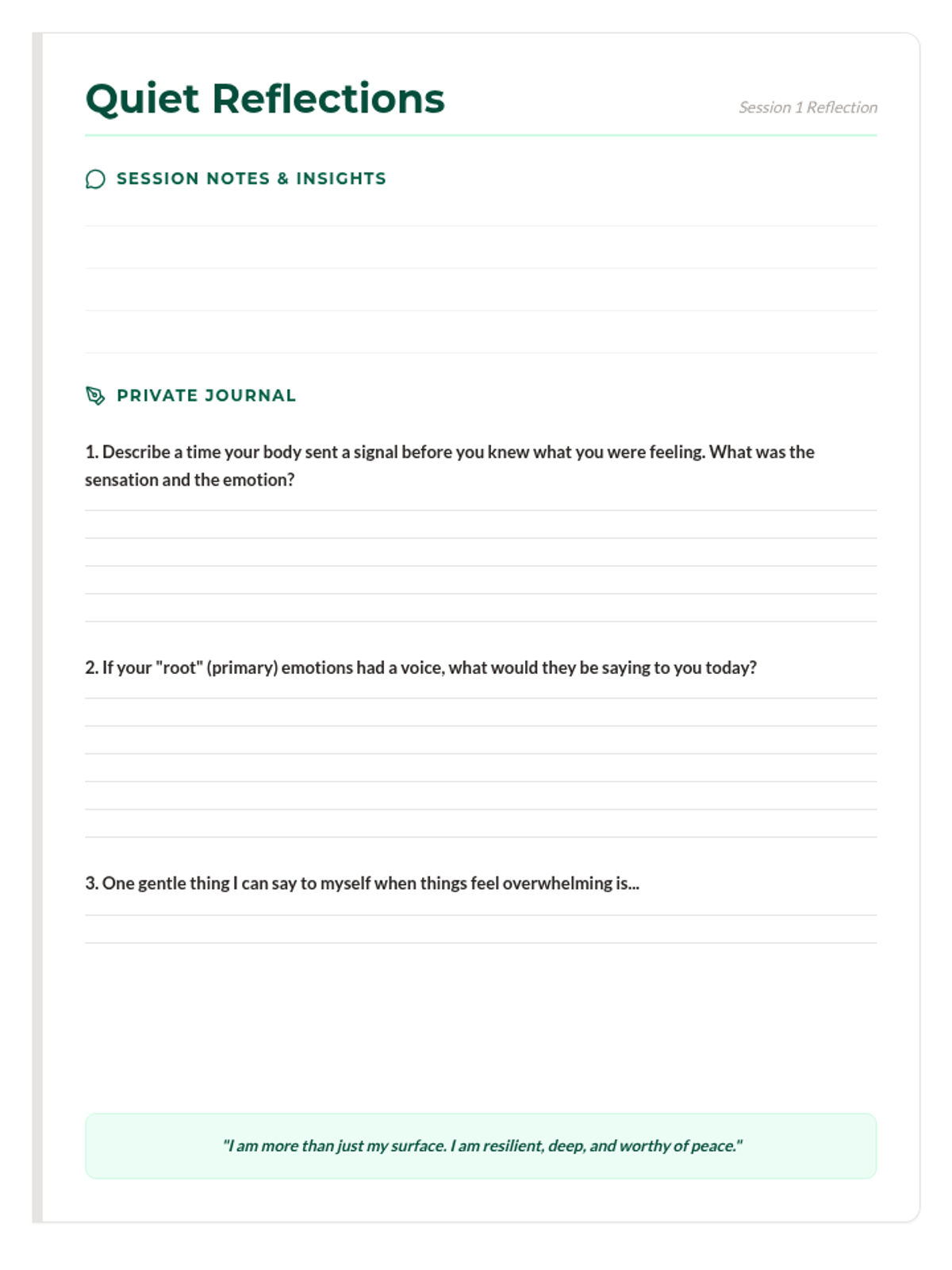
A collection of discussion questions and private journal prompts designed to help participants process the session's themes and practice self-reflection.
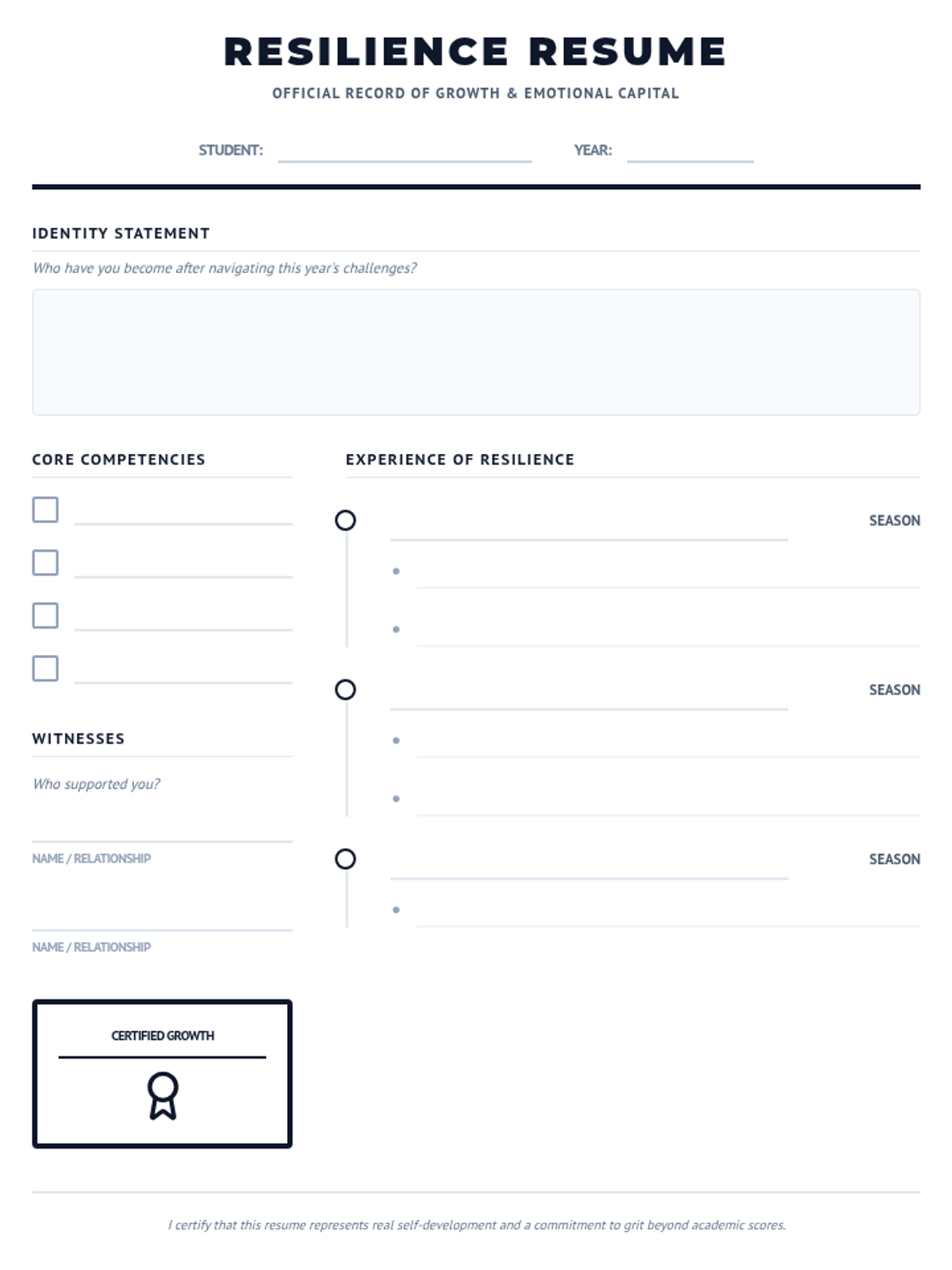
A professional-grade resume template for students to document their emotional and social growth, featuring sections for core competencies, experience of endurance, and personal references.
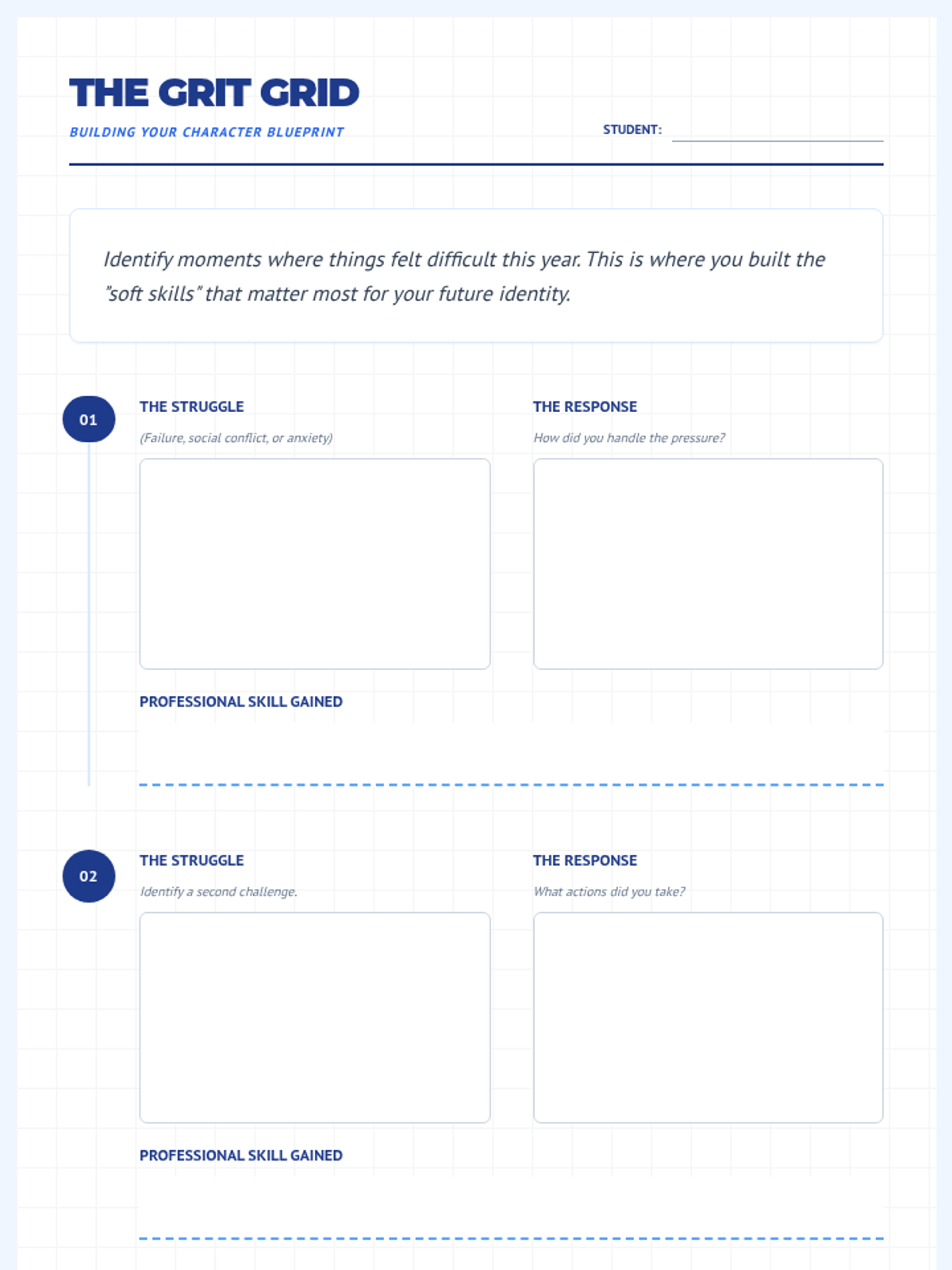
A structured brainstorming worksheet for students to identify specific challenges from their school year and translate them into actionable 'soft skills' for their final project.
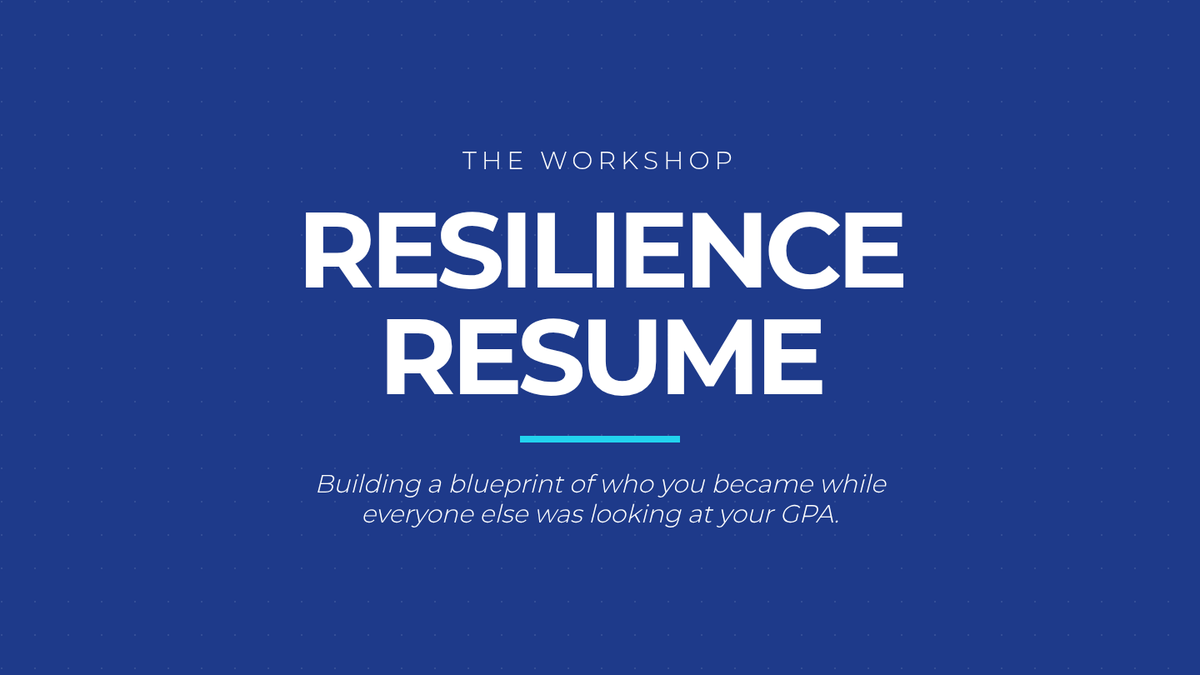
A visually engaging slide deck designed for 'The Resilience Resume' workshop, guiding students through the transition from academic-focused thinking to growth-oriented self-reflection.
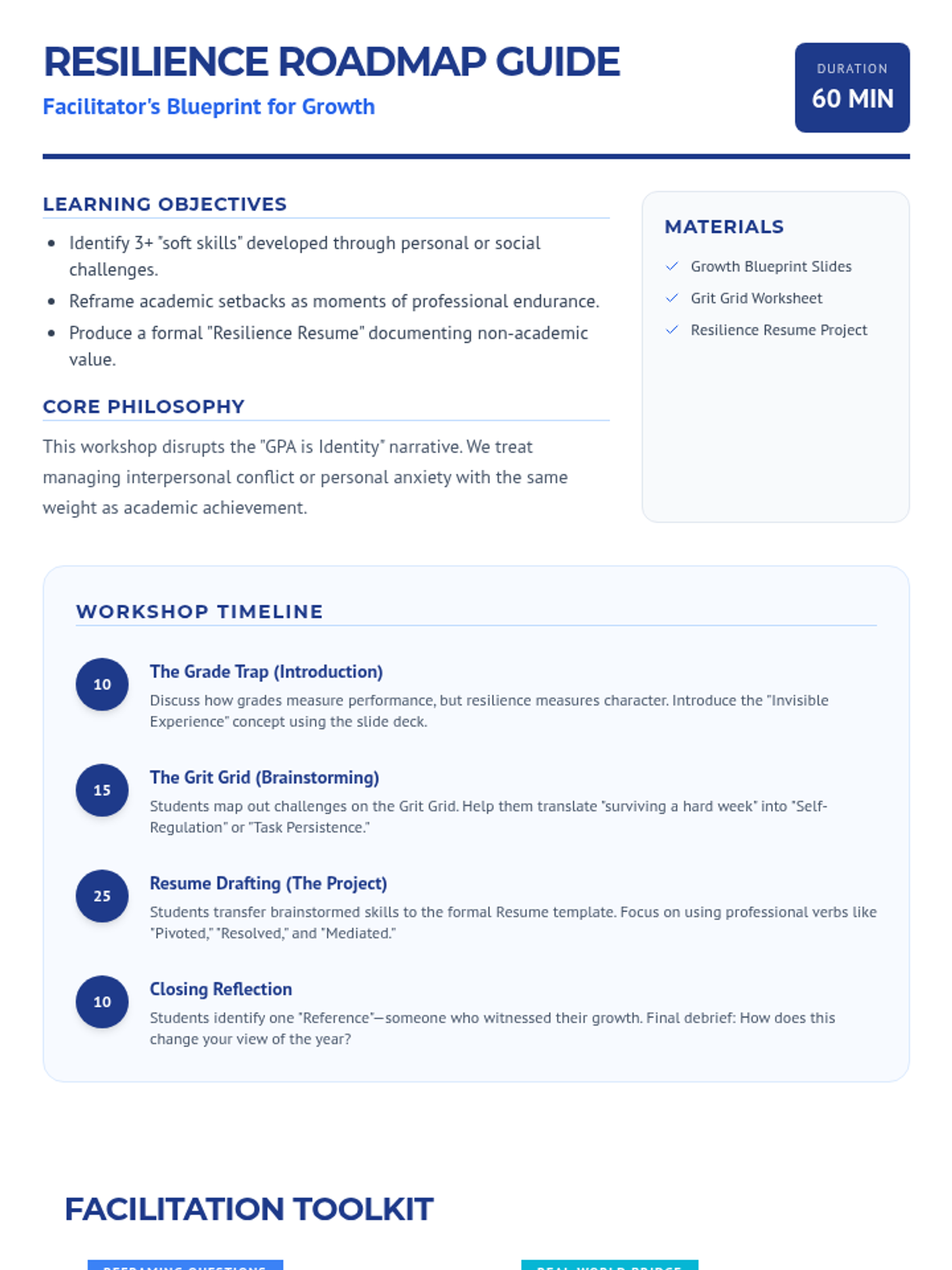
A comprehensive facilitator's guide for 'The Resilience Resume' workshop, including learning objectives, a detailed timeline, and reframing prompts to help students identify non-academic growth.
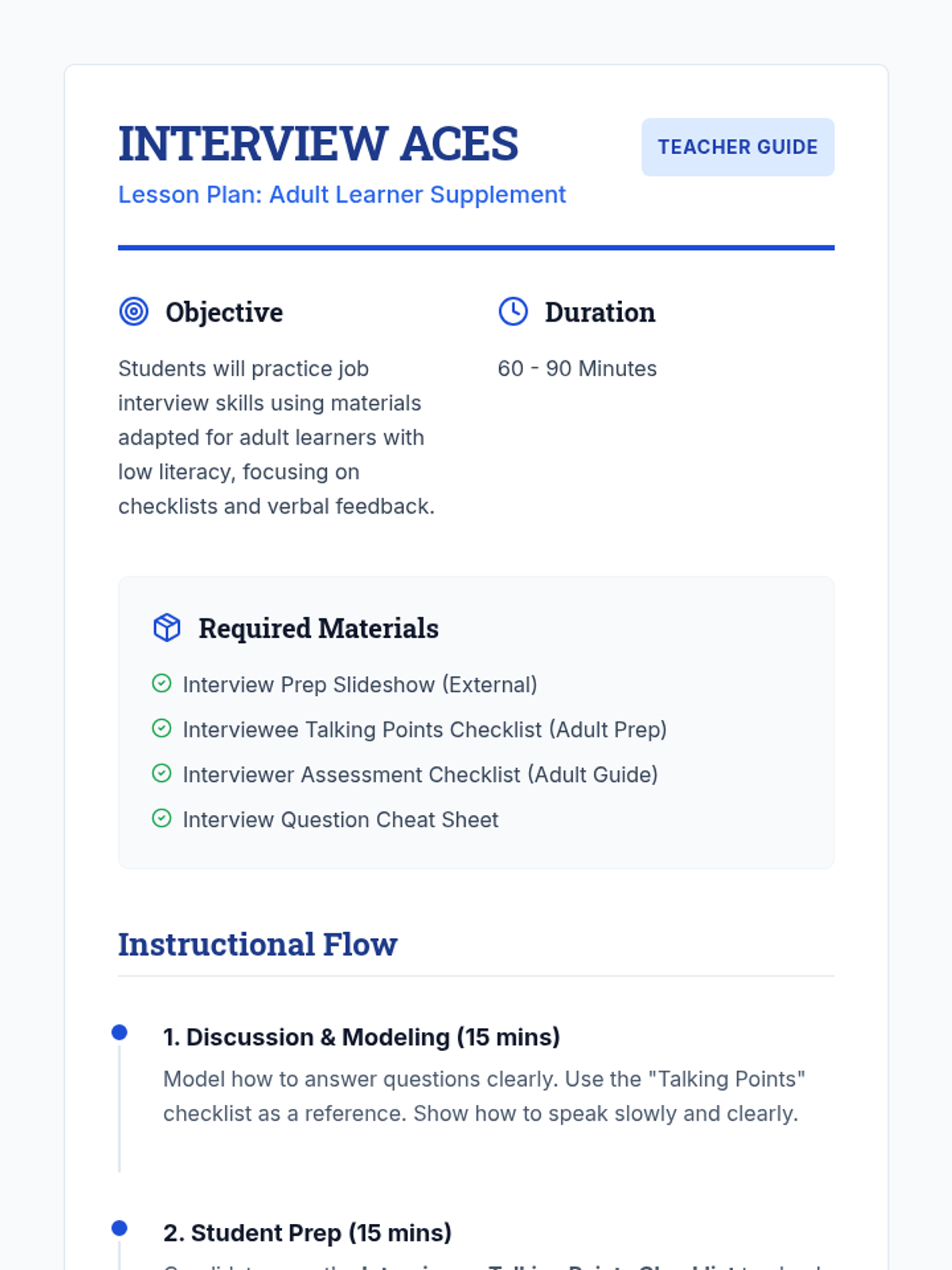
A detailed teacher lesson plan for a peer interview workshop, including timing, materials, and step-by-step instructional flow. Revised for adult learners with low literacy using checklists.
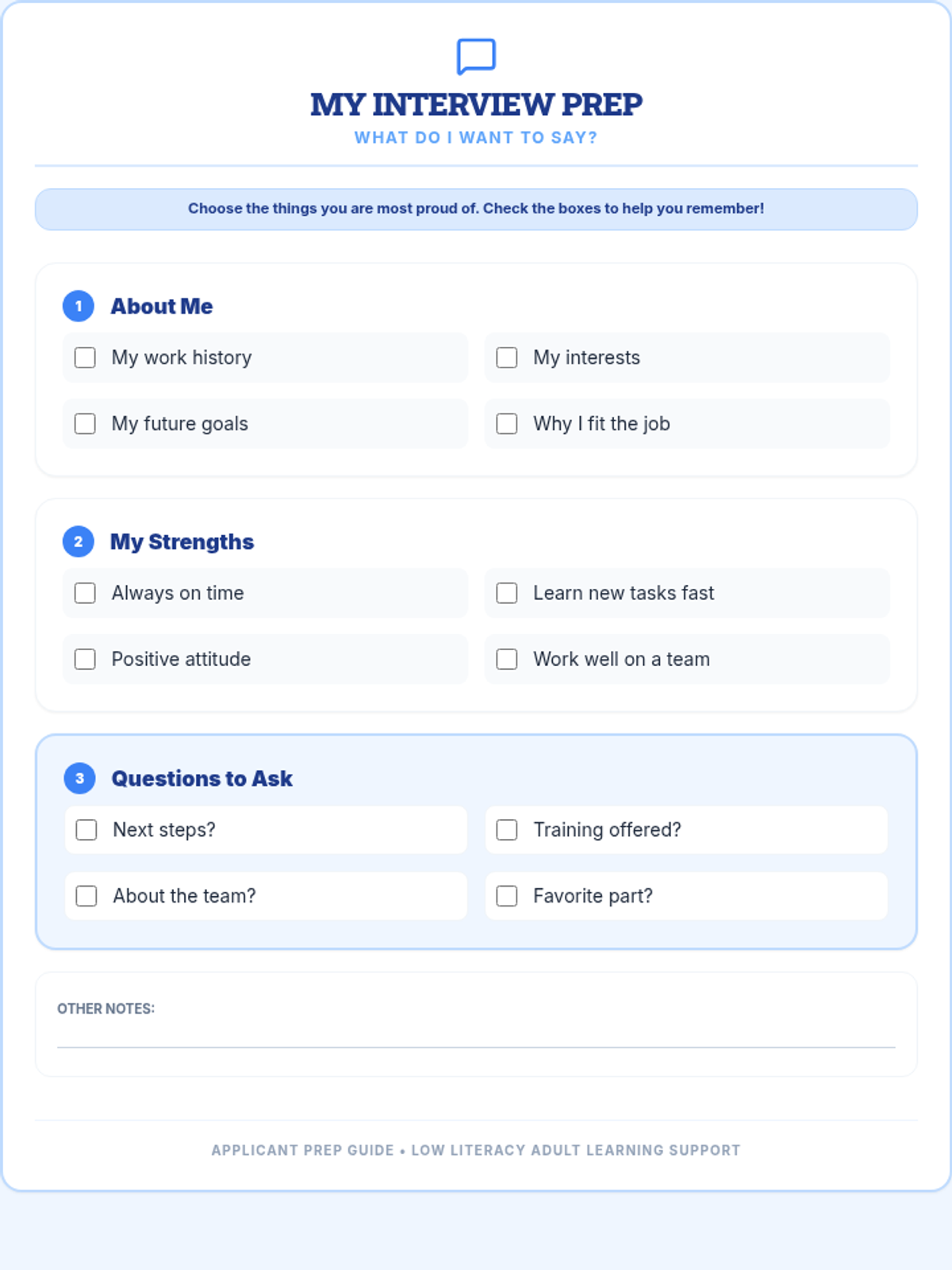
An interviewee preparation checklist for adult learners with low literacy, focusing on selecting key talking points to remember during an interview. Revised for single-page fit and better print quality.
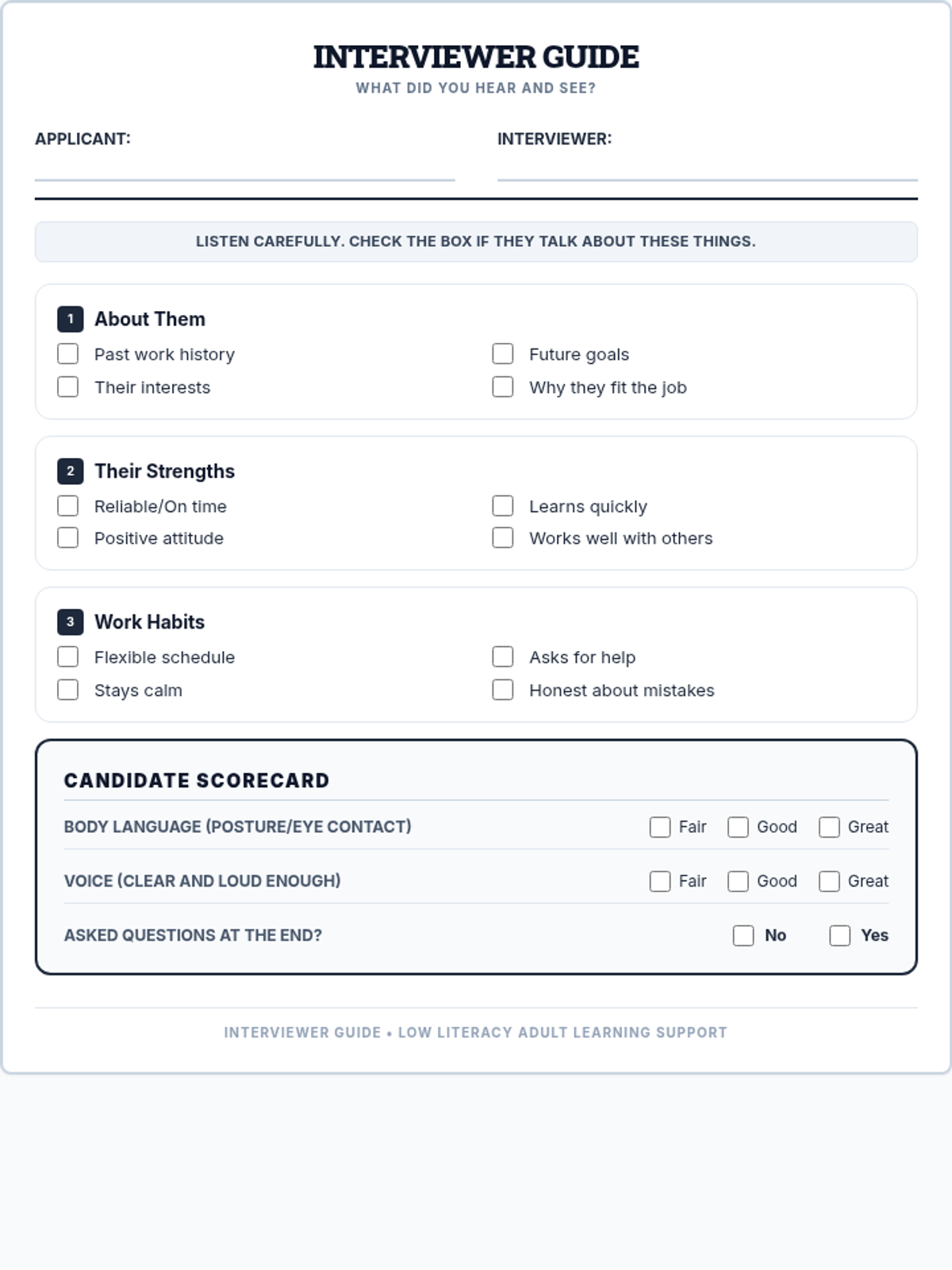
An interviewer guide with checkboxes to track candidate responses and evaluate performance, designed for adult learners with low literacy. Revised for single-page fit and better handwriting legibility.
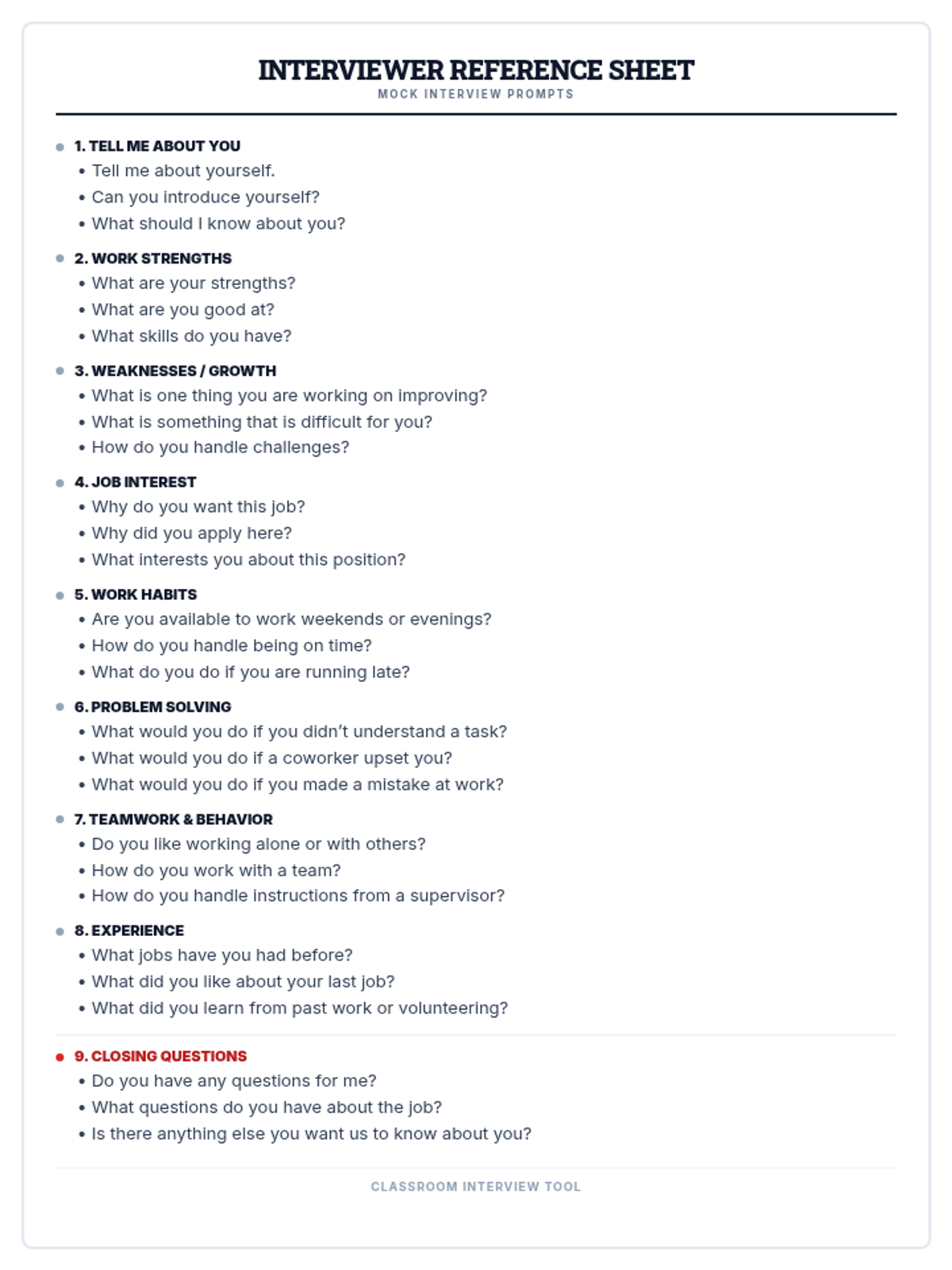
A clean, single-page reference sheet for students acting as interviewers, containing all question categories and prompts. Tightened for single-page layout.
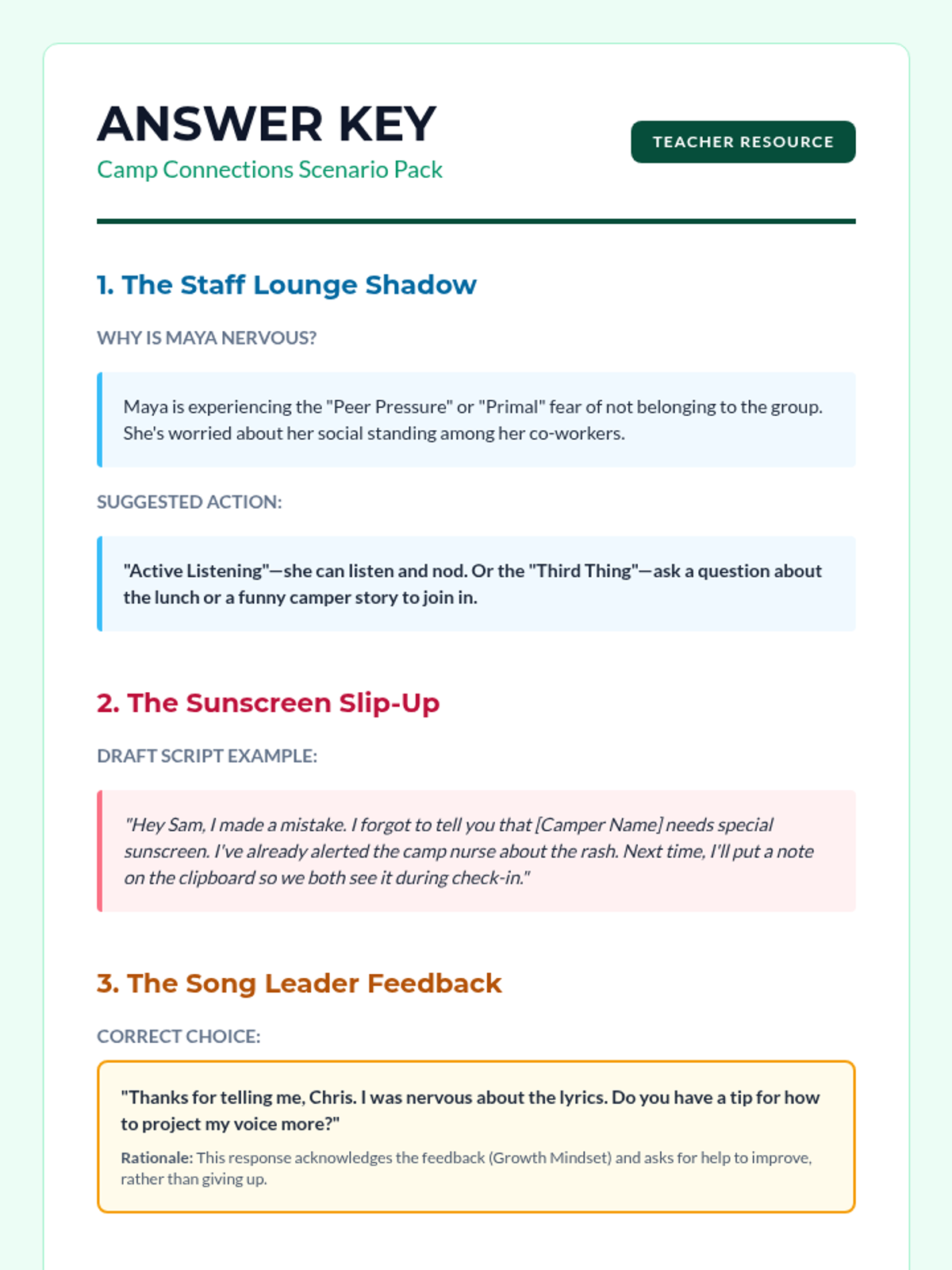
An answer key for the Camp Counselor Scenarios worksheet, providing suggested responses and rationales for counselor-to-staff communication.
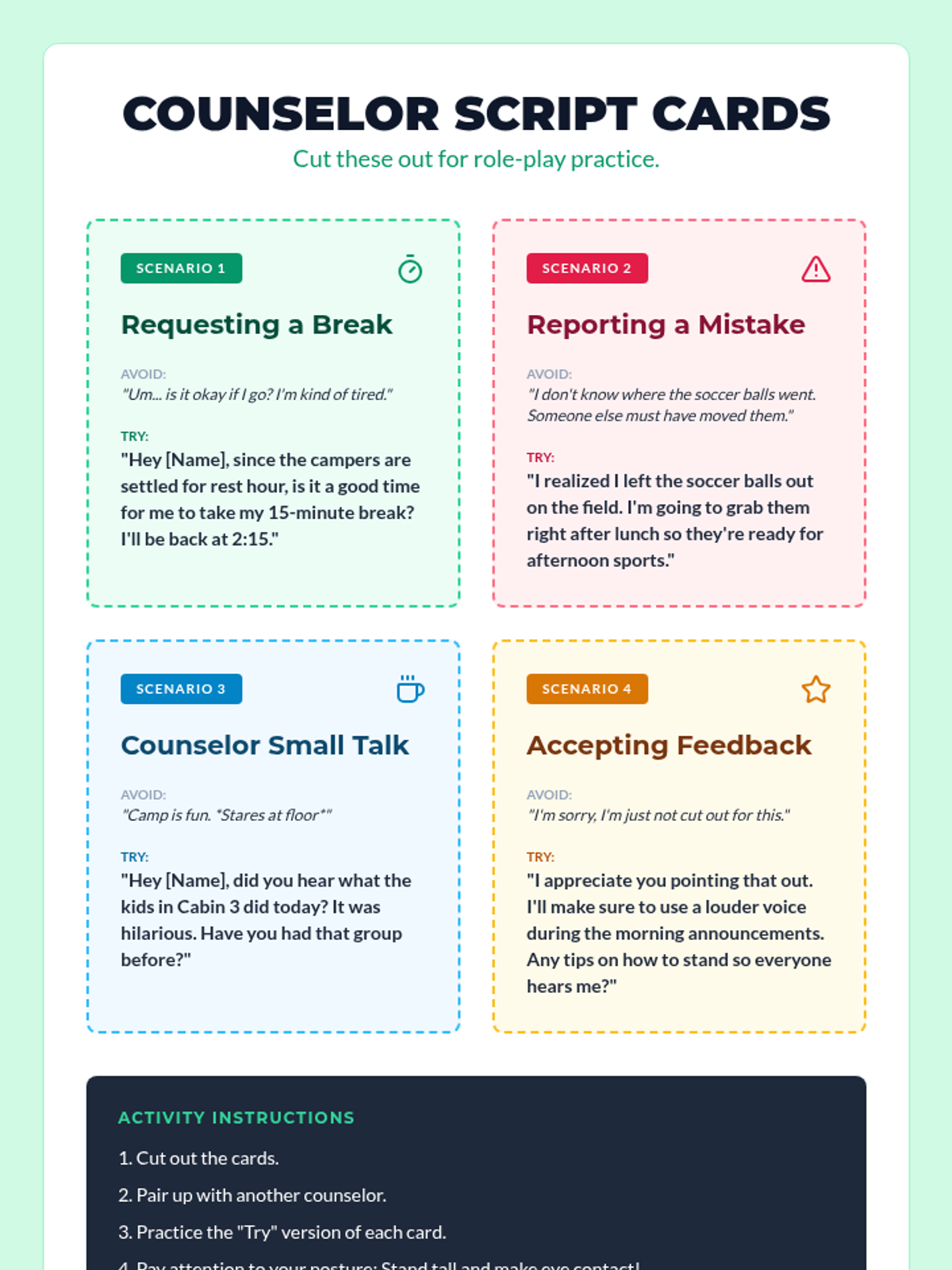
Role-play script cards for camp counselors to practice professional and confident communication with their peers and supervisors.
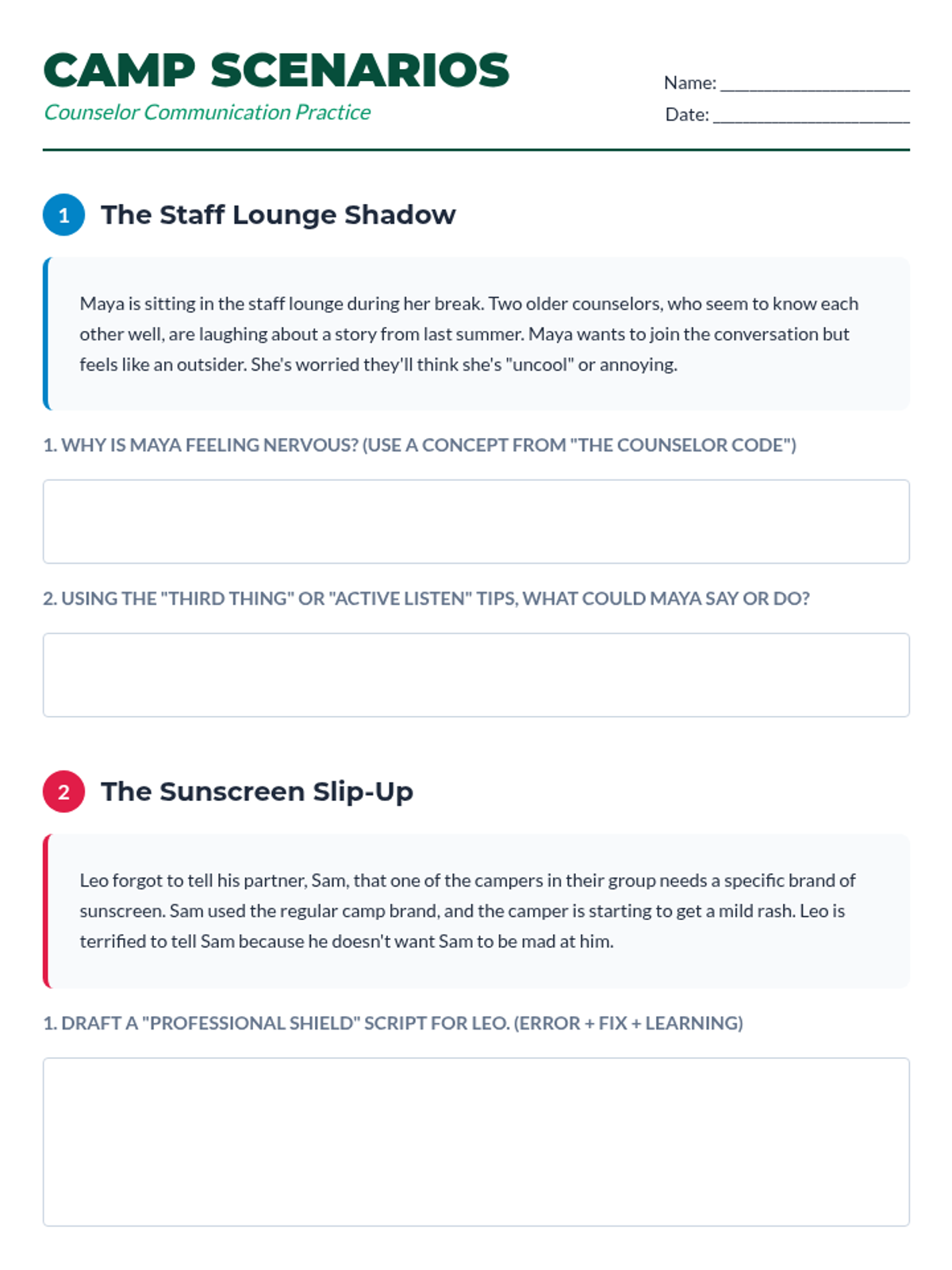
A scenario-based worksheet for camp counselors to practice peer communication, reporting mistakes, and accepting feedback.
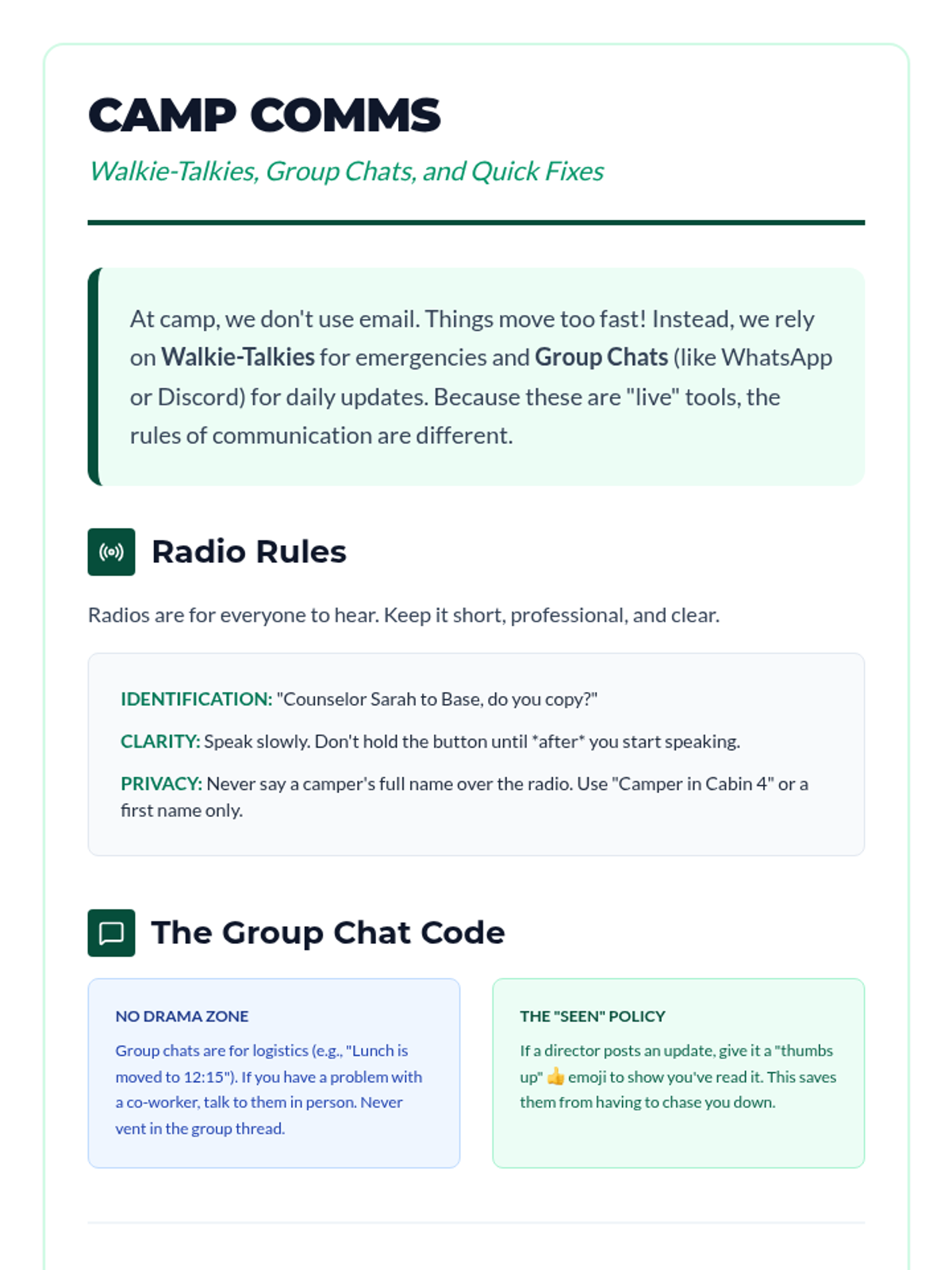
An informational reading passage and worksheet about camp-specific communication tools like walkie-talkies and group chats, excluding email.
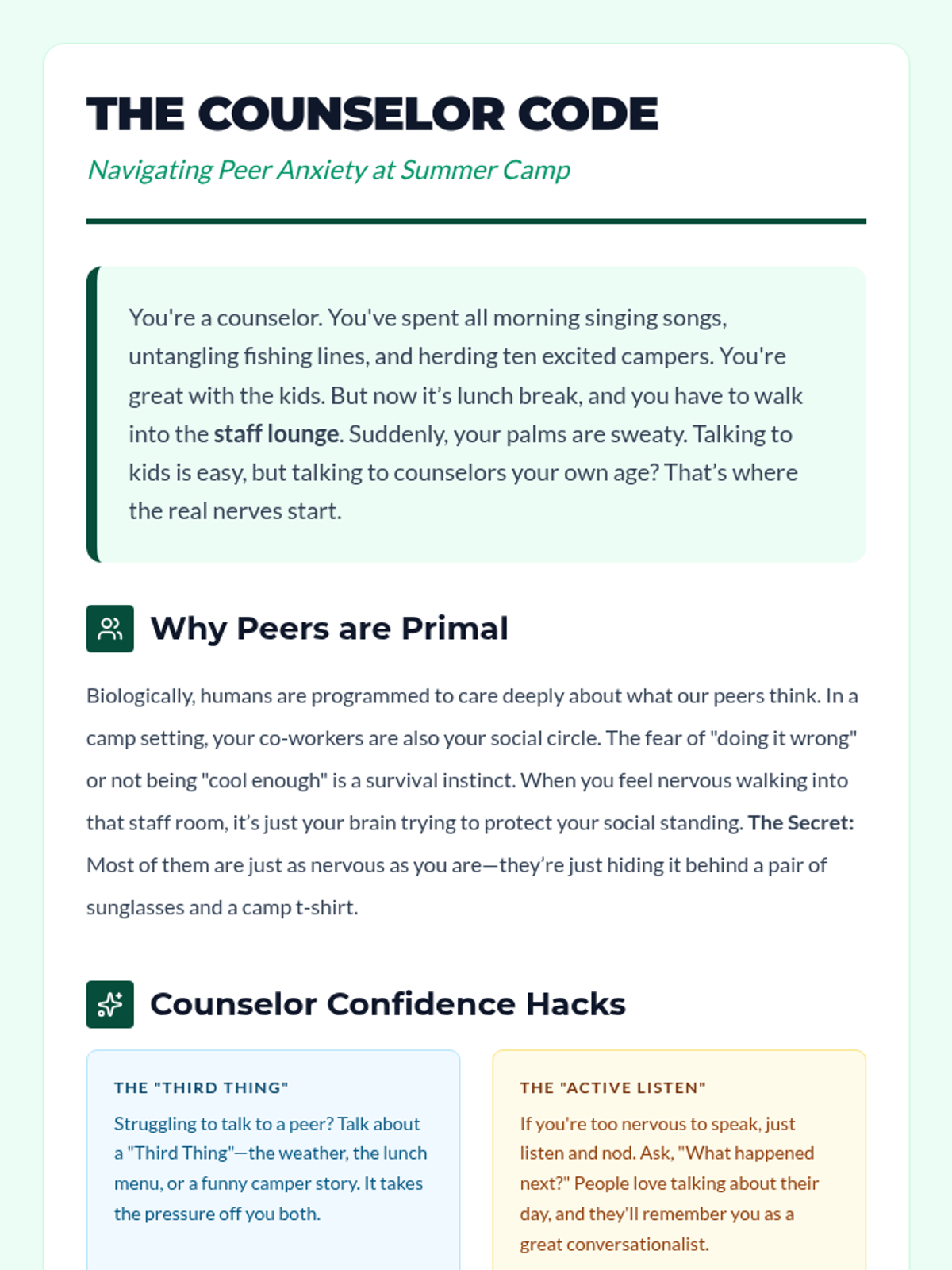
An informational reading passage for camp counselors about overcoming peer anxiety and mastering communication in a camp setting.
A slide presentation tailored for camp counselors, covering communication scenarios like breaks, reporting mistakes, and peer small talk.
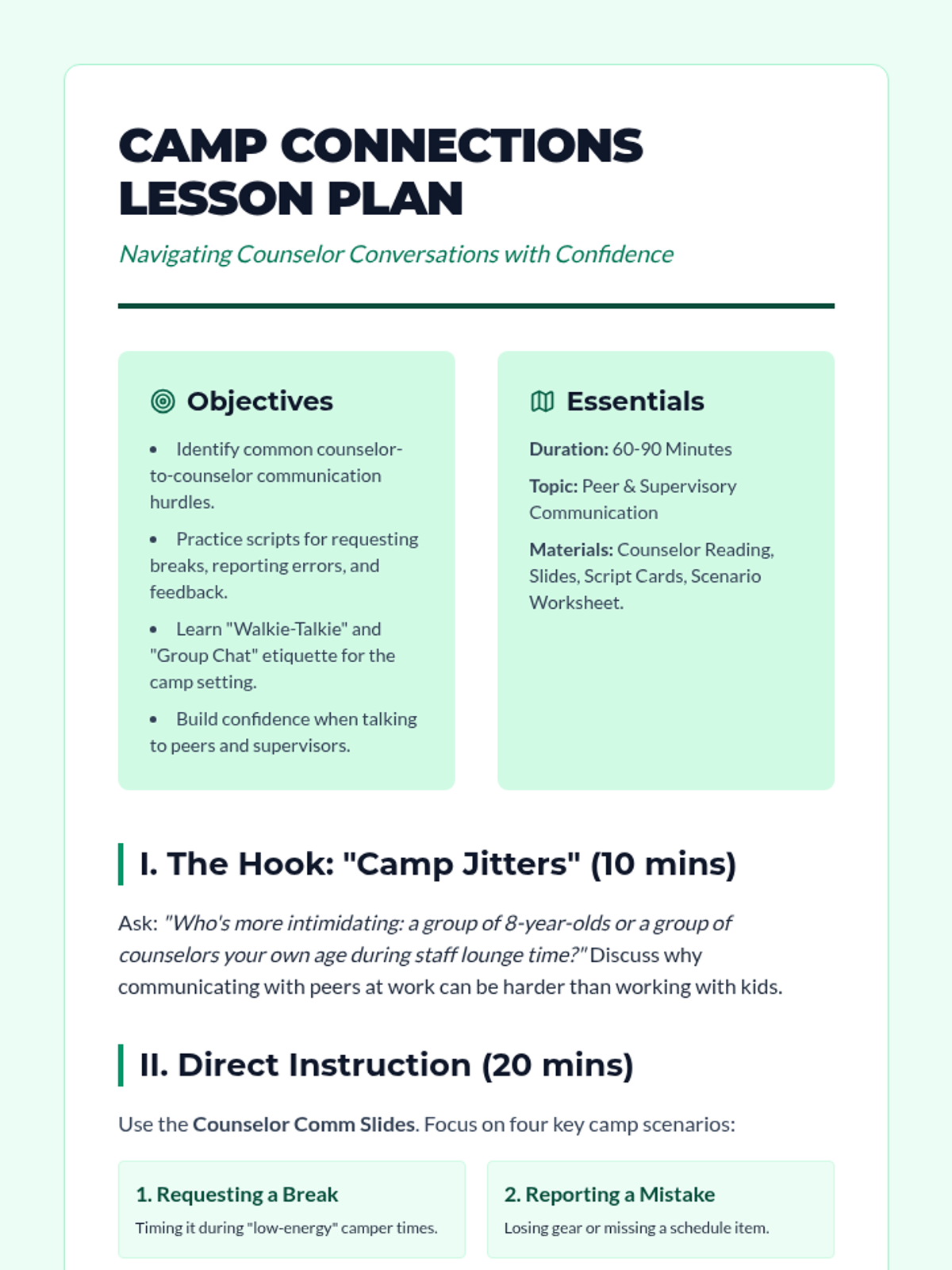
A detailed teacher's guide and lesson plan for the Camp Connections unit, focusing on communication between counselors and staff in a camp setting.
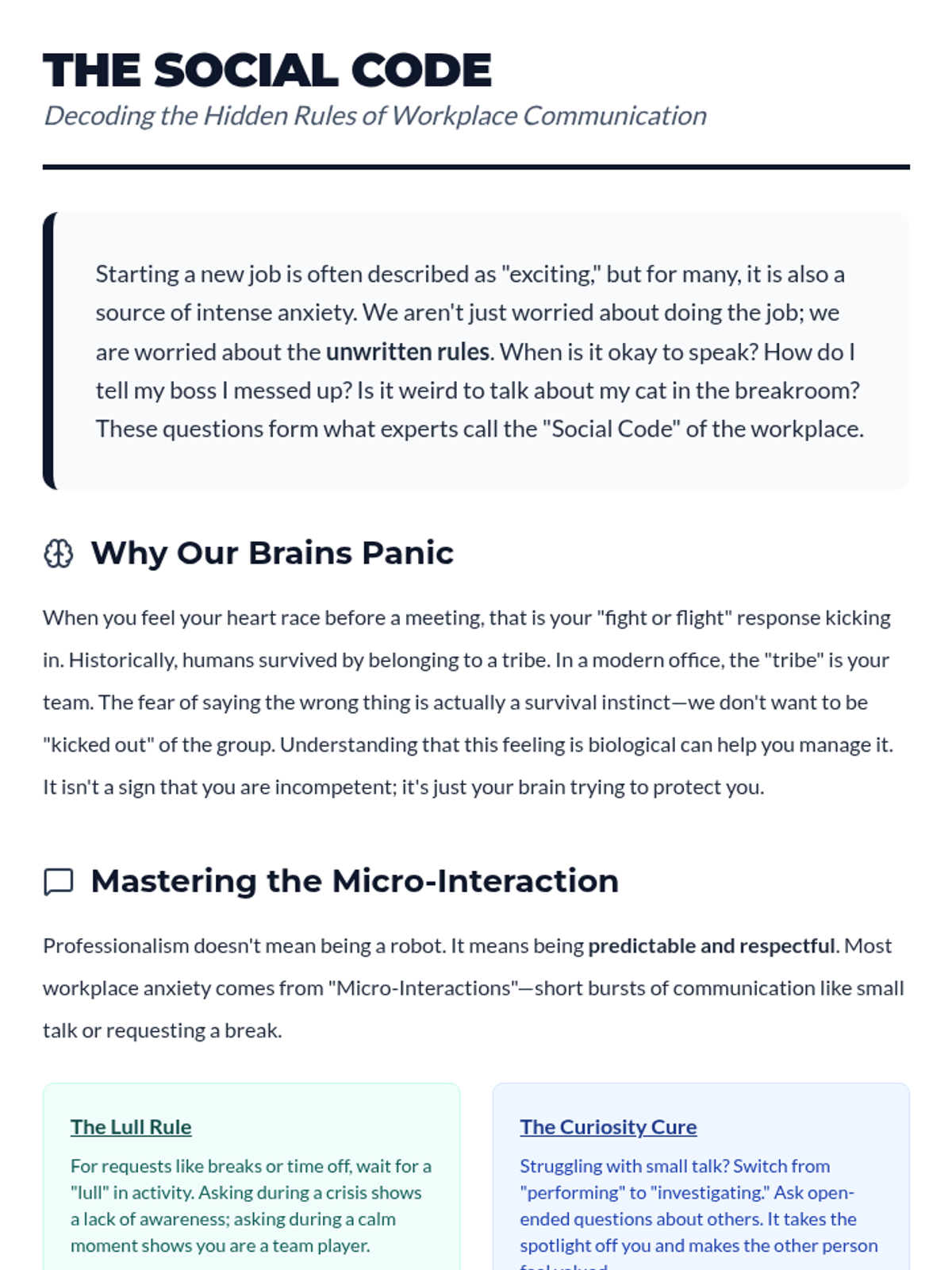
An informational reading passage exploring the psychology of workplace communication nerves and strategies for mastering professional interactions.
Introductory and discussion slides for 'The Blind Side' movie study, exploring the real story of Michael Oher and the metaphor of the 'blind side' in sports and life.
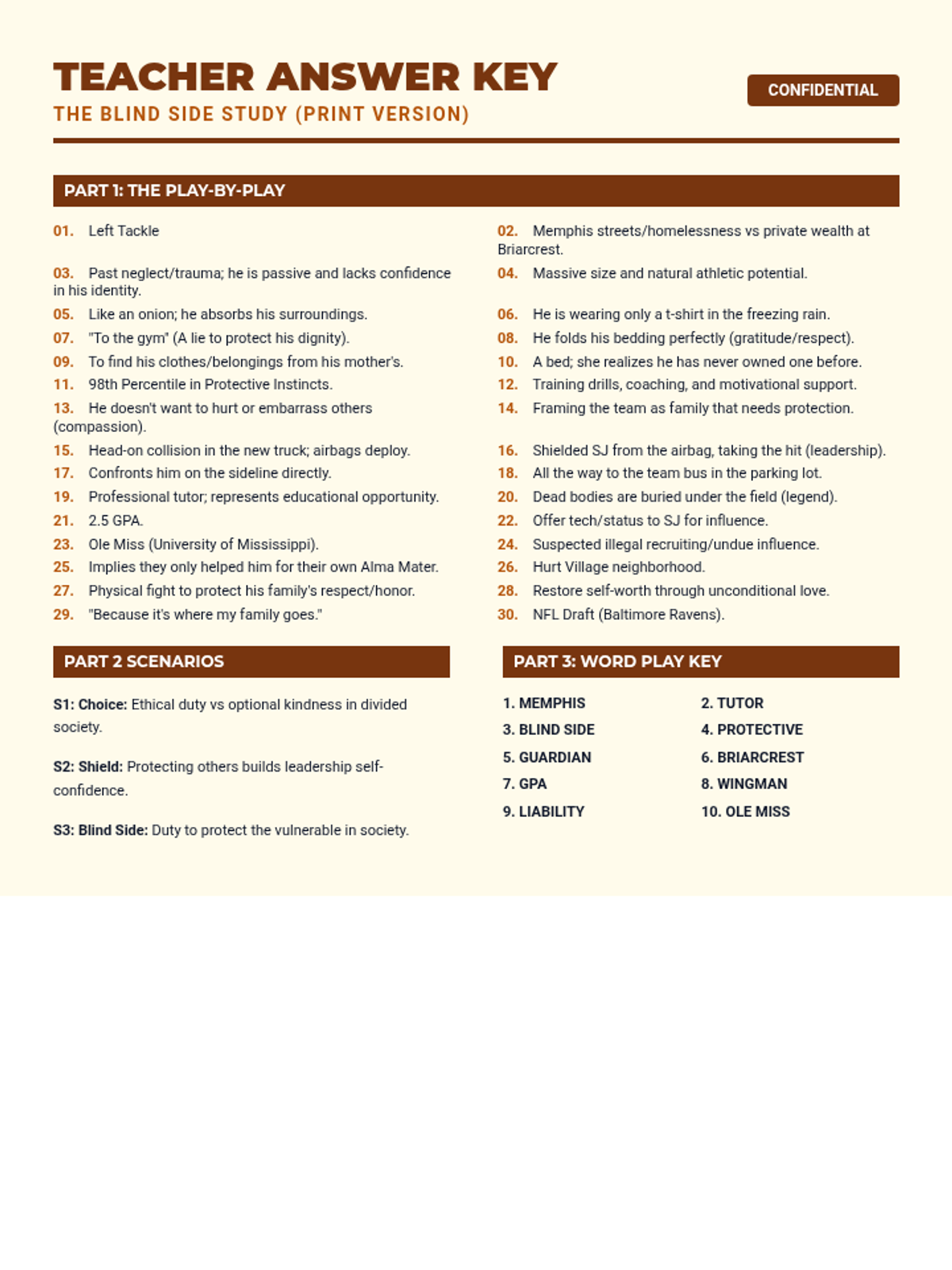
A matching teacher answer key for 'The Blind Side' movie guide, synchronized with the refined 30-question version. Fits on a single page for quick reference.
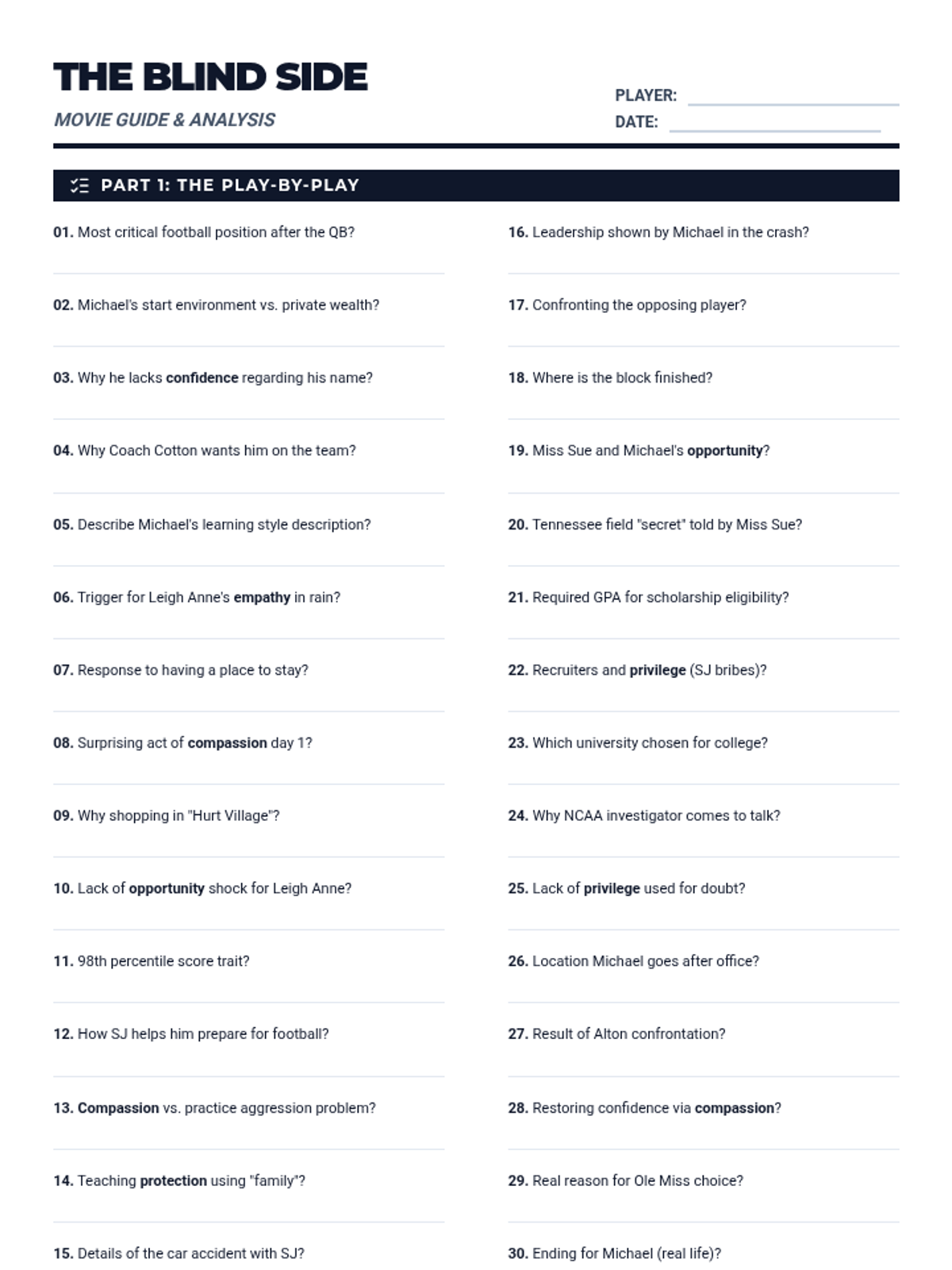
A finalized, print-optimized 2-page student worksheet for 'The Blind Side' featuring 30 chronological questions, 3 ethics scenarios with guided response boxes, and a 10-item vocabulary section. Designed for front-and-back printing on a single sheet.
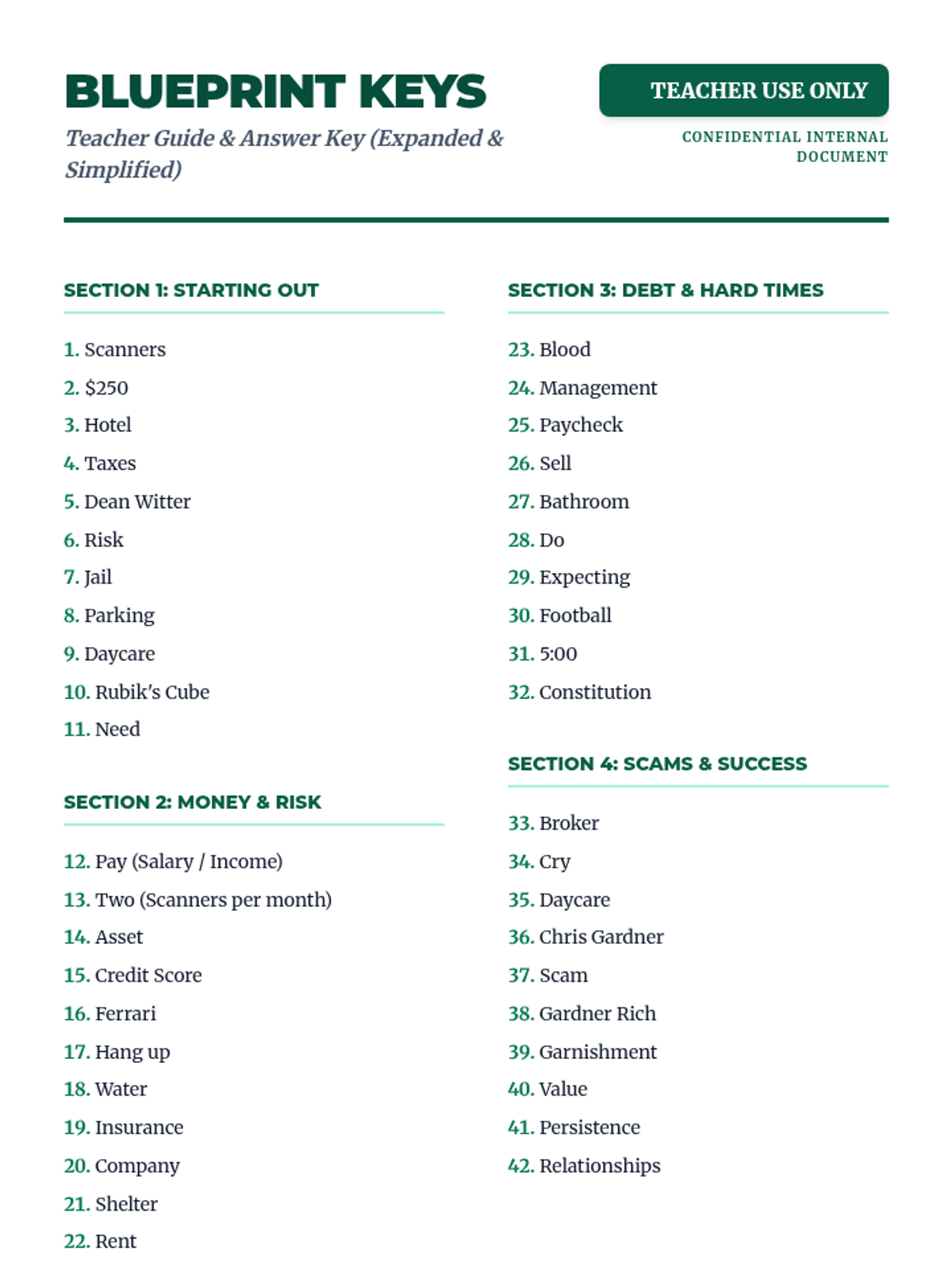
The answer key and discussion guide for the 'Brokerage Blueprint' worksheet, including all 42 answers and prompts for classroom debate on opportunity cost and asset management. Includes new answers for credit, insurance, and debt management.
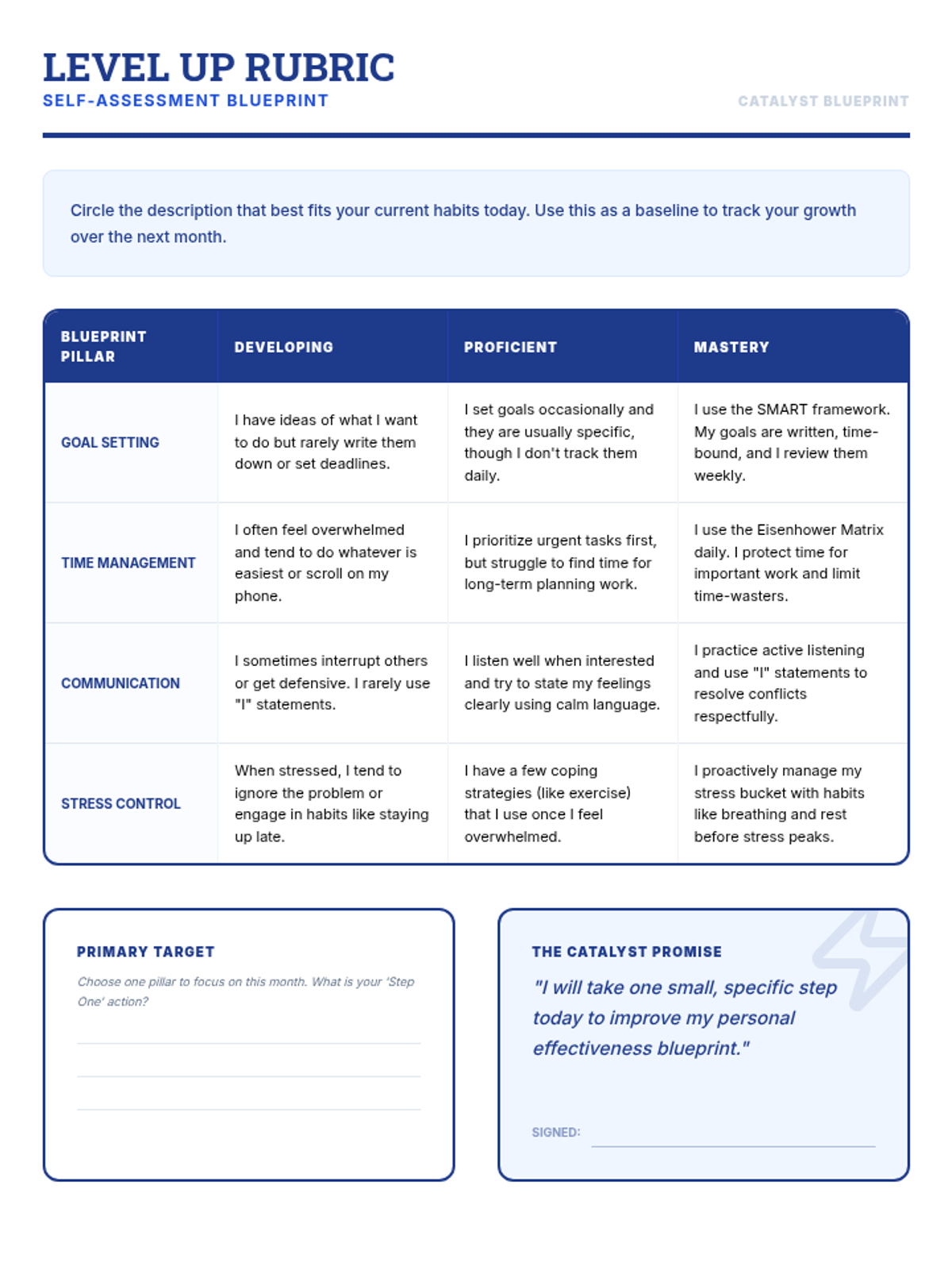
A self-assessment rubric titled 'Level Up Rubric' that allows students to evaluate their baseline skills across the four pillars of personal effectiveness and set targets for growth.
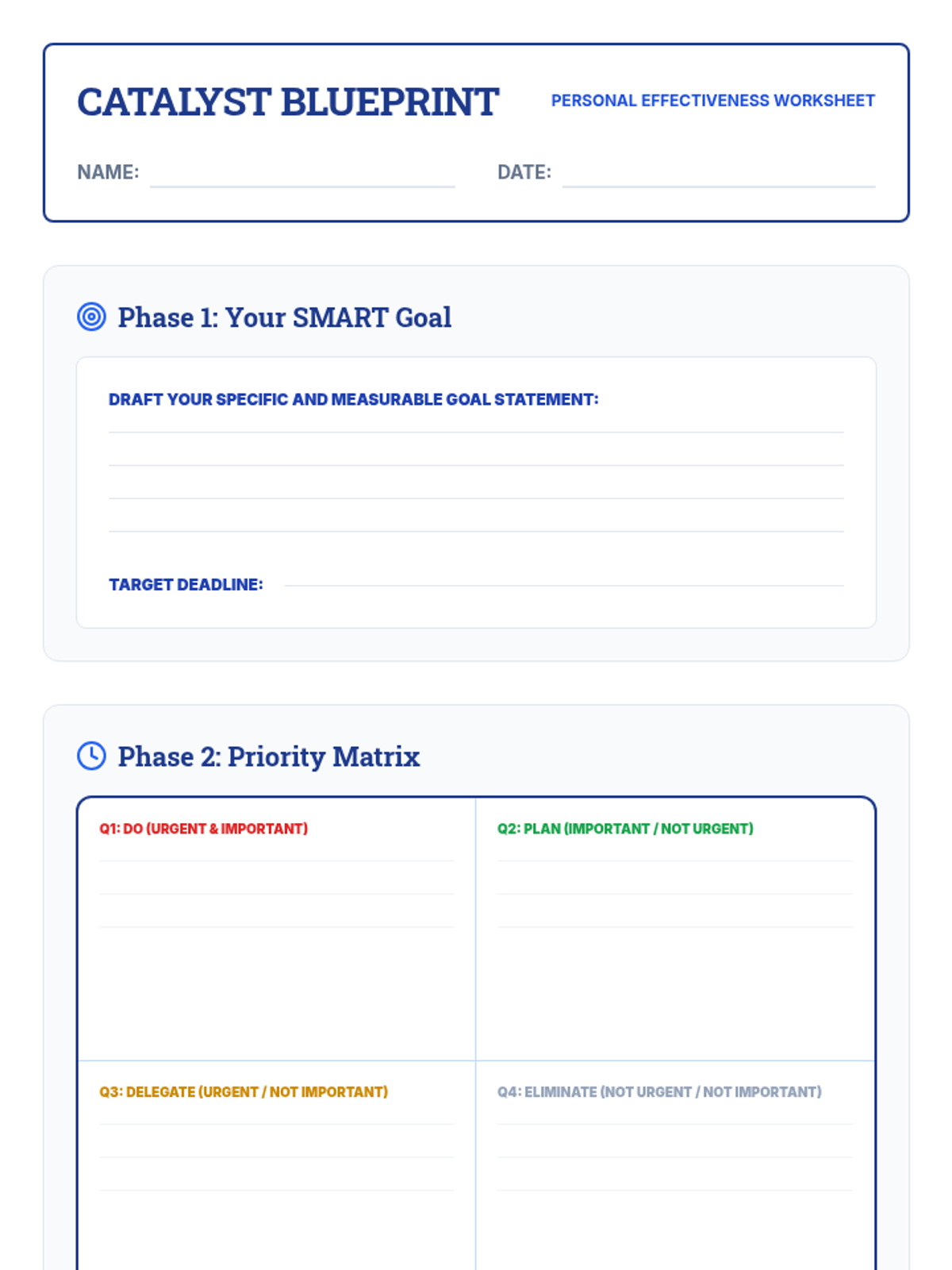
A structured student worksheet titled 'The Catalyst Blueprint' containing practical application areas for SMART goal setting, an Eisenhower Matrix grid, communication role-play prompts, and a stress management toolbox.
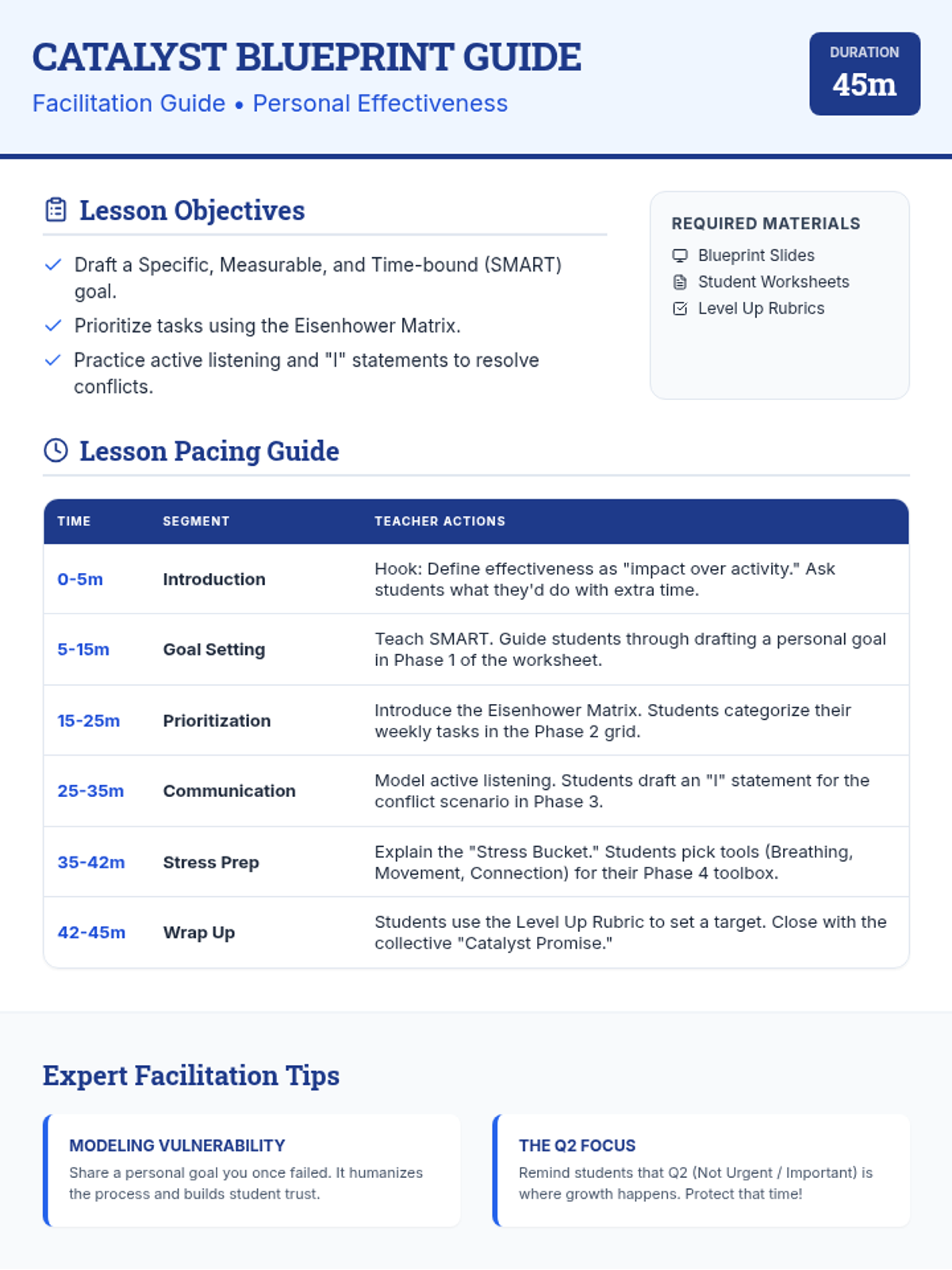
A comprehensive 45-minute teacher guide for facilitating 'The Catalyst Blueprint' lesson, featuring learning objectives, detailed pacing, activity instructions, and expert facilitation tips.
A professional slide presentation titled 'The Catalyst Blueprint' covering the four pillars of personal effectiveness: SMART goal setting, time management with the Eisenhower Matrix, active communication techniques, and stress management strategies.
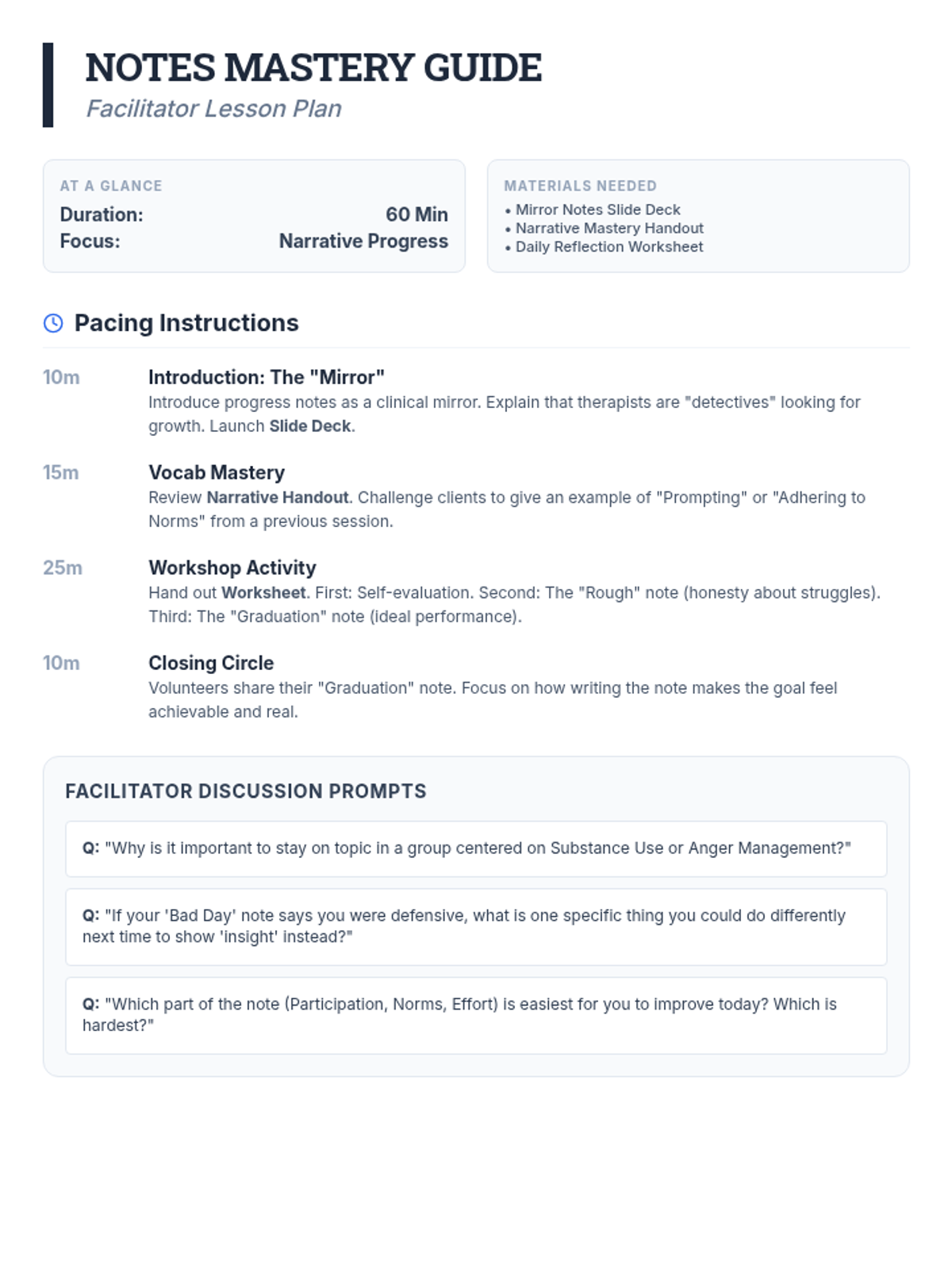
A comprehensive facilitator guide for the Mirror Notes lesson. Revised to restore specific discussion questions about bad notes, defensiveness, and staying on topic.
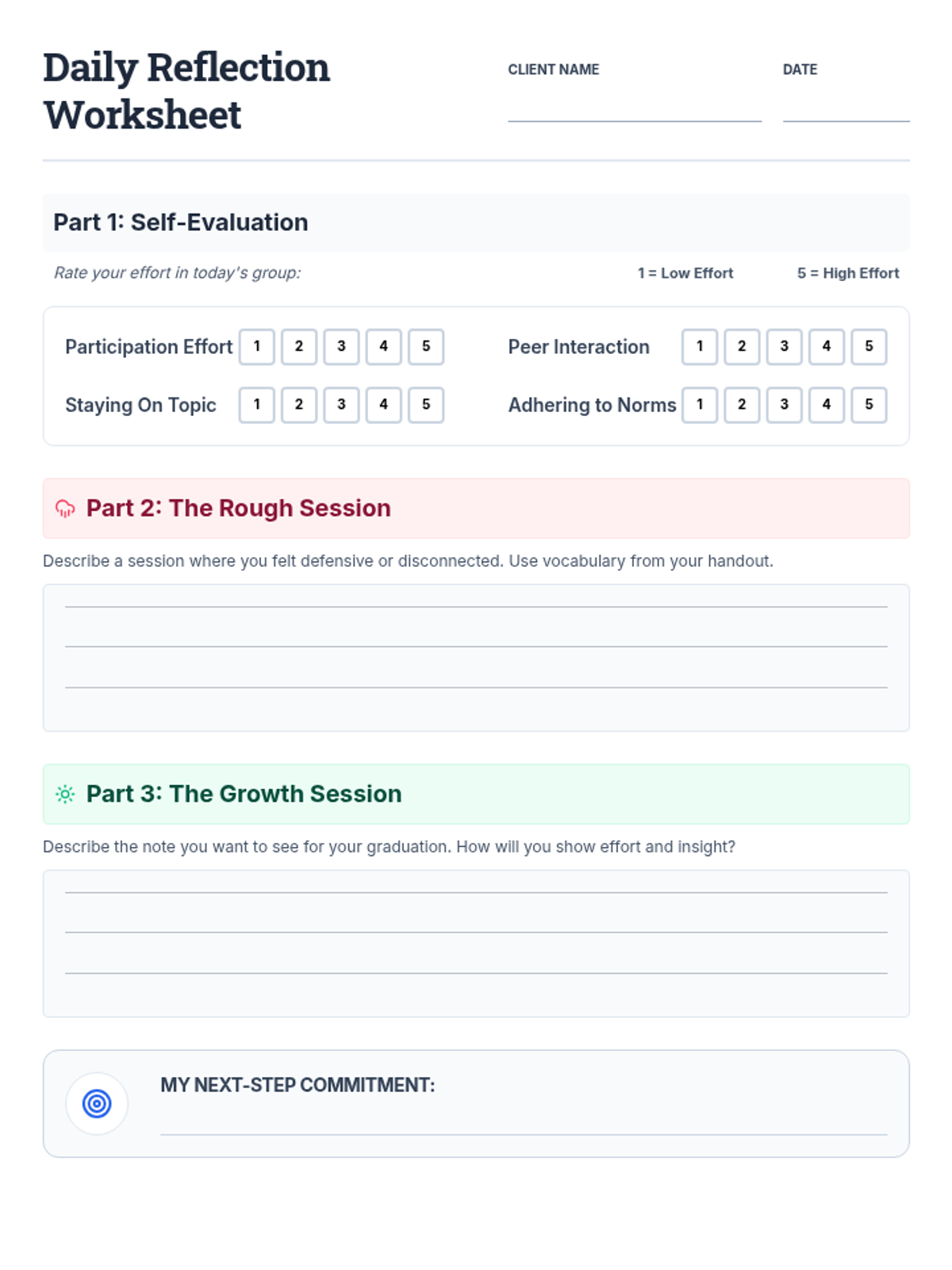
A structured student worksheet for self-evaluating group performance and practicing writing narrative progress notes. Revised with darkened labels, writing lines, and a one-page layout.
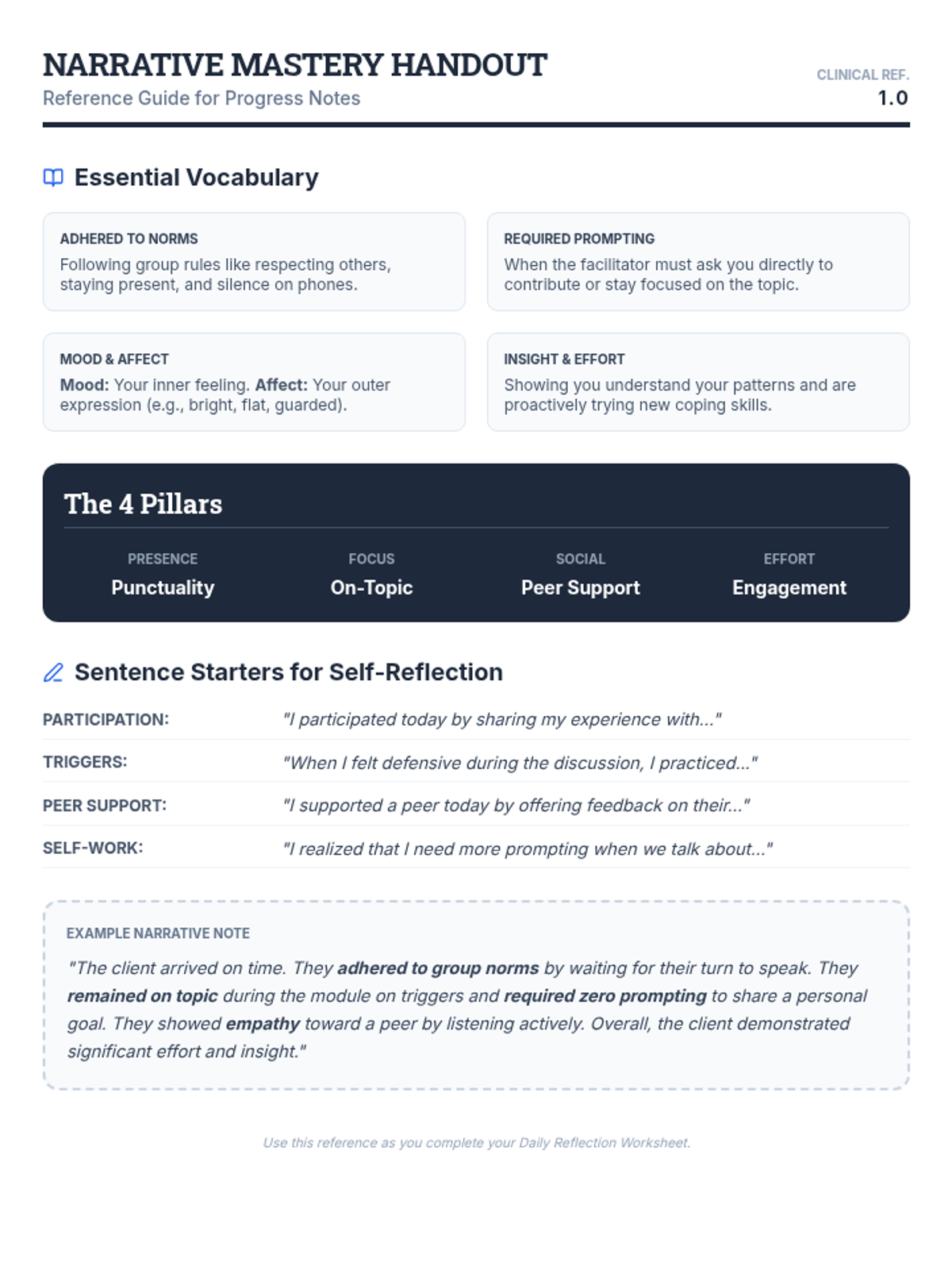
A reference sheet for clients containing key clinical vocabulary, the pillars of narrative notes, and sentence starters for self-reflection. Revised to fit on a single page with improved readability.
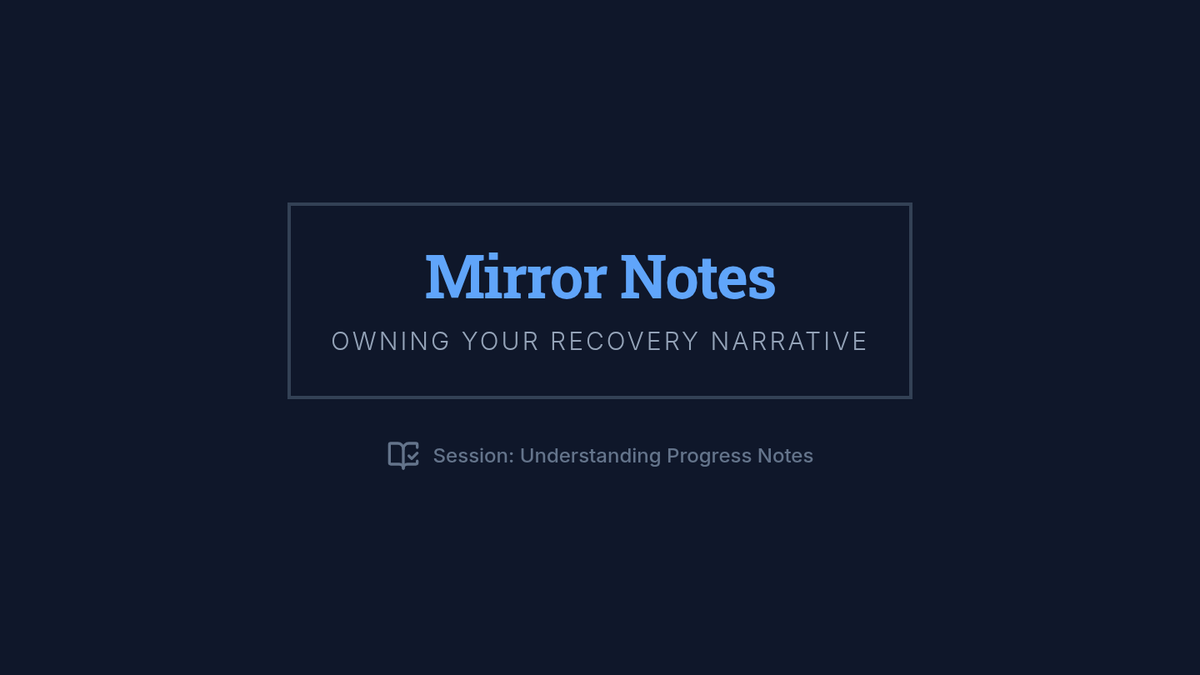
A set of presentation slides teaching clients how counselors write narrative progress notes and how to use them for self-reflection. Updated to restore the "Effort" note example slide and add facilitator discussion prompts.
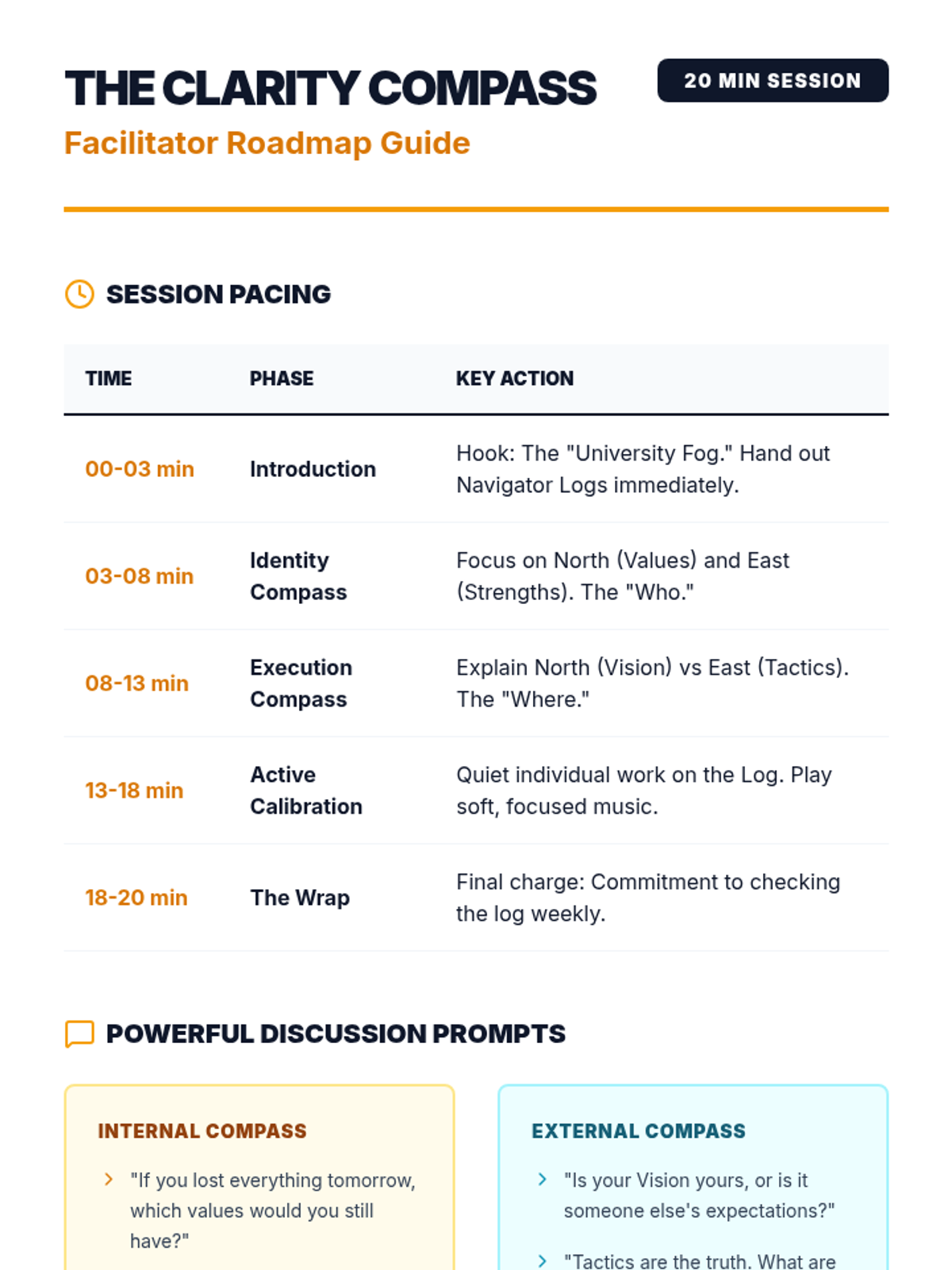
A comprehensive pacing and facilitation guide for the 20-minute Clarity Compass workshop, including discussion prompts and instructional tips.
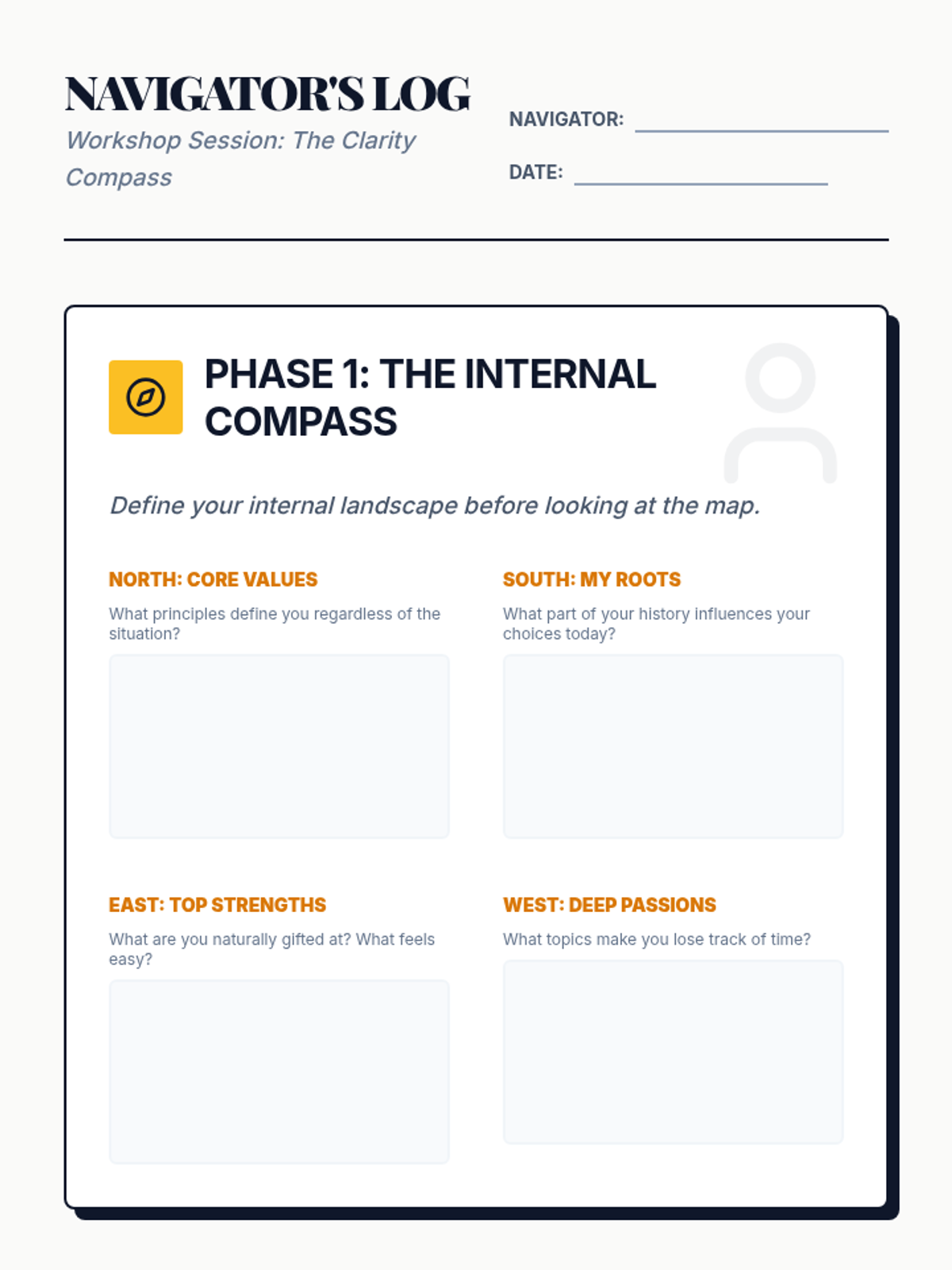
A practical goal-setting worksheet for students to document their Internal and External Clarity Compasses during the workshop.
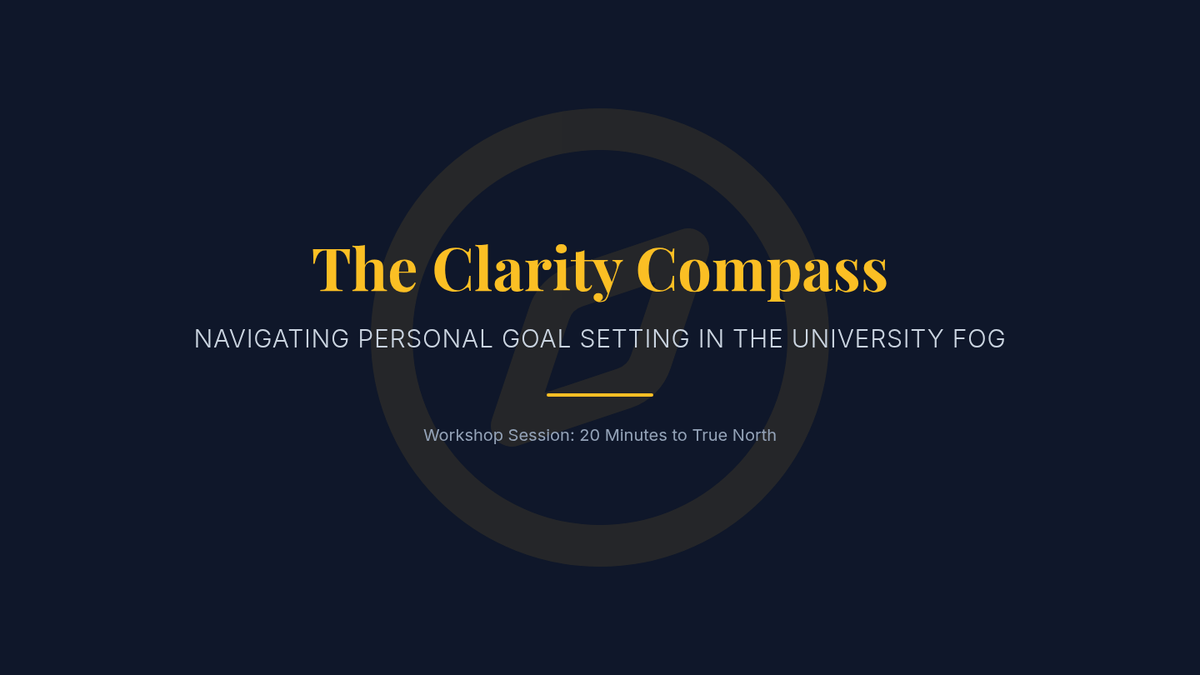
A visually striking slide deck for a 20-minute university workshop, introducing the Internal and External Clarity Compass models for personal goal setting.
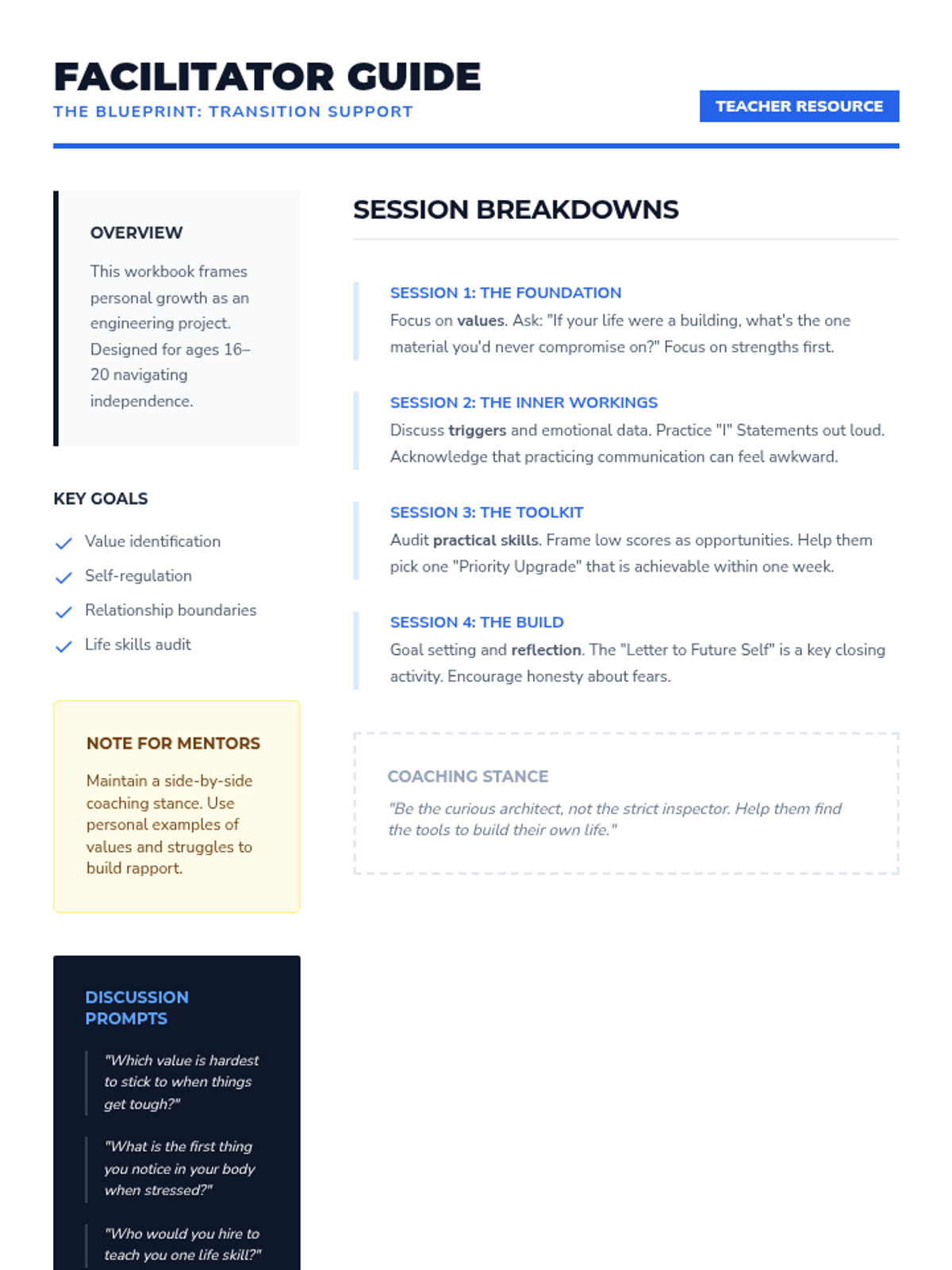
A guide for teachers, mentors, or therapists to facilitate the Blueprint Workbook, featuring session breakdowns, discussion prompts, and coaching strategies.
A 10-page transition workbook for young adults focusing on values, emotional intelligence, relationships, and independent living skills with a modern "blueprint" aesthetic.
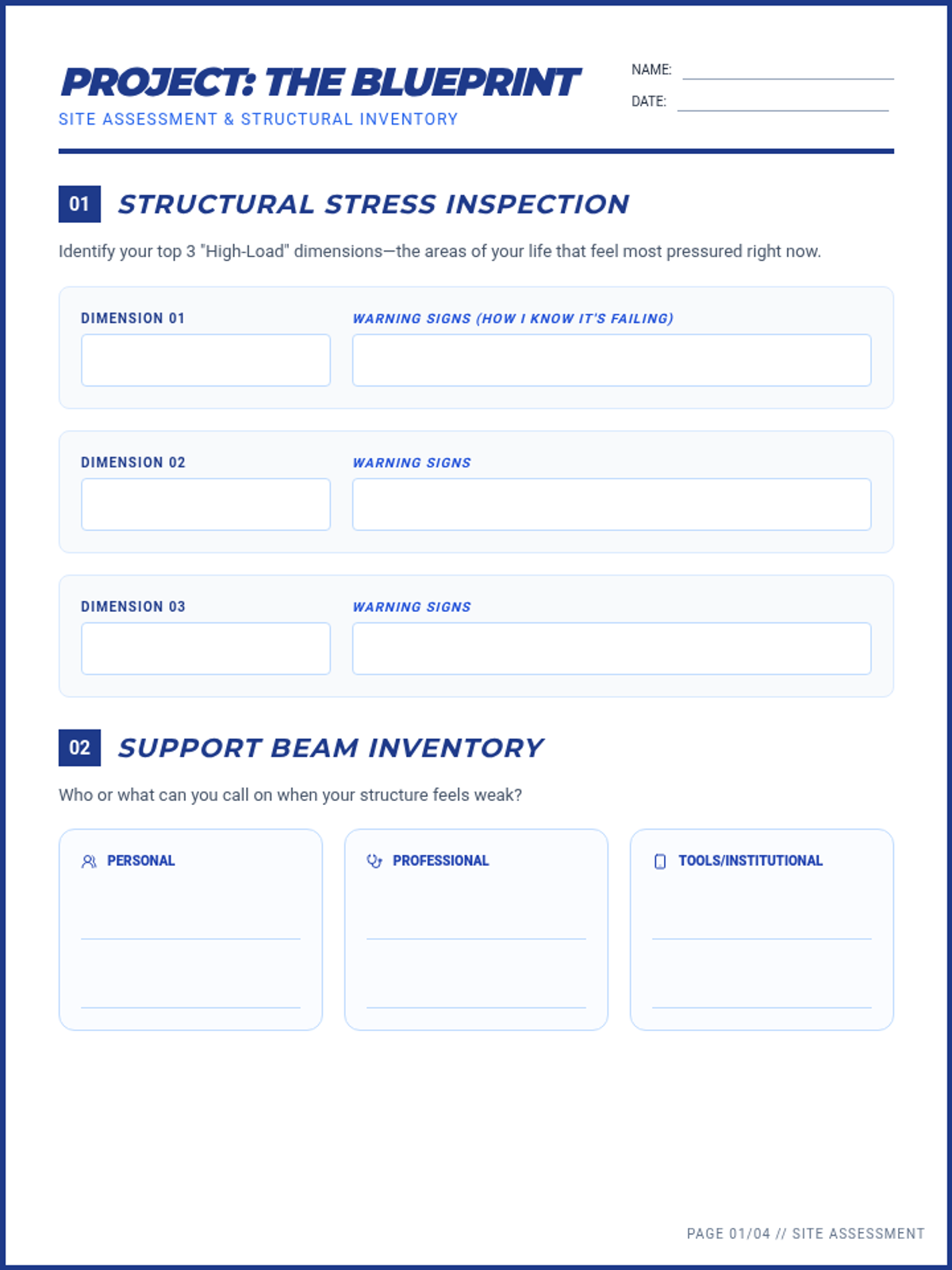
An expanded 4-page technical "Blueprint" worksheet for students. Includes stressor identification, support mapping, a drafting table, a load-bearing wall analysis, and a 7-day challenge tracker with a quality control reflection.
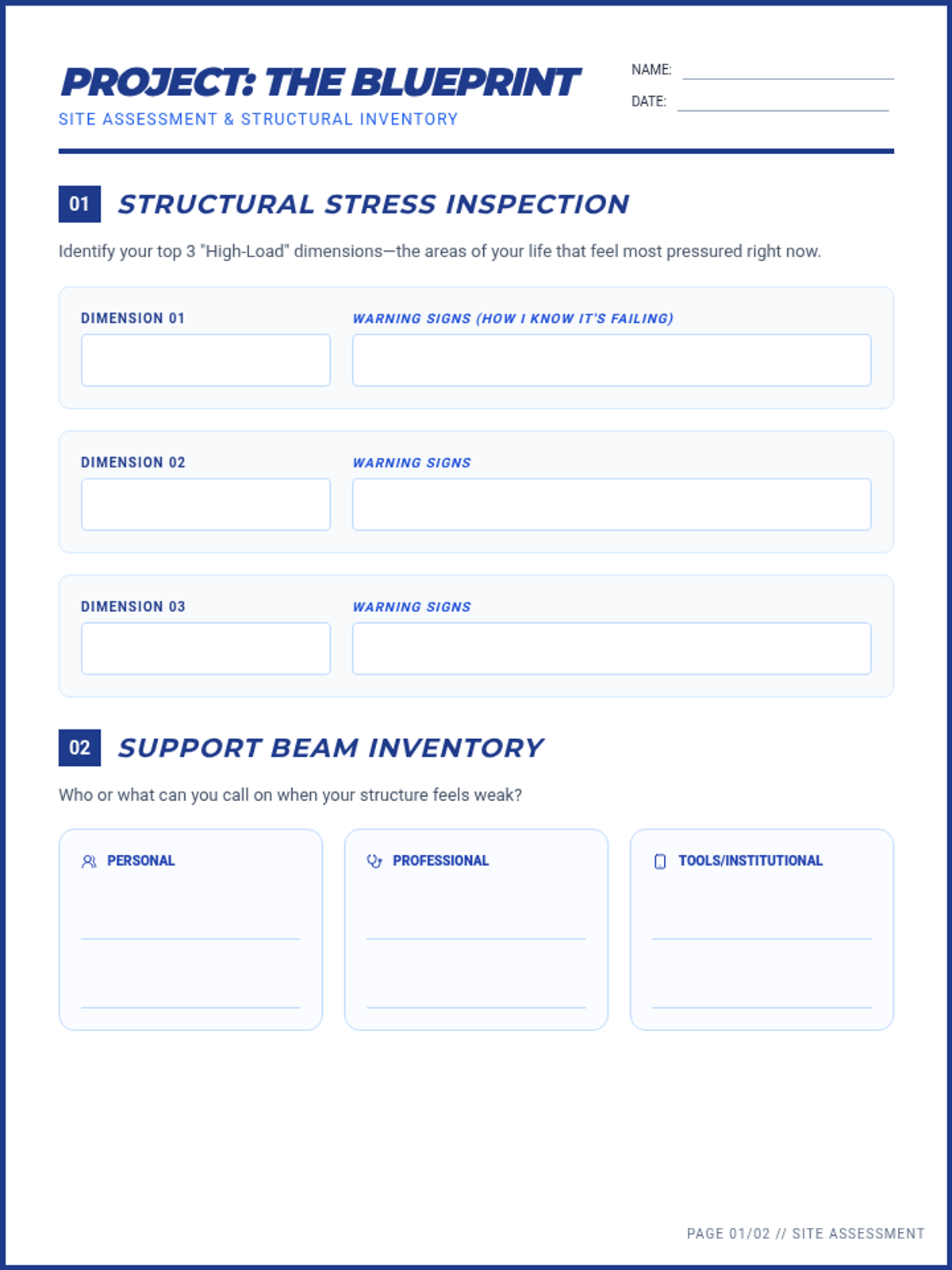
A technical-themed "Blueprint" worksheet for students to map their stressors, identify support beams, and draft specific maintenance and renovation actions for their self-care plan. Now expanded to 2 pages with strictly controlled layout to prevent overflow.
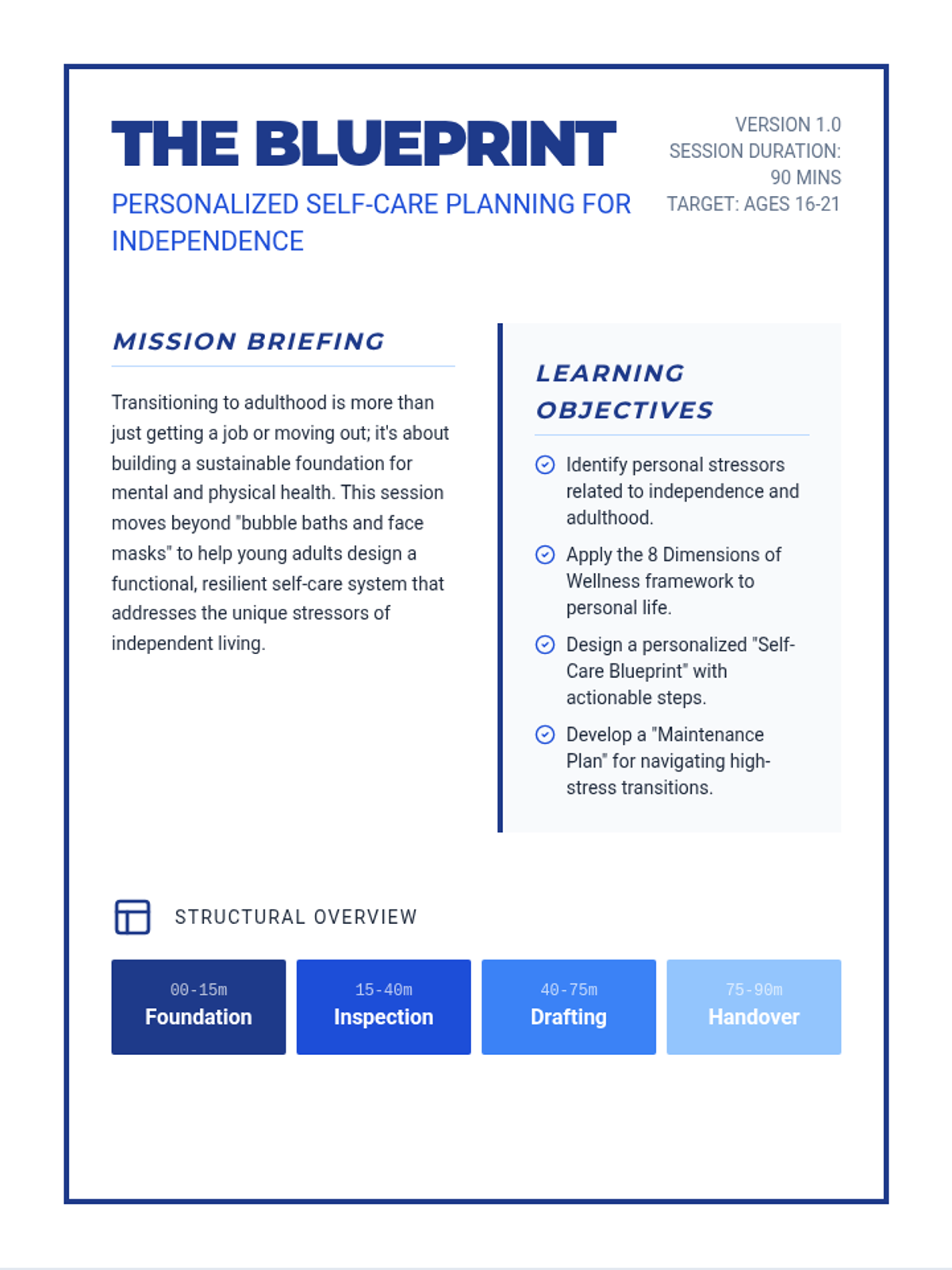
A dynamic slide presentation for "The Blueprint" session. It uses an architectural/blueprint theme and covers the 8 Dimensions of Wellness, identifying warning signs, and drafting actionable self-care steps.
A comprehensive 8-page instructor manual for "The Blueprint" session. It includes lesson plans, scripts, facilitation tips for working with young adults, and a detailed breakdown of the 8 Dimensions of Wellness framework.
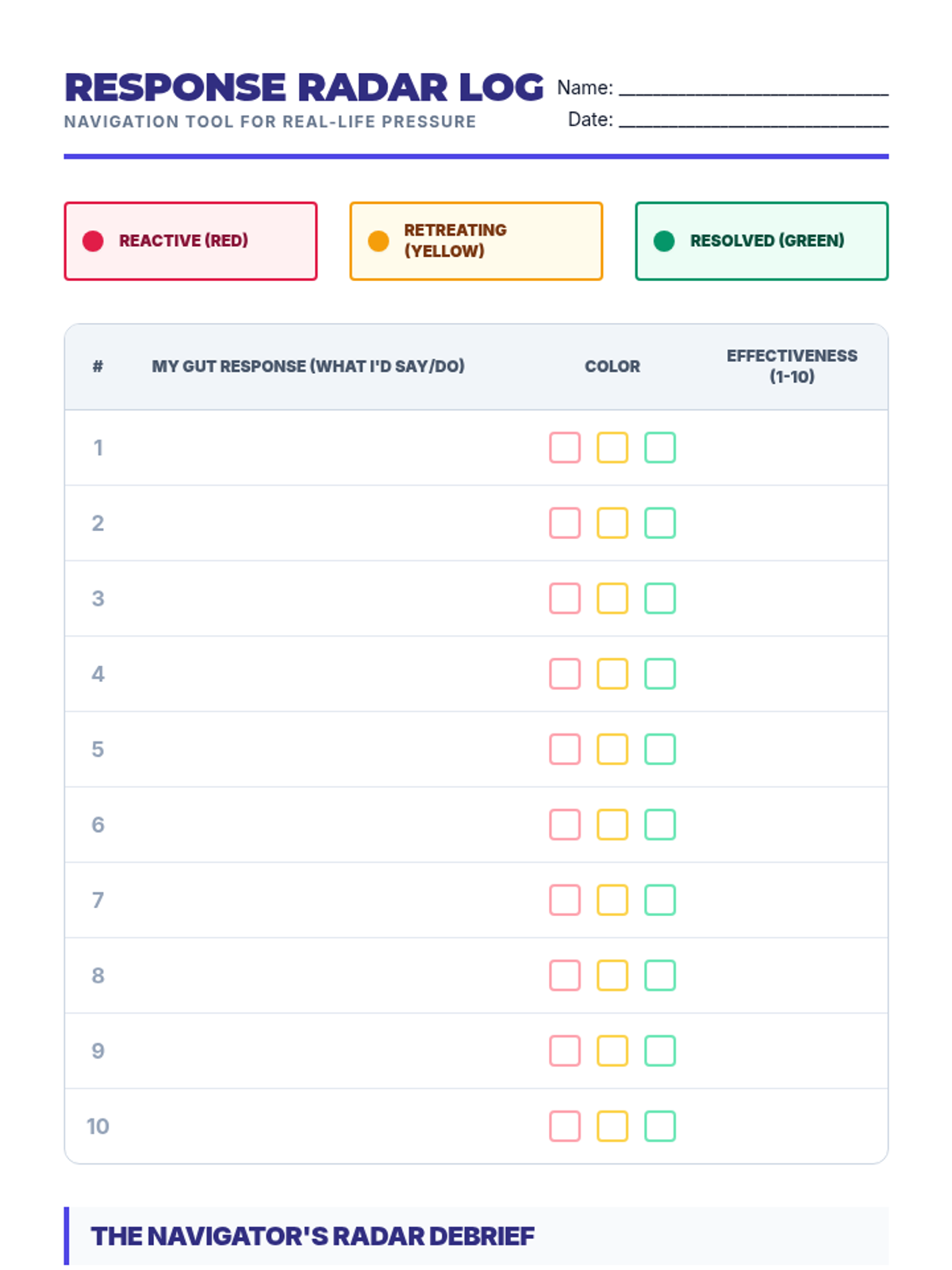
A worksheet for clients to log their responses to the scenarios, categorize them by color, and use SFBT scaling to evaluate the effectiveness of their communication habits.
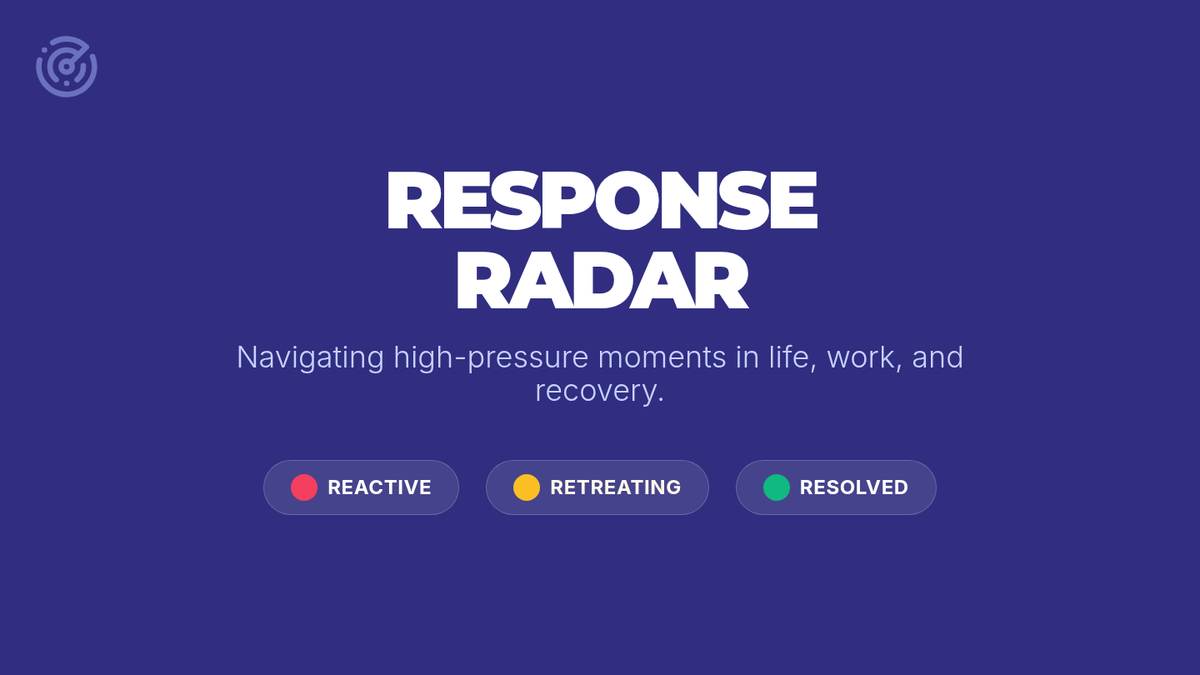
A slide deck presenting 10 high-stakes scenarios across residential, medical, legal, and workplace environments, designed to elicit and evaluate client communication styles.
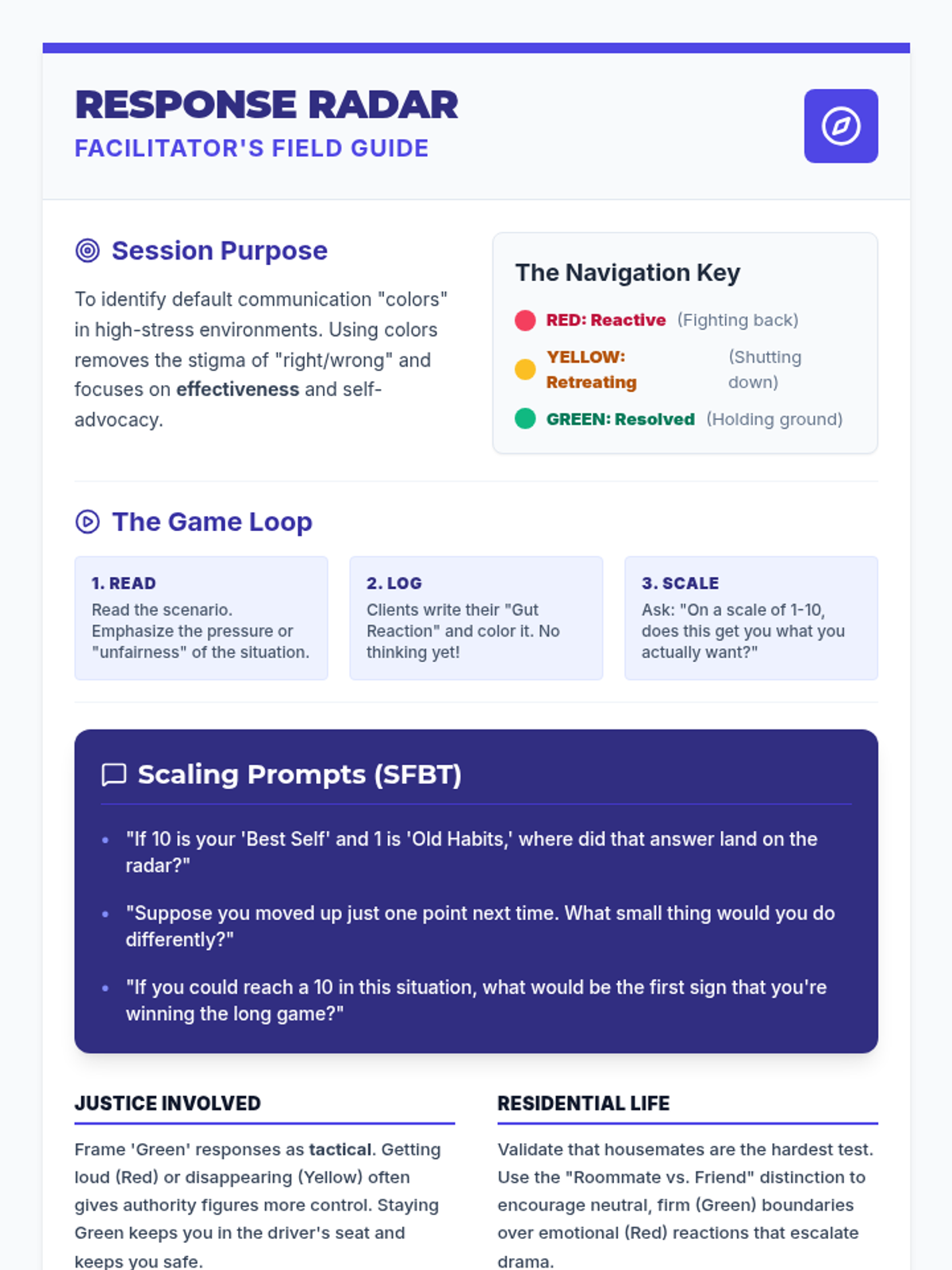
A guide for facilitators to lead the Response Radar game, including color-coding definitions, SFBT scaling prompts, and environment-specific tips for MH/SA and forensic populations.
A visual slide deck designed to accompany the Battery Reset workshop. Features high-impact graphics explaining the difference between stress and burnout, the 16-21 pressure cooker, and strategies for energy management.
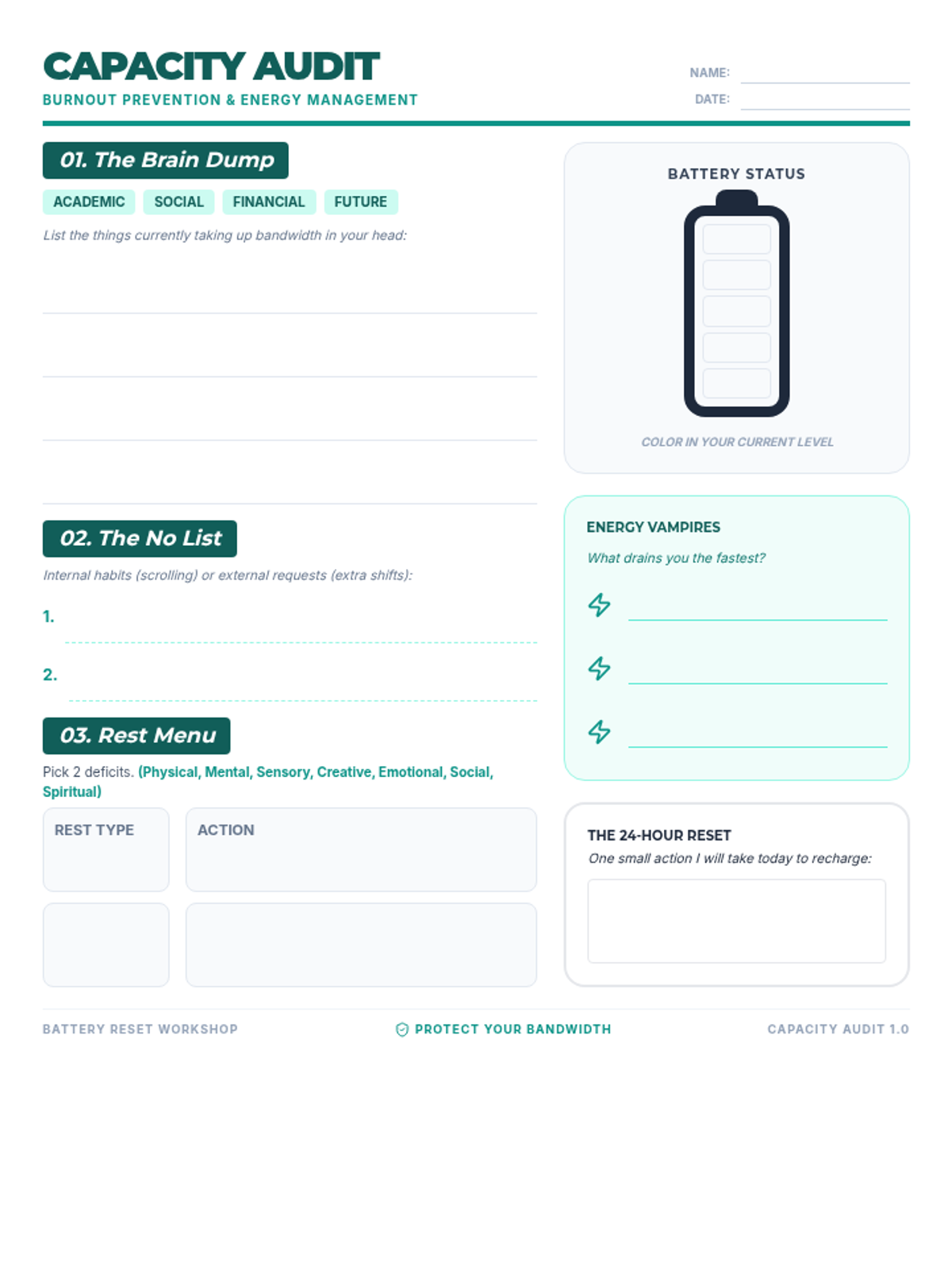
A comprehensive 3-page student workbook for the Battery Reset Stress Workshop. Features expanded self-reflection activities including an energy scan, physical stress mapping, nervous system ladder check-in, and personalized rest menu.
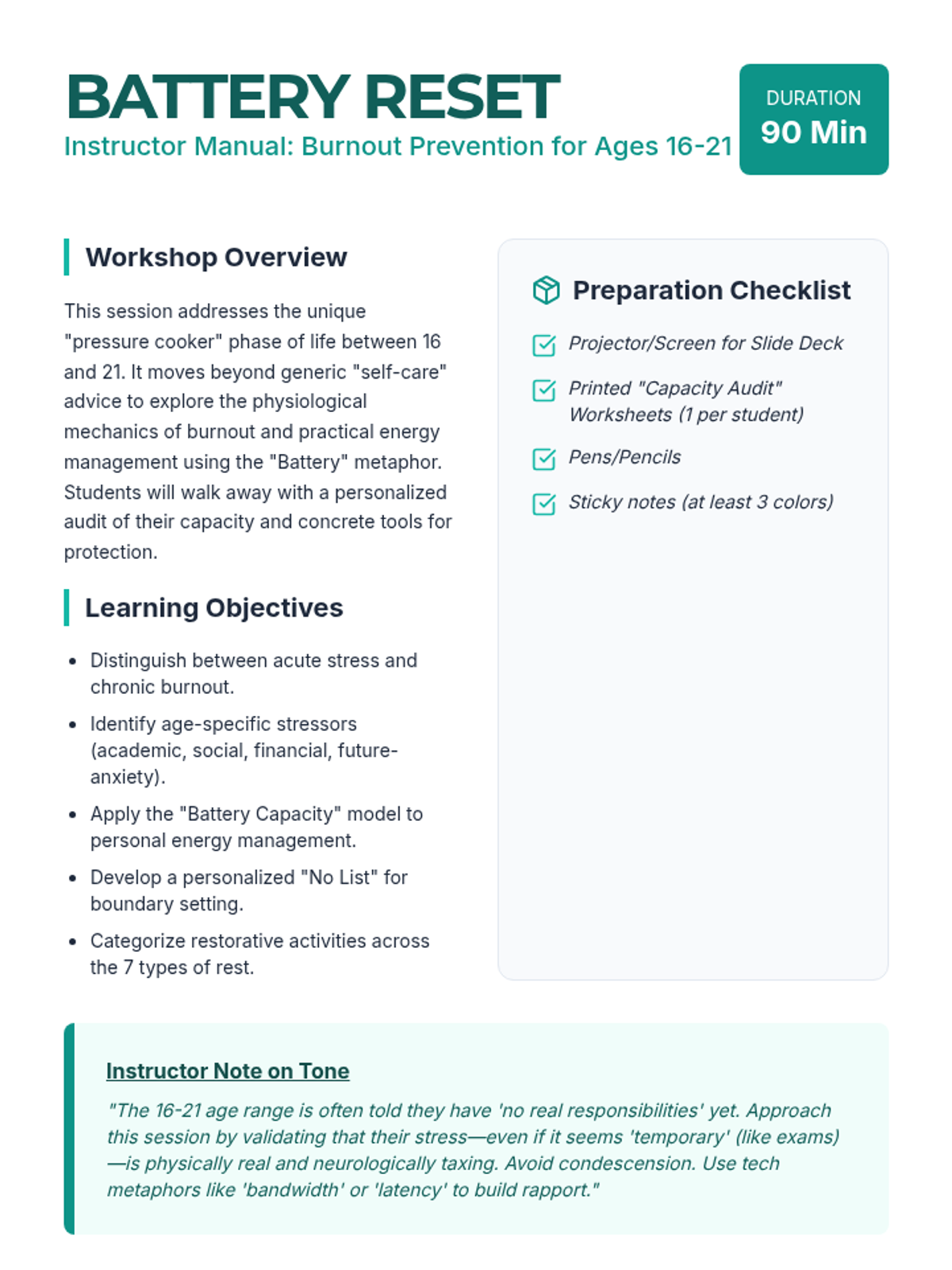
A comprehensive 8-page instructor guide for facilitating a 90-minute workshop on stress and burnout prevention for young adults (16-21). Includes psychological background, minute-by-minute facilitation notes, and resource lists.
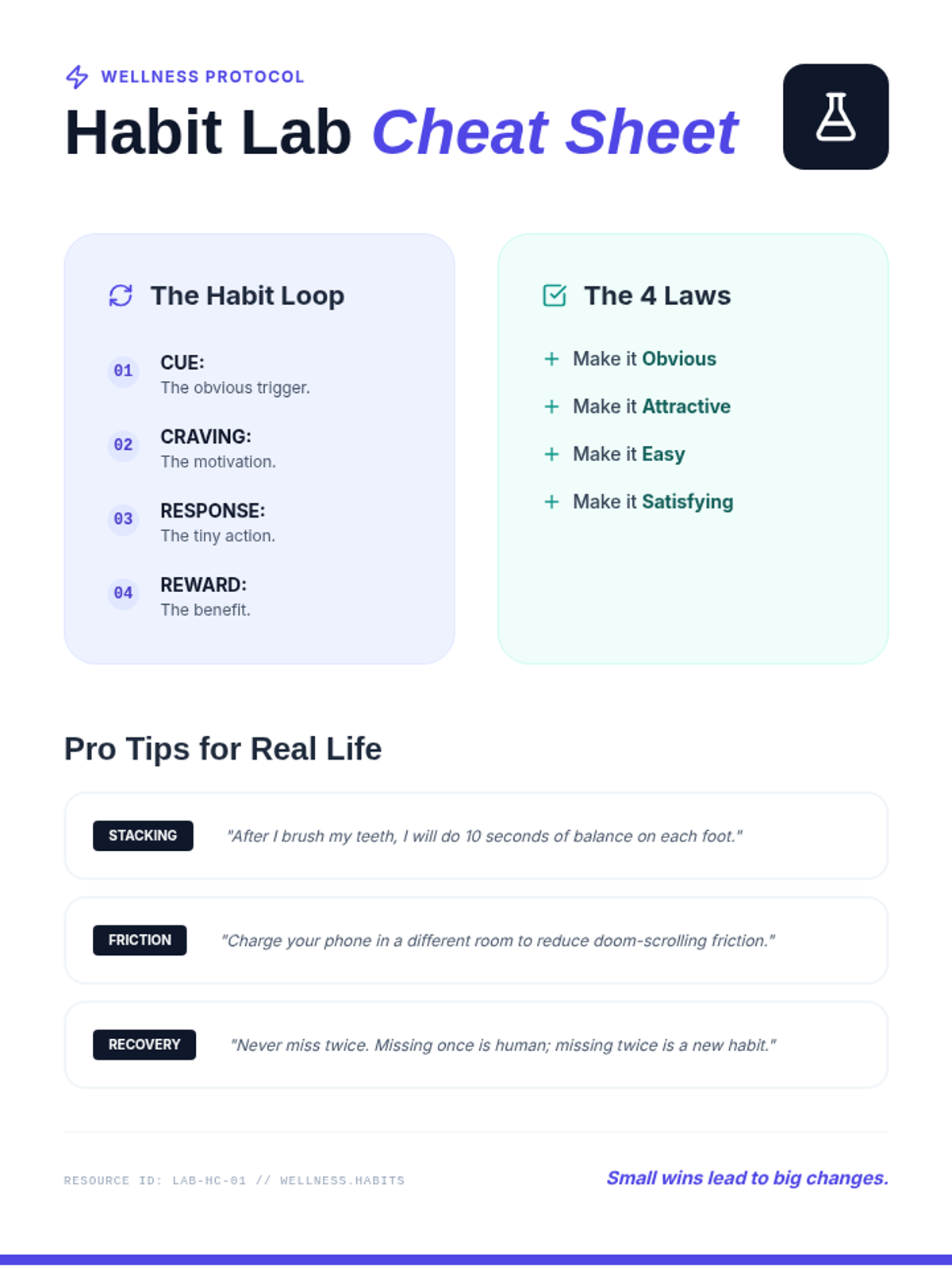
A concise one-page reference handout for participants, summarizing the habit loop, the four laws of behavior change, and practical strategies like habit stacking and environment design.
A high-impact visual presentation covering the core concepts of habit formation: the habit loop, identity-based habits, the 2-minute rule, temptation bundling, and habit stacking. Designed for 16-21 year olds.
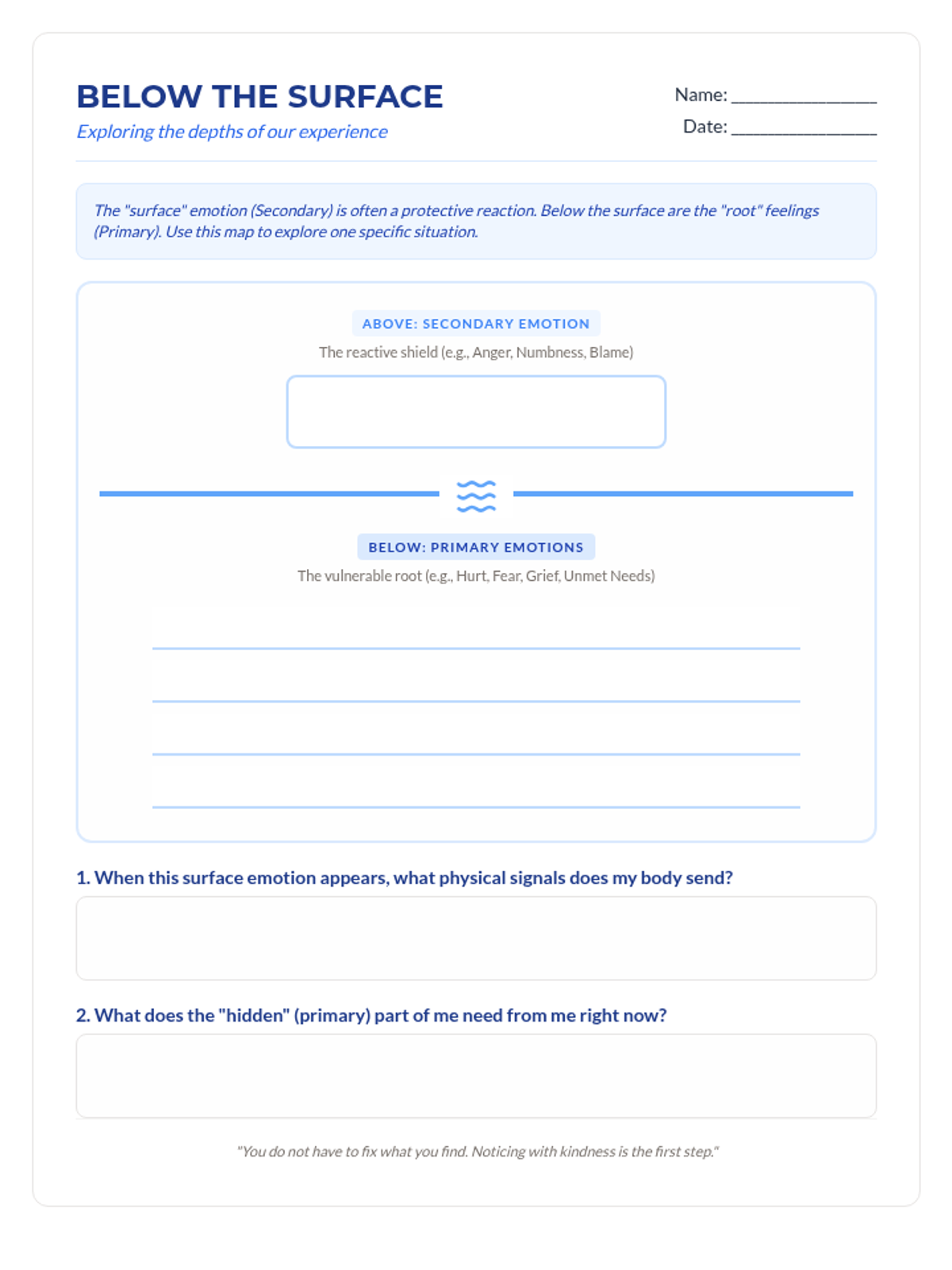
An activity worksheet for participants to explore the "iceberg" metaphor of emotions, identifying visible primary emotions and hidden secondary emotions.
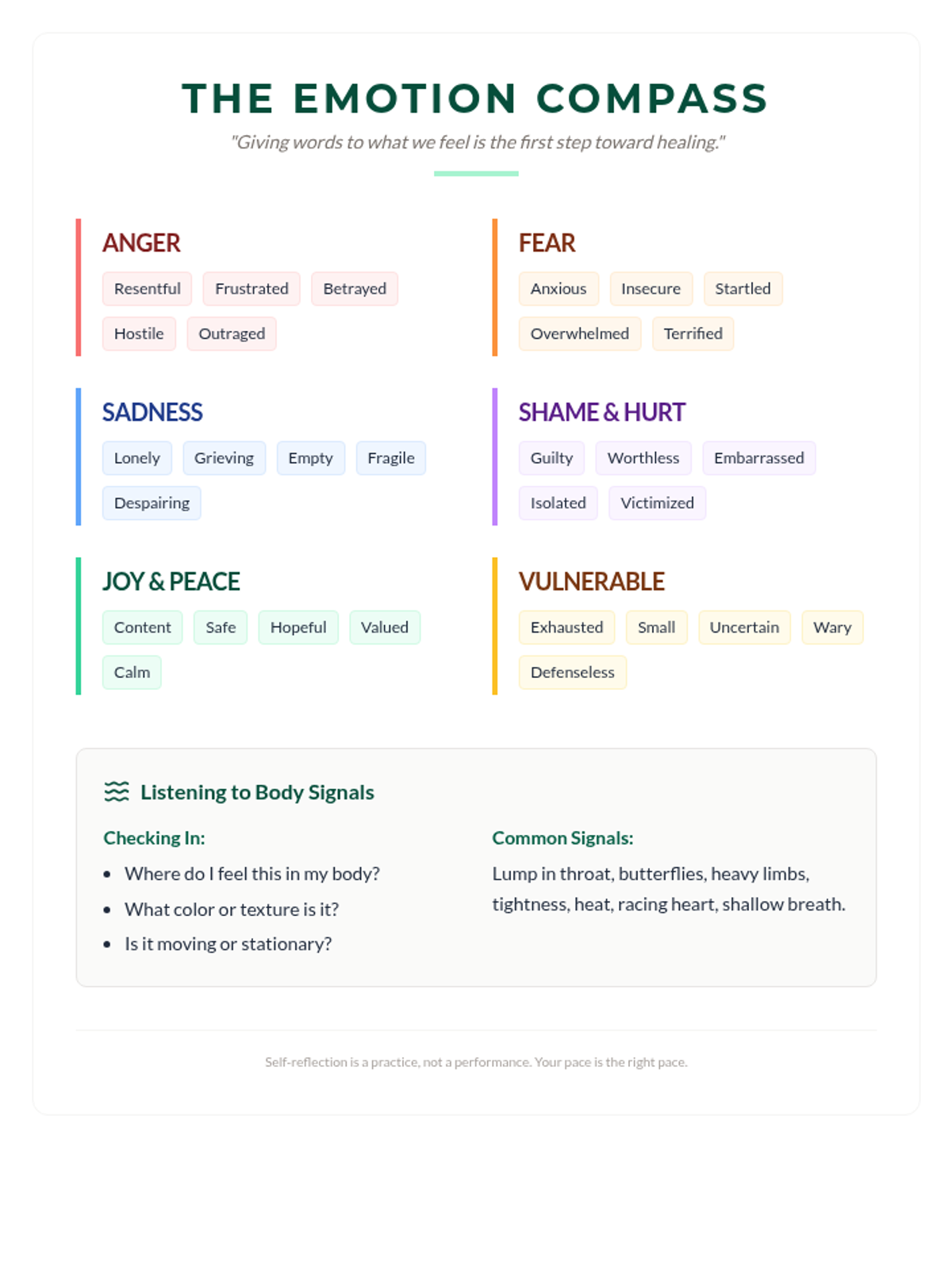
An emotion vocabulary reference guide for participants, categorizing complex emotions and providing a list of common somatic signals.
A visual presentation for the session, featuring concepts like somatic awareness, the iceberg metaphor for secondary emotions, and mindfulness prompts.
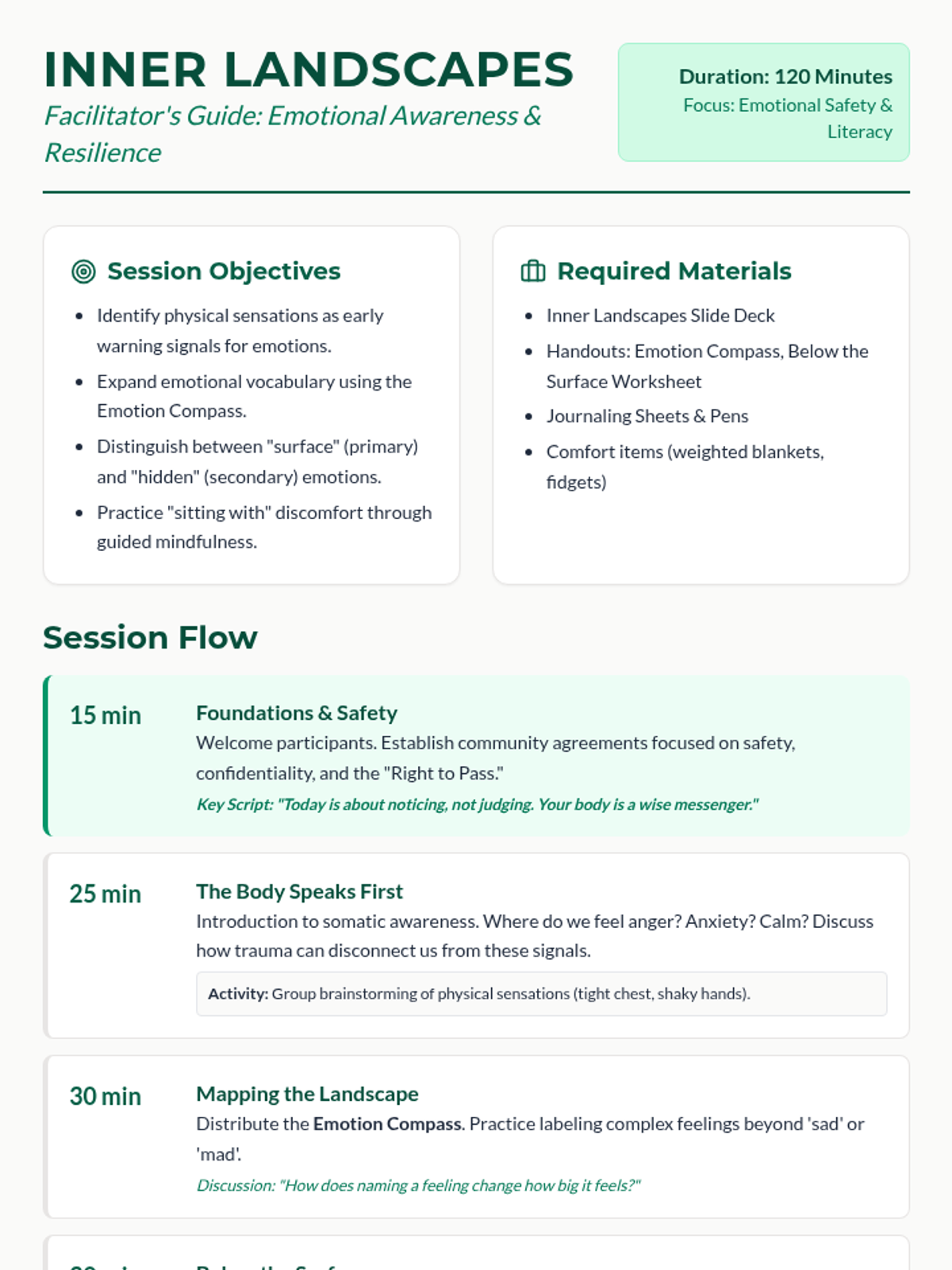
A comprehensive teacher guide for facilitators, outlining the 2-hour session flow, session objectives, pacing, and trauma-informed tips for working with survivors.
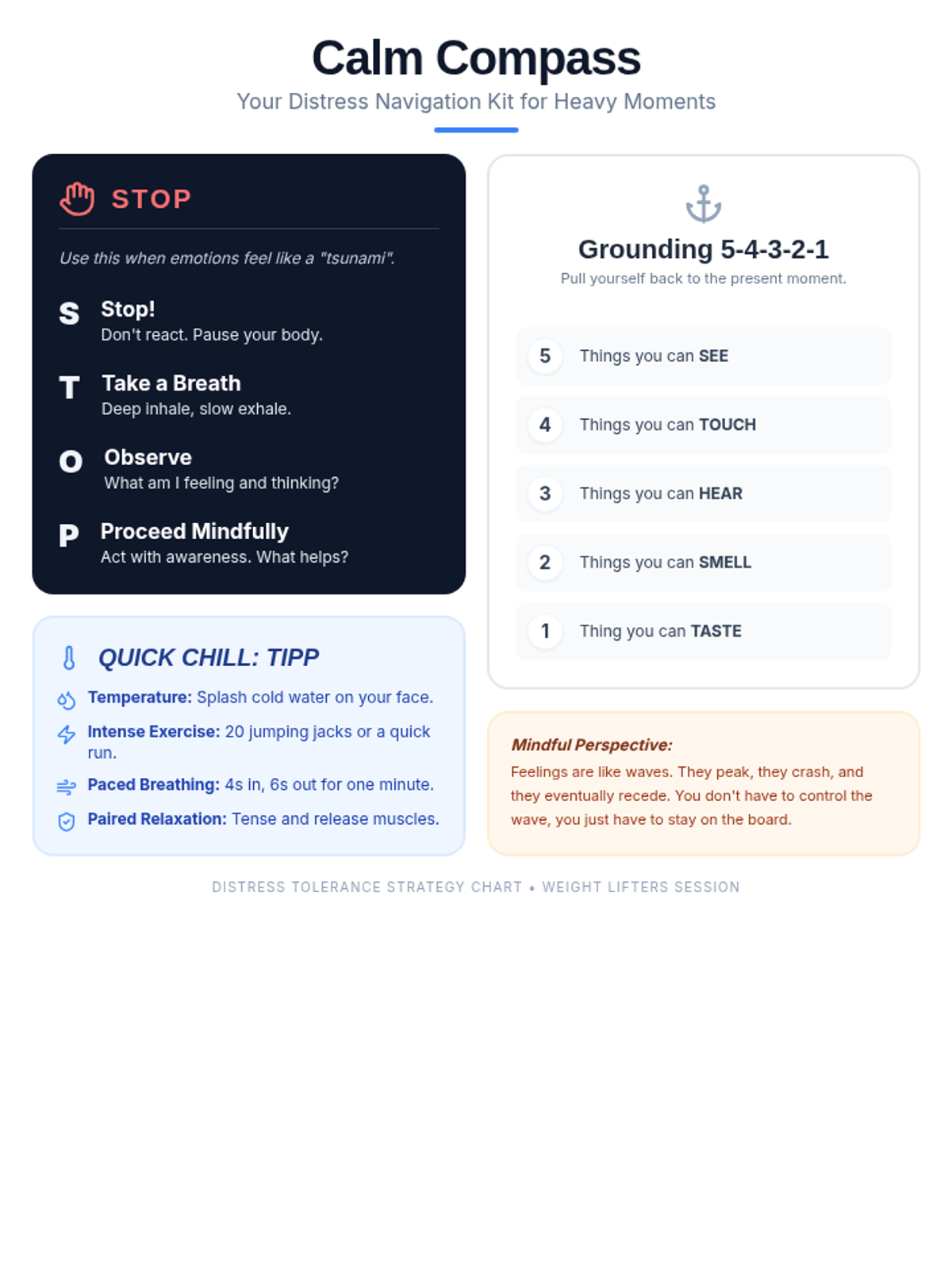
A visual coping strategy chart featuring DBT distress tolerance skills like STOP, TIPP, and 5-4-3-2-1 grounding. Revised for single-page layout and higher contrast.
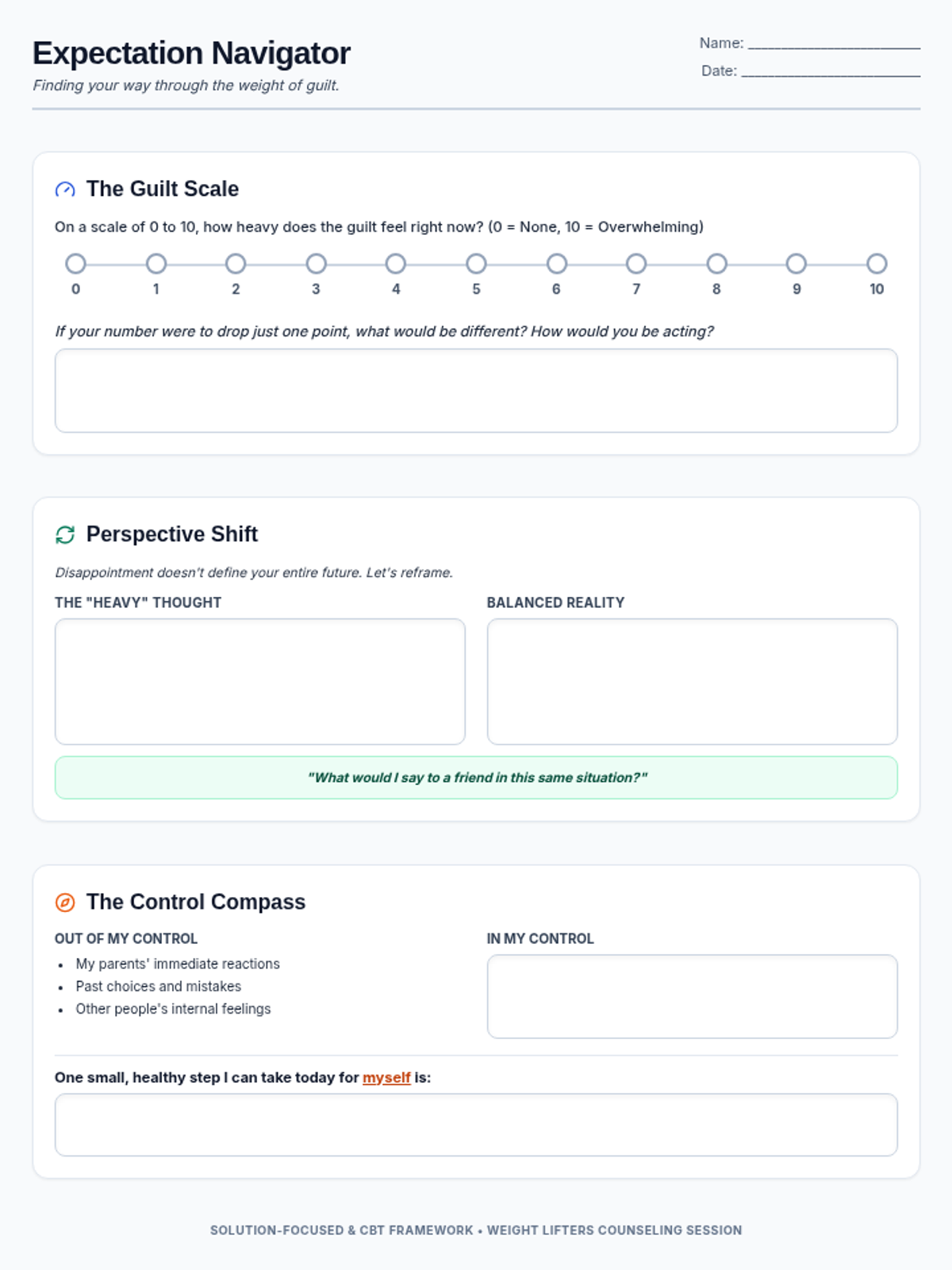
A counseling worksheet combining SFBT scaling, CBT reframing, and a control compass to help students navigate feelings of guilt and parental disappointment. Optimized for single-page printing.
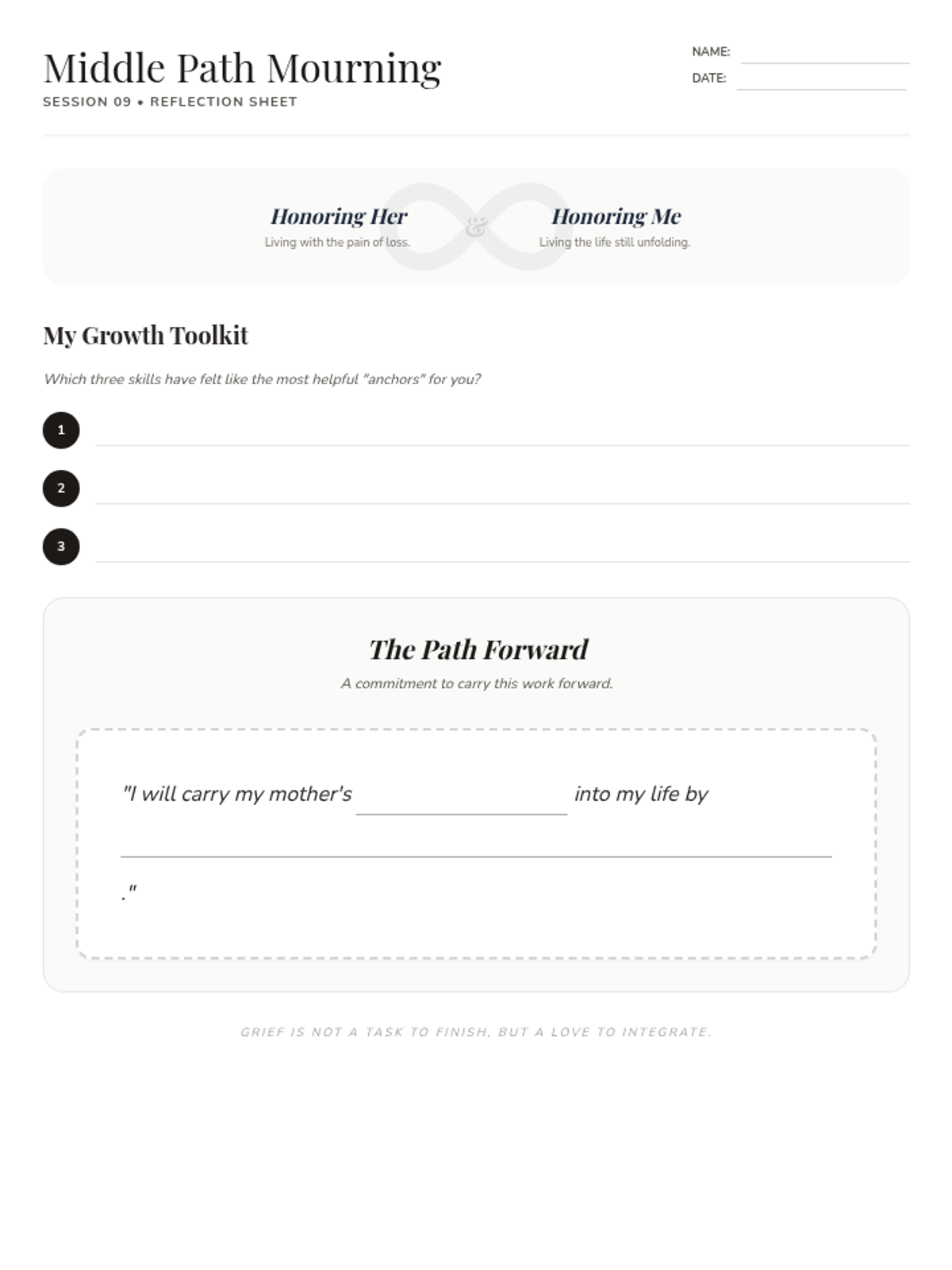
The final client reflection sheet, focusing on synthesis and the 'Middle Path' of grieving. Revised for single-page layout, light background for handwriting, and improved contrast.
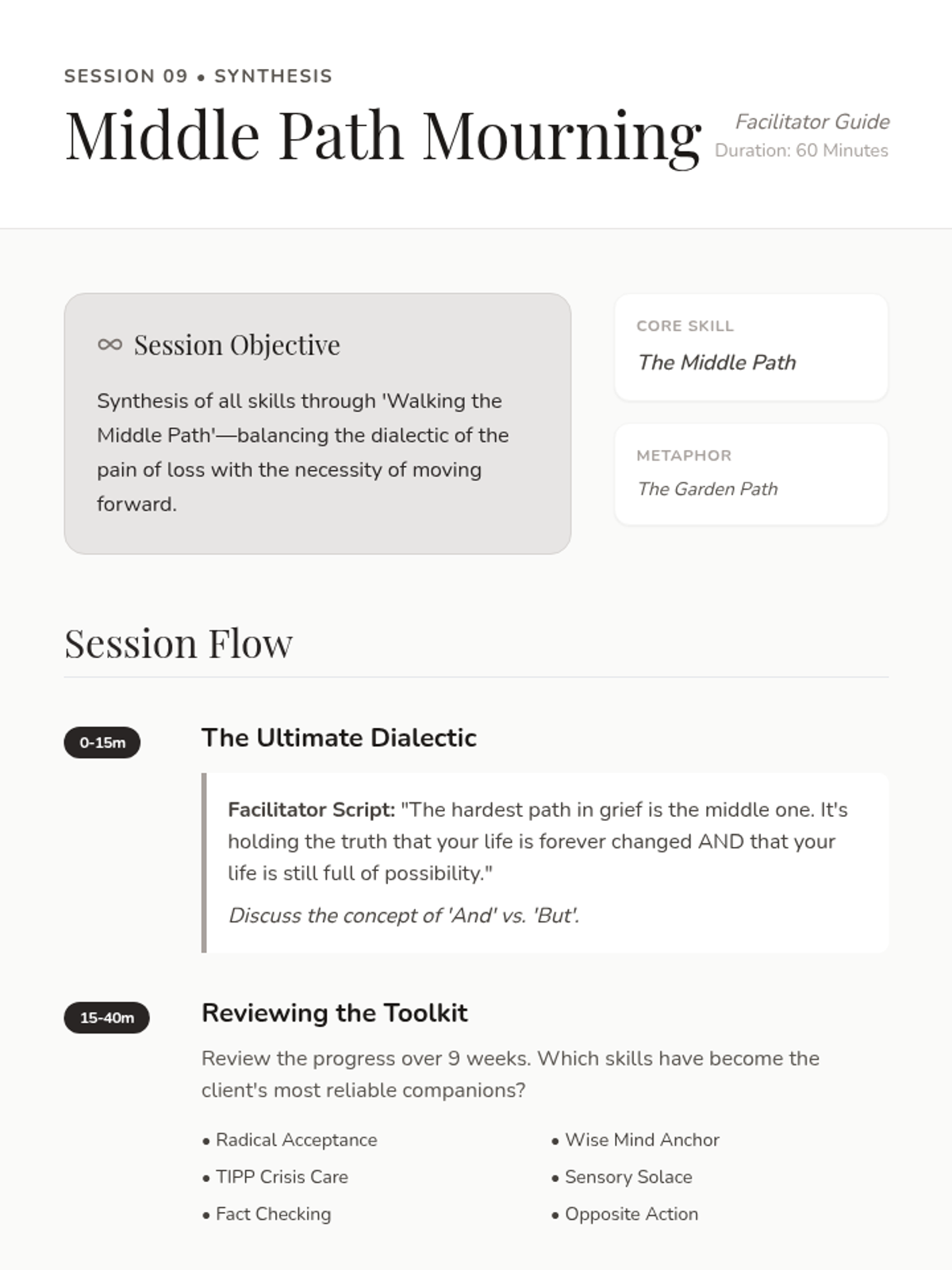
Facilitator guide for the final session, synthesizing all curriculum skills through the concept of 'Walking the Middle Path' to balance honoring the past with living in the present.
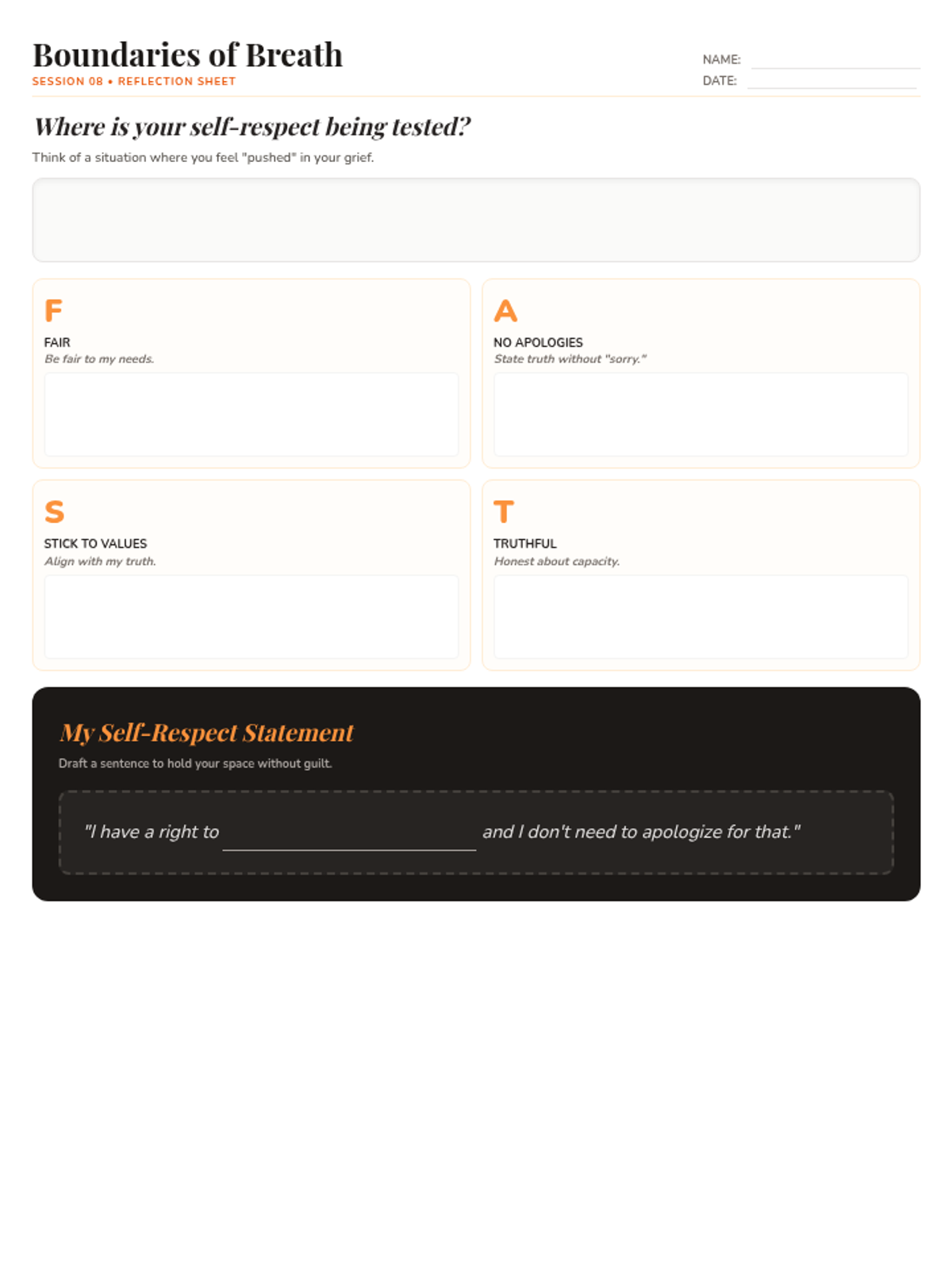
A student reflection sheet for Session 8, helping clients apply the FAST skill. Revised for single-page layout, increased font sizes, improved handwriting space, and better contrast.
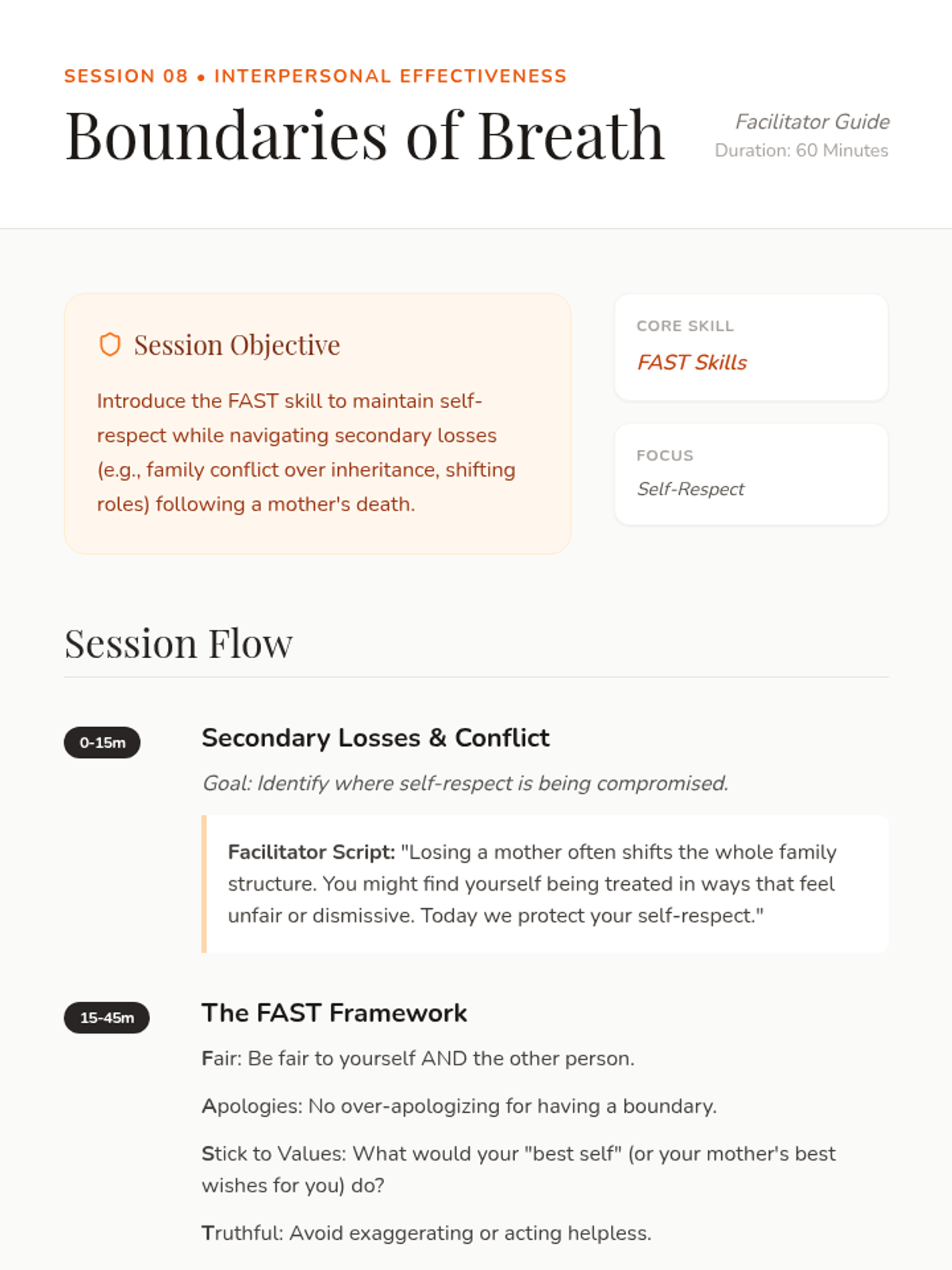
Facilitator guide for Session 8, focusing on the FAST interpersonal skill to help clients maintain self-respect and set boundaries during family conflicts and secondary losses after a mother's death.
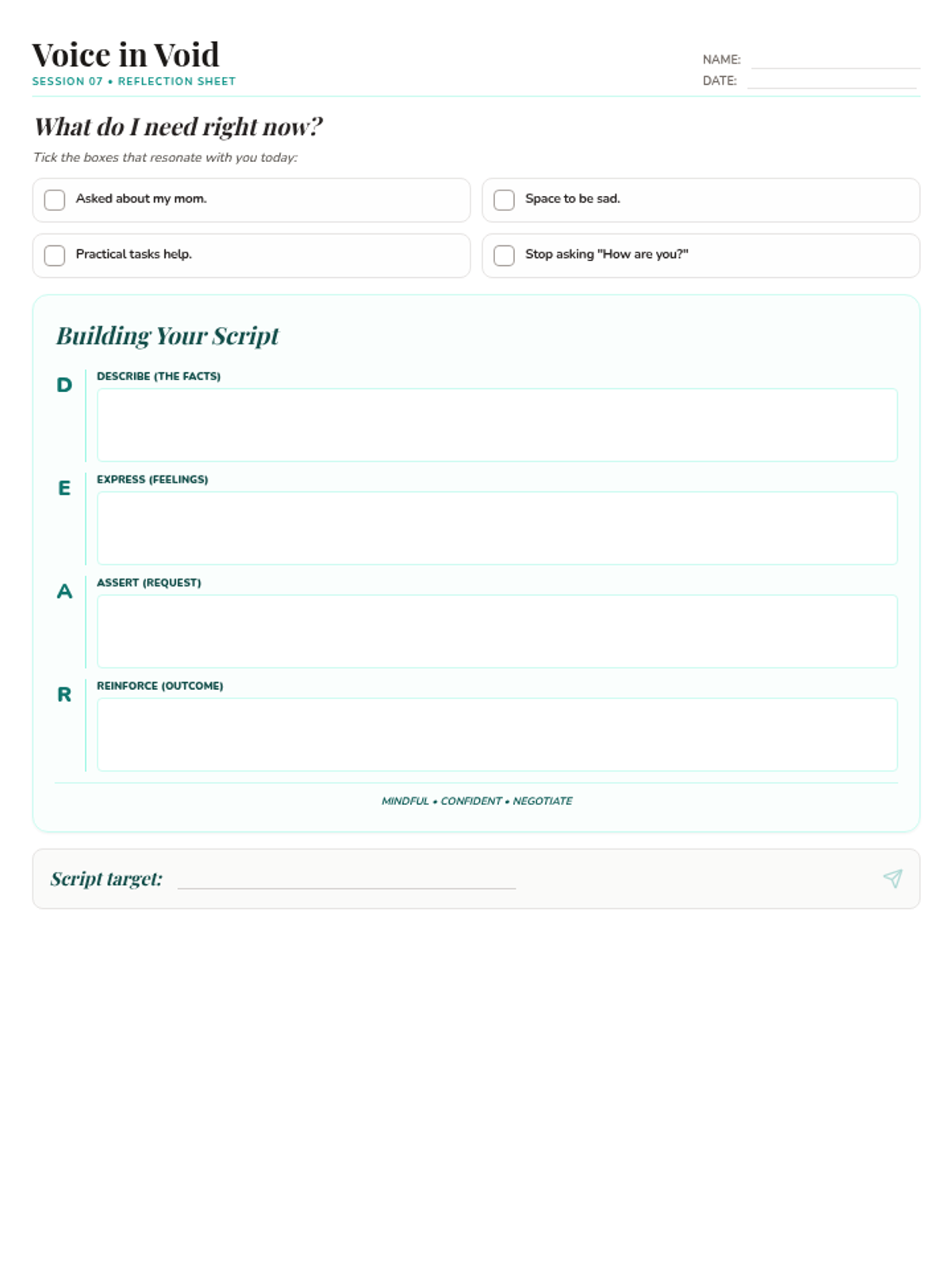
A student reflection sheet for Session 7, providing a needs assessment and a template for crafting a DEAR MAN script. Revised for single-page layout, increased font sizes, and improved handwriting space.
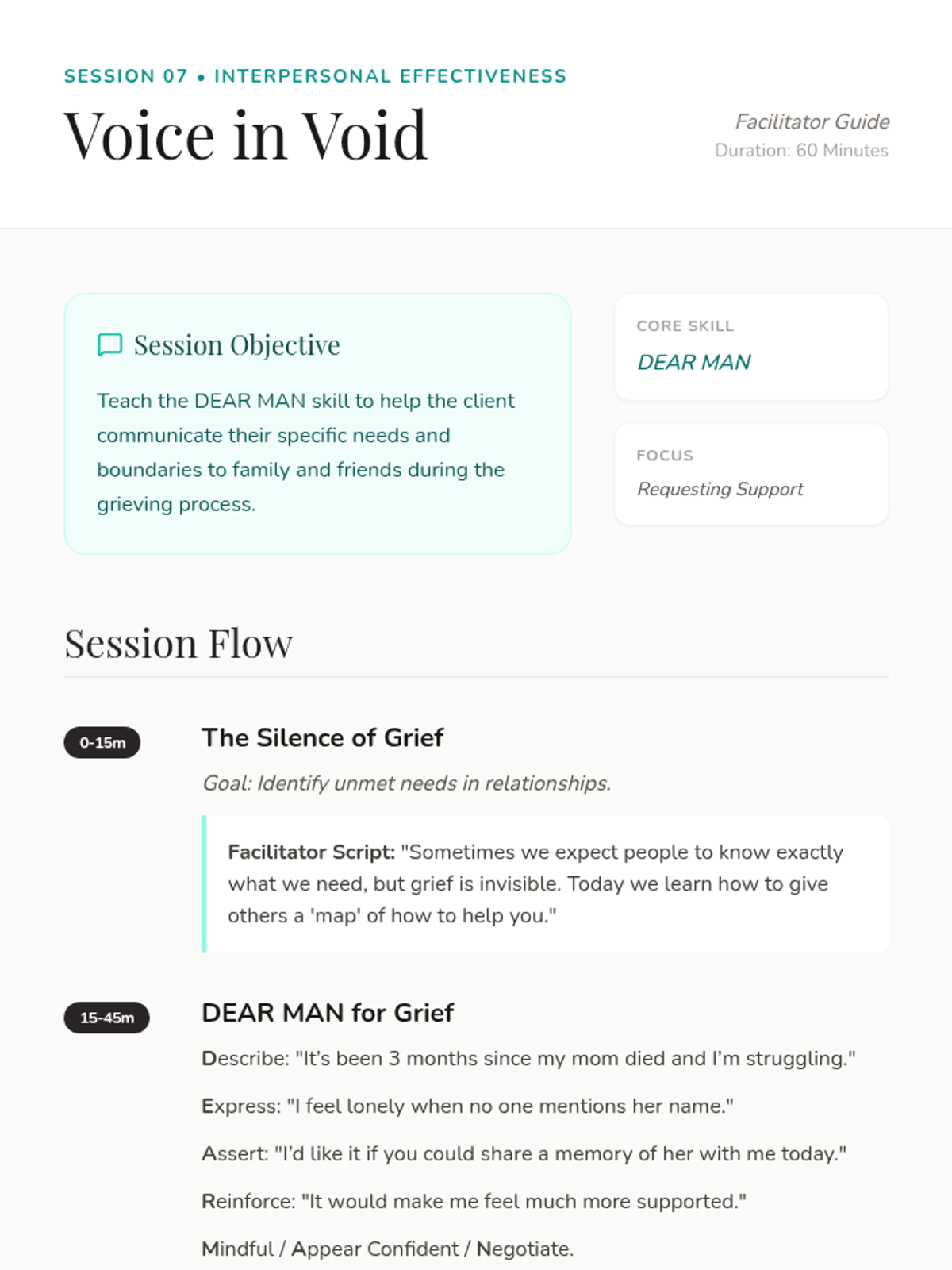
Facilitator guide for Session 7, teaching the DEAR MAN interpersonal effectiveness skill to help grieving clients articulate their needs and request support from their social network.
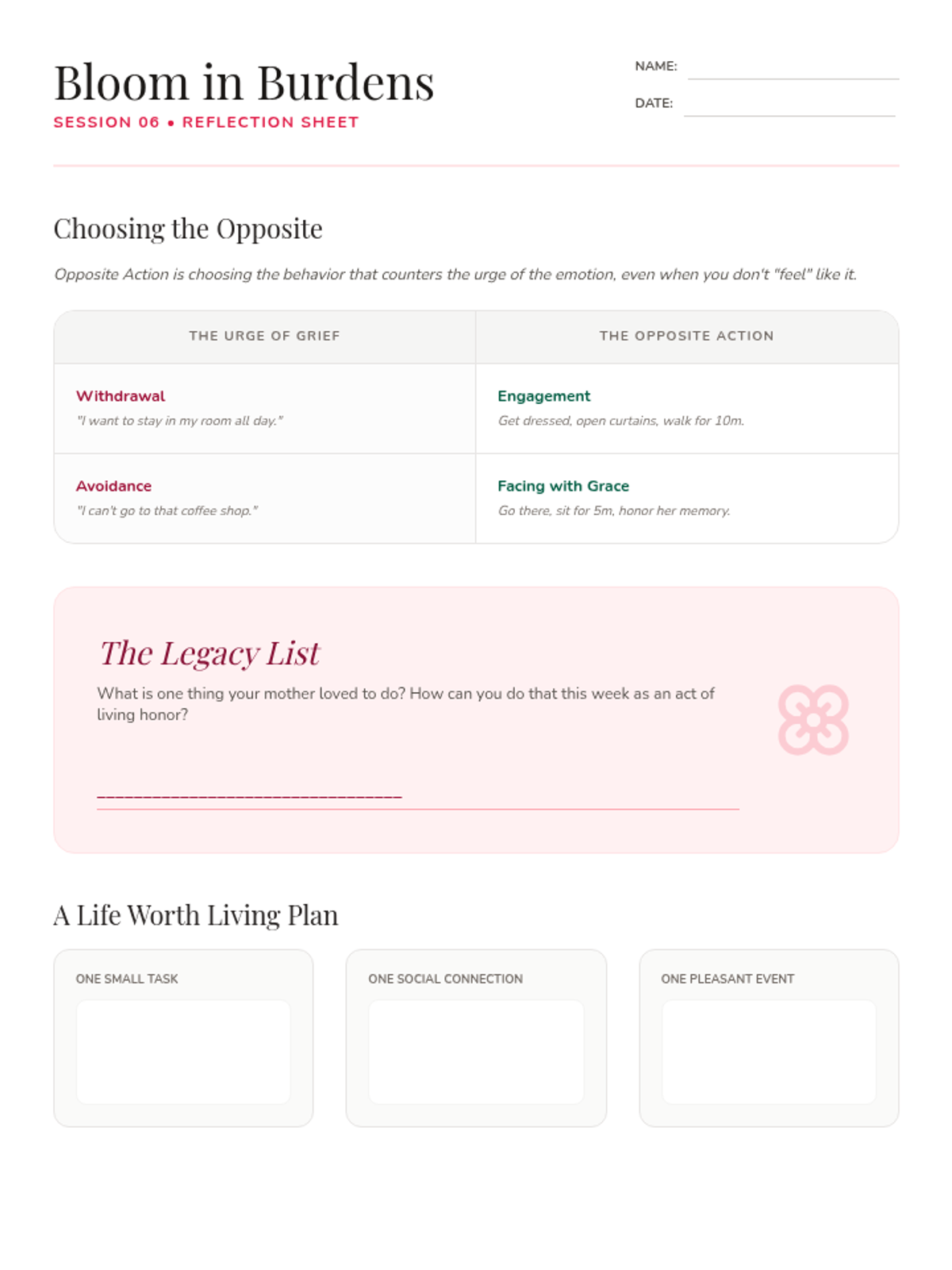
A student worksheet for Session 6, outlining Opposite Action strategies and a "Legacy List" to help clients build positive experiences. Revised for single-page layout and improved writing areas.
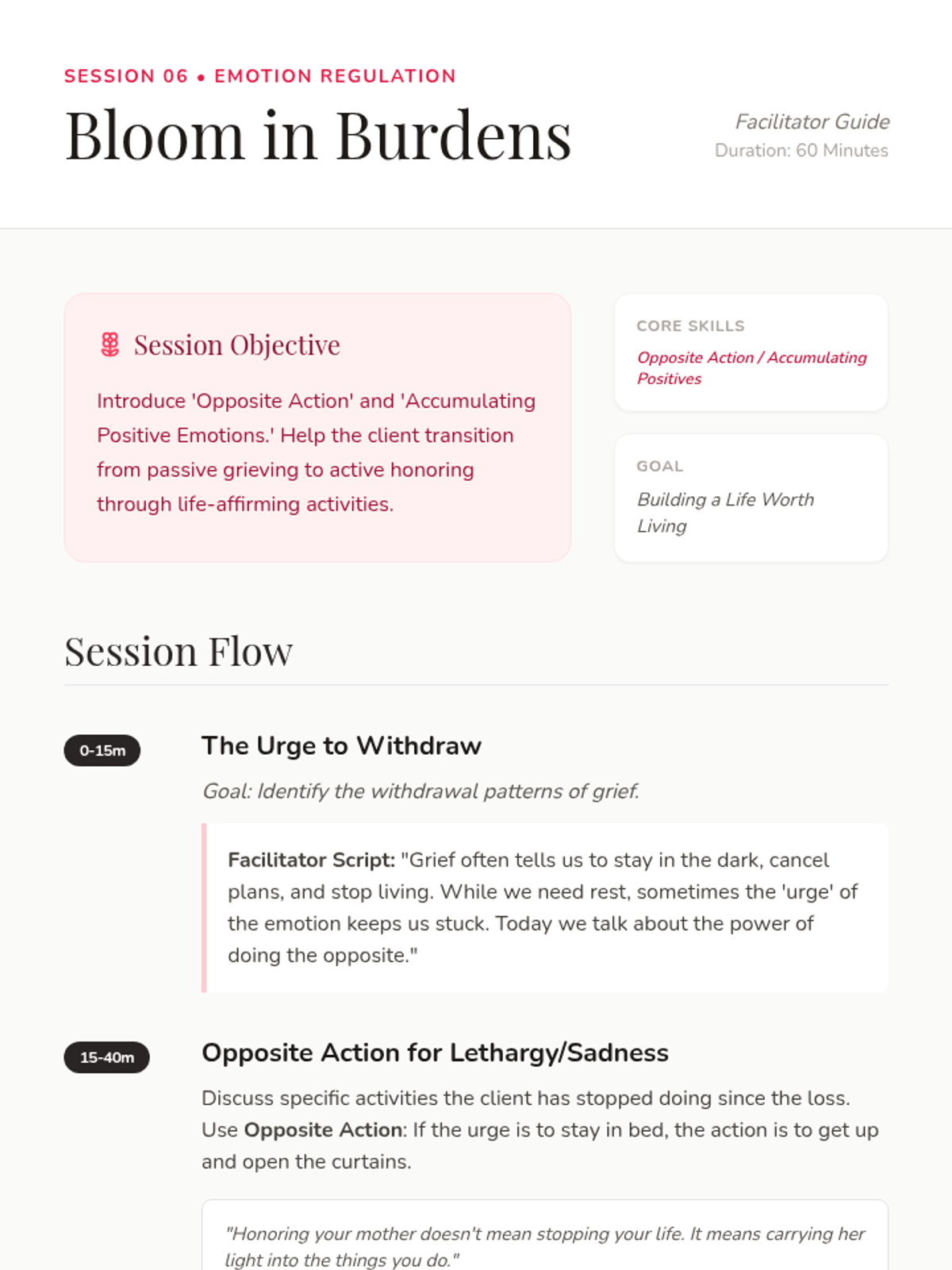
Facilitator guide for Session 6, implementing DBT skills like 'Opposite Action' to help clients overcome grief-induced withdrawal and intentionally build meaningful, positive experiences.
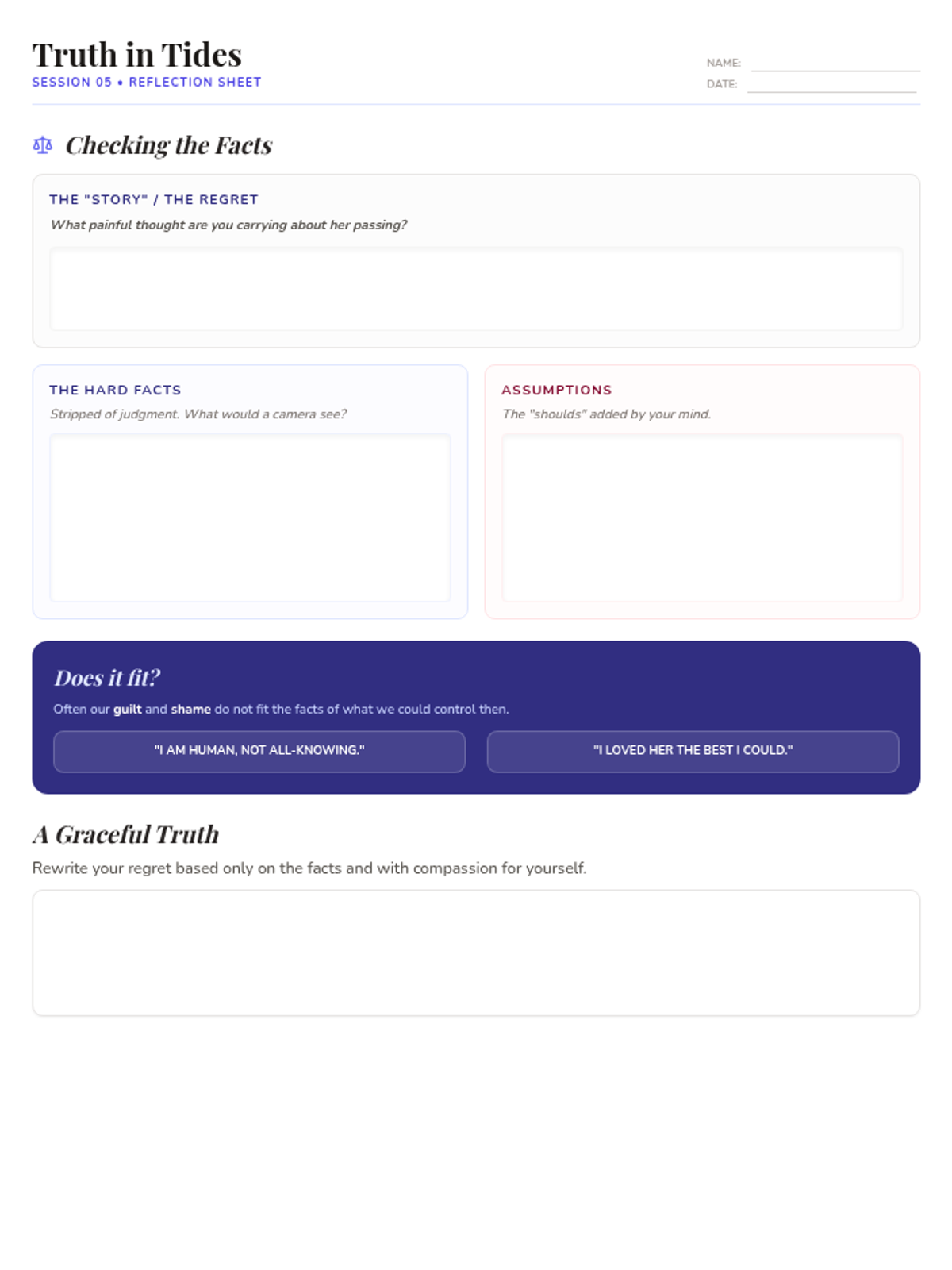
A student worksheet for Session 5, providing a structured "Check the Facts" table to help clients distinguish between objective events and judgmental narratives. Revised to fit one page, increase handwriting space, and improve contrast.
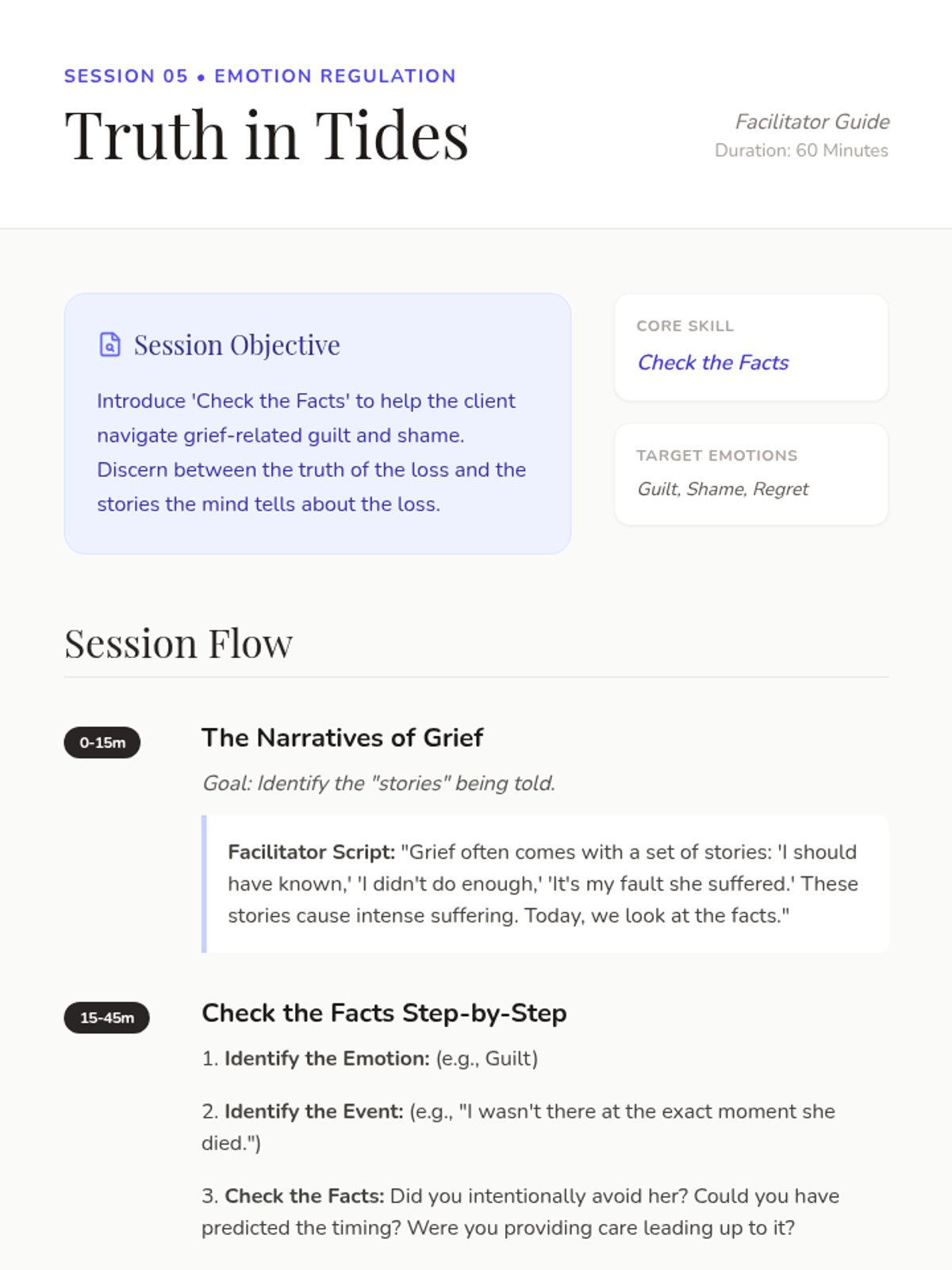
Facilitator guide for Session 5, applying the 'Check the Facts' DBT skill to address and reframe common grief-related guilt and regrets surrounding maternal loss.
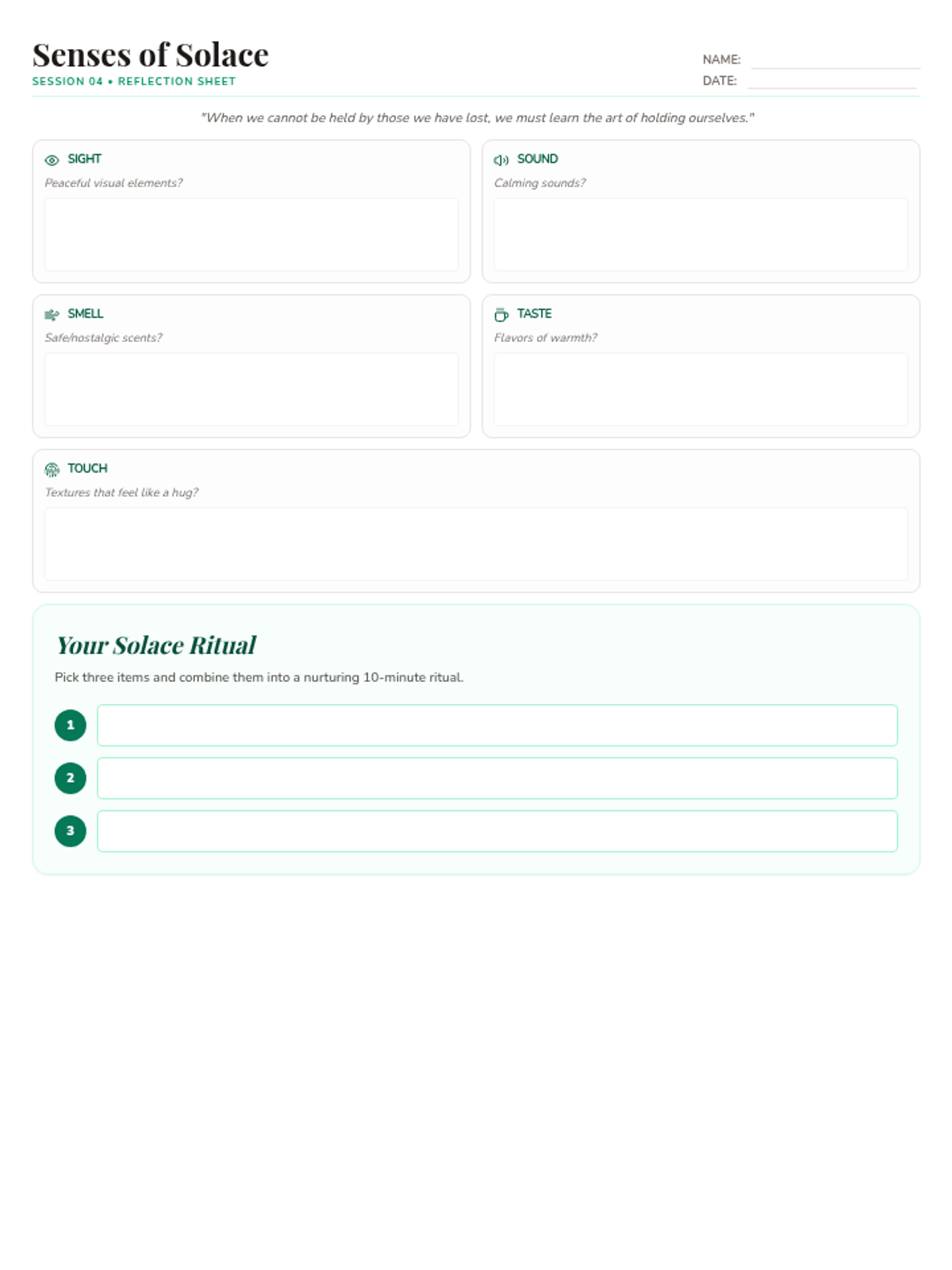
A client reflection sheet for Session 4, providing a sensory map for self-soothing and a template for creating a personalized "Solace Ritual." Revised for single-page layout, increased font sizes, and improved writing space.
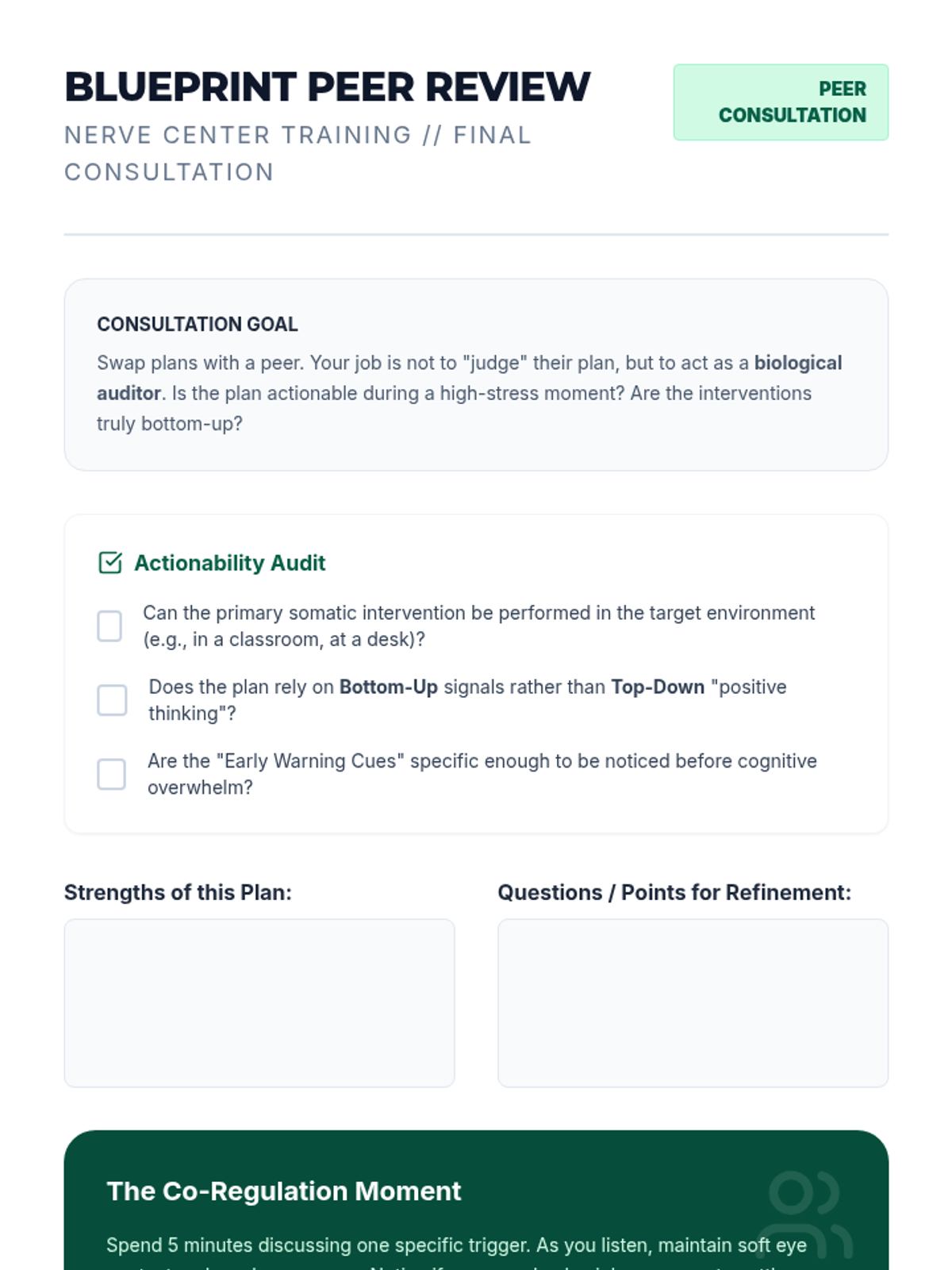
A peer review checklist and facilitation guide for students to audit each other's physiological safety plans, focusing on actionability and bottom-up efficacy.
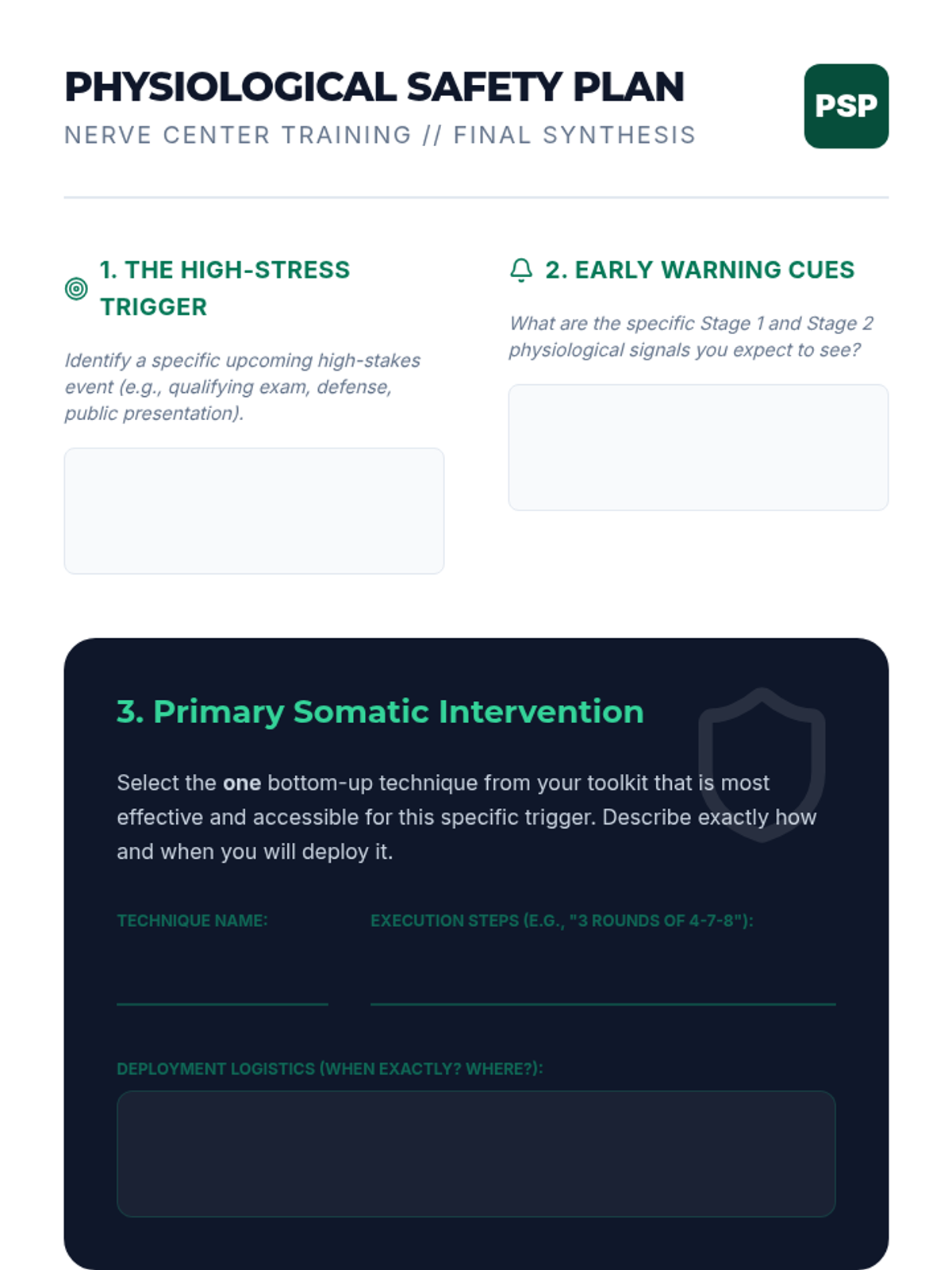
The culminating project template for the sequence: a personalized physiological safety plan that synthesizes triggers, cues, somatic interventions, and anchors.
Synthesis slides for Lesson 5, introducing the concept of mental rehearsal and the architecture of a physiological safety plan.
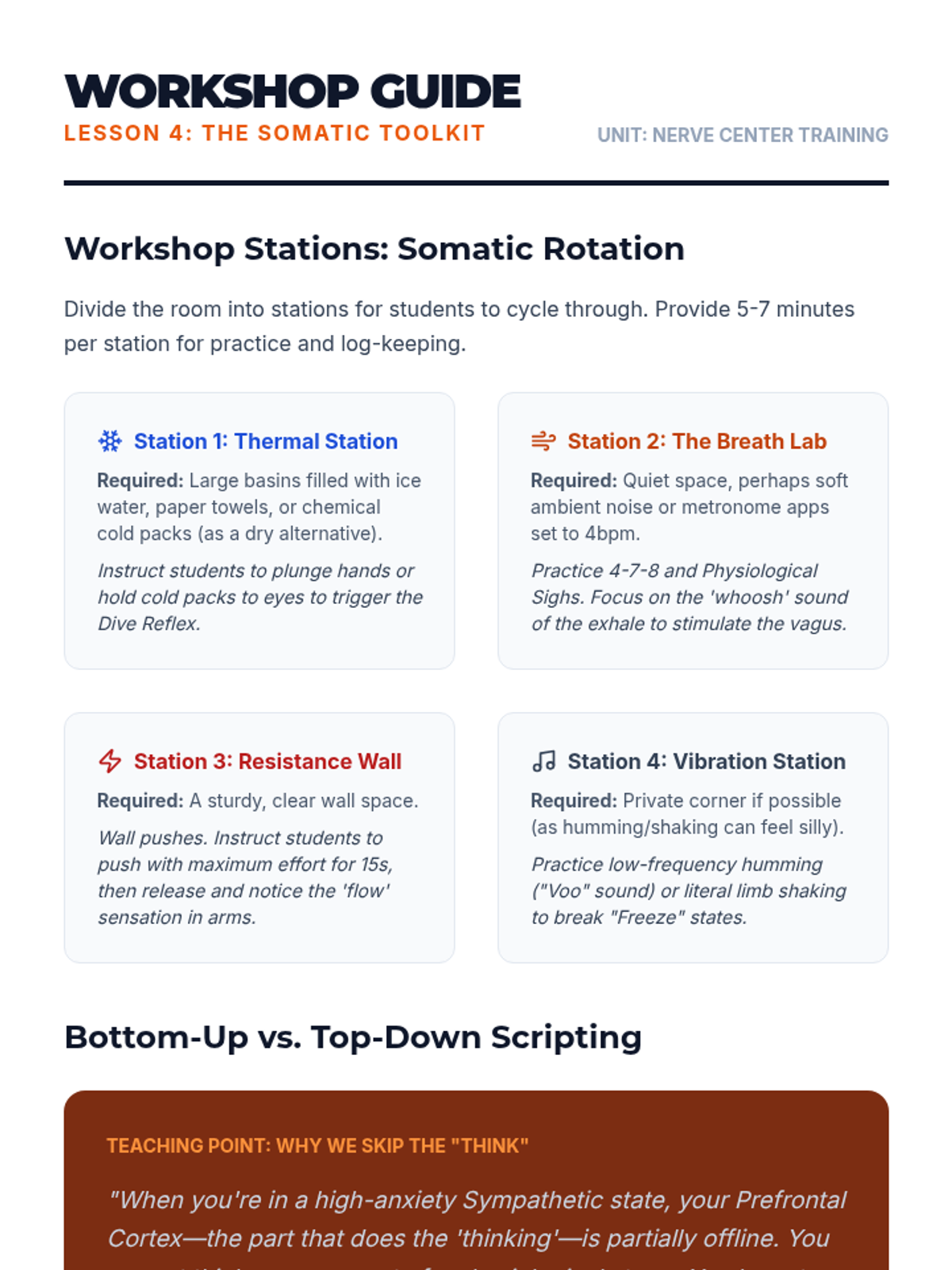
Facilitation guide for the Somatic Toolkit workshop, including station setup instructions and instructional scripts for bottom-up regulation.
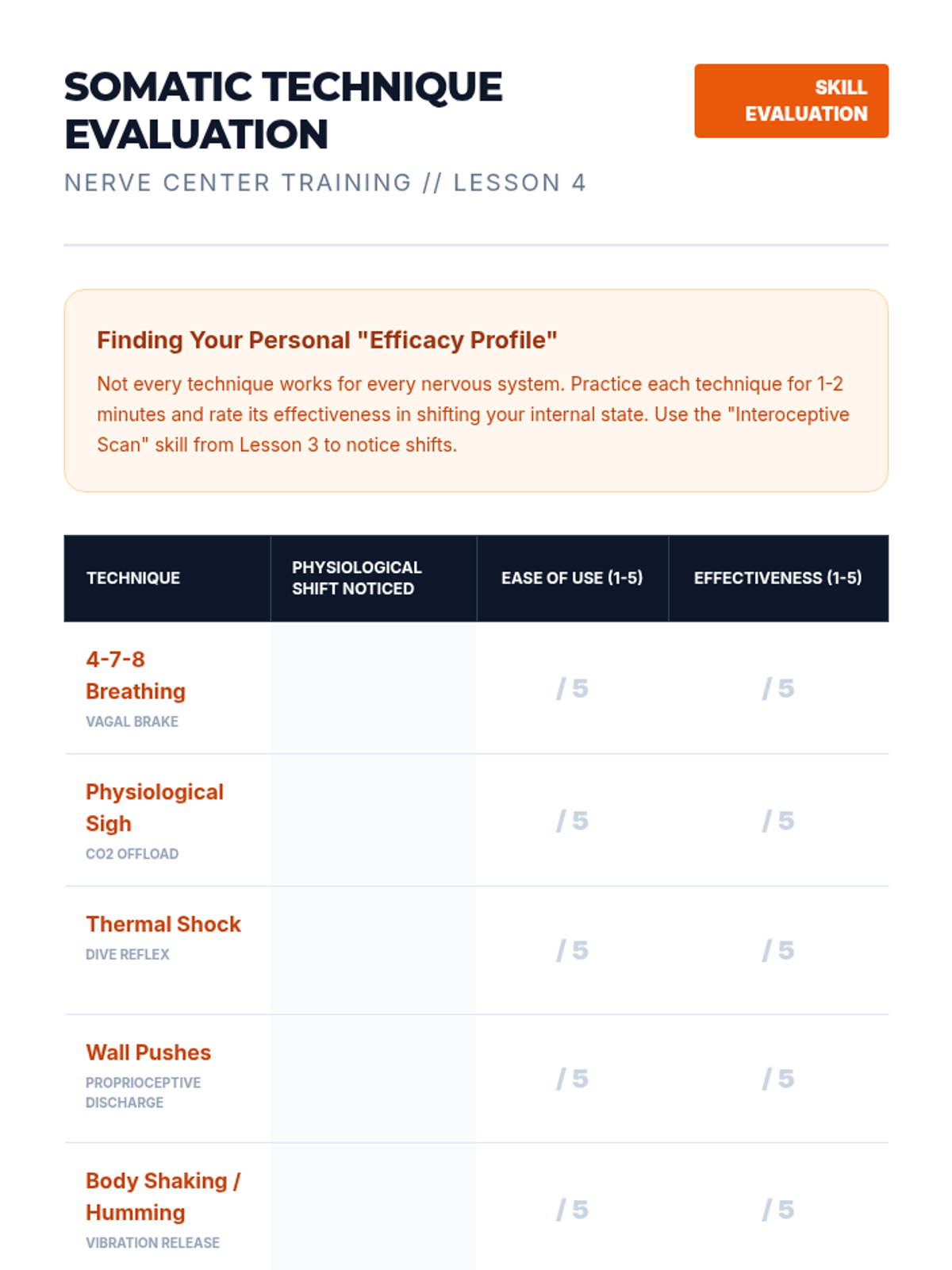
Student evaluation scorecard for somatic regulation techniques, allowing learners to test and rate the effectiveness of various bottom-up interventions.
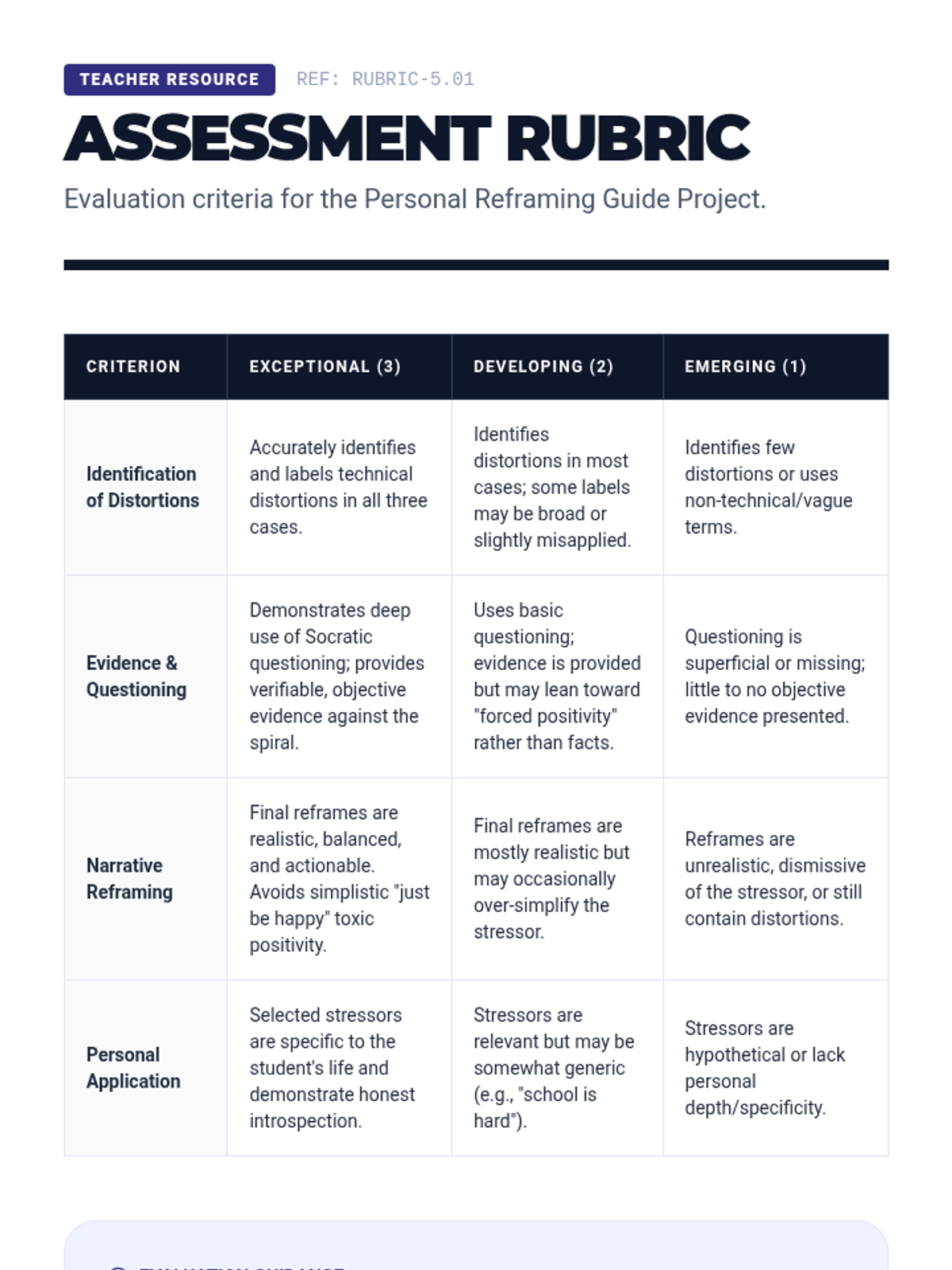
Grading rubric and evaluation guide for teachers to assess the final "Reframing Guide" projects while maintaining student confidentiality.
Slides for Lesson 4, detailing bottom-up regulation techniques including the dive reflex, diaphragmatic breathing, and muscular discharge.
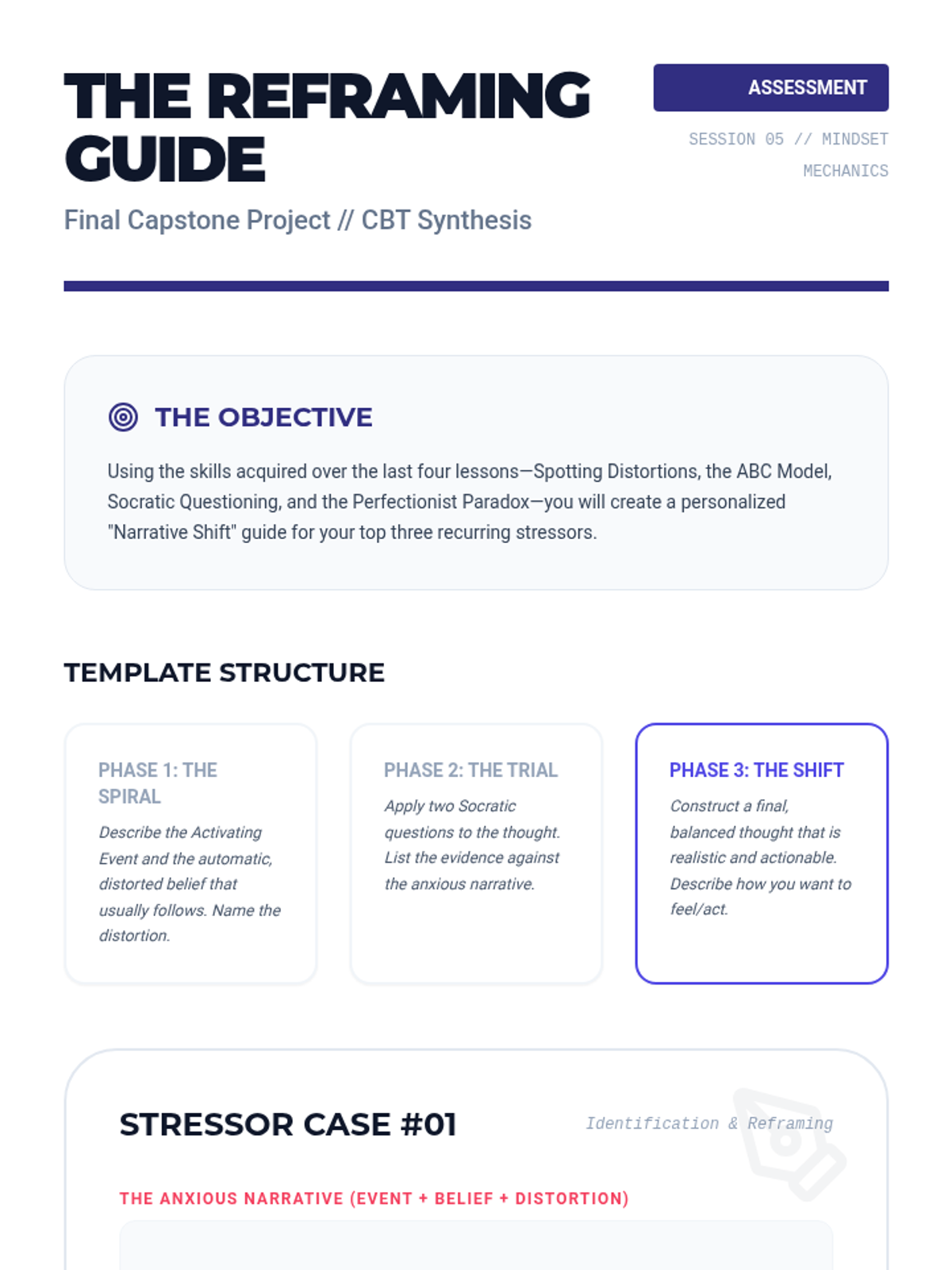
Final project guide and template for students to create their personalized "Reframing Guide," applying CBT techniques to their three most recurring stressors.
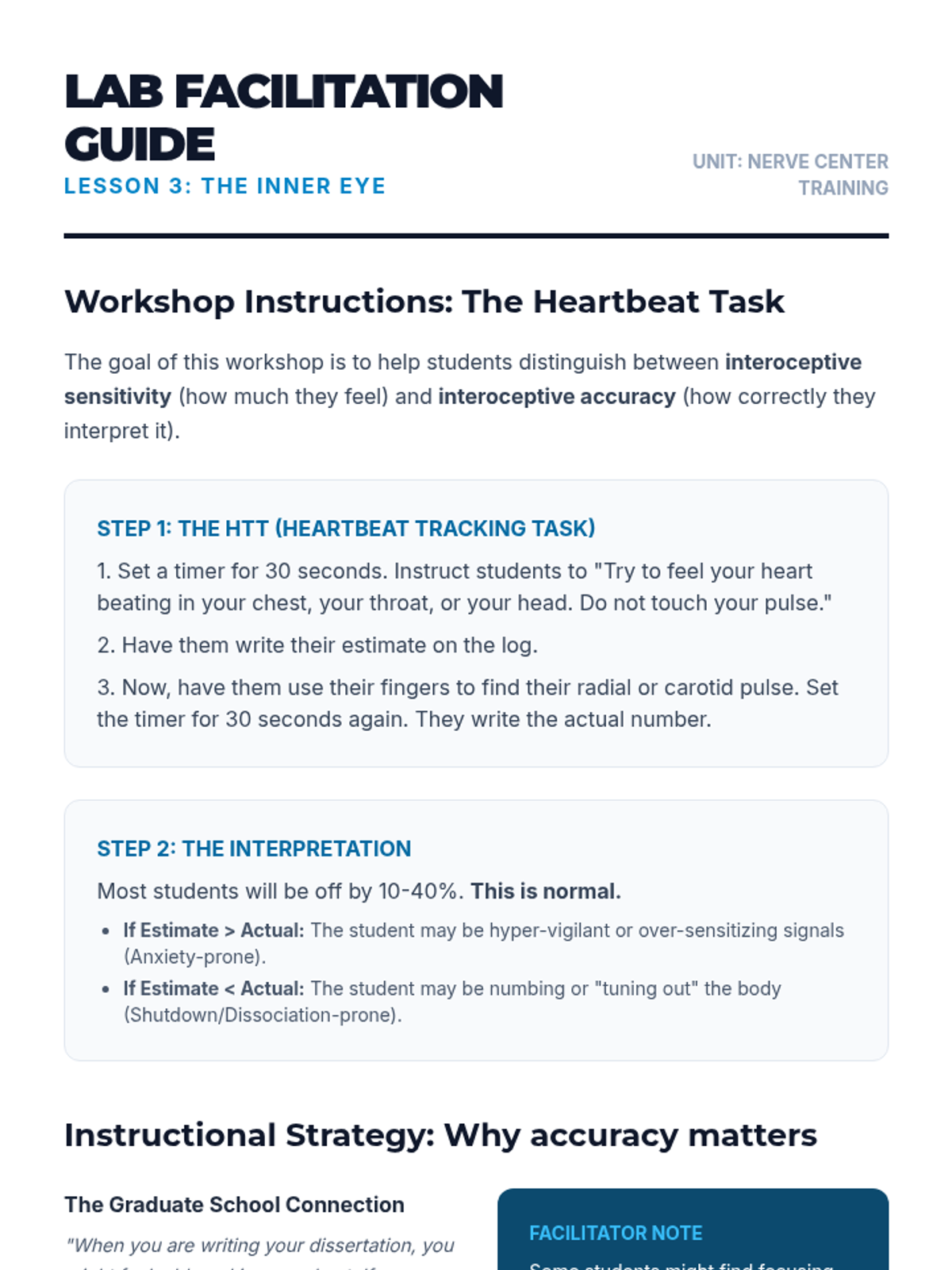
Teacher's guide for the Interoceptive Lab, including instructions for the Heartbeat Tracking Task and clinical interpretations of accuracy gaps.
Final synthesis presentation showing the shift from anxious narratives to balanced reframing, preparing students for their final project.
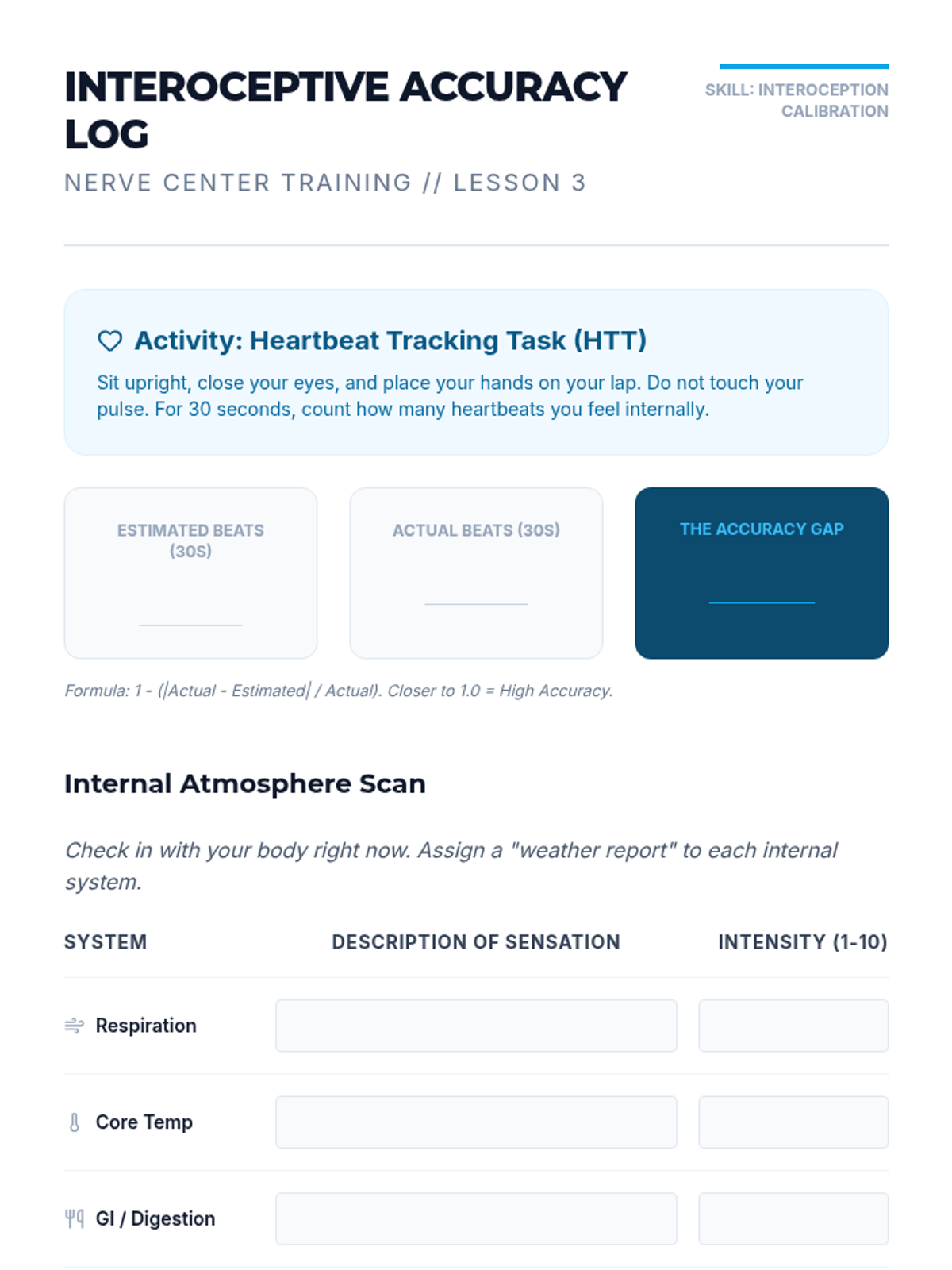
Student lab log for interoceptive accuracy tests and state-sensation mapping, including the Heartbeat Tracking Task (HTT).
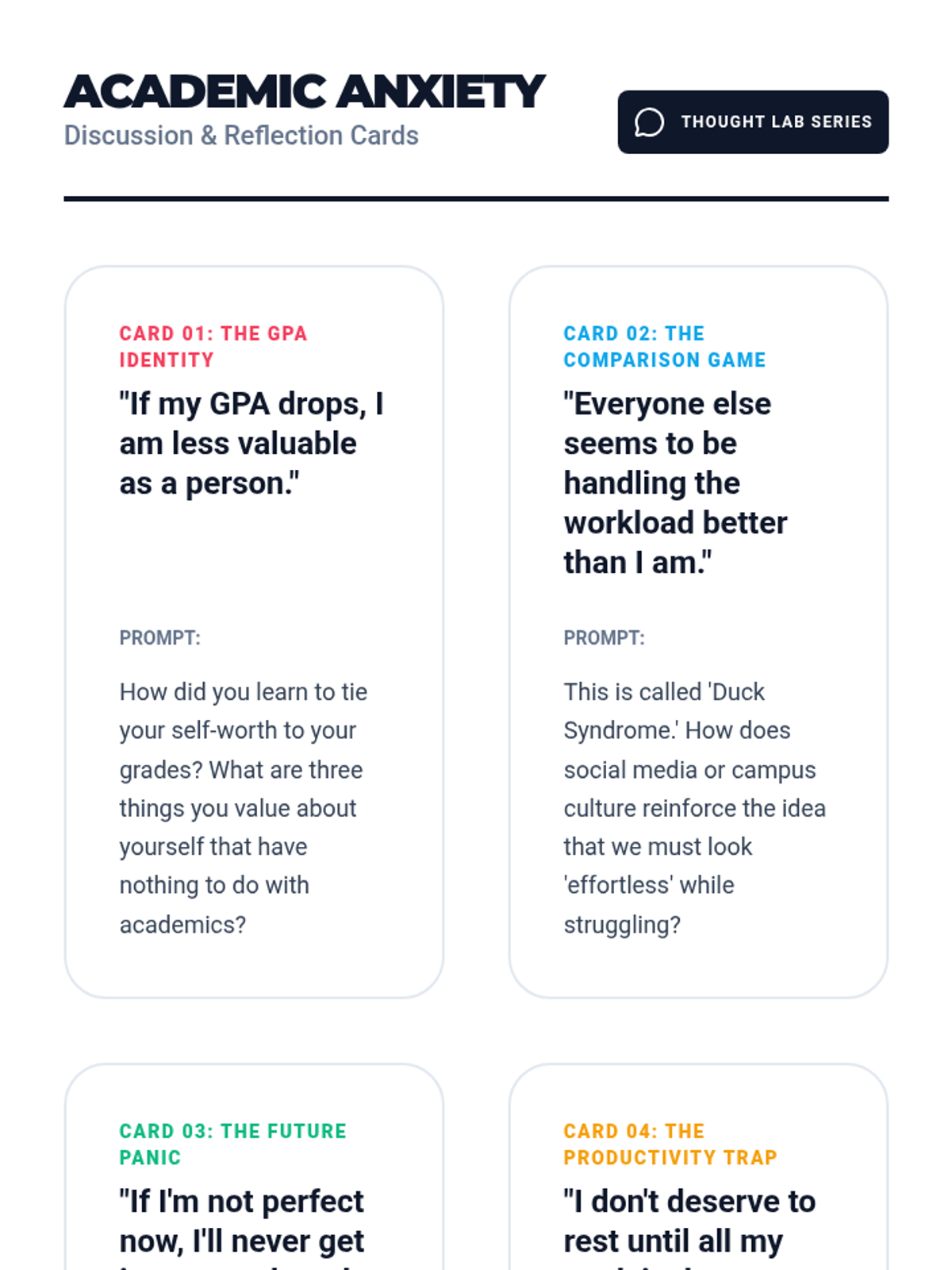
Discussion prompts on cards designed to spark dialogue about academic pressure, "Duck Syndrome," and the relationship between grades and self-worth.
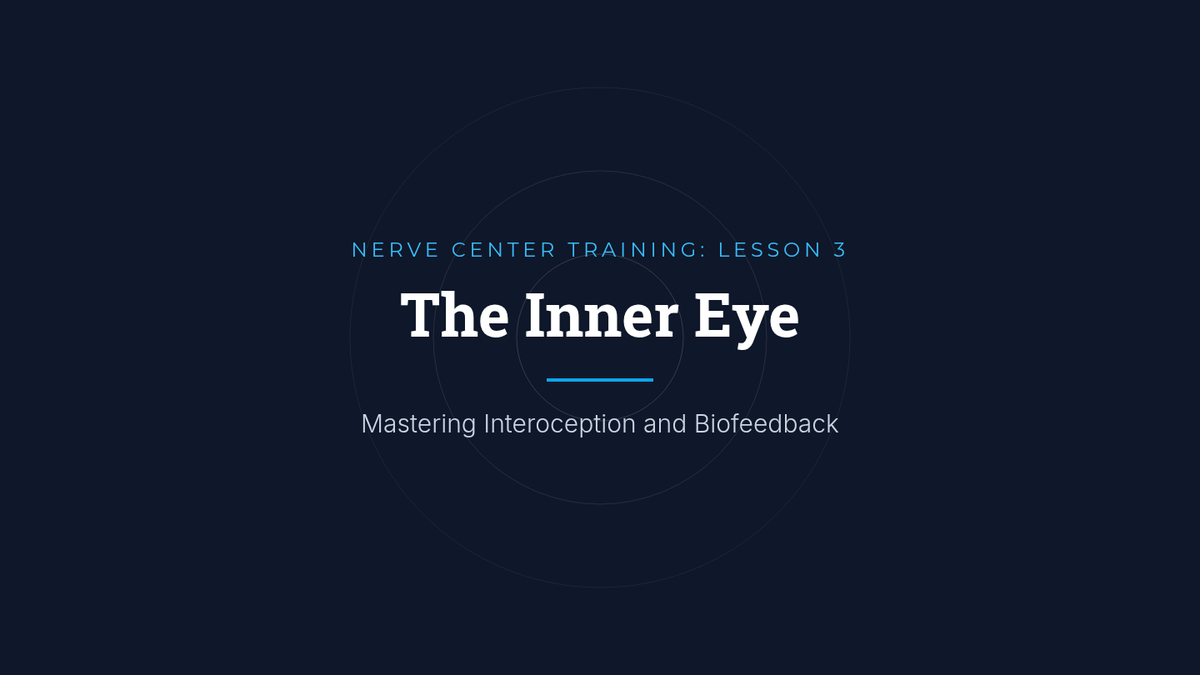
Slides for Lesson 3, covering the definition of interoception, its link to anxiety, and biofeedback techniques for improving internal awareness.
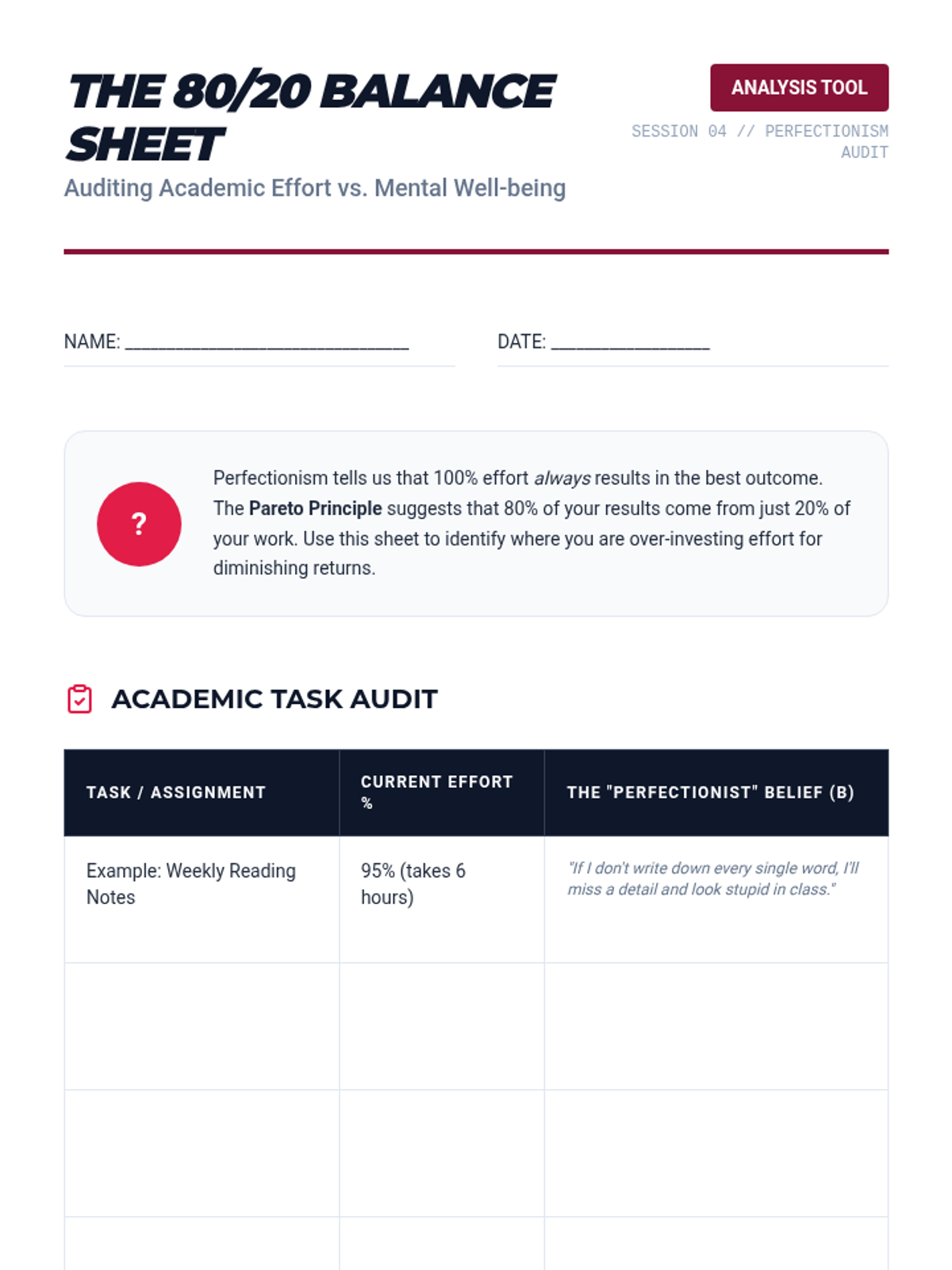
A worksheet for auditing academic effort using the Pareto Principle, helping students identify over-invested tasks and define "good enough" for better mental balance.
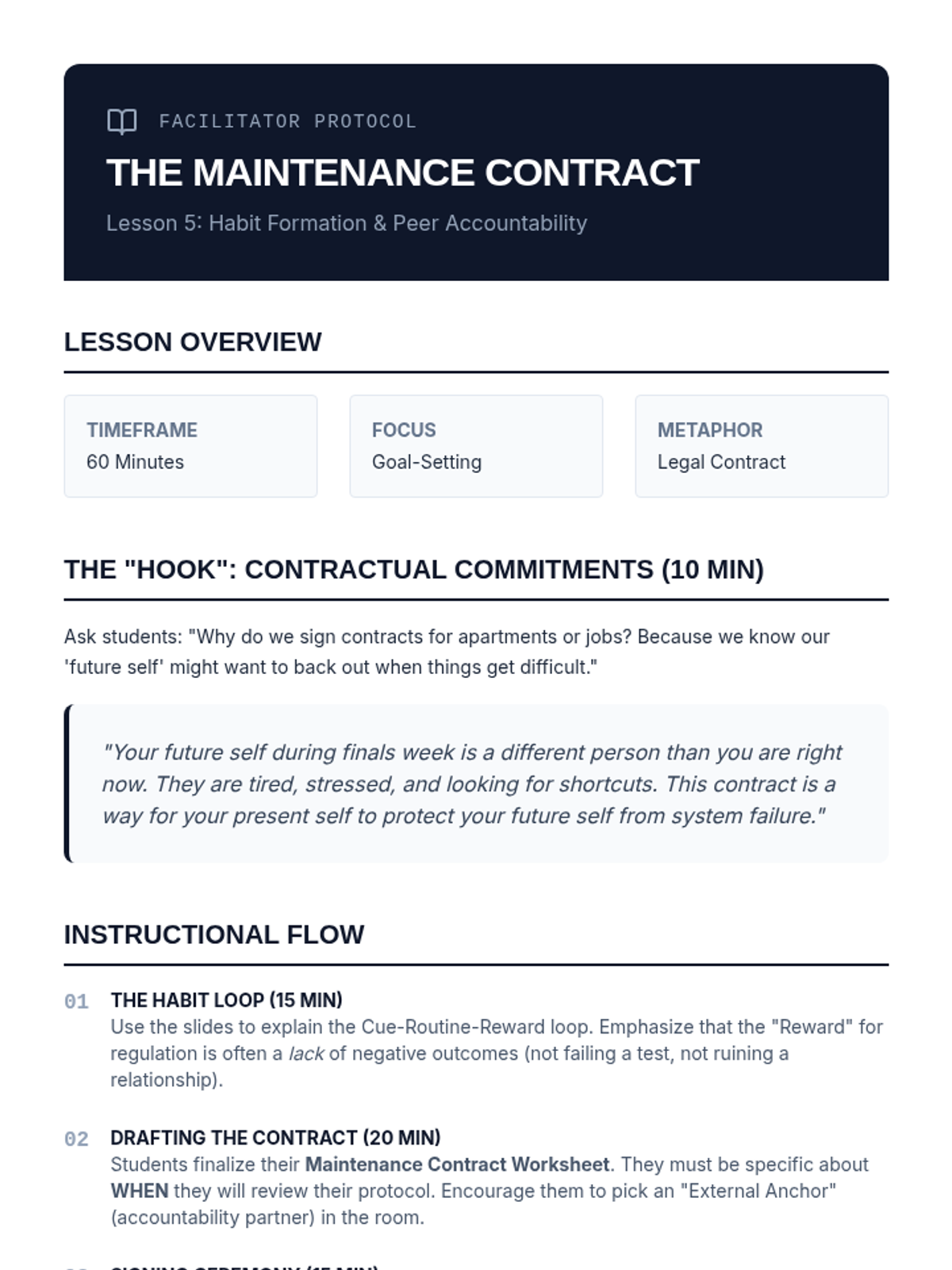
Facilitator guide for Lesson 5, outlining the instructional flow, discussion prompts, and key concepts for the maintenance contract and habit formation.
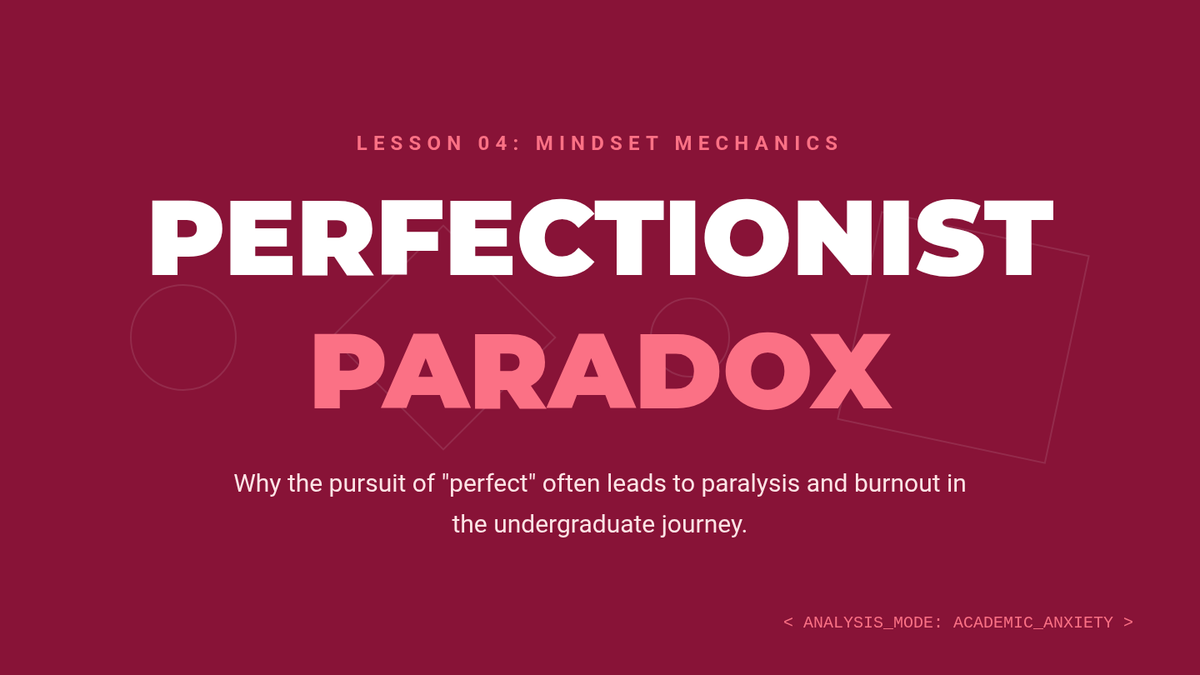
Visual presentation on the "Perfectionist Paradox," utilizing the Pareto Principle to discuss academic anxiety and the diminishing returns of perfectionist striving.
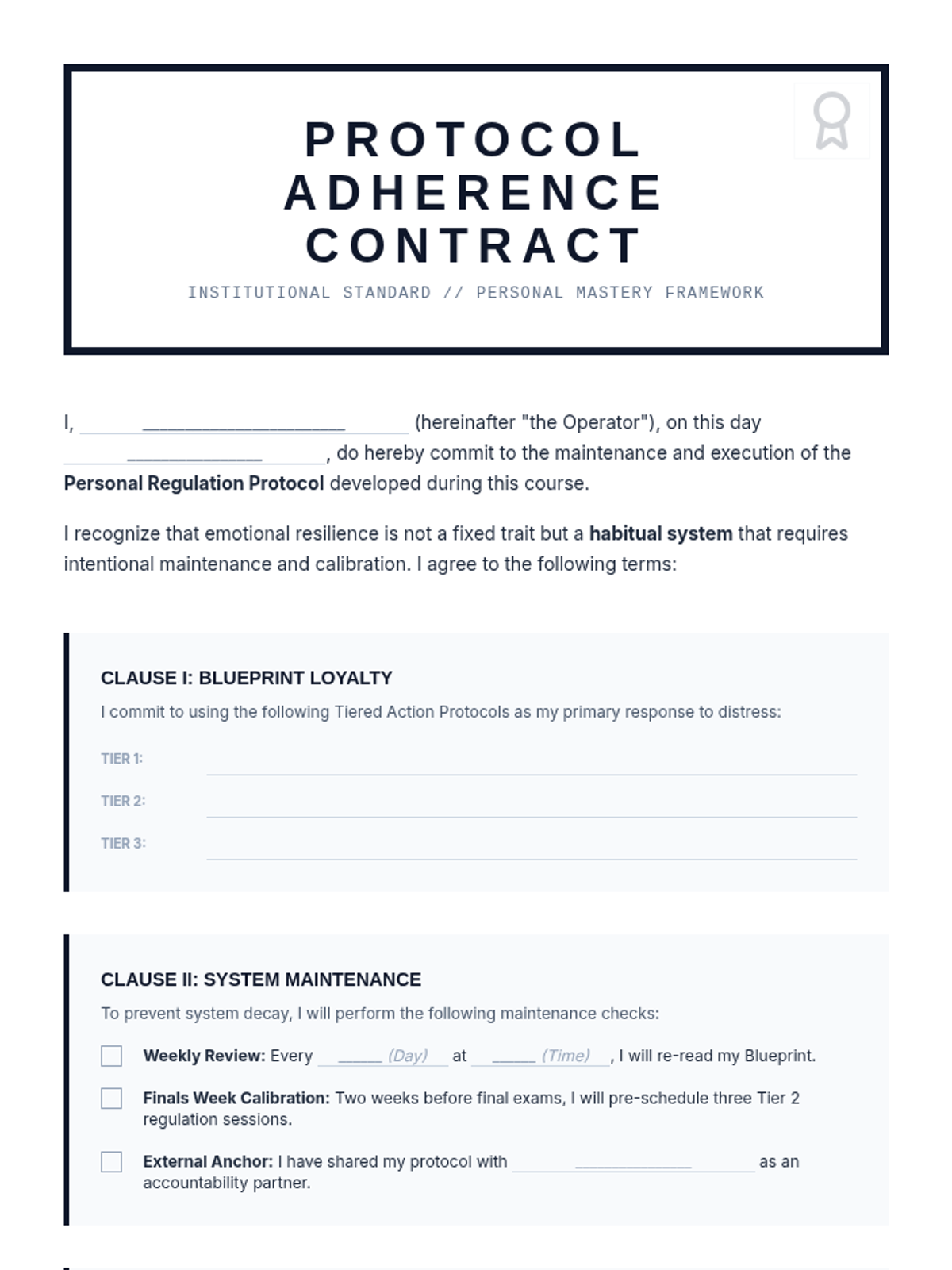
A formal maintenance contract for students to commit to their regulation protocols, establishing maintenance schedules and accountability partners.
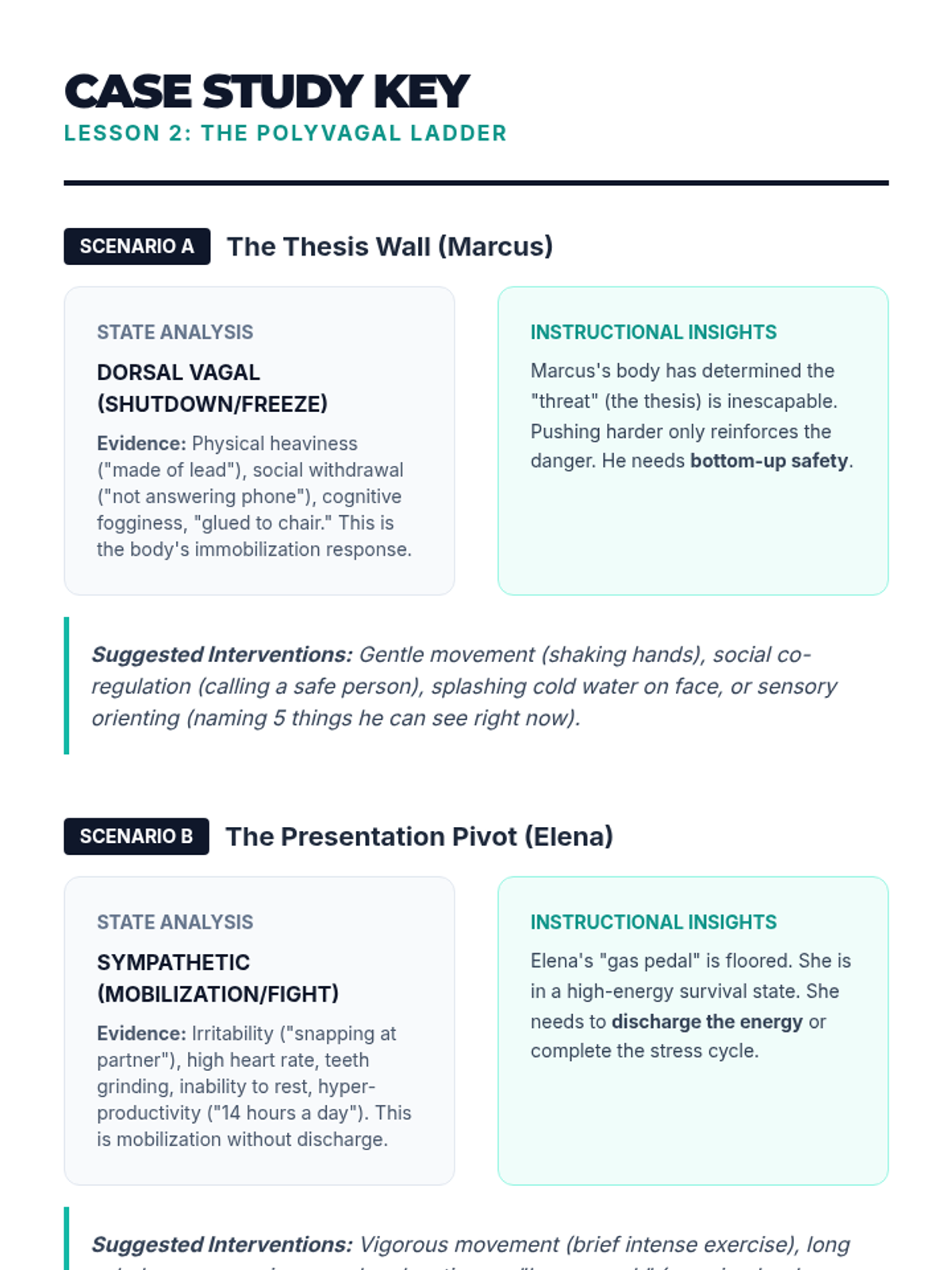
Answer key and facilitation notes for the Academic Shutdown Analysis activity, providing biological explanations and intervention strategies for each state.
Final slide deck for Lesson 5, focusing on habit formation, maintenance schedules, and the commitment to protocol adherence.
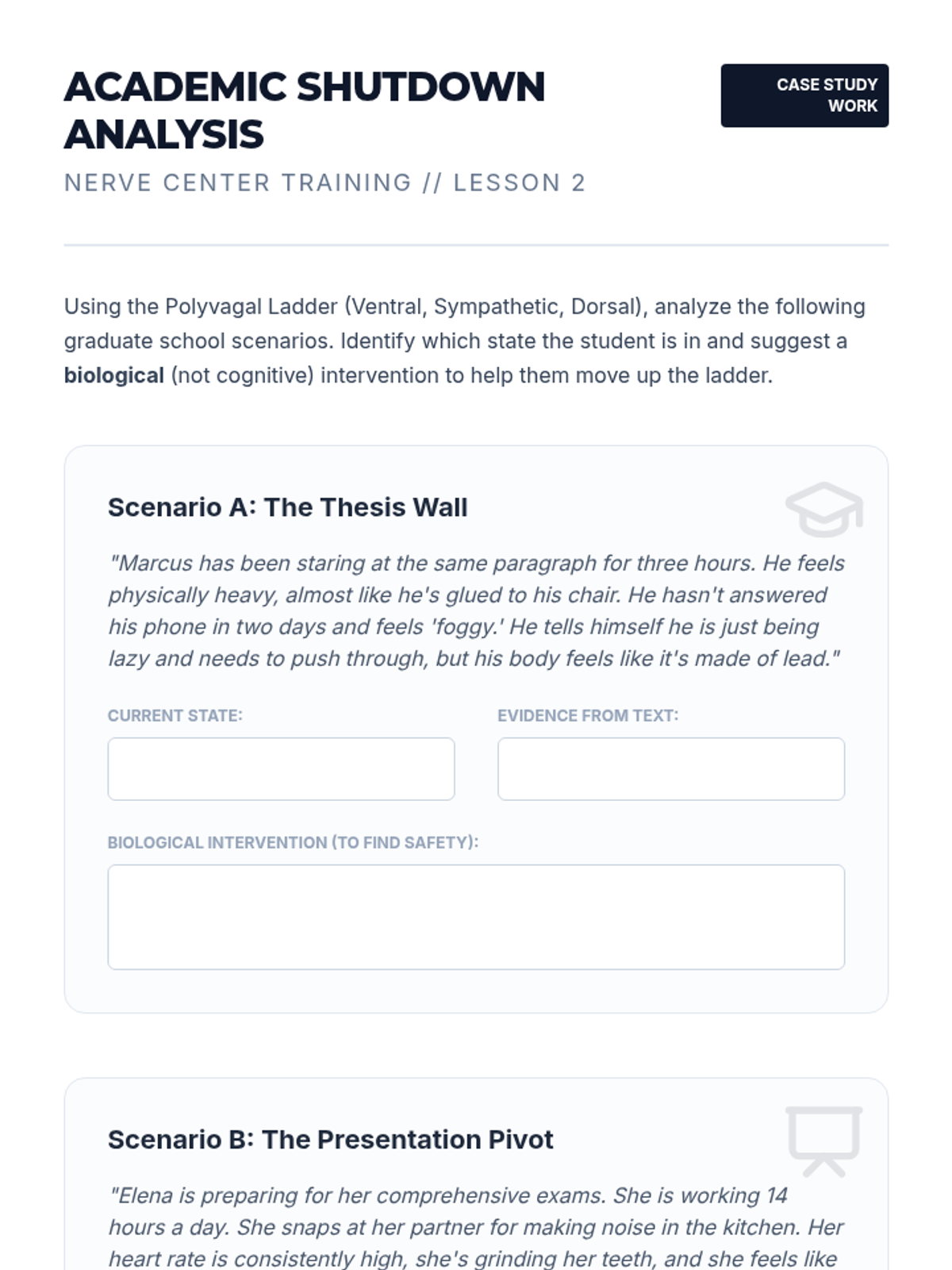
Case study analysis activity for Lesson 2, helping students identify Polyvagal states in academic scenarios and map their own behavior profiles.
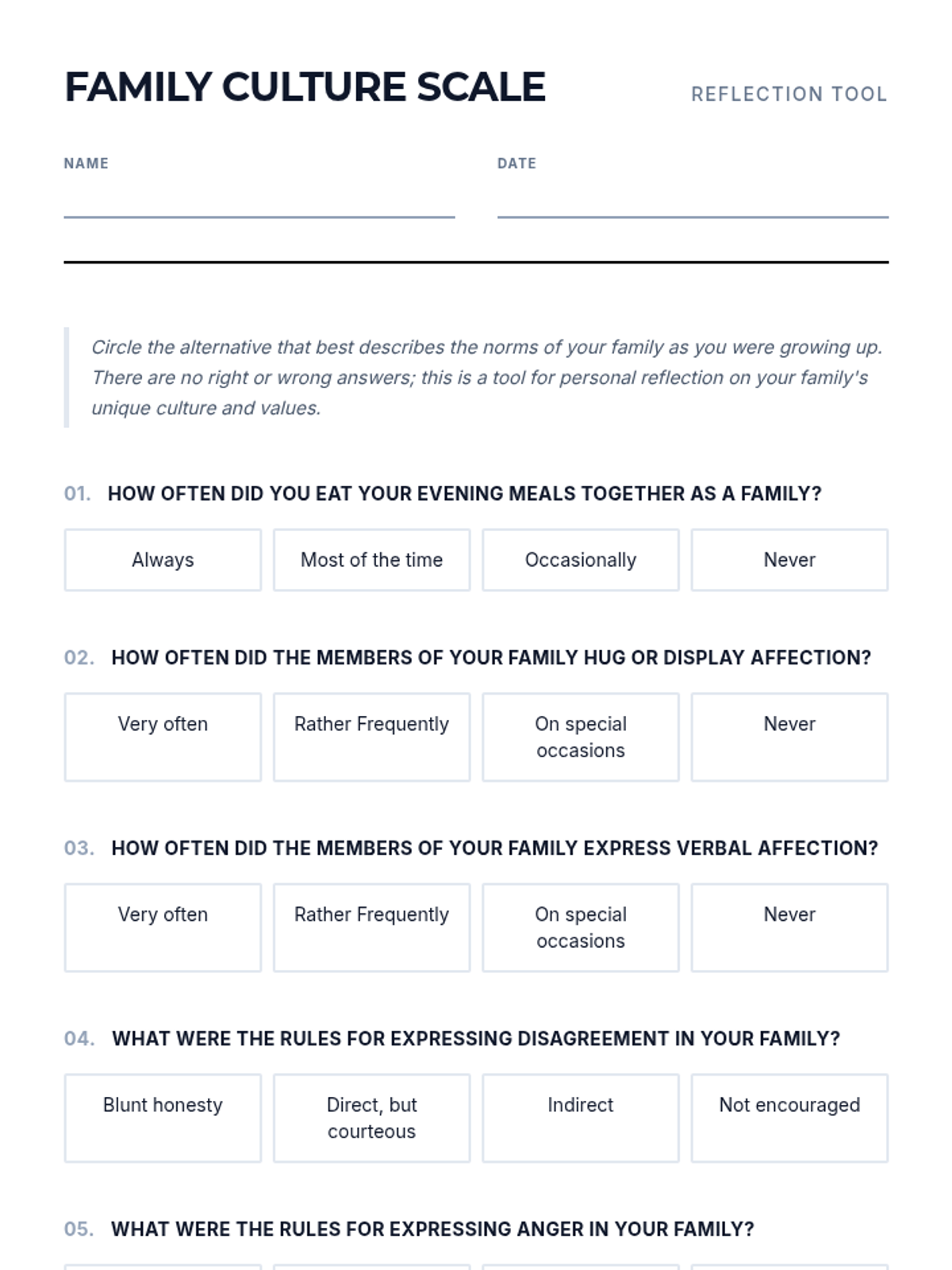
A refined, black-and-white minimalist worksheet for the Family Culture Scale, featuring nine reflection questions with structured response options and improved page-break handling.
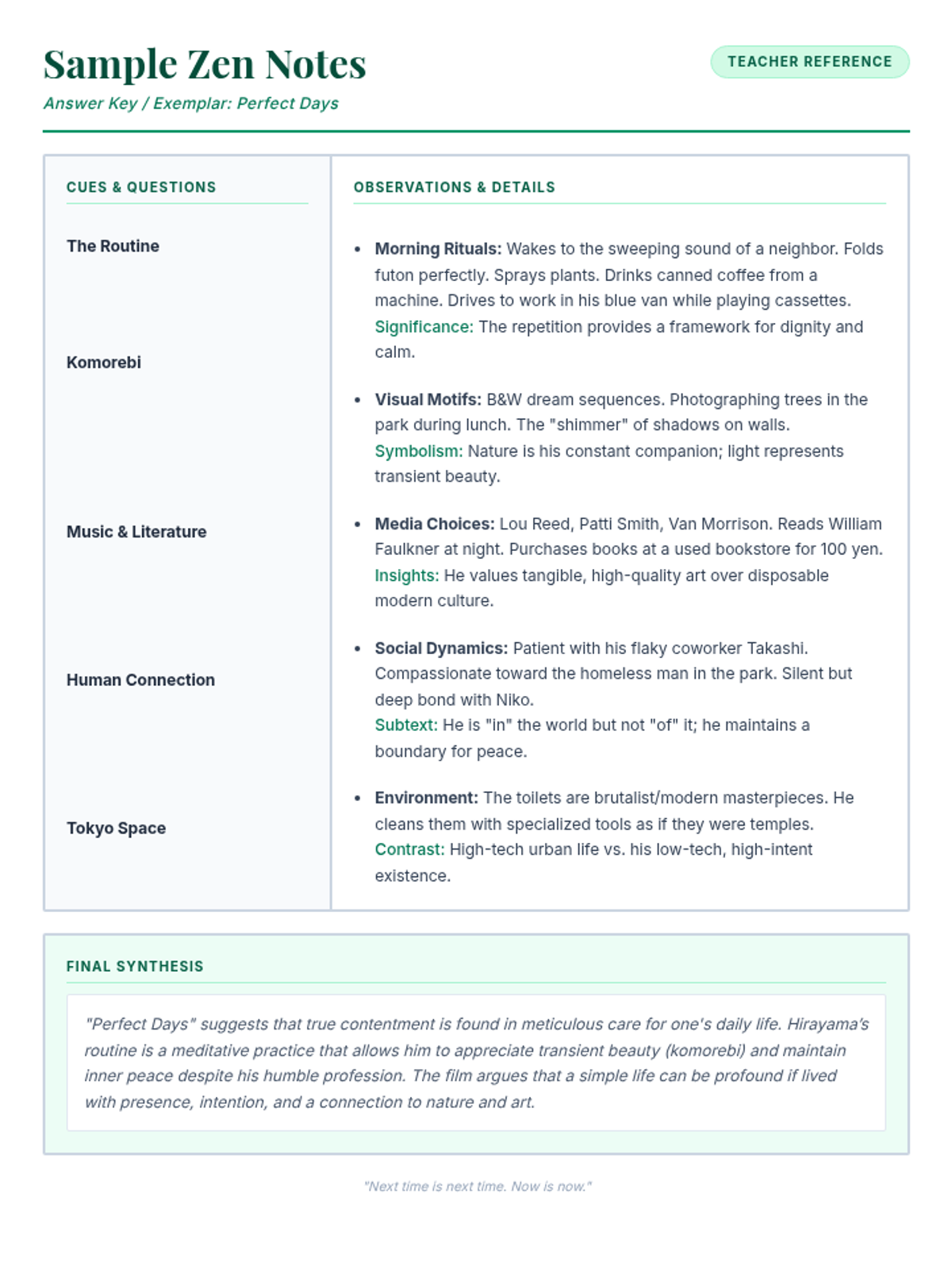
A sample completed Cornell note-taking sheet for Perfect Days, providing teachers with an exemplar of key themes and observations from the film.
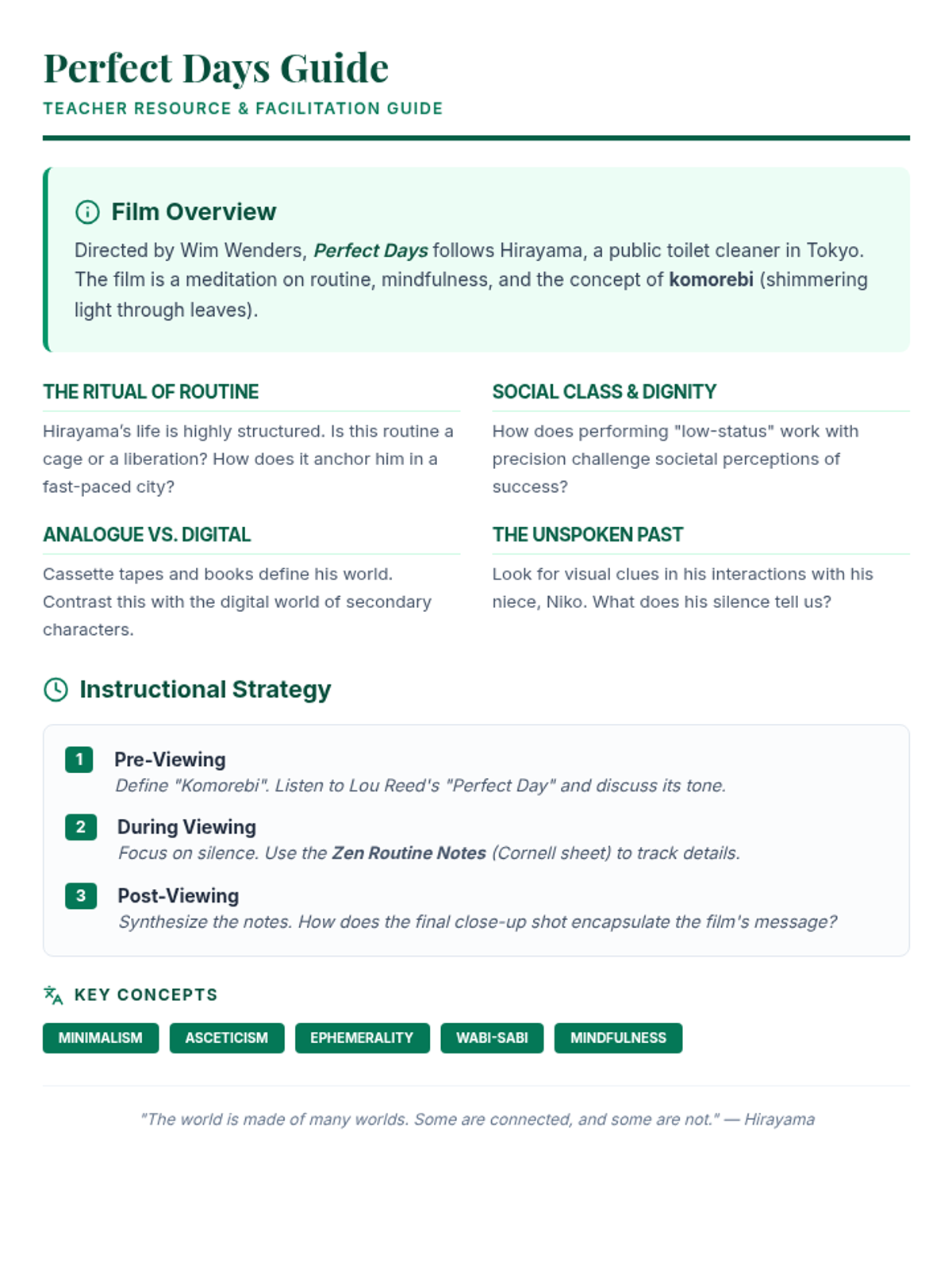
A teacher's guide for the film Perfect Days, providing thematic analysis, discussion prompts, and instructional strategies for using the Cornell note-taking sheet.
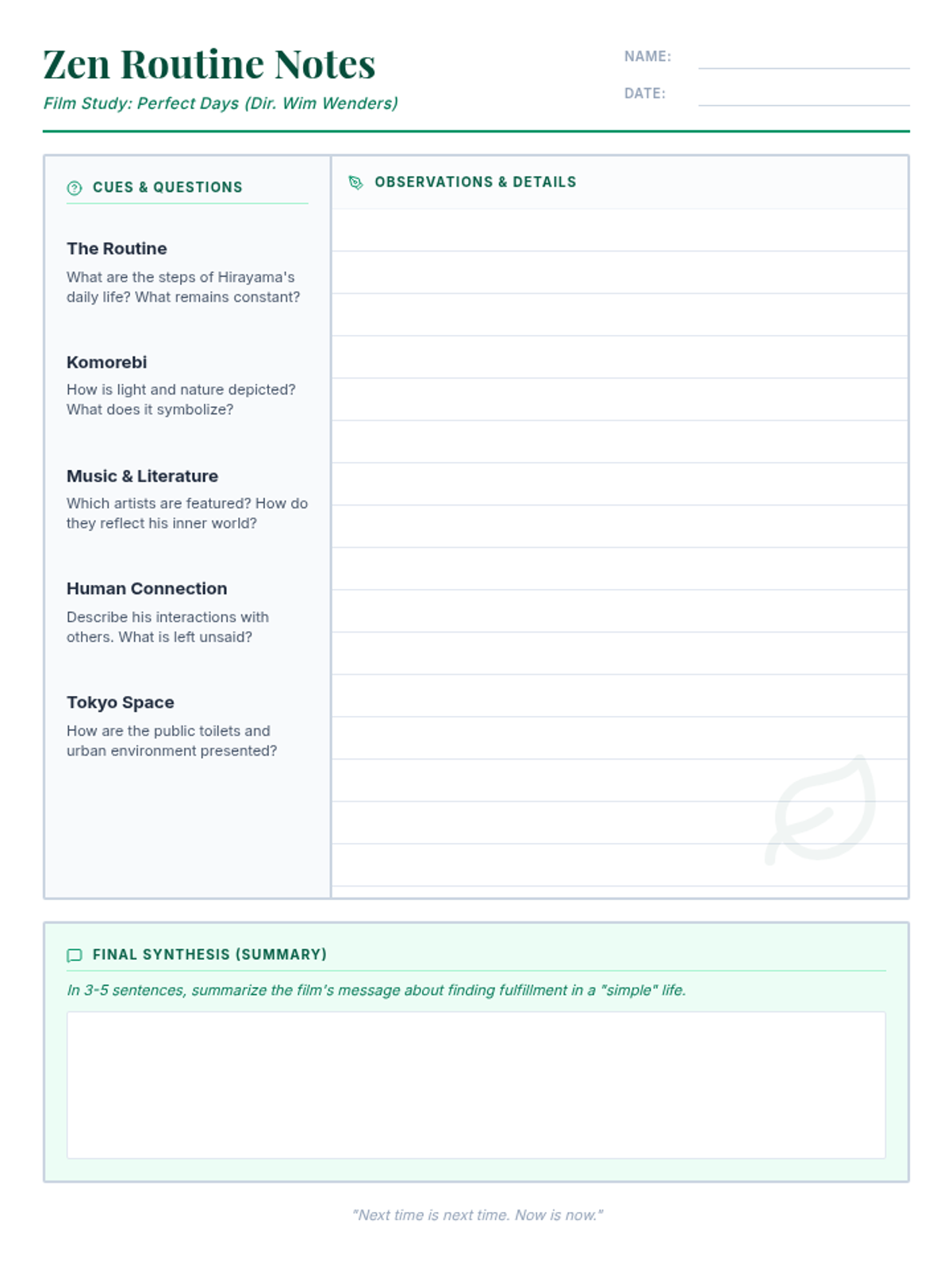
A Cornell note-taking sheet for Wim Wenders' film Perfect Days, featuring themed cue sections and a minimalist aesthetic.
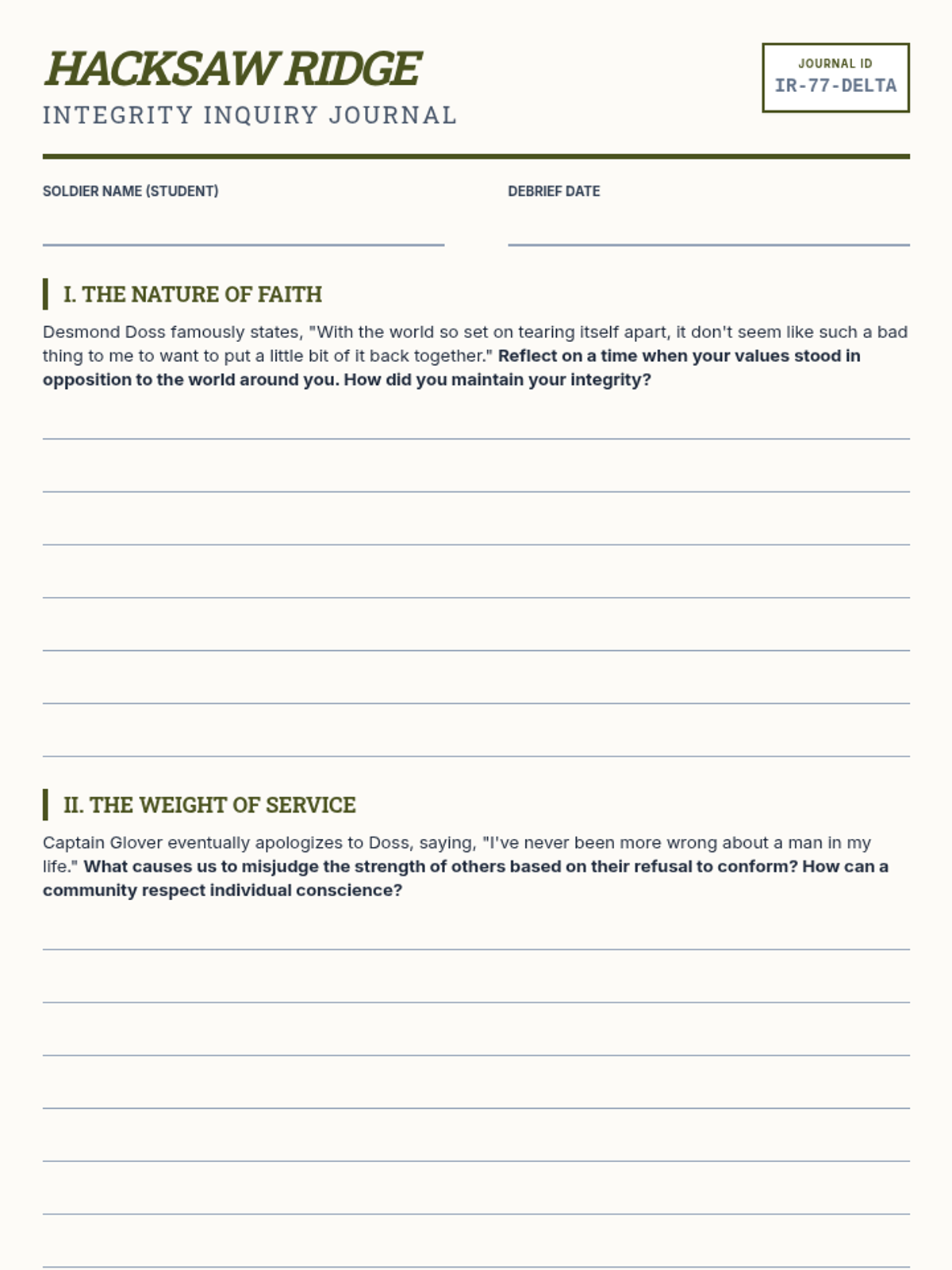
An open-ended reflection journal with four deep, philosophical prompts centered on integrity, faith, and the nature of heroism as depicted in Hacksaw Ridge.
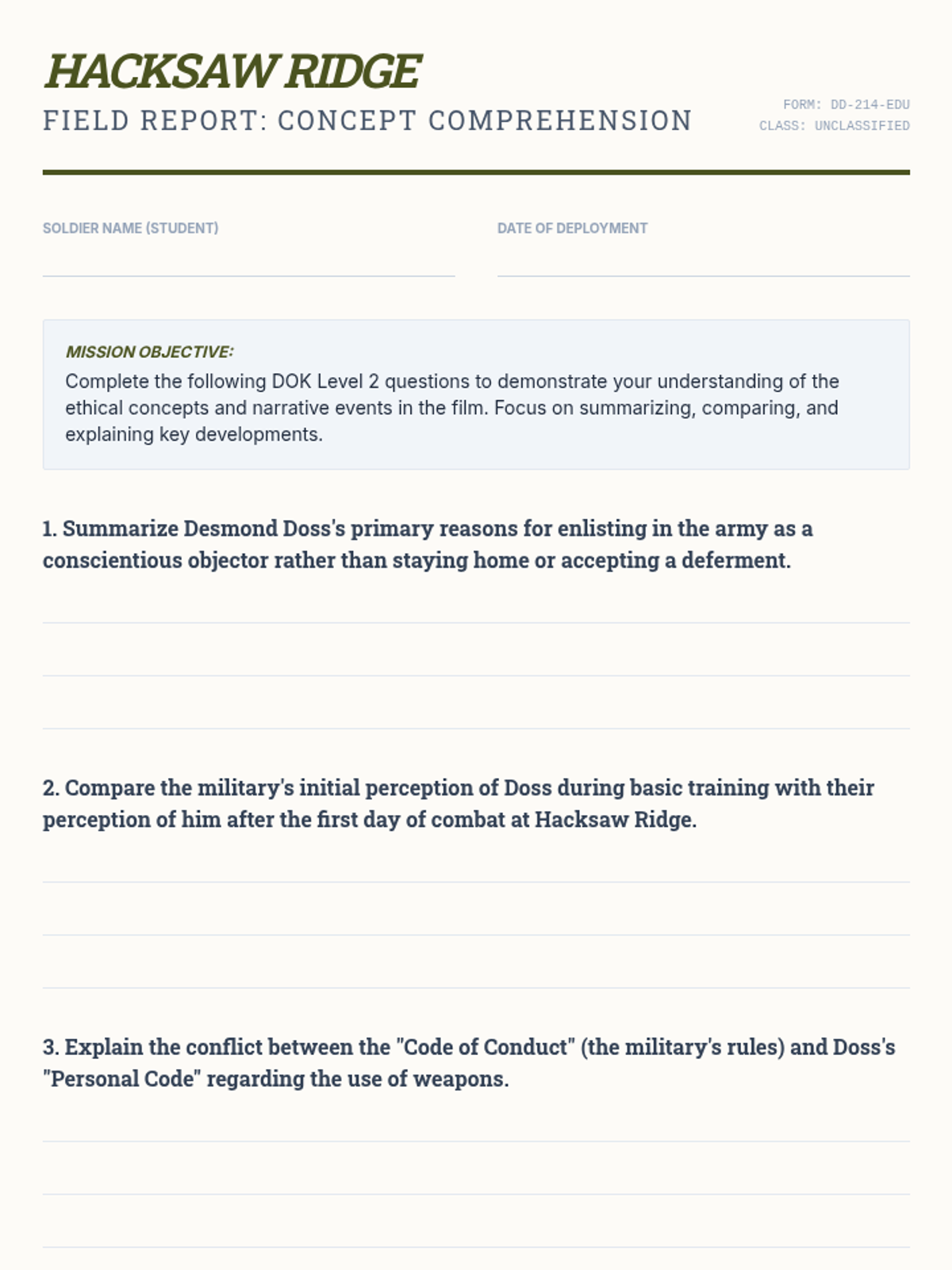
A student-facing worksheet featuring five DOK Level 2 comprehension questions about Hacksaw Ridge, focusing on summarization, comparison, and explanation of key themes and plot points.
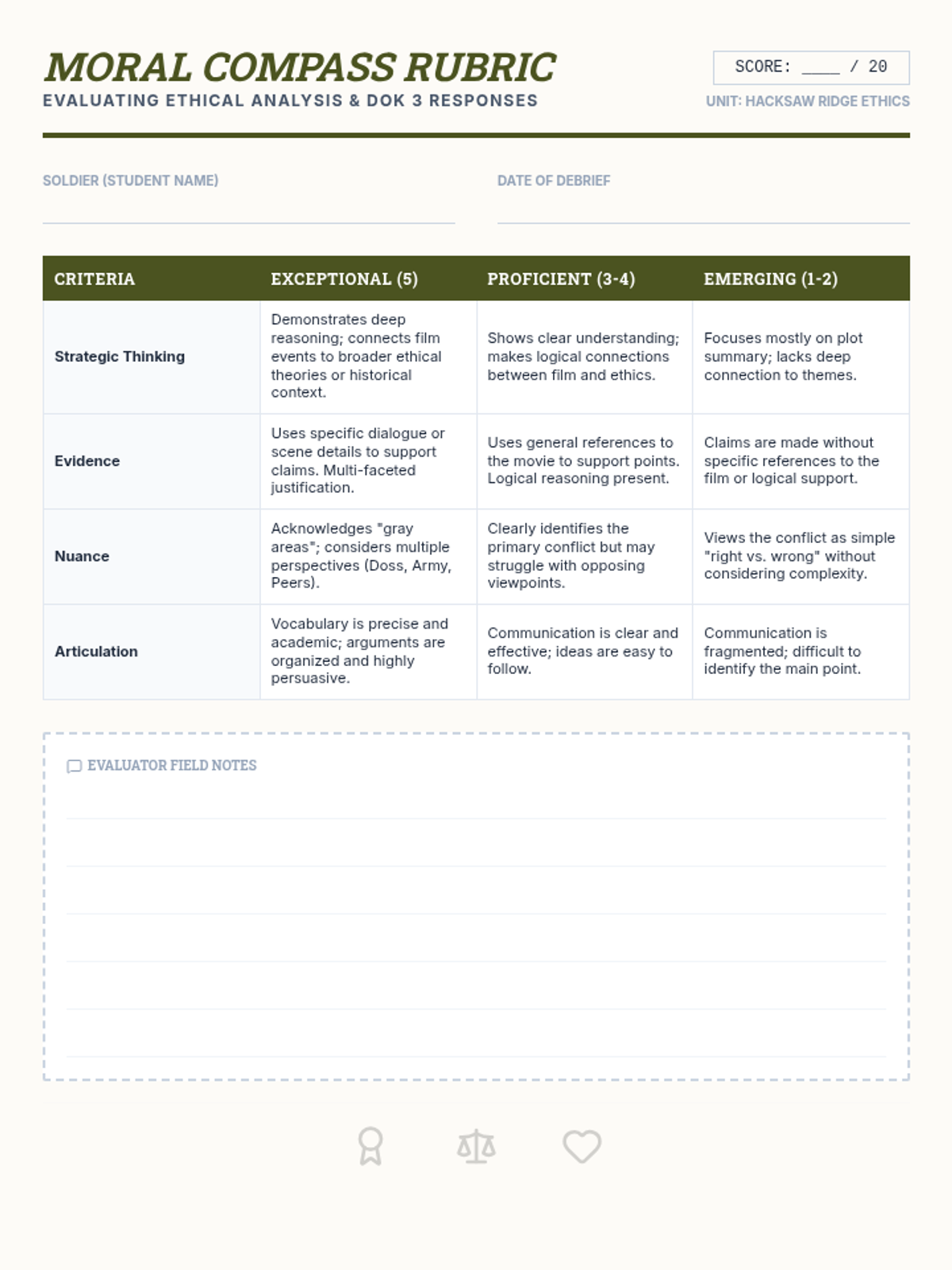
A clear and professional rubric for evaluating student responses or participation in discussions about the ethics of Hacksaw Ridge, designed with a military dossier aesthetic.
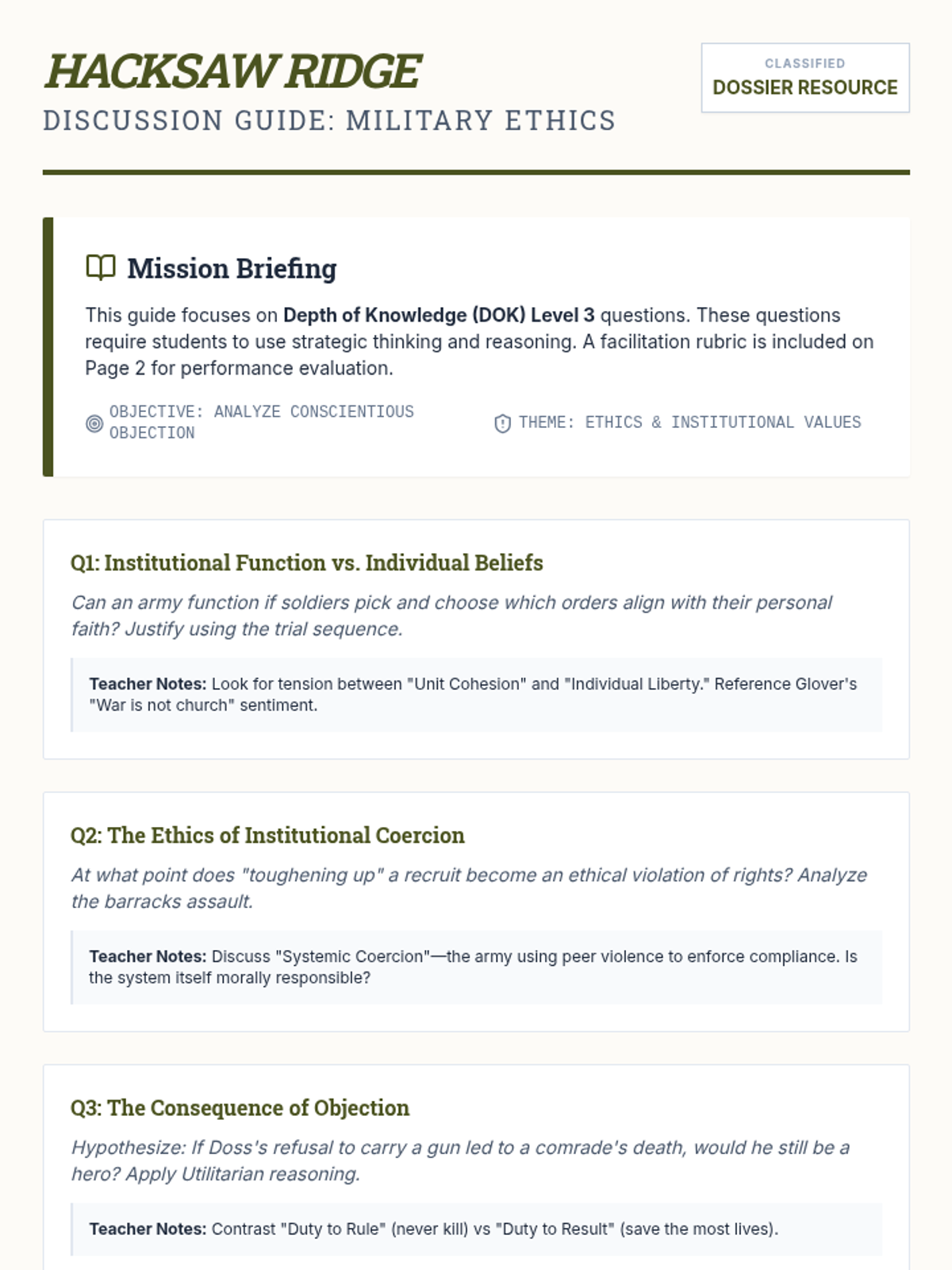
A teacher facilitation guide containing five high-level DOK 3 discussion questions regarding the ethics and conscientious objection themes in Hacksaw Ridge, complete with teacher notes and talking points.
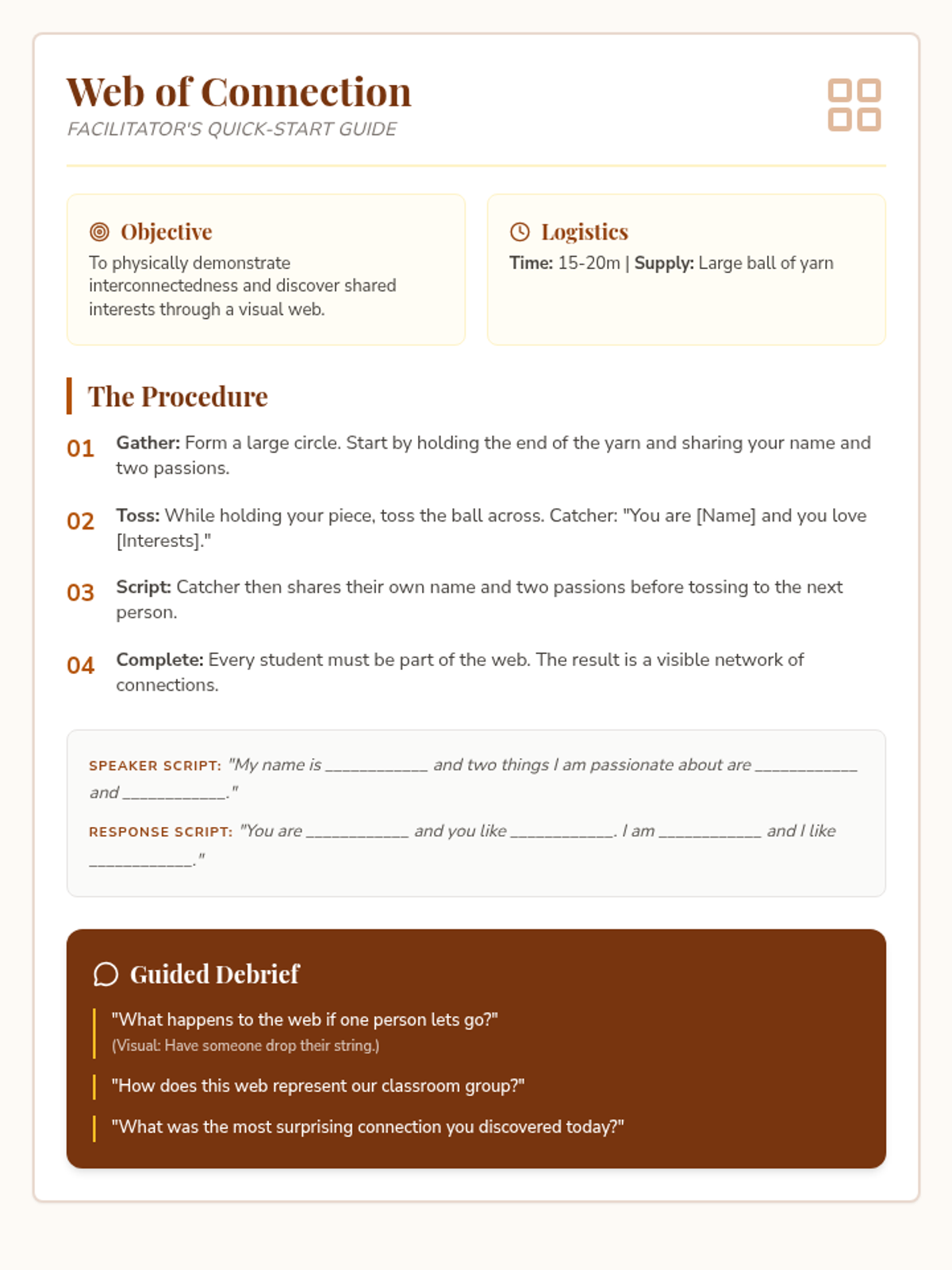
A detailed guide for facilitators to lead the Web of Connection activity, featuring setup instructions, step-by-step procedures, and guided debrief questions. Now updated to ensure all steps stay with their headings and placeholders are clearly marked. Final polish for single-page printing.
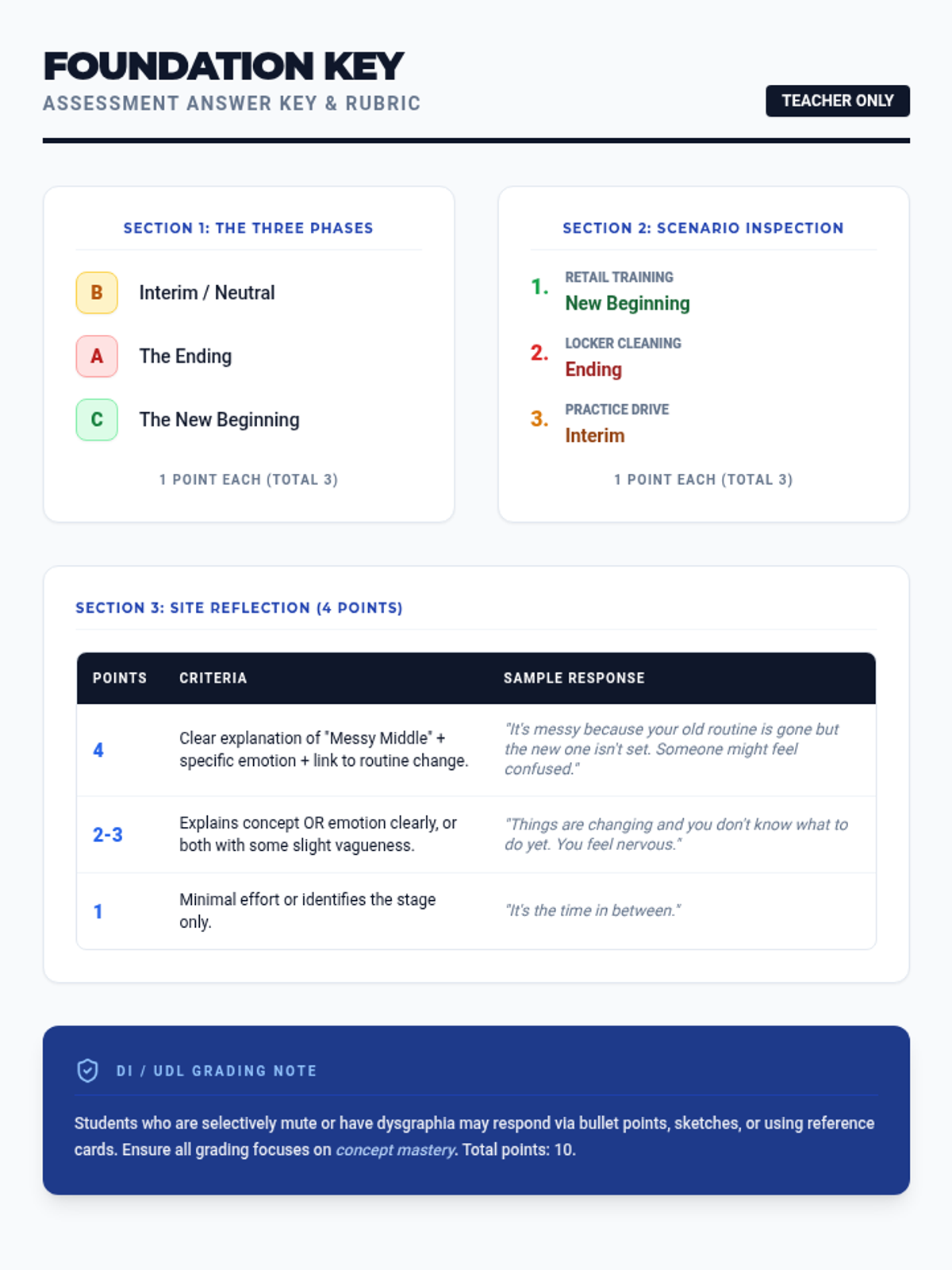
Updated answer key for the 9-point assessment with 8 scenarios and matching. Points: S1 (3), S2 (2 - 0.25 pts each), S3 (4). Includes teacher-only reference and UDL grading notes. Content matches updated assessment. Revised for single-page layout.
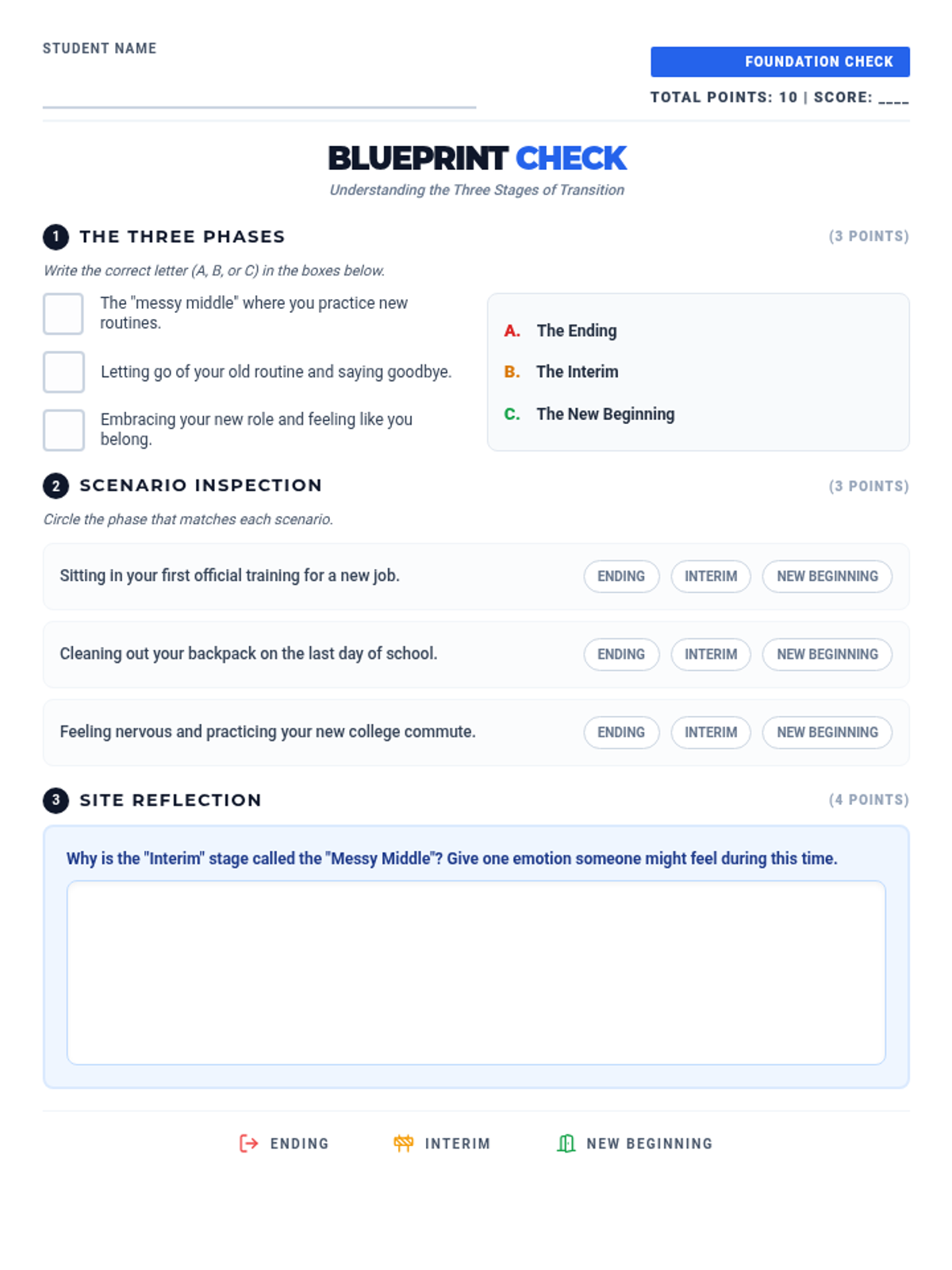
Expanded post-lesson assessment with 8 scenarios and matching. Points updated: S1 (3), S2 (2 - 0.25 pts each), S3 (4) for a total of 9. Optimized for a single page with clear UDL supports and standardized scenario labeling. Layout tightened for single-page printing.
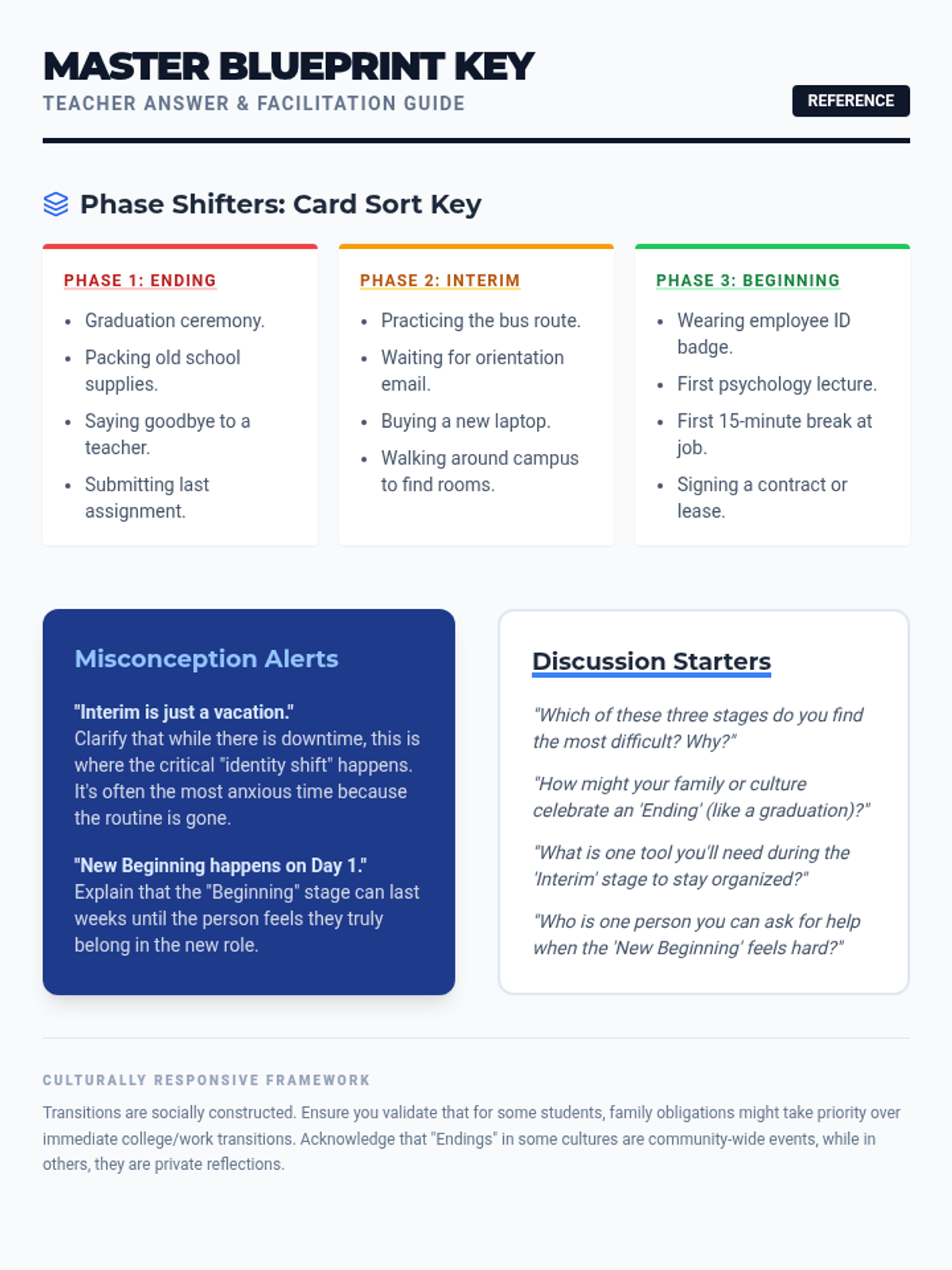
Updated teacher reference sheet with answers for the expanded 17-scenario card sort, plus updated facilitation tips and discussion starters.
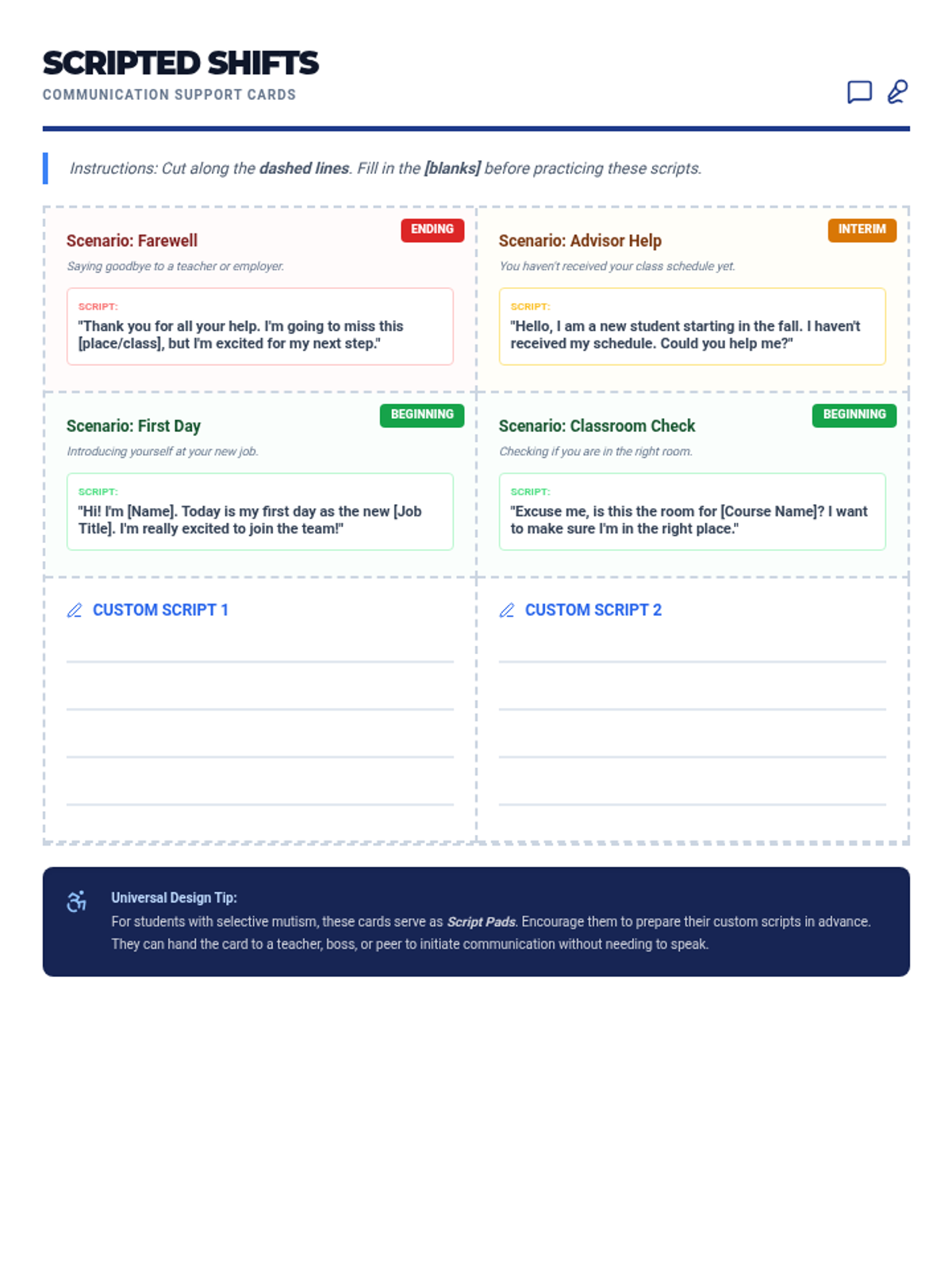
Expanded role-play script set with 6 diverse transition scenarios (Ending, Interim, Beginning) plus two custom script pads for student-generated practice. Scripts feature larger text for better readability. Added learning goal and specific fields for custom pads. Tip for script pads removed. Standardized scenario font sizes. Updated to ensure all content fits on one page. Removed points from confidence check.
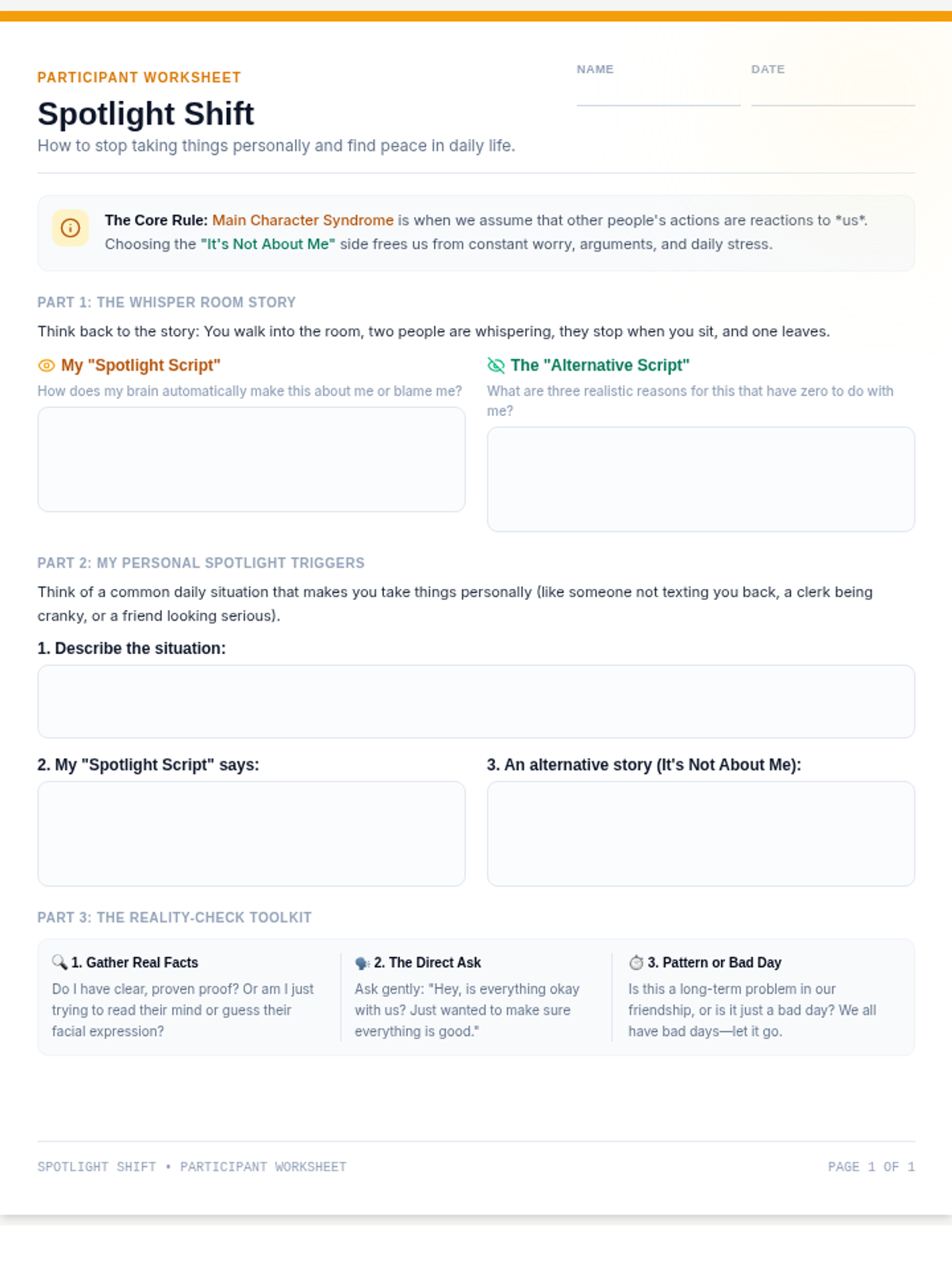
A structured, 1-page print-ready participant worksheet designed for mental health and substance abuse clients. It features guided exercises to break down personalization scenarios, re-frame thoughts, and run evidence-based reality checks.
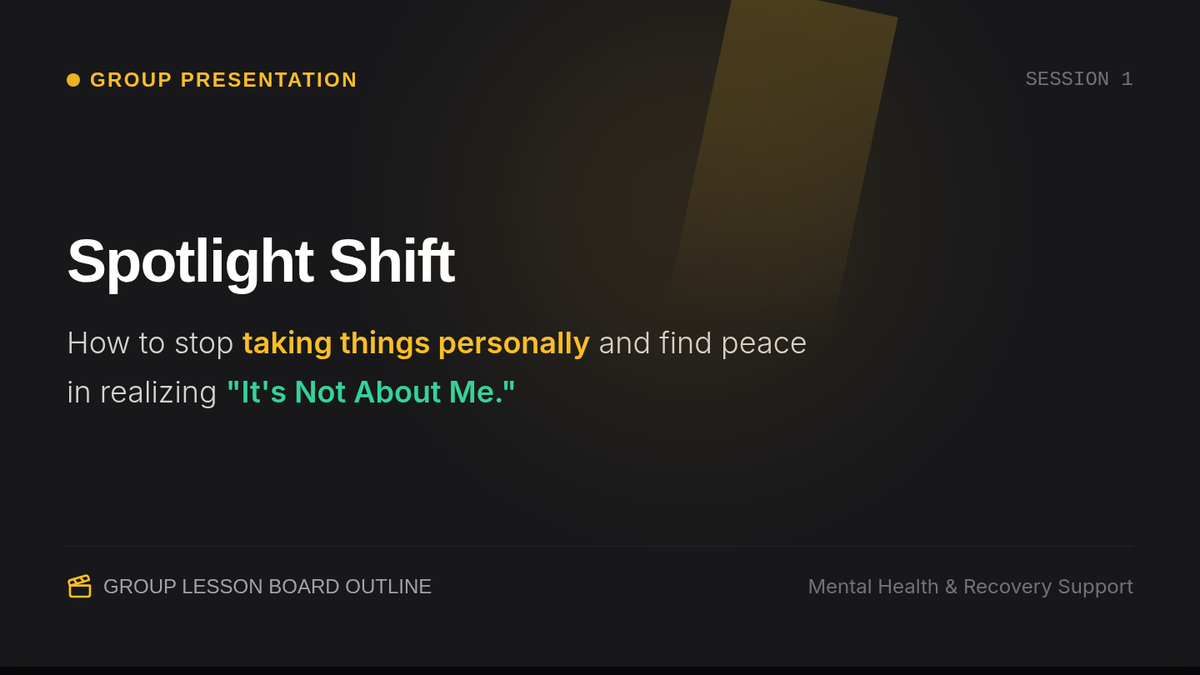
Highly visible, dark-themed presentation slides designed as visual anchors for a mental health / substance abuse group session. Every text element is carefully sized to be above the 24px threshold, facilitating high engagement with clear, readable typography.
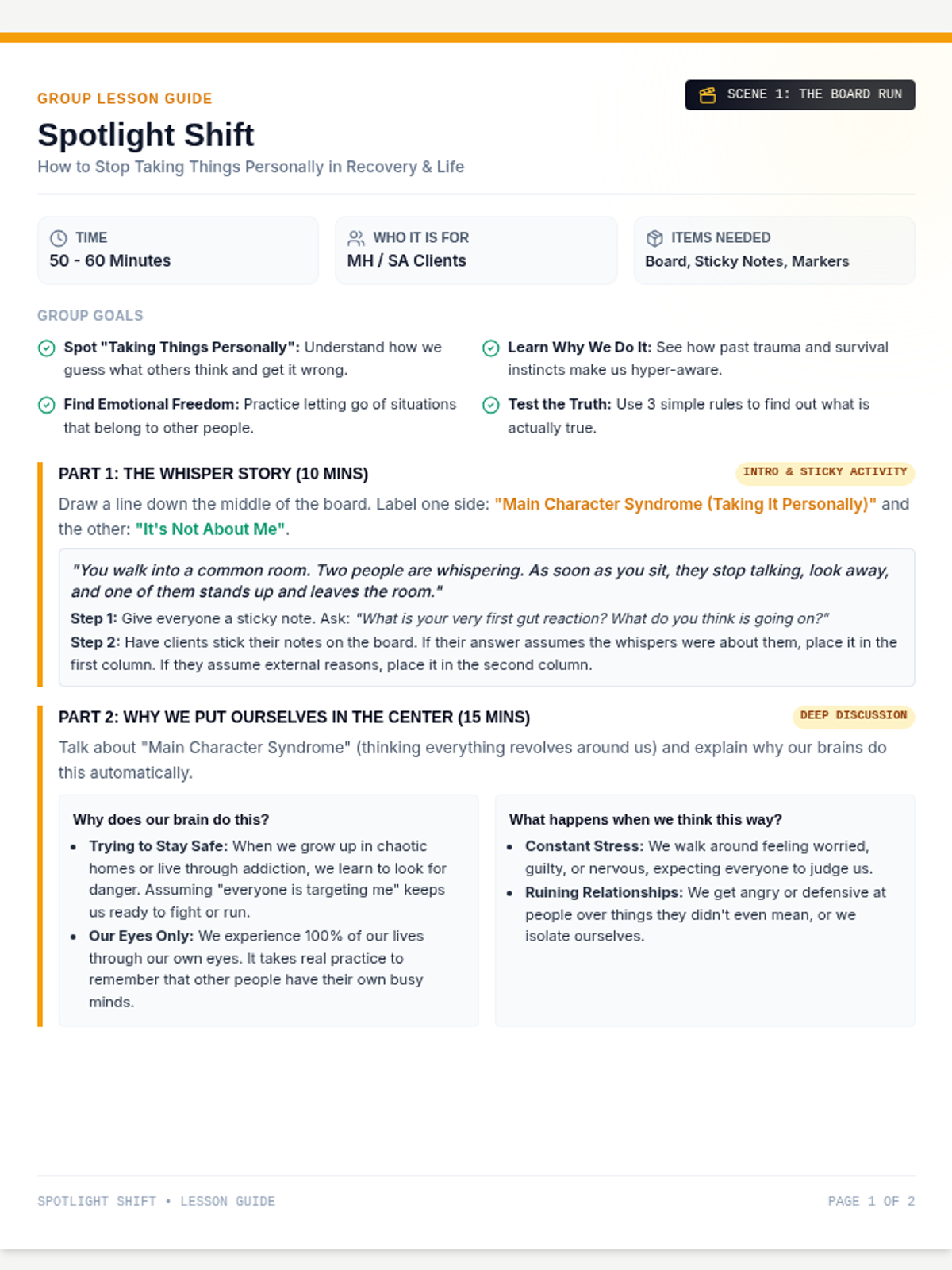
A simplified, 2-page print-ready facilitator guide for a mental health and substance abuse group. It uses accessible language (8th-grade level) to outline steps, timing, board activities, and clinical tips.
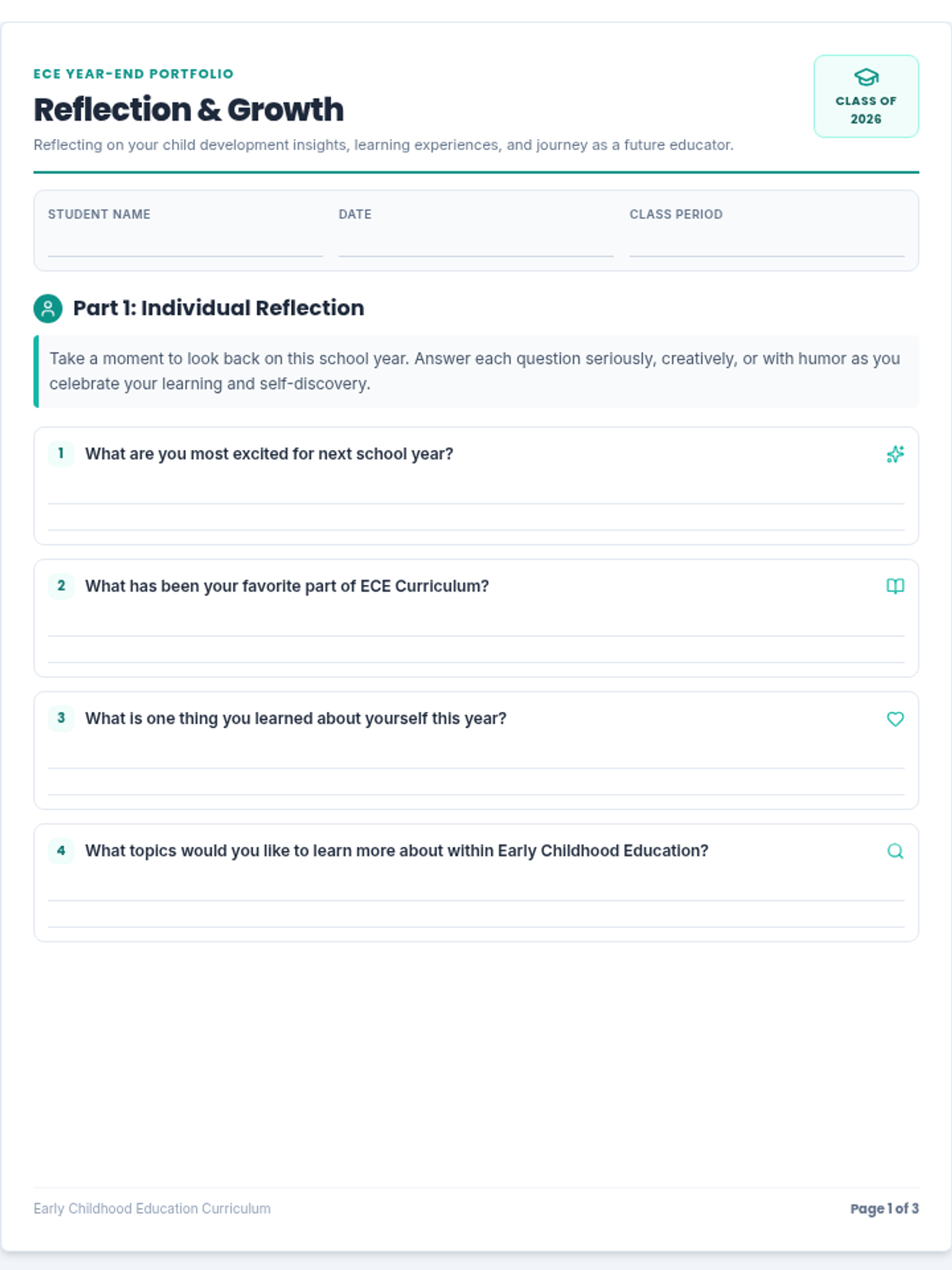
A clean, beautifully designed 3-page printable worksheet for Early Childhood Education (ECE) students. Pages 1 and 2 cover individual reflections on child development insights, classroom learning, and self-reflection. Page 3 provides 10 beautifully designed cut-out 'survival guide cards' for fun, anonymous collaborative advice about Mrs. Levy's class.
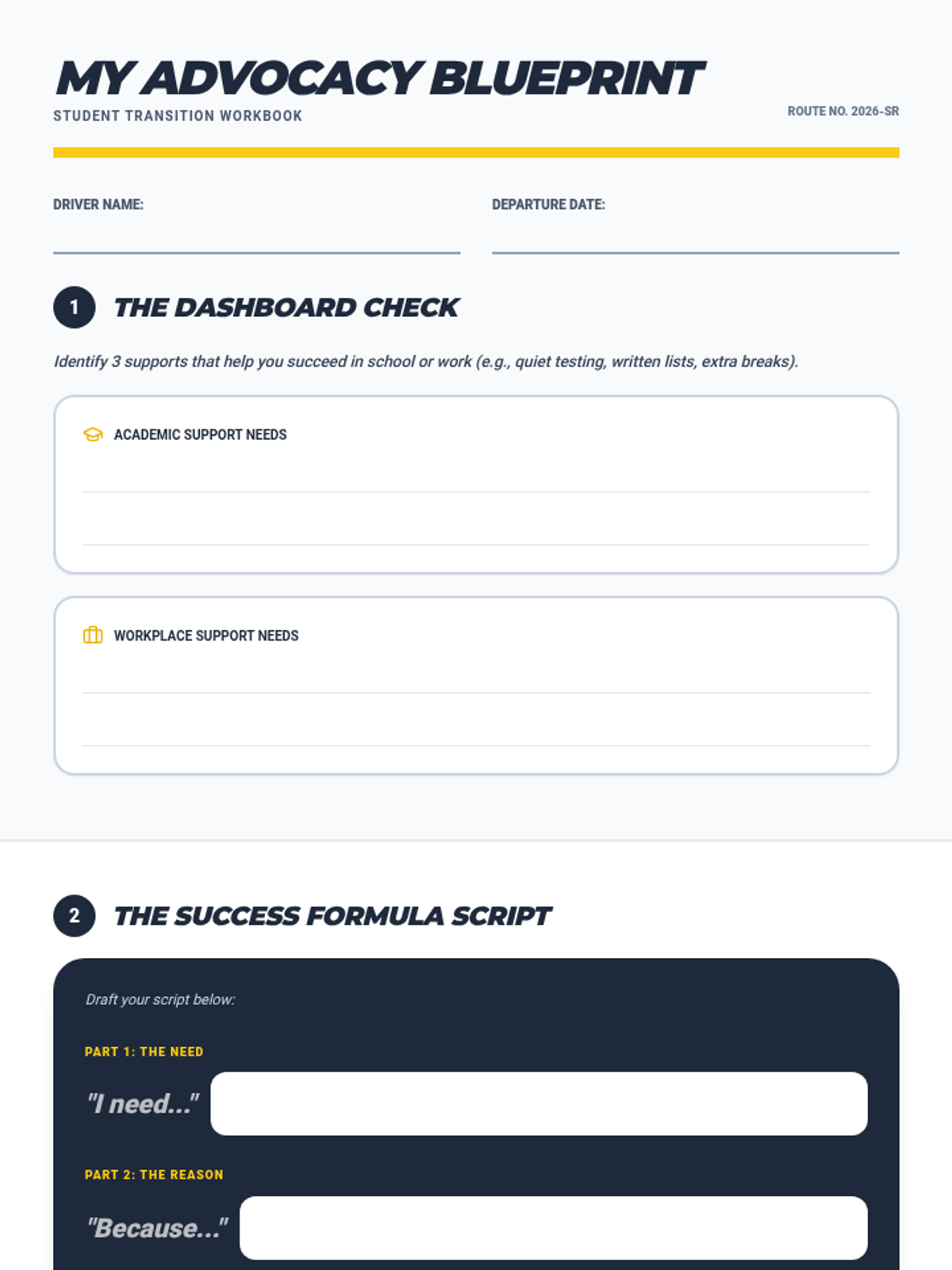
A structured 2-page workbook for students to identify their support needs, draft personalized advocacy scripts, and research local community resources.
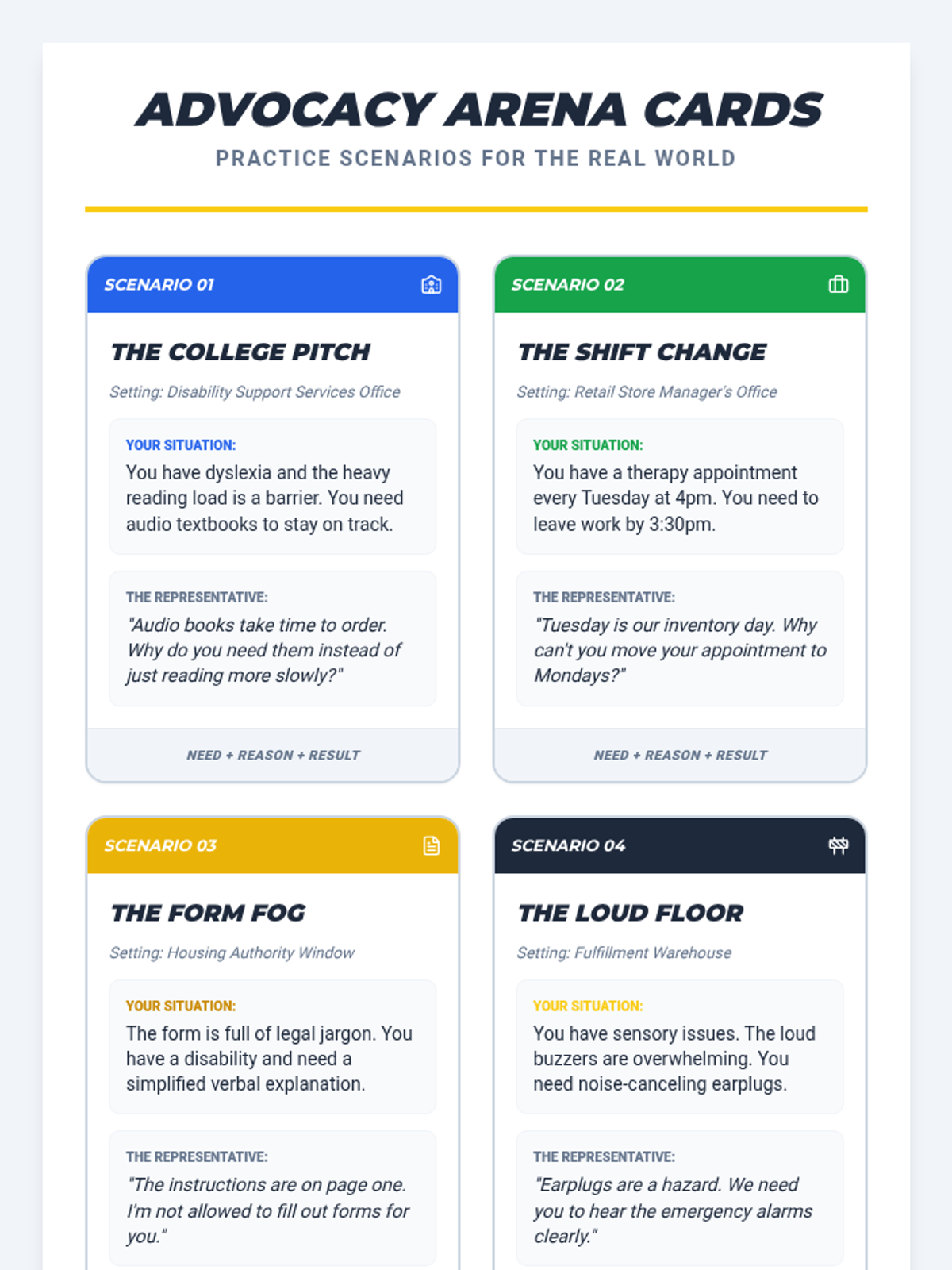
A set of 6 role-play scenario cards featuring real-world challenges in college, workplace, and community settings, designed for students to practice the 3-part advocacy script.
An engaging 9-slide presentation featuring a road-trip theme to guide students through self-advocacy concepts, the 3-part script formula, and resource mapping.
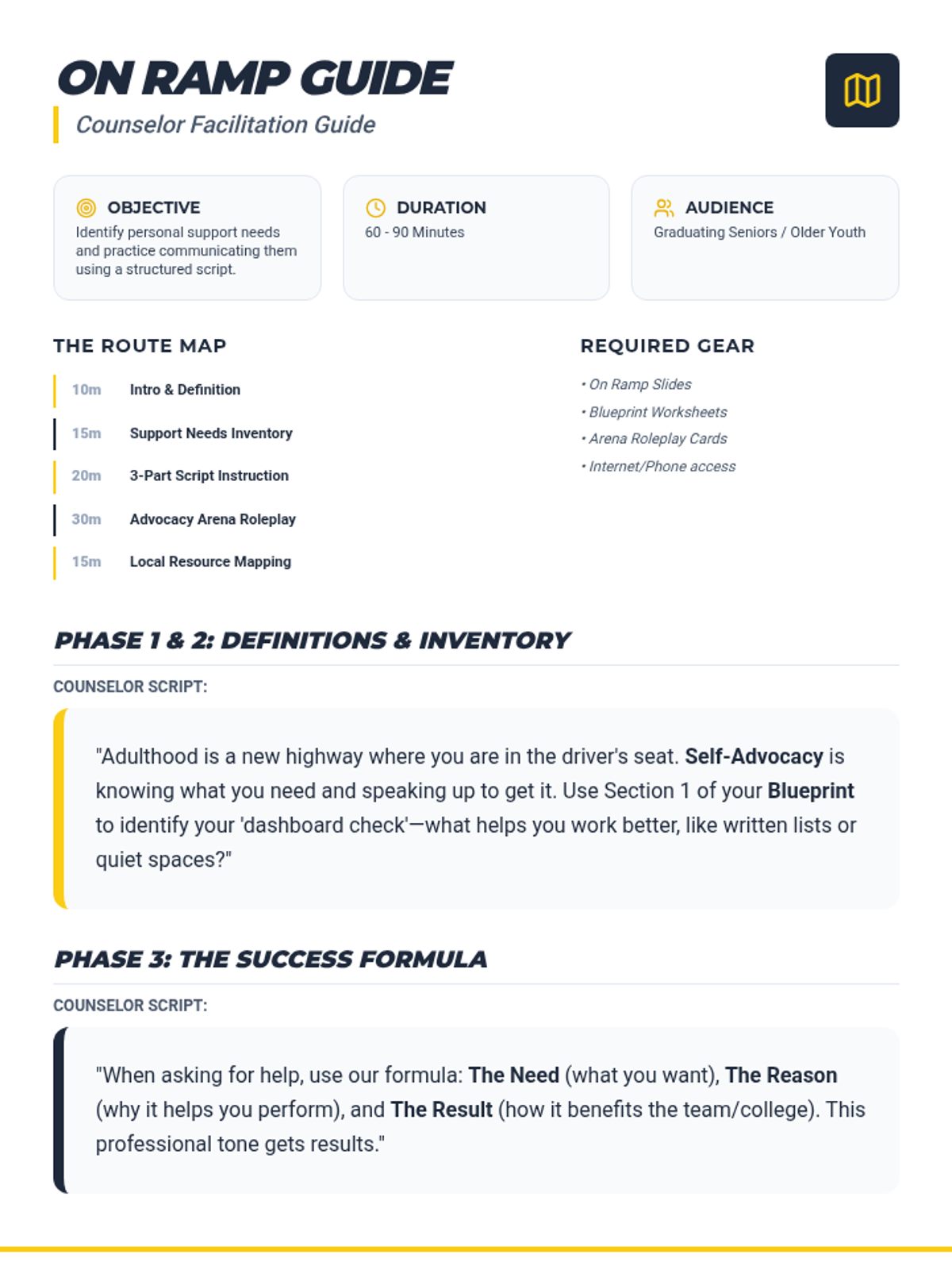
A detailed facilitator's guide for counselors, featuring a step-by-step lesson plan, a complete instructional script, and pacing suggestions for a 90-minute self-advocacy workshop.