Root cause analysis and brainstorming techniques for everyday problem-solving. Equips learners with ethical frameworks and risk-benefit evaluation skills to predict consequences and make informed choices.
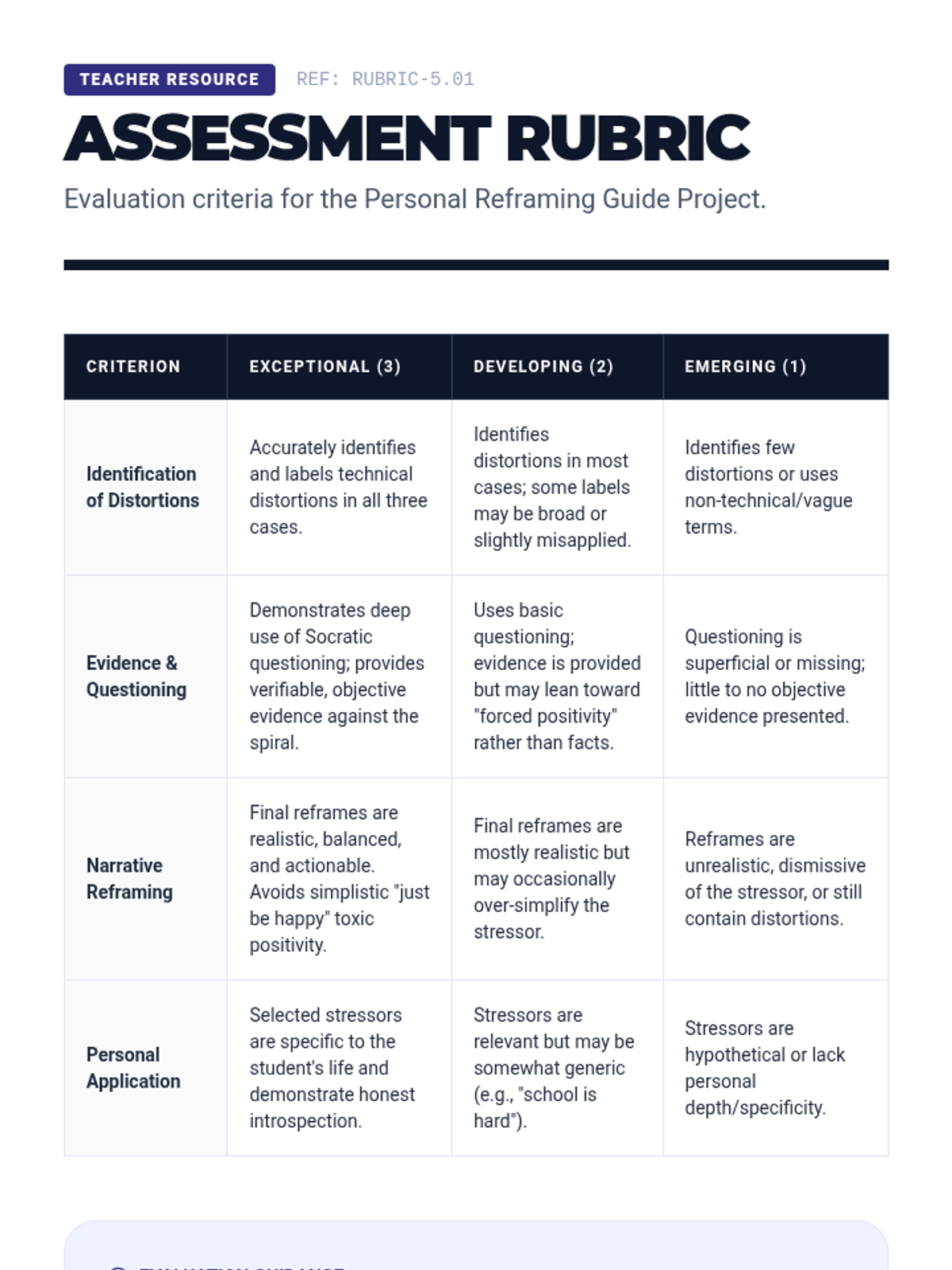
Grading rubric and evaluation guide for teachers to assess the final "Reframing Guide" projects while maintaining student confidentiality.
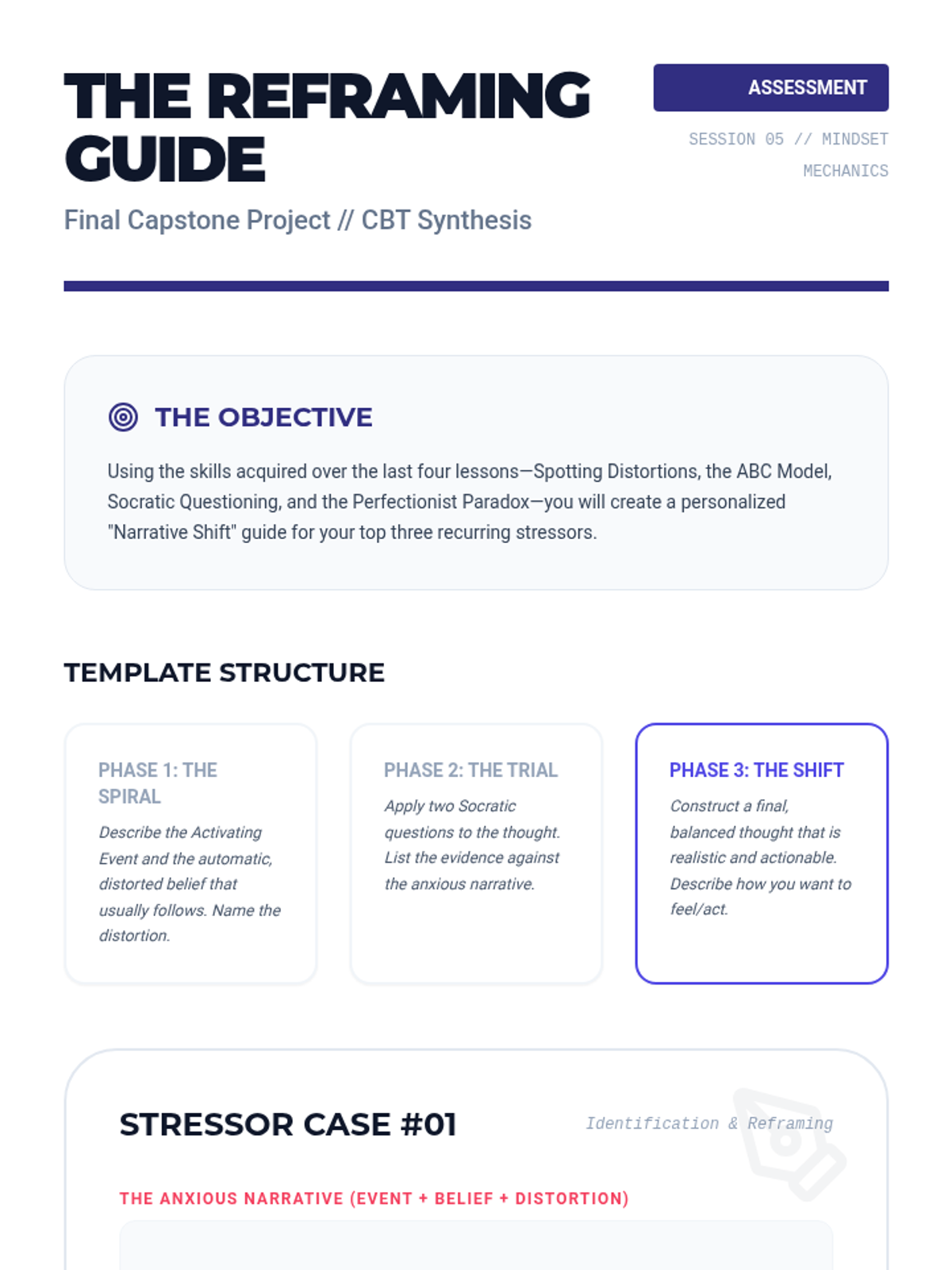
Final project guide and template for students to create their personalized "Reframing Guide," applying CBT techniques to their three most recurring stressors.
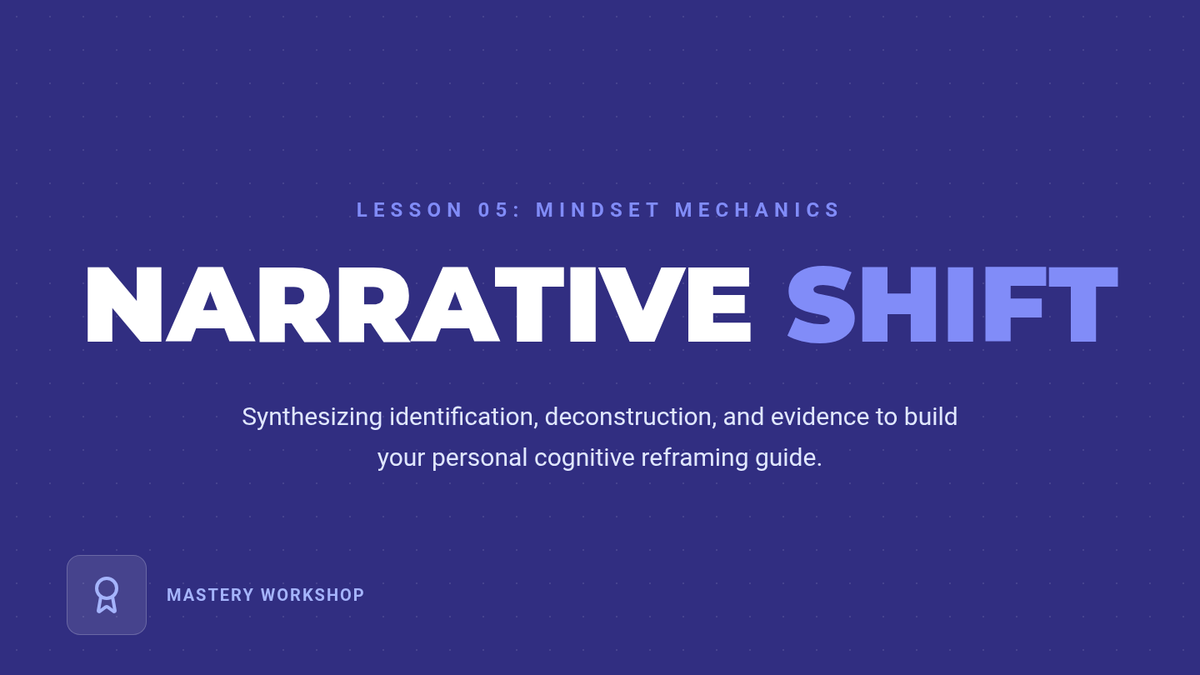
Final synthesis presentation showing the shift from anxious narratives to balanced reframing, preparing students for their final project.
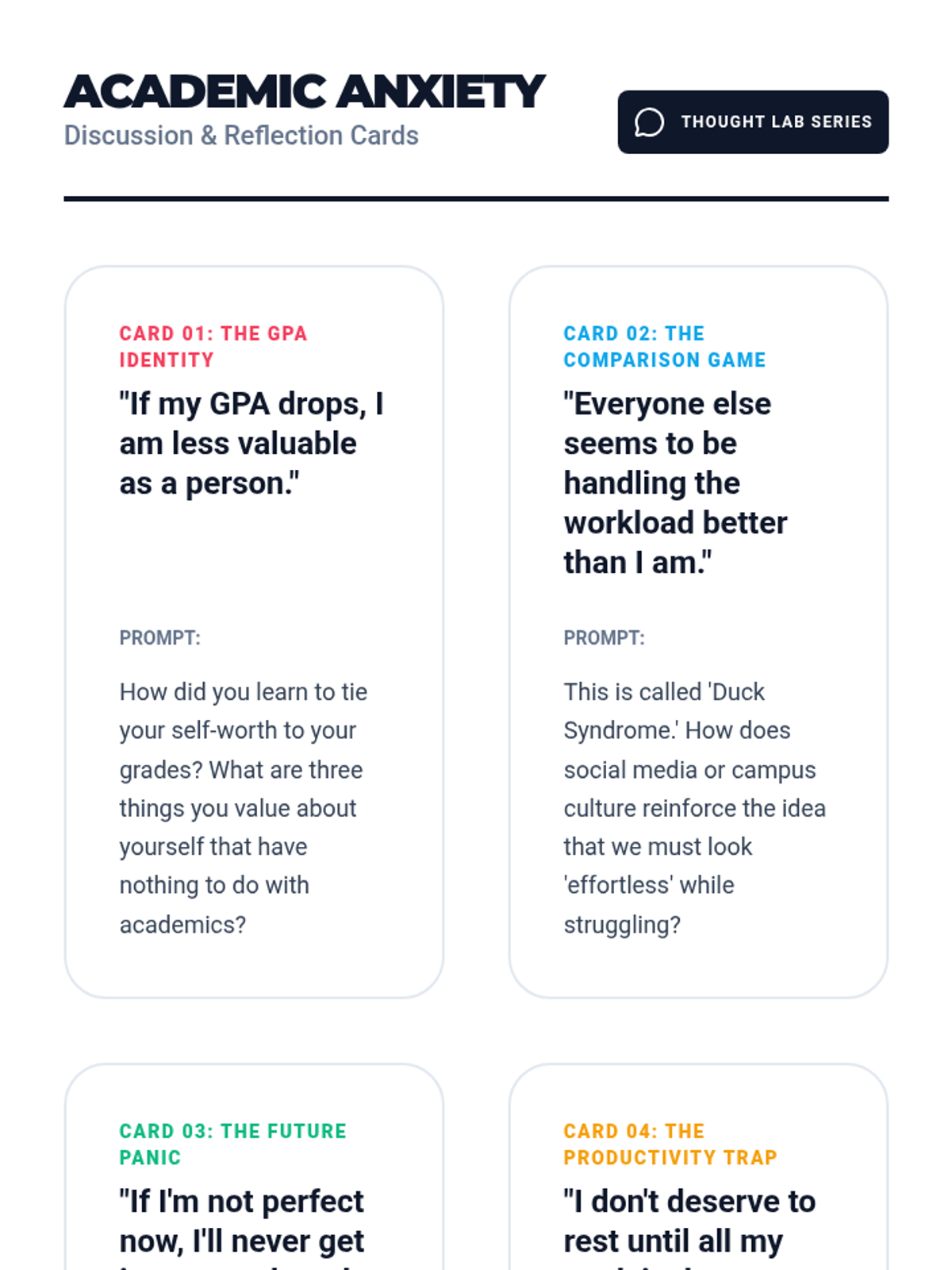
Discussion prompts on cards designed to spark dialogue about academic pressure, "Duck Syndrome," and the relationship between grades and self-worth.
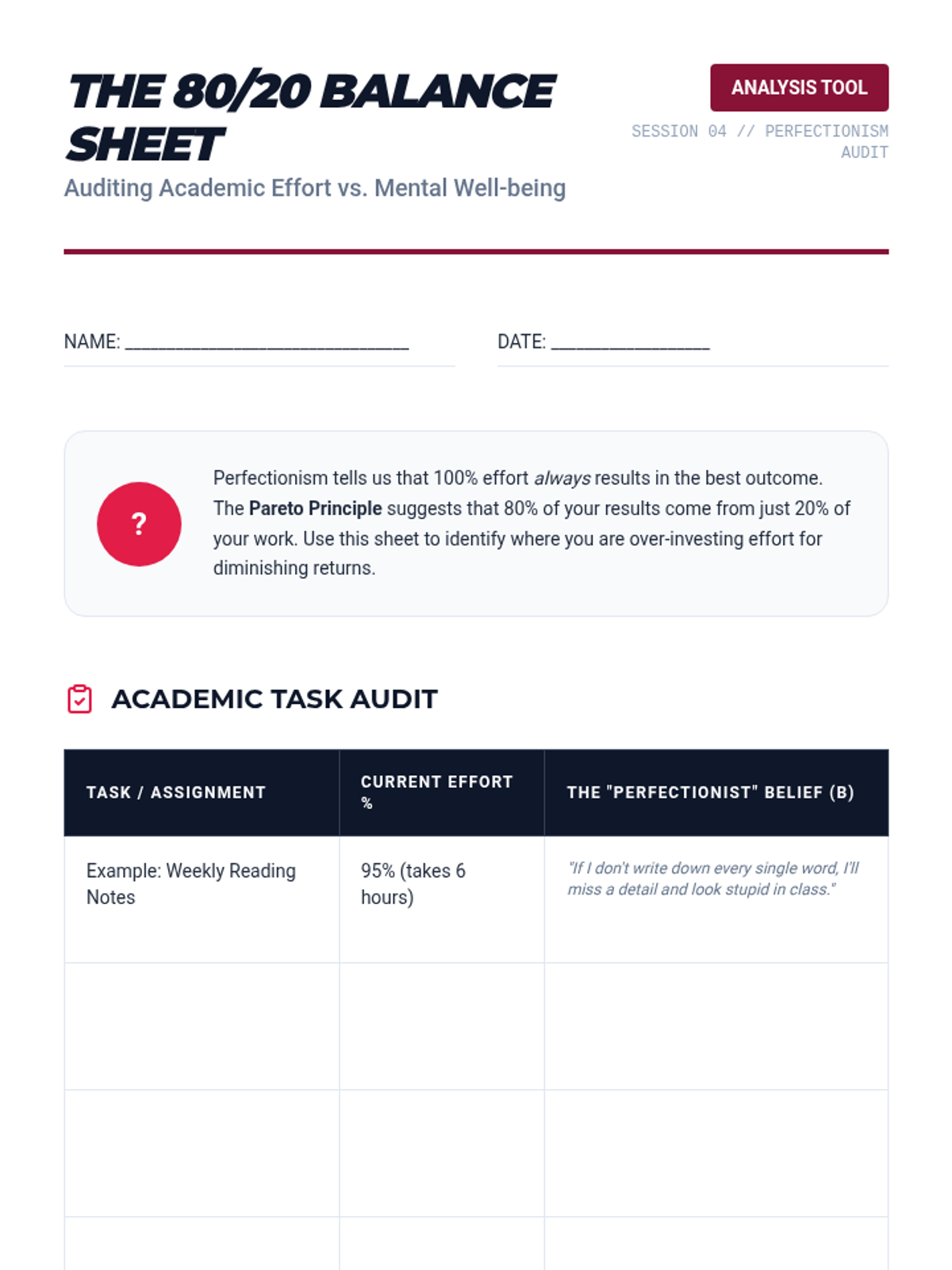
A worksheet for auditing academic effort using the Pareto Principle, helping students identify over-invested tasks and define "good enough" for better mental balance.
Visual presentation on the "Perfectionist Paradox," utilizing the Pareto Principle to discuss academic anxiety and the diminishing returns of perfectionist striving.
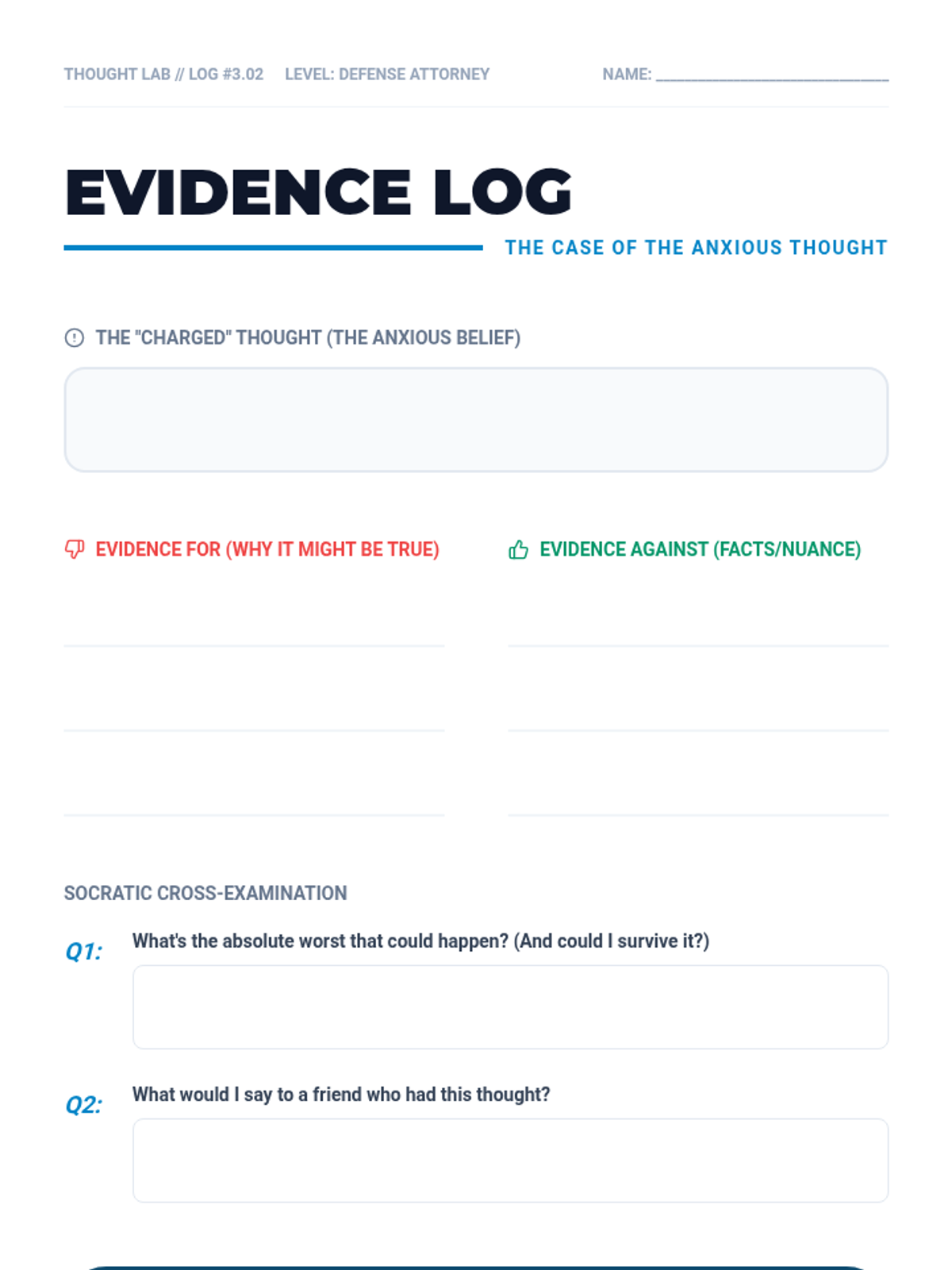
Worksheet for deconstructing an anxious thought through evidence collection and Socratic questioning, concluding with a "Balanced Narrative" verdict.
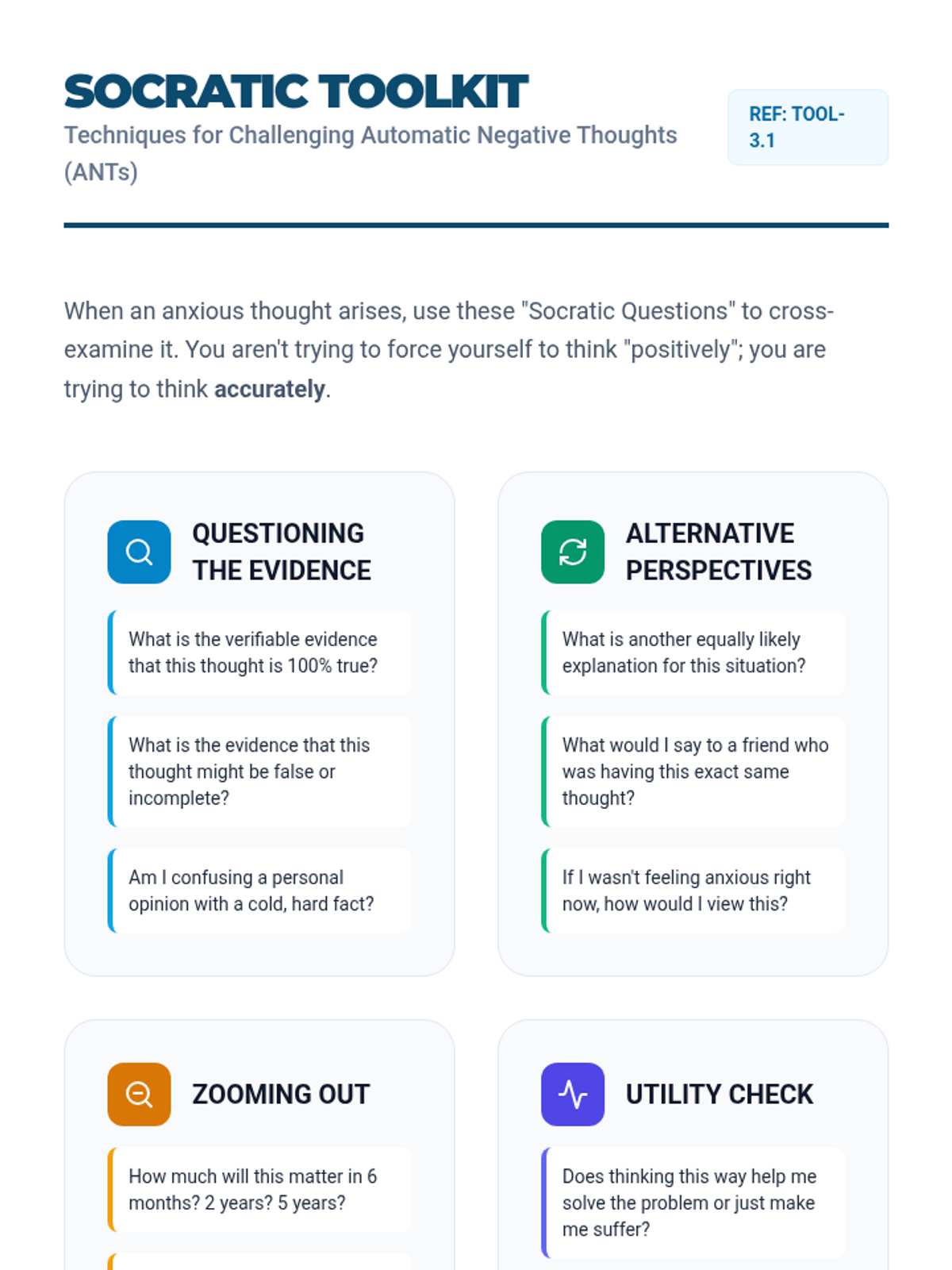
A comprehensive reference sheet containing categorized Socratic questions for students to use when challenging their own automatic negative thoughts.
Presentation introducing Socratic questioning techniques and the "Thought Trial" concept to evaluate the evidence for and against anxious thoughts.
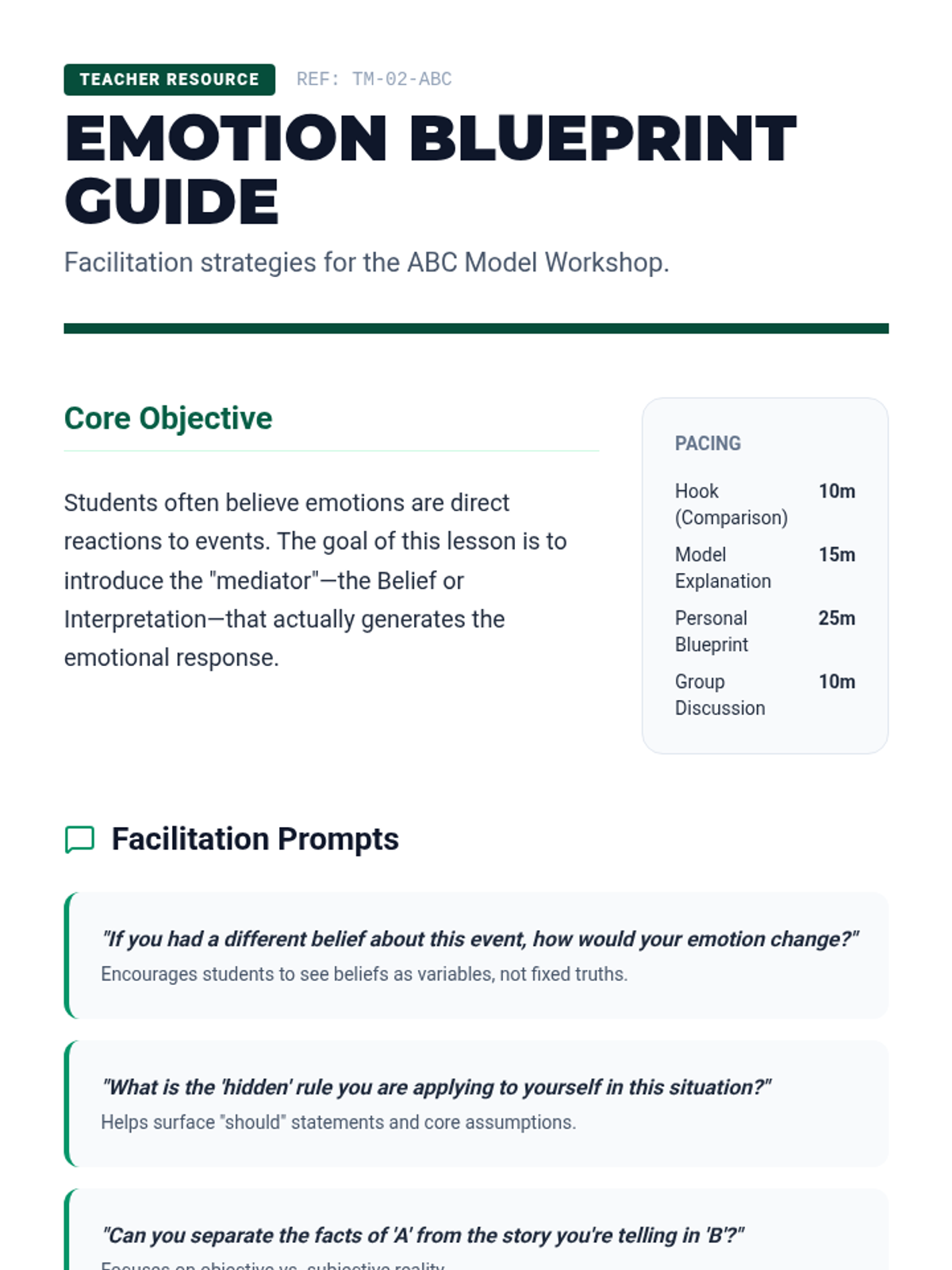
Instructional guide for teachers with facilitation prompts, pacing suggestions, and strategies for navigating common student difficulties with the ABC model.
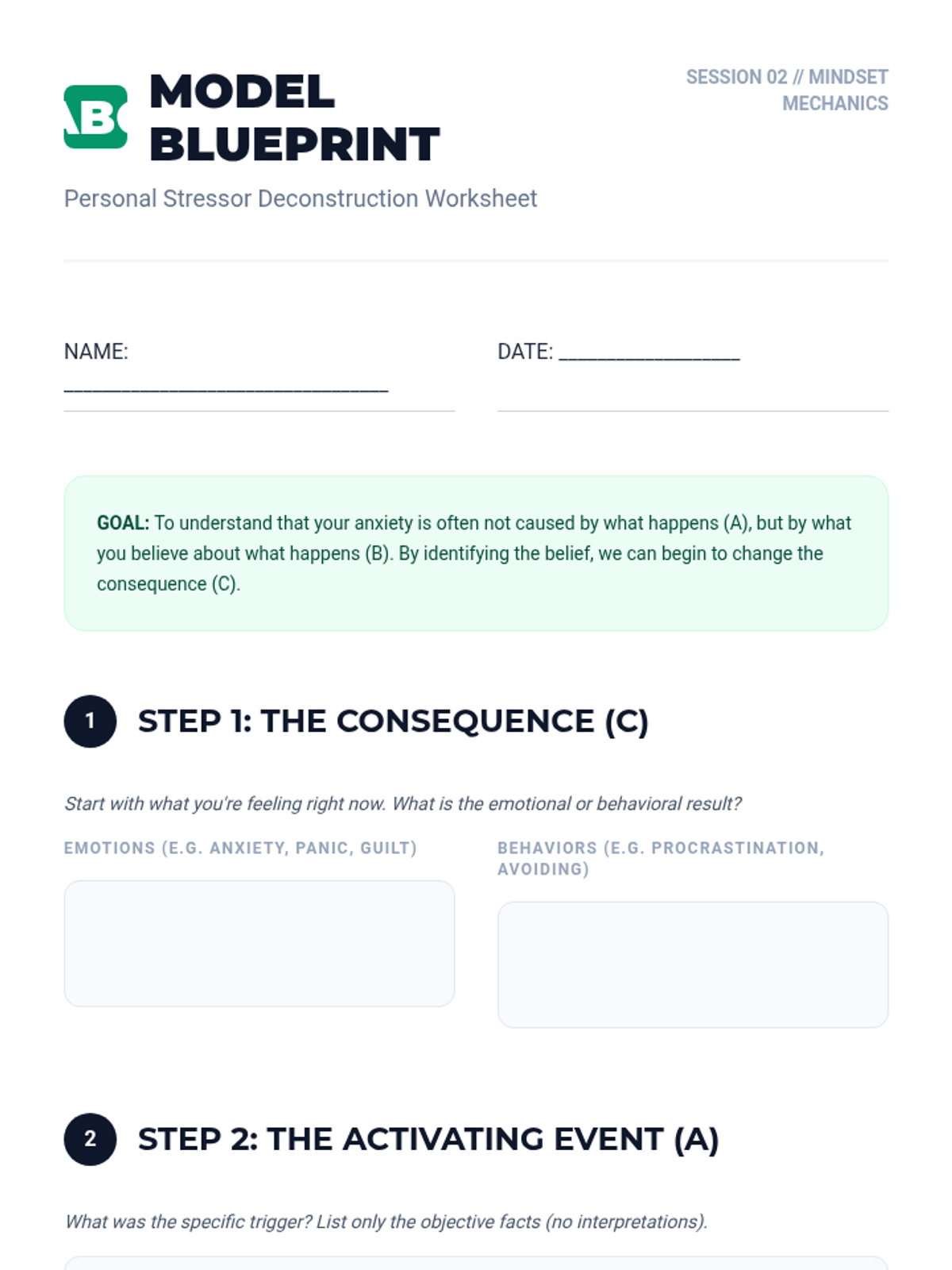
A structured worksheet for students to deconstruct a personal stressor using the ABC model, helping them identify the underlying beliefs driving their anxiety.
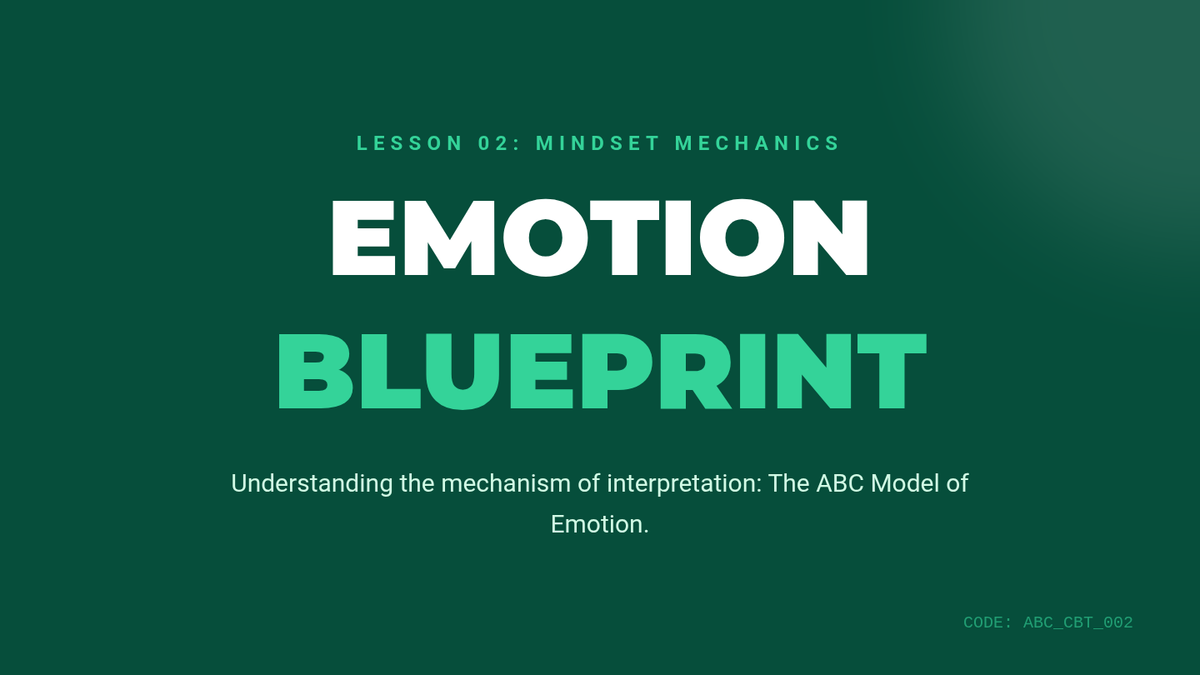
Presentation explaining the ABC Model (Activating event, Belief, Consequence) and how interpretation drives emotional responses to stress.
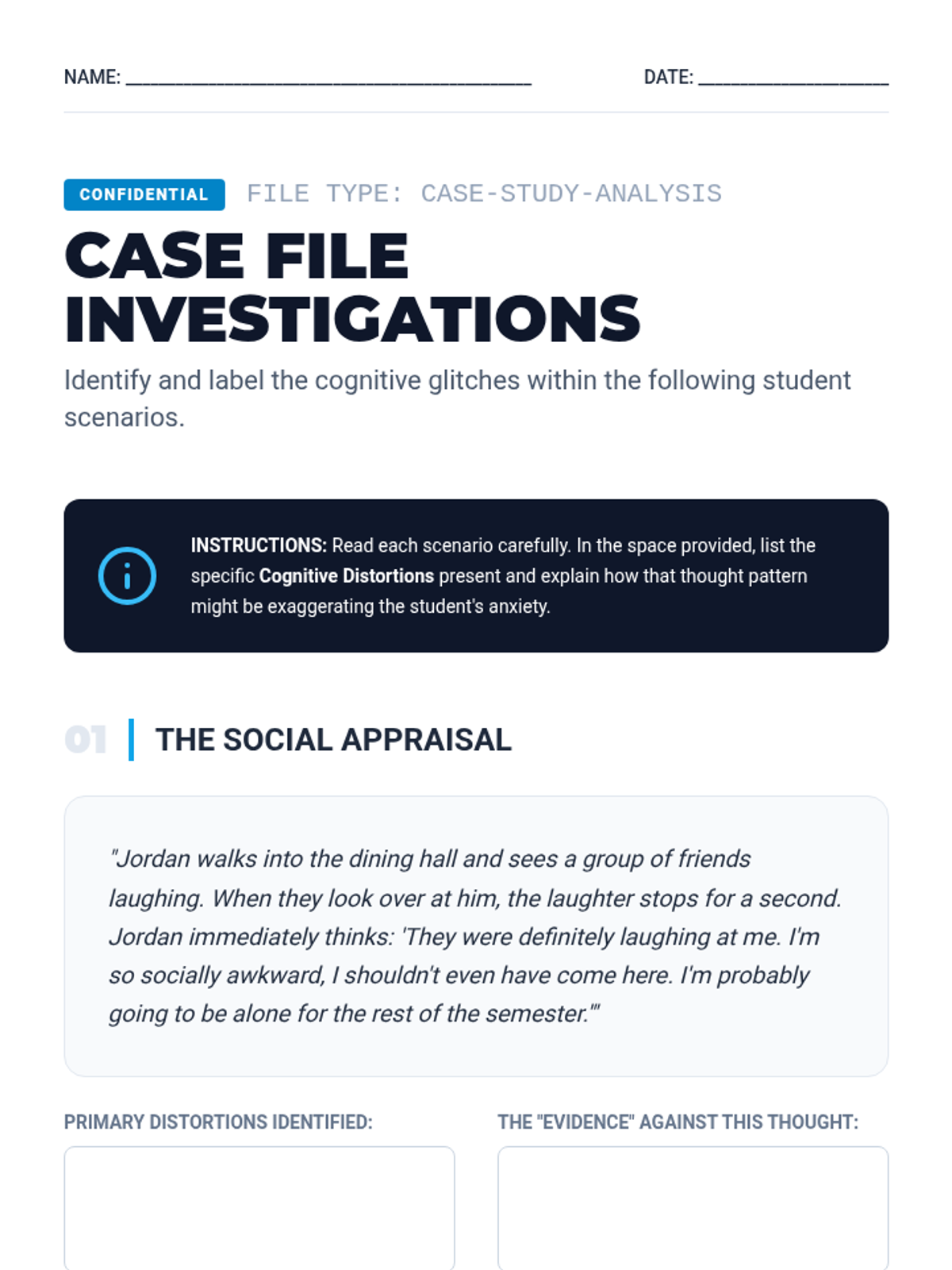
Worksheet featuring two student case studies where learners must identify specific cognitive distortions and brainstorm counter-evidence.
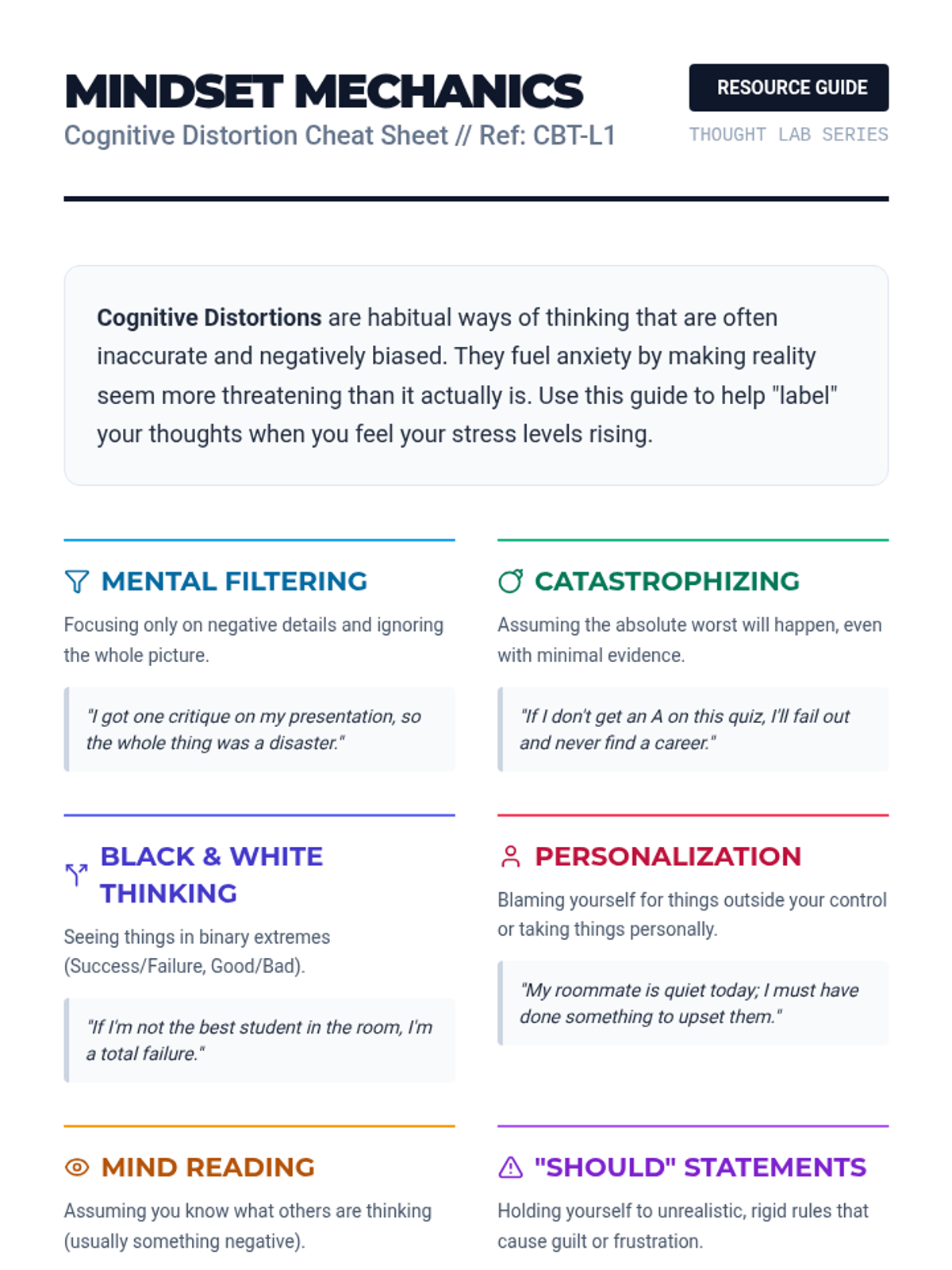
A technical reference guide defining common cognitive distortions with examples, designed for undergraduate students to keep in their notebooks.
Visual presentation introducing cognitive distortions, the anxiety feedback loop, and clinical labels for common negative thought patterns.
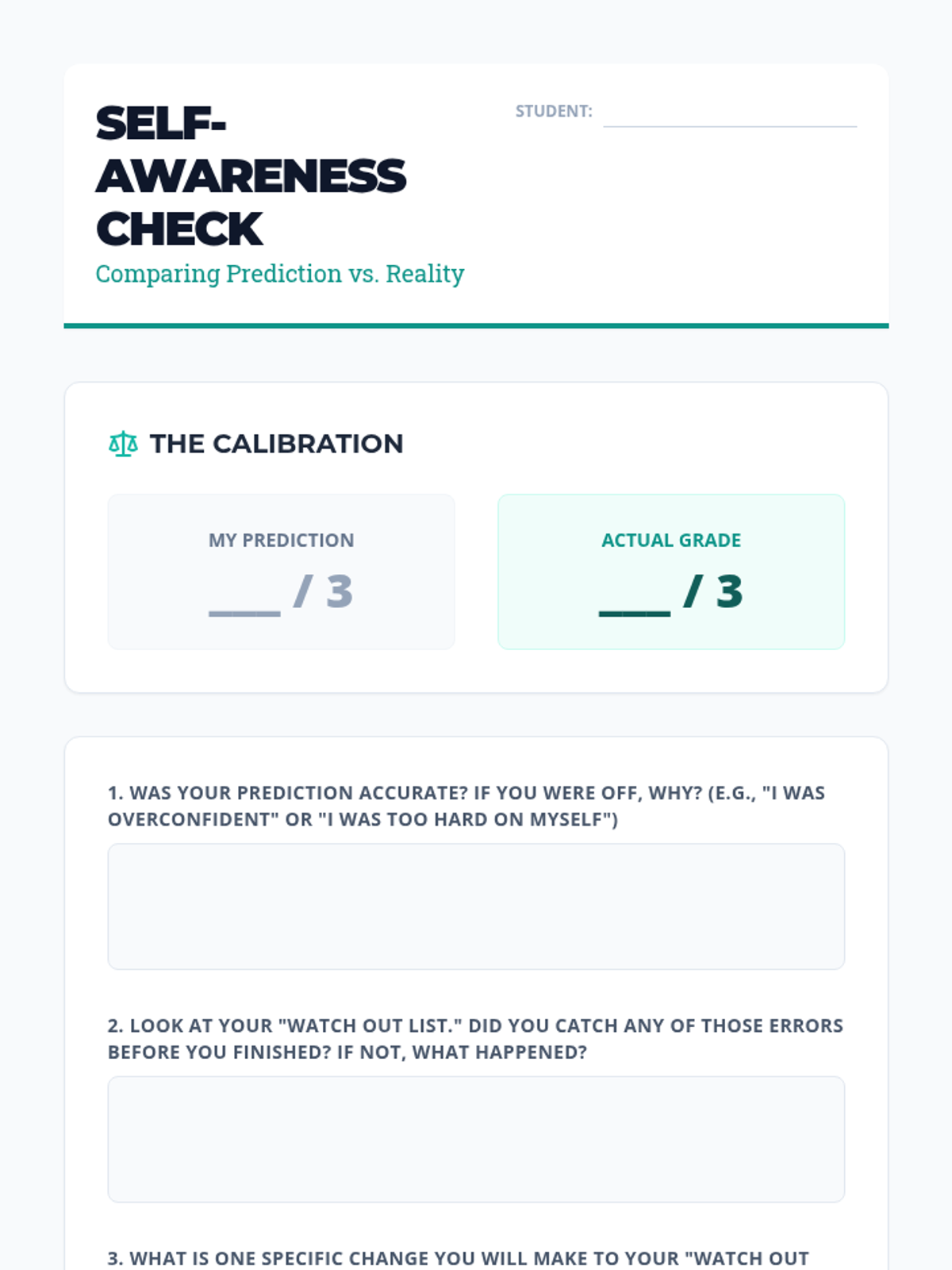
A final reflection sheet for students to compare their quiz predictions with their actual grades, evaluating the effectiveness of their metacognitive strategies.
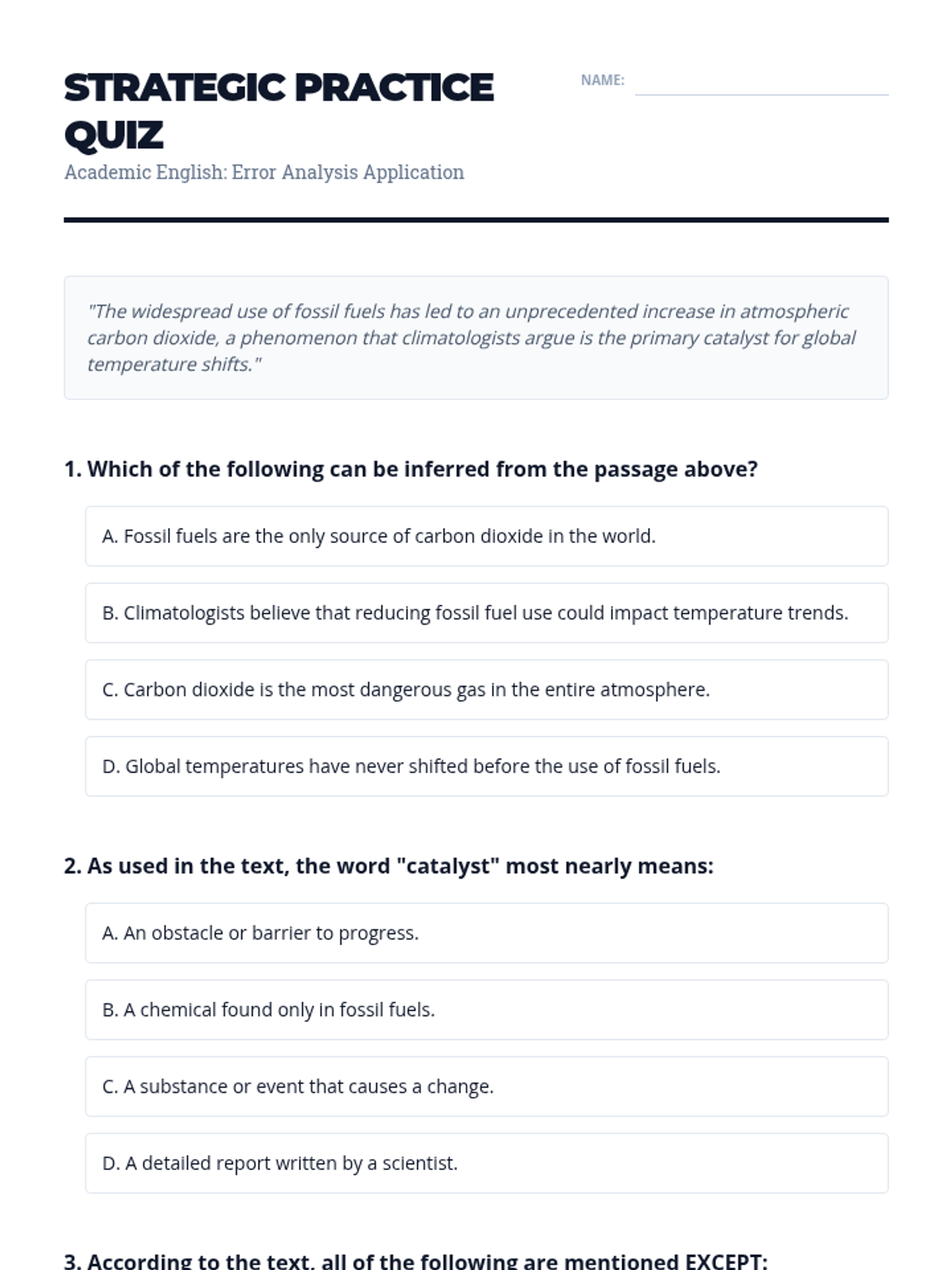
A short Academic English quiz designed to test students' application of their "Watch Out List," including a mandatory pre-grading self-reflection and score prediction section.
Final slides for the sequence focusing on the "Showtime" assessment. It introduces the score prediction challenge and real-time error analysis.
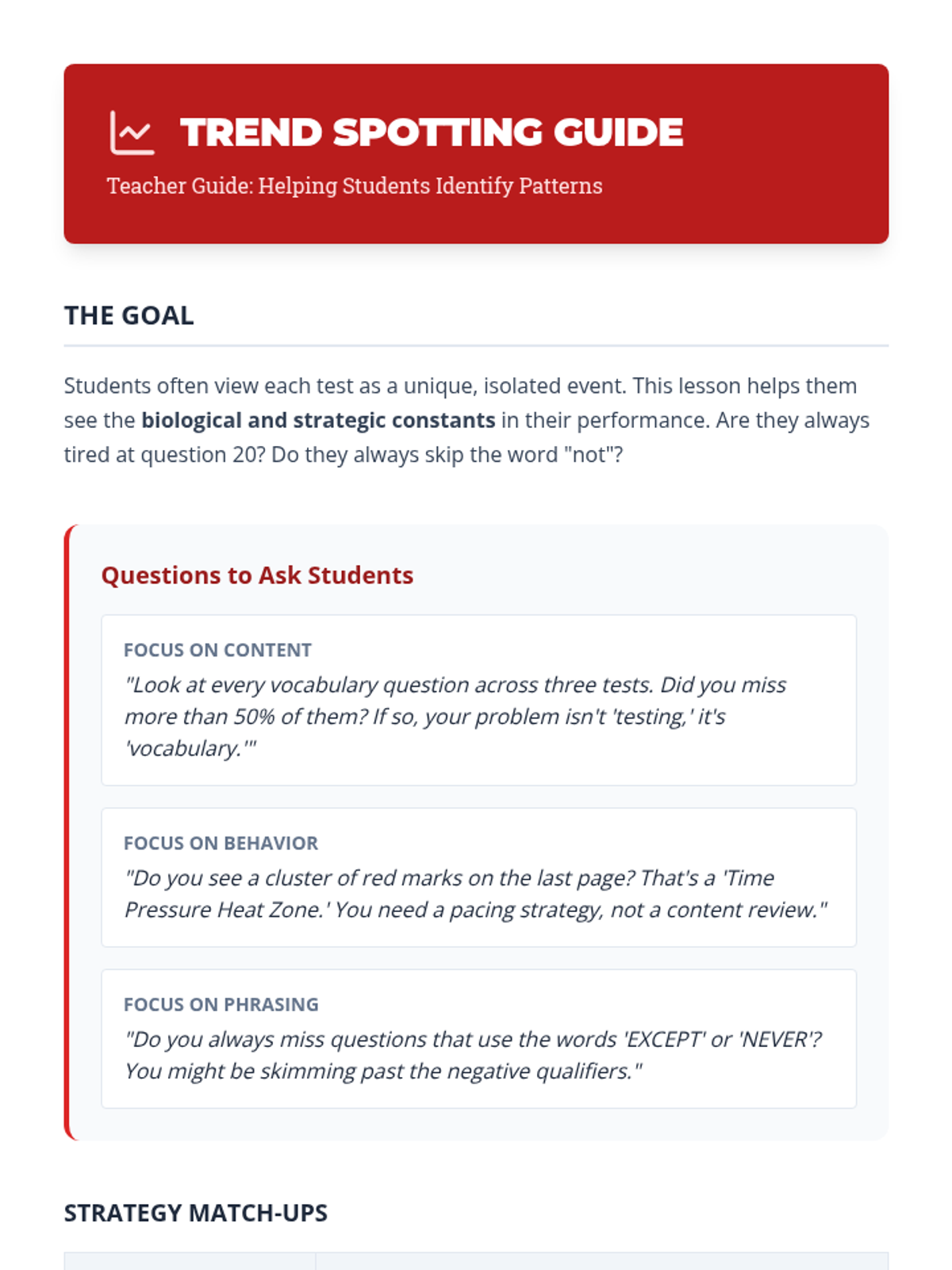
A guide for teachers to help students interpret their error data and connect patterns to specific defensive strategies.
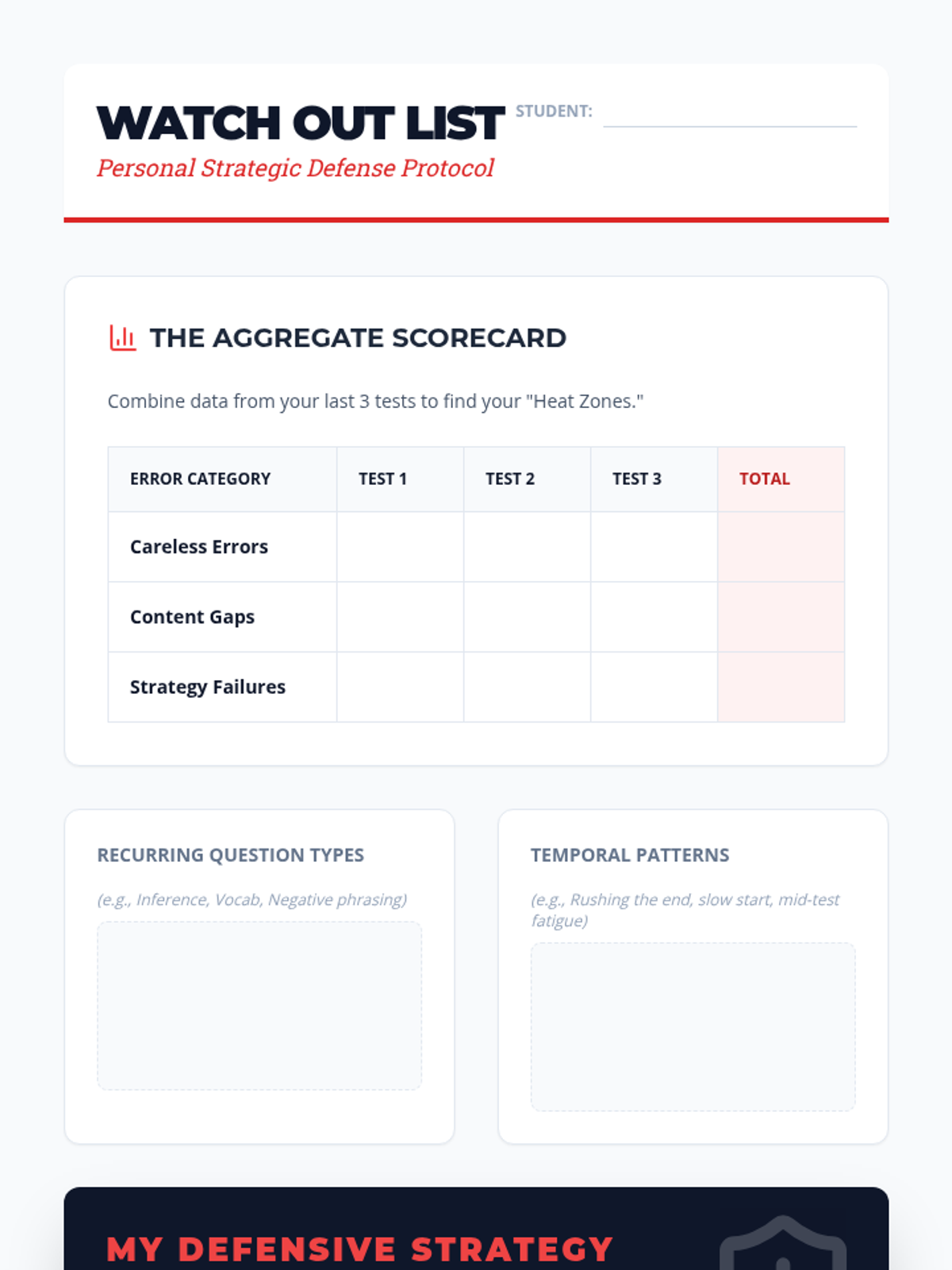
A student worksheet for aggregating error data across multiple assessments and distilling those patterns into a "Watch Out List" for future defense.
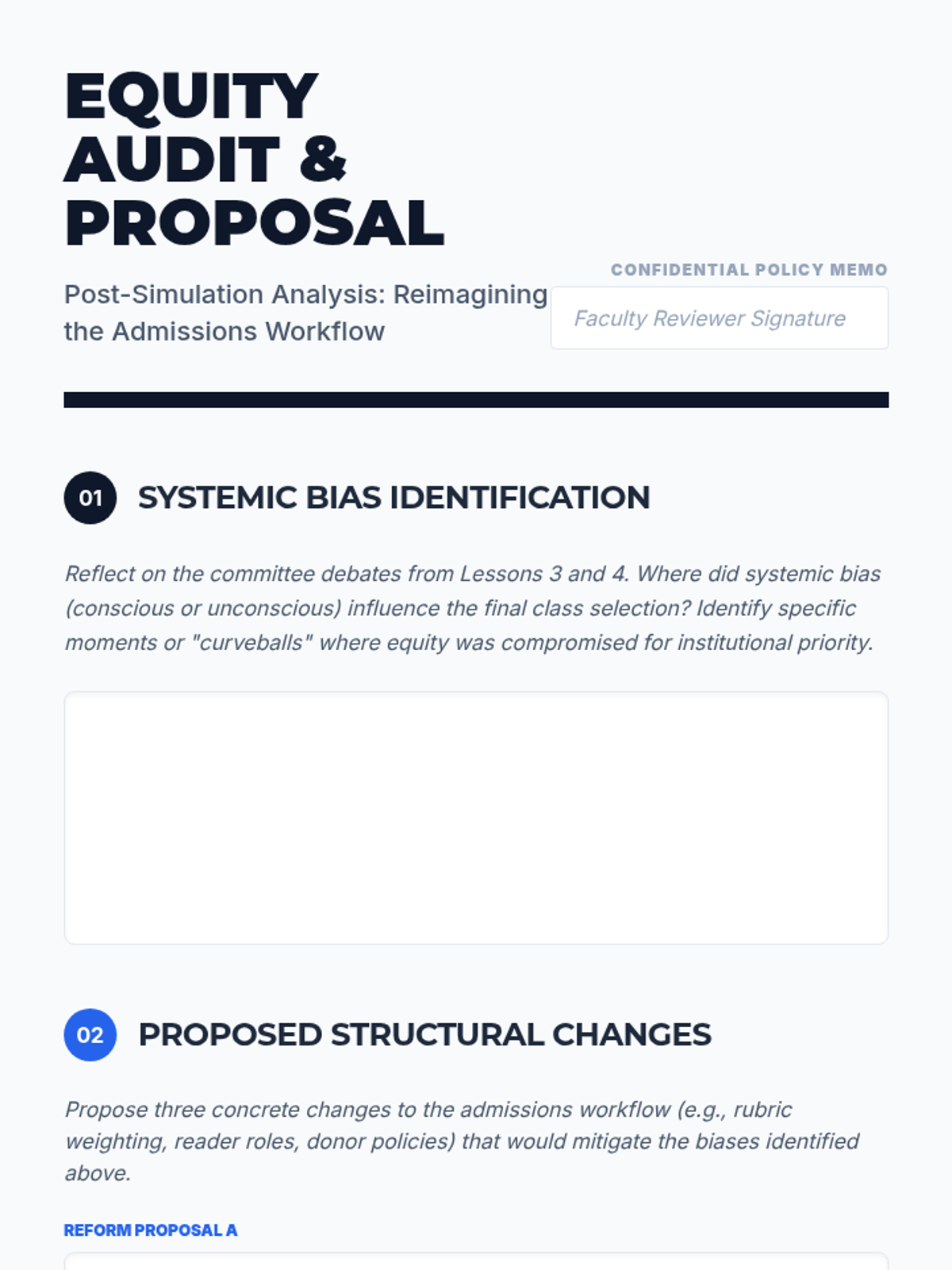
Final reflection and proposal guide for Lesson 5, where students synthesize simulation findings into concrete admissions policy reforms.
Final slide deck for Lesson 5 exploring systemic bias, demographic outcomes of the simulation, and reimagining equitable admissions workflows.
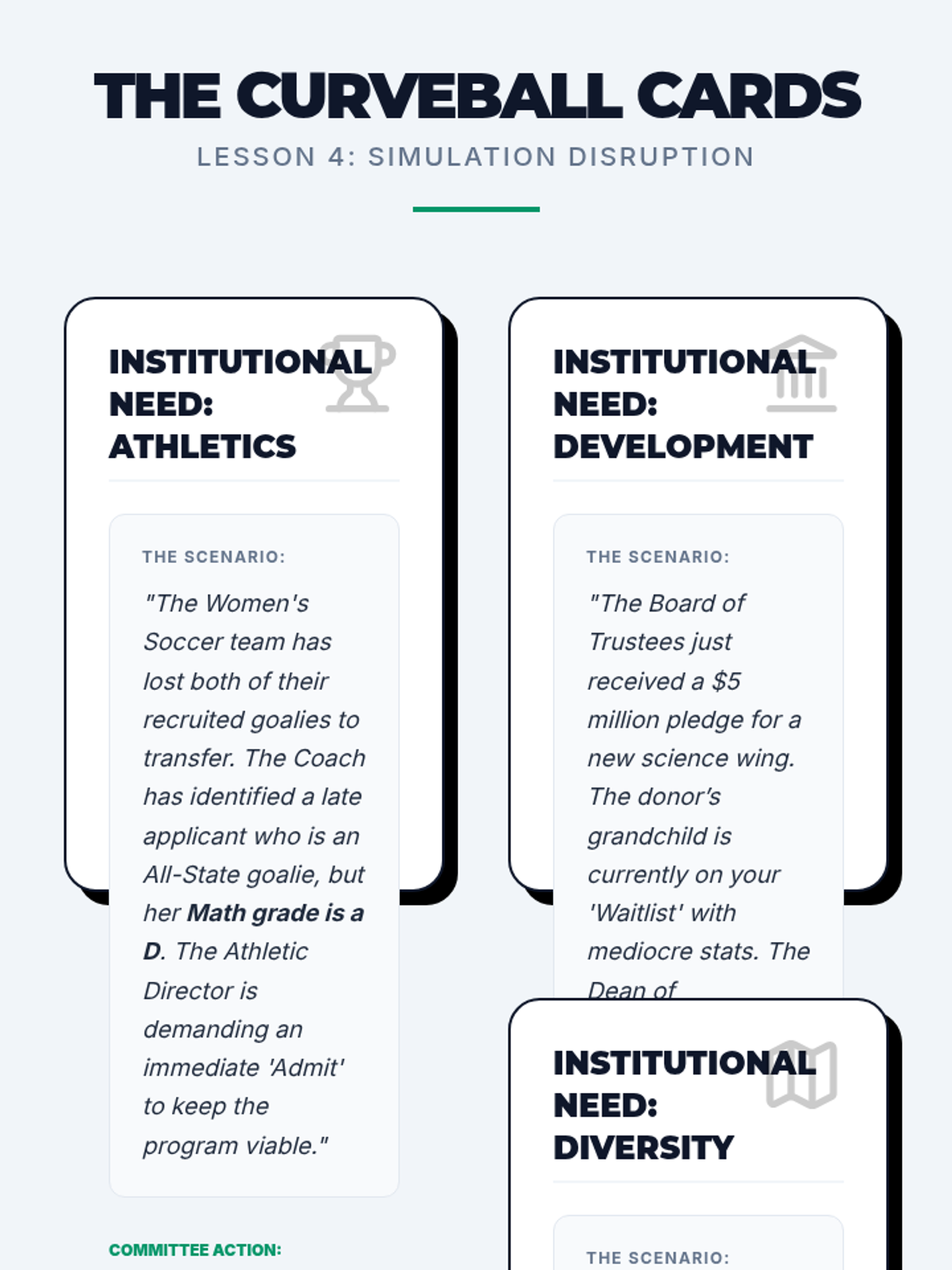
Set of four simulation "curveball" cards for Lesson 4, introducing institutional constraints like athletic needs, major donors, geographic diversity, and yield protection.
Slide deck for Lesson 4 exploring yield protection, special talents (athletics, arts), and the ethical dilemmas of institutional priorities.
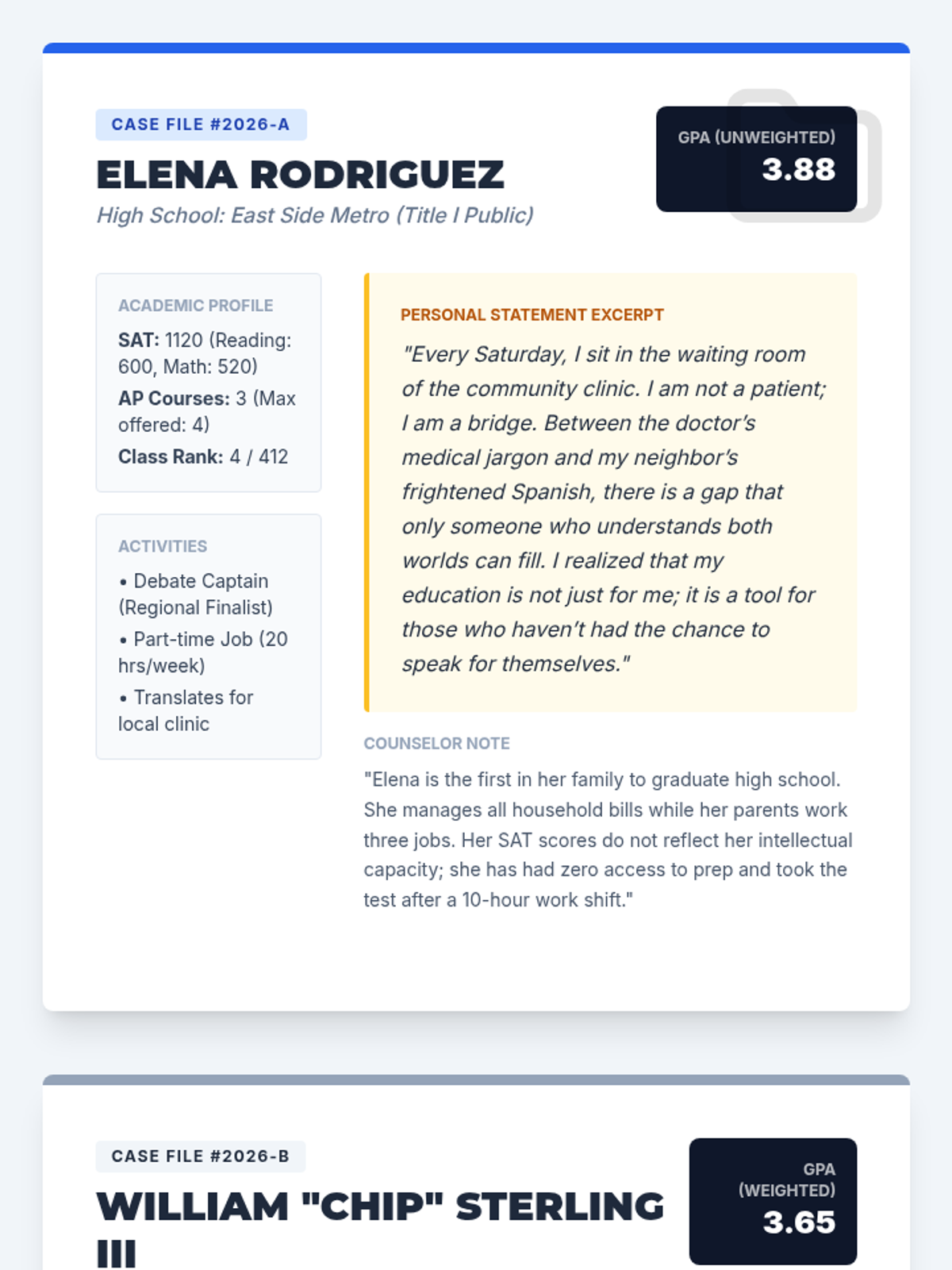
Set of three redacted-style applicant dossiers for Lesson 3 simulation, featuring a narrative striver, a legacy applicant, and a quantitative powerhouse.
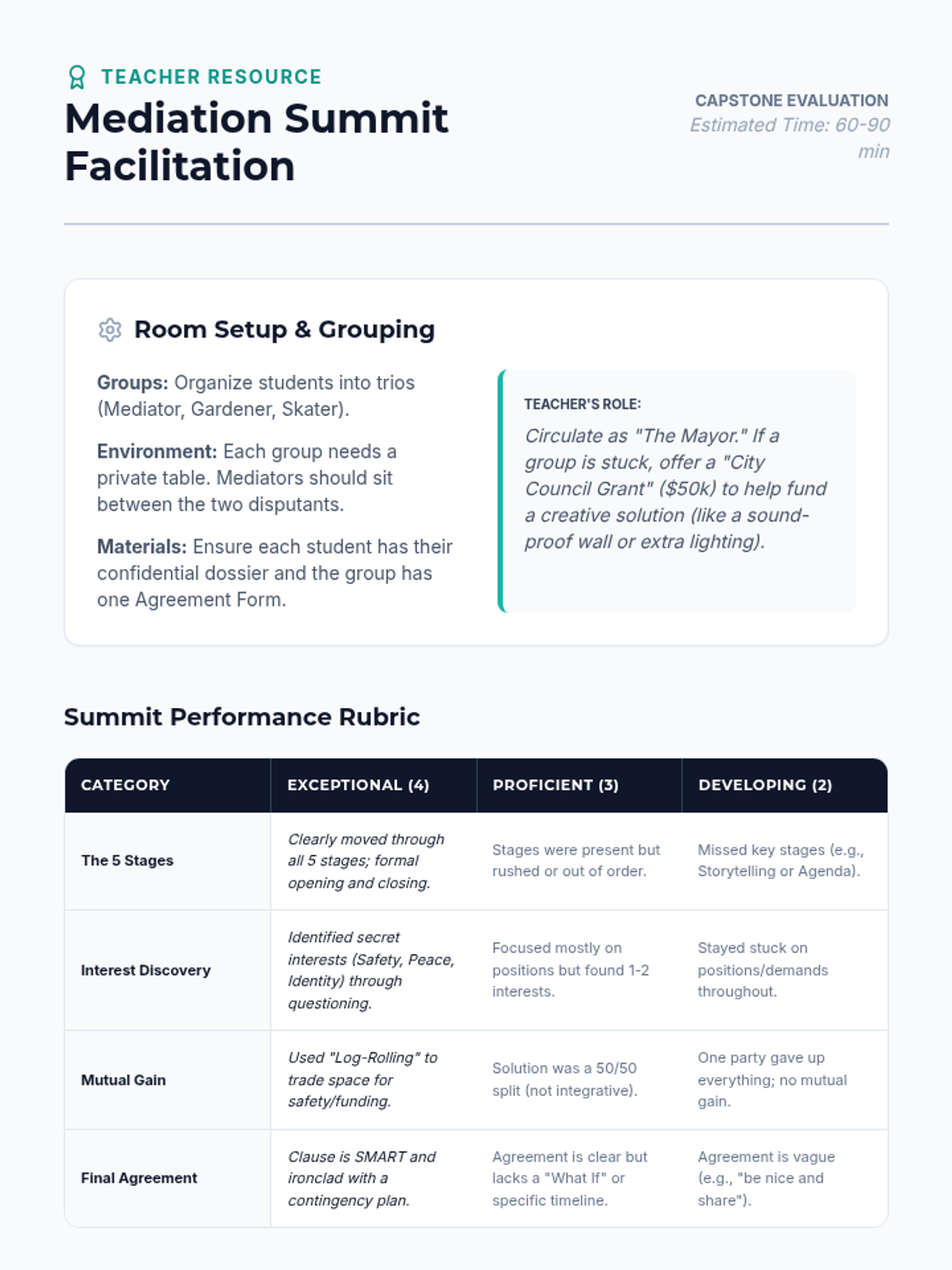
Teacher facilitation guide and evaluation rubric for the Lesson 5 Mediation Summit capstone simulation. Includes setup instructions, a grading rubric, and debrief prompts.
Slide deck for Lesson 3 simulation, focusing on advocacy techniques, committee roles, and the institutional realities of enrollment management.
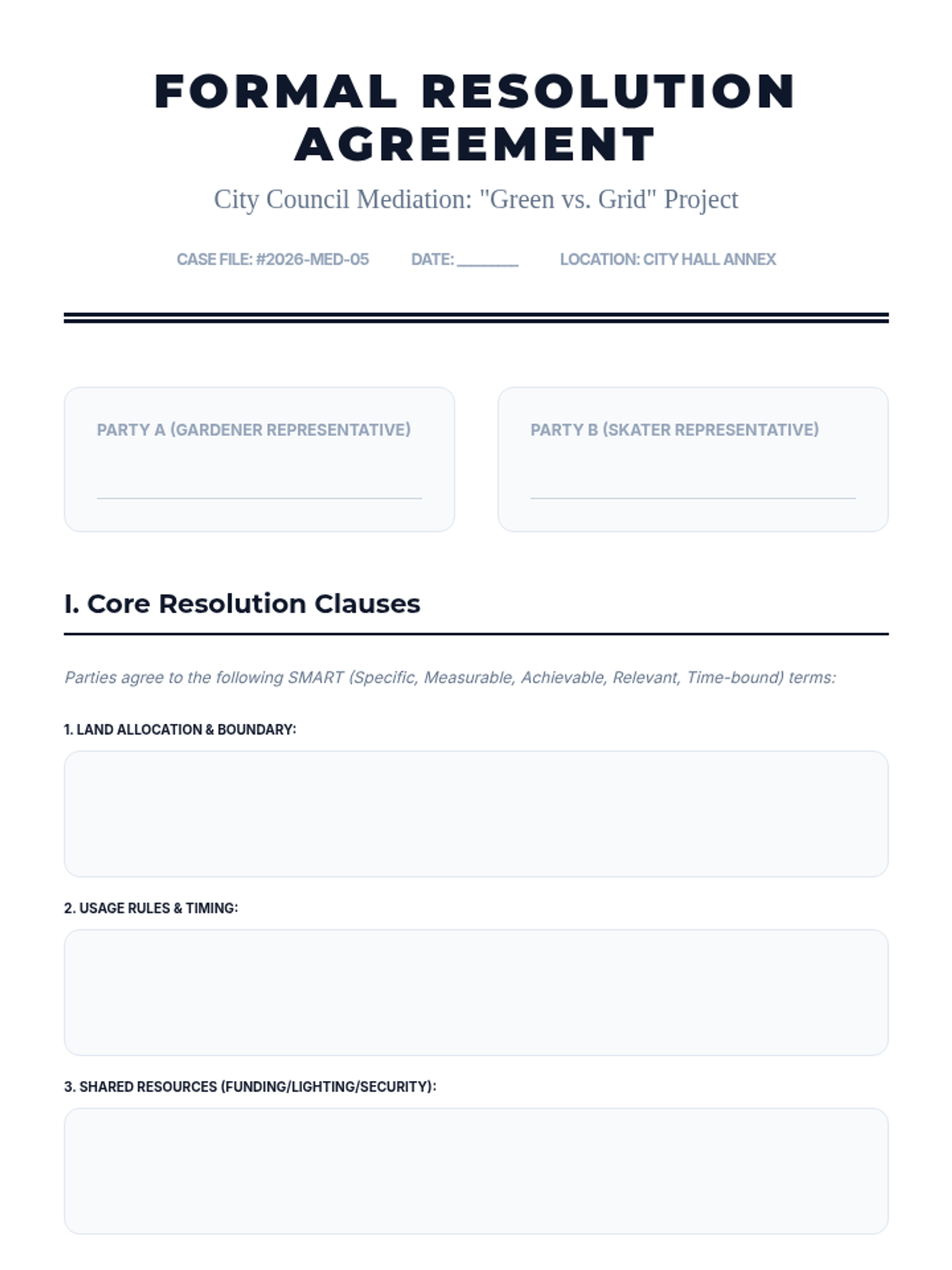
Formal mediation agreement form for the "Green vs. Grid" simulation. Students use this to draft their final SMART resolution clauses and finalize the simulation with signatures.
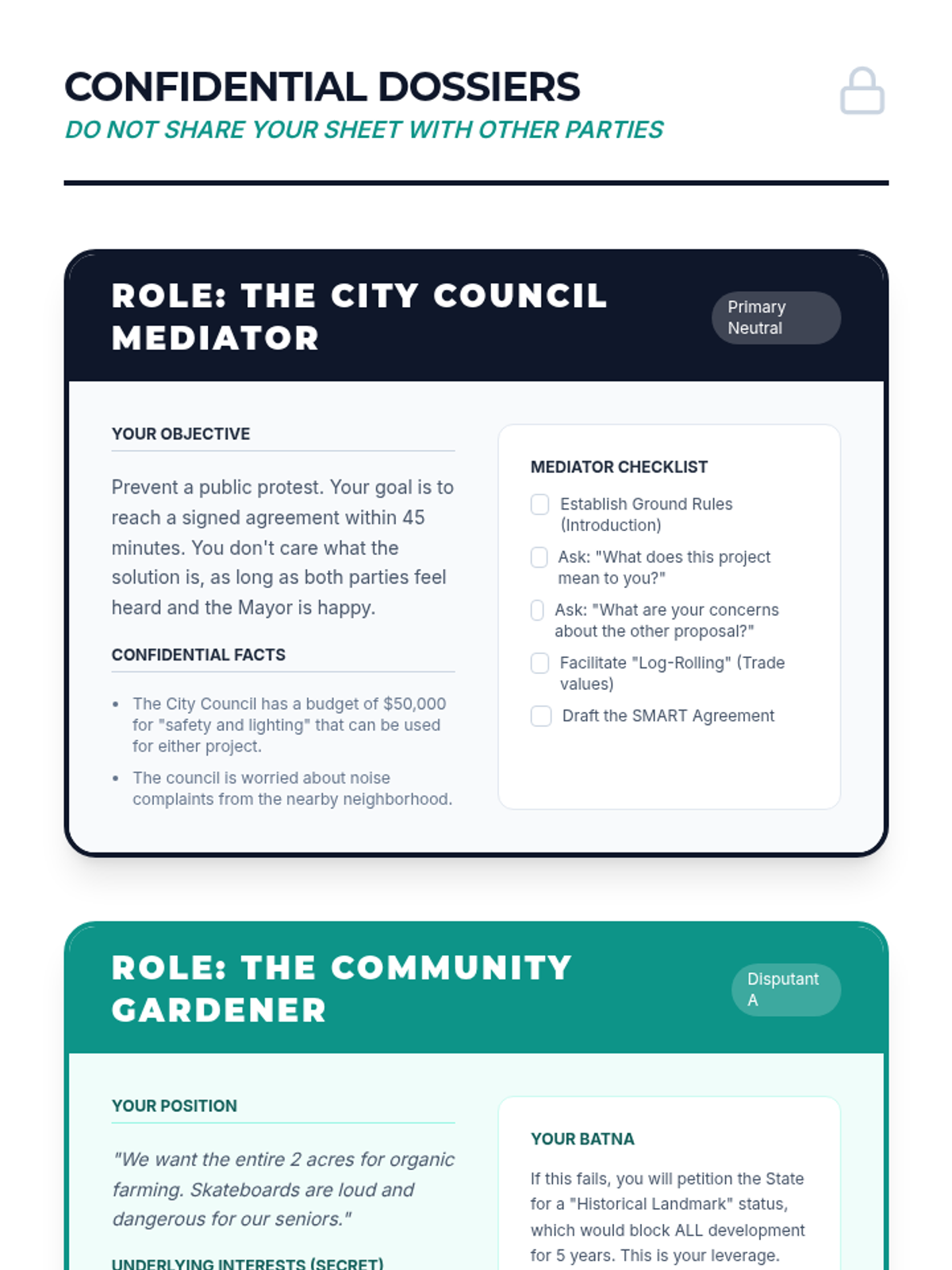
Confidential briefing sheets for the three roles in the "Green vs. Grid" simulation: The Mediator, The Gardener, and The Skater. Includes secret interests and walk-away points.
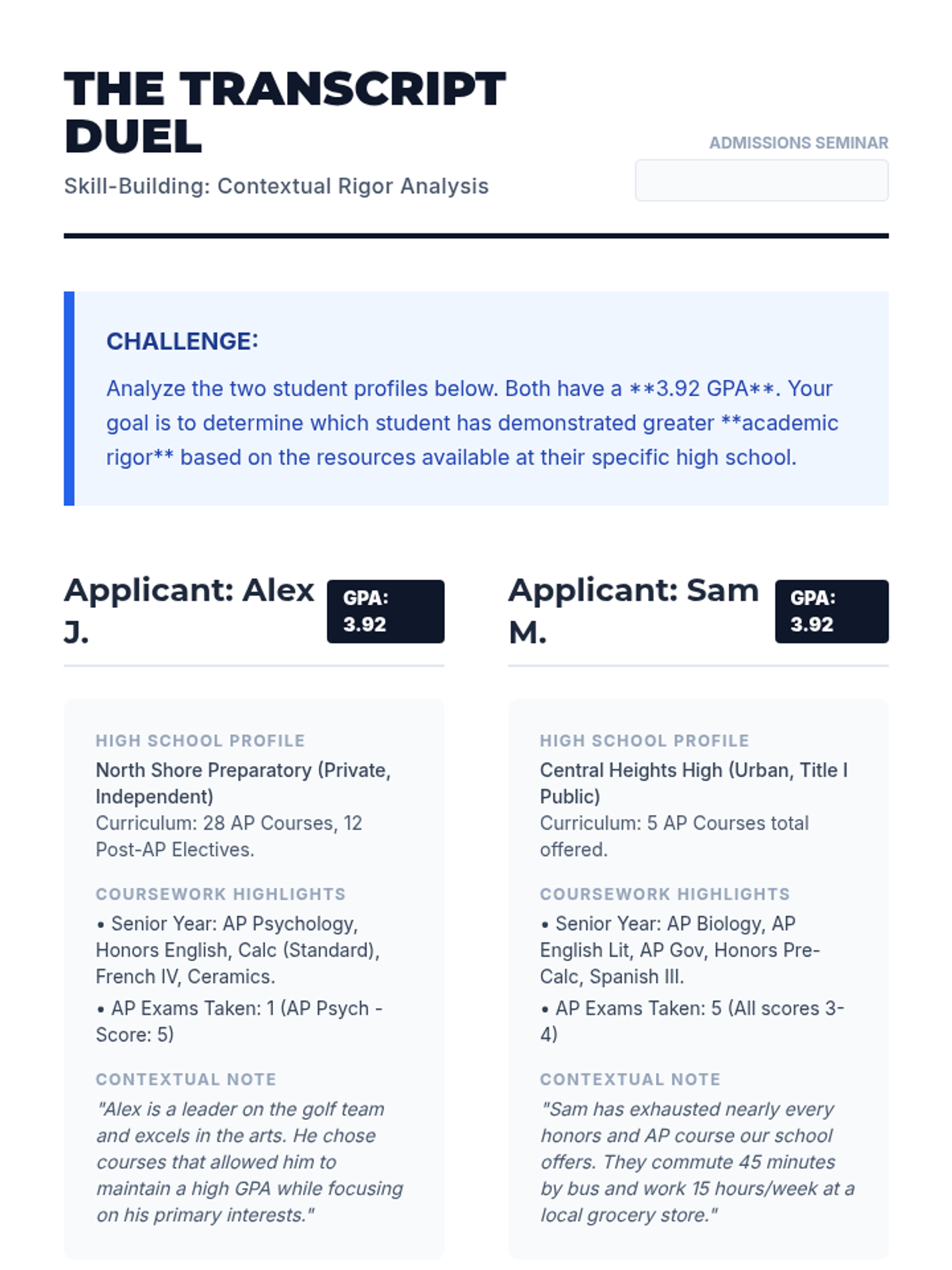
Worksheet for Lesson 2 comparing two student profiles with identical GPAs but different resource contexts to practice analyzing academic rigor.
Briefing slide deck for the Lesson 5 Mediation Summit capstone simulation. Introduces the "Green vs. Grid" land use case, roles, and rules of engagement.
Slide deck for Lesson 2 focusing on contextual review of transcripts, identifying grade trends, and the balance between standardized testing and personal narratives.
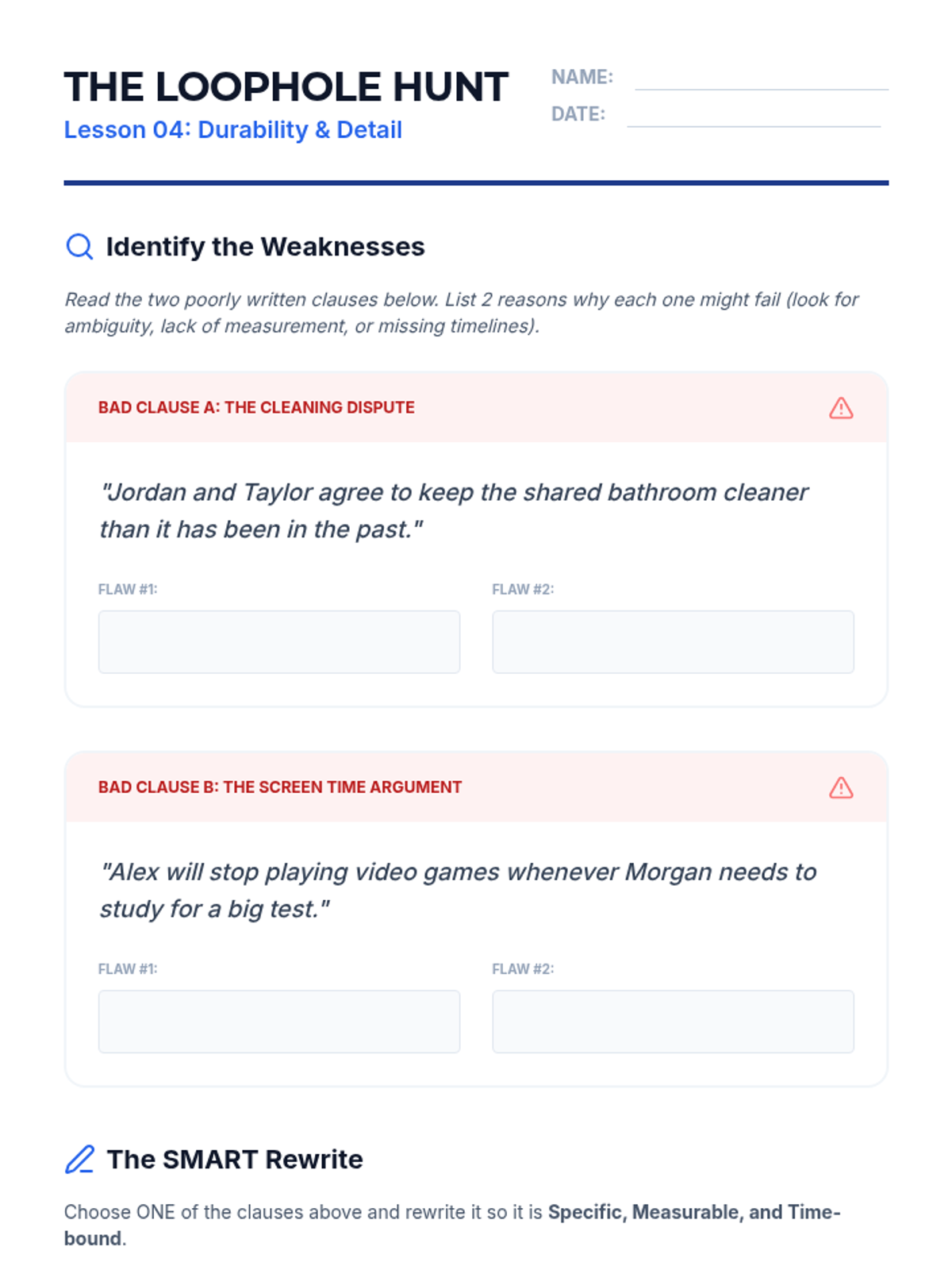
Student worksheet for identifying flaws in poorly written conflict resolution agreements and rewriting them using the SMART framework.
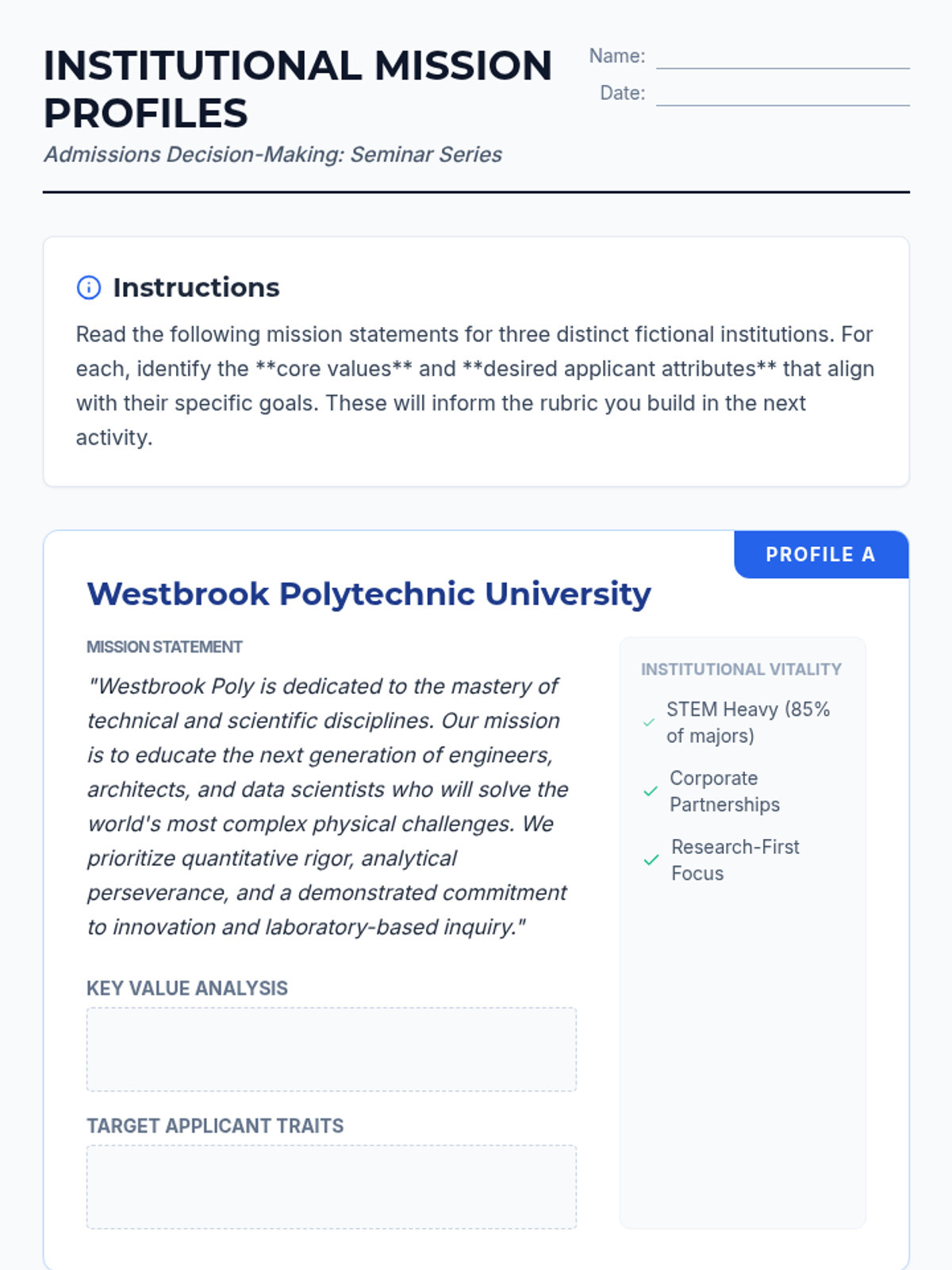
Worksheet featuring three fictional institution profiles with mission statements and analysis areas for students to determine core values and desired applicant traits.
Instructional slide deck for Lesson 4: Drafting Sustainable Agreements. Explains the SMART framework for conflict resolution and the importance of specific clauses and contingency planning.
Introductory slide deck for Lesson 1 on Admissions Priorities and Rubrics, featuring institutional mission analysis and the quantitative vs. qualitative debate.
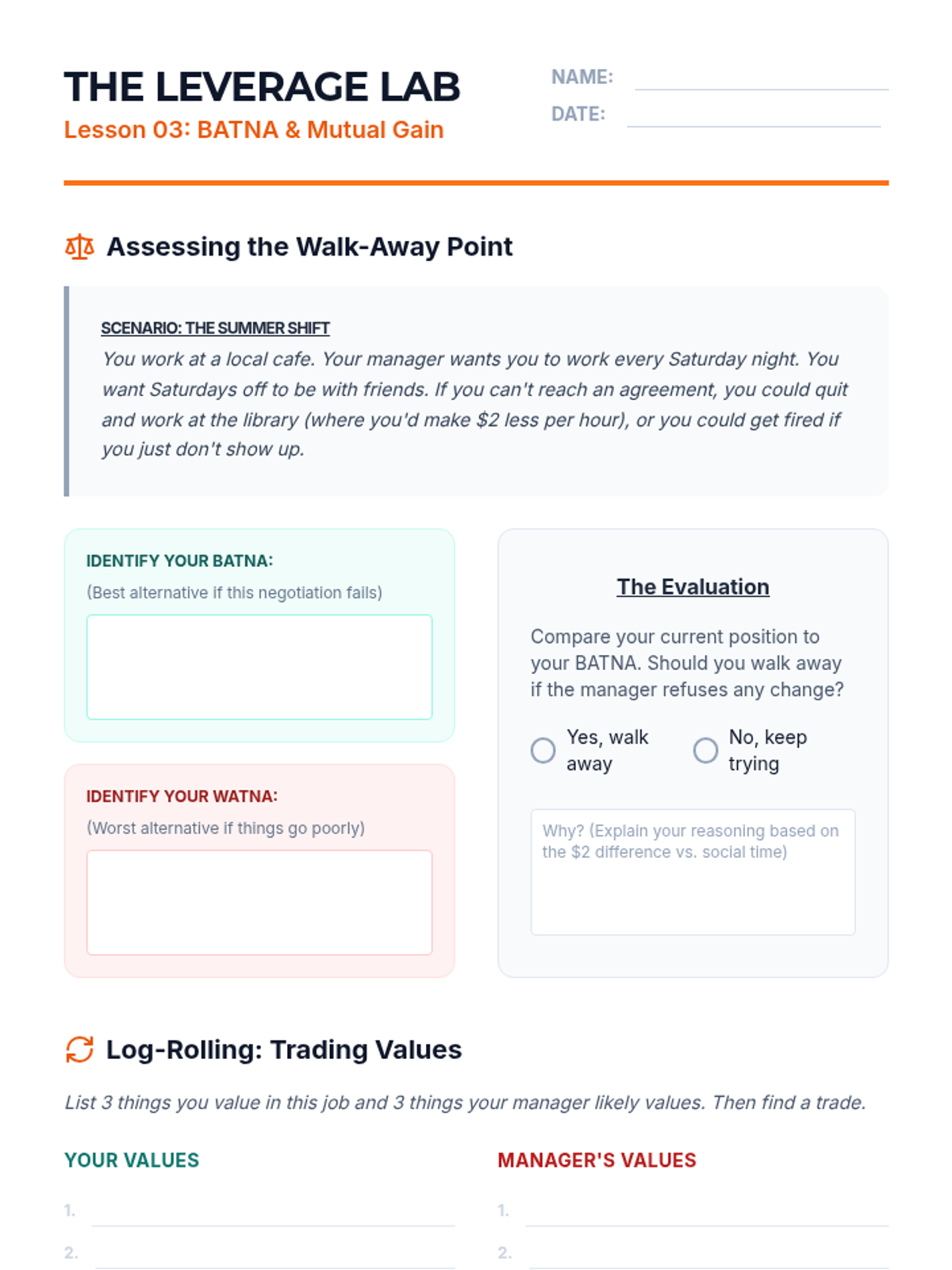
Student worksheet for analyzing BATNA/WATNA and practicing the Log-Rolling technique in a workplace conflict scenario.
Instructional slide deck for Lesson 3: Generating Options for Mutual Gain. Explains BATNA/WATNA, brainstorming rules, and the "Log-Rolling" technique for integrative negotiation.
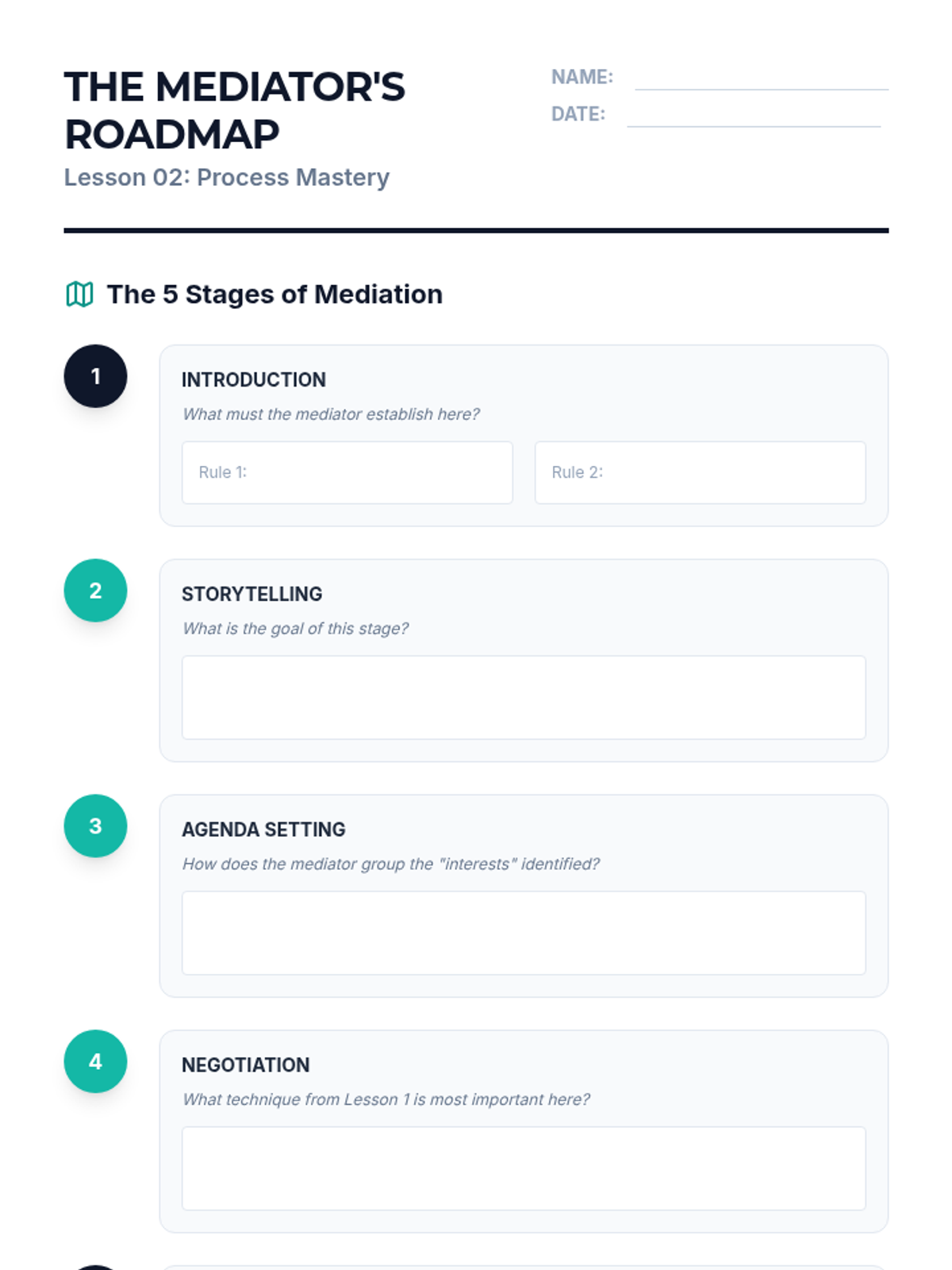
Student worksheet for visualizing the 5 stages of mediation and drafting a professional opening statement. Includes a flowchart and guided scripting area.
Instructional slide deck for Lesson 2: Structuring the Mediation Process. Outlines the 5 stages of mediation, the role of a neutral mediator, and active listening techniques.
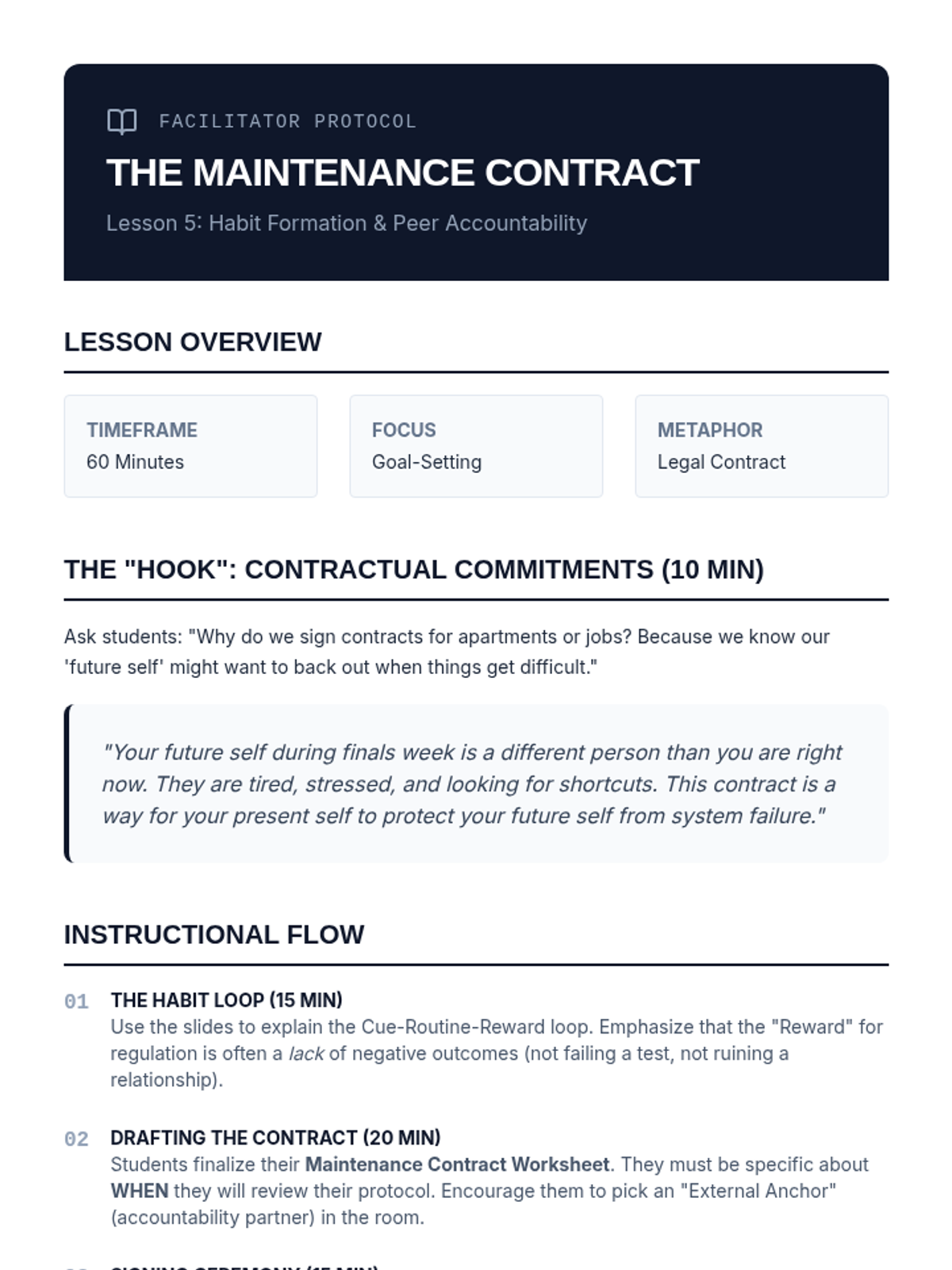
Facilitator guide for Lesson 5, outlining the instructional flow, discussion prompts, and key concepts for the maintenance contract and habit formation.
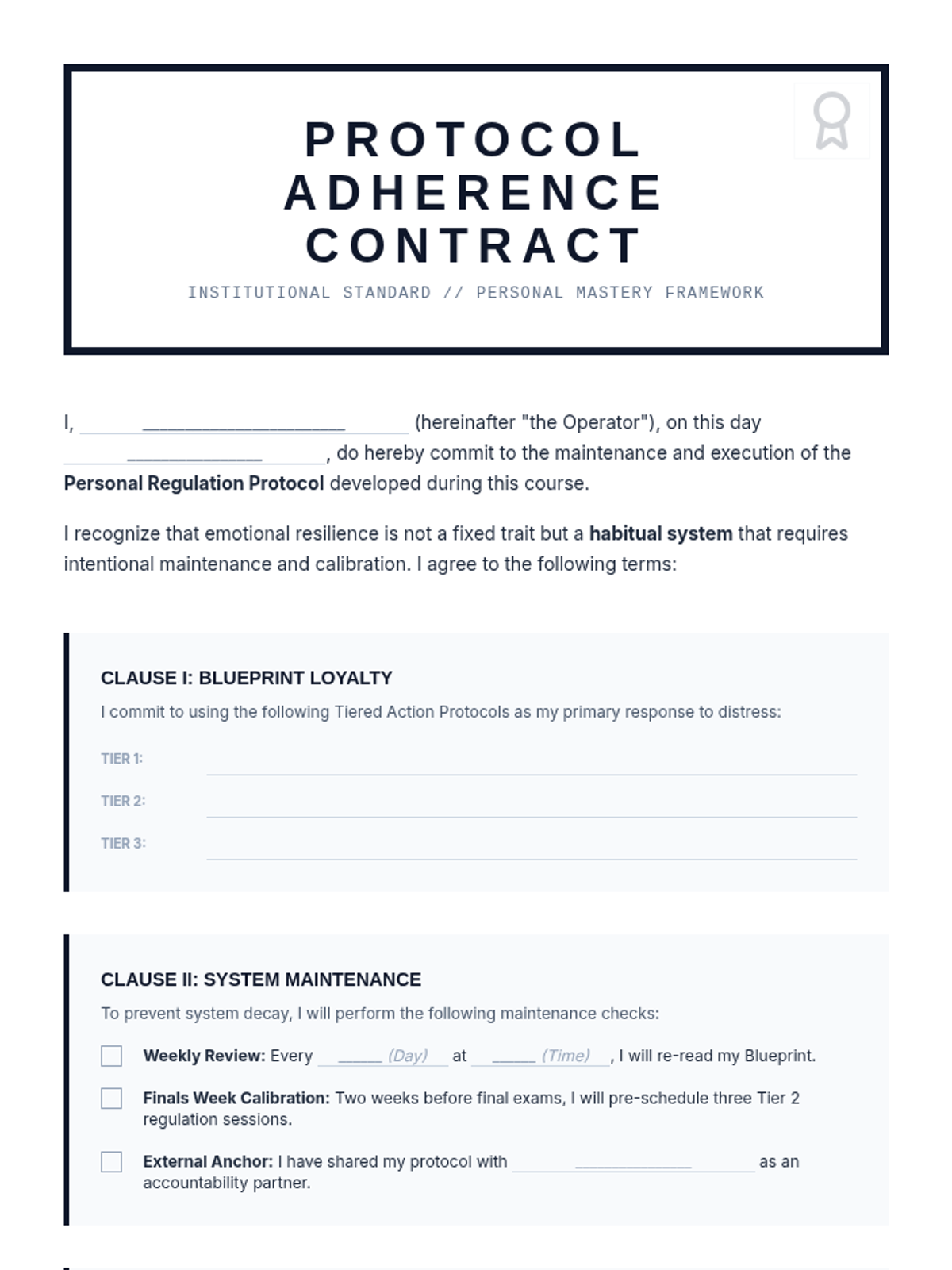
A formal maintenance contract for students to commit to their regulation protocols, establishing maintenance schedules and accountability partners.
Final slide deck for Lesson 5, focusing on habit formation, maintenance schedules, and the commitment to protocol adherence.
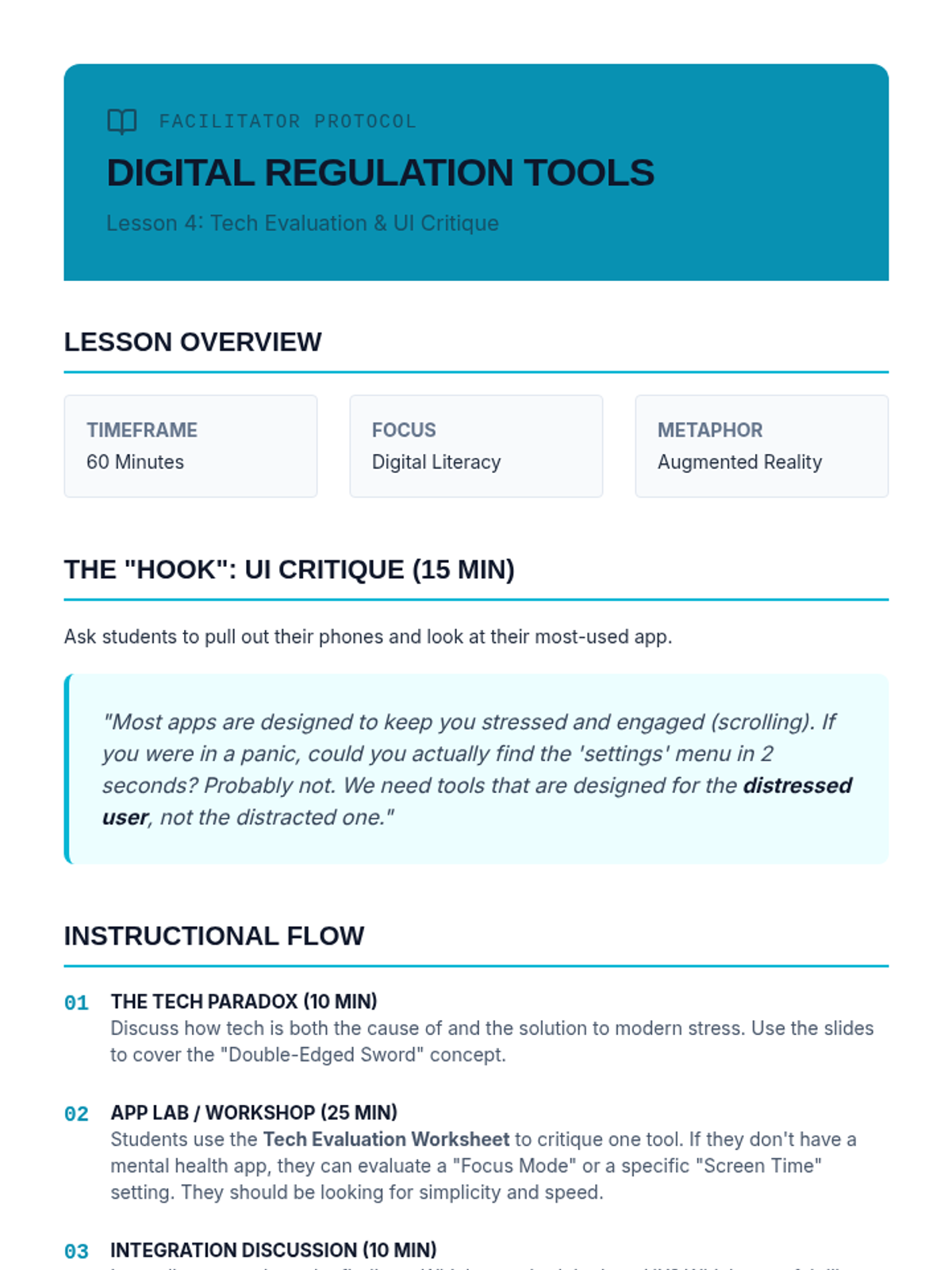
Facilitator guide for Lesson 4, outlining the instructional flow, discussion prompts, and key concepts for the digital tool evaluation and UI critique.
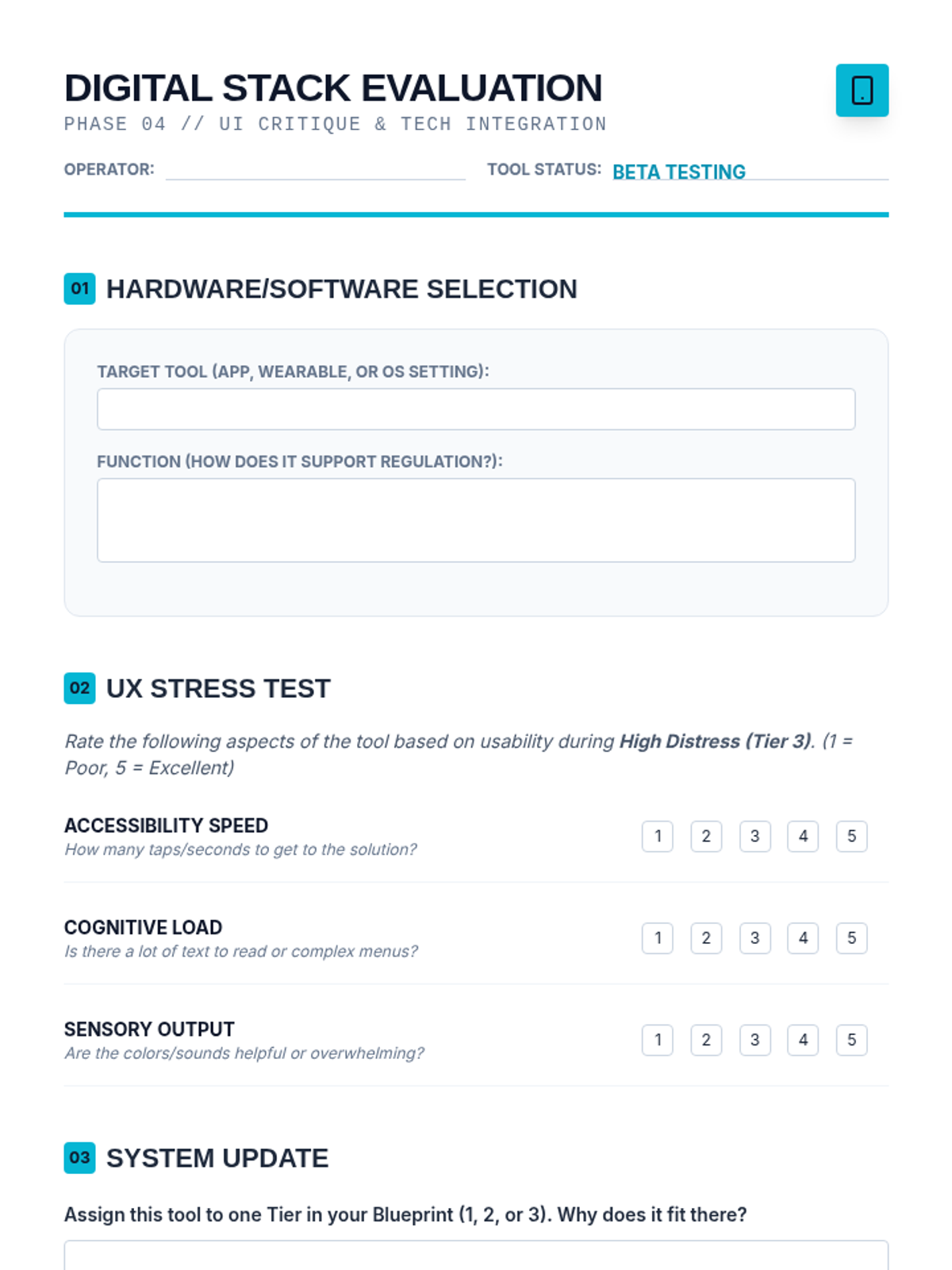
Worksheet for students to evaluate mental health apps and digital tools, specifically focusing on their user interface and accessibility during high-stress moments.
Slide deck for Lesson 4, introducing the concepts of digital support tools, UI critique for distress, and integrating tech into regulation protocols.
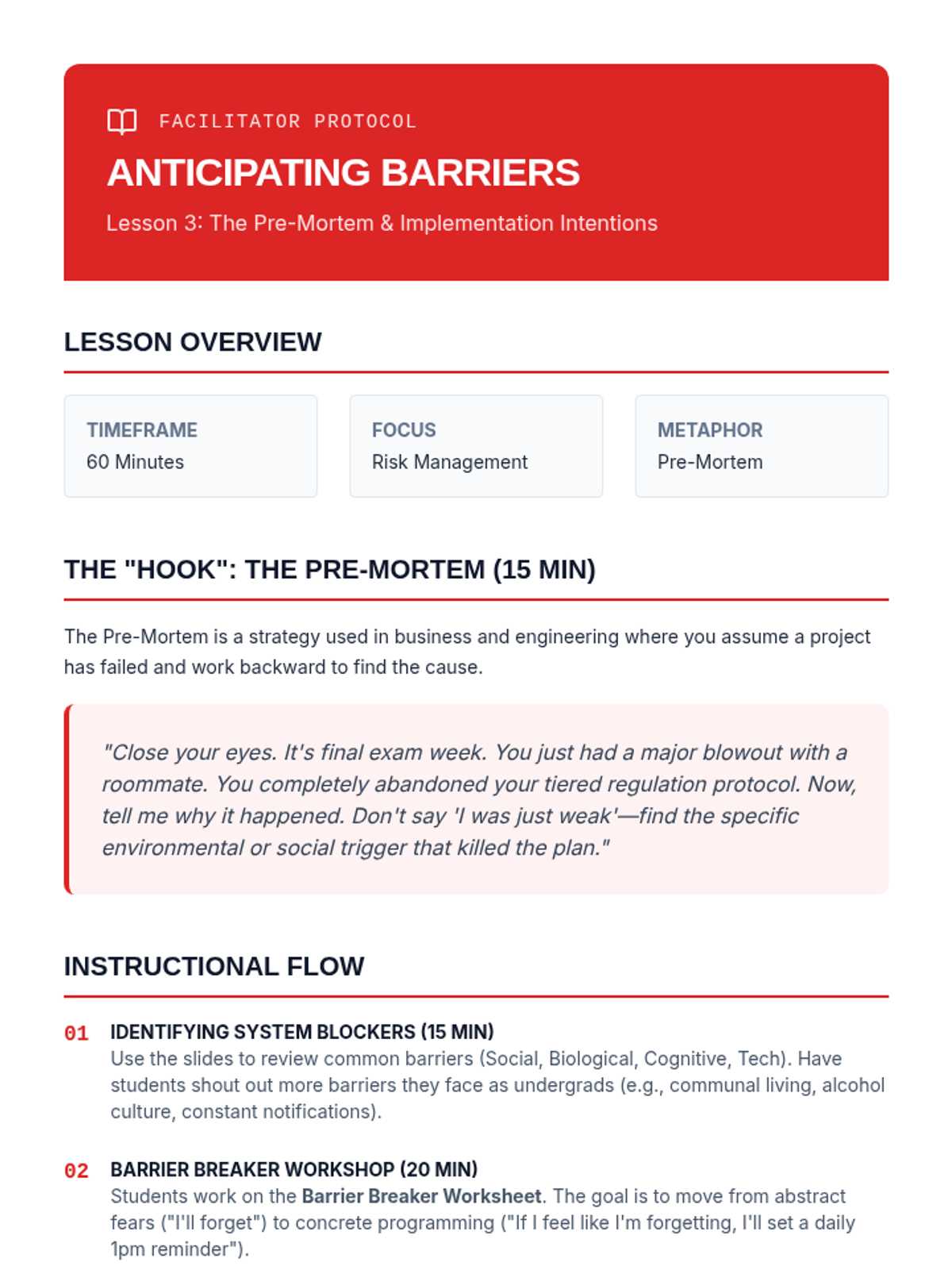
Facilitator guide for Lesson 3, outlining the instructional flow, discussion prompts, and key concepts for the "pre-mortem" and "If-Then" planning.
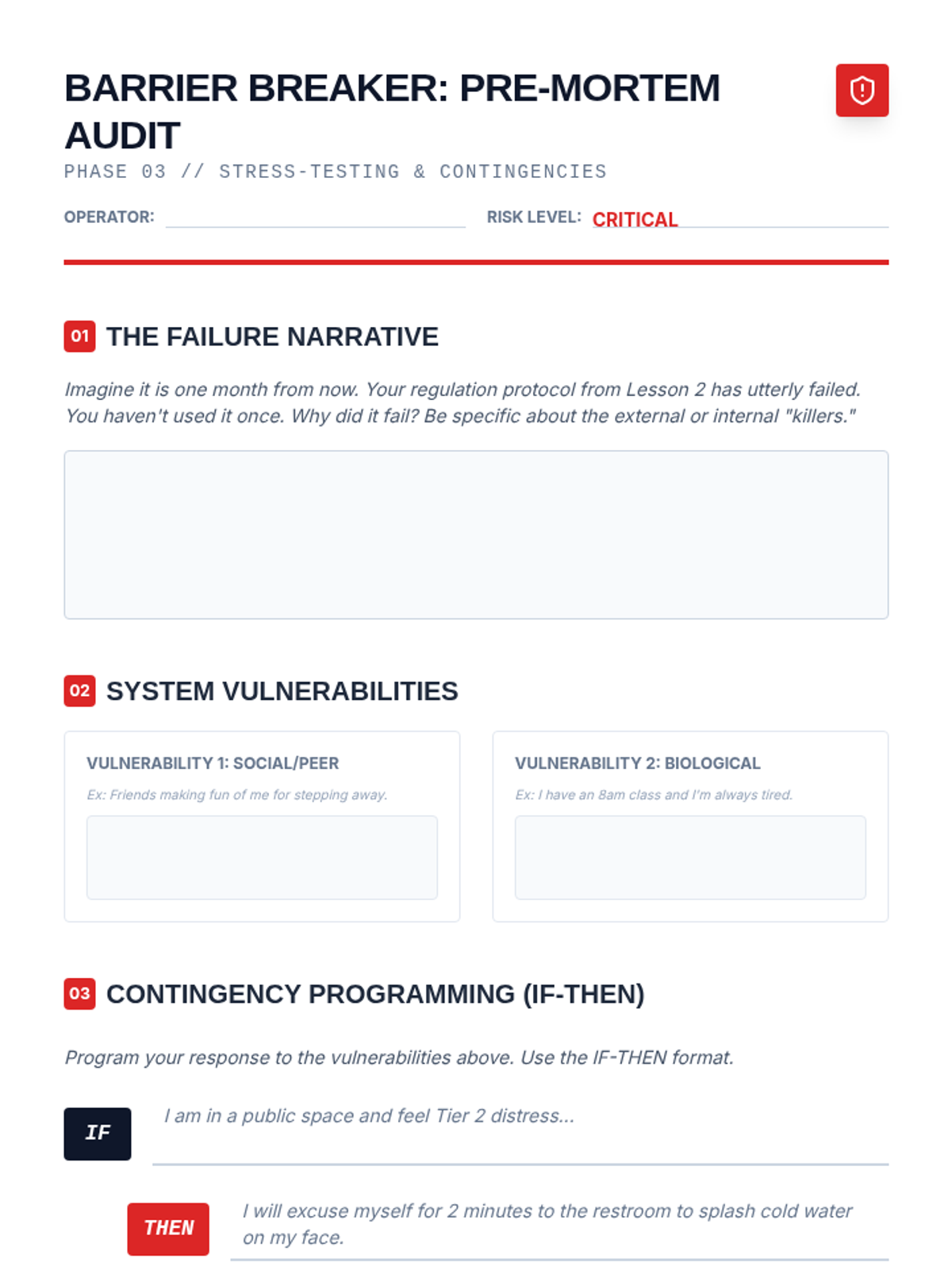
Worksheet for identifying potential obstacles and creating 'If-Then' implementation intentions to ensure protocol adherence during distress.
Instructional slides explaining insurance fundamentals (premium, deductible, risk transfer) with improved contrast, alignment, and Buffalo-specific examples.
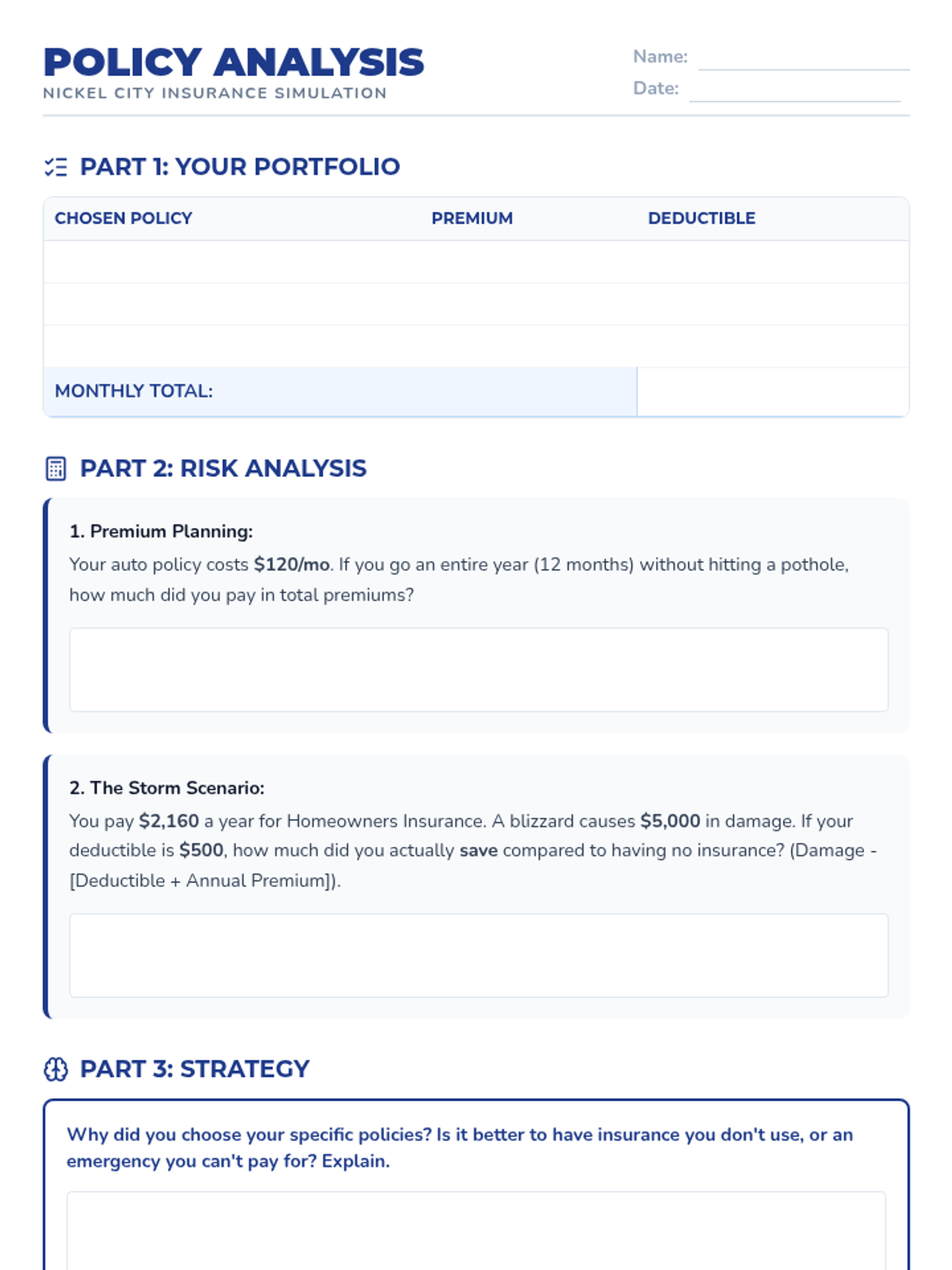
A tightened companion worksheet designed to fit on a single printable page. Includes risk analysis problems and a student work area with improved page-break management.
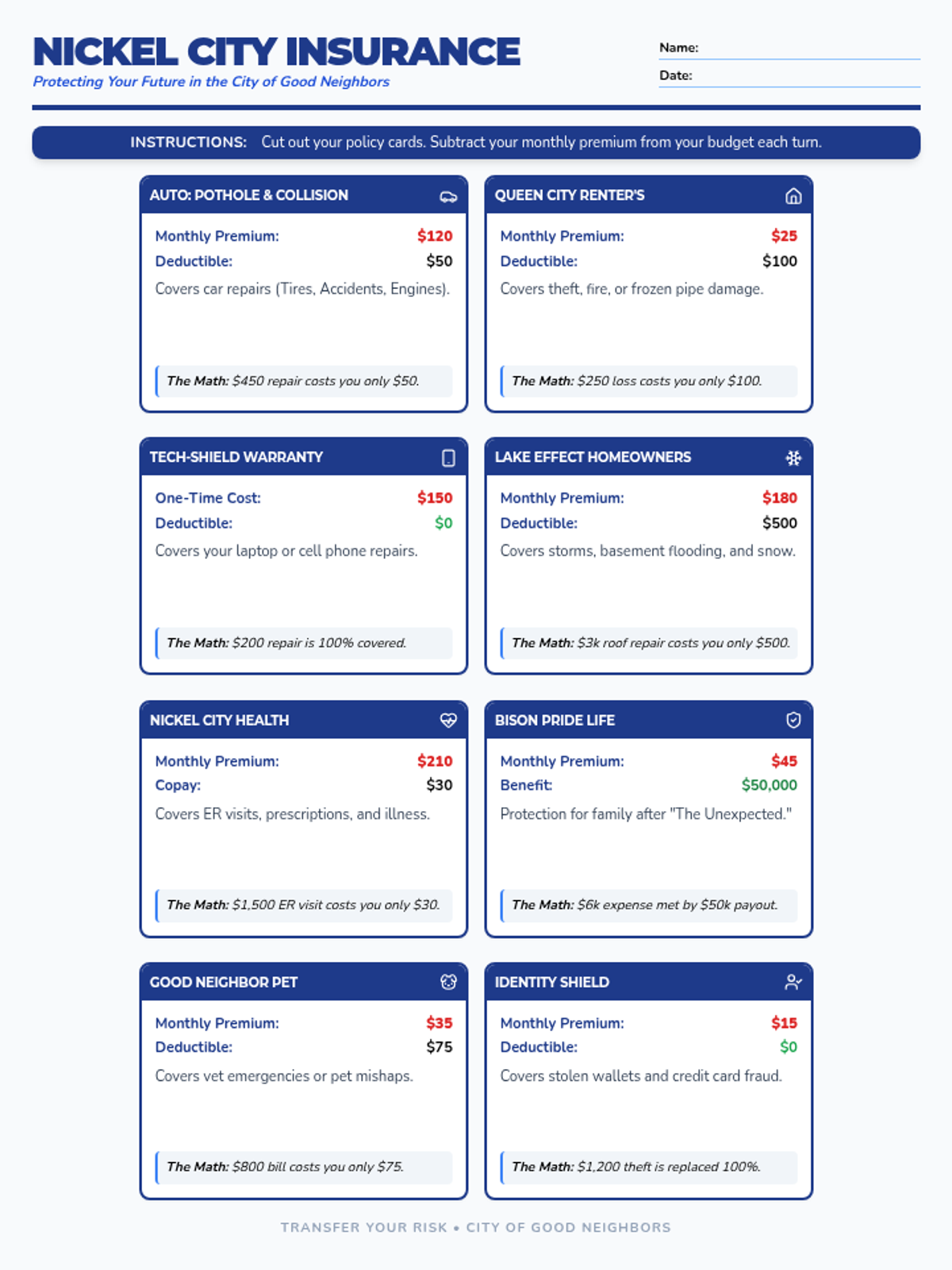
A single-page printable set of 8 Buffalo-themed insurance policy cards. Features compact layouts to ensure all 8 cards fit on one sheet for student use.
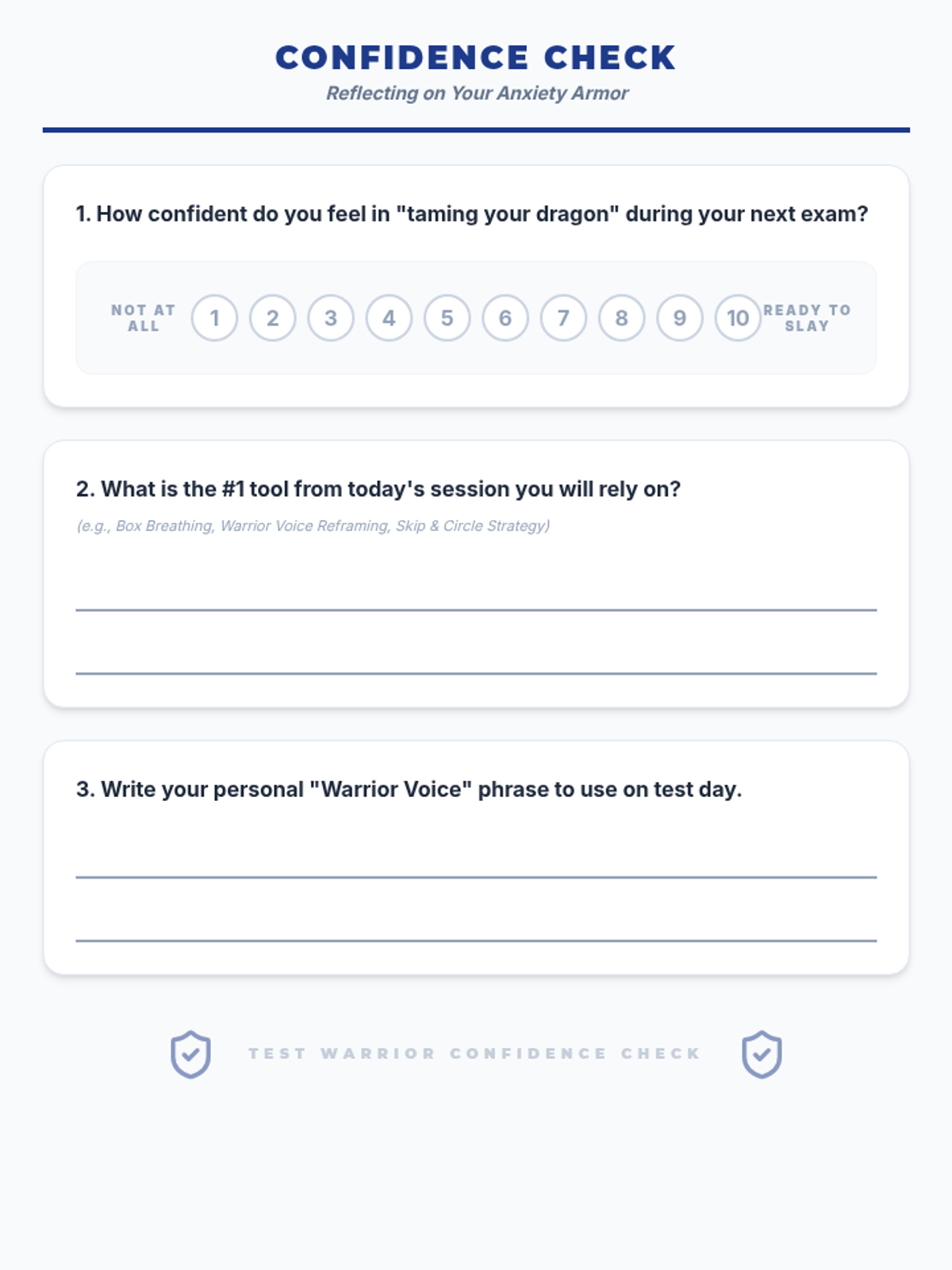
A final reflection exit ticket to assess student confidence and confirm their primary strategy for managing test anxiety, featuring optimized input areas and scales.
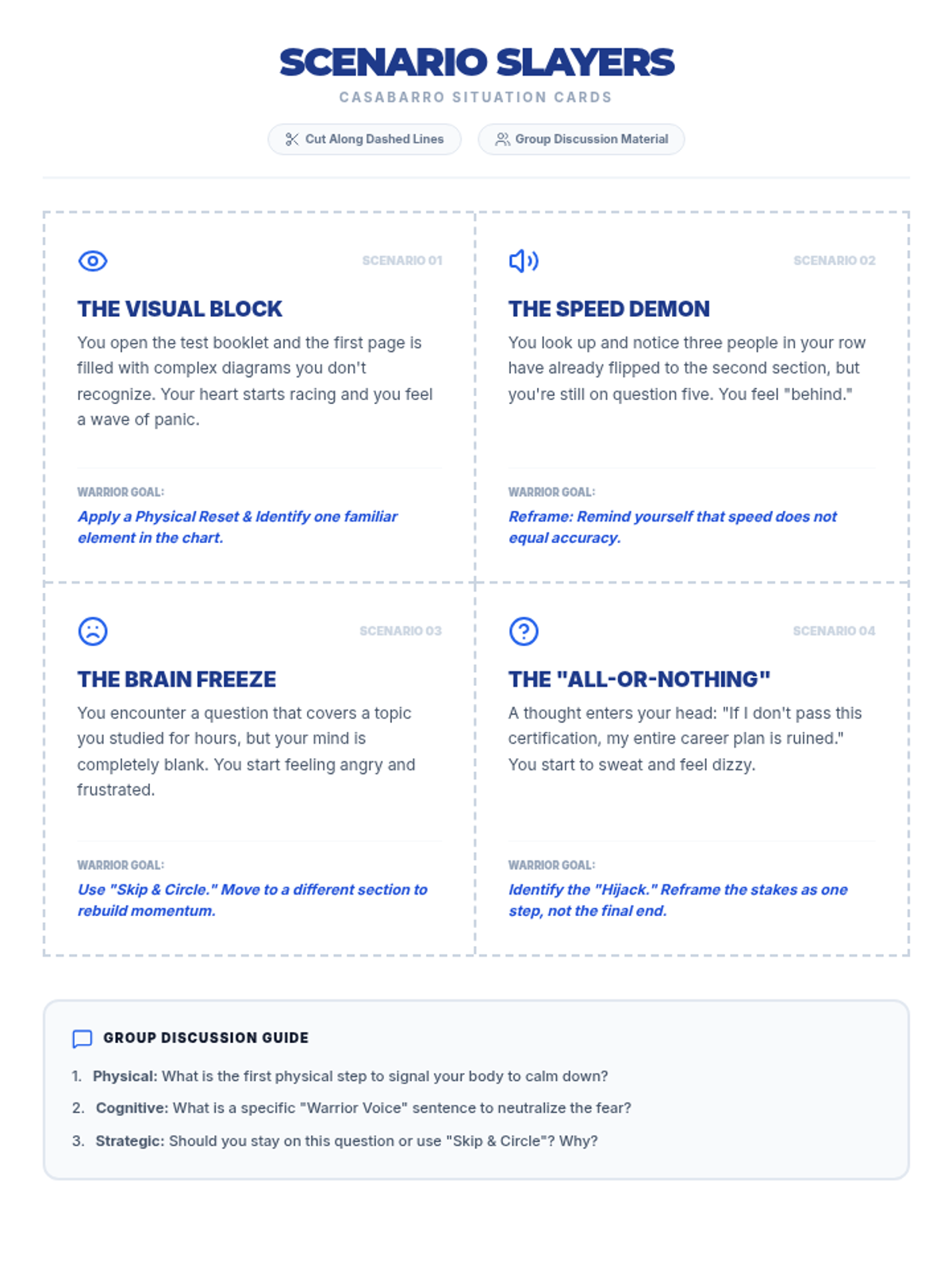
A printer-friendly set of scenario cards for small group activities, with fixed layouts to ensure all text remains visible and usable for student practice.
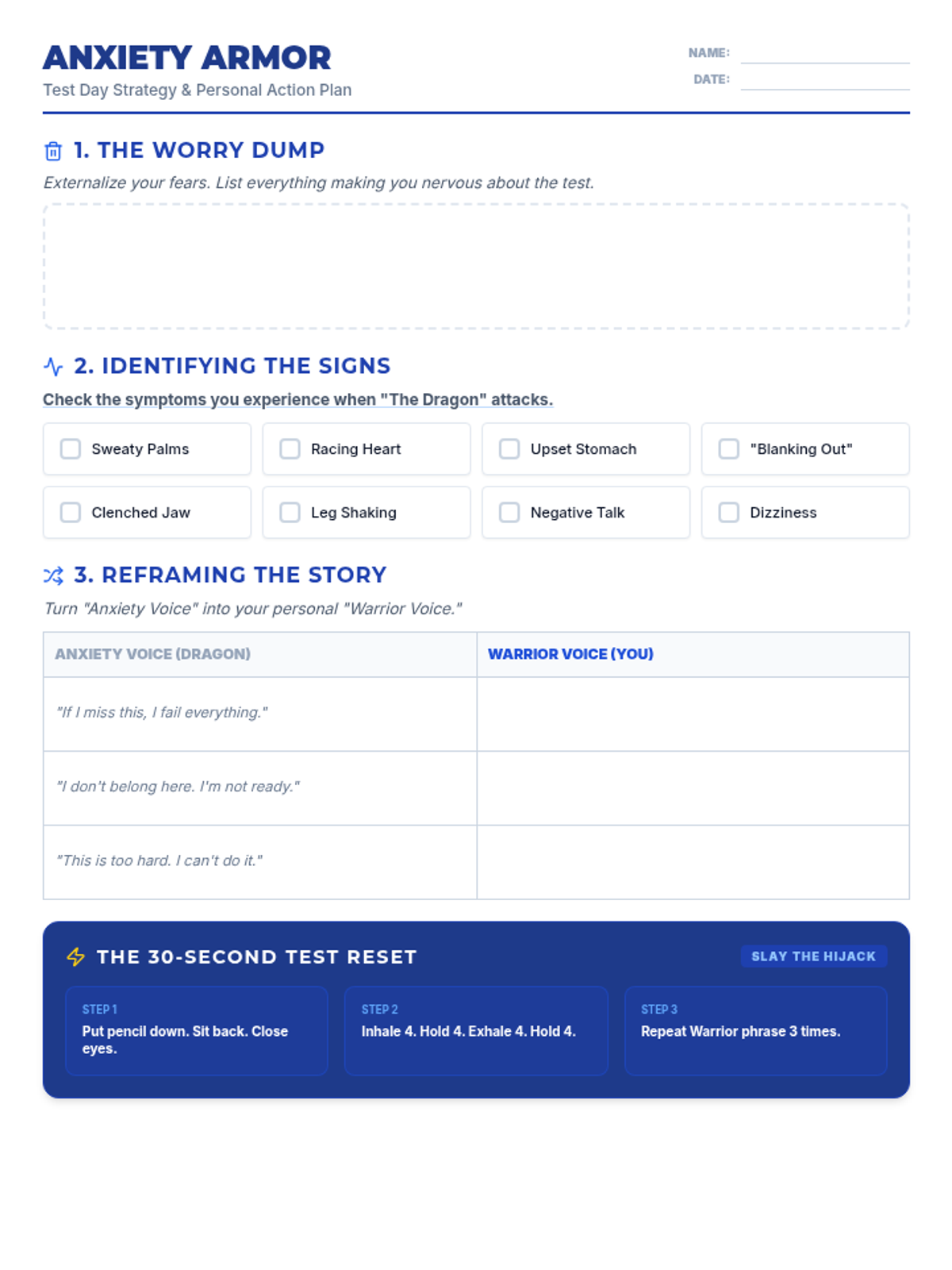
A student-facing handout featuring a 'Worry Dump' exercise, symptom checklist, and cognitive reframing practice table, with improved spacing for handwriting and optimized layout for single-page printing.
An enhanced presentation for the Casabarro test anxiety session, featuring improved contrast for readability, fixed breathing guide labels, and additional instructional content for a full 85-minute session.
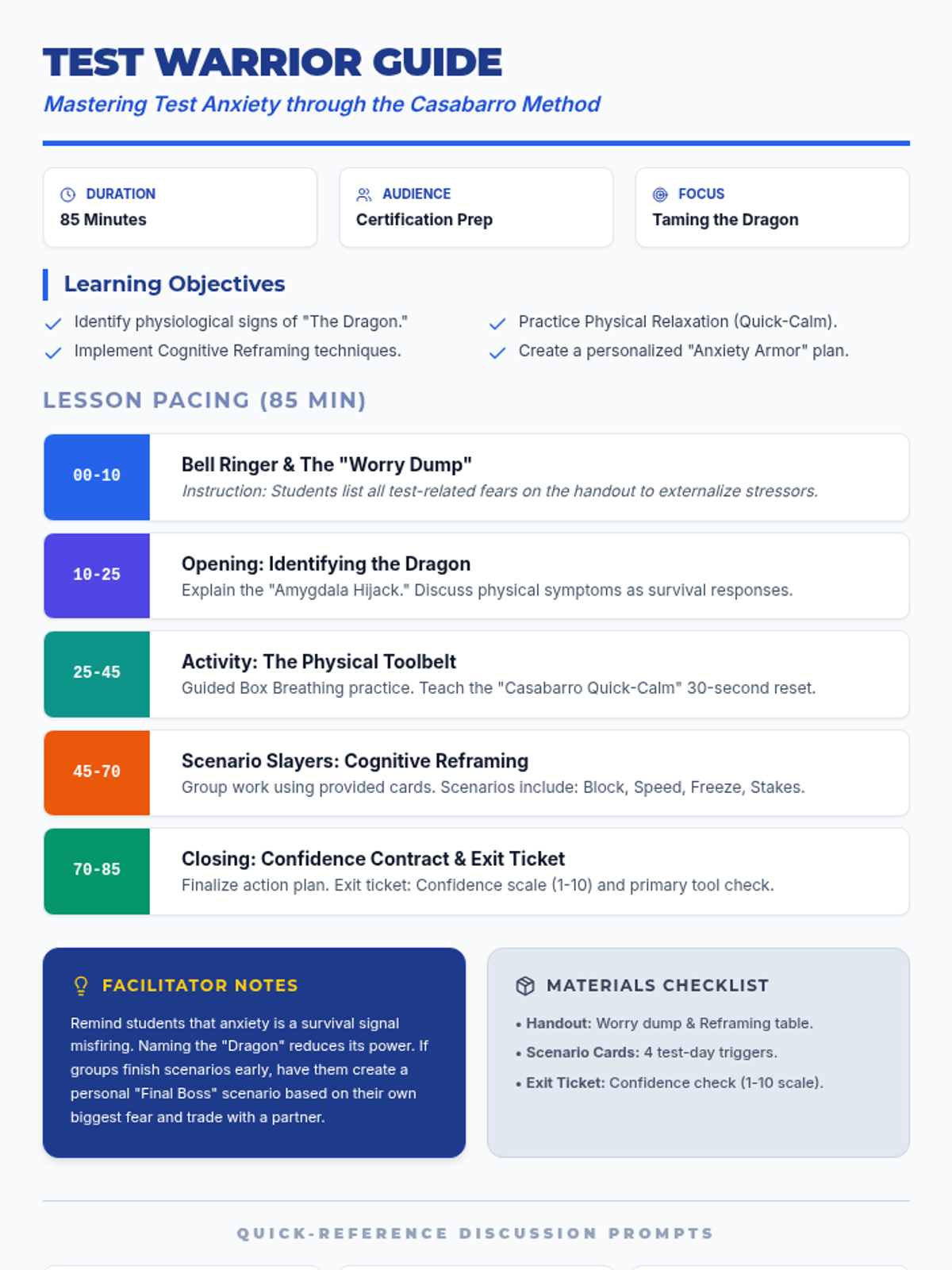
A comprehensive teacher facilitation guide for an 85-minute session on test anxiety, featuring optimized pacing layouts, material summaries, and facilitation notes aligned with Casabarro's method.
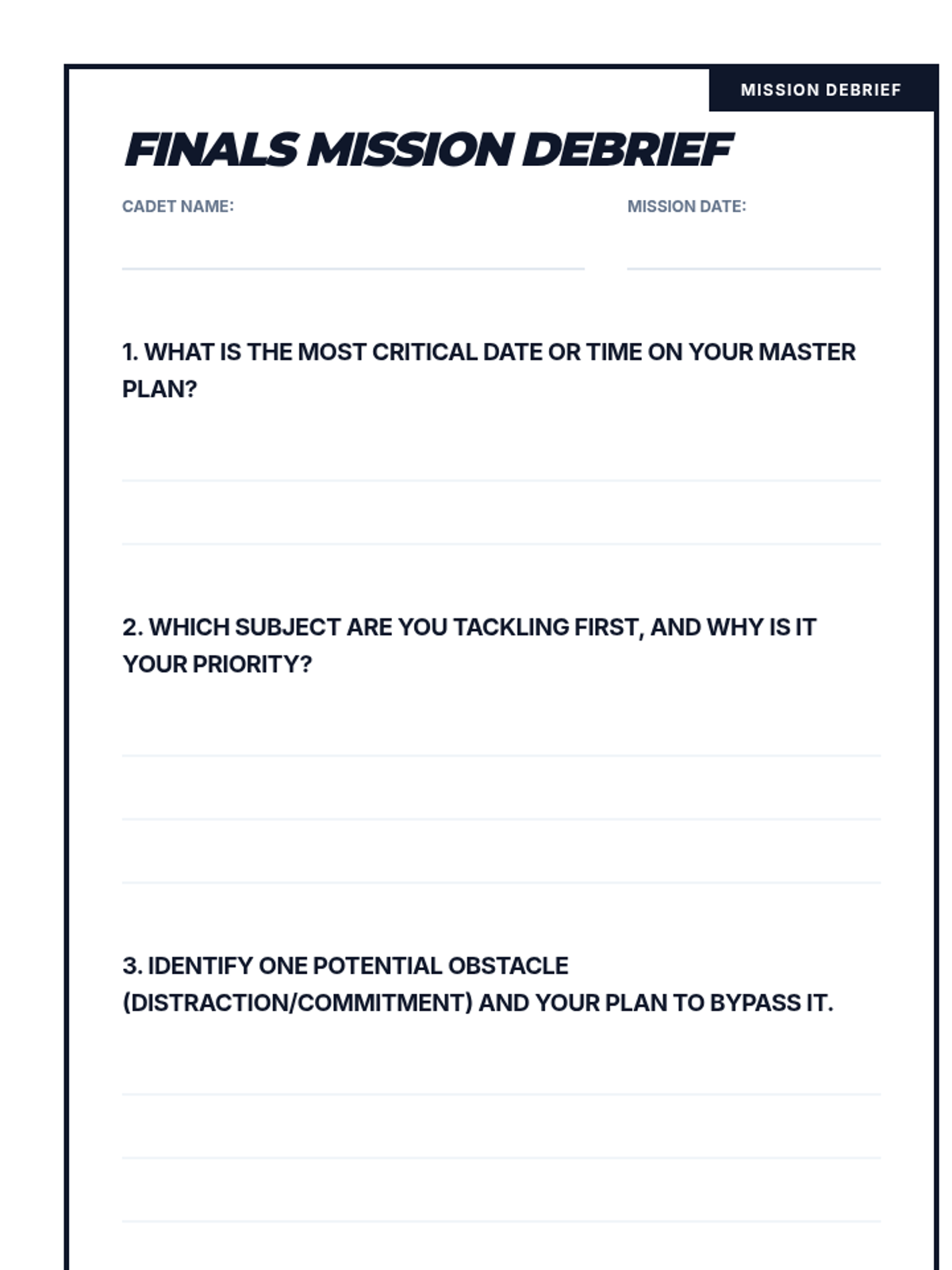
A quick post-lesson assessment for students to reflect on their primary study objectives and identify potential distractions. Completes the instructional cycle for the backward planning lesson.
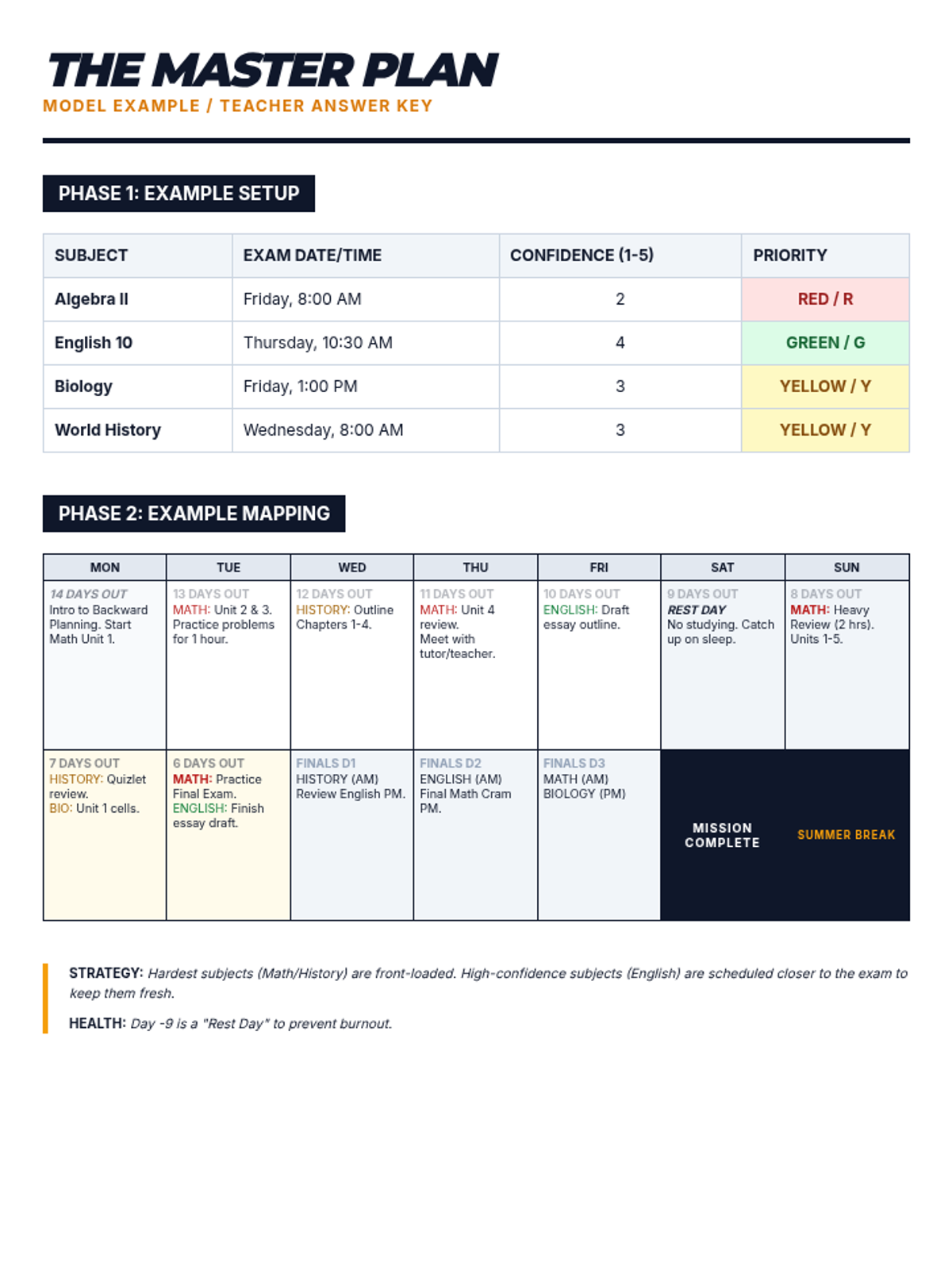
A completed model of 'The Master Plan' to be used as an answer key or student example. Demonstrates effective backward planning, prioritization of difficult subjects, and inclusion of rest days.
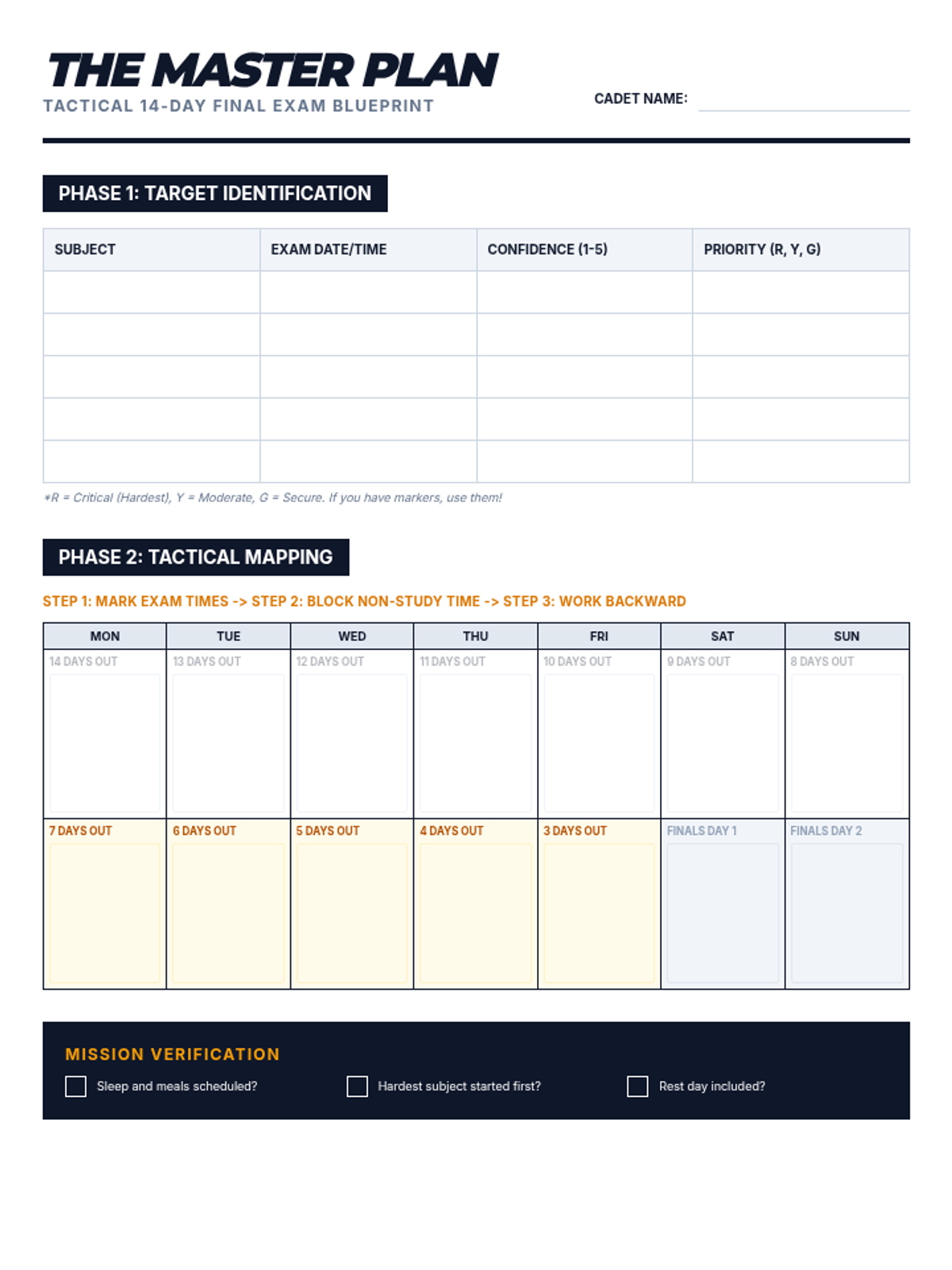
The student activity sheet for 'The Master Plan'. Students identify their 'target' exams, prioritize them by color, and work backward on a 14-day calendar to map out specific study tasks.
A high-impact slide deck for teaching backward planning. Uses a 'Mission Control' theme to engage students and break down complex scheduling into tactical steps. Includes a placeholder for a video embed.
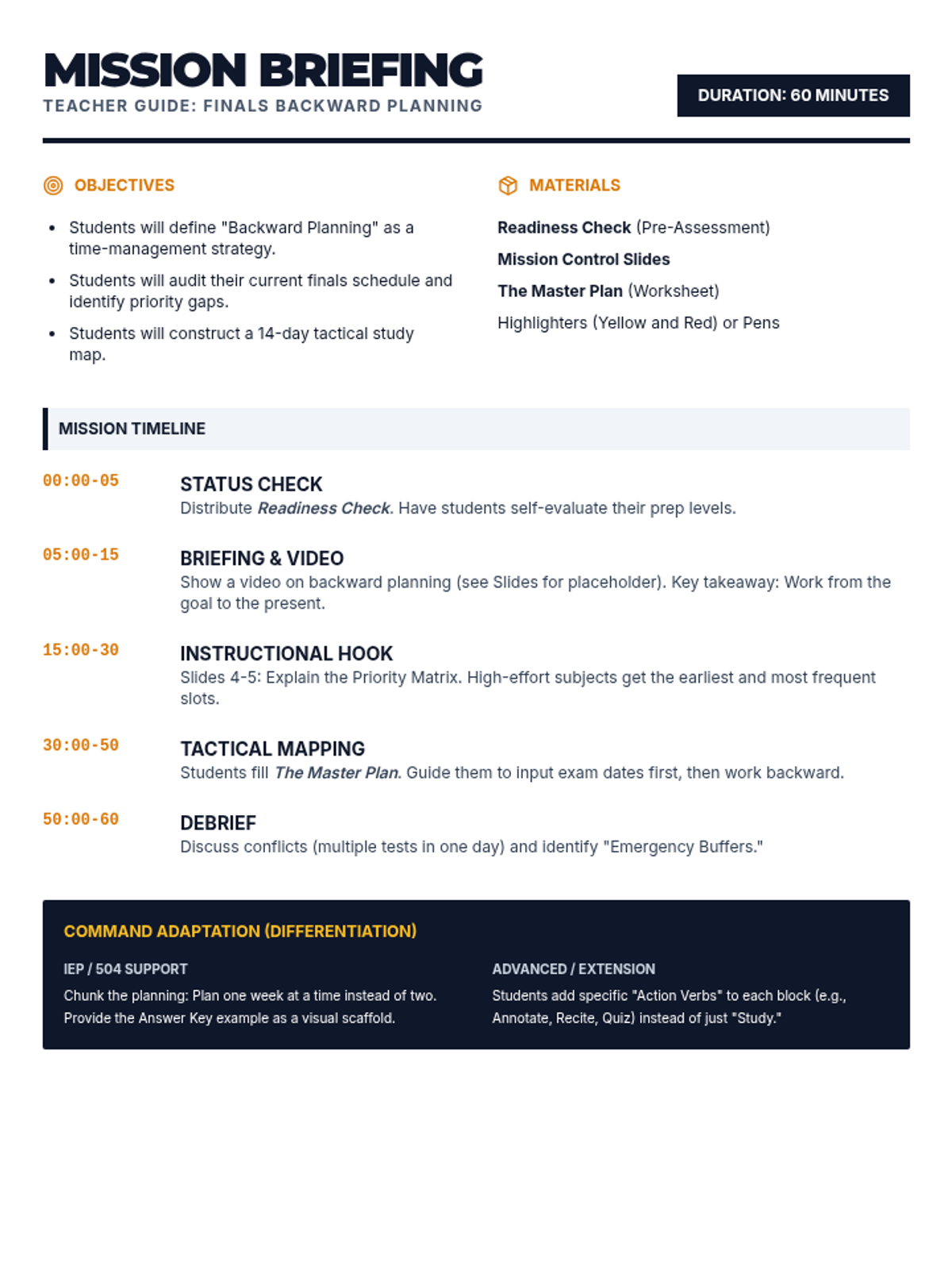
A comprehensive teacher's guide for the 'Finals Mission Control' lesson. Includes pacing, objectives, materials list, and differentiation strategies.
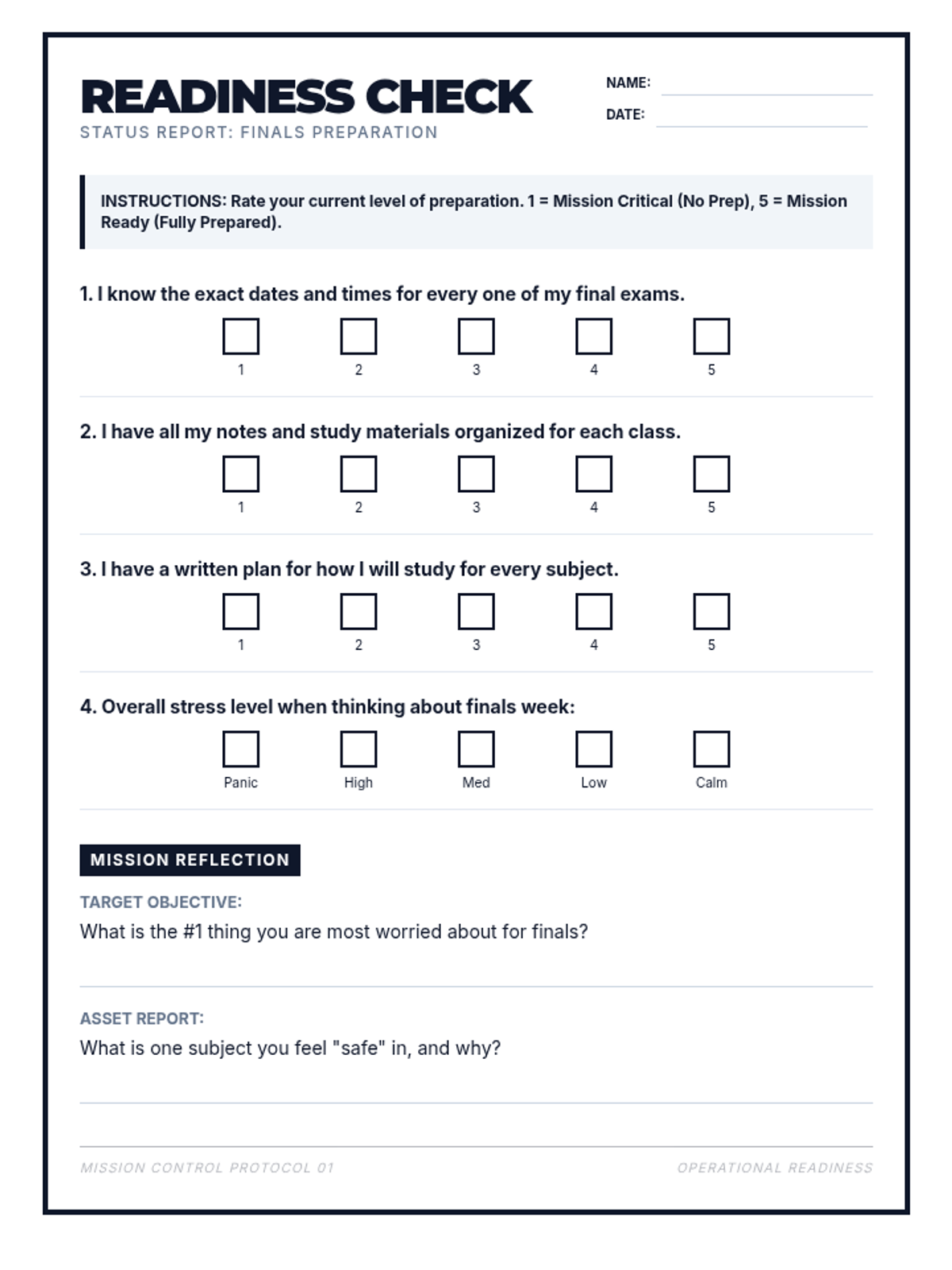
A pre-assessment for students to self-evaluate their current preparation levels and stress regarding upcoming finals. It uses a clean 'Mission Control' theme to frame the process as a tactical preparation.
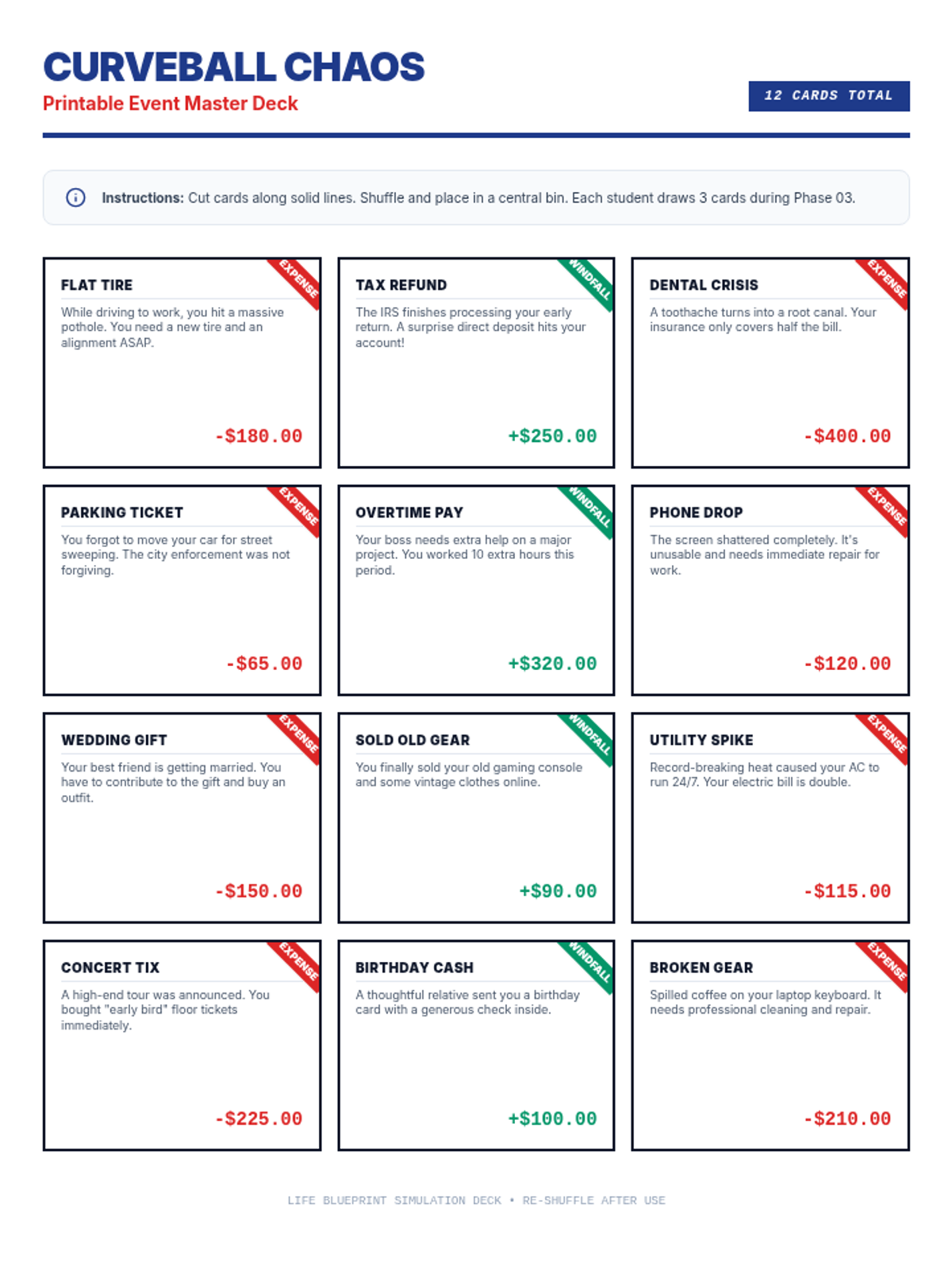
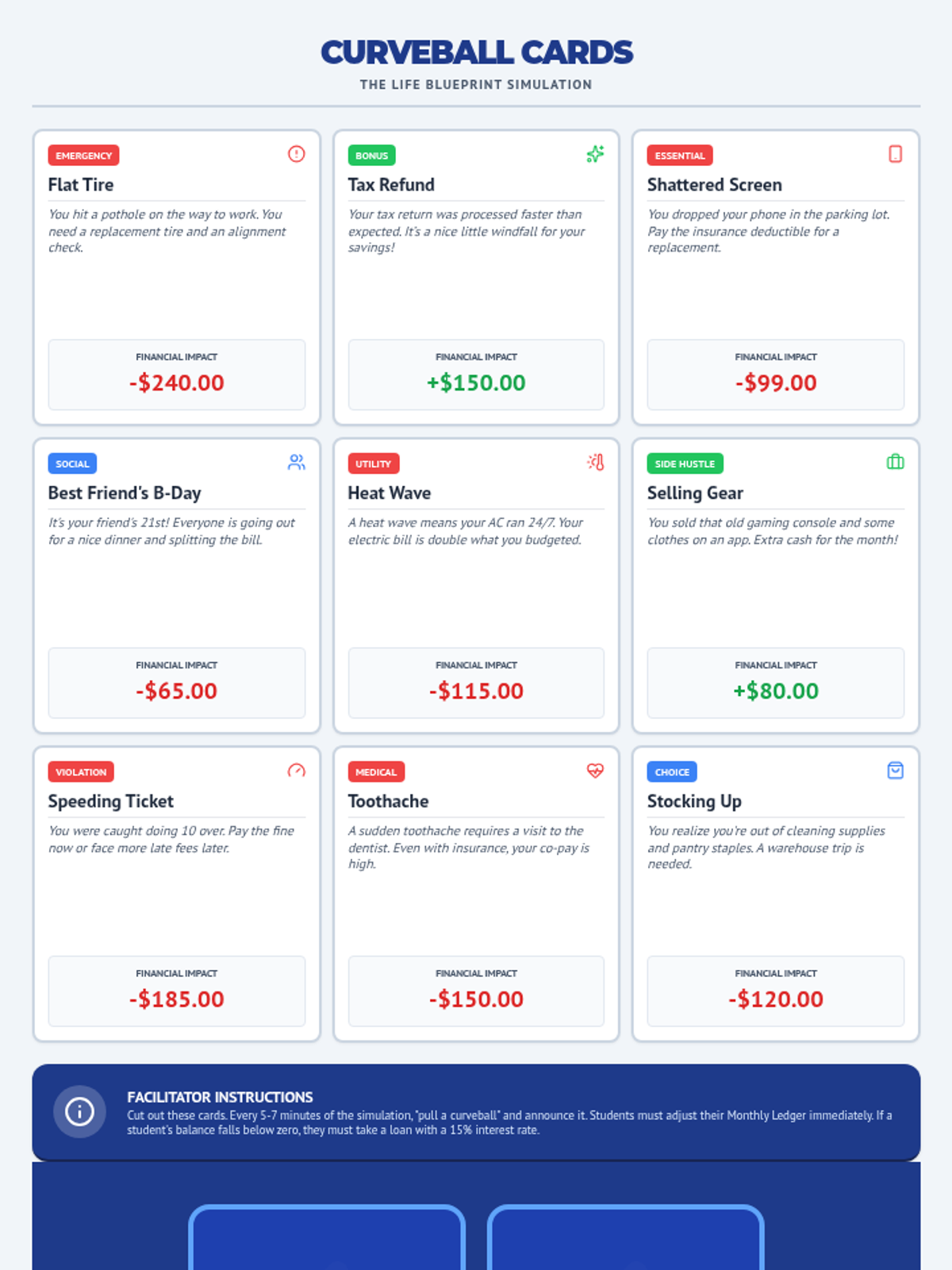
A set of printable "Curveball" and "Windfall" cards for the Life Blueprint simulation game. These cards represent the unpredictable financial events students must manage to complete their month.
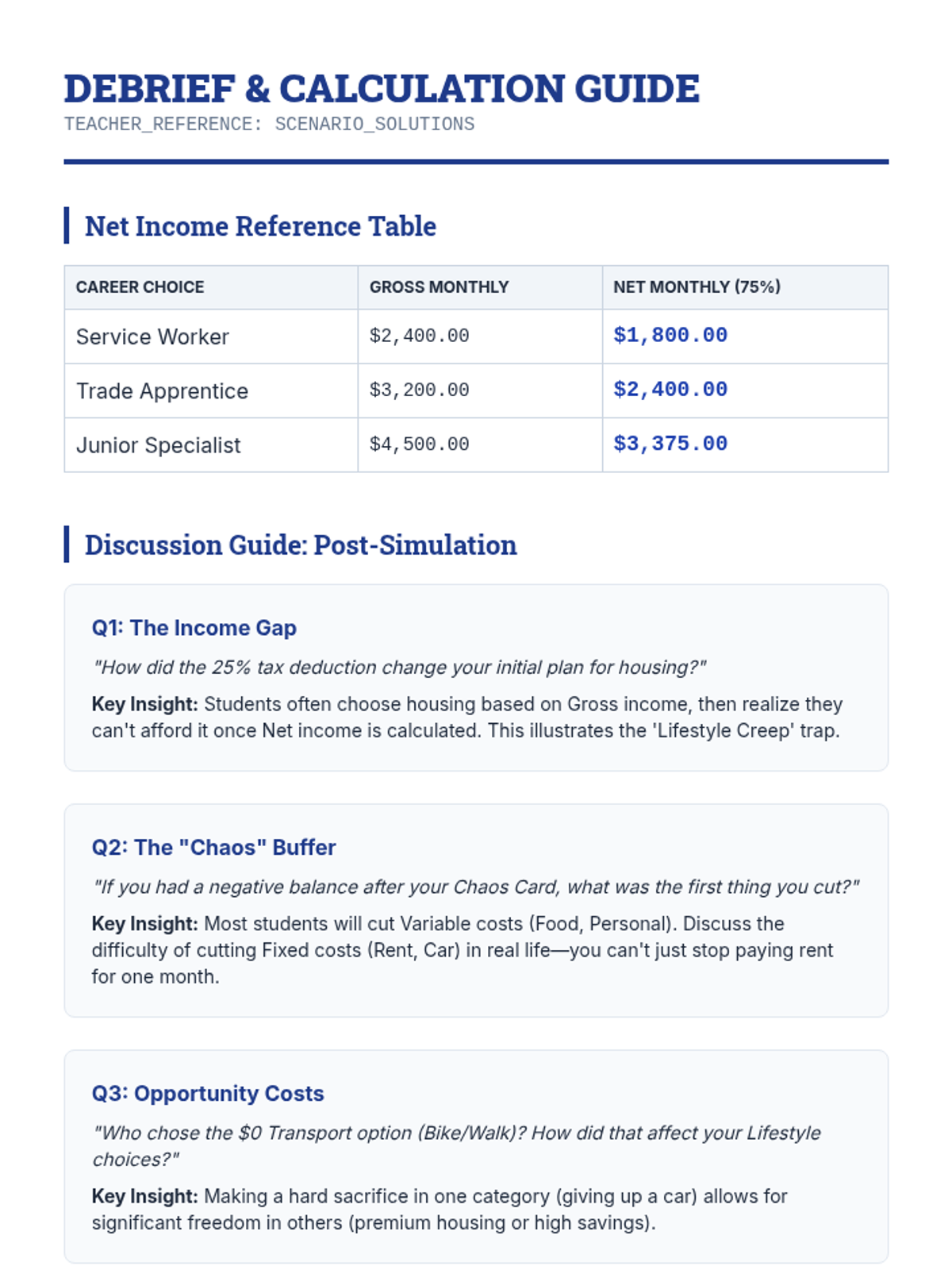
A teacher-facing reference guide containing the net income calculation table, discussion questions for debriefing, and key takeaways for the simulation.
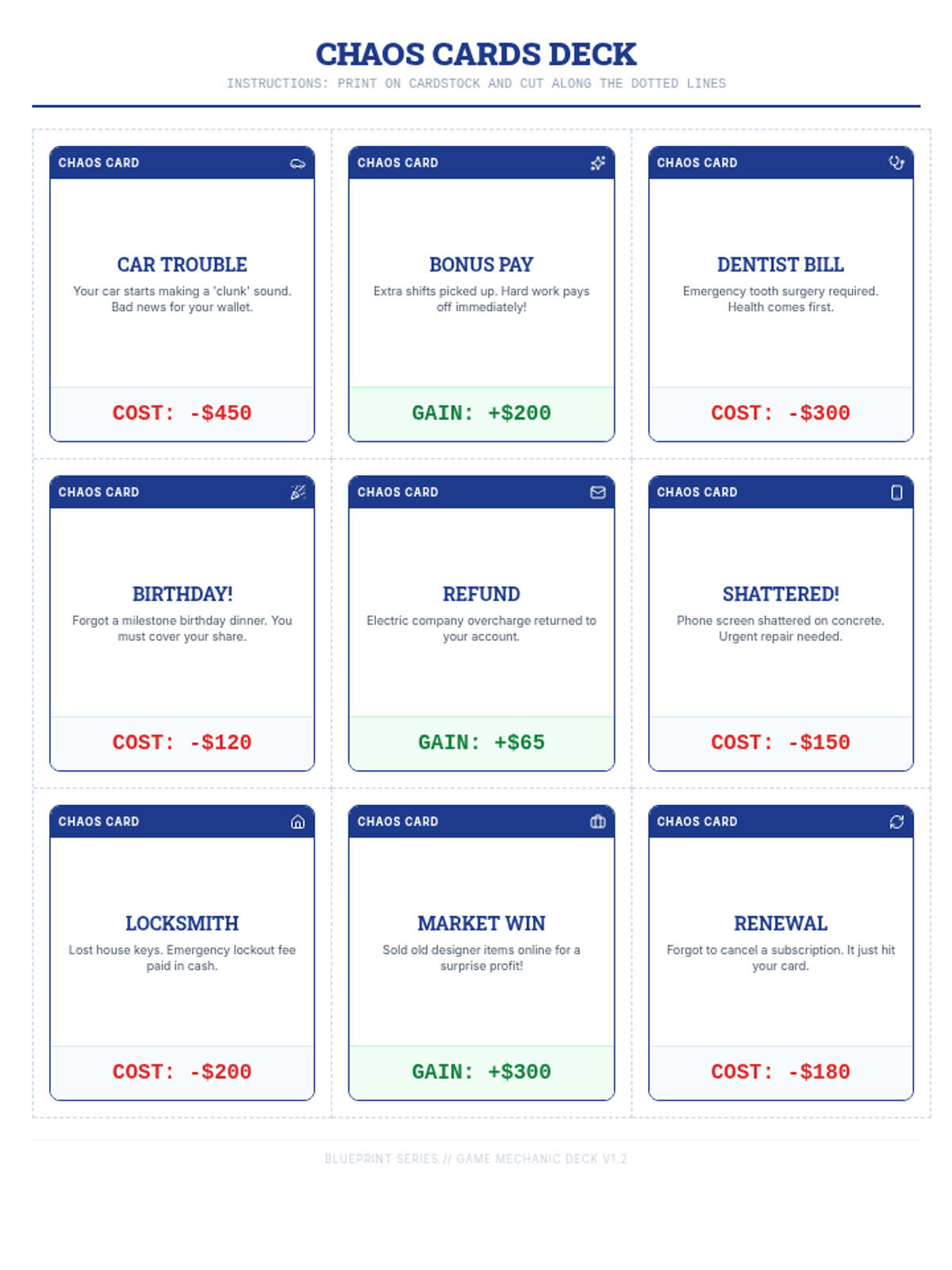
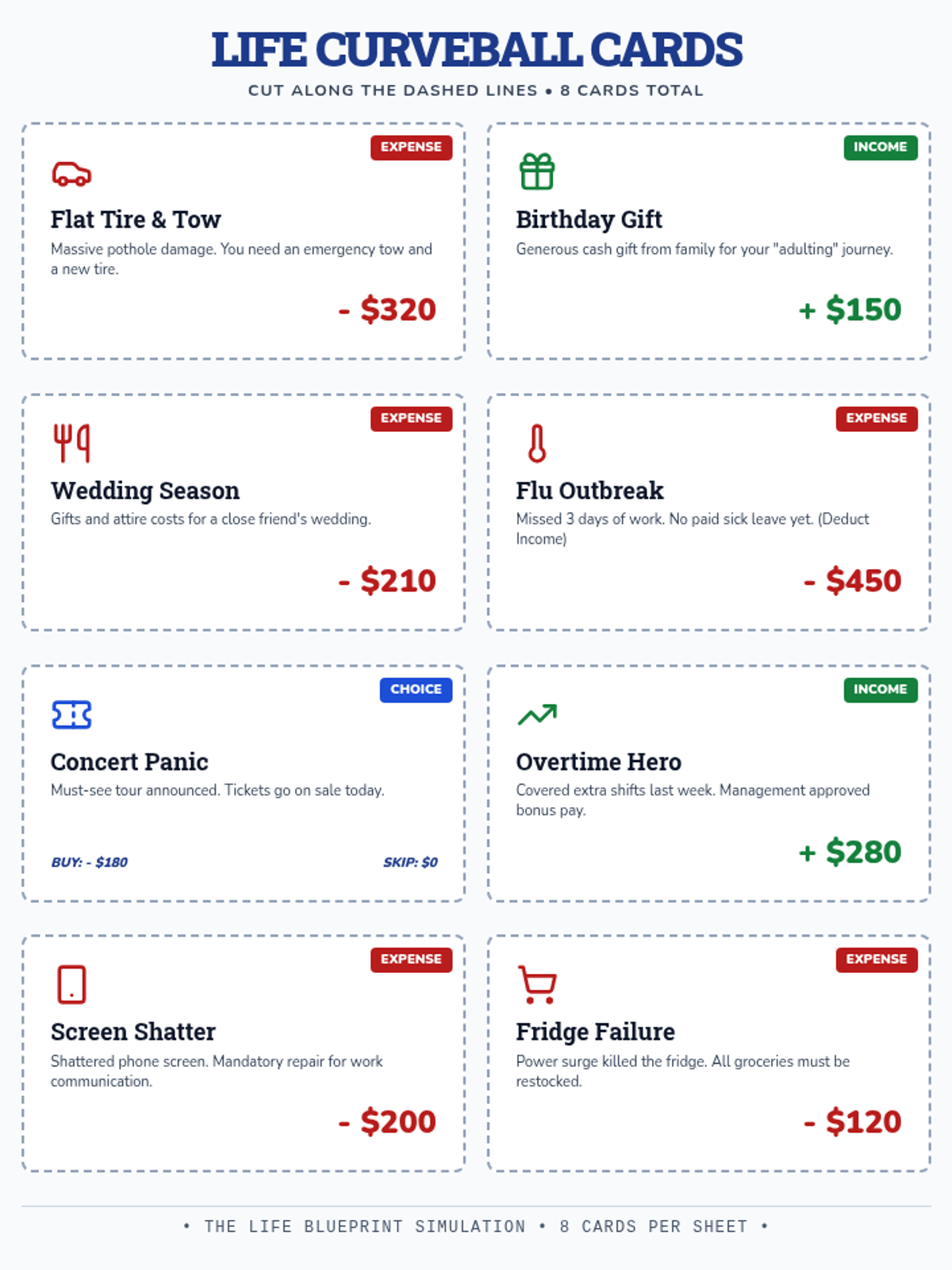
A set of printable 'Chaos Cards' representing unexpected financial events (both positive and negative) to be used in the final phase of the budgeting simulation.
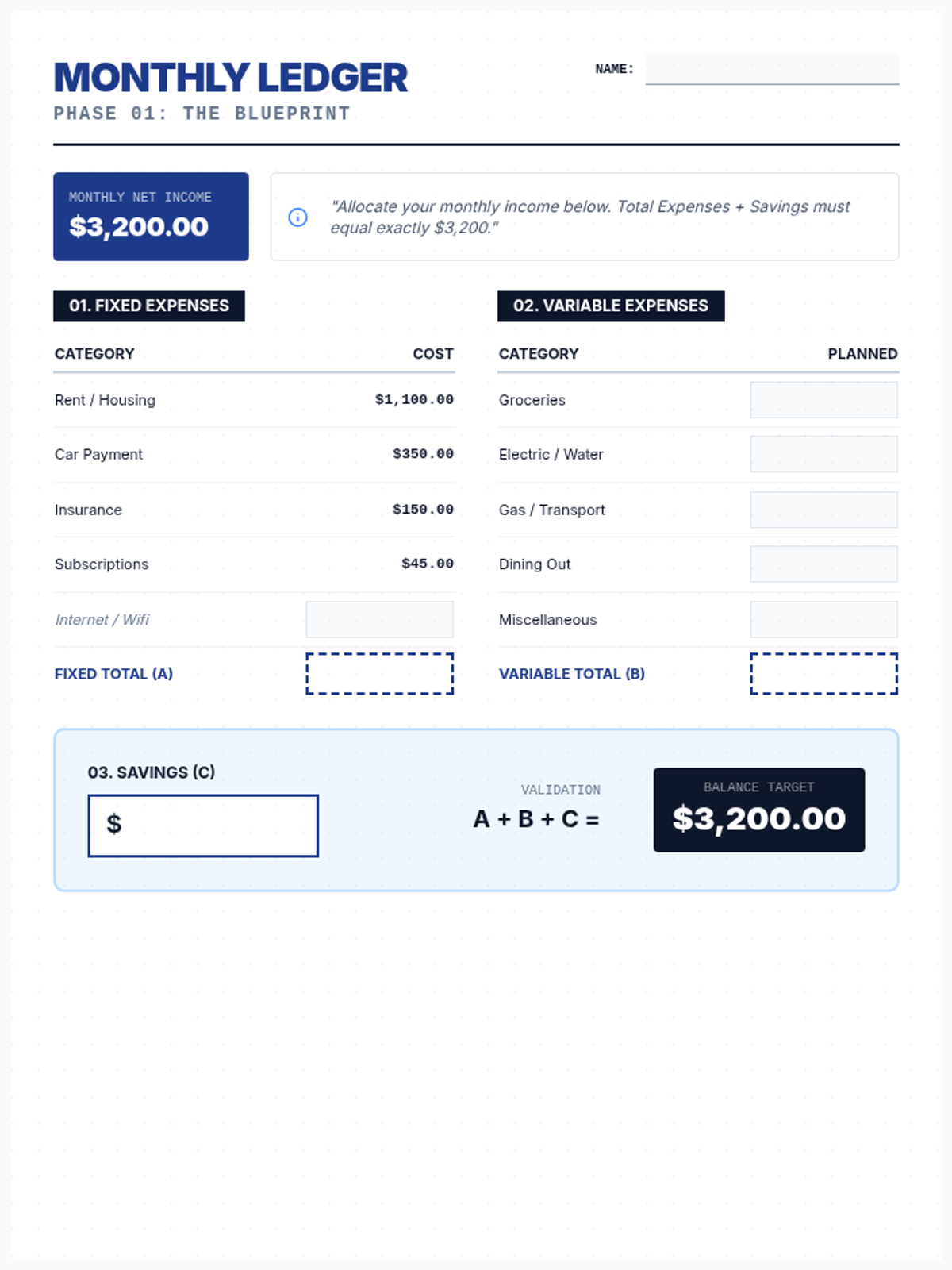
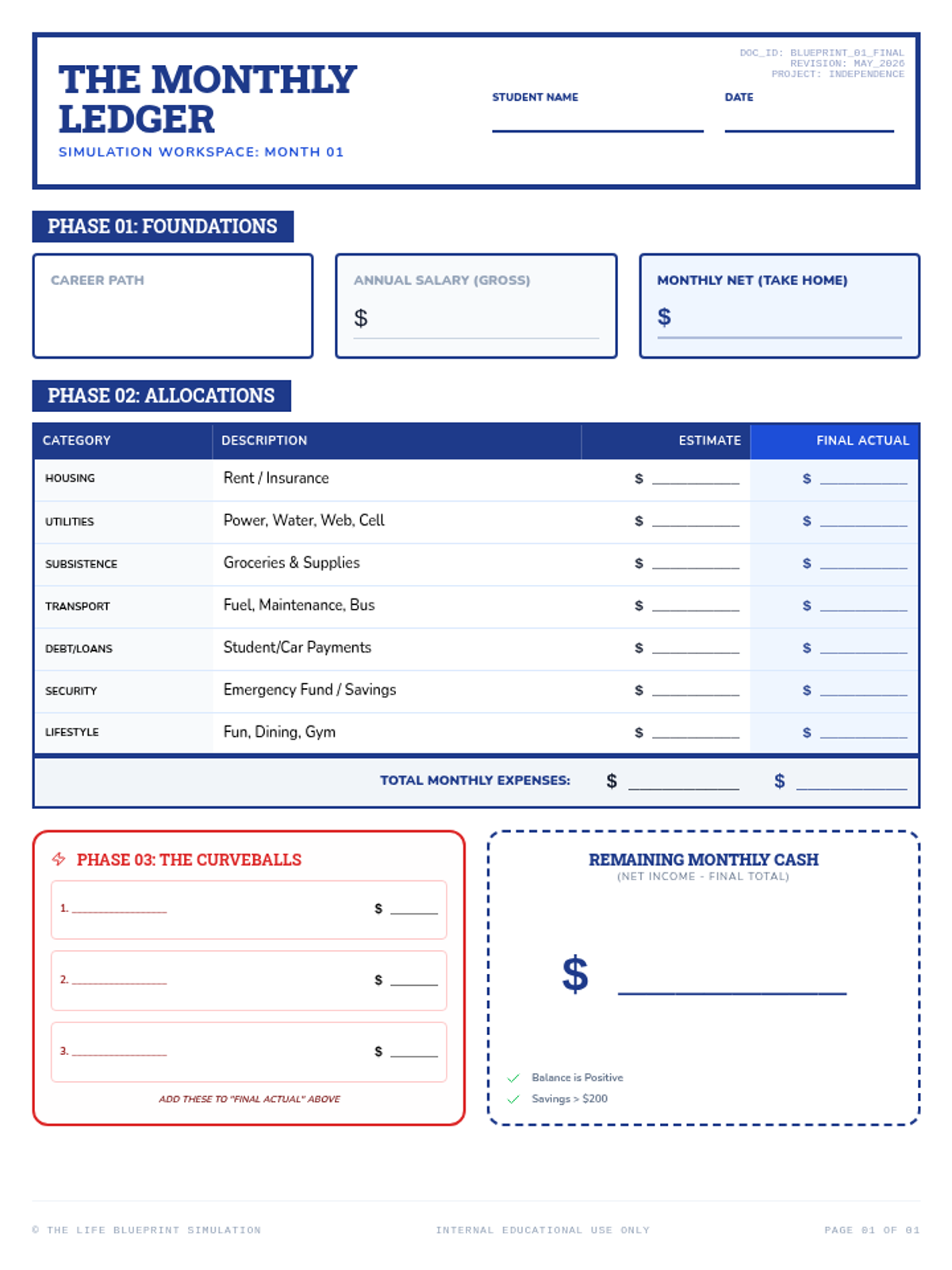
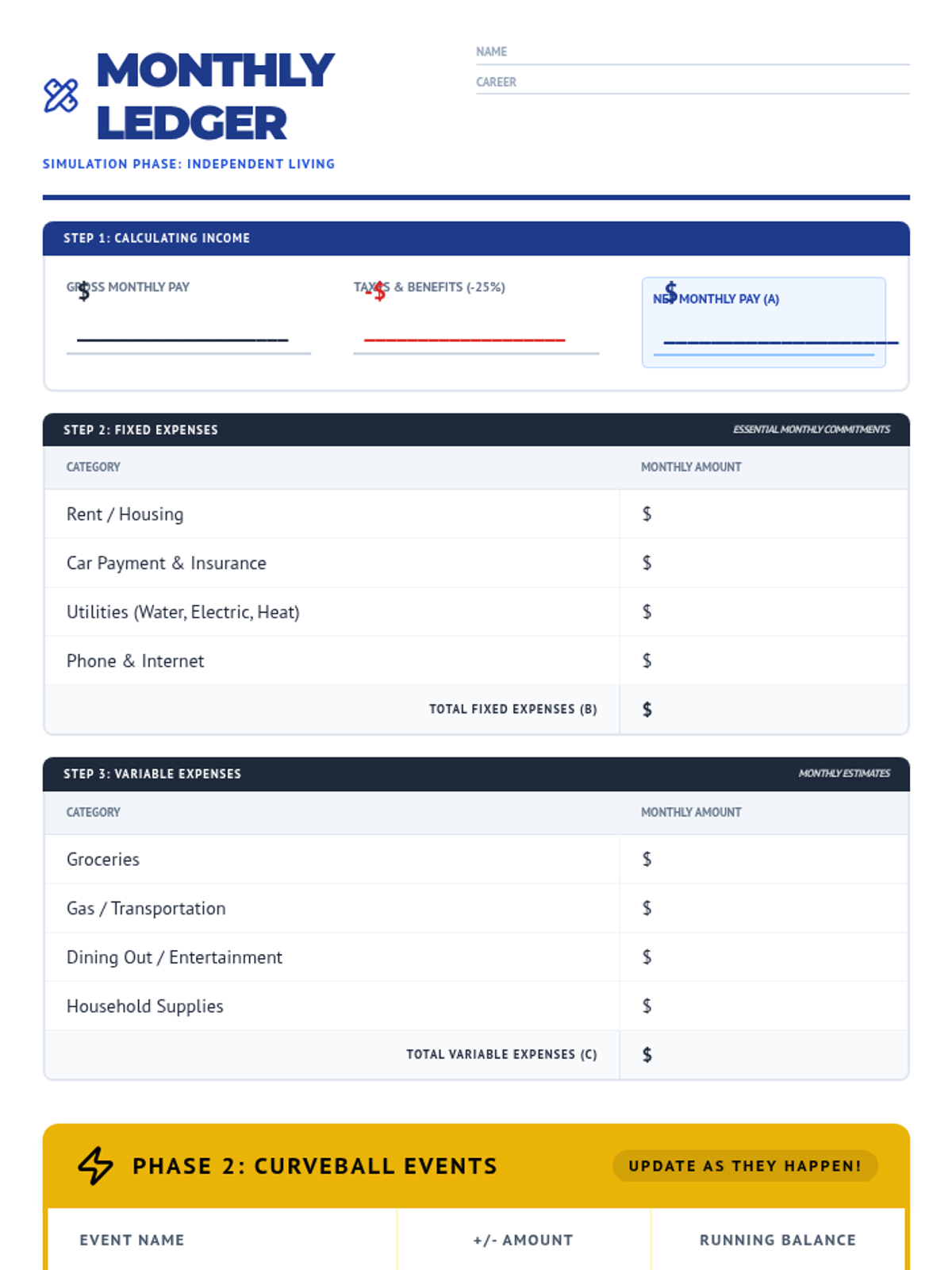
A two-page student ledger for the Life Blueprint project. Page 1 facilitates initial budget planning for a $3,200 net income, while Page 2 provides a structured space for reconciling the financial impact of "Curveball" events.
A set of printable game cards featuring various realistic financial 'Curveball' events (both positive and negative) that students must navigate during the independent living simulation.
A set of printable 'Curveball' cards for the life simulation game. Each card represents a realistic financial event (positive or negative) that students must incorporate into their monthly budget ledger.
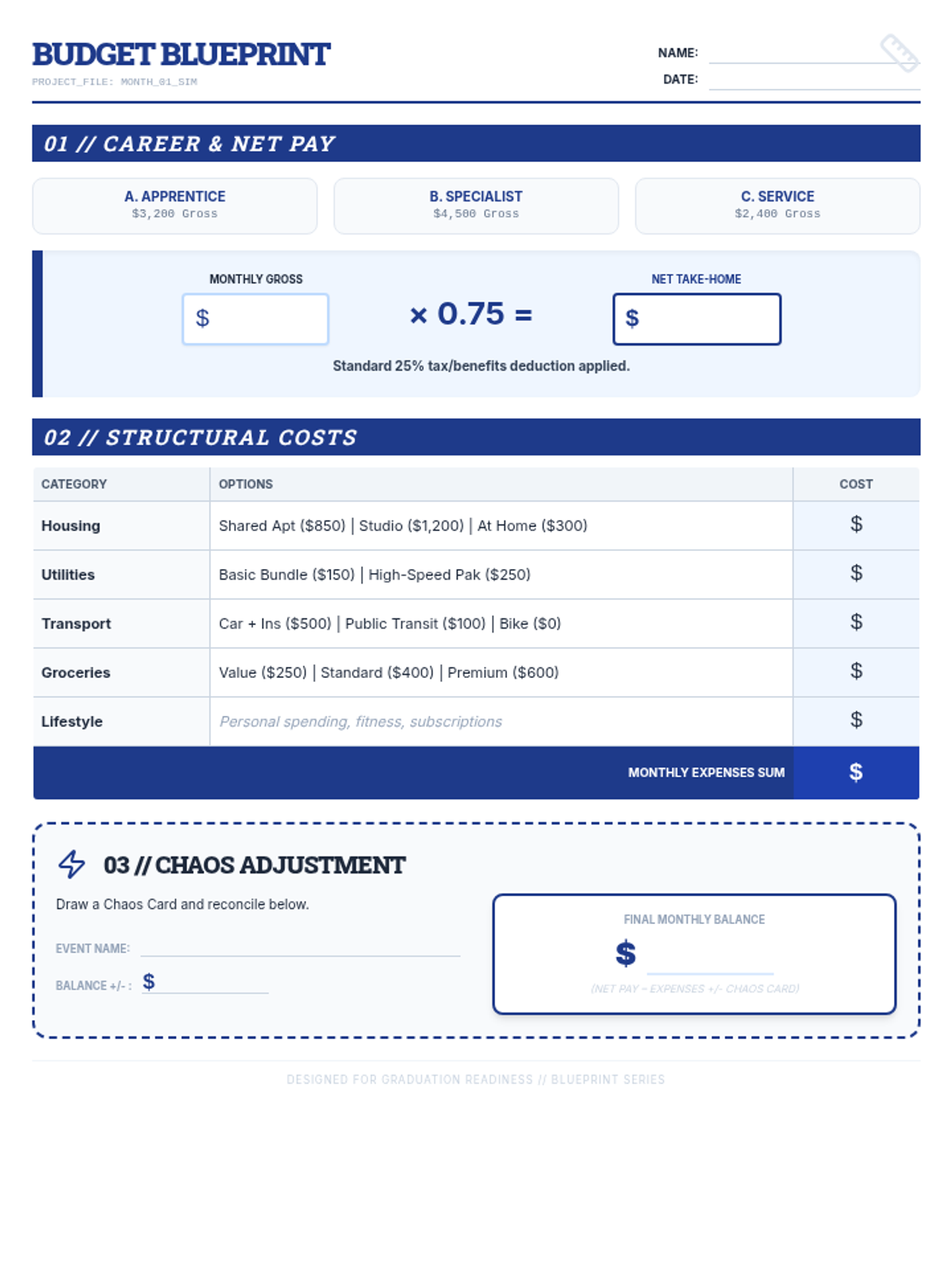
A structured budgeting worksheet styled as a blueprint, allowing students to select career paths, calculate net income, and manage various living expenses.
A highly structured student worksheet designed as a 'Blueprint' for tracking income and expenses. It features a detailed ledger for initial estimates and adjustment columns for the 'Curveball' phase of the simulation.
A student-facing worksheet for calculating income, fixed costs, and variable expenses, featuring a dedicated area to track 'Curveball' events during the simulation.
An engaging slide deck designed for high school seniors to introduce the concepts of fixed and variable expenses, the 50/30/20 budgeting rule, and the mechanics of the Life Blueprint simulation.
A high-impact visual presentation introducing core financial concepts like gross vs. net pay, fixed vs. variable expenses, and the simulation instructions.
A high-energy, visually engaging slide deck that introduces students to the concepts of gross vs. net pay, the 50/30/20 rule, and the 'Curveball' element of the life simulation.
A visual presentation to guide students through the basics of adult budgeting, including concepts like gross vs. net pay, fixed vs. variable costs, and the rules of the simulation.
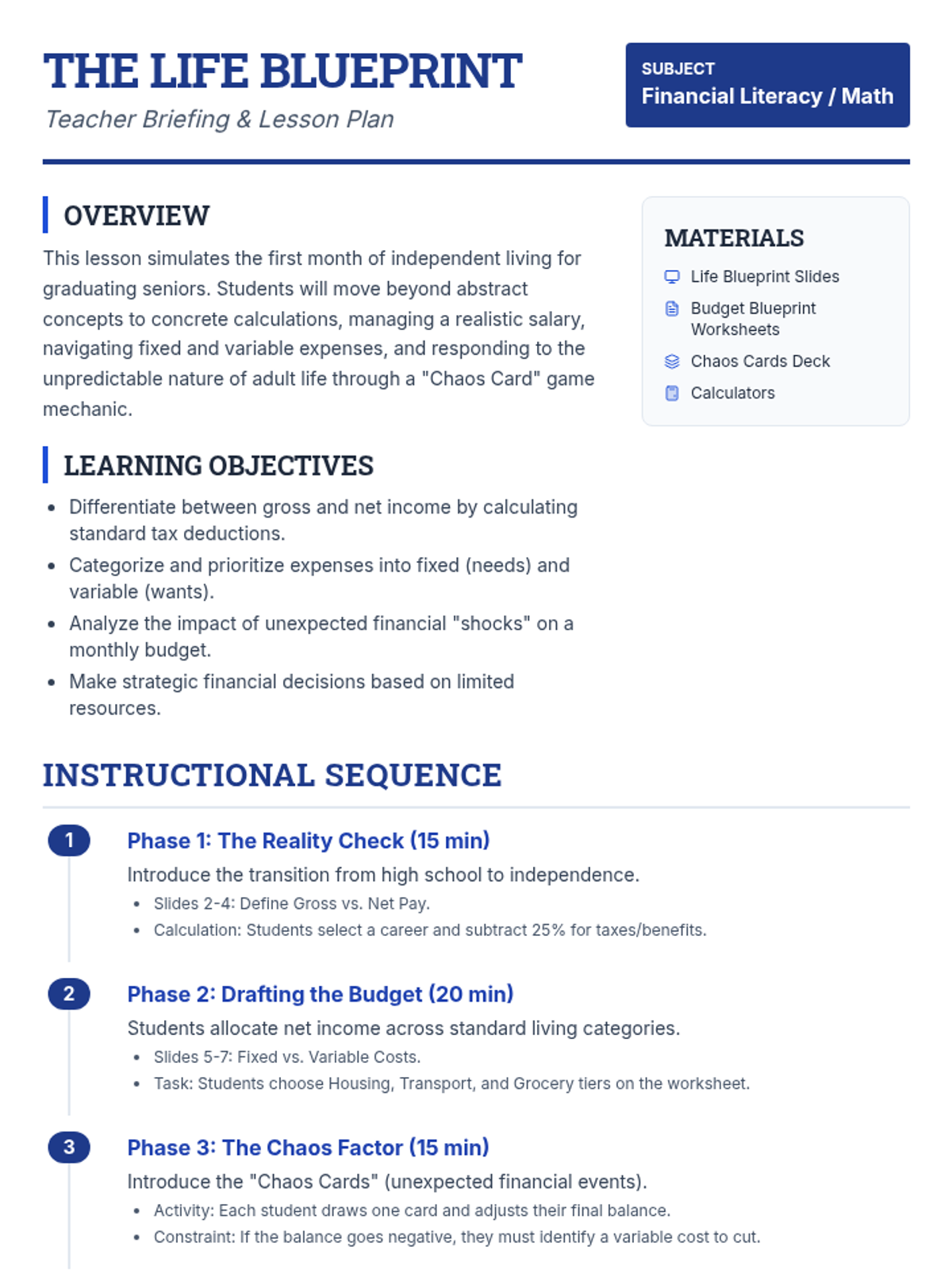
A detailed instructional guide for teachers to facilitate a financial literacy simulation, including learning objectives, a phased instructional sequence, and differentiation strategies.
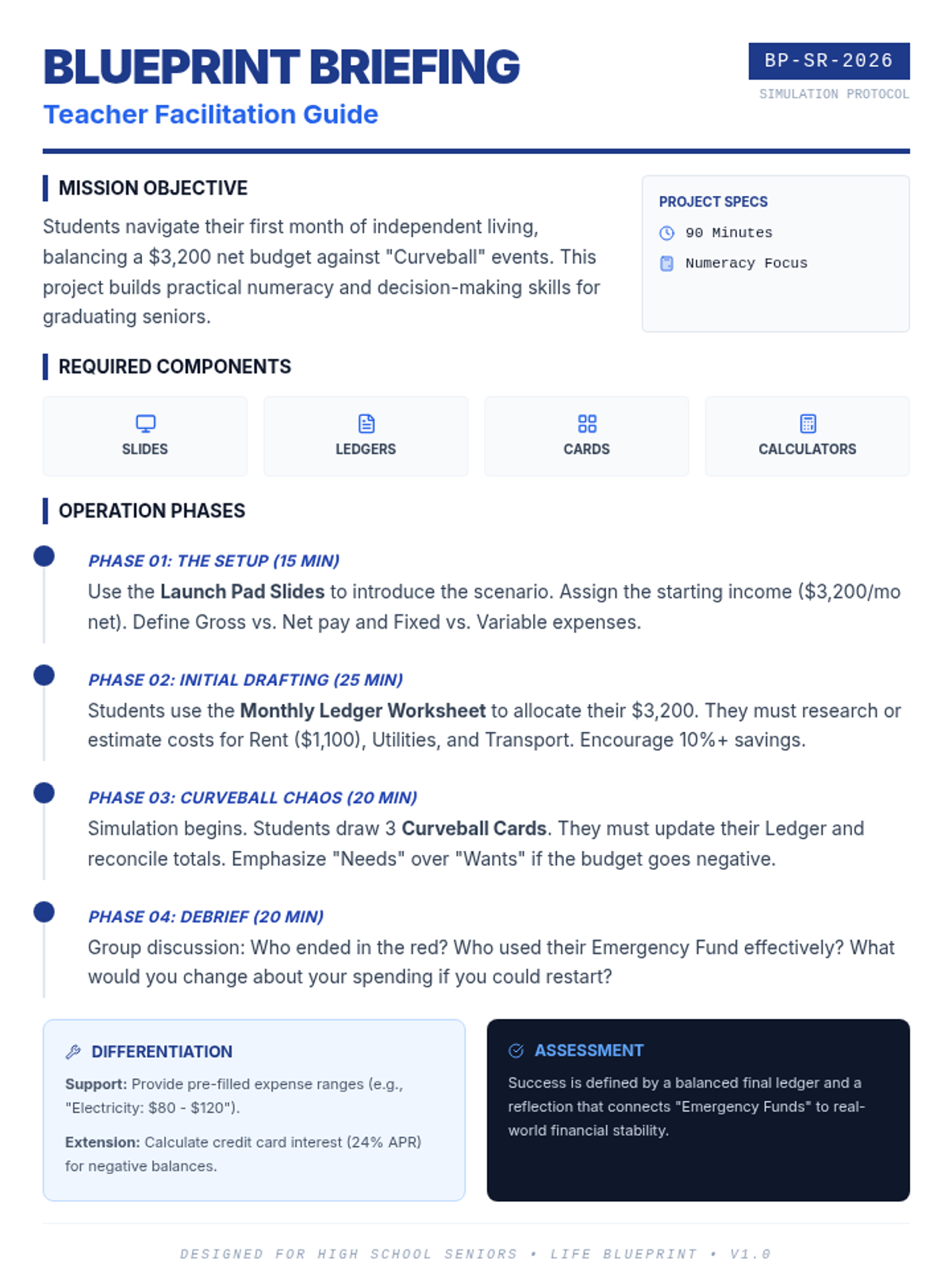
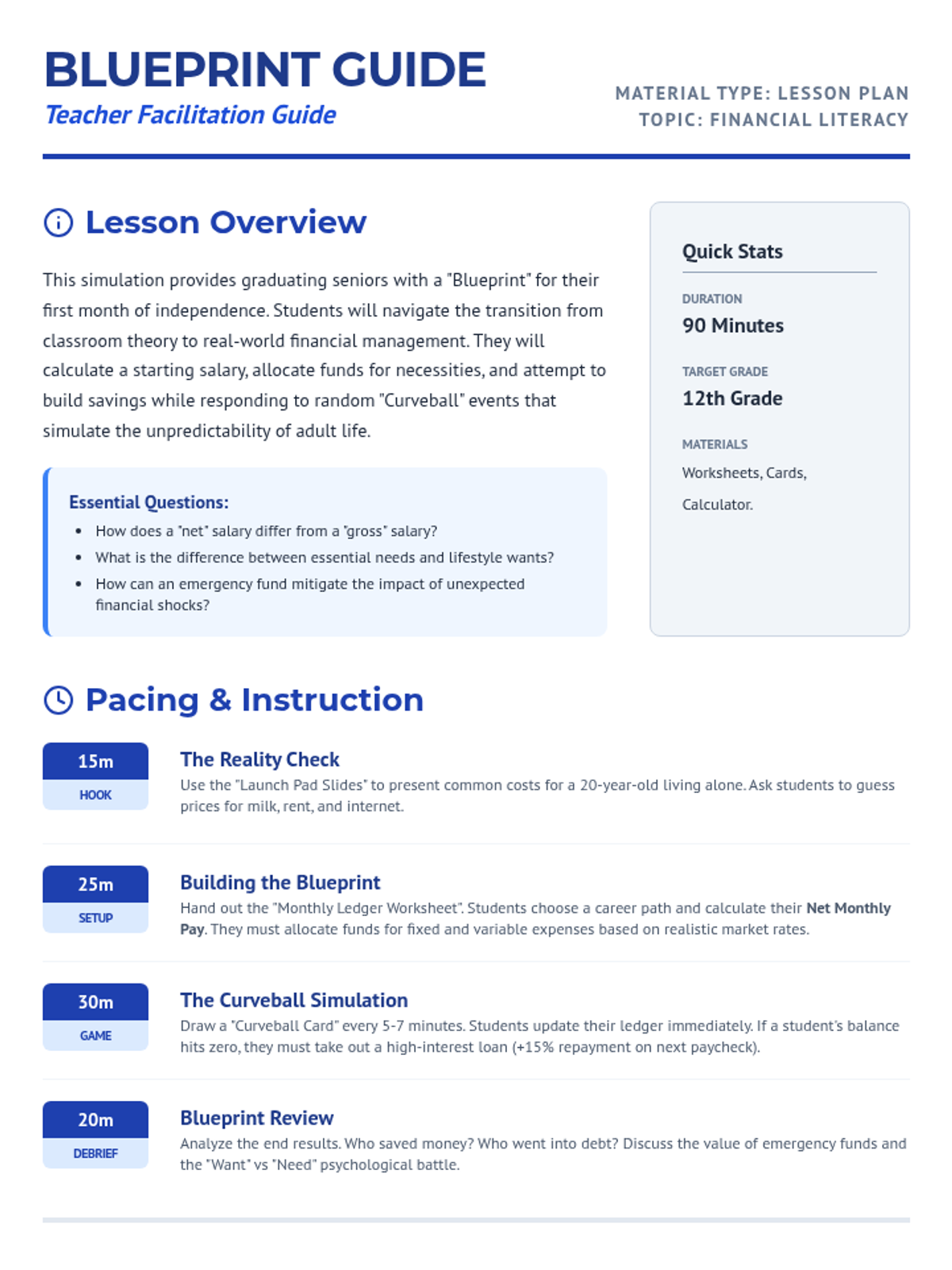
A comprehensive teacher facilitation guide for the Life Blueprint project, outlining the 90-minute simulation phases, materials needed, and differentiation strategies.
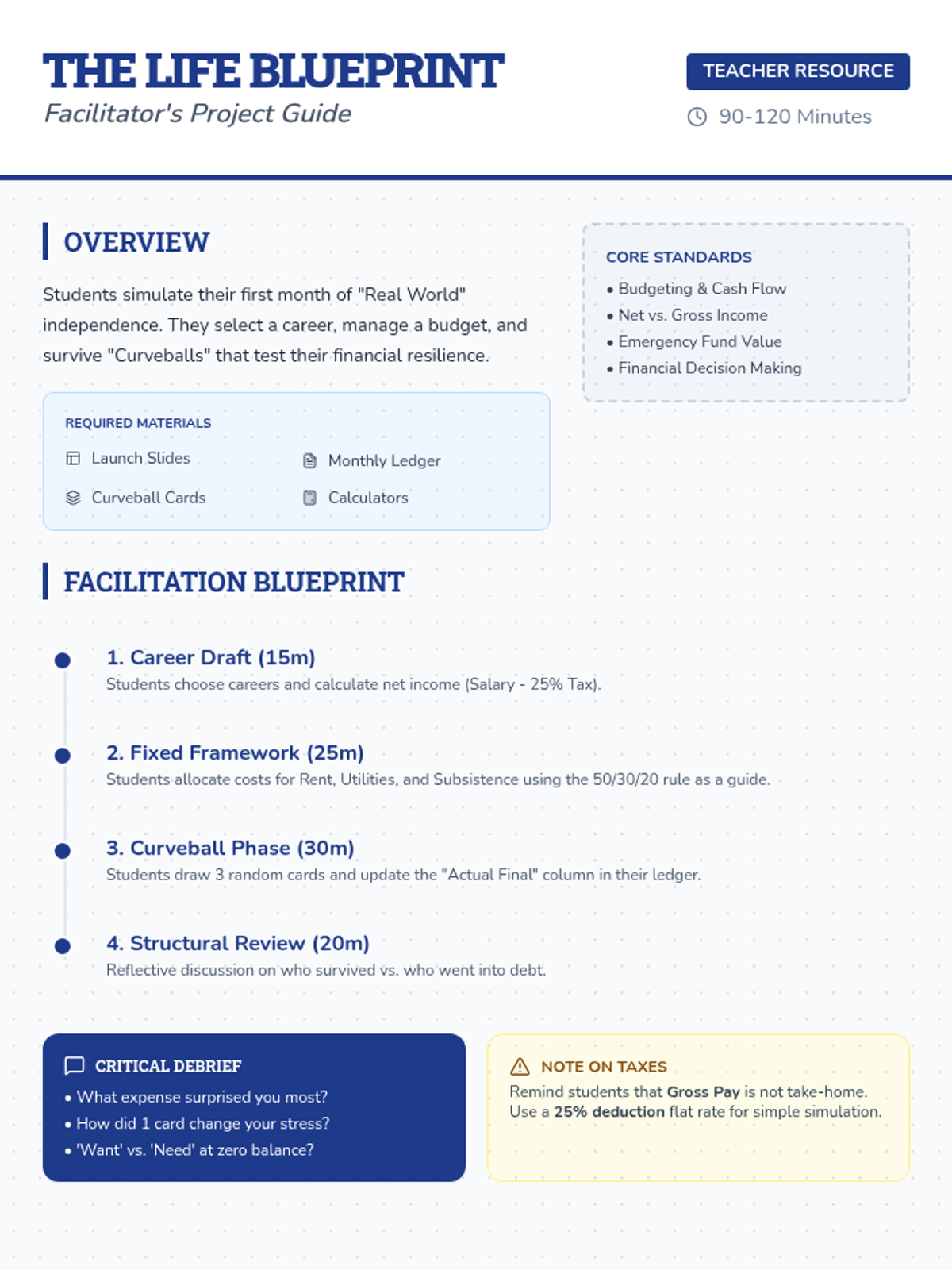
A comprehensive teacher guide for 'The Life Blueprint' simulation, including lesson flow, facilitating tips, and reference data for student budgeting.
A teacher-facing lesson plan that outlines the objectives, pacing, and instructional strategies for 'The Life Blueprint' simulation, designed specifically for graduating seniors.
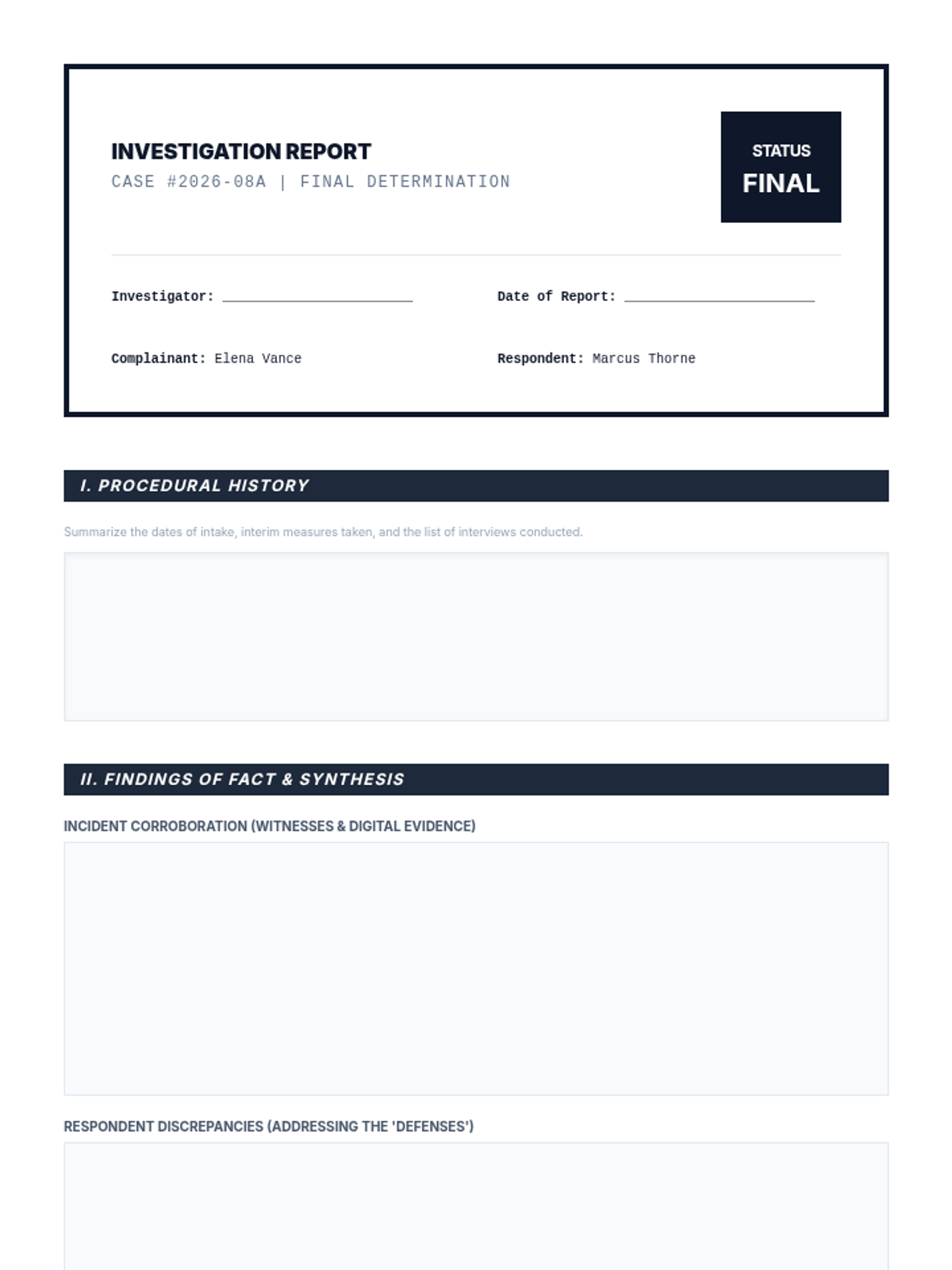
The capstone template for the final investigation report, structured to meet graduate-level technical writing and legal defensibility standards.
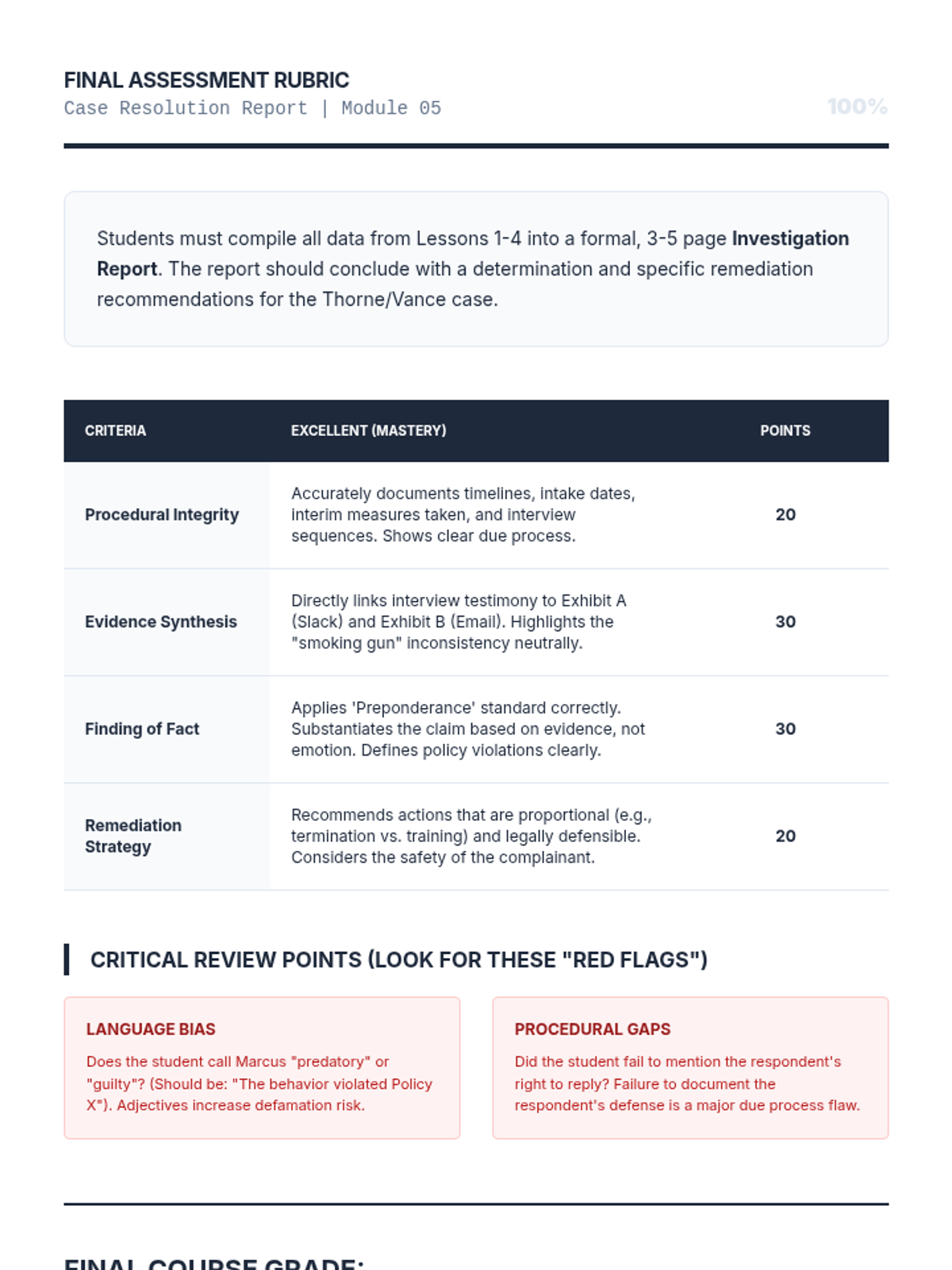
A comprehensive grading rubric for the final investigation report, focusing on procedural integrity, evidence synthesis, and remediation strategy.
Slide deck for Lesson 5 on drafting technical investigation reports and recommending appropriate remediation strategies while avoiding legal pitfalls.
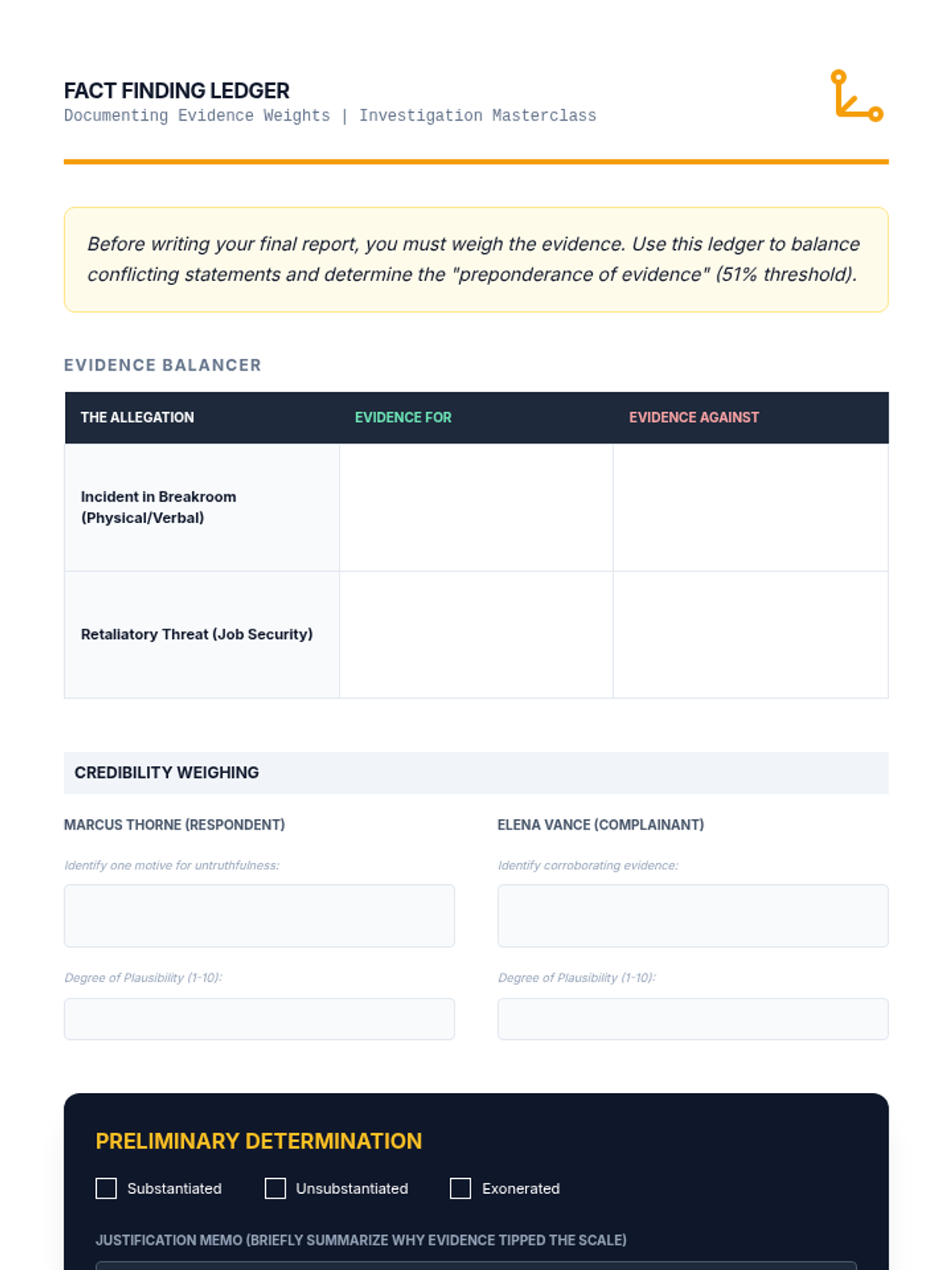
A worksheet for students to weigh conflicting evidence and apply credibility factors to reach a preliminary determination.
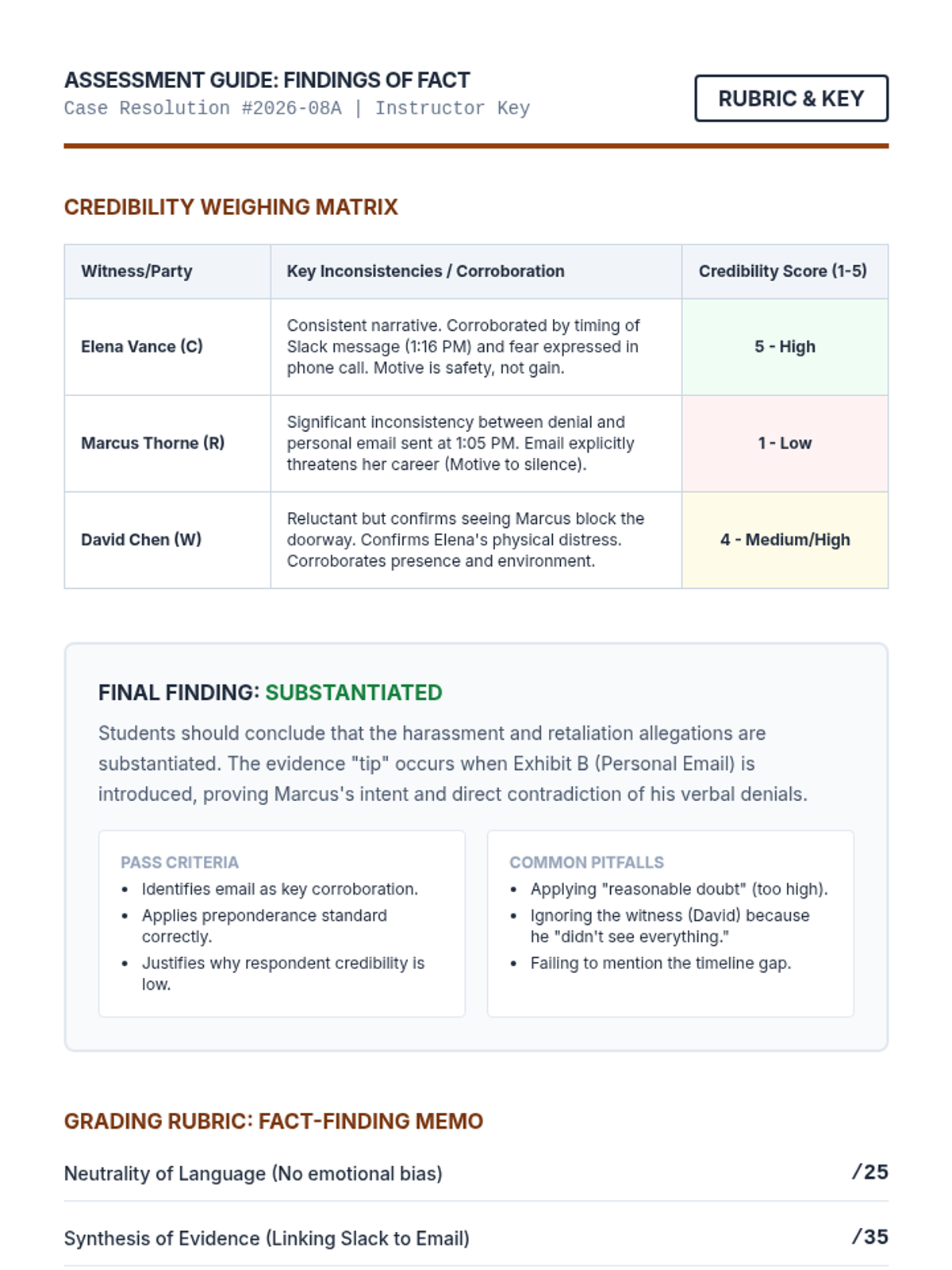
An answer key and rubric for Lesson 4, helping instructors grade student credibility assessments and findings of fact for the Thorne/Vance case.
Slide deck for Lesson 4 on weighing credibility, applying the preponderance of evidence standard, and making formal findings of fact.
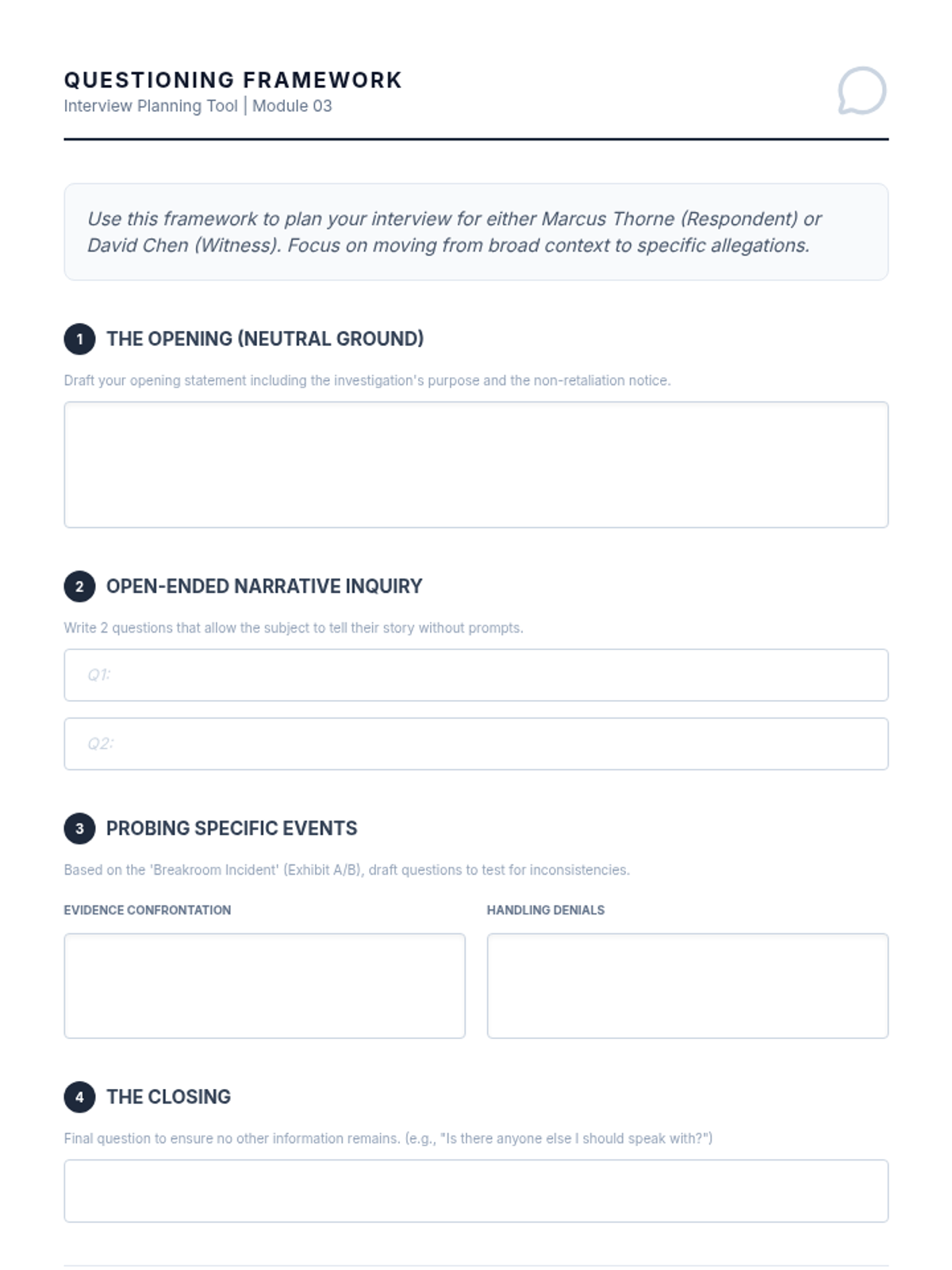
A planning worksheet for students to draft their interview questions and structure their inquiry according to the funnel technique.
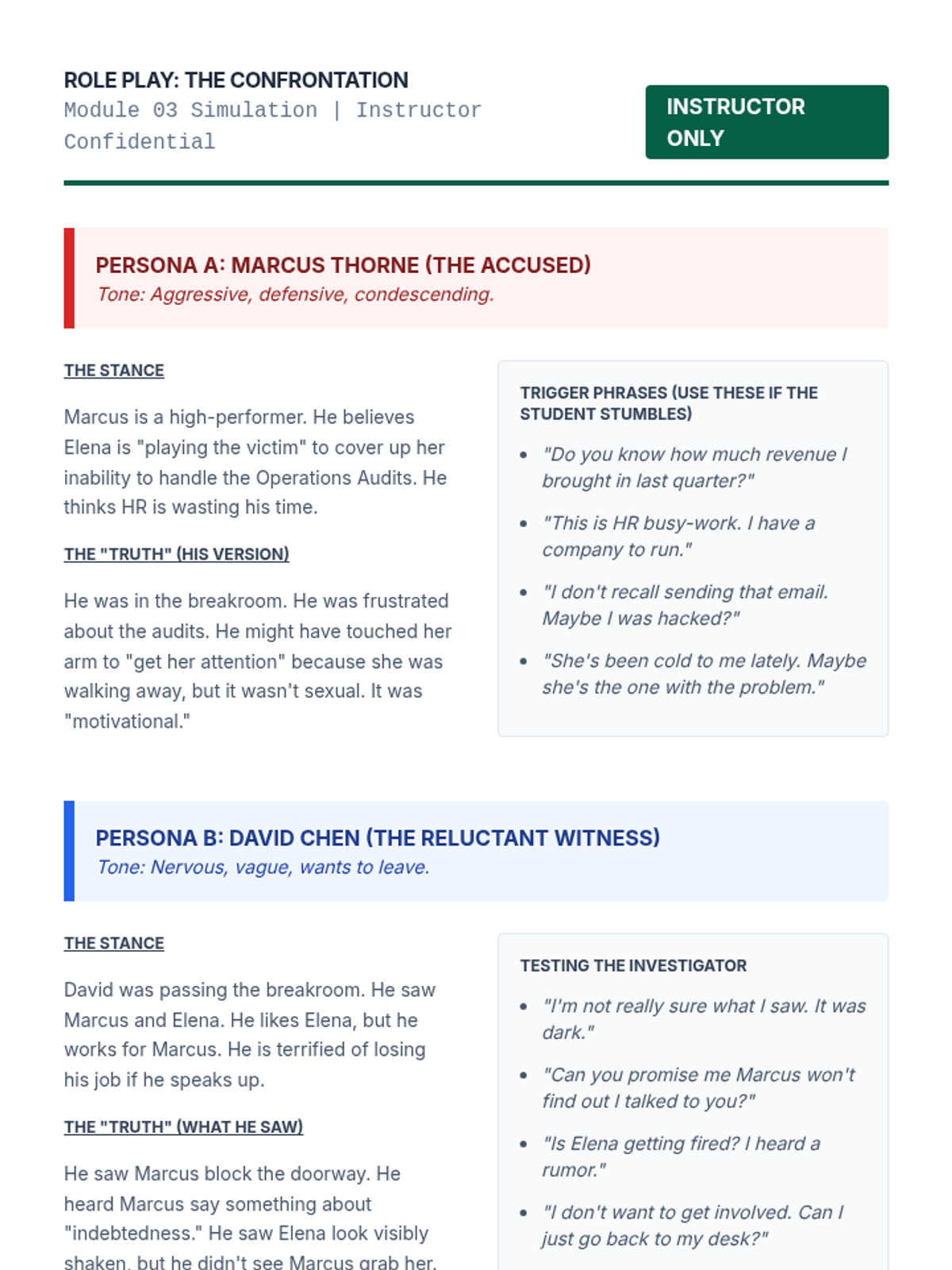
Detailed role-play scripts and facilitator instructions for Lesson 3, featuring two contrasting personas: a hostile respondent and a reluctant witness.
Slide deck for Lesson 3 focusing on interview techniques for the accused and witnesses, including the funnel technique and de-escalation strategies.
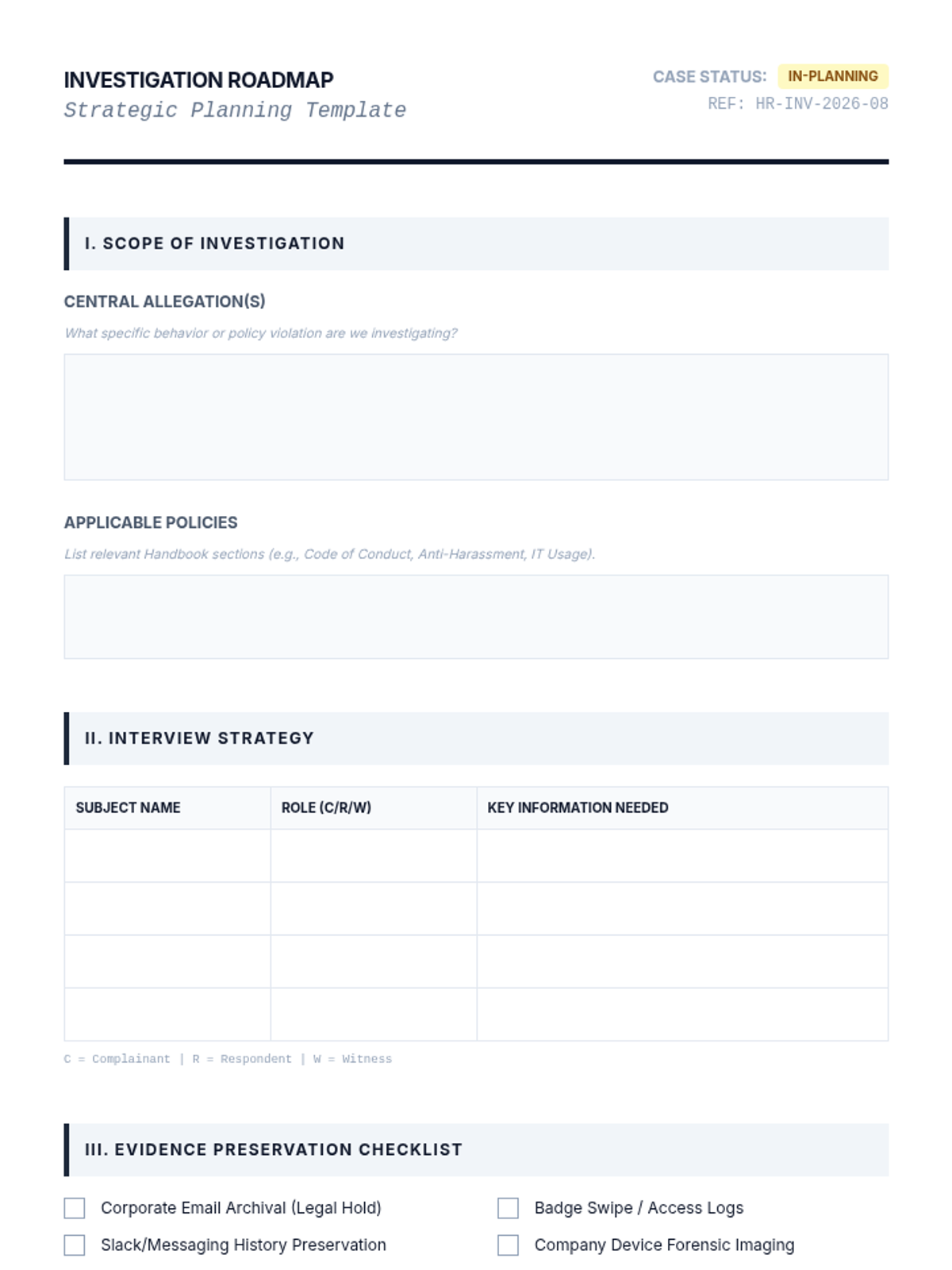
A strategic template for students to map out their investigation, including scope definition, interview sequencing, and evidence preservation tasks.
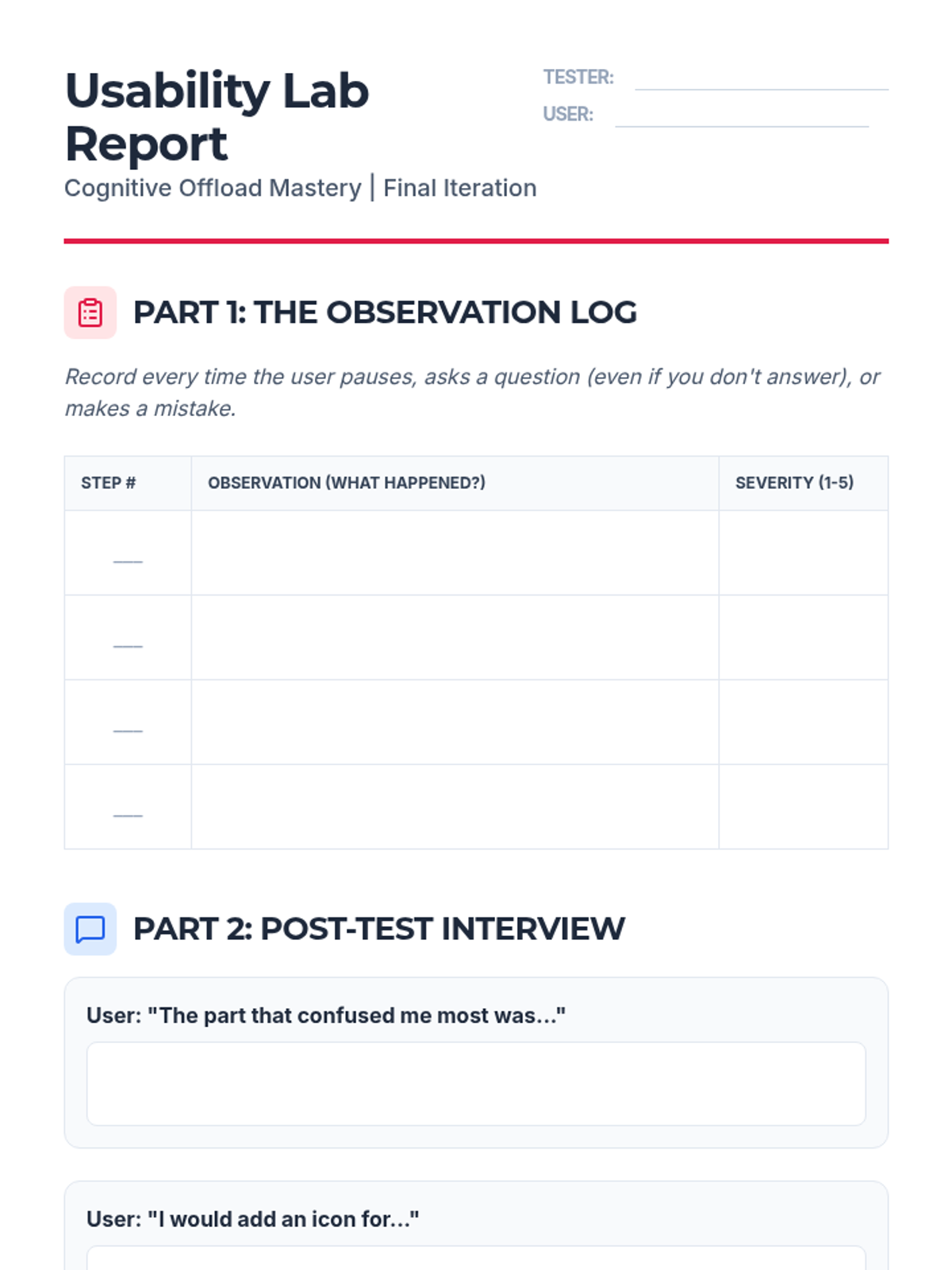
Worksheet for Lesson 5 where students record observations from usability testing and plan revisions for their final visual guides.
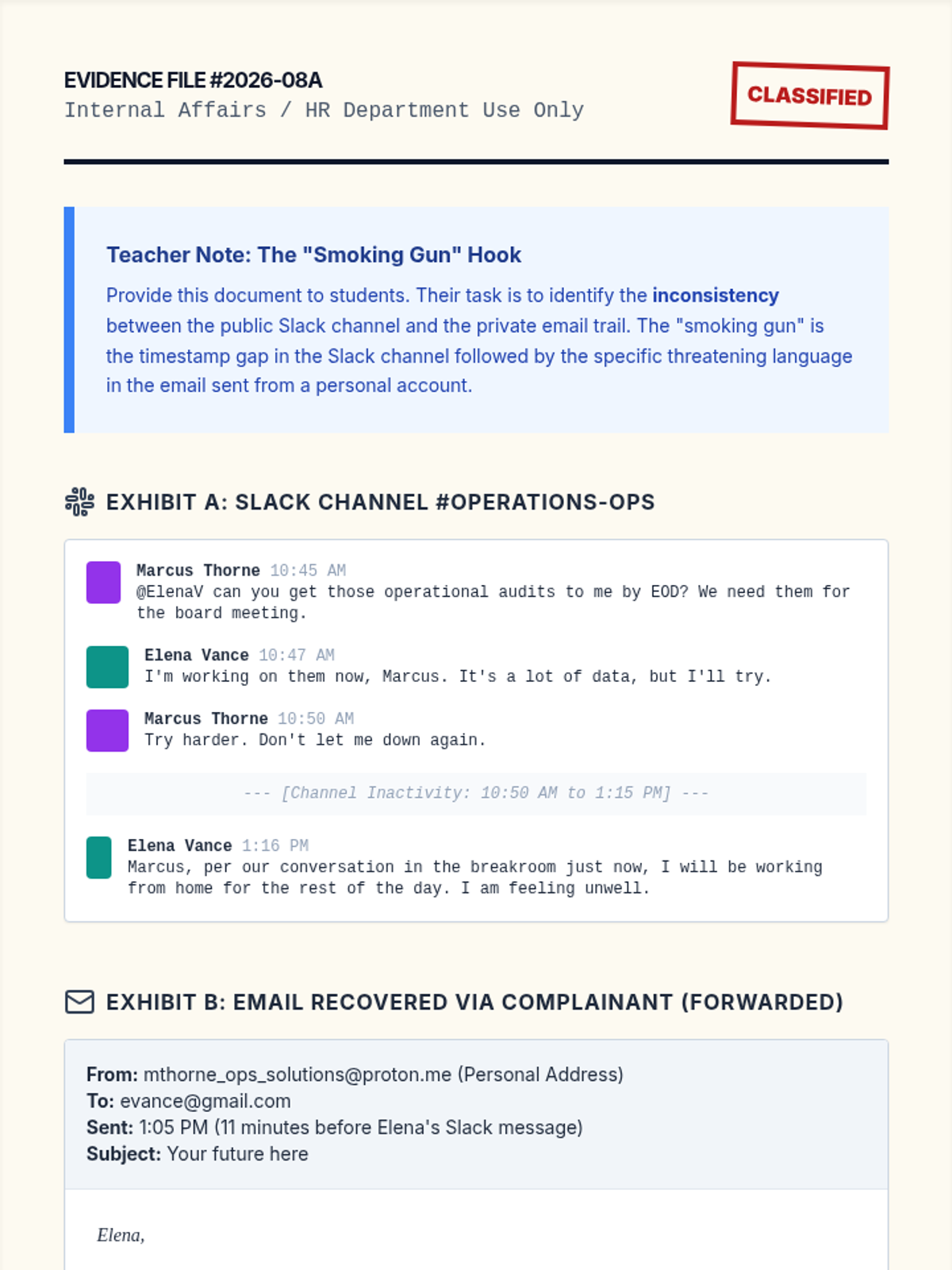
A mock case file containing Slack messages and emails designed for a graduate-level evidence analysis exercise. Students must identify inconsistencies and policy violations.
Lesson 5 slides focusing on usability testing, observation techniques, and the importance of iteration in instructional design.
Slide deck for Lesson 2 focusing on investigation planning, interview sequencing, and evidence preservation strategies.
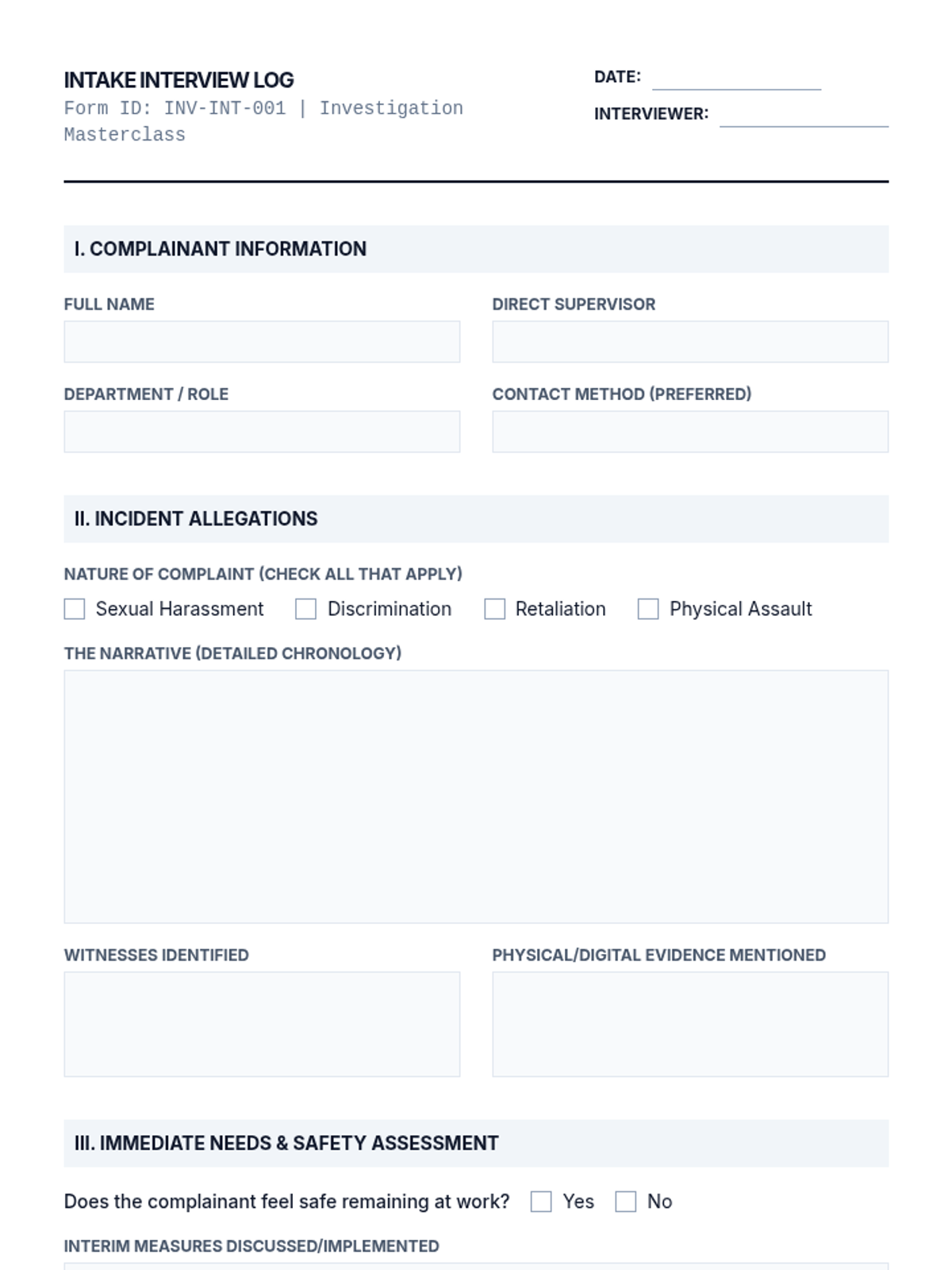
A formal intake log for students to use during Lesson 1 simulations to capture the details of a harassment complaint and assess the need for interim measures.
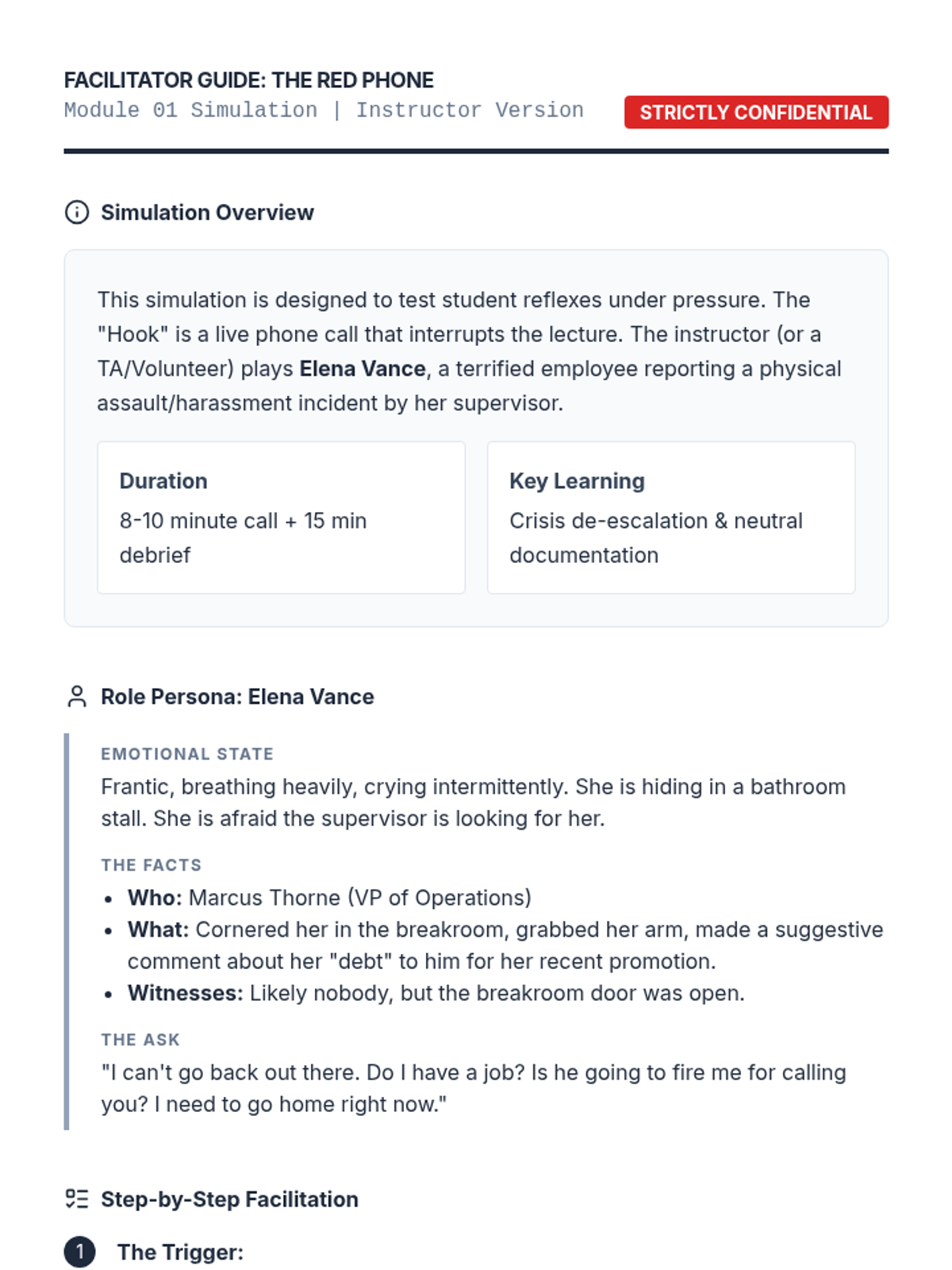
A teacher guide for Lesson 1 containing the setup and script for a high-stakes simulation where a student must handle a frantic complaint call live.
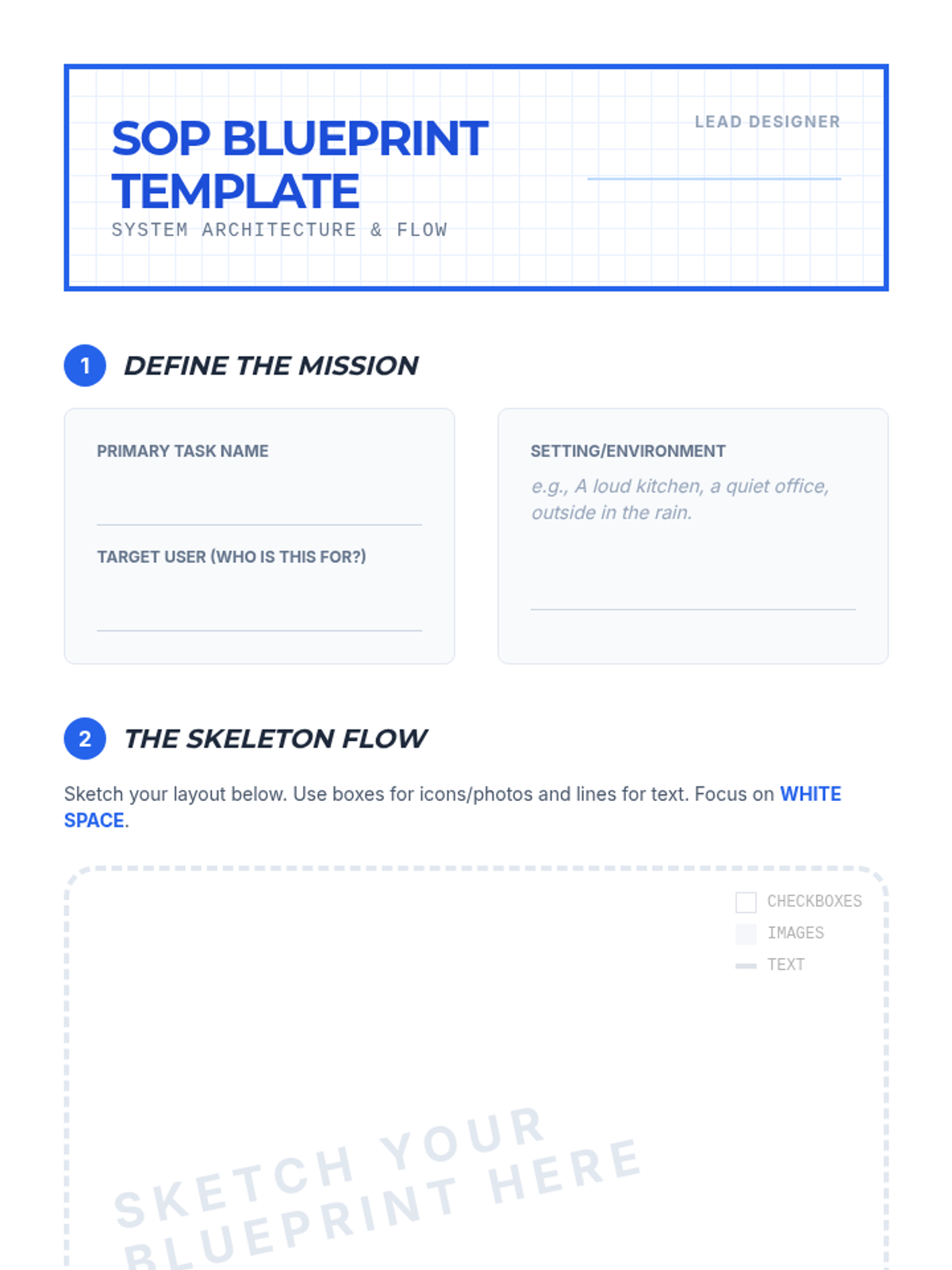
A drafting template for students to design the layout and flow of their visual checklist before creating the final version.
Introductory slide deck for Lesson 1 covering the critical window of complaint intake, the goals of an initial interview, and the decision-making process for interim measures.
Lesson 4 slides focusing on instructional design principles like white space, sequential logic, and the minimalist design of high-stakes checklists.
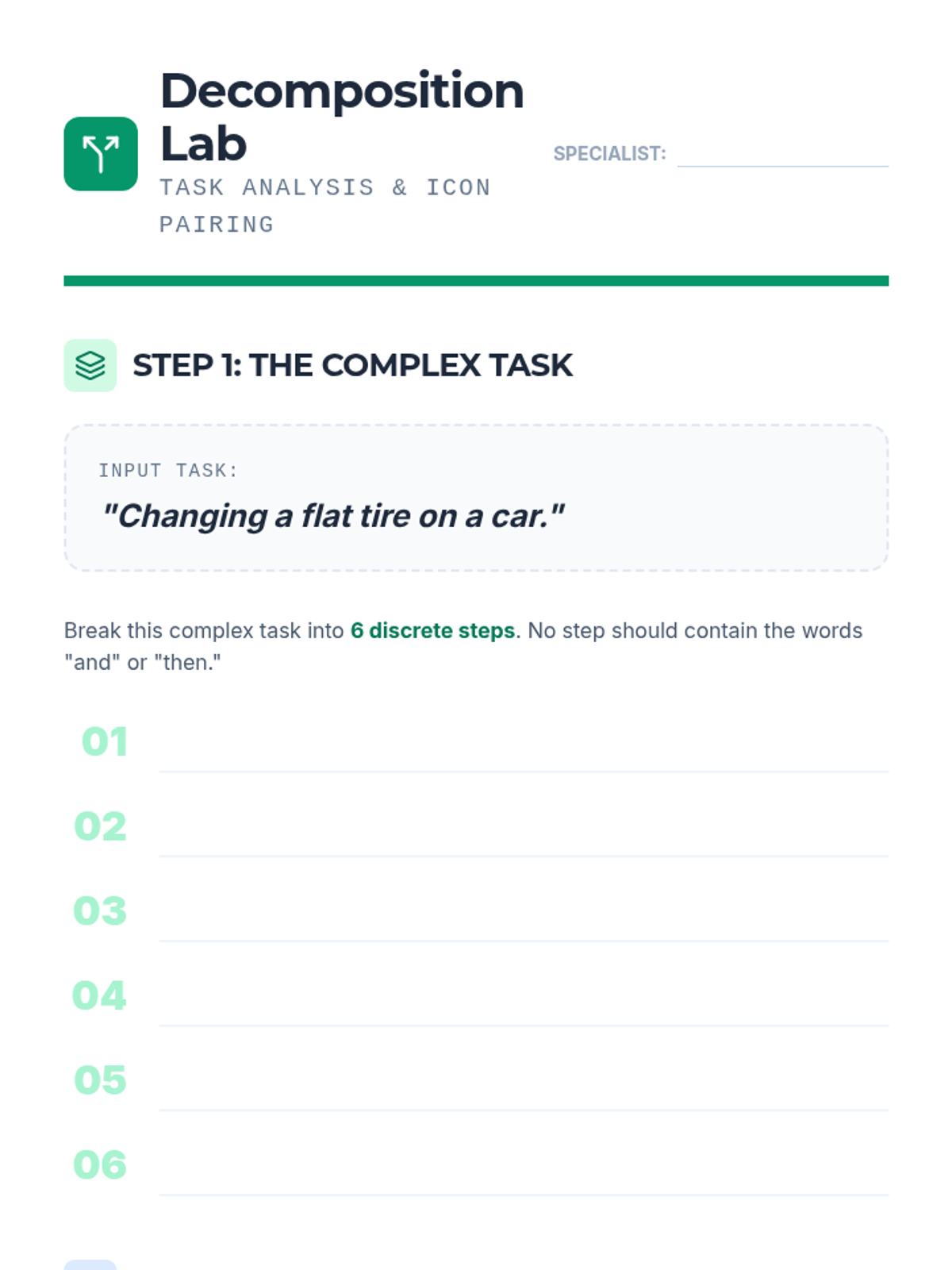
Worksheet for Lesson 3 where students practice breaking down a complex task (changing a tire) and matching instructions with universal icons.