Budgeting, saving, and investment strategies alongside practical skills for managing credit, taxes, and banking. Addresses insurance needs, employment income, and major purchase decisions to support comprehensive long-term financial planning.
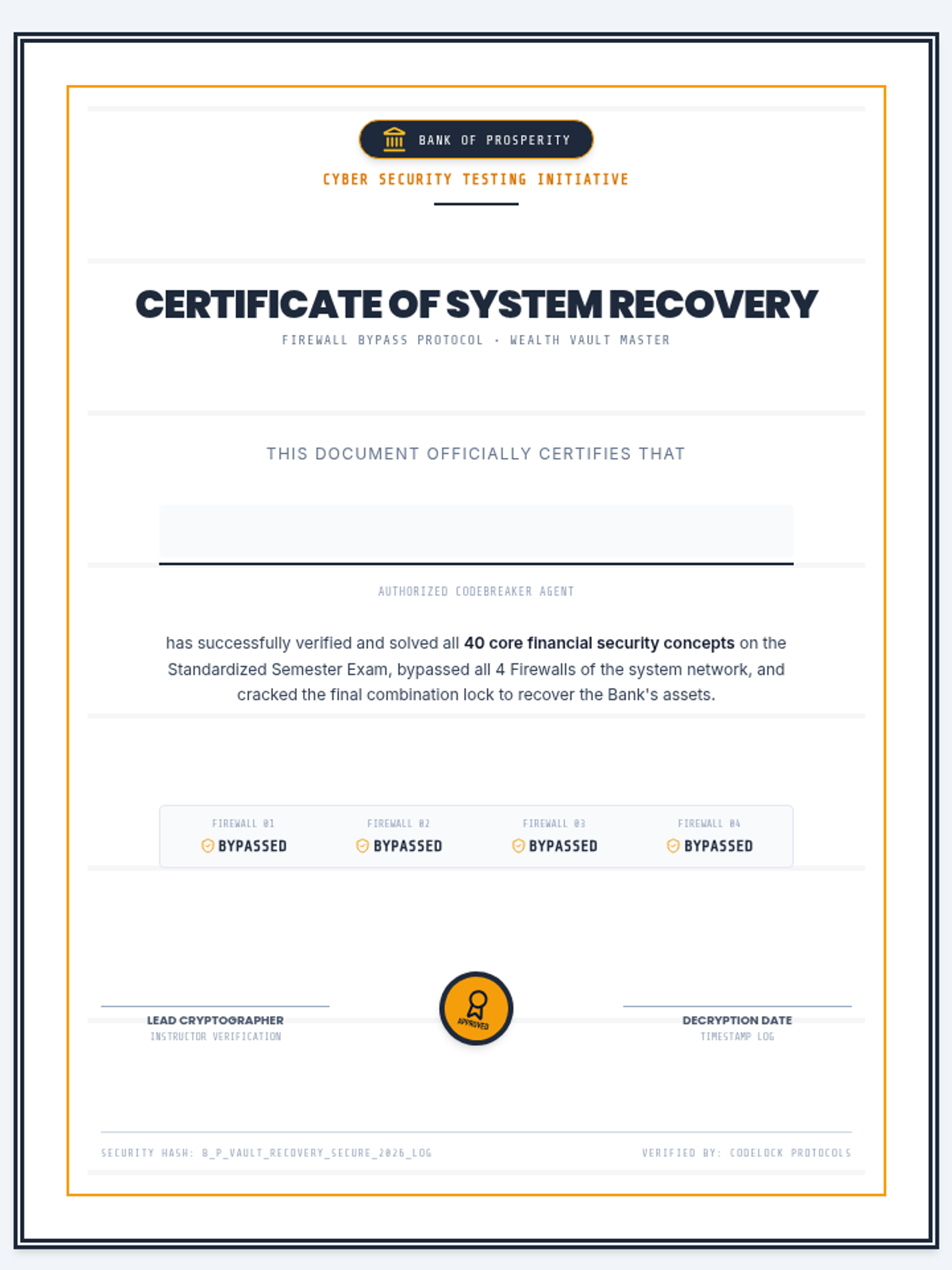
A highly rewarding, portrait-oriented certificate of completion for students who successfully bypass all 4 firewalls of the Bank of Prosperity Escape Room. Designed with a technical security aesthetic, gold accents, validation checks, and signature blanks.
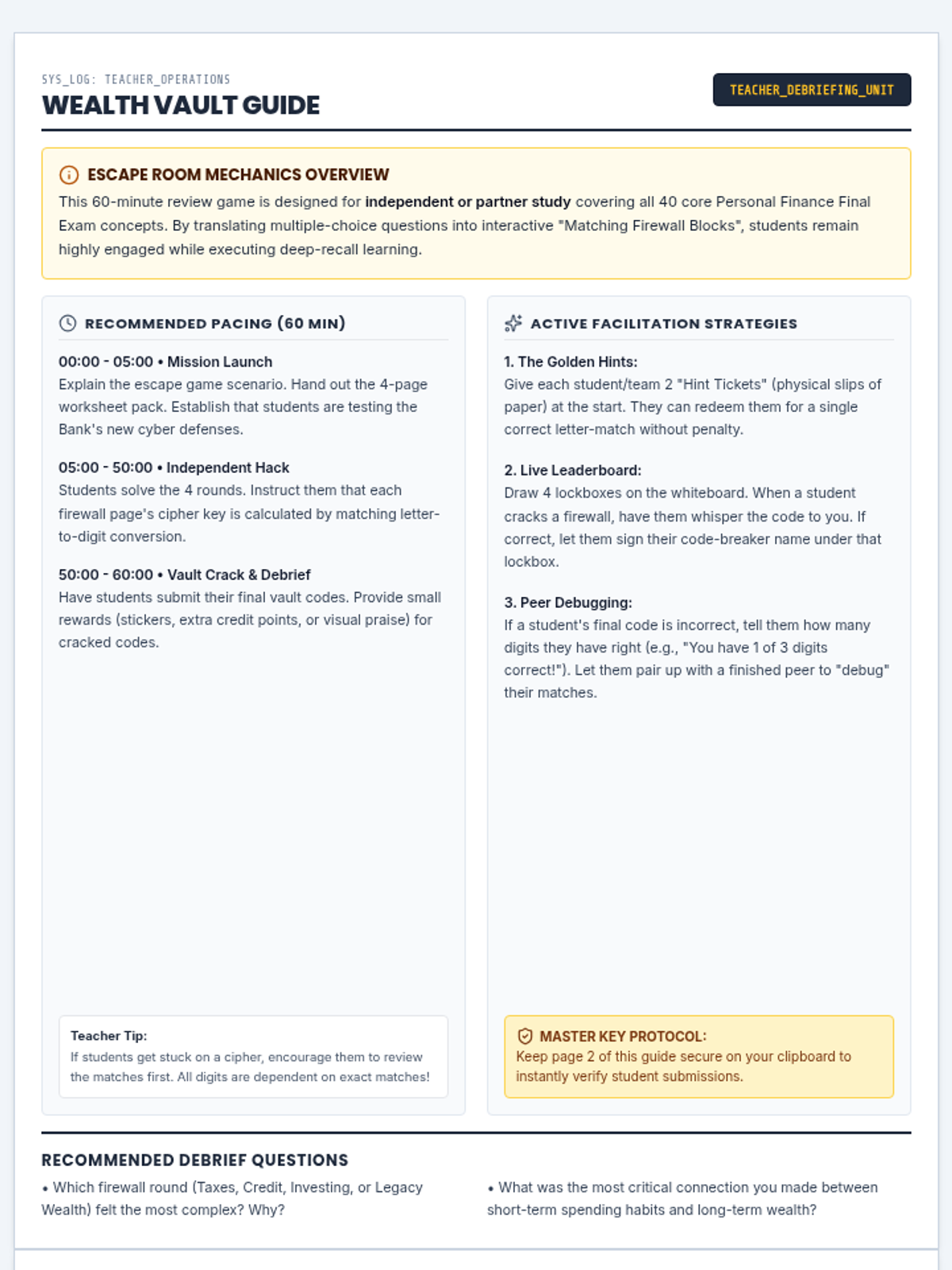
An elegant, 2-page Teacher Guide and Facilitation Master Key for the Wealth Vault Escape review game. Includes facilitation timelines, active gamification strategies, complete matching letter keys, and verified 3-digit combination tumbler codes for each firewall.
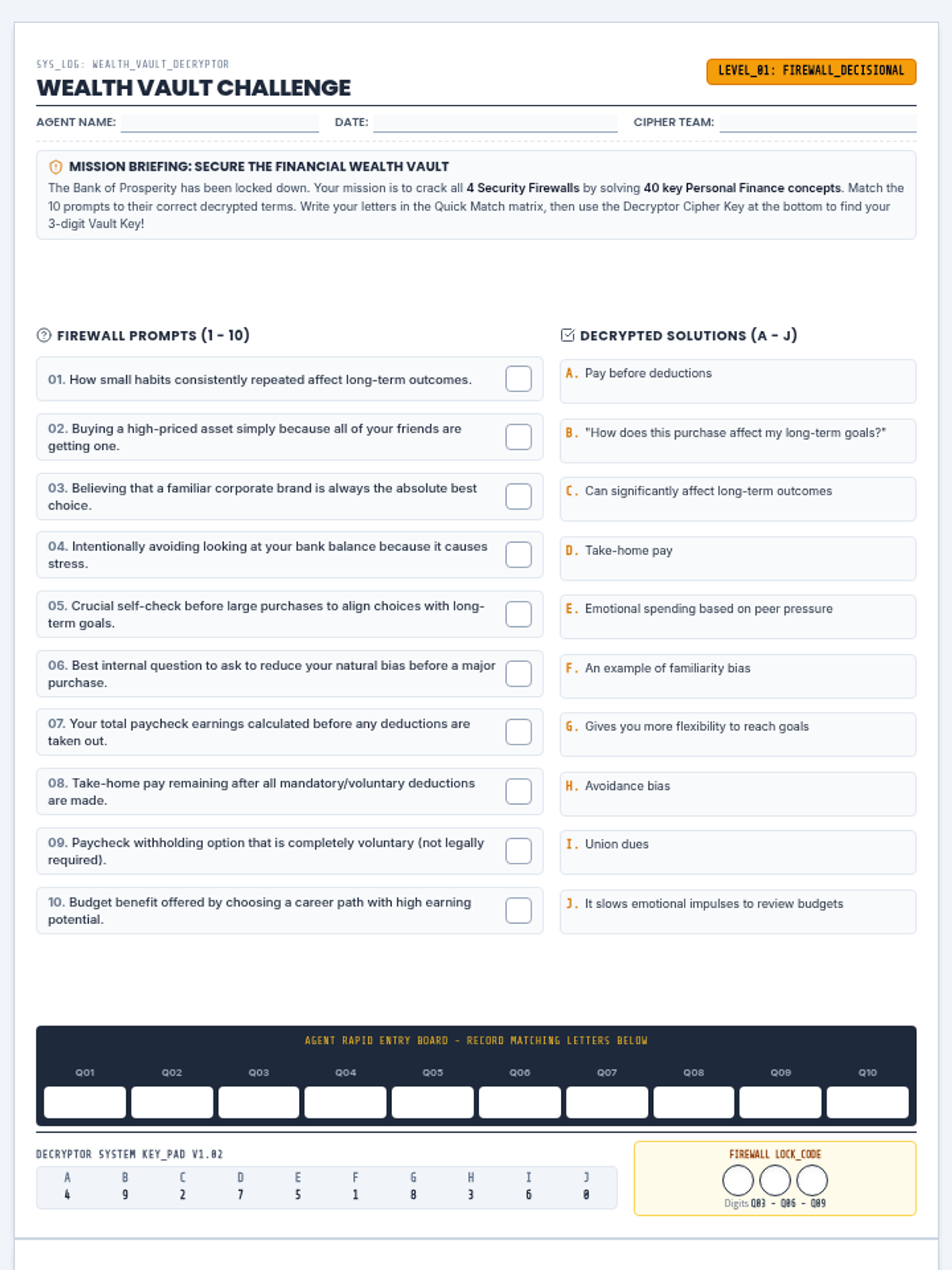
An immersive, 4-page escape room worksheet pack covering all 40 questions from the Personal Finance Final Exam. Students solve 4 thematic matching firewall rounds independently, decrypting letter choices to form numerical combinations to crack the final vault code.
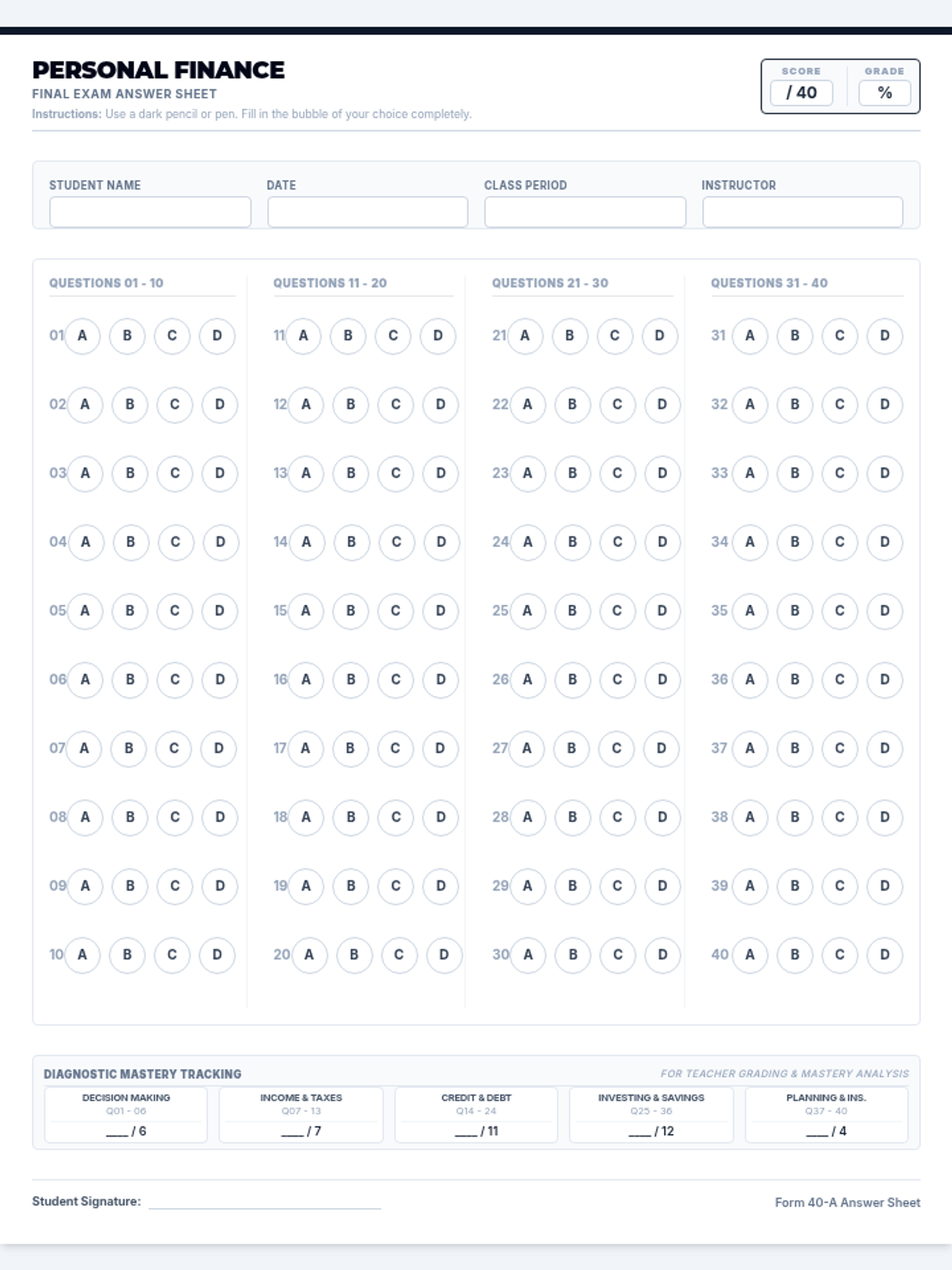
A professional, single-page bubble answer sheet designed to accompany the Personal Finance final exam booklet. Includes student information fields, teacher grading box, 40-question Scantron grid, standard-based diagnostic tracking section, and a student signature line.
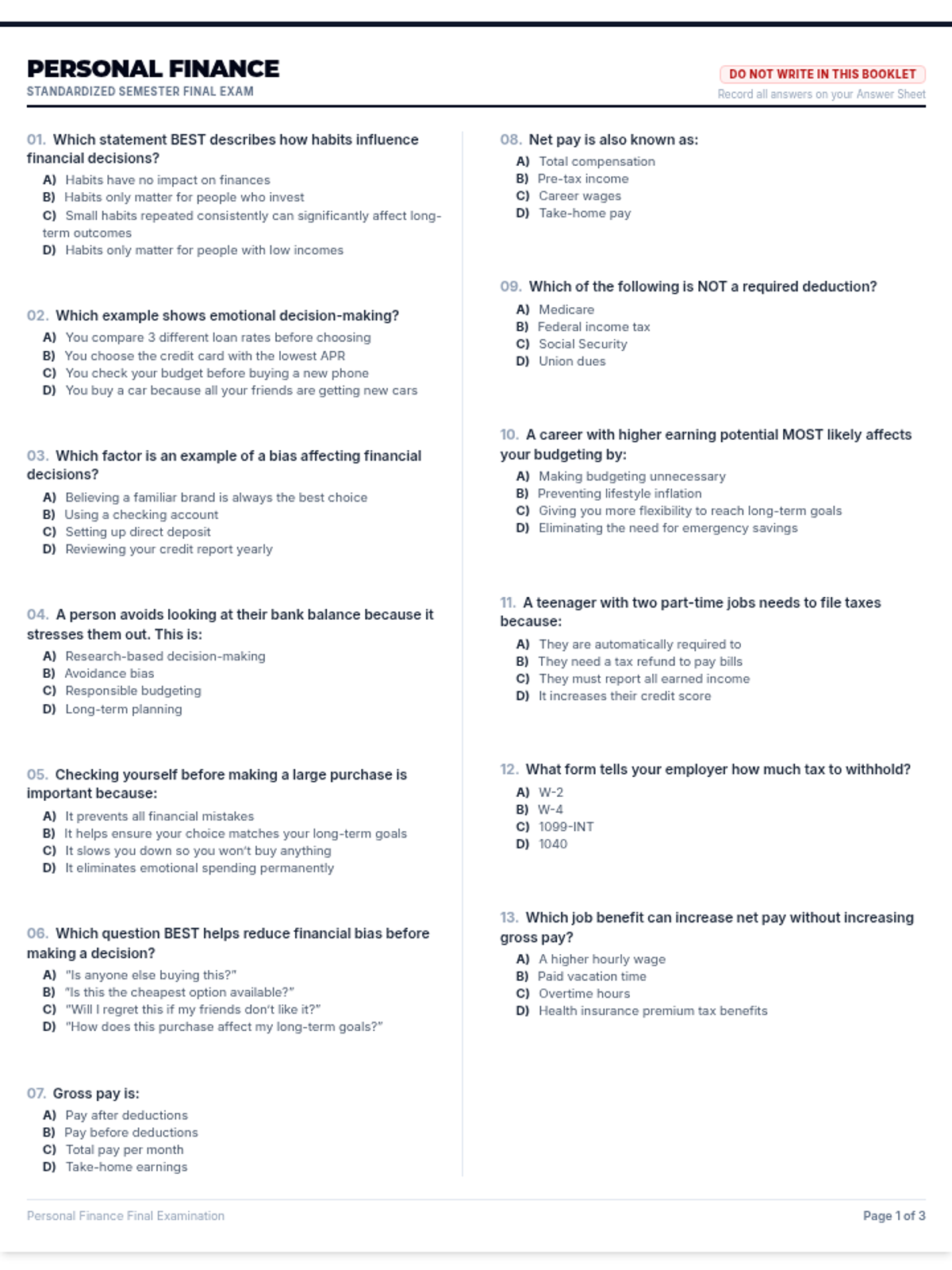
A highly compact, print-optimized 3-page final exam booklet for Personal Finance containing all 40 questions in a clean, two-column grid. Designed for reusability in testing centers to drastically save paper.
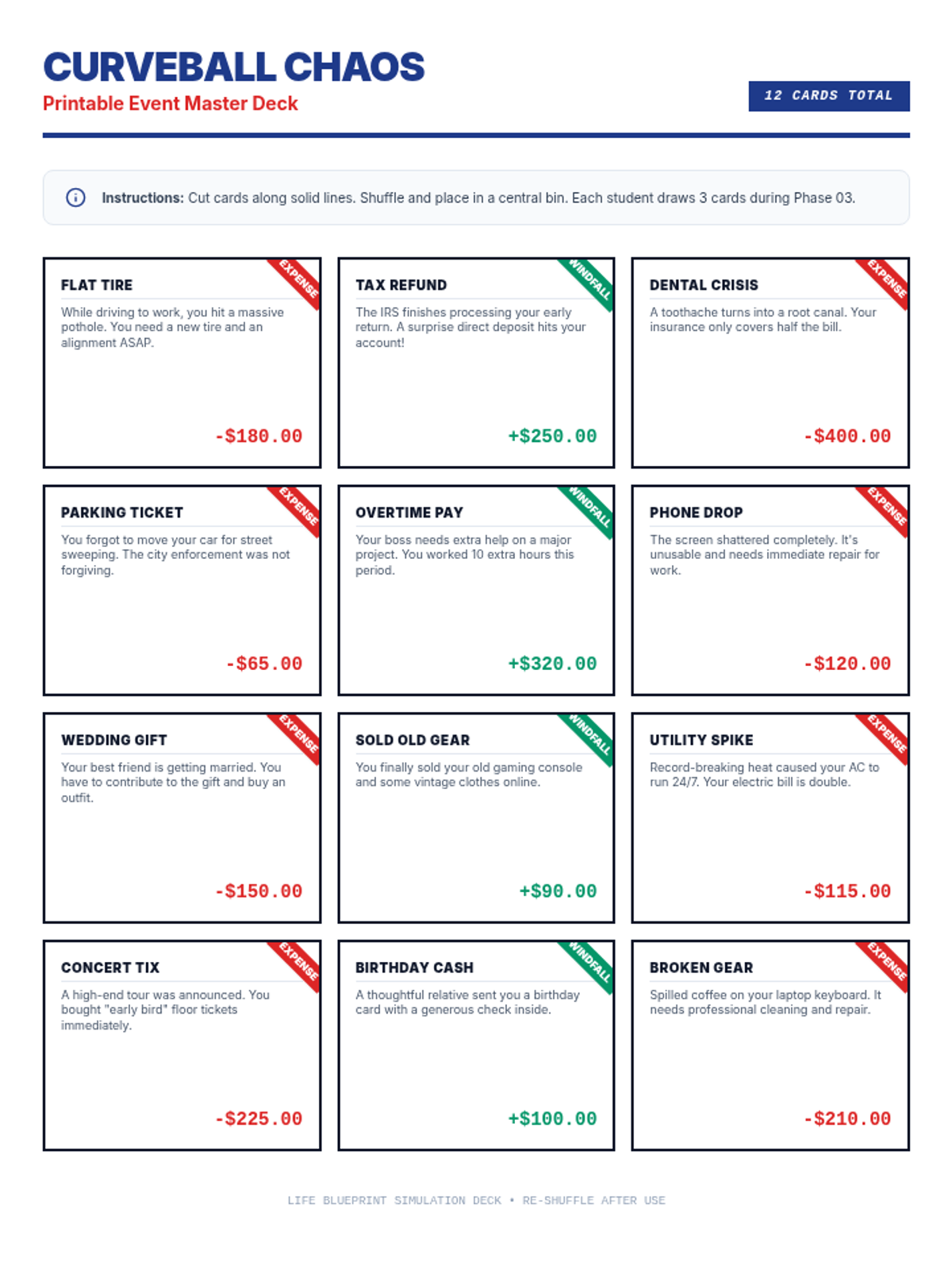
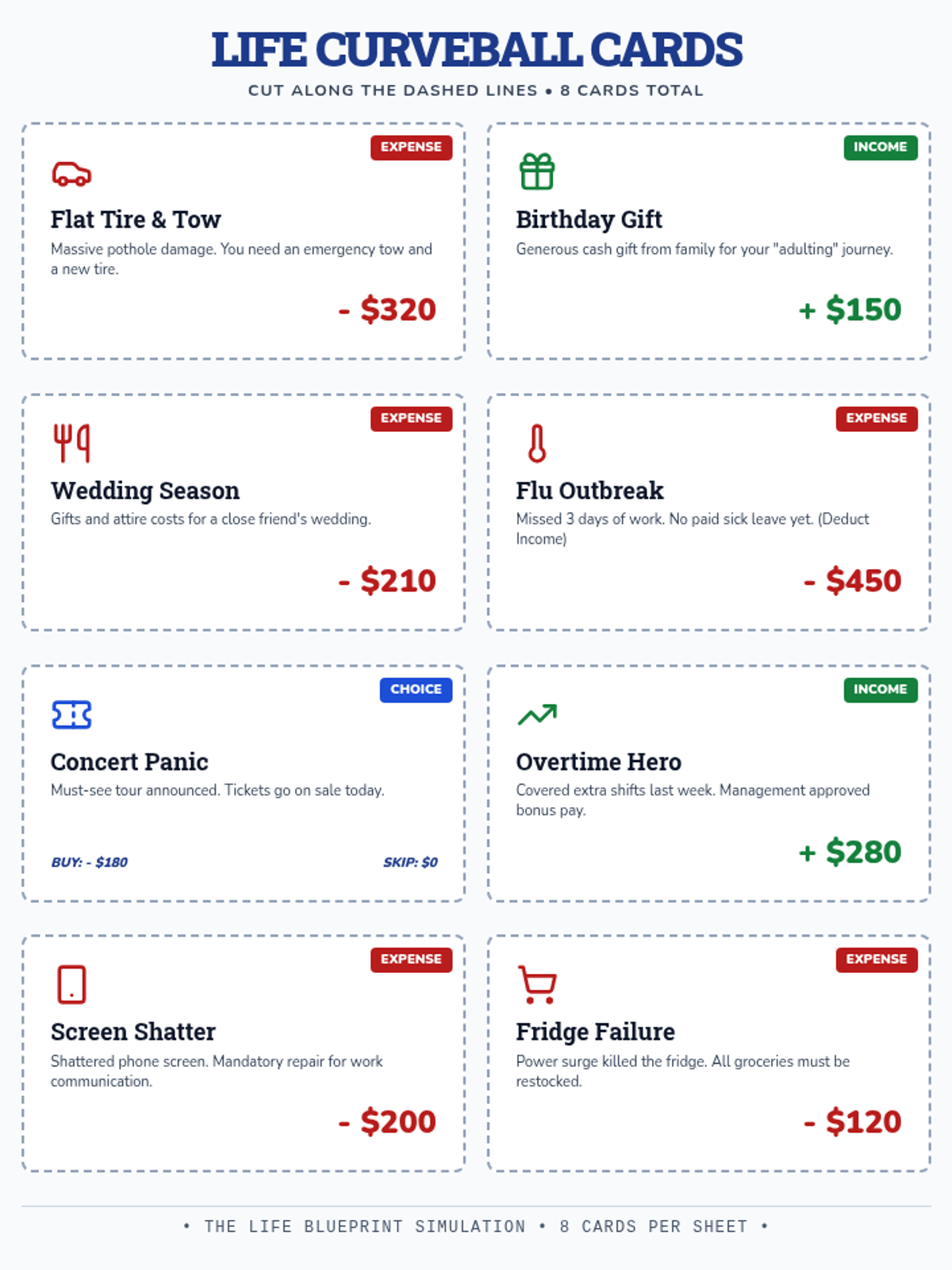
A set of printable "Curveball" and "Windfall" cards for the Life Blueprint simulation game. These cards represent the unpredictable financial events students must manage to complete their month.
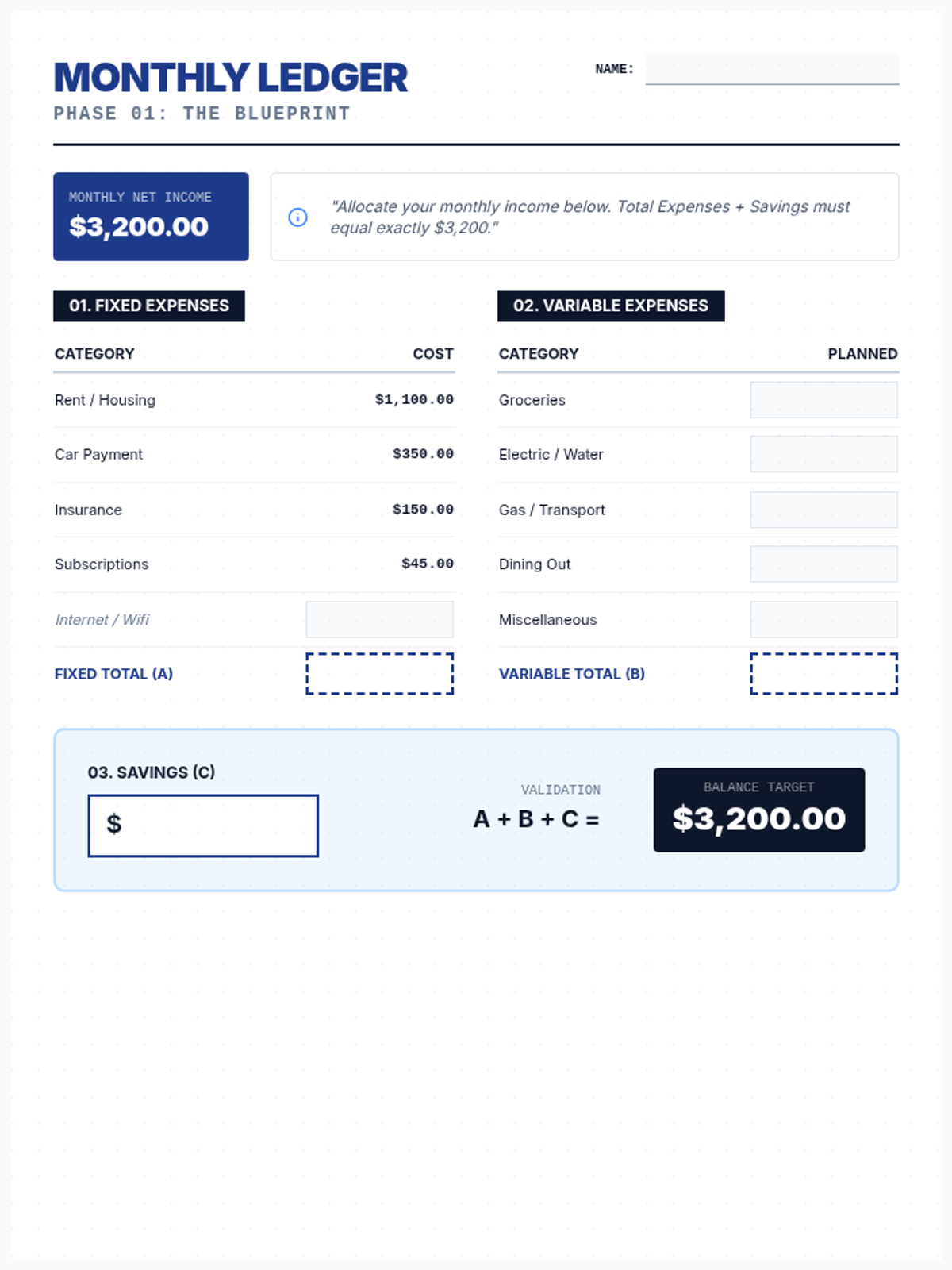
A two-page student ledger for the Life Blueprint project. Page 1 facilitates initial budget planning for a $3,200 net income, while Page 2 provides a structured space for reconciling the financial impact of "Curveball" events.
An engaging slide deck designed for high school seniors to introduce the concepts of fixed and variable expenses, the 50/30/20 budgeting rule, and the mechanics of the Life Blueprint simulation.
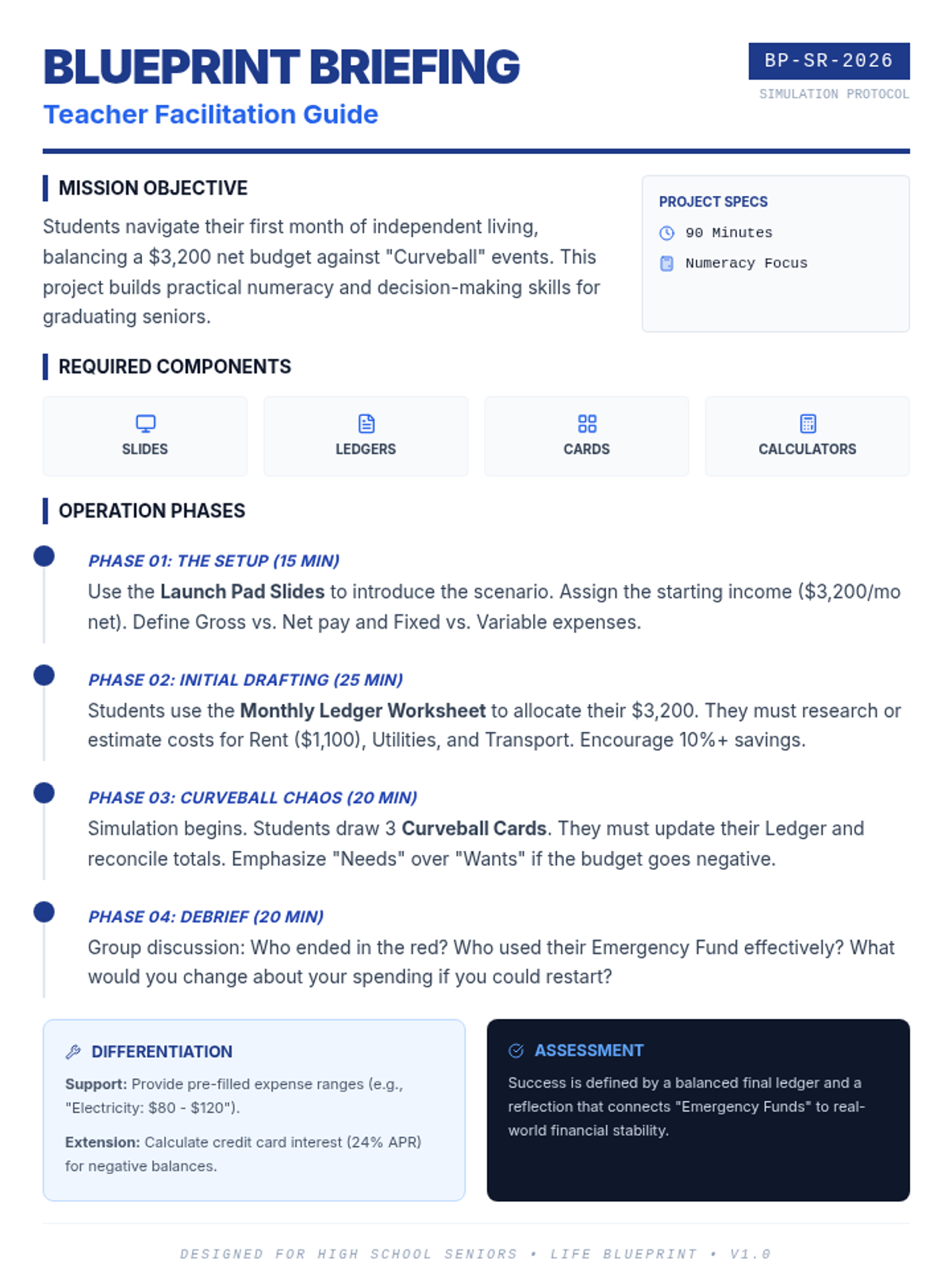
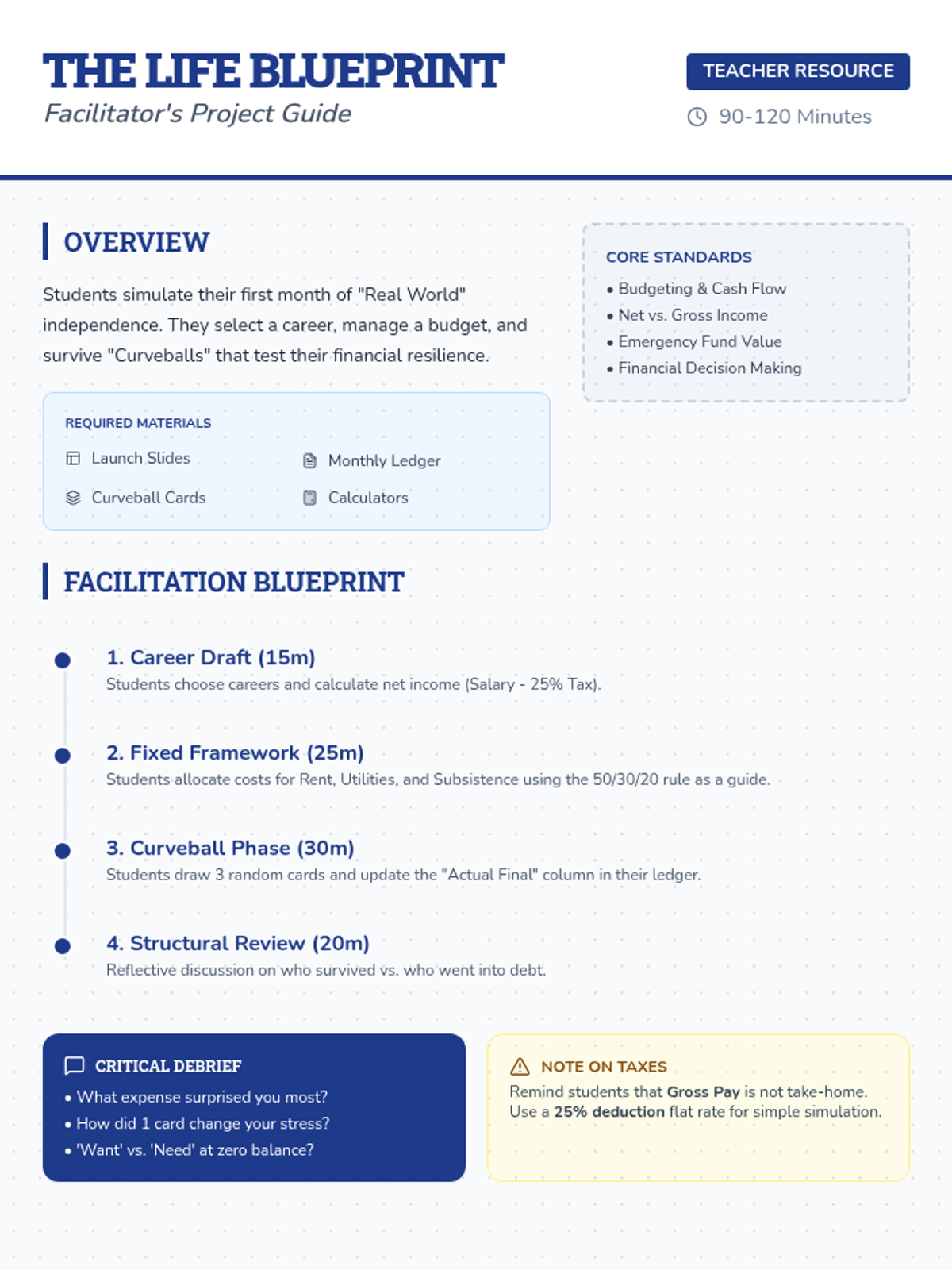
A comprehensive teacher facilitation guide for the Life Blueprint project, outlining the 90-minute simulation phases, materials needed, and differentiation strategies.
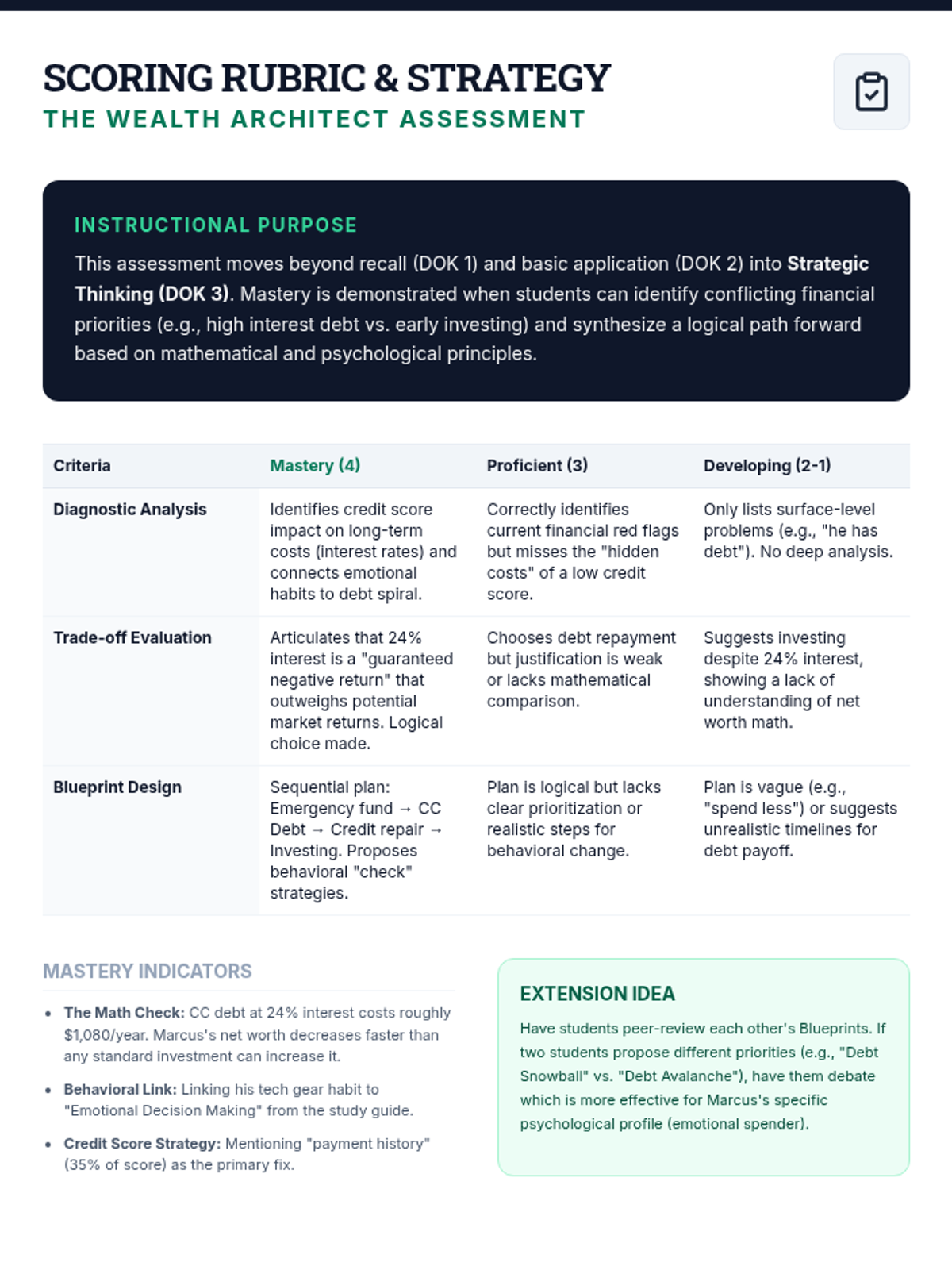
Teacher scoring guide and instructional strategy for the Wealth Architect performance assessment. Includes a DOK 3 rubric, mastery indicators, and a mathematical strategy key.
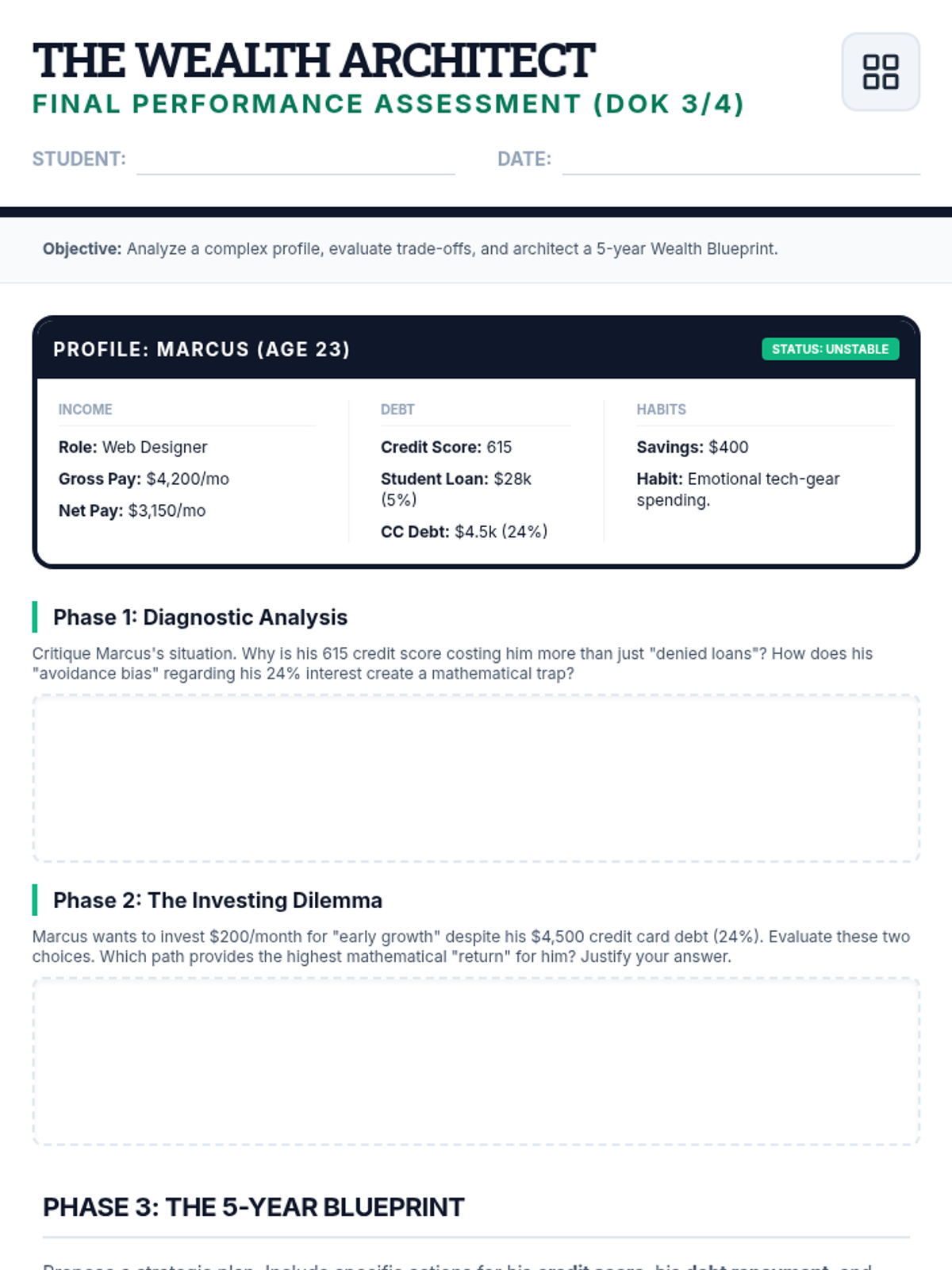
A high-DOK performance assessment for Personal Finance. Students act as a 'Wealth Architect' to analyze a complex financial case study, evaluate trade-offs between debt and investing, and design a strategic 5-year financial blueprint.
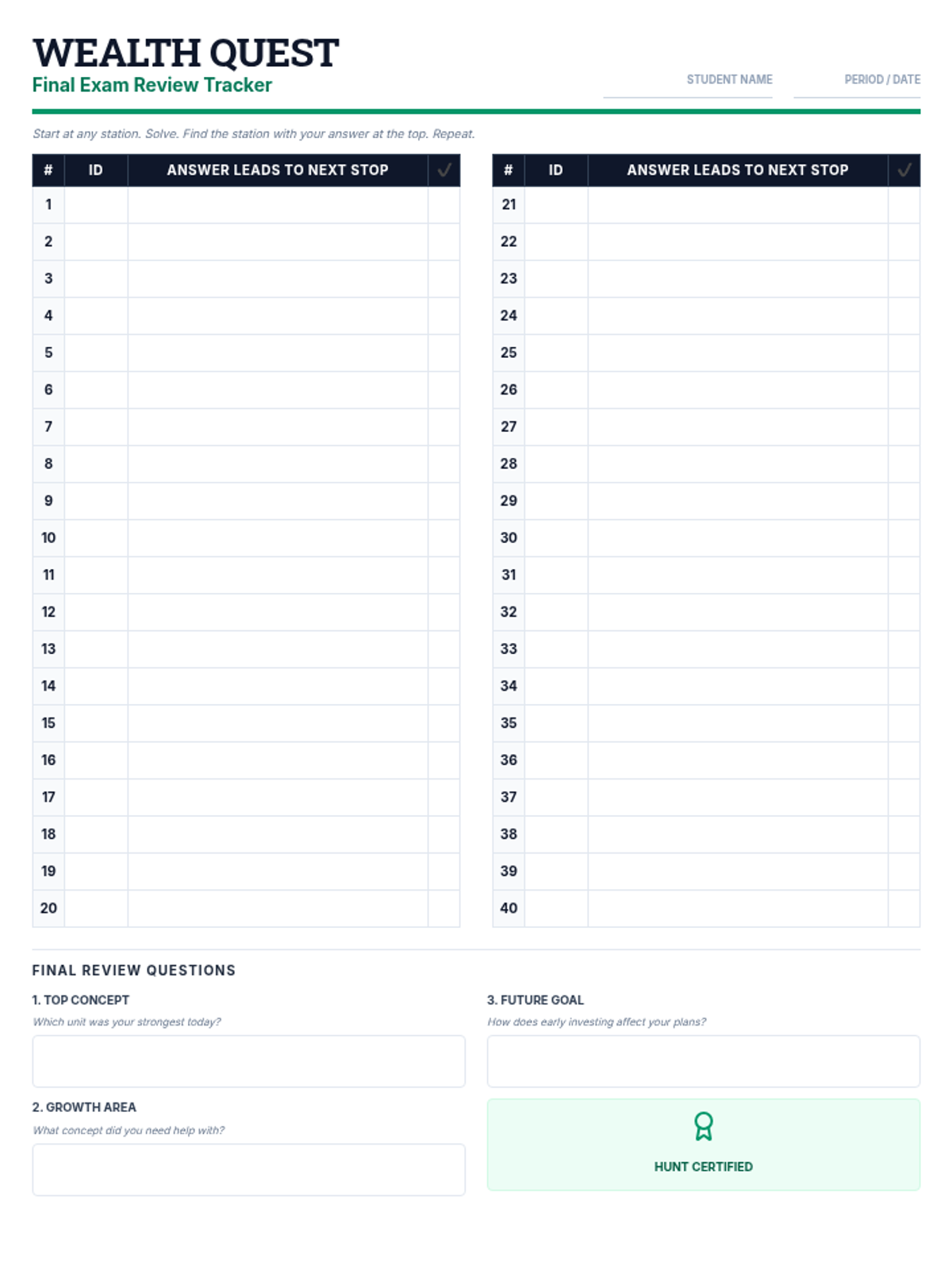
Student response sheet for the Wealth Quest scavenger hunt. Includes a 40-row tracking table for recording station sequences and answers, along with reflection questions to solidify learning.
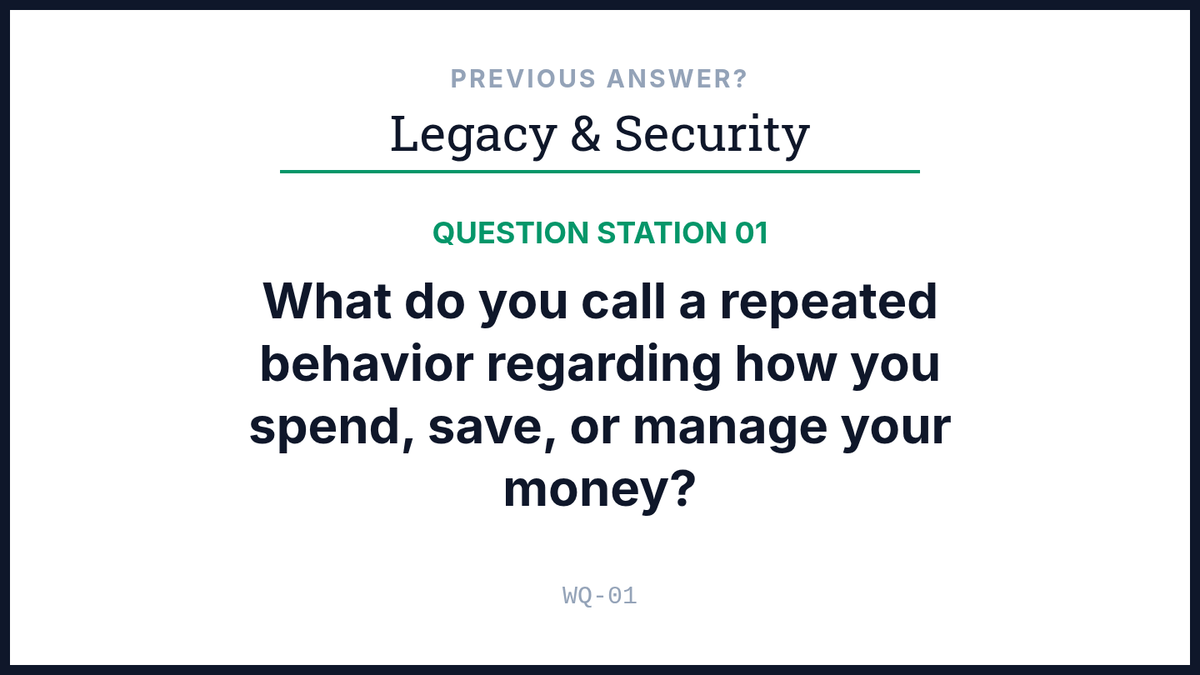
A printer-friendly set of 40 visually distinct scavenger hunt stations. Each features a bold 'Header Answer' to link the loop and a central review question based on the Personal Finance study guide, optimized for high visibility and ink efficiency.
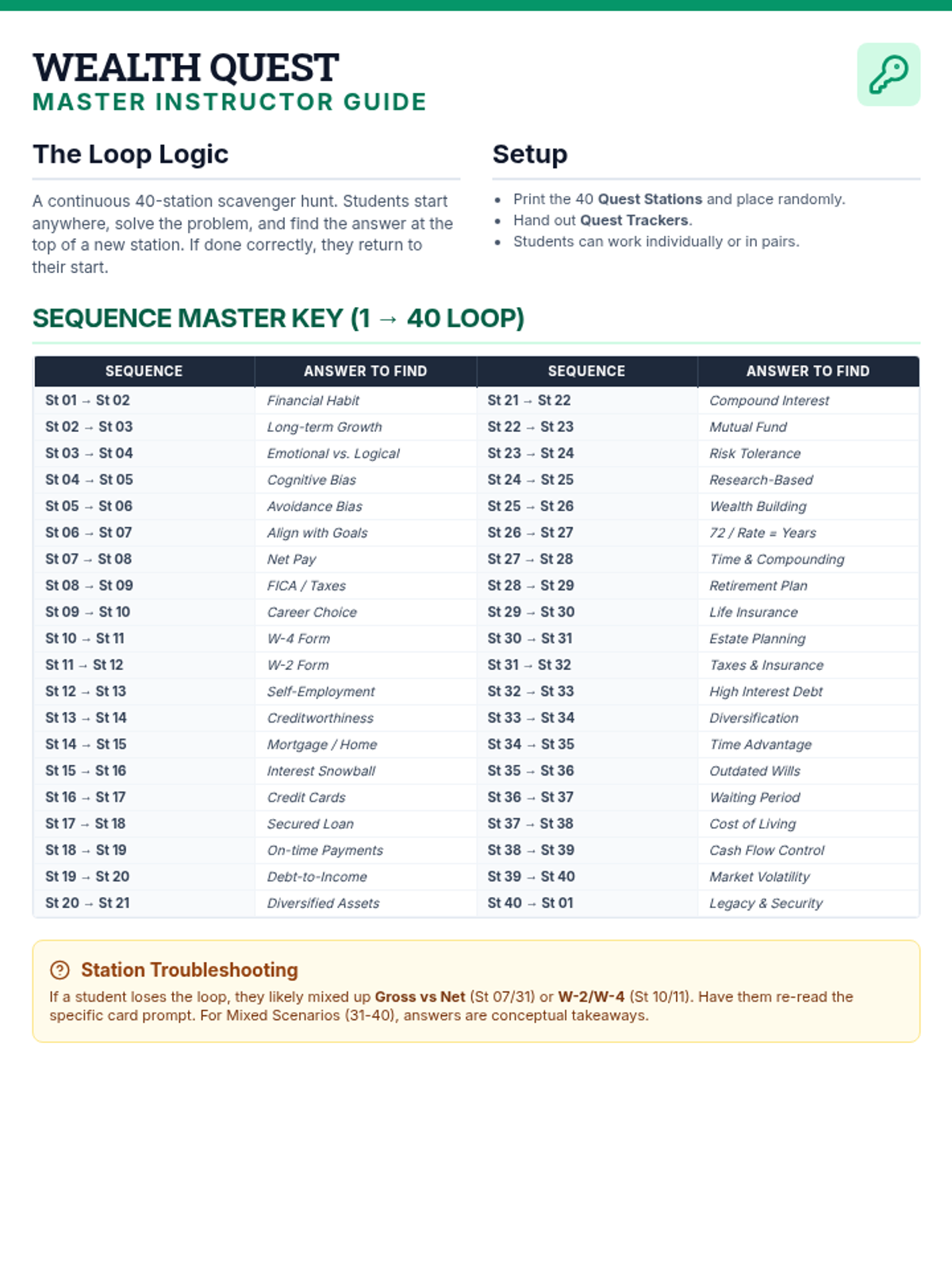
Comprehensive teacher guide for the Wealth Quest scavenger hunt, including instructions for setup and a complete answer sequence key for all 40 review stations.
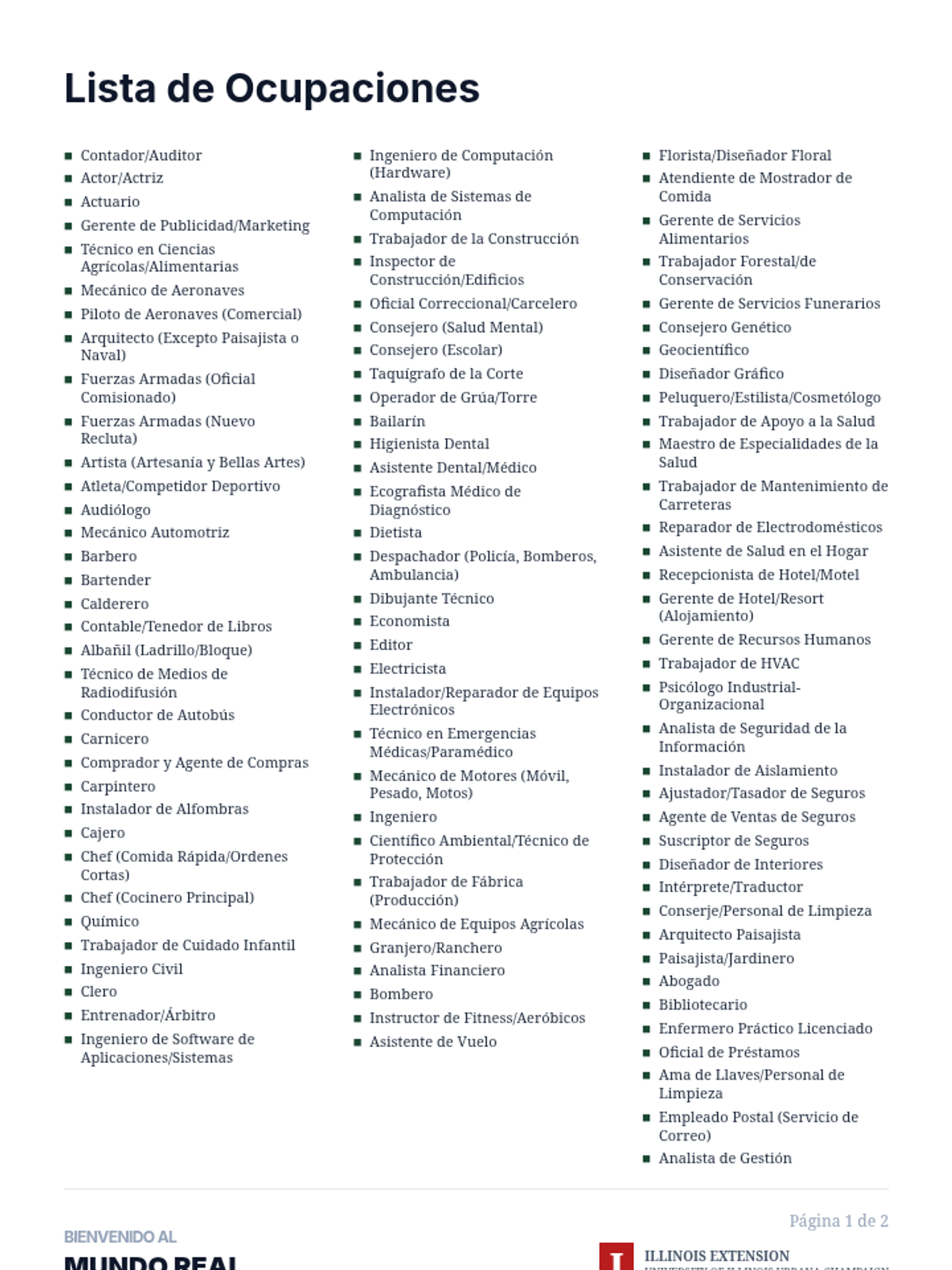
A two-page Spanish translation of the 'Occupation List' for the real-world financial simulation. It features a comprehensive list of over 100 job titles across multiple categories, presented in a clean, multi-column reference format.
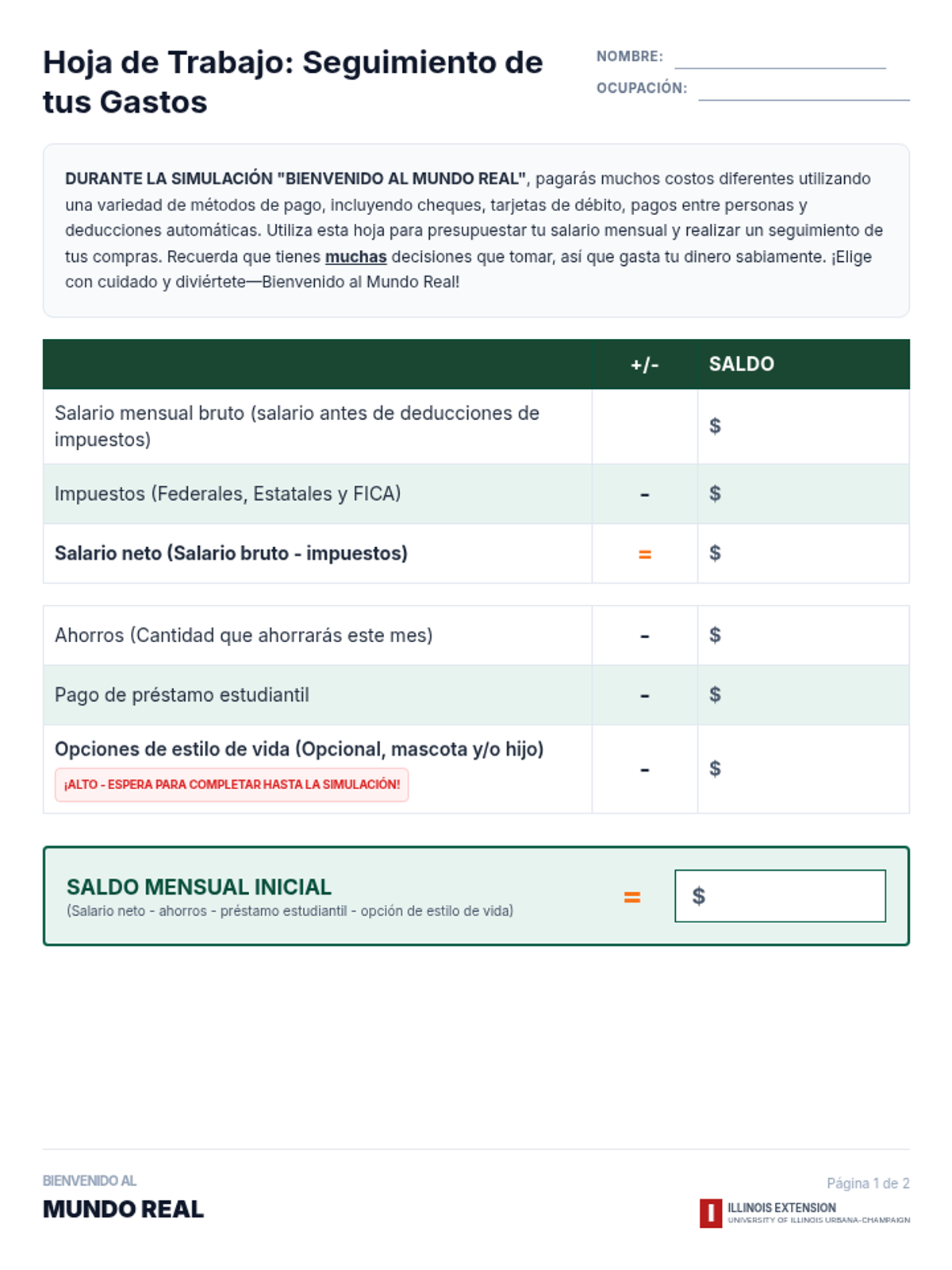
A two-page Spanish translation of the 'Tracking Your Expenses' worksheet, designed for a real-world financial simulation. It includes detailed sections for budgeting gross and net salary, tracking savings, and managing transactional expenses across various categories like housing and utilities.
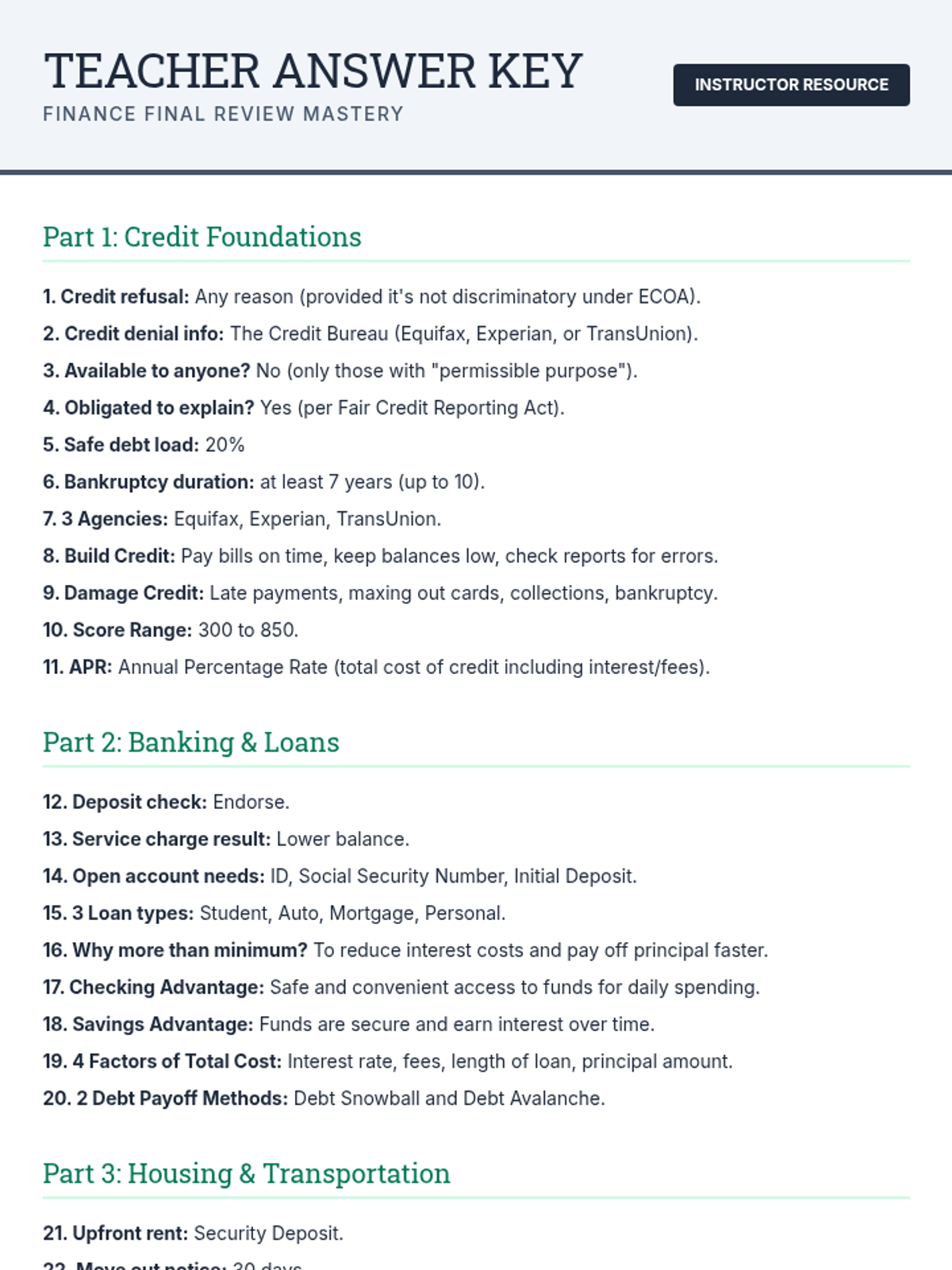
The comprehensive teacher answer key for the Personal Finance Final Review, providing detailed responses for all worksheet items.
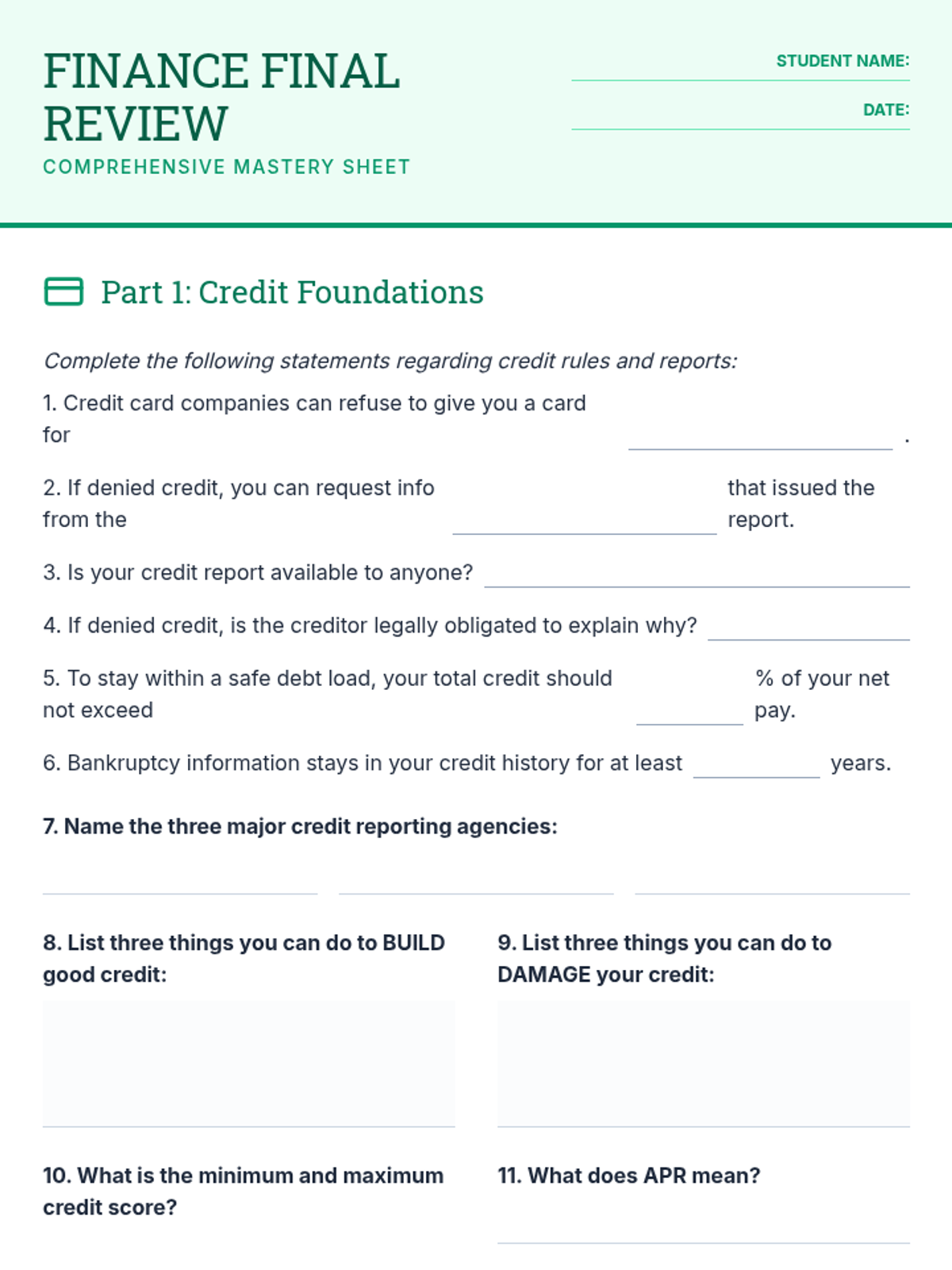
A comprehensive fill-in-the-blank and short-answer review worksheet covering all major topics from the Personal Finance final.
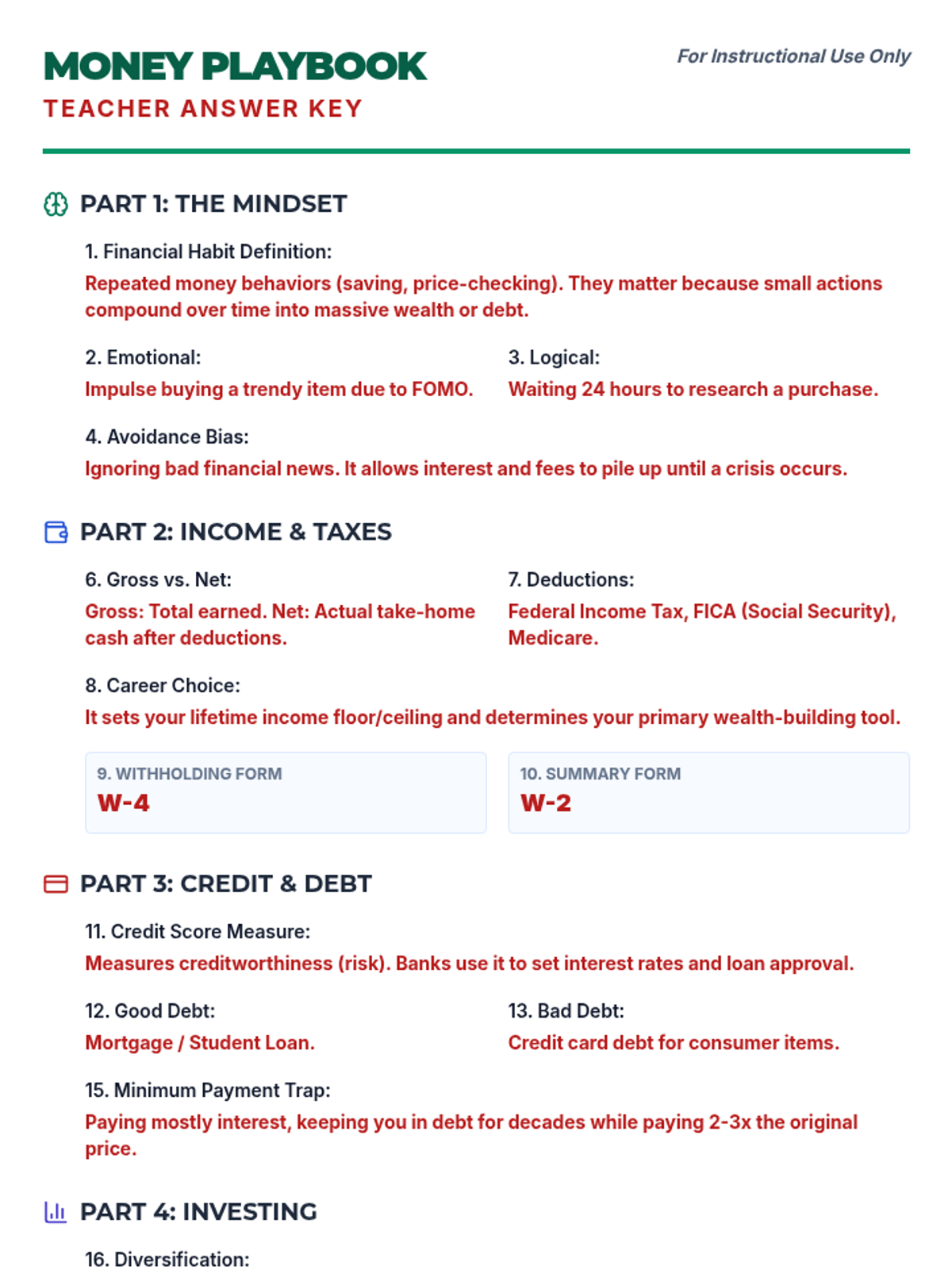
A detailed answer key for the Money Playbook Study Guide, featuring model responses and instructional notes for each question and scenario to assist with grading and review sessions.
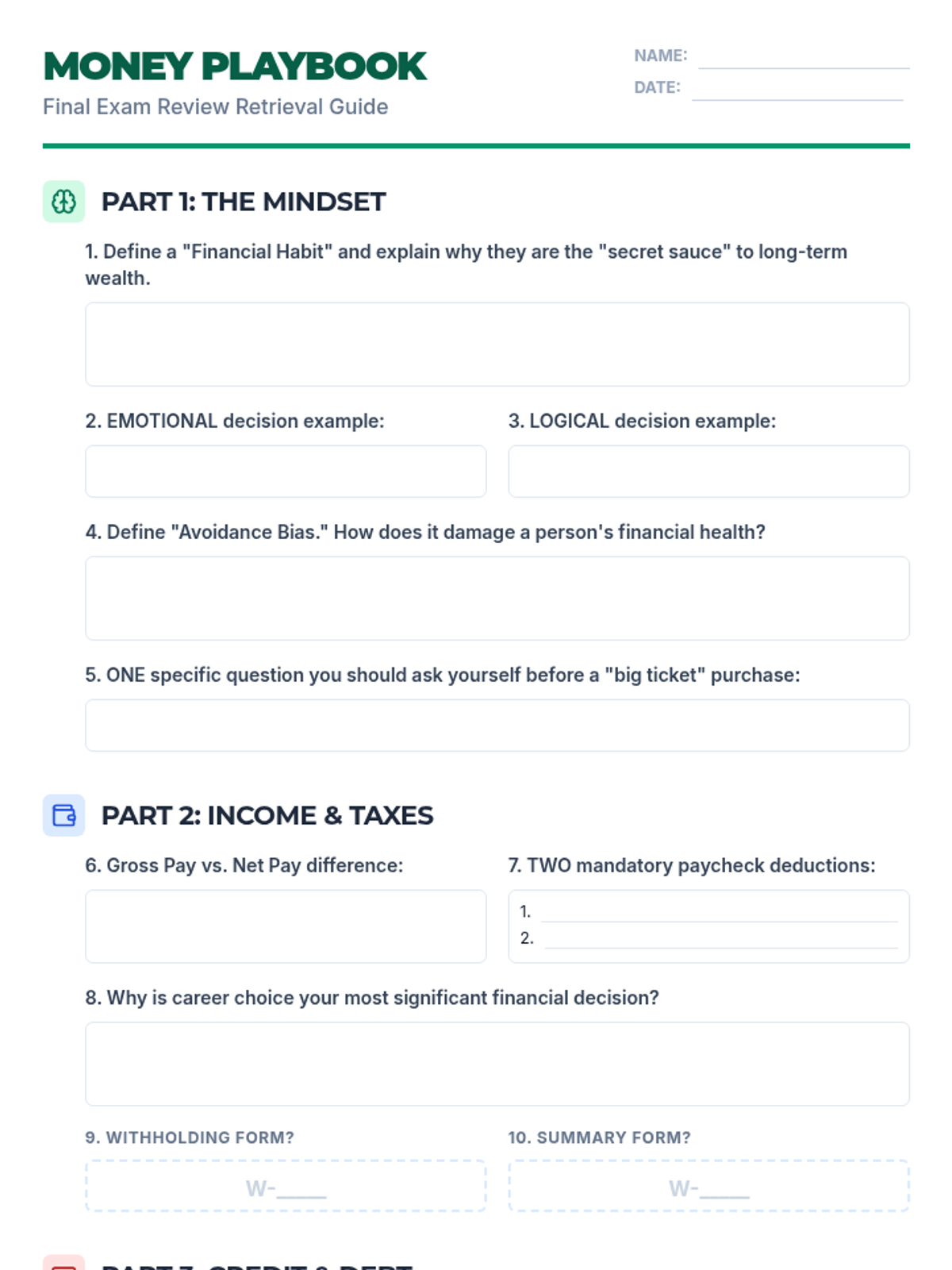
A comprehensive 3-page printable study guide designed for Personal Finance students. It features organized retrieval practice across five key units and three scenario-based analysis problems to prepare for the final exam.
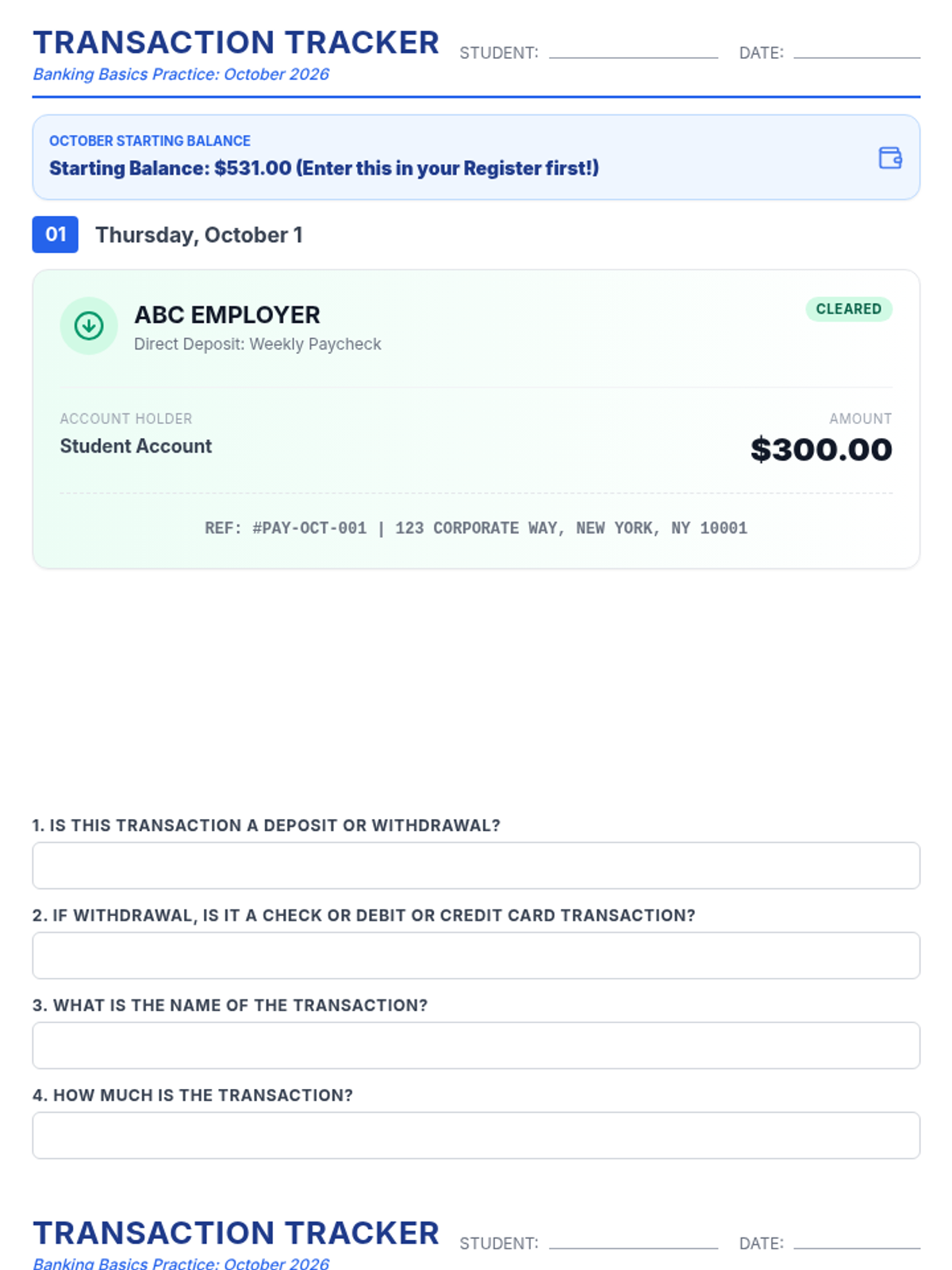
Student transaction tracker worksheets featuring 21 daily financial records (receipts, bills, deposits, and ATM slips) for October 2026. Includes fields for students to record transaction types, payment methods, and exact amounts, with enhanced large check addresses for easier reading.
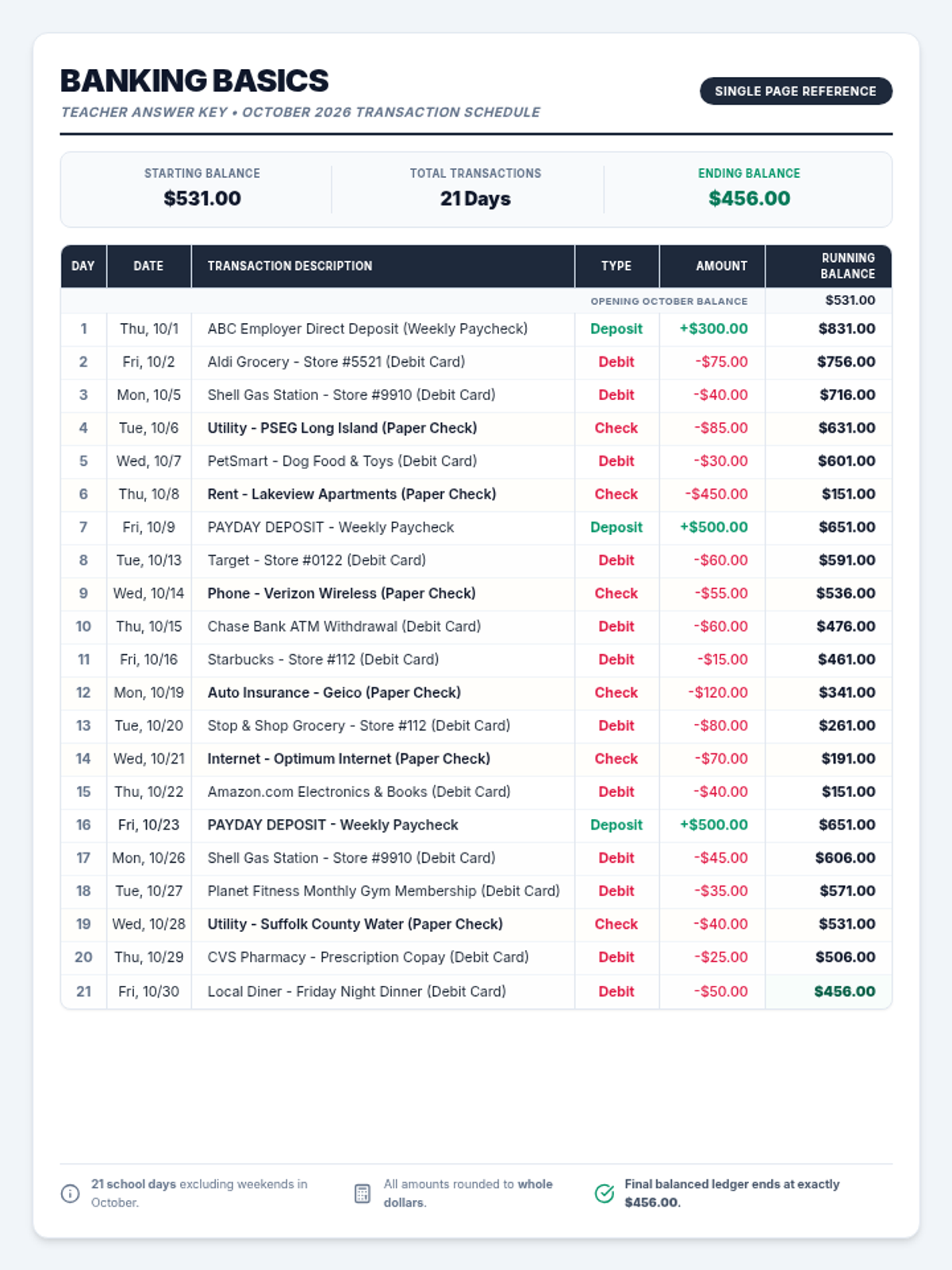
Teacher transaction schedule showing starting and ending balances, list of 21 days of transactions (deposits, checks, debits) for October 2026. Ideal for quick grading and instruction.
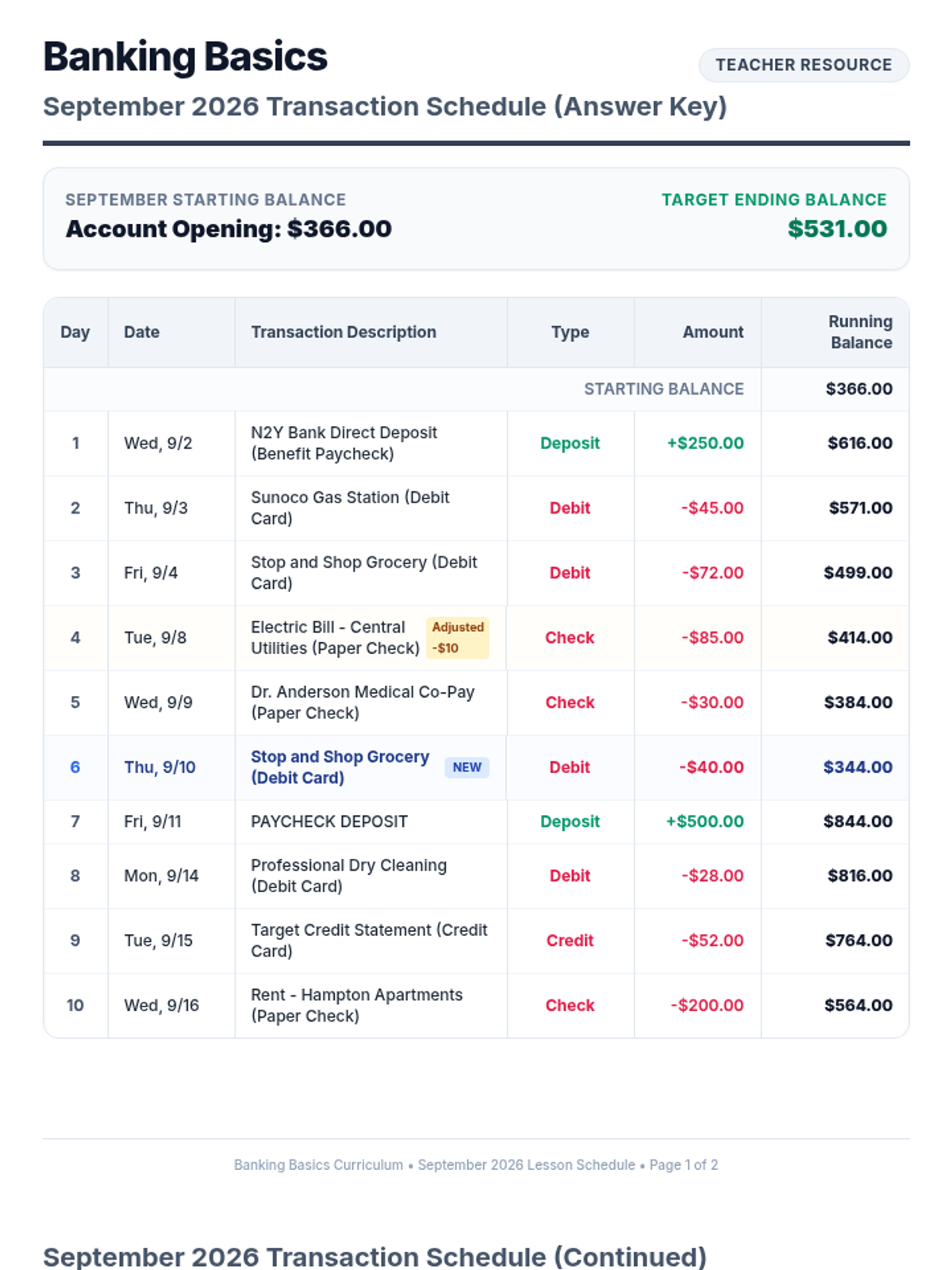
Teacher transaction schedule showing starting and ending balances, list of 19 days of transactions (deposits, checks, debits, credit cards), and curriculum features. Ideal for quick grading and instruction.
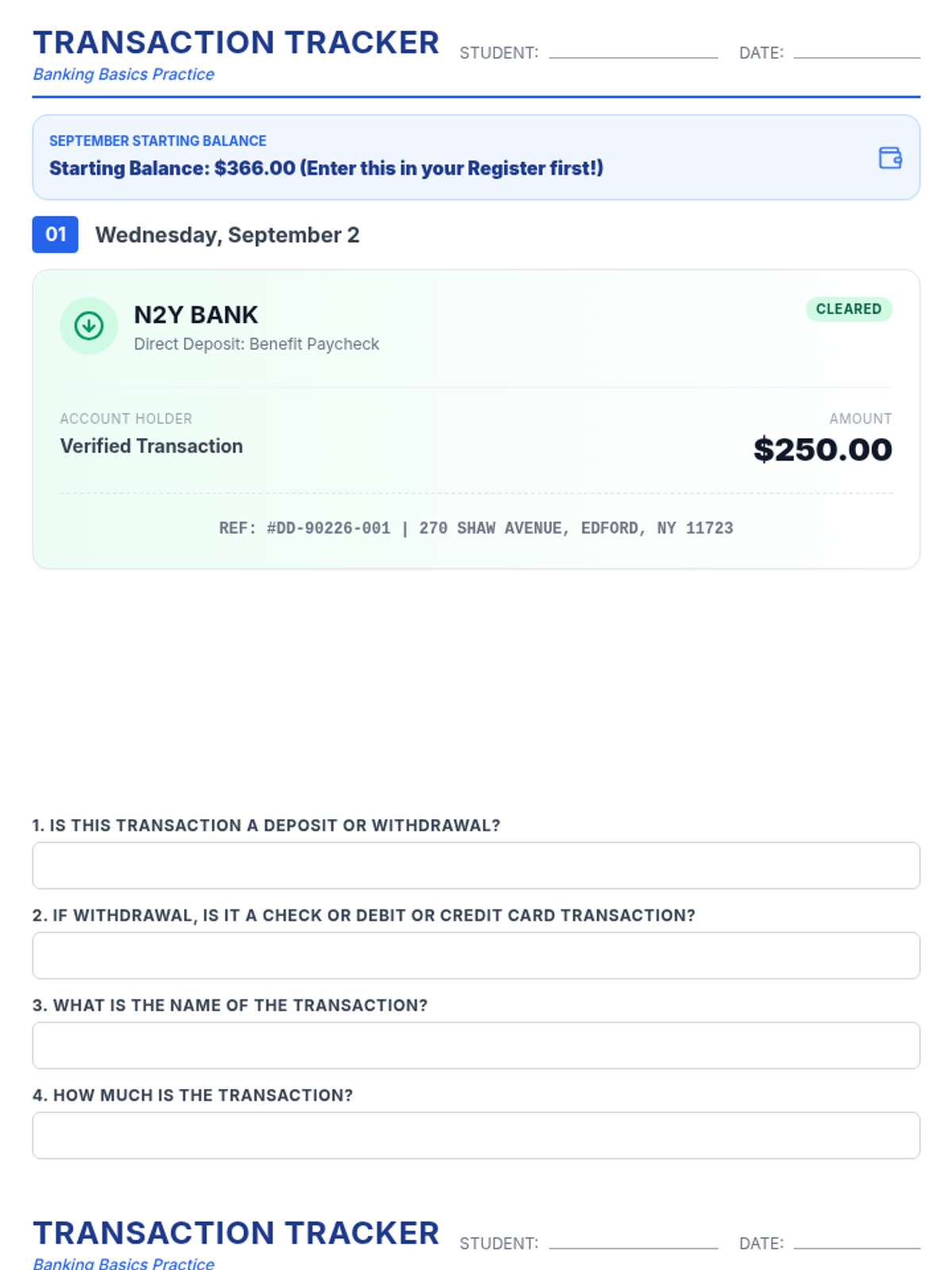
Student transaction tracker worksheets featuring 19 daily financial records (receipts, bills, deposits, and ATM slips) for September 2026. Includes fields for students to record transaction types, payment methods, and exact amounts.
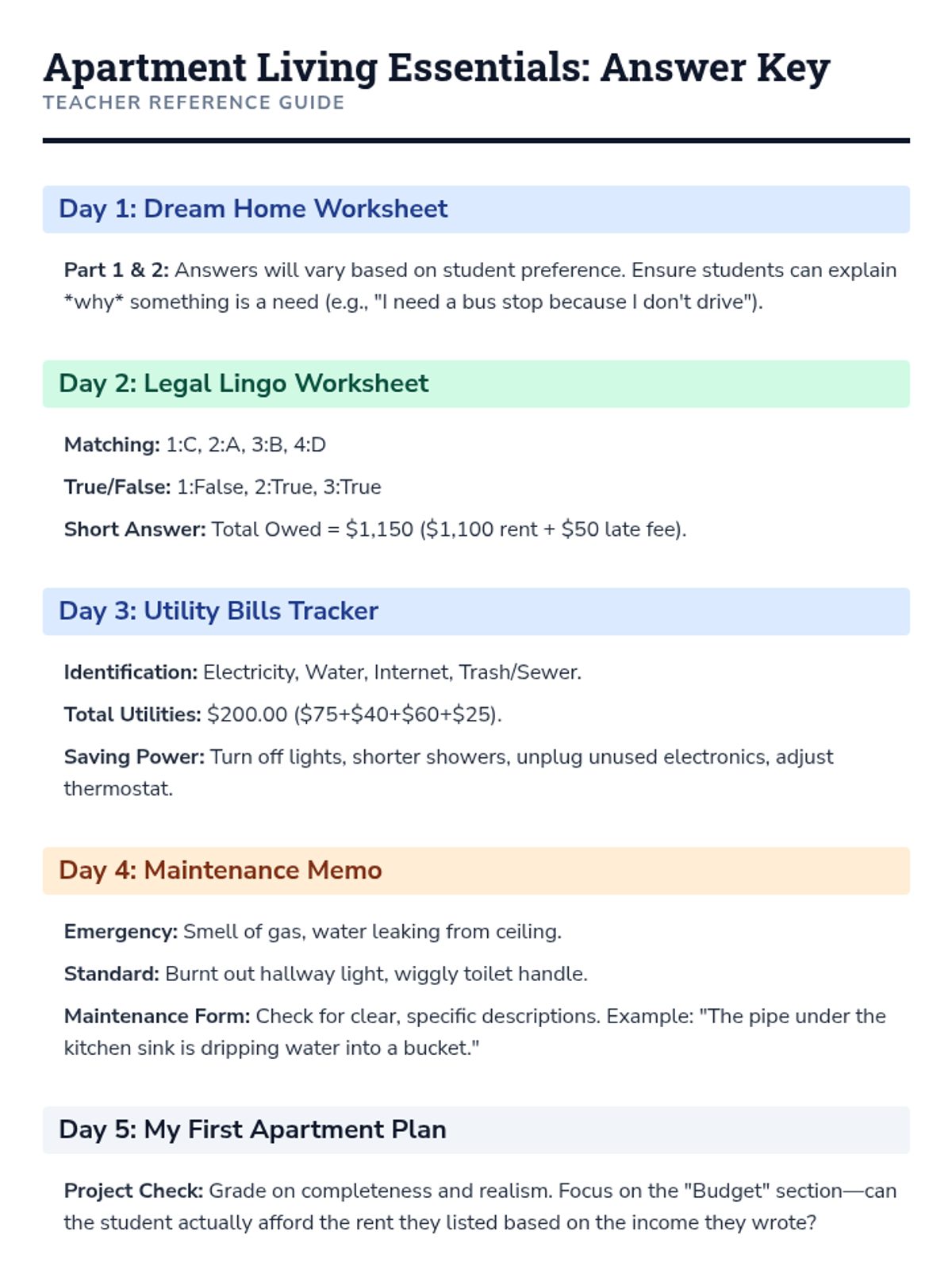
A comprehensive teacher answer key and instructional guide for the 5-day Apartment Living unit.
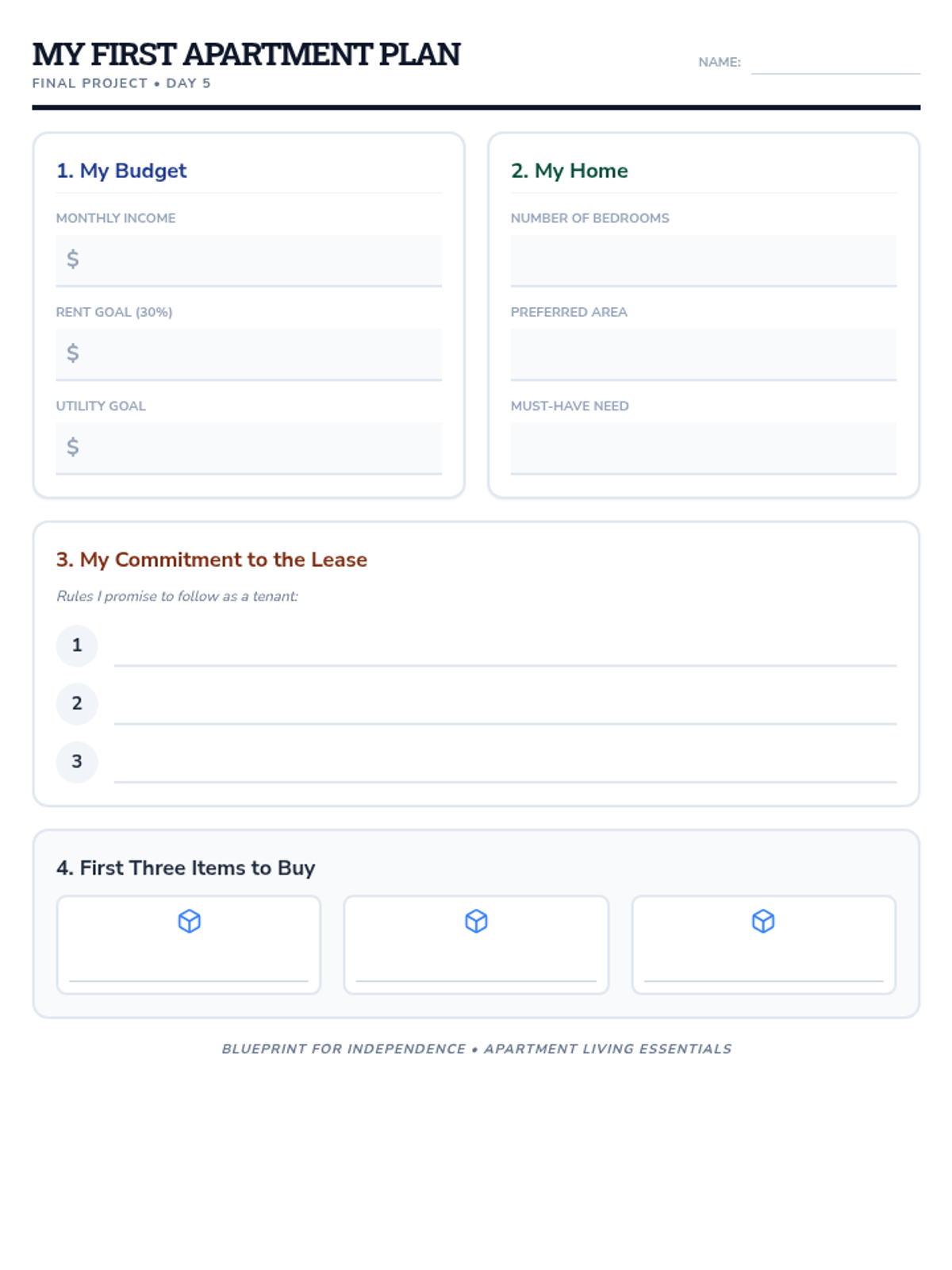
A culminating project worksheet where students synthesize the week's learning to create their own realistic apartment living plan. Now fully optimized for a single-page layout with larger handwriting spaces and improved footer legibility.
The final slide deck for the Apartment Living unit, summarizing key concepts and providing practical "pro tips" for new renters.
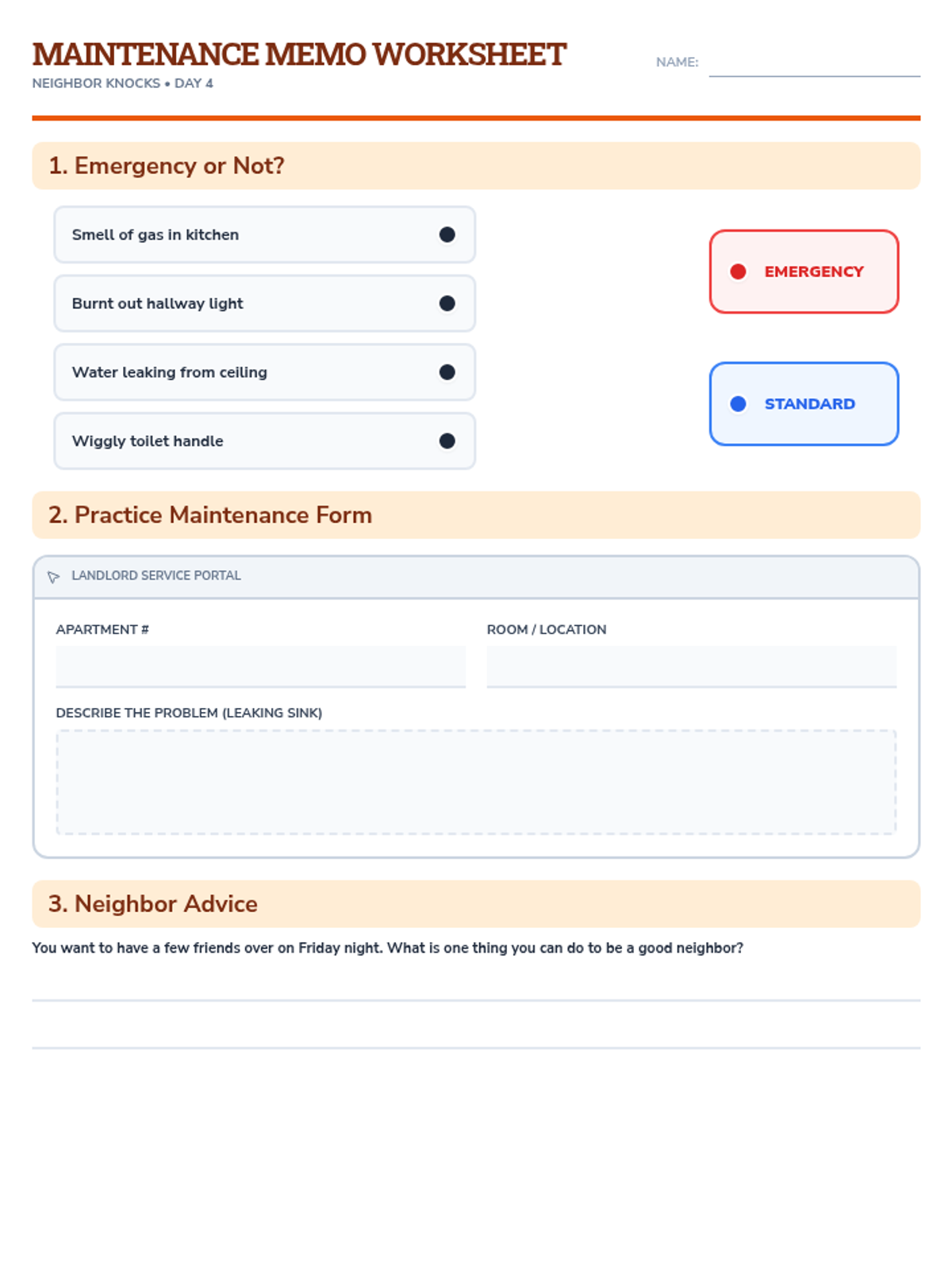
A worksheet for Day 4 focusing on identifying emergencies versus standard repairs and practicing how to write a clear maintenance request. Now optimized for a single-page layout with anchor points for matching and improved label contrast.
Slides for Day 4 of the apartment unit, covering neighbor etiquette, quiet hours, and how to handle maintenance and conflict. Now featuring unified multiple-choice styling and improved layout. Now optimized to prevent overflow and improve contrast.
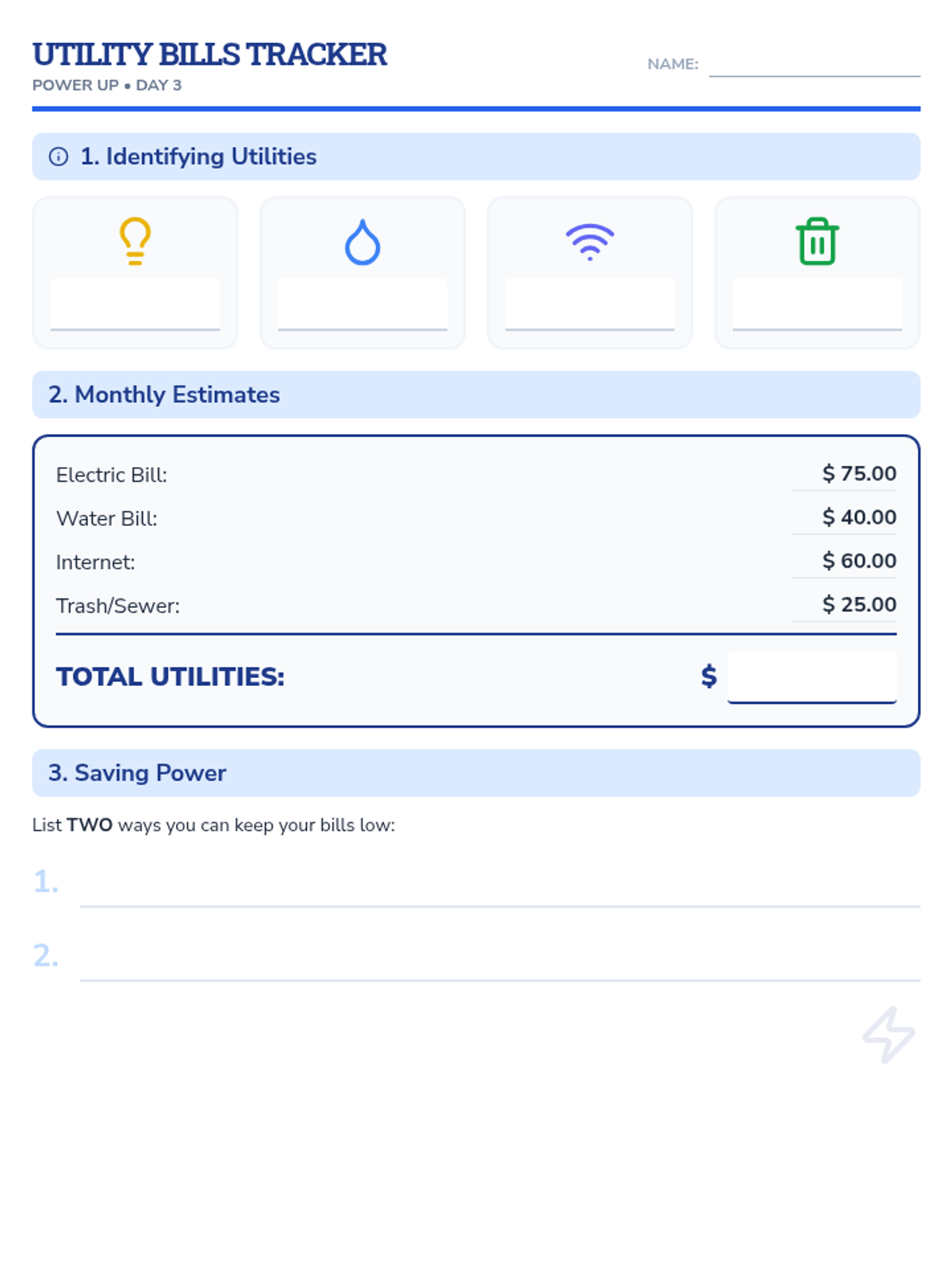
A utility budgeting worksheet where students identify common utilities, calculate monthly costs, and brainstorm energy-saving tips. Improved layout to avoid page breaks and larger writing areas.
Educational slides for Day 3 of the apartment unit, focusing on utilities, setting up services, and move-in essentials. Now includes actual energy-saving tips and improved layout.
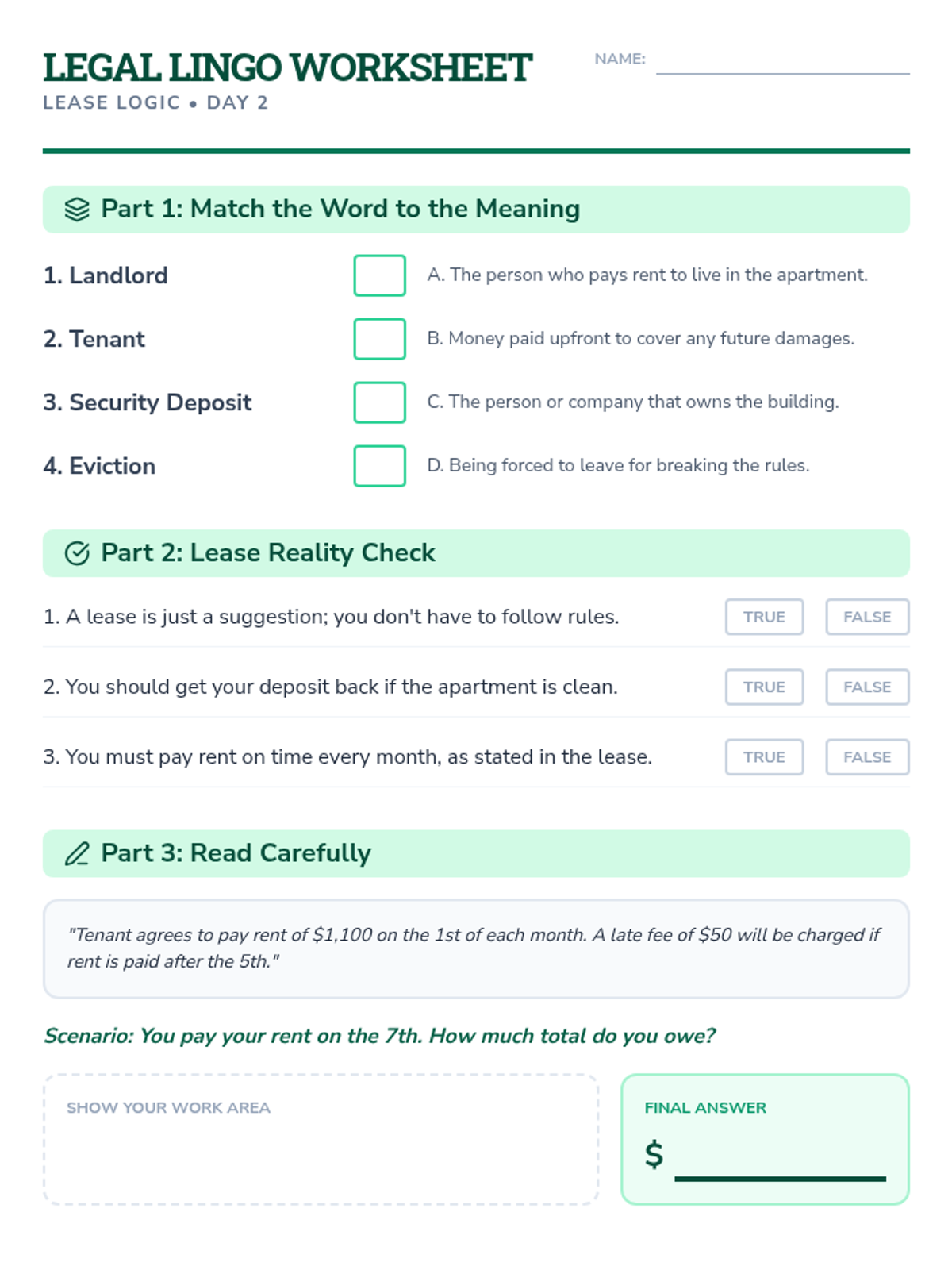
A lease terminology and rules worksheet for adult transition students, including matching, true/false, and a reading comprehension scenario.
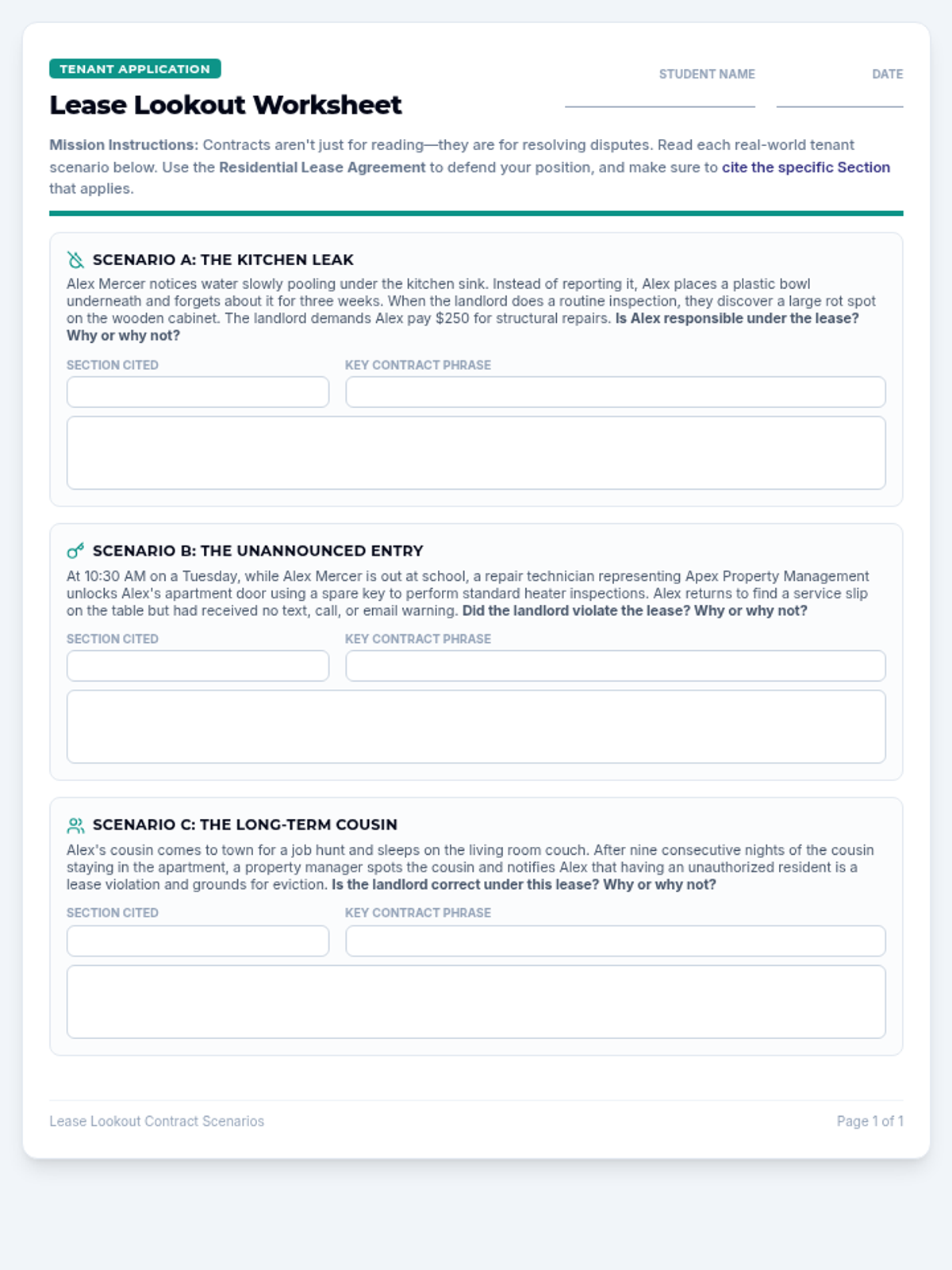
A student-facing worksheet presenting 3 realistic tenant-landlord scenarios. Students must review the Rental Agreement, cite relevant sections, and write professional claims to resolve the conflicts.
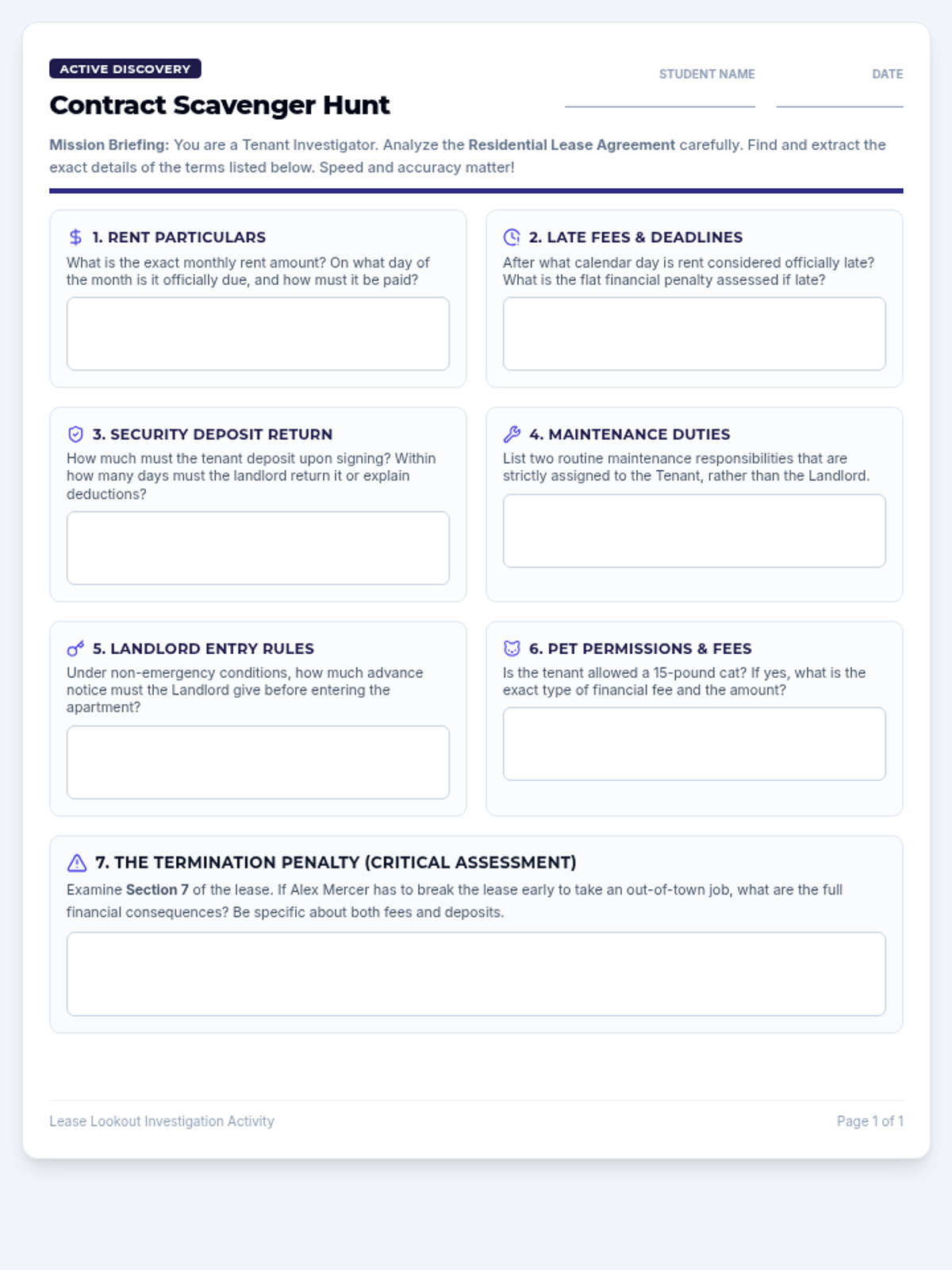
An active discovery scavenger hunt sheet designed to accompany the Lease Lookout Rental Agreement. Guides students to locate, write down, and evaluate specific core contract items.
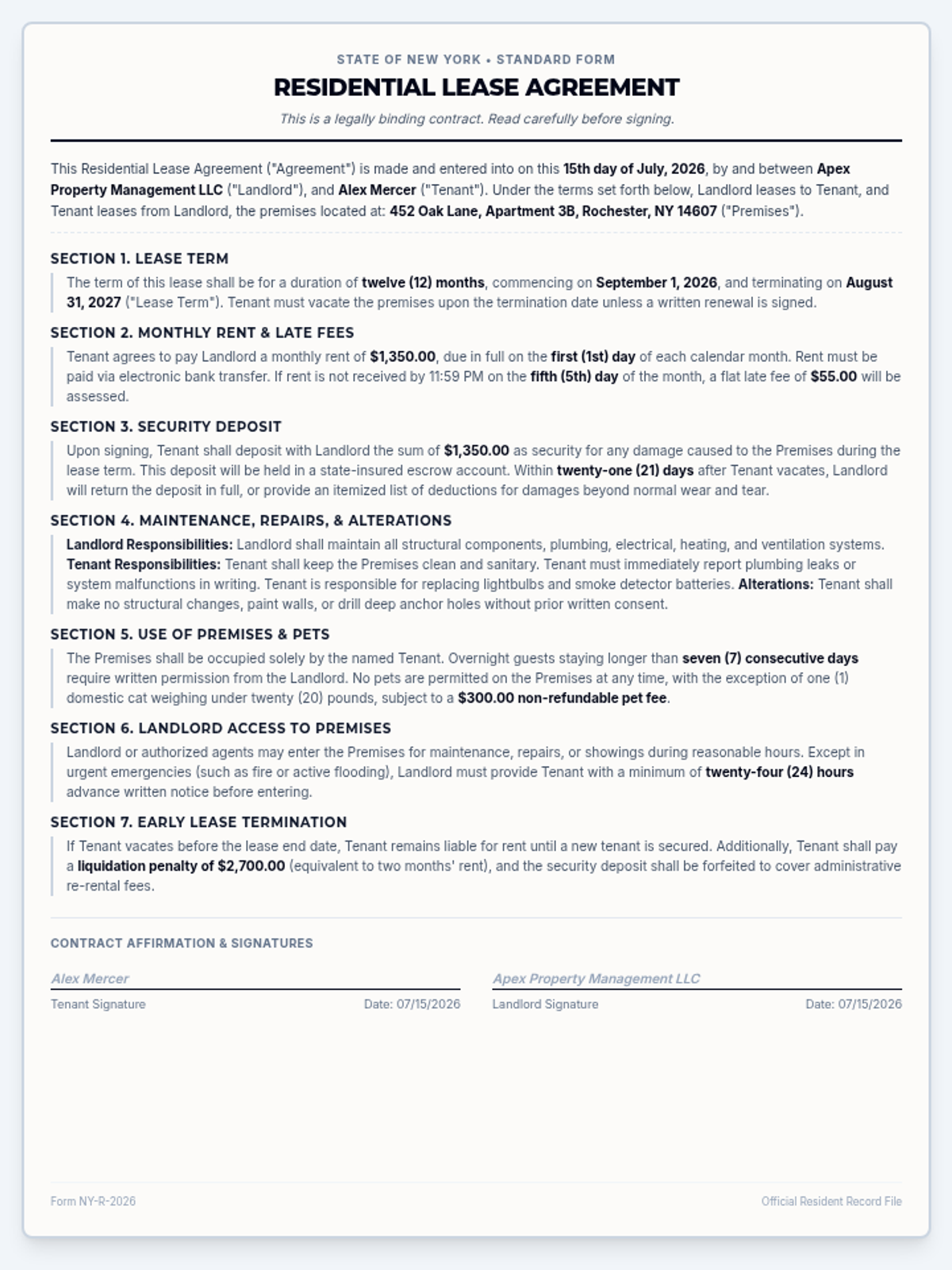
A highly realistic, standard 1-page sample Residential Lease Agreement. Includes structured clauses on lease terms, monthly rent, security deposits, maintenance duties, guest rules, and early termination penalties. Designed as the primary reading material for student analysis.
A highly engaging, visually bold slide deck formatted for screens (1440x810) designed to guide direct instruction. Covers the importance of leases, key terms (the big four), critical contract red flags, and rules for the contract scavenger hunt.
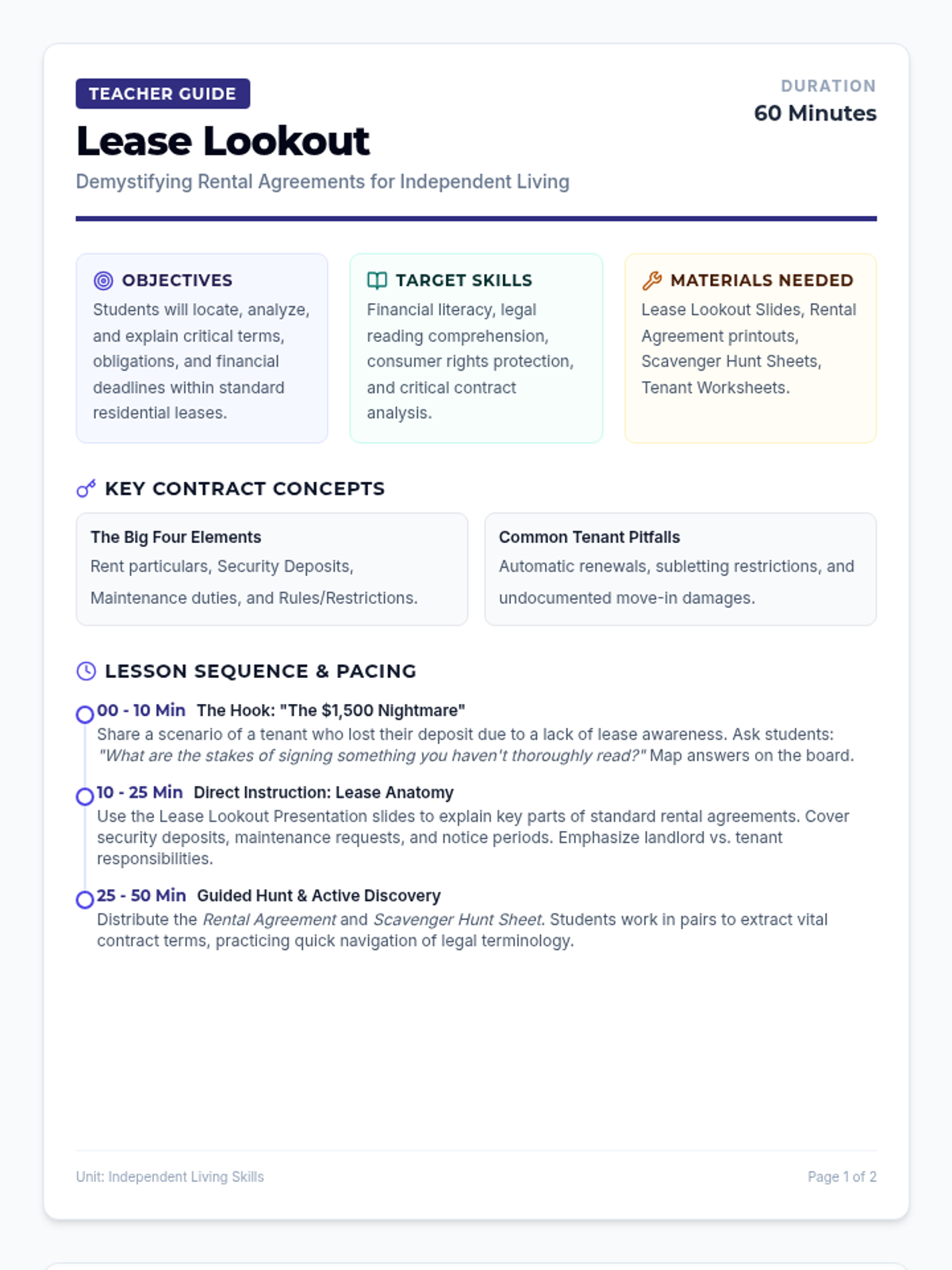
A 2-page teacher-facing lesson plan outlining the facilitation steps, pacing, key concepts, scaffolding, and discussion questions for the 'Lease Lookout' lesson.
Instructional slides explaining insurance fundamentals (premium, deductible, risk transfer) with improved contrast, alignment, and Buffalo-specific examples.
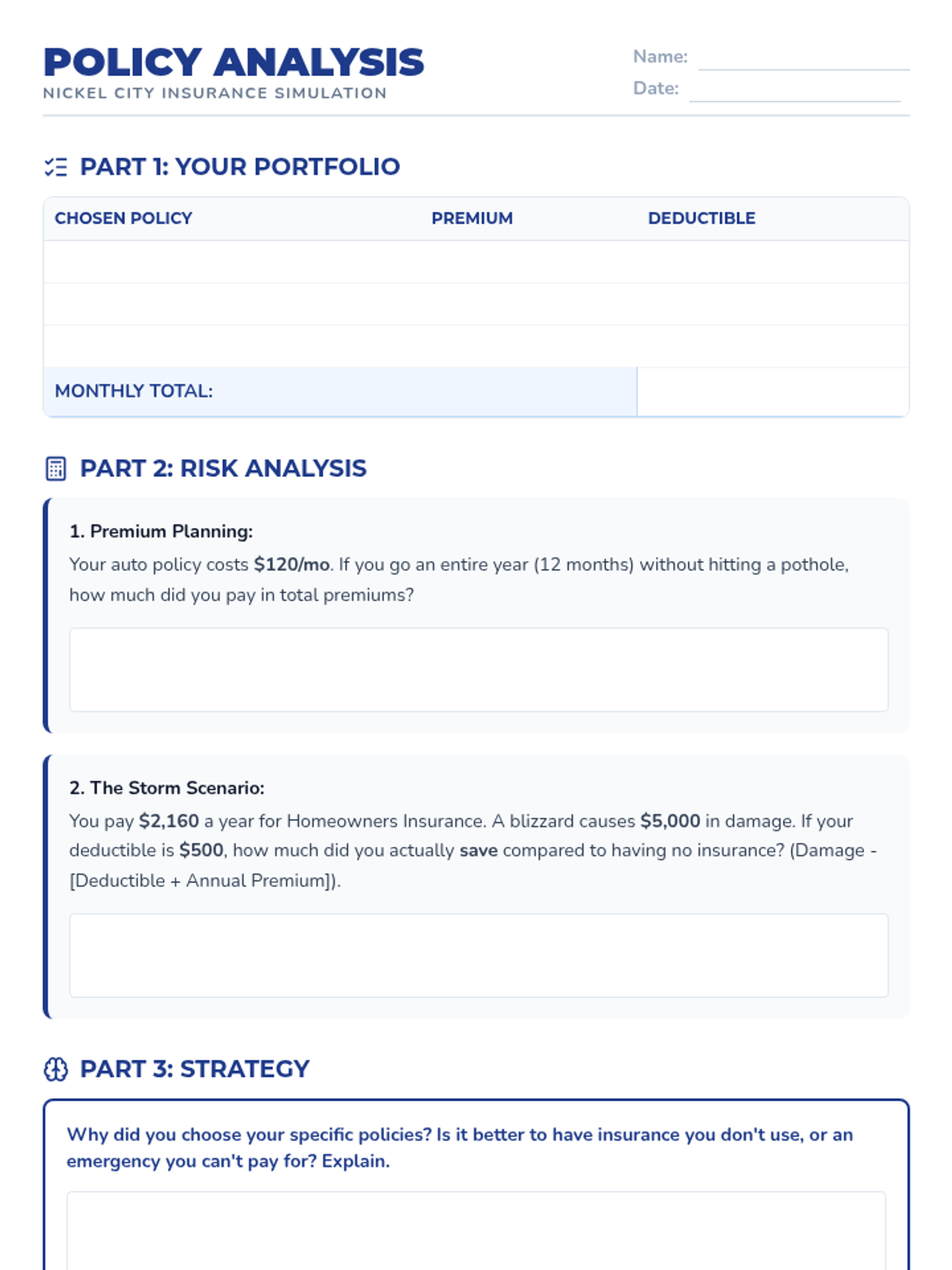
A tightened companion worksheet designed to fit on a single printable page. Includes risk analysis problems and a student work area with improved page-break management.
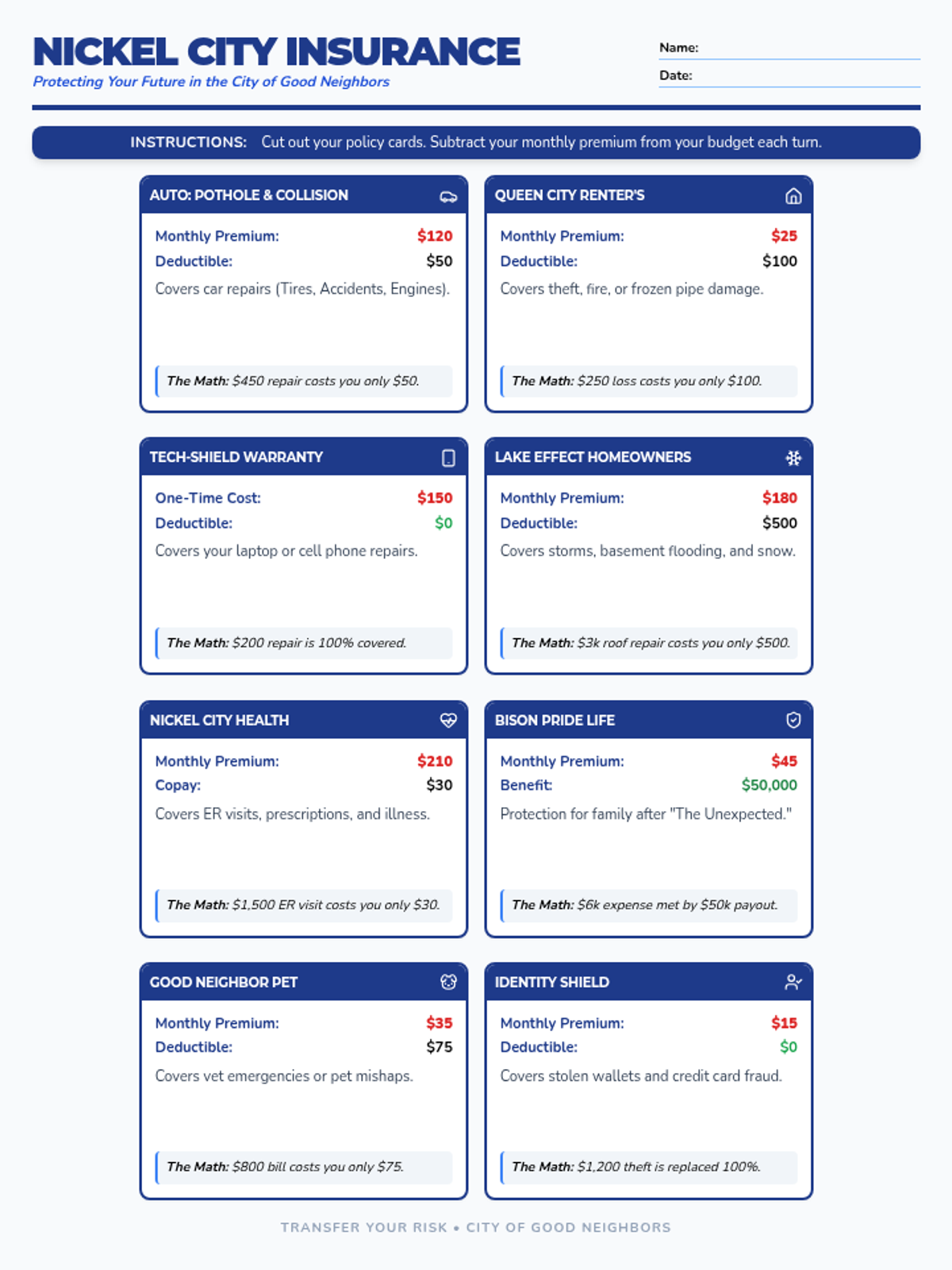
A single-page printable set of 8 Buffalo-themed insurance policy cards. Features compact layouts to ensure all 8 cards fit on one sheet for student use.
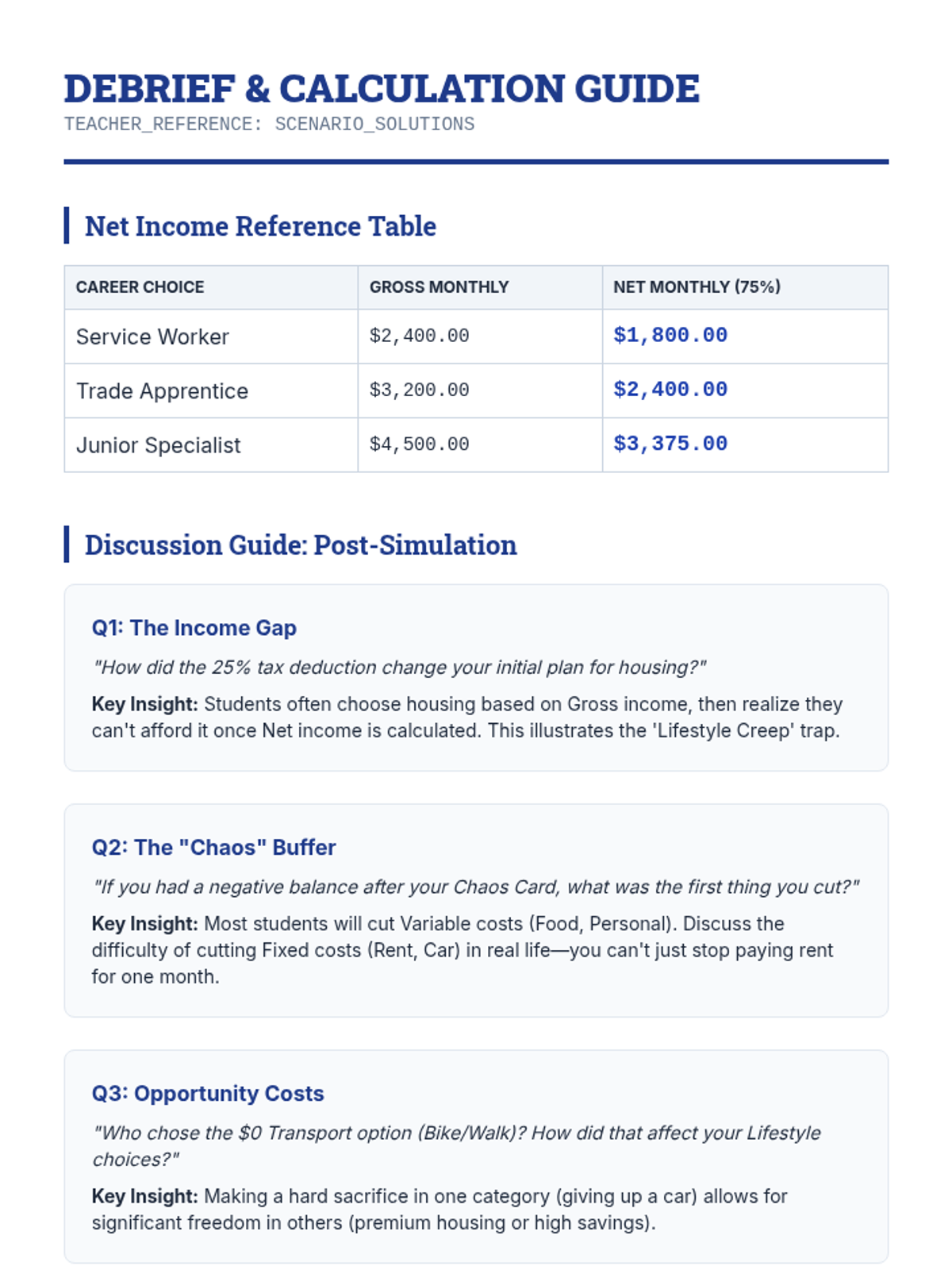
A teacher-facing reference guide containing the net income calculation table, discussion questions for debriefing, and key takeaways for the simulation.
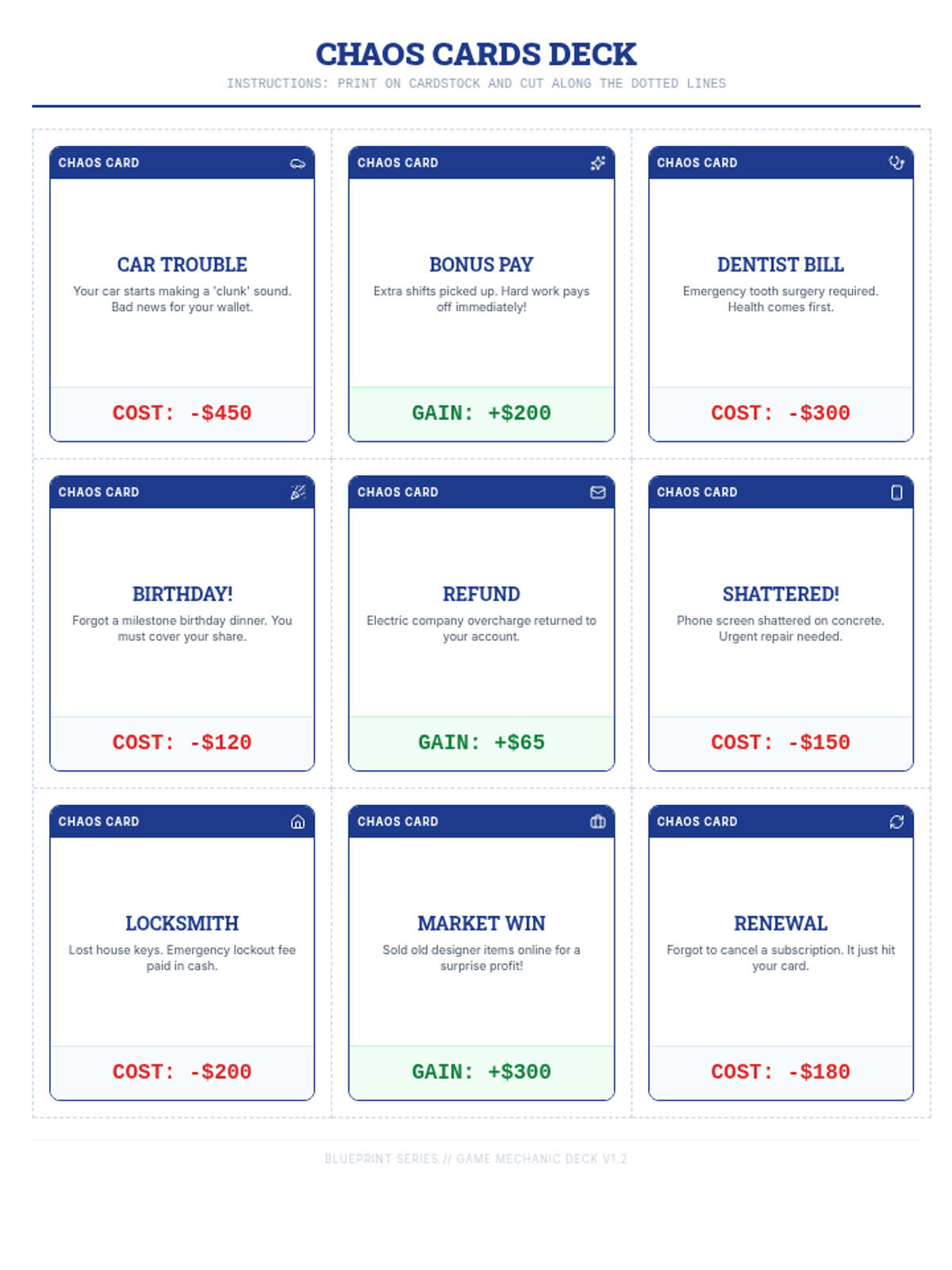
A set of printable 'Chaos Cards' representing unexpected financial events (both positive and negative) to be used in the final phase of the budgeting simulation.
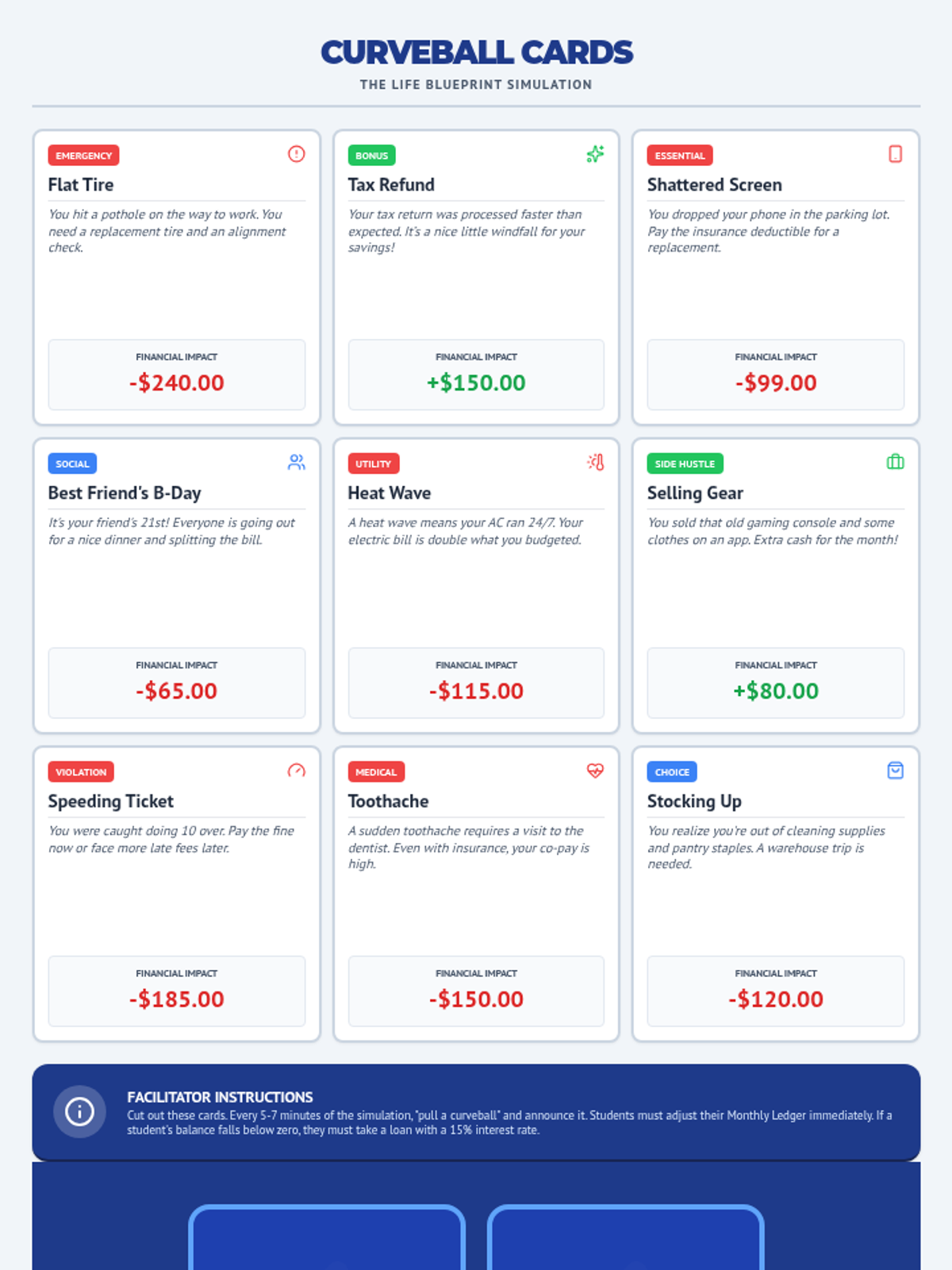
A set of printable game cards featuring various realistic financial 'Curveball' events (both positive and negative) that students must navigate during the independent living simulation.
A set of printable 'Curveball' cards for the life simulation game. Each card represents a realistic financial event (positive or negative) that students must incorporate into their monthly budget ledger.
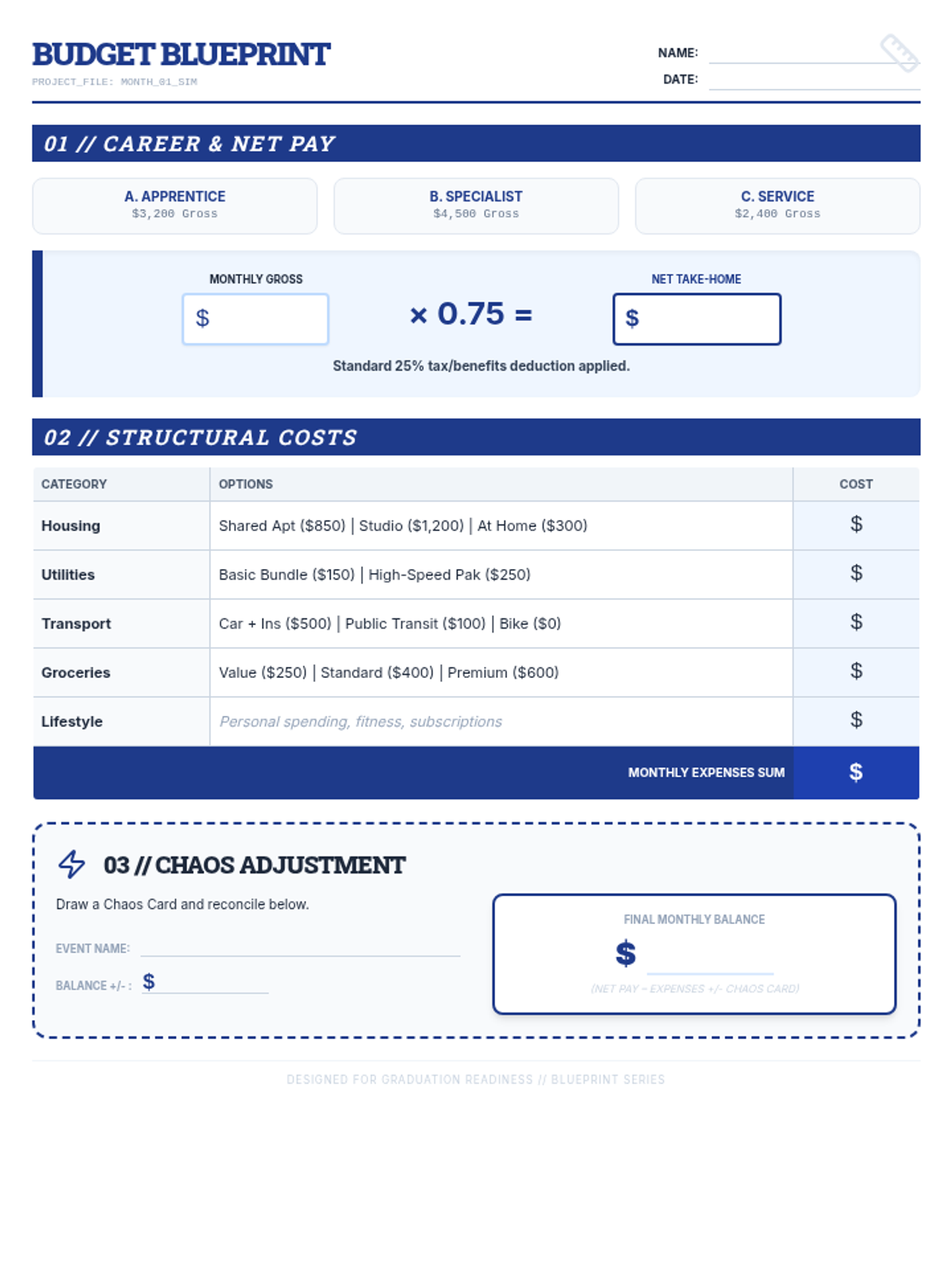
A structured budgeting worksheet styled as a blueprint, allowing students to select career paths, calculate net income, and manage various living expenses.
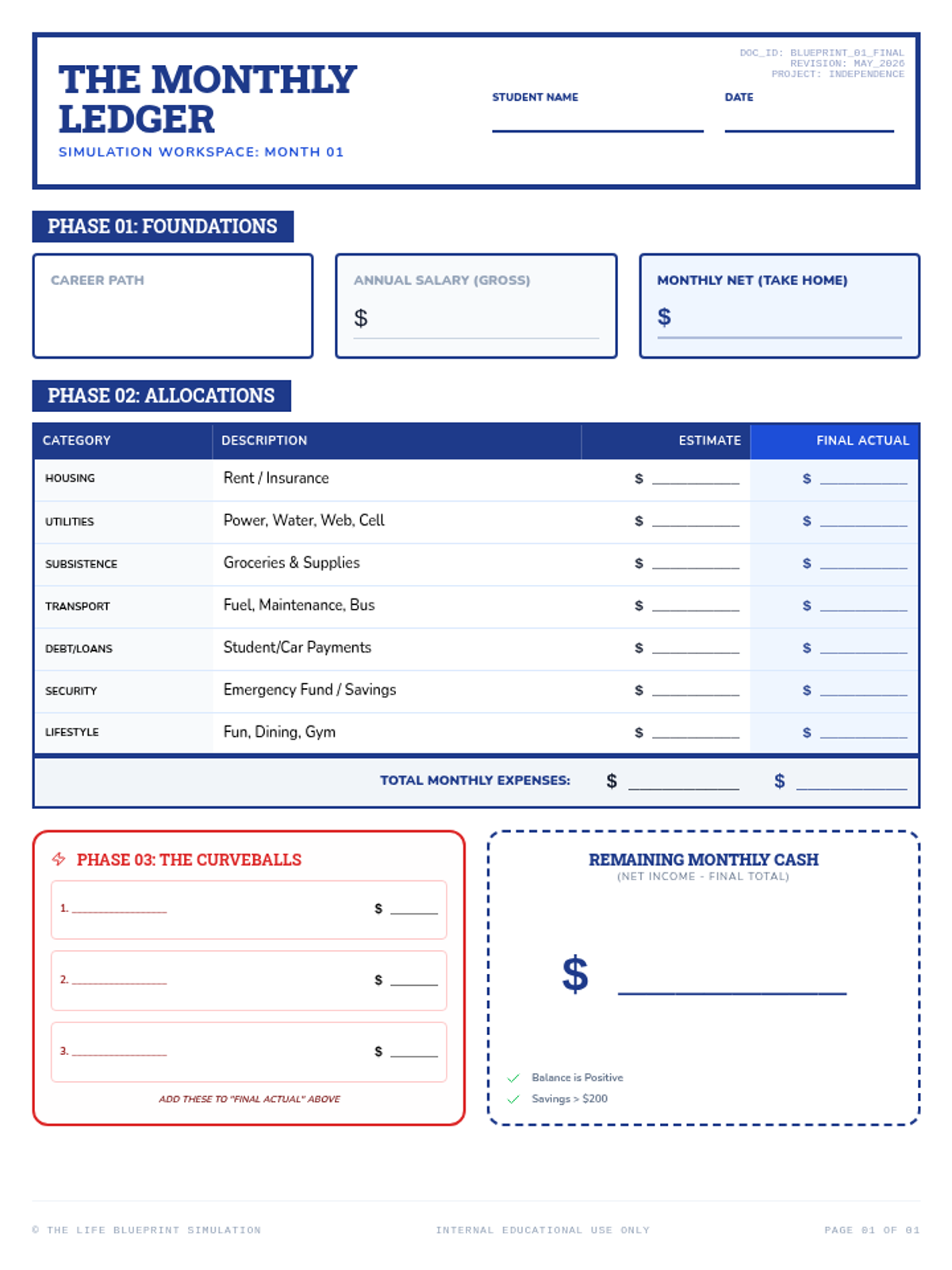
A highly structured student worksheet designed as a 'Blueprint' for tracking income and expenses. It features a detailed ledger for initial estimates and adjustment columns for the 'Curveball' phase of the simulation.
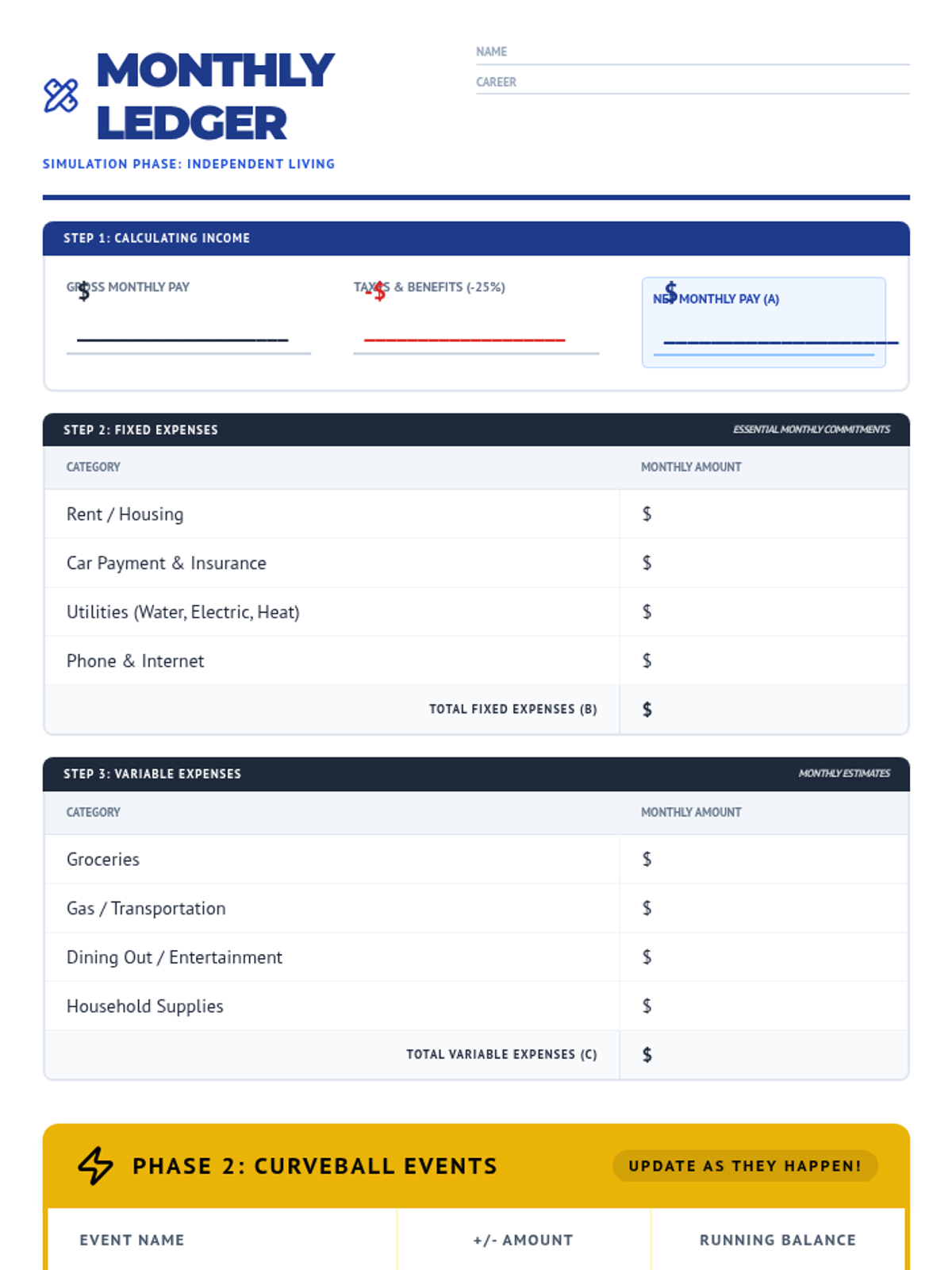
A student-facing worksheet for calculating income, fixed costs, and variable expenses, featuring a dedicated area to track 'Curveball' events during the simulation.
A high-impact visual presentation introducing core financial concepts like gross vs. net pay, fixed vs. variable expenses, and the simulation instructions.
A high-energy, visually engaging slide deck that introduces students to the concepts of gross vs. net pay, the 50/30/20 rule, and the 'Curveball' element of the life simulation.
A visual presentation to guide students through the basics of adult budgeting, including concepts like gross vs. net pay, fixed vs. variable costs, and the rules of the simulation.
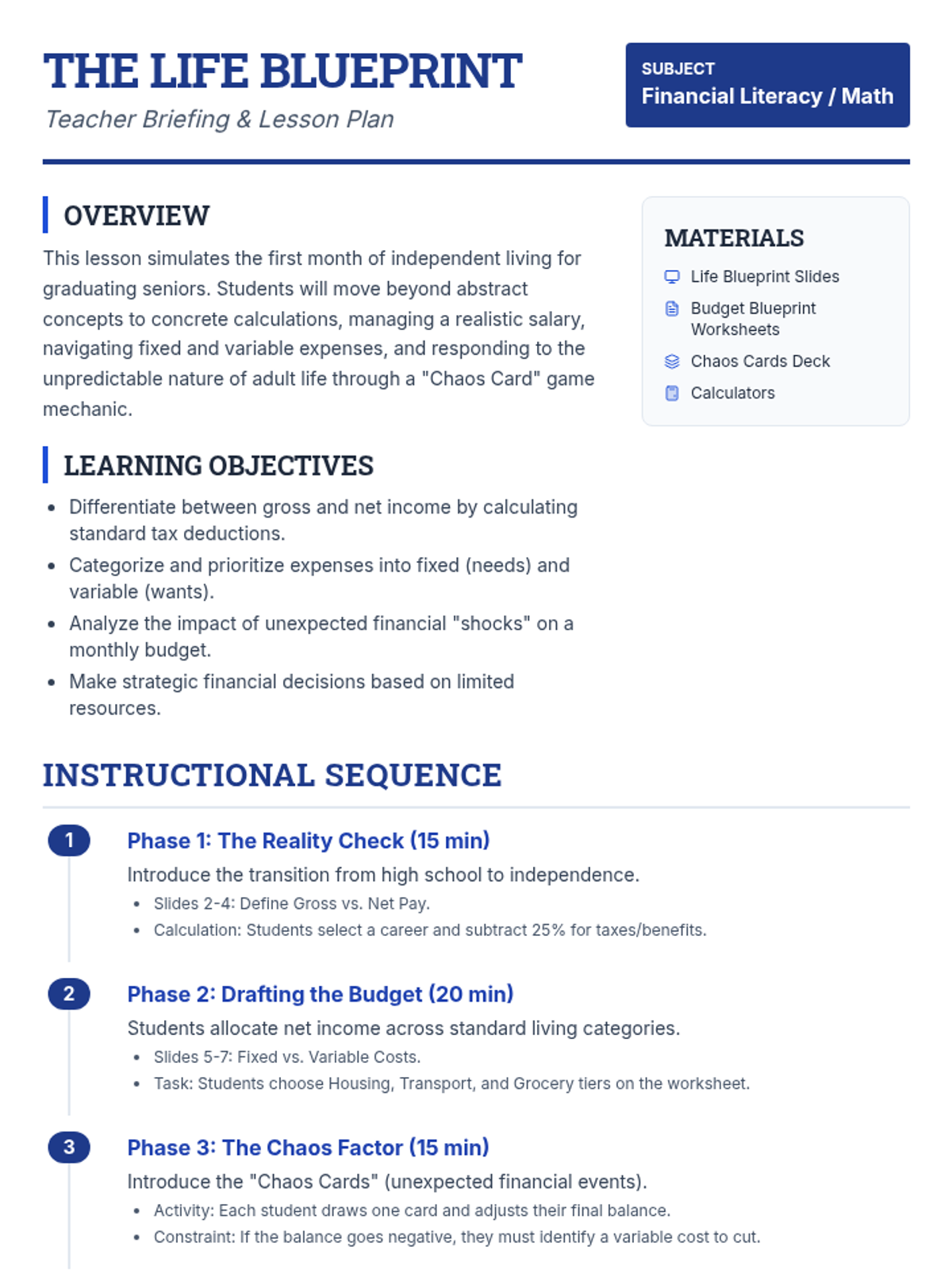
A detailed instructional guide for teachers to facilitate a financial literacy simulation, including learning objectives, a phased instructional sequence, and differentiation strategies.
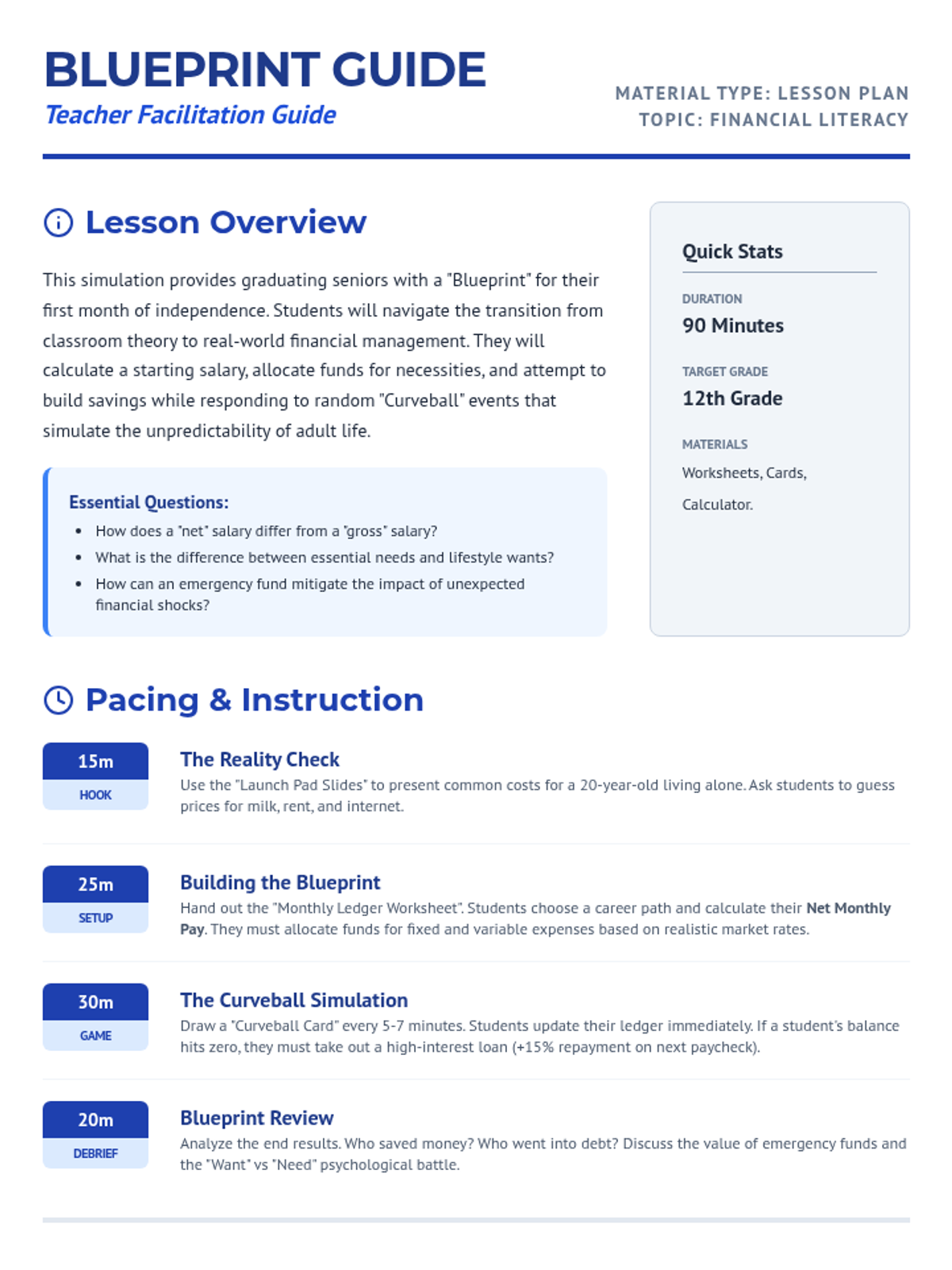
A comprehensive teacher guide for 'The Life Blueprint' simulation, including lesson flow, facilitating tips, and reference data for student budgeting.
A teacher-facing lesson plan that outlines the objectives, pacing, and instructional strategies for 'The Life Blueprint' simulation, designed specifically for graduating seniors.
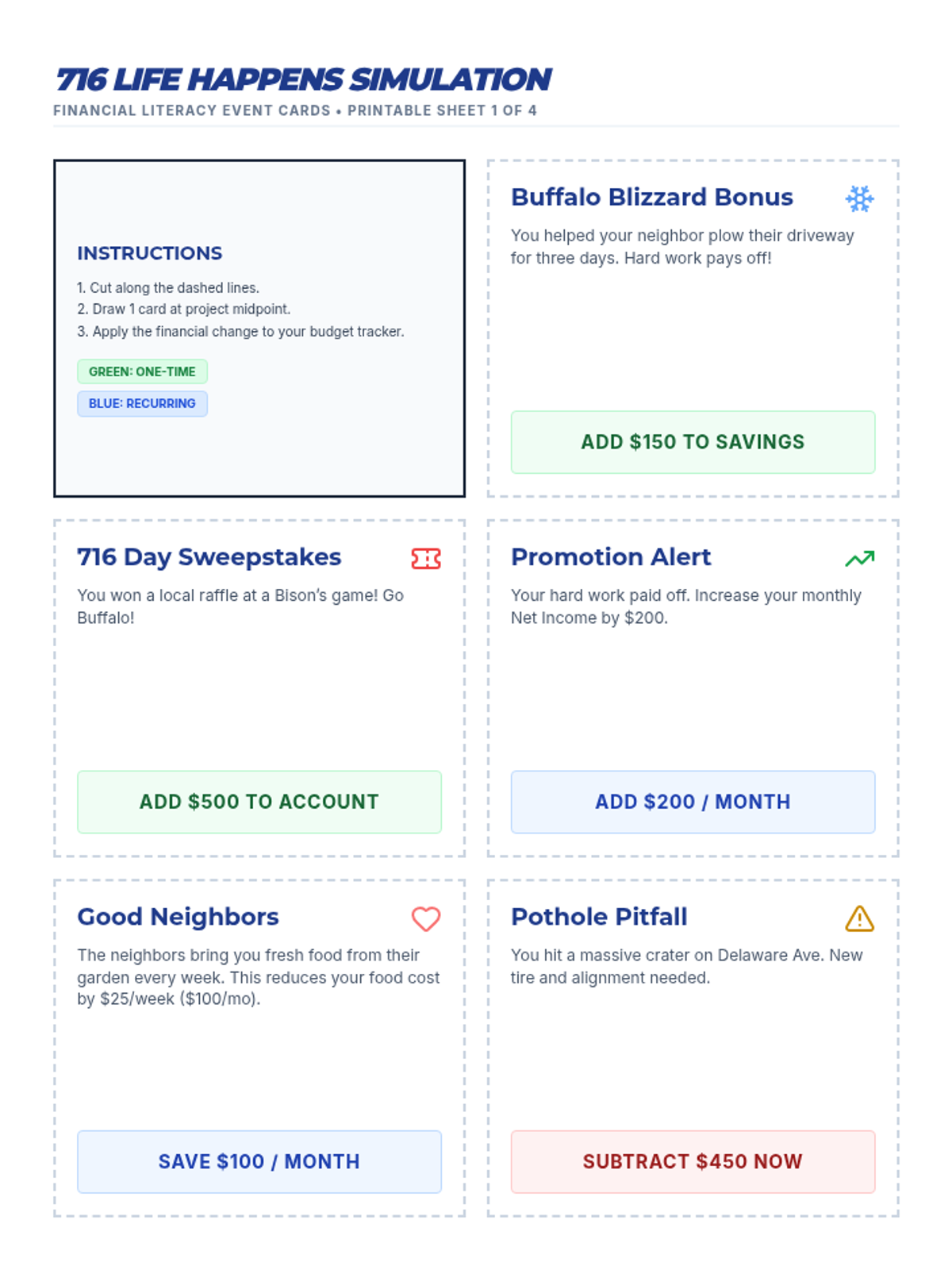
A set of 24 Buffalo-themed 'Life Happens' cards for a financial literacy project. The layout includes various local scenarios like blizzards and picnics, concluding with a single 'Identity Theft' special event card.
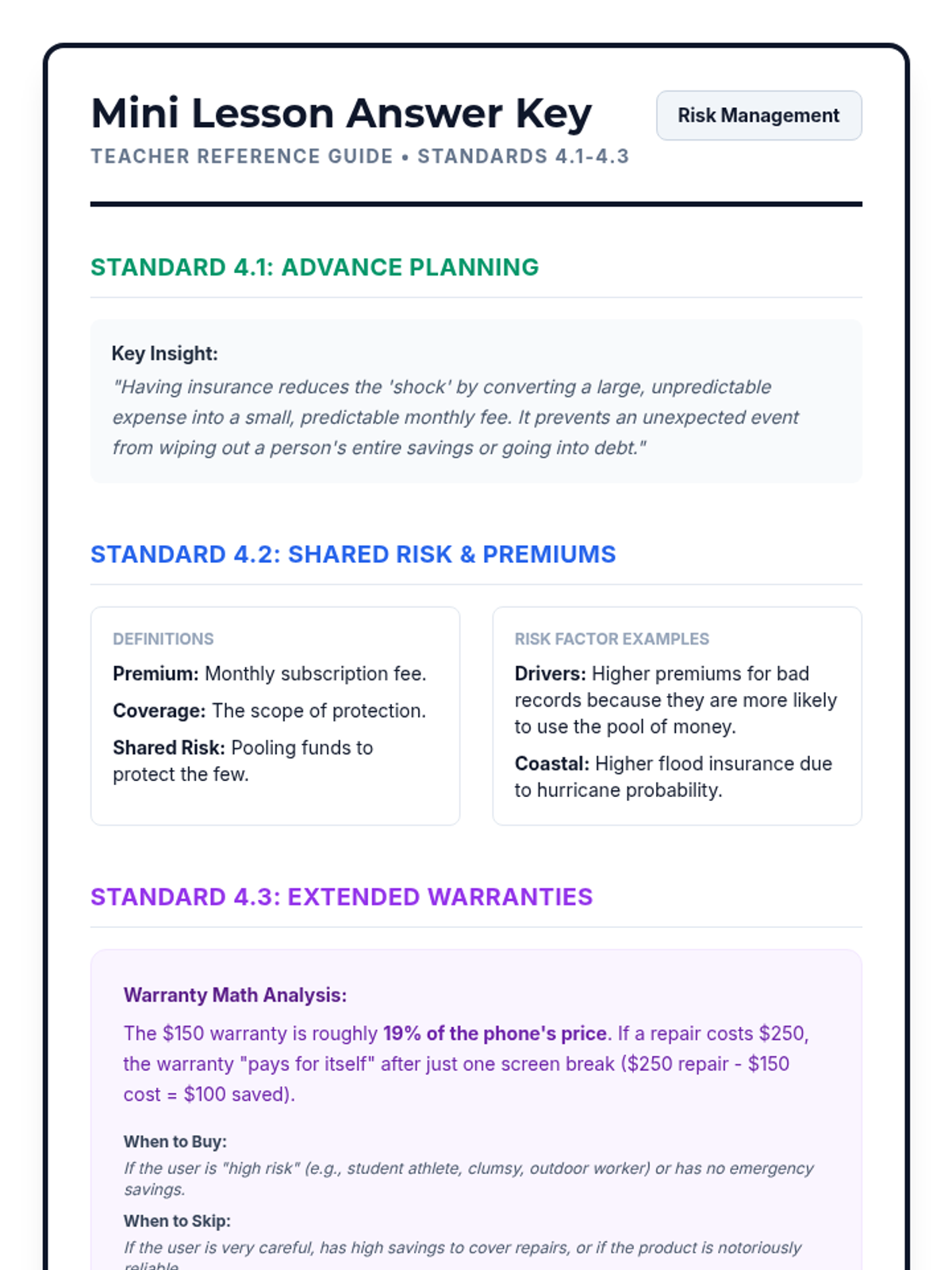
A teacher's answer key and facilitation guide for the Risk Management mini-lesson, including pacing tips and sample reflection responses.
Instructional slides for a mini-lesson on risk management standards 4.1, 4.2, and 4.3, covering shared risk, premiums, and warranty analysis.
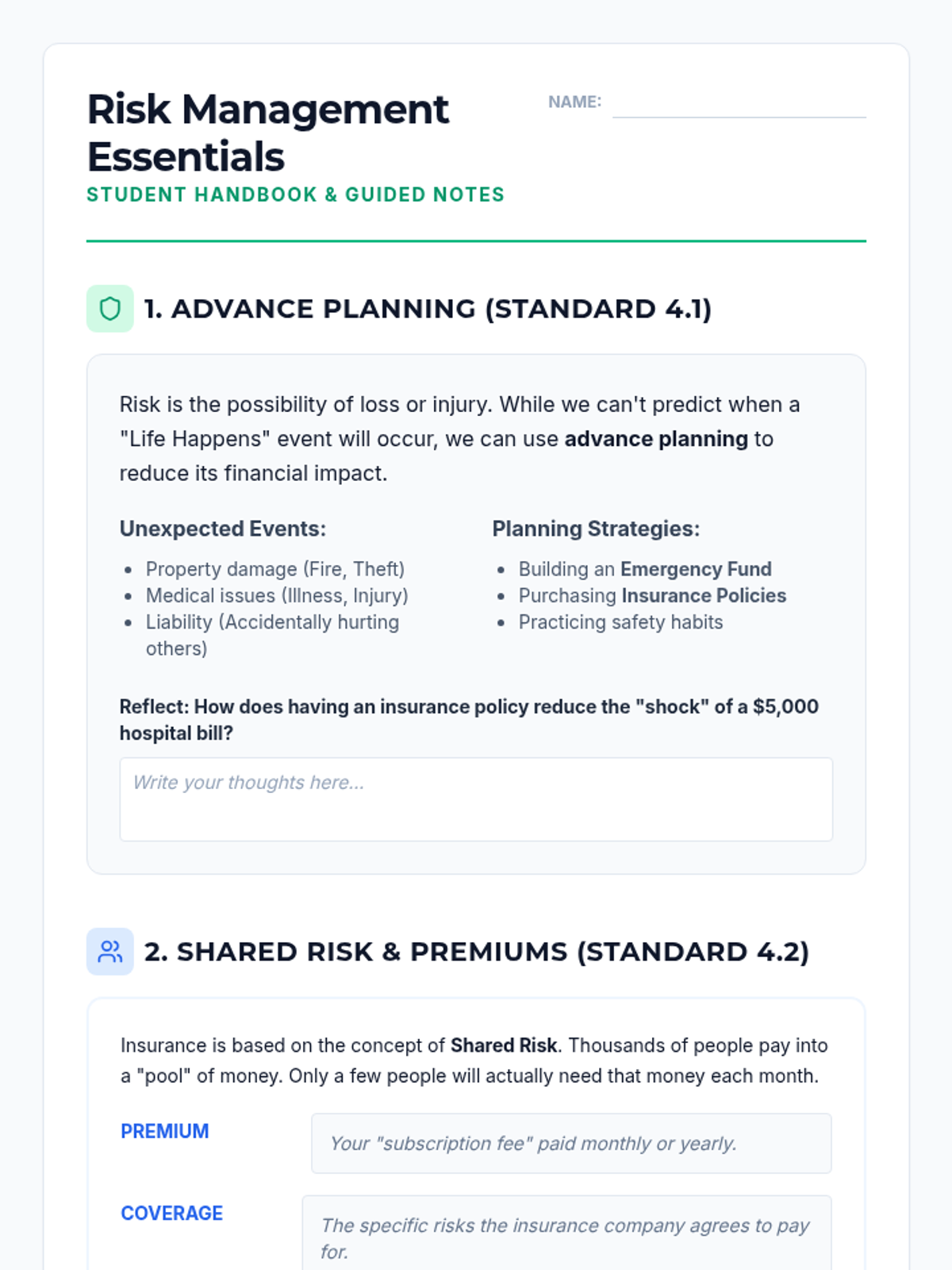
A student-facing handbook and guided notes document covering the fundamentals of risk management, shared risk, premiums, and extended warranties.
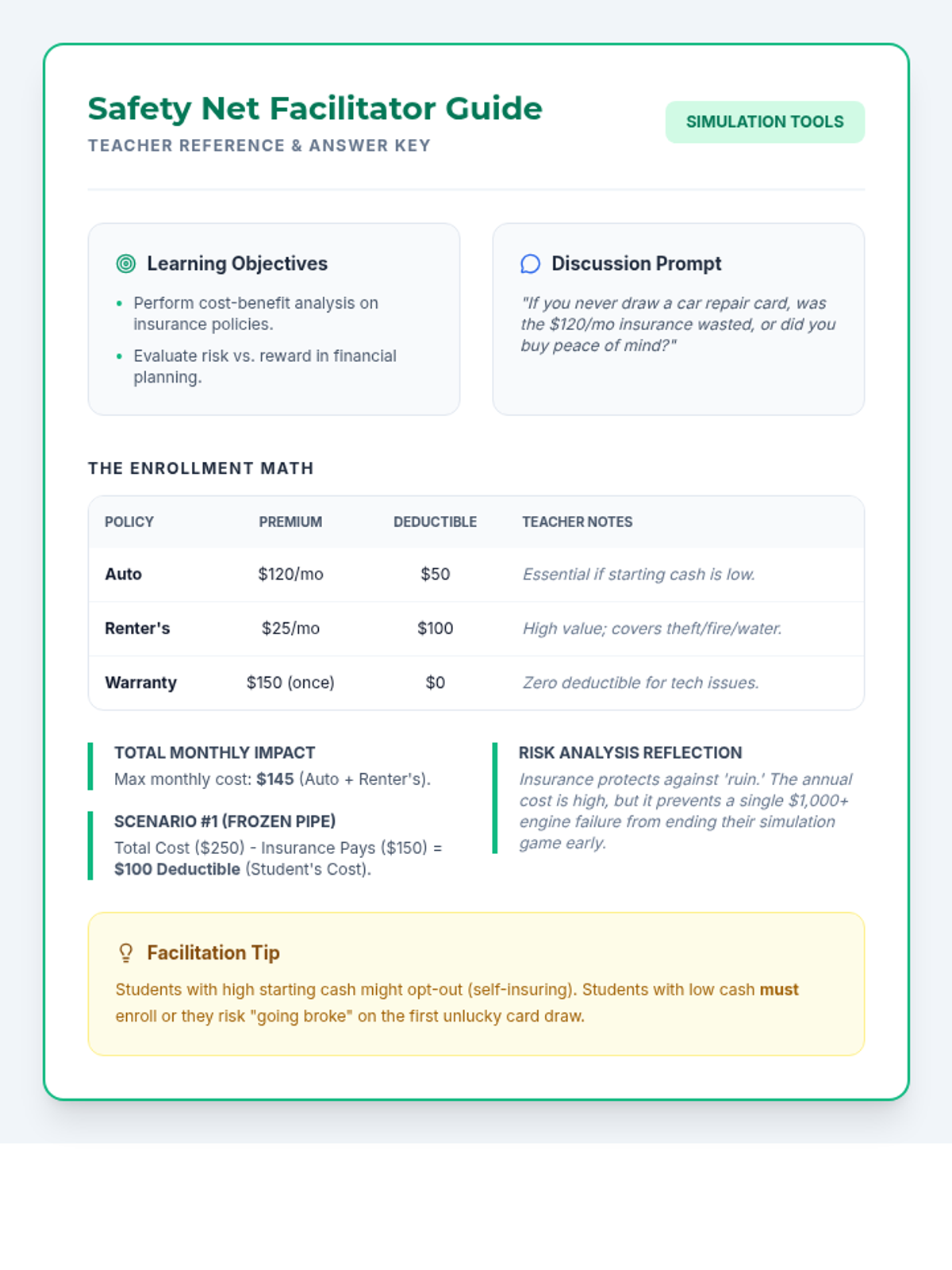
A teacher-facing guide providing the answer key for the enrollment form and facilitation strategies for the simulation.
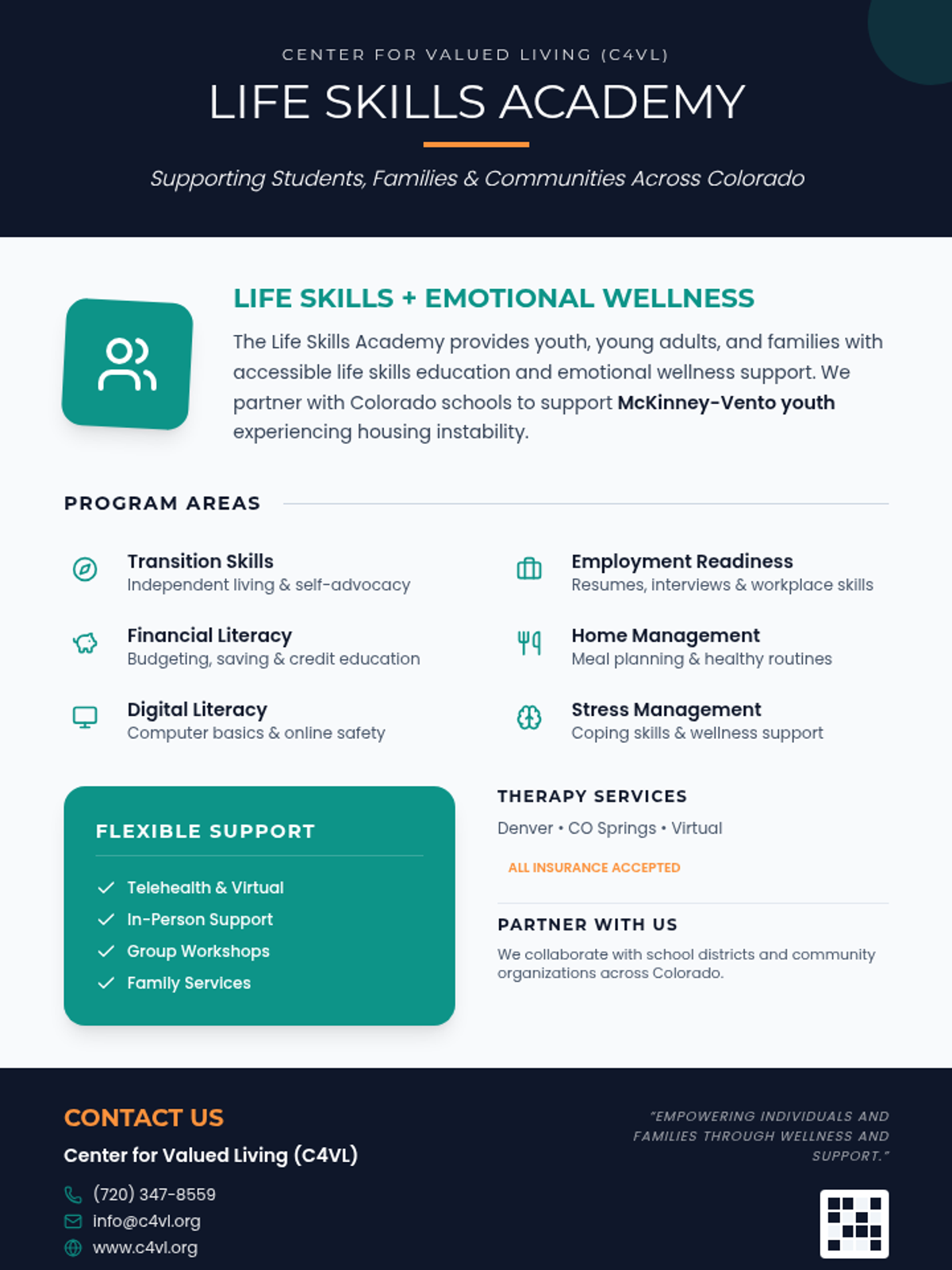
A professional one-page informational flyer for the C4VL Life Skills Academy, featuring a clean teal and navy blue design with sections on program areas, support options, and partnership opportunities.
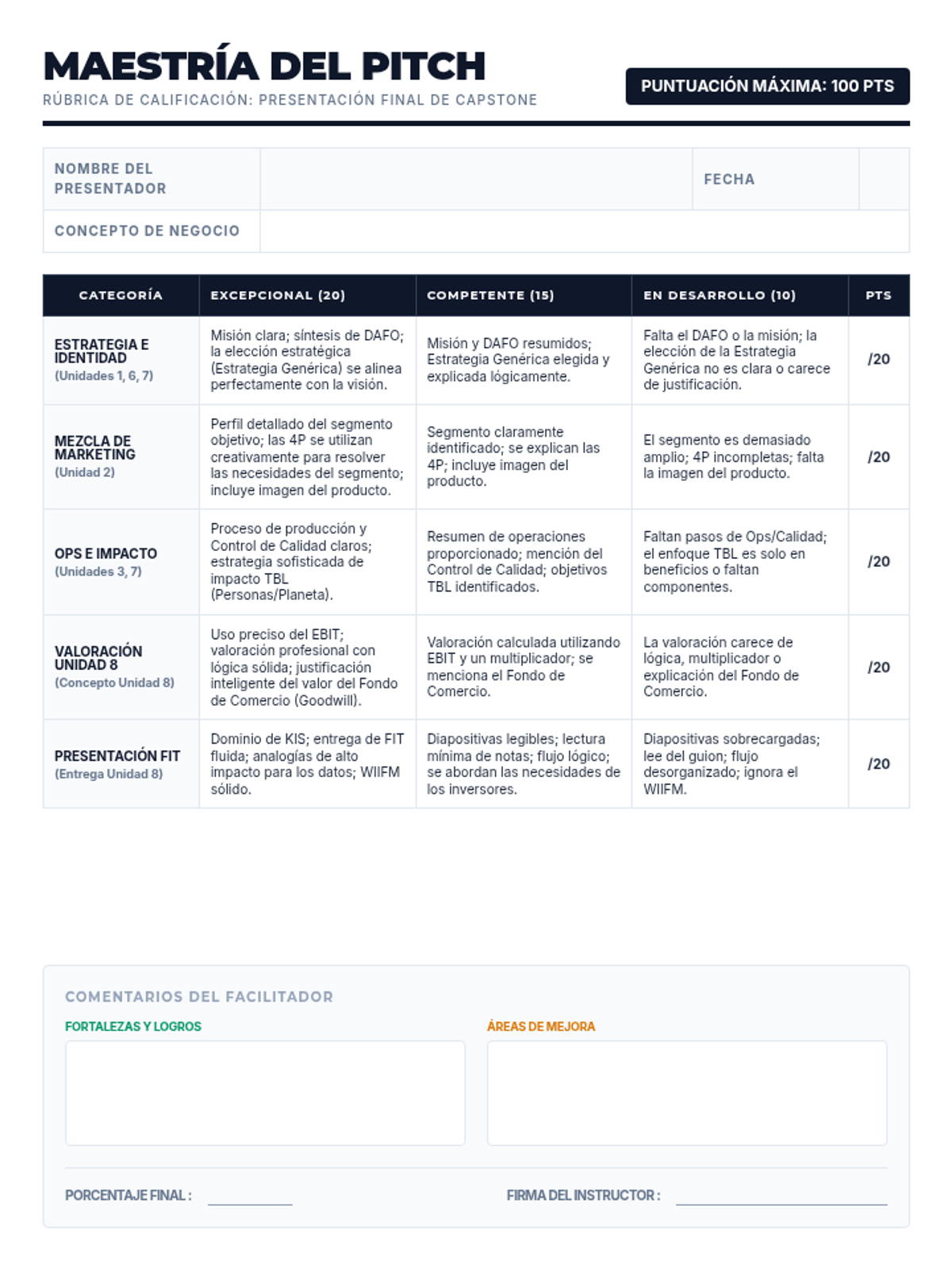
A comprehensive grading rubric for the final business presentation project. It evaluates Strategy, Marketing (including product picture), Operations, and Unit 8 Valuation. Updated to remove references to the financing plan and cash flow simulation.
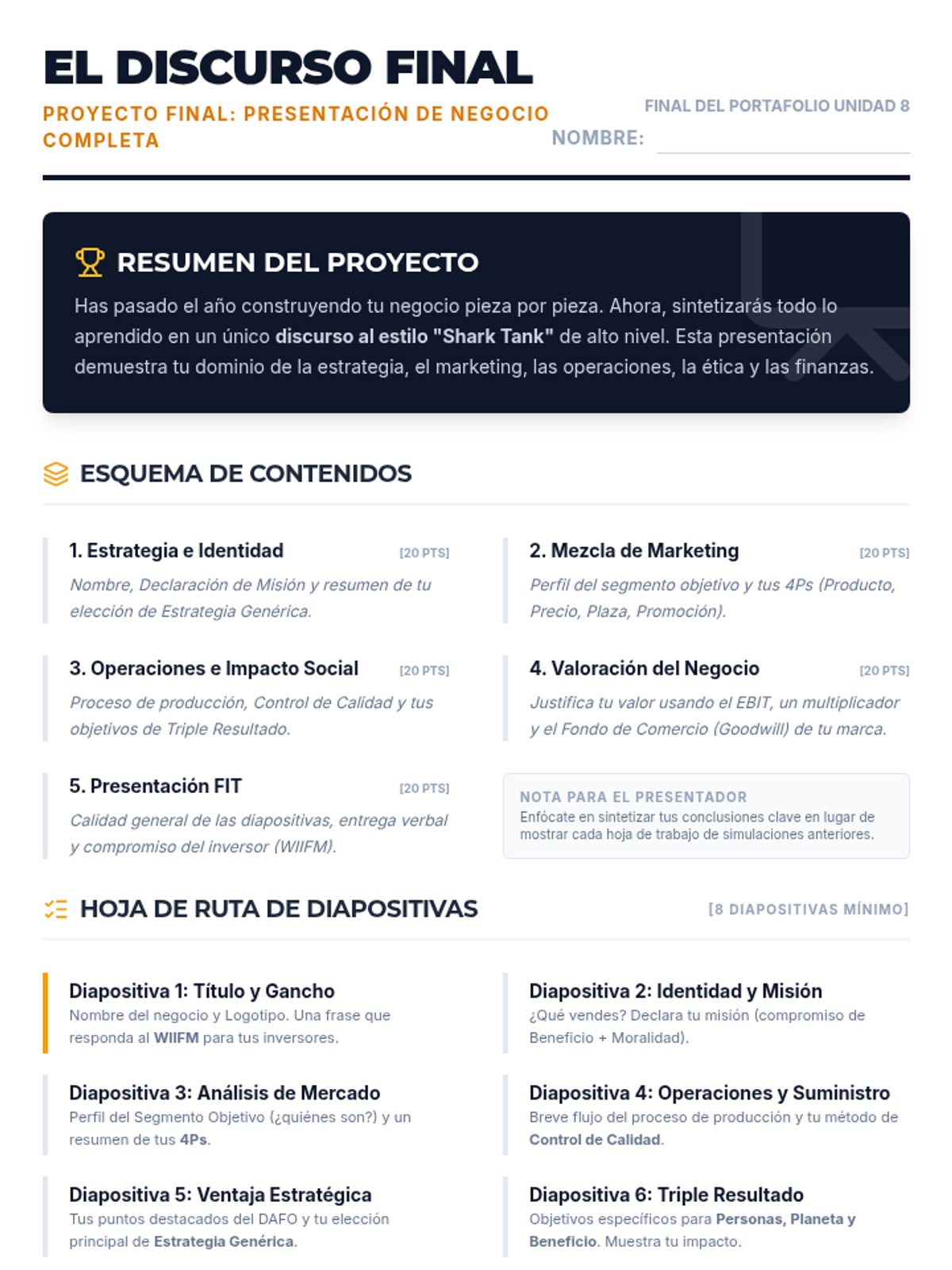
A comprehensive guide for the year-end final project where students present their fake business. It features an 8-slide Roadmap, focusing on strategy, marketing, operations, and valuation (Unit 8), while removing the cash flow simulation and financing plan requirements.
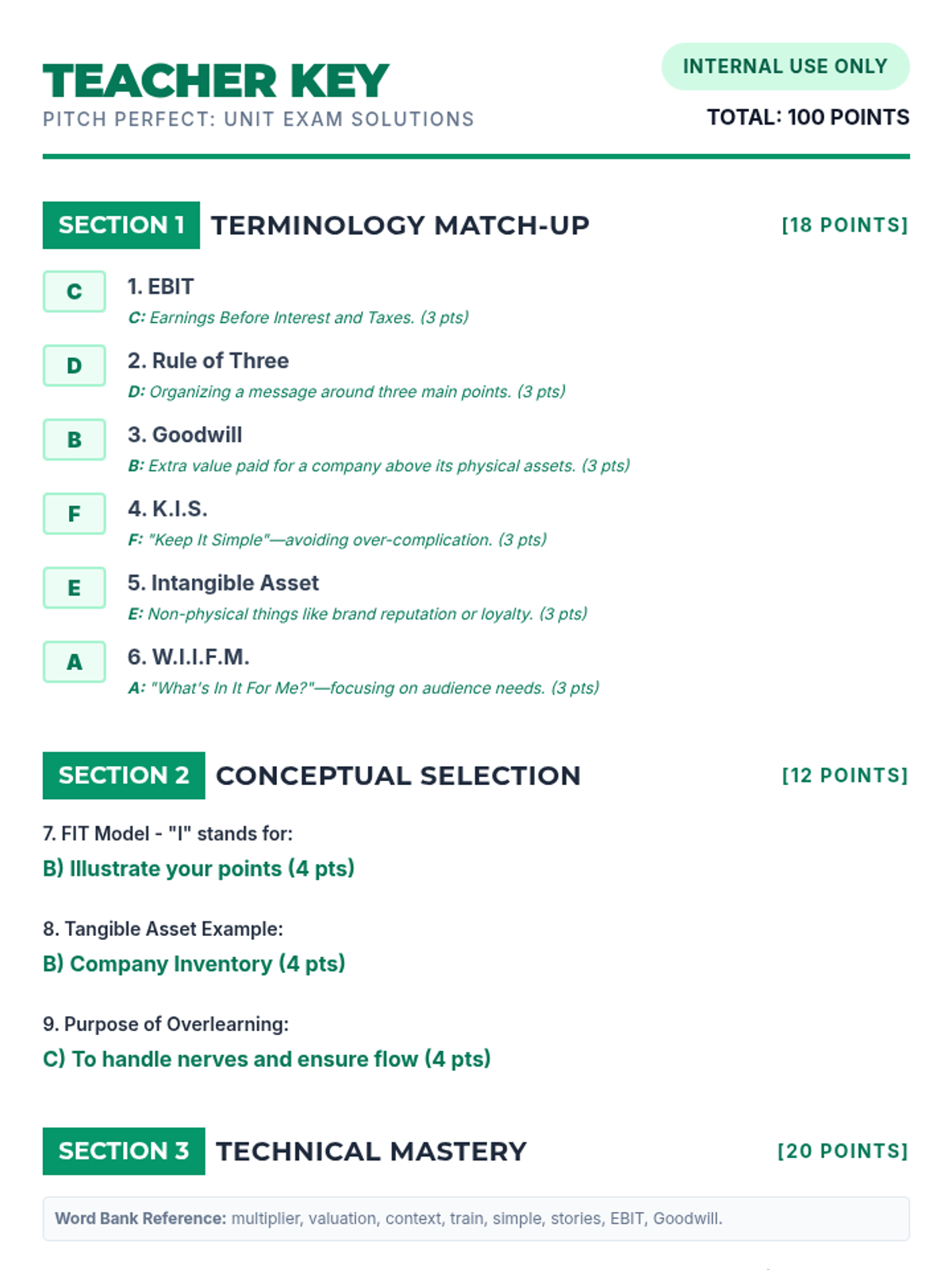
A detailed teacher answer key for the Pitch Perfect Unit Exam, including correct answers for all sections, point value breakdowns totaling 100 points, and grading criteria for open-ended and scenario-based questions.
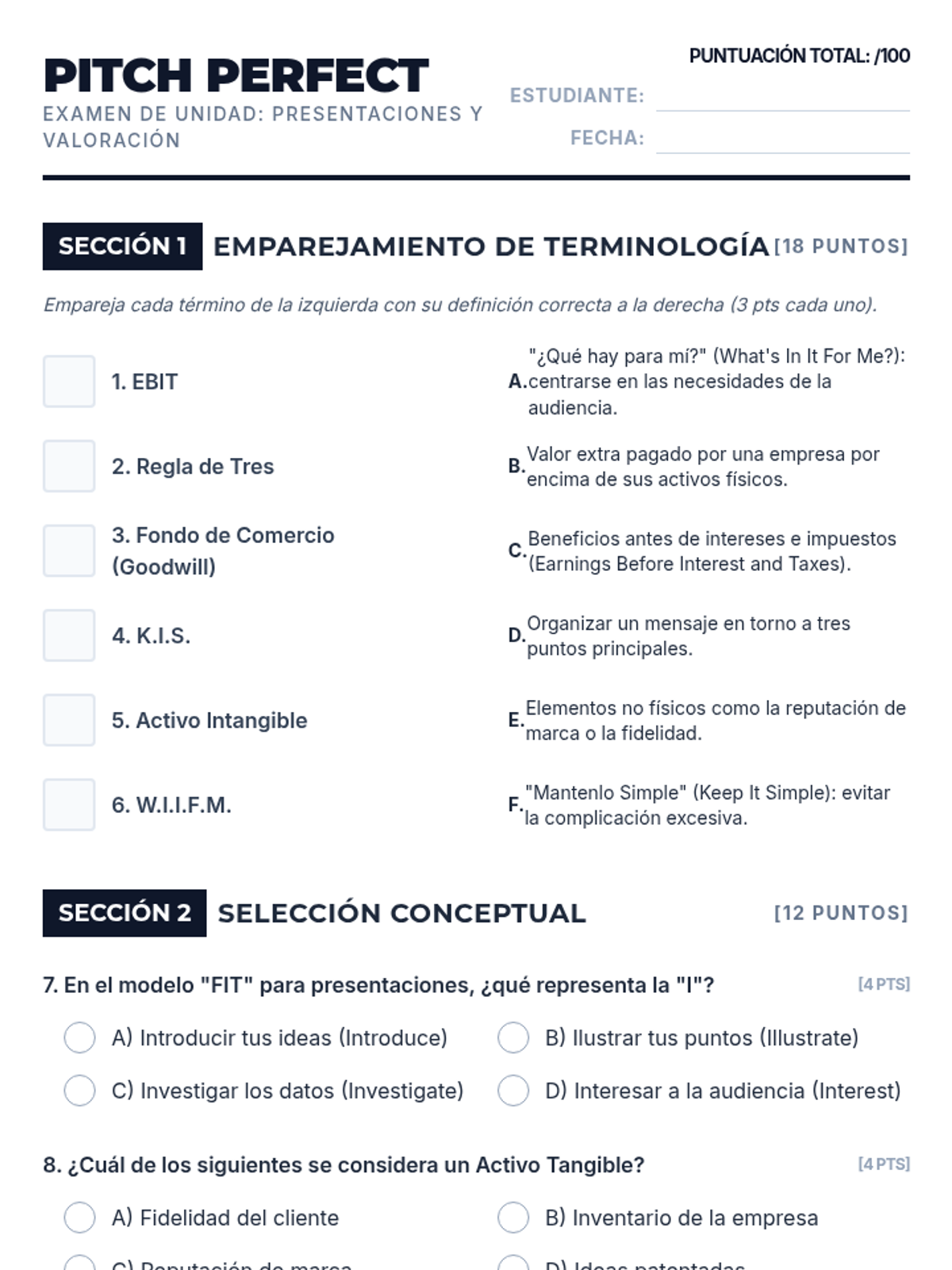
A comprehensive unit exam covering presentation skills (FIT model, Rule of Three, KIS, WIIFM) and business valuation concepts (EBIT, tangible/intangible assets, goodwill). Includes matching, multiple choice, fill in the blank, and short answer questions with assigned point values and a word bank.
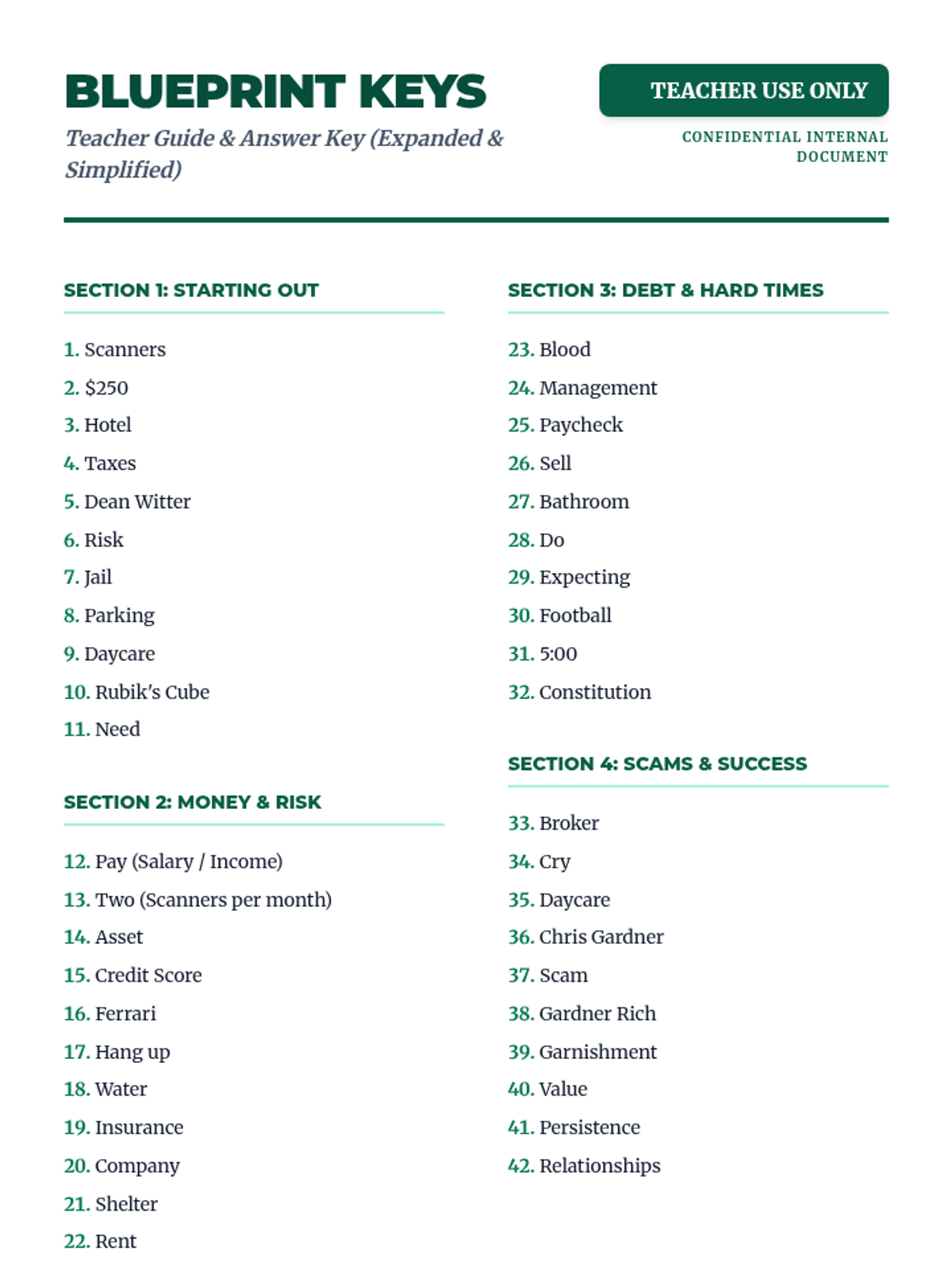
The answer key and discussion guide for the 'Brokerage Blueprint' worksheet, including all 42 answers and prompts for classroom debate on opportunity cost and asset management. Includes new answers for credit, insurance, and debt management.
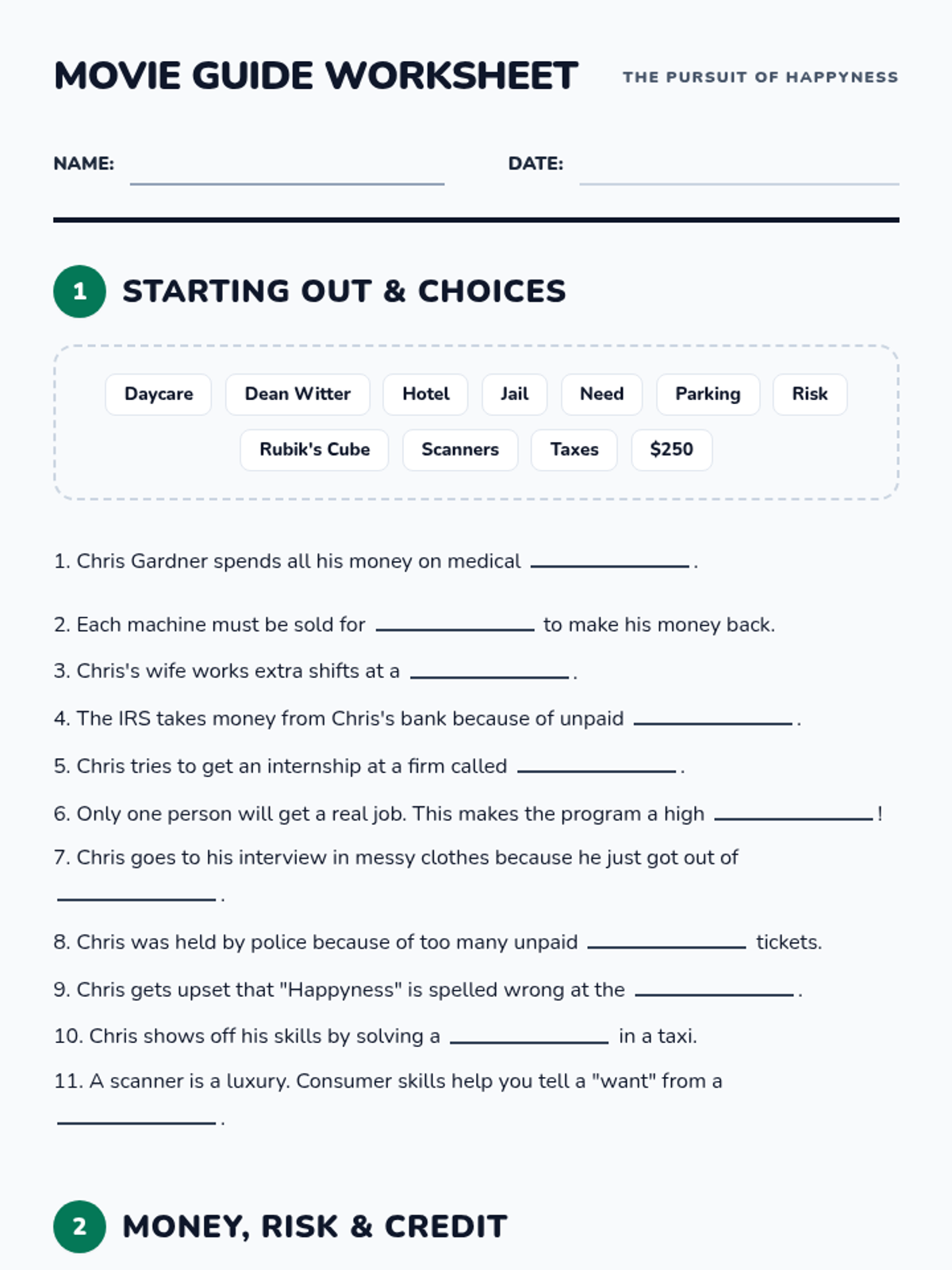
A comprehensive 42-question fill-in-the-blank worksheet with word banks and simplified language, designed for students who struggle with reading. Includes new questions on credit, insurance, and debt management. Fixed layout issues and orphaned punctuation.
A visually accessible introduction to 'The Pursuit of Happyness' with simplified text and large fonts, perfect for students who struggle with reading.
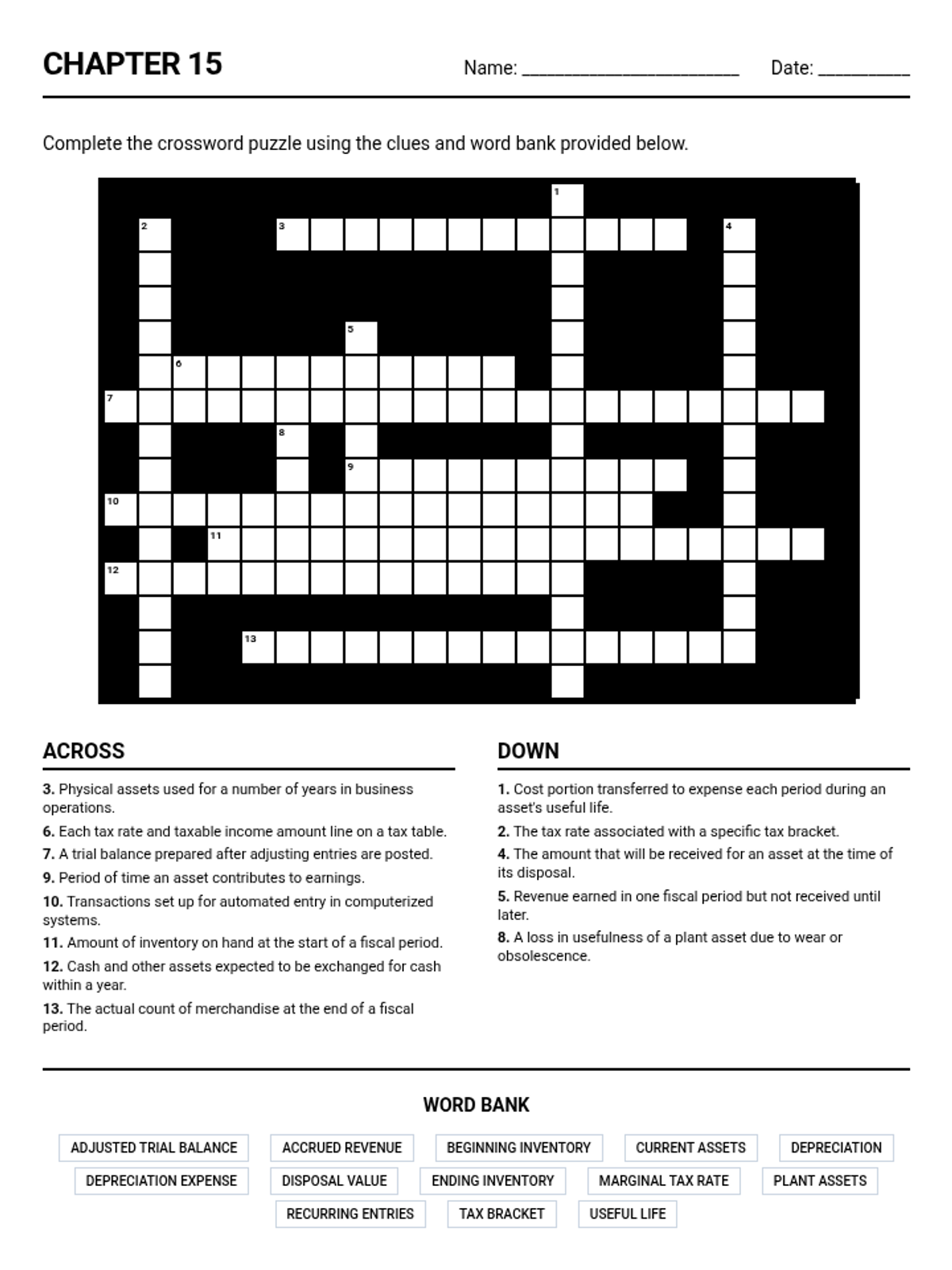
A simplified, black-and-white print-friendly crossword worksheet for Chapter 15 accounting terms. All elements, including the grid, clues, and word bank, are consolidated on a single page for classroom efficiency.
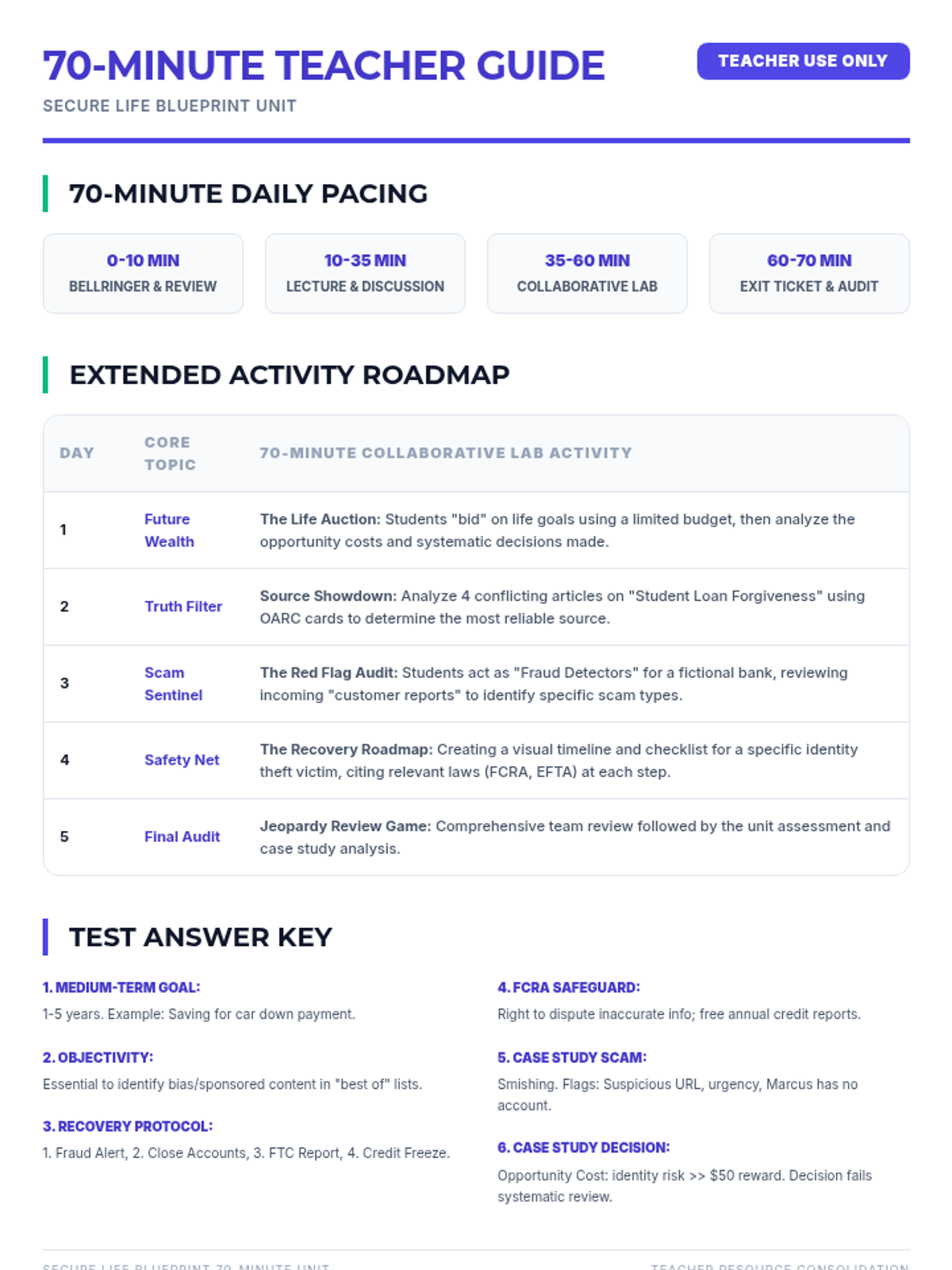
A teacher-facing resource providing the answer key for the unit test, unit objectives, and instructional tips for delivering the Secure Life Blueprint unit. Revised with the overarching unit goal and 70-minute daily pacing guide.
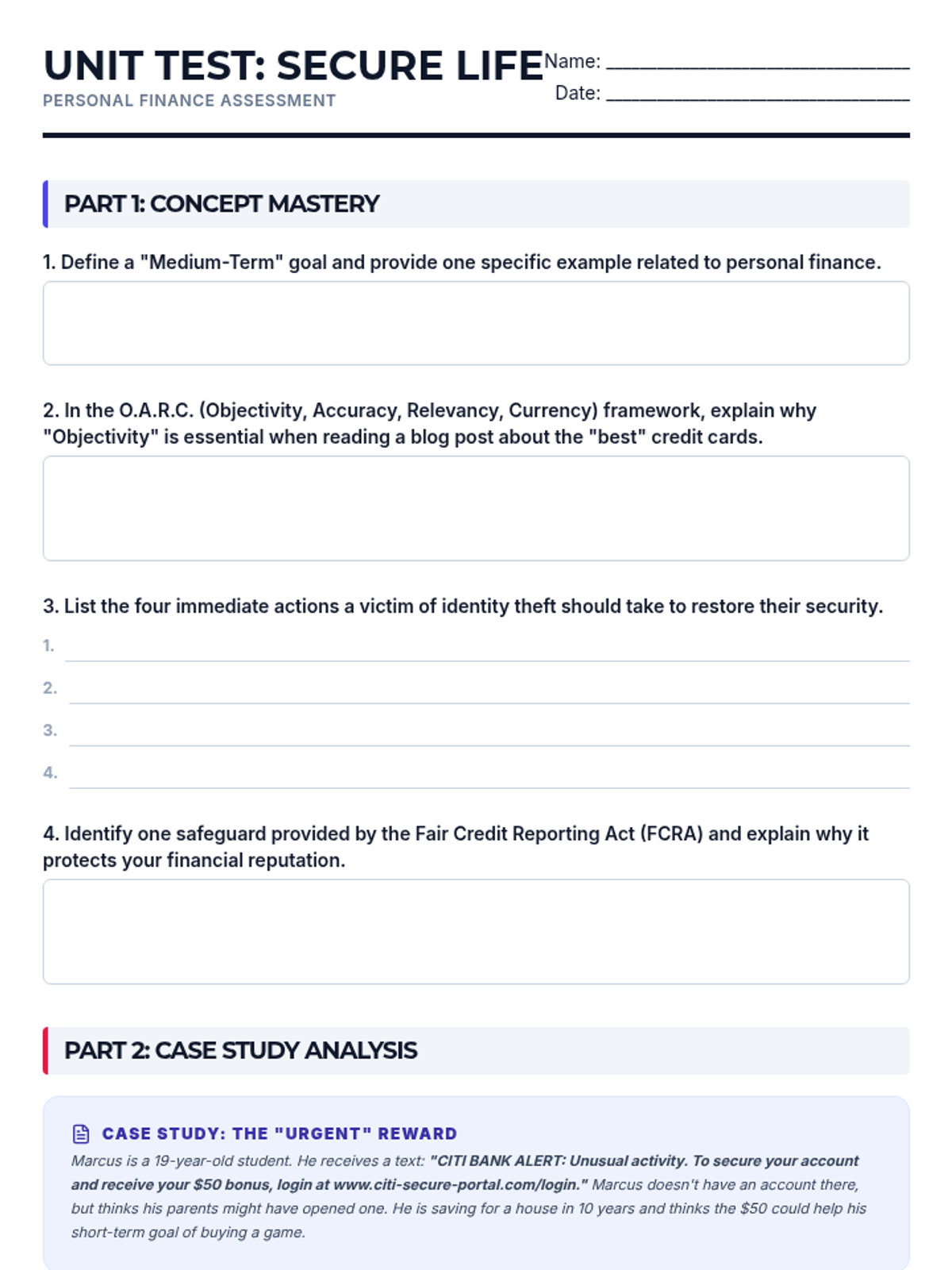
A unit test featuring short answer questions on core concepts and a detailed case study analysis involving fraud detection, decision-making, and consumer laws. Revised with better spacing and defined acronyms. Tightened to avoid empty pages.
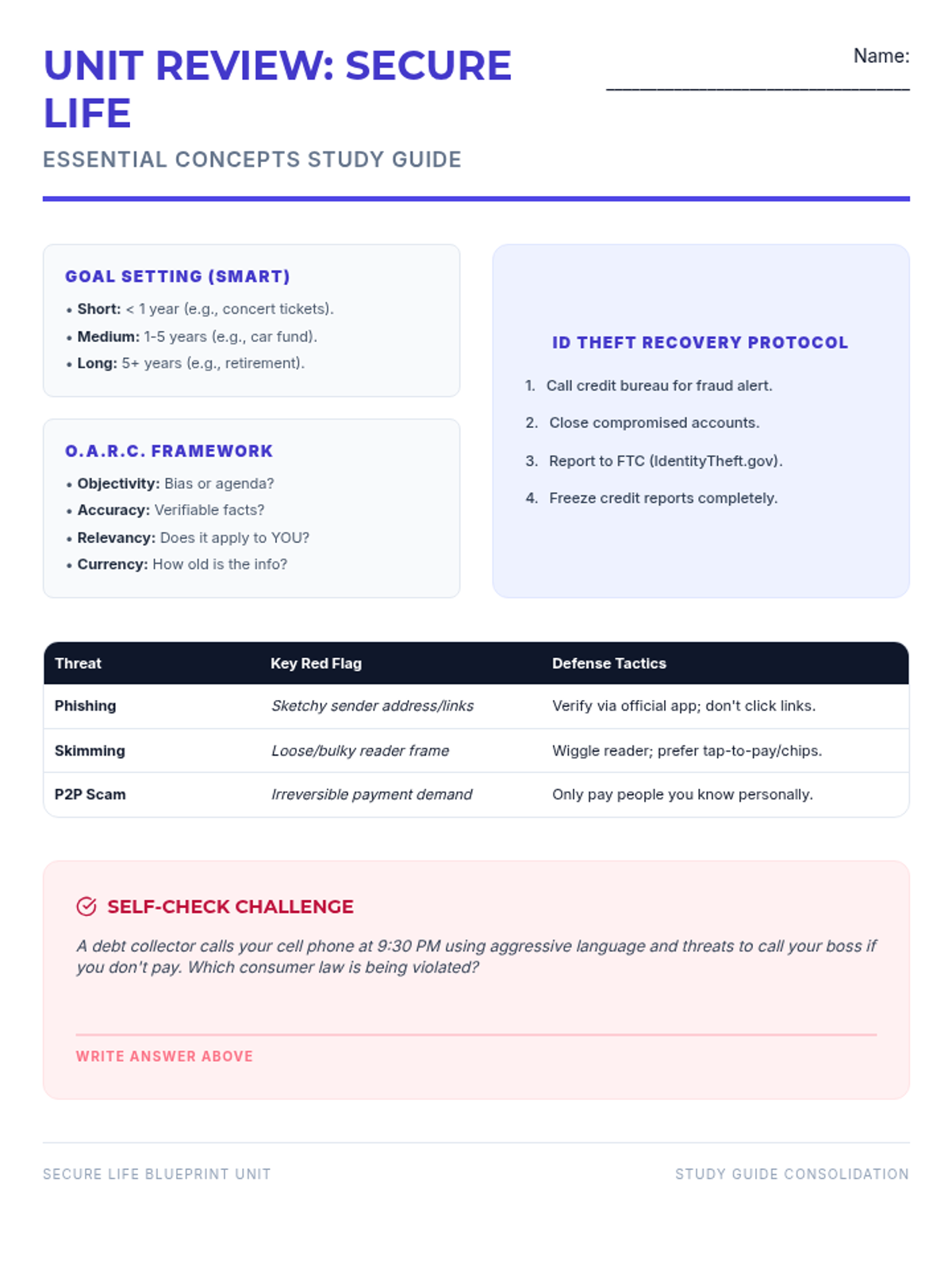
A concise unit review study guide summarizing SMART goals, systematic decision-making, the OARC information filter, fraud types, and identity theft recovery steps. Revised to fit on one page with increased response area.
A slide deck outlining consumer protection laws and the specific protocol for responding to identity theft. Revised with information on agencies and EFTA. Grammar corrected and contrast improved. Expanded for 70-minute sessions.
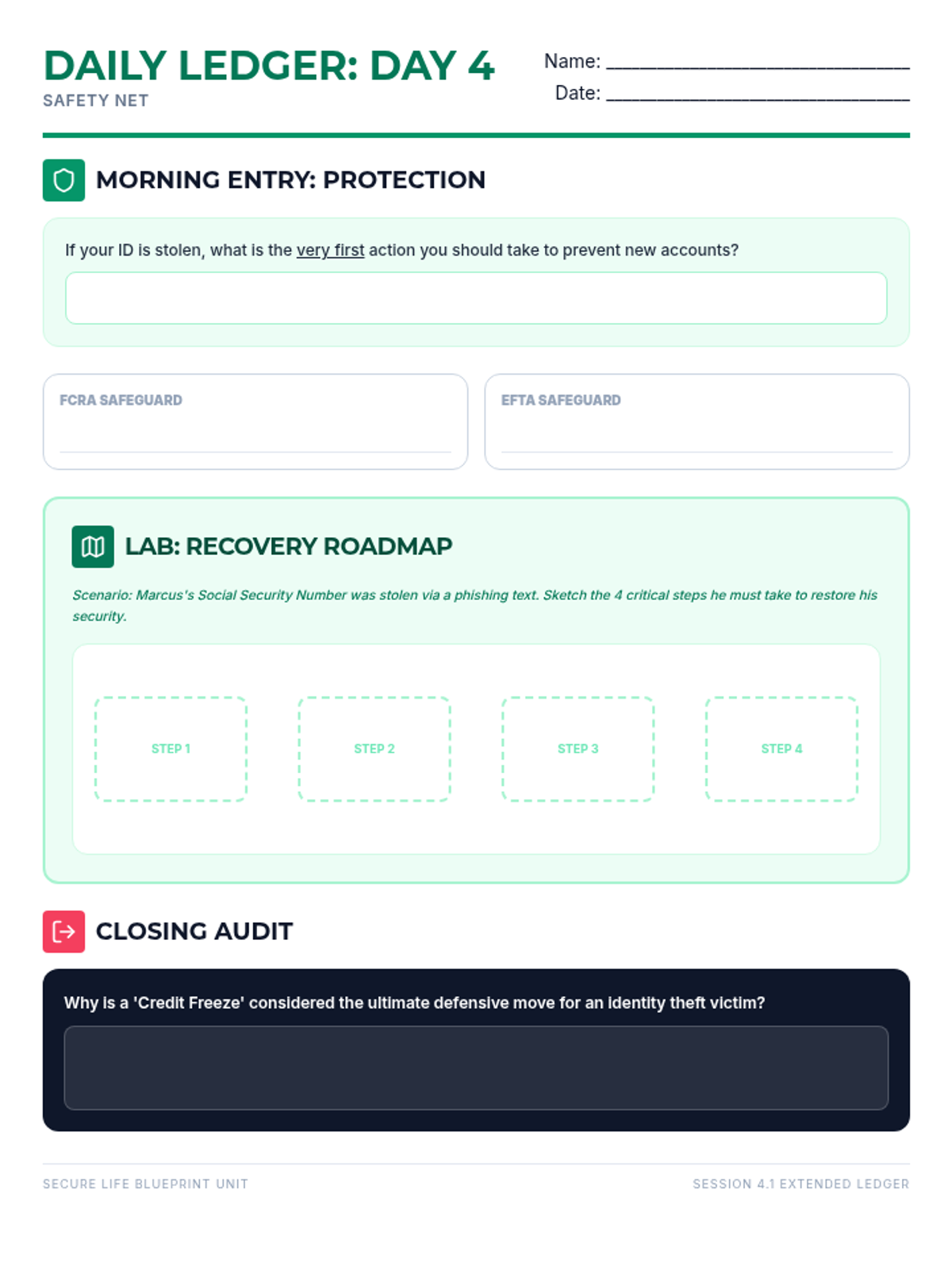
A student handout for Day 4 covering consumer protection laws and the specific steps to recover from identity theft. Revised with better alignment and increased response heights. Tightened to fit on one page.
A visual presentation on consumer fraud types including phishing, skimming, and peer-to-peer payment scams. Revised with psychological "hooks", detailed skimming info, and Fraud Audit lab instructions for 70-minute sessions.
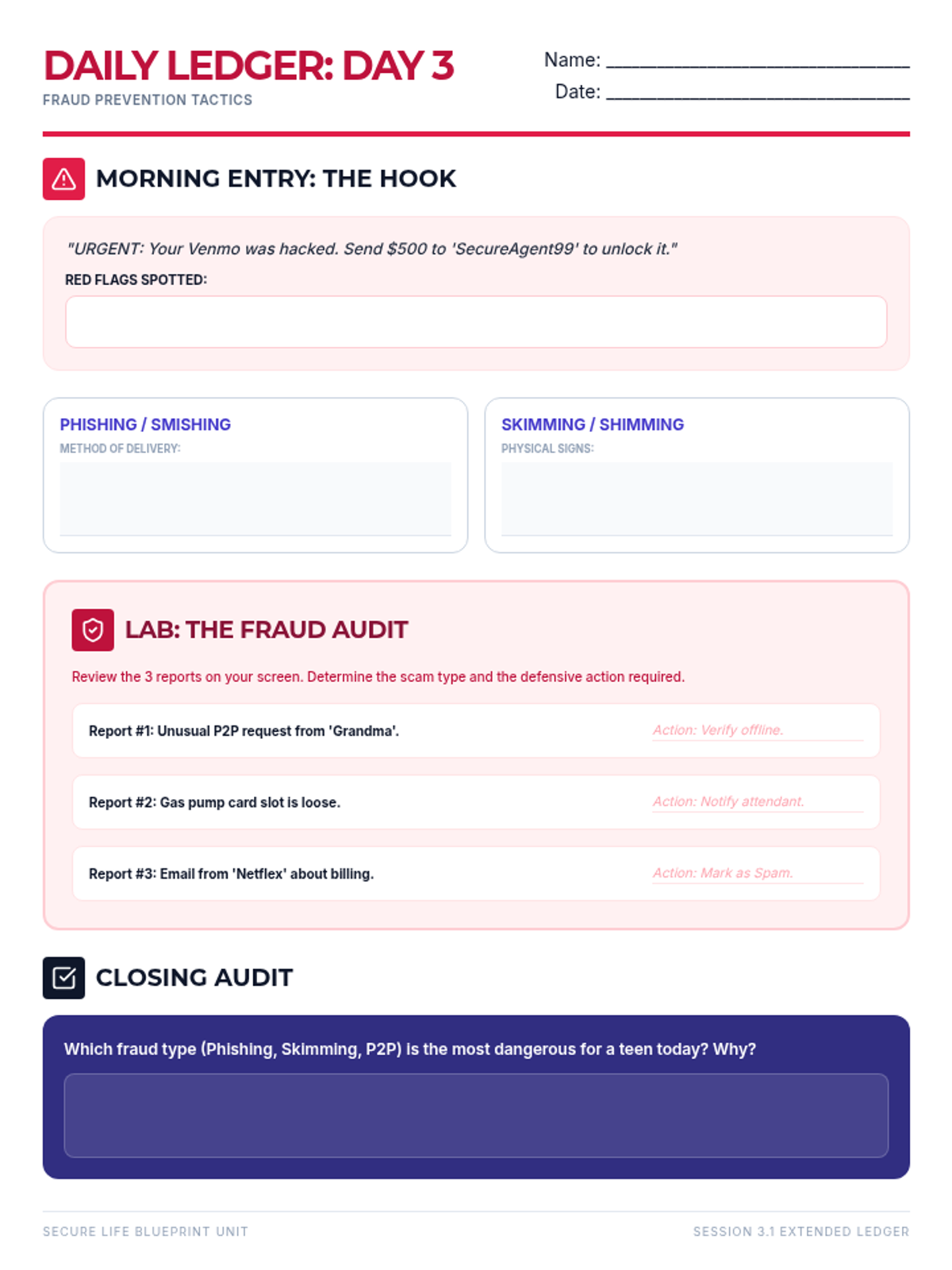
A student handout for Day 3 focusing on identifying and preventing consumer fraud. Revised with a 70-minute lab activity where students audit various fraud reports. Tightened layout to fit on one page.
A slide deck teaching the OARC (Objectivity, Accuracy, Relevancy, Currency) framework for evaluating financial information. Revised with breathing room, detailed criteria slides, and Source Showdown lab instructions.
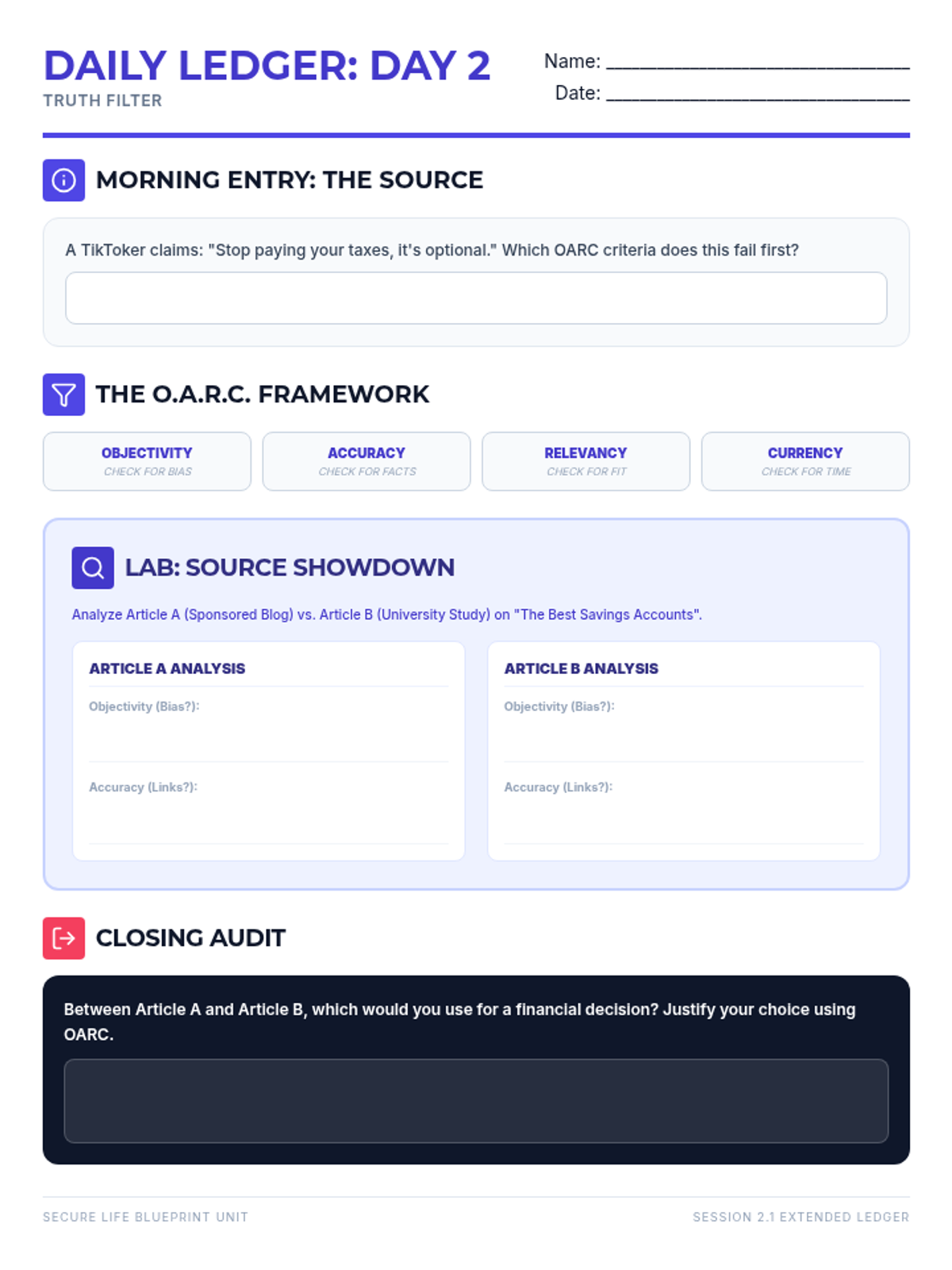
A daily handout for Day 2 featuring the OARC framework and an extended 'Source Showdown' lab activity where students compare financial information sources. Revised for 70-minute classes.
A presentation deck introducing the concepts of financial responsibility, systematic decision-making, and setting time-based financial goals. Revised to introduce the unit's mission statement and the PACED model.
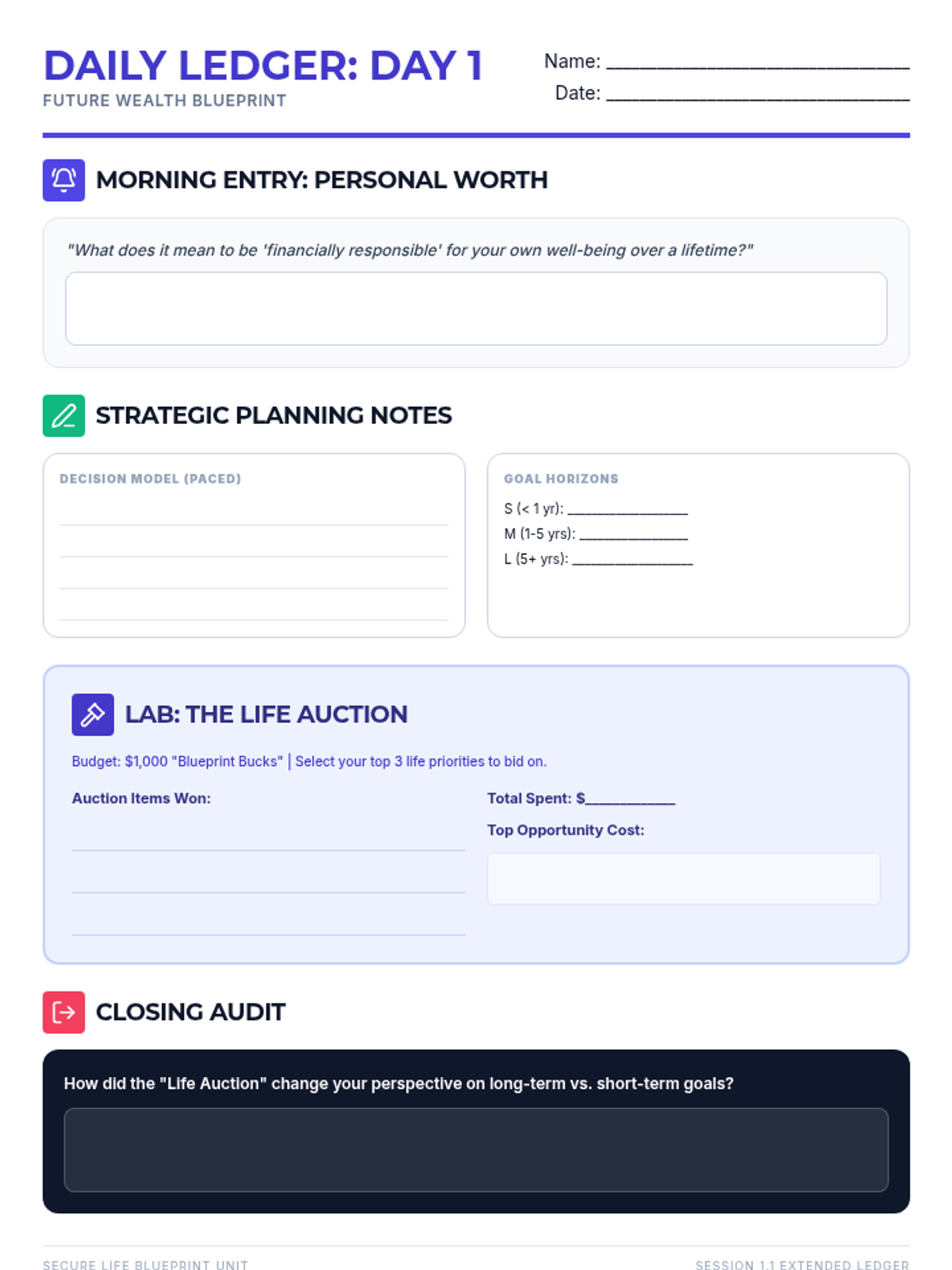
A daily handout for the first lesson featuring a bellringer activity about financial responsibility, space for notes on systematic decision-making and goals, and a new 'Life Auction' lab activity for extended class periods.
A dynamic 6-slide presentation deck summarizing the core concepts of Stockholders' Equity and Time Value of Money for a final exam review session. Revised for LaTeX rendering, text contrast, and font size consistency.
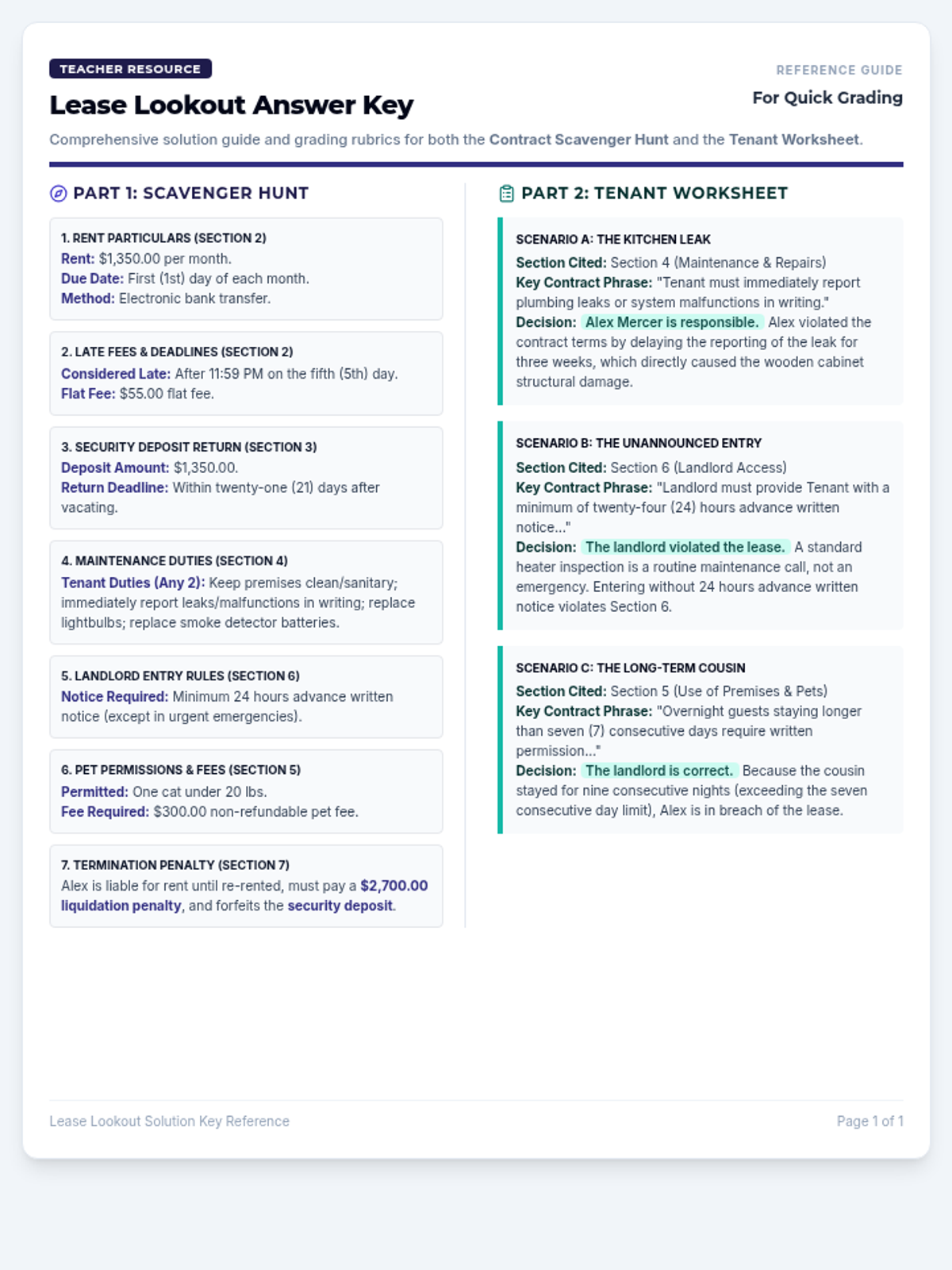
A comprehensive teacher-facing answer key containing solutions and legal defenses for the Scavenger Hunt and Scenario Worksheet.
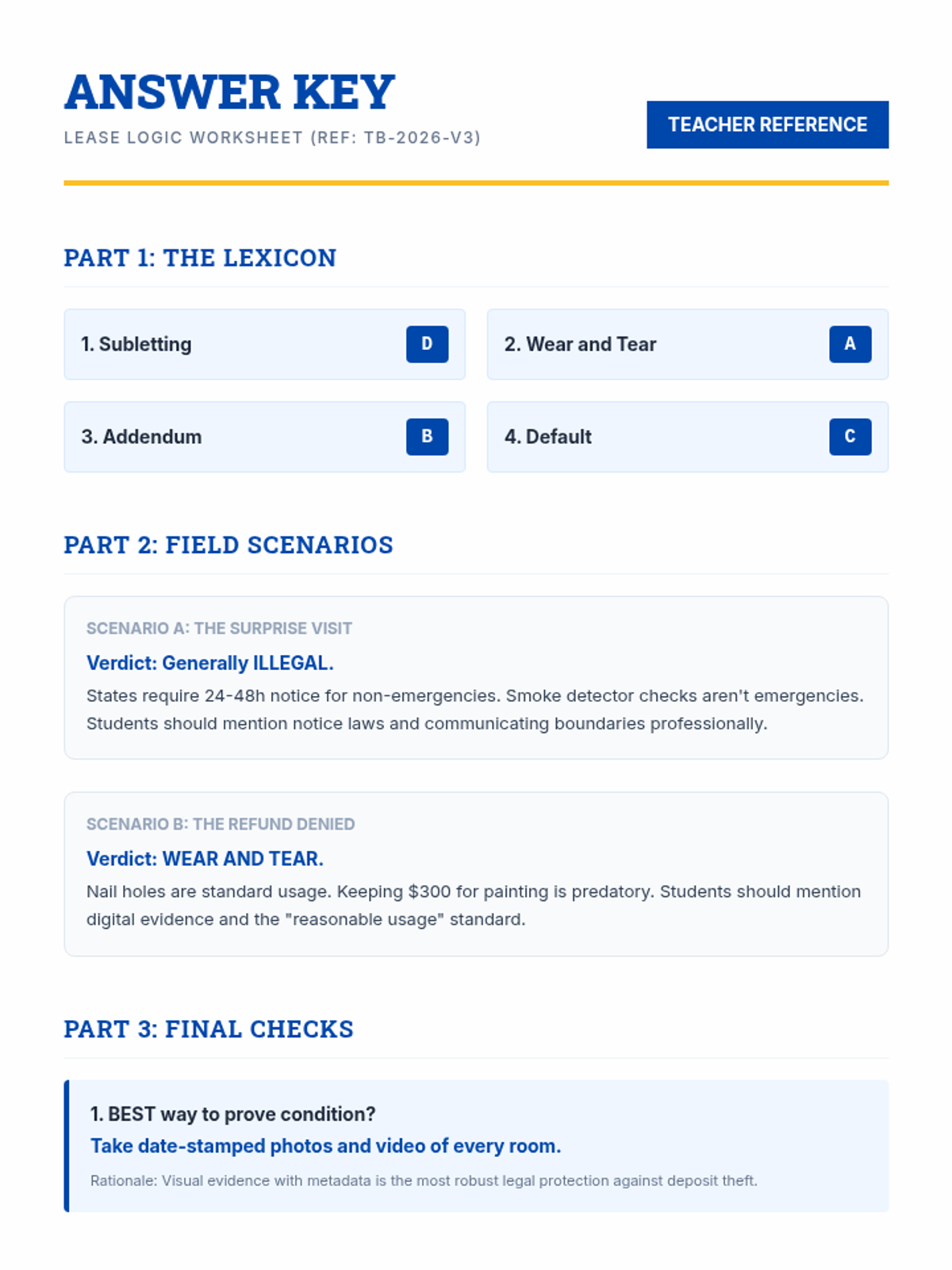
An answer key for 'The Tenant’s Blueprint' lesson. Provides correct matching for rental vocabulary, detailed explanations for legal scenarios, and a quick-reference key for the 'Red Flag Audit' activity.
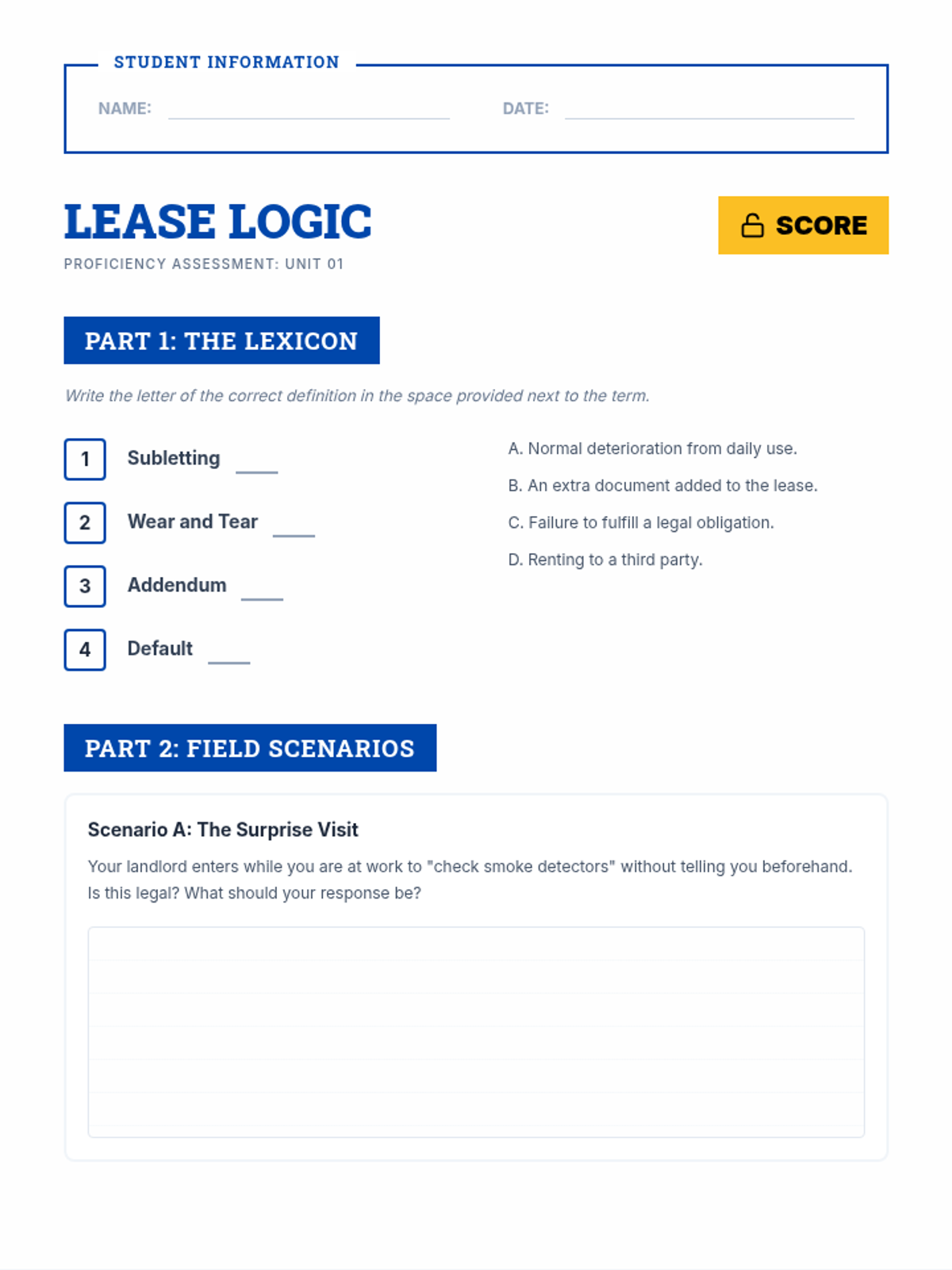
An individual student worksheet for 'The Tenant’s Blueprint' lesson. Assesses understanding of rental vocabulary, legal scenarios, and best practices for protecting a security deposit. Features matching, short-answer scenario analysis, and multiple-choice questions.
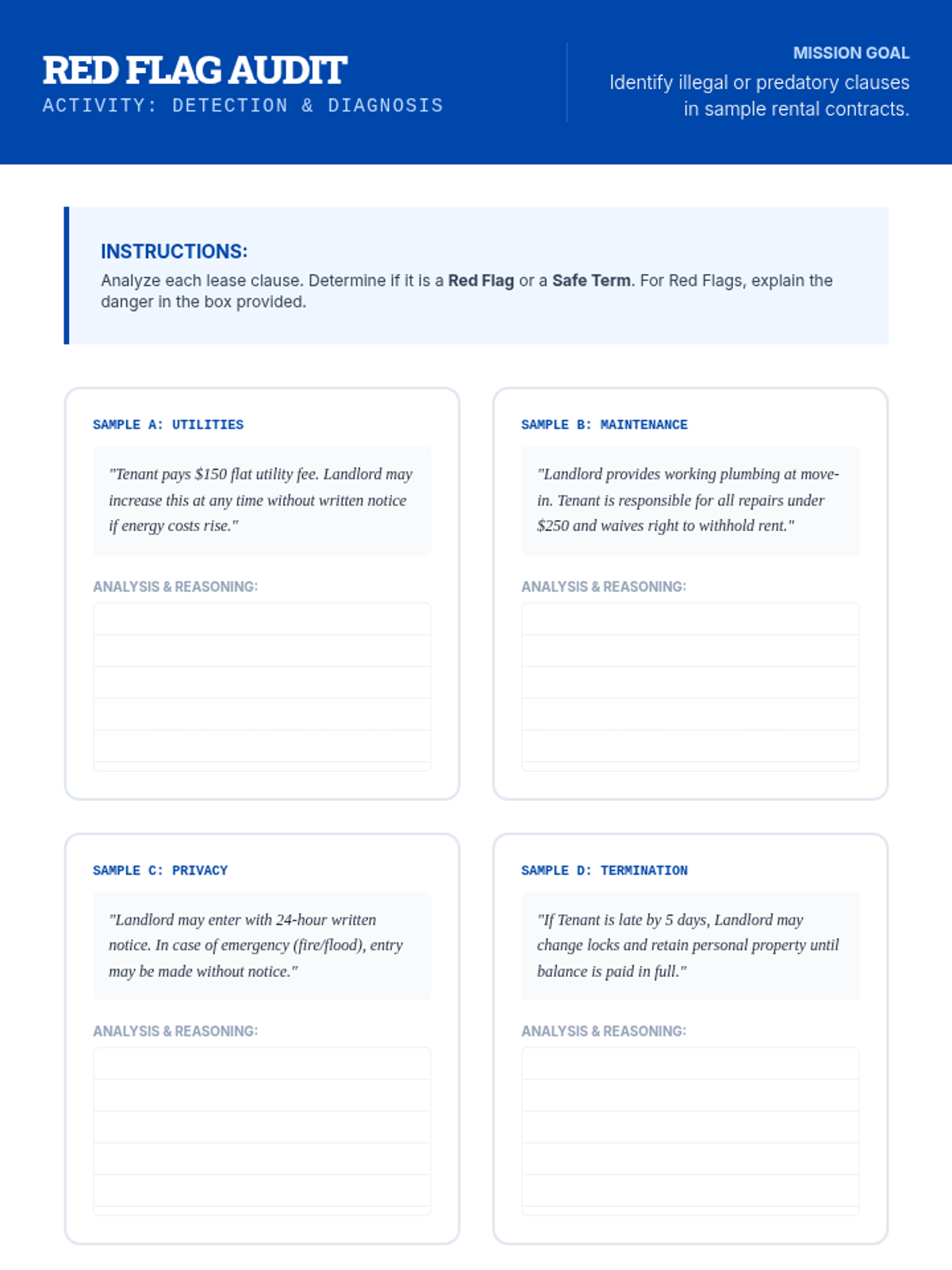
A collaborative 'Red Flag Audit' activity for 'The Tenant’s Blueprint' lesson. Students analyze six sample lease clauses to distinguish between safe, legal terms and predatory or illegal 'red flags'. Includes analysis work areas and group discussion prompts.
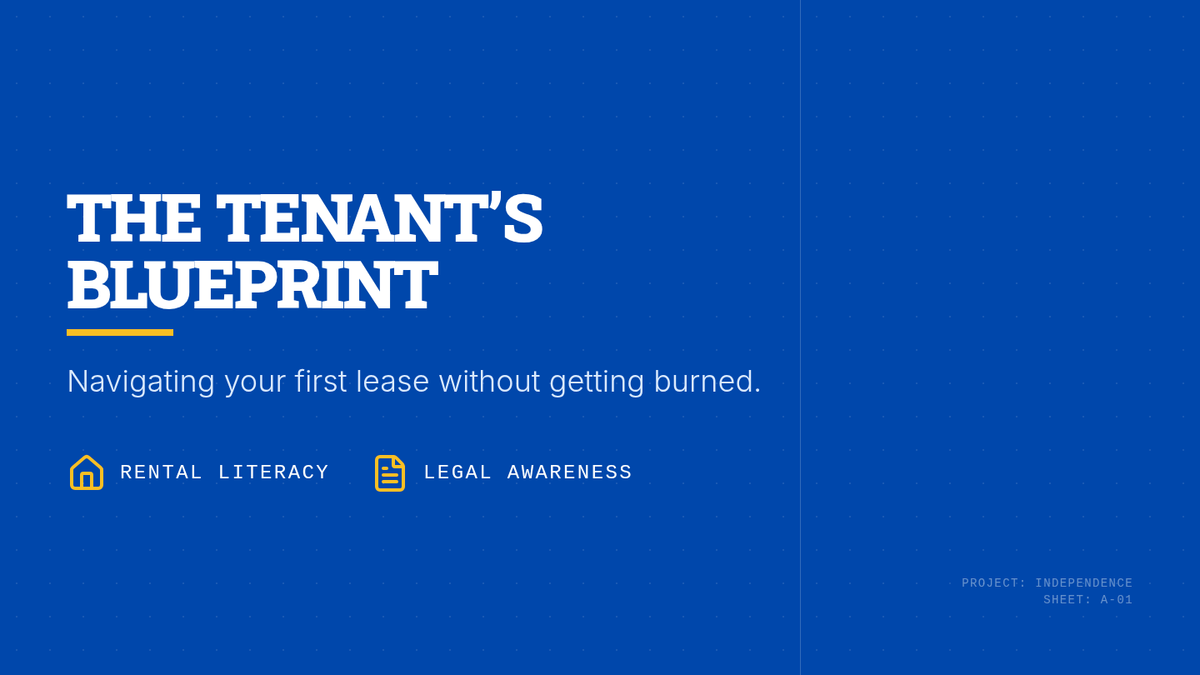
A visually striking slide deck for 'The Tenant’s Blueprint' lesson, designed to teach seniors the fundamentals of rental agreements. Includes sections on lease decoding, identifying legal red flags, move-in protection strategies, and professional communication with landlords.
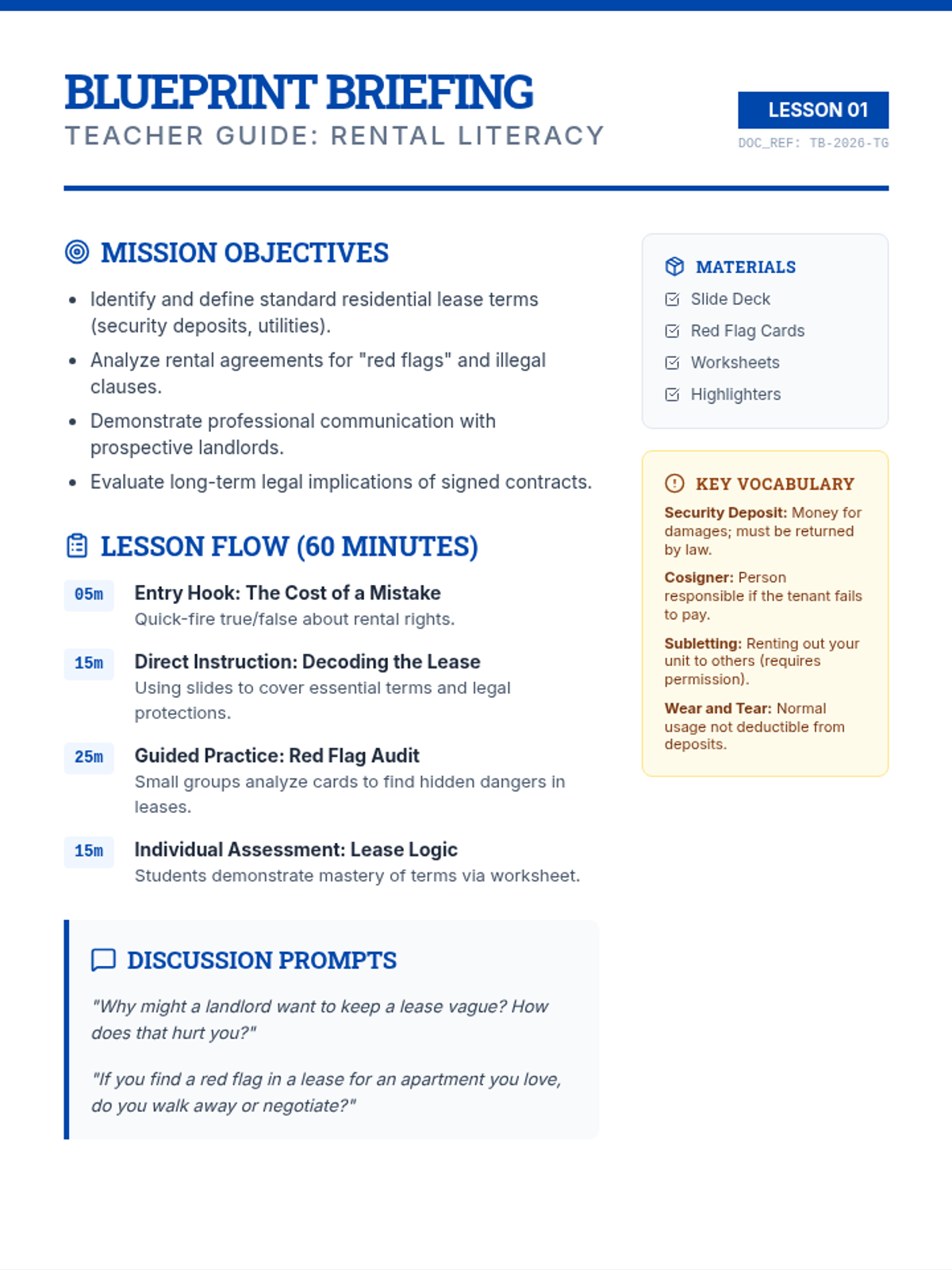
A comprehensive teacher guide for 'The Tenant’s Blueprint' lesson, featuring lesson objectives, a detailed 60-minute instructional flow, discussion prompts, and differentiation strategies for teaching rental literacy to seniors.
Slides for Day 2 of the Apartment Living unit, explaining leases, security deposits, and essential legal terminology for adult transition students.
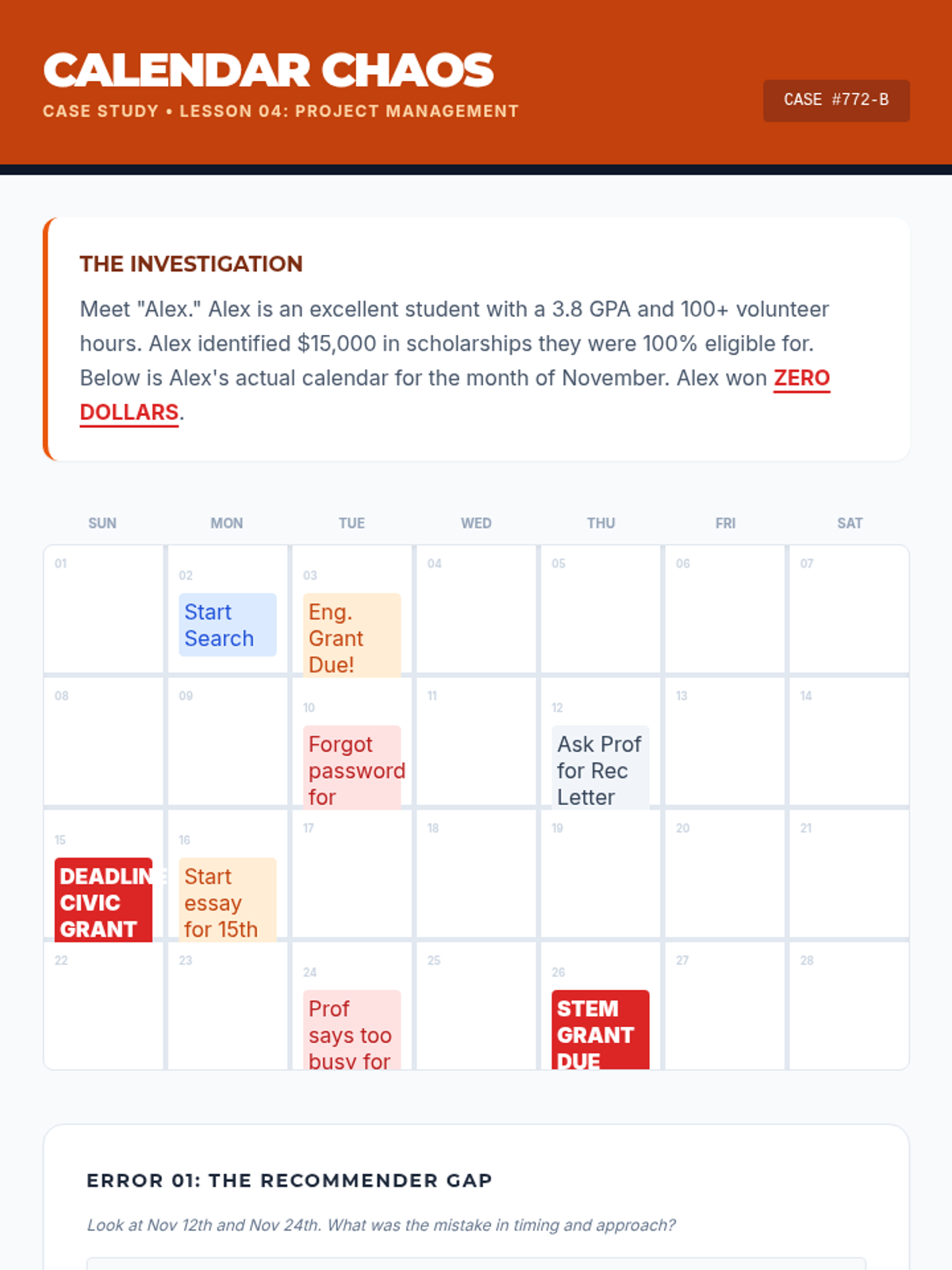
A case study activity where students analyze a disorganized student calendar to identify critical time-management and project-management errors in the scholarship application process.
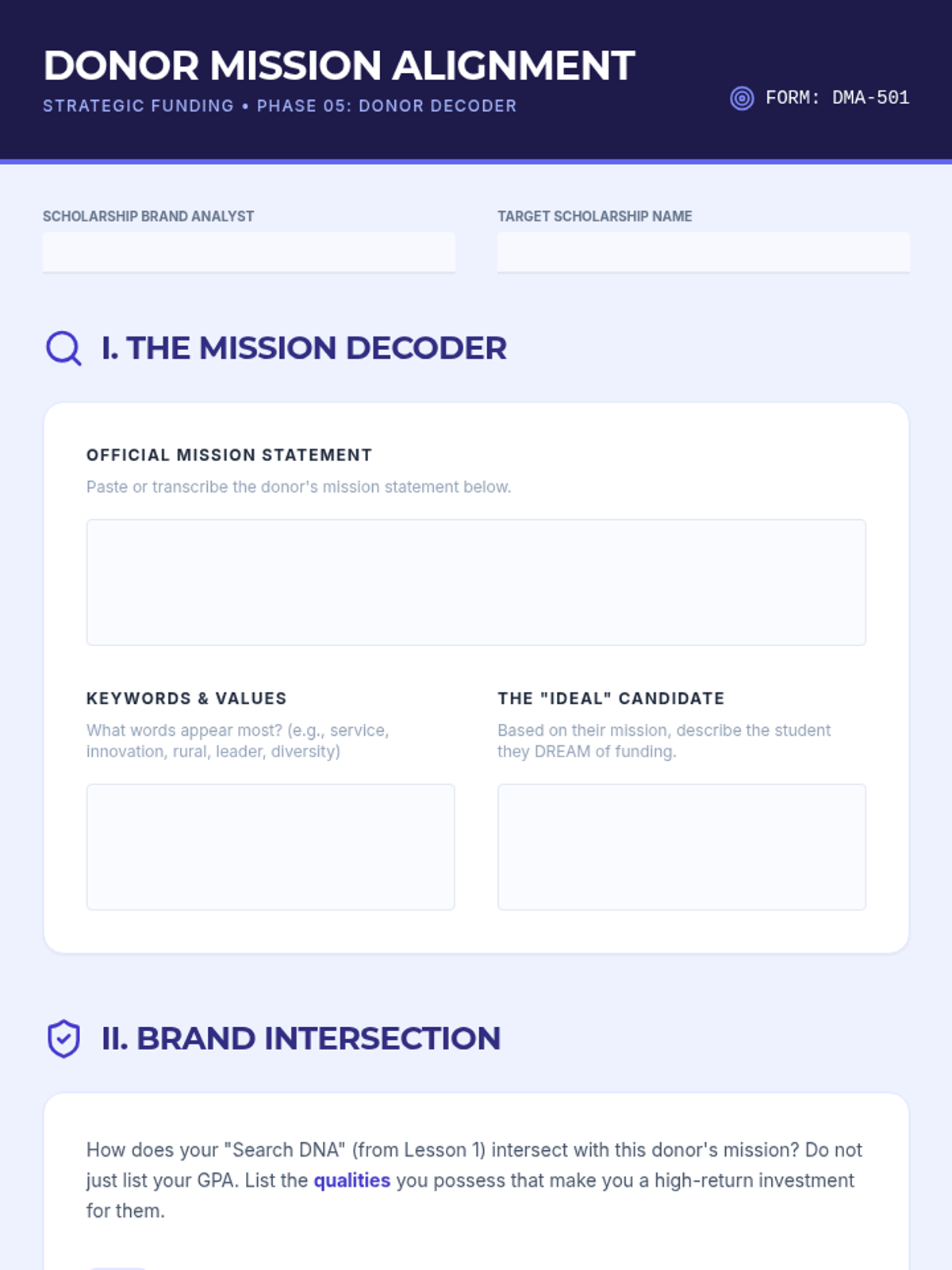
An alignment worksheet for students to research donor mission statements and justify how their personal brand connects to the funding organization's goals.
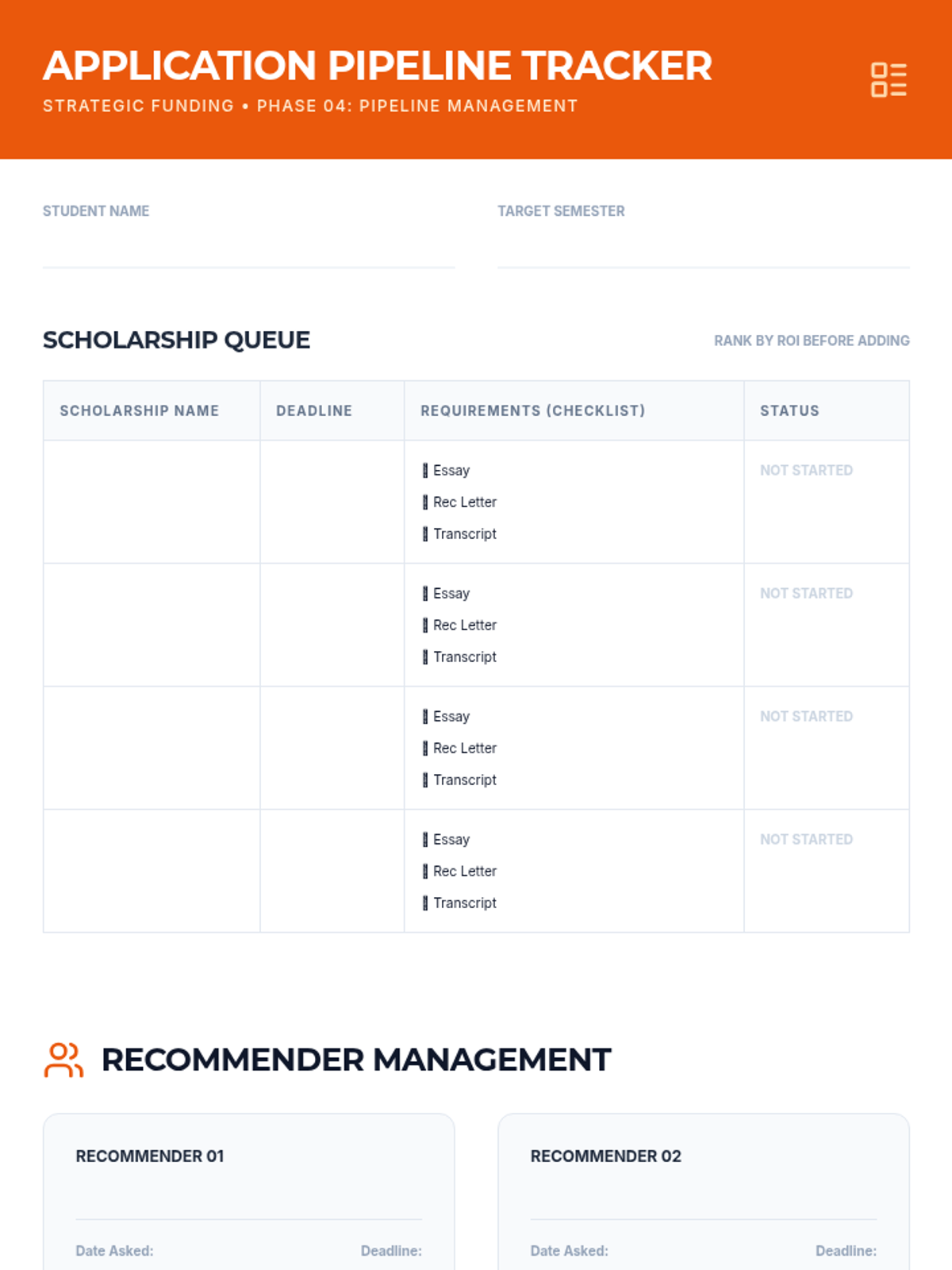
A comprehensive tracking worksheet for managing multiple scholarship deadlines, requirements, and recommender communication.
Instructional slides for Lesson 3, focusing on the concept of 'hourly rate' for scholarship applications and differentiating between high-competition and niche grants.
Instructional slides for Lesson 5, focusing on donor mission alignment and how to research organizations beyond their basic homepage.
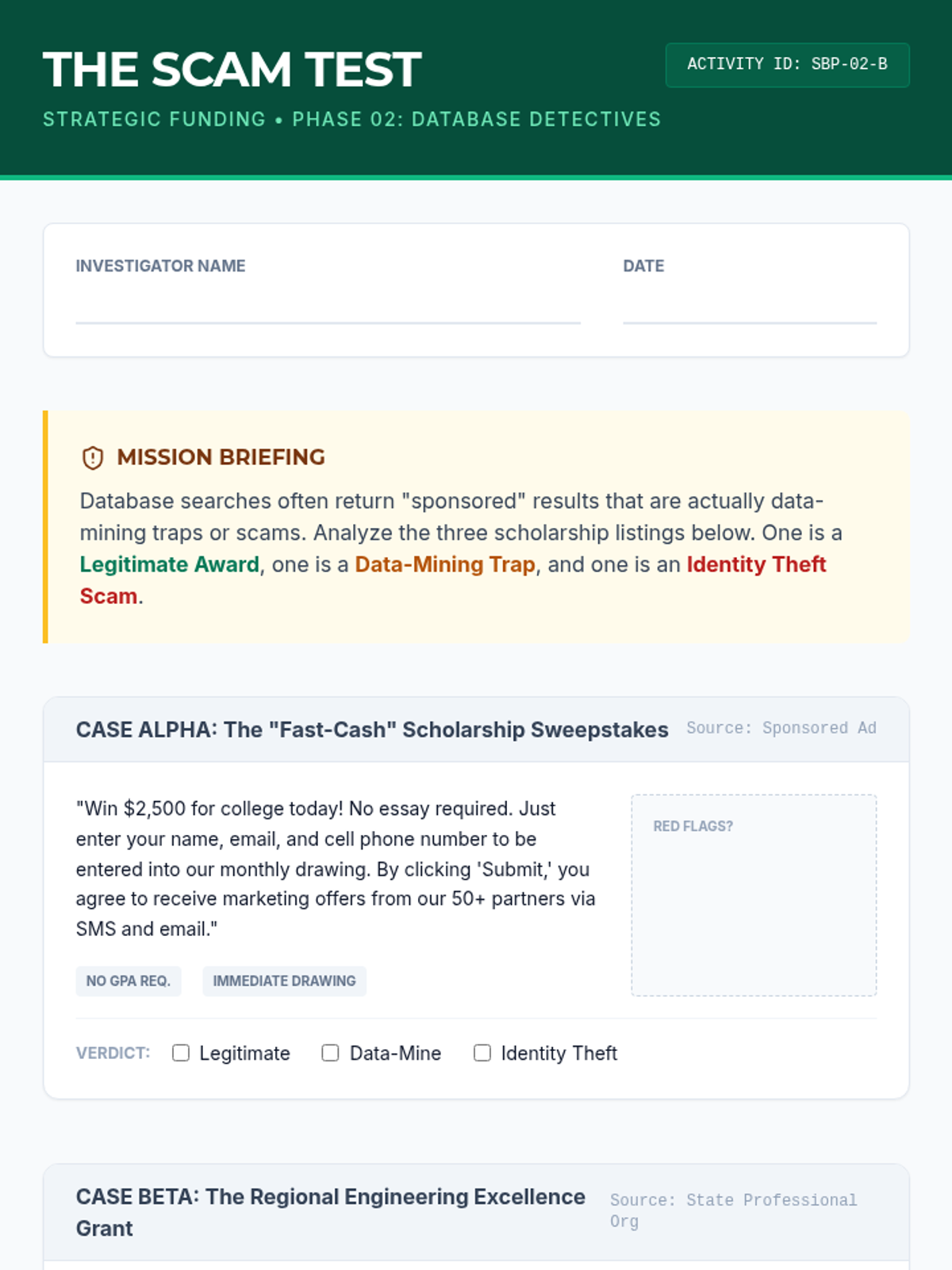
A case study activity where students analyze three scholarship listings to identify legitimate opportunities versus scams and data-mining traps.
Instructional slides for Lesson 4, covering building a tracking system, managing recommenders, and the importance of application infrastructure.
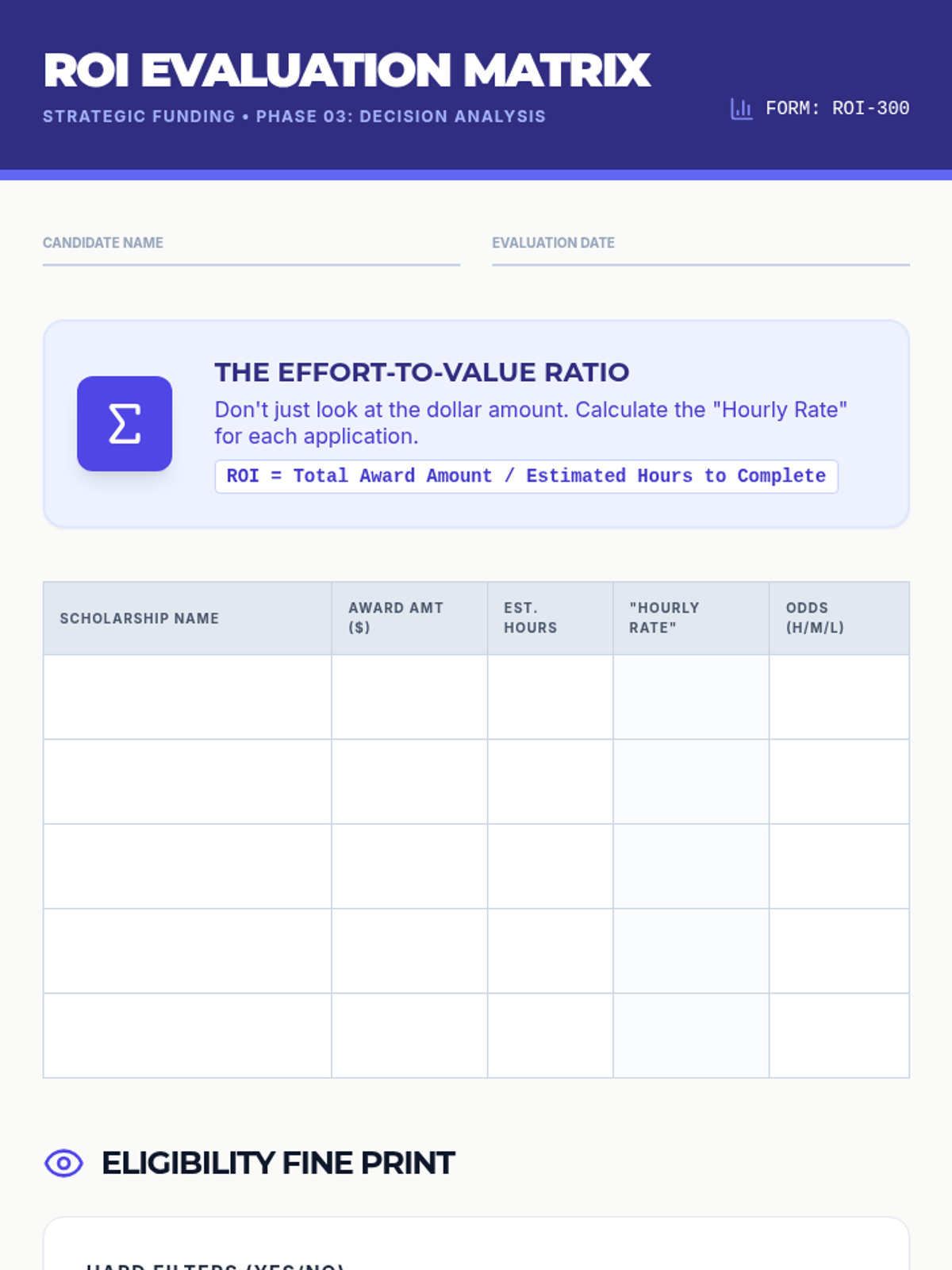
A decision-making worksheet for evaluating scholarships based on award amount, estimated effort, and eligibility odds to determine a student's personal ROI strategy.
Instructional slides for Lesson 2, covering database types, advanced Boolean search techniques, and red-flag detection for scholarship scams.
Instructional slides for Lesson 1, focusing on debunking scholarship myths, identifying 'Search DNA' (Identity, Interests, Geography), and conducting a financial gap analysis.
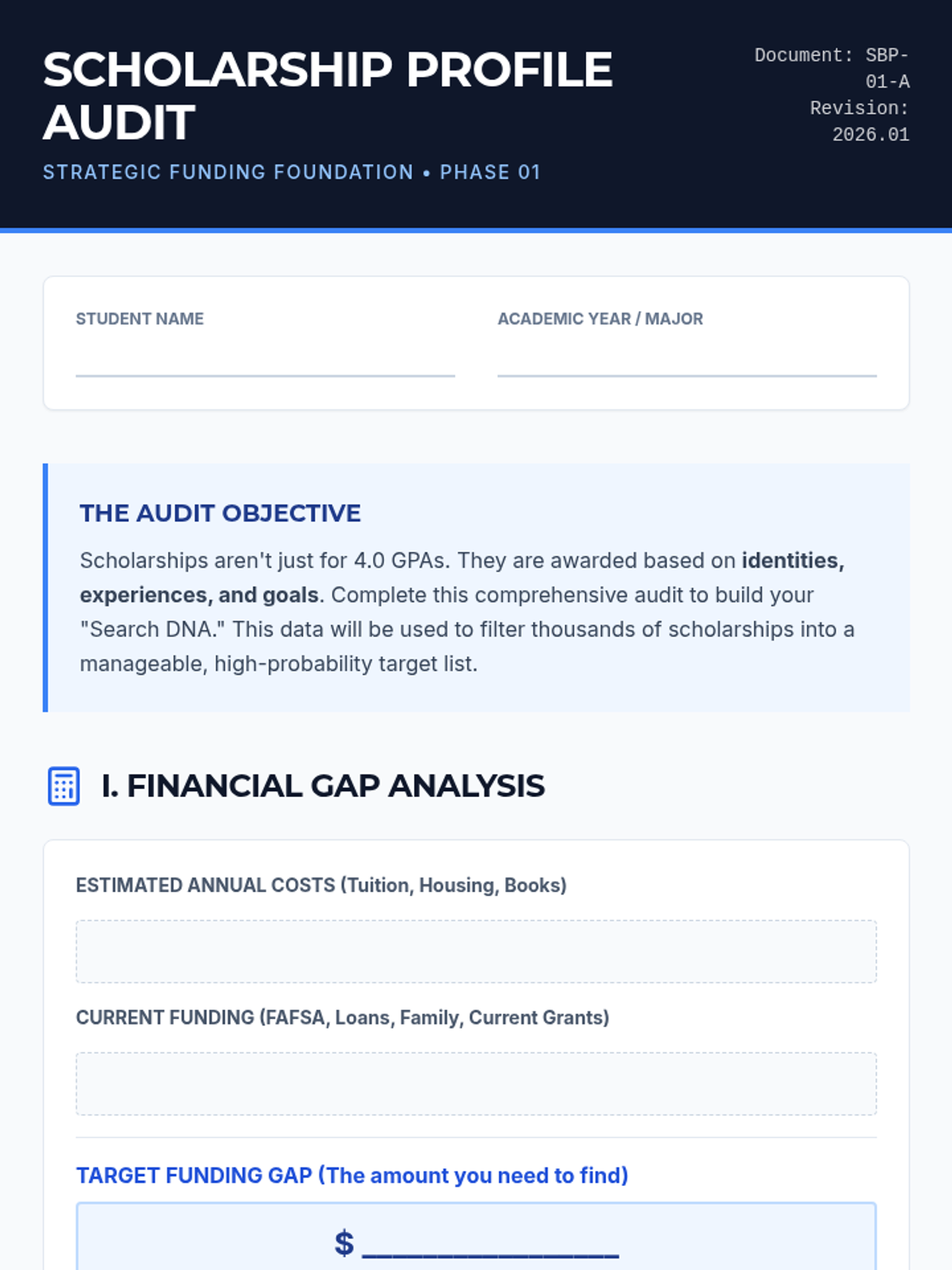
A comprehensive self-audit worksheet for undergraduate students to identify financial gaps, demographic traits, and niche interests for scholarship targeting.
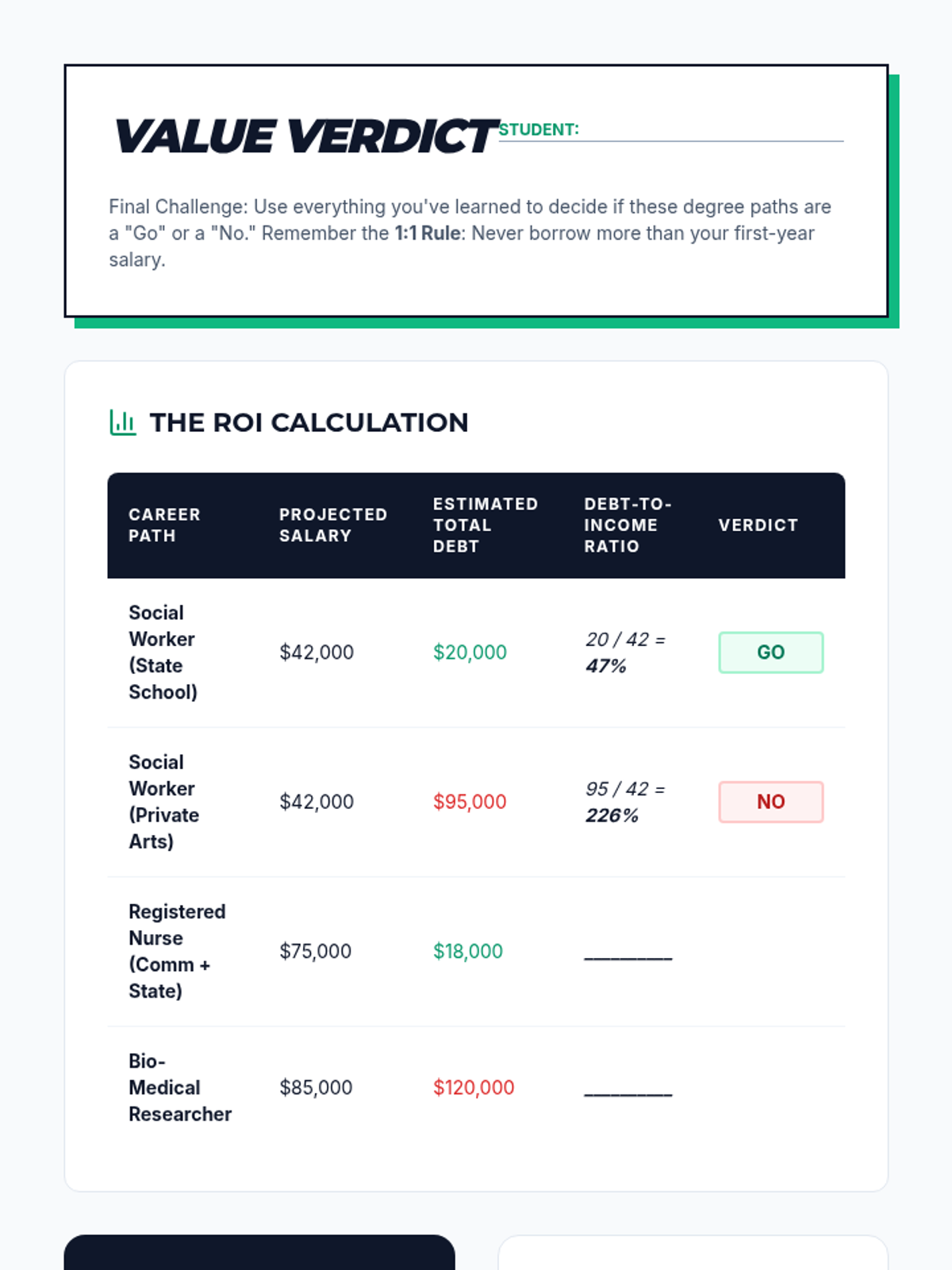
Case study activity comparing two education paths and calculating the ROI for each based on the 1:1 borrowing rule.
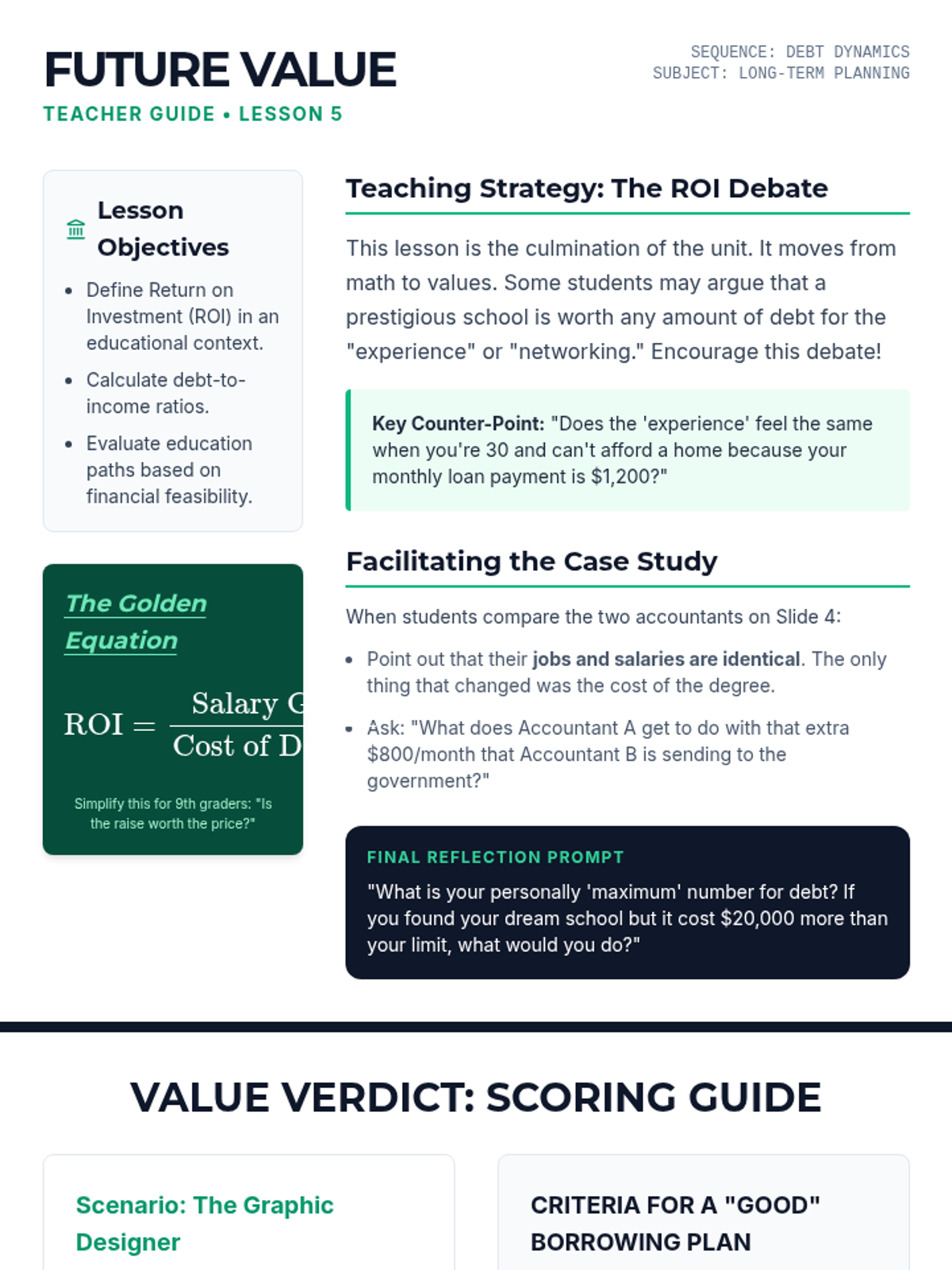
Teacher guide for Lesson 5, including discussion prompts for the "Is it worth it?" debate and guidelines for responsible borrowing.
Introductory slides for Lesson 5, defining ROI, debt-to-income ratio, and comparing expensive private schools vs state schools with career outcomes.
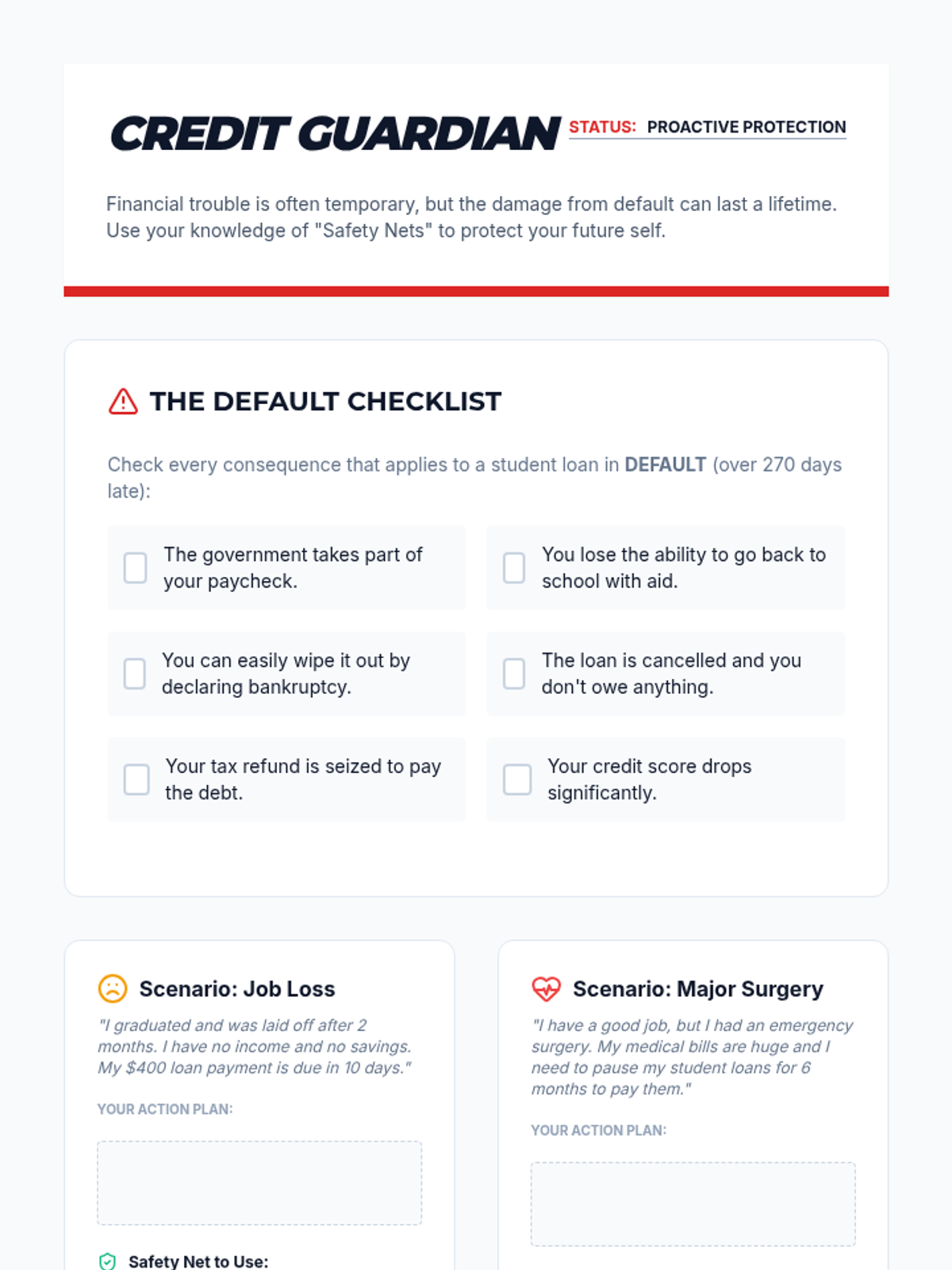
Scenario-based decision-making worksheet for students to identify the consequences of default and select appropriate safety nets like deferment or forbearance.
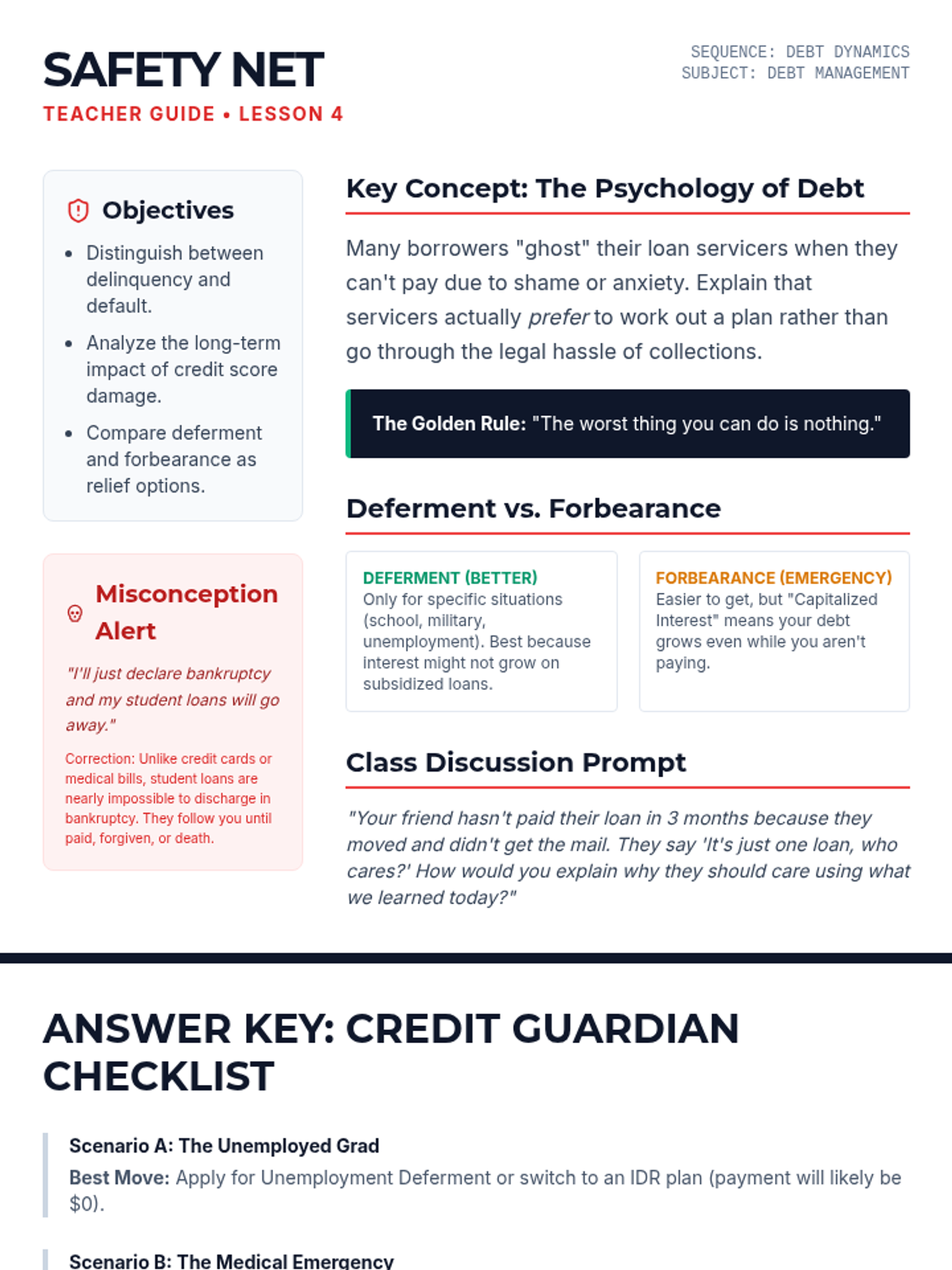
Teacher guide for Lesson 4, covering instructional strategies for discussing the consequences of default and distinguishing between deferment and forbearance.
Introductory slides for Lesson 4, explaining the consequences of delinquency and default, the impact on credit scores, and the difference between deferment and forbearance.
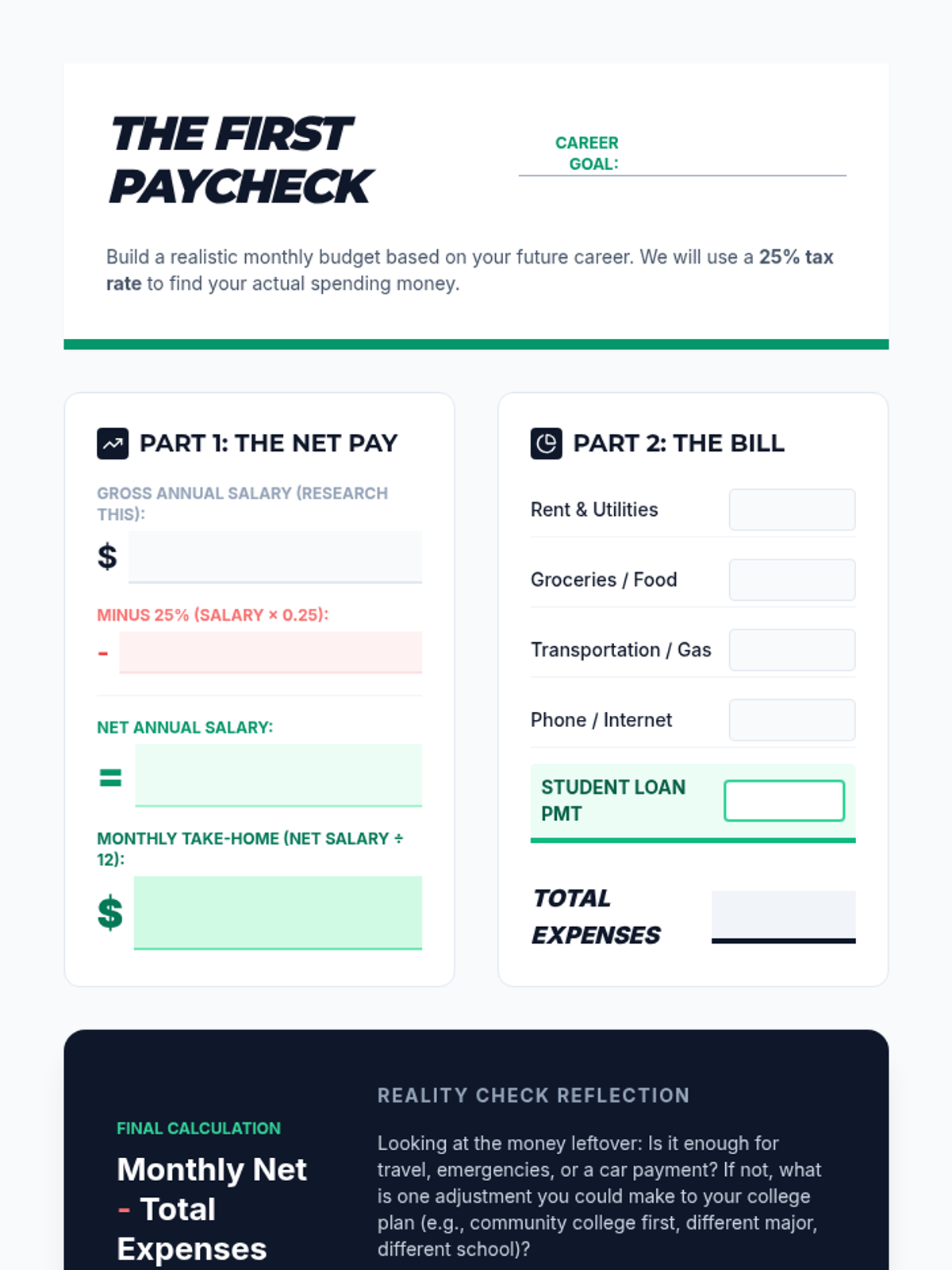
A simulation worksheet for students to research a career salary and build a realistic monthly budget that includes student loan payments.
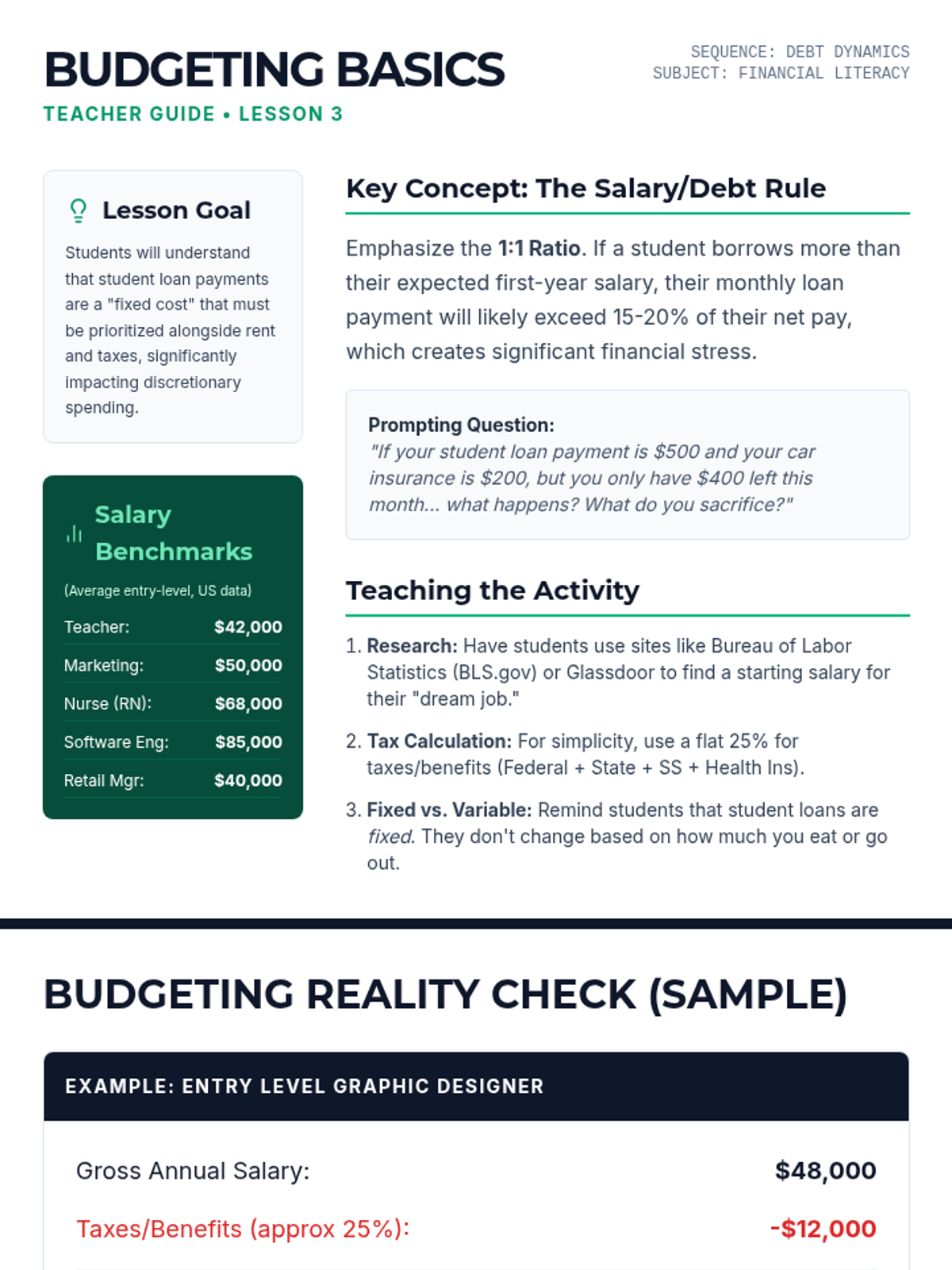
Teacher guide for Lesson 3, providing salary benchmarks, instructional strategies for budgeting, and a sample completed budget.
Introductory slides for Lesson 3, explaining gross vs net pay and visualizing the impact of a monthly loan payment on a budget.