Functional behavior assessment, data tracking, and de-escalation strategies for managing classroom conduct. Addresses positive reinforcement, token economies, and individualized behavior contracts to support student self-regulation.
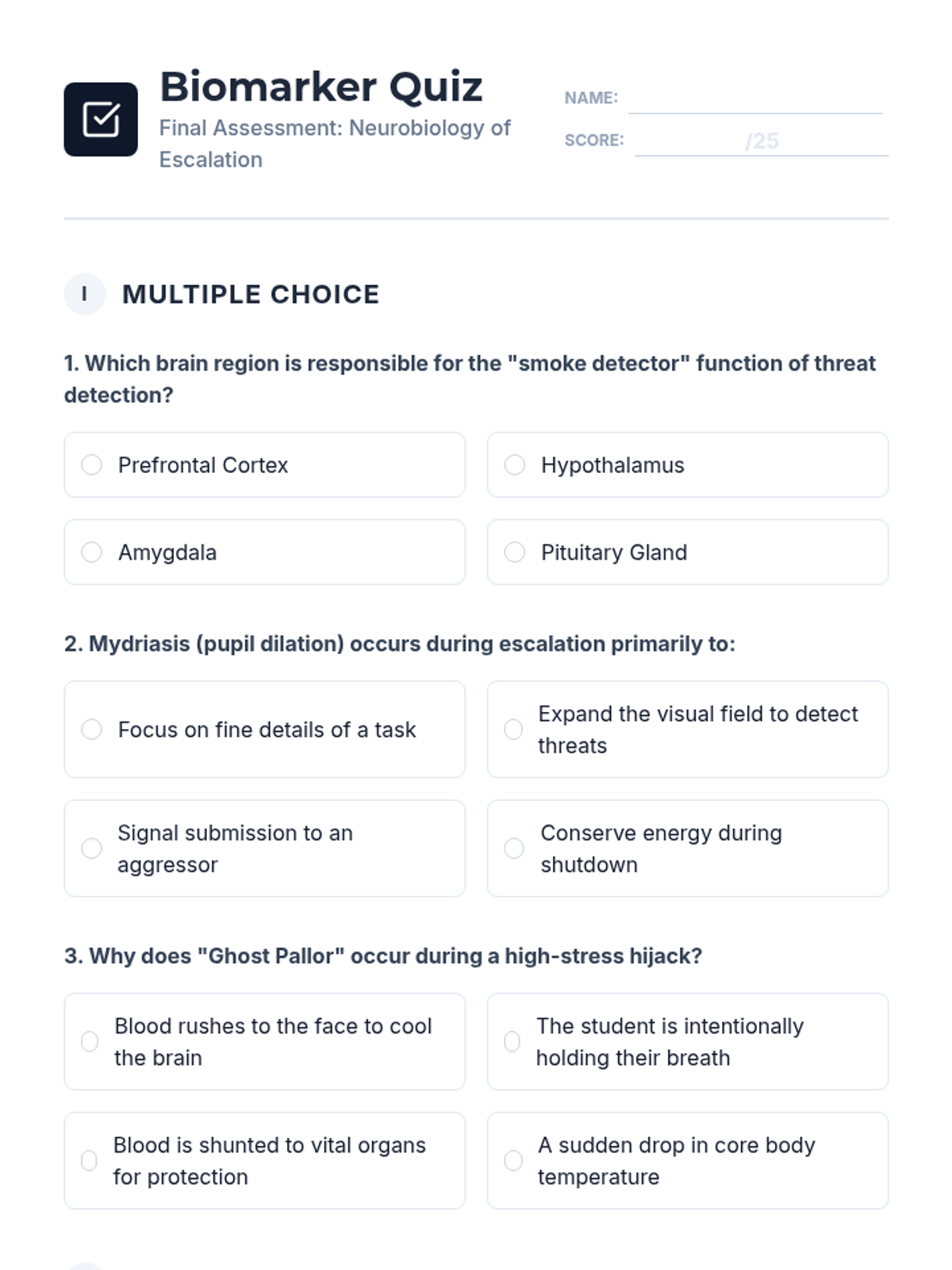
Final 10-question assessment covering the neurobiological foundations, somatic markers, respiratory patterns, and dissociation concepts from the sequence.
Final mastery project for Lesson 5, where students synthesize the entire sequence into a visual/written map of the escalation cycle and corresponding interventions.
Synthesis slides for Lesson 5, covering the intervention window and introducing the final "Escalation Blueprint" project.
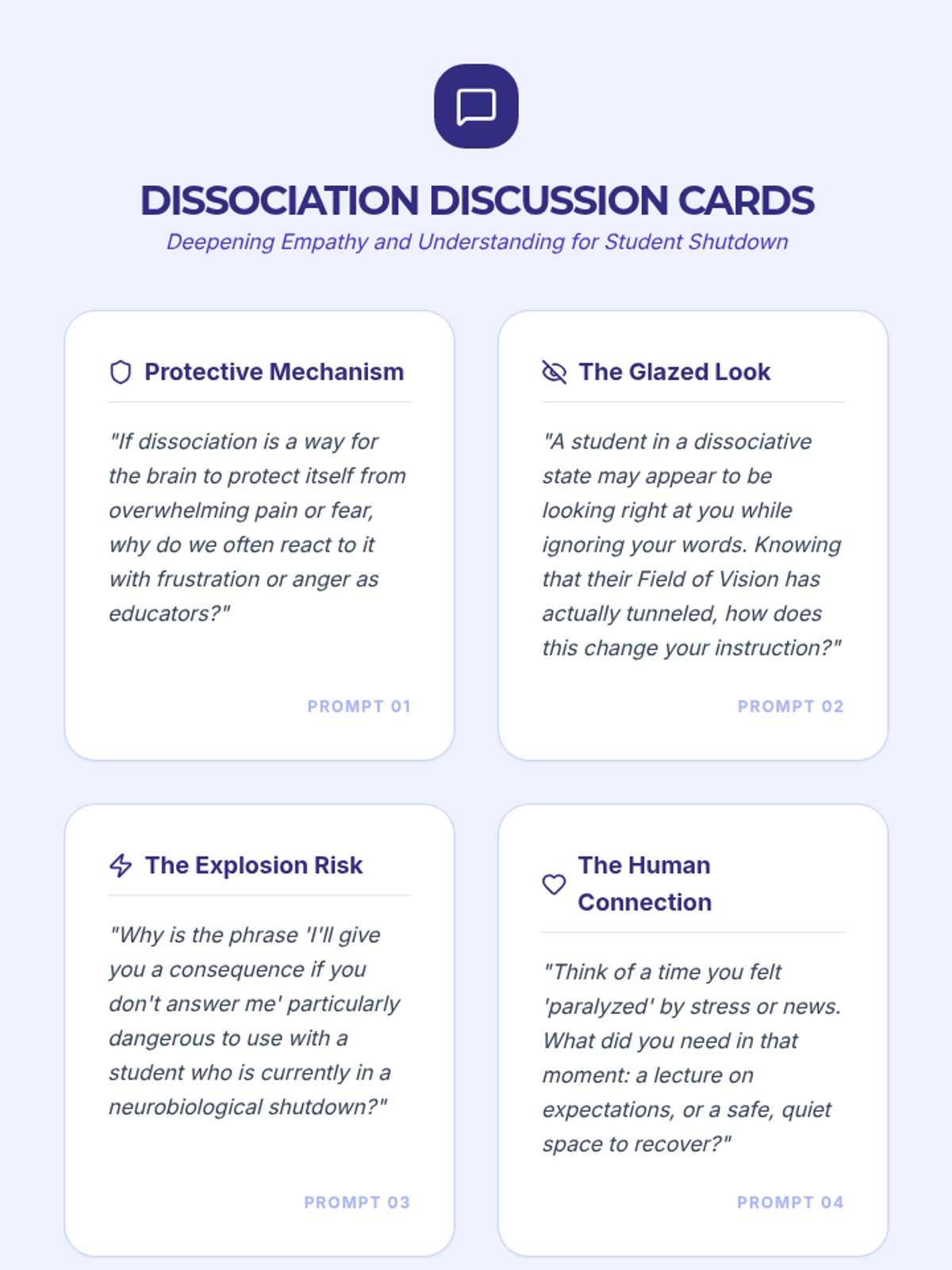
Set of 4 discussion cards for Lesson 4, designed to help students explore the empathy and practical intervention aspects of student dissociation.
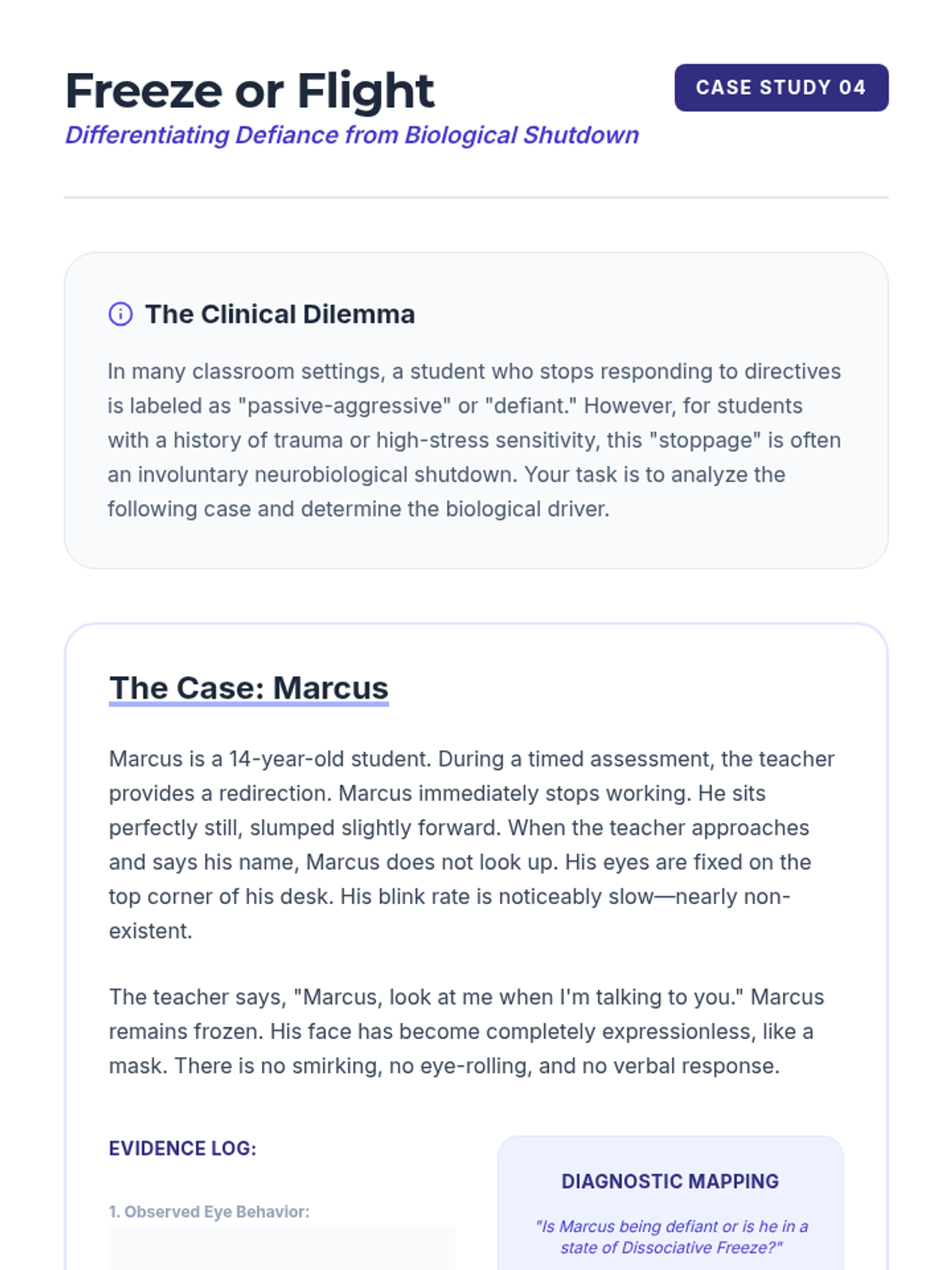
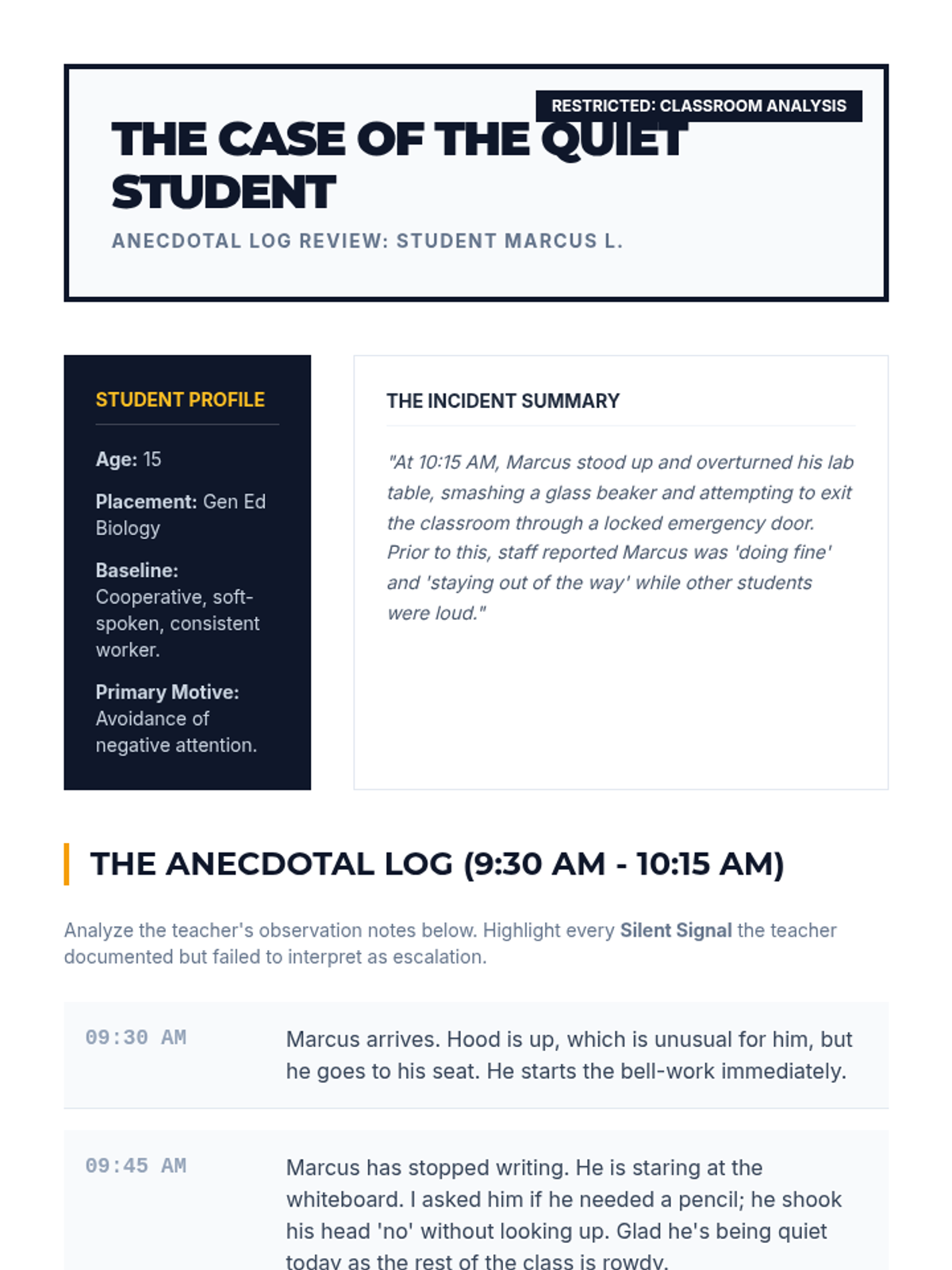
Student case study analysis for Lesson 4, focusing on differentiating between intentional defiance and neurobiological shutdown through the case of 'Marcus'.
Visual presentation for Lesson 4, covering the 'freeze' response and dissociation, differentiating between intentional defiance and neurobiological shutdown.
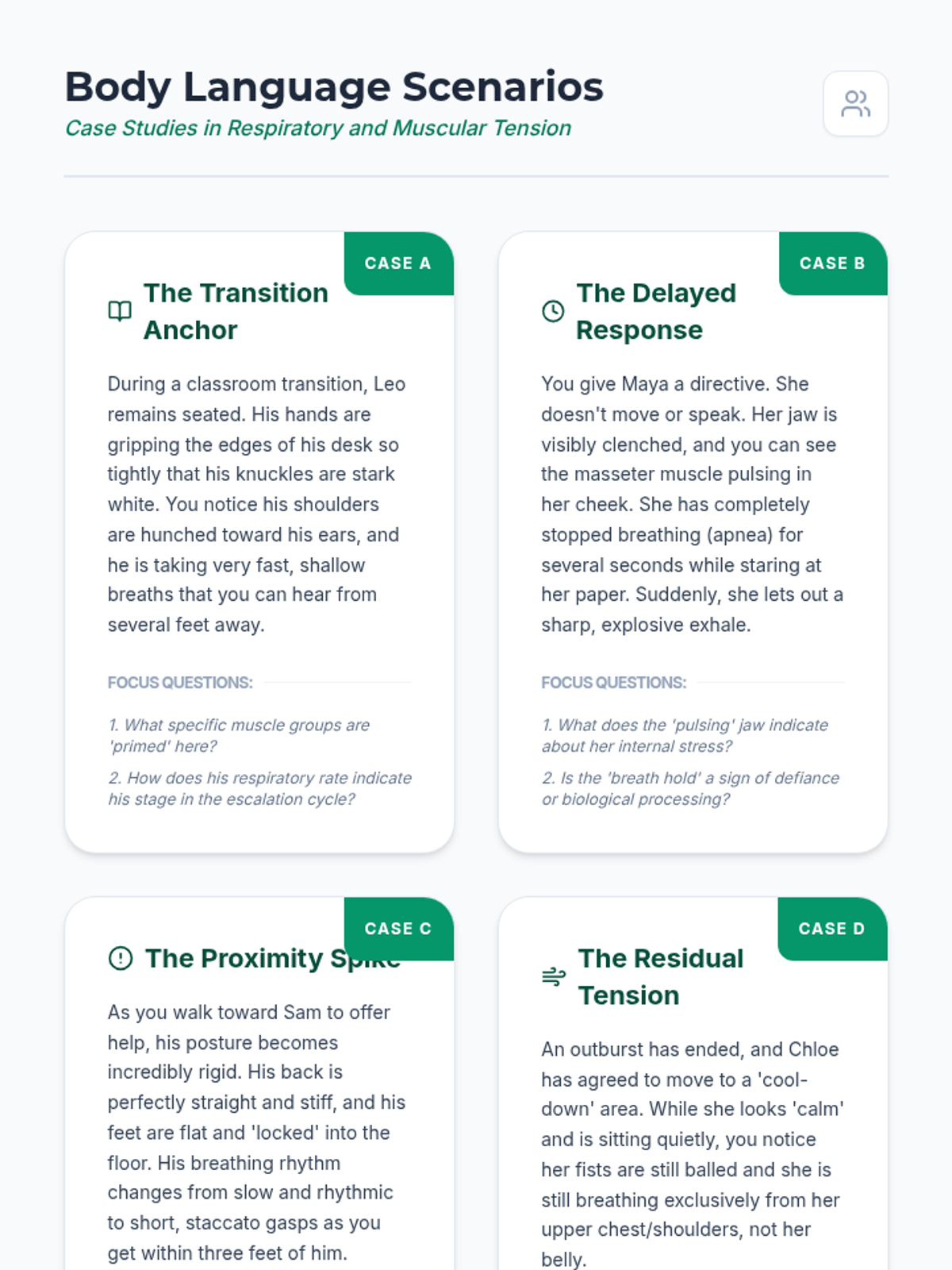
Case study cards for Lesson 3, focusing on identifying respiratory and muscular tension patterns in classroom scenarios.
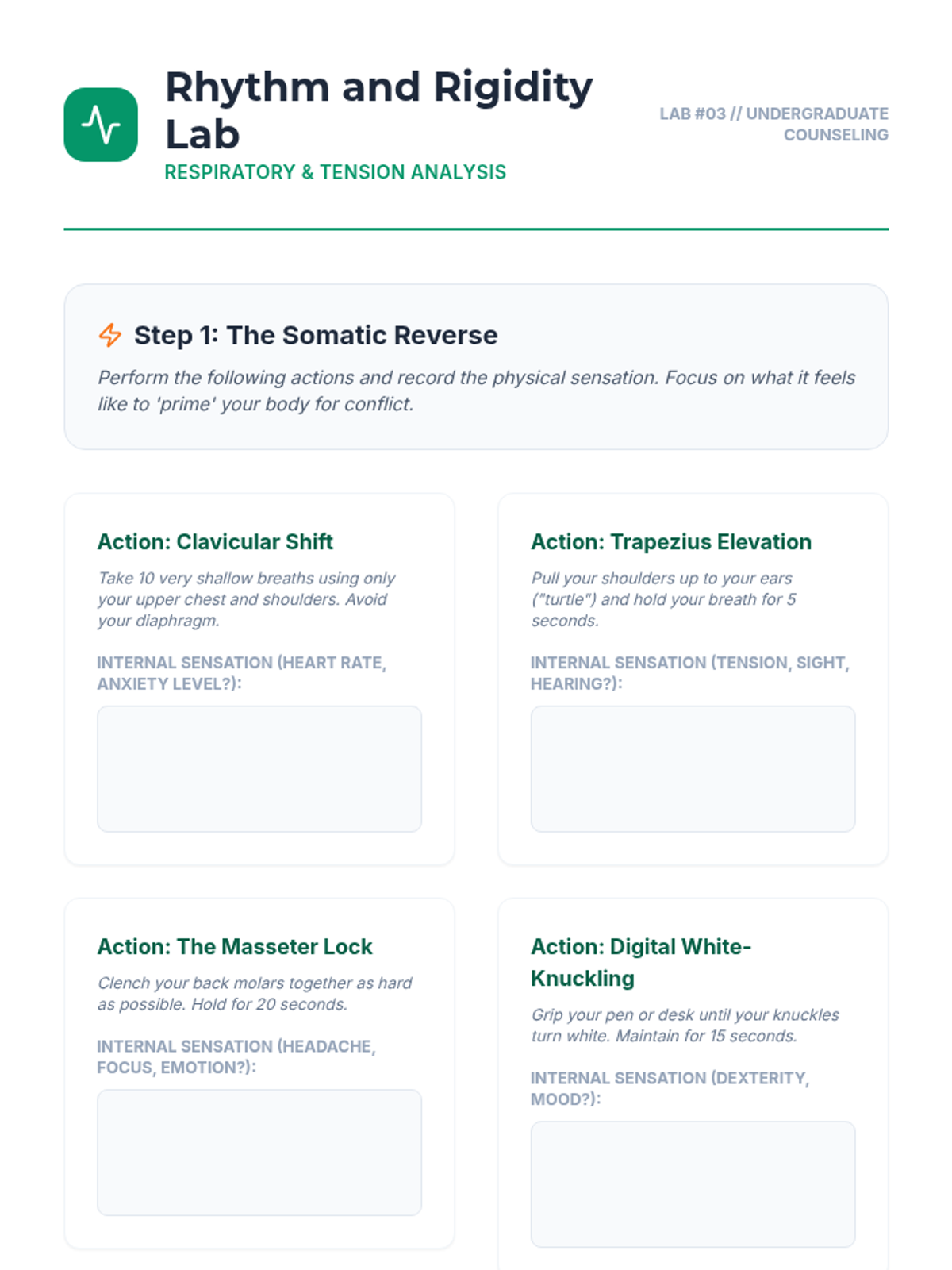
Student observation/practice sheet for Lesson 3, focusing on experiencing and analyzing respiratory changes and muscle tone as stress indicators.
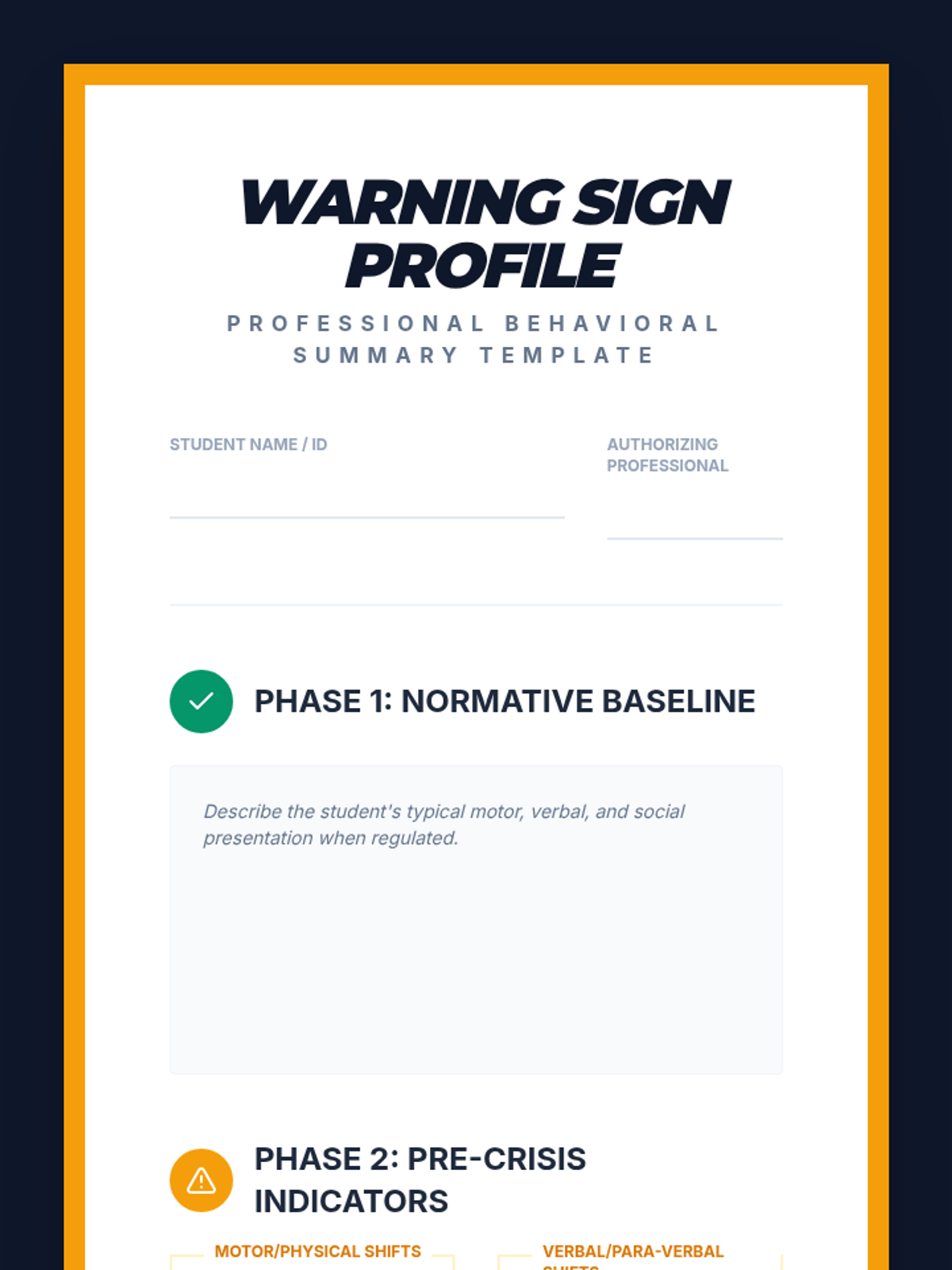
The final professional deliverable template: a comprehensive Warning Sign Profile where students synthesize all learning into a predictive support document.
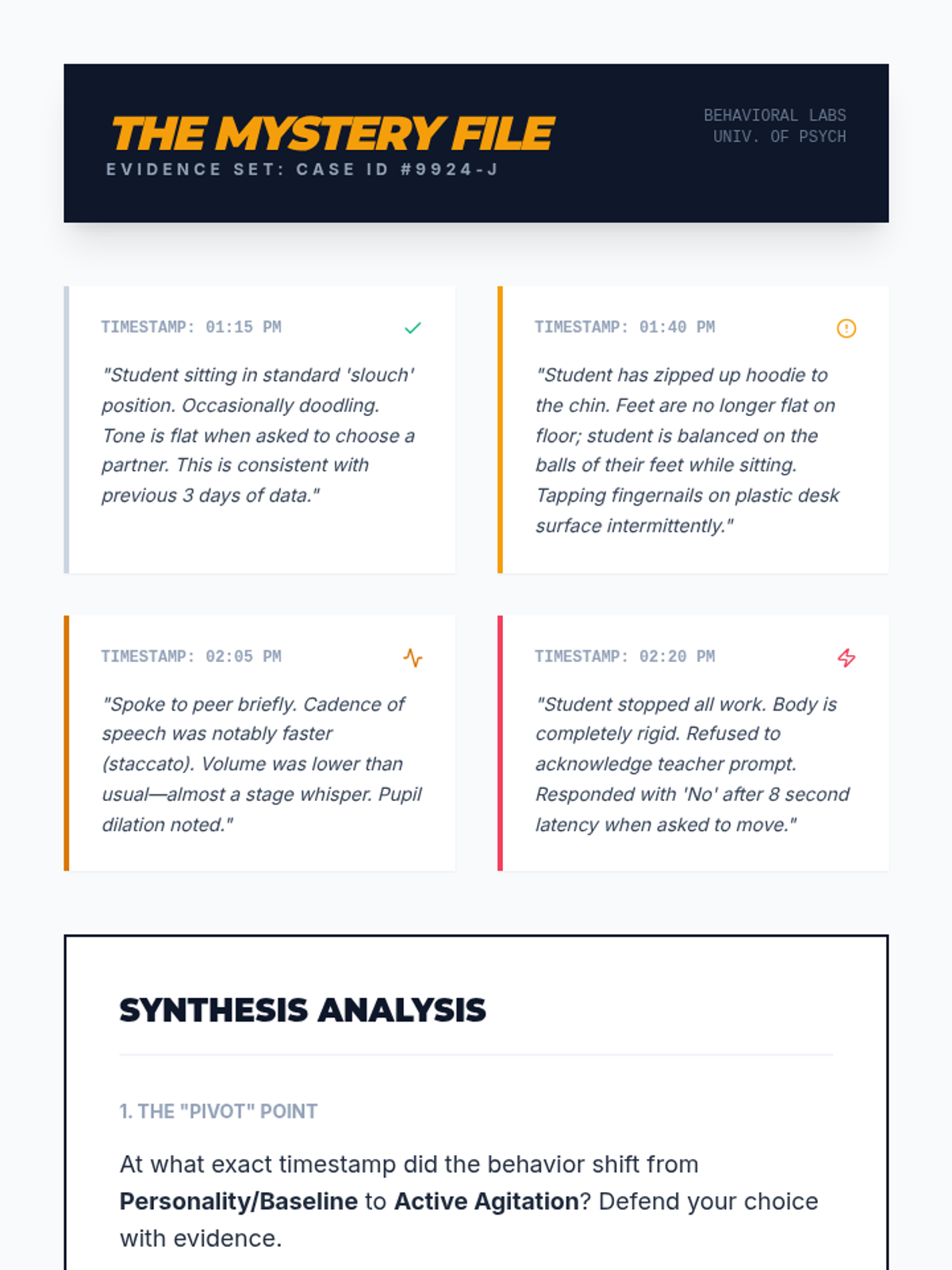
The "Mystery File" evidence set and synthesis worksheet for the final project, requiring students to identify escalation points and predict crisis timing.
Visual presentation for Lesson 3, covering breathing patterns (shallow, rapid, holding) and muscle tension (clenched fists, locked jaw) as indicators of escalation.
Final slide deck for Lesson 5, focusing on synthesizing behavioral evidence from multiple domains into a predictive warning sign profile.
A case study analysis document focusing on Marcus L., a "quiet" student whose withdrawal signals were missed before an explosive outburst.
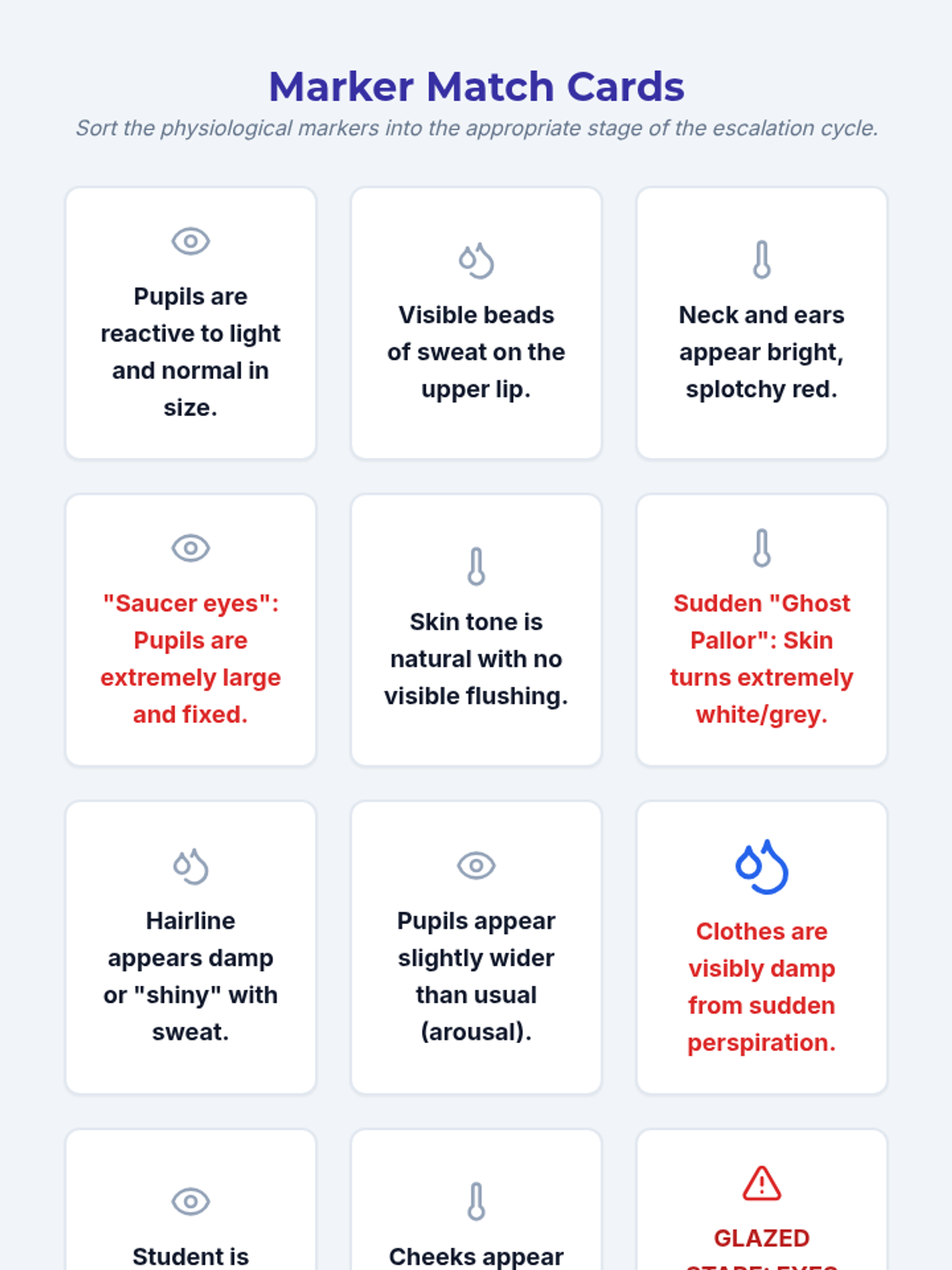
Set of 12 printable cards for a sorting activity where students categorize physiological markers into different stages of the escalation cycle.
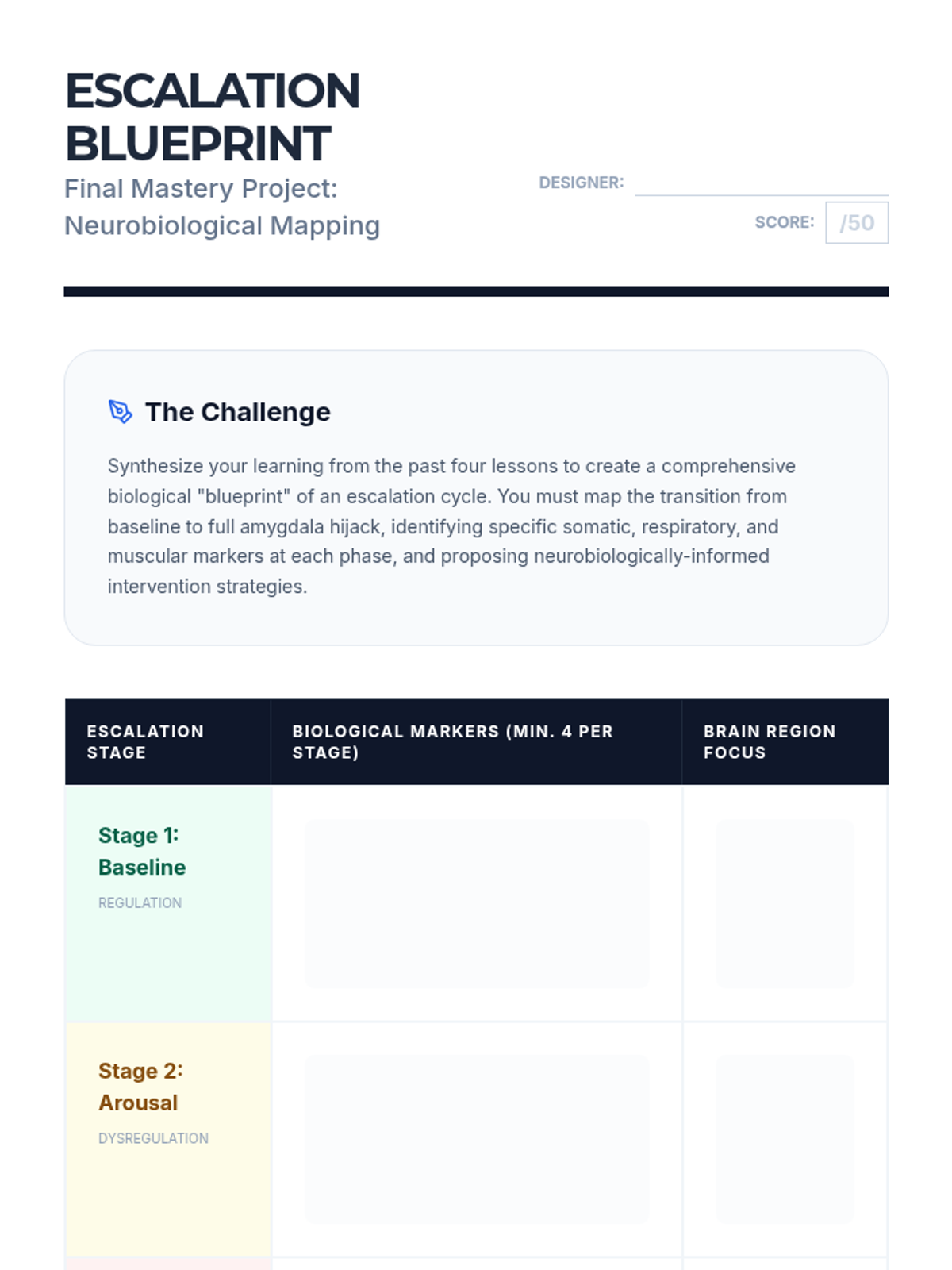
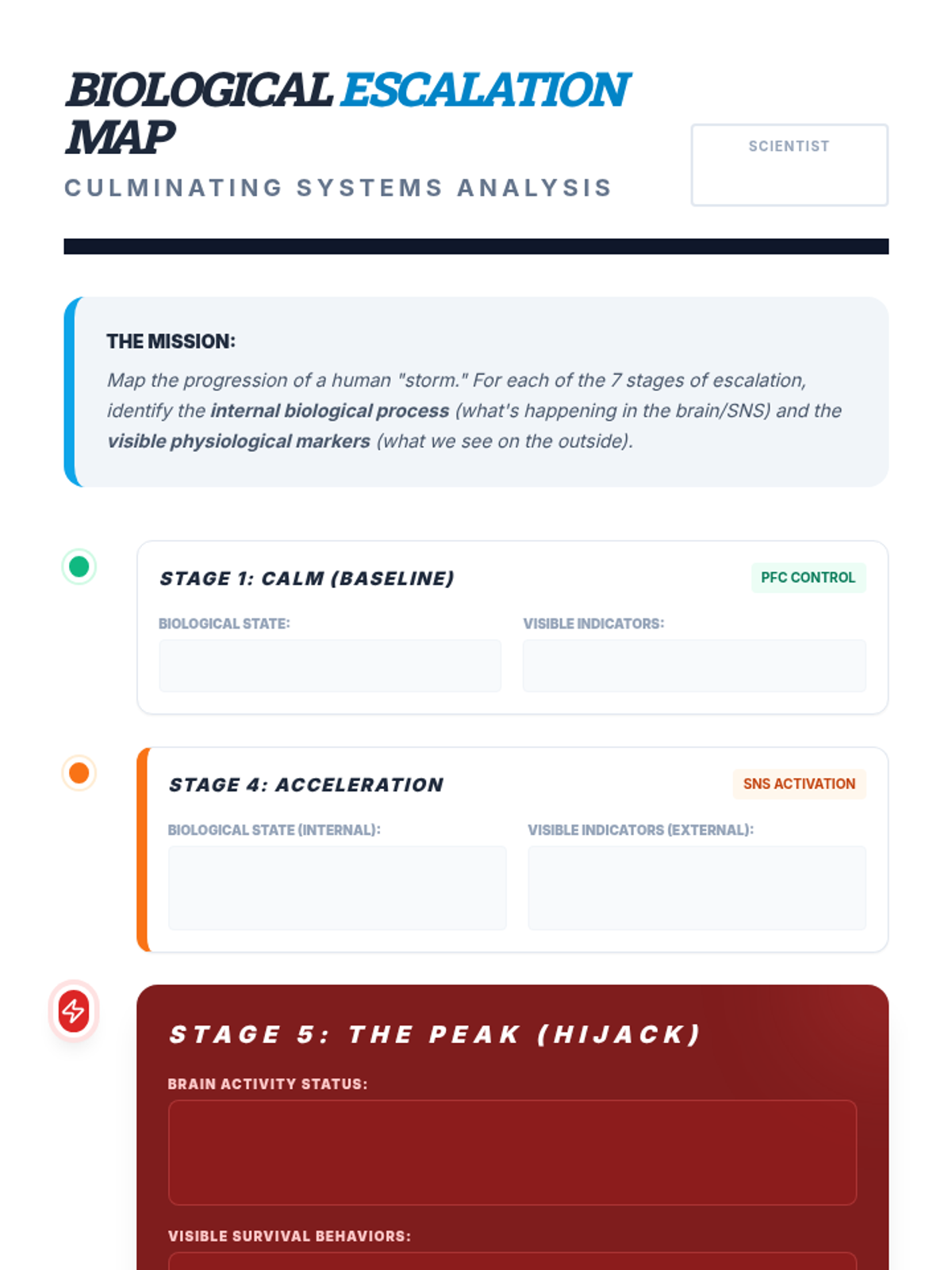
A culminating project sheet for students to map the internal biological states and external physiological markers across the seven stages of behavioral escalation.
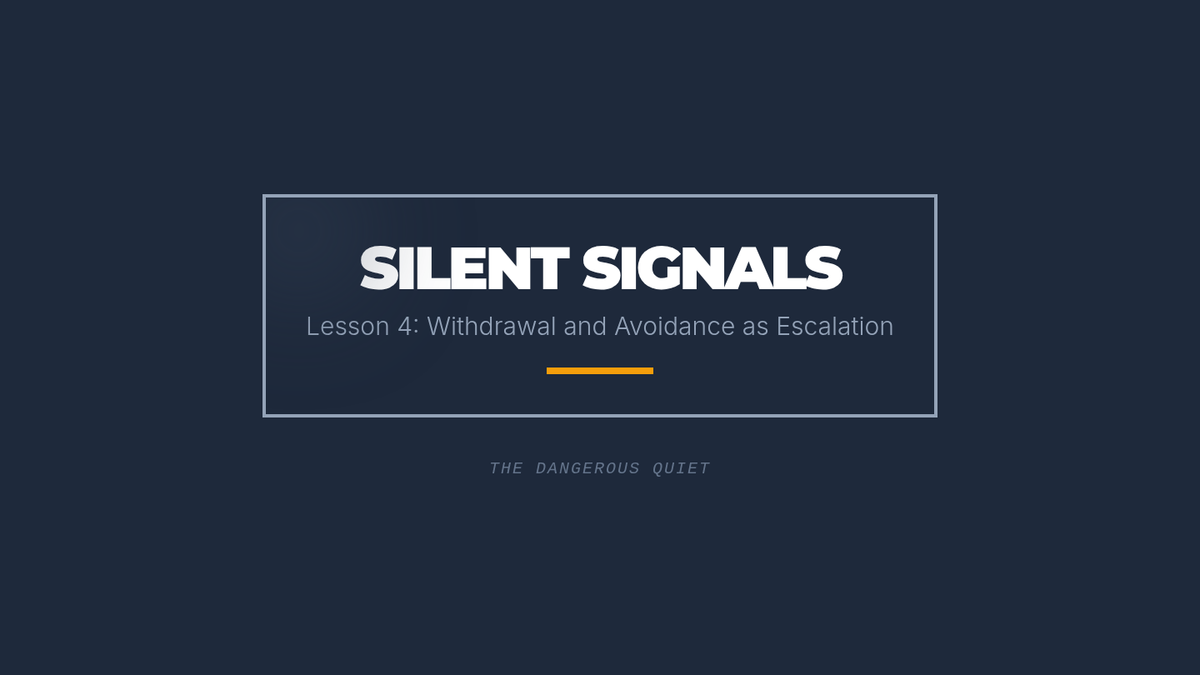
Slides for Lesson 4 on passive escalation, covering withdrawal, avoidance, and the "pressure cooker" effect of internalized stress.
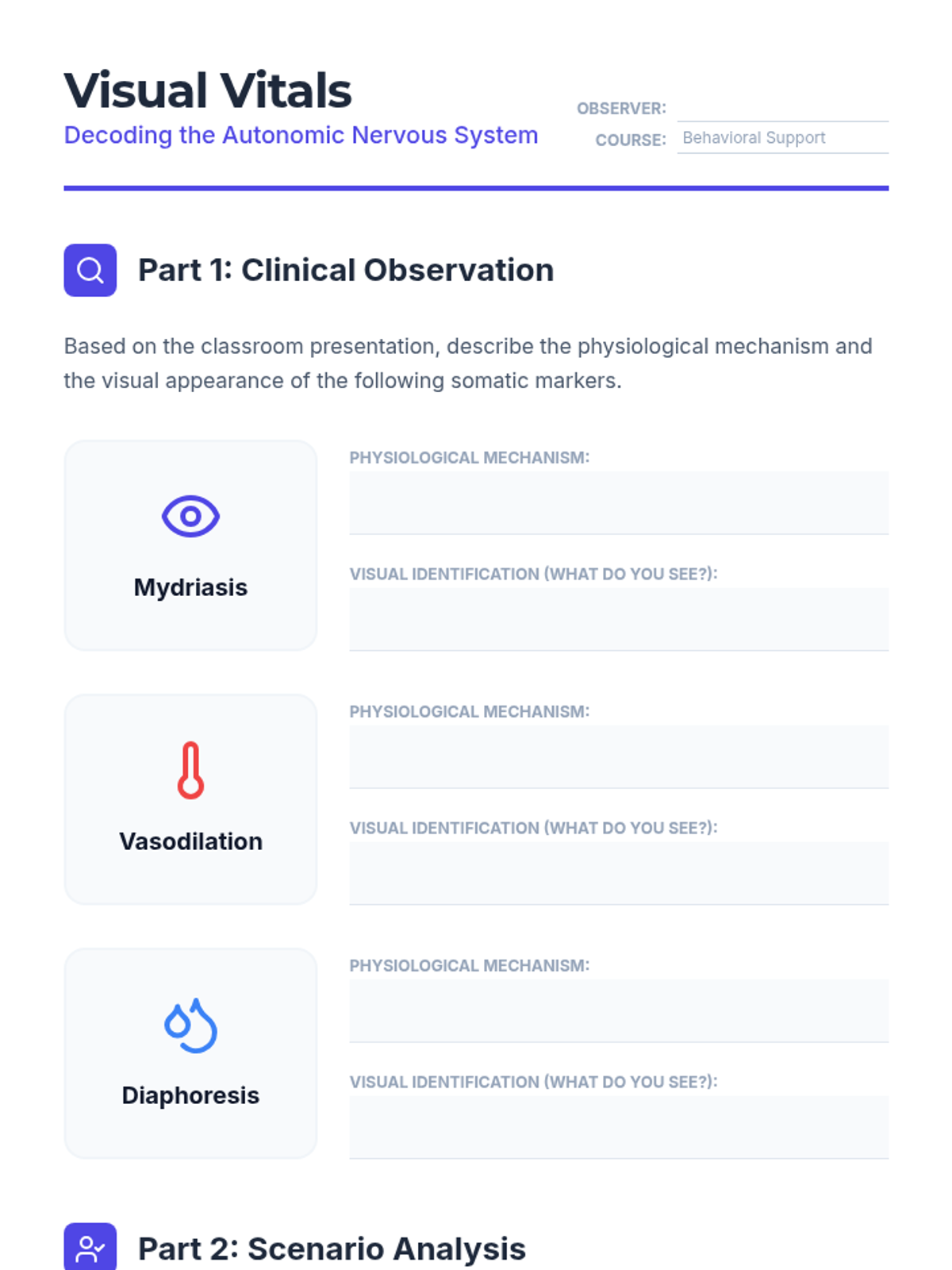
Student worksheet for Lesson 2, focusing on the identification and clinical analysis of somatic markers in various classroom scenarios.
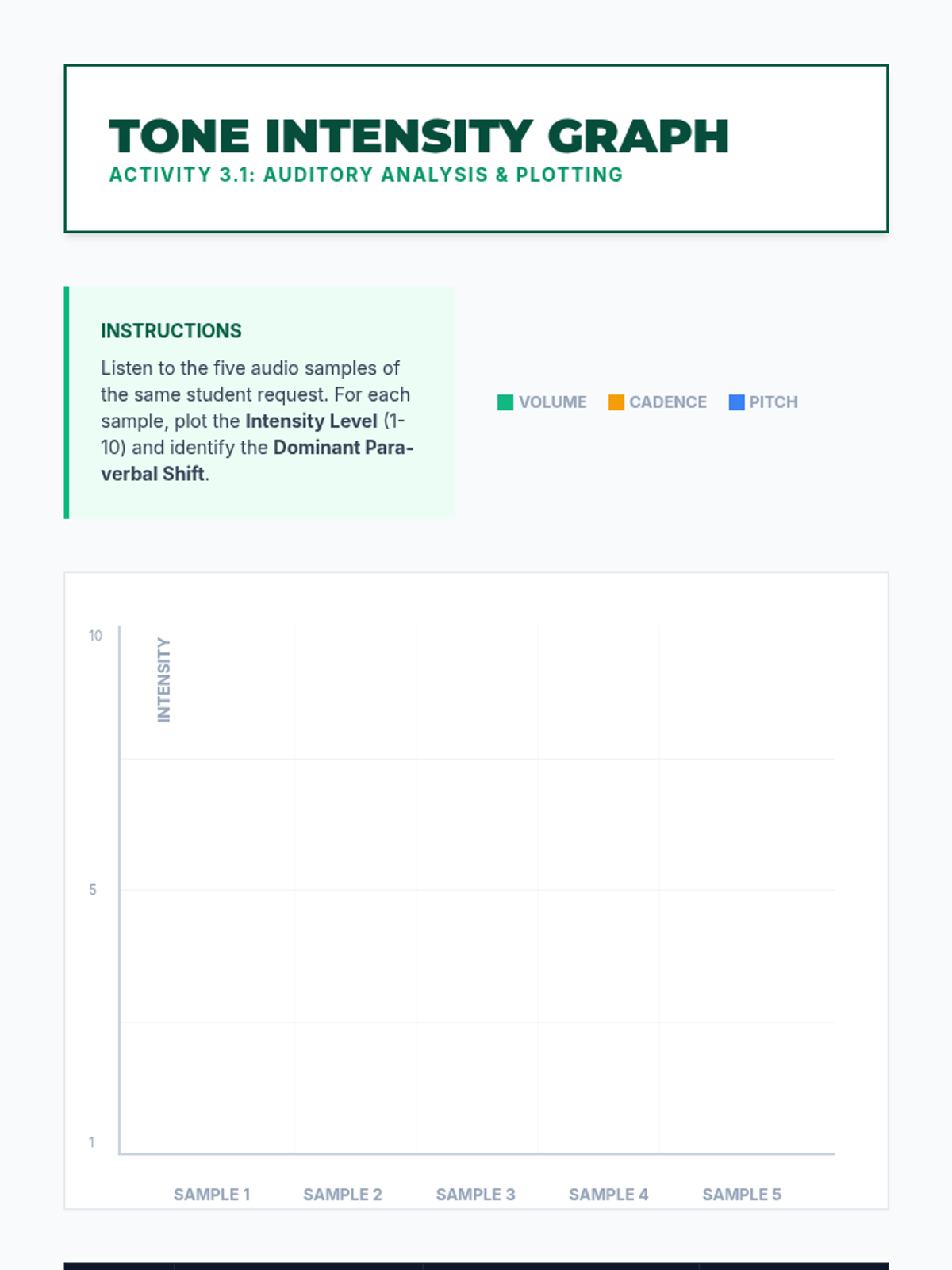
A worksheet for graphing and analyzing audio samples of vocal escalation, focusing on intensity plotting and para-verbal shifts.
A visual presentation on the seven stages of behavioral escalation, using a storm forecast metaphor to explain the progression from calm to peak and back to recovery.
Visual presentation for Lesson 2, covering the physiological markers of skin color changes, pupillary response, and sweating as indicators of escalation.
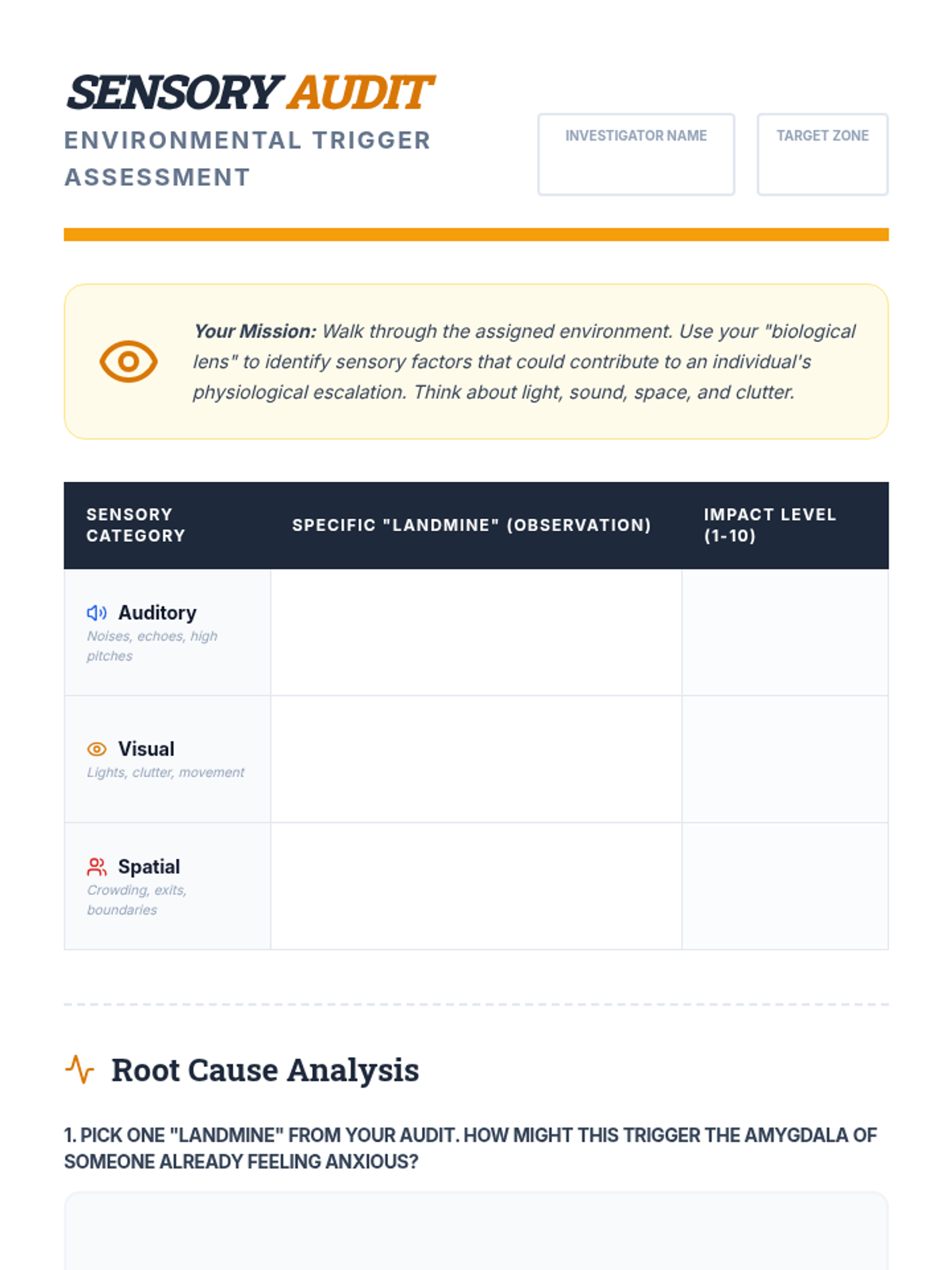
A classroom audit sheet for students to identify and analyze environmental sensory triggers and propose brain-friendly modifications.
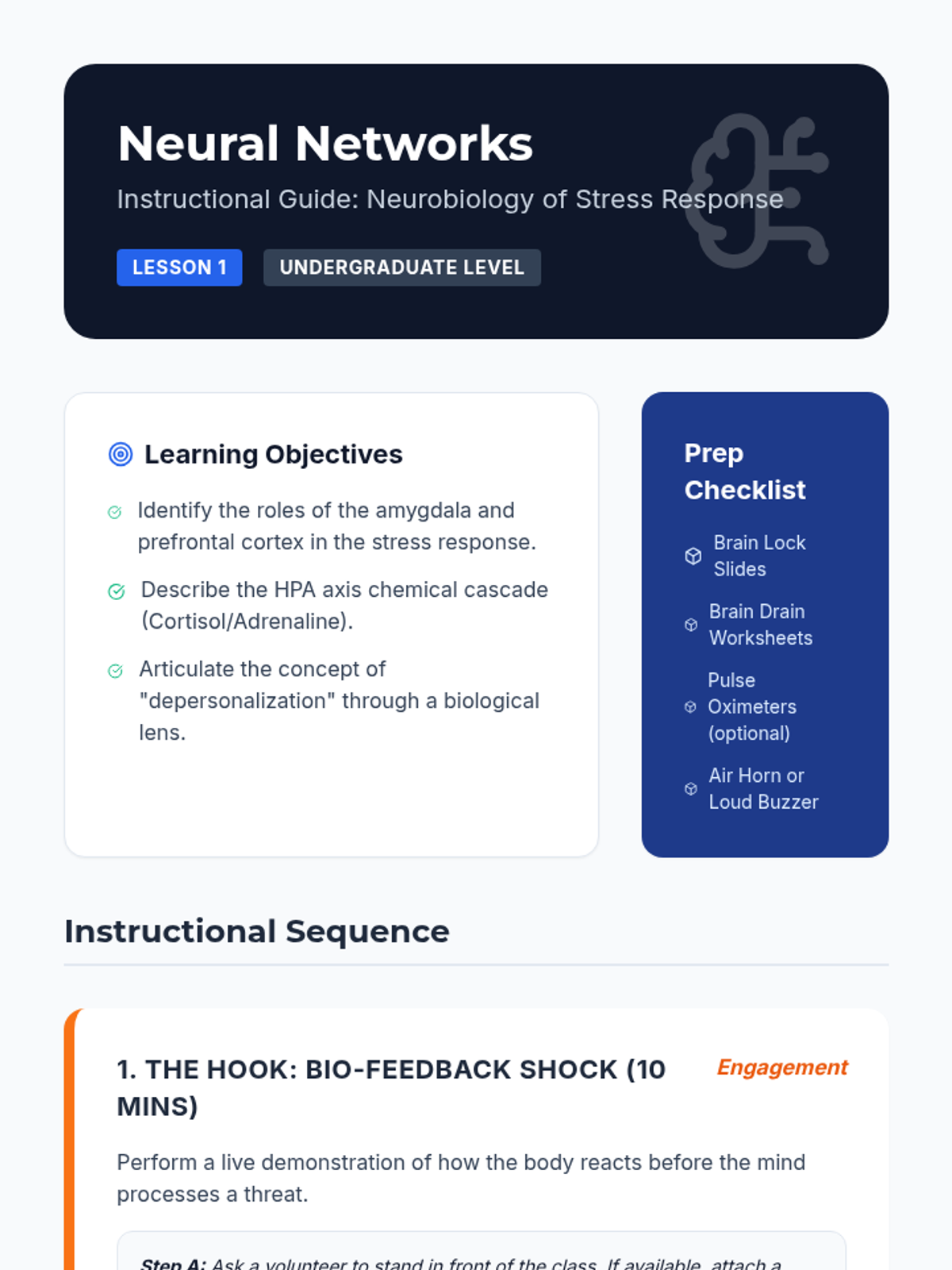
Teacher guide for Lesson 1, including instructions for the bio-feedback shock hook, discussion prompts on depersonalizing behavior, and key instructional takeaways.
A visual presentation focusing on sensory overload as a physiological trigger for escalation, exploring the role of the thalamus and identifying common environmental triggers.
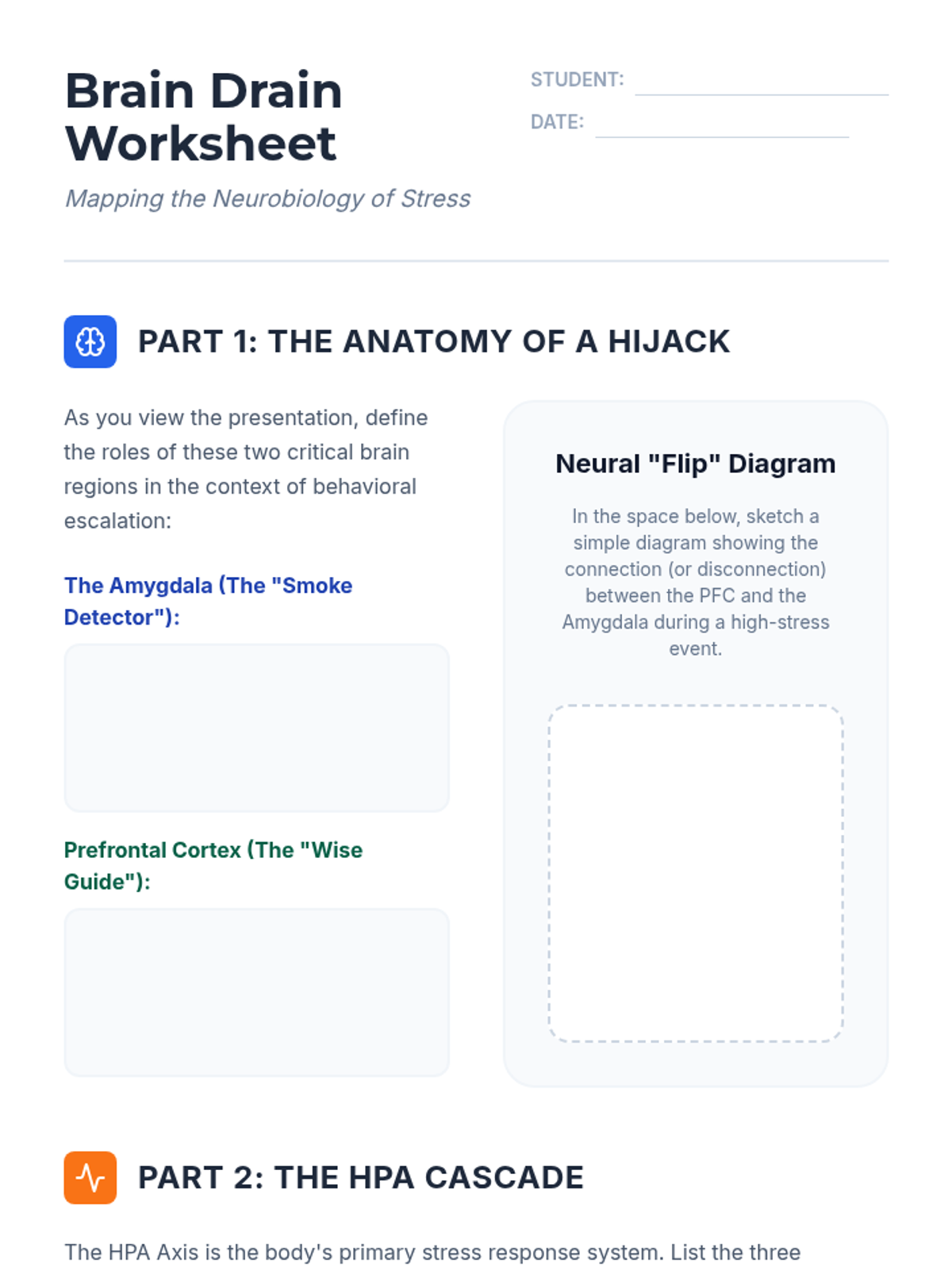
Student worksheet for Lesson 1 to capture key concepts of the amygdala hijack and the HPA axis, including a reflection on depersonalizing student behavior.
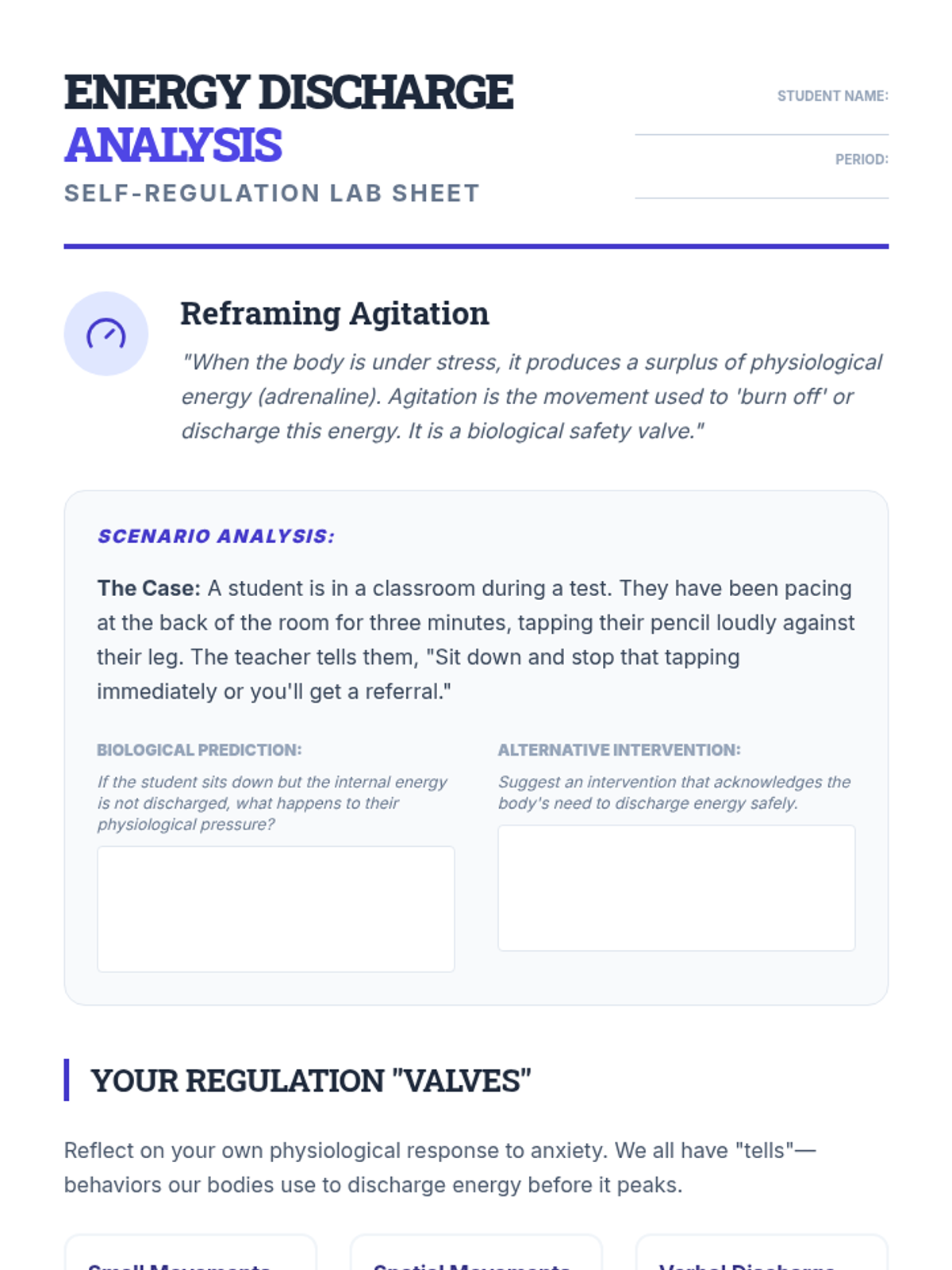
A worksheet for students to identify their own energy discharge behaviors and analyze scenarios through the lens of physiological self-regulation.
Introductory slides for Lesson 1, covering the amygdala hijack, the prefrontal cortex, and the HPA axis to explain the biological basis of escalation.
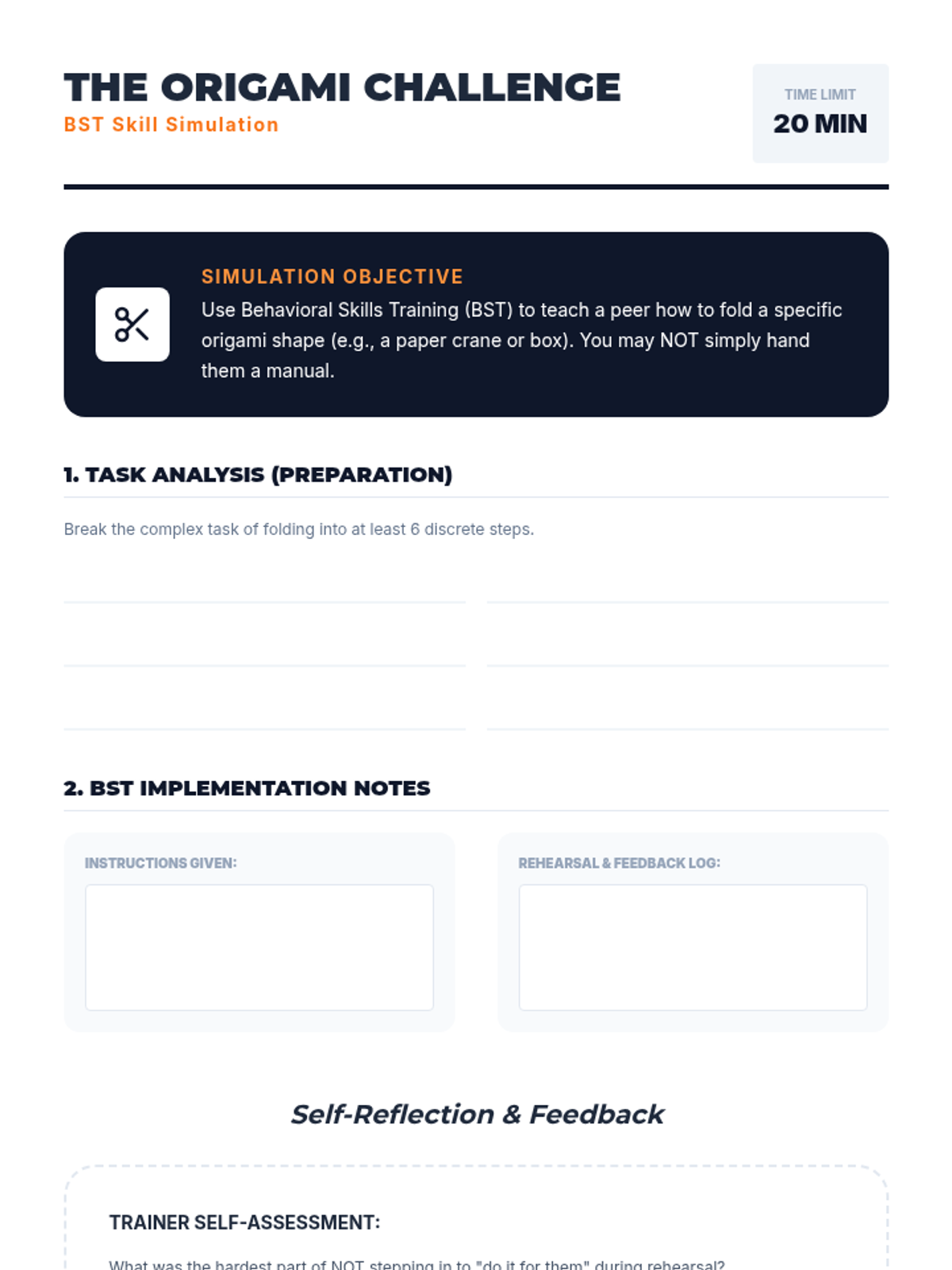
An activity sheet for students to practice Behavioral Skills Training (BST) by teaching a peer a complex manual task like origami.
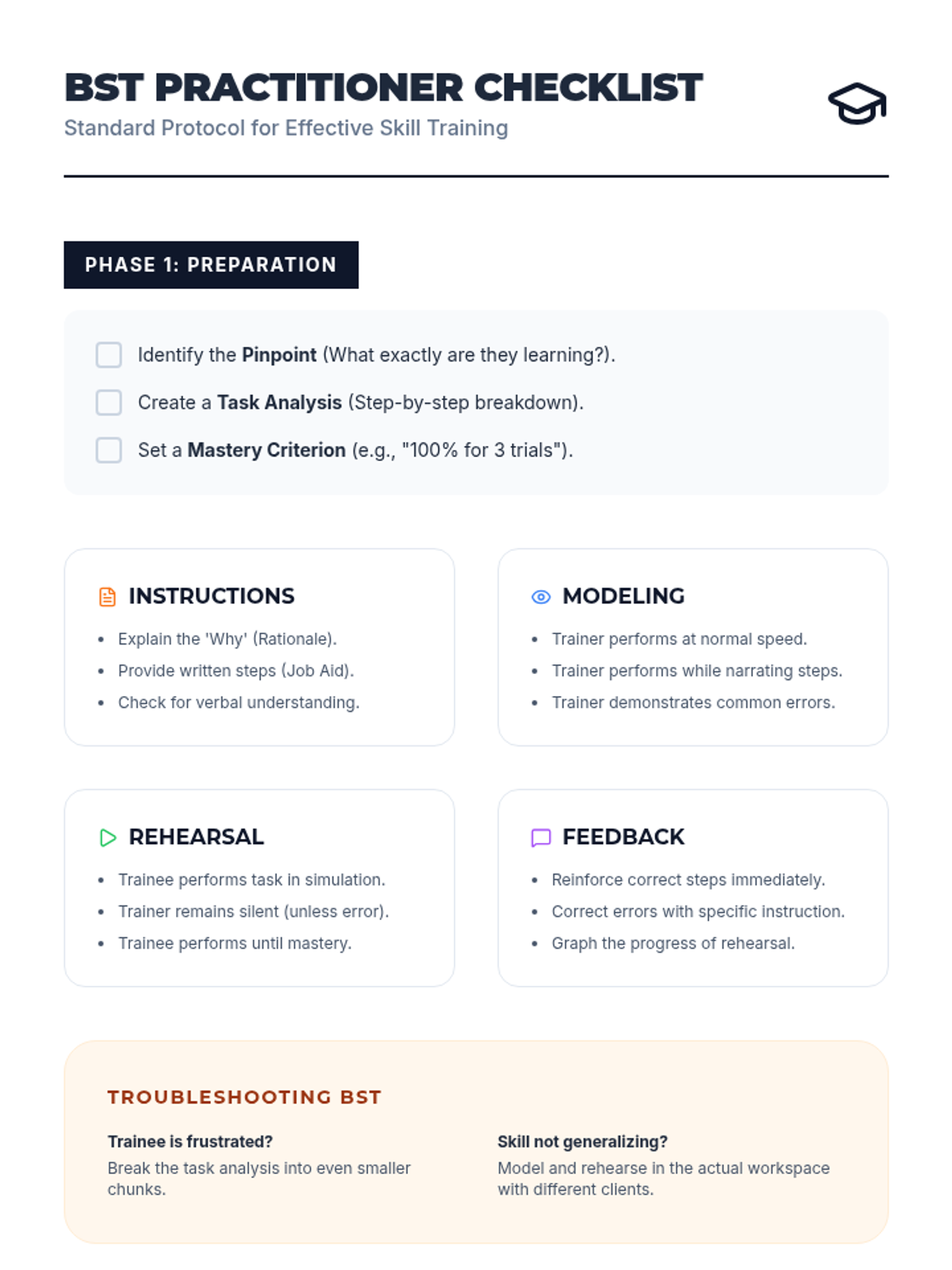
A practitioner-focused implementation checklist for the Behavioral Skills Training (BST) model, including prep, the core cycle, and troubleshooting.
Instructional slides for Lesson 5, breaking down the four steps of Behavioral Skills Training (BST) and the importance of mastery-based learning.
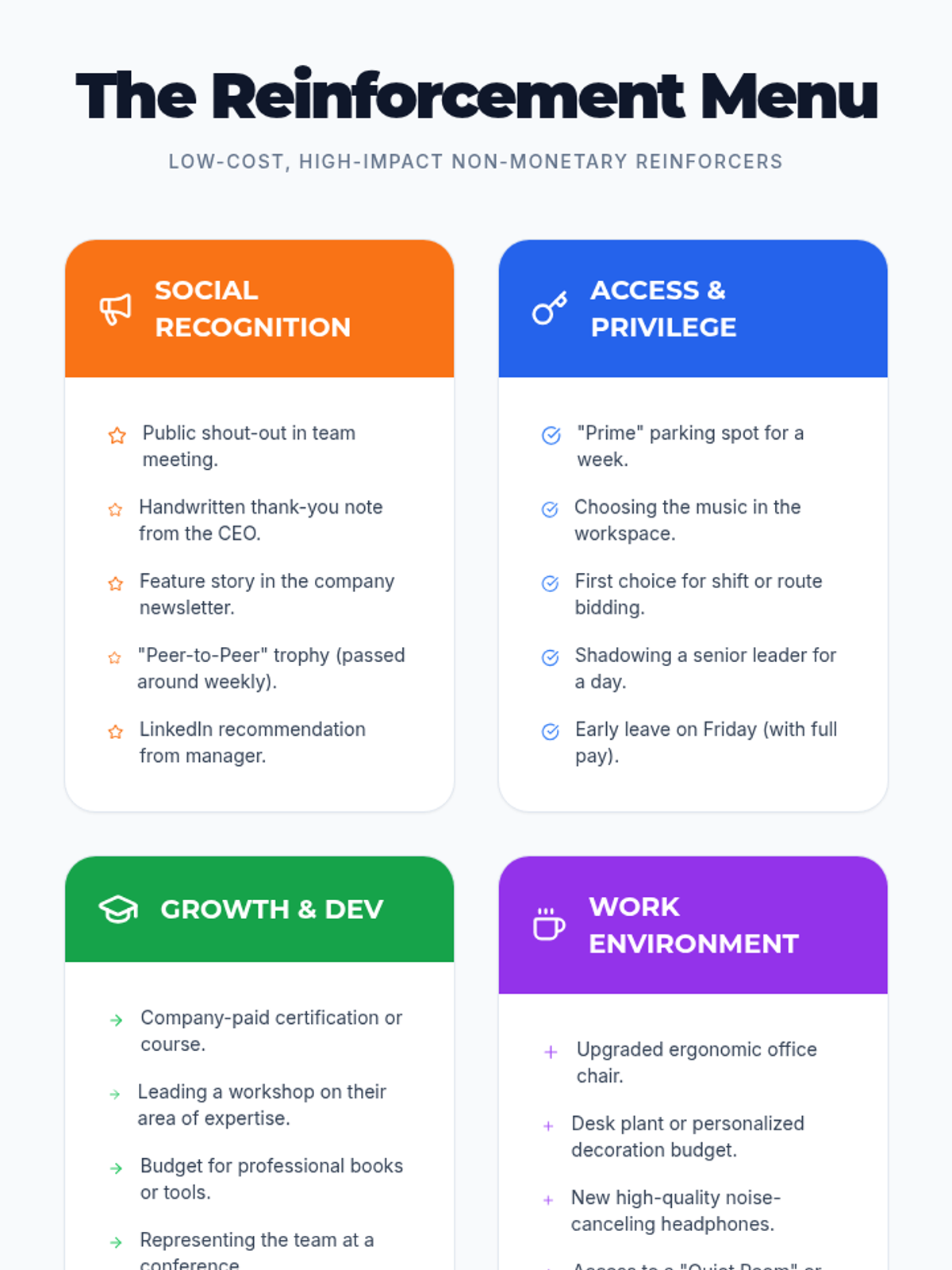
A reference guide for managers listing various non-monetary reinforcers categorized by social recognition, privilege, growth, and environment.
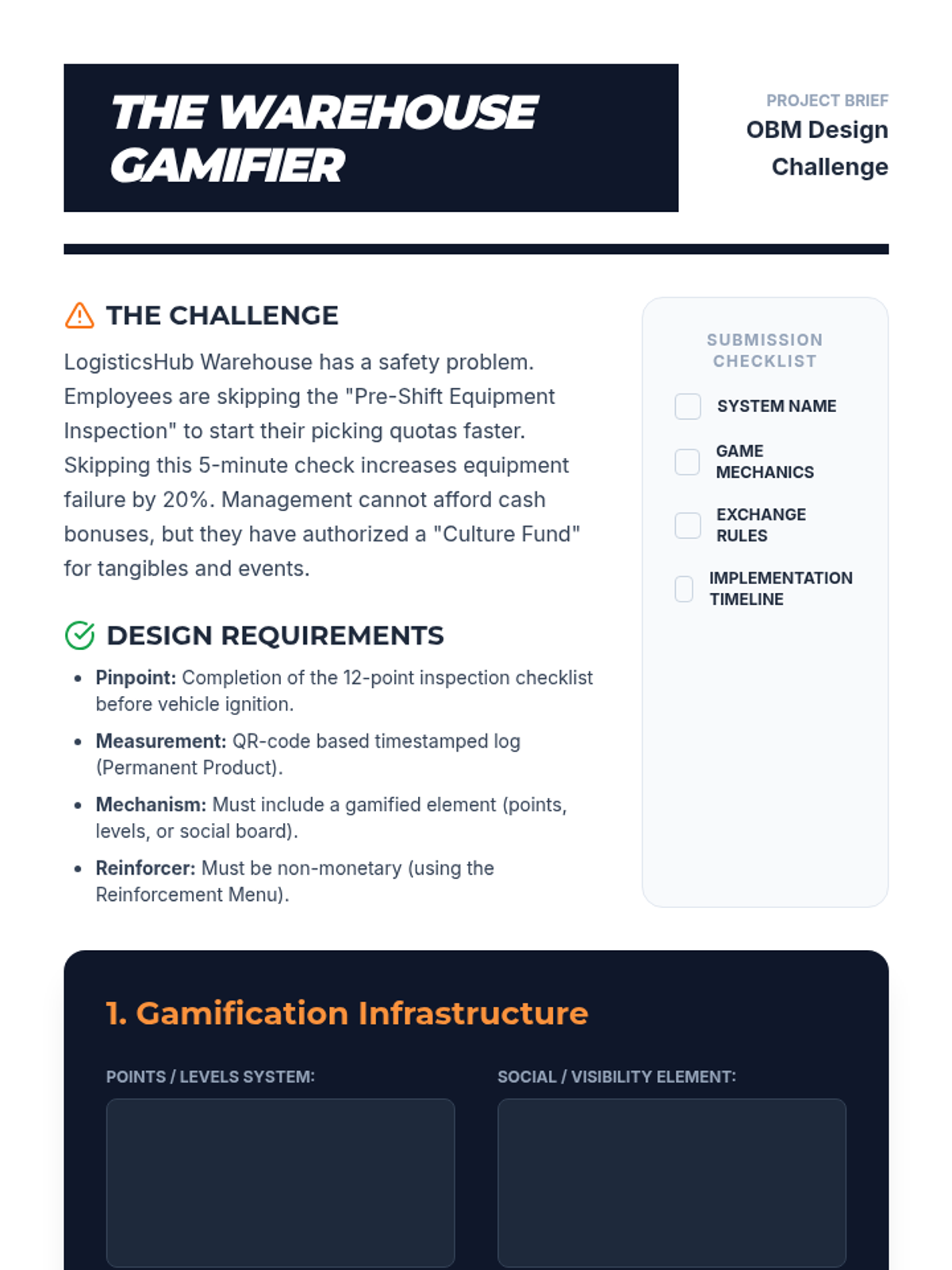
A project brief and planning sheet for students to design a gamified safety protocol for a warehouse setting.
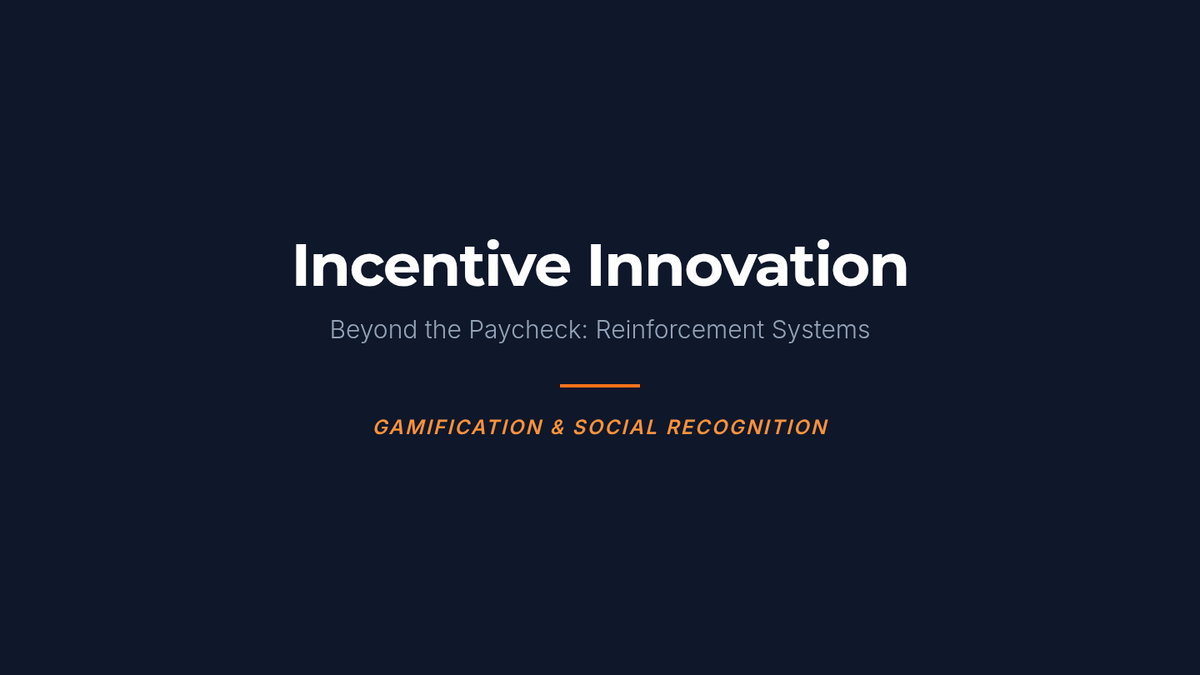
Instructional slides for Lesson 4, covering the Premack Principle, non-monetary reinforcers, and gamification mechanics in the workplace.
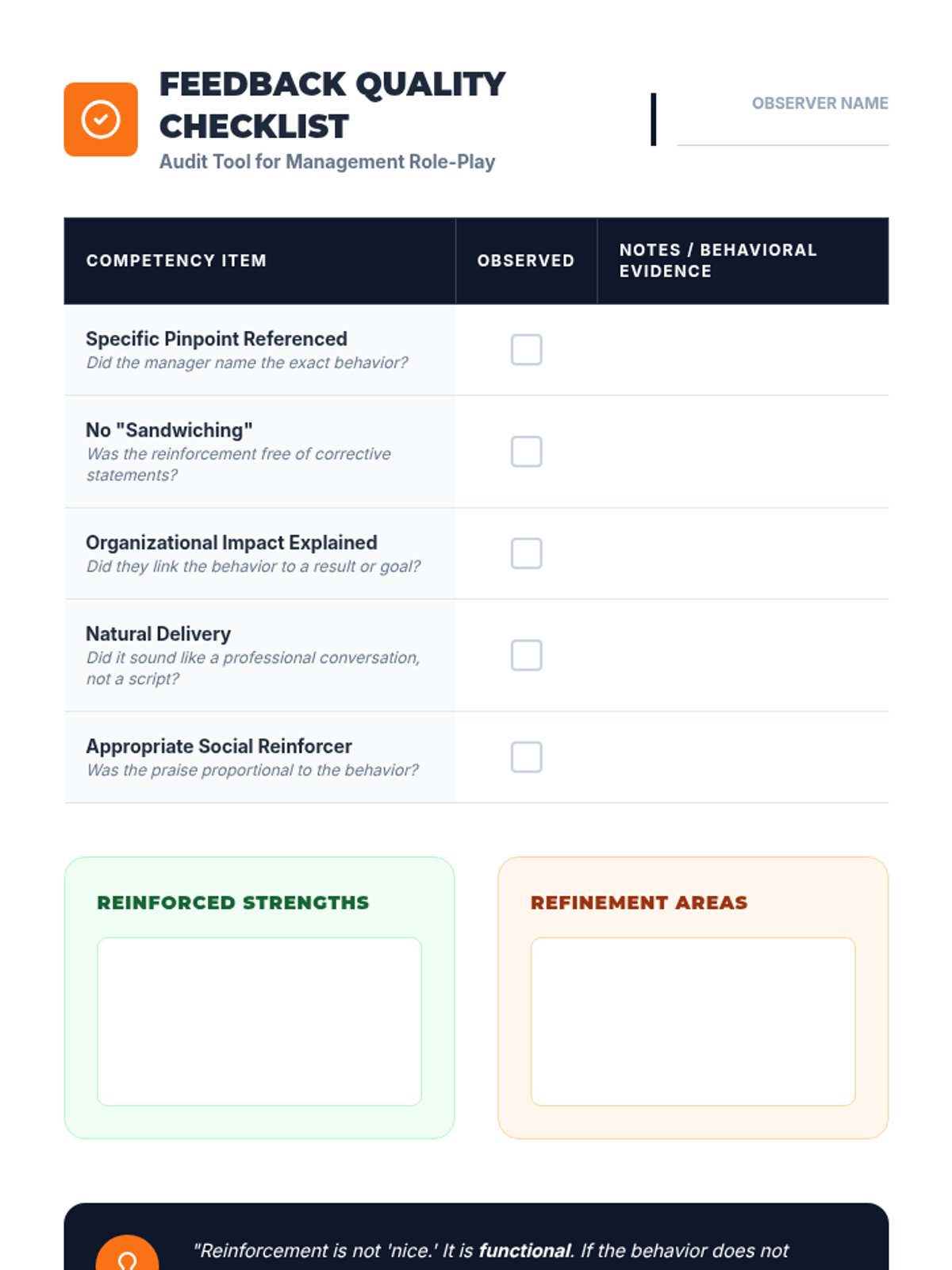
An observation rubric for students to use when peer-reviewing performance feedback delivery in role-play simulations.
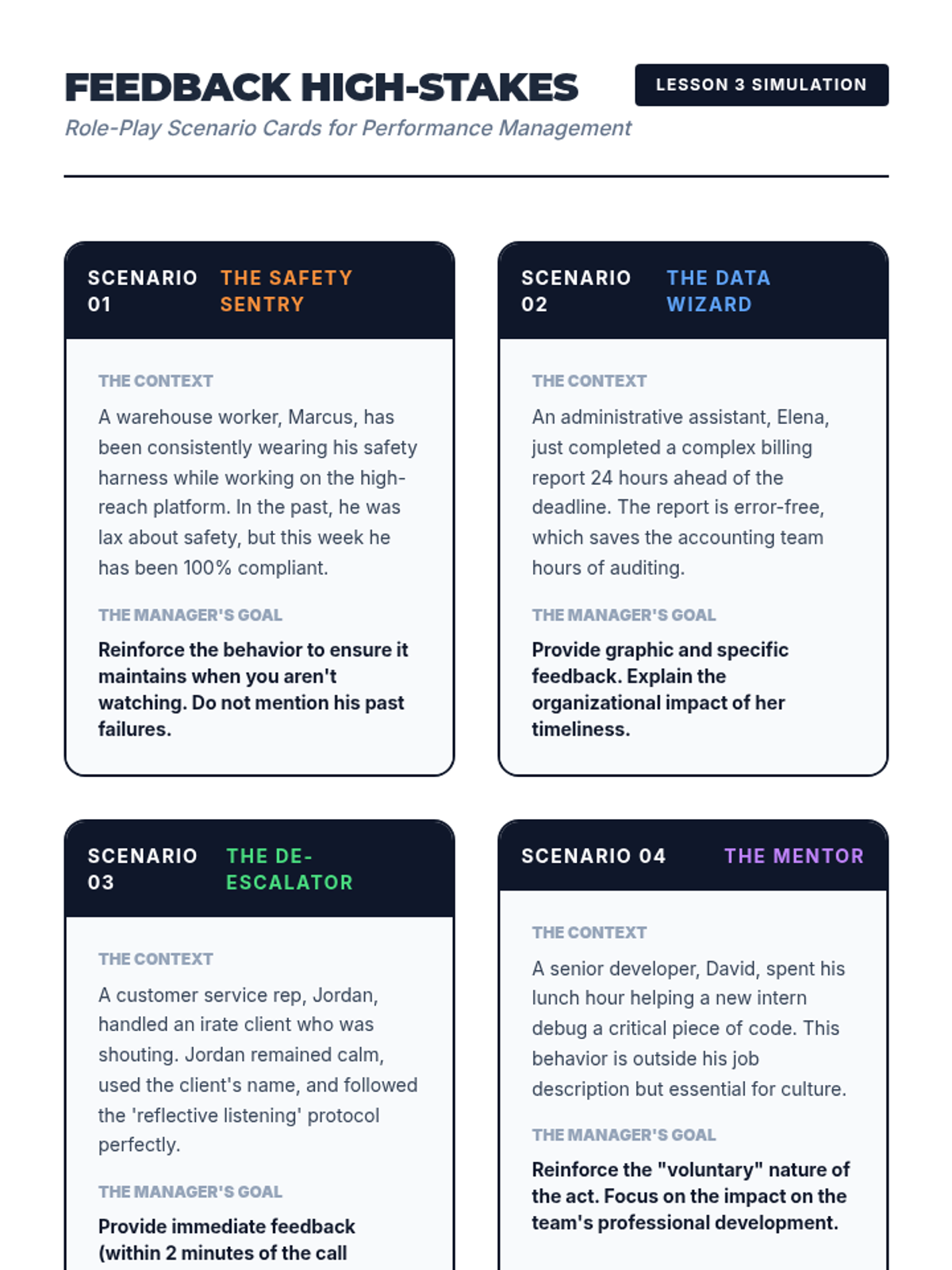
Workplace scenarios for students to practice delivering specific, behavioral feedback using the OBM reinforcement model.
Instructional slides for Lesson 3, introducing the mechanics of effective feedback and the "Reinforcement Script" model.
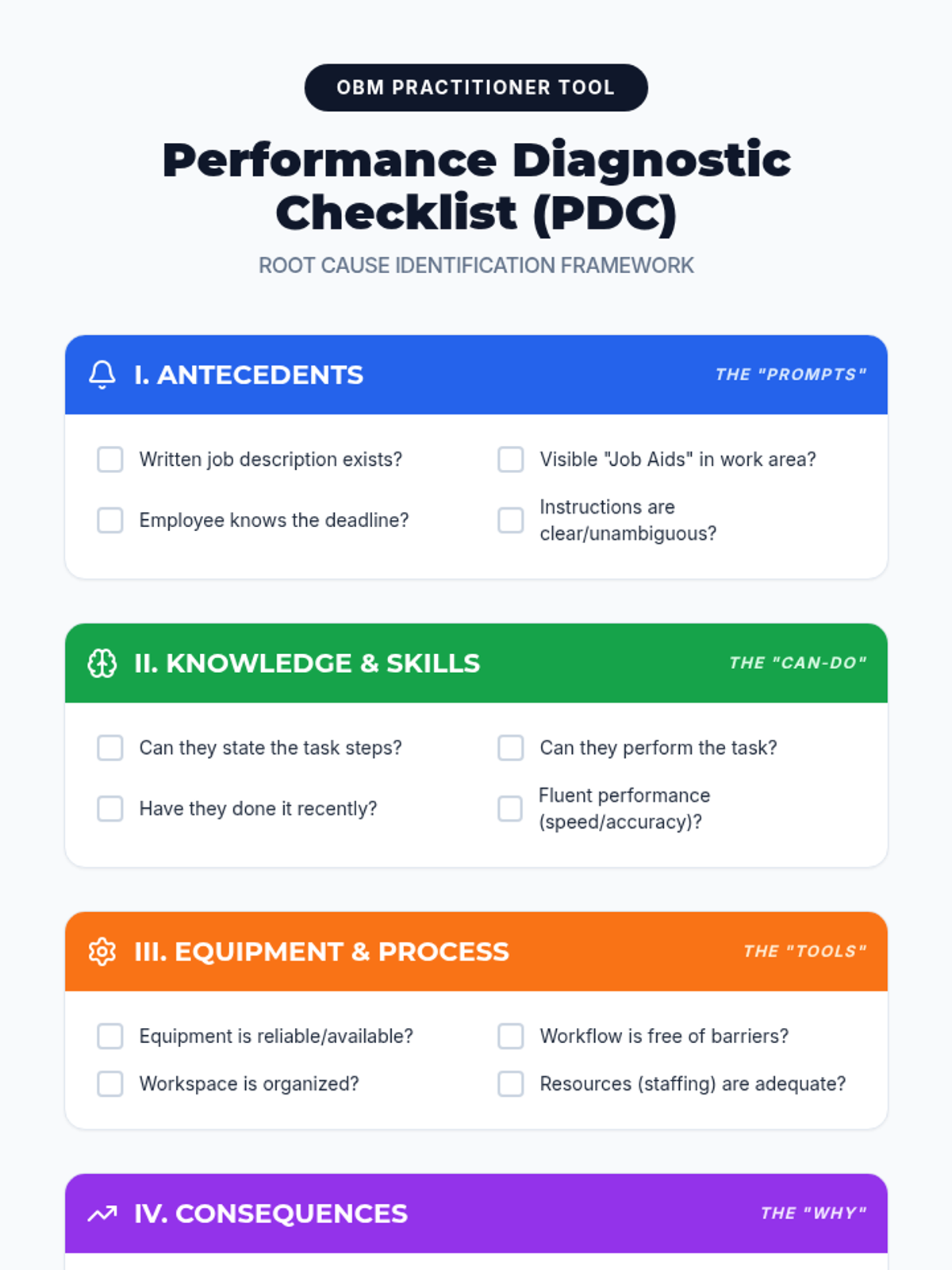
A practitioner-focused reference tool summarizing the four categories of the Performance Diagnostic Checklist (PDC).
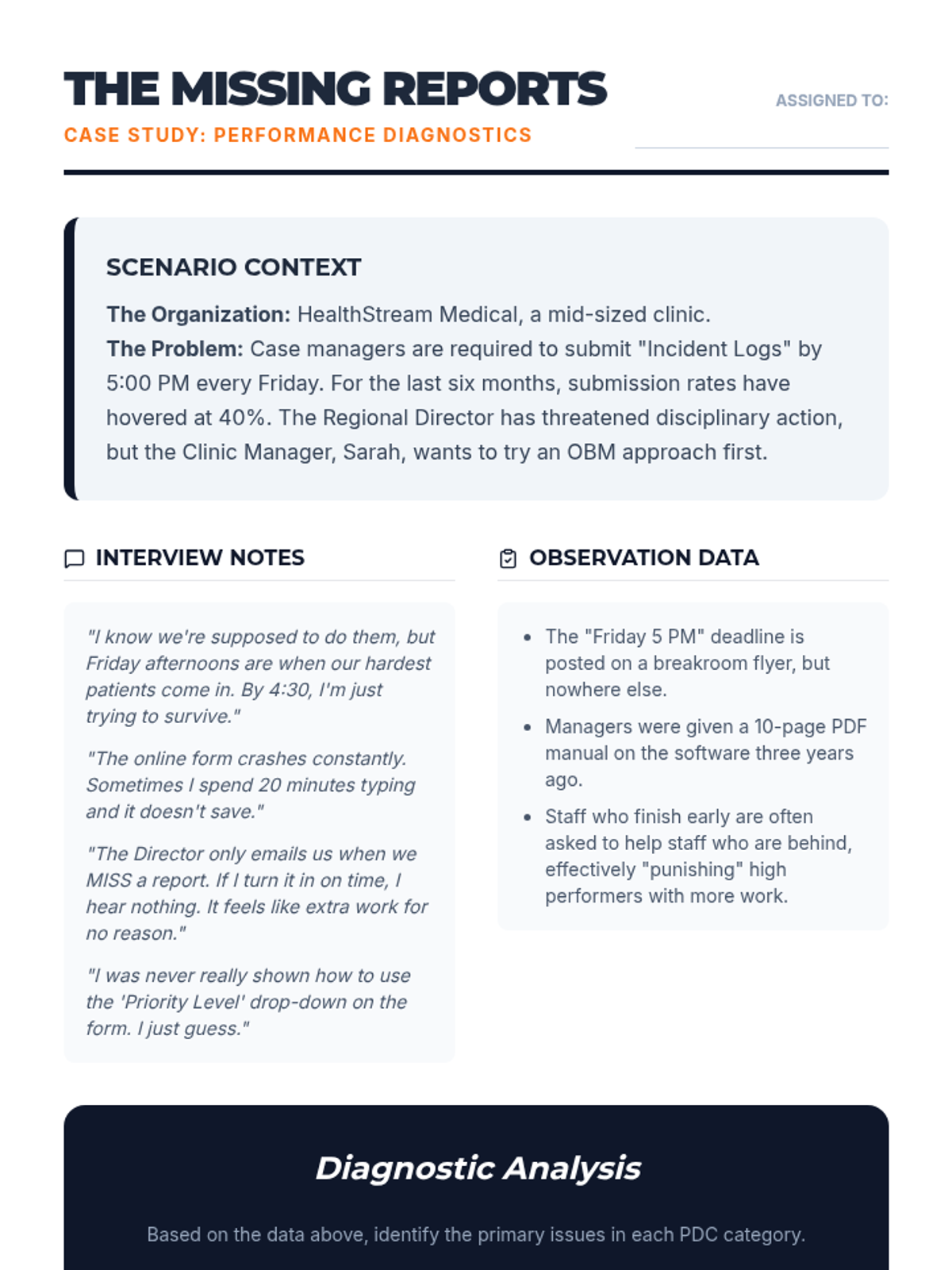
A case study for students to apply the Performance Diagnostic Checklist (PDC) to a real-world workplace performance issue.
Instructional slides for Lesson 2, introducing the Performance Diagnostic Checklist (PDC) and the "Can't Do vs. Won't Do" framework.
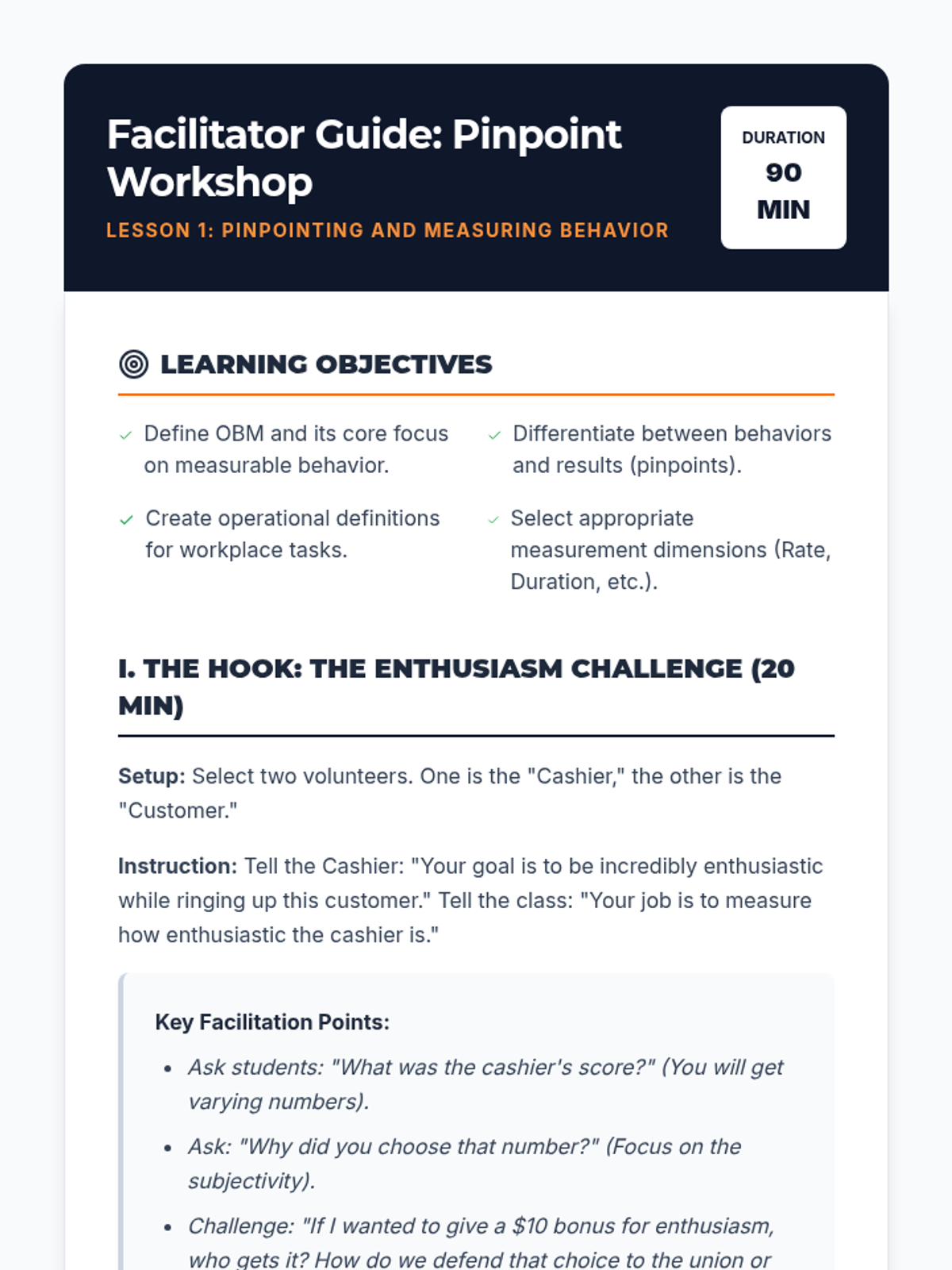
Teacher facilitation guide for Lesson 1, including the "Enthusiasm Challenge" hook, instructional keys, and common student errors.
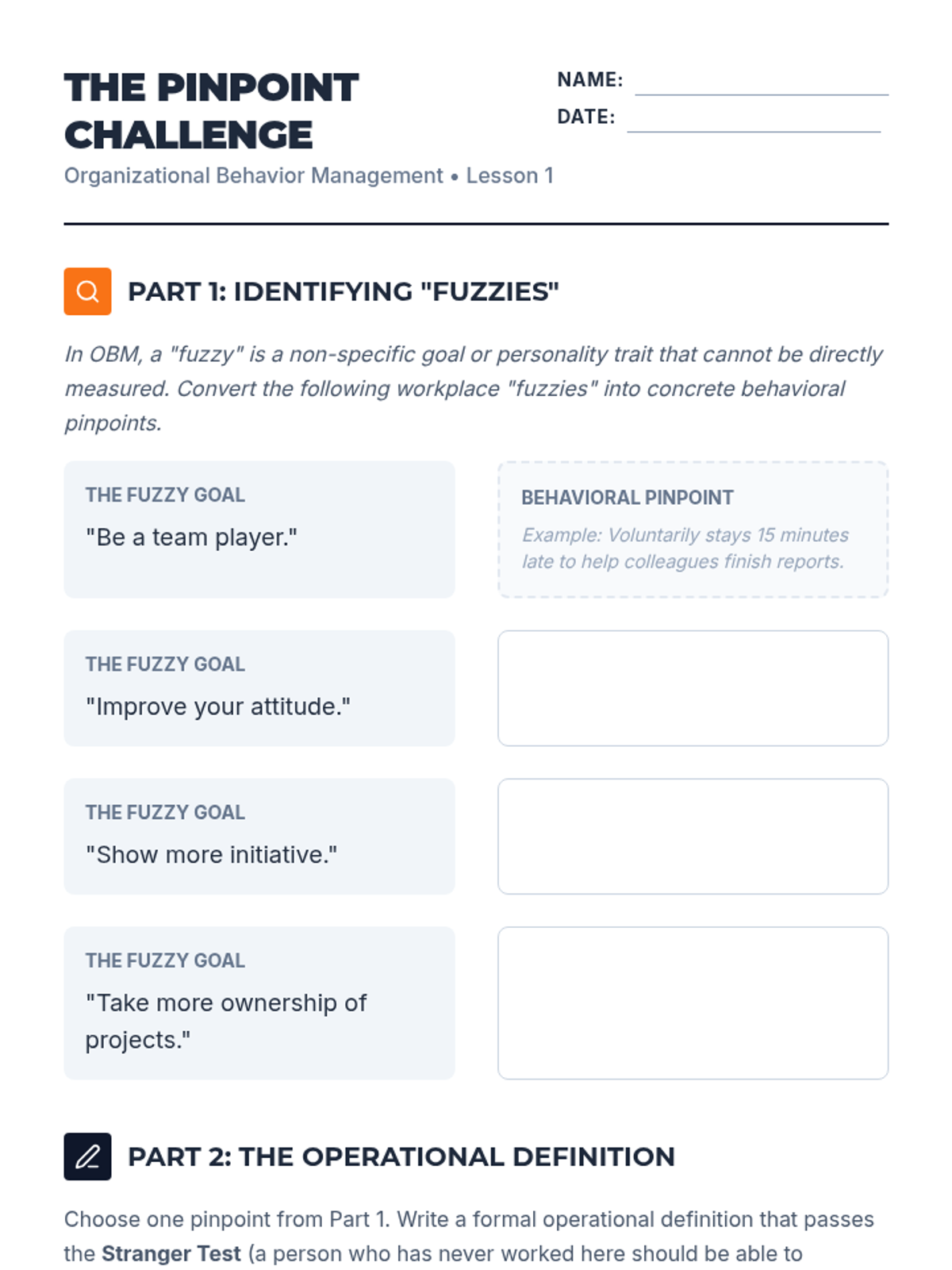
A worksheet for students to practice converting vague goals into operationalized pinpoints and selecting appropriate measurement dimensions.
Instructional slides for Lesson 1, introducing the concept of pinpointing behaviors versus results and the dimensions of measurement in OBM.
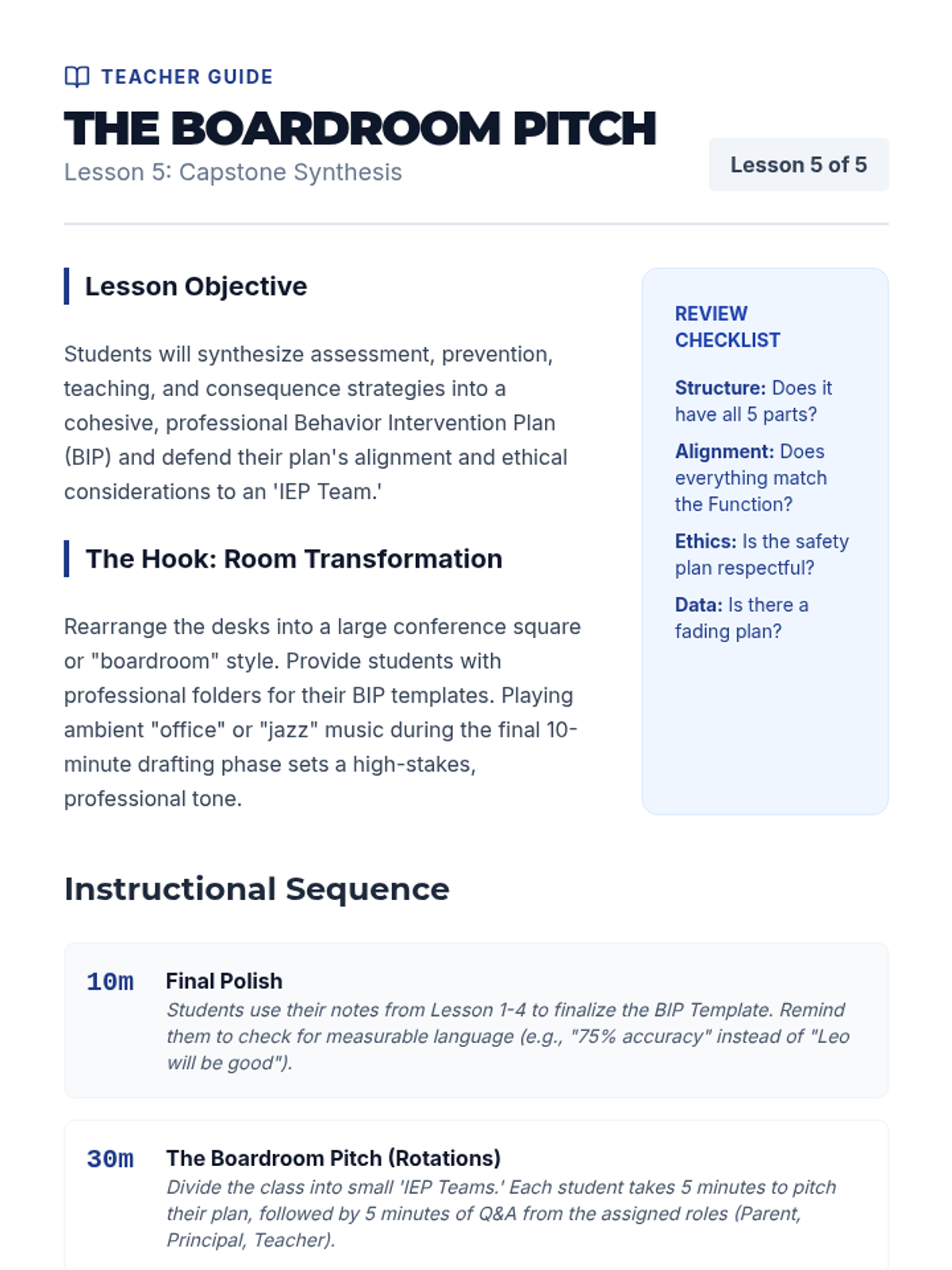
A teacher guide for the final capstone lesson, providing instructions for the boardroom pitch simulation and a grading checklist for the final BIP project.
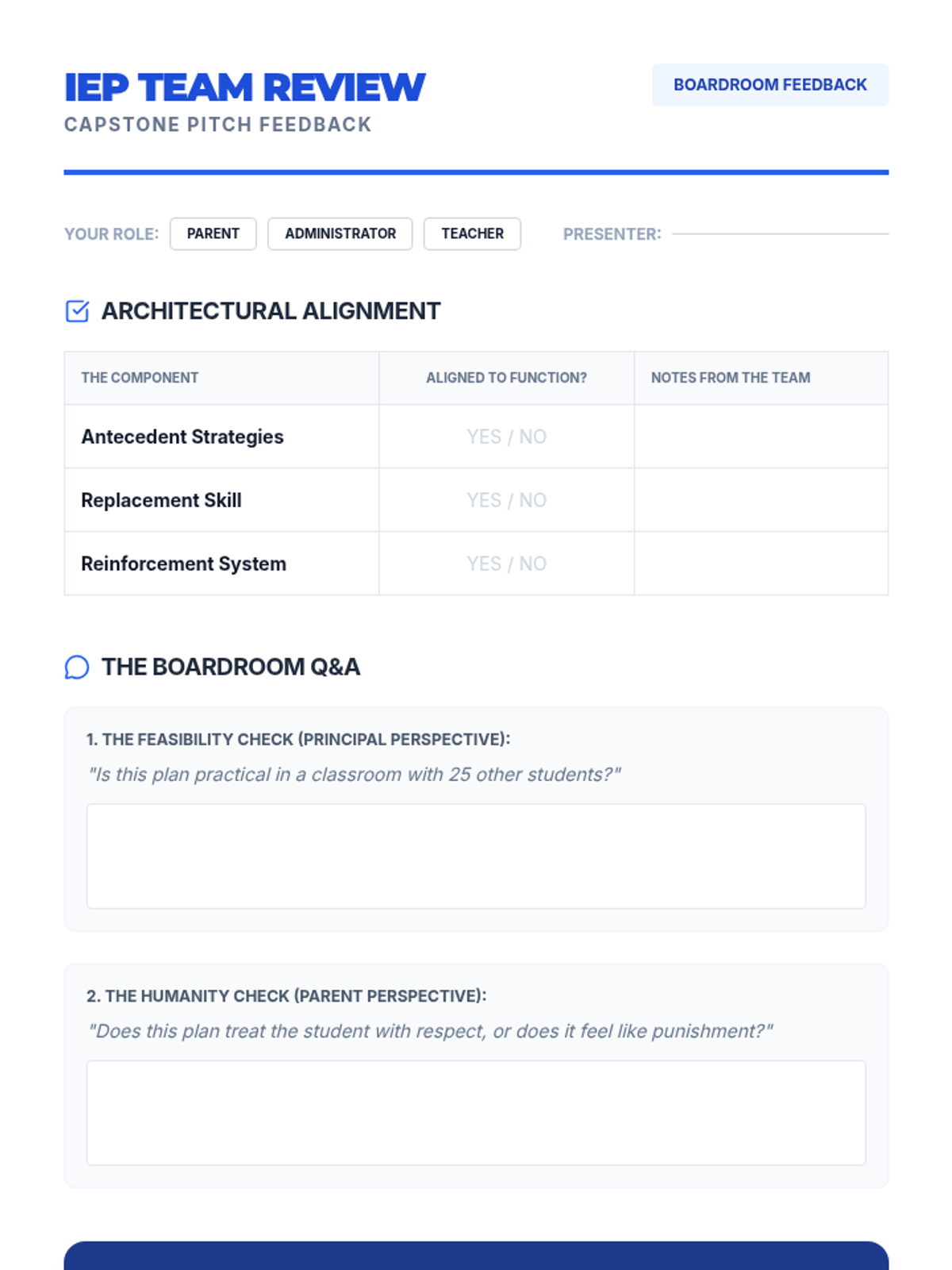
A peer review and feedback form for students acting as the 'IEP Team' during the BIP Capstone presentations, focusing on alignment, feasibility, and ethics.
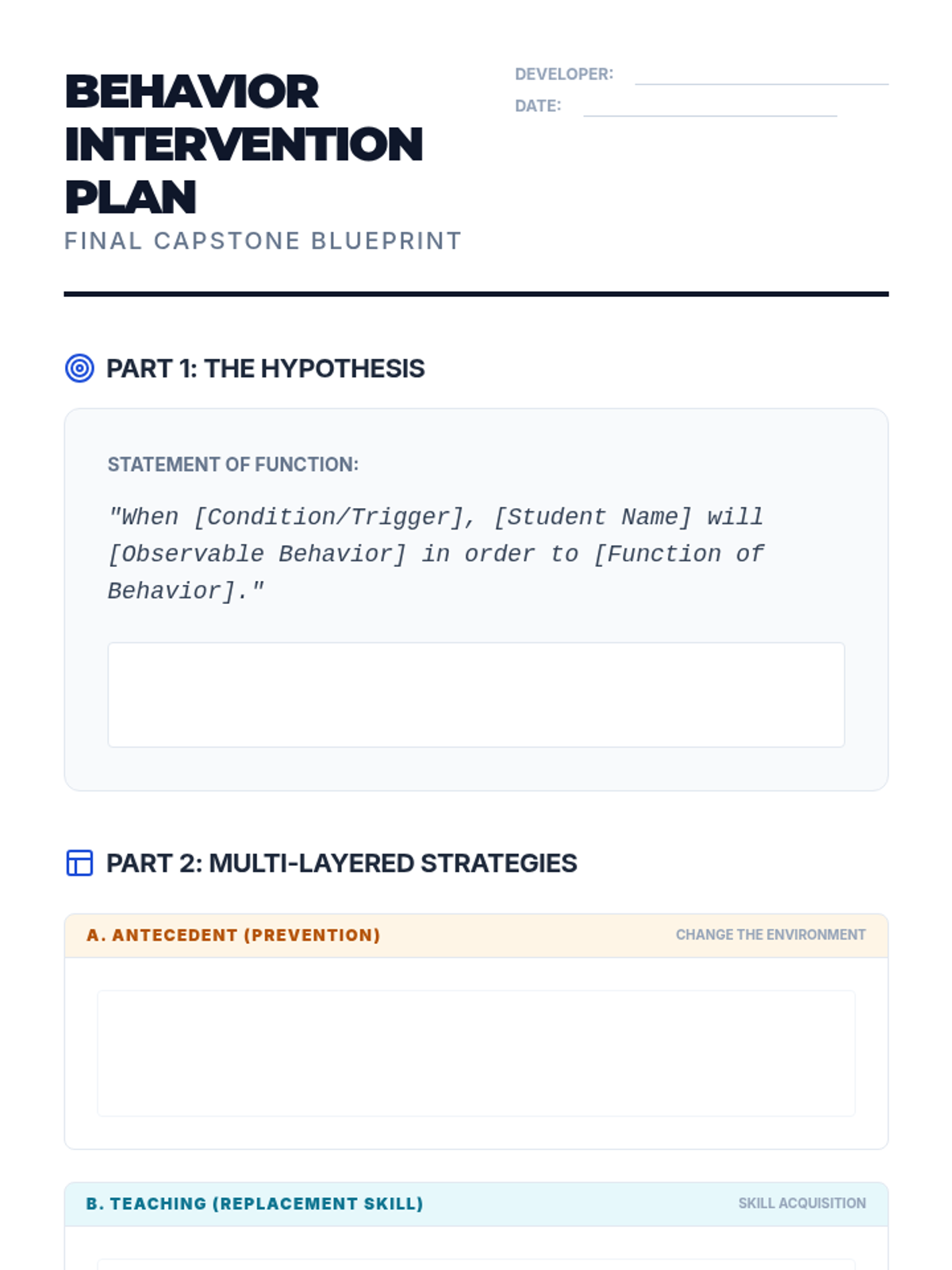
A comprehensive final project template for 11th-grade students to synthesize all components of a Behavior Intervention Plan (BIP) for a case study.
A slide deck for the culminating workshop of the BIP sequence, focusing on professional presentation, IEP team roles, and the synthesis of behavior intervention strategies.
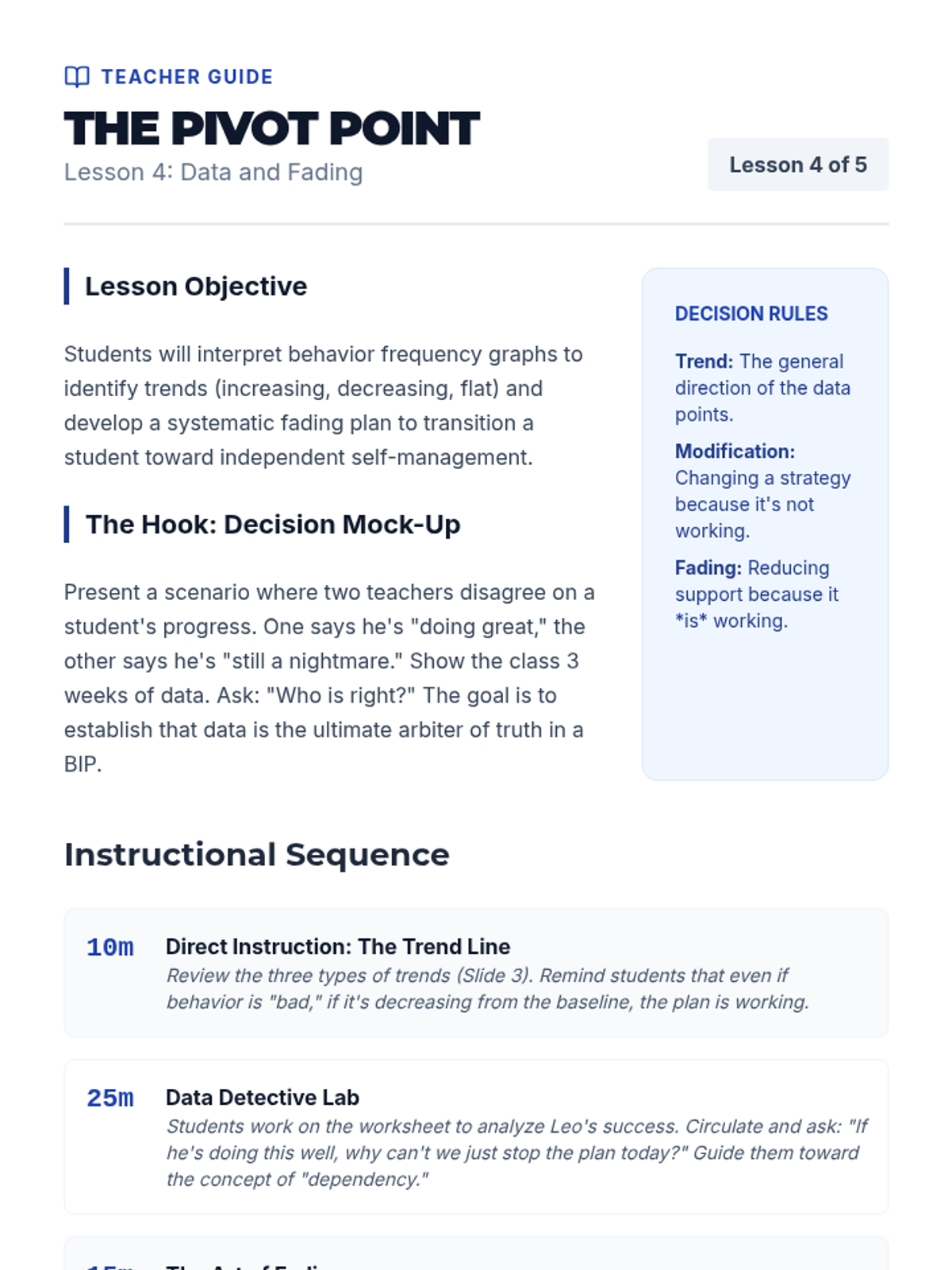
A teacher guide for Lesson 4 focusing on data-based decision making, trend analysis, and fading strategies for behavioral supports.
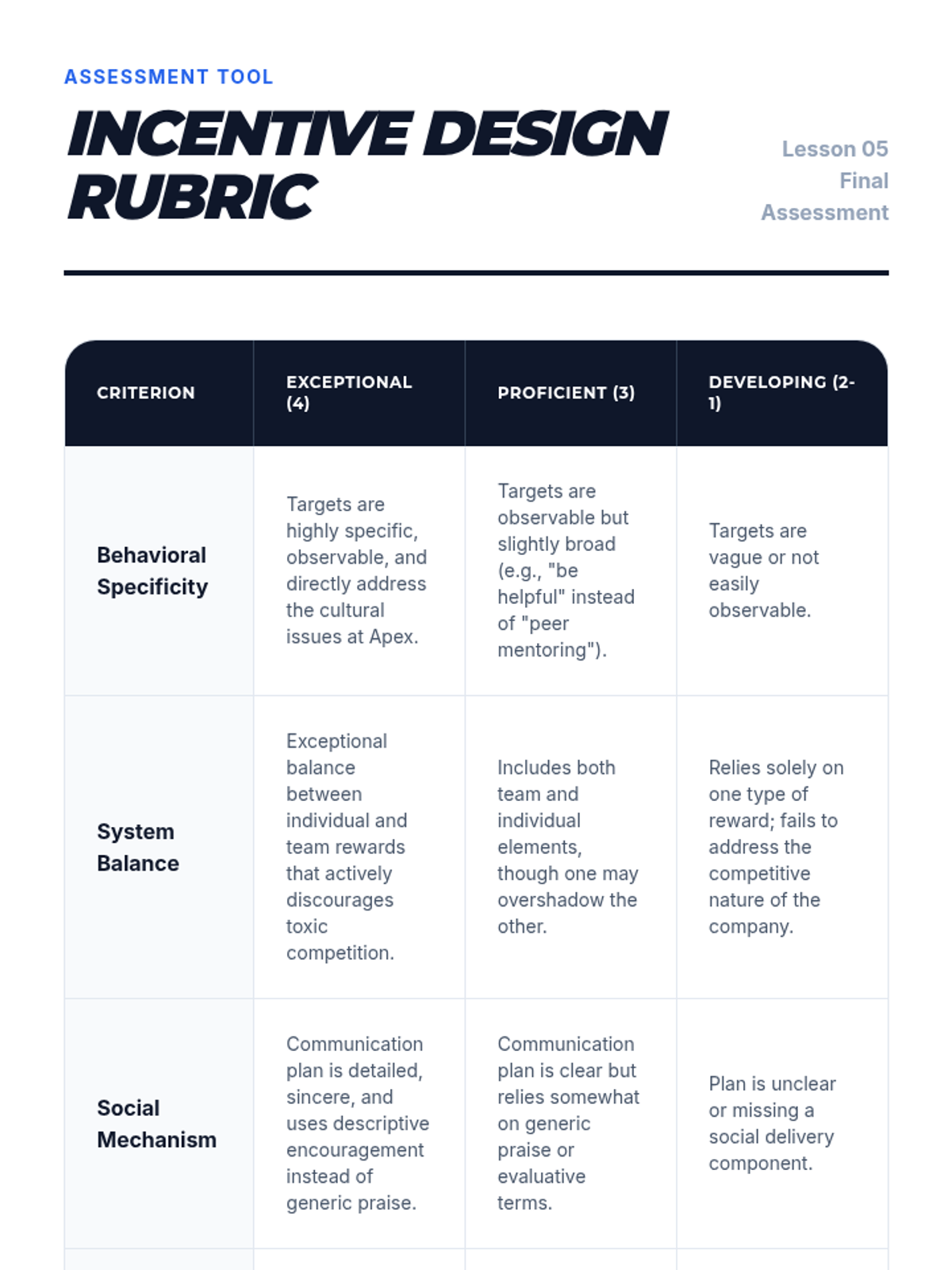
An assessment rubric for evaluating the Team Culture Blueprint project, focusing on behavioral specificity, system balance, and risk analysis.
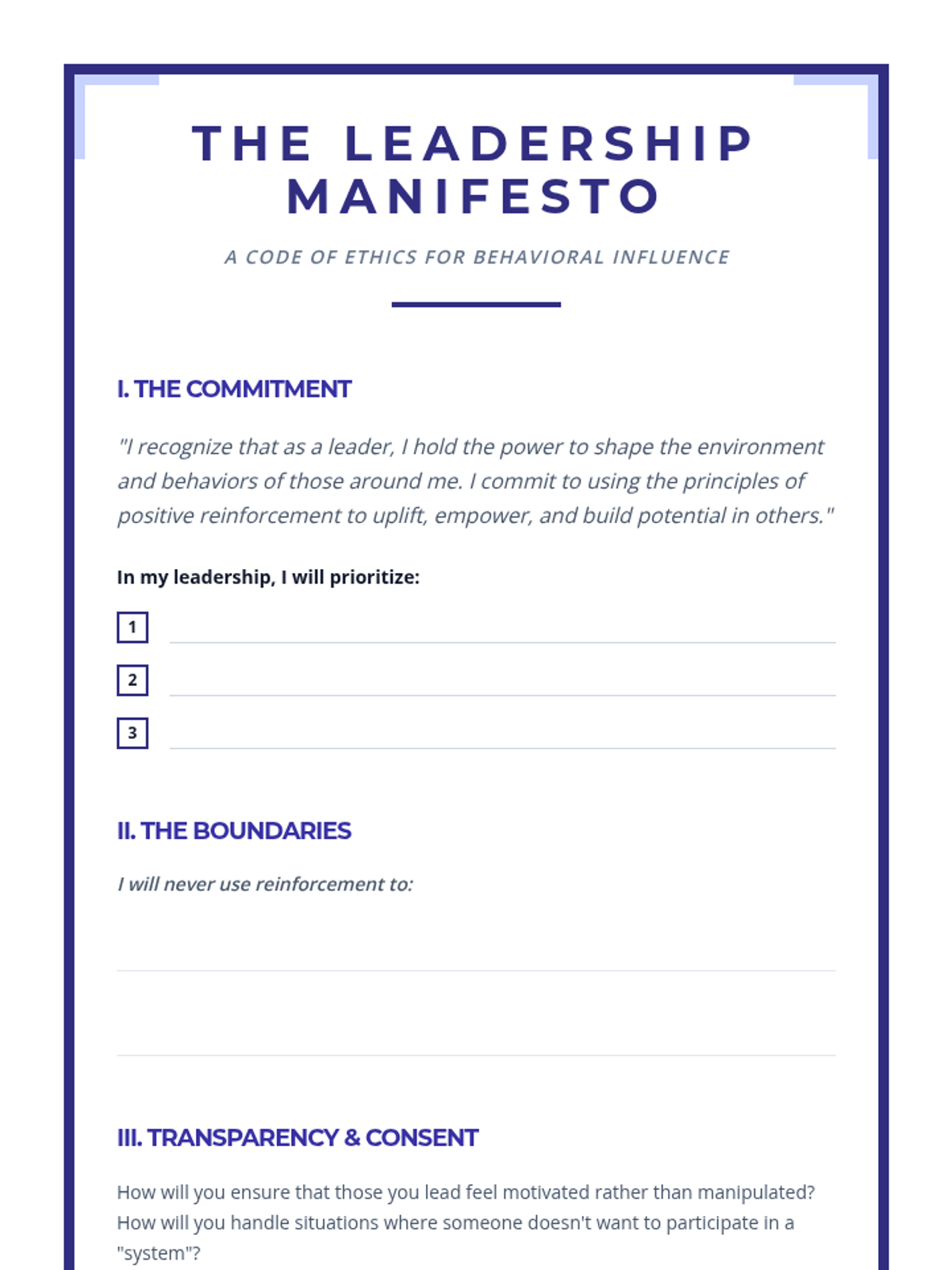
Final reflective project for Lesson 5, where students draft a personal code of ethics for using behavioral influence in their leadership roles.
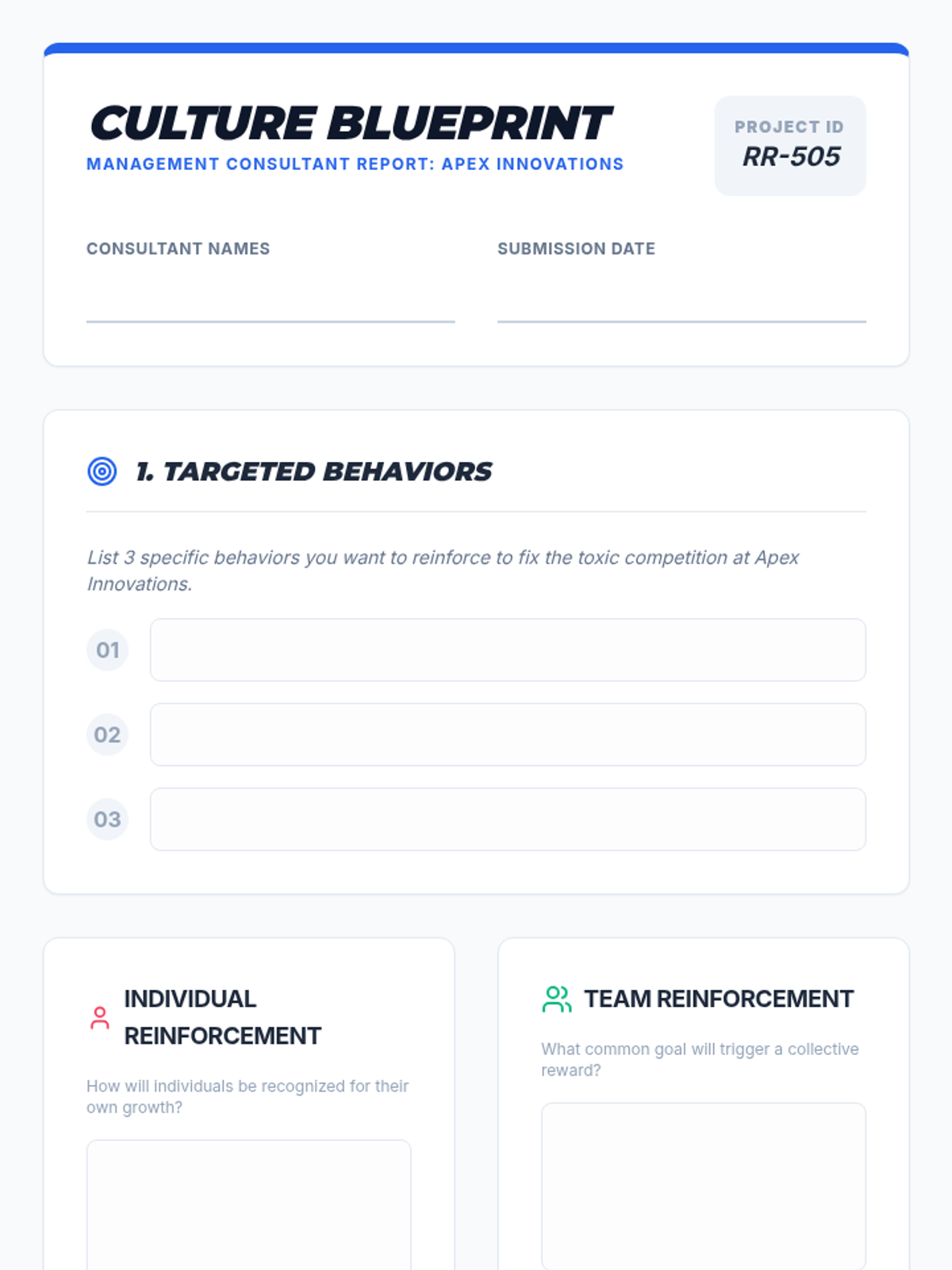
A culminating project template for students to act as management consultants and design a reinforcement system for a struggling organization.
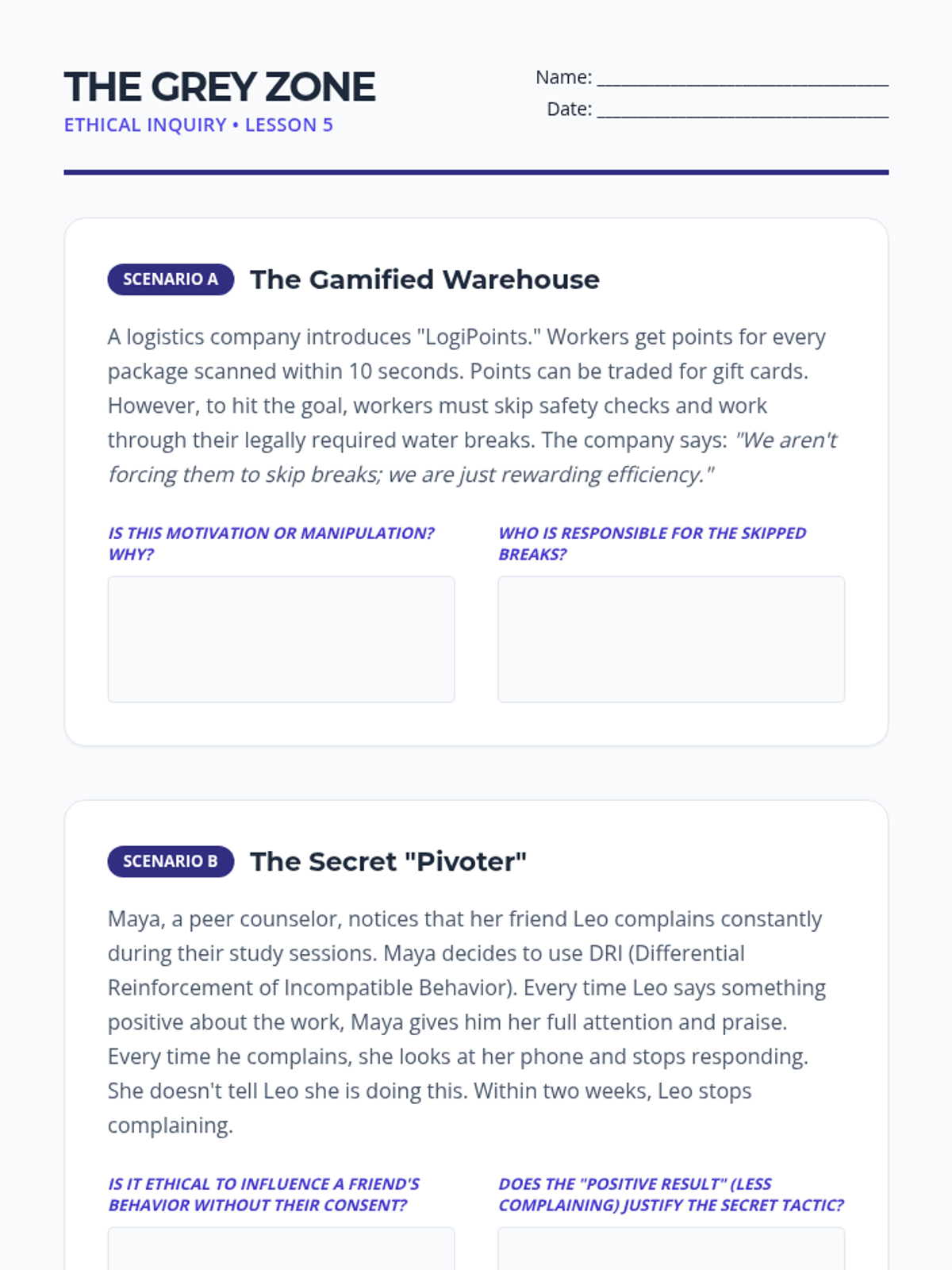
Student worksheet for Lesson 5, featuring ethical case studies and debate prompts regarding the use of behavioral reinforcement in leadership.
A slide deck for the culminating project where students design a reinforcement system for an organization, balancing individual and team goals.
Visual presentation slides for Lesson 5, exploring the ethics of behavioral leadership, transparency, and the difference between motivation and manipulation.
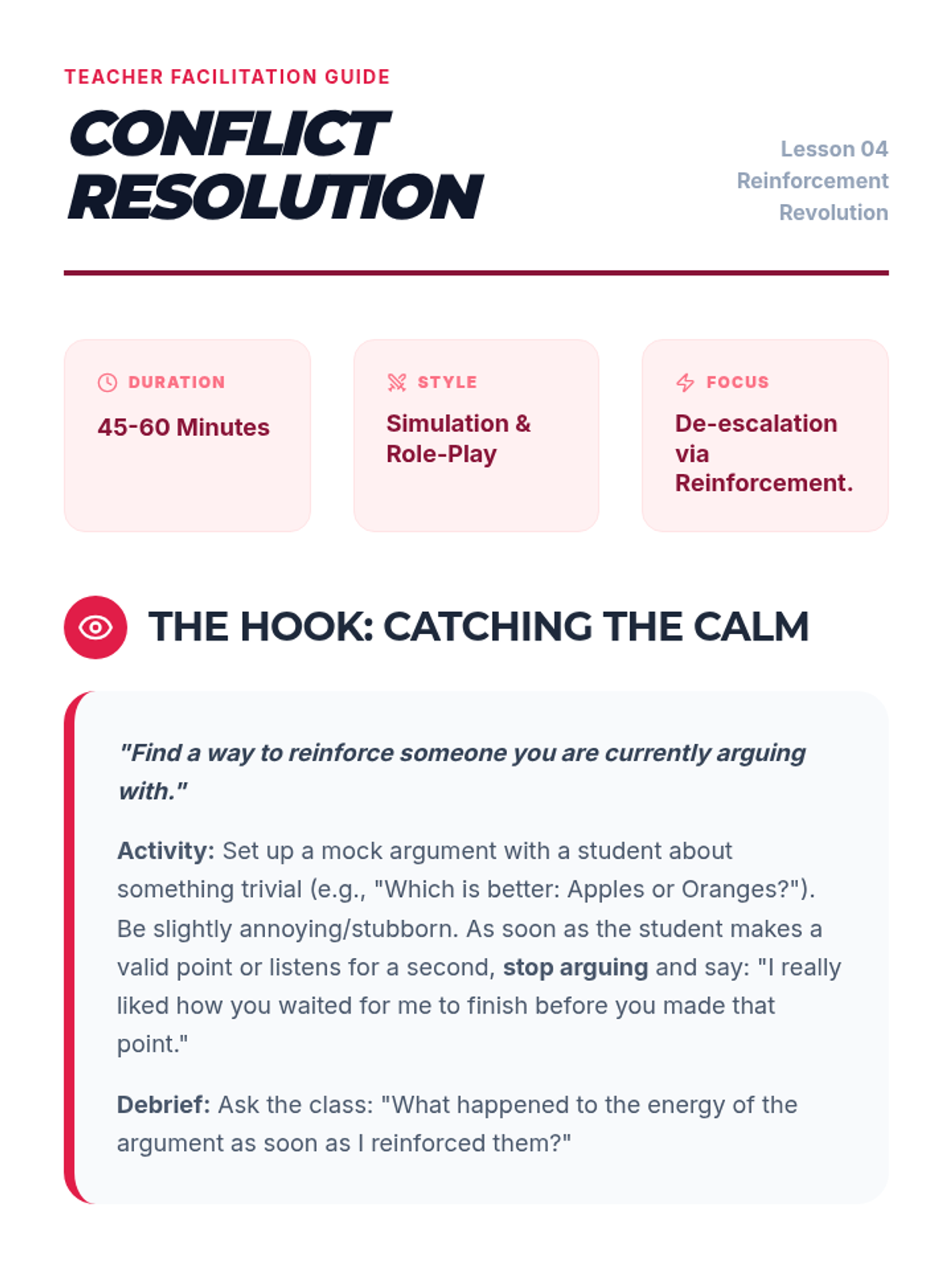
A facilitation guide for teachers to deliver the Reinforcement in Conflict lesson, including role-play tips, de-escalation strategies, and debrief questions.
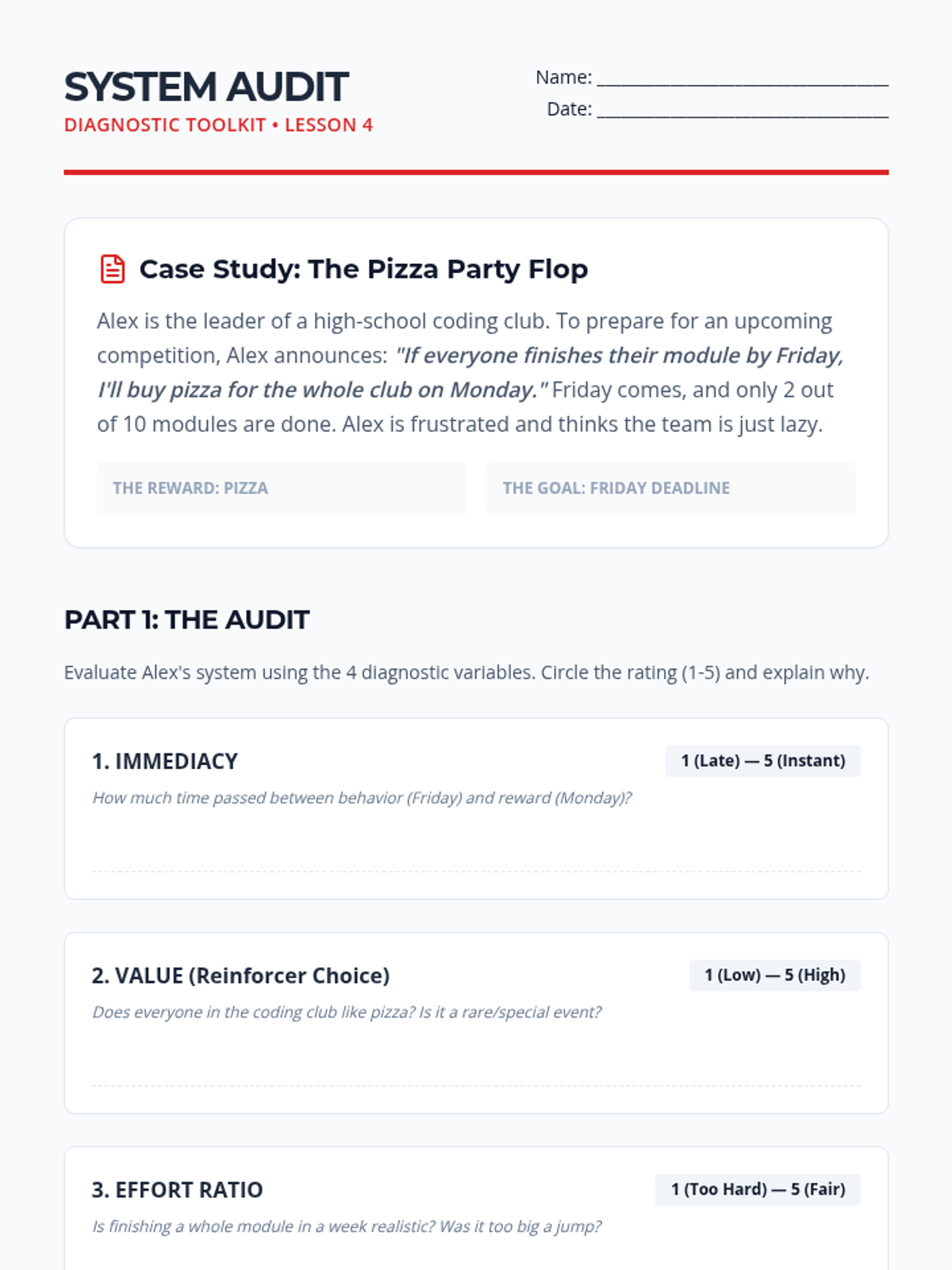
Student worksheet for Lesson 4, featuring a case study analysis and diagnostic checklist to troubleshoot failing reinforcement systems.
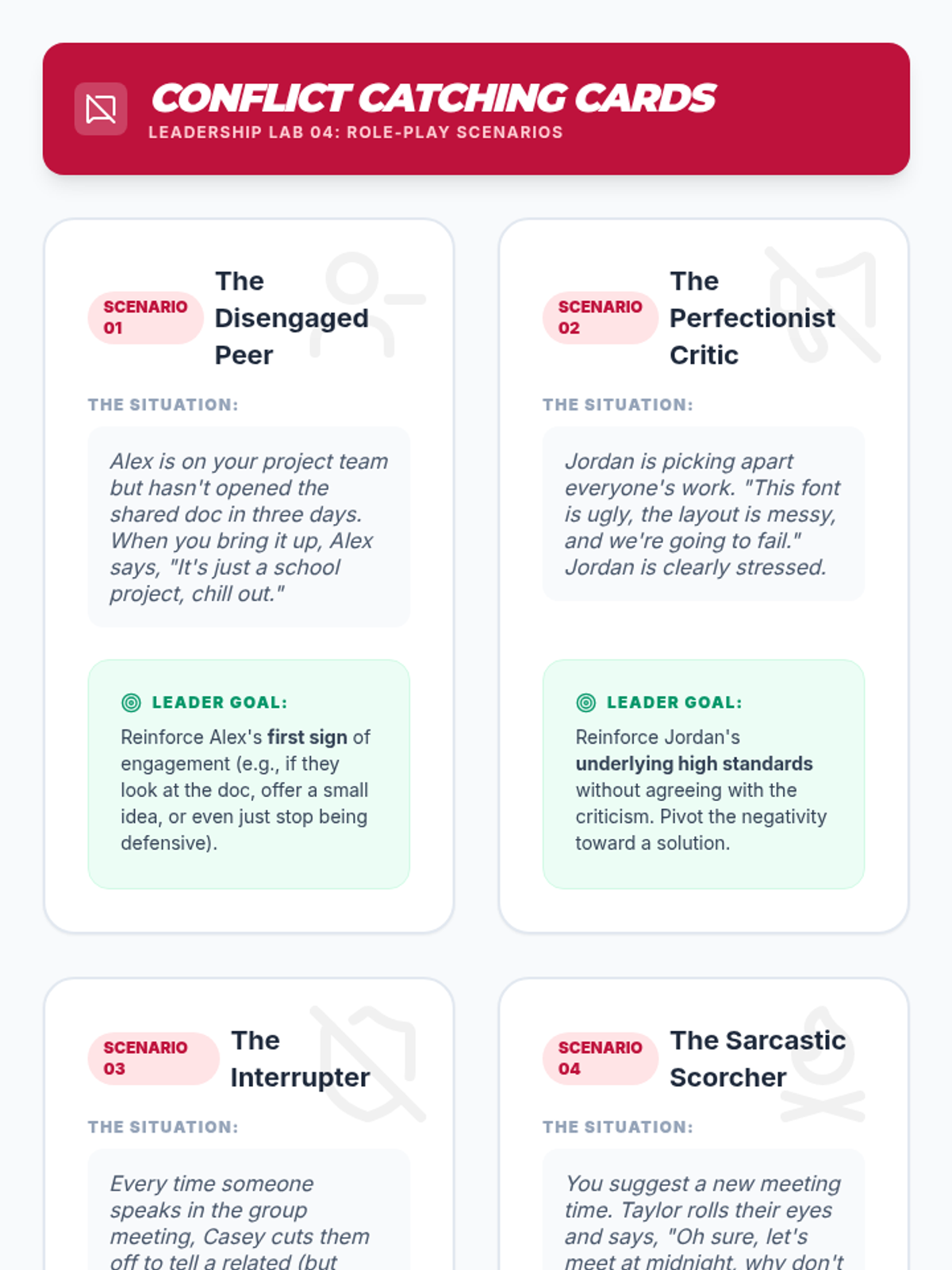
A set of role-play scenario cards designed to help students practice using positive reinforcement to de-escalate common interpersonal conflicts.
Visual presentation slides for Lesson 4, covering the common reasons reinforcement systems fail, including satiation, delay, and poor reinforcer choice.
A comprehensive guidebook for a 21-year-old client that translates the Success Blueprint presentation into a professional handbook format. It now includes a professional commitment signature area on the Power of Ownership page.
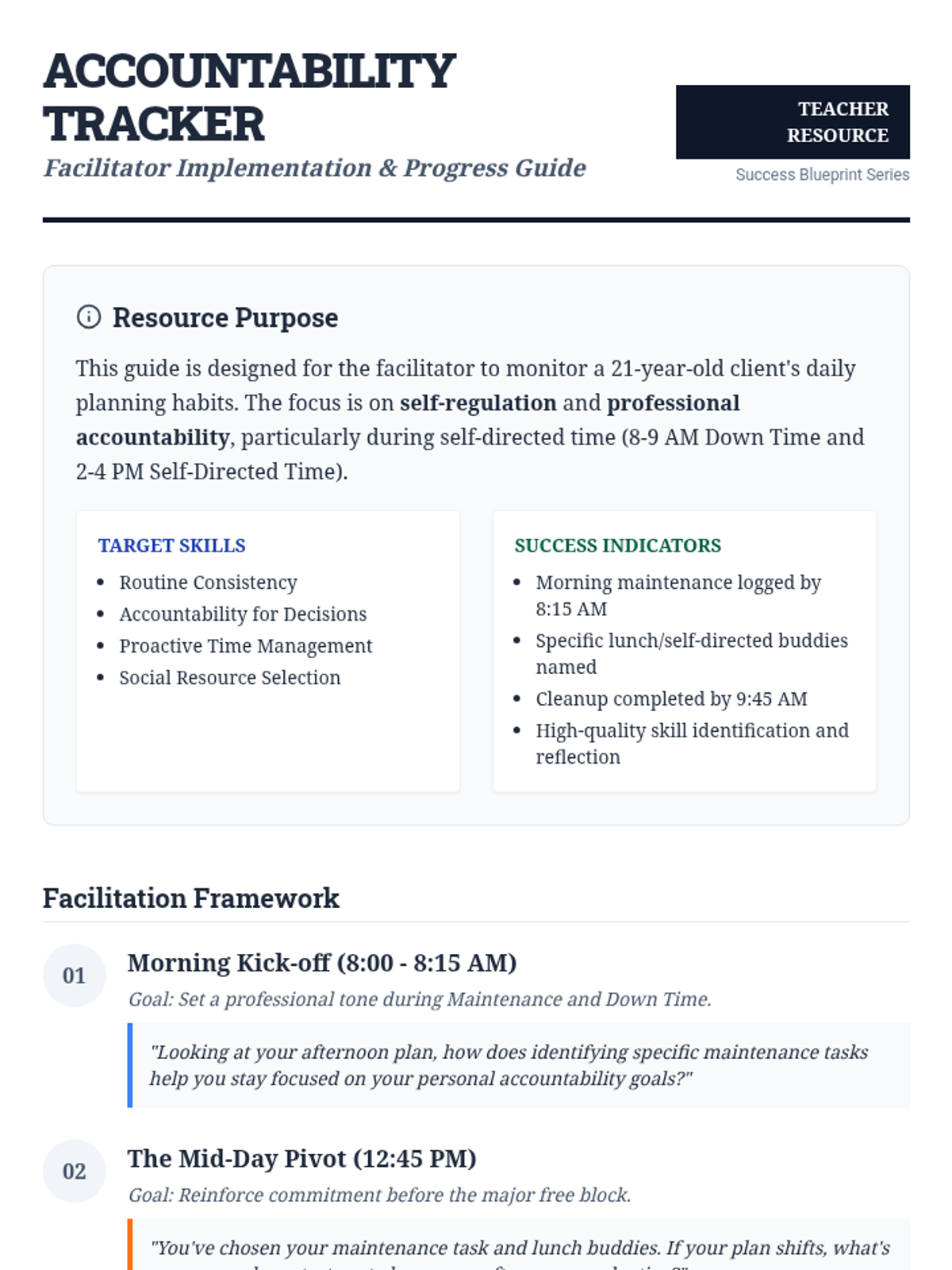
Facilitator resource for implementing the Daily Action Planner, including coaching scripts, prompts for mid-day check-ins, and a weekly tracking log to monitor client progress and behavioral incidents.
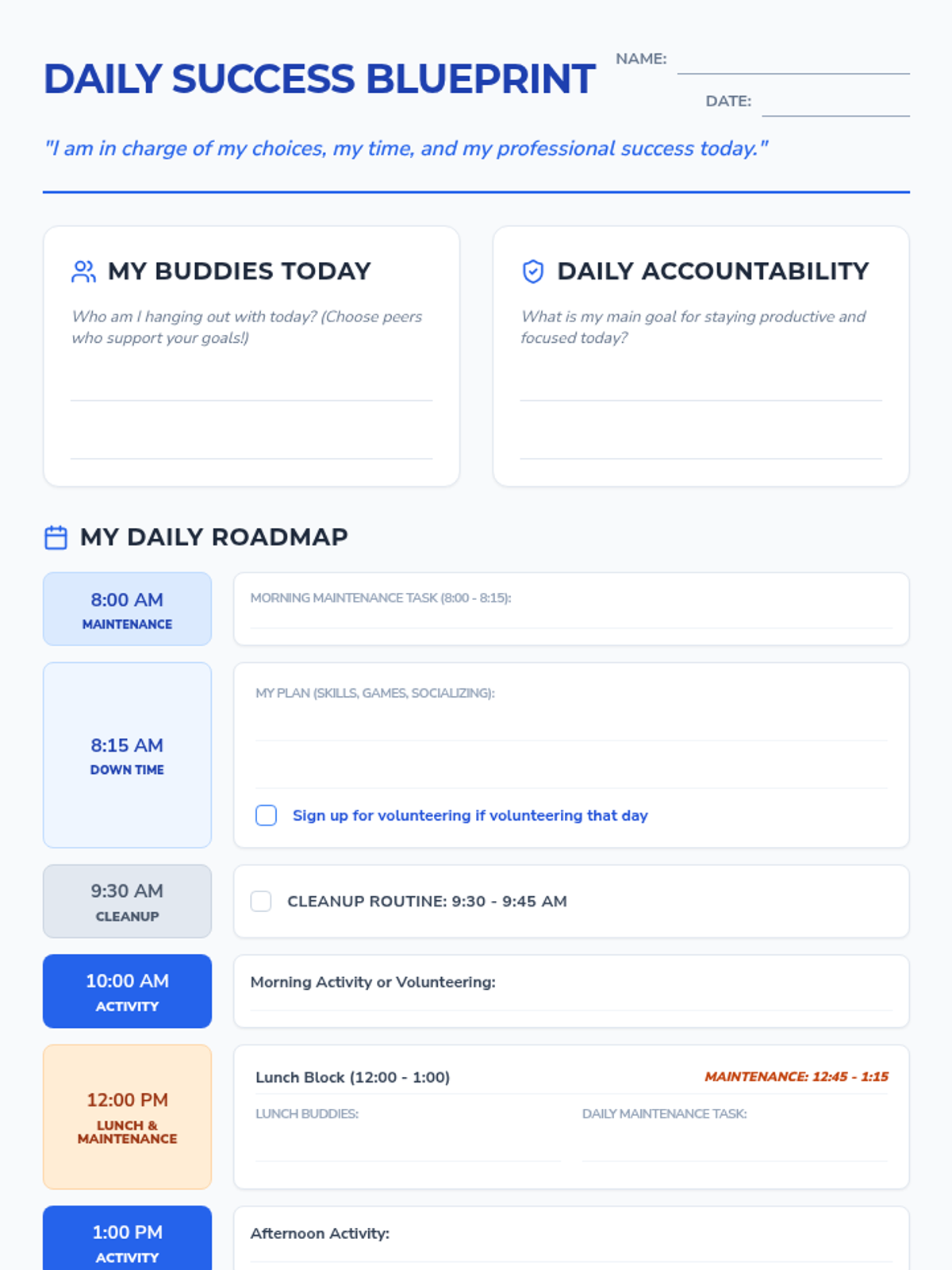
A structured daily worksheet for a 21-year-old client to plan their routine, select buddies, and practice professional accountability. It features an adult-focused tone, specific slots for lunch buddies, and open space for identifying skills worked on.
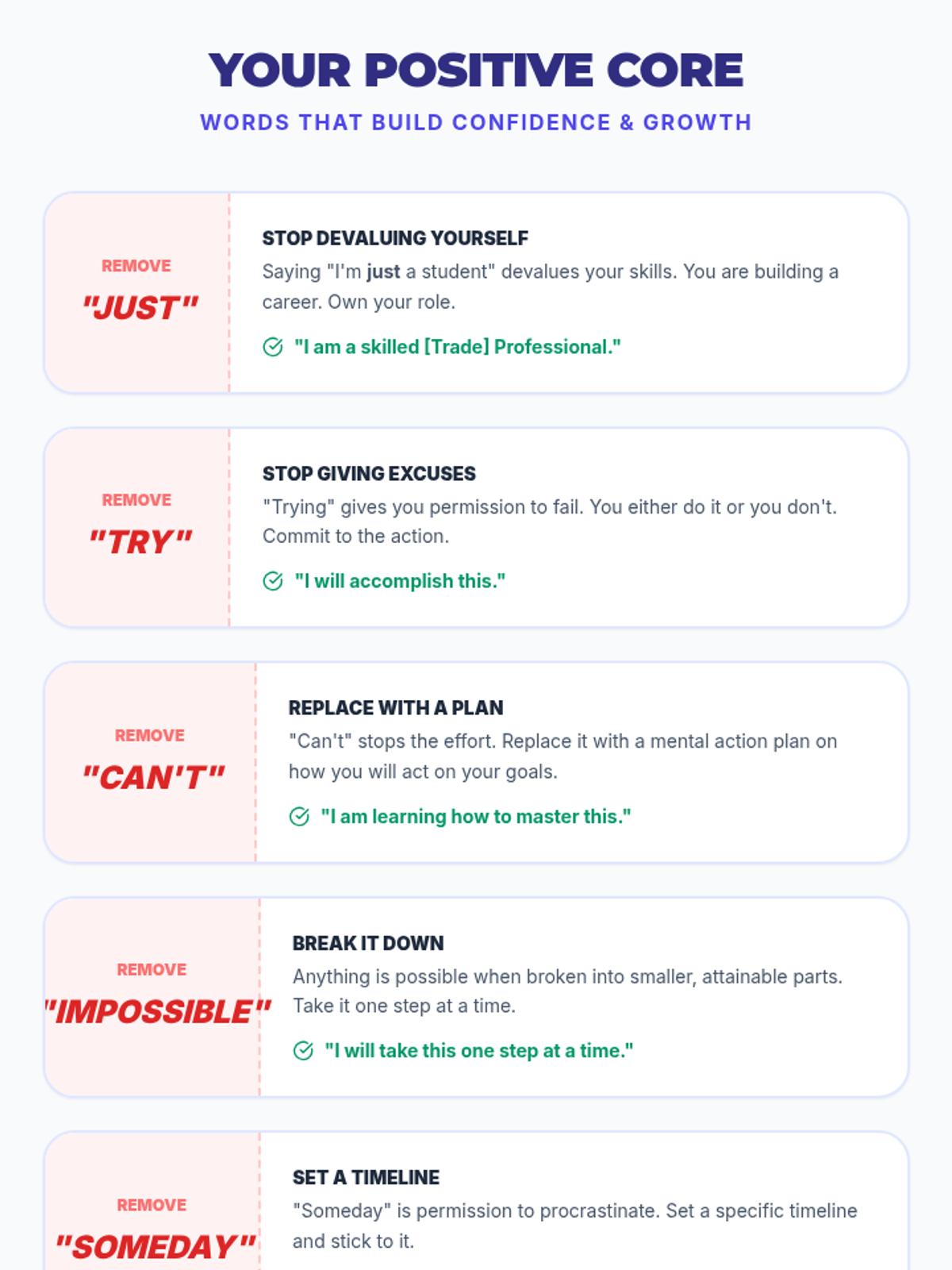
A visual guide to removing negative phrasing (Just, Try, Can't, Impossible, Someday) and replacing it with language that builds a positive core and confidence.
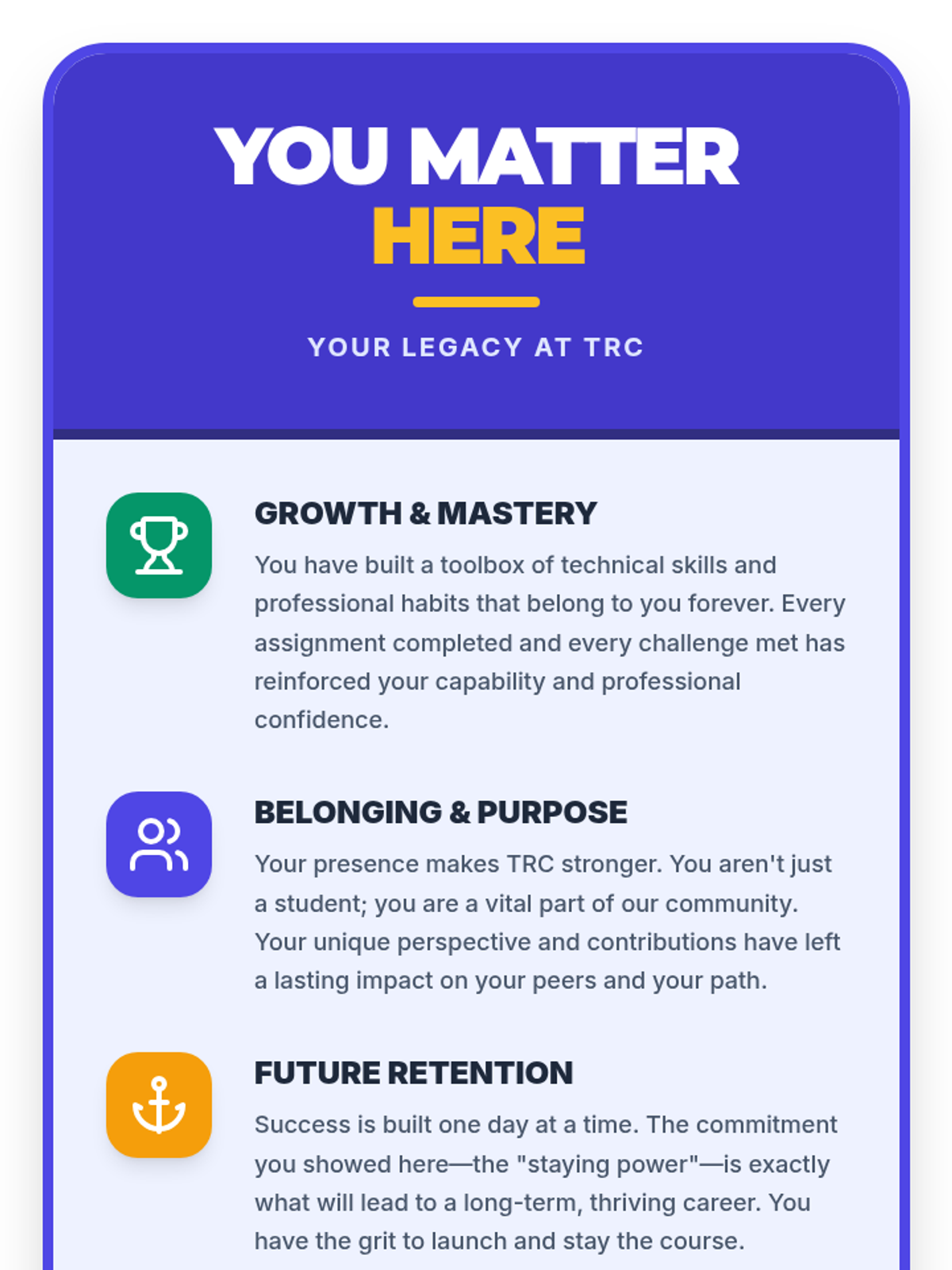
A large, static anchor poster for the Quarter 4 board, reinforcing messages of belonging, growth, and professional confidence.
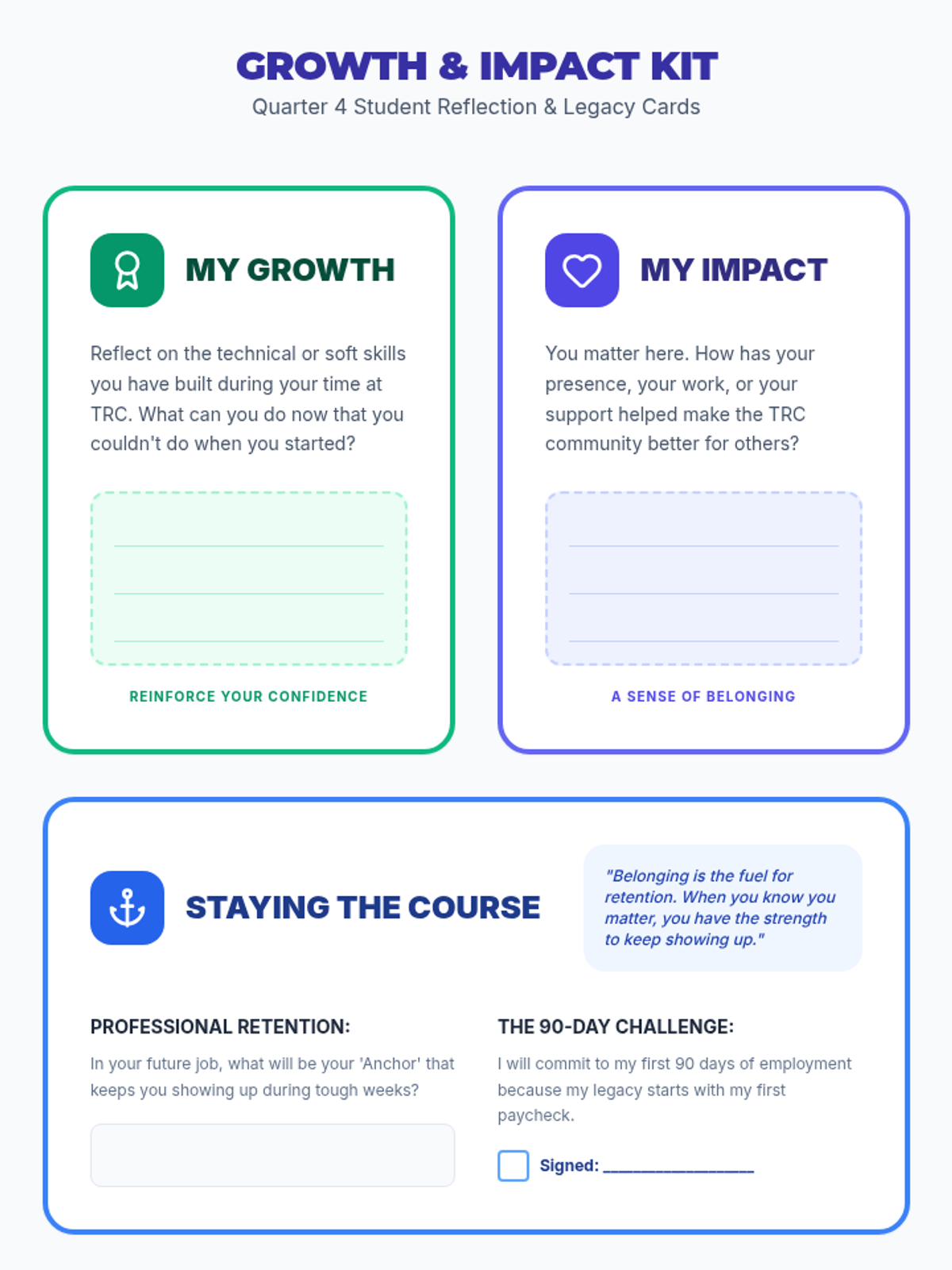
Interactive student reflection cards for Quarter 4, focusing on skills built, personal impact (belonging), and commitment to job retention.
Large printable headers and main title for the Quarter 4 bulletin board, designed for professional career prep aesthetics.
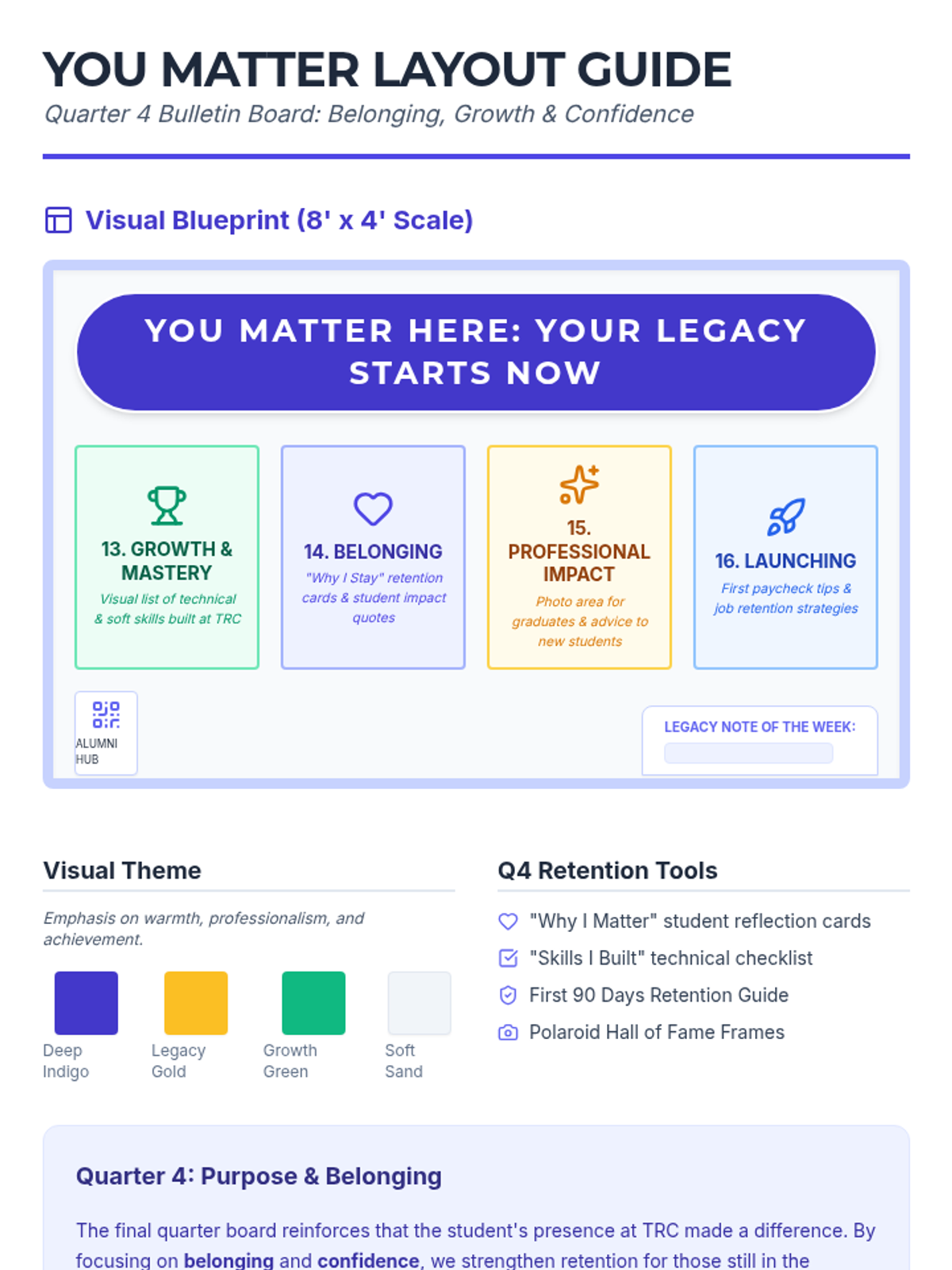
A visual blueprint and implementation guide for the Quarter 4 bulletin board, detailing the layout, color palette, and key sections for student belonging, growth, and confidence.
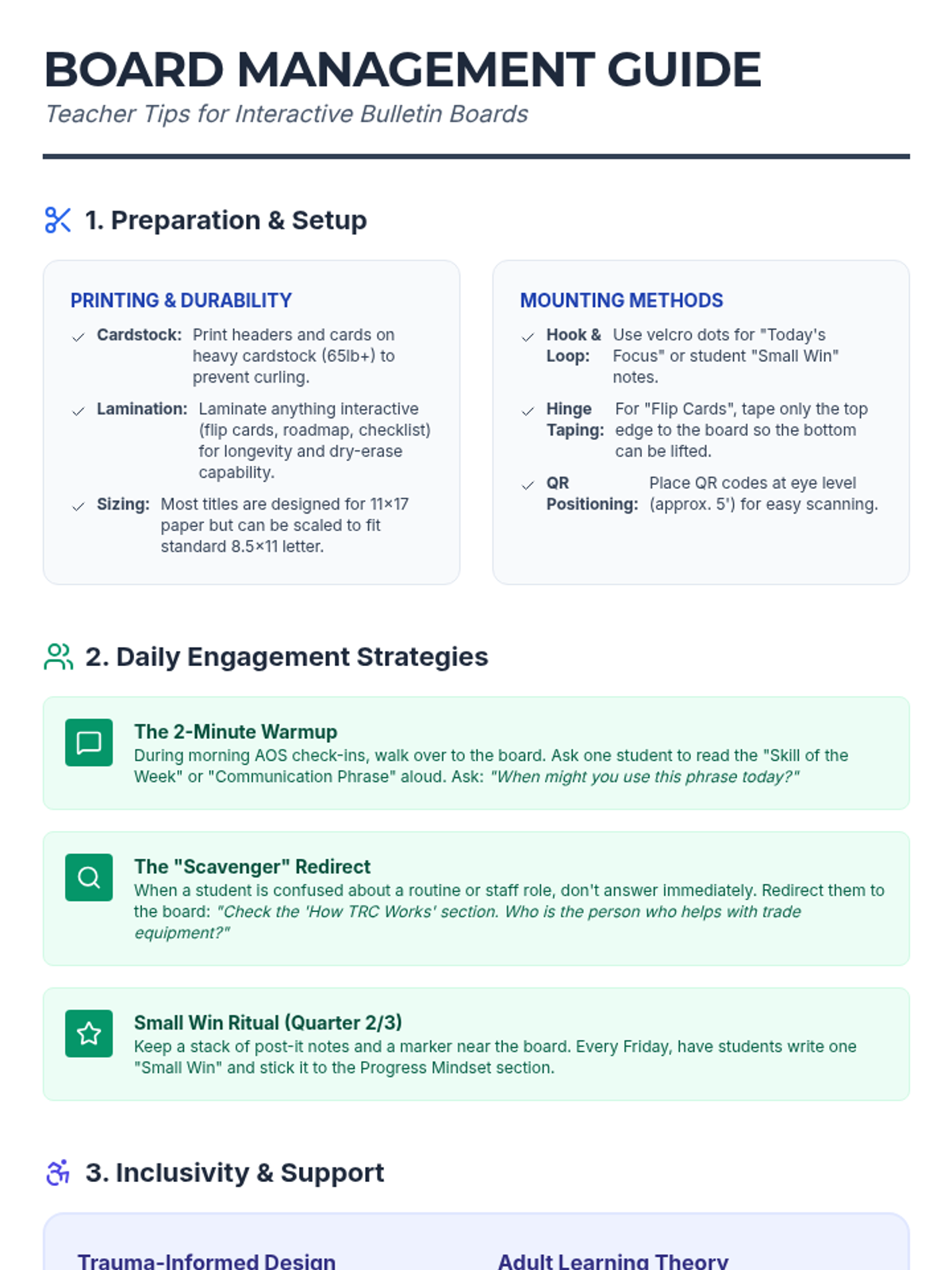
A comprehensive implementation and maintenance guide for teachers, providing strategies for using the bulletin boards as interactive instructional tools.
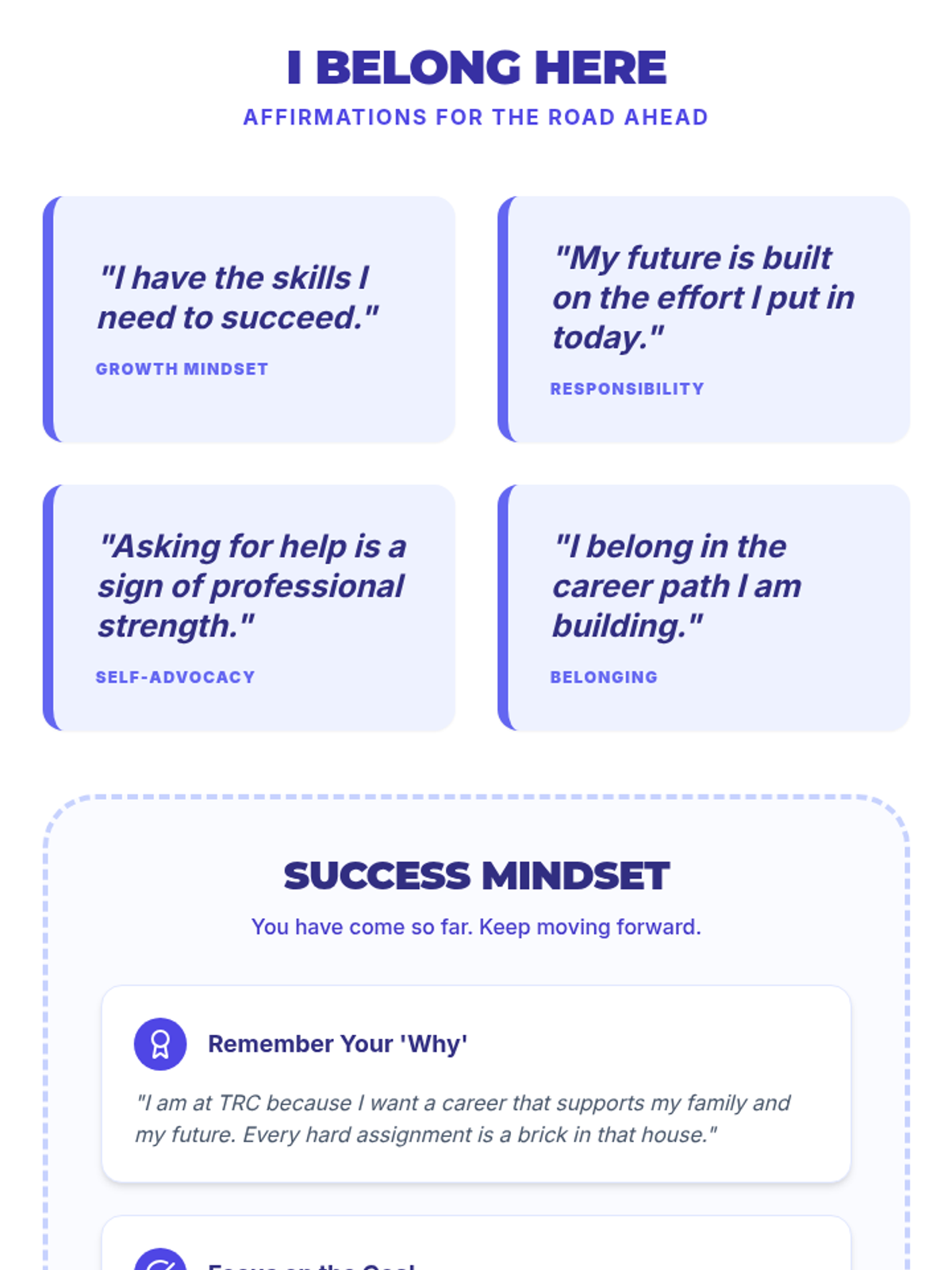
A motivational display for the final transition phase, featuring affirmations, encouragement, and a focus on a success mindset.
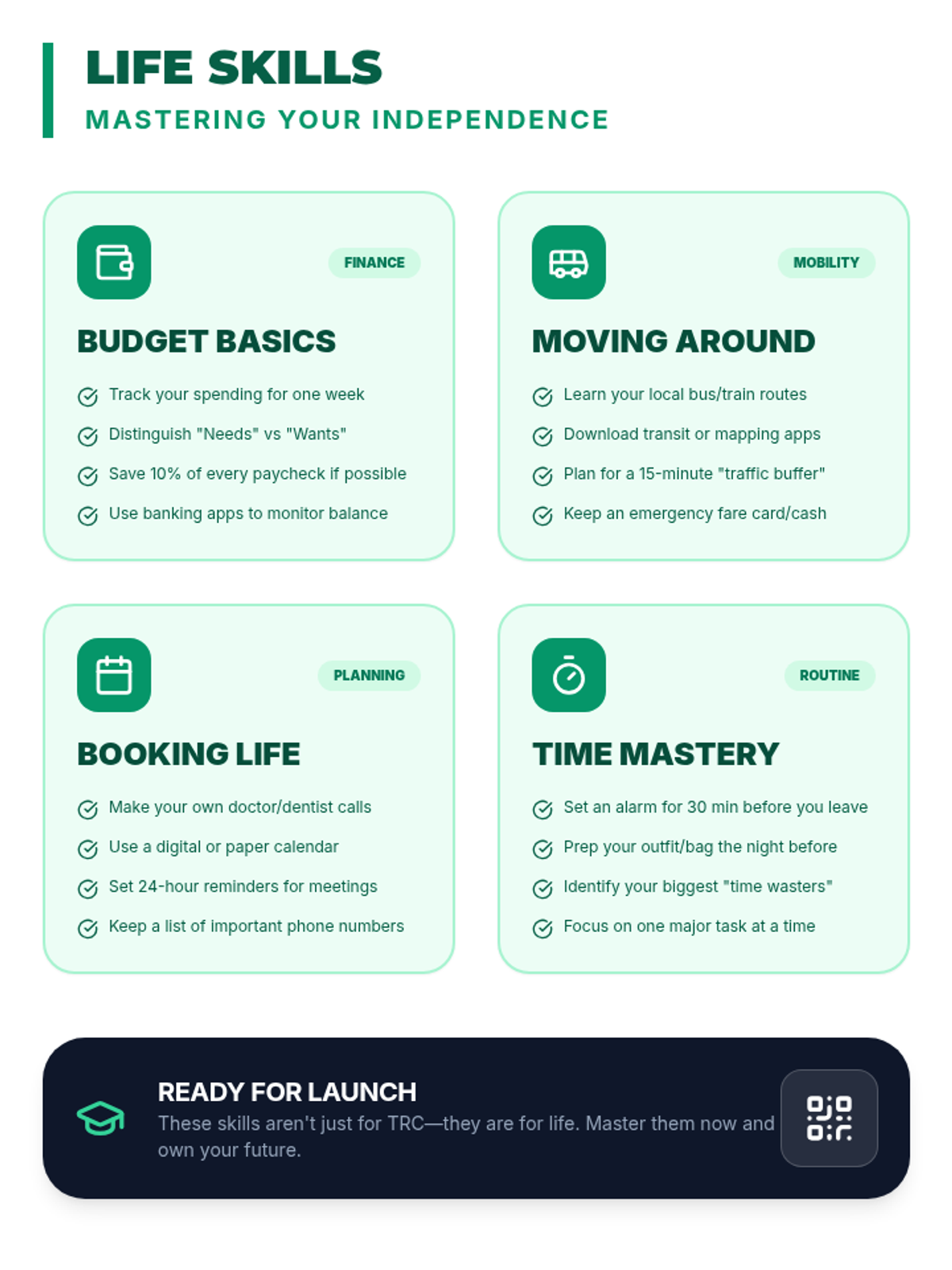
A set of life skills reference cards for student independence, covering budgeting, transportation, appointments, and time management.
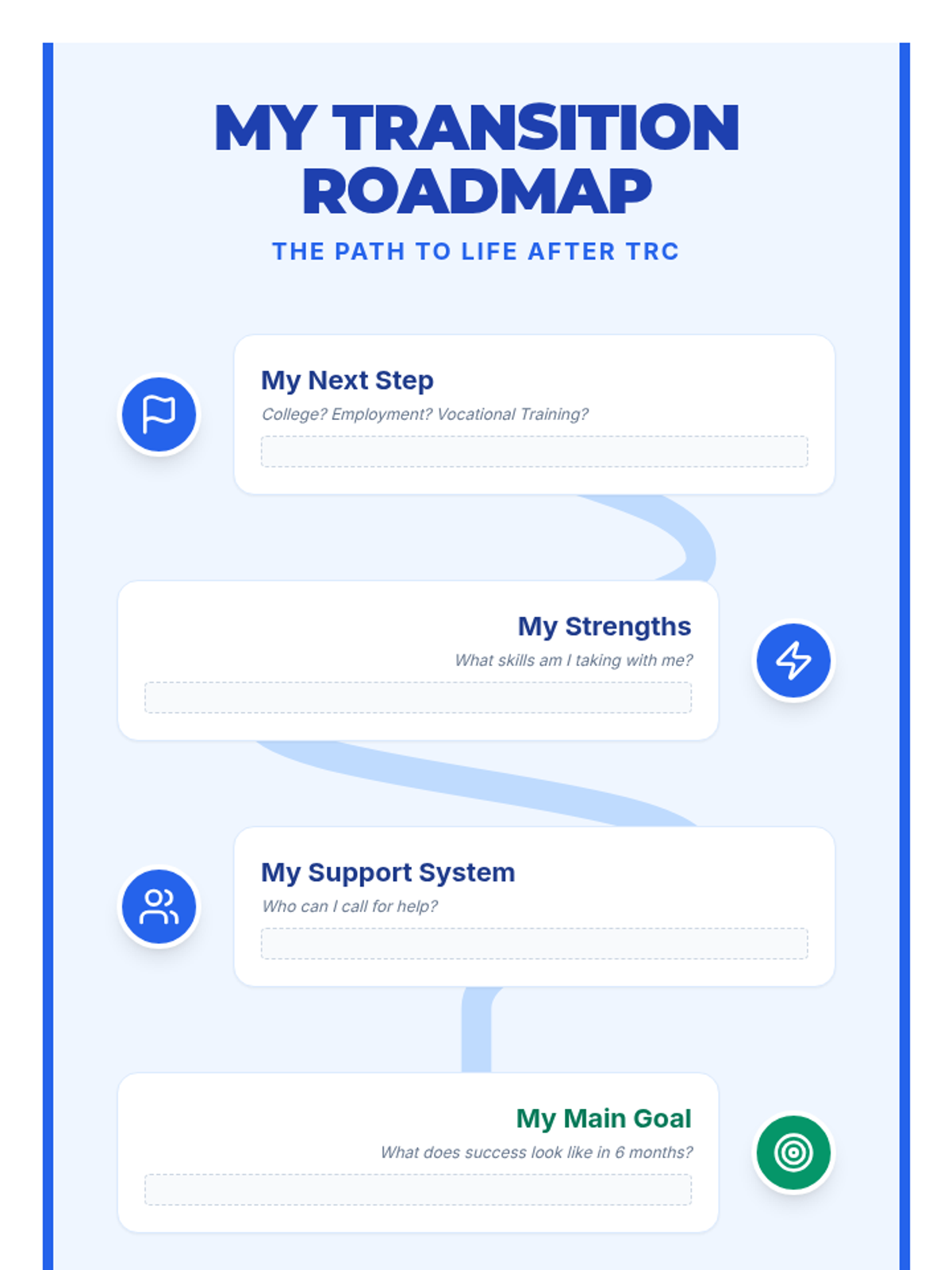
A visual roadmap poster for students to plan their transition after TRC, featuring sections for next steps, strengths, supports, and goals.
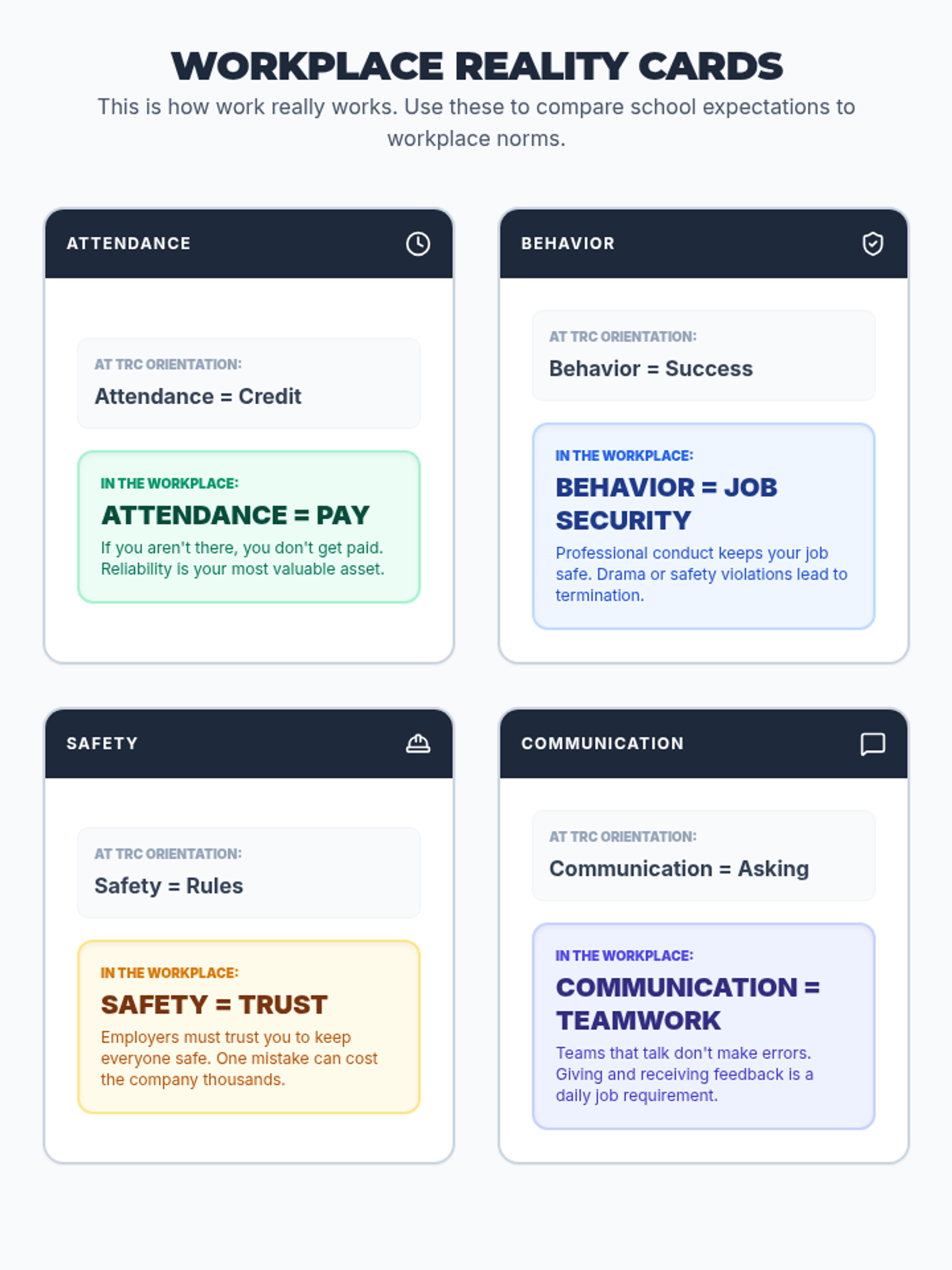
Reality-based cards comparing TRC expectations to workplace norms for attendance, behavior, safety, and communication.
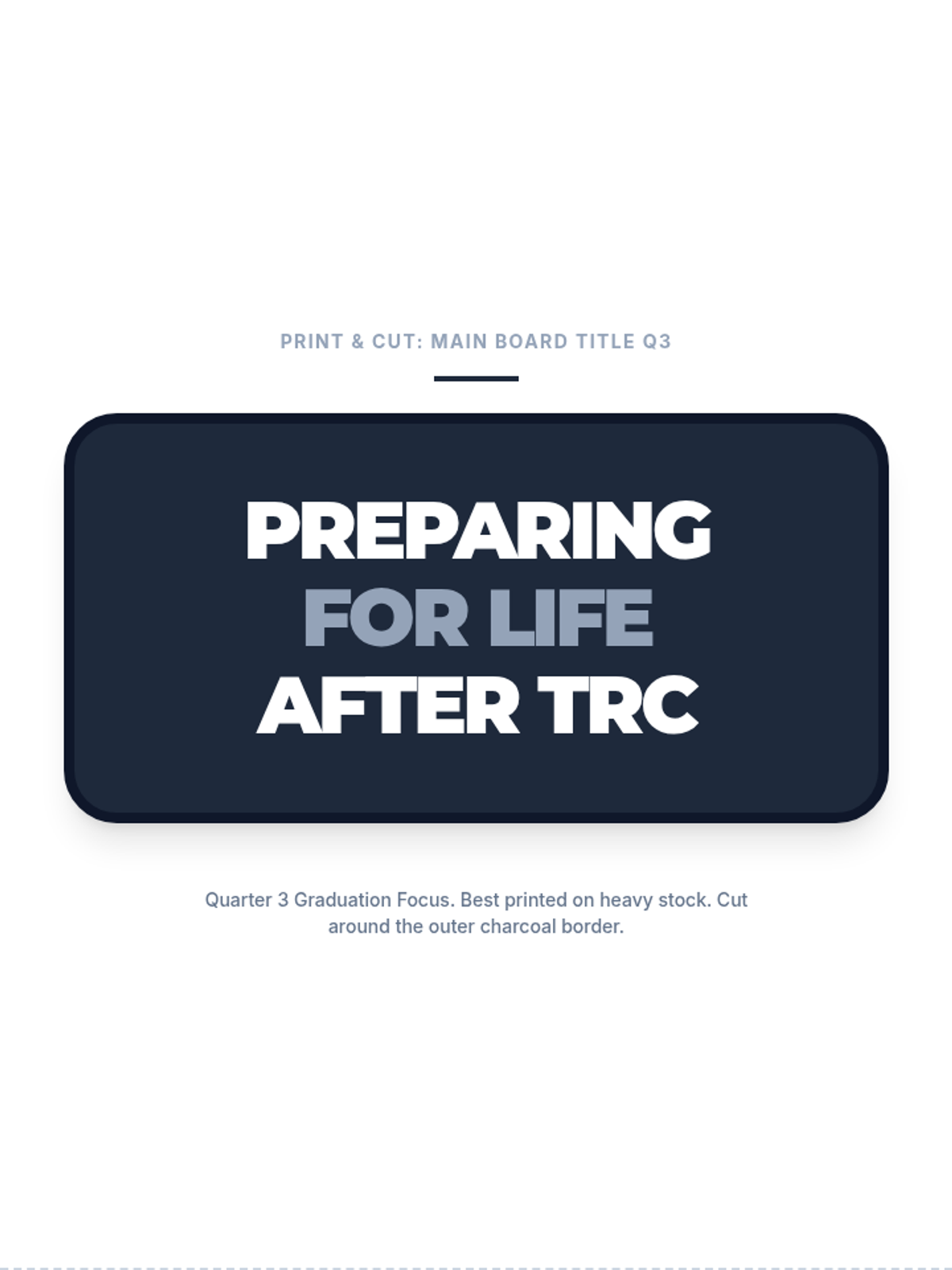
Large printable headers and main title for the Quarter 3 bulletin board, designed for professional career prep aesthetics.
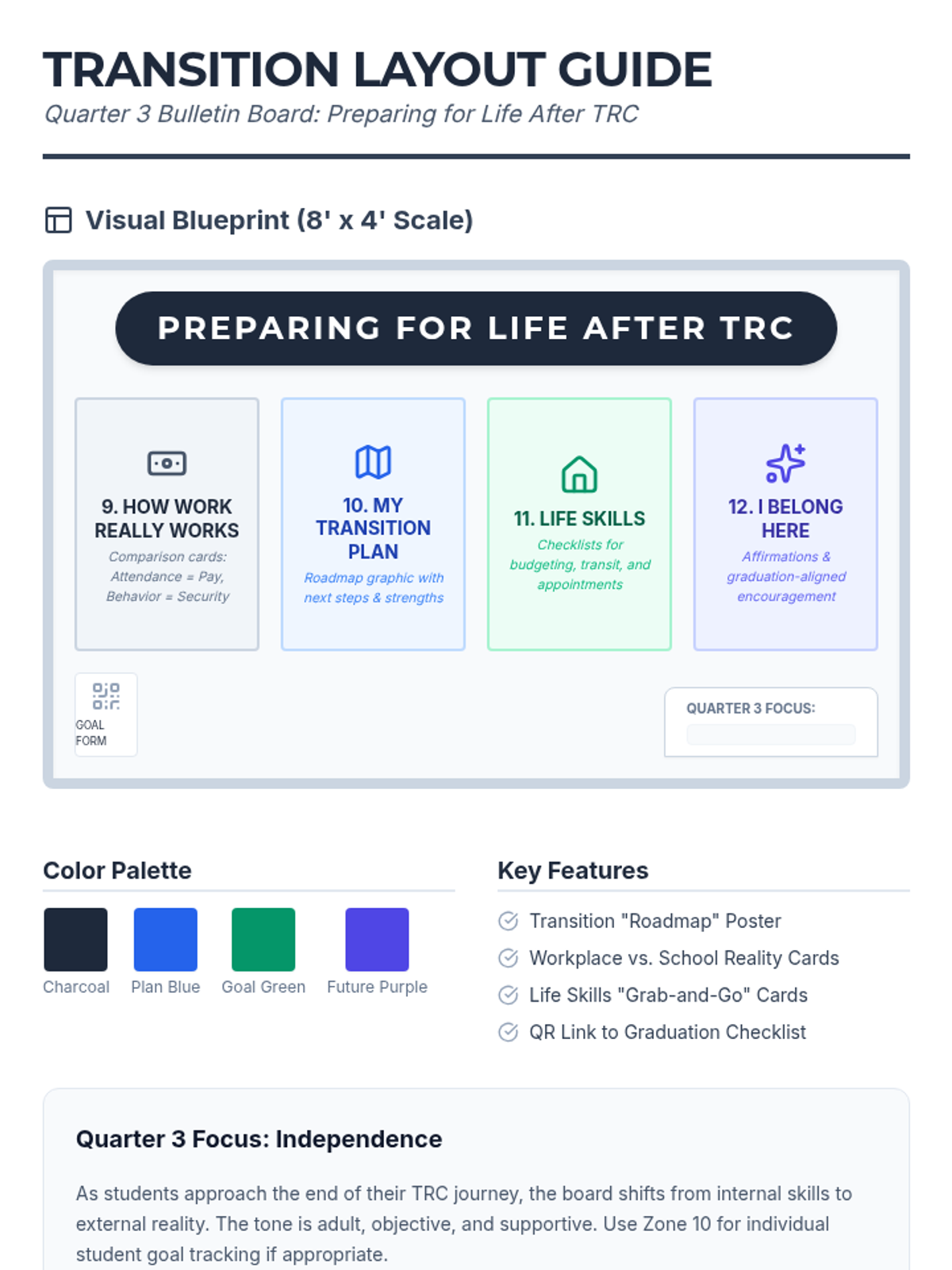
A visual blueprint and implementation guide for the Quarter 3 bulletin board, detailing the layout, color palette, and key sections for student transitions.
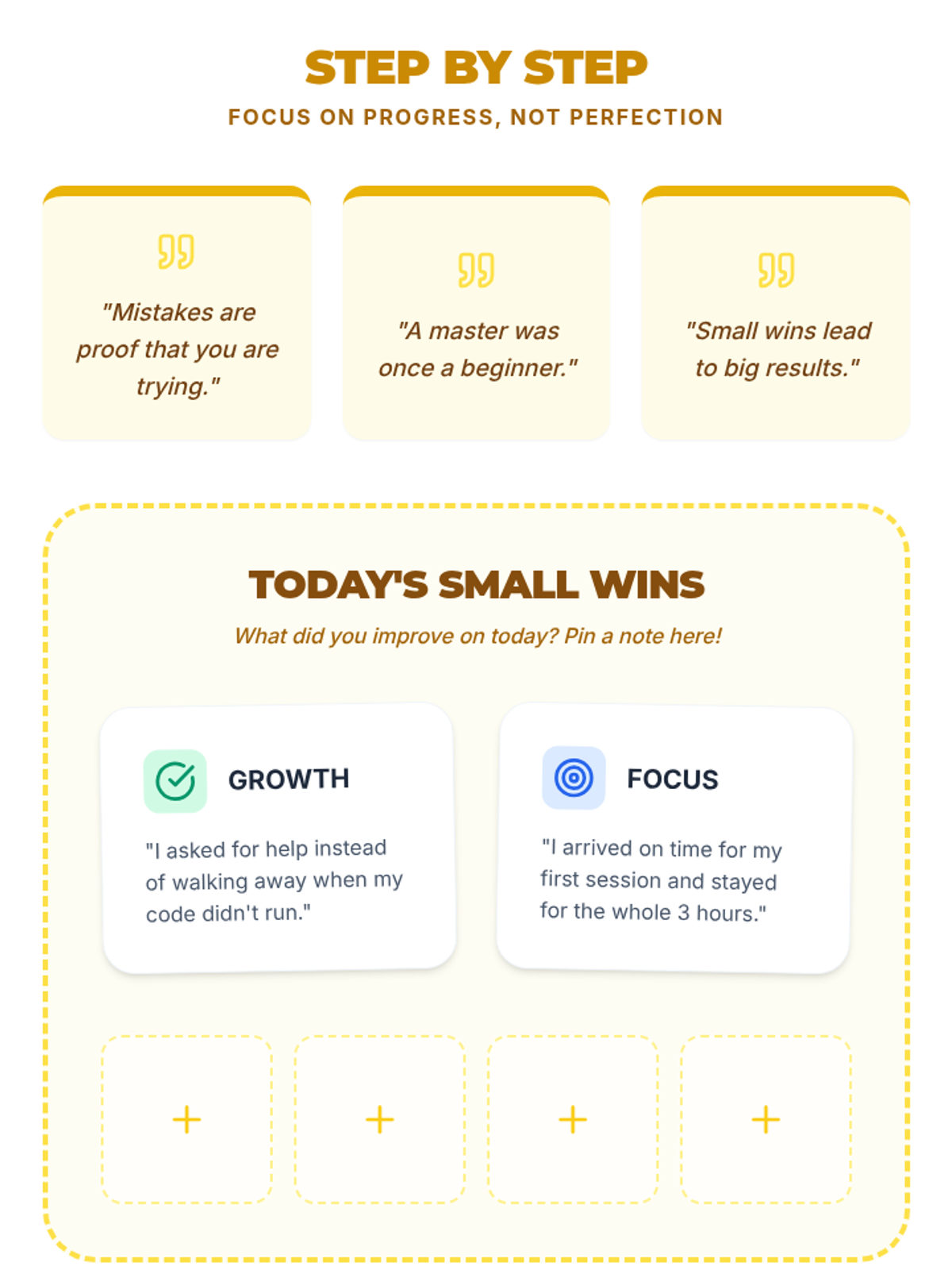
A motivational display for the 'Progress, Not Perfection' section, including mindset quotes and a designated area for celebrating student 'small wins'.
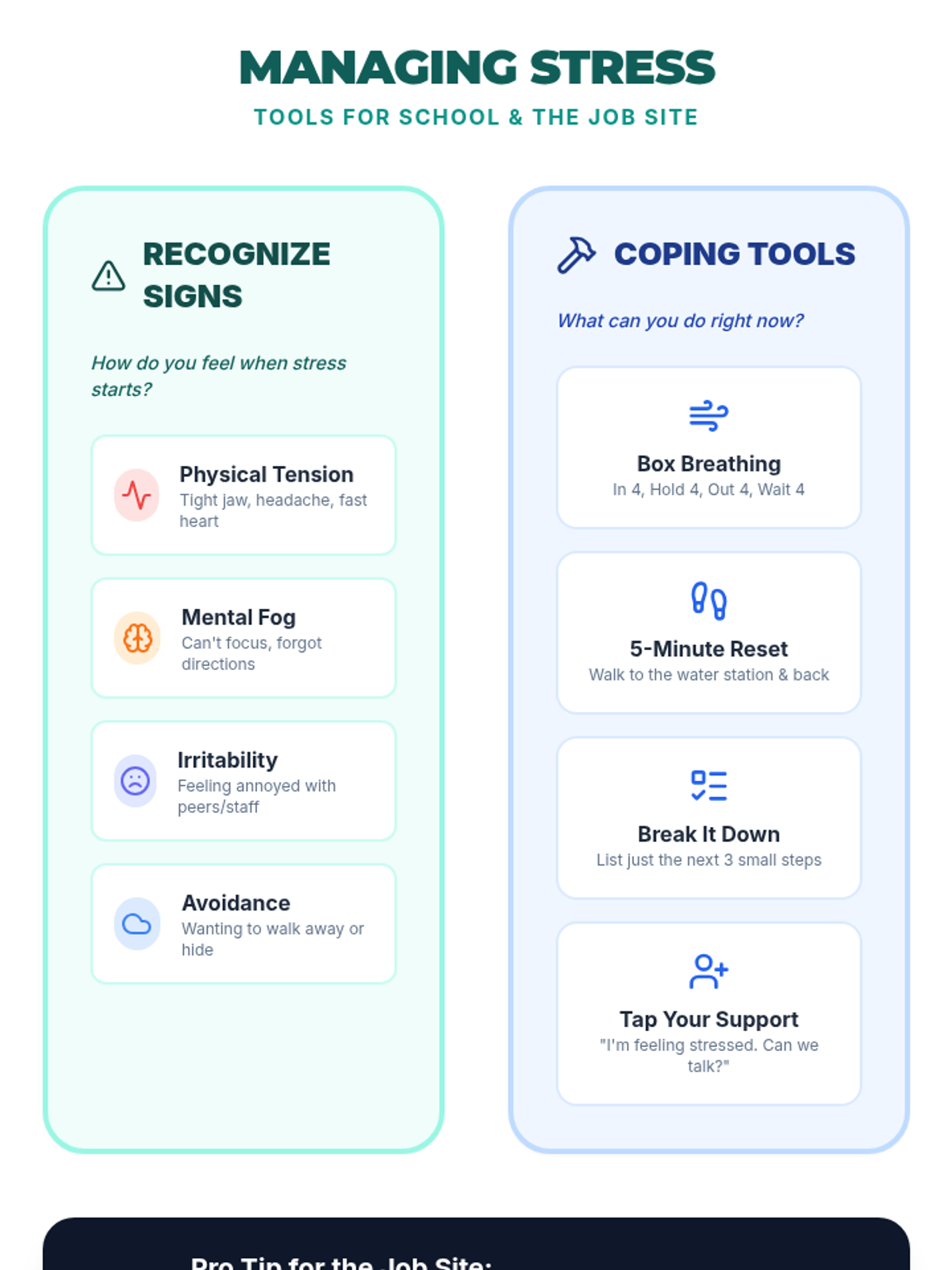
A visual stress management guide for students, featuring common stress indicators and practical coping strategies for school and work.
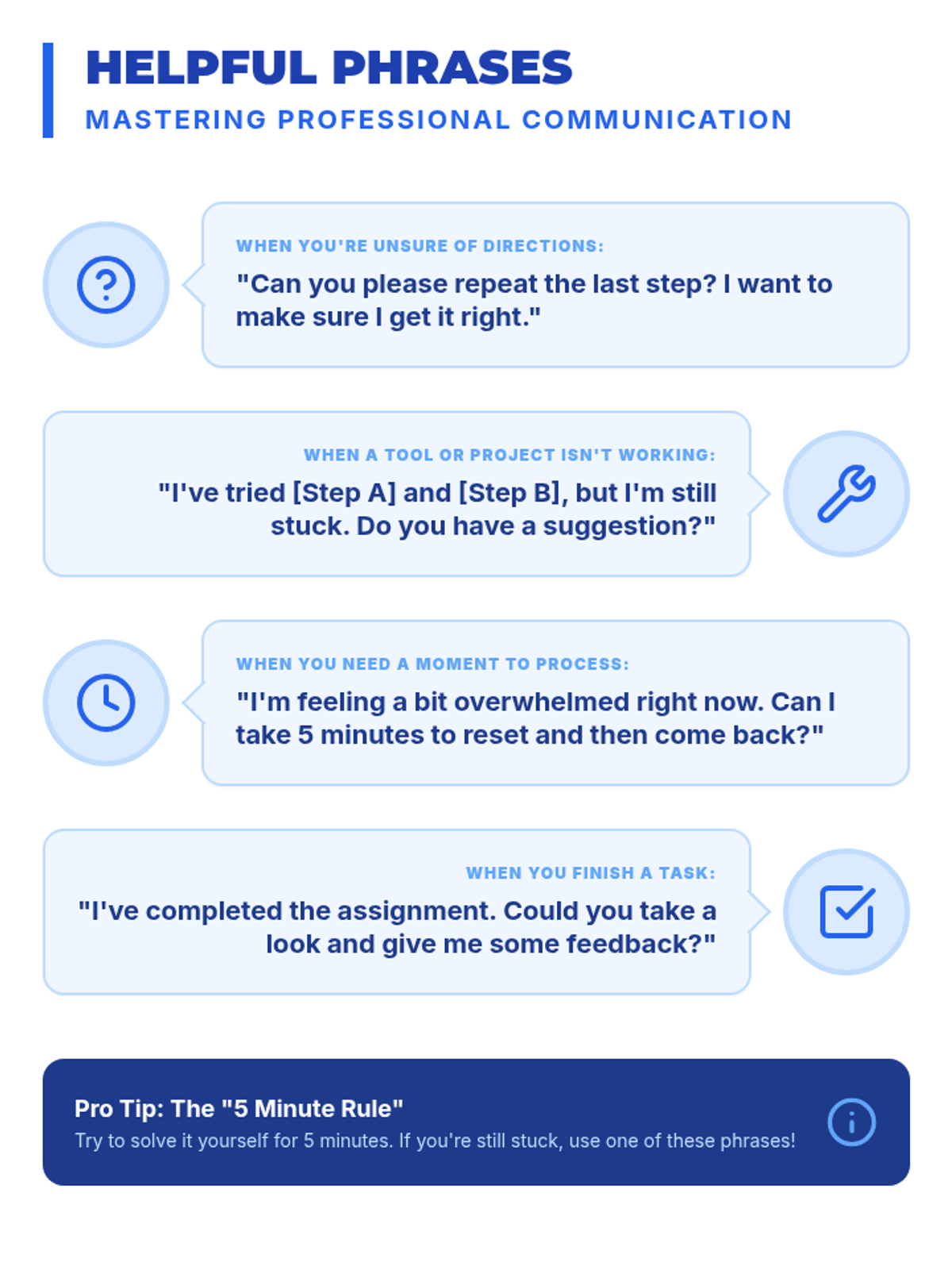
A set of professional communication script cards providing students with specific phrases to use when asking for help or clarification.
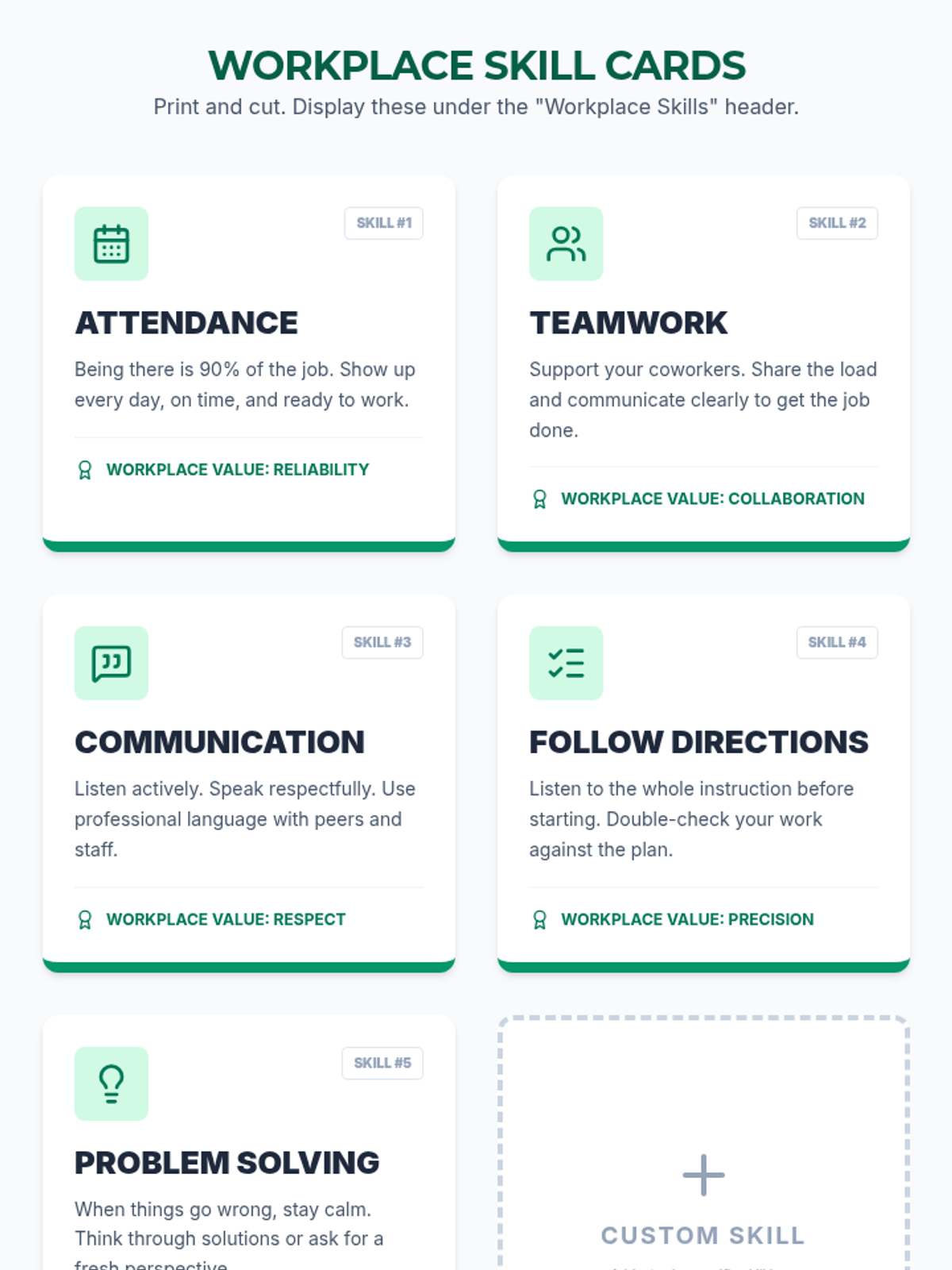
Visual skill cards for the 'Workplace Skills That Matter' section, detailing five core soft skills for employment success.
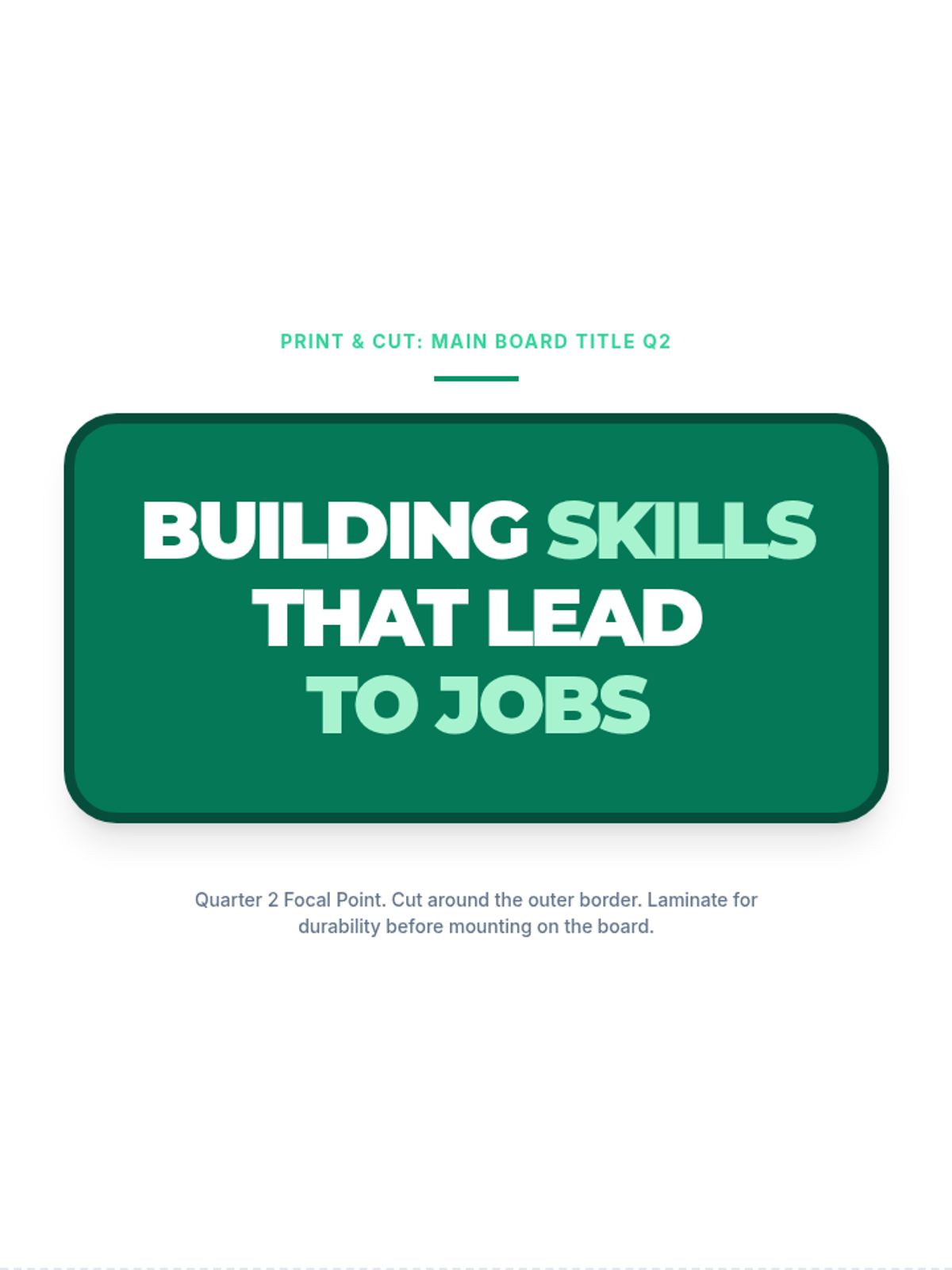
Large printable headers and main title for the Quarter 2 bulletin board, designed for professional career prep aesthetics.
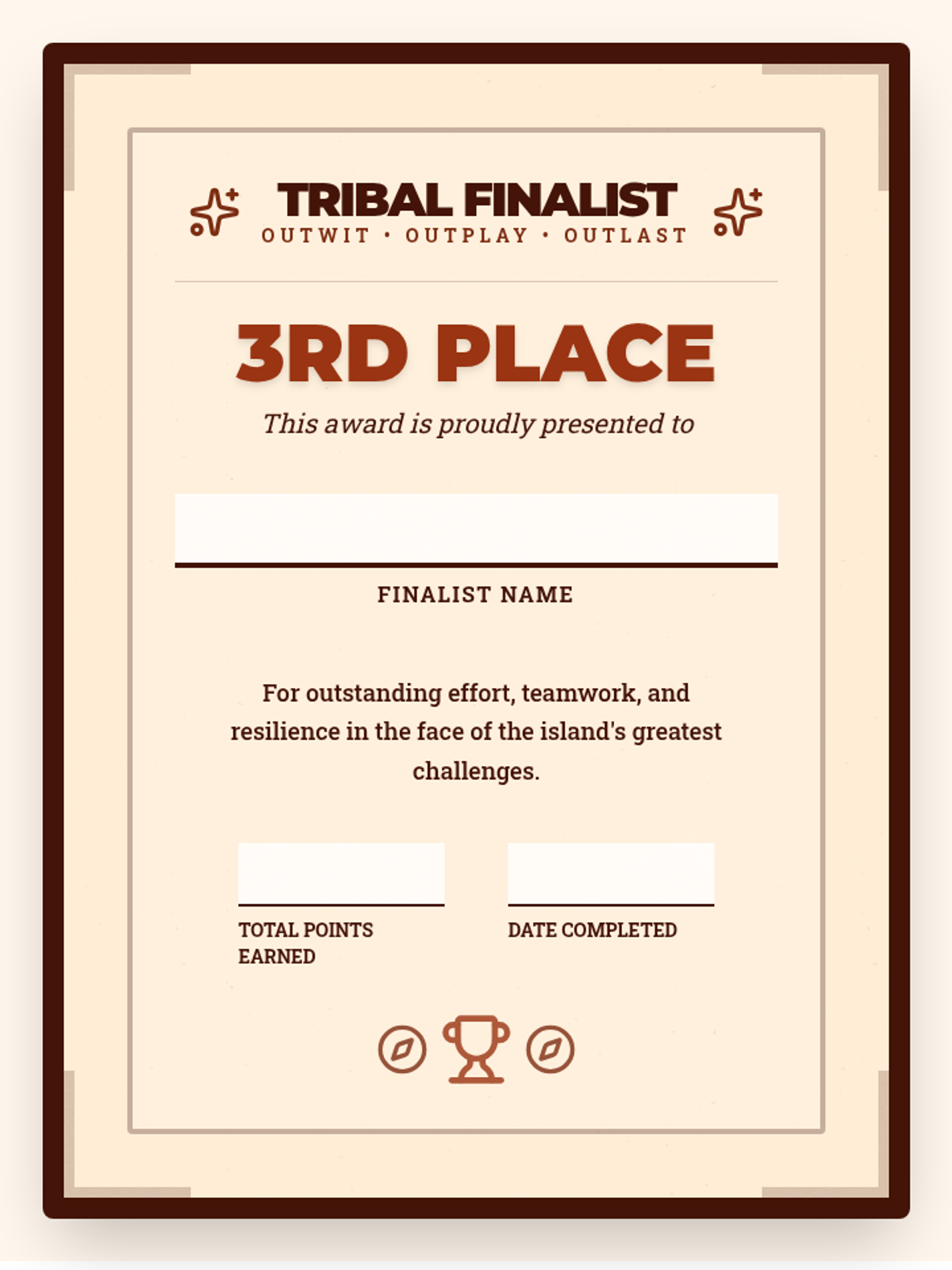
A bronze-themed third-place certificate for Survivor challenge finalists. Revised for improved input field consistency, label visibility, and layout balance.
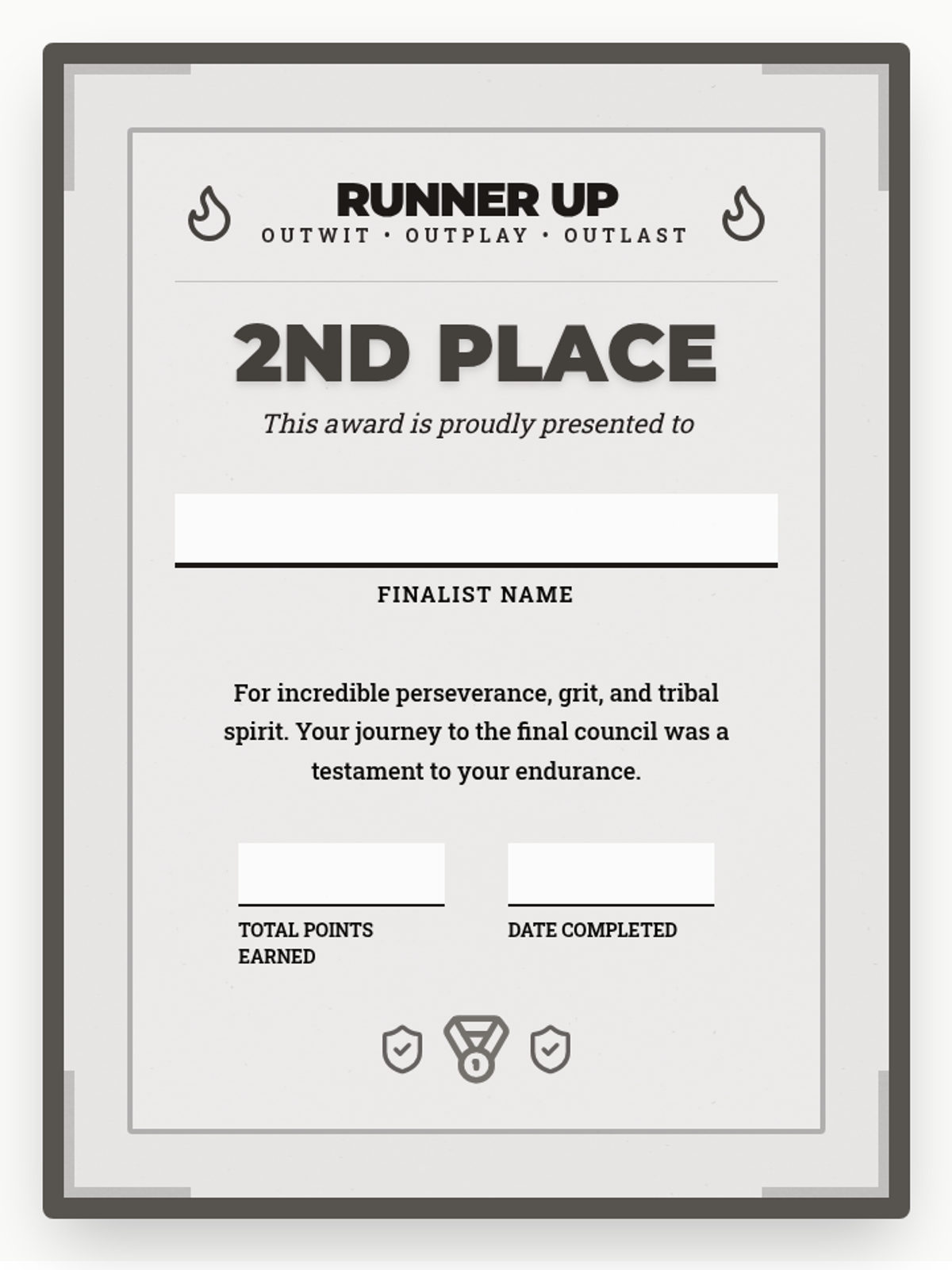
A silver-themed second-place certificate for a Survivor competition finalist. Revised for improved input field consistency, label visibility, and layout balance.
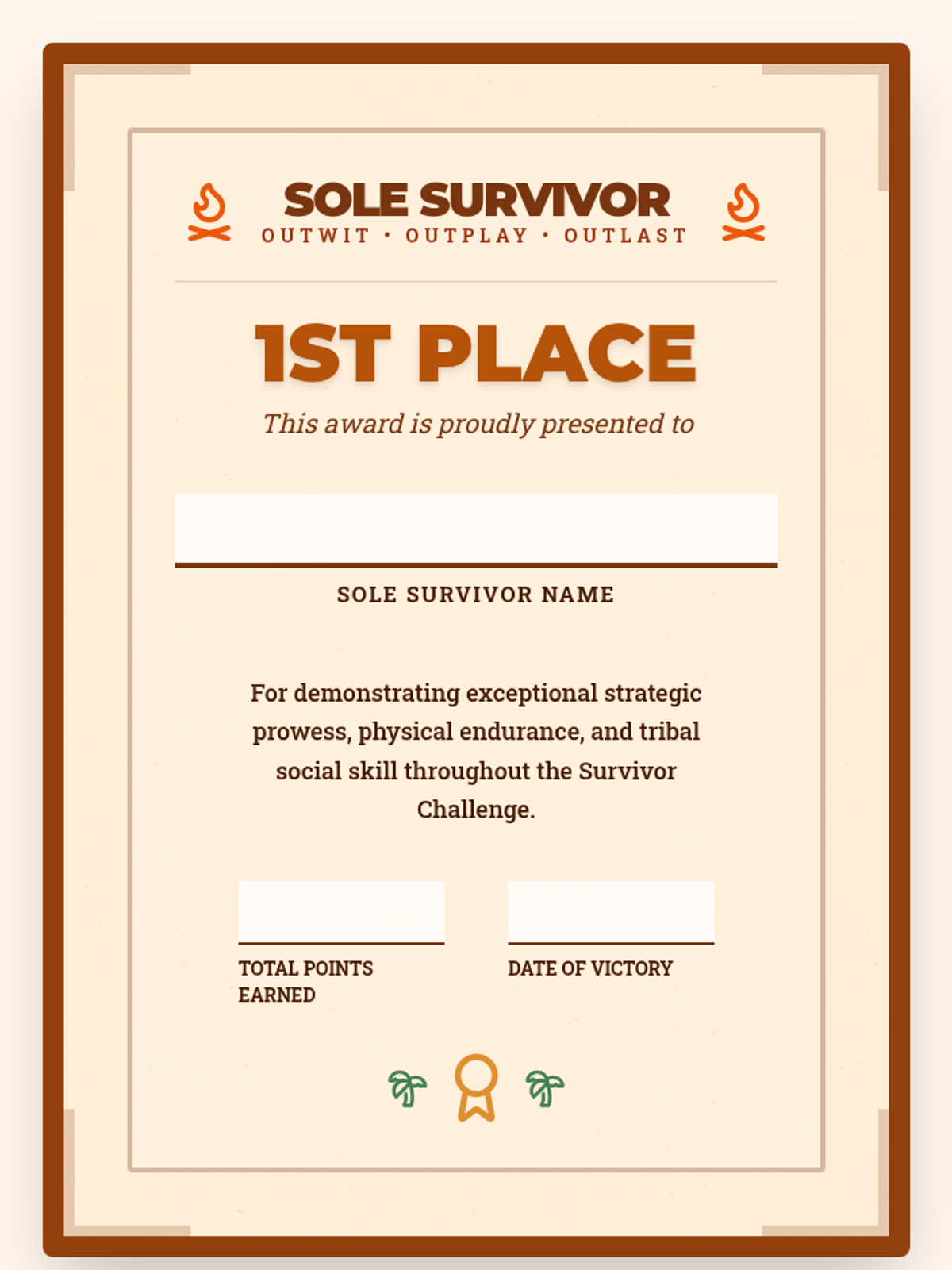
A premium first-place certificate for the winner of a Survivor-themed competition, featuring tribal motifs and a 'Sole Survivor' title. Revised for improved input field consistency and label visibility.
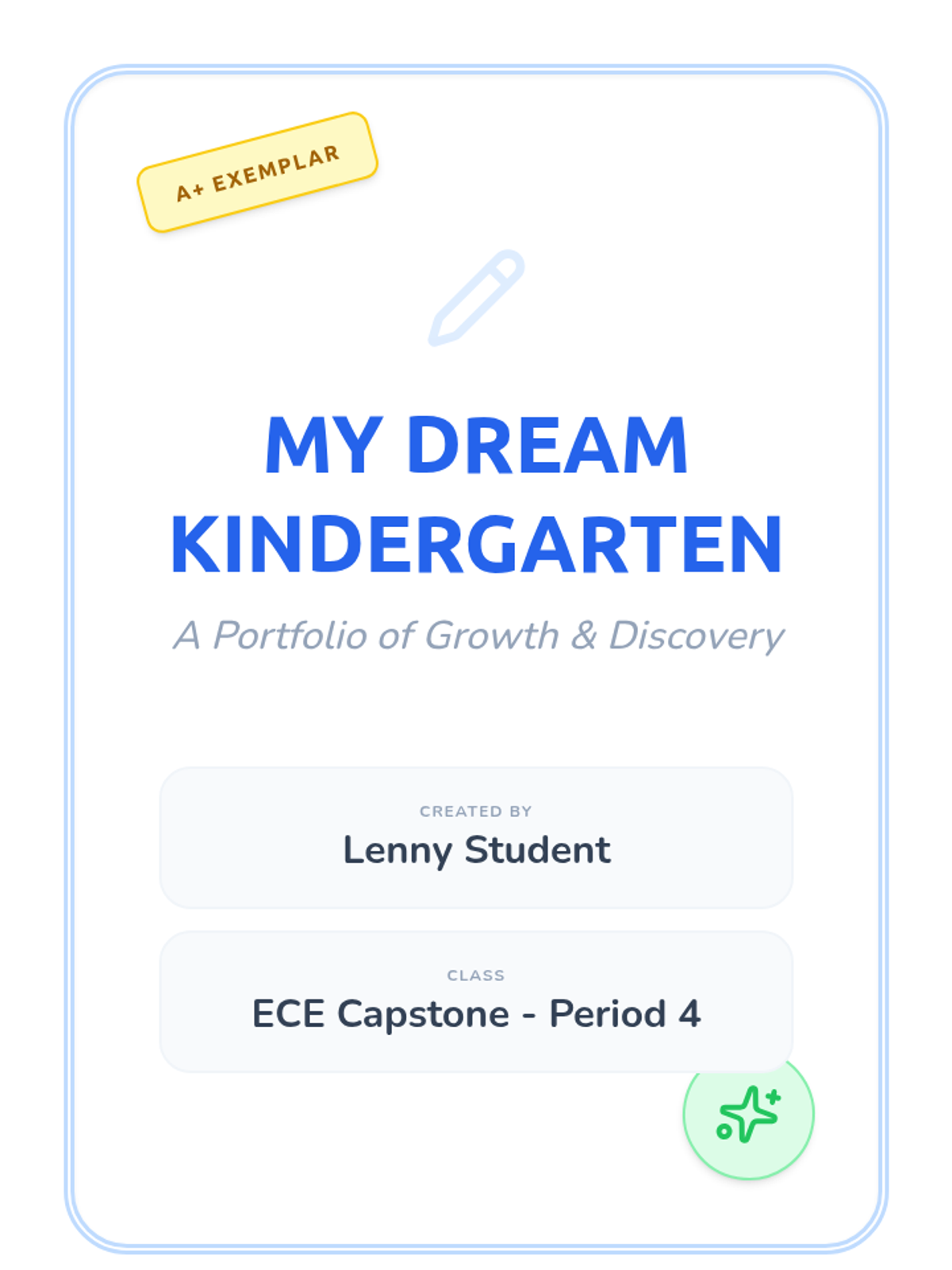
An exemplary completed project for the Kindergarten Portfolio Project, showcasing a high-quality classroom vision, layout rationale, daily schedule, and sample lesson plans for student reference.
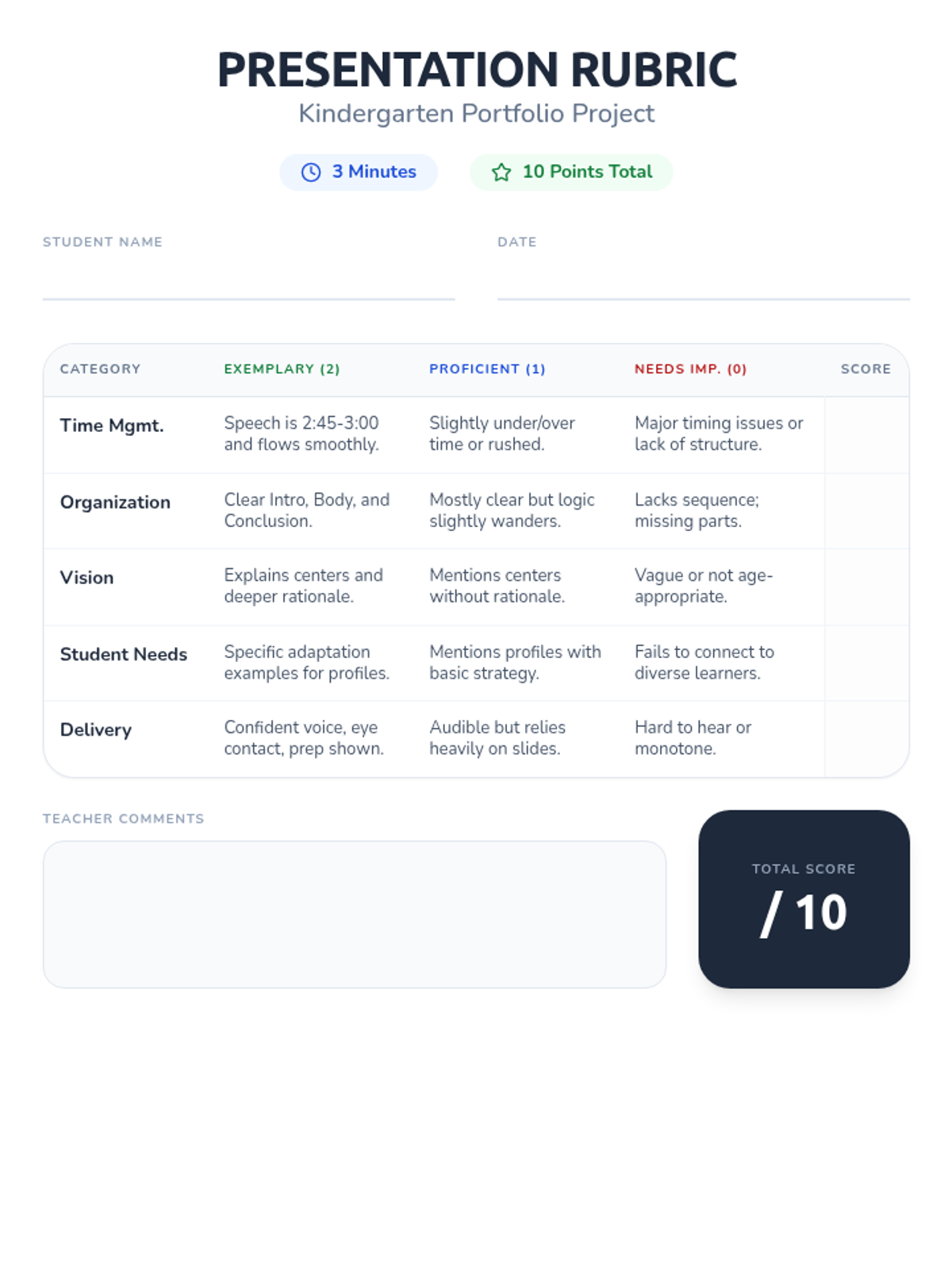
A 10-point rubric for the final presentation, focusing on time management, organization, classroom vision, and addressing student needs.
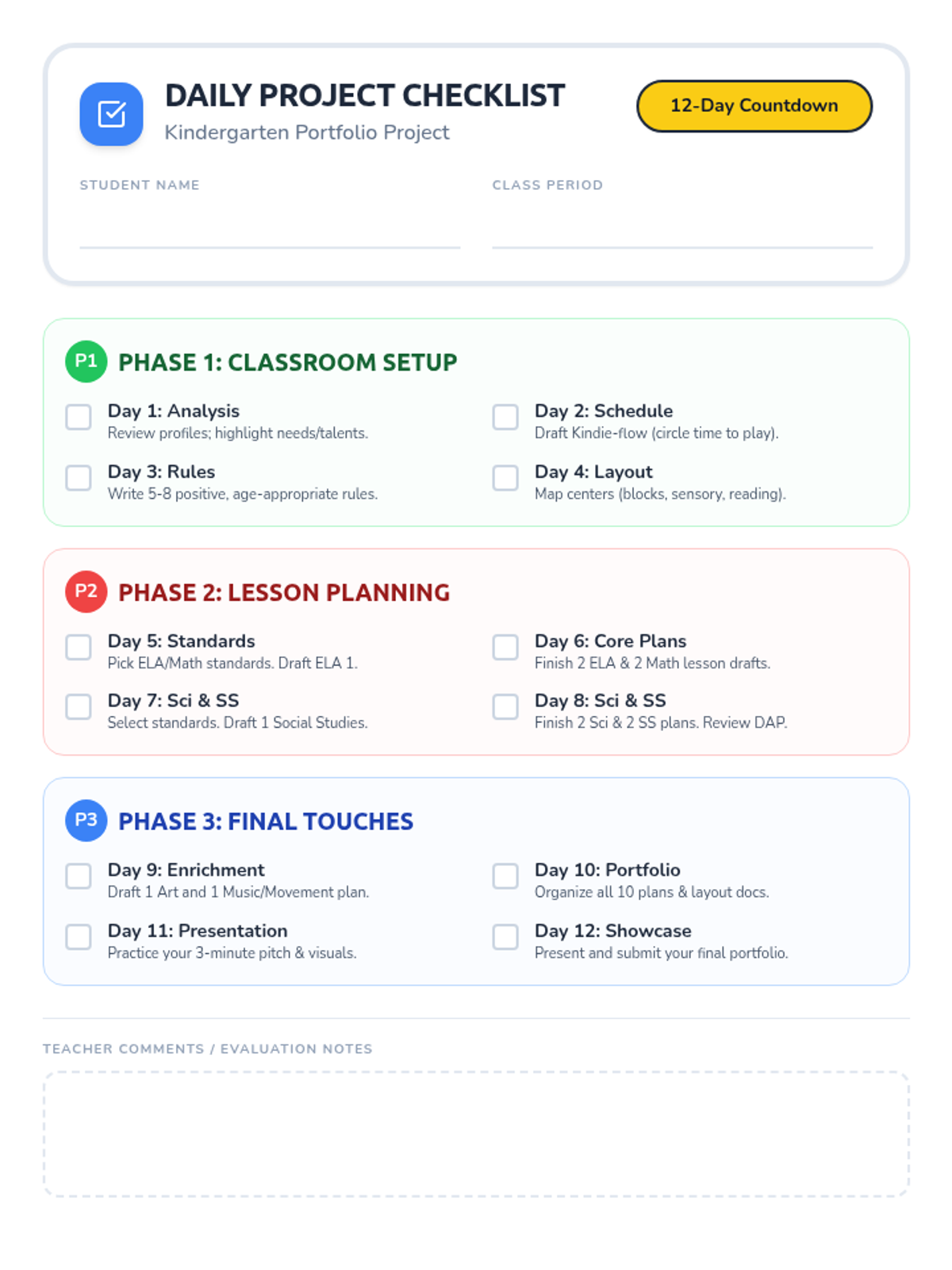
A day-by-day student checklist for the 12-day Kindergarten Portfolio Project, now featuring a dedicated spot for teacher initials for each daily task.
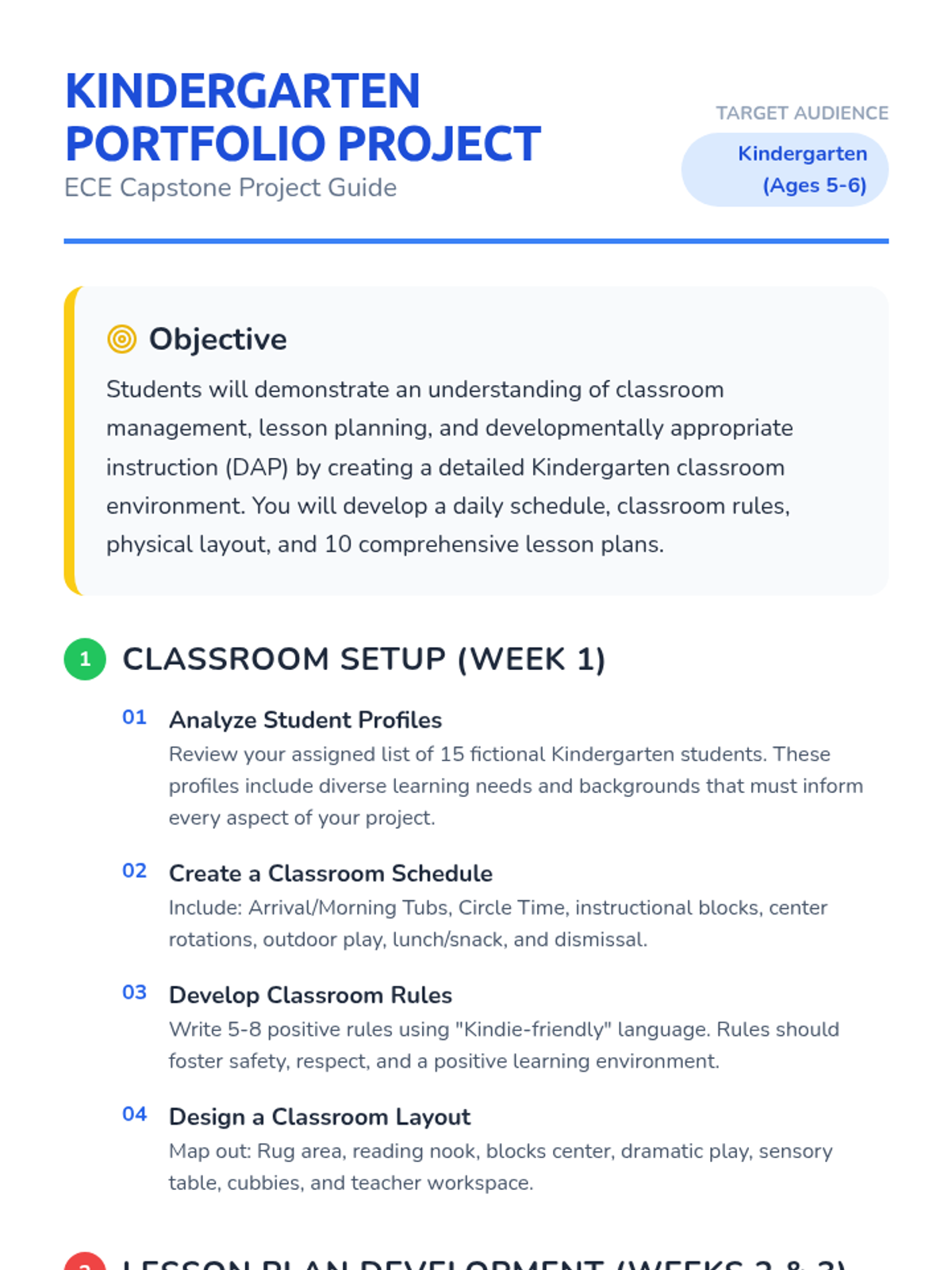
A comprehensive guide and rubric for the Kindergarten Portfolio Project, detailing the requirements for classroom setup, lesson plan development, and final presentation.
An updated instructional slide deck for the End of Year Kindergarten Classroom Project, featuring a vibrant, kid-friendly design and clear project phases.
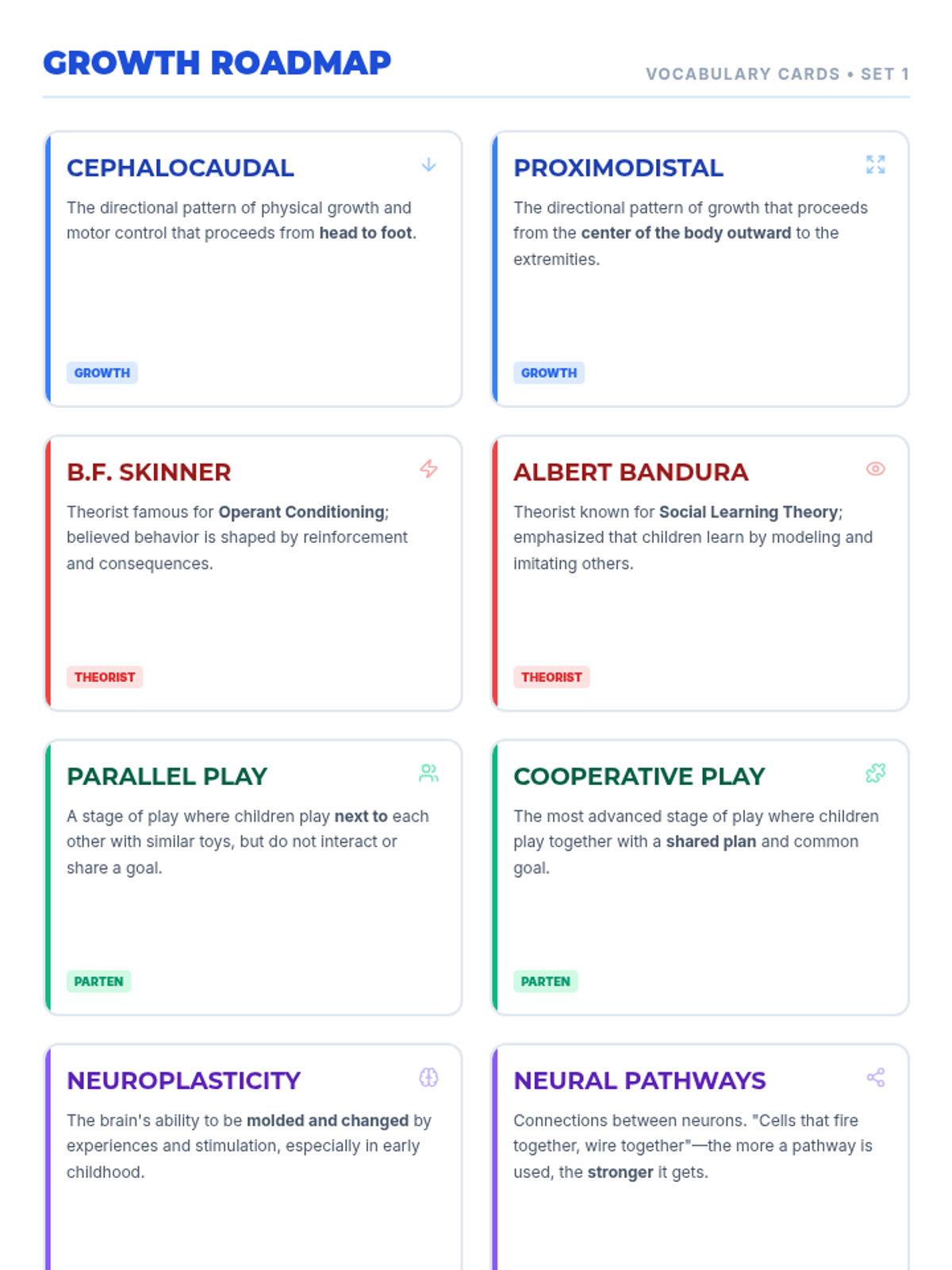
A set of 16 printable vocabulary cards for the Growth and Guidance Unit, featuring key terms from brain development, theorists, and play stages. Designed for student study and classroom review.
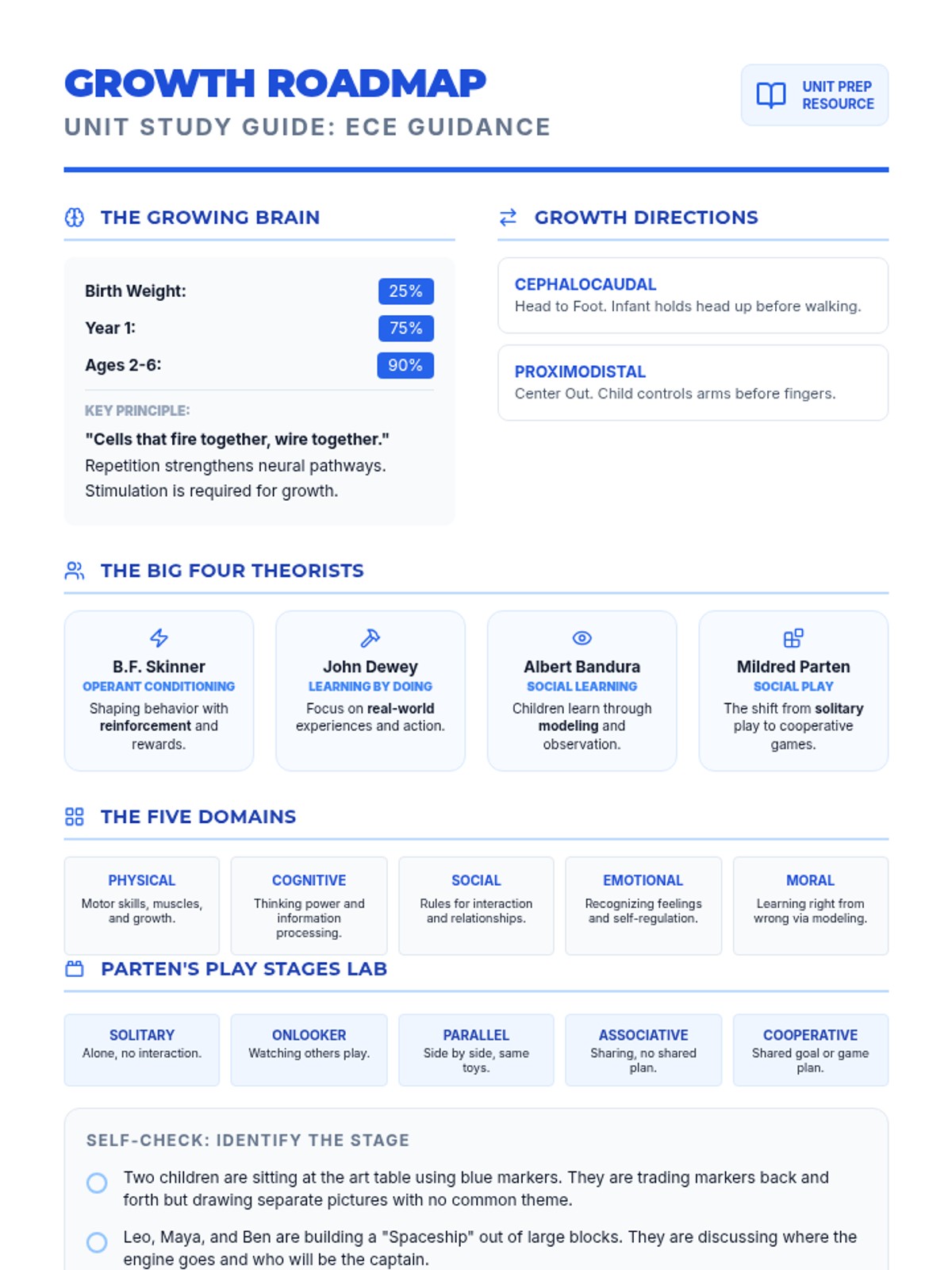
A comprehensive 3-page study guide for the Growth and Guidance Unit, covering brain development percentages, directional growth (Cephalocaudal/Proximodistal), the four major ECE theorists, the five developmental domains, Parten's play stages, and identity formation strategies. Now includes a dedicated page for practice short-answer questions to help students prepare for writing responses on the unit test.
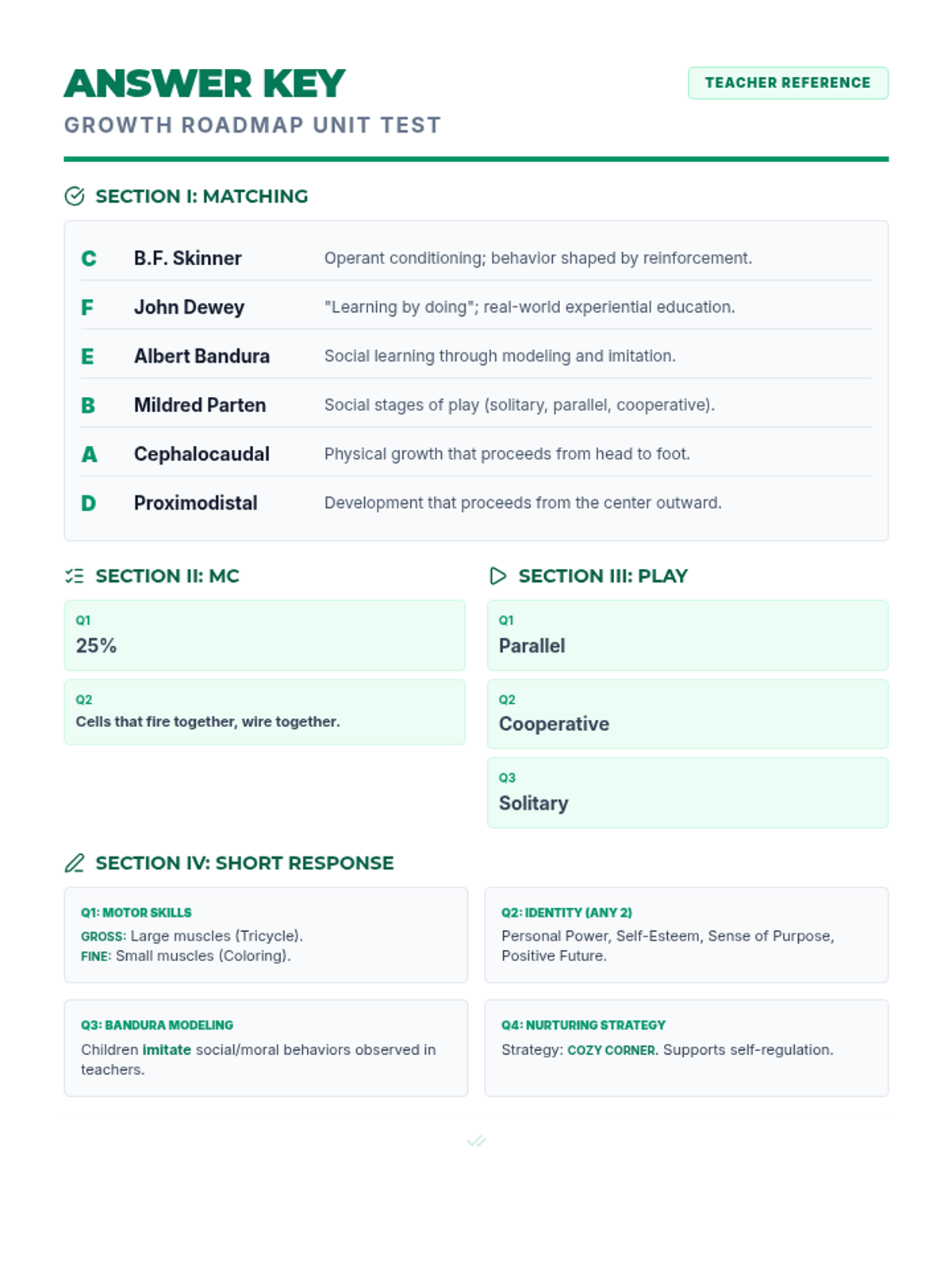
A detailed teacher's answer key for the Growth Roadmap Unit Test, providing correct answers for matching, fill-in-the-blank, and Parten's play scenarios with reasoning. Optimized for a single-page quick reference.
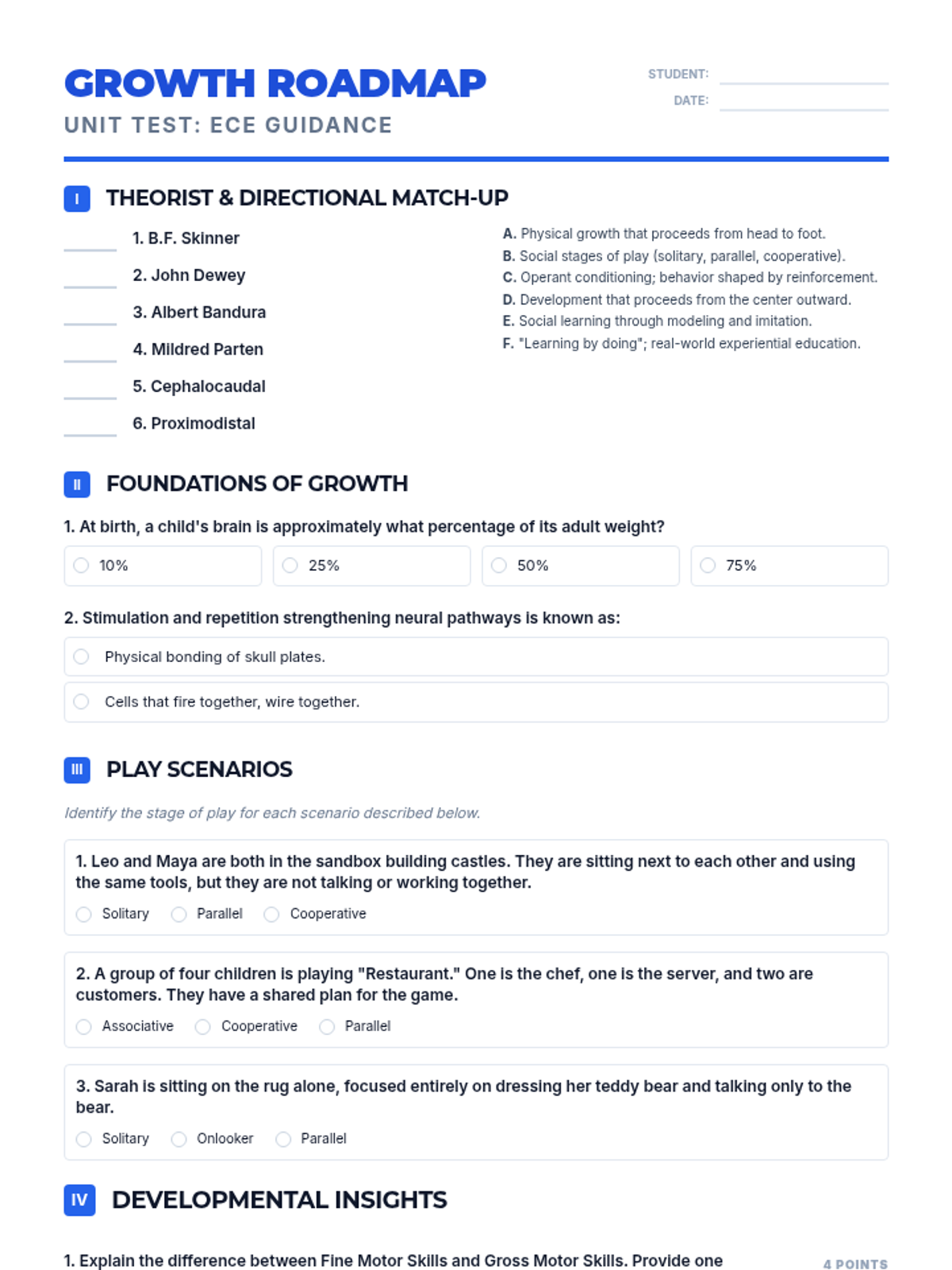
A comprehensive unit test for ECE guidance students, updated with fill-in-the-blank questions and a more rigorous play scenario section requiring both identification and reasoning. Optimized for a 2-page layout with clear student work areas.
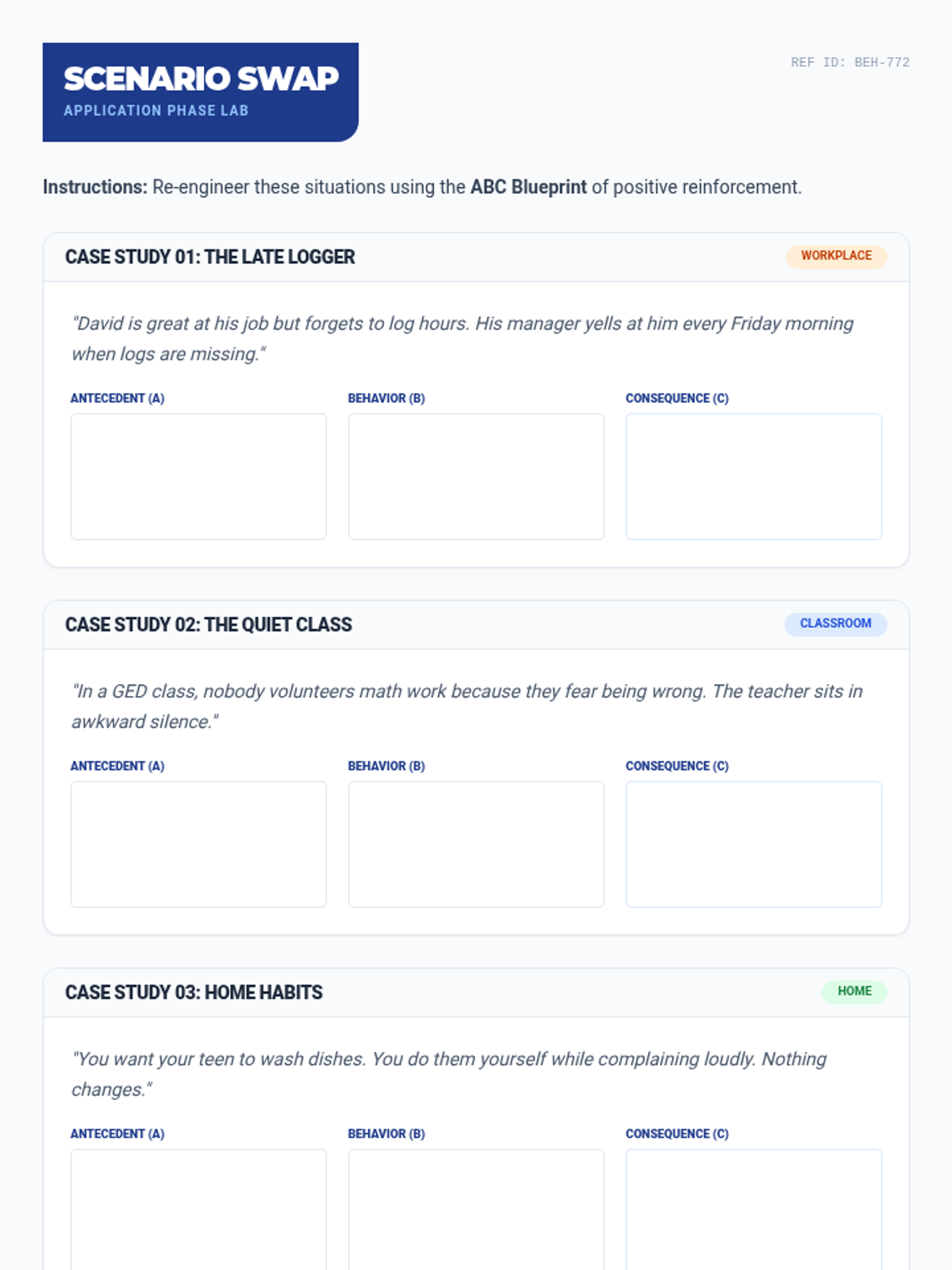
Activity sheet for re-engineering scenarios with positive reinforcement. Revised with larger work areas (h-32), improved labels, and CSS to prevent case study cards from splitting across pages.
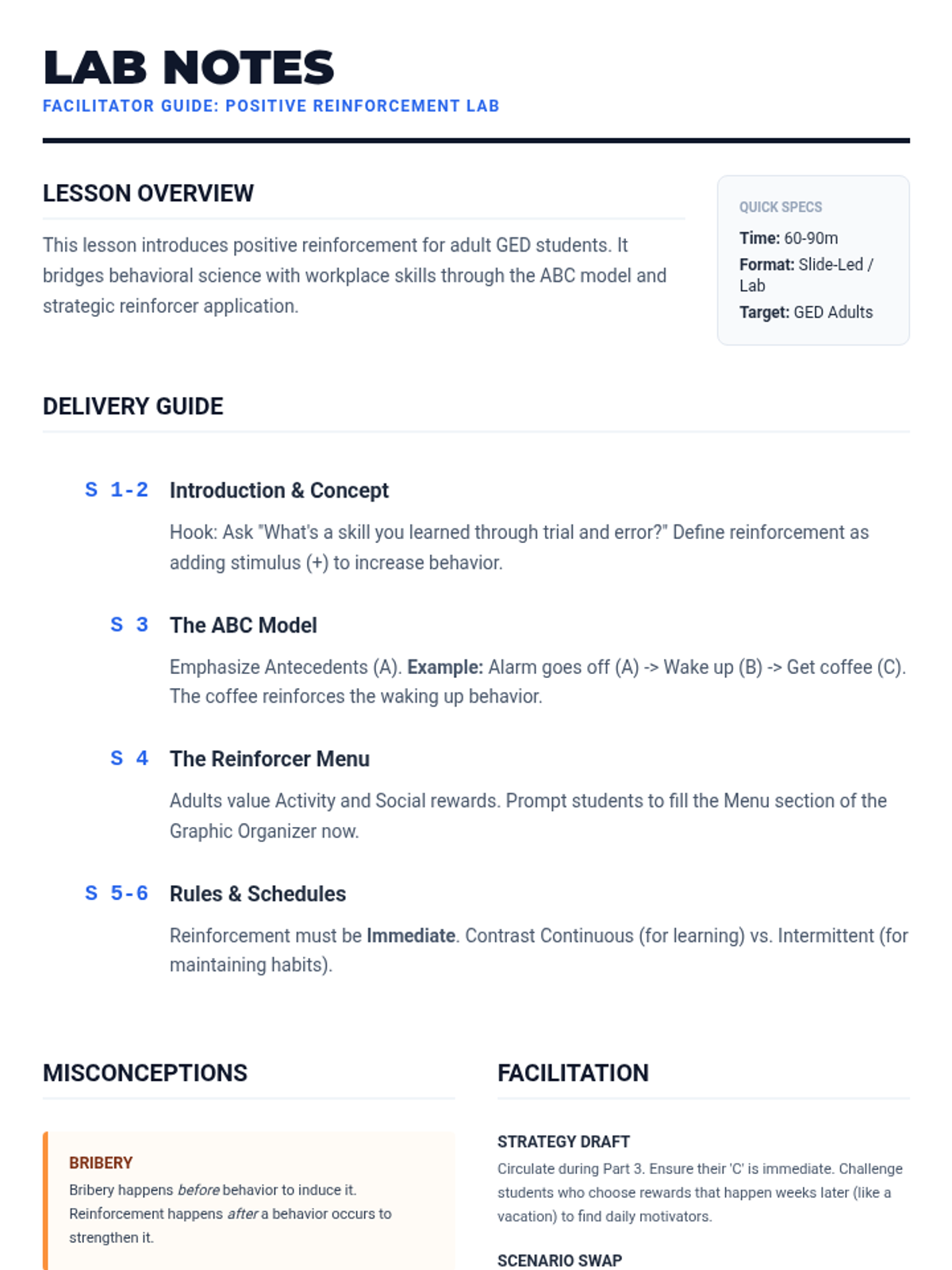
Facilitator guide for the Reinforcement Lab. Revised to ensure slide blocks do not break across pages and for improved spacing in the specs and guide sections.
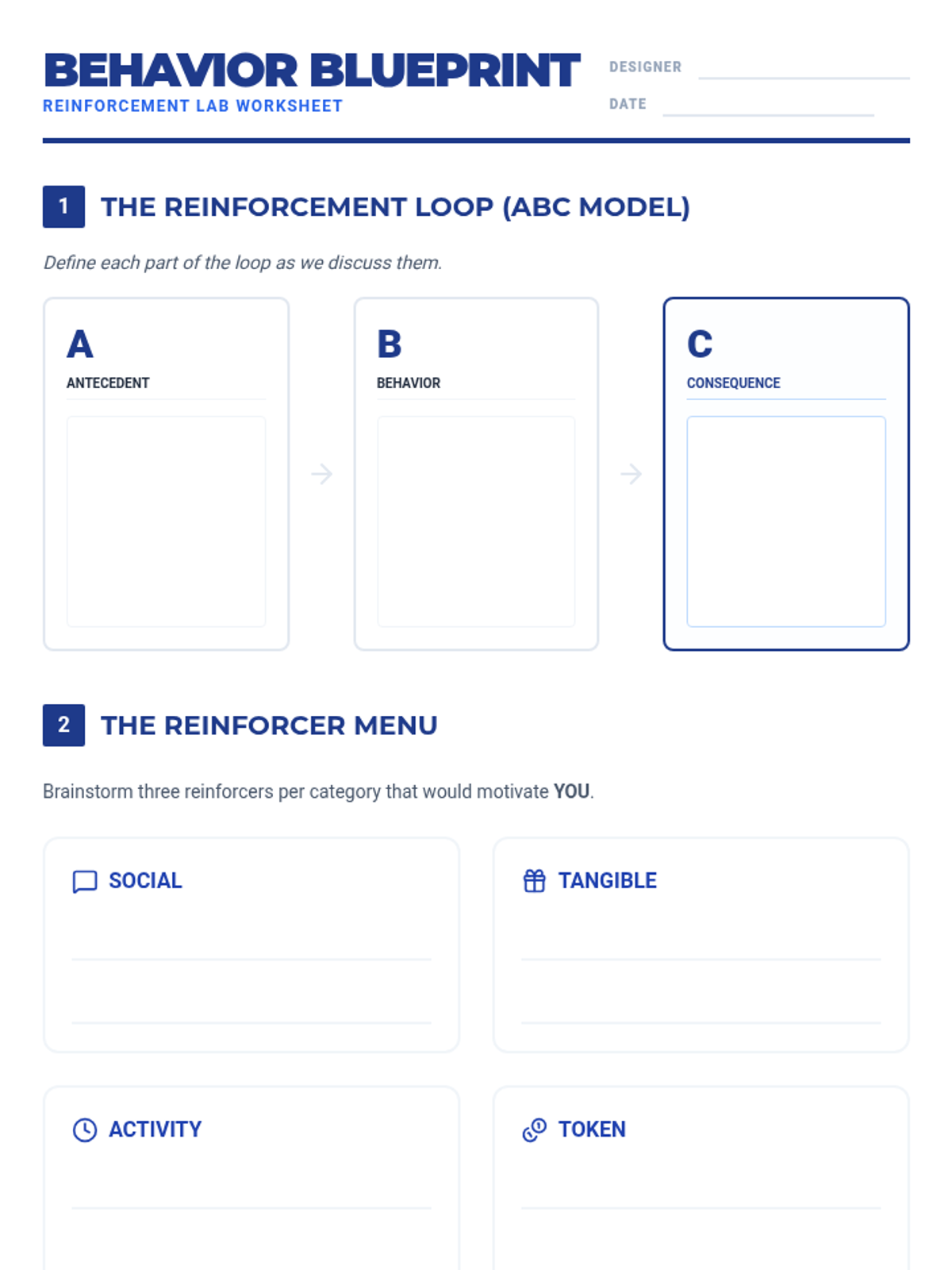
A structured graphic organizer for students to define the ABC model, brainstorm personal reinforcers, and draft a strategy. Revised to ensure Part 2 is not split across pages and to provide larger handwriting areas with better contrast.
A sleek, professional slide deck for GED students exploring the principles of positive reinforcement. Features the ABC model, types of reinforcers, and real-world workplace applications with a "Behavior Blueprint" aesthetic. (Revised for contrast and visual balance)
A presentation for ECE students introducing the neurological foundations of child behavior, focusing on the Upstairs/Downstairs brain model, executive function, and co-regulation strategies.
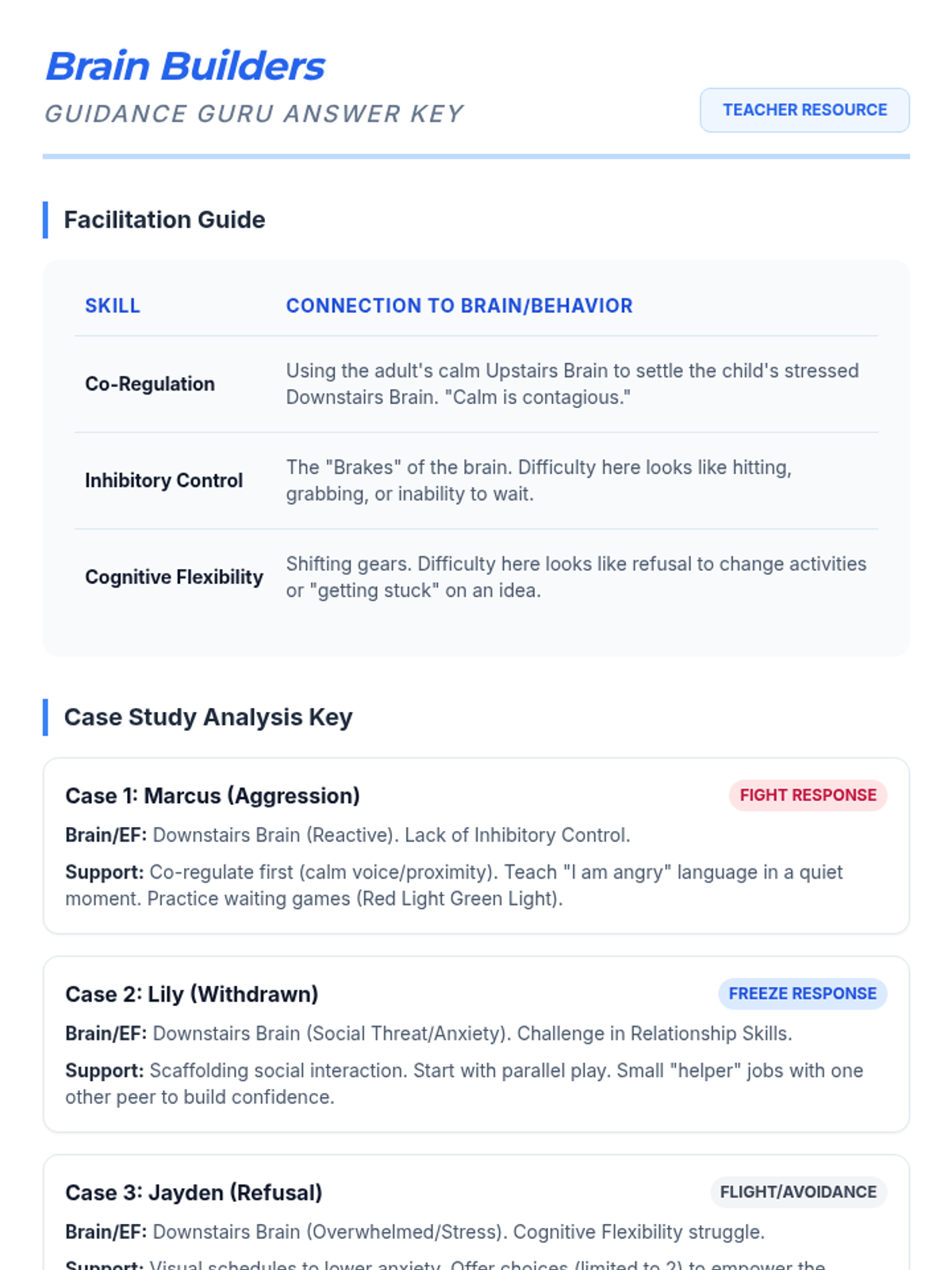
An answer key and facilitation guide for the Brain Builders case study analysis. It provides teachers with neurological interpretations of child behavior and suggested SEL-based support strategies.
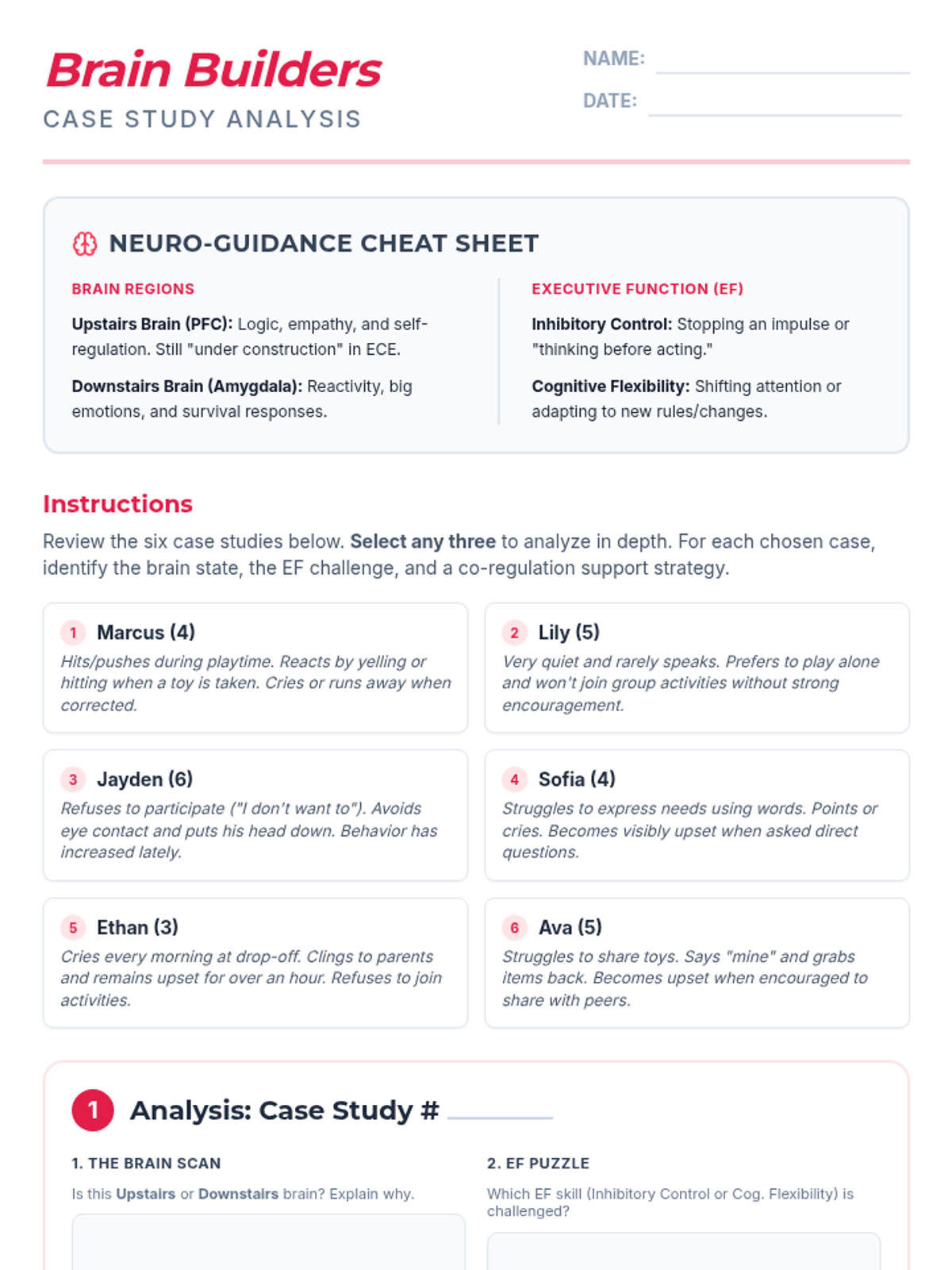
A revamped case study analysis worksheet for ECE students focused on brain-based guidance. It features a cheat sheet on brain regions and executive function, six short case studies, and three analysis sections for students to complete.
A "Summit Leadership" certificate for a mentor, celebrating their dedication and the impact of their guidance, featuring a signature space for a counselor.
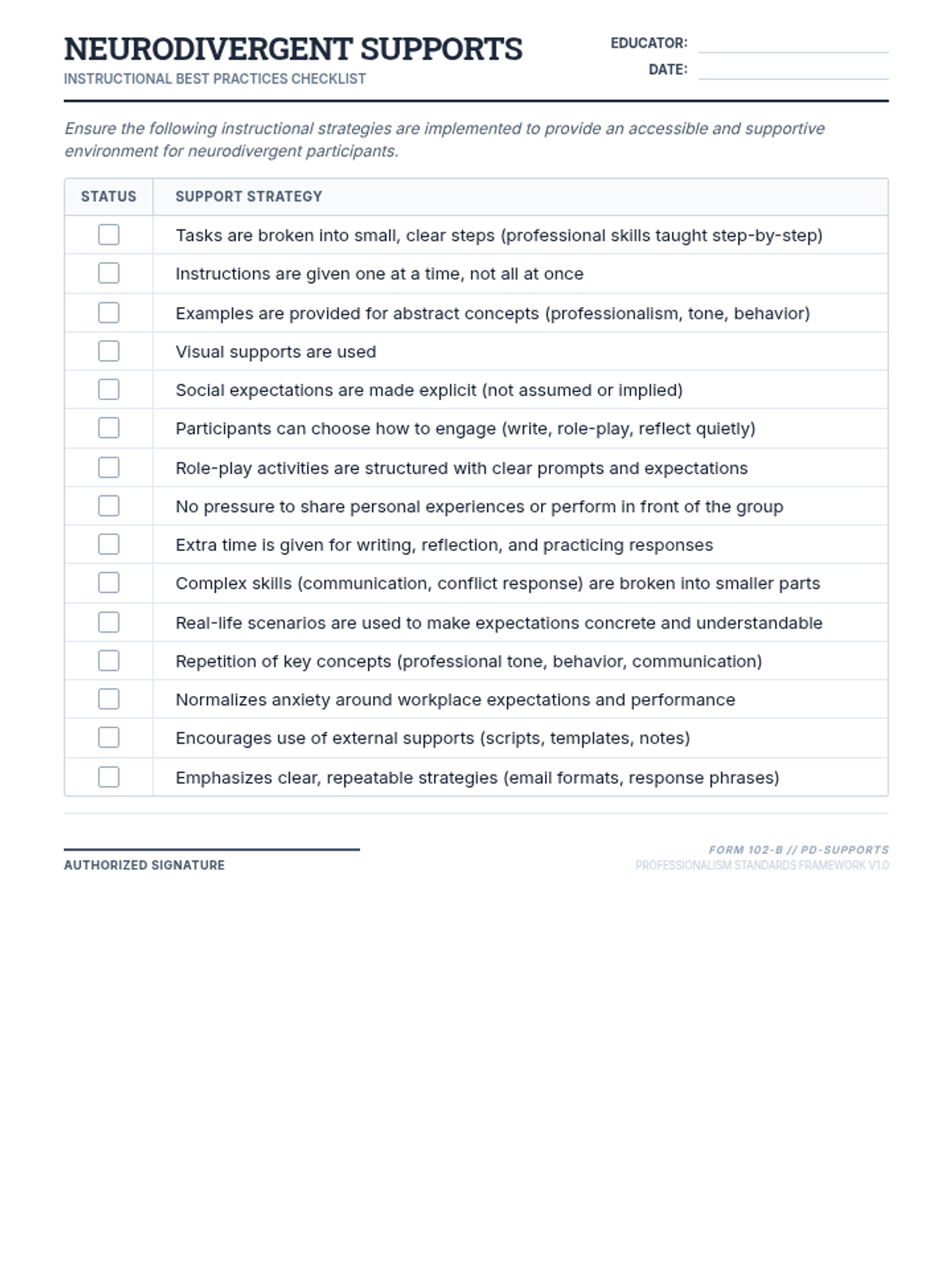
A clean, administrative checklist for implementing neurodivergent supports in educational and professional settings.
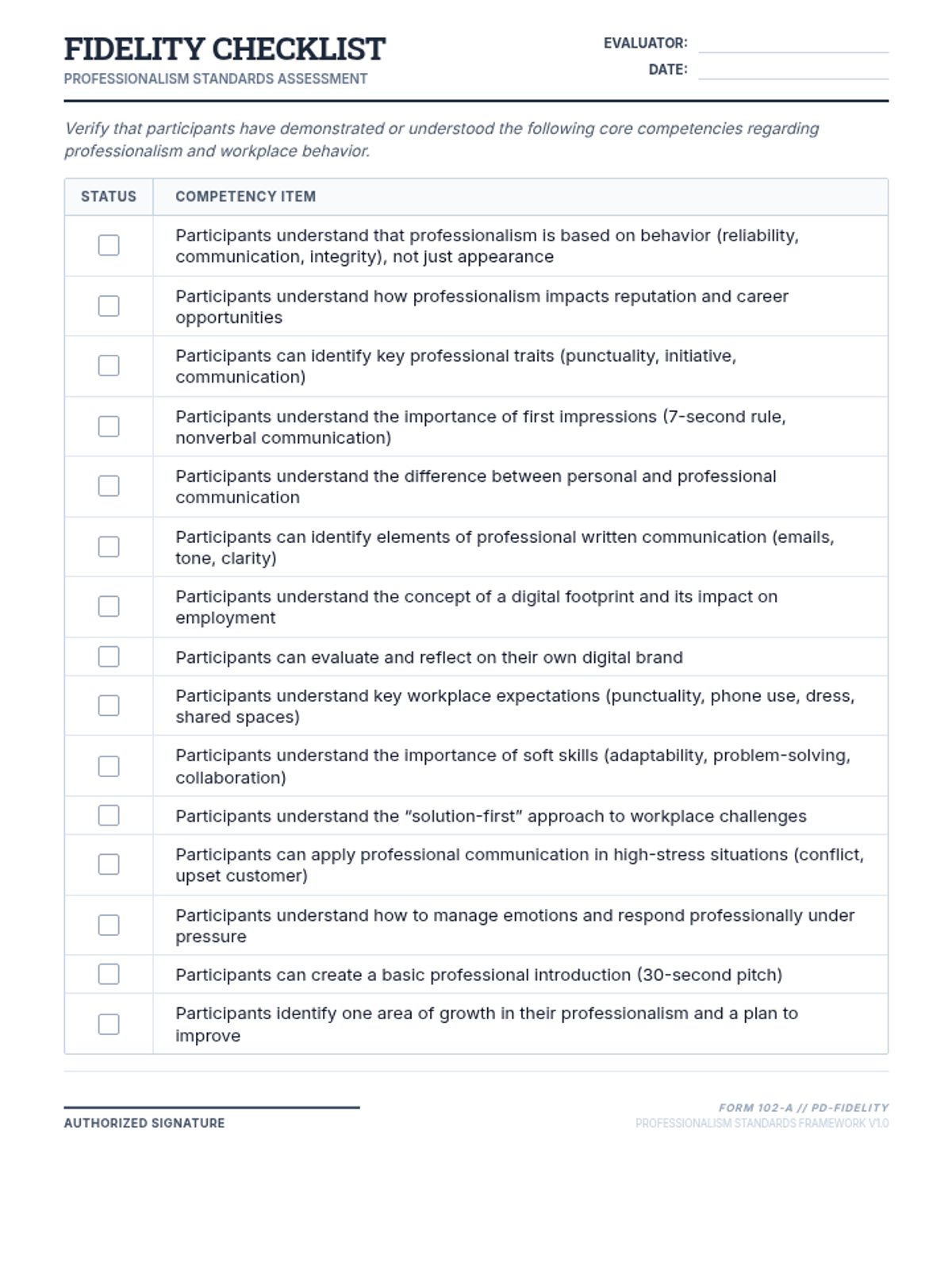
A clean, administrative fidelity checklist for evaluating participant understanding of professionalism core competencies.
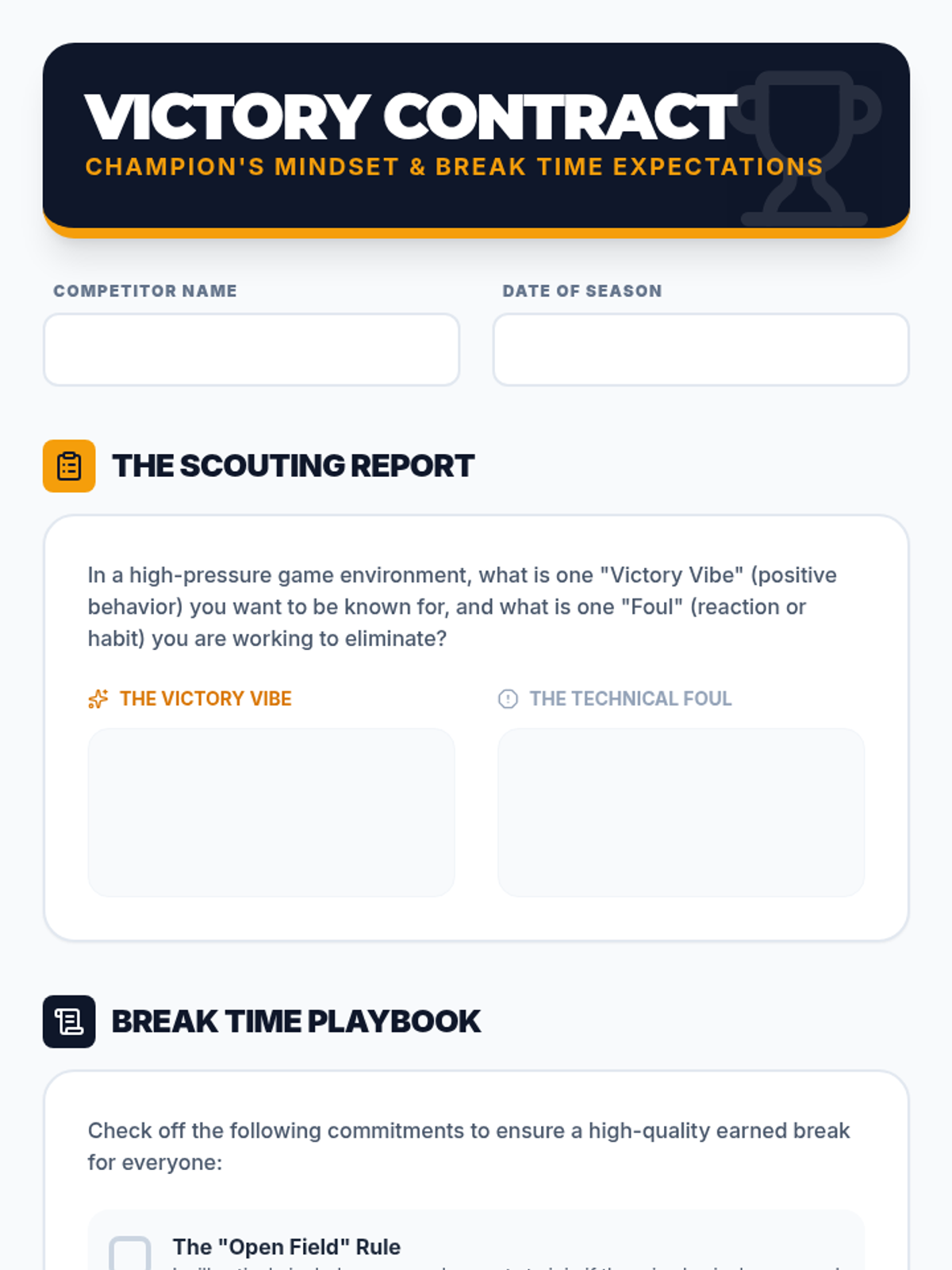
A student-facing contract and reflection sheet where students commit to sportsmanship principles and break-time expectations.
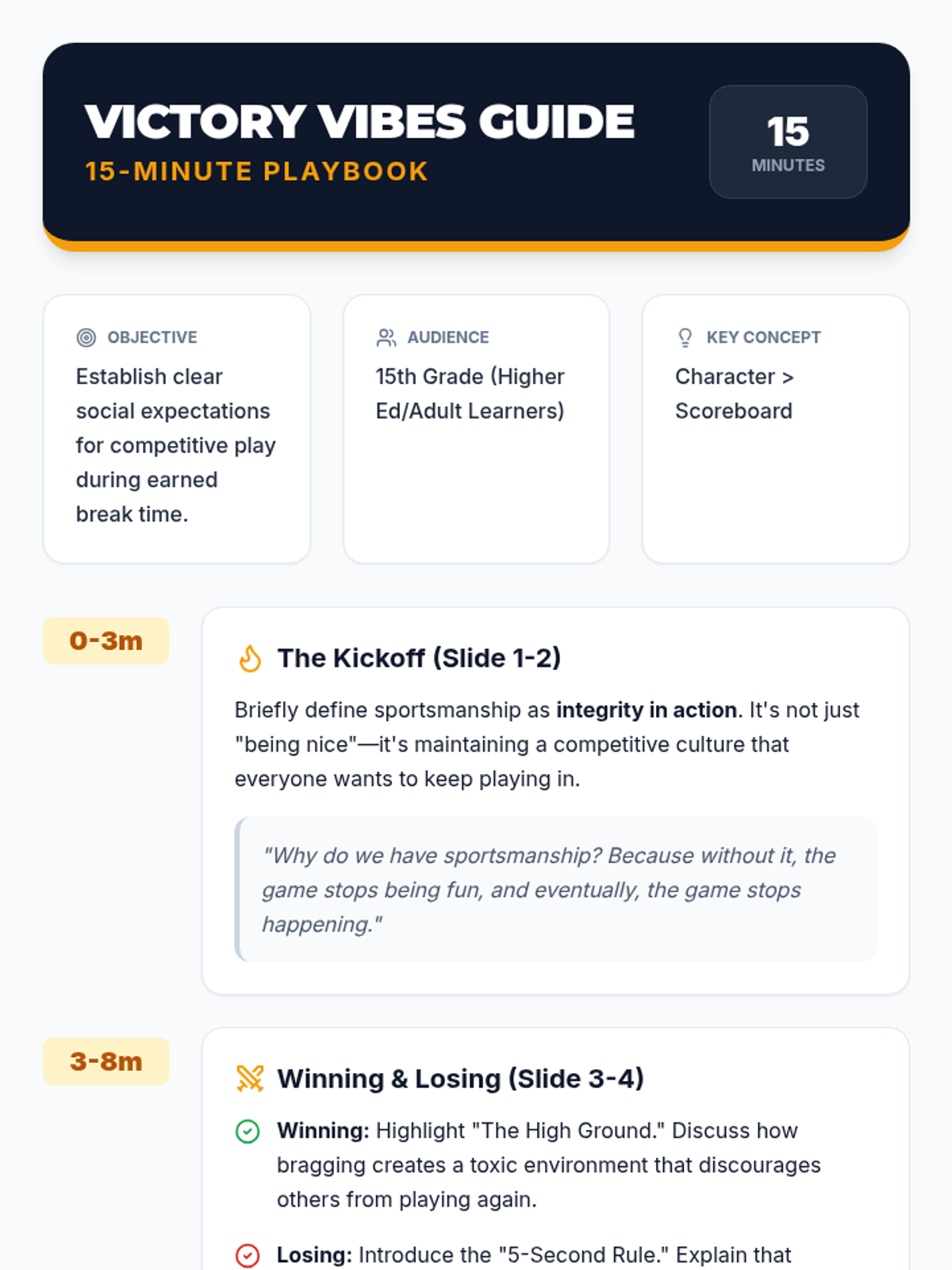
A structured, 15-minute facilitation guide for teachers to lead the Victory Vibes lesson, including pacing, talking points, and classroom management tips.
A high-energy, visually engaging slide deck that defines sportsmanship and sets clear expectations for games and sports during break time.
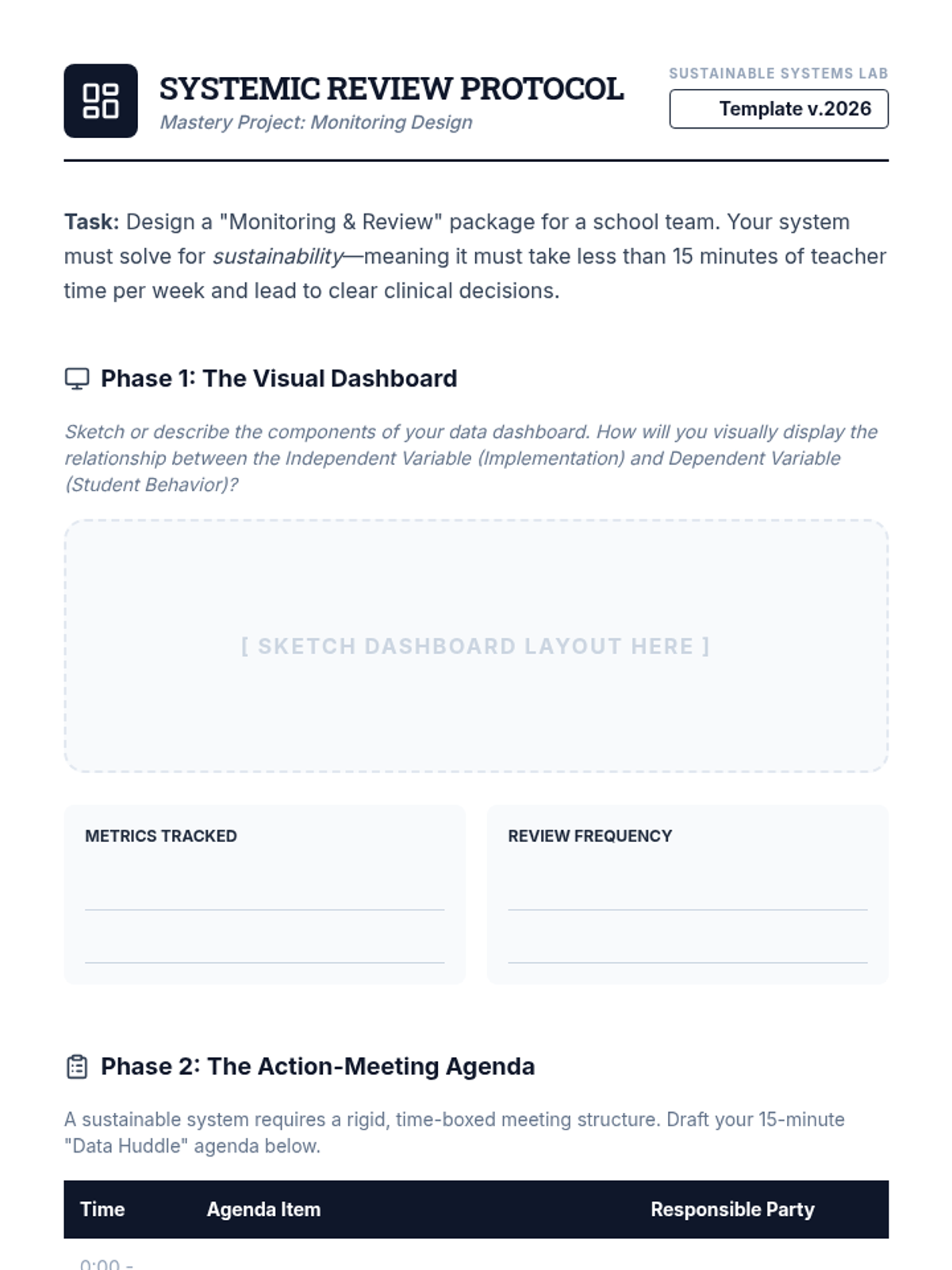
A culminating project template for graduate students to design a sustainable systemic monitoring review protocol, including a dashboard concept and meeting agenda.
A graduate slide deck on designing sustainable monitoring systems, data dashboards, and structured team review meetings for behavioral interventions.
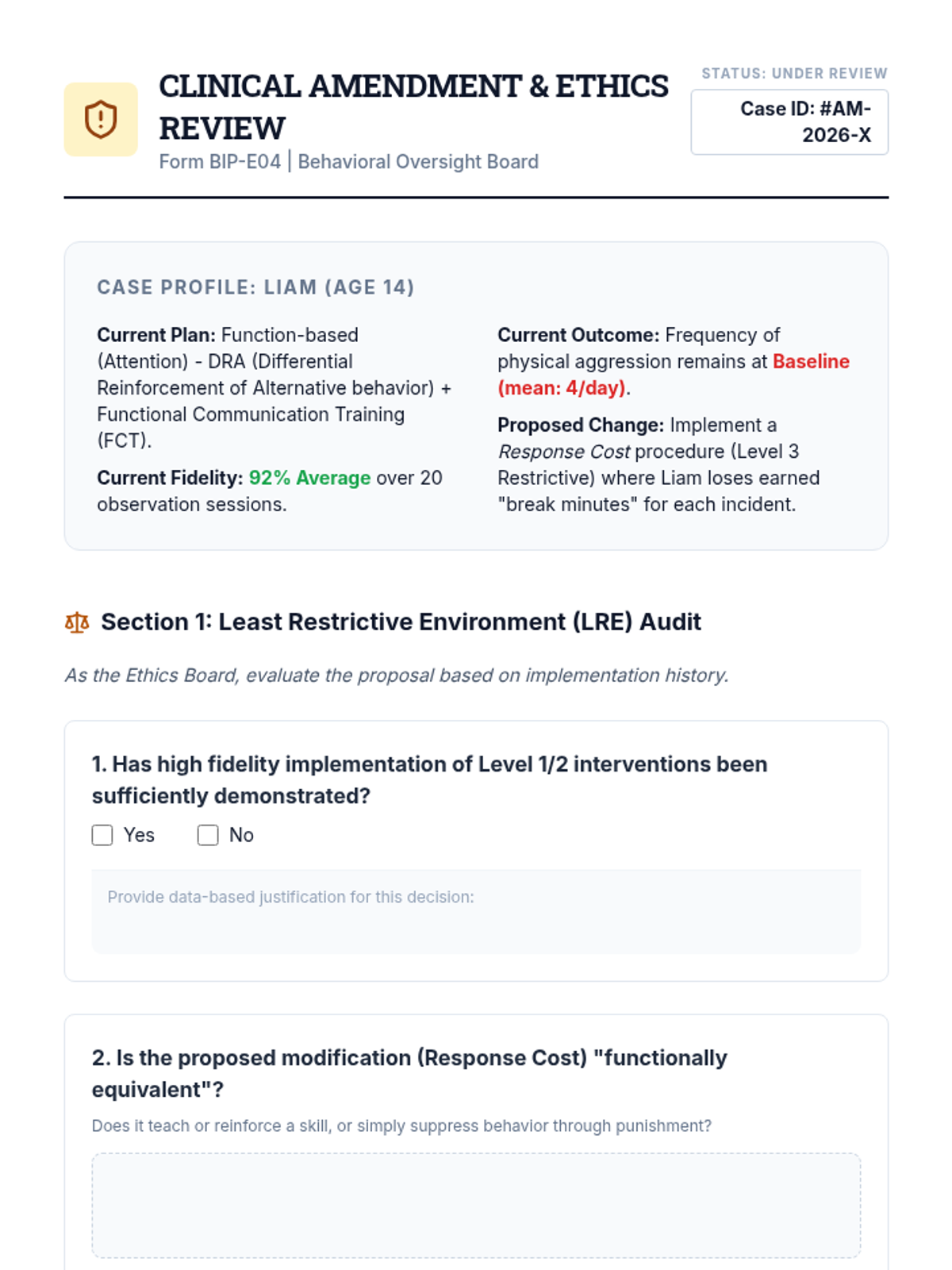
A graduate ethics review form where students analyze a proposed BIP modification against the LRE framework and fidelity data.
A graduate slide deck covering the ethical considerations of modifying Behavior Intervention Plans, focusing on the Least Restrictive Environment (LRE) framework.
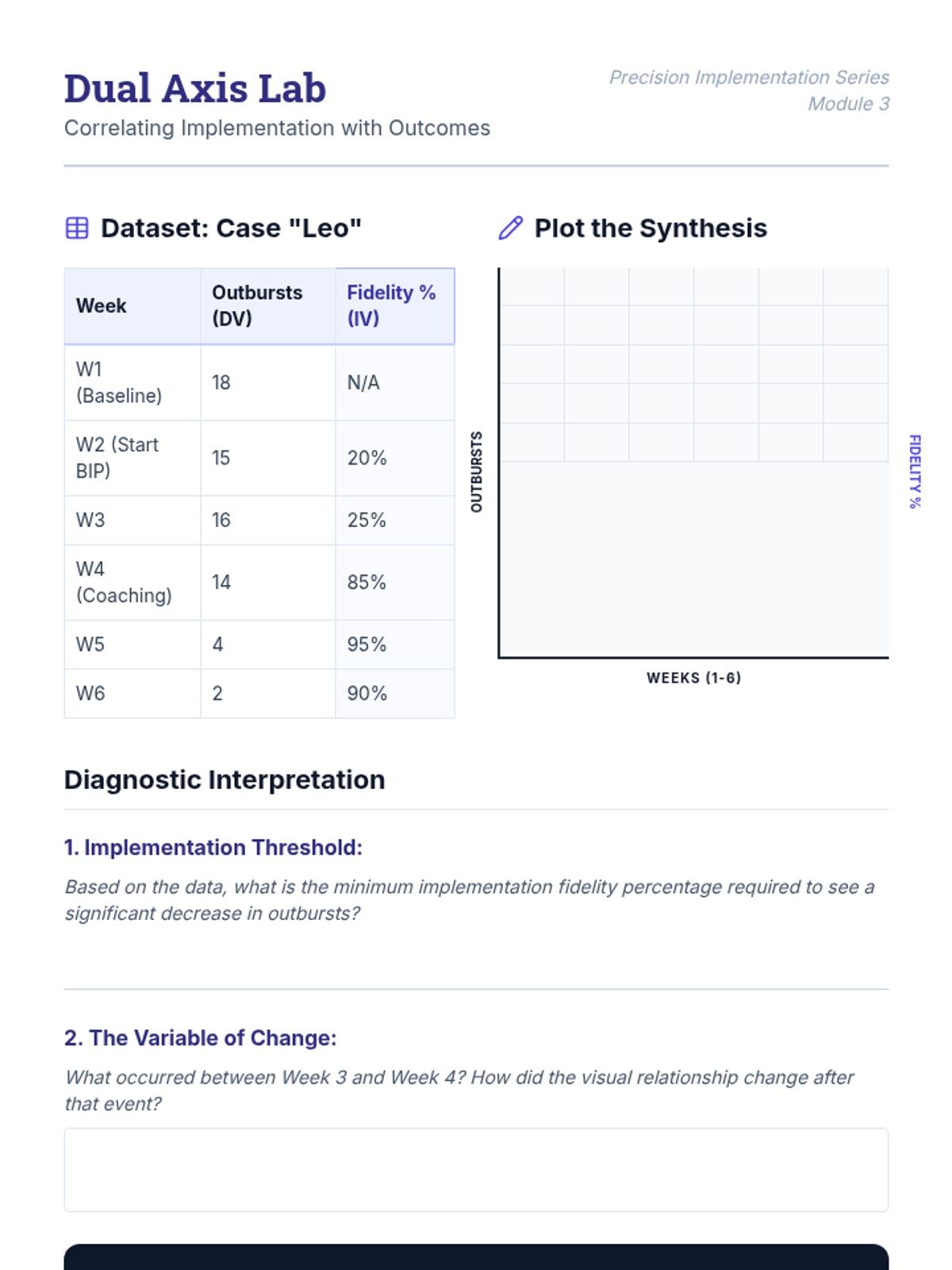
A graduate lab worksheet where students plot and analyze a dataset containing both student outbursts (outcome) and implementation fidelity percentages on a dual-axis graph.
A graduate slide deck explaining how to use dual-axis graphing to concurrently analyze treatment fidelity and student outcome data.
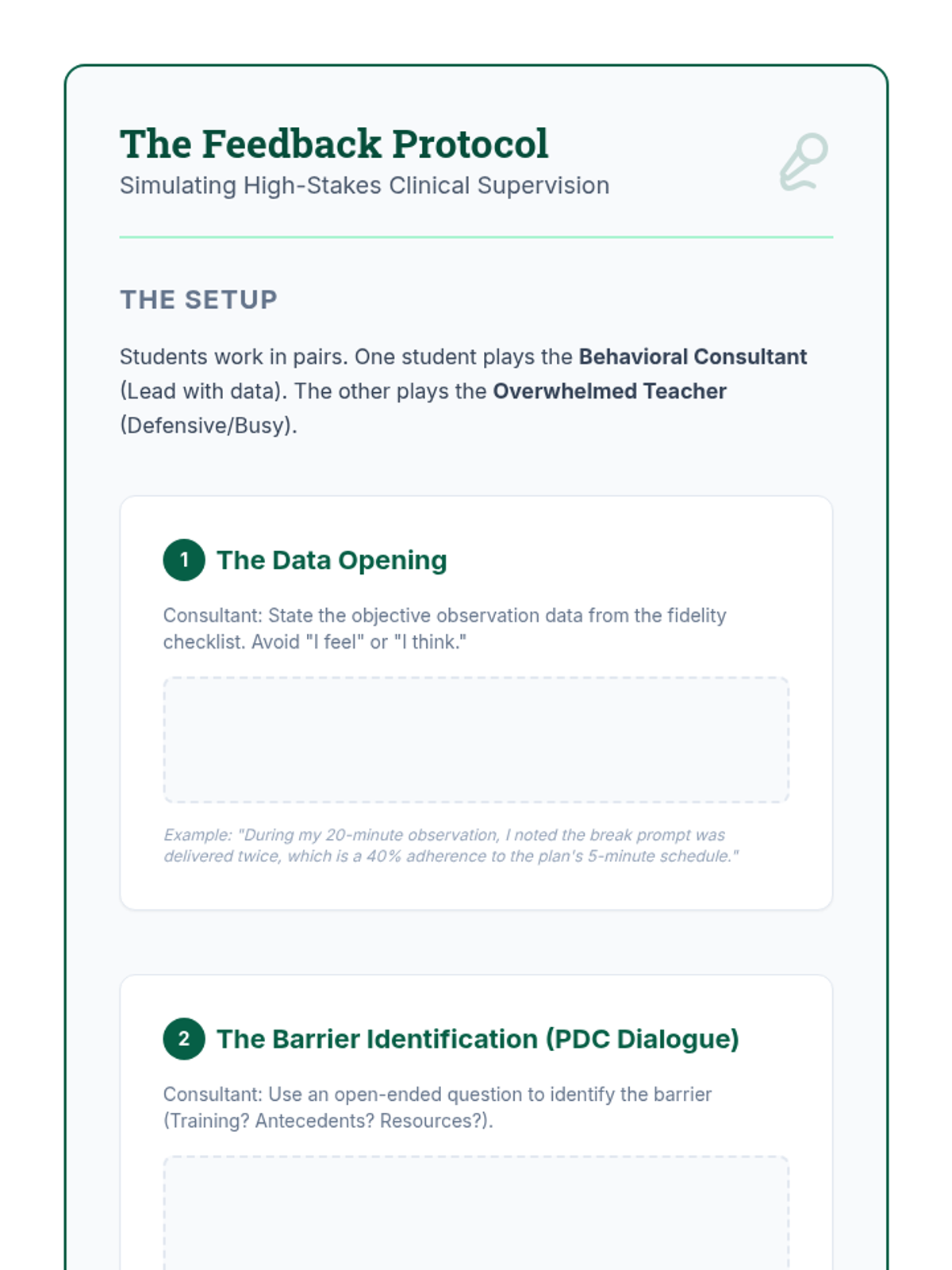
A role-play scripting tool for graduate students to practice delivering data-driven performance feedback to educational staff.
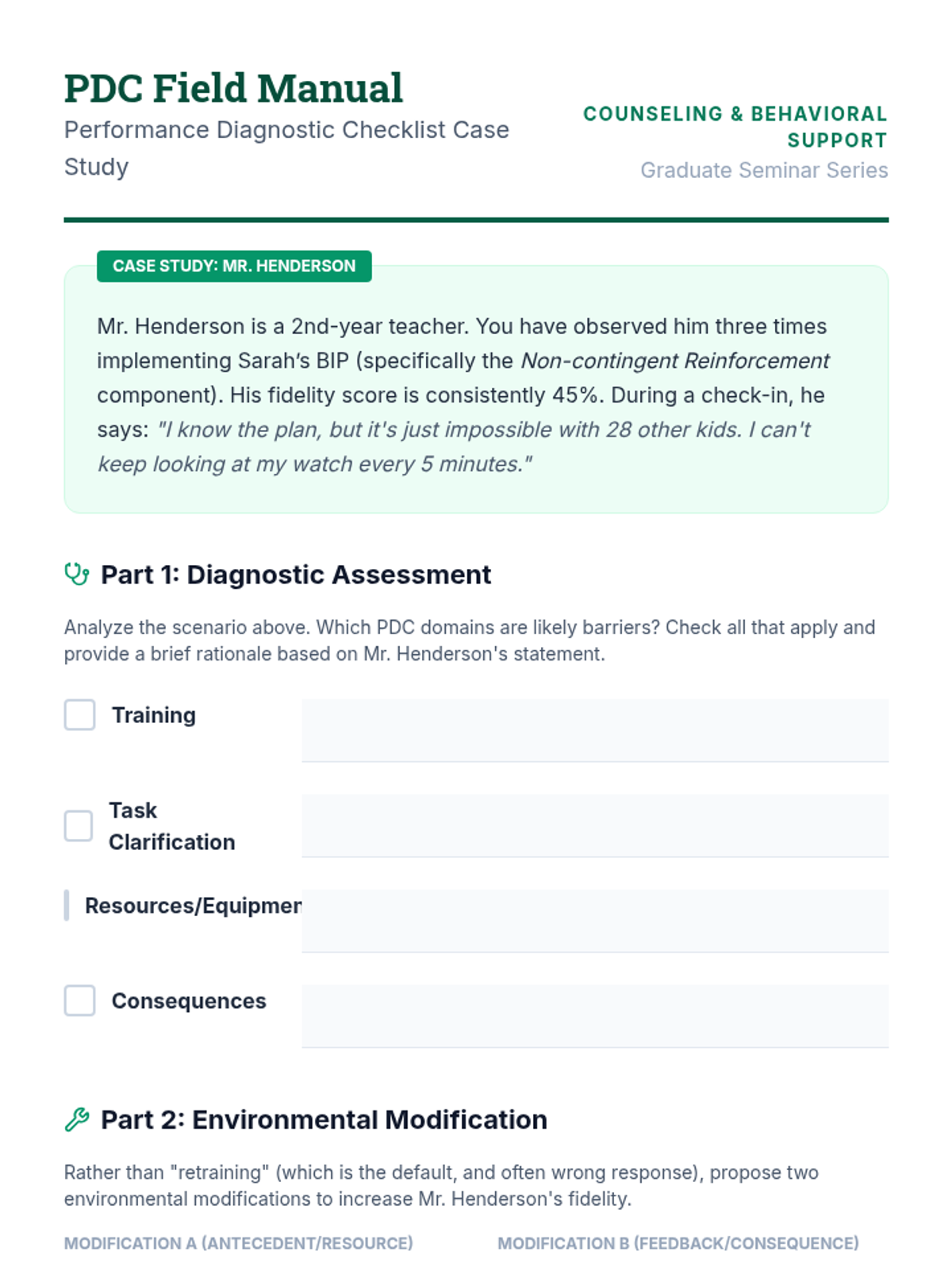
A graduate-level case study handout where students use the Performance Diagnostic Checklist (PDC) framework to identify implementation barriers and design environmental interventions for staff.
A graduate-level slide deck focused on staff coaching, the Performance Diagnostic Checklist (PDC), and providing objective, data-driven feedback.
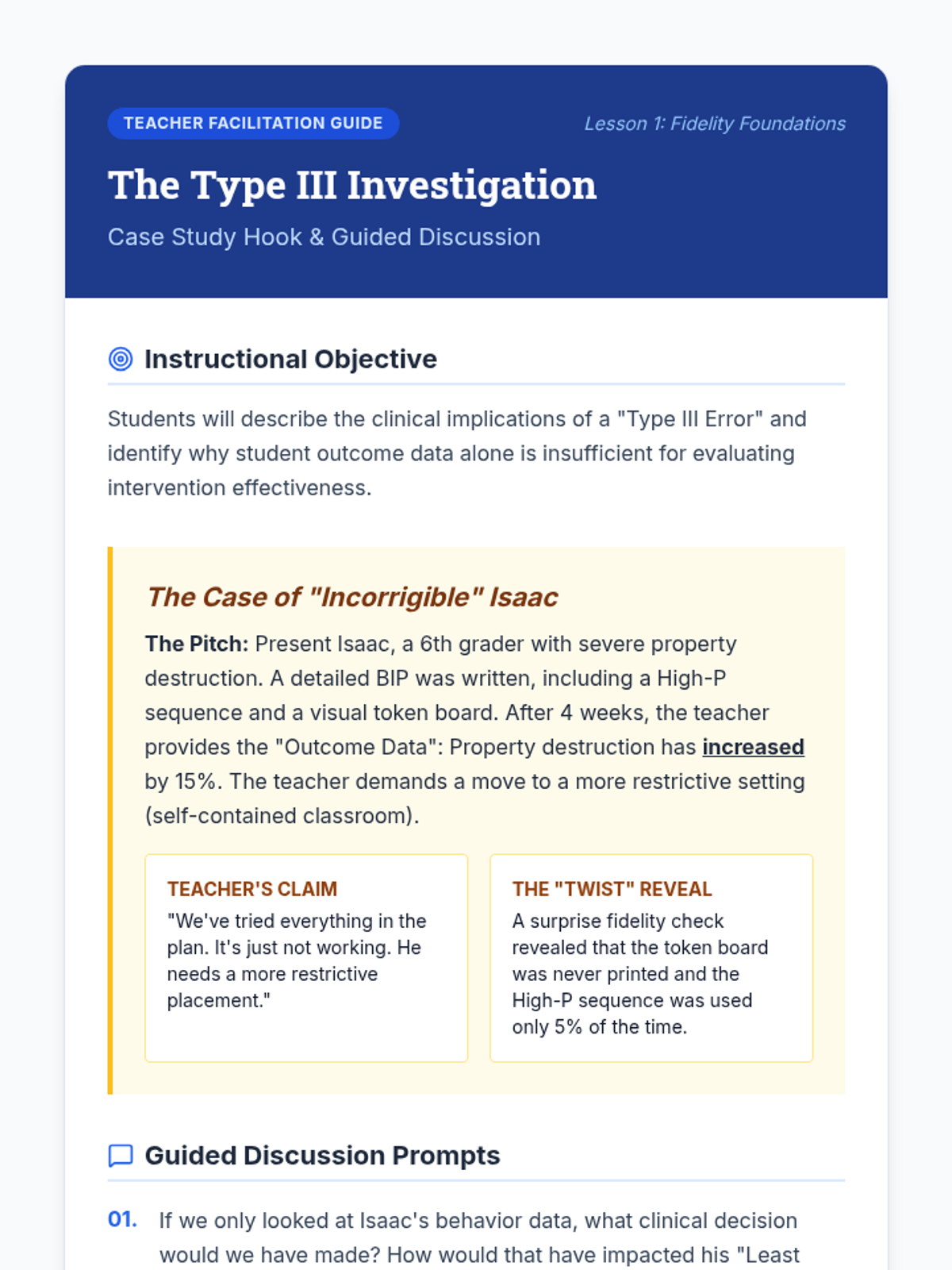
A facilitation guide for the Lesson 1 hook, providing a case study of 'Incorrigible Isaac' to illustrate the Type III error and implementation integrity.
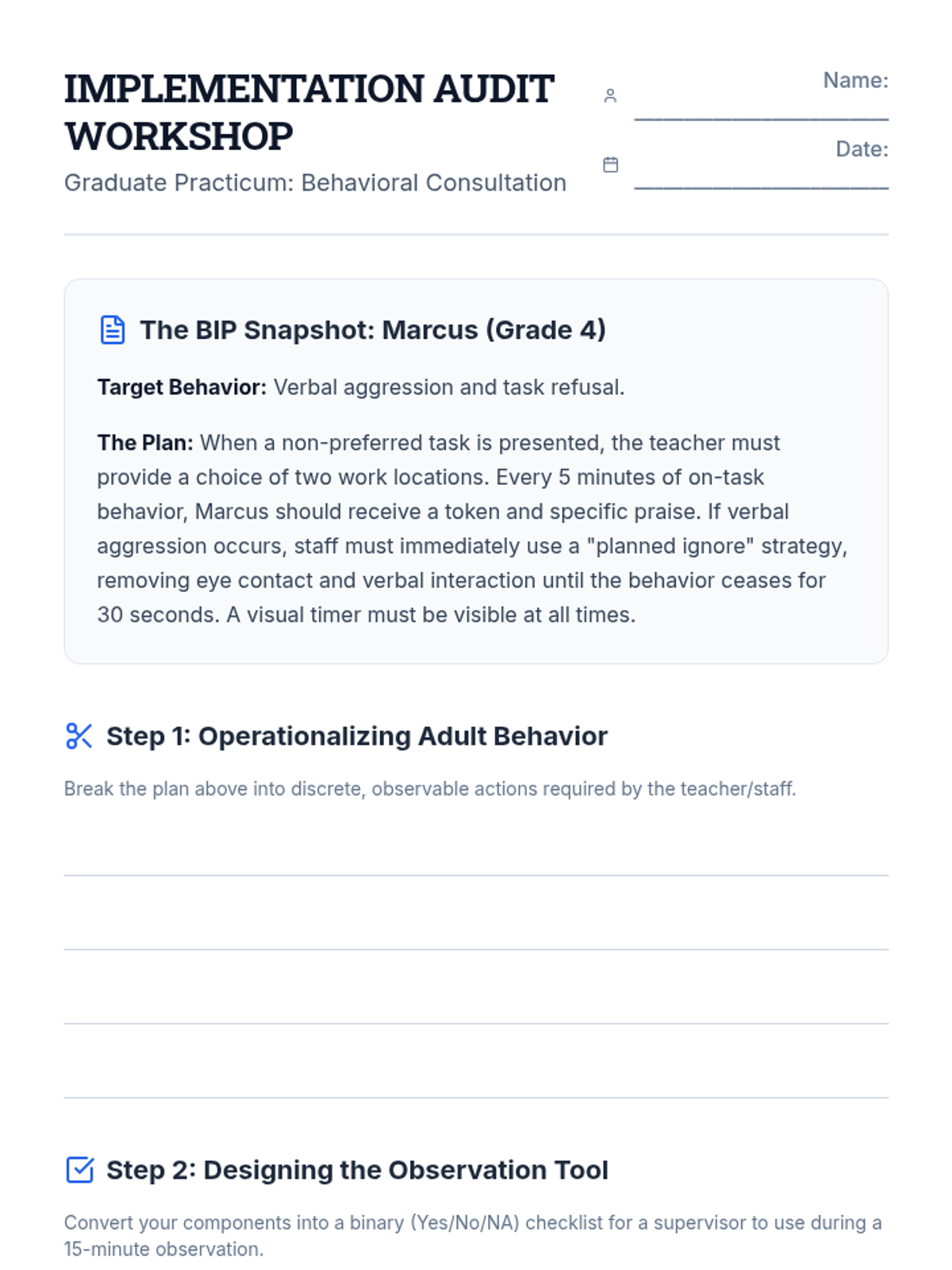
A graduate workshop activity where students extract implementation steps from a sample Behavior Intervention Plan (BIP) and design a functional fidelity checklist.
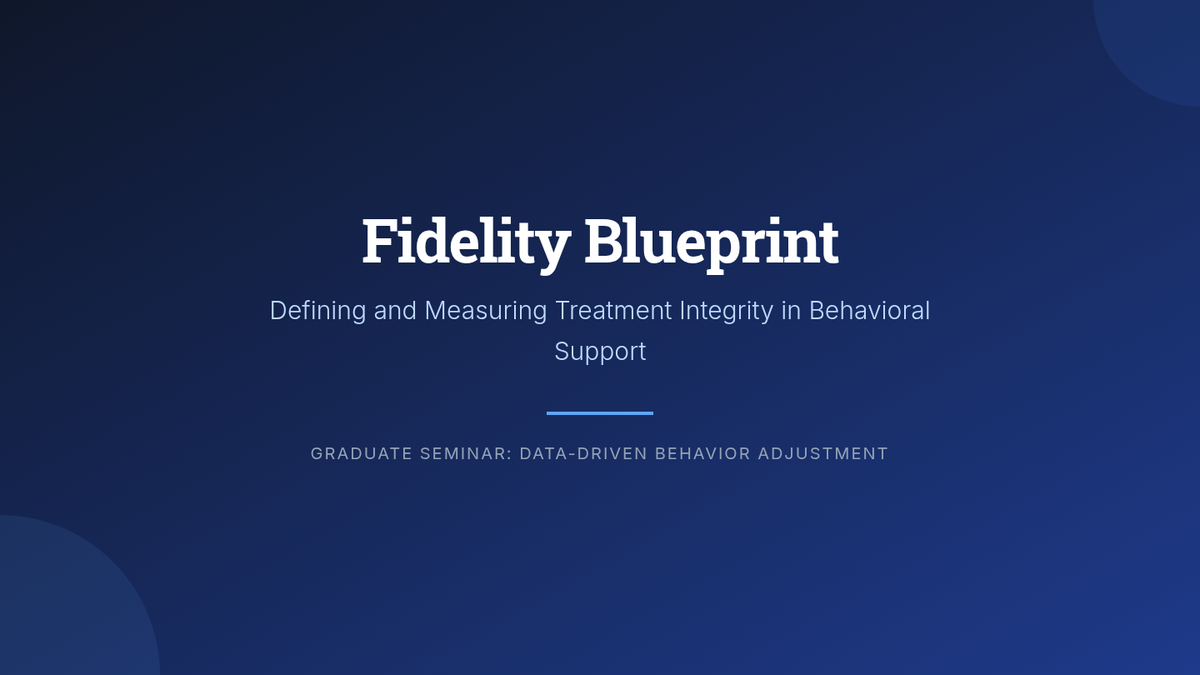
A graduate-level slide deck introducing the concepts of treatment fidelity, implementation integrity, and the Type III error in behavioral support.
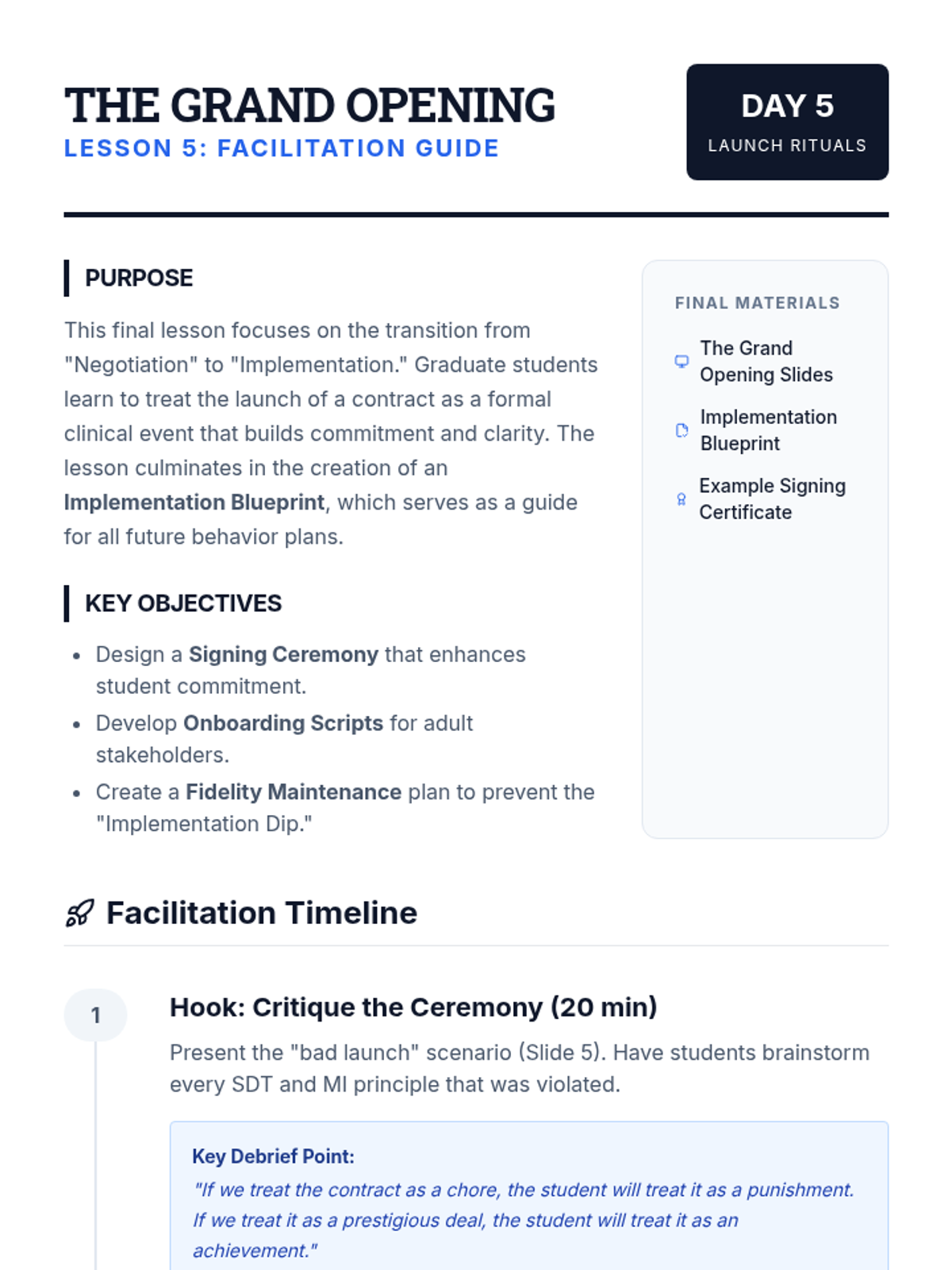
A comprehensive teacher guide for Lesson 5, including pacing notes, signing ritual tips, and guidance on preventing implementation failure.
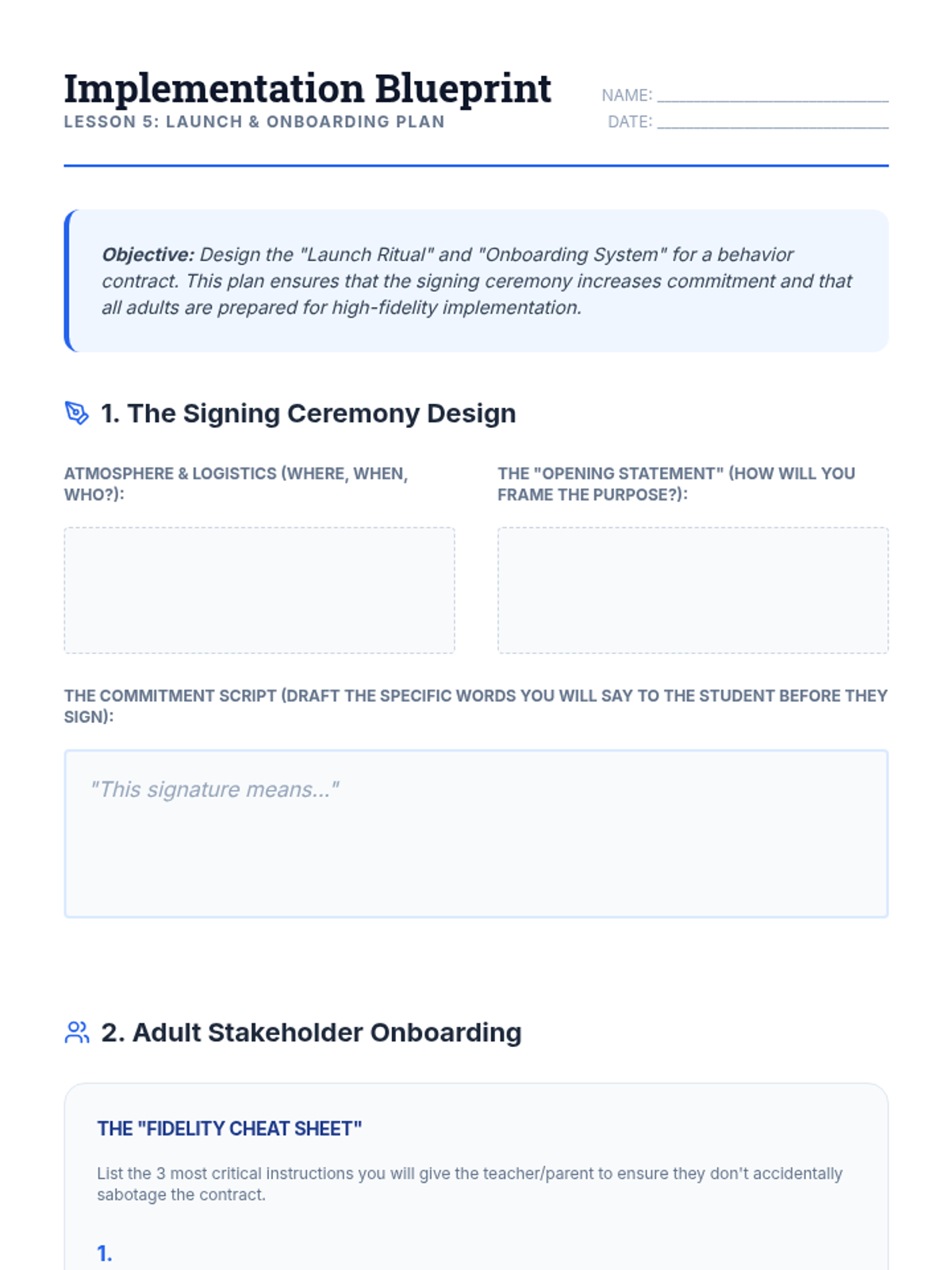
A planning tool for graduate students to design the implementation launch, signing ritual, and adult onboarding process for a behavior contract.
Instructional slides for Lesson 5, focusing on the ritual of signing to increase commitment and the practical steps for onboarding adults into the contract process.
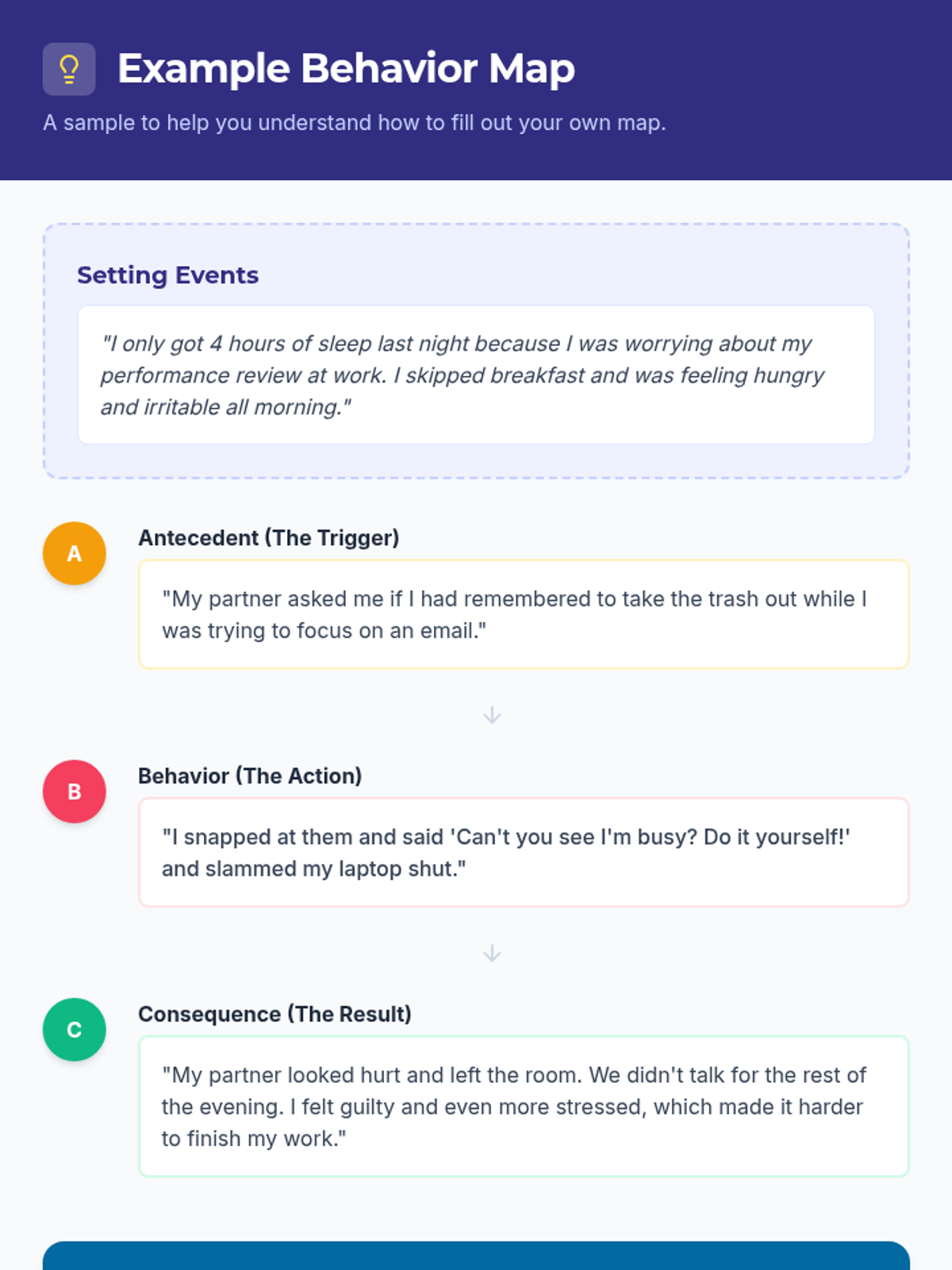
An illustrative example of a completed behavior map to provide patients with clarity on how to identify and document their own patterns.
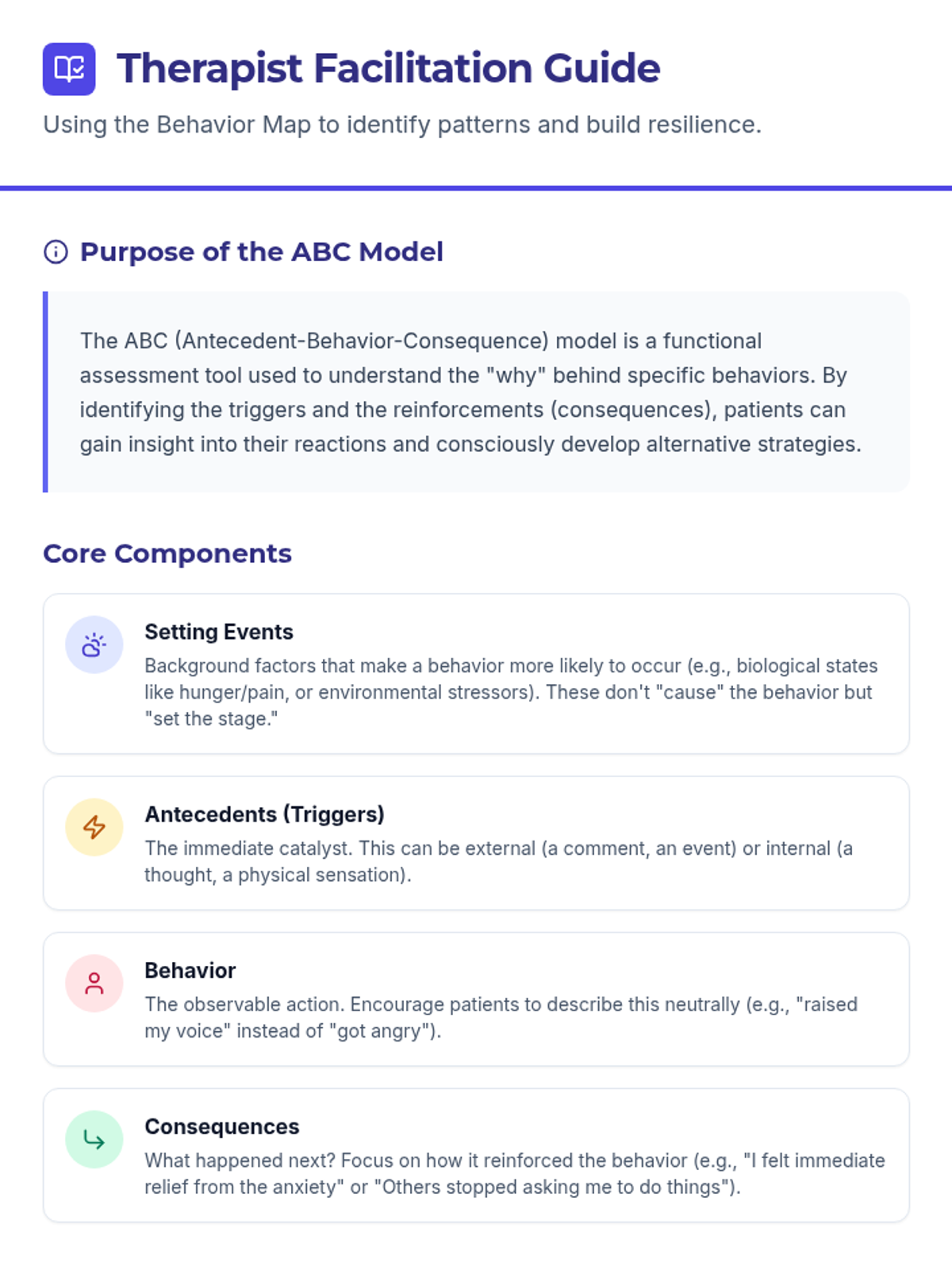
A professional guide for therapists and counselors to effectively facilitate behavior mapping sessions using the ABC model, including definitions and discussion prompts.
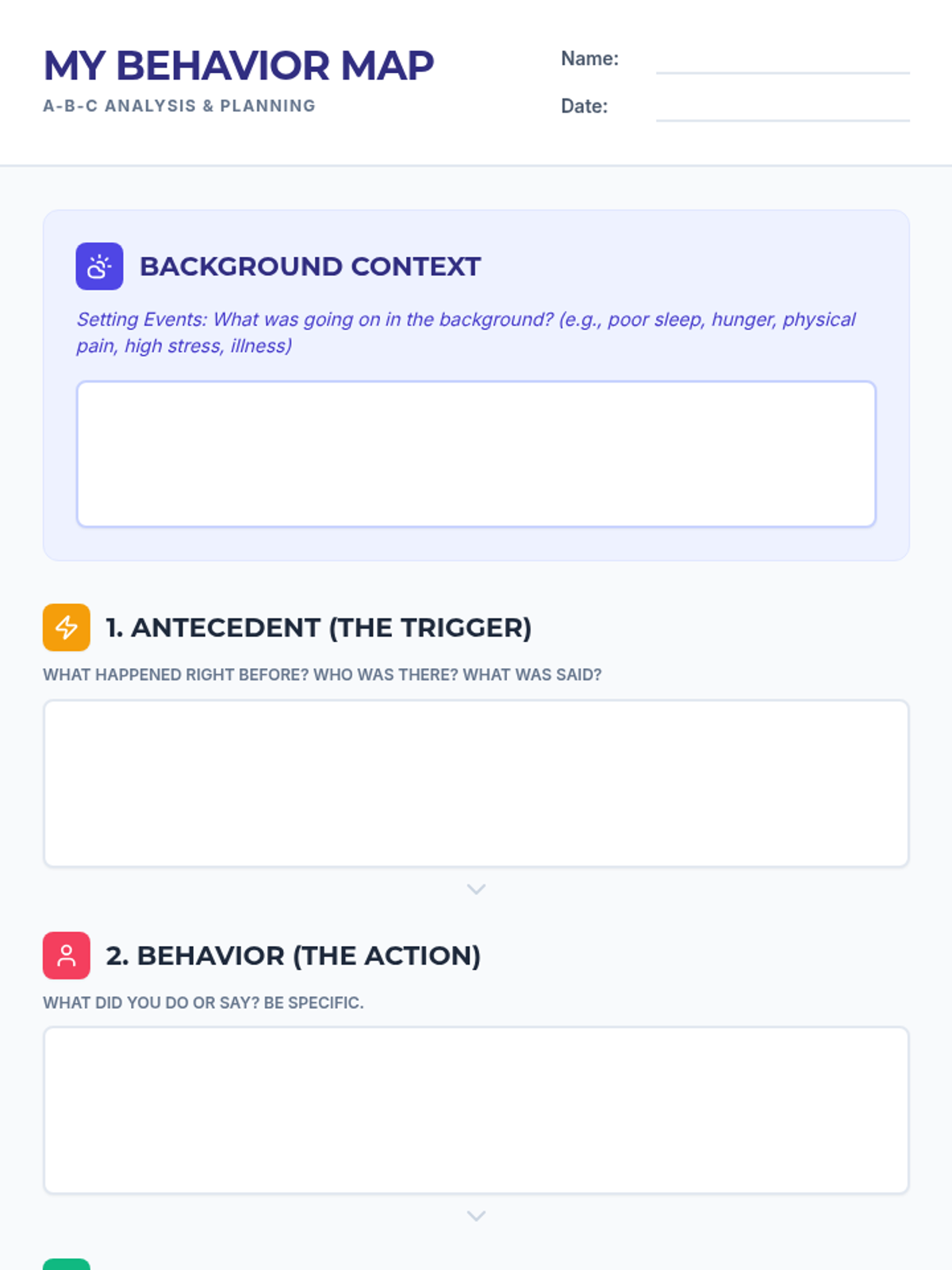
A clean, structured behavior mapping worksheet for patients to track setting events, antecedents, behaviors, and consequences, with a dedicated section for planning alternative pathways.
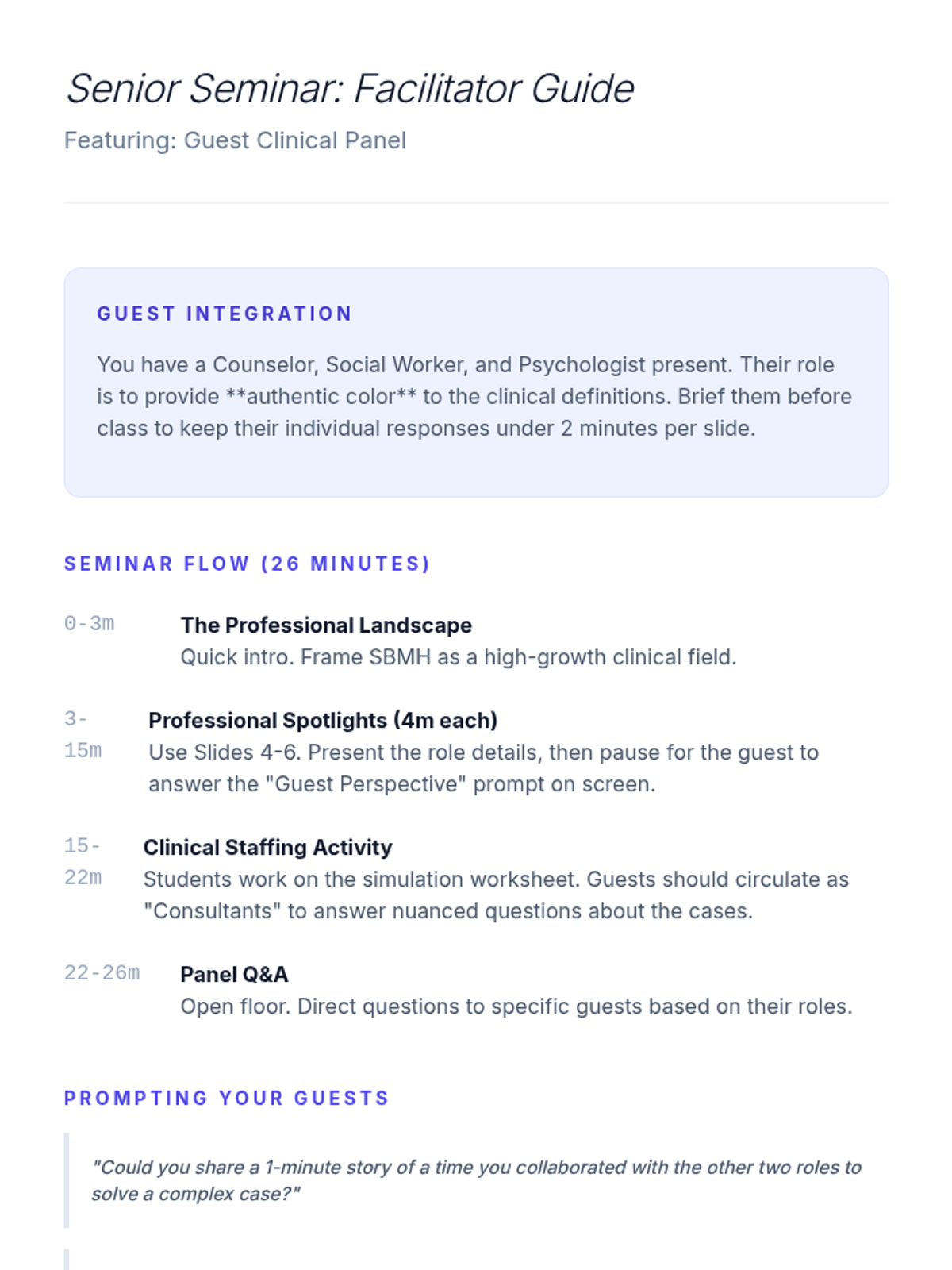
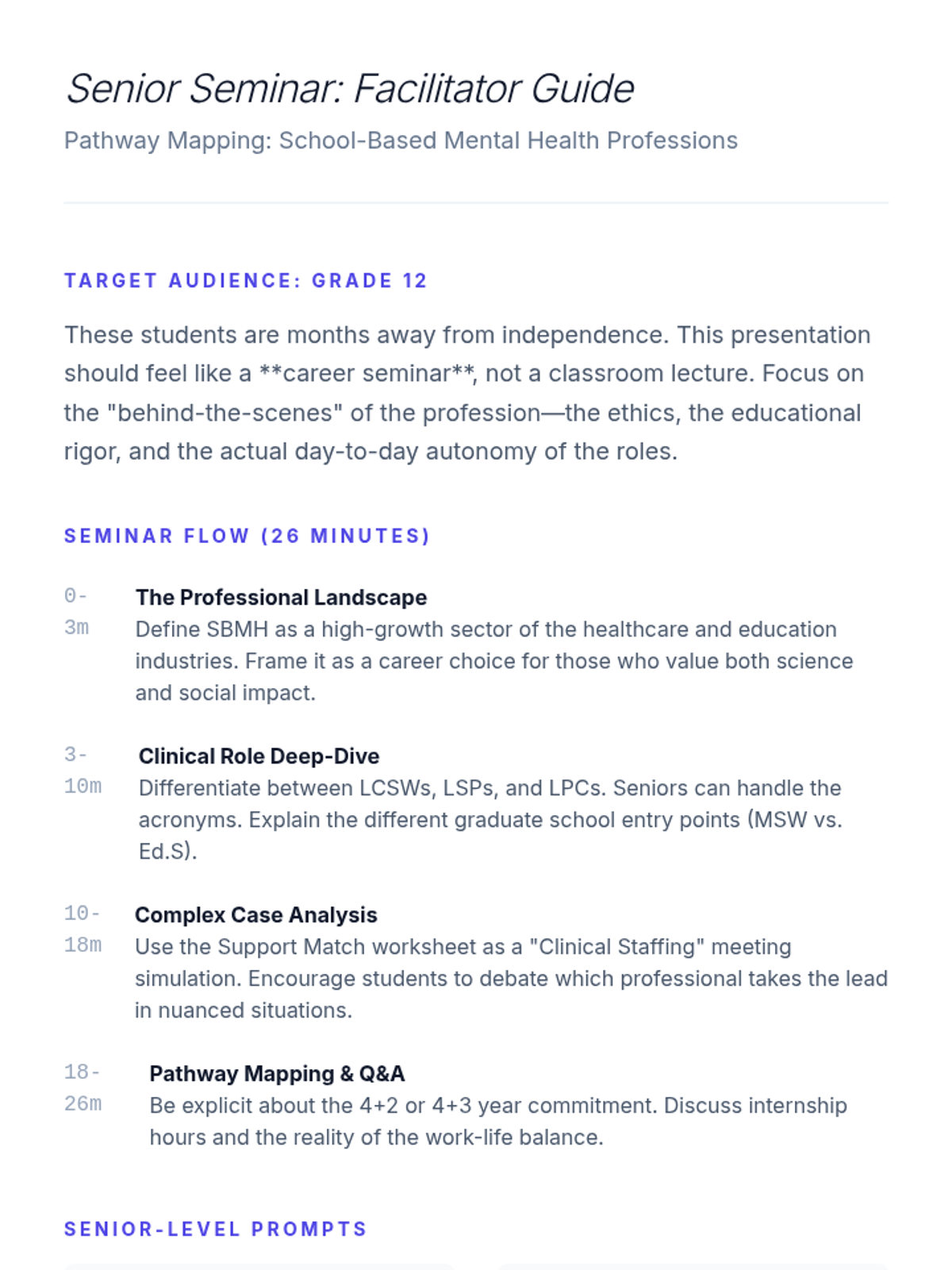
An updated professional facilitator guide for the senior seminar, featuring specific timing and strategy for integrating three guest SBMH professionals into the presentation.
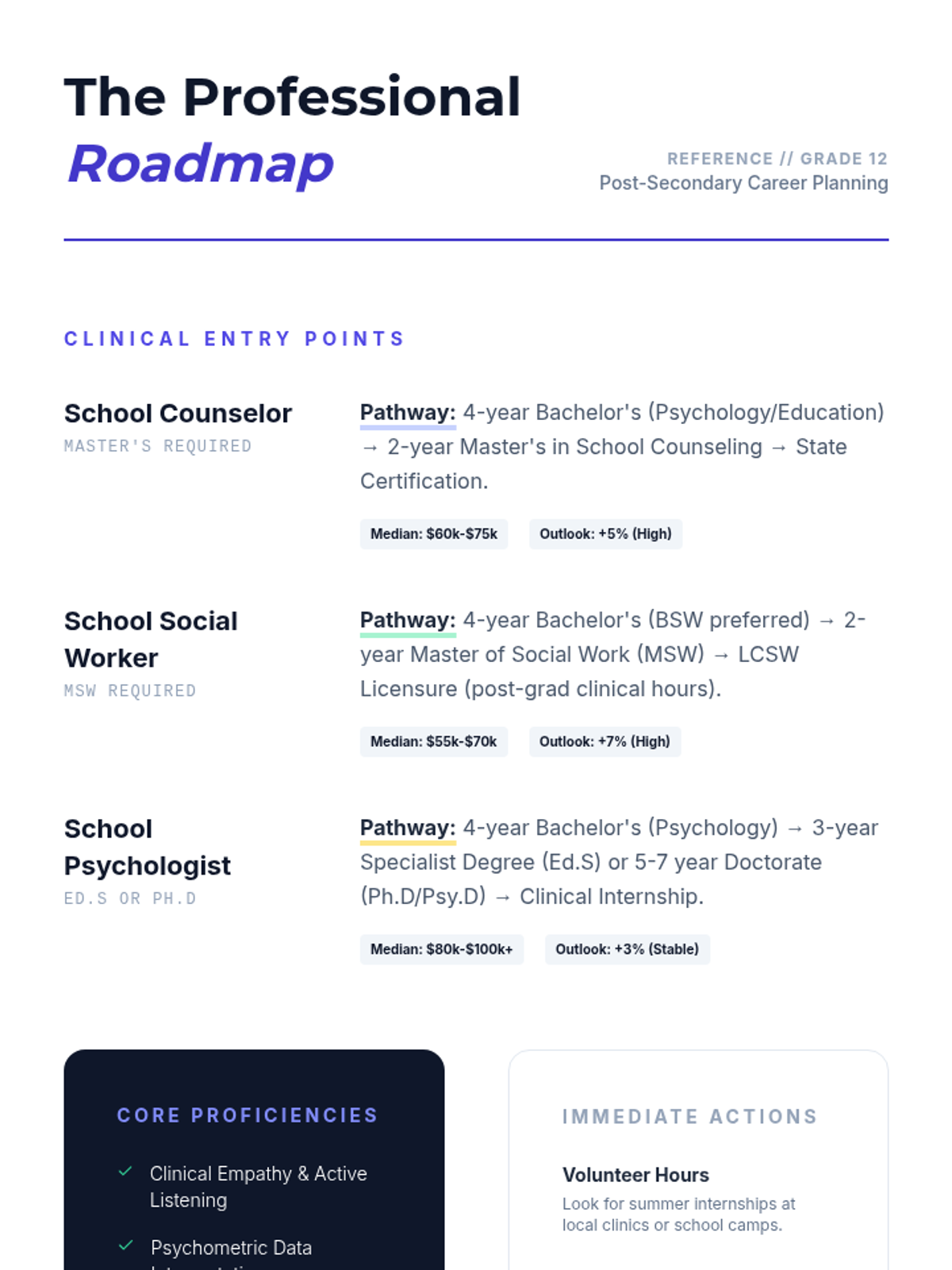
A comprehensive post-secondary career roadmap for high school seniors, detailing educational pathways, credential requirements, salary outlooks, and core professional competencies in SBMH.
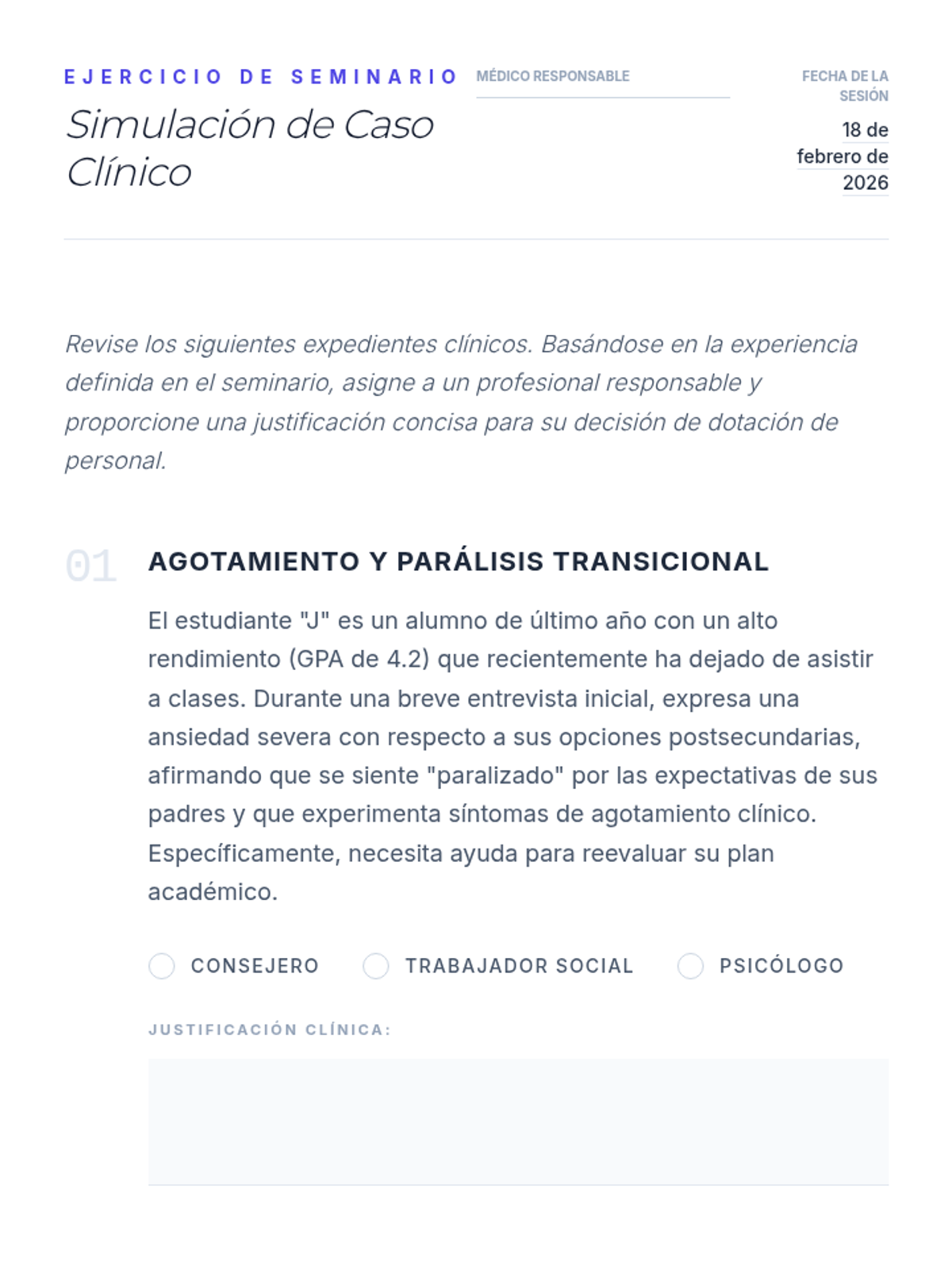
A sophisticated clinical case simulation worksheet for high school seniors, using complex scenarios and professional terminology to assess their understanding of SBMH roles.
A sophisticated, minimalist 10-slide presentation for high school seniors, now featuring integrated guest professional prompts for a counselor, social worker, and psychologist.
A professional facilitator guide specifically tailored for presenting SBMH careers to high school seniors, focusing on clinical terminology, ethics, and professional transparency.
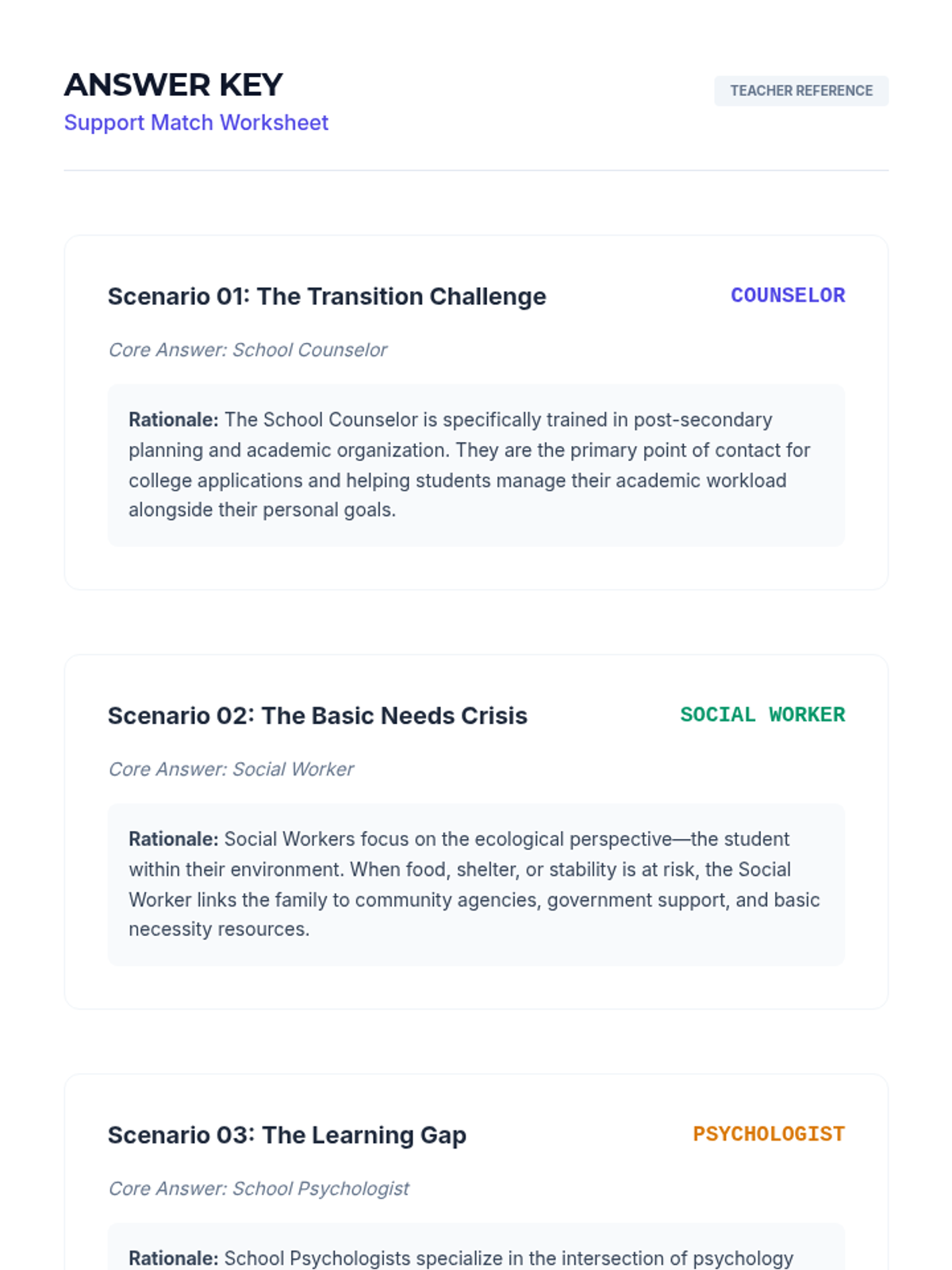
A clean, minimalist teacher answer key for the Support Match activity, providing role identifications and logical rationales.
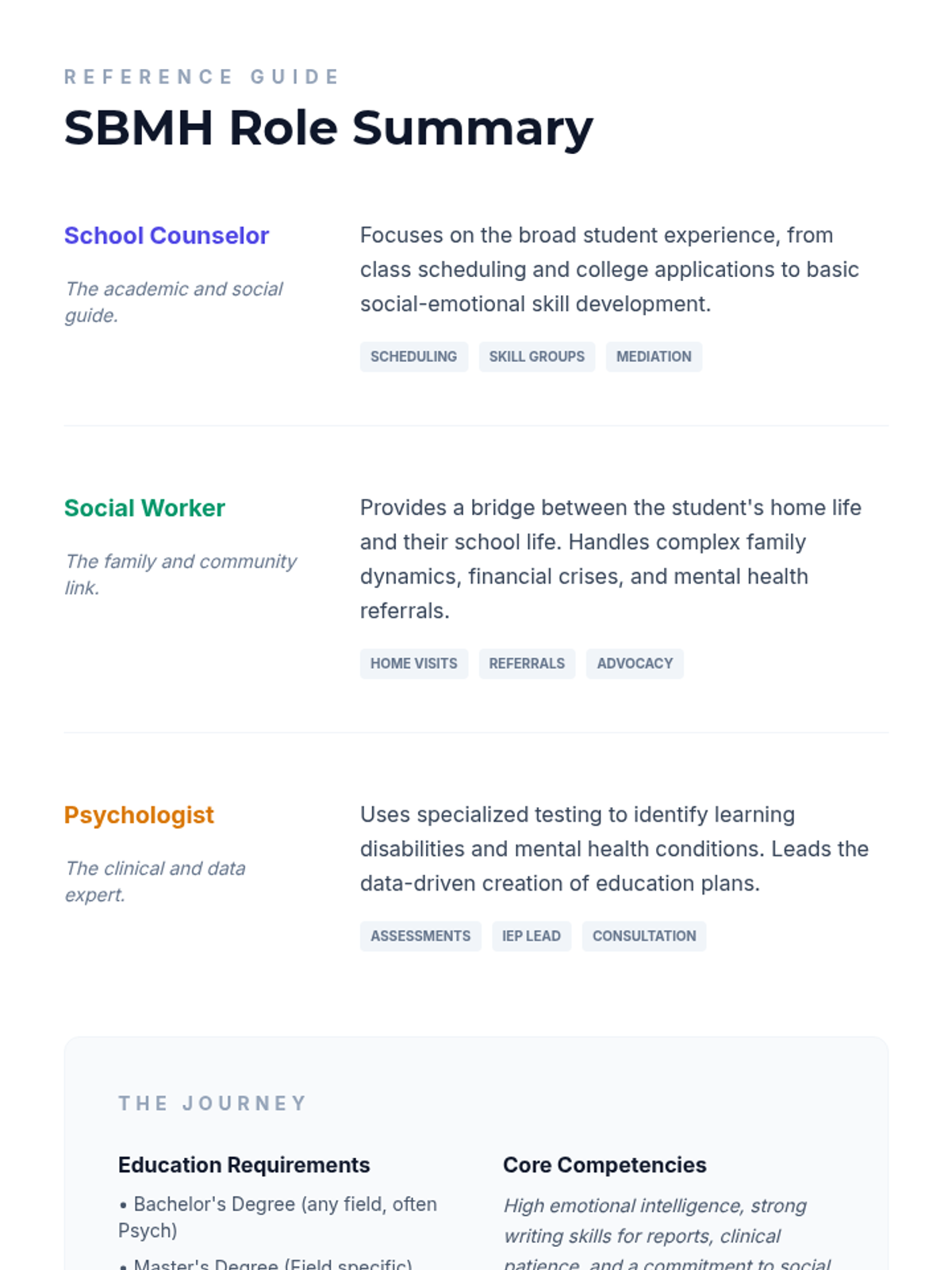
A clean, minimalist reference handout for students, summarizing SBMH roles and educational pathways.
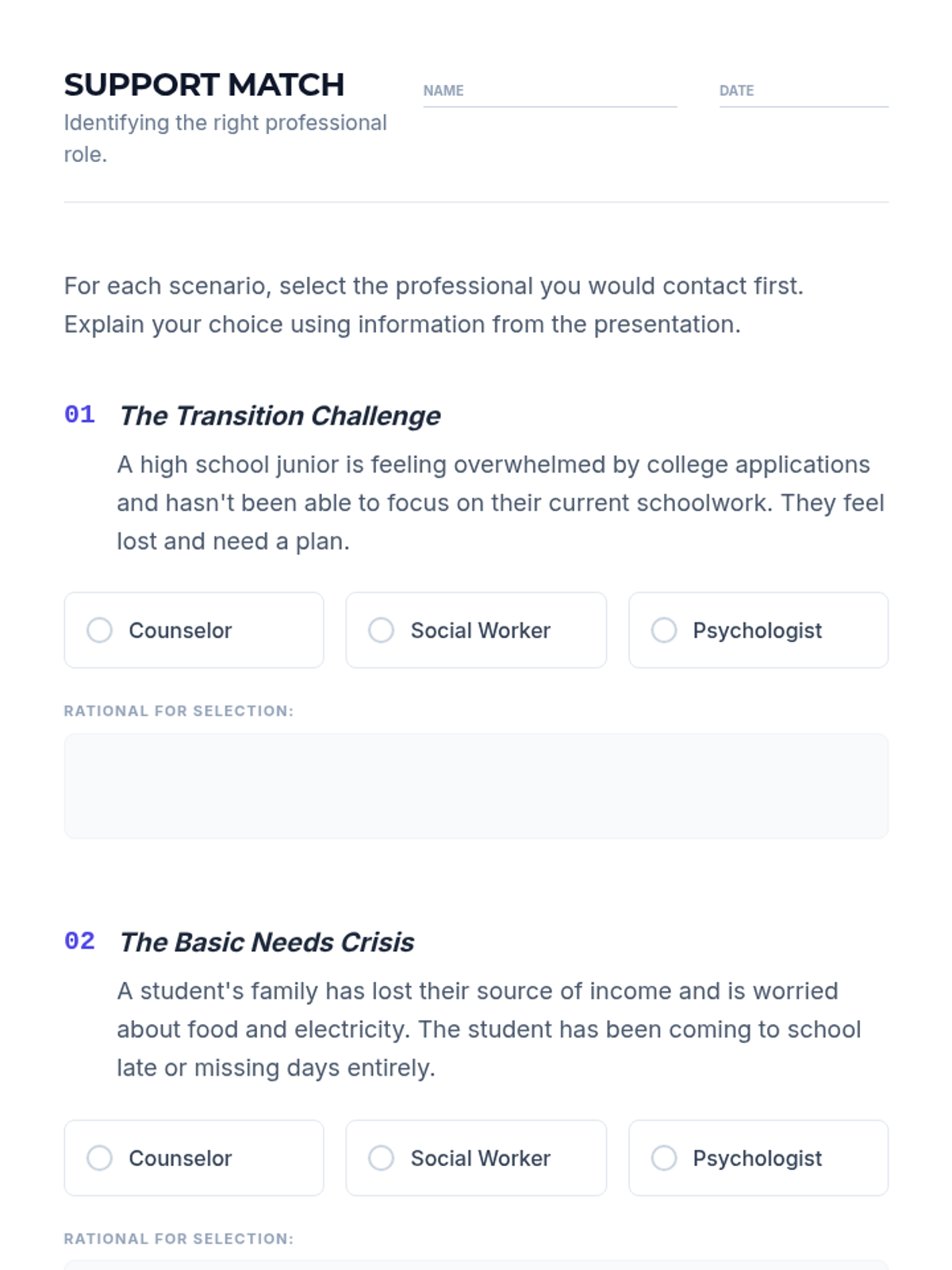
A minimalist worksheet for matching student scenarios to SBMH professions, focusing on clean design and clear student response areas.
A minimalist 10-slide presentation for introducing school-based mental health careers, focusing on clarity, whitespace, and professional profiles.
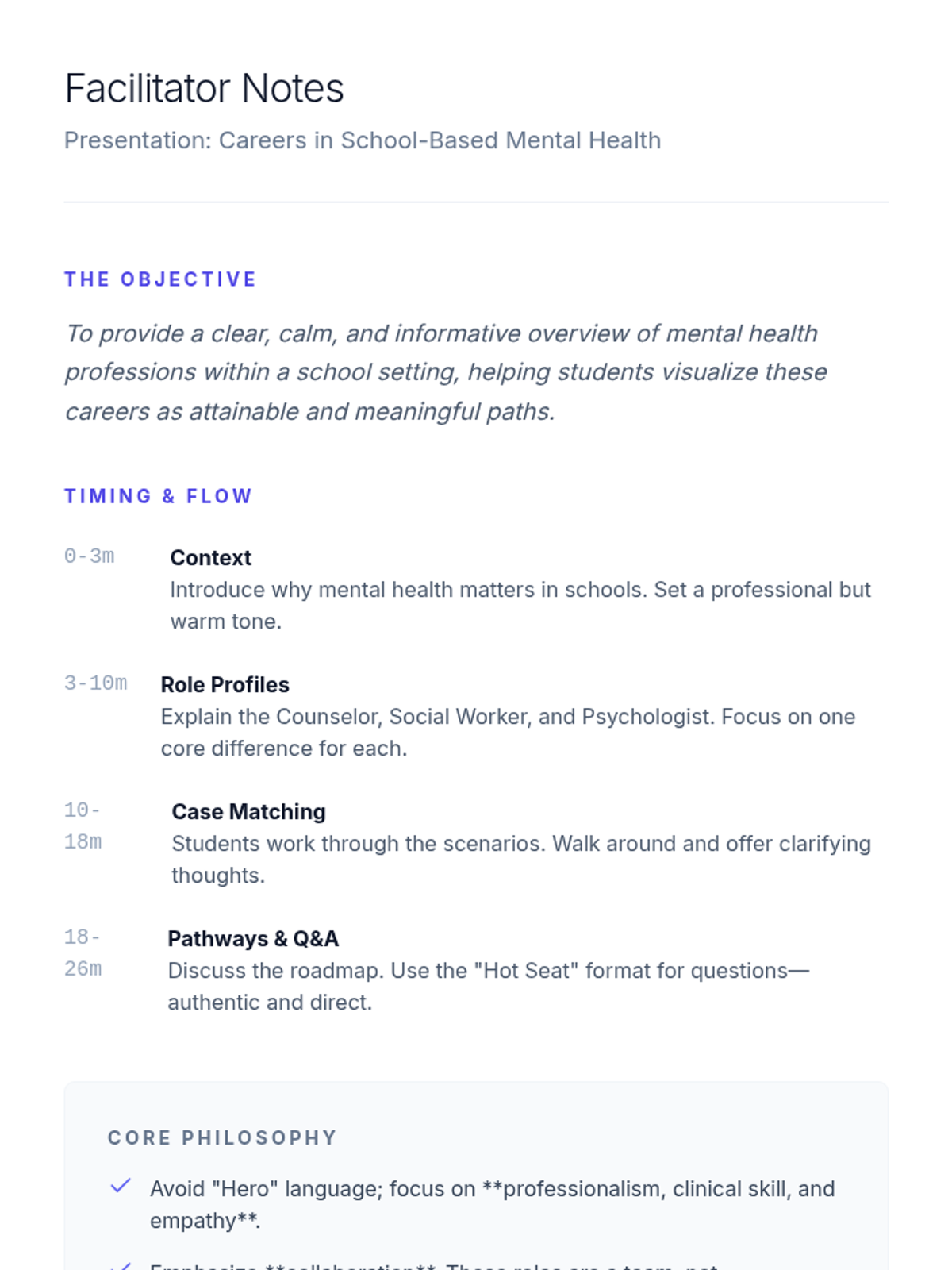
A professional and minimalist facilitator guide for the SBMH career presentation, focusing on calm delivery and clear timing.
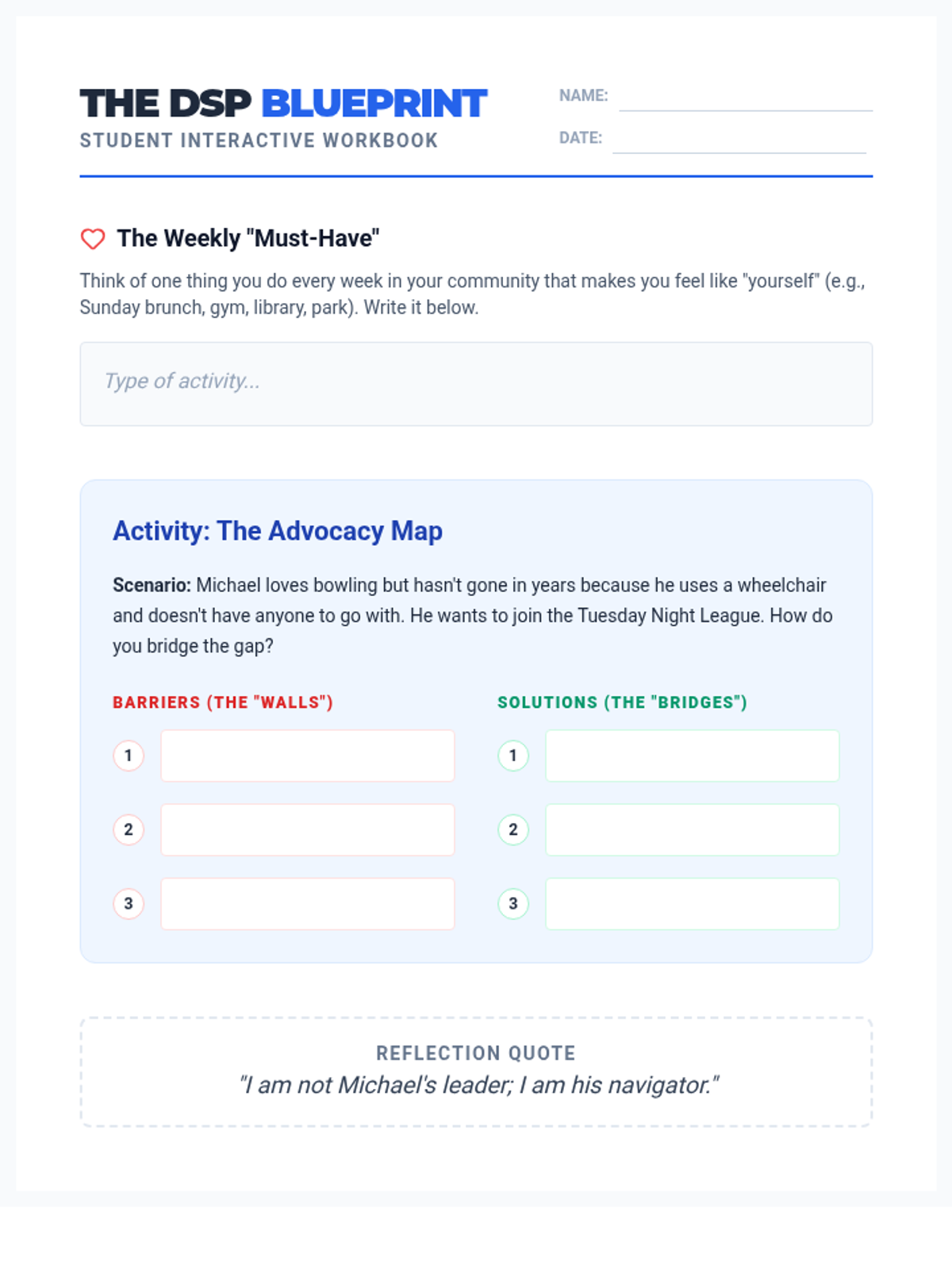
A 4-page interactive student workbook for the DSP training. Includes reflection prompts, a 'Note Doctor' documentation workshop, a behavioral iceberg case study, and a final knowledge check/pledge. Designed with ample space for handwriting.
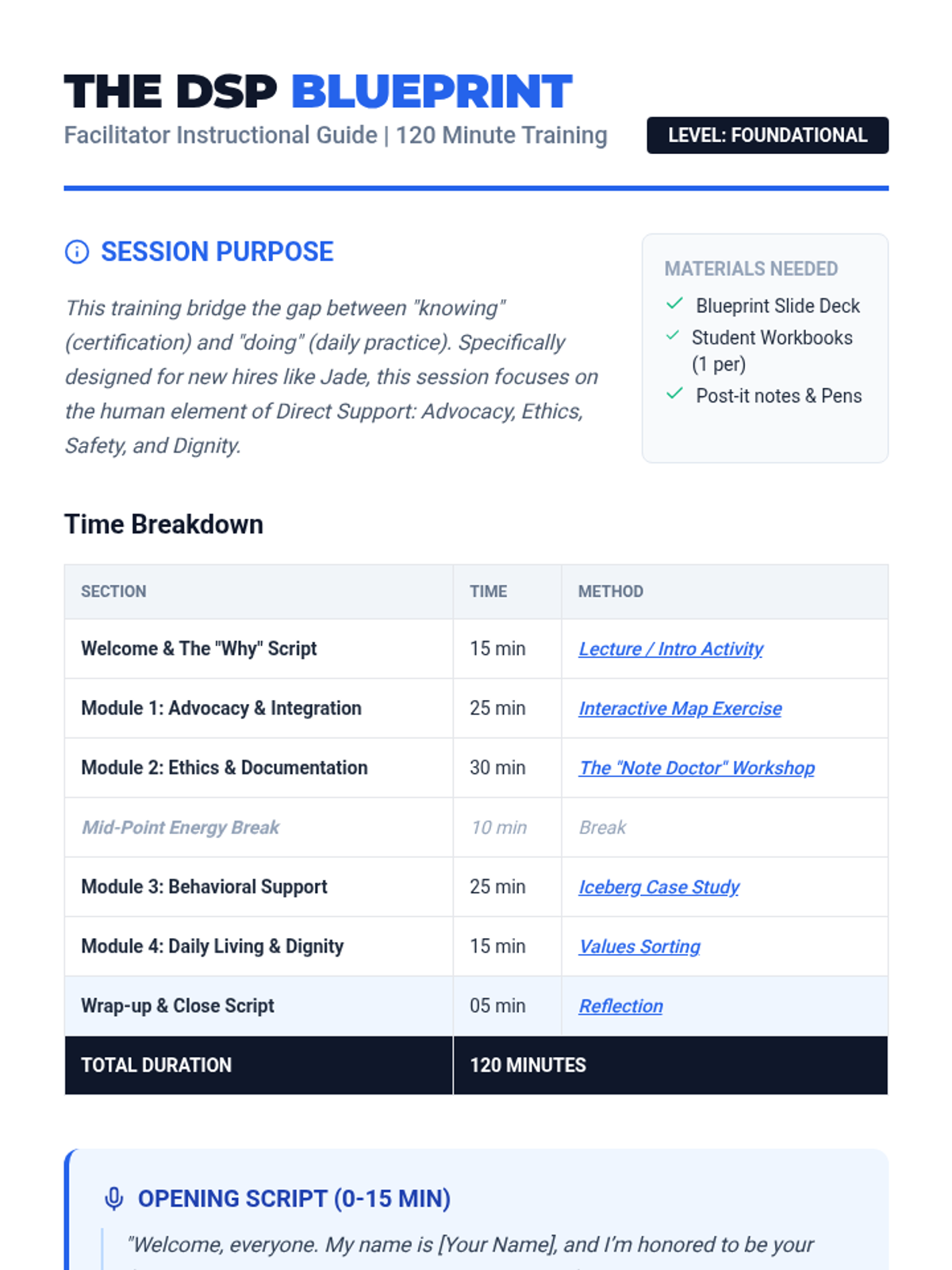
A detailed 4-page facilitator guide for a 120-minute DSP training. Includes word-for-word scripts, a minute-by-minute pacing chart, guided activity instructions, and facilitator tips for managing group dynamics.
A comprehensive 8-slide presentation deck for the 120-minute DSP training session. It covers advocacy, documentation, behavioral support, and personal care with high-visibility text and professional layout.
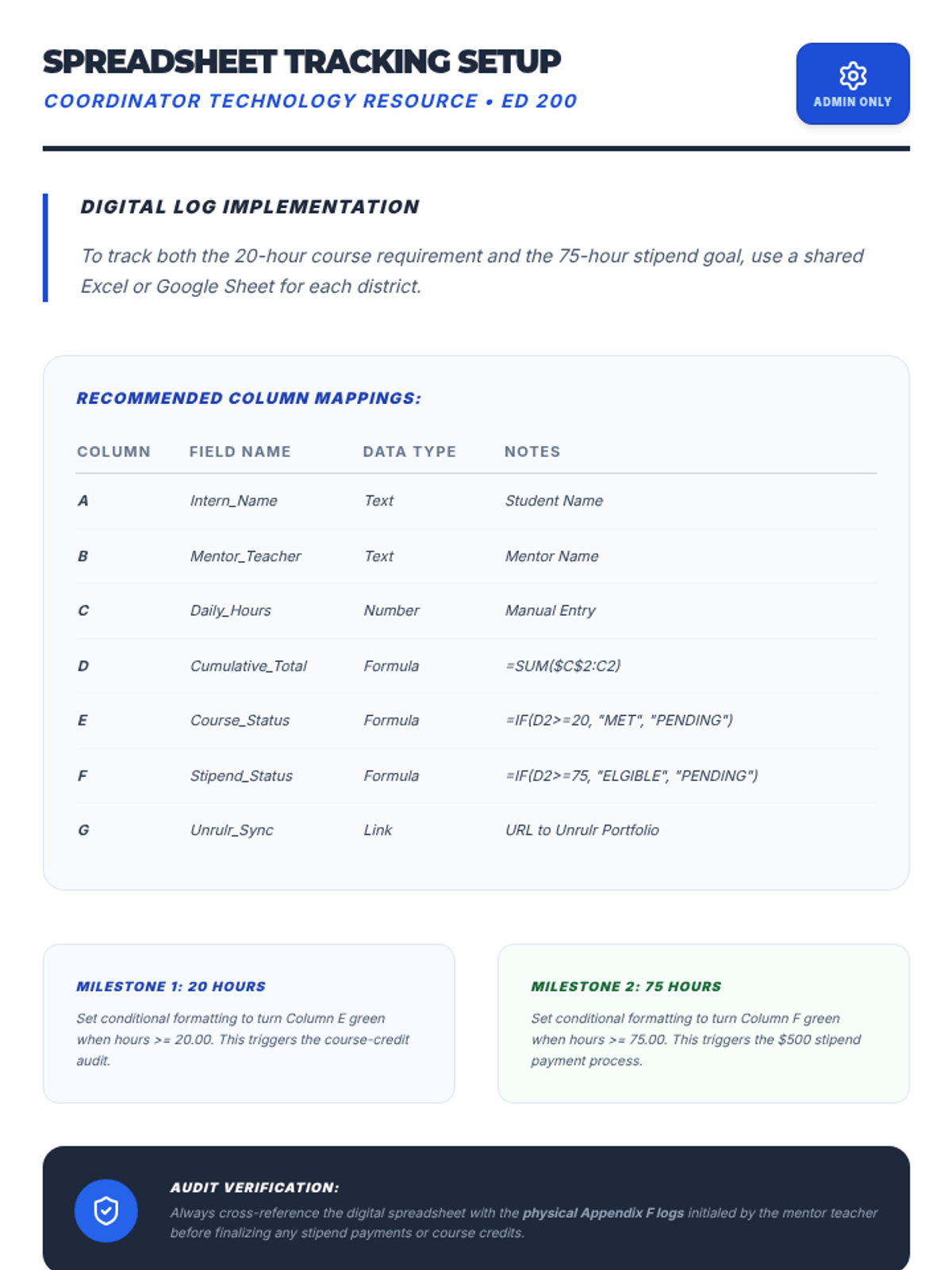
A technical implementation guide for teachers to set up a live Excel or Google Sheets log, featuring exact column mappings, daily hour formulas, cumulative total logic, and completion status alerts.
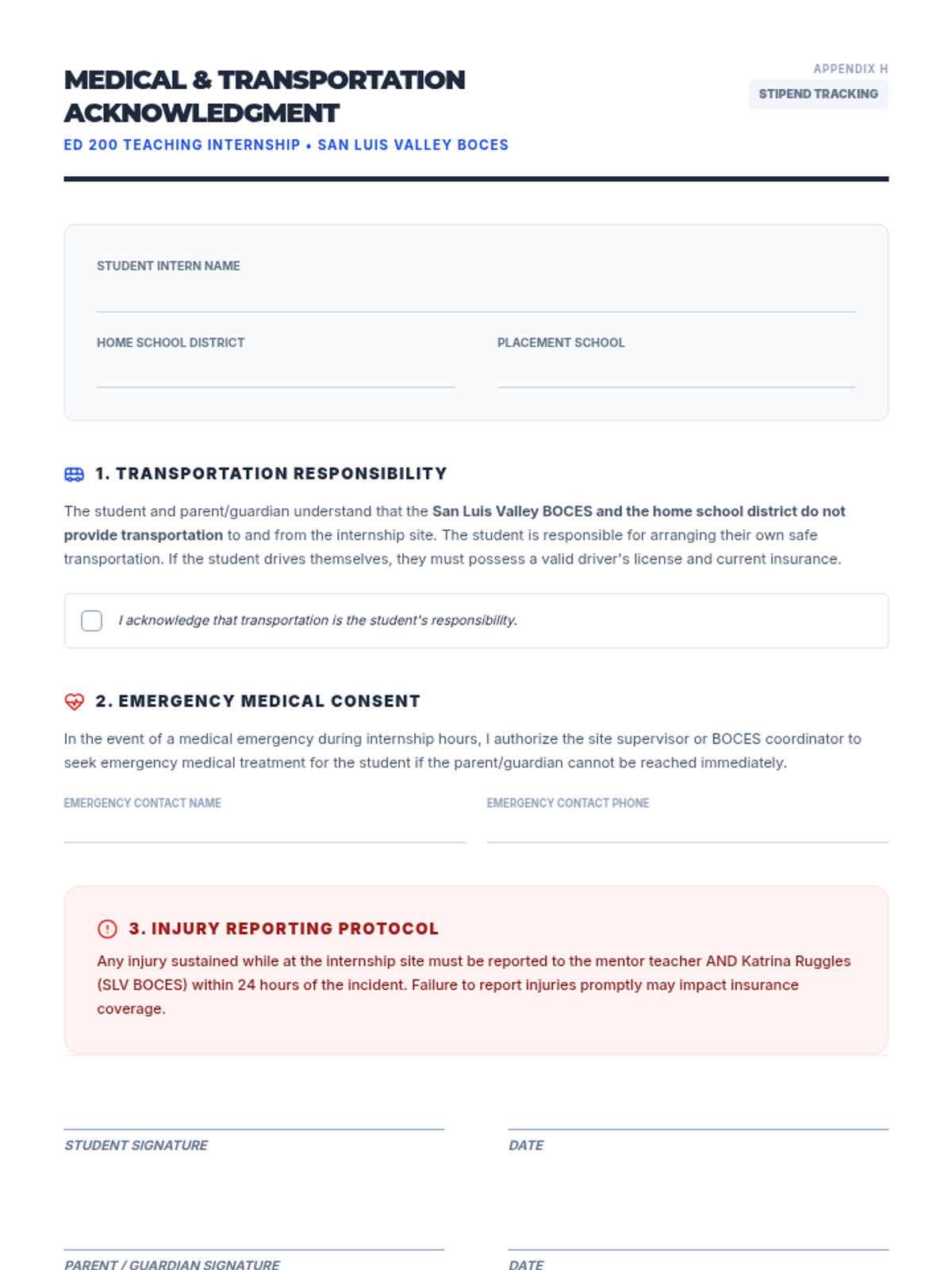
Official SLV PWR Medical & Transportation Acknowledgment form (Appendix H), detailing emergency consent, personal vehicle requirements, and injury reporting obligations.
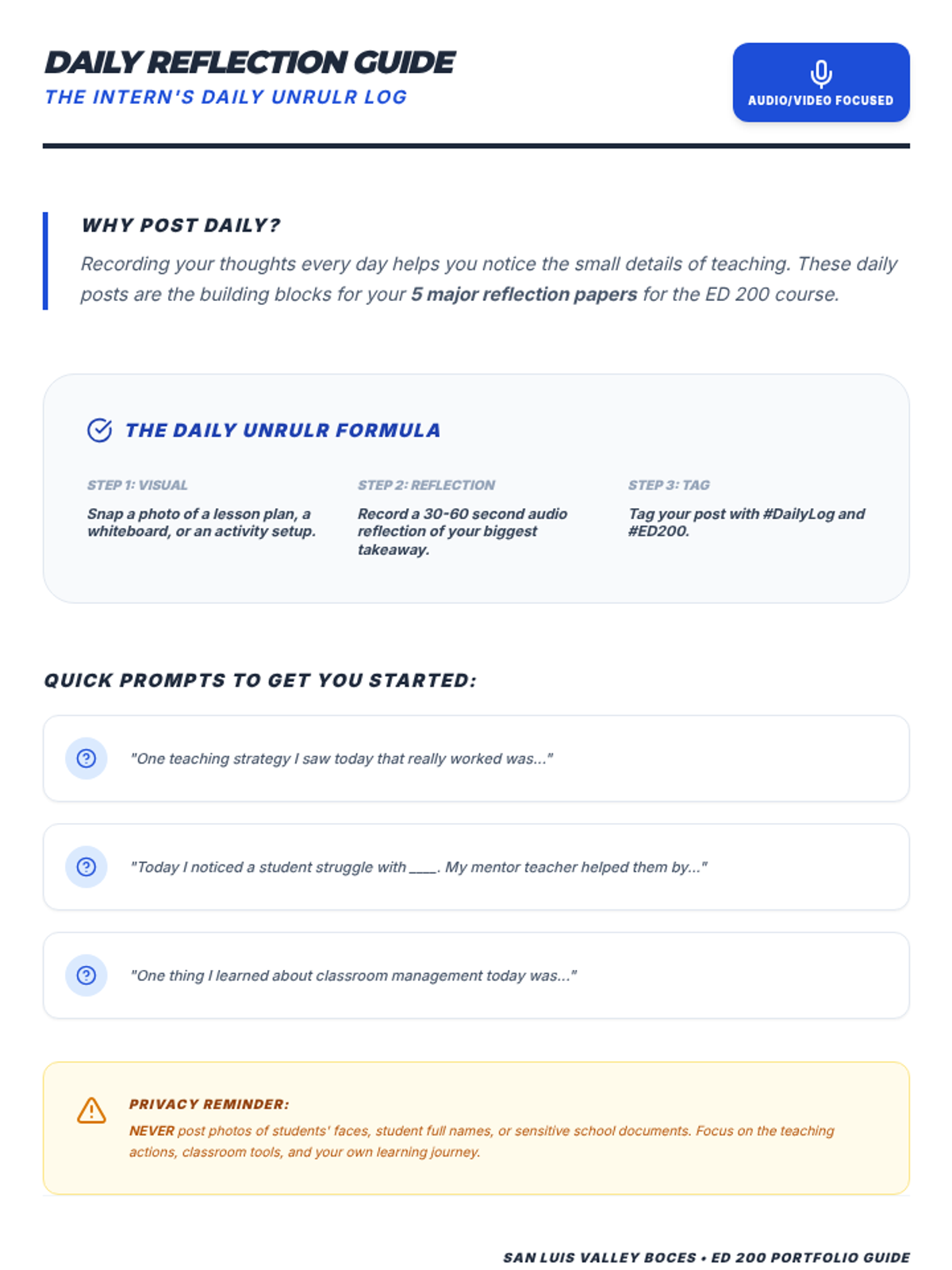
A quick-reference guide for students outlining the daily Unrulr post requirements. Prompts focus on daily tasks and learning outcomes, requiring audio or video responses paired with visual evidence.
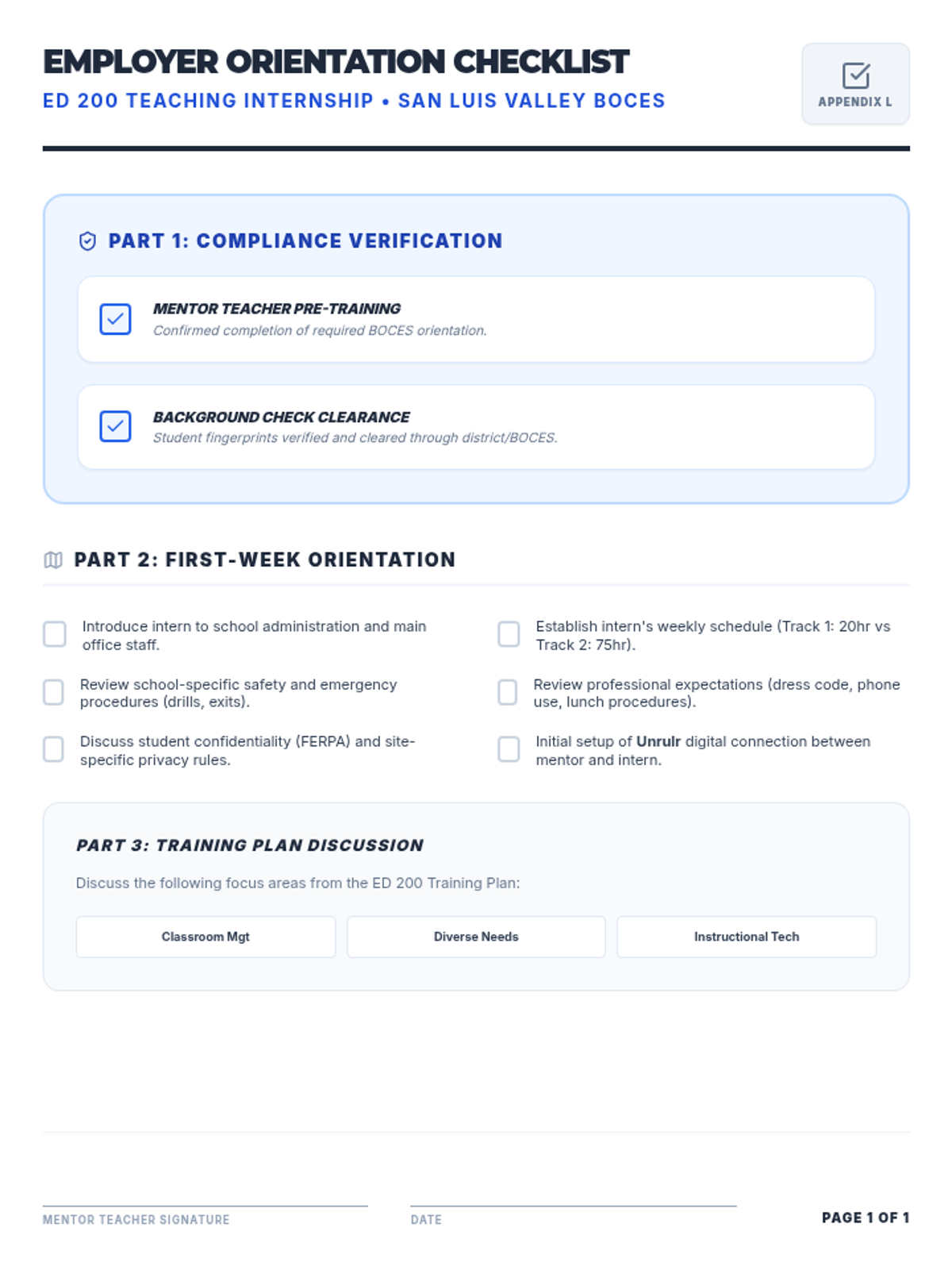
Official SLV PWR Employer Orientation Checklist (Appendix L), designed to guide the first-week onboarding process for internship hosts. Updated with Unrulr digital verification setup steps.
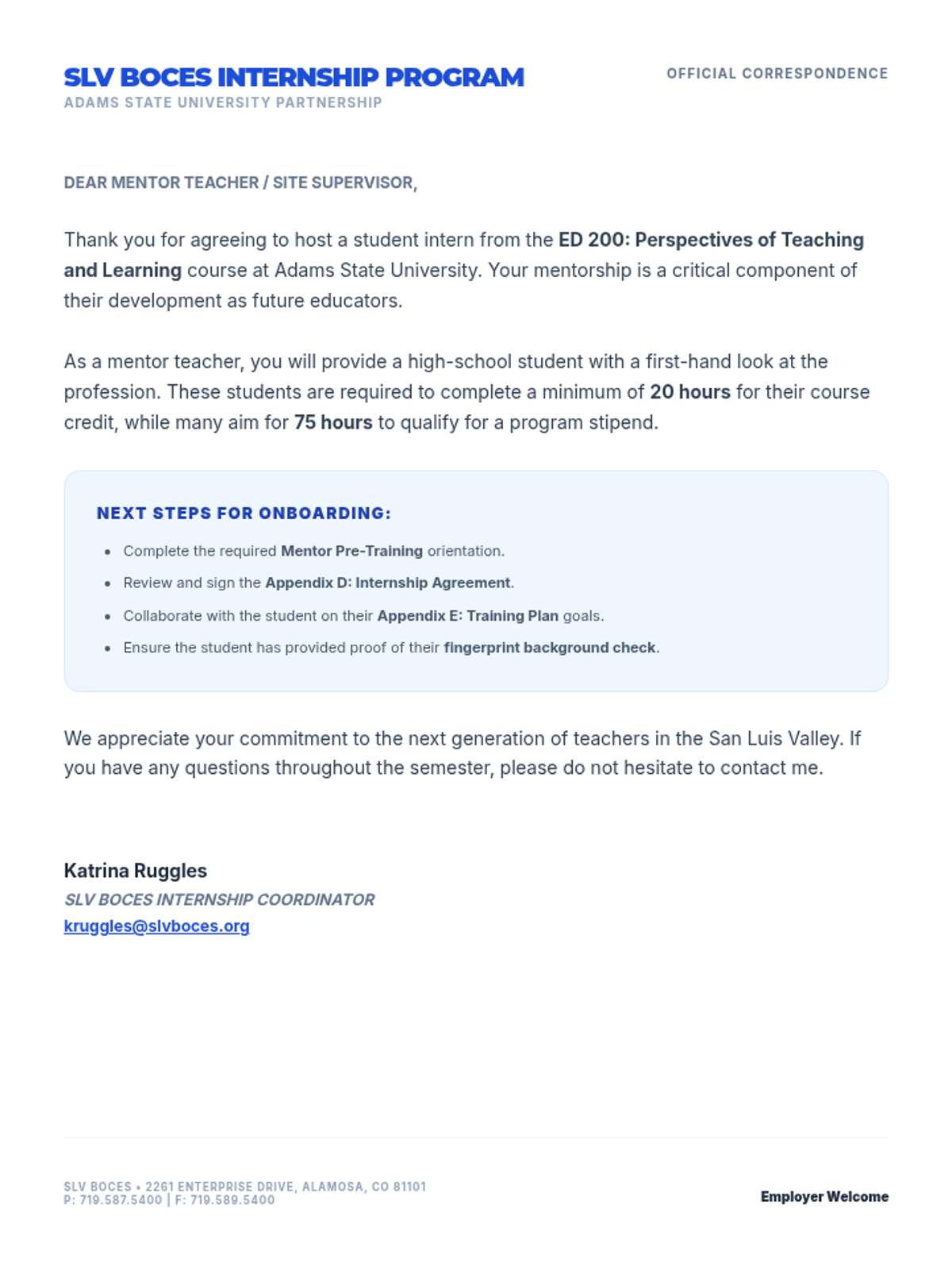
A collection of official welcome letters for employers, students, and parents, plus an optional media release form, all aligned with the SLV PWR handbook templates.
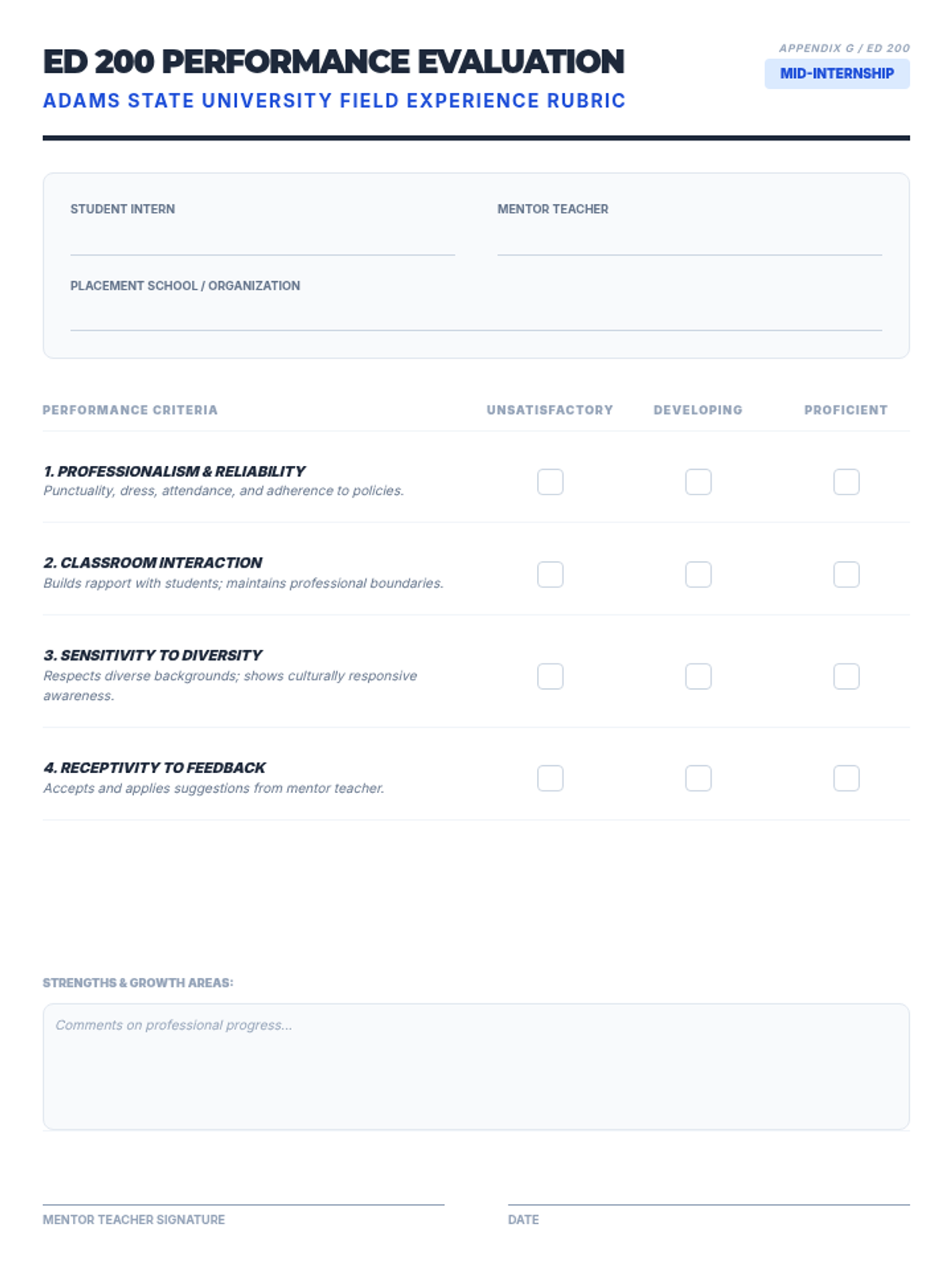
Official SLV PWR Internship Evaluation forms (Appendix G), including midpoint and final assessments based on the program's rubric. Updated with categories for professional skills, communication, thinking, and ICAP connection.
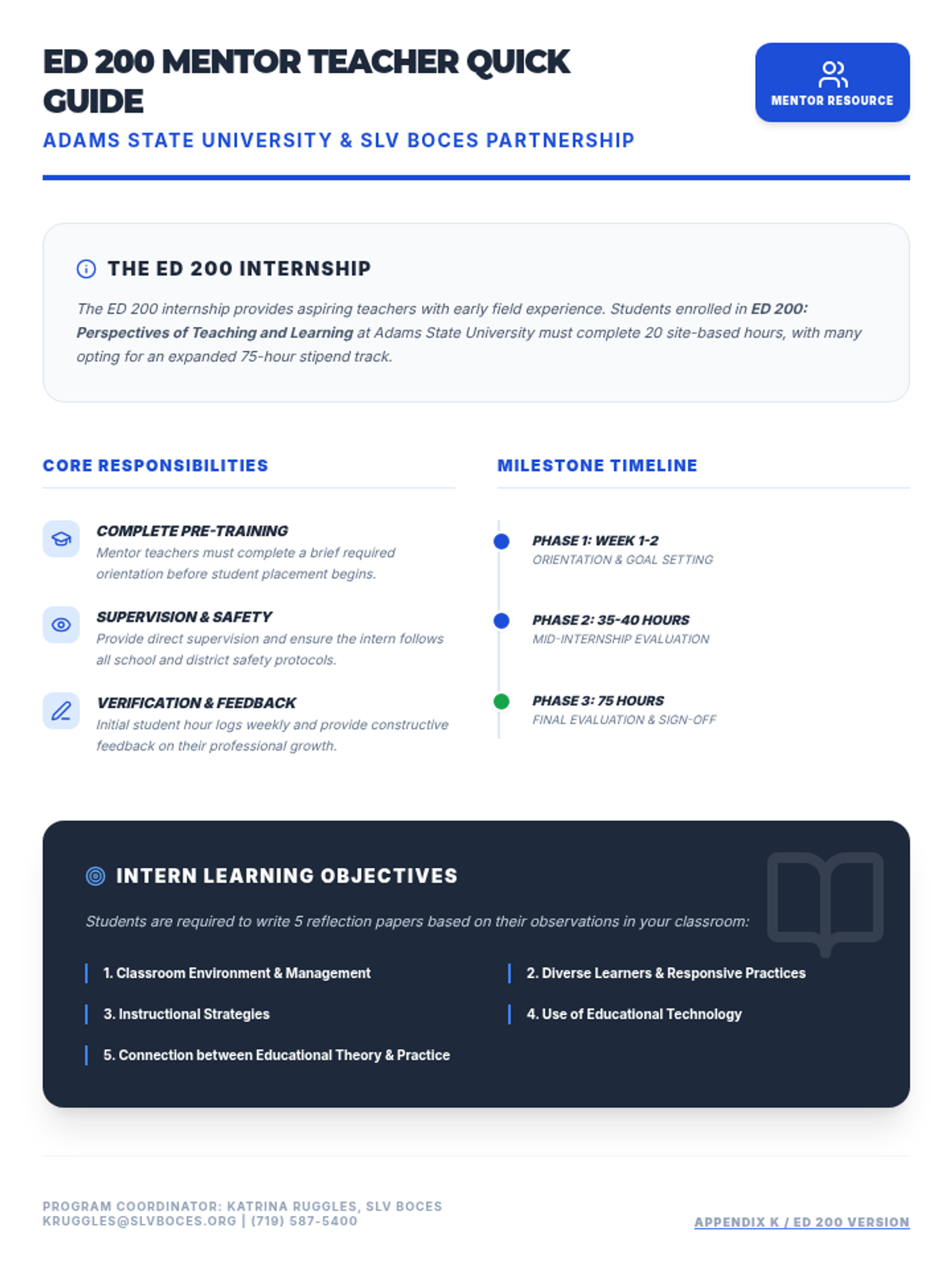
A specialized SLV PWR Employer Quick Guide (Appendix K) to provide host sites with core responsibilities, safety requirements, and program benefits. Updated with Unrulr digital verification instructions.
A detailed guide for teachers and coordinators on how to implement the internship hours log, featuring milestone tracking strategies, coaching tips for students, and a final verification checklist. Includes digital workflow instructions for Unrulr.
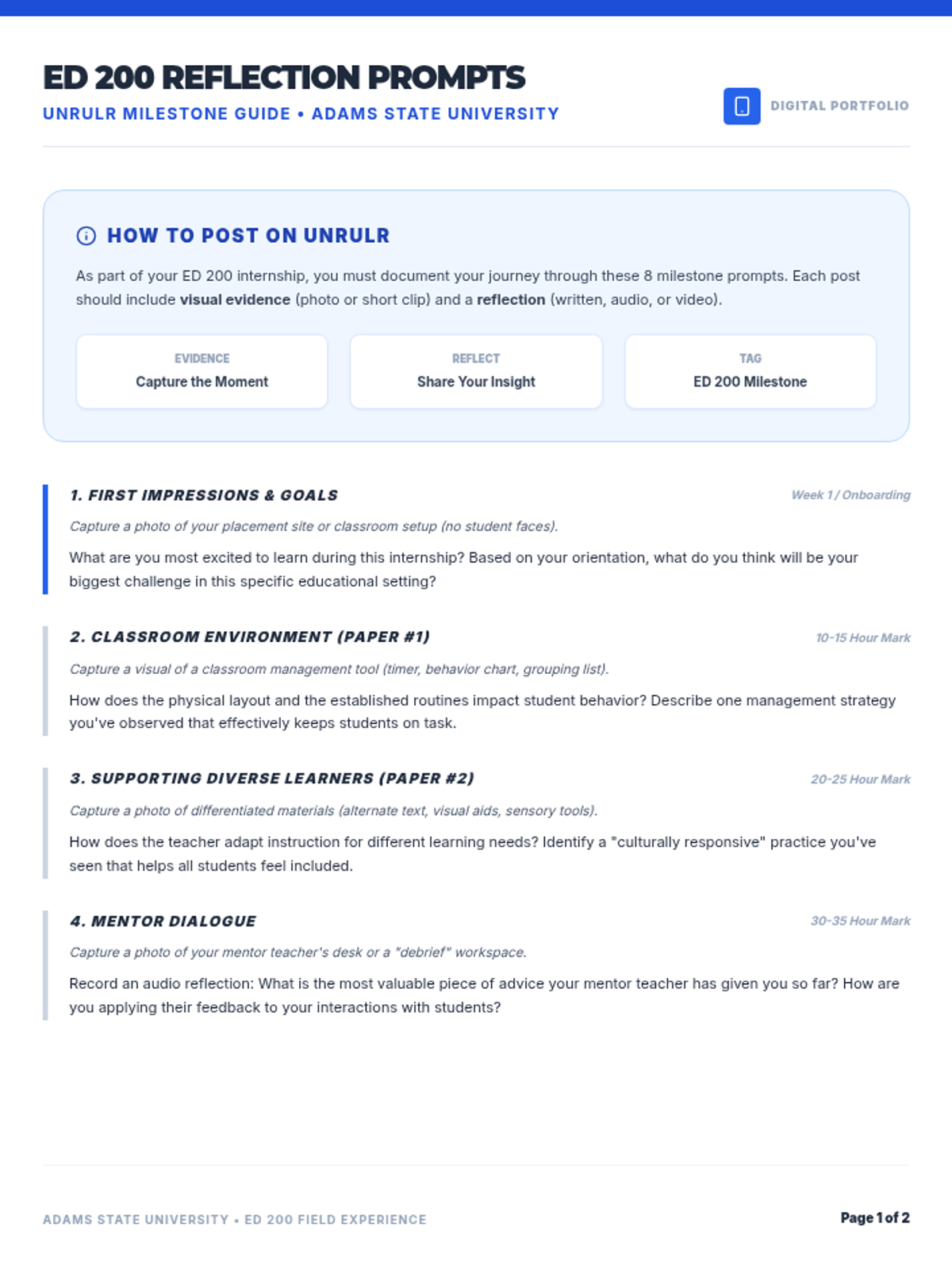
A set of 8 reflection prompts (one for each 10-hour milestone plus the final 75-hour mark) designed for Unrulr. Prompts encourage audio, video, or written responses and require visual evidence to document workplace progress.
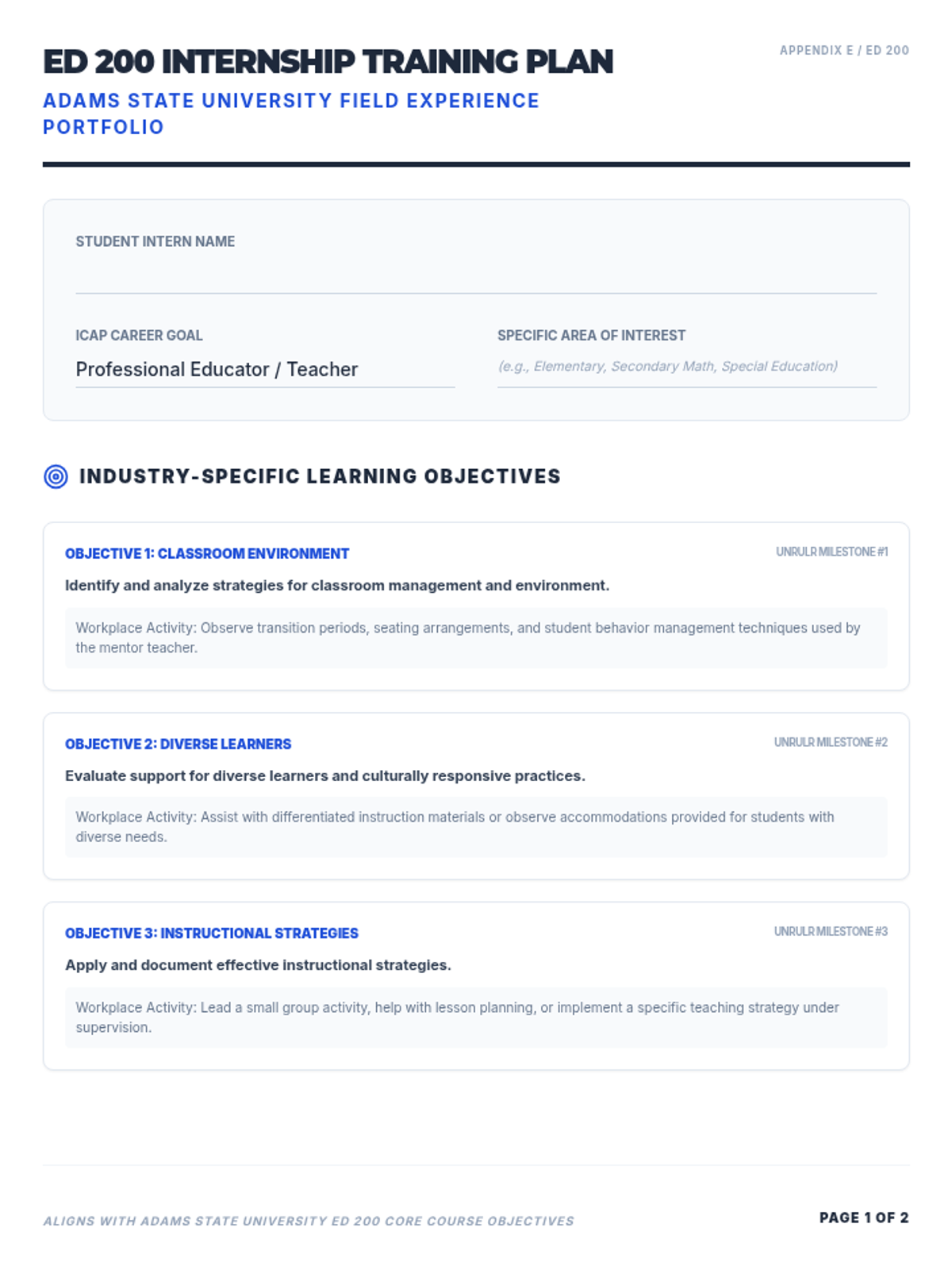
Official SLV PWR Internship Training Plan (Appendix E), outlining career goals, industry-specific learning objectives, employability skills, and supervision responsibilities. Updated with Unrulr digital verification instructions.
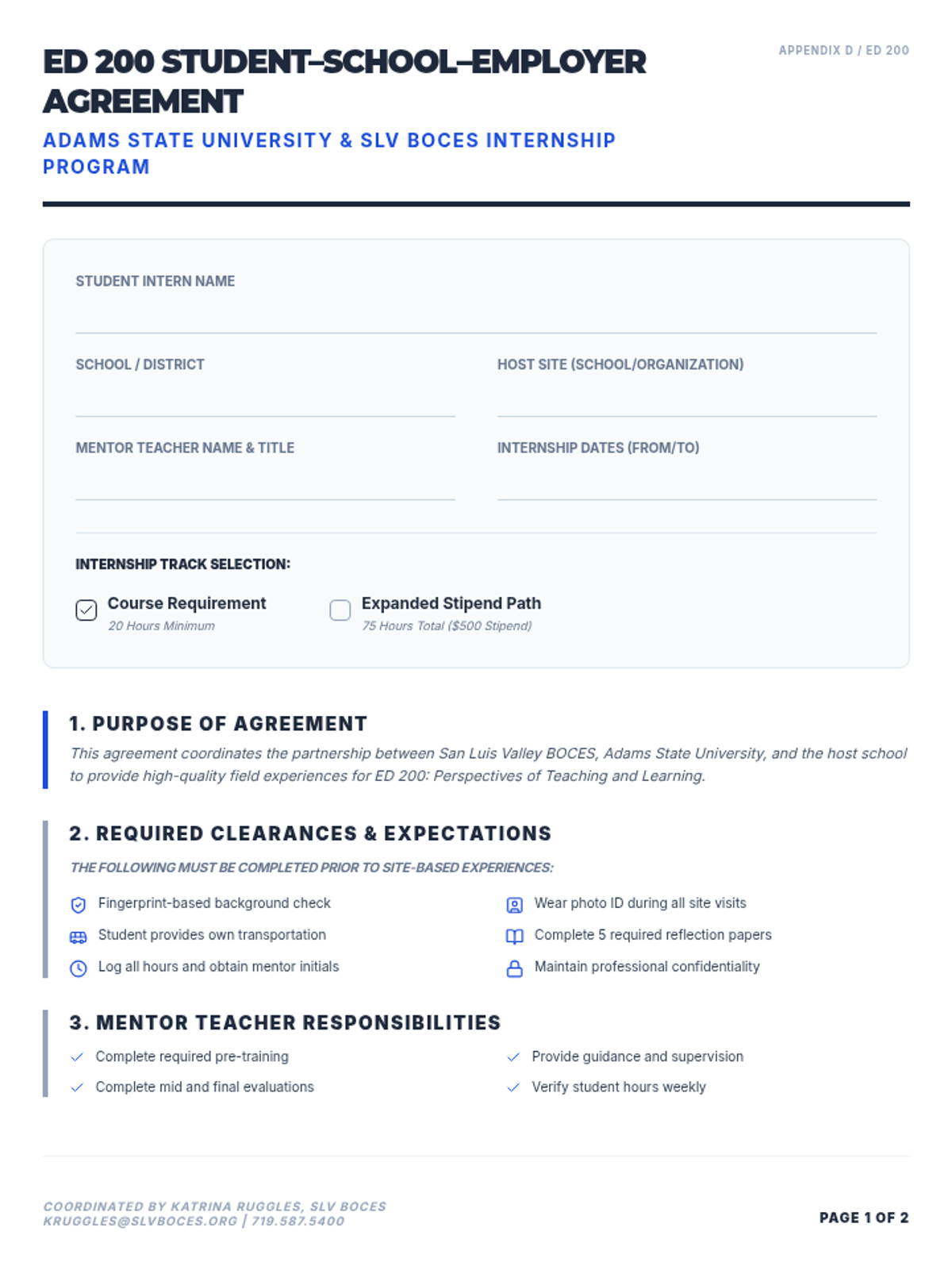
Official SLV PWR Student–School–Employer Agreement (Appendix D), featuring core responsibilities, workers' compensation notice, and required sign-off sections.
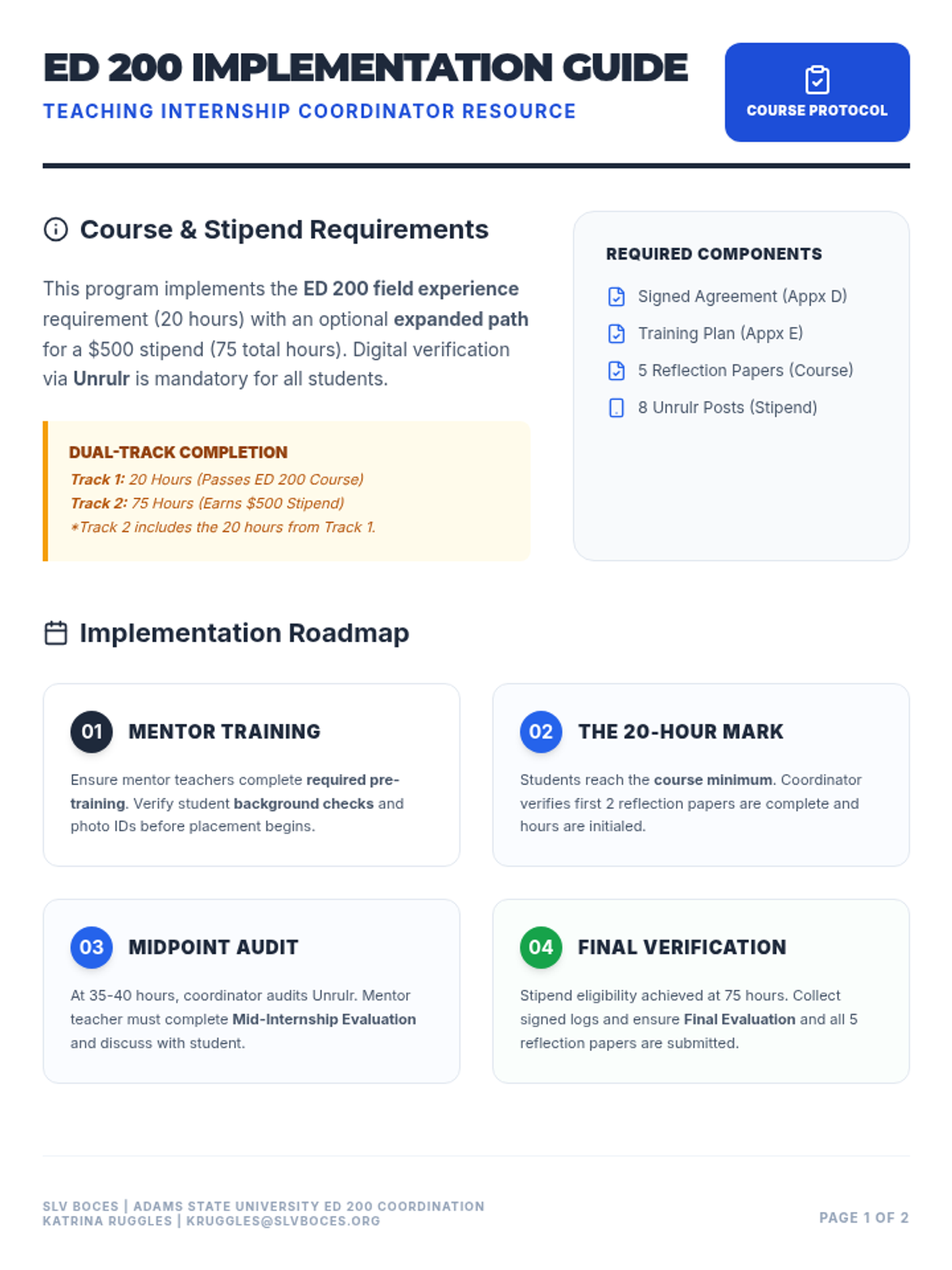
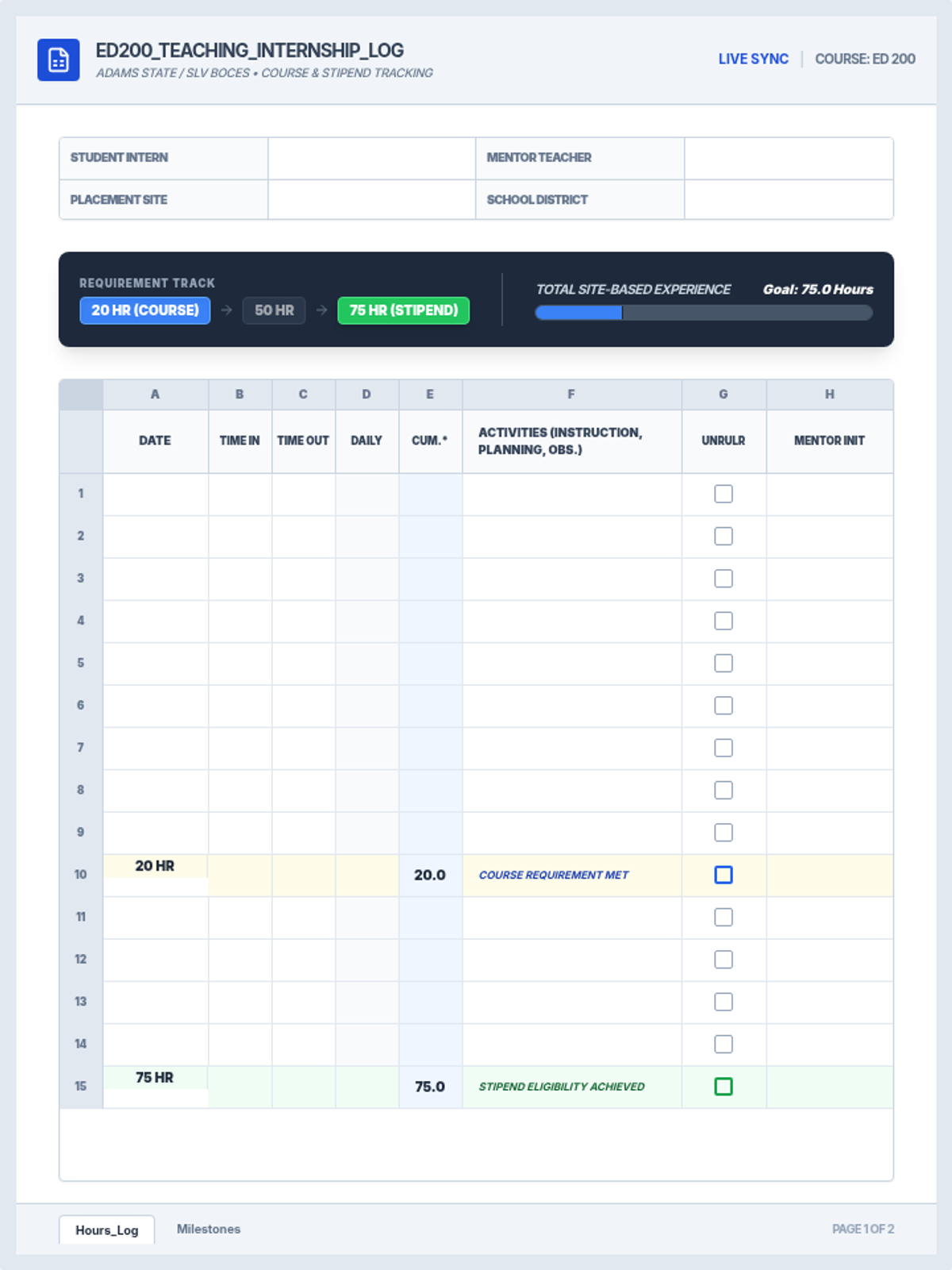
A specialized ED 200 internship hours log aligned with Adams State requirements, featuring tracking for both the 20-hour course minimum and the 75-hour stipend goal. Includes check-offs for mentor teacher evaluations and the five specific Unrulr reflection milestones.
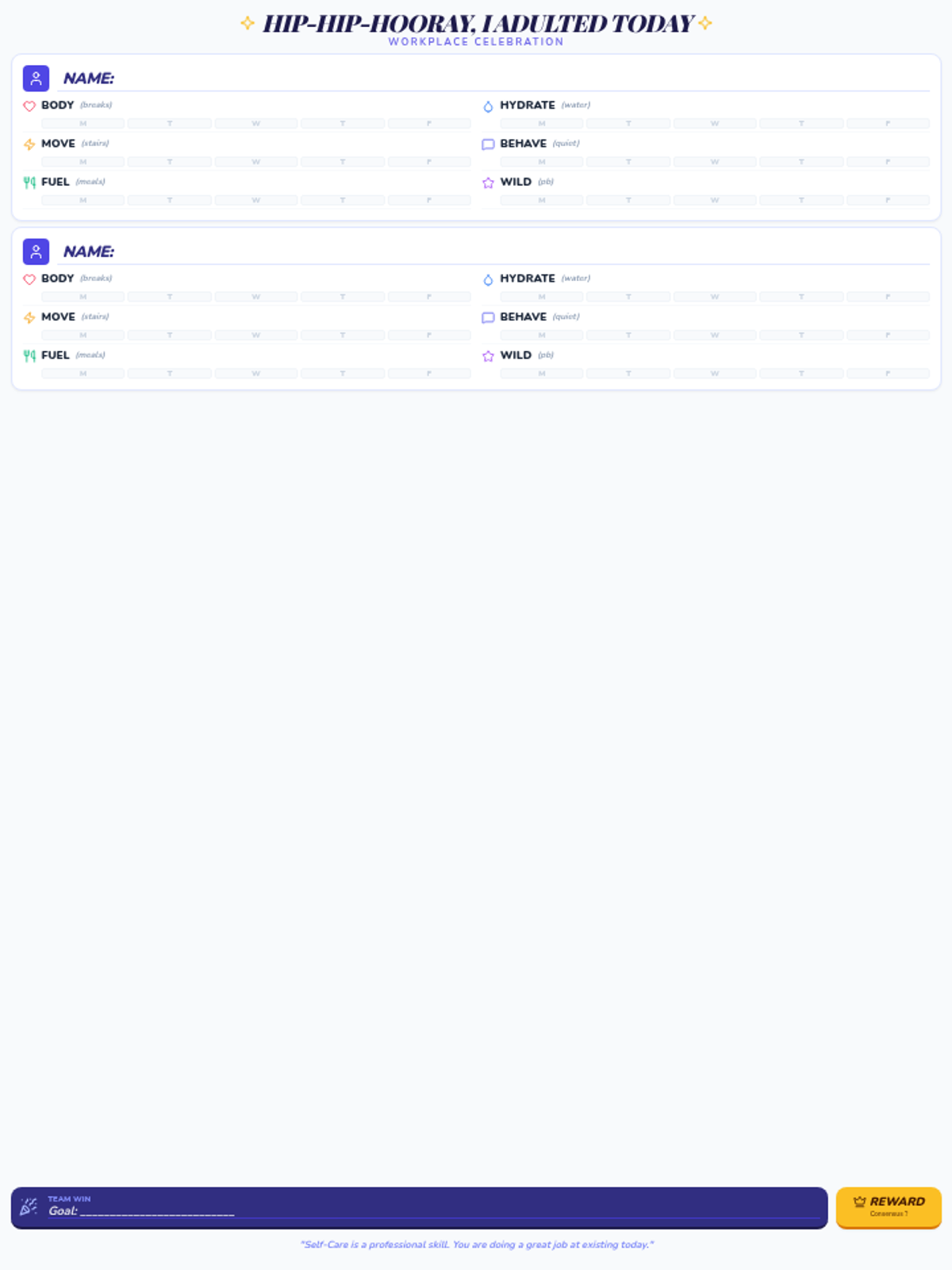
The ultimate compact version of the Adulting Celebration Chart with ultra-reduced line spacing and minimal vertical gaps. It utilizes tiny icons, condensed font sizes, and tight leading to provide a high-density workplace tracking experience that fits multiple players and comprehensive metrics in a single printable view. It moves metric descriptions inline to save vertical space.
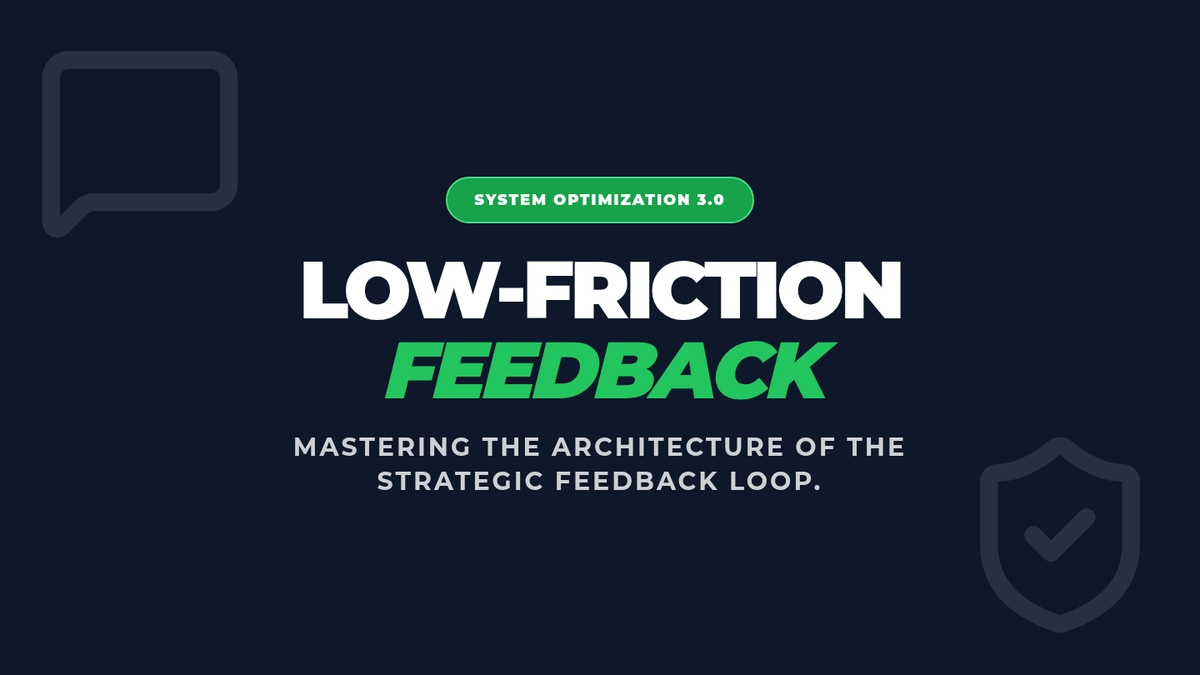
Advanced slides for Session 3. Replaces space themes with 'Social Engineering' logic, explaining the 'Amygdala Hijack' as a system firewall. Includes a micro-story case study to deepen instructional timing. Includes 'Strategic Replay' simulations. resolved orphan quotes and tracking. final polish.
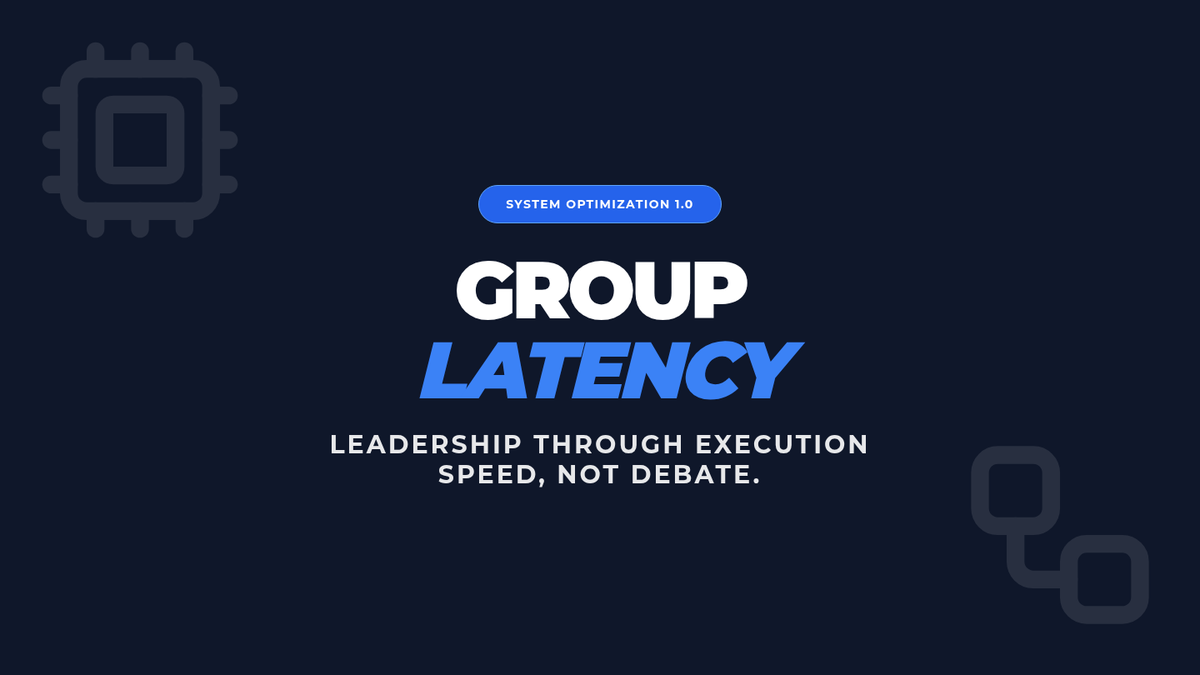
Advanced slides for Session 1. Replaces space themes with 'System Latency' logic, framing following directions as a system efficiency move. Includes the full 'Zero Query' execution test with all 5 commands. resolved orphan quotes and contrast issues. final polish.
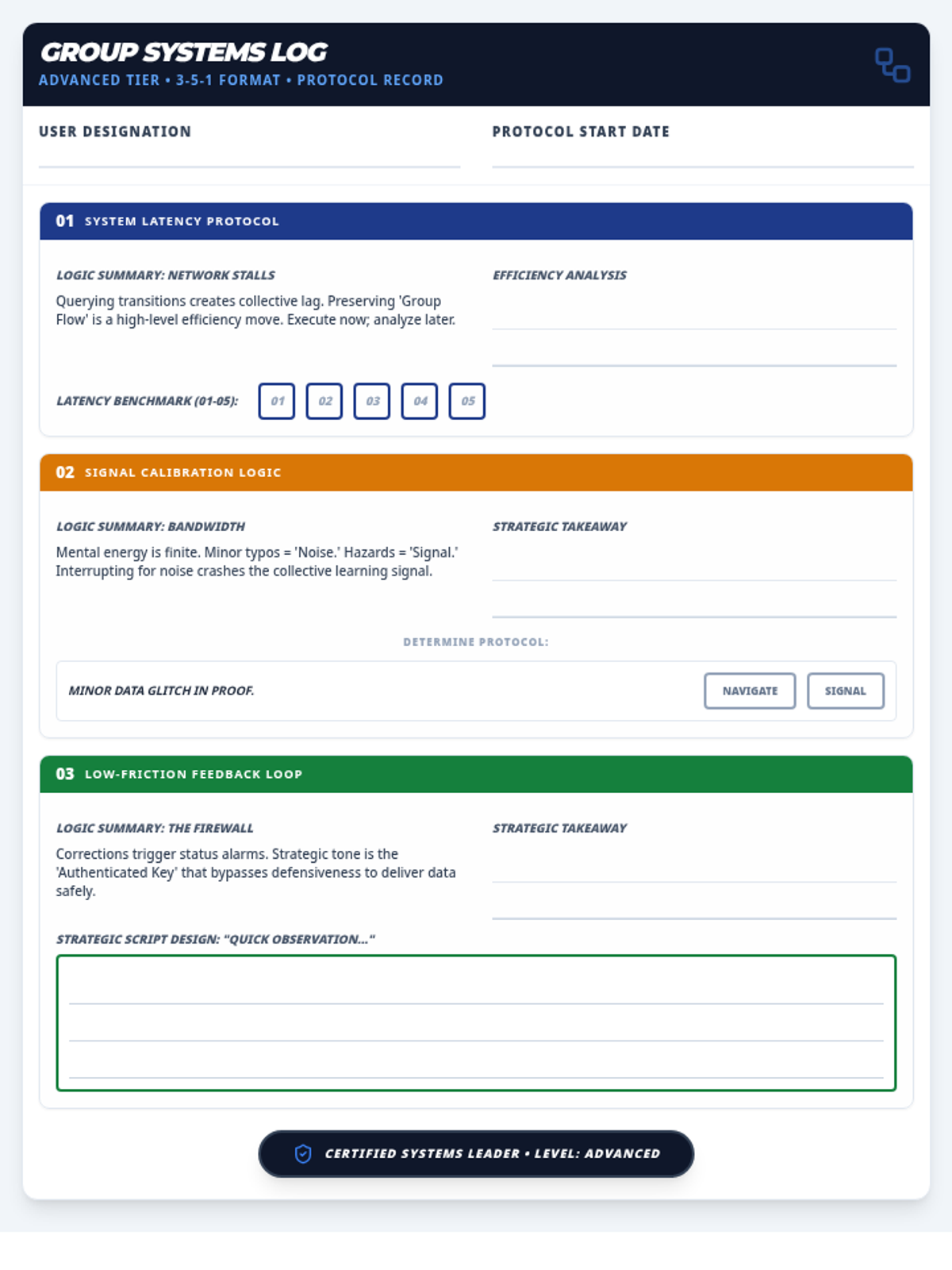
An advanced 1-page student system log. Uses high-level professional framings (User Designation, System Latency, Social Firewall) to teach classroom cooperation. Includes brief 'Systems Logic' summaries for each session. Optimized for single-page use. Revised for legibility and spacing. final polish.
Advanced slides for Session 2. Replaces space themes with 'Signal-to-Noise' logic, framing corrections through 'Cognitive Load Theory'. Revised for improved contrast and uniform scenario styling. resolved italicization cues.
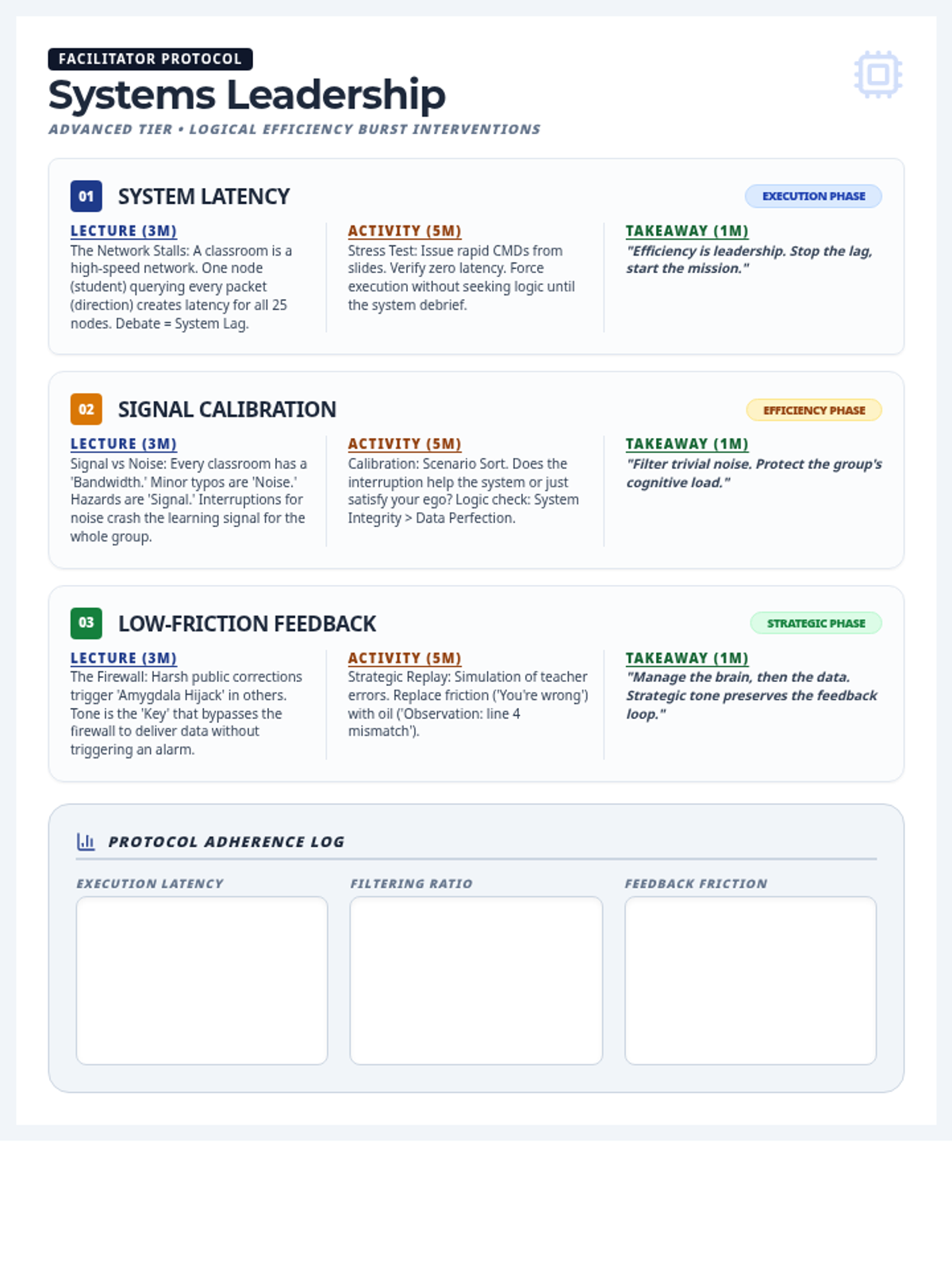
A sophisticated 1-page teacher guide for three 10-minute sessions. Uses 'Systems Thinking' and logical efficiency concepts (Latency, Signal-to-Noise, Firewalls) to frame leadership for advanced students. Optimized for single-page use. Revised padding, spacing, and log box size.
A visually engaging slide deck designed to introduce students to the Mission Ignition protocol. It covers the 'Frozen Brain' problem, the Chunking Maneuver, the 5-Second Countdown, and the 5-Minute Burn, ending with a call to action.
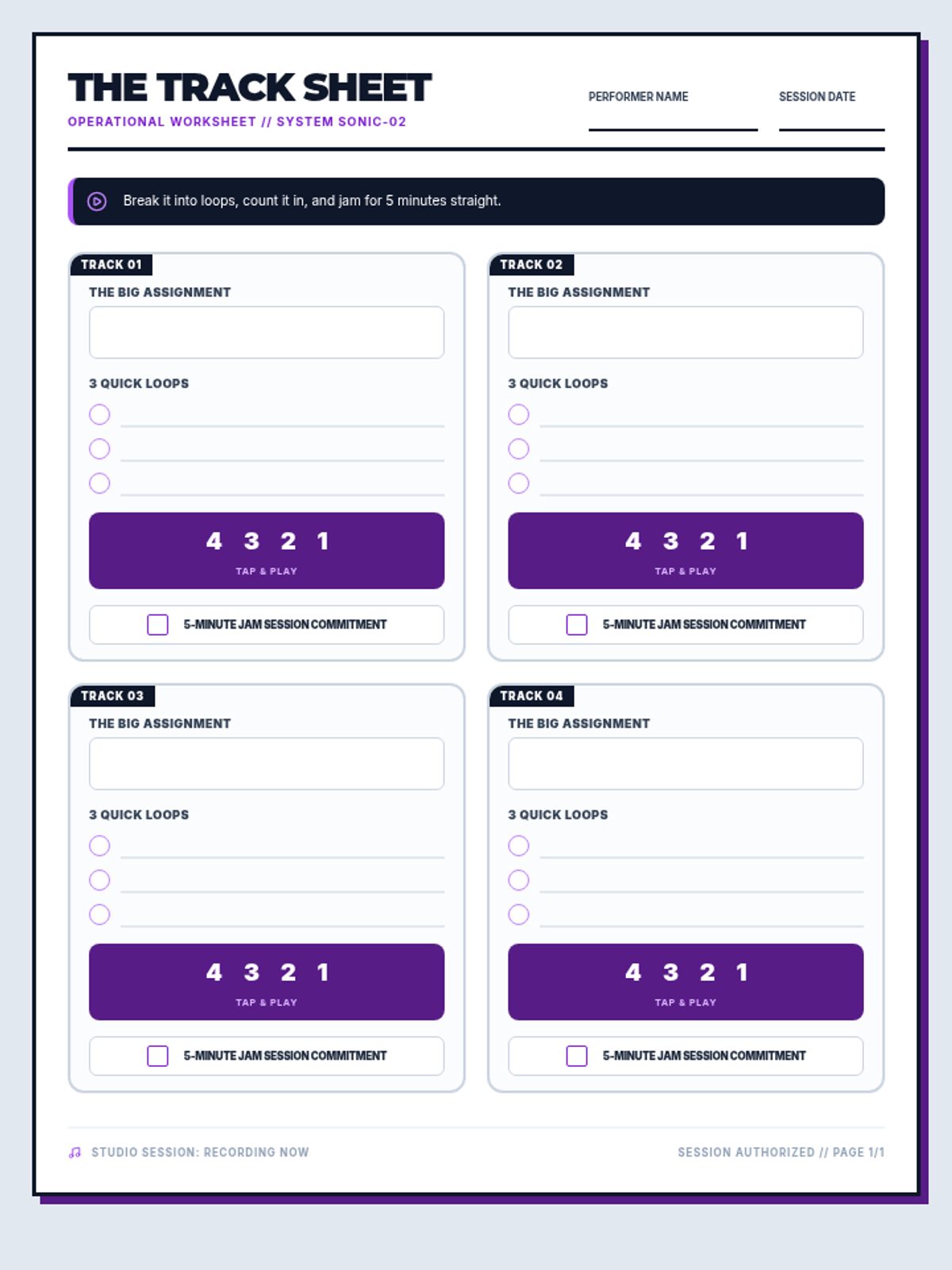
A student-facing worksheet featuring four 'Track Slots' to help students break down overwhelming tasks into small loops, perform a 4-beat count-in, and commit to 5 minutes of focused work.
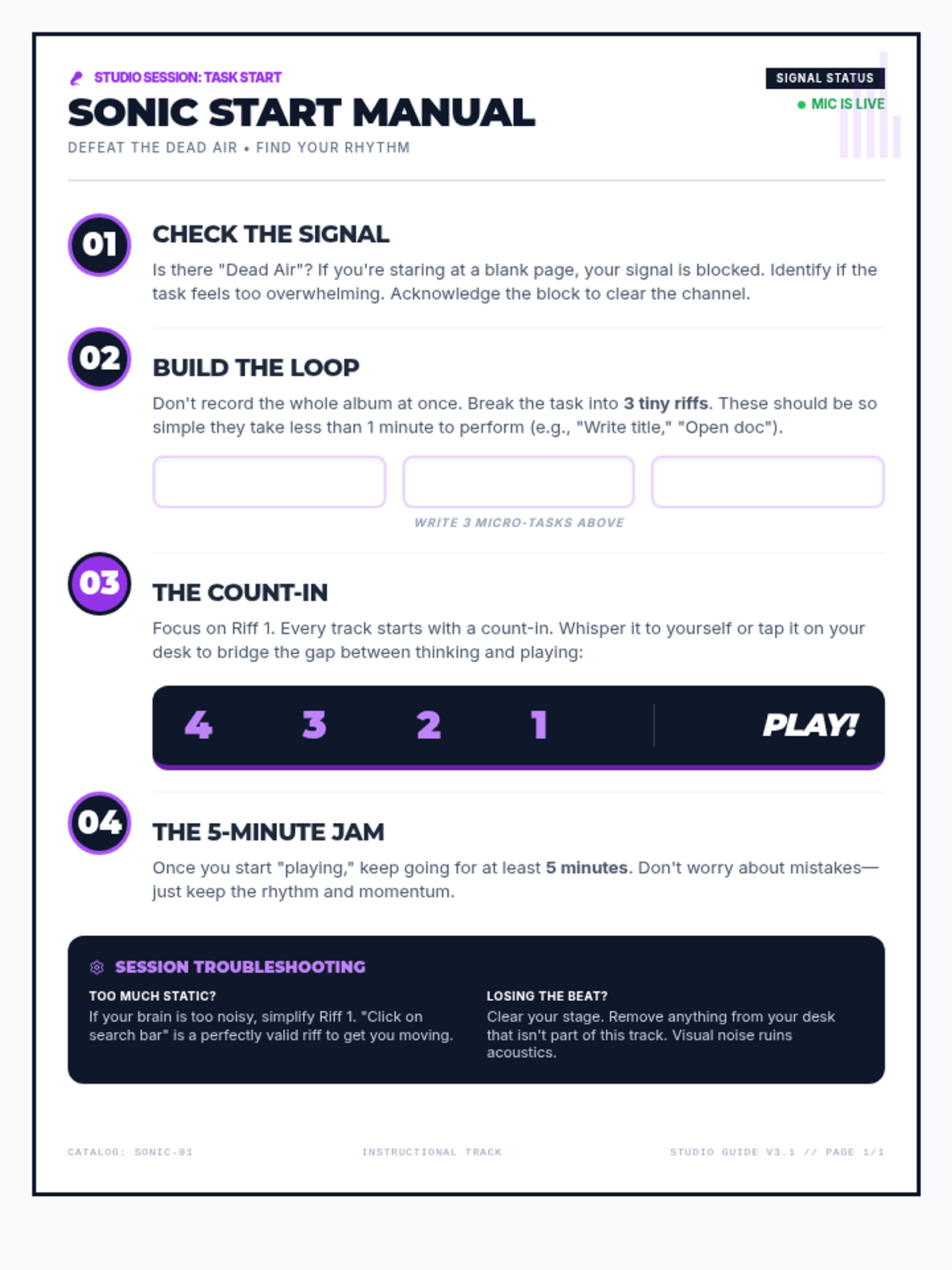
An instructional reference guide designed as a technical studio manual, providing a clear 4-step protocol for task initiation in the classroom. It includes identifying the block, building loops, the count-in, and the 5-minute jam session.
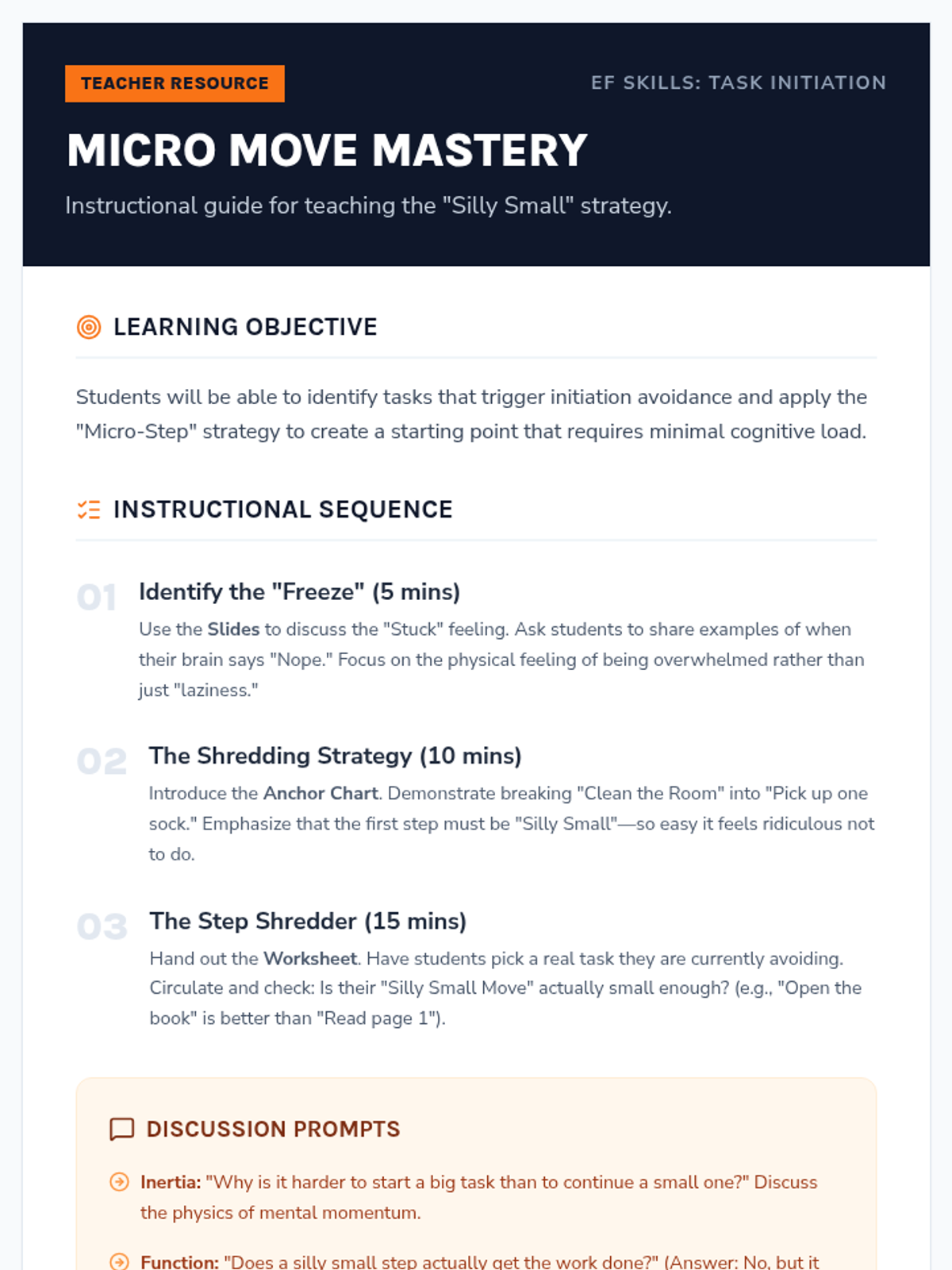
A comprehensive teacher guide for the Micro Move Mastery lesson, including learning objectives, lesson flow, and discussion prompts for task initiation.
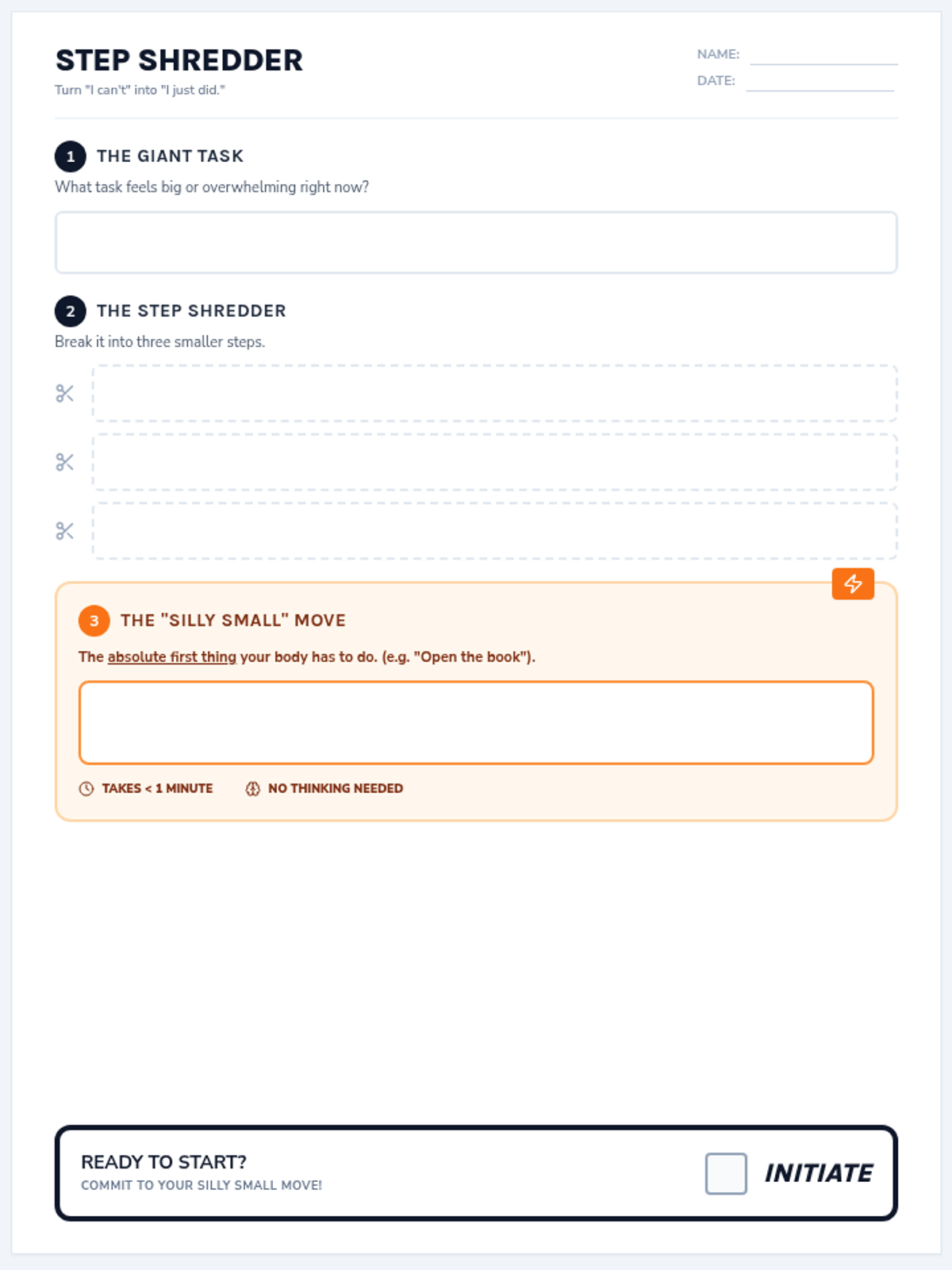
A practical worksheet designed to help students identify a large task, break it down into medium steps, and ultimately isolate a 'Silly Small' move to initiate work.
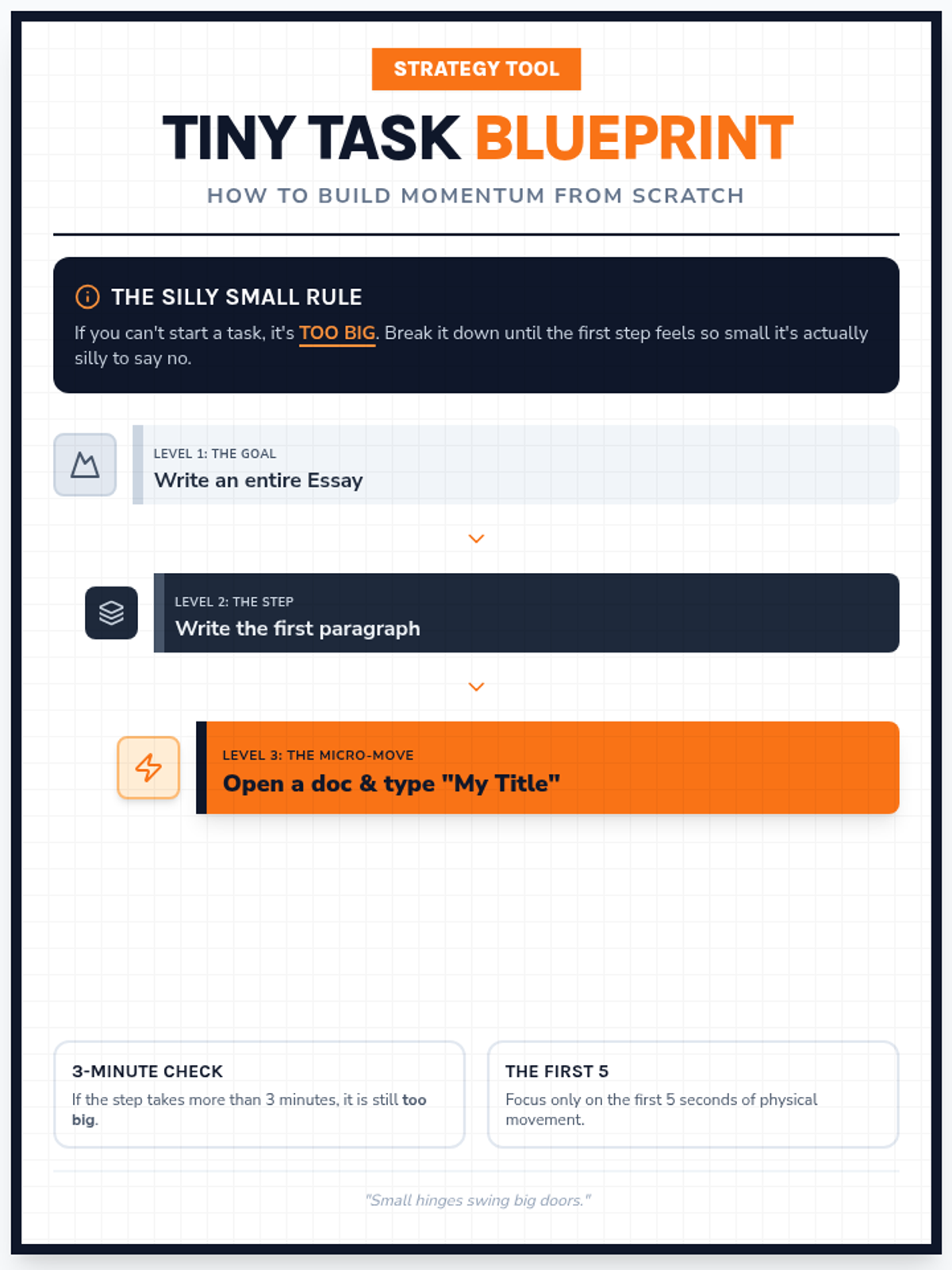
A visual anchor chart illustrating the 'Tiny Task Blueprint' strategy, showing how to break a giant goal down into a micro-move.
A slide presentation introducing the concept of micro-steps to overcome task initiation struggles, featuring the 'Silly Small Rule' and visual examples.
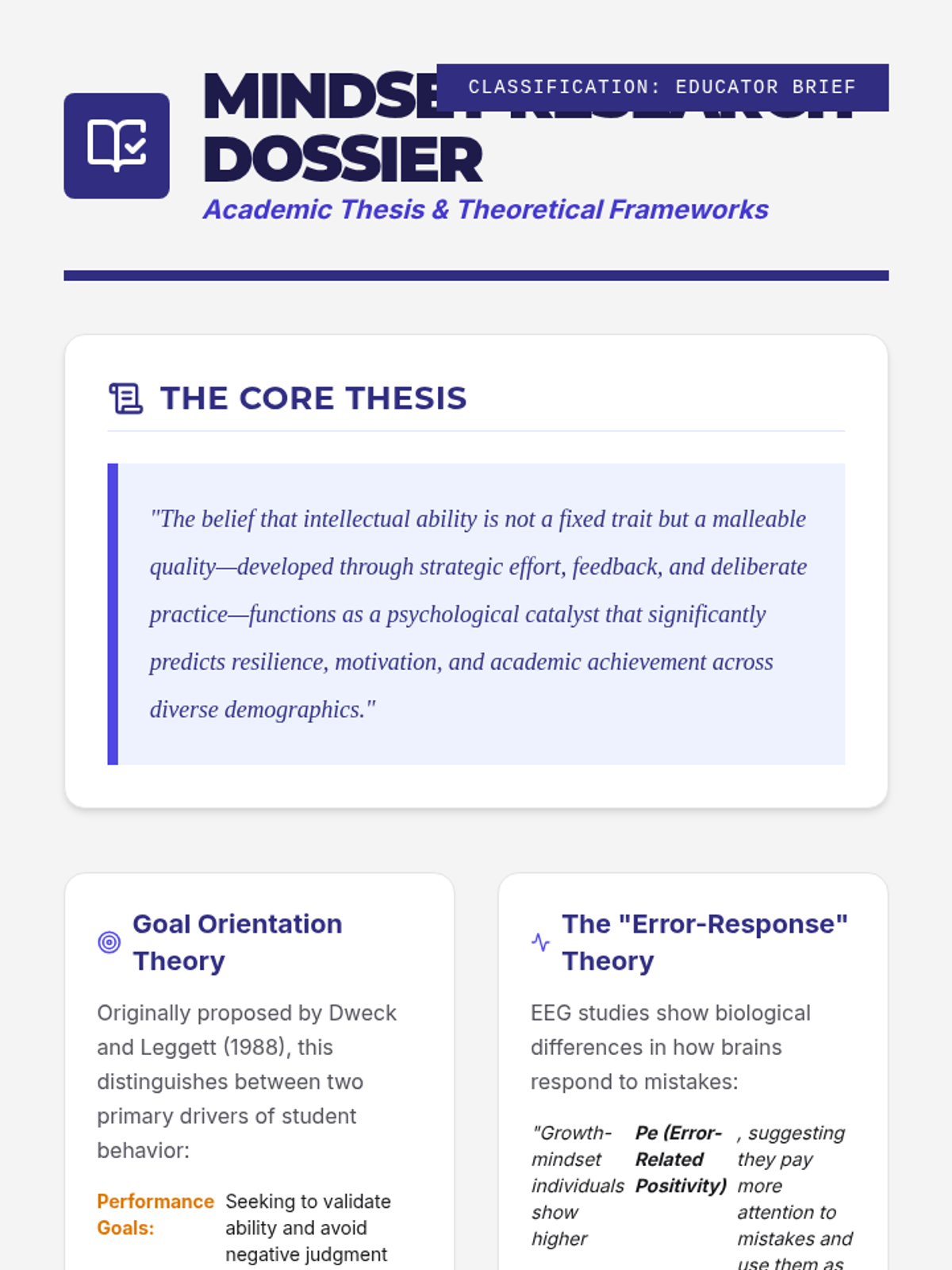
An academic-style teacher reference guide containing deep-dive theories of growth mindset, foundational research theses, and neurological evidence of neuroplasticity.
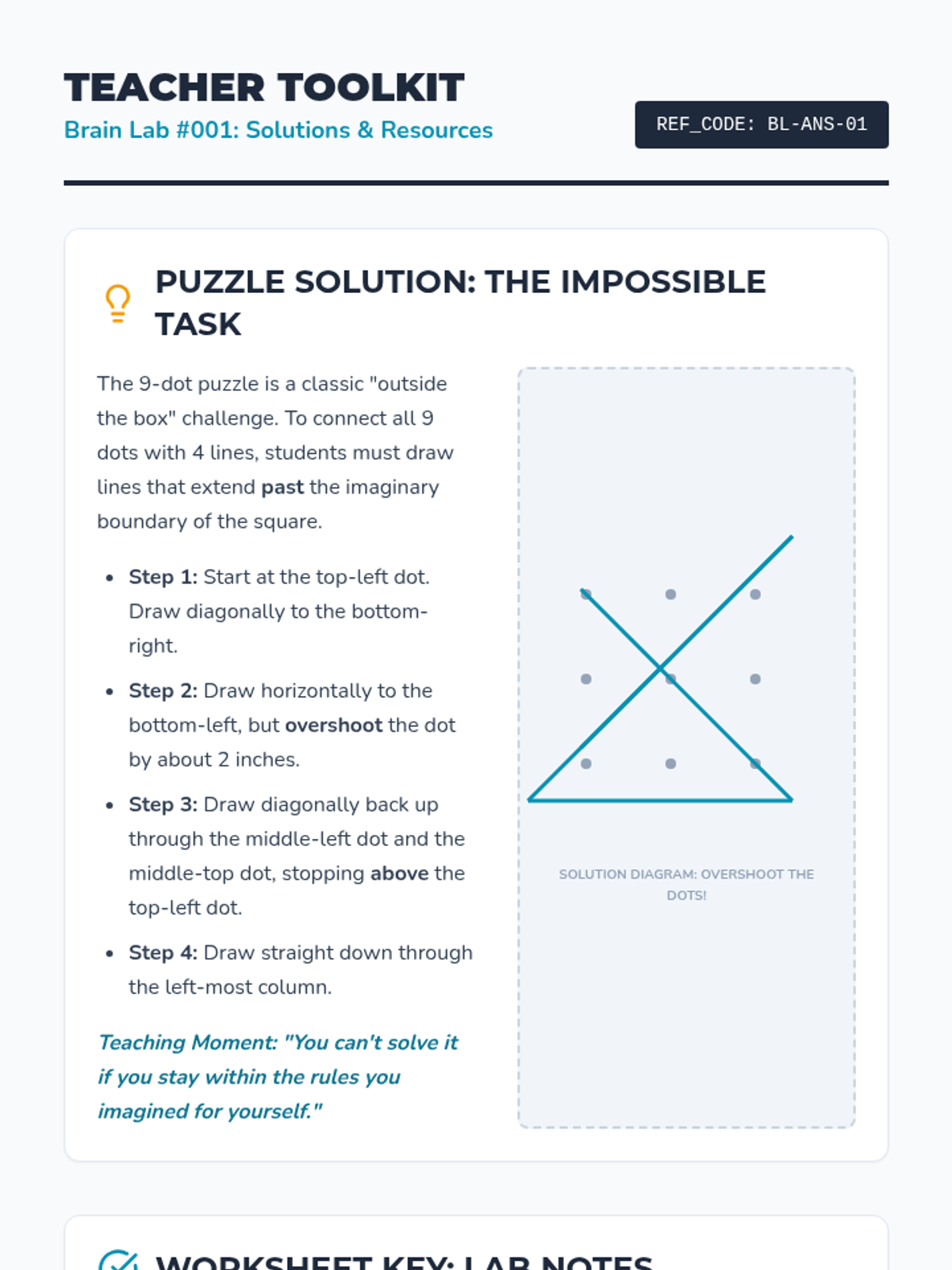
A teacher resource providing the solution to the 9-dot puzzle, an answer key for the Experiment Log worksheet, and a curated list of video recommendations to complement the lesson.
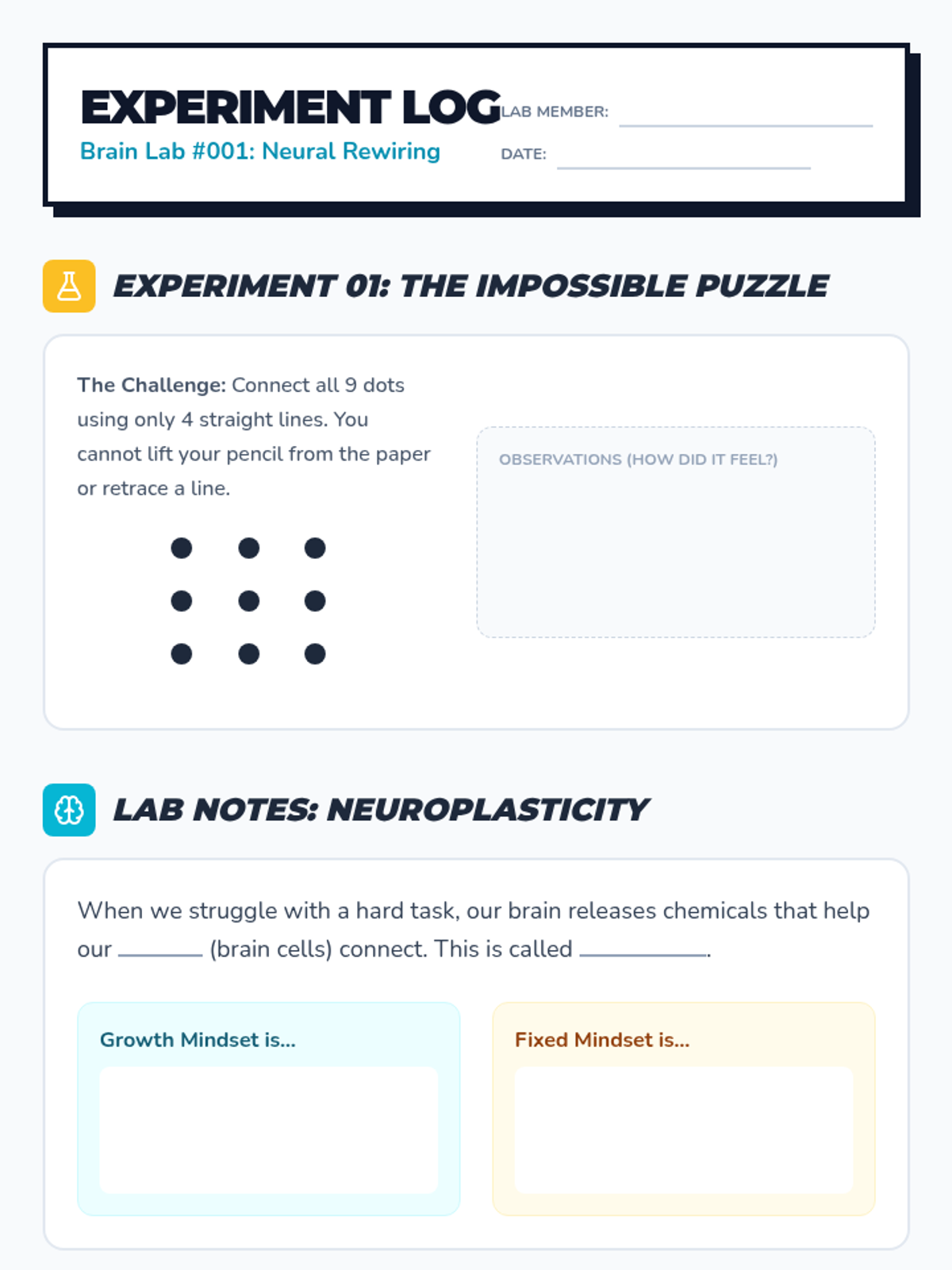
A laboratory-themed student worksheet designed to accompany the Brain Lab lesson. It includes a logic puzzle challenge, fill-in-the-blank neuroplasticity notes, a "Flip the Script" mindset activity, and a goal-setting section.
A high-energy, laboratory-themed slide deck for a growth mindset lesson. It covers neuroplasticity, the 'Impossible Task' challenge, the difference between effort and strategy, and the power of the word 'Yet'.
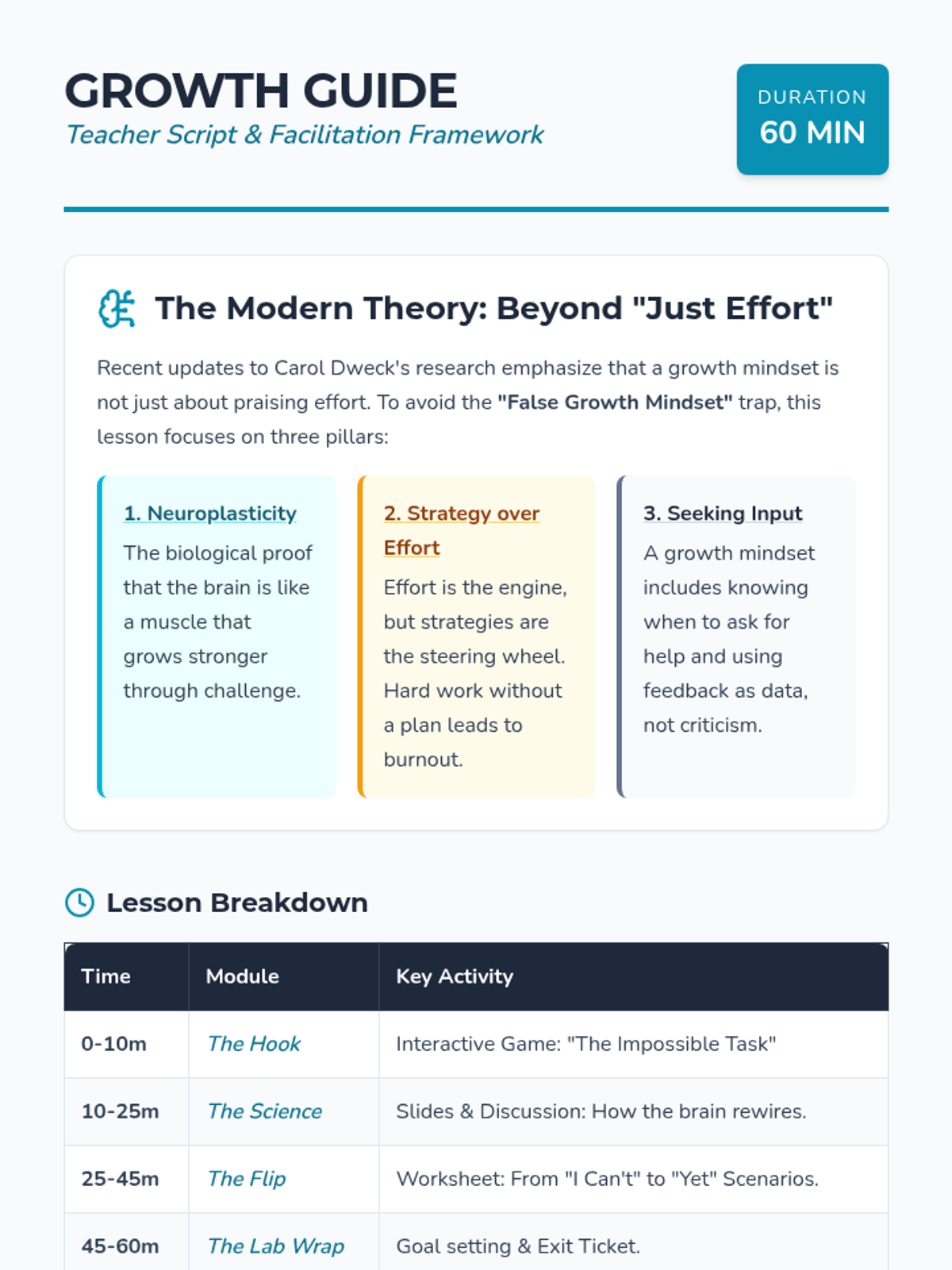
A comprehensive teacher facilitation guide for a 60-minute growth mindset lesson. It includes updated theory on neuroplasticity, a minute-by-minute breakdown, and instructional transcripts with discussion prompts.
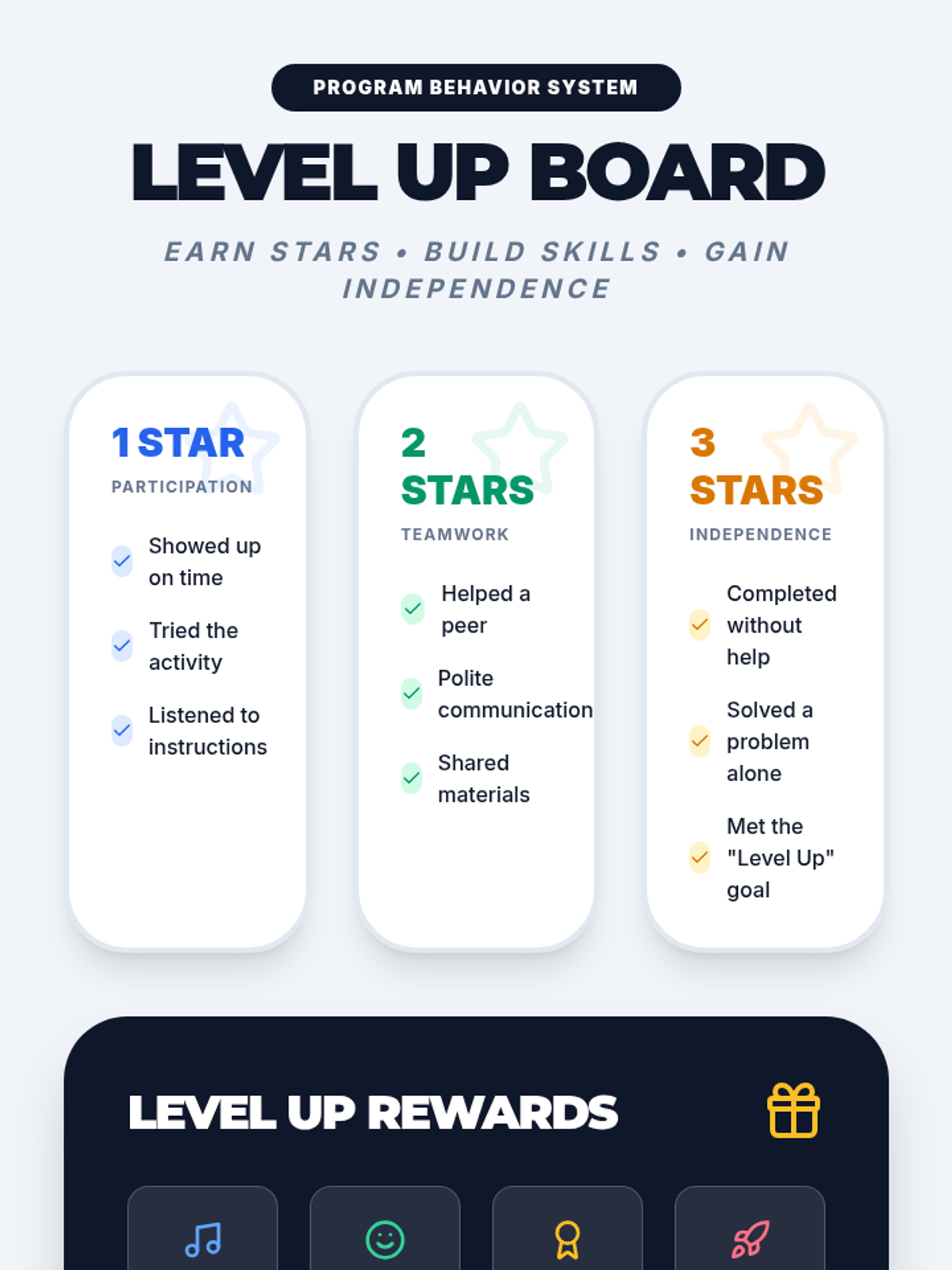
A program-wide behavior and motivation system poster featuring a tiered star reward system for participation, teamwork, and independence.
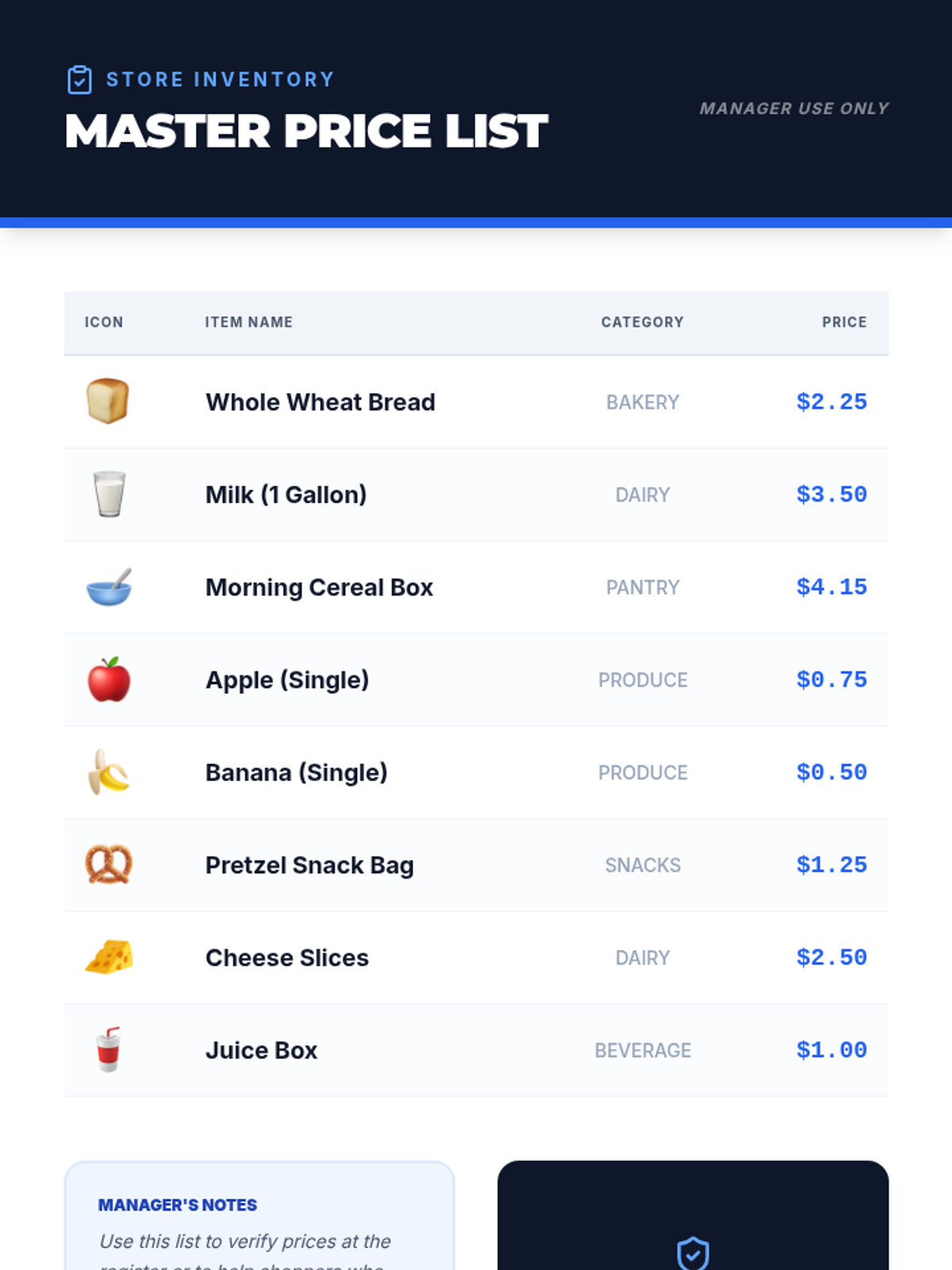
A master inventory and price list for the Pantry Store simulation, designed to help Cashiers and Managers verify pricing and category information.
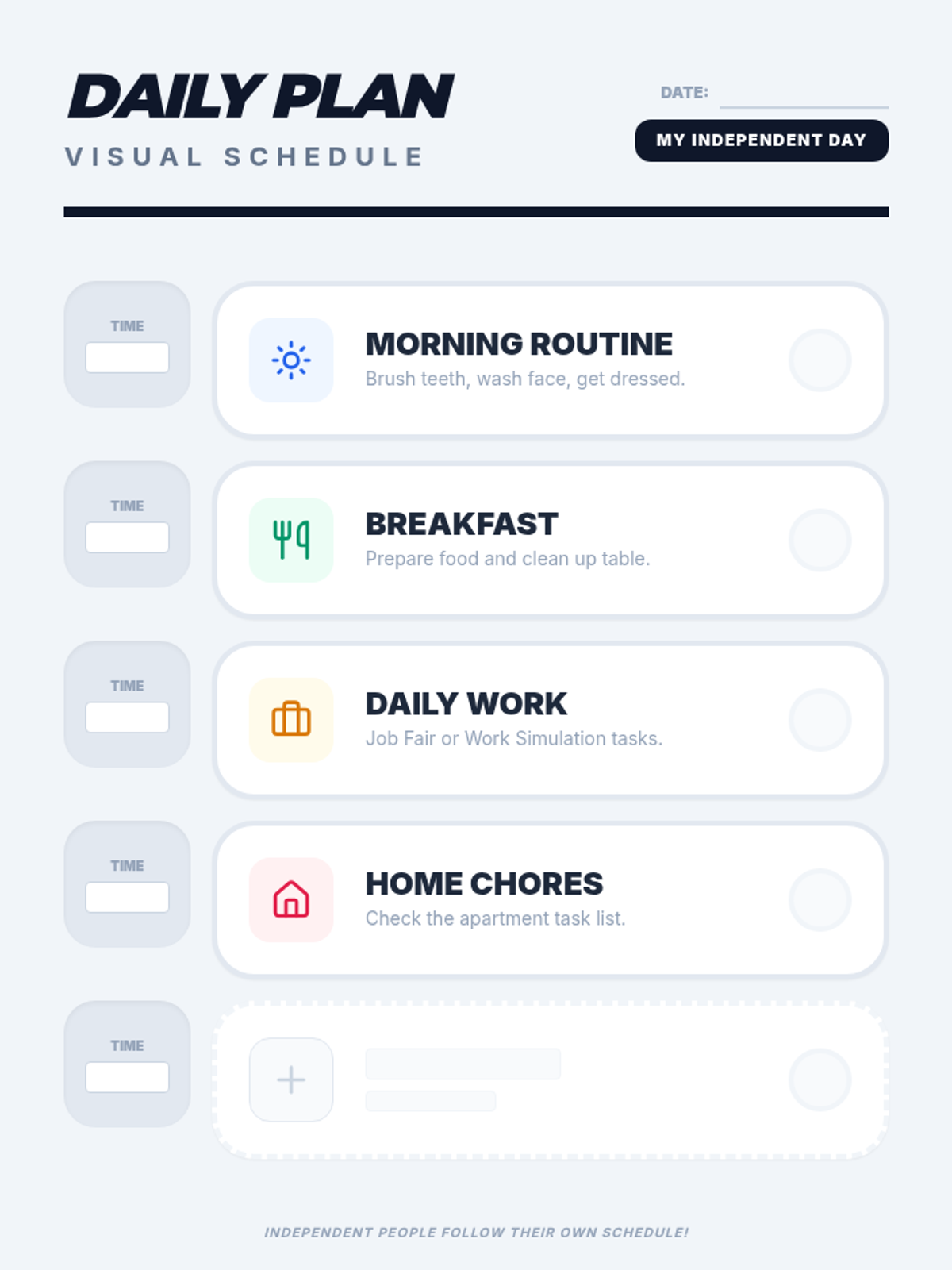
A visual daily schedule template with icons and checkboxes, helping students track their routines and simulation activities throughout the program.
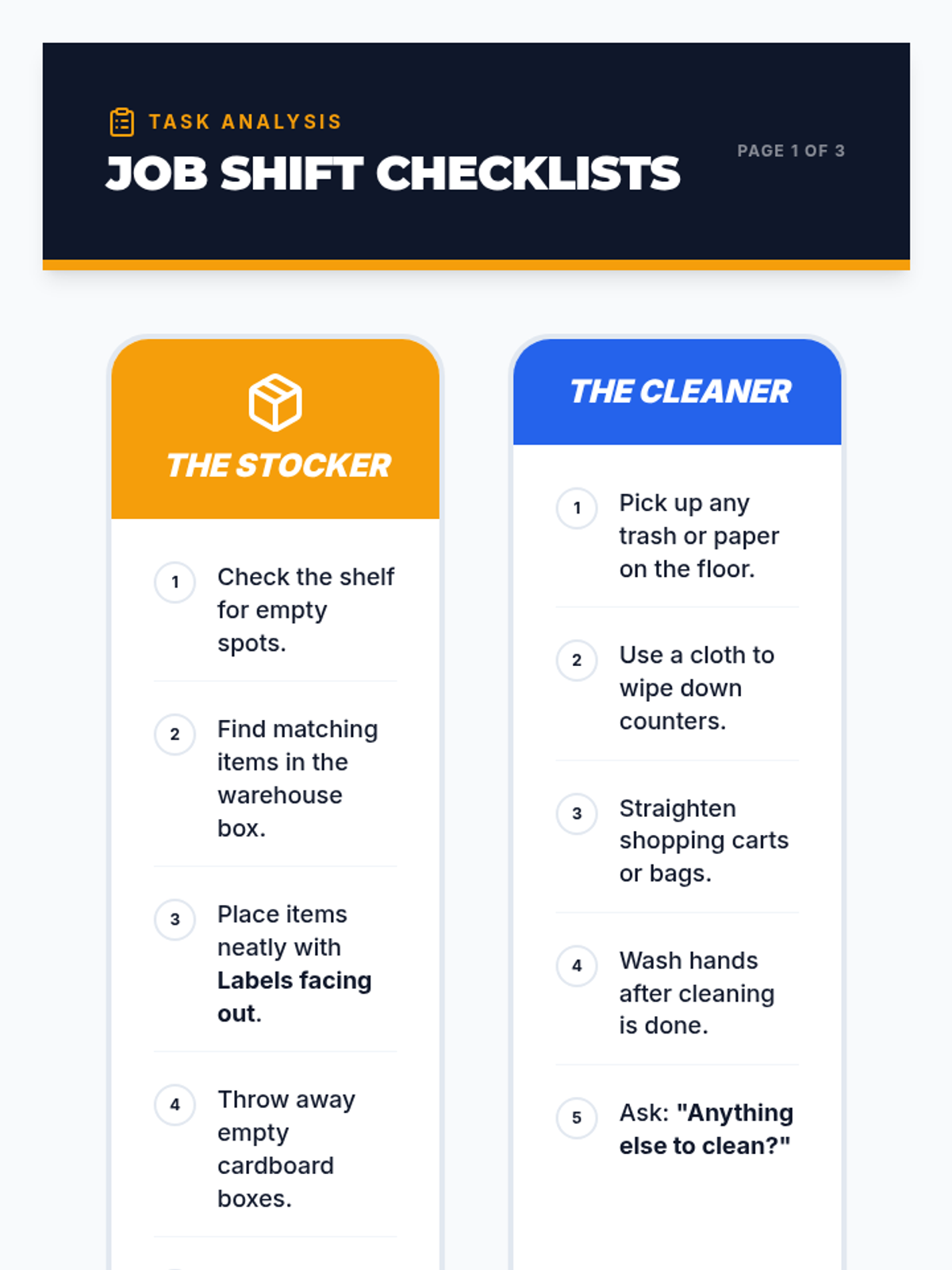
Step-by-step task analysis cards for stocking, cleaning, office assistance, bagging, table setting, and mail sorting jobs, designed to help students follow multi-step directions.
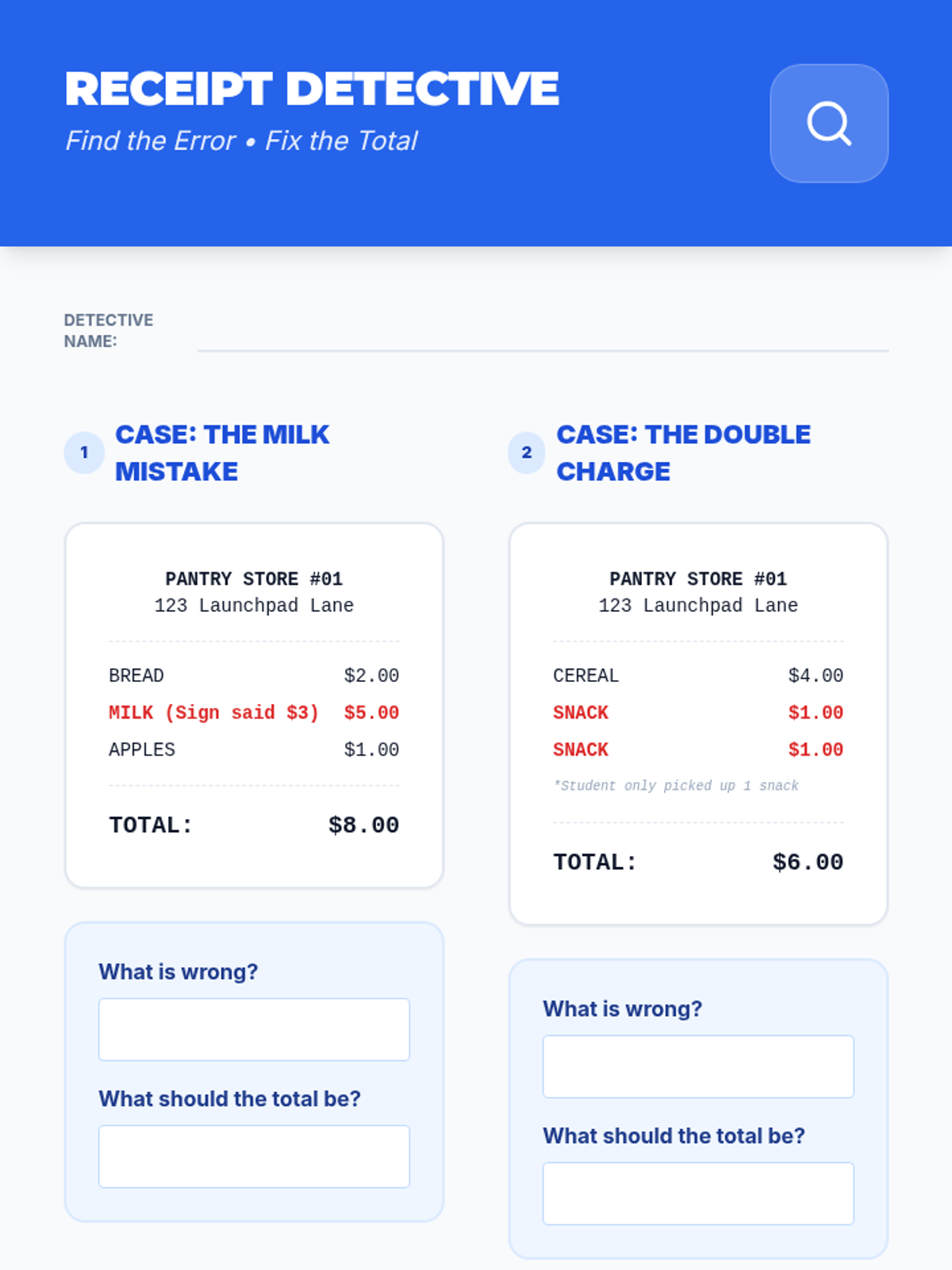
An error-analysis worksheet where students identify pricing mistakes and double charges on mock receipts, practicing both math and self-advocacy skills.
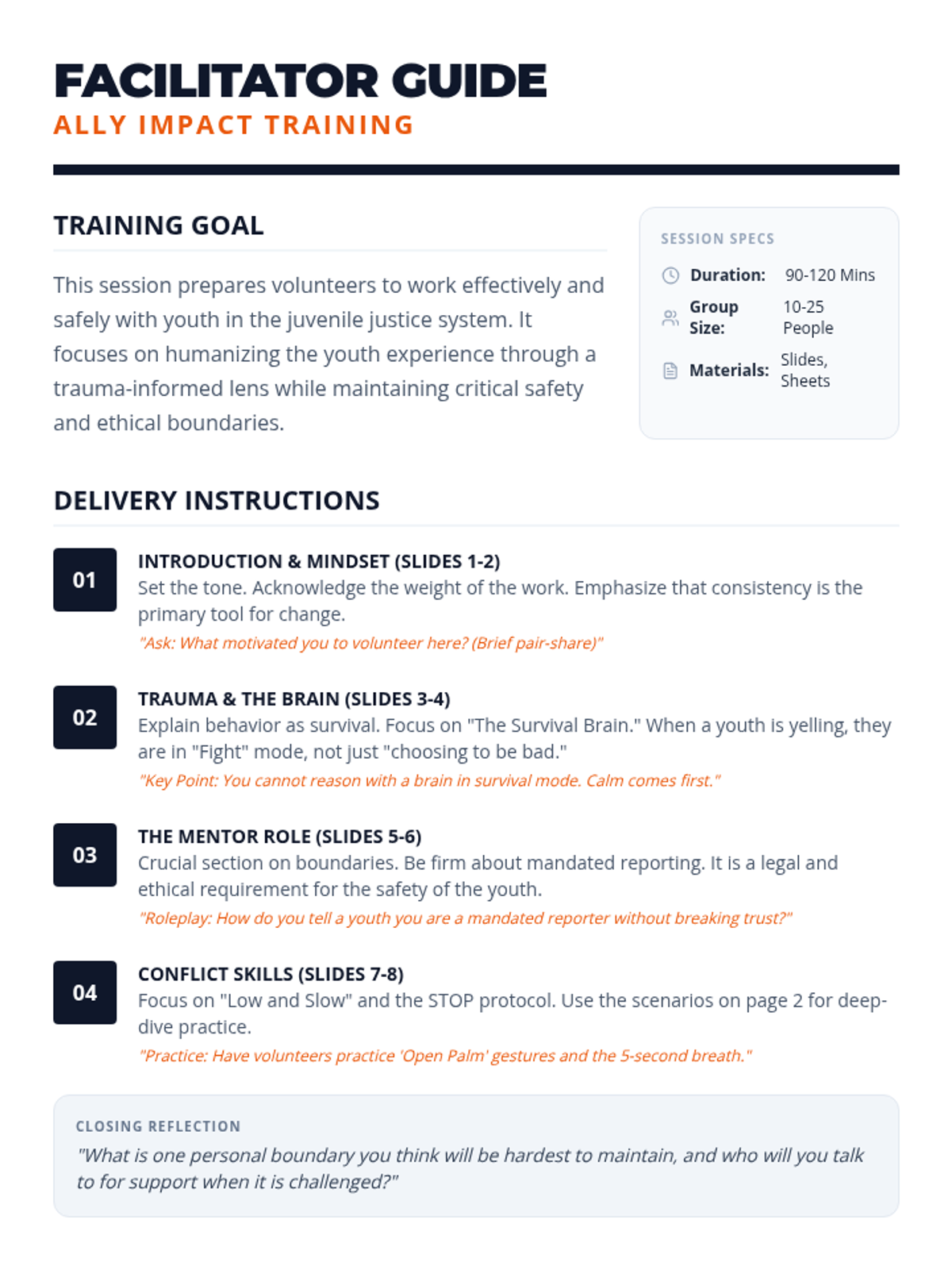
A comprehensive teacher-facing facilitator guide for the Ally Impact Training, including pacing tips, roleplay scenarios, and common volunteer misconceptions. Revised to 2 pages with improved layout and alignment.
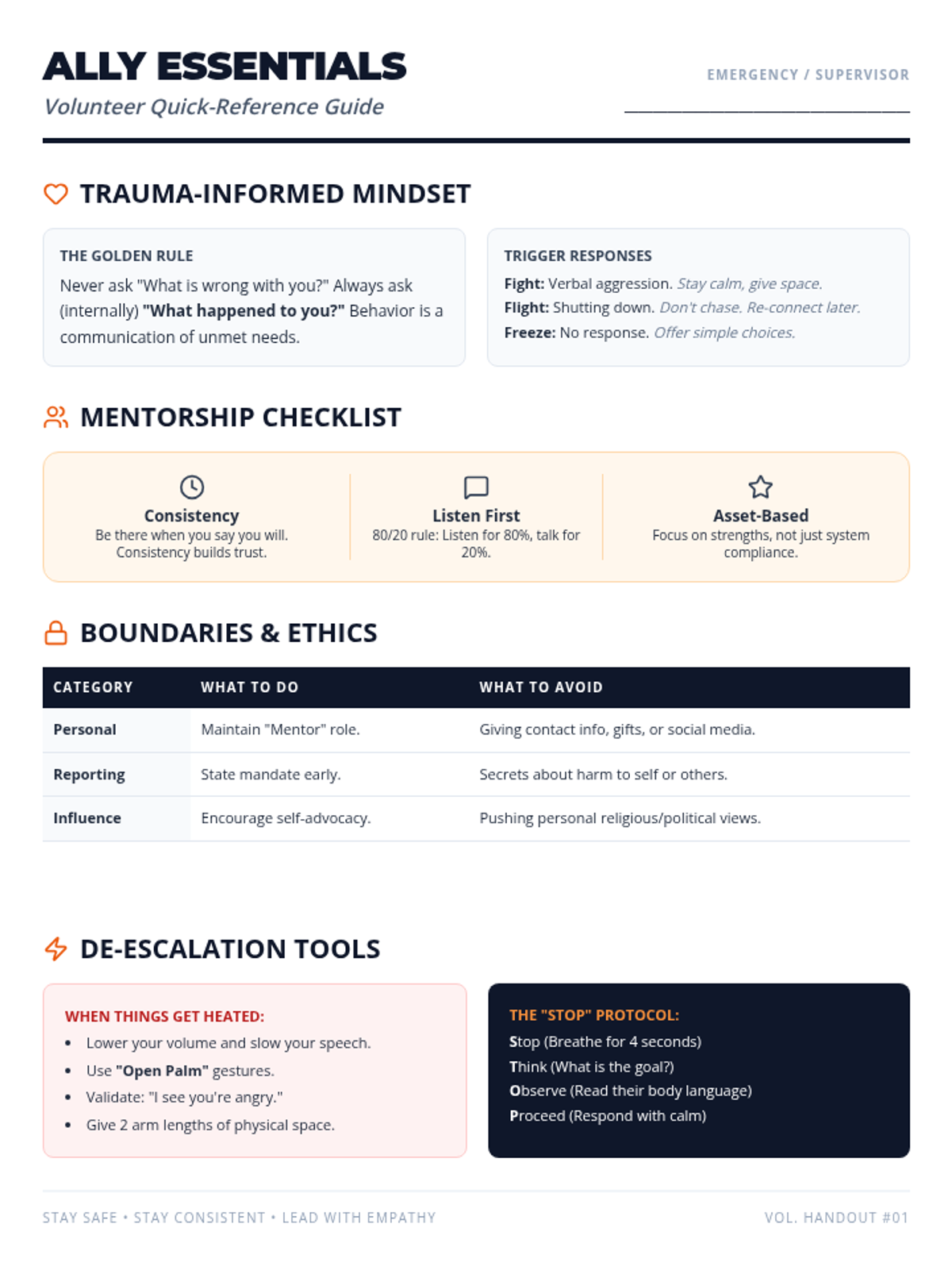
A high-density quick-reference sheet for volunteers working in juvenile justice, summarizing trauma-informed responses, mentorship best practices, boundary rules, and de-escalation protocols. Condensed to fit a single page with high-contrast elements.
A comprehensive 10-slide presentation for volunteer training in the juvenile justice system, covering trauma-informed care, mentorship, boundaries, and conflict resolution with a professional and encouraging aesthetic.