Active listening, assertive expression, and boundary-setting strategies for interpersonal success. Develops proficiency in conflict mediation, cooperative teamwork, and the cultivation of healthy romantic and platonic connections.
Formal Memorandum of Understanding (MOU) template for students to draft sustainable, durable resolutions following a mediation simulation.
Confidential role dossiers for students participating in the final mediation simulation, including space for recording positions, hidden interests, and BATNA.
Instructor's notes for directing the culminating mediation simulation, including role descriptions, timed 'curveballs', and an assessment rubric.
Culminating slide presentation for the final simulation, outlining the timeline, phases, and criteria for a sustainable mediation resolution.
Case study scenario detailing a conflict between a corporation and a community group, focusing on power dynamics, BATNA, and interest-based negotiation.
Worksheet for students to analyze and visualize the Zone of Possible Agreement (ZOPA) between two parties in a complex negotiation.
Facilitation guide for teaching power dynamics and leverage in mediation, including strategies for ethical balancing and case study facilitation.
Visual presentation on BATNA, ZOPA, and types of leverage, designed for advanced mediation students to analyze power dynamics in negotiations.
Reference sheet for students distinguishing between linear and circular questioning techniques, including master phrasings for mediation facilitation.
Worksheet for practicing the linguistic transformation of aggressive language into neutral, interest-based statements through a structured 'Translation Table'.
Facilitation guide for a 'fishbowl' workshop, providing toxic language prompts, setup instructions, and evaluation criteria for mediation students.
Visual slides exploring the art of reframing and the distinction between linear and circular questioning in mediation.
Scenario-based role-play cards for rapid-fire practice of de-escalation techniques, including labeling, silence, and neutralizing threats.
Worksheet for students to track their physiological and cognitive responses to high-stress conflict scenarios, aiding in the development of self-regulation skills.
Facilitation guide for instructors on teaching the neuroscience of conflict and de-escalation techniques, including role-play prompts and observation checklists.
Visual deck explaining the neuroscience of conflict, focusing on the amygdala hijack and specific mediator strategies for emotional de-escalation.
Detailed case study of a geopolitical resource dispute, designed for students to practice root cause analysis and interest-based mapping.
Student worksheet for mapping conflict positions and interests using a structured analytical framework. Includes space for diagnosing root causes and identifying compatible interests.
Comprehensive lesson plan and facilitation guide for instructors, focusing on teaching the Iceberg Model of conflict and interest-based negotiation.
Visual presentation introducing the Iceberg Model of conflict, distinguishing between surface-level positions and underlying interests for advanced mediation students.
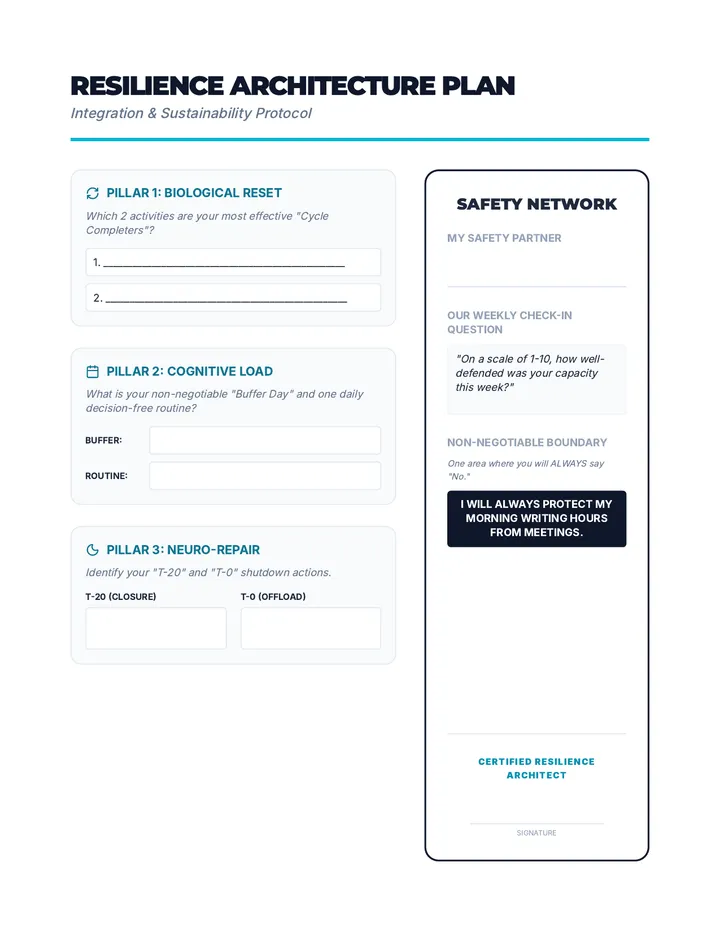
Final student synthesis materials for Lesson 5, including a comprehensive Resilience Architecture master plan and a portable, pocket-sized Crisis Card for immediate intervention.
Visual presentation for Lesson 5, synthesizing the sequence and introducing the Resilience Architecture plan and Crisis Card.
A student budgeting activity for Lesson 4 that teaches students how to evaluate opportunities and practice declining them to protect their academic capacity.
Visual presentation for Lesson 4, addressing the economics of energy, role overload, and the "Yes/No/Negotiate" framework in academia.
A student blueprint for Lesson 3 to design a personalized shutdown ritual and optimize their sleep environment.
Visual presentation for Lesson 3, focusing on the neurobiology of sleep and the concept of revenge bedtime procrastination.
A student worksheet for Lesson 2 that helps graduate students audit 'phantom time' lost to anxiety and design a schedule with structural buffers.
Visual presentation for Lesson 2, reframing time management from a productivity lens to a cognitive load reduction lens.
Visual presentation for Lesson 1, introducing the concept of the stress cycle, stressors, and the six ways to complete the cycle physiologically.
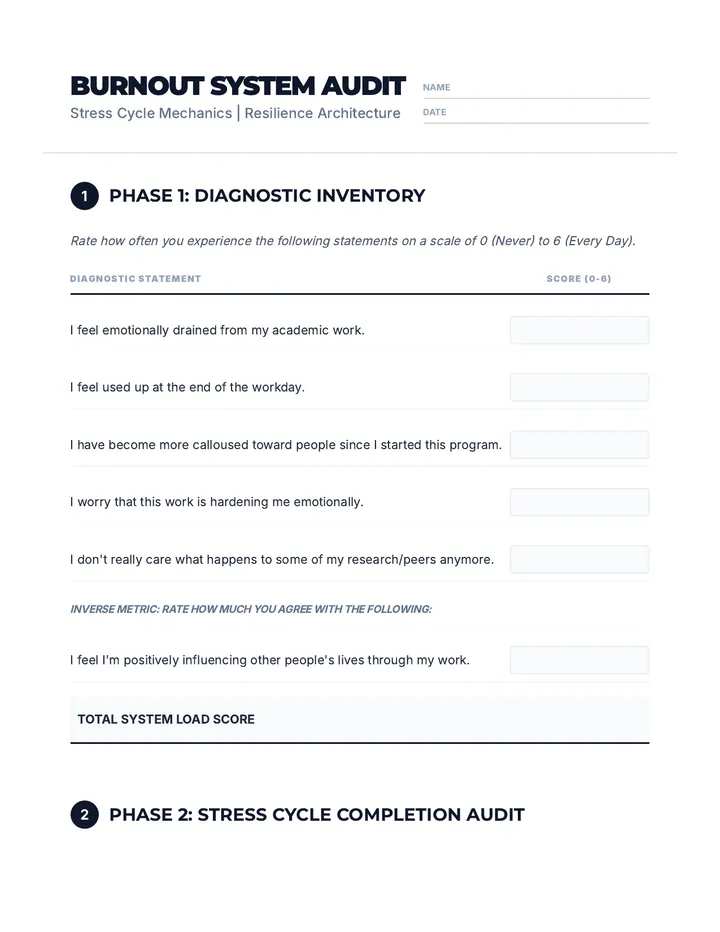
A student diagnostic worksheet for Lesson 1, including a burnout risk inventory and a structural audit of stress-completion activities.
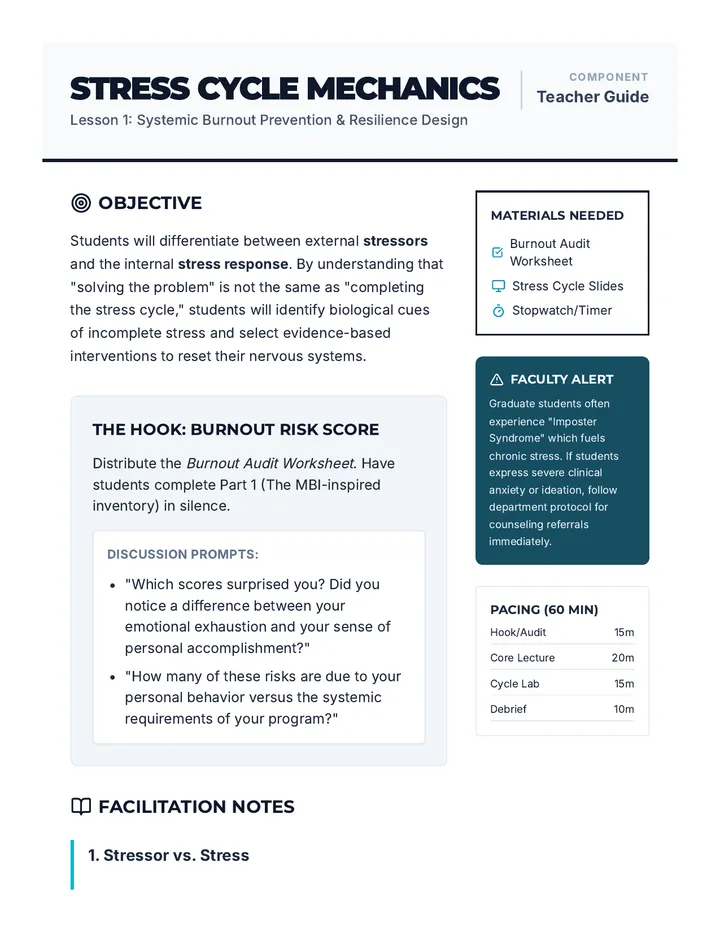
A comprehensive teacher facilitation guide for Lesson 1, focusing on the neurobiology of the stress cycle and strategies for burnout prevention in graduate academia.
Student-facing scenario cards for the final performance evaluation, presenting complex clinical cases for immediate coaching and role-play.
Instructor-facing resource for evaluating students during the capstone performance assessment, including a fidelity checklist and mastery indicators.
Final slides for the capstone assessment, outlining the mastery indicators and random-draw scenario categories for the clinical performance evaluation.
A student handout for practicing validation and urging strategies, including script prompts for the Devil's Advocate technique.
Teacher guide for the Devil's Advocate simulation, providing scenario details, instructional scripts, and coaching interventions for managing therapeutic resistance.
Slides for the Fear of Abandonment coaching lesson, exploring how to use dialectical strategies to address client resistance to FAST skills.
An assessment rubric for the final Community Charter project, evaluating theory application, safety planning, and sustainability.
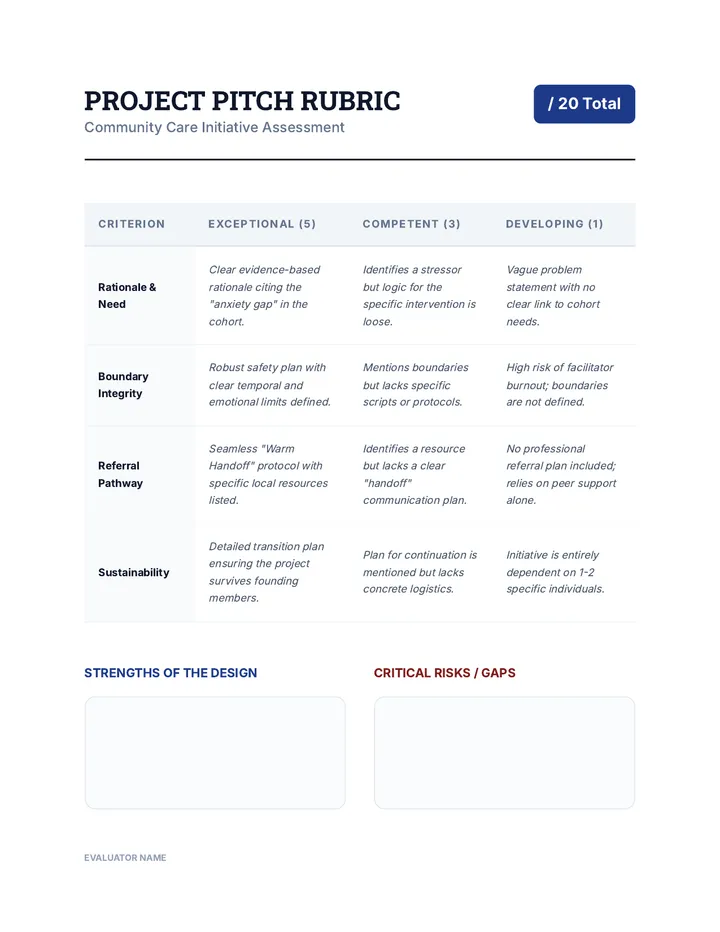
Final project rubric for evaluating the Community Care Initiative, focusing on rationale, boundaries, referral pathways, and sustainability.
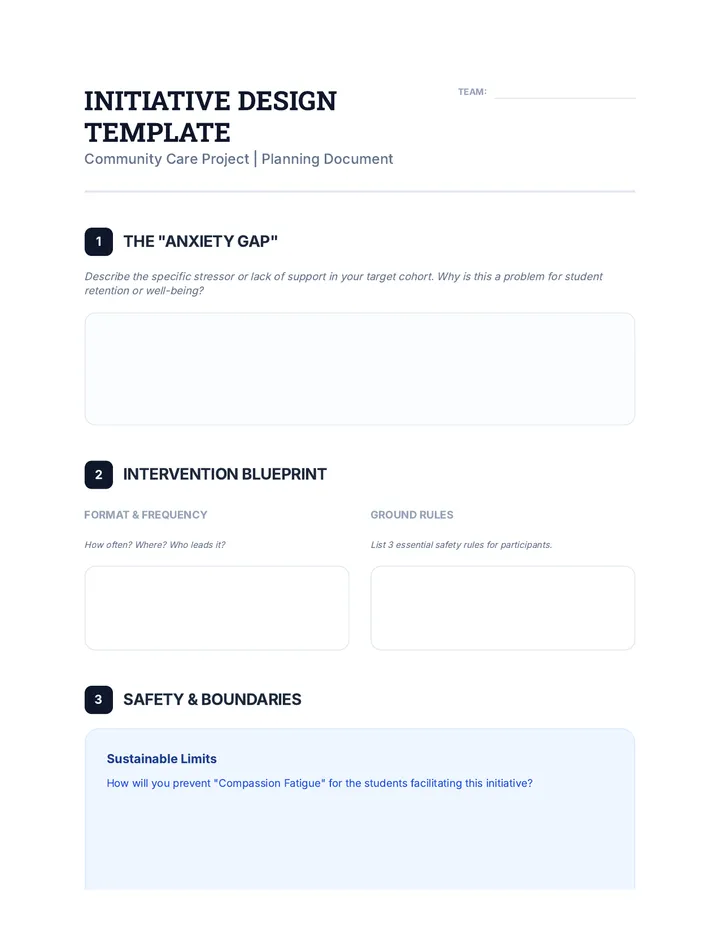
Student design workbook for planning the Community Care initiative, covering problem definition, logistics, safety boundaries, and sustainability.
A design framework for a community care plan, producing a 'Community Charter' for peer support in a specific campus context.
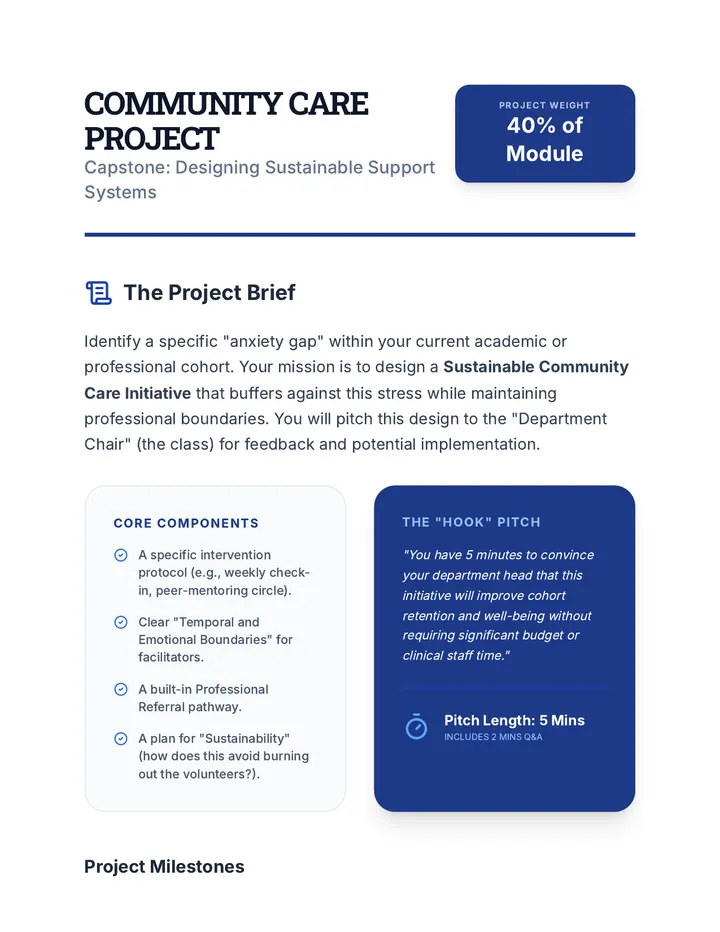
Final project brief for the Community Care initiative, detailing requirements, core components, and the "Department Pitch" assessment.
Visual slide deck for Lesson 5, introducing the concepts of mutual aid, sustainable networks, and the "Community Charter" project.
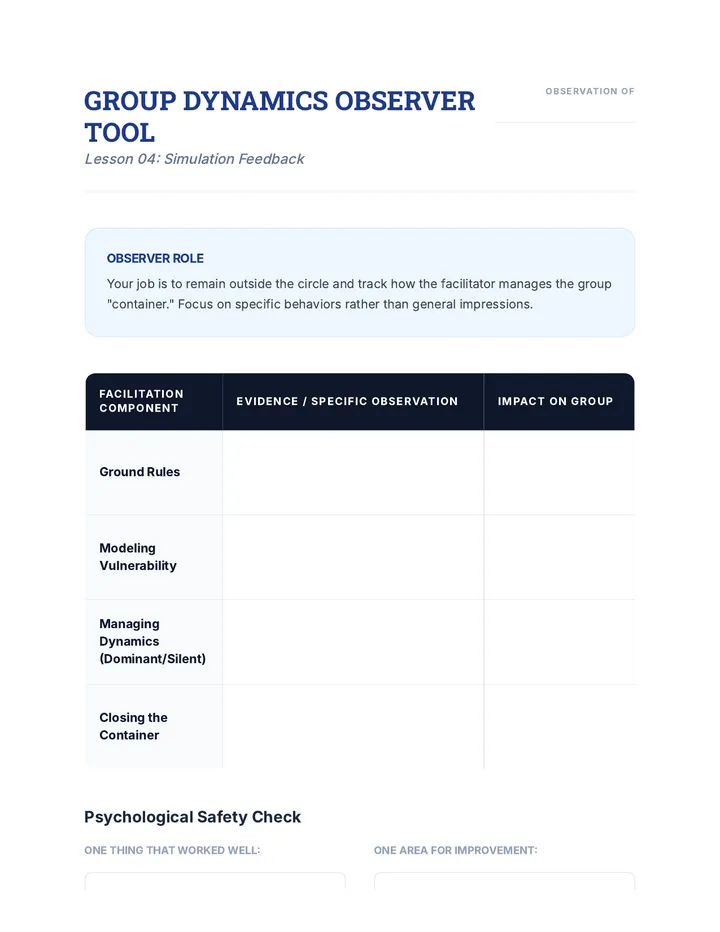
Observation and feedback tool for students to use while observing peer-led group facilitation simulations, focusing on psychological safety and dynamic management.
A brainstorming worksheet for identifying collective coping strategies for common undergraduate stressors.
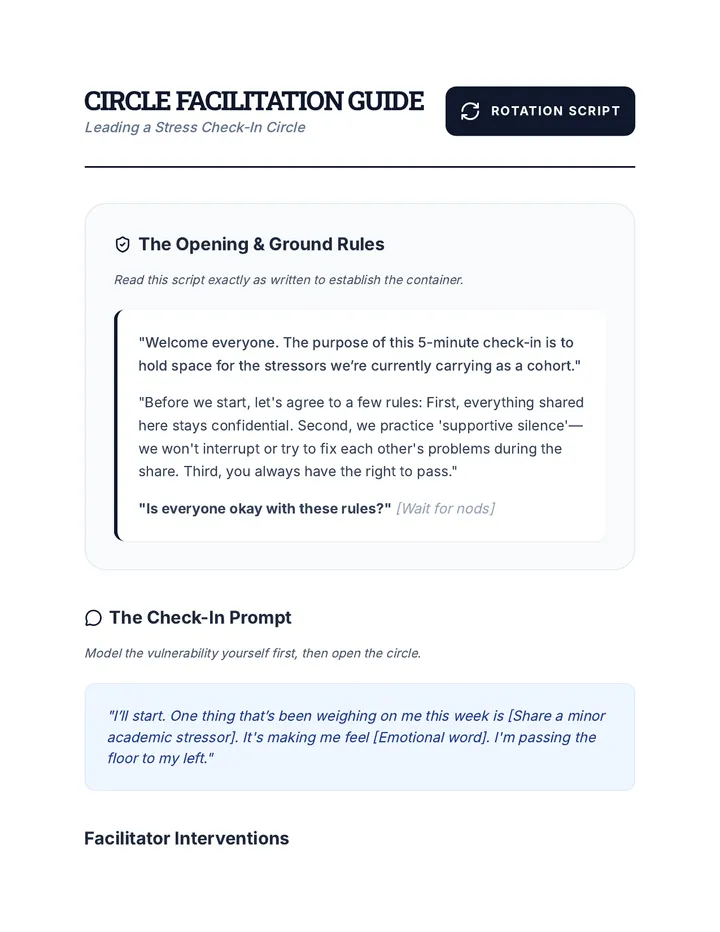
Practical script for students to lead a brief check-in circle, featuring opening ground rules, modeling prompts, and intervention strategies.
A sorting activity where students categorize shared stressors from an anonymous "drop box" into personal or systemic categories to facilitate normalization.
Facilitation Fundamentals Slides focusing on group dynamics, psychological safety, and managing difficult participants.
Visual slide deck for Lesson 4, introducing group facilitation skills, the power of normalization, and the distinction between individual and systemic stressors.
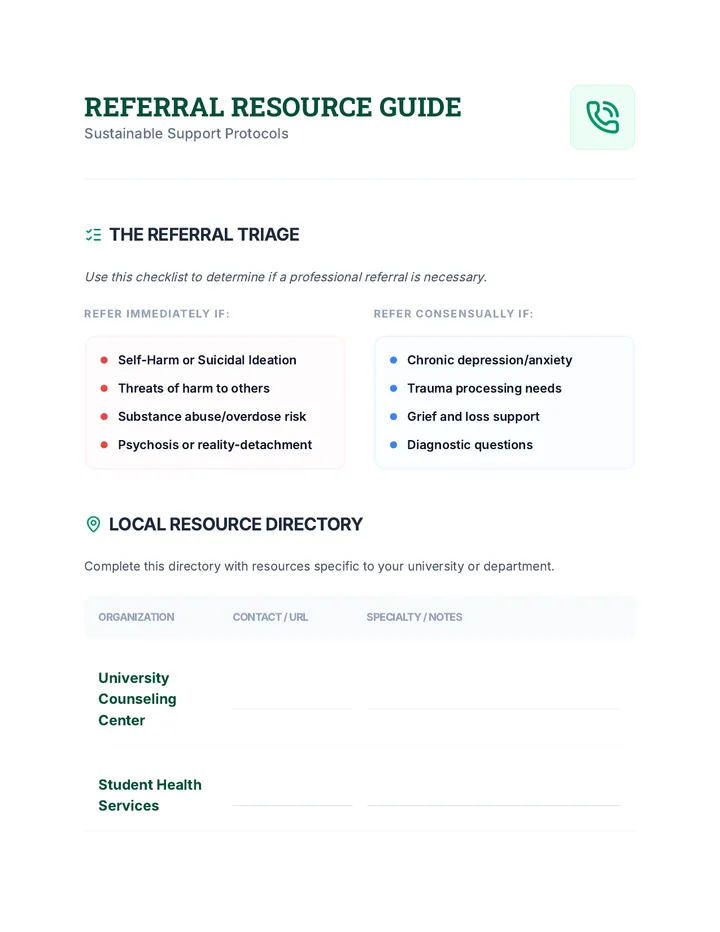
Reference guide and template for students to identify professional resources and practice the "warm handoff" referral protocol.
A resource guide template for students to collect and categorize campus professional resources.
Case studies focusing on temporal and emotional boundary failures in peer support, including scripting exercises for boundary resetting.
A comprehensive 2-page print-ready facilitator answer key and discussion guide detailing the automatic judgments, hidden contexts, and calmer responses for all 8 Everyday Harmony scenario cards.
A 7-slide visual presentation deck for guiding the 1-hour workshop on the Social Side of the Goleman Emotional Intelligence Model, featuring large 24px+ text.
A printable sheet containing 8 scenario and discussion cards across 2 pages for small-group roleplay and perspective-taking practice in daily life, work, and community settings.
A 2-page printable participant workbook for residents or adults containing perspective-taking exercises, space for individual reflection, and personal commitment action steps in everyday social, workplace, and housing settings.
A comprehensive 2-page print-ready facilitator guide detailing the 1-hour Emotional Intelligence workshop, structured with the "Story We Invent" icebreaker, Goleman social quadrants, "What Might Be Underneath" activity, scenario guides, and deep personal reflections.
A step-by-step facilitation guide matching the student workbook, offering detailed pacing, verbal coaching scripts, discussion starters, and concrete answer keys for all exercises.
An interactive student workbook with self-assessments, trigger trackers, empathy scenarios, and a personal commitment contract to develop high-level emotional intelligence.
A professional 2-page companion and facilitation guide for teachers and supervising social workers. Includes slide-by-slide prompt scripts, targeted role-play guidelines, developmental debriefing structures, and boundaries supervision protocols.
A double-sided blueprint worksheet for students and interns to deconstruct difficult conversations. It features a complete planning sandbox for crafting I-statements, planning reflective listening responses, and analyzing personal default communication pitfalls.
A beautifully designed, print-ready, and displayable 11-slide presentation on teaching difficult conversations using empathetic listening and the L.A.S.T. Framework. Features custom layout systems tailored for students and social work training.
Lengthened the blank bubble on the title slide to w-[600px] to accommodate long URL placements, while keeping it entirely free of text and symbols. All other slide content, including references and citations, remains intact.
A comprehensive facilitator guide for the Mirror Notes lesson. Revised to restore specific discussion questions about bad notes, defensiveness, and staying on topic.
A structured student worksheet for self-evaluating group performance and practicing writing narrative progress notes. Revised with darkened labels, writing lines, and a one-page layout.
A reference sheet for clients containing key clinical vocabulary, the pillars of narrative notes, and sentence starters for self-reflection. Revised to fit on a single page with improved readability.
A set of presentation slides teaching clients how counselors write narrative progress notes and how to use them for self-reflection. Updated to restore the "Effort" note example slide and add facilitator discussion prompts.
The final client reflection sheet, focusing on synthesis and the 'Middle Path' of grieving. Revised for single-page layout, light background for handwriting, and improved contrast.
Facilitator guide for the final session, synthesizing all curriculum skills through the concept of 'Walking the Middle Path' to balance honoring the past with living in the present.
A student reflection sheet for Session 8, helping clients apply the FAST skill. Revised for single-page layout, increased font sizes, improved handwriting space, and better contrast.
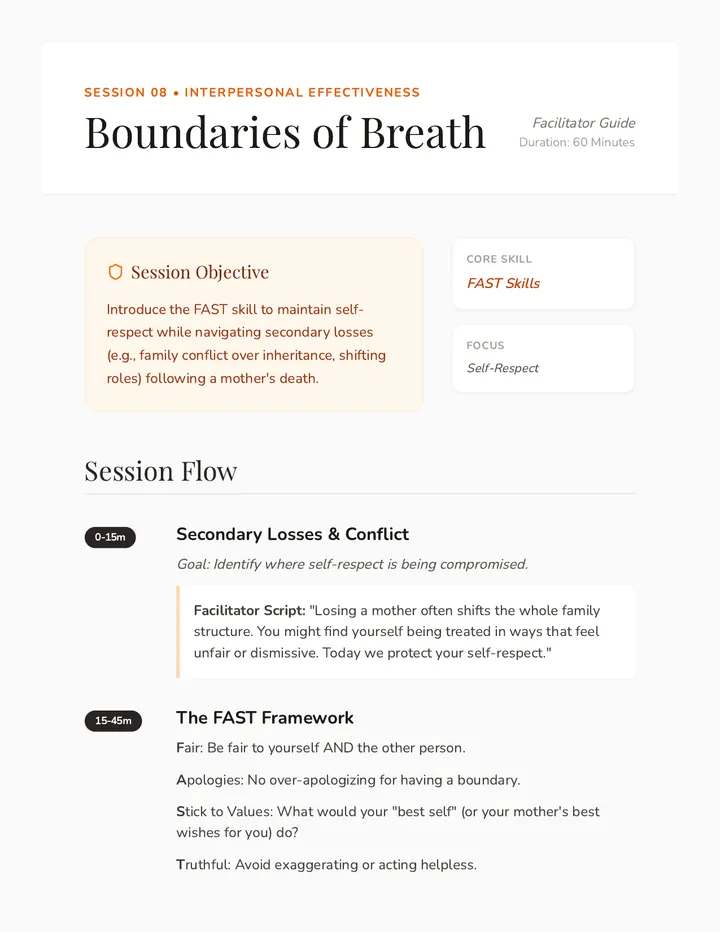
Facilitator guide for Session 8, focusing on the FAST interpersonal skill to help clients maintain self-respect and set boundaries during family conflicts and secondary losses after a mother's death.
A student reflection sheet for Session 7, providing a needs assessment and a template for crafting a DEAR MAN script. Revised for single-page layout, increased font sizes, and improved handwriting space.
Sustainable Support Slides focusing on compassion fatigue, different types of boundaries, and the professional referral process.
Case study scenarios for Lesson 3 focusing on identifying red flags, setting internal limits, and drafting referral scripts.
Reference sheet for students featuring micro-skills definitions, validation hierarchy levels, and helpful open-ended question prompts.
Visual slide deck for Lesson 3, covering the scope of peer support, referral red flags, and the prevention of compassion fatigue.
Student activity sheet featuring "Bad Listener" exercises and specific role-play scenarios for practicing the validation hierarchy.
A presentation slide deck with high-impact, low-stimulation visual aids to structure instruction on workplace socialization and communication.
Offers structured, low-pressure workplace conversation starters, interview role-play situations, and task-oriented clarification practice cards.
An interactive four-page workbook containing anxiety regulation techniques, guided self-introduction scripts, structured conversation templates for clarifying tasks, and peer interaction blueprints.
A hands-on, two-page template designed to help learners identify their unique strengths, professional skills, ideal work environments, and career goals. Features a structured skills inventory and an environmental fit analyzer.
An engaging, printable coaching worksheet designed to help young adults apply the 3-Step Pivot Protocol to real-life triggers across feedback, peer conflict, and family boundaries.
A beautiful pink-and-lavender aesthetic slide deck tailored for young women/telehealth clients, featuring elegant layouts and structured role-play scenarios.
An interactive problem-solving worksheet matching the "Unstuck Blueprint" drafting theme. It guides students step-by-step to identify their current blocked task, rate their level of overwhelm, reframe heavy thoughts, perform sensory and somatic breathing, and construct a detailed 5-minute micro-task to kickstart momentum.
A 1-page visual coping strategy menu and checklist using a crisp "Unstuck Blueprint" drafting theme. It provides actionable cognitive reframing pairs, box-breathing/grounding routines, self-advocacy scripts, and task-chunking guides to move students from avoidant freezing to action.
A student-facing reference sheet explaining the psychological and relational benefits of assertive communication, specifically tailored for adult learners with mental health concerns.
A set of 8 printable scenario cards depicting realistic adult situations where assertive communication is needed, categorized by life domain (work, home, healthcare, etc.).
A student-facing worksheet for practicing I-statements and the DEAR MAN communication framework, featuring clear instructional prompts and dedicated work areas for handwriting.
A facilitator's guide for leading small-group workshops focused on practicing assertive communication through structured role-play and collaborative script-writing.
A step-by-step facilitation guide for teachers, outlining the lesson sequence, objectives, and specific instructional strategies for teaching assertive communication to adults.
A significantly expanded 8-page instructor guide for the Career Catalyst Masterclass. Includes detailed SAY/DO scripts, facilitation directions for mirroring and STAR drills, scenario discussion guides, and a comprehensive Triad rotation model.
A comprehensive student workbook for interview skills, expanded with professional practice scenarios and an updated digital presence checklist. Fixed page breaks and enhanced work area borders. Reduced heights to prevent overflow.
A modern, high-contrast slide deck for teaching interview skills, featuring the STAR method, body language tips, and mock interview guidelines. Expanded to include digital professionalism and workplace etiquette.
A step-by-step physical guide for performing the body language scenarios in the Social Cues Master Deck. Designed to help facilitators and members who struggle with improvisation. Revised with scripts for all 14 scenarios and improved page layouts.
A comprehensive group-focused observation and feedback form for tracking body language. Features 10 observation blocks across 4 pages with high-contrast handwriting areas and clear checklist items. Revised with standardized cue lists and improved handwriting space.
A complete set of body language activity cards with separate pages for staff and member scenarios. Features background tinting for color coding and high-contrast text.
A comprehensive facilitator guide for a 90-minute verbal body language workshop, updated with a 14-round observation cycle (6 Staff, 8 Member) and improved pacing tips. Revised with better spacing and contrast.
A facilitator's guide for the boundary-setting lesson. Includes detailed definitions of boundary types, an analysis of the J.A.D.E. strategy, and specific discussion prompts for social scenarios with ready-to-use scripts.
A high-impact 7-slide presentation for workshops or coaching sessions on friendship boundaries. Features updated scripting examples and fixed text layouts for professional presentation.
A modern, blueprint-themed worksheet for adults to practice setting boundaries in friendships. Features improved layouts with avoid-break scenarios, larger writing areas for adult handwriting, and clarified example phrases in the toolkit.
An advanced 2-page assessment and activity sheet for adult professionals. Focuses on logistical data patterns, critical safety shutdown sequences, and behavioral baseline recognition in workplace environments.
A printer-friendly facilitator guide for the Reclaiming the Floor lesson, designed with minimal ink usage and no heavy color blocking, inclusive of academic settings.
A printer-friendly facilitator guide for the Strategic Interrupting lesson, designed with minimal ink usage and no heavy color blocking, inclusive of academic settings.
A printer-friendly facilitator guide for the Professional Presence lesson, designed with minimal ink usage and no heavy color blocking, inclusive of academic settings.
A specialized slide deck for adult learners on strategies for handling being interrupted and managing conversational dominance in professional and academic settings, featuring a clean, white, printer-friendly design.
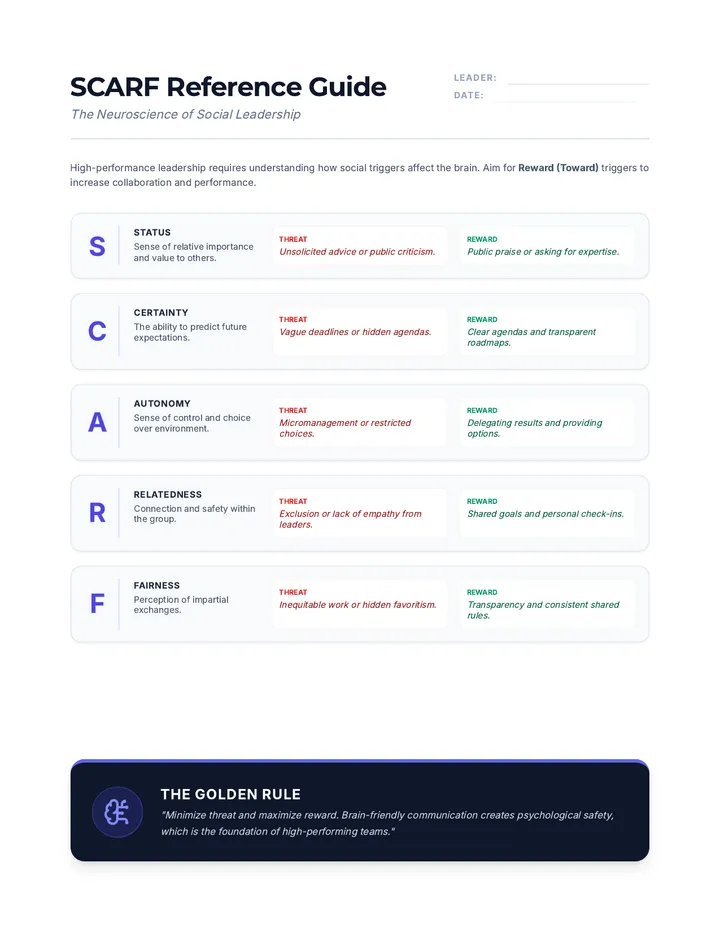
A high-impact leadership toolkit featuring a spacious SCARF model reference guide and a dedicated full-page action planner with large brainstorming areas for communication strategy.
An application worksheet for students to map Adlerian techniques to group stages and reflect on the application of core tenets across different group types.
A visually professional 10-slide presentation deck covering Adlerian group therapy principles, school-based examples, and applications for graduate counseling students.
A comprehensive lesson plan for graduate school counseling students covering Adlerian Therapy in groups, now including school-based examples for each group type.
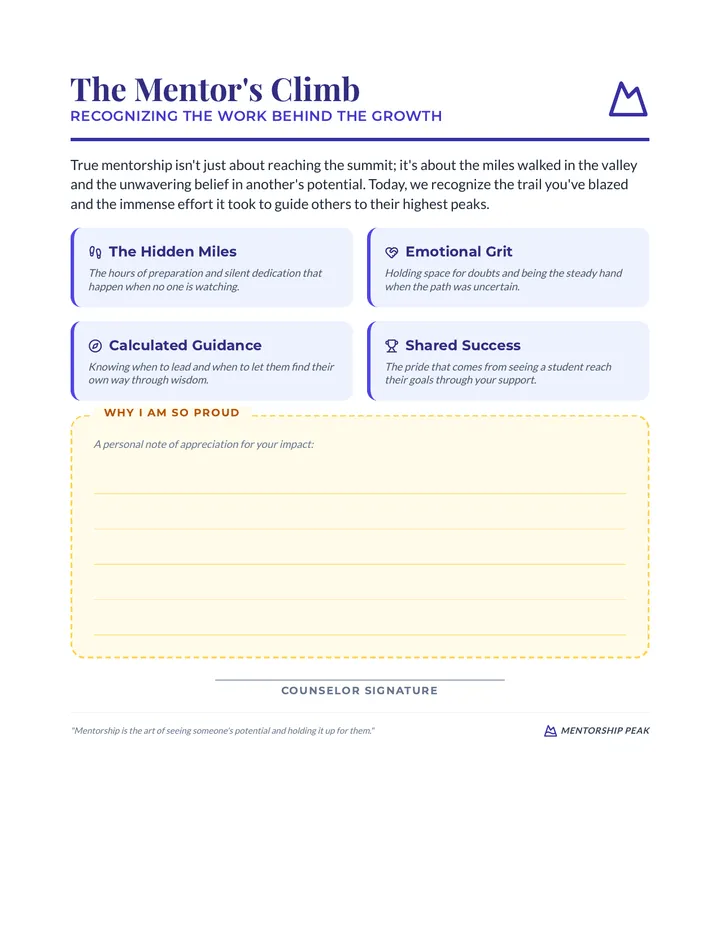
A companion handout for a mentor appreciation event, outlining the "hidden work" of mentorship and providing space for a counselor or student to write a personal note of pride and gratitude. Revised for single-page layout with improved signature area.
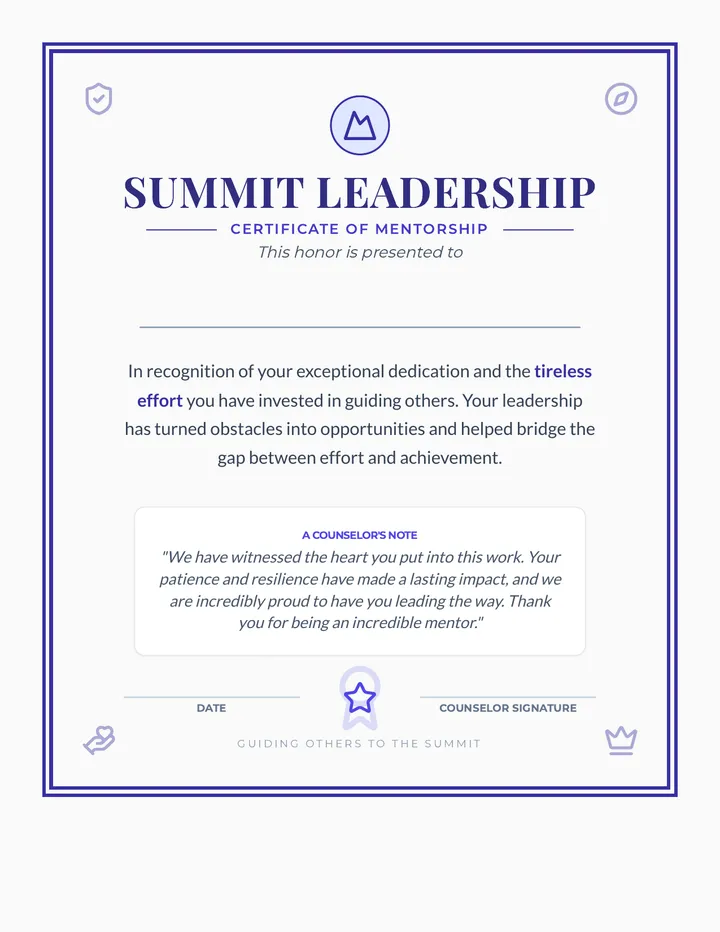
A "Summit Leadership" certificate for a mentor, celebrating their dedication and the impact of their guidance, featuring a signature space for a counselor.
A reflective student worksheet for use during person-centered group sessions, focusing on self-awareness, authenticity, and interpersonal connection.
A comprehensive teacher guide for facilitating person-centered groups in schools, including detailed breakdowns of group types, process stages, and facilitation pitfalls.
A 10-slide presentation introducing the Person-Centered Approach (PCA) in school counseling groups, covering core conditions, counselor roles, and various group types like psychoeducational and support groups.
A team-building charter where student groups define their name, mission, communication norms, and shared commitments.
A detailed guide for a paper plane factory simulation activity, including role assignments, sprint trackers, and communication reflection questions.
A comprehensive slide deck covering Agile mindset, Scrum framework roles/events, and the importance of effective communication and psychological safety in teams.
A professional observation tool for graduate students to assess CBT group session fidelity, identify therapeutic factors in action, and provide structured feedback to student-facilitators.
A set of complex role-play scenarios for master's level students to practice specific Group CBT interventions, handling resistance, and navigating interpersonal conflicts within a clinical group setting.
A detailed speaker notes guide for the Group CBT seminar, providing specific talking points, "deep dive" theoretical connections, and facilitator tips to help master's students transition from experiential participants to reflective clinical practitioners.
A high-level facilitator's discussion guide for leading a master's level seminar on CBT in group counseling, including learning objectives, pacing, deep-dive prompts, and common pitfalls.
A checklist for students to evaluate professional non-verbal communication during mock interviews, covering handshakes, posture, and facial expressions.
A student worksheet designed as a 'Field Observation Log' for role-playing exercises and scenario analysis in non-verbal communication.
Instructional slides for the 'Silent Signals' lesson, featuring visual breakdowns of the 93% rule, interpersonal rapport techniques, professional interview cues, and de-escalation strategies.
A detailed teacher facilitation guide for the 'Silent Signals' lesson, including lesson objectives, timing, key concepts for three modules, and practical classroom exercises.
Printable scenario cards for practicing 'Hard vs. Soft Start-Ups' in interpersonal conflict, designed for pair activities.
A reference handout for students featuring specific individual and co-regulation techniques to manage stress and its impact on relationships.
A reflective student worksheet for identifying personal stressors, reactive patterns ('Stress Signatures'), and developing a personalized regulation plan.
A comprehensive teacher's facilitation guide for the 3-hour 'Tangled Roots' workshop, including pacing, instructional goals, discussion prompts, and activity instructions.
A visual presentation deck for the 'Tangled Roots' lesson, exploring the physiology of stress, relationship spillover, common reactive patterns, and regulation strategies using a botanical field guide aesthetic.
A 2-page activity pack featuring a "Self-Love Bingo" game and a "Green Flag" relationship health quiz. Designed to provide interactive and fun elements to the workshop while reinforcing key concepts of self-care and healthy boundaries.
A 7-slide presentation deck to facilitate the workshop. Features high-impact visuals, the 8 types of love, love language overviews, and instructions for group activities. Designed with a sophisticated rose-and-white aesthetic for high visibility.
A set of 8 interactive scenario cards designed for group discussion. Scenarios cover romantic, family, friendship, workplace, and self-love situations, encouraging participants to apply workshop concepts like boundaries and "Good Love" to real-world challenges.
A 6-page participant journal for the workshop, containing warm-up activities, reflection prompts, the self-love mirror inventory, types of love matching, and a personal assessment. Designed with a soft rose aesthetic for a gentle and inviting experience.
A comprehensive 4-page facilitator guide for a three-hour women's workshop on self-love and relationships. It includes a master agenda, hourly activity breakdowns, discussion prompts, and facilitation tips.
A facilitation guide for educators teaching the final practicum on difficult conversations, focusing on container management and strategic communication.
A comprehensive assessment rubric for evaluating graduate students' mastery of differentiation, NVC translation, container management, and repair.
A conversation planning template for graduate students to structure high-stakes dialogues, including pre-framing scripts, trigger identification, and exit strategies.
Teacher-facing assessment rubric for the final synthesis project, with an instructor's key for the Jordan & Sam case study and evaluation standards for graduate students.
A slide deck for graduate students focusing on building conversational containers, pre-framing intent, and managing high-stakes de-escalation strategies.
The final case portfolio for graduate students, presenting a complex relationship scenario (Jordan & Sam) with multiple artifacts for a comprehensive clinical assessment.