Identifies mental health crises and suicide warning signs while developing personal safety plans and grounding techniques. Equips users with peer gatekeeper skills and direct pathways to professional crisis resources and hotlines.
A 'Mind Shift Guide' designed for students, focusing on the cognitive behavioral technique of reframing negative thoughts. It includes identification of common thought traps, a step-by-step reframing process, and a dedicated space for practice, alongside prominent emergency crisis resources.
Synthesizing all concepts, students build a semester-long calendar that proactively schedules mental health days, tutoring sessions, and social support check-ins, treating them as non-negotiable appointments.
Visual presentation for Lesson 5 summarizing executive function strategies and introducing the 'Semester Sustainability Plan' project. Covers strategic foresight and scheduling support.
A setup guide for students to configure focus modes, silence non-essential notifications, and identify one regulation or focus-enhancing app.
Visual presentation exploring the "Attention Economy" and demonstrating how to configure digital wellbeing controls (Focus Modes) and apps to facilitate support and focus.
A categorized project template for students to identify and document support resources. It includes sections for different friction levels and space to draft proactive communication templates.
Visual presentation for Lesson 3 introducing the concept of decision fatigue and the "Support Menu" framework for proactive resource identification.
A tracking worksheet for students to use during a productivity simulation. It allows them to log their chosen time-management framework, track focus levels across intervals, and evaluate the quality of their rest.
Visual presentation comparing various time-management frameworks (Pomodoro, 52/17, Time Blocking) and the physiological difference between high-quality and low-quality rest.
A 3-day data tracking worksheet for students to log hourly focus levels and physiological symptoms, including a post-audit analysis section for identifying peak performance windows.
Visual presentation for Lesson 1 introducing the concept of Ultradian Rhythms and the biological basis for energy fluctuations. Includes signs of physiological 'troughs' and instructions for the 72-hour energy audit project.
Template for graduate students to synthesize their knowledge into a professional crisis response protocol for their future practice.
Slide deck for Lesson 5 guiding students through the synthesis of legal and ethical knowledge into a professional crisis response protocol.
Teacher discussion and role-play guide for Lesson 5, providing a framework for managing therapeutic repair following a crisis intervention.
A safety plan update template designed for graduate students to practice revising and refining clinical safety plans following a crisis event.
Reference guide for counselors regarding the emergency disclosure exceptions under 42 CFR Part 2 for substance use disorder records.
Visual presentation for graduate students on post-crisis therapeutic repair and safety plan updates.
Discussion cards for Lesson 4 with complex ethical scenarios involving substance use, life-saving interventions, and privacy law.
Teacher resource for Lesson 4, providing the answer key for the Documentation Lab and a specific malpractice case summary for the lesson hook.
Slide deck for Lesson 4 exploring the ethical and legal complexities of substance use crisis referrals and federal privacy protections.
An assessment rubric for the final Community Charter project, evaluating theory application, safety planning, and sustainability.
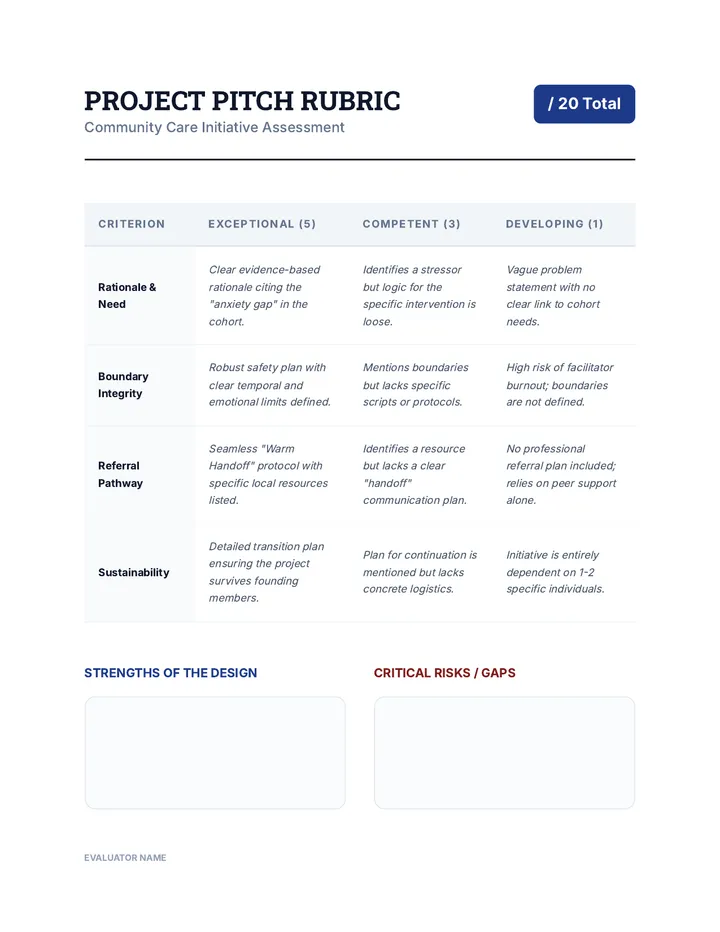
Final project rubric for evaluating the Community Care Initiative, focusing on rationale, boundaries, referral pathways, and sustainability.
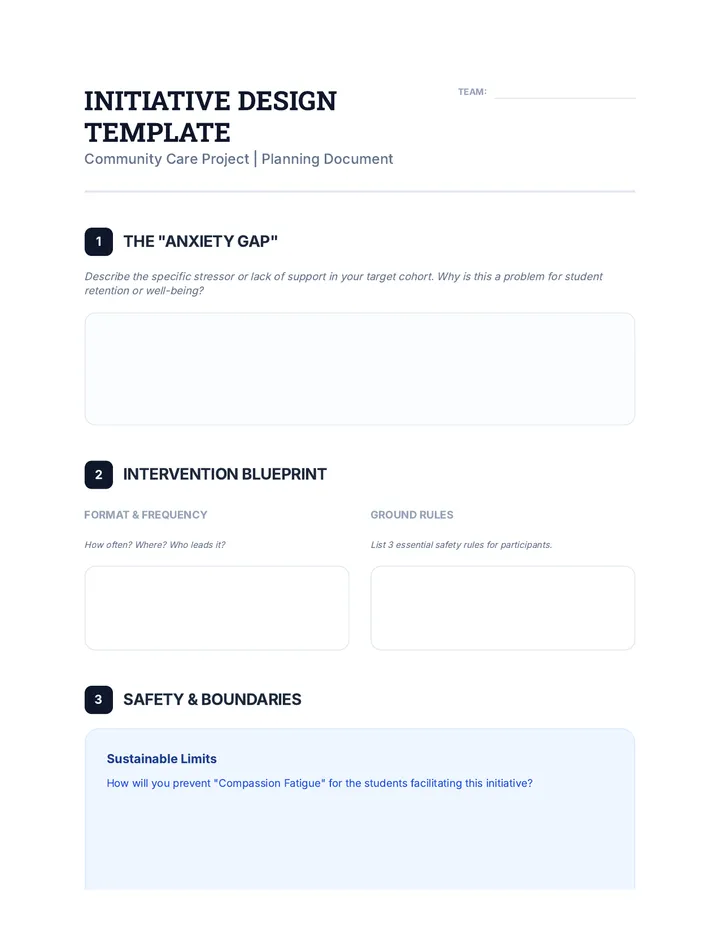
Student design workbook for planning the Community Care initiative, covering problem definition, logistics, safety boundaries, and sustainability.
A design framework for a community care plan, producing a 'Community Charter' for peer support in a specific campus context.
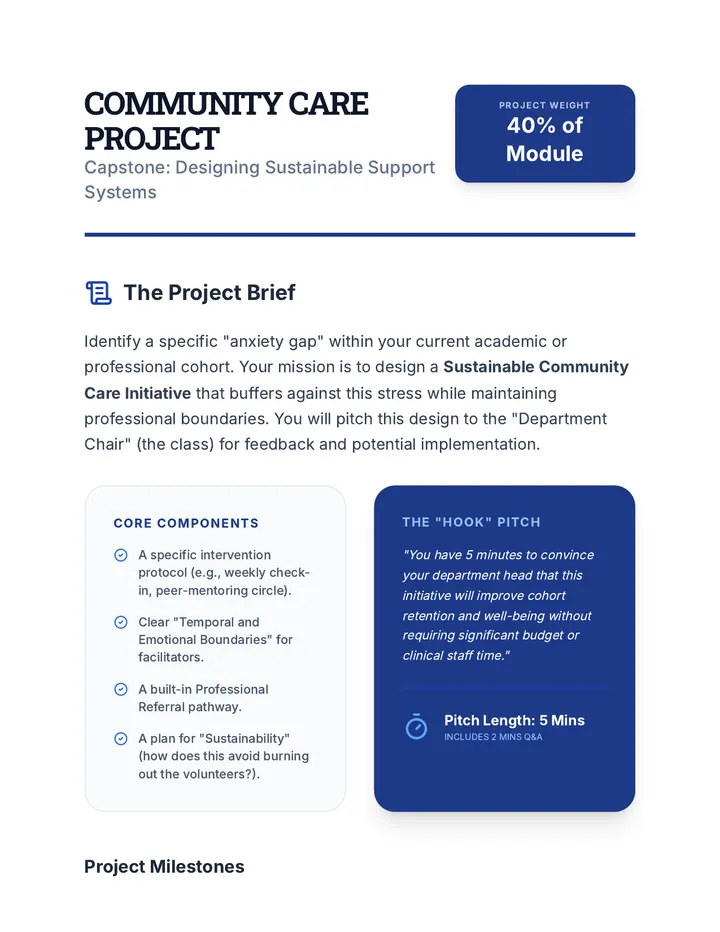
Final project brief for the Community Care initiative, detailing requirements, core components, and the "Department Pitch" assessment.
Visual slide deck for Lesson 5, introducing the concepts of mutual aid, sustainable networks, and the "Community Charter" project.
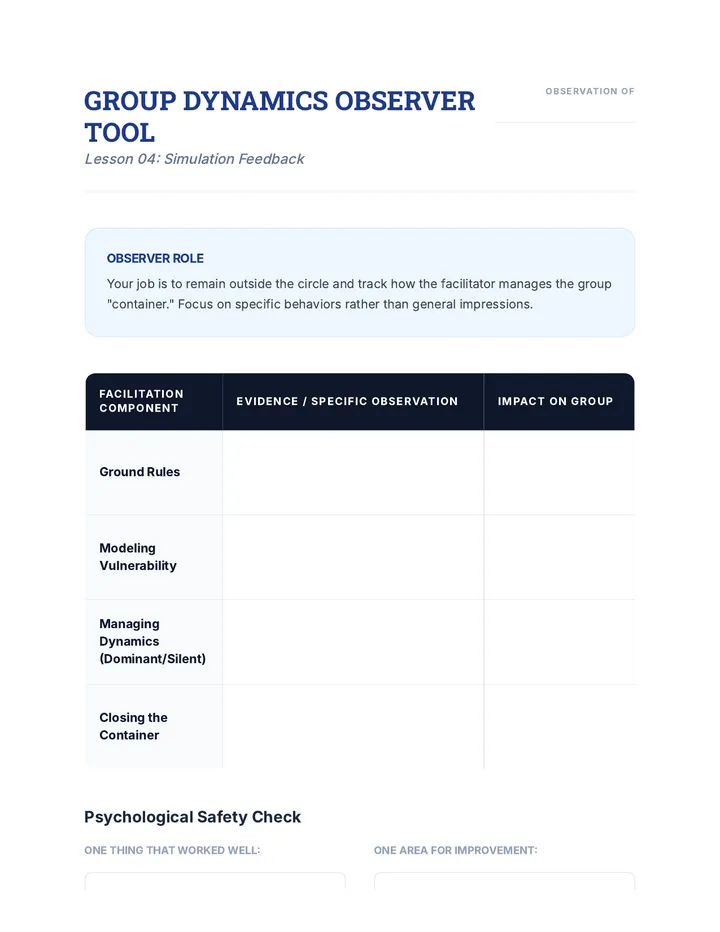
Observation and feedback tool for students to use while observing peer-led group facilitation simulations, focusing on psychological safety and dynamic management.
A brainstorming worksheet for identifying collective coping strategies for common undergraduate stressors.
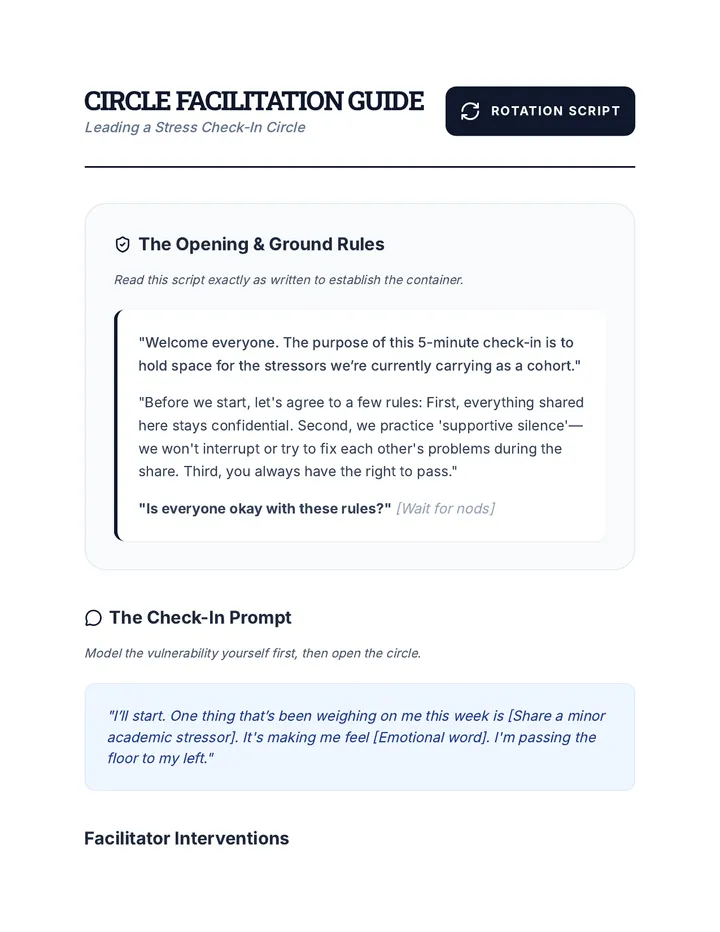
Practical script for students to lead a brief check-in circle, featuring opening ground rules, modeling prompts, and intervention strategies.
A sorting activity where students categorize shared stressors from an anonymous "drop box" into personal or systemic categories to facilitate normalization.
Facilitation Fundamentals Slides focusing on group dynamics, psychological safety, and managing difficult participants.
Visual slide deck for Lesson 4, introducing group facilitation skills, the power of normalization, and the distinction between individual and systemic stressors.
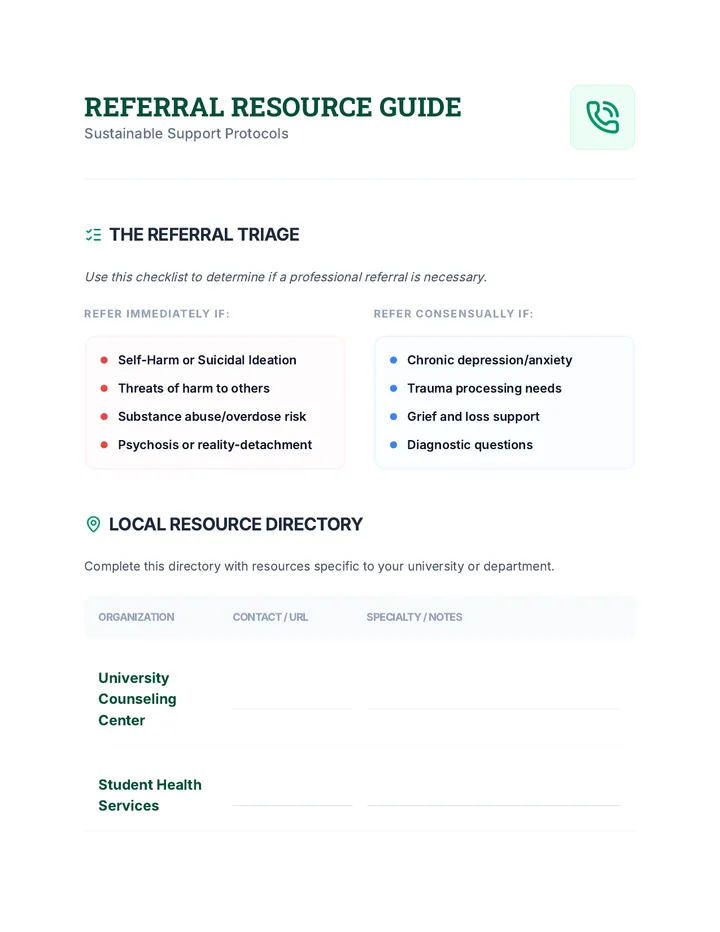
Reference guide and template for students to identify professional resources and practice the "warm handoff" referral protocol.
A resource guide template for students to collect and categorize campus professional resources.
Case studies focusing on temporal and emotional boundary failures in peer support, including scripting exercises for boundary resetting.
Sustainable Support Slides focusing on compassion fatigue, different types of boundaries, and the professional referral process.
Case study scenarios for Lesson 3 focusing on identifying red flags, setting internal limits, and drafting referral scripts.
Reference sheet for students featuring micro-skills definitions, validation hierarchy levels, and helpful open-ended question prompts.
Visual slide deck for Lesson 3, covering the scope of peer support, referral red flags, and the prevention of compassion fatigue.
Student activity sheet featuring "Bad Listener" exercises and specific role-play scenarios for practicing the validation hierarchy.
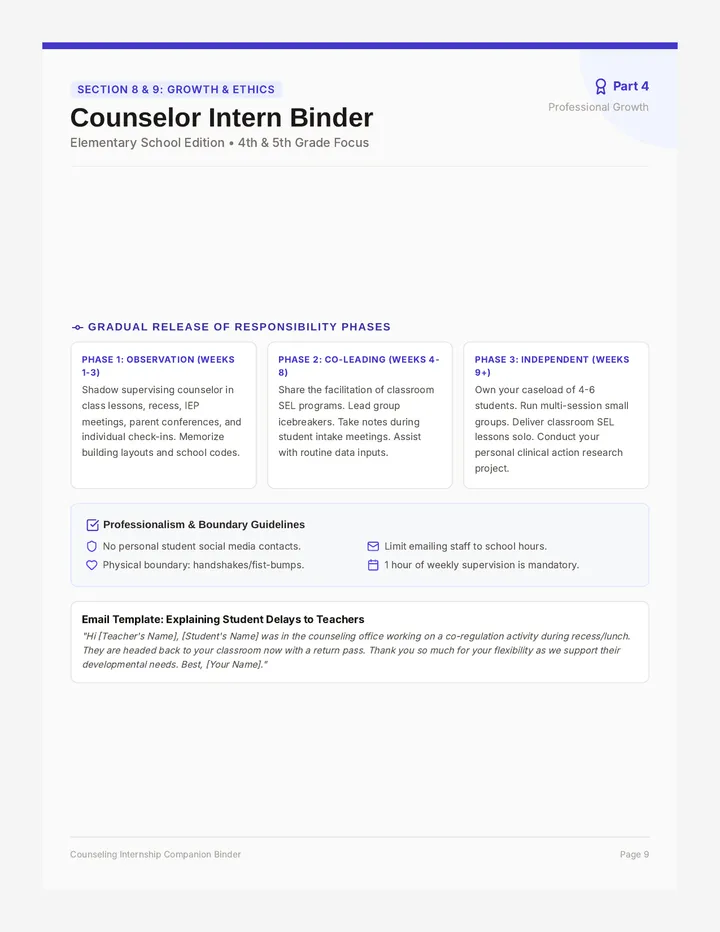
Growth, Forms, & Self-Care Guide (Part 4) containing internship participation phases, professionalism checklists, FAQs, blank template examples, and survival advice.
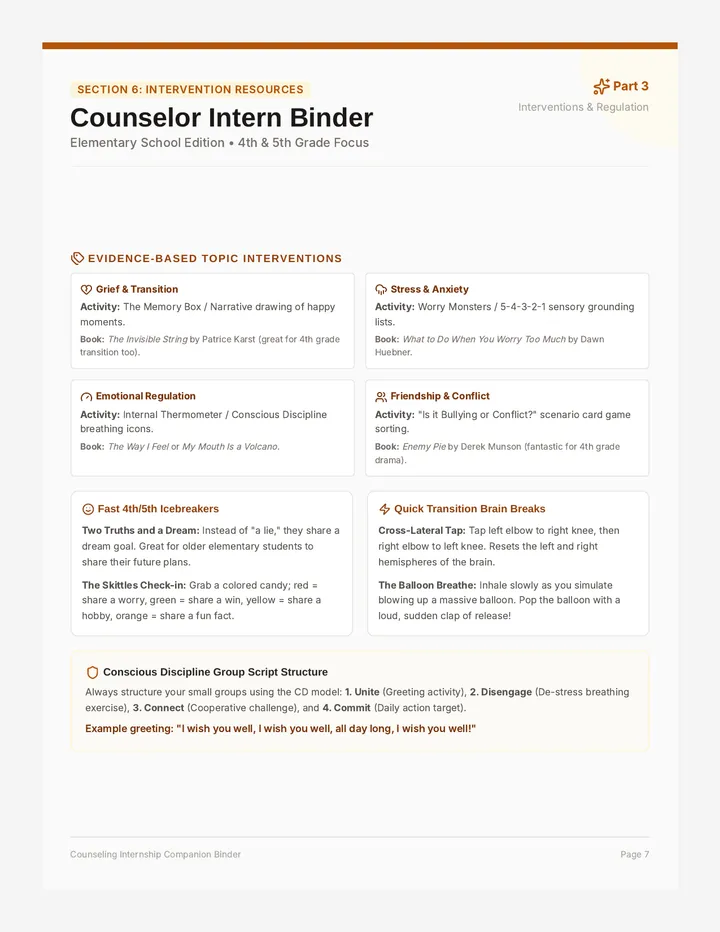
Clinical Interventions & Crisis Support Guide (Part 3) containing small group resources, Conscious Discipline de-escalation scripts, behavior escalation stages, and helpful/unhelpful phrases.
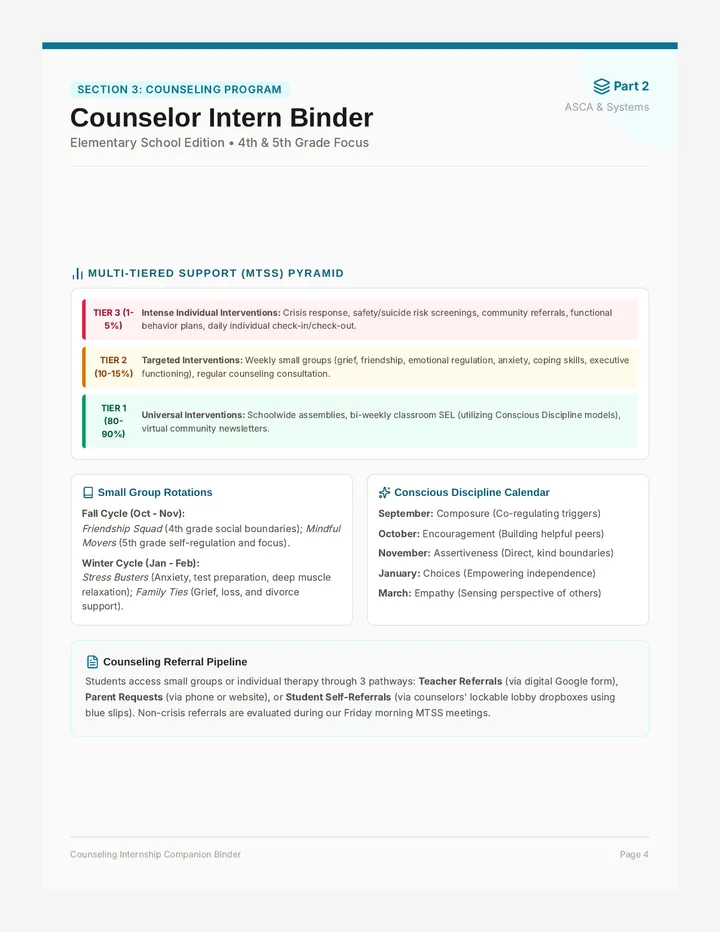
Counseling Program & Procedures Guide (Part 2) containing an ASCA-aligned program framework, tiered supports pyramid, student referral process, emergency procedures, confidentiality limits, and mandated reporting protocols.
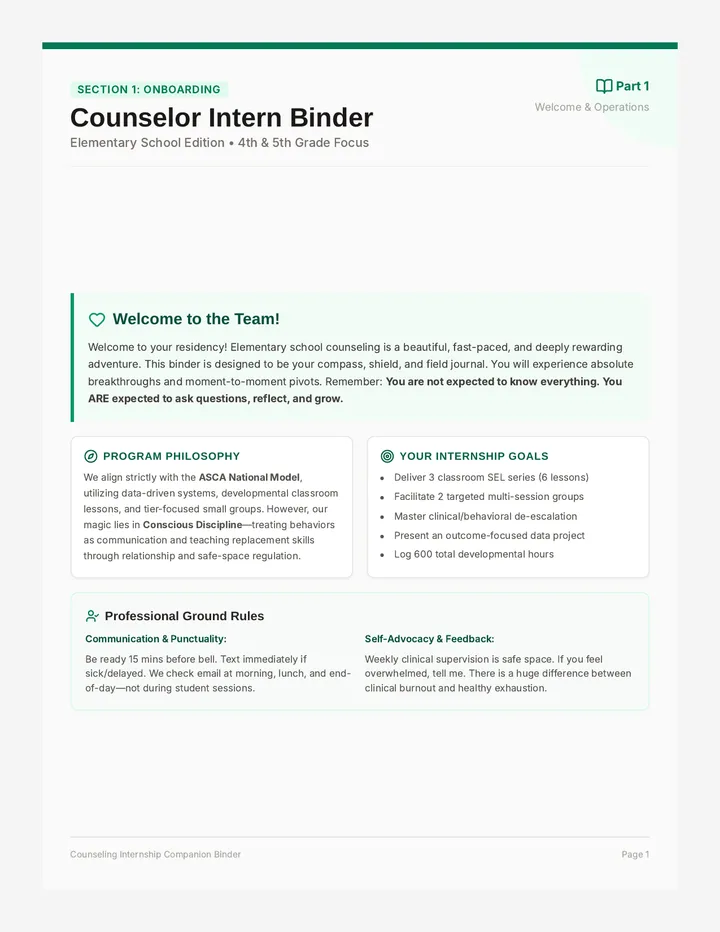
Onboarding & Operations Guide (Part 1) containing a warm welcome letter, program philosophy, intern goals, school schedules, directories, daily logistics, and humorous survival tips.
A training presentation for clinical staff on integrating Social Awareness and CBT skills. Covers population-specific dynamics, core skills like STOP, and strategic implementation.
A client-facing CBT worksheet designed to help individuals process social interactions, identify cognitive distortions, and apply coping skills in real-time.
A clinician-facing lesson plan for facilitating social awareness and CBT group or individual sessions. Includes structured steps, discussion prompts, and trauma-informed guidance.
A high-density professional reference guide for clinical staff, mapping CBT interventions and social awareness strategies to specific patient populations including BPD, Trauma, and Substance Use.
A compact grounding reference sheet featuring the 5-4-3-2-1 technique, square breathing visual, a mantra writing area, and a "Just 5 Minutes" challenge. Designed to fit easily on a single page for quick student reference.
A visually engaging slide deck that uses a hiking metaphor to help middle school students understand and process the different stages of grief as landmarks on a journey.
An age-appropriate 'trail map' worksheet for middle schoolers to identify and process the stages of grief using a hiking metaphor, featuring interactive landmarks and reflection spaces.
A creative therapeutic activity for children and adolescents to process loss by focusing on positive memories and legacy through a 'Memory Lantern' drawing and writing guide.
A nautical-themed worksheet for clients to identify grounding techniques, supportive social contacts, and an 'emergency plan' for handling intense grief triggers in public settings.
A clinician-facing scoring guide and interpretation manual for the Heavy Heart Assessment, providing point values, intensity ranges, and thematic analysis for treatment planning.
A visually engaging slide deck for psychoeducation on the stages of grief, the non-linear nature of healing, and the dual-process model of oscillation between loss and restoration.
A comprehensive grief severity assessment tool for clinical use, featuring a Likert scale for symptom frequency and open-ended reflection sections for deeper insight into the client's experience.
A 2-page answer key for facilitators providing suggested responses and ACT-consistent perspectives for the 15 Willingness Crossroads scenarios.
A 5-page student worksheet containing a mini-lesson recap and 15 structured scenarios for practicing ACT willingness and distinguishing it from flooding.
A concise one-page reference sheet for students covering the core concepts of ACT willingness, the quicksand metaphor, and the Window of Tolerance.
A 14-slide presentation for an ACT willingness lesson, featuring metaphors, the Window of Tolerance mini-lesson, and 12 detailed scenario discussion slides.
A comprehensive, professional visual flowchart of the 7-step CSTAG protocol, specifically tailored for Woburn Public Schools' graduate-level teacher training. It features clear decision branching and high-contrast instructional blocks.
A refined professional flowchart of the CSTAG 7-step protocol, specifically designed for Woburn Public Schools' graduate-level training. It accurately details the decision paths between transient, serious substantive, and very serious substantive threats.
A professional visual flowchart of the Comprehensive School Threat Assessment Guidelines (CSTAG) protocol, customized for Woburn Public Schools for use in graduate-level instruction.
Updated facilitation guide integrating Schimmel's active leadership skills (Cutting Off, Drawing Out, Scanning, Shifting Focus) with Benne and Sheats role management.
A detailed teacher-facing lesson plan and facilitation guide for a graduate-level seminar. Includes pacing, learning objectives, simulation instructions, and deep-dive Socratic discussion prompts.
A professional evaluation rubric for graduate counseling students. Measures role identification, ethical navigation, group maintenance, and presence during clinical simulations. Includes space for detailed feedback.
A set of printable role-play materials including two complex ethical scenarios (Confidentiality and Self-Harm) and six secret role cards based on Benne and Sheats theory. Designed for hands-on facilitation practice.
Updated slide deck featuring Schimmel's core leadership skills (Cutting Off, Drawing Out, Scanning, Shifting Focus) as interventions for managing group dynamics.
Updated reference guide including Benne and Sheats roles integrated with core group leadership skills from the Schimmel textbook (Cutting Off, Drawing Out, Scanning).
A professional-grade rubric for evaluating a social work community assessment project, covering criteria from profile accuracy to engagement methodology.
A slide deck introducing the 4 Rs and 6 Key Principles of trauma-informed care, emphasizing a shift in perspective and the importance of practitioner self-care.
An introductory slide deck for social work students on grant writing, covering proposal anatomy, impactful writing techniques, and budgeting principles.
A professional reference guide for social work students outlining evidence-based crisis intervention strategies, including the Roberts Seven-Stage Model and verbal de-escalation techniques.
A worksheet featuring real-world social work ethics scenarios for students to analyze using the NASW Code of Ethics. It includes structured sections for identifying dilemmas, citing standards, and justifying interventions.
The final professional deliverable template: a comprehensive Warning Sign Profile where students synthesize all learning into a predictive support document.
The "Mystery File" evidence set and synthesis worksheet for the final project, requiring students to identify escalation points and predict crisis timing.
A professional district-wide visual flowchart of the 7-step CSTAG protocol for Woburn Public Schools. This version is designed for general use by threat assessment teams and school staff, removing specific graduate-level training references.
Final assessment rubric for evaluating graduate students' performance in the high-fidelity crisis simulation. Measures cue identification, spatial awareness, clinical reasoning, and self-regulation.
Final slide deck for Lesson 5, focusing on synthesizing behavioral evidence from multiple domains into a predictive warning sign profile.
Capstone simulation slides for the 'Hot Seat' assessment. Outlines the 60-second rapid assessment protocol and success criteria for identifying escalation cues in real-time.
A printable reflection worksheet for students transitioning out of a therapeutic program, featuring space for a support network list, closure reflections, and goal setting.
A 4-slide presentation designed for students transitioning out of a therapeutic program, covering relationships, closure, and future goal setting.
A comprehensive teacher guide for leading a 2-3 hour ACT lesson on willingness, including pacing, instructional scripts, and facilitation tips tailored for adult mental health and substance abuse contexts.