Mindful breathing and body scan meditation techniques integrated with daily self-care routines. Develops strategies for balancing life demands and advocating for personal wellness needs.
A beautifully formatted, serene, and informational slide presentation about the Burmese Meditation movement (Vipassana), detailing its historical origins, key methodologies (Mahasi and U Ba Khin), core principles, and global impact.
A printable deck of 20 CBT and DBT-based stress reflection cards designed to convert gameplay tension into clinical insight. Divided across two pages for optimal print sizing, the deck targets somatic awareness, cognitive reframing, relapse prevention, and distress tolerance.
A printable deck of 24 cut-out coping cards focused on somatic regulation, distress tolerance, and grounding. Now expanded across two pages, the deck offers twice as many physical instructions and visual icons to guide clients during high-stress moments.
A high-visibility clinical rules board that adapts the intense gameplay of UNO Show 'Em No Mercy into an active therapeutic group. Outlines specific somatic/mindfulness coping protocols and CBT reflection triggers for every card-drawing penalty, helping clients build real-time distress tolerance.
A collection of discussion questions and private journal prompts designed to help participants process the session's themes and practice self-reflection.
An activity worksheet for participants to explore the "iceberg" metaphor of emotions, identifying visible primary emotions and hidden secondary emotions.
An emotion vocabulary reference guide for participants, categorizing complex emotions and providing a list of common somatic signals.
A visual presentation for the session, featuring concepts like somatic awareness, the iceberg metaphor for secondary emotions, and mindfulness prompts.
A comprehensive teacher guide for facilitators, outlining the 2-hour session flow, session objectives, pacing, and trauma-informed tips for working with survivors.
A session-tracking tool for clinicians and patients to document "decisive actions" made despite OCD doubt. It uses Narrative Therapy principles to track the shift from the "Indecisive" identity to the "Wise Elder" identity.
A patient-facing worksheet designed for seniors struggling with OCD-related indecision. It guides the user through identifying core values, mapping choices based on those values rather than certainty, and practicing cognitive defusion from "The Prosecutor" (the OCD voice).
A clinician-facing intervention guide outlining specific behavioral strategies using Narrative and ACT frameworks. Includes techniques for externalizing OCD, somatic expansion, and values-based choice mapping for seniors.
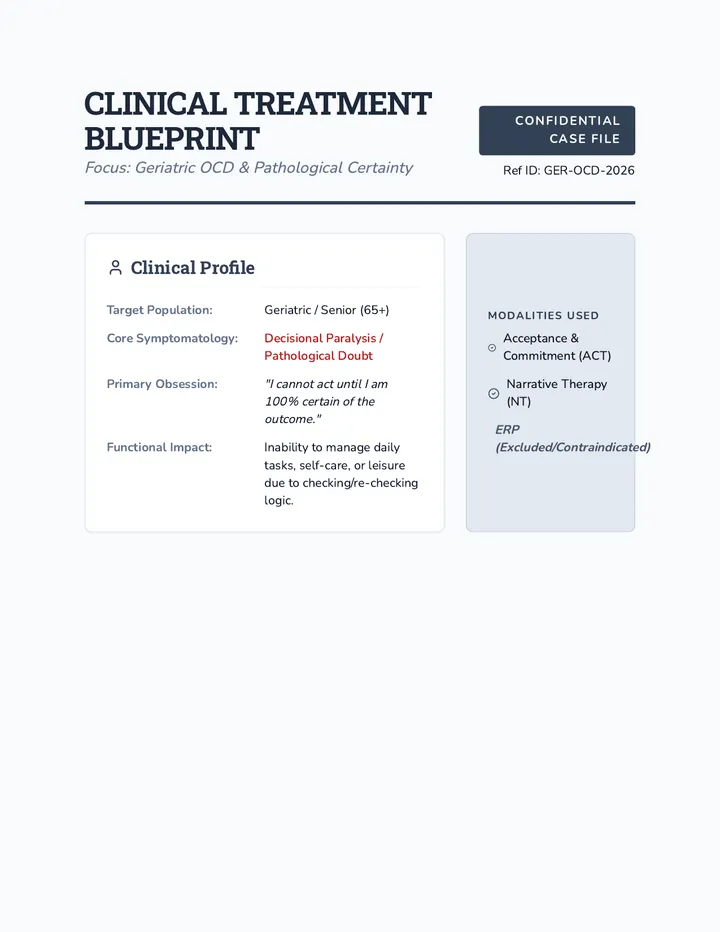
A formal clinical treatment plan for a senior with OCD focusing on "pathological certainty" and decisional paralysis. It outlines a phased approach combining Acceptance and Commitment Therapy (ACT) and Narrative Therapy strategies without the use of ERP.
An elegant, highly structured 4-page print-ready student-facing journal designed to help individuals manage stress, ground their minds, and build healthy work-life boundaries. Features distinct mindfulness affirmations, reflective writing prompts, somatic exercises, and emotional regulation templates.
An aesthetic, premium telehealth slide deck designed for an 18-year-old female young adult. It provides interactive, visually engaging slides for teaching emotion labeling, 5-4-3-2-1 grounding, box breathing, cognitive reframing, and structured role-playing to manage social anxiety. All slides have been optimized to eliminate vertical overflow and strictly adhere to the 24px minimum font size.
A presentation slide deck with high-impact, low-stimulation visual aids to structure instruction on workplace socialization and communication.
Offers structured, low-pressure workplace conversation starters, interview role-play situations, and task-oriented clarification practice cards.
An interactive four-page workbook containing anxiety regulation techniques, guided self-introduction scripts, structured conversation templates for clarifying tasks, and peer interaction blueprints.
A hands-on, two-page template designed to help learners identify their unique strengths, professional skills, ideal work environments, and career goals. Features a structured skills inventory and an environmental fit analyzer.
A printable grid of 6 scenario cards to be cut out and used during the group discussion session. Each card poses a realistic, everyday stressful scenario at home and prompts participants to apply breathing, grounding, or self-talk strategies.
A visually striking, printable anchor chart poster designed to serve as a daily visual coping guide. It details simple box-breathing visuals, the 5-4-3-2-1 sensory grounding technique, and three easy reframing strategies for positive self-talk at home.
A student-facing printable worksheet used during the Guided Practice Stations. It provides writing spaces for breathing observations, a sensory grounding countdown tracker, a self-talk reframe template, and a personal coping-skills home checklist.
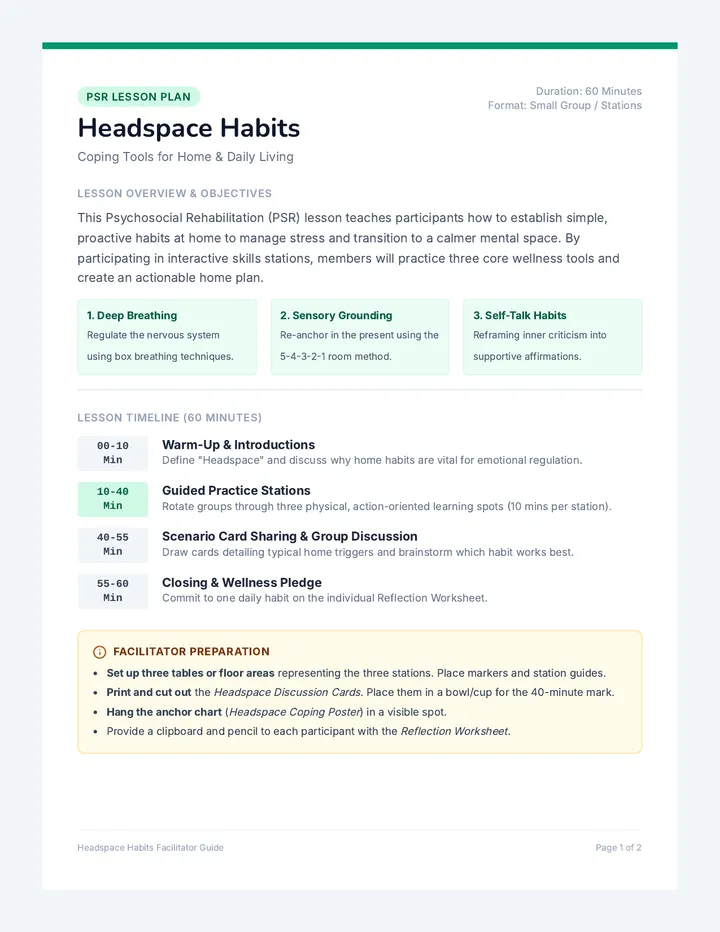
A detailed 2-page facilitator guide for educators or clinicians delivering the Headspace Habits lesson. It includes an hourly breakdown, step-by-step instructions for the three Guided Practice Stations (Breathing, Grounding, and Self-Talk), and discussion prompts.
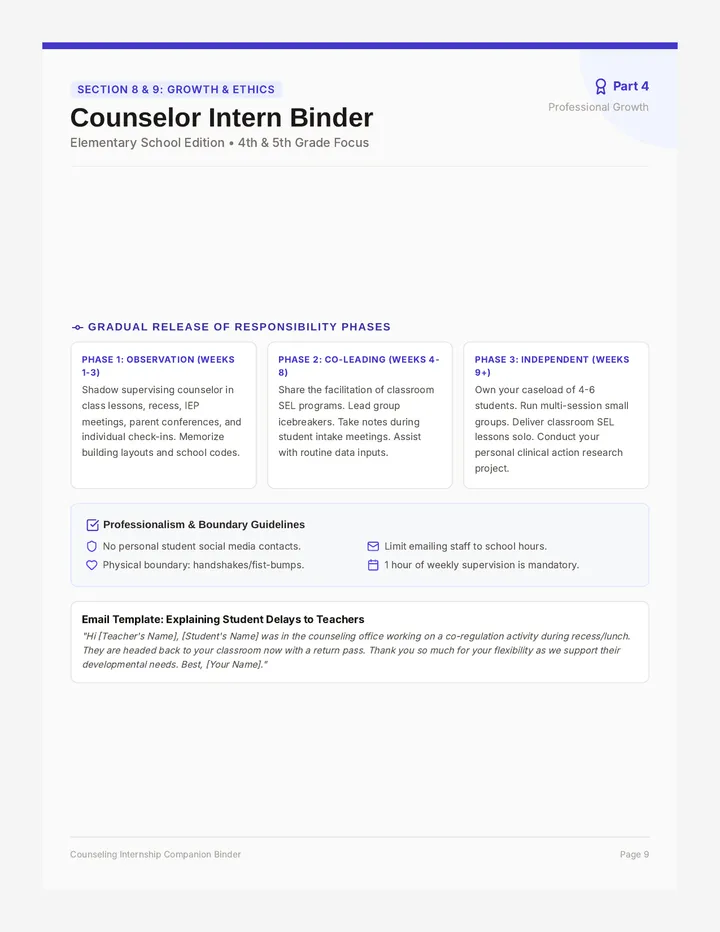
Growth, Forms, & Self-Care Guide (Part 4) containing internship participation phases, professionalism checklists, FAQs, blank template examples, and survival advice.
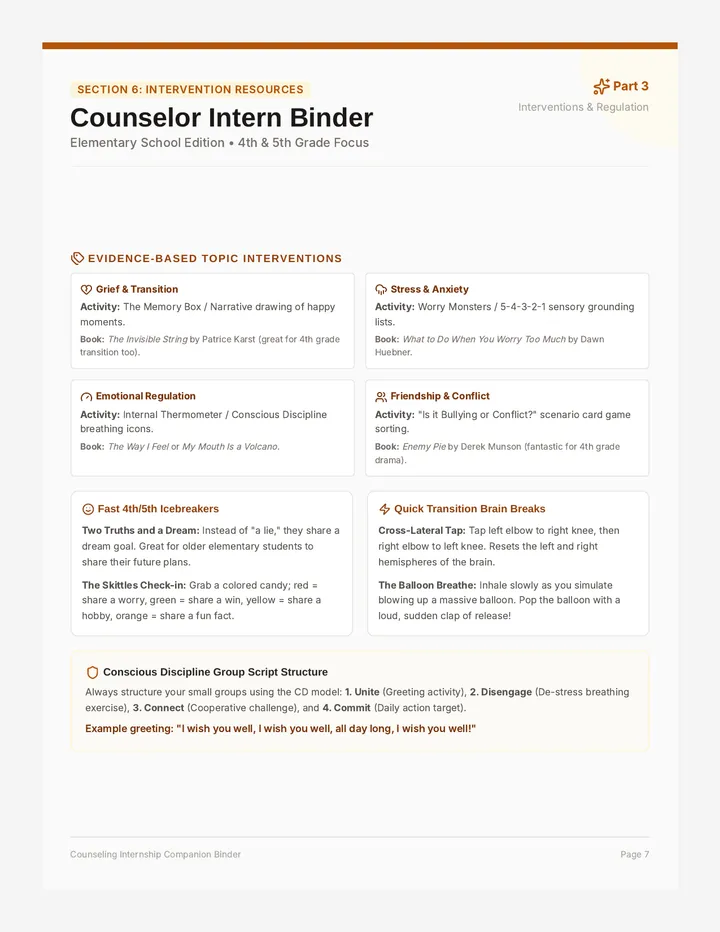
Clinical Interventions & Crisis Support Guide (Part 3) containing small group resources, Conscious Discipline de-escalation scripts, behavior escalation stages, and helpful/unhelpful phrases.
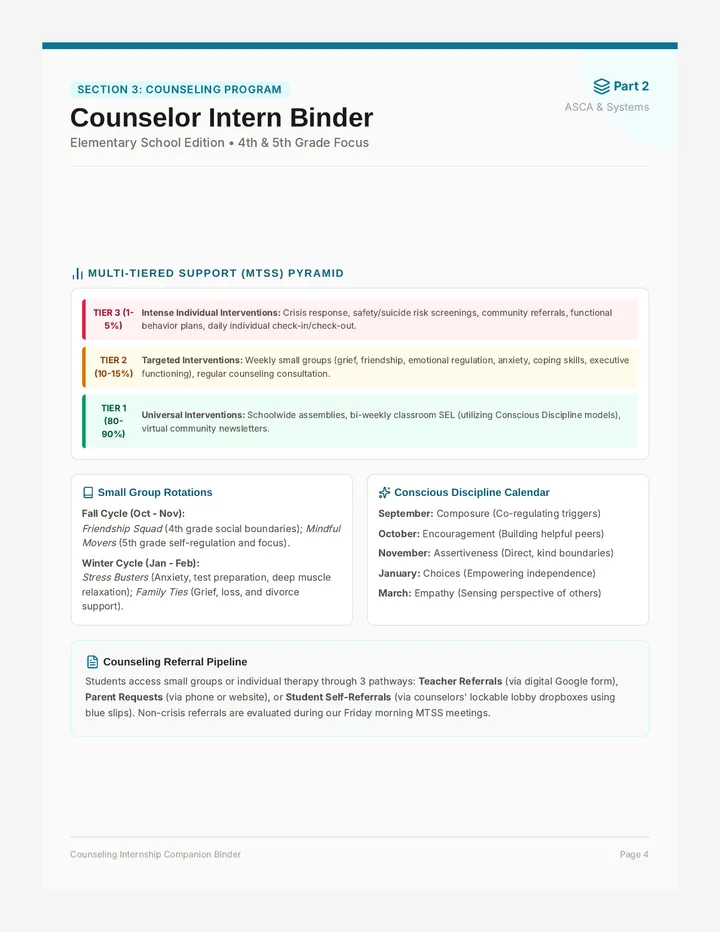
Counseling Program & Procedures Guide (Part 2) containing an ASCA-aligned program framework, tiered supports pyramid, student referral process, emergency procedures, confidentiality limits, and mandated reporting protocols.
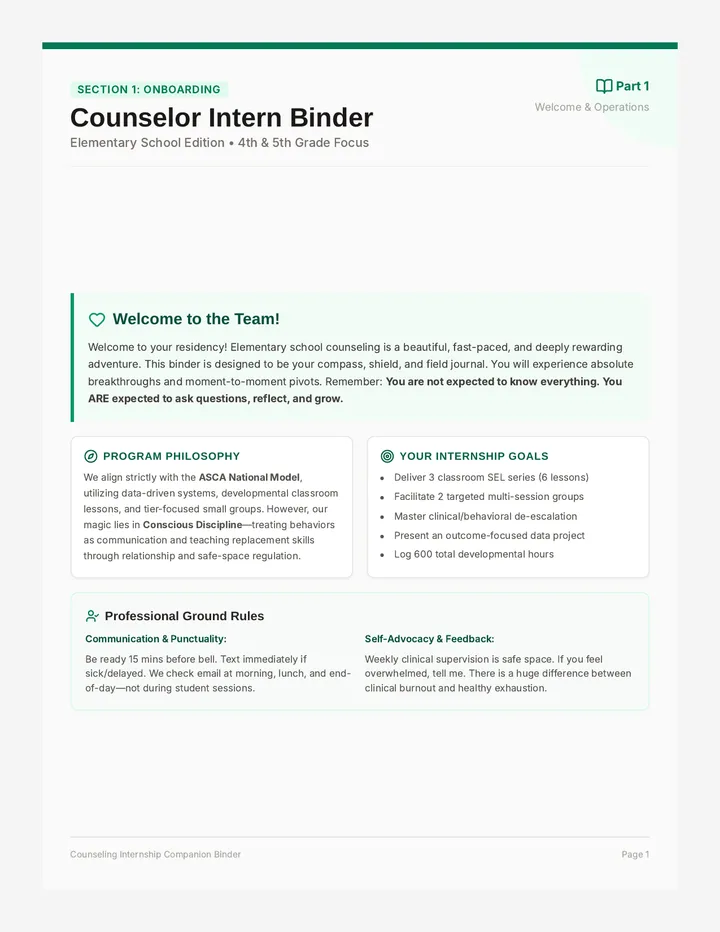
Onboarding & Operations Guide (Part 1) containing a warm welcome letter, program philosophy, intern goals, school schedules, directories, daily logistics, and humorous survival tips.
A guided reflection journal for students to document their personal stress triggers and create a customized 90-day resilience plan for their transition into the workforce.
A modern, minimalist slide deck for adult learners that visualizes the psychological transition to the workforce and provides instructional graphics for stress-management techniques.
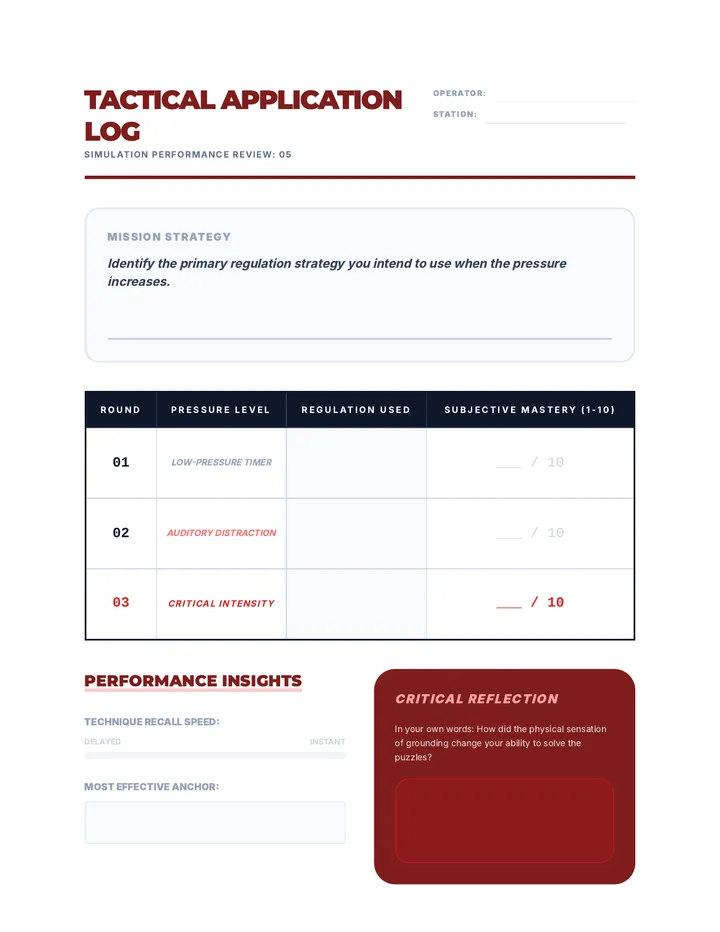
A performance tracking log for students to evaluate their use of regulation techniques during the final simulation under timed cognitive pressure.
Introductory slides for the Simulated Stress Response lesson, facilitating the final classroom simulation where students apply techniques under cognitive pressure.
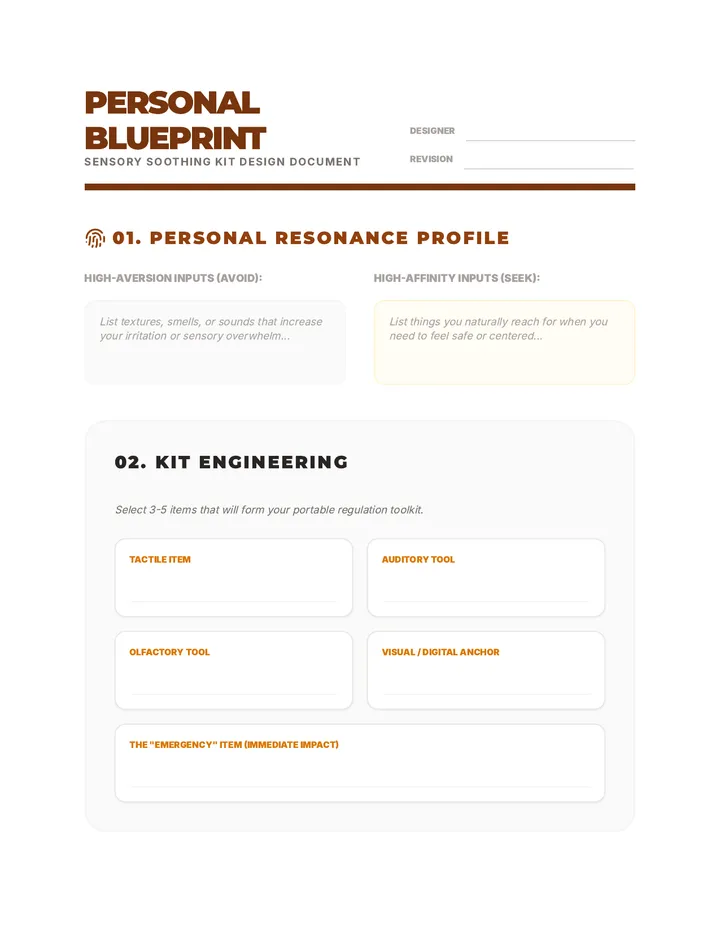
A project guide and planning document for students to design their personalized physical or digital sensory soothing kits.
Introductory slides for the Sensory Soothing Kit project, covering the psychology of decision fatigue, sensory inputs, and physical vs. digital implementation formats.
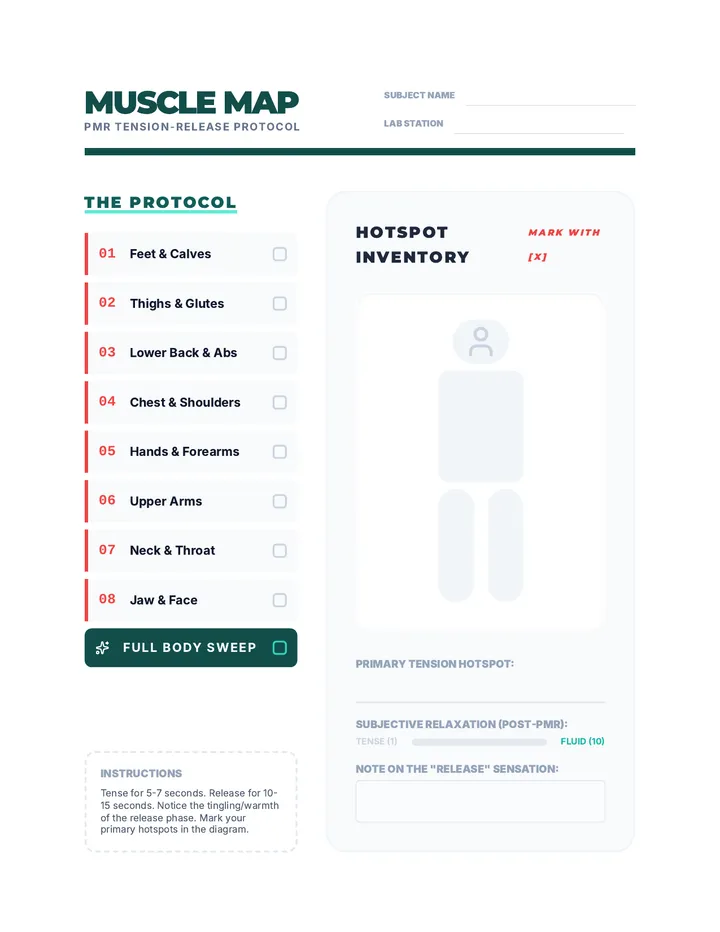
A visual checklist and hotspot mapping tool for students to track their physical response to Progressive Muscle Relaxation.
Technical slides for the Progressive Muscle Relaxation lesson, teaching the tension-relaxation contrast and the full-body PMR protocol.
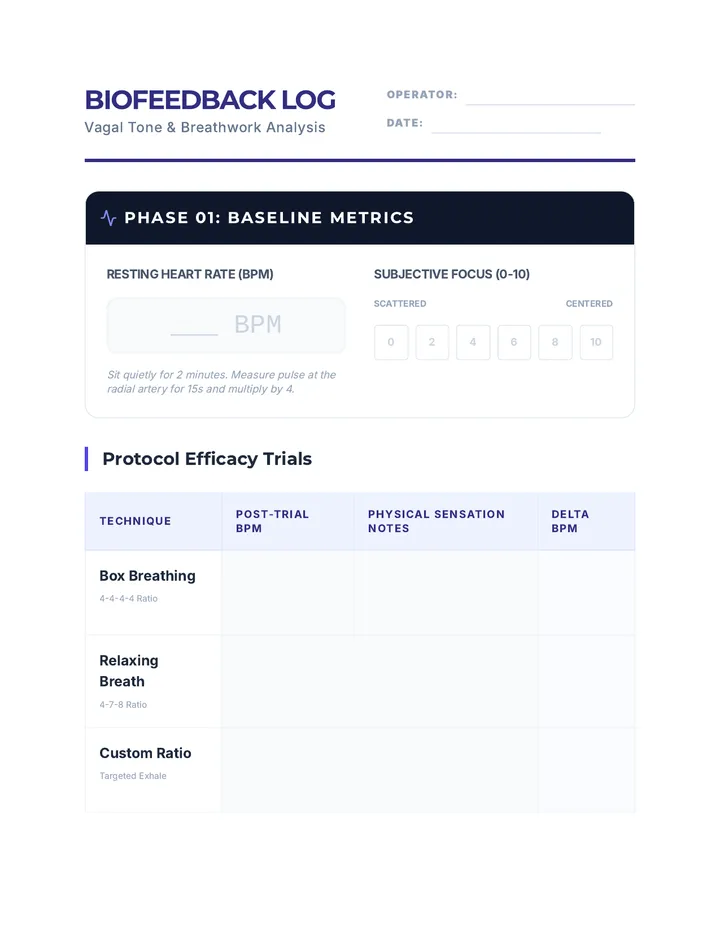
A technical biofeedback log for students to record heart rate data and subjective stress levels before and after practicing various breathing protocols.
Technical slides for the Controlled Breathing lesson, explaining vagal tone, the autonomic nervous system, and step-by-step protocols for Box and 4-7-8 breathing.
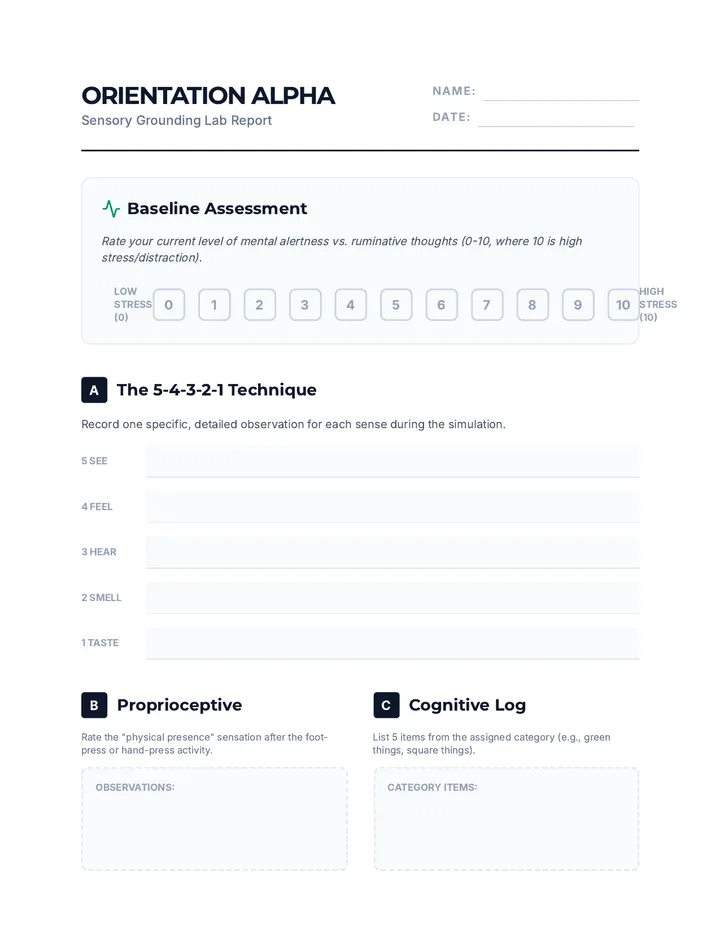
A structured lab report for undergraduate students to track and compare the efficacy of different sensory grounding techniques during a classroom simulation.
Introductory slides for the Sensory Grounding lesson, covering the science of ruminative loops, the ice cube challenge, and the 5-4-3-2-1 technique.
An assessment rubric for the final Community Charter project, evaluating theory application, safety planning, and sustainability.
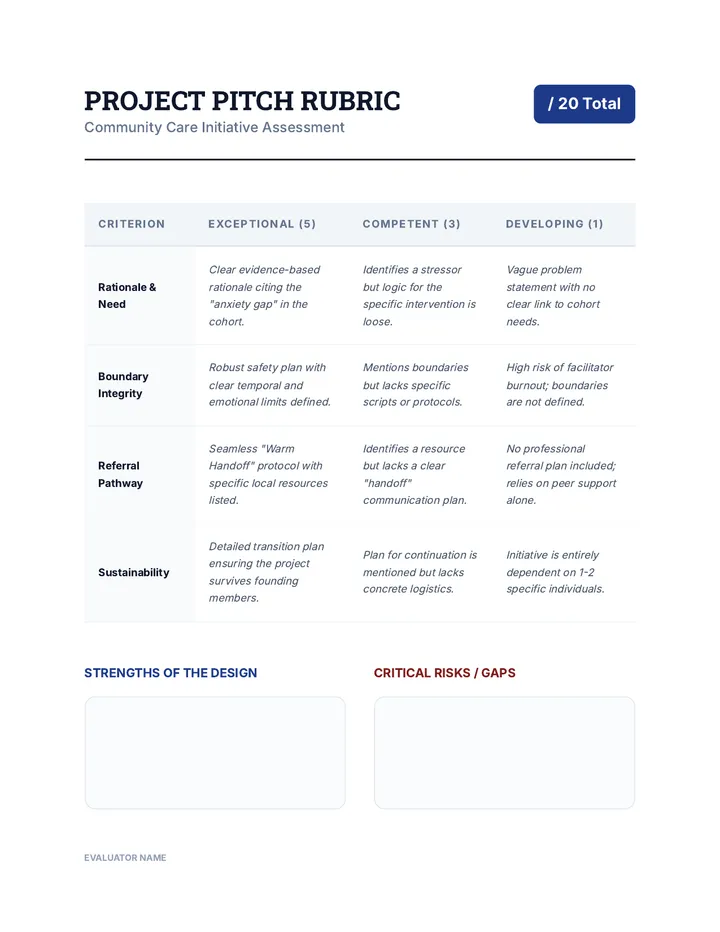
Final project rubric for evaluating the Community Care Initiative, focusing on rationale, boundaries, referral pathways, and sustainability.
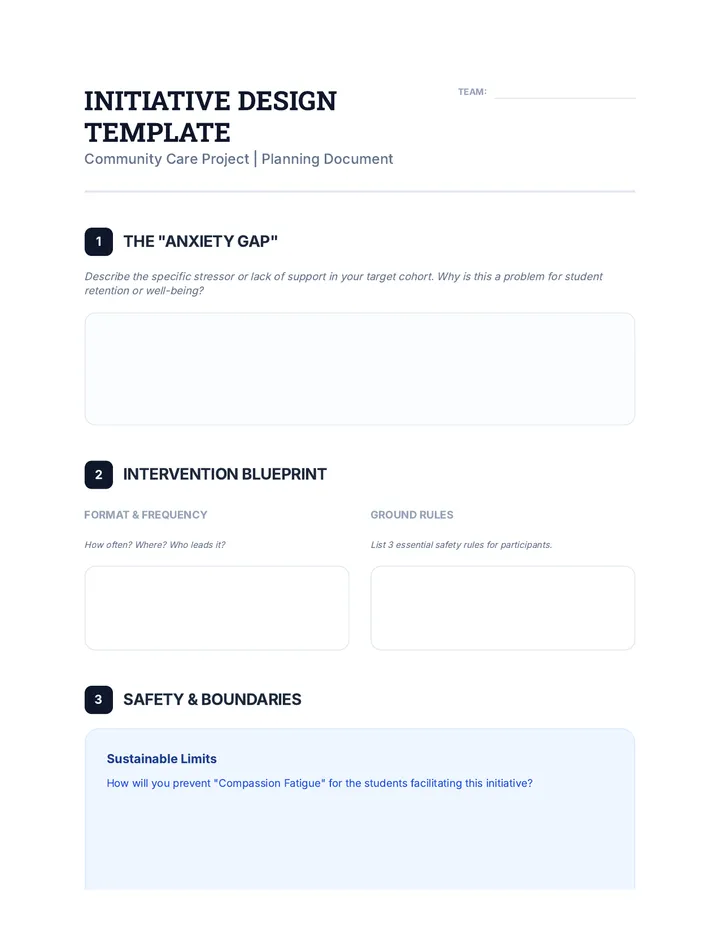
Student design workbook for planning the Community Care initiative, covering problem definition, logistics, safety boundaries, and sustainability.
A design framework for a community care plan, producing a 'Community Charter' for peer support in a specific campus context.
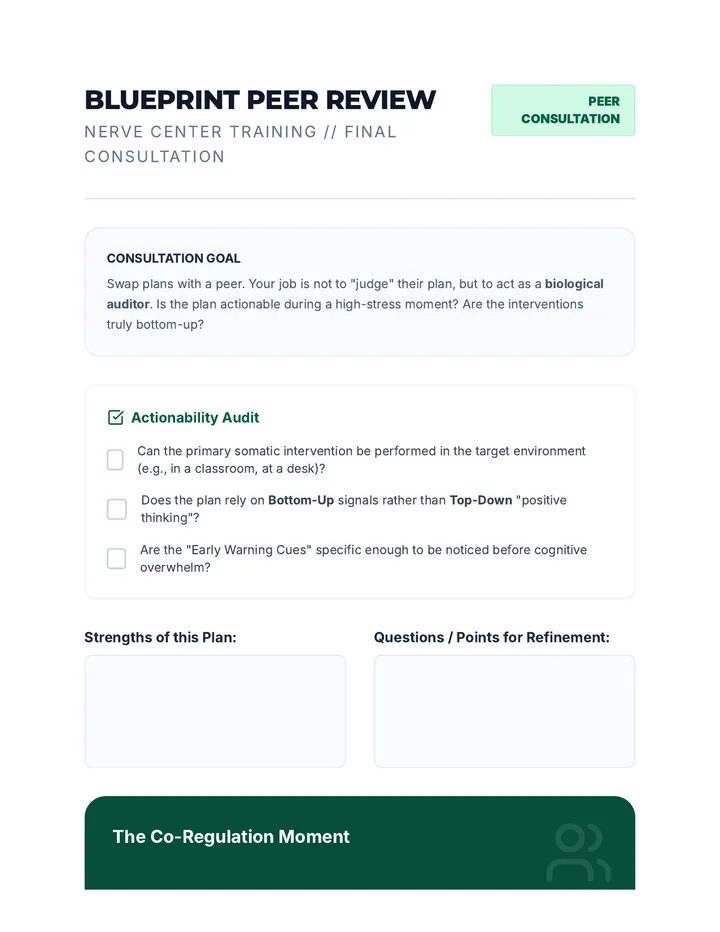
A peer review checklist and facilitation guide for students to audit each other's physiological safety plans, focusing on actionability and bottom-up efficacy.
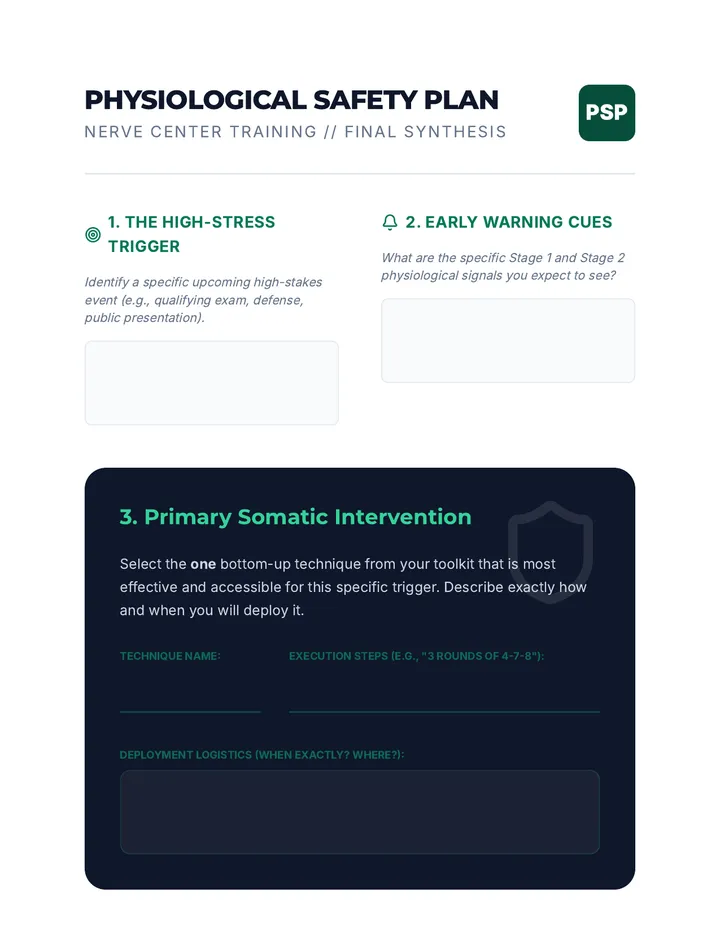
The culminating project template for the sequence: a personalized physiological safety plan that synthesizes triggers, cues, somatic interventions, and anchors.
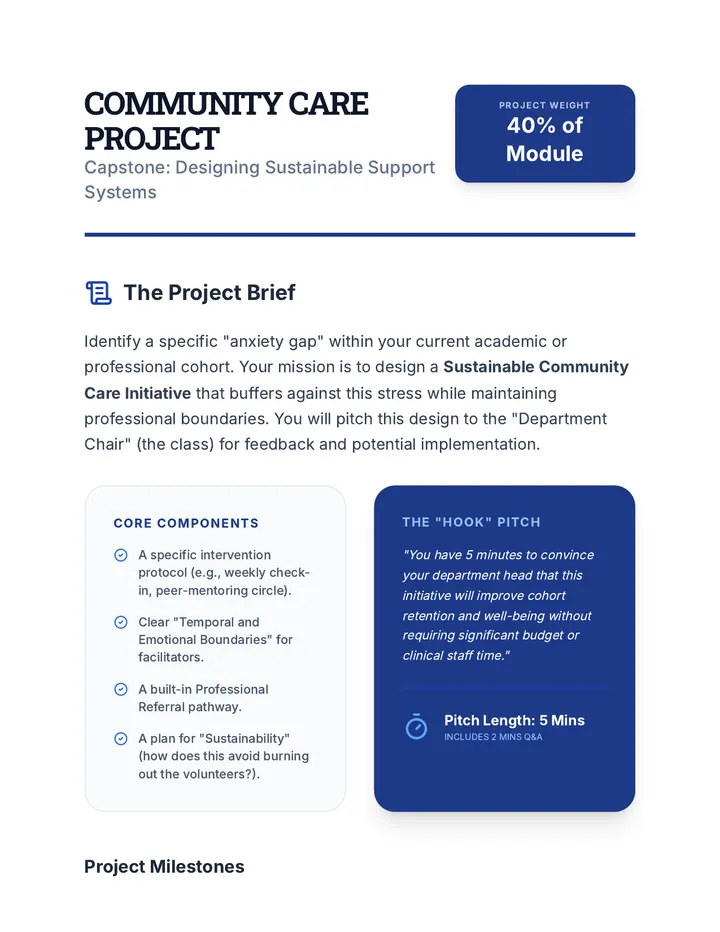
Final project brief for the Community Care initiative, detailing requirements, core components, and the "Department Pitch" assessment.
Visual slide deck for Lesson 5, introducing the concepts of mutual aid, sustainable networks, and the "Community Charter" project.
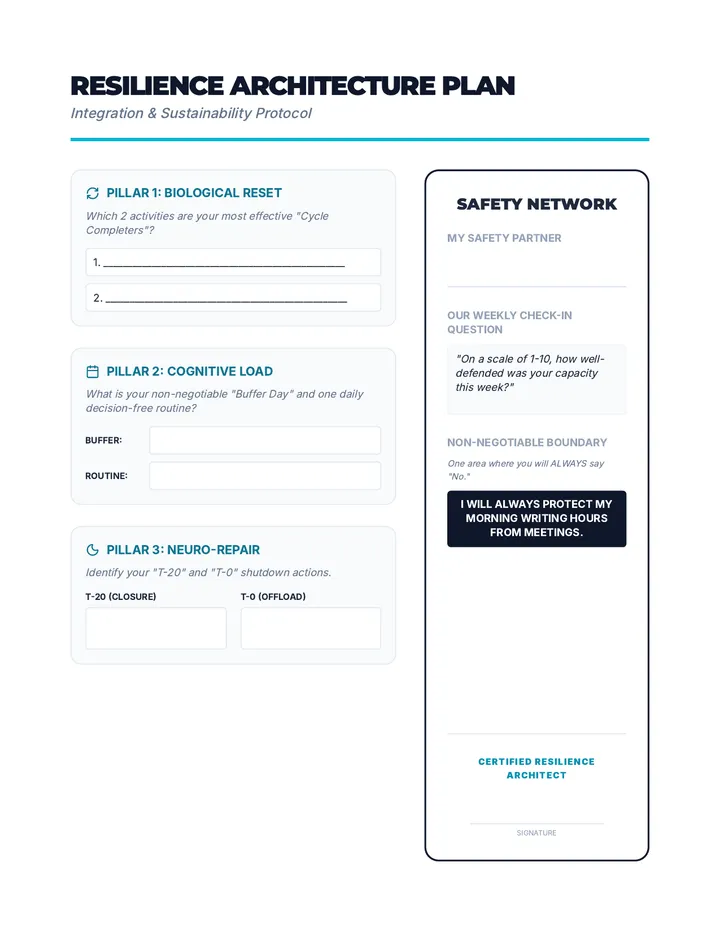
Final student synthesis materials for Lesson 5, including a comprehensive Resilience Architecture master plan and a portable, pocket-sized Crisis Card for immediate intervention.
Synthesis slides for Lesson 5, introducing the concept of mental rehearsal and the architecture of a physiological safety plan.
Visual presentation for Lesson 5, synthesizing the sequence and introducing the Resilience Architecture plan and Crisis Card.
A student budgeting activity for Lesson 4 that teaches students how to evaluate opportunities and practice declining them to protect their academic capacity.
Visual presentation for Lesson 4, addressing the economics of energy, role overload, and the "Yes/No/Negotiate" framework in academia.
A student blueprint for Lesson 3 to design a personalized shutdown ritual and optimize their sleep environment.
Facilitator guide for Lesson 5, outlining the instructional flow, discussion prompts, and key concepts for the maintenance contract and habit formation.
Visual presentation for Lesson 3, focusing on the neurobiology of sleep and the concept of revenge bedtime procrastination.
A formal maintenance contract for students to commit to their regulation protocols, establishing maintenance schedules and accountability partners.
Final slide deck for Lesson 5, focusing on habit formation, maintenance schedules, and the commitment to protocol adherence.
A student worksheet for Lesson 2 that helps graduate students audit 'phantom time' lost to anxiety and design a schedule with structural buffers.
The final client reflection sheet, focusing on synthesis and the 'Middle Path' of grieving. Revised for single-page layout, light background for handwriting, and improved contrast.
Facilitator guide for the final session, synthesizing all curriculum skills through the concept of 'Walking the Middle Path' to balance honoring the past with living in the present.
A student reflection sheet for Session 8, helping clients apply the FAST skill. Revised for single-page layout, increased font sizes, improved handwriting space, and better contrast.
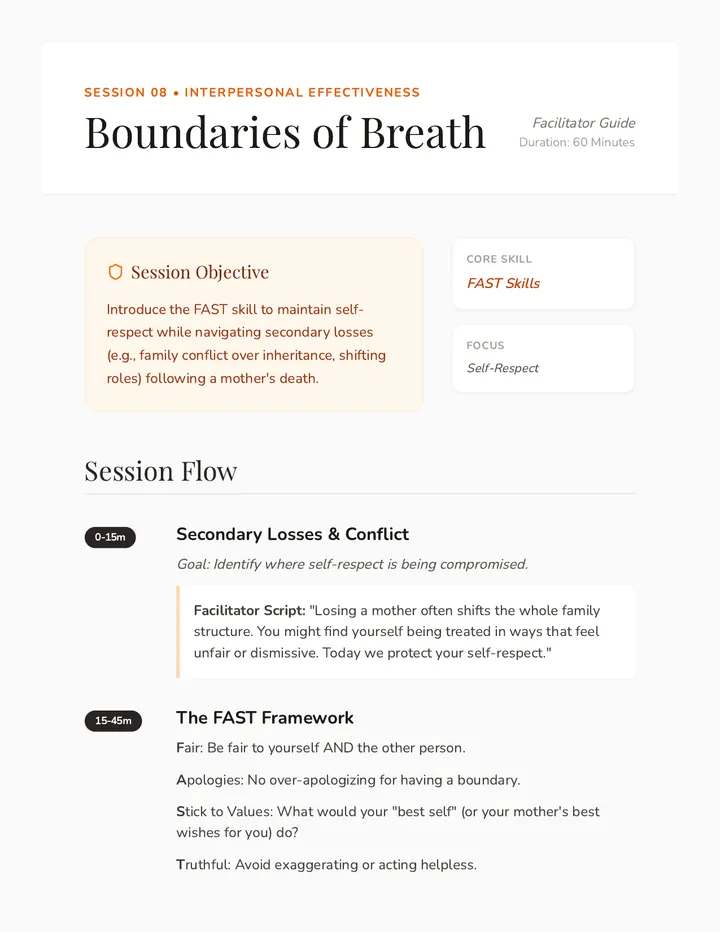
Facilitator guide for Session 8, focusing on the FAST interpersonal skill to help clients maintain self-respect and set boundaries during family conflicts and secondary losses after a mother's death.
A student reflection sheet for Session 7, providing a needs assessment and a template for crafting a DEAR MAN script. Revised for single-page layout, increased font sizes, and improved handwriting space.
Facilitator guide for Session 7, teaching the DEAR MAN interpersonal effectiveness skill to help grieving clients articulate their needs and request support from their social network.
A student worksheet for Session 6, outlining Opposite Action strategies and a "Legacy List" to help clients build positive experiences. Revised for single-page layout and improved writing areas.
Facilitator guide for Session 6, implementing DBT skills like 'Opposite Action' to help clients overcome grief-induced withdrawal and intentionally build meaningful, positive experiences.
A student worksheet for Session 5, providing a structured "Check the Facts" table to help clients distinguish between objective events and judgmental narratives. Revised to fit one page, increase handwriting space, and improve contrast.
Facilitator guide for Session 5, applying the 'Check the Facts' DBT skill to address and reframe common grief-related guilt and regrets surrounding maternal loss.
A client reflection sheet for Session 4, providing a sensory map for self-soothing and a template for creating a personalized "Solace Ritual." Revised for single-page layout, increased font sizes, and improved writing space.
Facilitator guide for Session 4, focusing on self-soothing techniques through the five senses to address the void of maternal comfort and create personalized grounding rituals.