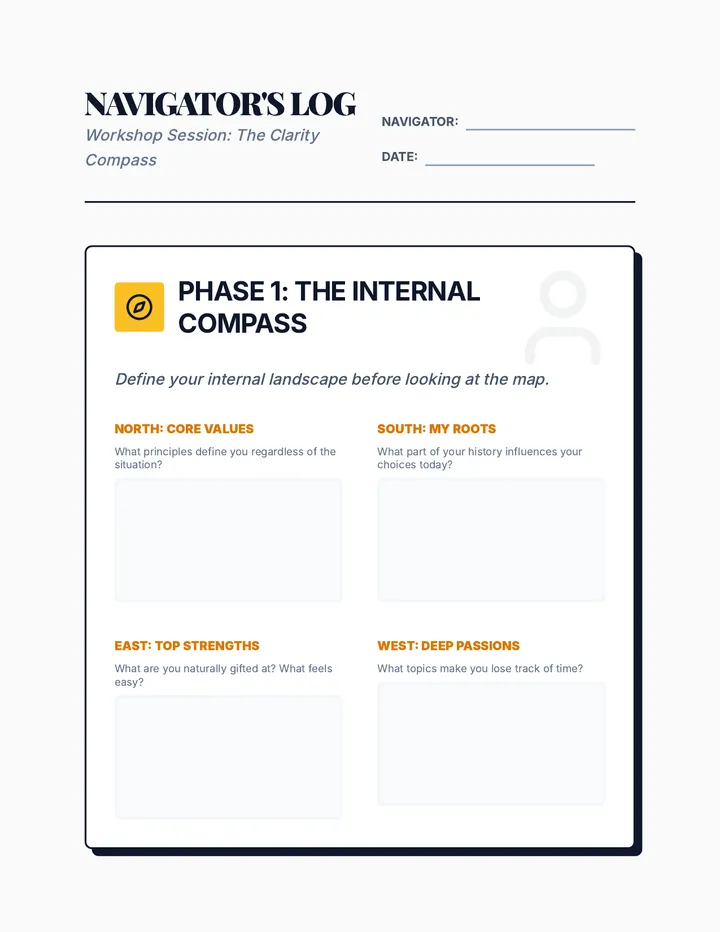
Emotion recognition ranging from basic feelings to complex nuances and mixed states. Strengthens accurate self-assessment through identity exploration, strength identification, and values-based decision making.
The ultimate compact version of the Adulting Celebration Chart with ultra-reduced line spacing and minimal vertical gaps. It utilizes tiny icons, condensed font sizes, and tight leading to provide a high-density workplace tracking experience that fits multiple players and comprehensive metrics in a single printable view. It moves metric descriptions inline to save vertical space.
A multi-page reflective 'Growth Log Journal' for students, featuring sections for modality discovery, self-advocacy script building, and goal setting to promote long-term metacognitive growth.
A student worksheet titled 'Strengths Compass', focusing on identifying academic strengths, soft skills, and environmental 'blind spots' to facilitate self-advocacy.
A set of printable 'Modality Mixer Cards' designed for a classroom activity. These cards provide specific tasks for students to test their visual, auditory, reading/writing, and kinesthetic learning preferences at different stations.
A visually engaging slide deck titled 'Unlocking You', exploring various learning modalities (VARK), self-advocacy strategies, and goal-setting for students from high school to graduate level.
A comprehensive lesson plan for educators titled 'Pathway Guide', detailing the instructional flow, objectives, and strategies for teaching students about personalized learning styles and self-advocacy.
A comprehensive facilitator guide for clinicians to lead the Mind Blueprints session, including pacing, activity instructions, and clinical tips for working with schemas in recovery.
A personal reflection worksheet for clients in clinical or recovery settings to identify their maladaptive schemas and brainstorm adaptive updates.
Printable cards for a matching activity. Includes 'The Lenses' (Schema cards) and 'The Moments' (Scenario cards) designed for clinical discussion and recovery settings.
A slide deck introducing cognitive schemas, their role in depression, and their specific impact on substance use recovery. Includes definitions of maladaptive schemas and positive adaptive schemas.
A comprehensive facilitator session guide for leading the Inner Garden Art Therapy session, including timing, scripts, troubleshooting tips, and session flows.
A student-facing worksheet for the Hybrid Bloom activity, featuring sections for grounding, a large creative workspace for the botanical metaphor, and structured reflection prompts.
An updated slide deck for the art therapy session with increased font sizes for accessibility and a refined 'Midnight Garden' aesthetic, now featuring specific sections on color language and painting techniques.
A visual presentation for the "Graduate Grit" workshop, featuring slides on tactical time management, the 'Research Trap,' and the three pillars of resilience.
A student-facing discussion outline that guides graduate students through the "Hustle and Heart" session activities, including an Eisenhower Matrix, resilience scenarios, and a personal commitment section.
A comprehensive 60-minute lesson plan for educators, featuring a timed sequence, learning objectives, and facilitation tips for teaching time management and resilience to graduate students.
A fun and educational worksheet for 10-year-olds that teaches metaphors, similes, and imagery using Taylor Swift's lyrics. Includes identifying devices in lyrics and a creative writing prompt about the student's own "Era."
An engaging 6-slide presentation for 10-year-olds about Taylor Swift's career, focusing on songwriting techniques, the concept of "Eras," and resilience. Uses a vibrant, sparkly theme with minimum 28px font size for high visibility.
Printable mindfulness micro-practice cards designed for graduate students to use during research, writing, and study sessions.
A detailed facilitation guide for counselors or advisors to lead a 60-90 minute session on graduate student resilience, including scripts, timing, and discussion prompts.
A facilitator's guide for leading a seminar on theoretical orientation in group counseling, including session objectives, Corey chapter synthesis, and activity notes.
A cognitive restructuring worksheet designed for college-aged students to identify, challenge, and reframe automatic thoughts using a "Thought Triage" model.
A set of instructional slides for a master's level group counseling seminar focusing on theoretical orientation (Corey Ch 13/14) and the application of CBT for college-aged clients.
A comprehensive project guide and rubric for students to create a visual career timeline and strategic roadmap, integrating their research and self-discovery into a 5-10 year professional plan.
A student worksheet for self-discovery using the Ikigai framework and a structured research matrix to evaluate potential career paths, salaries, and future industry outlooks.
An activity where students map core transferable skills to various industries, identifying how specialized skills can be applied in different professional contexts.
A professional visual presentation designed to guide students through career self-assessment, industry trends, and strategic planning. Includes the Ikigai framework and future-ready skill stacking.
A detailed facilitator guide for teachers, providing a structured sequence for the Career Foundations lesson including learning objectives, required materials, and discussion prompts.
A comprehensive facilitation guide for instructors, detailing the learning objectives, instructional sequence, and common student misconceptions regarding group counseling planning. Links theories from Jacobs et al. and Coogan & Steen (including the TRATE model) to practical classroom implementation.
A two-page case study analysis worksheet for school counseling students to practice big-picture and session-specific planning. Features a middle school transition scenario and requires application of Jacobs et al.'s 3-phase model and Coogan & Steen's leadership skills, now including a focus on the TRATE model.
A professional 9-slide presentation for Master's level school counseling students, including a detailed slide on Coogan & Steen's TRATE model for leadership development. Other slides cover the 3-phase session plan, big-picture alignment, and common planning pitfalls. All text meets the minimum 24px requirement for visibility.
A practical action plan for learners to audit their apps, notifications, and digital environments.
A reflective workbook for learners to audit their digital habits and define their personal values regarding technology.
A comprehensive lesson plan for instructors, including discussion prompts, research-backed insights, and activity instructions.
A visual presentation covering the psychology of the attention economy and the core pillars of digital minimalism.
A reflective student worksheet for use during person-centered group sessions, focusing on self-awareness, authenticity, and interpersonal connection.
A comprehensive teacher guide for facilitating person-centered groups in schools, including detailed breakdowns of group types, process stages, and facilitation pitfalls.
A 10-slide presentation introducing the Person-Centered Approach (PCA) in school counseling groups, covering core conditions, counselor roles, and various group types like psychoeducational and support groups.
A guided partner worksheet for practicing the Peace Pilot protocol, featuring I-Statement templates, role-play planning, and a mission reflection.
A set of 10 printable discussion cards featuring conflict scenarios in workplace, residential, community, and social settings for group dialogue.
Visual social stories and instructional slides for the Peace Pilots lesson, using aviation metaphors to teach conflict resolution in four key settings.
A teacher navigation guide for the Peace Pilots lesson, featuring instructional flow, differentiation strategies for adults with disabilities, and the core I-Statement protocol.
A set of instructional slides detailing the structure, facilitator role, and specific techniques of CBT within a group counseling setting.
A clinical reference "cheat sheet" for graduate counseling students, featuring translation guides for surface-to-depth language, question stems, and a session checklist.
A slide presentation for graduate counseling students, now updated for group dynamics. It includes the required definitions of depth, why it matters, and specific facilitator techniques like linking and modeling vulnerability.
Student-facing role-play scenarios and a clinical observation tracker designed for school counseling graduate students to practice identifying underlying themes.
A clinical facilitation guide for instructors, redesigned for group counseling. It includes the Iceberg model, specific definitions of depth, and techniques for facilitating group process and cohesion.
A facilitation guide for the "Waiting Way" lesson, including pacing suggestions, discussion points, and an answer key for the scenario worksheet to help trainers lead effective staff development sessions.
A set of 8 roleplay cards for nursing home staff, featuring diverse scenarios like dementia care, family conflict, and physical pain. Designed for staff huddles to practice the WAIT framework (Watch, Acknowledge, Inform, Transition) in real-world situations.
A scenario-based worksheet for nursing home staff to practice the WAIT framework (Watch, Acknowledge, Inform, Transition). Includes four realistic care situations with dedicated areas for students to write their observations and responses.
A 8-slide presentation for nursing home staff introducing the WAIT framework (Watch, Acknowledge, Inform, Transition) for managing resident wait times with compassion and professionalism.
A teacher-facing discussion guide containing categorized conversation prompts to help students explore their emotional weather metaphors deeply.
A 4-page quick reference booklet for adult learners, providing specific disengagement tactics, physical regulation techniques, and mental anchors to manage social provocation and academic frustration. Designed with a professional, discreet aesthetic suitable for a correctional environment.
A 4-page comprehensive booklet for adult learners, providing deep-dive strategies for managing social provocation, academic frustration, and long-term self-regulation habits.
A visually clear grounding menu for adult learners, featuring four distinct physical and mental techniques to quickly de-escalate during moments of irritation or high frustration.
A professional social narrative designed for adult learners, providing step-by-step protocols for managing social provocation and academic frustration without impulsive outbursts.
A set of weekly writing prompts and a structured reflection template for a two-semester research project. It guides students through the GTD phases—Capture, Clarify, Organize, and Reflect—while encouraging 400-word thoughtful responses.
A high-impact visual poster designed for a bathroom mirror to provide daily GTD reminders tailored for 'hummingbird' students. It simplifies the capture-clarify-organize-reflect cycle into daily habits for managing a long-term research project.
A printable template for standard 3x3 sticky notes, designed to help 'hummingbird' students quickly capture ideas, define next actions, log research sources, and track pending items without losing focus.
A calming, two-page self-reflection worksheet focused on the benefits of peer support in group counseling and developing empathetic listening skills. It includes reflective prompts, a comfort-level scale, and specific active listening habits to practice.
A professional 2-page proposal and lesson guideline for the 'Words That Work' program. It features the 6-month curriculum roadmap, a detailed breakdown of the 5-part instructional framework, and a concrete example lesson for 'My Name & Identity'. This version uses a rhythmic chant warm-up instead of magnets.
A student worksheet and reference toolkit for practicing emotional regulation, identifying triggers, and scripting professional responses.
A visual presentation deck designed to support a 90-minute training session on professional emotional regulation, featuring concepts like the Amygdala Hijack and Response Toolkits.
A comprehensive 90-minute facilitator guide including instructional scripts, pacing notes, and detailed activities for a training session on emotional regulation and professional communication.
The second part of the participant reflection journal, completing the 15-day journey with prompts for psychodrama, storytelling, synthesis, and closing rituals.
Facilitator guide for the final two days of the Soul Canvas program, focusing on integration mapping and the closing ceremony.
Facilitator guide for Days 11 through 13, covering object-based storytelling, intermodal fusion, and the ethics of therapeutic endings.
Facilitator guide for Days 8 through 10, focusing on sociometry, psychodramatic techniques like the empty chair, and narrative therapy basics.
A condensed modular facilitator guide covering Days 5 through 7, including lyric rewriting, Laban movement efforts, and authentic movement practices.
Facilitator guide for Day 4, focusing on rhythm and drumming as tools for group cohesion and personal grounding.
Facilitator guide for Day 3, focusing on mask-making to explore the public persona versus the private self.
Facilitator guide for Day 2 of the Soul Canvas program, focusing on non-dominant hand drawing and somatic visual expression.
Facilitator guide for Day 1 of the Soul Canvas expressive arts program, focusing on group foundations, safety, and ethics.
A comprehensive 15-day reflection journal for expressive arts therapy participants, providing structured prompts for each daily session across visual art, music, and movement. (Note: Contains first 6 days of reflections).
A comprehensive facilitator guide for teaching the Motivation Map framework, including lesson objectives, pacing, and facilitation tips for adult learners.
A reflective two-page worksheet for adult counselor students to map their circle of control, identify their primary motivator, and isolate a single actionable task.
A visually professional slide deck for adult counselor students, exploring the Circle of Control and the psychological roots of personal motivation.
A 2-page answer key for facilitators providing suggested responses and ACT-consistent perspectives for the 15 Willingness Crossroads scenarios.
A 5-page student worksheet containing a mini-lesson recap and 15 structured scenarios for practicing ACT willingness and distinguishing it from flooding.
A concise one-page reference sheet for students covering the core concepts of ACT willingness, the quicksand metaphor, and the Window of Tolerance.
A 14-slide presentation for an ACT willingness lesson, featuring metaphors, the Window of Tolerance mini-lesson, and 12 detailed scenario discussion slides.
A comprehensive teacher guide for leading a 2-3 hour ACT lesson on willingness, including pacing, instructional scripts, and facilitation tips tailored for adult mental health and substance abuse contexts.
An assessment rubric for the Career Architect project, providing teachers with clear criteria for grading students' post-graduation plans based on vision, research, timeline, and presentation.
A summative project guide and brainstorming handout where students design a visual representation of their post-graduation pathway, including foundational values and a 12-month construction timeline.
A technical planning worksheet for students to document their values, vision, and a detailed 12-month timeline for their post-graduation transition.
A research-focused activity sheet where students compare three different post-graduation pathways, analyzing costs, time commitments, and market outlooks.
Visual presentation slides for the Future Blueprint lesson, introducing the architectural metaphor for career planning, discussing values, and outlining research strategies.
A comprehensive teacher facilitation guide for the Future Blueprint lesson, featuring learning objectives, material checklists, instructional procedures, and differentiation strategies.
An interactive worksheet that guides students through mapping the consequences of a specific leadership decision across four levels: self, team, organization, and society.
An updated facilitation guide for teachers, including talking points for the new slides on trust dividends, timing traps, and ethical blind spots.