Emotion recognition ranging from basic feelings to complex nuances and mixed states. Strengthens accurate self-assessment through identity exploration, strength identification, and values-based decision making.
A collection of lessons that use modern cultural icons to teach literacy, social-emotional skills, and creative expression to elementary and middle school students.
A comprehensive 15-day expressive arts therapy program for adults, integrating visual arts, music, dance, psychodrama, storytelling, and professional ethics.
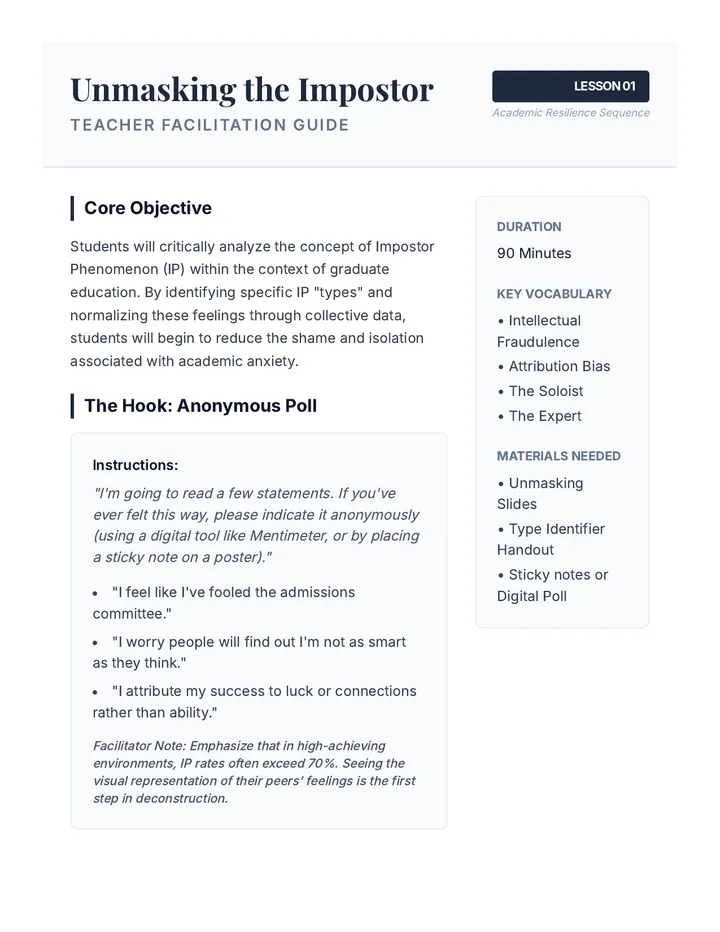
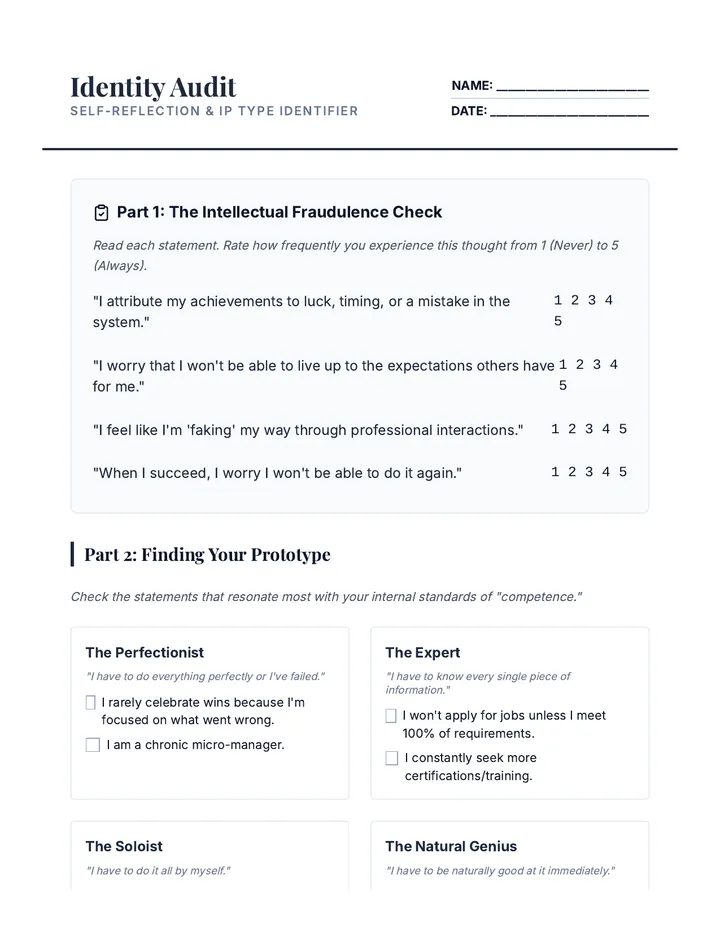
A comprehensive workshop sequence for graduate students to address academic anxiety through cognitive restructuring. The sequence explores Impostor Phenomenon, cognitive distortions, perfectionism, and professional identity to build long-term resilience.
A clinical training laboratory for graduate students to master the coaching and implementation of DBT FAST skills. Focuses on move from theory to practice through simulation, peer feedback, and managing client resistance.
A 5-lesson workshop sequence for undergraduate students to understand, challenge, and overcome imposter syndrome through peer validation and evidence-based identity building.
A 5-lesson sequence for graduate students designed to deconstruct the 'Impostor Phenomenon' and normalize academic failure. Students will analyze their internal narratives, create 'Shadow CVs', and reconstruct their professional identities through cognitive reframing and narrative inquiry.
A graduate-level exploration of how social structures, laws, and algorithms construct identity, moving from sociological theory to clinical 'Structural Competency' and advocacy.
This graduate-level sequence explores the neurobiological foundations and clinical applications of self-compassion interventions. Students will master the Three Systems Model of emotion regulation, psychometric assessment of self-compassion, and specific therapeutic techniques like visualization, somatic soothing, and the Self-Compassion Break.
A graduate-level sequence exploring Narrative and Acceptance and Commitment Therapy (ACT) techniques to manage internal dialogue. Students move from externalizing thoughts to practicing cognitive defusion and values-based action.
This sequence explores how societal narratives shape personal identity. Students learn to deconstruct dominant cultural 'scripts', utilize Narrative Therapy frameworks like the Landscape of Action/Identity, and practice Outsider Witnessing to formalize new, preferred stories of agency and resilience.
A comprehensive psychological resilience program for graduate students, focusing on CBT strategies to combat impostor syndrome, perfectionism, and academic rejection. This sequence builds practical metacognitive skills to help researchers maintain mental well-being throughout their academic careers.
A specialized mindfulness sequence for graduate students, focusing on attention as a cognitive resource to enhance research, writing, and performance while managing academic stressors.
This sequence addresses the 'Imposter Phenomenon' in graduate studies and high-level careers. Students move from diagnosing imposter feelings using psychometric tools to developing evidence-based leadership identities and feedback-integration strategies.
A graduate-level counseling sequence exploring how sociocultural forces shape self-image through Narrative Therapy and intersectional analysis. Students learn to externalize negative narratives and re-author their professional and personal identities.
A comprehensive graduate-level sequence exploring the intersection of neurobiology and Cognitive Behavioral Therapy (CBT) to restructure self-concept. Students will analyze the Default Mode Network, identify high-achiever cognitive distortions, and develop evidence-based maintenance protocols for professional resilience.
A comprehensive 5-lesson sequence for undergraduate students exploring the intersection of digital technology, psychological well-being, and cognitive autonomy. Students analyze the attention economy, social comparison, digital ethics, and productivity strategies to build a personalized framework for digital resilience.
A graduate-level sequence focused on the transition from trauma exposure to cognitive restructuring. Students learn to identify stuck points within trauma narratives, use Socratic questioning for reframing, and guide clients toward a resilient narrative conclusion.
This sequence examines the intersection of narrative psychology and creative writing as tools for mourning. Students investigate how trauma fragments linear memory and how structured writing interventions can restore narrative coherence. Through varied writing modalities—from structured journaling to poetry—students learn to reshape the story of loss, moving from a narrative of victimization to one of survival and meaning-making.
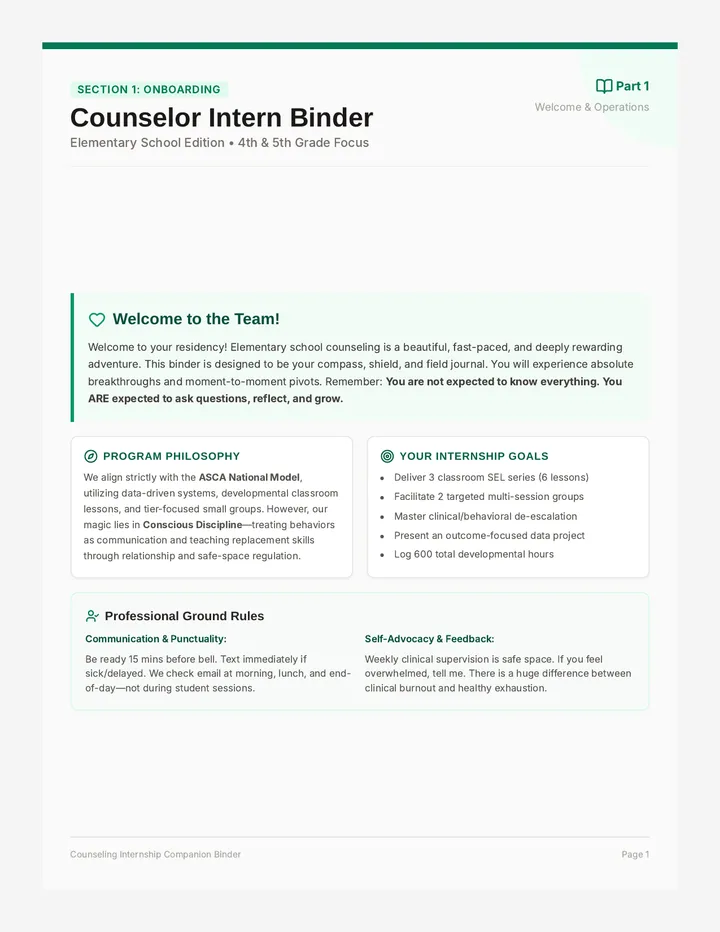
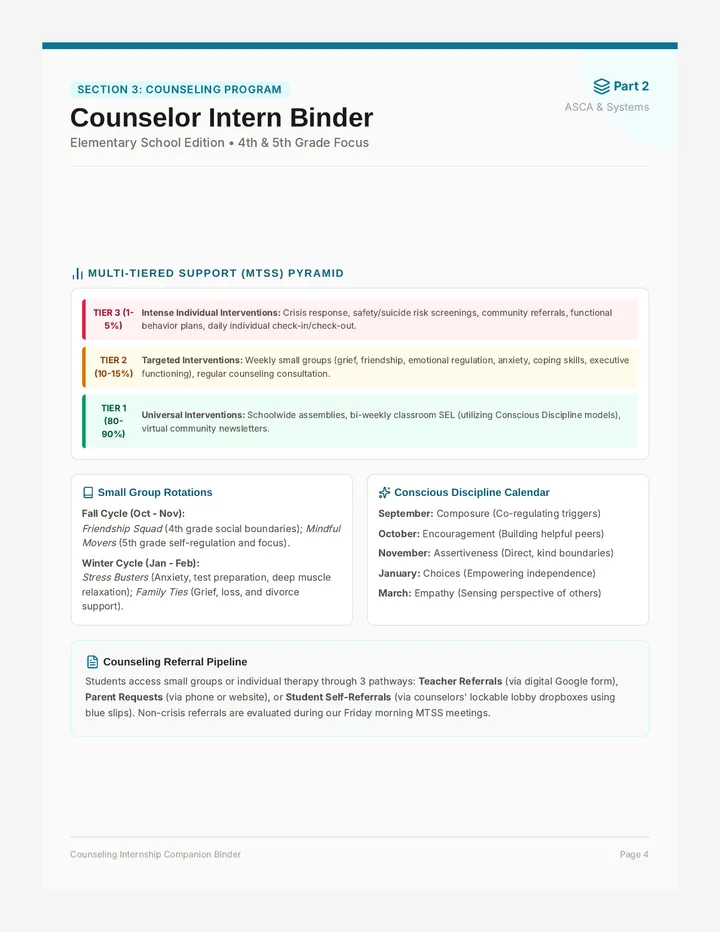
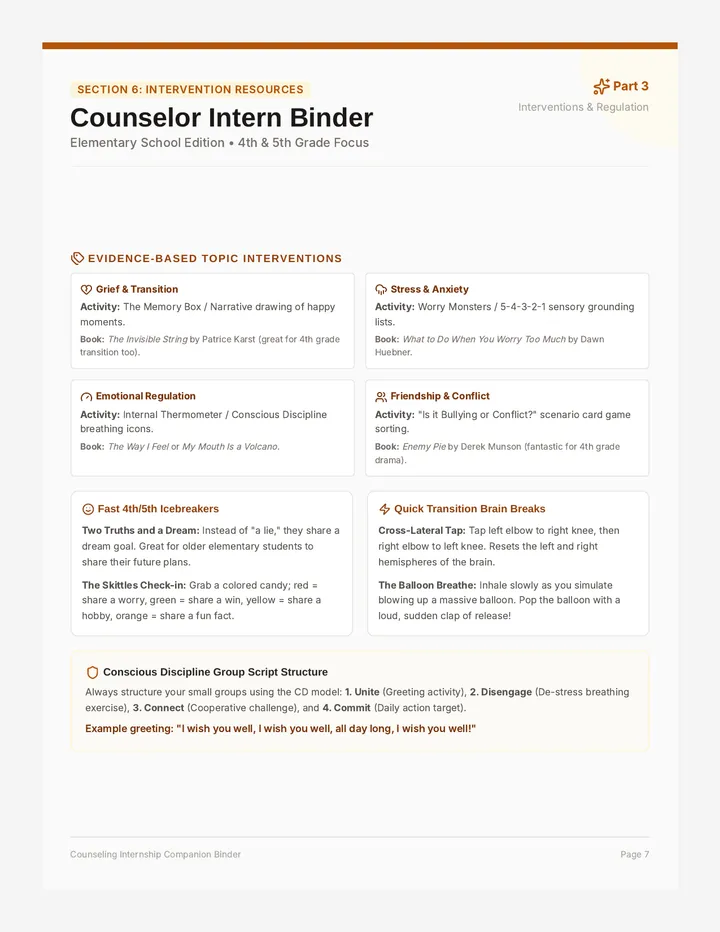
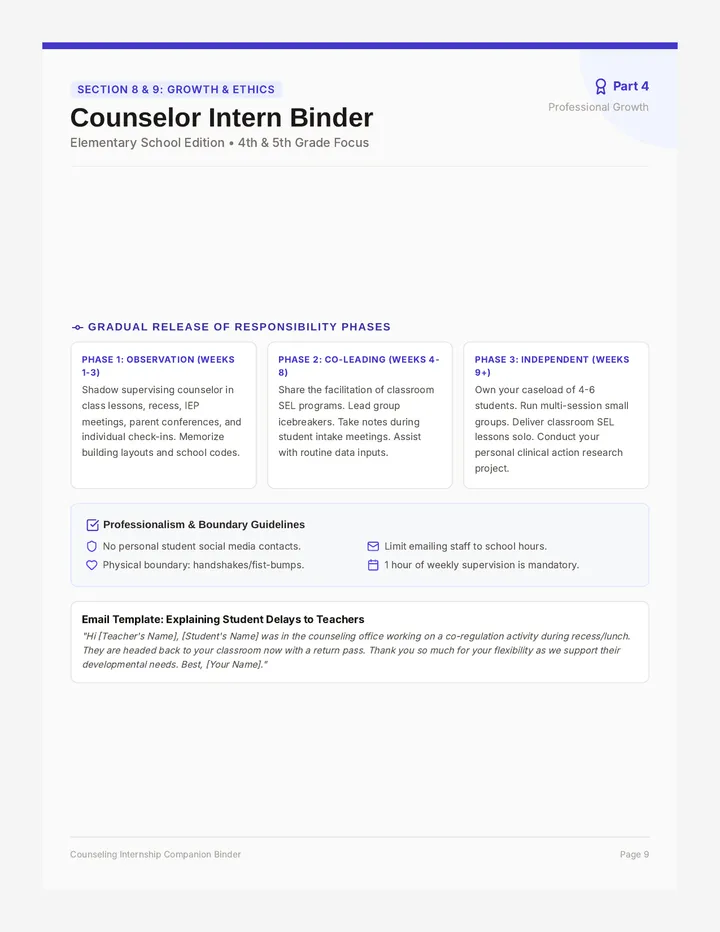
A comprehensive, professional, and warm internship binder split into modular parts to guide an elementary school counseling intern through their residency with practical tips, checklists, and procedures.
A 9-week therapeutic curriculum for adults processing maternal loss, integrating Dialectical Behavior Therapy (DBT) skills to foster acceptance, emotional regulation, and resilience.
A series of advanced counseling assignments covering Case Conceptualization and Theory/Intervention for CSL 686.
A professional development series for nursing home staff and volunteers focused on enhancing resident communication and emotional support through practical strategies.
A specialized curriculum for adults on mastering emotional regulation, focusing on the mechanics of anger explosions, identifying vulnerabilities, and understanding the long-term impact of emotional reactivity.
A comprehensive therapeutic sequence designed to guide clinicians and clients through the complexities of grief, focusing on assessment, psychoeducation, and age-appropriate coping strategies.
A comprehensive CBT toolkit for treating anxiety, covering cognitive restructuring, exposure therapy, behavioral experiments, and mindfulness. This sequence provides clinicians and clients with structured guides, tracking tools, and practical scenarios to build resilience and manage anxiety symptoms effectively.
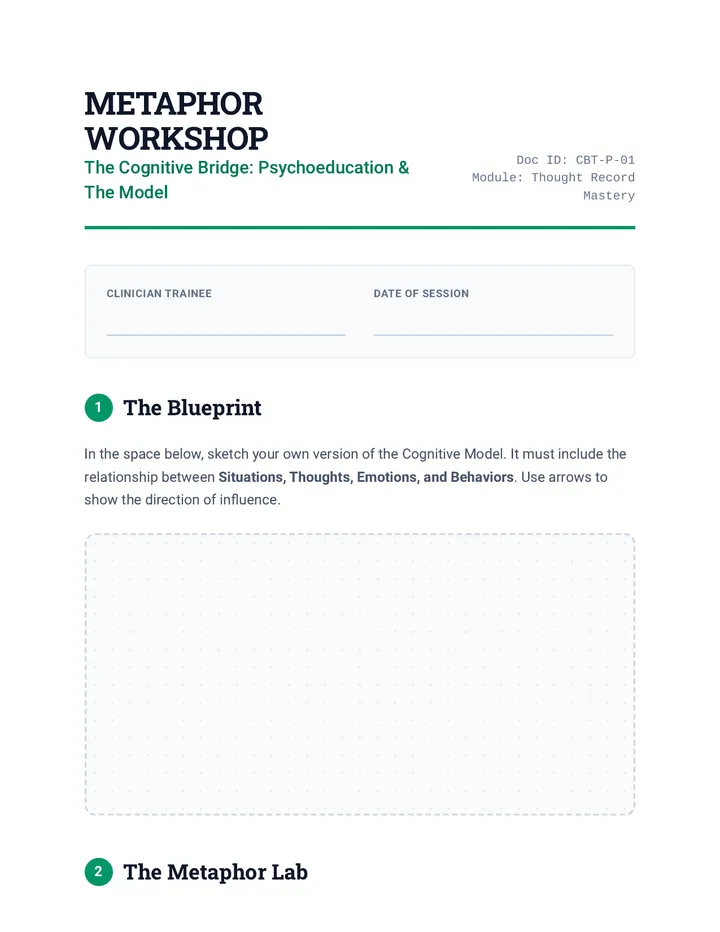
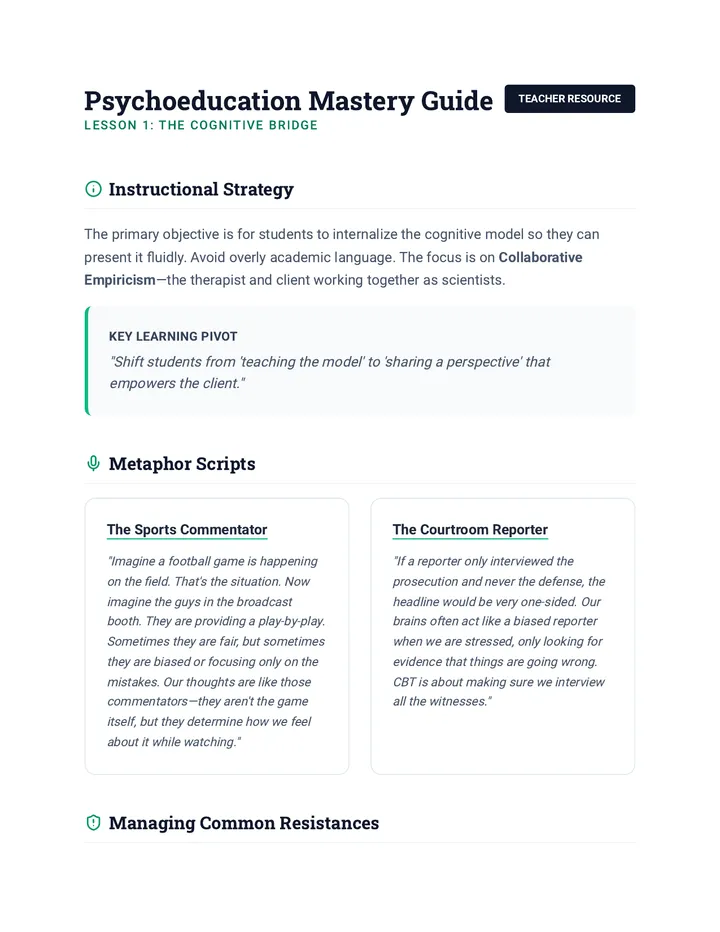
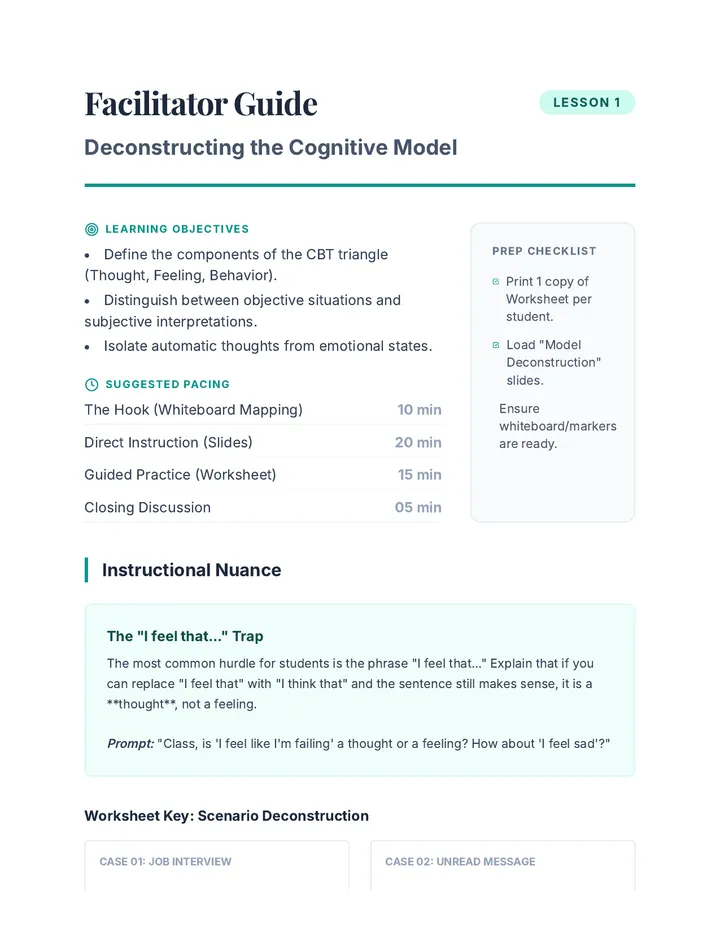
A comprehensive training workshop for graduate students on the clinical implementation of the standard 7-column thought record in Cognitive Behavioral Therapy (CBT). Students move from initial psychoeducation to the precise mechanics of cognitive restructuring and troubleshooting client compliance.
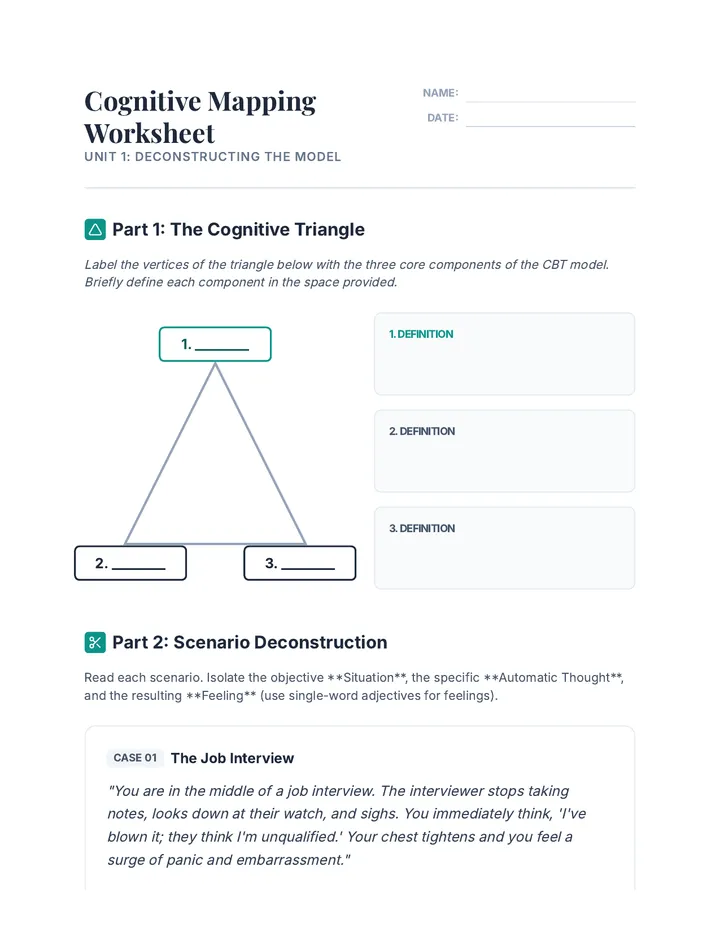
A comprehensive sequence for undergraduate students to master the clinical skill of cognitive restructuring using the 7-column thought record. Students progress from theoretical foundations to identifying distortions, gathering evidence, and synthesizing balanced thoughts.
This sequence immerses undergraduate students in the theoretical and practical application of advanced conflict resolution, moving beyond basic interpersonal skills to systemic mediation strategies. Students will master interest-based negotiation, emotional regulation, reframing, and power analysis through simulations and case studies.
This graduate-level sequence bridges the gap between neurobiological theory and clinical practice. Students will explore the physiological underpinnings of emotional dysregulation, analyze Polyvagal Theory, and develop the skills to implement and explain sensory-based grounding techniques through an evidence-based lens.
This sequence explores the physiological and psychological mechanisms of exposure therapy, moving from neurobiological foundations to the ethical application of therapeutic interventions. Students analyze the 'avoidance trap,' learn to quantify distress using SUDS, and distinguish between habituation and inhibitory learning through clinical case study analysis.
A comprehensive graduate-level training sequence exploring how cultural identity, systemic barriers, and implicit bias influence crisis presentation and peer support. Students move from understanding diverse cultural idioms of distress to developing culturally responsive safety plans that challenge traditional Western medical models.
An advanced course for graduate students exploring the intersection of neurobiology, psychological theory, and organizational leadership. Students develop high-level social and emotional competencies to navigate complex professional environments and foster psychological safety.
An advanced clinical sequence for graduate students focusing on the assessment of romantic relationship dynamics through attachment theory, neurobiology, and evidence-based frameworks. It bridges theory with clinical application, focusing on adult attachment, power dynamics, and conflict styles.
An advanced workshop-style sequence for graduate students focusing on communication architectures, differentiation of self, and the practical mastery of healthy relationship dynamics. Students will move from theoretical frameworks (Bowen Family Systems, NVC) to high-stakes practical simulations.
A sequence for graduate students exploring mindfulness as a tool for emotional intelligence and resilient leadership. Focuses on moving from internal regulation to interpersonal effectiveness in professional settings.
This graduate-level sequence focuses on clinical interventions for alexithymia, moving from sophisticated psychometric assessment to somatic and narrative scaffolding for clients who struggle to identify and label emotions.
A comprehensive sequence for graduate students focusing on the craft of personal statements for competitive fellowships. Students will learn to deconstruct complex prompts, mine their life experiences for compelling hooks, bridge their past achievements with future goals, and tailor their narratives for diverse funding audiences through rigorous revision.
A graduate-level sequence focused on applying FAST skills (Fair, Apologies, Stick to Values, Truthful) to professional identity, boundary setting, and therapist resilience. Students learn to navigate imposter syndrome, ethical documentation, and career advocacy through a clinician-centered lens.
This graduate-level sequence critically examines the DBT FAST skills (Fair, Apology-free, Stick to values, Truthful) through the lenses of cultural humility, intersectionality, and systemic power dynamics. Students will move beyond a Eurocentric assertiveness model to develop nuanced, safe, and culturally responsive clinical interventions.
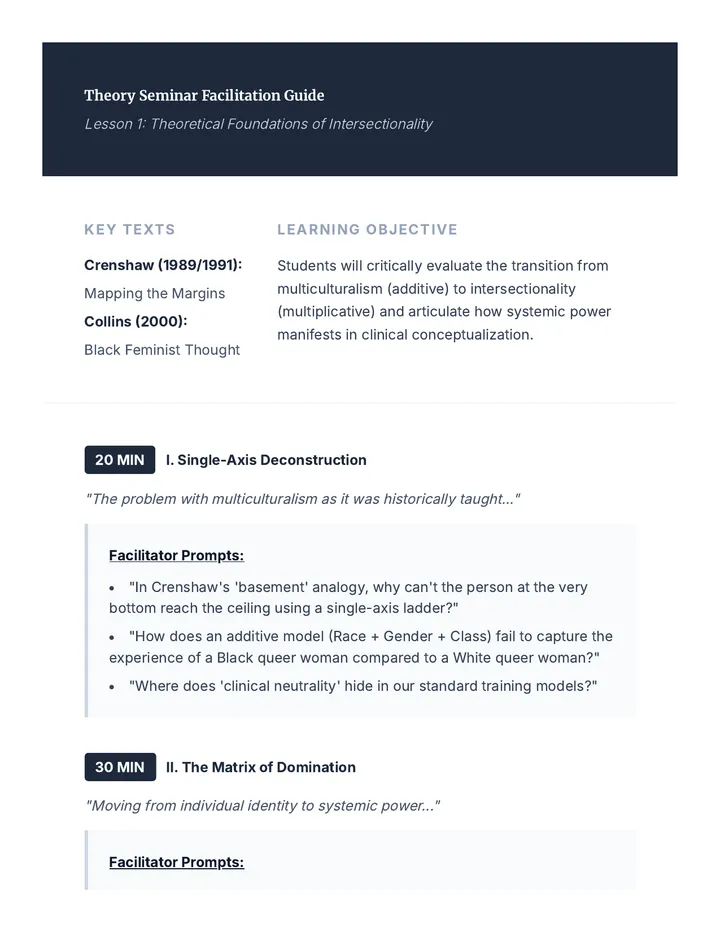
A 5-lesson sequence for graduate counseling students to explore intersectionality, social location, and family scripts to build cultural humility and professional identity. Students move from theoretical critique to personal excavation and clinical application.
A 5-lesson series for graduate students focused on navigating the systemic stressors of academia, setting professional boundaries, and preventing burnout through neurobiological understanding and assertive communication.
A comprehensive sequence for graduate students using behavioral science to build sustainable wellbeing habits through stress auditing, micro-practices, and systemic analysis.
This sequence for graduate counseling students examines how culture, language, and systemic context shape emotional labeling and expression. It challenges Western-centric models and prepares students to use culturally humble inquiry in clinical settings.
A comprehensive exploration of intersectionality and cultural humility for undergraduate students. This sequence moves from personal identity mapping to institutional accountability, emphasizing lifelong self-reflection and the recognition of power dynamics in professional and community settings.
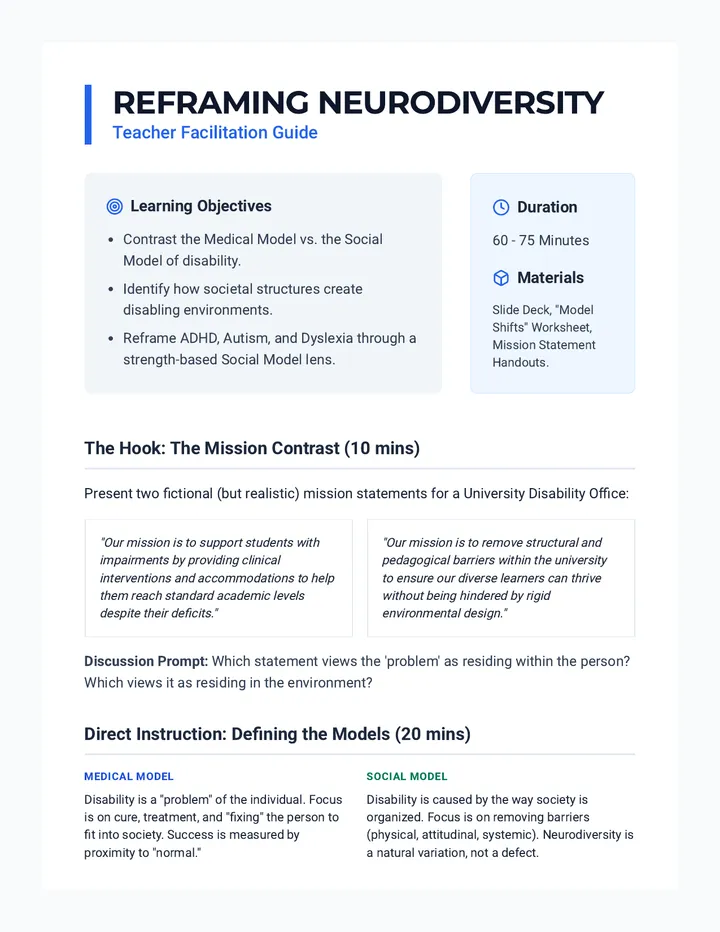
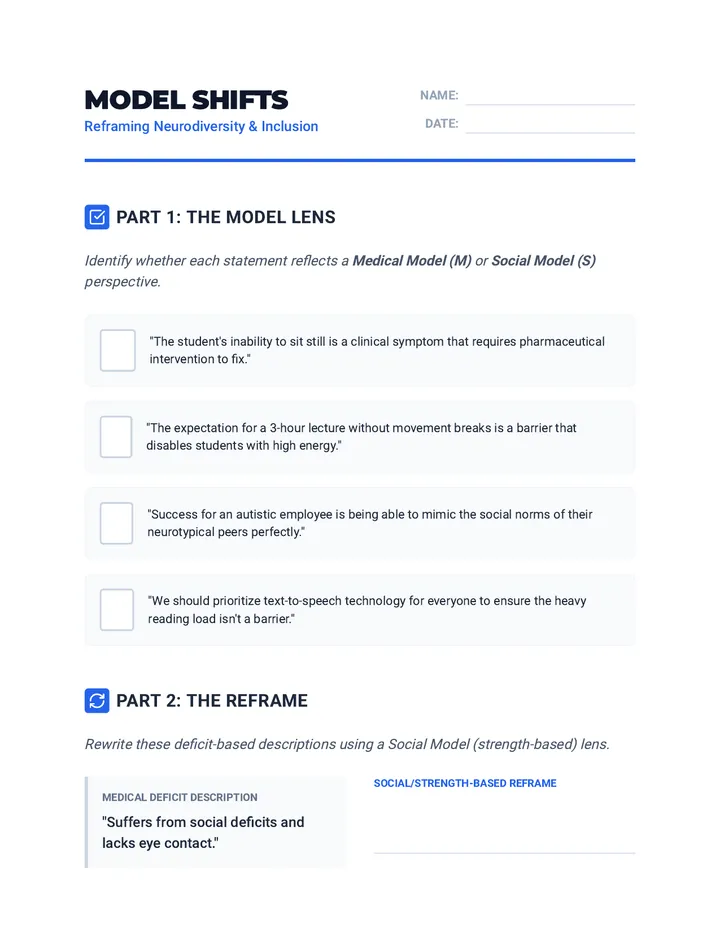
This sequence explores neurodiversity through the Social Model of disability, challenging traditional norms of professionalism and designing inclusive environments. Students will move from theoretical understanding to practical application in organizational policy and advocacy.
A 5-lesson sequence for graduate students to identify and articulate their professional and academic identity for personal statement writing. The sequence covers value identification, intellectual mapping, narrative construction, reframing challenges, and synthesizing a personal thesis.
This workshop-style sequence for graduate students focuses on the interpersonal dimensions of adaptability, training them to diagnose and adjust communication styles for diverse professional audiences across cultural, disciplinary, and hierarchical boundaries.
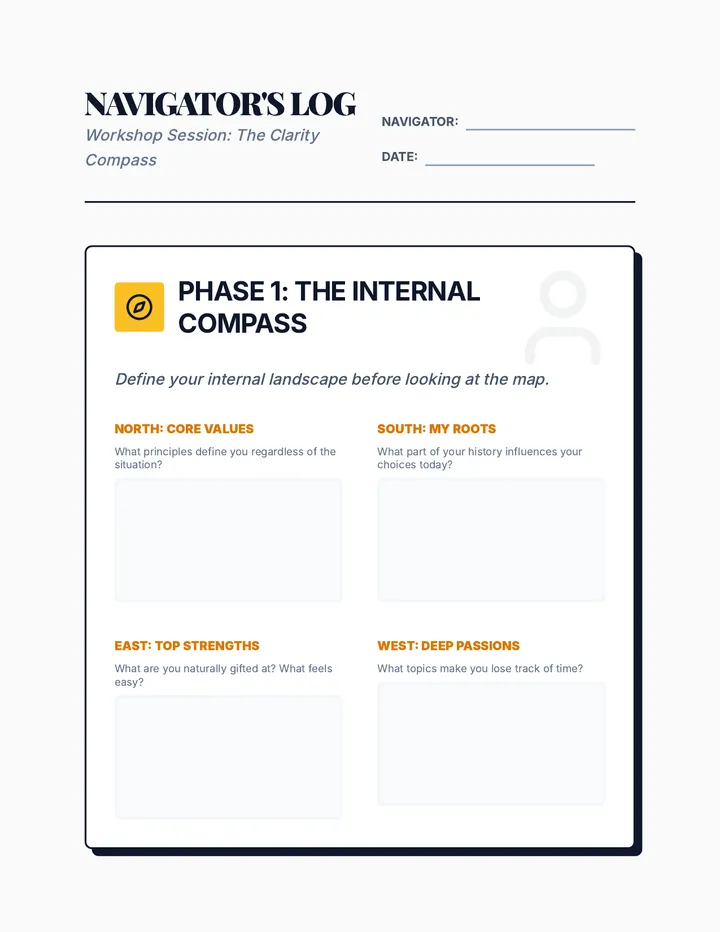
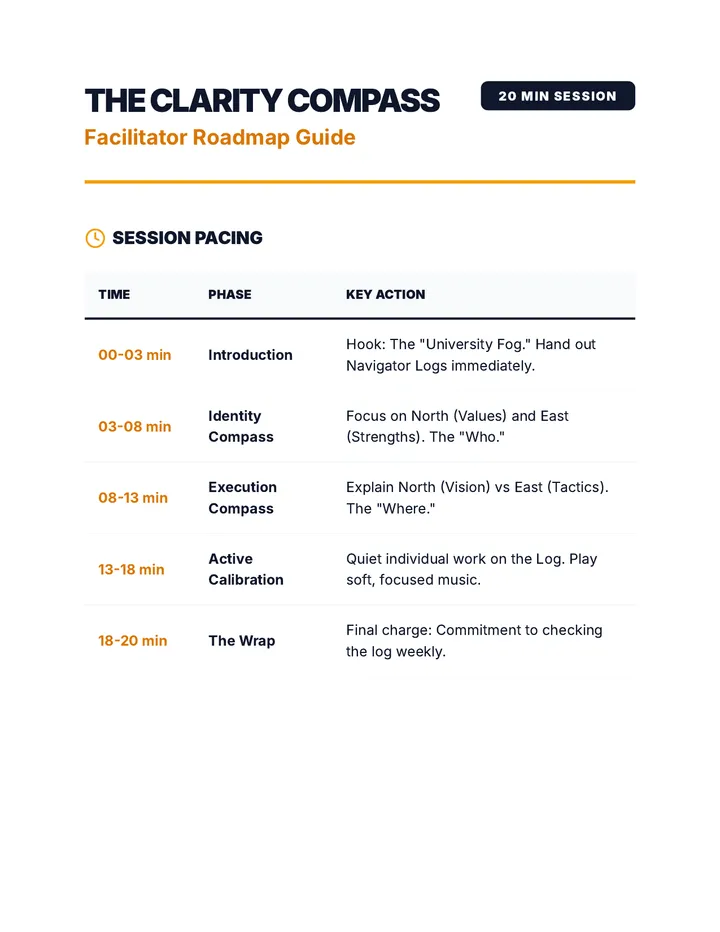
A high-impact workshop sequence designed to help university students navigate personal goal setting using two distinct Clarity Compass models focusing on internal identity and external action.
An 11-part group counseling sequence designed for LDS young adults and adults, focusing on reframing religious expectations through the lens of grace, clinical psychology, and restored doctrine to address scrupulosity and spiritual distress.
A unit exploring the foundations of humanistic psychology, focusing on person-centered approaches, therapeutic relationships, and the drive toward self-actualization.
A therapeutic series designed to help individuals in recovery identify their non-negotiable core values through high-stakes decision-making and real-world application. Students move from broad concepts to a refined personal compass.
A CBT-based program for adults with inattentive ADD to master task isolation, short-burst productivity (10-minute sessions), and positive reinforcement through a spiritual lens. This sequence guides learners through physical, digital, and professional decluttering.
This sequence introduces undergraduate students to the theoretical underpinnings and practical assessment tools of Behavioral Activation (BA). Students will learn to conceptualize depression as a cycle of avoidance and reduced reinforcement, mastering techniques like activity monitoring, values clarification, and functional analysis.
This graduate-level sequence explores the clinical application of FAST skills in DBT, focusing on the conceptualization of self-respect deficits and the prioritization of integrity in interpersonal conflict. Students will move from theoretical differentiation of effectiveness goals to advanced case formulation and treatment planning.
An inquiry-based exploration of the FAST skills (Fairness, Apologies, Stick to Values, Truthfulness) for undergraduate students. This sequence moves from internal value identification to external boundary setting and integrity planning.
A comprehensive sequence for undergraduate students focusing on executive function and proactive support-seeking. Students move from data-driven self-analysis of energy rhythms to the creation of a long-term 'Semester Sustainability Plan' that treats mental health and support as logistical necessities.
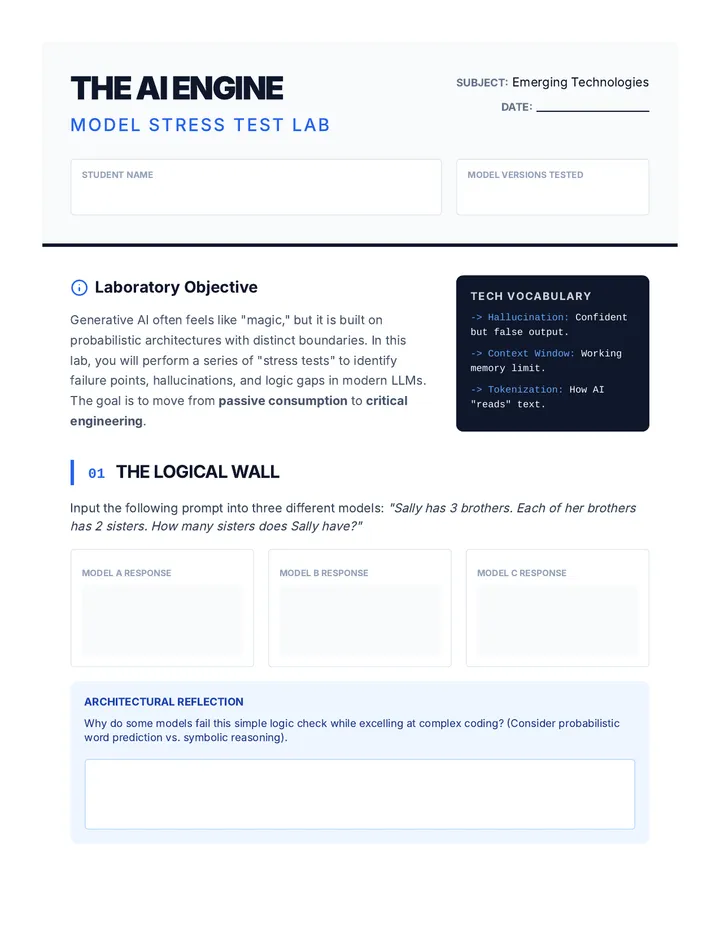
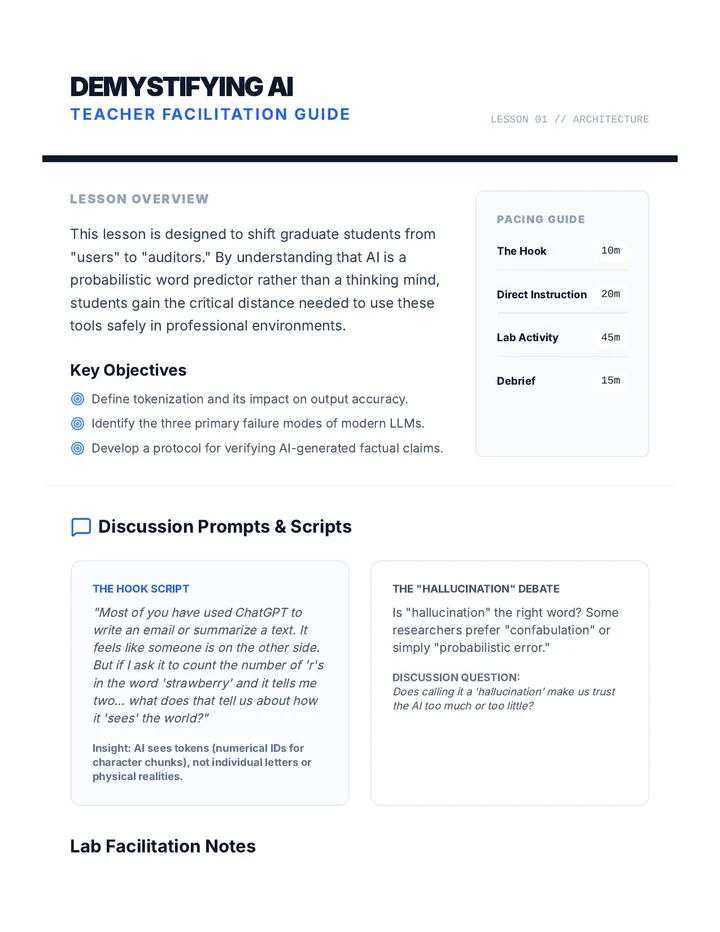
A graduate-level sequence focused on the practical integration of emerging technologies like LLMs and workflow automation into professional workflows, emphasizing technical literacy, prompt engineering, and career strategy.
This graduate-level sequence focuses on the interpersonal and therapeutic aspects of behavior contracting. Rather than treating the contract as a static document, students explore it as a collaborative intervention designed to build student agency, self-regulation, and stakeholder alignment using Motivational Interviewing and negotiation strategies.
A comprehensive system for young adult researchers to manage long-term projects using GTD principles adapted for high-energy 'hummingbird' chronotypes. Focuses on capturing ideas quickly, maintaining visual momentum, and deep weekly reflection.
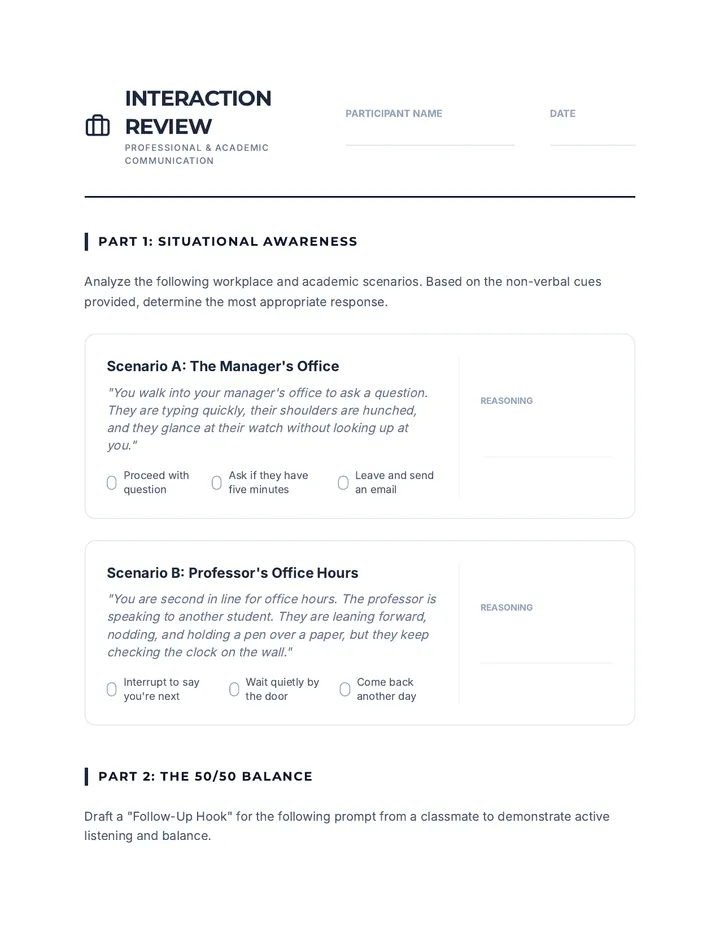
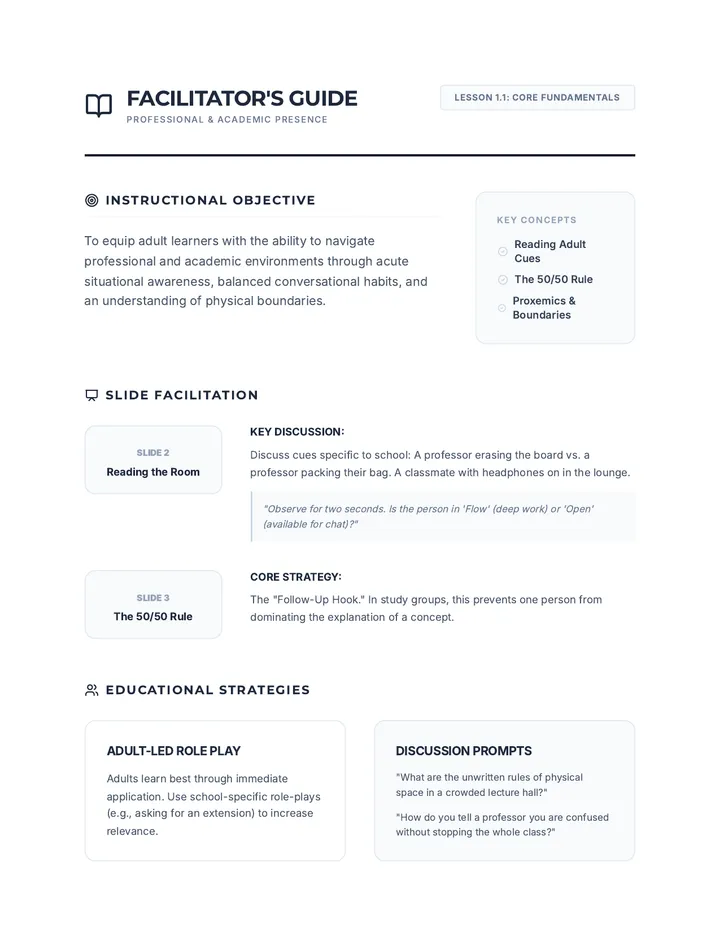
A series of lessons designed to enhance social and professional communication skills for adult learners, focusing on workplace and community interactions.
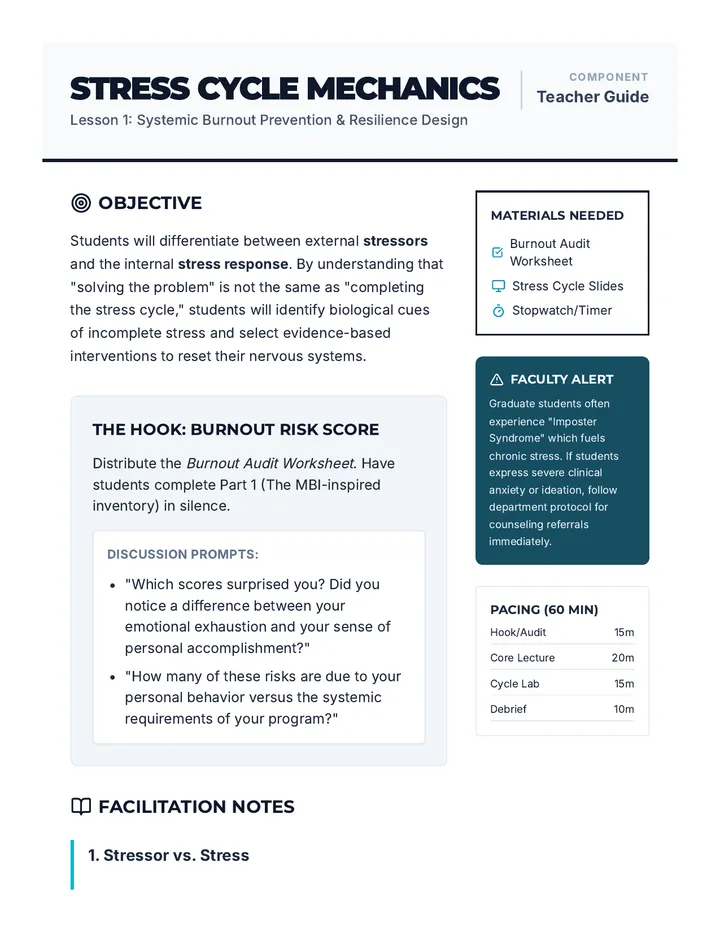
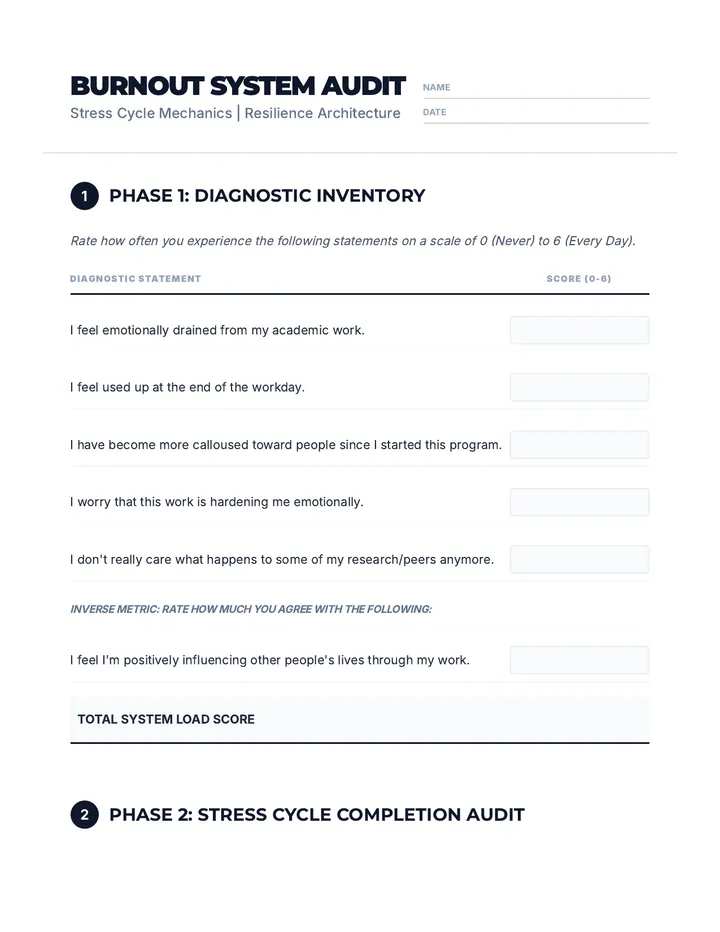
A systemic approach to stress and burnout prevention for graduate students, reframing personal well-being as a design challenge. Students develop a personalized 'resilience architecture' through structural changes in time management, sleep hygiene, and boundary setting.
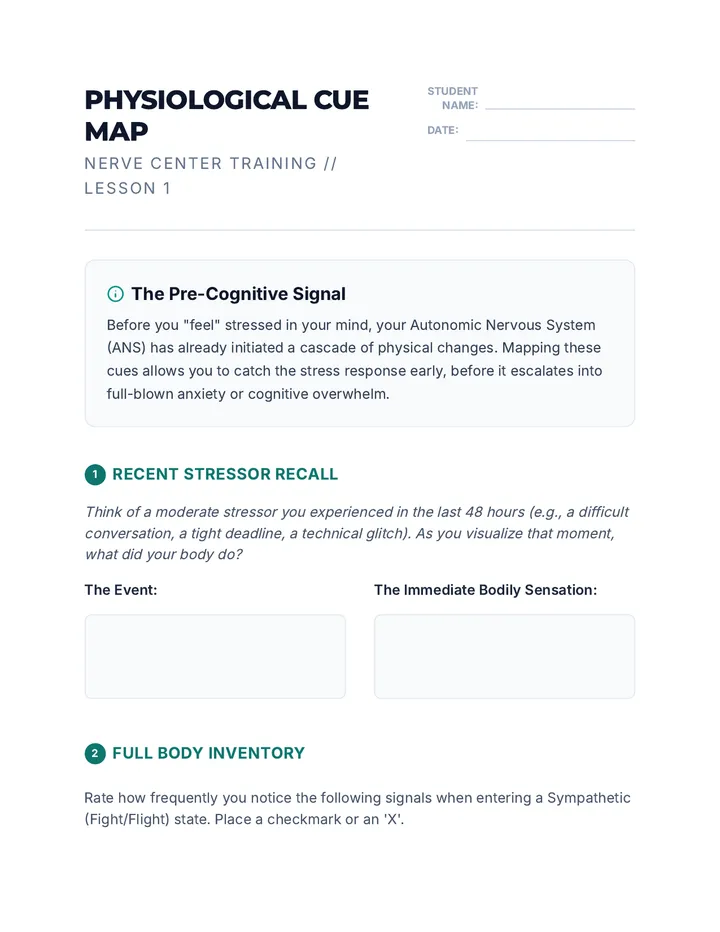
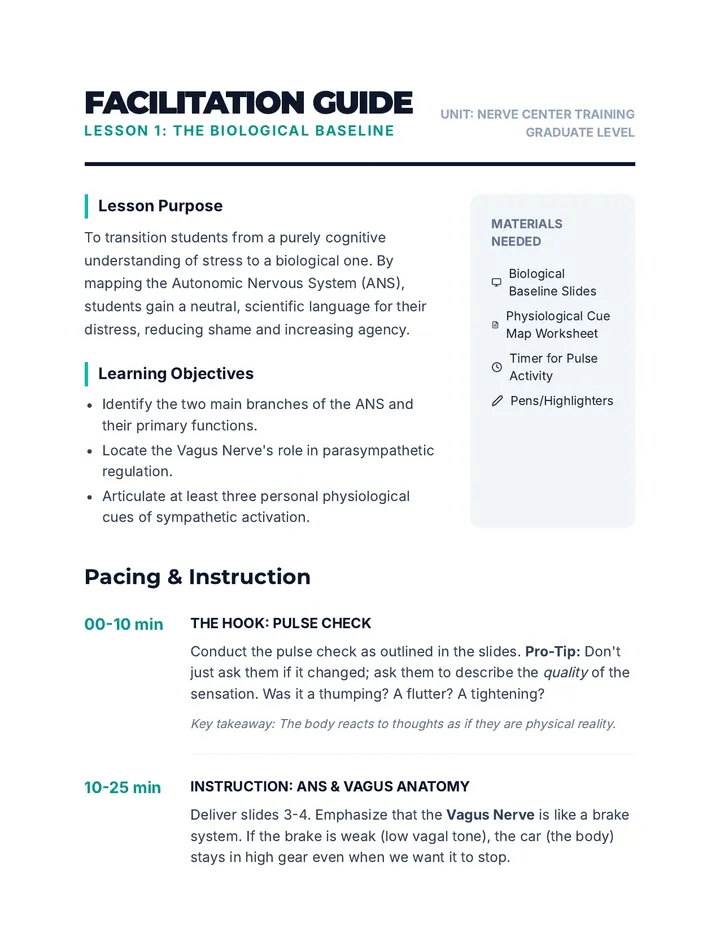
A graduate-level exploration of the biological underpinnings of stress. Students move from theoretical understanding of the autonomic nervous system and Polyvagal Theory to practical application of somatic regulation and interoceptive awareness, culminating in a personalized physiological safety plan.
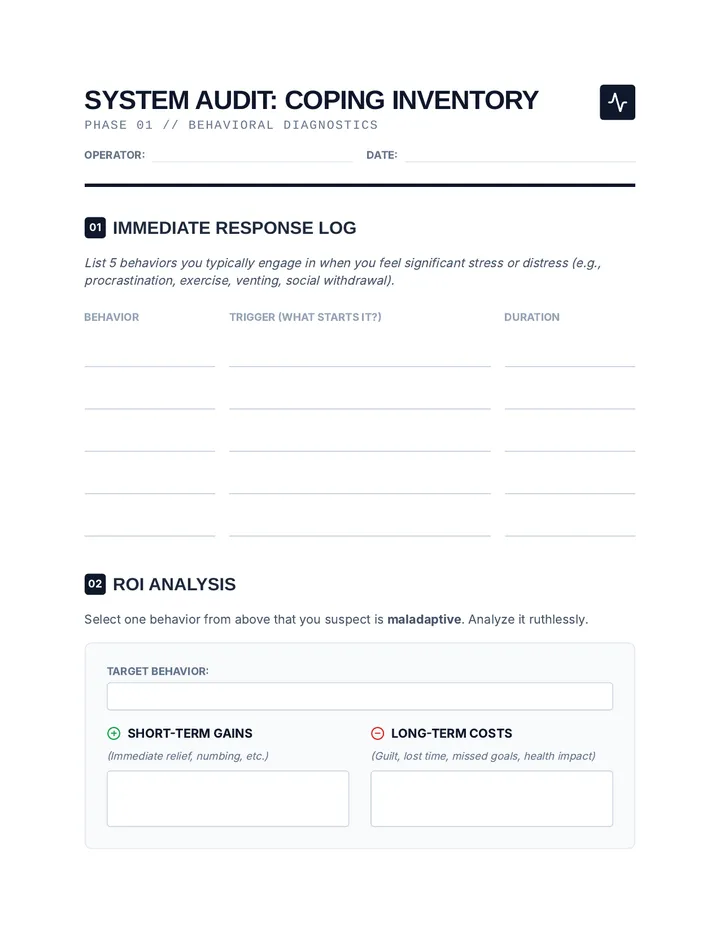
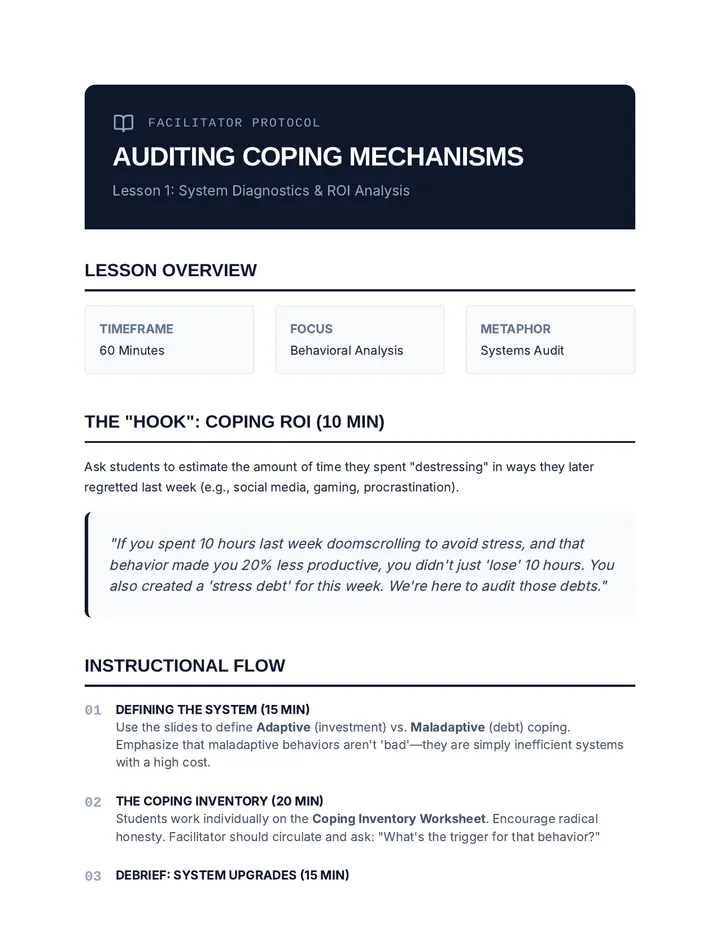
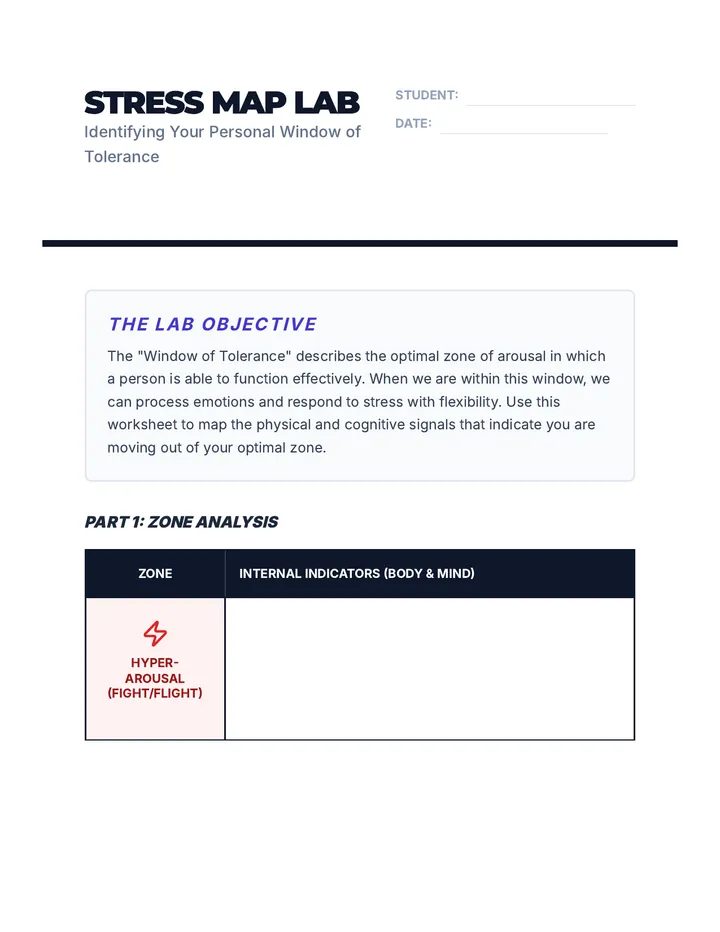
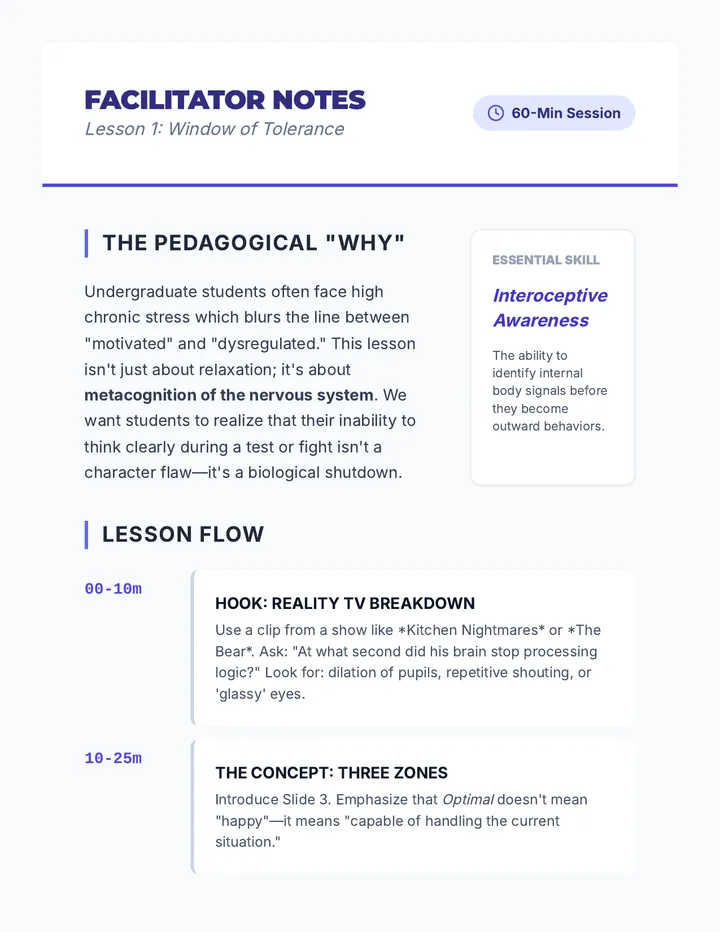
A mastery-focused sequence where undergraduate students audit their current stress responses and design a personalized, tiered emotional regulation protocol. Students use systems thinking to build resilient habits and prepare for future distress.
An applied sequence for undergraduate students to master self-regulation and de-escalation techniques in high-pressure academic and interpersonal contexts. Students move from identifying personal physiological triggers to practicing real-time regulation during active conflict and performance.
A workshop-based sequence where undergraduate students apply the PLEASE skills to their own lives. Students act as both client and clinician, tracking sleep, nutrition, and exercise to understand the causal link between physical maintenance and emotional vulnerability.
This sequence explores the physiological foundations of the DBT 'PLEASE' skills. Students investigate the neurobiological mechanisms through which physical health impacts emotional regulation, focusing on sleep, nutrition, and exercise.
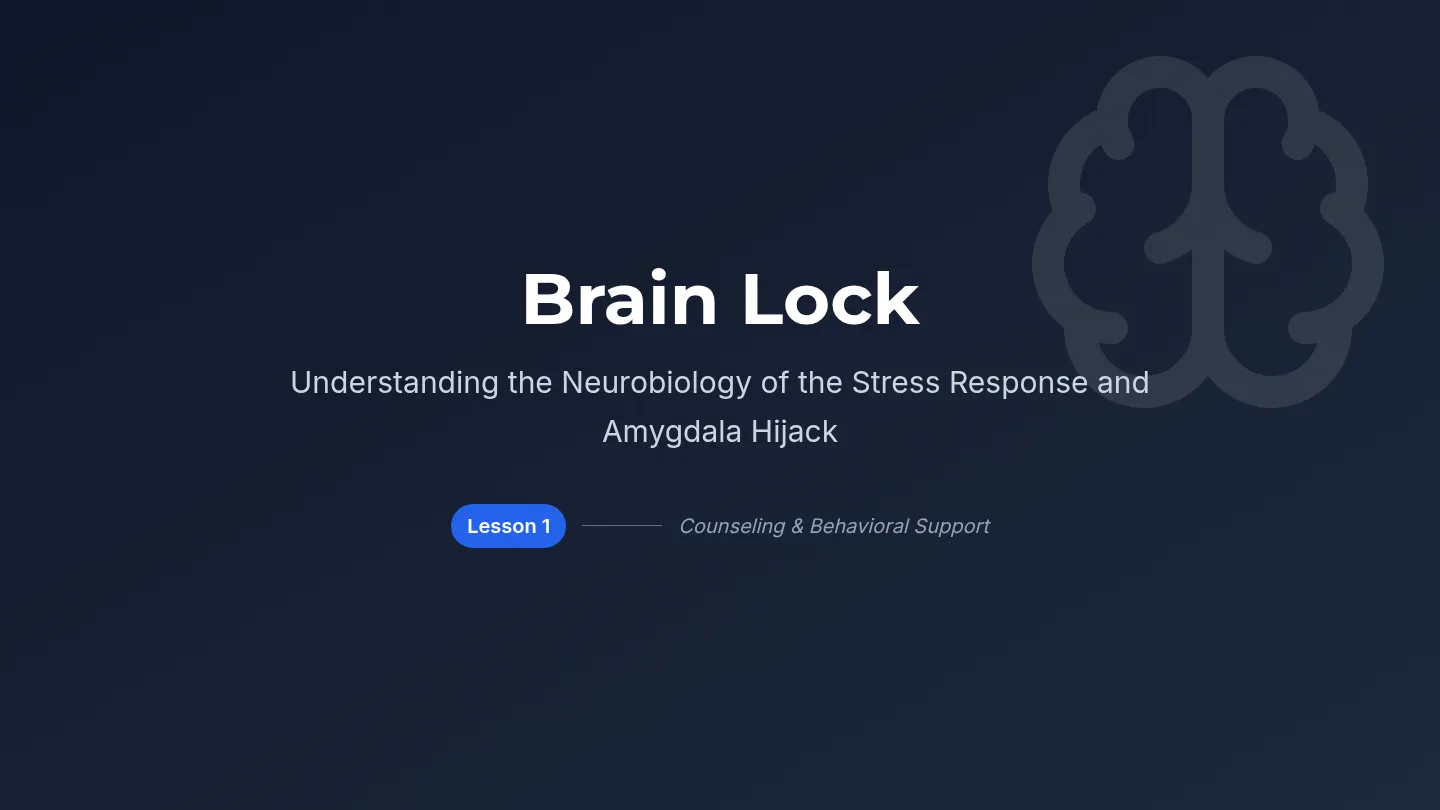
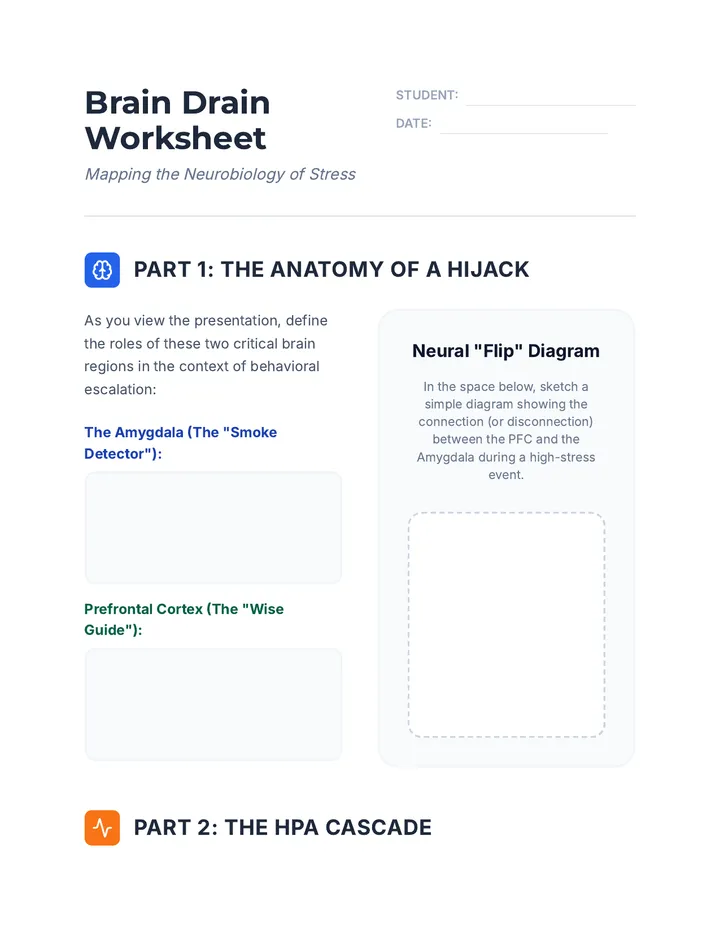
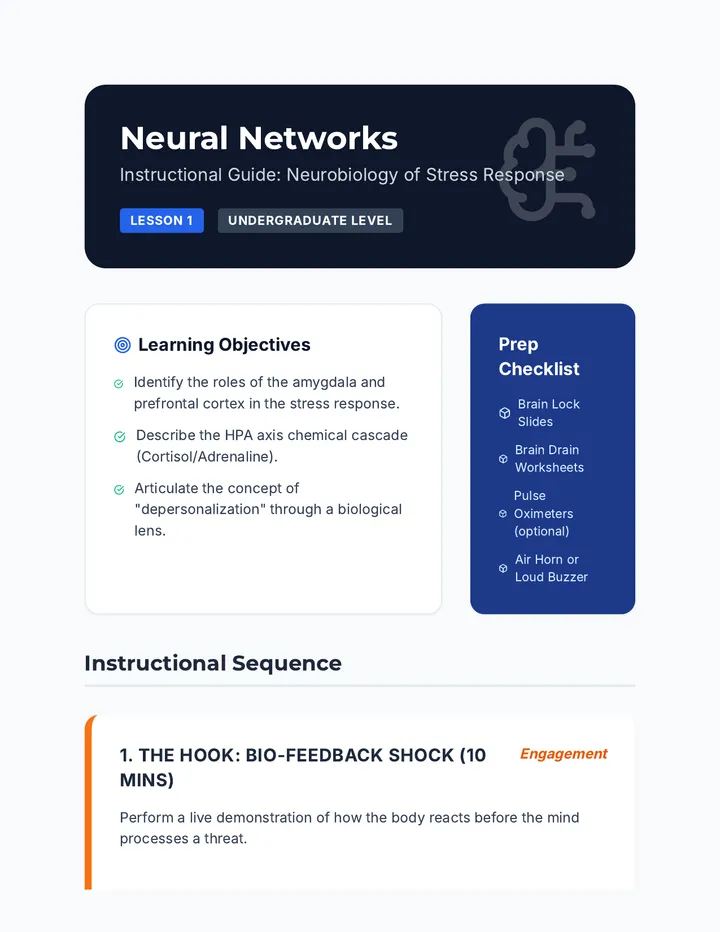
This sequence explores the neurobiological foundations of student escalation, connecting internal physiological stress responses (the 'amygdala hijack') to observable external warning signs. Students will learn to depersonalize behavior by understanding it as a biological survival mechanism, training them to recognize subtle somatic, respiratory, and muscular cues before a full behavioral outburst occurs.
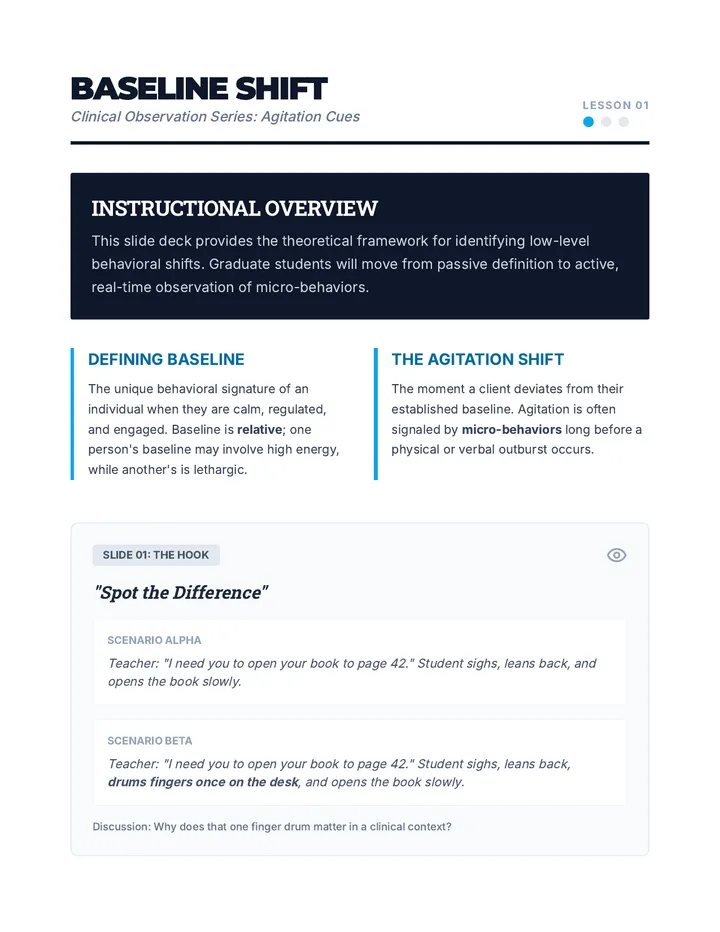
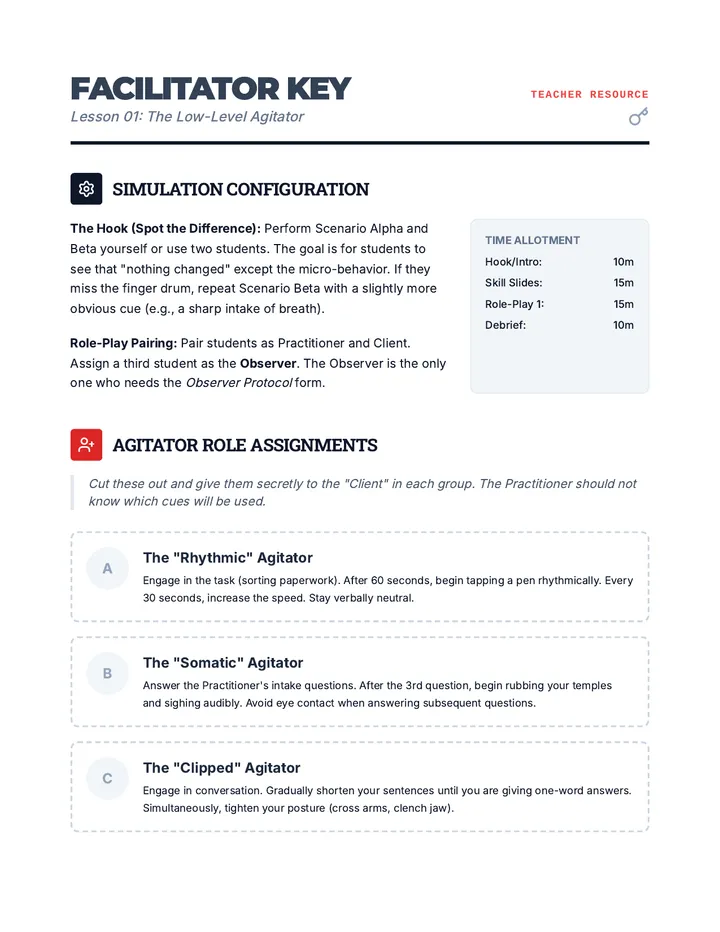
A high-intensity, simulation-based training sequence for graduate students to master real-time identification of behavioral escalation cues. Students move from identifying subtle micro-behaviors to managing their own physiological responses during high-fidelity crisis simulations.
A 5-lesson sequence for undergraduate students focused on deconstructing academic failure, understanding stress physiology, practicing vulnerability through storytelling, and creating personalized resilience frameworks through peer support.
A high-level series for graduate students to master the art of decoding complex job postings, focusing on organizational culture, implicit expectations, and strategic alignment. Students will learn to analyze job descriptions as primary sources to make informed career decisions.
This graduate-level sequence examines the ethical and systemic implications of behavioral surveillance in schools. Students will critique traditional tracking methods through the lenses of privacy law, psychological theory, and cultural equity to design more humane, dignity-affirming support systems.
A comprehensive unit for undergraduate students exploring the nuances of human connection, boundary setting, and conflict resolution in academic and professional contexts.
A comprehensive sequence for undergraduate students exploring the intersection of neuroscience, economics, and psychology within the digital ecosystem. Students move from understanding biological habit loops to constructing a personalized framework for digital autonomy and professional wellbeing.