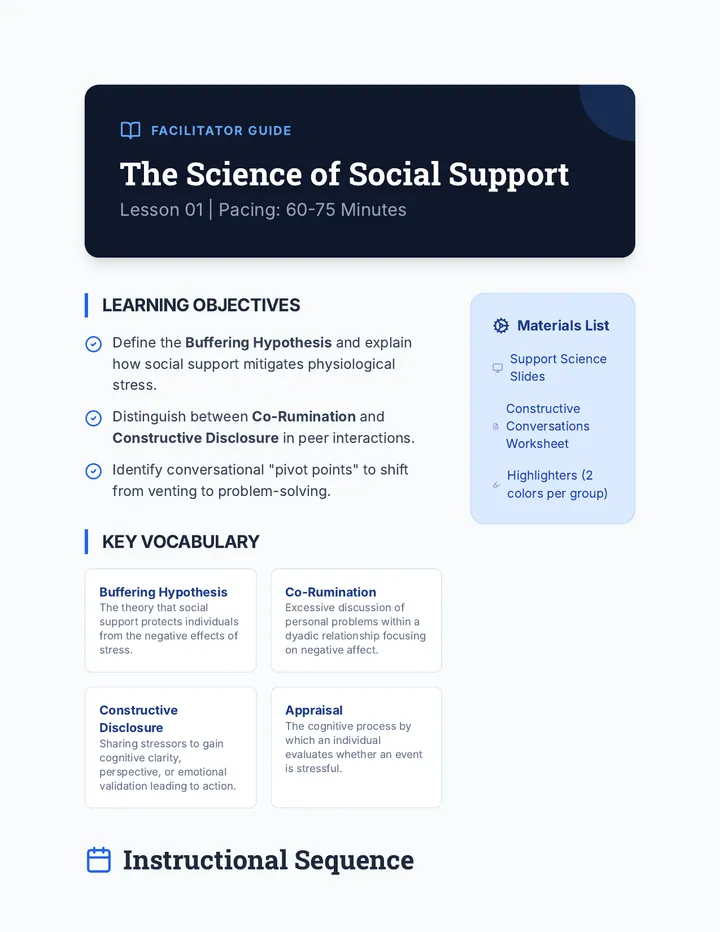
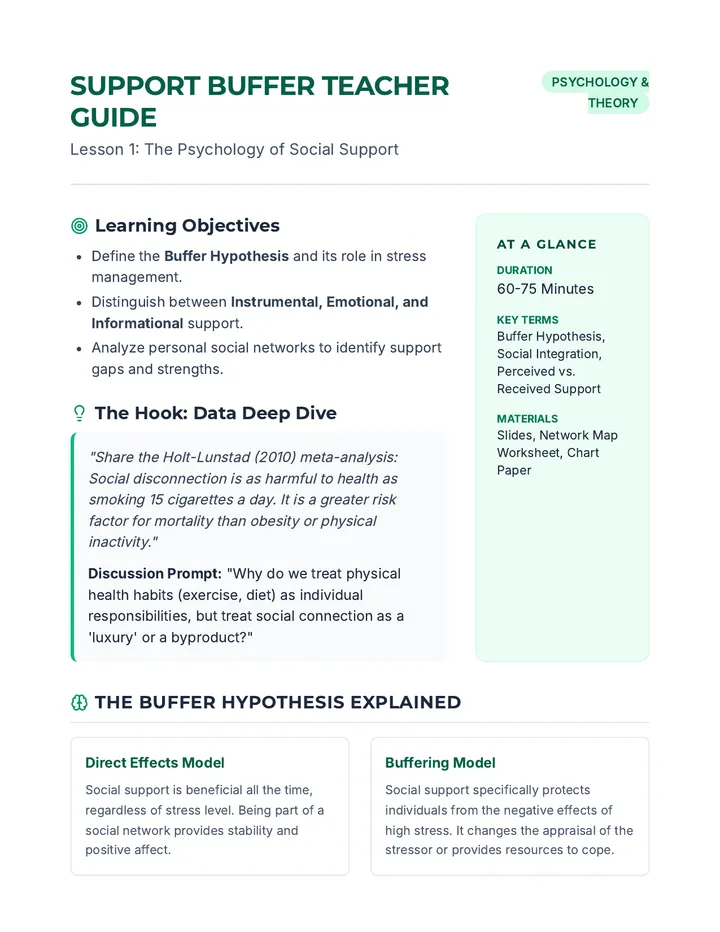
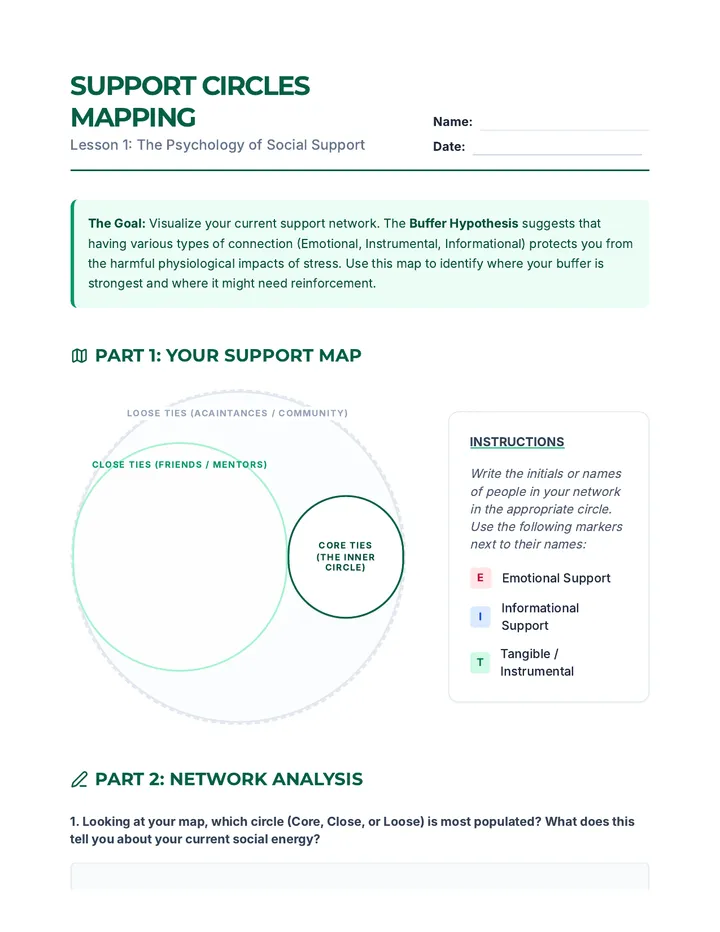
Peer relationship navigation, conversational turn-taking, and stress management strategies within supportive group settings. Develops communal belonging through shared mental health education and collaborative skill practice.
A graduate-level training sequence on facilitating peer support systems to mitigate stress and anxiety. Students learn the science of social support, micro-skills for active listening, boundary setting to prevent burnout, and group facilitation techniques to create sustainable communities of care.
A comprehensive sequence for undergraduate students exploring the social psychology of stress and the practical skills needed to build resilient peer support networks. Students move from theoretical understanding to practical facilitation and community planning.
A 5-lesson sequence for undergraduate students focused on deconstructing academic failure, understanding stress physiology, practicing vulnerability through storytelling, and creating personalized resilience frameworks through peer support.
A 5-lesson sequence for graduate students designed to deconstruct the 'Impostor Phenomenon' and normalize academic failure. Students will analyze their internal narratives, create 'Shadow CVs', and reconstruct their professional identities through cognitive reframing and narrative inquiry.
A professional workshop series for graduate students to master peer support, empathetic communication, and collective problem-solving within high-pressure academic cohorts.
A case-study-driven sequence for graduate students to analyze professional stressors and develop evidence-based resilience strategies through collective insight.
This sequence for graduate-level counseling students explores the advanced application, ethical adaptation, and facilitation of TIPP crisis survival skills across diverse clinical populations and restrictive environments. Students will move from basic skill mechanics to sophisticated risk assessment, environmental design, and professional advocacy for crisis intervention protocols.
A graduate-level project-based sequence where students design, refine, and pilot evidence-based group counseling interventions. Focuses on the transition from clinical theory to practical curriculum design, emphasizing cultural responsiveness and evaluation.
This graduate-level sequence focuses on the ethical and practical frameworks required to maintain psychological safety in group counseling. Students progress from initial contracting to managing complex dynamics like over-disclosure, trauma-informed gatekeeping, and conflict resolution, concluding with professional closure protocols.
A 4-session relapse prevention group for adults in SUD recovery, focusing on understanding relapse, identifying triggers, building coping strategies, and creating long-term support plans. This program helps participants develop skills to maintain sobriety through interactive readings, discussions, activities, and games.
An 11-part group counseling sequence designed for LDS young adults and adults, focusing on reframing religious expectations through the lens of grace, clinical psychology, and restored doctrine to address scrupulosity and spiritual distress.
A 5-lesson workshop sequence for undergraduate students to understand, challenge, and overcome imposter syndrome through peer validation and evidence-based identity building.
This graduate-level sequence explores narrative and musical modalities in group grief support, focusing on the therapeutic power of storytelling and music to foster connection and meaning reconstruction.
A graduate-level exploration of systems-based approaches to opioid recovery, focusing on integrated care models, recovery capital, and the creation of recovery-ready communities. Students analyze the 'Continuum of Care' and develop strategies for sustainable social reintegration.
A comprehensive graduate-level seminar series on advanced group counseling facilitation, focusing on instructional frameworks, clinical process, and cultural sensitivity.
A collection of lessons that use modern cultural icons to teach literacy, social-emotional skills, and creative expression to elementary and middle school students.
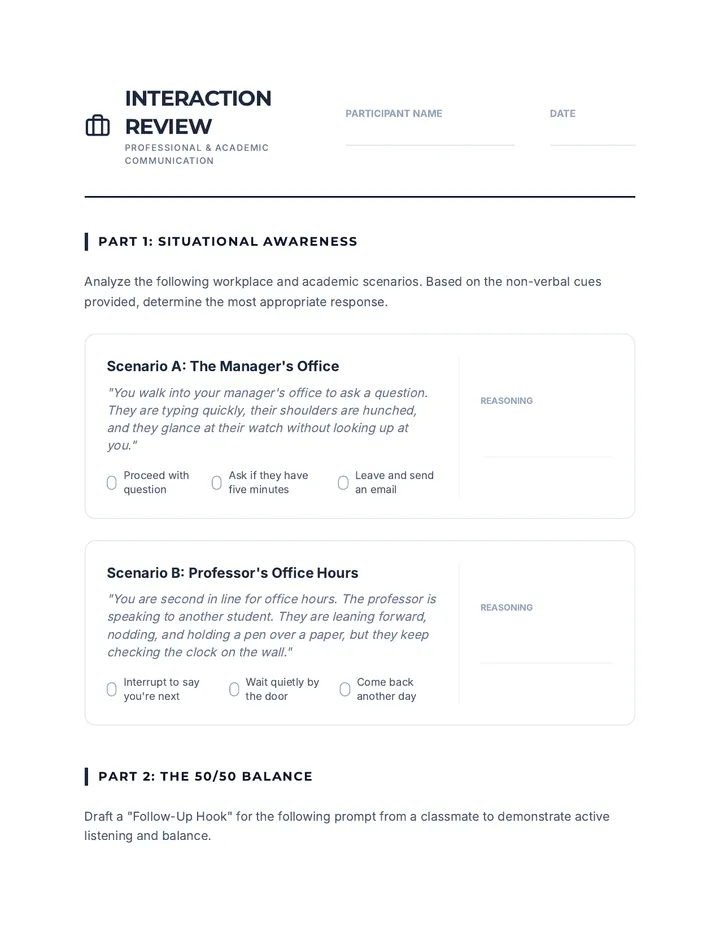
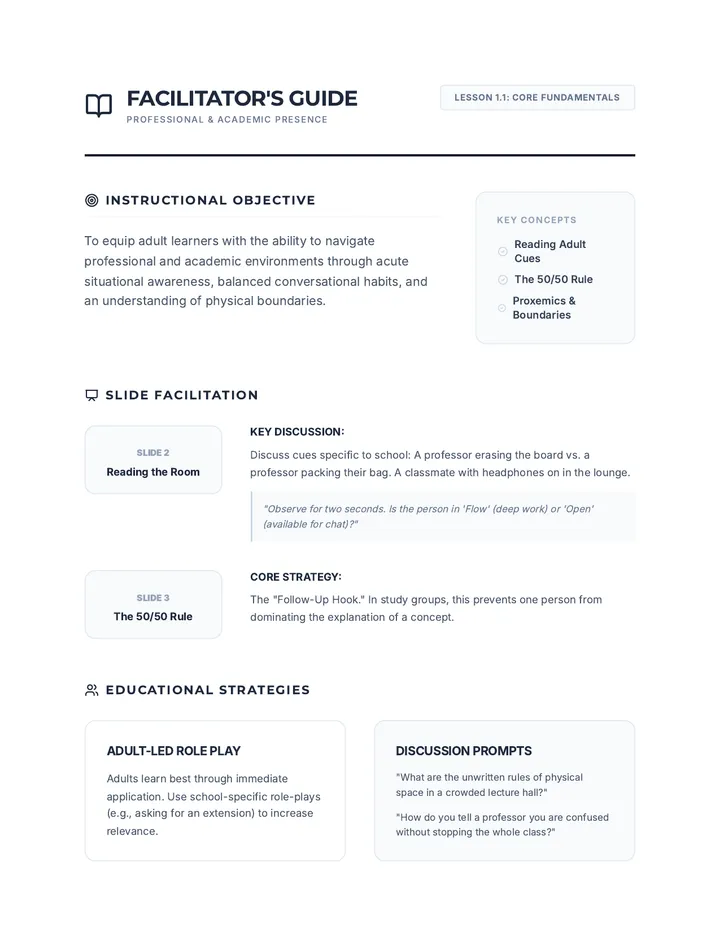
A series of lessons designed to enhance social and professional communication skills for adult learners, focusing on workplace and community interactions.
A comprehensive 15-day expressive arts therapy program for adults, integrating visual arts, music, dance, psychodrama, storytelling, and professional ethics.
This sequence explores the psychology of group dynamics and community care. Students learn to recognize burnout, offer effective support, and advocate for cultures where requesting breaks is normalized and valued.
This sequence trains undergraduate students in the foundational mechanisms required to build and maintain safe peer support environments. Students progress from theoretical psychological safety to practical microskills, empathy, boundary management, and group facilitation.
An advanced sequence for graduate counseling students focusing on the theoretical and practical application of building psychological safety, group cohesion, and navigating developmental stages in therapeutic groups.
A graduate-level sequence focused on the 'process' rather than the 'content' of group interaction. Students learn to identify underlying emotional currents, facilitate interpersonal feedback, and manage transference/countertransference through experiential, inquiry-based learning.
A comprehensive graduate-level sequence exploring conflict resolution, challenging member behaviors, and crisis management within group therapy. Students move from theoretical 'Storming' stage frameworks to hands-on simulation of de-escalation and restorative dialogue.
This sequence provides undergraduate counseling students with a structured progression from non-verbal presence to complex group facilitation. It emphasizes active listening, reflective responding, internal bias management, and constructive feedback loops using the SBI model.
This sequence challenges graduate students to build inclusive, non-judgmental group environments through a critical theory lens, examining power dynamics, microaggressions, and cultural humility in support settings.
A comprehensive sequence for undergraduate counseling students focused on building psychological safety, co-creating group norms, and mastering the structural elements of group facilitation. Students progress from theoretical understanding to simulated practice of establishing and maintaining safe group containers.
An advanced workshop sequence for graduate students focusing on the micro-skills of attunement, deep reflection, the strategic use of silence, and the clinical distinction between validation and agreement in group support settings.
A comprehensive sequence for undergraduate students on managing the ethical complexities of peer support, focusing on professional boundaries, disclosure limits, and crisis management.