Peer relationship navigation, conversational turn-taking, and stress management strategies within supportive group settings. Develops communal belonging through shared mental health education and collaborative skill practice.
An assessment rubric for the final Community Charter project, evaluating theory application, safety planning, and sustainability.
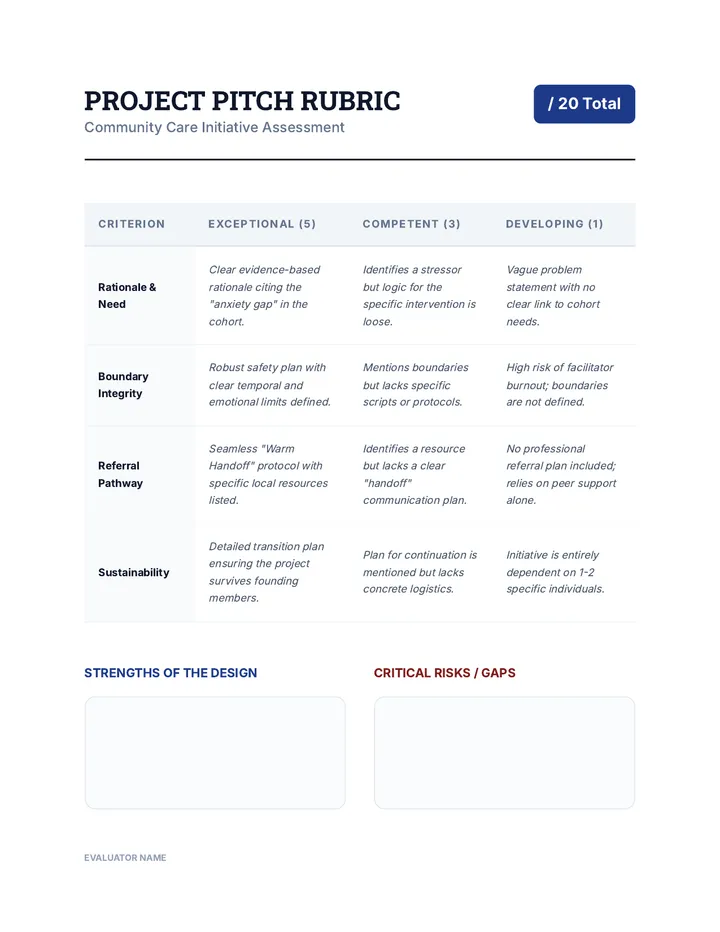
Final project rubric for evaluating the Community Care Initiative, focusing on rationale, boundaries, referral pathways, and sustainability.
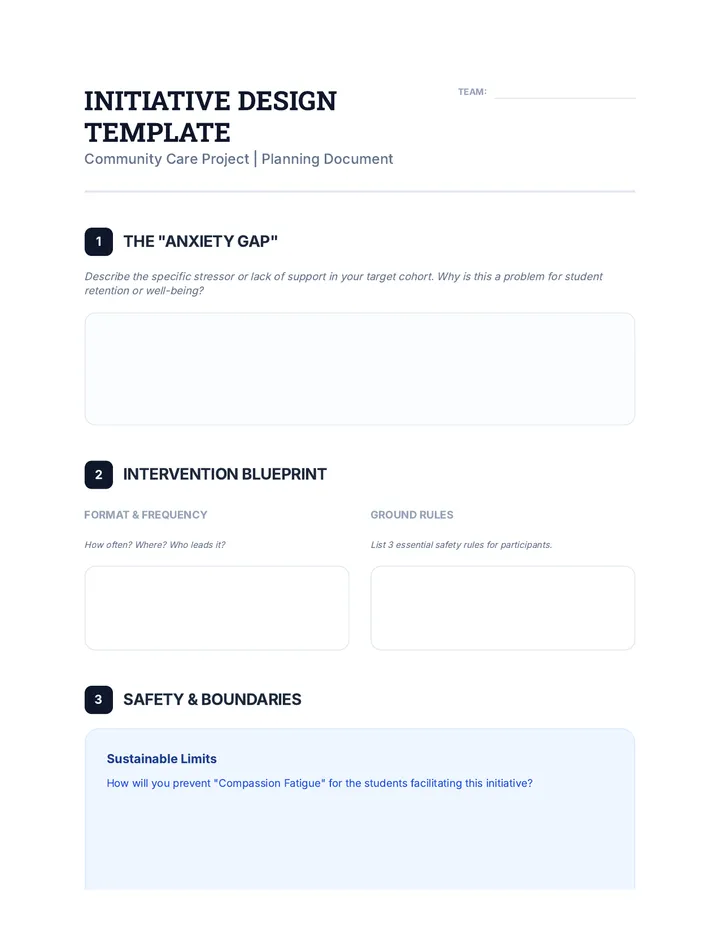
Student design workbook for planning the Community Care initiative, covering problem definition, logistics, safety boundaries, and sustainability.
A design framework for a community care plan, producing a 'Community Charter' for peer support in a specific campus context.
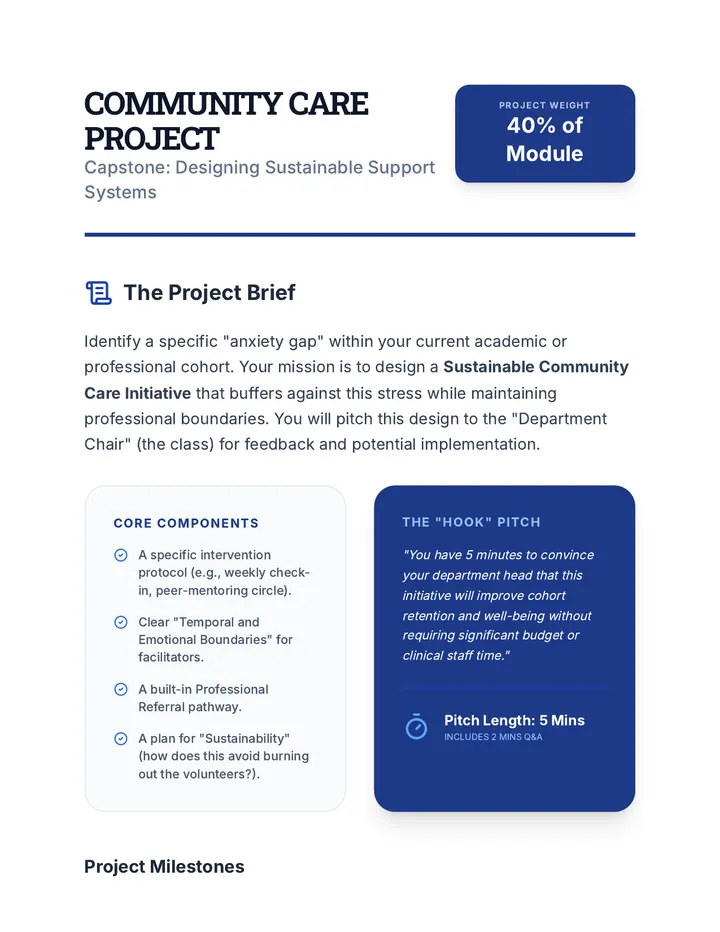
Final project brief for the Community Care initiative, detailing requirements, core components, and the "Department Pitch" assessment.
Visual slide deck for Lesson 5, introducing the concepts of mutual aid, sustainable networks, and the "Community Charter" project.
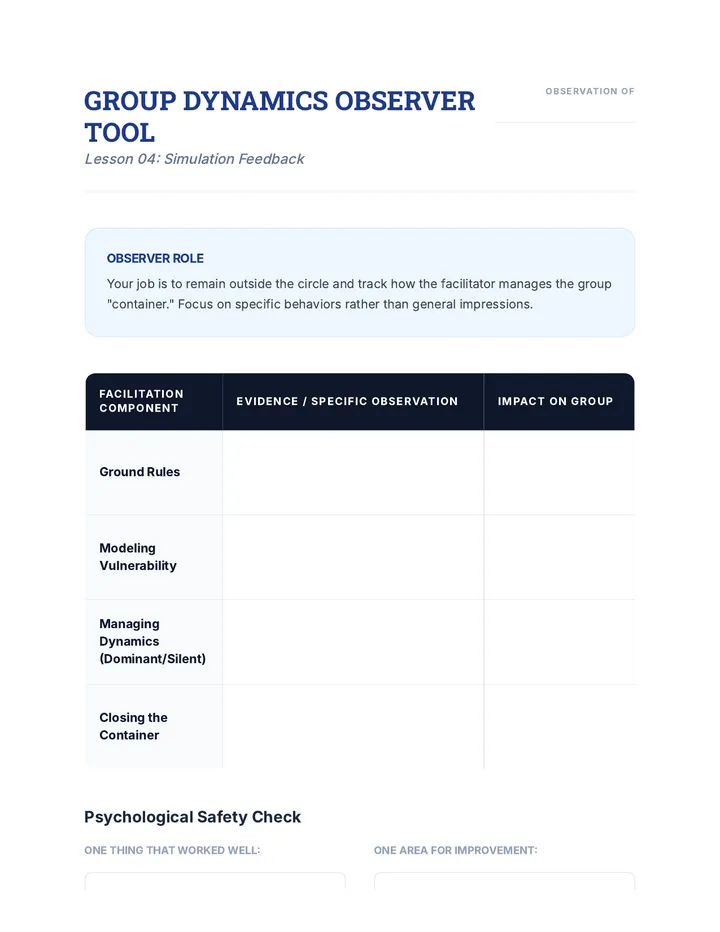
Observation and feedback tool for students to use while observing peer-led group facilitation simulations, focusing on psychological safety and dynamic management.
A brainstorming worksheet for identifying collective coping strategies for common undergraduate stressors.
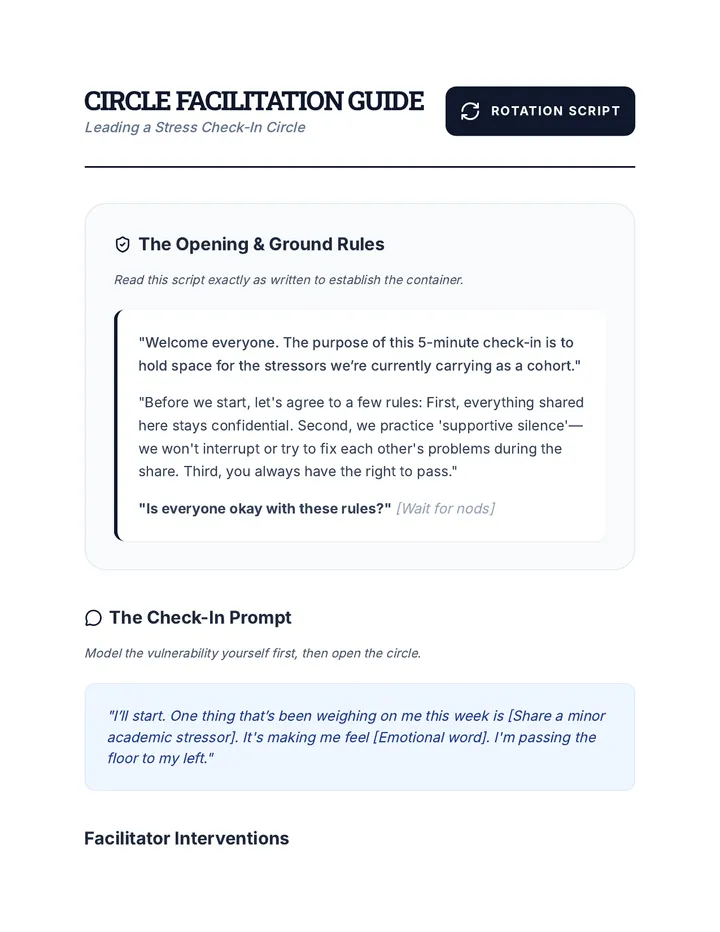
Practical script for students to lead a brief check-in circle, featuring opening ground rules, modeling prompts, and intervention strategies.
A sorting activity where students categorize shared stressors from an anonymous "drop box" into personal or systemic categories to facilitate normalization.
Facilitation Fundamentals Slides focusing on group dynamics, psychological safety, and managing difficult participants.
Visual slide deck for Lesson 4, introducing group facilitation skills, the power of normalization, and the distinction between individual and systemic stressors.
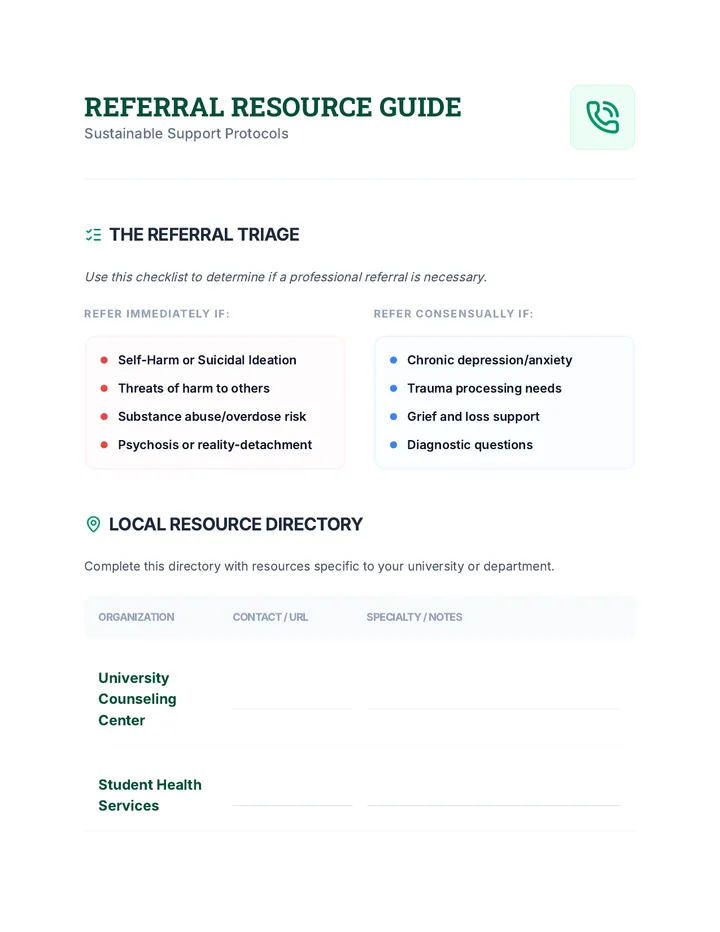
Reference guide and template for students to identify professional resources and practice the "warm handoff" referral protocol.
A resource guide template for students to collect and categorize campus professional resources.
Case studies focusing on temporal and emotional boundary failures in peer support, including scripting exercises for boundary resetting.
Sustainable Support Slides focusing on compassion fatigue, different types of boundaries, and the professional referral process.
Case study scenarios for Lesson 3 focusing on identifying red flags, setting internal limits, and drafting referral scripts.
Reference sheet for students featuring micro-skills definitions, validation hierarchy levels, and helpful open-ended question prompts.
Visual slide deck for Lesson 3, covering the scope of peer support, referral red flags, and the prevention of compassion fatigue.
Student activity sheet featuring "Bad Listener" exercises and specific role-play scenarios for practicing the validation hierarchy.
A printable deck of 20 CBT and DBT-based stress reflection cards designed to convert gameplay tension into clinical insight. Divided across two pages for optimal print sizing, the deck targets somatic awareness, cognitive reframing, relapse prevention, and distress tolerance.
A printable deck of 24 cut-out coping cards focused on somatic regulation, distress tolerance, and grounding. Now expanded across two pages, the deck offers twice as many physical instructions and visual icons to guide clients during high-stress moments.
A high-visibility clinical rules board that adapts the intense gameplay of UNO Show 'Em No Mercy into an active therapeutic group. Outlines specific somatic/mindfulness coping protocols and CBT reflection triggers for every card-drawing penalty, helping clients build real-time distress tolerance.
A 7-slide visual presentation deck for guiding the 1-hour workshop on the Social Side of the Goleman Emotional Intelligence Model, featuring large 24px+ text.
A printable sheet containing 8 scenario and discussion cards across 2 pages for small-group roleplay and perspective-taking practice in daily life, work, and community settings.
A 2-page printable participant workbook for residents or adults containing perspective-taking exercises, space for individual reflection, and personal commitment action steps in everyday social, workplace, and housing settings.
A comprehensive 2-page print-ready facilitator guide detailing the 1-hour Emotional Intelligence workshop, structured with the "Story We Invent" icebreaker, Goleman social quadrants, "What Might Be Underneath" activity, scenario guides, and deep personal reflections.
A comprehensive facilitator guide for the Mirror Notes lesson. Revised to restore specific discussion questions about bad notes, defensiveness, and staying on topic.
A structured student worksheet for self-evaluating group performance and practicing writing narrative progress notes. Revised with darkened labels, writing lines, and a one-page layout.
A reference sheet for clients containing key clinical vocabulary, the pillars of narrative notes, and sentence starters for self-reflection. Revised to fit on a single page with improved readability.
A set of presentation slides teaching clients how counselors write narrative progress notes and how to use them for self-reflection. Updated to restore the "Effort" note example slide and add facilitator discussion prompts.
A print-ready reference guide for students providing specific strategies and assertive scripts for a traffic stop, medical appointment, and social pressure. Revised to ensure a one-page fit and included student work areas for personalized scripts.
A 'fun and different' icebreaker activity where participants bid on personal rights using 'Assertion Bucks' to spark conversation about priorities and values. Revised to include a second page of printable currency and bid tracking lines.
A facilitation guide for the 60-minute Stand Your Ground session. Updated to incorporate the 12-card Mega Scenario Set and the Independence Field Guide. Revised timing to match a 10-minute icebreaker.
A mega-set of 12 role-play scenario cards covering police, medical, government, social, employment, housing, pharmacy, and peer situations. Revised with 6 new high-stakes scenarios for PSR groups.
An elaborated slide deck for the Stand Your Ground PSR group session. Features detailed breakdowns of the Traffic Stop, Medical, and System/Government scenarios with assertive scripts and explanations of why they work. Revised with improved contrast and clearer role-play instructions.
A self-reflection checklist for participants to identify personal rights and assess their ability to assert them in daily life. Final revision to ensure one-page fit and expanded reflection area.
A revised Facilitator Guide for Lesson 11, fixing page break issues to keep section 3 and 4 together, adding specific workspace lines for the prayer realignment activity, and providing a dedicated space for final group insights.
A revised Facilitator Guide for Lesson 10, fixing page break orphans by keeping the realignment activity together, adding specific workspace lines for identifying distortions and reframes, and providing ample space for facilitator notes.
A revised Facilitator Guide for Lesson 9, fixing page break issues to keep section headers with their content, adding specific numbered lines for the journal prompt, and providing extra space for facilitator notes.
A student-facing reference sheet explaining the psychological and relational benefits of assertive communication, specifically tailored for adult learners with mental health concerns.
A set of 8 printable scenario cards depicting realistic adult situations where assertive communication is needed, categorized by life domain (work, home, healthcare, etc.).
A student-facing worksheet for practicing I-statements and the DEAR MAN communication framework, featuring clear instructional prompts and dedicated work areas for handwriting.
A facilitator's guide for leading small-group workshops focused on practicing assertive communication through structured role-play and collaborative script-writing.
A step-by-step facilitation guide for teachers, outlining the lesson sequence, objectives, and specific instructional strategies for teaching assertive communication to adults.
A 2-page printable card deck featuring seven secular reflection cards (one for each domain) containing inspiring stories, quotes, and deep discussion prompts that map perfectly to the original scriptures.
An interactive, highly polished student-facing worksheet where clients assess their spiritual wellness across the seven secular domains of meaning and connection. Features an elegant 7-segment SVG plate diagram and reflective writing fields.
A comprehensive 2-page facilitator guide for delivering the secular 'Inner Balance' lesson. It details the seven domains of spiritual well-being (adapted for secular contexts) and provides a step-by-step group activity plan.
A revised Facilitator Guide for Lesson 8, fixing the orphaned header for section 3, adding specific celebration writing lines for the closing action plan, and providing extra space for recording group insights.
A revised Facilitator Guide for Lesson 7, fixing page break orphans by ensuring headers stay with their content, adding specific journal writing lines for the closing reflection, and including space for group insights.
A revised Facilitator Guide for Lesson 6, ensuring core content on 'Weakness vs. Sin' stays together on one page, adding a writing area for the closing activity, and balancing content across two pages with additional reflection space.
A revised Facilitator Guide for Lesson 5, replacing problematic Lucide icons with CSS arrows in the cycle diagram, fixing page break orphans, and adding dedicated spaces for group observation logs and personal reflections.
A revised Facilitator Guide for Lesson 4, adding a visual 'Wholeness Map' with specific work areas for pit stops, fixing page break issues to keep activity instructions together, and providing space for facilitator reflections.
A revised Facilitator Guide for Lesson 3, fixing page break issues to keep section 3 headers with their content, improving the layout of the persistence checklist, and adding dedicated spaces for group insights and personal commitments.
A revised Facilitator Guide for Lesson 2, fixing page break issues between section headers and content, providing a dedicated 'Workspace' for the mapping activity, and ensuring all text spacing allows for comfortable reading.
A revised Facilitator Guide for Lesson 1, addressing page break issues, adding specific student work areas for the 'Should Detective' activity, and including a dedicated space for facilitator notes.
A simple, metaphor-based story handout explaining the roles of the amygdala (Gus the Guard Dog) and the prefrontal cortex (Lara the Librarian) in trigger reactions, suitable for middle school reading levels and clinical groups. Includes a second page with group discussion prompts and the 'Freeze Frame' exercise.
A comprehensive 60-minute facilitation guide for social workers and group leaders, detailing pacing, discussion prompts, and clinical considerations for teaching trigger identification.
A student-facing worksheet for personal trigger mapping, including sections for external/internal signals and a 'Trace One Signal' deep dive exercise.
A high-contrast visual anchor chart defining triggers and categorizing them into internal and external types, designed for clinical and group settings.
A visual presentation for a group counseling termination session, featuring instructions for a yarn-weaving ritual, guided reflection prompts, and closing thoughts.
A set of 8 printable task cards designed for a group counseling termination session, featuring prompts focused on connection, growth, and shared memories. Cards are grouped 4 per page for easy printing.