Employer research strategies and behavioral response techniques using the STAR method. Develops virtual interview etiquette, professional presence, and effective follow-up communication.
A high-energy, high-impact presentation deck for a 75-minute Spotlight Ready interview workshop. Features the mindset shift, pitch structure, STAR story bank, and a mock question forge. Expanded to fill the 75-minute duration with instructional depth.
A high-density 75-minute student workbook for the Spotlight Ready workshop, designed for immediate drafting, STAR story structuring, and peer-to-peer feedback. Includes a Question Forge for custom mock interview engineering. Designed with high-contrast text and clear writing areas.
A high-impact 75-minute facilitator guide for the Spotlight Ready workshop, featuring exact scripts, a question forge appendix, and pacing adjustments for a condensed intensive. Designed with clear page breaks and standalone phase structures.
A significantly expanded 8-page instructor guide for the Career Catalyst Masterclass. Includes detailed SAY/DO scripts, facilitation directions for mirroring and STAR drills, scenario discussion guides, and a comprehensive Triad rotation model.
A comprehensive student workbook for interview skills, expanded with professional practice scenarios and an updated digital presence checklist. Fixed page breaks and enhanced work area borders. Reduced heights to prevent overflow.
A modern, high-contrast slide deck for teaching interview skills, featuring the STAR method, body language tips, and mock interview guidelines. Expanded to include digital professionalism and workplace etiquette.
A student worksheet for evaluating job offers, calculating total compensation, identifying contract red flags, and drafting negotiation scripts.
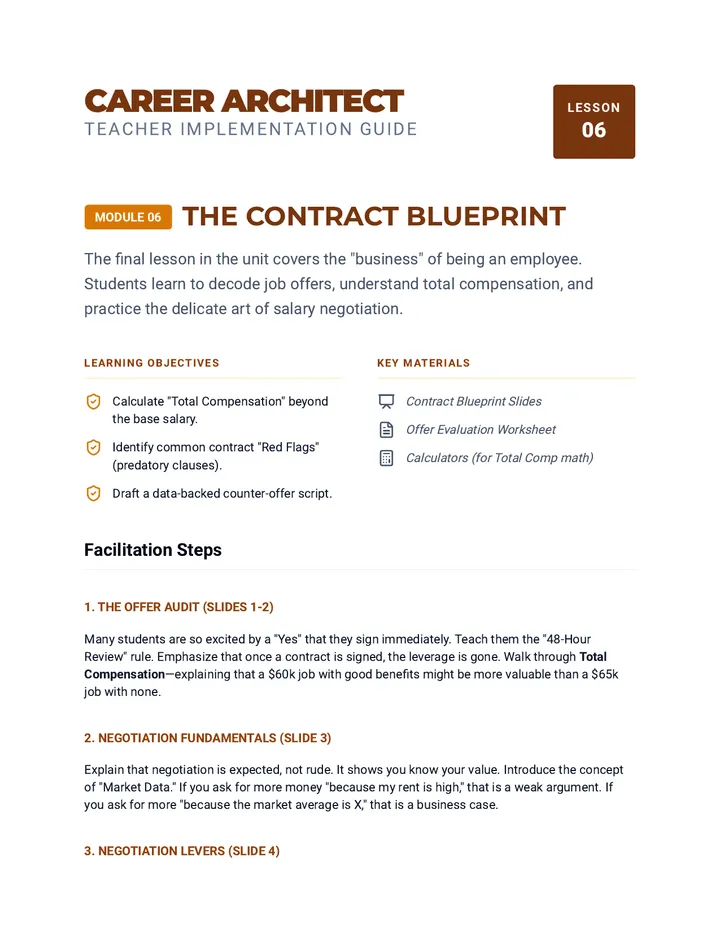
A comprehensive teacher guide for Lesson 6, providing instructional strategies for teaching offer evaluation, salary negotiation, and contract decoding.
A student worksheet for tracking post-interview follow-ups, drafting personalized thank-you notes, and conducting self-debriefs to improve performance.
A comprehensive teacher guide for Lesson 5, providing instructional strategies for teaching post-interview follow-up and feedback loops.
Visual presentation for Lesson 6, focusing on offer evaluation, salary negotiation strategies, and understanding contract terms.
Visual presentation for Lesson 5, focusing on post-interview thank-you notes, follow-up strategies, and handling rejection through a feedback loop.
A student worksheet for the "Tailoring Lab," where students deconstruct job descriptions and rewrite their resumes/cover letters to match company needs.
A comprehensive teacher guide for Lesson 3, providing instructional strategies for teaching resume tailoring and cover letter construction.
Visual presentation for Lesson 3, using a "drafting table" aesthetic to teach students how to tailor resumes and cover letters based on deep company research.
A student storyboard worksheet for drafting STAR method responses and tailoring interview pitches based on company research.
A comprehensive teacher guide for Lesson 4, providing instructional strategies for teaching the STAR method, handling stress-test questions, and facilitating mock interviews.
A comprehensive teacher guide for Lesson 2, providing instructional strategies for teaching deep company research and strategic positioning.
Visual presentation for Lesson 4, focusing on the STAR method, interviewer research, body language, and high-pressure situational responses.
A student worksheet designed as a "classified dossier" for conducting deep research on target companies, bridging the gap between discovery and interview preparation.
A presentation slide deck with high-impact, low-stimulation visual aids to structure instruction on workplace socialization and communication.
Offers structured, low-pressure workplace conversation starters, interview role-play situations, and task-oriented clarification practice cards.
An interactive four-page workbook containing anxiety regulation techniques, guided self-introduction scripts, structured conversation templates for clarifying tasks, and peer interaction blueprints.
A hands-on, two-page template designed to help learners identify their unique strengths, professional skills, ideal work environments, and career goals. Features a structured skills inventory and an environmental fit analyzer.
A streamlined facilitator checklist featuring only the main title and the essential fidelity steps for a career development session.
A comprehensive, step-by-step interview preparation checklist designed with a professional 'mission launch' theme. It covers the night before, morning of, and arrival stages with clear checkboxes and visual hierarchy across two logically structured pages.
A checklist for students to evaluate professional non-verbal communication during mock interviews, covering handshakes, posture, and facial expressions.
A student worksheet designed as a 'Field Observation Log' for role-playing exercises and scenario analysis in non-verbal communication.
Instructional slides for the 'Silent Signals' lesson, featuring visual breakdowns of the 93% rule, interpersonal rapport techniques, professional interview cues, and de-escalation strategies.
A detailed teacher facilitation guide for the 'Silent Signals' lesson, including lesson objectives, timing, key concepts for three modules, and practical classroom exercises.
A technical blueprint-inspired poster for 'Interview Zen', focusing on biological and technical readiness. Features a drafting aesthetic with schematic components for interview preparation.
A technical blueprint-inspired infographic for post-interview follow-up procedures, featuring technical terminology and a drafting aesthetic. Guide for professional communication.
A technical blueprint-inspired poster for the Zen Zone, featuring technical terminology and a drafting aesthetic. Perfect for a modern or STEAM-focused classroom.
A professional guide for post-interview follow-ups, featuring a checklist of best practices and a sample email structure. It focuses on timing, personalization, and professionalism.
A teacher-facing facilitation guide for the Post Interview Polish lesson, including lesson pacing, discussion prompts, and an evaluation rubric for student notes.
A reference sheet providing three distinct post-interview thank-you note examples for different professional scenarios, from formal corporate roles to creative startups.
A visual slide deck covering the importance of post-interview follow-up, the anatomy of a perfect thank-you note, and timing guidelines.
A professional guide and workshop sheet for writing an interview thank-you note, including a template, a personalization guide, and a dedicated drafting area.
A professional infographic for 'Interview Zen Zone', focusing on mental and physical preparedness before an interview. It provides five rules for staying calm, focused, and ready.
Visual presentation for Lesson 2, using a "classified dossier" aesthetic to teach students how to conduct deep research on company culture, strategy, and financials.
Student activity worksheet for mapping professional connections and drafting outreach messages for informational interviews.
A comprehensive guide for teachers, including unit overview, pacing, and detailed implementation notes for the first lesson on professional networking.
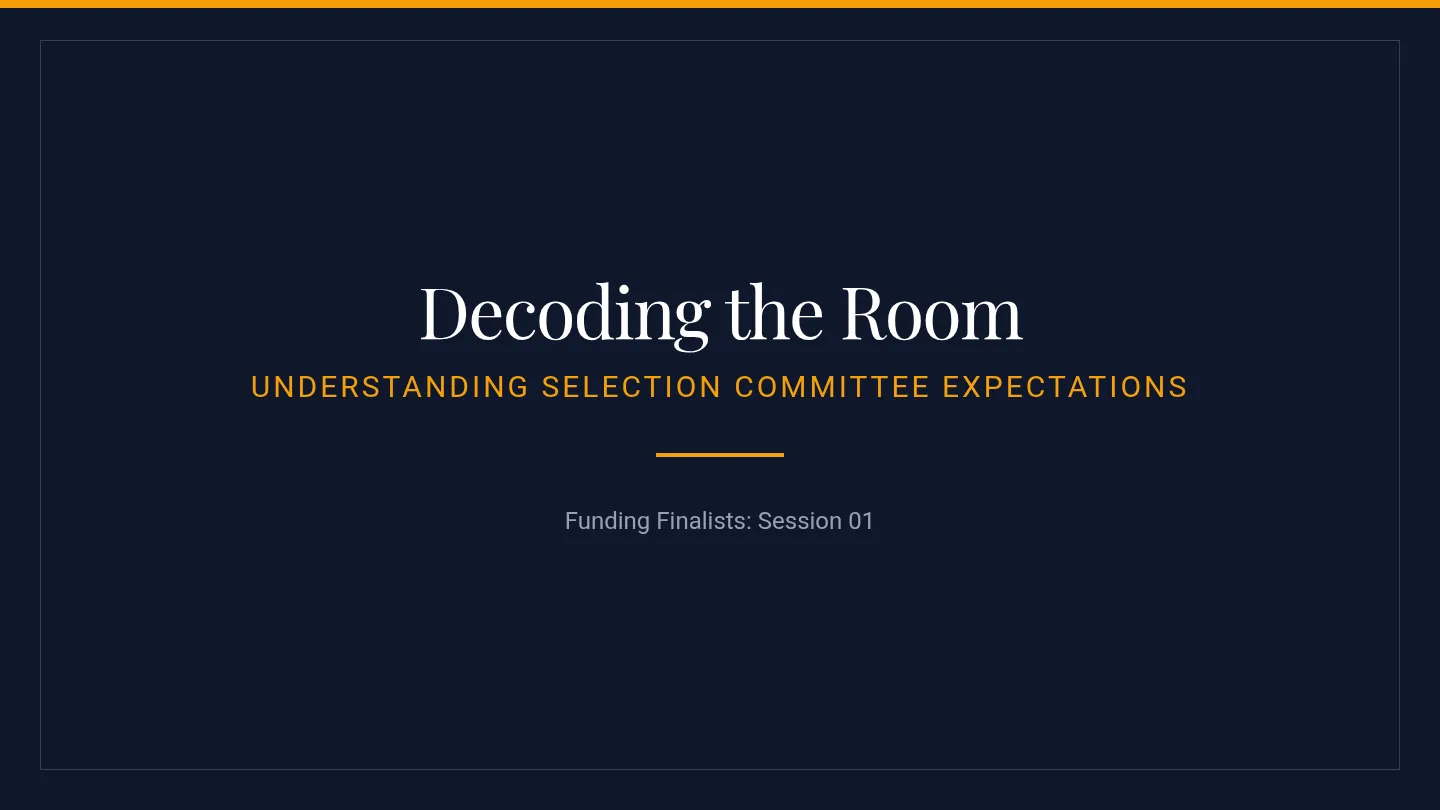
Final presentation slides for the 'Funding Finalists' sequence, covering mock interview setup, professional follow-up etiquette, and outcome management.
A professional rubric for peer evaluation during mock fellowship interviews, focusing on pitch impact, STAR technique, and poise.
A structured worksheet for students to build their versatile 'story bank' using the STAR method, including an adaptability matrix.
Instructional slides for crafting and delivering a 90-second research pitch, focusing on clarity, structure, and jargon-free communication.
Instructional slides for Lesson 3, teaching the STAR method (Situation, Task, Action, Result) for behavioral interviews and how to build a versatile story bank.
A set of peer review cards for students to provide quick, structured feedback during speed-pitching sessions.
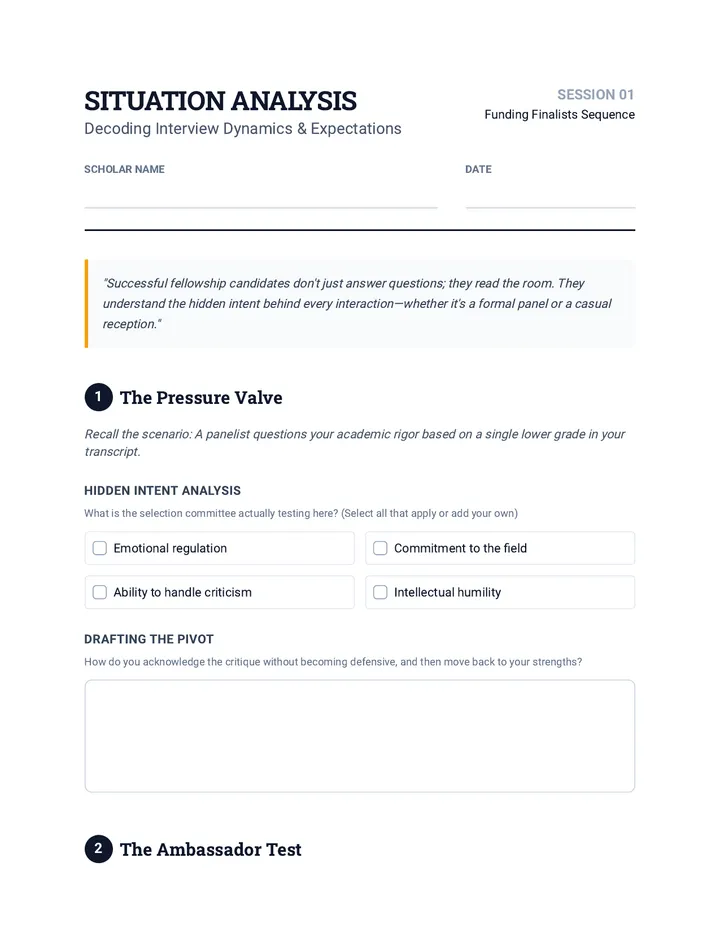
A student worksheet for Lesson 1 to help analyze interview scenarios, hidden committee intents, and ambassadorial strategies.
Visual presentation slides for Lesson 1, detailing panel, stress, and social interview formats for high-stakes fellowships.
A long-term strategic plan that uses interview performance patterns to guide skill acquisition and career growth. Includes sections for communication vs. knowledge gaps and a 6-month roadmap.
A visual presentation for graduate students on transforming interview performance data into a long-term professional development plan. Focuses on identifying "Skill Gaps" vs "Communication Gaps."
An iterative design template for rewriting interview stories. It provides space for a baseline (Version 1.0) and a re-engineered version (Version 2.0), focusing on cutting context, active action verbs, and power closings.
A visual presentation for graduate students on iterative design for interview stories. It focuses on re-engineering weak narrative arcs by cutting context, injecting personal agency, and creating power closings.
A gap analysis tool for students to compare their intended message with a peer's perception. It identifies 'message takeaways' versus 'intent' to calculate communication distortion and prioritize refinements.
A visual presentation exploring communication theory in interviews. It focuses on 'Signal vs. Noise,' identifying where messaging distortion occurs between the candidate's intent and the interviewer's perception.
A reference guide for students to calibrate their scoring during the performance audit. It provides specific examples of low vs. high performance in clarity, conciseness, and alignment.
A quantitative scoring worksheet for interview performance evaluation. Students use a 1-4 scale across clarity, conciseness, and alignment to audit their responses and identify specific areas for improvement.
A visual presentation introducing a quantitative scoring model for interview performance. It focuses on clarity, conciseness, and alignment, moving students from subjective feelings to objective metrics.
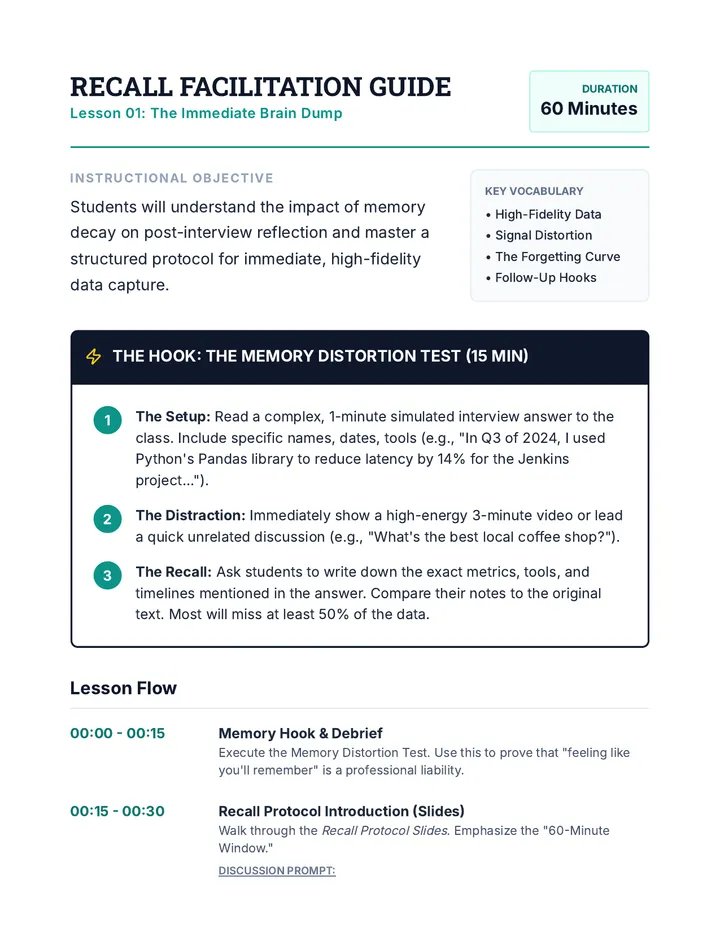
A facilitation guide for the Immediate Brain Dump lesson, including instructions for a memory-decay hook activity, discussion prompts, and a timed lesson flow.
A visual presentation for graduate students introducing the Rapid Recall Protocol, focusing on memory decay and the importance of immediate, data-driven post-interview documentation.