Employment laws, safety protocols, and legal protections against workplace harassment and discrimination. Connects regulatory requirements to practical understandings of pay stubs, insurance benefits, and employee advocacy.
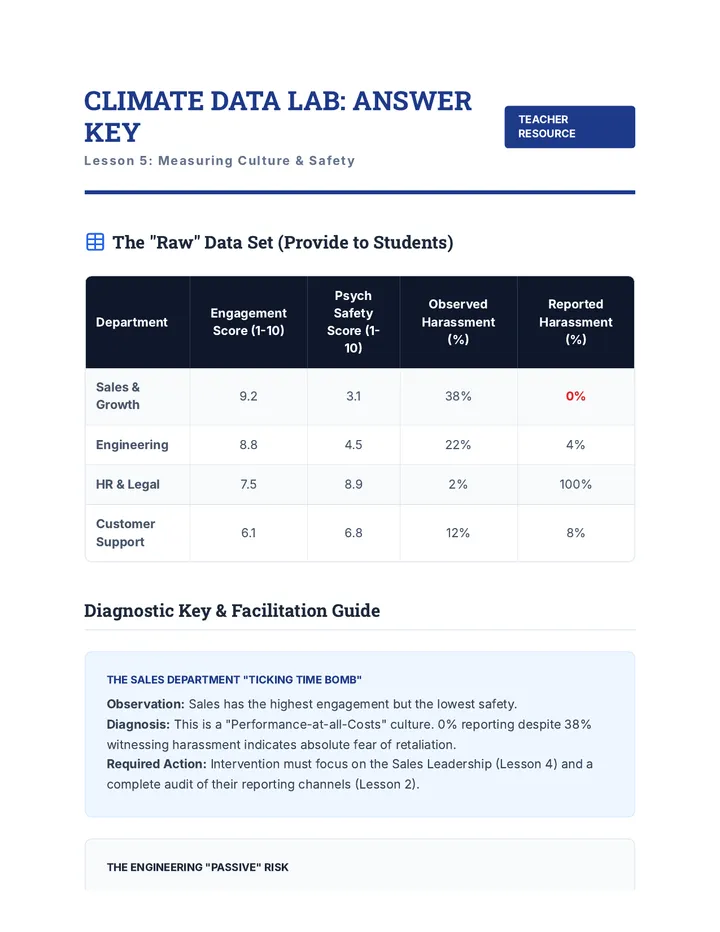
A sample data set and discussion key for the climate survey lab, designed to help students identify organizational "hot spots" of harassment risk.
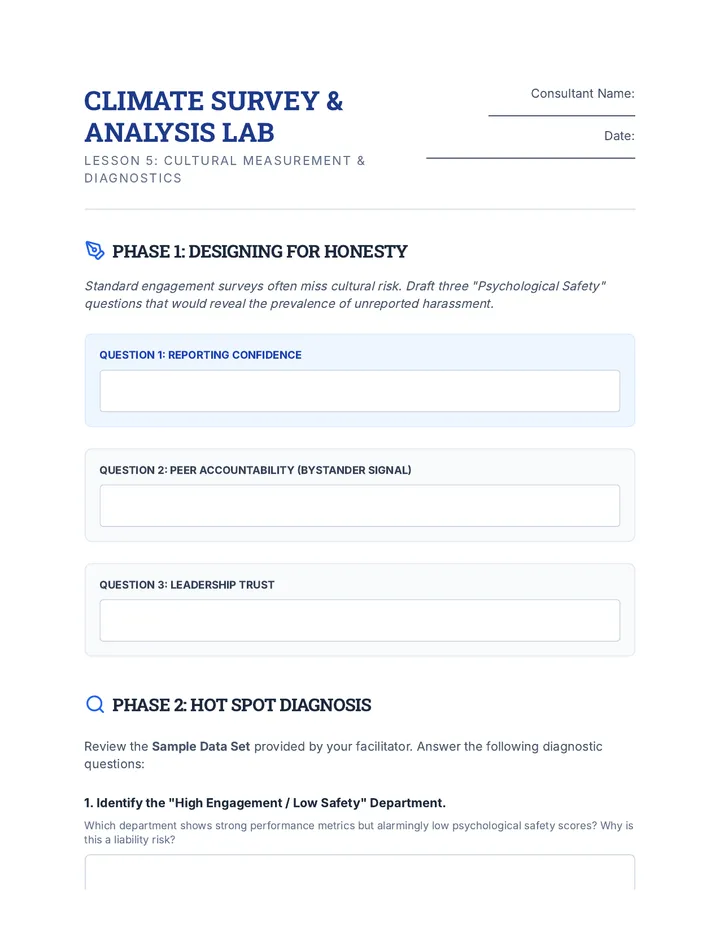
A graduate-level lab worksheet for designing psychological safety survey questions and interpreting organizational climate data.
A slide deck for graduate students exploring cultural measurement through climate surveys and the assessment of psychological safety within an organization.
The capstone template for the final investigation report, structured to meet graduate-level technical writing and legal defensibility standards.
A facilitator discussion guide for analyzing leadership's role in workplace culture using comparative case studies like Uber and Netflix.
A comprehensive grading rubric for the final investigation report, focusing on procedural integrity, evidence synthesis, and remediation strategy.
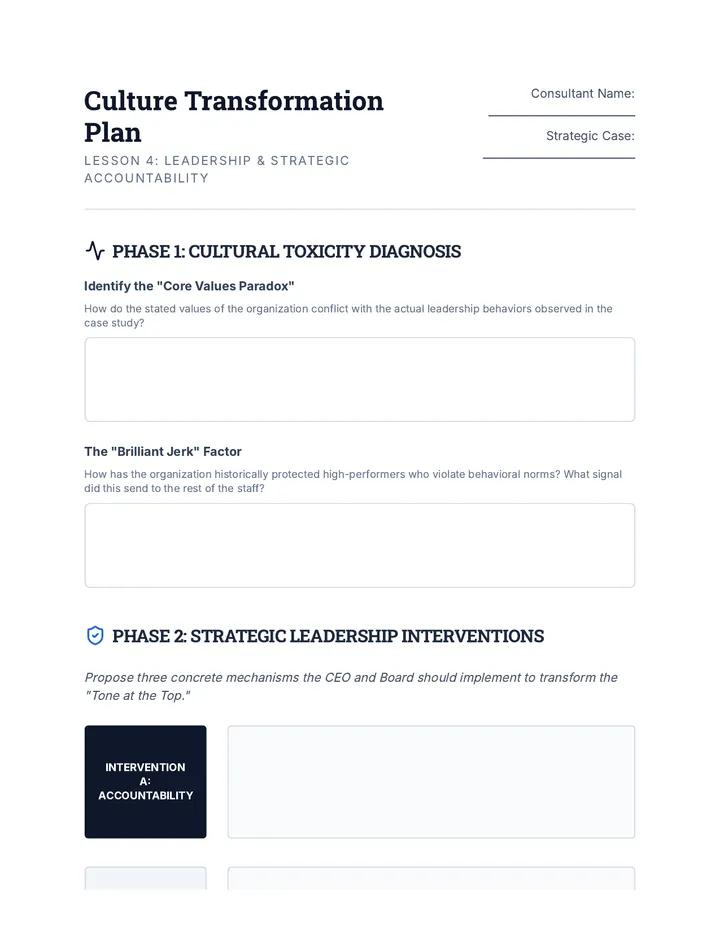
A strategy document for graduate students to analyze a toxic culture case study and propose leadership-level accountability mechanisms for transformation.
Slide deck for Lesson 5 on drafting technical investigation reports and recommending appropriate remediation strategies while avoiding legal pitfalls.
A slide deck for graduate students examining leadership's role in establishing workplace culture, focusing on accountability mechanisms and case study analysis.
A worksheet for students to weigh conflicting evidence and apply credibility factors to reach a preliminary determination.
An answer key and rubric for Lesson 4, helping instructors grade student credibility assessments and findings of fact for the Thorne/Vance case.
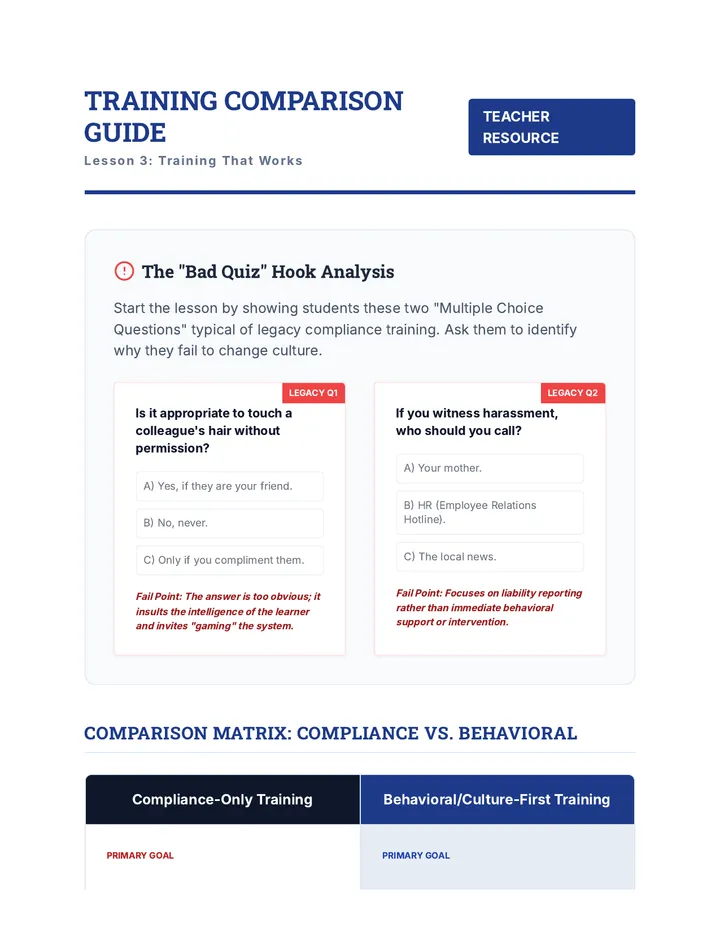
A teacher resource comparing legacy compliance-based harassment training with modern behavioral-based models, including sample "bad" quiz questions and facilitation tips.
Slide deck for Lesson 4 on weighing credibility, applying the preponderance of evidence standard, and making formal findings of fact.
A design sprint template for graduate students to create a behavioral-based, 15-minute training module for a specific workplace context.
A planning worksheet for students to draft their interview questions and structure their inquiry according to the funnel technique.
A slide deck exploring why traditional compliance training fails and how to design behavioral-based training modules focused on civility and respect.
Detailed role-play scripts and facilitator instructions for Lesson 3, featuring two contrasting personas: a hostile respondent and a reluctant witness.
Slide deck for Lesson 3 focusing on interview techniques for the accused and witnesses, including the funnel technique and de-escalation strategies.
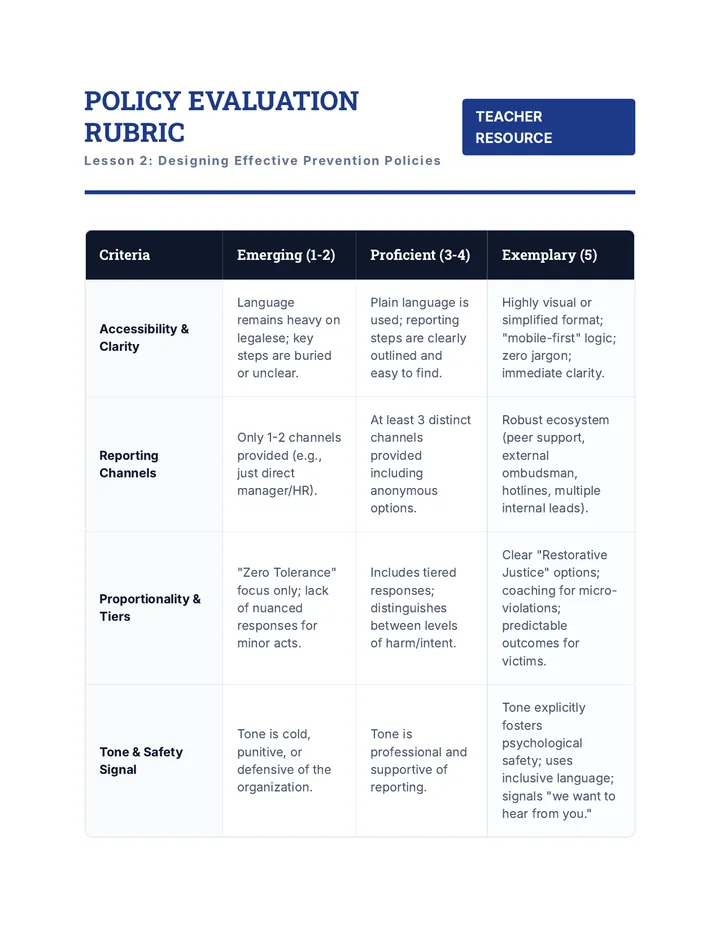
A comprehensive rubric and facilitator discussion guide for evaluating and critiquing anti-discrimination and harassment policies.
A strategic template for students to map out their investigation, including scope definition, interview sequencing, and evidence preservation tasks.
A print-ready reference guide for students providing specific strategies and assertive scripts for a traffic stop, medical appointment, and social pressure. Revised to ensure a one-page fit and included student work areas for personalized scripts.
A 'fun and different' icebreaker activity where participants bid on personal rights using 'Assertion Bucks' to spark conversation about priorities and values. Revised to include a second page of printable currency and bid tracking lines.
A facilitation guide for the 60-minute Stand Your Ground session. Updated to incorporate the 12-card Mega Scenario Set and the Independence Field Guide. Revised timing to match a 10-minute icebreaker.
A mega-set of 12 role-play scenario cards covering police, medical, government, social, employment, housing, pharmacy, and peer situations. Revised with 6 new high-stakes scenarios for PSR groups.
An elaborated slide deck for the Stand Your Ground PSR group session. Features detailed breakdowns of the Traffic Stop, Medical, and System/Government scenarios with assertive scripts and explanations of why they work. Revised with improved contrast and clearer role-play instructions.
A self-reflection checklist for participants to identify personal rights and assess their ability to assert them in daily life. Final revision to ensure one-page fit and expanded reflection area.
A post-simulation exit ticket for patients/students to reflect on legal competency standards, the Marcus Thorne case, and personal takeaways.
A facilitator's guide for the Marcus Thorne case, detailing the distinction between factual and rational competency and outlining potential legal strategies like NGRI.
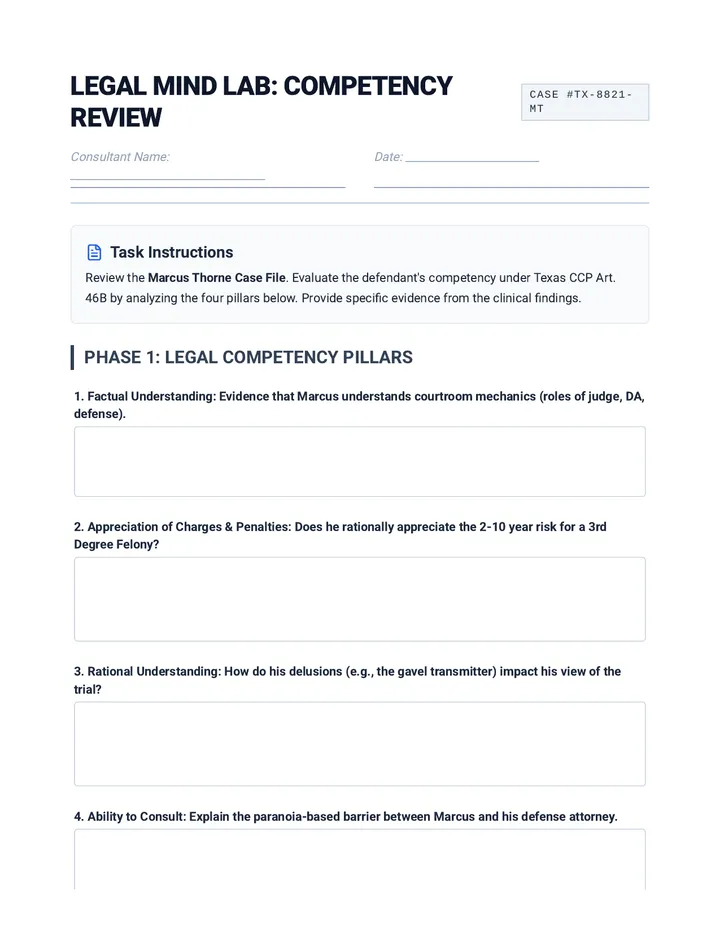
A student worksheet for analyzing a criminal case and competency report, focusing on factual and rational understanding and legal defense strategies.
A legal and clinical summary of a criminal case involving a defendant with Schizoaffective Disorder, including the offense narrative and mental health findings.
A comprehensive 2-page activity worksheet that combines system identification (decoding) with hands-on paycheck auditing (investigating). Covers FLSA basics, tip credits, and common math errors. Fixed page breaks and student work area legibility.
A facilitation guide for the Tipping 101 workshop, featuring a pacing roadmap, answer keys for the combined activity worksheet, and essential teaching points on FLSA compliance. Updated to reflect the new Slide 2 video and discussion prompts on tipping creep.
Archived. Combined into Tipping 101 Activity Worksheet.
A 14-slide visual presentation for a 90-minute workshop on tipping fundamentals. Slide 10 has been updated to be more informational, detailing specific legal violations regarding business losses, customer theft, and register gaps under the FLSA. Fixed text-contrast and layout issues throughout the deck.
Archived. Not for use.
Facilitation guide for Lesson 5, covering under-reporting, incentive misalignment, and strategies for promoting incident transparency.
A comprehensive project guide for the final summative assessment where graduate students design a 3-phase organizational roadmap to transition to a 'Just Culture.'
Facilitation guide for Lesson 4, covering management visibility, safety walks, and techniques for trust-building during incident response.
Facilitation guide for Lesson 3, covering under-reporting, incentive misalignment, and strategies for promoting incident transparency.
A structured checklist and observation tool for management-led safety walks, focusing on engagement, trust-building, and barrier identification.
Visual presentation for Lesson 5, covering Just Culture, the behavioral spectrum, and the link between physical and psychological safety.
Visual presentation for Lesson 4, covering management visibility, safety walks, and active listening.
A worksheet for analyzing the negative impact of outcome-based safety incentives and proposing alternative leading-indicator rewards.
Visual presentation for Lesson 3, covering under-reporting, incentive misalignment, and structural barriers to incident transparency.
Facilitation guide for Lesson 2, providing pacing, discussion prompts, and activity guidance for teaching whistleblower rights and anti-retaliation policies.
A workshop activity where graduate students design an organizational anti-retaliation policy, including reporting channels, investigation protocols, and accountability standards.
Visual presentation for Lesson 2, covering Section 11(c) of the OSH Act, definitions of retaliation, and the legal elements of a whistleblower claim.
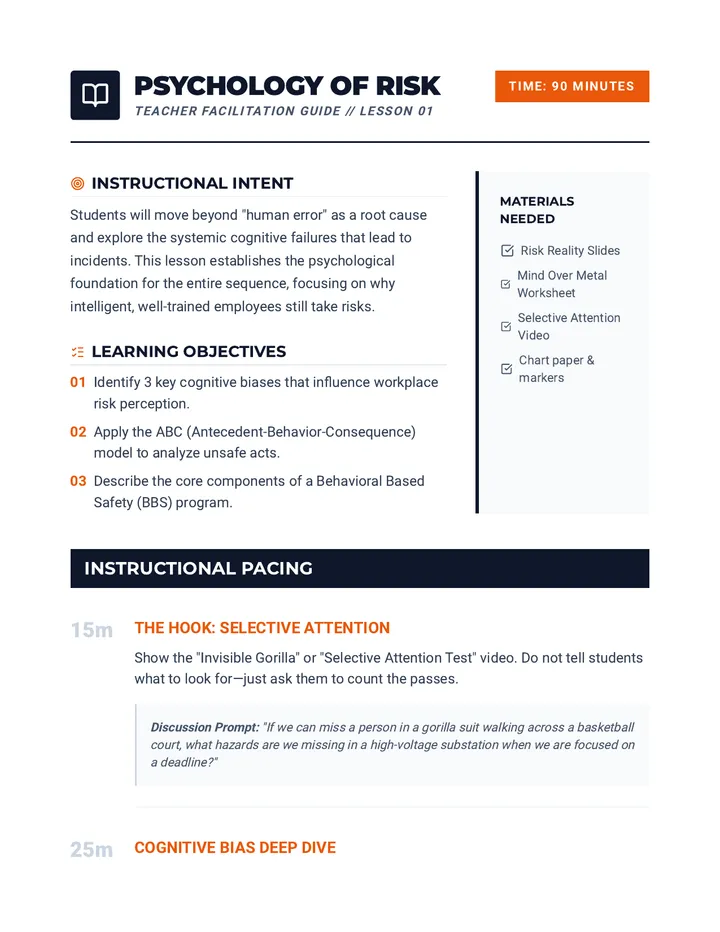
A comprehensive teacher facilitation guide for Lesson 1, including instructional pacing, discussion prompts, and pedagogical tips for teaching risk psychology.
A visual presentation for Lesson 1, covering cognitive biases, Behavioral Based Safety (BBS) principles, and the ABC analysis model.
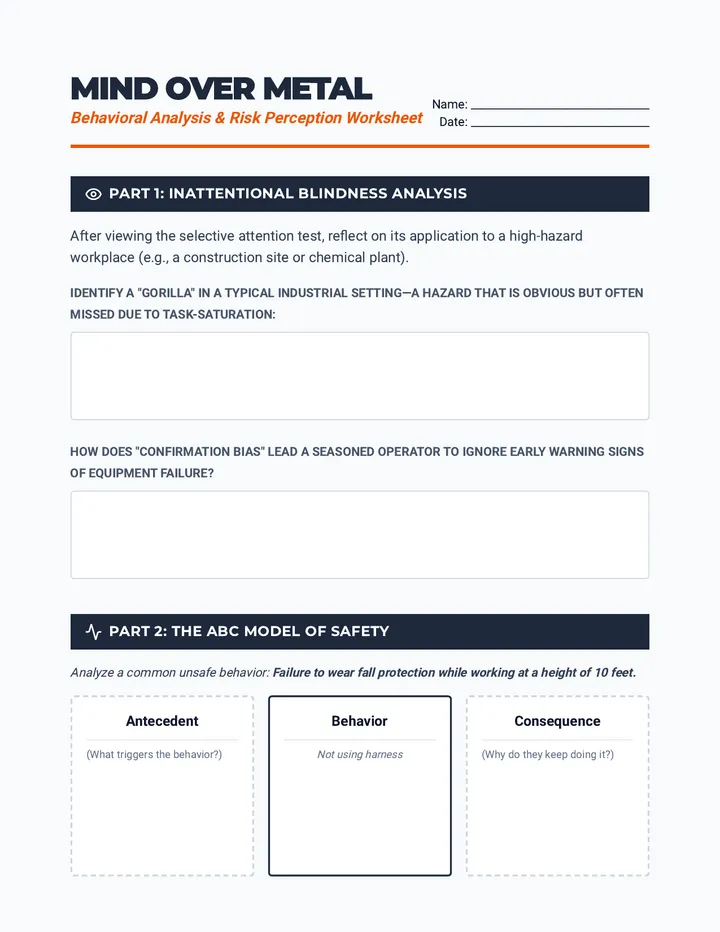
A graduate-level worksheet focused on analyzing cognitive biases, inattentional blindness, and the ABC (Antecedent-Behavior-Consequence) model in the context of industrial safety.