Root cause analysis and brainstorming techniques for everyday problem-solving. Equips learners with ethical frameworks and risk-benefit evaluation skills to predict consequences and make informed choices.
Final reflection and proposal guide for Lesson 5, where students synthesize simulation findings into concrete admissions policy reforms.
Final slide deck for Lesson 5 exploring systemic bias, demographic outcomes of the simulation, and reimagining equitable admissions workflows.
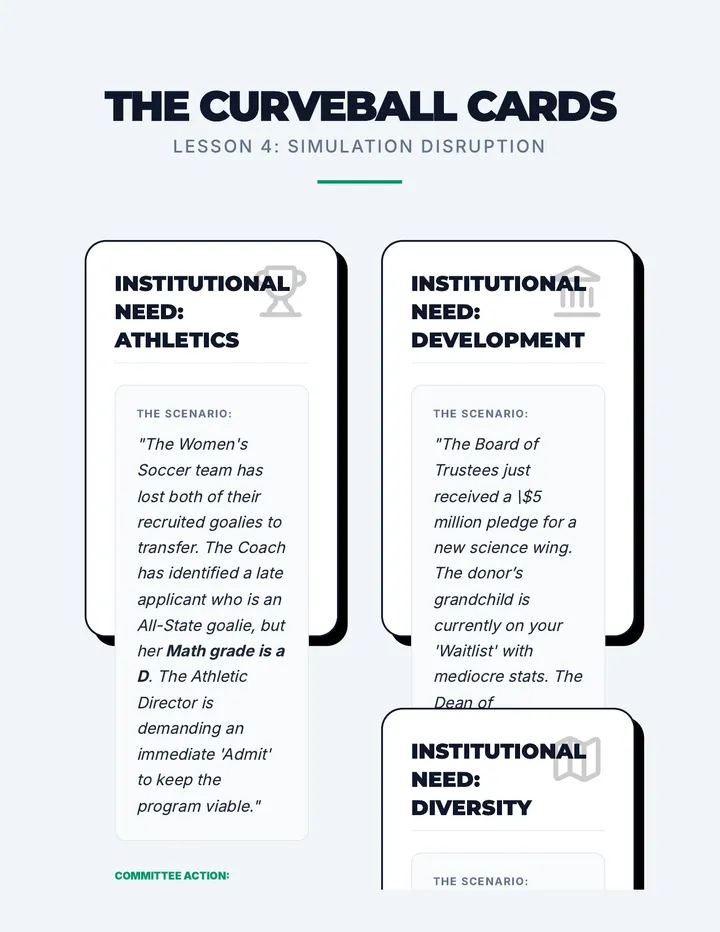
Set of four simulation "curveball" cards for Lesson 4, introducing institutional constraints like athletic needs, major donors, geographic diversity, and yield protection.
Slide deck for Lesson 4 exploring yield protection, special talents (athletics, arts), and the ethical dilemmas of institutional priorities.
Set of three redacted-style applicant dossiers for Lesson 3 simulation, featuring a narrative striver, a legacy applicant, and a quantitative powerhouse.
Slide deck for Lesson 3 simulation, focusing on advocacy techniques, committee roles, and the institutional realities of enrollment management.
Worksheet for Lesson 2 comparing two student profiles with identical GPAs but different resource contexts to practice analyzing academic rigor.
Slide deck for Lesson 2 focusing on contextual review of transcripts, identifying grade trends, and the balance between standardized testing and personal narratives.
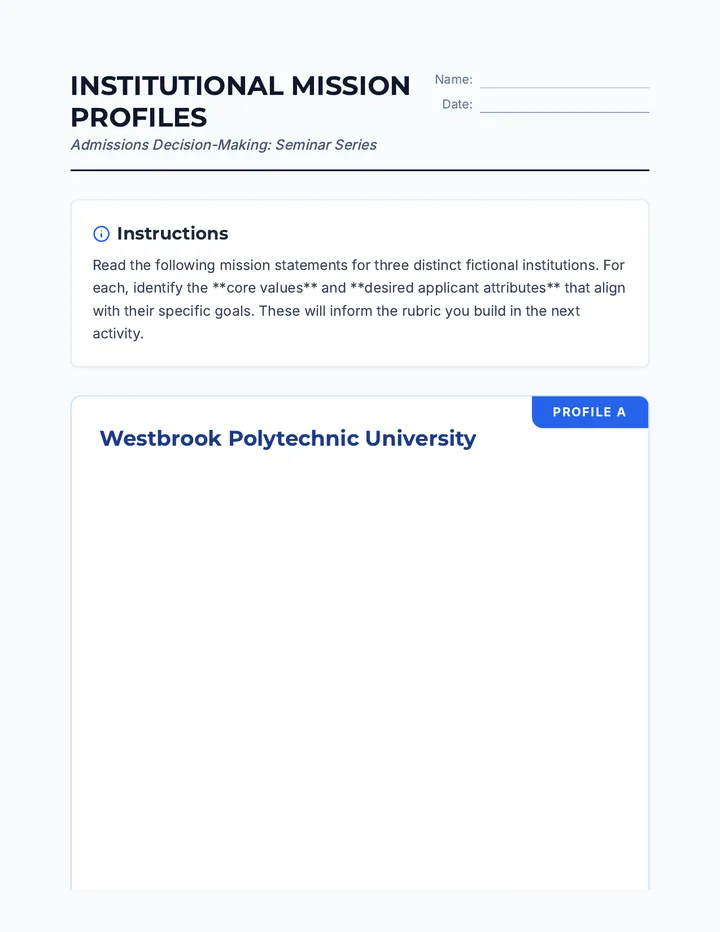
Worksheet featuring three fictional institution profiles with mission statements and analysis areas for students to determine core values and desired applicant traits.
Introductory slide deck for Lesson 1 on Admissions Priorities and Rubrics, featuring institutional mission analysis and the quantitative vs. qualitative debate.
The evaluation rubric for the capstone project, assessing students on their diagnostic accuracy, impact analysis, and the quality of their FAST-aligned 'prescriptive' scripts.
A planning guide and worksheet for the capstone project. Students identify their subject, diagnose the integrity failure, and script a 'FAST Pivot' to redesign the outcome.
The capstone project presentation slides, outlining the requirements for students to analyze a public or fictional figure's integrity crisis using the FAST framework.
Answer key and guide for Lesson 4, providing exemplars of FAST-aligned communication that replaces manipulation and sugar-coating with respectful truthfulness.
A workshop worksheet for Lesson 4 where students rewrite common communication failures (compliment sandwiches, helplessness, exaggeration) using the 'T' (Truthful) element of FAST.
This slide deck explores the 'Truthful' component of FAST, debunking the 'compliment sandwich' and explaining how acting helpless is a form of professional dishonesty that erodes self-respect.
Teacher's brief for Lesson 3, including a model refusal script and a breakdown of why a FAST-aligned response maintains professional integrity in high-pressure ethical situations.
A culminating activity where students apply decision-making frameworks to complex applicant scenarios, deciding whether to submit test scores based on percentile data and environmental context.
A simulation worksheet for Lesson 3 where students must respond to a supervisor's request to falsify data. Students use each letter of FAST to build a respectful but firm ethical refusal.
This presentation defines the 'Stick to Values' component of FAST, distinguishing between healthy integrity and unprofessional insubordination while highlighting the psychological pressures of authority.
Facilitation guide for Lesson 5, covering under-reporting, incentive misalignment, and strategies for promoting incident transparency.
A comprehensive project guide for the final summative assessment where graduate students design a 3-phase organizational roadmap to transition to a 'Just Culture.'
Facilitation guide for Lesson 4, covering management visibility, safety walks, and techniques for trust-building during incident response.
Facilitation guide for Lesson 3, covering under-reporting, incentive misalignment, and strategies for promoting incident transparency.
A structured checklist and observation tool for management-led safety walks, focusing on engagement, trust-building, and barrier identification.
Visual presentation for Lesson 5, covering Just Culture, the behavioral spectrum, and the link between physical and psychological safety.
A comprehensive clinical competency rubric for evaluating graduate students' ability to design individualized PLEASE protocols for complex cases.
Capstone project brief for graduate students to design tailored PLEASE protocols for complex client profiles with significant environmental and physical barriers.
Visual presentation for Lesson 4, covering management visibility, safety walks, and active listening.
Capstone slides for designing tailored PLEASE protocols, focusing on complex client profiles with socioeconomic, physical, and occupational barriers.
A worksheet for analyzing the negative impact of outcome-based safety incentives and proposing alternative leading-indicator rewards.
A debate guide and worksheet for graduate students to analyze complex clinical cases involving substances, prescription drugs, and emotional regulation.
Clinical slides on the "Avoid Mood-Altering Substances" skill, exploring the emotional half-life of substances and harm reduction vs. abstinence frameworks.
Visual presentation for Lesson 3, covering under-reporting, incentive misalignment, and structural barriers to incident transparency.
A clinical assessment tool for graduate students to identify medical barriers and practice advocacy scripting for clients struggling with the "PL" component of PLEASE.
Slides for a clinical lesson on the "Treat Physical Illness" component of PLEASE, focusing on identifying and overcoming psychological, socioeconomic, and systemic barriers to medical care.
Facilitation guide for Lesson 2, providing pacing, discussion prompts, and activity guidance for teaching whistleblower rights and anti-retaliation policies.
A clinical case study and worksheet for practicing chain analysis on a client with BPD and chronic migraine, focusing on physiological vulnerability factors.
A workshop activity where graduate students design an organizational anti-retaliation policy, including reporting channels, investigation protocols, and accountability standards.
Clinical slides explaining the mechanics of chain analysis with a specific focus on identifying physiological "weak links" that contribute to behavioral crises.
Facilitator guide for Lesson 5, outlining the instructional flow, discussion prompts, and key concepts for the maintenance contract and habit formation.
A formal maintenance contract for students to commit to their regulation protocols, establishing maintenance schedules and accountability partners.
Final slide deck for Lesson 5, focusing on habit formation, maintenance schedules, and the commitment to protocol adherence.
Facilitator guide for Lesson 4, outlining the instructional flow, discussion prompts, and key concepts for the digital tool evaluation and UI critique.
Worksheet for students to evaluate mental health apps and digital tools, specifically focusing on their user interface and accessibility during high-stress moments.
Slide deck for Lesson 4, introducing the concepts of digital support tools, UI critique for distress, and integrating tech into regulation protocols.
Facilitator guide for Lesson 3, outlining the instructional flow, discussion prompts, and key concepts for the "pre-mortem" and "If-Then" planning.
Worksheet for identifying potential obstacles and creating 'If-Then' implementation intentions to ensure protocol adherence during distress.
Slide deck for Lesson 3, introducing the concept of the "pre-mortem" and "If-Then" implementation intentions to overcome barriers to regulation.
Facilitator guide for Lesson 2, outlining the instructional flow, discussion prompts, and key concepts for the tiered regulation plan.
A comprehensive design worksheet for students to map out their three-tiered emotional regulation plan, including indicators and specific action protocols.
Slide deck for Lesson 2, introducing the triage metaphor and the three-tiered system for emotional regulation.
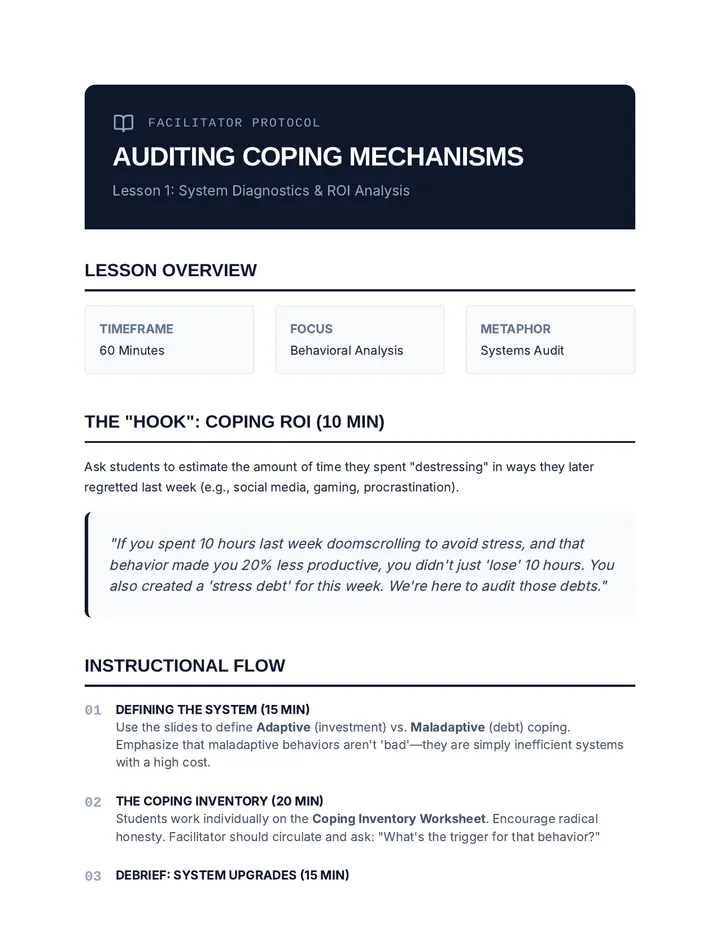
Facilitator guide for Lesson 1, outlining the instructional flow, discussion prompts, and key concepts for the coping mechanism audit.
Small printable cards with breathing exercises, grounding techniques, and positive visualization prompts for students to use during practice.
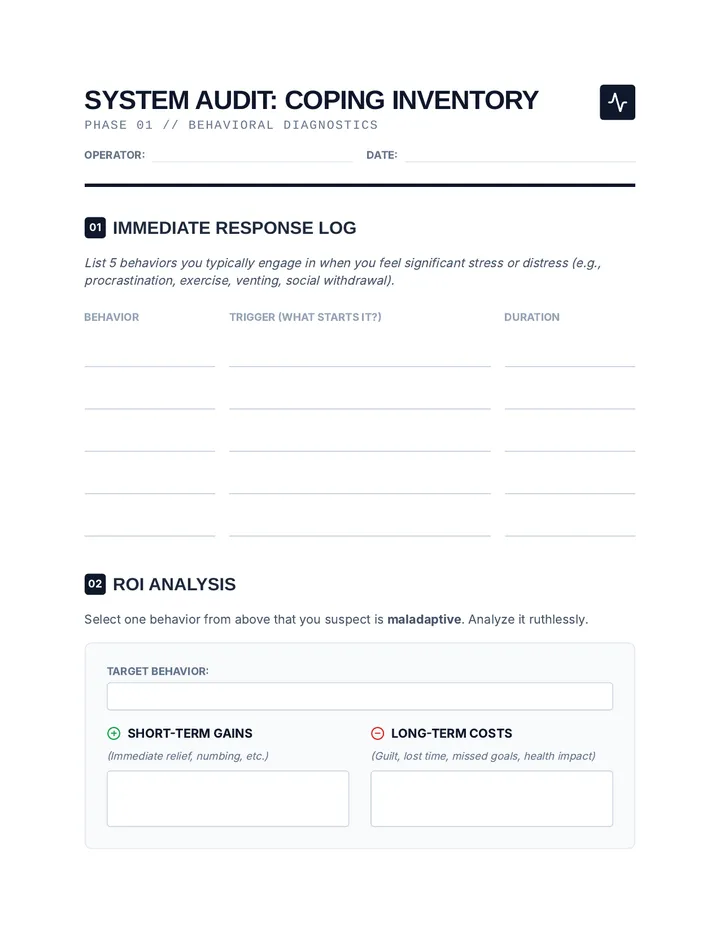
A structured worksheet for students to inventory their current stress responses and perform a cost-benefit analysis of maladaptive behaviors.
A post-simulation reflection worksheet for students to analyze their accuracy, fatigue levels, and strategic adjustments.
Introductory slide deck for Lesson 1, focusing on the distinction between adaptive and maladaptive coping mechanisms using a data-driven systems metaphor.
A quick-reference decision matrix for classifying test questions during the triage process.
Slides for the final lesson on endurance simulation, emphasizing sustained focus and fatigue management.
A worksheet for students to practice identifying distractor patterns and using the process of elimination to increase their guessing odds.
An engaging, printable coaching worksheet designed to help young adults apply the 3-Step Pivot Protocol to real-life triggers across feedback, peer conflict, and family boundaries.
A beautiful pink-and-lavender aesthetic slide deck tailored for young women/telehealth clients, featuring elegant layouts and structured role-play scenarios.
A structured pacing guide and instructional script for facilitators to deliver a 30-minute mindset session, including discussion prompts and common misconceptions.
A reflective journal-style worksheet for fellowship students to audit their fixed mindset triggers and re-script them using growth mindset principles through the lens of Chintan.
A minimalist and professional slide deck for a 30-minute session on Fixed vs. Growth Mindset, introducing the concept of Chintan (deep contemplation) for high-level learners.
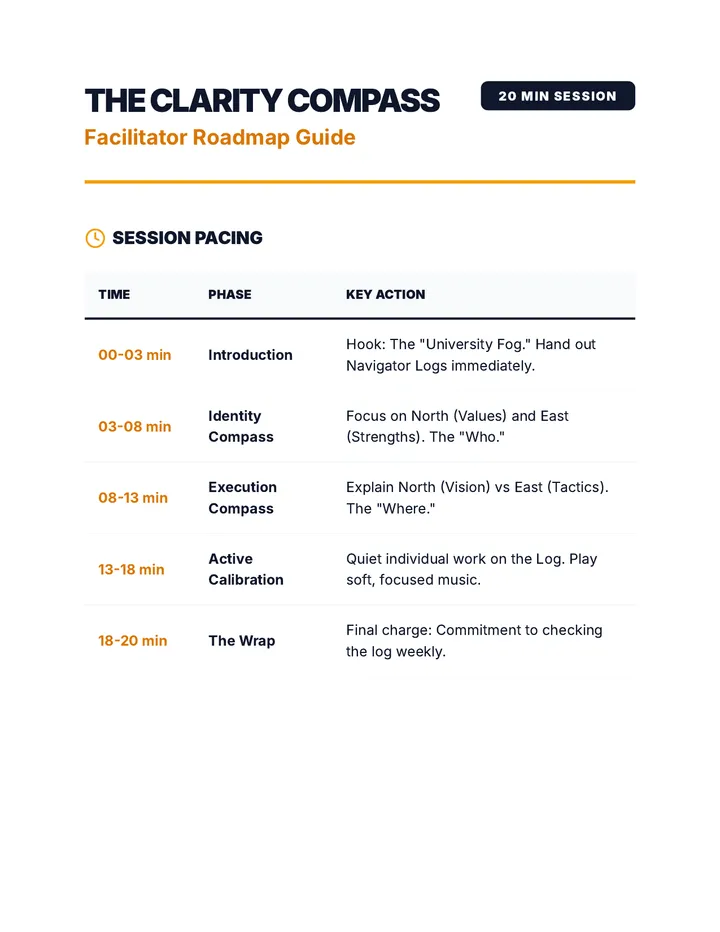
A comprehensive pacing and facilitation guide for the 20-minute Clarity Compass workshop, including discussion prompts and instructional tips.
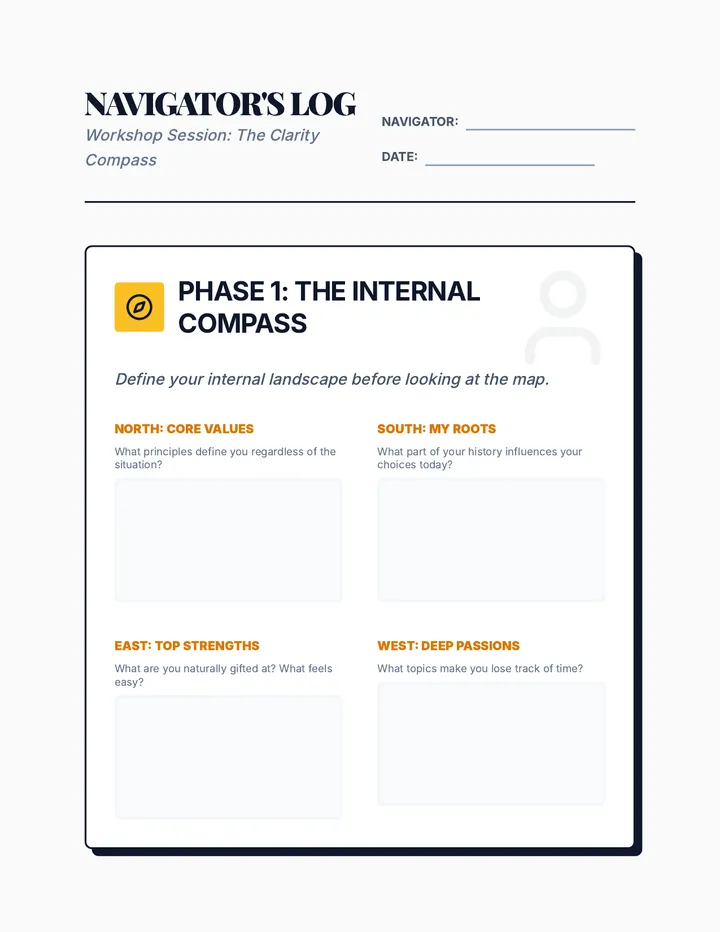
A practical goal-setting worksheet for students to document their Internal and External Clarity Compasses during the workshop.
A visually striking slide deck for a 20-minute university workshop, introducing the Internal and External Clarity Compass models for personal goal setting.
A sleek, corporate-themed presentation featuring 4 complex ethical dilemmas across finance, retail, and marketing. Includes structured prompts to facilitate high-level student debate and critical thinking.
A comprehensive 2-page reference handout summarizing all key executive functioning mastery concepts. It includes the neurological foundations (Limbic vs. PFC), The Wall of Awful, the ABCDE method, Atomic Sequencing, Friction Engineering, and the Reset Protocol.
An intensive 4-page workbook designed for advanced executive functioning optimization, featuring a deep skills audit, a 10-step sequencing lab, friction engineering strategies, and long-term if-then planning modules. Each page is meticulously laid out for print legibility and student engagement.
A comprehensive and visually striking slide deck for an advanced 90-minute executive functioning workshop, featuring in-depth modules on task initiation, the ABCDE prioritization method, linear sequencing secrets, and environmental friction engineering.
A massive, in-depth 4-page instructor manual designed for professional facilitation of executive functioning skills. It includes specific teaching scripts, neurological background on the limbic system, detailed walkthroughs of all worksheet activities, and high-level troubleshooting strategies for common student hurdles.
An informational fact sheet for adult learners in a counseling setting, providing neurological and psychological insights into self-control, impatience, paranoia, and impulsivity. Revised for better layout and flow.
Updated visual slides for the 'Emotional Mastery' lesson, addressing impatience, paranoid thoughts, and impulsivity through the 'Label, Anchor, Pivot' framework.
An updated student worksheet for adult learners to manage impatience, paranoid thoughts, and impulsive actions by labeling their "hijacks" and pivoting to reality-based responses.
A detailed lesson plan for counselors focusing on teaching adult learners the 'Pause and Pivot' technique for self-control, with specific emphasis on managing impatience, paranoid thoughts, and impulsive actions.
A comprehensive worksheet for graduate students to practice DBT skills and reflect on K-12 implementation strategies.
A facilitator guide for graduate instructors, providing pacing, script notes, and detailed scenario analysis for teaching DBT skills.
A slide deck designed for graduate students to teach DBT Check the Facts and Problem Solving skills, featuring three school-based scenarios for group analysis.