Written and verbal communication standards for the workplace, including email etiquette, presentation delivery, and professional phone conduct. Develops collaborative skills for teamwork, constructive feedback, and efficient time management.
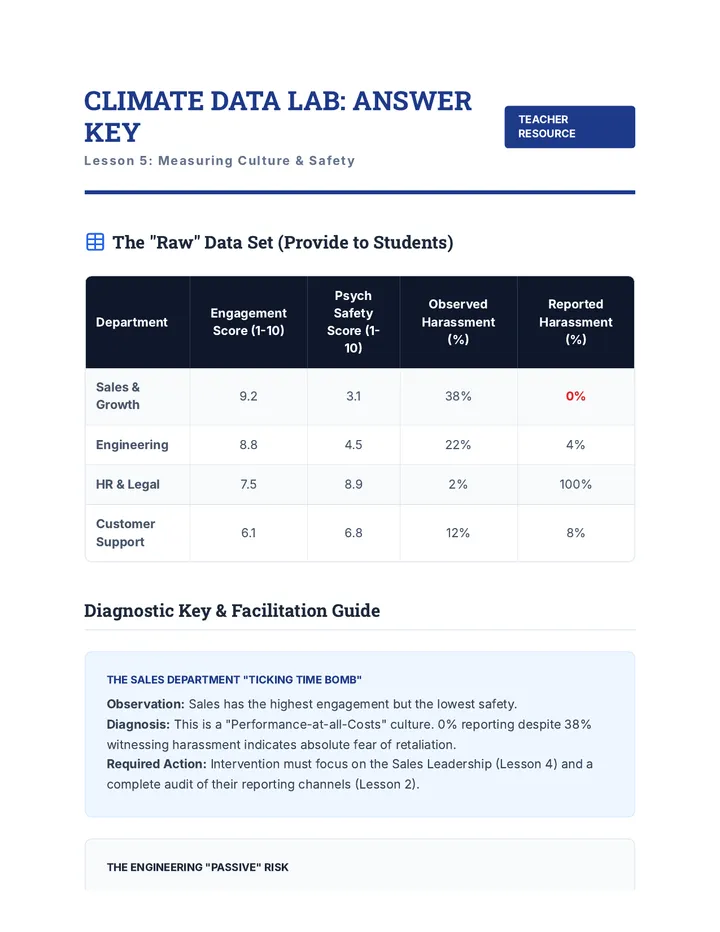
A sample data set and discussion key for the climate survey lab, designed to help students identify organizational "hot spots" of harassment risk.
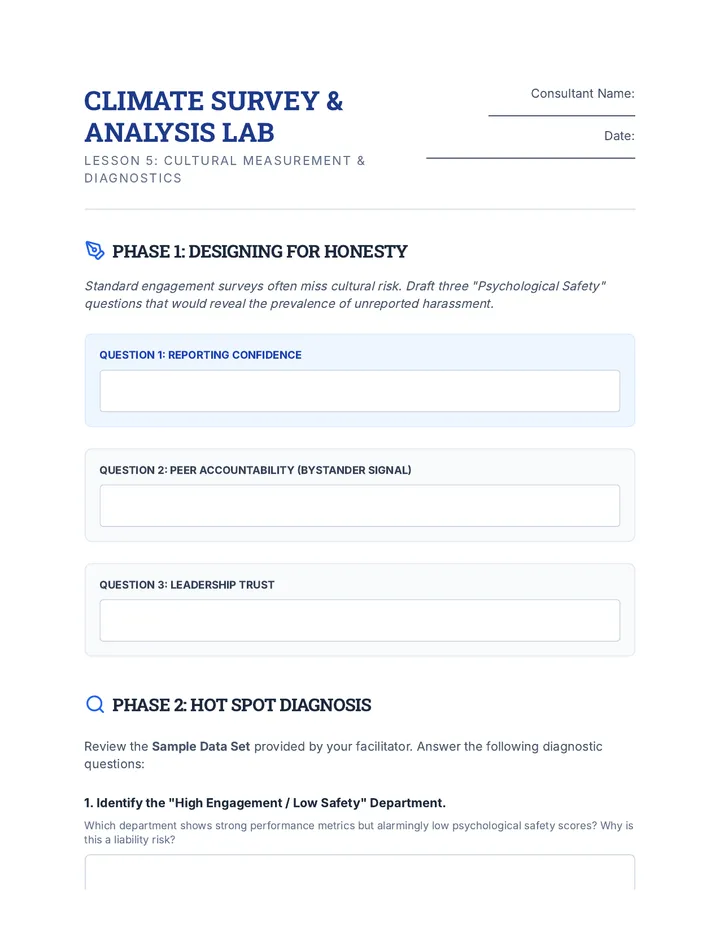
A graduate-level lab worksheet for designing psychological safety survey questions and interpreting organizational climate data.
A slide deck for graduate students exploring cultural measurement through climate surveys and the assessment of psychological safety within an organization.
A facilitator discussion guide for analyzing leadership's role in workplace culture using comparative case studies like Uber and Netflix.
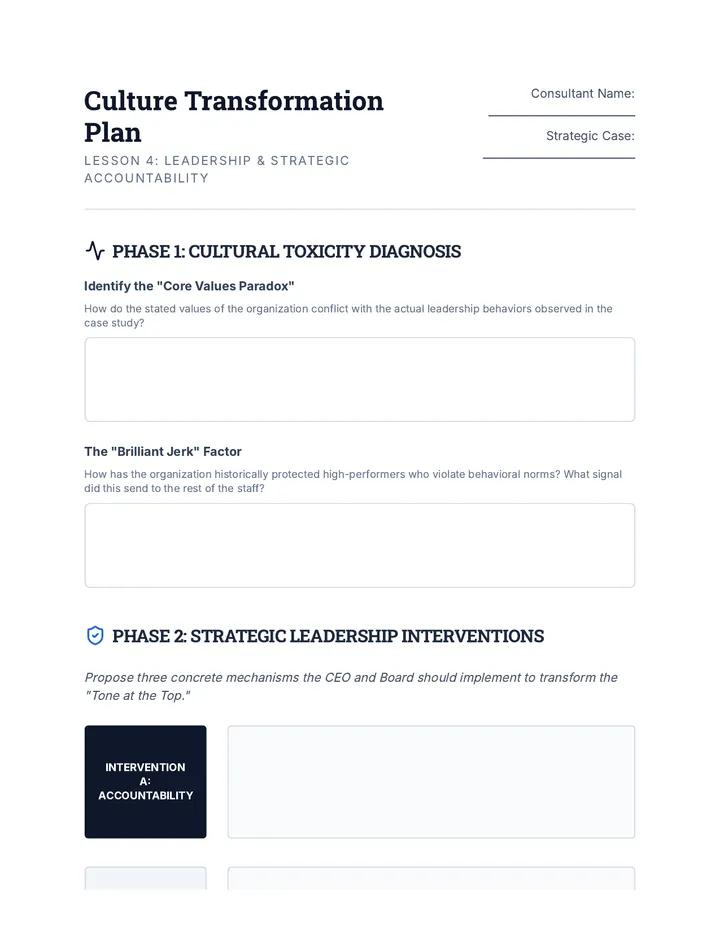
A strategy document for graduate students to analyze a toxic culture case study and propose leadership-level accountability mechanisms for transformation.
A slide deck for graduate students examining leadership's role in establishing workplace culture, focusing on accountability mechanisms and case study analysis.
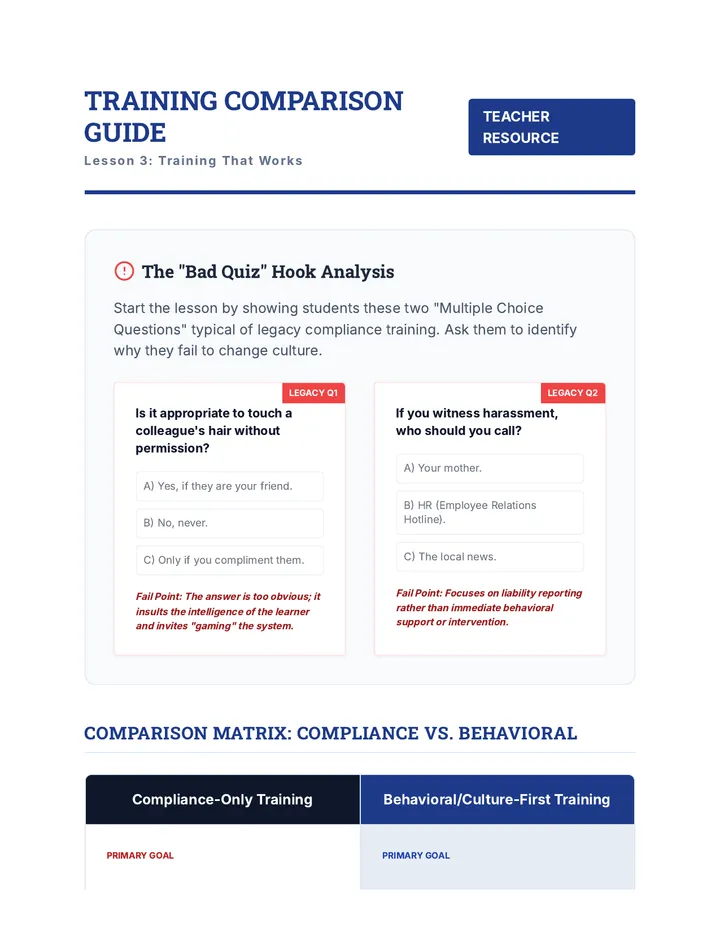
A teacher resource comparing legacy compliance-based harassment training with modern behavioral-based models, including sample "bad" quiz questions and facilitation tips.
A design sprint template for graduate students to create a behavioral-based, 15-minute training module for a specific workplace context.
A slide deck exploring why traditional compliance training fails and how to design behavioral-based training modules focused on civility and respect.
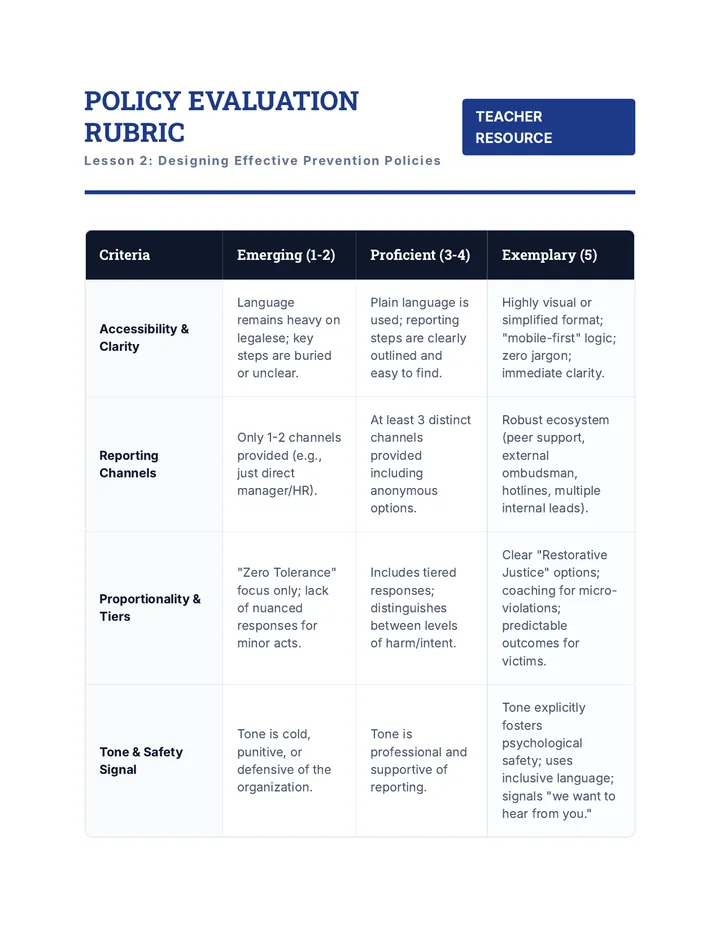
A comprehensive rubric and facilitator discussion guide for evaluating and critiquing anti-discrimination and harassment policies.
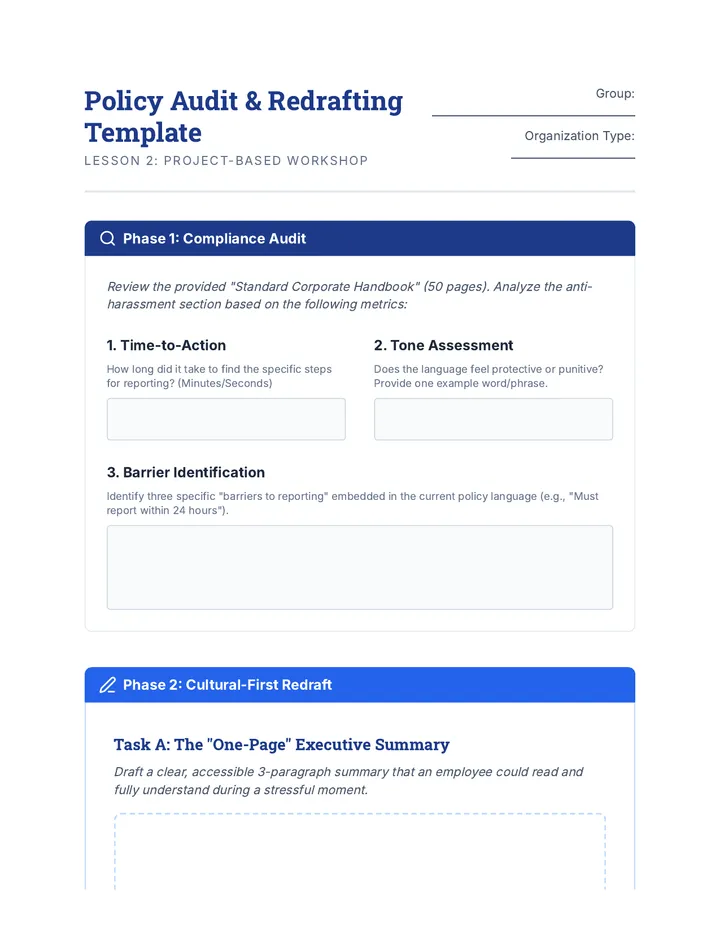
A graduate-level project template for auditing traditional harassment policies and redrafting them using cultural-first, accessible principles.
A slide deck for graduate students comparing traditional compliance-based harassment policies with cultural-first approaches that focus on accessibility and nuanced reporting.
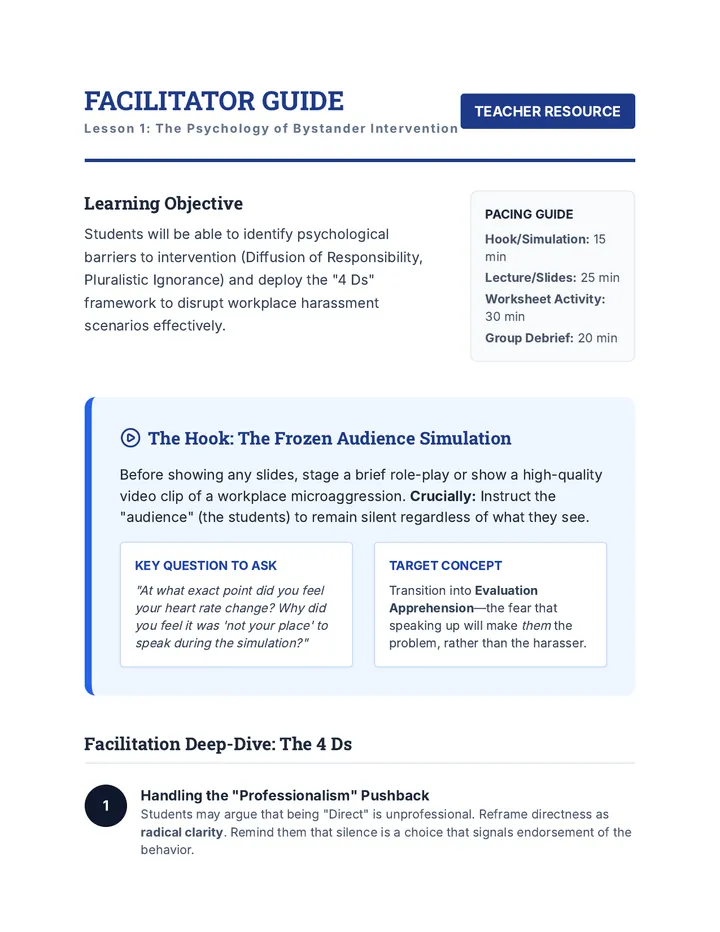
A comprehensive facilitator guide for teaching the psychology of bystander intervention, including simulation instructions, discussion prompts, and debriefing strategies.
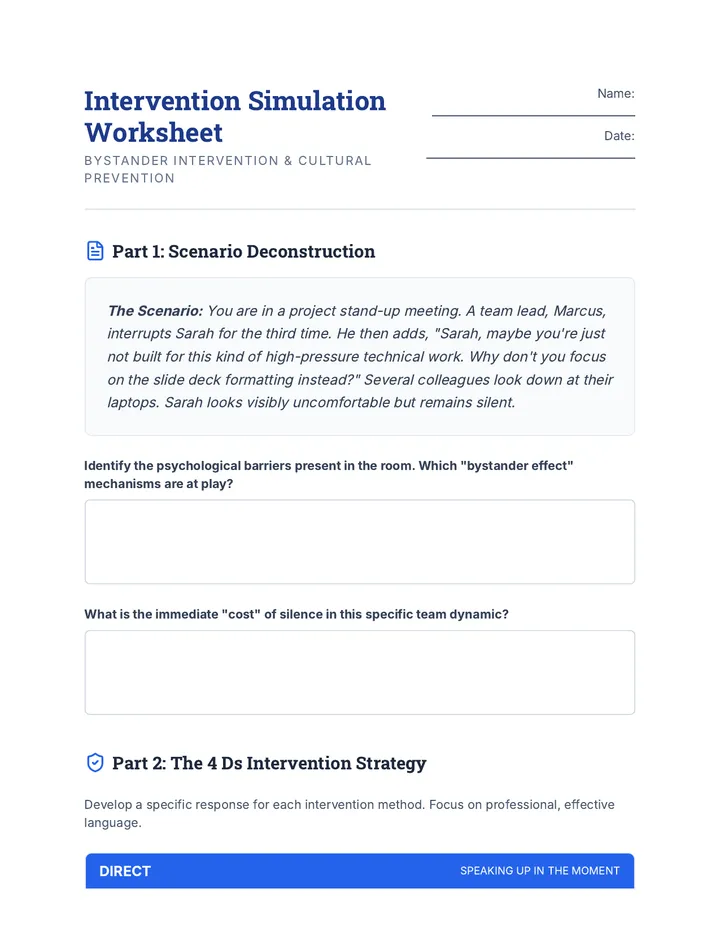
A graduate-level worksheet where students deconstruct a workplace harassment scenario and apply the 4 Ds bystander intervention framework.
A professional presentation for graduate students exploring the psychological barriers to bystander intervention and the 4 Ds framework for workplace harassment prevention.
A high-impact slide deck for Lesson 5 that sets the scene for the boardroom negotiation simulation and provides success criteria.
A peer assessment form for students to provide feedback on tone, clarity, and persistence during the negotiation simulation in Lesson 5.
A high-stakes role-play scenario where students must negotiate a support plan for a week-long medical leave during a critical project phase.
A professional slide deck for Lesson 4 covering the DEAR MAN technique for assertive communication and boundary setting.
A set of role-play scenario cards for Lesson 4 to practice instant assertive responses using the DEAR MAN technique.
A high-energy, high-impact presentation deck for a 75-minute Spotlight Ready interview workshop. Features the mindset shift, pitch structure, STAR story bank, and a mock question forge. Expanded to fill the 75-minute duration with instructional depth.
A high-density 75-minute student workbook for the Spotlight Ready workshop, designed for immediate drafting, STAR story structuring, and peer-to-peer feedback. Includes a Question Forge for custom mock interview engineering. Designed with high-contrast text and clear writing areas.
A high-impact 75-minute facilitator guide for the Spotlight Ready workshop, featuring exact scripts, a question forge appendix, and pacing adjustments for a condensed intensive. Designed with clear page breaks and standalone phase structures.
Lengthened the blank bubble on the title slide to w-[600px] to accommodate long URL placements, while keeping it entirely free of text and symbols. All other slide content, including references and citations, remains intact.
A streamlined facilitator checklist featuring only the main title and the essential fidelity steps for a career development session.
A significantly expanded 8-page instructor guide for the Career Catalyst Masterclass. Includes detailed SAY/DO scripts, facilitation directions for mirroring and STAR drills, scenario discussion guides, and a comprehensive Triad rotation model.
A comprehensive student workbook for interview skills, expanded with professional practice scenarios and an updated digital presence checklist. Fixed page breaks and enhanced work area borders. Reduced heights to prevent overflow.
A modern, high-contrast slide deck for teaching interview skills, featuring the STAR method, body language tips, and mock interview guidelines. Expanded to include digital professionalism and workplace etiquette.
A step-by-step physical guide for performing the body language scenarios in the Social Cues Master Deck. Designed to help facilitators and members who struggle with improvisation. Revised with scripts for all 14 scenarios and improved page layouts.
A comprehensive group-focused observation and feedback form for tracking body language. Features 10 observation blocks across 4 pages with high-contrast handwriting areas and clear checklist items. Revised with standardized cue lists and improved handwriting space.
A complete set of body language activity cards with separate pages for staff and member scenarios. Features background tinting for color coding and high-contrast text.
A comprehensive facilitator guide for a 90-minute verbal body language workshop, updated with a 14-round observation cycle (6 Staff, 8 Member) and improved pacing tips. Revised with better spacing and contrast.
A checklist for students to evaluate professional non-verbal communication during mock interviews, covering handshakes, posture, and facial expressions.
A student worksheet designed as a 'Field Observation Log' for role-playing exercises and scenario analysis in non-verbal communication.
Instructional slides for the 'Silent Signals' lesson, featuring visual breakdowns of the 93% rule, interpersonal rapport techniques, professional interview cues, and de-escalation strategies.
A detailed teacher facilitation guide for the 'Silent Signals' lesson, including lesson objectives, timing, key concepts for three modules, and practical classroom exercises.
A comprehensive 2-page activity worksheet that combines system identification (decoding) with hands-on paycheck auditing (investigating). Covers FLSA basics, tip credits, and common math errors. Fixed page breaks and student work area legibility.
A facilitation guide for the Tipping 101 workshop, featuring a pacing roadmap, answer keys for the combined activity worksheet, and essential teaching points on FLSA compliance. Updated to reflect the new Slide 2 video and discussion prompts on tipping creep.
Archived. Combined into Tipping 101 Activity Worksheet.
A 14-slide visual presentation for a 90-minute workshop on tipping fundamentals. Slide 10 has been updated to be more informational, detailing specific legal violations regarding business losses, customer theft, and register gaps under the FLSA. Fixed text-contrast and layout issues throughout the deck.
A 7-slide visual presentation deck for guiding the 1-hour workshop on the Social Side of the Goleman Emotional Intelligence Model, featuring large 24px+ text.
A printable sheet containing 8 scenario and discussion cards across 2 pages for small-group roleplay and perspective-taking practice in daily life, work, and community settings.
A 2-page printable participant workbook for residents or adults containing perspective-taking exercises, space for individual reflection, and personal commitment action steps in everyday social, workplace, and housing settings.
A comprehensive 2-page print-ready facilitator guide detailing the 1-hour Emotional Intelligence workshop, structured with the "Story We Invent" icebreaker, Goleman social quadrants, "What Might Be Underneath" activity, scenario guides, and deep personal reflections.
A professional 2-page companion and facilitation guide for teachers and supervising social workers. Includes slide-by-slide prompt scripts, targeted role-play guidelines, developmental debriefing structures, and boundaries supervision protocols.
A double-sided blueprint worksheet for students and interns to deconstruct difficult conversations. It features a complete planning sandbox for crafting I-statements, planning reflective listening responses, and analyzing personal default communication pitfalls.
A beautifully designed, print-ready, and displayable 11-slide presentation on teaching difficult conversations using empathetic listening and the L.A.S.T. Framework. Features custom layout systems tailored for students and social work training.
A worksheet for clients to log their responses to the scenarios, categorize them by color, and use SFBT scaling to evaluate the effectiveness of their communication habits.
A slide deck presenting 10 high-stakes scenarios across residential, medical, legal, and workplace environments, designed to elicit and evaluate client communication styles.
A guide for facilitators to lead the Response Radar game, including color-coding definitions, SFBT scaling prompts, and environment-specific tips for MH/SA and forensic populations.
A guide for teachers, mentors, or therapists to facilitate the Blueprint Workbook, featuring session breakdowns, discussion prompts, and coaching strategies.
A 10-page transition workbook for young adults focusing on values, emotional intelligence, relationships, and independent living skills with a modern "blueprint" aesthetic.
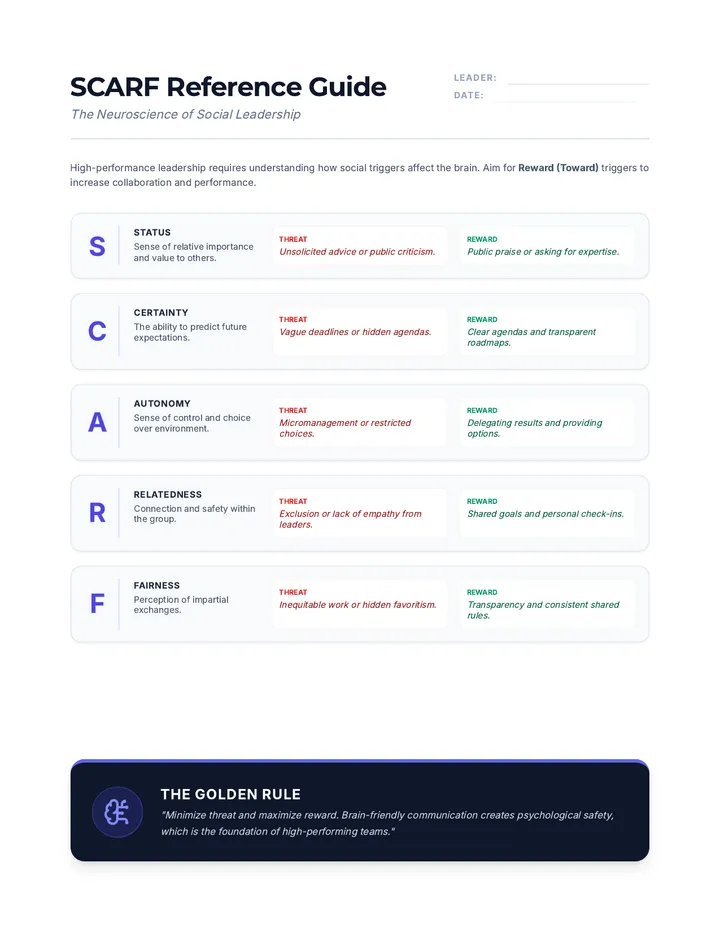
A high-impact leadership toolkit featuring a spacious SCARF model reference guide and a dedicated full-page action planner with large brainstorming areas for communication strategy.
A facilitation guide for the 60-minute Stand Your Ground session. Updated to incorporate the 12-card Mega Scenario Set and the Independence Field Guide. Revised timing to match a 10-minute icebreaker.
A mega-set of 12 role-play scenario cards covering police, medical, government, social, employment, housing, pharmacy, and peer situations. Revised with 6 new high-stakes scenarios for PSR groups.
An elaborated slide deck for the Stand Your Ground PSR group session. Features detailed breakdowns of the Traffic Stop, Medical, and System/Government scenarios with assertive scripts and explanations of why they work. Revised with improved contrast and clearer role-play instructions.
A self-reflection checklist for participants to identify personal rights and assess their ability to assert them in daily life. Final revision to ensure one-page fit and expanded reflection area.
Visual presentation slides for Lesson 4, distinguishing between adaptive excellence and maladaptive perfectionism while introducing the law of diminishing returns.
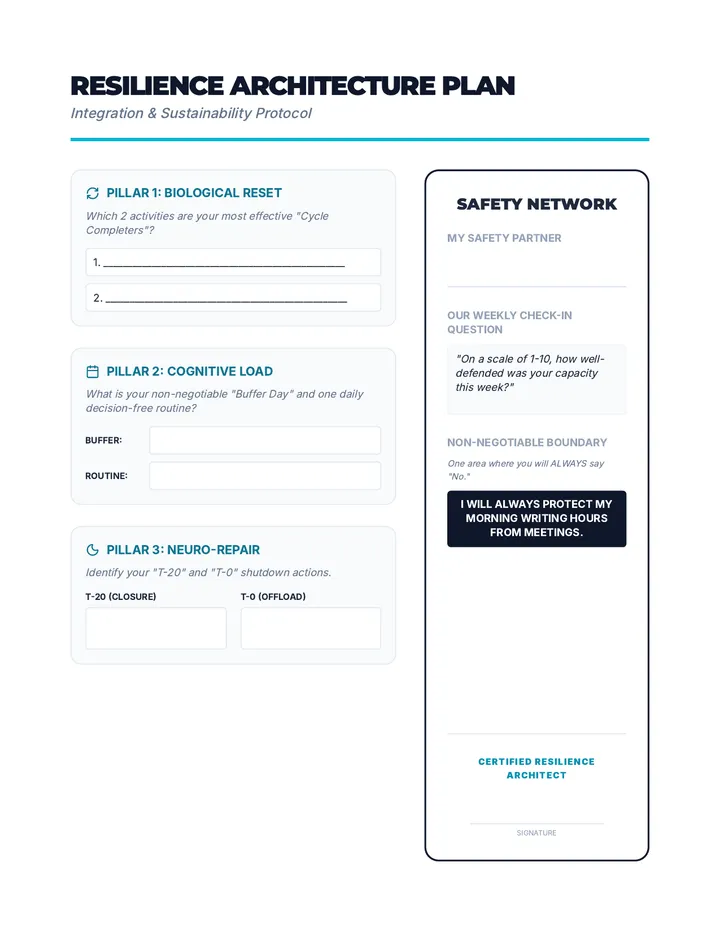
Final student synthesis materials for Lesson 5, including a comprehensive Resilience Architecture master plan and a portable, pocket-sized Crisis Card for immediate intervention.
Visual presentation slides for Lesson 3, teaching students how to detach self-worth from academic critique and parse feedback for objective data.
Visual presentation for Lesson 5, synthesizing the sequence and introducing the Resilience Architecture plan and Crisis Card.
Visual presentation slides for Lesson 2, illustrating the ABC model of CBT and common academic cognitive distortions.
A student budgeting activity for Lesson 4 that teaches students how to evaluate opportunities and practice declining them to protect their academic capacity.
The summative student material for the sequence—a Professional Resilience Manifesto template where students synthesize their learning into core commitments and a resilient professional narrative.
Visual presentation for Lesson 4, addressing the economics of energy, role overload, and the "Yes/No/Negotiate" framework in academia.
Teacher facilitation guide for the final lesson, focusing on cognitive rehearsal and the construction of a Professional Resilience Manifesto.
A student handout for Lesson 4 that includes a perfectionism audit, effort allocation grid, and the "80% Rule Challenge" planning guide.
A student blueprint for Lesson 3 to design a personalized shutdown ritual and optimize their sleep environment.
Teacher facilitation guide for Lesson 4, exploring the difference between excellence and perfectionism and introducing the concept of strategic satisficing.
Visual presentation for Lesson 3, focusing on the neurobiology of sleep and the concept of revenge bedtime procrastination.
Student activity sheet for Lesson 3, featuring the "Identity vs. Output" model, feedback parsing practice, and a non-defensive response rehearsal.
Facilitation guide for Lesson 3, focusing on detaching self-worth from academic work and processing professional critique effectively.
A student worksheet for Lesson 2 that helps graduate students audit 'phantom time' lost to anxiety and design a schedule with structural buffers.
A student worksheet for Lesson 2 featuring a distortion reference guide, scenario analysis exercises, and a personal ABC model audit.
Visual presentation for Lesson 2, reframing time management from a productivity lens to a cognitive load reduction lens.
Teacher facilitation guide for Lesson 2, covering CBT frameworks, the ABC model, and common cognitive distortions in an academic setting.
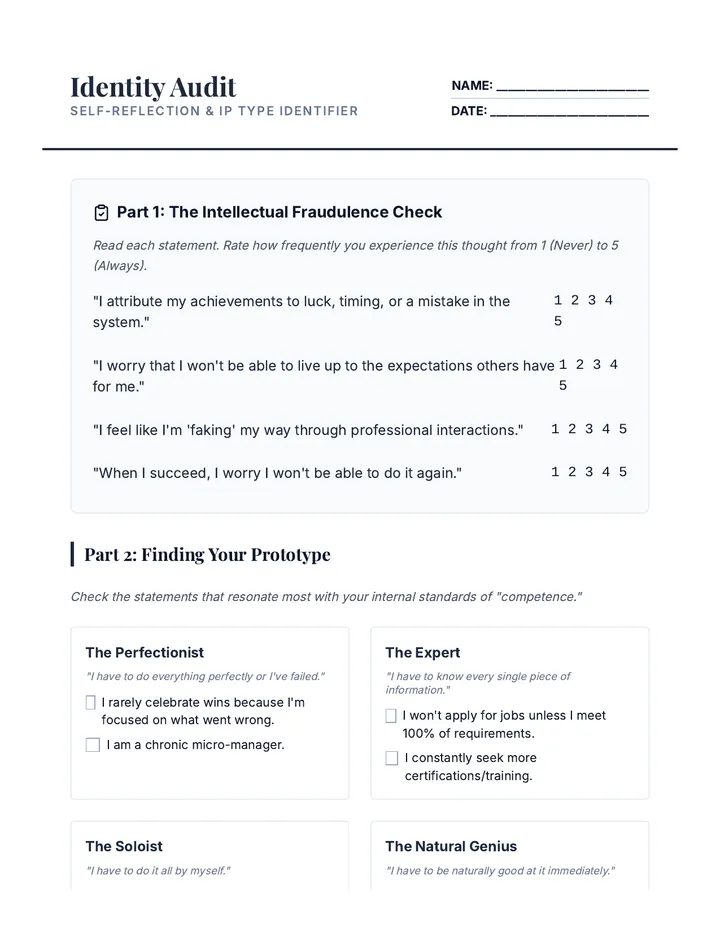
A student-facing self-reflection handout for Lesson 1, including an IP feelings audit, type identification, and evidence collection exercise.
The definitive quality control checklist for graduate fellowship submissions, covering technical compliance, visual auditing, and logistical contingency planning.
Final student project worksheet for building a multi-year funding strategy, including a 12-month calendar and a "leverage" plan for negotiations.
Facilitation guide for the Funding Roadmap Masterclass, focusing on long-term strategy and portfolio management.
Visual presentation for the final lesson on quality assurance, technical compliance, PDF sanitization, and professional post-submission etiquette.
Visual presentation for Lesson 5, focusing on long-term funding strategy, the multi-layered funding model, and the 12-month application cycle.
A digital audit worksheet for graduate students to track search results, checklist professional platform optimizations, and draft a high-impact scholarly bio.
Student activity sheet for drafting professional outreach emails and utilizing an outreach readiness checklist.
Visual presentation for Lesson 4 on managing digital footprints, optimizing LinkedIn for academics, and performing professional online audits before application submission.
Facilitation guide for the Unadvertised Outreach lesson, focusing on email etiquette and elevator pitch simulations.
Visual presentation for Lesson 4, covering professional communication strategies for contacting program officers and faculty mentors.
A CV workshop resource featuring a peer-audit activity, strategic section prioritization guide, and bullet-point "power-up" exercise for funding applications.
Student activity sheet for performing rhetorical and laureate analysis on a specific funding organization.
Visual presentation for workshopping academic CVs, focusing on tailoring for funding agencies, visual hierarchy, and the '30-second scan' criteria used by grant reviewers.
Facilitation guide for the Funder Forensics lesson, focusing on rhetorical analysis and laureate profiling strategies.
Visual presentation for Lesson 3, detailing rhetorical analysis of mission statements and reverse-engineering successful award winner profiles.
A professional resource for graduate students including a Recommender Packet checklist and two formal email templates for requesting and facilitating strong letters of recommendation.
Student activity sheet for the Niche Data Diving lesson, guiding students to log high-value funding opportunities found in specialized databases.
Visual presentation on recommender management, contrasting generic vs specific letters, outlining the Recommender Packet, and detailing a strategic application timeline.
Facilitation guide for the Niche Data Diving lesson, focusing on database technical prep and scavenger hunt facilitation.
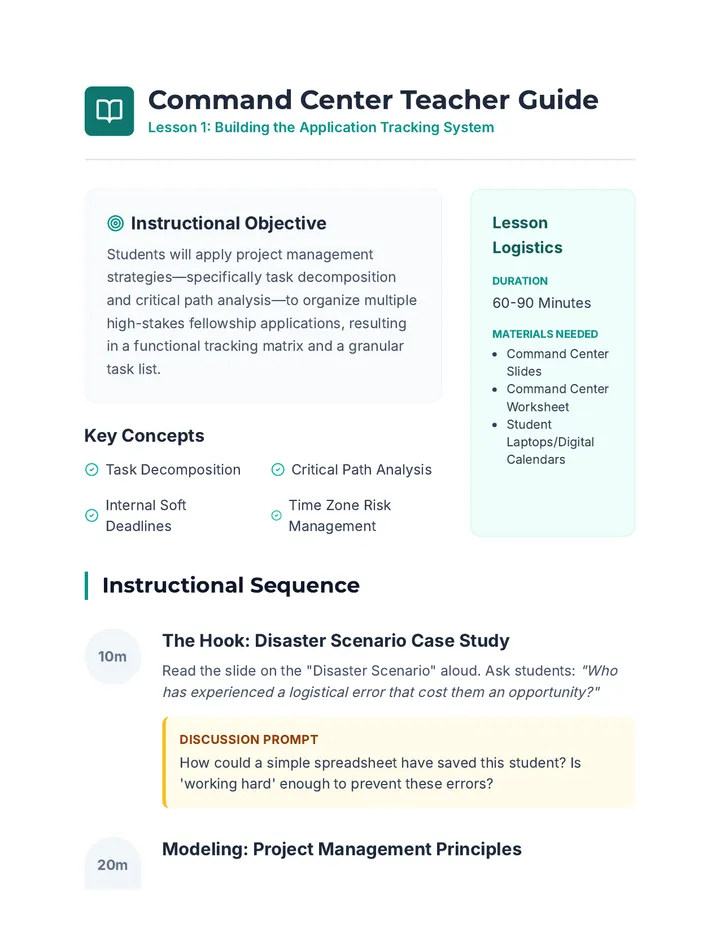
Teacher facilitation guide for Lesson 1, including instructional sequence, discussion prompts, and differentiation strategies for graduate students.
A comprehensive career development guide for junior AI PMs, featuring a complete 7-day learning sprint, common pitfalls, interactive exercise areas, and interview strategies. Optimized page flow, increased writing space, and improved legibility.
A hands-on worksheet where junior PMs can practice designing an AI feature for a real-world e-commerce scenario. Includes three evaluation scenarios and business logic reflection. Optimized for clarity and handwriting space.
A concise reference document for junior AI PMs containing key terminology, the product lifecycle, and critical strategic questions. Optimized for one-page reference.
A sleek, tech-focused presentation covering the transition from traditional PM to AI PM, technical stacks, and key metrics.
A print-ready reference guide for students providing specific strategies and assertive scripts for a traffic stop, medical appointment, and social pressure. Revised to ensure a one-page fit and included student work areas for personalized scripts.
A 'fun and different' icebreaker activity where participants bid on personal rights using 'Assertion Bucks' to spark conversation about priorities and values. Revised to include a second page of printable currency and bid tracking lines.
A comprehensive 2-page reference handout summarizing all key executive functioning mastery concepts. It includes the neurological foundations (Limbic vs. PFC), The Wall of Awful, the ABCDE method, Atomic Sequencing, Friction Engineering, and the Reset Protocol.
A presentation slide deck with high-impact, low-stimulation visual aids to structure instruction on workplace socialization and communication.
Offers structured, low-pressure workplace conversation starters, interview role-play situations, and task-oriented clarification practice cards.
An interactive four-page workbook containing anxiety regulation techniques, guided self-introduction scripts, structured conversation templates for clarifying tasks, and peer interaction blueprints.
A hands-on, two-page template designed to help learners identify their unique strengths, professional skills, ideal work environments, and career goals. Features a structured skills inventory and an environmental fit analyzer.
An elegant, deeply reflective open-ended reflection guide for counseling supervisees to evaluate clinical growth, supervisory relationship safety, and offer future program advocacy.
A 10-page facilitation guide featuring accessible scripts, simple time markers, and easy-to-follow instructions for guiding adults through the workshop.
An 8-page participant workbook featuring "Safe Zone" tracking, thought-trap exercises, practice guides, and a personal balance plan using clear, accessible language.
A 13-slide visual presentation for Session 5, focusing on staying calm during feedback, identifying thought traps, and managing everyday stress using simple, accessible language.
A practical application worksheet for mental health staff to practice converting vague clinical goals into SMART goals using a guided three-step process.
An intensive 4-page workbook designed for advanced executive functioning optimization, featuring a deep skills audit, a 10-step sequencing lab, friction engineering strategies, and long-term if-then planning modules. Each page is meticulously laid out for print legibility and student engagement.
A comprehensive and visually striking slide deck for an advanced 90-minute executive functioning workshop, featuring in-depth modules on task initiation, the ABCDE prioritization method, linear sequencing secrets, and environmental friction engineering.
A massive, in-depth 4-page instructor manual designed for professional facilitation of executive functioning skills. It includes specific teaching scripts, neurological background on the limbic system, detailed walkthroughs of all worksheet activities, and high-level troubleshooting strategies for common student hurdles.