Resume construction, cover letter drafting, and networking techniques for modern job markets. Equips learners to analyze job descriptions and tailor applications using achievement-based language.
A streamlined facilitator checklist featuring only the main title and the essential fidelity steps for a career development session.
A 7-slide presentation deck for the Resume Launchpad session. Designed for high visibility with minimum 24px font sizes, bold imagery, and structured learning points covering skill categories, the PAR formula, and industry niches.
A comprehensive 1-page Master Resume Checklist for students to use as a final review before submitting their applications. Covers basics, experience, technical skills, and formatting.
A Career Discovery Map document to help students explore different industries where their animation skills are applicable. Includes industry categorization and reflection prompts for personal interests.
A 2-page Skill Discovery Workbook for students. It includes sections for project extraction, technical skill listing, and a mind-map for categorizing technical and transferable skills.
A comprehensive 3-page facilitator guide for a 90-minute resume training session. Includes a detailed timeline, exact opening and closing scripts, activity instructions, and troubleshooting tips for a substitute instructor.
A one-page document featuring two identical copies of a comprehensive job application checklist, complete with cut lines for easy separation. The checklist covers everything from document preparation and role analysis to tailoring and final submission tracking.
A comprehensive orientation handout for medical interns featuring frequently asked questions, key program requirements, and contact information for supervisors.
A professional slide deck for medical internship orientation covering requirements, placement procedures, communication policies, and post-internship support.
A student worksheet for evaluating job offers, calculating total compensation, identifying contract red flags, and drafting negotiation scripts.
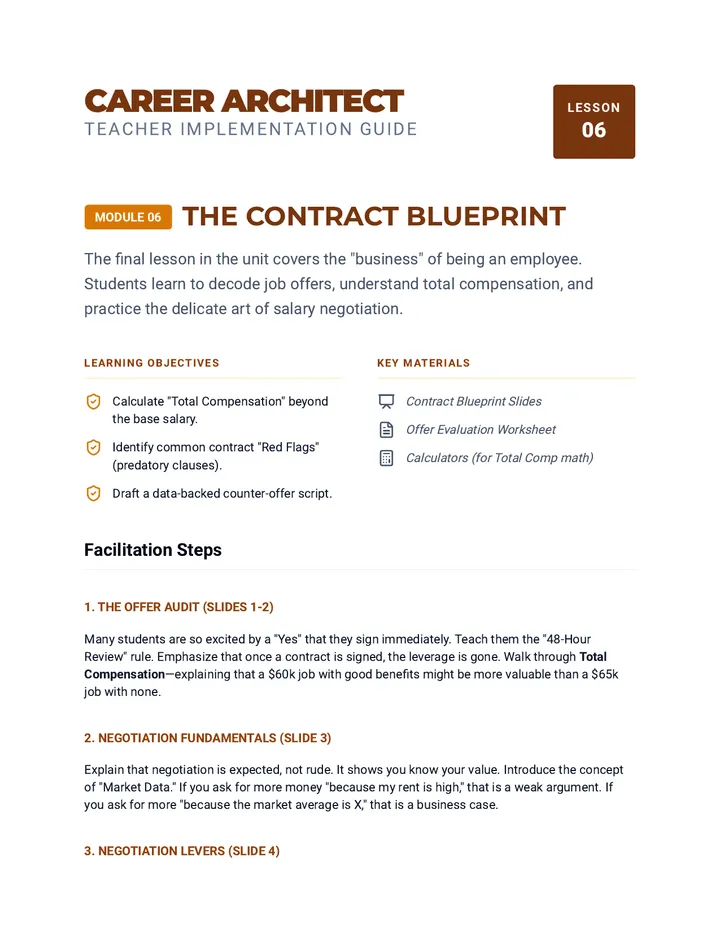
A comprehensive teacher guide for Lesson 6, providing instructional strategies for teaching offer evaluation, salary negotiation, and contract decoding.
A student worksheet for tracking post-interview follow-ups, drafting personalized thank-you notes, and conducting self-debriefs to improve performance.
A comprehensive teacher guide for Lesson 5, providing instructional strategies for teaching post-interview follow-up and feedback loops.
Visual presentation for Lesson 6, focusing on offer evaluation, salary negotiation strategies, and understanding contract terms.
Visual presentation for Lesson 5, focusing on post-interview thank-you notes, follow-up strategies, and handling rejection through a feedback loop.
A student worksheet for the "Tailoring Lab," where students deconstruct job descriptions and rewrite their resumes/cover letters to match company needs.
A comprehensive teacher guide for Lesson 3, providing instructional strategies for teaching resume tailoring and cover letter construction.
Visual presentation for Lesson 3, using a "drafting table" aesthetic to teach students how to tailor resumes and cover letters based on deep company research.
A student storyboard worksheet for drafting STAR method responses and tailoring interview pitches based on company research.
A comprehensive teacher guide for Lesson 4, providing instructional strategies for teaching the STAR method, handling stress-test questions, and facilitating mock interviews.
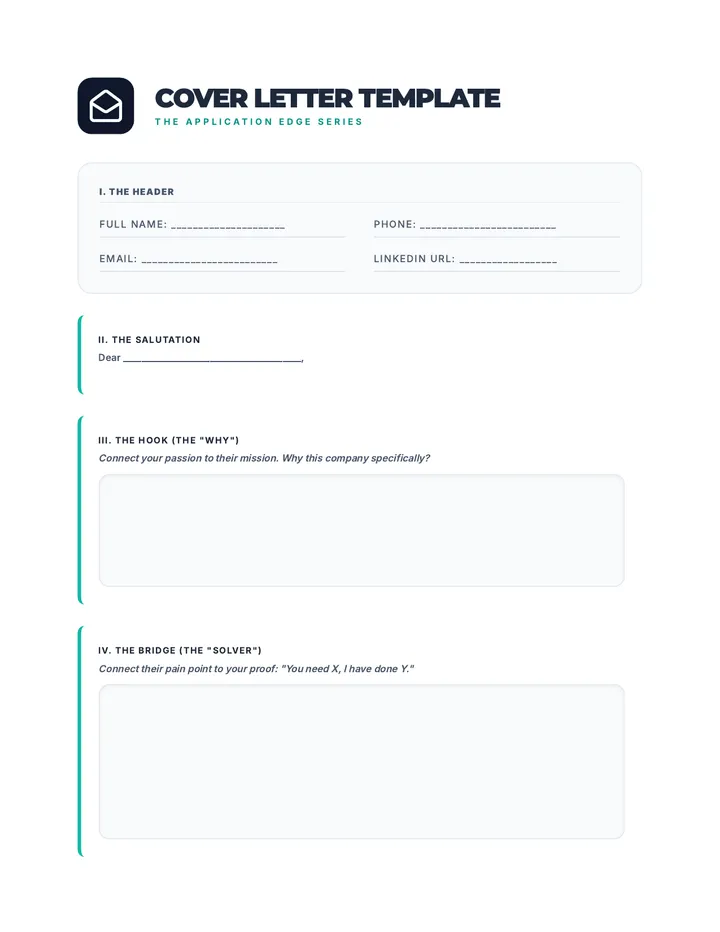
A structured two-page cover letter template for the Career Launchpad course, guiding students through the Hook, Bridge, and Closing sections with professional prompts and tips.
A revised two-page student worksheet designed as a fillable resume template, with improved writing space and layout to ensure it fits perfectly within the virtual viewport.
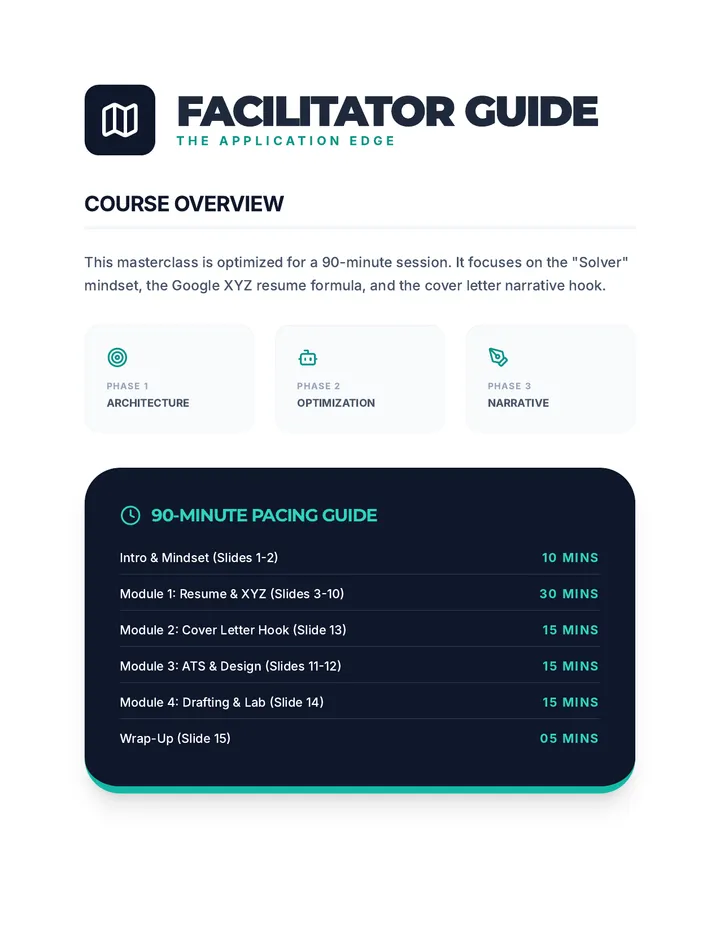
A revised 4-page facilitator guide for "The Application Edge" masterclass, updated for a 90-minute session with precise pacing, module deep dives, and scripted talking points.
A refined participant workbook for the Career Launchpad course, featuring 3 achievement drafting templates and improved writing space for student completion.
A polished 15-slide presentation for a 90-minute "Application Edge" masterclass, featuring bold typography, visual hierarchies, and structured content for resume and cover letter optimization.
A comprehensive two-page quick-reference sheet for Workforce interns. It includes staff contact information, essential attendance and payment protocols, a professional "playbook" of habits, and a goal-setting section for the first 100 hours of the internship. This version is optimized for print without image placeholders.
The complete orientation slide deck for the Workforce Internship program at Commonpoint Queens. These slides cover key staff contacts, mandatory document checklists, professional dress code requirements, hour targets, and communication protocols, optimized for a visual presentation without image placeholders.
A comprehensive teacher guide for Lesson 2, providing instructional strategies for teaching deep company research and strategic positioning.
A long-term strategic plan that uses interview performance patterns to guide skill acquisition and career growth. Includes sections for communication vs. knowledge gaps and a 6-month roadmap.
A visual presentation for graduate students on transforming interview performance data into a long-term professional development plan. Focuses on identifying "Skill Gaps" vs "Communication Gaps."
An iterative design template for rewriting interview stories. It provides space for a baseline (Version 1.0) and a re-engineered version (Version 2.0), focusing on cutting context, active action verbs, and power closings.
A visual presentation for graduate students on iterative design for interview stories. It focuses on re-engineering weak narrative arcs by cutting context, injecting personal agency, and creating power closings.
A gap analysis tool for students to compare their intended message with a peer's perception. It identifies 'message takeaways' versus 'intent' to calculate communication distortion and prioritize refinements.
A visual presentation exploring communication theory in interviews. It focuses on 'Signal vs. Noise,' identifying where messaging distortion occurs between the candidate's intent and the interviewer's perception.
A reference guide for students to calibrate their scoring during the performance audit. It provides specific examples of low vs. high performance in clarity, conciseness, and alignment.
A quantitative scoring worksheet for interview performance evaluation. Students use a 1-4 scale across clarity, conciseness, and alignment to audit their responses and identify specific areas for improvement.
A visual presentation introducing a quantitative scoring model for interview performance. It focuses on clarity, conciseness, and alignment, moving students from subjective feelings to objective metrics.
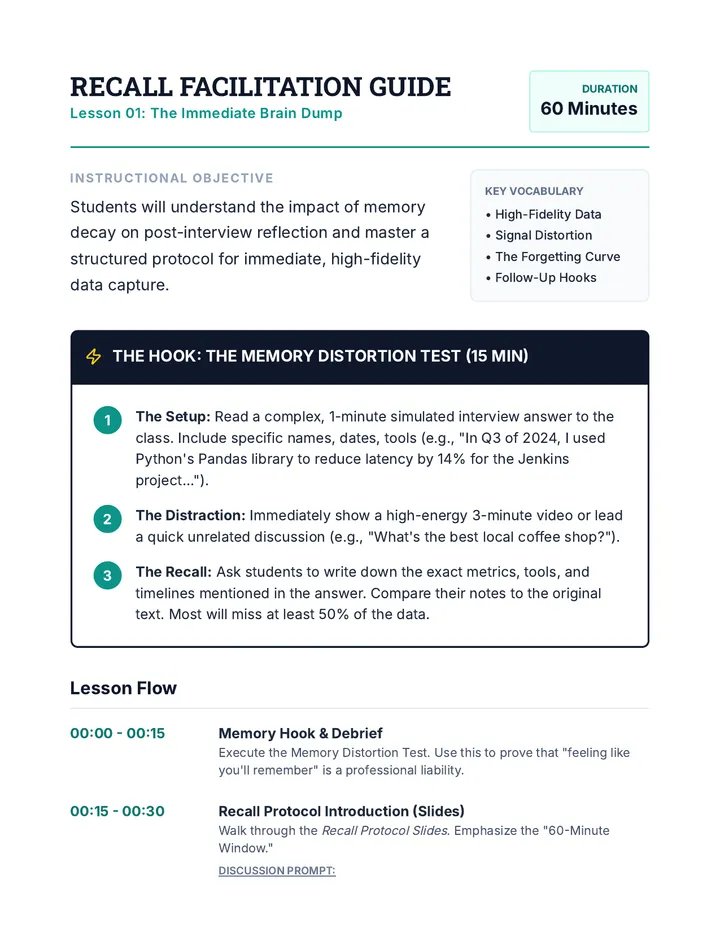
A facilitation guide for the Immediate Brain Dump lesson, including instructions for a memory-decay hook activity, discussion prompts, and a timed lesson flow.
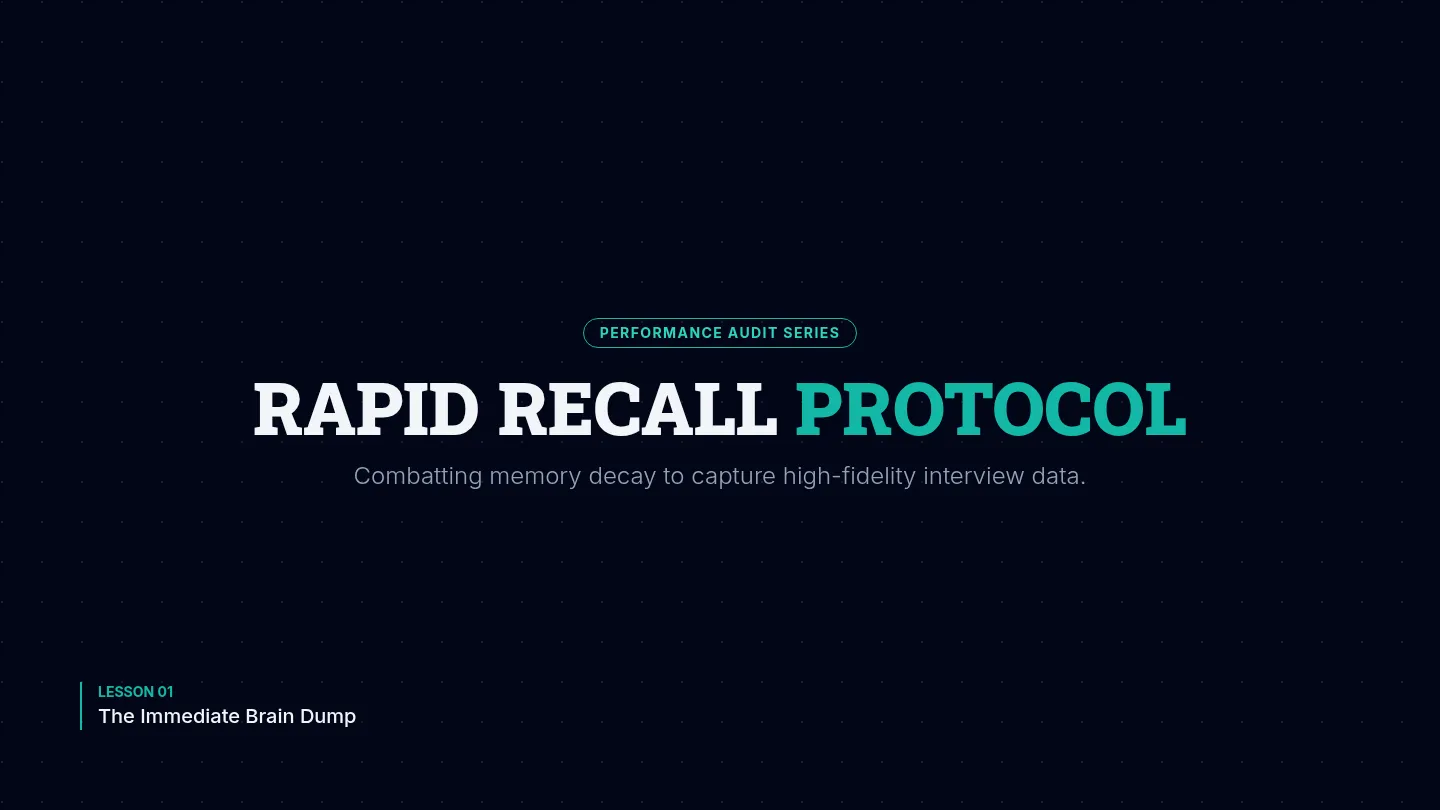
A visual presentation for graduate students introducing the Rapid Recall Protocol, focusing on memory decay and the importance of immediate, data-driven post-interview documentation.
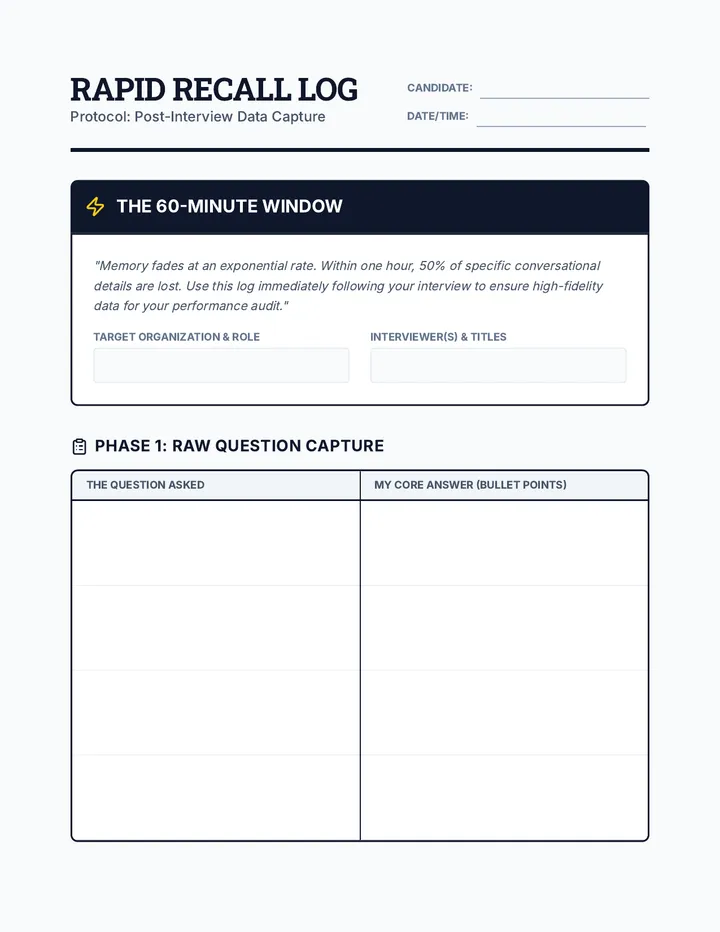
A structured documentation tool designed for graduate students to record interview questions, answers, and non-verbal cues immediately following an interview. Includes sections for raw question capture, body language observation, and follow-up hooks.
A comprehensive final checklist for students to use as a quality control tool before submitting their cover letters, covering design, rhetoric, and polish.
Student activity sheet for Lesson 5, providing a structured way to gather peer feedback during the "Speed Dating" workshop.
An activity worksheet for Lesson 5 where students rank various closing statements by effectiveness and draft their own final professional sign-off.
An activity sheet guiding students through a 5-minute cover letter customization sprint using their modular content blocks.
Visual presentation for Lesson 5, guiding students through the final portfolio requirements and the peer review speed dating activity.
Slide deck for Lesson 5 focusing on concluding paragraphs, call-to-action strategies, professional sign-offs, and avoiding the "wait-and-see" passive trap.
A modular content block template for students to organize their achievements into reusable snippets for efficient cover letter customization.
Worksheet for Lesson 4 to help graduate students map out hybrid job roles and practice bridging academic expertise with practical application.
Visual presentation for Lesson 4, focusing on the STAR method, interviewer research, body language, and high-pressure situational responses.
A student worksheet designed as a "classified dossier" for conducting deep research on target companies, bridging the gap between discovery and interview preparation.
Visual presentation for Lesson 2, using a "classified dossier" aesthetic to teach students how to conduct deep research on company culture, strategy, and financials.
Student activity worksheet for mapping professional connections and drafting outreach messages for informational interviews.
A comprehensive guide for teachers, including unit overview, pacing, and detailed implementation notes for the first lesson on professional networking.
Visual presentation for Lesson 1, using a "blueprint" aesthetic to explain the hidden job market, networking circles, and informational interviewing strategies. Includes a sample outreach script and an action-oriented closing slide.
A teacher-facing answer key providing exemplar responses for the three scenarios in the Scenario Showdown Worksheet, including professional email drafts and assessment criteria.
A comprehensive final student document for assembling the Reference Portfolio, including a master reference list, interaction tracker, and peer professionalism review.
An instructional slide deck for the 'Reference Call Simulation' lesson, providing the framework and protocol for mock professional reference calls.
A final instructional slide deck for the 'Dossier Assembly Finale' lesson, guiding students through the final assembly of their Reference Portfolio and the peer review process.
A peer review worksheet designed for students to evaluate the visual branding and strategic content of a classmate's professional reference list.
A student worksheet for the 'Digital Advocacy Mastery' lesson, used to plan and draft personalized LinkedIn recommendation requests with specific skill targets.
A visual presentation for undergraduate students to finalize their professional reference list through peer review and practice articulating their reference choices.
A student simulation guide and rubric for the 'Reference Call Simulation' lesson, providing structure and scoring criteria for mock professional reference calls.
A workspace for students to draft follow-up emails and graceful responses for non-responsive or declining reference contacts.
Case study worksheet for Lesson 5, presenting ethical and security scenarios related to handling reference contact information.
A visual presentation for undergraduate students to develop strategies for following up with non-responsive contacts and gracefully handling rejections.
Visual presentation for Lesson 5, focusing on information security and ethical submission of reference data.
An instructional slide deck for the 'Digital Advocacy Mastery' lesson, teaching students how to distinguish between digital endorsements and formal references while mastering LinkedIn recommendation requests.
A scenario-based quiz for graduate students to test their understanding of the legal boundaries, liability risks, and corporate policies surrounding professional references.
A structural template for students to organize and draft their professional reference list content.
Teacher guide for Lesson 5, focusing on the instructional flow, key discussion prompts, and information security protocols for reference data.
Drafting templates for graduate students to follow up with their references after a job search outcome, including 'hired' and 'not hired' scenarios.
Teacher guide for Lesson 5 focusing on the legal boundaries, liability concerns, and corporate HR policies of reference checks and instructional strategies for building a 'Plan B' folder.
A student-facing template for creating a Reference Briefing Sheet, used to prepare professional references for recruiter calls with specific context and evidence.
A high-energy, high-impact presentation deck for a 75-minute Spotlight Ready interview workshop. Features the mindset shift, pitch structure, STAR story bank, and a mock question forge. Expanded to fill the 75-minute duration with instructional depth.
A high-density 75-minute student workbook for the Spotlight Ready workshop, designed for immediate drafting, STAR story structuring, and peer-to-peer feedback. Includes a Question Forge for custom mock interview engineering. Designed with high-contrast text and clear writing areas.
A high-impact 75-minute facilitator guide for the Spotlight Ready workshop, featuring exact scripts, a question forge appendix, and pacing adjustments for a condensed intensive. Designed with clear page breaks and standalone phase structures.