Resume construction, cover letter drafting, and networking techniques for modern job markets. Equips learners to analyze job descriptions and tailor applications using achievement-based language.
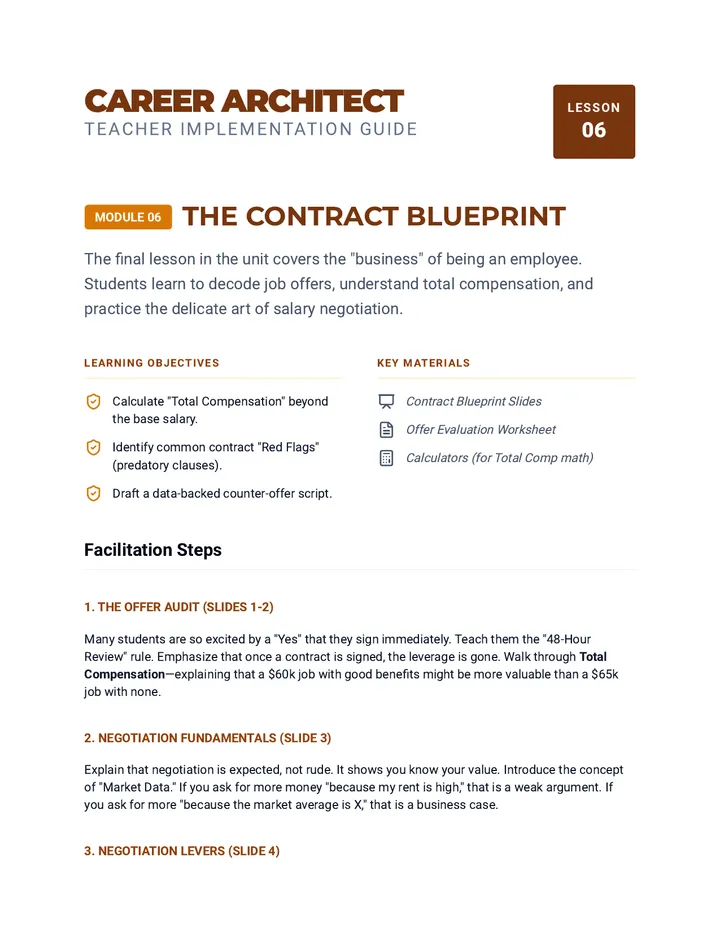
Teaches students how to evaluate job offers, negotiate salary and benefits, and prepare for the professional transition into a new role. Focuses on the "business" side of starting a career.
Focuses on the critical period after the interview. Students learn to craft high-impact thank-you notes, manage follow-up timelines, and leverage post-interview feedback to refine their approach.
Focuses on translating research into action. Students learn to tailor their resumes and cover letters using the data gathered during their 'Company Recon' to stand out from generic applicants.
Prepares students for various interview formats and difficult scenarios. Focuses on the STAR method for behavioral questions, researching the interviewers themselves, and practicing high-pressure situational responses.
Teaches students how to move beyond surface-level job descriptions. Focuses on researching company culture, financial health, and industry positioning to tailor applications and demonstrate genuine interest and fit.
Focuses on the 'hidden job market' and the power of professional networking. Students learn how to identify potential connections, conduct informational interviews, and leverage their existing circle to find opportunities before they are posted publicly.
A comprehensive lesson on mastering the art of professional correspondence, specifically focusing on the nuance of rejection letters and the strategy of post-interview thank you letters. Students learn to maintain professionalism, build bridges, and leave a lasting positive impression.
This lesson covers the professional etiquette and structural requirements for writing effective rejection and thank-you letters. Students will learn to balance empathy with professionalism in rejections and use thank-you notes as a strategic tool for networking and career growth.
A comprehensive 120-minute training session covering self-assessment, resume building, job search strategies, and interview techniques for job seekers.
A high-stakes role-playing simulation where students navigate difficult interview questions and scenarios using the STAR method.
Students learn and practice networking through role-playing varied professional social environments, focusing on the elevator pitch and strategic connection-building.
The final lesson encourages students to use the rejection data to analyze their market fit. They review their follow-up interactions to determine if they need to pivot their target industry or role.
Students develop strategies for connecting with interviewers on LinkedIn and other professional platforms post-process. They learn appropriate intervals and content for maintaining these weak ties.
This lesson focuses on writing the 'graceful concession' email. Students practice crafting responses to rejection that leave the door open for future roles or freelance opportunities.
Students learn how to ask for feedback after a rejection in a way that actually yields results. They analyze the legal constraints HR faces and learn how to phrase questions to bypass generic responses.
Students explore the cognitive aspects of professional rejection and learn techniques to reframe 'no' as 'not yet.' The lesson focuses on maintaining professional composure in the face of disappointment.
Students develop a long-term relationship management system, including the 'Circle Back' technique and a personal CRM to convert initial contacts into enduring professional alliances.
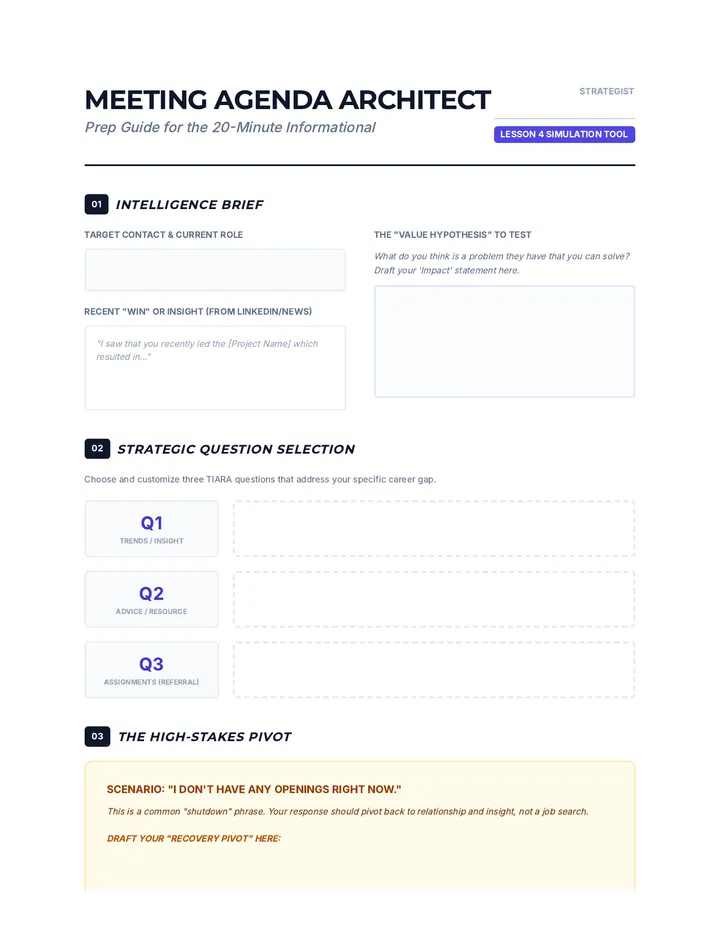
Students prepare for and simulate high-impact informational interviews, learning to design agendas that extract strategic insights while demonstrating professional maturity.
Students deconstruct the psychology of cold outreach to maximize response rates, drafting a suite of modular templates for alumni, cold inquiries, and referral requests.
Students leverage digital tools to identify the hidden job market, mapping out key decision-makers and advocates within target organizations to create a prioritized 'Target 20' list.
A comprehensive 90-minute training session designed for college students in creative fields (specifically animation) to identify their skills, explore career paths, and build a professional resume.
A comprehensive orientation for medical interns covering placement procedures, professional standards, and post-internship career support.
A comprehensive 65-minute training lesson designed to teach job seekers how to proactively follow up on applications to stand out from other candidates. This lesson covers timing, communication methods (phone, email, in-person), and includes role-playing activities to build confidence.
The sequence culminates in a long-term strategic plan that uses interview performance patterns to guide skill acquisition and career growth.
A workshop-style lesson where students use audit data to re-engineer their STAR stories, turning their weakest answers into their strongest narratives.
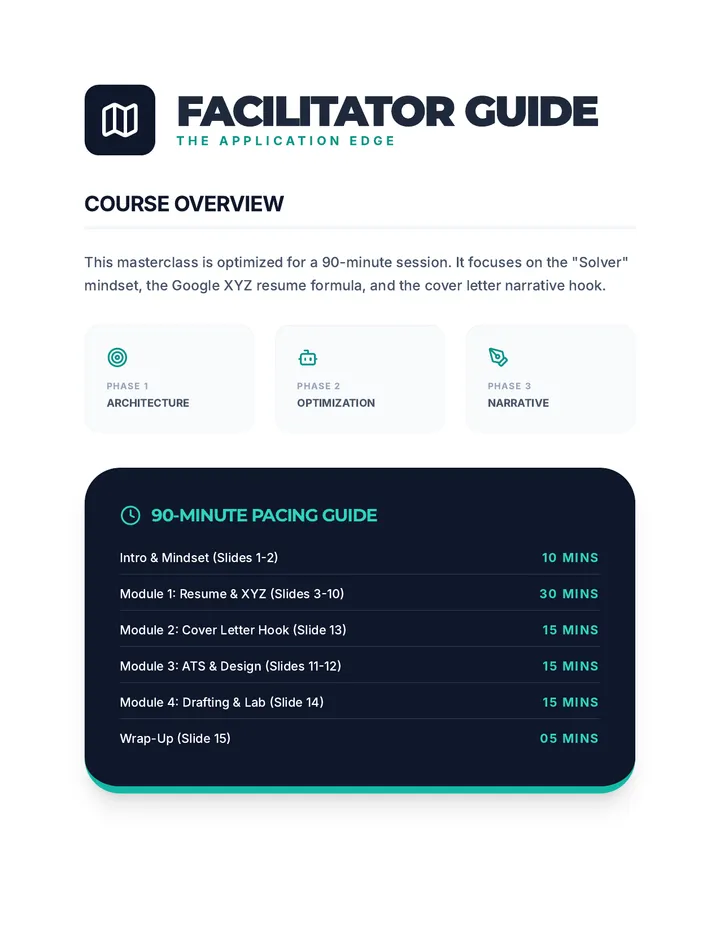
A masterclass in crafting professional application materials, including resumes that beat tracking systems and cover letters that tell a compelling story.
A comprehensive orientation for the Workforce Internship program, covering policies, expectations, and success strategies for new interns at Commonpoint Queens.
A focused lesson on crafting professional resumes specifically for construction students, covering the nuances of applying for both internships and entry-level full-time positions.
A lesson focused on teaching students how to use powerful, industry-standard adjectives to enhance their resumes and professional profiles. Students will learn to replace generic descriptors with high-impact vocabulary that demonstrates their skills and character.
Students build a reusable matrix that maps their top achievements to common market requirements for future cover letters and interviews.
Learn strategies to leverage internships, assistantships, and volunteer work to satisfy years-of-experience requirements ethically and strategically.
Focuses on mining job descriptions for soft skill requirements and mapping them to graduate research experiences with evidence-based writing.
Students perform a rigorous gap analysis using aspirational job postings to identify missing technical or certification requirements and create a development plan.
Students analyze job postings to identify industry equivalents for academic activities and create a bilingual glossary relevant to their field.
Balance keyword density with professional flow, ensuring the narrative remains compelling for the human recruiters who follow the initial digital screening.
Use comparison tools to measure and iterate on resume match rates, practicing the 'Beat the Bot' challenge.
Distinguish between system weighting of hard technical skills and soft adaptive skills, learning strategic placement for maximum visibility.
Students assemble their final Reference Dossier, including lists, briefing sheets, and a tracking system, receiving peer feedback on professionalism.
Working in pairs, students simulate the reference call using their Briefing Sheets to test the effectiveness of their preparatory materials.
Students audit LinkedIn profiles and draft requests for digital recommendations, distinguishing between informal endorsements and formal background checks.
Students design a one-page 'Briefing Sheet' including their resume, job description, and key talking points to ensure references are prepared for recruiter calls.
Students gather past evaluations, graded projects, and performance metrics to support their reference requests, learning to organize evidence to help references recall specific achievements.
Students finalize their reference lists through peer review and practice explaining their advocates in mock interview scenarios.
Students develop strategies for following up with non-responsive contacts and gracefully handling rejections.
A technical workshop on creating a standardized reference sheet that aligns with a student's resume.
Students learn to draft professional emails to request reference permission, focusing on tone and providing an 'out'.
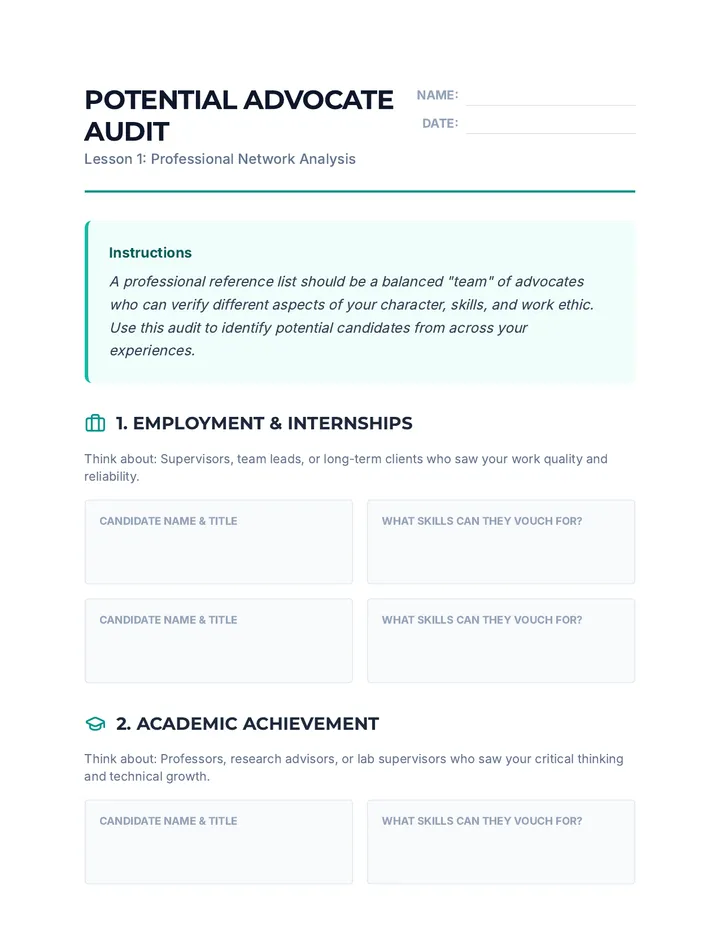
Students conduct an audit of their academic and work history to identify and categorize potential professional advocates.
A culminating simulation where students act as a hiring committee comparing candidates based on reference feedback notes to cement the value of strong advocacy.
Explores how employers use references to verify cultural fit and soft skills, helping students map their references to specific intangible qualities.
Students examine case studies of reference checks that led to rescinded job offers, identifying common red flags and discrepancies that lead to disqualification.
Focuses on the psychology of the reference check, where tone and hesitation often speak louder than words, teaching students how to detect and avoid lukewarm endorsements.
Students analyze standard scripts and questions used by professional recruiters to identify the difference between verification questions and competency questions, helping them prep their references for specific lines of inquiry.
An overview of the legal boundaries surrounding reference checks and the liability concerns that drive corporate HR policies.
Solving the problem of companies that have closed or supervisors who are unreachable, retired, or deceased using alternative documentation.
Exploring the reality and ethics of 'backdoor' references, where recruiters contact mutual acquaintances not listed on a reference sheet.
Addressing how to handle references after termination or difficult resignations, focusing on honest narrative framing and alternative verification.
A high-impact 75-minute workshop designed to prepare candidates for interviews through research, personal branding (The Master Pitch), and behavioral storytelling (STAR Method). This condensed version focuses on active, hands-on practice and immediate application.
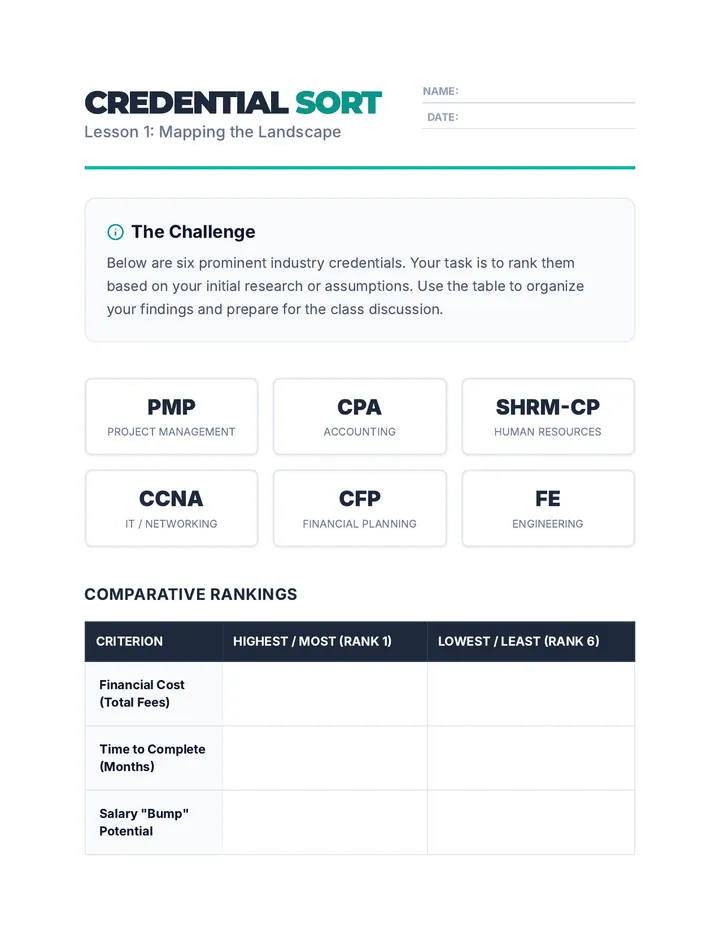
In this culminating lesson, students create a personalized rubric to evaluate future learning opportunities based on cost, duration, relevance, and income potential. They apply this matrix to a specific credential they are considering pursuing post-graduation.
Students analyze job postings and conduct informational interview simulations to determine how employers view specific certifications versus experience. They practice articulating the value of a certification during a mock interview context.
This lesson explores the concept of 'stackable' credentials where smaller units of learning build toward a larger degree or qualification. Students design a theoretical pathway where short-term certifications lead to long-term academic goals.
Students learn to audit the quality of certification programs by investigating accrediting bodies and industry recognition. The lesson focuses on avoiding diploma mills and low-value certificates through rigorous vetting criteria.
Students explore the hierarchy of post-secondary credentials, distinguishing between certificates, certifications, licensures, and micro-degrees. They map these categories to their potential career paths to identify relevant qualifications.
Students develop a strategy for documenting and showcasing micro-credentials and project outcomes through digital portfolios.
Using backward design, students plot major educational milestones on a 10-year timeline to ensure logical career progression.
Students structure a system for informal continuous education, including journals, podcasts, and professional networks to supplement formal degrees.
Learners research emerging technologies and methodologies to predict future skill demands, ensuring educational investments remain relevant.
Students assess current competencies against 'reach' roles using frameworks to identify specific technical and soft skill deficits for educational intervention.
Finalizes two distinct cover letters for different sectors through peer review and portfolio development.
Students conduct a gap analysis between their intended message and how it was perceived by others, identifying 'signal distortion' in their professional communication.
Introduces a standardized rubric for objective self-evaluation. Students analyze clarity, conciseness, and alignment with organizational values.
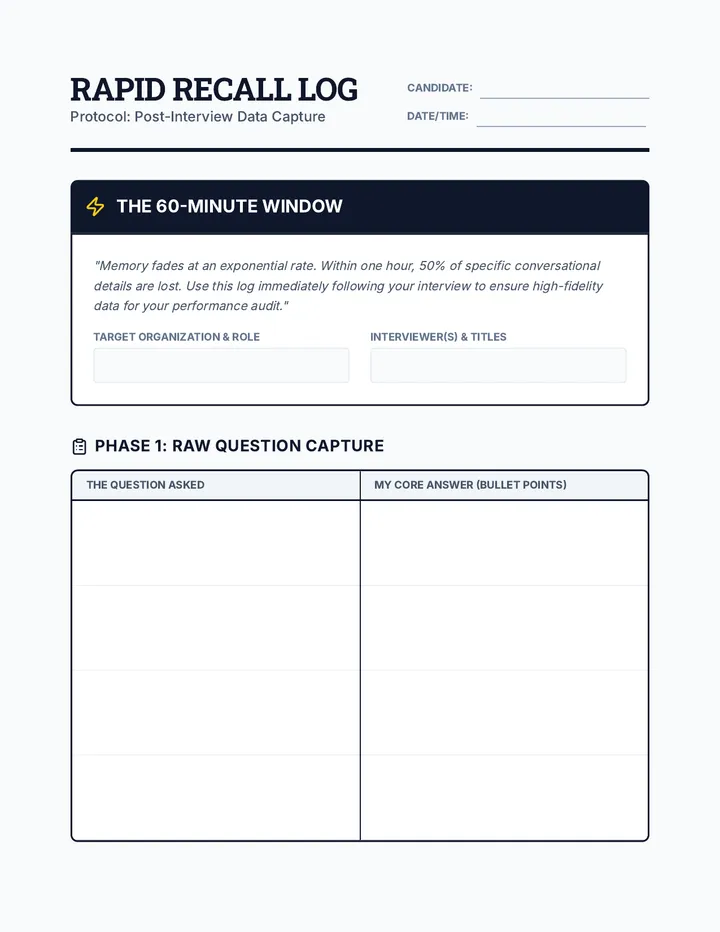
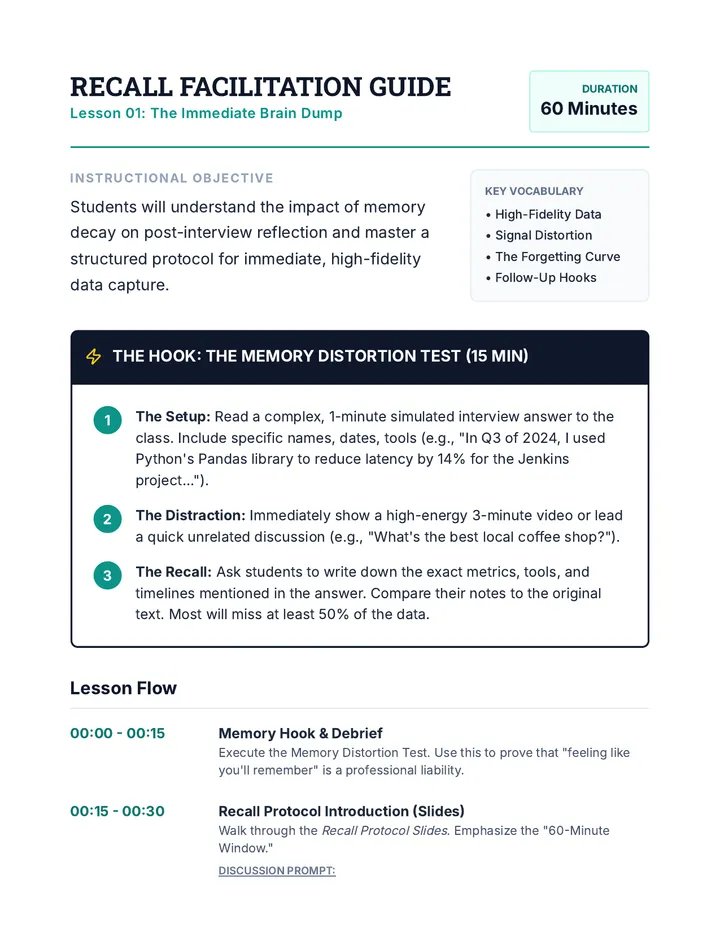
Focuses on the critical 60 minutes post-interview. Students learn a 'Rapid Recall Protocol' to capture data-driven insights before memory decay sets in.
Students synthesize their skills, pivot narratives, and quantified achievements into a final, professional cover letter, followed by a peer review focused on jargon elimination.
Students learn to identify and calculate metrics and outcomes for their academic work, attaching tangible business value to their research and teaching achievements.
Students master the STAR (Situation, Task, Action, Result) method to transform dry academic claims into compelling mini-narratives that demonstrate professional competency.
Students learn strategic framing to explain their transition from academia to industry, framing it as a logical professional evolution rather than a restart.
Explores the middle ground of non-profits and think tanks, where academic depth meets practical application.
Students present their final cover letter along with the strategy behind their rhetorical choices. They defend their tailoring approach and receive final feedback in a pitch format.
Introduces the 'Bottom Line Up Front' (BLUF) style for industry applications, emphasizing results and brevity.
The final technical stage where students learn professional proofreading strategies. This includes non-linear reading techniques to catch errors that automated tools often miss.
Focuses on the specific conventions of academic applications, including narrating research, teaching, and service.
Students compare side-by-side examples of successful academic and industry letters to identify differences in structure, tone, and length.
A deep dive into sentence-level refinement, focusing on dynamic action verbs and professional tone. Students identify and replace weak vocabulary with high-impact language.
Focuses on the structural integrity and logical progression of the cover letter. Students use reverse outlining and paragraph reassembly to ensure their narrative flows effectively.
Students adopt the persona of a hiring manager to understand the speed and criteria of professional application reviews. They develop a critical eye and a rubric for evaluating their own and others' cover letters.
Focuses on the concluding paragraph, covering how to reiterate interest, request an interview professionally, and sign off with appropriate business etiquette.
Developing a system for managing modular content blocks for rapid application customization.
Researching a target company's mission and values to customize tone and express genuine alignment.
Teaches the claim-evidence-impact model for body paragraphs, focusing on substantiating claims with specific achievements rather than summarizing the resume.
Students create a mapping matrix to align their experiences directly with the employer's stated needs.
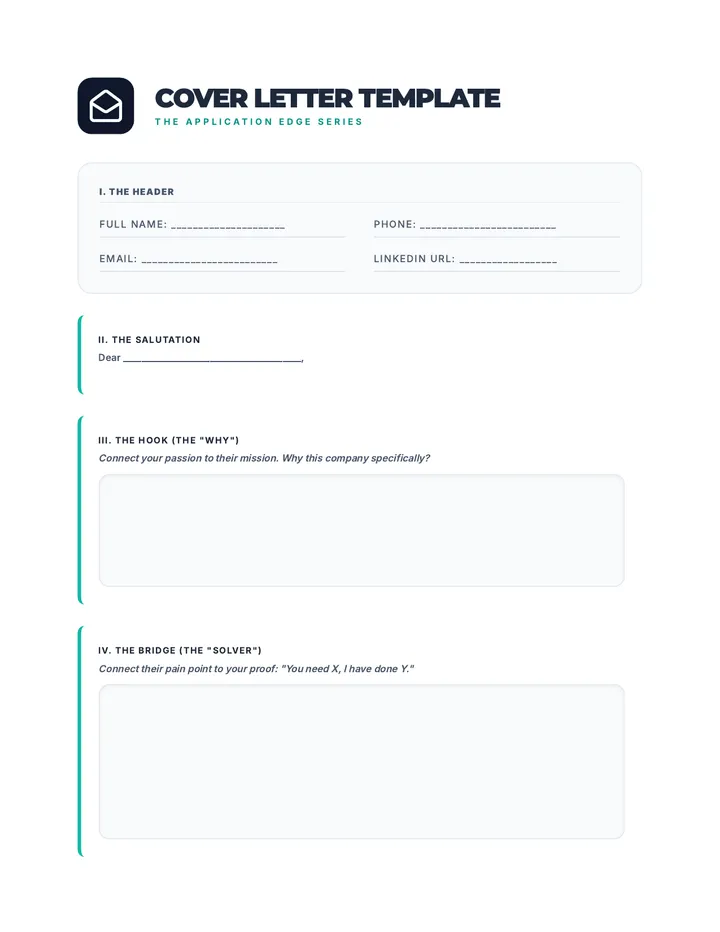
Focuses on writing opening paragraphs that go beyond generic introductions, experimenting with value propositions, shared missions, and personal connections to engage readers.