Empathetic skill development through emotion recognition, cultural diversity appreciation, and bias confrontation. Targets multi-perspective analysis to support respectful interactions and complex social responses.
The sequence culminates with students mapping local community resources that support the PLEASE skills for low-income or marginalized clients.
Students learn to adapt movement recommendations for mood regulation for clients with physical disabilities or chronic pain, focusing on 'building mastery'.
This lesson addresses sleep hygiene for clients in crowded or noisy environments, focusing on environmental adaptation and behavioral modifications.
Students modify nutritional advice for clients with limited budgets or access, developing realistic harm-reduction strategies for 'Eating Balanced'.
Students critique standard PLEASE skills through a socioeconomic lens, identifying how food deserts, shift work, and environment impact emotional regulation.
Students step out of role to analyze the simulation outcomes, discussing where systemic bias entered the process. The lesson culminates in a proposal for improving the equity of the admissions review workflow.
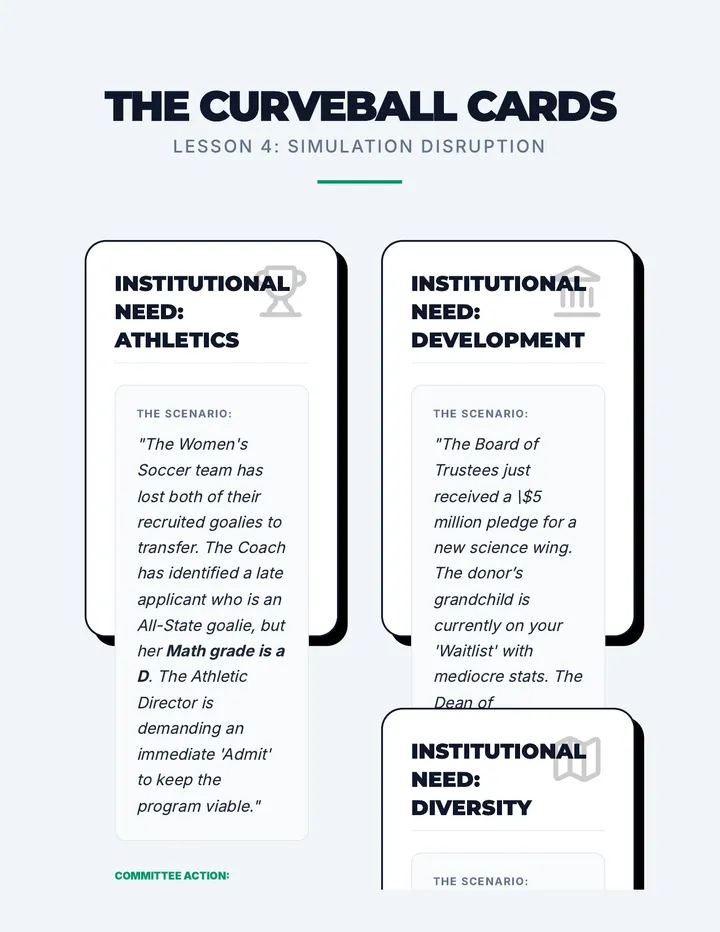
The simulation introduces real-world constraints such as legacy preferences, athletic recruitment needs, and yield protection strategies. Students must adjust their cohort selections to meet these external institutional demands.
Functioning as regional admissions officers, students present their assigned applicants to a small group, advocating for acceptance or rejection based on evidence. The focus is on articulating a clear argument grounded in the application materials.
Participants review redacted application files, practicing the skill of 'reading between the lines' of transcripts and standardized test reports. They learn to identify rigorous course sequencing and contextualize GPA within school profiles.
Covers the longitudinal analysis of thought records to identify recurring core beliefs and the ethical implications of cognitive restructuring.
An intensive role-play session focused on real-time facilitation skills. Students practice pacing and interpersonal effectiveness in a simulated clinical setting.
Explores strategies for handling emotional reasoning and therapeutic resistance. Students learn to validate feelings while gently challenging cognitive distortions.
Teaches the specific verbal techniques of guided discovery through Socratic questioning. Students practice helping clients find their own evidence without being directive.
Focuses on the art of introducing CBT concepts and Thought Records to clients. Students develop a professional 'elevator pitch' and learn to manage initial skepticism.
Full-scale simulation of a multi-party dispute involving legal and interpersonal elements. Students draft a Memorandum of Understanding (MOU) that is stress-tested for durability and clarity.
Identification of power imbalances and calculation of the Best Alternative to a Negotiated Agreement (BATNA). Students analyze the Zone of Possible Agreement (ZOPA) in complex organizational scenarios.
Practice in reframing toxic language into neutral, problem-solving statements and utilizing circular questioning to uncover systemic issues. Focuses on the linguistic tools required for effective mediation facilitation.
Exploration of the 'amygdala hijack' and its impact on rational decision-making during disputes. Students practice de-escalation techniques and neutrality maintenance while managing their own physiological responses to high-arousal emotions.
Students analyze the theoretical distinction between surface-level demands (positions) and underlying needs (interests) using the 'Iceberg Model' of conflict. They will diagnose root causes in complex disputes and apply the Harvard Negotiation Project framework.
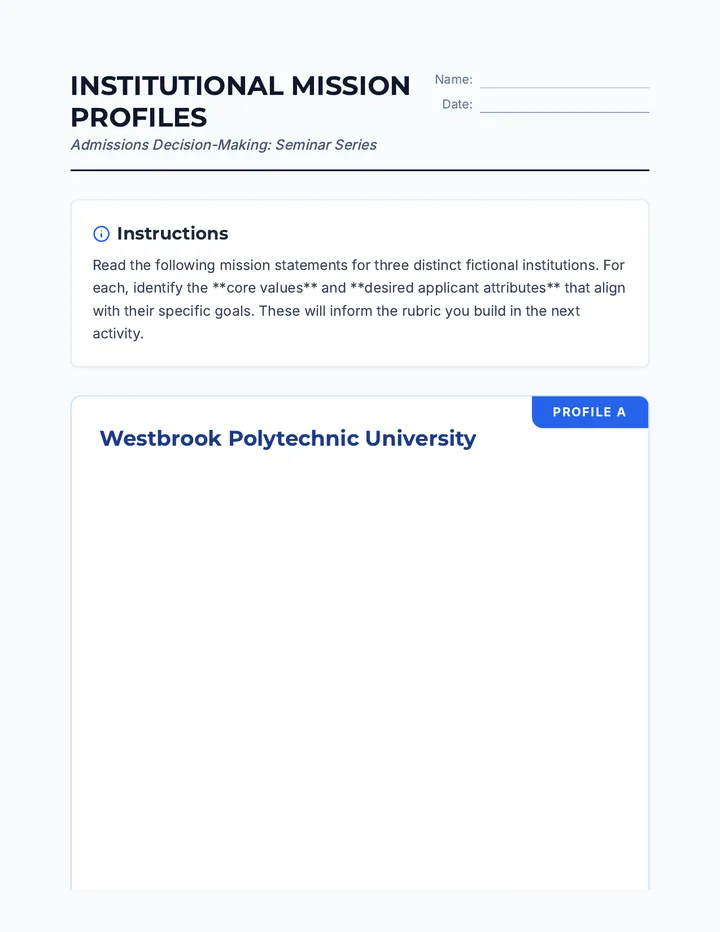
Students analyze mission statements from diverse institution types to create weighted admissions rubrics, determining the value of quantitative metrics versus qualitative attributes.
Design a macro-level intervention to address a structural barrier to healthy identity development.
Learn to apply the Structural Competency framework and conduct structural vulnerability assessments in clinical practice.
Explore the psychological impact of systemic oppression and how to validate structural trauma without pathologizing the individual.
Analyze how digital algorithms and social media environments shape and limit modern identity exploration.
Deconstruct identity as a social construction influenced by historical and legal systems.
The capstone lesson where students synthesize their knowledge to design a community action plan or advocacy initiative to address local gaps in survivor services.
Focuses on the long-term mental health impacts of trafficking, specifically Complex PTSD, the neurological effects of coercion, and the necessity of long-term therapeutic support.
Students critique the exploitation of survivor stories in media and fundraising, focusing on ethical guidelines for survivor-led advocacy and the 'nothing about us without us' movement.
This lesson addresses the criminalization of survivors and the importance of vacatur laws, exploring how trafficking-related criminal records create lifelong barriers to housing and employment.
Students define the core principles of trauma-informed care (safety, trustworthiness, choice, collaboration, and empowerment) and analyze institutional procedures to identify practices that might re-traumatize survivors.
Develops clinical judgment for managing resistance, impasses, and the potential for thought records to become ruminative or safety behaviors.
Teaches the downward arrow technique to connect surface-level automatic thoughts to deeper intermediate assumptions and maladaptive core schemas.
Critically evaluates the use of cognitive restructuring in the context of systemic oppression and cultural diversity, distinguishing between distortions and valid perceptions.
Focuses on meta-cognitive analysis of serial thought records to identify systemic patterns and 'signature' distortions in client thinking.
Explores the phenomenon of 'rational-emotional dissonance' and introduces experiential techniques to bridge the gap between cognitive understanding and emotional shift.
Synthesize learning by creating a culturally adapted FAST skills handout for a specific marginalized or non-Western population.
Practice 'bracketing' techniques to support client integrity when personal or religious values conflict with the therapeutic baseline.
Investigate how gender socialization impacts assertiveness and design workplace-specific adaptations for FAST skills.
Analyze 'Truthfulness' and 'Fairness' within contexts of systemic oppression, developing safety-first clinical protocols.
Examine the sociolinguistic functions of apologies across cultures, challenging the 'no apology' rule in favor of functional cultural bridging.
A strategy-focused session where students develop decision-making frameworks for advising applicants on score submission in a post-test-optional world.
Students learn to use school profiles to contextualize student performance relative to the opportunities and constraints of their secondary school environment.
An analysis of the strategic and ethical shifts toward test-optional and test-blind policies and their impact on university diversity and enrollment trends.
A critical examination of the history, psychometrics, and predictive validity of standardized tests, with a focus on their correlation with socioeconomic status.
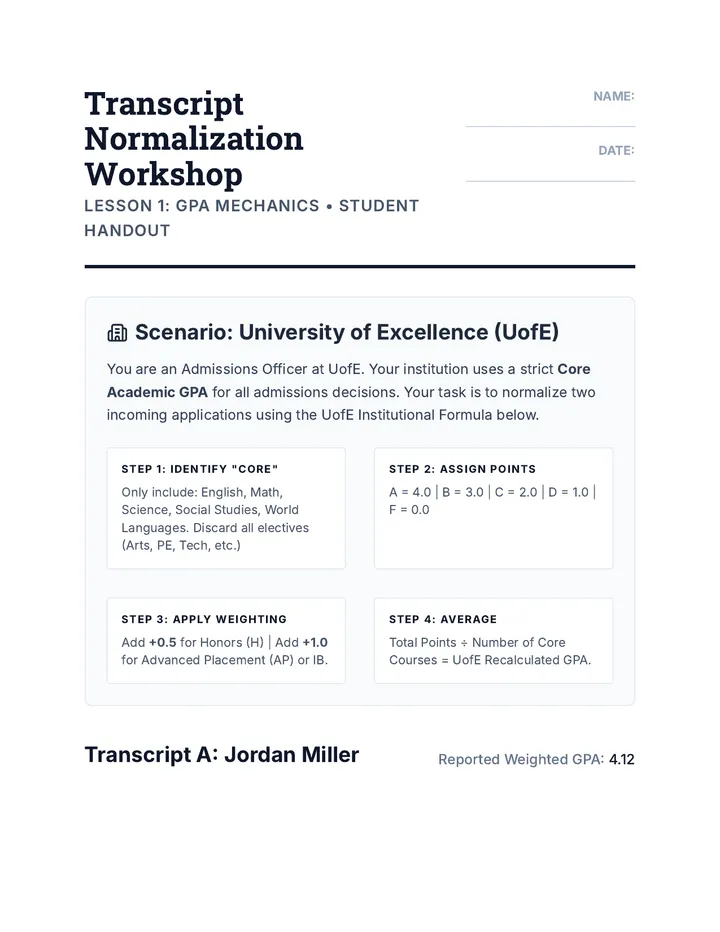
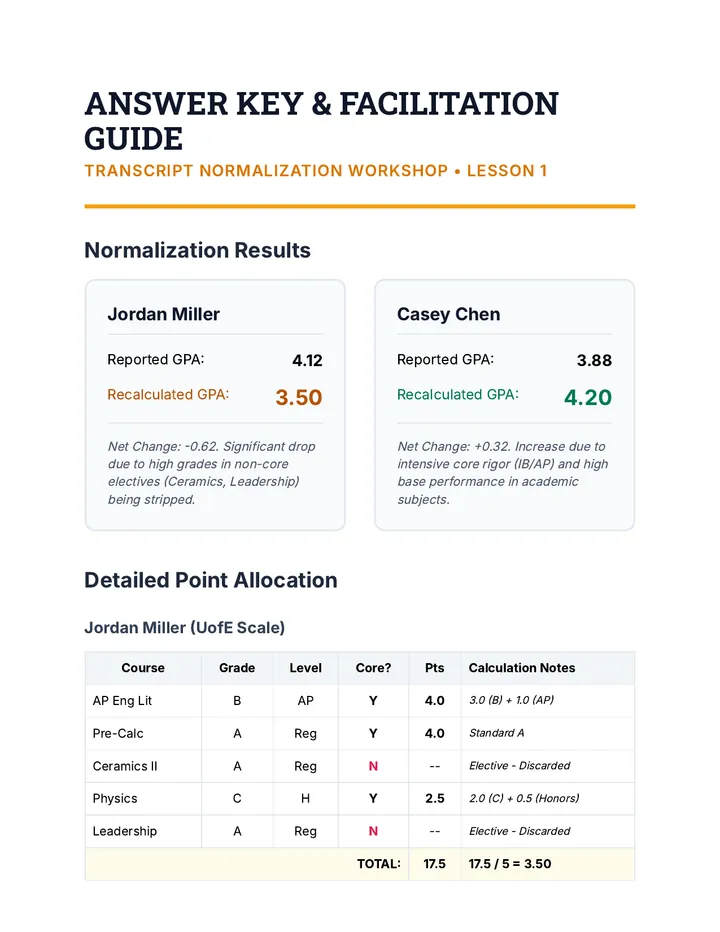
Students explore how higher education institutions normalize diverse high school transcripts by stripping electives and applying specific weights to core academic subjects.
The sequence concludes with students designing a 'Community Care Agreement' to establish norms for mutual support and collective rest in their own communities.
This lesson teaches specific bystander intervention strategies to bridge the gap between noticing distress and connecting a peer to resources.
Students learn to identify subtle behavioral and non-verbal signs of distress in their peers and practice gentle intervention strategies.
A workshop focusing on the listening skills required to support peers, emphasizing validation over immediate problem-solving.
Students define psychological safety and analyze its impact on team performance, using Google's 'Project Aristotle' as a primary case study.