Empathetic skill development through emotion recognition, cultural diversity appreciation, and bias confrontation. Targets multi-perspective analysis to support respectful interactions and complex social responses.
Final reflection and proposal guide for Lesson 5, where students synthesize simulation findings into concrete admissions policy reforms.
Final slide deck for Lesson 5 exploring systemic bias, demographic outcomes of the simulation, and reimagining equitable admissions workflows.
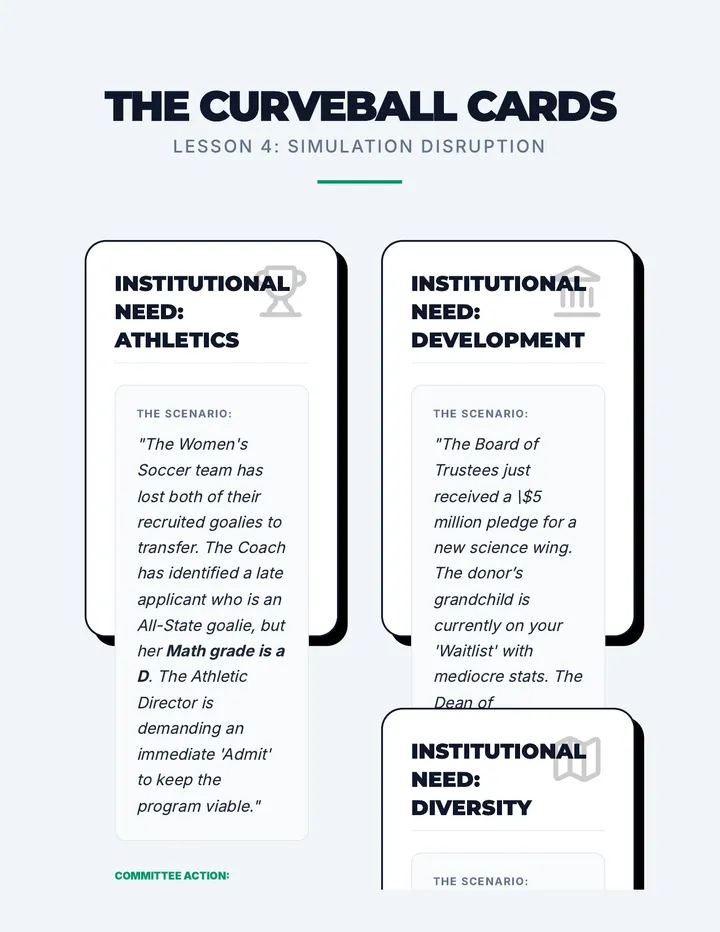
Set of four simulation "curveball" cards for Lesson 4, introducing institutional constraints like athletic needs, major donors, geographic diversity, and yield protection.
Slide deck for Lesson 4 exploring yield protection, special talents (athletics, arts), and the ethical dilemmas of institutional priorities.
Set of three redacted-style applicant dossiers for Lesson 3 simulation, featuring a narrative striver, a legacy applicant, and a quantitative powerhouse.
A clinical monitoring checklist for teachers and students to identify when thought record tracking has become a safety behavior or a form of rumination.
Slide deck for Lesson 3 simulation, focusing on advocacy techniques, committee roles, and the institutional realities of enrollment management.
Instructional slides for Lesson 5, focusing on managing clinical impasses, resistance, and the potential for thought records to become safety behaviors.
Worksheet for Lesson 2 comparing two student profiles with identical GPAs but different resource contexts to practice analyzing academic rigor.
A visual graphic organizer for students to practice the downward arrow technique, mapping the descent from automatic thoughts to core schemas.
A clinical facilitation guide for teachers to demonstrate the downward arrow technique through roleplay scripts and strategy tips.
Slide deck for Lesson 2 focusing on contextual review of transcripts, identifying grade trends, and the balance between standardized testing and personal narratives.
Instructional slides for Lesson 4, covering the theory of cognitive architecture and the downward arrow technique for schema identification.
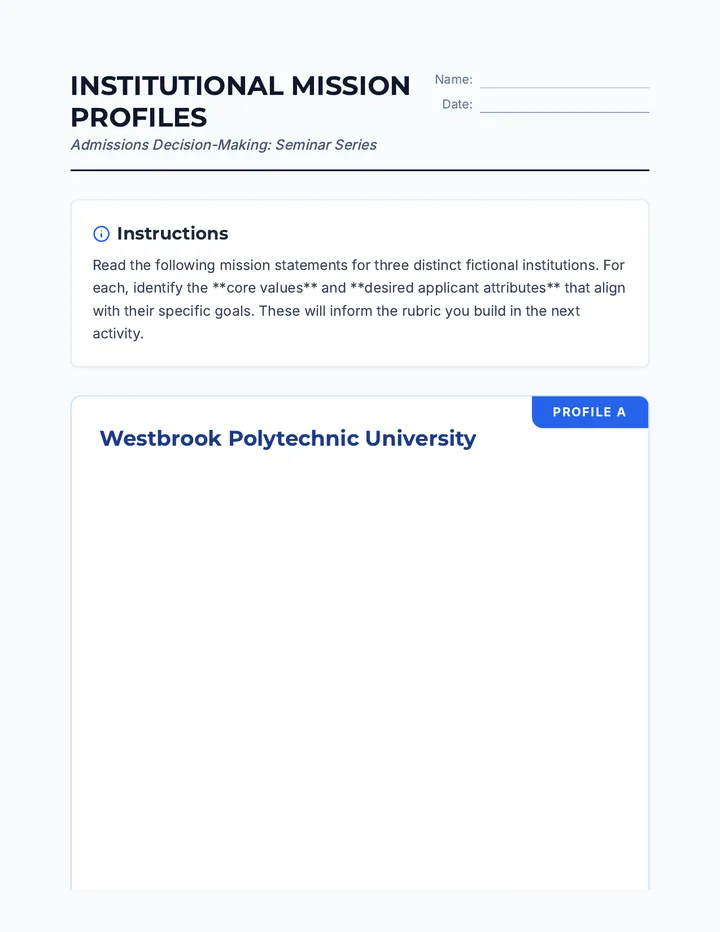
Worksheet featuring three fictional institution profiles with mission statements and analysis areas for students to determine core values and desired applicant traits.
A clinical decision-making tool (flowchart) to help clinicians distinguish between cognitive distortions and valid perceptions of environmental or systemic stressors.
Instructional slides for Lesson 3, focusing on distinguishing between cognitive distortions and valid perceptions of systemic oppression.
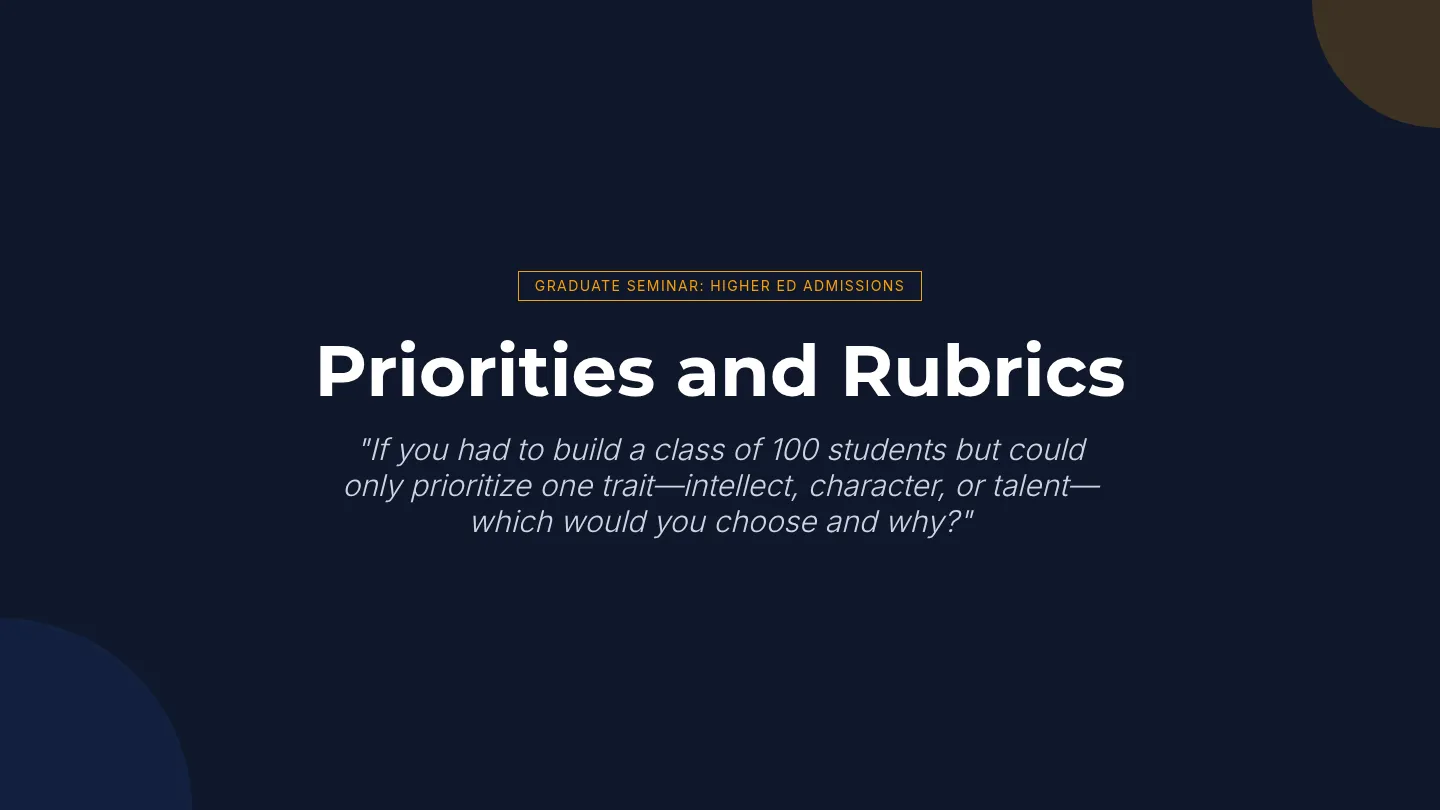
Introductory slide deck for Lesson 1 on Admissions Priorities and Rubrics, featuring institutional mission analysis and the quantitative vs. qualitative debate.
A student worksheet for analyzing multiple thought records to identify recurring cognitive distortions and create client-friendly 'Signature Labels' for meta-cognitive awareness.
A clinical casebook containing serial thought records for analysis, designed to help students identify recurring cognitive distortions across multiple life domains.
Instructional slides for Lesson 2, focusing on the meta-cognitive analysis of serial thought records and identifying signature distortions.
A slide deck for Lesson 4's intensive facilitation workshop. Includes rules for the 'Fishbowl' simulation, focus areas for practitioners, and specific client scenarios for role-play.
A student-facing worksheet for Lesson 3. Students analyze case studies of 'blocked' thought records where clients are stuck in emotional reasoning, practicing validation and clinical pivots.
A student-facing worksheet for Lesson 5. Students analyze a month's worth of case-study thought records to identify recurring themes, use the downward arrow technique to find core beliefs, and monitor clinical progress.
A slide deck covering longitudinal analysis of thought records, identifying recurring core beliefs, and the ethical considerations of cognitive restructuring.
A professional rubric for assessing student performance during role-play simulations. Focuses on psychoeducation, Socratic questioning, session pacing, and therapeutic alliance.
A 5-slide presentation for Lesson 3 focused on emotional reasoning and clinical resistance. Covers the 'Validate then Challenge' model and strategies for troubleshooting 'blocked' thought records.
A student worksheet focused on identifying the gap between rational belief and emotional experience in a clinical case study.
A professional cheat sheet for students practicing Socratic questioning. Includes question stems for evidence seeking, alternative perspectives, and utility, plus clinical pivot strategies.
A clinical guide for teachers to facilitate experiential bridging techniques (imagery, behavioral experiments, and internal dialogue) when clients experience the head-heart lag.
A slide deck explaining the principles of Socratic questioning, guided discovery, and common clinical traps. Focuses on the "Scientist Stance" and differentiates between leading vs. curious questioning.
Final capstone worksheet for Lesson 5, where students map local community resources to each of the PLEASE skills and conduct an accessibility audit.
Teacher guide for Lesson 5, including instructions for the 'Great Asset Scavenger Hunt' and final sequence reflection.
Final slides for the sequence, focusing on community resource mapping and the counselor's role as a systems navigator.
Worksheet for Lesson 4, containing a matrix for students to practice modifying movement recommendations for clients with specific physical disabilities or chronic pain.
Teacher guide for Lesson 4, focusing on inclusive movement strategies and how to teach 'Movement Mastery' over traditional exercise.
Slides for Lesson 4, redefining exercise as 'Movement Mastery' and focusing on inclusivity for clients with physical disabilities or chronic pain.
Worksheet for Lesson 3, where students develop a sleep plan for a client living in a crowded, shared apartment using low-cost adaptations.
Teacher guide for Lesson 3, featuring instructions for the audio simulation and practical tips for low-cost sleep hygiene adaptations.
Slides for Lesson 3, addressing the 'S' (Sleep) in PLEASE for clients living in shared, noisy, or unsafe environments.
Workshop activity for Lesson 2, challenging students to create a $5 daily meal plan that supports emotional stability under strict environmental constraints.
Teacher guide for Lesson 2, including the facilitation instructions for the $5 Daily Challenge and key concepts like 'Protein Anchoring'.
Slides for Lesson 2, focusing on adapting nutritional advice for clients facing food insecurity and introducing the '$5 Daily Challenge'.
Student worksheet for Lesson 1, featuring a case study analysis of "Marcus" to identify systemic barriers to PLEASE skills practice.
Teacher facilitation guide for Lesson 1, including instructional arc, discussion prompts, and teaching tips for deconstructing PLEASE through an equity lens.
Introductory slides for Lesson 1, exploring the PLEASE skills through a Social Determinants of Health (SDOH) lens and identifying systemic barriers to self-care.