Employer research strategies and behavioral response techniques using the STAR method. Develops virtual interview etiquette, professional presence, and effective follow-up communication.
A high-impact 75-minute workshop designed to prepare candidates for interviews through research, personal branding (The Master Pitch), and behavioral storytelling (STAR Method). This condensed version focuses on active, hands-on practice and immediate application.
A comprehensive 90-minute lesson covering first impressions, the STAR method for behavioral questions, and professional etiquette for job seekers.
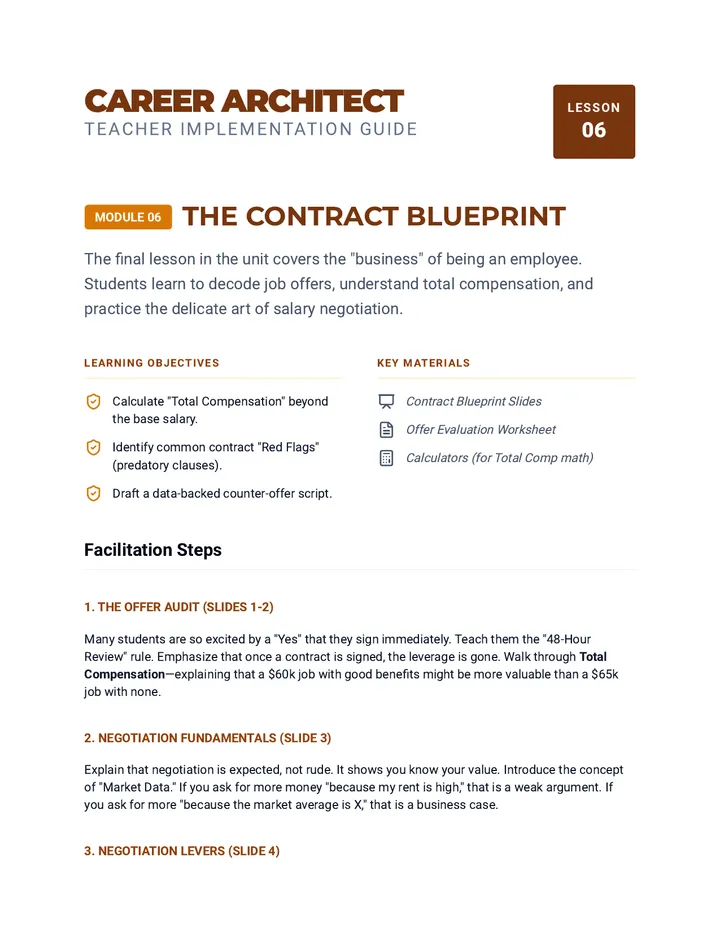
Teaches students how to evaluate job offers, negotiate salary and benefits, and prepare for the professional transition into a new role. Focuses on the "business" side of starting a career.
Focuses on the critical period after the interview. Students learn to craft high-impact thank-you notes, manage follow-up timelines, and leverage post-interview feedback to refine their approach.
Focuses on translating research into action. Students learn to tailor their resumes and cover letters using the data gathered during their 'Company Recon' to stand out from generic applicants.
Prepares students for various interview formats and difficult scenarios. Focuses on the STAR method for behavioral questions, researching the interviewers themselves, and practicing high-pressure situational responses.
Teaches students how to move beyond surface-level job descriptions. Focuses on researching company culture, financial health, and industry positioning to tailor applications and demonstrate genuine interest and fit.
Focuses on the 'hidden job market' and the power of professional networking. Students learn how to identify potential connections, conduct informational interviews, and leverage their existing circle to find opportunities before they are posted publicly.
A comprehensive 120-minute training session covering self-assessment, resume building, job search strategies, and interview techniques for job seekers.
A high-stakes role-playing simulation where students navigate difficult interview questions and scenarios using the STAR method.
Students learn and practice networking through role-playing varied professional social environments, focusing on the elevator pitch and strategic connection-building.
A culminating mock interview experience followed by instruction on professional follow-up etiquette and managing outcomes.
Focuses on managing unexpected or abstract questions by demonstrating visible reasoning and intellectual poise.
Students master the STAR method to answer behavioral questions and develop a strategic 'story bank' of professional experiences.
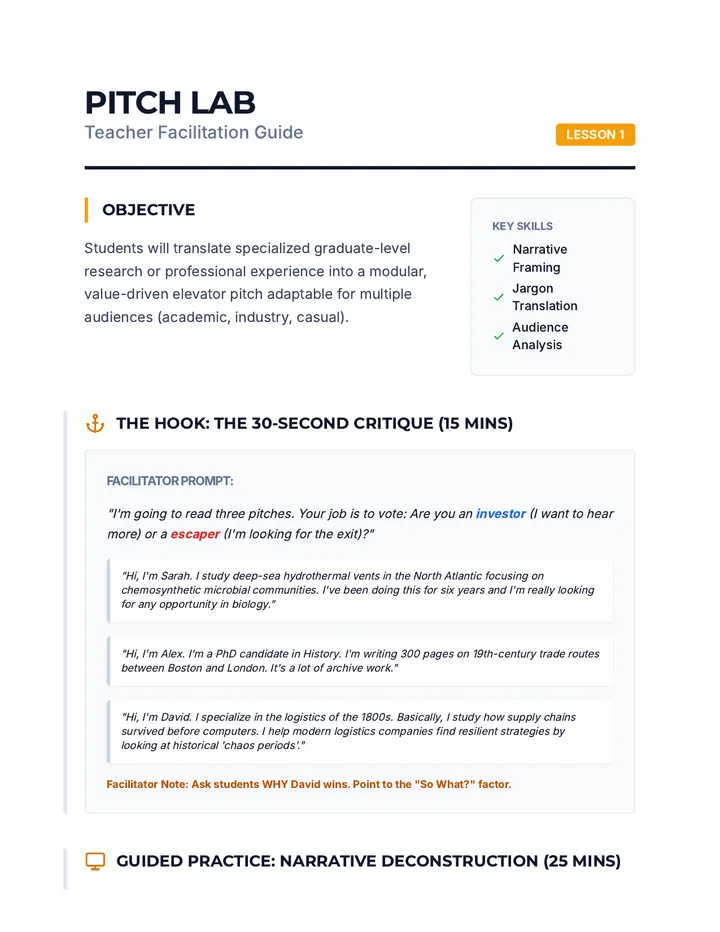
Students craft and refine a compelling 90-second summary of their research impact, practicing delivery for diverse audiences.
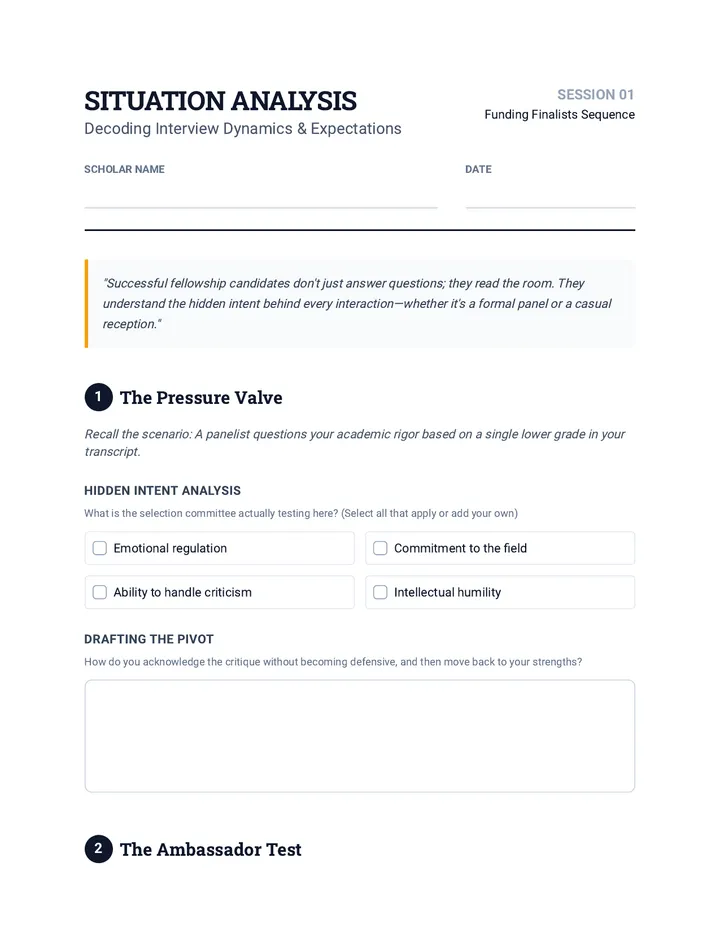
Students analyze different fellowship interview styles—panel, one-on-one, and social—and decode the underlying expectations of selection committees.
The sequence culminates in a long-term strategic plan that uses interview performance patterns to guide skill acquisition and career growth.
A workshop-style lesson where students use audit data to re-engineer their STAR stories, turning their weakest answers into their strongest narratives.
Students conduct a gap analysis between their intended message and how it was perceived by others, identifying 'signal distortion' in their professional communication.
Introduces a standardized rubric for objective self-evaluation. Students analyze clarity, conciseness, and alignment with organizational values.
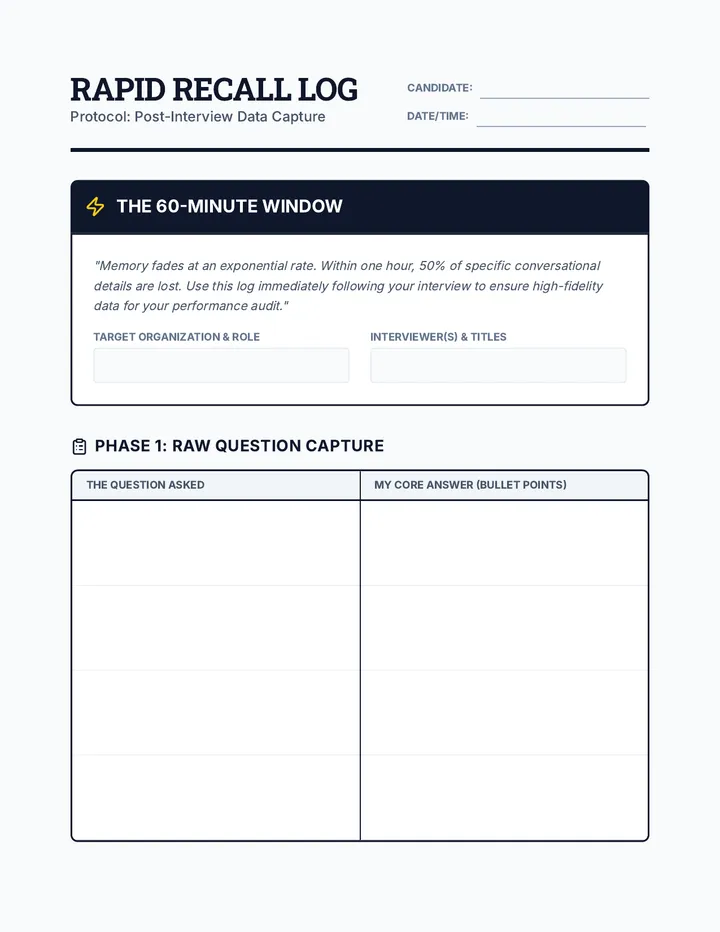
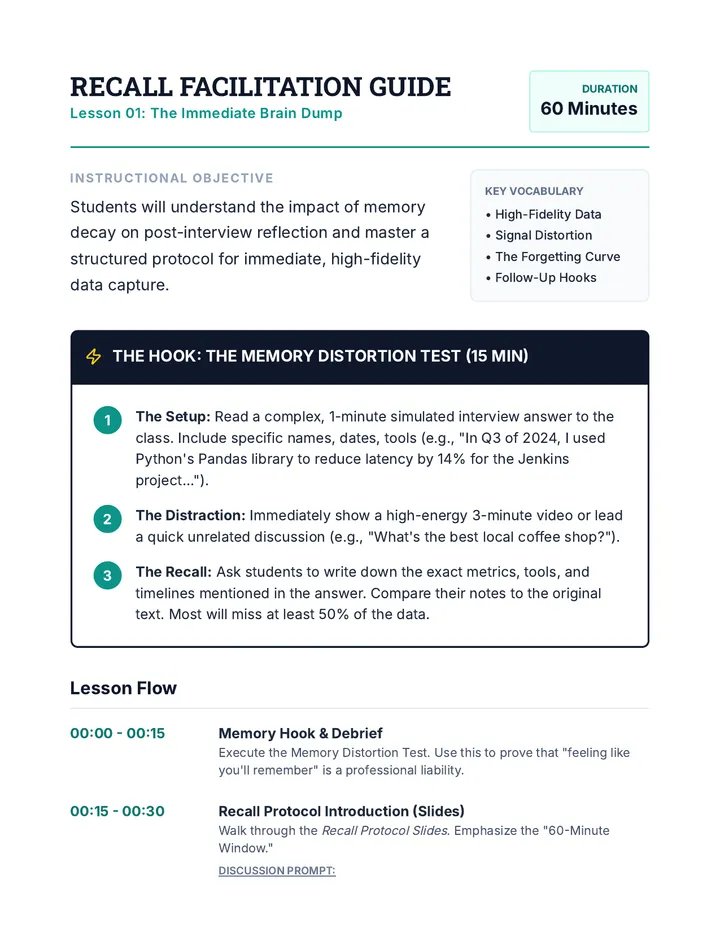
Focuses on the critical 60 minutes post-interview. Students learn a 'Rapid Recall Protocol' to capture data-driven insights before memory decay sets in.
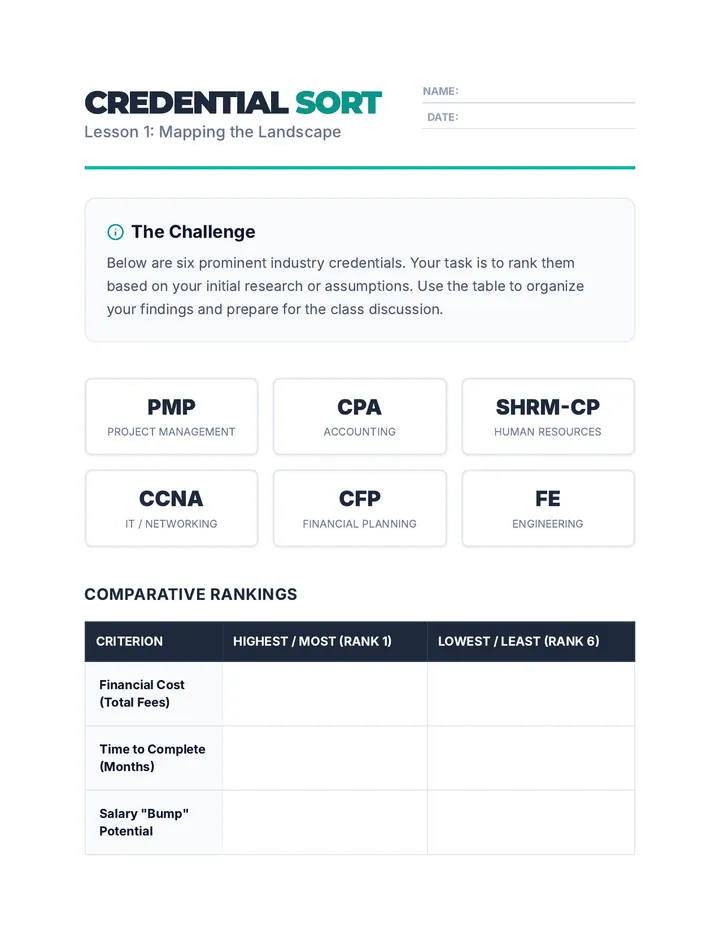
In this culminating lesson, students create a personalized rubric to evaluate future learning opportunities based on cost, duration, relevance, and income potential. They apply this matrix to a specific credential they are considering pursuing post-graduation.
Students analyze job postings and conduct informational interview simulations to determine how employers view specific certifications versus experience. They practice articulating the value of a certification during a mock interview context.
This lesson explores the concept of 'stackable' credentials where smaller units of learning build toward a larger degree or qualification. Students design a theoretical pathway where short-term certifications lead to long-term academic goals.
Students learn to audit the quality of certification programs by investigating accrediting bodies and industry recognition. The lesson focuses on avoiding diploma mills and low-value certificates through rigorous vetting criteria.
Students explore the hierarchy of post-secondary credentials, distinguishing between certificates, certifications, licensures, and micro-degrees. They map these categories to their potential career paths to identify relevant qualifications.
Students develop a long-term relationship management system, including the 'Circle Back' technique and a personal CRM to convert initial contacts into enduring professional alliances.
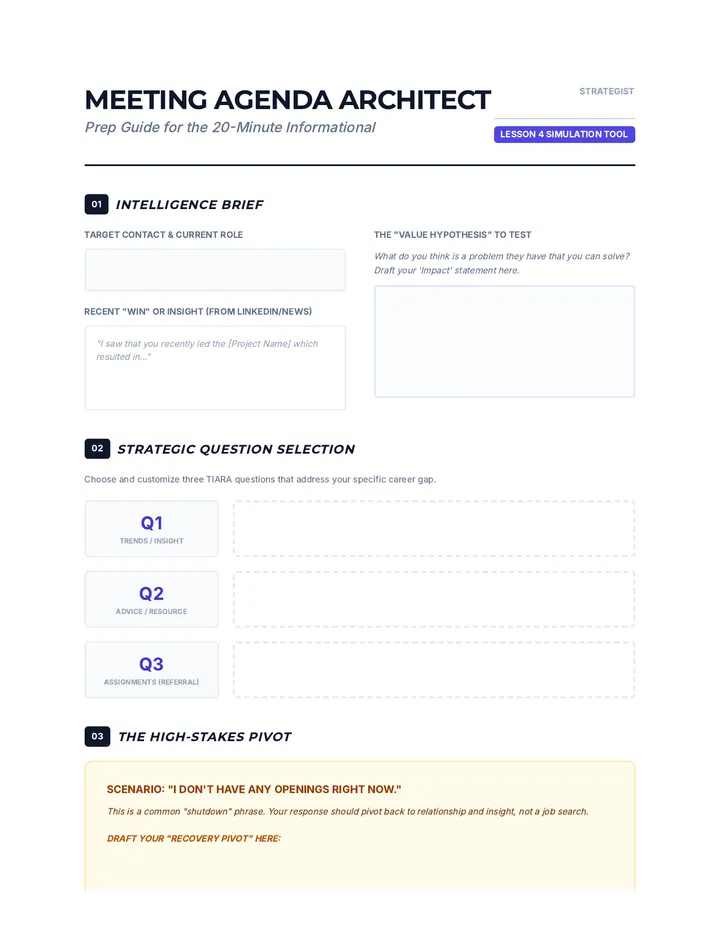
Students prepare for and simulate high-impact informational interviews, learning to design agendas that extract strategic insights while demonstrating professional maturity.
Students deconstruct the psychology of cold outreach to maximize response rates, drafting a suite of modular templates for alumni, cold inquiries, and referral requests.
Students leverage digital tools to identify the hidden job market, mapping out key decision-makers and advocates within target organizations to create a prioritized 'Target 20' list.
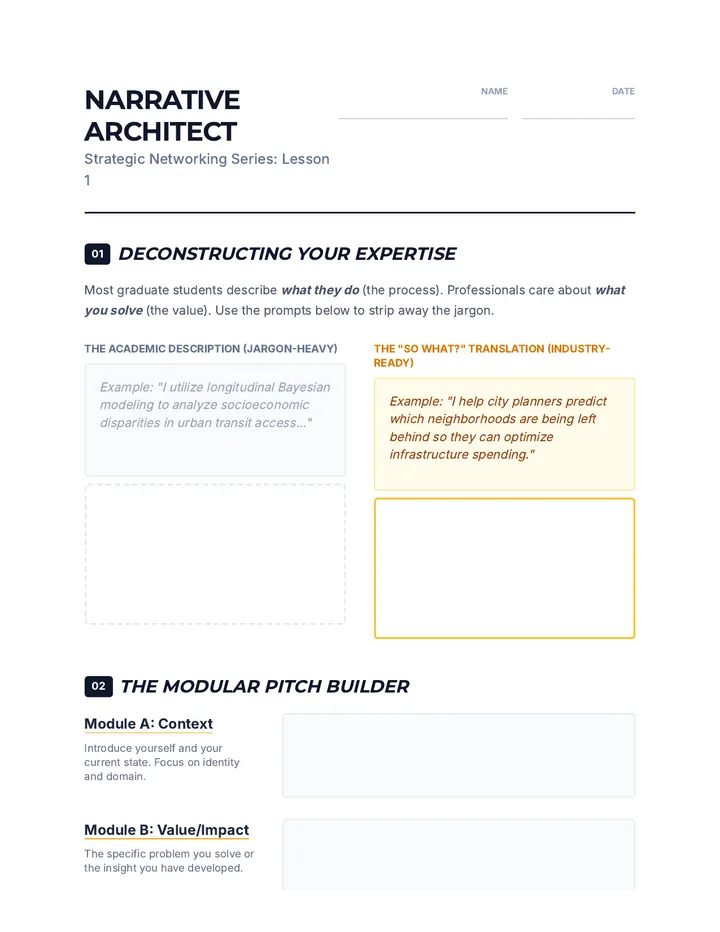
Students analyze their unique academic and professional assets to construct a compelling narrative for potential employers and mentors, refining a modular elevator pitch for various scenarios.
A lesson focused on the critical final step of the interview process: the thank-you note. Students learn the etiquette, timing, and structural requirements of professional follow-up communication.
A lesson focused on professional etiquette and maintaining a productive, calm workspace. Students learn the importance of post-interview communication and the value of a 'Zen Zone' for focused work.
A comprehensive lesson on mastering the art of professional correspondence, specifically focusing on the nuance of rejection letters and the strategy of post-interview thank you letters. Students learn to maintain professionalism, build bridges, and leave a lasting positive impression.
This lesson covers the professional etiquette and structural requirements for writing effective rejection and thank-you letters. Students will learn to balance empathy with professionalism in rejections and use thank-you notes as a strategic tool for networking and career growth.
The final lesson encourages students to use the rejection data to analyze their market fit. They review their follow-up interactions to determine if they need to pivot their target industry or role.
Students develop strategies for connecting with interviewers on LinkedIn and other professional platforms post-process. They learn appropriate intervals and content for maintaining these weak ties.
This lesson focuses on writing the 'graceful concession' email. Students practice crafting responses to rejection that leave the door open for future roles or freelance opportunities.
Students learn how to ask for feedback after a rejection in a way that actually yields results. They analyze the legal constraints HR faces and learn how to phrase questions to bypass generic responses.
Prepares students for field-specific interviews (MMI, committee interviews) and focuses on articulating research interests and soft skills under pressure.
Covers the etiquette and strategy of requesting recommendations, including the creation of briefing packets to ensure letters address specific competencies.
Deconstructs successful personal statements to understand the narrative arc required for advanced study, helping students articulate a clear research agenda and professional vision.
In this culminating workshop, students integrate audio, lighting, camera, and background into a final checklist procedure. They will perform a test recording to verify internet bandwidth stability and hardware integration. The output is a documented 'pre-flight' checklist for use before every future virtual interview.
Participants analyze the rhetoric of their background, choosing between a curated physical bookshelf/wall or a professional virtual background. They will learn to declutter the frame to minimize cognitive load for the interviewer while ensuring virtual backgrounds do not cause digital artifacting.
Students explore the psychology of camera angles, specifically the impact of eye-level versus low-angle (dominance) or high-angle (submission) framing. They will physically adjust their webcam height and distance to achieve a 'head and shoulders' shot that mimics appropriate social distance.
Students participate in a final high-stakes mock interview with a new partner or instructor, aiming for a 'perfect' technical and behavioral delivery. They must demonstrate mastery of lighting, audio, eye contact, and platform navigation. The session ends with a debrief on long-term virtual networking strategies.
Using recordings from the previous lesson, students perform a deep-dive critique of their own performance. They look for moments where engagement dropped or technical issues distracted from the content. They identify one technical and one behavioral goal for improvement.
This lesson covers the physics of lighting, focusing on color temperature (Kelvin), diffusion, and the classic three-point lighting setup (key, fill, back). Students will utilize available household light sources or professional ring lights to eliminate shadows and ensure they are evenly illuminated.
Students record and perform a micro-analysis of their own digital presence. Using a comprehensive rubric, they evaluate their eye contact, posture, and gesture management to create a personalized improvement plan for future virtual interviews.
Covers the mechanics of professional call exits, avoiding 'hot mic' errors, and crafting high-impact post-interview follow-up emails and reflection plans.
A full-scale mock interview simulation where students act as both candidate and interviewer to practice holistic performance and provide peer feedback on technical and behavioral skills.
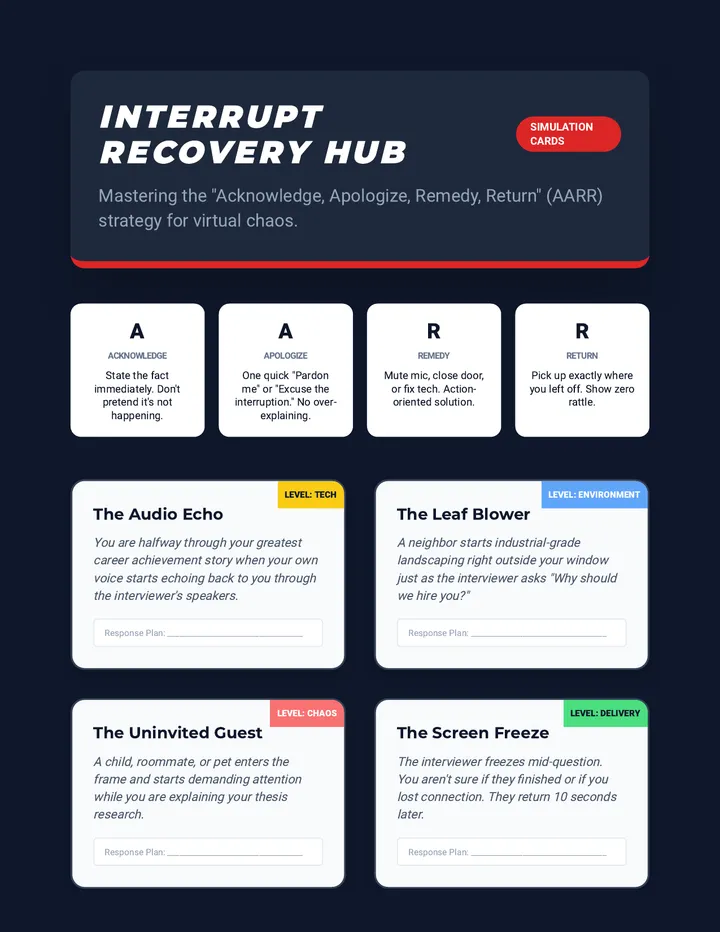
Teaches students how to recover professionally from unexpected environmental interruptions like tech glitches or background noise using the 'acknowledge, apologize, remedy, and return' strategy.
A high-pressure mock interview simulation where technical failures are intentionally introduced to test student composure and problem-solving skills.
Developing a robust 'Plan B' and 'Plan C' for infrastructure failures, including tethering, dial-ins, and secondary device handoffs.
A 120-minute, step-by-step training lesson designed to help learners with social anxiety identify their professional skills, build interactive communication confidence, and master critical task-oriented and interview conversations. Includes comprehensive facilitator scripts, structured activities, and coping mechanisms.
A comprehensive lesson on mastering non-verbal communication across interpersonal relationships, professional interviews, and high-stakes de-escalation scenarios. Students learn to decode 'silent signals' to improve empathy, professionalism, and safety.