Budgeting, saving, and investment strategies alongside practical skills for managing credit, taxes, and banking. Addresses insurance needs, employment income, and major purchase decisions to support comprehensive long-term financial planning.
A comprehensive guide to the home buying process, covering financial preparation, mortgage types, home inspections, and the legal closing process. Students will learn how to navigate the complex journey of purchasing their first home with confidence and financial savvy.
A comprehensive 90-minute workshop on the fundamentals of tipping. This session covers legal rights under the FLSA, the mechanics of tip credits, and paycheck auditing.
This area contains lessons and materials that have been removed from the active sequence. They are kept here due to technical storage requirements but should not be used for instruction.
A comprehensive deep-dive into personal finance, focusing on budgeting, saving strategies, and financial goal-setting for long-term stability. Students will move from understanding basic income and expenses to managing complex life scenarios.
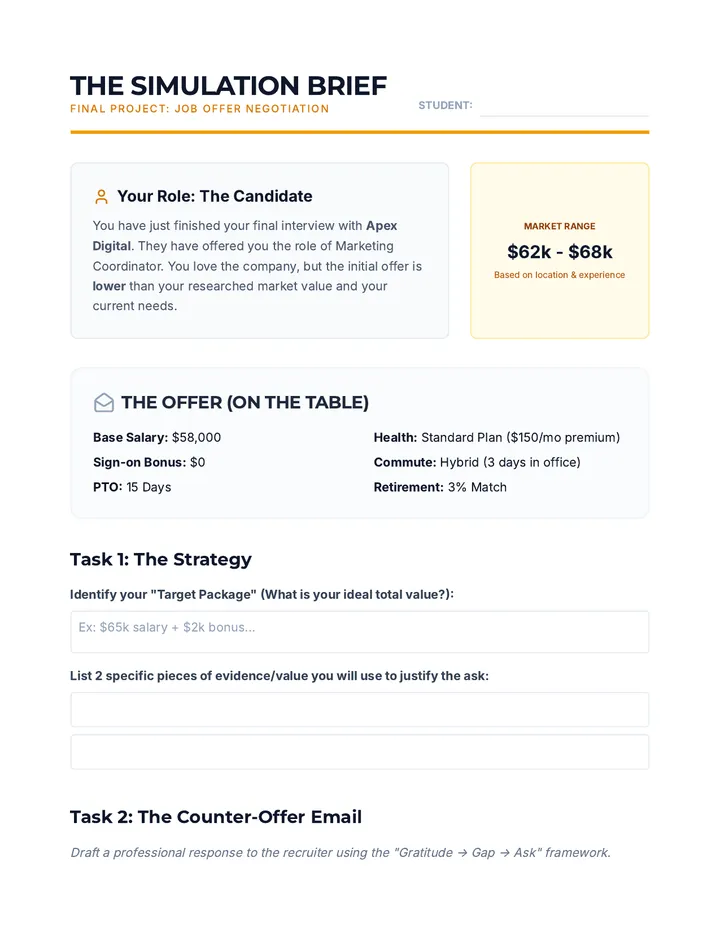
In this final role-play, students act as job candidates receiving an initial offer. Using their total compensation analysis, they draft a counter-offer email and participate in a live negotiation to improve specific terms (salary, sign-on bonus, or extra PTO).
This lesson covers the legal framework of the employment relationship, including at-will employment, non-compete clauses, and intellectual property agreements. Students review a sample contract to flag potential red flags.
Students use cost-of-living indices to normalize salaries across different cities. They adjust gross pay calculations to account for local taxes and housing costs to find the 'real' purchasing power of an offer.
Learners assign monetary values to intangible benefits like Paid Time Off, remote work flexibility, and professional development budgets to compare offers with different leave policies.
Students identify and quantify every component of a job's value, moving beyond base salary to build a comprehensive total rewards framework.
In this culminating activity, students manage a complex fictional client profile involving dual incomes, investments, and educational expenses to determine filing status and complete tax forms.
This lesson examines how different asset classes and retirement accounts are taxed. Students compare Traditional and Roth contributions, as well as short-term and long-term capital gains tax rates.
Learners explore the nuances between standard deductions and itemized deductions (Schedule A), along with the impact of tax credits. Special attention is given to graduate-relevant topics such as the Lifetime Learning Credit and student loan interest deductions.
This lesson focuses on the tax implications of the gig economy, consulting work, and traditional employment. Students analyze case studies comparing the total tax burden of a salaried employee versus an independent contractor.
Students investigate the mathematics behind the US progressive tax system, differentiating between marginal and effective tax rates. The lesson covers the mechanics of FICA taxes and payroll withholdings to deconstruct a standard paycheck.
The capstone experience. Students combine their policy research, business case, and flexibility negotiation into a final verbal pitch and written proposal for educational support.
Not all education happens in a classroom. Students learn to map internal company resources—mentorships, internal leadership academies, and stretch assignments—to build a 'shadow curriculum' that complements their external studies.
Students tackle the most difficult part of integration: time. They learn to negotiate for non-financial support, such as flextime, condensed work weeks, and study leave, using interest-based negotiation techniques.
Synthesis of findings into a cohesive financial roadmap, including primary funding plans and contingency strategies to minimize debt exposure.
Students model lost wages during study against projected salary increases to calculate the 'break-even' point of their educational investment.
Investigates corporate benefits and strategies for negotiating education funding with employers, including ROI justification to management.
Demystifies the difference between loans, grants, teaching assistantships, and fellowships, exploring how to find fully funded programs and work obligations.
Students research the full scope of expenses for various programs, including tuition, fees, relocation, and cost of living, while learning to identify hidden costs.
Students synthesize their financial models, funding strategies, and salary projections into a coherent presentation. They effectively communicate the financial viability of a specific educational path to a simulated board of advisors.
Learners use industry salary data to project realistic income growth following specific educational achievements. They calculate the 'break-even' age where the increased salary surpasses the cost of education and lost experience.
Students examine the specific terms of graduate-level federal and private loans, including Grad PLUS loans and refinancing options. They calculate interest capitalization and analyze repayment scenarios based on projected income.
This workshop focuses on identifying and applying for 'free money' via research assistantships, teaching fellowships, and external grants. Students critique sample grant proposals and identify key funding databases.
Students build a comprehensive financial model that includes tuition, fees, lost wages, and retirement contribution gaps during study periods. The lesson focuses on revealing the 'hidden' costs of returning to school full-time versus part-time.
A legal review of the Master Promissory Note and Entrance Counseling requirements to ensure students understand their rights and responsibilities.
A simulation-based lesson on interest capitalization, demonstrating how deferring payments can lead to ballooning balances.
A deep dive into Public Service Loan Forgiveness (PSLF) requirements, ensuring students borrow the correct loan types and plan for qualifying employment.
A comprehensive personal development lesson designed for young adults transitioning into independence. It features a 10-page workbook centered on values, emotional intelligence, and life skills, paired with a facilitator guide for mentors or therapists.
A deep dive into Stockholders' Equity transactions and Time Value of Money applications for accounting professionals.
A comprehensive set of planning tools for a budget-conscious backyard wedding, focusing on organization, logistics, and DIY execution.
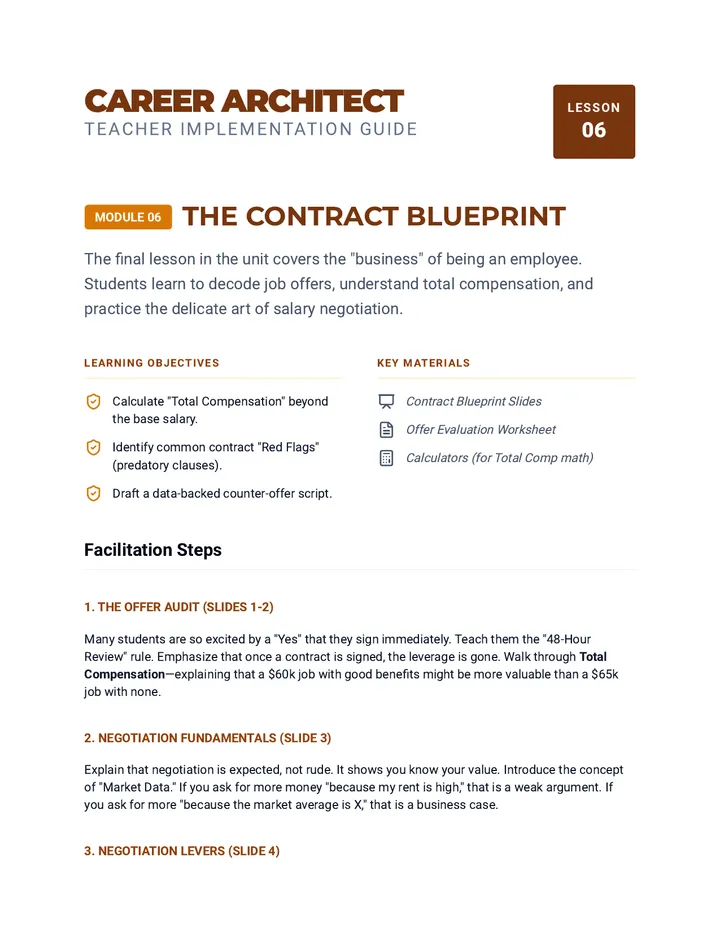
Teaches students how to evaluate job offers, negotiate salary and benefits, and prepare for the professional transition into a new role. Focuses on the "business" side of starting a career.
Focuses on the critical period after the interview. Students learn to craft high-impact thank-you notes, manage follow-up timelines, and leverage post-interview feedback to refine their approach.
Focuses on translating research into action. Students learn to tailor their resumes and cover letters using the data gathered during their 'Company Recon' to stand out from generic applicants.
Prepares students for various interview formats and difficult scenarios. Focuses on the STAR method for behavioral questions, researching the interviewers themselves, and practicing high-pressure situational responses.
Teaches students how to move beyond surface-level job descriptions. Focuses on researching company culture, financial health, and industry positioning to tailor applications and demonstrate genuine interest and fit.
Focuses on the 'hidden job market' and the power of professional networking. Students learn how to identify potential connections, conduct informational interviews, and leverage their existing circle to find opportunities before they are posted publicly.
A comprehensive lesson designed for adult women to manage compulsive spending by addressing executive function challenges like impulsivity and distractibility. This lesson provides practical strategies to bridge the gap between intention and action.
A foundational introductory lesson for a college-level personal finance course, focusing on the importance of financial literacy, core concepts, and setting the stage for the semester.