Employment laws, safety protocols, and legal protections against workplace harassment and discrimination. Connects regulatory requirements to practical understandings of pay stubs, insurance benefits, and employee advocacy.
A 60-minute group session focused on empowering adults in PSR programs to understand their personal rights and practice assertive communication in real-world situations.
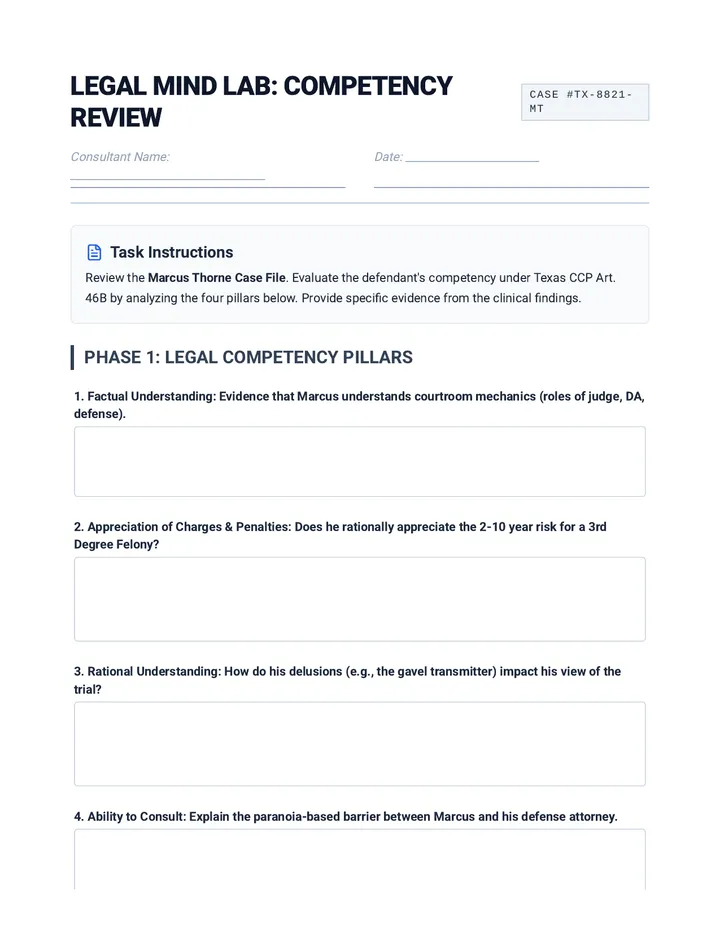
A forensic mental health simulation where students or patients analyze a criminal case and competency report for a defendant with Schizoaffective Disorder charged with a felony in Texas.
A comprehensive 90-minute workshop on the fundamentals of tipping. This session covers legal rights under the FLSA, the mechanics of tip credits, and paycheck auditing.
This area contains lessons and materials that have been removed from the active sequence. They are kept here due to technical storage requirements but should not be used for instruction.
A dual-track 90-minute activity sequence on pattern recognition, offering a professional development seminar for workplace efficiency and a supportive, scaffolded module for adults with IDD.
A vocational training module exploring diverse career paths that require professional laundry skills, from healthcare and hospitality to sports management and commercial services.
A comprehensive orientation for medical interns covering placement procedures, professional standards, and post-internship career support.
A comprehensive lesson on navigating professional transitions through effective resignation and thank you letters, covering legalities, etiquette, and writing styles.
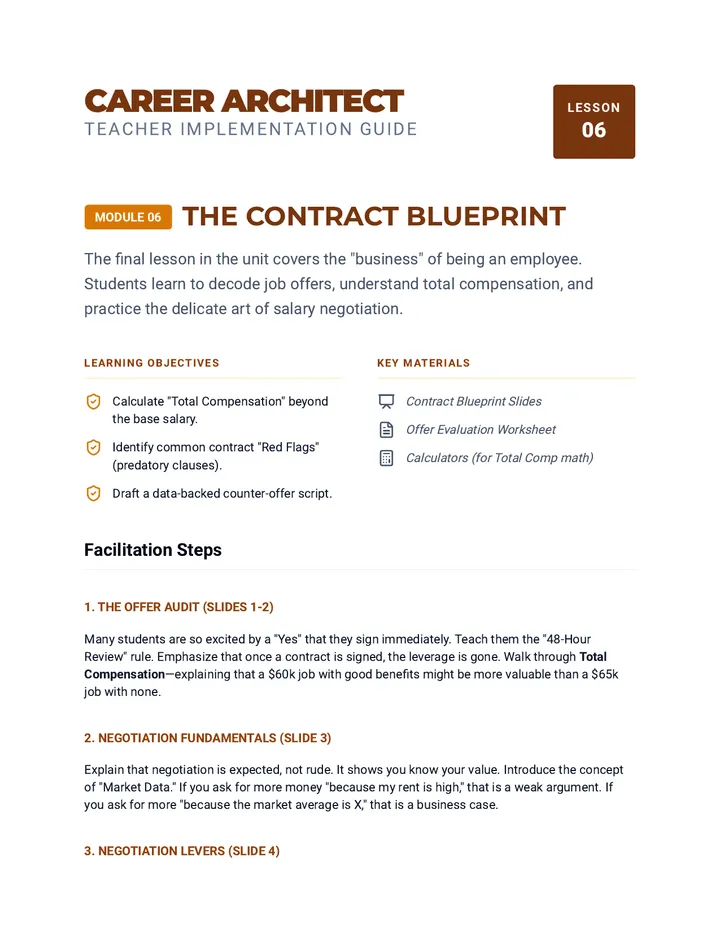
Teaches students how to evaluate job offers, negotiate salary and benefits, and prepare for the professional transition into a new role. Focuses on the "business" side of starting a career.
Focuses on the critical period after the interview. Students learn to craft high-impact thank-you notes, manage follow-up timelines, and leverage post-interview feedback to refine their approach.
Focuses on translating research into action. Students learn to tailor their resumes and cover letters using the data gathered during their 'Company Recon' to stand out from generic applicants.
Prepares students for various interview formats and difficult scenarios. Focuses on the STAR method for behavioral questions, researching the interviewers themselves, and practicing high-pressure situational responses.
Teaches students how to move beyond surface-level job descriptions. Focuses on researching company culture, financial health, and industry positioning to tailor applications and demonstrate genuine interest and fit.
Focuses on the 'hidden job market' and the power of professional networking. Students learn how to identify potential connections, conduct informational interviews, and leverage their existing circle to find opportunities before they are posted publicly.
A comprehensive lesson designed for social workers and clinical staff to master advocacy frameworks, systemic communication strategies, and practical implementation through scenario-based analysis.
A concise lesson for wheelchair users to effectively self-advocate for workplace accessibility and ADA compliance while maintaining professional relationships.
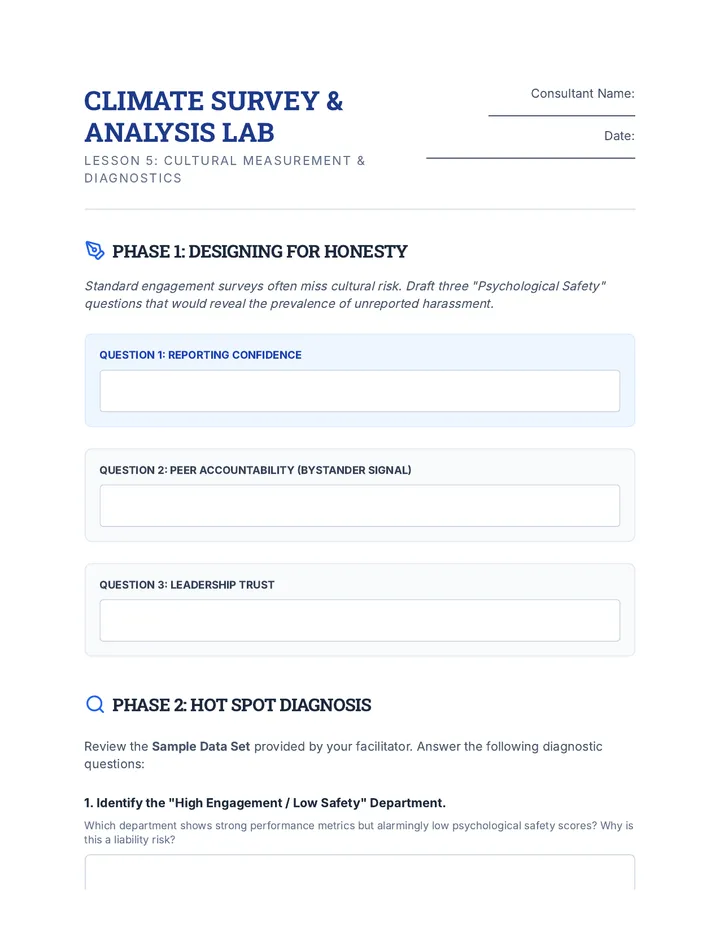
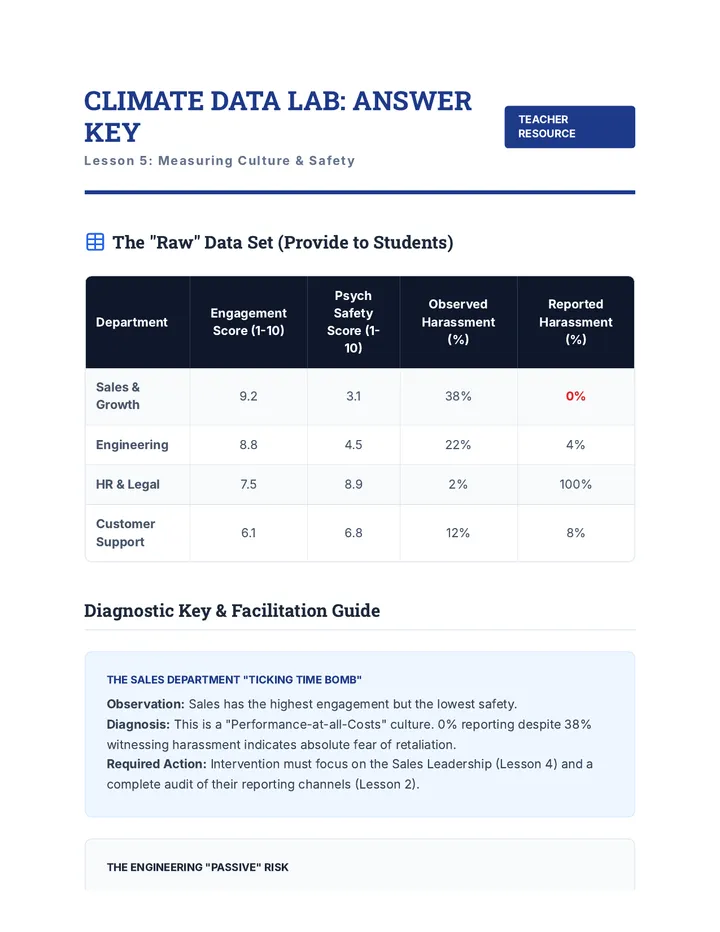
How do you know if prevention is working? Students learn to design climate surveys and interpret data to assess the prevalence of unreported harassment and the general level of psychological safety in an organization.
Synthesize learning to create a roadmap for 'Just Culture,' integrating physical and psychological safety as core organizational values.
Explore the impact of leadership communication and behavior on safety culture, including practical techniques for management-led safety walks and trust-building.
Investigate the systemic and cultural factors that lead to under-reporting of incidents and design alternative incentive structures to promote transparency.
Analyze the legal protections afforded to whistleblowers under the OSH Act and develop organizational policies that prevent retaliation and encourage ethical reporting.
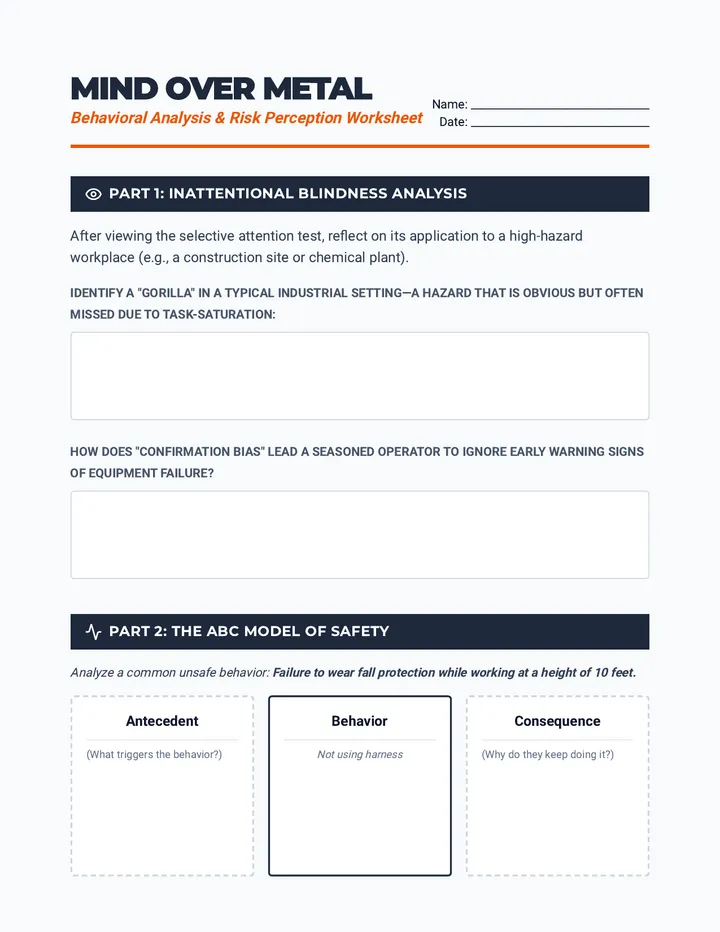
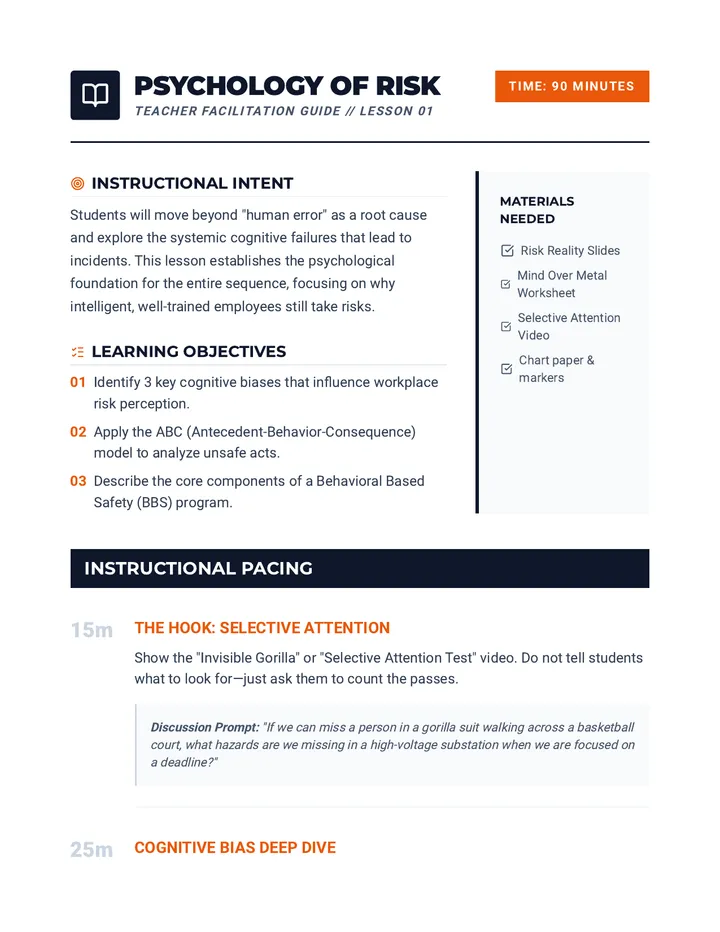
Examine the cognitive biases and psychological factors that influence risk perception and safety-related behavior in industrial and corporate environments.
Concludes with the technical skills needed to draft a defensible investigation report and recommend appropriate remediation.
Teaches students how to weigh conflicting testimony and apply the preponderance of evidence standard to make formal findings of fact.
Develops skills for interviewing the accused and witnesses, focusing on non-leading questions and managing high-conflict interactions.
Covers strategic planning for an investigation, identifying witnesses, and managing digital and physical evidence.
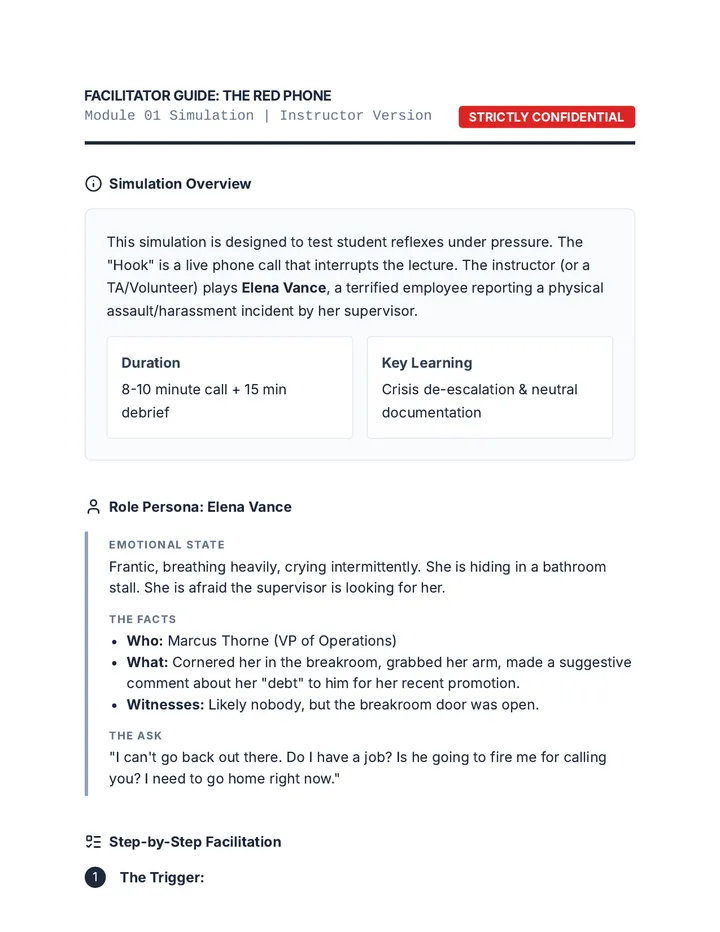
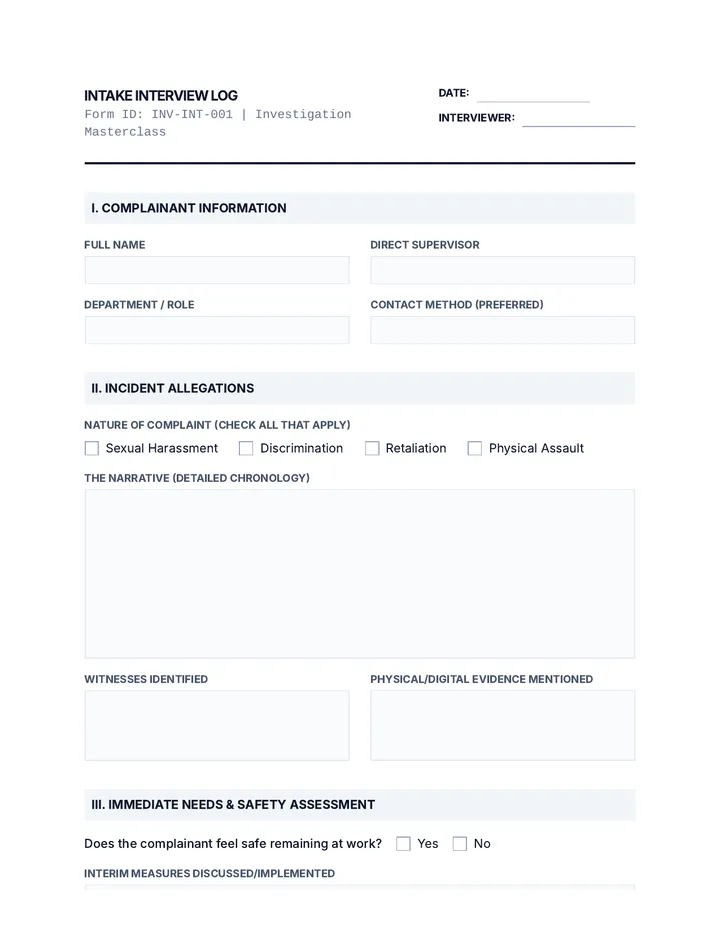
Focuses on the immediate response to a complaint, including conducting the intake interview and determining if interim measures like administrative leave are necessary.
In this capstone workshop, students synthesize all prior topics to present a comprehensive compliance strategy for a fictional organization facing multiple lawsuits. They must propose training programs, policy revisions, and cultural initiatives that reduce liability. Peers review the strategies to identify potential legal gaps or implementation failures.
Focusing on the Electronic Communications Privacy Act and emerging state laws, this lesson explores the limits of employee monitoring and off-duty conduct. Students debate the legality and ethics of tracking remote workers and disciplining employees for social media activity. The output is a drafted 'Acceptable Use and Privacy Policy' for a modern, remote-first organization.
Students tackle the 'Bermuda Triangle' of employment law: the overlap between the Family and Medical Leave Act, the Americans with Disabilities Act, and workers' compensation. Through a role-play simulation, students must manage an interactive process for an employee with a complex medical history requesting indefinite leave. They will draft accommodation plans that satisfy legal requirements without causing undue hardship to the employer.
This seminar-style lesson focuses on Title VII of the Civil Rights Act, analyzing the nuances between disparate treatment and disparate impact. Students critique real-world court rulings regarding harassment and retaliation and practice conducting neutral, legally sound internal investigations.
An examination of wage, hour, and safety compliance focusing on the FLSA and OSHA within the context of the gig economy. Students audit a fictional startup to classify workers and assess liability risks associated with workplace safety.
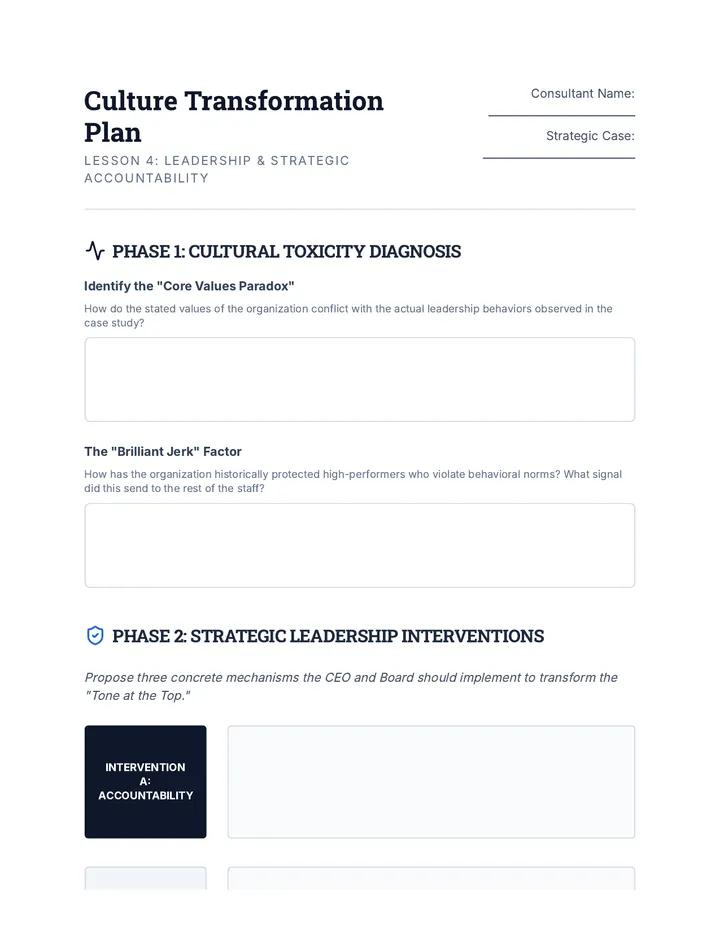
This lesson examines the concept of 'tone at the top.' Students analyze case studies of organizations that successfully transformed toxic cultures through leadership transparency and accountability mechanisms.
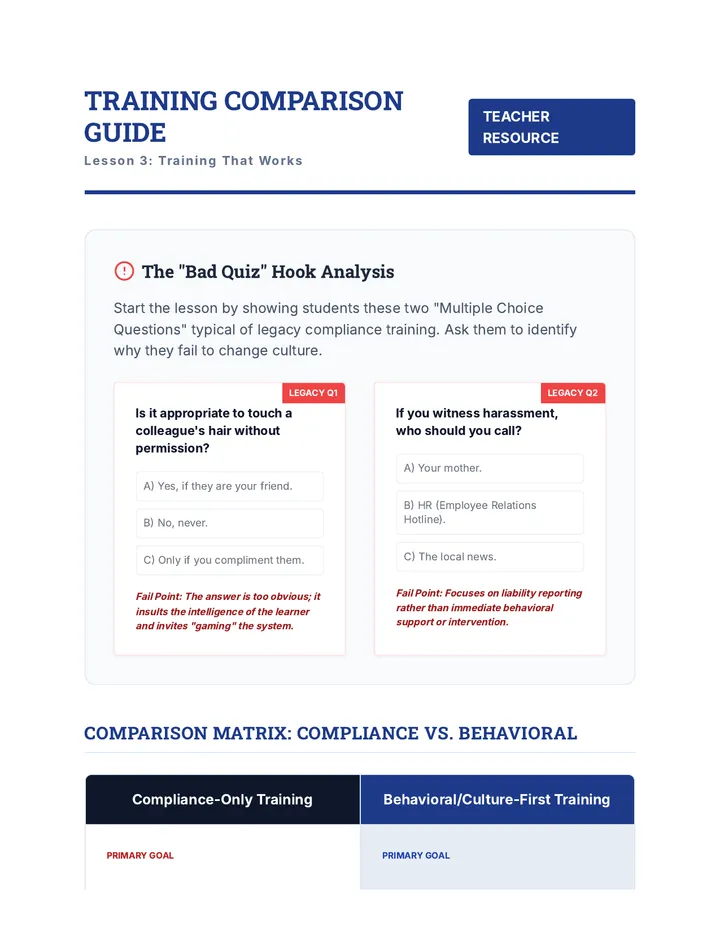
Analyzing why traditional sexual harassment training often fails, this lesson explores interactive and behavioral-based training models. Students design a training module that focuses on civility and respect rather than just liability avoidance.
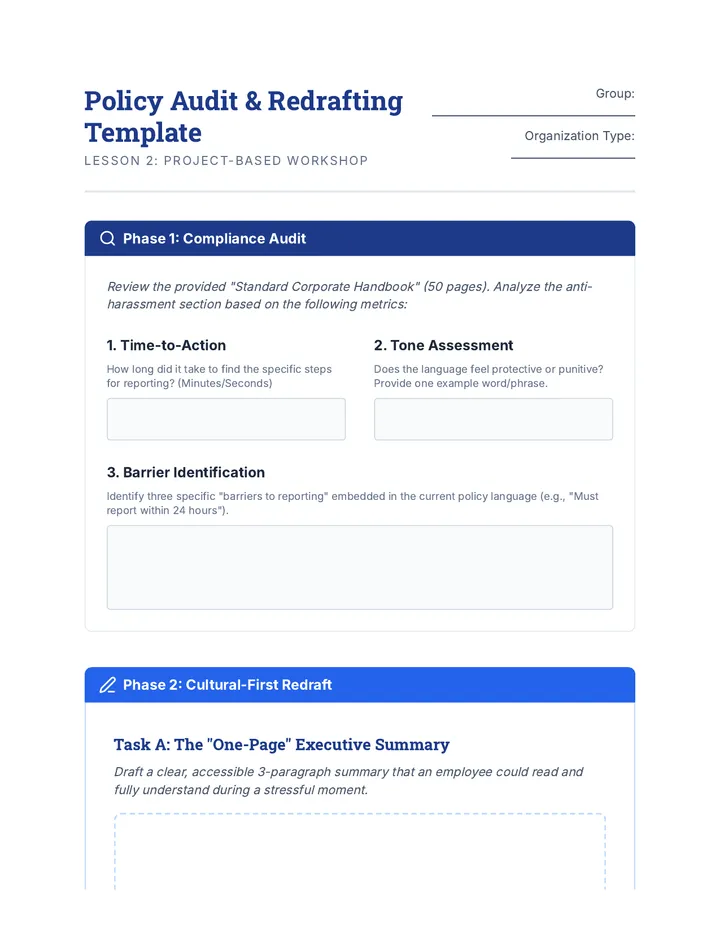
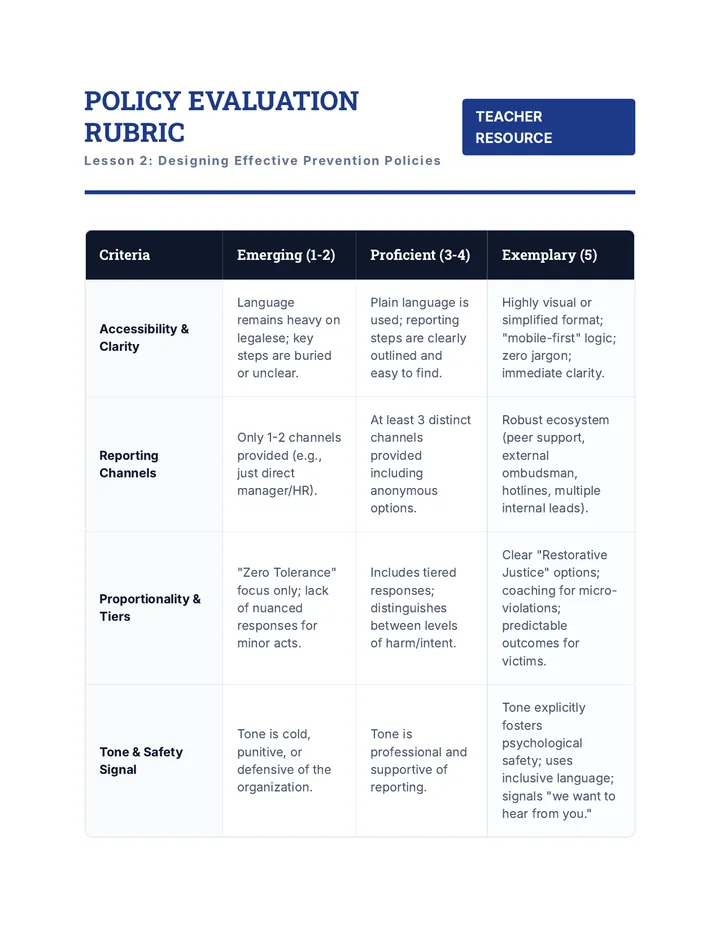
Critique standard zero-tolerance policies and explore nuanced approaches that encourage reporting and cultural health through effective policy design.
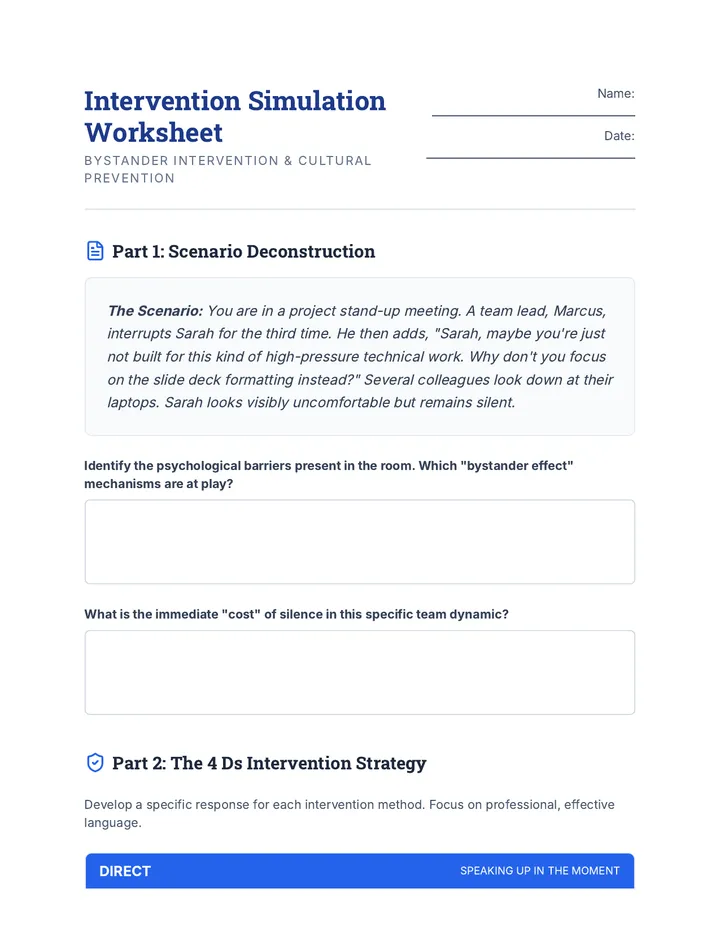
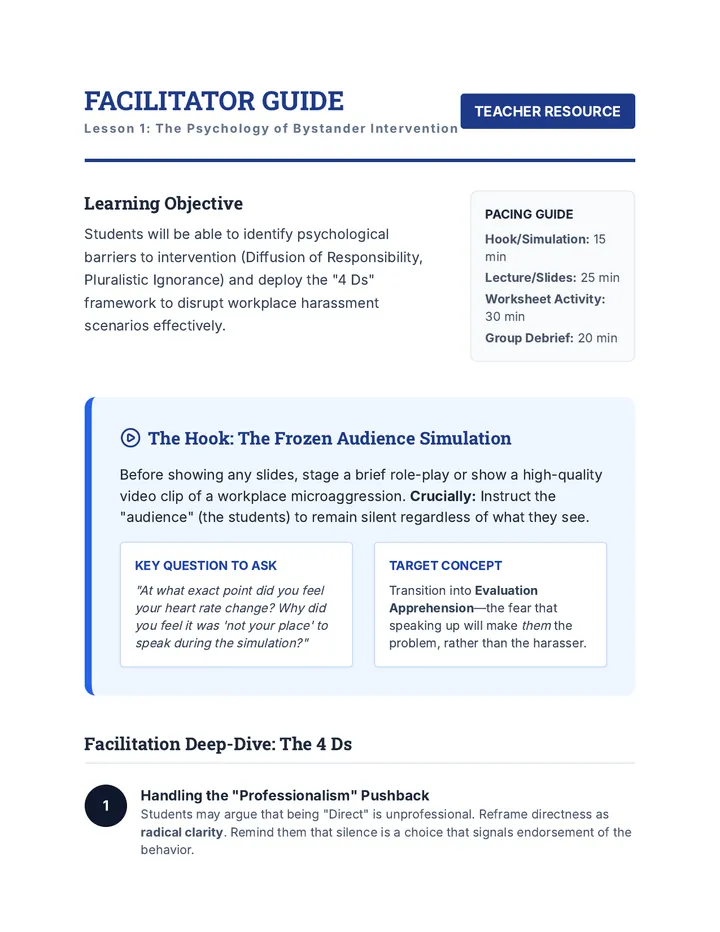
Explore the psychological barriers to intervening in workplace harassment and master the 4 Ds of bystander intervention through simulation and analysis.
Covers postvention strategies for community stabilization following a crisis. Students learn safe messaging guidelines and draft a cohort crisis response protocol.
Introduces vicarious trauma and compassion fatigue as ethical considerations. Students assess their personal resilience and create a post-intervention debriefing protocol.
Addresses the ethical challenges of dual relationships and the 'savior complex' in graduate cohorts. Students practice setting professional boundaries and defining the limits of peer support.
Focuses on identifying and mapping institutional resources beyond the counseling center. Students conduct a resource audit to understand the specific roles of the Dean of Students, Title IX, and Campus Police.
Explores the legal intersection of FERPA, HIPAA, and the duty to warn in a university setting. Students analyze the Tarasoff principle and develop a decision tree for breaching confidentiality during imminent risk.