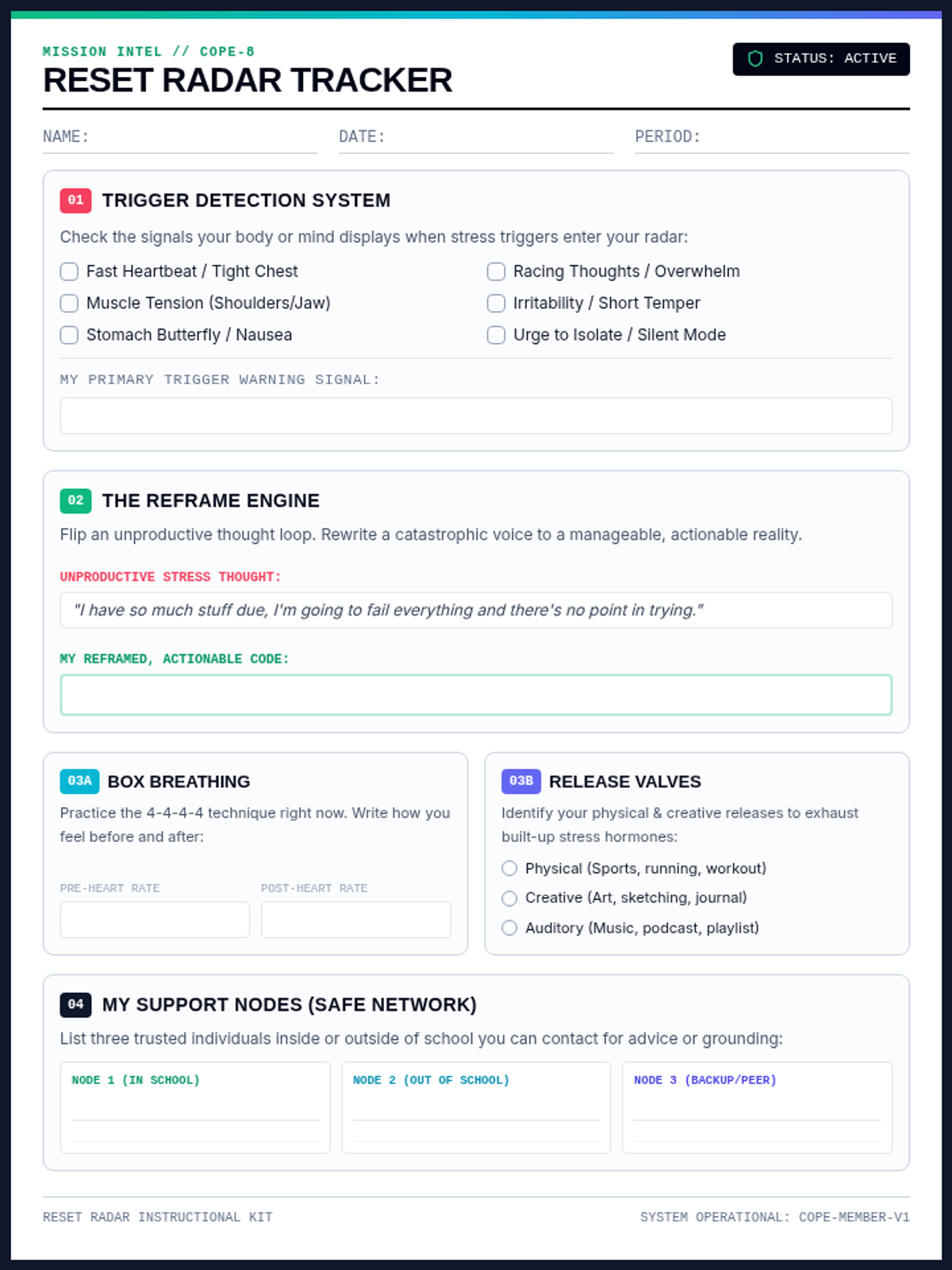
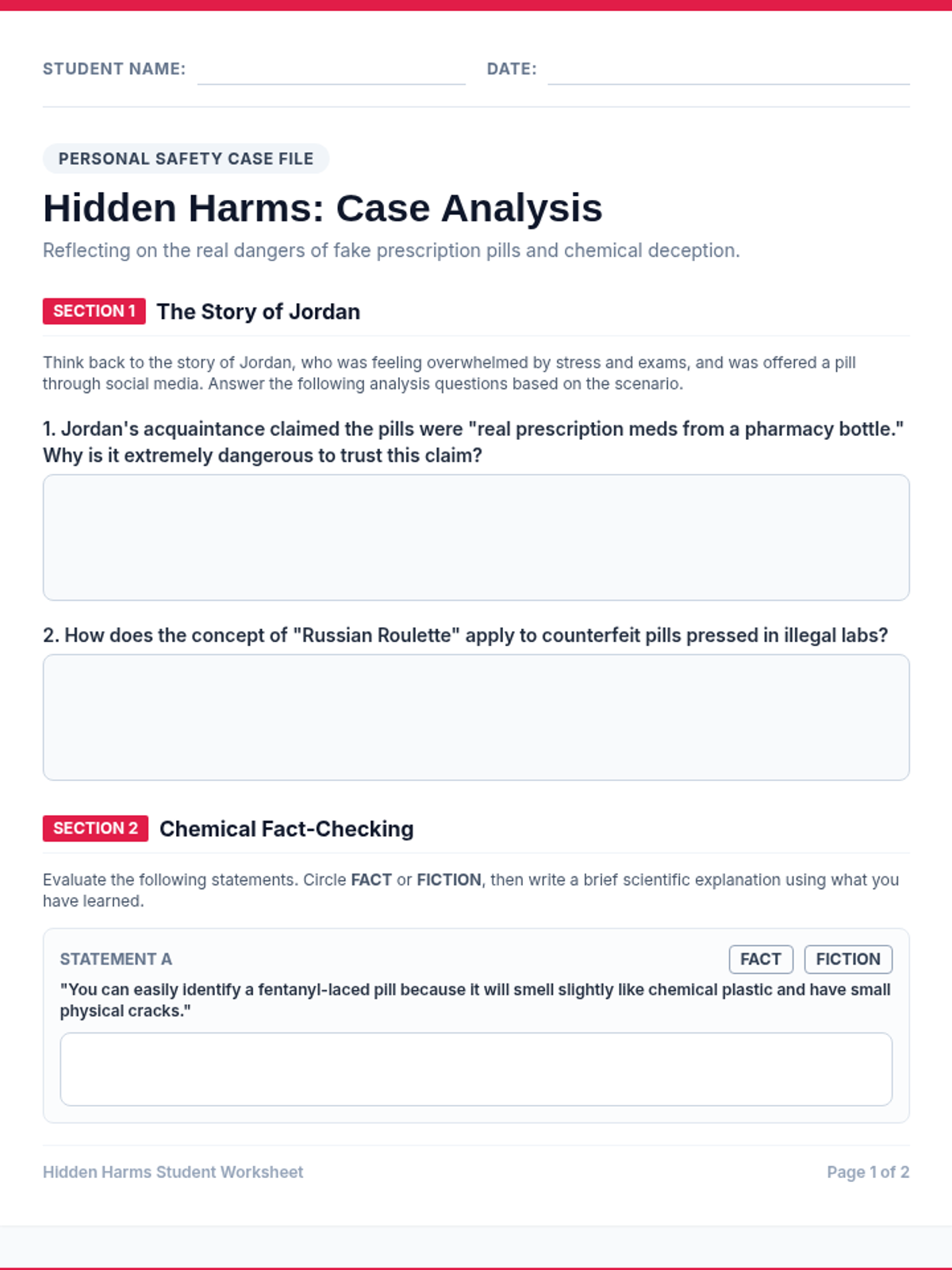
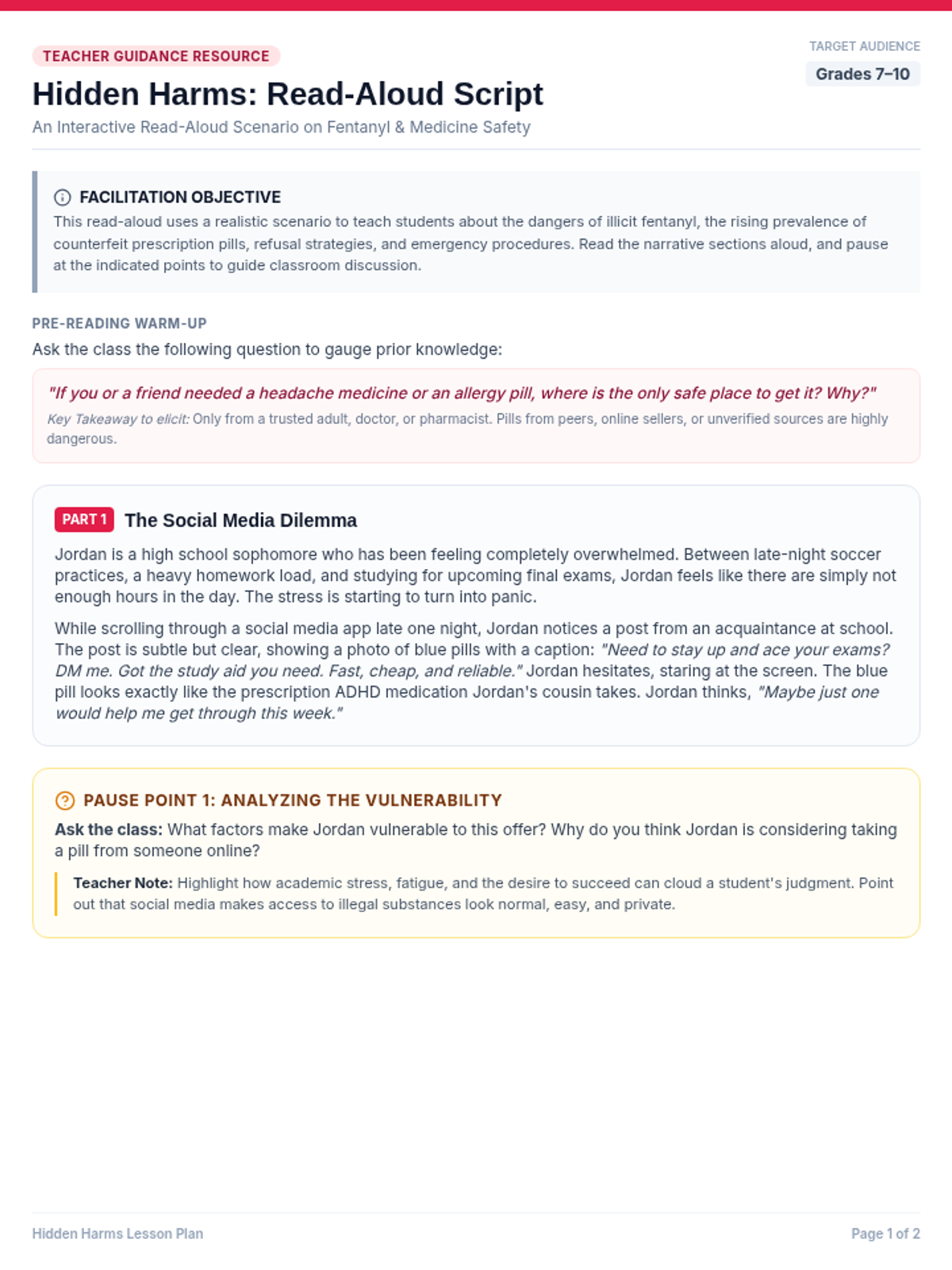
A comprehensive guide for teachers to facilitate the Mind Armor lesson, including discussion prompts, video timestamps, activity requirements, and common misconceptions to address.
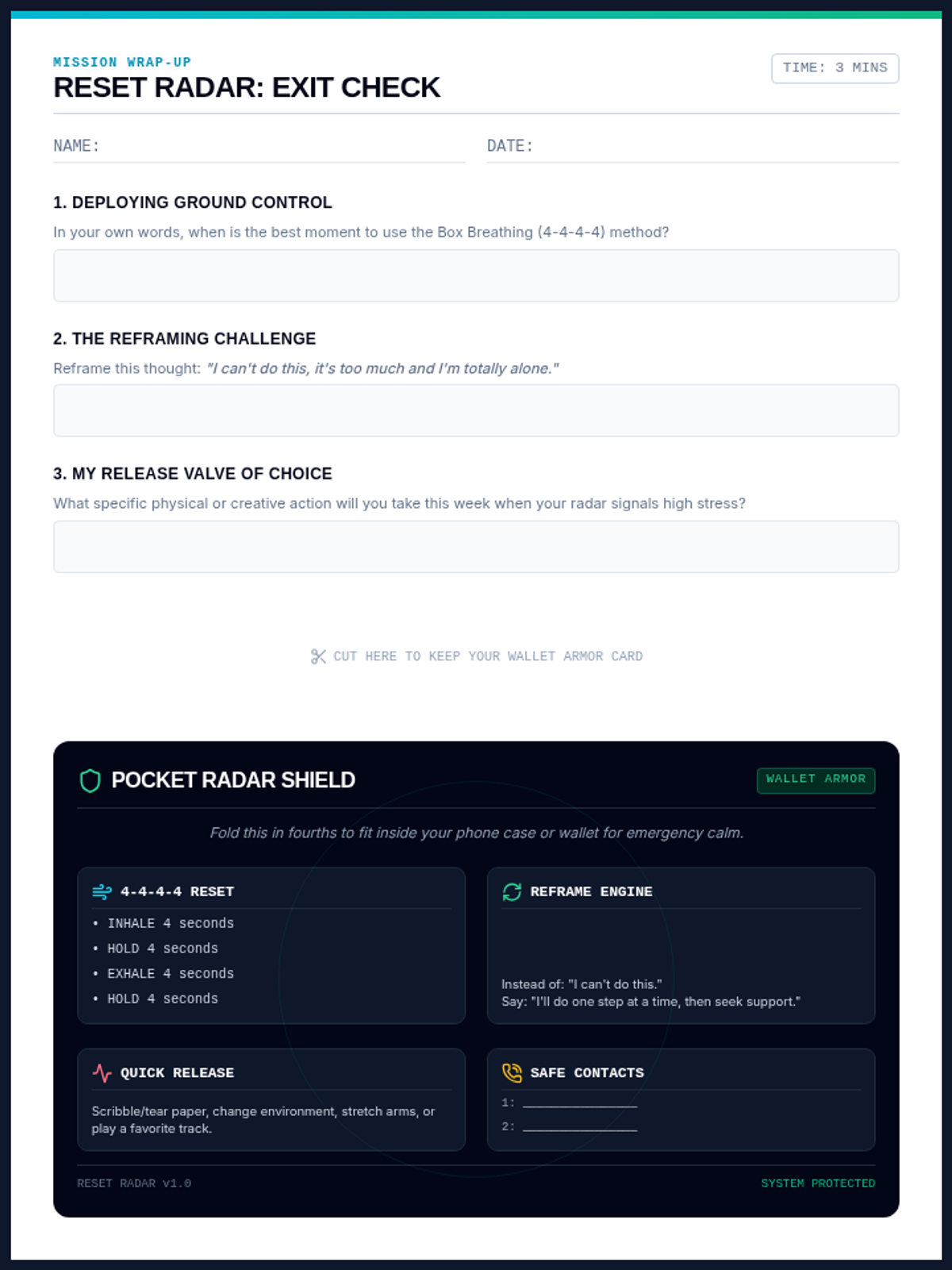
A polished version of the "Self Care Blueprint" worksheet with improved spacing to ensure it feels open while still fitting perfectly on one page.
A student-facing "Solo Reps Log" worksheet designed for tracking completion of 16 different individual drills. Includes categories for walkovers, handsprings, aerials, and core strength with checkbox tracking for multiple sets.
A comprehensive 1-page reference guide for students containing 12 individual drills they can perform on side-mats without a spotter. Drills are categorized by skill focus: Walkovers, Power/Handsprings, Aerials, and Core.
An expanded set of 6 visual station cards designed to be printed and placed at different areas of the gym. Includes dedicated stations for individual solo drills like handstand snap-downs and hurdle skips that don't require spotting.
An updated student-facing skills tracker for tumbling, now including a dedicated "Solo Foundations" section for tracking progress on individual drills like snap-downs, wall holds, and hurdle timing.
A revised 2-page coaching guide for the tumbling session, now featuring a management strategy for balancing spotted skills with new solo/individual drill stations. Includes updated timeline and coaching tips for solo skill acquisition.
A visual reference sheet for a pom dance routine, illustrating essential arm motions (High V, T, etc.) and jazz technical skills with clear descriptions and diagrams.
A professional assessment rubric for a pom dance routine, featuring specific criteria for precision, technique, musicality, and performance with space for teacher feedback.
A vibrant presentation for a jazzy pom dance class, highlighting routine style, essential pom positions, formation strategies, and performance energy.
A comprehensive teacher choreography guide for an intermediate jazzy pom routine to 'Under the Sea', starting at the 1:58 mark with timestamped breakdowns.
Facilitation guide for teachers, including detailed pacing, material checklists (including drawing supplies), discussion prompts with video timestamps, and a key for the student worksheet.
Visual anchor chart summarizing the gut-brain axis, identifying key organs, the role of neurotransmitters, and the contrast between premium and jamming fuels.
Student worksheet featuring spaces for warm-up reflections, video notes, a large drawing area for the 'Neurotransmitter Highway' diagram, and a mood-fuel reflection prompt.
A printable page of "Stress Audit" cards for the warm-up activity. Each card provides a space for students to anonymously write down a personal stressor, serving as a replacement for physical sticky notes.
Instructional guide for teachers to deliver "The Calm Cafe" lesson. Includes pacing, discussion prompts for video pause points, differentiation strategies, and extension ideas to encourage student engagement with self-care practices.
A 2-page student worksheet designed like a cafe menu. Page 1 allows students to list "Appetizers" (2-min), "Main Courses" (15-30 min), and "Desserts" (social) self-care strategies. Page 2 includes a 7-day challenge tracker for the extension activity.
Visual presentation for "The Calm Cafe" lesson, including the "Self-care techniques" video, warm-up instructions, guiding questions, and self-care menu activity steps. Designed for 6th-8th grade with clear, accessible text and calming visuals.
Four detailed character scenarios for students to analyze during the 'Accumulation Effect' activity. Each scenario depicts a week of emotional suppression, providing concrete examples for students to map and then rewrite using mental health techniques.
A student worksheet for 'The Accumulation Effect' activity. It includes sections for tracking suppressed feelings in a character scenario, a visual 'Accumulation Vessel' to illustrate emotional build-up, and a rewrite section to apply daily check-in techniques.
A slide deck designed for the 'Unfelt Feelings' health lesson, featuring the video embed, discussion prompts, and visual explanations of emotional suppression and transformation techniques.
A comprehensive teacher facilitation guide for the 'Unfelt Feelings' health lesson, including a 50-minute timeline, learning objectives, discussion anchors, and key vocabulary definitions.
Interactive presentation slides covering the gut-brain connection, neurotransmitters, and mood-boosting food groups, including embedded video and activity prompts.
An exit ticket assessment for the Brain Balance Mechanics lesson. It requires students to explain the concept of tolerance using the seesaw metaphor and identifies the biological cause of withdrawal through a multiple-choice question. Styled as a clean, professional card with clear handwriting areas.
A student worksheet for the Seesaw Model activity. It provides a structured three-step drawing area for students to visualize the biological process of brain adaptation: Baseline, Tolerance (adding counter-weights), and Withdrawal (the crash). Includes a short reflection question to check for understanding.