A comprehensive 5th-grade ESL lesson focusing on food chains and webs, integrating vocabulary development and complex sentence construction using Reading Universe guidelines.
A fast-paced, 20-minute lesson introducing students to the essential physical buttons and ports found on modern computers, focusing on identification and function.
A foundational look at robot anatomy, exploring how sensors, actuators, and controllers work together to create a functional machine.
Mise en pratique des connaissances pour résoudre un défi complexe de navigation et d'interaction.
Introduction à l'algorithmique et à la programmation par blocs pour diriger un robot à travers des missions précises.
Comprendre le schéma de fonctionnement d'un robot : capter, traiter, agir. Découverte des différents capteurs et actionneurs.
Identifier ce qu'est un robot, le distinguer d'une simple machine et découvrir les domaines d'application de la robotique.
An introductory lesson on photosynthesis for 5th graders, focusing on how plants transform sunlight into energy using chloroplasts and chlorophyll. Students will explore the process through visual aids, vocabulary building, and informational reading.
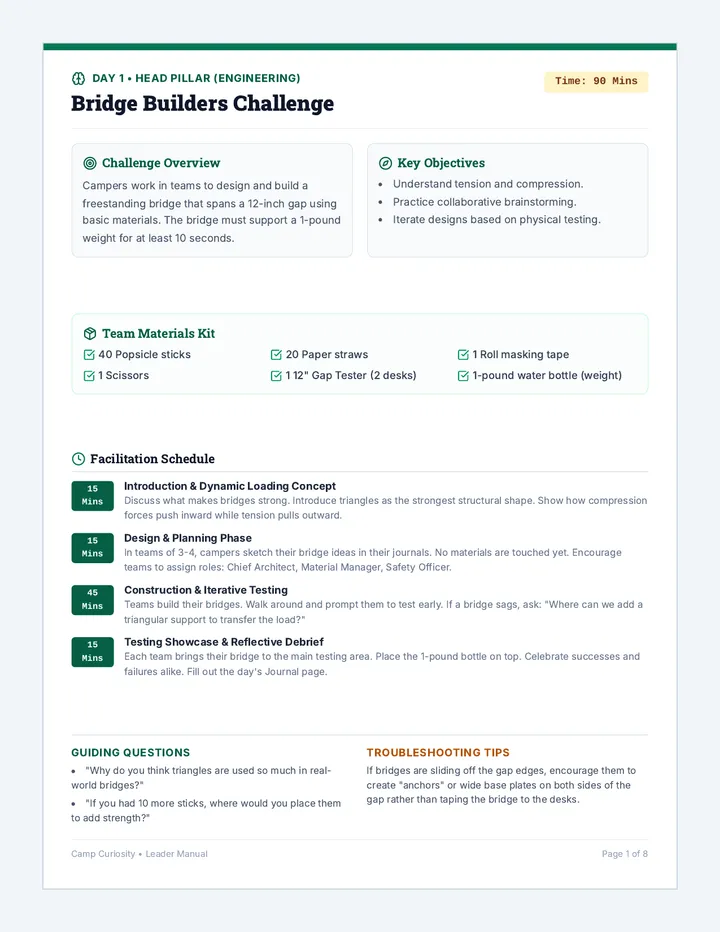
An advanced physics-based engineering unit for grades 4-5. Students take on the role of 'Roller Coaster Tycoons' to design gravity-powered coasters and braking systems, emphasizing variable testing, energy transfer, and safety criteria.
A fun-filled junior engineering lesson for grades 1-3. Students act as 'Thrill Seekers' to design steep, safe slides and sturdy ticket booths for a new amusement park, focusing on surface properties, friction, and structural stability.
An advanced disaster relief engineering unit for grades 4-5. Students design precision supply drop crates to protect medical gear and modular flood barrier systems to save a model town, emphasizing experimental variables and cost-to-performance criteria.
A high-energy junior engineering lesson for grades 1-3. Students join the 'Storm Rescue Team' to design unsinkable rafts for flood rescues and wind-resistant shelters for high-wind emergencies, focusing on material properties and modeling.
An advanced engineering challenge for grades 4-5 set in a Mars mission context. Students design landing systems to protect rovers and build structures to withstand extreme planetary conditions, focusing on experimental design and prototype evaluation.
A junior engineering lesson for grades 1-3 where students act as zoo designers. They solve real-world animal habitat problems by building waterproof canopies and sturdy bridges, focusing on modeling, tool use, and basic prototyping.
Fifth-grade students explore energy flow and conservation of matter by building wind turbine blades and sorting mixtures of recyclable materials.
Fourth-grade students analyze systems and stability by designing water filtration devices and flood defense systems for the city.
Third-grade students model systems and energy flow by creating habitats for pollinators and using solar energy to heat a habitat.
Second-grade students investigate cause-and-effect and measurement by building thermal insulators and protective packaging for fragile items.
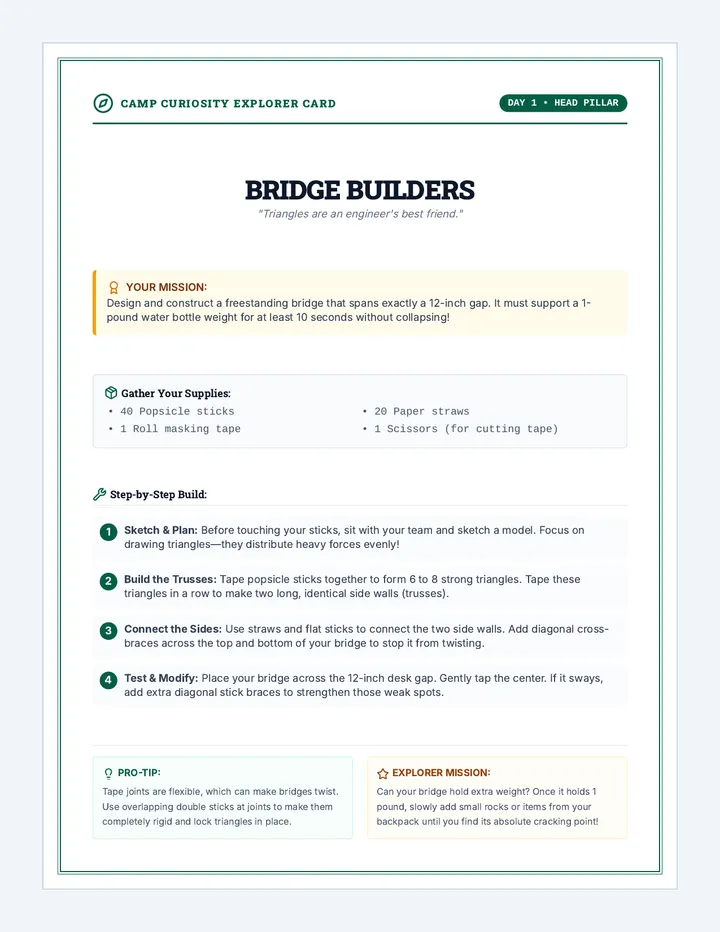
First-grade students explore patterns and structure-function relationships by designing shade structures and bridges for their local park.
Fifth-grade maestros perform advanced testing on conductivity, solubility, and mass to restore power to a science lab. Comprehensive STAAR review and engineering design.
Fourth-grade detectives classify matter using temperature, magnetism, and relative density to solve a water filtration mystery. Includes STAAR-aligned assessment questions.
Third-grade pilots test mass, magnetism, and buoyancy to recover sunken treasure. Explores the properties of solids, liquids, and gases including shape and volume.
Second-grade engineers investigate texture, flexibility, and physical states of matter to design components for an astronaut's spacesuit. Distinguishes between solids and liquids.
First-grade agents classify objects by size, weight, and multiple observable attributes to help a superhero organize their gadget bag. Focuses on heavier vs. lighter and larger vs. smaller.
Kindergarten students explore physical properties like shape, color, texture, and material to help a broken toy factory sort its inventory. Includes hands-on sorting and sensory exploration.
A comprehensive set of extension activities for the book 'The Boy Who Harnessed the Wind', featuring reading analysis, creative writing, renewable energy research, and a hands-on STEM engineering challenge.
Masters Insulation and Convection. Students engineer 'Arctic Armor' to stop heat transfer and visualize 'Convection Currents' in liquids to understand energy flow.
Focuses on Radiation and Conduction. Students build Solar Ovens to harness radiation and conduct the 'Spoon Showdown' to test how different materials transfer heat via conduction.
Explores phase changes in water (solid, liquid, gas). Students solve the "Desert Water Trap" using 'Ice Island Rescue' and 'Cloud Catcher' activities to master evaporation and condensation.
Investigates how physical properties change through melting, freezing, and sanding. Students explore the "Sanding Lab" and "Chocolate Foundry" to see how energy changes materials.
Focuses on identifying changes caused by heating and cooling, specifically distinguishing between reversible (melting wax) and irreversible (baking/cooking) changes. Includes 'Crayon Sculptors' and 'Pancake Puzzle'.
An immersive study of lions, exploring their social structures, habitats, and survival strategies in the African savanna.