A vocabulary building lesson featuring a high-quality matching card game and a corresponding answer key to help students master academic roots and terms across various subjects.
A pre-reading exploration of the scientific theories and literary motifs that underpin Nicola Yoon's 'The Sun Is Also a Star'. Students research and create posters on concepts like quantum entanglement and fate to prepare for the novel's themes.
A sophisticated figurative language review for high school juniors featuring quotes from The Great Gatsby, The Crucible, and The Raven. Students identify literary devices to unlock a color-coded geometric mosaic.
A set of scaffolded writing resources designed to help students with ADHD and SLD craft a 5-paragraph reflective essay from the perspective of Elisha Wiesel. The materials focus on synthesizing themes from 'Night' and a contemporary article about Wiesel's legacy.
This lesson covers Chapters 1-3 of Zora Neale Hurston's 'Their Eyes Were Watching God', focusing on Janie's early life, the symbolism of the pear tree, and her first marriage. Students will analyze the setting of Eatonville and Janie's internal character growth.
A guided exploration of the opening chapters of 'Their Eyes Were Watching God', focusing on Janie's return, the significance of the pear tree, and the vibrant setting of the Eatonville porch. This lesson adapts the complex themes and dialect for 6th-grade comprehension while maintaining the lyrical beauty of Hurston's prose.
A collection of accessible reading materials for Shakespeare's Macbeth, specifically tailored for students requiring large print and modern translations. This lesson ensures all students can navigate and comprehend the play during classroom instruction.
Focuses on drafting and finalizing the narrative using differentiated scaffolds and final writing paper.
Focuses on brainstorming and planning using a beginning-middle-end graphic organizer and introductory slides.
A deep-dive Socratic Seminar centered on Dostoevsky's 'The Dream of a Ridiculous Man,' exploring themes of nihilism, the Fall of Man, and the power of individual empathy. Students prepare textual evidence and engage in peer-led discussion.
A full set of large-print, accessible script materials for Shakespeare's Macbeth, designed for students needing 20px font. Includes interleaved modern translations and original text with original page references.
Covers the tornado, the retrieval of the survival pack, and Brian's eventual rescue. Focuses on the irony of the survival pack and Brian's lasting changes as a person.
Tracks Brian's transformation into the 'New Brian' following the missed rescue plane. Focuses on resilience, the concept of 'tough hope', and mastery of his environment.
Centuries on the discovery of fire and the expansion of Brian's diet. Focuses on the 'spark' of hope and the intellectual process of problem-solving in the wild.
Explores Brian's first attempts at finding food and shelter, his encounter with the bear, and the physical toll of survival. Focuses on sensory details and the transition from shock to action.
Covers the pilot's heart attack, the plane crash, and Brian's initial realization of his isolation. Focuses on the immediate conflict and the burden of 'The Secret'.
A comprehensive set of morphology games and activities focusing on two to three syllable words with open, closed, and VCE patterns combined with specific prefixes and suffixes. Students explore how affixes attach to unchanging base words to shift meaning.
A collection of games designed to reinforce closed, VCe, and open syllable patterns within prefixed and suffixed words for upper elementary students.
A comprehensive lesson on literary conflict, focusing on the distinction between internal and external struggles and exploring the four primary subtypes: Person vs. Self, Person vs. Person, Person vs. Nature, and Person vs. Society.
A deep dive into Chapter 7 of The Outsiders, exploring the aftermath of the fire, Johnny's condition, and the unexpected conversation between Ponyboy and Randy.
A comprehensive review of sentence structures including simple, compound, complex, and compound-complex sentences using a construction-themed approach. Students will analyze blueprints of sentences and build their own using specific grammatical tools.
A lesson exploring the primary types of literary conflict, categorized by internal and external forces, using a detective-themed 'case file' approach.
A comprehension check for Chapter 12 of The Last Kids on Earth and the Nightmare King, featuring key plot points and character actions.
A lesson focused on Telemachus's growth and the events of Book 2 of The Odyssey, specifically designed with high visual support for ELL students at WIDA levels 1-2.
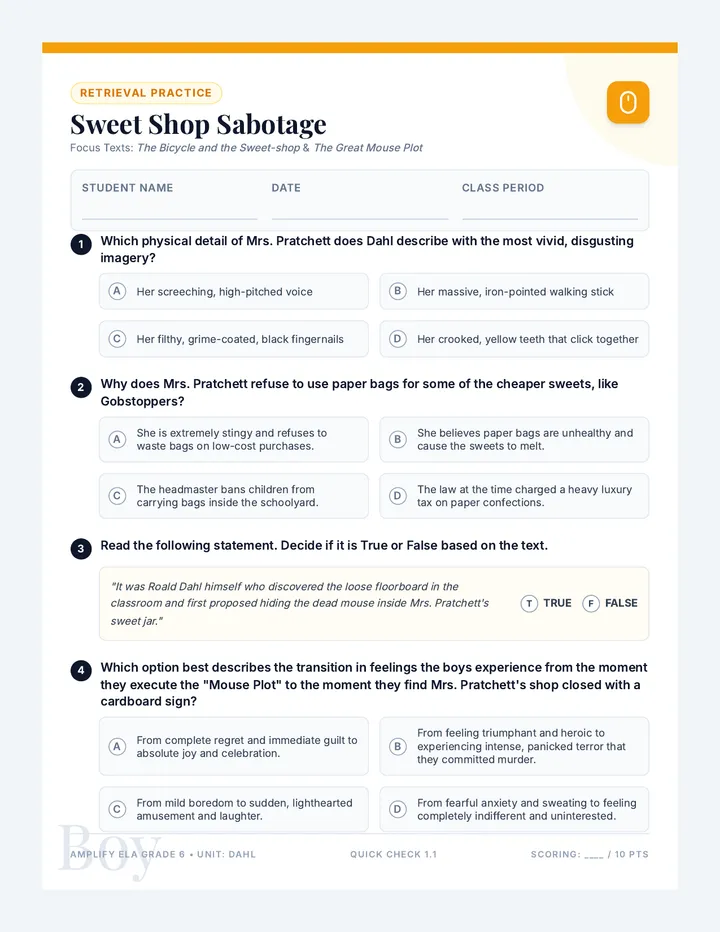
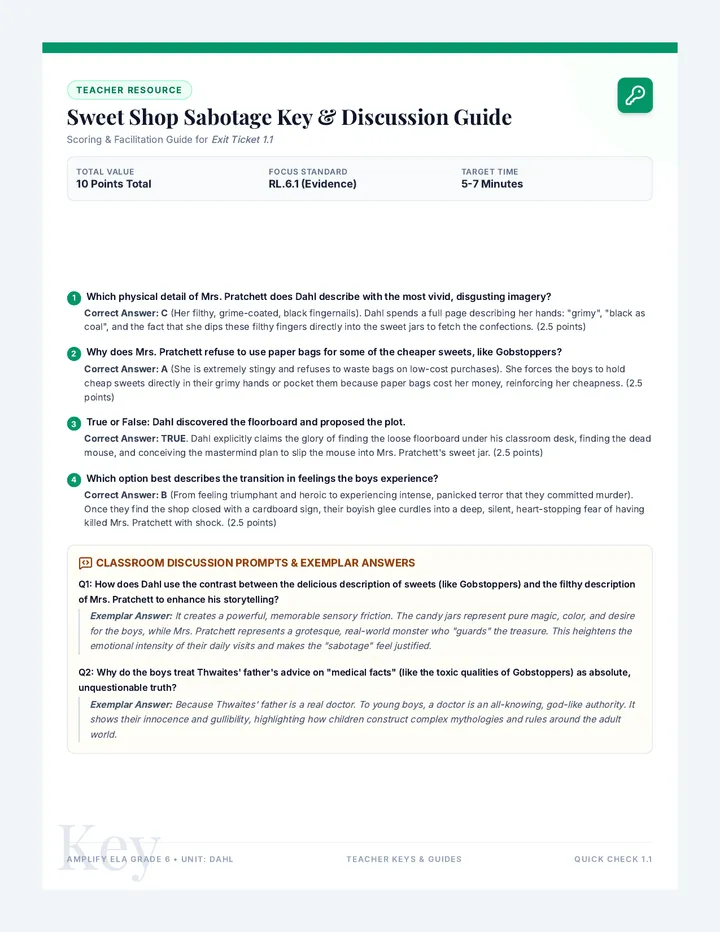
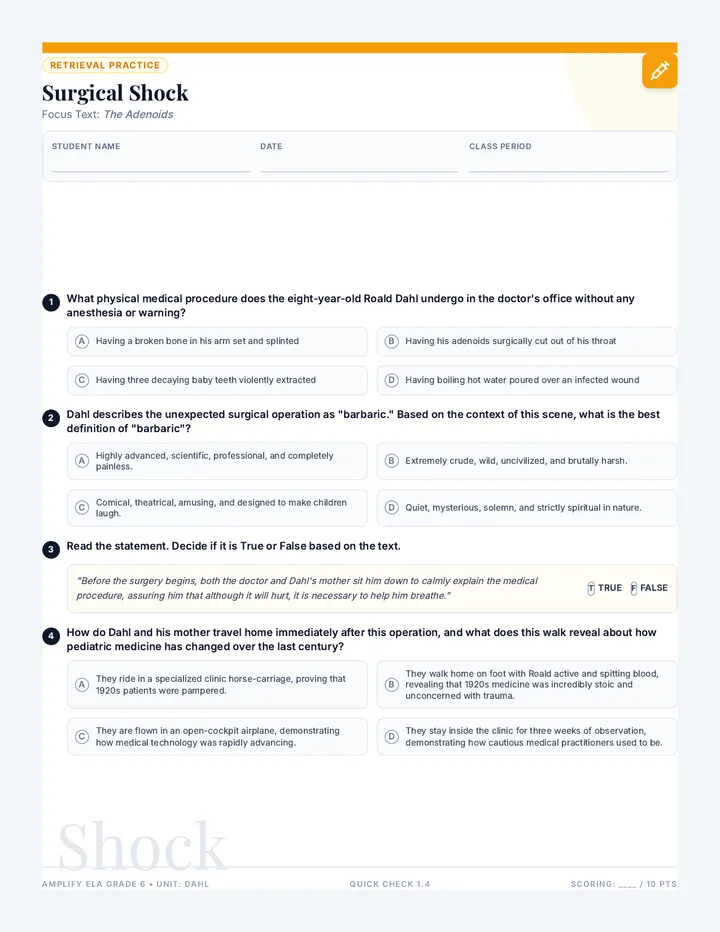
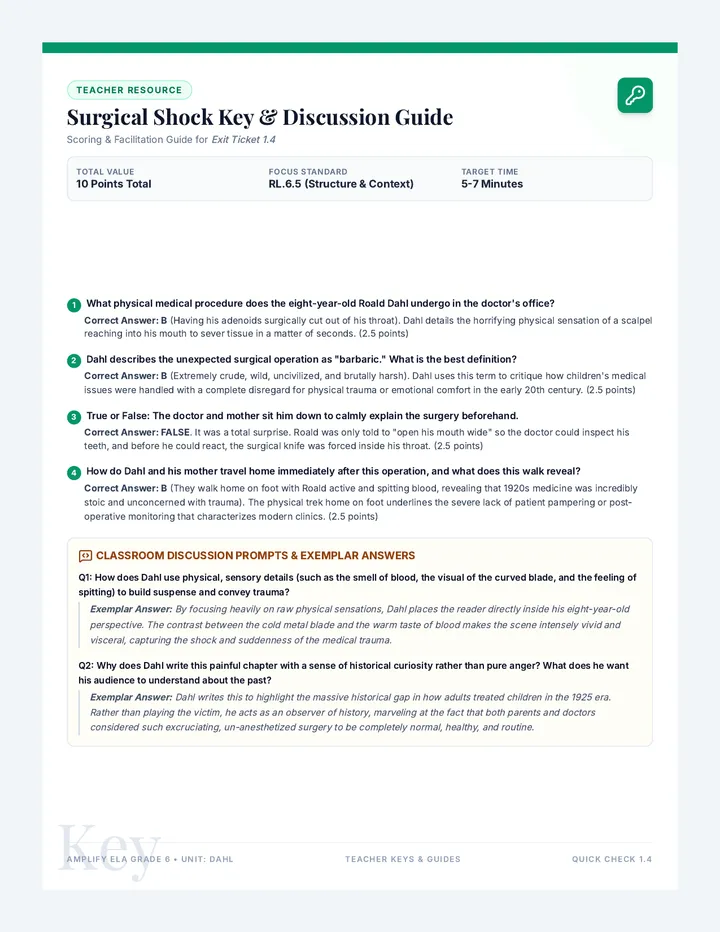
A mystery-themed lesson where students act as detectives to master making inferences and summarizing main ideas through a short story investigation.
A focus on advanced grammar concepts for 8th-grade students, specifically mastering parallel structure in complex sentences to improve writing flow and clarity.
A high-impact, 10-minute lesson designed to help 8th graders master participial phrases through structural analysis and creative writing.
A collection of five reading passages and comprehension questions designed for beginning 4th-grade students to practice literal and inferential reading skills.
A lesson focused on summarizing the key events of Books 1-10 of Homer's Odyssey for English Language Learners, using visual supports and simplified language.
A 3-page narrative summary and analysis of the history of Eatonville, Florida, and the legacy of author Zora Neale Hurston. Designed for a 7th-grade reading level with a focus on community identity and historical preservation.
A culminating week where students compile their work into a portfolio and perform a 'Final Verse' for their peers.
Teaching students that poems can tell stories. Students will read and write short narrative verses about everyday events.
Exploring the emotional side of poetry. Students will identify how a poem makes them feel and what 'vibes' the author is sending.
Helping students find the 'big idea' or lesson in a poem. Students will identify simple themes like bravery, friendship, and change.
Exploring how poems can make objects act like people (personification) and how words can sound like their meanings (onomatopoeia).
Introducing similes and metaphors as "secret comparisons." Students will use simple 'like' and 'as' structures to describe themselves and their world.