Students explore chronological order and temporal vocabulary through daily routines, school schedules, and stories. The unit focuses on terms like 'first,' 'next,' and 'last' to build foundational historical thinking skills.
A comprehensive introduction for Kindergarteners to the basics of economy, covering the difference between goods and services, how money is earned through work, and how it is used in a marketplace.
A Kindergarten sequence focused on introducing the concepts of scarcity, supply and demand, and resource management through hands-on simulations, sharing strategies, and problem-solving activities.
A Kindergarten sequence introducing the economic concepts of choices and opportunity cost. Students learn that choosing one thing means giving up another through games, stories, and reflection.
This Kindergarten sequence introduces the foundational economic concept of distinguishing between essential needs and discretionary wants through interactive discussions, sorting activities, and simple budgeting simulations. Students move from identifying survival items to making prioritized choices, building a baseline for financial literacy.
A hands-on introduction to economics for 1st graders, covering goods, services, producers, consumers, and the basic forces of supply and demand through a classroom 'Market Town' simulation.
A 1st Grade financial literacy unit exploring the origins of money, the concept of value, why prices change (inflation), and the connection between work and purchasing power. Students move from understanding barter systems to planning their own purchases.
A 1st Grade sequence introducing economic decision-making and the concept of opportunity cost. Students explore trade-offs through interactive games, a token shop simulation, and reflective journaling.
A foundational sequence for 1st graders exploring needs, wants, and scarcity. Students learn to differentiate survival essentials from desires and understand why resources are limited through simulations, games, and creative projects.
A comprehensive sequence for 1st-grade students to understand financial decision-making, covering scarcity, needs versus wants, and the fundamental concept of opportunity cost through relatable scenarios and creative projects.
A vibrant introduction for 1st graders to Spanish-speaking holidays and family traditions, exploring Día de los Muertos, Las Posadas, and the history of piñatas.
A Kindergarten sequence focused on identifying and distinguishing Earth's landforms and water bodies. Students progress from basic land/water distinction to creating physical models of mountains, hills, plains, valleys, rivers, and lakes.
A Kindergarten sequence exploring the evolution of money from natural objects (shells and beans) to physical currency (metal and paper), global variations, digital forms (cards and taps), and future inventions. Students learn that money is a tool for exchange that has changed over time.
A Kindergarten economics sequence that introduces the basics of money, focusing on the difference between needs and wants, the concept of scarcity, making economic choices (opportunity cost), and the importance of saving.
This Kindergarten sequence introduces students to the concept of earning money through work. It explores community roles, distinguishes between work and play, simulates a classroom economy, and explains the difference between goods and services, culminating in a reflection on how families use earned income.
A Kindergarten sequence exploring the transition from bartering to using money. Students learn through simulation, role-play, and creative design why a common currency makes trading easier.
A 1st-grade sequence exploring basic economic principles including the difference between needs and wants, scarcity, and the logic of making choices with limited resources. Students participate in a market simulation to apply their learning.
This 1st Grade sequence introduces the fundamentals of economics by exploring how money is earned through work, the difference between goods and services, and the importance of saving for the future. Students engage in classroom simulations and goal-setting to make abstract financial concepts concrete and actionable.
A 1st Grade sequence exploring the evolution of exchange, from the difficulties of bartering to the convenience of modern currency, helping students understand money as a problem-solving tool.
A Kindergarten sequence where students act as field researchers, learning to use observation and interviews to gather information about their school community. Students develop foundational research skills through hands-on data collection and synthesis.
This 1st Grade sequence explores power and authority through rules and voting. Students experience the necessity of rules, collaborate on classroom agreements, and learn the democratic process of voting and majority rule.
A 1st-grade civics sequence focusing on the distinction between coercive power ('bossy' behavior) and servant leadership ('helpful' behavior), while introducing the concept that all leaders are subject to limits and laws.
This first-grade sequence introduces the concept of authority figures at home, school, and in the community. Students learn to identify leaders, understand the purpose of rules, and distinguish between positive authority and bullying through interactive lessons and creative projects.
A Kindergarten sequence exploring democratic decision-making through individual vs. group choices, respectful opinions, voting methods, and majority rule, culminating in a class election.
A Kindergarten civics sequence that introduces the concept of authority figures and the purpose of rules at home, in school, and in the community. Students learn why rules exist for safety and fairness, and conclude by collaboratively creating a classroom constitution.
This sequence introduces Kindergarten students to foundational economic concepts through concrete experiences. Students explore the difference between needs and wants, encounter scarcity through a limited resource simulation, practice decision-making with trade-offs, and participate in a classroom market using earned tokens.
Students navigate a simulated classroom economy to learn budgeting, opportunity cost, and the difference between needs and wants through games and real-world scenarios.
A journey through the diverse ways families and cultures shape our identities. Students explore family structures, traditions, roles, and cultural heritage to build a sense of belonging and respect for diversity.
A 1st Grade Social Studies sequence focused on self-identity, exploring physical traits, inner personality, personal interests, and the history of names, culminating in a 'Me Museum' portfolio.
This Kindergarten Social Studies sequence explores social identity by examining how students fit into families, the classroom, and the wider community. Students learn that their personal identity is shaped by the groups they belong to through literature, discussion, and hands-on activities.
A 1st Grade sequence exploring chronology and sequencing in historical biographies. Students learn to distinguish past from present, identify signal words like 'first' and 'next', and construct timelines of famous lives.
Students use read-along informational texts to research community helpers, categorize tools, and compare roles, culminating in the creation of a 'Community Helper Profile Card'.
A Pre-K ELA sequence focused on reading comprehension through informational texts about community helpers. Students explore the roles, tools, and processes of firefighters, doctors, mail carriers, and builders through interactive read-alongs and role-play.
A virtual road trip across America for 1st graders to explore key landmarks and understand how they represent national ideals and history.
In this inquiry-driven sequence, students explore the concept of symbolism by investigating the most prominent American national icons. They learn to decode meanings behind colors, numbers, and animals, culminating in designing a symbol for their own classroom community.
A foundational sequence for Kindergarten students exploring needs versus wants, scarcity, and decision-making through interactive games and hands-on simulations. Students learn that resources are limited and making a choice involves giving something else up, building early financial literacy.
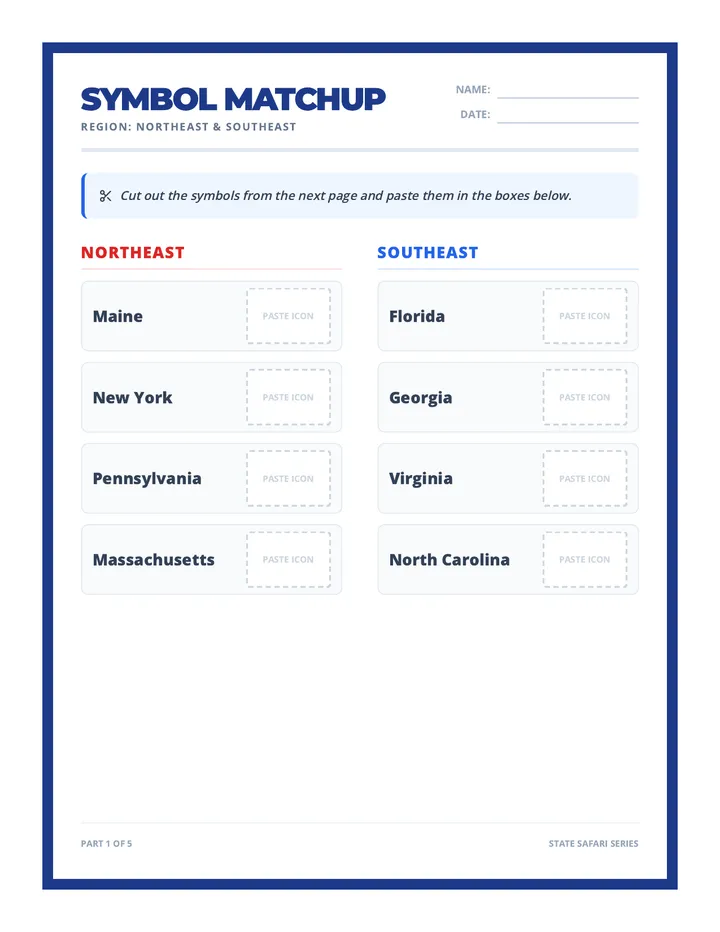
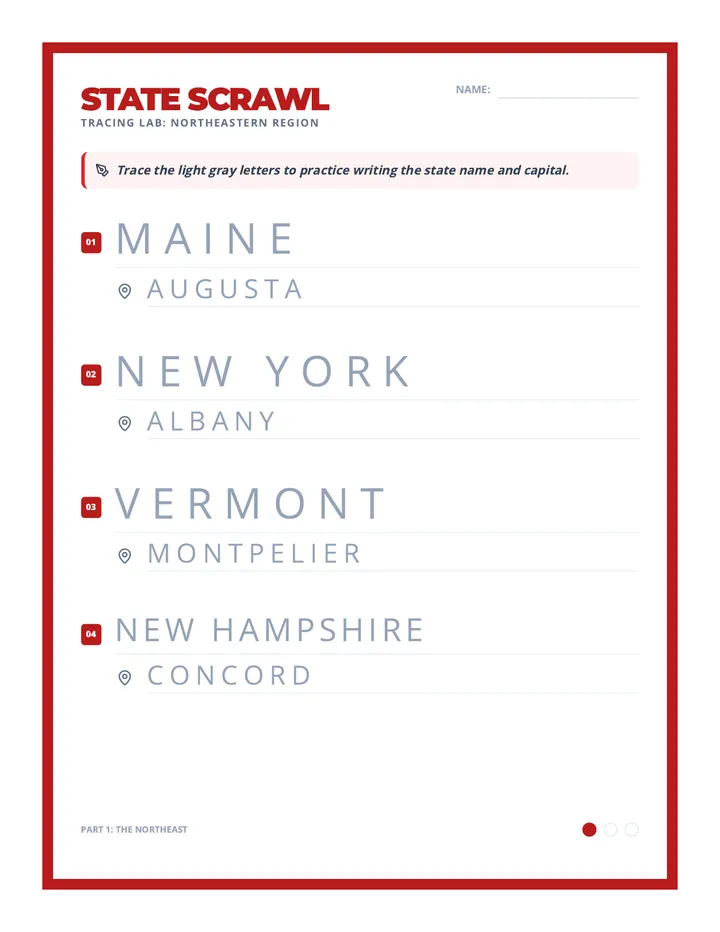
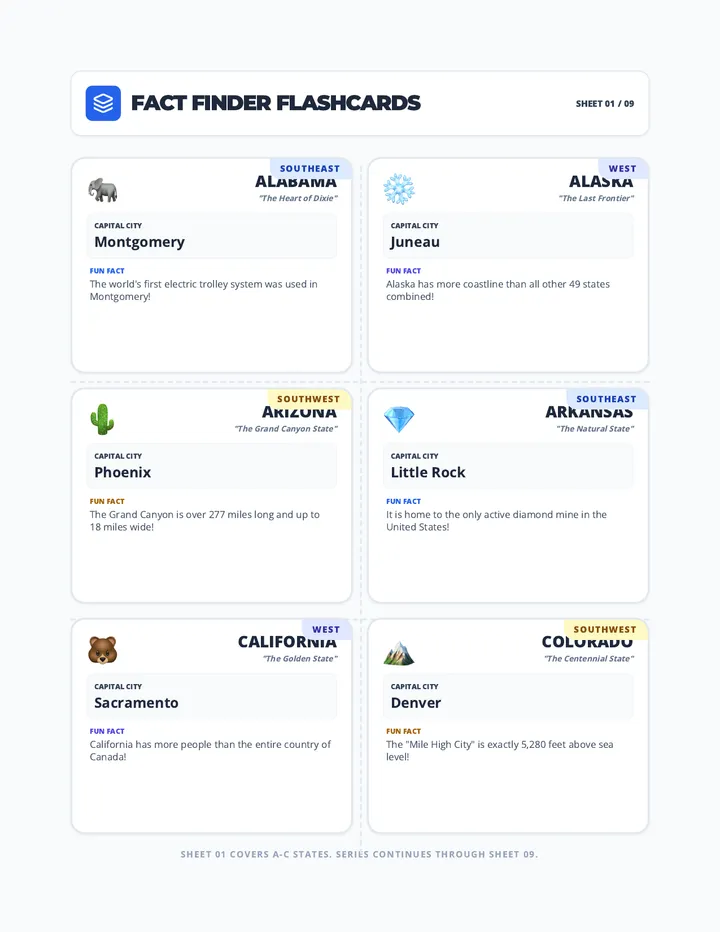
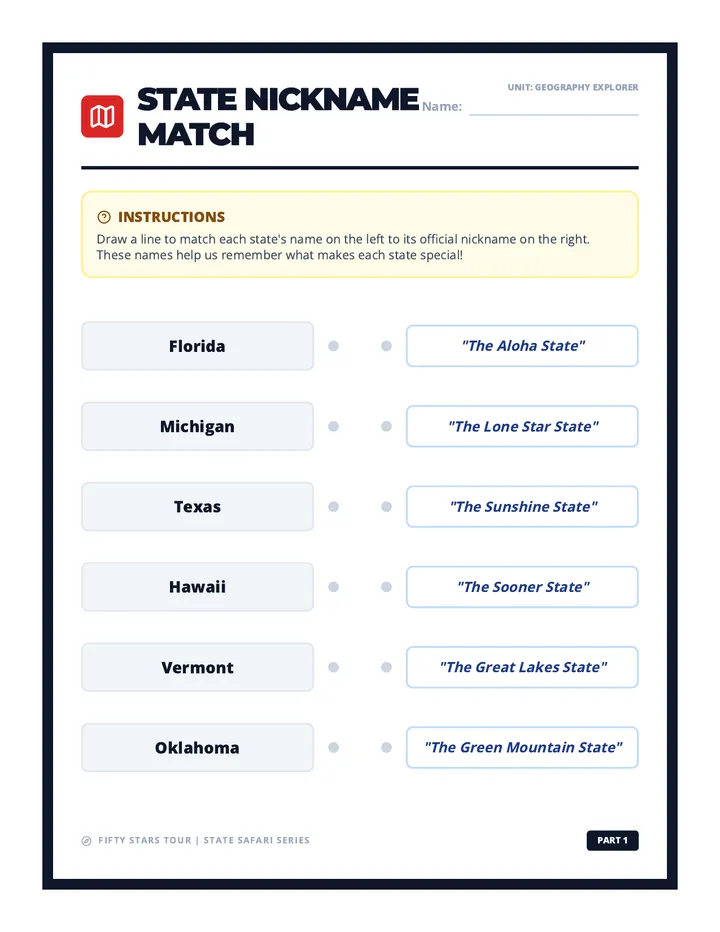
Students explore the concept of a 'state' as a distinct geographic and political entity. They learn to locate their state on a map, understand the hierarchy of city/state/country, identify official symbols, and recognize important regional landmarks.
A project-based exploration of how Native American history and culture were preserved through oral tradition, Winter Counts, wampum belts, and totem poles. Students create their own symbolic artifacts to understand history as a living, spoken, and artistic record.