An active, movement-oriented sequence for Pre-K students exploring how plants use wind, water, animals, and 'explosions' to move their seeds. Students engage in gross motor play and nature exploration to understand seed dispersal.
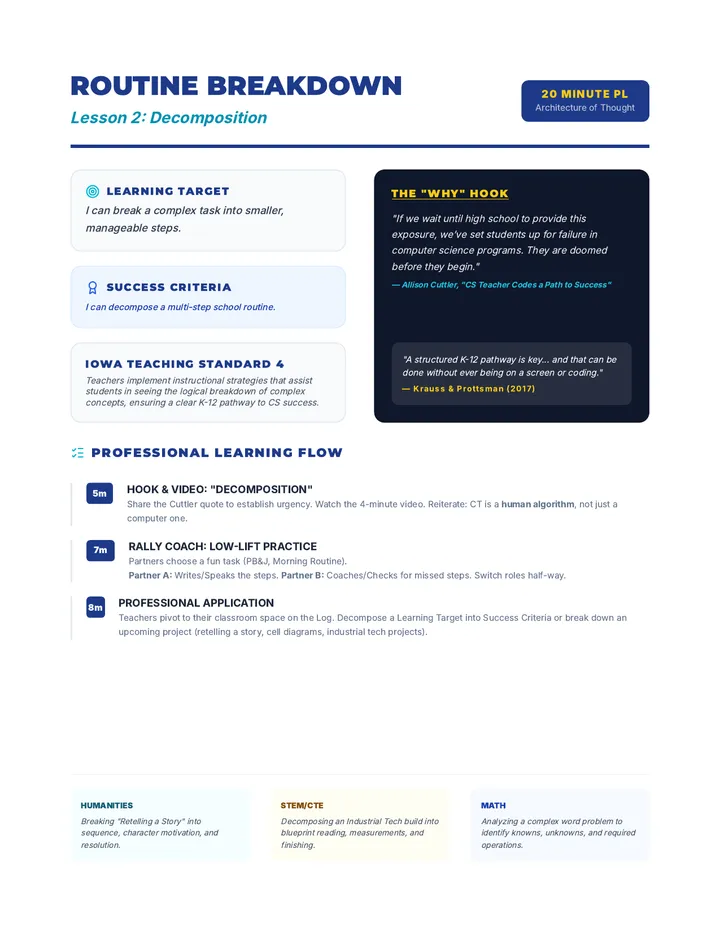
A professional development series for PreK-12 educators that reframes Computer Science as a "Superpower" through Computational Thinking. Teachers explore how CS concepts like decomposition, abstraction, and automation are already present in their daily instructional practices and Iowa Core content.
A five-part multi-sensory journey for preschoolers exploring the life cycle of a chick, from incubation to hatching. This sequence emphasizes fine motor skills, communication, and sensory exploration through hands-on activities.
A functional science unit for Essential Skills classrooms focusing on identifying push and pull forces within daily household chores and routines. Students explore forces through visual identification, movement-based games, and guided group activities.
A 3-day introductory science sequence for early learners (PreK-1st) exploring the fundamental needs of plants, animals, and humans. Students will discover commonalities in survival requirements through visuals, guided practice, and hands-on sorting.
A 4-day introduction to weather types and appropriate clothing choices for preschool and kindergarten students. Students explore hot, cold, rainy, and warm/sunny conditions through visual slides, hands-on sorting activities, and creative worksheets.
A comprehensive Pre-K exploration of weather types and seasonal changes through observation, hands-on experiments, and creative activities. Students will learn to identify common weather patterns and understand how the environment changes throughout the year.
A unit exploring different habitats through sensory observation and descriptive language, starting with the wide-open grasslands.
A fun, introductory science and math sequence for Pre-K and Kindergarten students focused on identifying animal habitats and practicing basic counting. Students explore different environments like the forest, ice, and homes through music and movement.
A project-based sequence for Pre-K students to learn basic digital creative tools, from launching apps to saving and showcasing digital art. Students develop mouse/touch skills and an understanding of file management through a 'Pixel Playground' theme.
A Pre-K sequence introducing the keyboard as a tool for letters and numbers. Students learn the layout, locate their own initials, understand the space bar's function, identify numbers, and learn the 'action' of the Enter key through play and exploration.
A foundational sequence for Pre-K students to learn the physical gestures and actions required to use tablets and computers, focusing on tapping, swiping, clicking, dragging, and navigating interfaces.
This sequence introduces Pre-K learners to computer hardware and device care. Students will learn to identify screens, mice, and keyboards while practicing safe and gentle handling techniques through hands-on play and exploration.
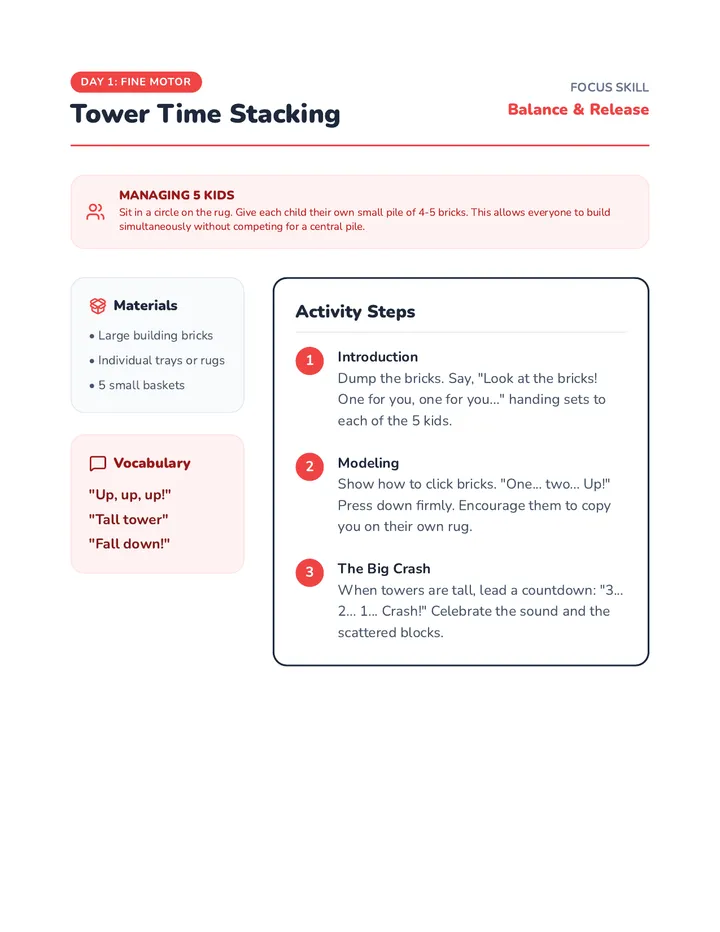
A Pre-K engineering sequence exploring shape composition, stability, and structural design through hands-on block play and spatial reasoning challenges.
A Pre-K physics sequence exploring three-dimensional solids. Students investigate the properties of spheres, cubes, cylinders, and cones through hands-on experimentation with rolling, stacking, and sliding to understand how shape dictates movement and stability.
A Pre-K physics unit exploring transparency, translucency, and opacity through hands-on flashlight testing, color filters, water refraction, and art projects. Students develop observation and sorting skills as they investigate how light interacts with different materials.
A hands-on physics sequence for Pre-K students to explore reflection, material properties, and light paths using mirrors and shiny objects. Students move from self-observation to problem-solving with periscopes and pattern creation.
A Pre-K science sequence exploring light sources, natural vs. artificial light, rainbows, color mixing, and sensory light play. Students engage in inquiry-based hunts, sorting activities, and engineering with light tables.
A hands-on, inquiry-based sequence for Pre-K students to explore light and shadows. Students discover shadows in their environment, manipulate shadow size, and use puppets to tell stories, understanding that shadows are formed when objects block light.
A problem-based physics sequence for Pre-K students exploring how materials protect objects from damage, water, and temperature. Students test properties like softness, water resistance, and insulation to solve real-world protection challenges.
A project-based physics sequence for Pre-K students exploring material properties, hardness, and structural stability through hands-on stacking and building challenges. Students act as little engineers to discover why certain materials are better for construction than others.
A hands-on exploration for Pre-K students to distinguish between rigid and flexible materials through physical manipulation, testing, and creative construction. Students learn to classify objects based on their ability to bend, stretch, and fold.
A hands-on investigation into how light and water interact with different materials. Pre-K students explore transparency, shadows, absorption, and buoyancy through inquiry-based play.
A tactile and exploratory science sequence where Pre-K students use their senses to observe, describe, and categorize materials based on properties like hardness and texture. Students progress from simple identification to complex sorting and peer communication.
Students explore how materials interact with light, moving from shadows and opacity to transparency and translucency, culminating in a sunshade design challenge.
This inquiry-based sequence teaches Pre-K students to understand the logic behind event sequences. Students investigate cause and effect, predict outcomes, identify logical errors, and explore natural cycles to answer 'Why does the order of events matter?'