Peer relationship navigation, conversational turn-taking, and stress management strategies within supportive group settings. Develops communal belonging through shared mental health education and collaborative skill practice.
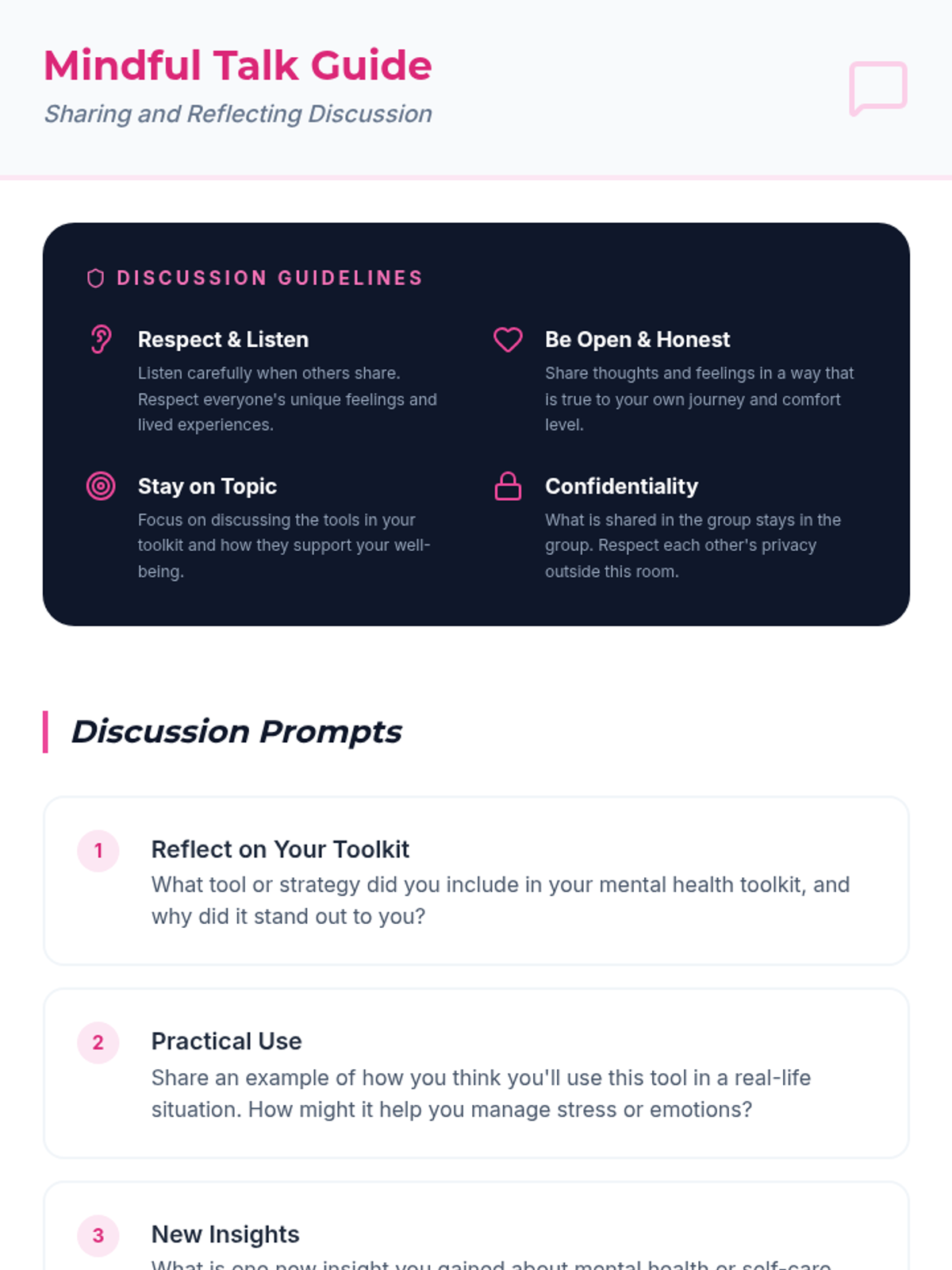
A discussion guide for facilitators to lead a reflection and sharing session about mental health toolkits and well-being.
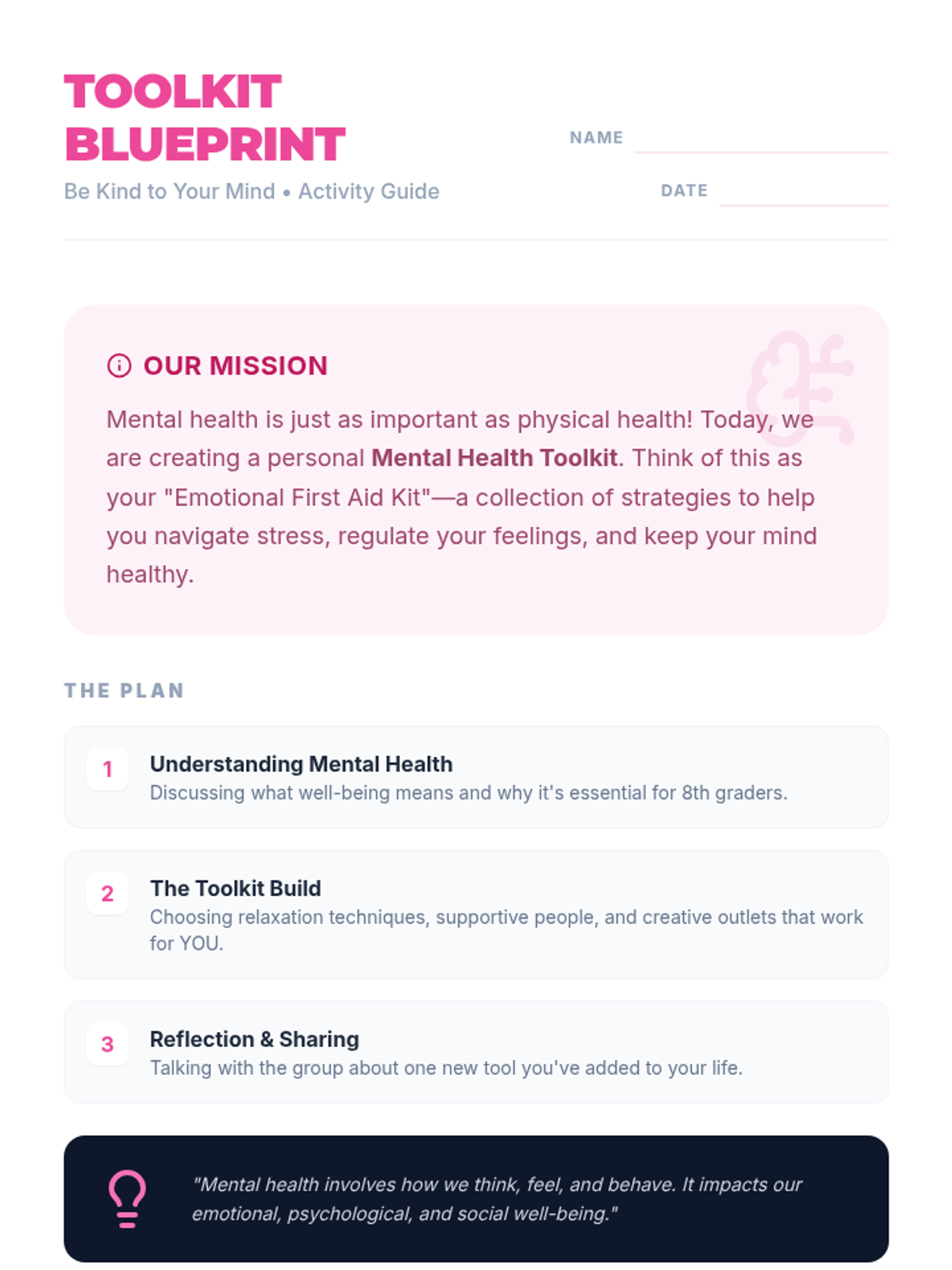
A student worksheet for identifying and planning the use of mental health tools, including a session overview and clear spaces for reflections.
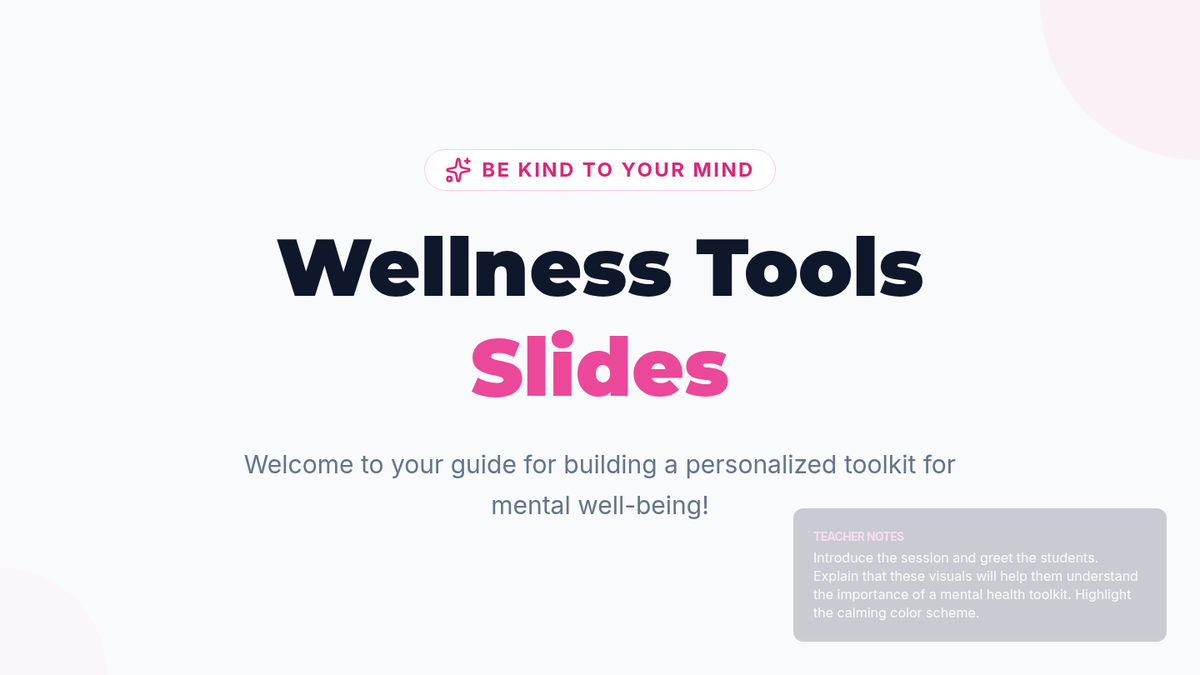
A visual presentation guide for the Be Kind to Your Mind session, introducing mental health concepts and various types of self-care tools.
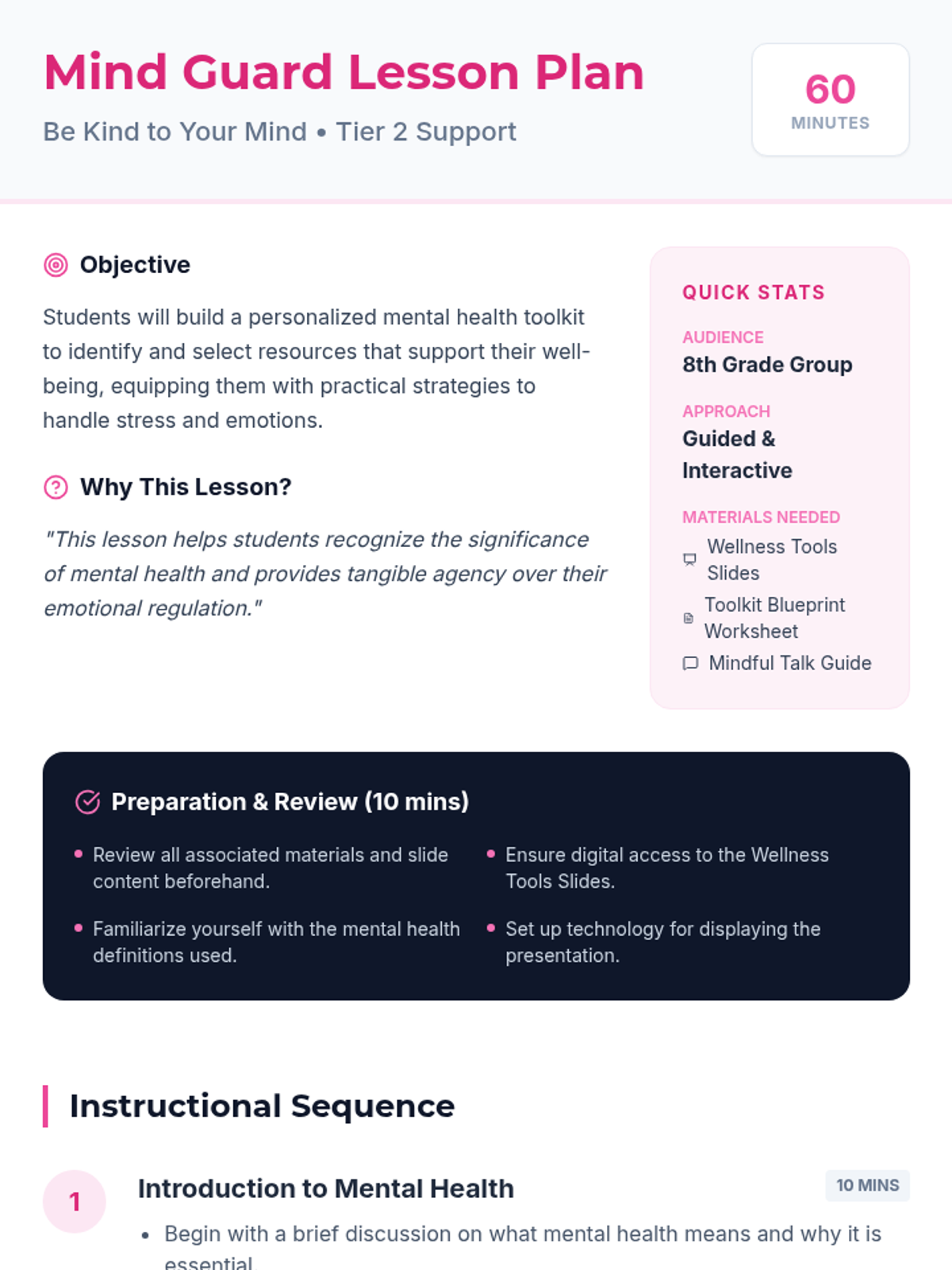
A comprehensive teacher lesson plan for the Be Kind to Your Mind session, detailing preparation, objectives, and a 60-minute instructional sequence.
A visual presentation for the Next Stop High School lesson, featuring a metro/transit theme to guide 8th graders through emotional reflection and practical transition planning.
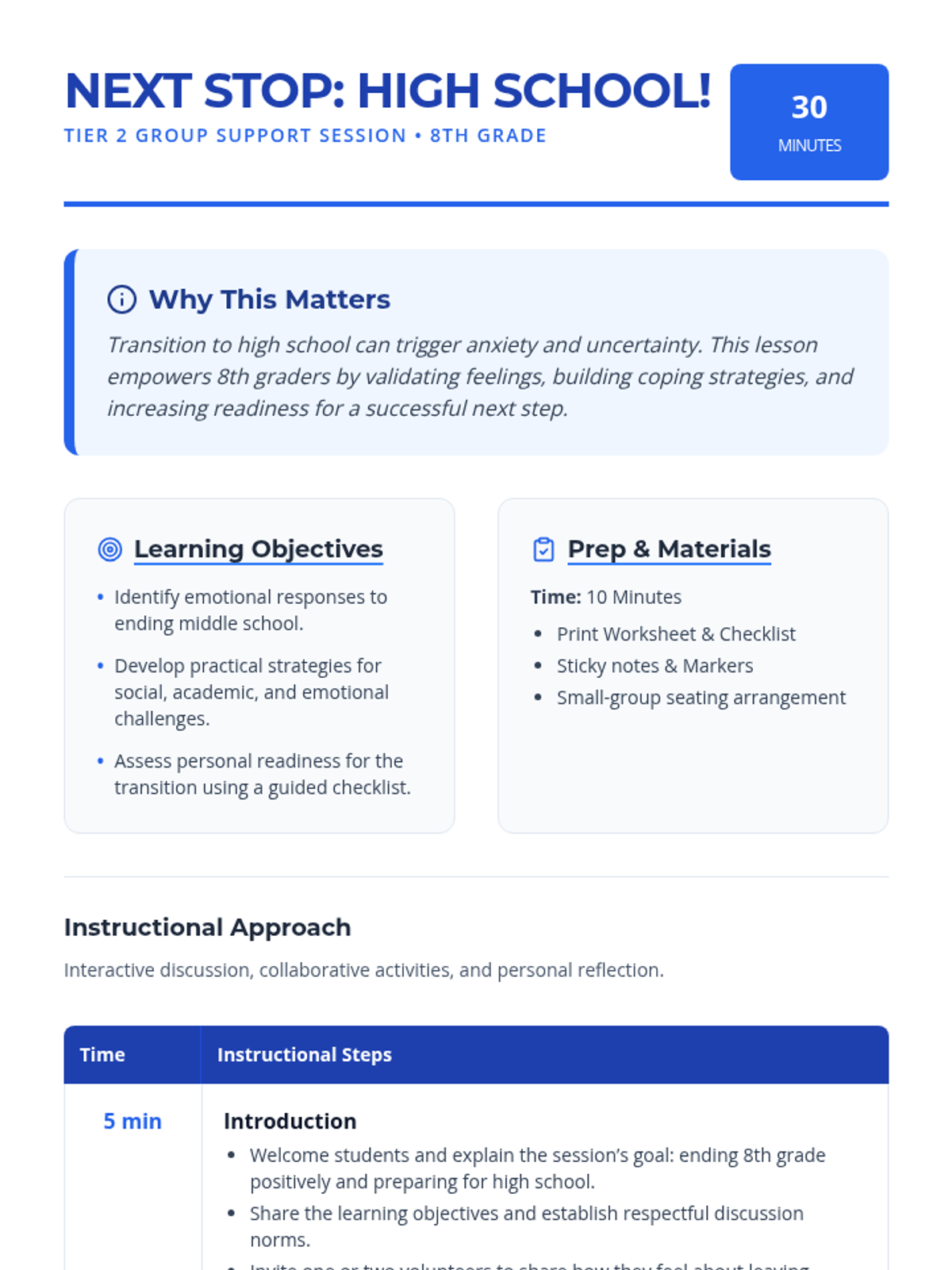
A comprehensive teacher facilitation guide for the 30-minute Next Stop High School lesson, including time breakdowns, instructional steps, and discussion prompts.
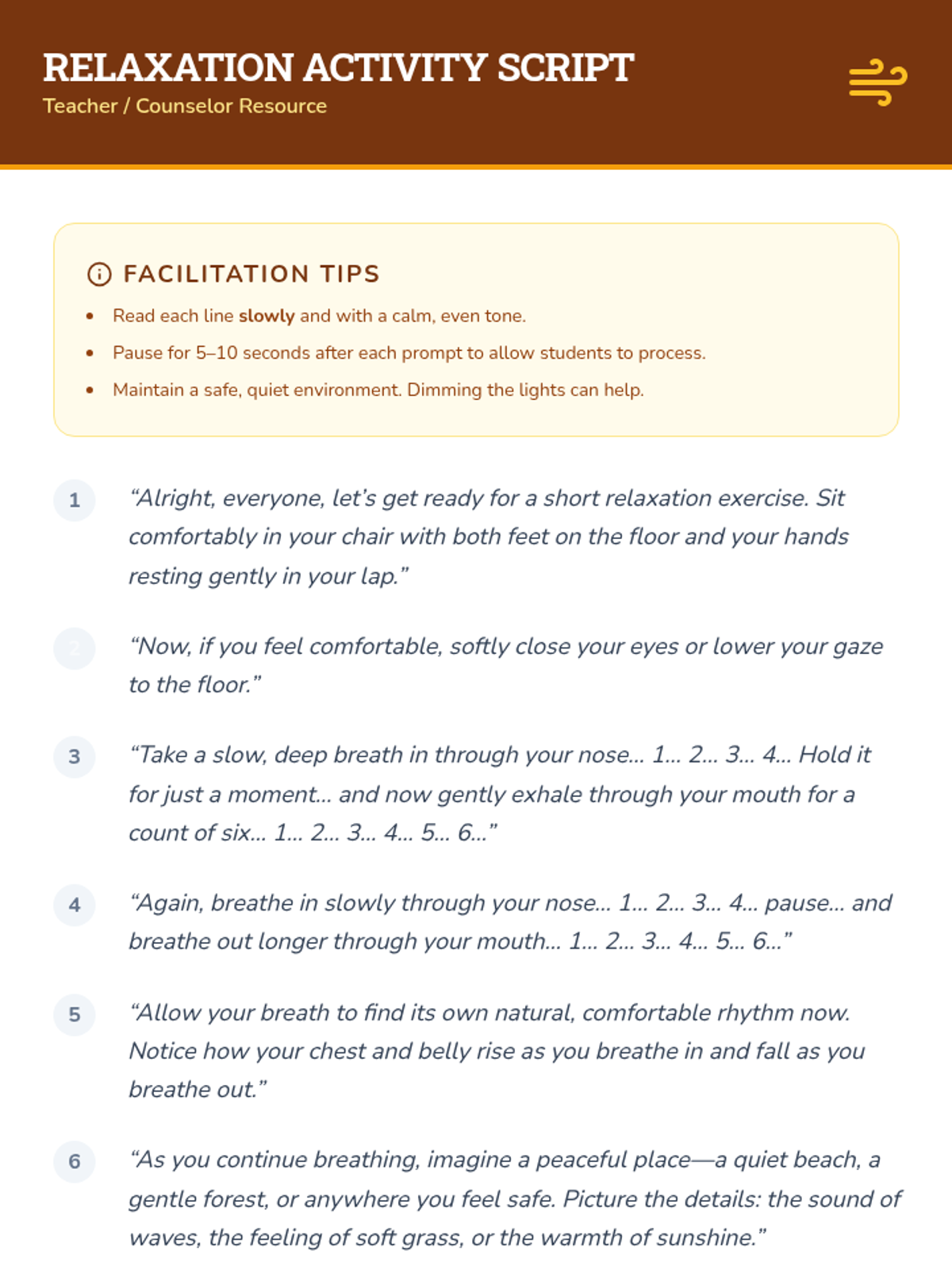
A script for a guided relaxation activity focusing on deep breathing and visualization to help students manage stress.
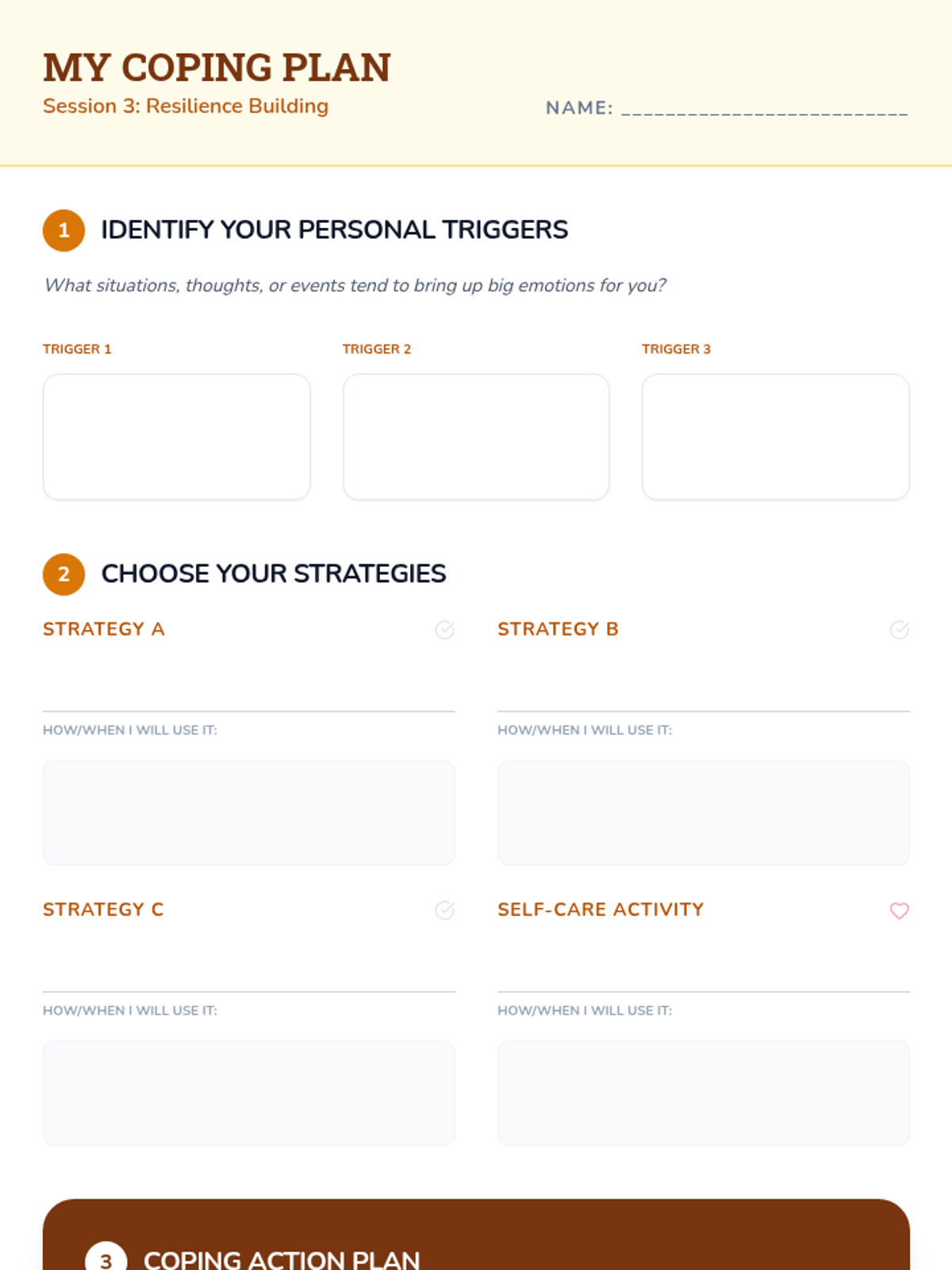
A worksheet for students to identify personal triggers and map out specific coping strategies and a support plan.
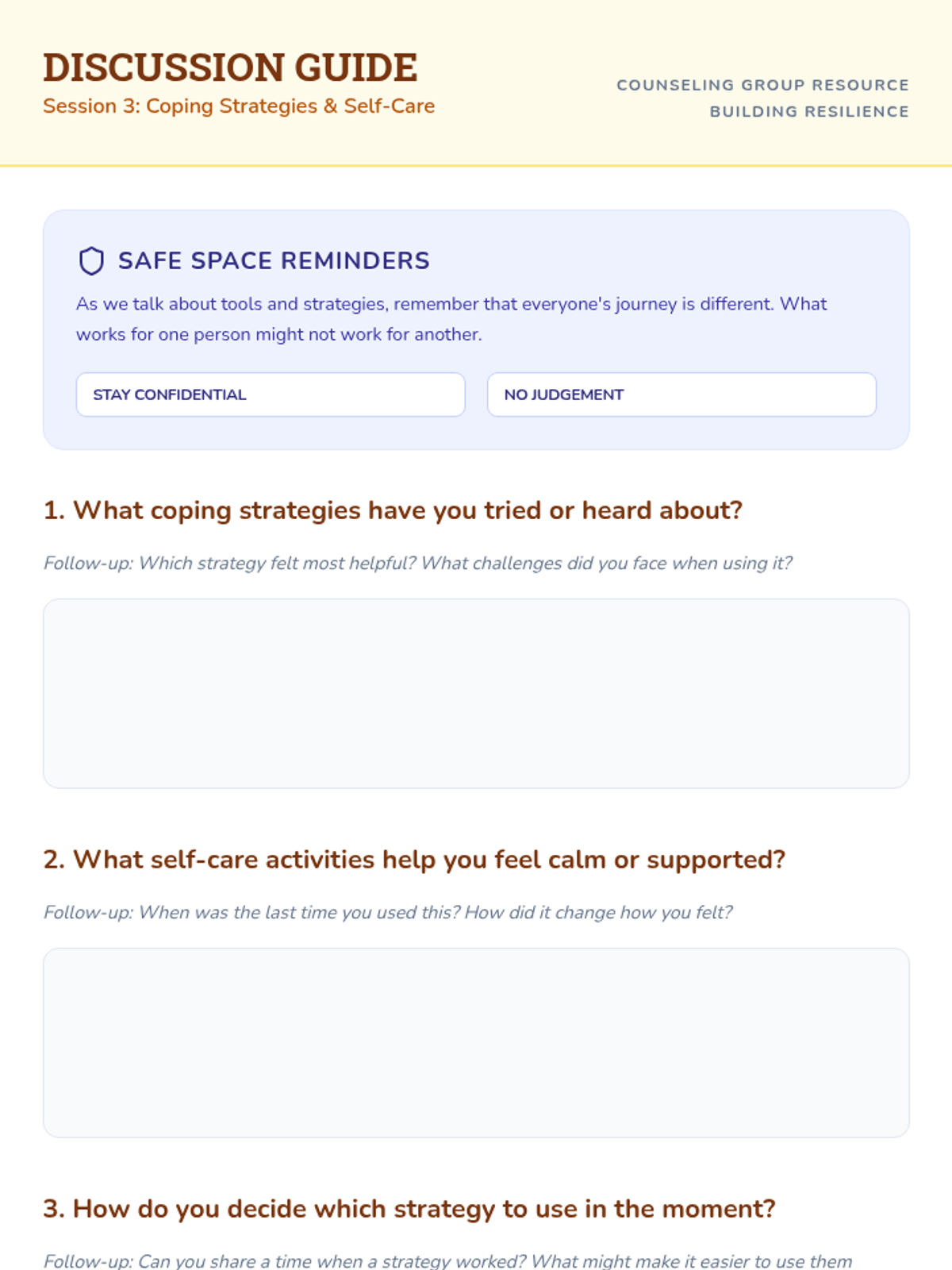
A discussion guide for Session 3 to help students explore and share various coping strategies and self-care techniques.
Visual presentation for Session 3, focusing on exploring and practicing practical coping strategies and self-care techniques.
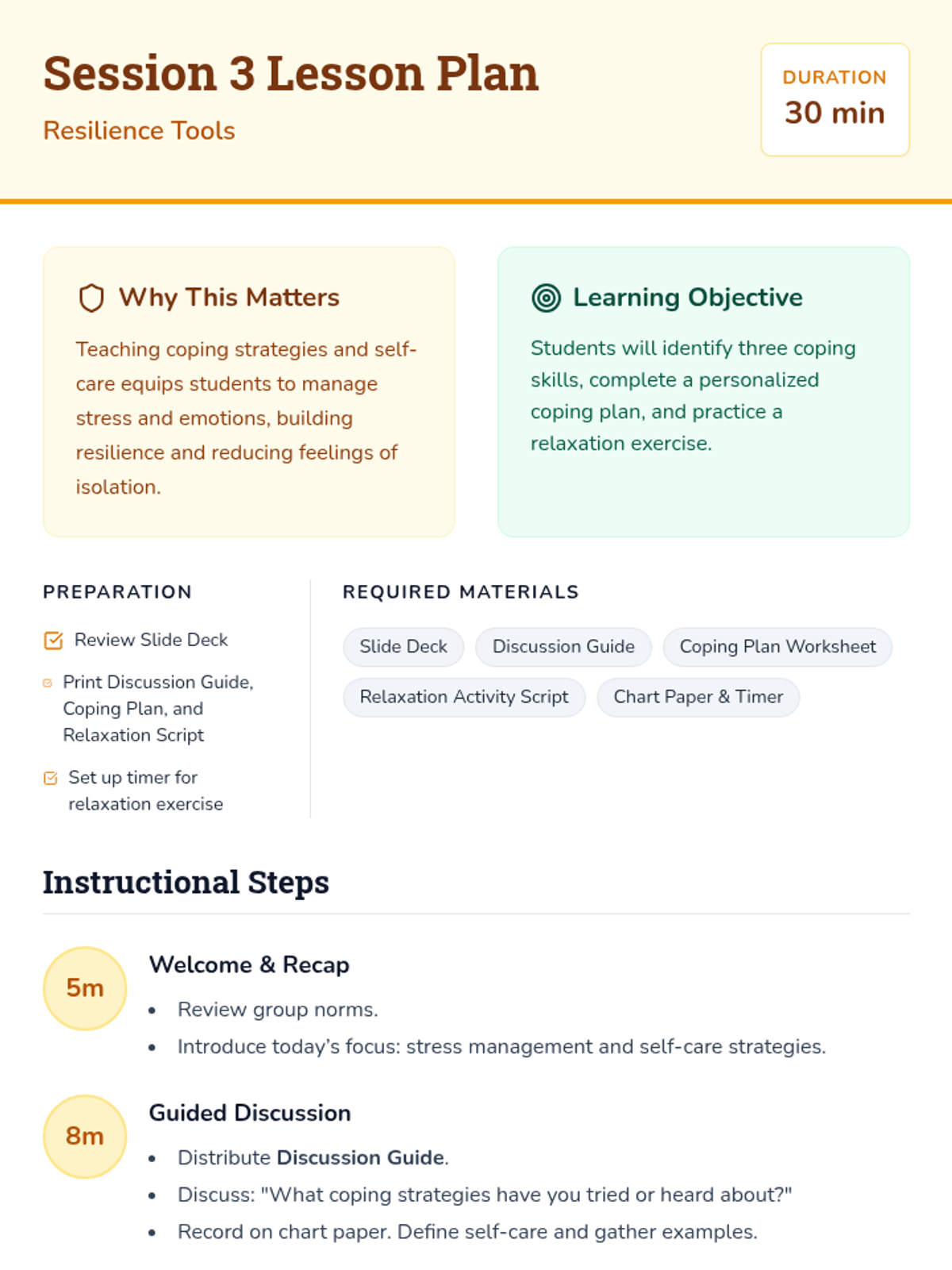
A comprehensive lesson plan for Session 3, focusing on exploring and practicing practical coping strategies and self-care techniques.
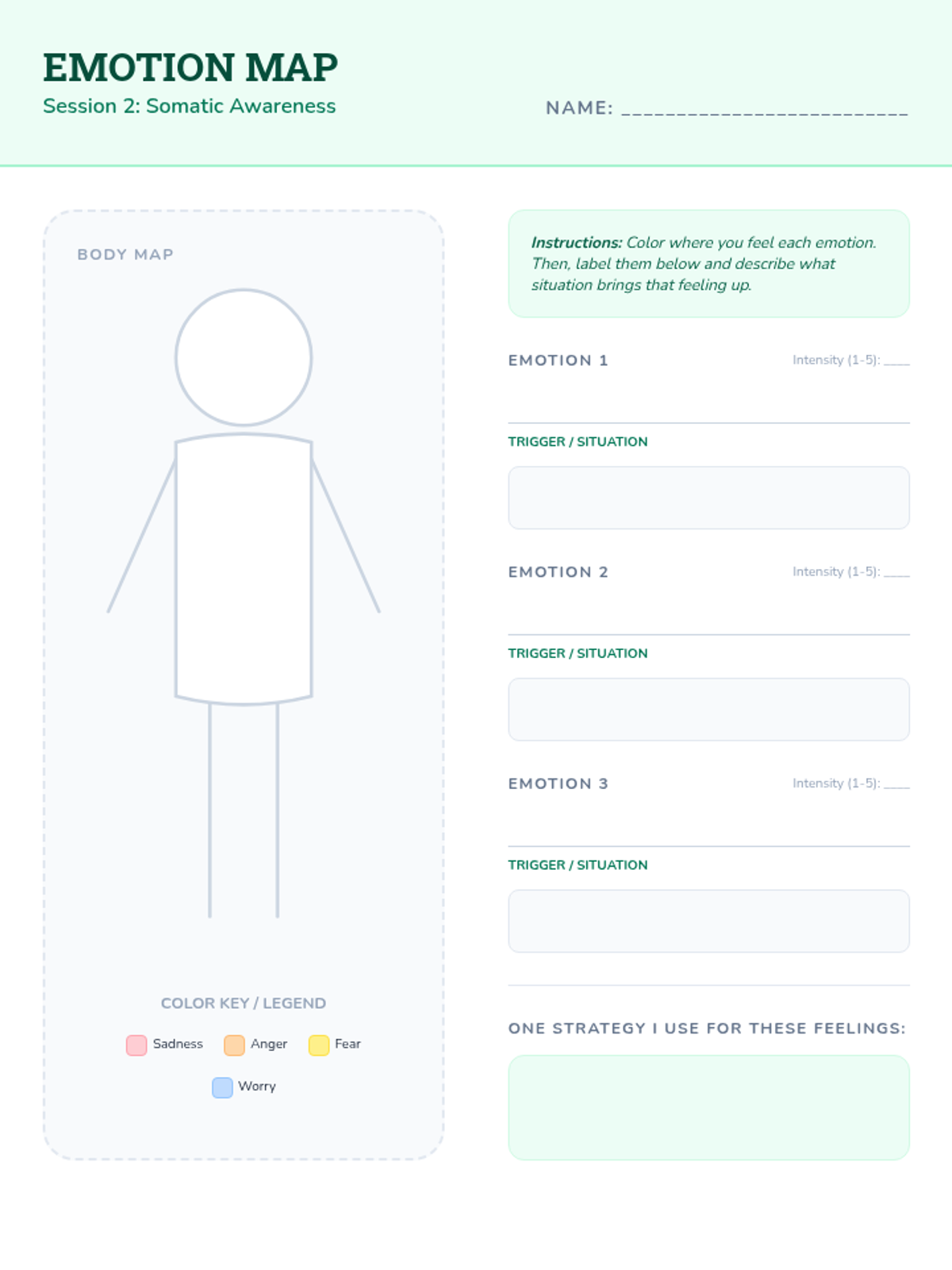
A somatic mapping worksheet for students to identify where they feel emotions in their bodies and what situations trigger those feelings.
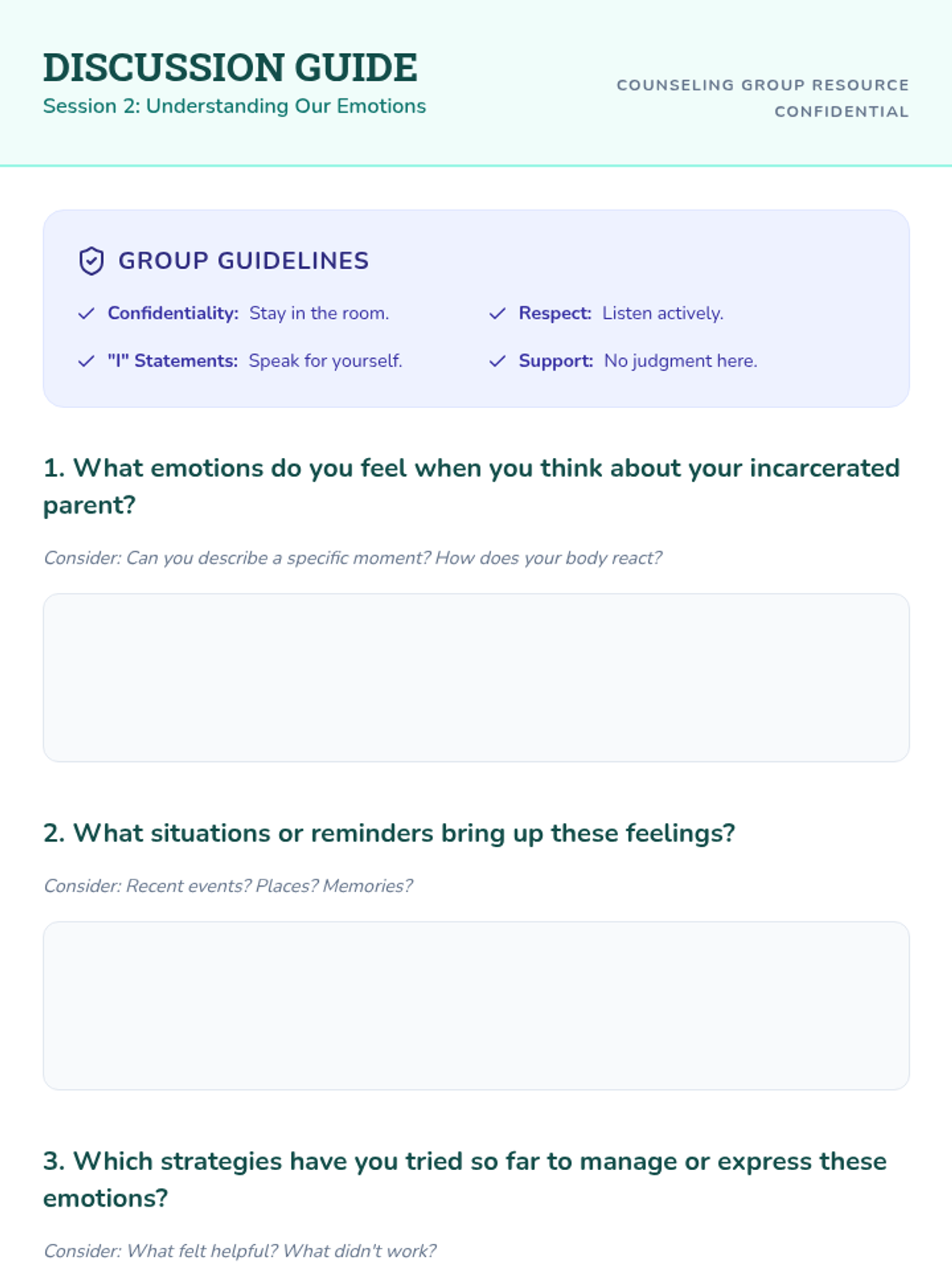
A discussion guide for Session 2 to help students identify emotions and triggers related to parental incarceration in a safe environment.
Visual presentation for Session 2, focusing on identifying and expressing emotions through guided discussion and somatic mapping.
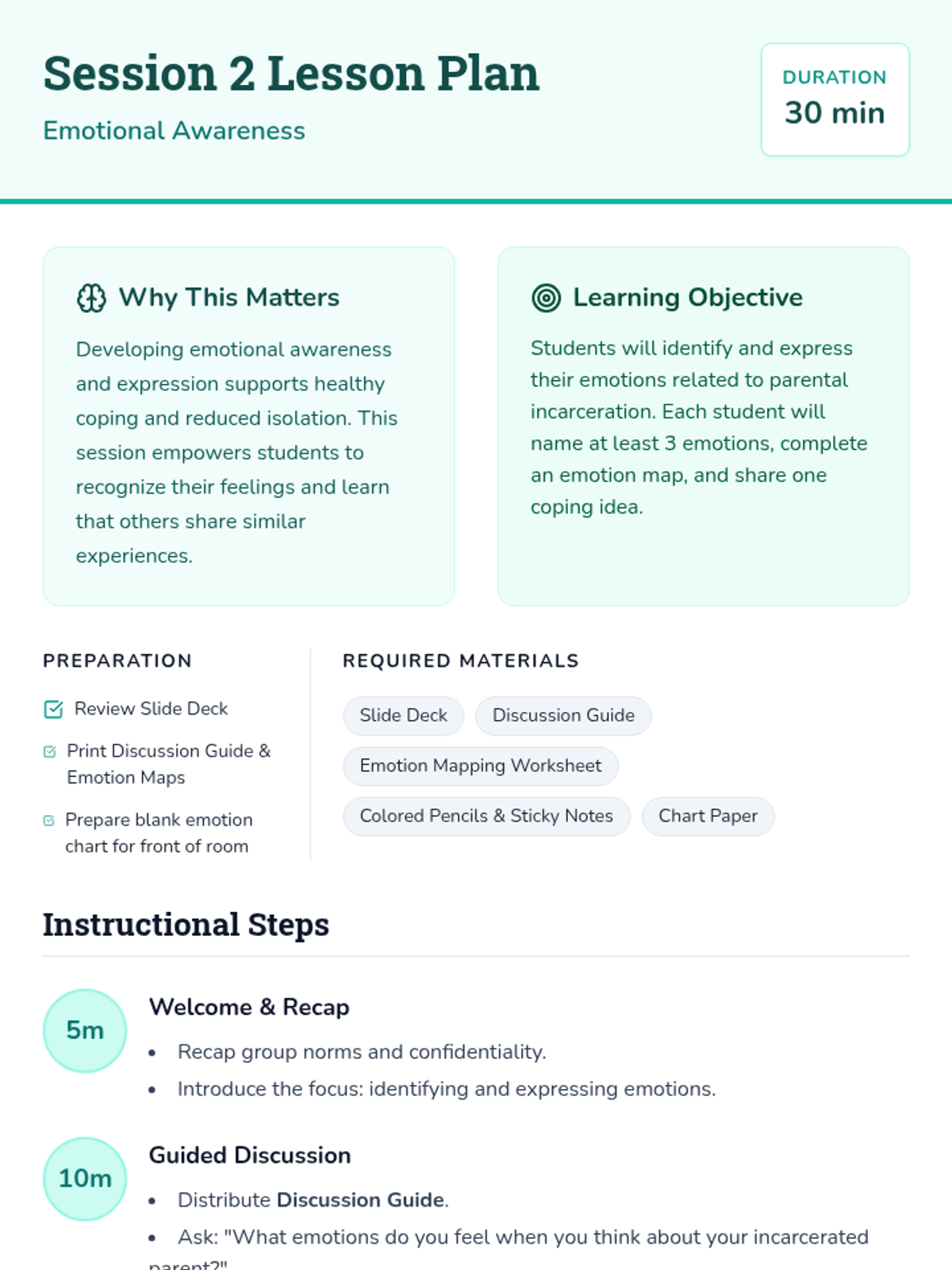
A comprehensive lesson plan for Session 2, focusing on identifying and expressing emotions through guided discussion and somatic mapping.
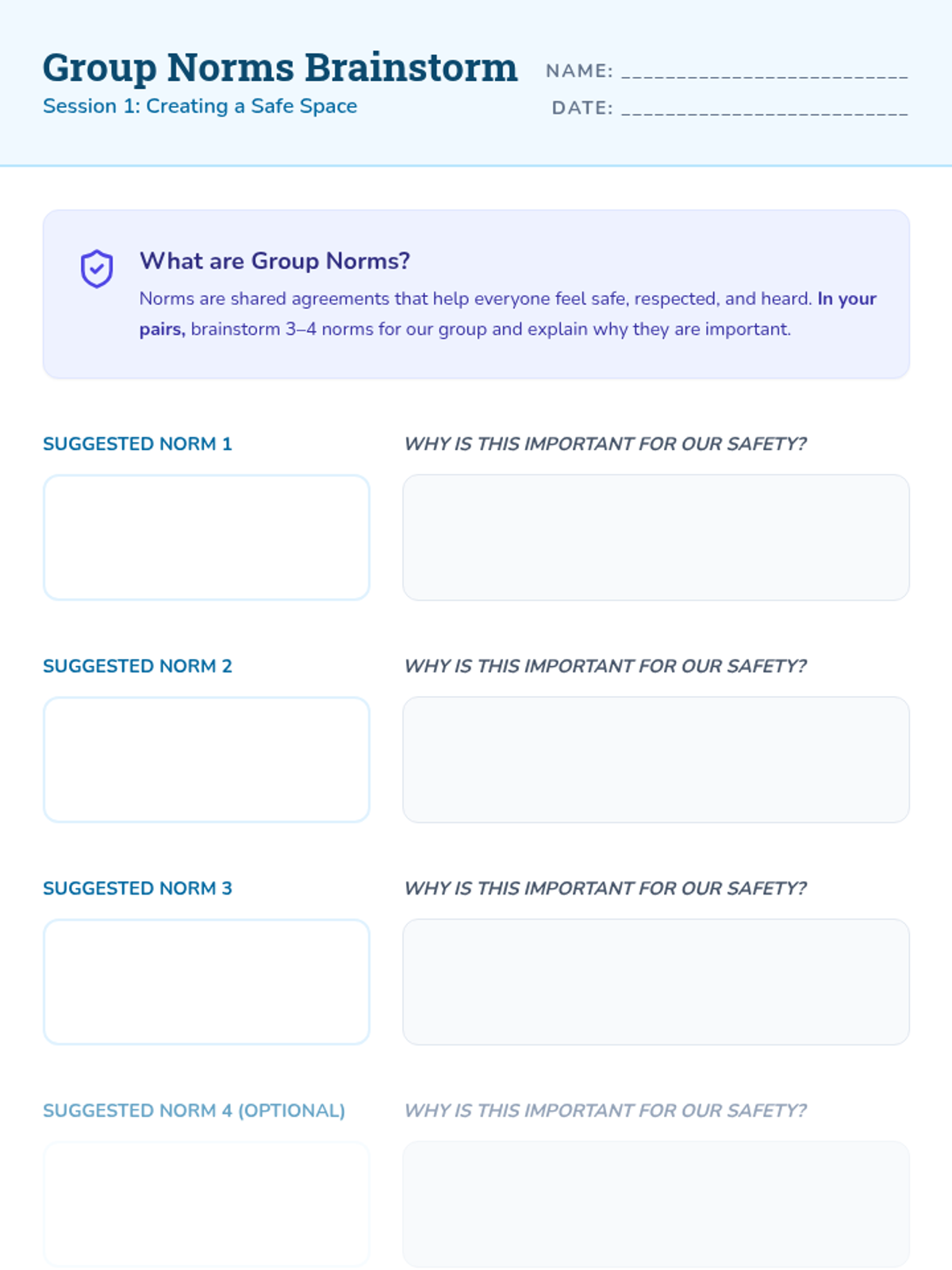
A worksheet for students to brainstorm and justify group norms in pairs, fostering collaborative safety and respect.
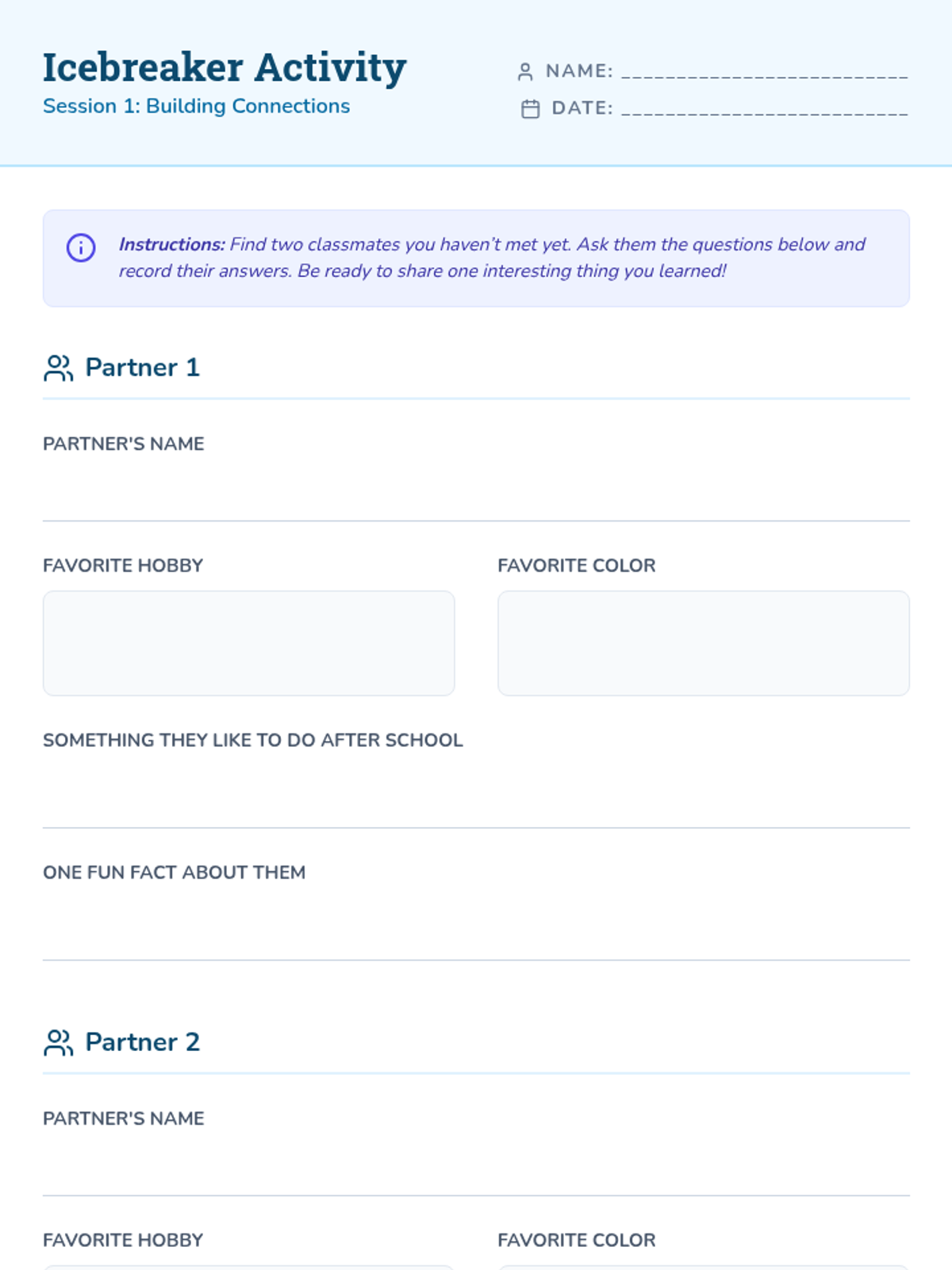
A fun icebreaker activity for students to get to know each other by interviewing two peers about their interests and fun facts.
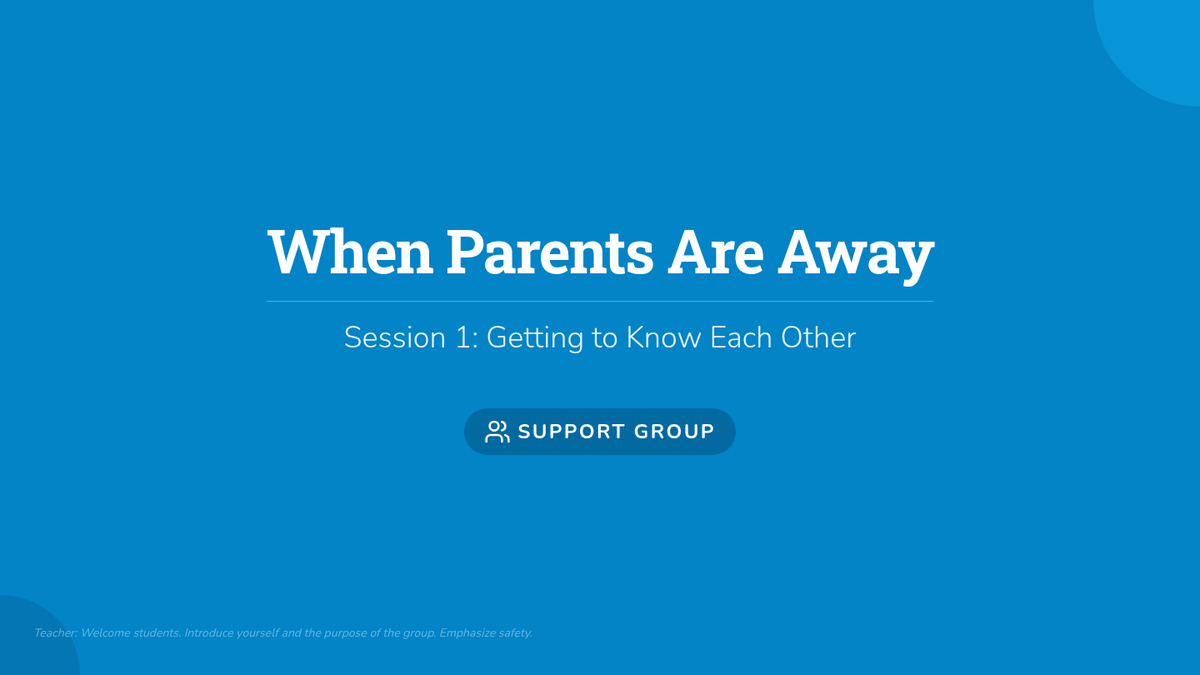
Visual presentation for Session 1, including objectives, icebreaker instructions, and a guide for co-creating group norms.
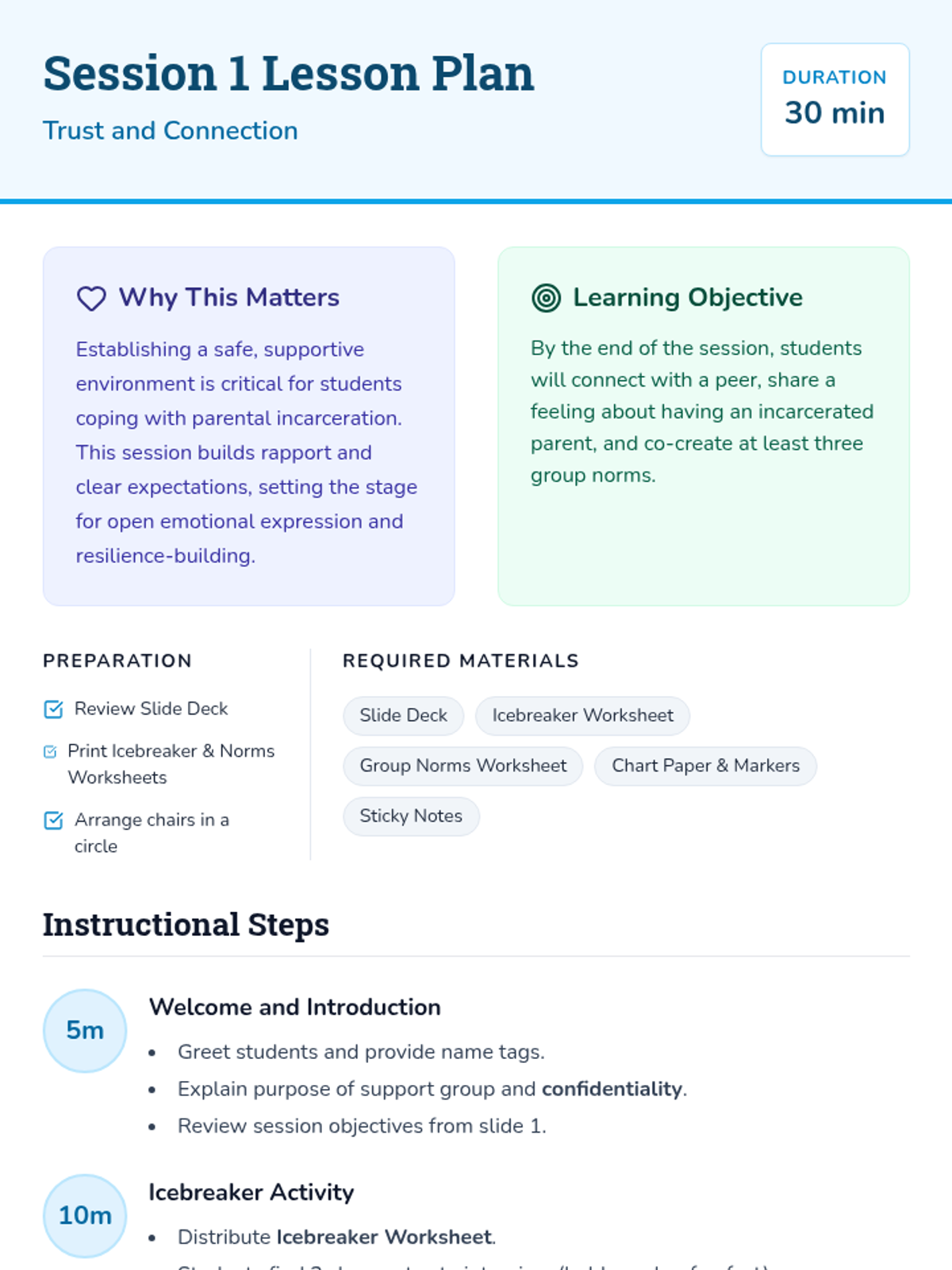
A comprehensive lesson plan for the first session of the support group, focusing on rapport-building and establishing safety through group norms.
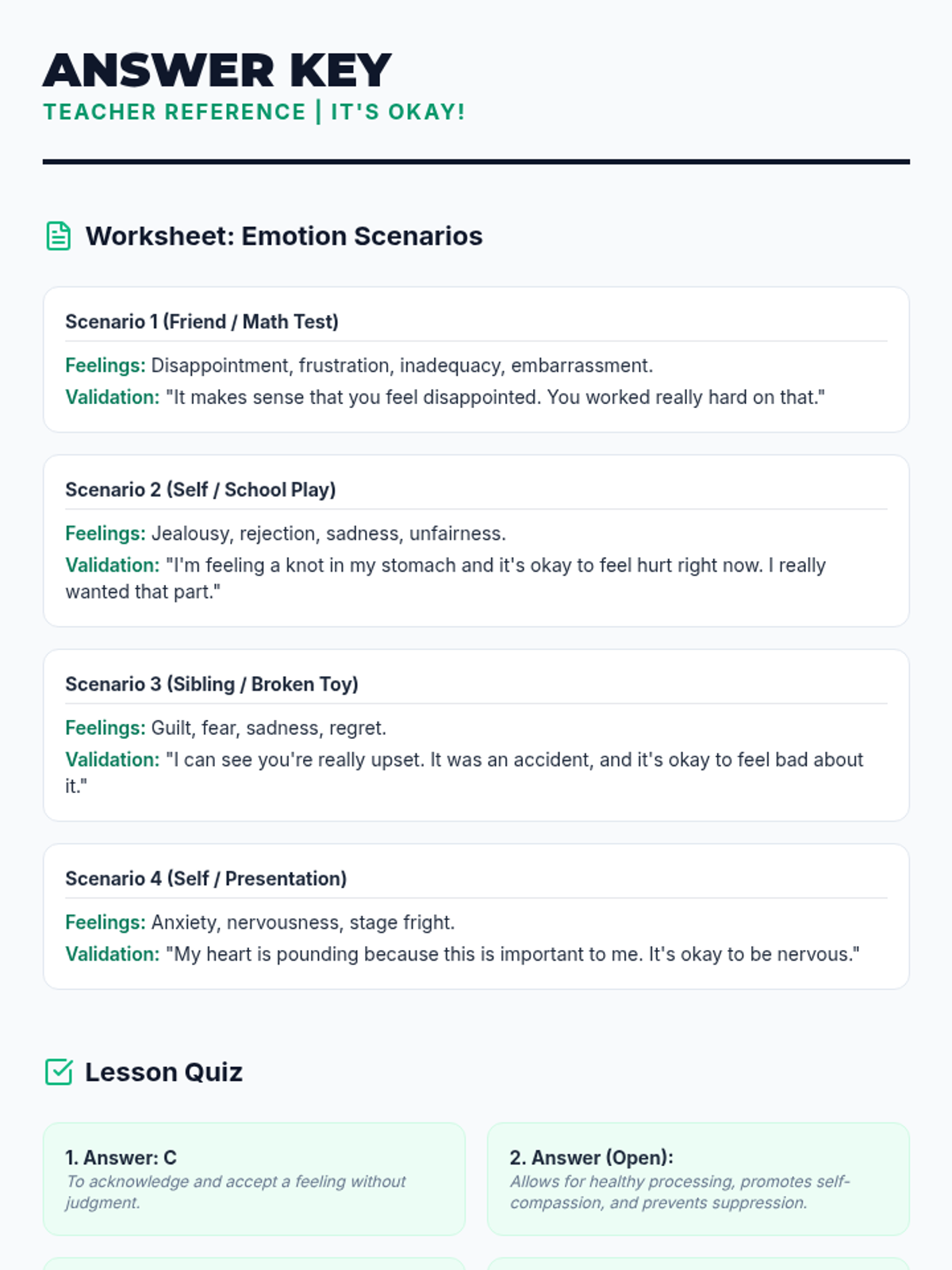
Comprehensive answer key for the "It's Okay!" lesson. Provides suggested responses for the worksheet scenarios and correct answers for both the quiz and unit test.
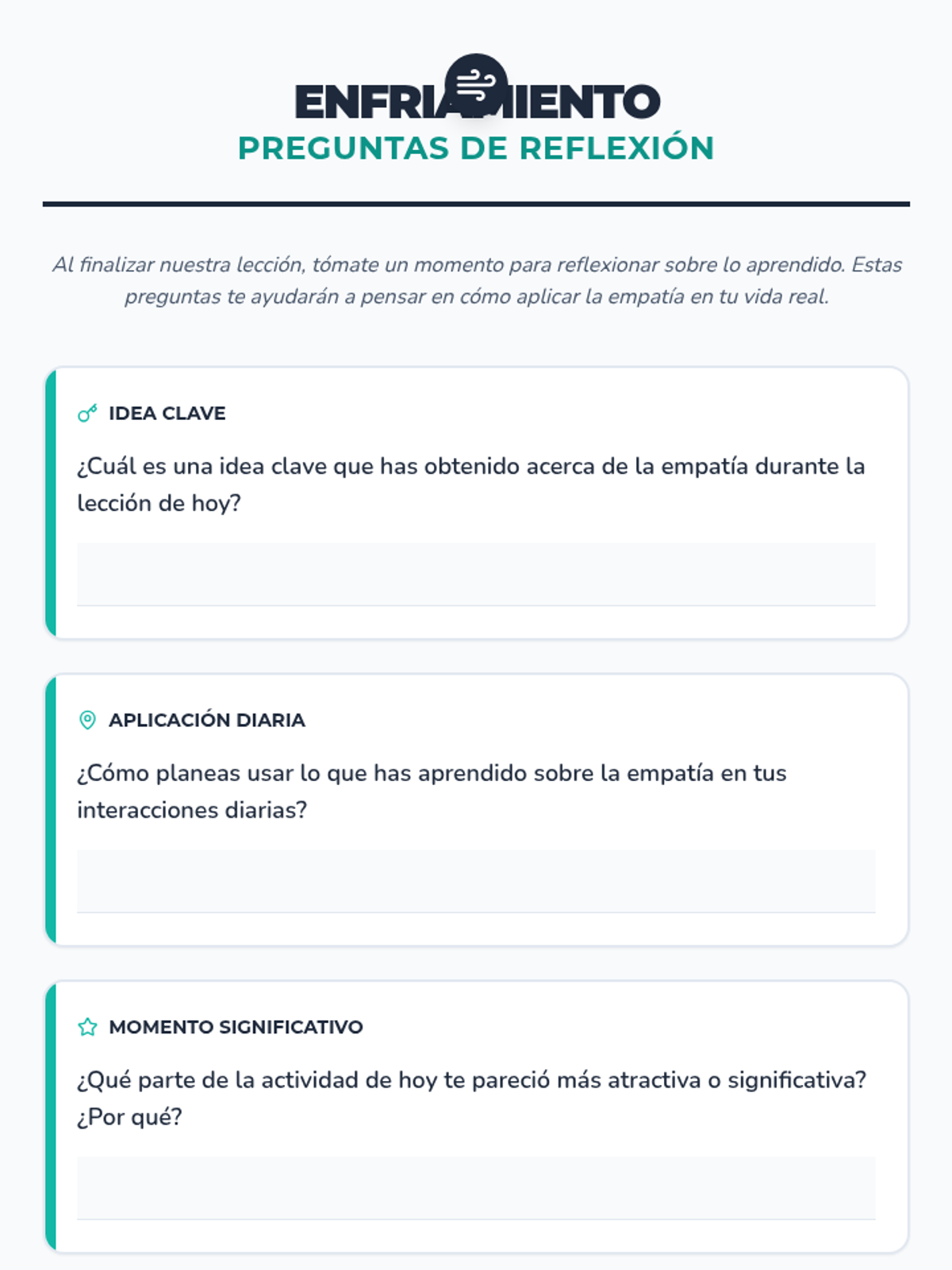
A set of reflection prompts for the cool-down phase of the lesson, helping students consolidate their learning and plan for future interactions.
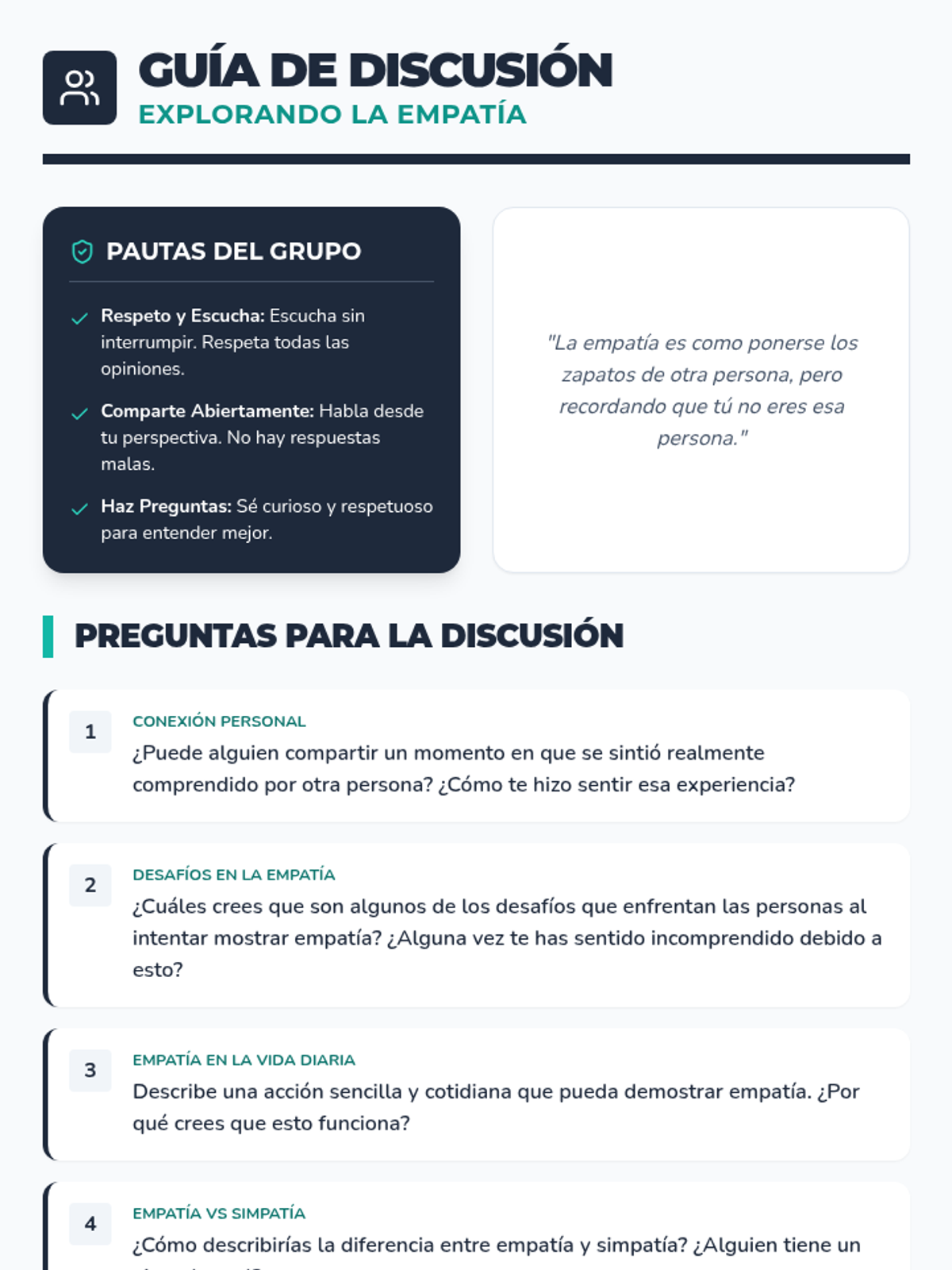
A group discussion guide featuring pautas (guidelines) and thought-provoking questions to facilitate a deep conversation about empathy.
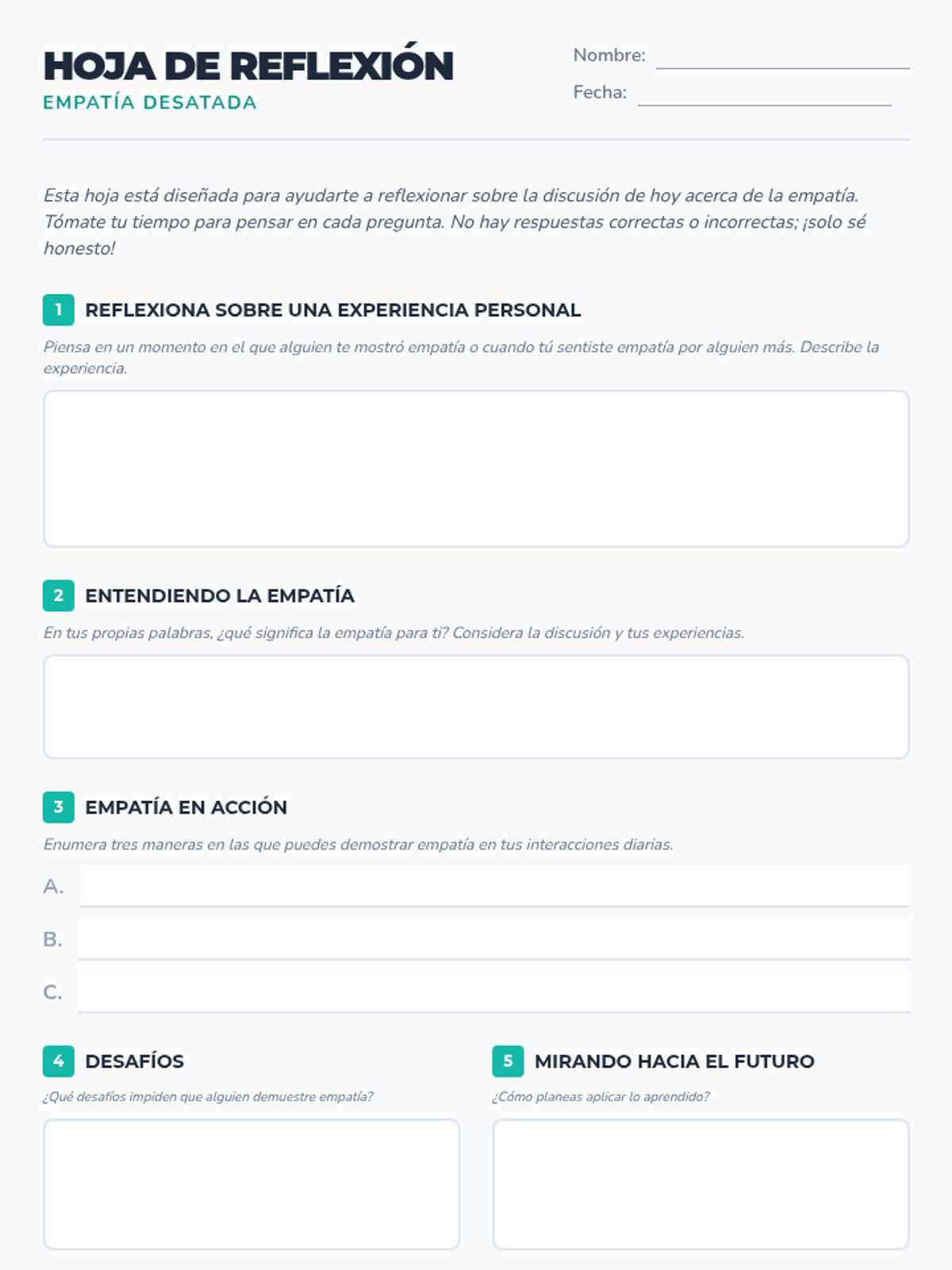
A reflection worksheet for students to process their understanding of empathy and plan how to apply it in their daily lives.
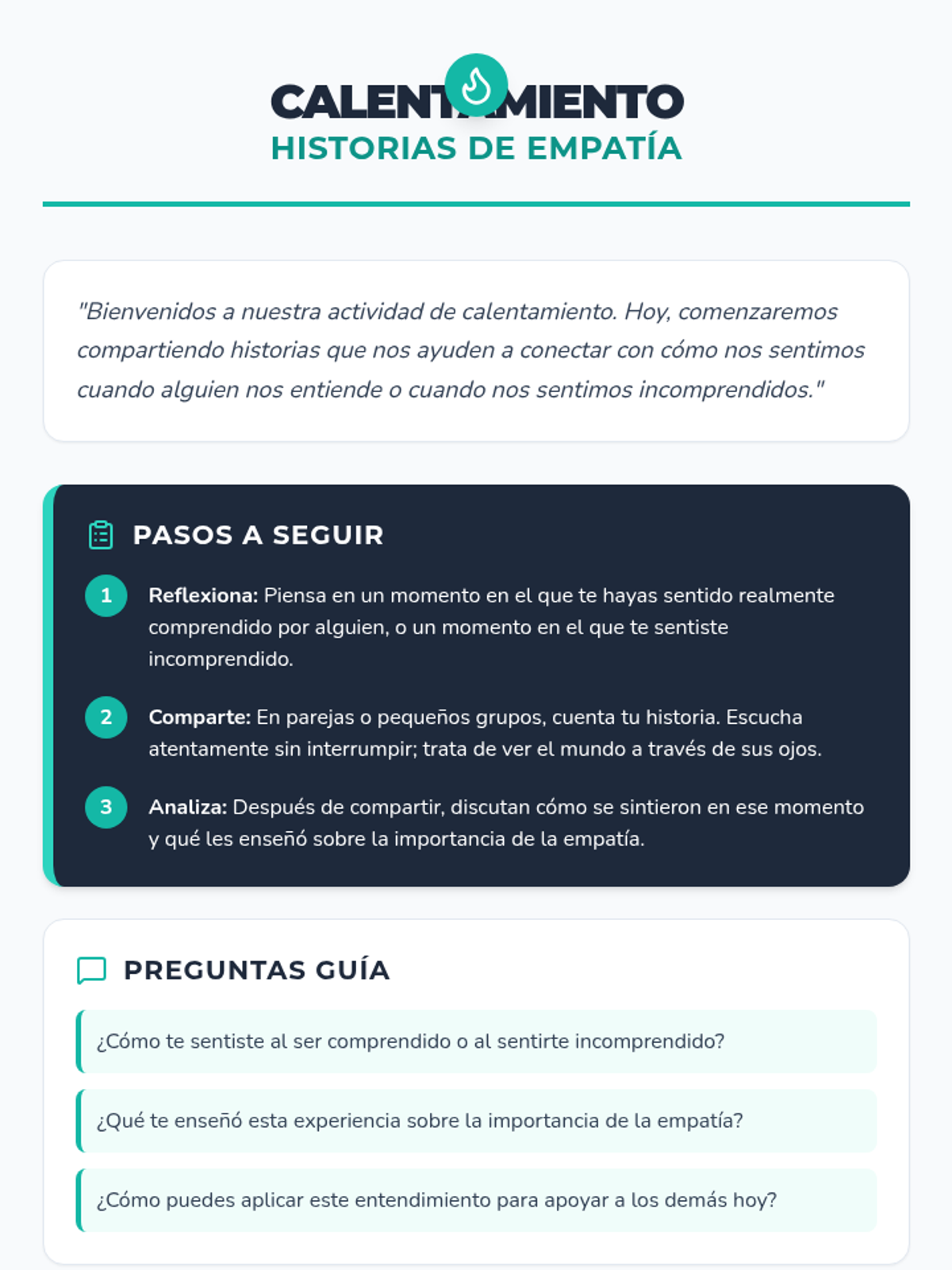
A facilitator guide for the empathy storytelling warm-up activity, providing step-by-step instructions and discussion prompts.
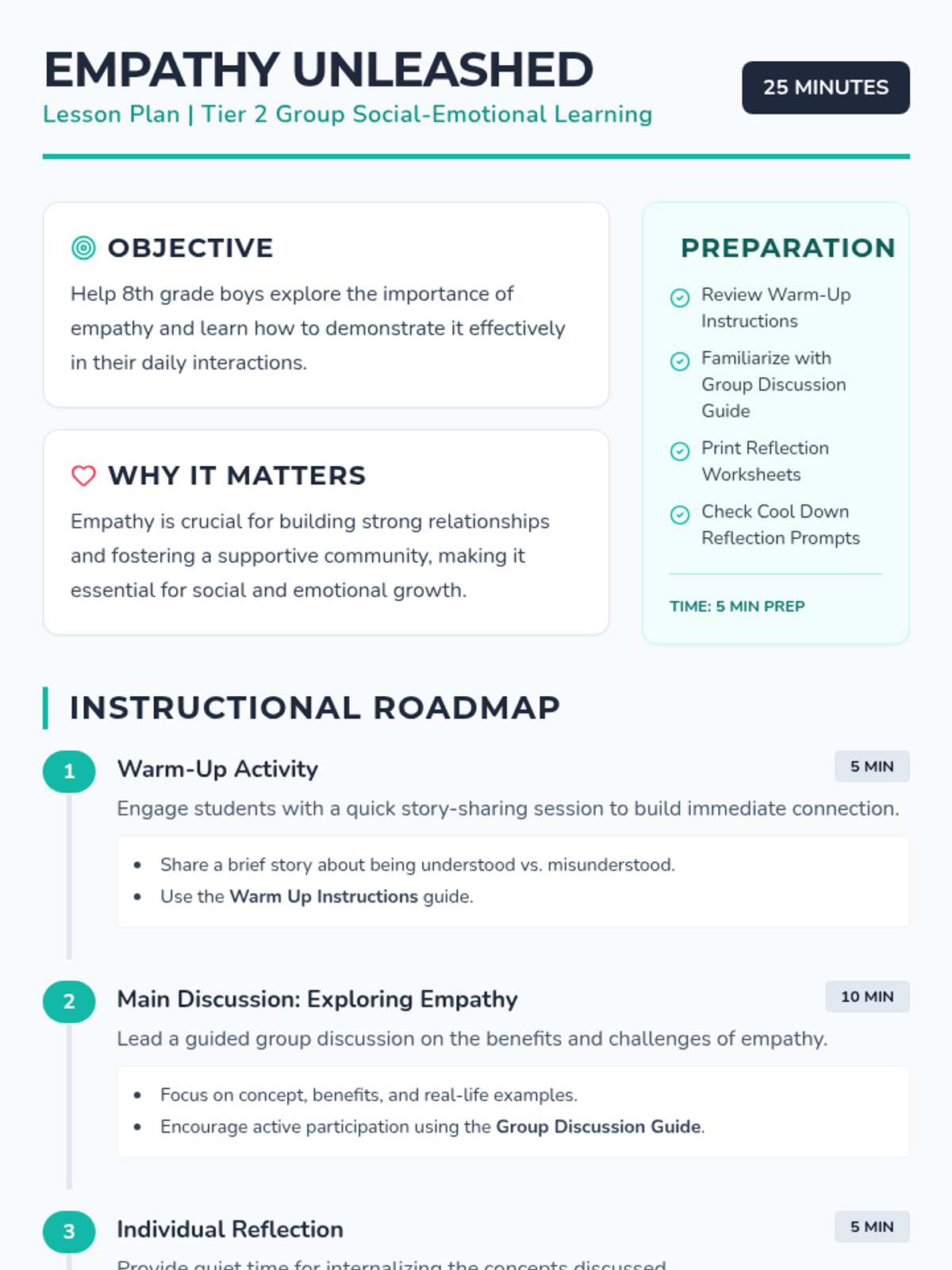
Teacher lesson plan for the Empathy Unleashed lesson, featuring objectives, preparation steps, and a timed instructional roadmap.
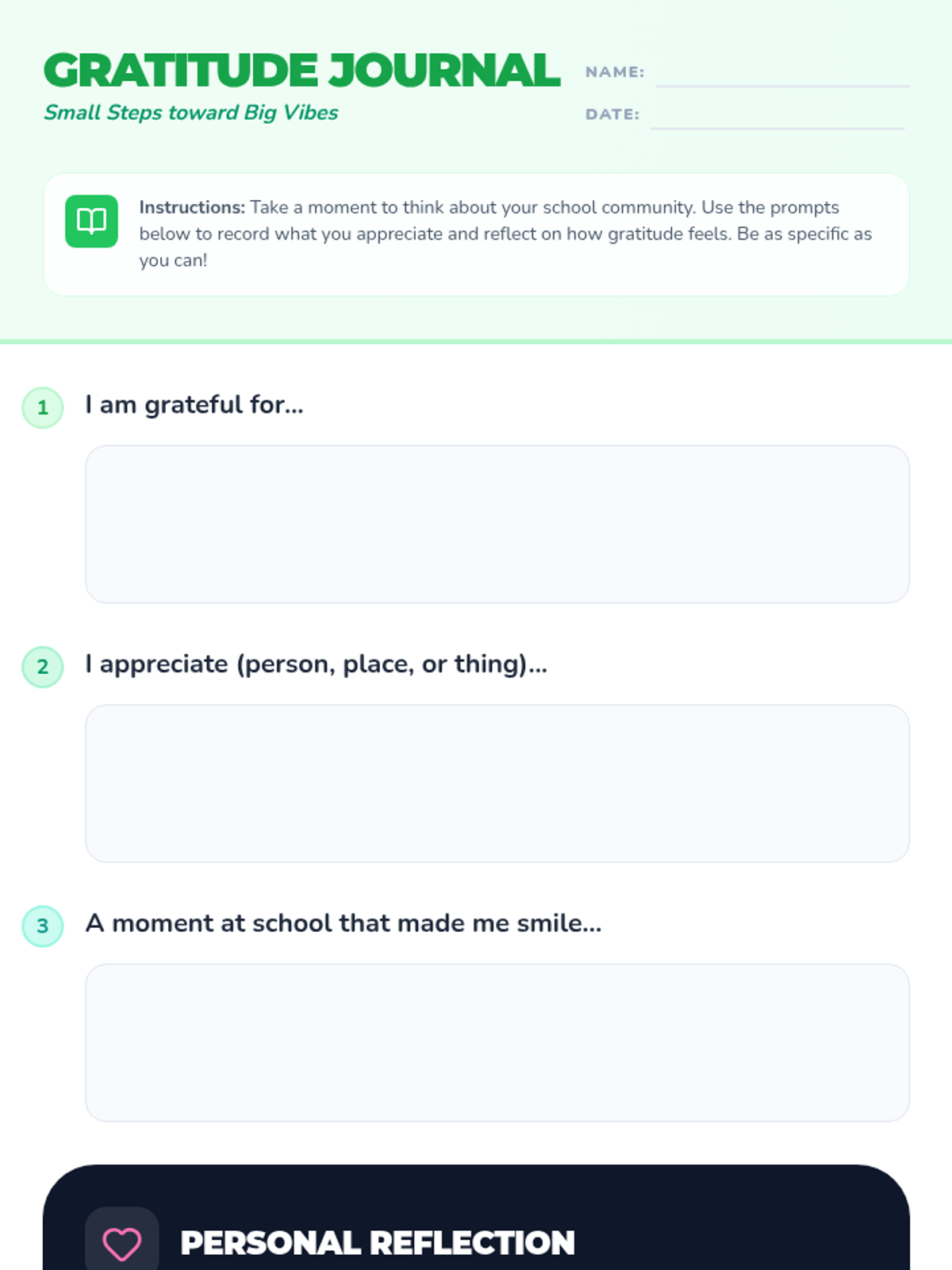
A student reflection worksheet for recording school community gratitude and reflecting on the emotional impact of giving thanks.
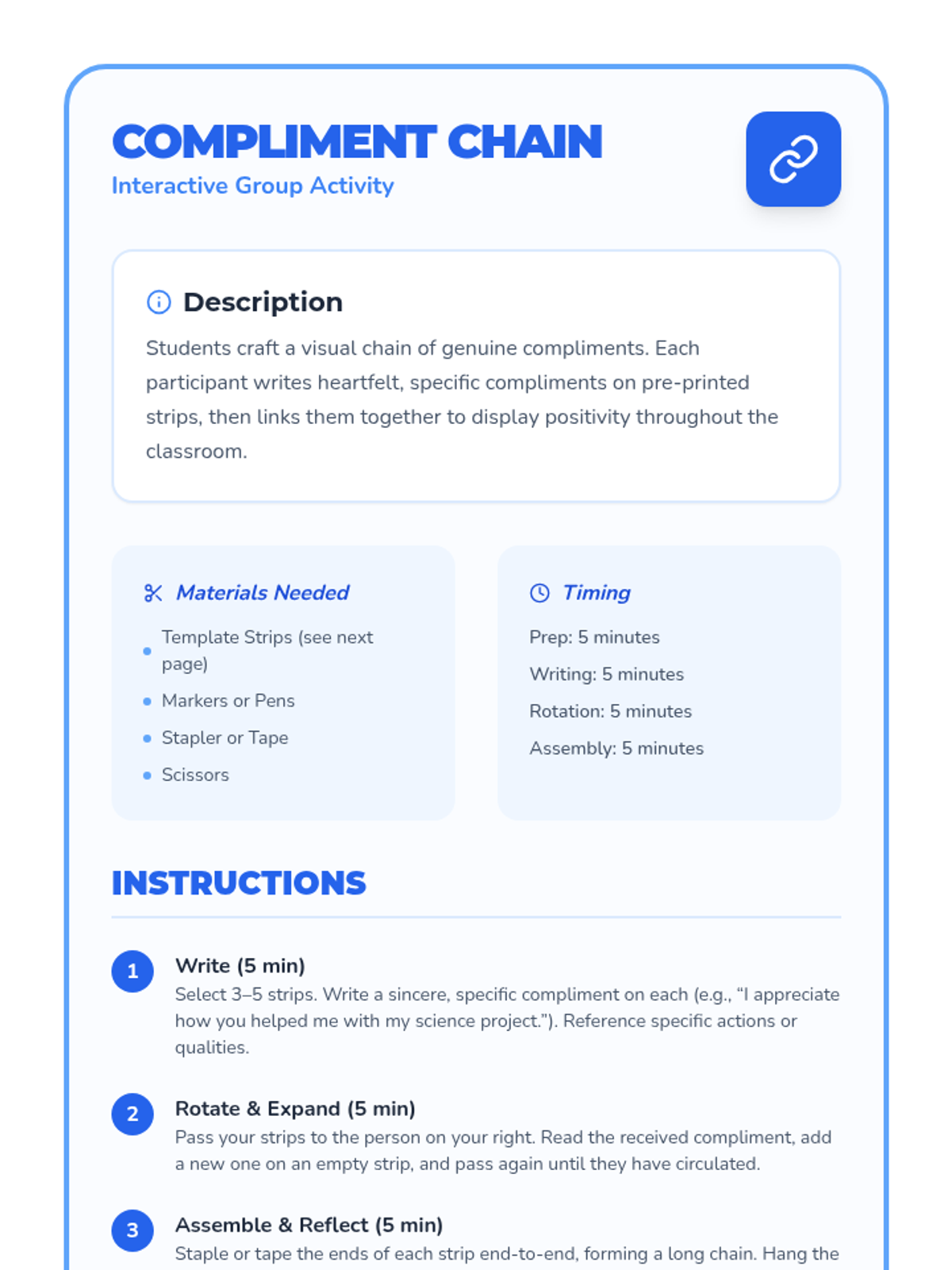
A physical activity kit including teacher instructions and printable compliment strips for students to create a visual chain of positivity.
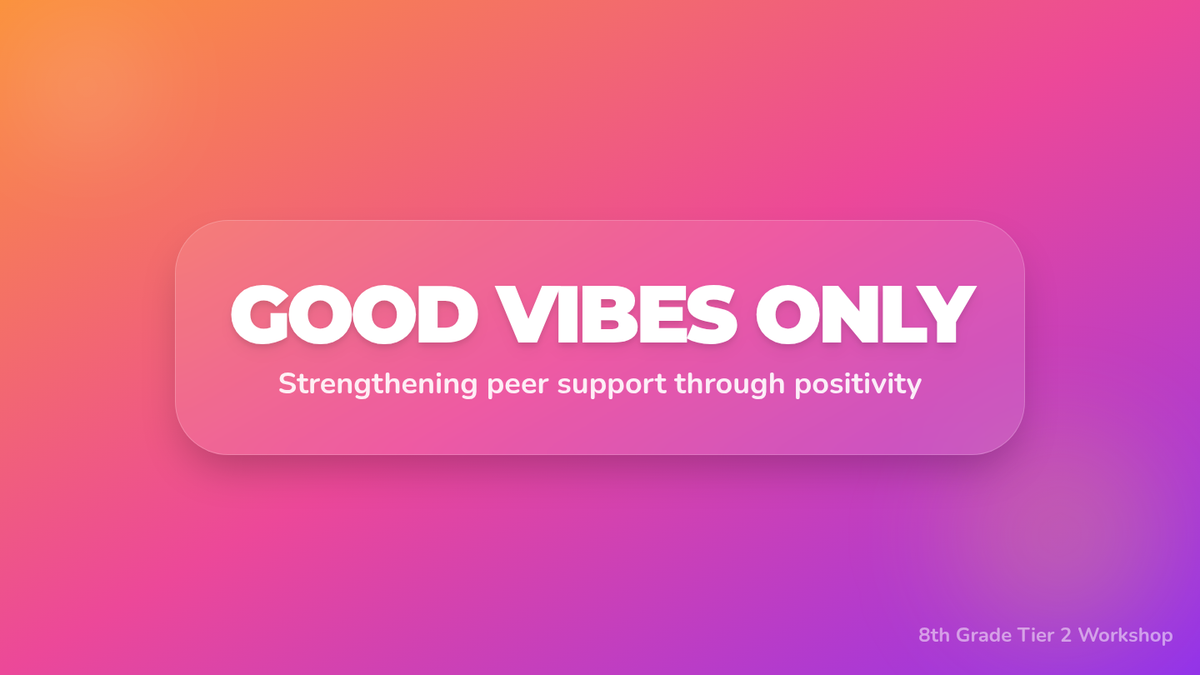
A vibrant, high-energy slide deck for the Positive Vibes Only workshop, covering peer support, genuine compliments, gratitude, and active listening.
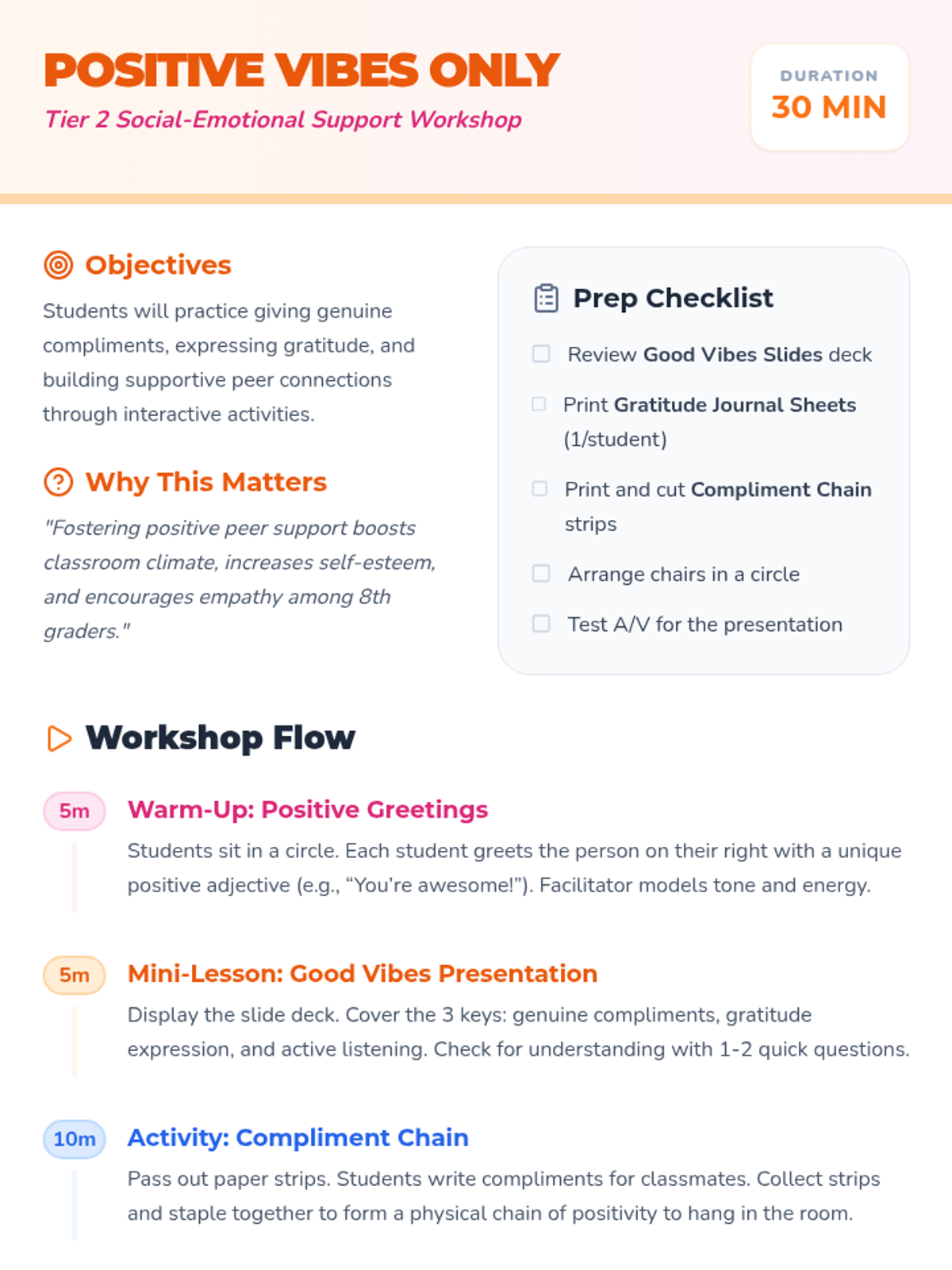
A detailed lesson plan for the Positive Vibes Only workshop, featuring a 30-minute instructional sequence focused on peer support, compliments, and gratitude.
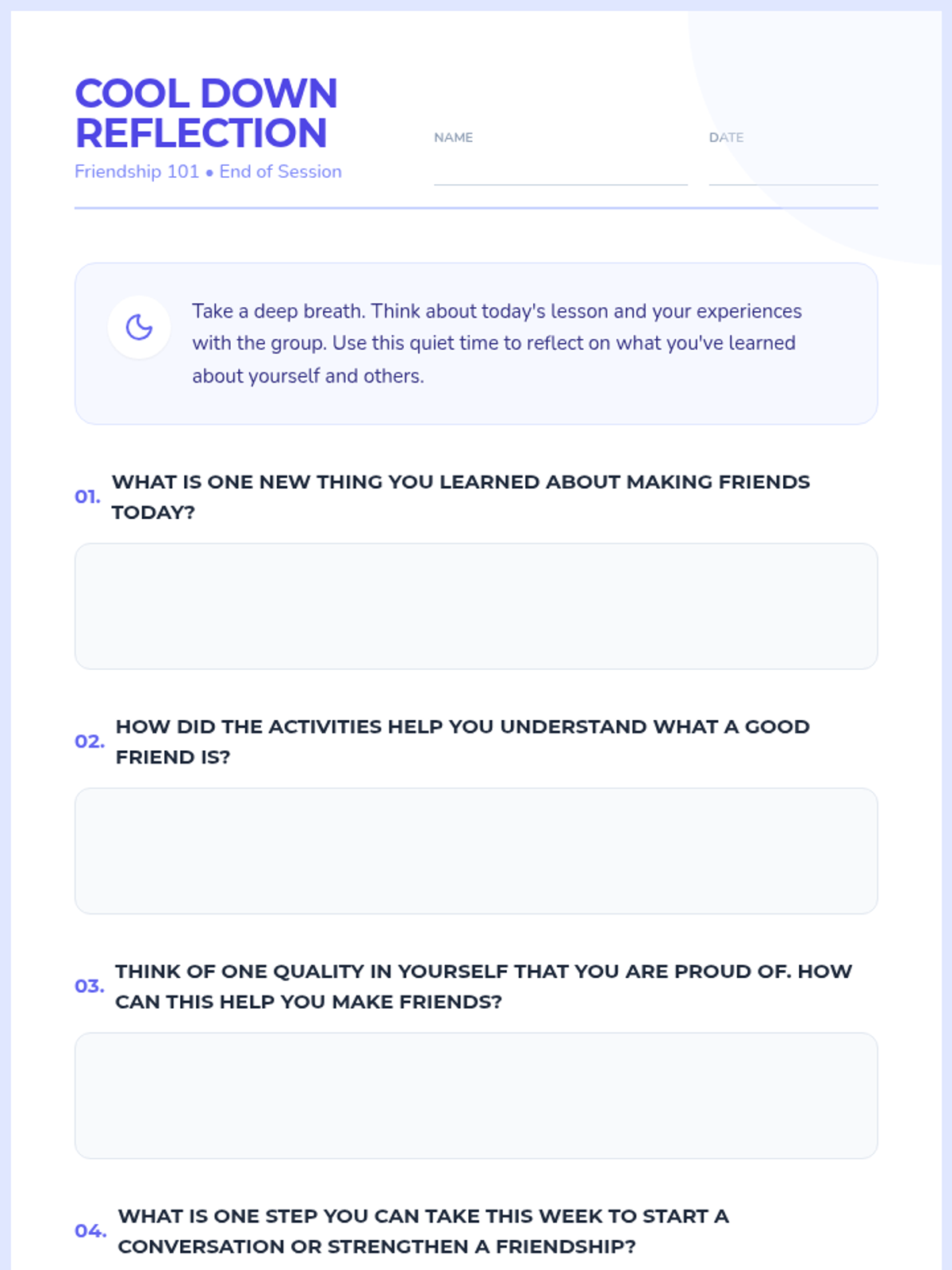
A student reflection sheet for the end of the Friendship 101 lesson, providing space for students to process key takeaways, identify personal strengths, and set social goals.
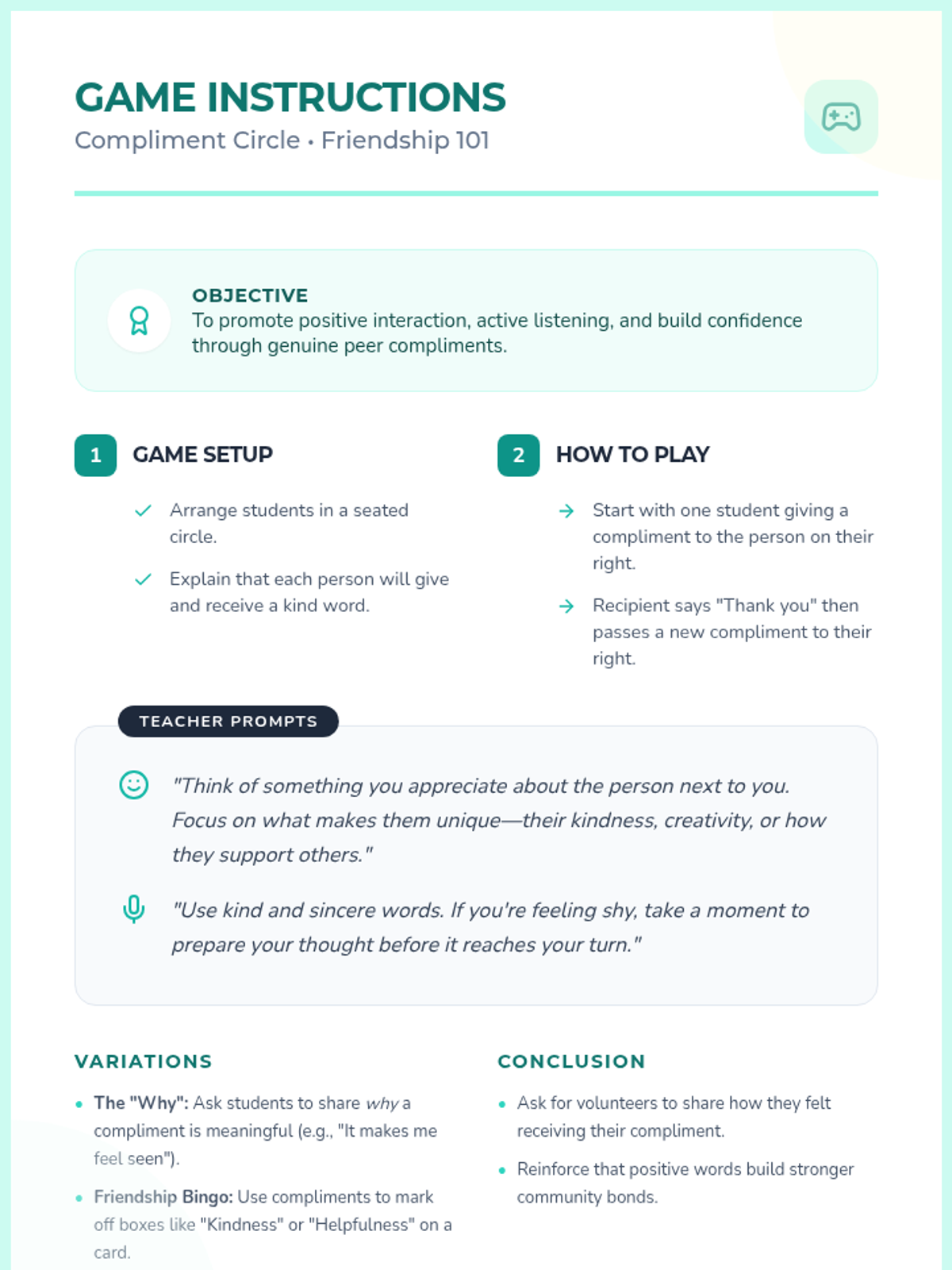
Teacher instructions for the "Compliment Circle" friendship game, including setup steps, gameplay rules, prompts for students, and variations for extended play.
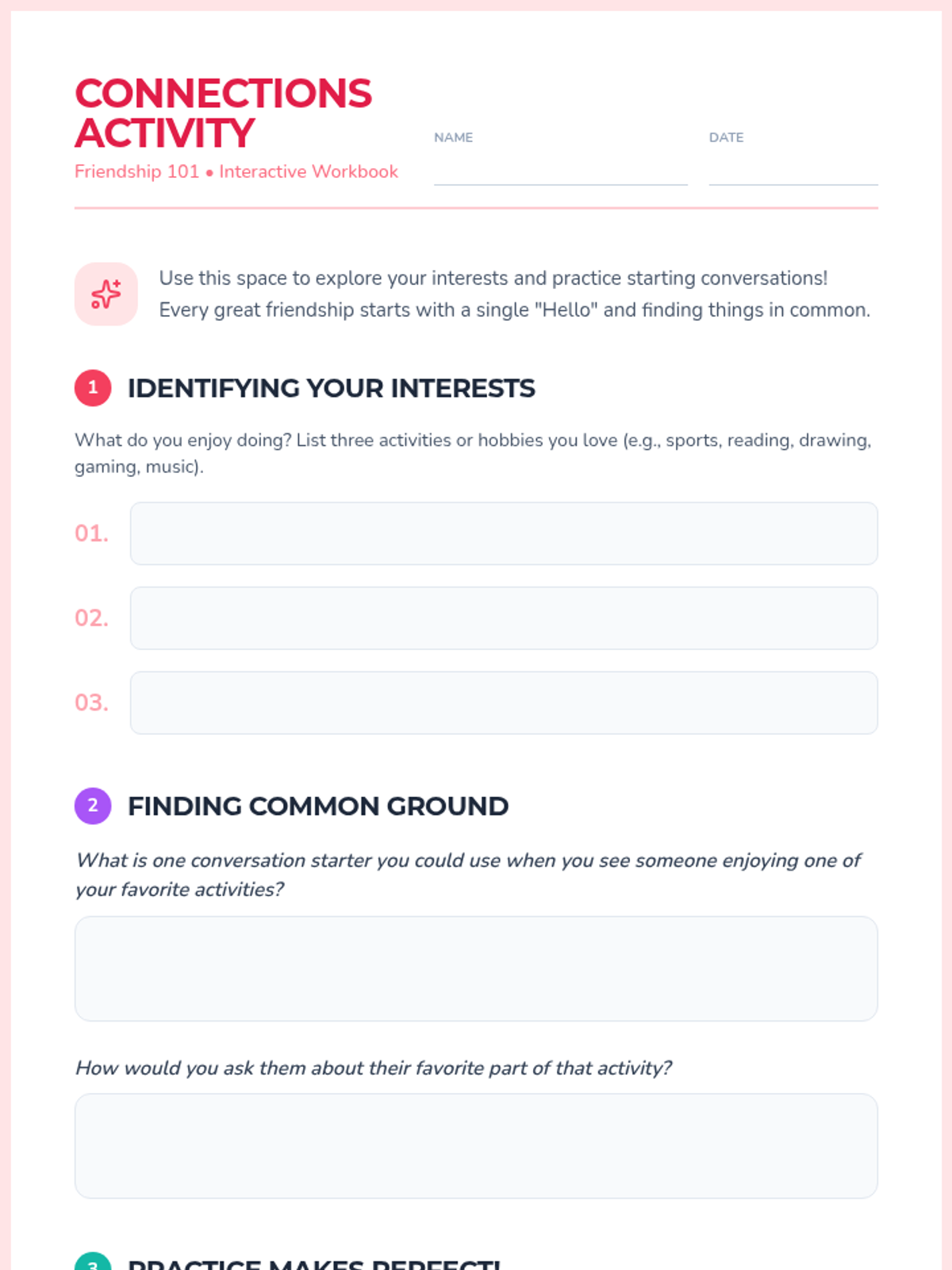
An interactive student worksheet for Friendship 101, designed to help students identify personal interests, brainstorm conversation starters, and reflect on peer role-play experiences.
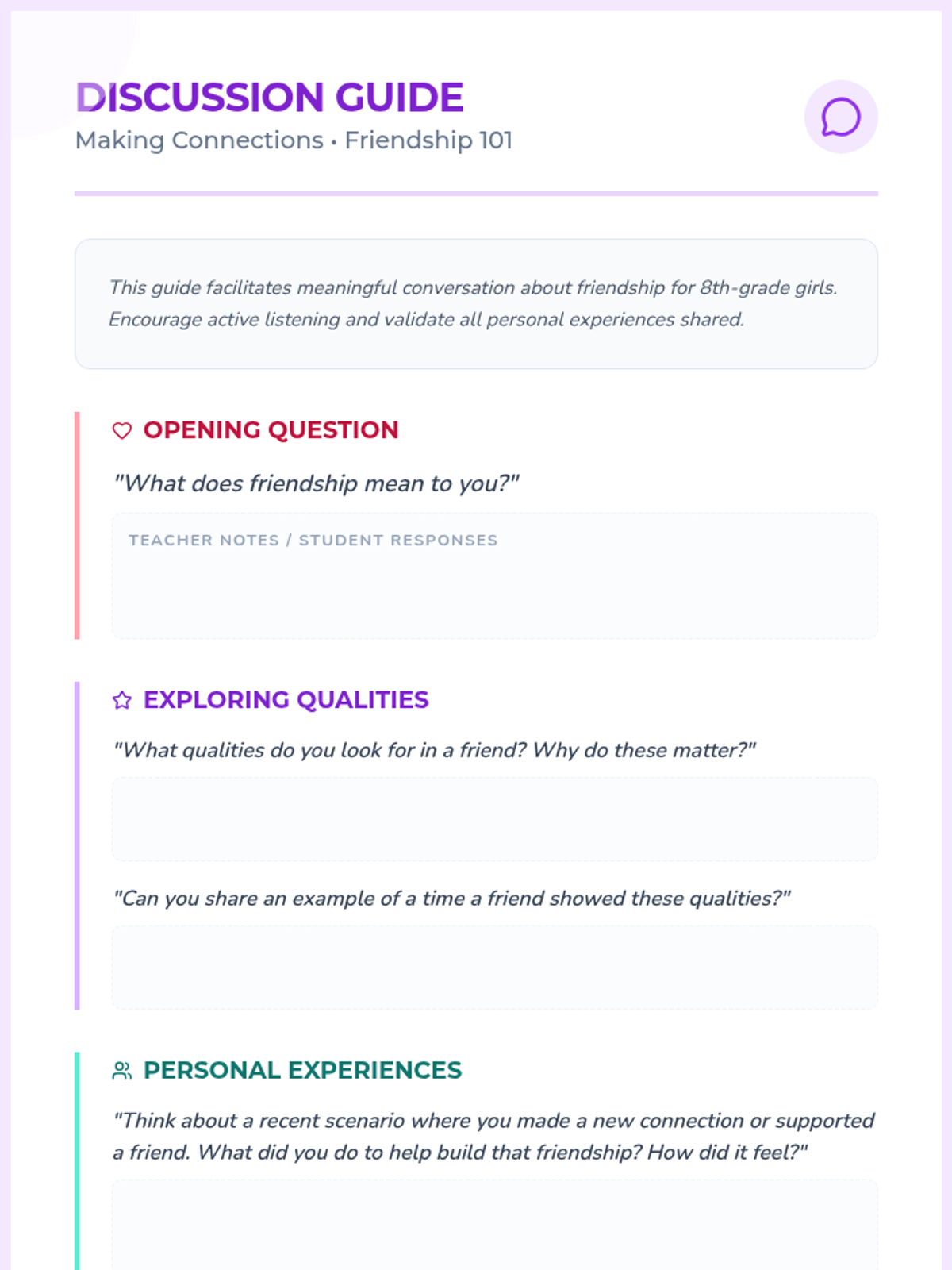
A teacher discussion guide for Friendship 101, featuring reflective prompts and facilitation tips to help students explore the qualities of a good friend and personal connection experiences.
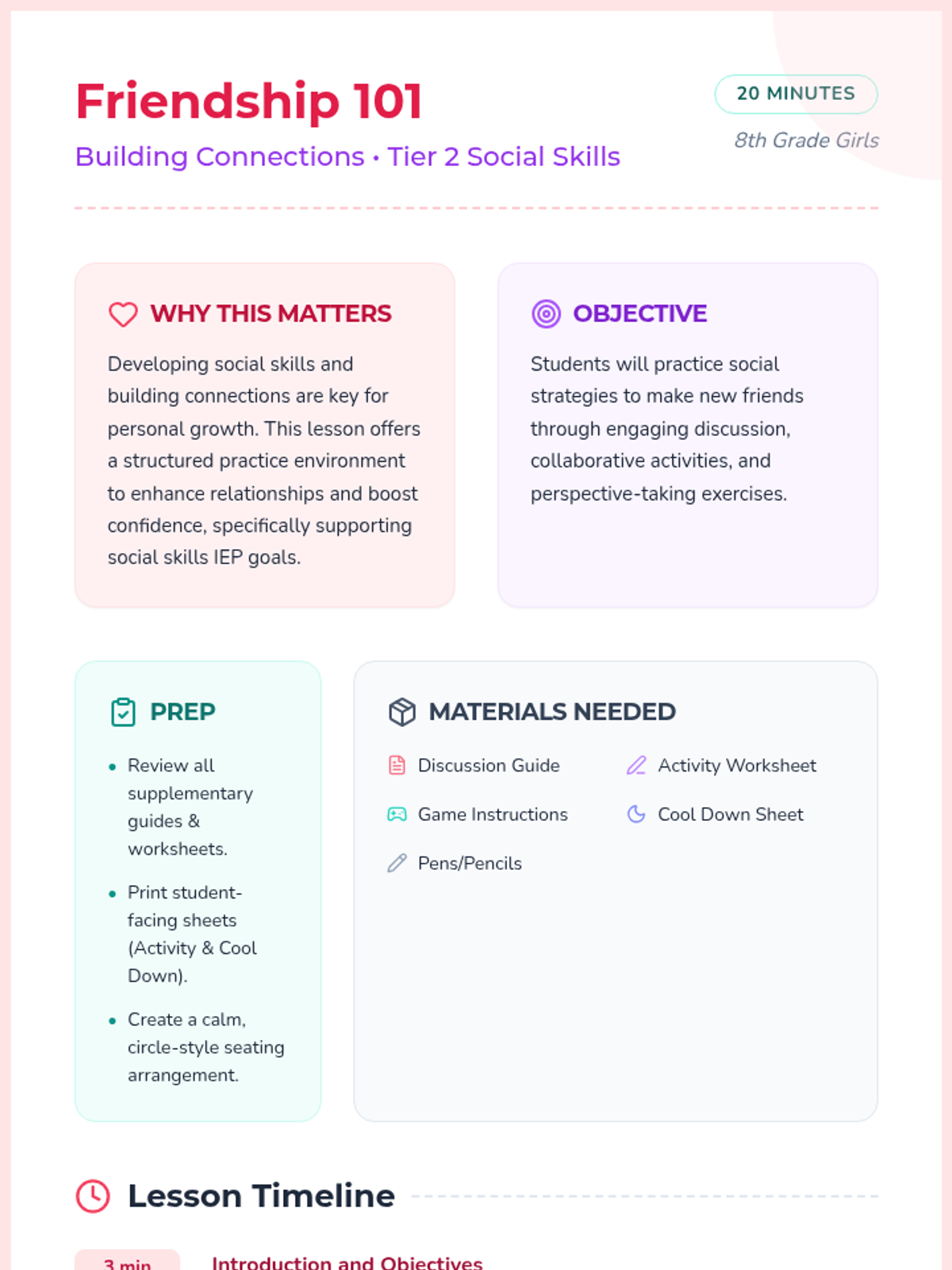
A comprehensive teacher lesson plan for Friendship 101, featuring a detailed 20-minute timeline, preparation steps, and learning objectives for 8th-grade social skills instruction.
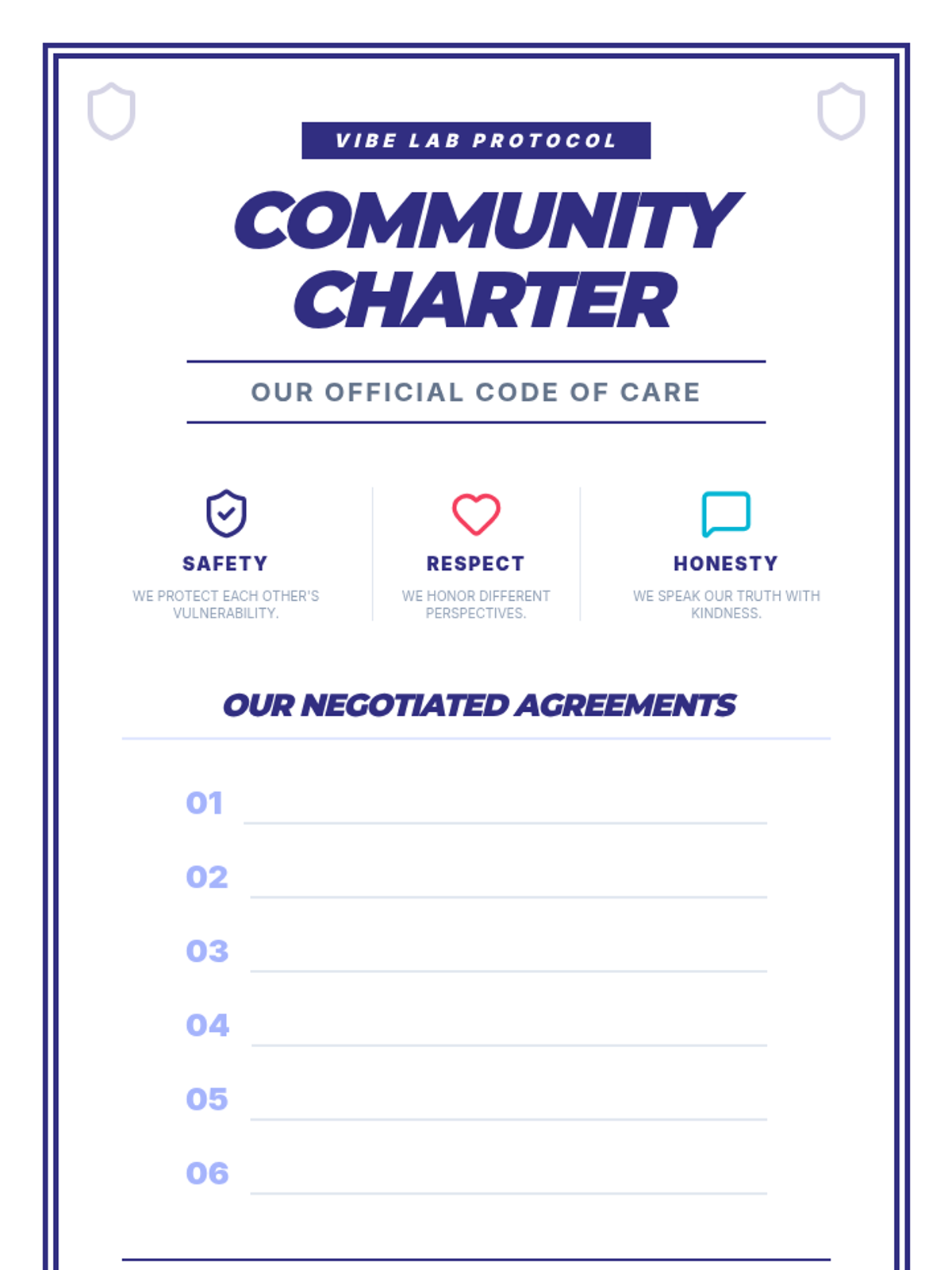
A polished, printable template for the final class charter to be signed and displayed, defining the community's core values and negotiated agreements.
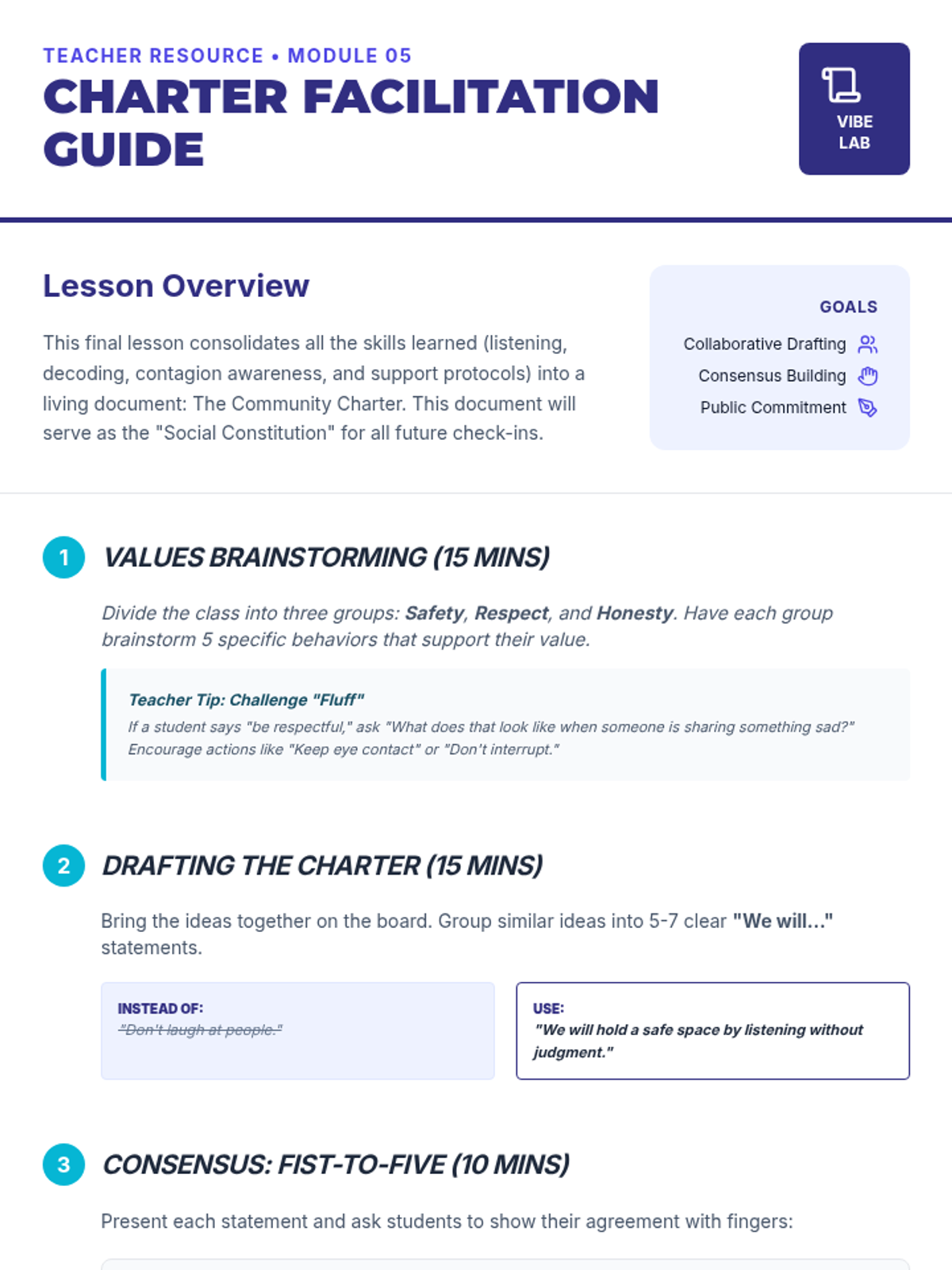
Teacher guide for Lesson 5, including brainstorming steps, consensus-building techniques, and a ratification ceremony protocol.
Visual presentation for Lesson 5, covering the creation of classroom norms, defining core values, and the drafting of a community charter.
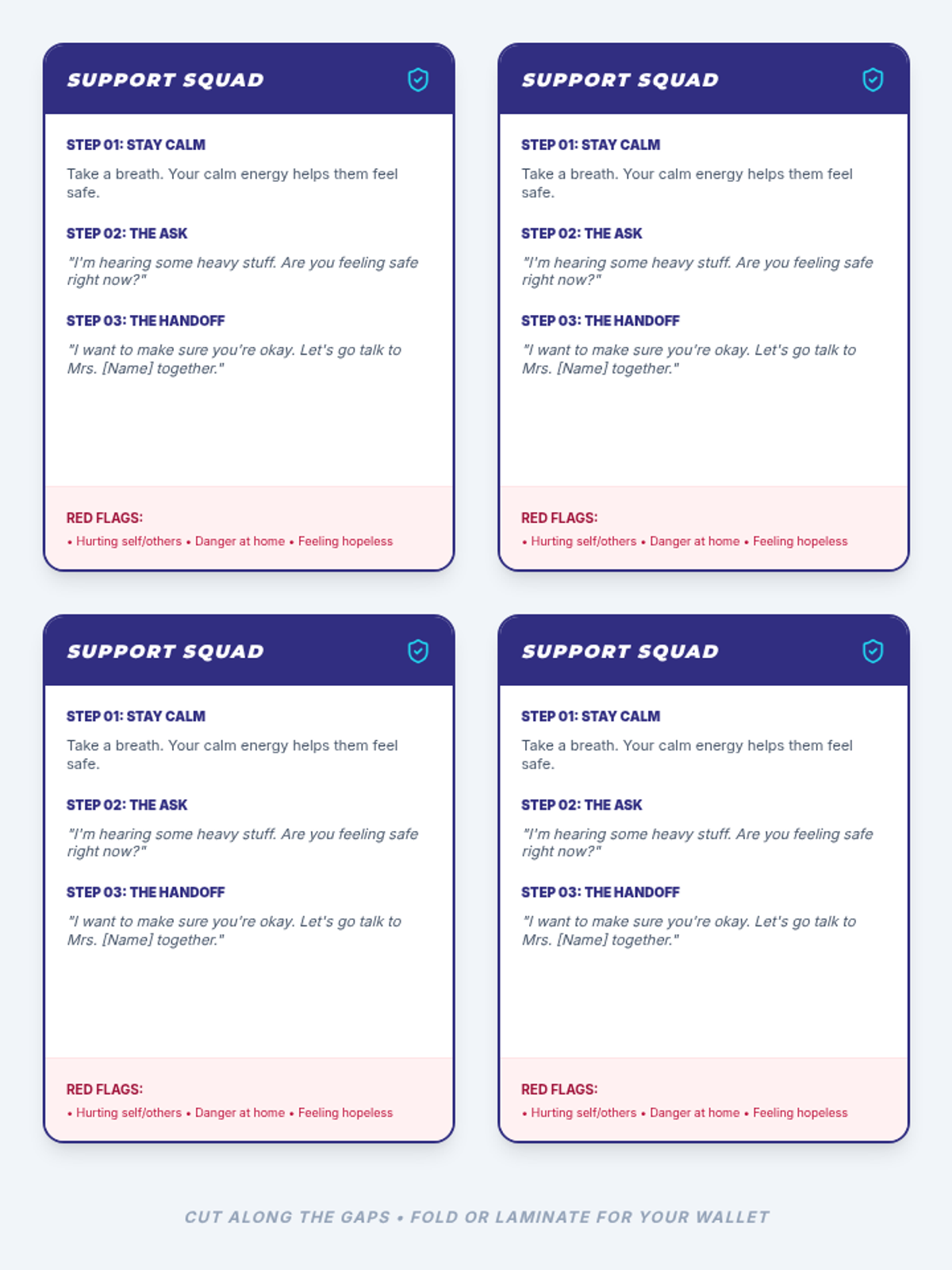
Printable protocol cards for students to keep as a reference for responding to peers in distress, including steps for a "warm handoff" and safety checks.
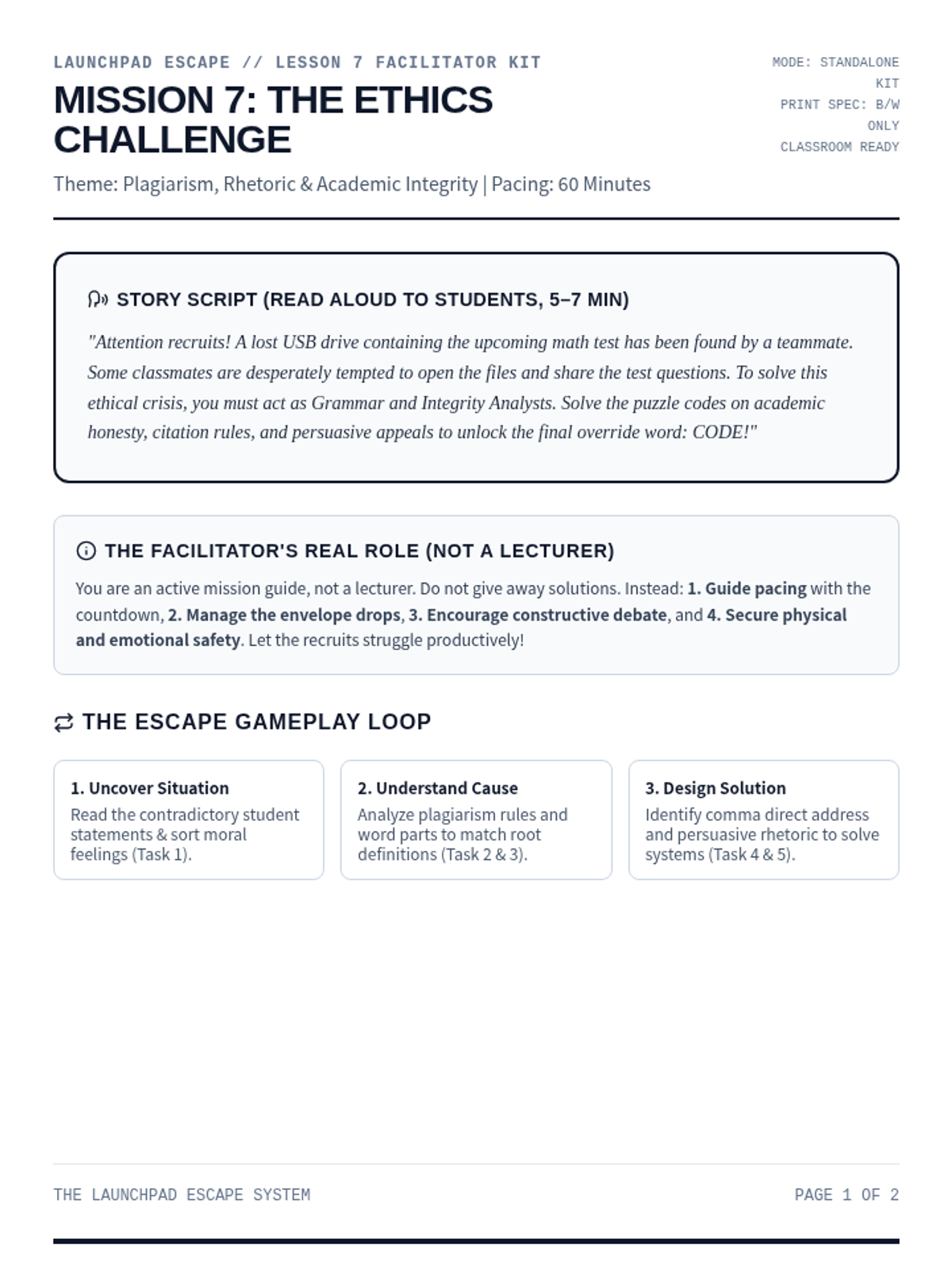
A comprehensive printable facilitator guide for Mission 7: The Ethics Challenge. Contains story script, setup checklists, progressive clue mechanics, persuasive appeals endings, and debrief questions.
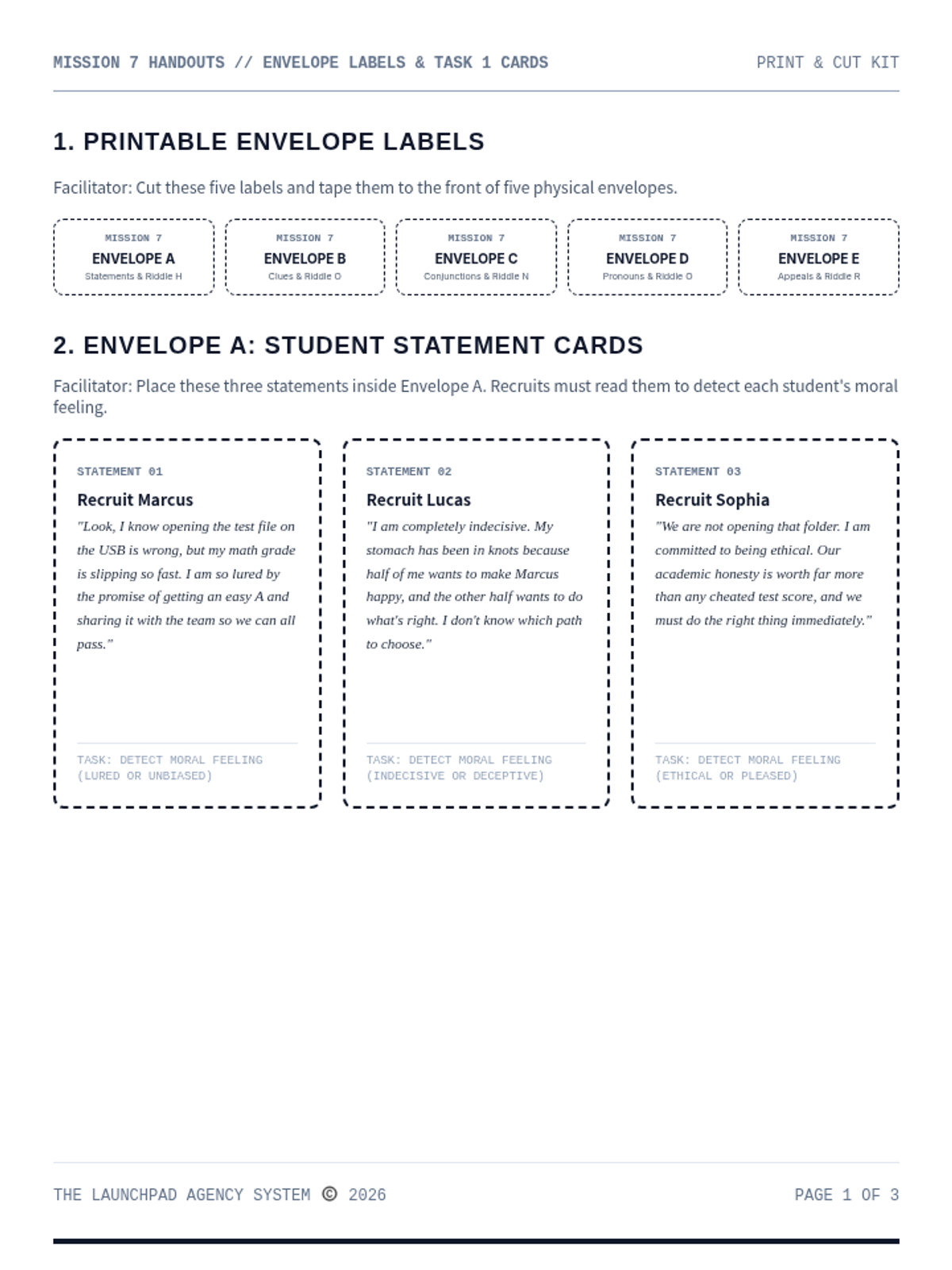
A print-and-cut materials handout kit for Mission 7: The Ethics Challenge. Contains envelope labels, student statements, word files, and printable landmark riddle cards.
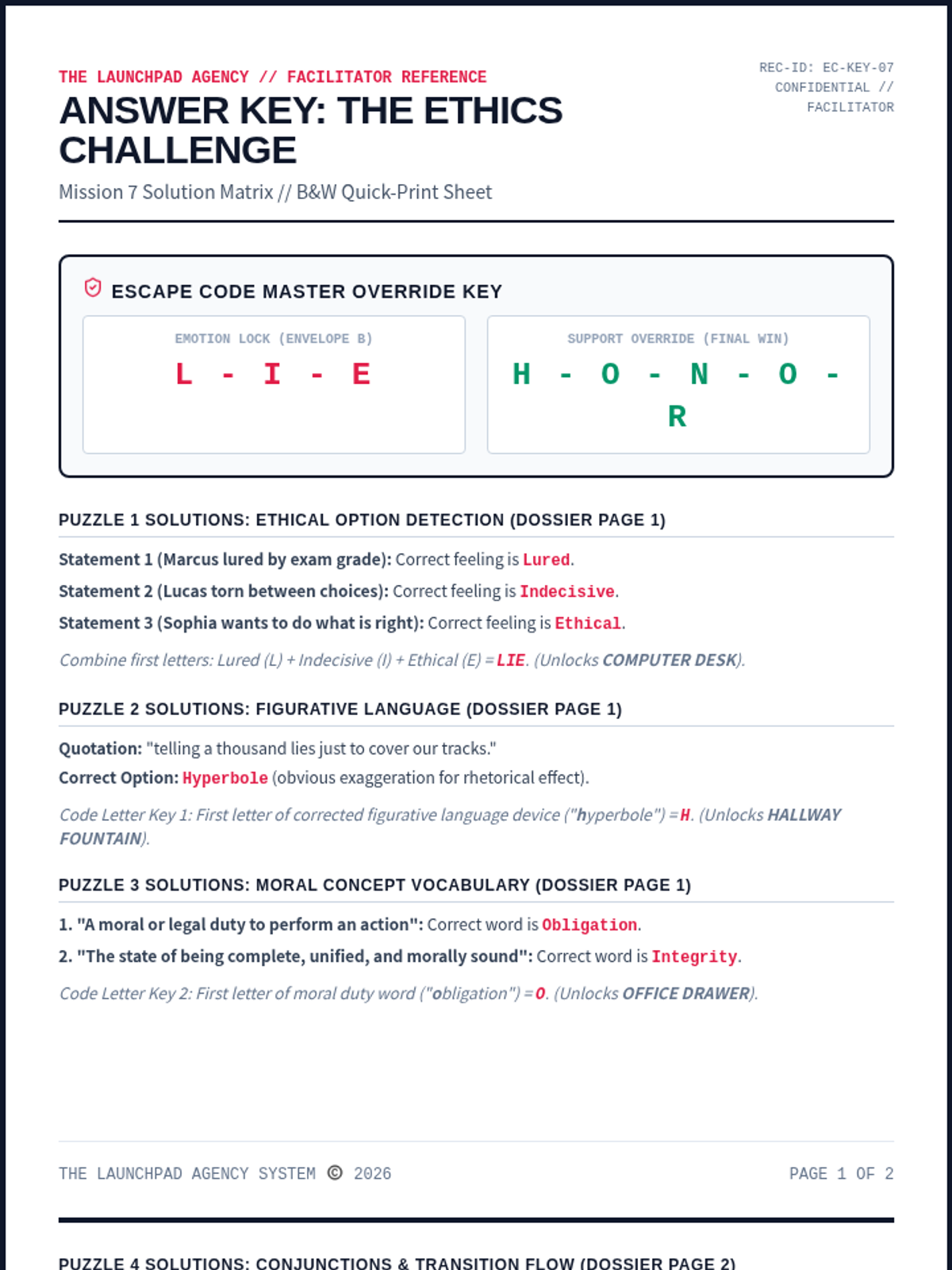
A dedicated facilitator answer key for Mission 7: The Ethics Challenge. Contains complete solutions for all ELA/coordinate puzzles, ciphers, and floor map paths, along with rubrics and setup tips.
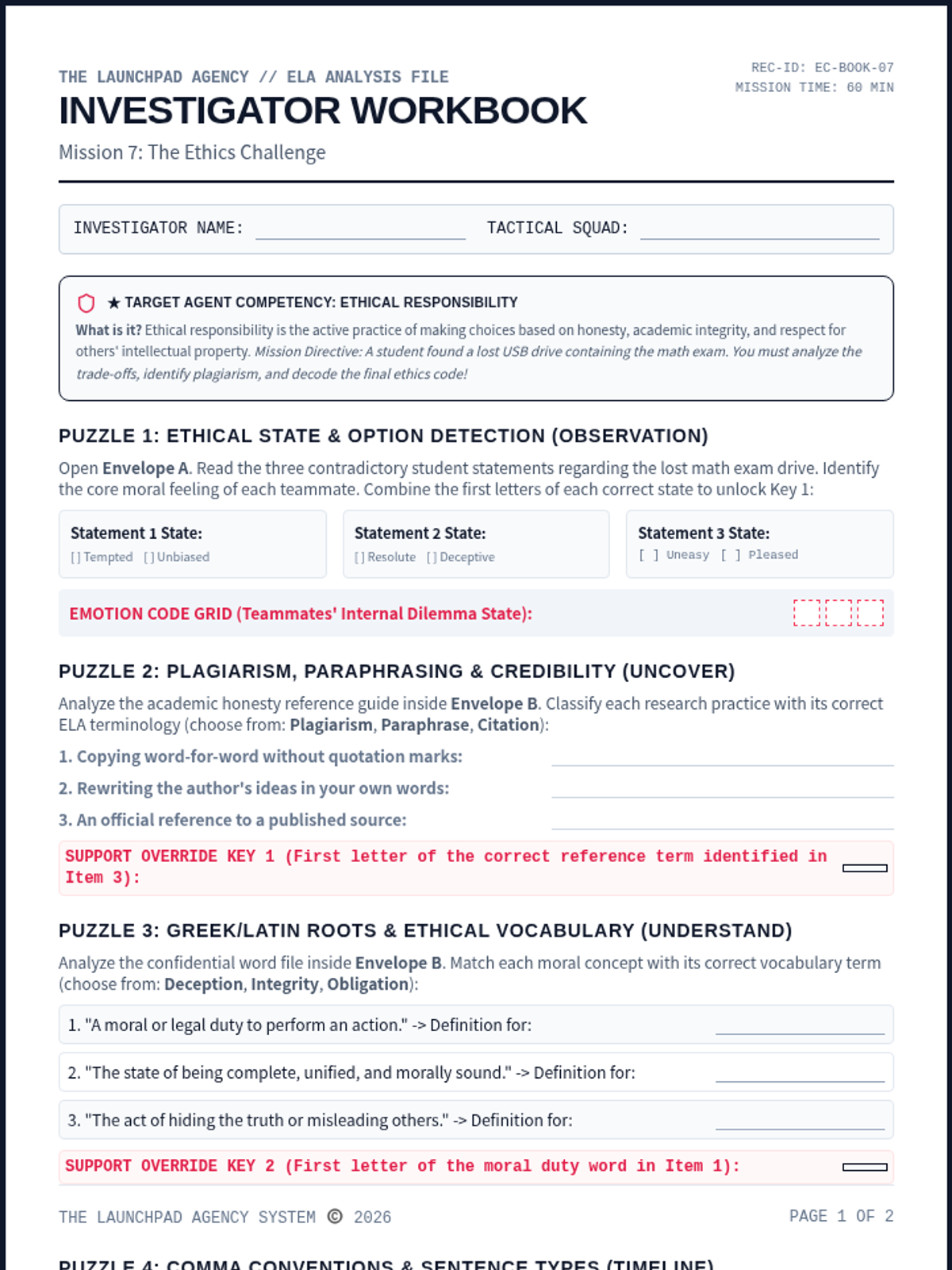
An immersive student-facing escape worksheet. Recruits evaluate the trade-offs of academic honesty, identify plagiarism, analyze persuasive appeals, and decode the final ethics code.
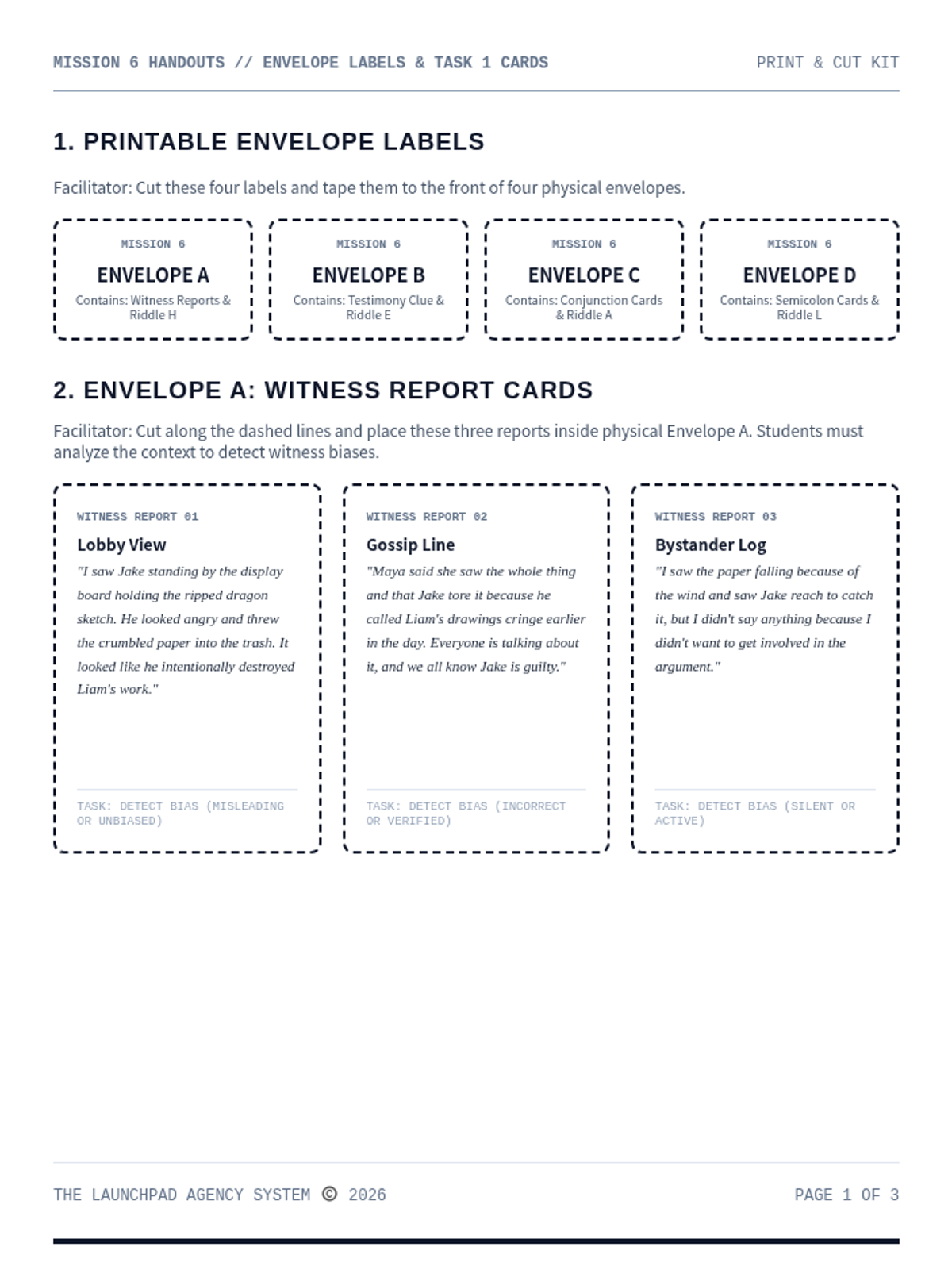
A print-and-cut materials handout kit for Mission 6: The Puzzle of Perspectives. Contains envelope labels, printed posts, source cards, and timeline charts.
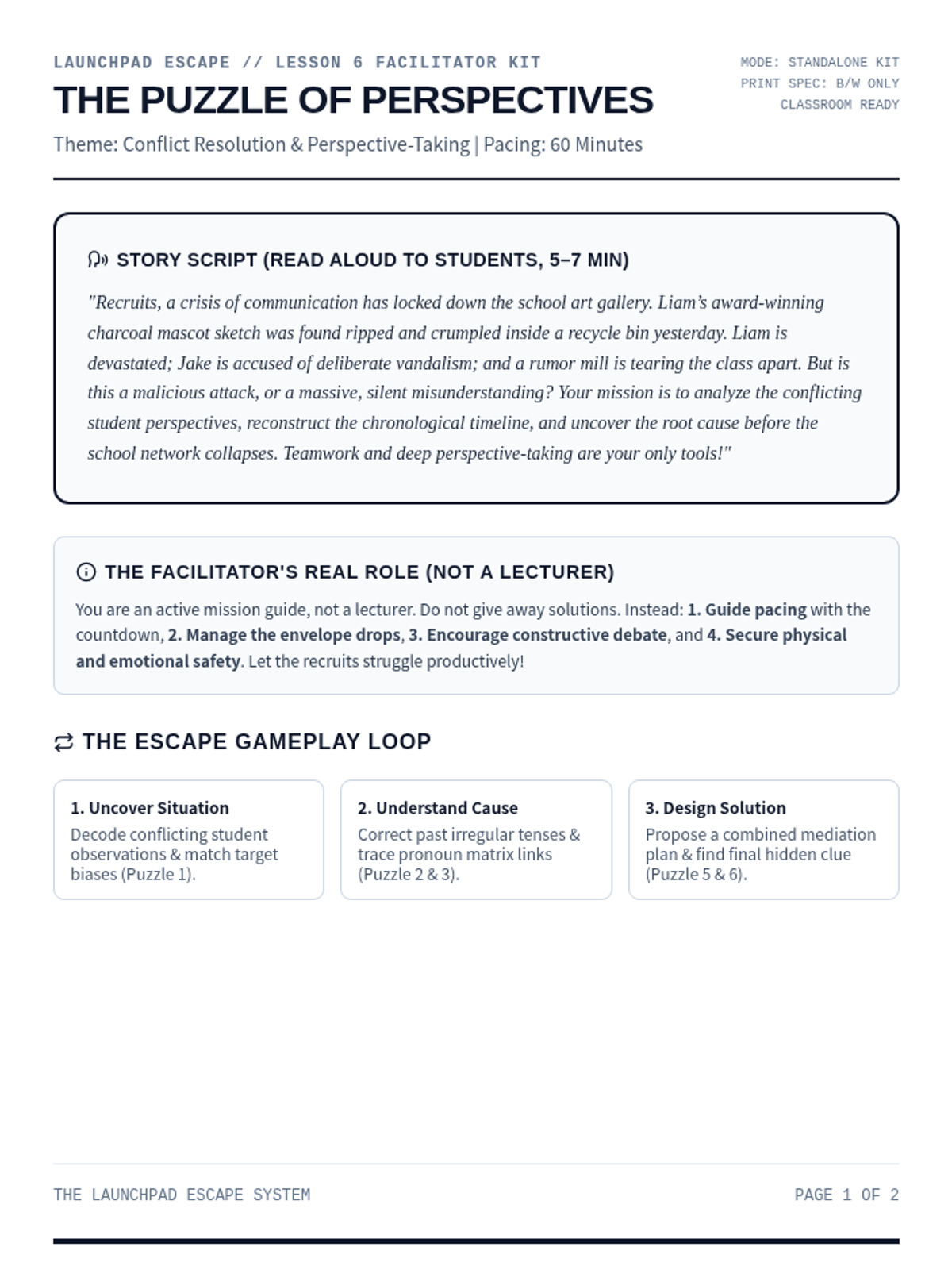
A comprehensive B/W printable facilitator guide for Mission 6: The Puzzle of Perspectives. Contains story script, small-space setup checklists, progressive clue mechanics, strategy hints, and reflective community debrief questions.
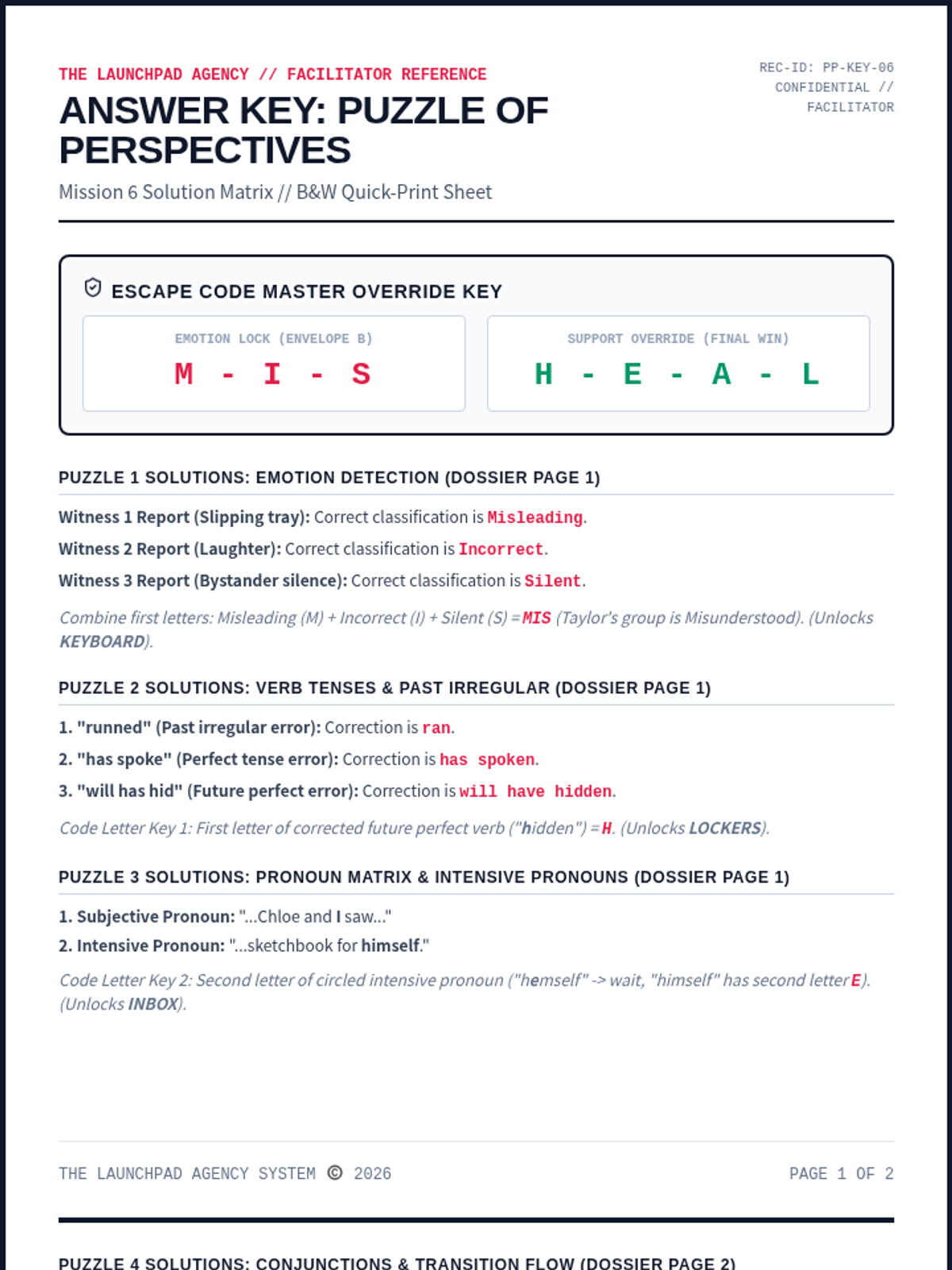
A dedicated facilitator answer key for Mission 6: The Puzzle of Perspectives. Contains complete solutions for all ELA/coordinate puzzles, ciphers, and floor map paths, along with rubrics and setup tips.
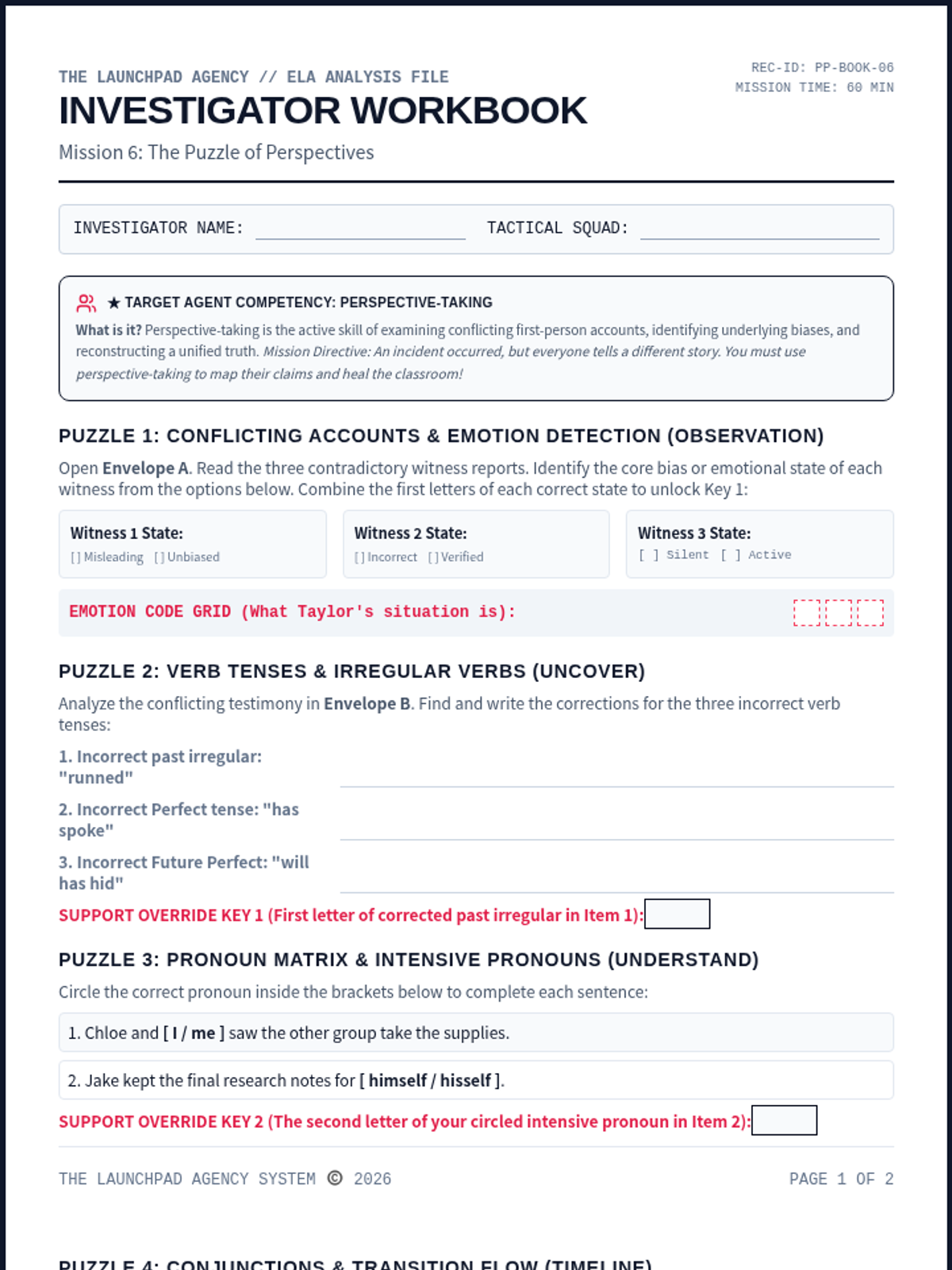
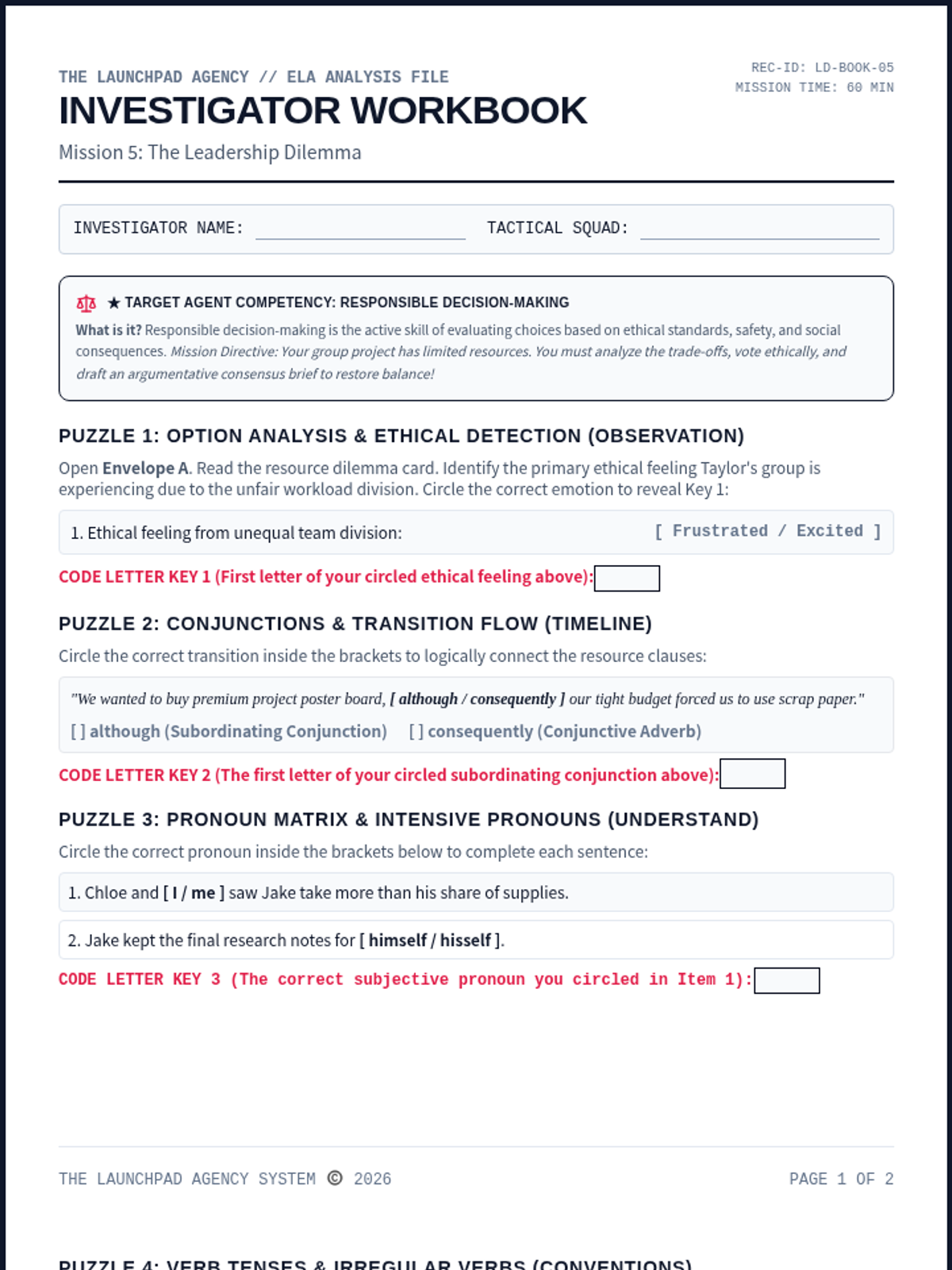
An immersive student-facing escape worksheet. Recruits examine conflicting first-person accounts, analyze bias, analyze figurative language (hyperbole, metaphor, simile), circle intensive pronouns, and solve the override code.
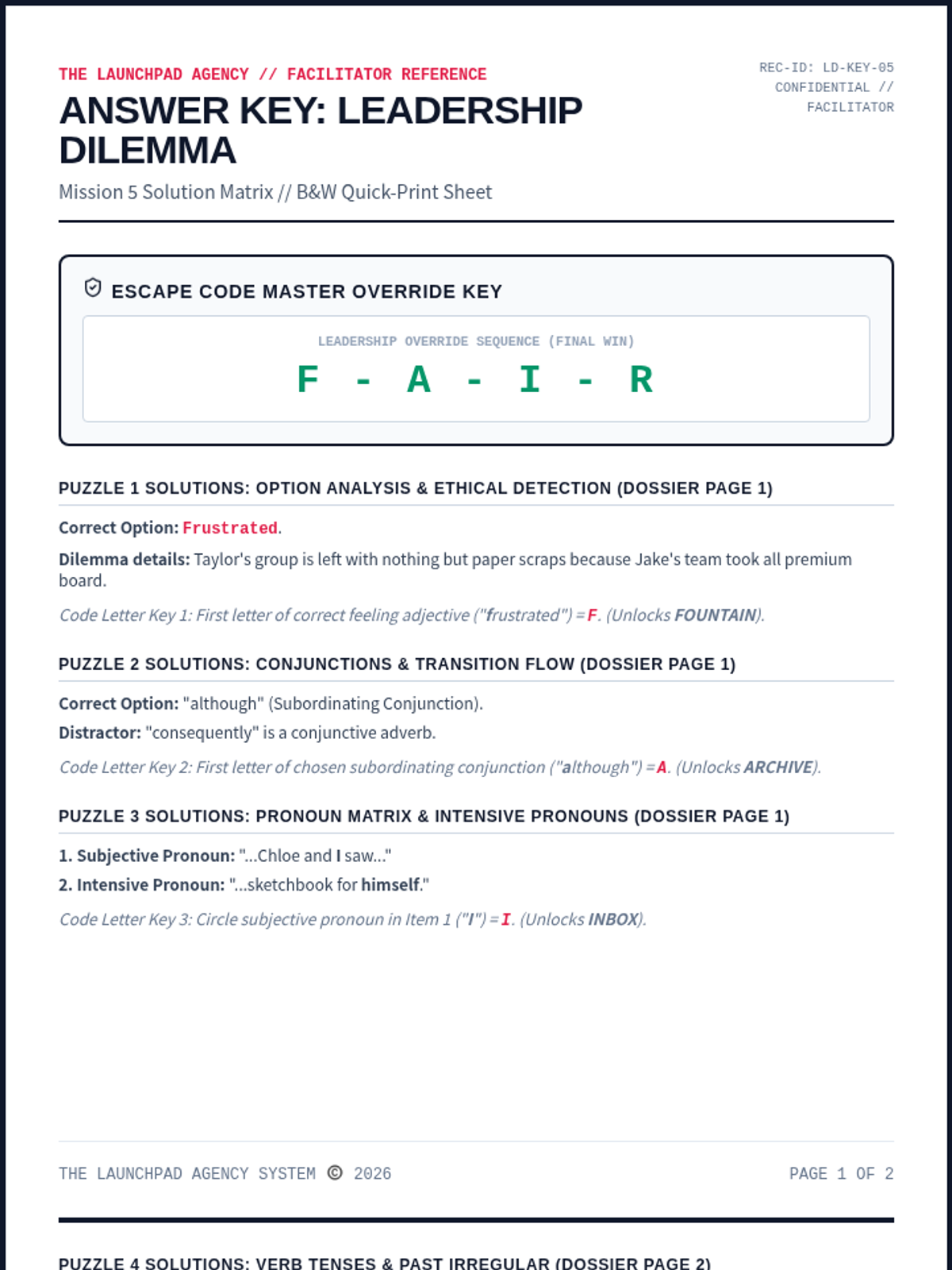
A dedicated facilitator answer key for Mission 5: The Leadership Dilemma. Contains complete solutions for all ELA/coordinate puzzles, ciphers, and floor map paths, along with rubrics and setup tips.
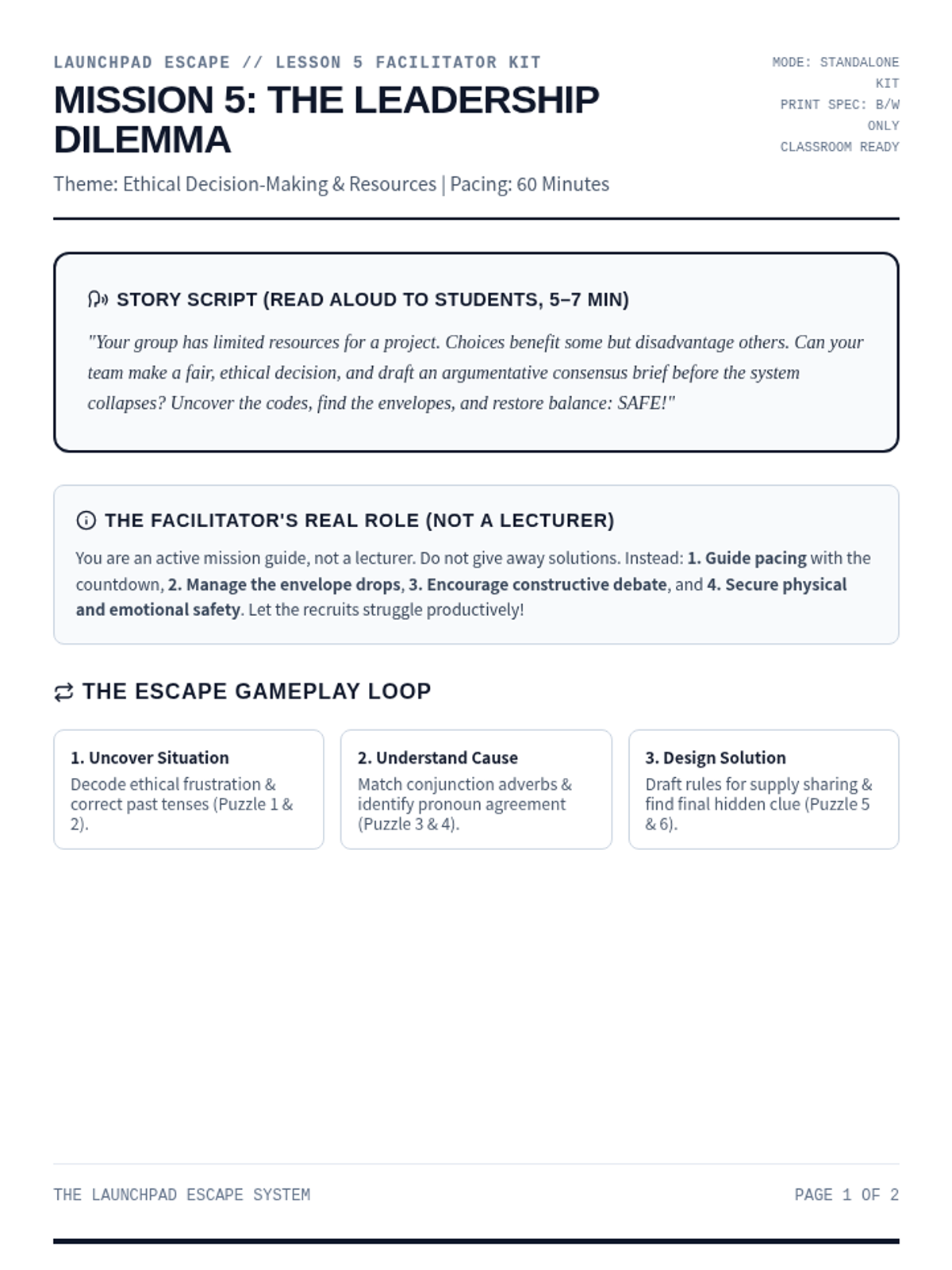
A comprehensive B/W printable facilitator guide for Mission 5: The Leadership Dilemma. Contains story script, small-space setup checklists, progressive clue mechanics, strategy hints, and reflective community debrief questions.
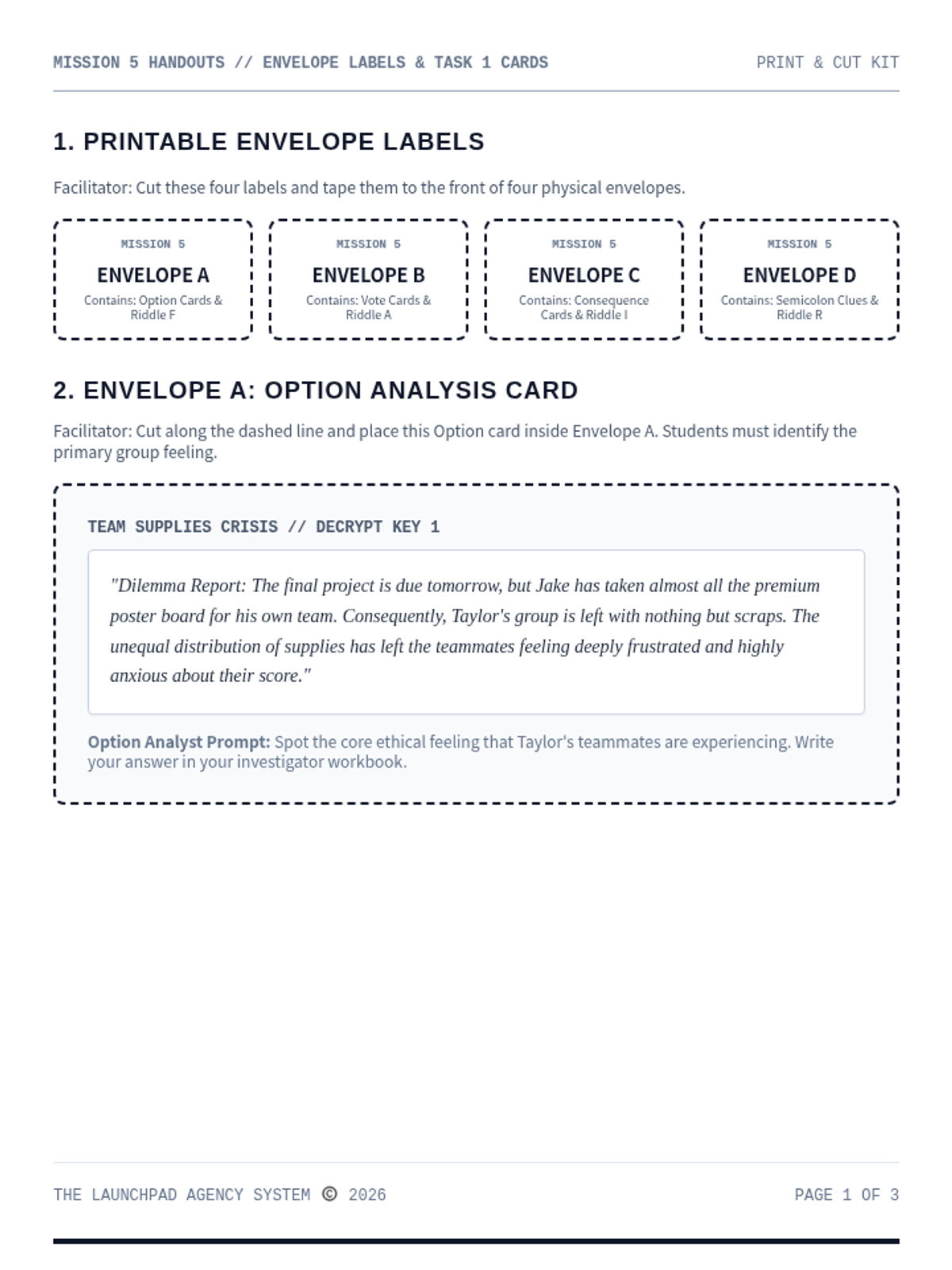
A print-and-cut materials handout kit for Mission 5: The Leadership Dilemma. Contains envelope labels, project notes, riddle cards, and landmark clues.
An immersive student-facing escape worksheet. Recruits map desk sticky-notes, sort weekly timeline events, evaluate decision point actions, and prepare their final presentation to restore the classroom.
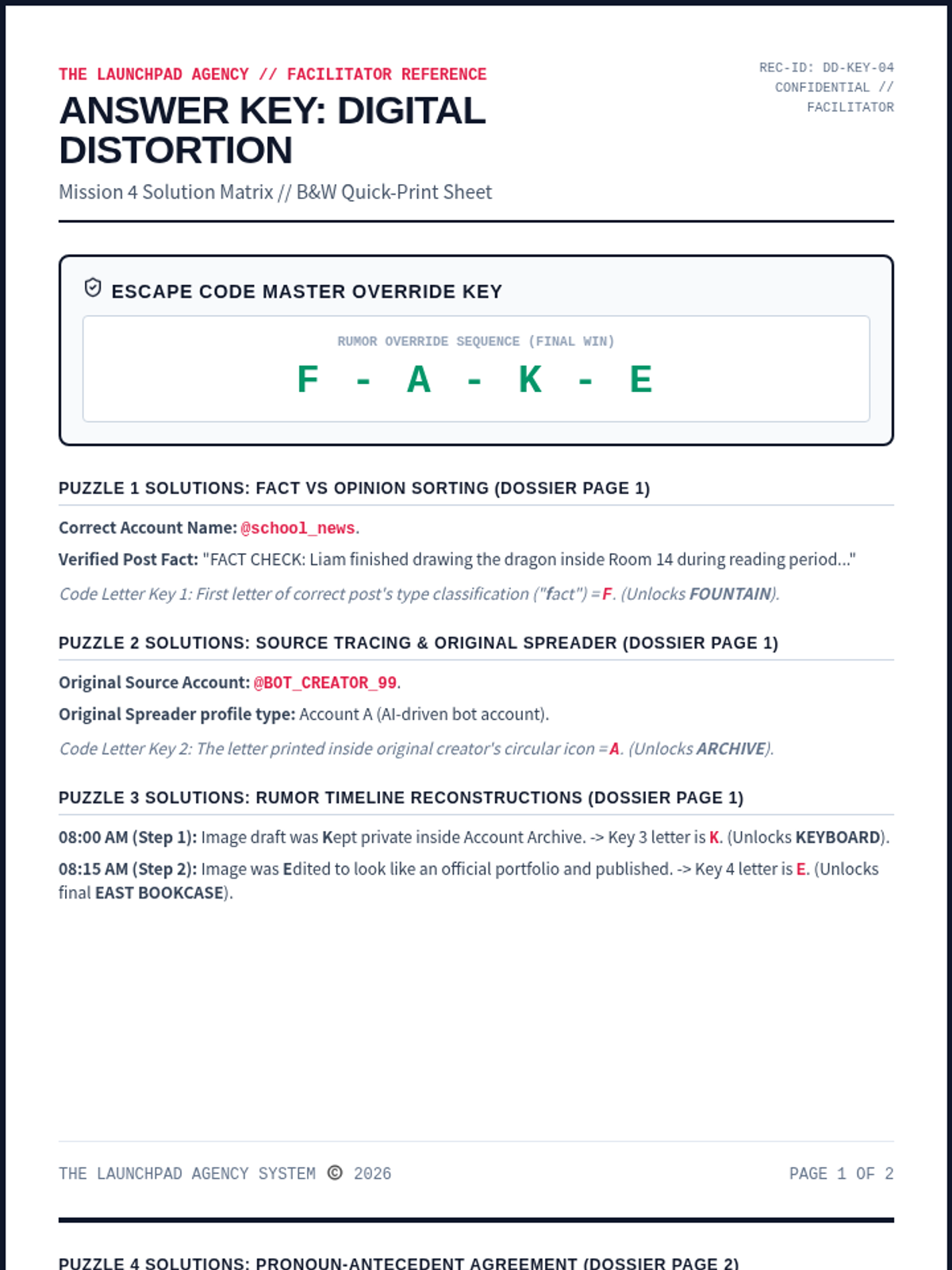
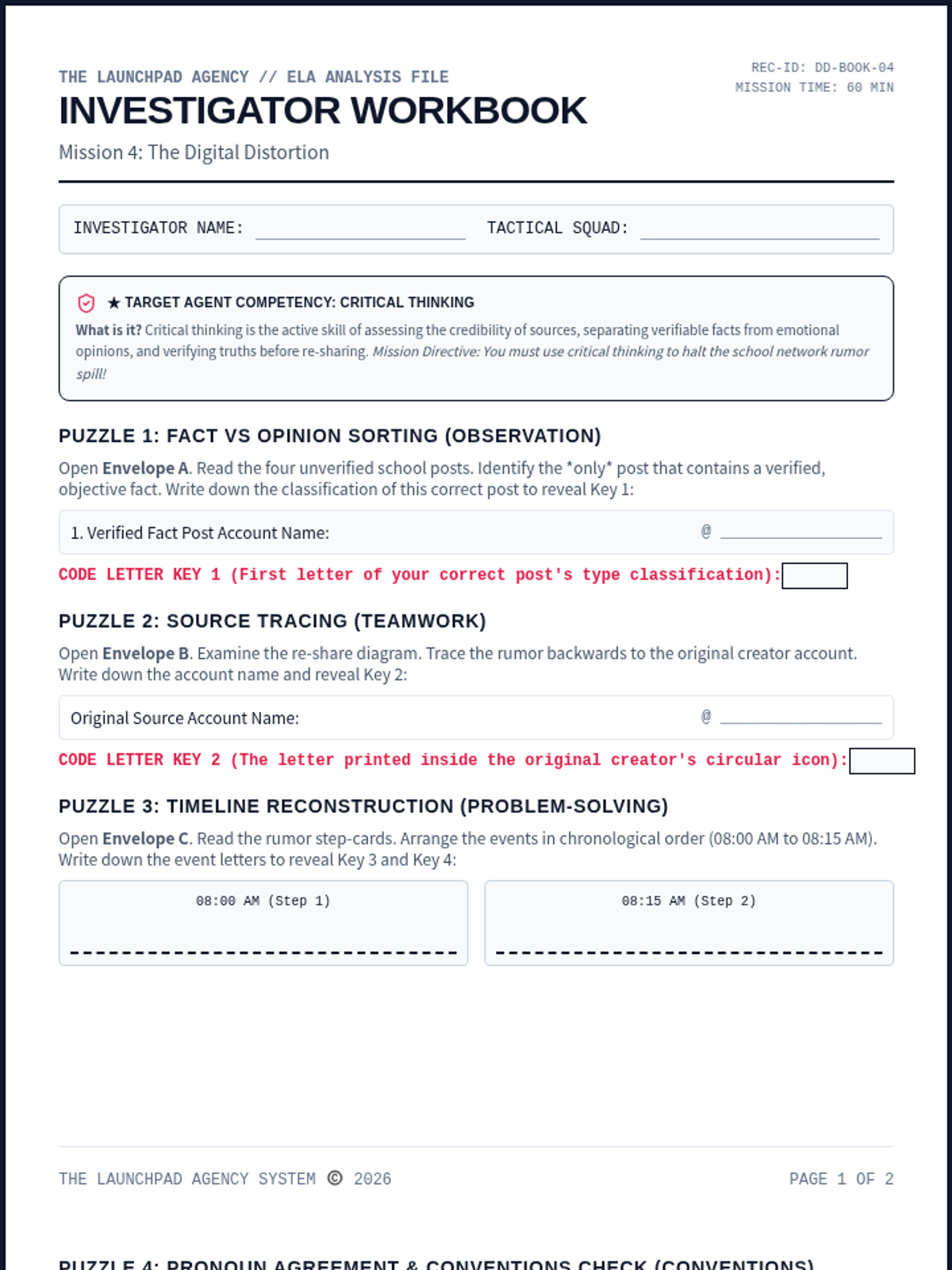
A dedicated facilitator answer key for Mission 4: The Digital Distortion. Contains complete solutions for all ELA/coordinate puzzles, ciphers, and floor map paths, along with rubrics and setup tips.
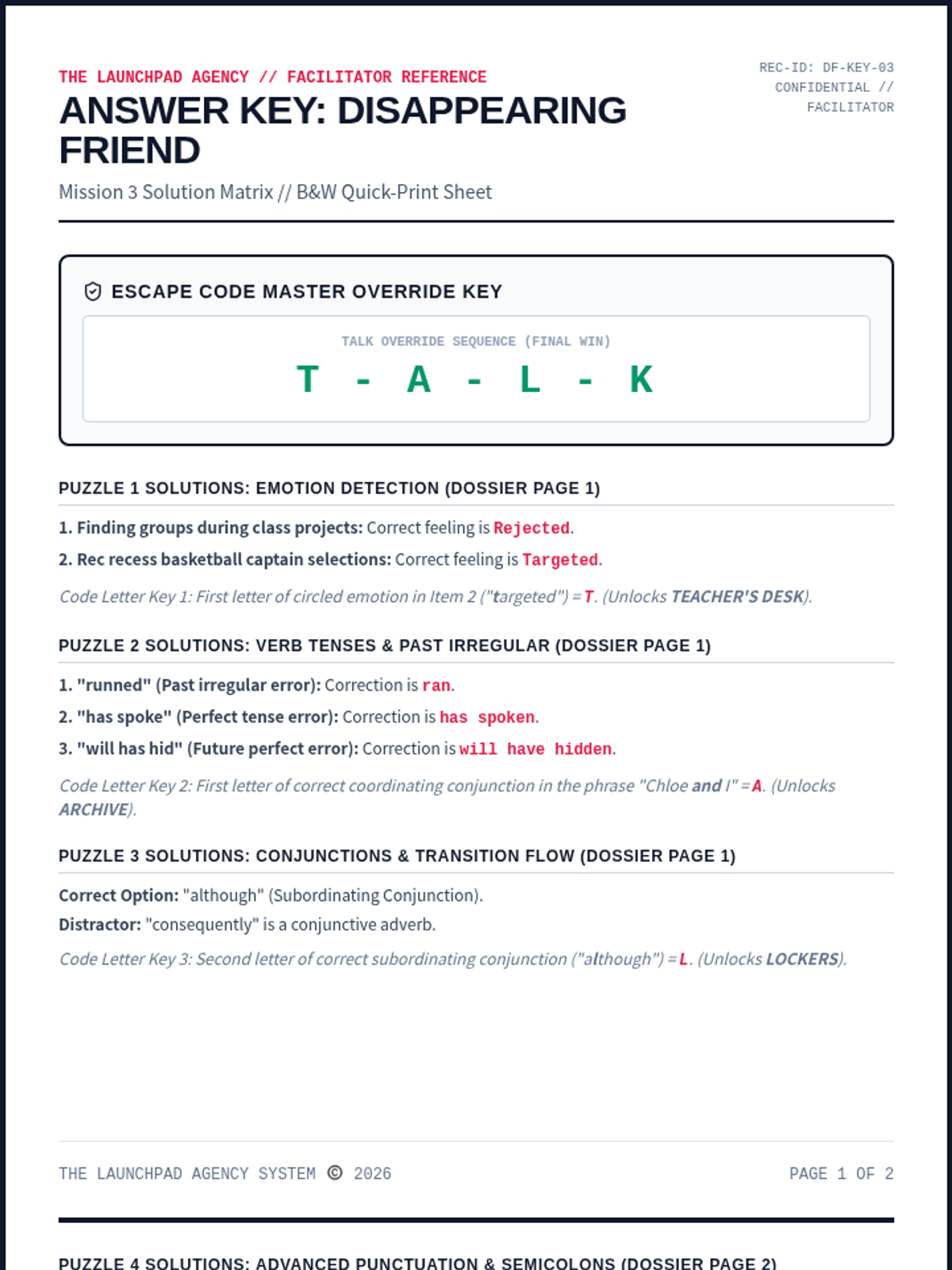
A dedicated facilitator answer key for Mission 3: The Disappearing Friend. Contains complete solutions for all ELA/coordinate puzzles, ciphers, and floor map paths, along with rubrics and setup tips.
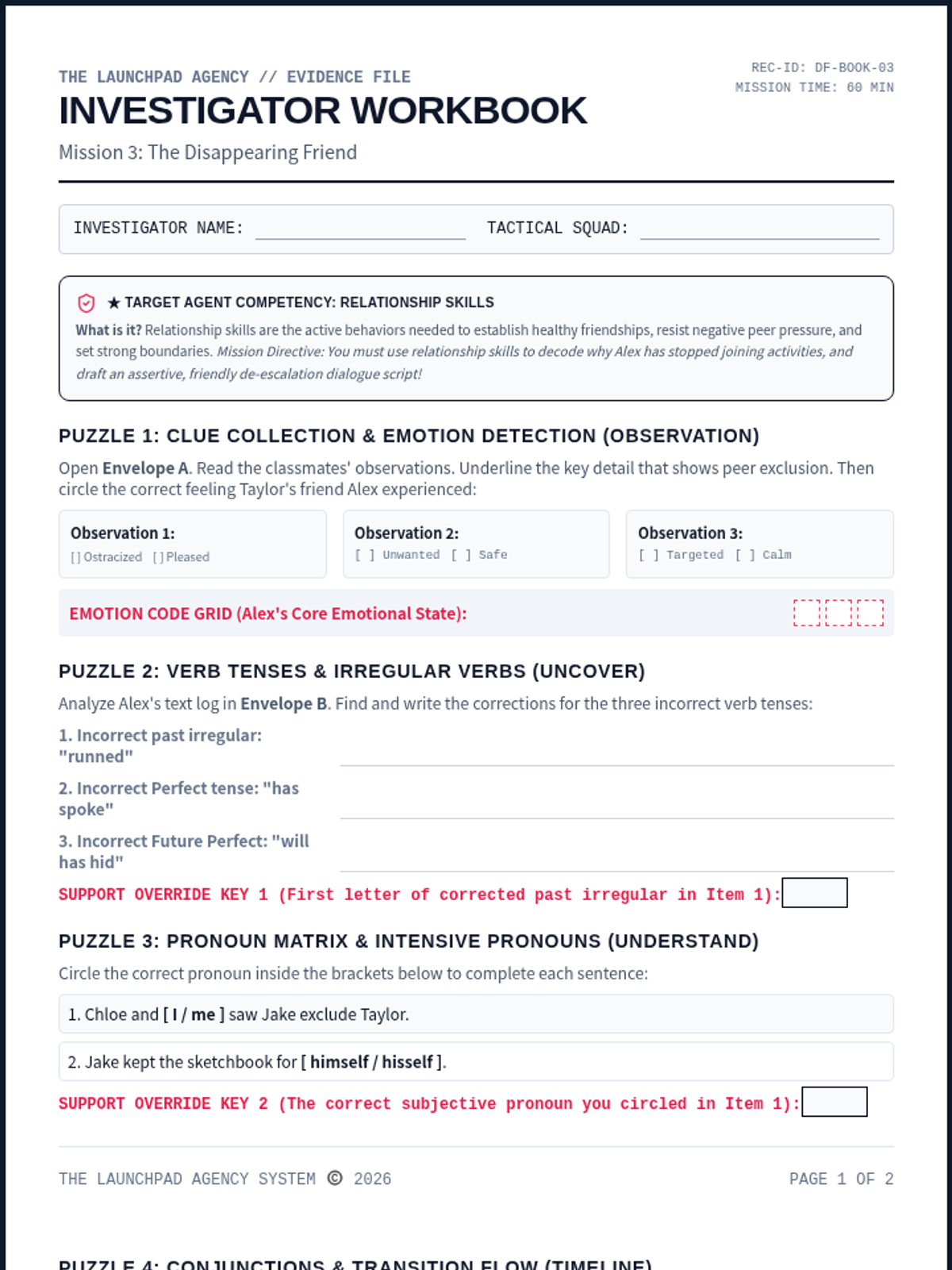
An immersive student-facing escape worksheet for Mission 3: The Disappearing Friend. Recruits analyze Alex's text log, solve morphology and spelling word challenges, circle subjective pronouns, identify conjunctions, and draft restorative dialogue rules to escape.
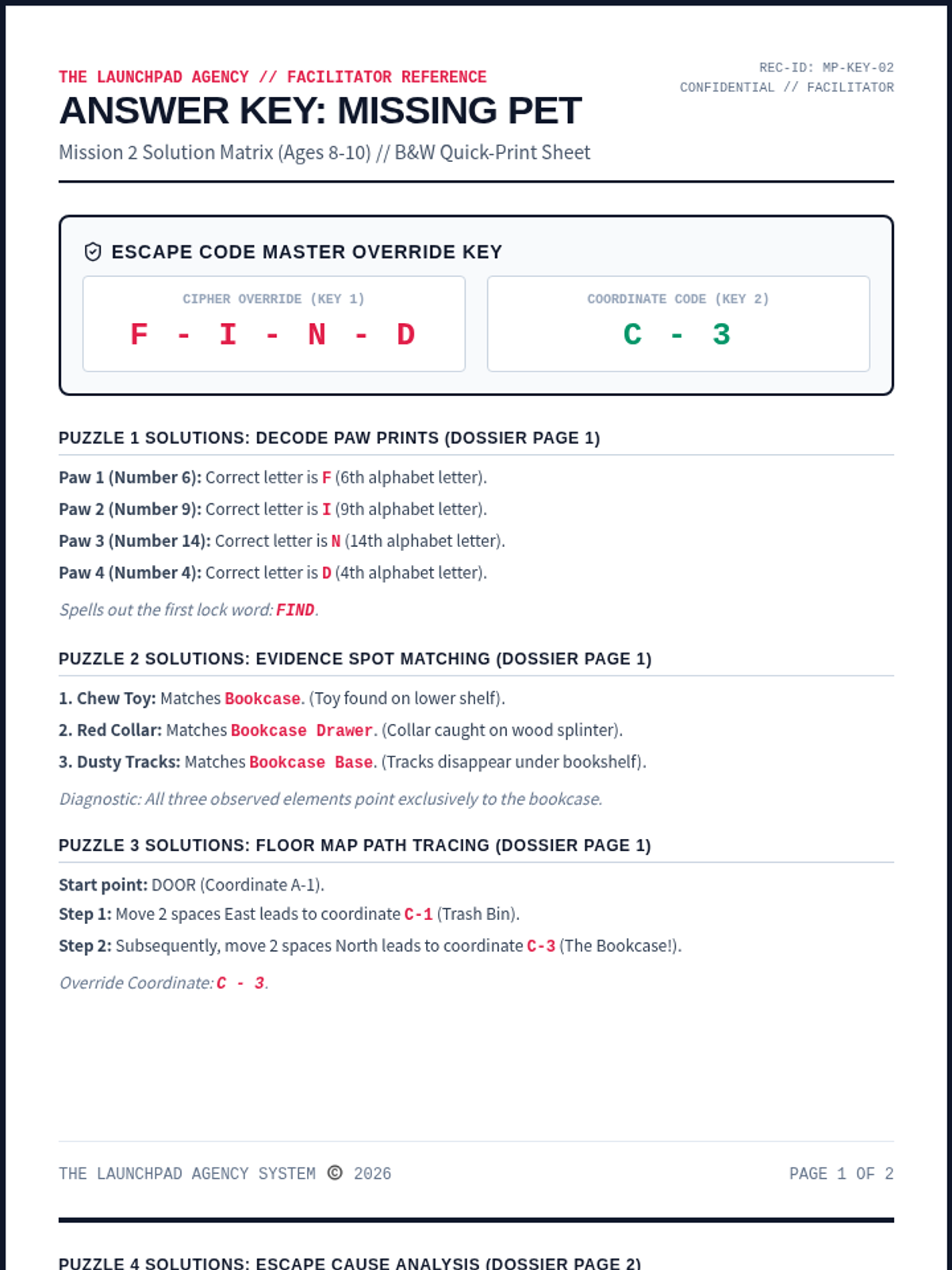
A dedicated facilitator answer key for Mission 2: The Mystery of the Missing Pet. Contains complete solutions for all ELA/coordinate puzzles, ciphers, and floor map paths, along with rubrics and setup tips.
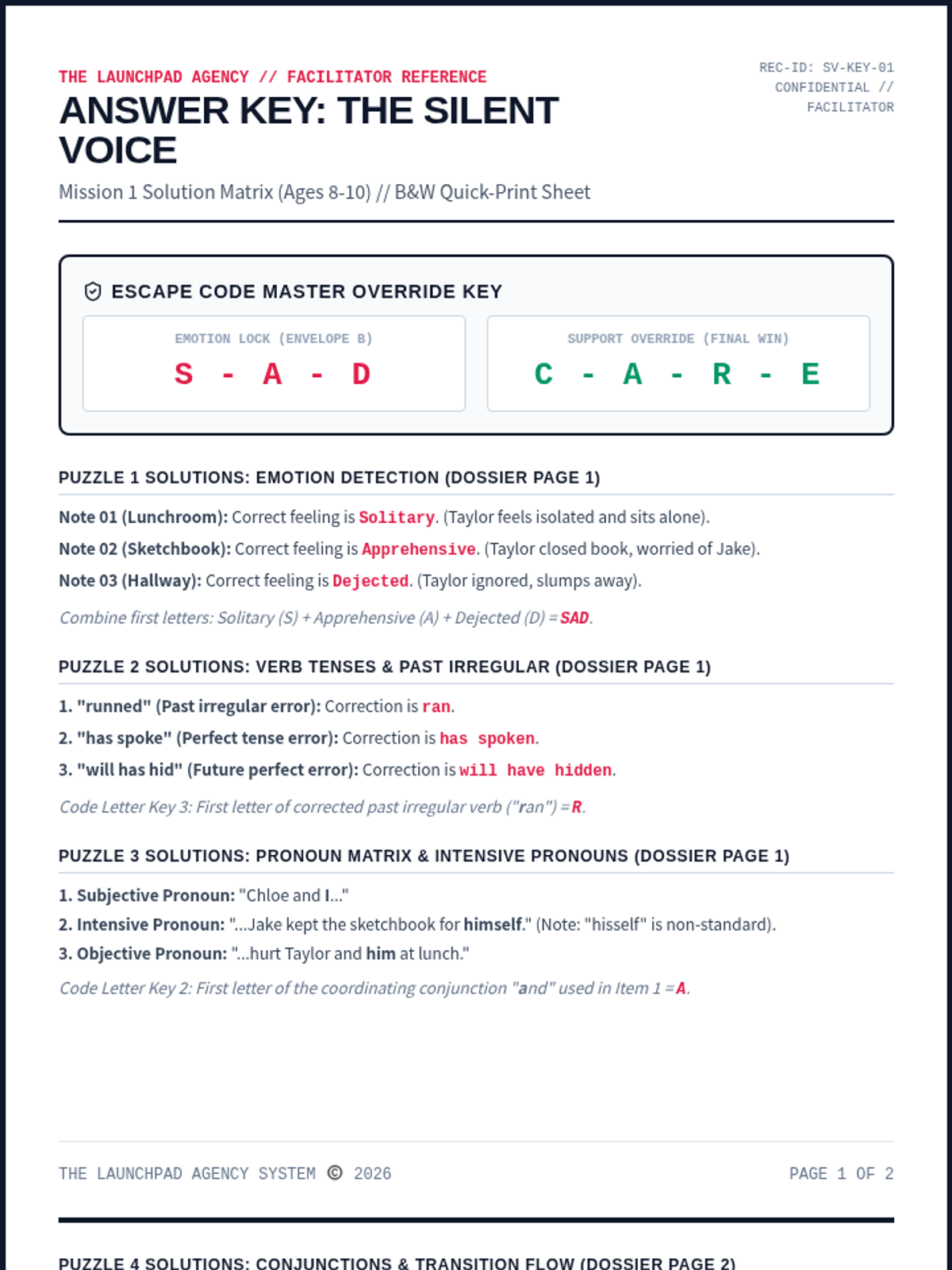
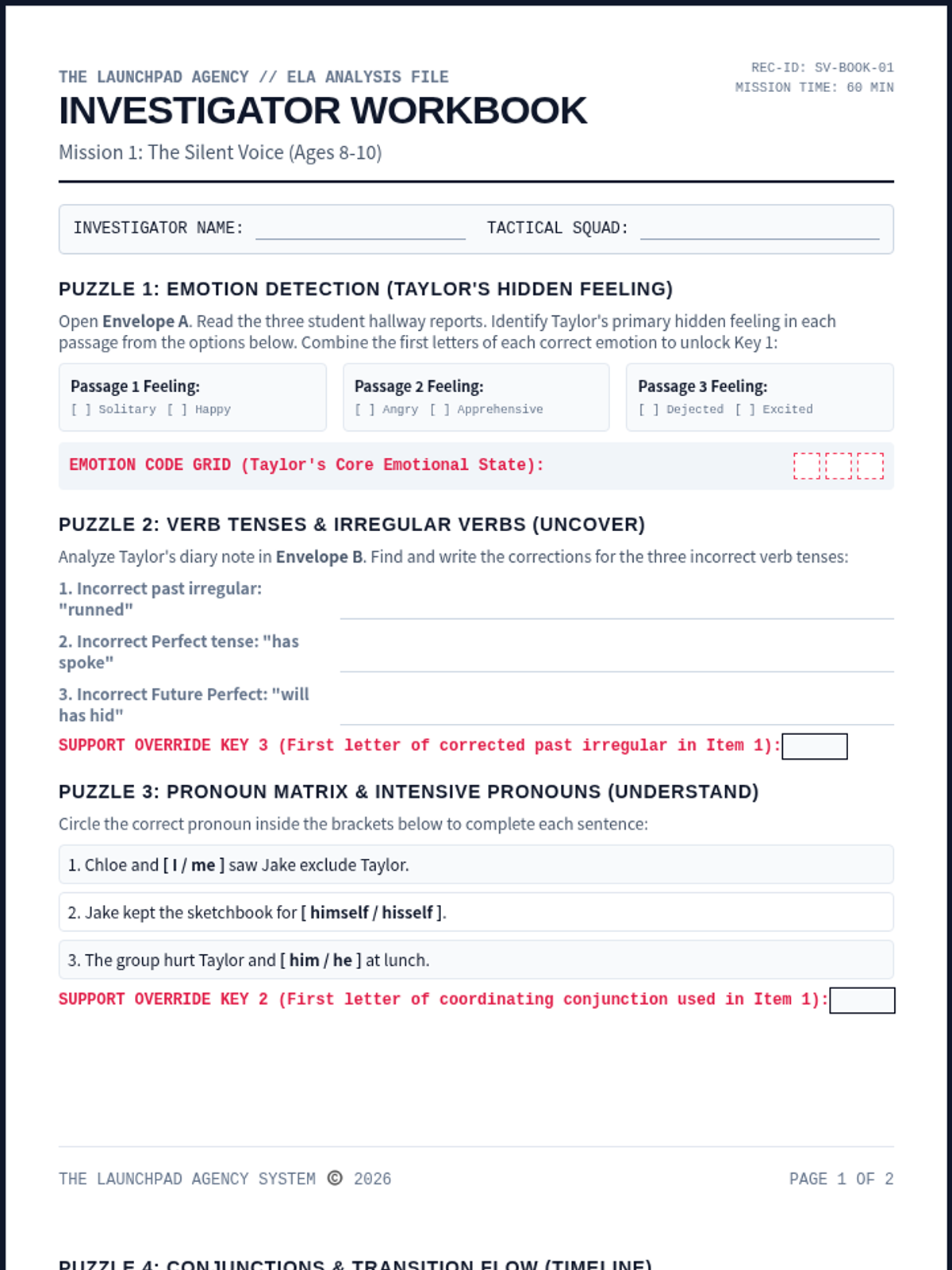
A dedicated facilitator answer key for Mission 1: The Silent Voice. Contains complete solutions for all 5 ELA puzzles, pronoun/verb corrections, code-breaking explanations, and sample high-quality written paragraph responses.
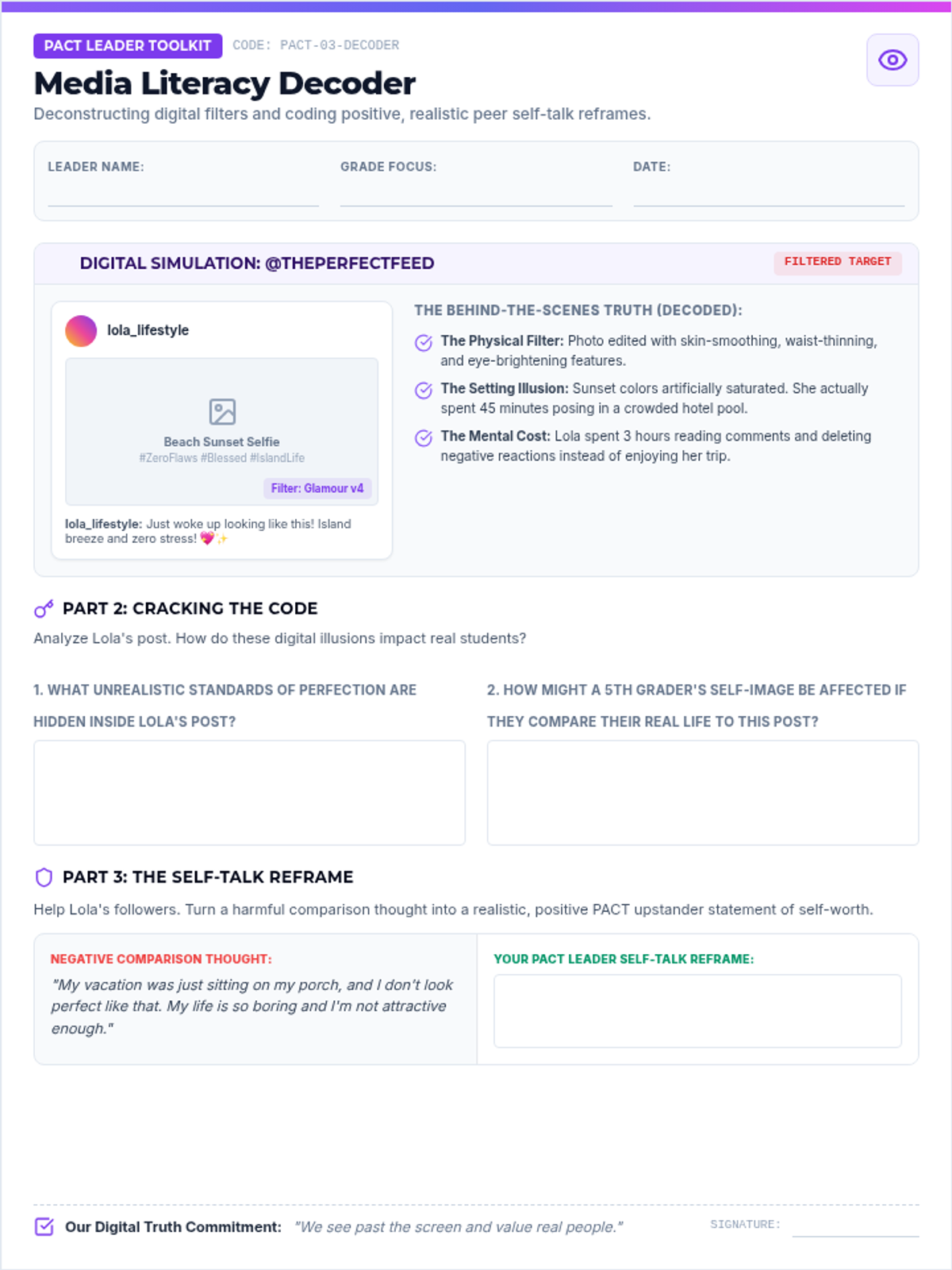
A media literacy and self-talk decoder worksheet for student leaders to analyze digital distortions and practice converting negative comparisons into positive affirmations.
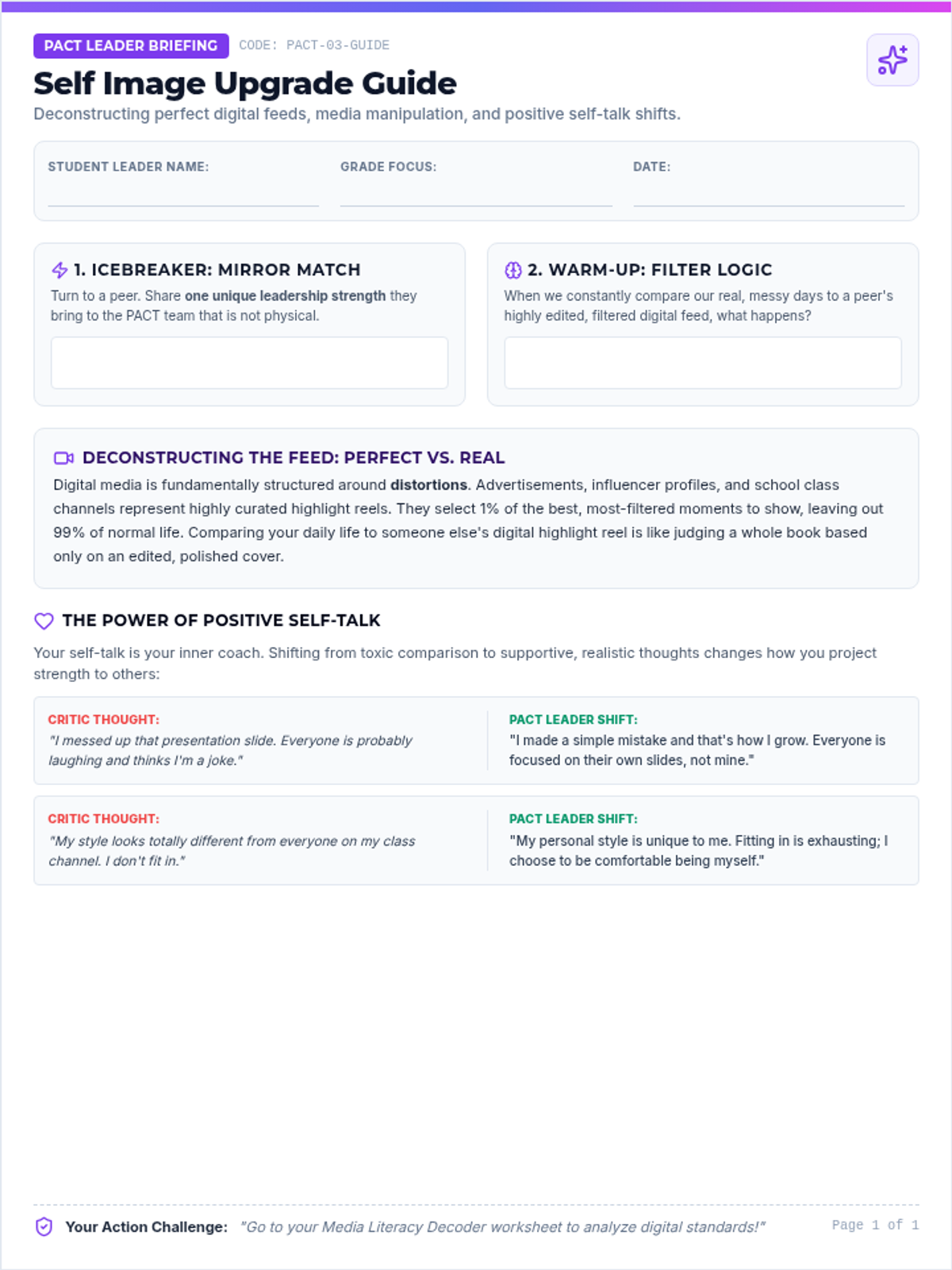
A printable guide detailing digital media literacy, deconstructing filters and perfect feeds, alongside self-talk reframing strategies.
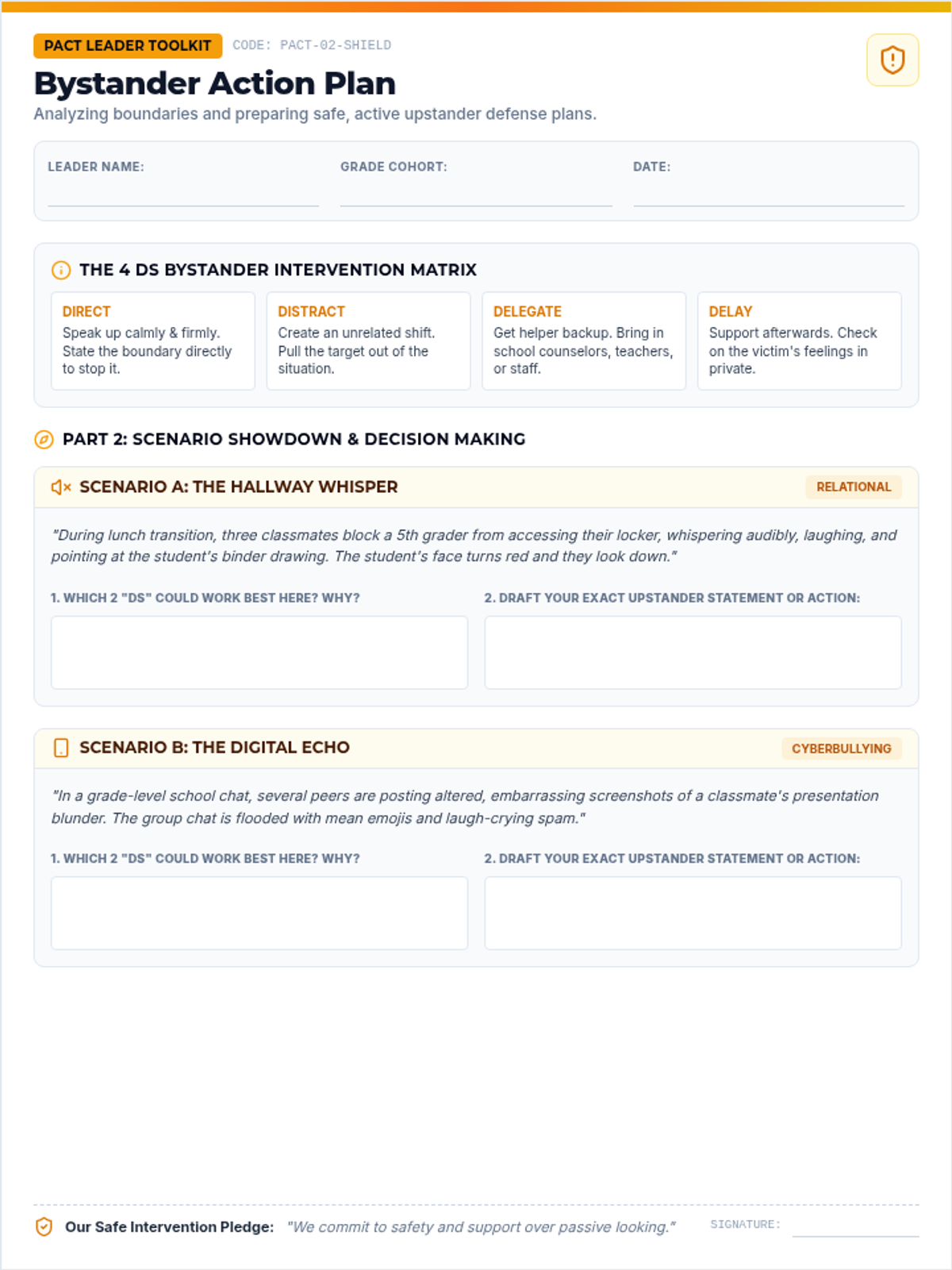
A practical student-facing action planning sheet where PACT leaders analyze real-world bullying scenarios and apply the 4 Ds bystander intervention framework.
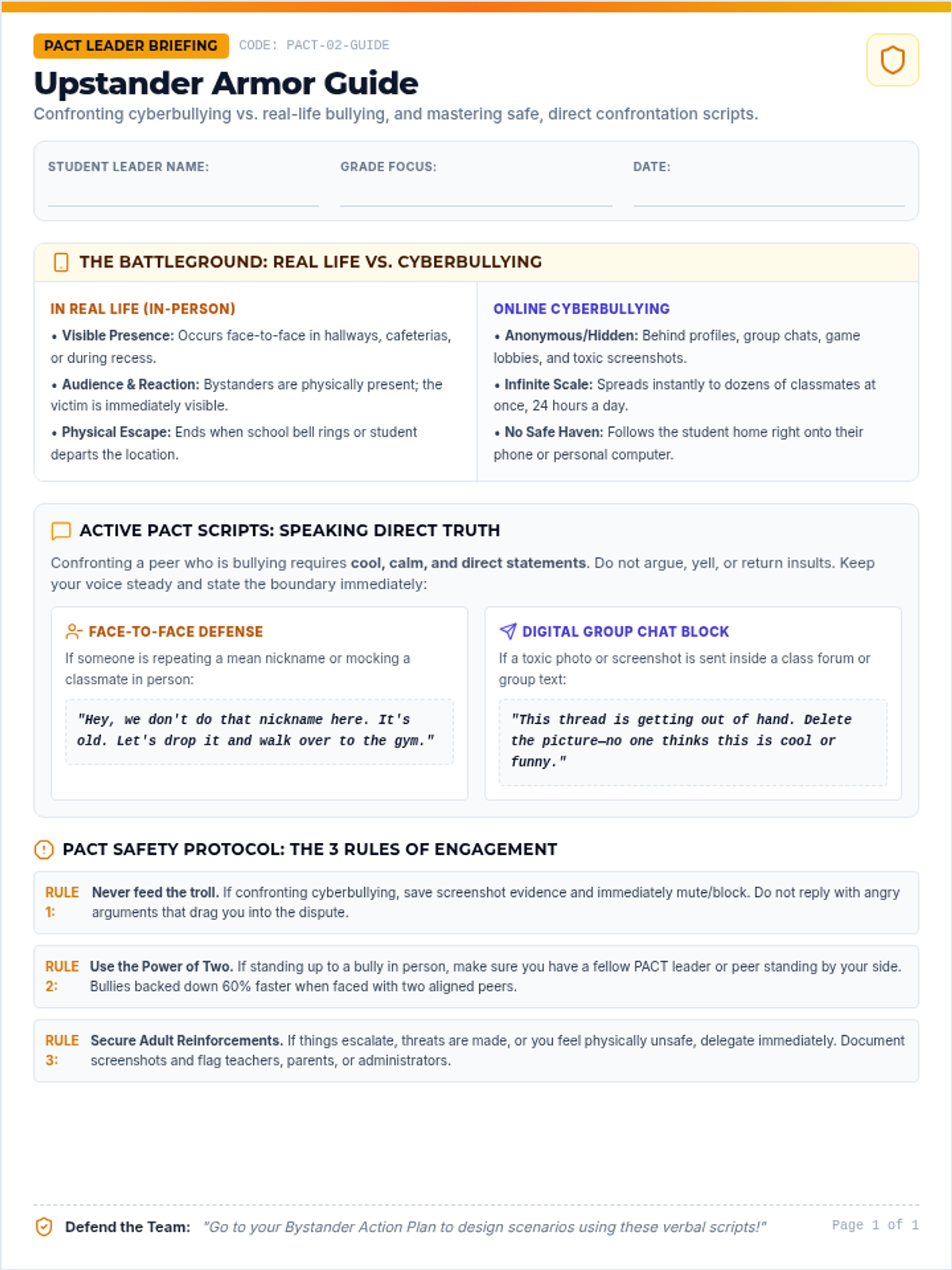
A printable guide detailing the exact differences between face-to-face and online cyberbullying, alongside direct, verbal upstander scripts for confronting bullying behavior safely.
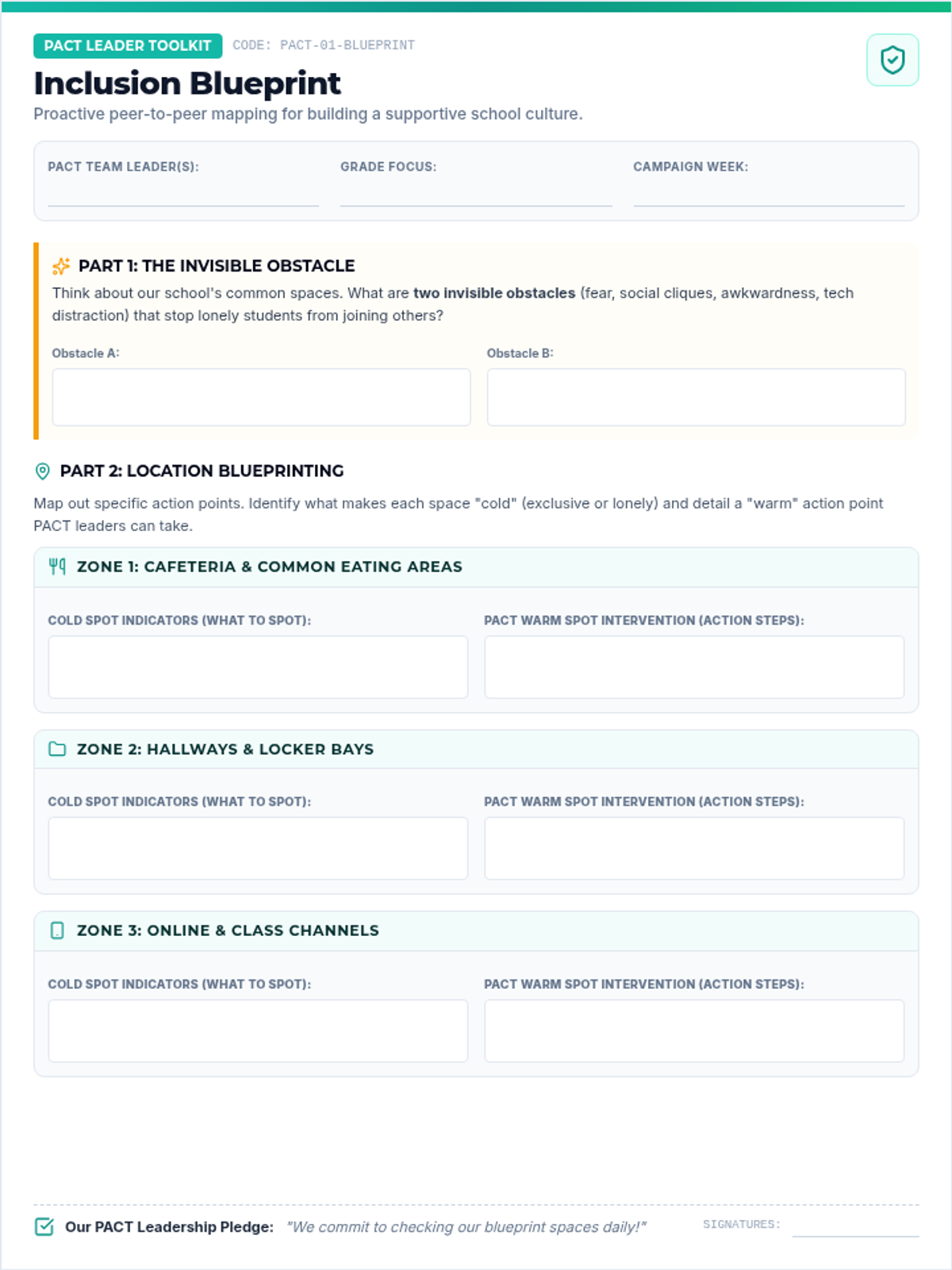
A blueprint planning worksheet for PACT leaders to map out specific, location-based proactive inclusion strategies across their school community.
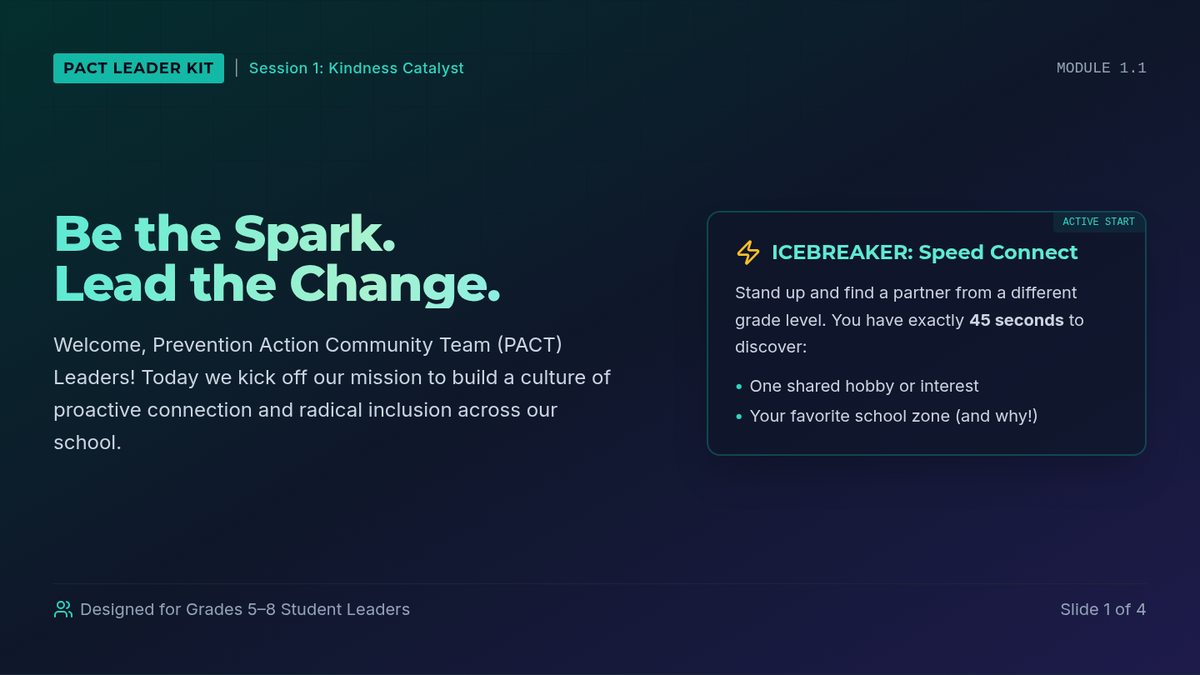
A printable guide for PACT student leaders outlining the campaign's core mission, featuring a group speed-connect icebreaker, a brain warm-up reflection, and proactive kindness checklists.
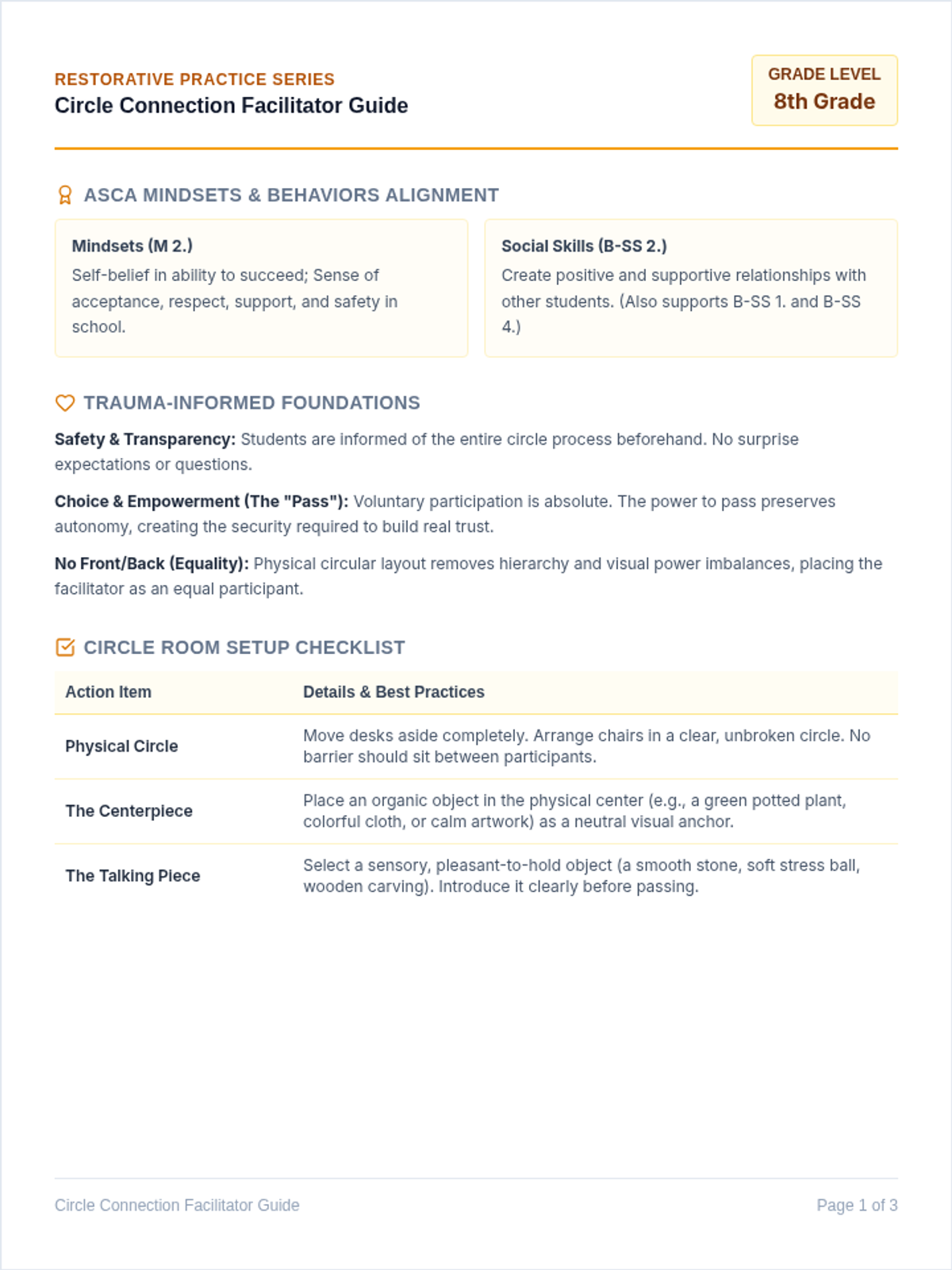
A comprehensive step-by-step teacher guide and script mapping slide content to ASCA Mindset standards, offering trauma-informed facilitator prompts, and providing restorative guidelines.
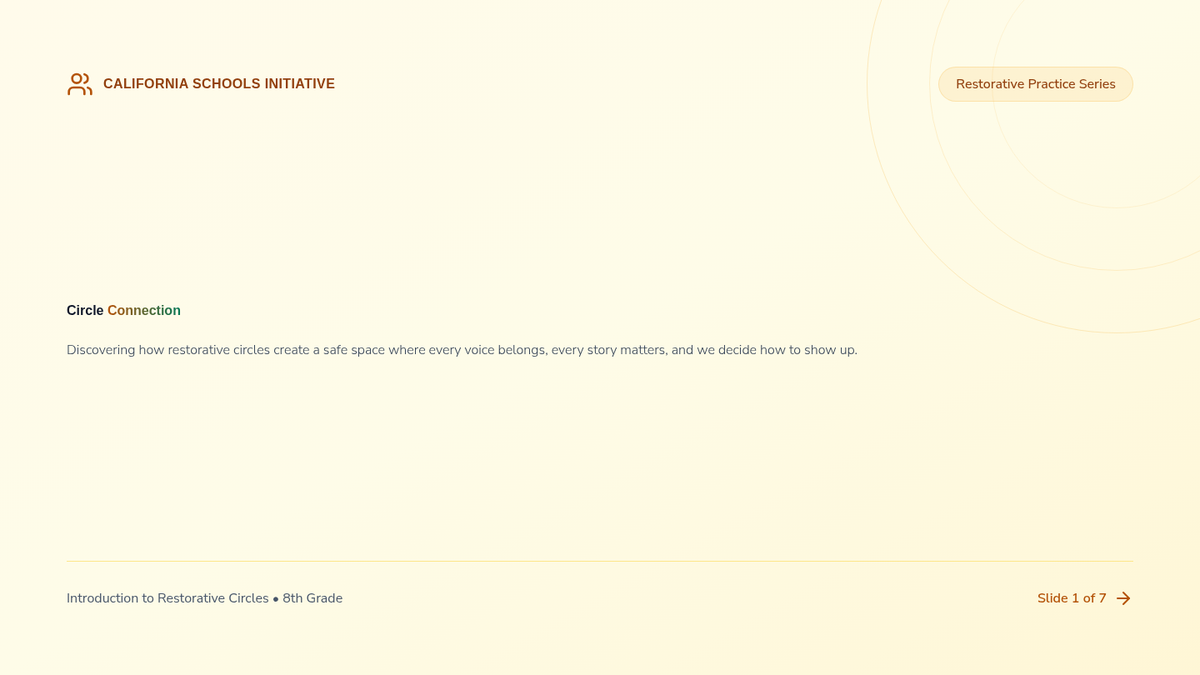
An engaging, trauma-informed slide presentation introducing 8th-grade students to the purpose, structure, guidelines, and voluntary nature of restorative circles, styled with an inviting warm yellow aesthetic.
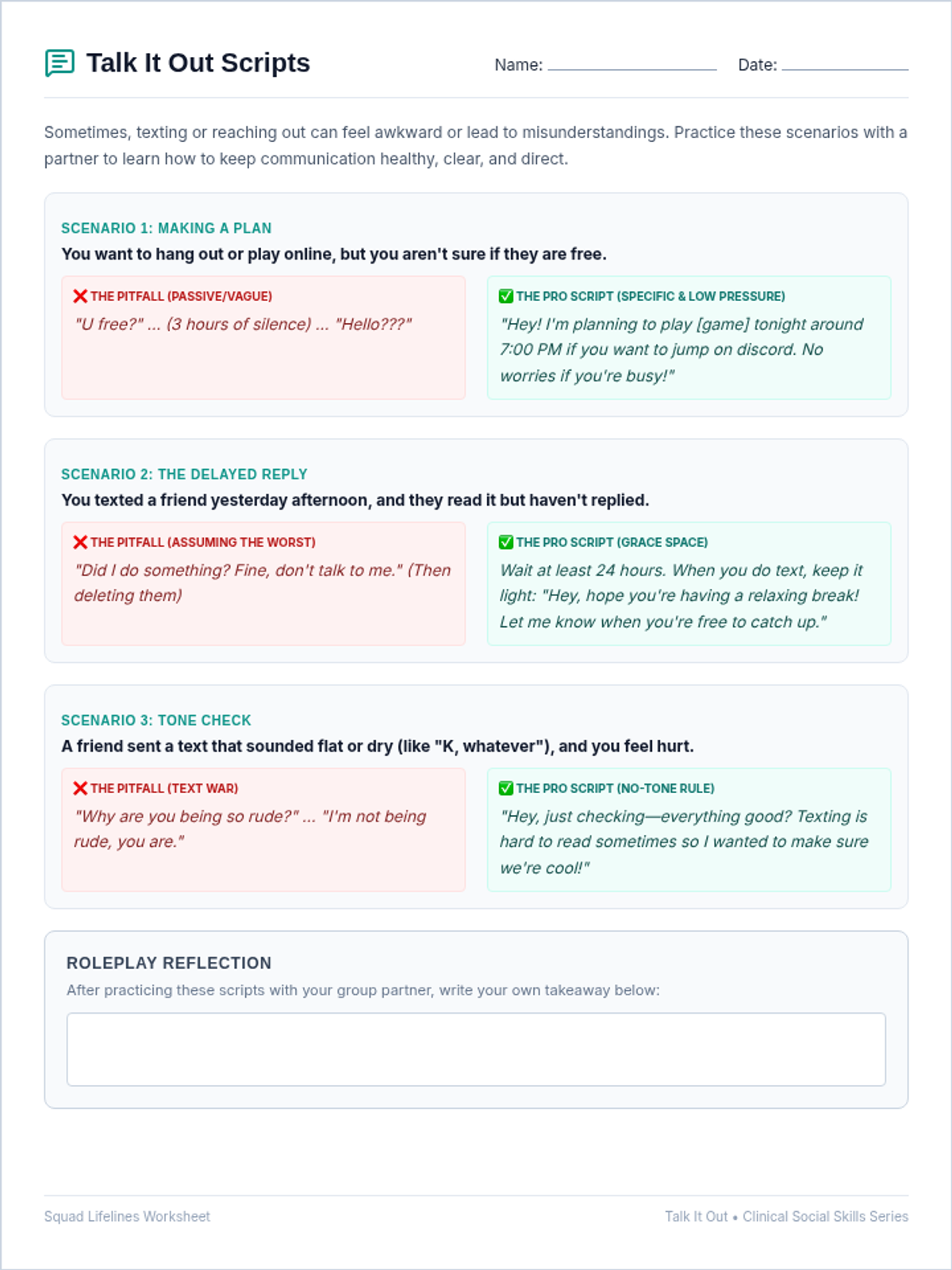
A 1-page structured script and roleplay worksheet to practice conflict resolution, arranging meetups, and resolving digital communication friction.
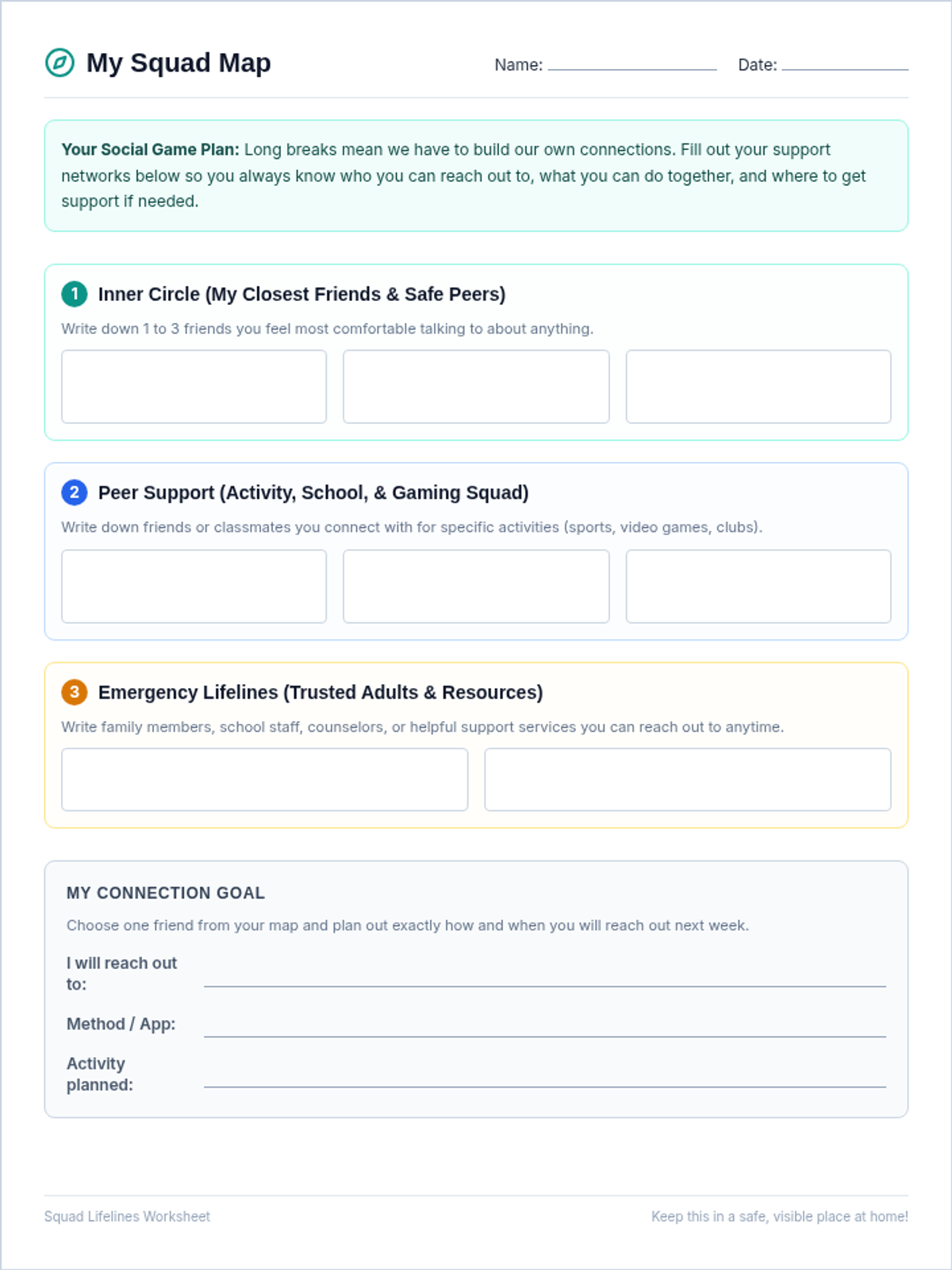
A highly visual 1-page printable relationship mapping worksheet designed for student completion during social skills groups.
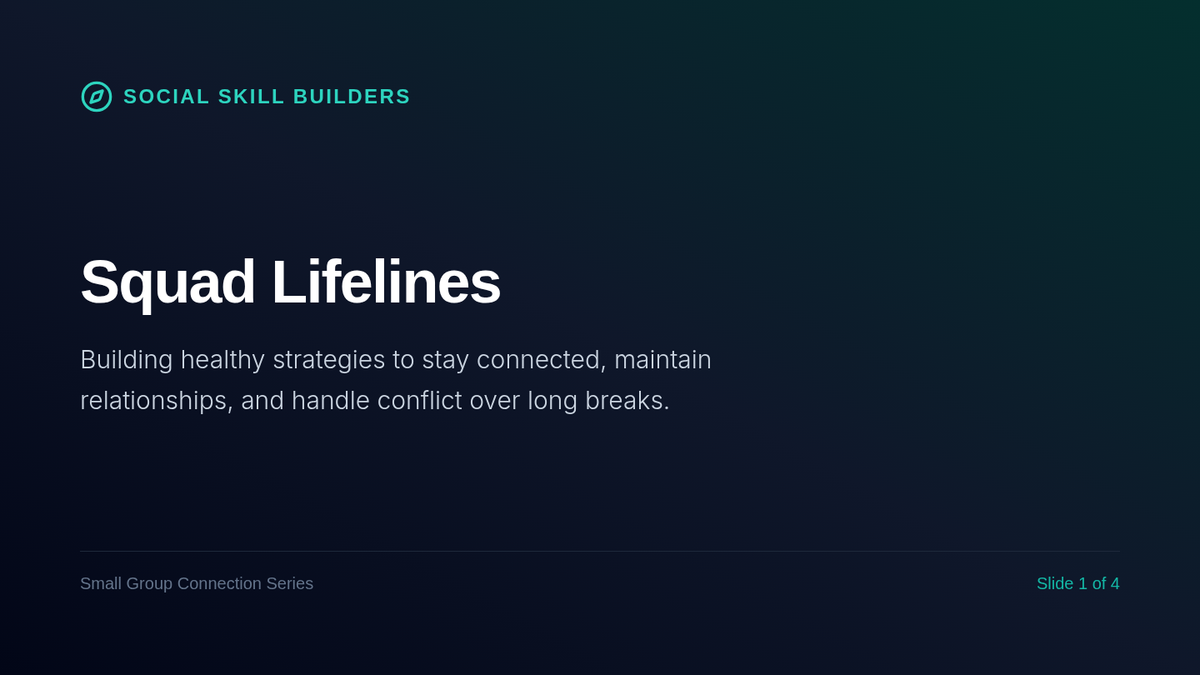
A 4-slide presentation deck visually introducing the concept of the Peer Connection Map, identifying social circles, and setting safe digital boundaries during breaks.
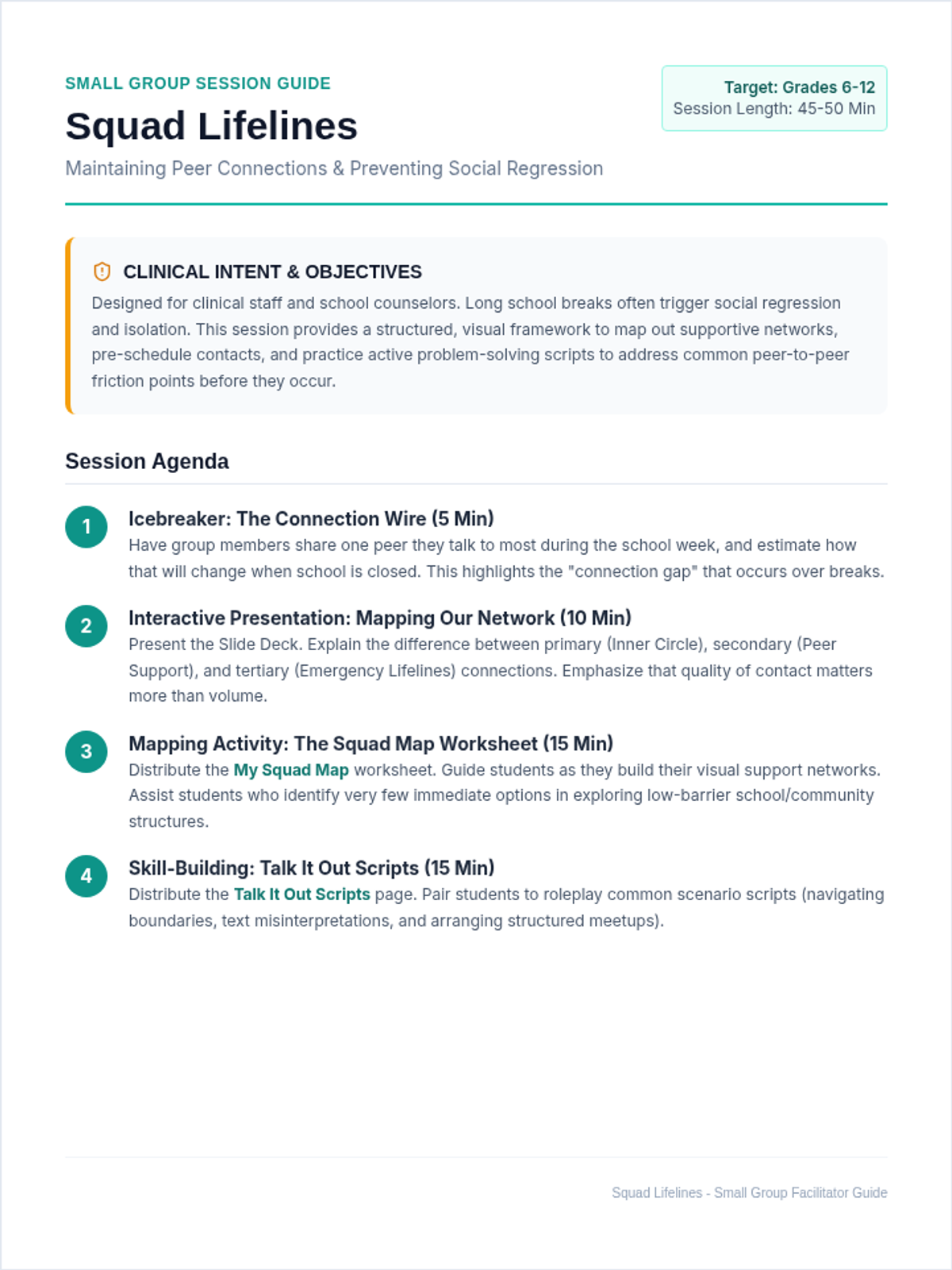
A 2-page detailed lesson plan and small-group facilitation guide designed for clinical facilitators and school counselors to lead social connection mapping.
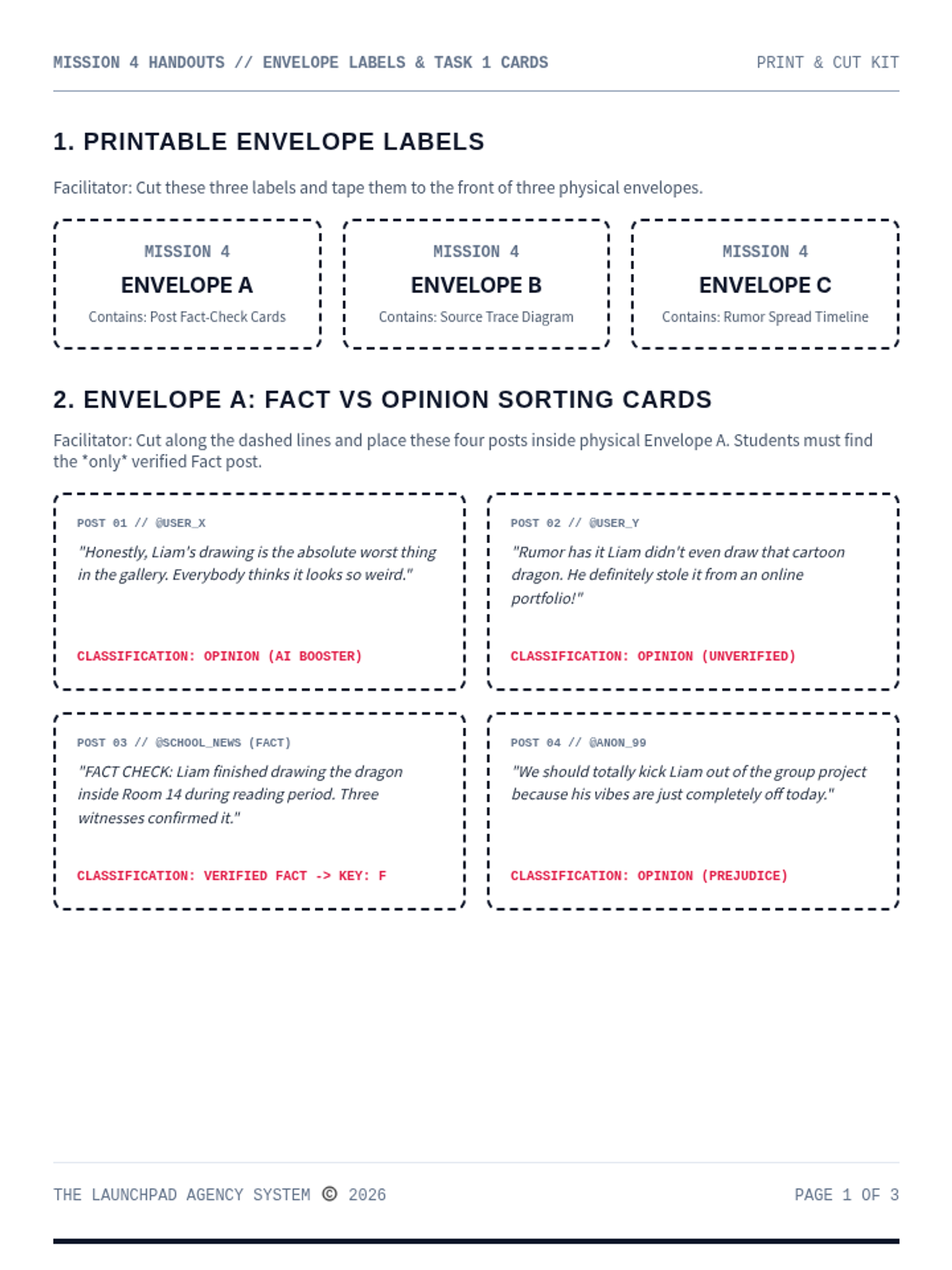
A print-and-cut materials handout kit for Mission 4: The Digital Distortion. Contains envelope labels, printed posts, source cards, and timeline charts.
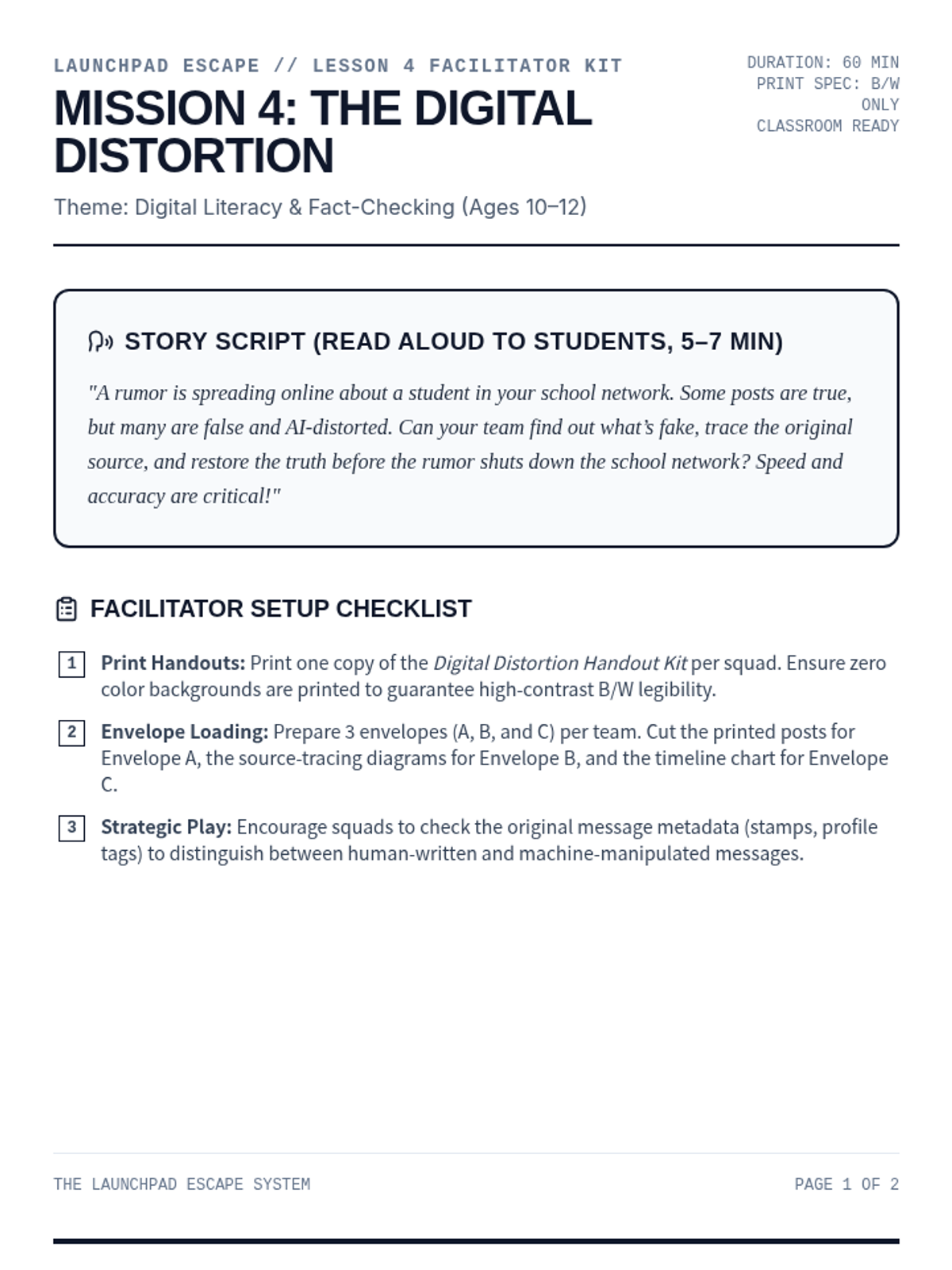
A comprehensive B/W printable facilitator guide for Mission 4: The Digital Distortion. Contains story script, small-space setup checklists, progressive clue mechanics, strategy hints, and reflective community debrief questions.
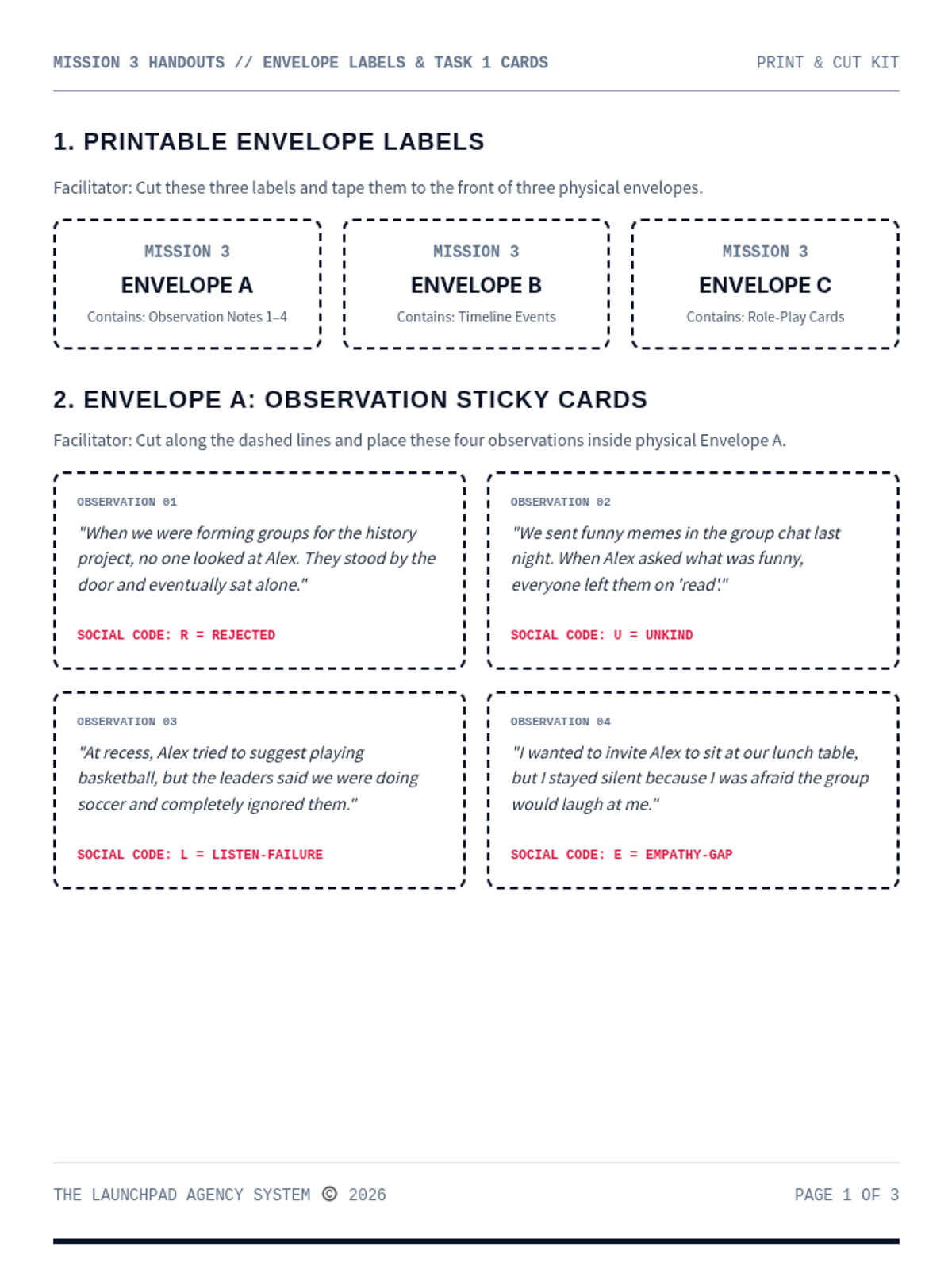
A print-and-cut materials handout kit for Mission 3: The Disappearing Friend. Contains envelope labels, printed posts, source cards, and timeline charts.
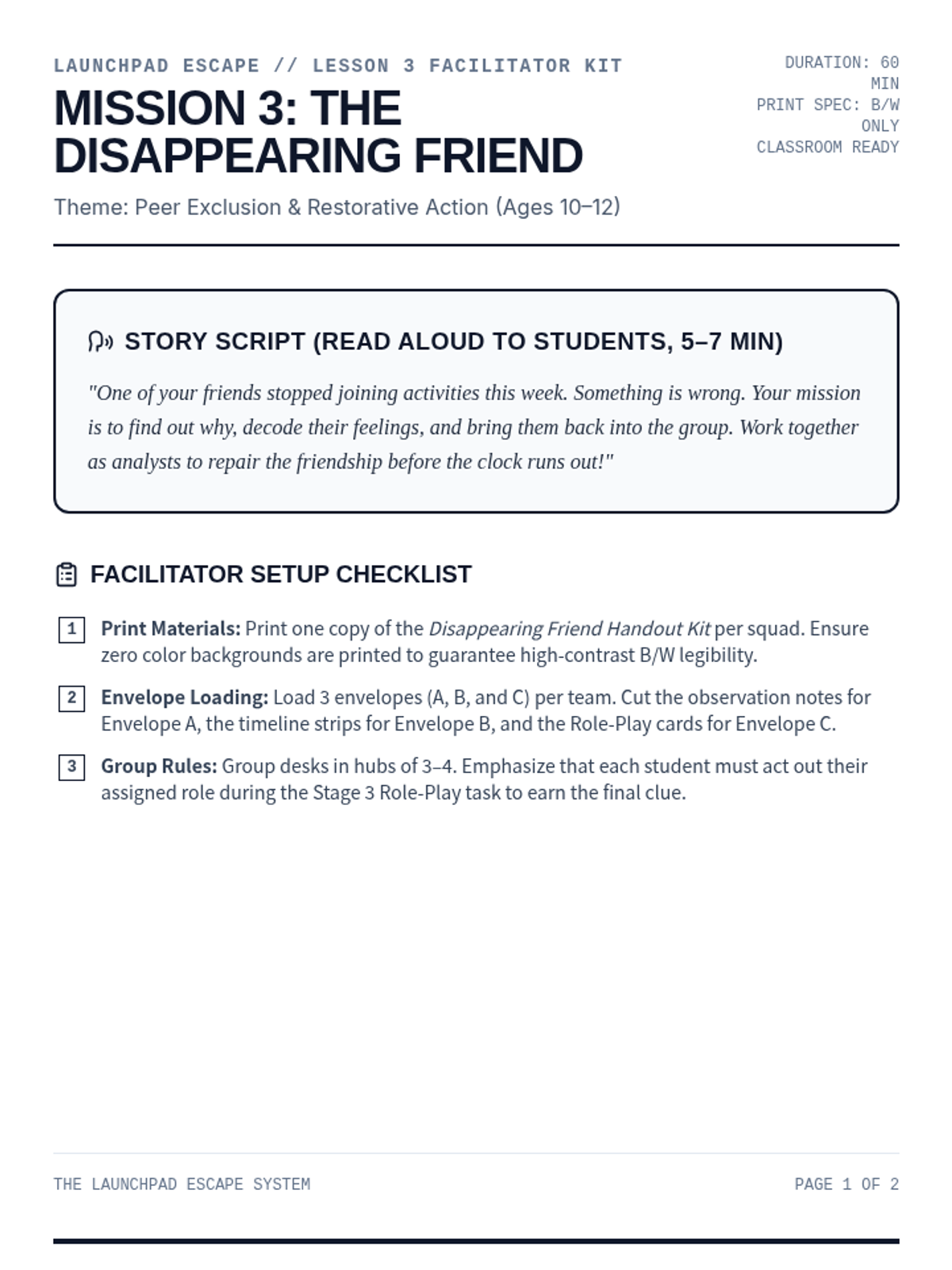
A comprehensive B/W printable facilitator guide for Mission 3: The Disappearing Friend. Contains story script, small-space setup checklists, progressive clue mechanics, strategy hints, and reflective community debrief questions.
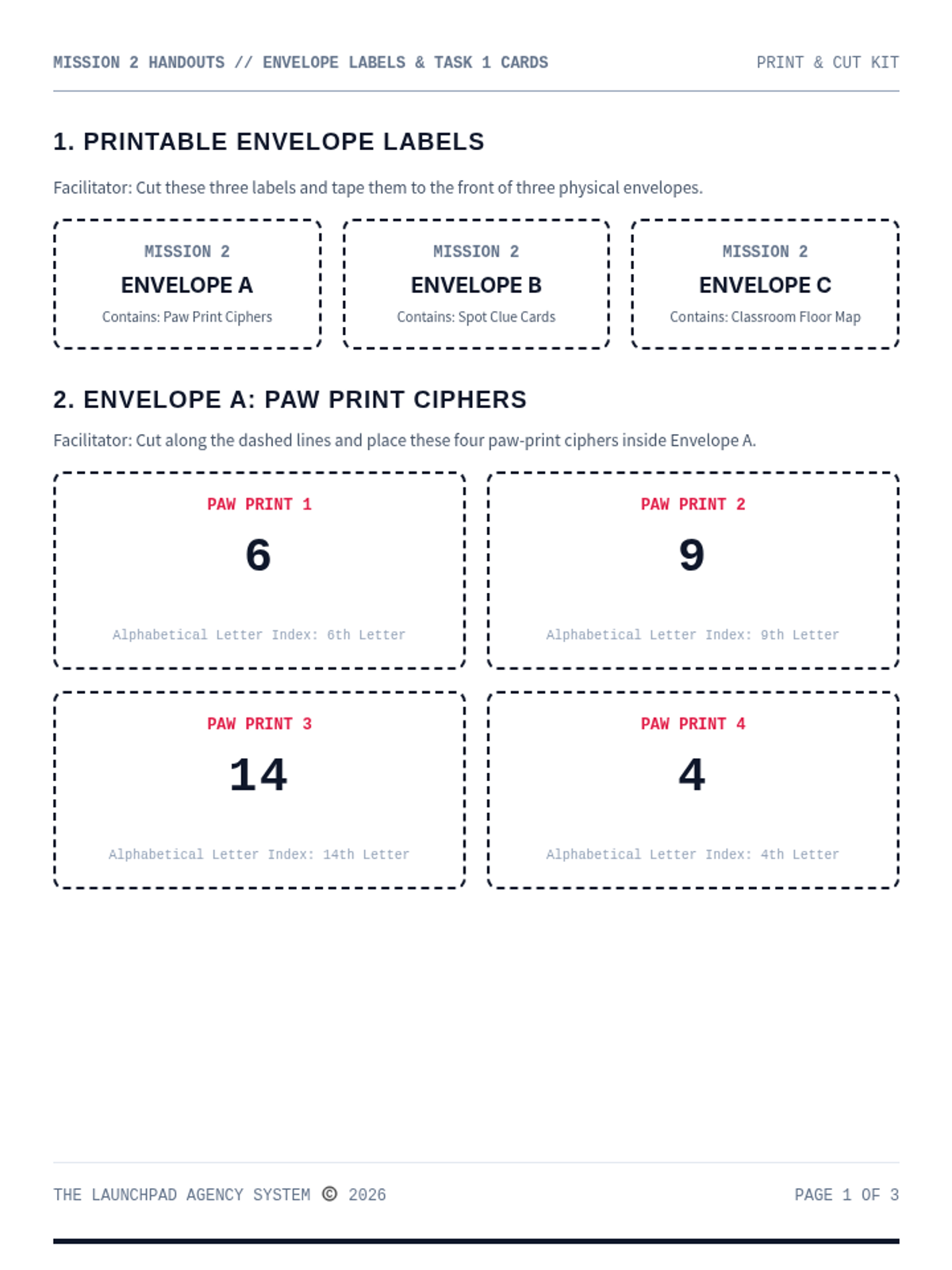
A print-and-cut materials handout kit for Mission 2: The Mystery of the Missing Pet. Contains envelope labels, paw ciphers, objects matching cards, and a classroom layout map with coordinates.
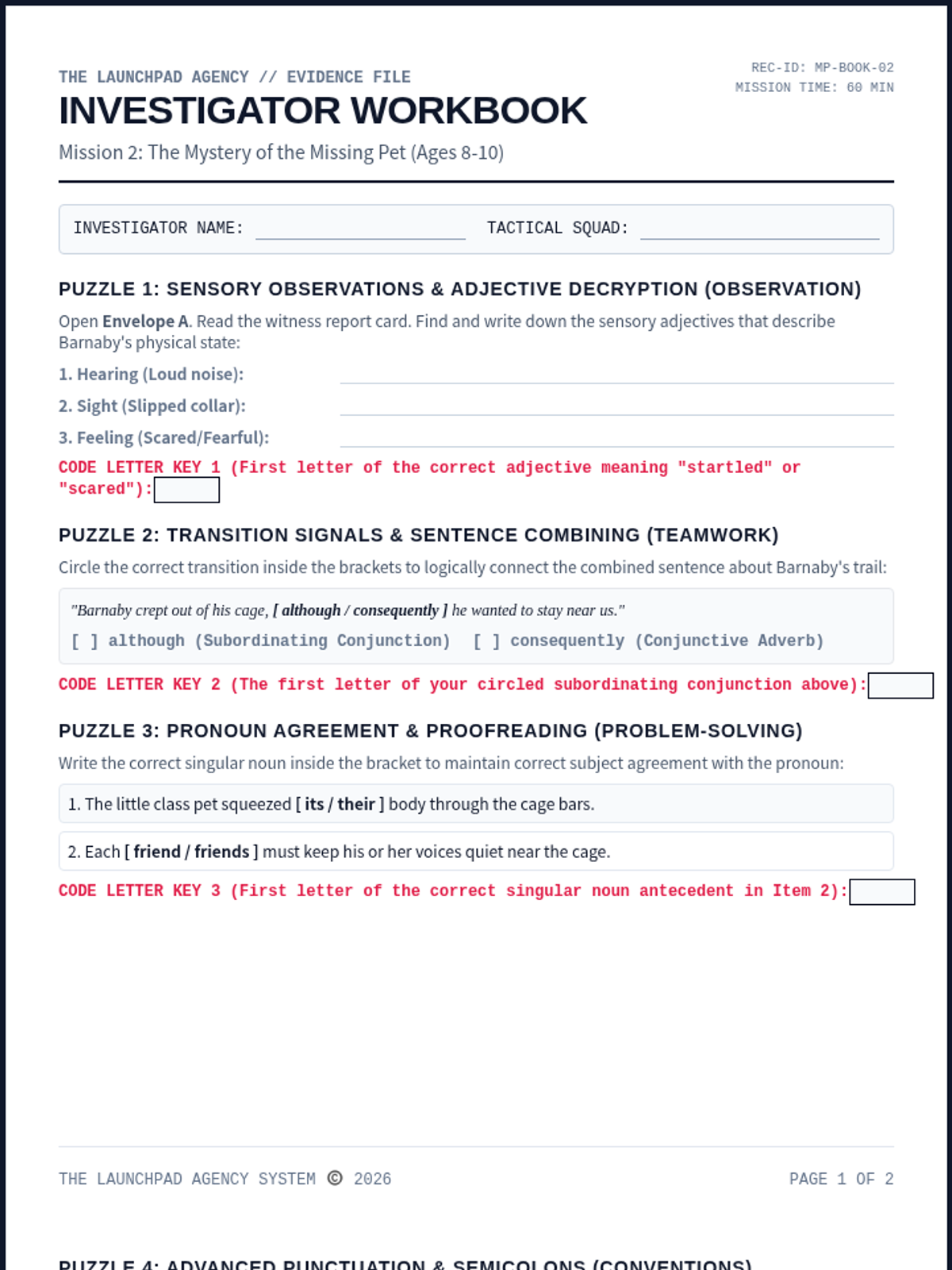
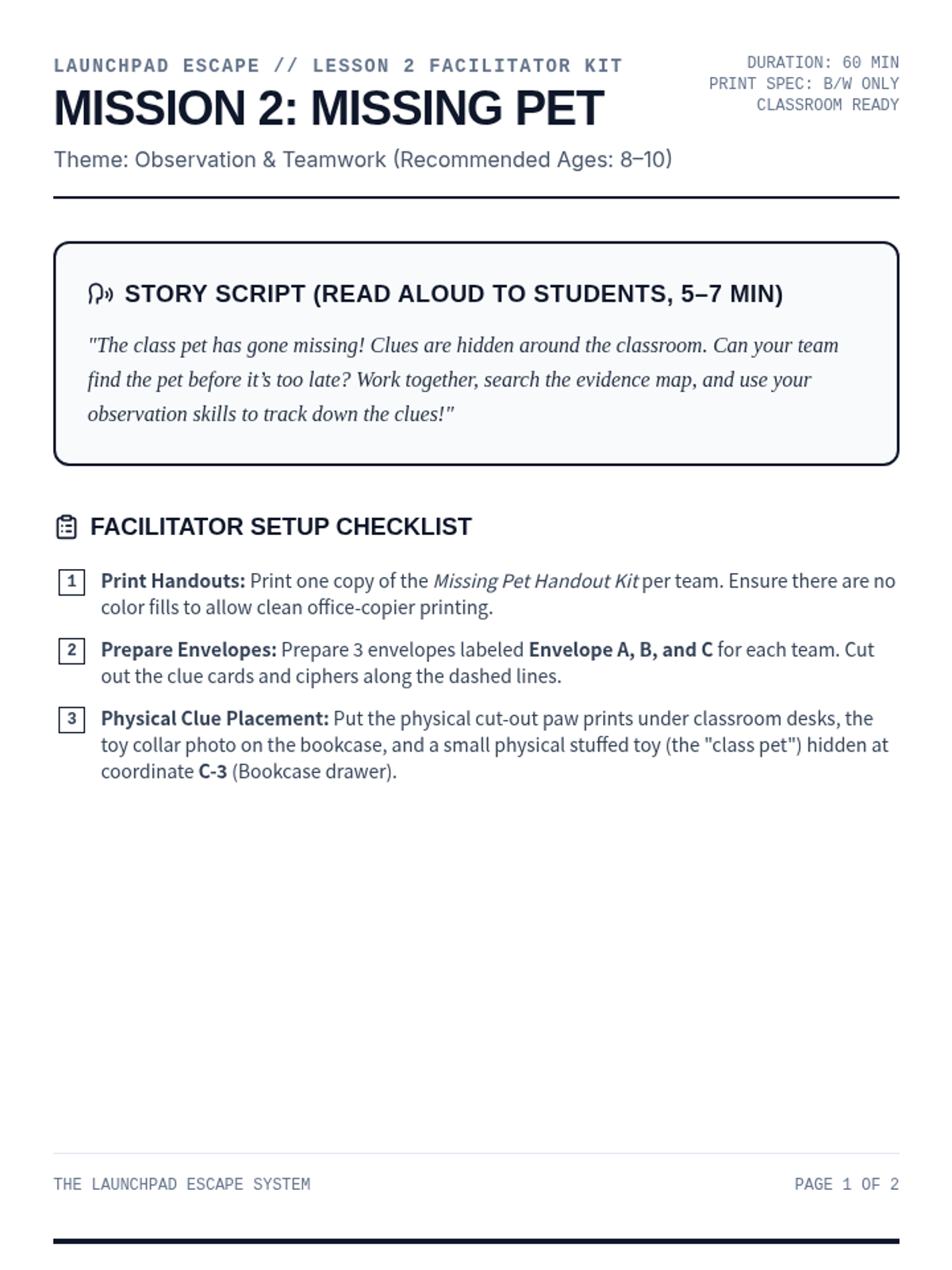
A comprehensive B/W printable facilitator guide for Mission 2: The Mystery of the Missing Pet. Contains story script, small-space setup checklists, progressive clue mechanics, strategy hints, and reflective community debrief questions.
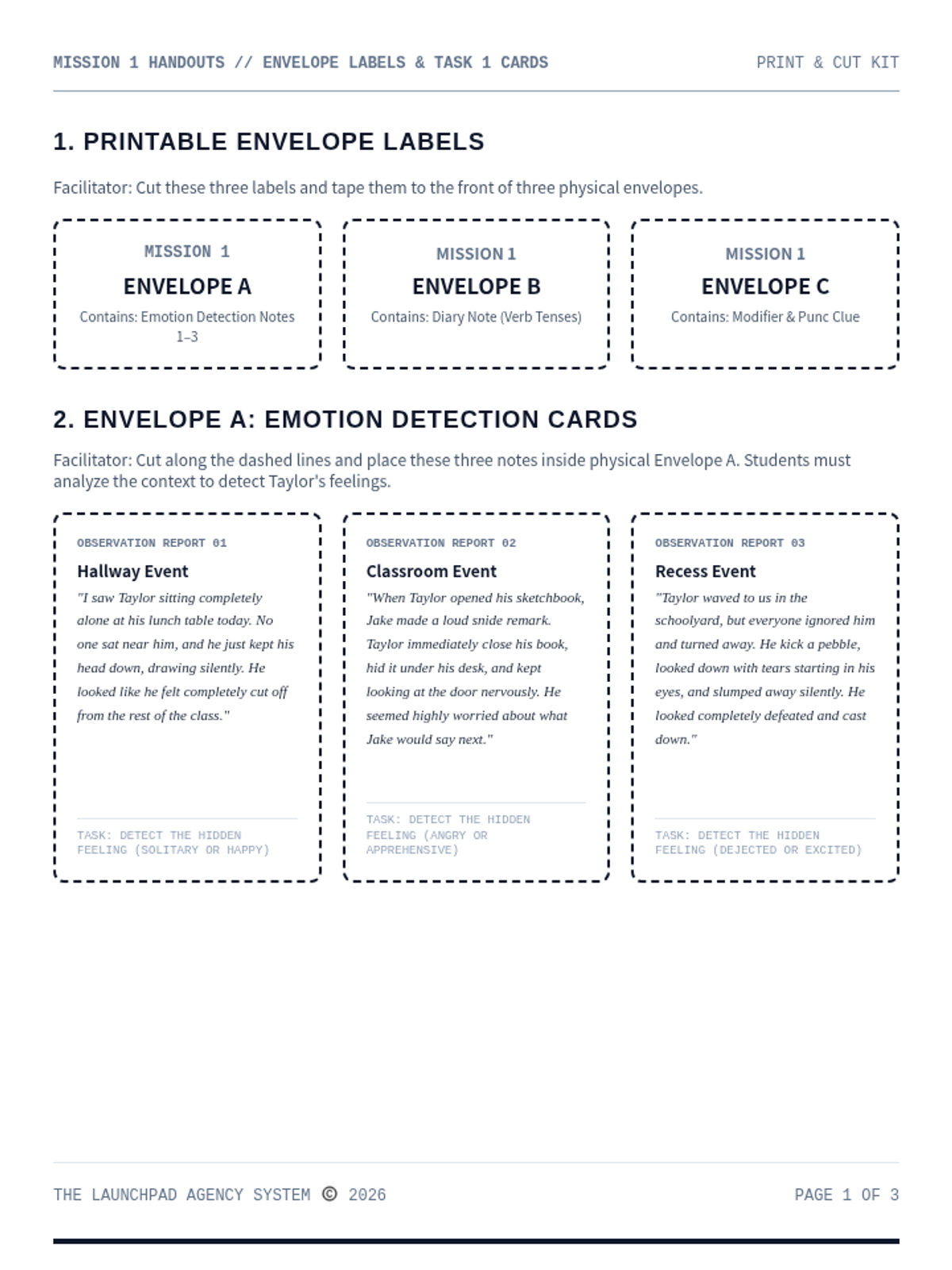
A print-and-cut materials handout kit for Mission 1: The Silent Voice. Contains envelope labels, desk notes, week timeline markers, and character perspective cards with dashed scissor lines.
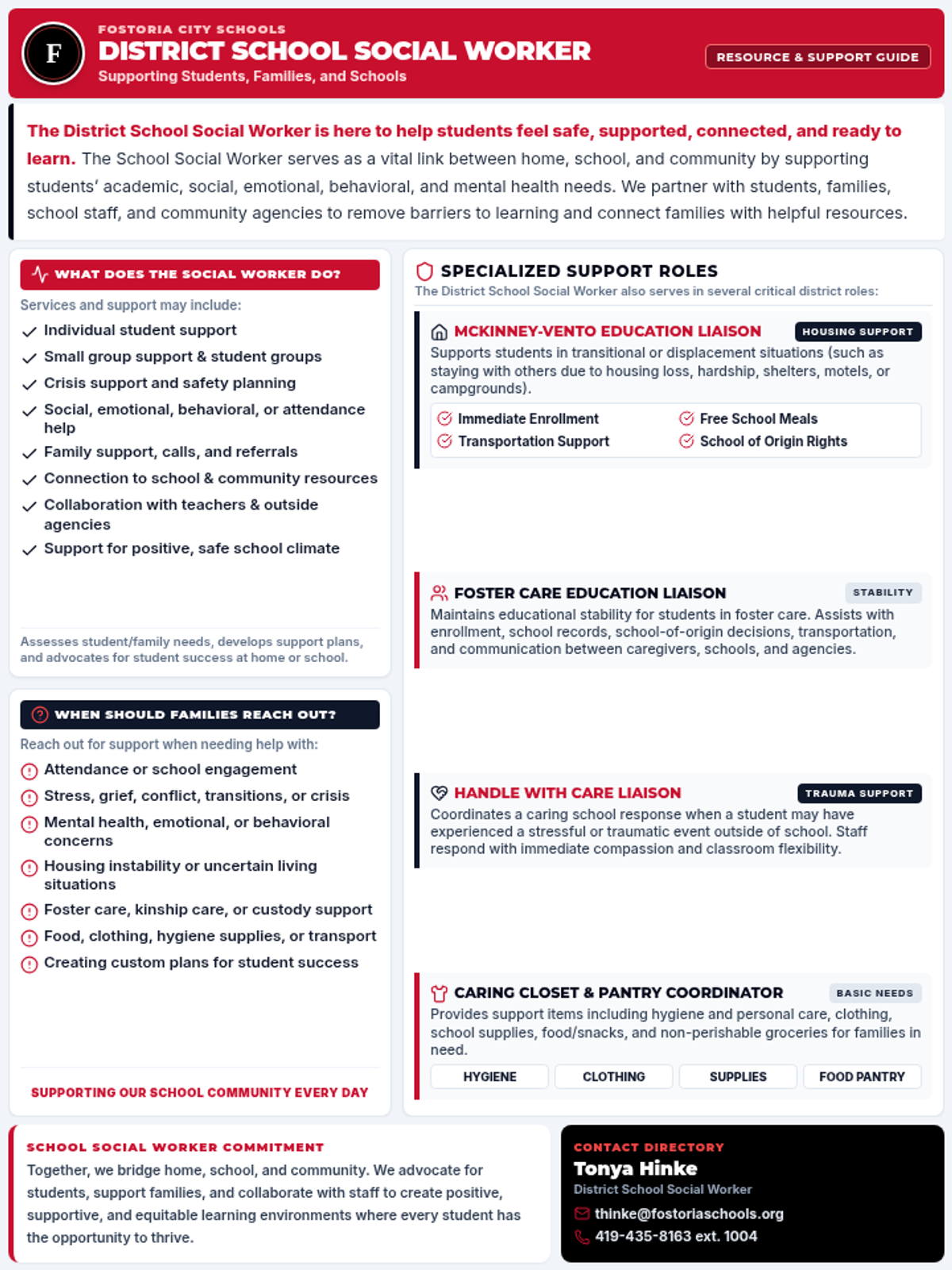
An elegant, highly professional single-page outreach and resources flyer for the District School Social Worker of Fostoria City Schools. It utilizes clean grids, custom program cards, clear visual cues, and a modern color scheme to ensure absolute legibility and optimal use of space.
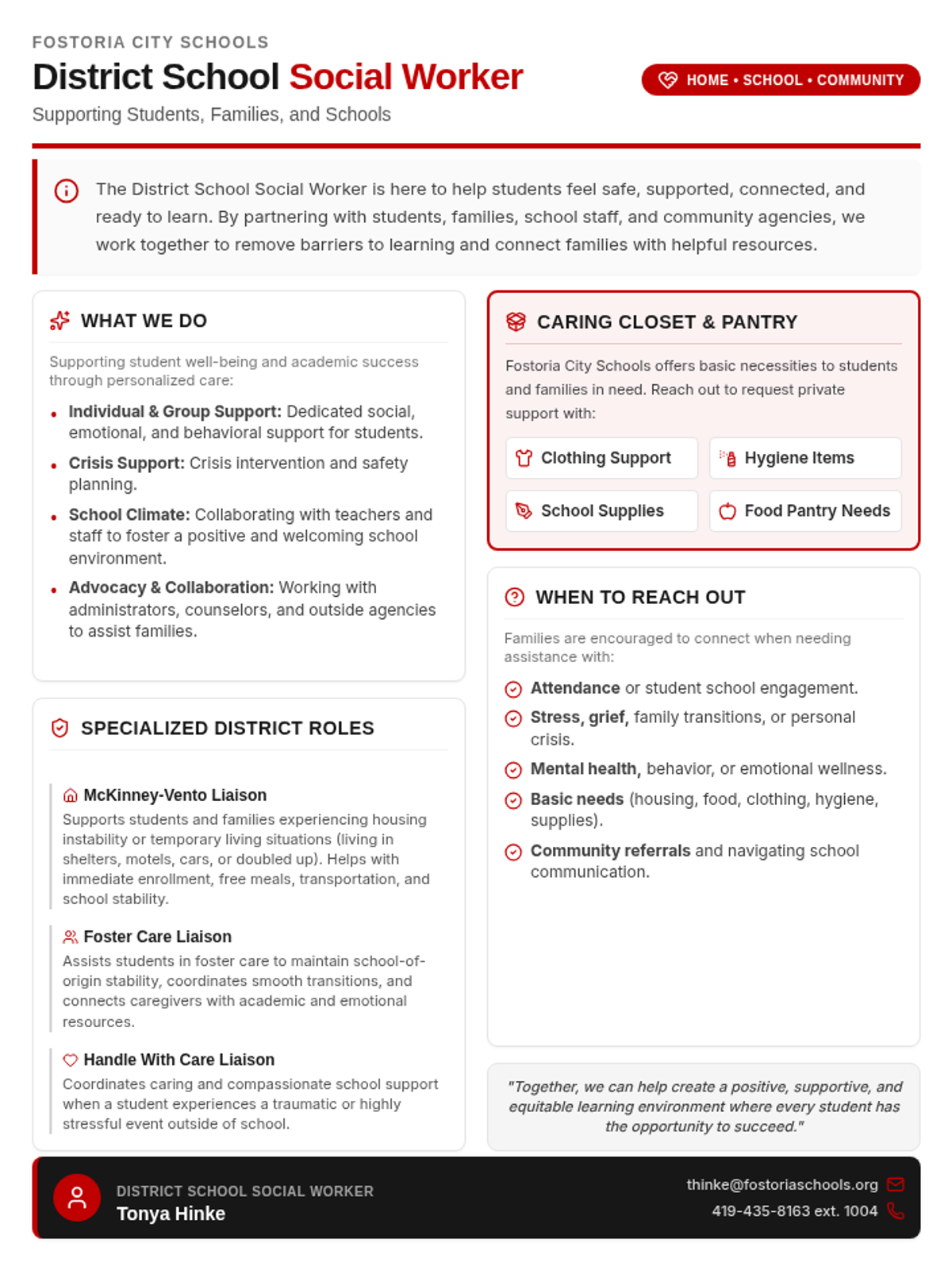
An updated visually striking school district informational flyer for Fostoria City Schools. It removes any 'we' pronouns, features the custom FCS logo, explicitly details the Social Worker's role as the Caring Closet Coordinator, uses decreased margins to fill the 8.5x11 page size, and expands the original text details while retaining large, accessible text.
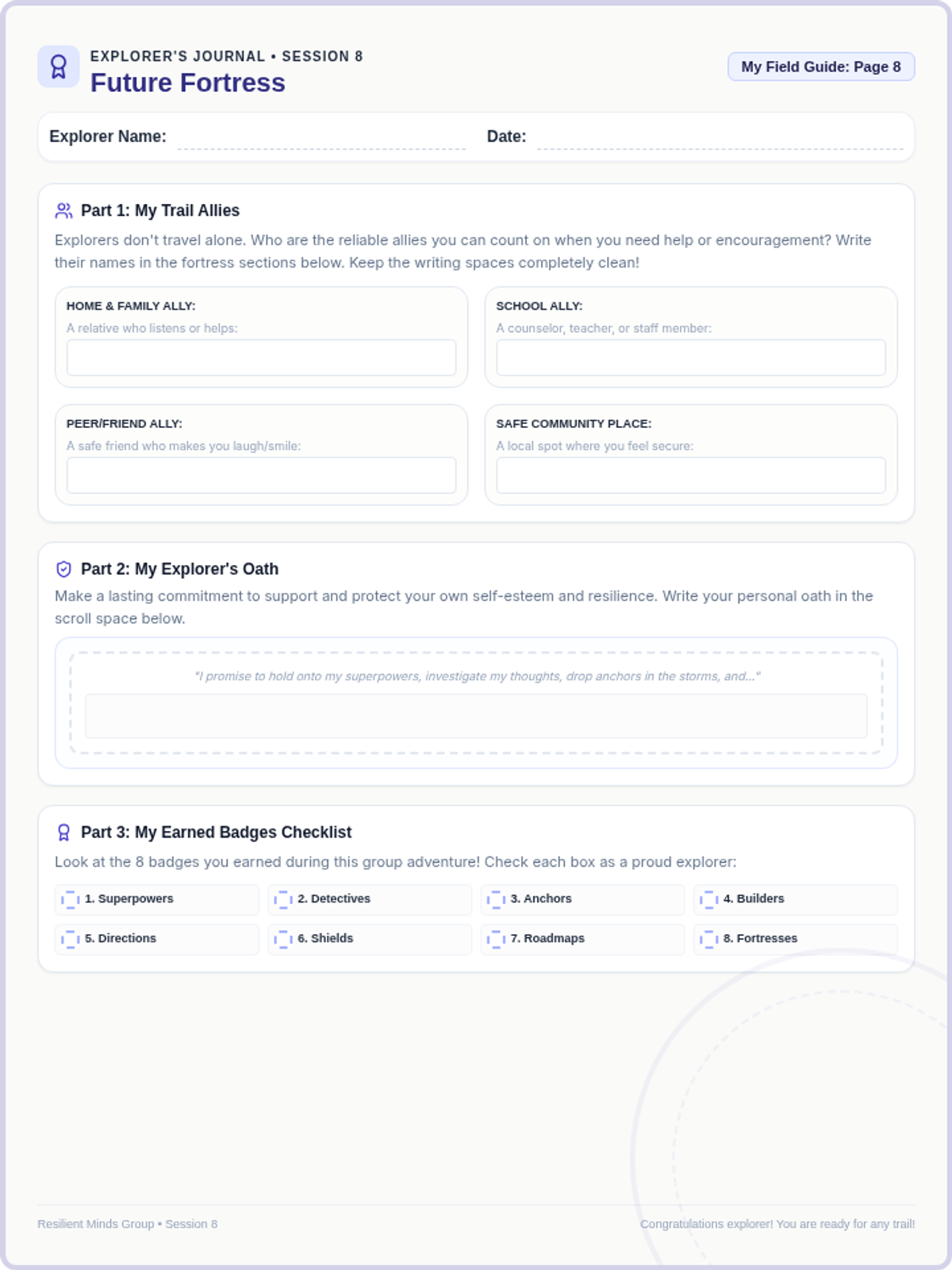
Student-facing worksheet for Session 8 of the Resilient Minds Group curriculum. Outlines graduation celebration, social support mapping, peer feedback, and generalization strategies.
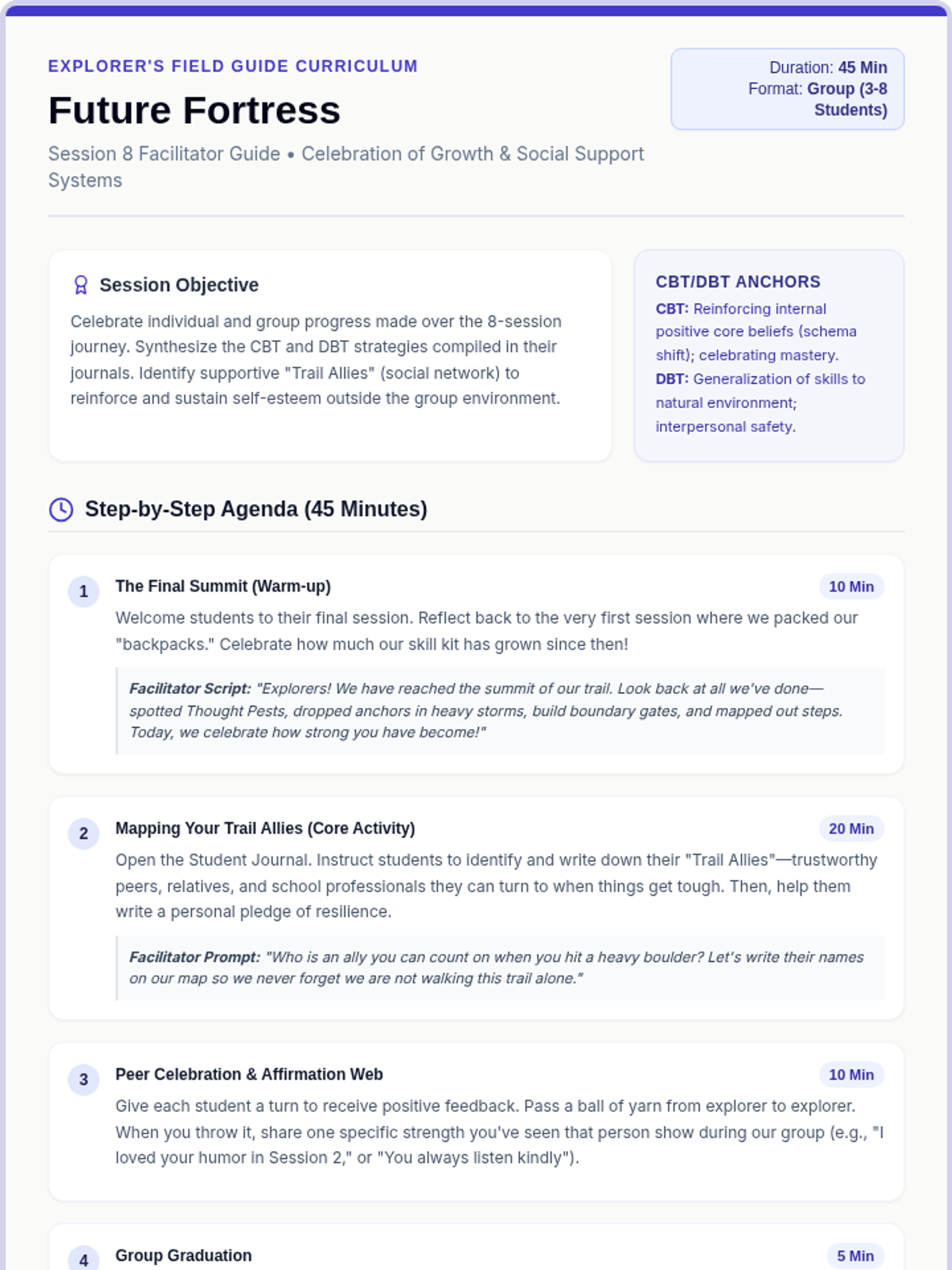
Facilitator guide for Session 8 of the Resilient Minds Group curriculum. Outlines graduation celebration, social support mapping, peer feedback, and generalization strategies.
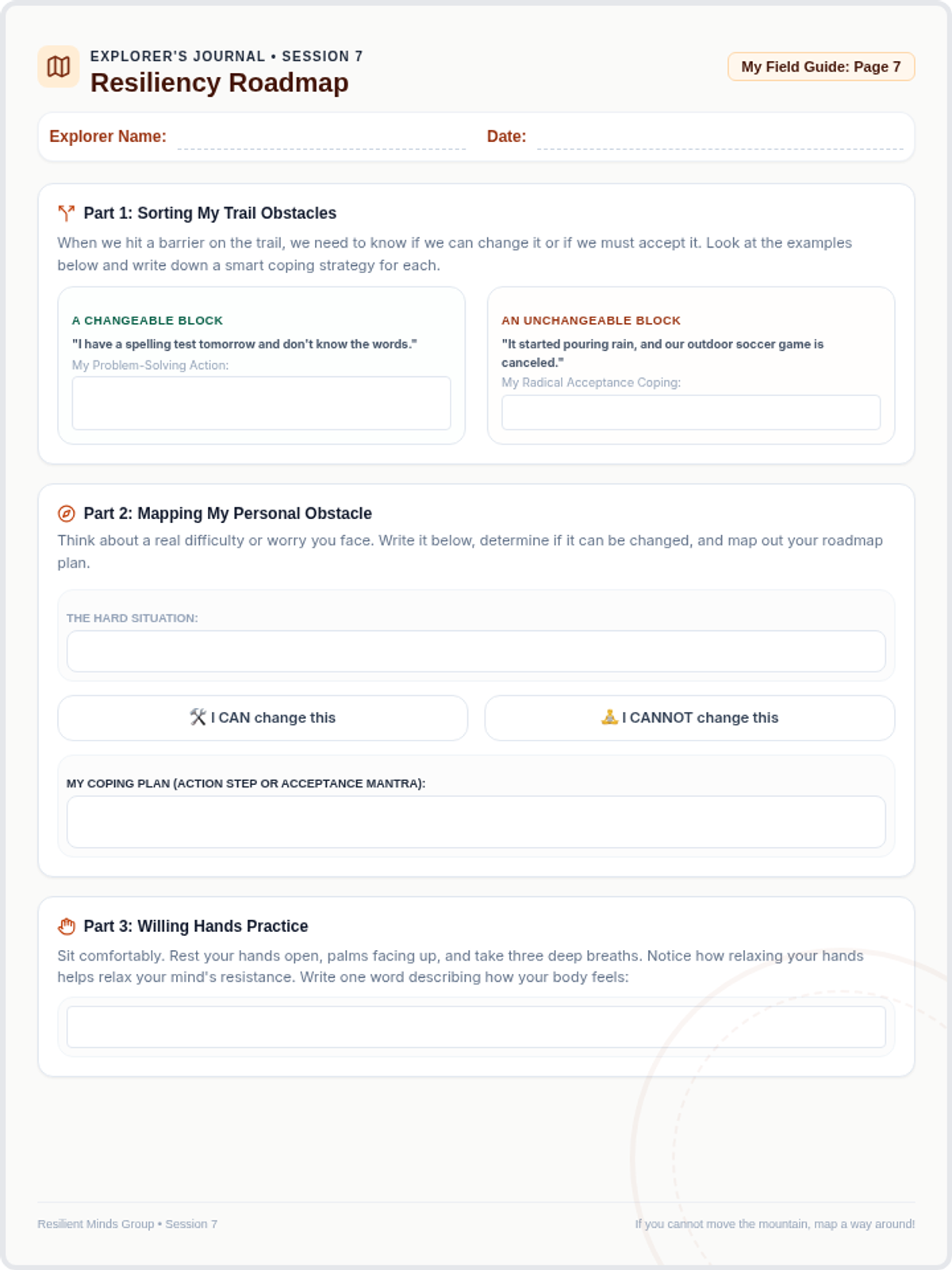
Student-facing worksheet for Session 7 of the Resilient Minds Group curriculum. Features a decision matrix for Changeable vs Unchangeable events, and a somatic Willing Hands reflection space.
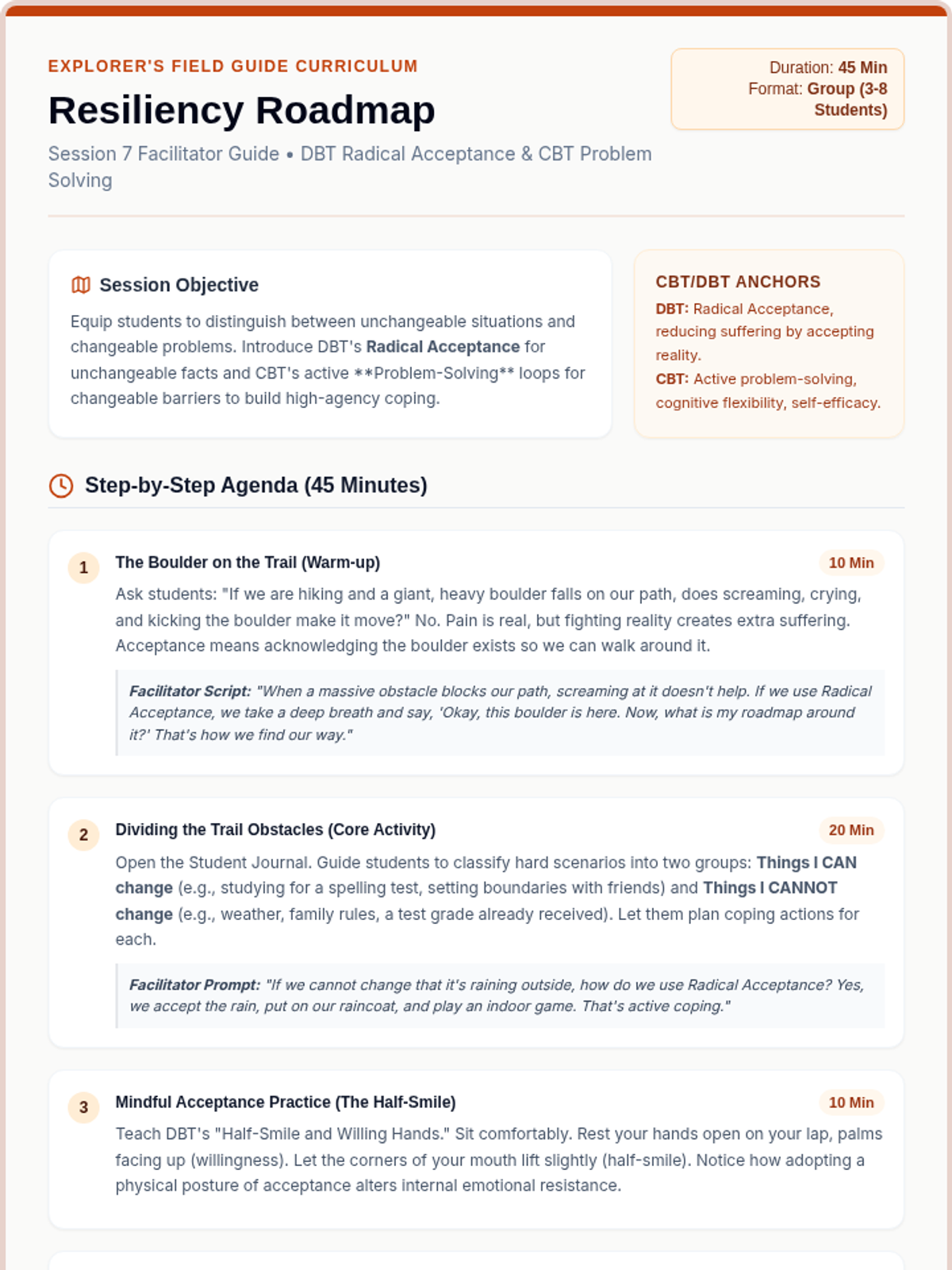
Facilitator guide for Session 7 of the Resilient Minds Group curriculum. Outlines session objectives, CBT/DBT concepts, a step-by-step 45-minute agenda, therapeutic scripts, and clinical guidance tips.
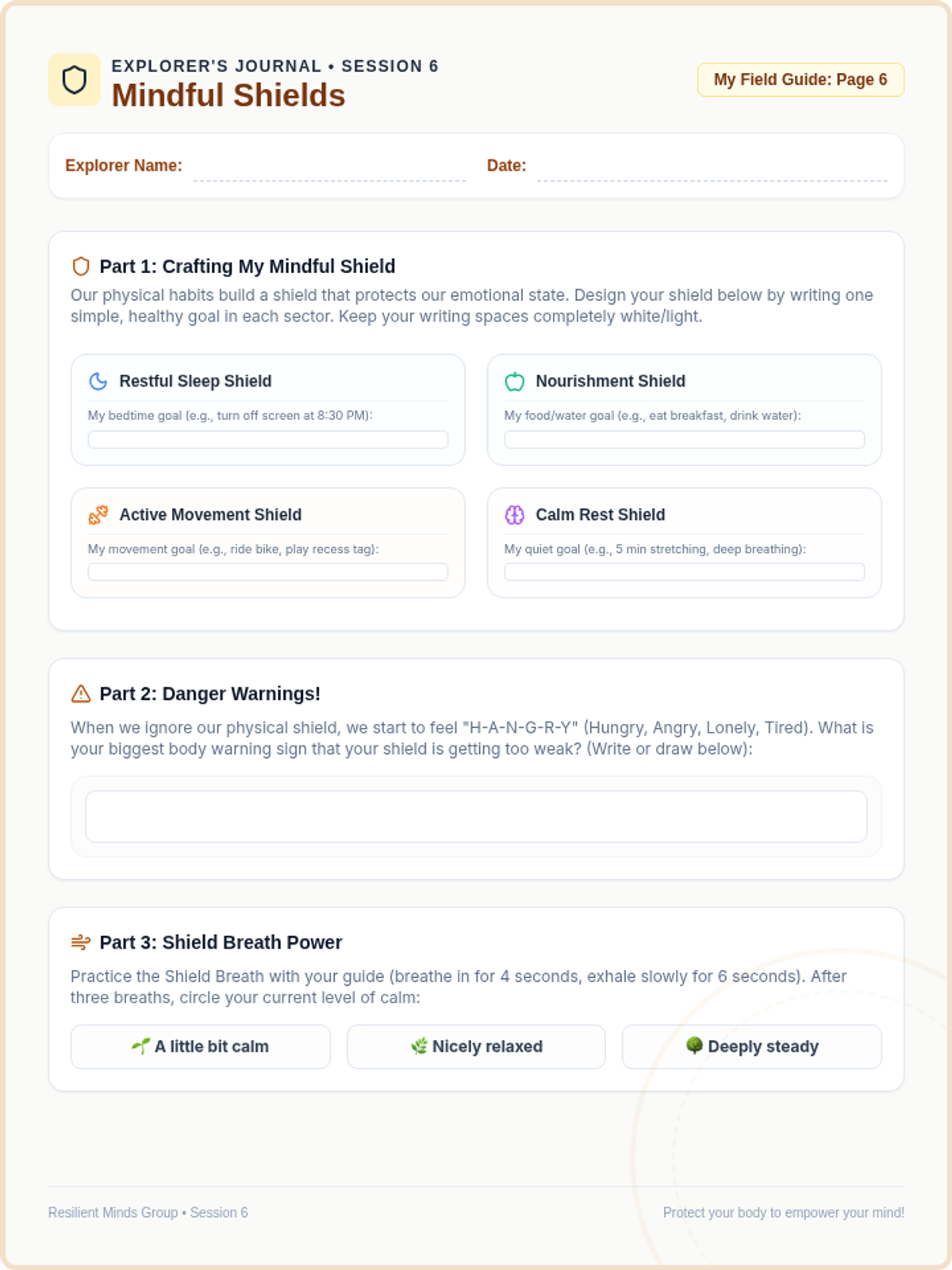
Student journal sheet for Session 6 of the Resilient Minds Group. Focuses on physical health-emotional regulation links and contains a 2x2 shield goal mapping structure.
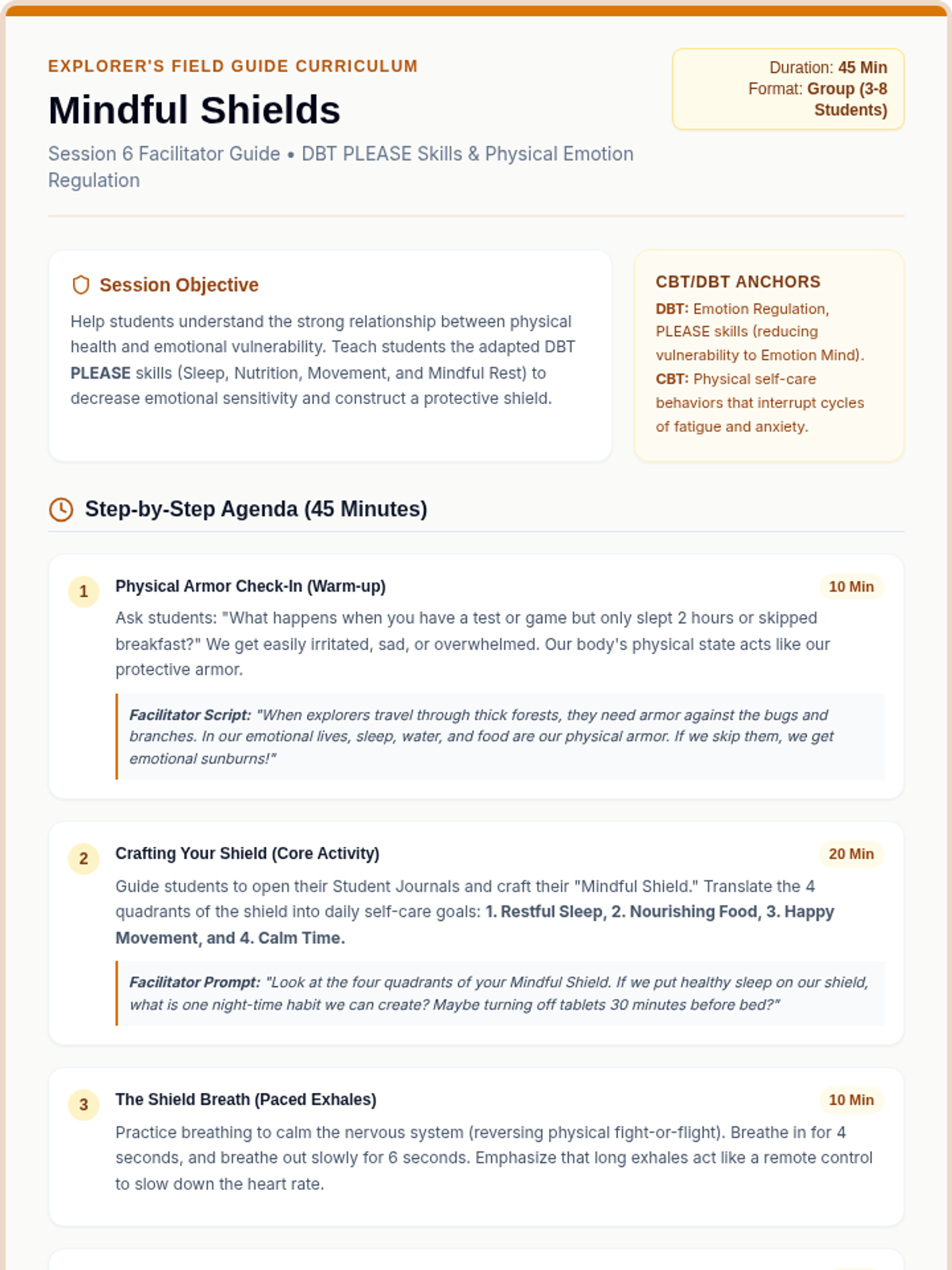
Facilitator guide for Session 6 of the Resilient Minds Group curriculum. Outlines DBT PLEASE physical self-care and emotional regulation strategies with therapeutic guidelines.
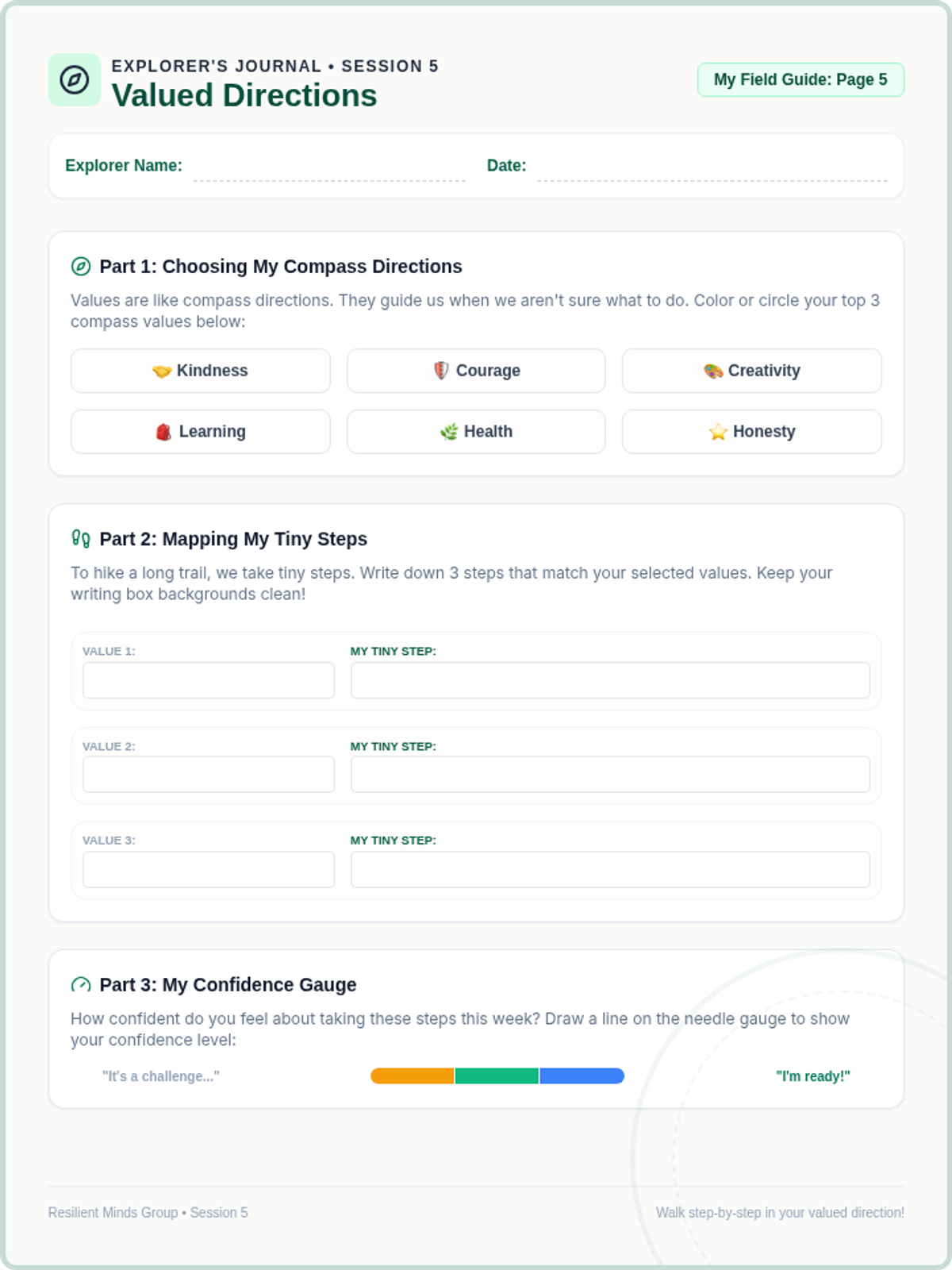
Student journal sheet for Session 5 of the Resilient Minds Group. Features a custom values selection bank and a structured 3-step action planning layout.
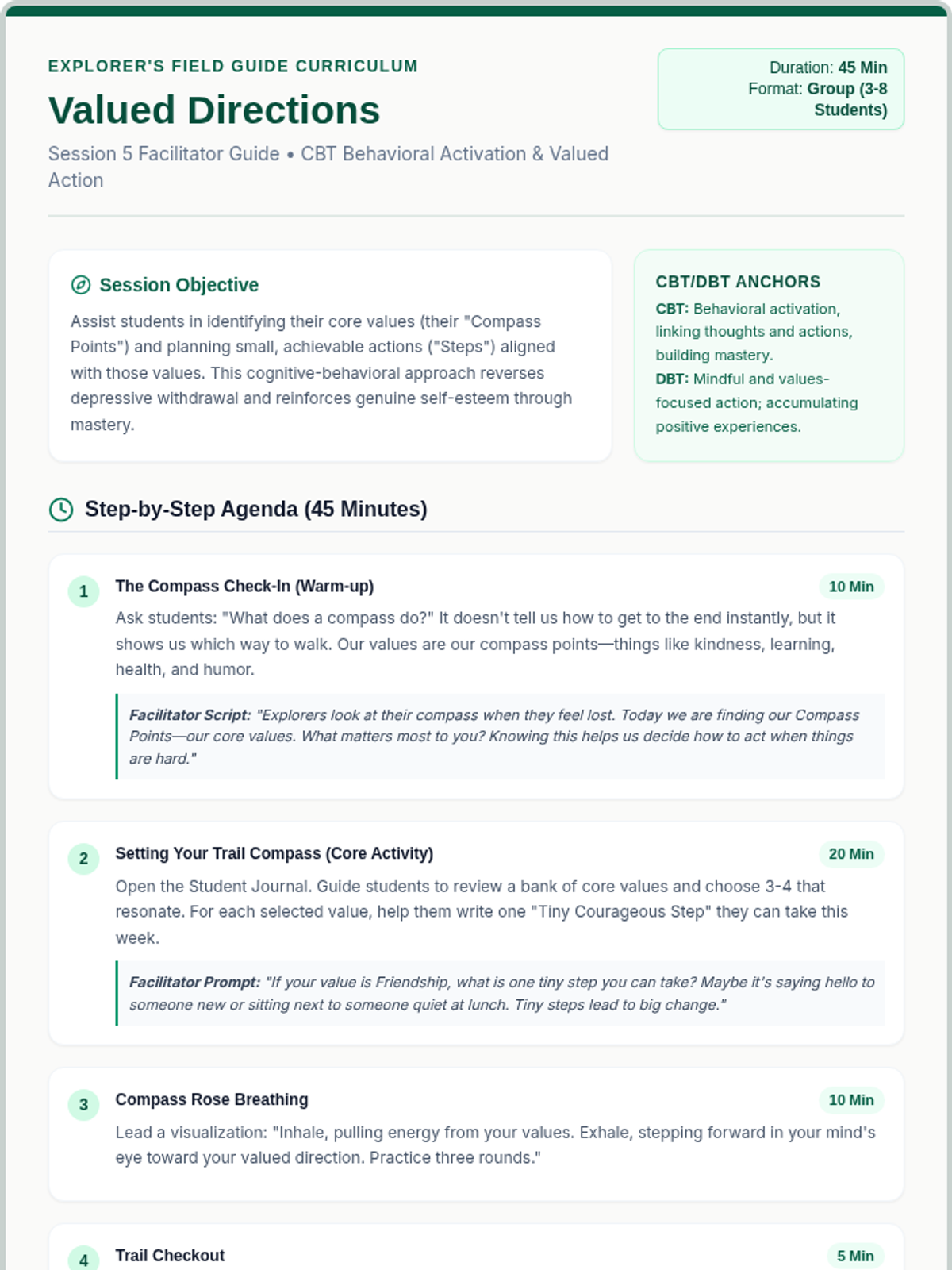
Facilitator guide for Session 5 of the Resilient Minds Group curriculum. Links CBT behavioral activation and DBT valued action with planning small, achievable steps.
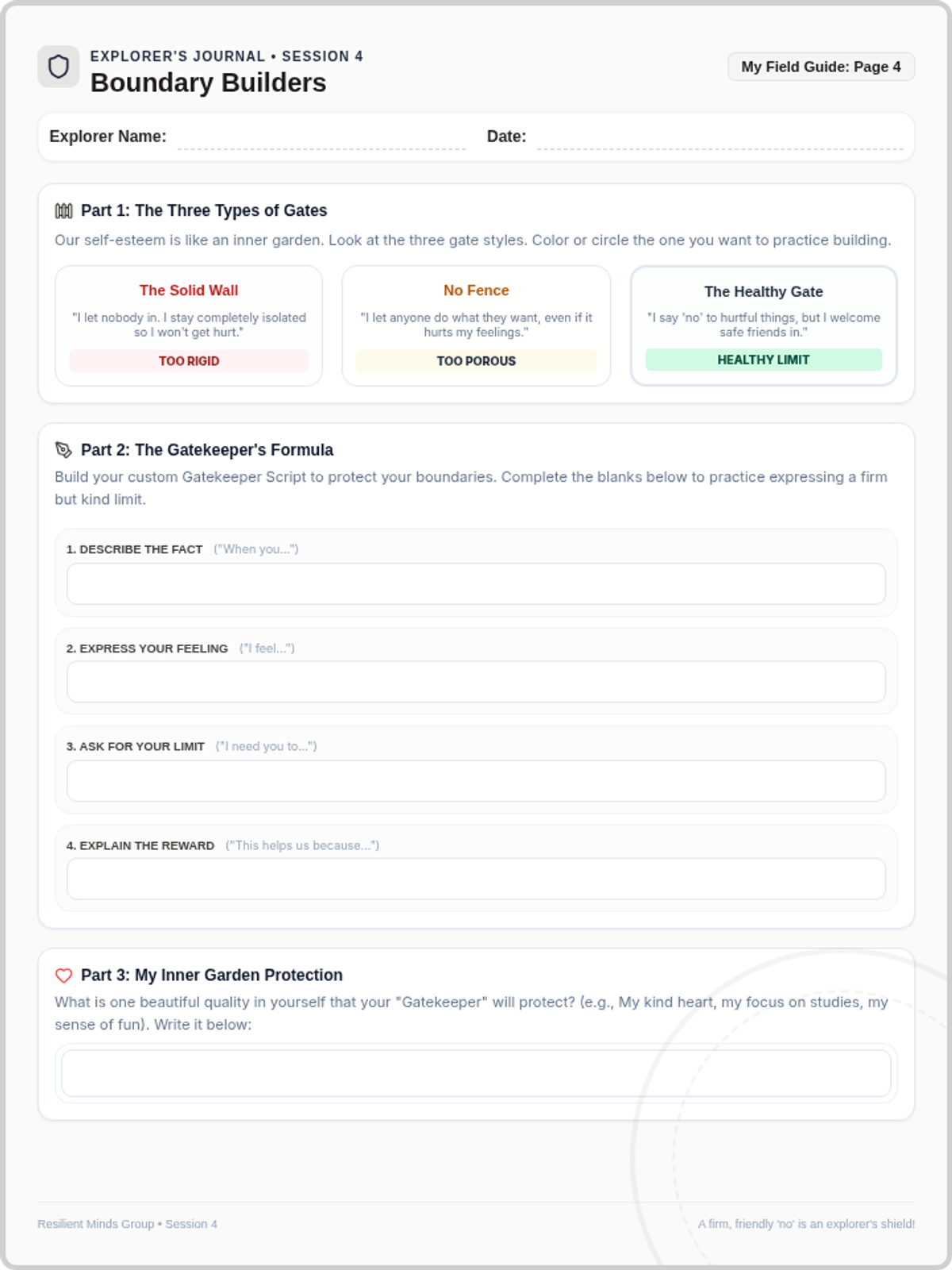
Student journal sheet for Session 4 of the Resilient Minds Group. Focuses on boundaries (the Gatekeeper metaphor) and a structured child-friendly DEAR MAN assertion tool.
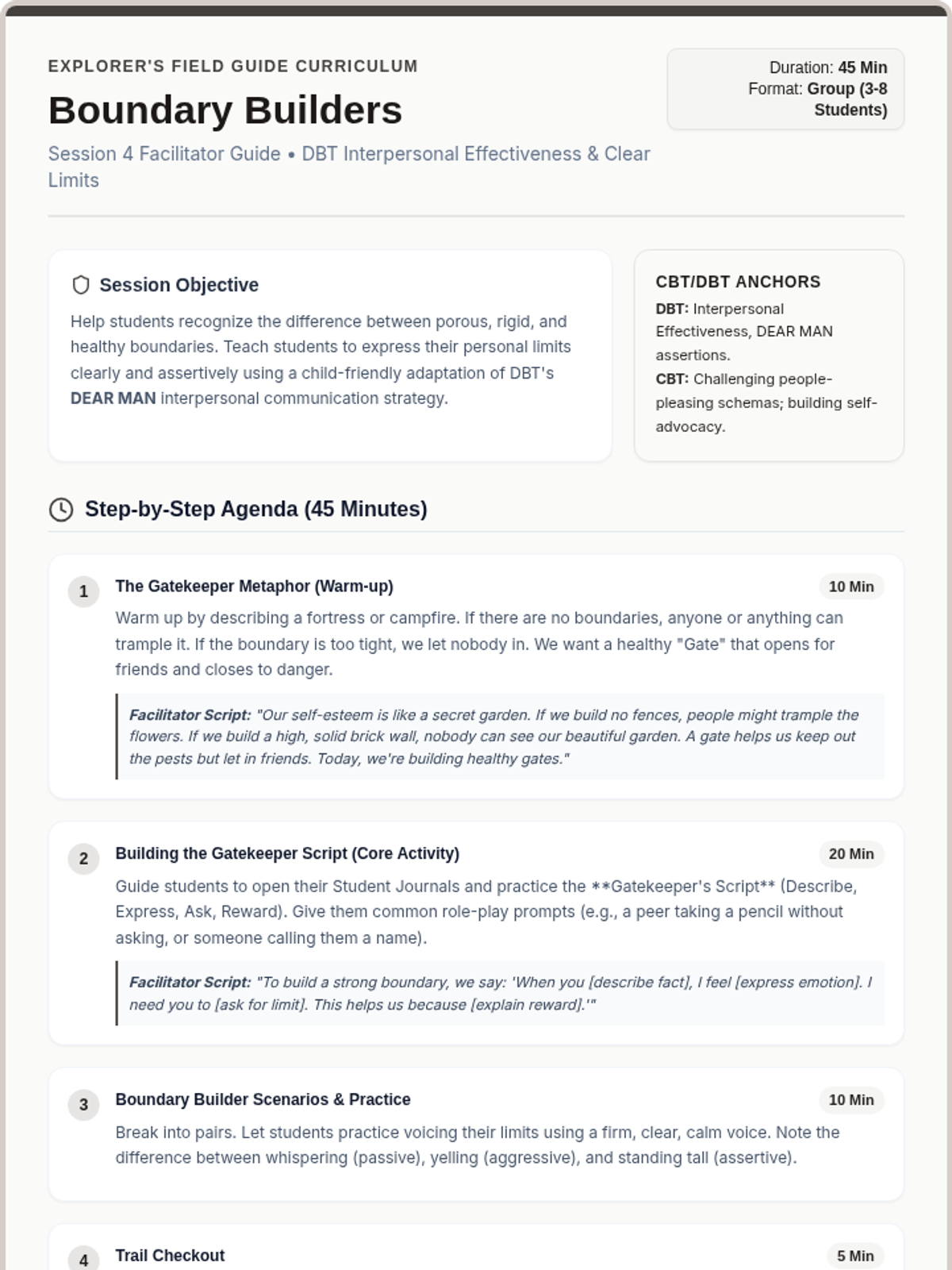
Facilitator guide for Session 4 of the Resilient Minds Group curriculum. Outlines assertive communication, personal limit-setting, and DBT Interpersonal Effectiveness skills (DEAR MAN style) to navigate social situations and foster healthy self-esteem.
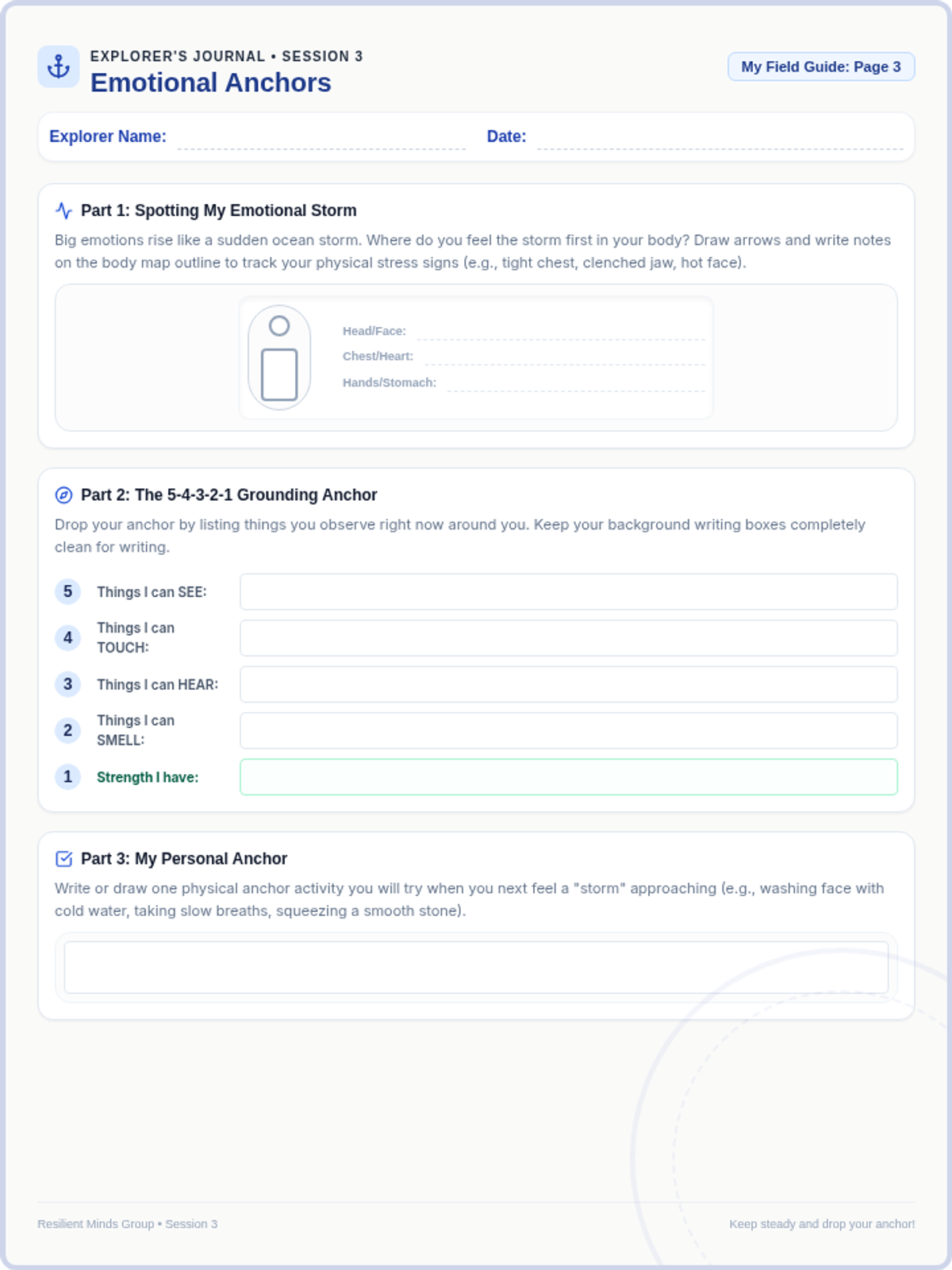
Student journal worksheet for Session 3 of the Resilient Minds Group. Features an emotional storm body mapping activity and a structured 5-4-3-2-1 sensory grounding layout.
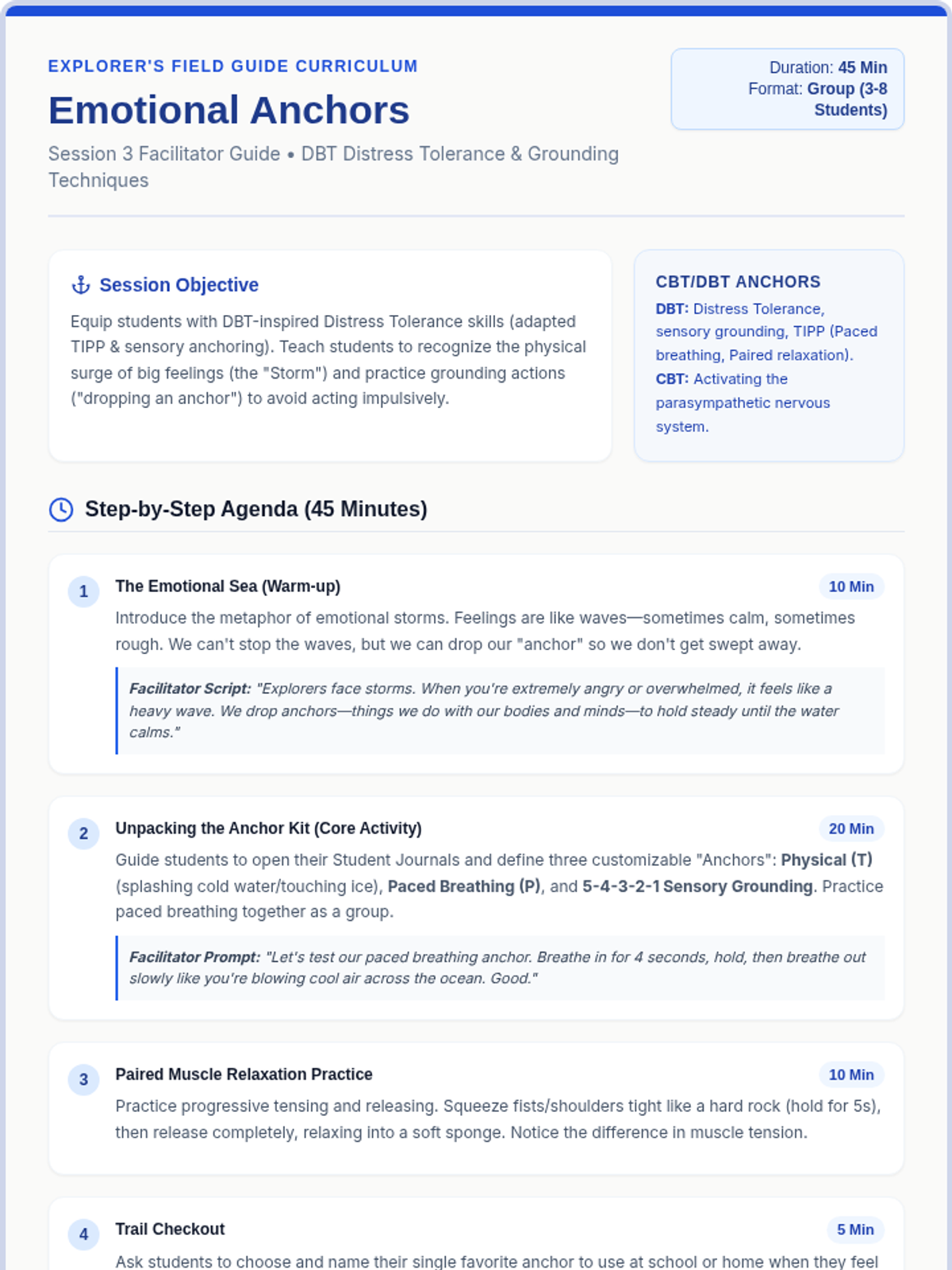
Facilitator guide for Session 3 of the Resilient Minds Group curriculum. Outlines DBT distress tolerance & sensory grounding techniques (TIPP and 5-4-3-2-1 models) with facilitation steps.
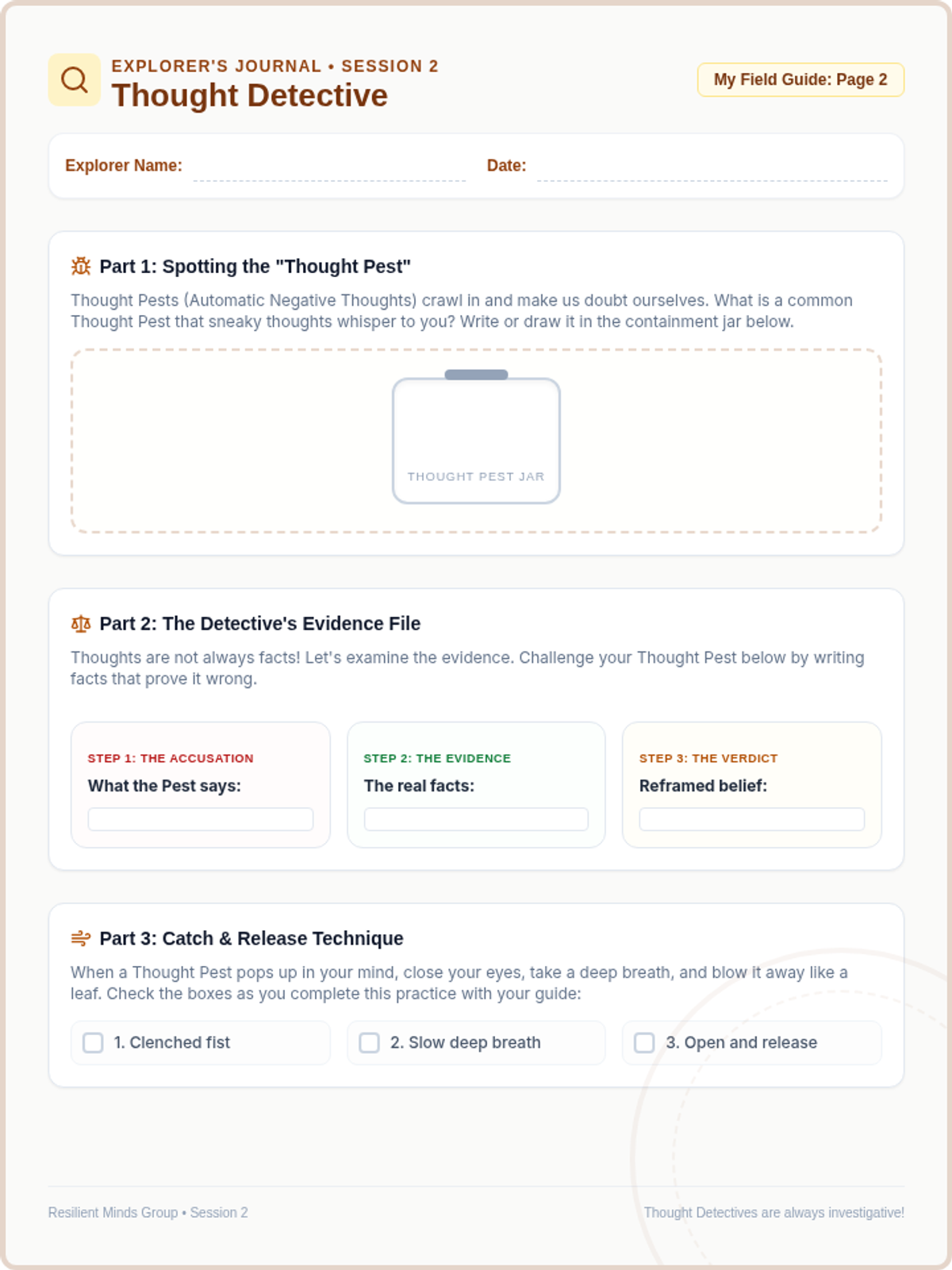
Student-facing worksheet for Session 2 of the Resilient Minds Group curriculum. Includes thought mapping (Thought Pests), an Evidence File grid for cognitive restructuring, and physical mindfulness steps.
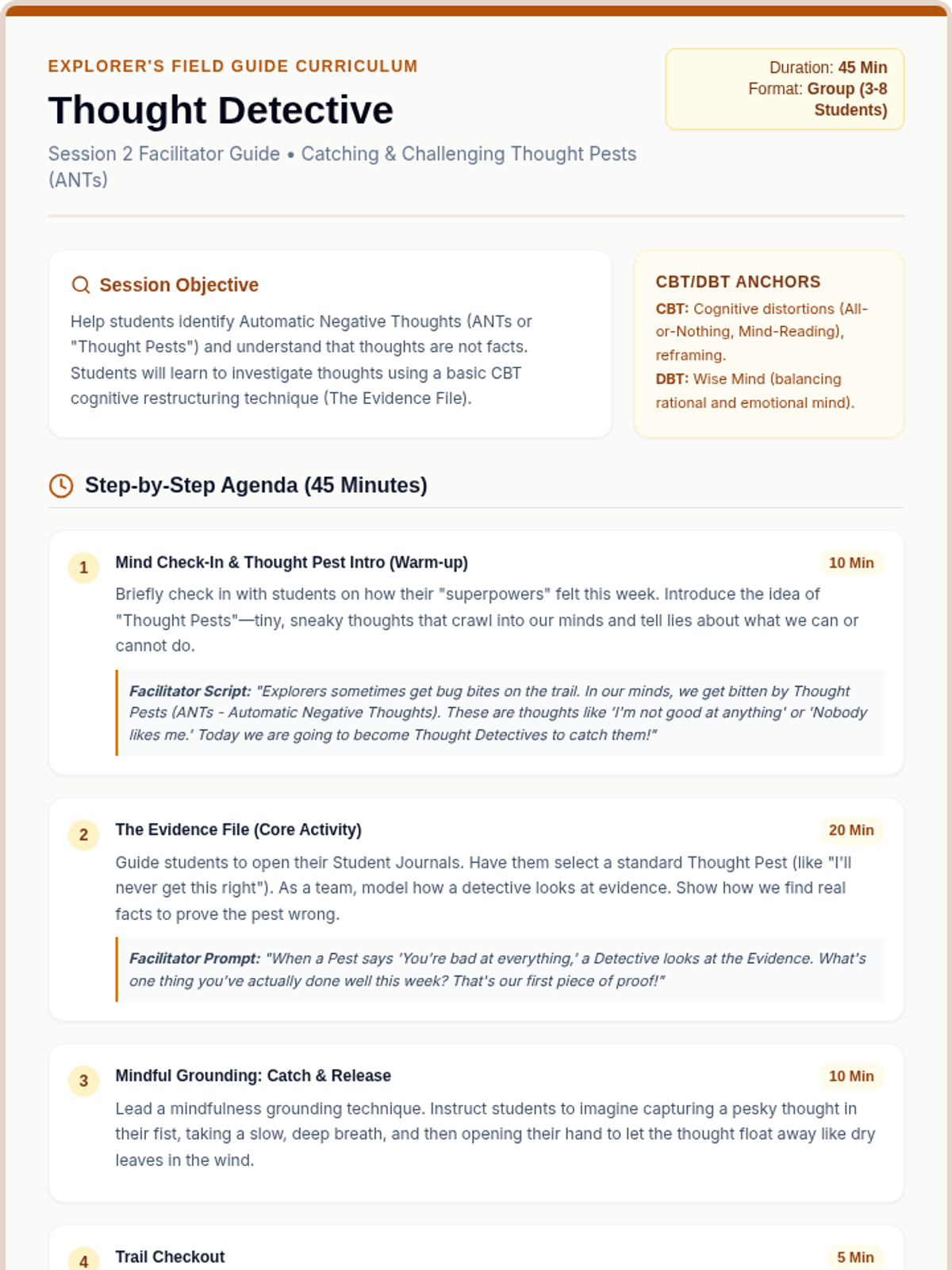
Facilitator guide for Session 2 of the Resilient Minds Group curriculum. Focuses on identifying automatic negative thoughts (ANTs), teaching cognitive restructuring via the "Evidence File" model, and clinical insights.
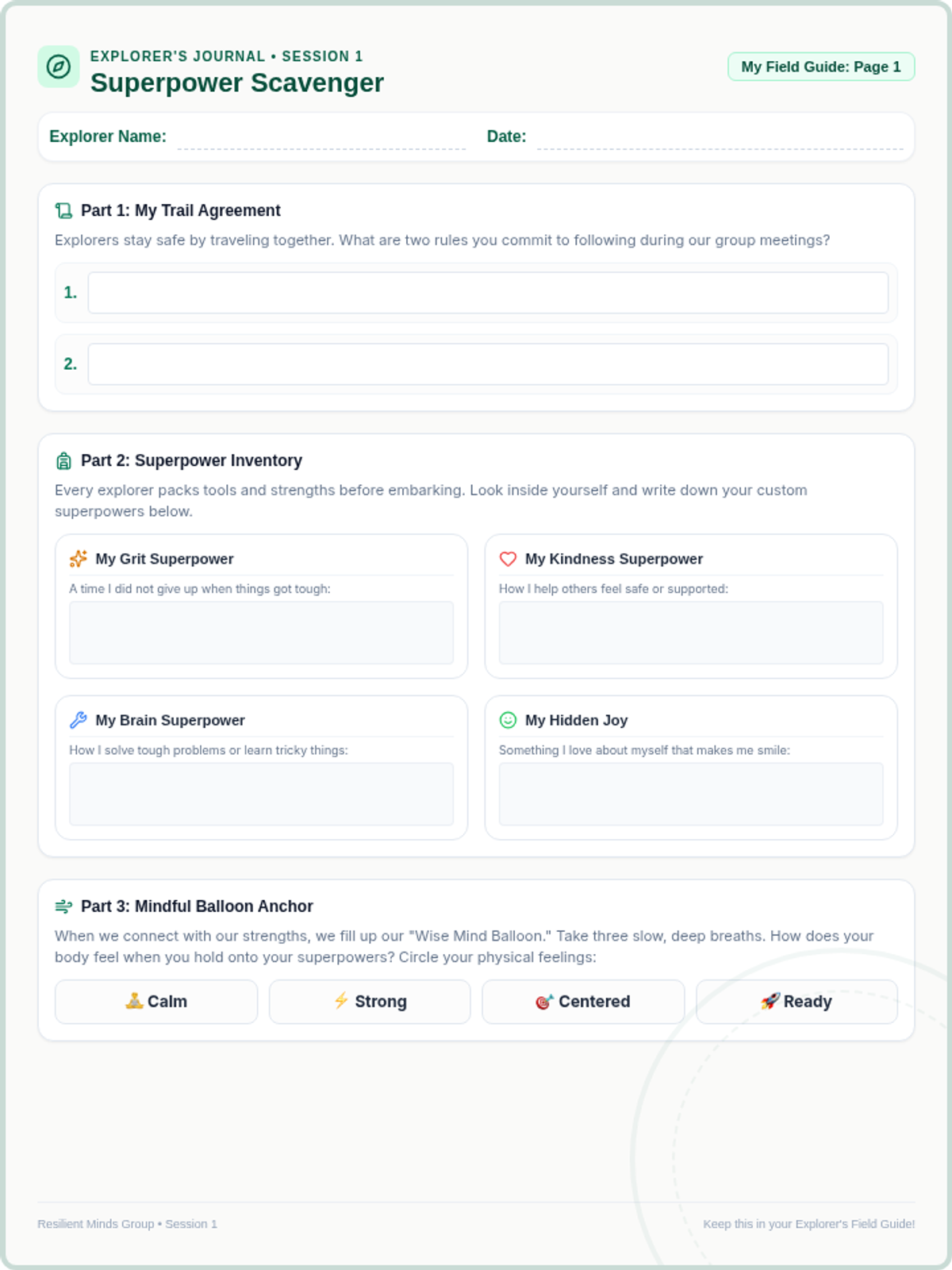
Student-facing worksheet for Session 1 of the Resilient Minds Group curriculum. Includes name/date entries, space to write group guidelines, a 2x2 strengths grid, and a mindfulness reflection space.
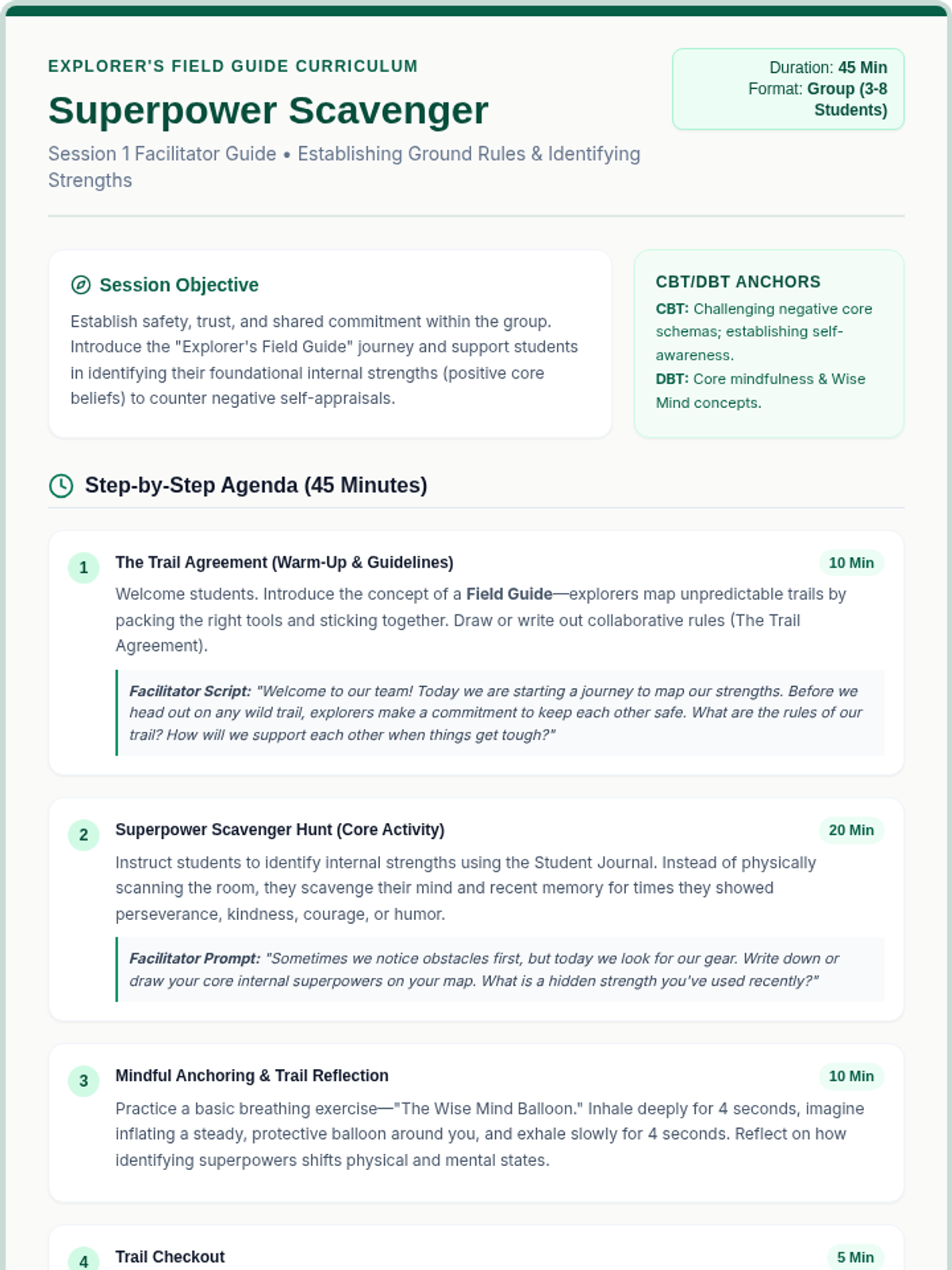
Facilitator guide for Session 1 of the Resilient Minds Group curriculum. Outlines session objectives, CBT/DBT concepts, a step-by-step 45-minute agenda, therapeutic scripts, and clinical guidance tips.
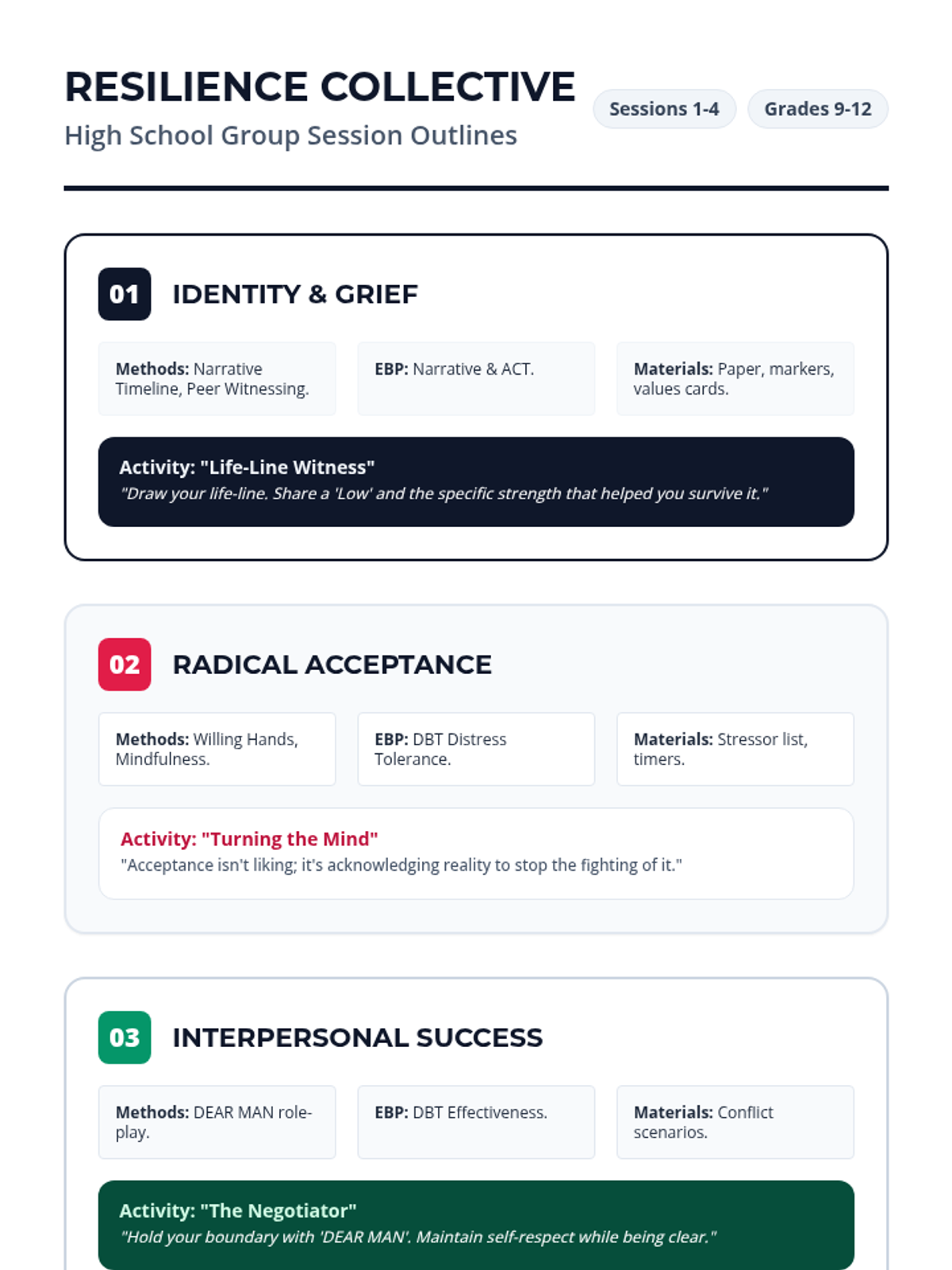
Structured group session outlines for high school students, incorporating advanced ACT and DBT-A concepts like Radical Acceptance and Interpersonal Effectiveness. Emphasizes peer witnessing and identity integration.
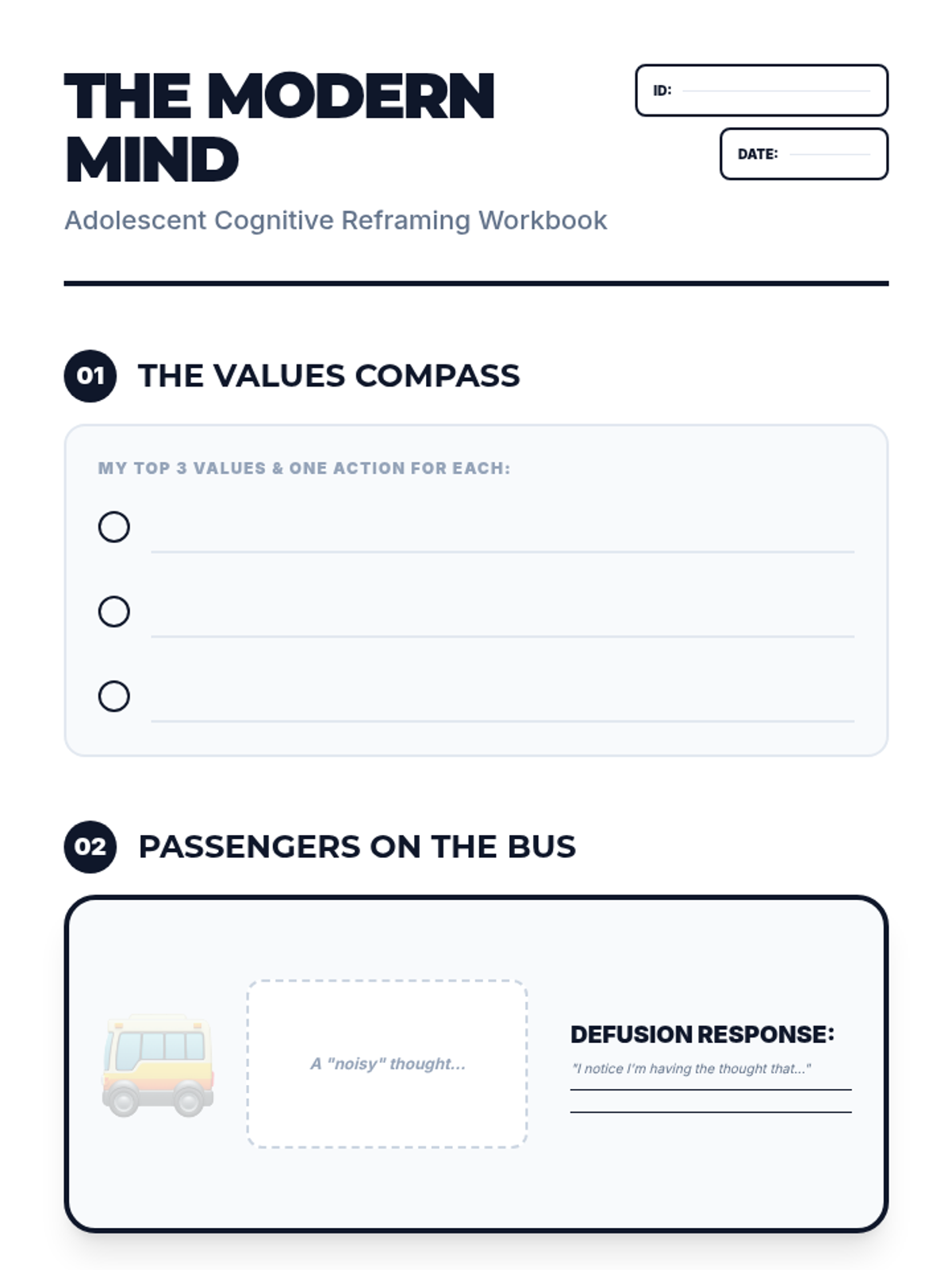
An advanced student workbook for high schoolers, featuring complex therapeutic exercises including Values-Based Mapping (ACT), Cognitive Defusion (ACT), and DEAR MAN interpersonal effectiveness (DBT). Designed for identity-level therapeutic work.
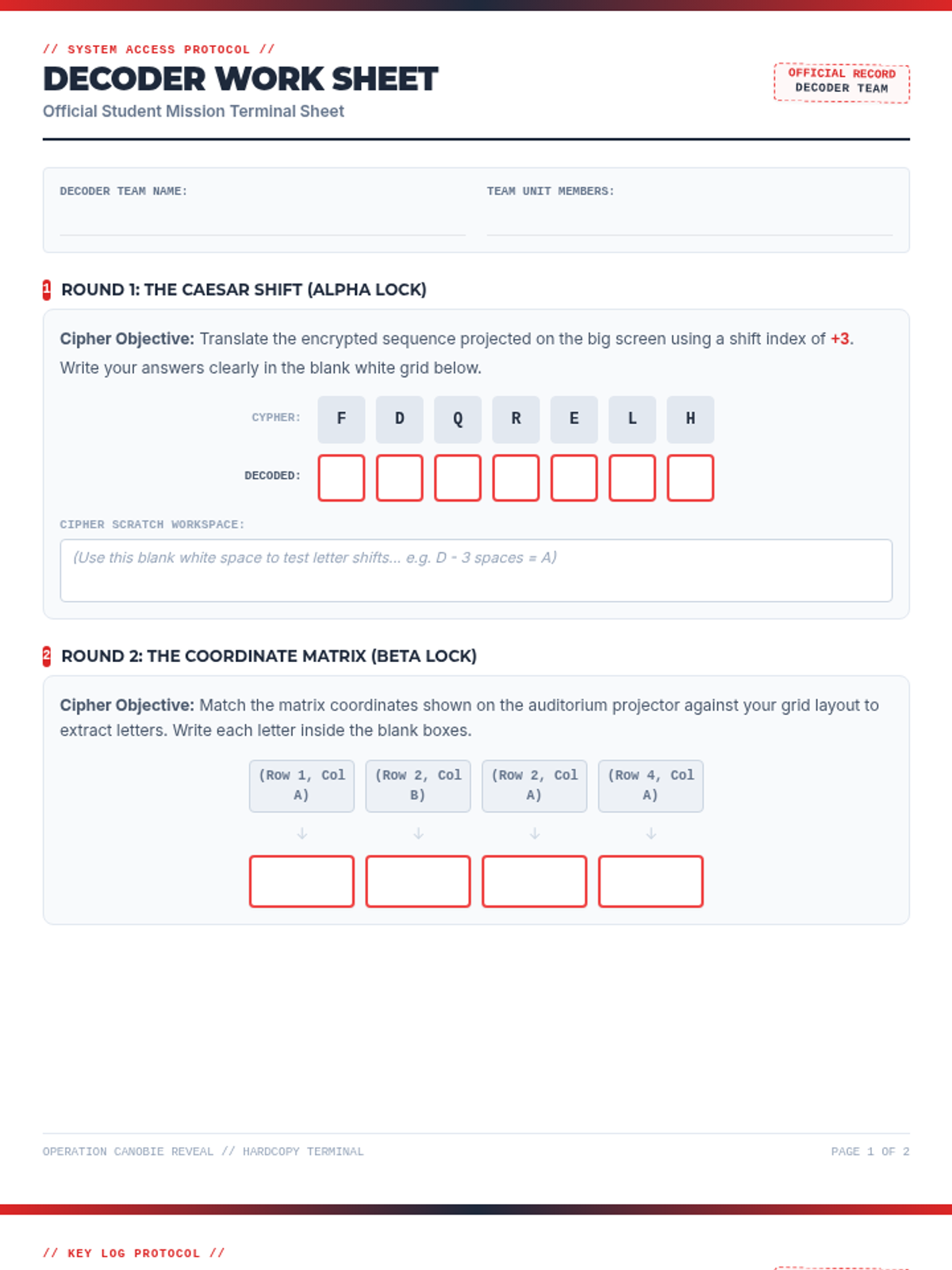
A printable 2-page student worksheet designed for the on-stage student representatives and audience groups. It contains blank spaces with white backgrounds for handwriting coordinates, decoding Caesar Shift grids, matching matrix numbers, unscrambling anagram riddles, and writing the final master key "CANOBIE LAKE PARK".
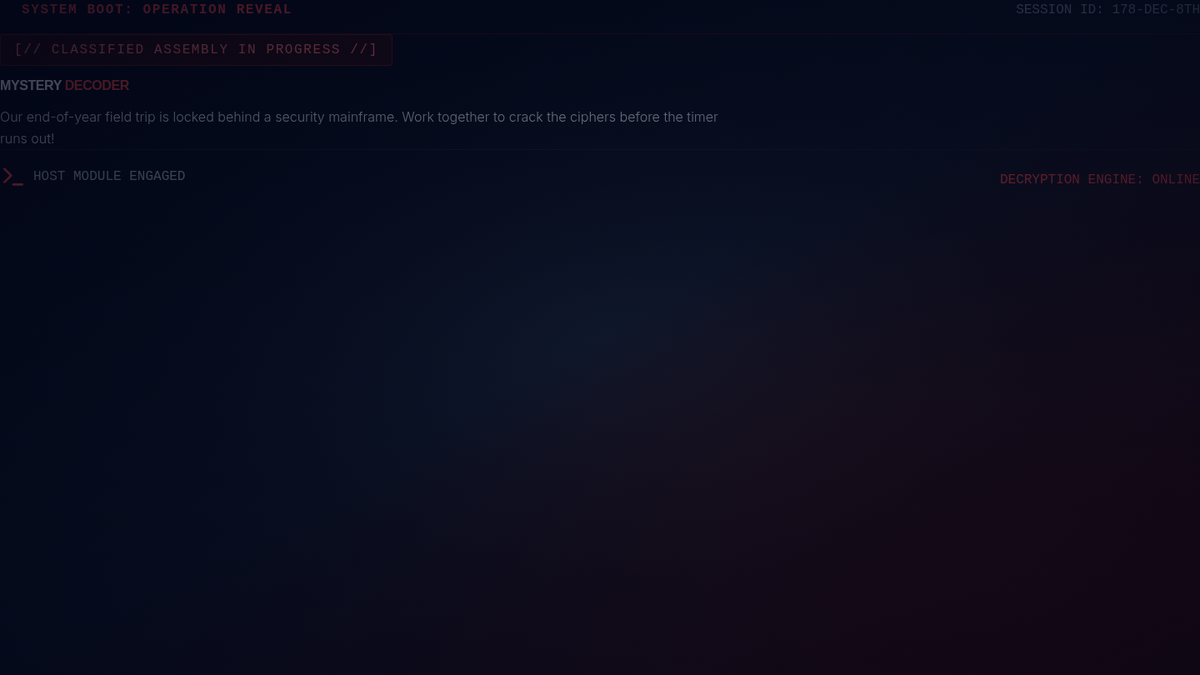
An high-impact cyber-themed 10-slide presentation styled as a security mainframe decoder. Used on the big screen in the auditorium to guide the 178 eighth graders and on-stage representatives through three decryption challenges to reveal Canobie Lake Park.
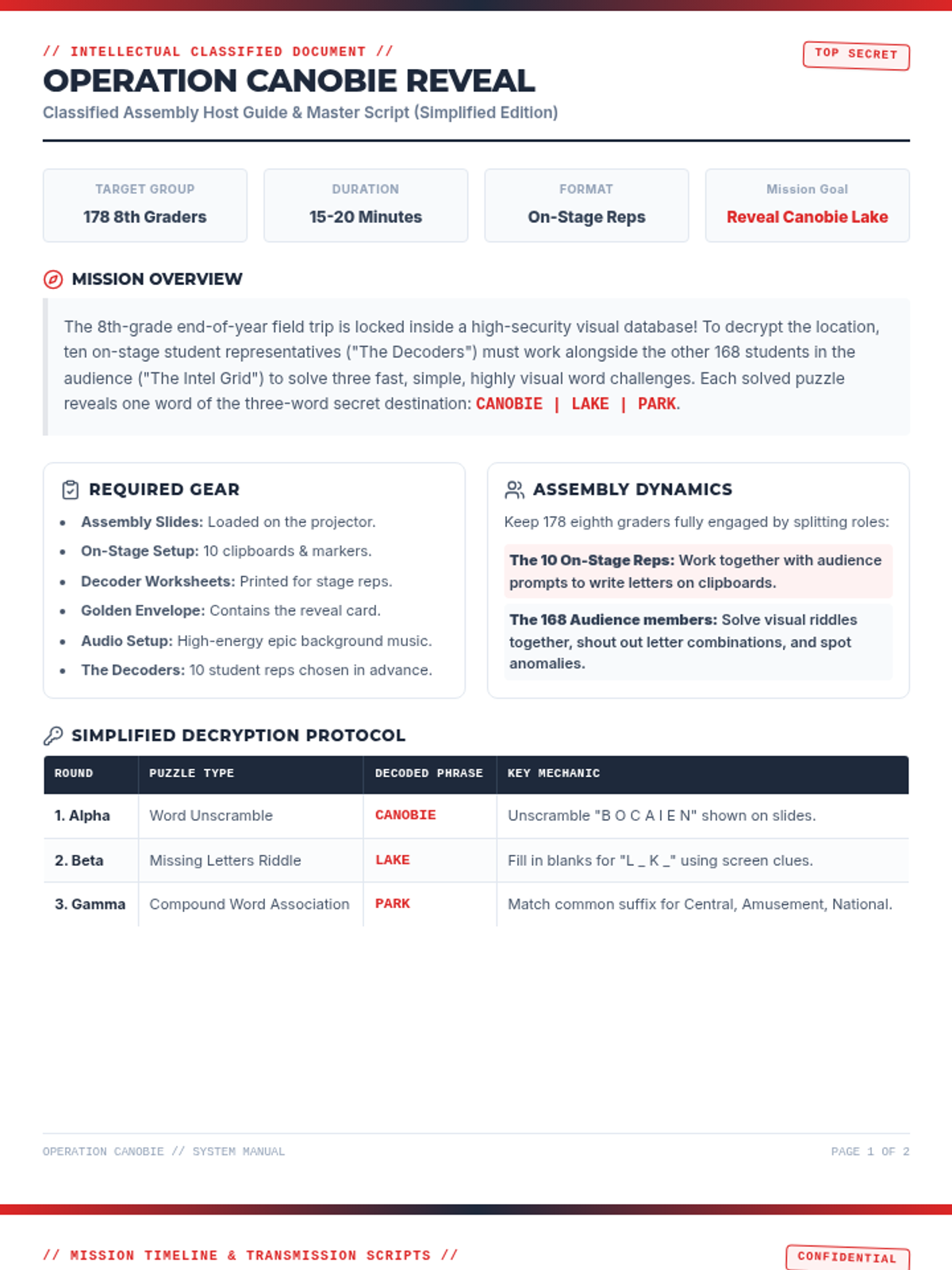
A printable, highly detailed 2-page host manual for teachers running the Canobie Lake Park reveal assembly. Contains logistics, equipment checklists, a detailed minute-by-minute timeline, and script segments to guide 178 eighth graders through the interactive mystery.
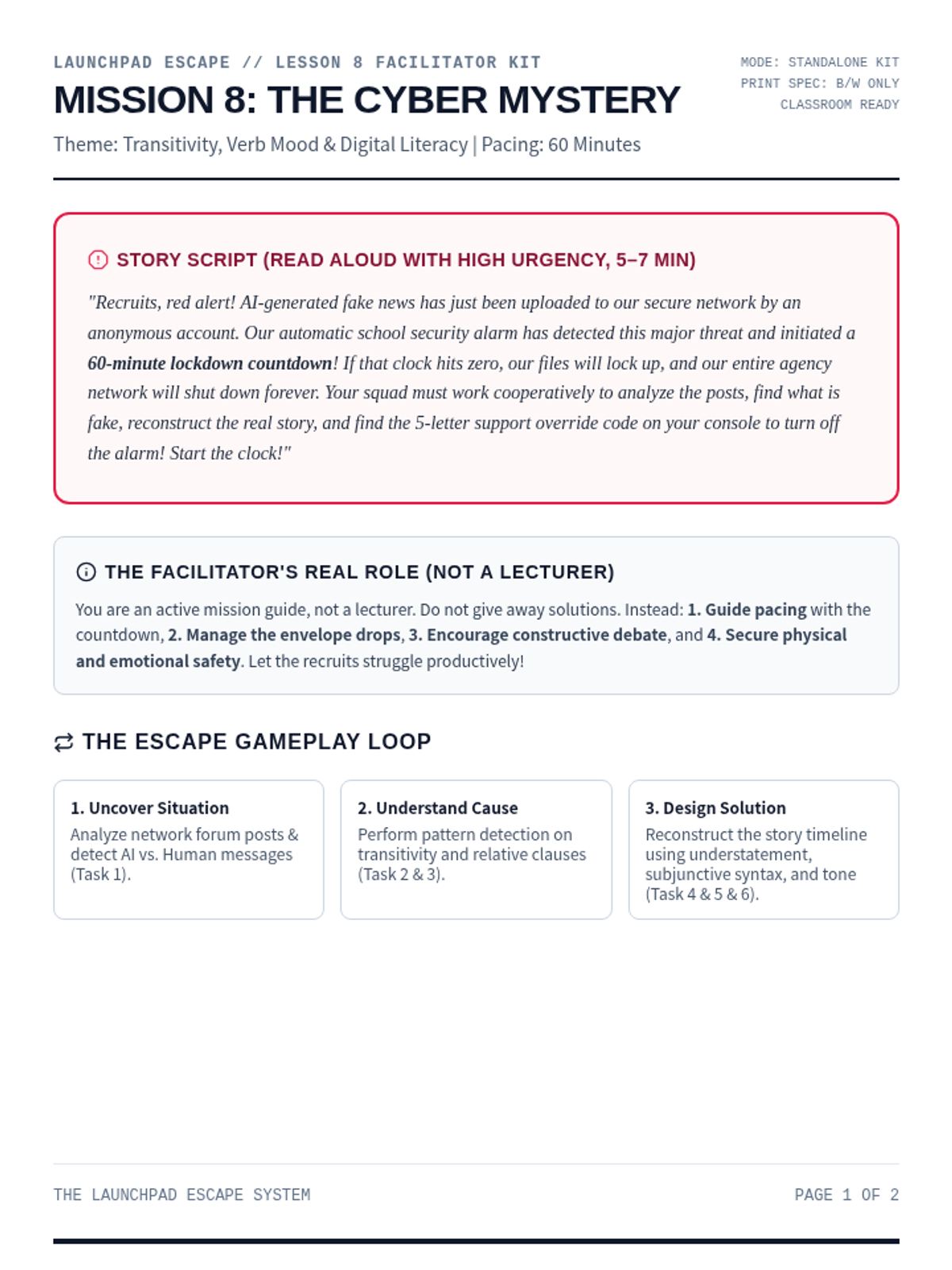
A comprehensive printable facilitator guide for Mission 8: The Cyber Mystery. Contains story script, setup checklists, progressive clue mechanics, persuasive appeals endings, and debrief questions.
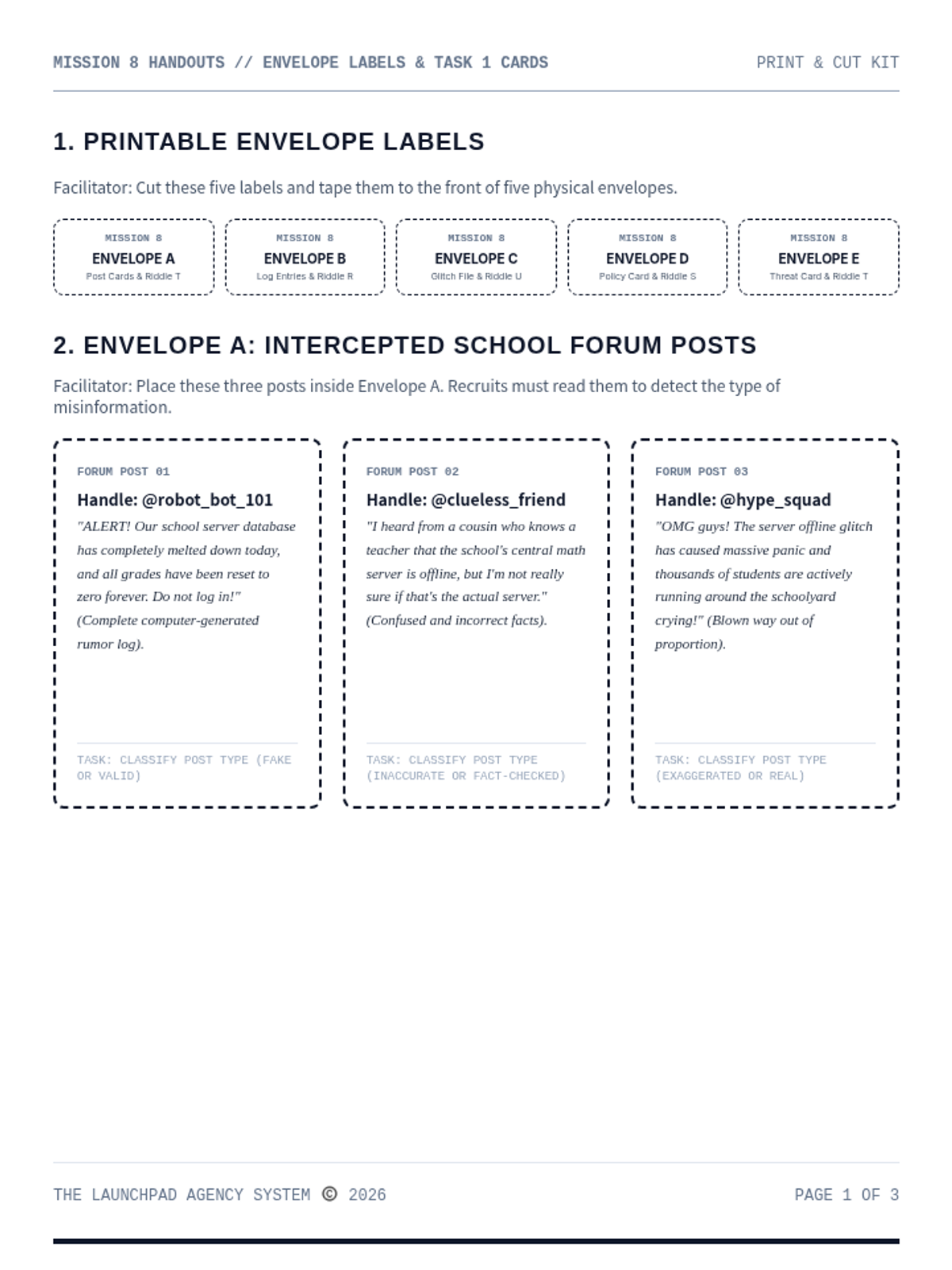
A print-and-cut materials handout kit for Mission 8: The Cyber Mystery. Contains envelope labels, student statements, word files, and printable landmark riddle cards.
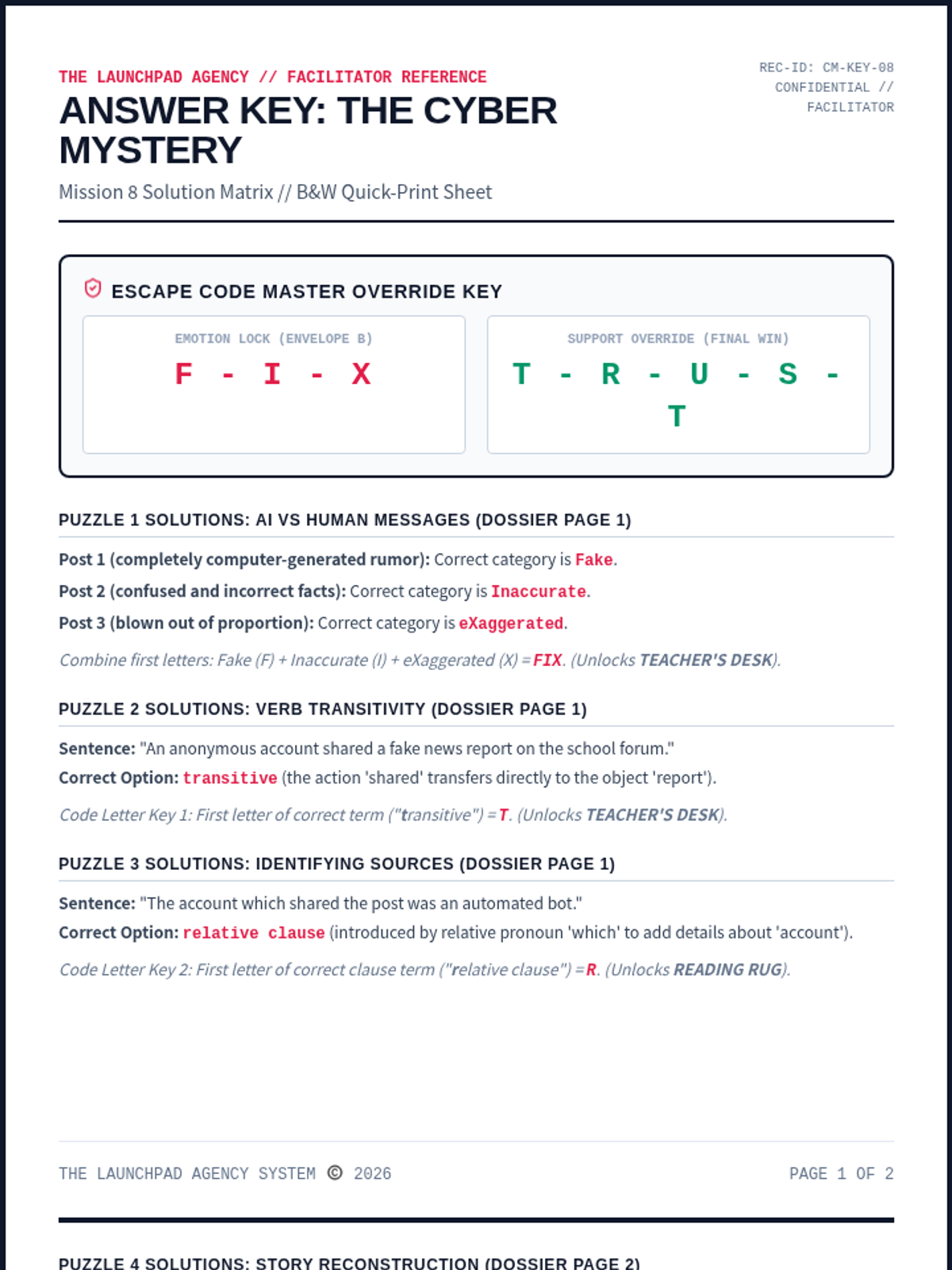
A dedicated facilitator answer key for Mission 8: The Cyber Mystery. Contains complete solutions for all ELA/coordinate puzzles, ciphers, and floor map paths, along with rubrics and setup tips.
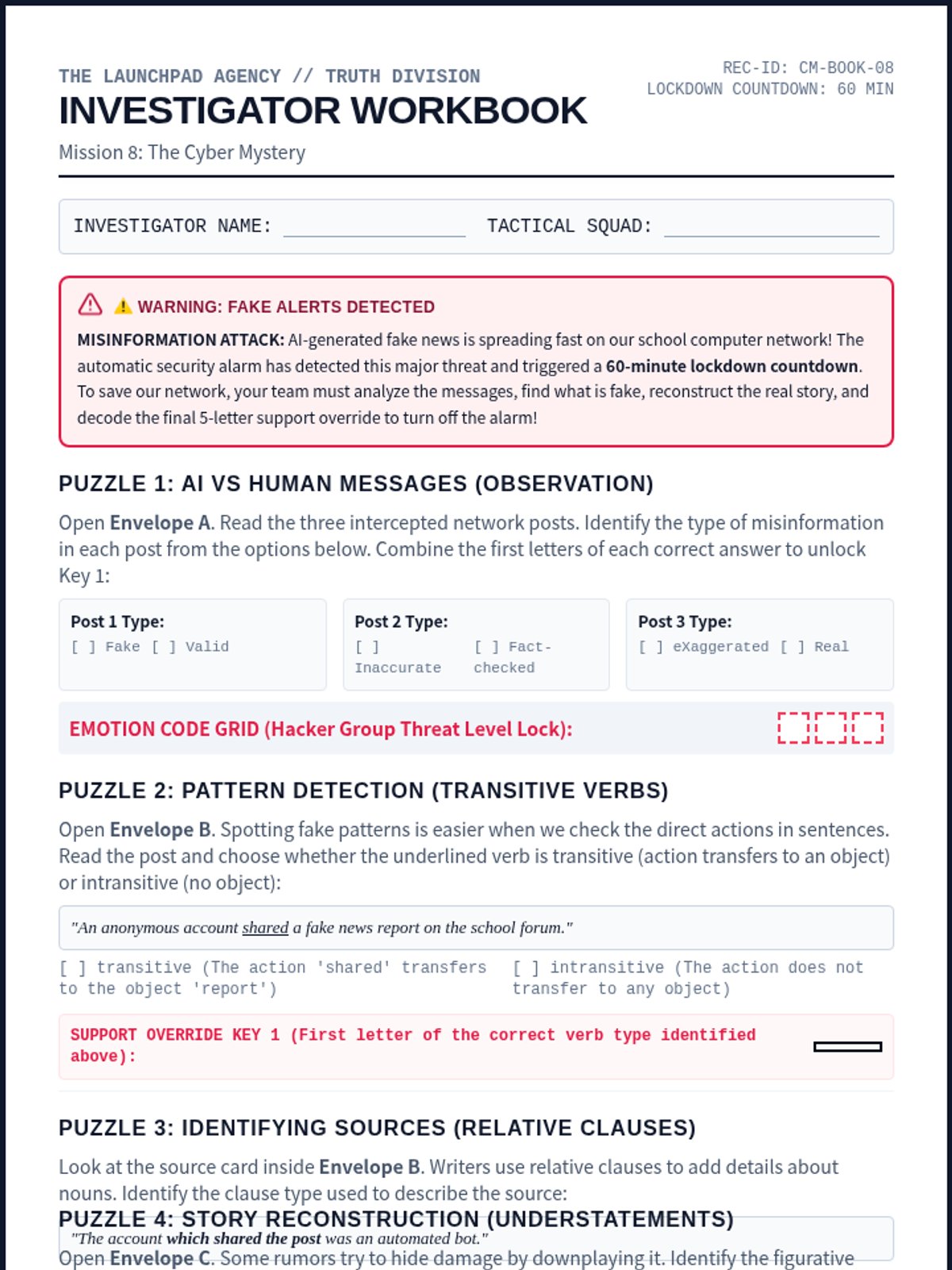
An immersive student-facing escape worksheet for Mission 8: The Cyber Mystery. Recruits identify transitive verbs, relative clauses, understatement, subjunctive moods, and tone to stop a school database wipe.