Active listening, assertive expression, and boundary-setting strategies for interpersonal success. Develops proficiency in conflict mediation, cooperative teamwork, and the cultivation of healthy romantic and platonic connections.
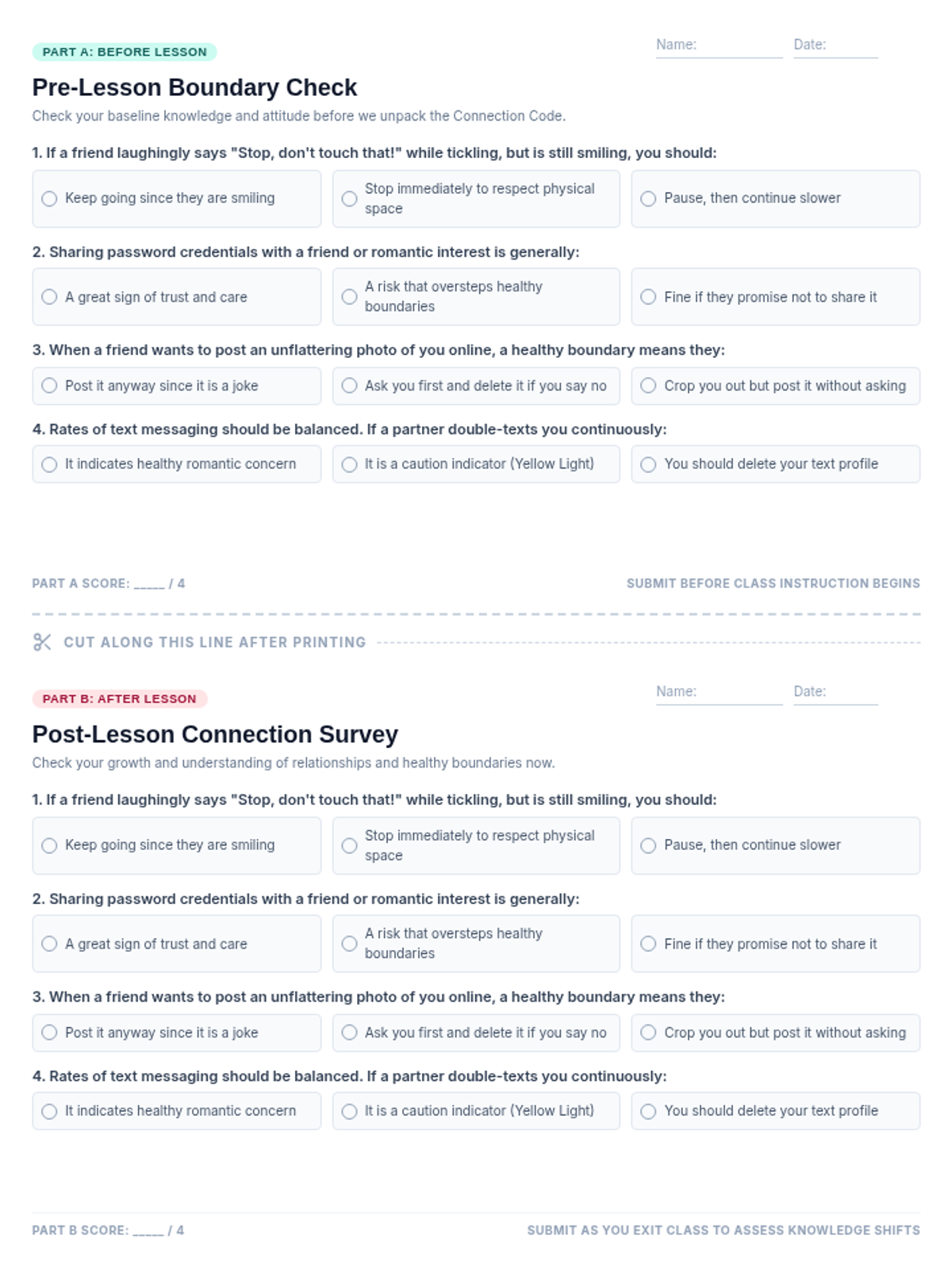
A pre- and post-lesson diagnostic survey designed as a half-page cut out worksheet. Features identical, styled multiple-choice questions to measure knowledge growth and attitude shifts regarding consent, passwords, and space.
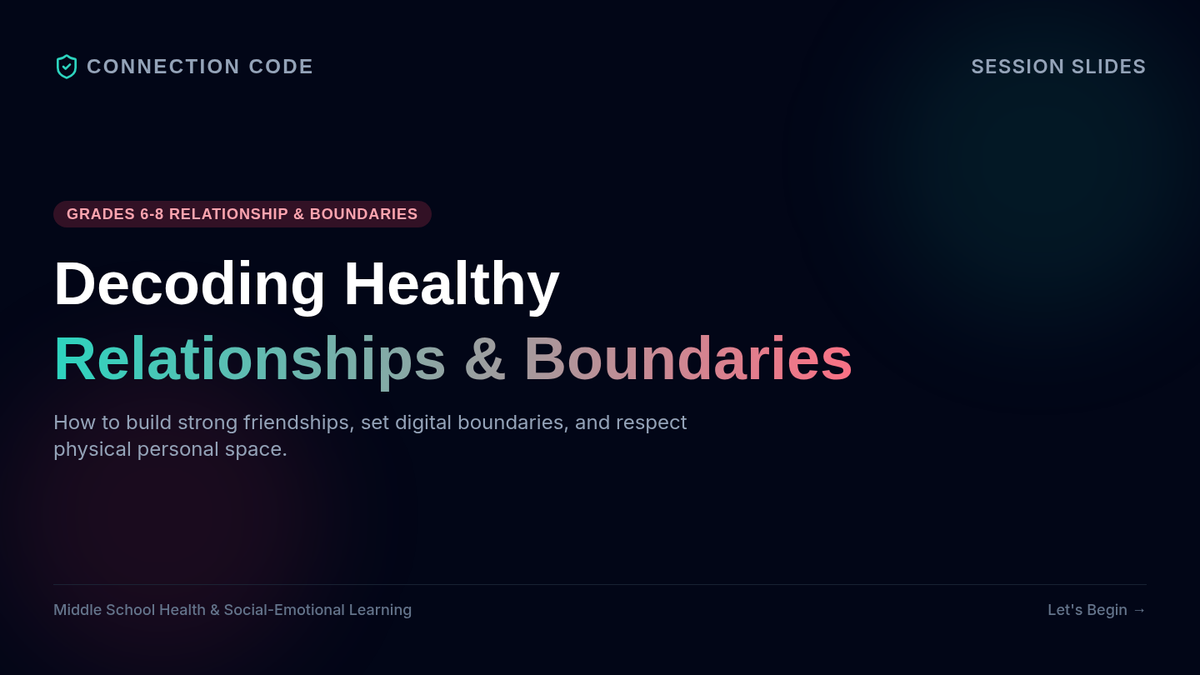
A comprehensive 5-slide visual presentation deck covering healthy physical space, digital boundaries, text etiquette, relationship indicators, and the assertive boundary-setting formula.
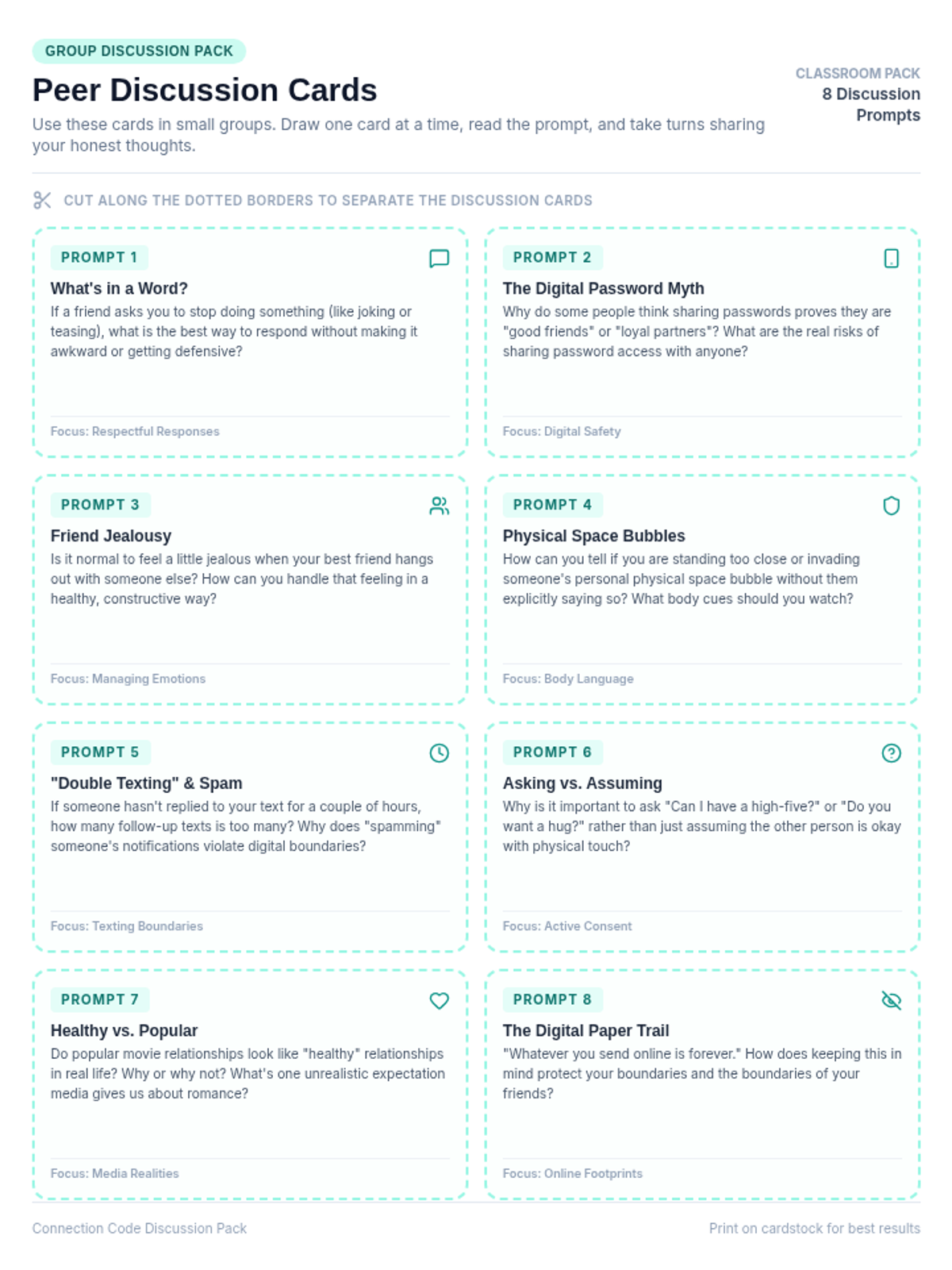
A classroom set of 8 printable discussion prompt cards focused on active consent, texting etiquette, password boundaries, personal physical space bubbles, and healthy relationship choices.
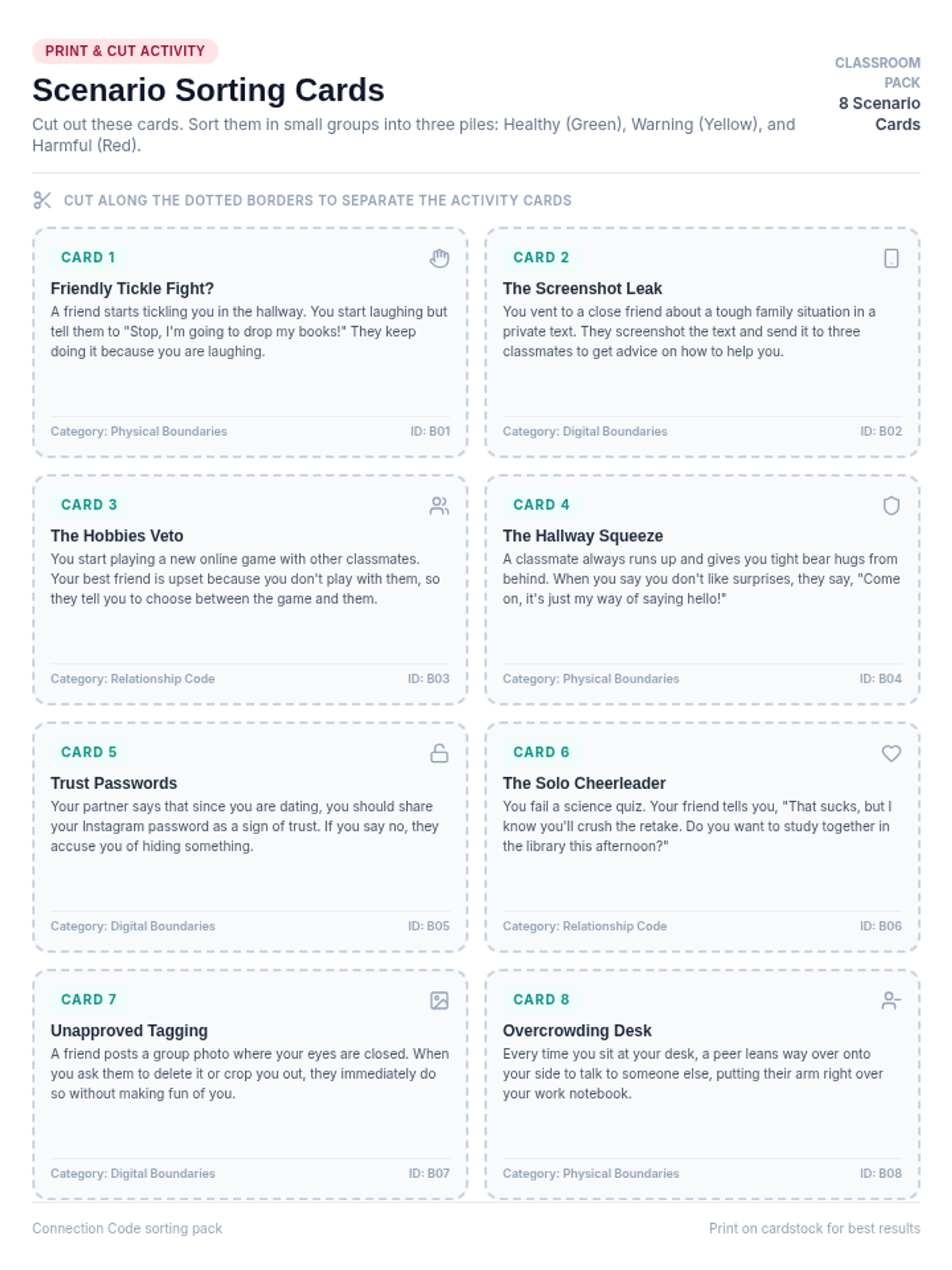
A classroom set of 8 printable scenario cards with real-world relationship, digital, and physical space boundary situations, formatted with dashed cutting guidelines for student group sorting.
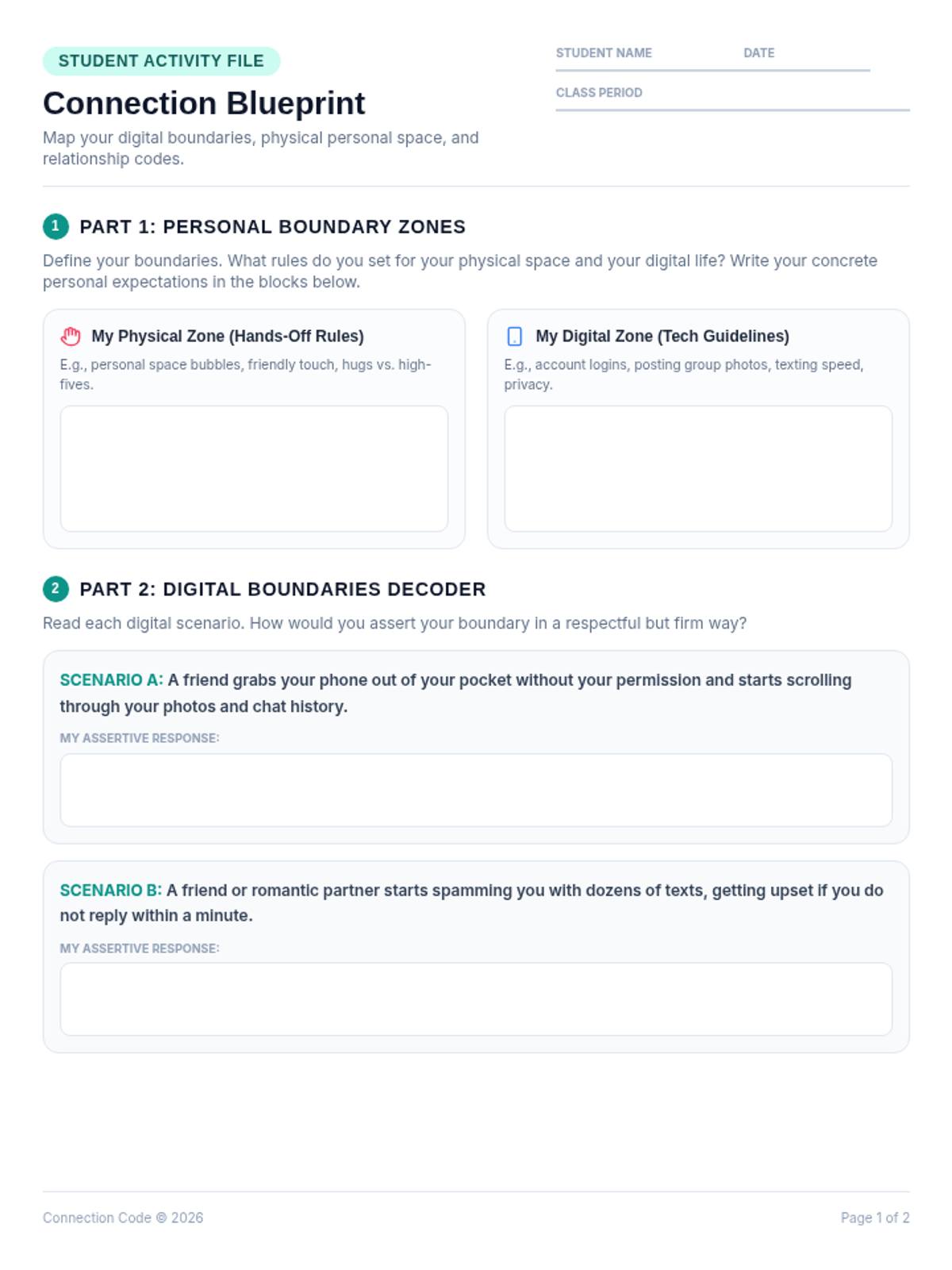
A student worksheet containing three parts: Personal Boundary Zones (physical/digital), a Digital Boundaries Decoder with real-world tech scenarios, and a Relationship Radar scorecard activity to evaluate behavior.
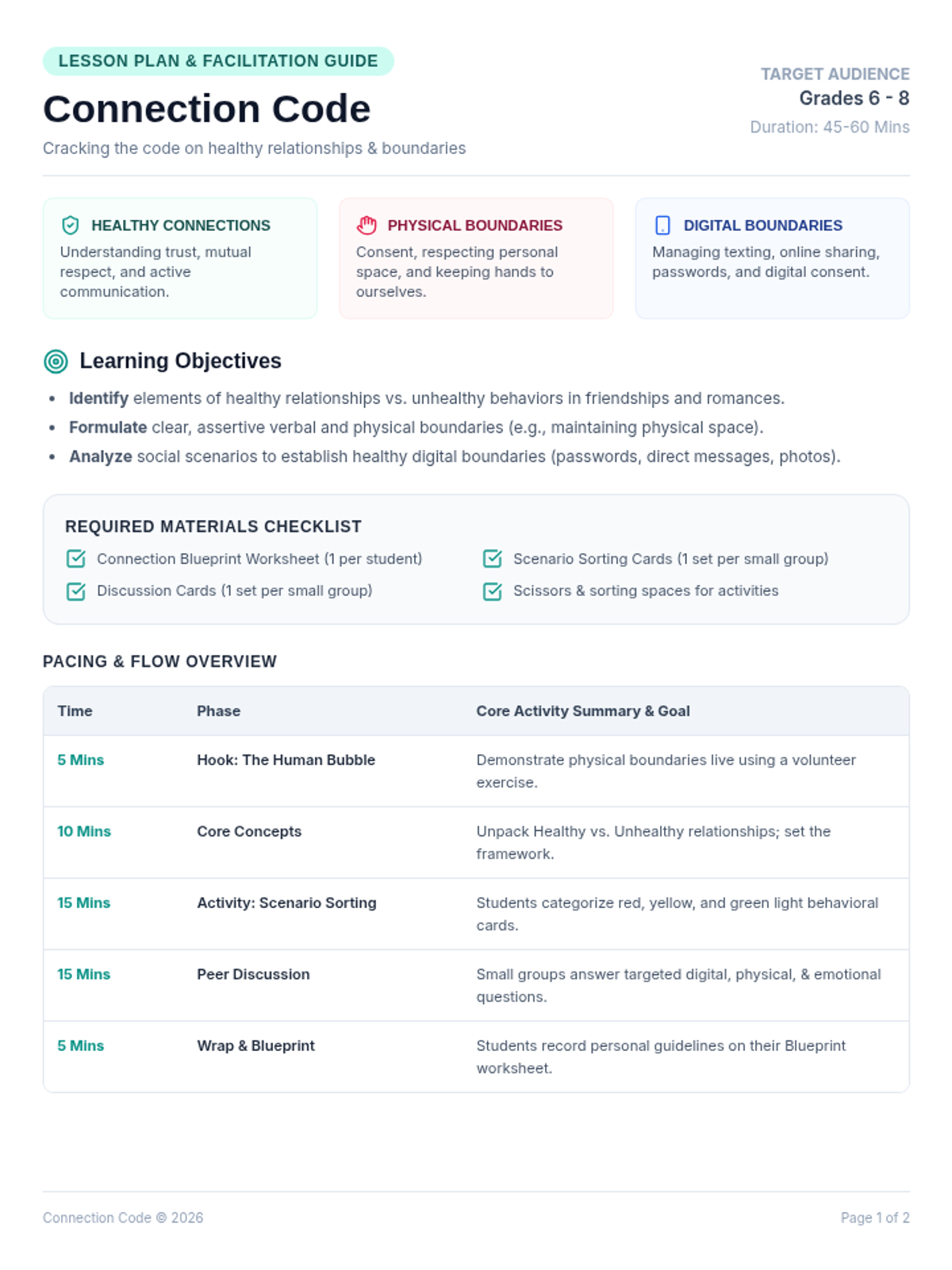
A 2-page detailed teacher guide and lesson plan outlining facilitation instructions, pacing, materials checklists, and developmental guidelines for running the Connection Code relationship and boundary lesson for grades 6-8.
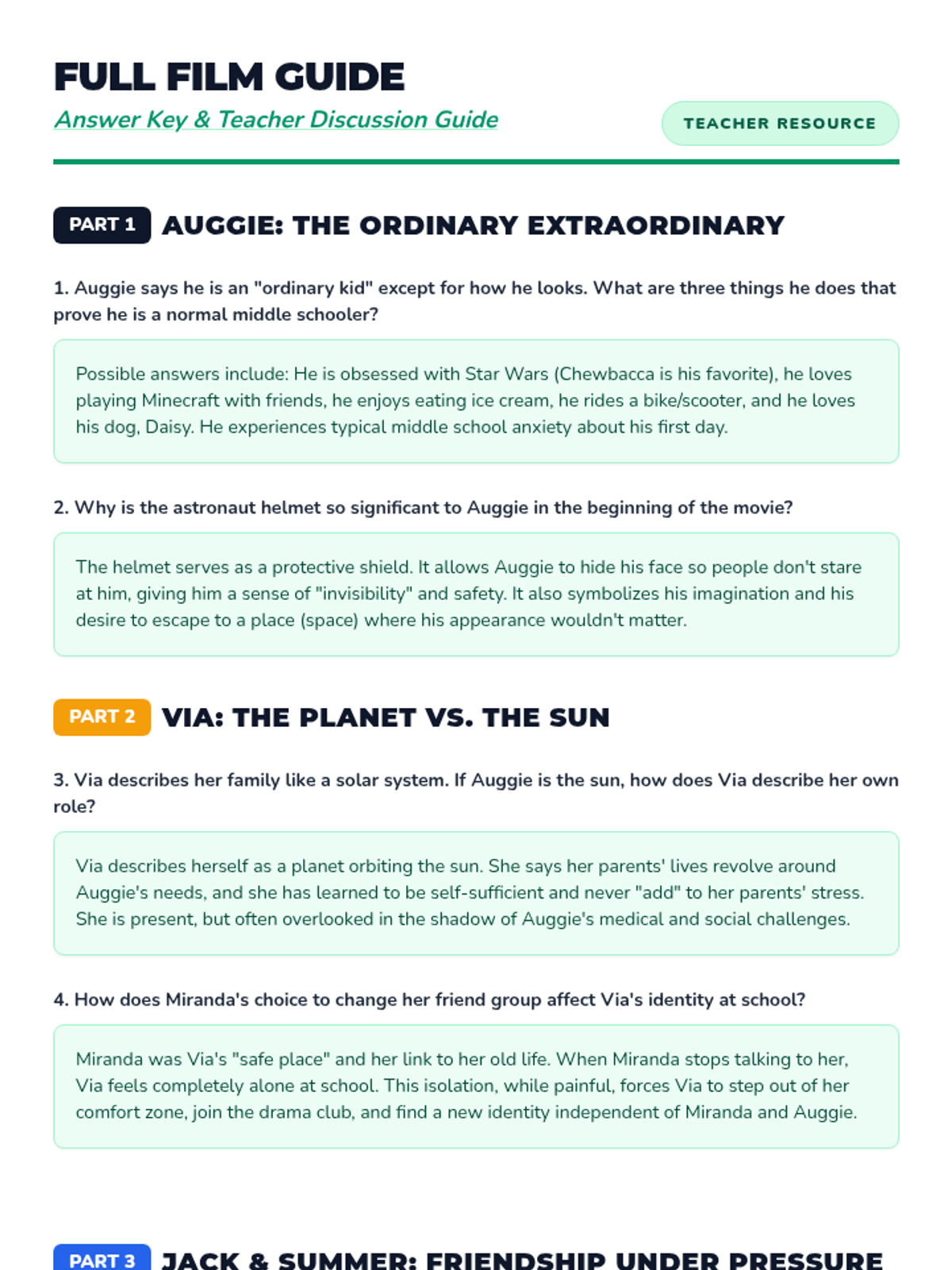
A teacher-facing answer key for the full-film viewing guide, providing suggested responses and discussion points for each character perspective and thematic question.
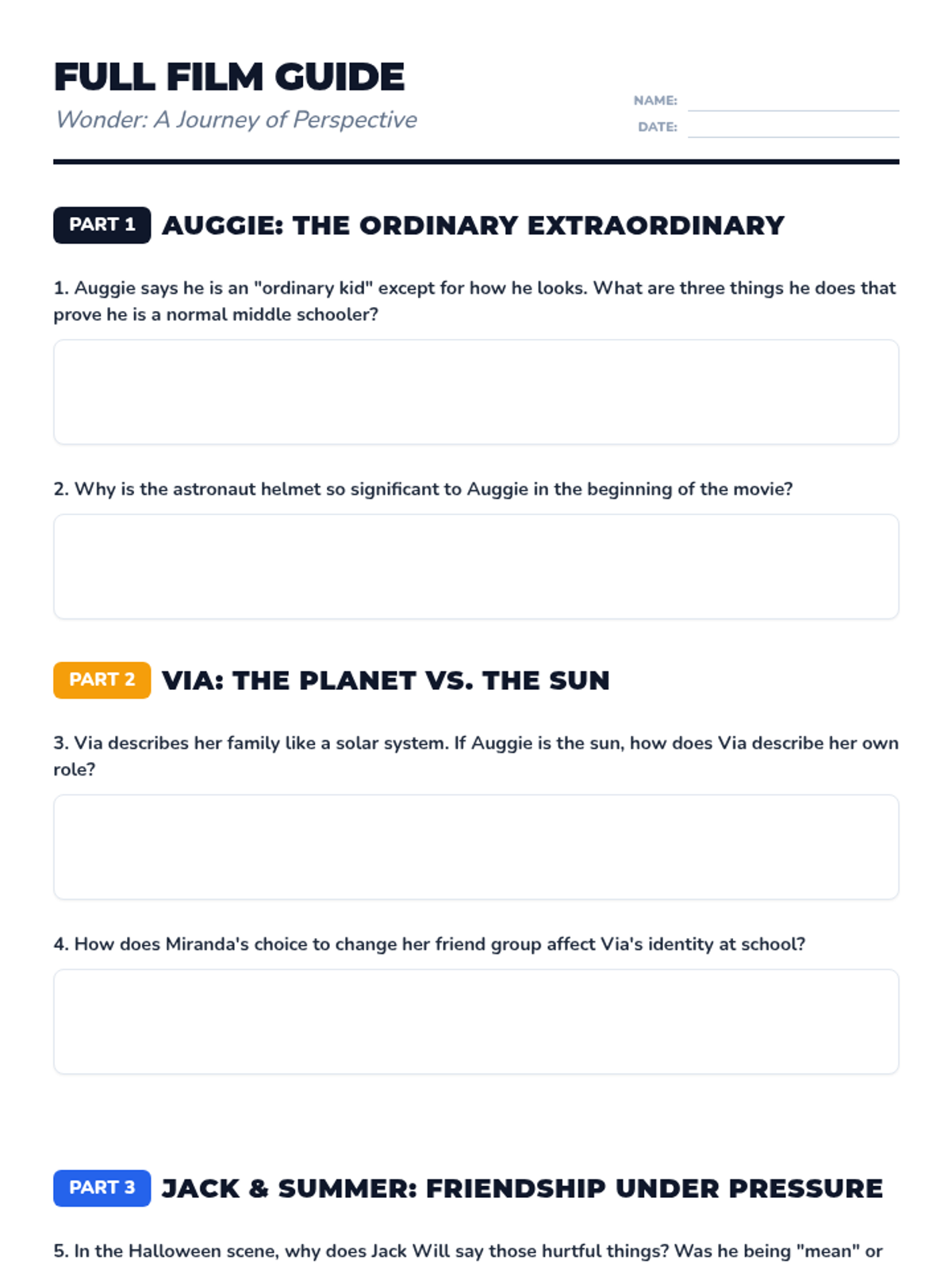
A comprehensive guided viewing worksheet for the full movie Wonder, structured by character perspective with analytical questions on empathy, friendship, and perspective.
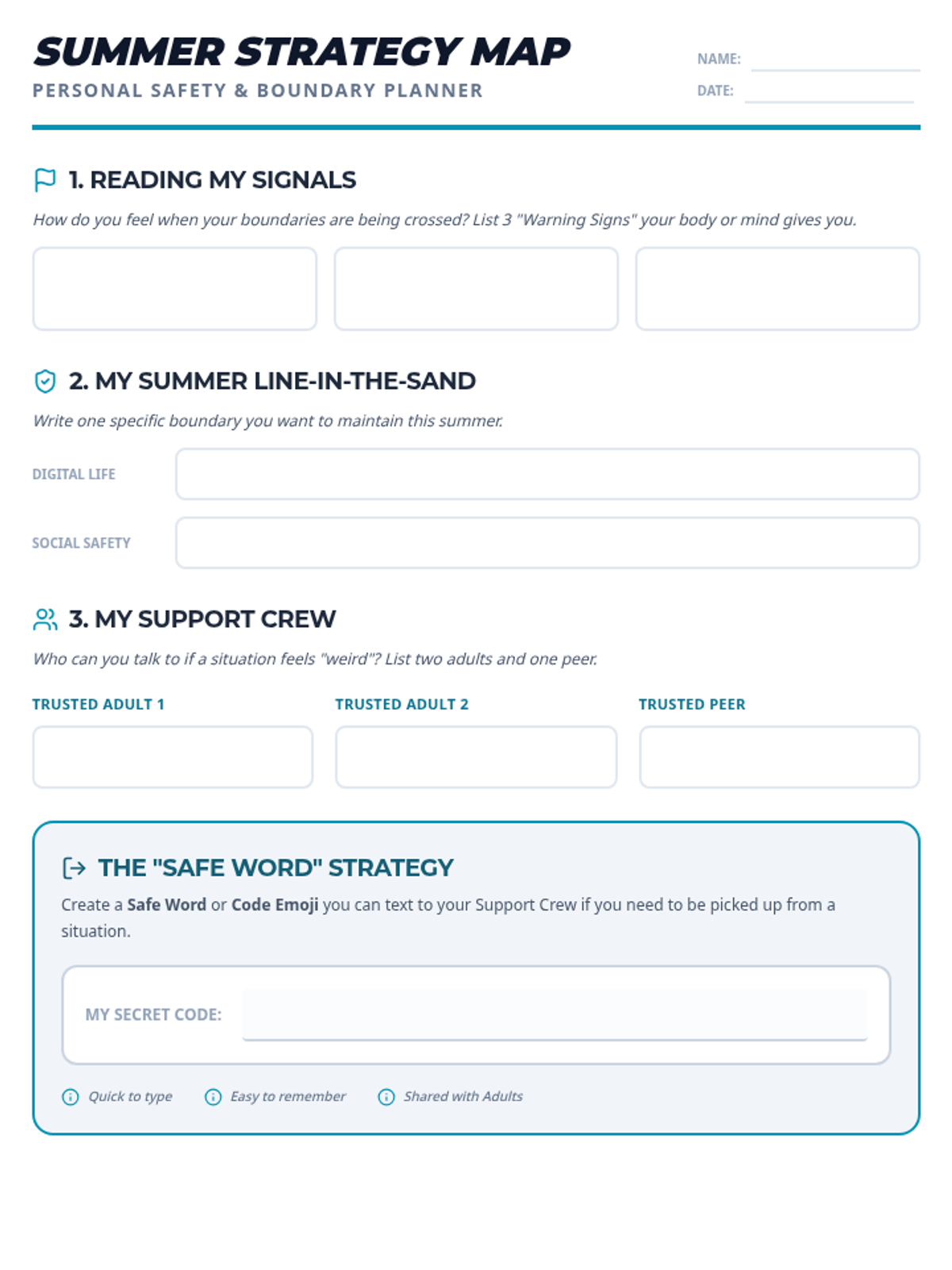
A student worksheet titled "Summer Strategy Map" that allows students to reflect on their own warning signs, set personal boundaries, and identify a support network and exit strategy for the summer.
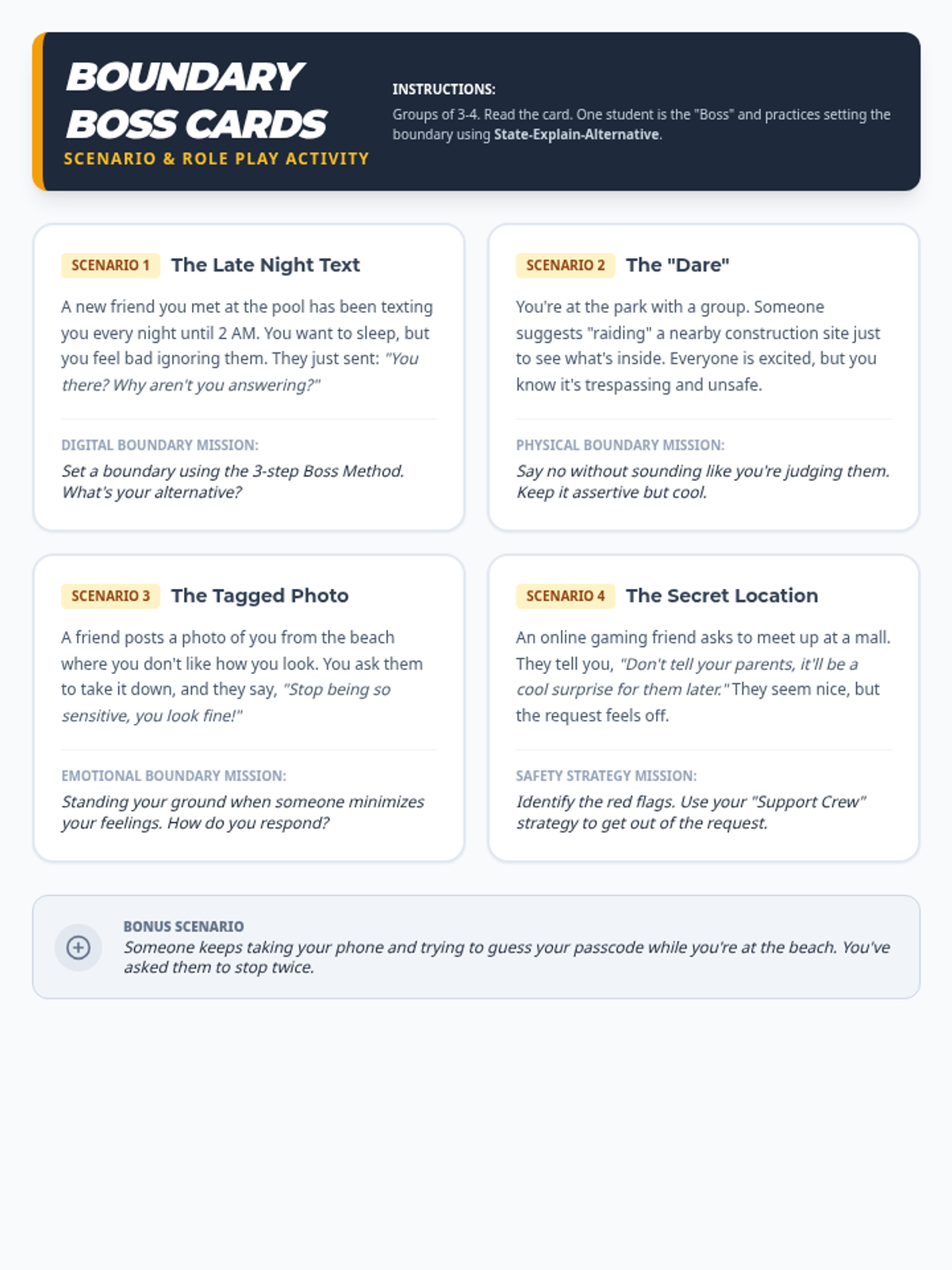
A set of scenario-based activity cards designed for group role-play, helping students practice assertive communication and boundary setting in common summer social situations.
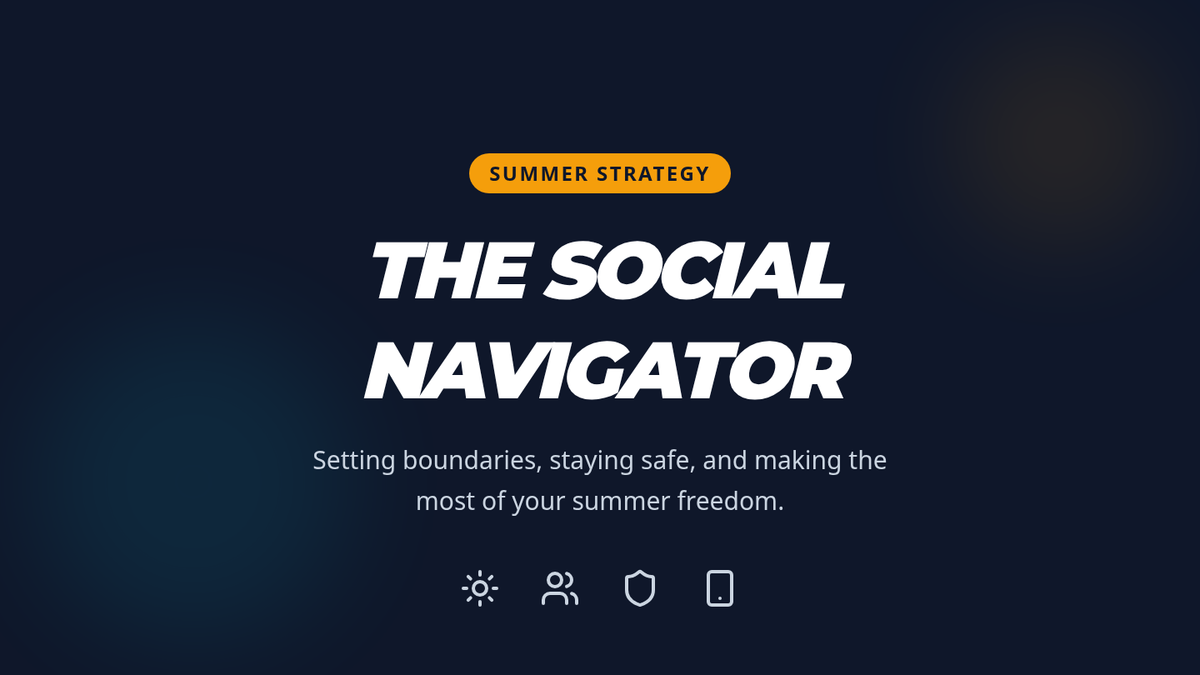
A visual slide deck titled "The Social Navigator" that guides students through the complexities of summer independence, relationship green/red flags, boundary setting, and digital safety.
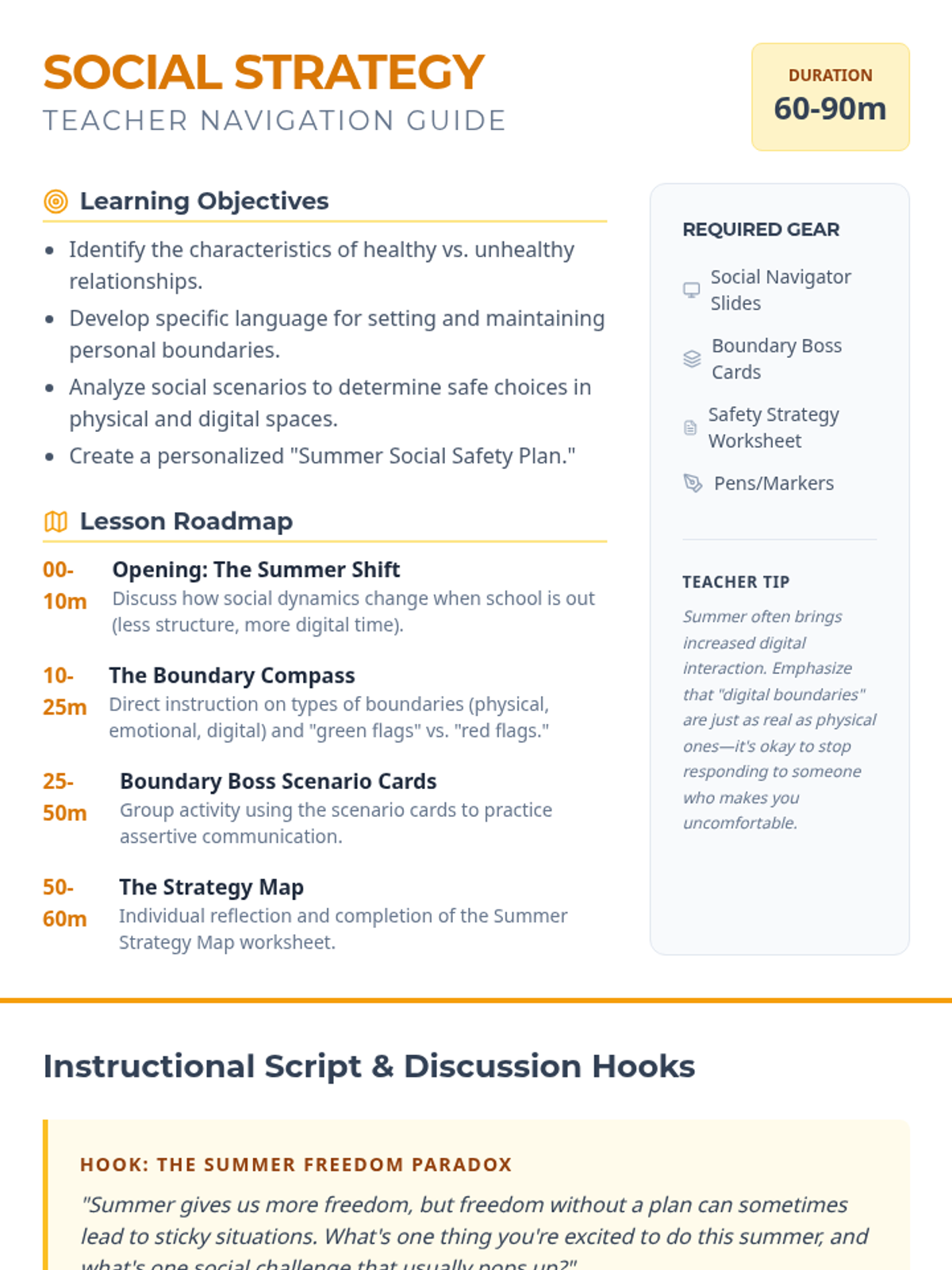
A detailed teacher guide for the Summer Social Strategy lesson, featuring learning objectives, a timed roadmap, and instructional scripts for facilitating discussions on boundaries and safety.
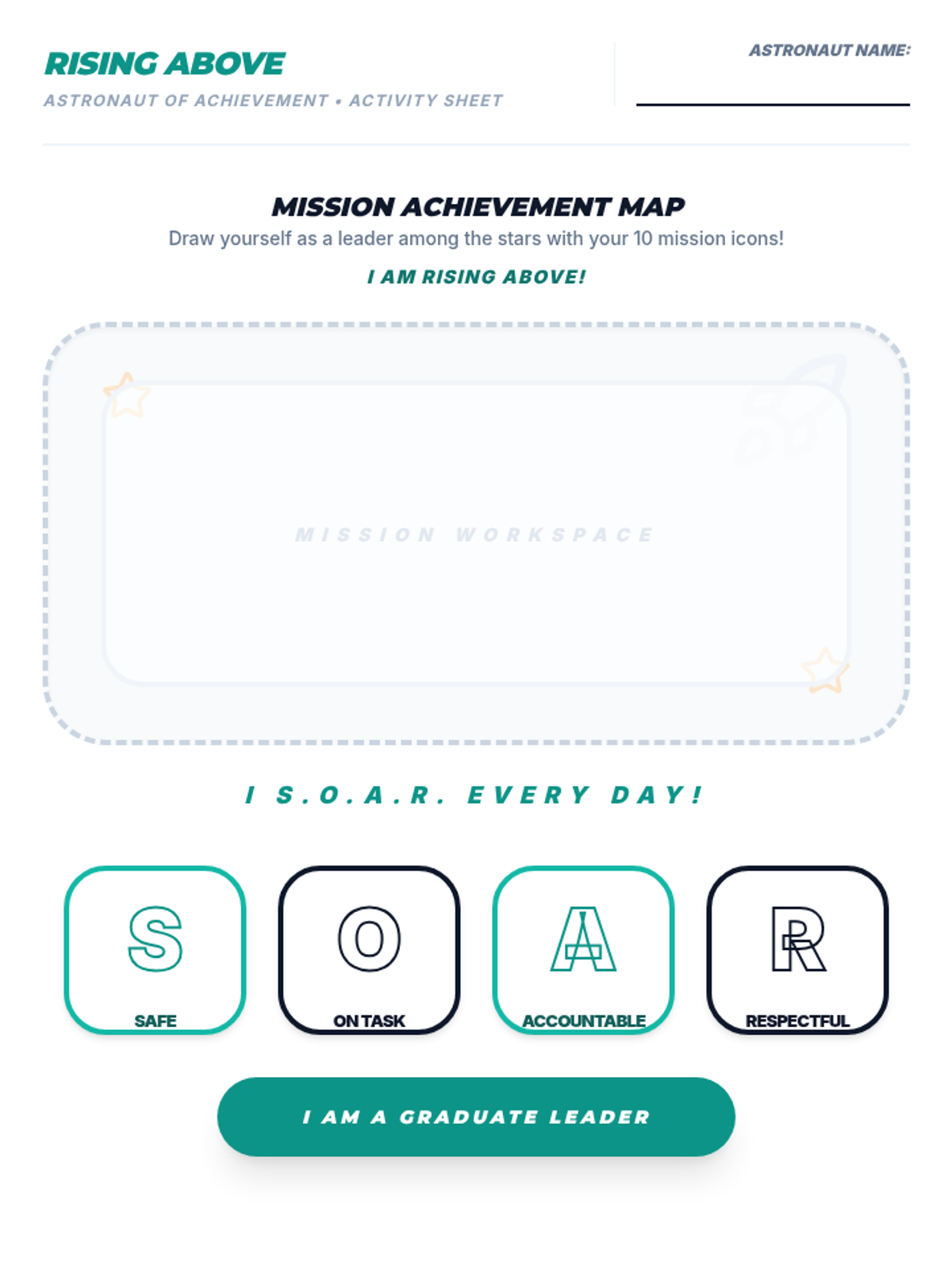
Student activity sheet for 1st Grade Lesson 10. A celebratory 'graduation' sheet where students visualize themselves as leaders having completed their 10 missions. Updated with white drawing area and S.O.A.R. tracing elements.
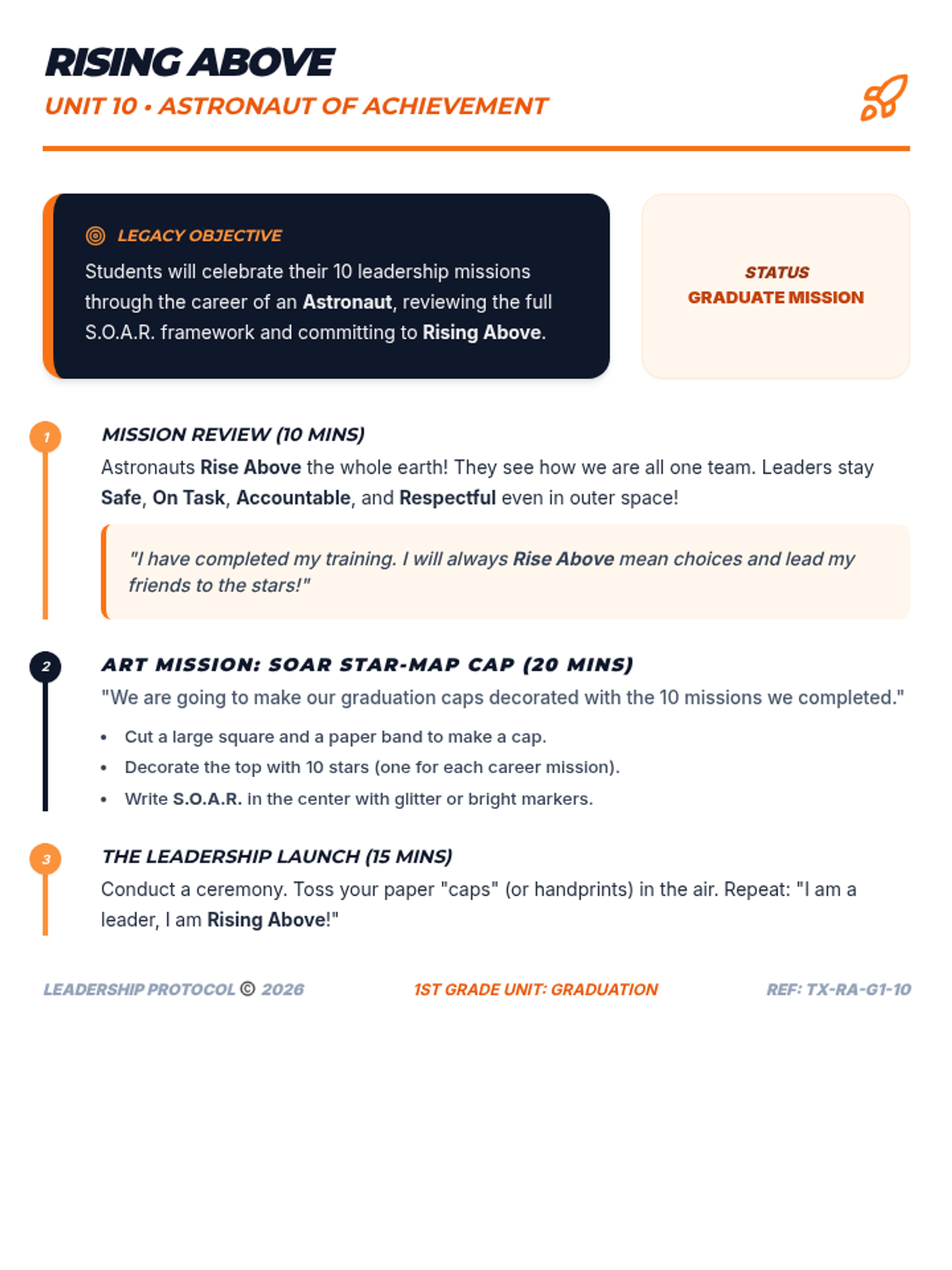
Teacher guide for 1st Grade Lesson 10. Graduation celebration reviewing all 10 missions. Includes the 'SOAR Star-Map Cap' art activity.
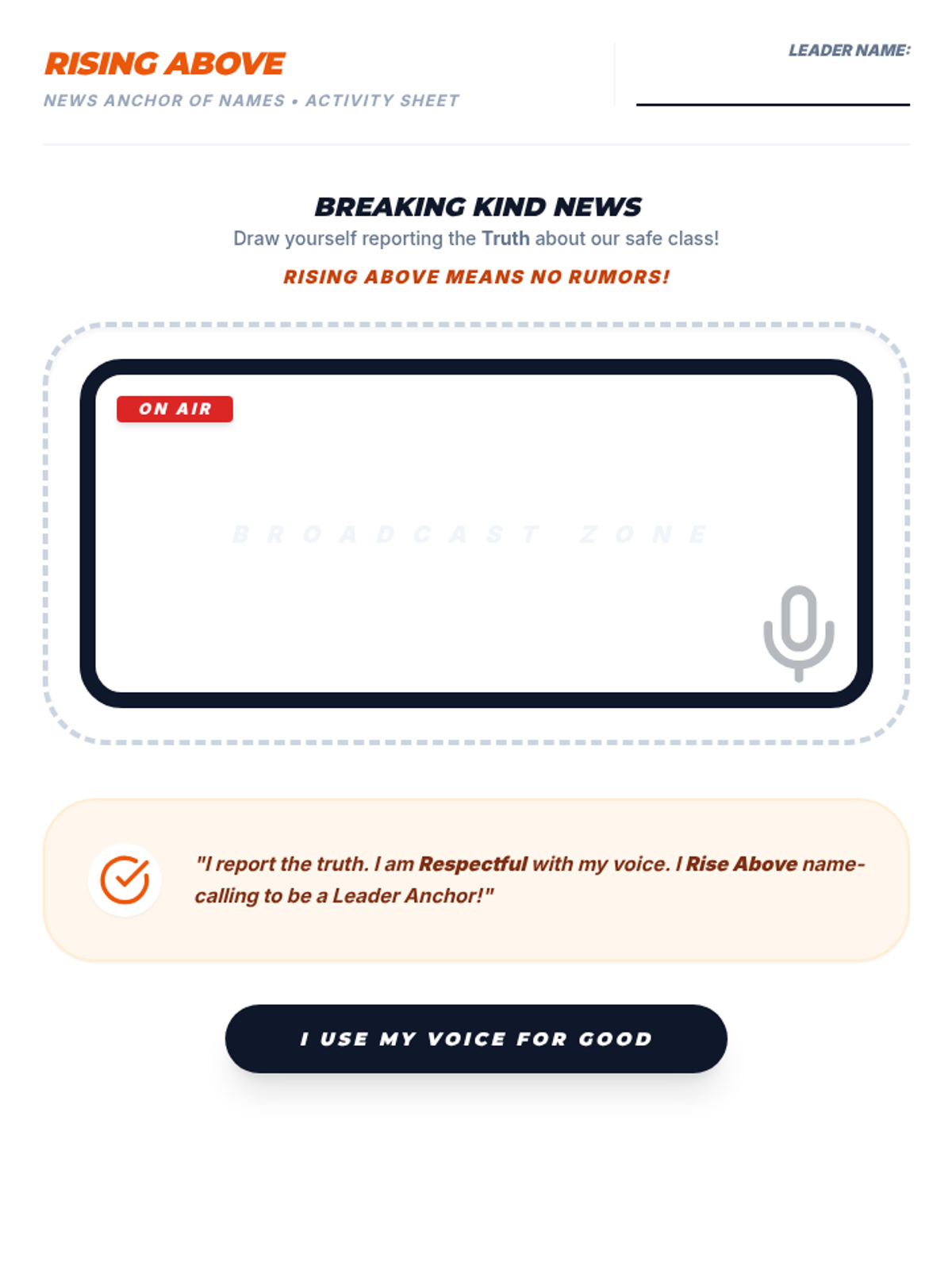
Student activity sheet for 1st Grade Lesson 9. Focuses on safe communication and reporting only the truth. Updated with higher contrast TV frame and cleared workspace.
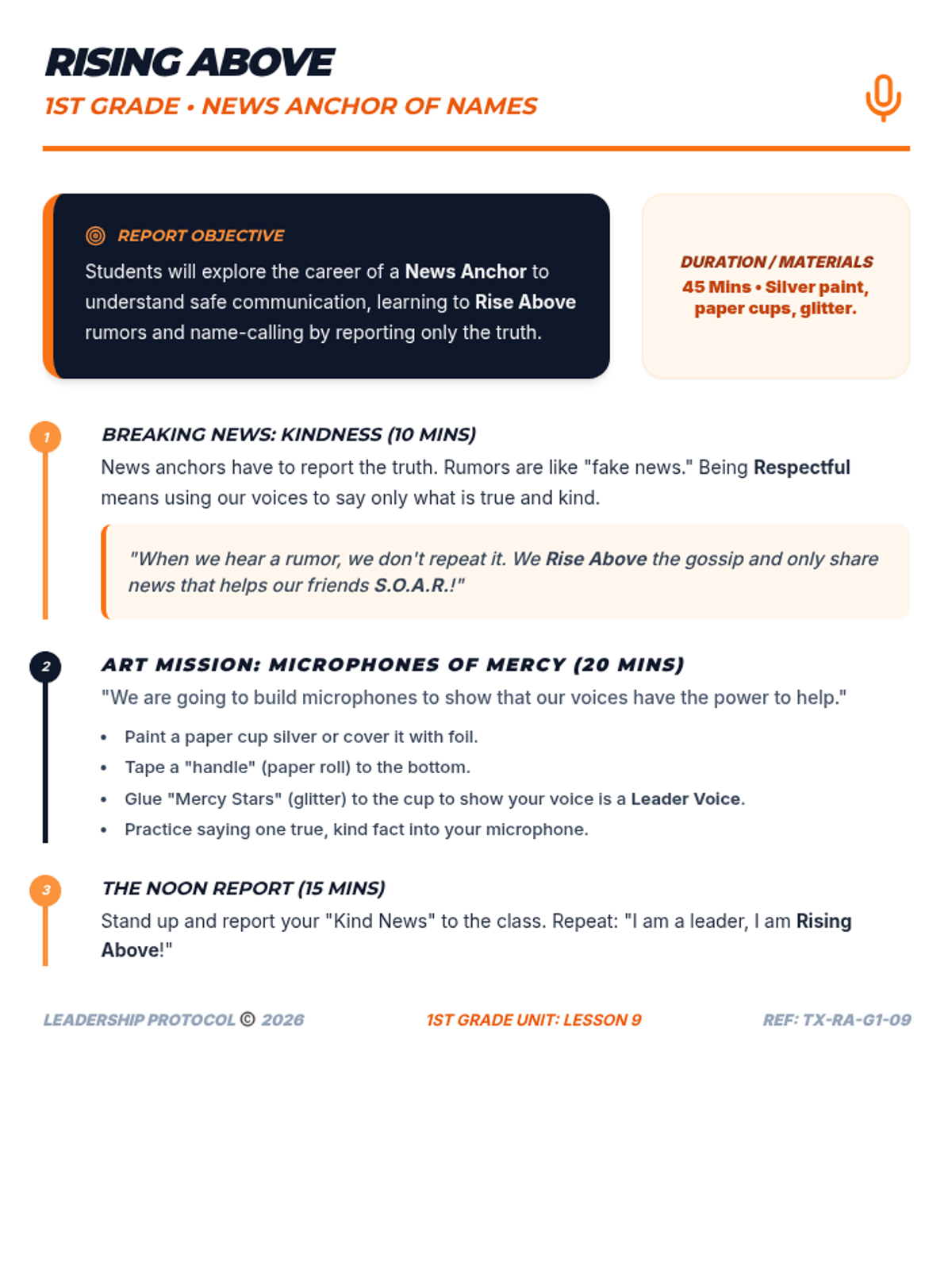
Teacher guide for 1st Grade Lesson 9. Focuses on safe communication and reporting the truth through the career of a News Anchor. Includes the 'Microphones of Mercy' art activity.
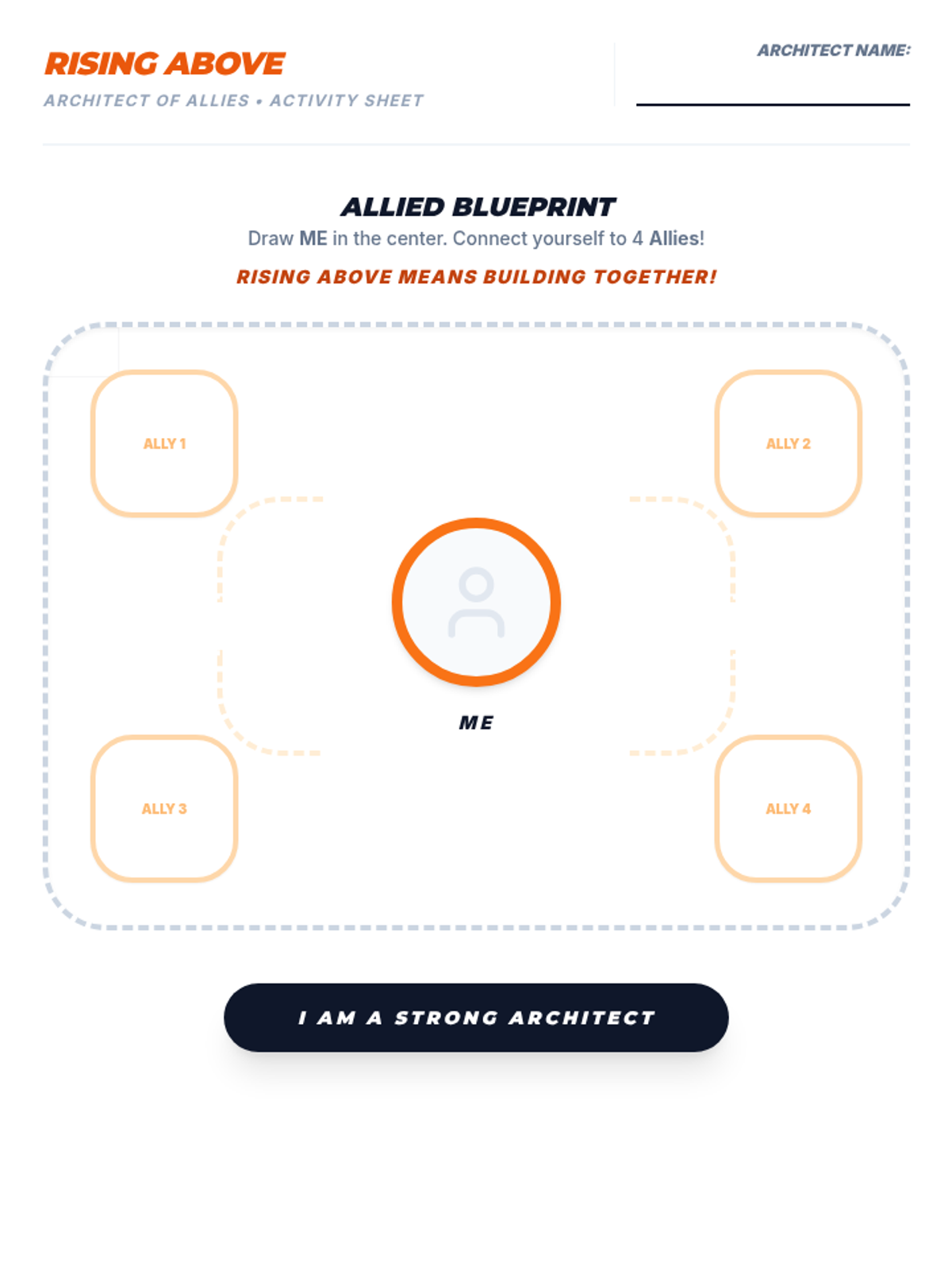
Student activity sheet for 1st Grade Lesson 8. Helps students identify their support network. Updated with larger drawing areas and tracing lines for allies.
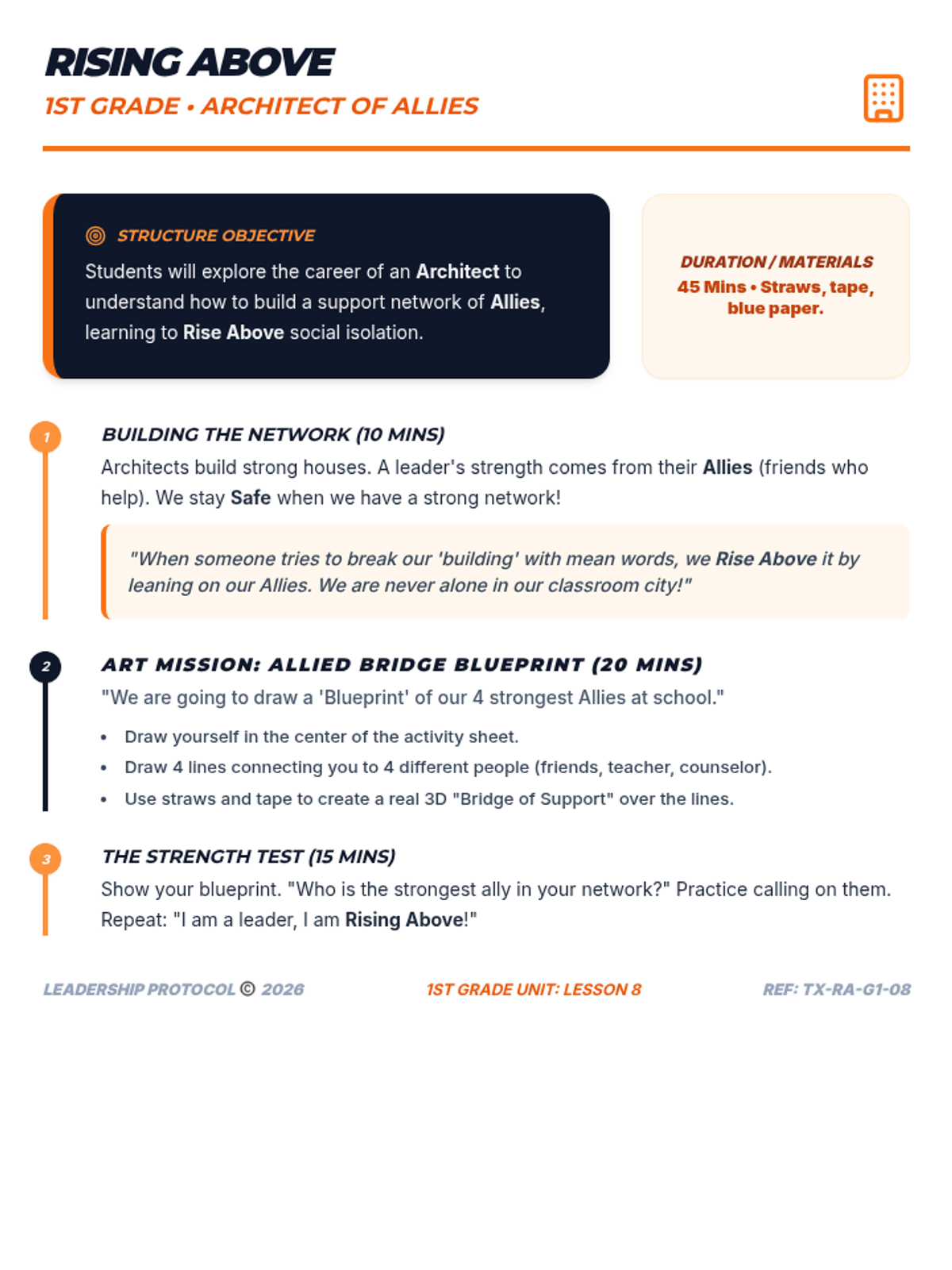
Teacher guide for 1st Grade Lesson 8. Focuses on building a support network through the career of an Architect. Includes the 'Allied Bridge' art activity.
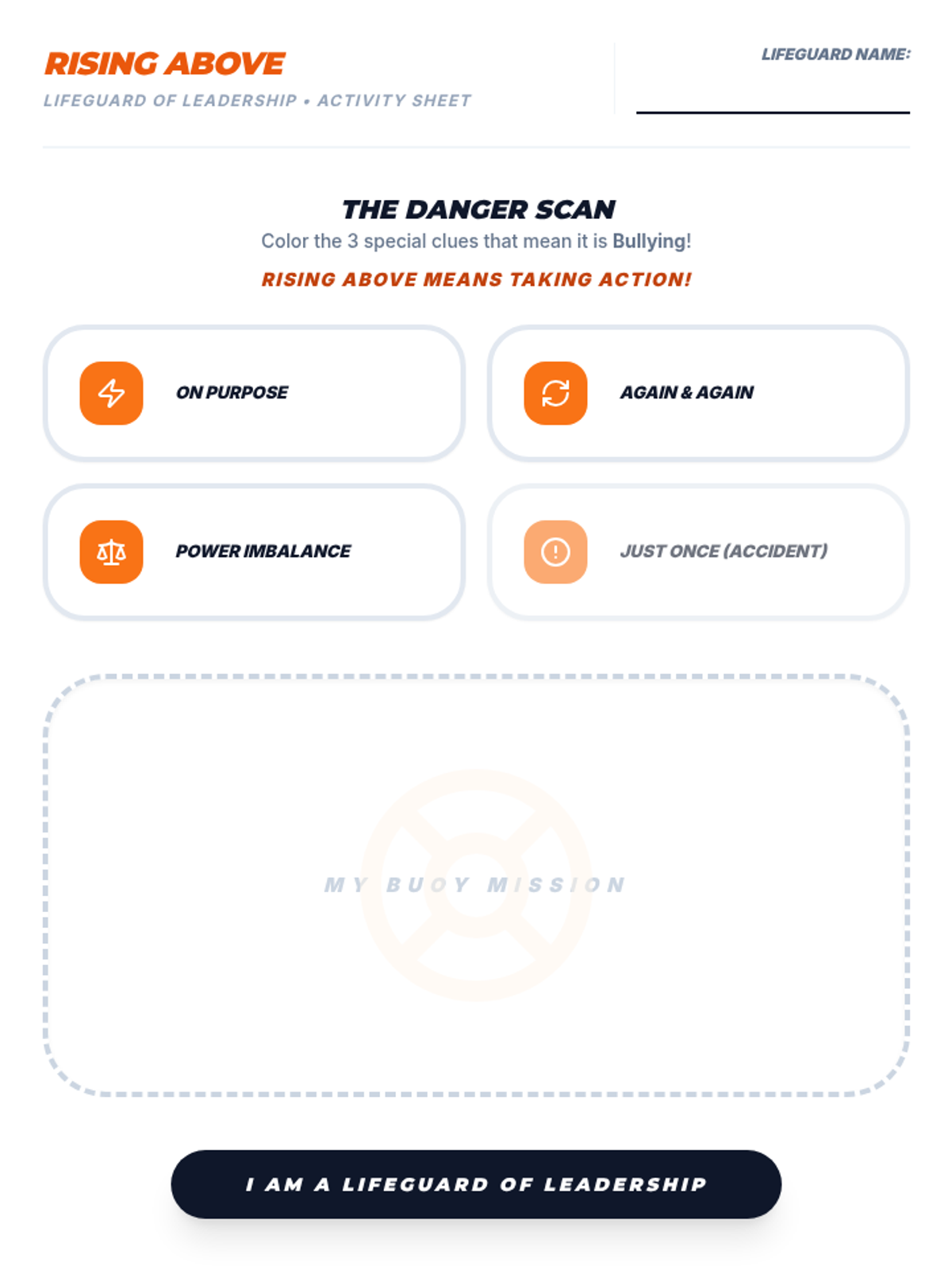
Student activity sheet for 1st Grade Lesson 7. Focuses on identifying the three clues of bullying with distractions for task engagement. Updated with uniform colors and higher contrast.
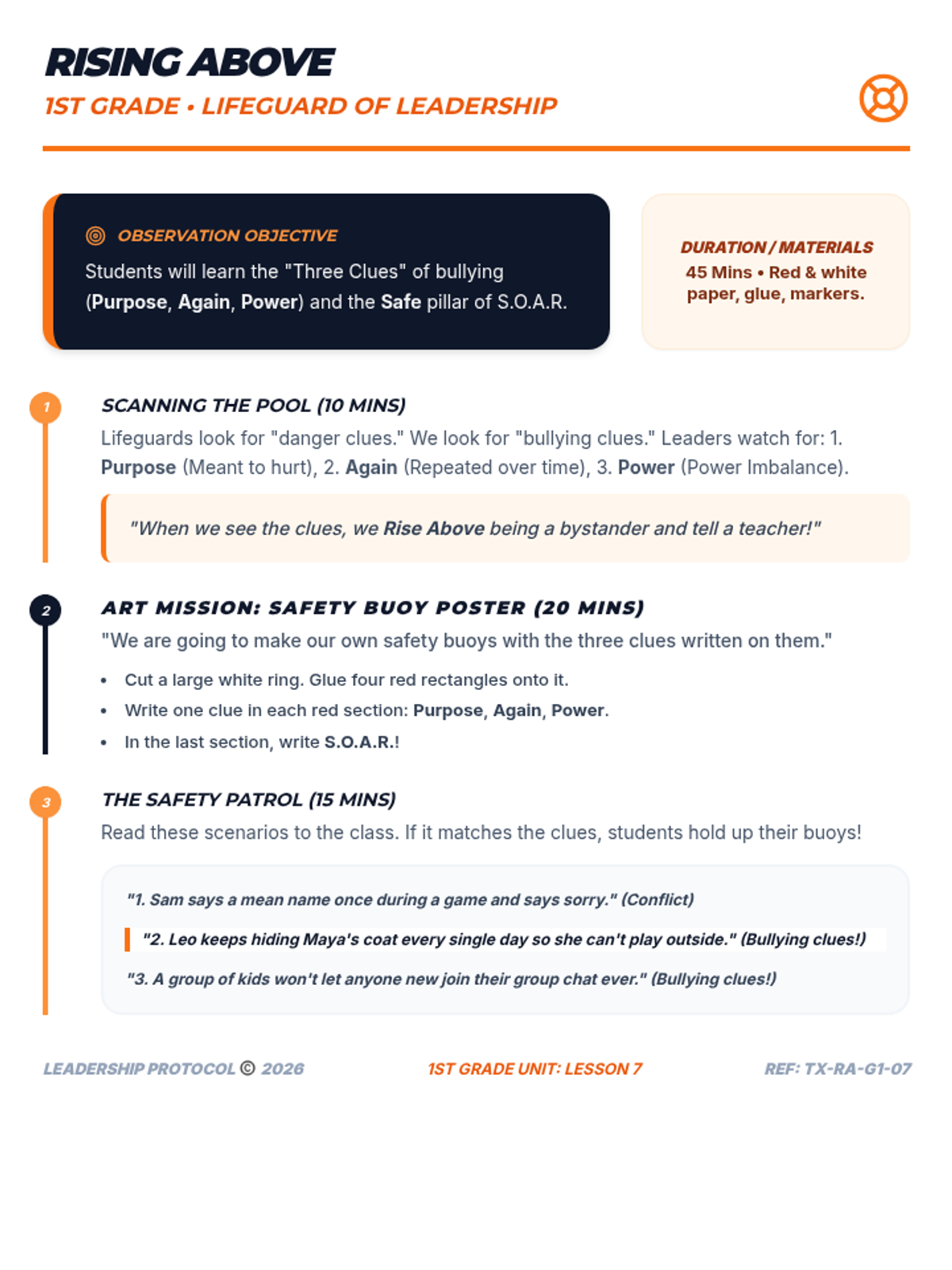
Teacher guide for 1st Grade Lesson 7. Focuses on identifying bullying clues through the career of a Lifeguard. Includes age-appropriate scenarios and the 'Safety Buoy' art activity.
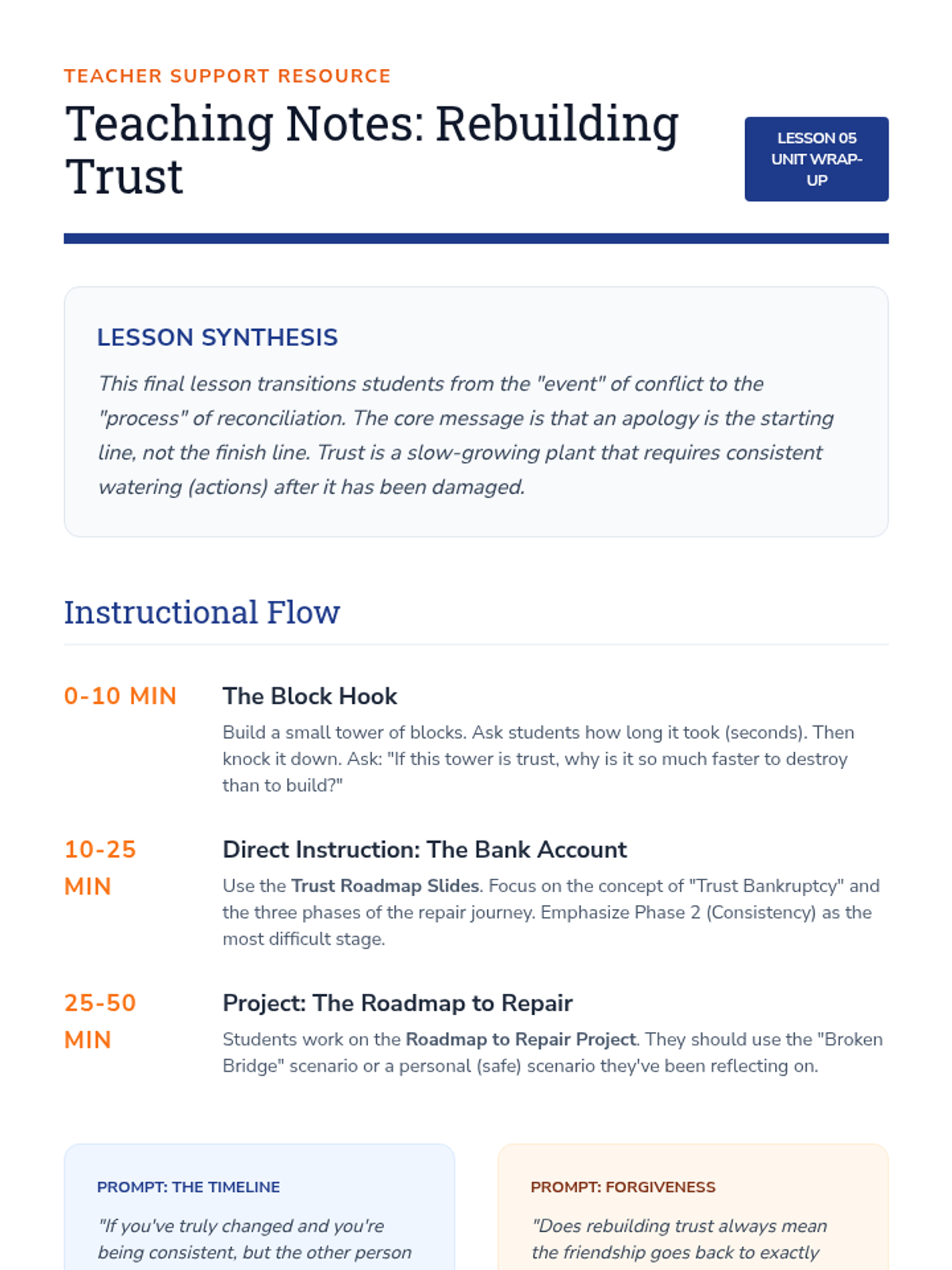
Teaching notes for Lesson 5, including summary of the 'Trust Bank Account' analogy, pacing for the final project, and unit wrap-up discussion prompts.
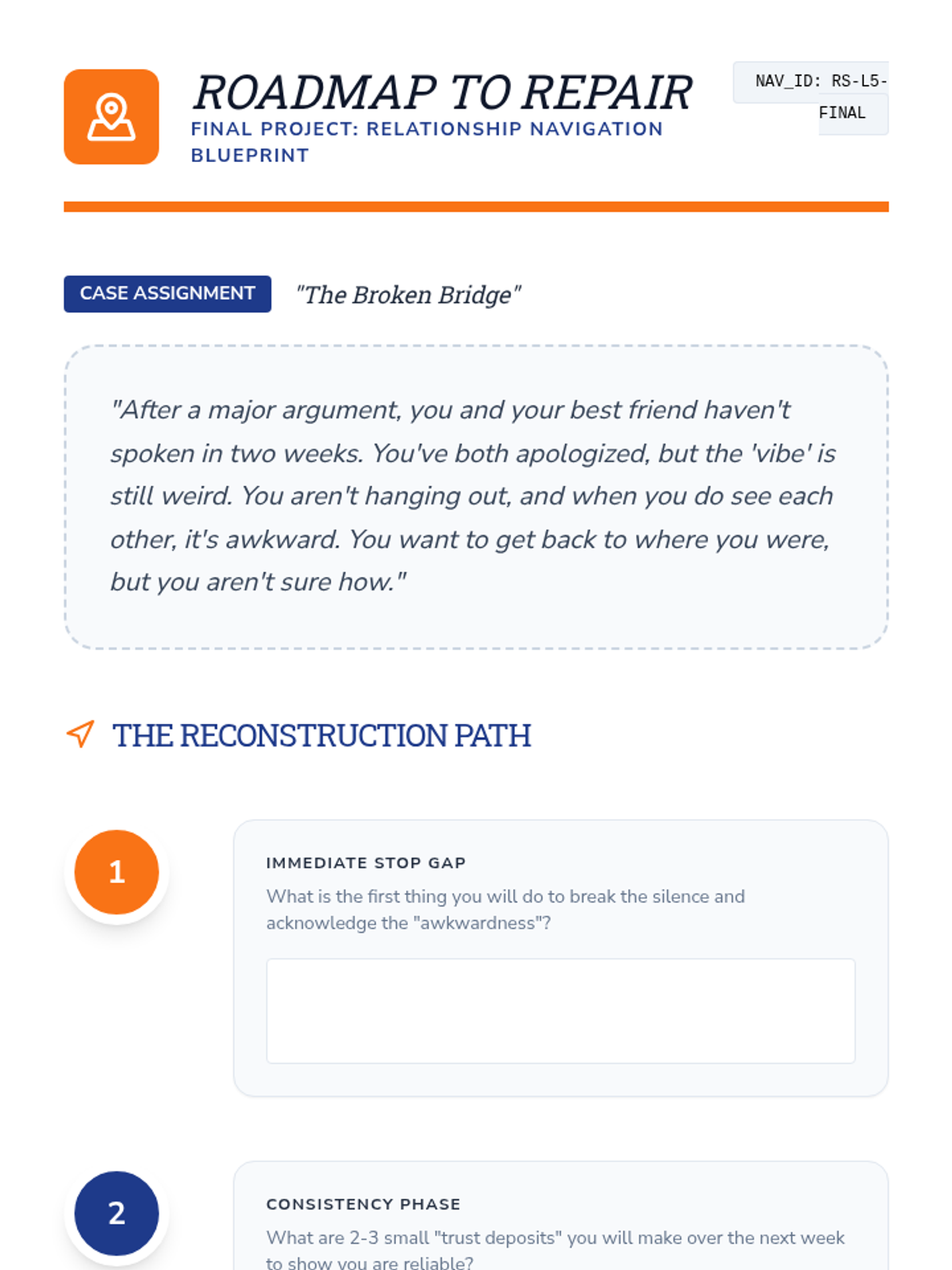
Final project worksheet for Lesson 5, guiding students to create a step-by-step visual 'Roadmap to Repair' for a fictional relationship scenario.
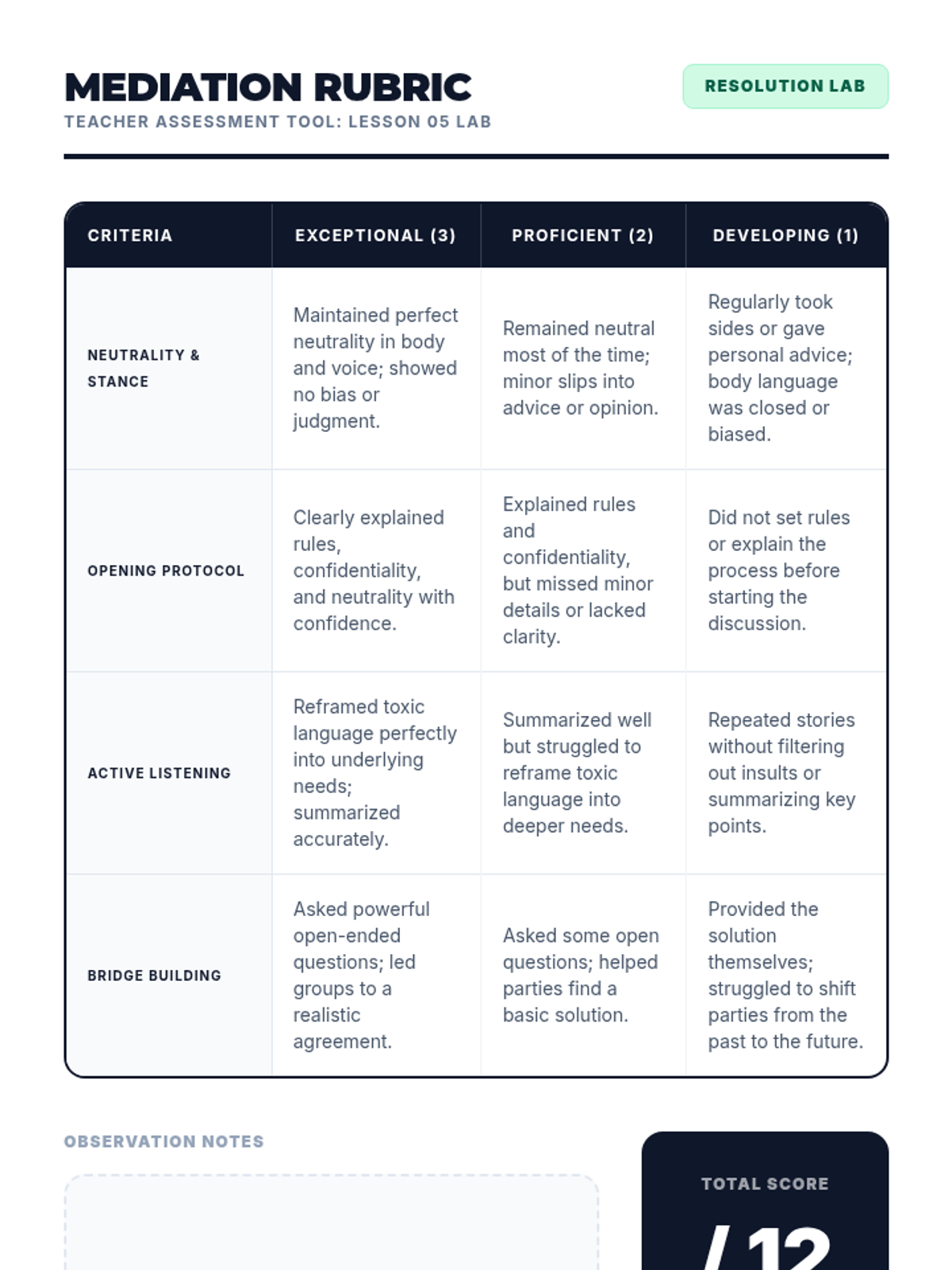
A comprehensive rubric for teachers to assess student facilitators during the final mock mediation Resolution Lab.
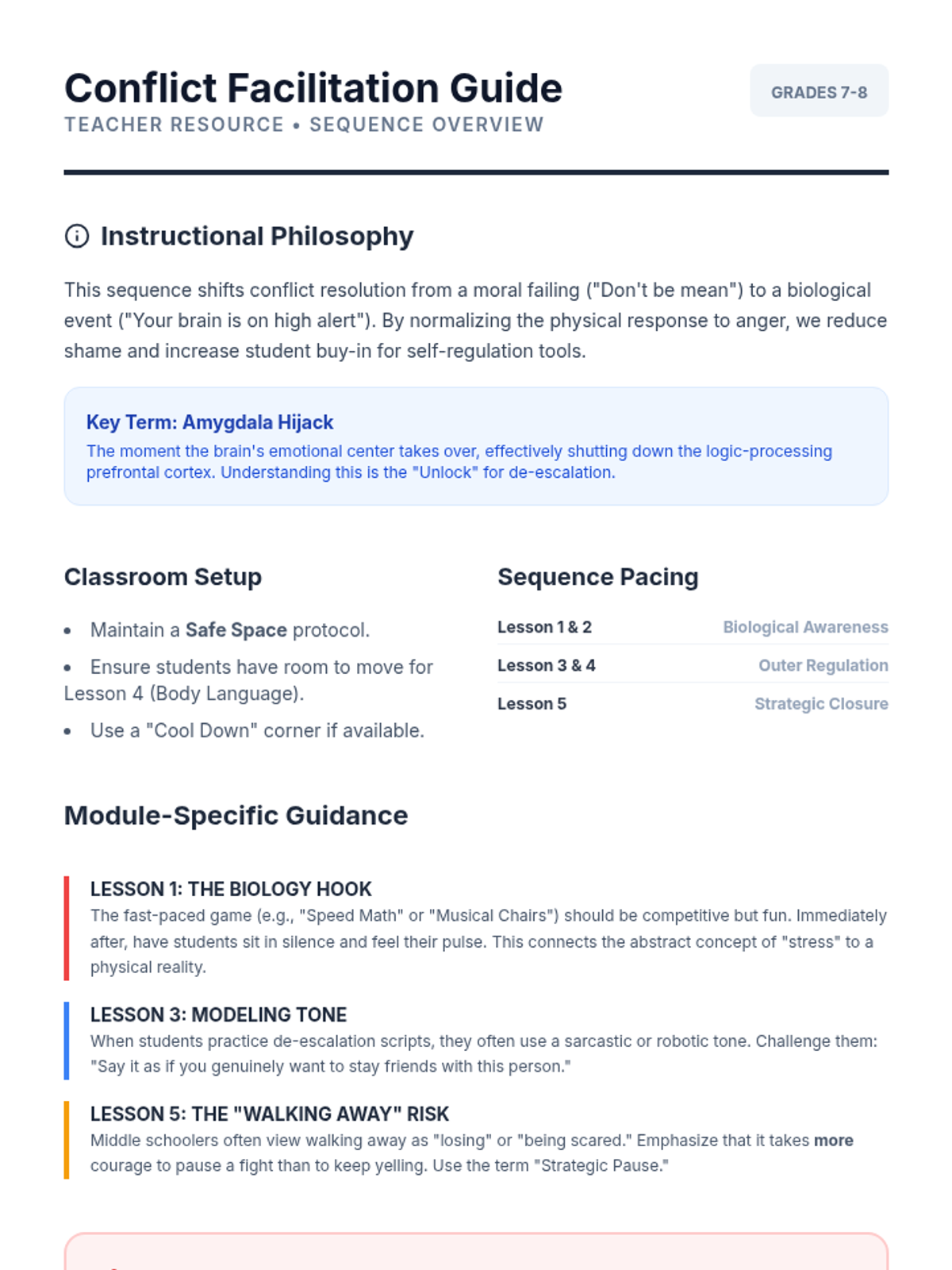
A comprehensive teacher's guide for the Conflict Navigation sequence, providing instructional philosophy, facilitation tips, and pacing guidance for all five lessons.
Visual slide deck for Lesson 5: Rebuilding Trust Over Time, introducing the concept of trust as a bank account and the long-term phases of relationship repair.
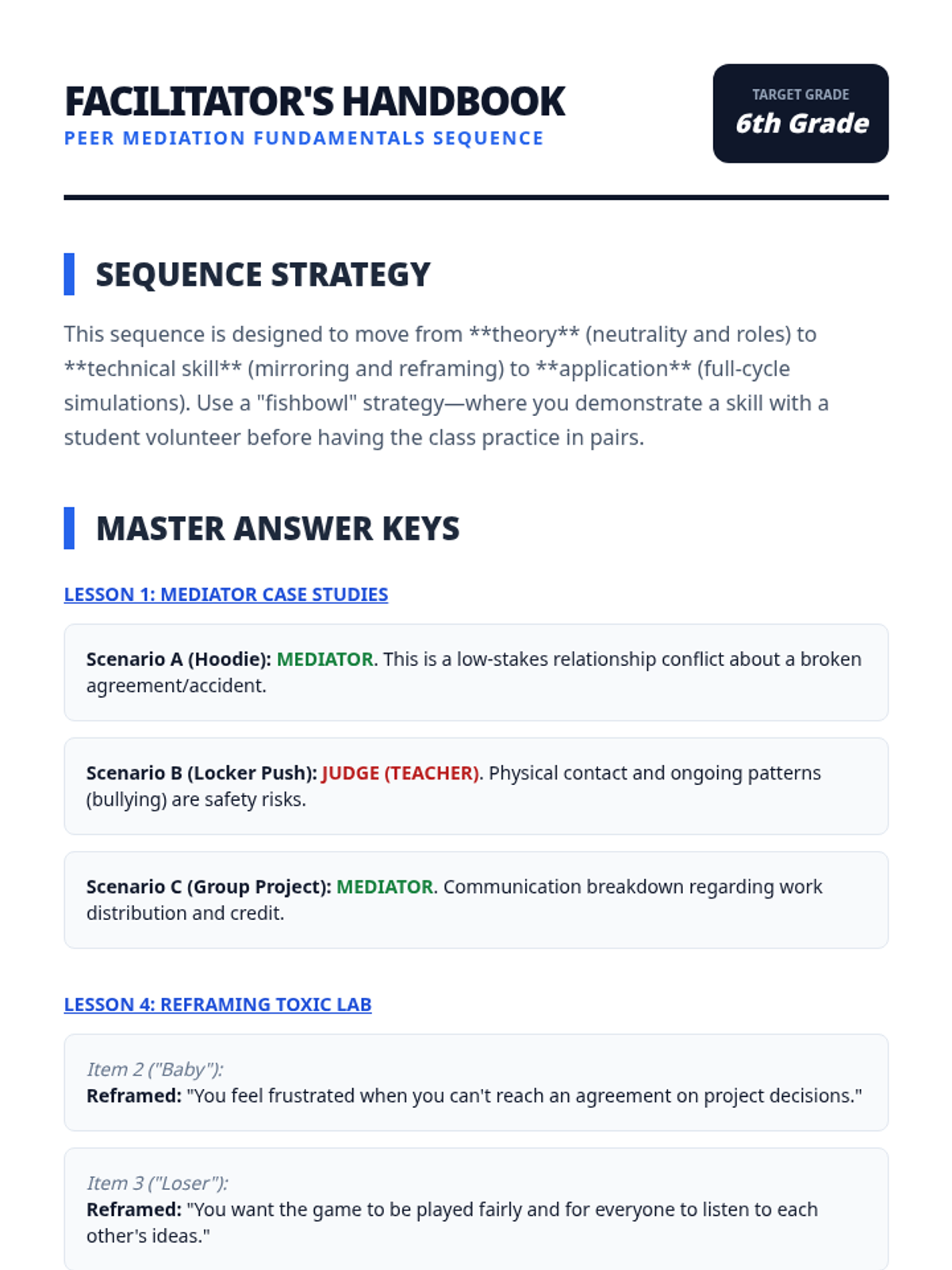
Teacher-facing facilitation guide and answer keys for the entire Peer Mediation sequence, including coaching tips for mock mediations.
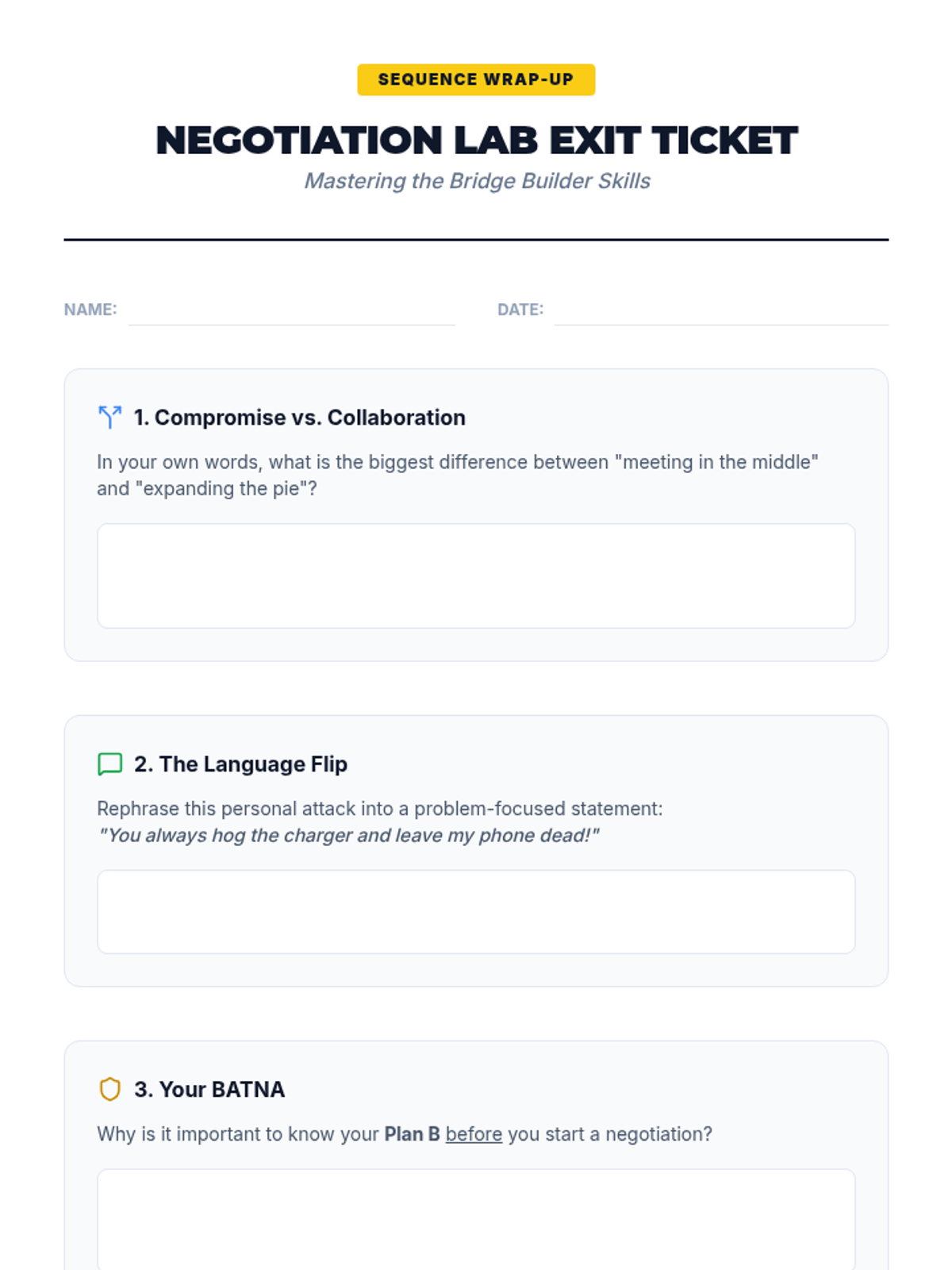
Final exit ticket for the negotiation sequence, assessing students' understanding of compromise, externalizing language, and BATNA.
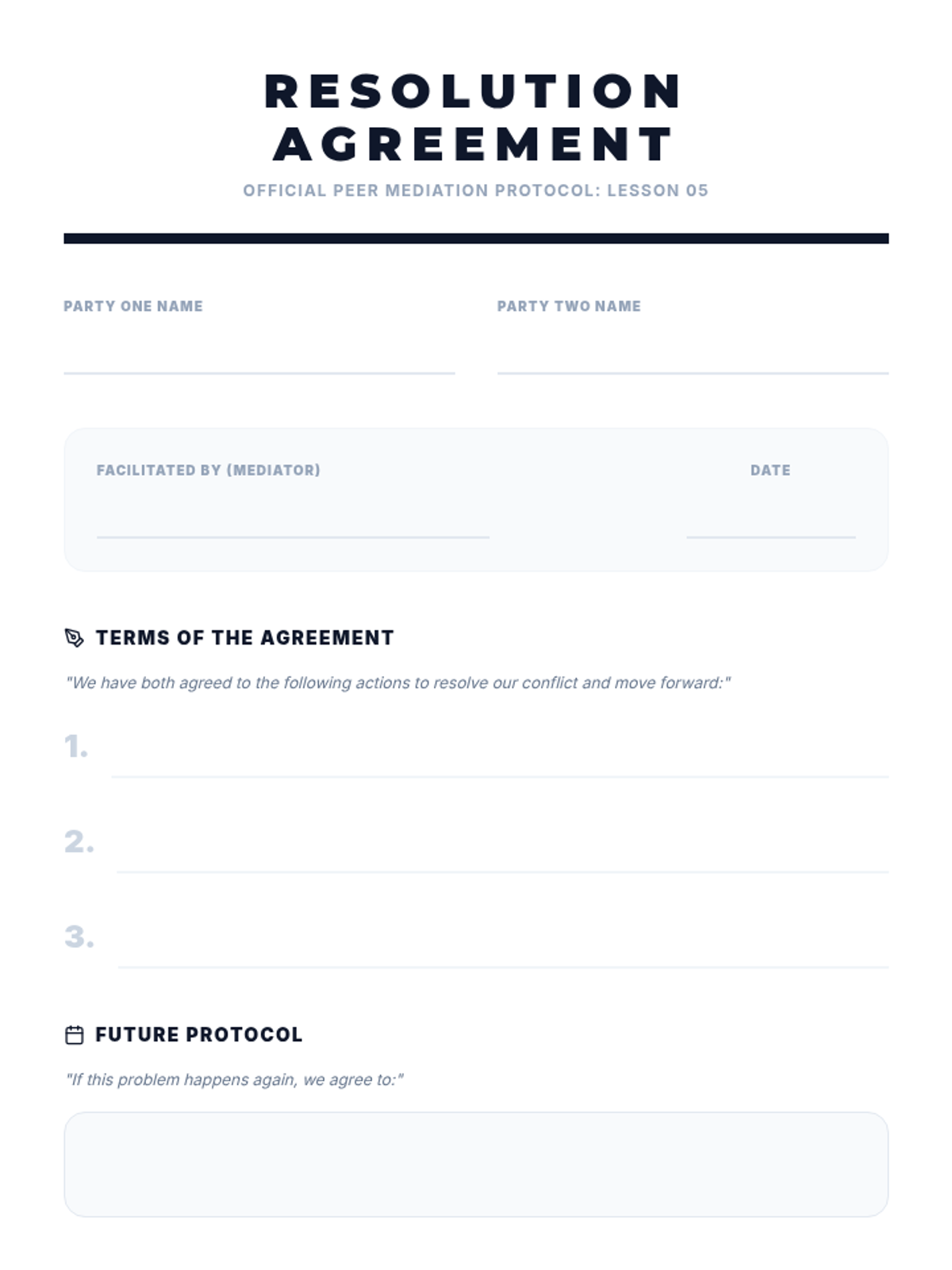
Official resolution agreement form for students to complete at the end of a successful peer mediation session.
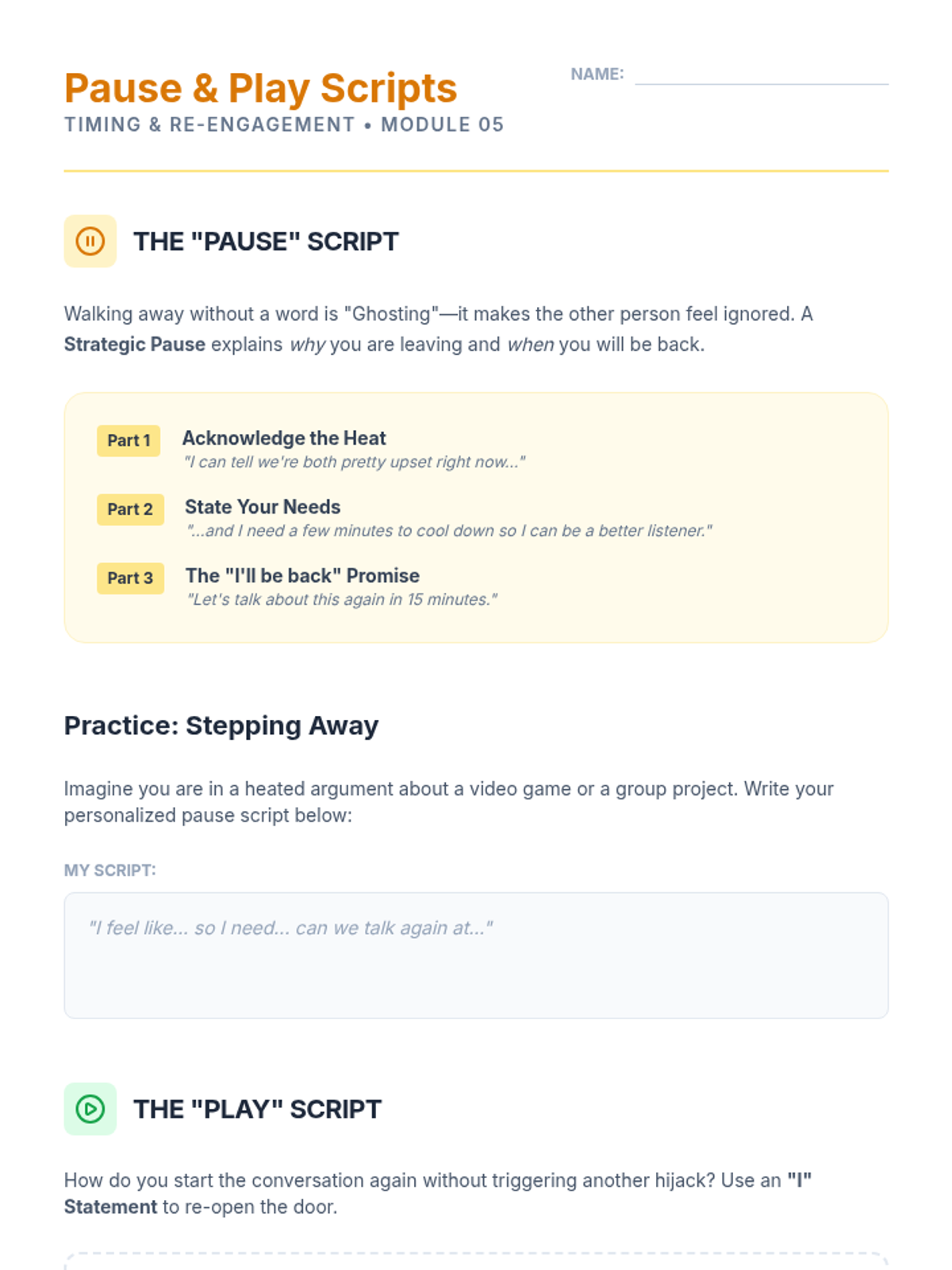
A script-writing and role-play guide for students to practice the three-part pause script and constructive re-engagement techniques.
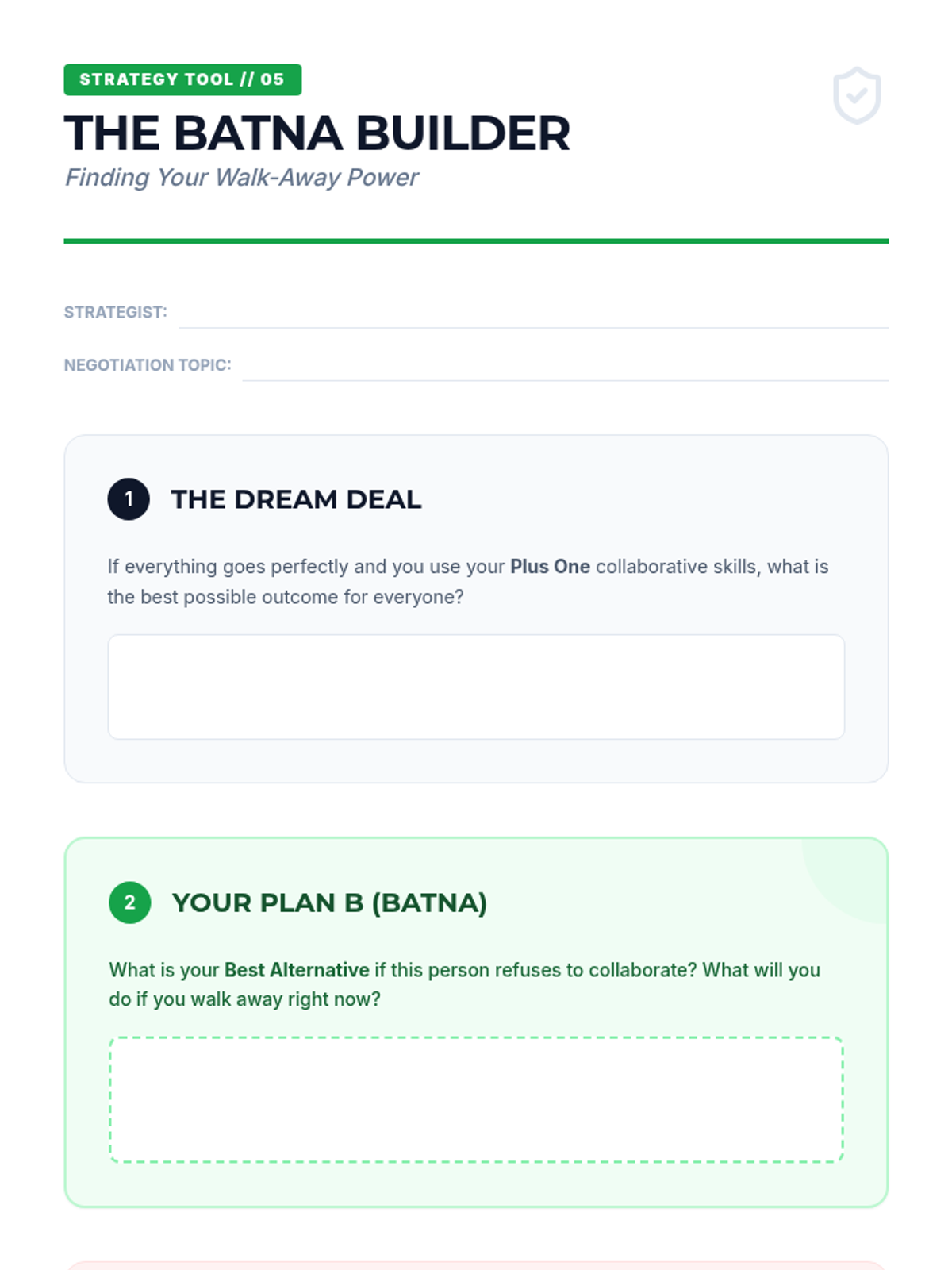
Student worksheet for identifying and strengthening their BATNA (Best Alternative to a Negotiated Agreement) before entering a conflict resolution.
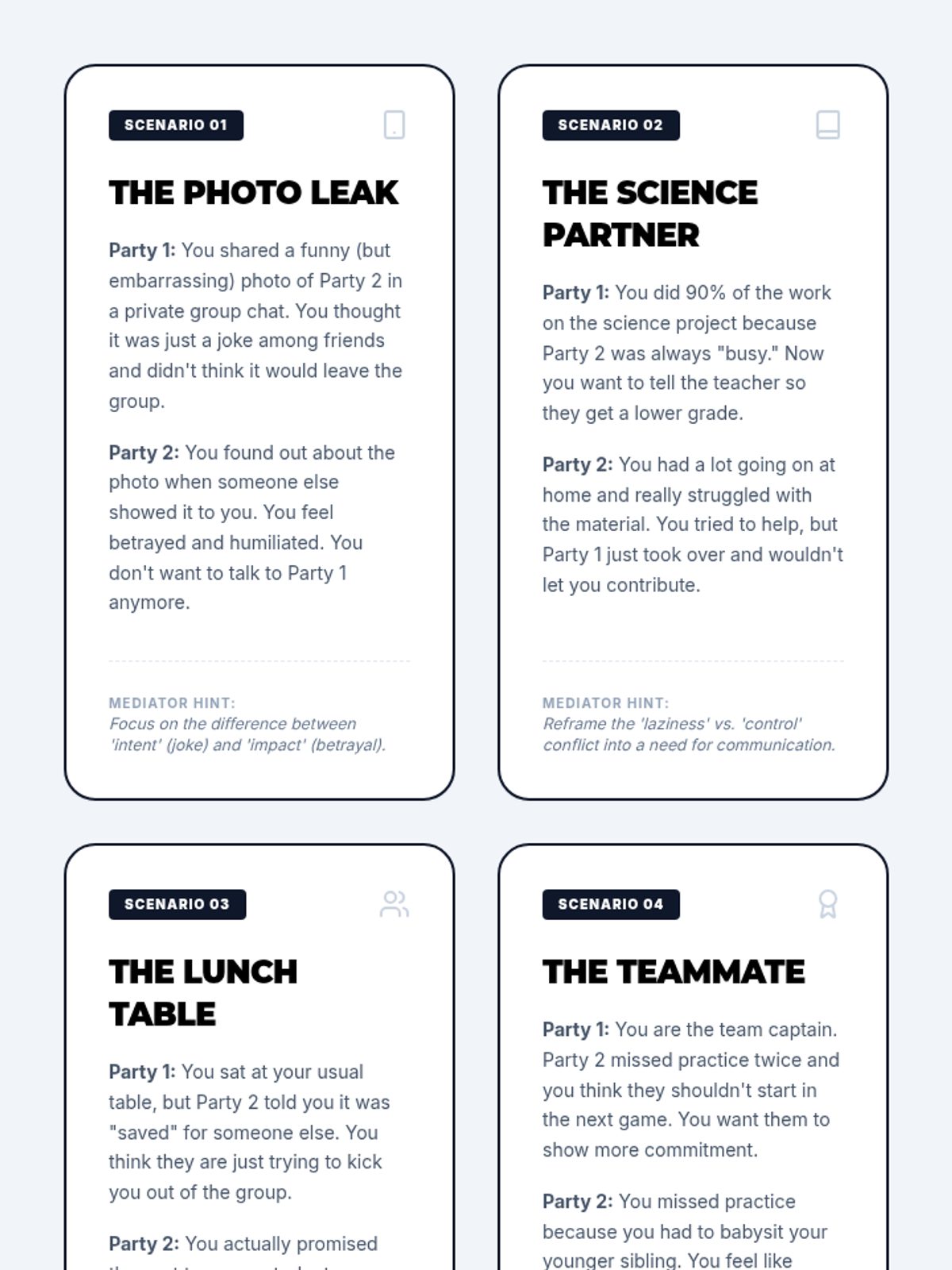
Printable scenario cards for mock mediation role-plays, featuring realistic middle school conflicts.
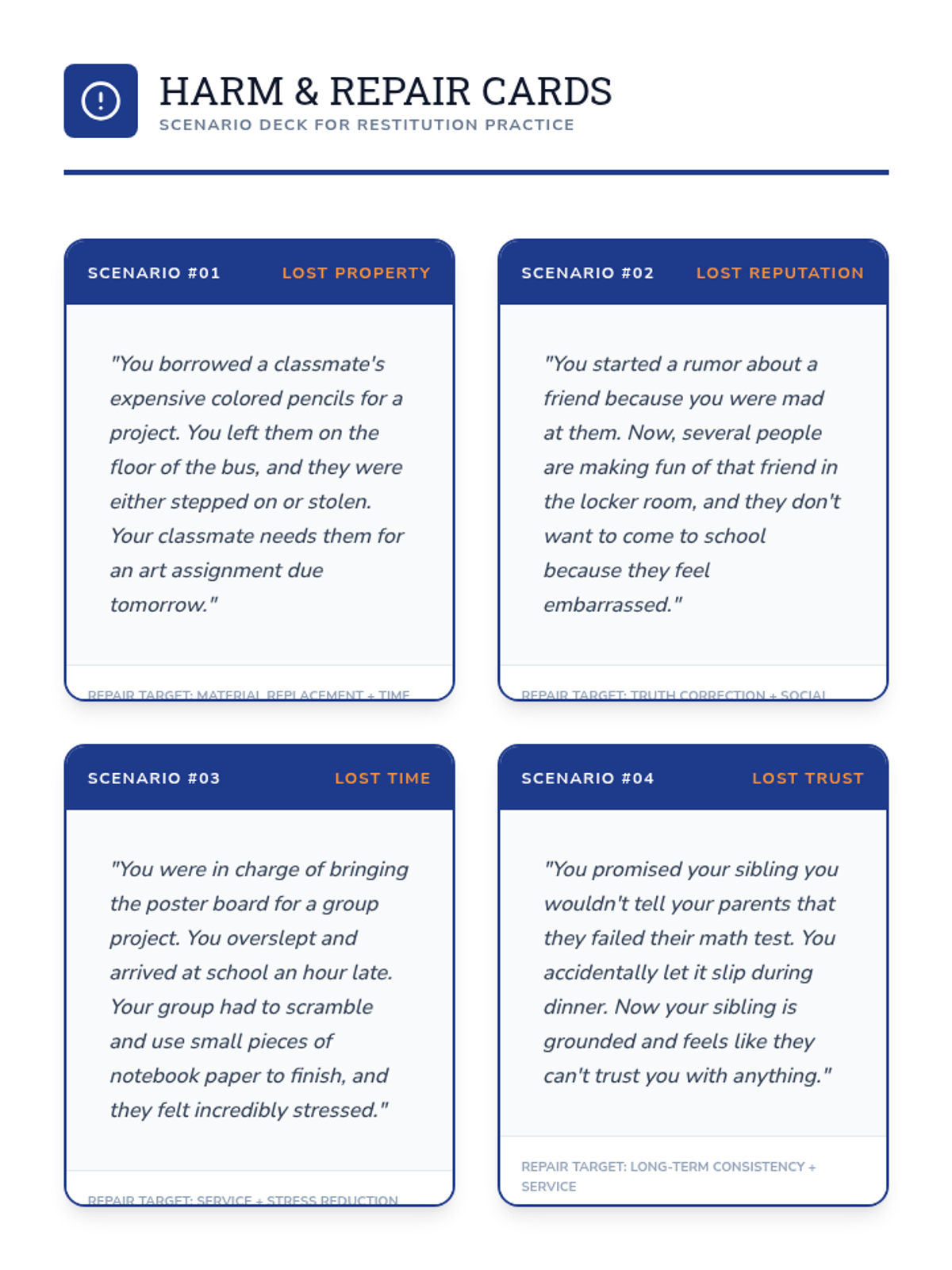
Scenarios of harm for students to analyze and use for designing restitution plans on their blueprints.
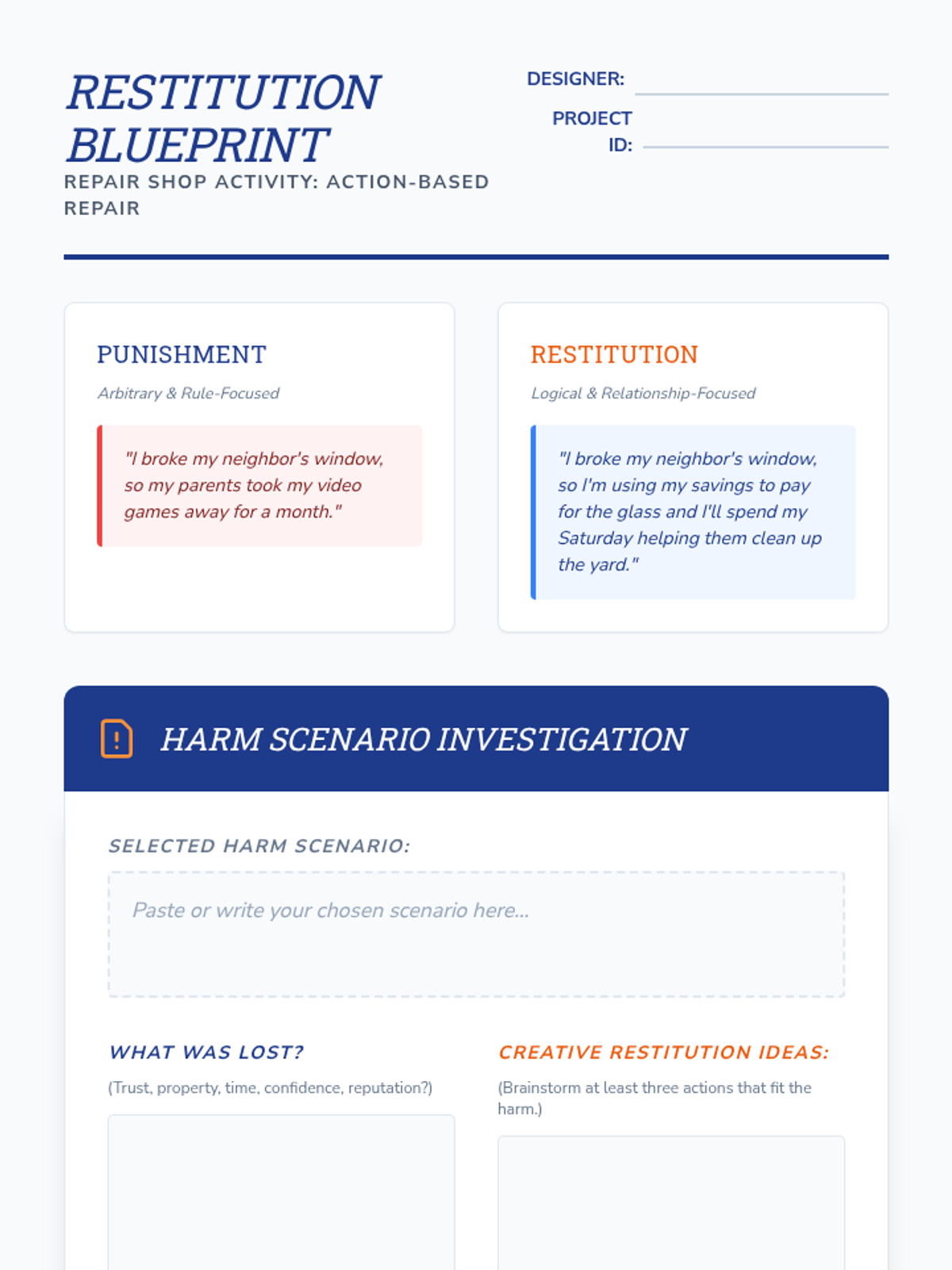
Creative project worksheet for Lesson 4, guiding students to design logical and relationship-focused restitution plans for specific harm scenarios.
Visual aids for Lesson 5 explaining the concept of BATNA (Best Alternative to a Negotiated Agreement) to understand their 'walk-away' power.
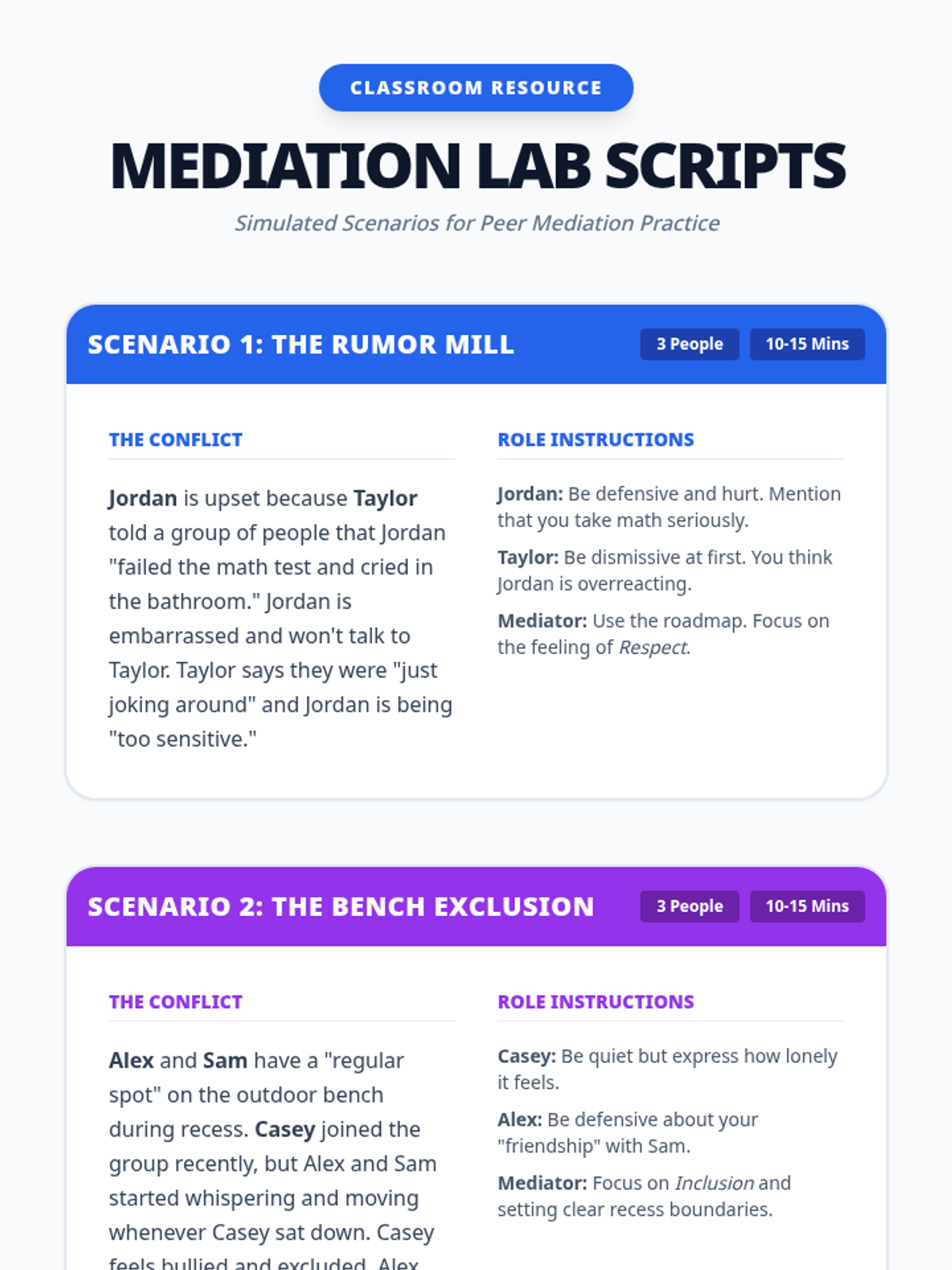
Role-play scenarios based on common middle school conflicts to be used during the Mediation Lab simulation.
Instructional slides for Lesson 5, guiding students through the final mock mediation simulation.
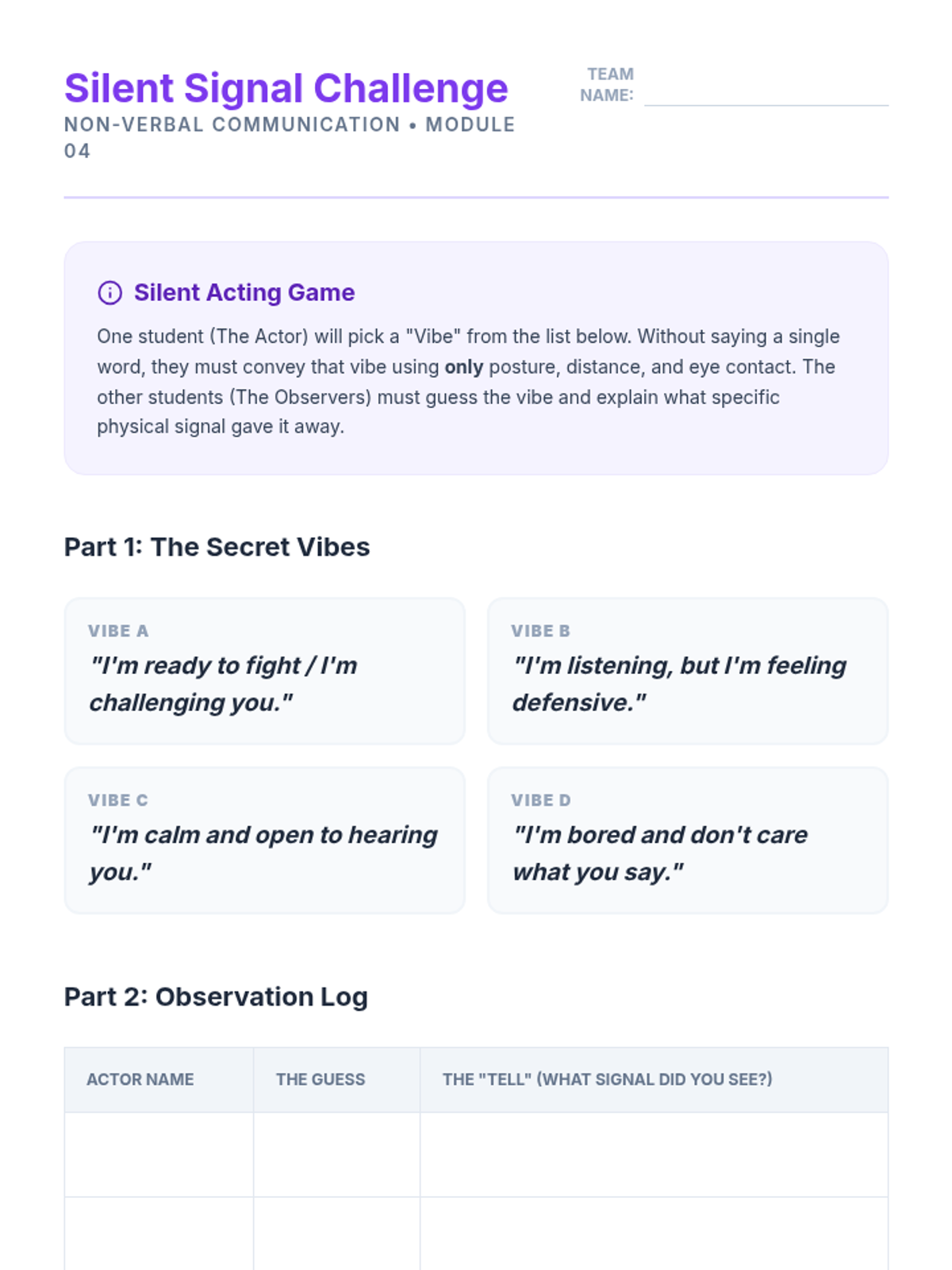
A student activity sheet for the 'Silent Signal Challenge' game, where students practice identifying and demonstrating non-verbal communication signals in conflict scenarios.
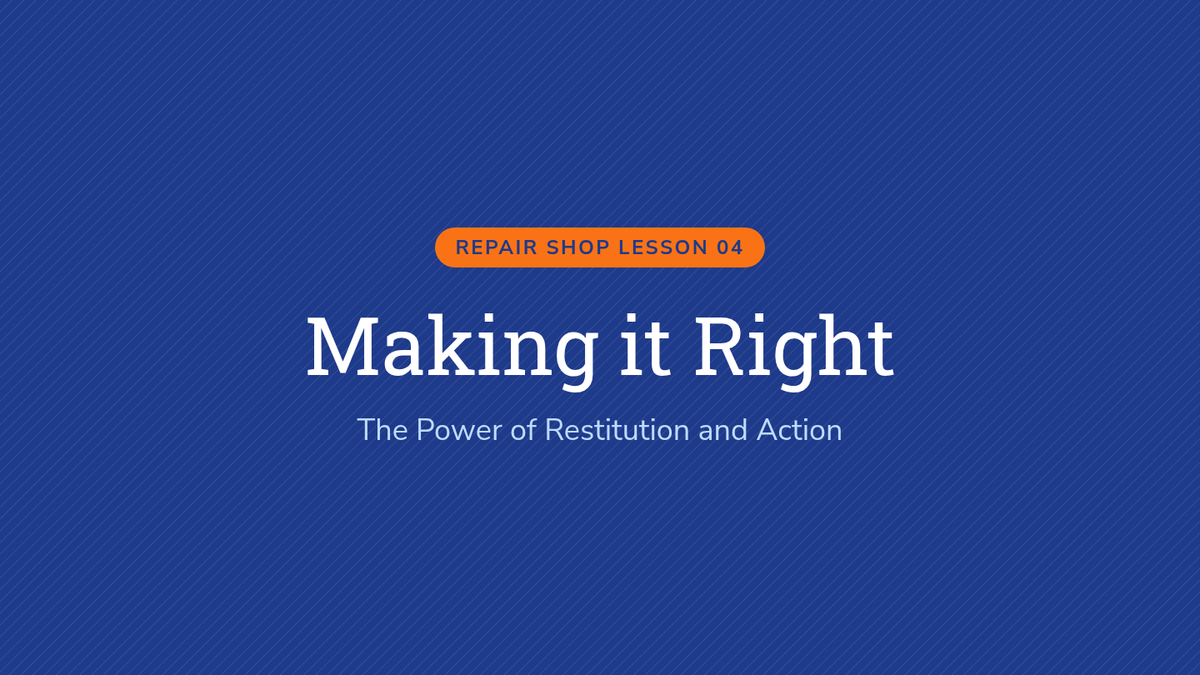
Visual slide deck for Lesson 4: Making Amends and Restitution, introducing the concept of restitution versus punishment and brainstorming creative ways to 'make it right'.
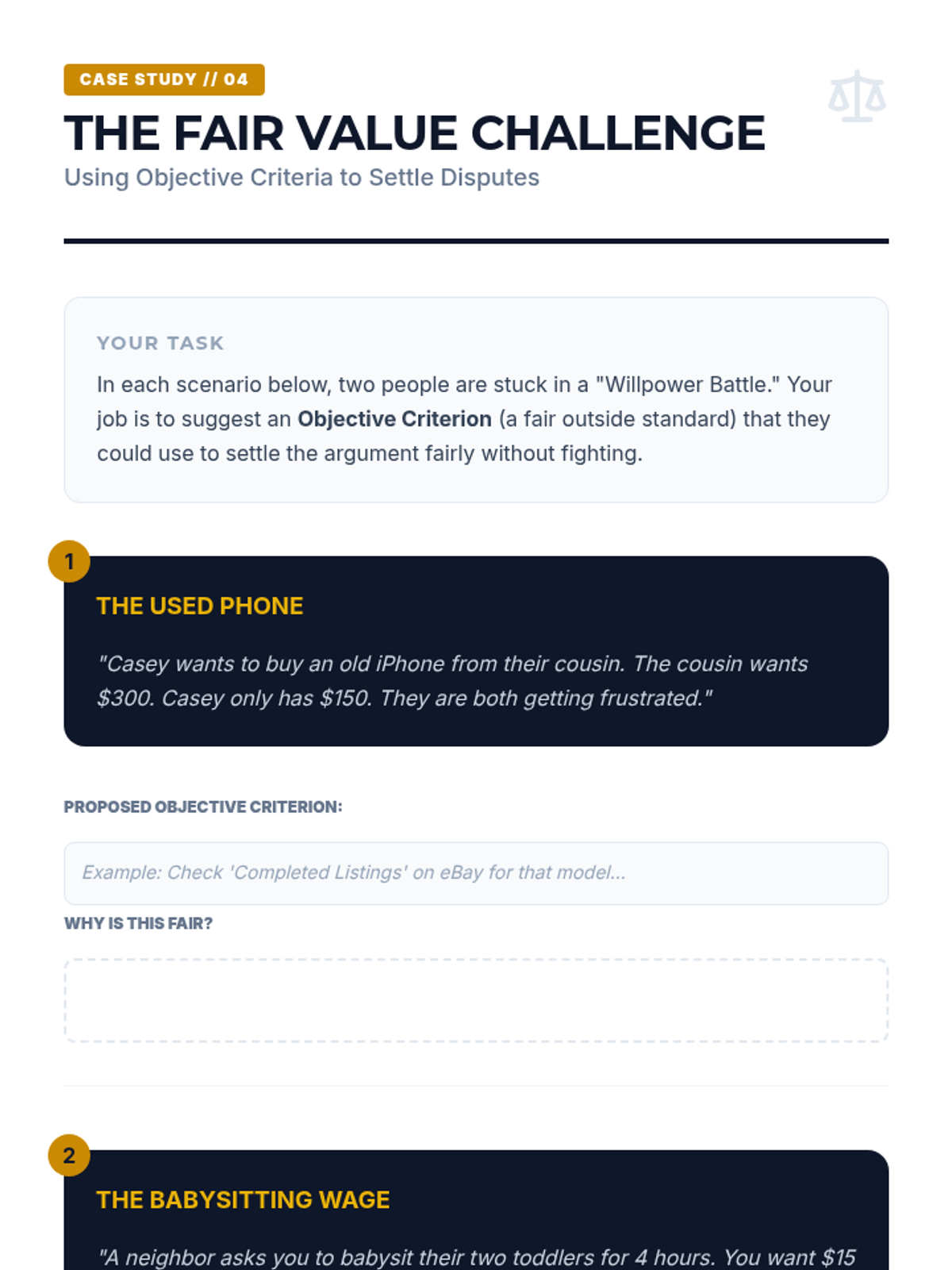
Student worksheet for applying objective criteria to resolve three different common disputes fairly and professionally.
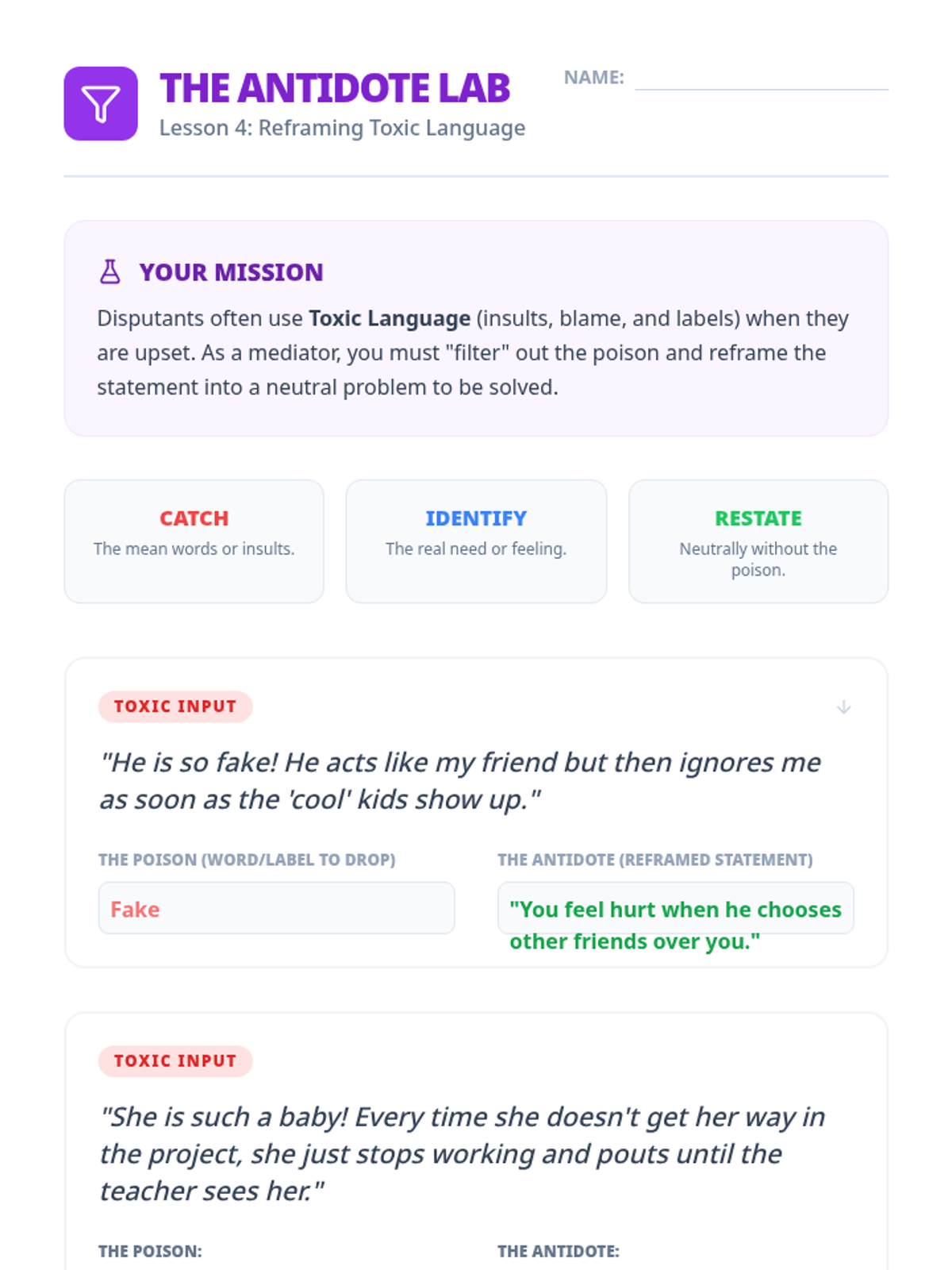
Advanced practice worksheet where students identify toxic labels and absolutes in conflict statements and reframe them into neutral needs or feelings.
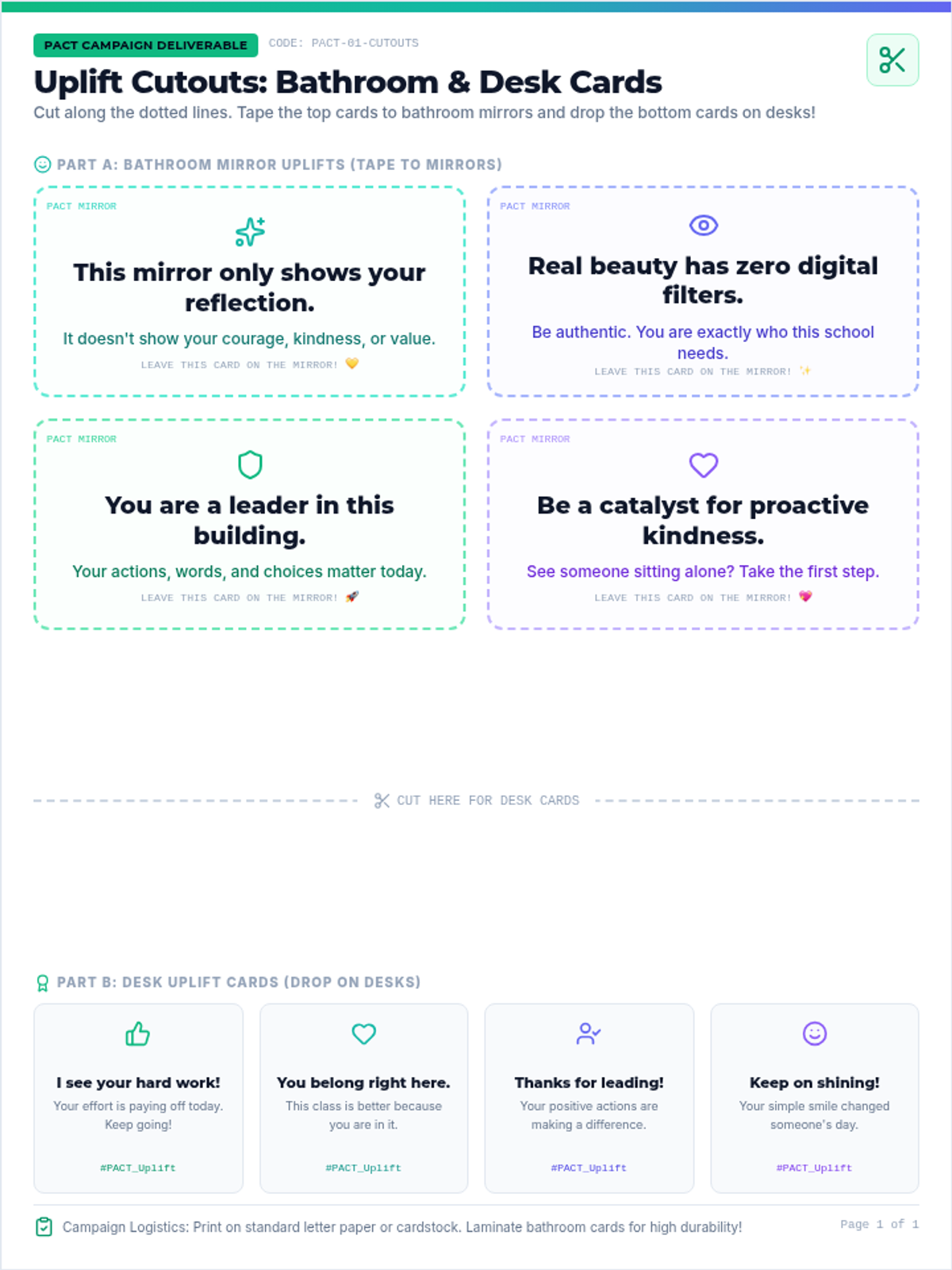
A 1-page printable containing beautifully designed positive mirror reminders for school bathrooms and desk quote slips for classmates. Features scissor-ready cut lines.
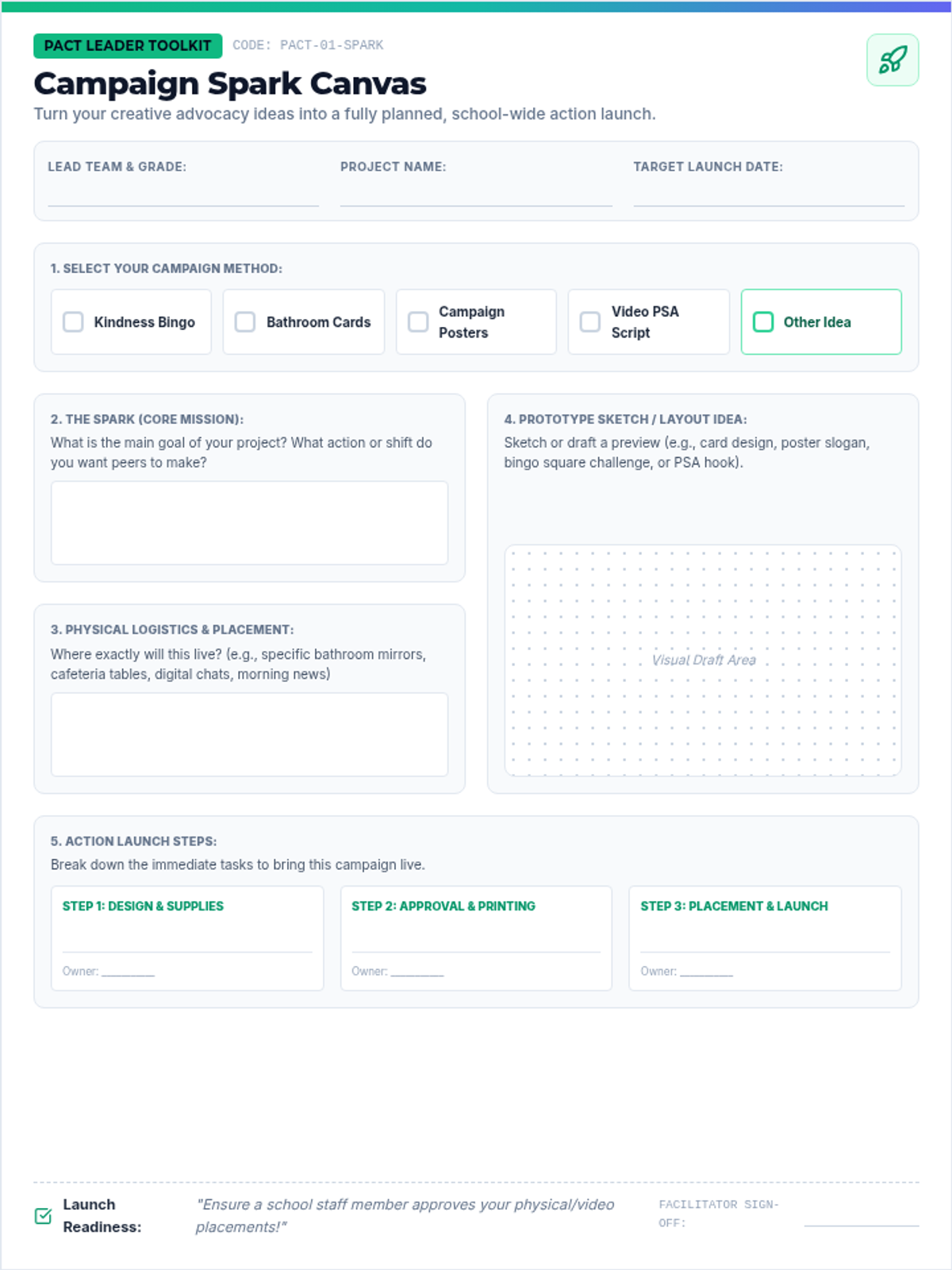
A highly structured, student-friendly project planning canvas designed for PACT leaders to outline, prototype, and launch creative student projects like Kindness Bingo, bathroom cards, posters, and PSAs.
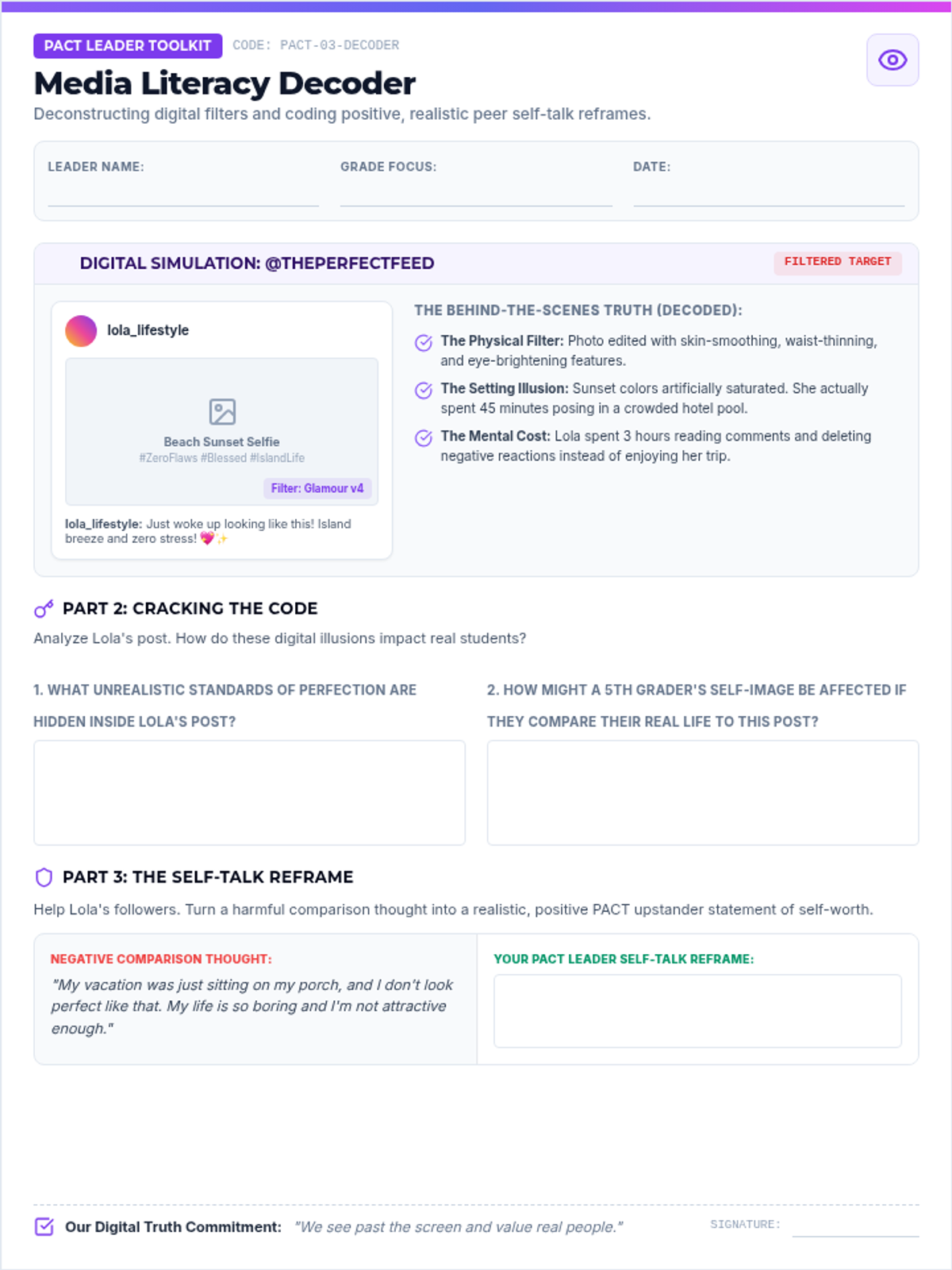
A media literacy and self-talk decoder worksheet for student leaders to analyze digital distortions and practice converting negative comparisons into positive affirmations.
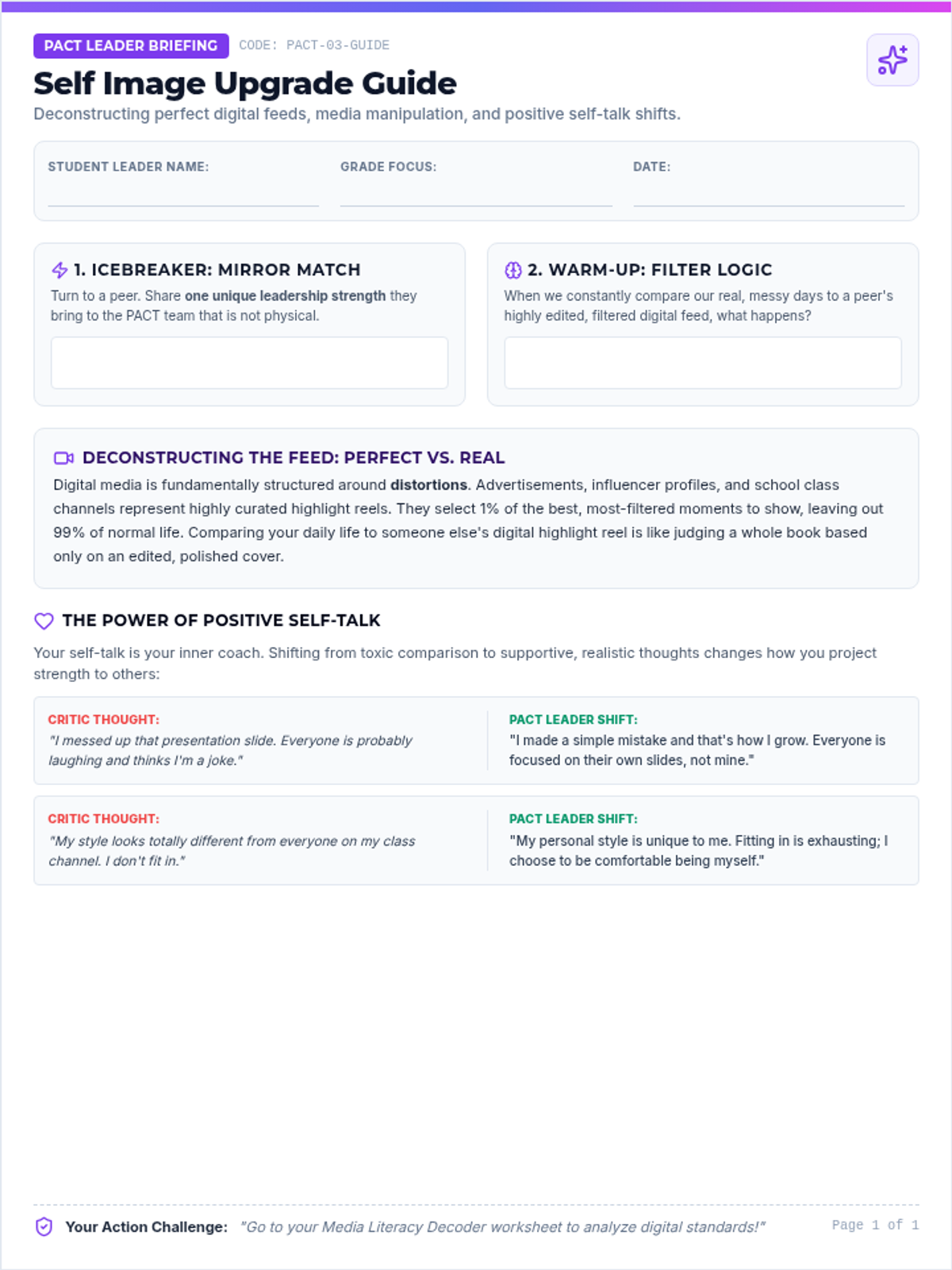
A printable guide detailing digital media literacy, deconstructing filters and perfect feeds, alongside self-talk reframing strategies.
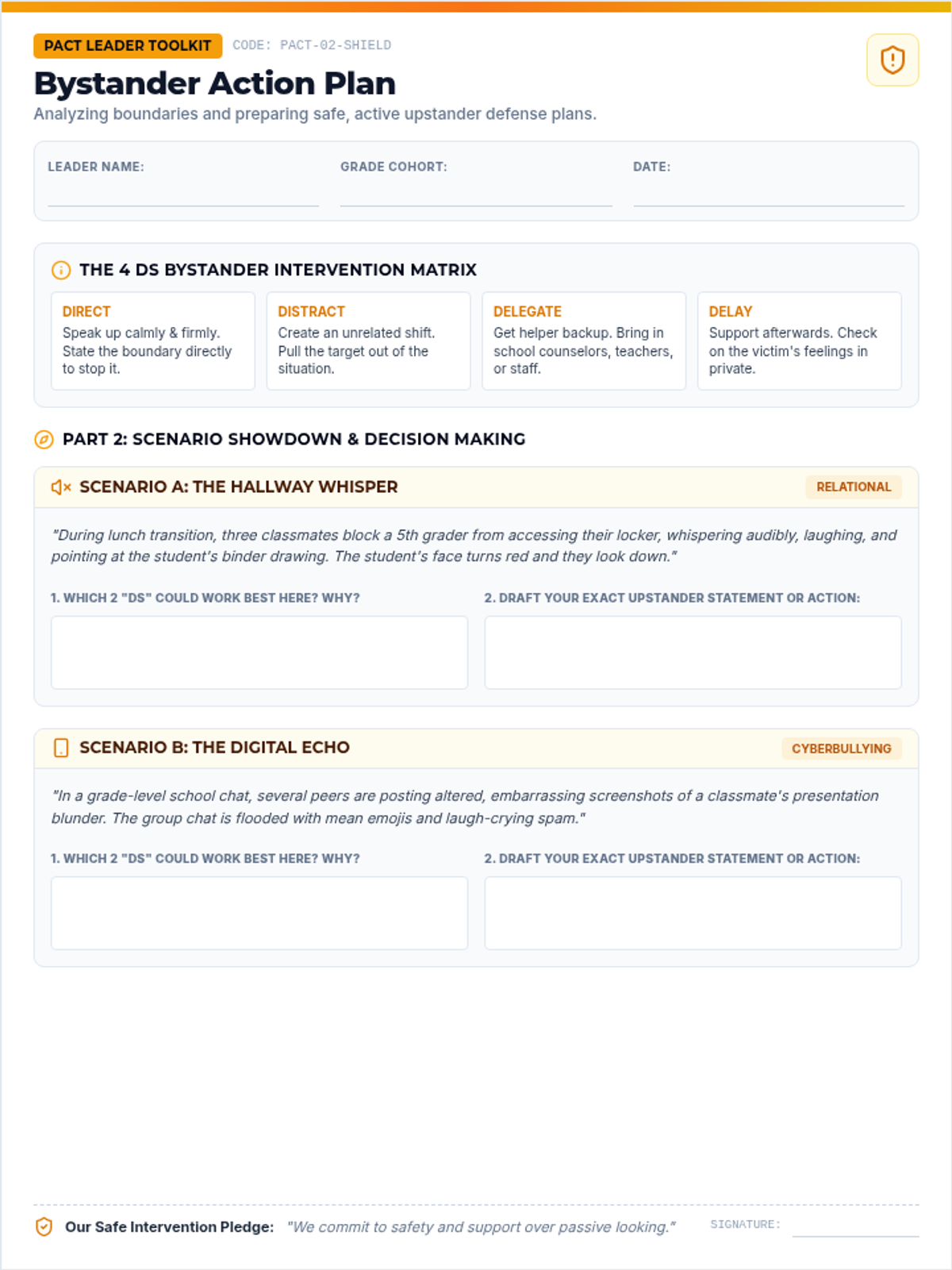
A practical student-facing action planning sheet where PACT leaders analyze real-world bullying scenarios and apply the 4 Ds bystander intervention framework.
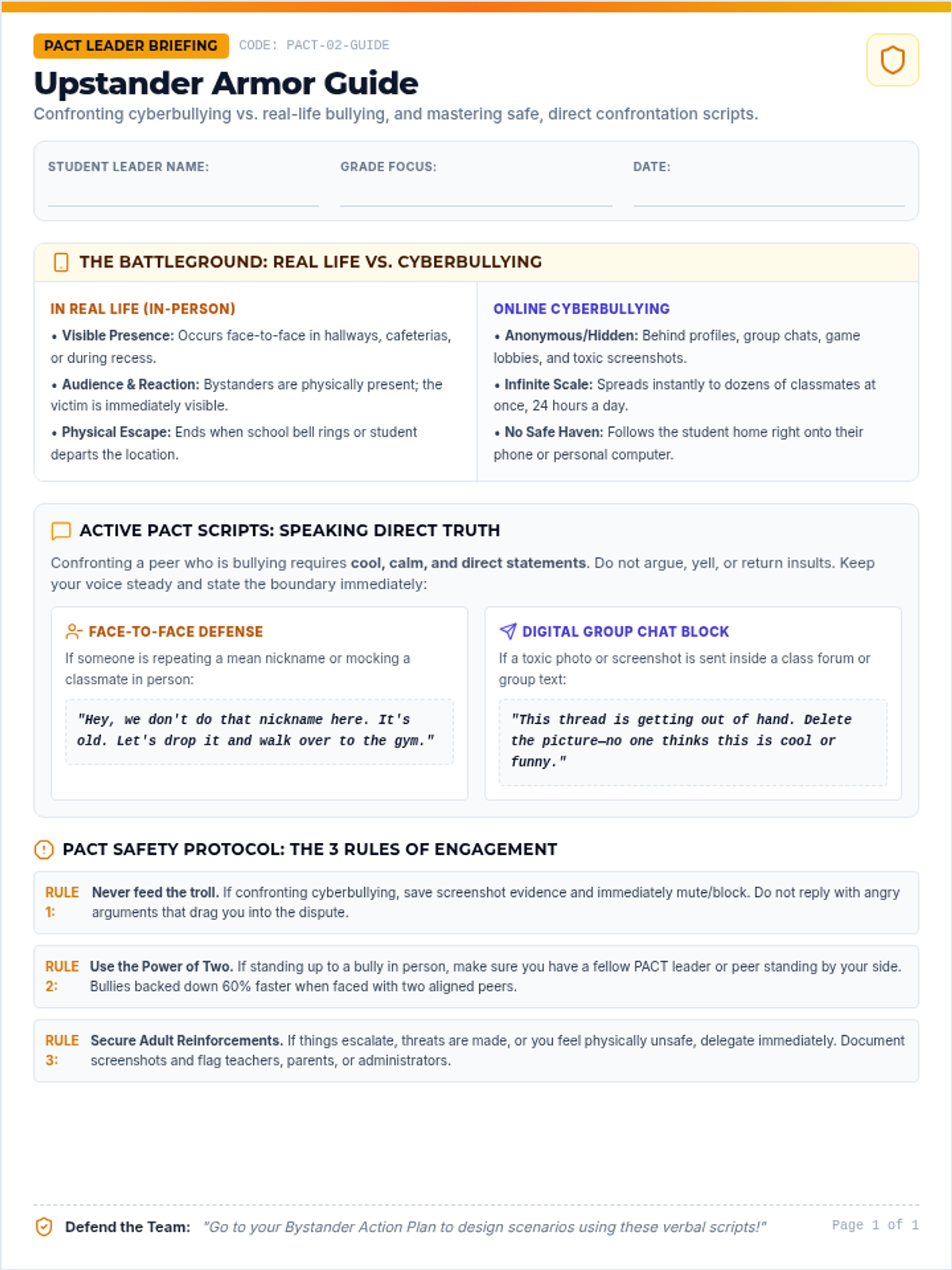
A printable guide detailing the exact differences between face-to-face and online cyberbullying, alongside direct, verbal upstander scripts for confronting bullying behavior safely.
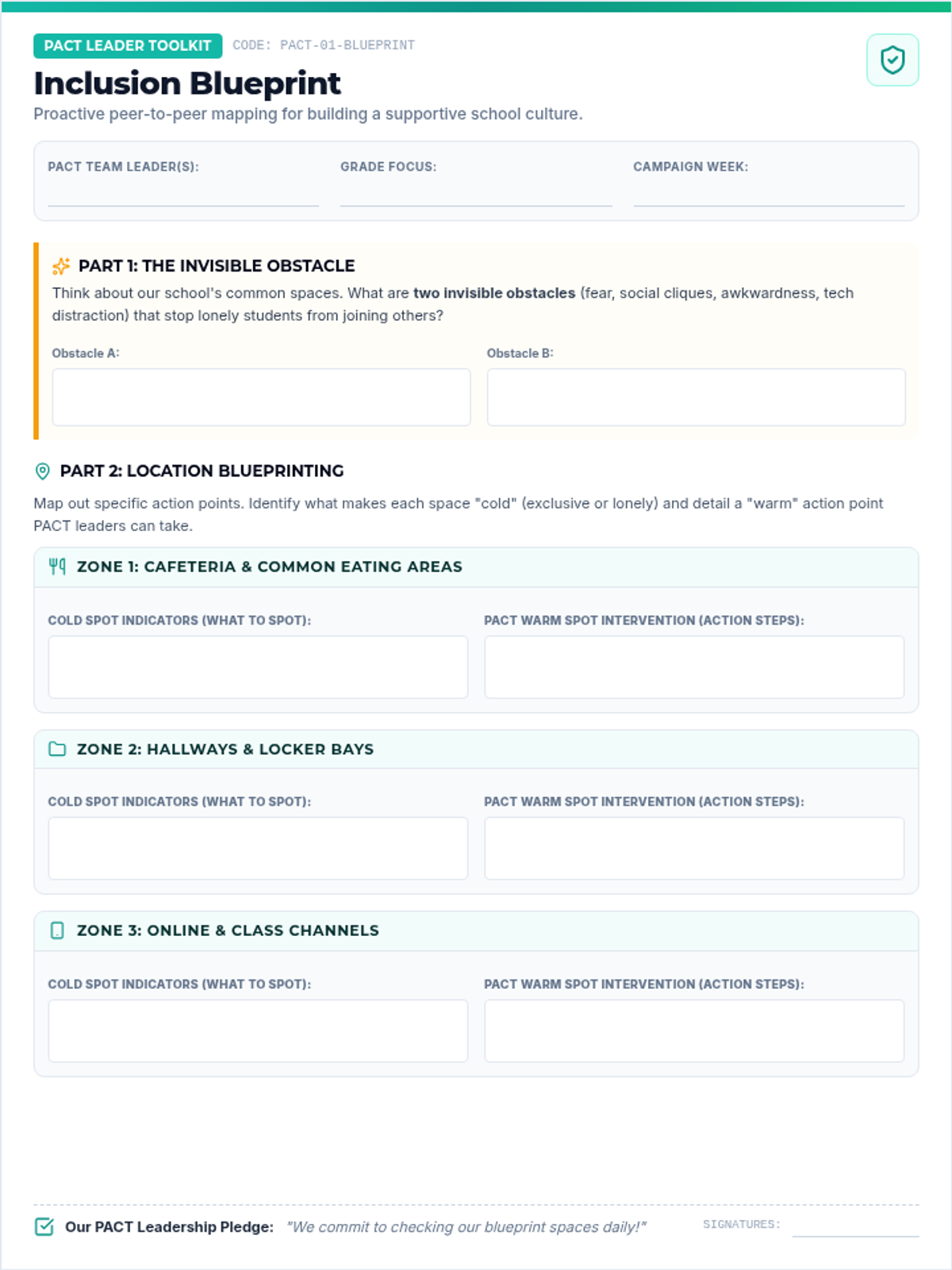
A blueprint planning worksheet for PACT leaders to map out specific, location-based proactive inclusion strategies across their school community.
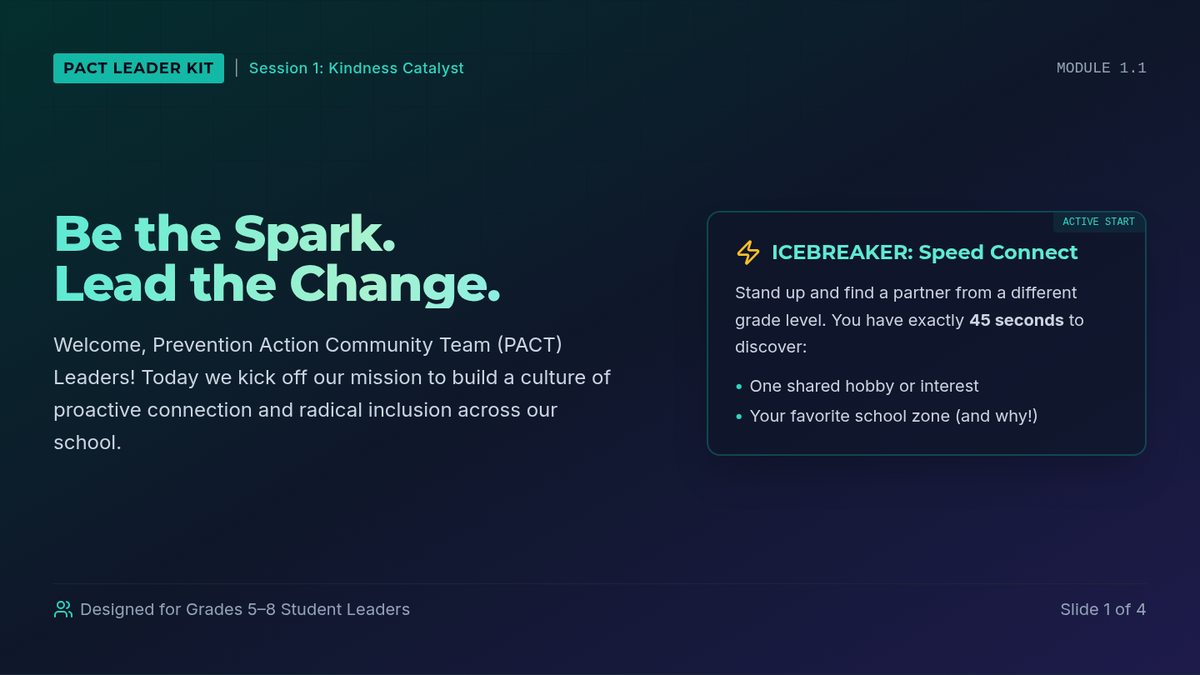
A printable guide for PACT student leaders outlining the campaign's core mission, featuring a group speed-connect icebreaker, a brain warm-up reflection, and proactive kindness checklists.
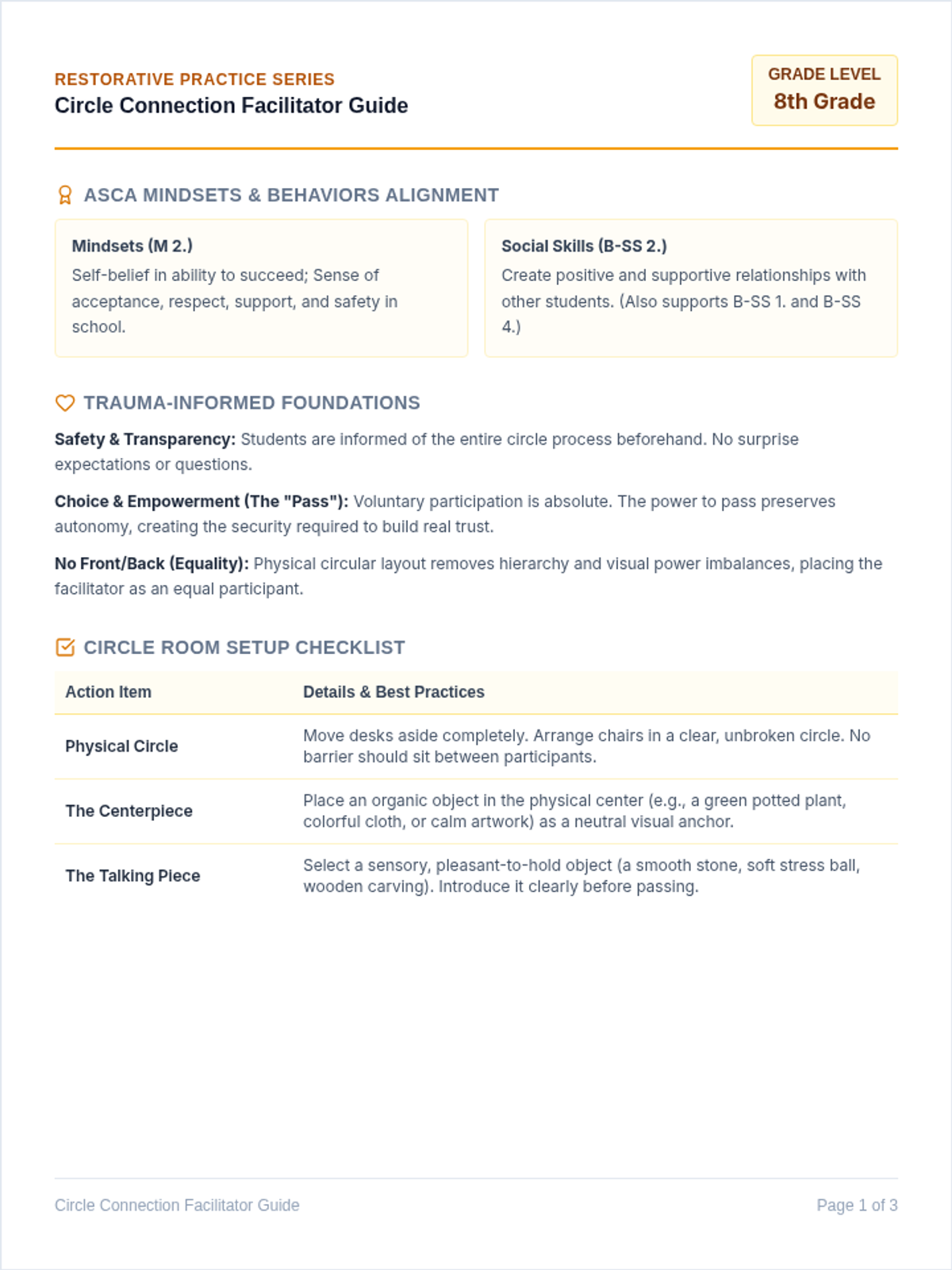
A comprehensive step-by-step teacher guide and script mapping slide content to ASCA Mindset standards, offering trauma-informed facilitator prompts, and providing restorative guidelines.
An engaging, trauma-informed slide presentation introducing 8th-grade students to the purpose, structure, guidelines, and voluntary nature of restorative circles, styled with an inviting warm yellow aesthetic.
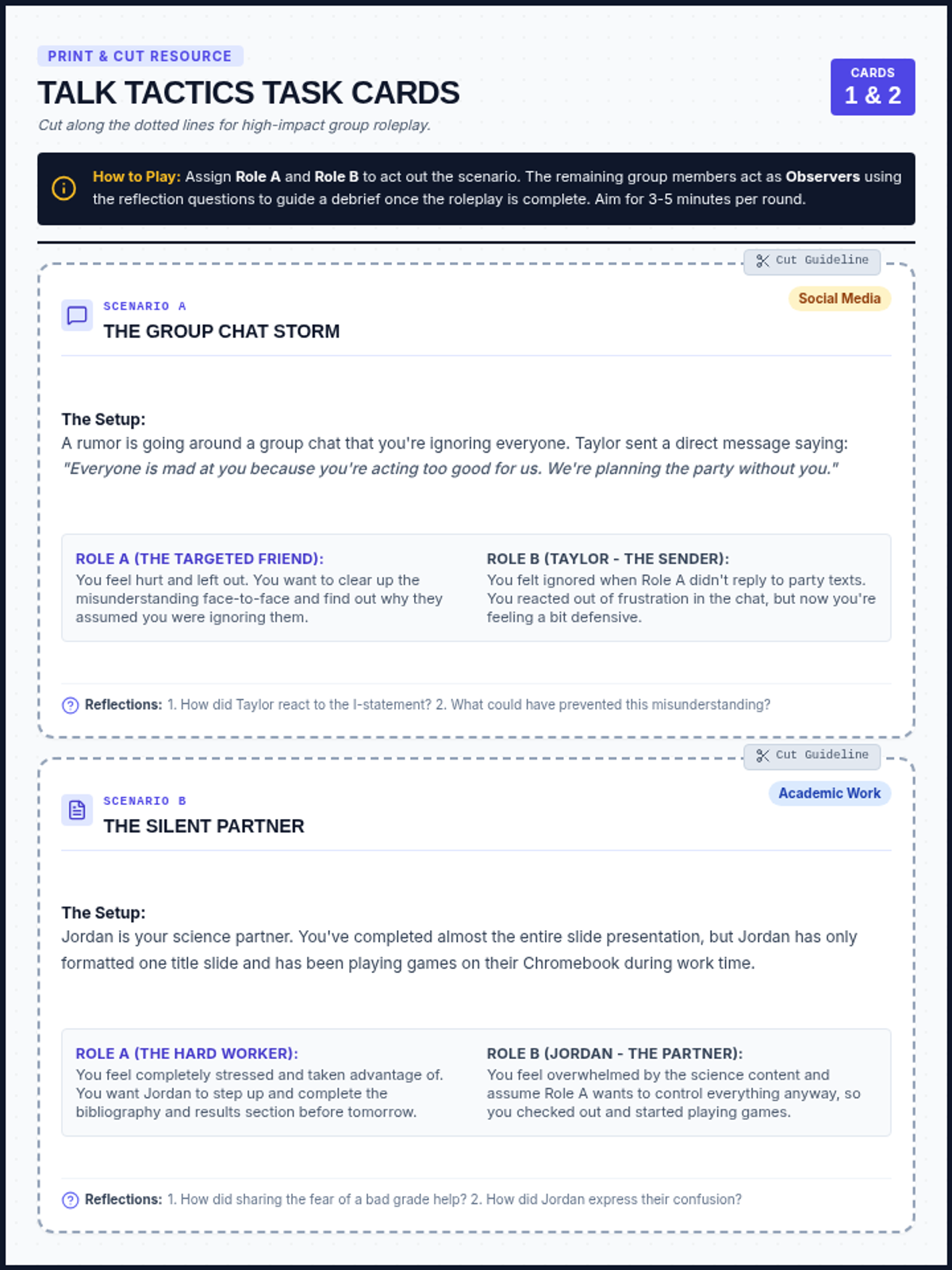
A 2-page print-ready material containing 4 distinct, large-format conflict resolution task cards designed for small-group roleplay, complete with scenario details, role perspectives, and reflective group questions.
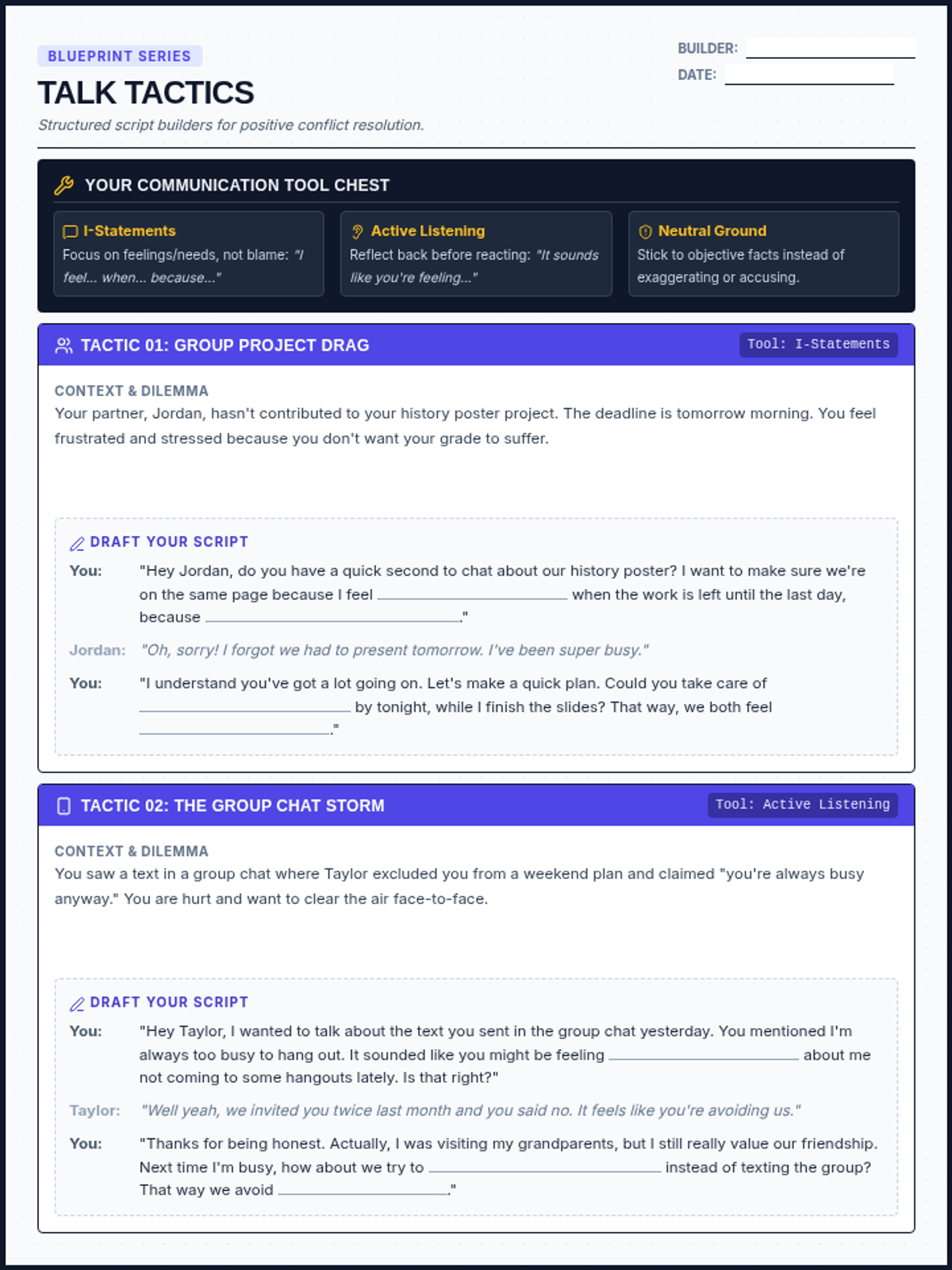
A 2-page student worksheet containing structured, fill-in-the-blank script templates that help students practice specific positive communication techniques across four common conflict scenarios.
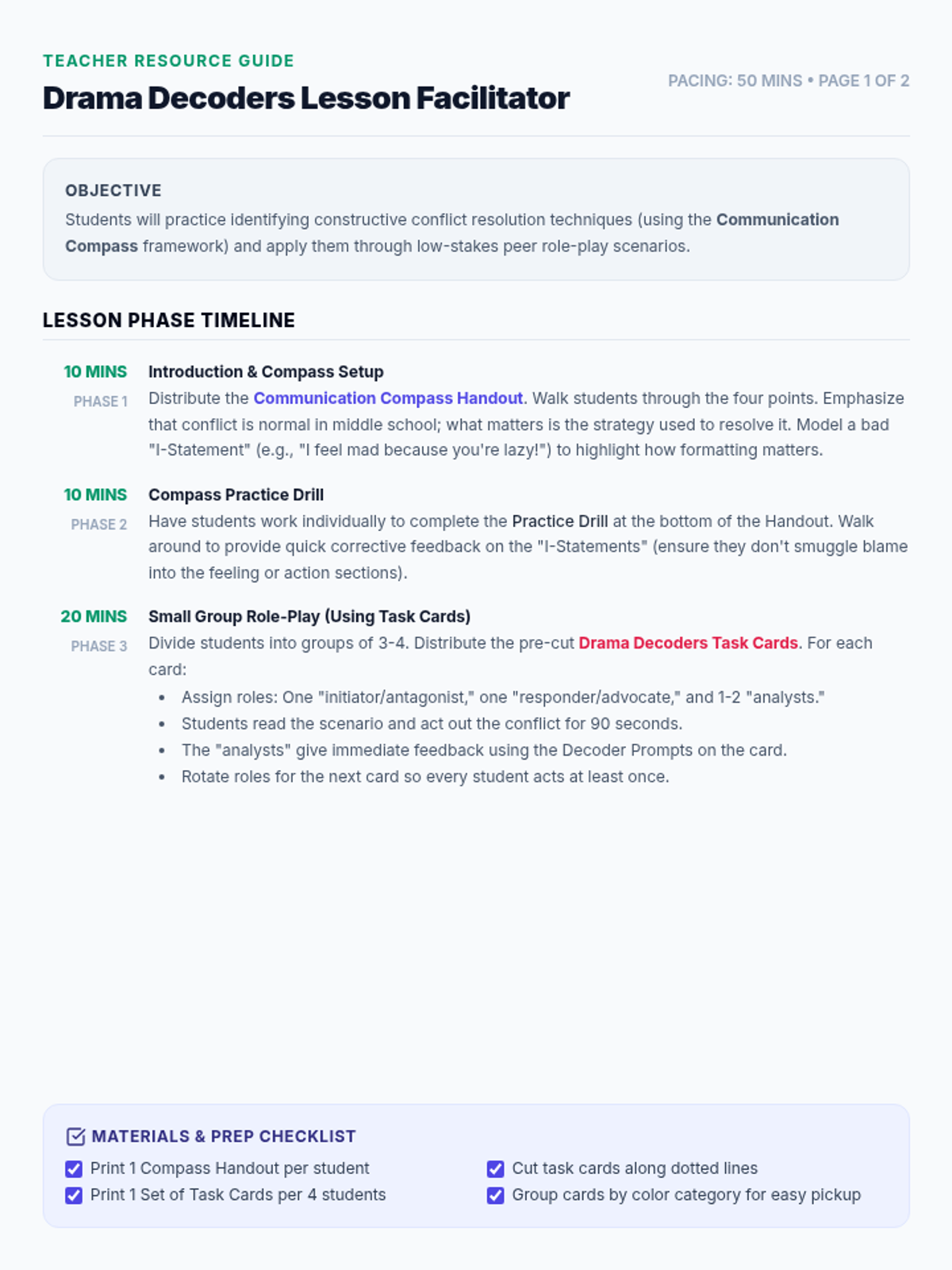
A 2-page instructional guide for teachers containing pacing, group setup directions, debriefing strategies, and rubric examples for the Drama Decoders role-play lesson.
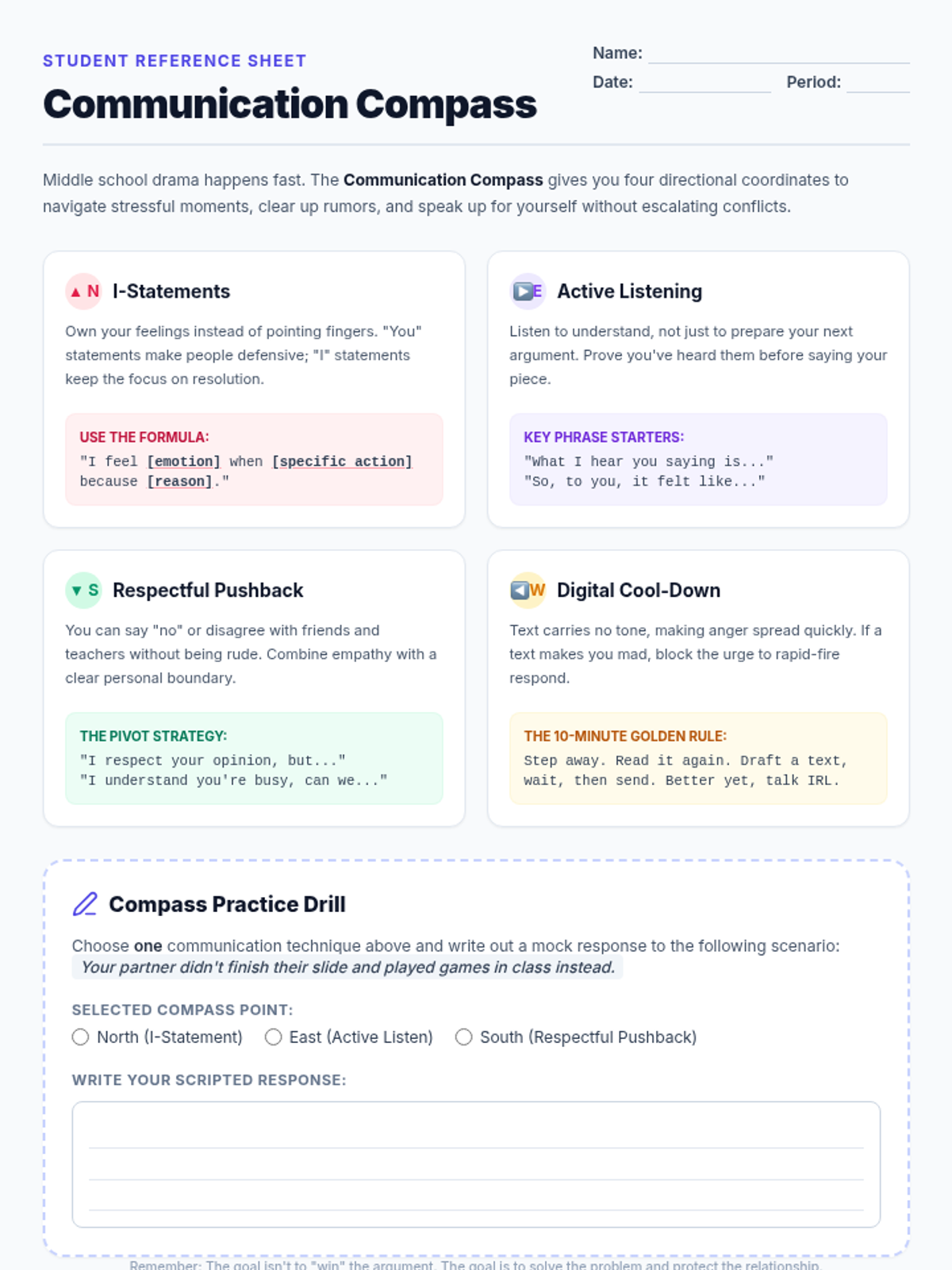
A 1-page student reference handout and quick-practice sheet detailing four core positive communication techniques: I-Statements, Active Listening, Respectful Pushback, and Digital Cool-Down.
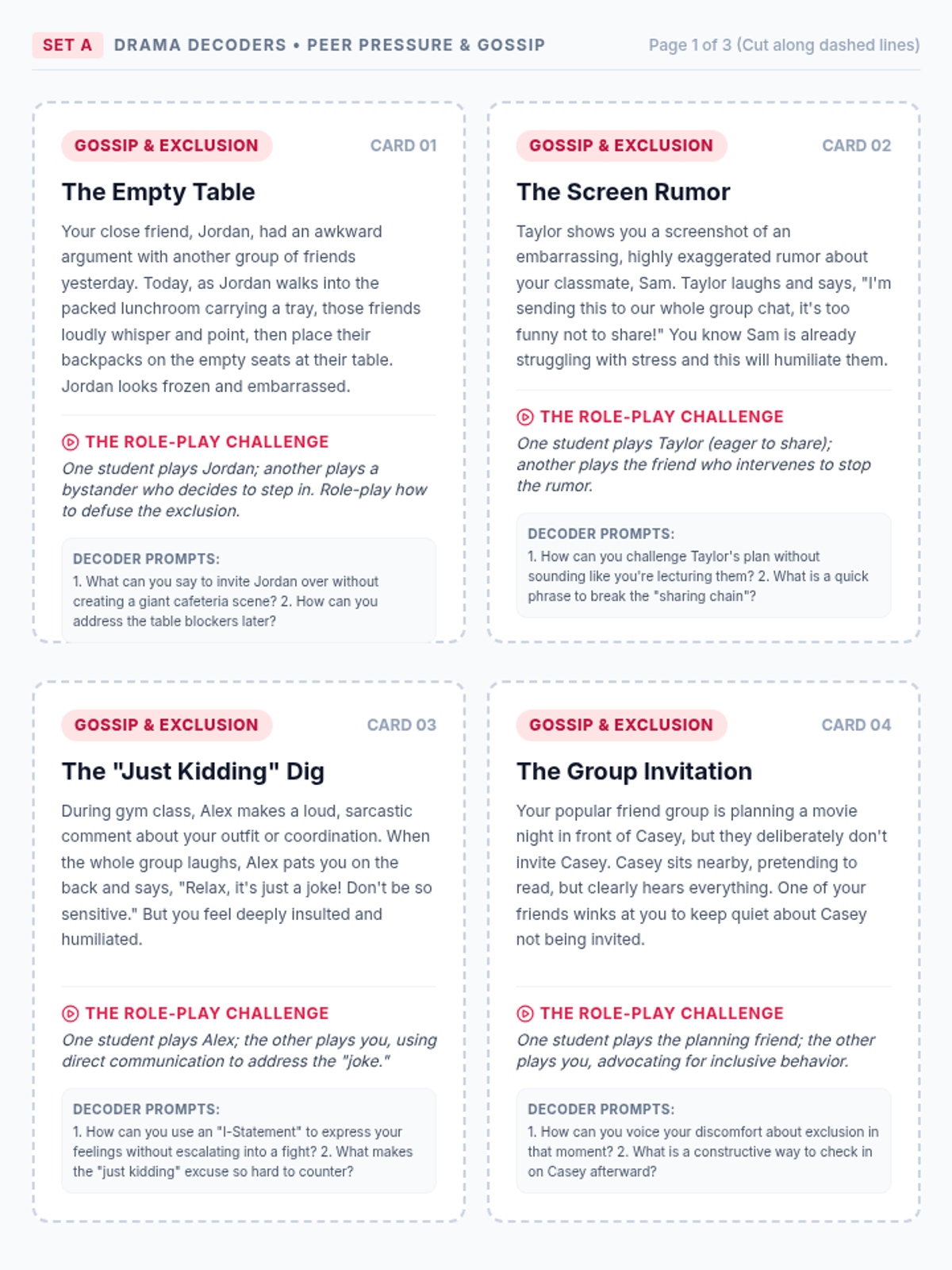
A 3-page set of 12 printable task cards for small-group role-playing, formatted in a 2x2 grid with cutting guides. Categories include Peer Pressure, Digital Misunderstandings, Group Projects, and Teacher Advocacy.
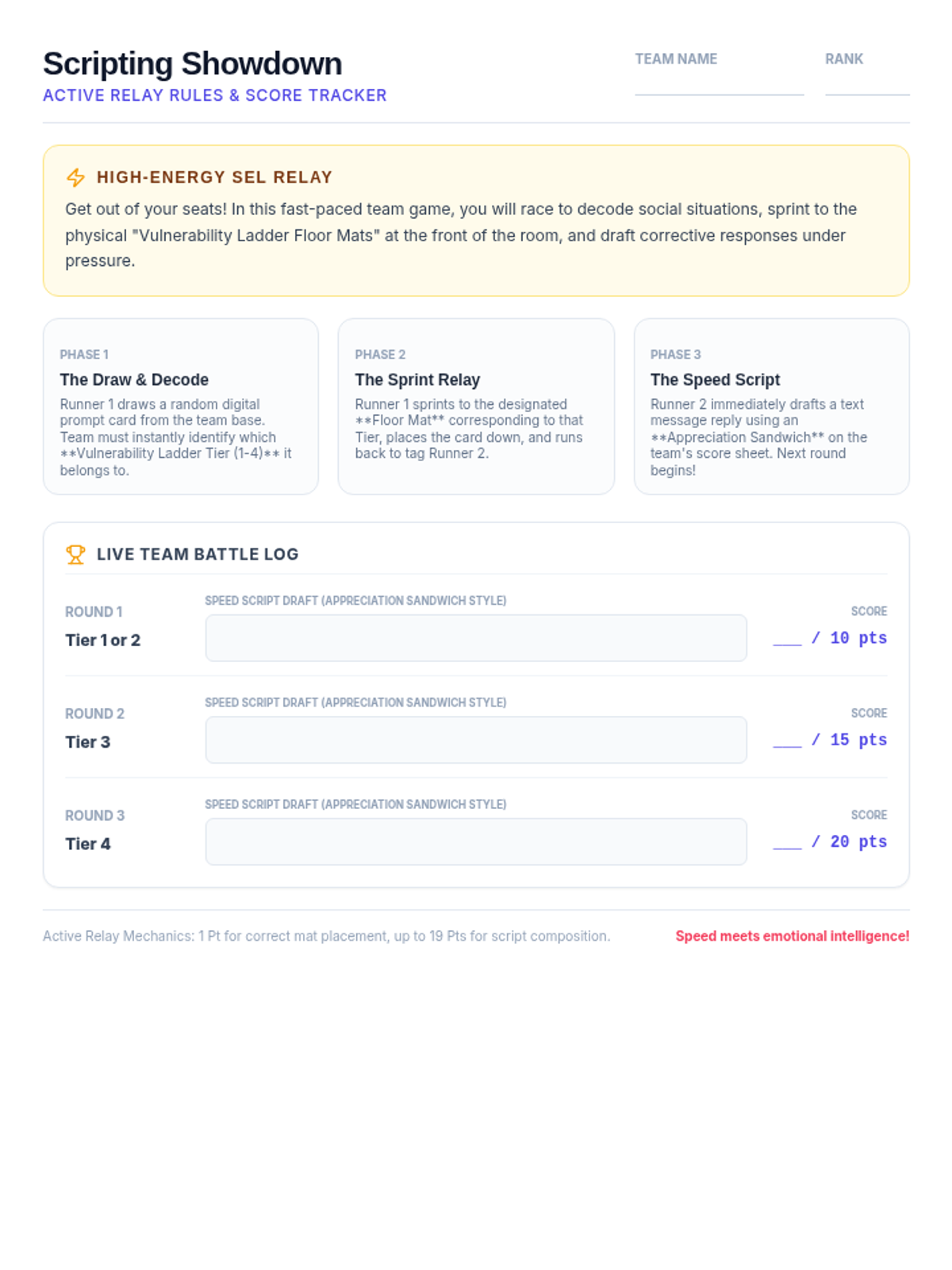
A competitive, movement-based classroom relay guide and score sheet where student teams race to match social triggers to the Vulnerability Ladder floor mats.
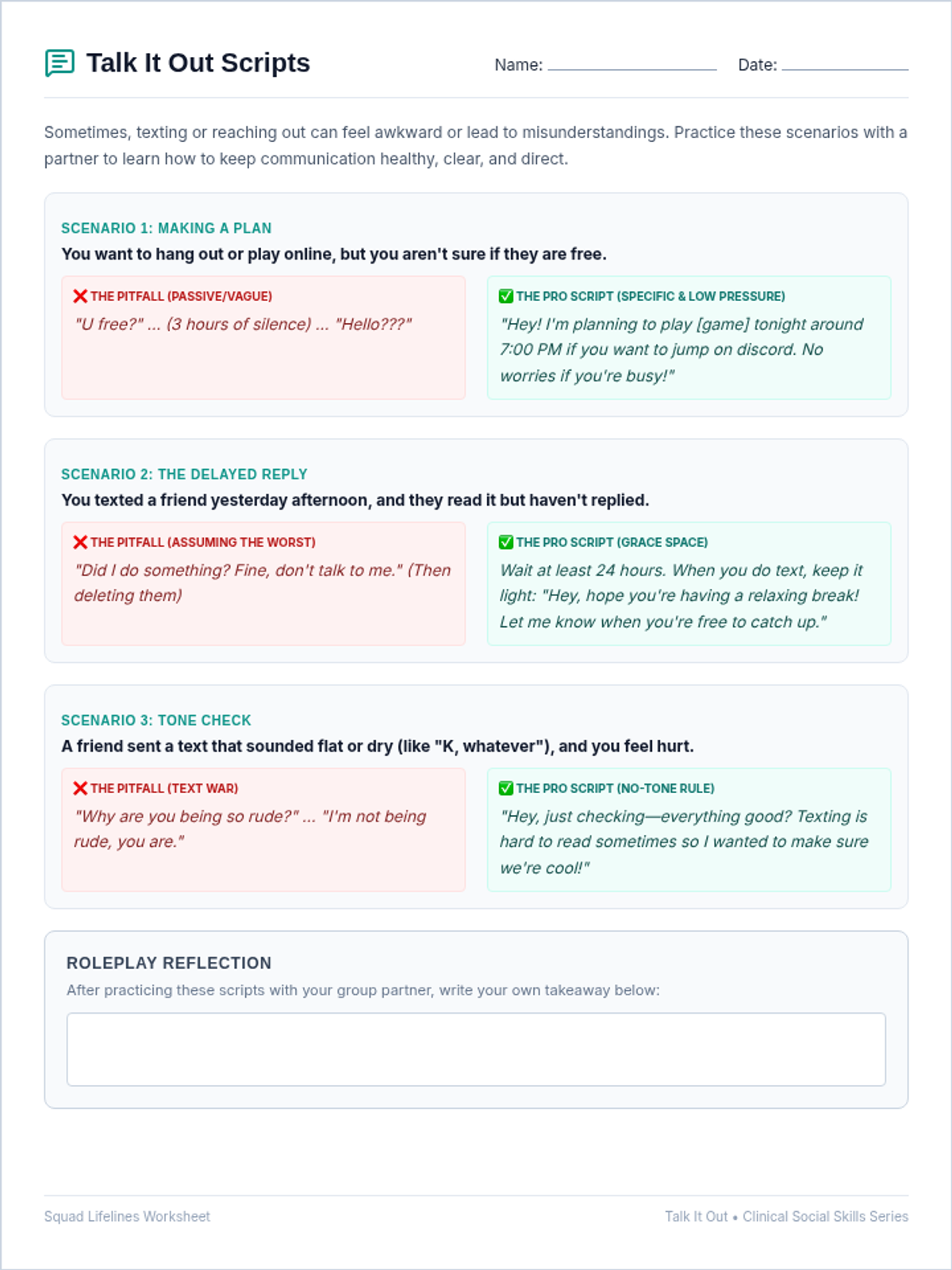
A 1-page structured script and roleplay worksheet to practice conflict resolution, arranging meetups, and resolving digital communication friction.
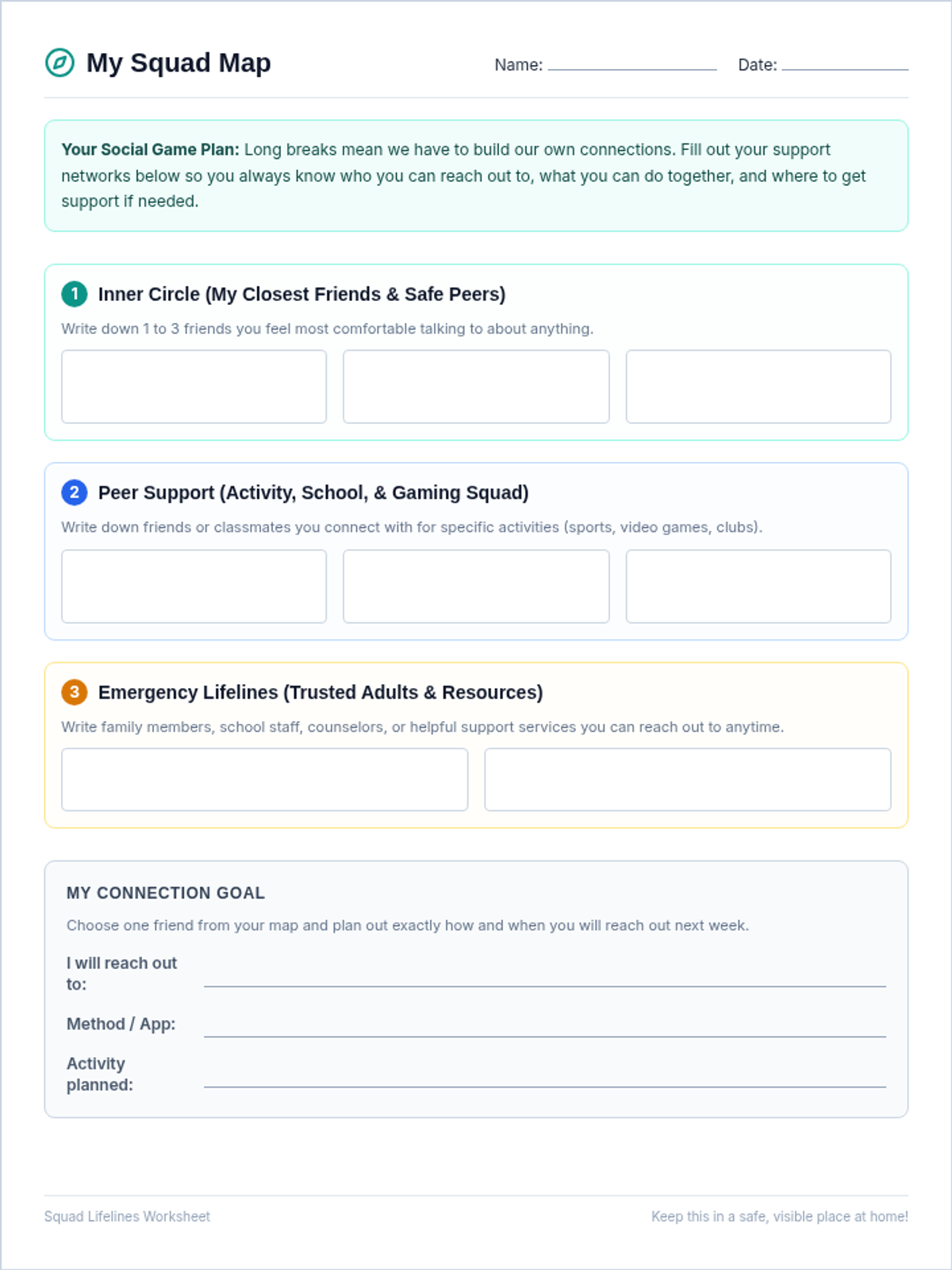
A highly visual 1-page printable relationship mapping worksheet designed for student completion during social skills groups.
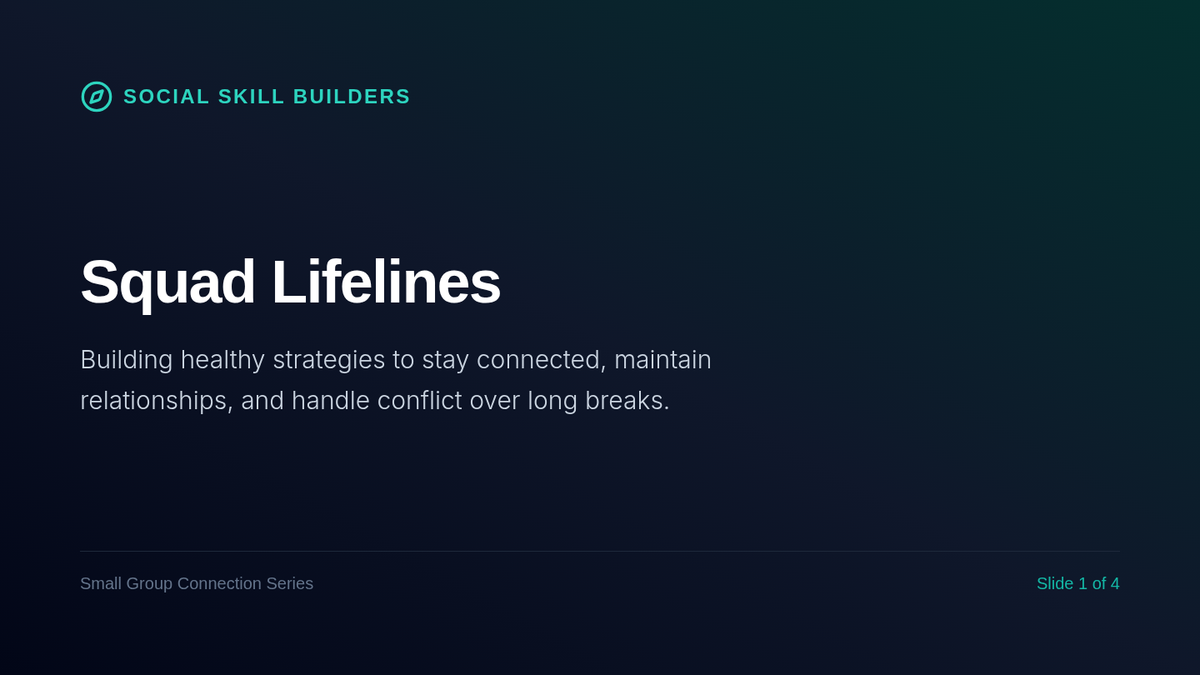
A 4-slide presentation deck visually introducing the concept of the Peer Connection Map, identifying social circles, and setting safe digital boundaries during breaks.
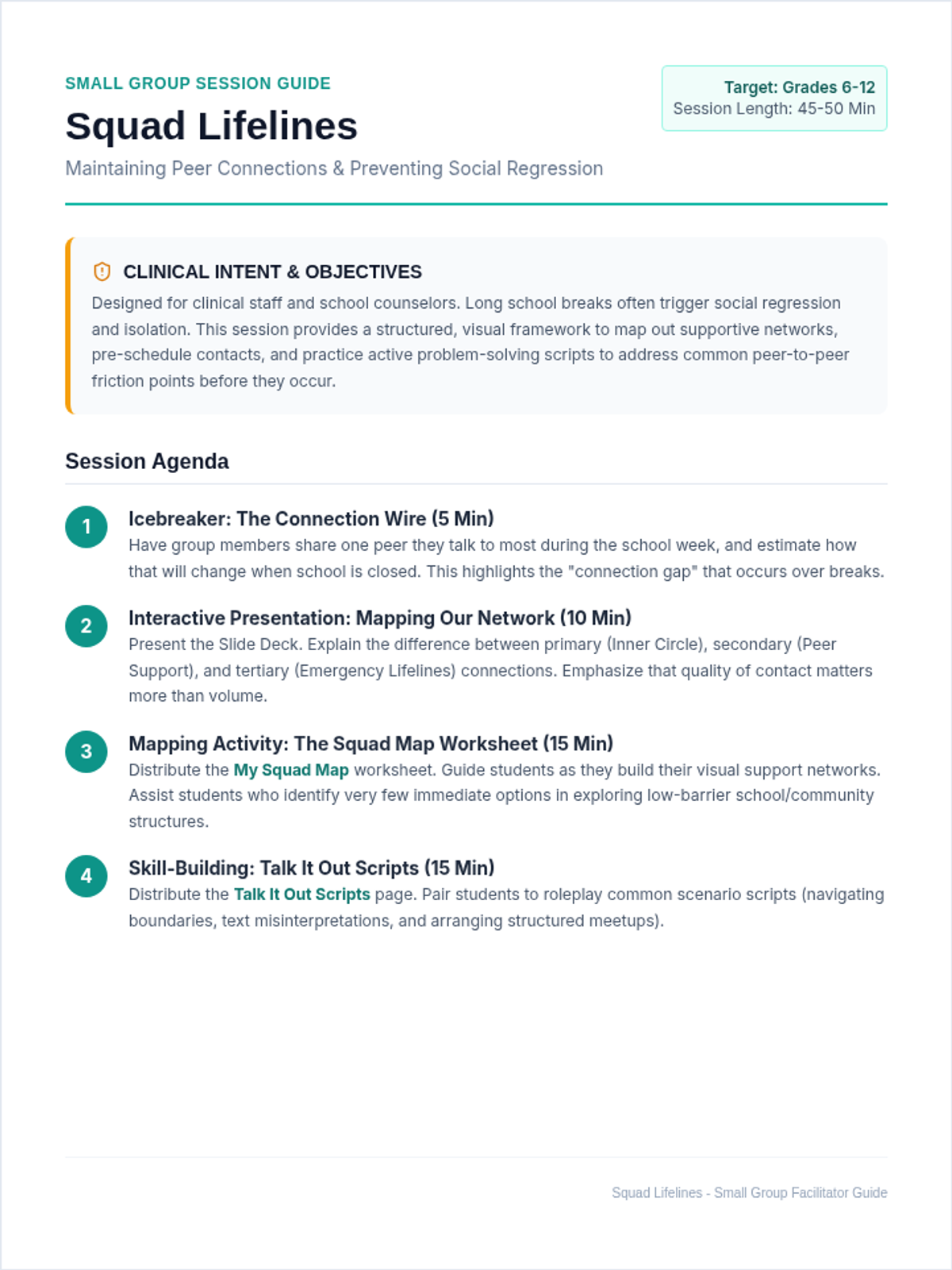
A 2-page detailed lesson plan and small-group facilitation guide designed for clinical facilitators and school counselors to lead social connection mapping.
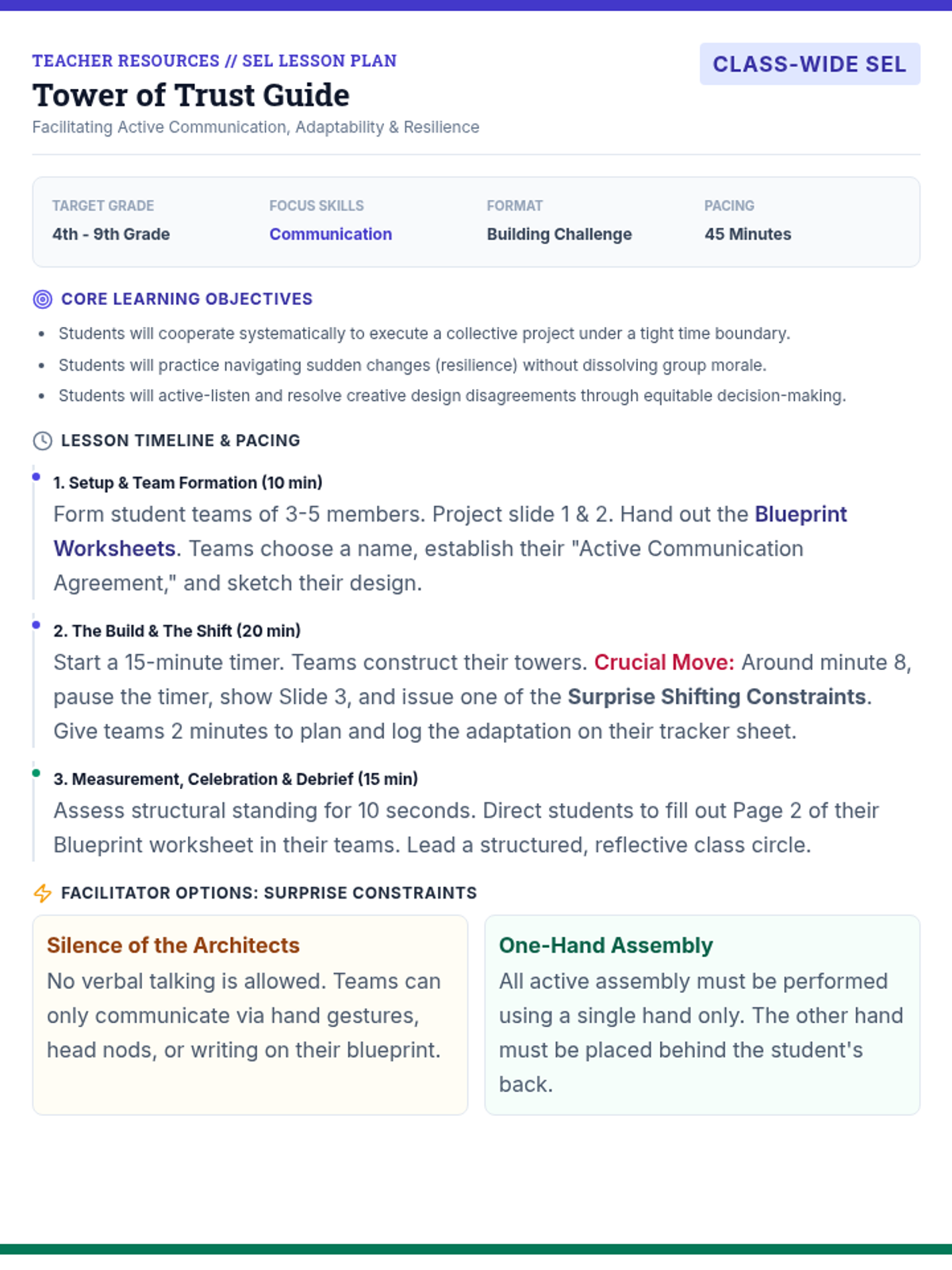
An extensive teacher facilitation guide containing material requirements, a precise paced timeline, surprise constraint options to deploy mid-challenge, a structured debrief guide, and an observational SEL rubric.
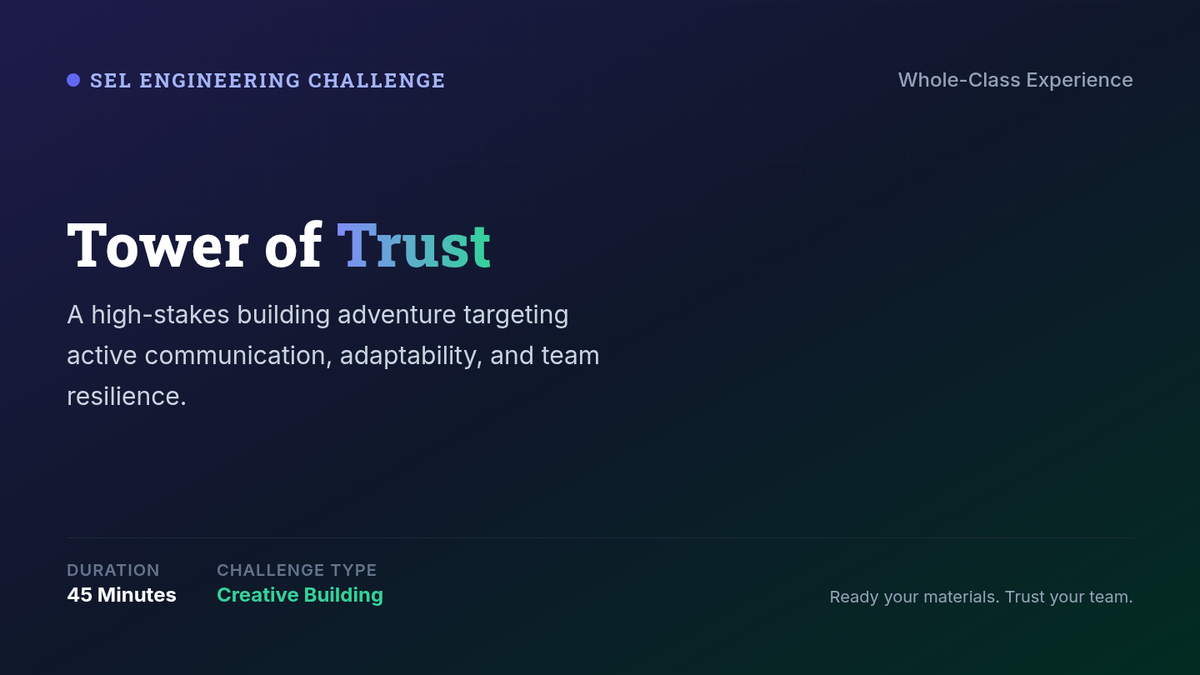
An interactive and beautiful slide deck guiding classes through the Tower of Trust creative building challenge. Includes objectives, safety guides, surprise shifting constraint rules, dynamic collaborative goals, and debrief prompts with high readability.
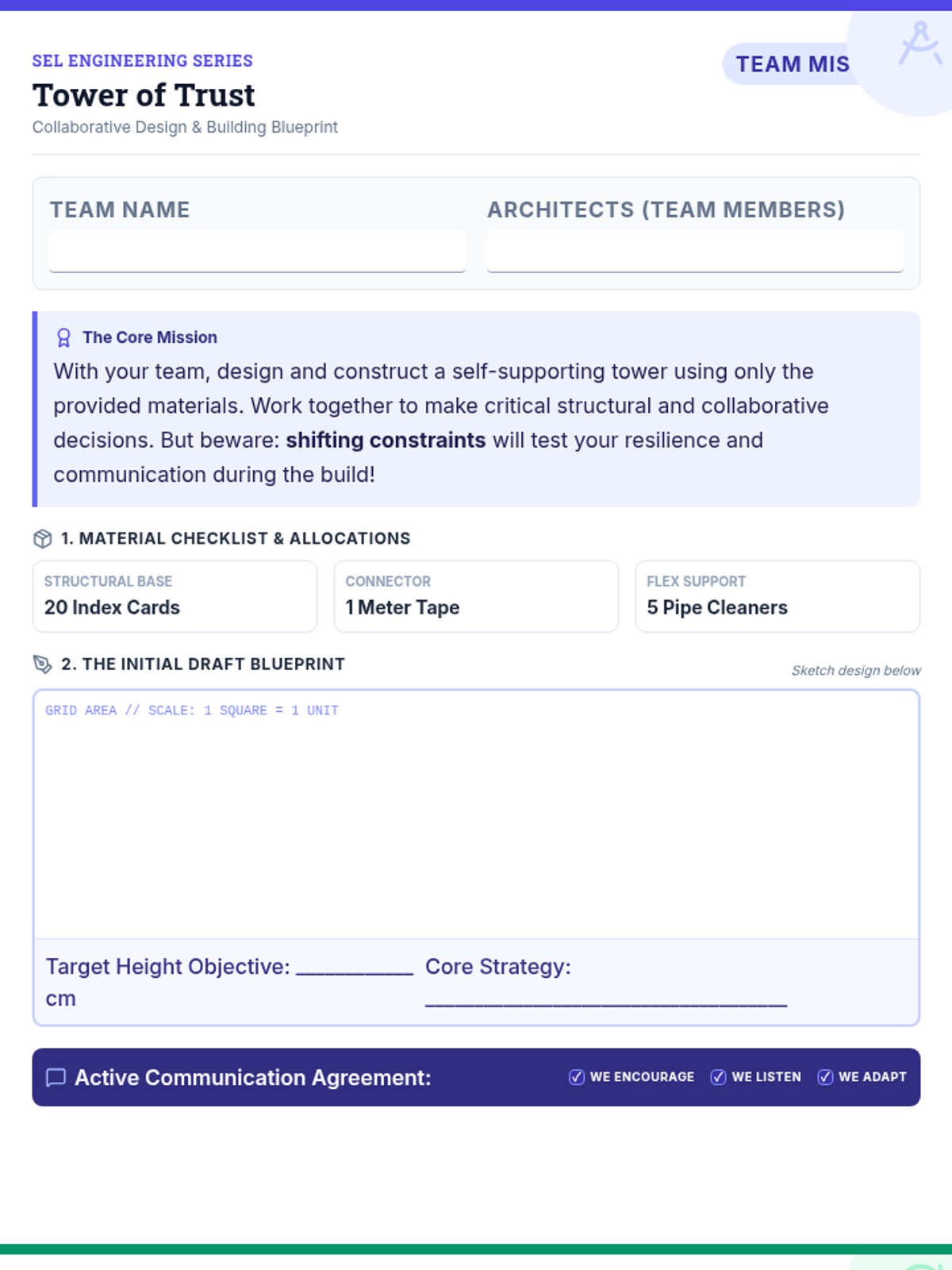
A student blueprint and reflective worksheet for the Tower of Trust building challenge. Structured like an architectural planner, it has space for designs, tracking unexpected constraints, and self-evaluating active communication.
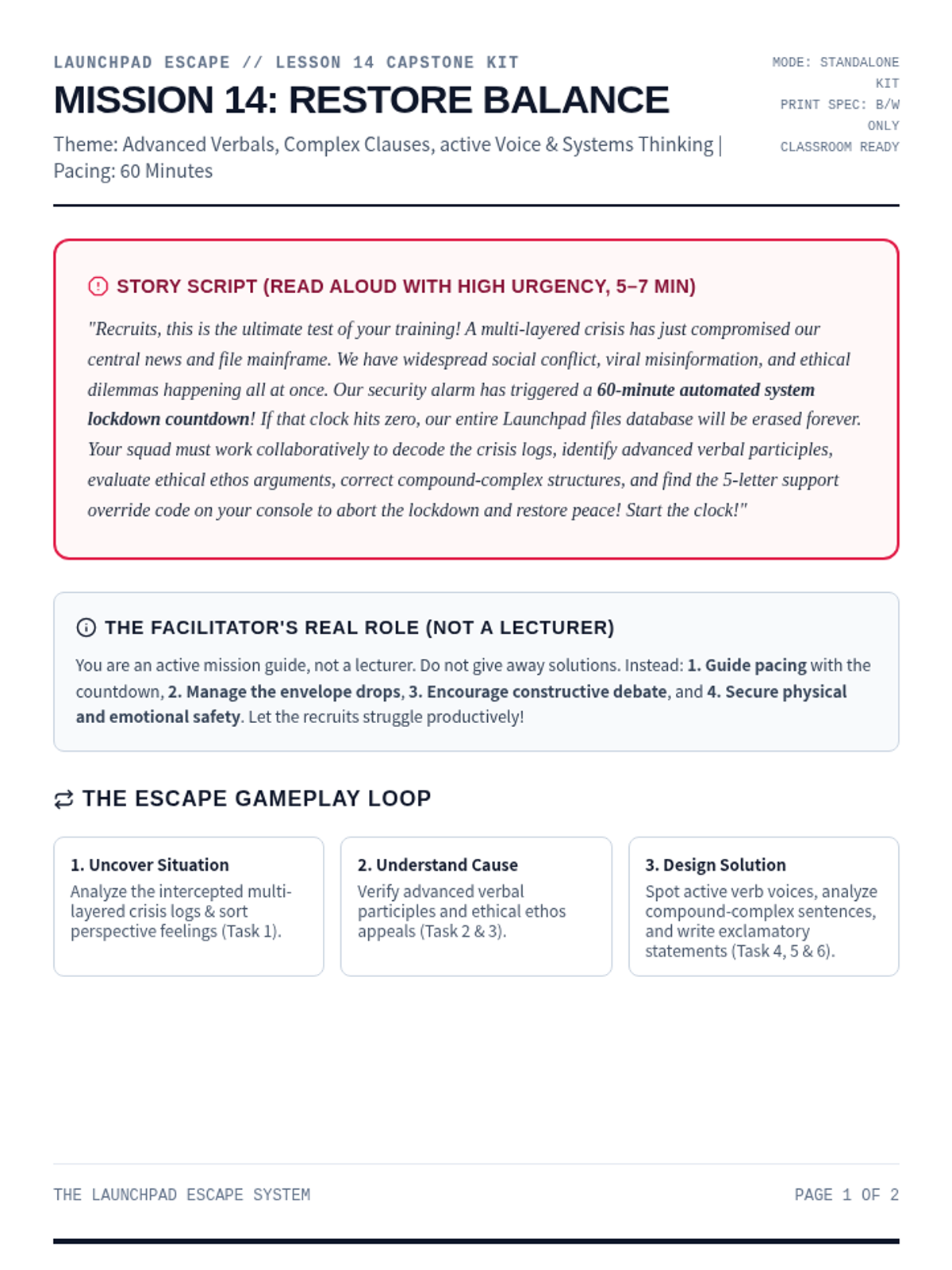
A comprehensive printable facilitator guide for Mission 14: The Capstone Mission. Contains story script, setup checklists, progressive clue mechanics, persuasive appeals endings, and debrief questions.
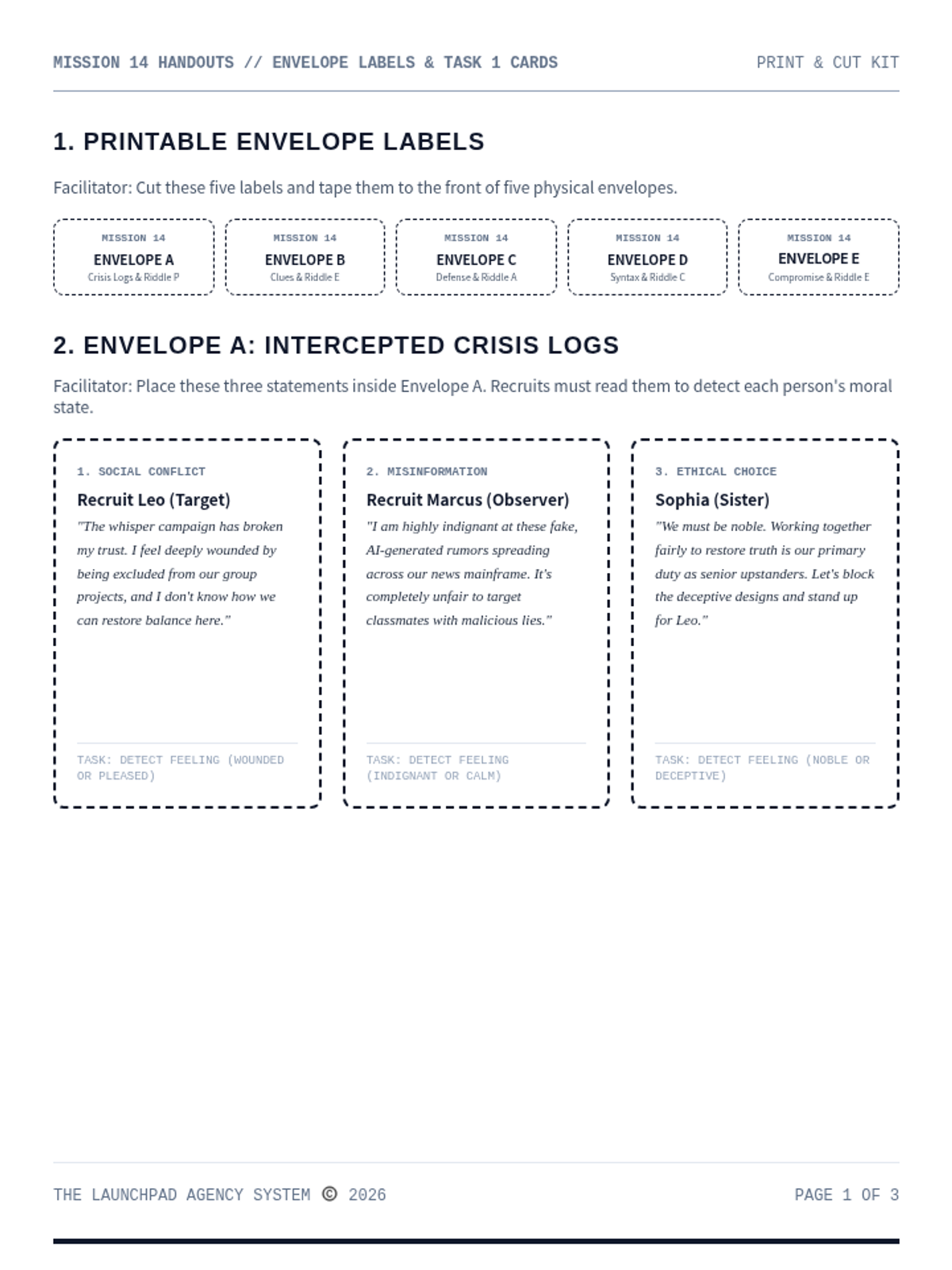
A print-and-cut materials handout kit for Mission 14: The Capstone Mission. Contains envelope labels, printed posts, source cards, and timeline charts.
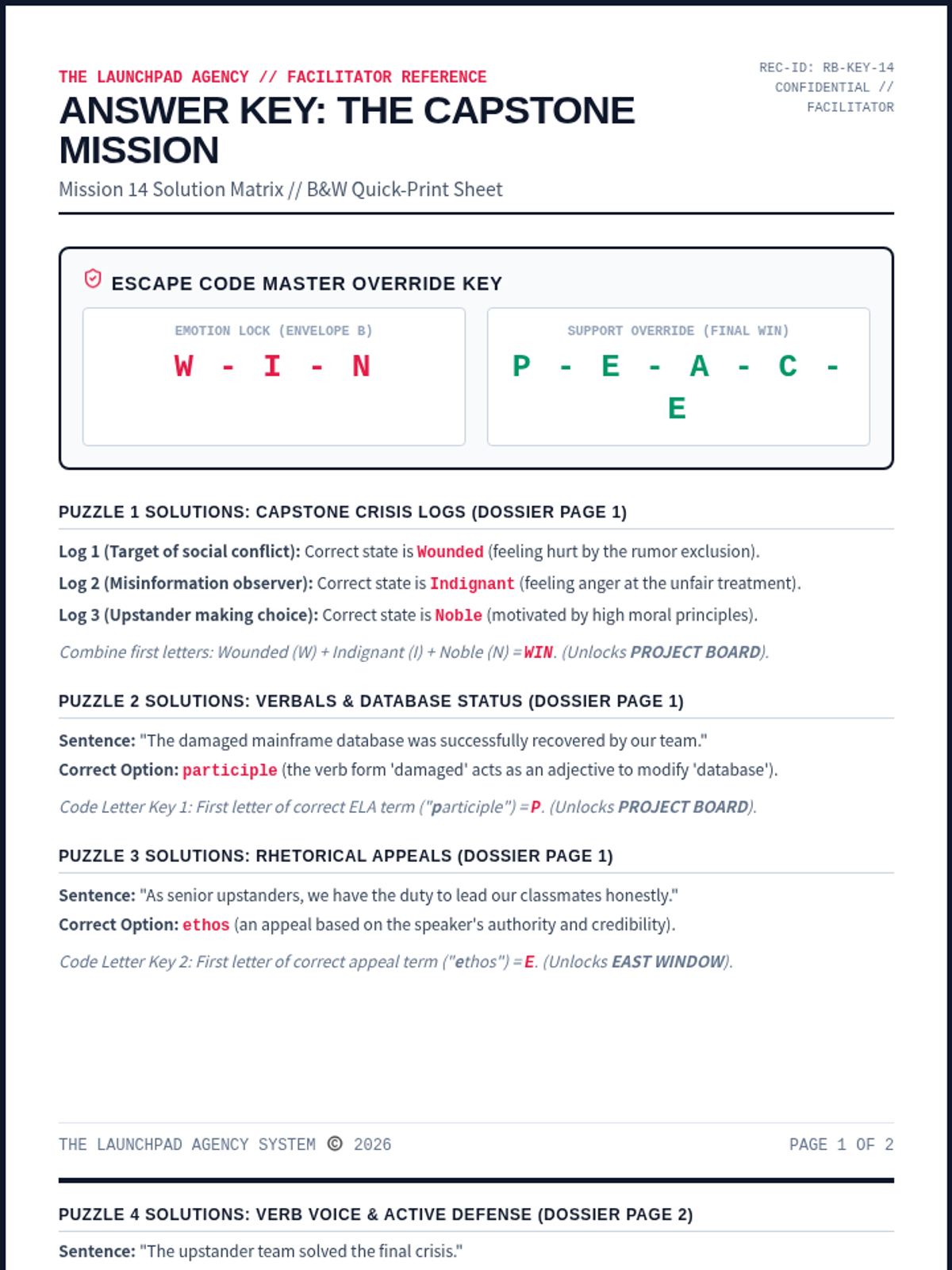
A dedicated facilitator answer key for Mission 14: The Capstone Mission. Contains complete solutions for all ELA/coordinate puzzles, ciphers, and floor map paths, along with rubrics and setup tips.
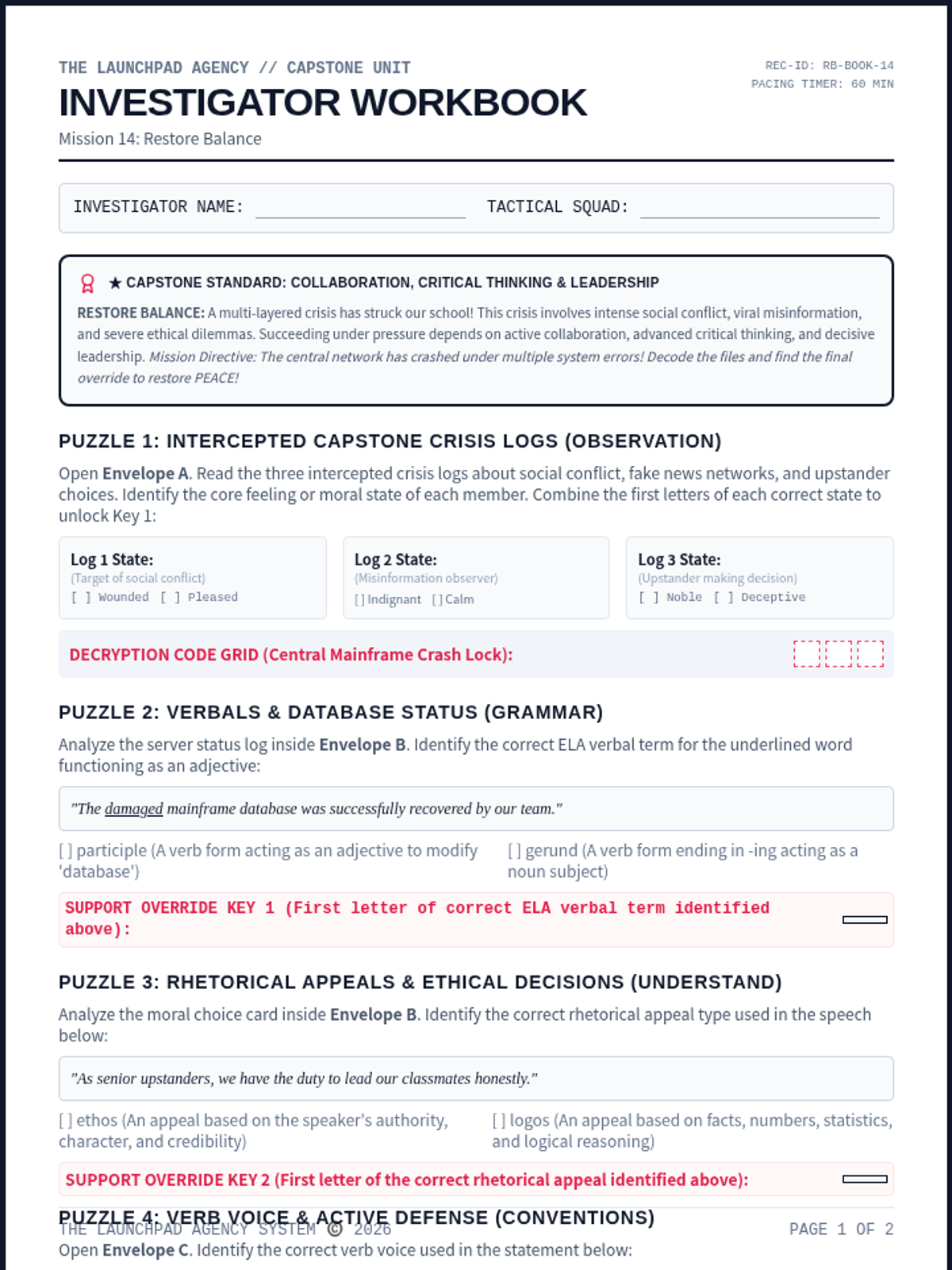
An immersive student-facing escape worksheet. Recruits examine complex social conflict evidence, trace misinformation networks, resolve major ethical dilemmas, and decode the final override.
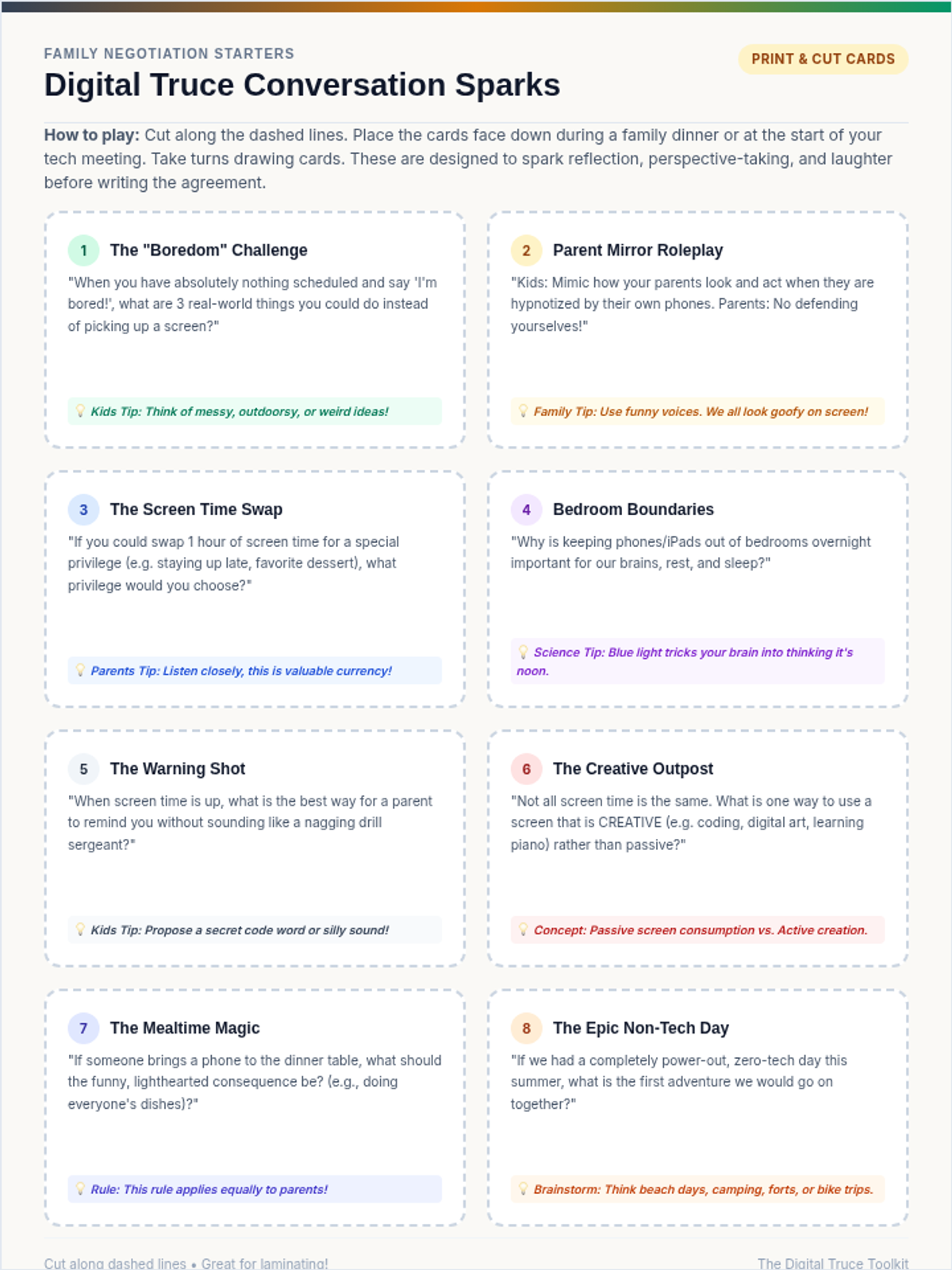
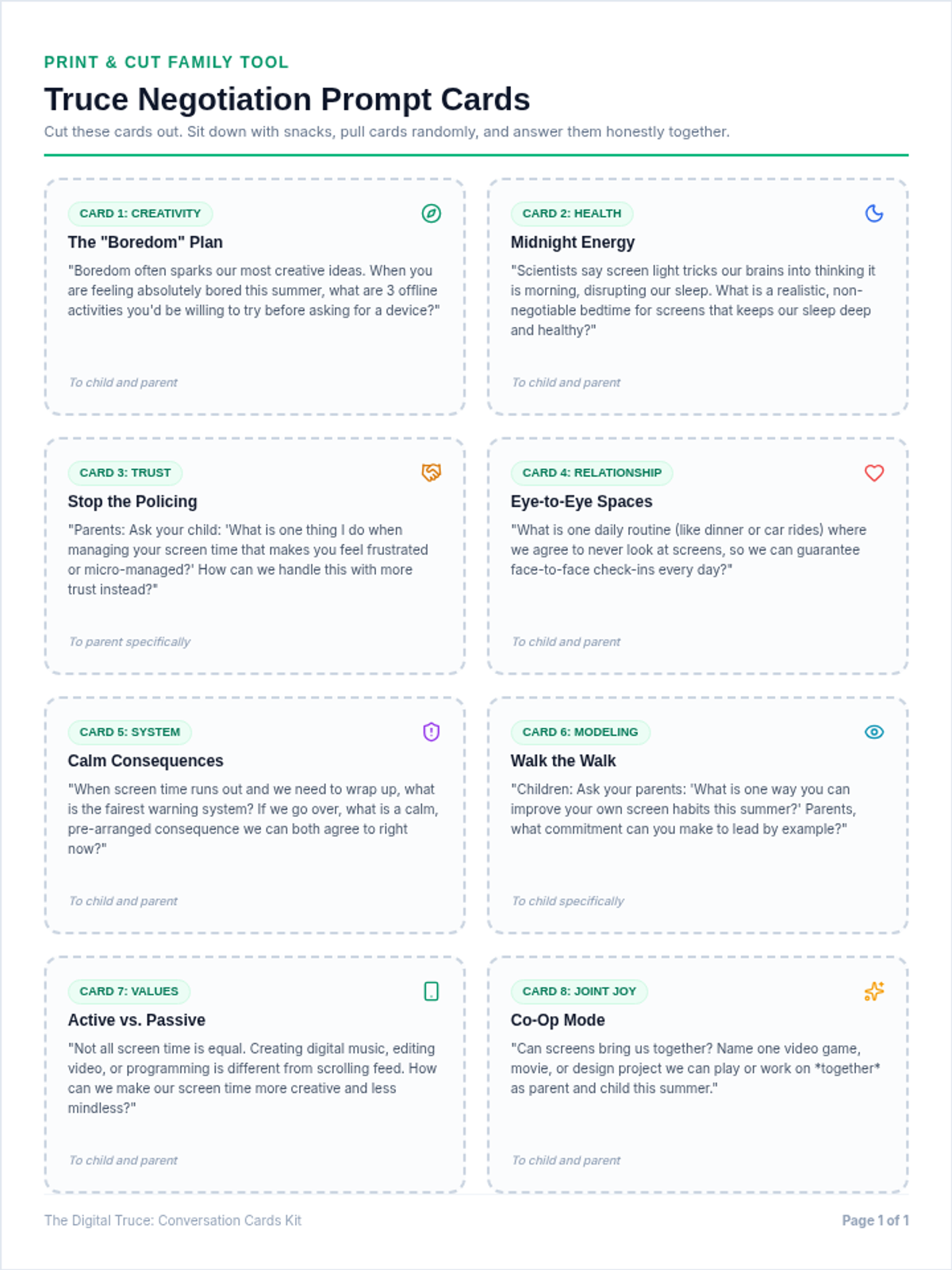
A set of printable conversation starter cards to break the ice and build empathy between parents and kids before drafting the summer tech agreement.
A beautifully designed, 2-page family agreement blueprint with structured checklists, tech-free zones, and commitment lines for collaborative co-creation.
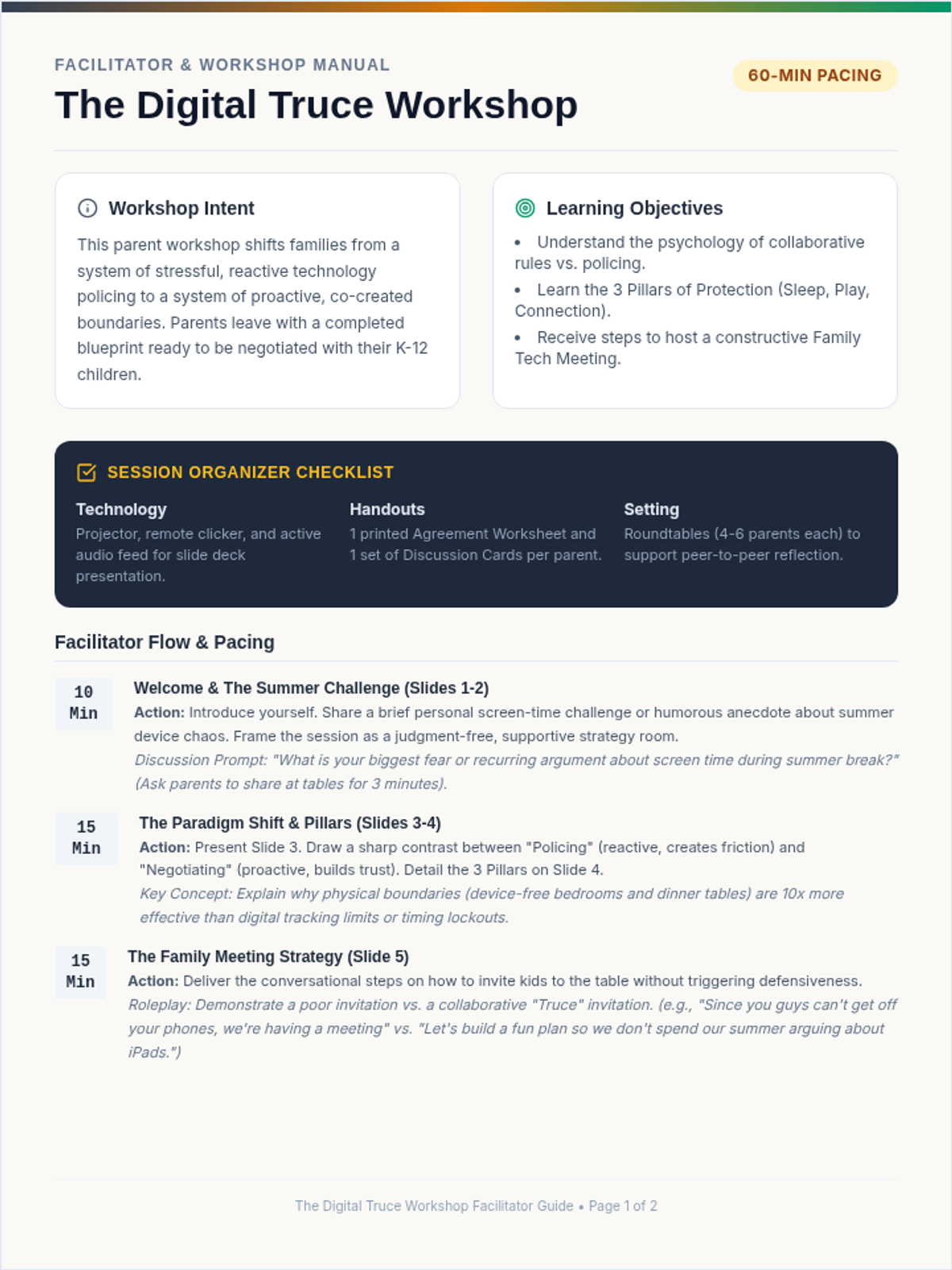
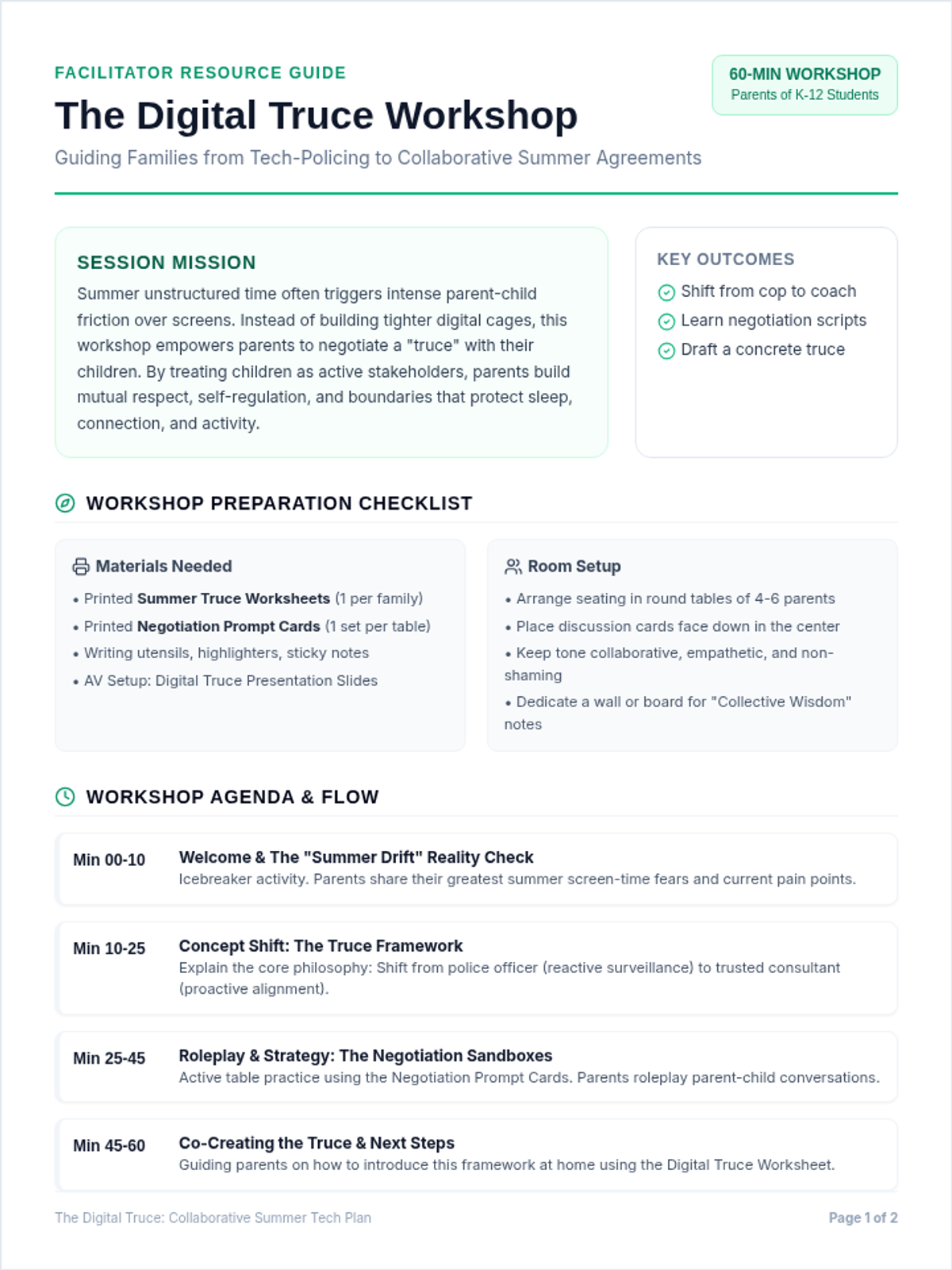
A step-by-step facilitation manual for workshop organizers, PTA leaders, or school counselors to deliver a 60-minute presentation guiding parents to build collaborative agreements.
A presentation slide deck for a parent workshop or community evening, guiding parents through the philosophy and step-by-step process of establishing a collaborative family screen-time agreement.
A 1-page printable set of 8 collaborative conversation cards for parents and kids to use during their family screen-time negotiations.
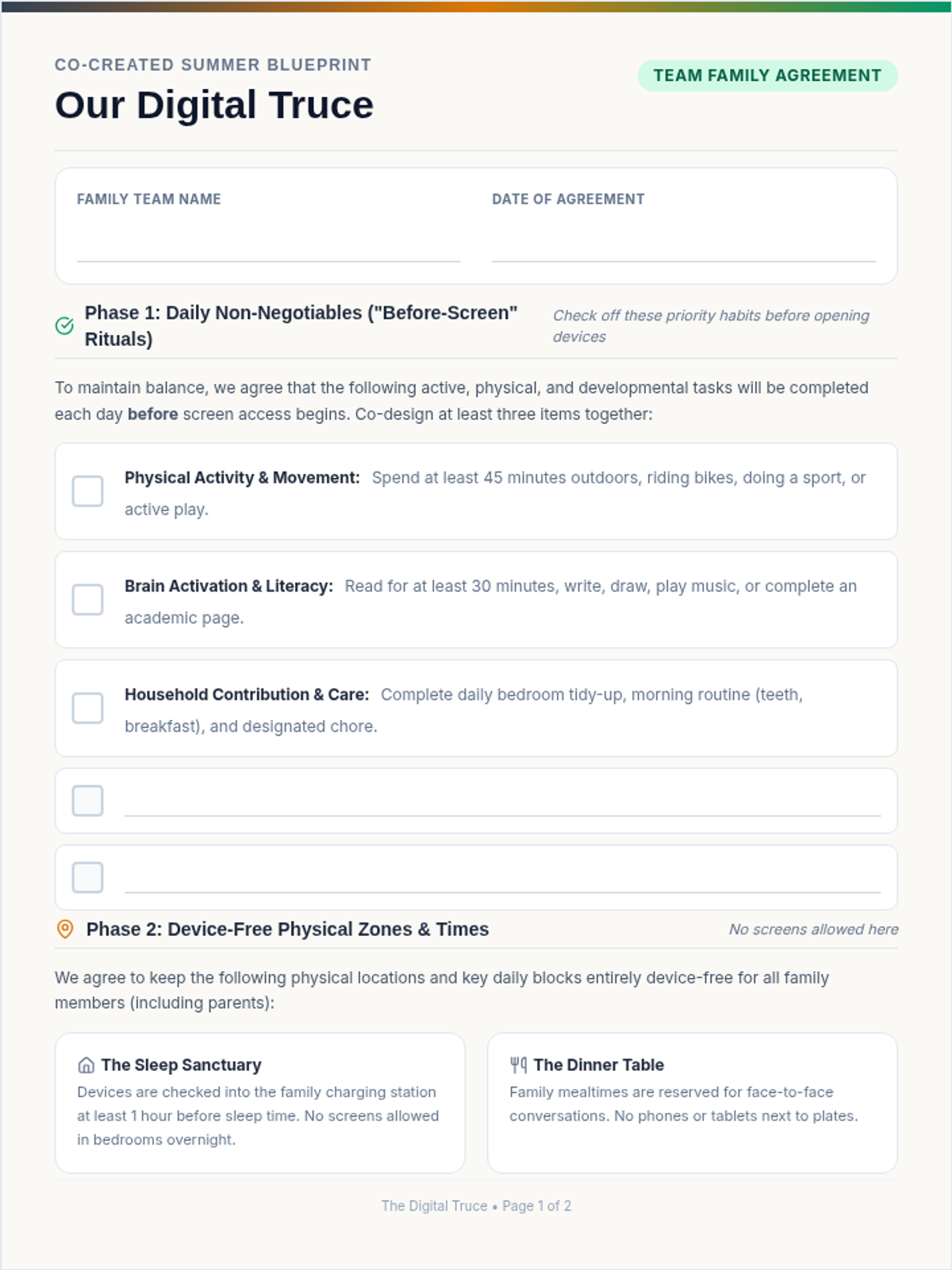
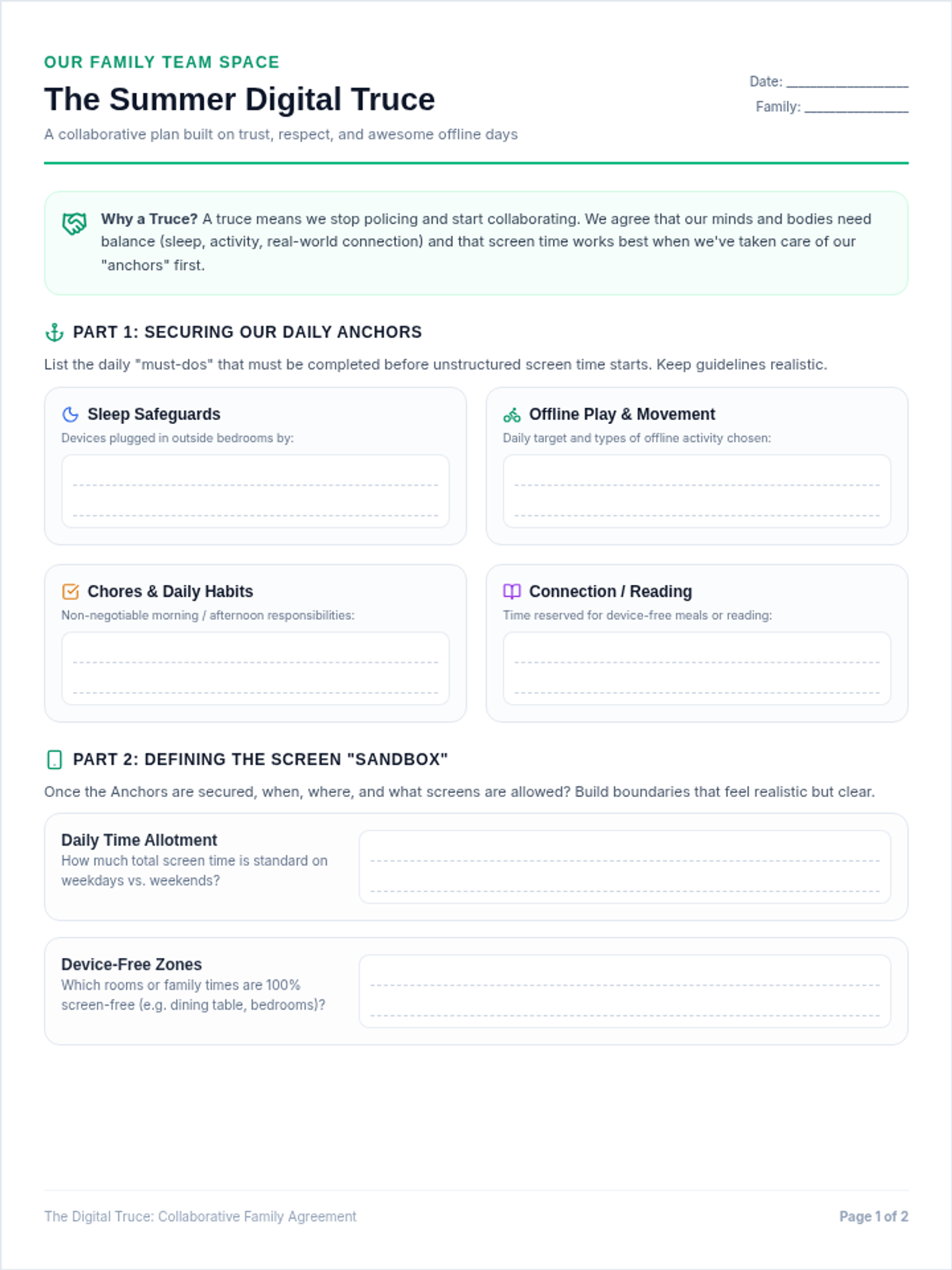
A 2-page highly engaging and structured printable worksheet/agreement template for families to draft, negotiate, and sign their personalized Summer Digital Truce.
A clean, highly visible 5-slide presentation deck used during the parent workshop to explain the shift from screen policing to collaborative boundaries.
A 2-page workshop facilitator guide for educators or parent-group leaders, detailing how to run a 60-minute interactive session on building collaborative summer tech agreements.
Visual aids for Lesson 4 explaining the importance of objective criteria (precedent, market value, expert opinion) in resolving disputes fairly.
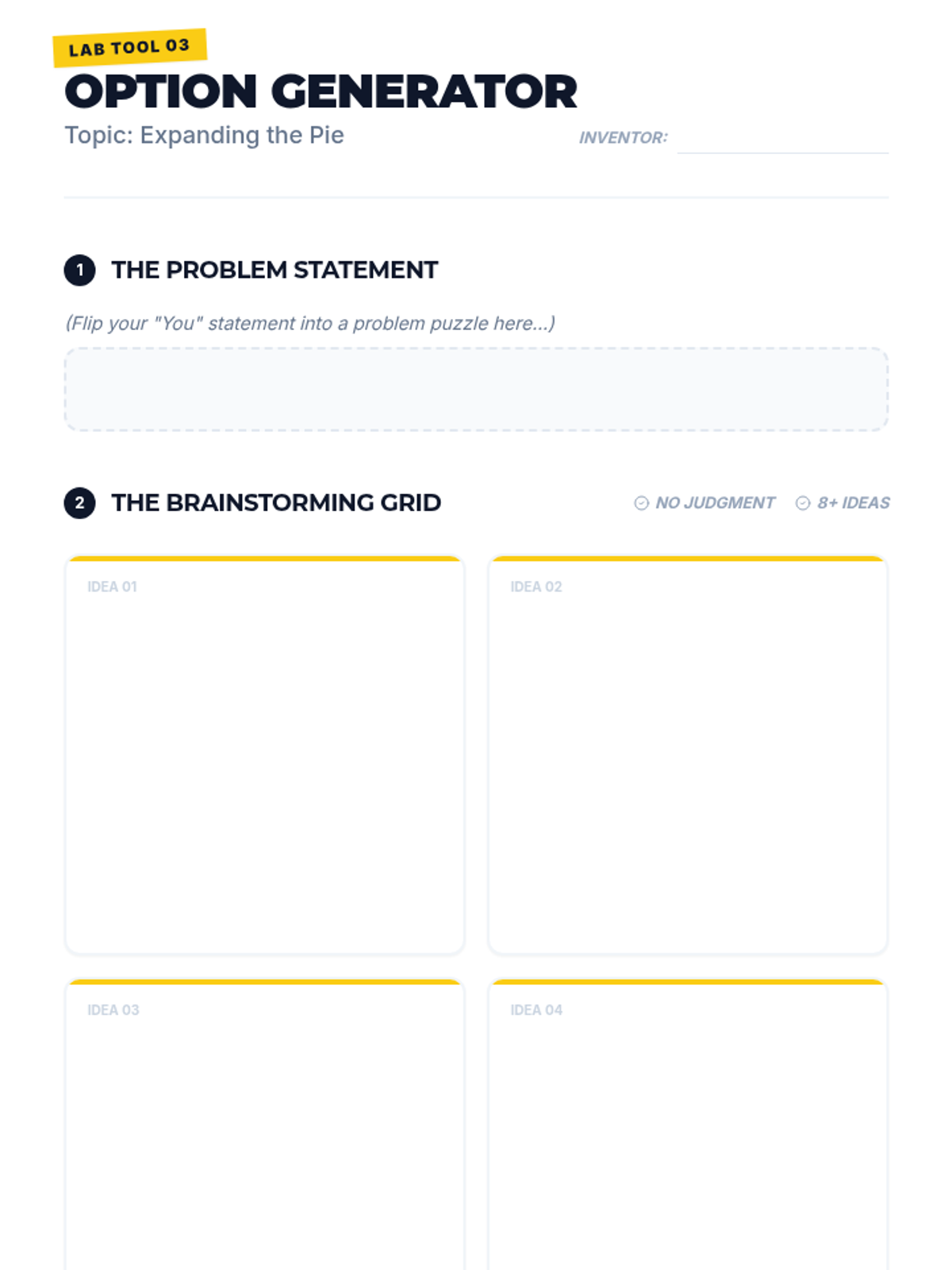
Student worksheet for brainstorming multiple creative solutions to a conflict, using a grid system and evaluation filters.
Visual aids for Lesson 3 focusing on the ideation phase, including the 'Bad Idea' hook and the classic Orange Dispute story.
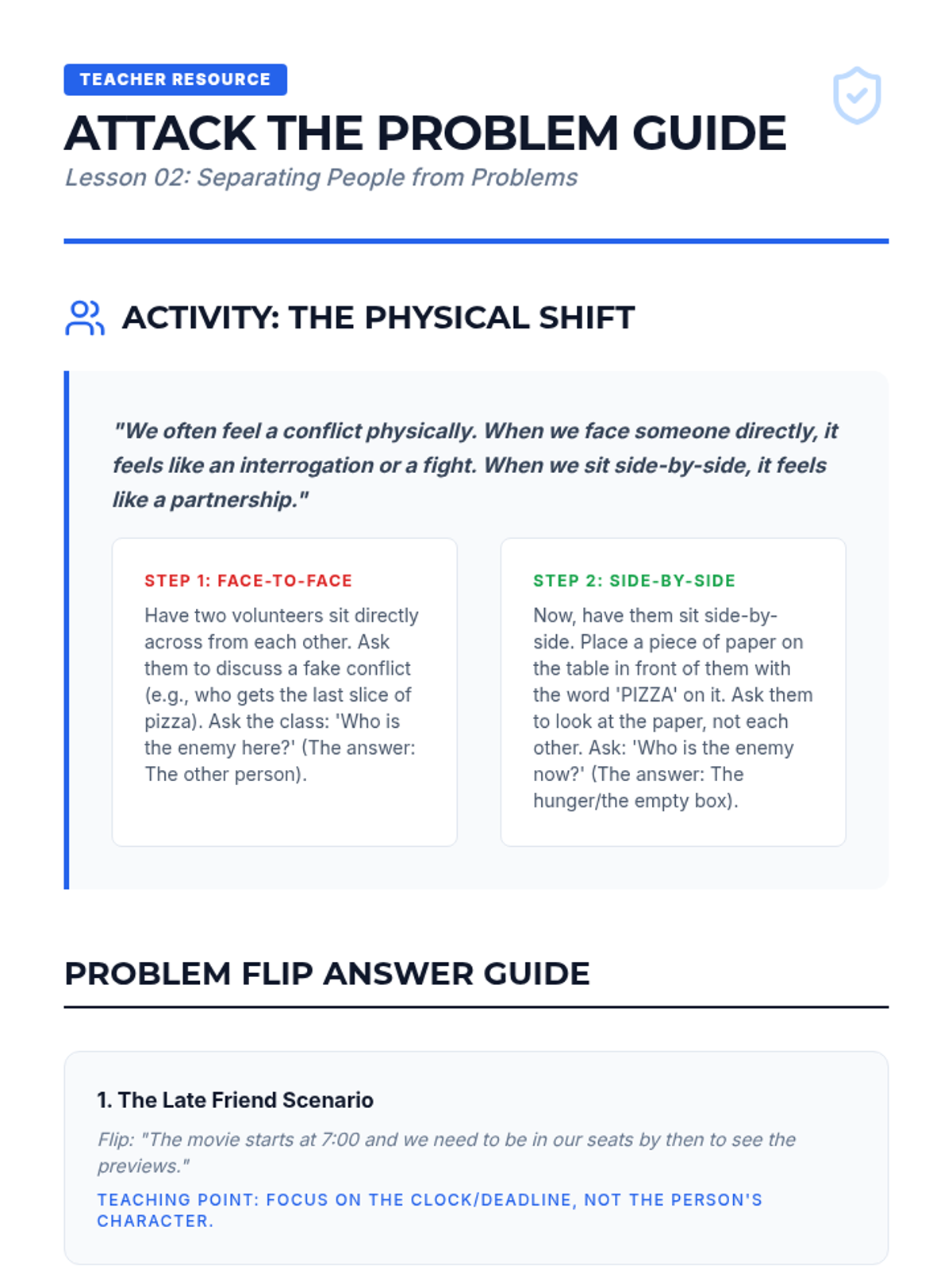
Teacher instructions for Lesson 2, including the physical side-by-side activity and an answer key for the Problem Flip Workshop.
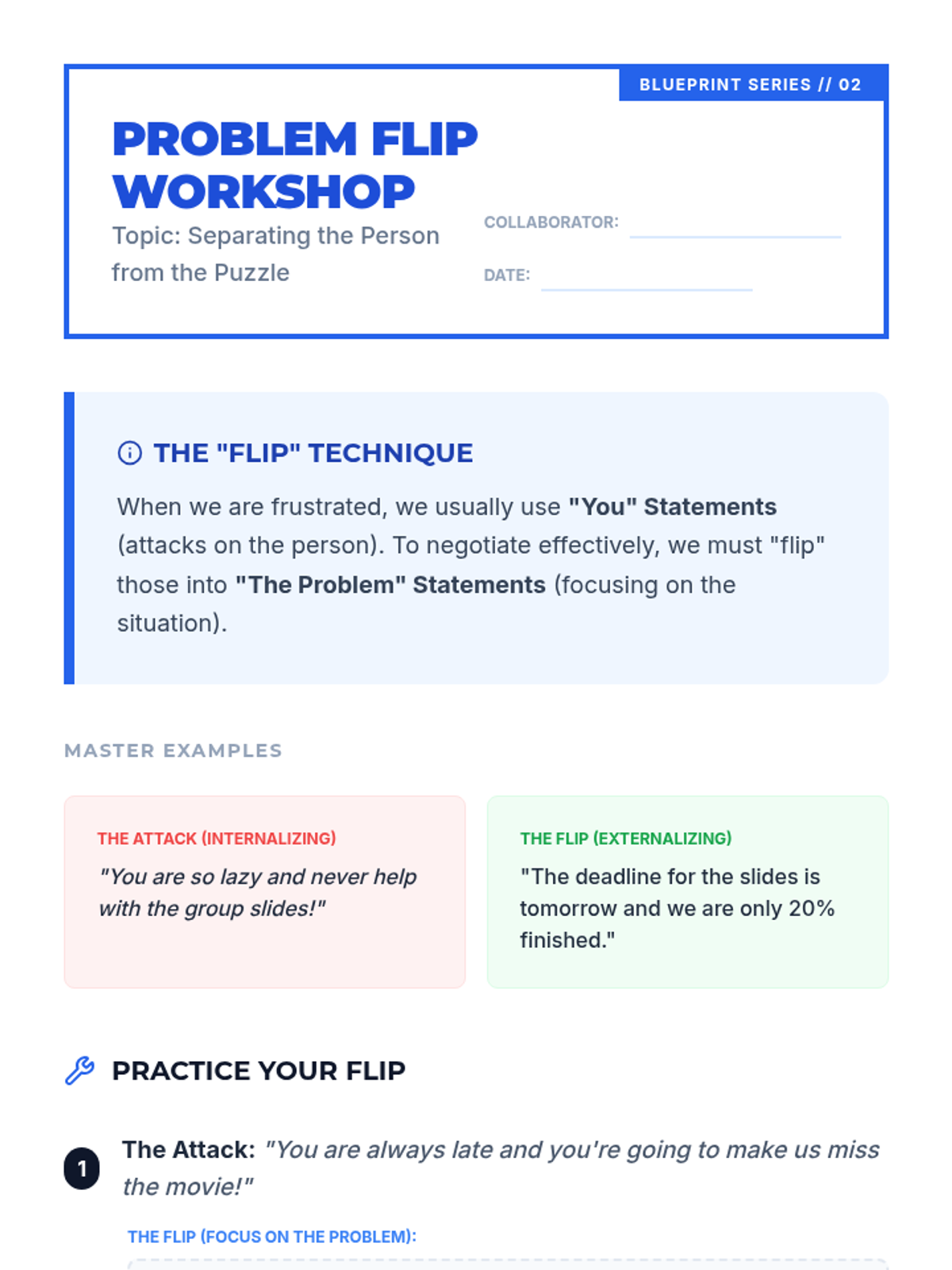
Student worksheet for practicing rephrasing personal attacks into objective problem statements using externalizing language.
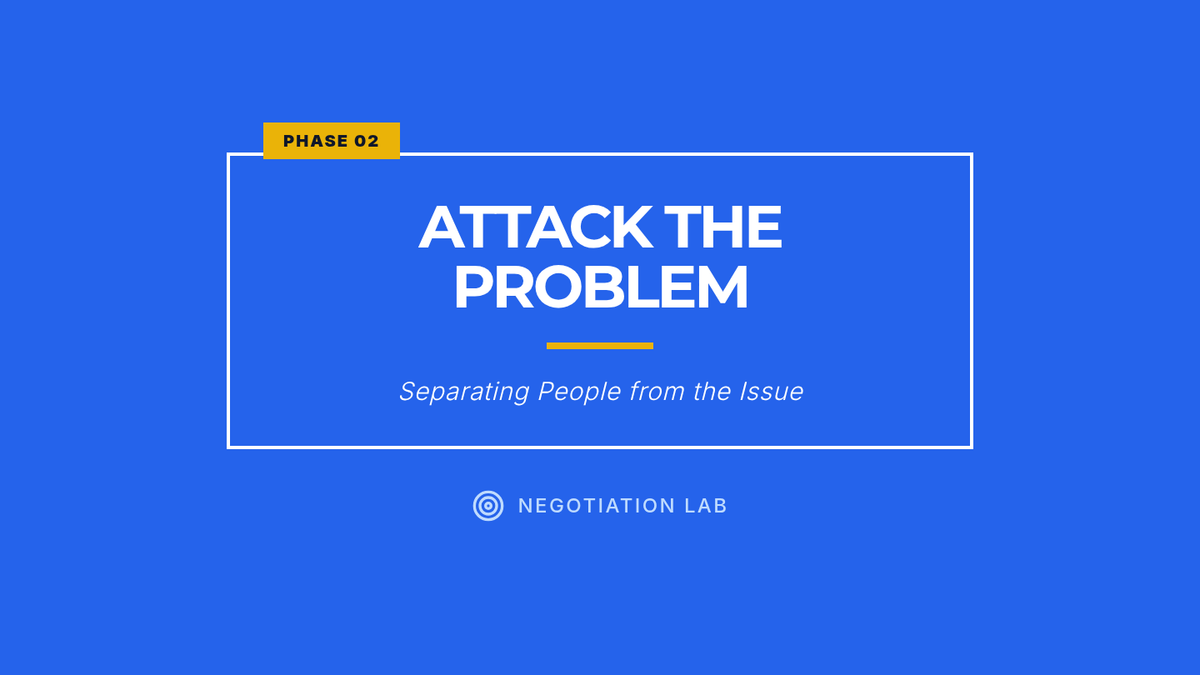
Visual aids for Lesson 2 explaining the difference between attacking people and attacking problems, including the physical shift and externalizing language.
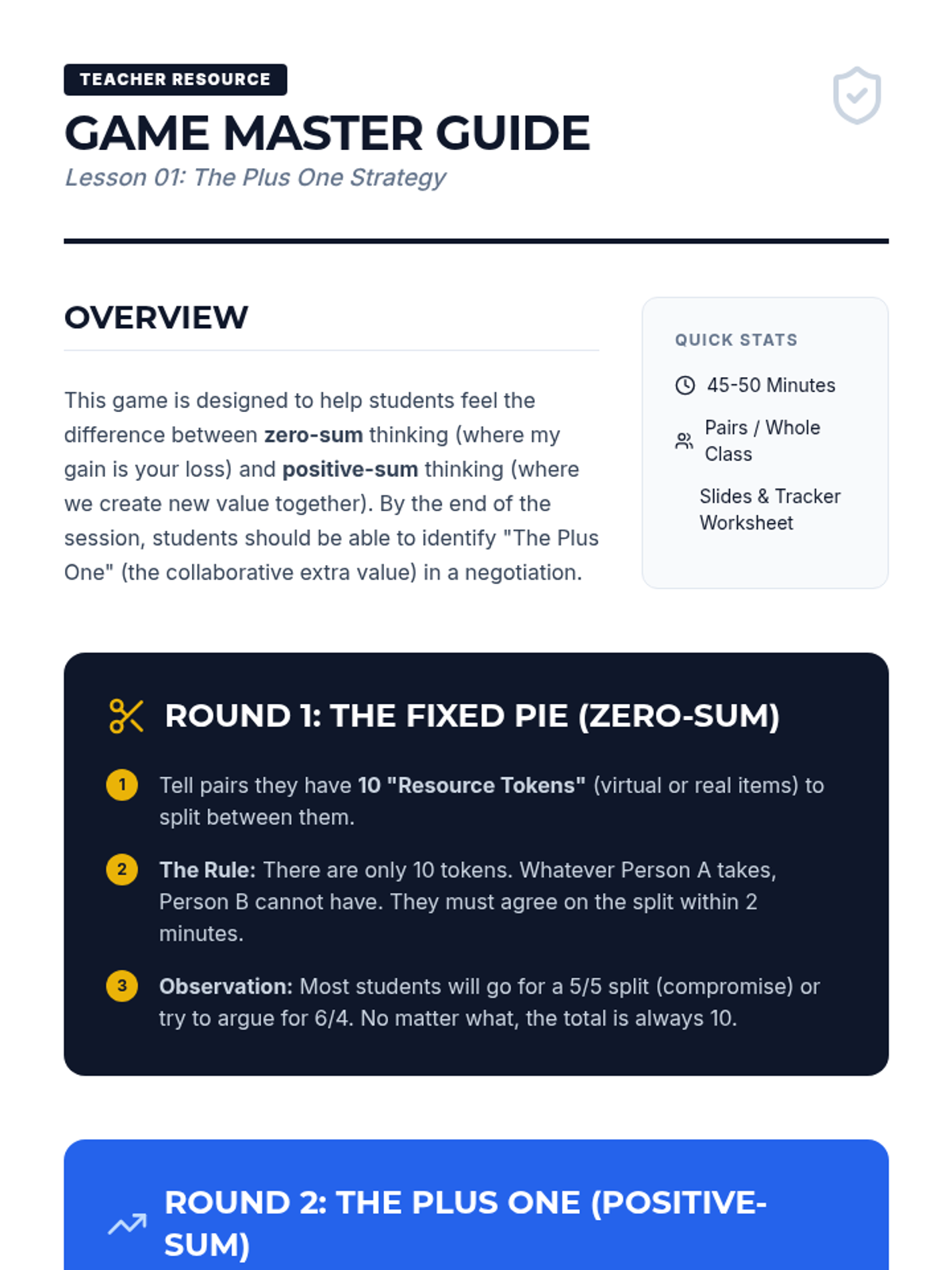
Teacher instructions for facilitating the trade game, including game rules, script points, and discussion prompts.
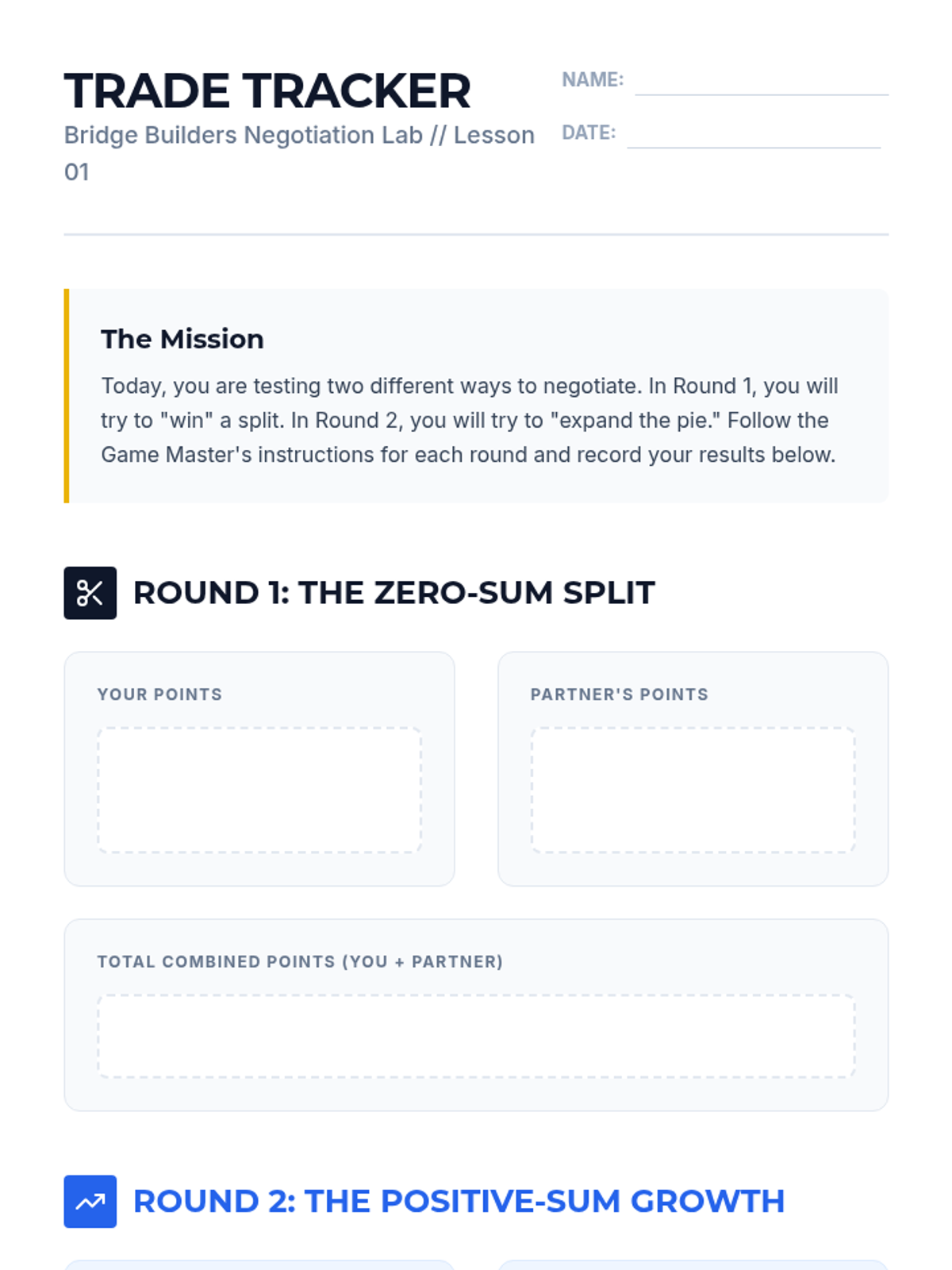
Student activity sheet for tracking points and reflecting on the outcomes of the zero-sum and positive-sum trading games.
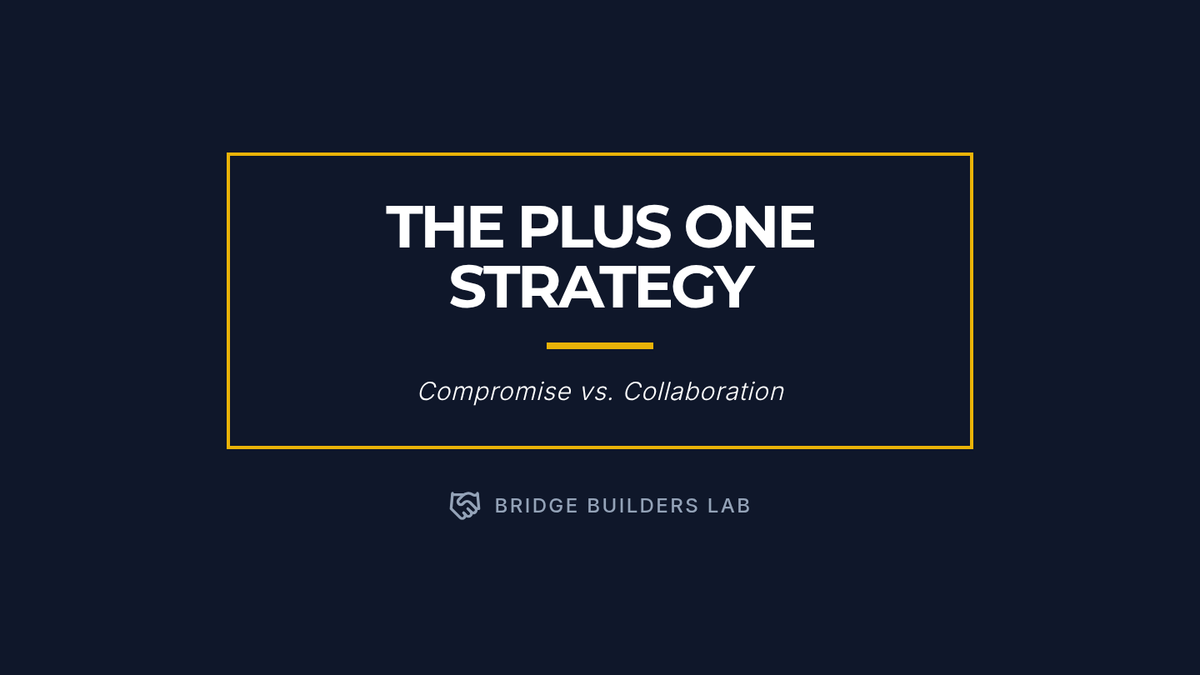
Introductory slides for the first lesson on the difference between compromise and collaboration, featuring the 'Plus One' strategy.
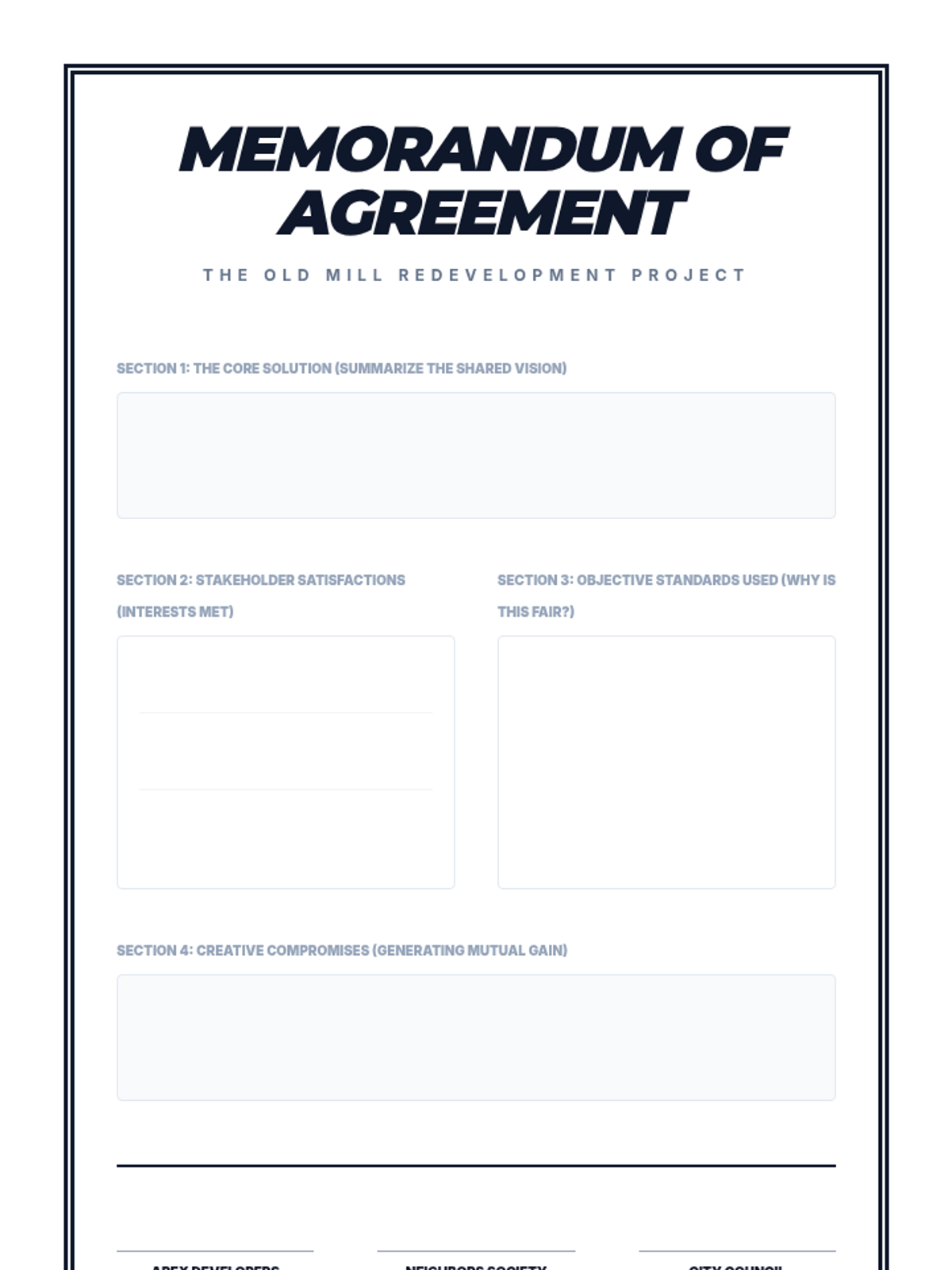
The final agreement template for the 'Old Mill' simulation, where students formalize their negotiated solution, citing interests and objective criteria.
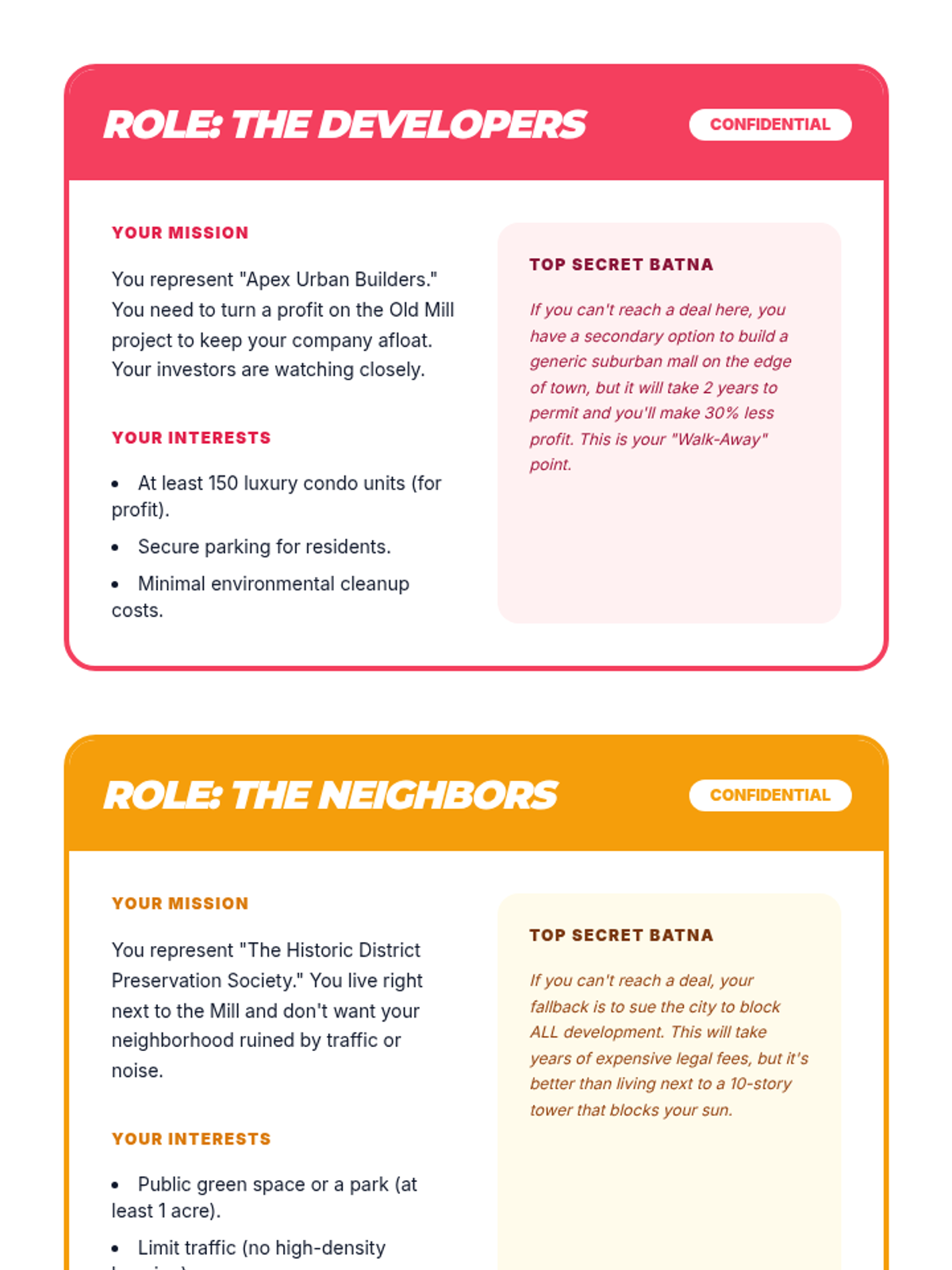
Confidential role profiles for the three parties in the 'Old Mill' negotiation simulation, outlining missions, interests, and secret BATNAs.
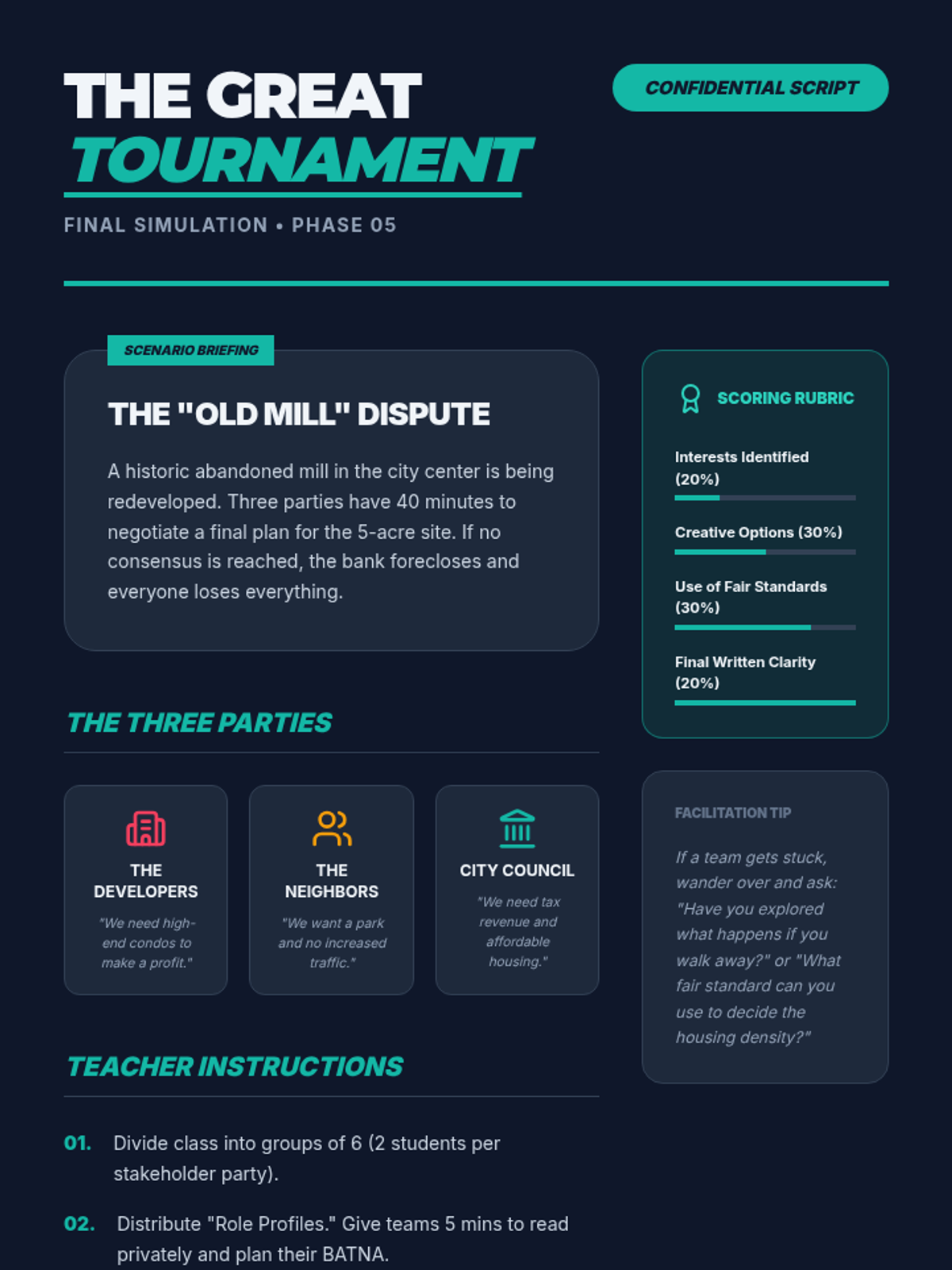
Teacher guide for the final negotiation simulation, providing setup instructions, party descriptions, and a scoring rubric for the 'Old Mill' dispute.
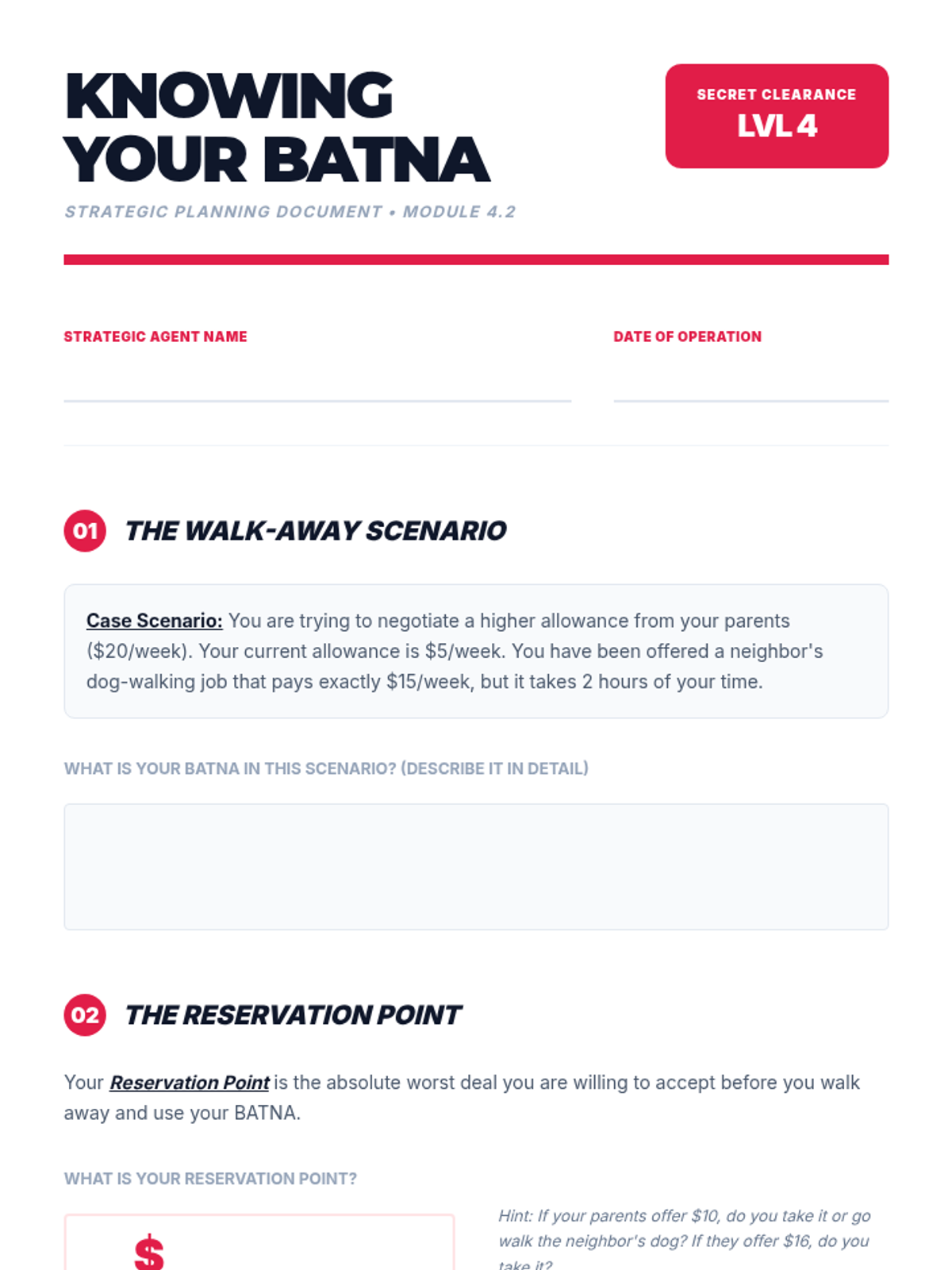
Student worksheet for Lesson 4, helping students define their BATNA and Reservation Point through an allowance-based scenario.
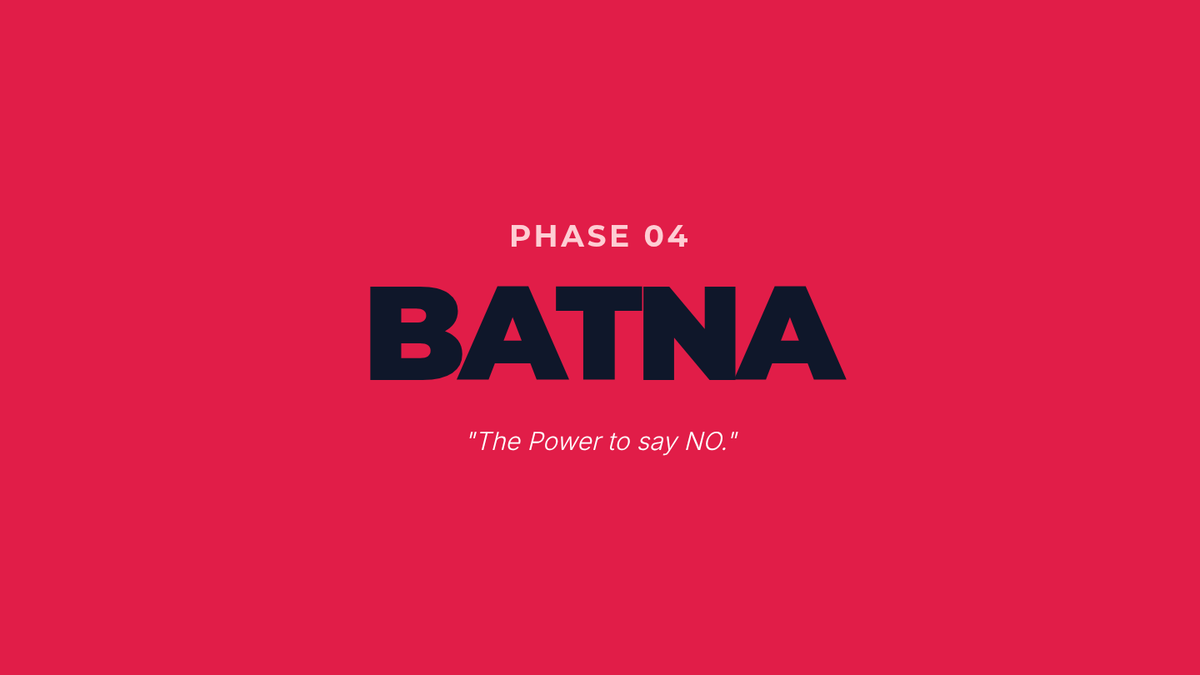
Visual slide deck for Lesson 4, explaining the BATNA acronym and how leverage works through alternative planning.
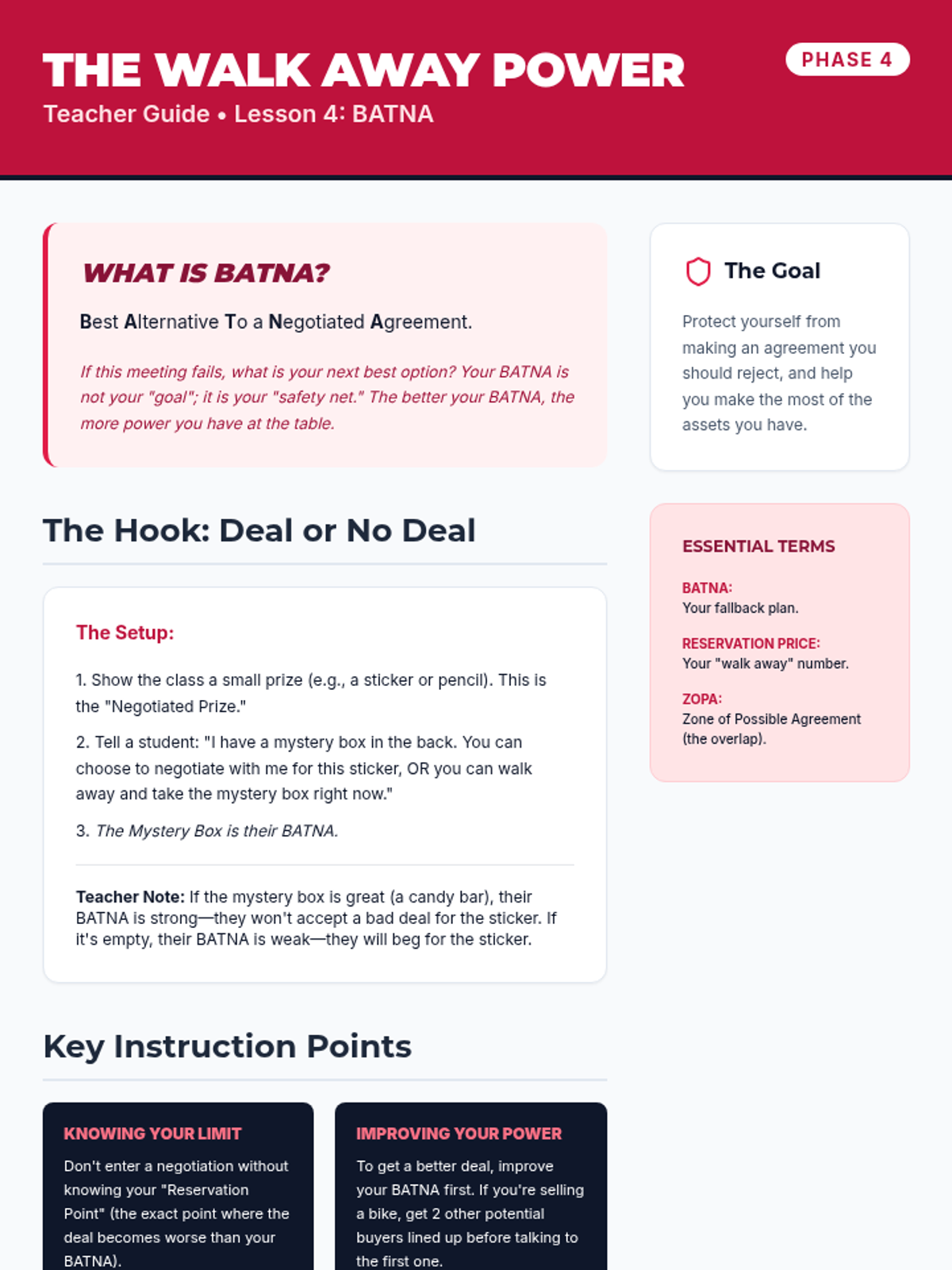
Teacher guide for Lesson 4, introducing students to the concept of BATNA (Best Alternative to a Negotiated Agreement) and how it provides leverage in negotiations.
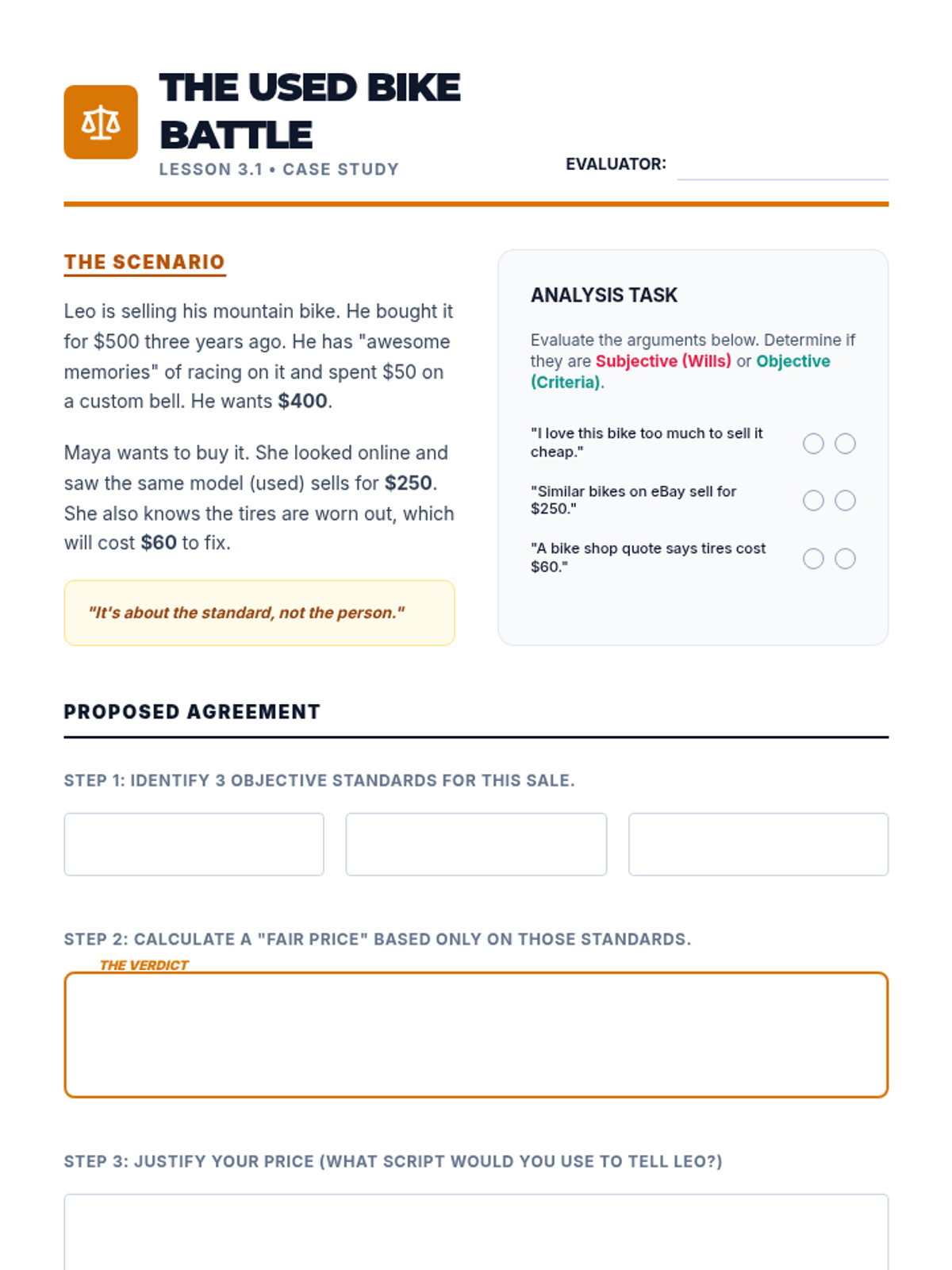
Case study worksheet for Lesson 3, where students analyze a used bike sale to differentiate between subjective feelings and objective market standards.
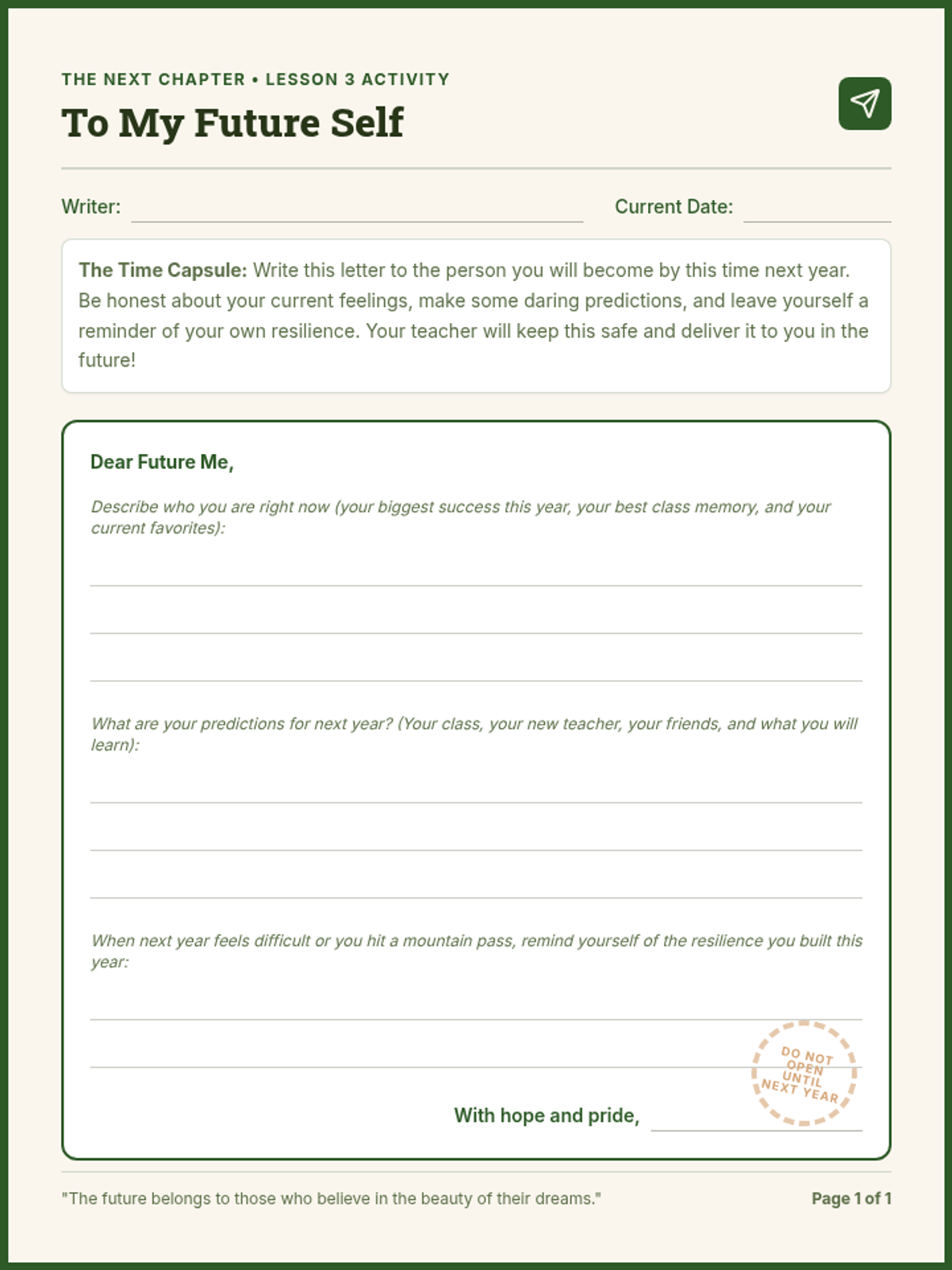
A beautifully structured future-self writing template where students record predictions, personal advice, and words of encouragement for next school year.
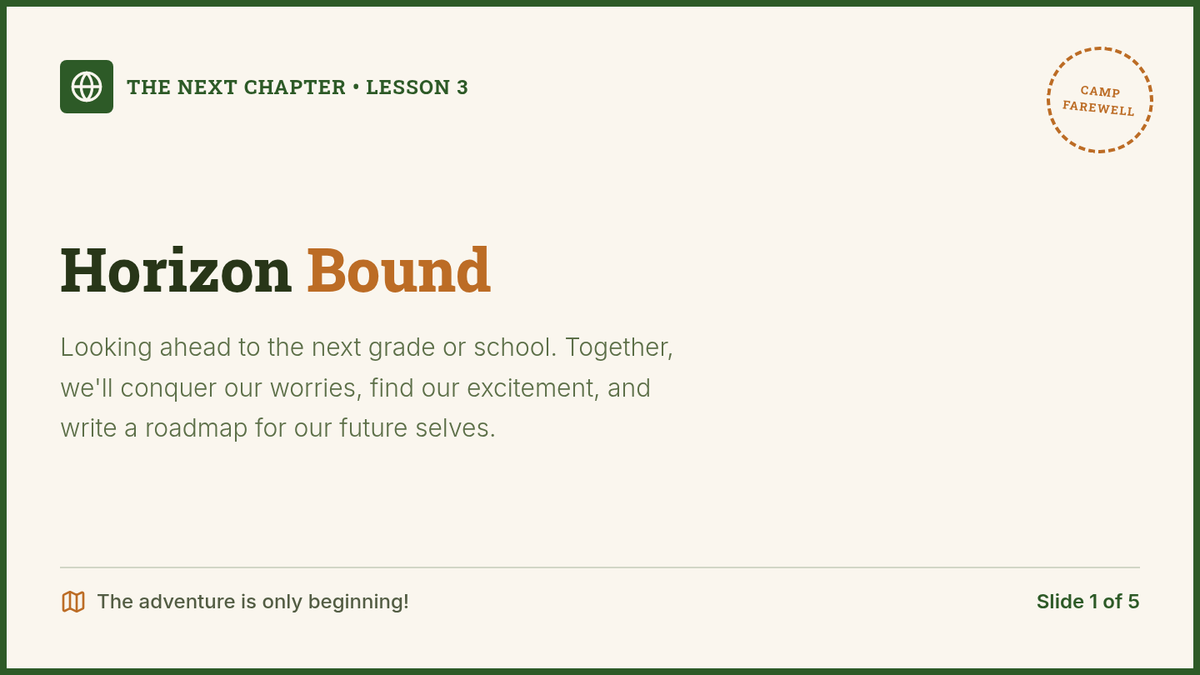
An interactive slide deck guiding students through future grade transitions, exploring their mixed feelings of anxiety and excitement, and collecting wisdom for next year's incoming students.
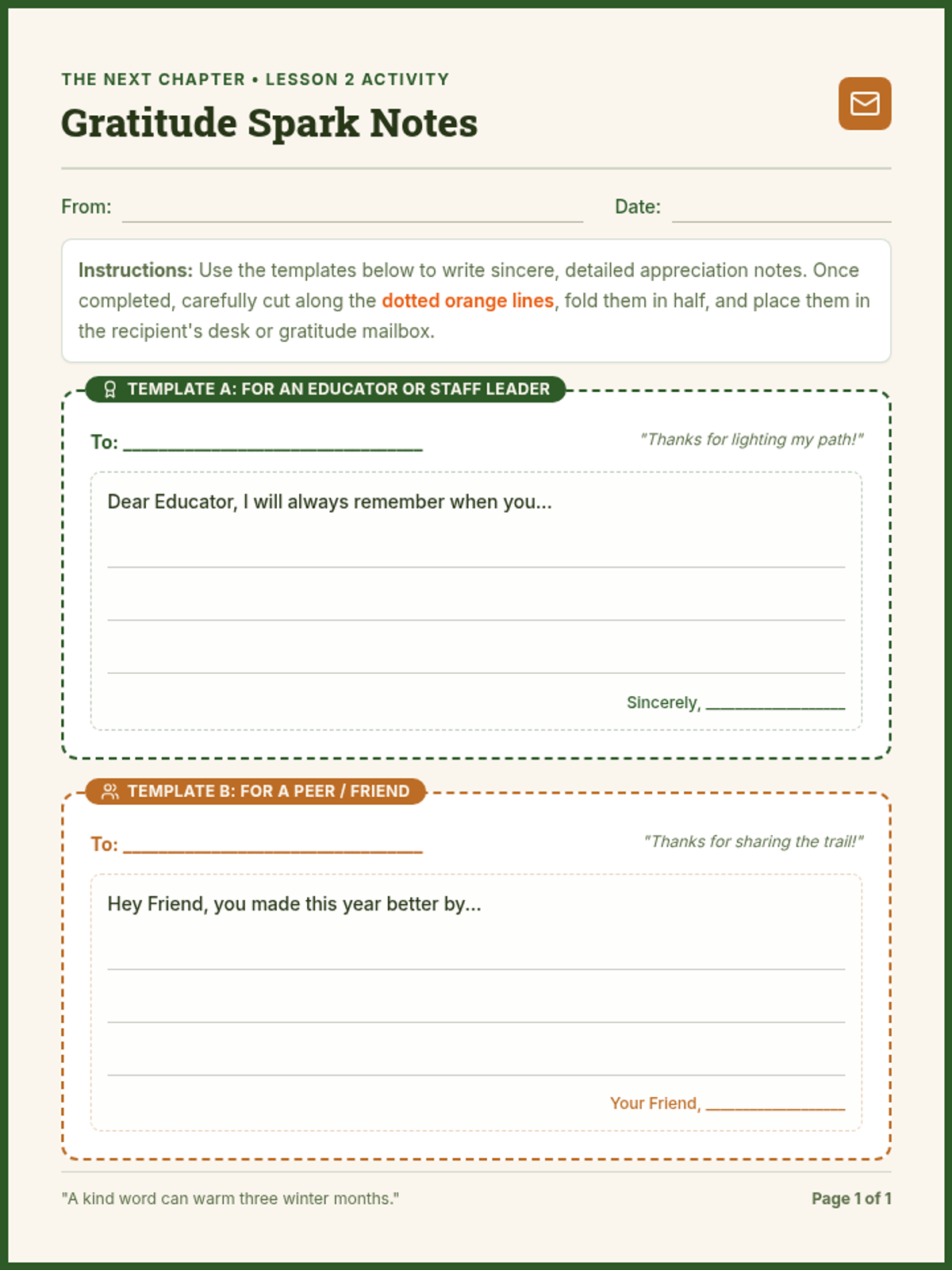
A printable template sheet with folding gratitude card designs for students to write warm, specific appreciation letters to classmates and teachers.
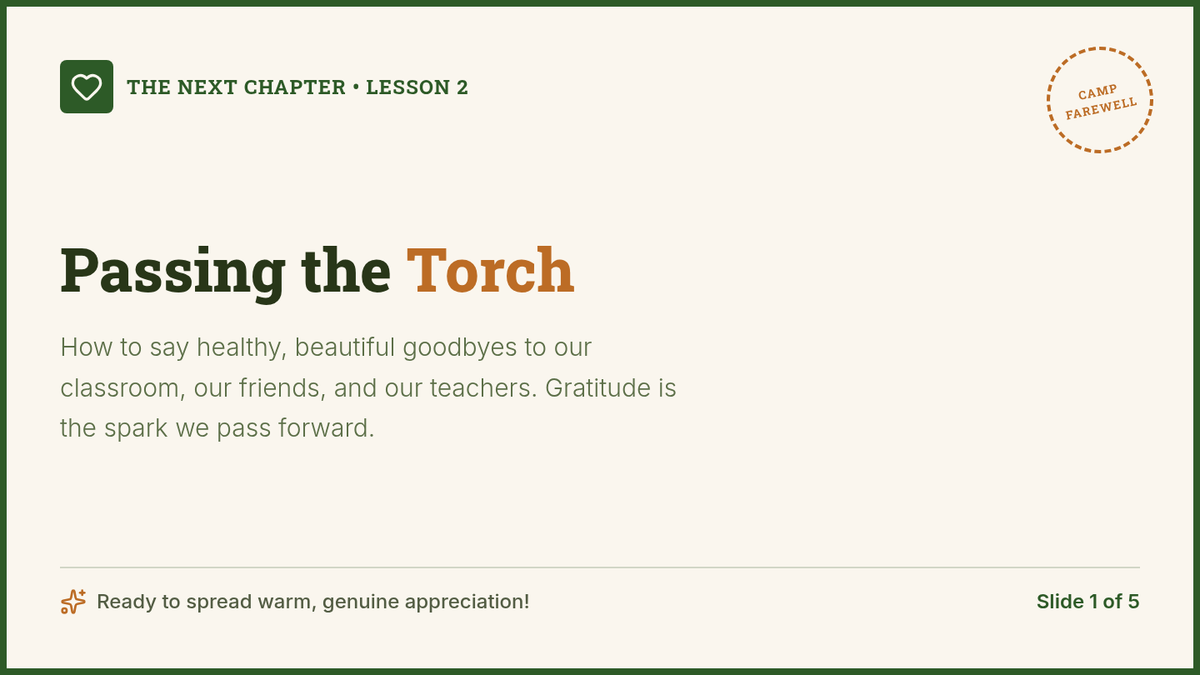
An interactive presentation that helps students discuss saying healthy, thoughtful goodbyes, acknowledging mixed emotions, and using gratitude as a tool for meaningful closure.
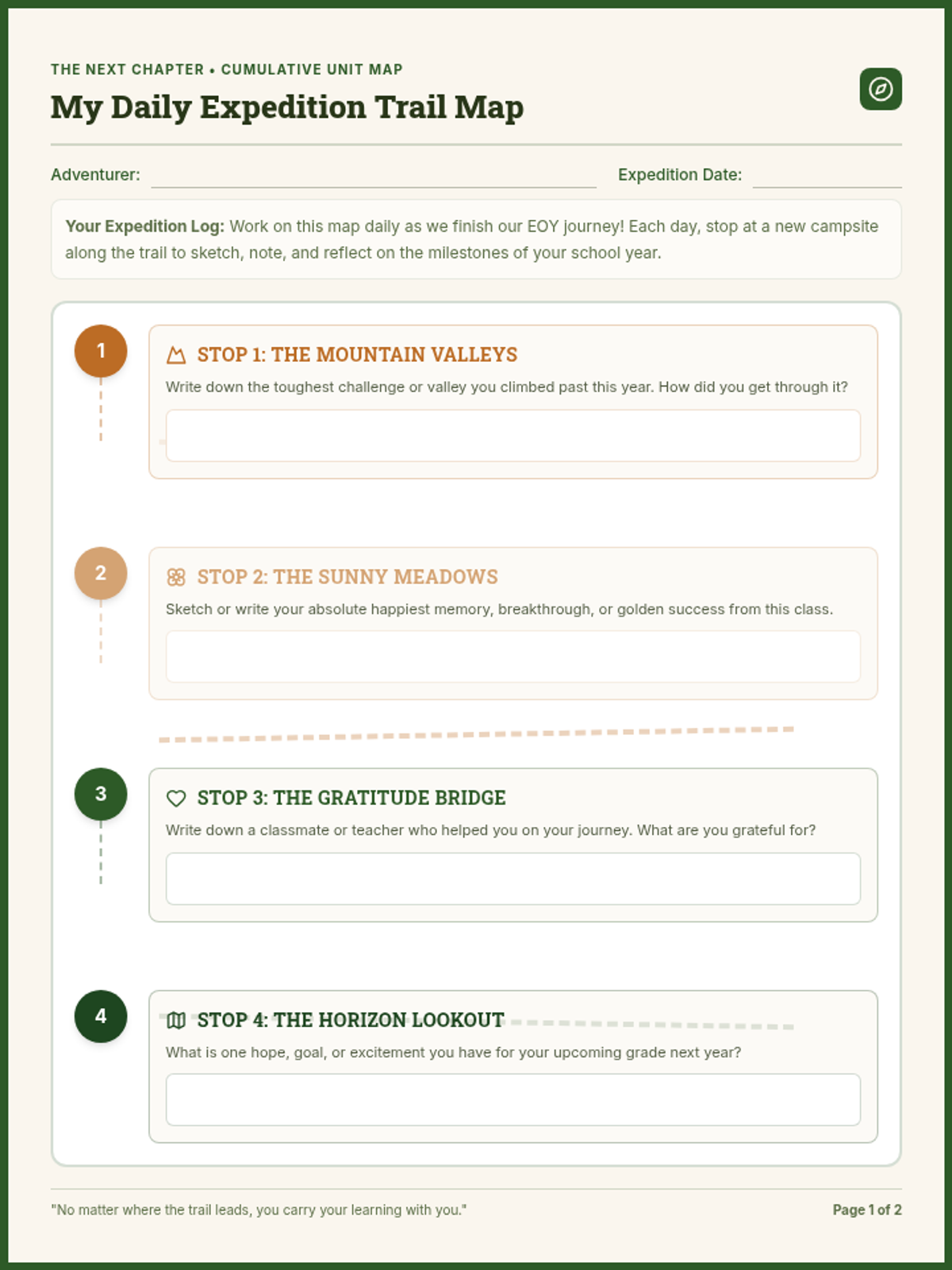
A multi-day EOY reflection journal styled like an explorer's trail map, where students log daily reflections on their valleys, meadows, gratitude, and future goals.
The first part of the divided slide presentation for Lesson 2, focusing on navigating difficult mountain passes, building resilience, and processing the year's challenges.
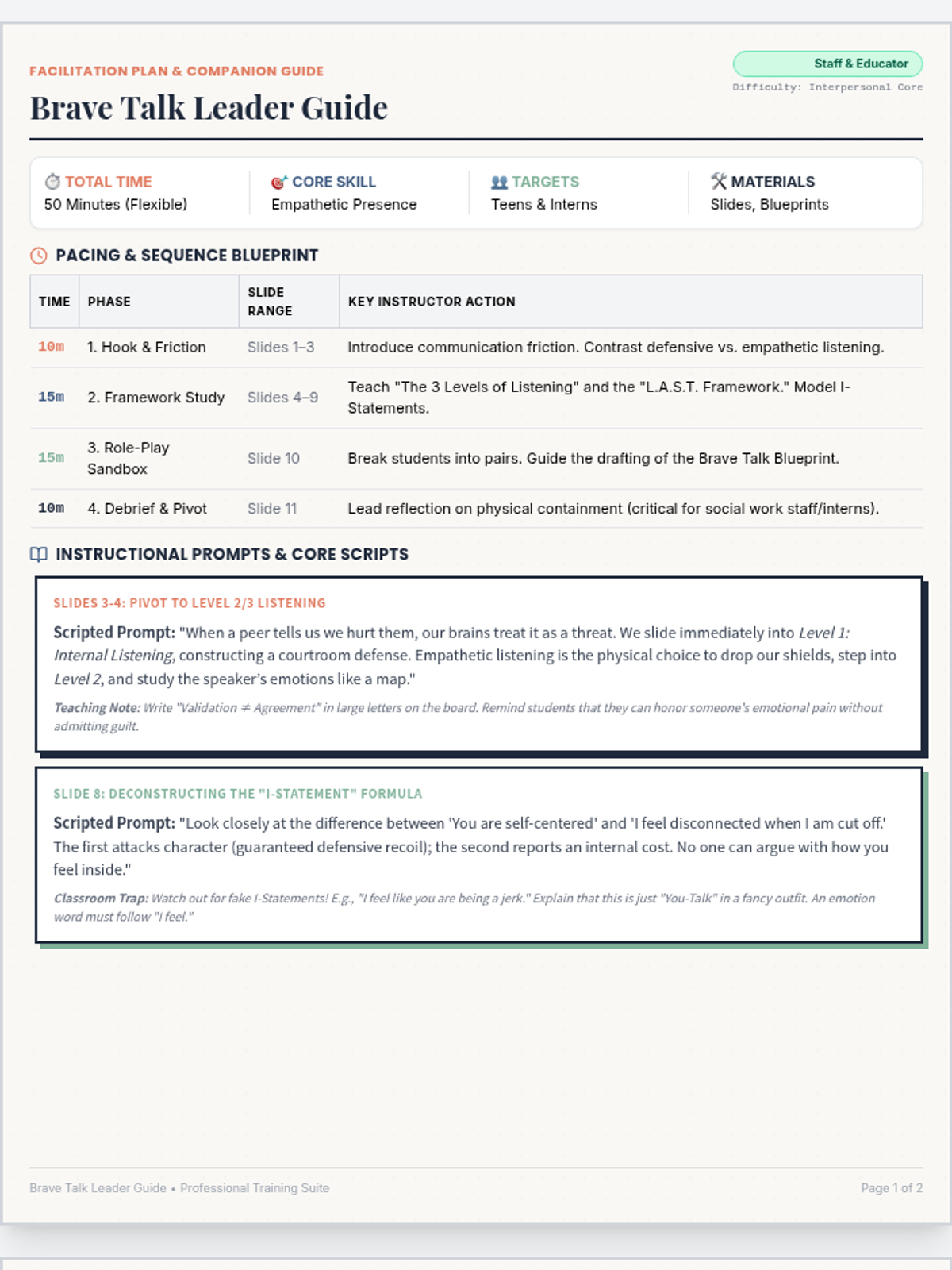
A professional 2-page companion and facilitation guide for teachers and supervising social workers. Includes slide-by-slide prompt scripts, targeted role-play guidelines, developmental debriefing structures, and boundaries supervision protocols.
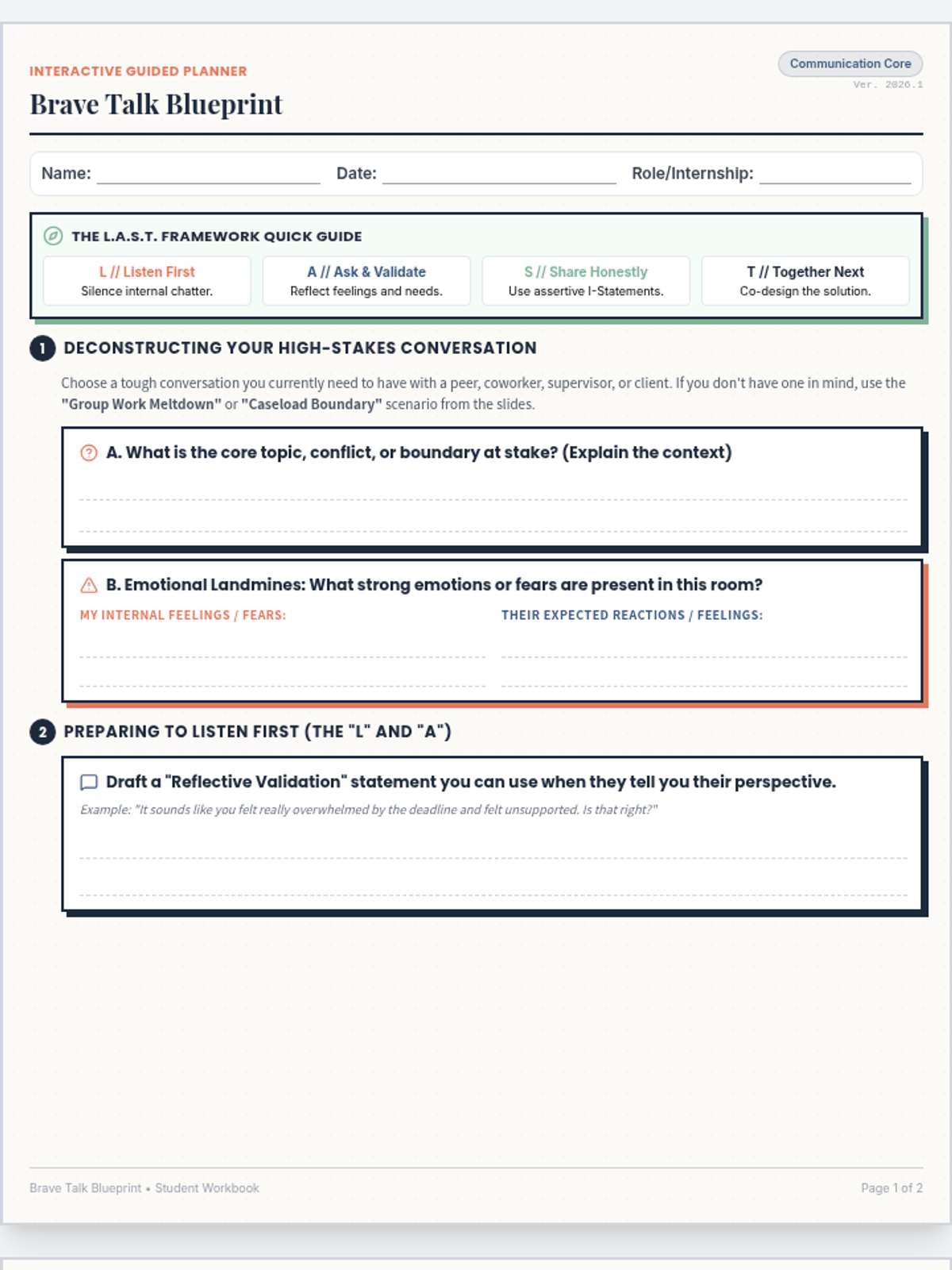
A double-sided blueprint worksheet for students and interns to deconstruct difficult conversations. It features a complete planning sandbox for crafting I-statements, planning reflective listening responses, and analyzing personal default communication pitfalls.
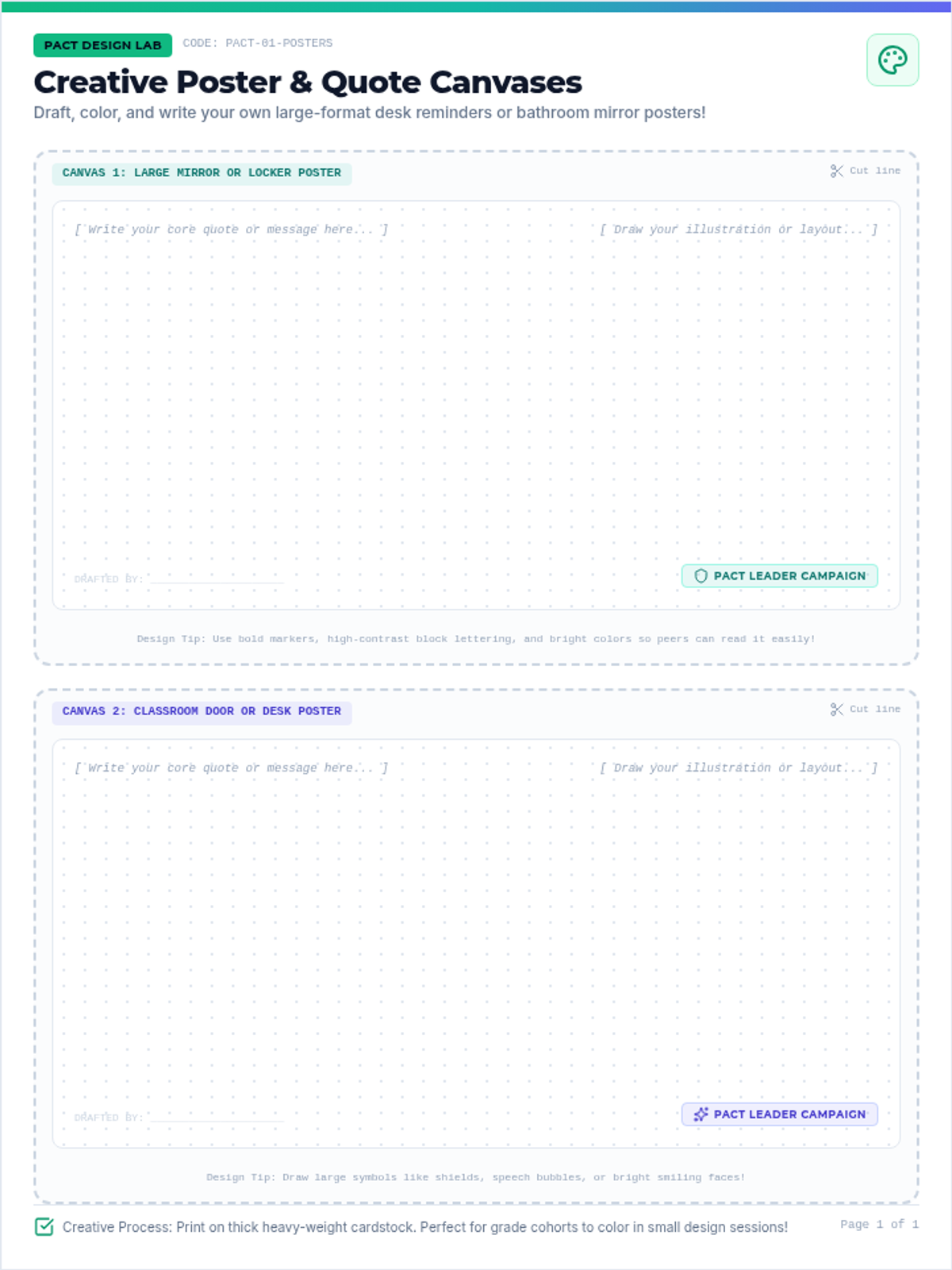
A printable set of large-format design canvases with guide borders and PACT badges, allowing student leaders to hand-draw, color, and draft custom posters or large desk reminders.
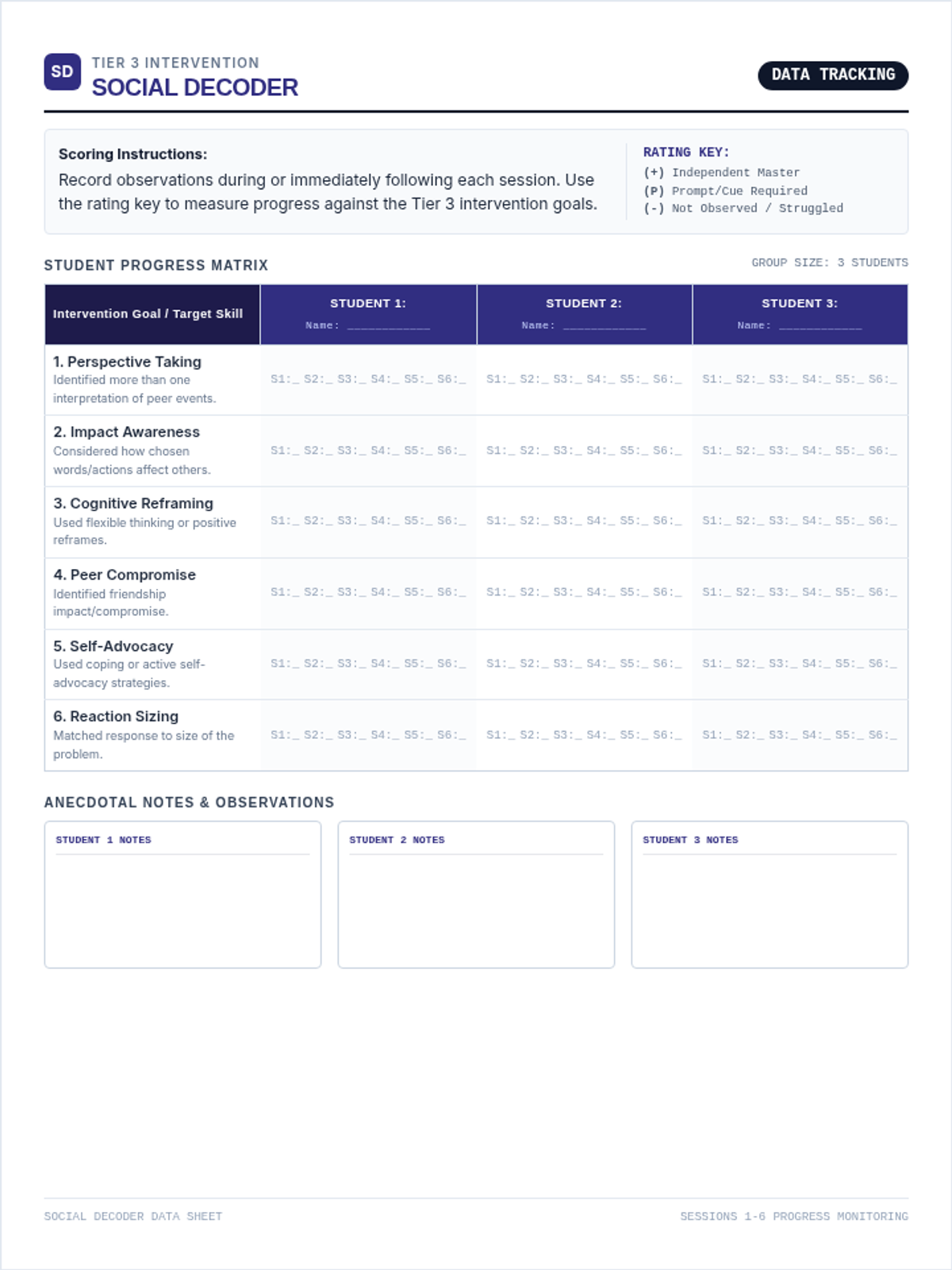
A clean, highly structured 1-page progress-tracking data sheet for facilitators to observe and rate three students' cognitive-behavioral skills across the 6 sessions.
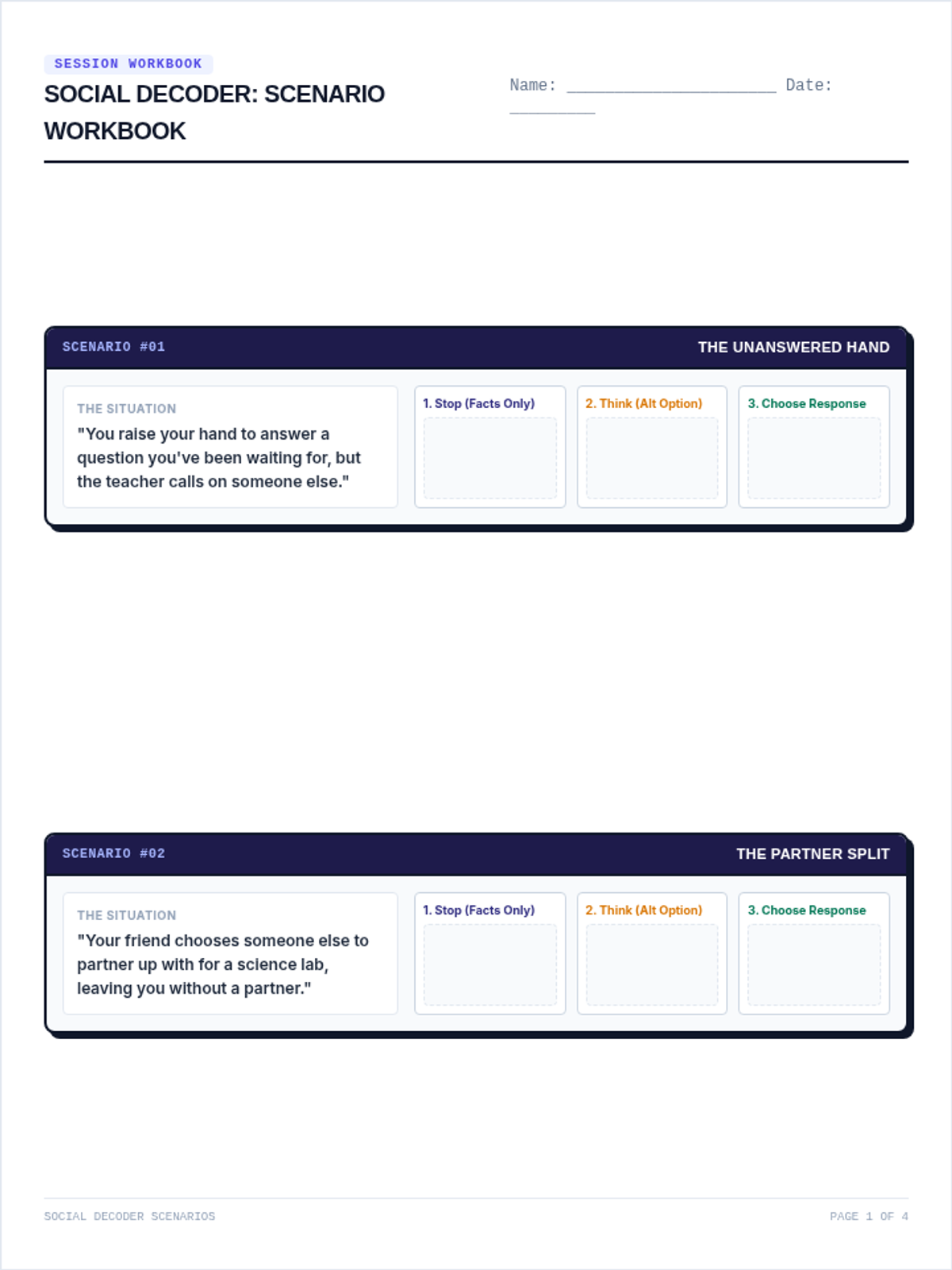
A 4-page interactive scenario workbook containing six clean, comic-paneled social situations. Provides large, blank response grids for student completion of the Stop, Think Twice, Choose framework.
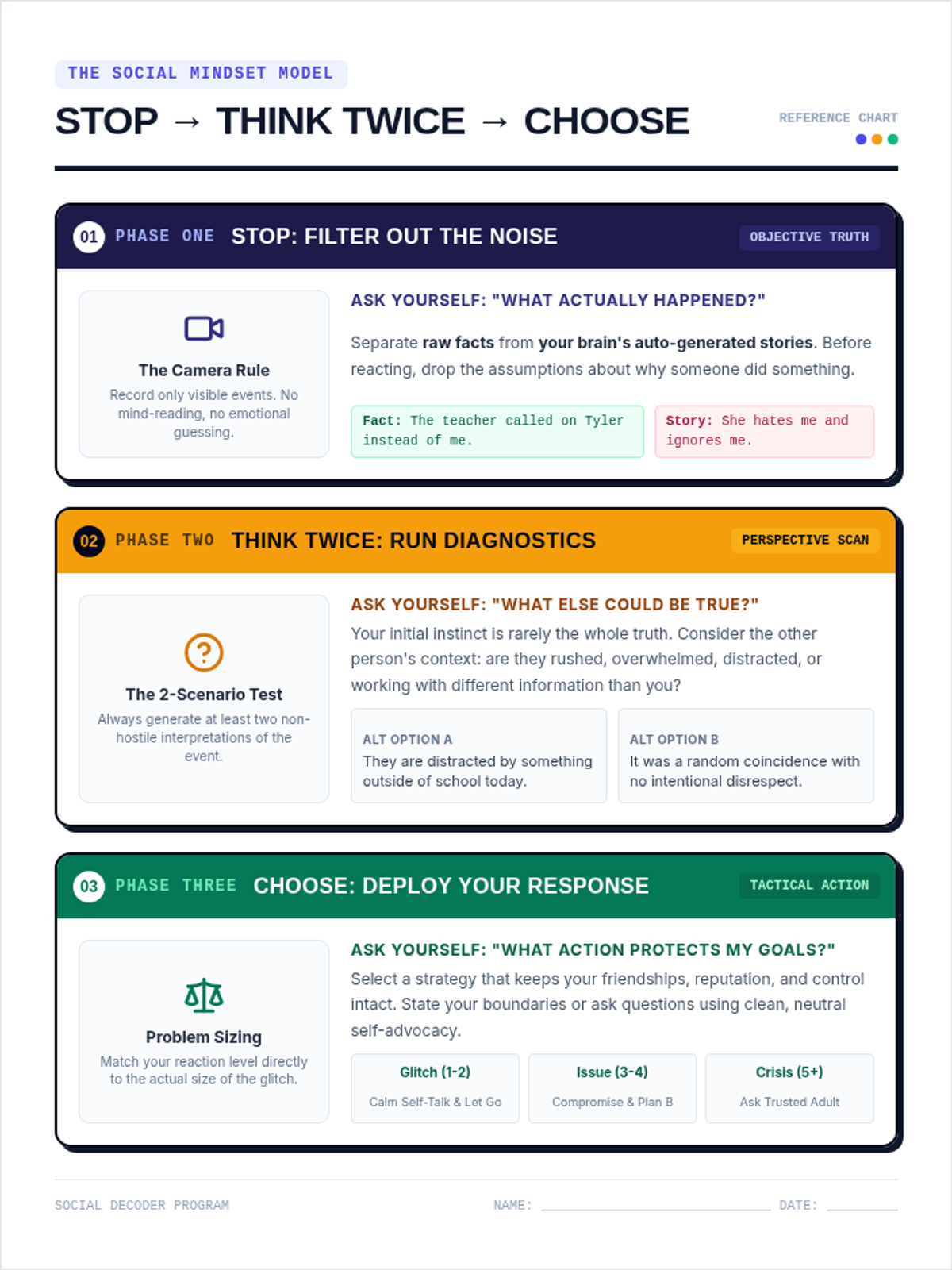
A highly polished 1-page visual anchor chart for sixth-grade students, breaking down the Stop, Think Twice, Choose framework into mature, logical steps with objective data concepts.
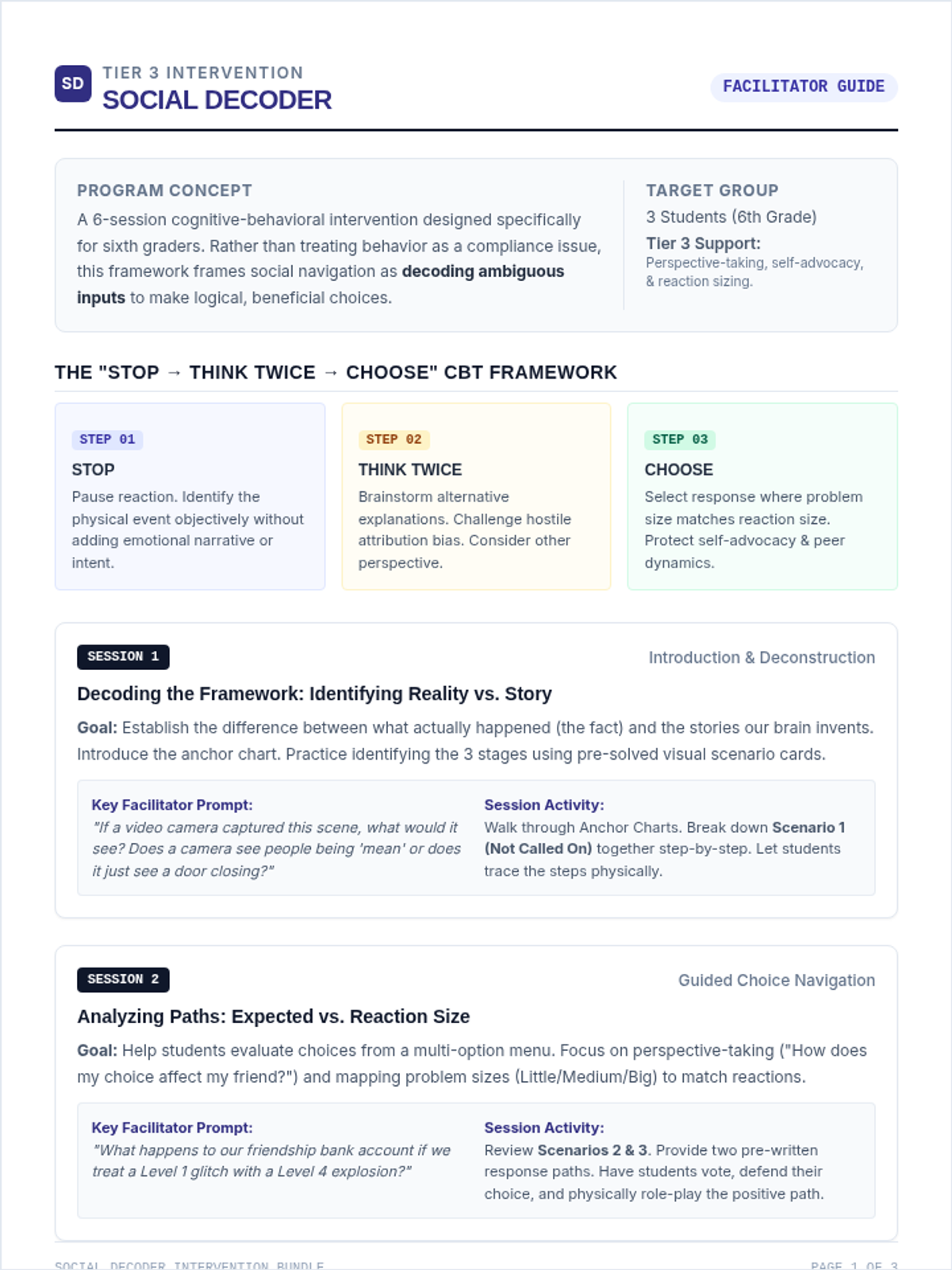
A 3-page print-ready facilitator guide detailing the 6-session social dynamics curriculum for Tier 3 sixth graders using the 'Stop, Think Twice, Choose' framework. Includes pacing, session goals, discussion prompts, and small-group facilitation techniques.
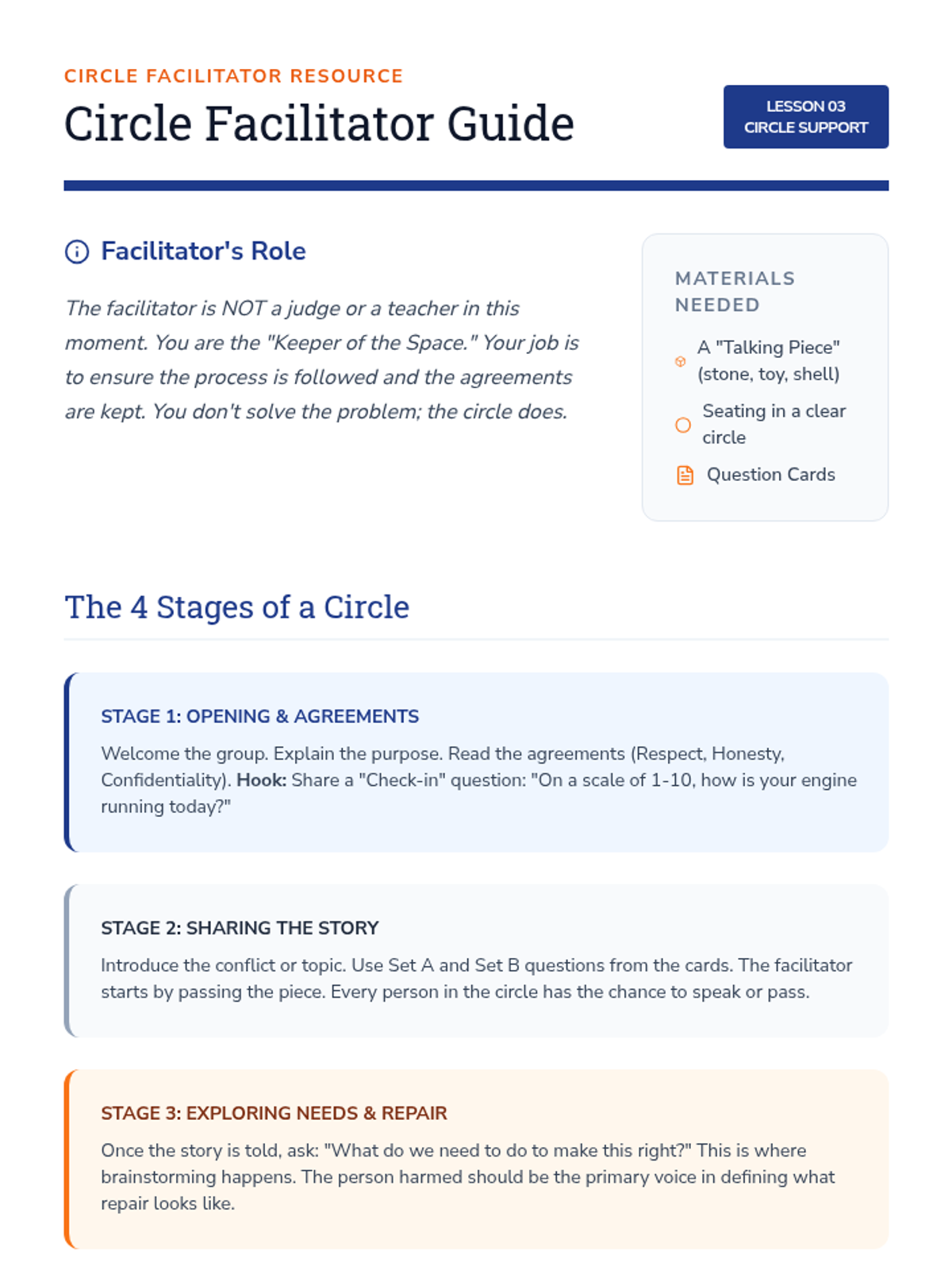
Comprehensive facilitation guide for teachers on how to lead a restorative dialogue circle, including stages, scripts, and troubleshooting tips.
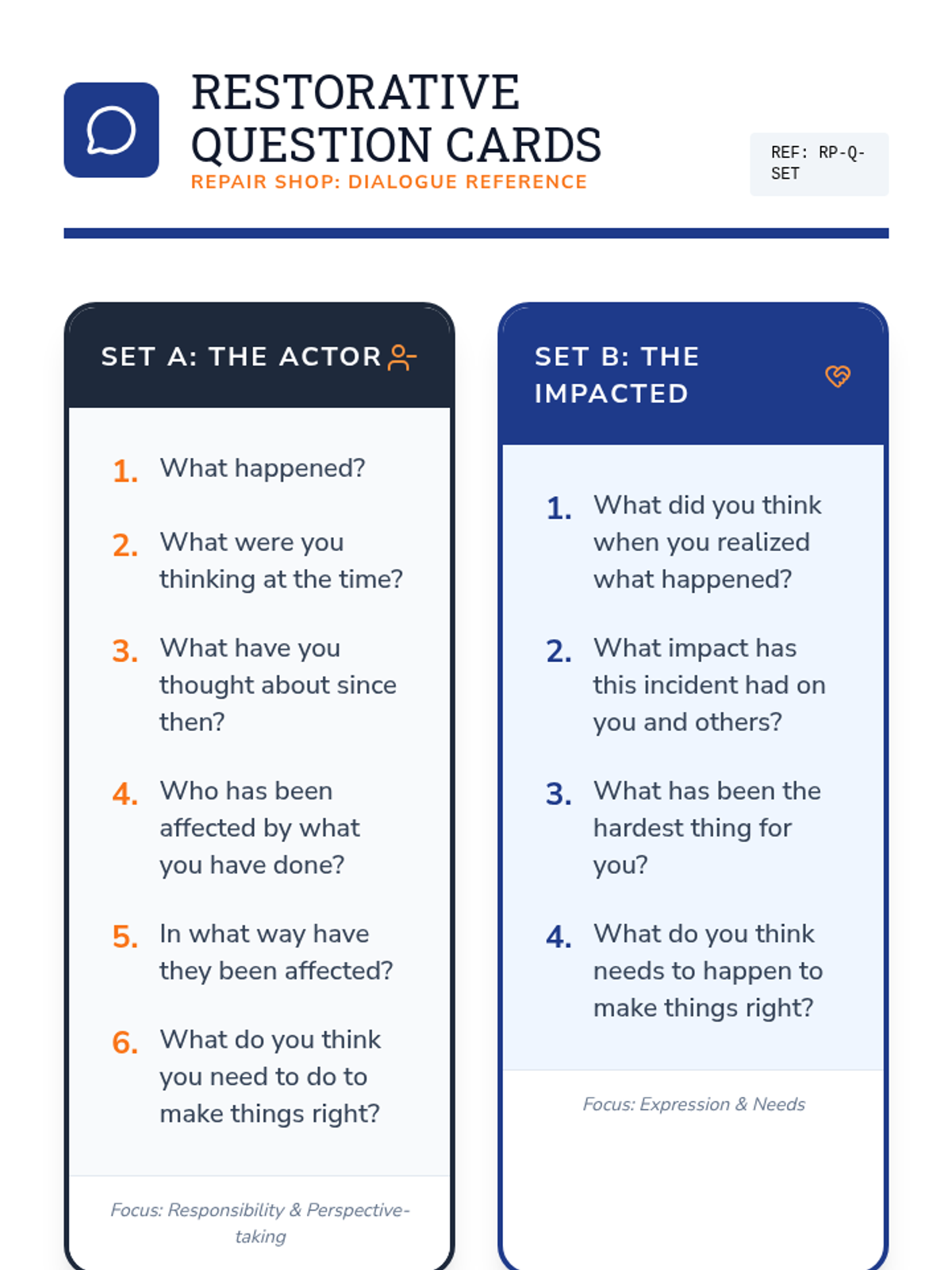
Set of standard restorative justice questions for both the person who caused harm and the person affected, designed for student use during dialogue circles.
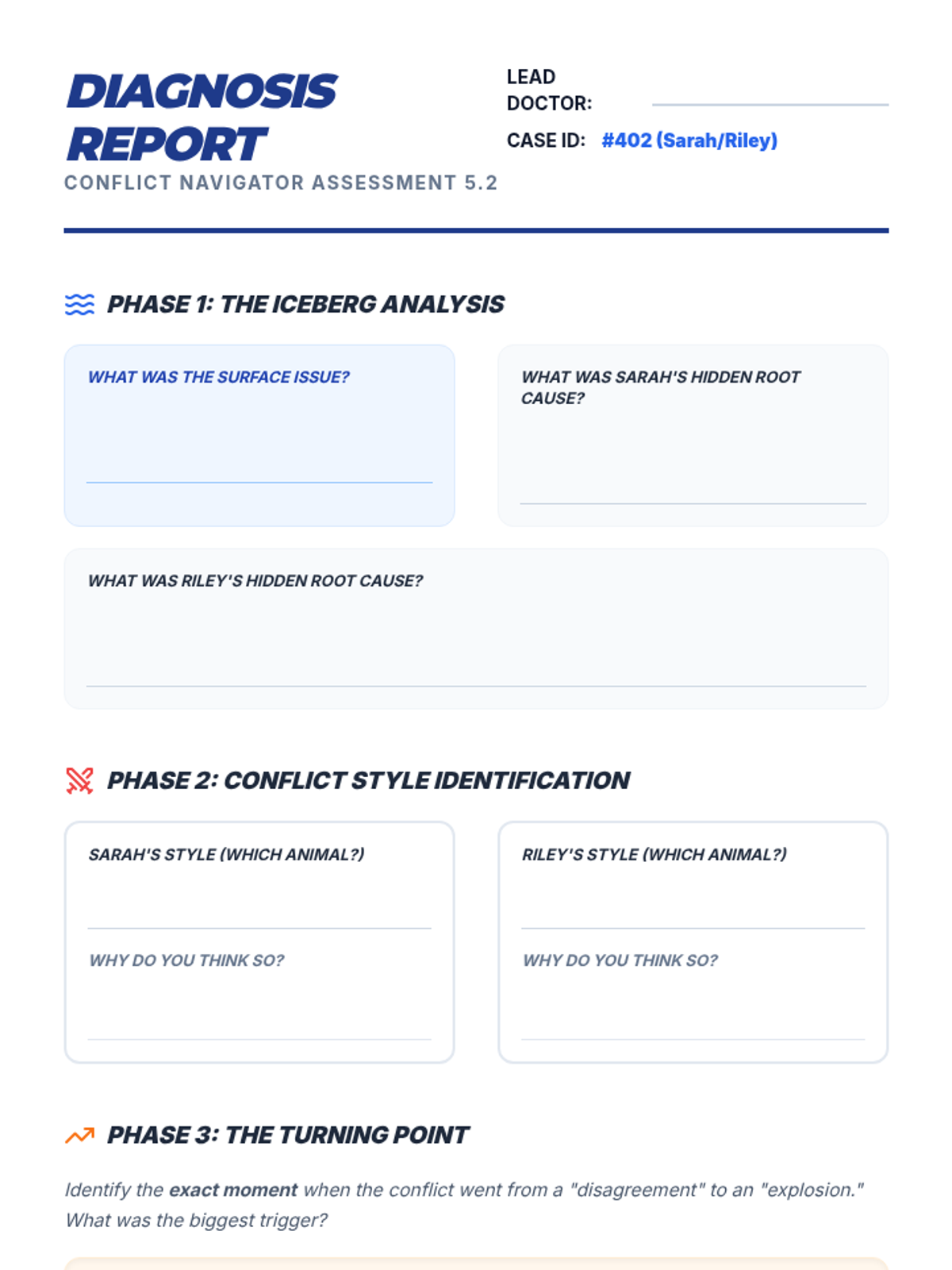
The final assessment form for students to synthesize their learning by diagnosing the Sarah/Riley case study, identifying root causes, styles, and intervention strategies.
Visual slide deck for Lesson 3: Restorative Dialogue Circles, introducing the circle process, talking pieces, and the core restorative questions.
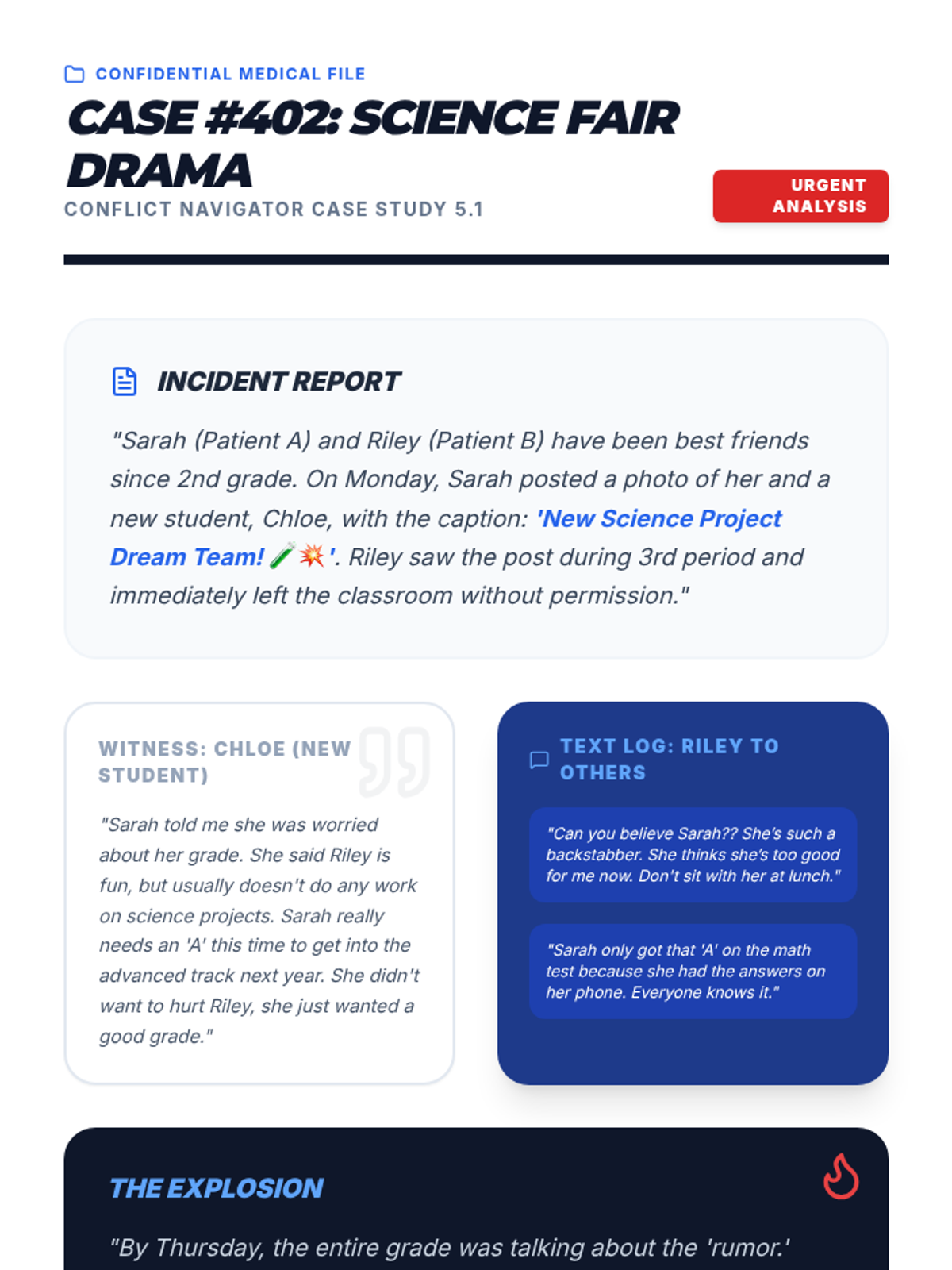
A detailed fictional case study for the final lesson, providing students with witness statements, text logs, and incident reports to analyze a complex middle school conflict.
Slides for the final lesson, framing the conflict resolution synthesis activity as a "Conflict Clinic" where students act as doctors to diagnose a complex dispute.
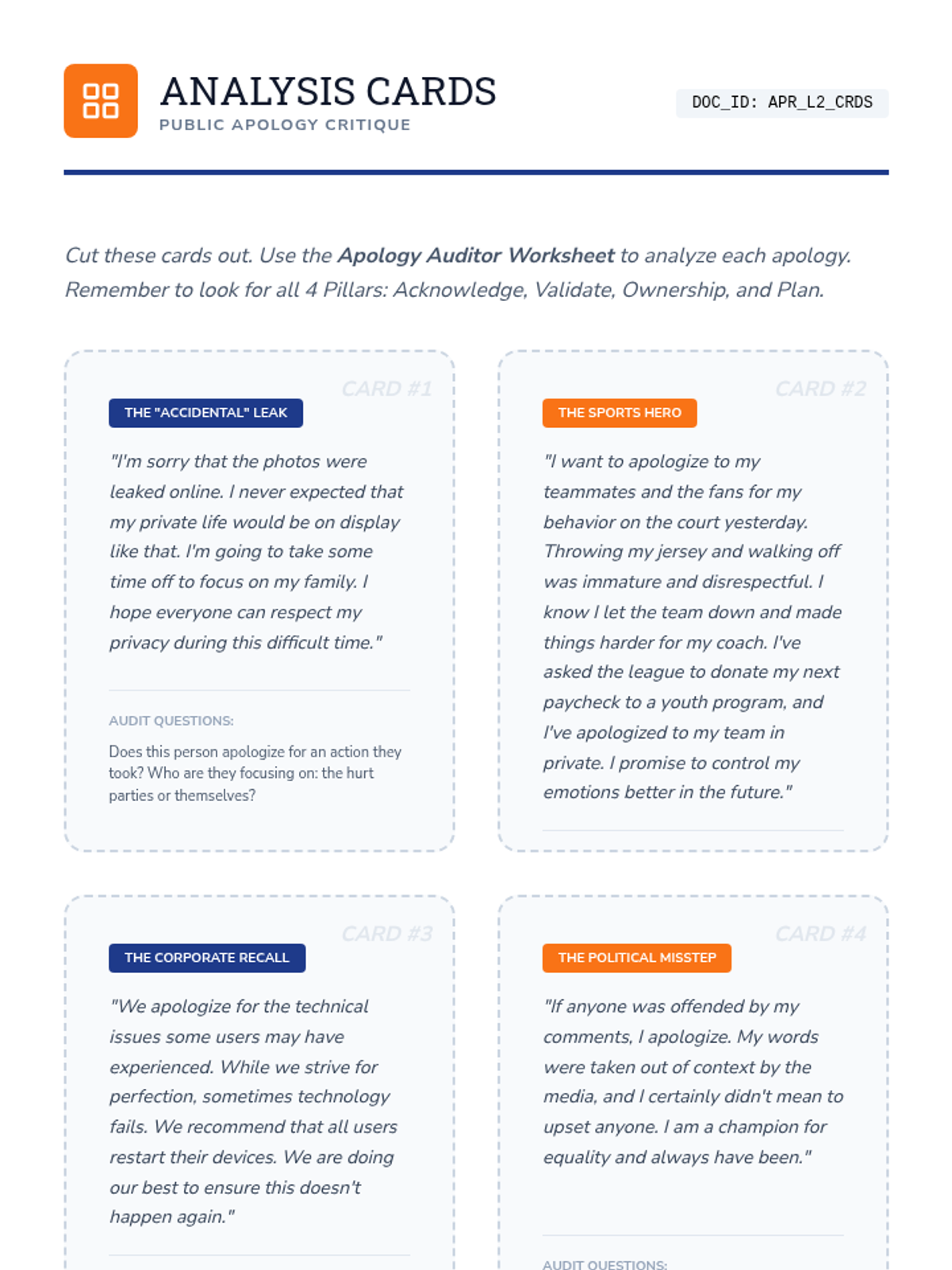
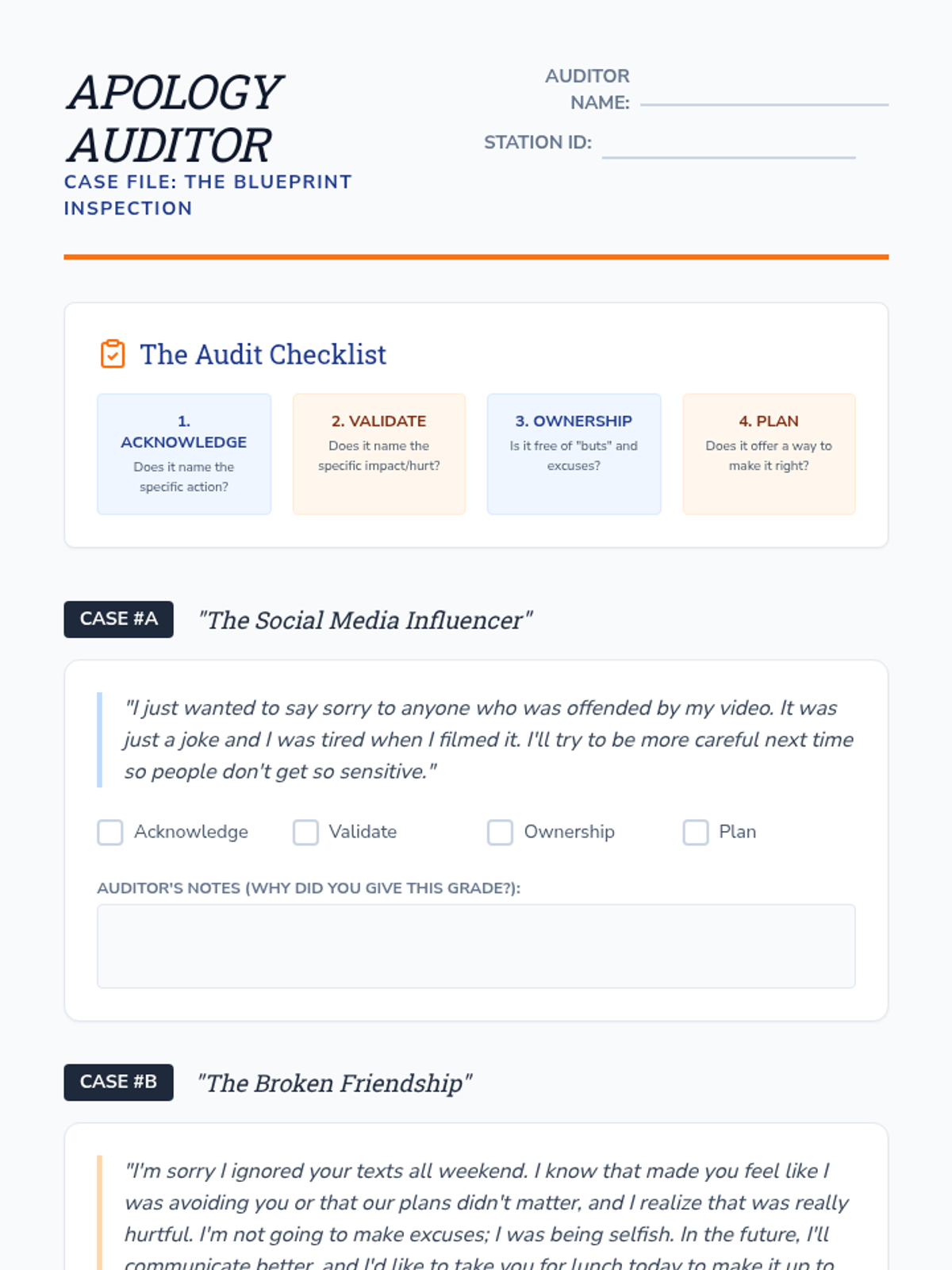
Analysis cards featuring fictionalized but realistic public apologies for students to critique using the Apology Auditor worksheet.
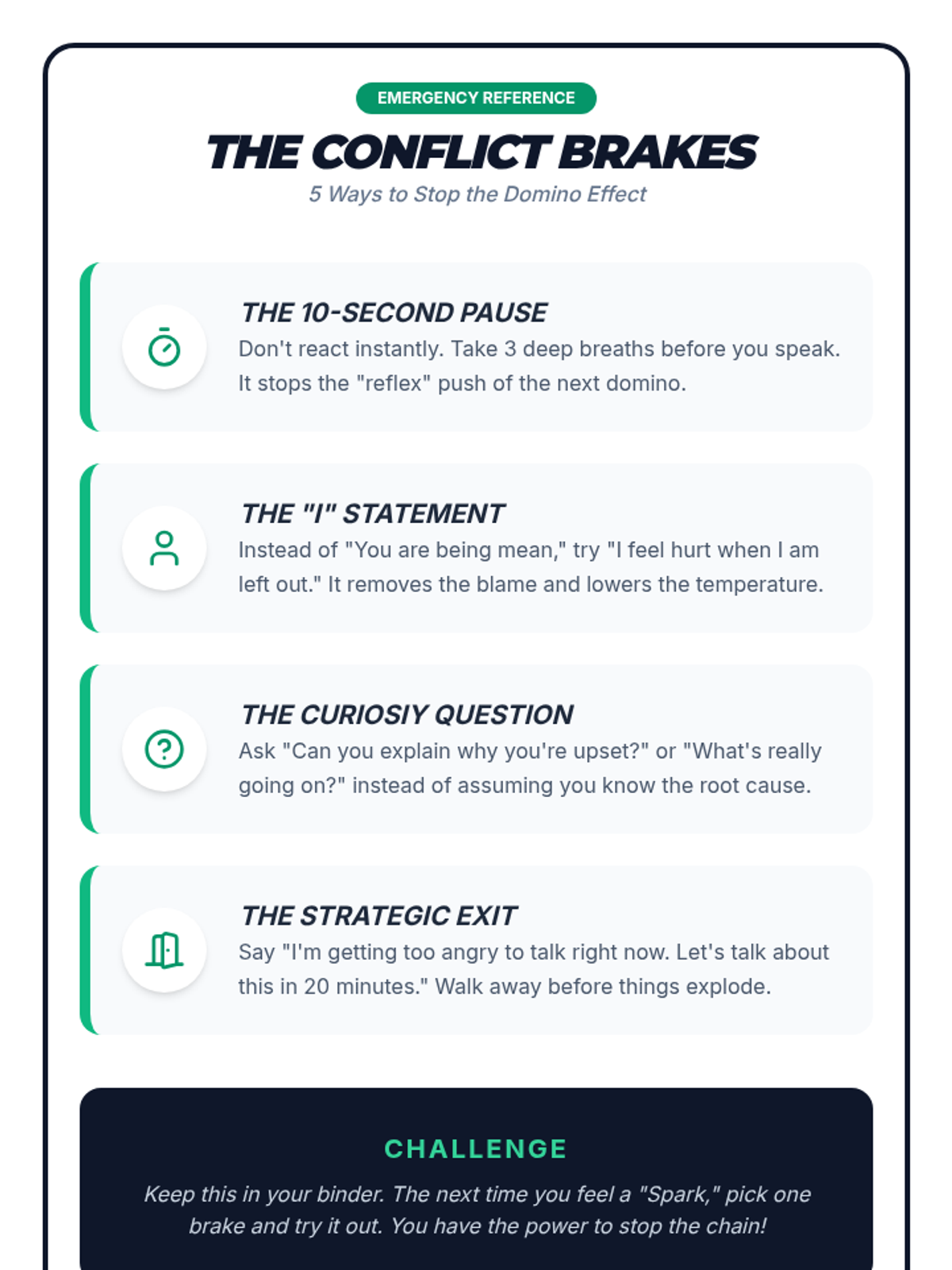
A reference handout for students listing four key de-escalation strategies (The Brakes) to use when they recognize a conflict starting to escalate.
Worksheet for auditing apologies based on the 4 Pillars of a genuine apology. Includes analysis of two case studies and a creative writing task.
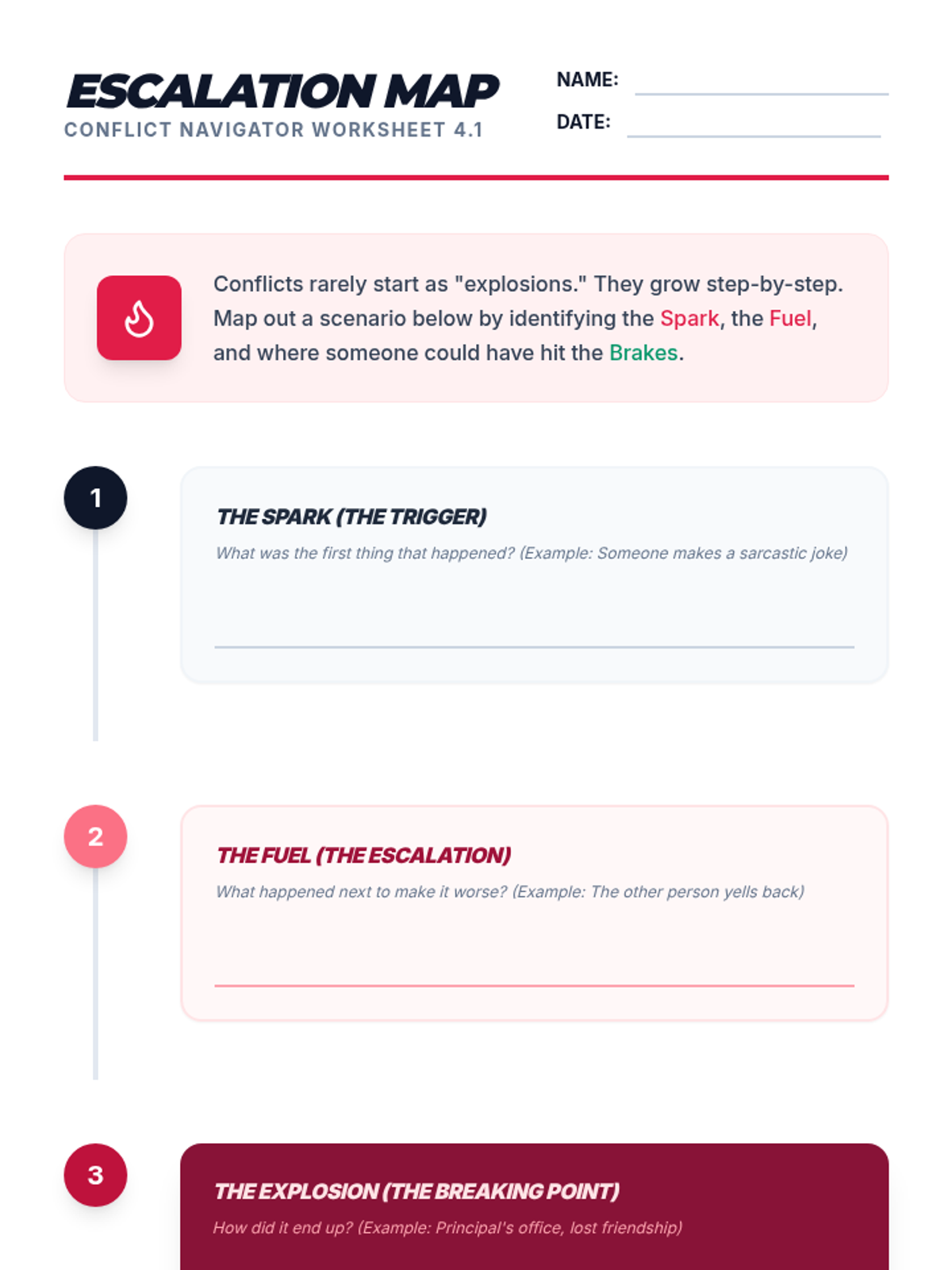
A student worksheet for Lesson 4 where learners map out a conflict scenario through the stages of Spark, Fuel, and Explosion, and then identify intervention points.
Visual slide deck for Lesson 2: Architecture of Apology, introducing the 4 Pillars of a genuine apology and contrasting them with "non-apologies".
Slides for Lesson 4, exploring the cycle of conflict escalation through the "Domino Effect" analogy and teaching students to recognize triggers and turning points.
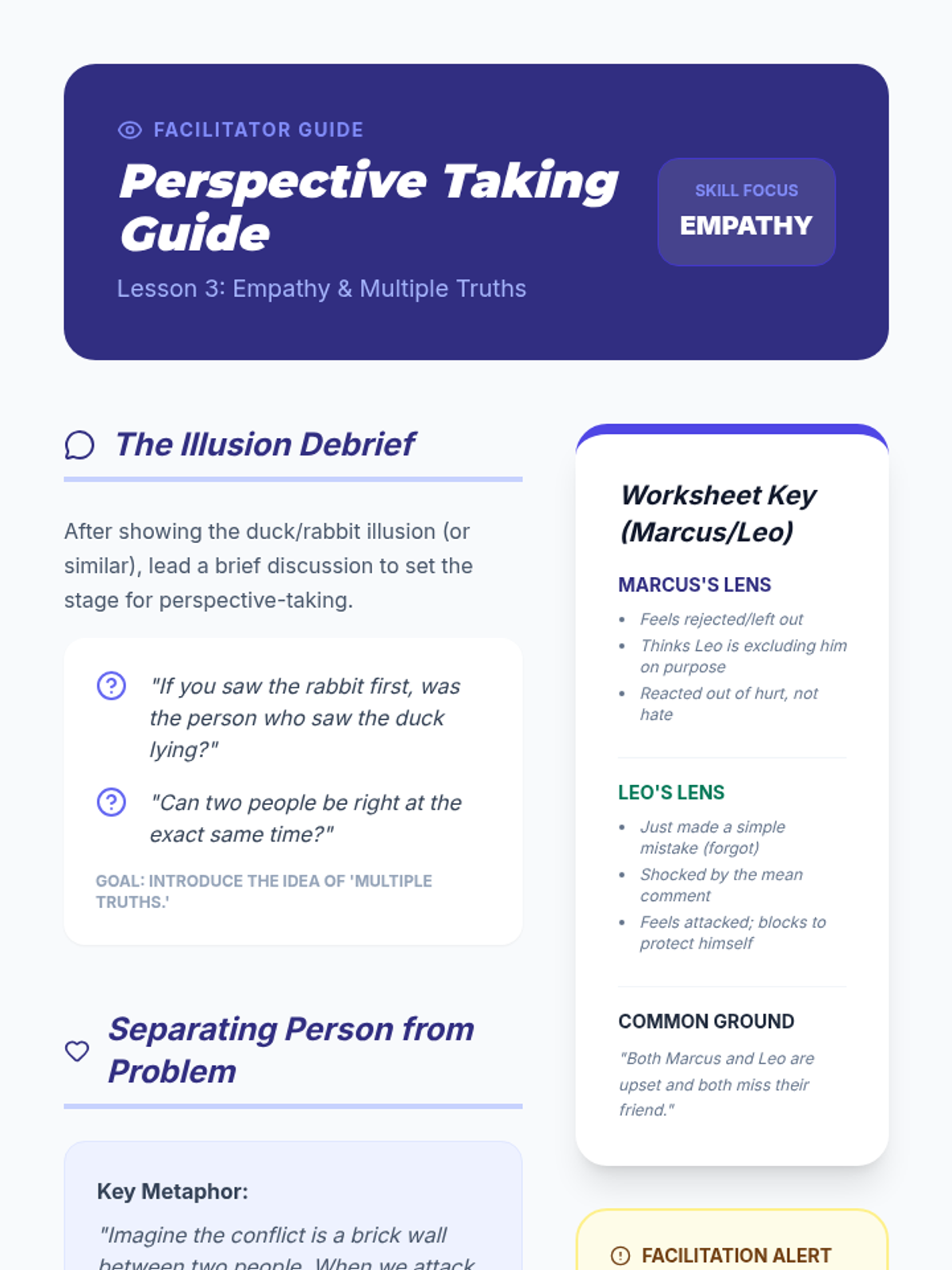
A teacher guide for Lesson 3 focused on facilitating empathy and perspective-taking discussions, including key metaphors and analysis of the Marcus/Leo scenario.
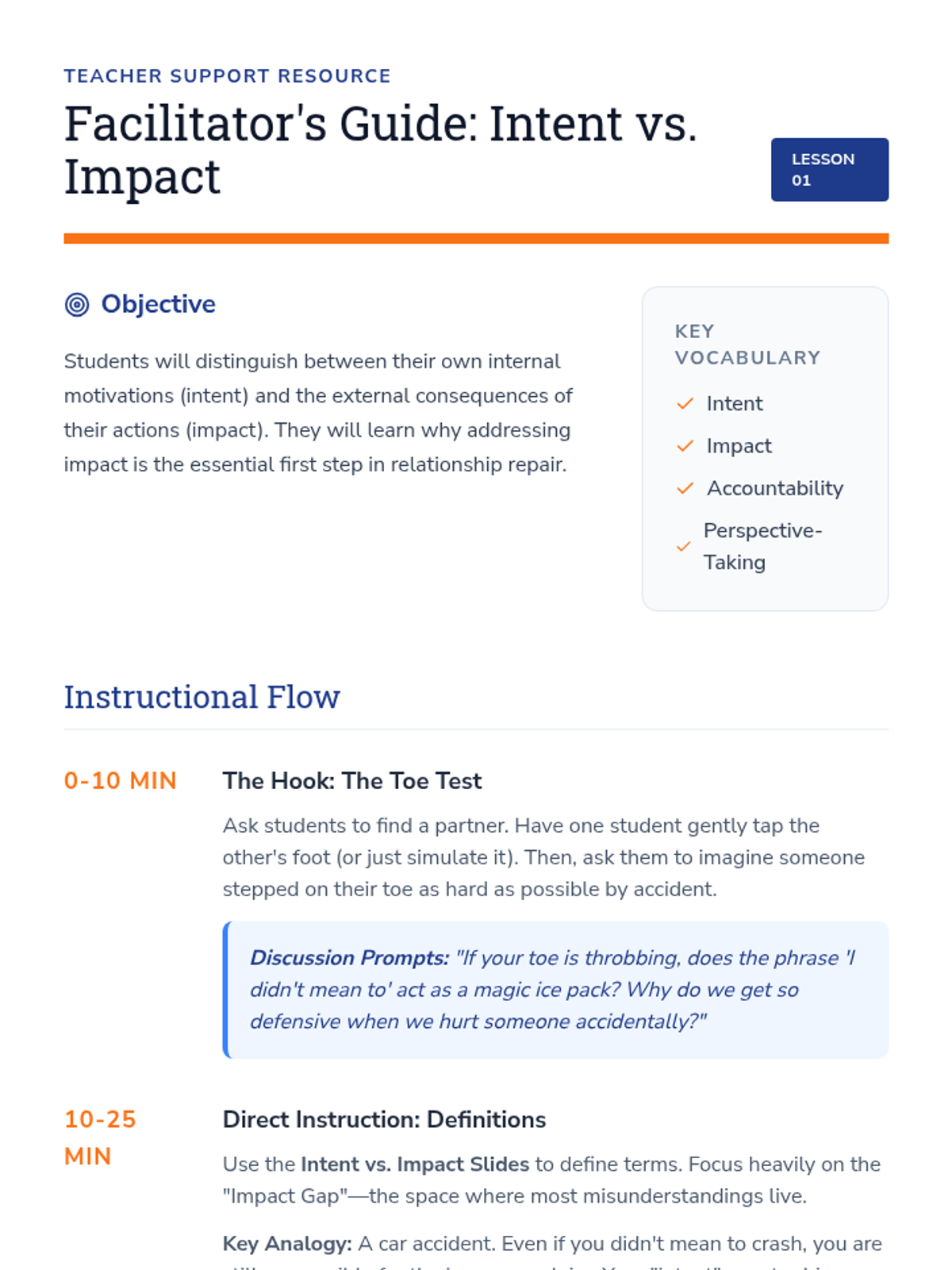
Comprehensive facilitation guide for Lesson 1, including pacing, discussion prompts, analogies, and strategies for addressing student misconceptions about intent and impact.
A slide deck for the 'Opportunity Cost Simulation' lesson, explaining the core economic concept of opportunity cost using relatable 8th-grade scenarios and RPG-style choice mechanics.
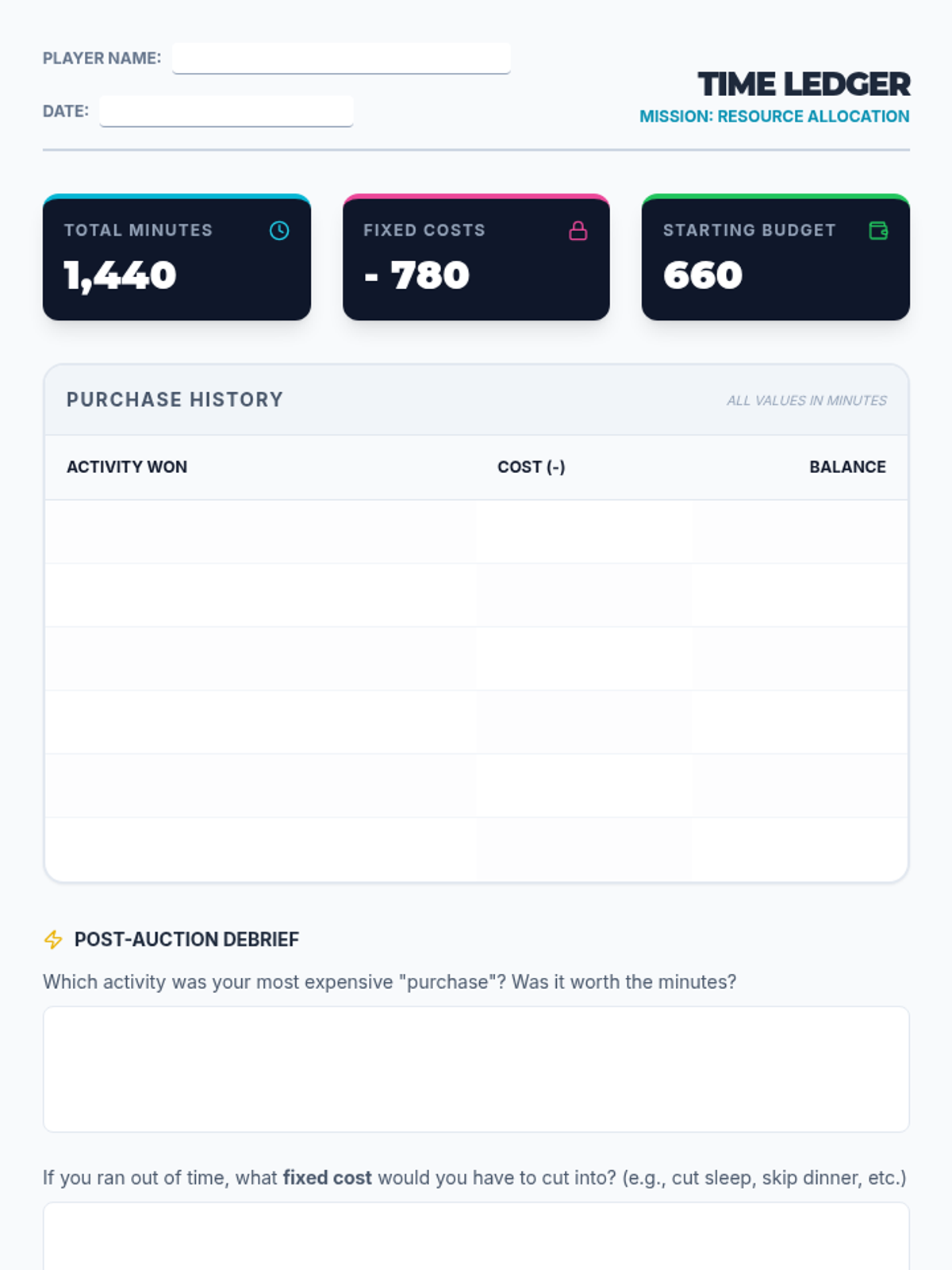
A student worksheet for the 'Currency of Time' lesson. It includes a ledger for tracking 'minutes' spent during the time auction and reflection questions about trade-offs and priorities.
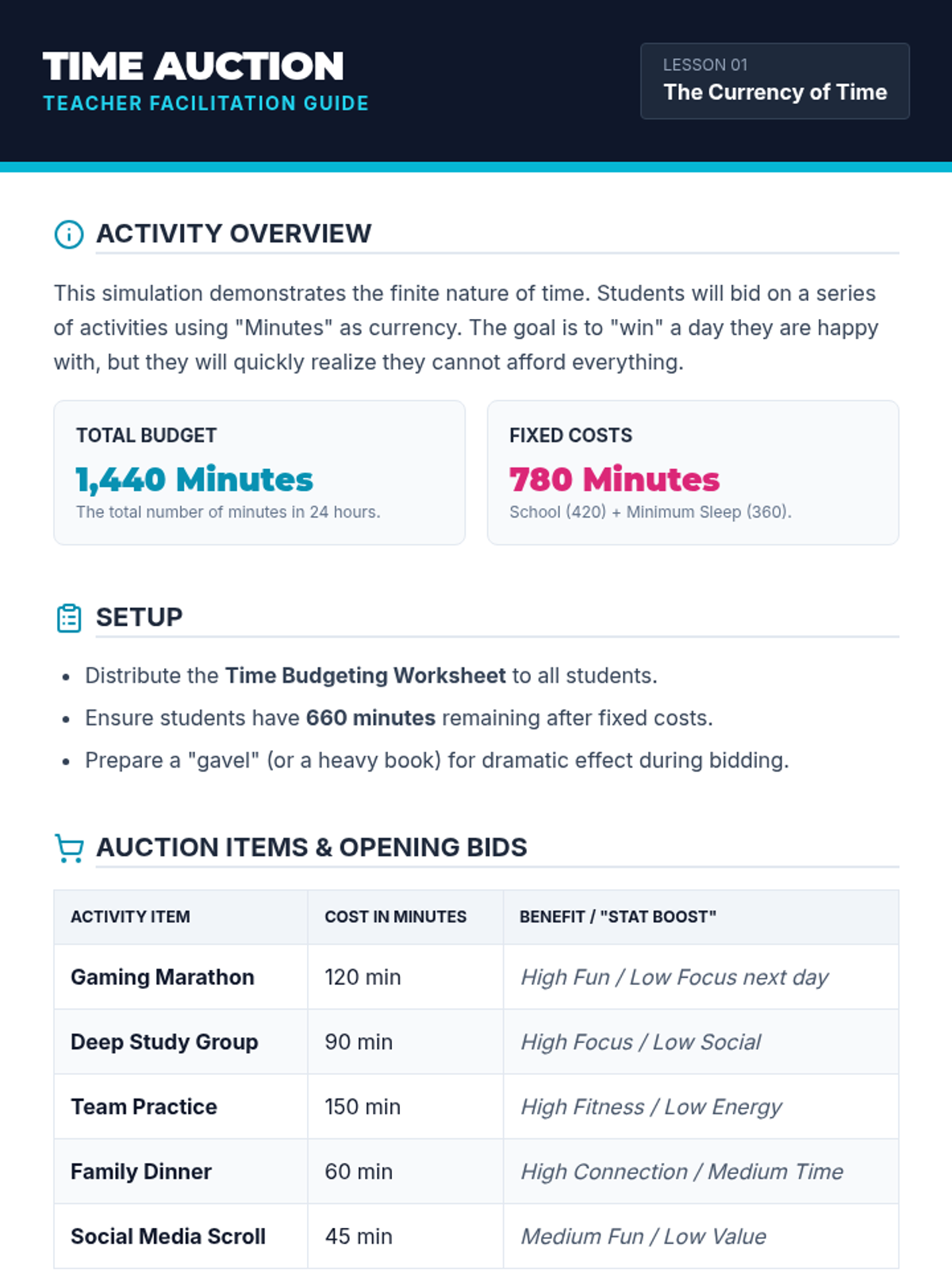
A facilitation guide for teachers to run the 'Time Auction' activity. Includes activity setup, a list of auction items with their 'costs' in minutes, and discussion hooks to debrief the simulation.
An introductory slide deck for the 'Currency of Time' lesson, framing time management as a game-based resource allocation simulation. It uses RPG-style visuals to explain fixed costs, finite resources, and the concept of time as currency.
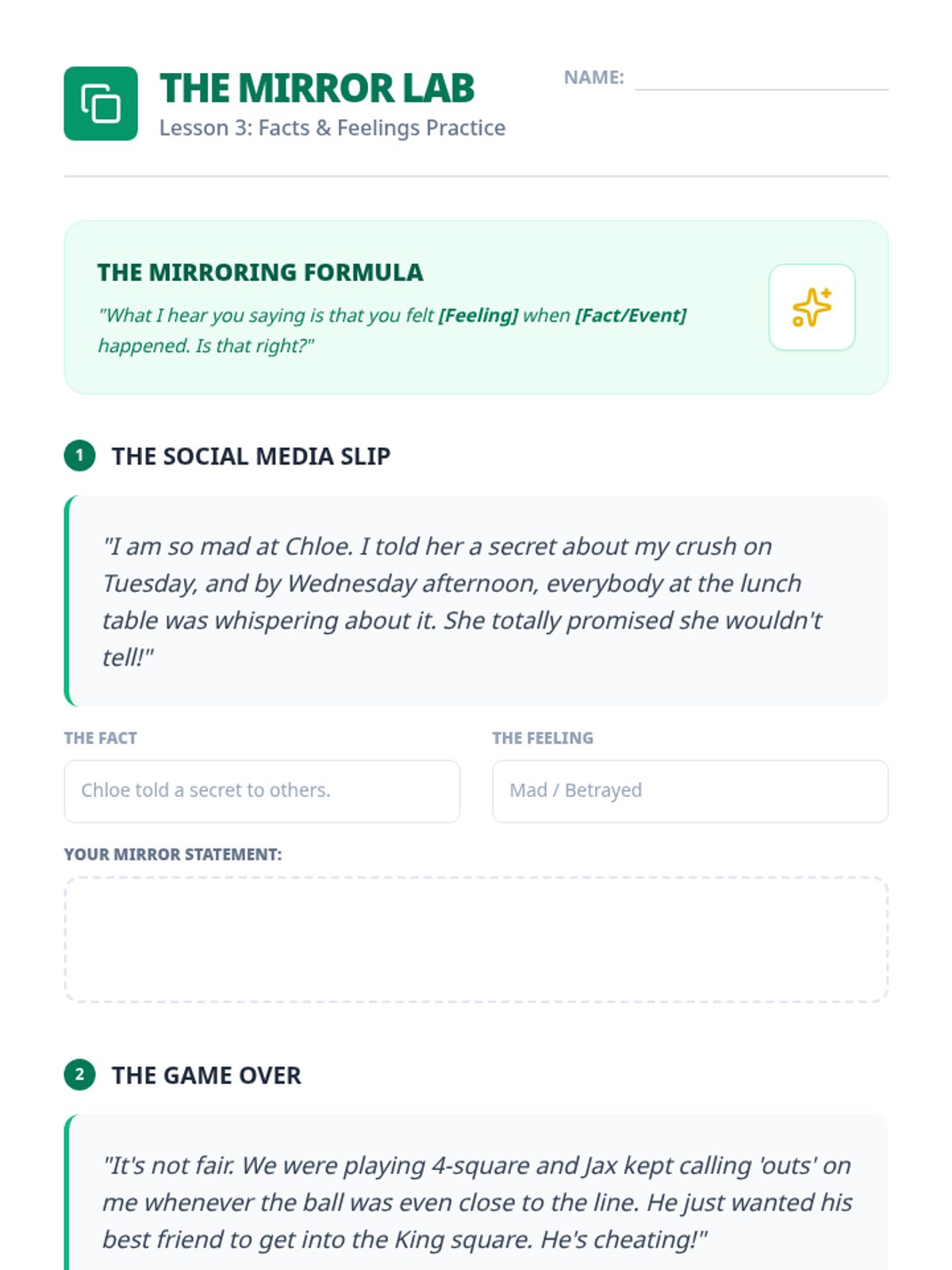
Worksheet for students to practice identifying facts and feelings in conflict statements and crafting neutral mirroring responses.
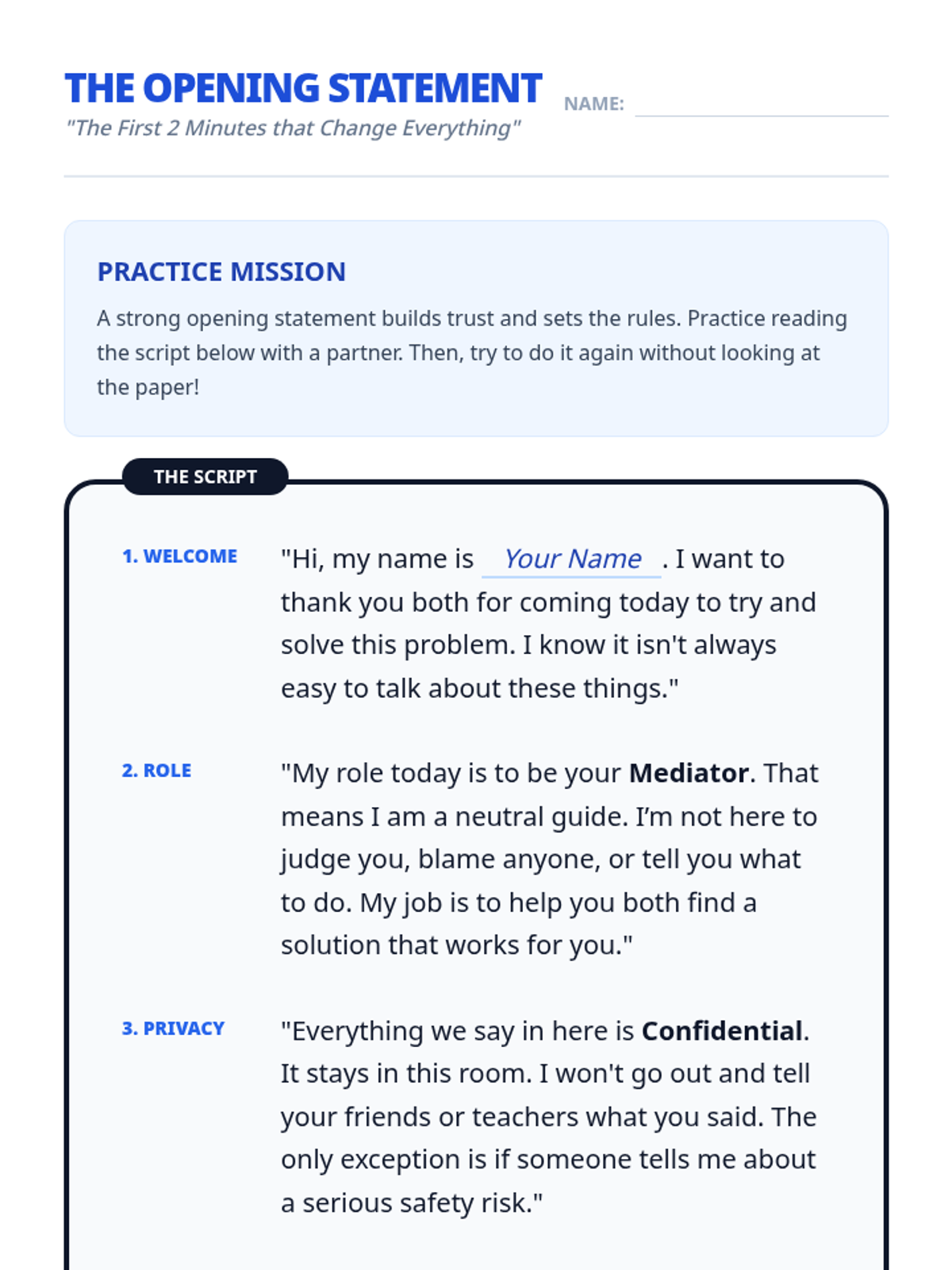
Student-facing script and practice guide for delivering a mediation opening statement, including ground rules and neutrality reminders.
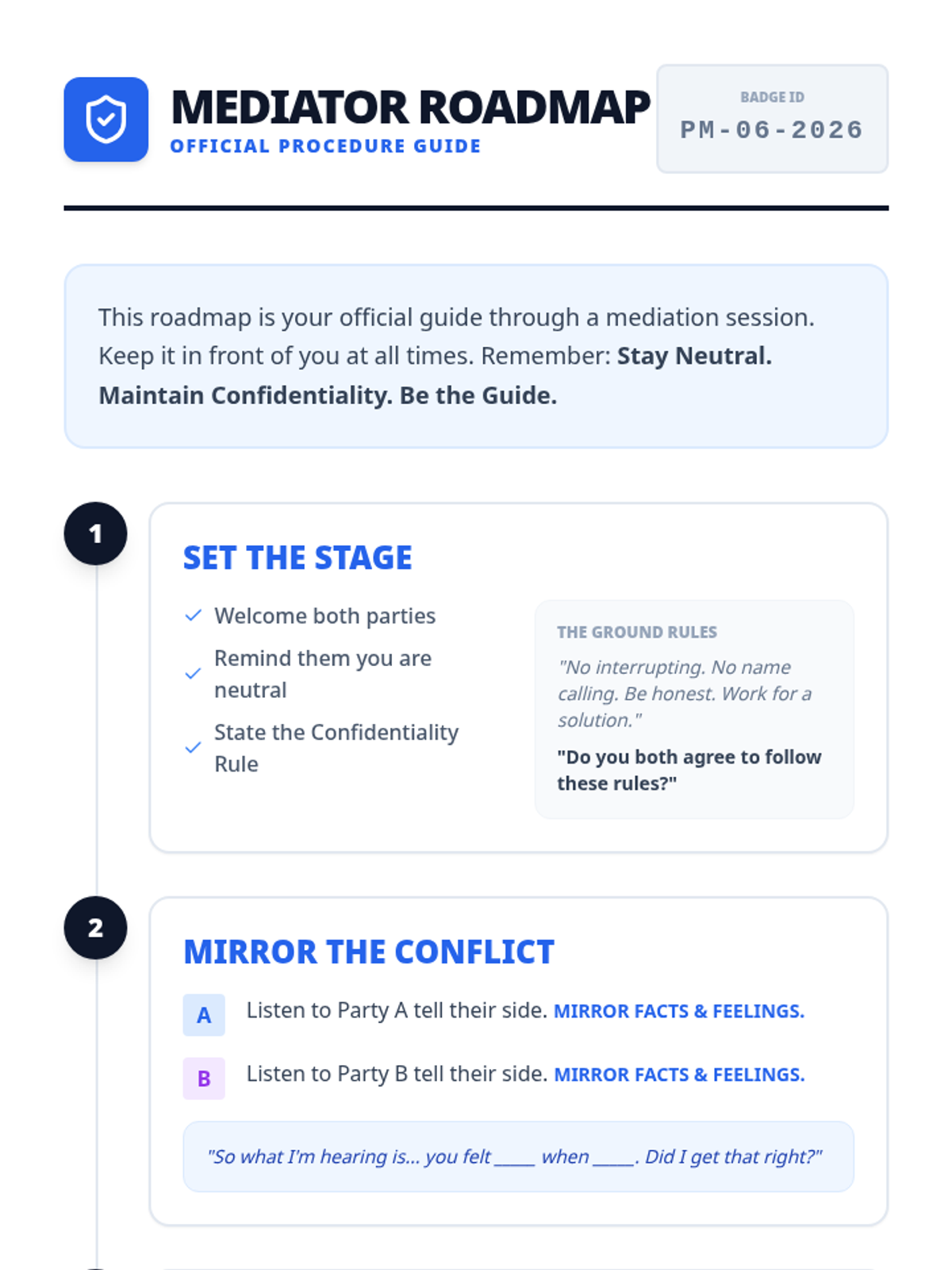
Student-facing reference sheet to guide them through the 4-step peer mediation process during simulations.
Slide deck explaining the concept of reframing toxic language into neutral problem statements to help de-escalate conflicts and focus on solutions.