Root cause analysis and brainstorming techniques for everyday problem-solving. Equips learners with ethical frameworks and risk-benefit evaluation skills to predict consequences and make informed choices.
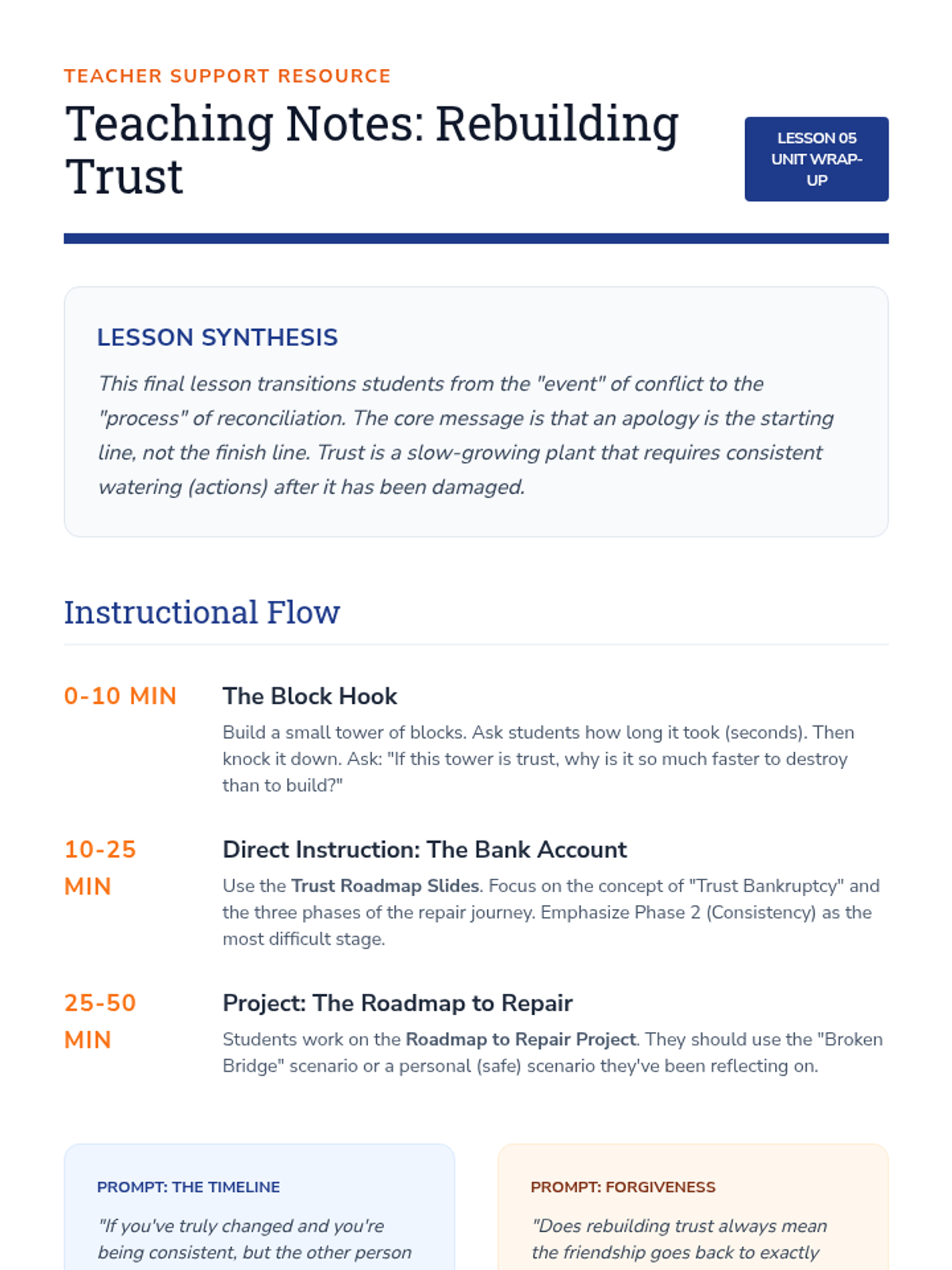
Teaching notes for Lesson 5, including summary of the 'Trust Bank Account' analogy, pacing for the final project, and unit wrap-up discussion prompts.
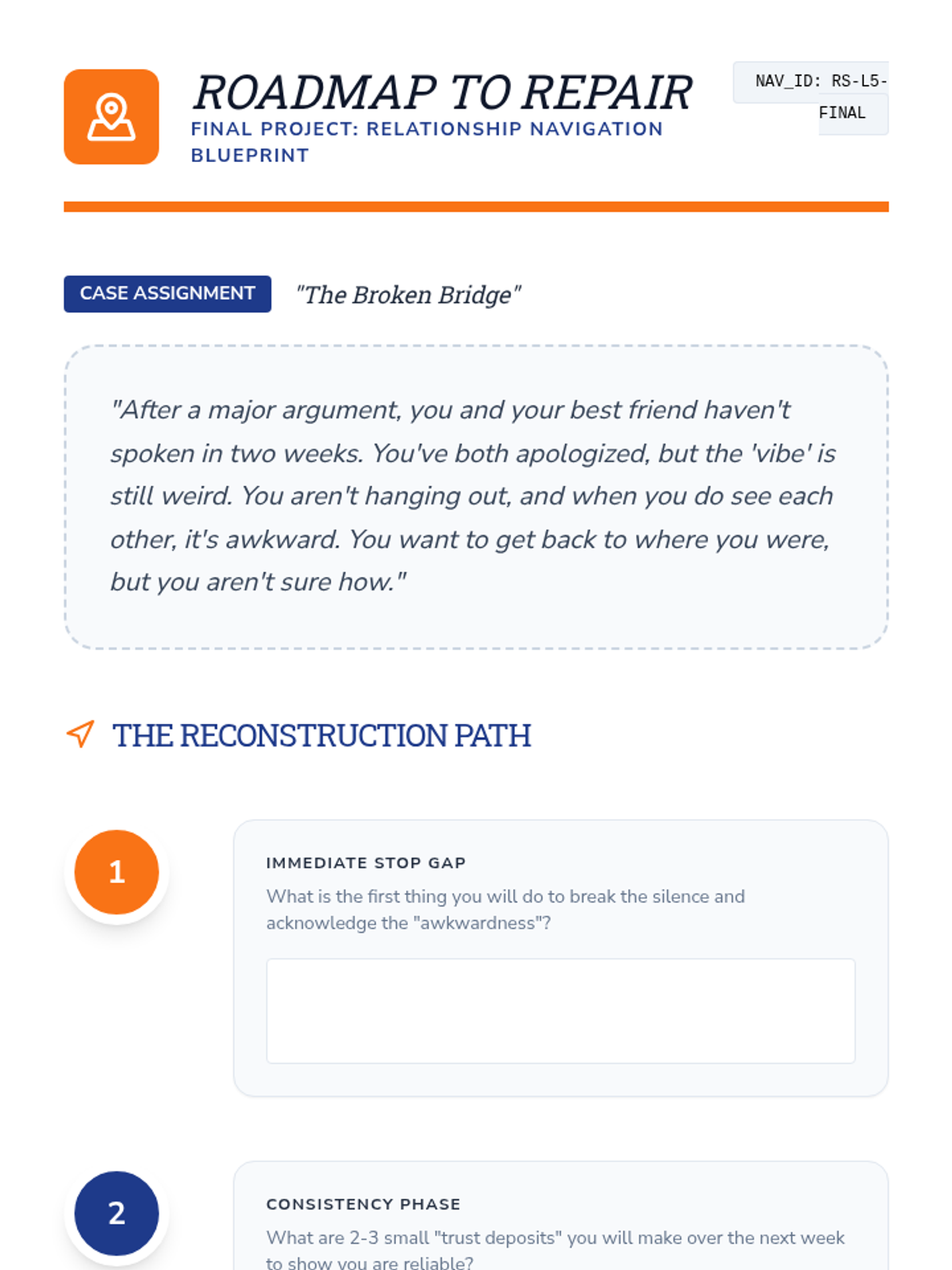
Final project worksheet for Lesson 5, guiding students to create a step-by-step visual 'Roadmap to Repair' for a fictional relationship scenario.
Visual slide deck for Lesson 5: Rebuilding Trust Over Time, introducing the concept of trust as a bank account and the long-term phases of relationship repair.
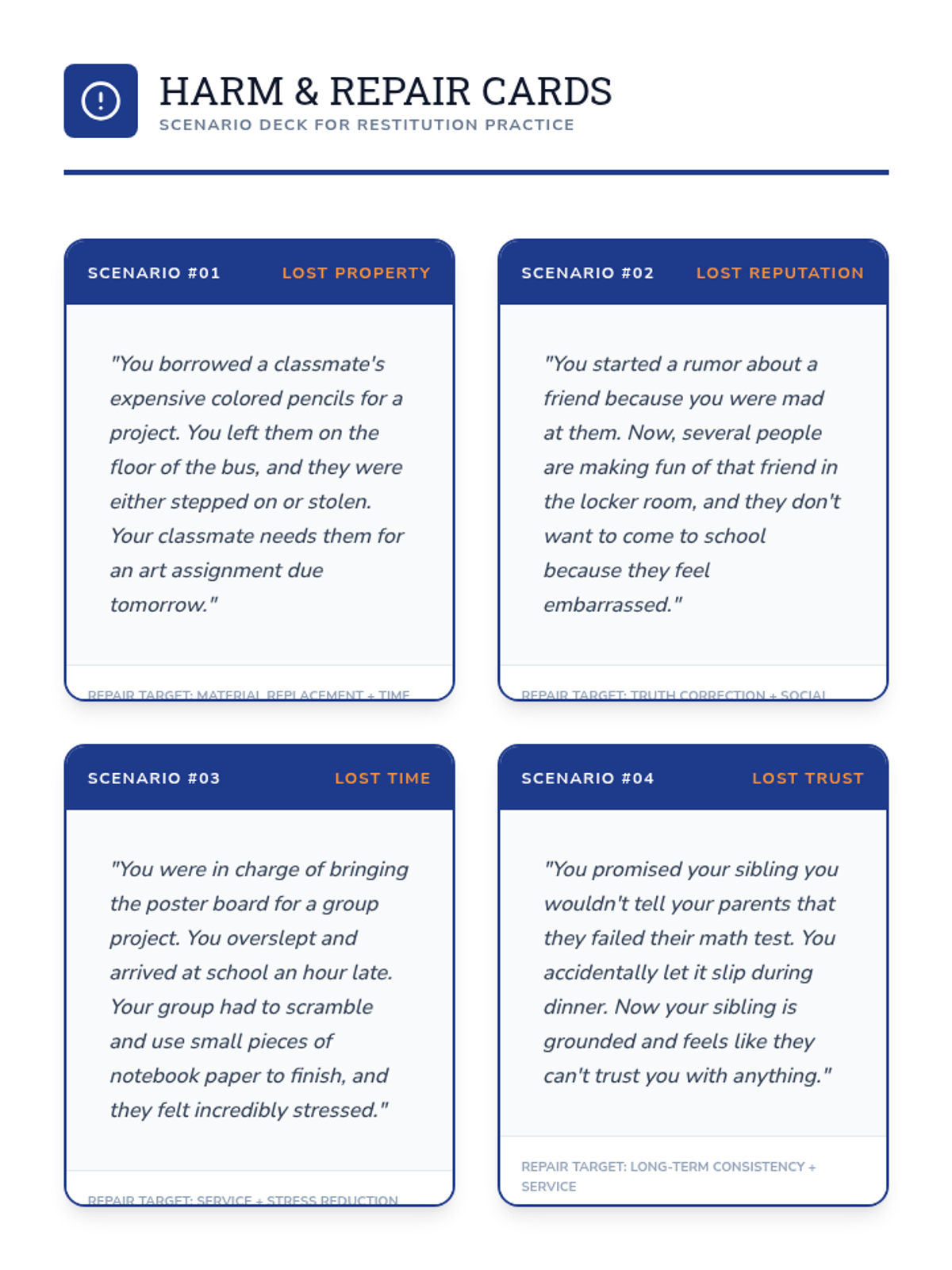
Scenarios of harm for students to analyze and use for designing restitution plans on their blueprints.
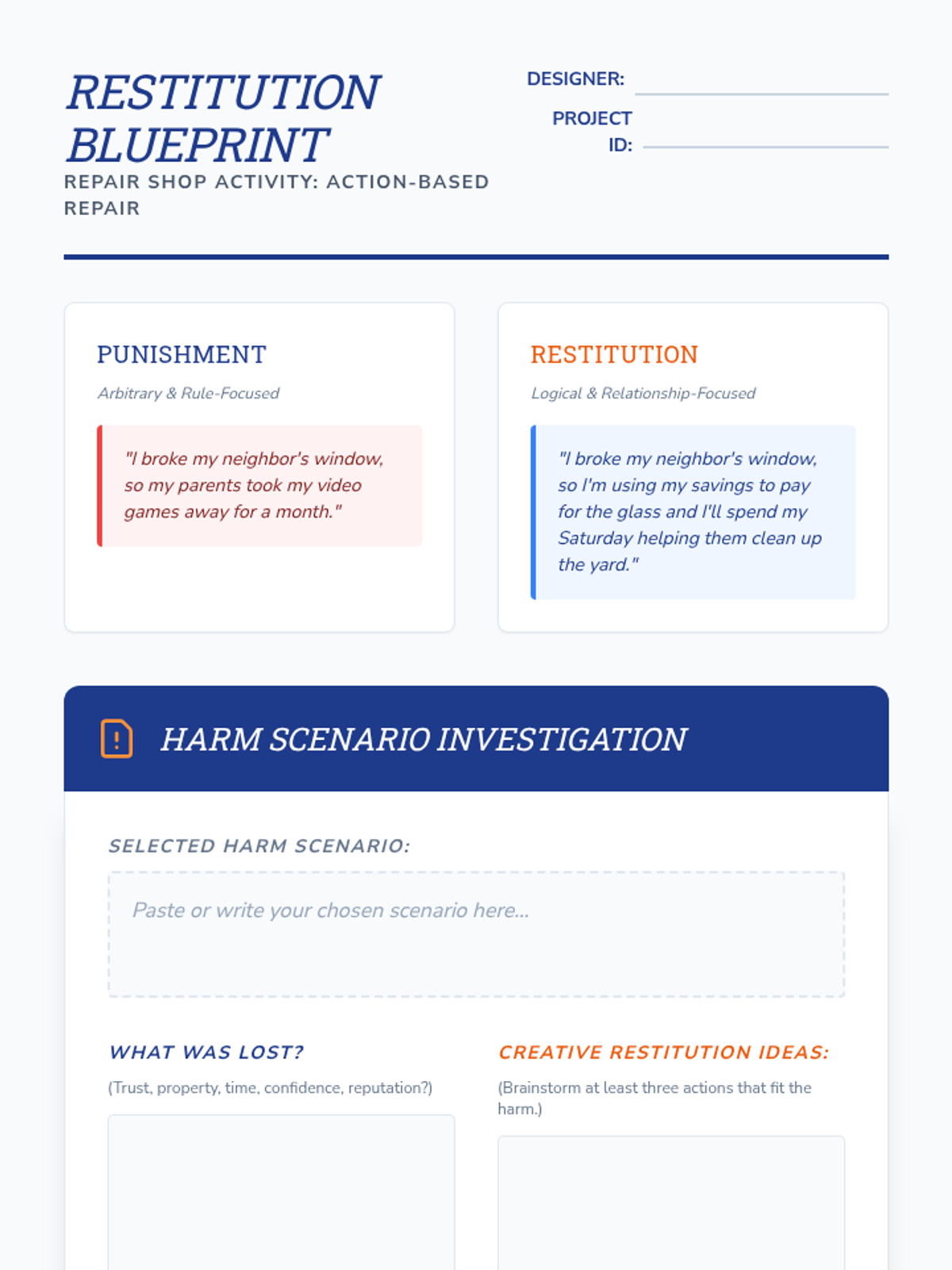
Creative project worksheet for Lesson 4, guiding students to design logical and relationship-focused restitution plans for specific harm scenarios.
Visual slide deck for Lesson 4: Making Amends and Restitution, introducing the concept of restitution versus punishment and brainstorming creative ways to 'make it right'.
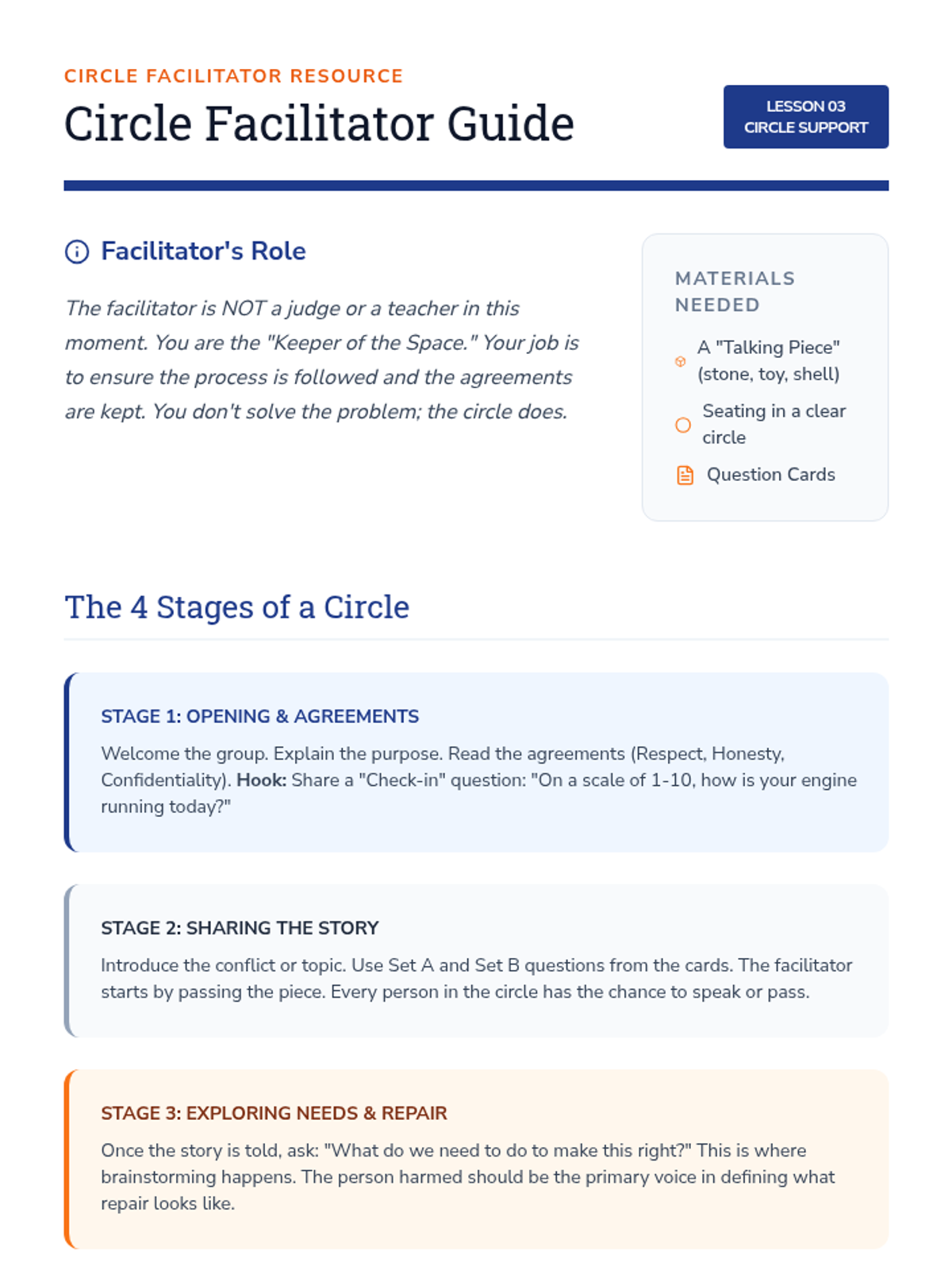
Comprehensive facilitation guide for teachers on how to lead a restorative dialogue circle, including stages, scripts, and troubleshooting tips.
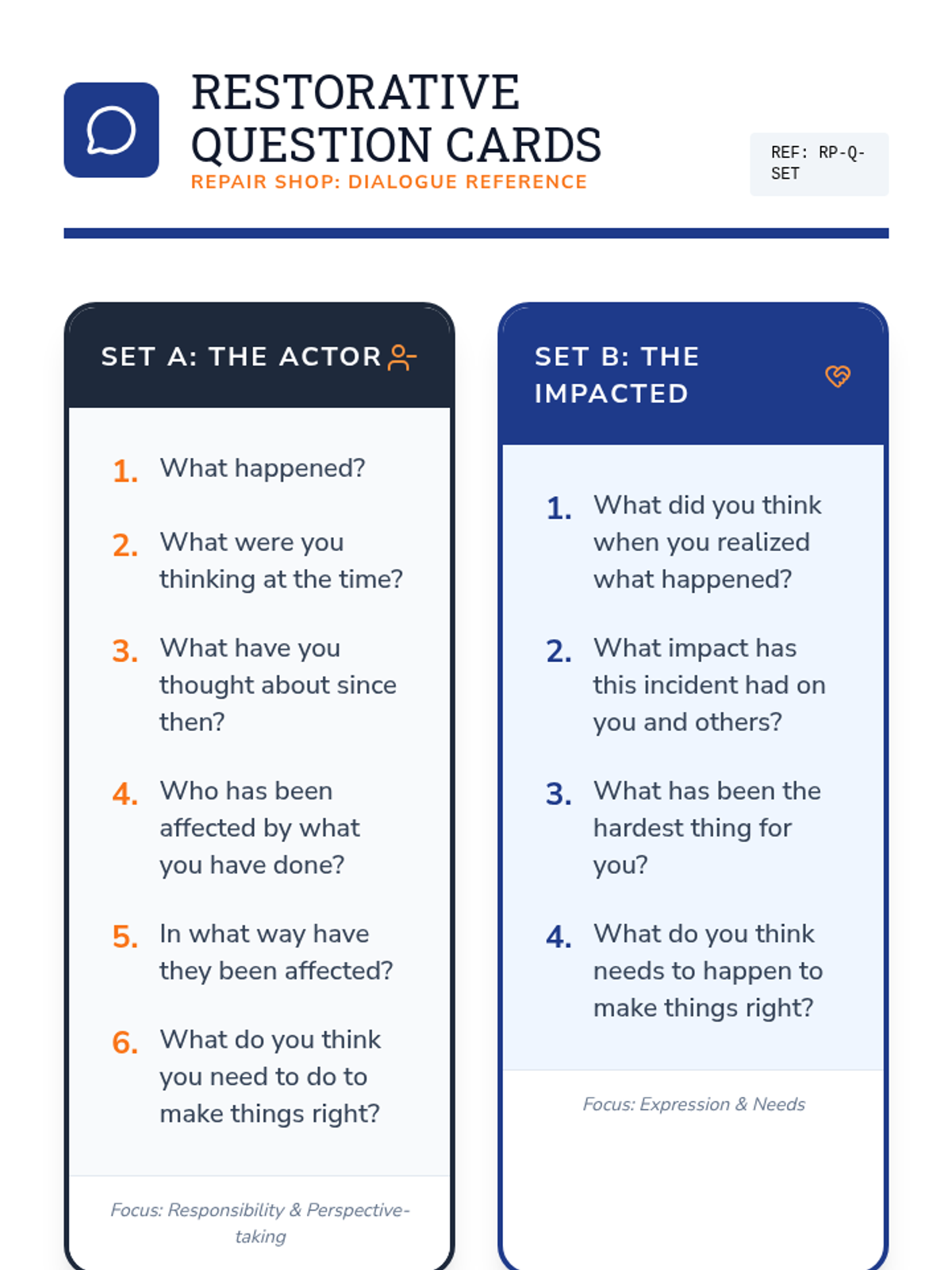
Set of standard restorative justice questions for both the person who caused harm and the person affected, designed for student use during dialogue circles.
Visual slide deck for Lesson 3: Restorative Dialogue Circles, introducing the circle process, talking pieces, and the core restorative questions.
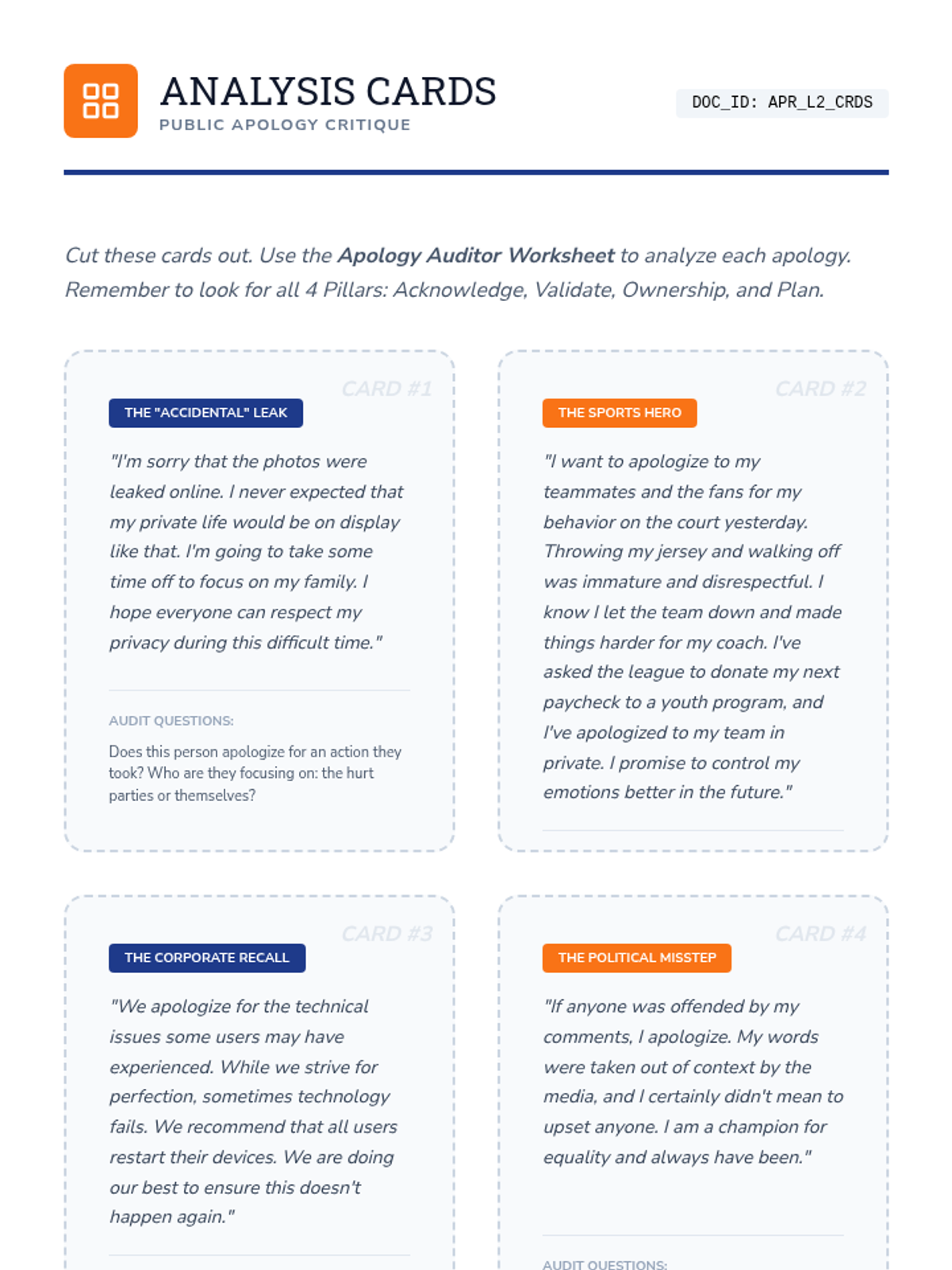
Analysis cards featuring fictionalized but realistic public apologies for students to critique using the Apology Auditor worksheet.
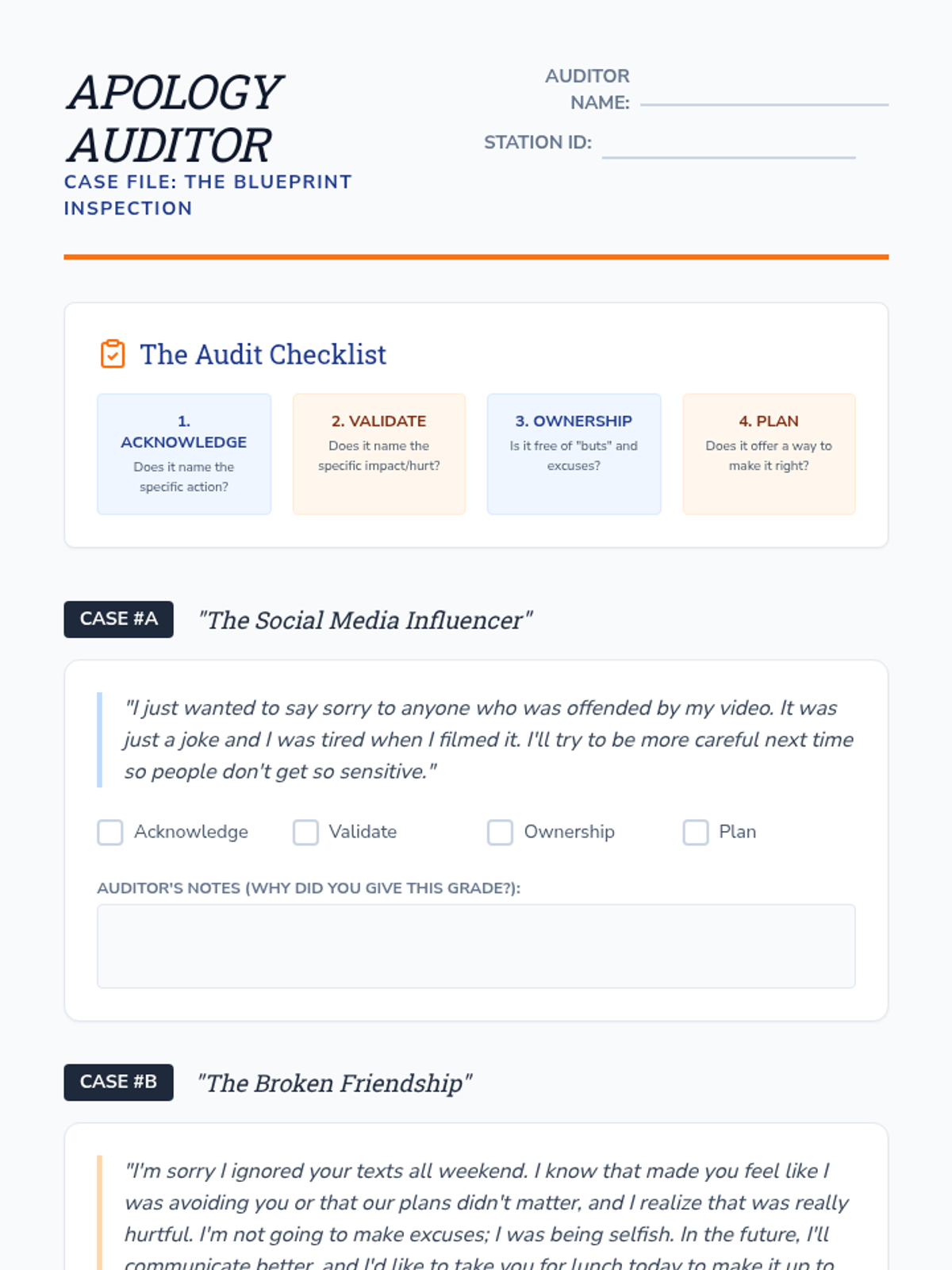
Worksheet for auditing apologies based on the 4 Pillars of a genuine apology. Includes analysis of two case studies and a creative writing task.
Visual slide deck for Lesson 2: Architecture of Apology, introducing the 4 Pillars of a genuine apology and contrasting them with "non-apologies".
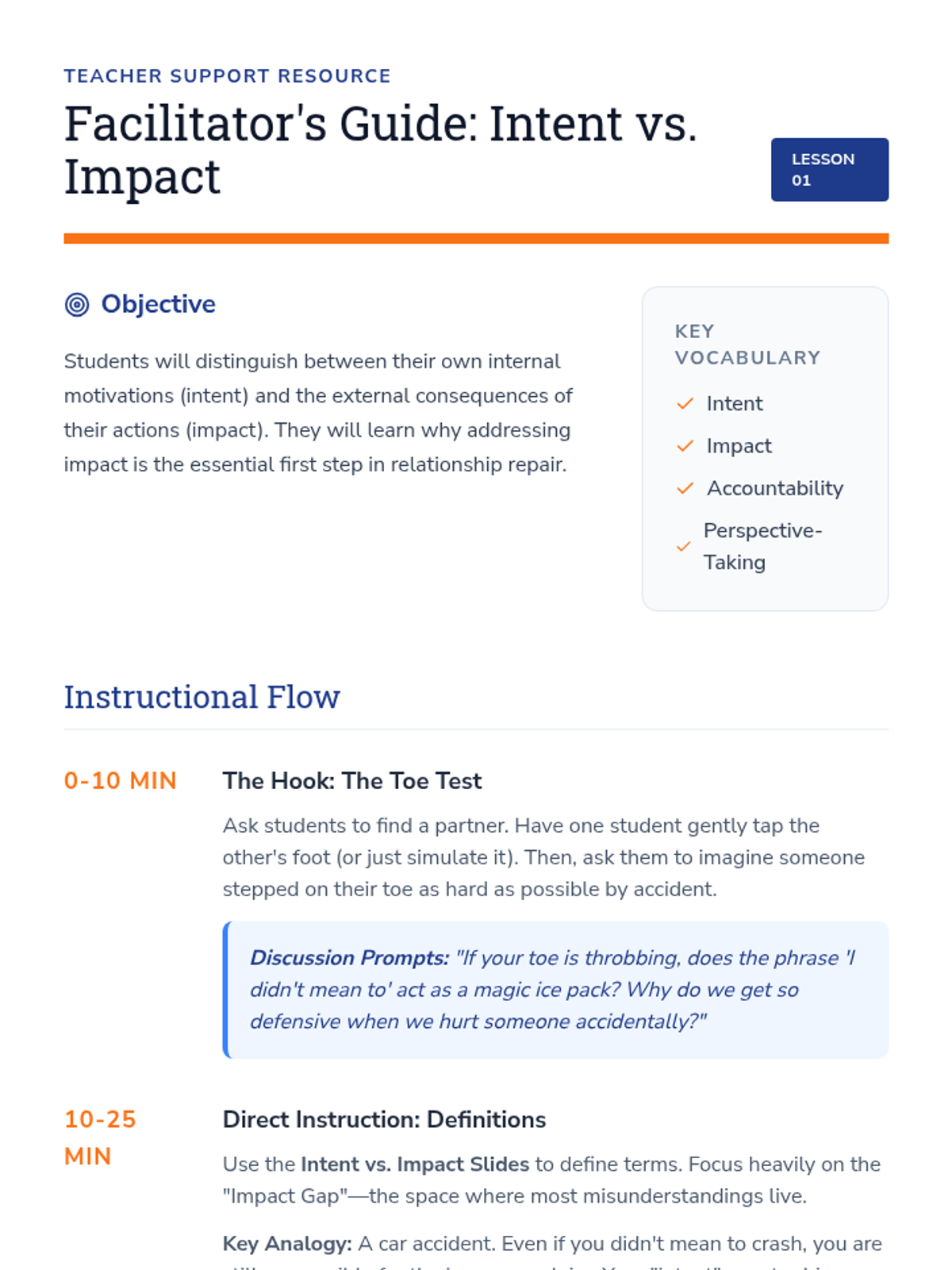
Comprehensive facilitation guide for Lesson 1, including pacing, discussion prompts, analogies, and strategies for addressing student misconceptions about intent and impact.
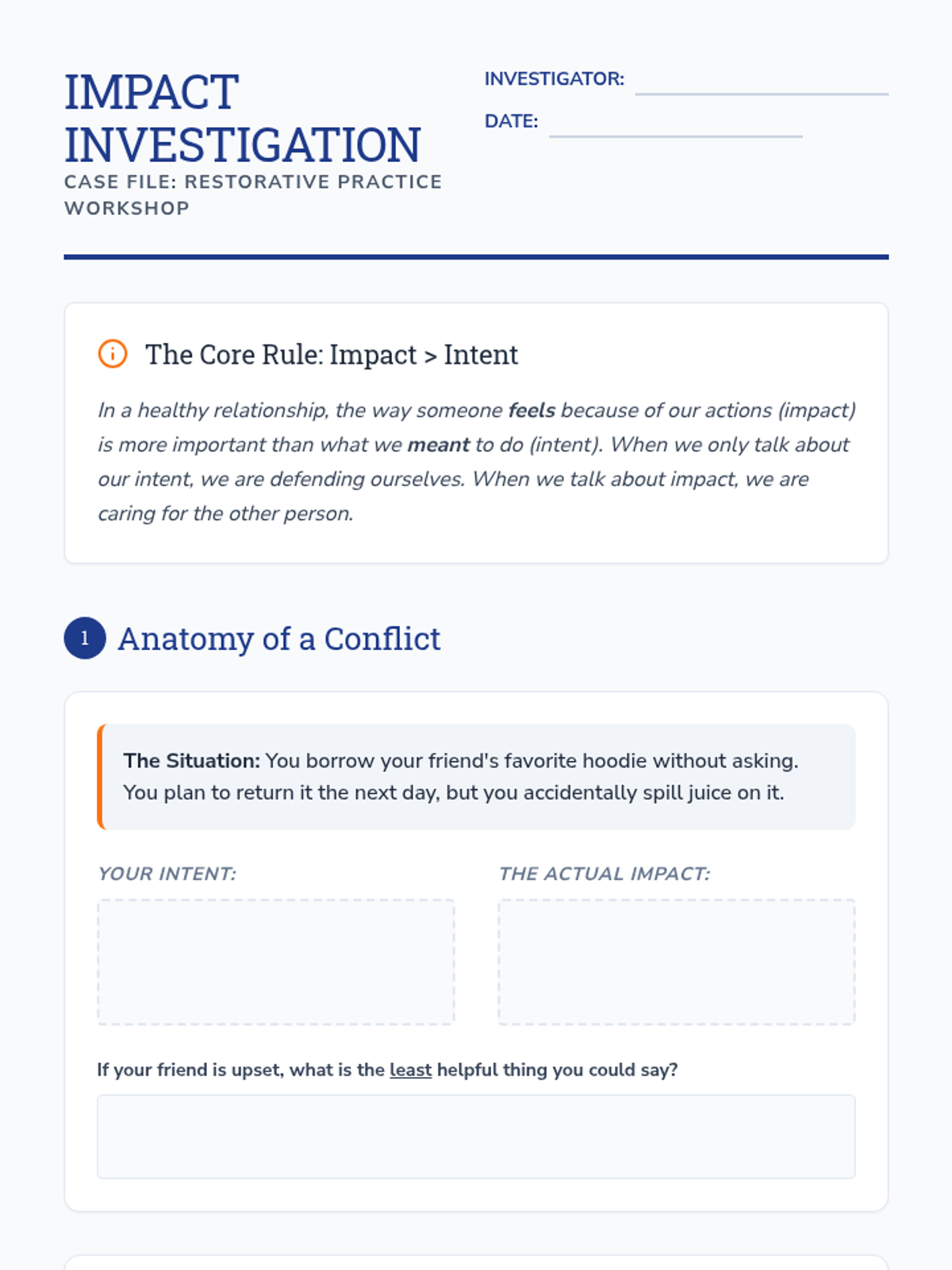
Case study worksheet for Lesson 1, where students analyze scenarios to distinguish between intent and impact and practice crafting impact-focused responses.
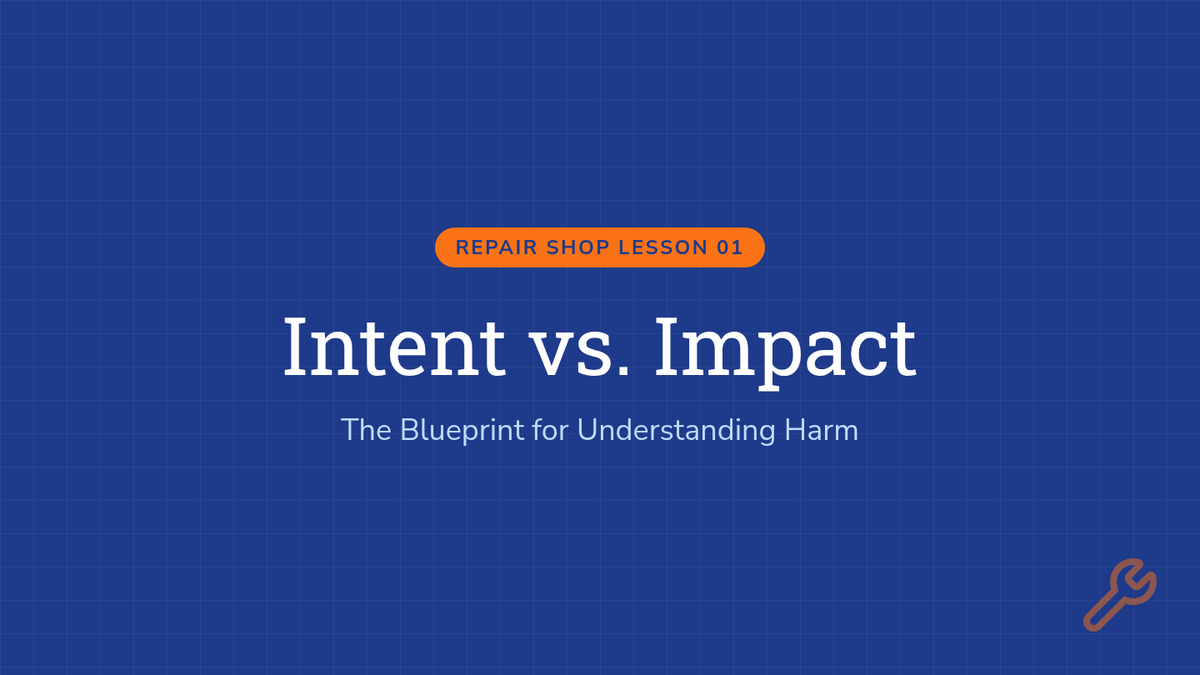
Visual slide deck for Lesson 1: Intent vs Impact, introducing the core concepts using the 'Toe Test' hook and a real-world case study.
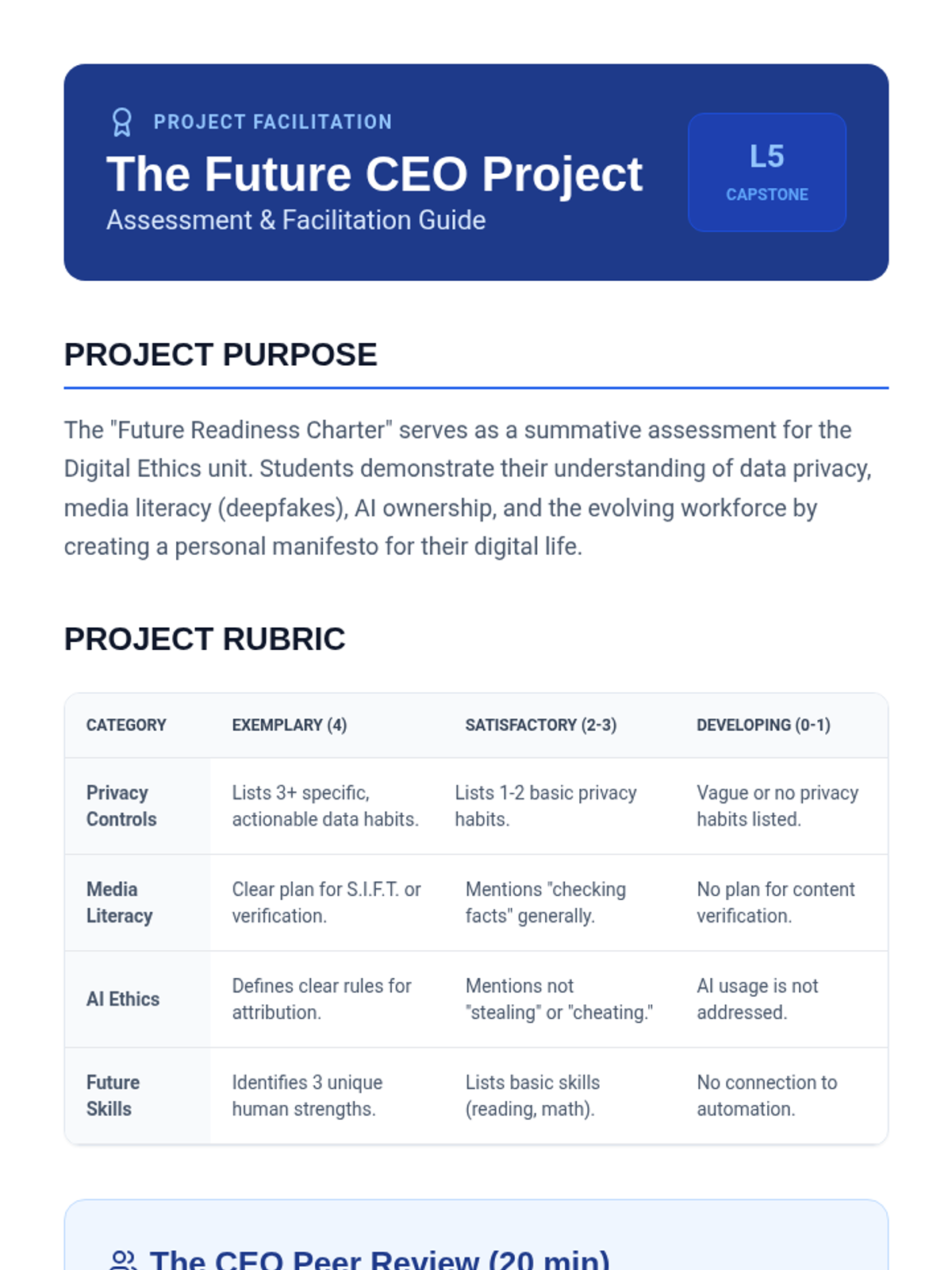
Teacher facilitation guide and rubric for the final capstone project, including the P.Q.P. peer review framework.
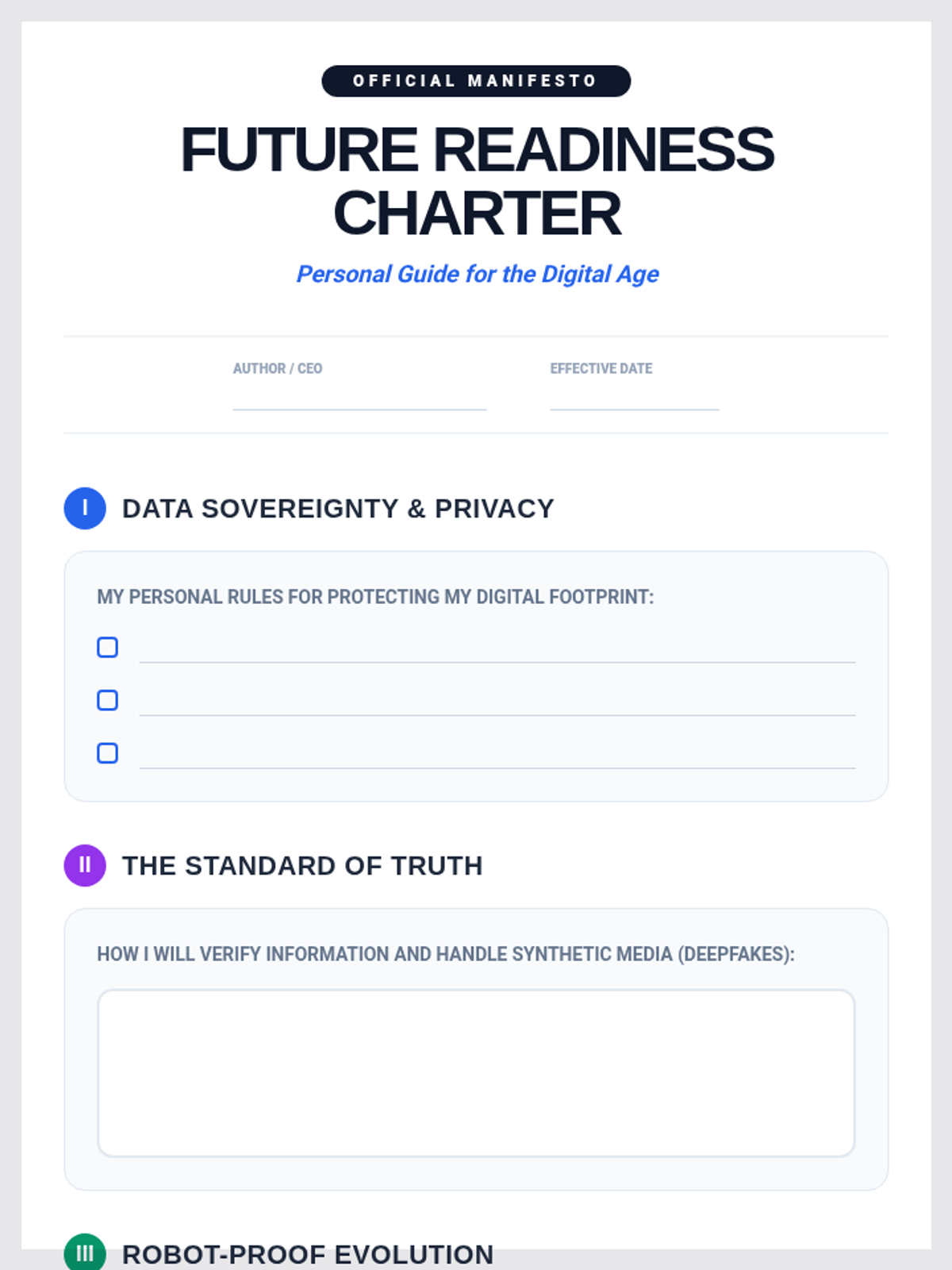
The final project template for Lesson 5, where students draft their personal Future Readiness Charter covering privacy, media literacy, human skills, and AI ethics.
Slides for the culminating project (Lesson 5), introducing the "Future Readiness Charter" and framing students as the CEOs of their own digital futures.
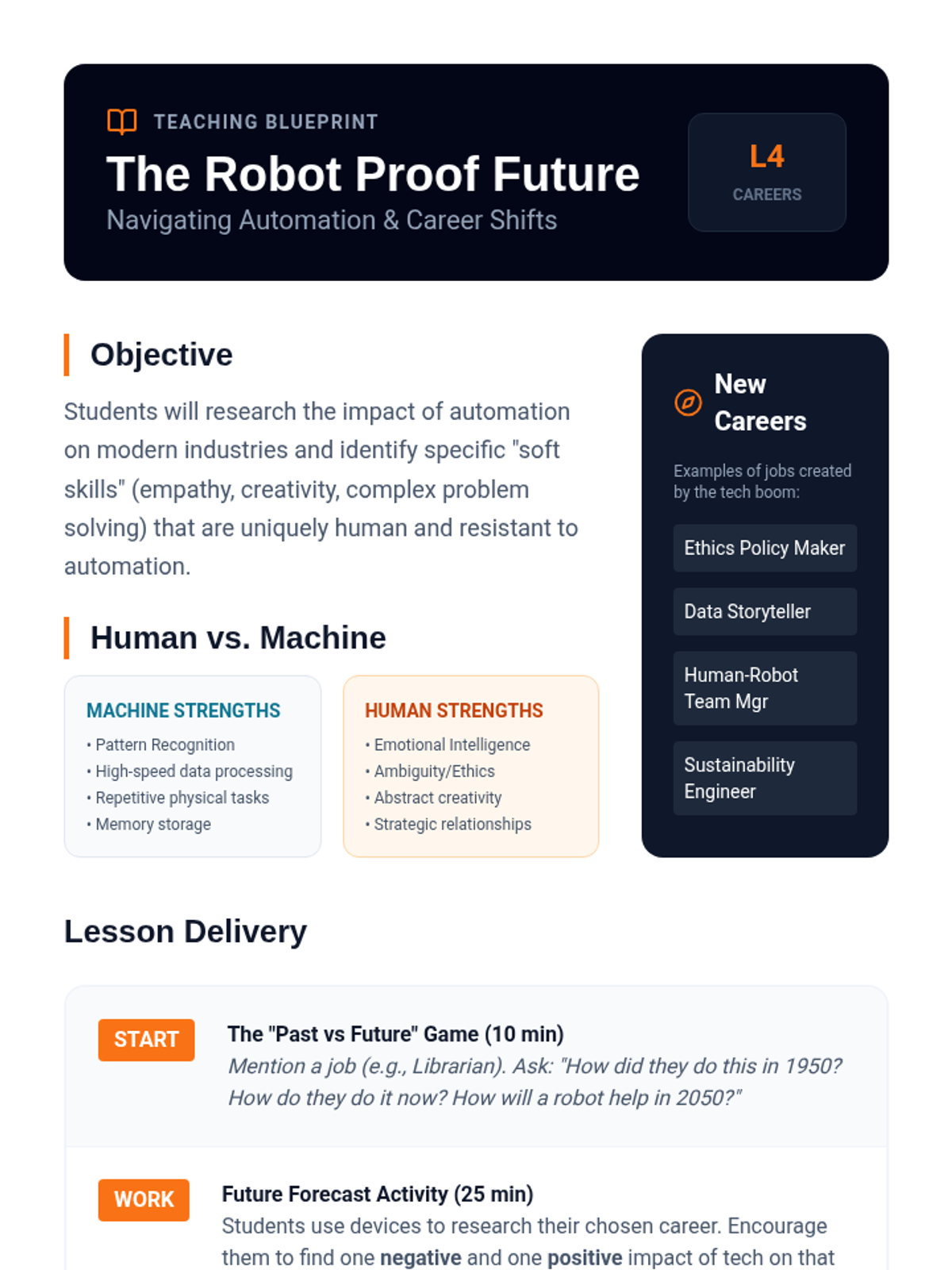
Teacher facilitation guide for Lesson 4, detailing human vs. machine strengths, a list of emerging tech careers, and instructional delivery steps.
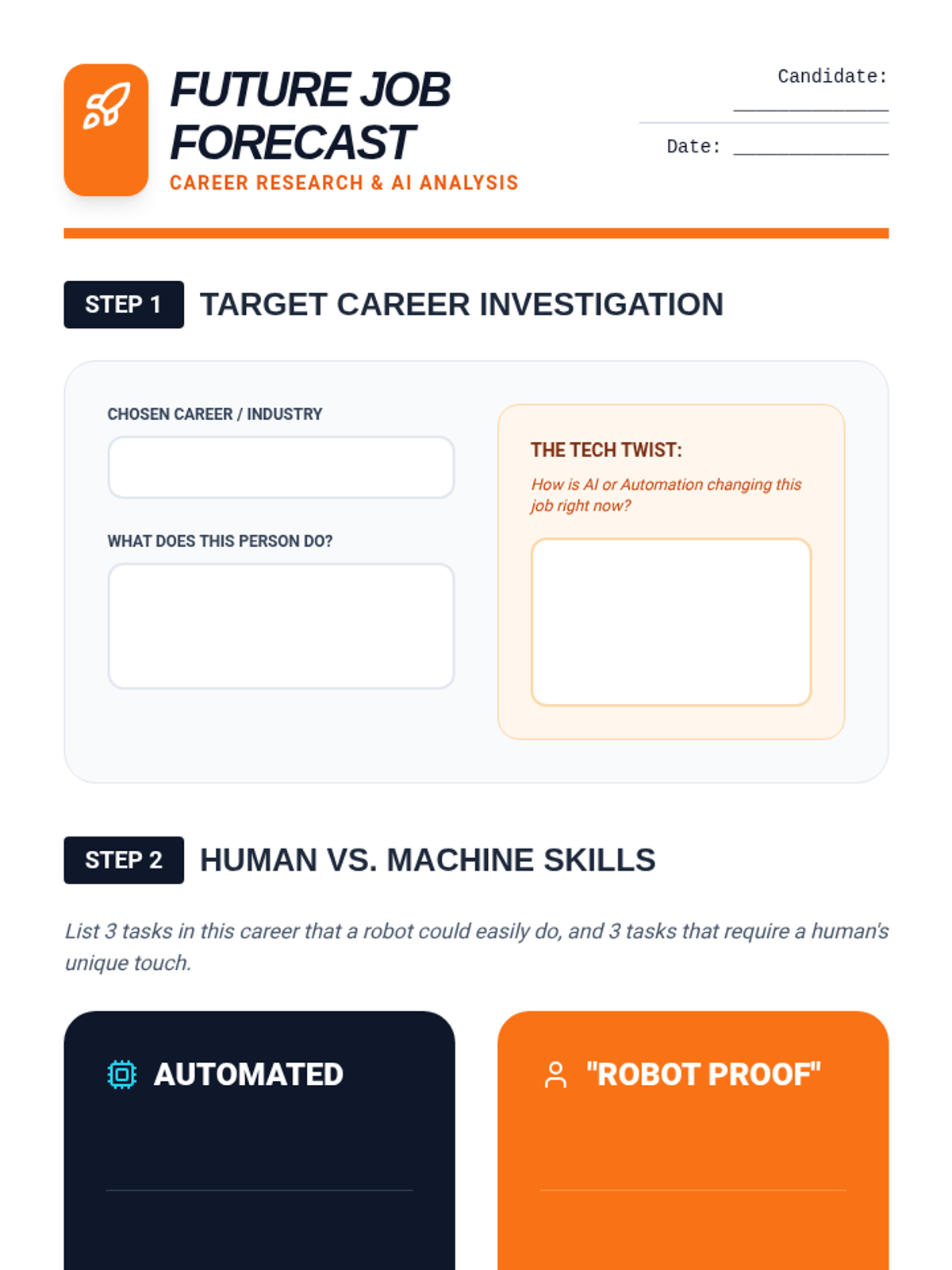
Career research worksheet for Lesson 4 where students analyze a specific career through the lens of automation and identify "robot-proof" human skills.
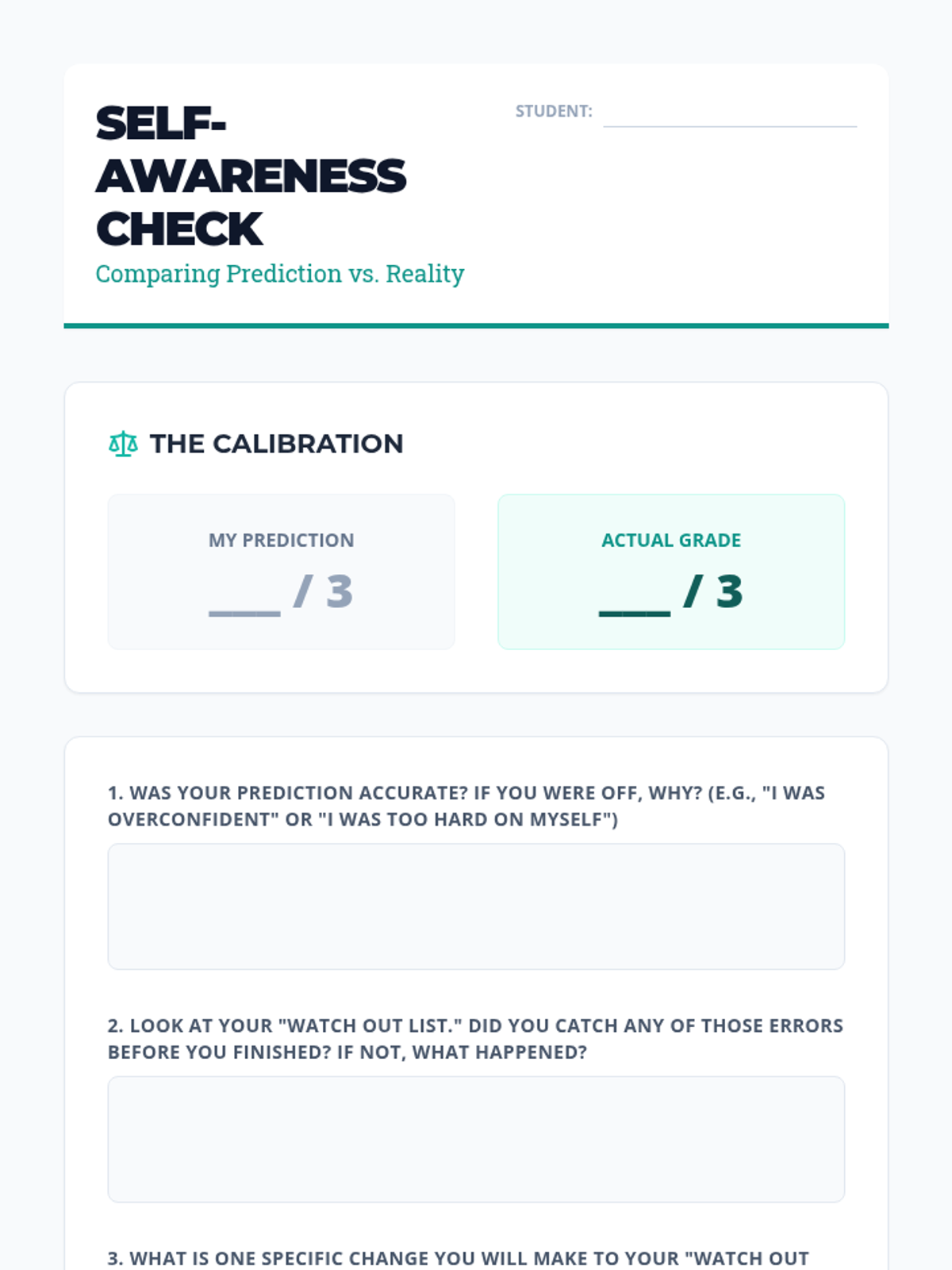
A final reflection sheet for students to compare their quiz predictions with their actual grades, evaluating the effectiveness of their metacognitive strategies.
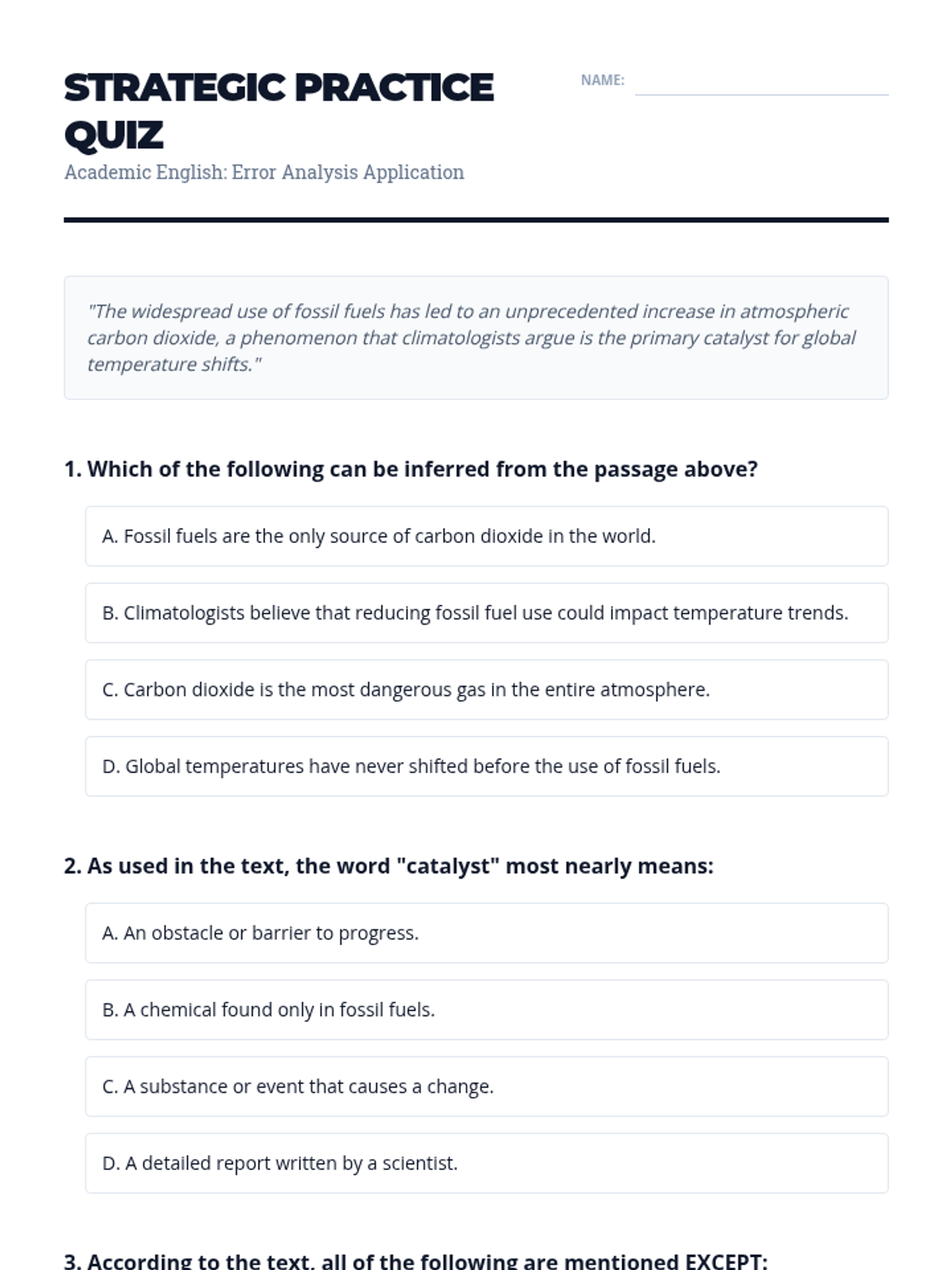
A short Academic English quiz designed to test students' application of their "Watch Out List," including a mandatory pre-grading self-reflection and score prediction section.
Final slides for the sequence focusing on the "Showtime" assessment. It introduces the score prediction challenge and real-time error analysis.
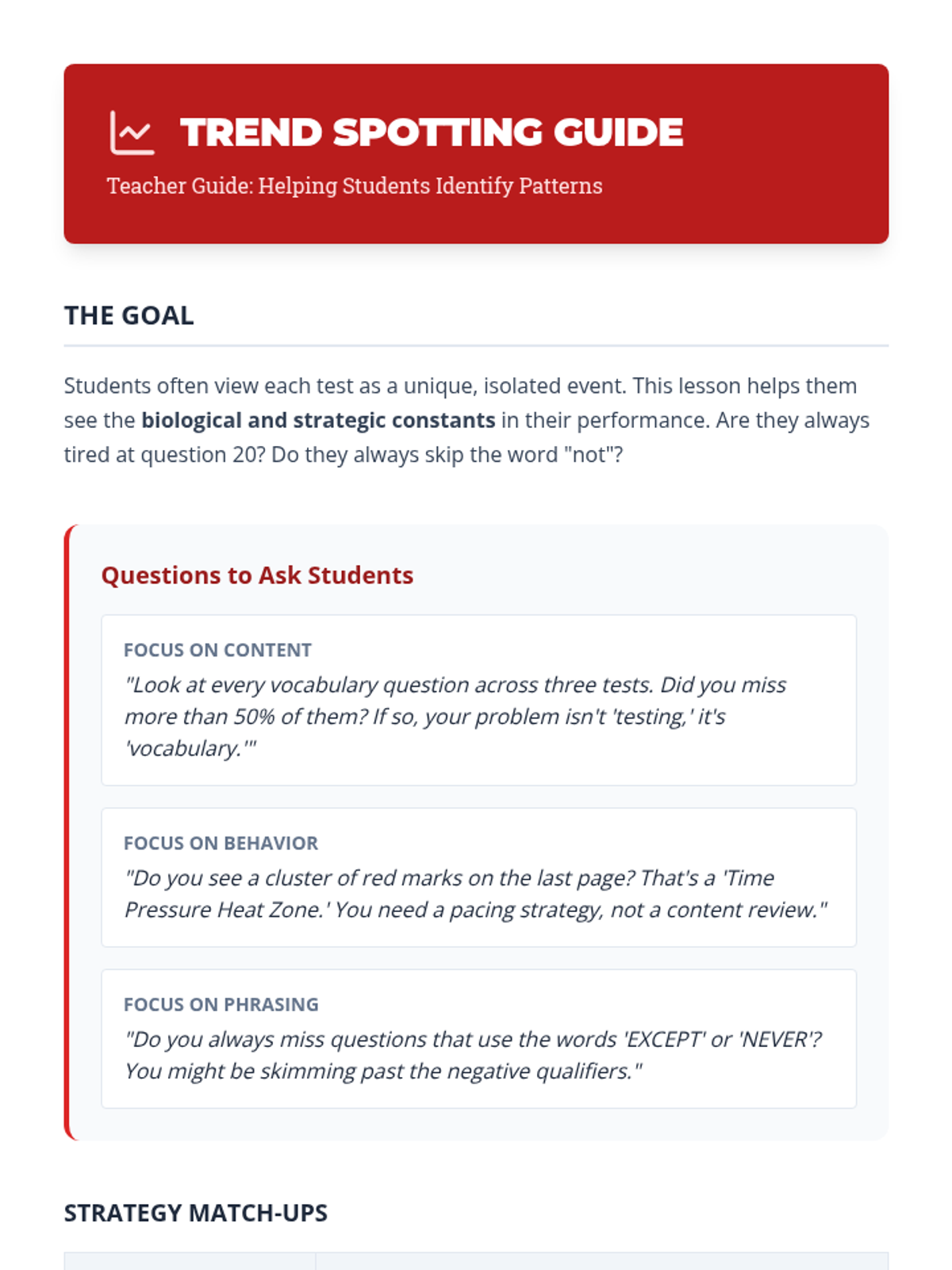
A guide for teachers to help students interpret their error data and connect patterns to specific defensive strategies.
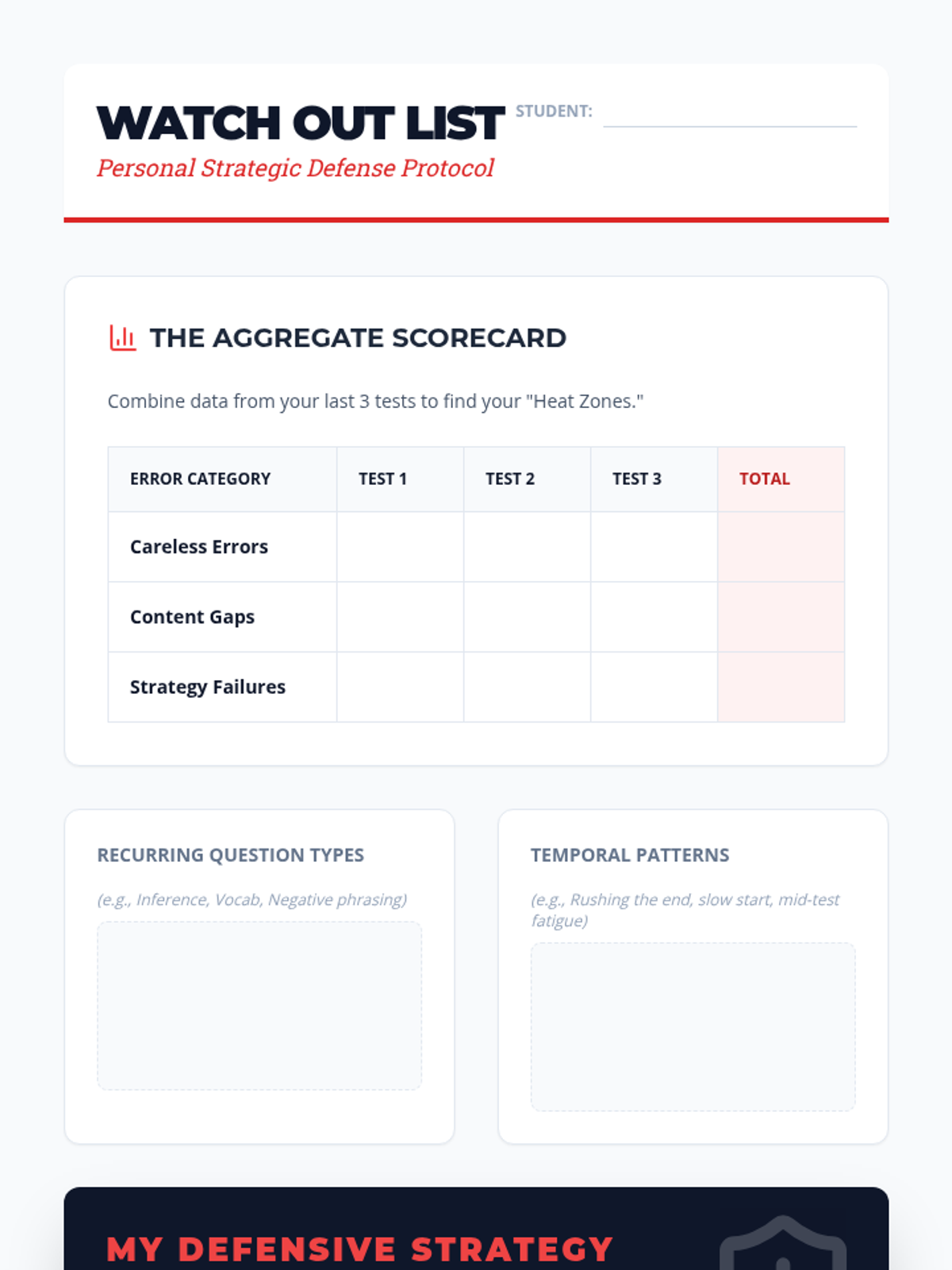
A student worksheet for aggregating error data across multiple assessments and distilling those patterns into a "Watch Out List" for future defense.
Slides for Lesson 4 that use a "Heatmap" analogy to teach students how to aggregate error data and identify recurring personal patterns.
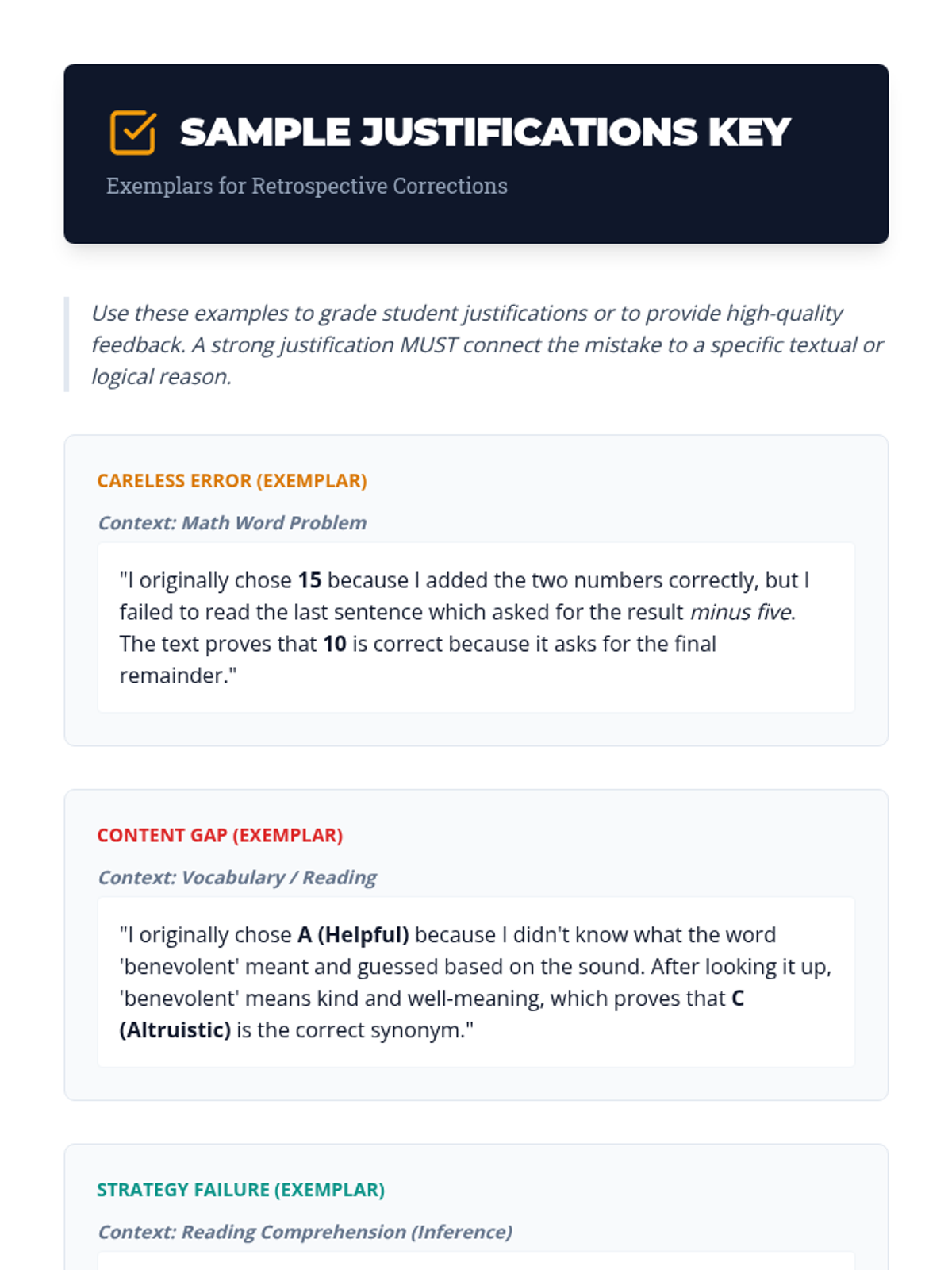
An answer key/exemplar guide for teachers to evaluate student justification statements, showing the difference between weak and mastery-level corrections.
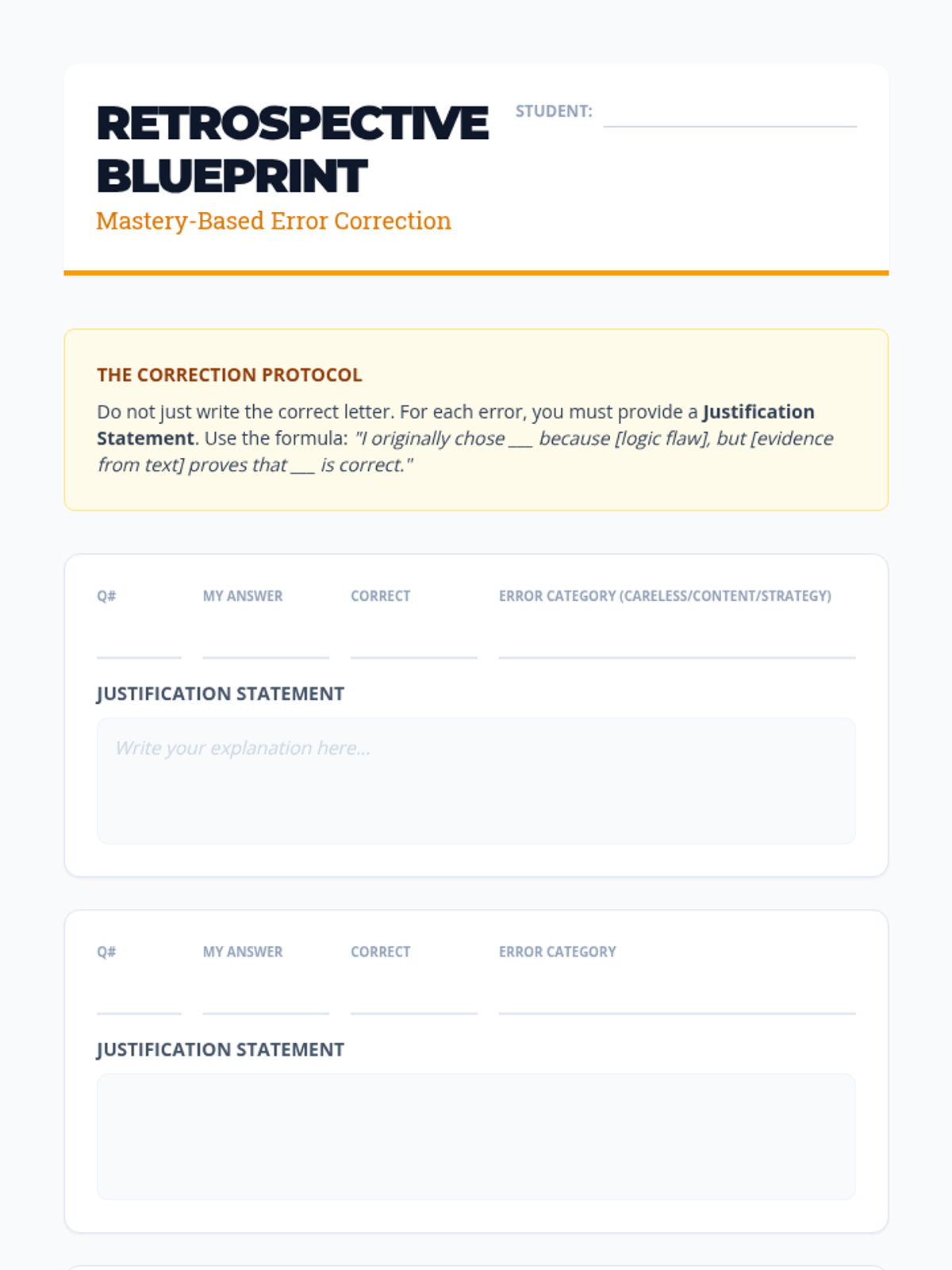
A template for students to perform deep error corrections, requiring them to write justification statements using a specific logic-based formula.
Slides for Lesson 3 introducing the "Justified Fix" method. It emphasizes that students must explain why they were wrong and why the new answer is right using evidence.
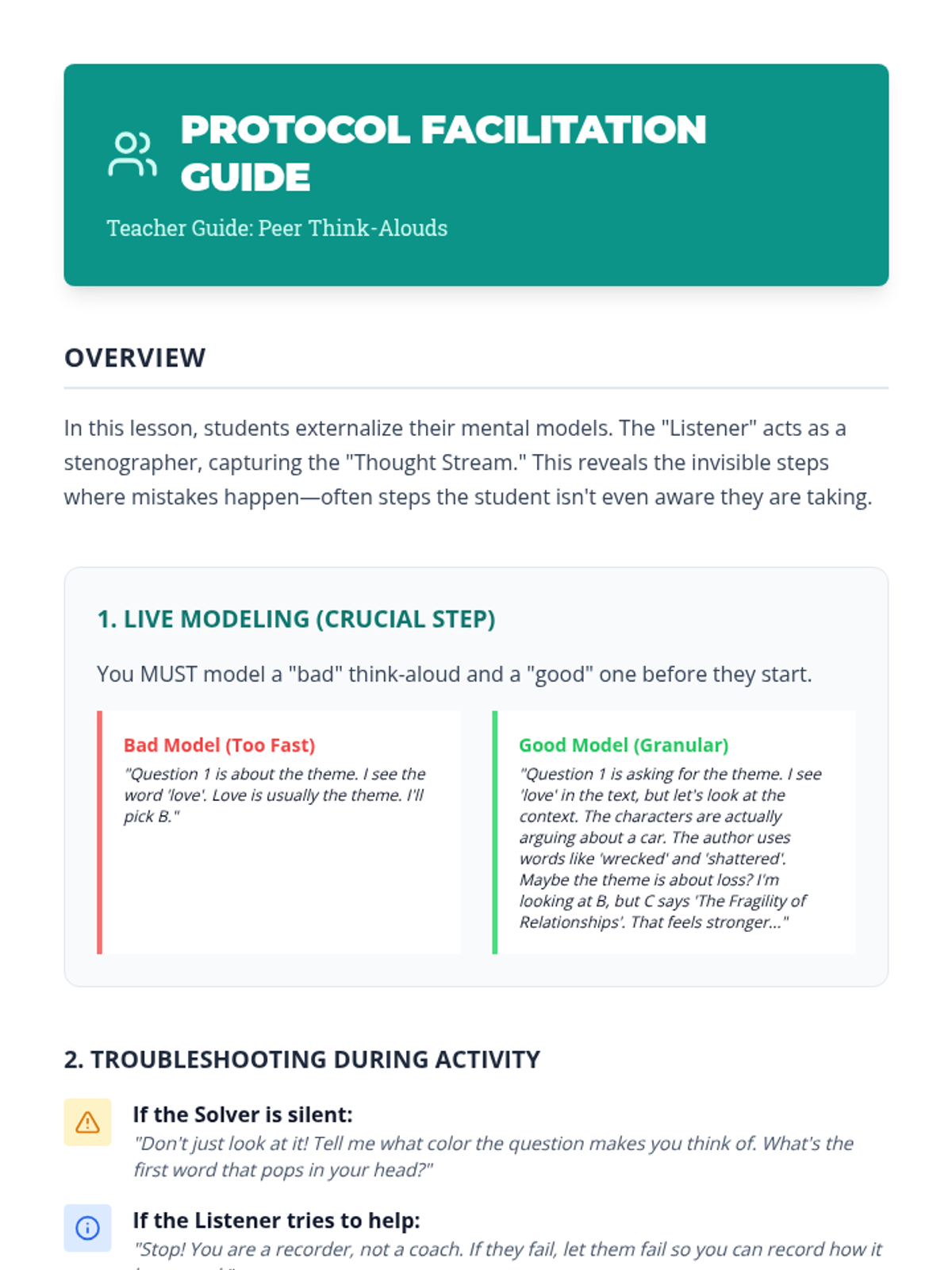
A facilitation guide for teachers to lead the "Think-Aloud" protocol, including scripts for modeling and tips for troubleshooting silent students.
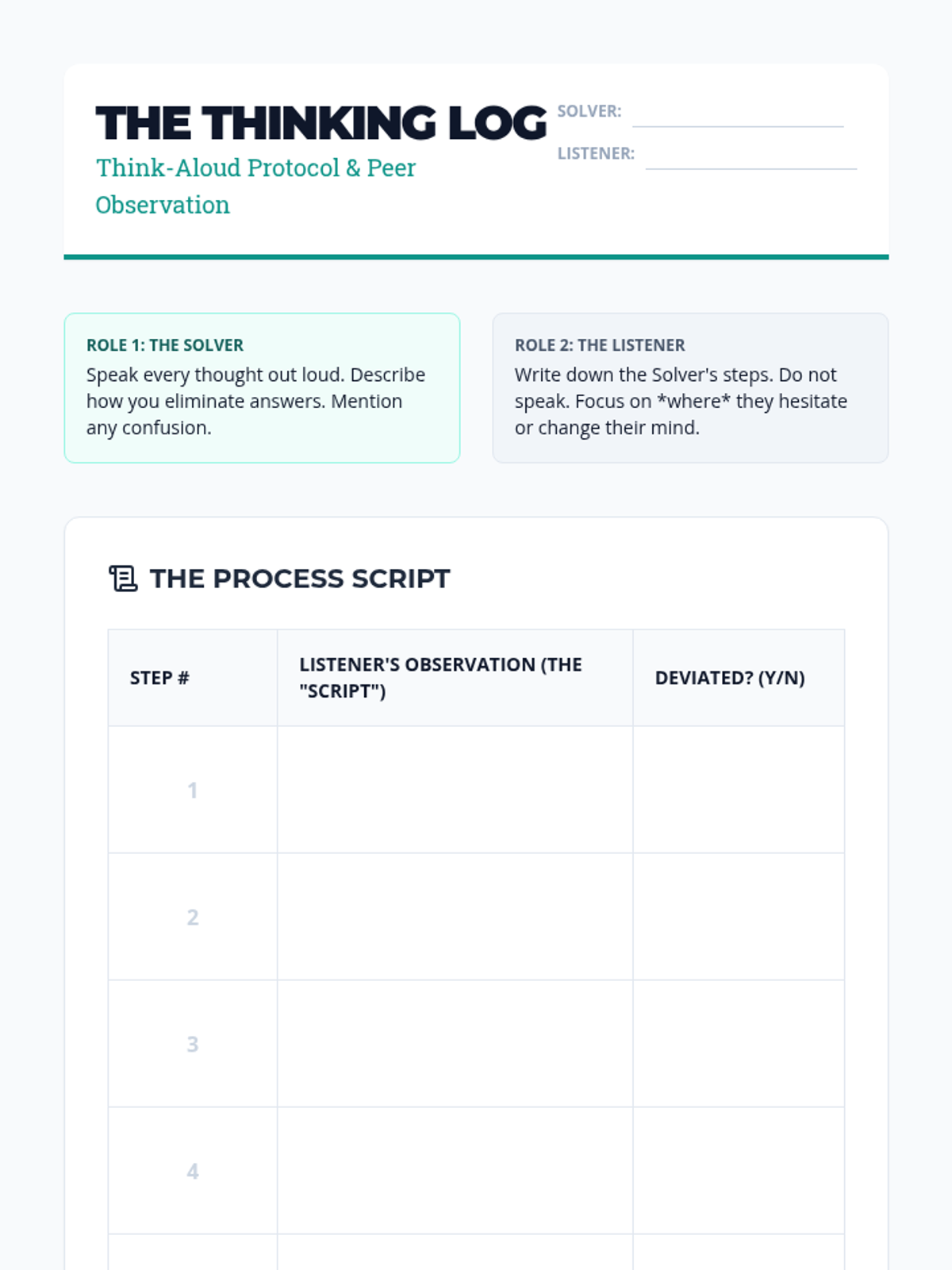
A peer-observation worksheet where students record their partner's "Think-Aloud" steps and analyze where their logic deviated from the correct path.
Slides for Lesson 2 that introduce the "Think-Aloud" protocol using a gamer commentary analogy. It outlines the roles of "The Solver" and "The Listener."
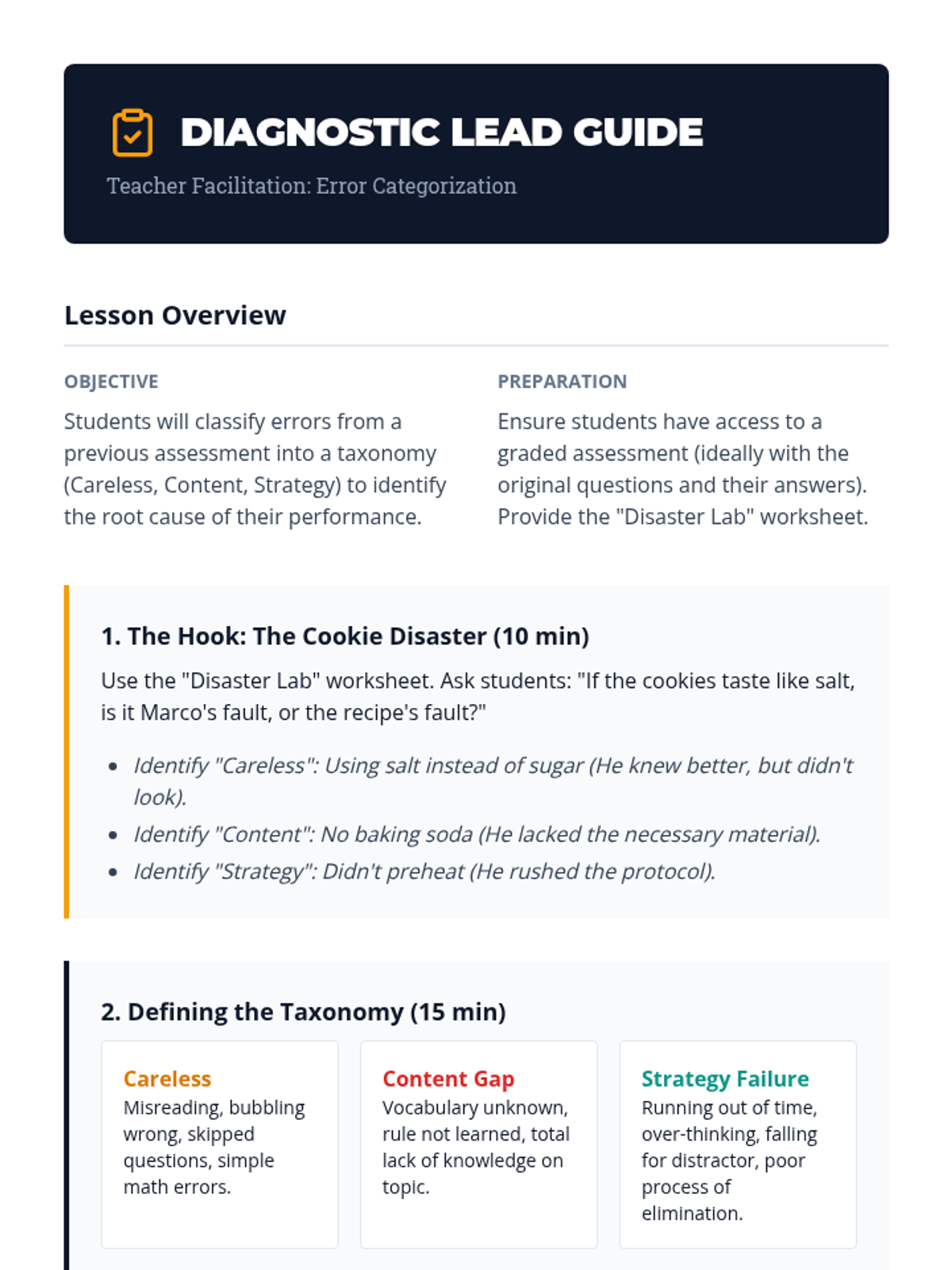
A teacher facilitation guide for Lesson 1, providing instructional prompts and definitions for error taxonomy.
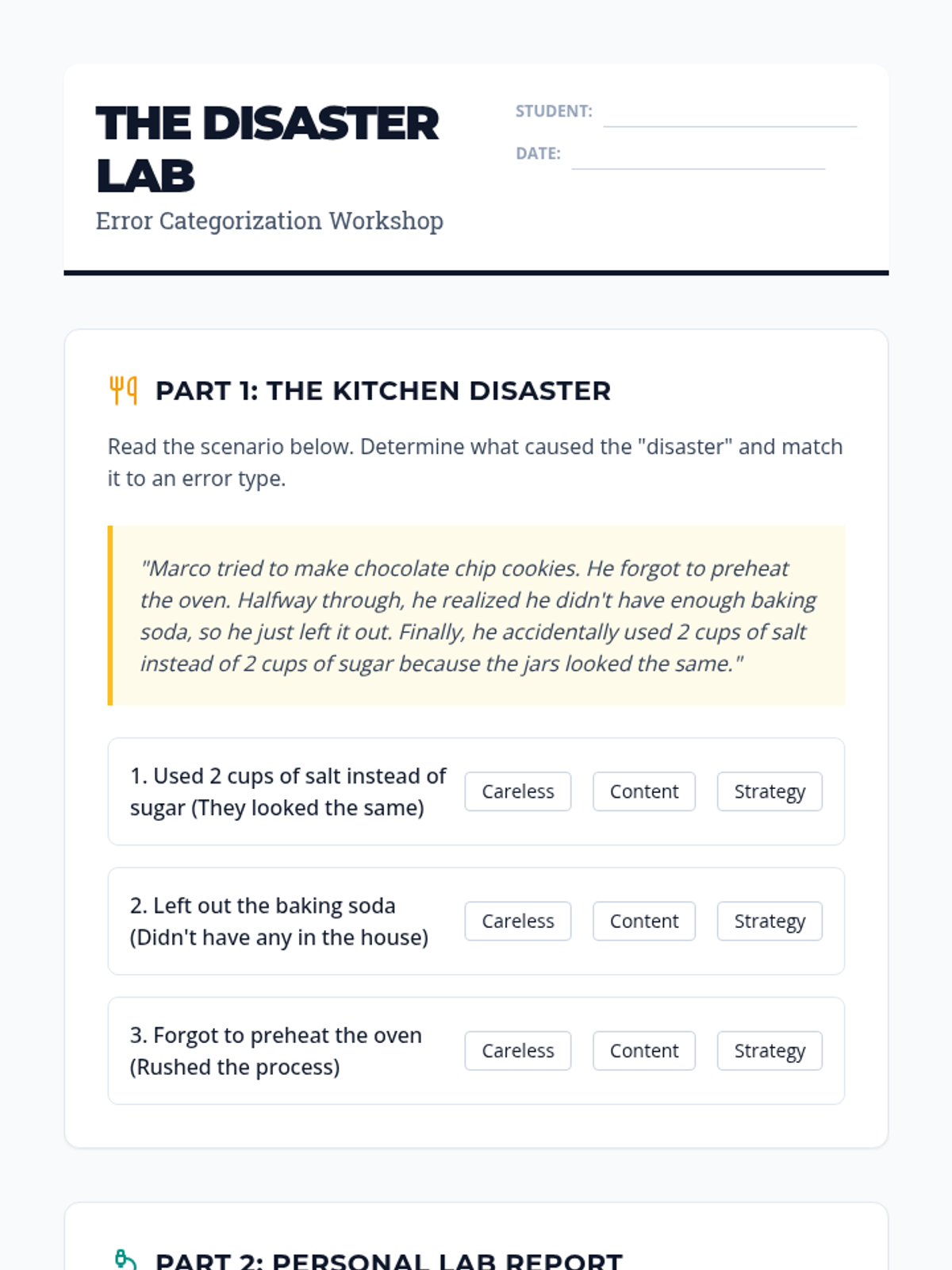
A student worksheet for the first lesson that uses a cookie recipe disaster to hook students into error categorization, followed by a table for analyzing their own test mistakes.
An introductory slide deck explaining the three main types of errors: Careless, Content Gap, and Strategy Failure, using a recipe disaster analogy.
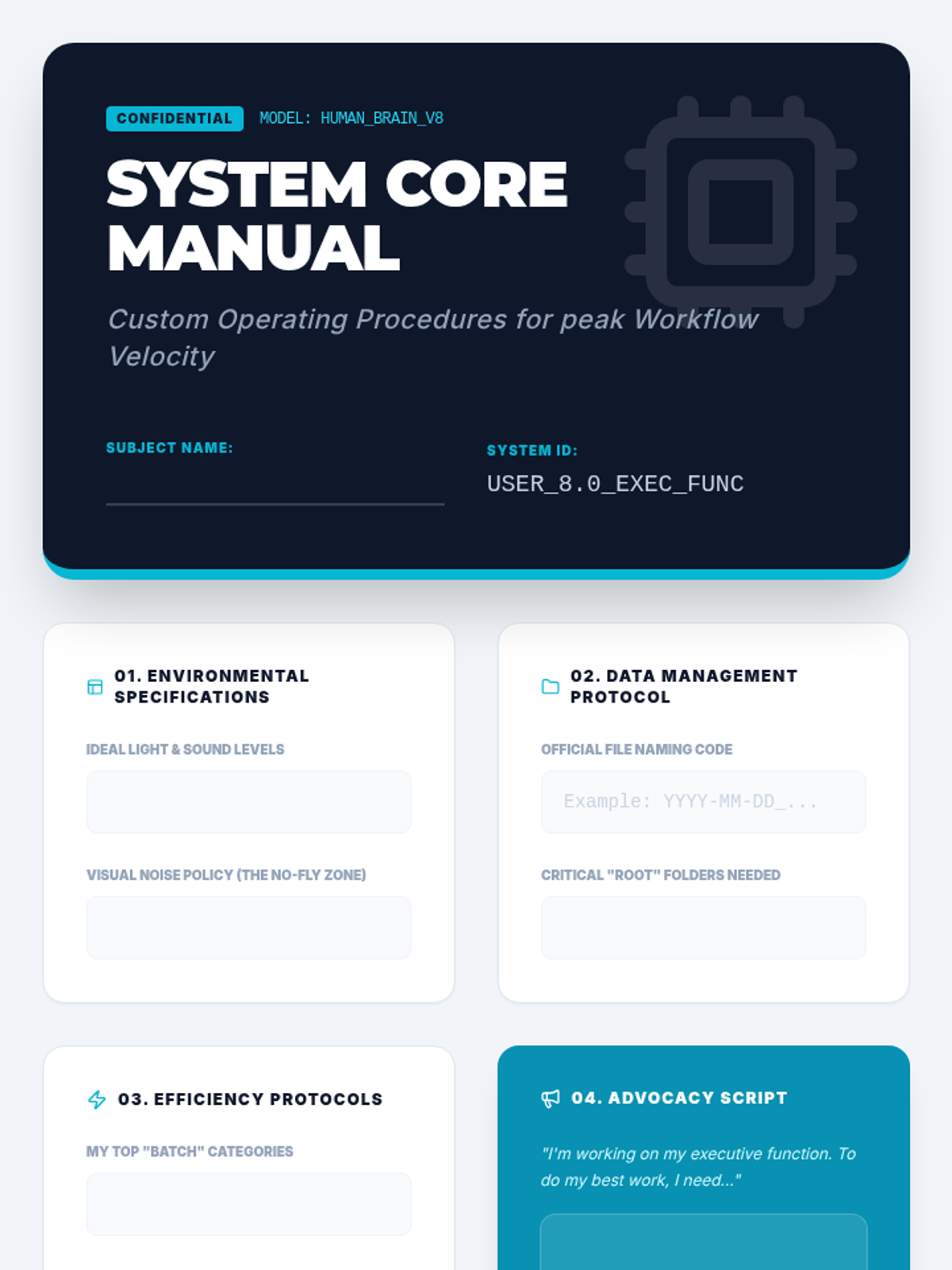
The capstone project template for the sequence. Students synthesize all previous learning into a professional-looking "System Core Manual" that documents their personalized organizational strategies and self-advocacy needs.
Final project presentation guiding students to synthesize their learning into a personal "Operating Manual." Focuses on self-advocacy and developing a set of standard operating procedures for their individual cognitive needs.
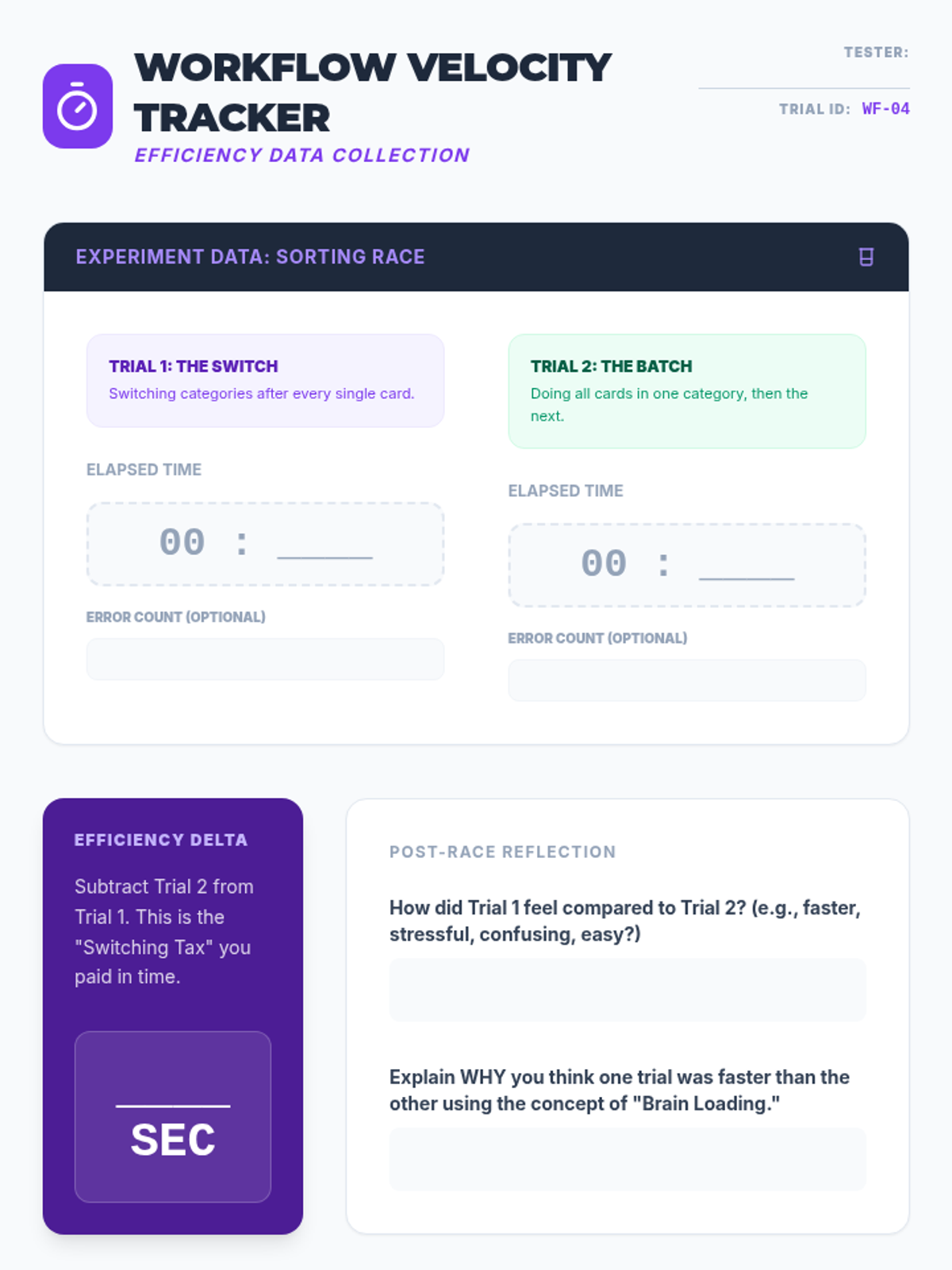
Experimental data tracker for the sorting race. Students record times for sequential versus batched tasks, calculate their efficiency delta, and plan real-world application of batching strategies to their homework.
Slides explaining the concept of task batching versus context switching. Includes instructions for a physical "Sorting Race" experiment to demonstrate the productivity cost of multitasking.
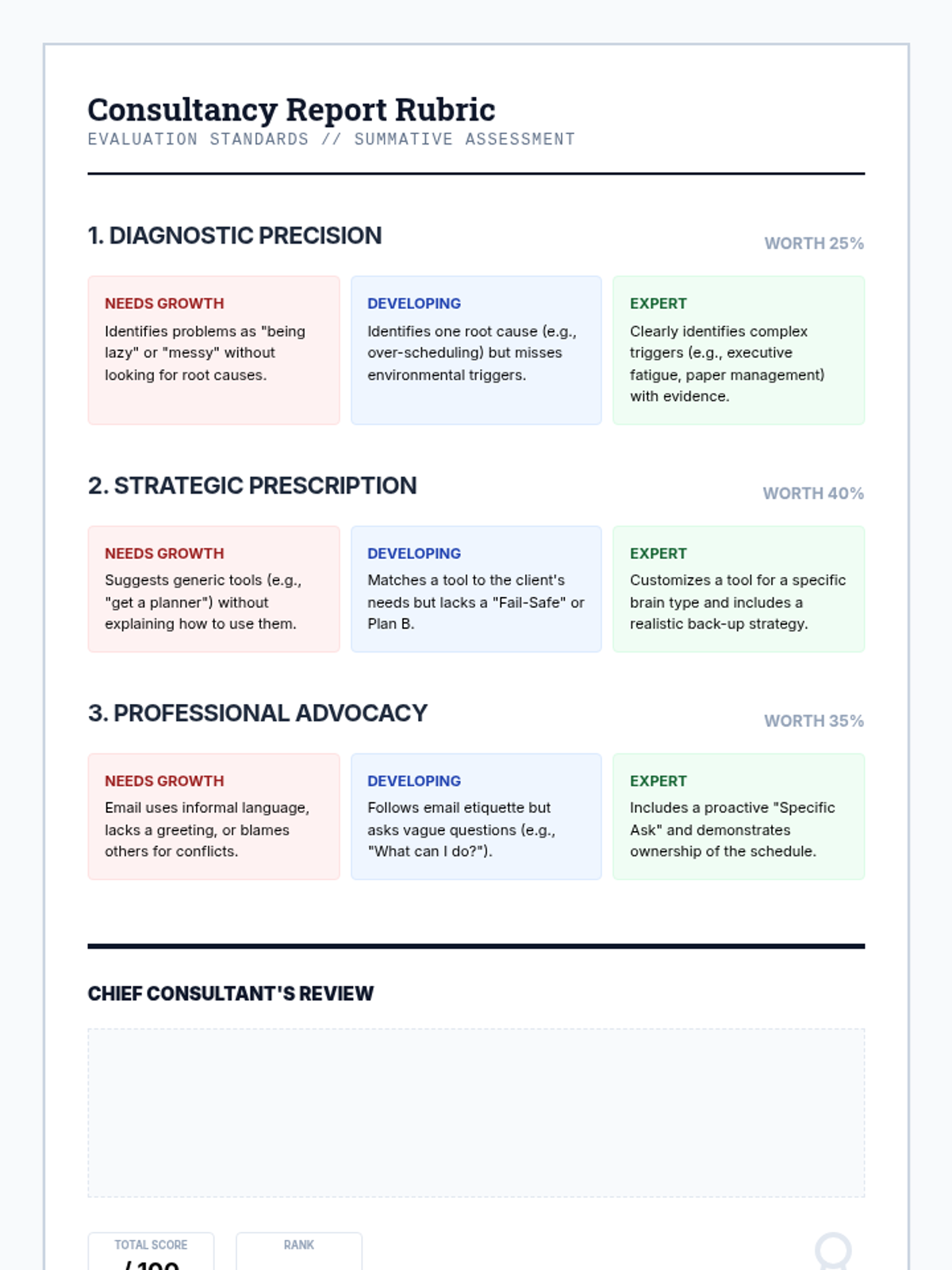
Teacher-facing rubric for assessing the Final Consultancy Report. Evaluates diagnostic precision, strategic prescription (tools), and professional advocacy (communication).
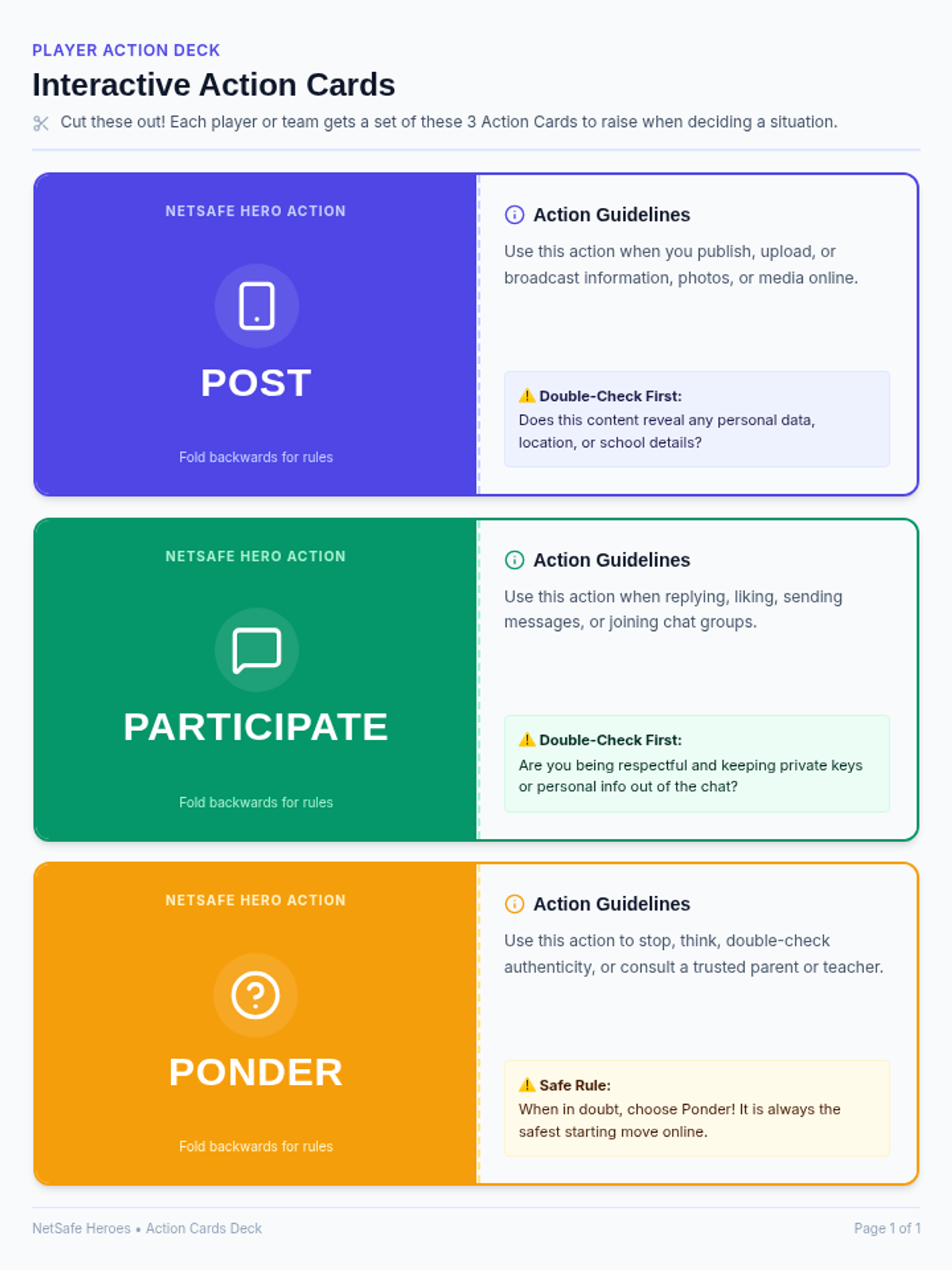
A printable set of 3 double-sided foldable player action cards (Post, Participate, and Ponder) designed for students to hold, discuss, and raise to answer digital safety situations during gameplay.
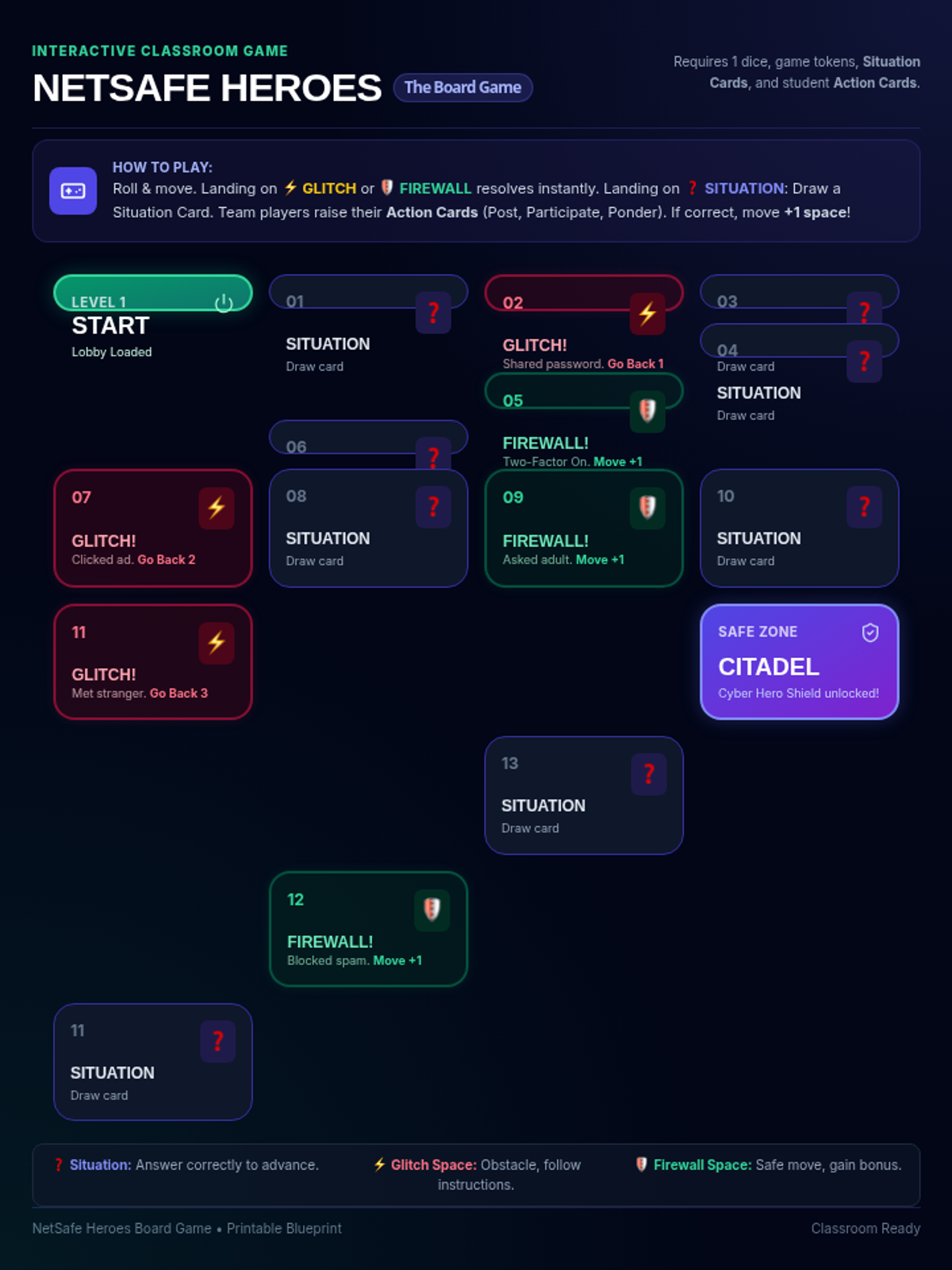
A printable board game layout featuring a winding pathway of digital safety milestones, situation spaces, glitch traps, and firewall boosts designed to be played with the Situation and Action cards.
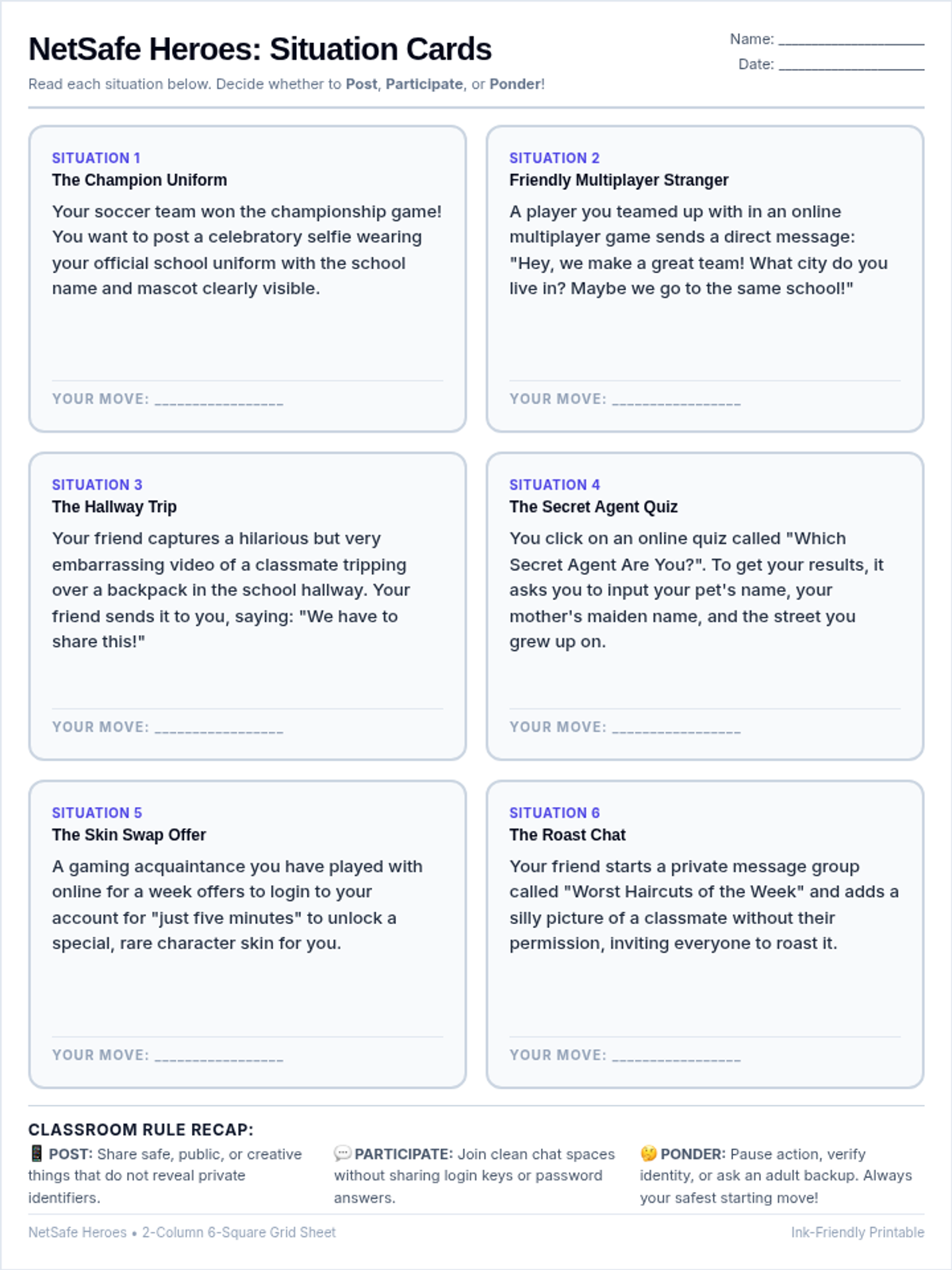
A clean, ink-friendly single-sheet handout displaying the 6 digital safety situations in a beautifully balanced 2-column, 6-square grid, designed with large, easy-to-read text for quick printing.
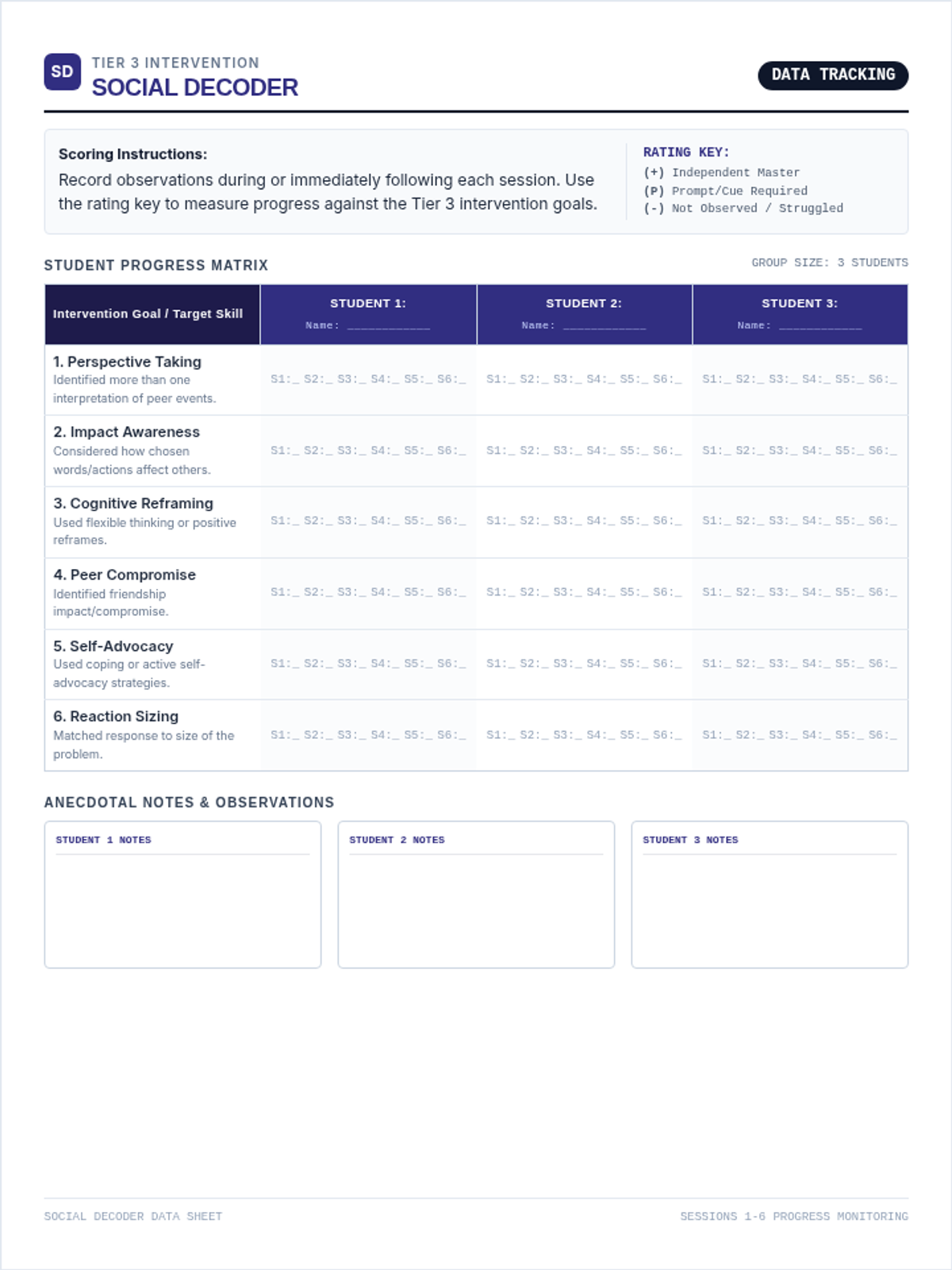
A clean, highly structured 1-page progress-tracking data sheet for facilitators to observe and rate three students' cognitive-behavioral skills across the 6 sessions.
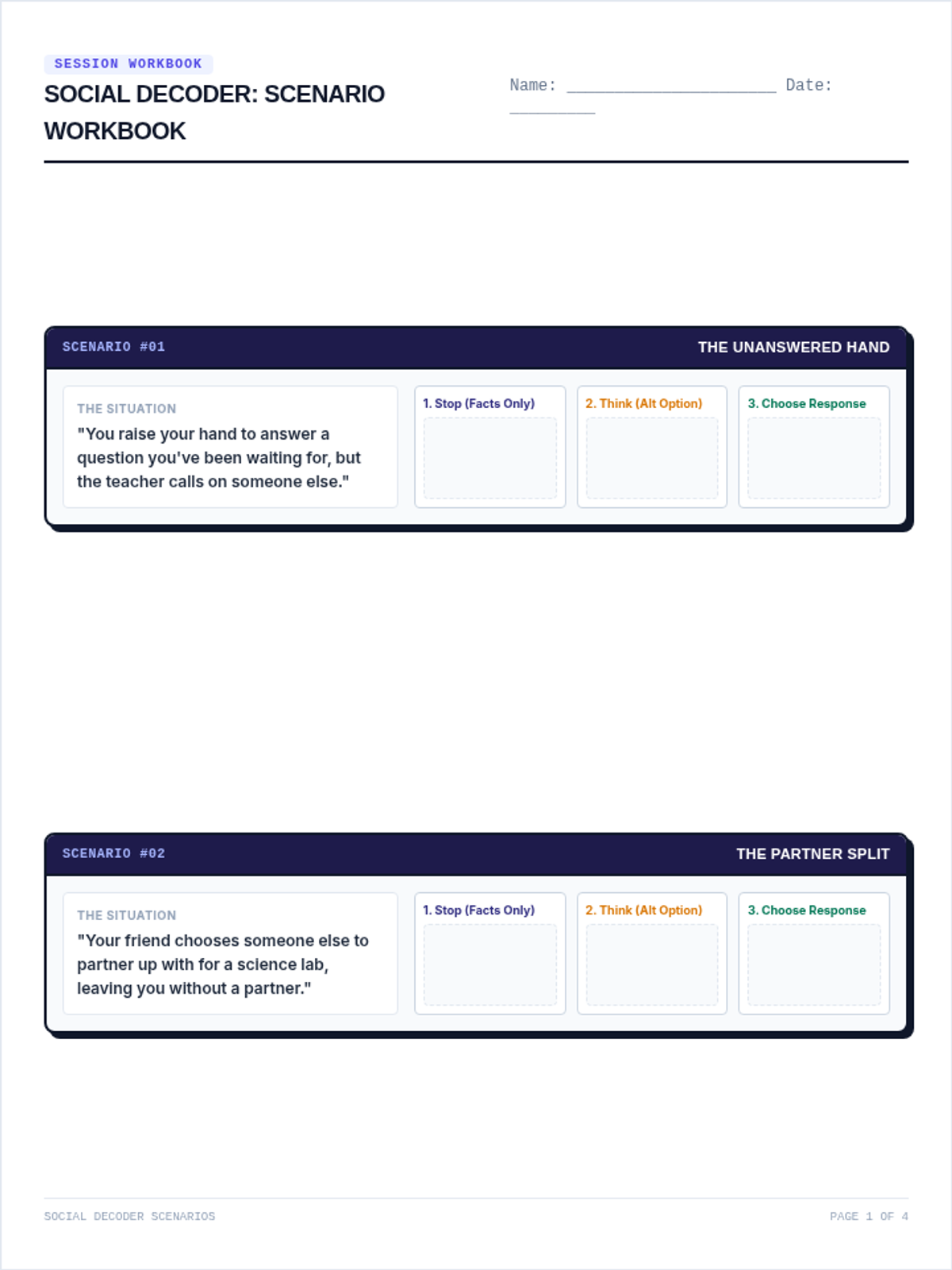
A 4-page interactive scenario workbook containing six clean, comic-paneled social situations. Provides large, blank response grids for student completion of the Stop, Think Twice, Choose framework.
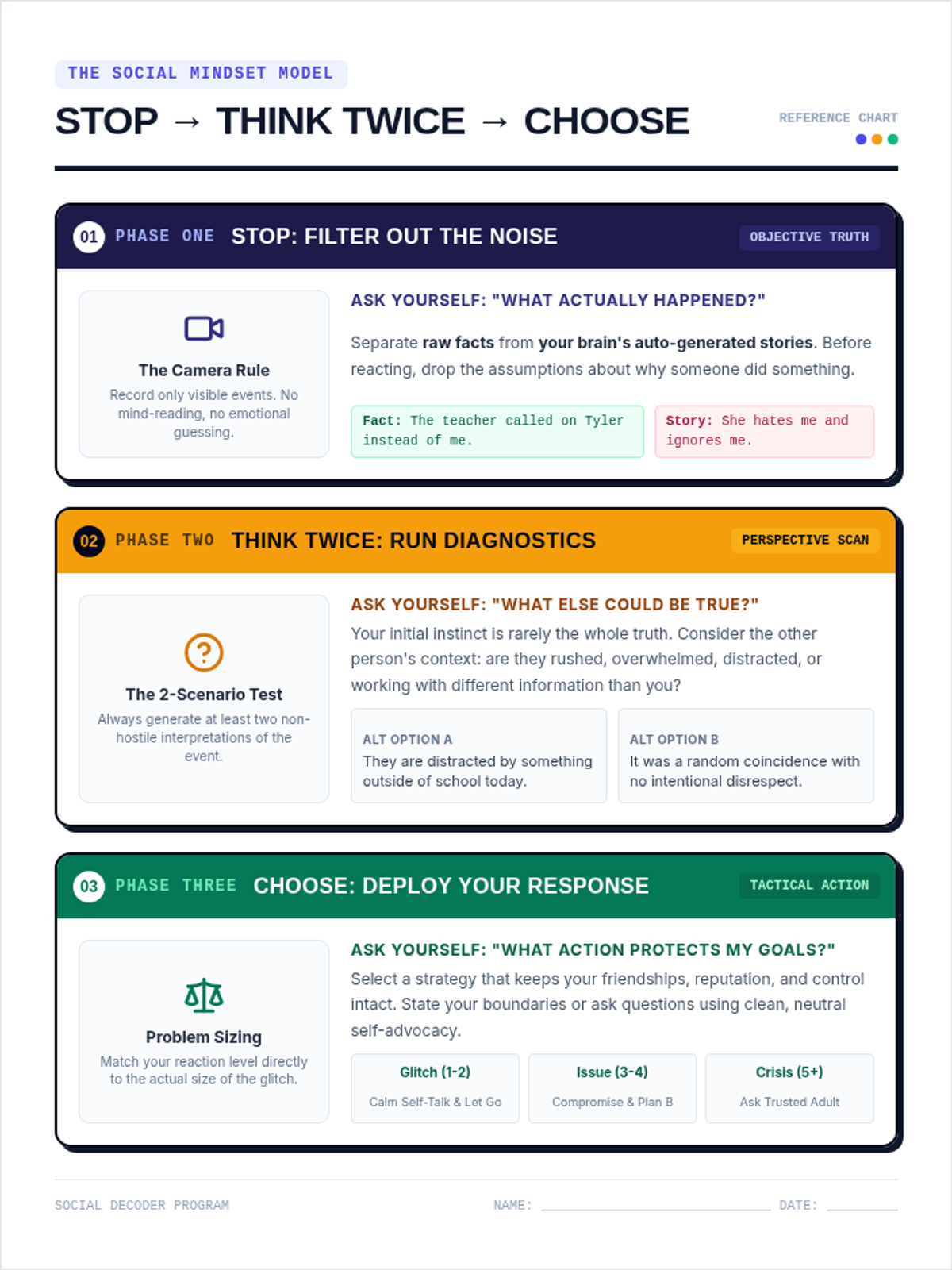
A highly polished 1-page visual anchor chart for sixth-grade students, breaking down the Stop, Think Twice, Choose framework into mature, logical steps with objective data concepts.
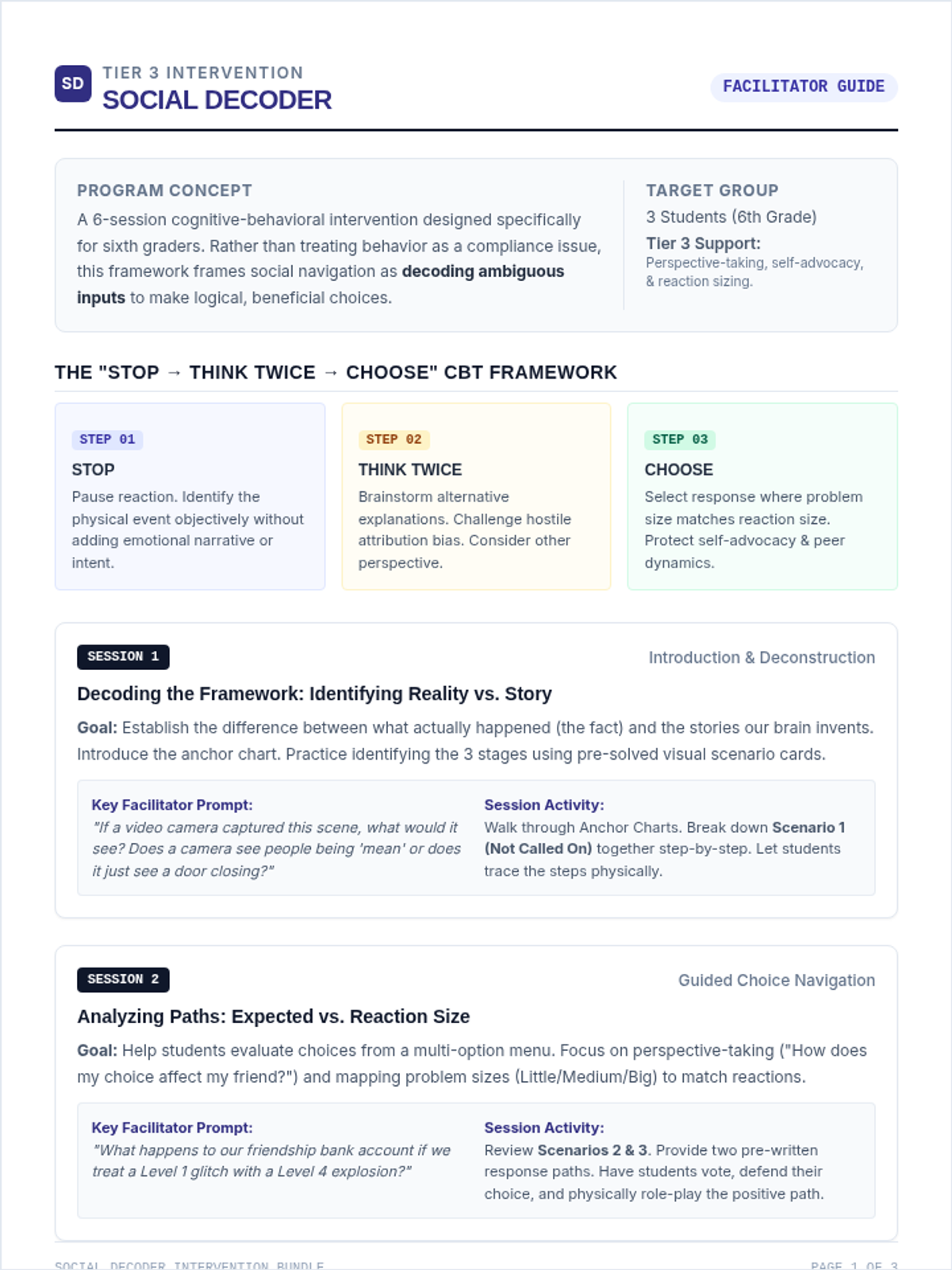
A 3-page print-ready facilitator guide detailing the 6-session social dynamics curriculum for Tier 3 sixth graders using the 'Stop, Think Twice, Choose' framework. Includes pacing, session goals, discussion prompts, and small-group facilitation techniques.
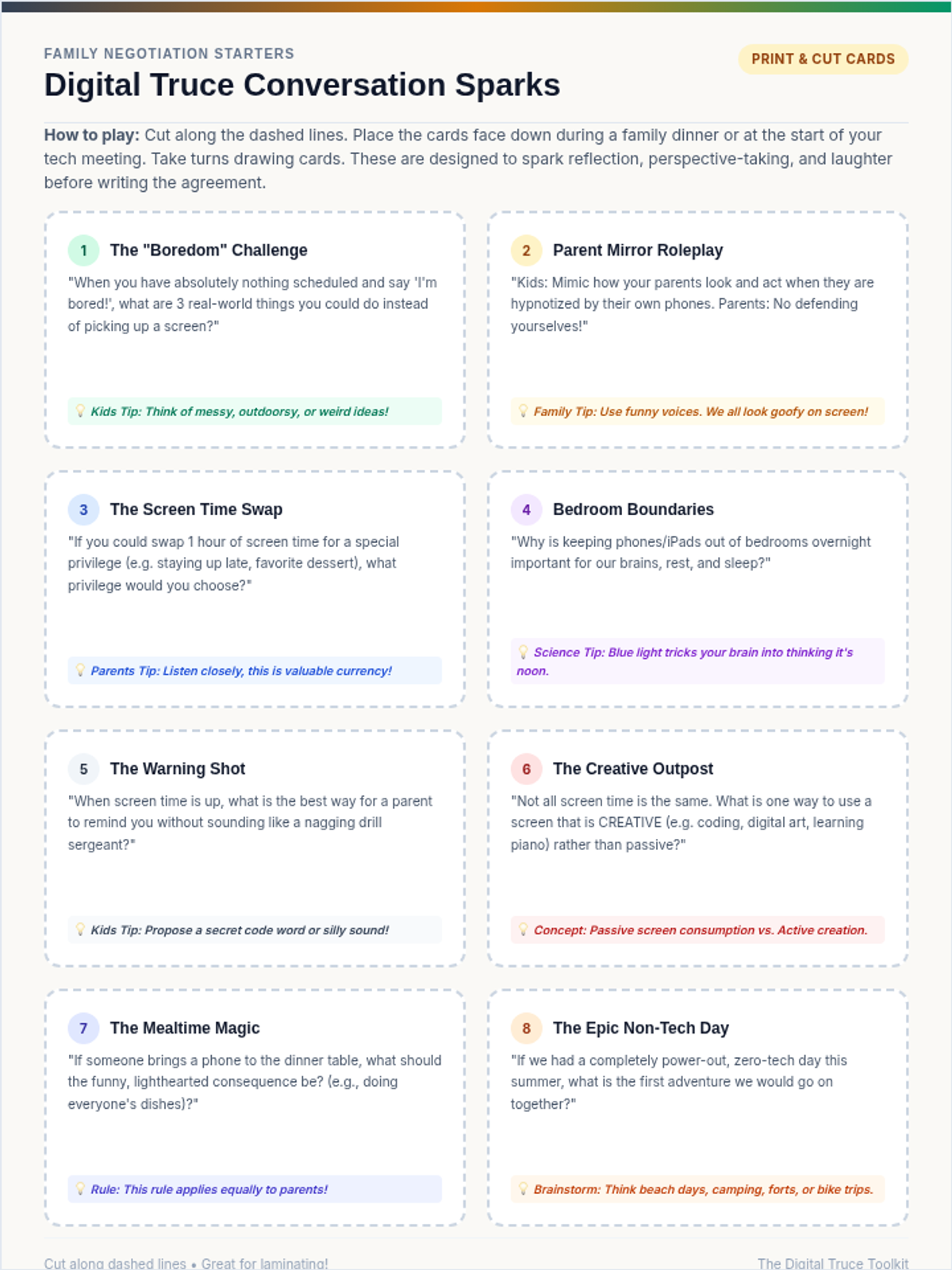
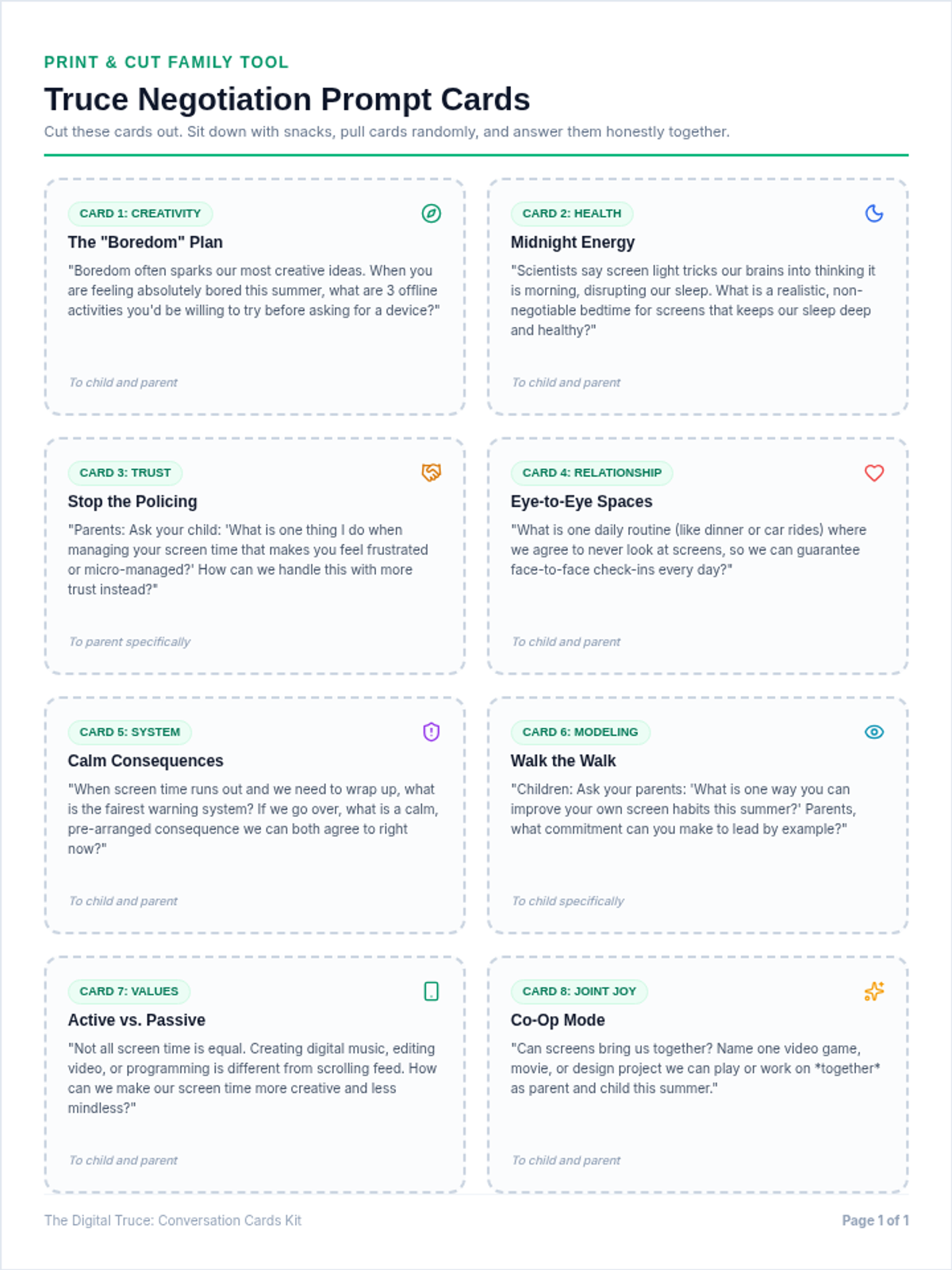
A set of printable conversation starter cards to break the ice and build empathy between parents and kids before drafting the summer tech agreement.
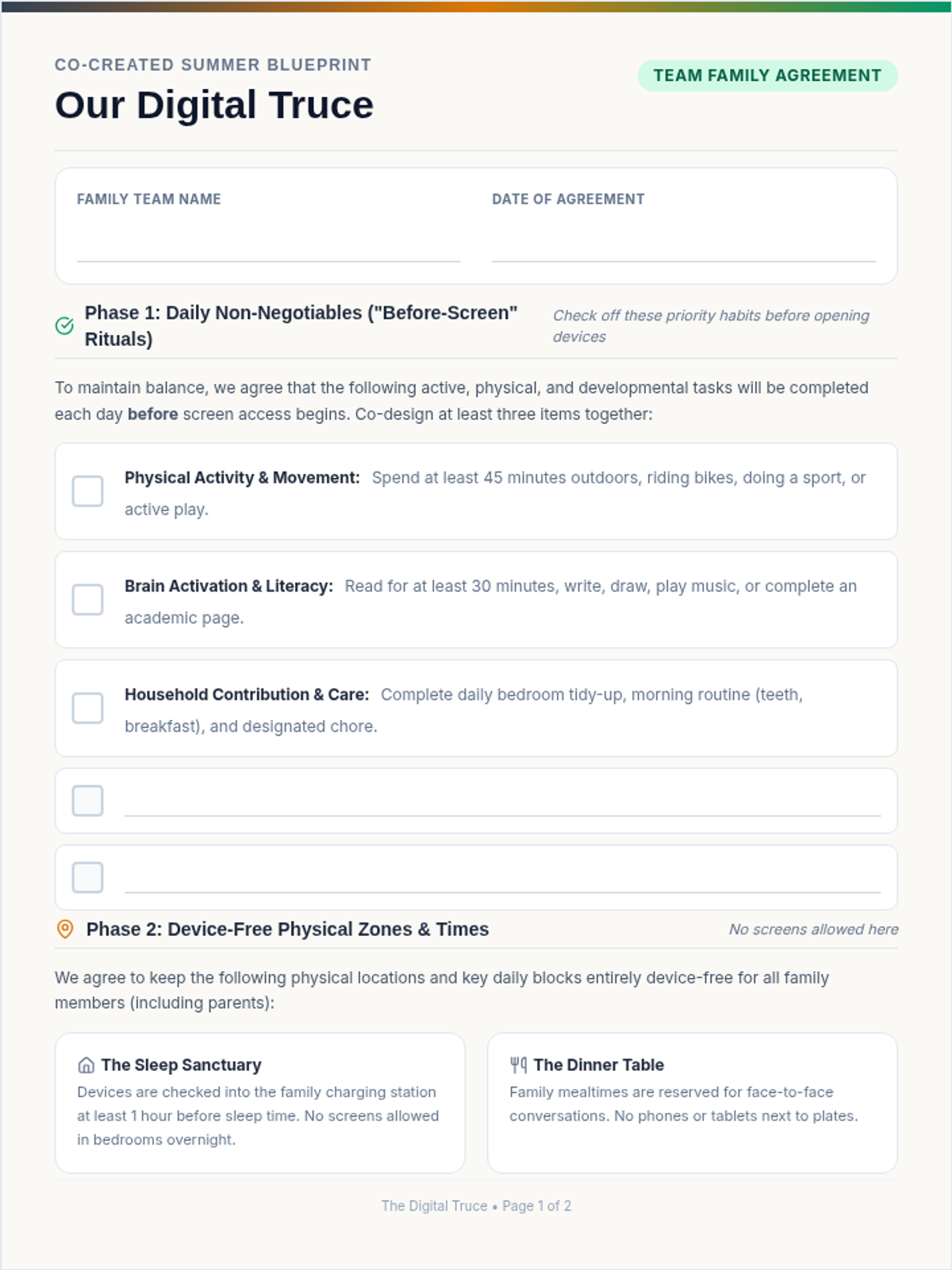
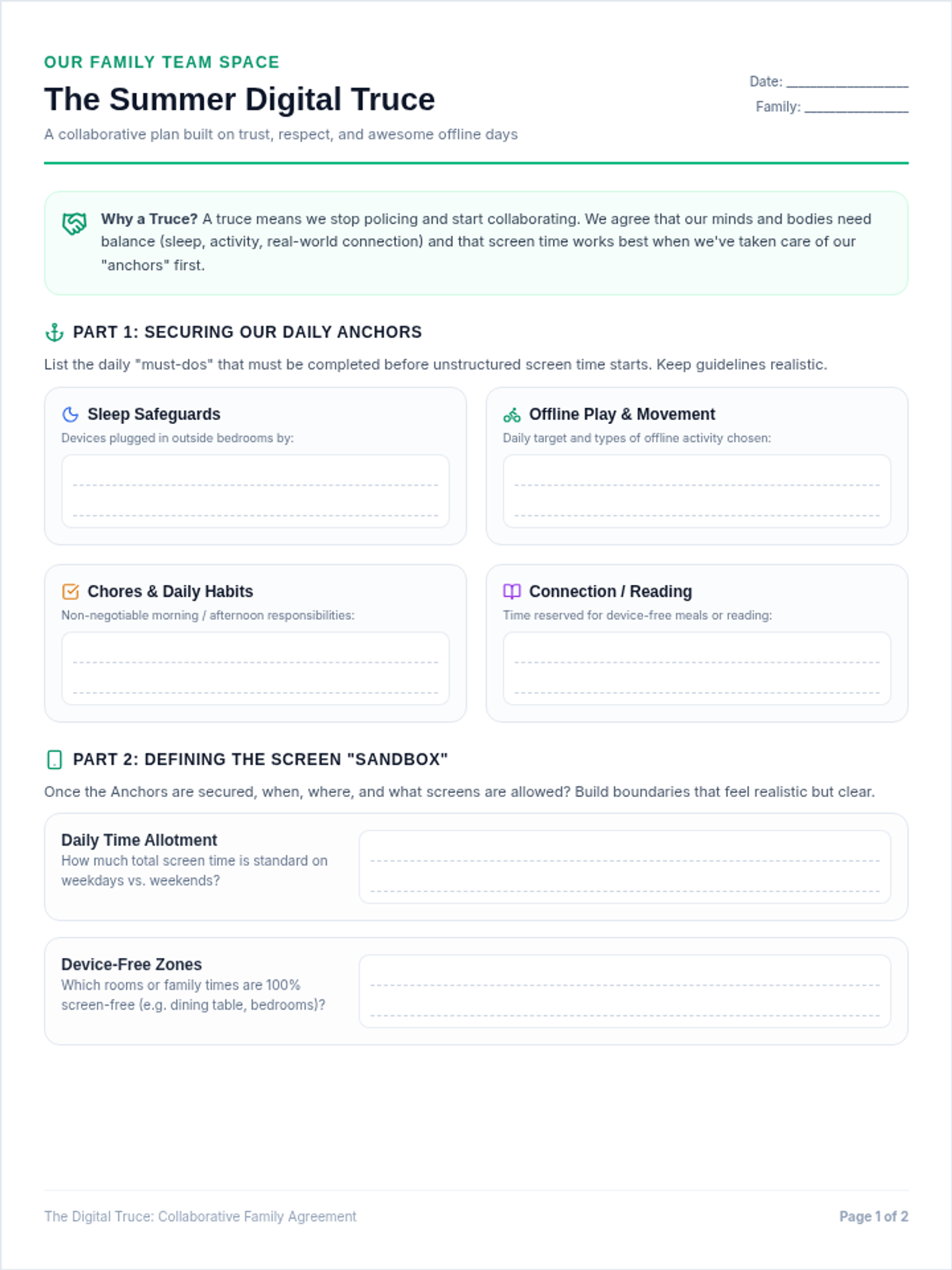
A beautifully designed, 2-page family agreement blueprint with structured checklists, tech-free zones, and commitment lines for collaborative co-creation.
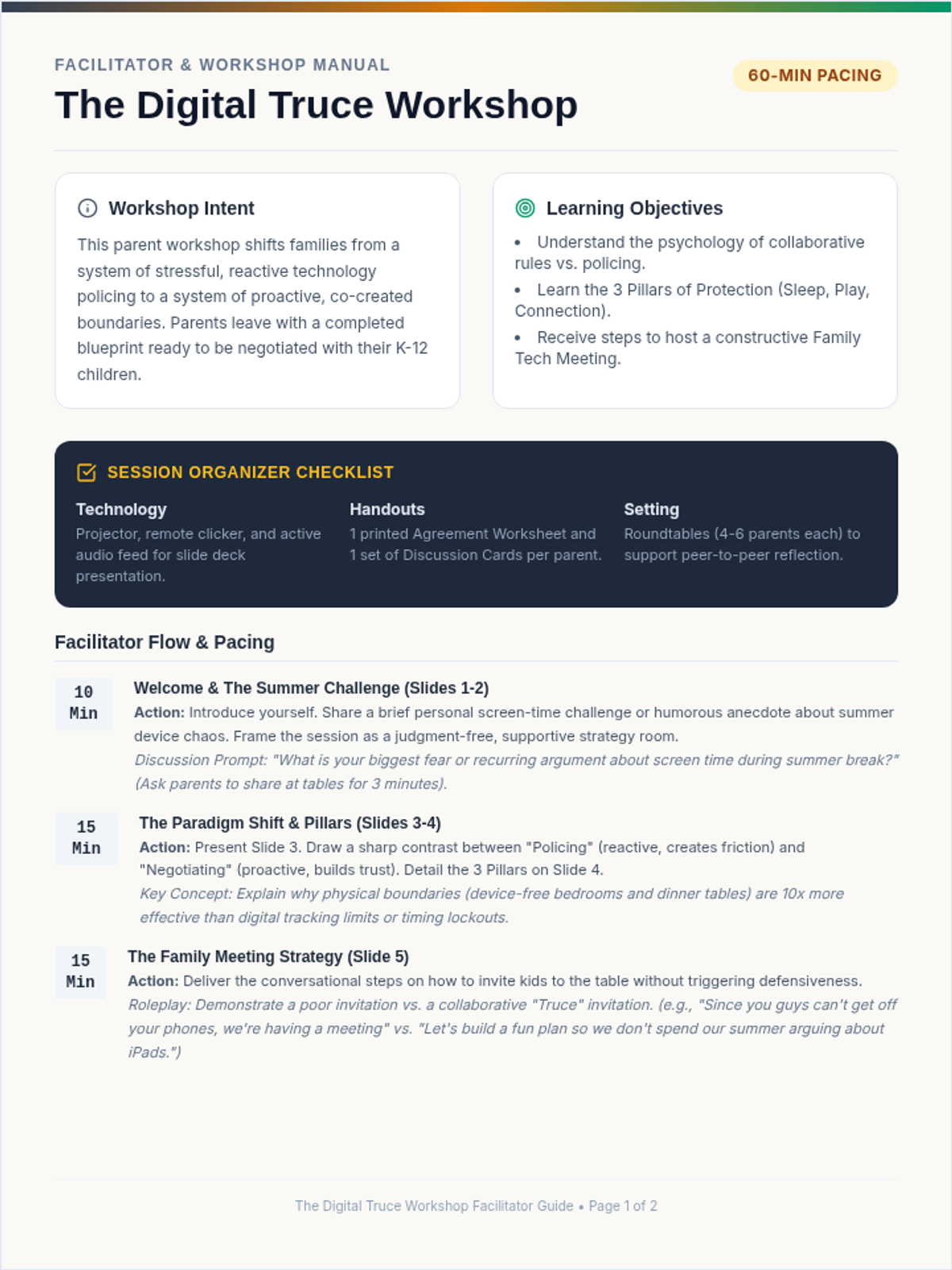
A step-by-step facilitation manual for workshop organizers, PTA leaders, or school counselors to deliver a 60-minute presentation guiding parents to build collaborative agreements.
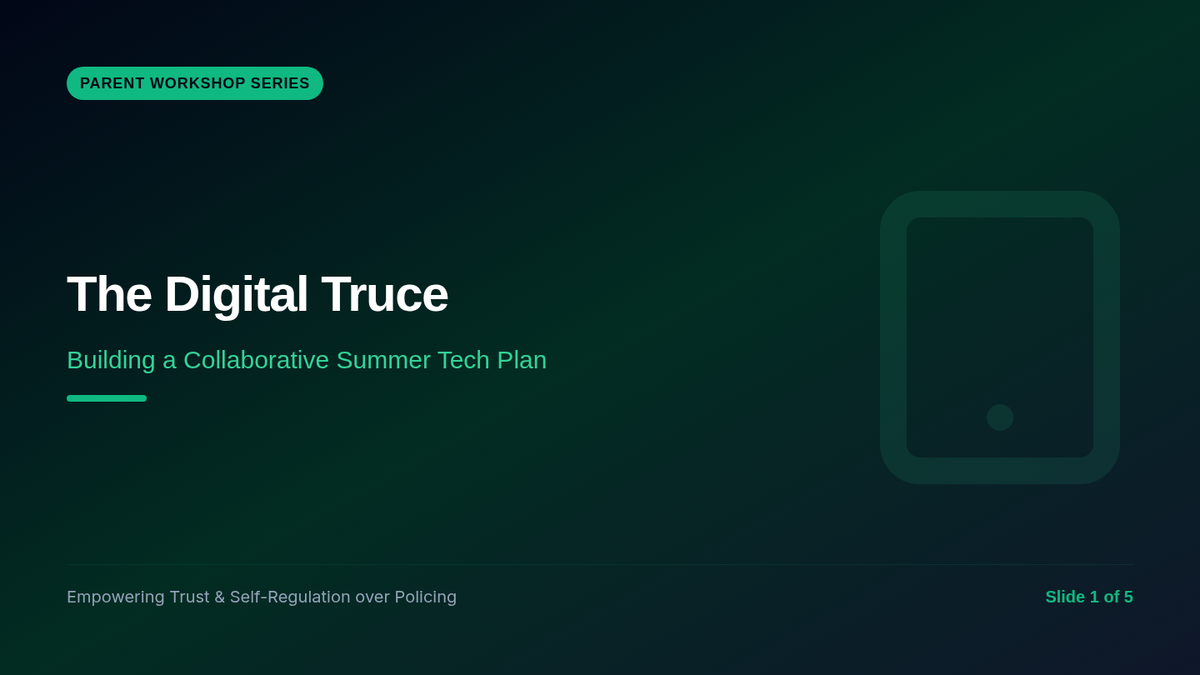
A presentation slide deck for a parent workshop or community evening, guiding parents through the philosophy and step-by-step process of establishing a collaborative family screen-time agreement.
A 1-page printable set of 8 collaborative conversation cards for parents and kids to use during their family screen-time negotiations.
A 2-page highly engaging and structured printable worksheet/agreement template for families to draft, negotiate, and sign their personalized Summer Digital Truce.
A clean, highly visible 5-slide presentation deck used during the parent workshop to explain the shift from screen policing to collaborative boundaries.
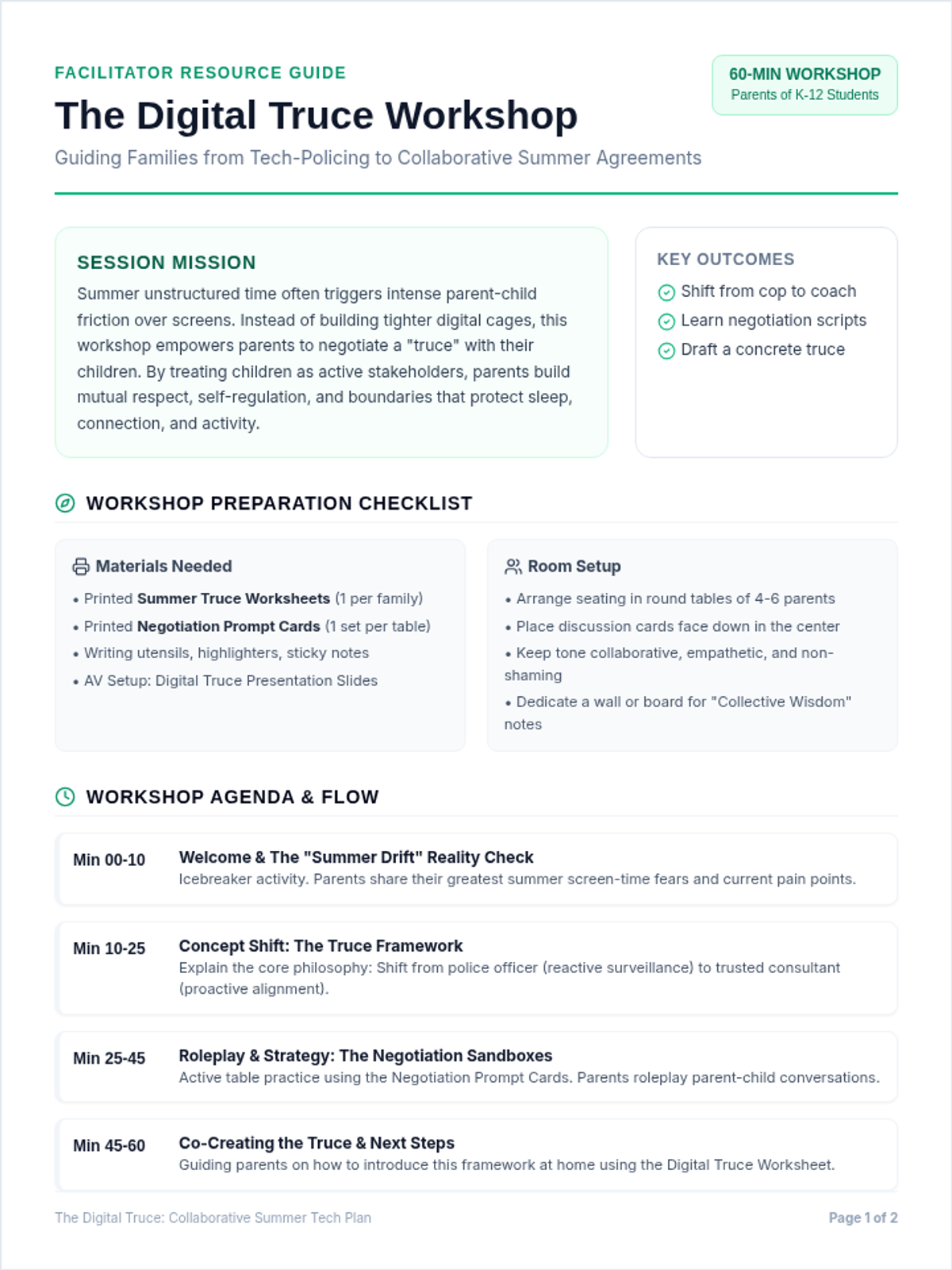
A 2-page workshop facilitator guide for educators or parent-group leaders, detailing how to run a 60-minute interactive session on building collaborative summer tech agreements.
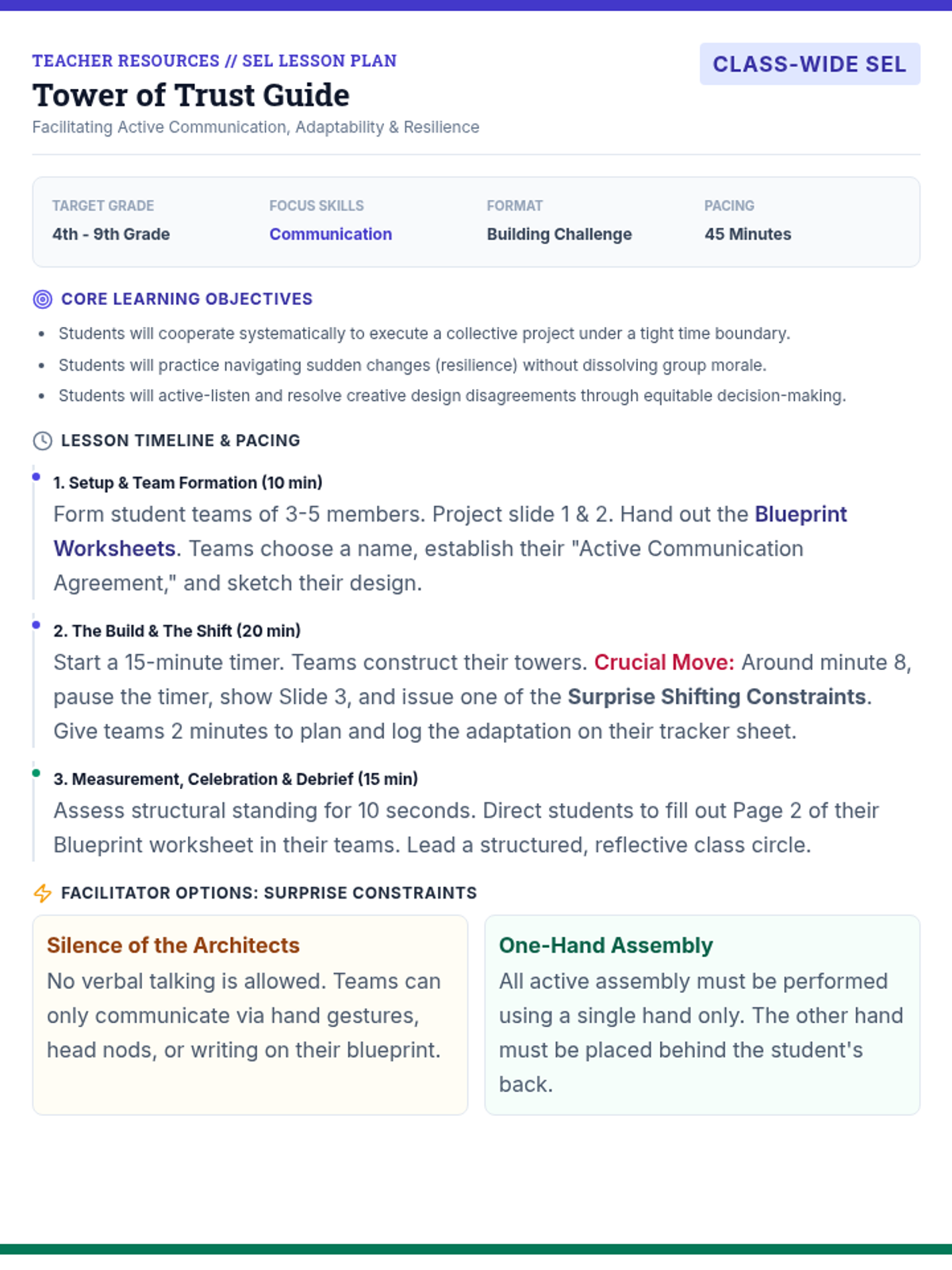
An extensive teacher facilitation guide containing material requirements, a precise paced timeline, surprise constraint options to deploy mid-challenge, a structured debrief guide, and an observational SEL rubric.
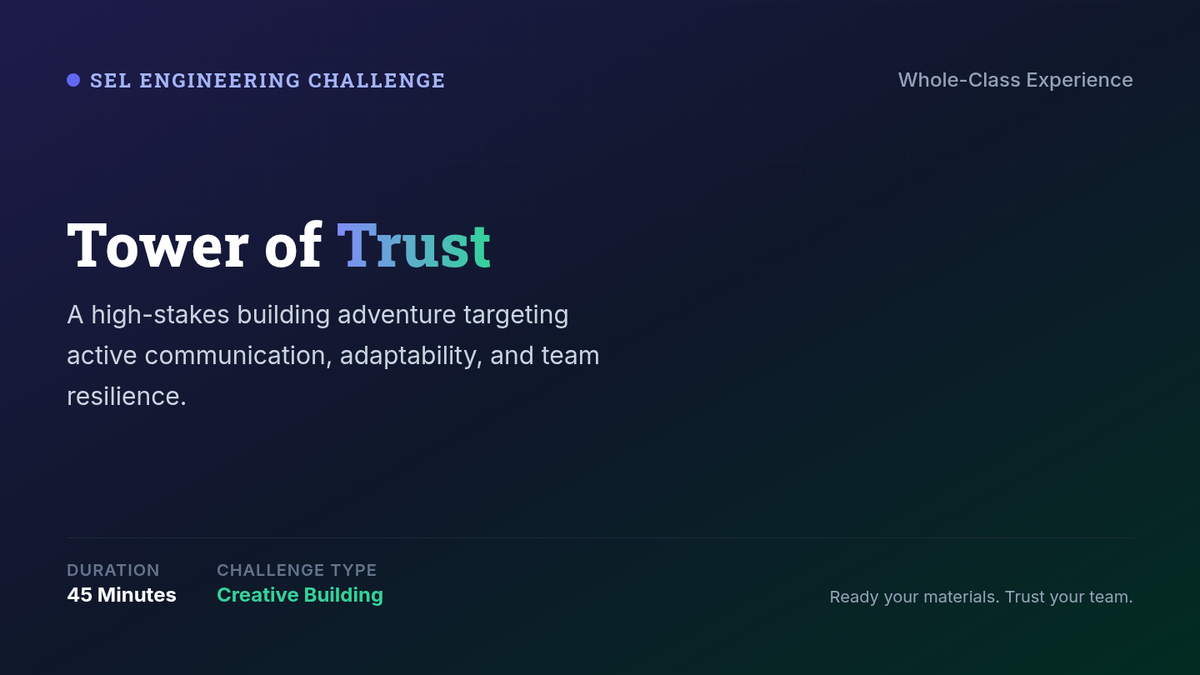
An interactive and beautiful slide deck guiding classes through the Tower of Trust creative building challenge. Includes objectives, safety guides, surprise shifting constraint rules, dynamic collaborative goals, and debrief prompts with high readability.
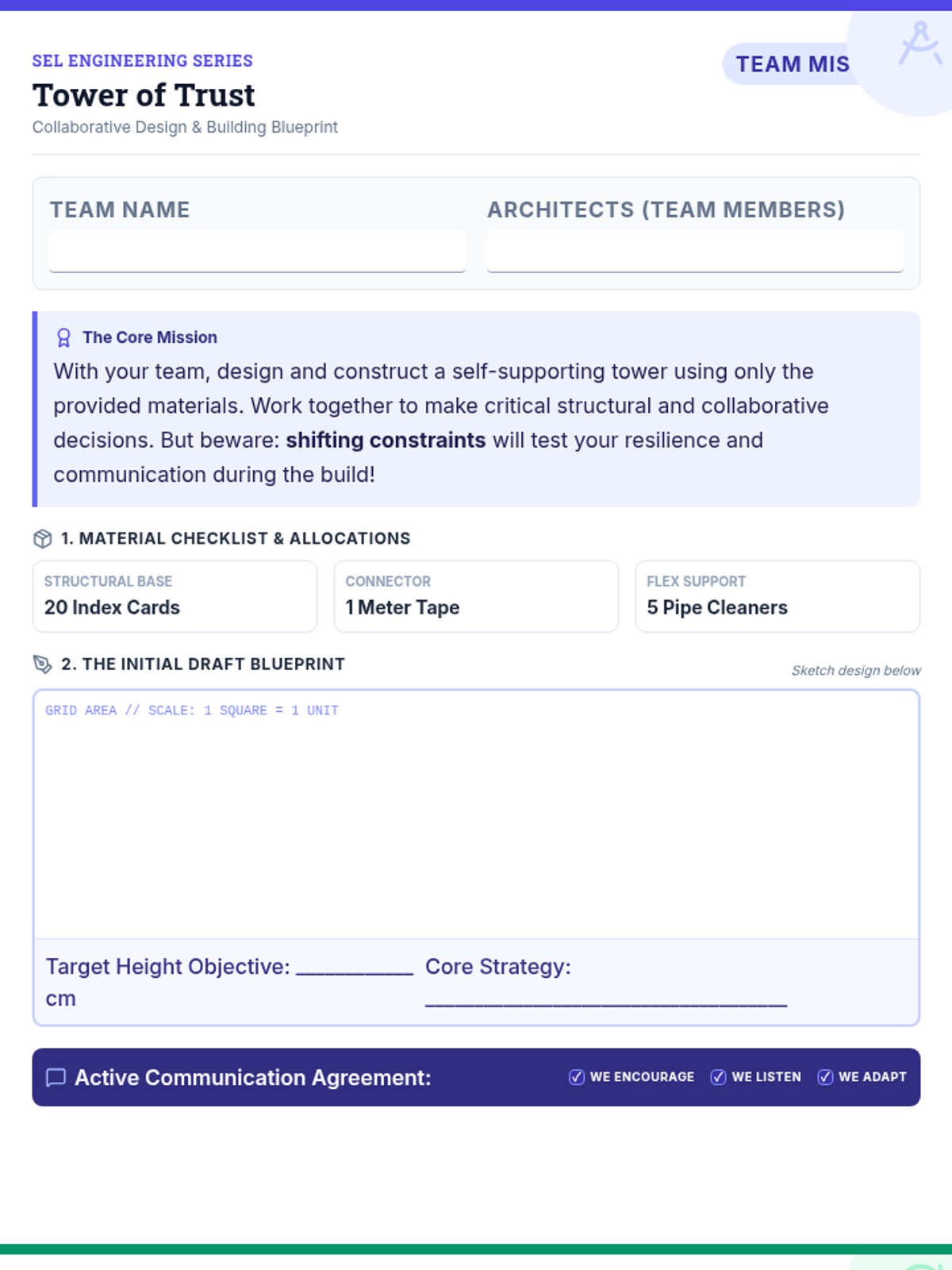
A student blueprint and reflective worksheet for the Tower of Trust building challenge. Structured like an architectural planner, it has space for designs, tracking unexpected constraints, and self-evaluating active communication.
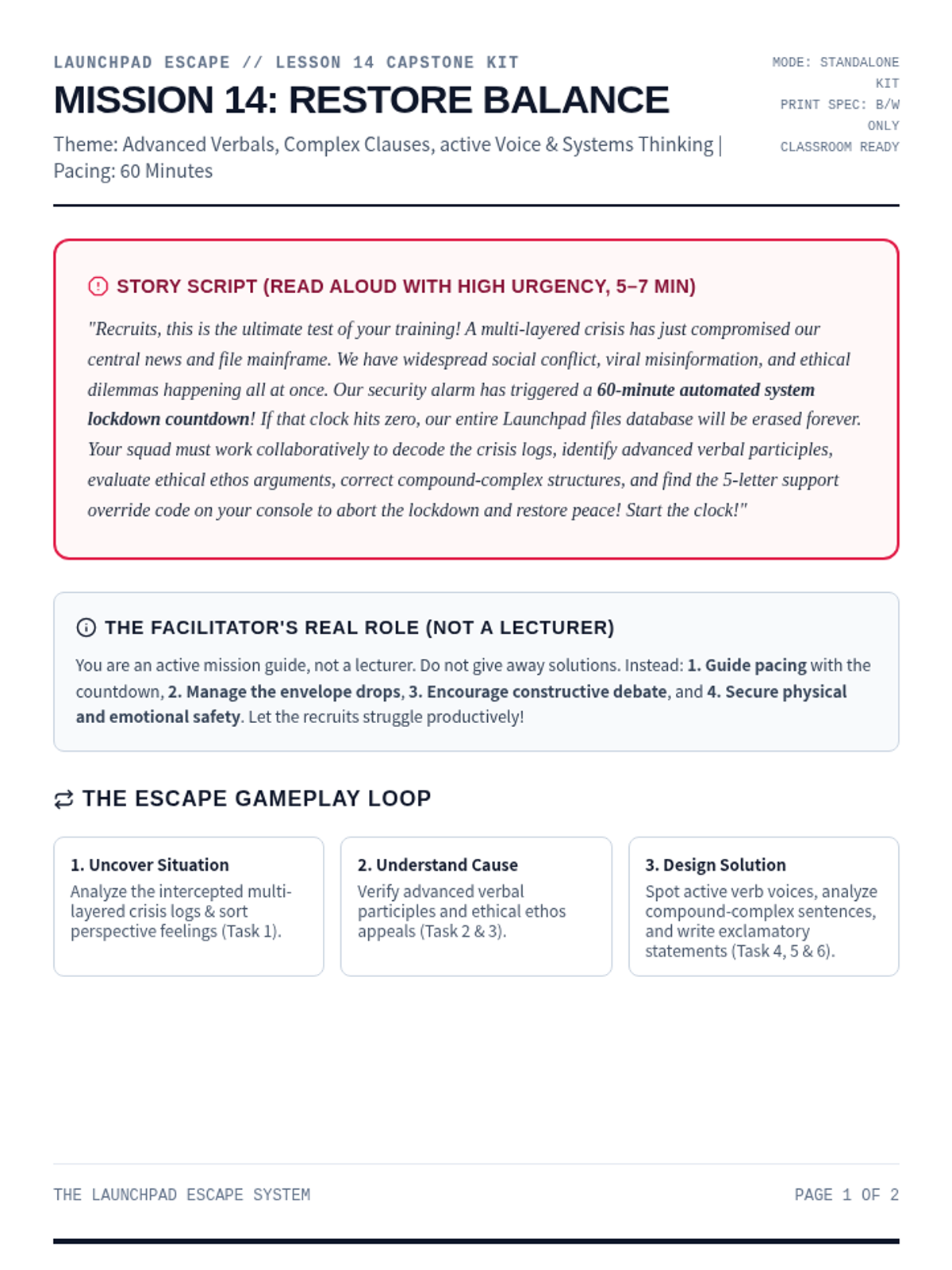
A comprehensive printable facilitator guide for Mission 14: The Capstone Mission. Contains story script, setup checklists, progressive clue mechanics, persuasive appeals endings, and debrief questions.
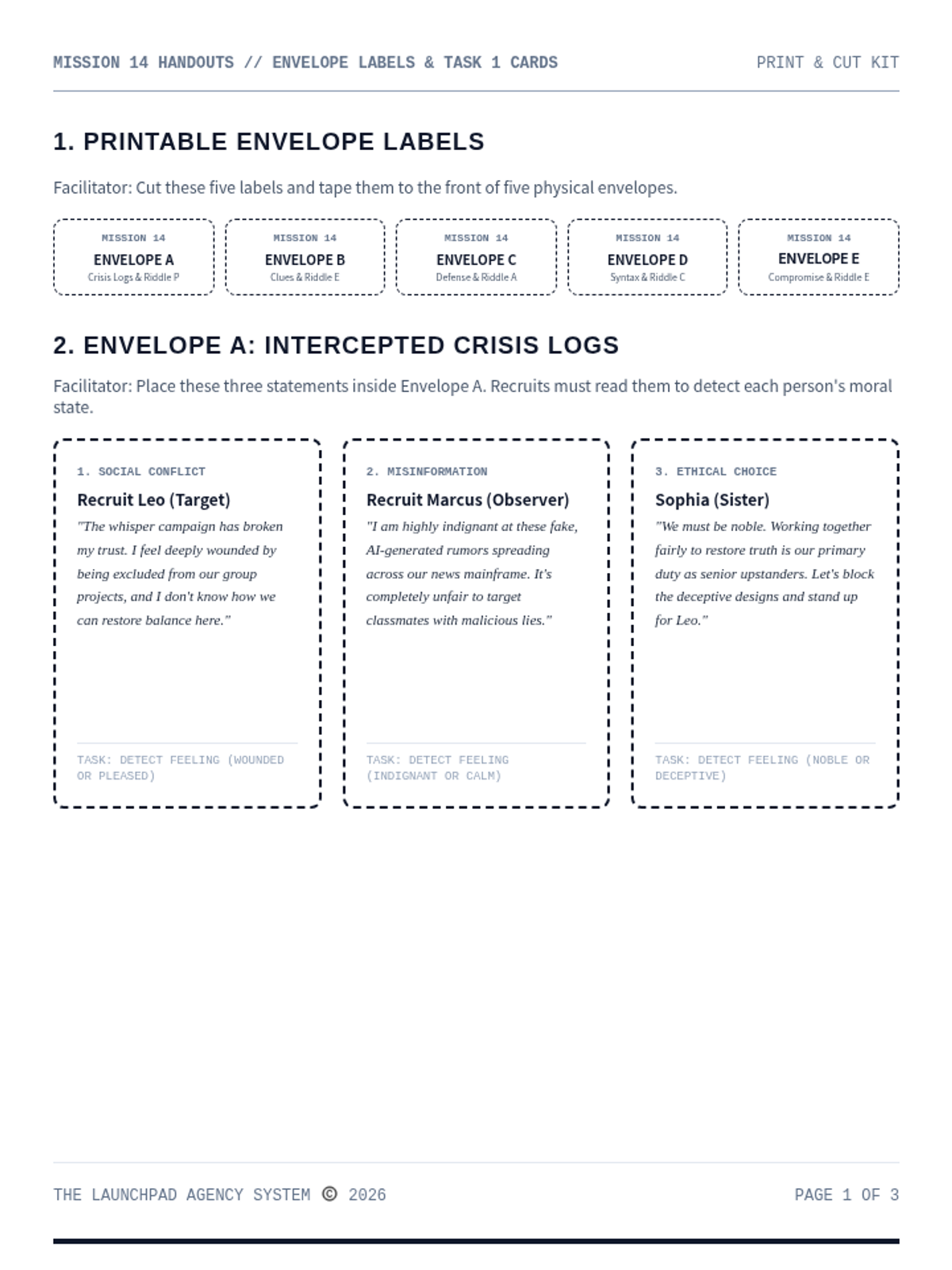
A print-and-cut materials handout kit for Mission 14: The Capstone Mission. Contains envelope labels, printed posts, source cards, and timeline charts.
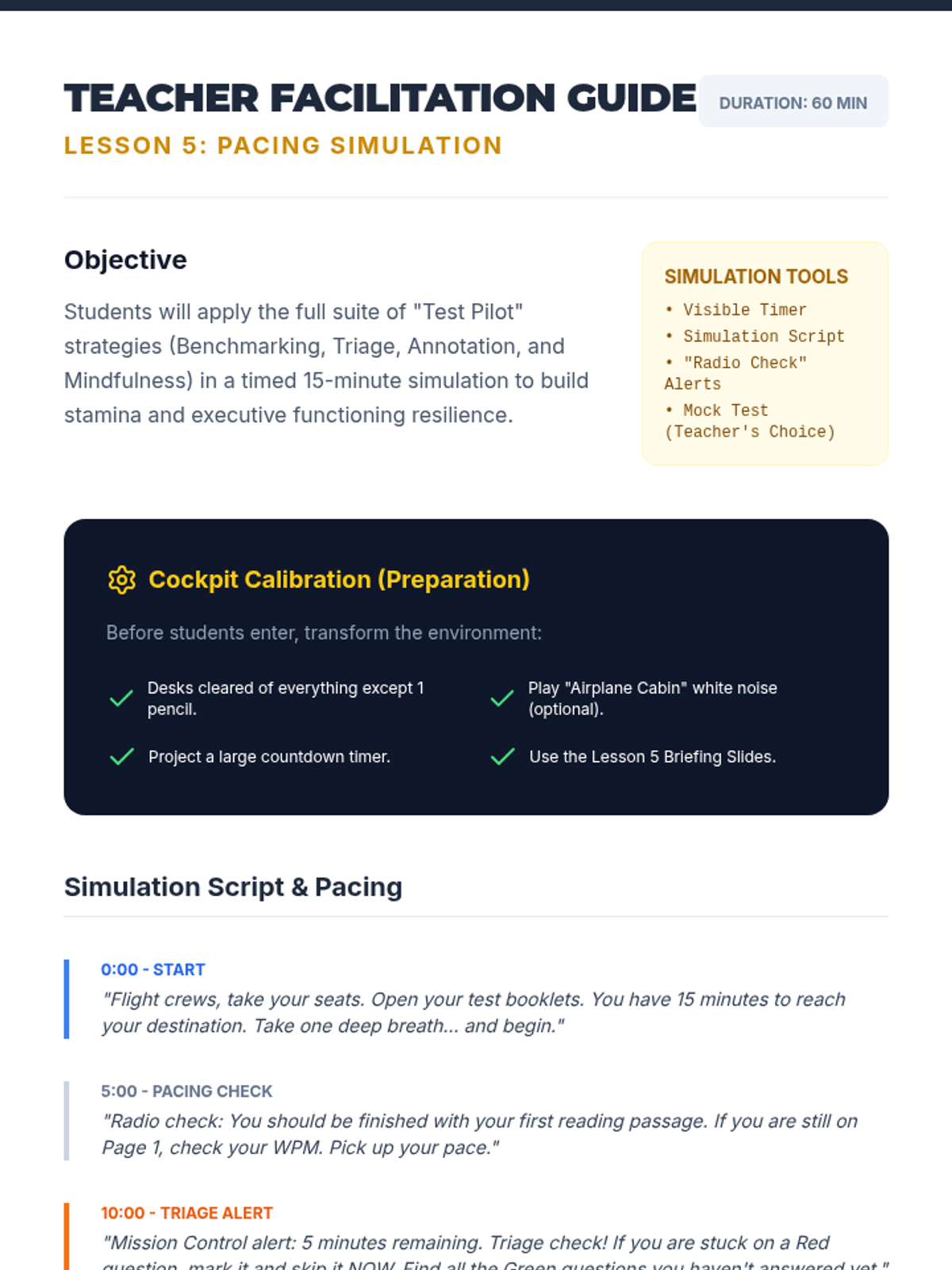
A teacher guide for Lesson 5 including the simulation script, timing intervals, and a guide for the post-simulation debrief and student certification.
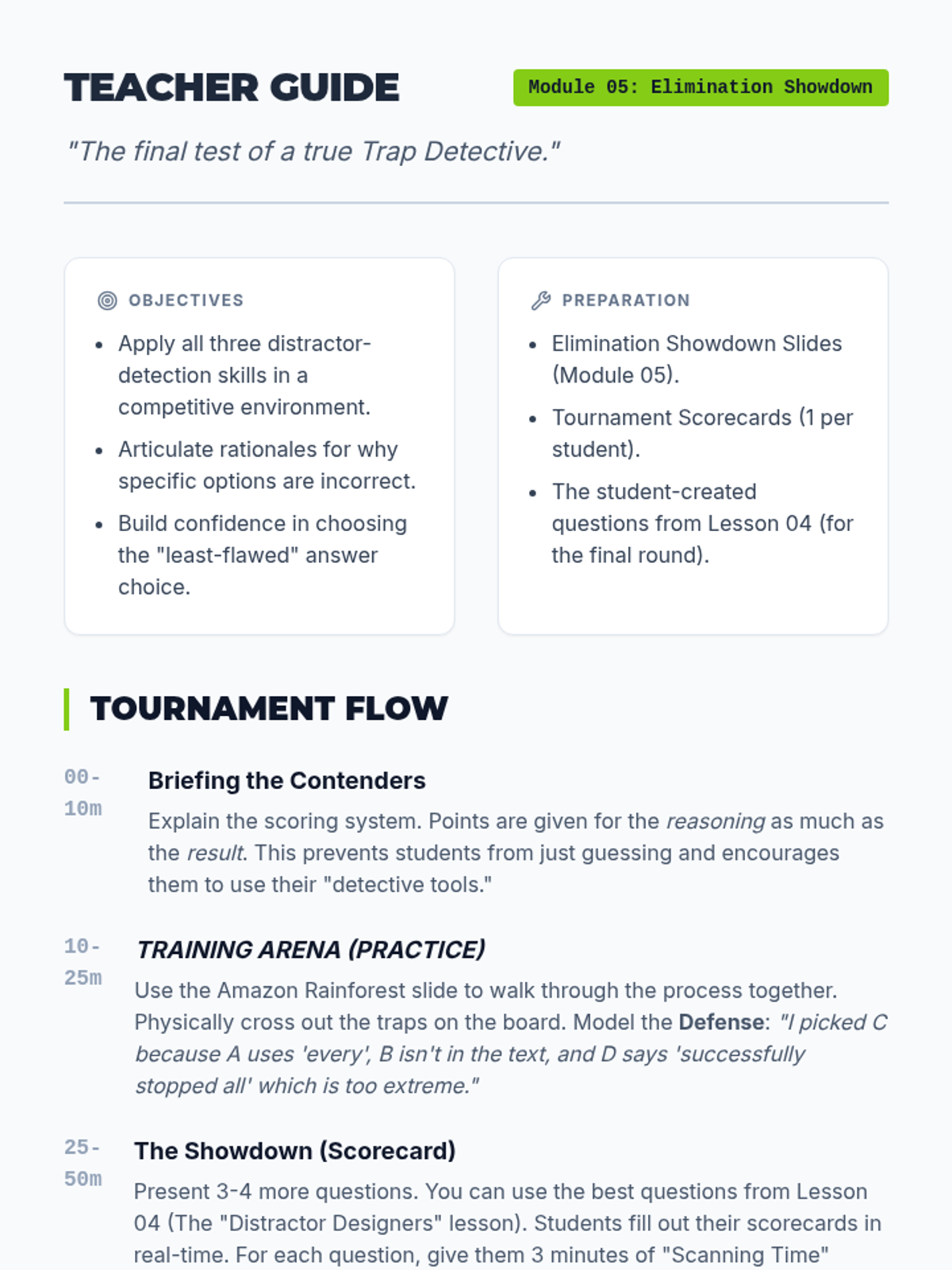
Teacher guide for 'Elimination Showdown'. Includes lesson flow, tournament scoring mechanics, and a detailed analysis of the practice question.
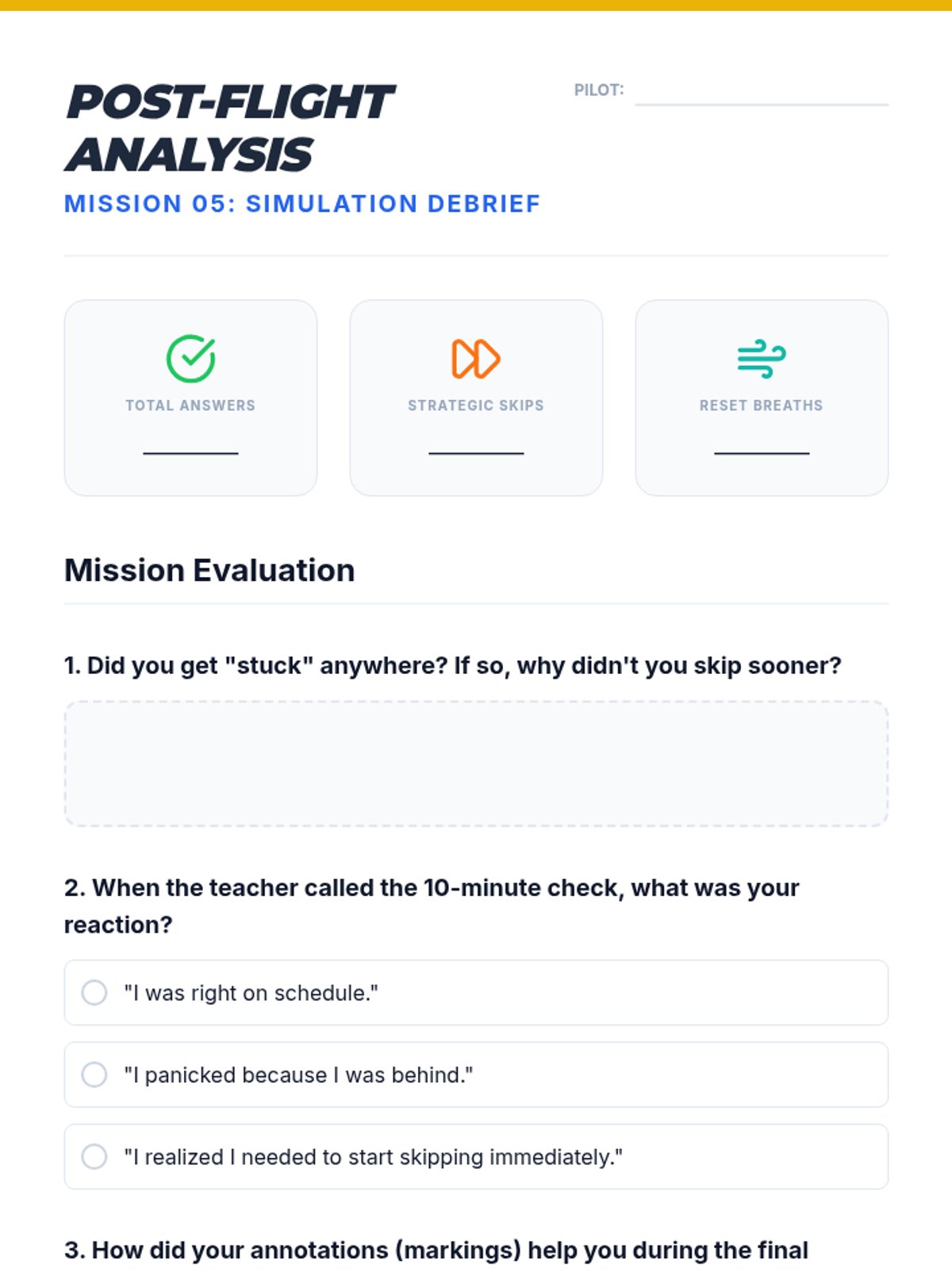
A student reflection sheet and goal-setting document for the final pacing simulation, helping students create a personalized 'Test Protocol' for future exams.
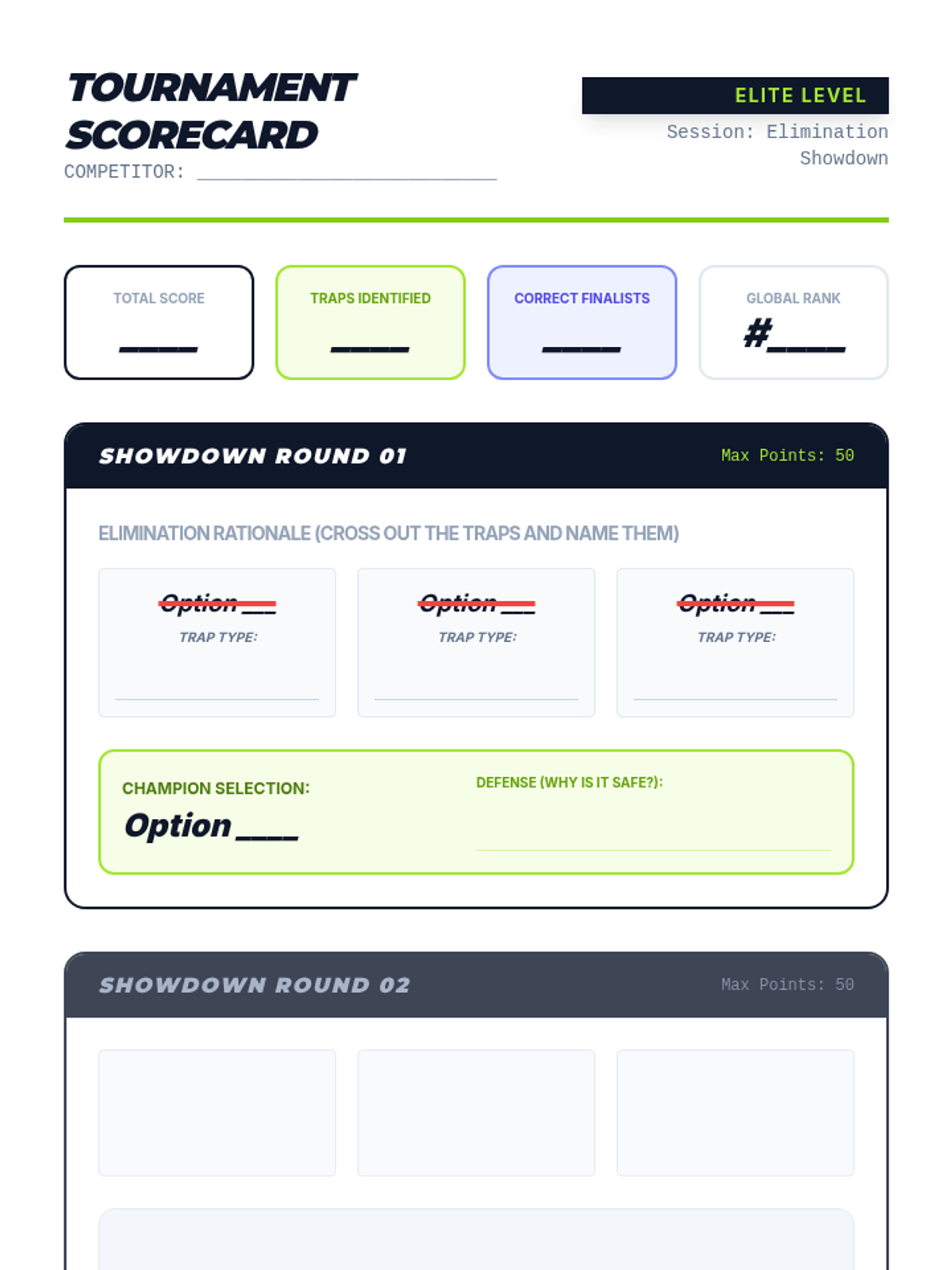
A student tournament scorecard for the final showdown. Features sections for tracking points, identifying trap types for each distractor, and selecting the 'Champion' (correct) answer with a defense.
Slides for Lesson 5, the final simulation briefing, reviewing all Test Pilot Academy strategies and providing time-check benchmarks for the mock exam.
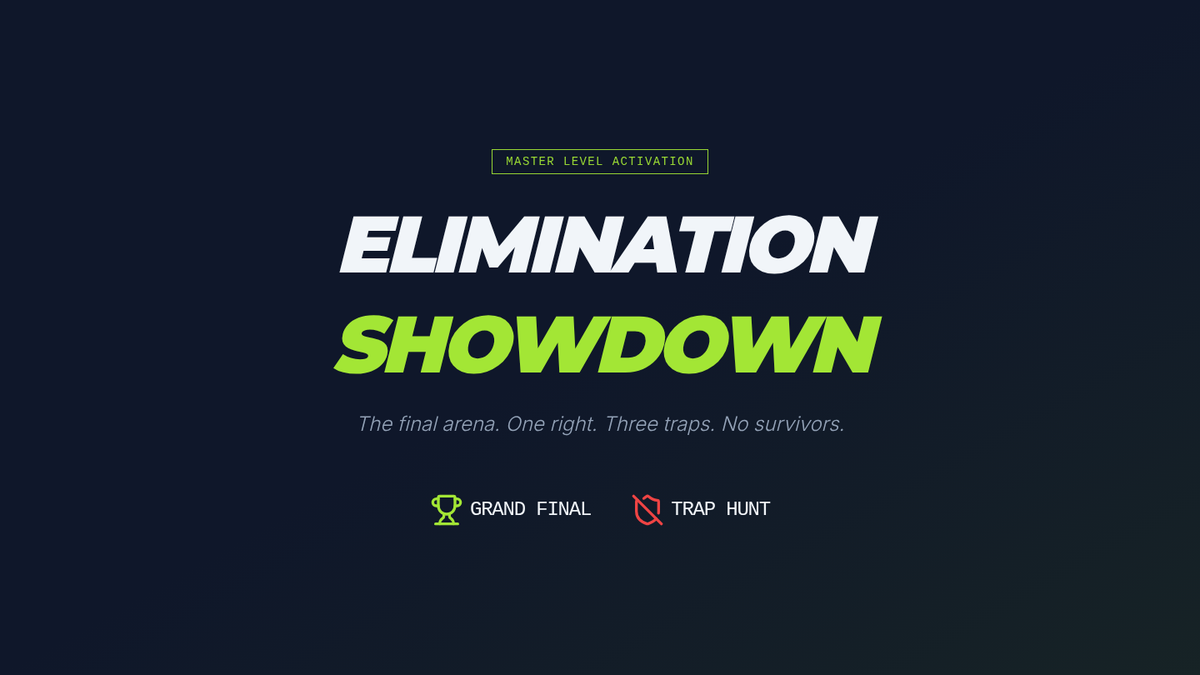
Introductory slides for 'Elimination Showdown'. Features tournament rules and a walk-through of the 'Elimination Showdown' process with a practice question.
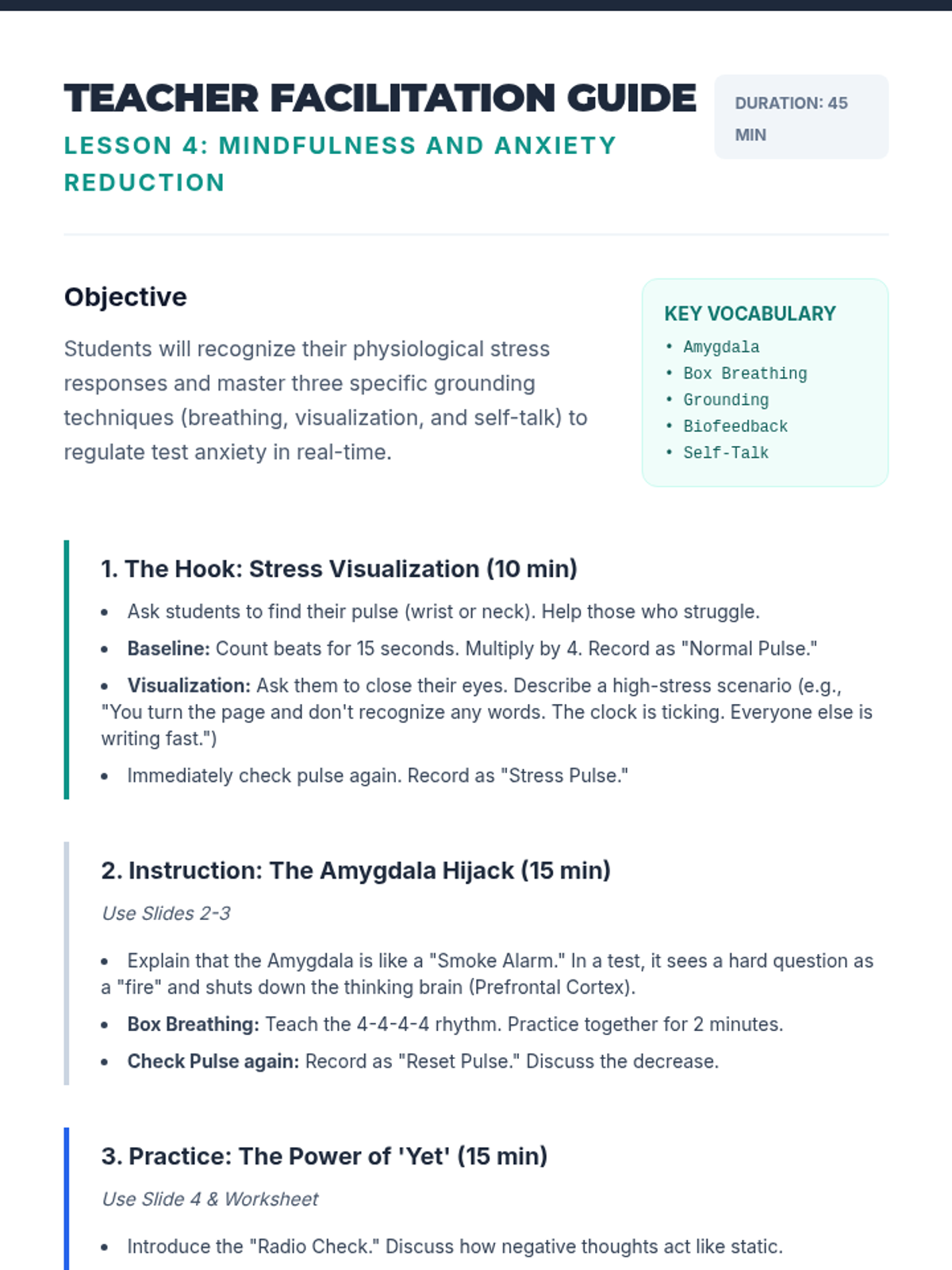
A teacher guide for Lesson 4 including instructions for the biofeedback pulse check, grounding exercise facilitation, and strategies for student buy-in using the Test Pilot theme.
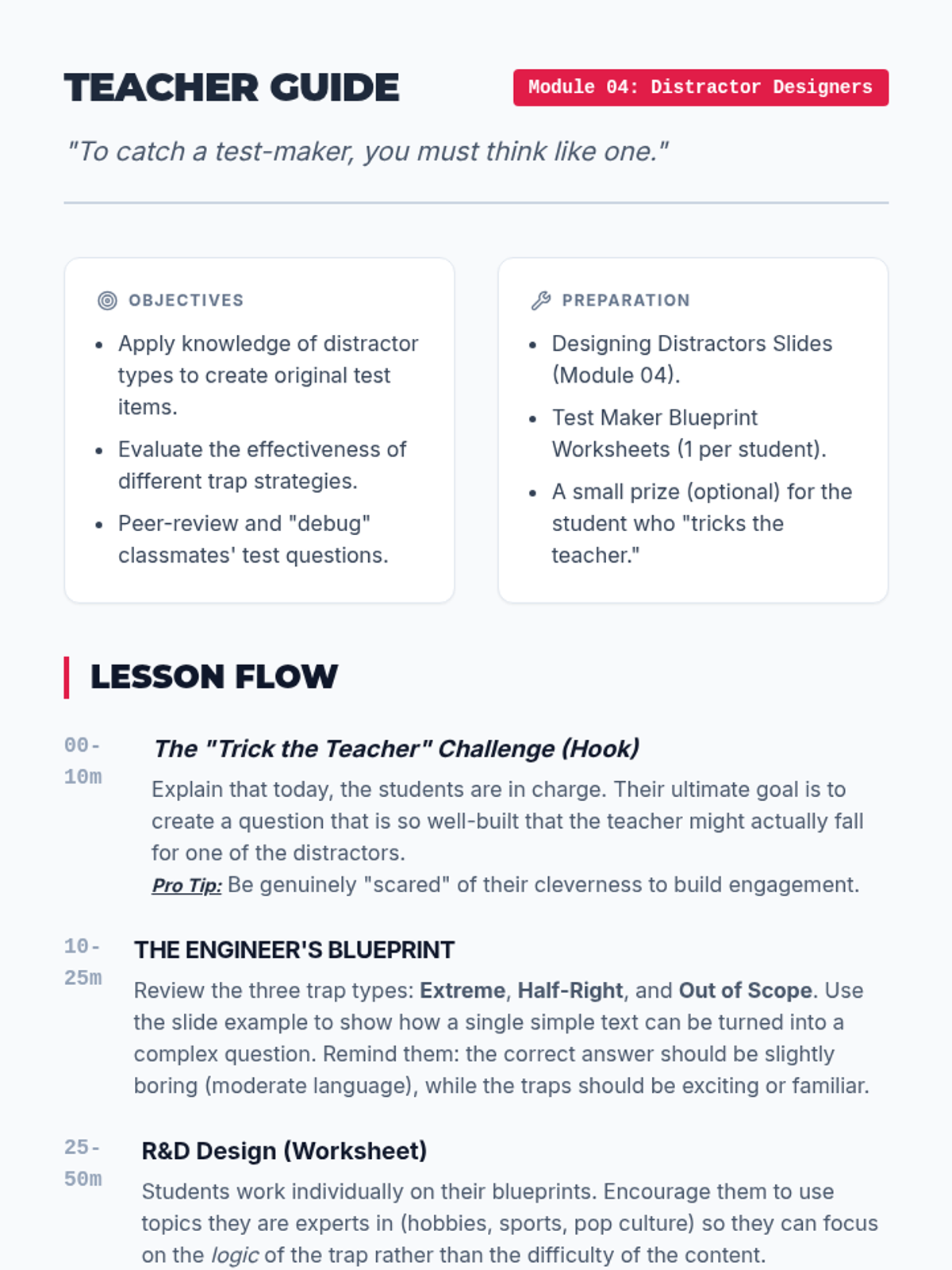
Teacher guide for 'Distractor Designers'. Includes pacing, rubric for the student worksheet, and instructions for the peer-testing phase of the lesson.
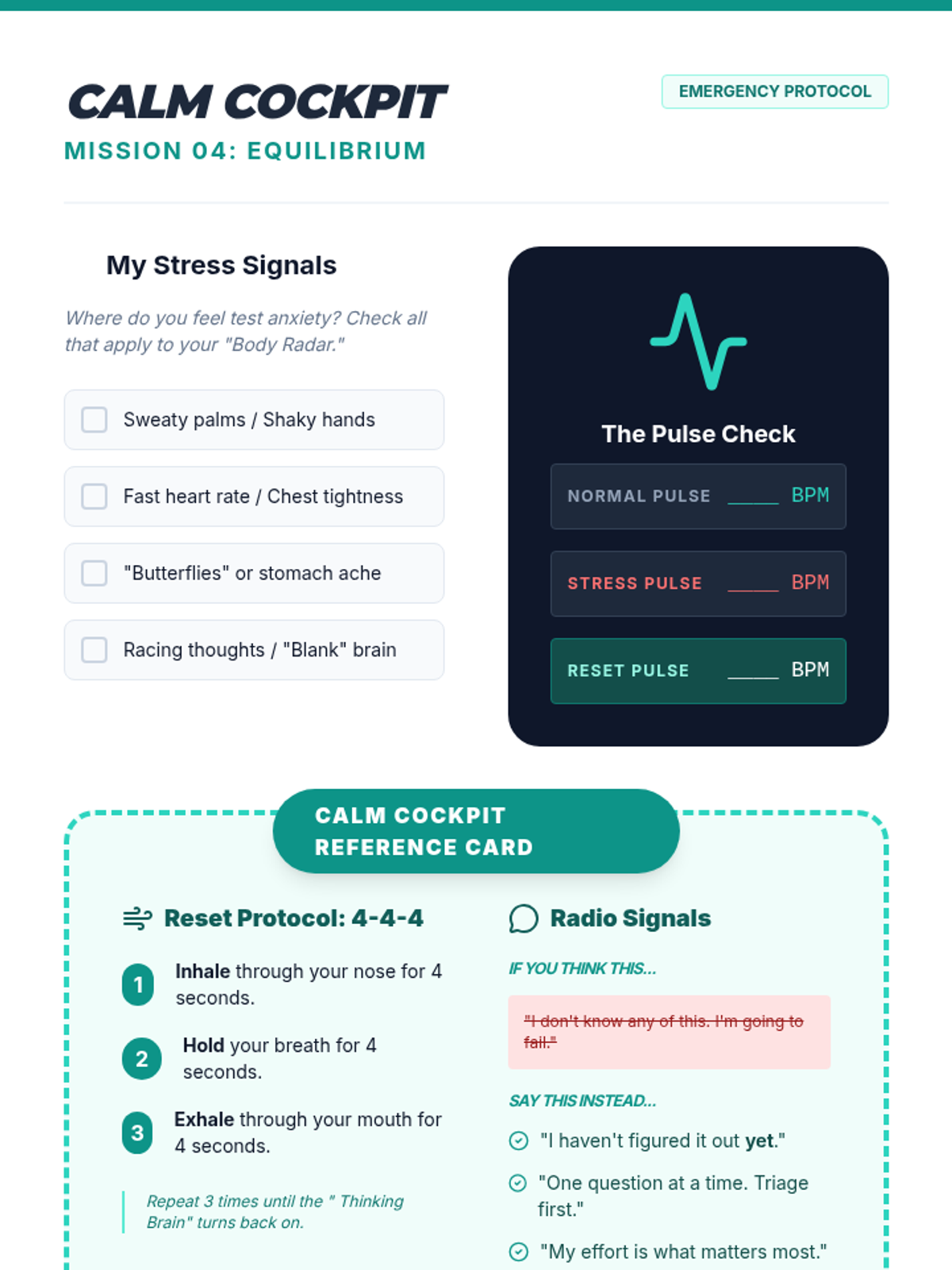
A student resource featuring an anxiety-mapping activity and a cutout 'Calm Cockpit' reference card with grounding techniques and positive self-talk prompts.
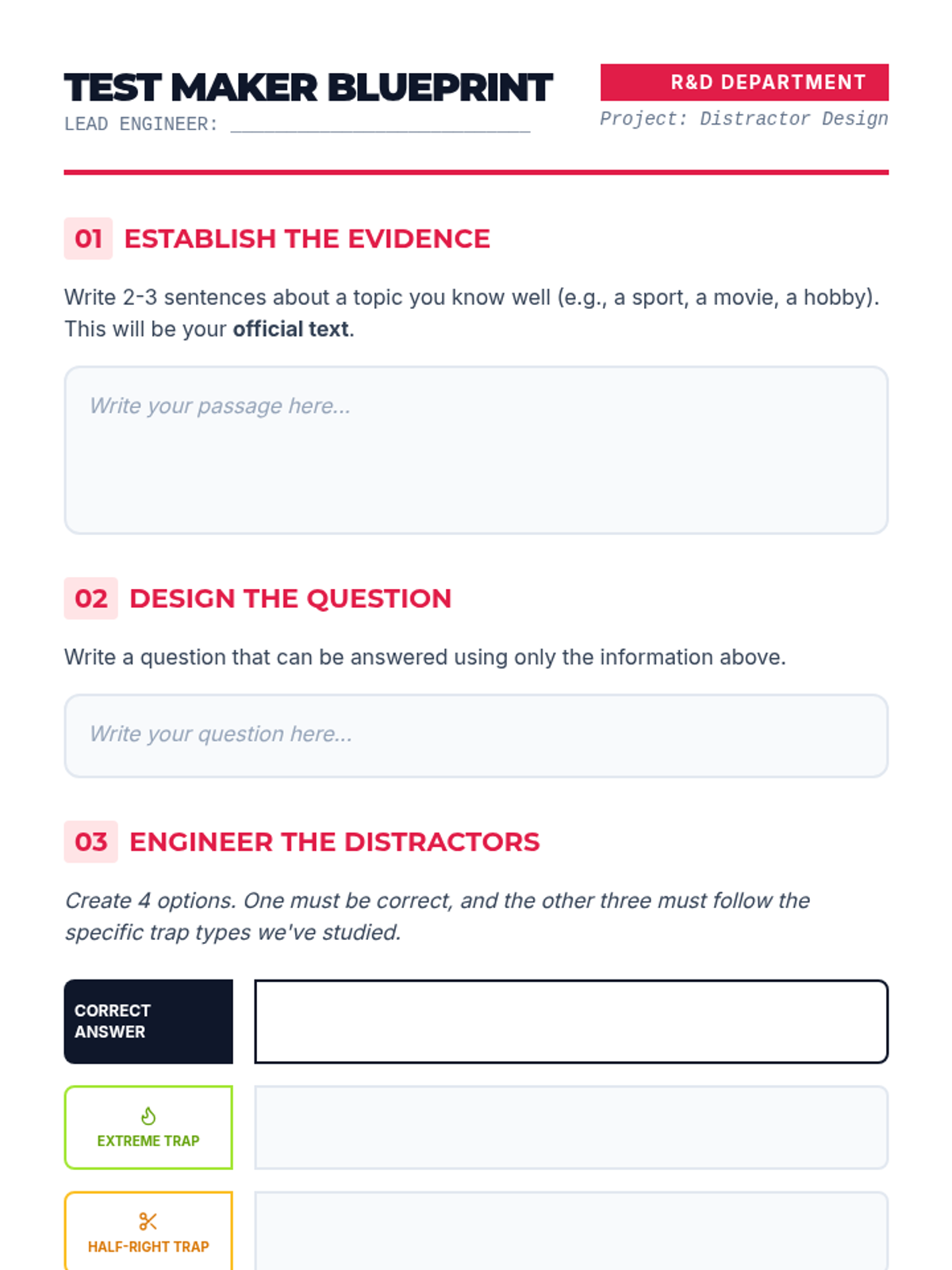
A student design sheet where they create their own multiple-choice question. Students must provide a short text and then engineer four options: one correct answer and three specific distractor types (Extreme, Half-Right, and Out of Scope).
Slides for Lesson 4 teaching mindfulness and anxiety reduction techniques for testing, focusing on the physiology of stress and grounding exercises.
Introductory slides for 'Distractor Designers'. Explains how to create 'Extreme', 'Half-Right', and 'Out of Scope' distractors by thinking like a test-maker.
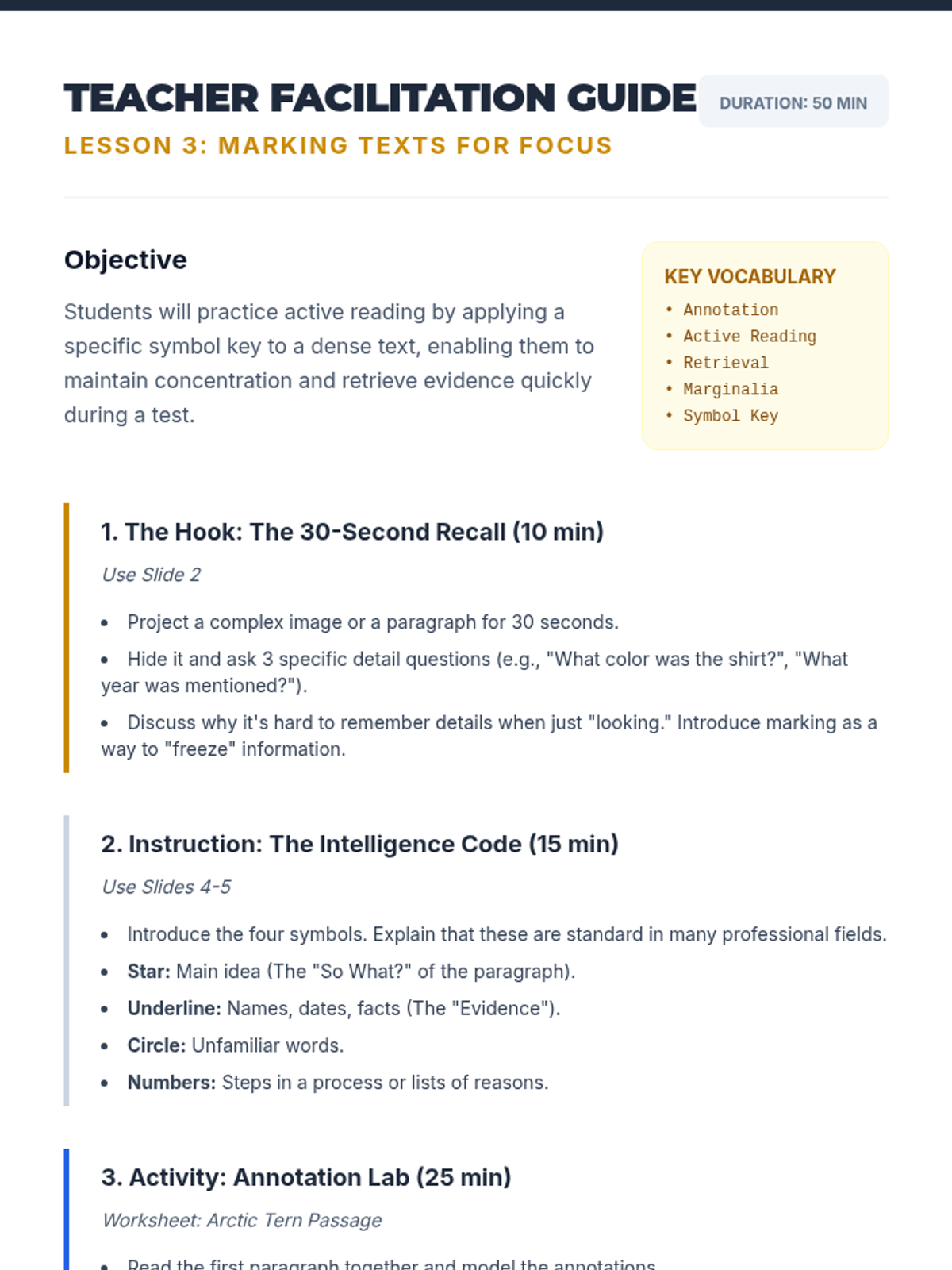
A teacher guide for Lesson 3 including instructions for the recall challenge, a model of the annotated passage, and an answer key for retrieval questions.
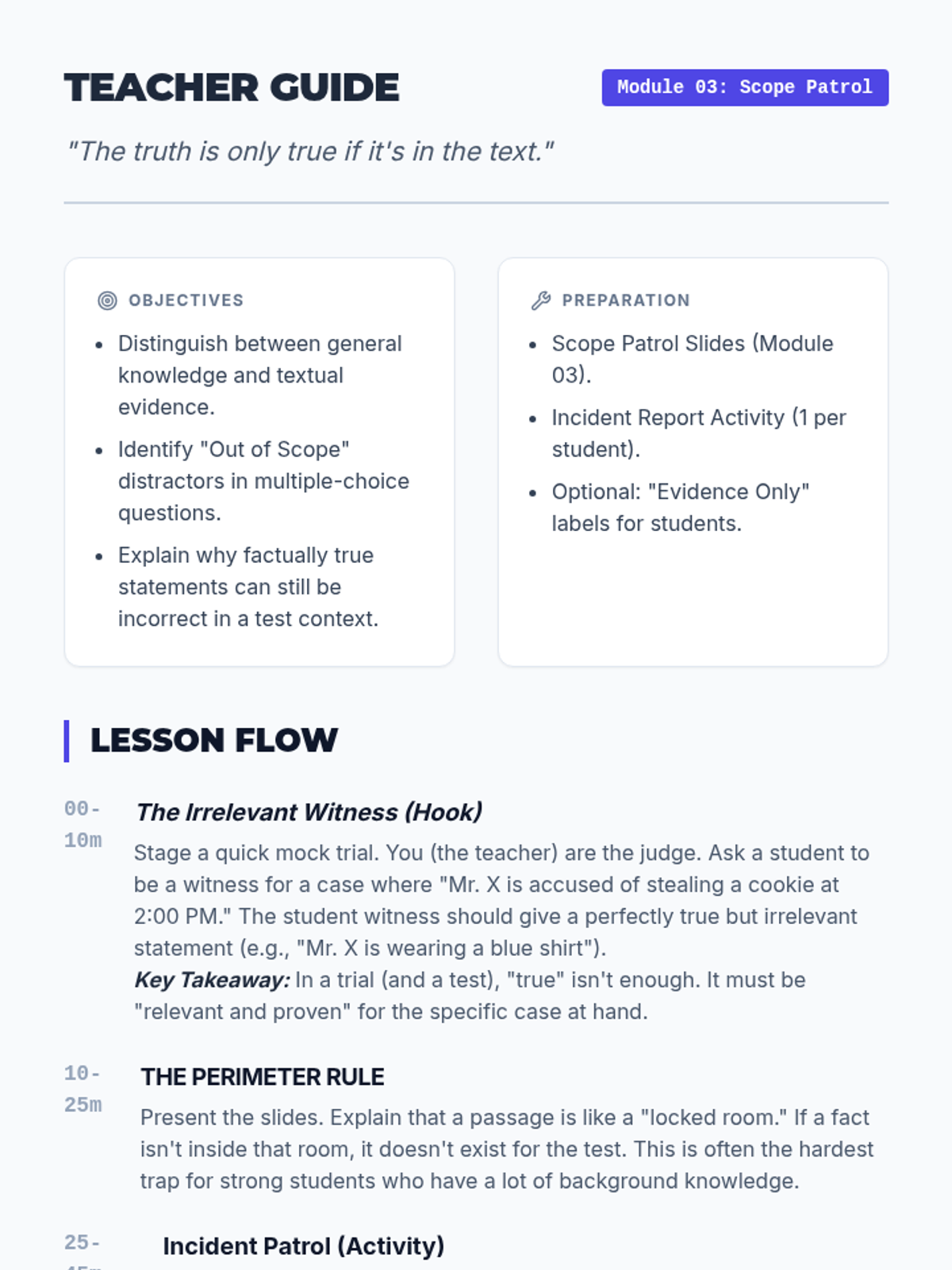
Teacher guide for 'Scope Patrol'. Includes lesson flow, mock trial hook instructions, and a detailed answer key for the Incident Report activity.
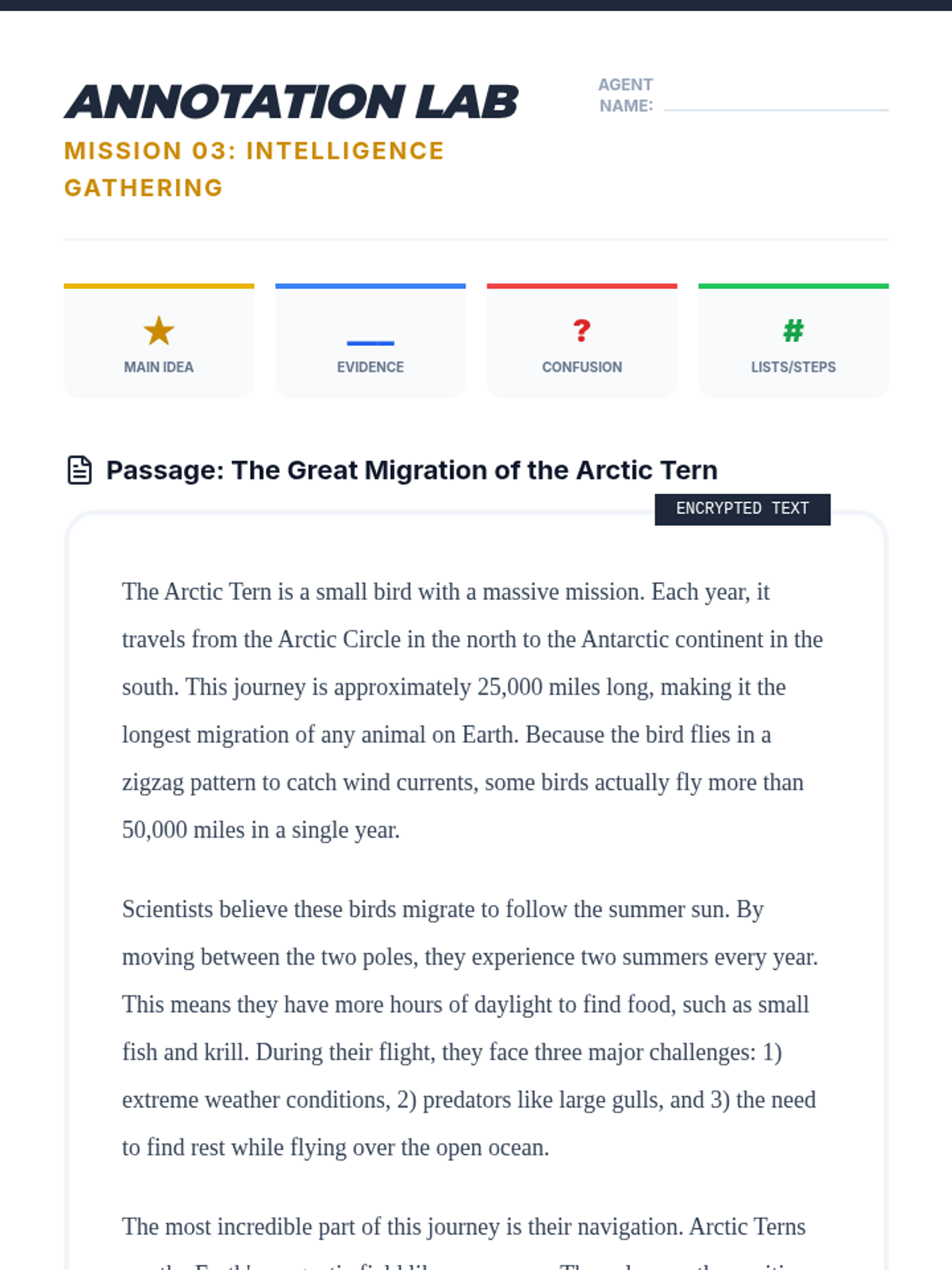
A student worksheet for practicing text annotation using a specific symbol key, featuring a dense passage about Arctic Tern migration and retrieval questions.
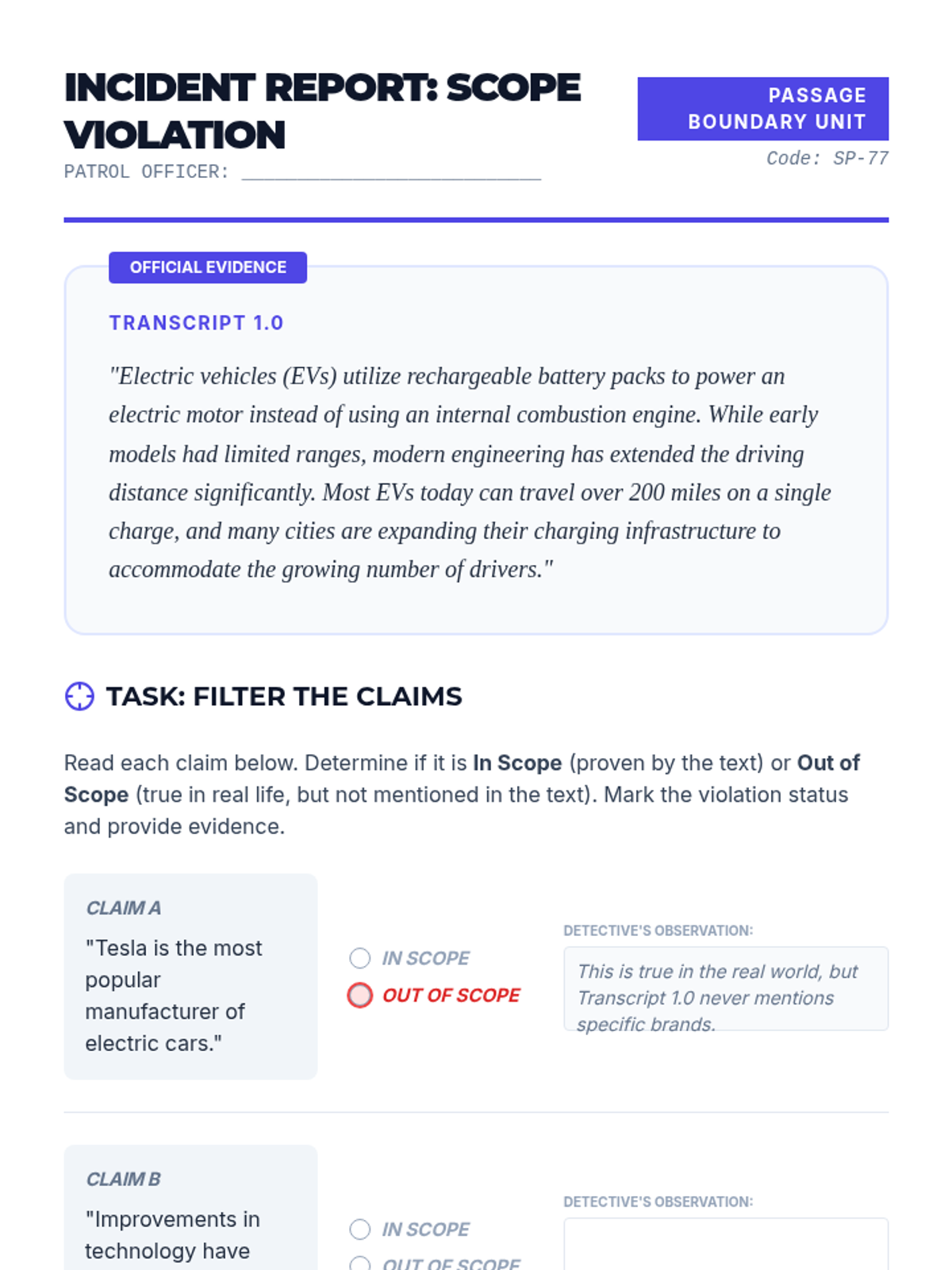
A student activity for identifying out-of-scope distractors. Features an evidence passage and a 'Incident Report' where students categorize claims as 'In Scope' or 'Out of Scope' based on textual evidence.
Introductory slides for 'Scope Patrol'. Explains the concept of 'Out of Scope' distractors—statements that are factually true but not supported by the specific text provided.
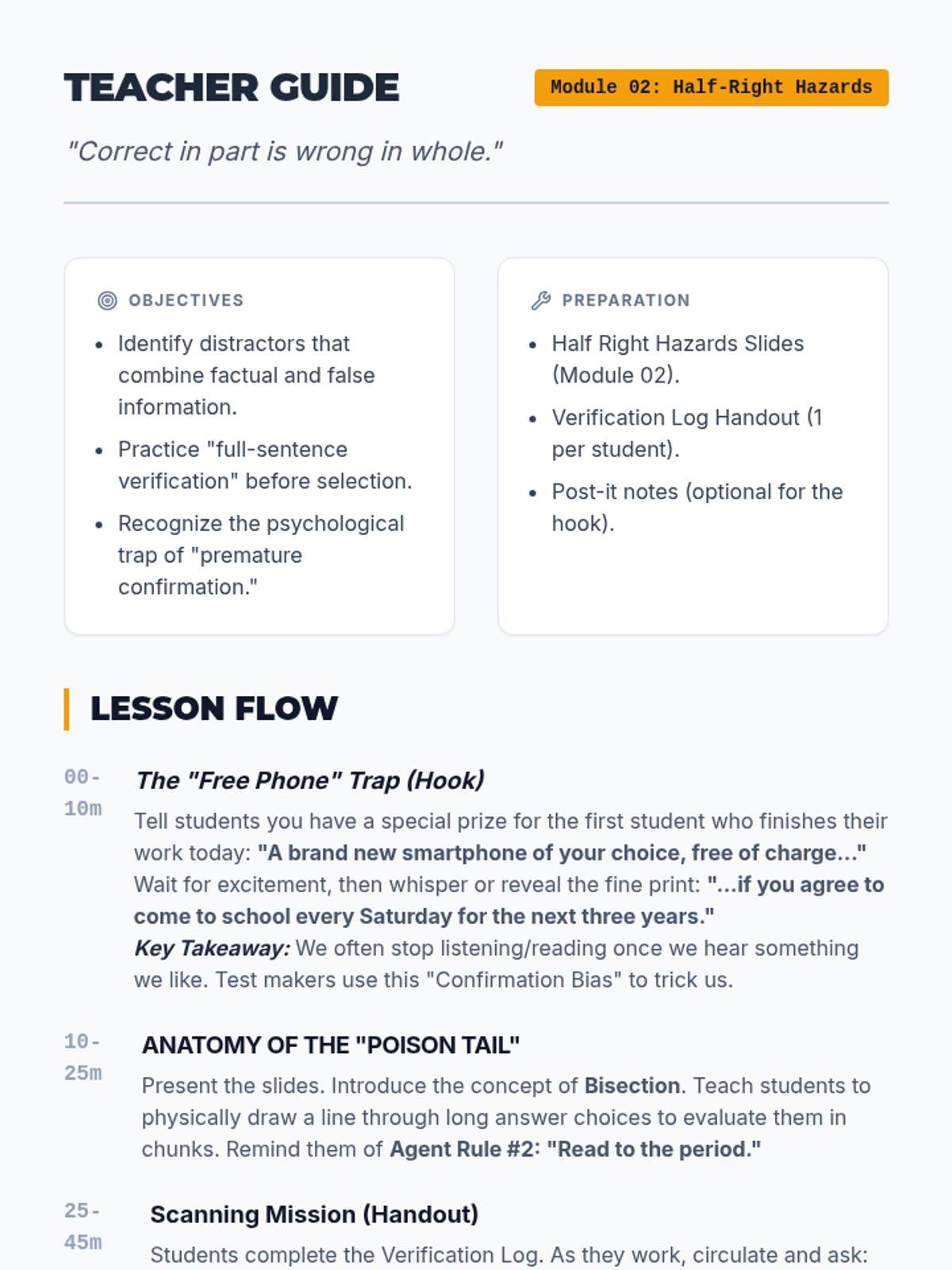
Teacher guide for 'Half Right Hazards'. Includes hook instructions (the 'Free Phone' offer), pacing guide, and detailed answer key for the Verification Log handout.
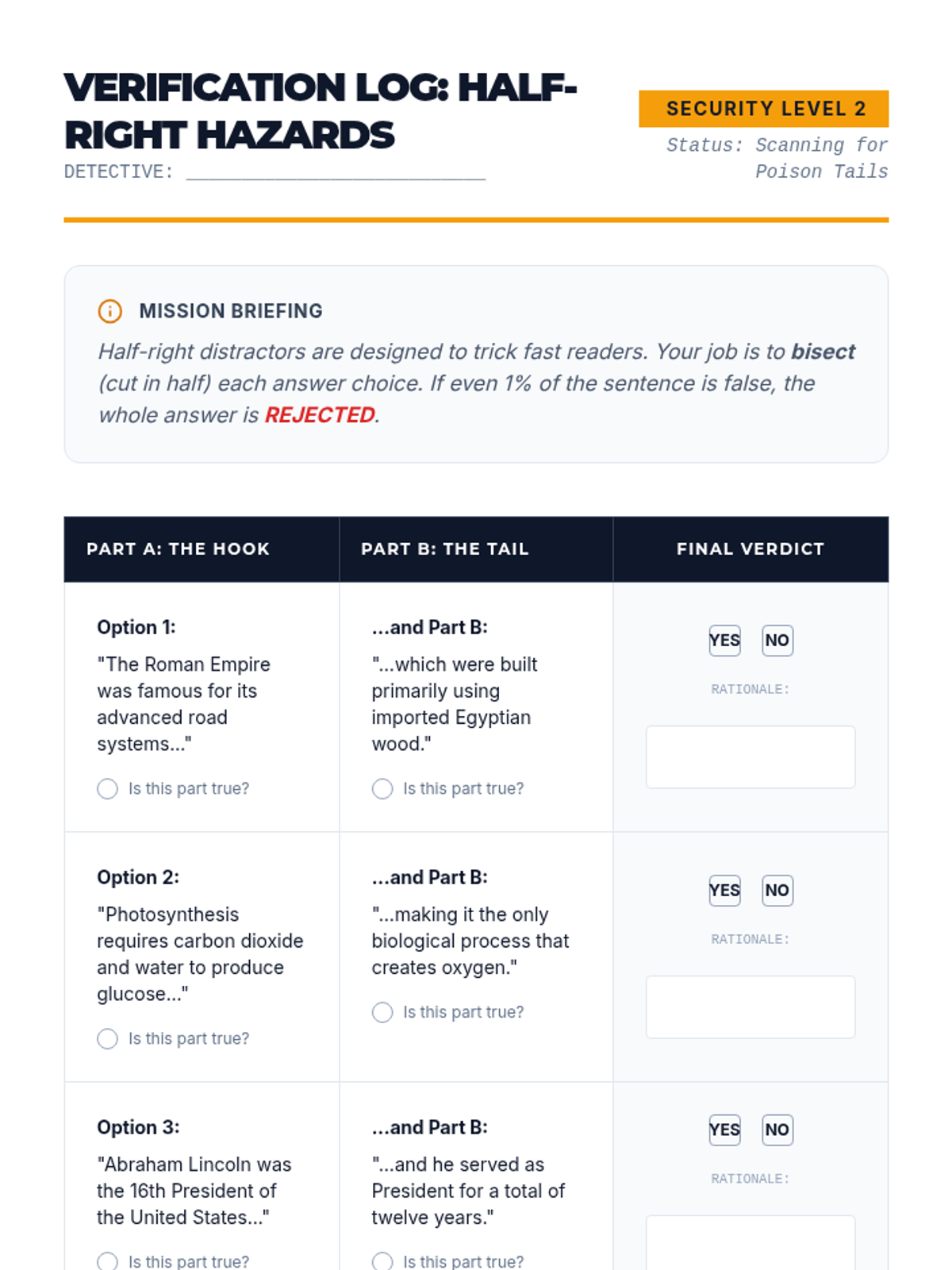
A student worksheet for identifying half-right distractors. Features a 'Verification Log' table where students dissect answer choices into two parts and evaluate the accuracy of each half.
Introductory slides for 'Half Right Hazards'. Explains the 'Poison Tail' concept—where an answer choice begins correctly but ends with a false detail—and emphasizes reading to the end.
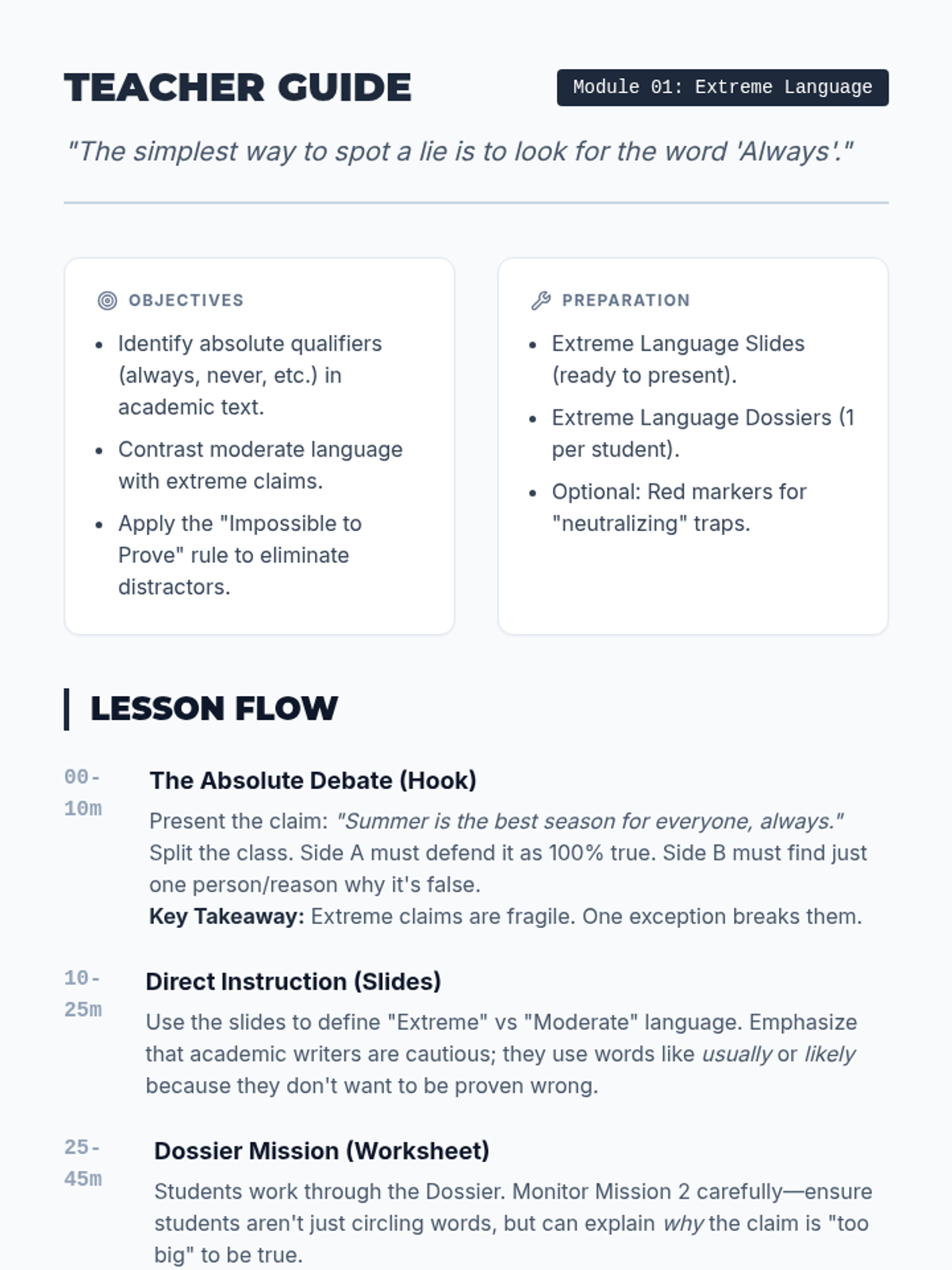
A comprehensive teacher guide for the 'Extreme Language Lab' lesson. Includes lesson objectives, a detailed pacing guide, hook instructions, and a full answer key for the student worksheet.
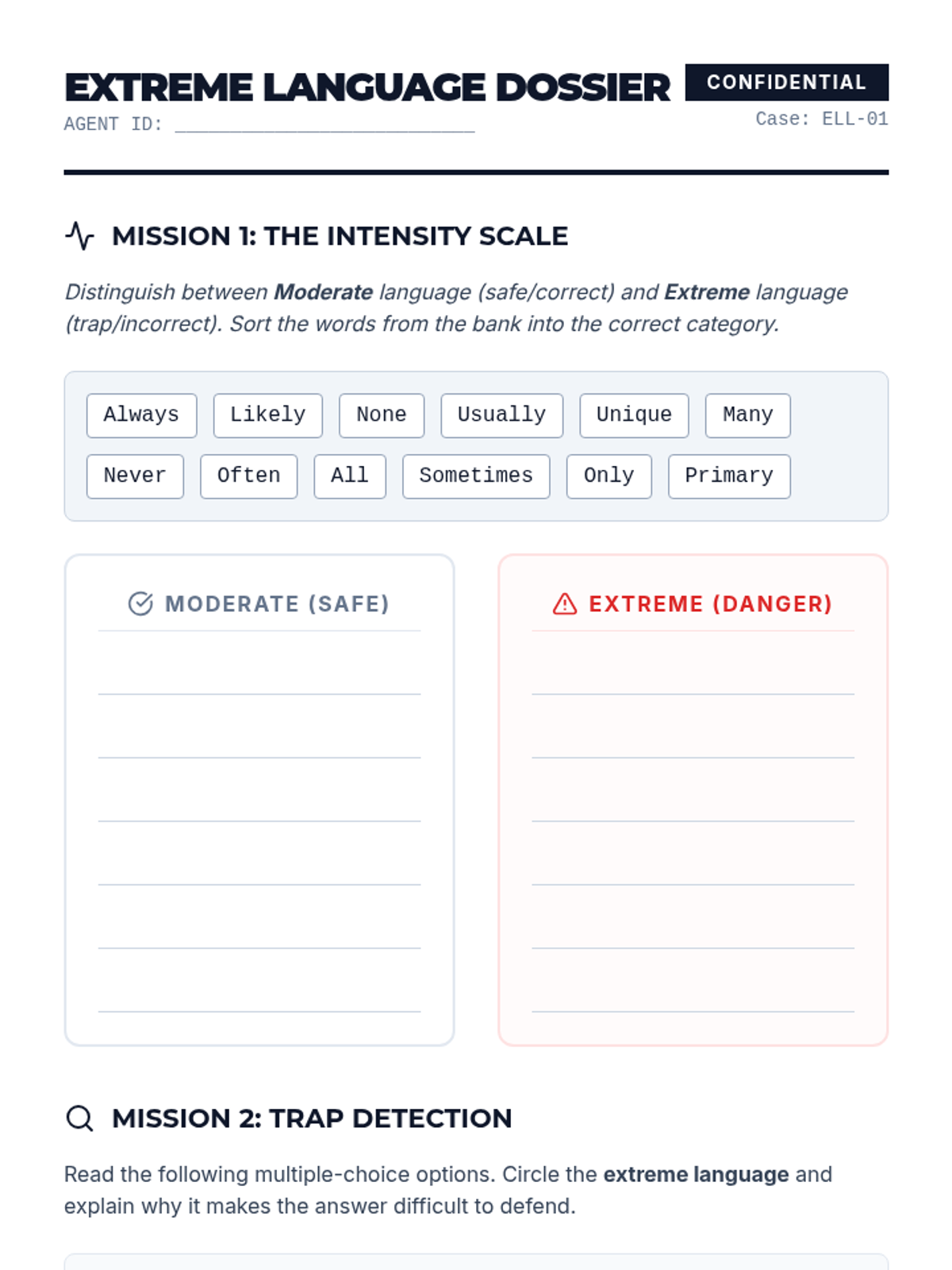
A student worksheet for identifying and neutralizing extreme language traps. Includes word sorting, rationalization exercises, and claim revision.
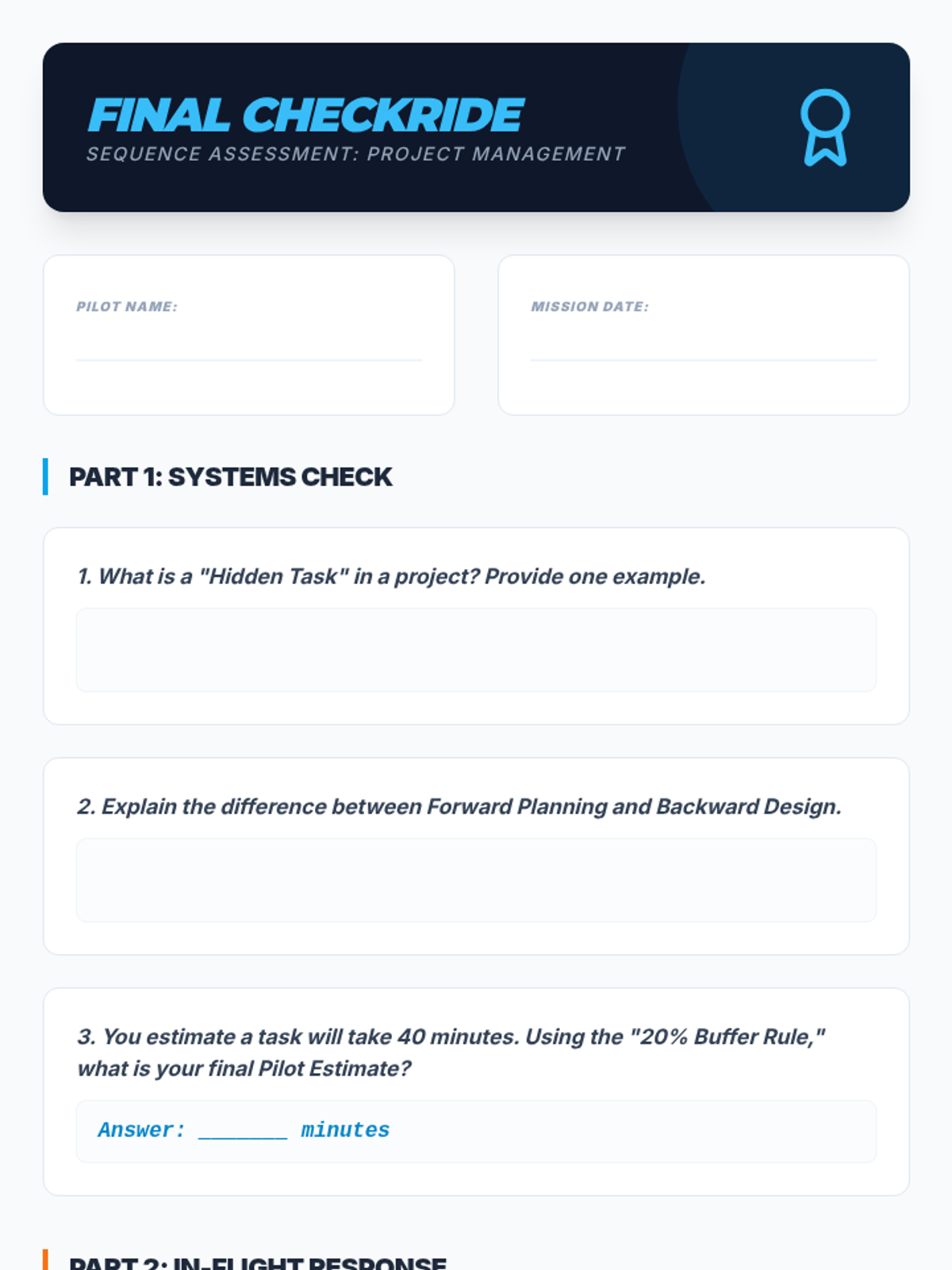
A comprehensive final assessment for the Project Pilot sequence, testing students on task deconstruction, backward planning, time estimation, and disaster recovery strategies.
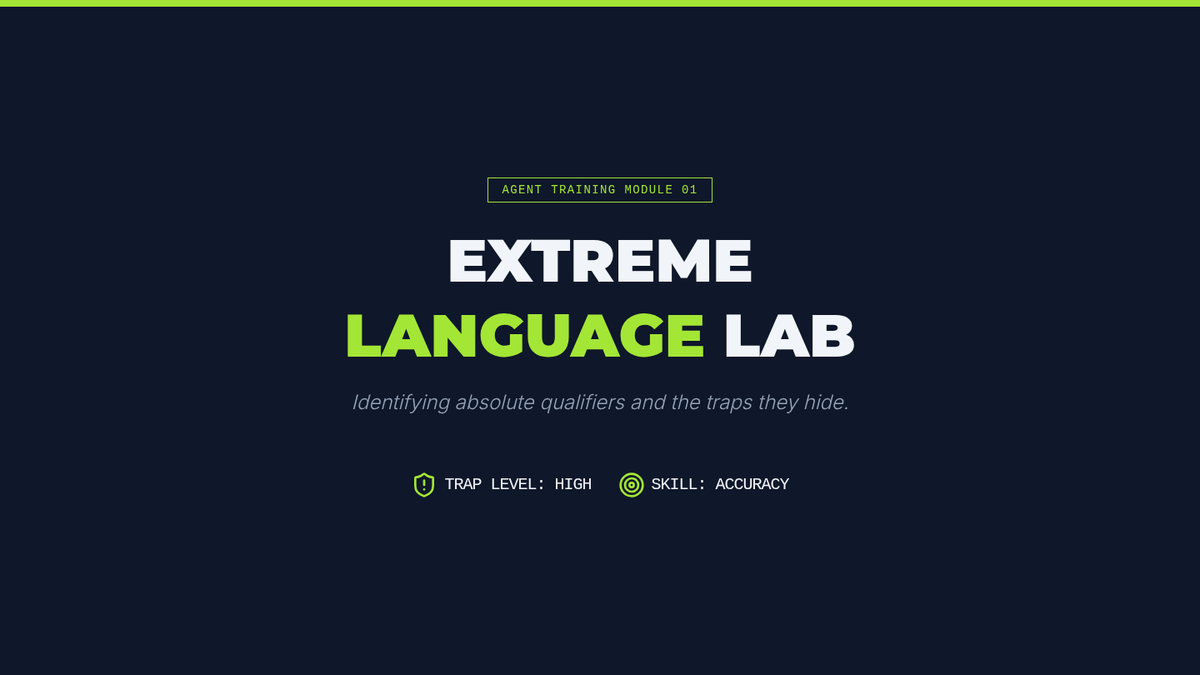
Introductory slides for the 'Extreme Language Lab' lesson, featuring the TSA/Trap Detector Academy theme. Covers the difference between absolute and moderate language in test questions.
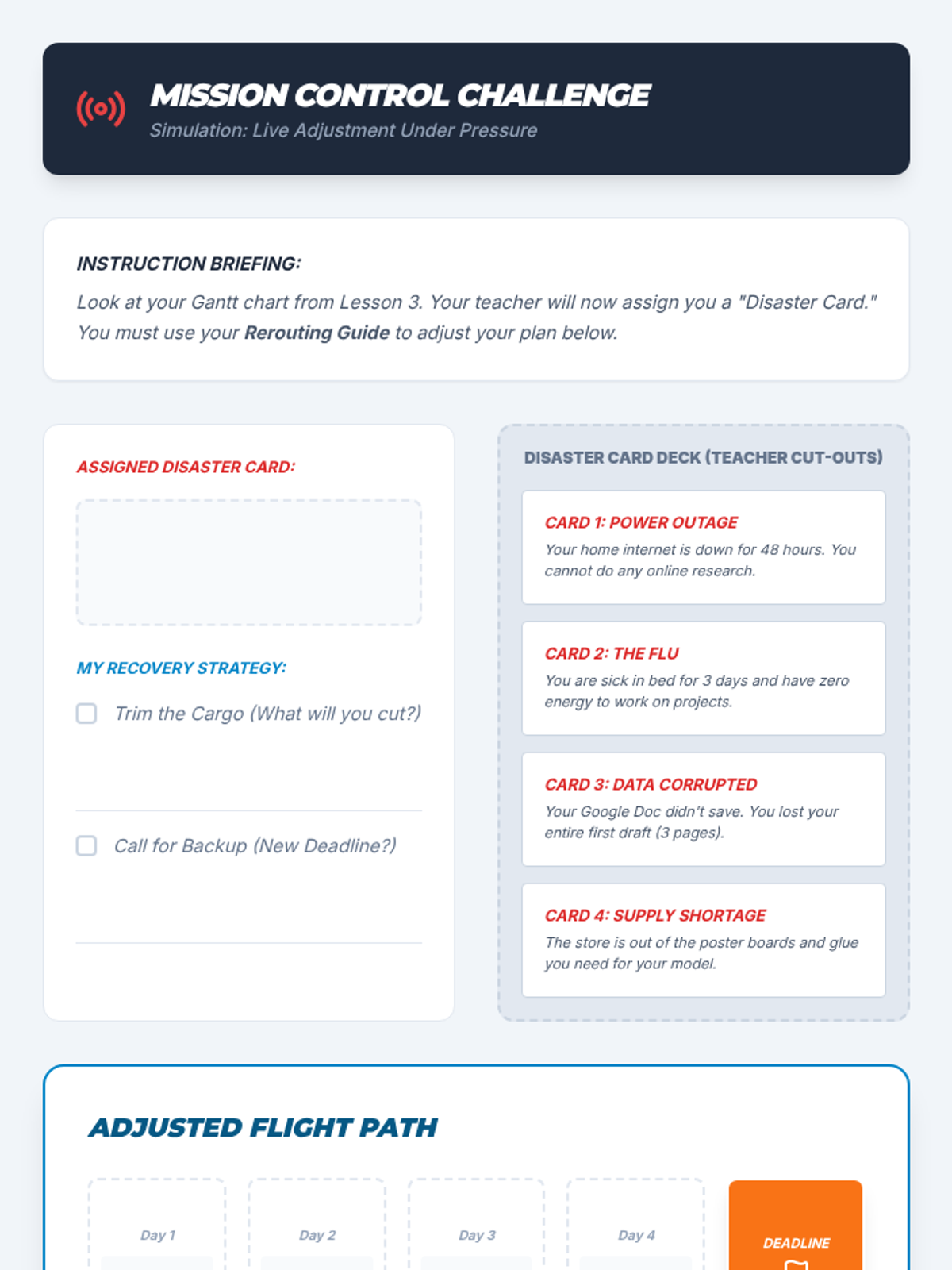
A simulation activity where students are given a 'Disaster Card' (e.g., lost data, sickness) and must use their recovery strategies to adjust their project timeline.
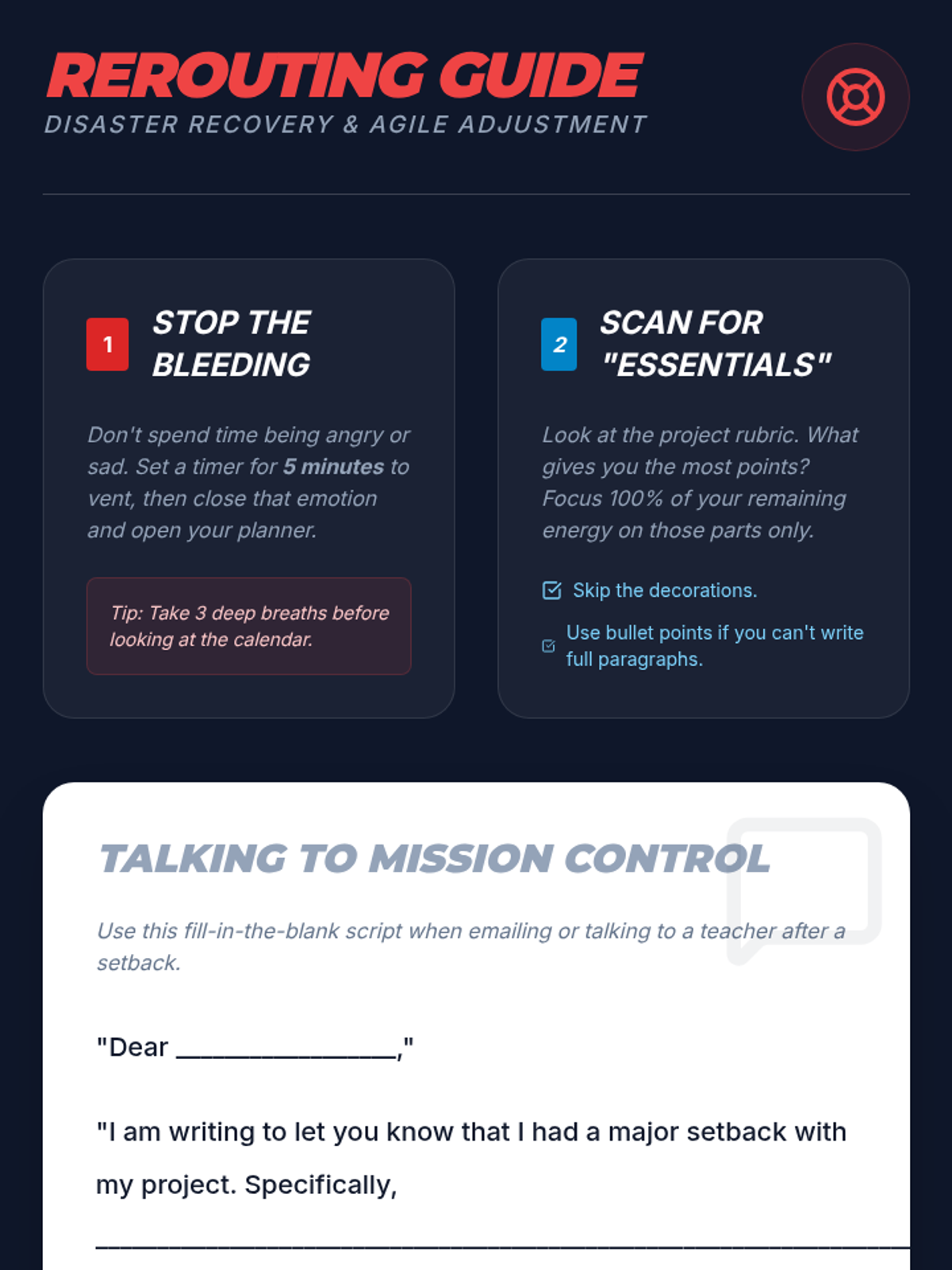
A disaster recovery guide for students, providing a step-by-step protocol for project setbacks and a fill-in-the-blank script for communicating with teachers.
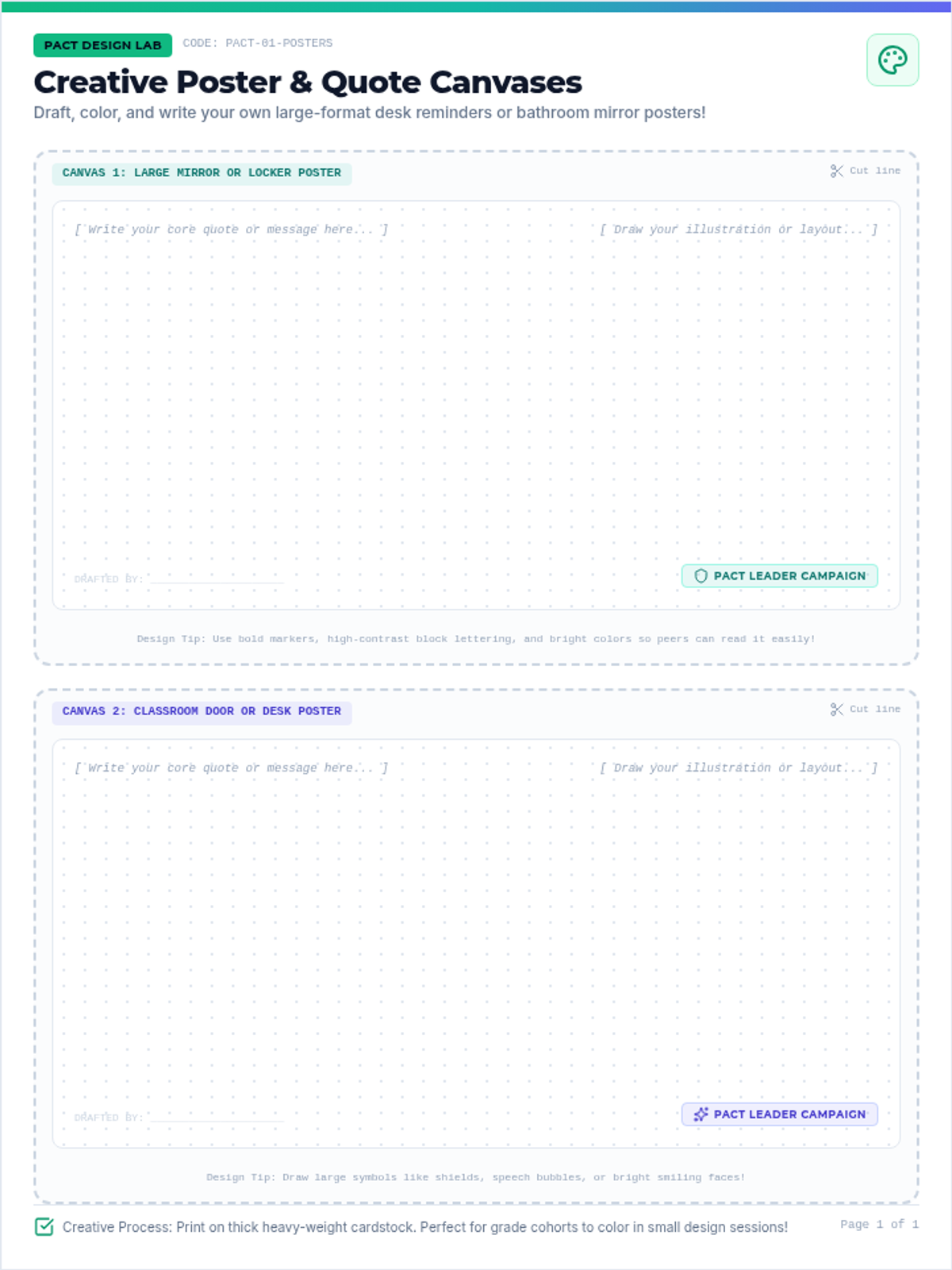
A printable set of large-format design canvases with guide borders and PACT badges, allowing student leaders to hand-draw, color, and draft custom posters or large desk reminders.
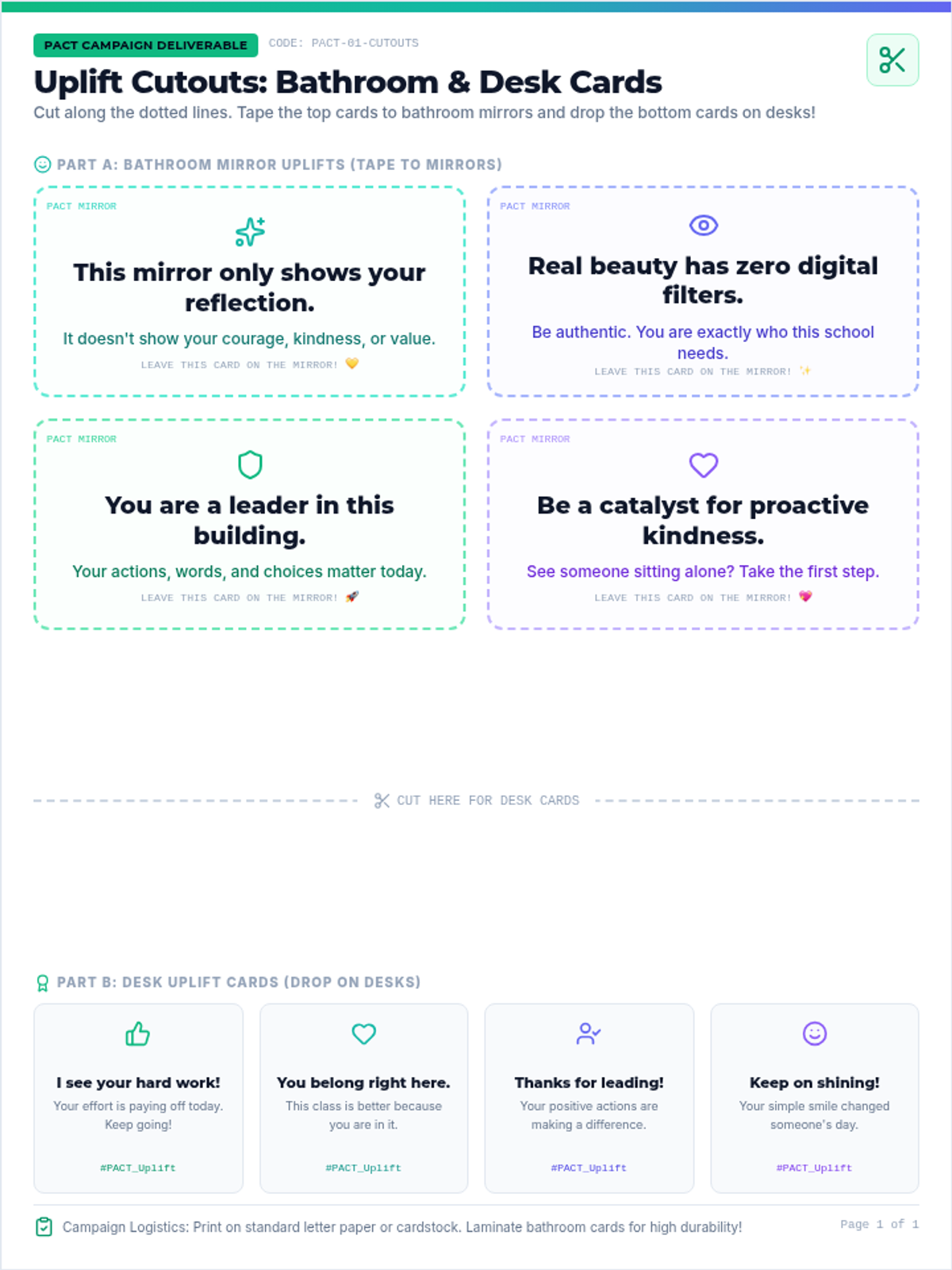
A 1-page printable containing beautifully designed positive mirror reminders for school bathrooms and desk quote slips for classmates. Features scissor-ready cut lines.
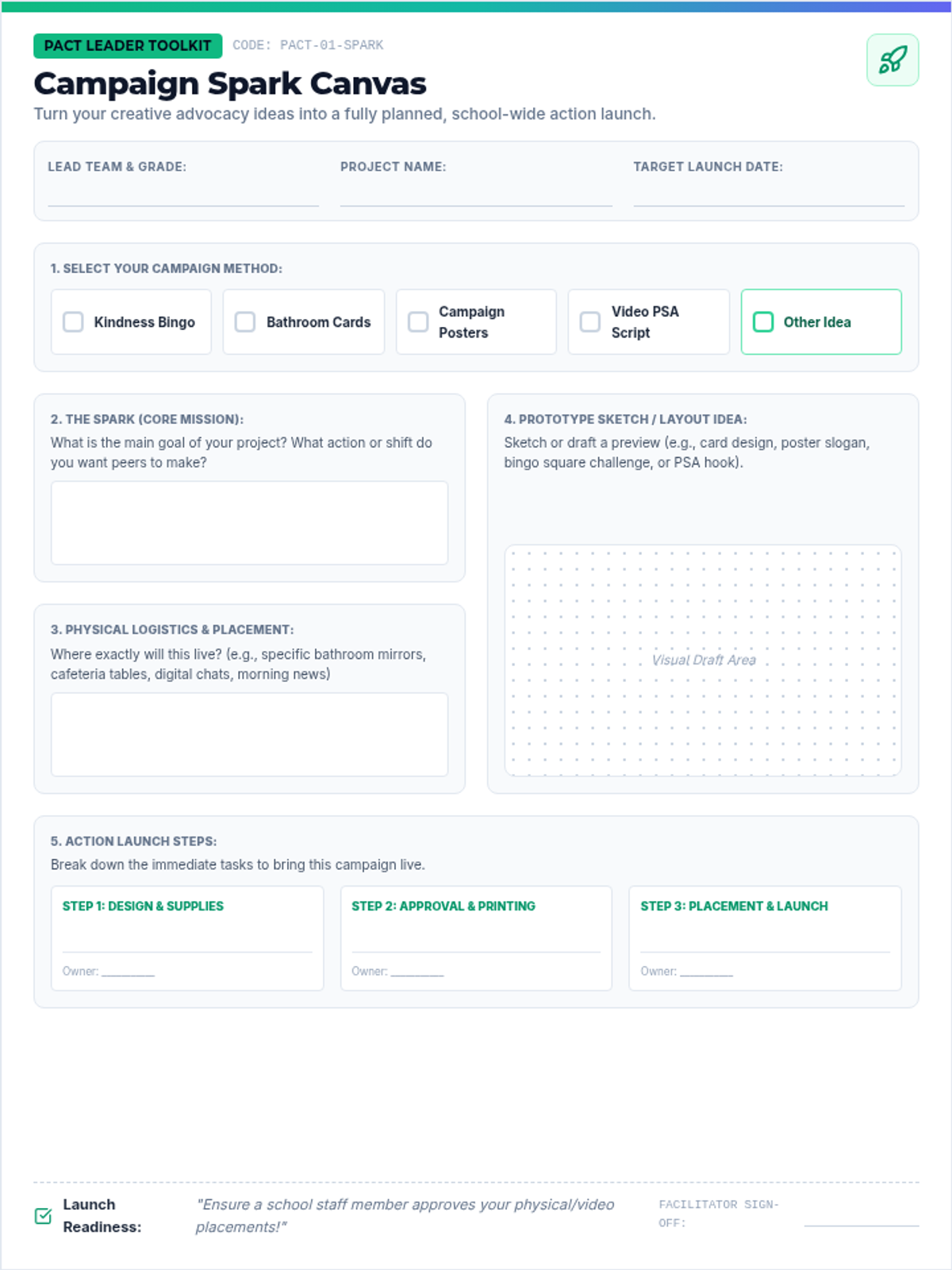
A highly structured, student-friendly project planning canvas designed for PACT leaders to outline, prototype, and launch creative student projects like Kindness Bingo, bathroom cards, posters, and PSAs.
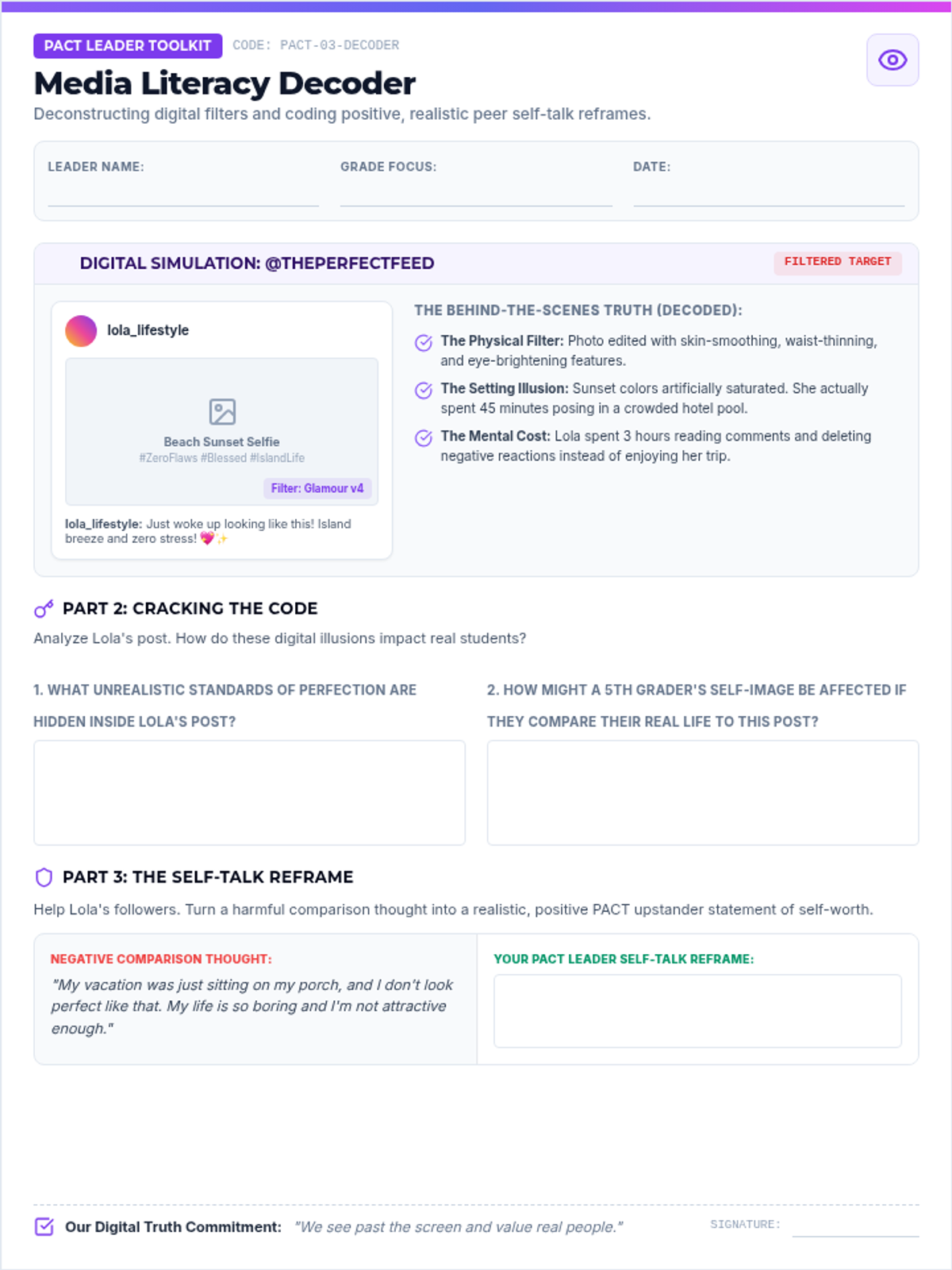
A media literacy and self-talk decoder worksheet for student leaders to analyze digital distortions and practice converting negative comparisons into positive affirmations.
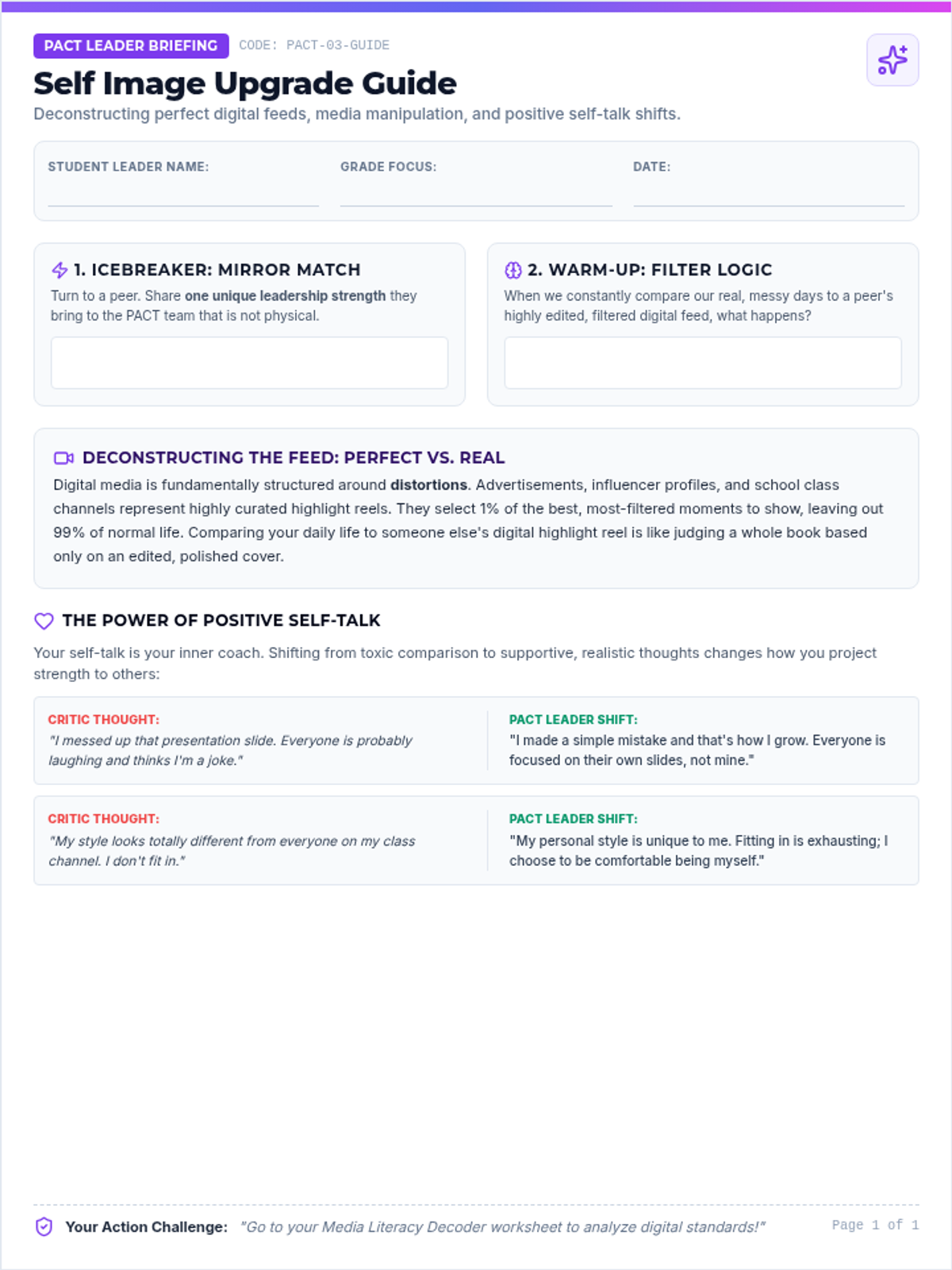
A printable guide detailing digital media literacy, deconstructing filters and perfect feeds, alongside self-talk reframing strategies.
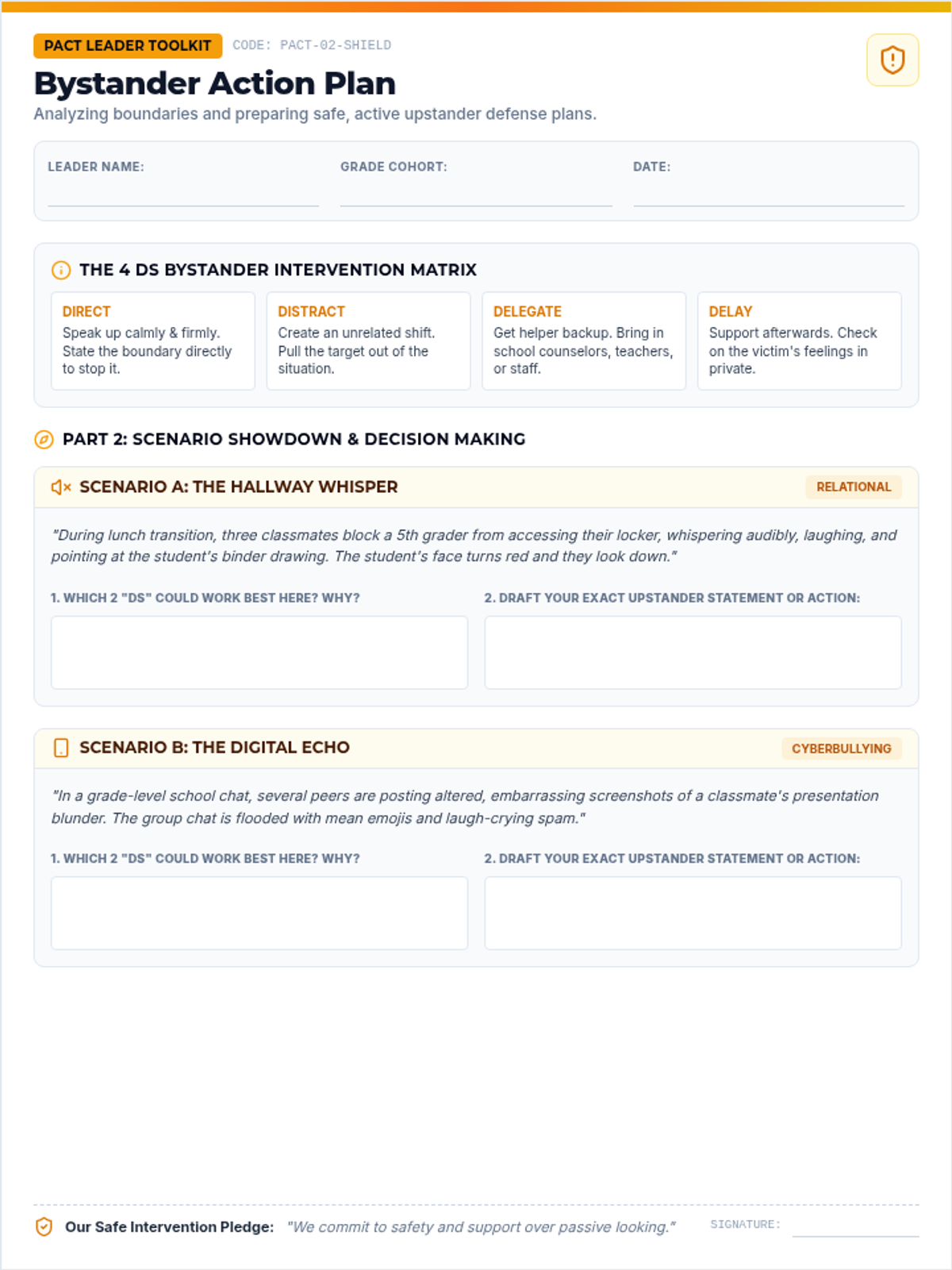
A practical student-facing action planning sheet where PACT leaders analyze real-world bullying scenarios and apply the 4 Ds bystander intervention framework.
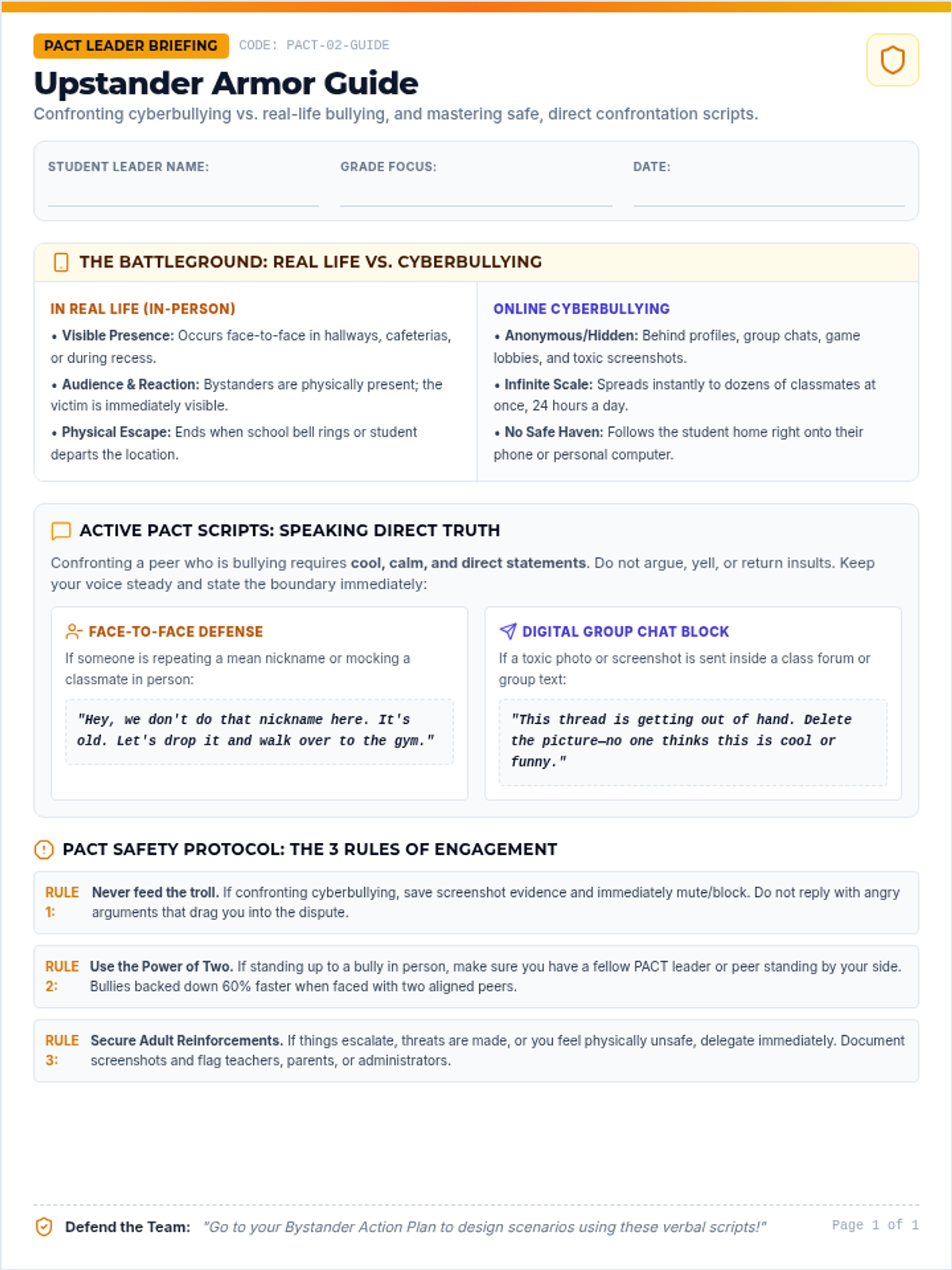
A printable guide detailing the exact differences between face-to-face and online cyberbullying, alongside direct, verbal upstander scripts for confronting bullying behavior safely.
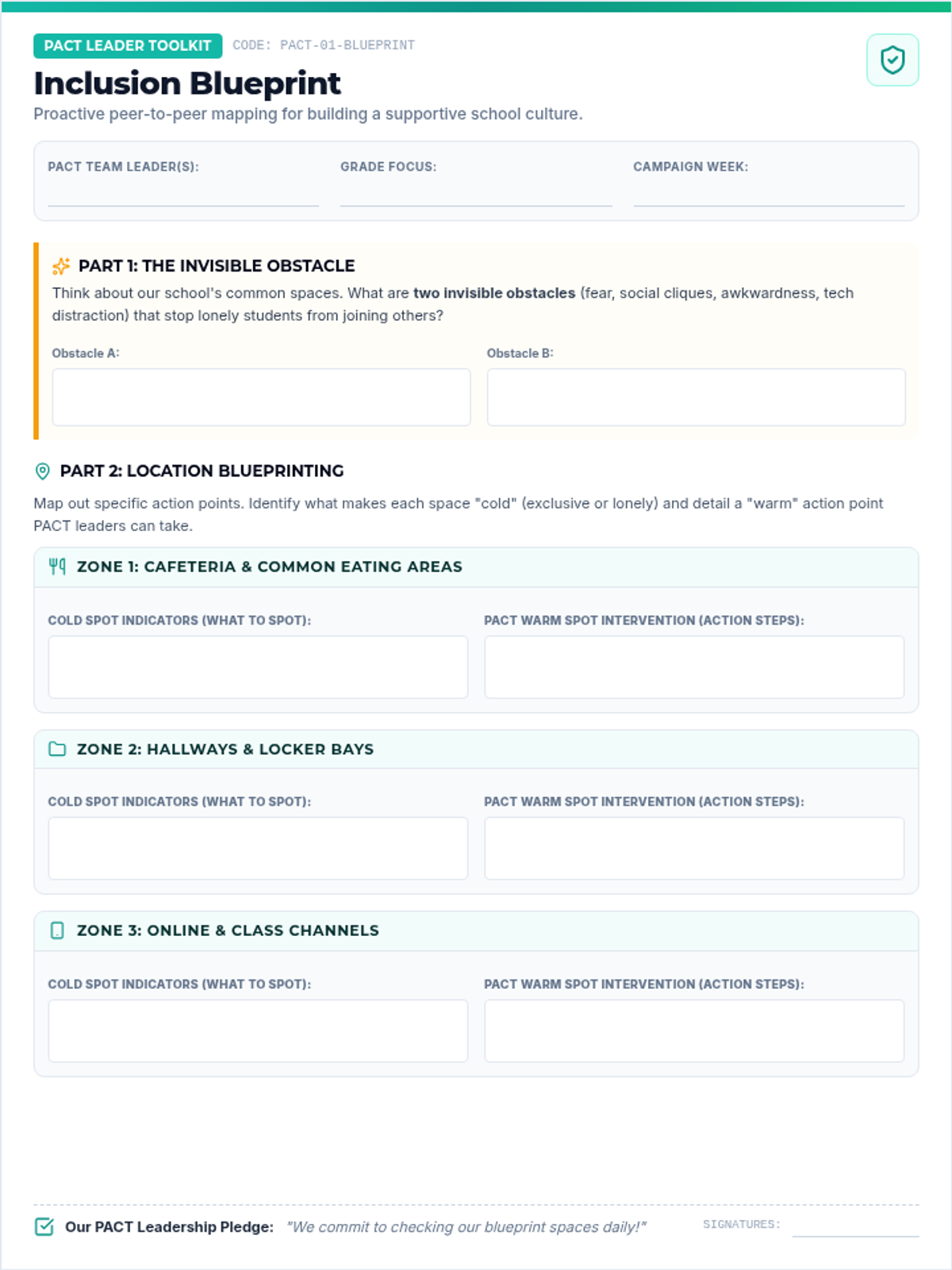
A blueprint planning worksheet for PACT leaders to map out specific, location-based proactive inclusion strategies across their school community.
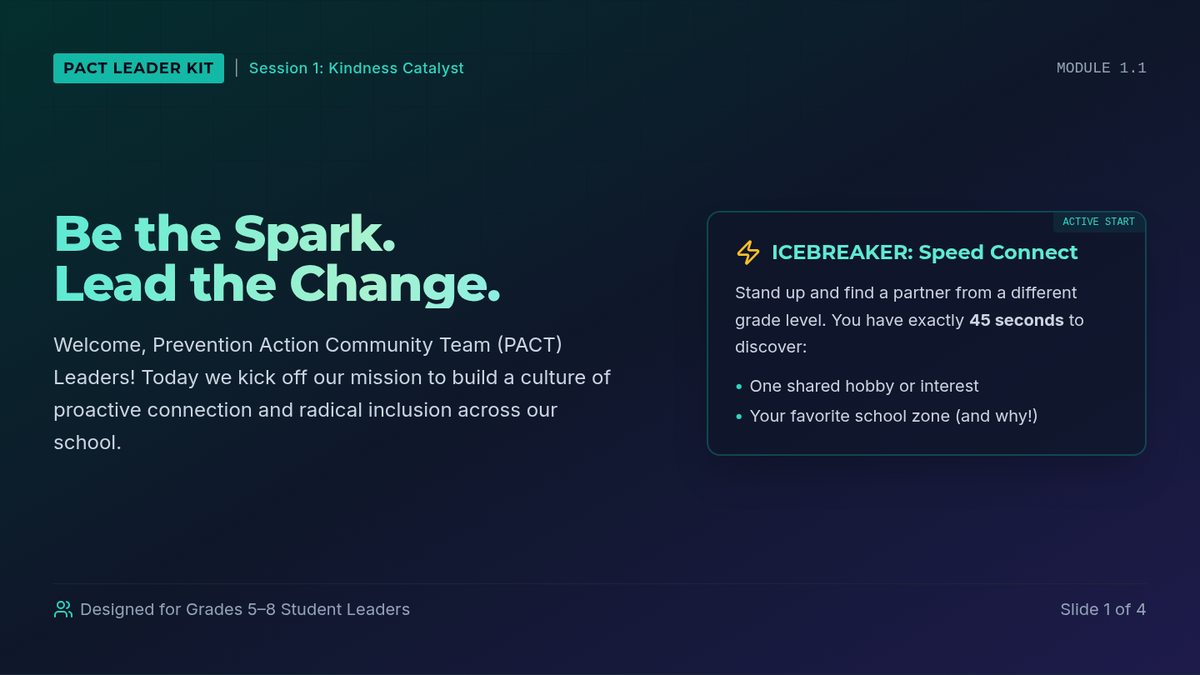
A printable guide for PACT student leaders outlining the campaign's core mission, featuring a group speed-connect icebreaker, a brain warm-up reflection, and proactive kindness checklists.
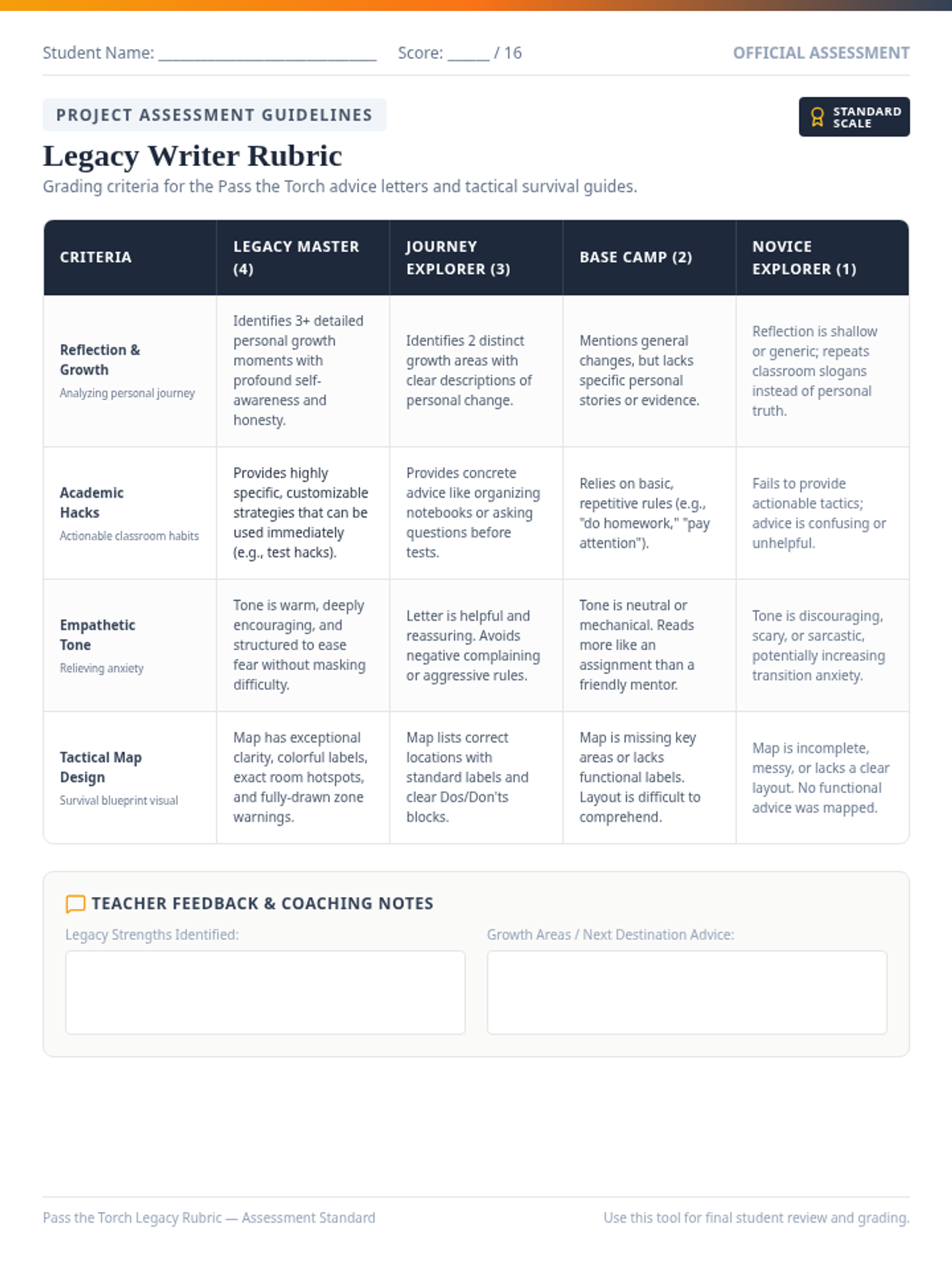
A 1-page vintage-styled legacy assessment rubric mapping out standards for student growth reflection, academic hacks, empathetic communication tone, and tactical map design.
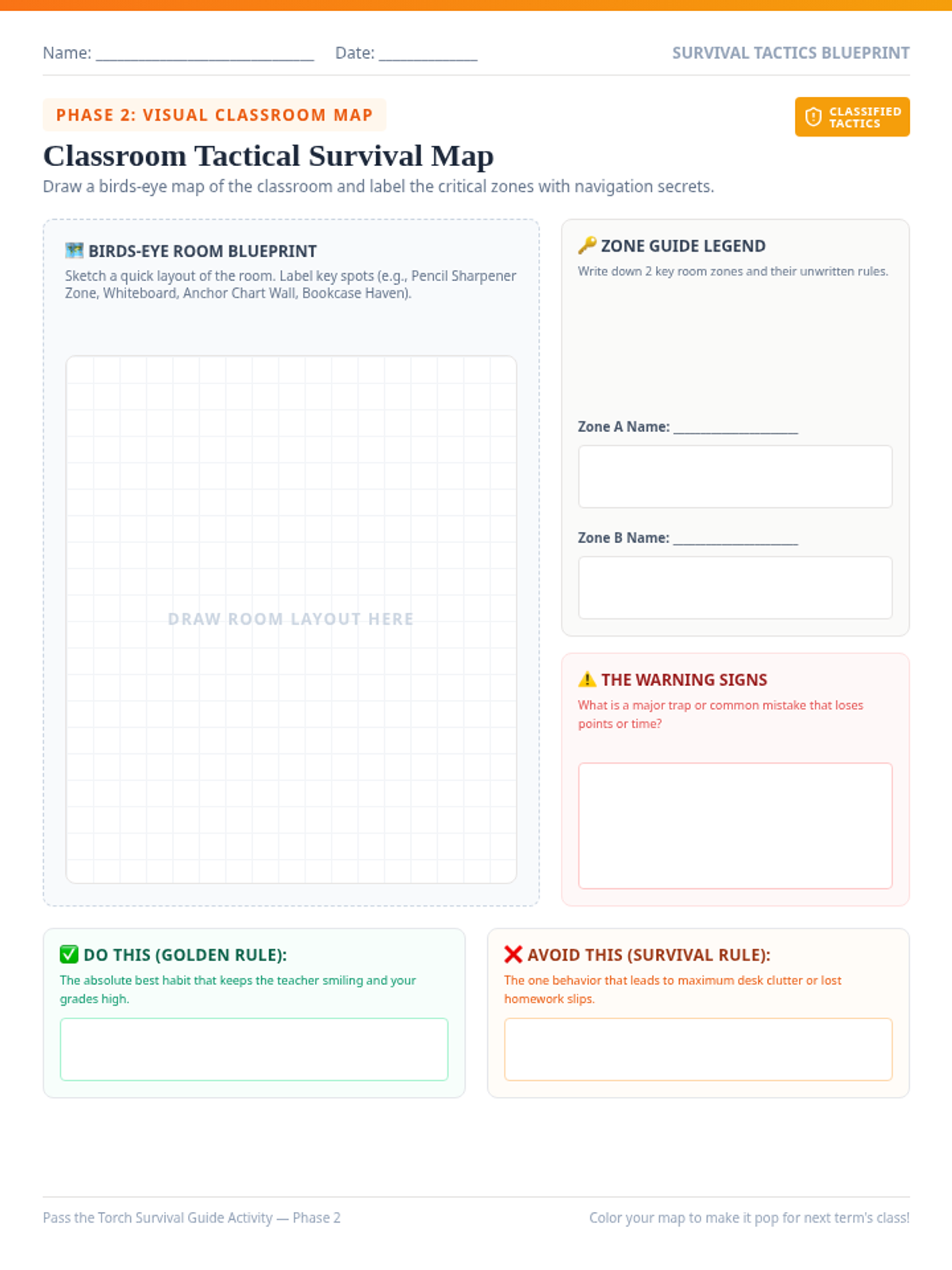
A creative, highly-visual 1-page classroom tactical map and checklist for students to design a 'survival guide' layout showing key physical zones and rules of the room.
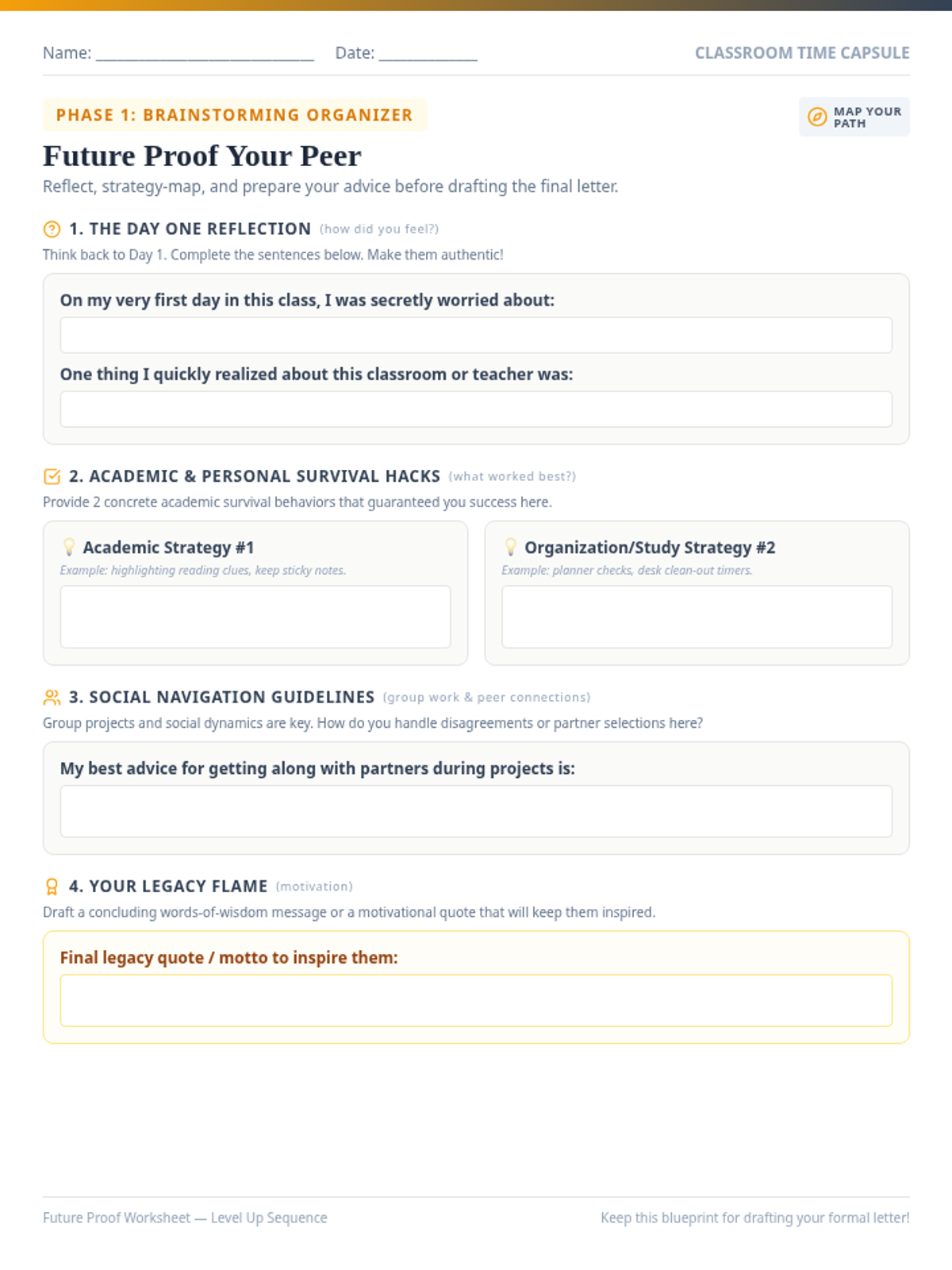
A 1-page structured student planning organizer to scaffold personal reflection, academic hacks, and social strategies before writing the final advice letter.
An engaging and colorful 5-slide instructional presentation that guides students through the process of writing their letters and designing survival guides.
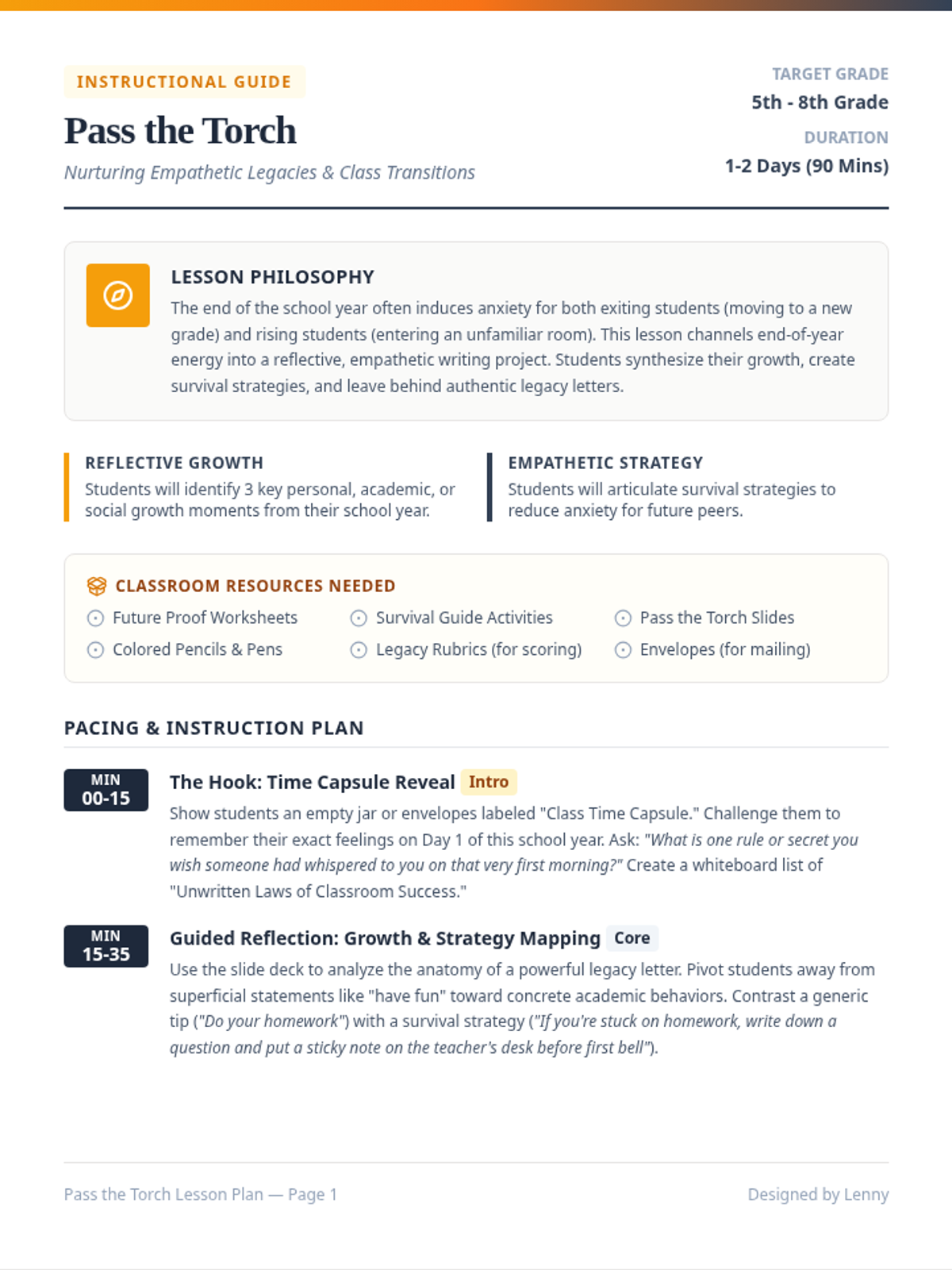
A comprehensive 2-page instructional guide for teachers to facilitate the 'Pass the Torch' writing and design project, complete with pacing, discussion prompts, and differentiation strategies.
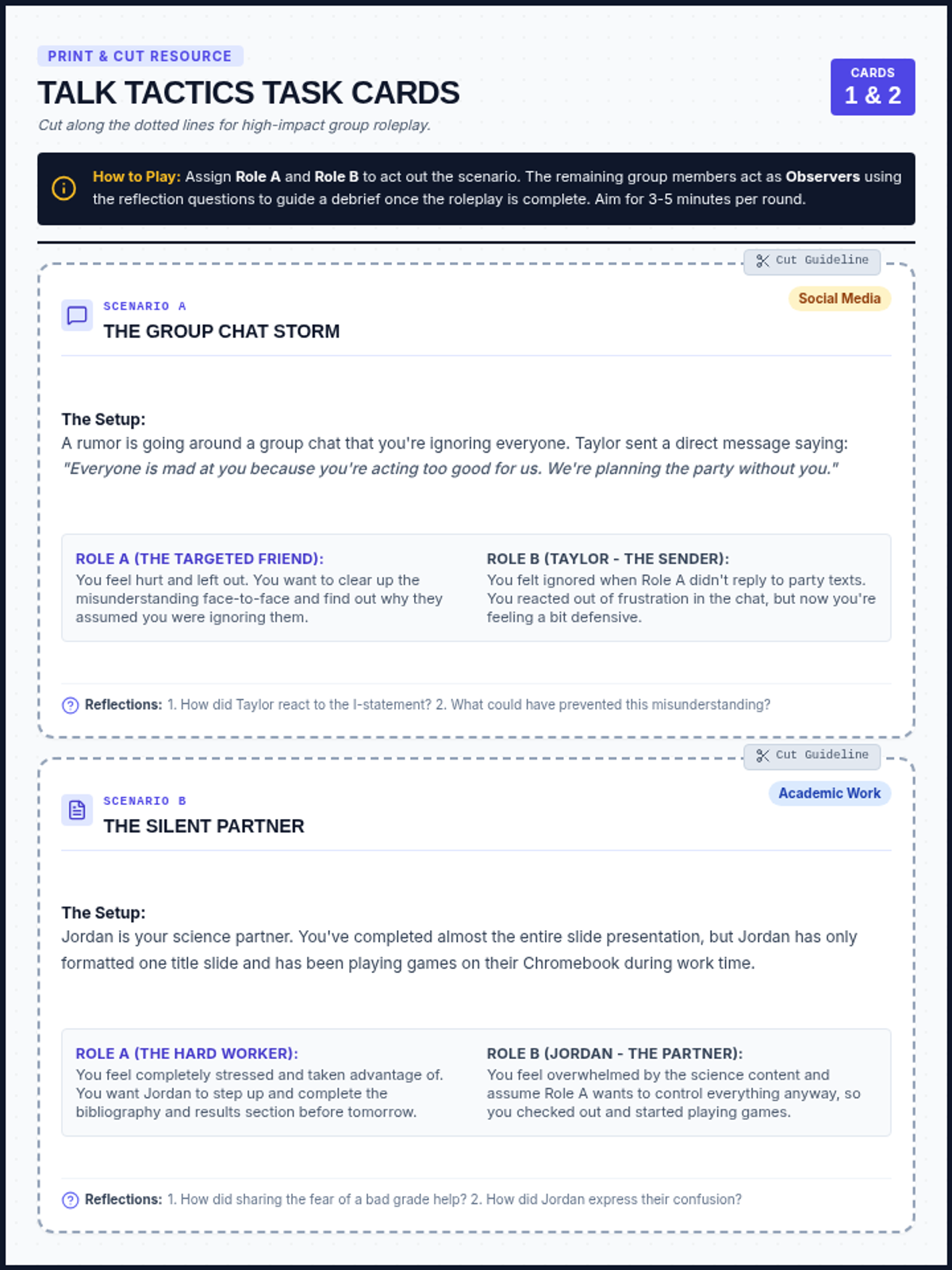
A 2-page print-ready material containing 4 distinct, large-format conflict resolution task cards designed for small-group roleplay, complete with scenario details, role perspectives, and reflective group questions.
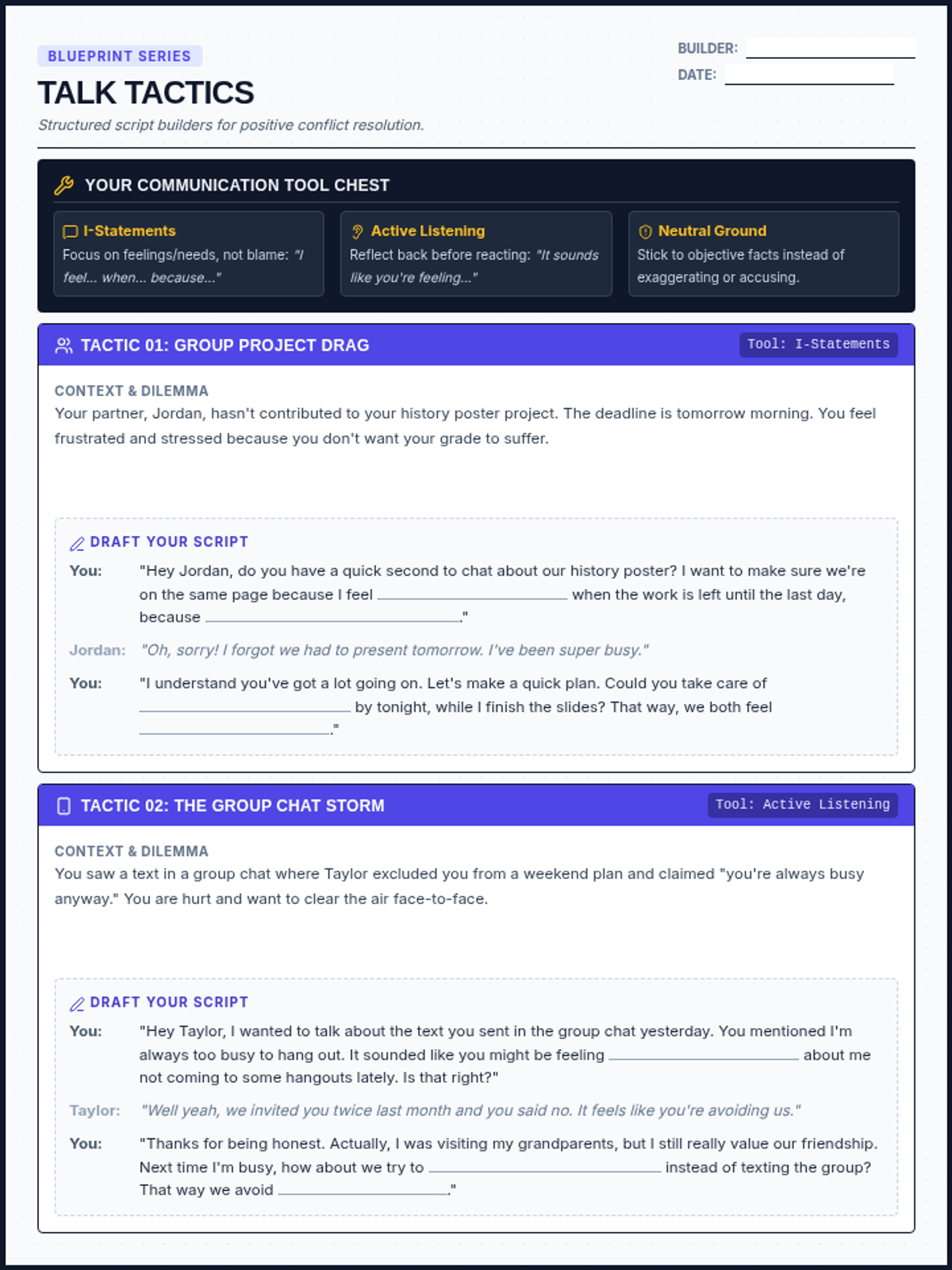
A 2-page student worksheet containing structured, fill-in-the-blank script templates that help students practice specific positive communication techniques across four common conflict scenarios.
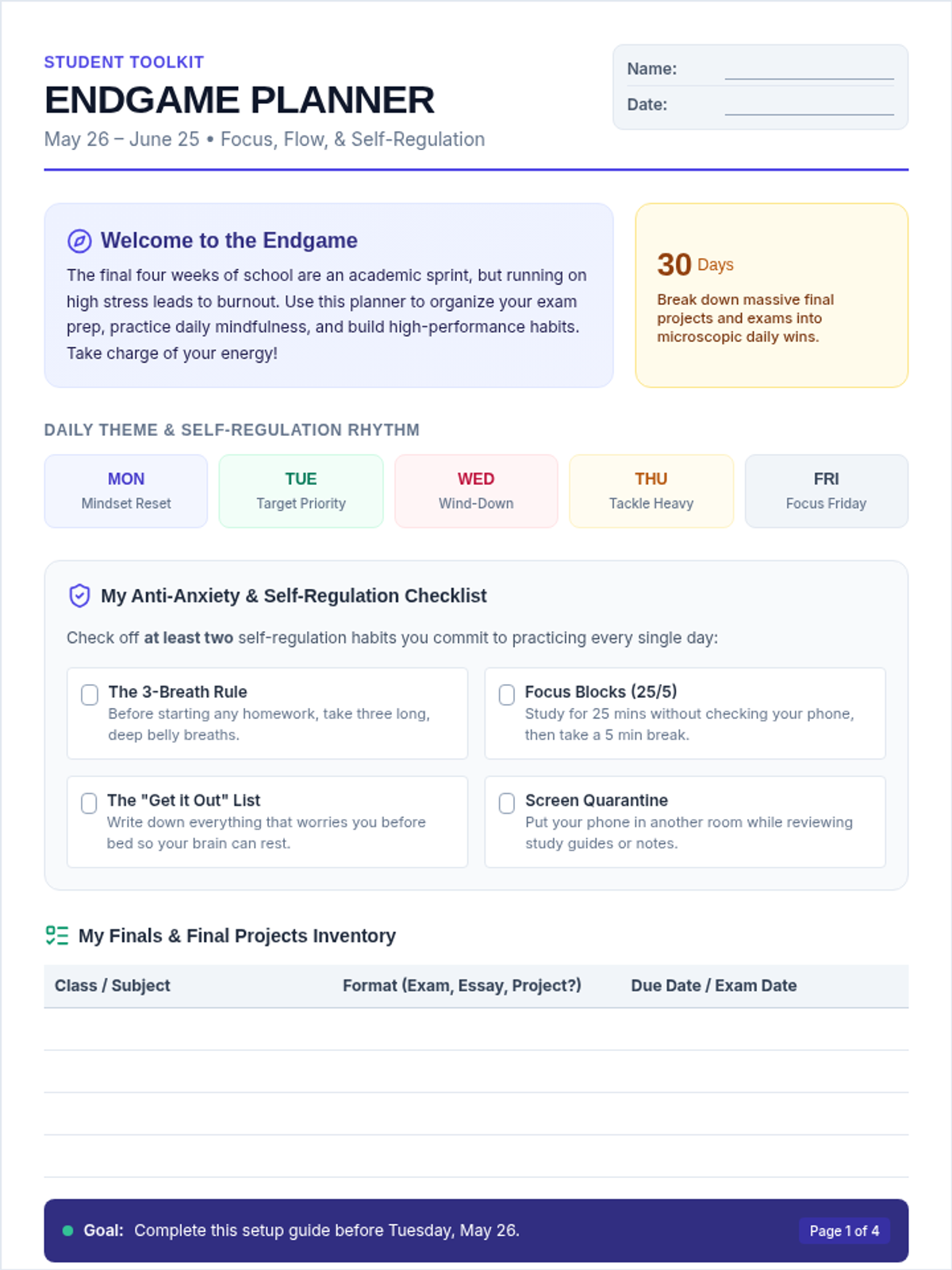
A highly structured, printable 4-page interactive workbook and calendar featuring daily executive functioning checklists, stress-management anchors, and co-planning layouts for May 26 to June 25.
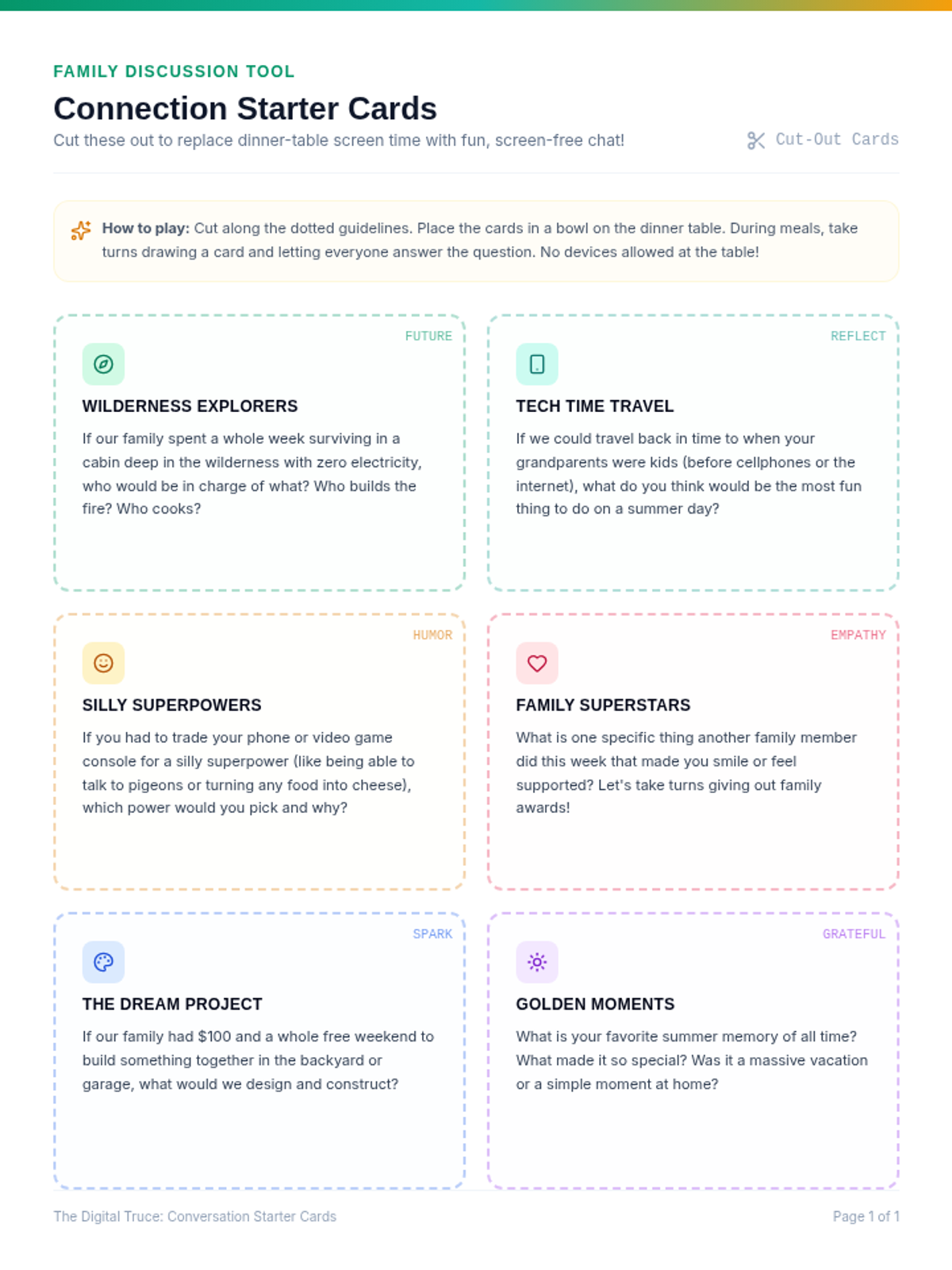
A set of 6 printable family conversation cards designed to replace screen-time with screen-free dinner table or bedtime discussion.
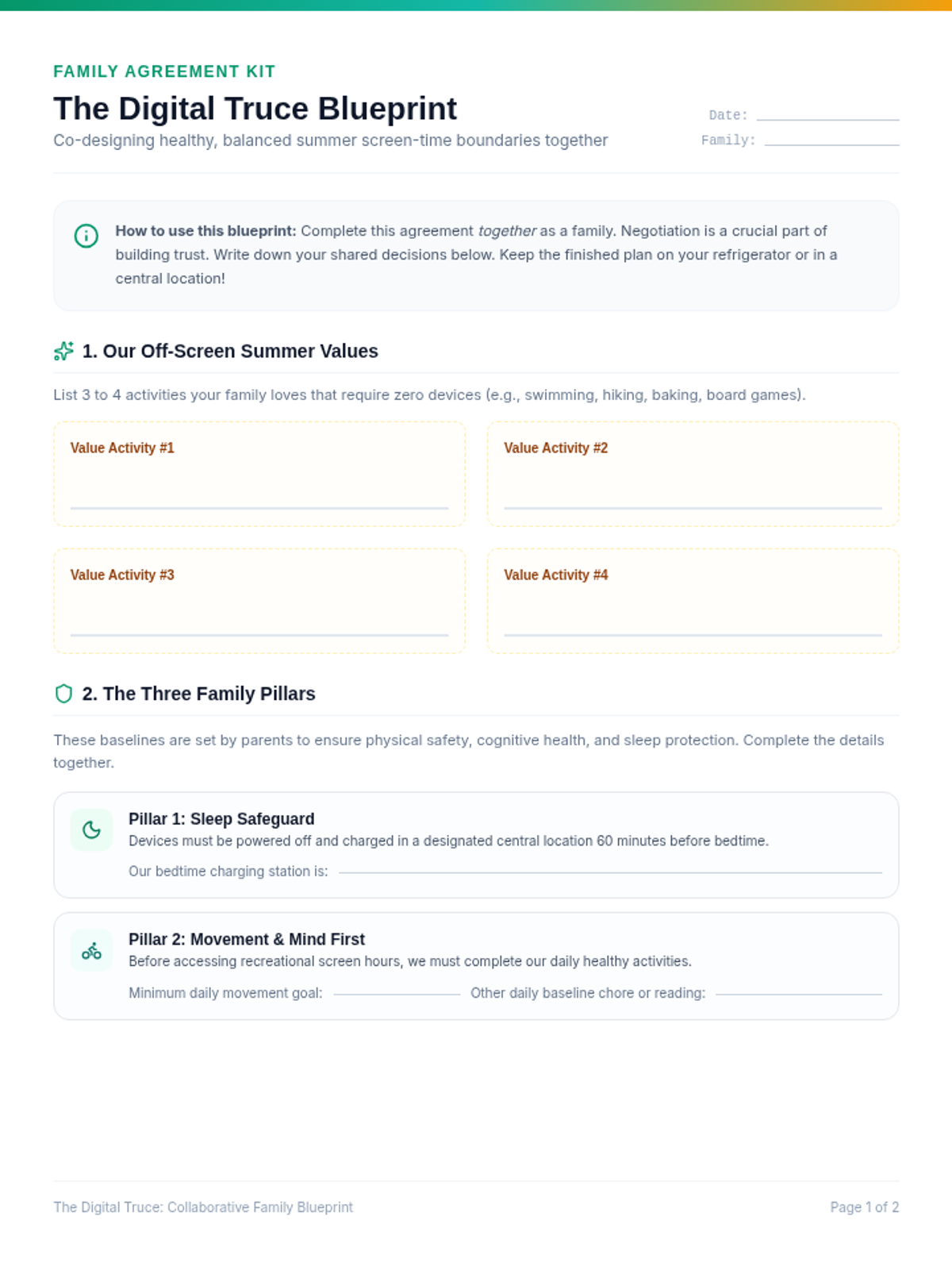
A beautifully designed, collaborative 2-page family agreement blueprint with fields for parents and kids to co-design and commit to screen boundaries.
An elegant 5-slide presentation deck (16:9 format) for leading the Digital Truce parent workshop, using clear layouts and a strict minimum 24px font size.
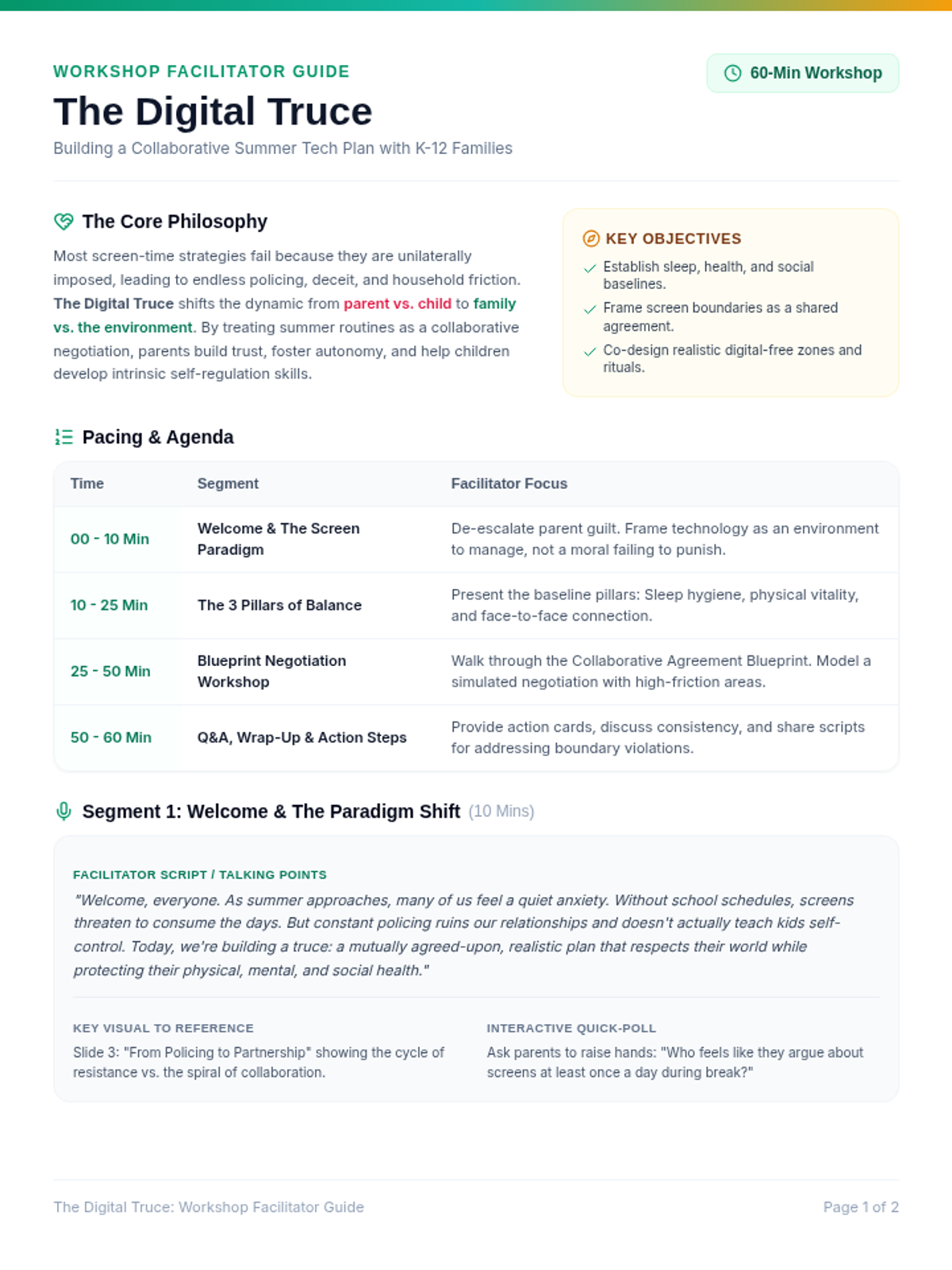
A comprehensive, highly detailed 2-page workshop facilitator guide for leading a 60-minute parent session on collaborative summer screen-time negotiation.
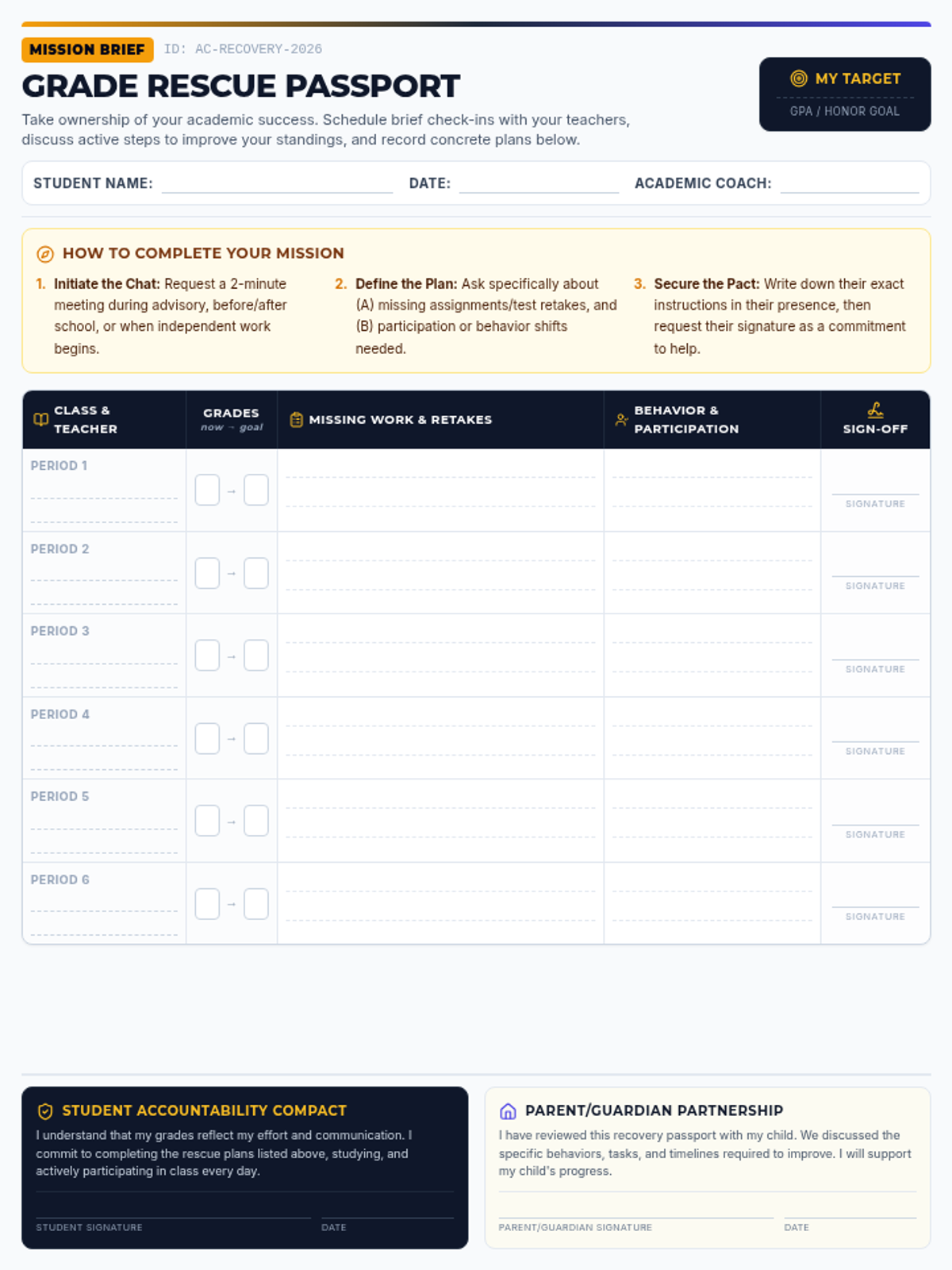
A 1-page check-in document designed as an academic passport. It enables students to consult with teachers across 6 class periods to map out concrete strategies for behavior, participation, missing assignments, and test retakes. Includes student and parent signature compacts.