Functional behavior assessment, data tracking, and de-escalation strategies for managing classroom conduct. Addresses positive reinforcement, token economies, and individualized behavior contracts to support student self-regulation.
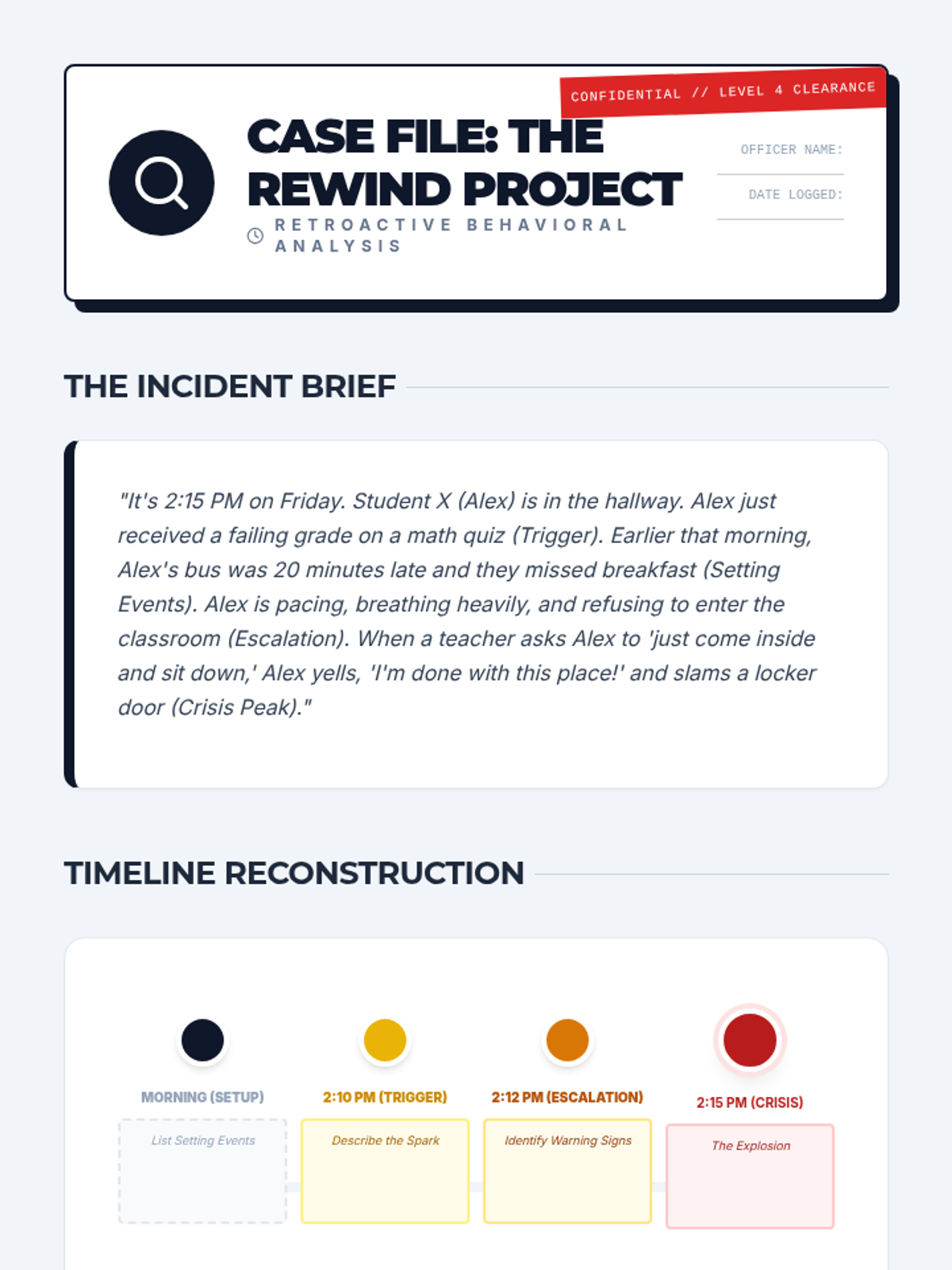
A summative project where students reconstruct a crisis event timeline to identify missed intervention 'off-ramps' and missed warning signs.
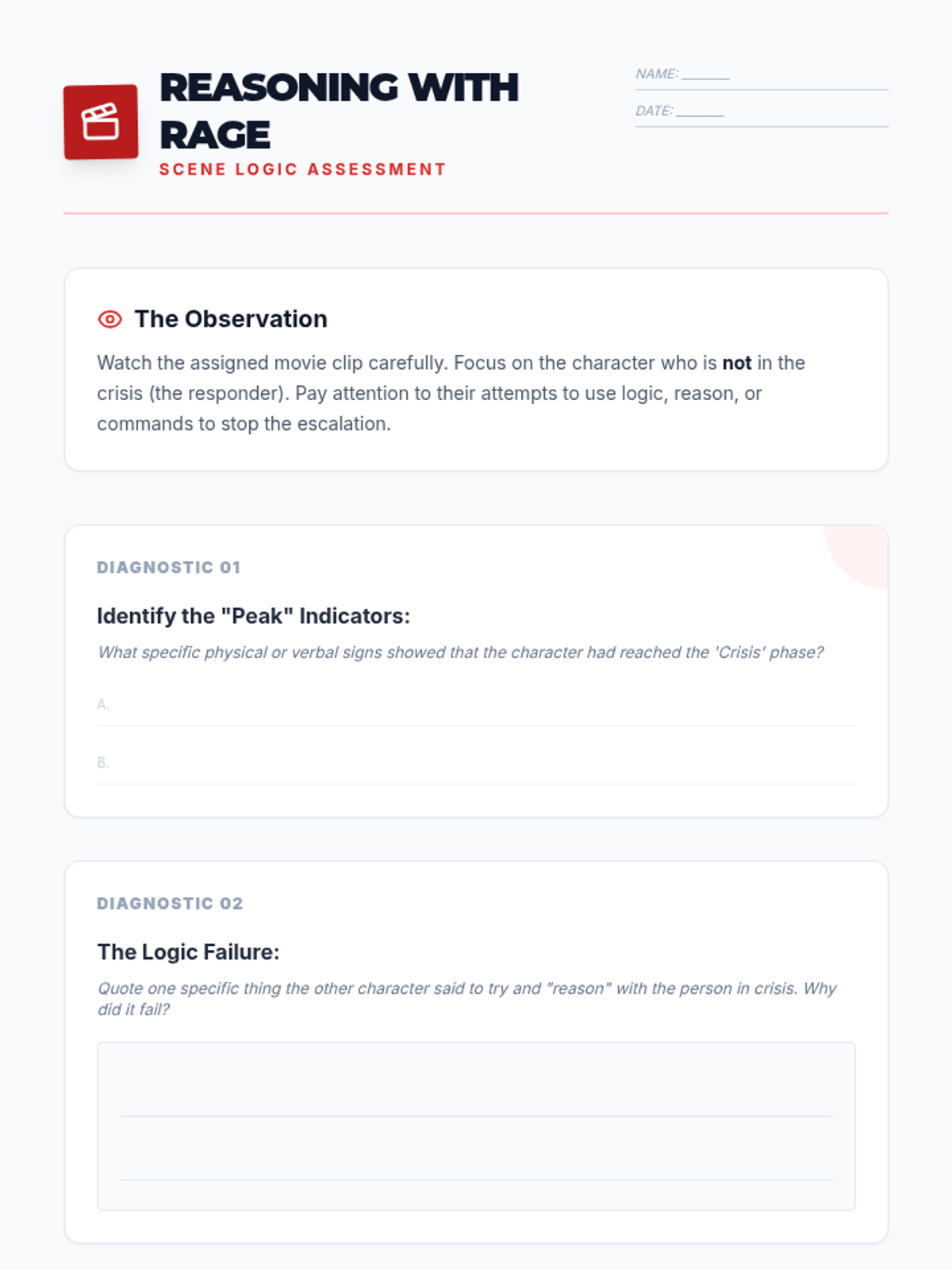
An analysis worksheet for Lesson 4 where students analyze a movie scene of a crisis to identify signs of the peak and why rational reasoning failed.
A slide deck for Lesson 4 exploring the biological 'Amygdala Hijack' and why rational communication fails during the peak of a crisis.
A slide deck for Lesson 3 focused on the cumulative nature of stress and the psychological signs of the acceleration phase.
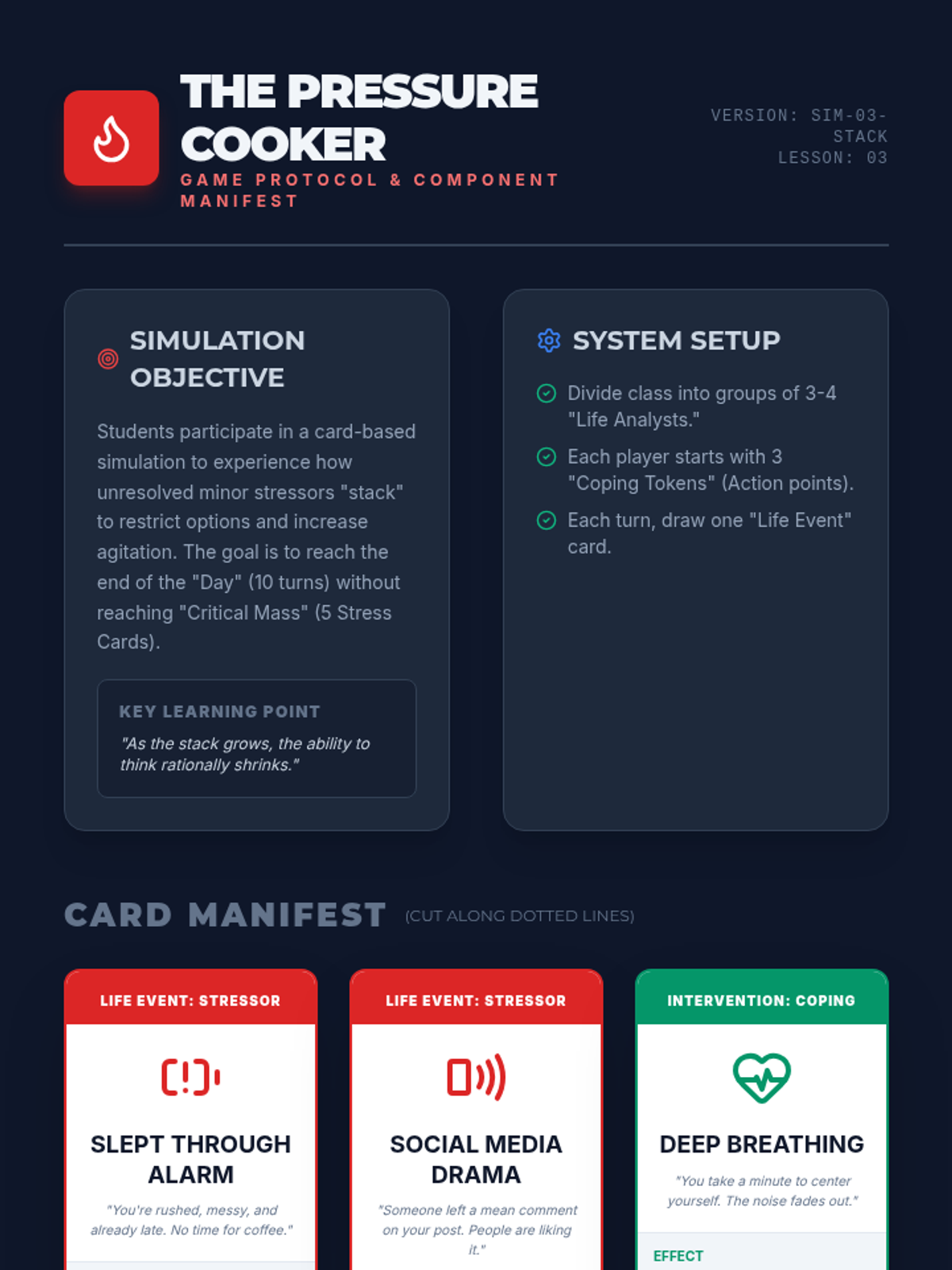
Teacher guide and card components for 'The Pressure Cooker', a game-based simulation where students experience the cumulative effects of stress on rational decision-making.
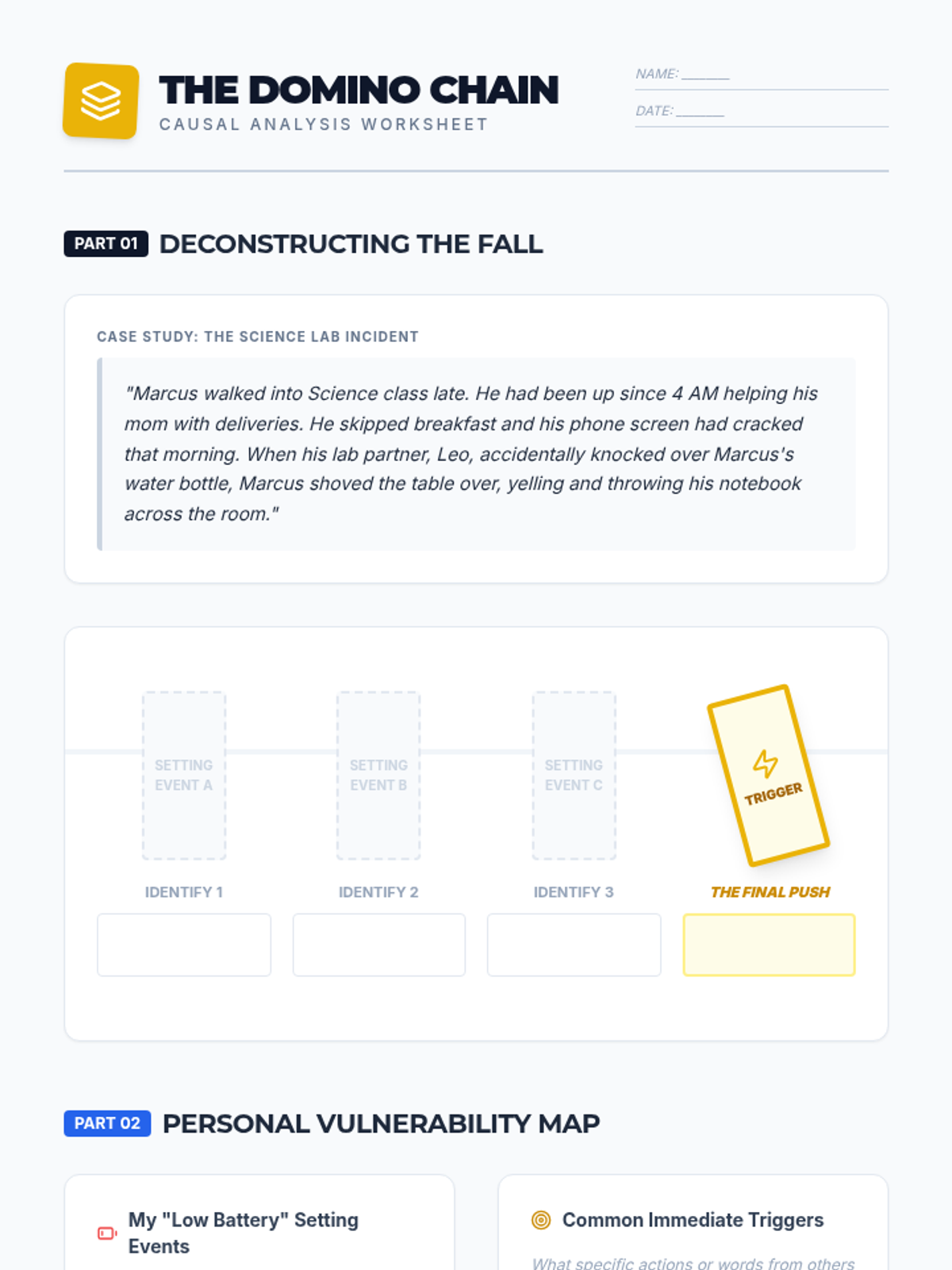
A causal analysis worksheet where students analyze setting events and triggers through a 'Domino Effect' case study and personal reflection.
A slide deck for Lesson 2 exploring the distinction between vulnerability factors (setting events) and immediate triggers.
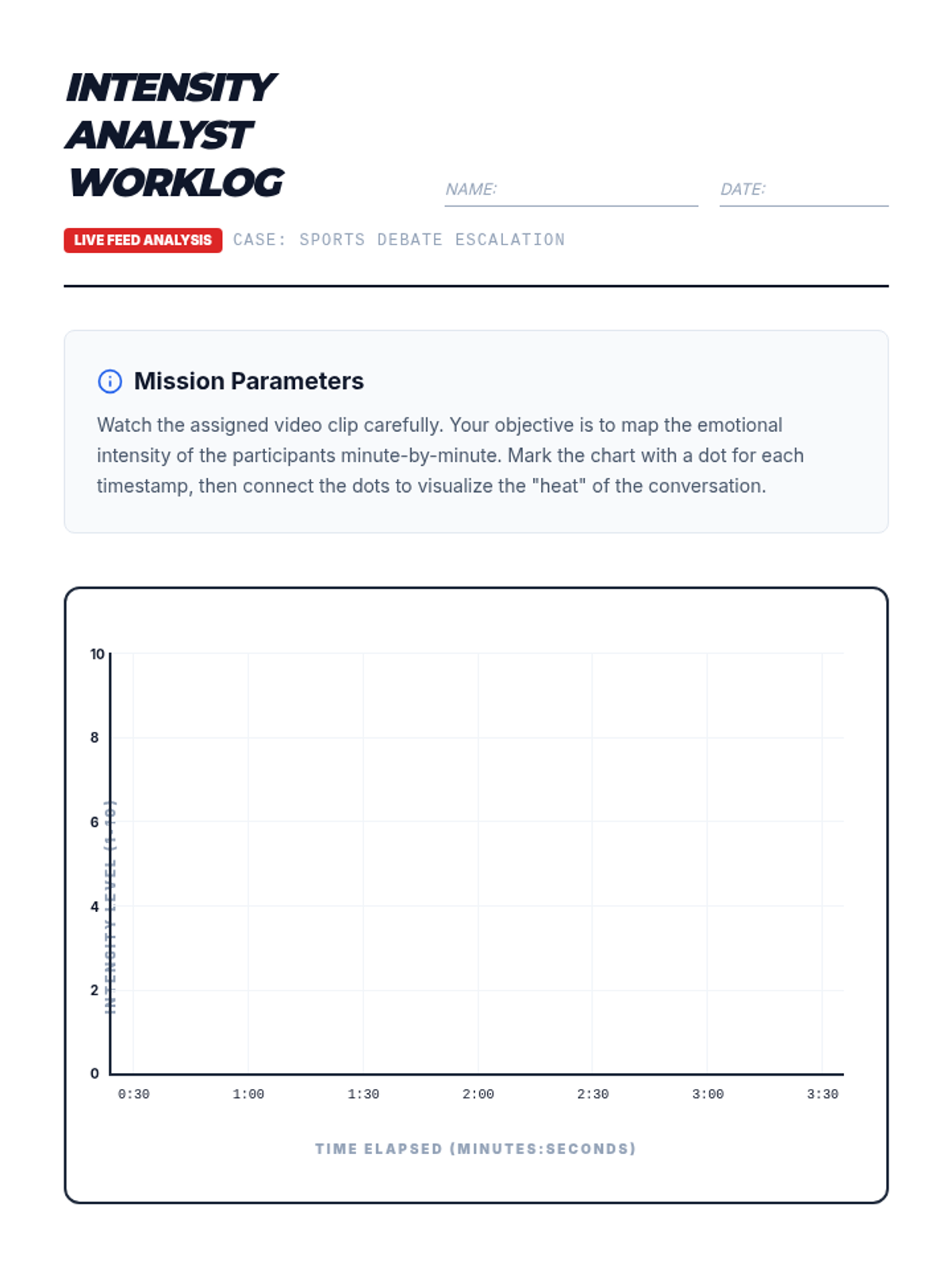
A data-analysis worksheet where students graph the emotional intensity of a sports argument video to identify stages of the Crisis Cycle.
An introductory slide deck for Lesson 1, visually explaining the five stages of the Crisis Cycle and setting up the sports argument hook activity.
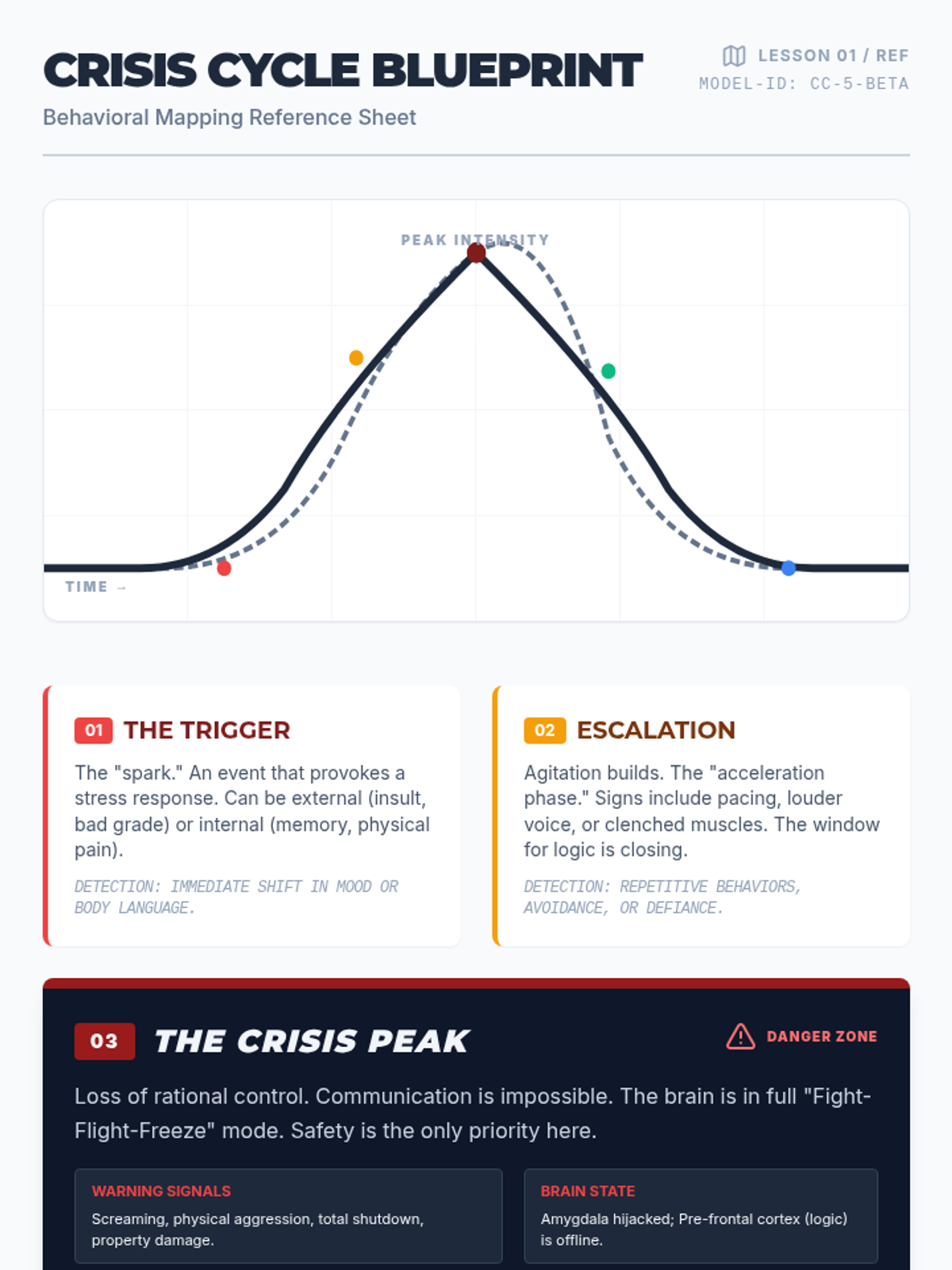
A technical reference sheet outlining the five stages of the Crisis Cycle with a visual curve and diagnostic descriptions for each phase.
A slide deck summarizing the four types of emotional signals and providing instructions for the final Personal Escalation Map project.
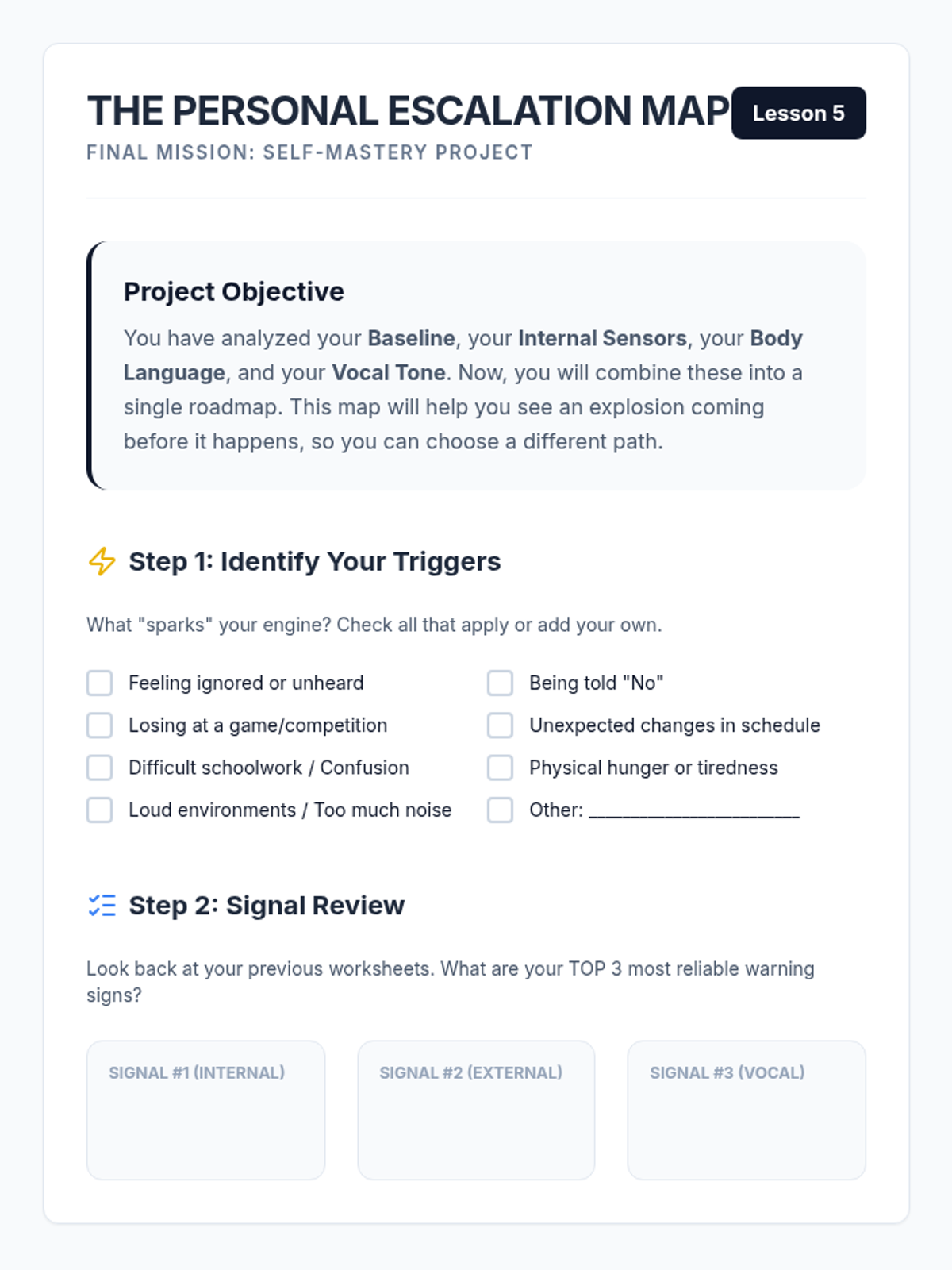
The final project for the unit where students synthesize all previous learning to create a visual 'Escalation Map' identifying their specific triggers and warning signs at different levels.
A slide deck introducing vocal indicators of emotional escalation, contrasting rational communication with emotional venting, and explaining the Tone Twister game.
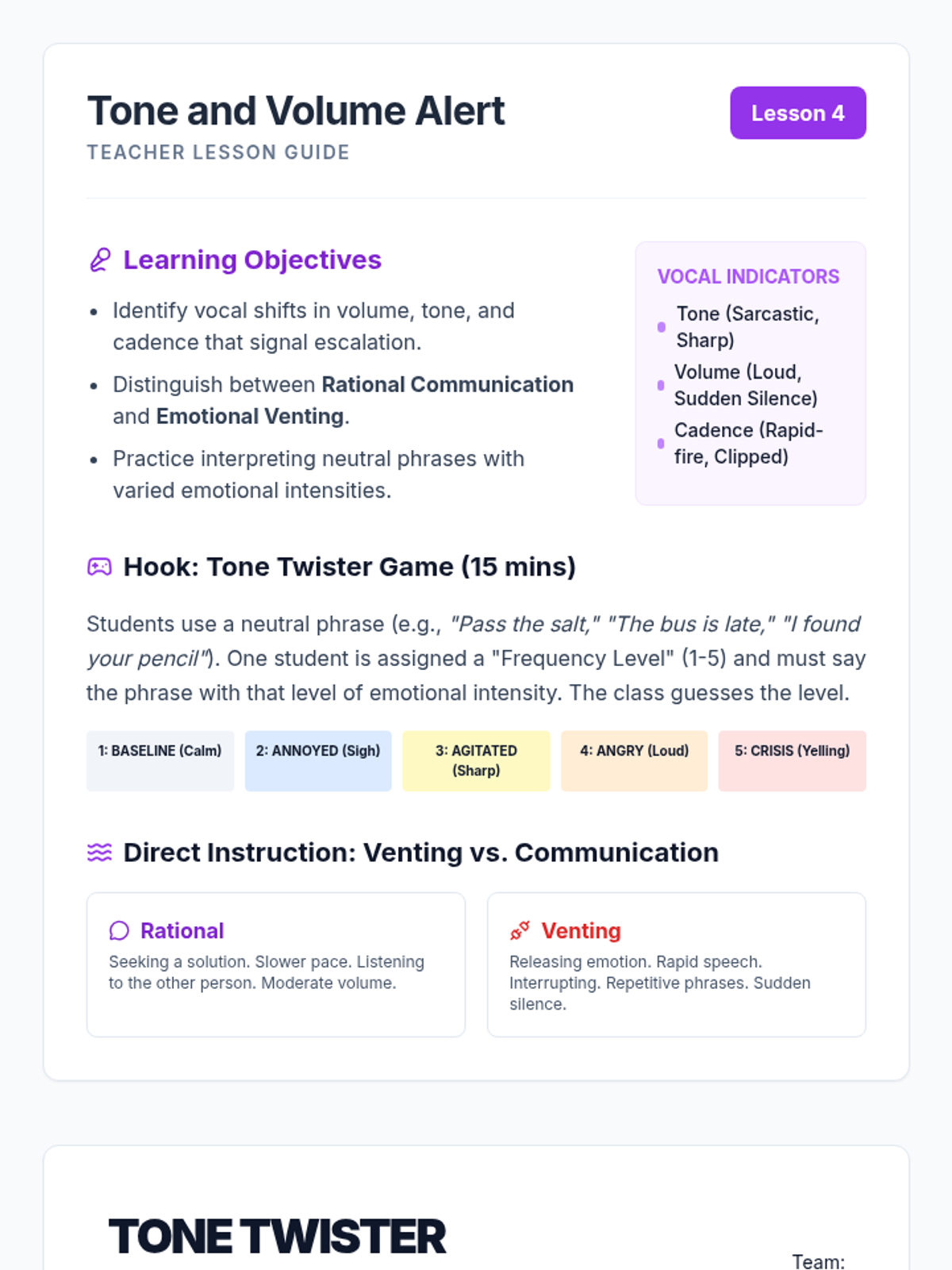
A teacher guide and student activity focused on identifying vocal shifts in tone, volume, and cadence during emotional escalation through a role-play game.
A slide deck explaining the importance of objective observation in identifying non-verbal warning signs. includes the "Silent Film" hook and definitions of signal clusters.
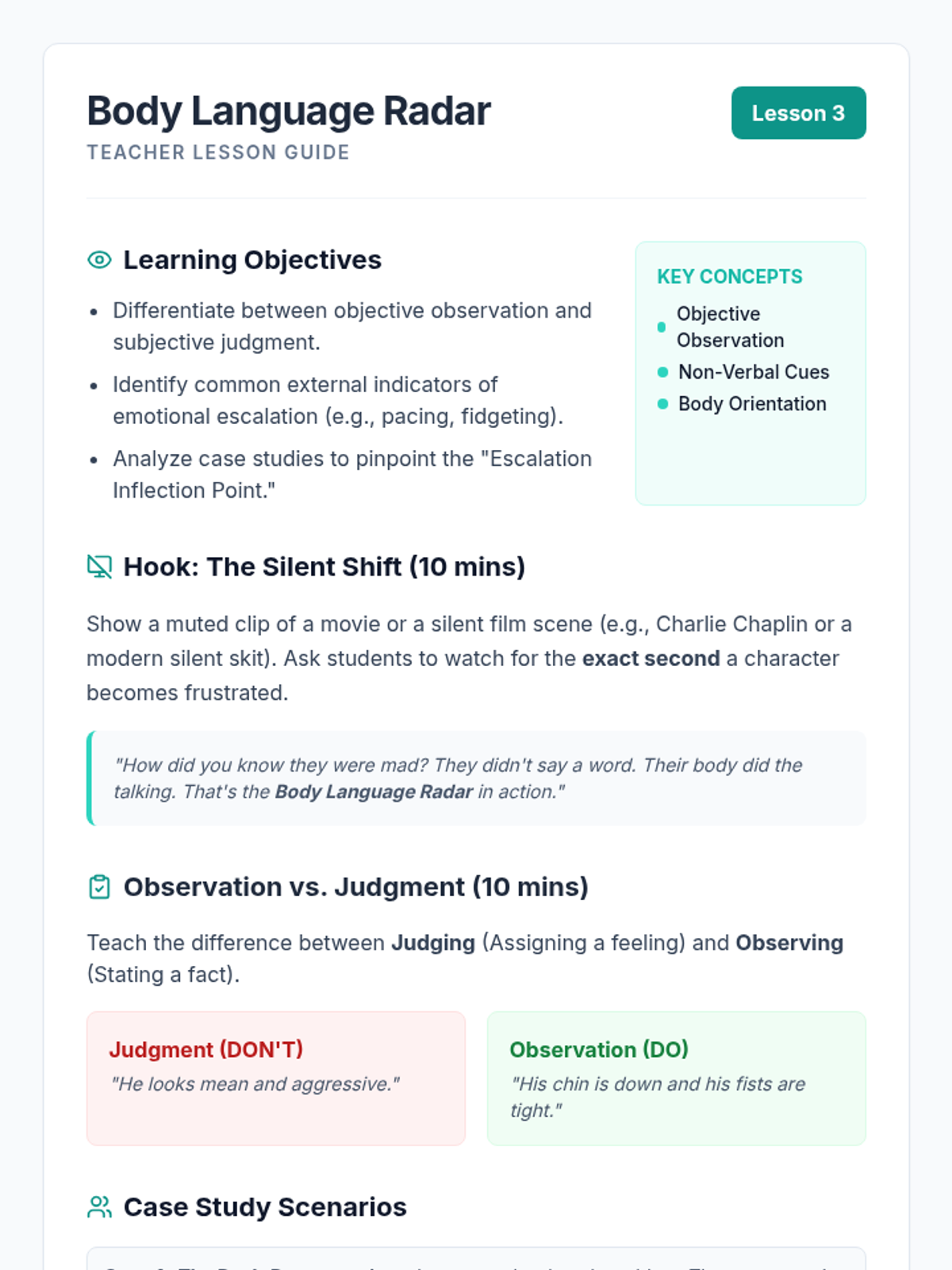
A teacher guide and student activity focused on identifying external non-verbal behavioral cues during emotional escalation through objective observation.
A slide deck explaining the physiological 'alarm system' of the brain (the amygdala) and how it triggers physical sensations in the body during stress. Includes the Lemon Test hook.
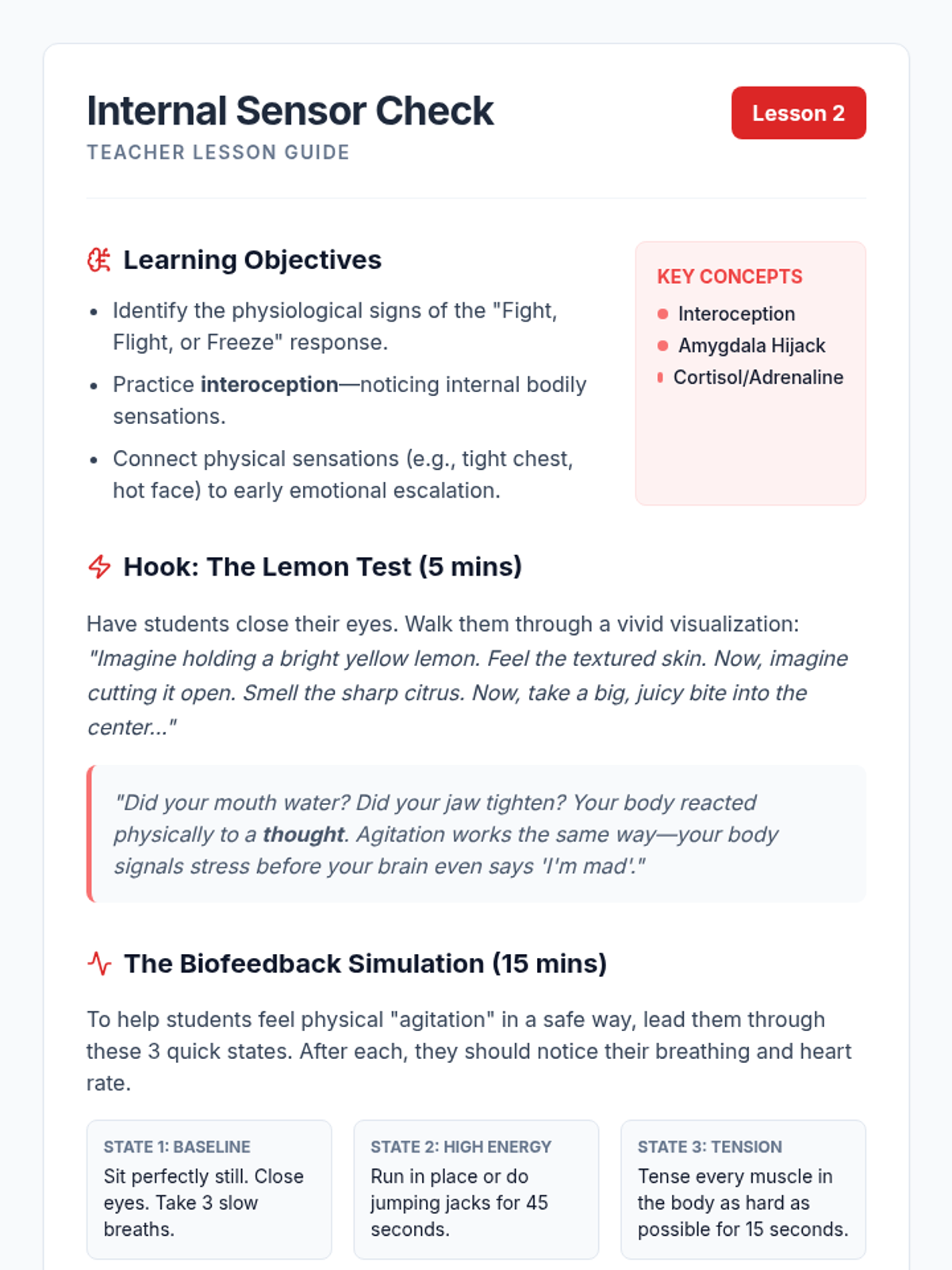
A teacher guide and student body-mapping worksheet focused on identifying internal physiological signals of stress and agitation.
A visual presentation introducing students to the concepts of baseline behavior and emotional deviation. includes a 'spot the difference' hook and instructions for the baseline self-audit.
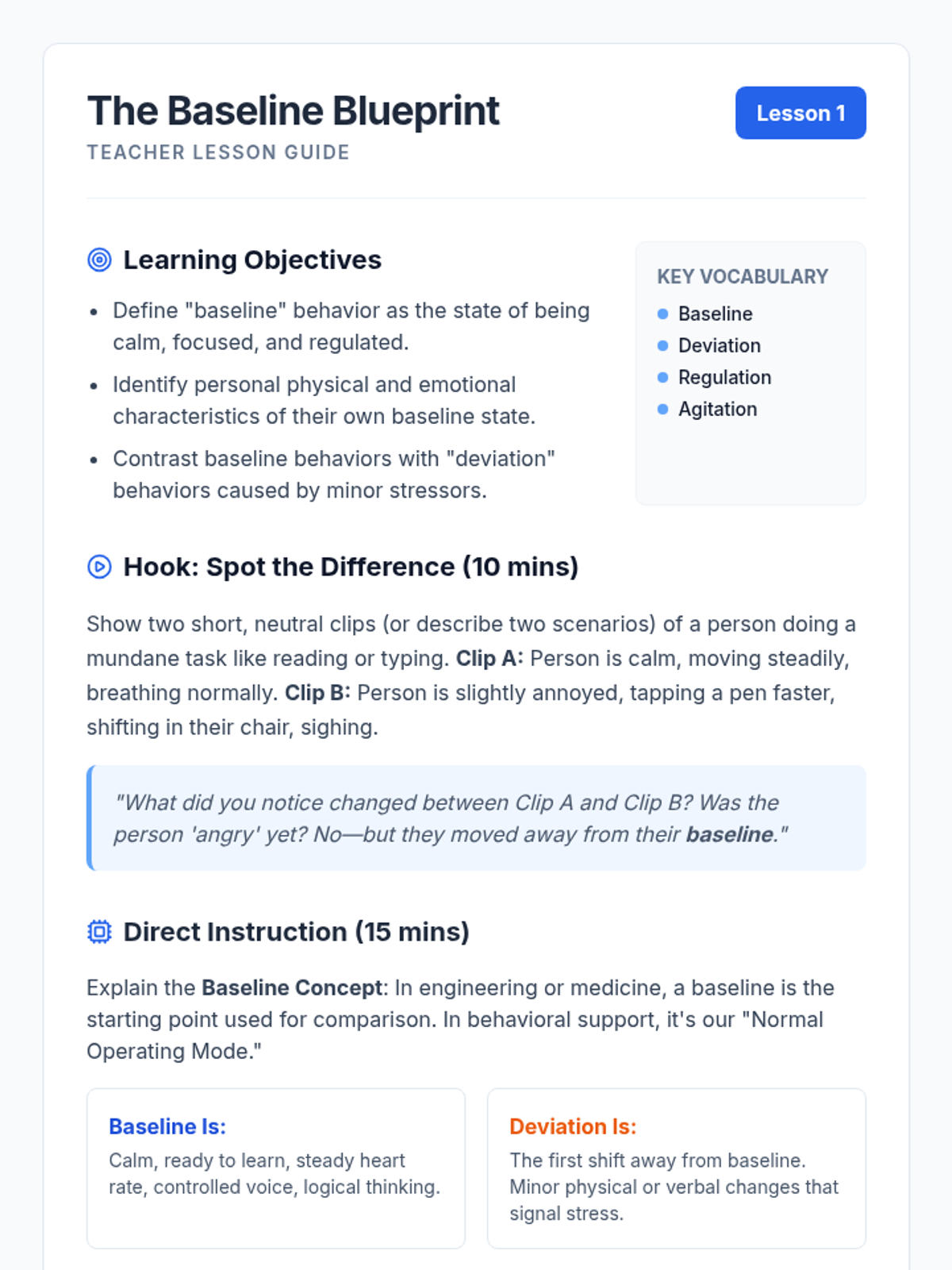
A teacher guide and student worksheet designed to establish the concept of 'baseline' behavior and identify personal physical/social indicators of a regulated state.
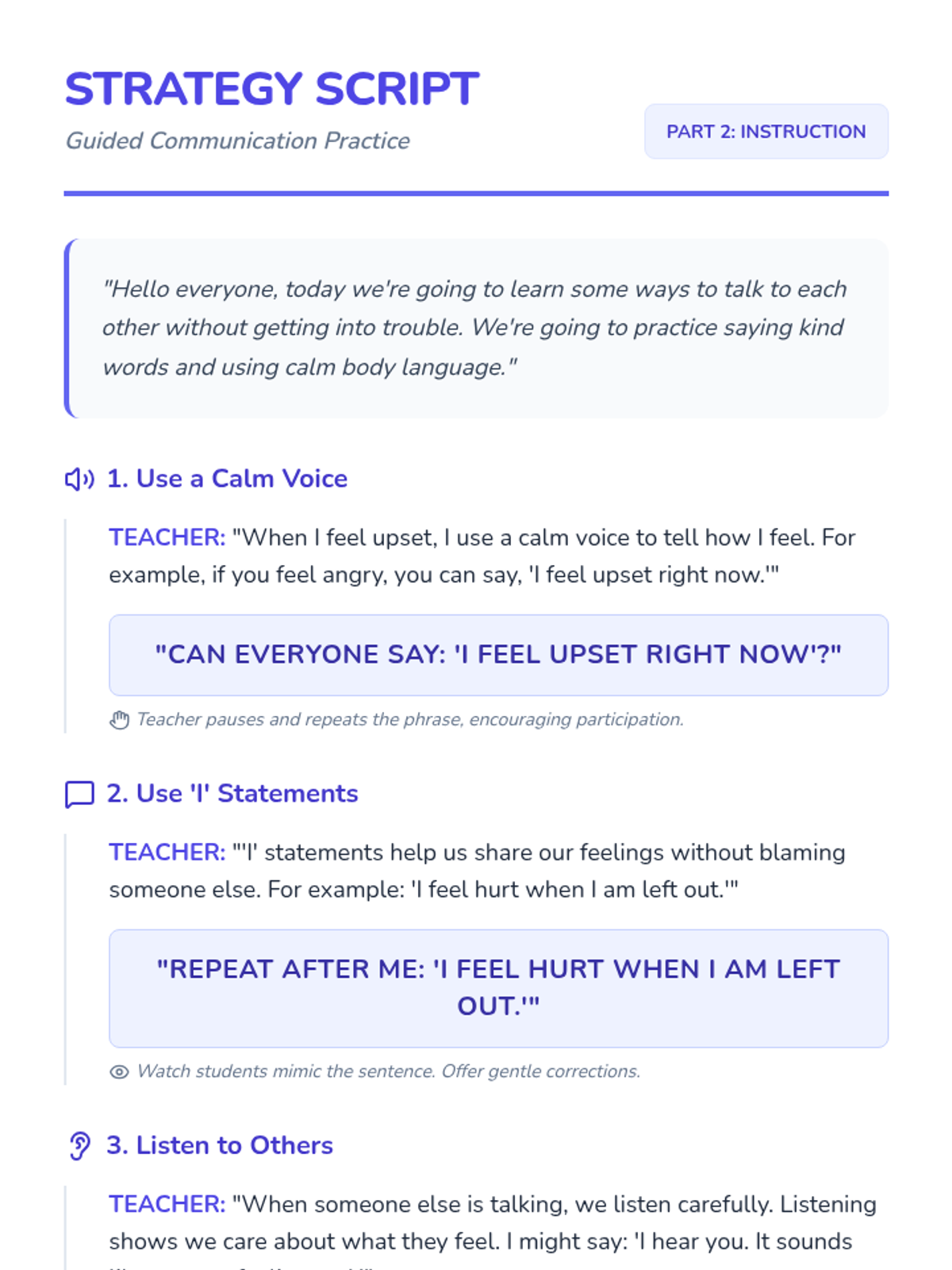
A scripted instructional guide for teachers to model and practice key communication strategies like 'I' statements and active listening with students.
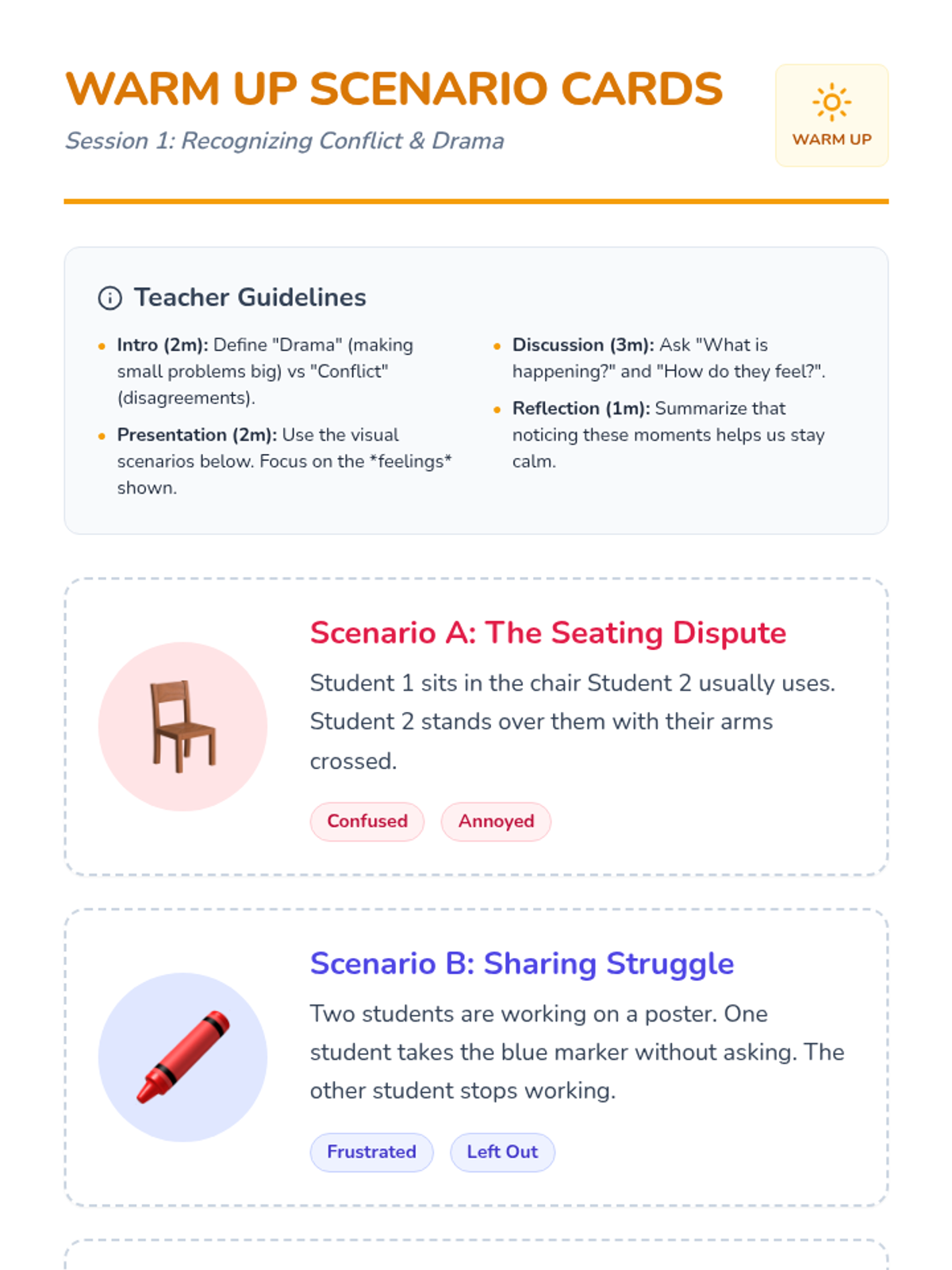
A visual warm-up activity for 6th-grade students to identify classroom drama and conflict through illustrated scenarios and discussion prompts.
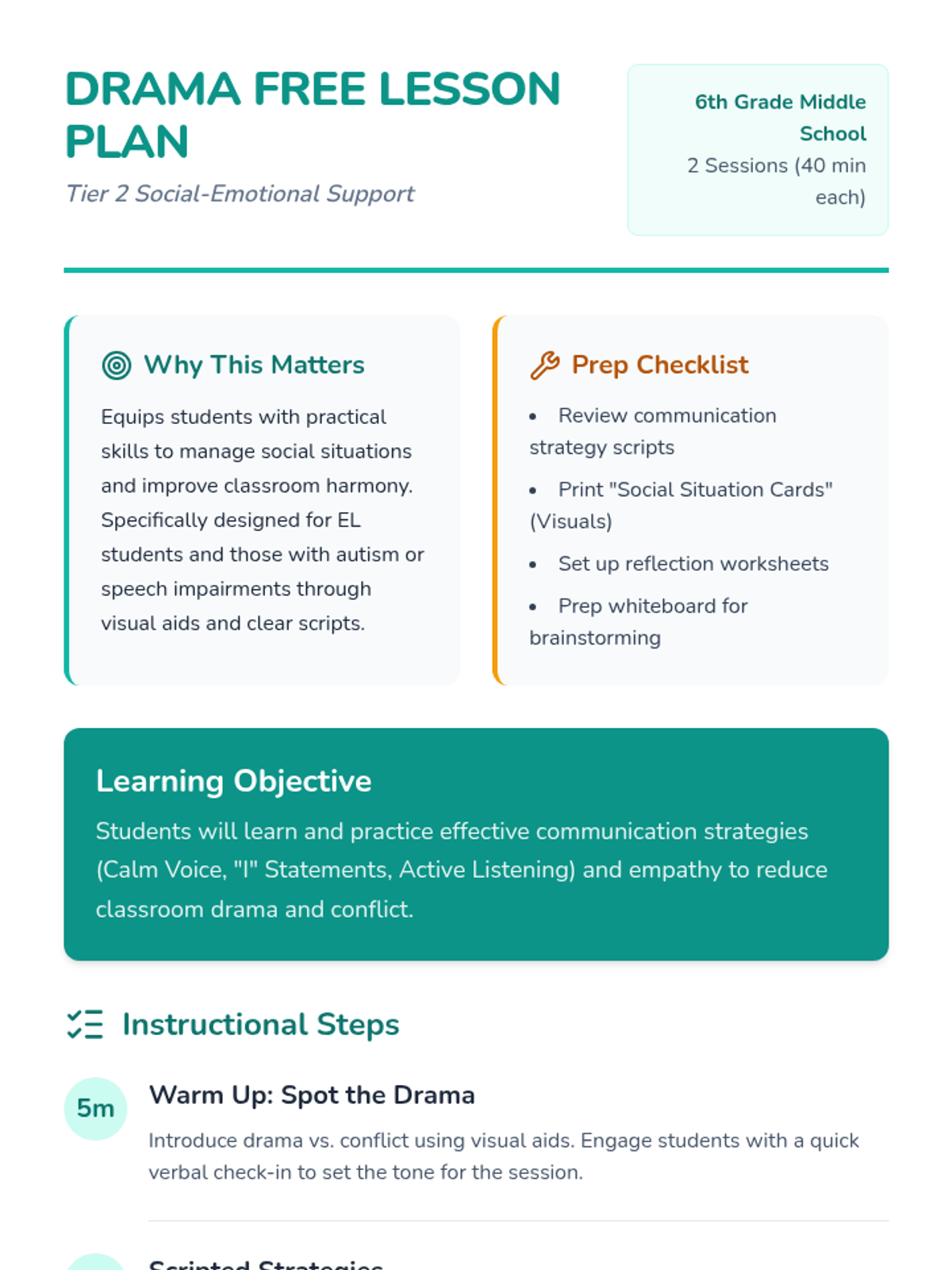
A comprehensive teacher guide for the two-session Drama Free Zone unit, featuring a timed instructional sequence and preparation checklist for 6th-grade students.
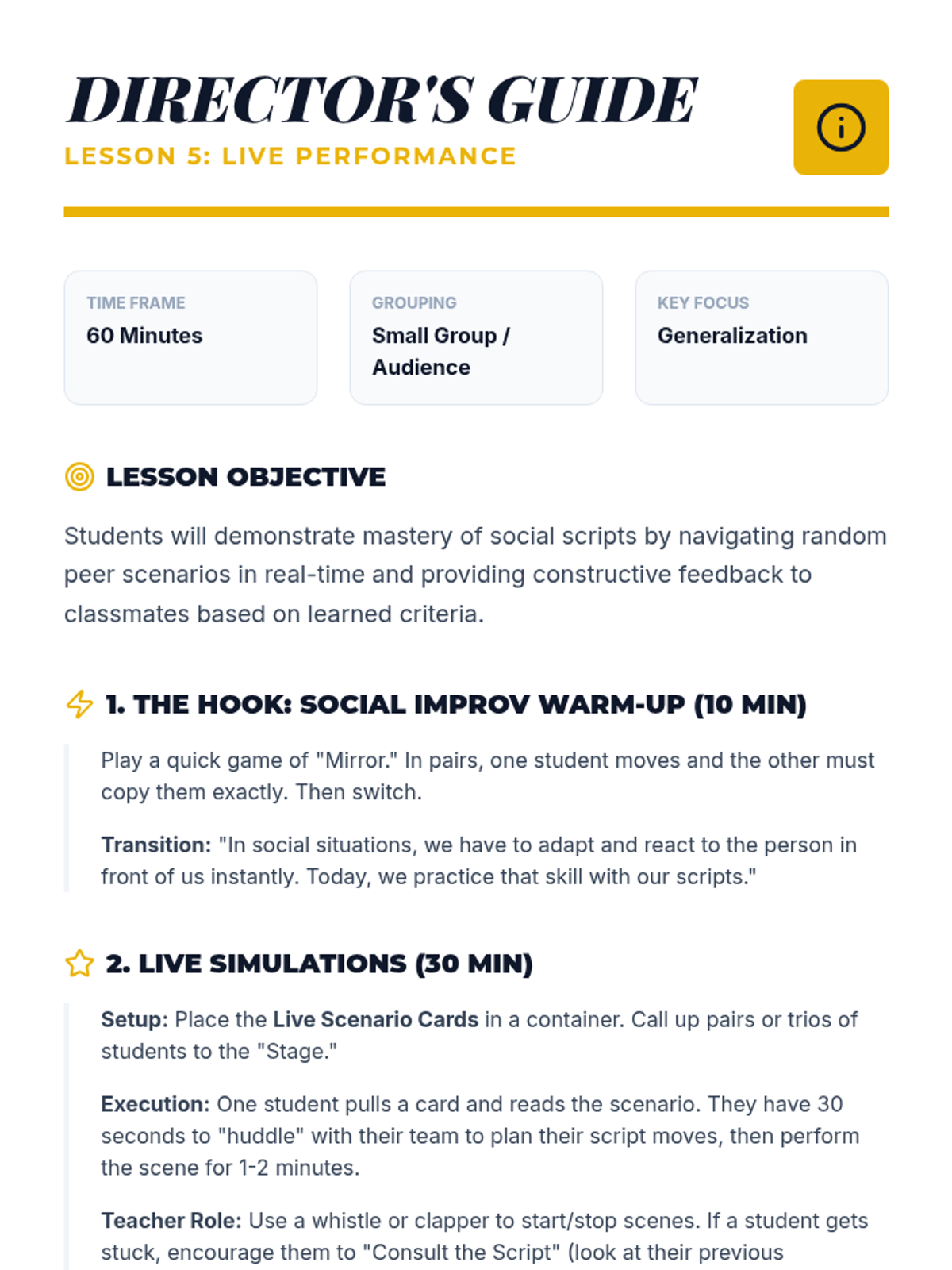
A teacher facilitation guide for Lesson 5, providing instructions for the 'Live Performance' simulations and peer feedback sessions.
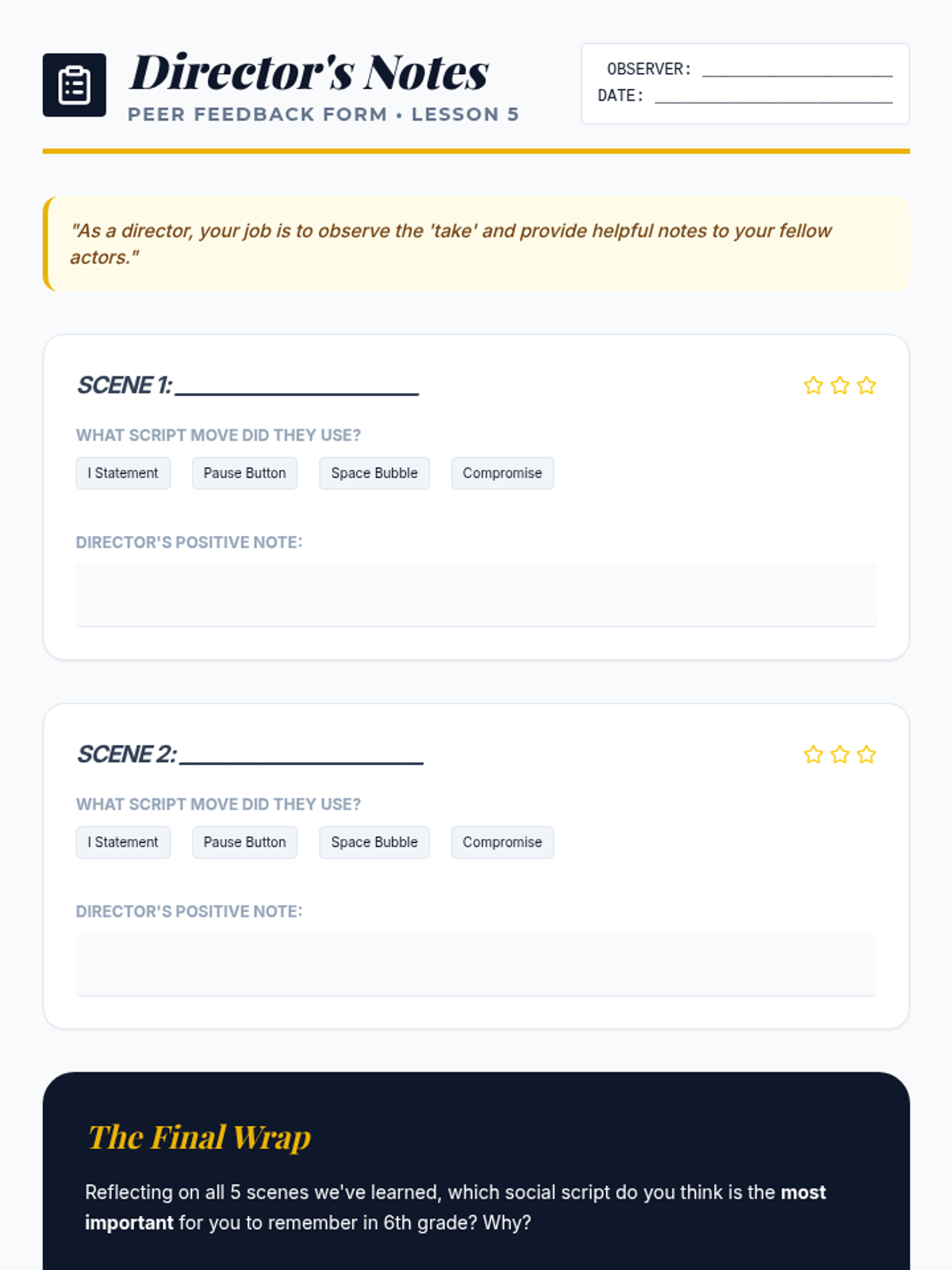
A student feedback form for Lesson 5, allowing peers to observe and provide constructive comments on social simulations based on the learned scripts.
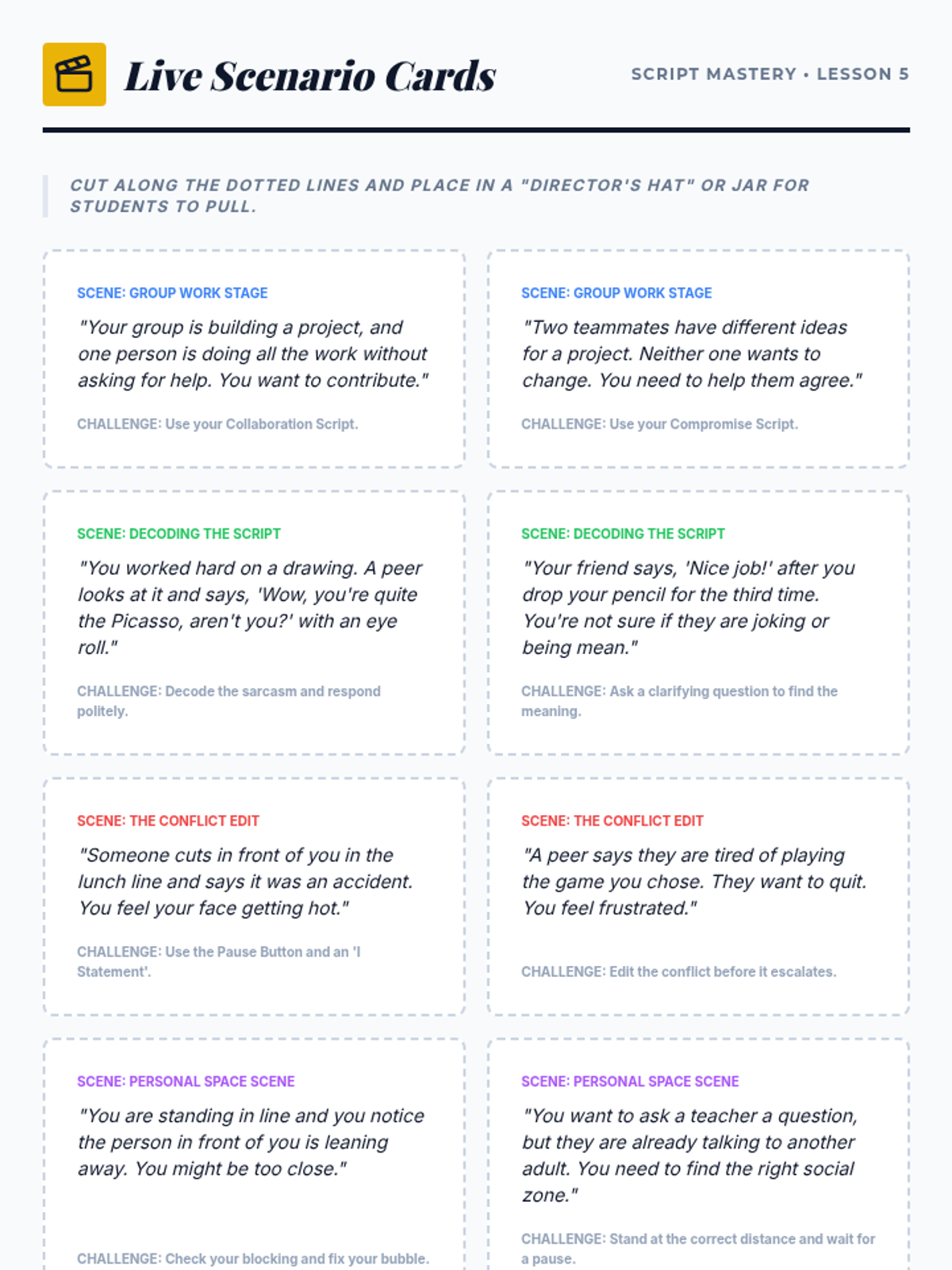
A set of scenario cards for Lesson 5 social simulations, covering topics like group work, sarcasm, conflict, and personal space.
Final slide deck for Lesson 5, preparing students for live social rehearsal simulations and peer feedback.
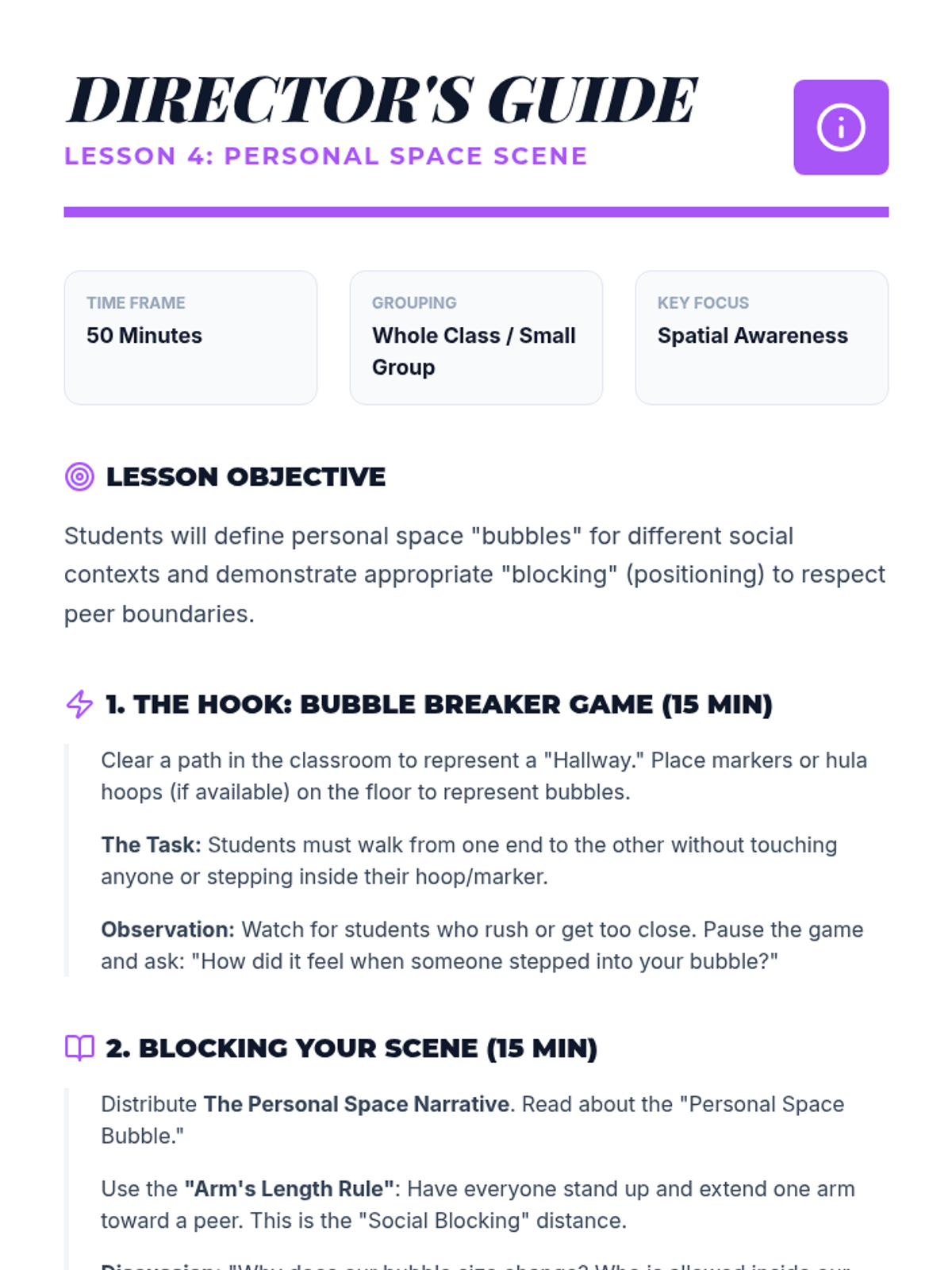
A teacher facilitation guide for Lesson 4, providing instructions for the 'Bubble Breaker' game and teaching the arm's length rule.
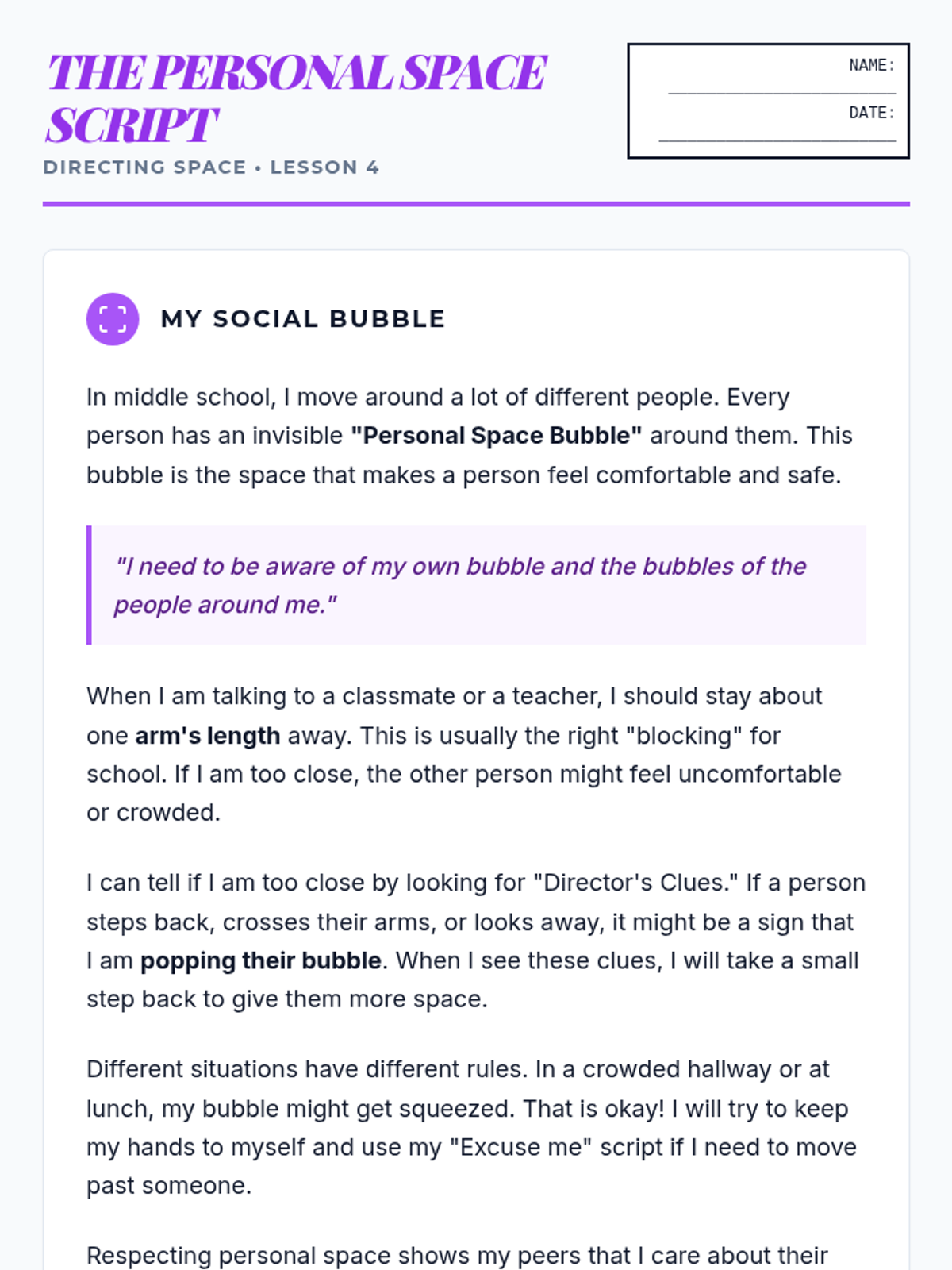
A social narrative handout for Lesson 4 that explains the concept of personal space bubbles and how to recognize social cues for physical boundaries.
Introductory slides for Lesson 4, exploring the concept of personal space bubbles and 'blocking' actors on a social set.
Expanded 24-slide presentation for school social workers featuring detailed DSM-5-TR diagnostic criteria for anxiety, depression, ODD, IED, grief, and SI/NSSI. Includes a developmental matrix and 3 comprehensive case studies (Elementary, Middle, and High School) to apply clinical learning.
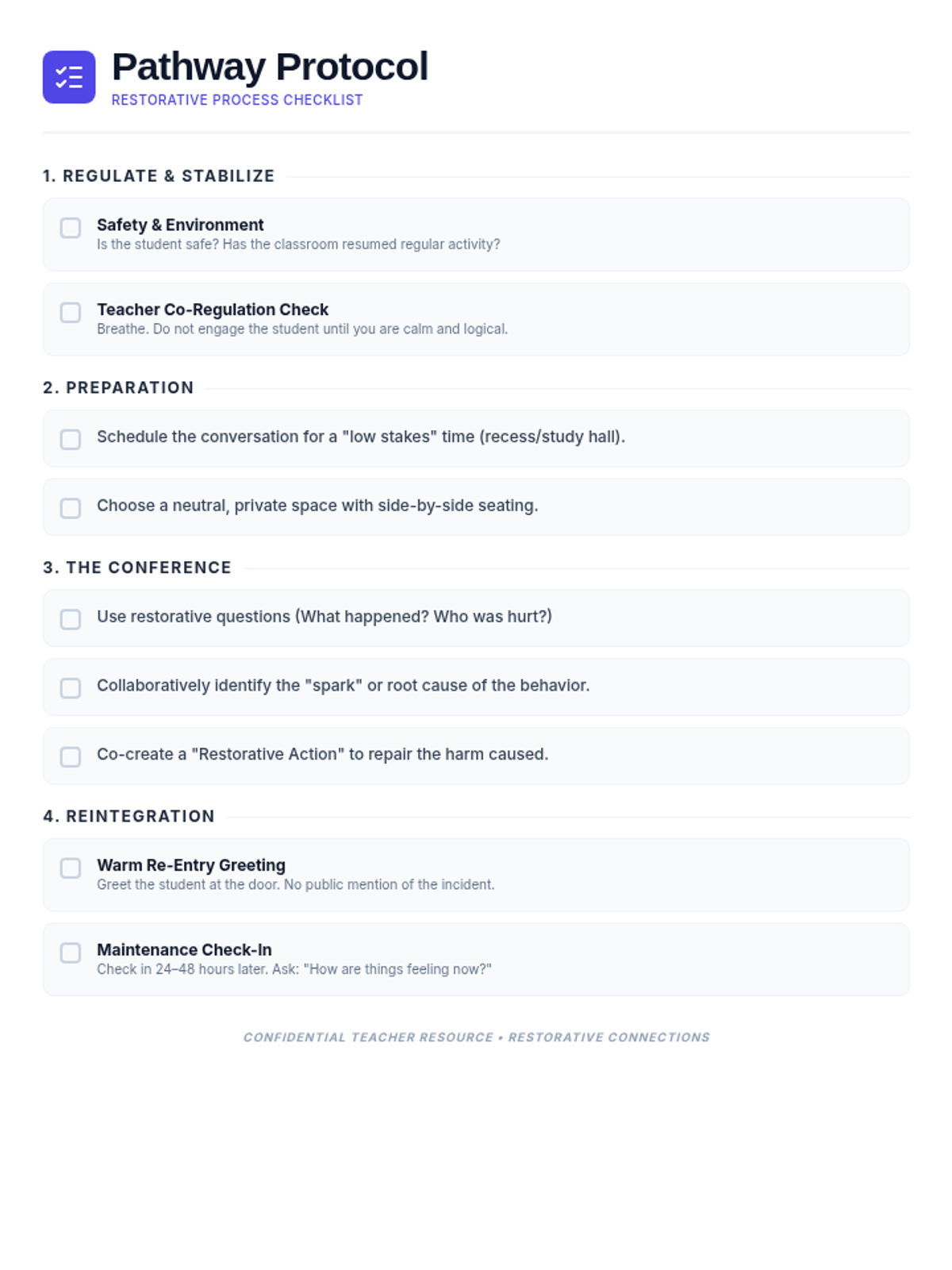
A teacher-facing checklist to guide educators through the restorative process, from the immediate aftermath of an outburst to the student's reintegration and follow-up.
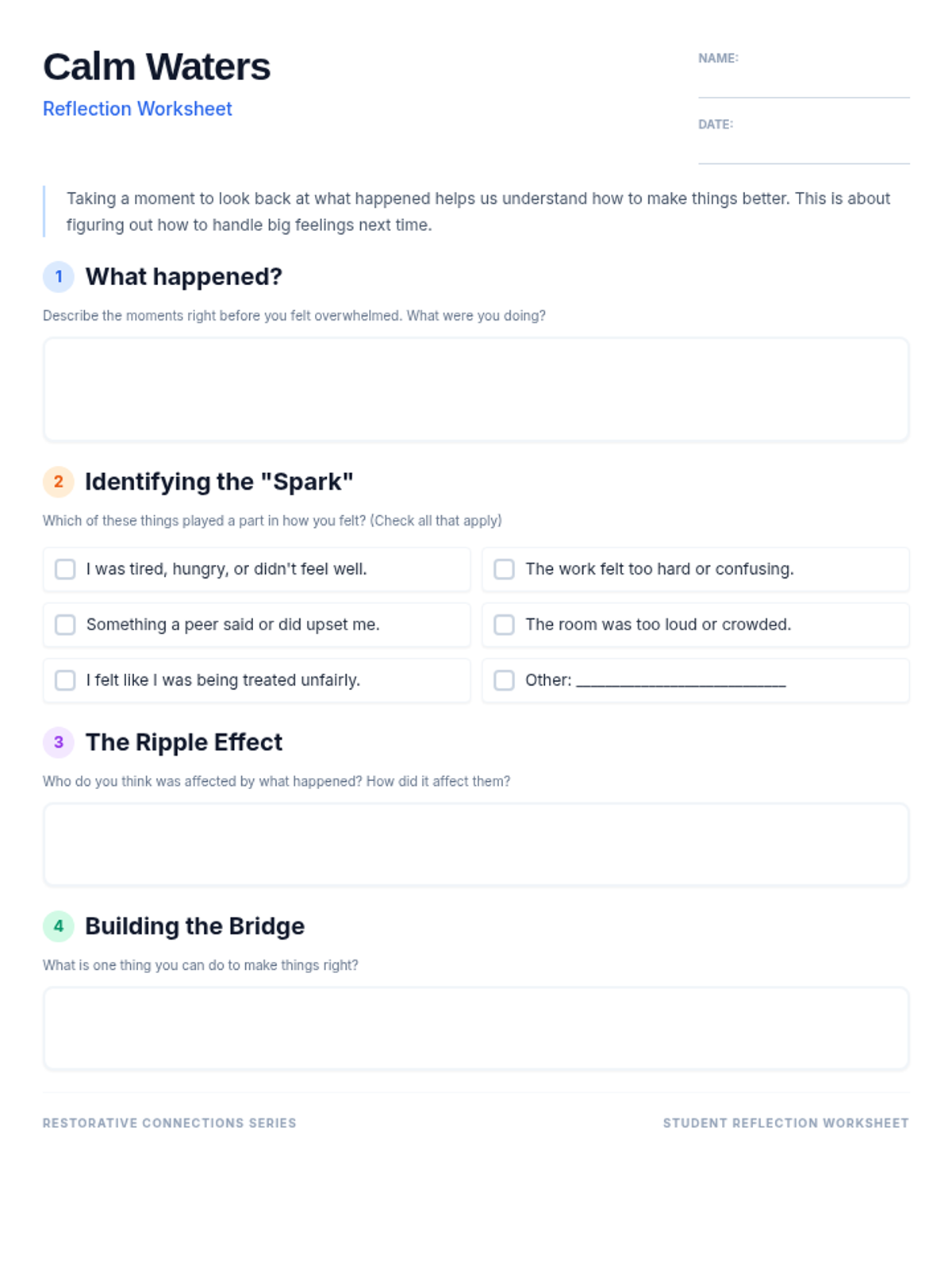
A student reflection worksheet designed to help students identify triggers, understand the impact of their actions, and propose restorative steps after an emotional outburst.
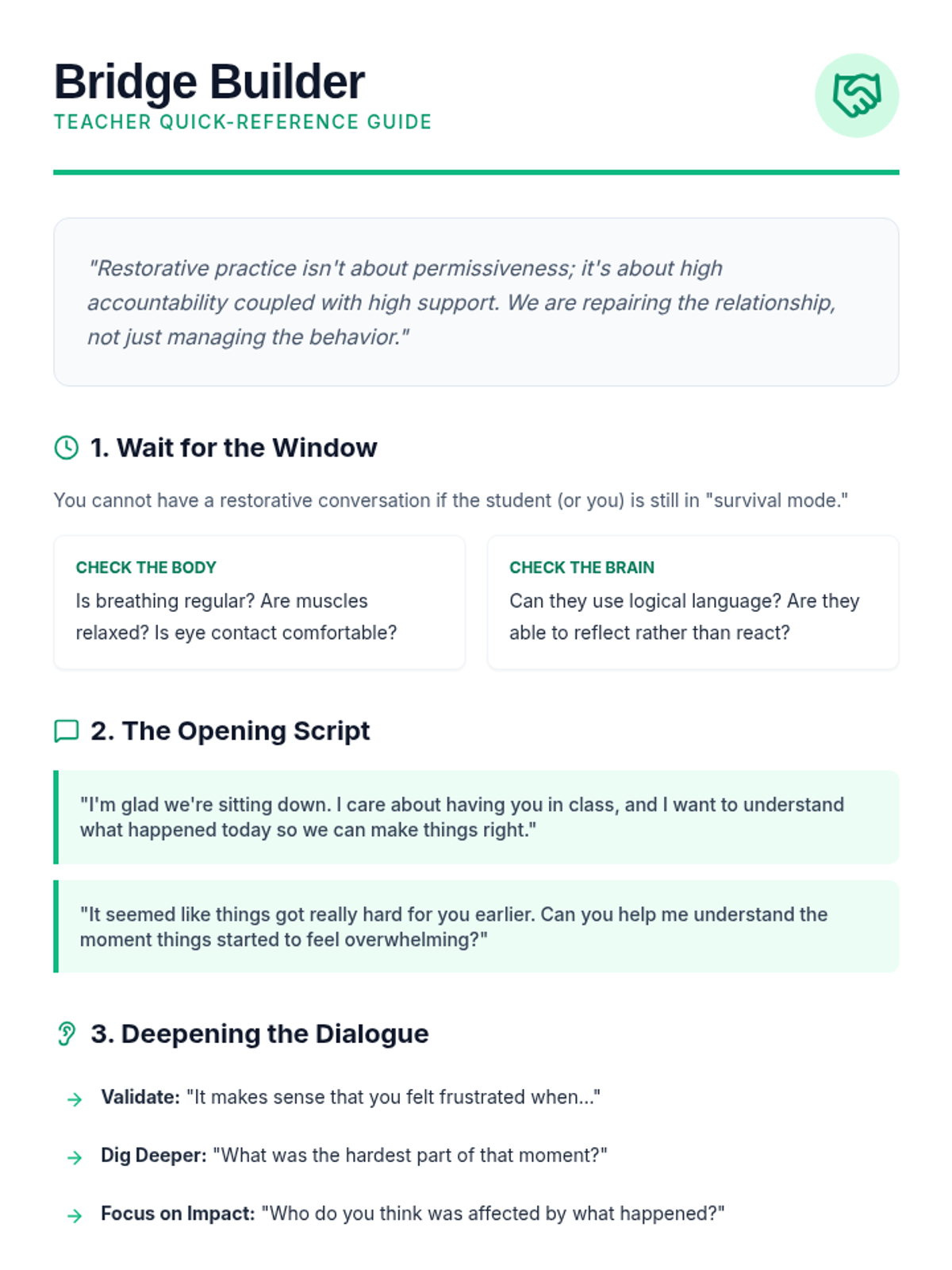
A two-page teacher quick-reference guide for conducting restorative conversations, featuring opening scripts, active listening prompts, and a breakdown of common student triggers.
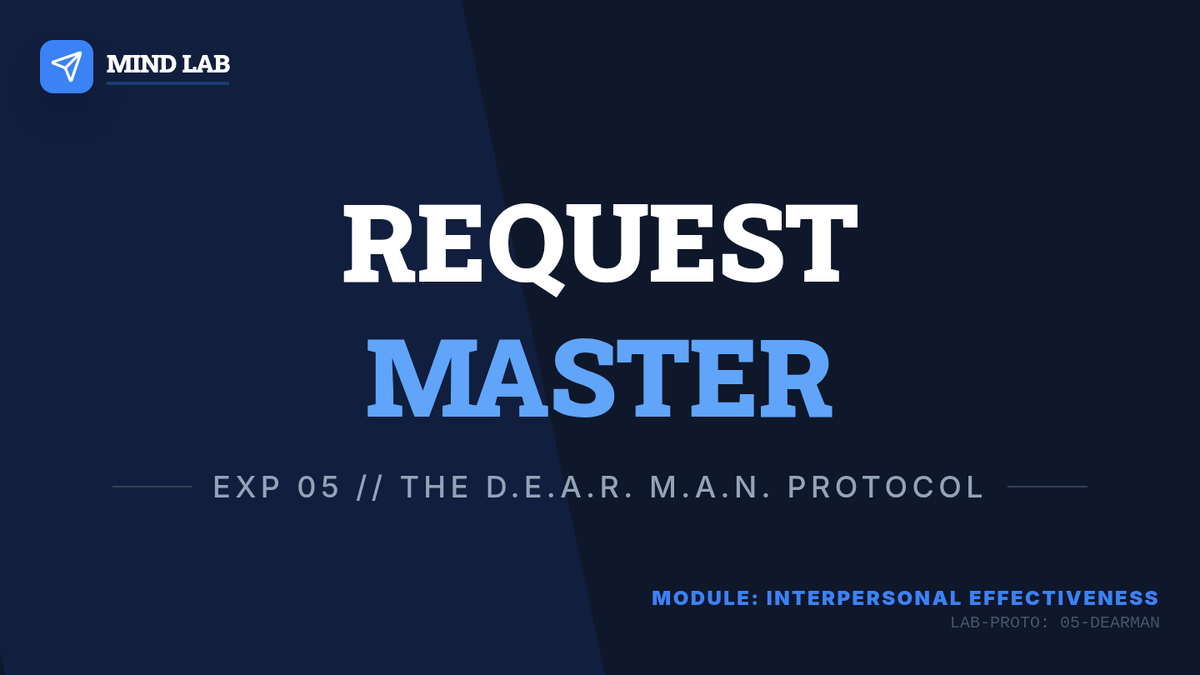
Week 5 slides for the DBT Group curriculum. Introduces the DEAR MAN interpersonal effectiveness skill with clear breakdowns of each letter and a sibling conflict practice scenario. Revised for layout and readability.
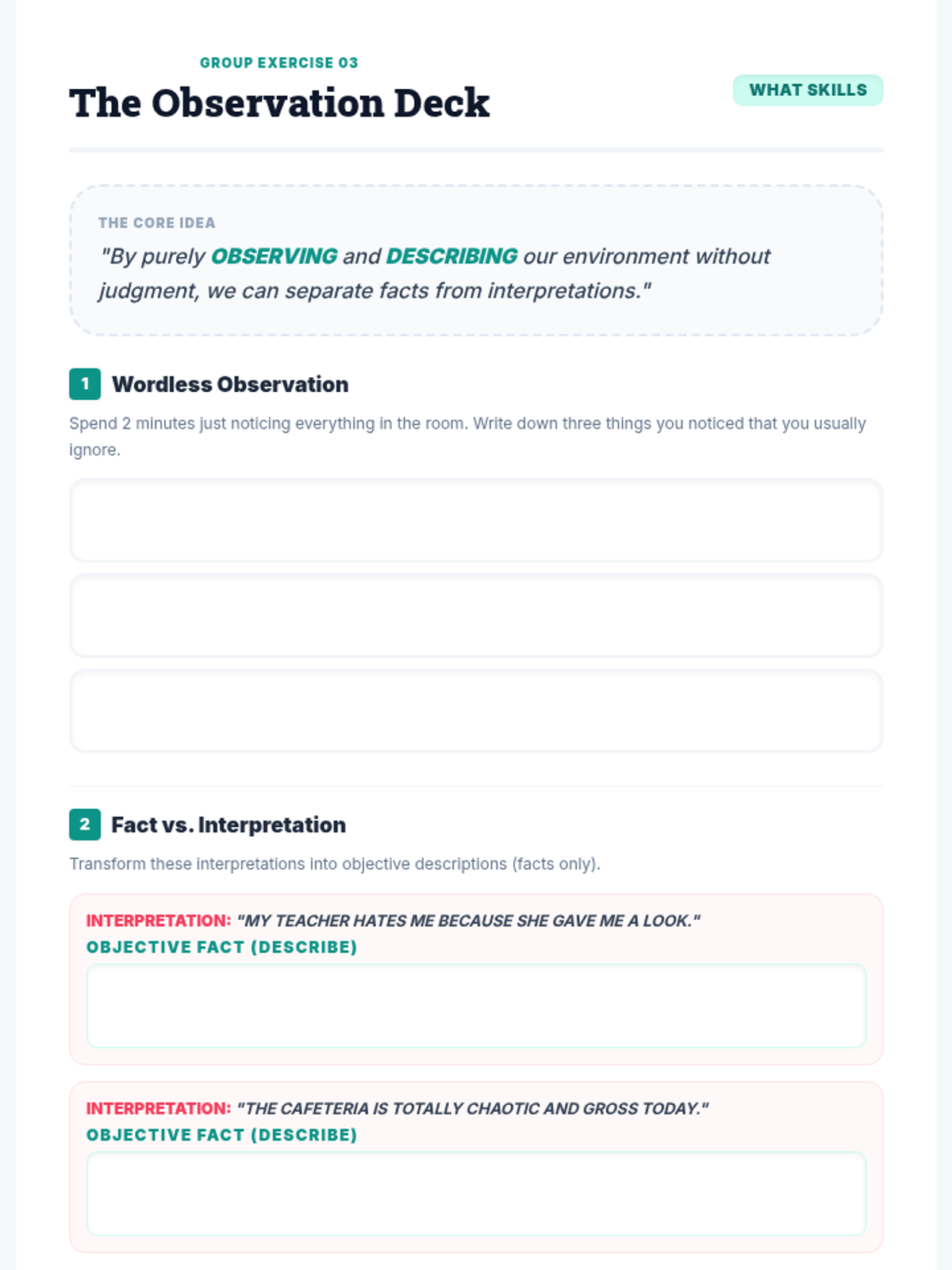
Week 3 student workbook materials for the DBT Group curriculum. Includes activities for Observing, Describing (Fact vs. Interpretation), and Participating with a home experiment log. Revised for layout and renamed branding.
Week 3 slides for the DBT Group curriculum. Introduces the "What" skills of Mindfulness: Observe, Describe, and Participate with a sensory experiment. Revised for better readability and contrast.
Week 2 slides for the DBT Group curriculum focusing on the Wise Mind concept. Explains Reasonable Mind, Emotion Mind, and the Wise Mind synthesis with a practical breathing experiment. Revised for layout and content accuracy.
Week 1 introductory slides for the DBT Group curriculum. Introduces Dialectics through the 'Middle Path' concept. Revised for better readability, contrast, and renamed branding.
Caderno do aluno Grupo DBT Parte 1 com estética de caderno de laboratório. Inclui atividades para Dialética, Mente Sábia e Tolerância ao Mal-estar (STOP/TIPP) com áreas de trabalho dedicadas para o aluno.
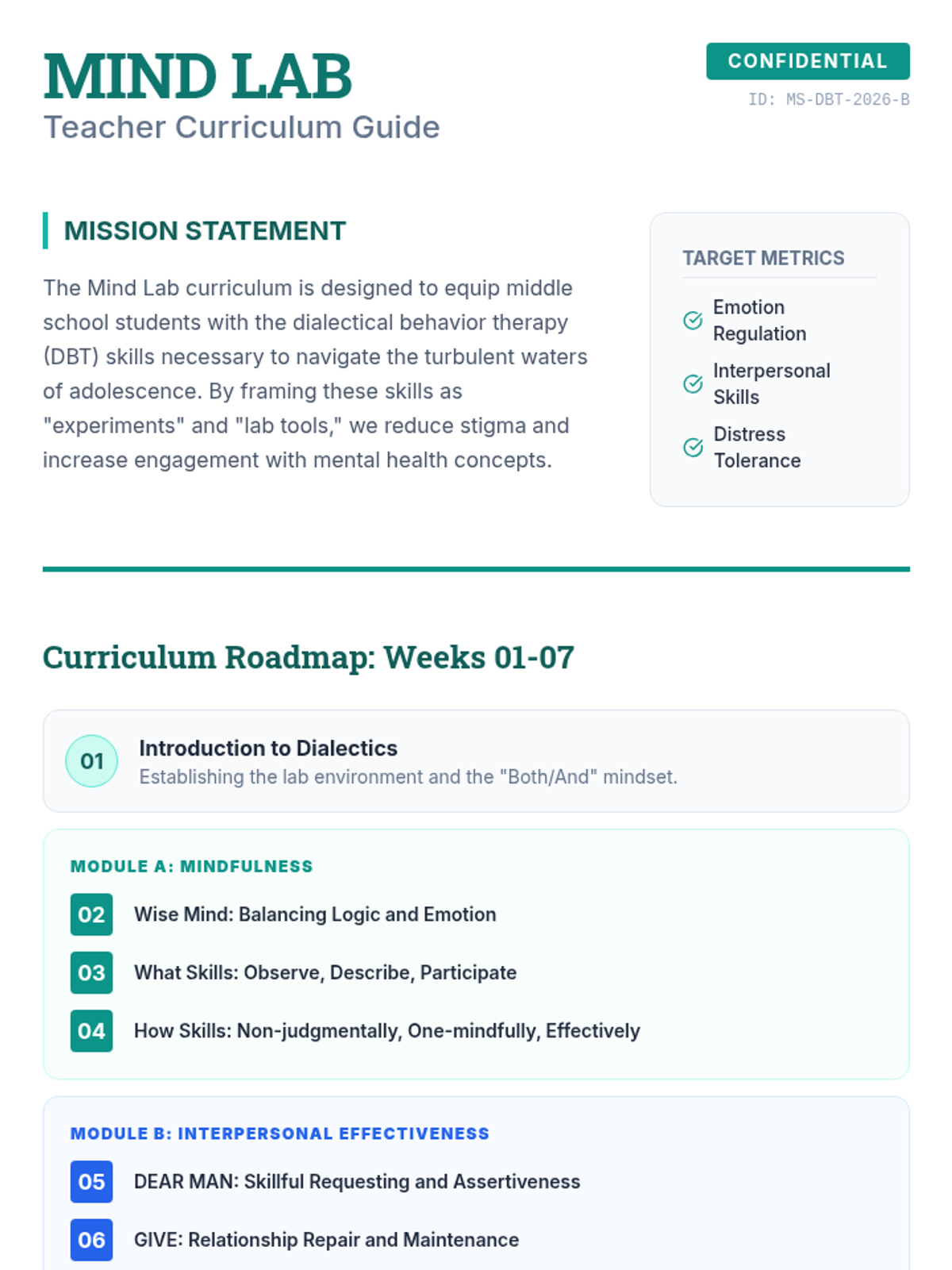
Guia abrangente do professor para o currículo de habilidades do Grupo DBT, com cronograma de 13 semanas, divisões de módulos, protocolos de lições e rubricas de avaliação em Português.
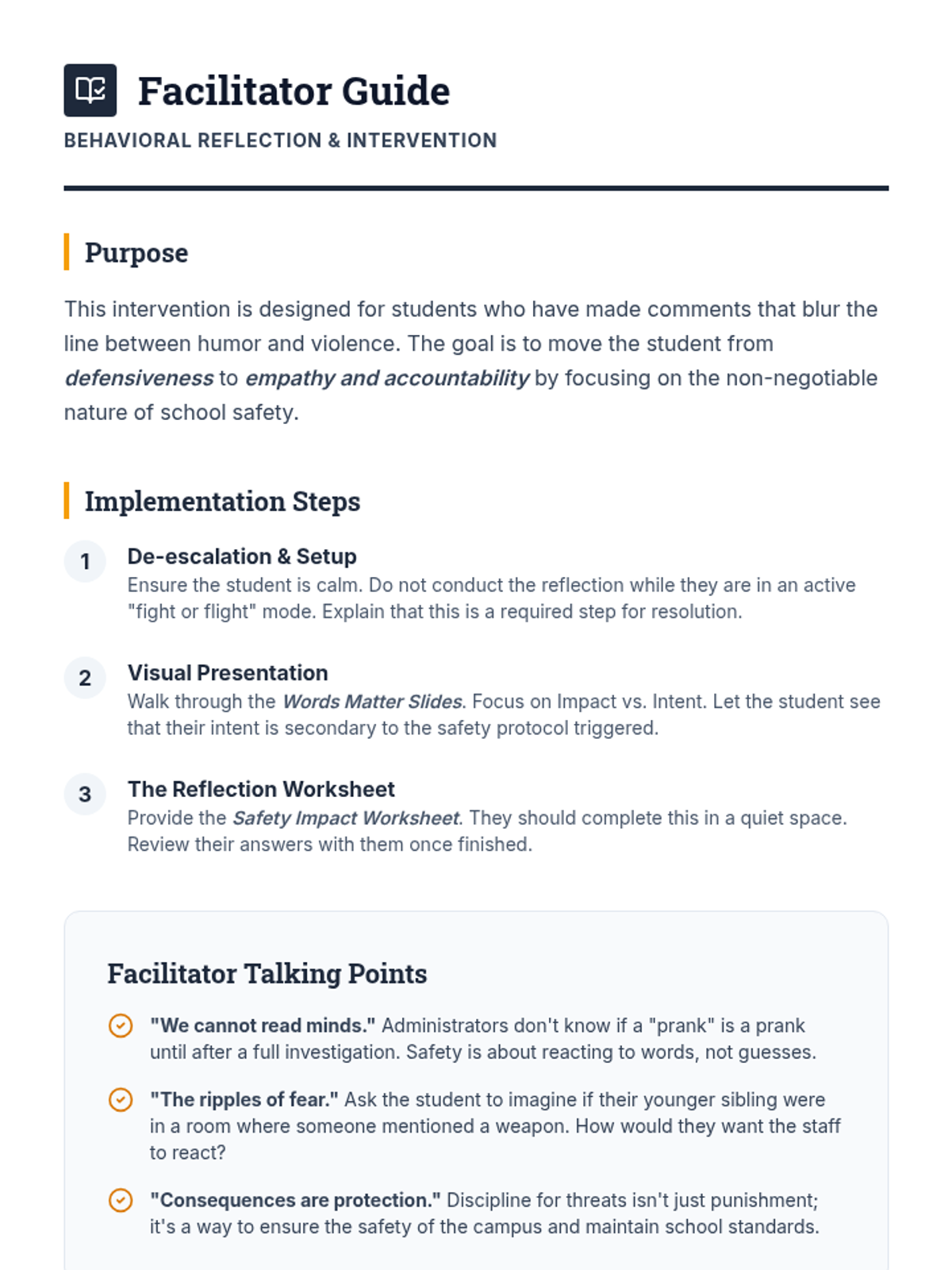
A facilitator guide with implementation steps, de-escalation tips, and talking points for safety-related behavioral reflections. Updated to ensure better page breaks and contrast.
An instructional presentation defining school safety boundaries and the consequences of threatening language. Updated to ensure all content fits within slide viewports and eliminate overlap.
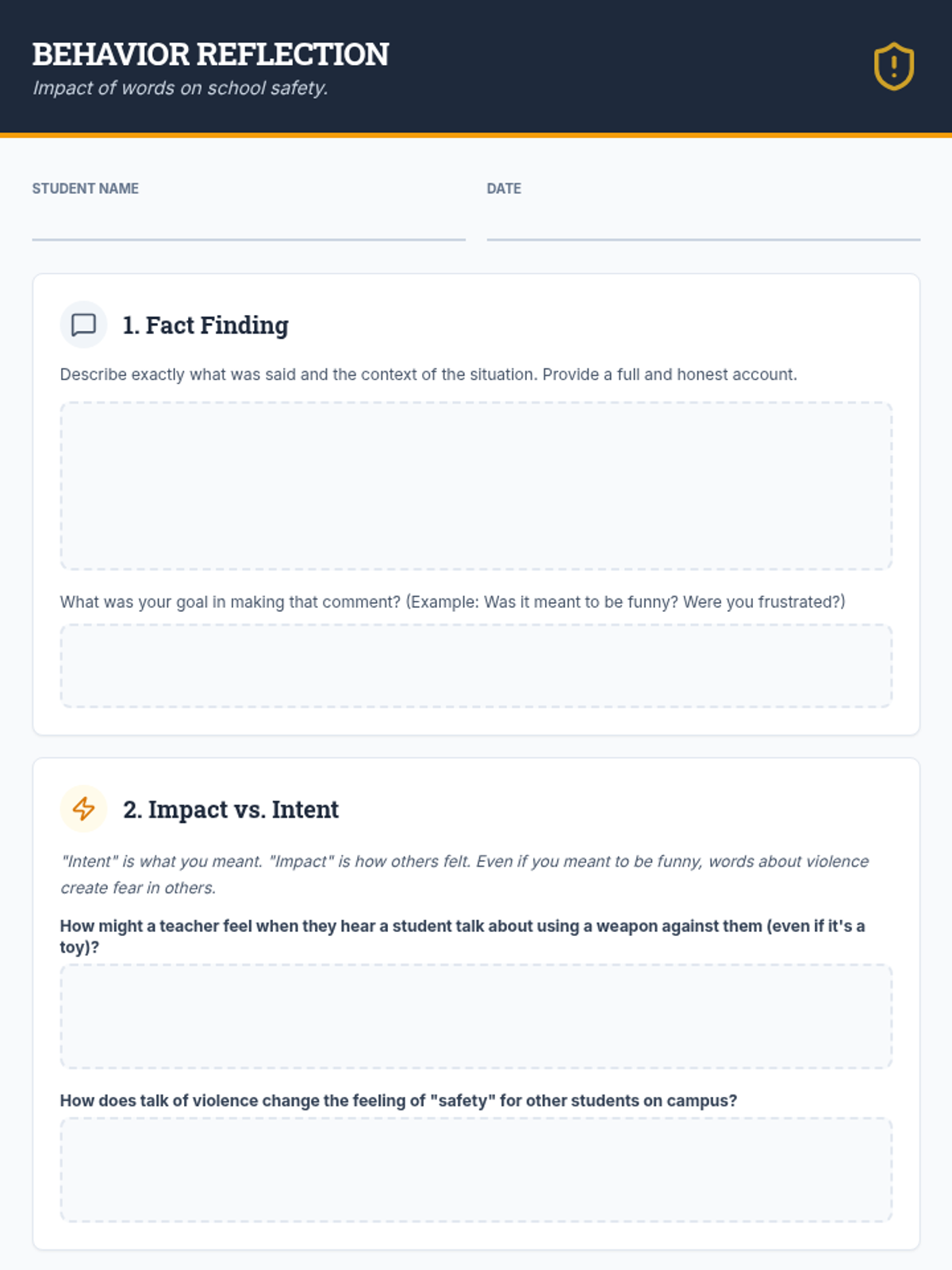
A structured reflection worksheet for students who have made inappropriate or threatening comments. It guides them through fact-finding, analyzing impact vs. intent, understanding safety boundaries, and planning restorative actions. Updated to ensure better layout and page-flow.
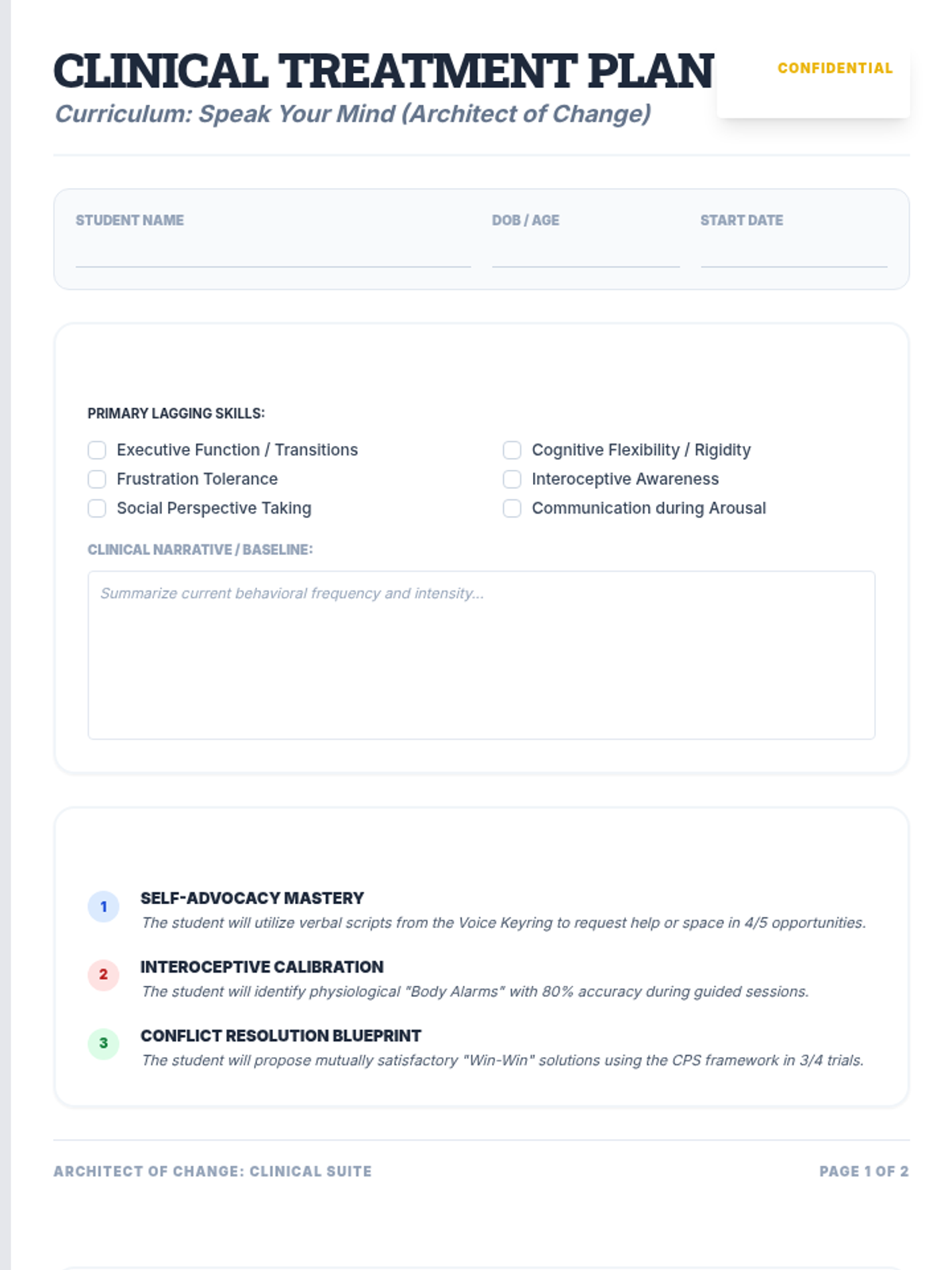
A formal clinical treatment plan template for the Speak Your Mind curriculum, including assessment of lagging skills, targeted objectives, intervention modalities, and graduation criteria. Corrected for page breaks and formatting.
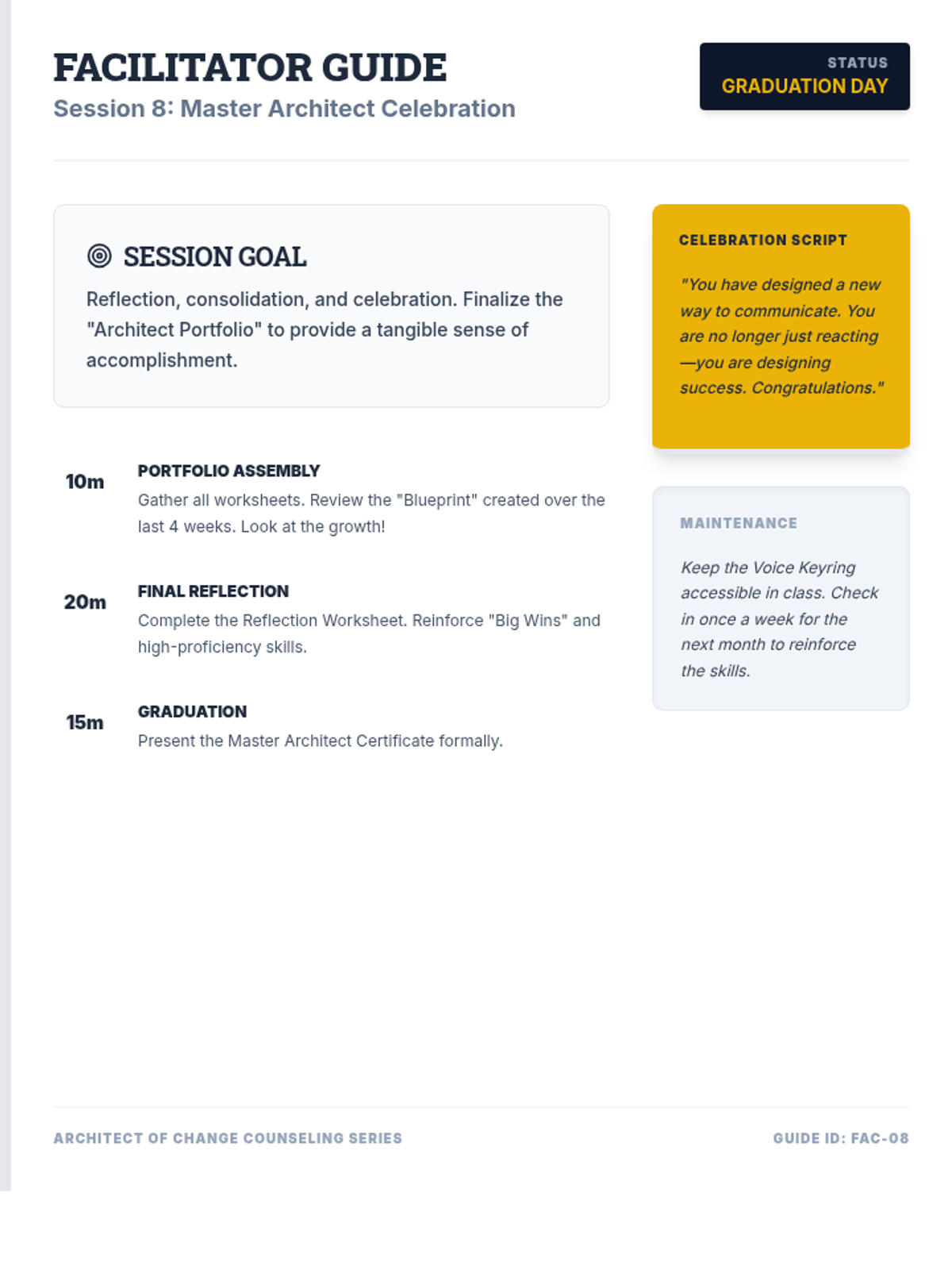
A final facilitator guide for the curriculum graduation, providing structured prompts for reflection and the Master Architect ceremony. Corrected for contrast and formatting.
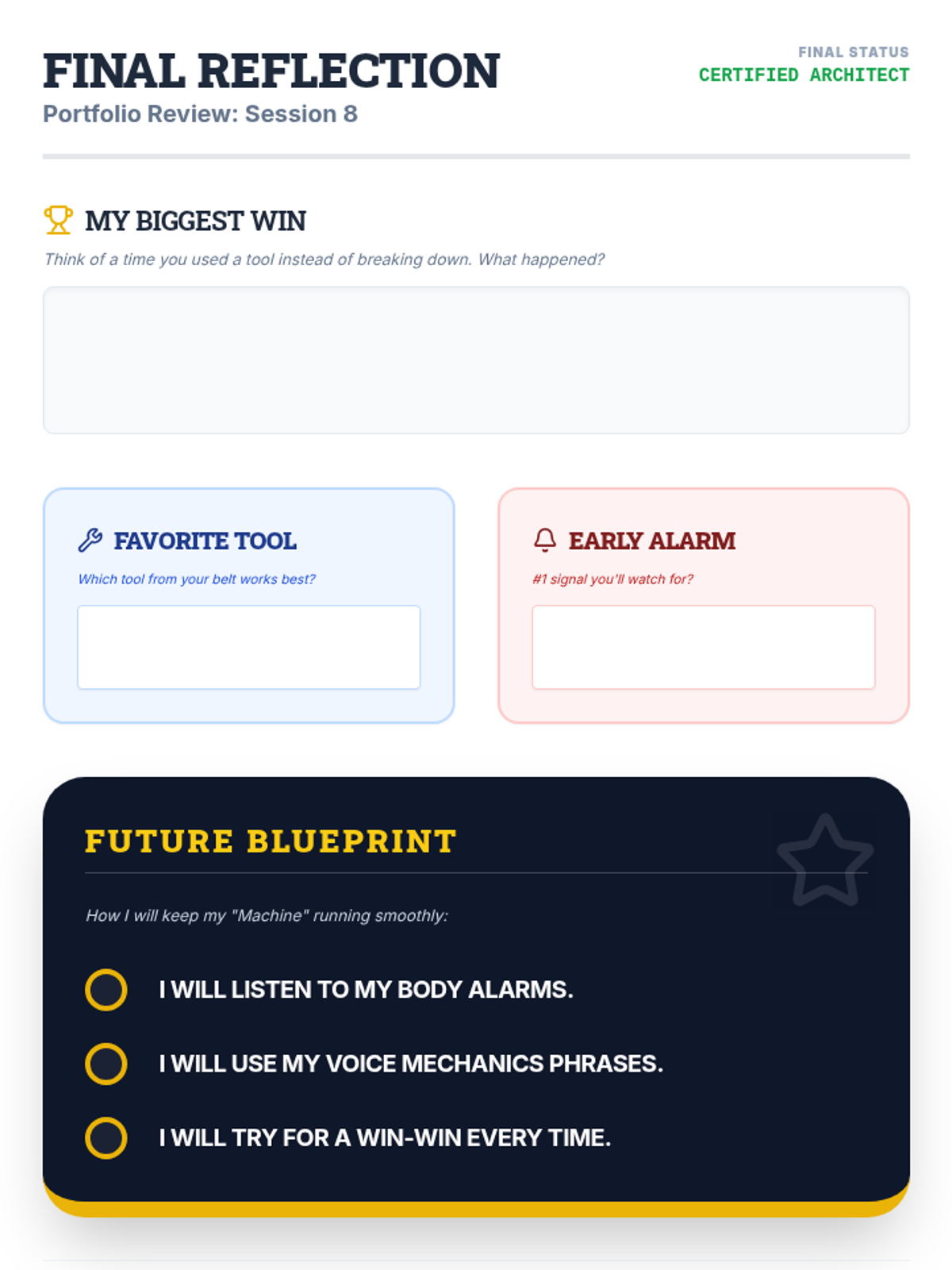
A final reflection worksheet for students to review their progress, identify their most effective tools, and commit to future self-regulation goals. Corrected for contrast and student work area.
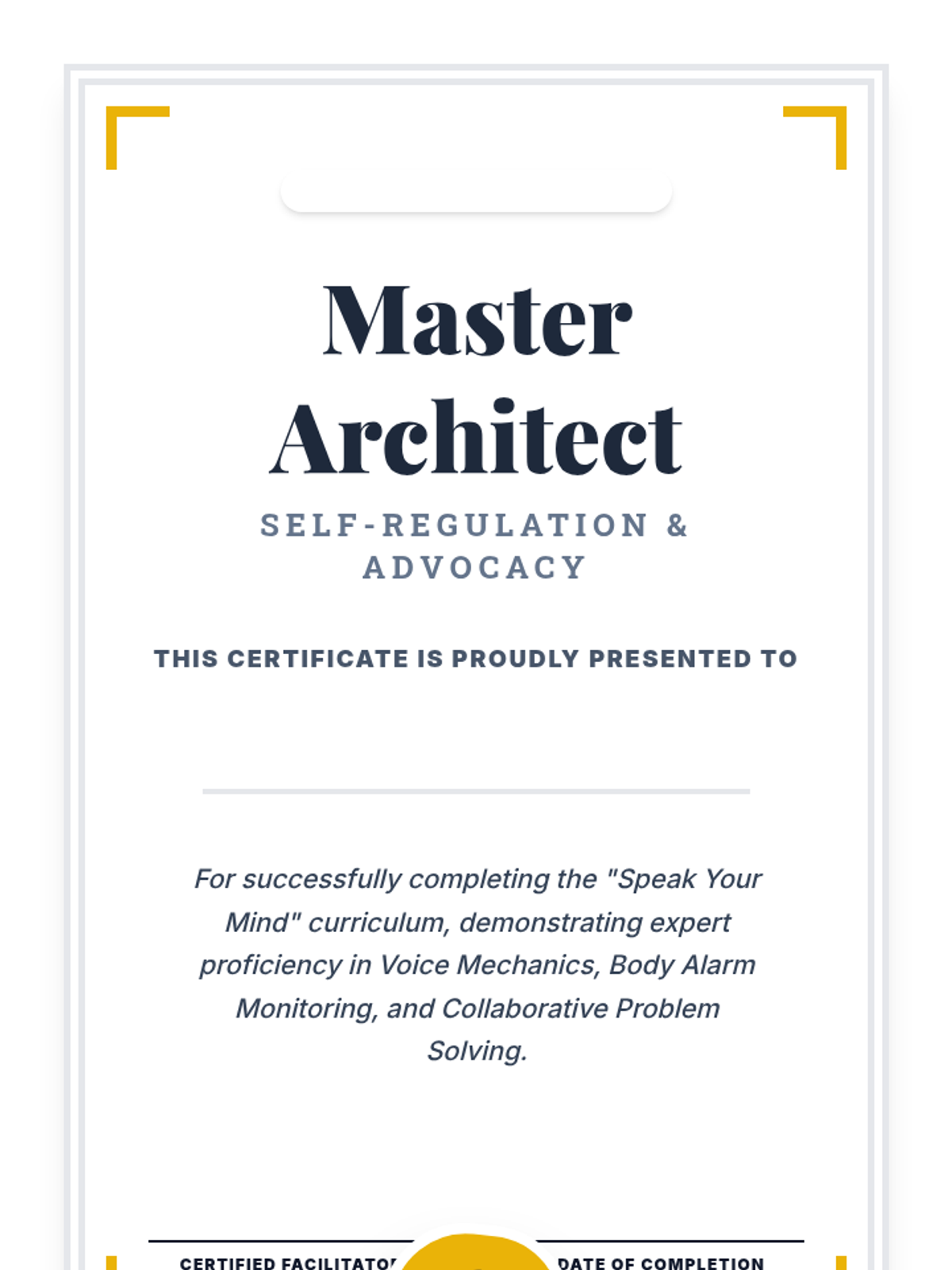
A formal certificate of completion for students who have successfully finished the Speak Your Mind self-regulation curriculum. Corrected for ink usage and font size.
Celebratory slides for the final session, reviewing student progress and celebrating their graduation as a 'Master Architect' of self-regulation. Corrected for title contrast and spacing.
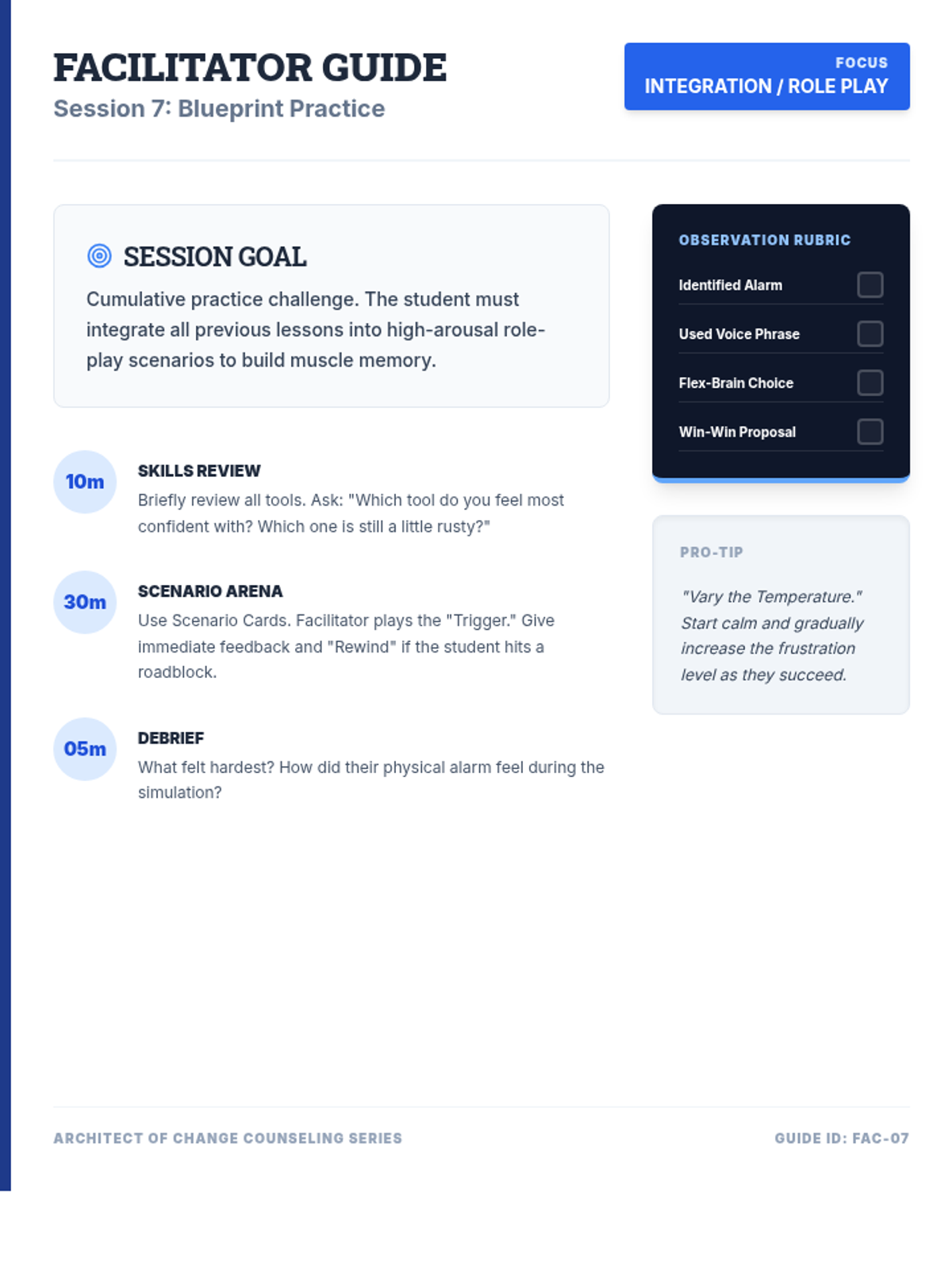
A facilitation guide for Session 7, providing counselors with structured prompts for integration role-plays and skill verification. Corrected for rubric contrast.
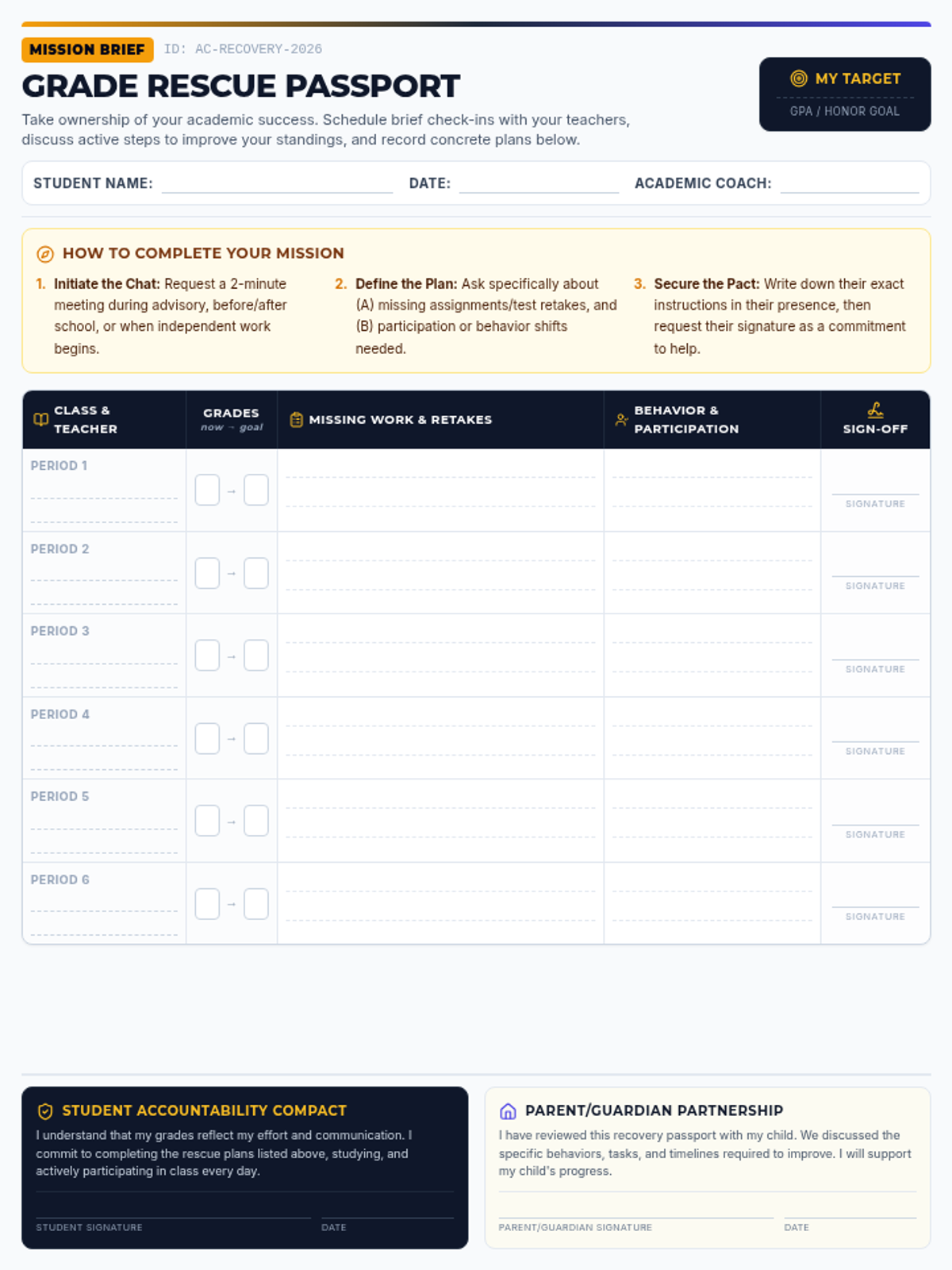
A 1-page check-in document designed as an academic passport. It enables students to consult with teachers across 6 class periods to map out concrete strategies for behavior, participation, missing assignments, and test retakes. Includes student and parent signature compacts.
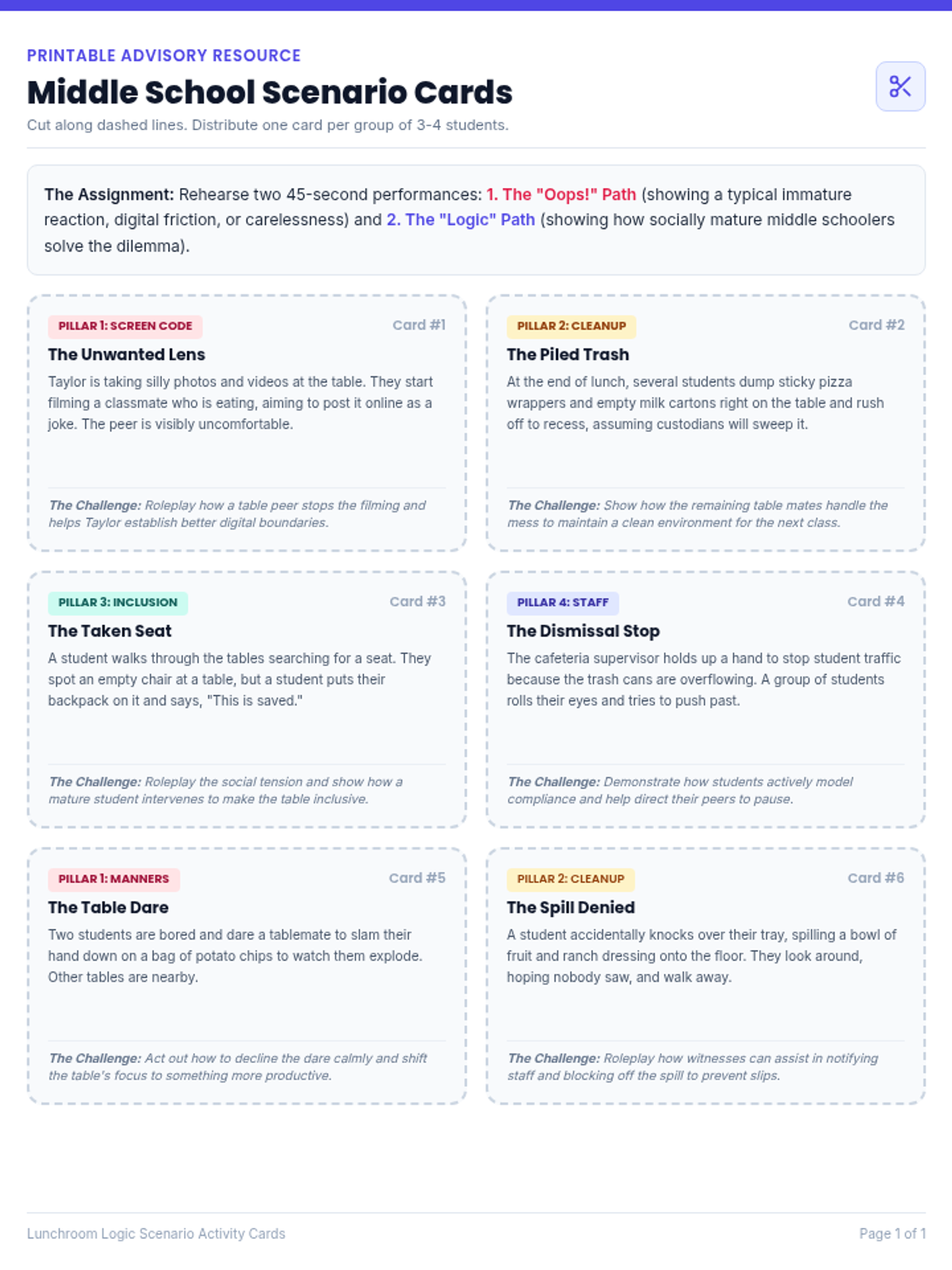
A set of 6 printable role-playing scenario cards for students, each outlining a specific lunchroom challenge based on the lesson's four pillars.
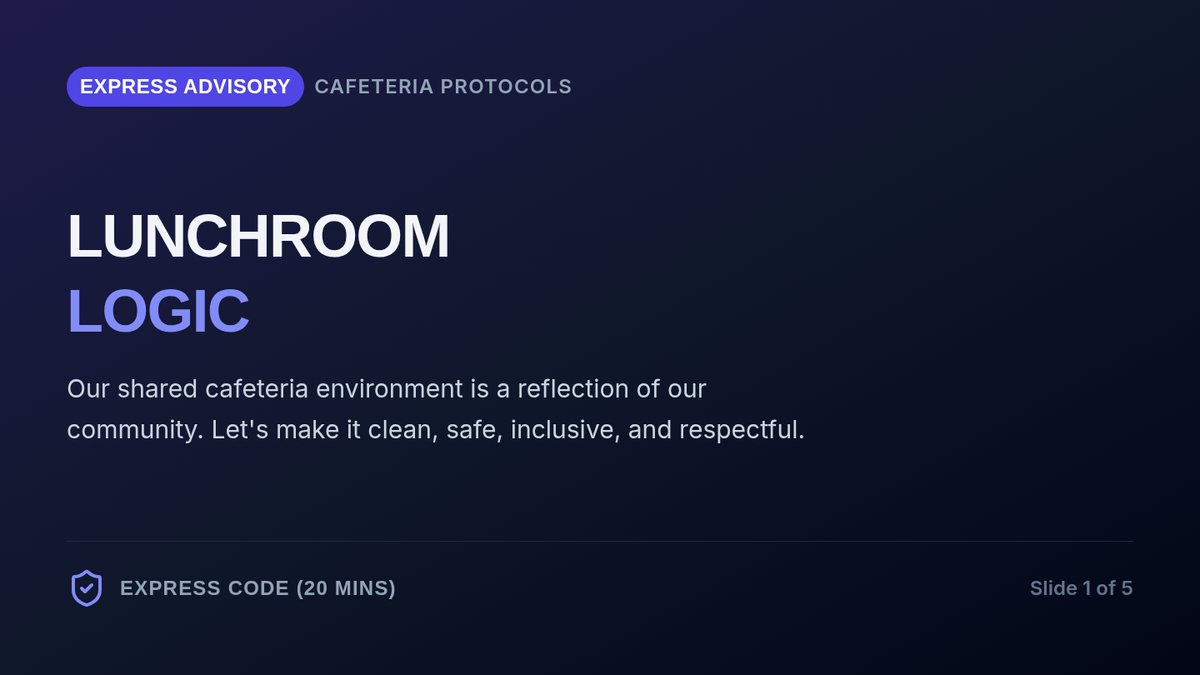
A 5-slide instructional visual presentation mapping out the core expectations of lunchroom etiquette (table manners, cleaning up, peer connections, and staff interaction) and setting up the roleplay activity.
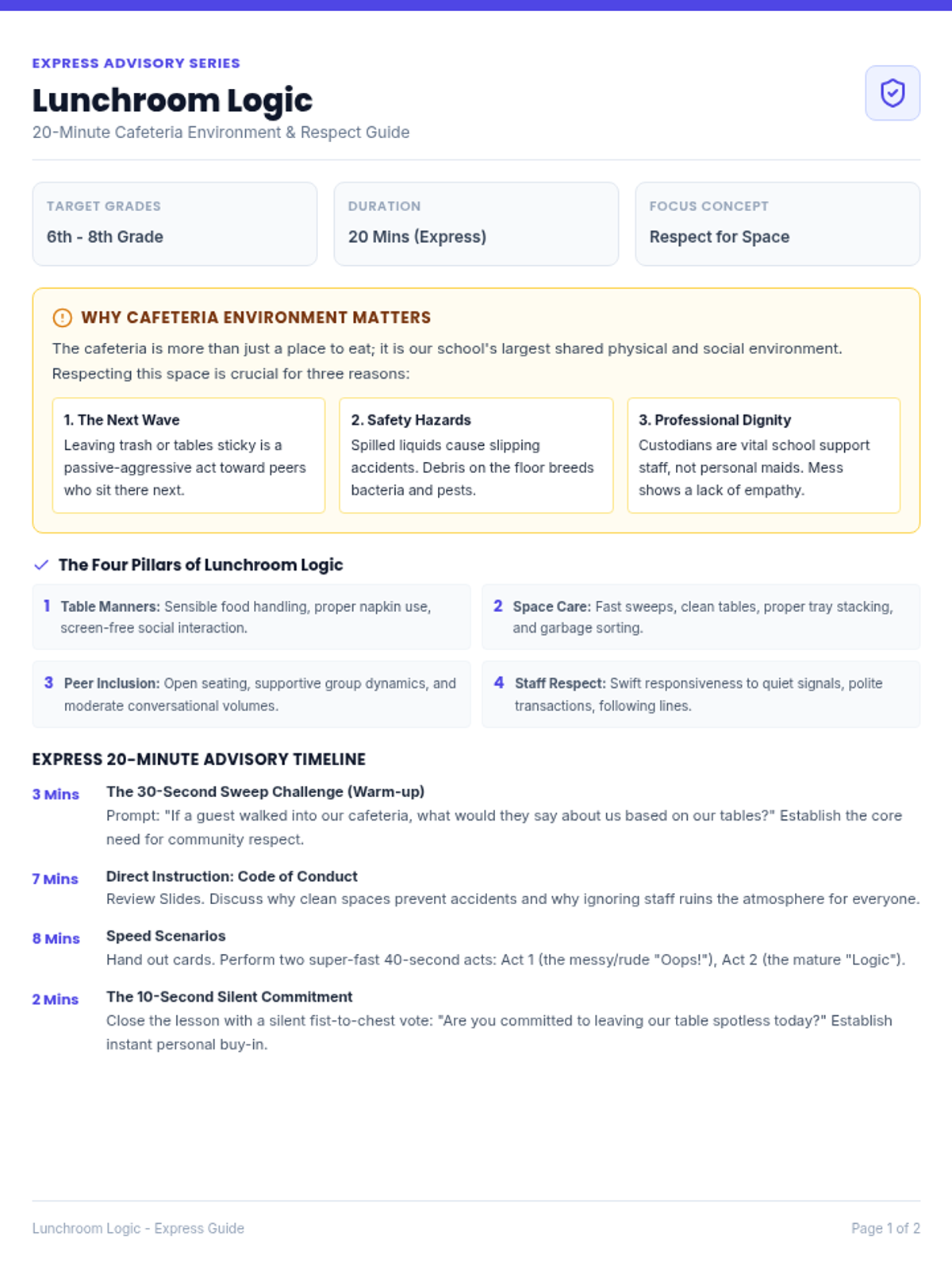
A 2-page printable Teacher Guide for 'Lunchroom Logic' containing lesson metadata, a detailed timeline, differentiation strategies, and group discussion prompts designed to guide students toward legendary cafeteria behavior.
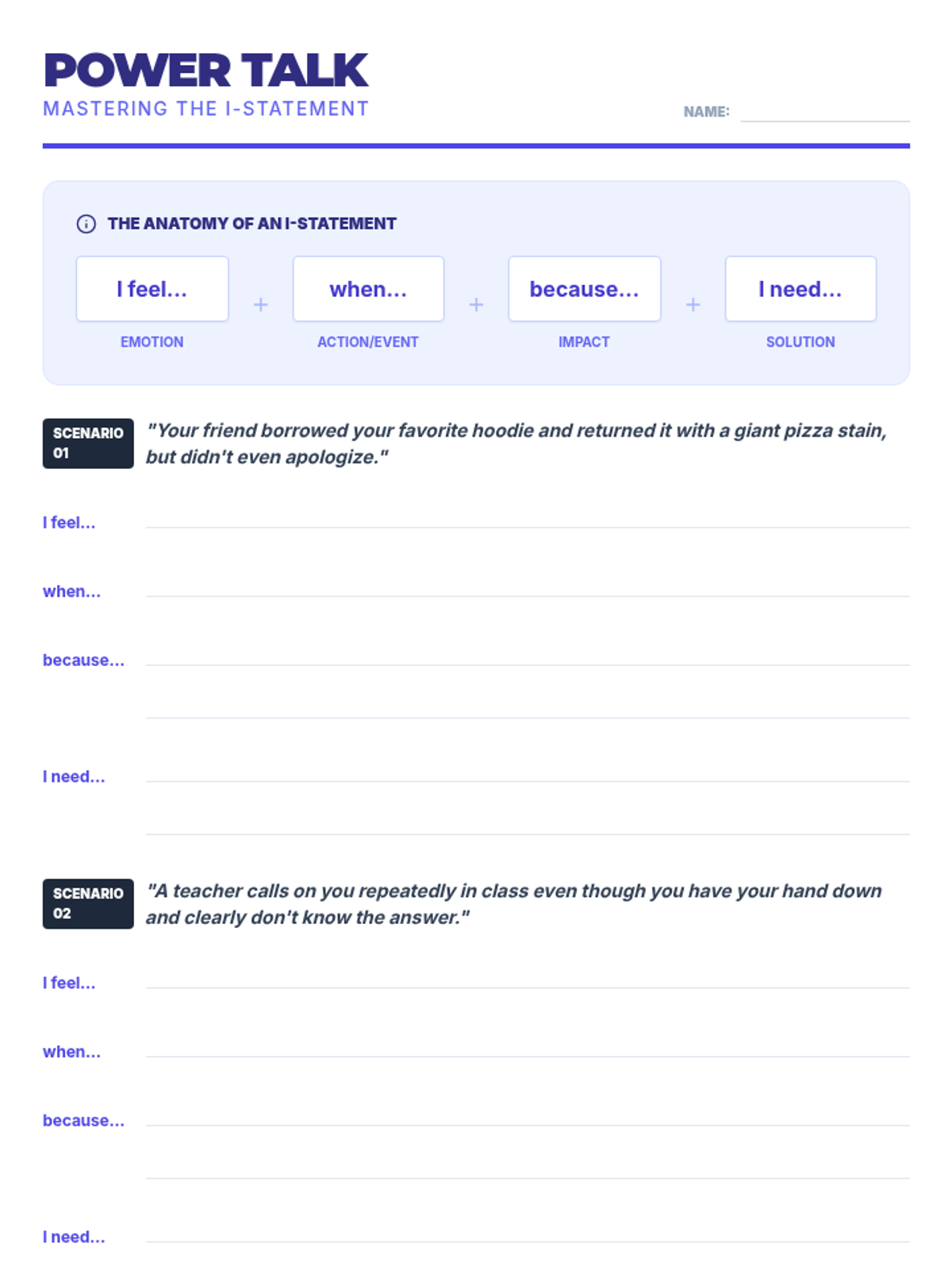
A practice worksheet for 8th graders to master assertive communication using the I-statement formula, featuring guided social scenarios and space for students to develop their own responses.
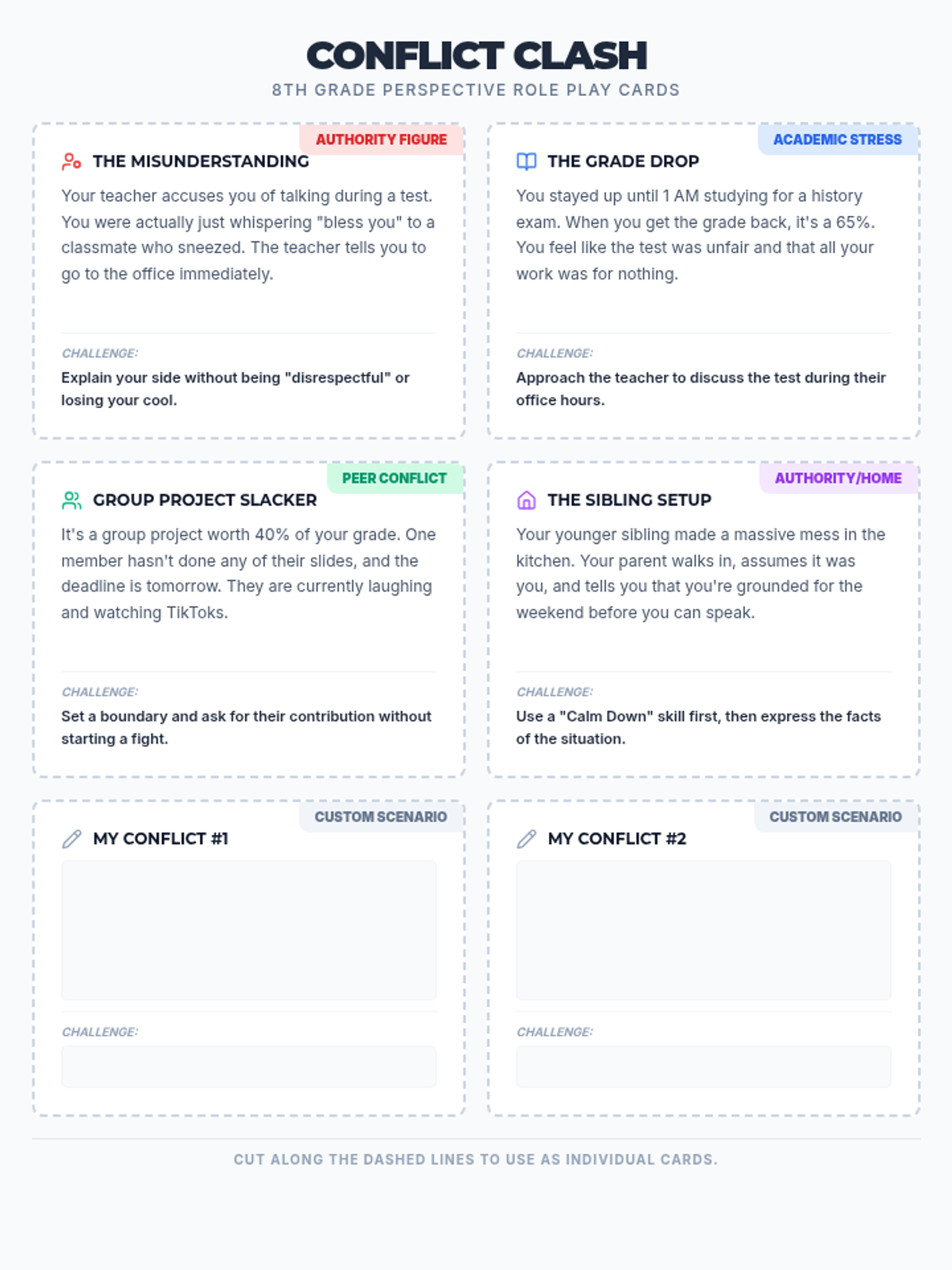
A set of role-play cards designed for 8th graders, featuring realistic conflict scenarios and blank templates for students to develop their own scenarios.
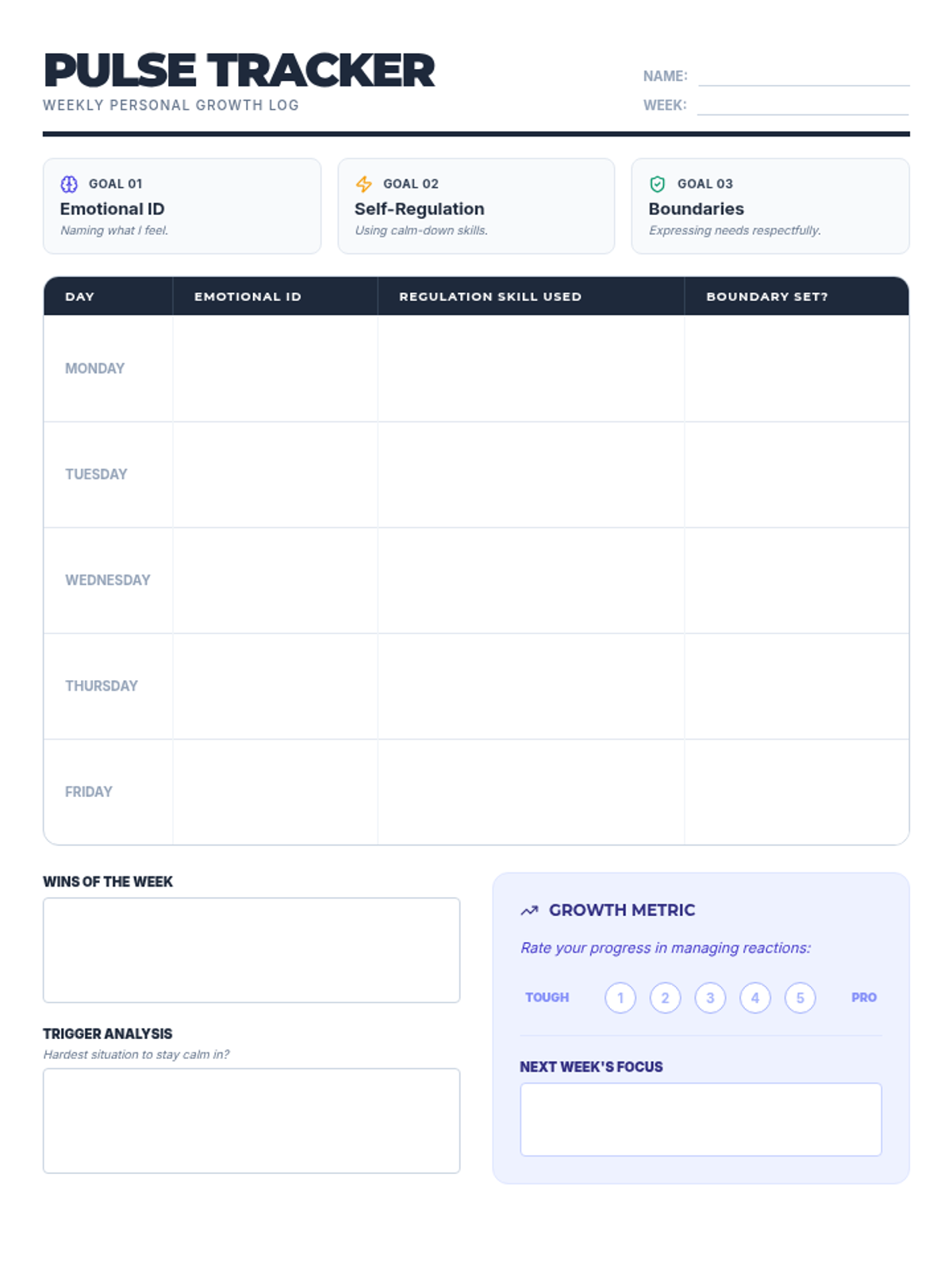
A weekly behavior log for 8th graders to track emotional identification, self-regulation, and boundary-setting goals with daily entry spaces and weekly reflection prompts.
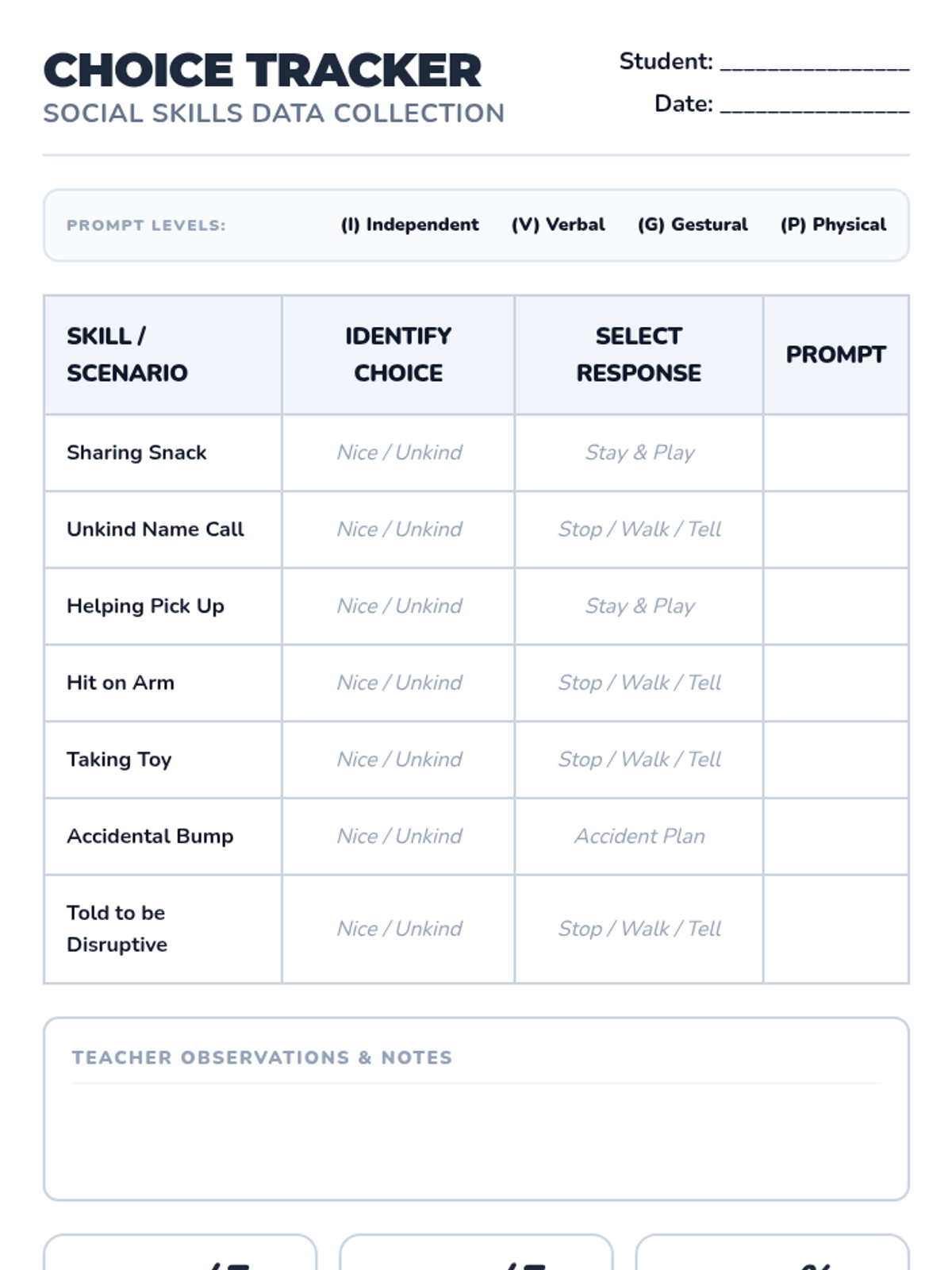
A data collection sheet designed for tracking student progress in identifying nice vs. unkind behaviors and selecting appropriate responses. Now includes 7 scenario tracking rows.
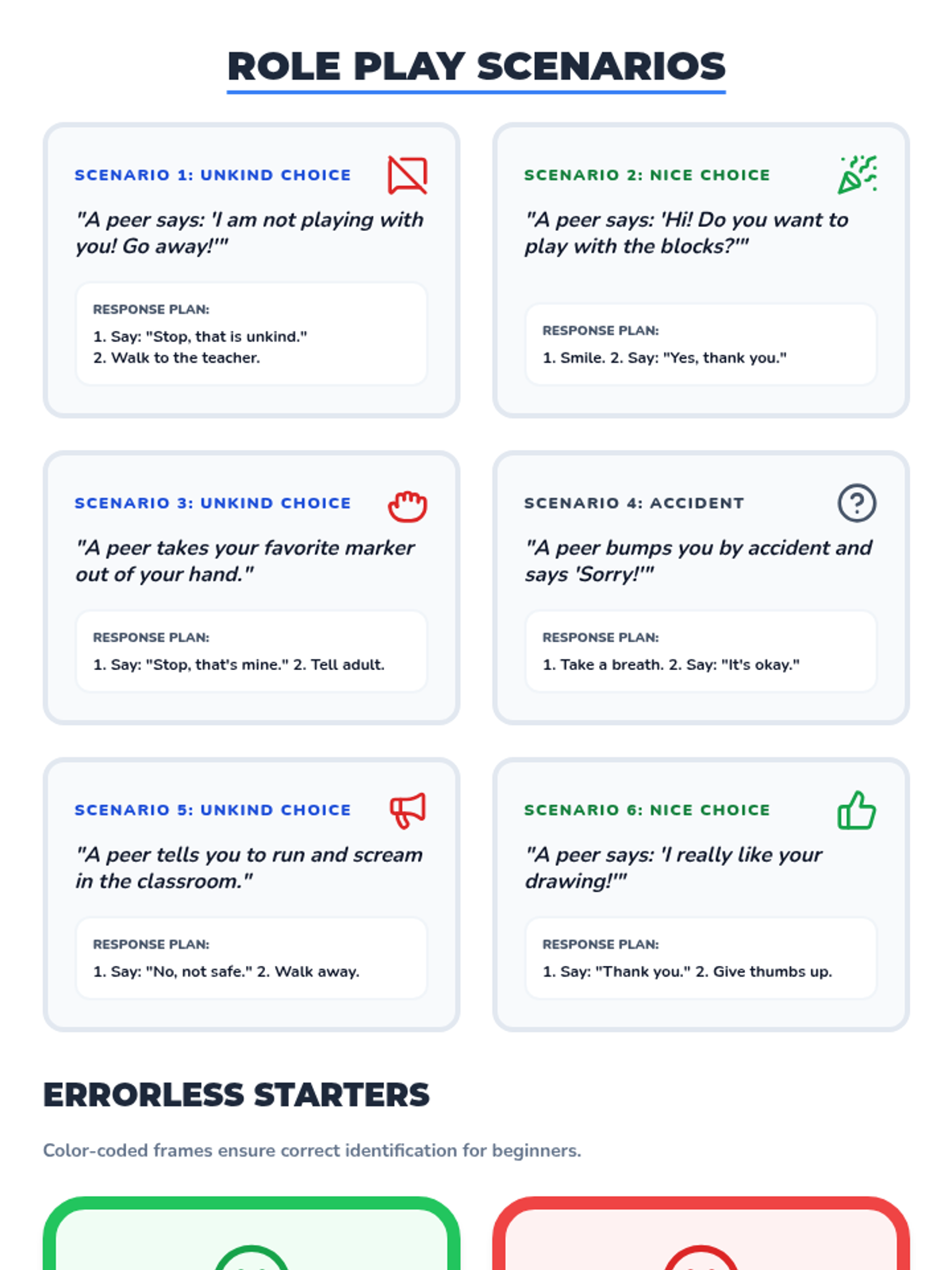
A revised resource pack with expanded role-play scenarios, vertical stacking for errorless cards to prevent overflow, and high-contrast staff instructions. Uses "Nice Choice" and "Unkind Choice". Revised for print-readiness.
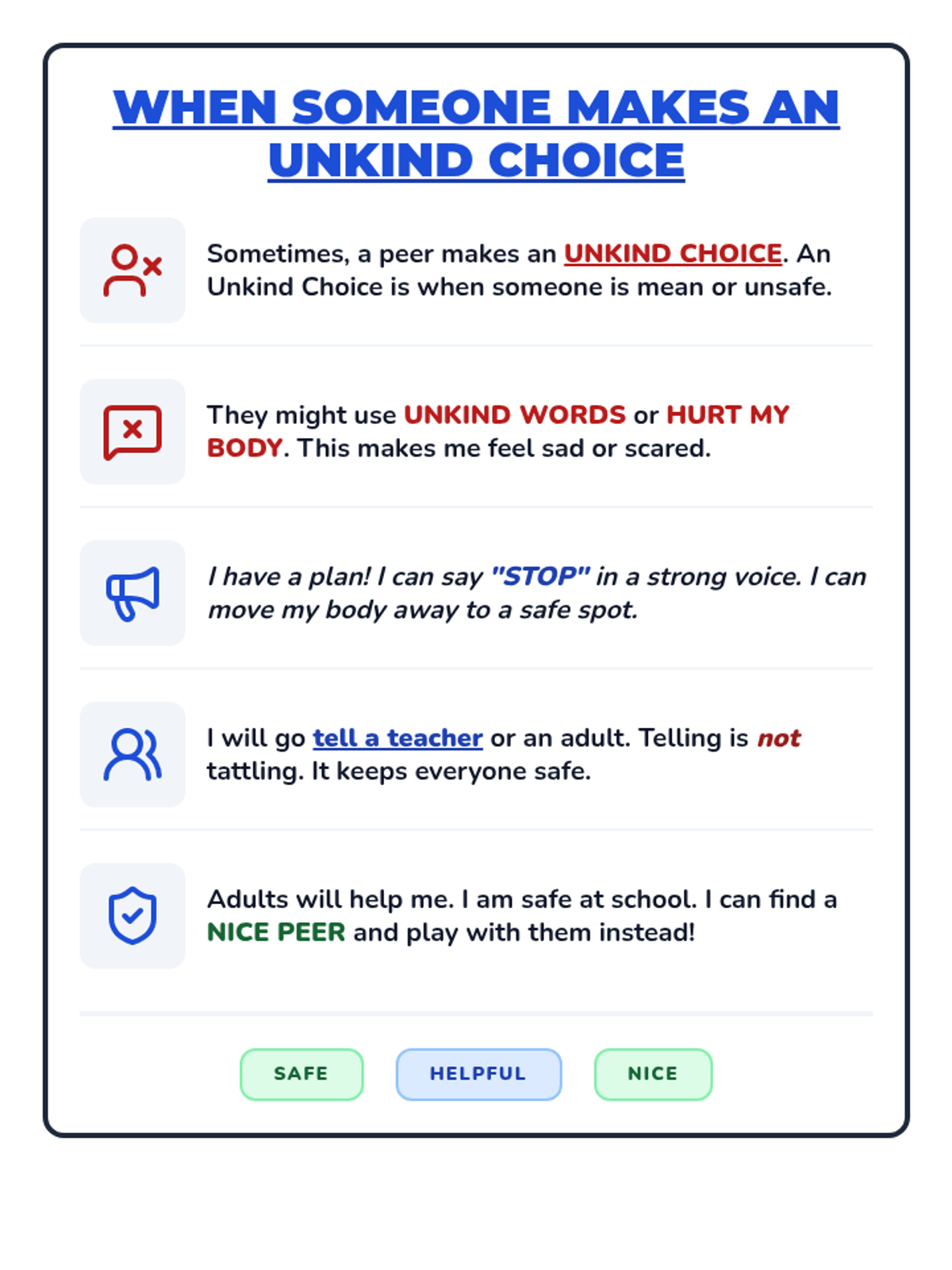
A revised social story that fits entirely on one page, explaining what to do when someone makes an "Unkind Choice" using concrete steps.
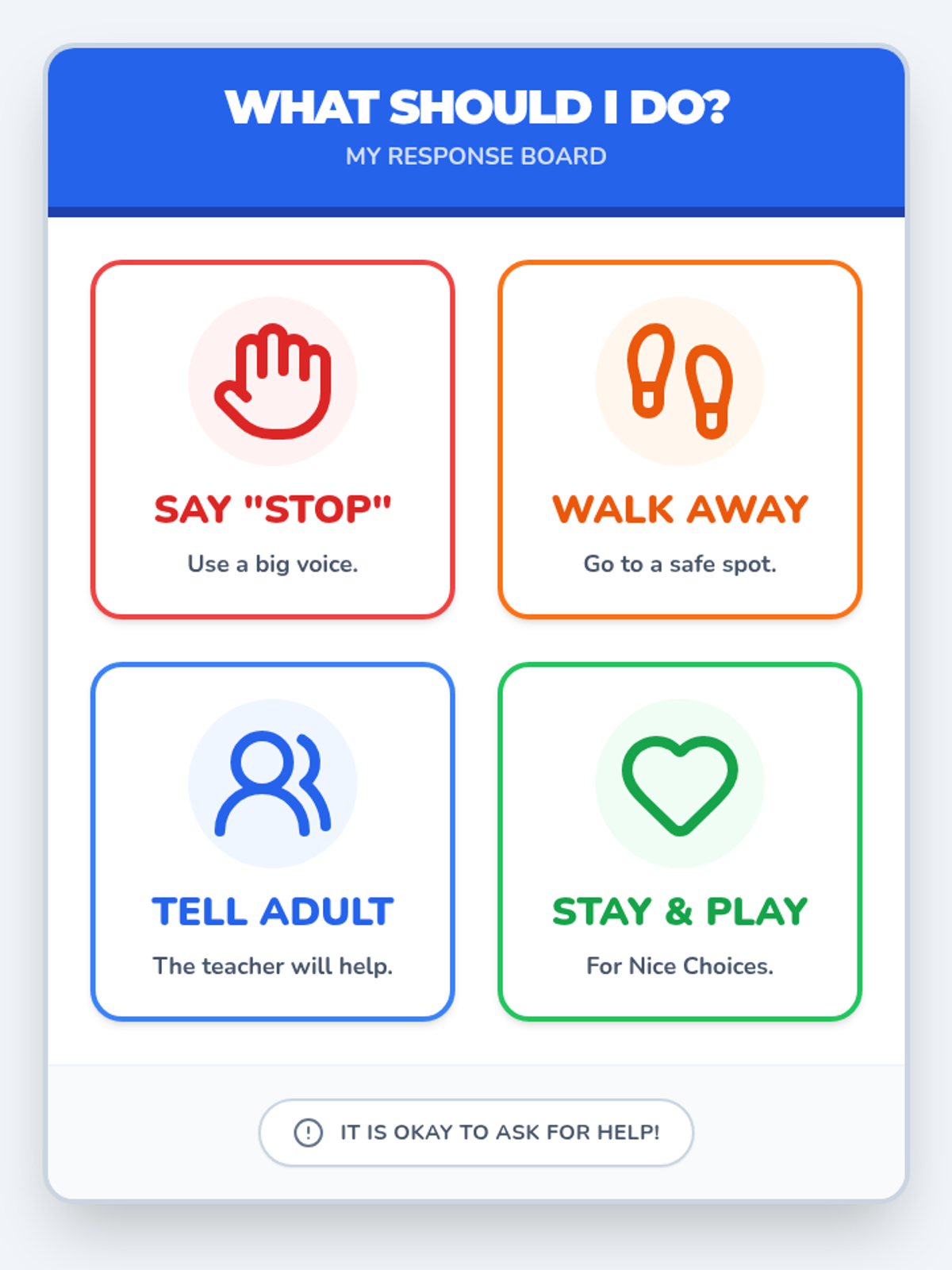
A one-page visual response board featuring four clear choices for students when encountering peer behaviors: Say "STOP", Walk Away, Tell Adult, or Stay & Play. Uses "Nice Choices".
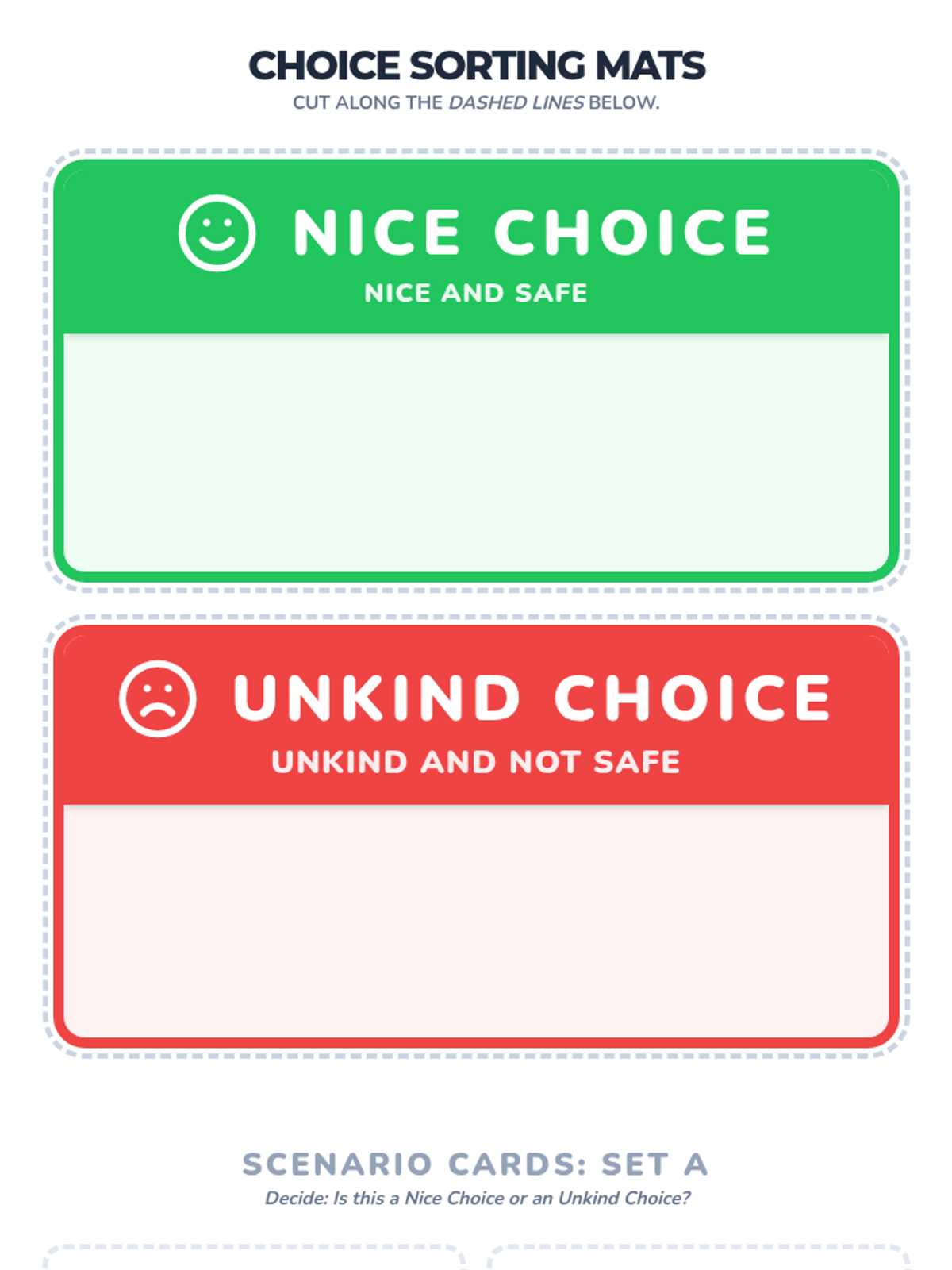
A revised sorting activity with corrected page breaks, neutral-colored icons to prevent telegraphing answers, and dashed cut guides for physical preparation. Now includes 24 scenario cards, featuring new items where students encourage disruptive behavior. Revised for better print alignment.
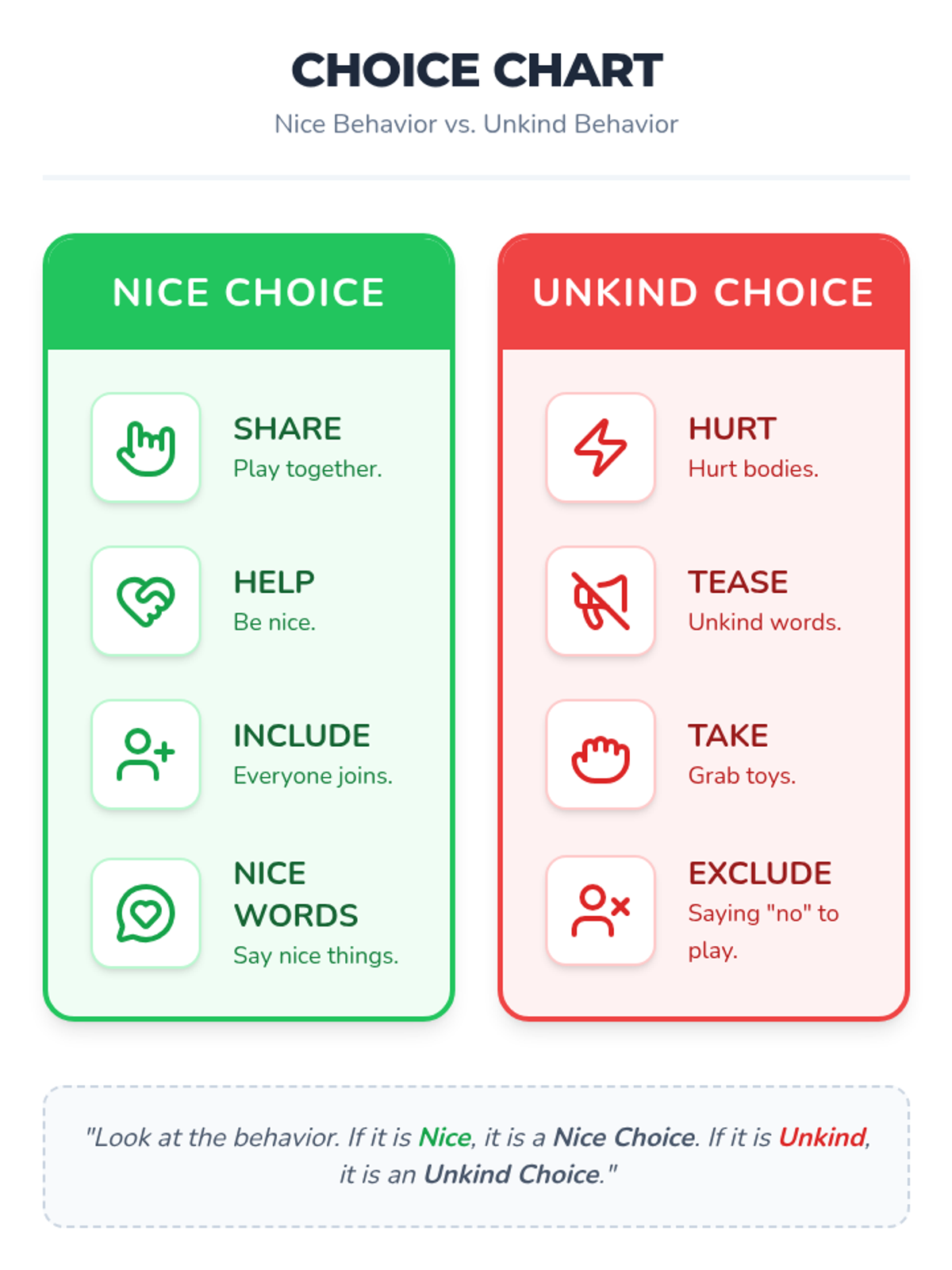
A visually simplified mini-anchor chart comparing Nice Choices (Share, Help, Include, Kind Words) and Unkind Choices (Hurt, Tease, Take, Exclude) using clear icons and concrete language.
A visual slide deck introducing the concepts of Nice Choice and Unkind Choice, featuring concrete examples and a three-step safety response plan for students.
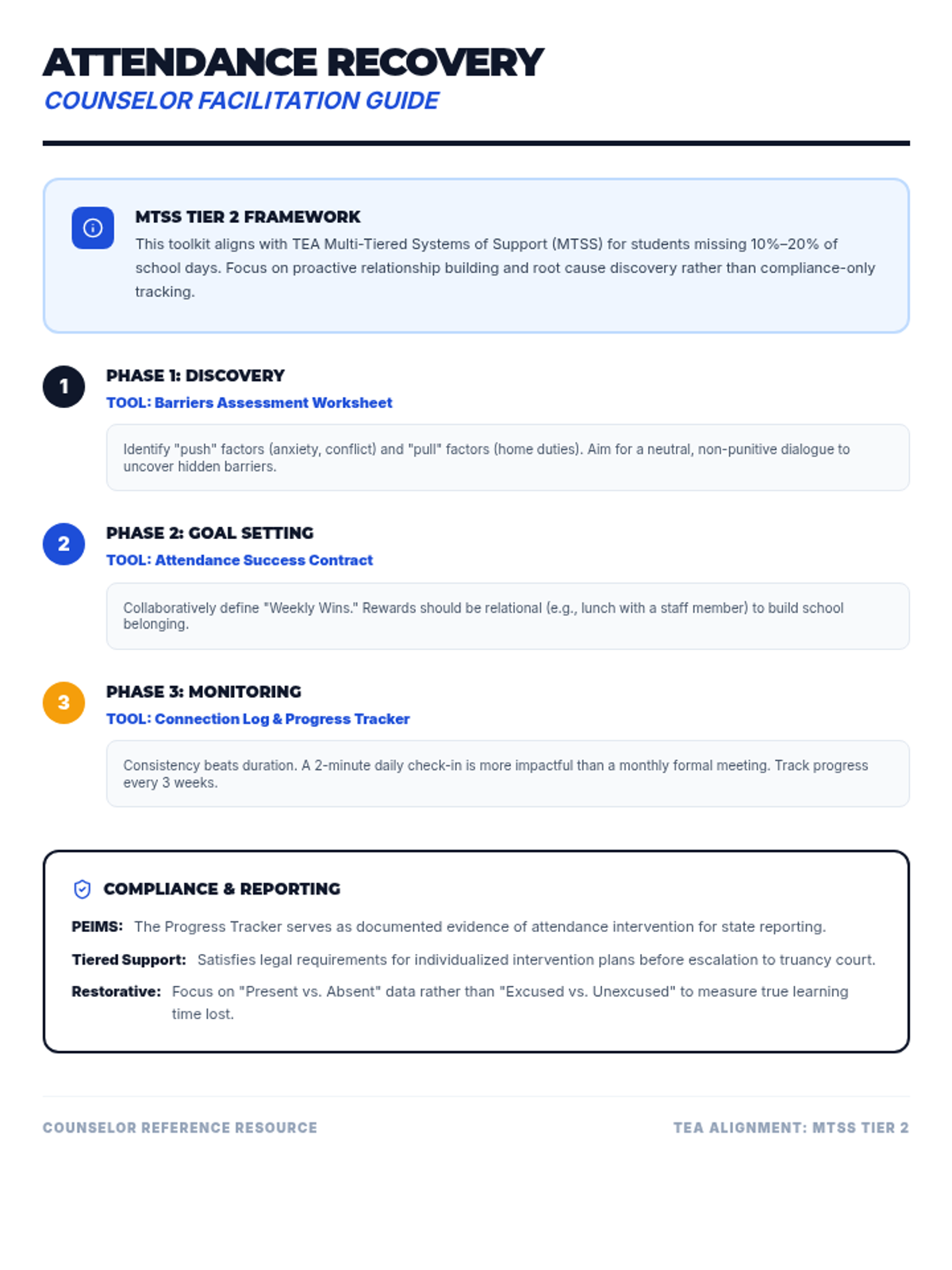
A guide for counselors on implementing the attendance recovery process. Revised for single-page layout, improved visual hierarchy, and clear alignment with the other packet materials.
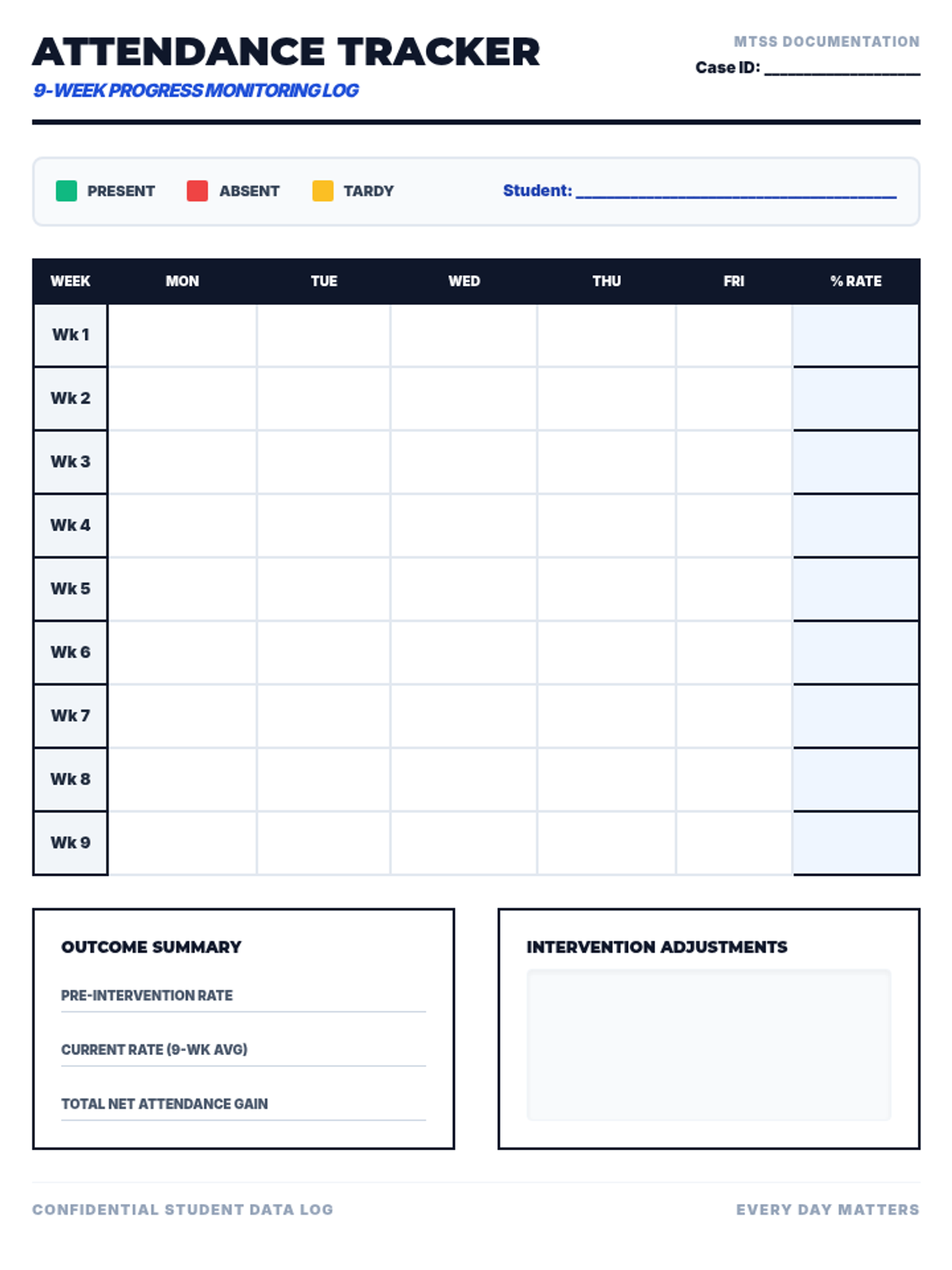
A 9-week progress monitoring tracker for attendance. Revised to fit on a single page and ensure high contrast for all data entry fields.
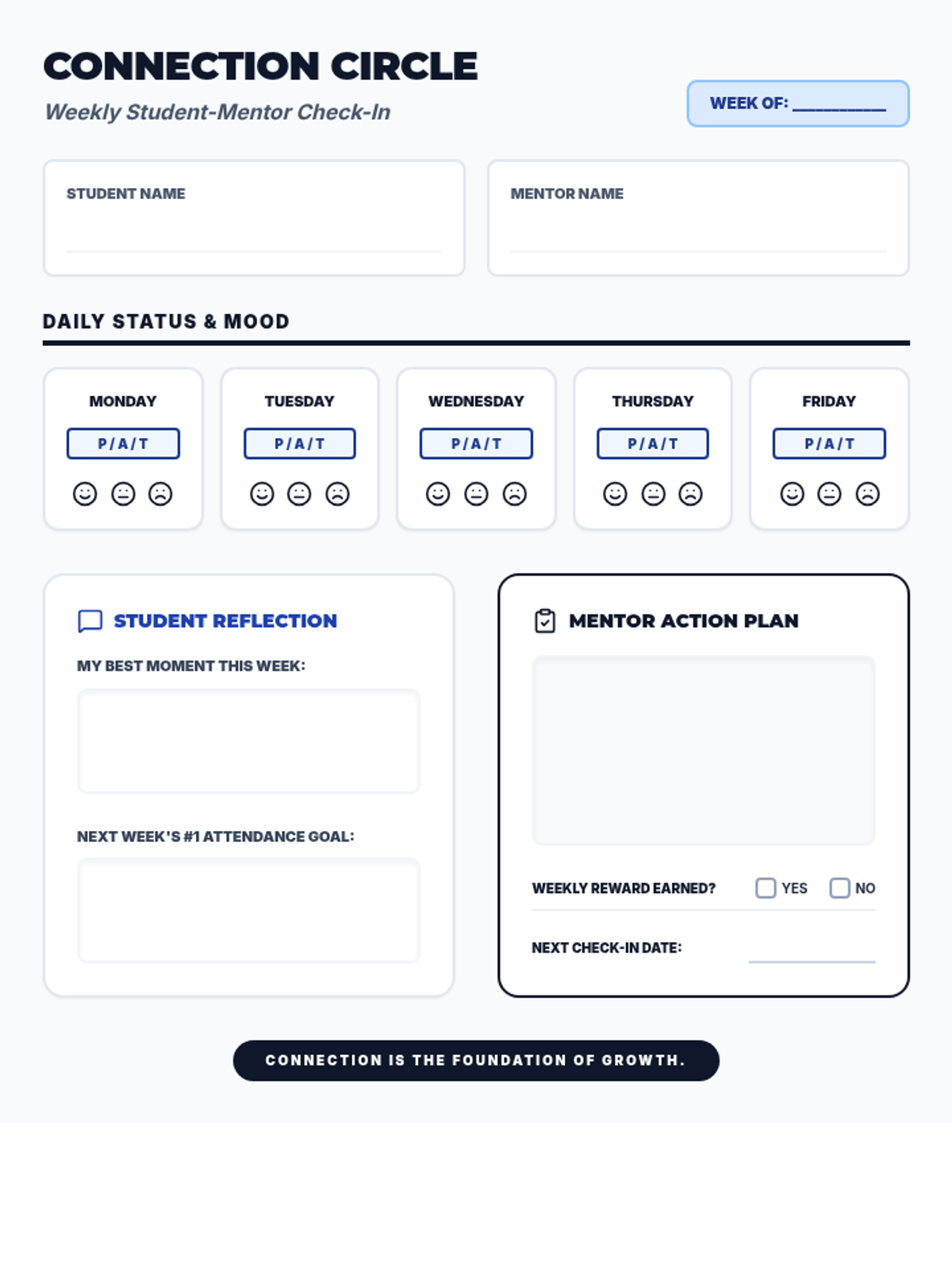
A weekly check-in log for mentors and students. Revised to fit on a single page, improve contrast for handwriting, and clarify input areas.
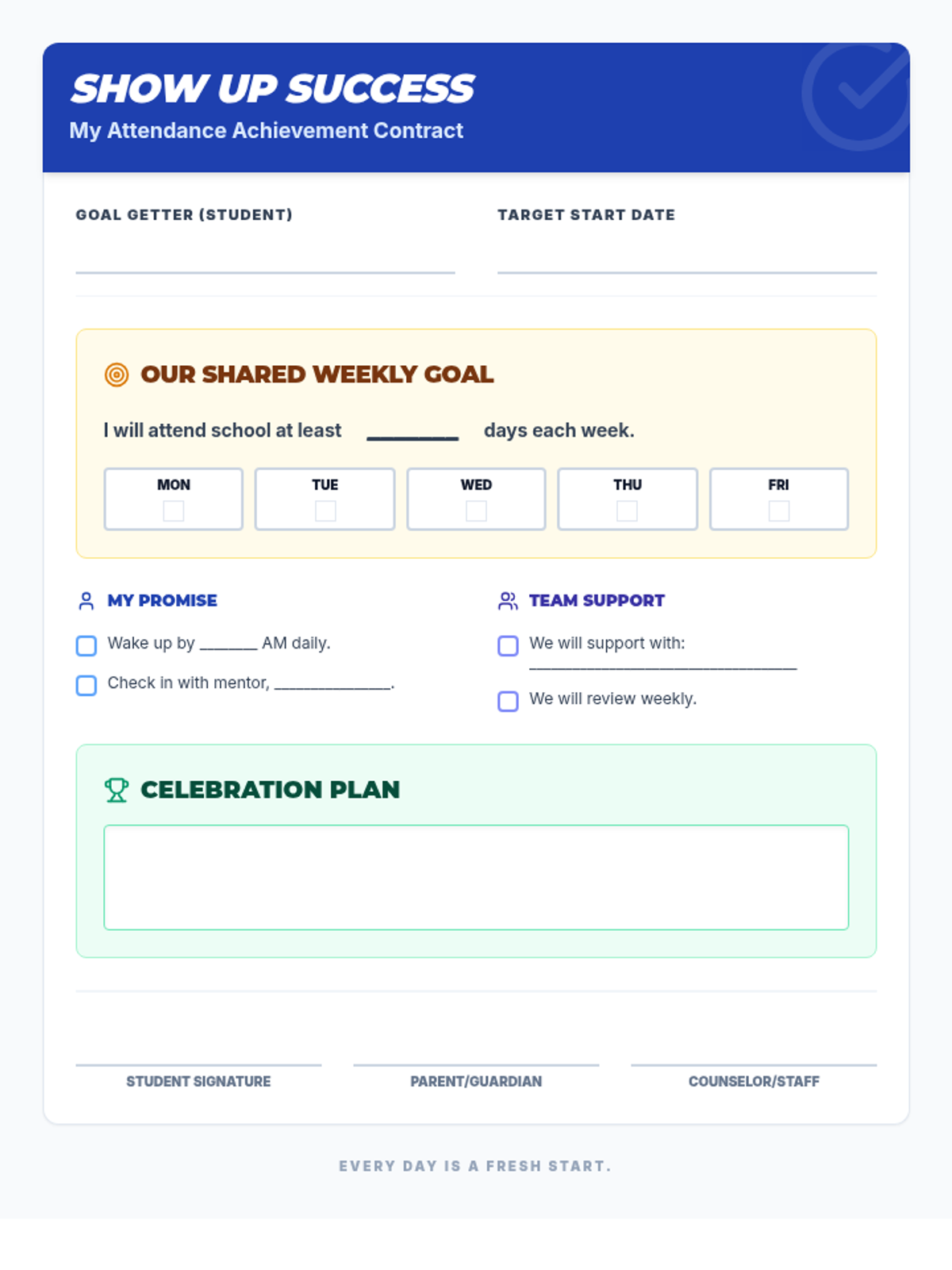
A student-facing attendance contract designed for middle schoolers. Revised to fit on a single page and improve contrast and usability.
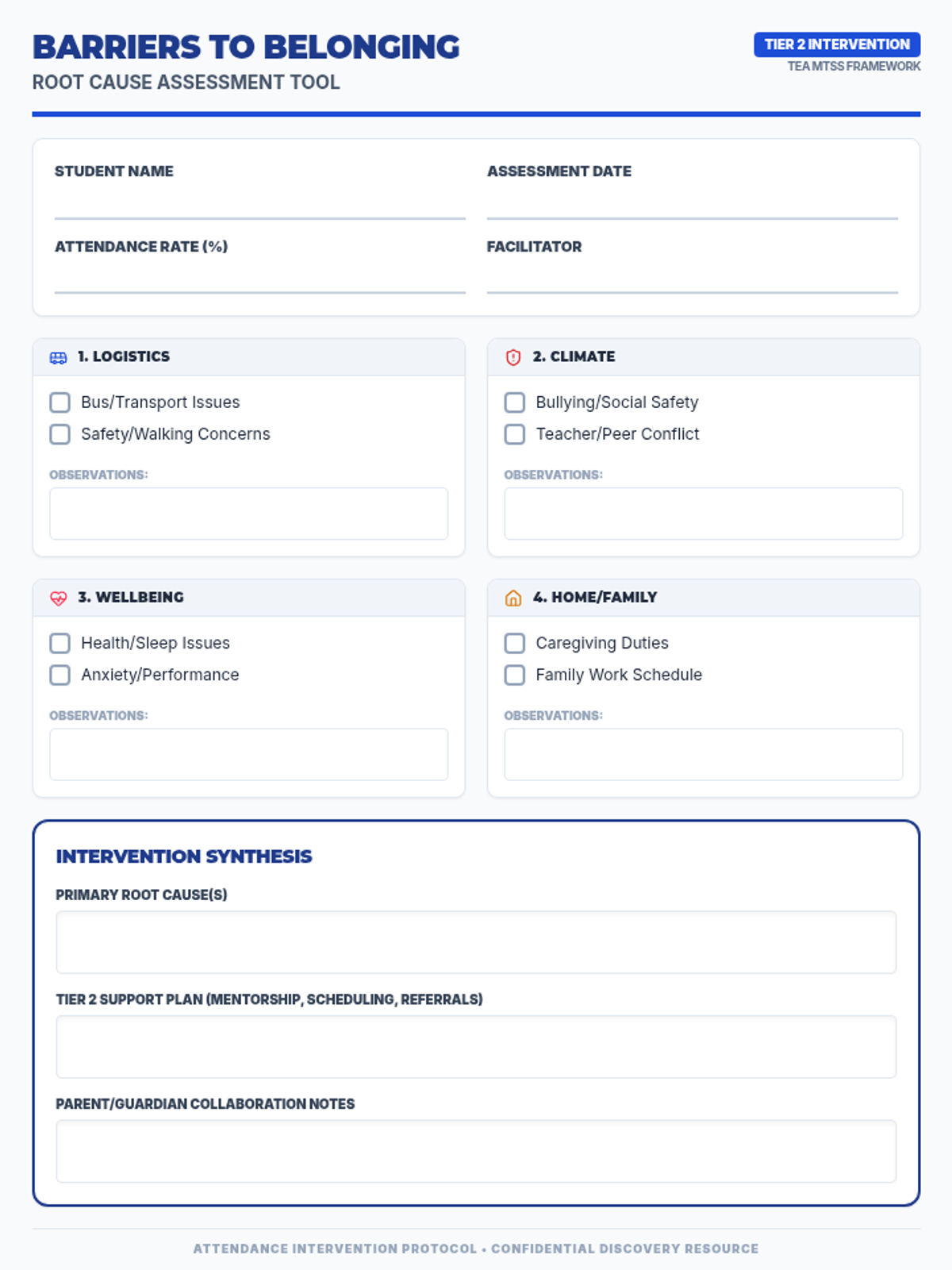
A root cause assessment tool for middle school counselors to identify barriers to attendance, including transportation, safety, health, and family factors. Revised to ensure single-page layout and improved contrast for handwriting.
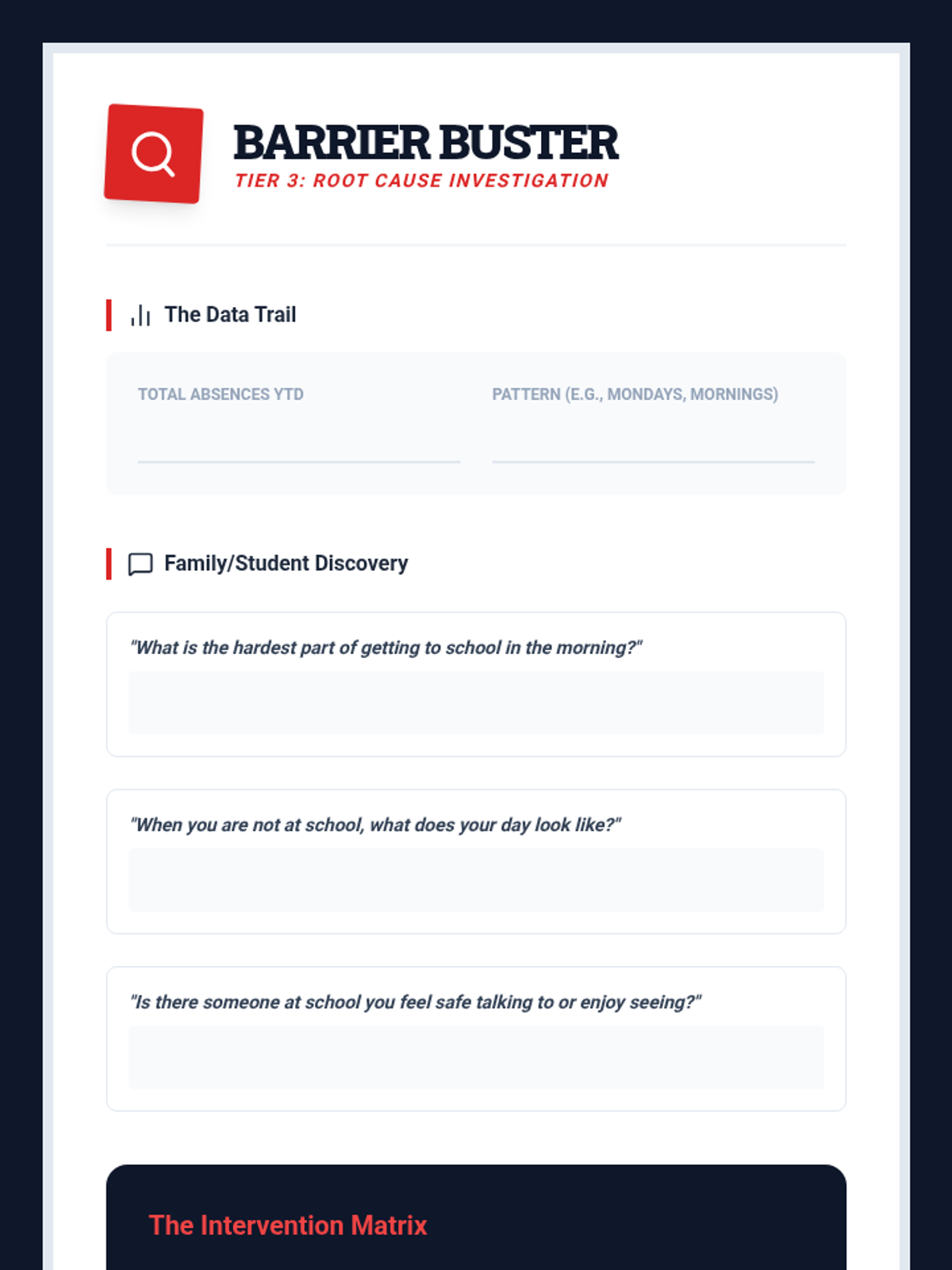
A Tier 3 intensive intervention tool designed for teachers and administrators to perform deep-dive root cause analysis and match specific barriers to community solutions.
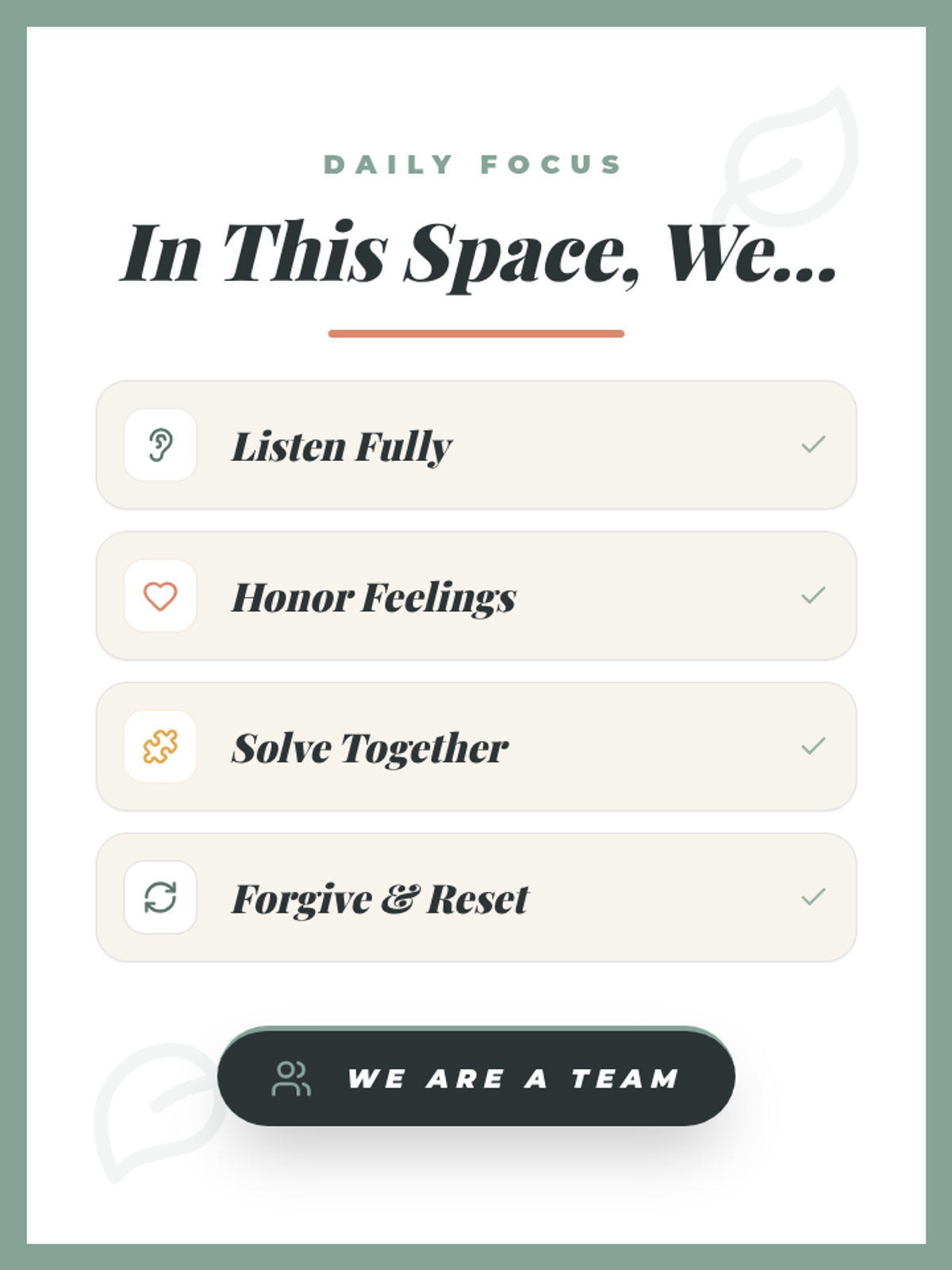
A dual-purpose community station resource featuring a 'Daily Focus' agreements poster and a 'Heart Check-In' station. The design uses botanical motifs and a sophisticated muted palette to encourage calm daily routines and emotional self-awareness.
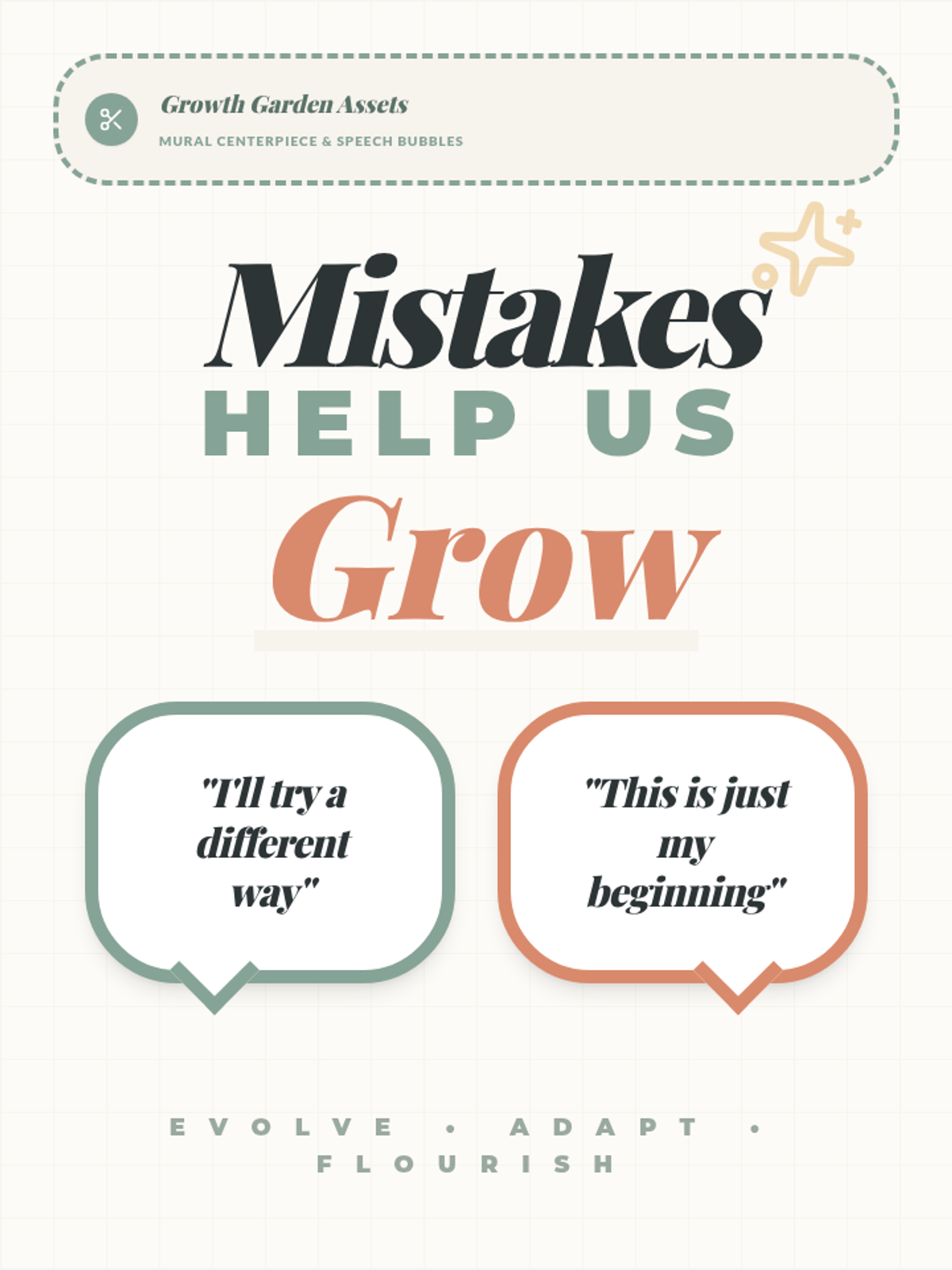
A collection of high-impact printable mural assets for a 'Growth Garden' display. Includes a stylized 'Mistakes Help Us Grow' centerpiece, botanical-framed affirmations, and a variety of interactive leaf and bloom templates for student recognition.
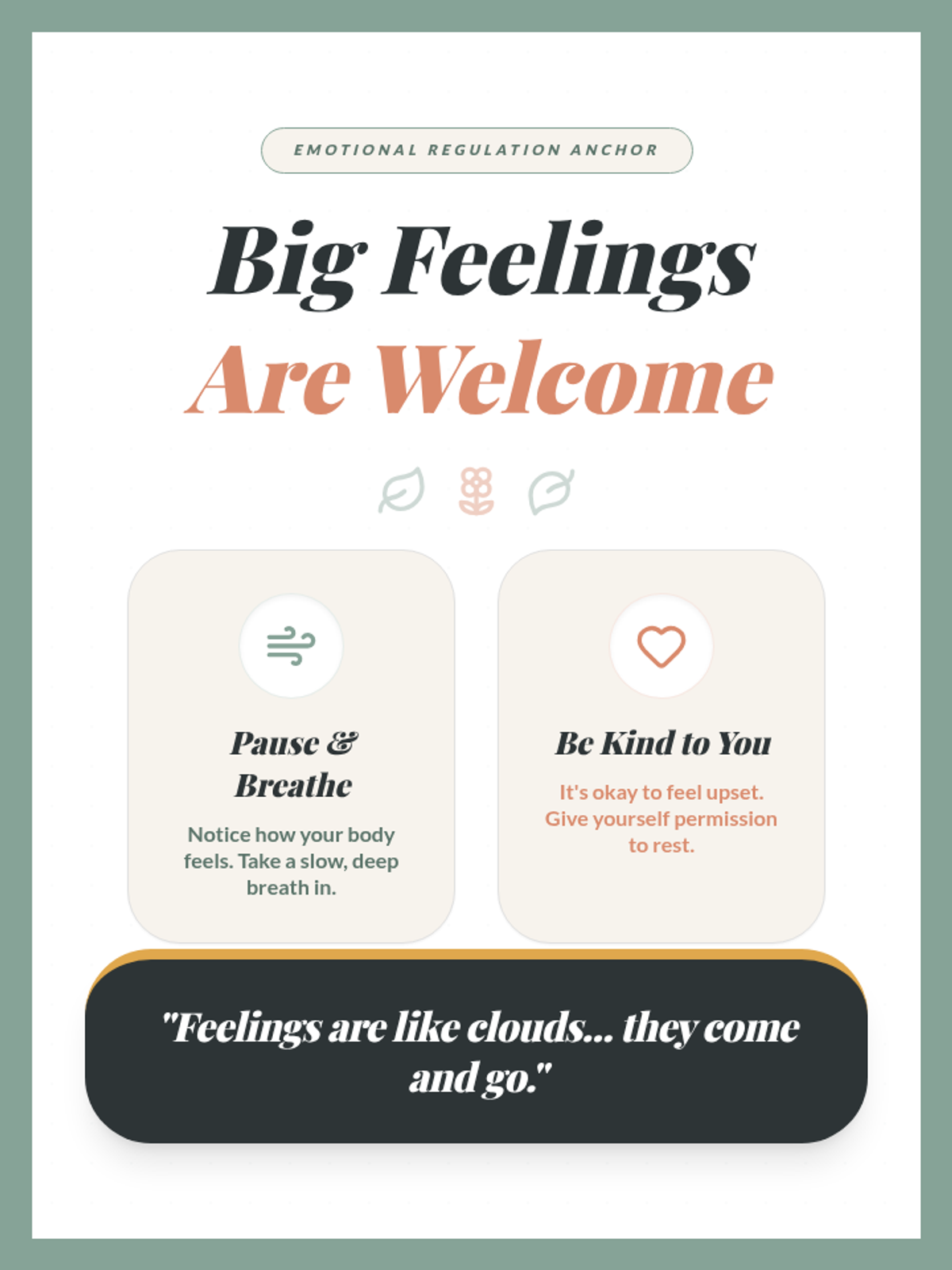
A set of calming sensory station visuals with a botanical aesthetic. Includes a large-format emotional regulation anchor poster and four modular strategy cards designed for hands-on student use in a calm-down corner.
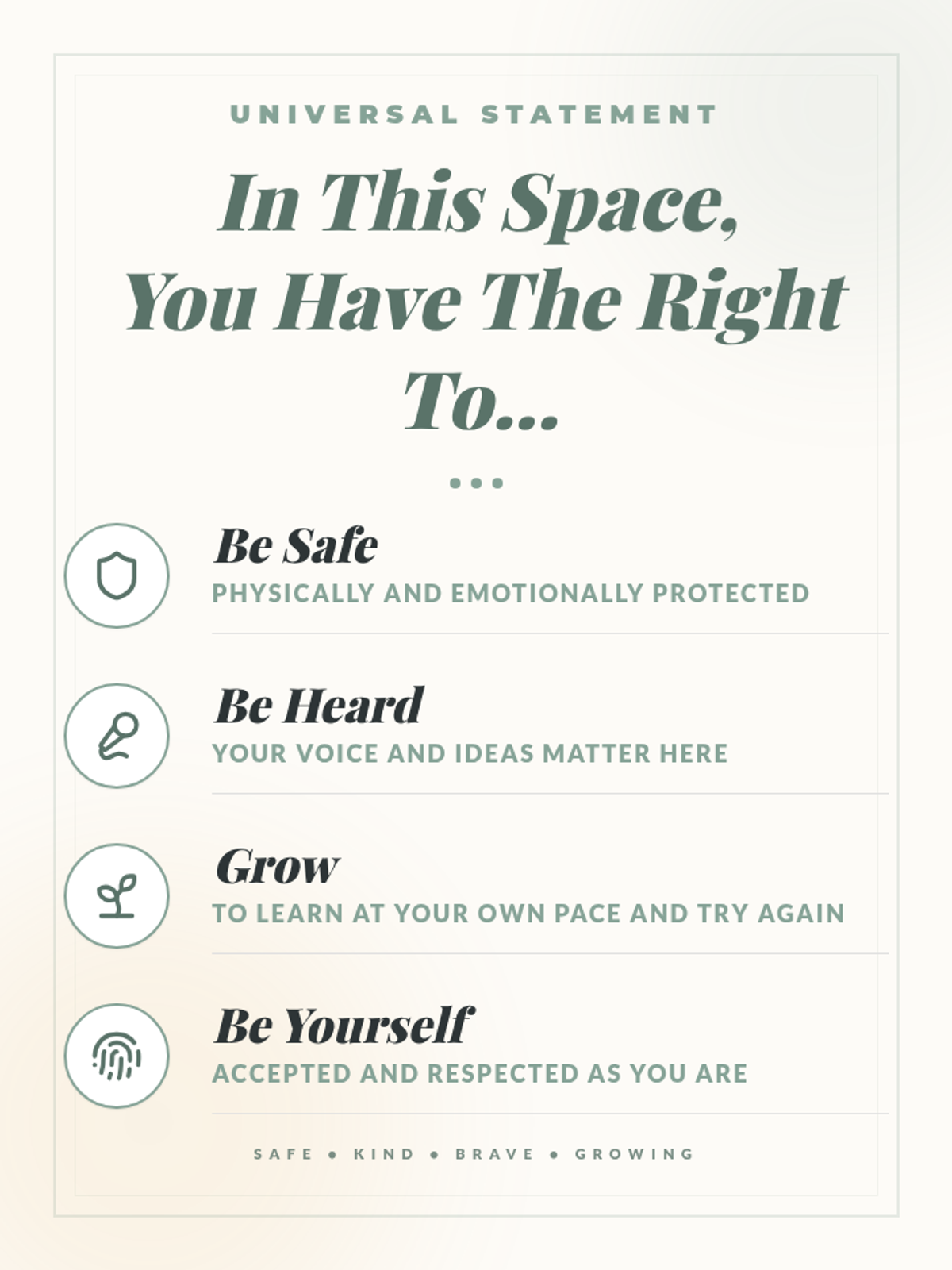
A pair of elegant botanical-themed posters defining student rights and responsibilities. The designs use a sophisticated palette of sage and terracotta to create a calming yet authoritative environmental statement for the classroom.
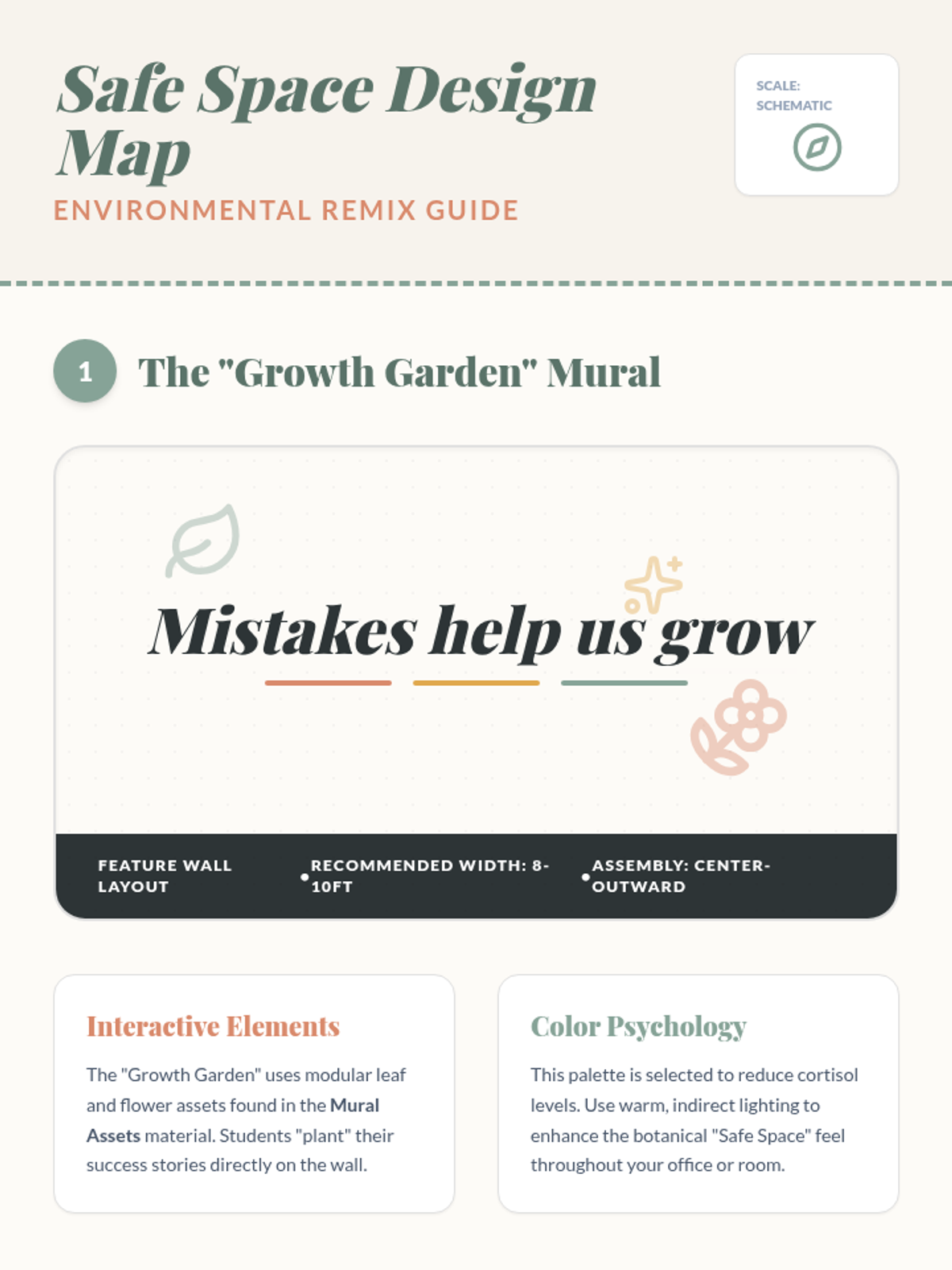
A botanical-themed space setup guide that provides a blueprint for creating a cohesive classroom environment. It features visual mockups for a 'Growth Garden' mural and a 'Community Station' bulletin board with installation tips.
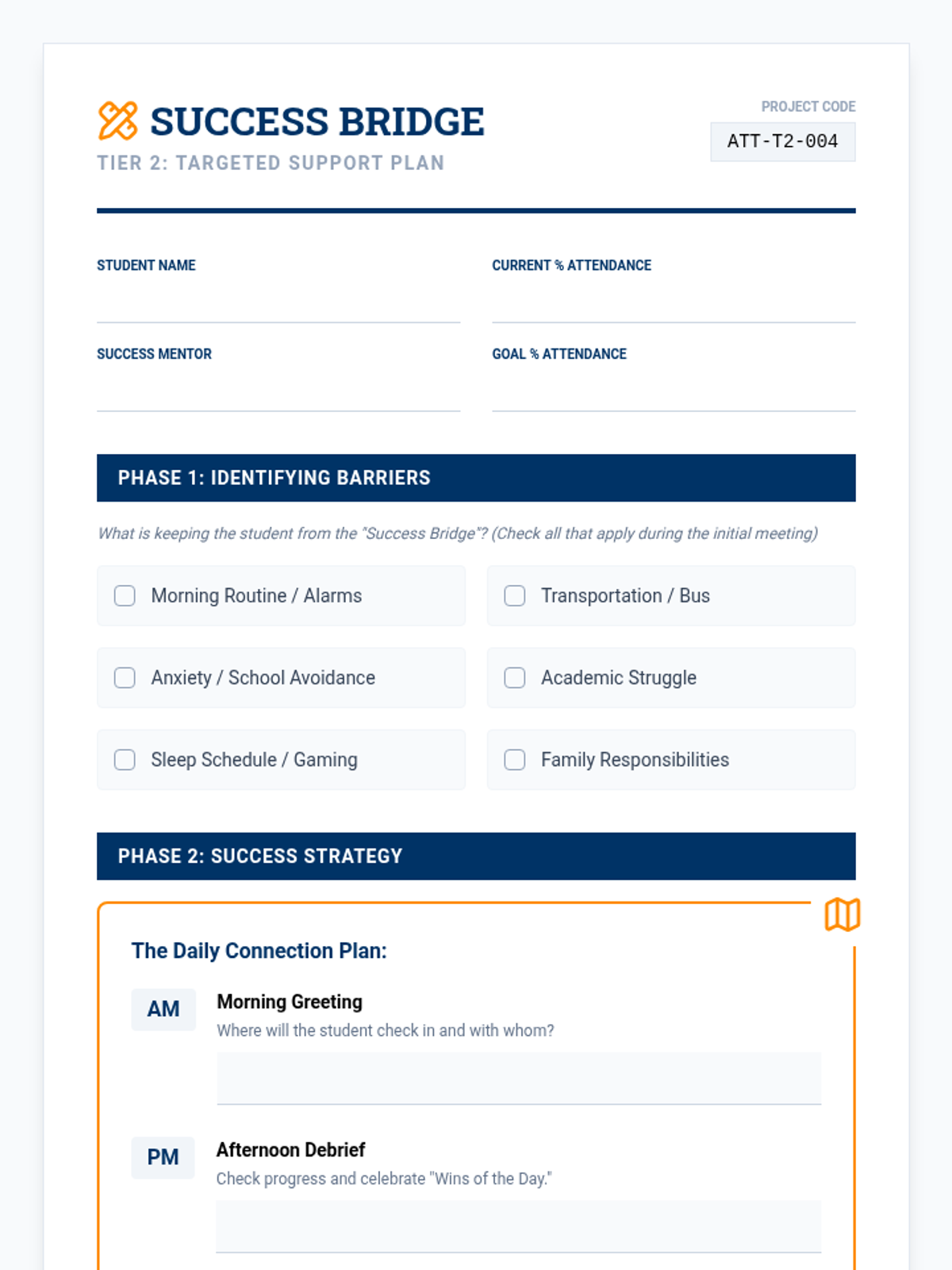
A Tier 2 intervention planning tool for mentors and students to identify attendance barriers and establish a formal Check-In/Check-Out routine.
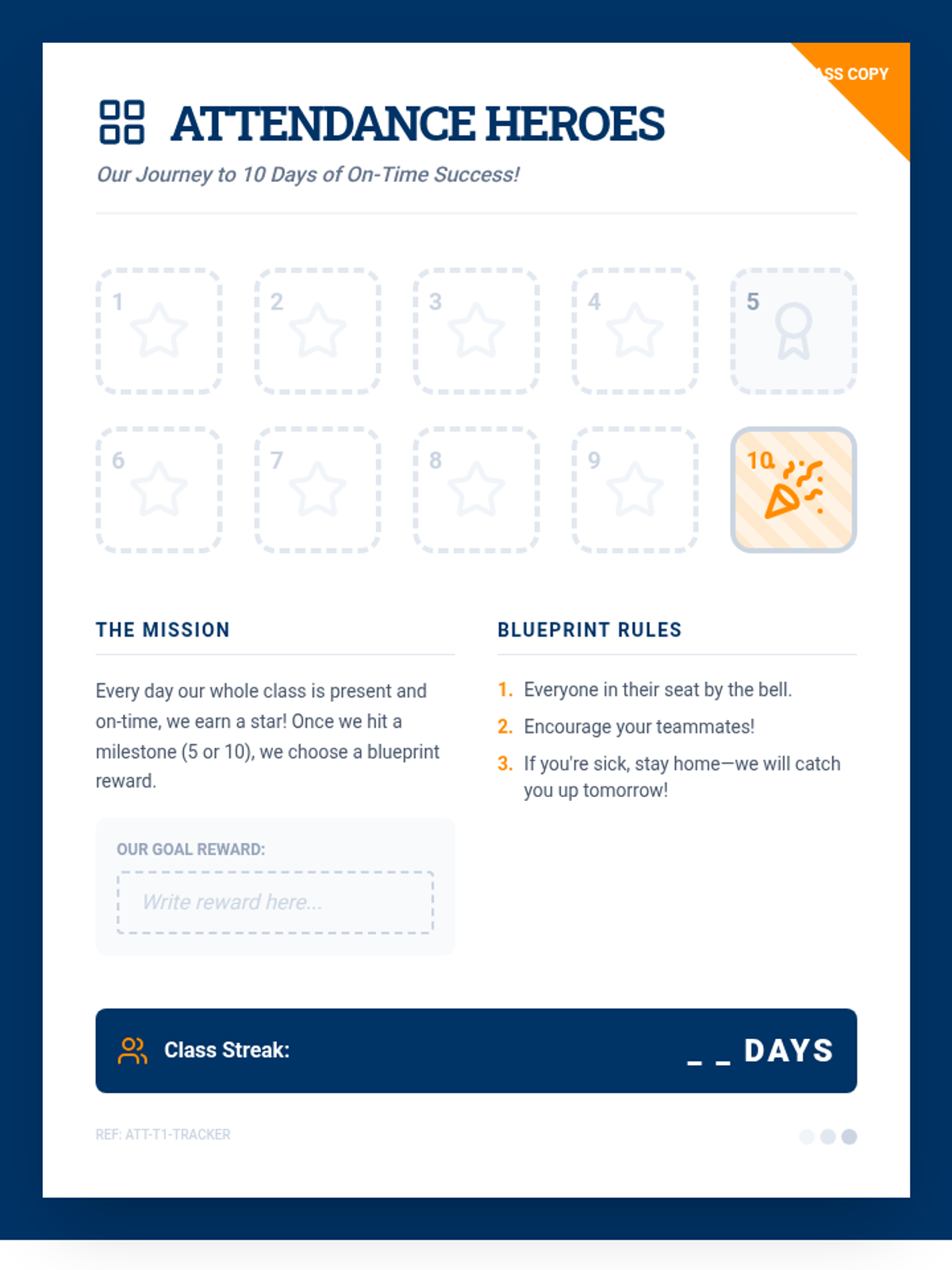
A classroom visual for tracking consecutive days of whole-class attendance and on-time arrival. Includes spaces for setting goals and rewards.
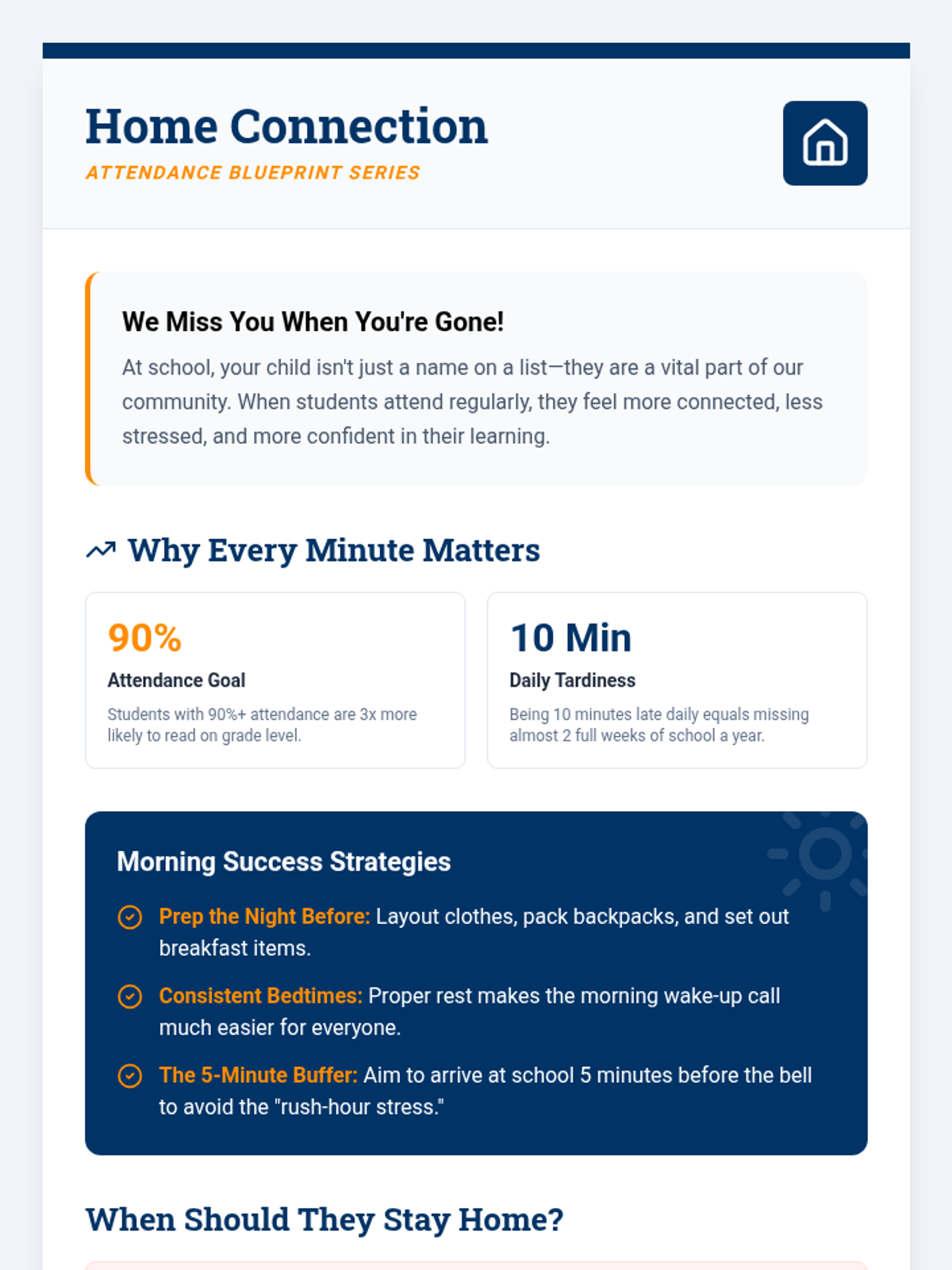
A parent-facing newsletter providing data on attendance, practical morning routine tips, and a clear guide on when children should stay home versus attend school.
A high-impact slide deck for staff or parent presentations, introducing the Attendance Blueprint framework, the academic impact of missed time, and Tier 1 PBIS strategies.
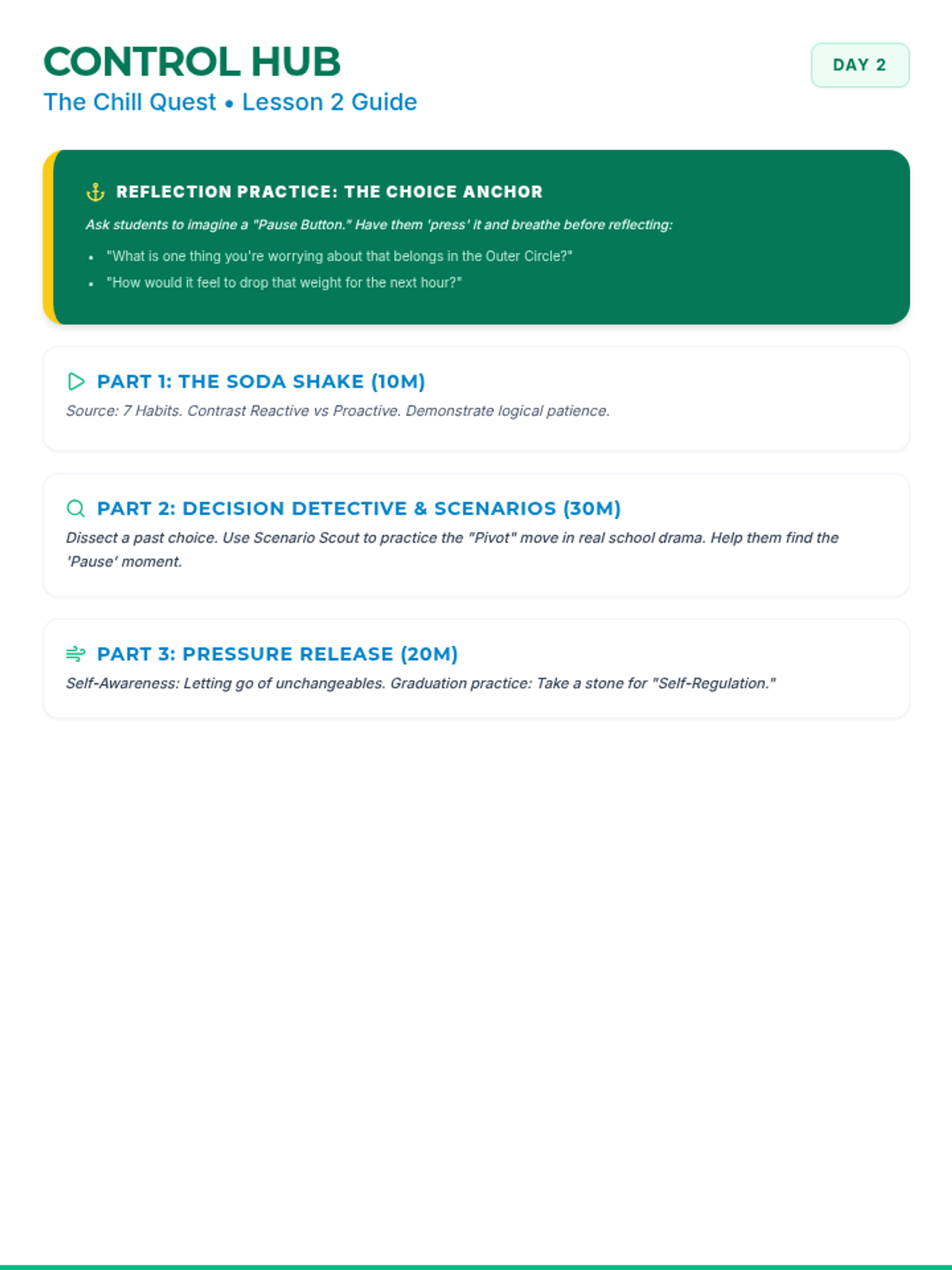
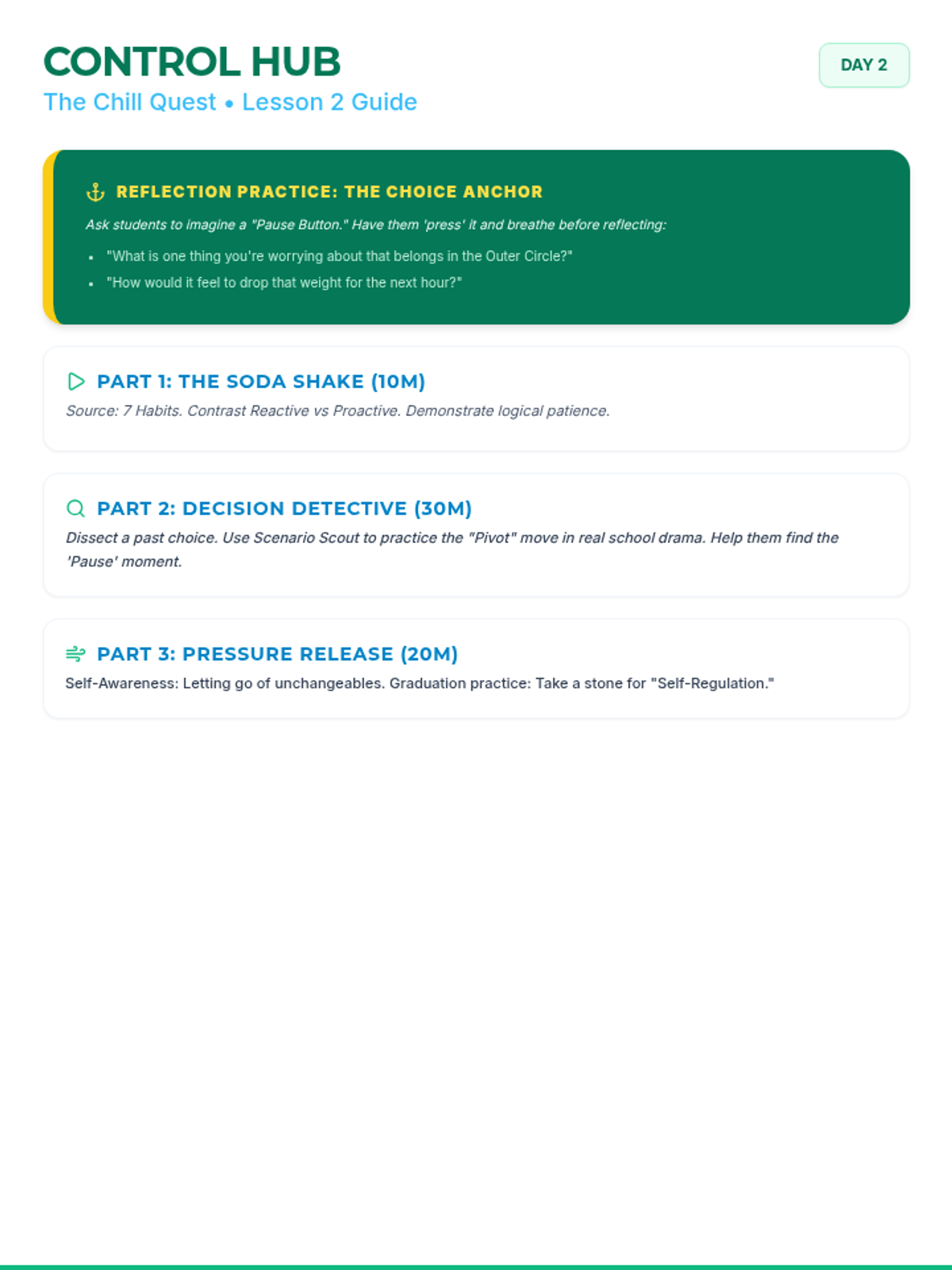
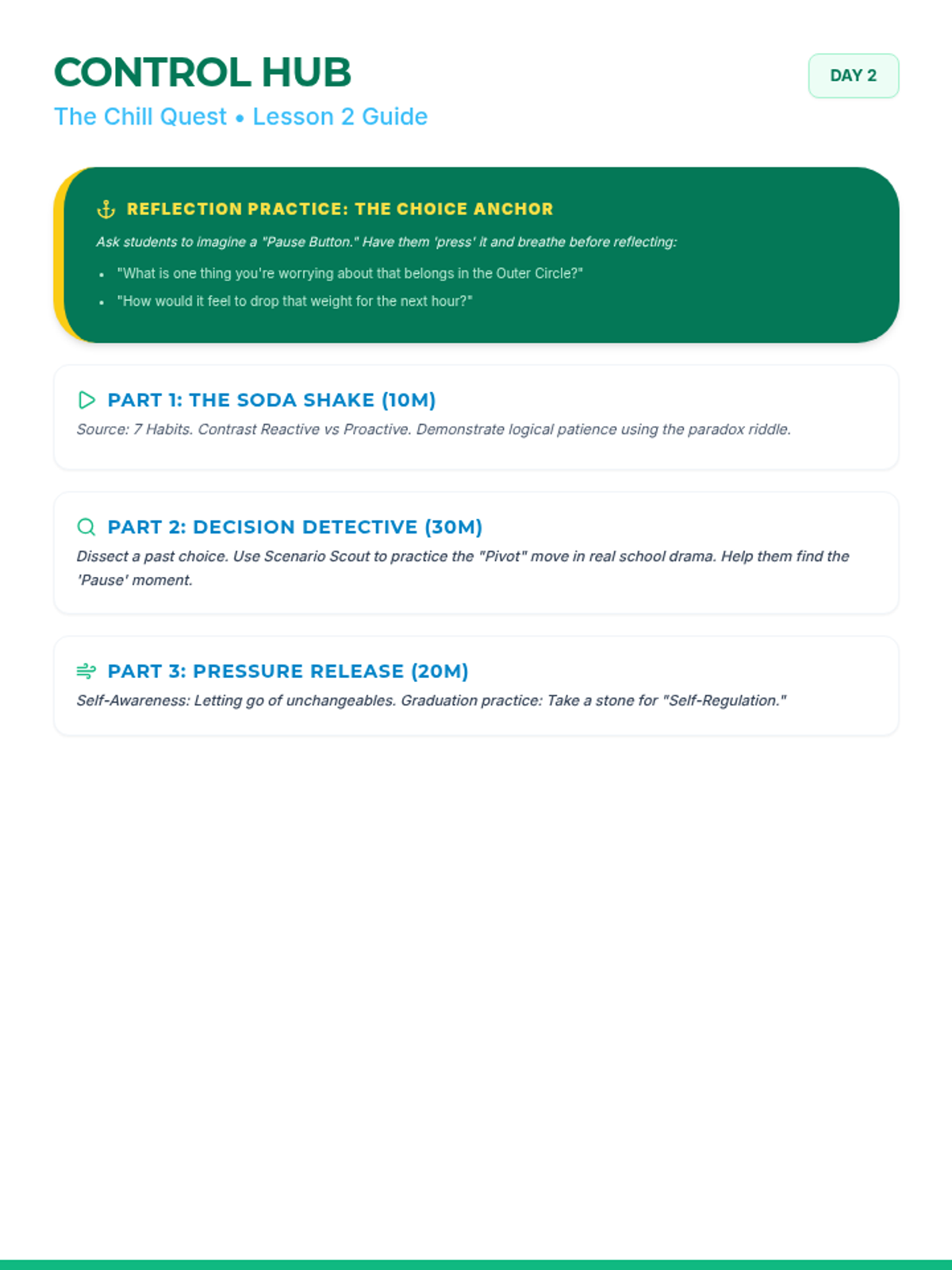
Lesson 2 Guide and Worksheet focused on Habit 1: Be Proactive. Includes Page 3: Decision Detective for critical thinking on past choices. Revised for a bright summer aesthetic using light green, sky blue, and yellow. Added facilitator details and student clues. Enhanced self-reflection with "Resilience Anchor" and "Worry Weight" checks. Replaced "ritual" with "practice." Added Page 4: Scenario Scout for life choices. Added source materials and student clues.
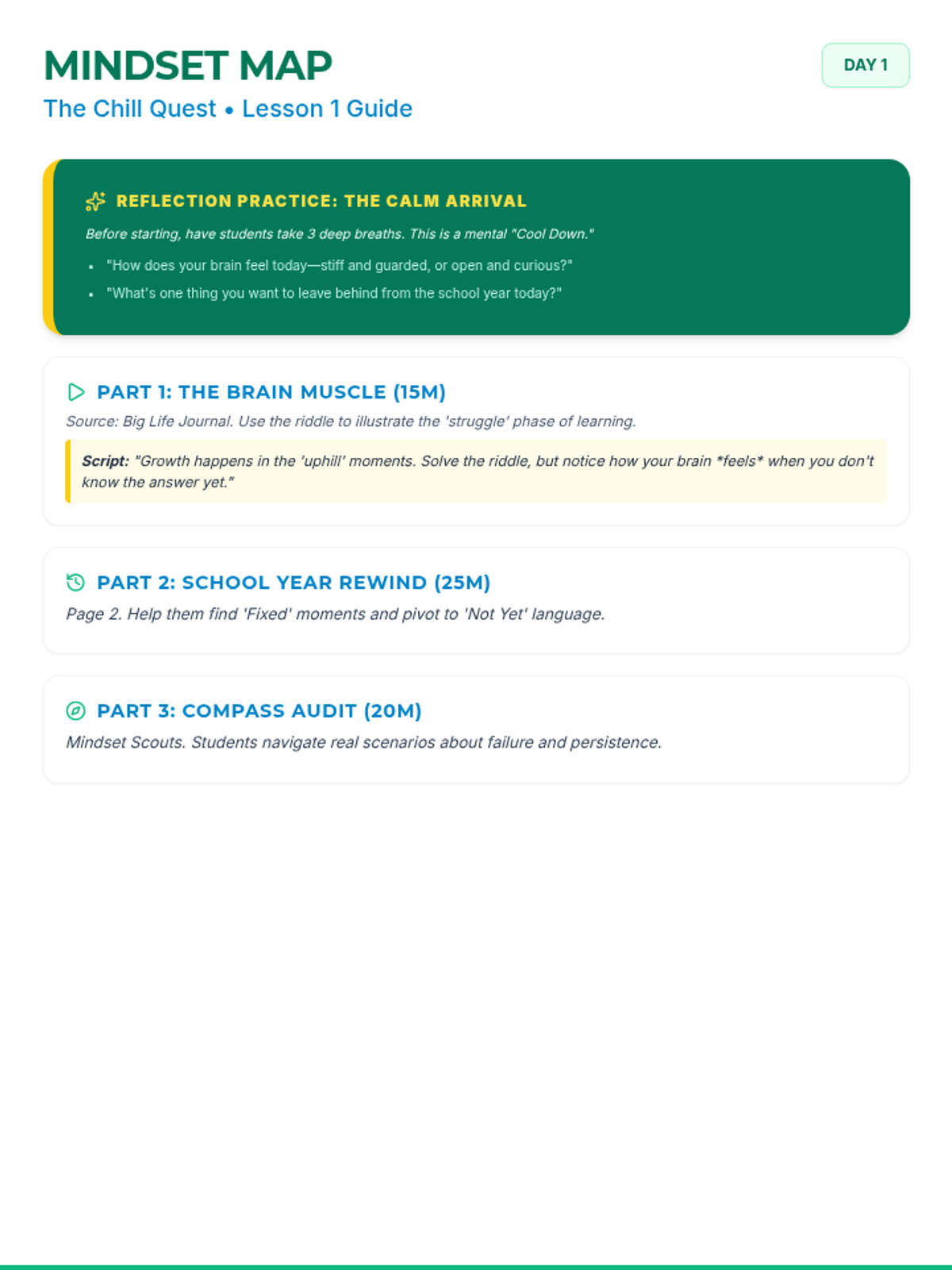
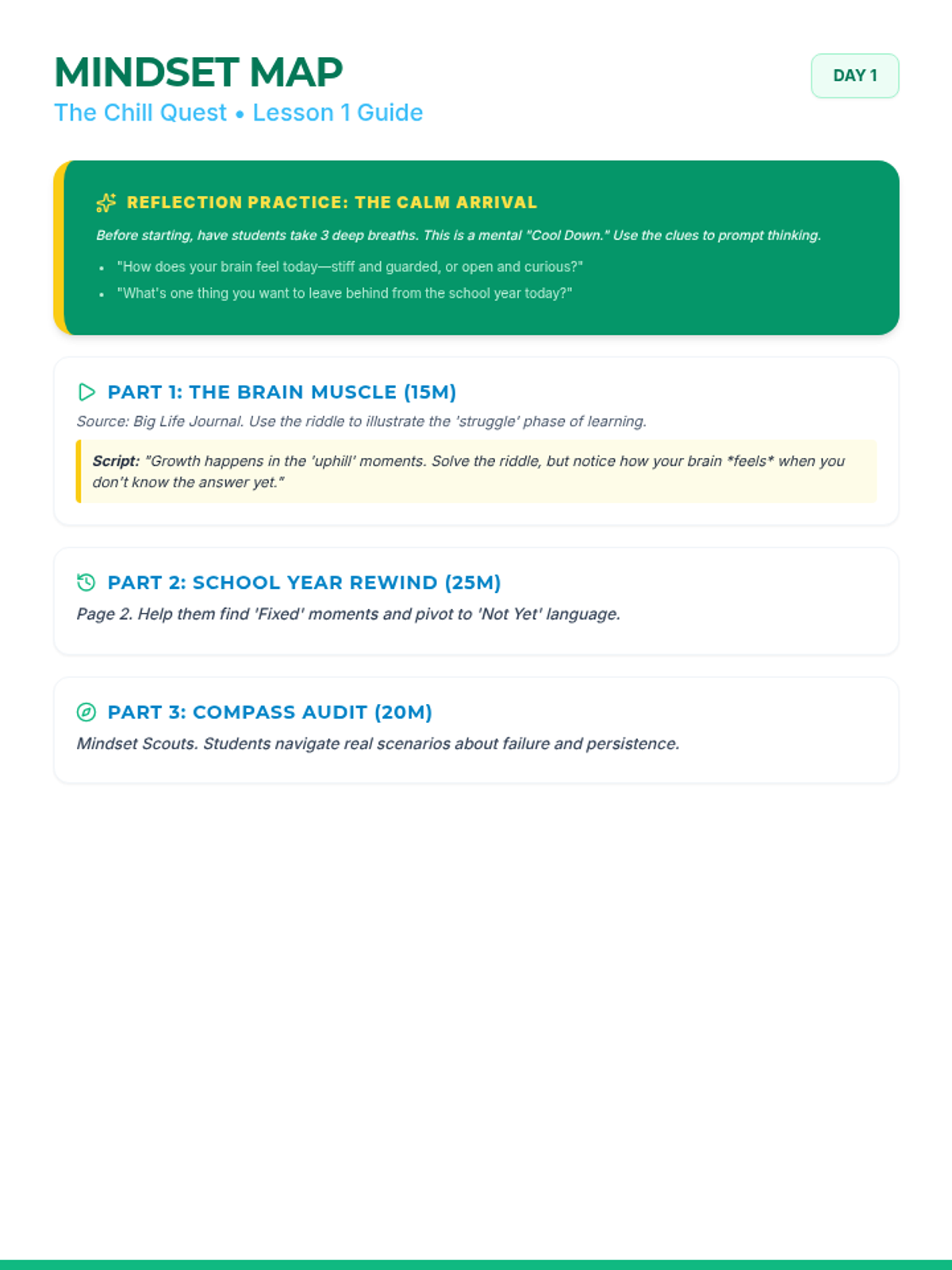
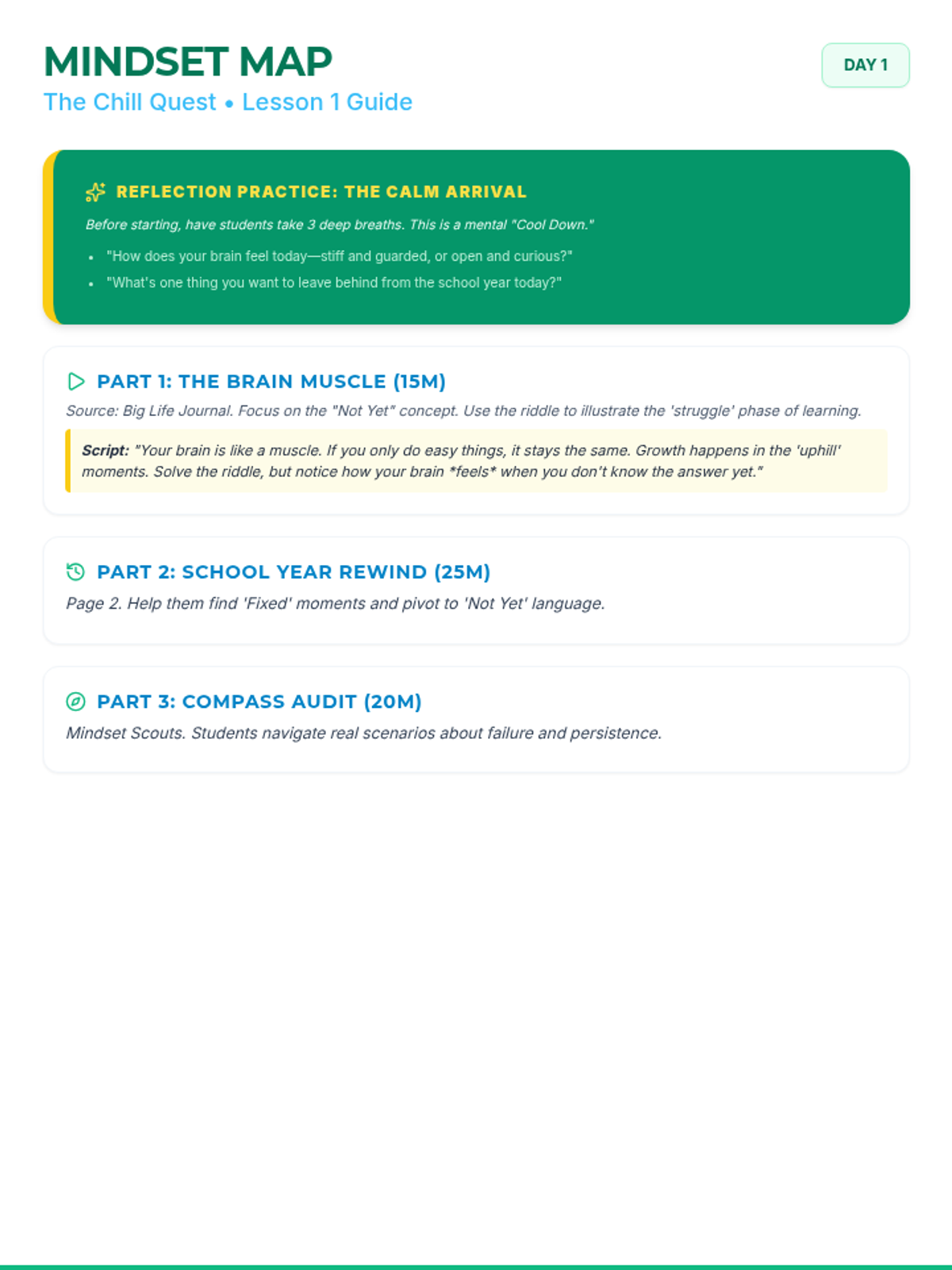
Lesson 1 Guide and Worksheet focused on Growth Mindset basics. Includes School Year Rewind and Confidence Compass. Revised for a balanced light green, sky blue, and yellow summer aesthetic. Added more facilitator details and student clues. Enhanced self-reflection with "Quest North Star" and "Mindset Temperature" checks. Added real-life scenarios about failure and persistence. Replaced "ritual" with "practice."
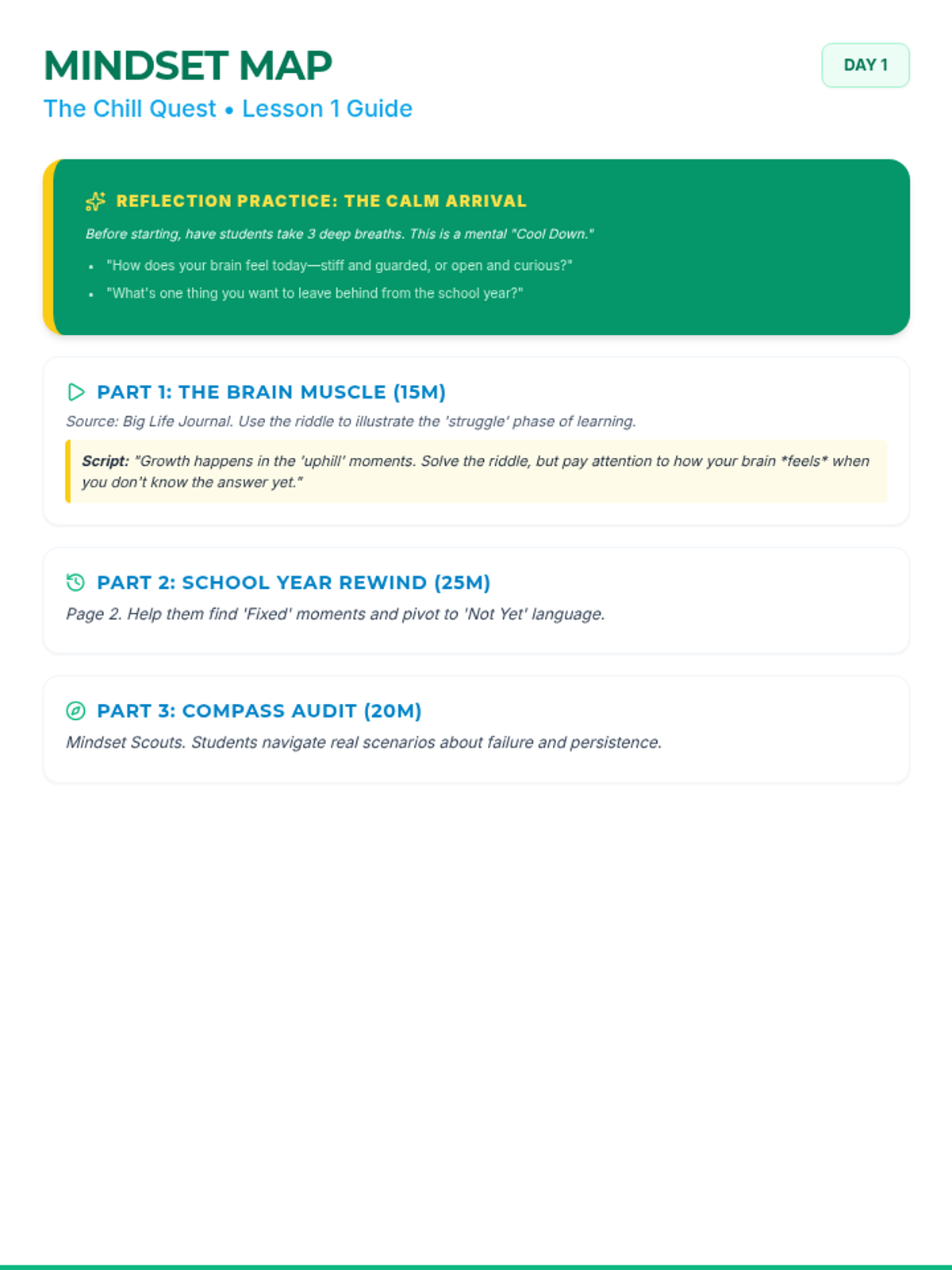
Lesson 1 Guide and Worksheet focused on Growth Mindset basics. Revised for a bright summer aesthetic using light green, sky blue, and yellow. Added facilitator details and student clues. Enhanced self-reflection with "Quest North Star" and "Mindset Temperature" checks. Added real-life scenarios about failure and persistence. Replaced "ritual" with "practice." Adjusted formatting for the 3-page layout.
Lesson 2 Guide and Worksheet focused on Habit 1: Be Proactive. Revised for a bright summer aesthetic using light green, sky blue, and yellow. Includes the Circle of Control and Paradox brain break. Replaced "ritual" with "practice." Added facilitator details and student clues.
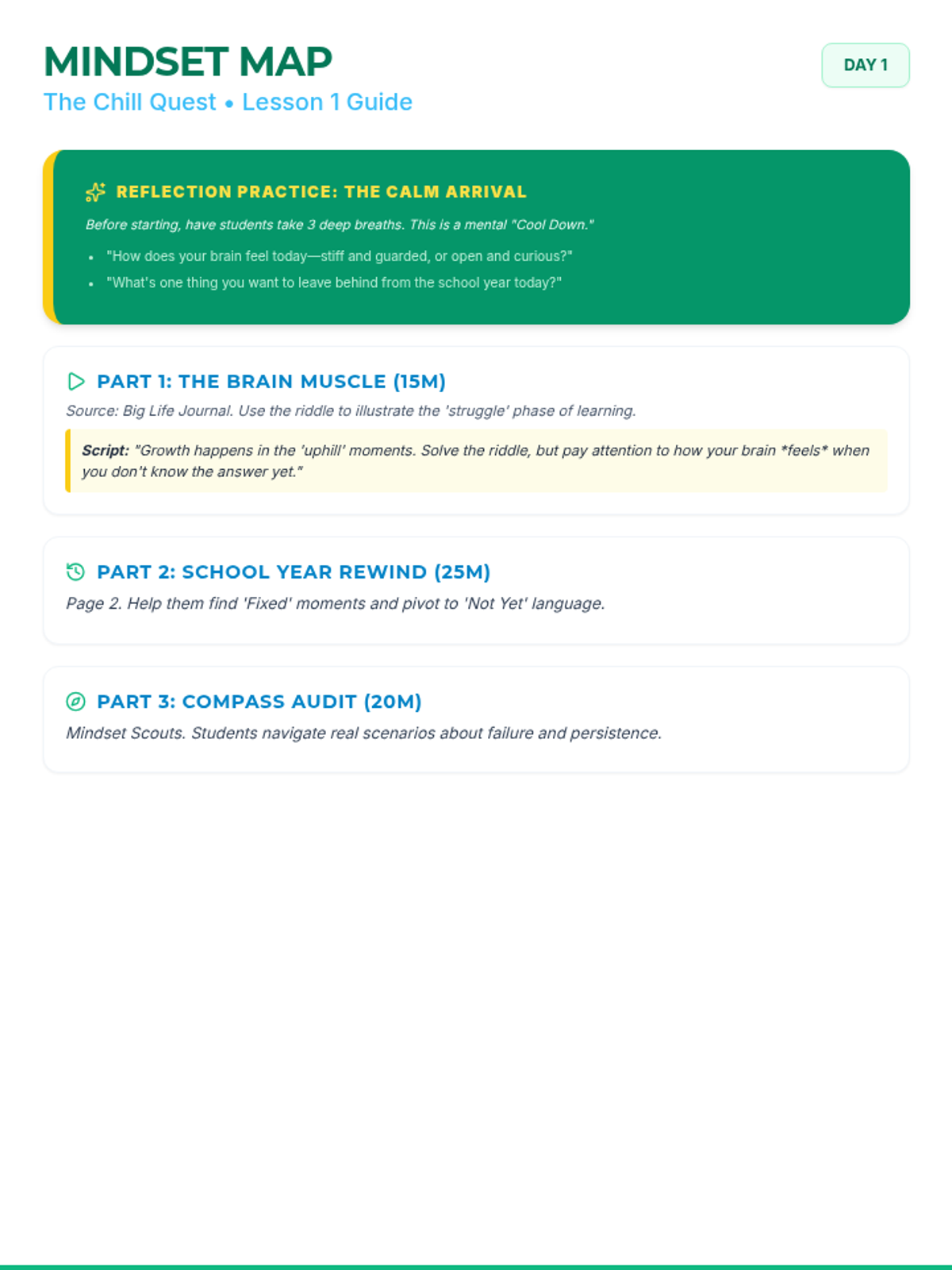
Lesson 1 Guide and Worksheet focused on Growth Mindset basics. Revised for a light green, blue, and yellow summer aesthetic. Includes status checks and real-life scenarios. Added facilitator details. Replaced "ritual" with "practice."
Lesson 1 Guide and Worksheet focused on Growth Mindset basics. Includes School Year Rewind and Confidence Compass. Revised for a bright summer aesthetic using light green, sky blue, and yellow. Added facilitator details and student clues. Enhanced self-reflection with "Quest North Star" and "Mindset Temperature" checks. Replaced "ritual" with "practice." Added real-life scenarios about failure and persistence.
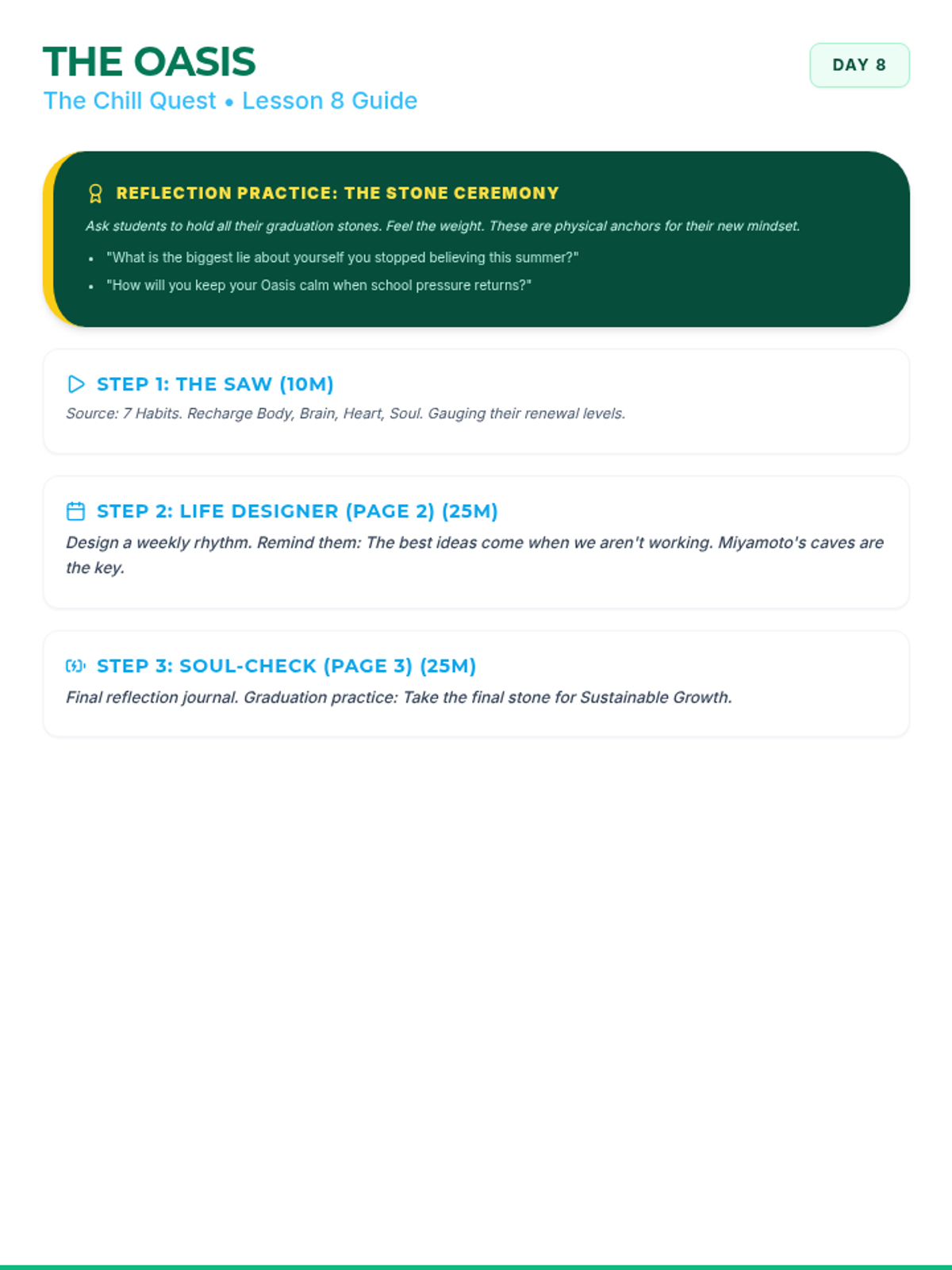
Focusing on self-care, renewal, and reflecting on the summer journey. Includes Page 3: The Life Designer for post-quest planning. Revised for a bright summer aesthetic using light green, sky blue, and yellow. Added facilitator details and student clues. Enhanced self-reflection with "Vision Anchor" and "Reflection Navigator" checks. Replaced "ritual" with "practice." Added graduation stones ritual details. Added source materials and student clues.
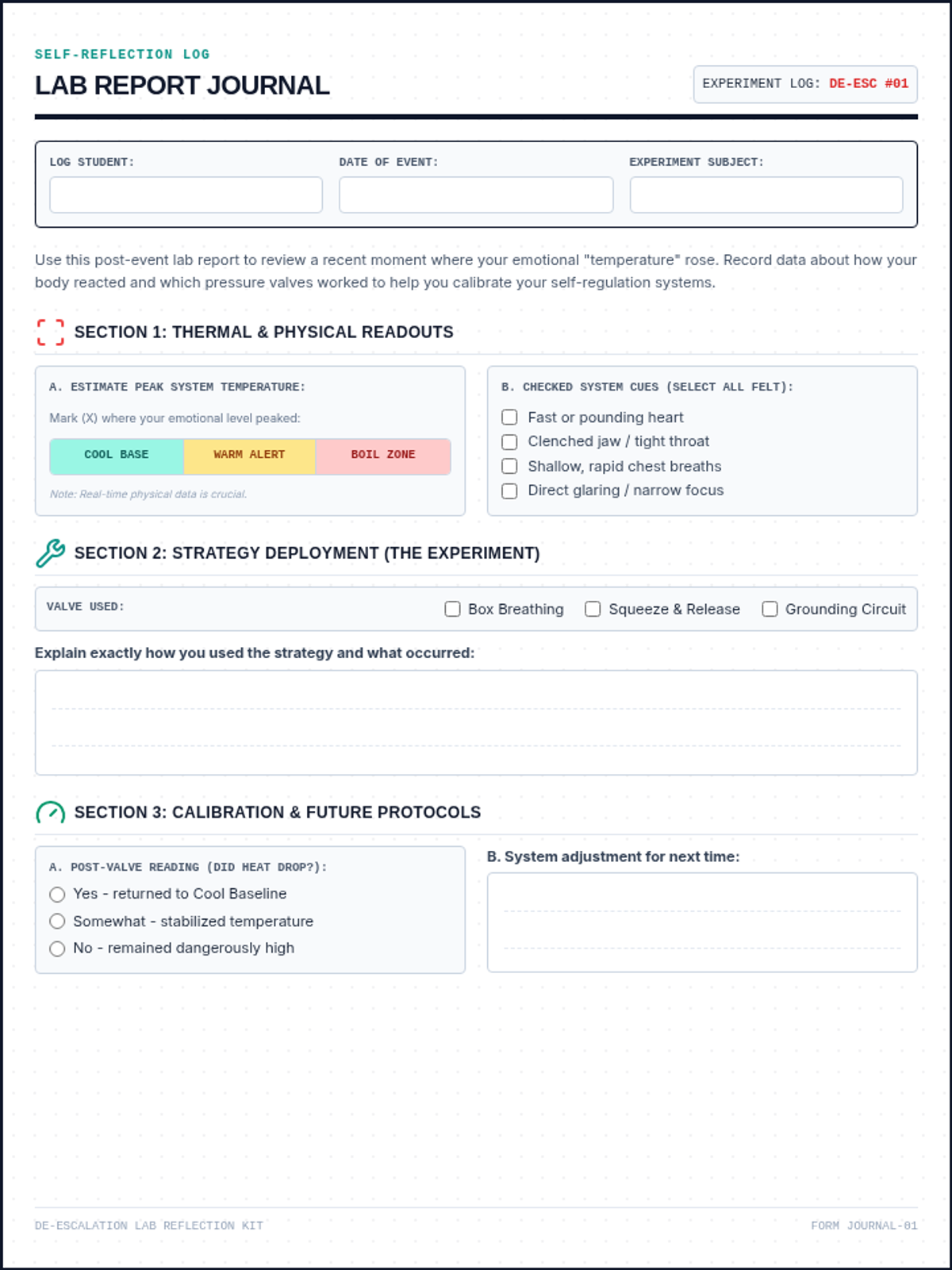
A structured reflection journal page for students styled like a lab report. It lets students document an emotional incident, checklist their warning symptoms, track their strategy test, and calibrate for future thermal stress.
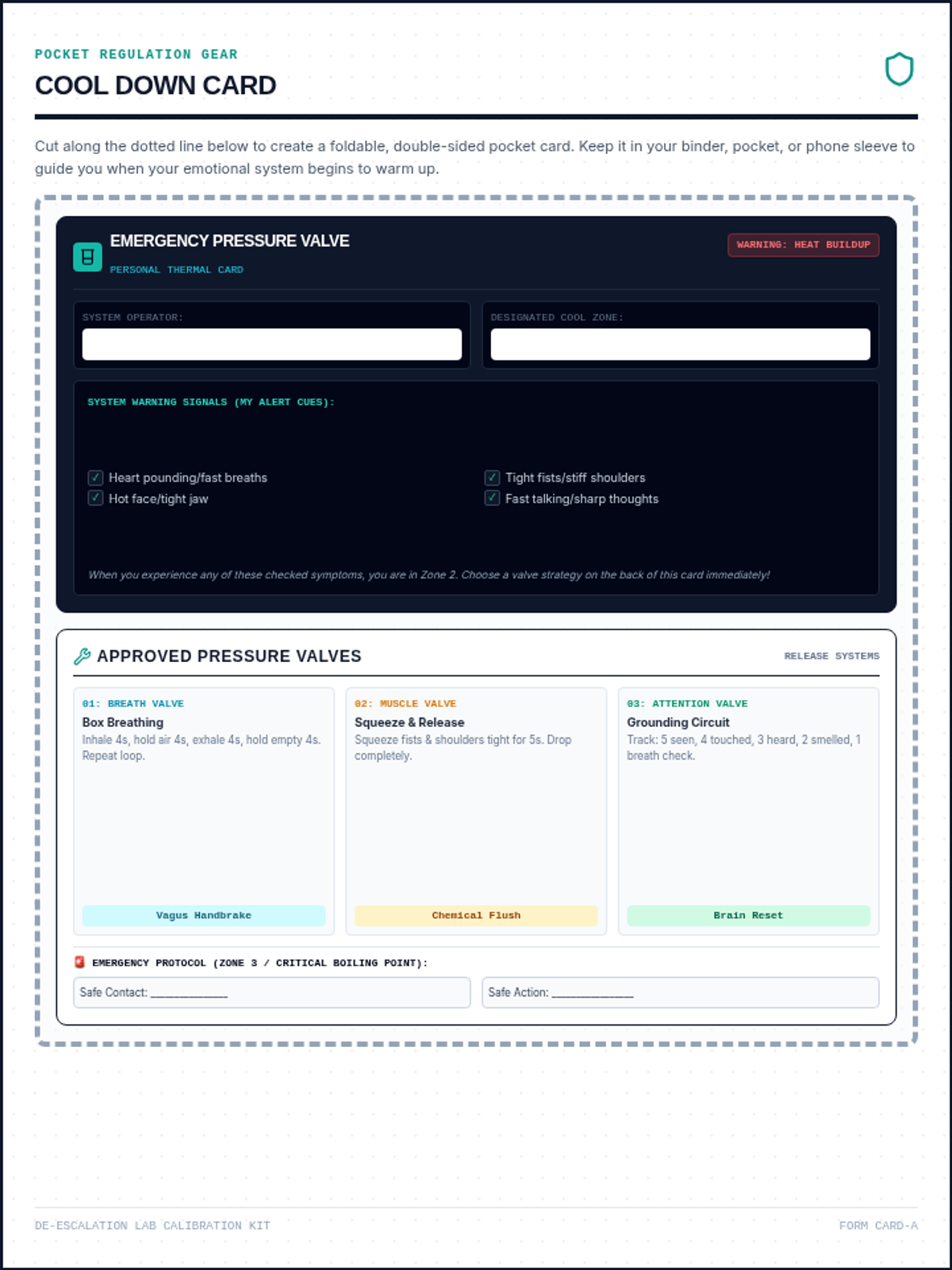
A printable, pocket-sized folding reference card for students. It lists their identified warning signs and provides visual step-by-step instructions for the three primary de-escalation pressure valves.
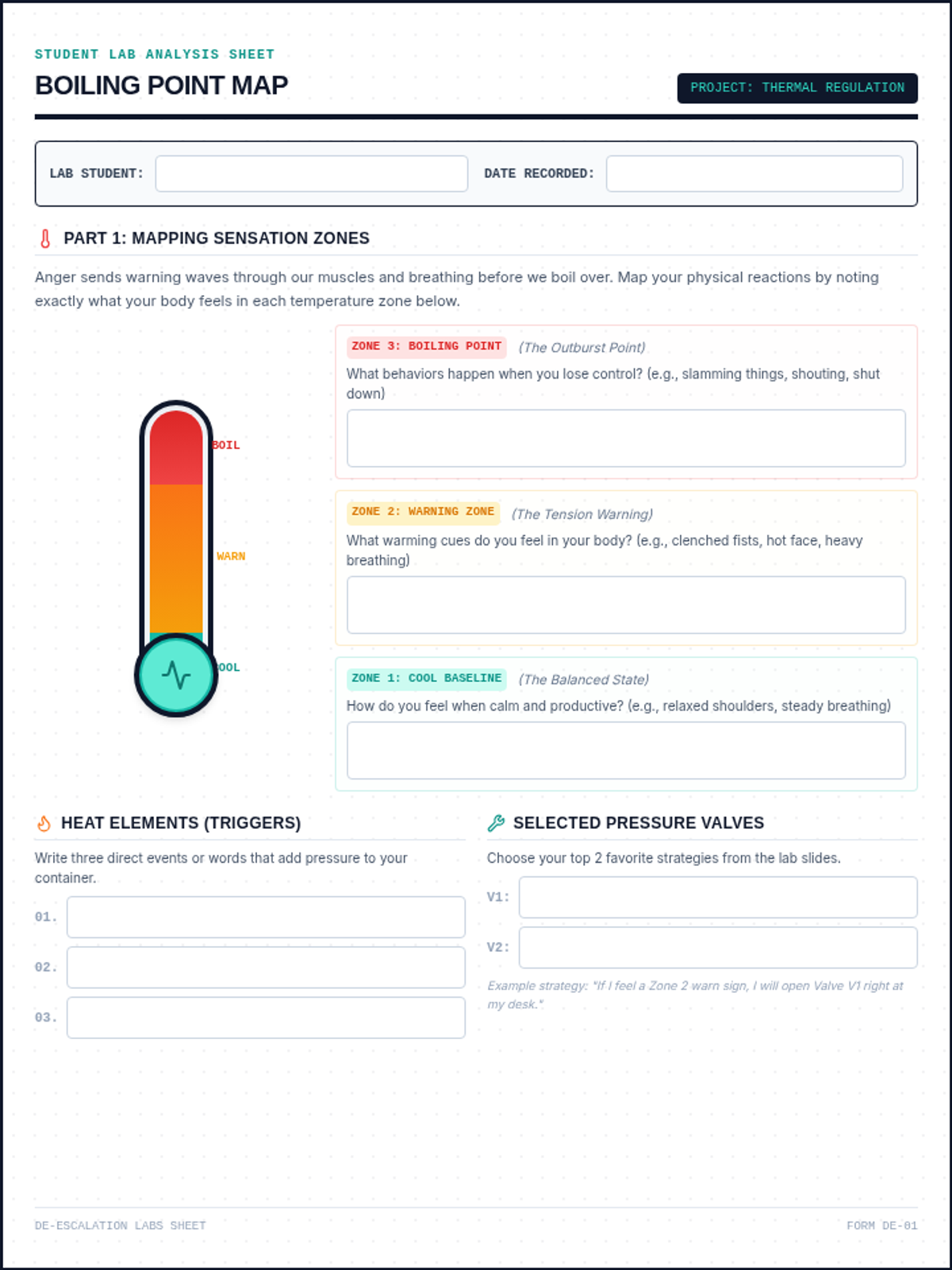
An interactive student-facing worksheet styled as a lab data sheet. Students map their personal physical cues of anger onto a 'human thermometer' graphic and identify specific thermal triggers and chosen 'pressure valve' strategies.
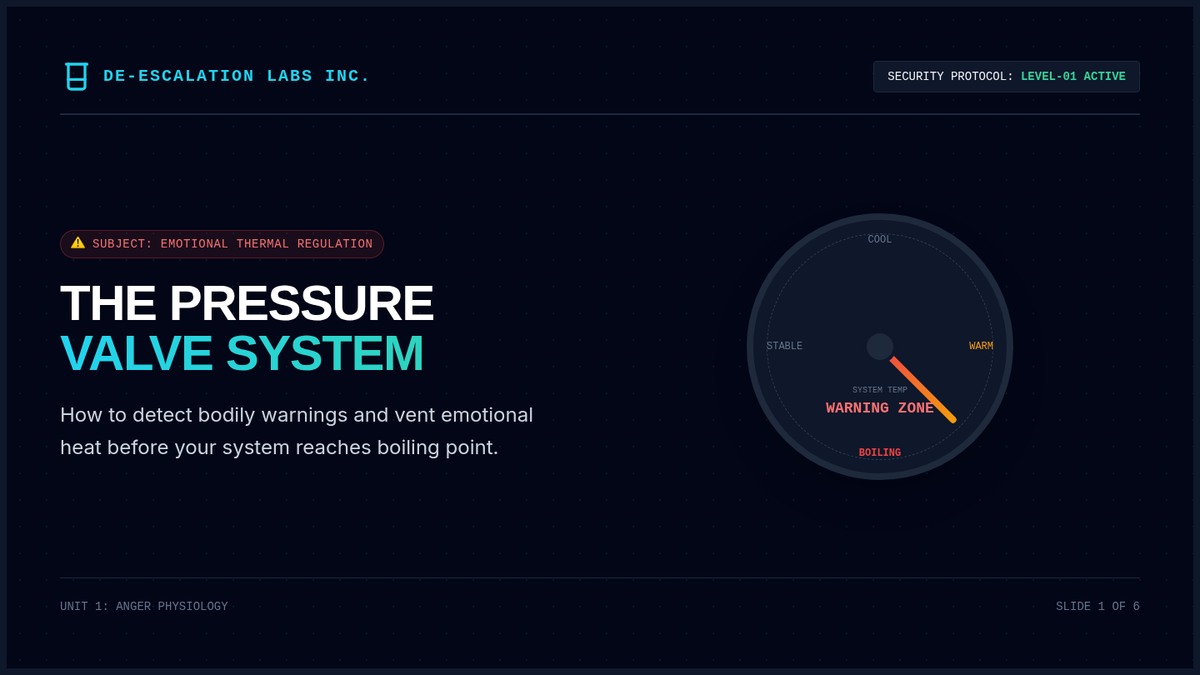
An engaging, highly visual 16:9 slide deck for presenting anger physiology and 'pressure valve' de-escalation strategies to middle schoolers. It explains emotional thermodynamics, system warnings, and outlines three distinct calming protocols.
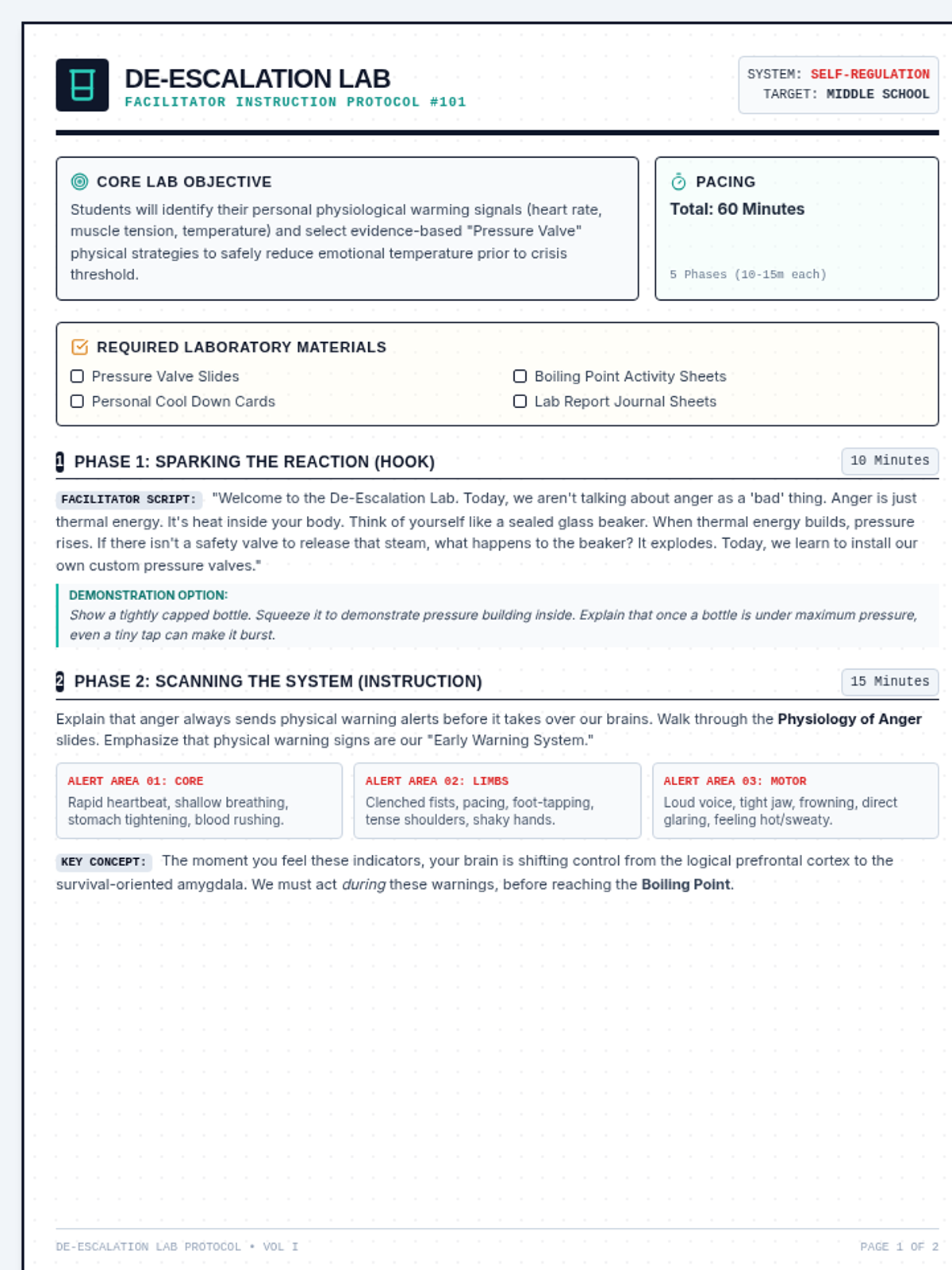
A comprehensive, laboratory-themed lesson plan and facilitator guide for behavior interventionists. It outlines the lesson flow, teacher scripts, physical exercises, and clinical best practices for helping middle schoolers manage emotional temperature.
A deeper, 2-page behavior reflection worksheet containing an extensive series of questions on triggers, physical signals, perspective-taking, tool selections, and collaborative support agreements.
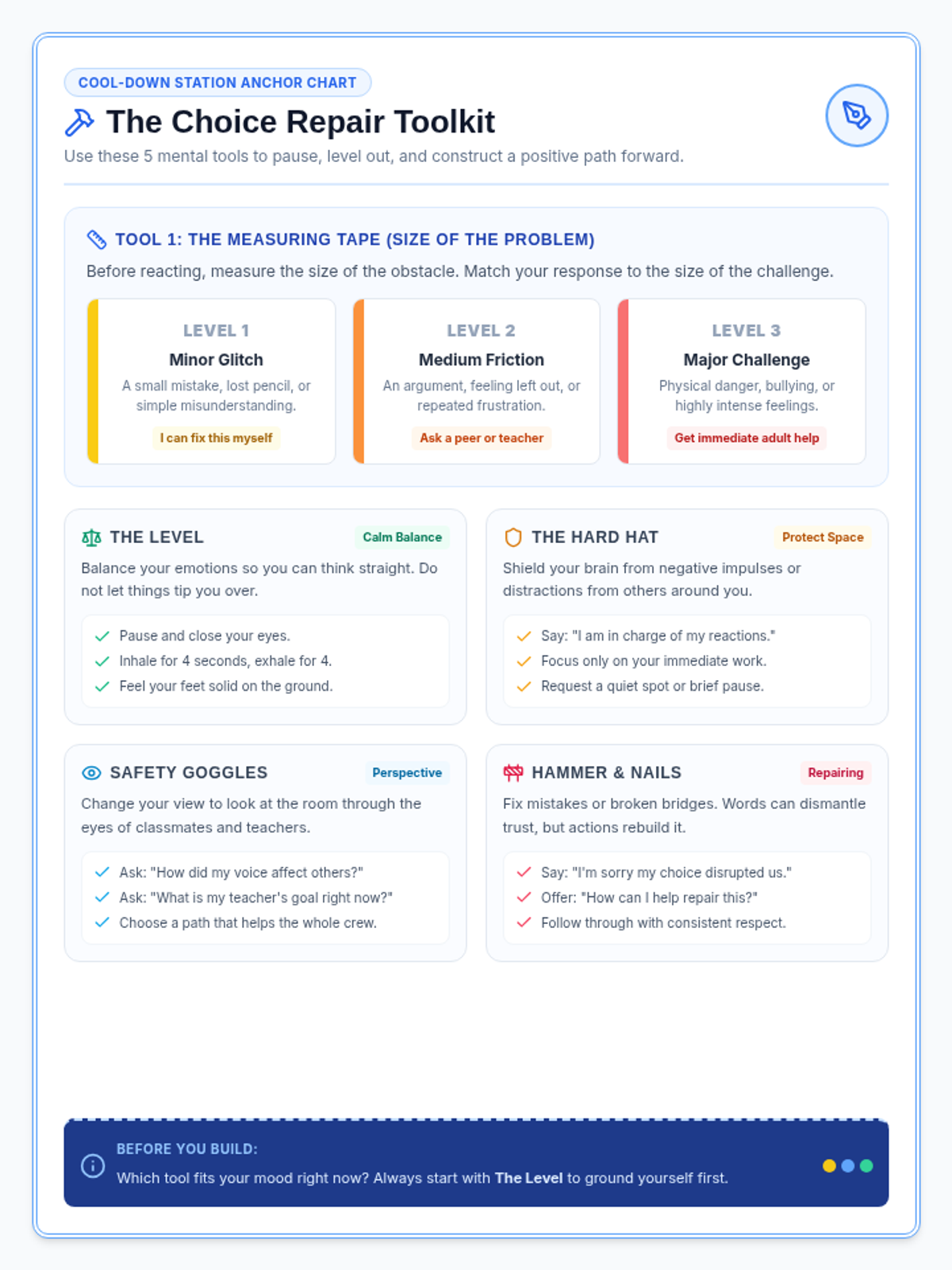
An engaging, architect-themed behavior support reference guide (anchor chart) that equips students with 5 practical calming and behavioral repair tools to handle frustration, disruption, and disrespect.
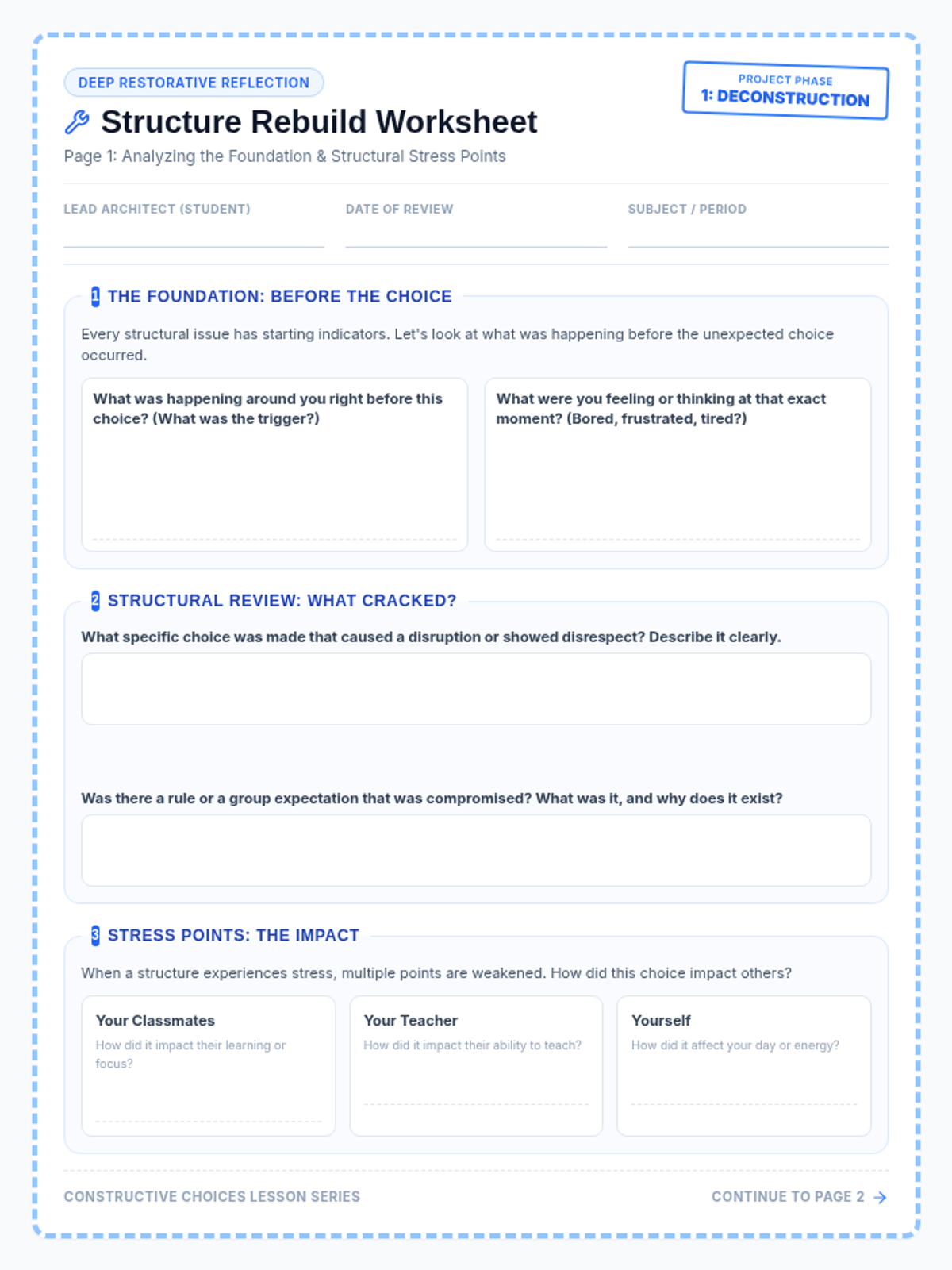
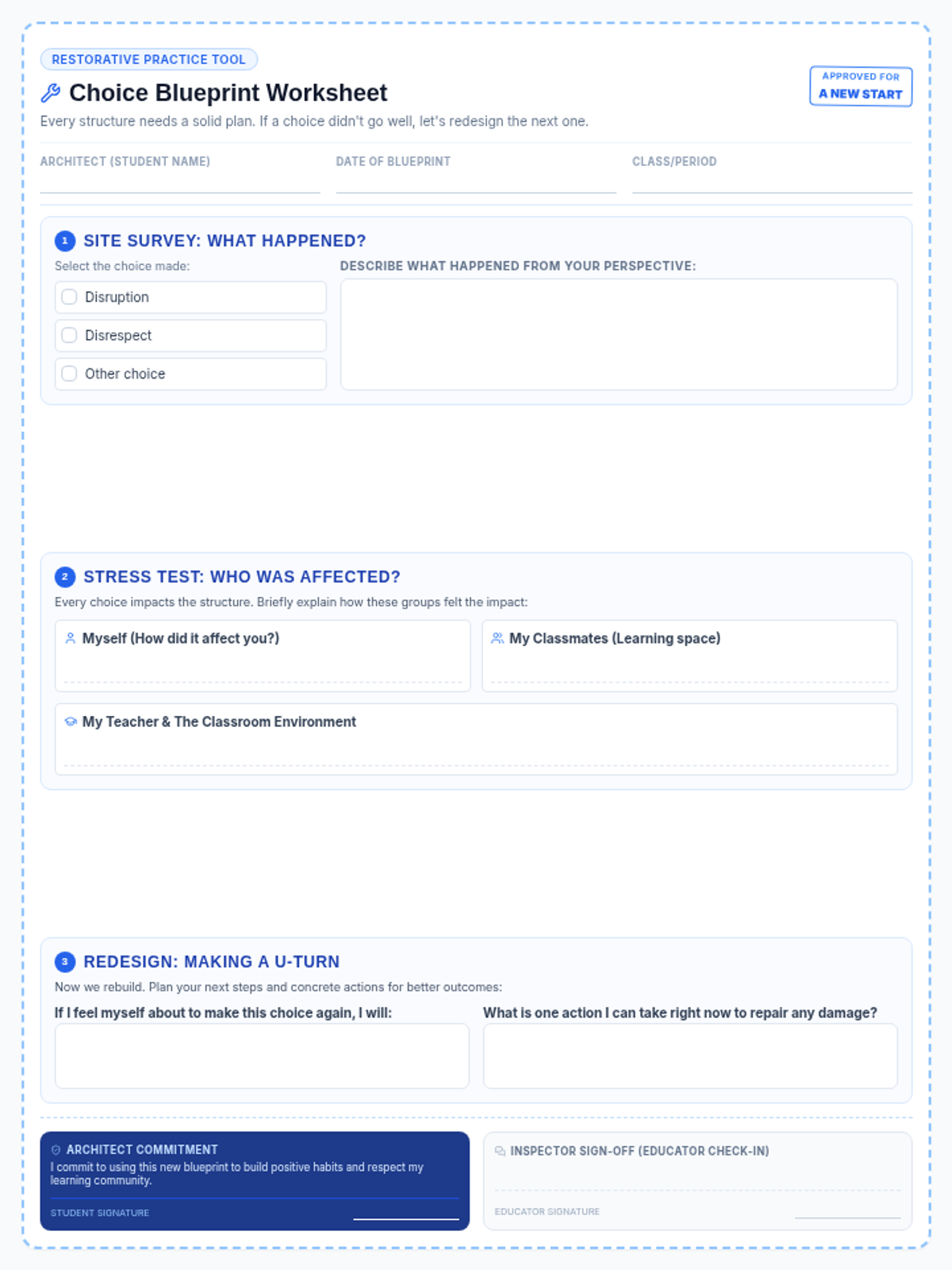
An architect-themed restorative reflection worksheet for students to process disruptive or disrespectful choices and design a blueprint for better decisions next time.
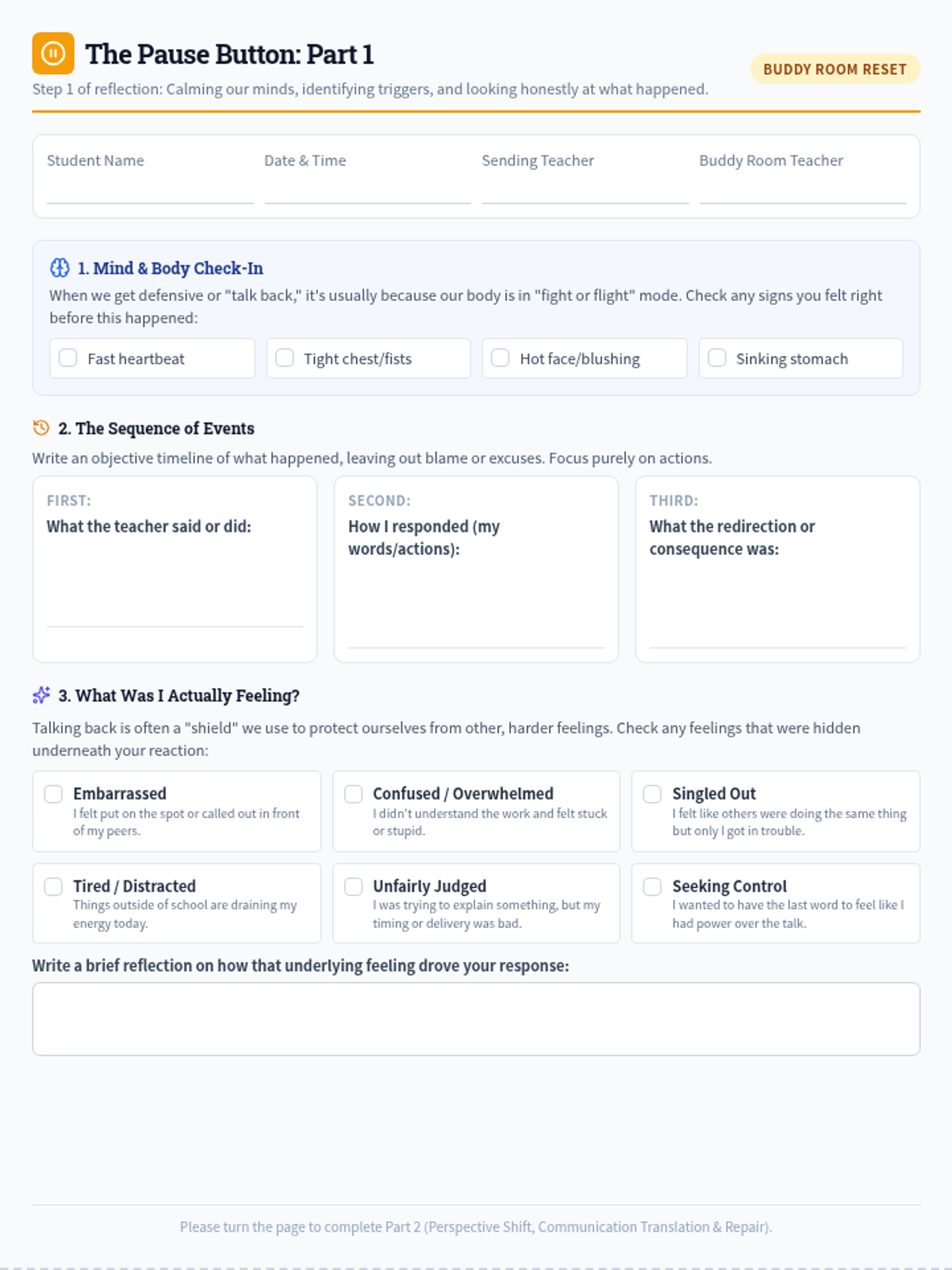
An expanded two-page restorative reflection workbook for students in a buddy room due to disrespectful language or talking back. It guides students through somatic cooling-off, objective timeline sequencing, uncovering underlying feelings (embarrassment, overwhelm, singling out), perspective shifting, translating statements into respectful communication, and drafting a concrete re-entry repair plan.
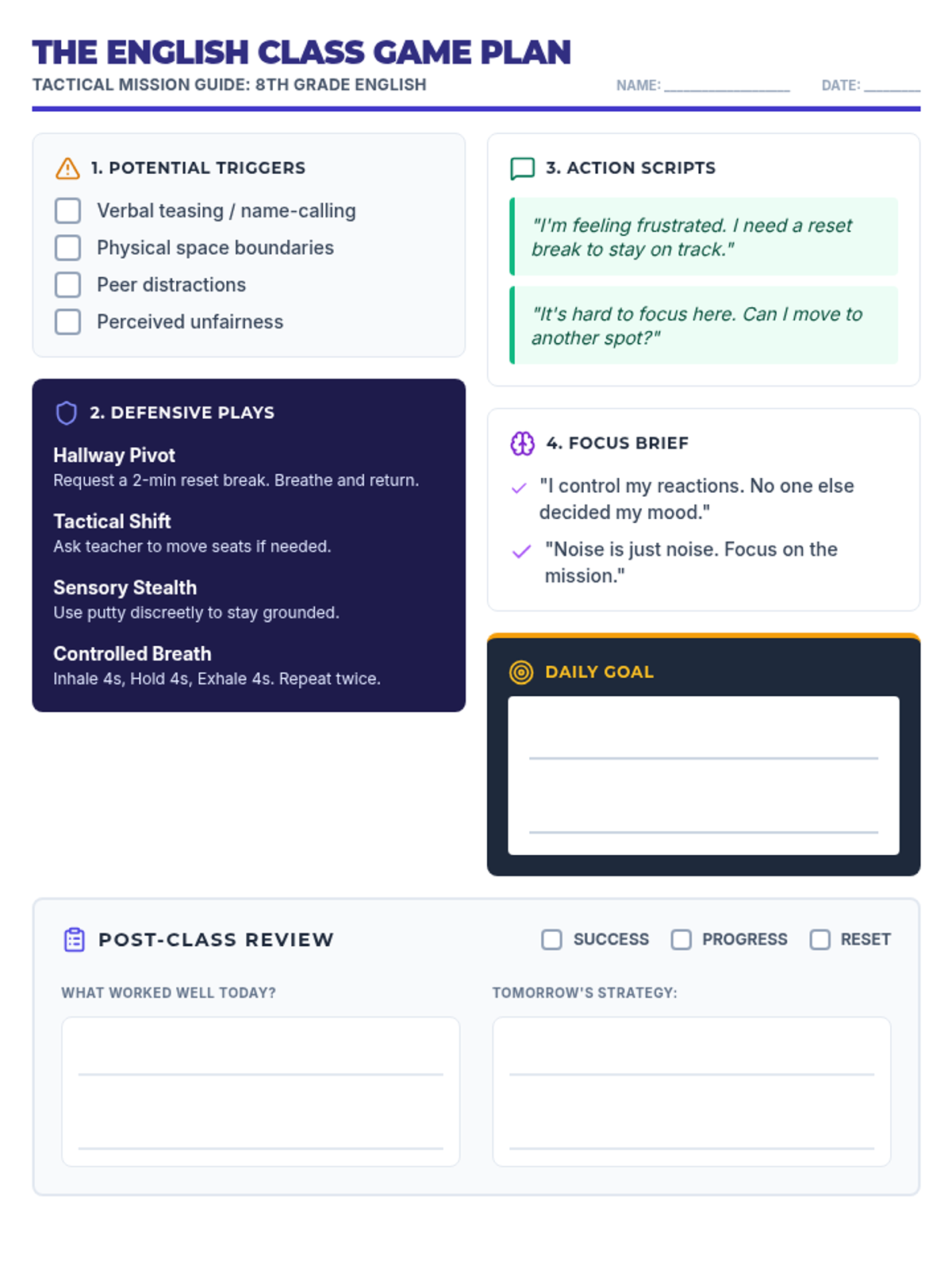
A tactical-themed behavior management handout for middle school students to plan and track their coping strategies during English class, updated with breathing exercises and putty-focused sensory tools.
A Dojo-themed slide deck with a natural parchment and wood aesthetic. It features three mission-based scenarios including a science experiment logic challenge, and specific 'Quiet Shield' tools to teach self-control to high-achieving students.
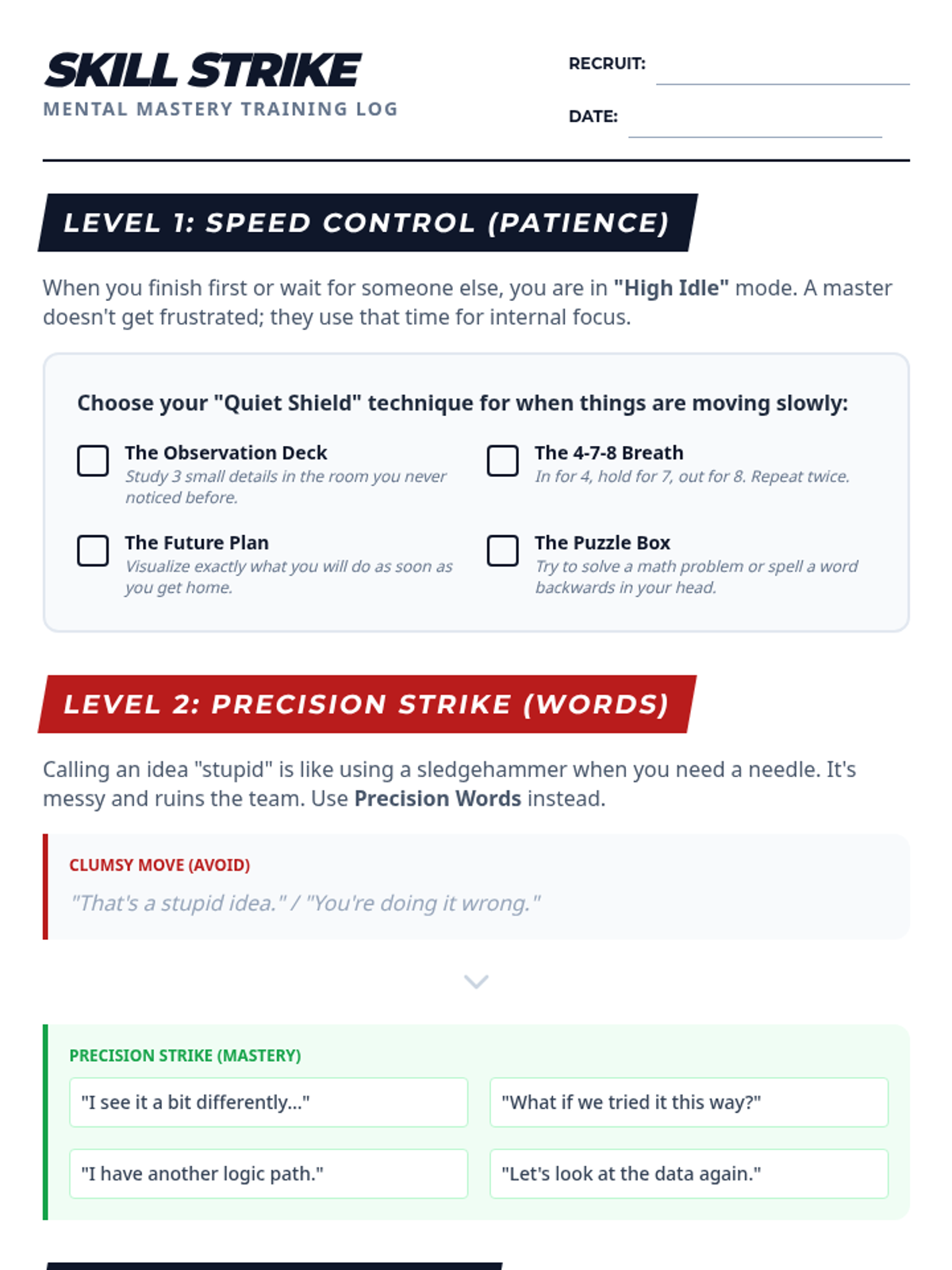
A Dojo-themed student worksheet on parchment-colored background, including three 'Mission' scenarios including a science experiment logic challenge, a tool selection area, and a large commitment space for self-mastery goals.
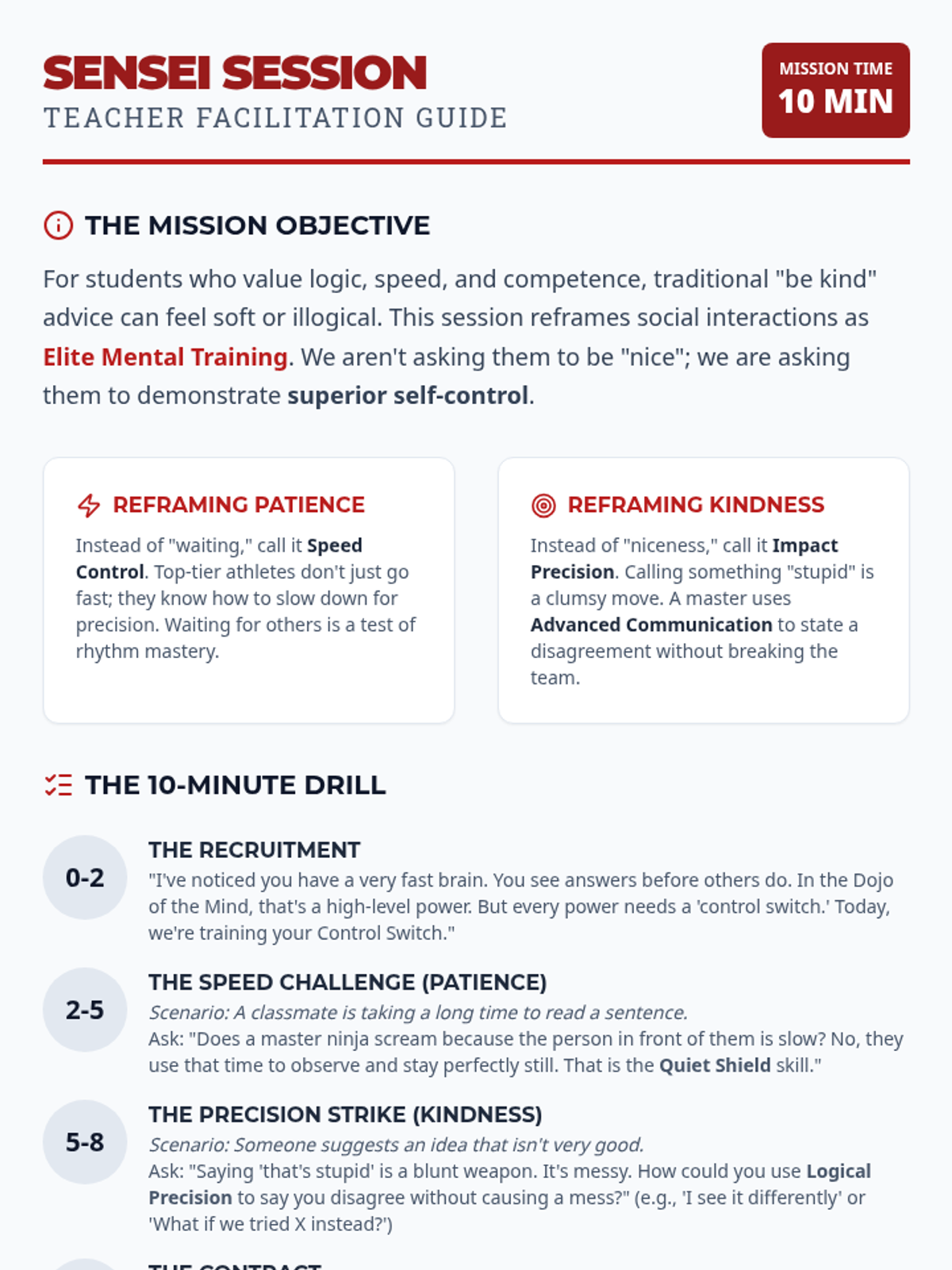
A specialized facilitator guide for the Mind Dojo lesson, focusing on high-level language and strategic coaching for students with fast-moving, ego-driven minds.
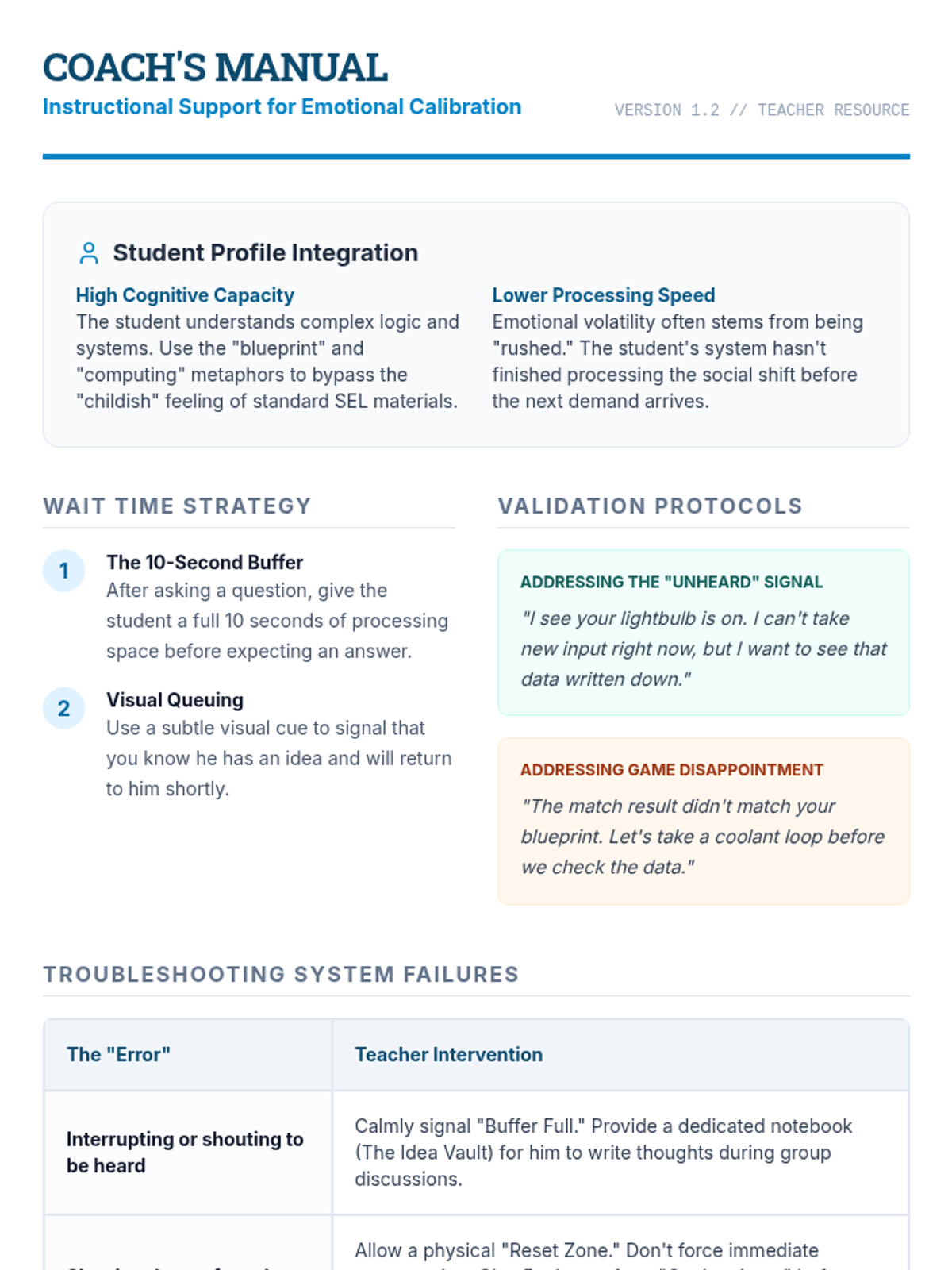
A teacher-facing guide with specific strategies and scripts to support a bright middle schooler with autism and lower processing speed in emotional regulation. Updated with corrected table layout and page-break avoidance.
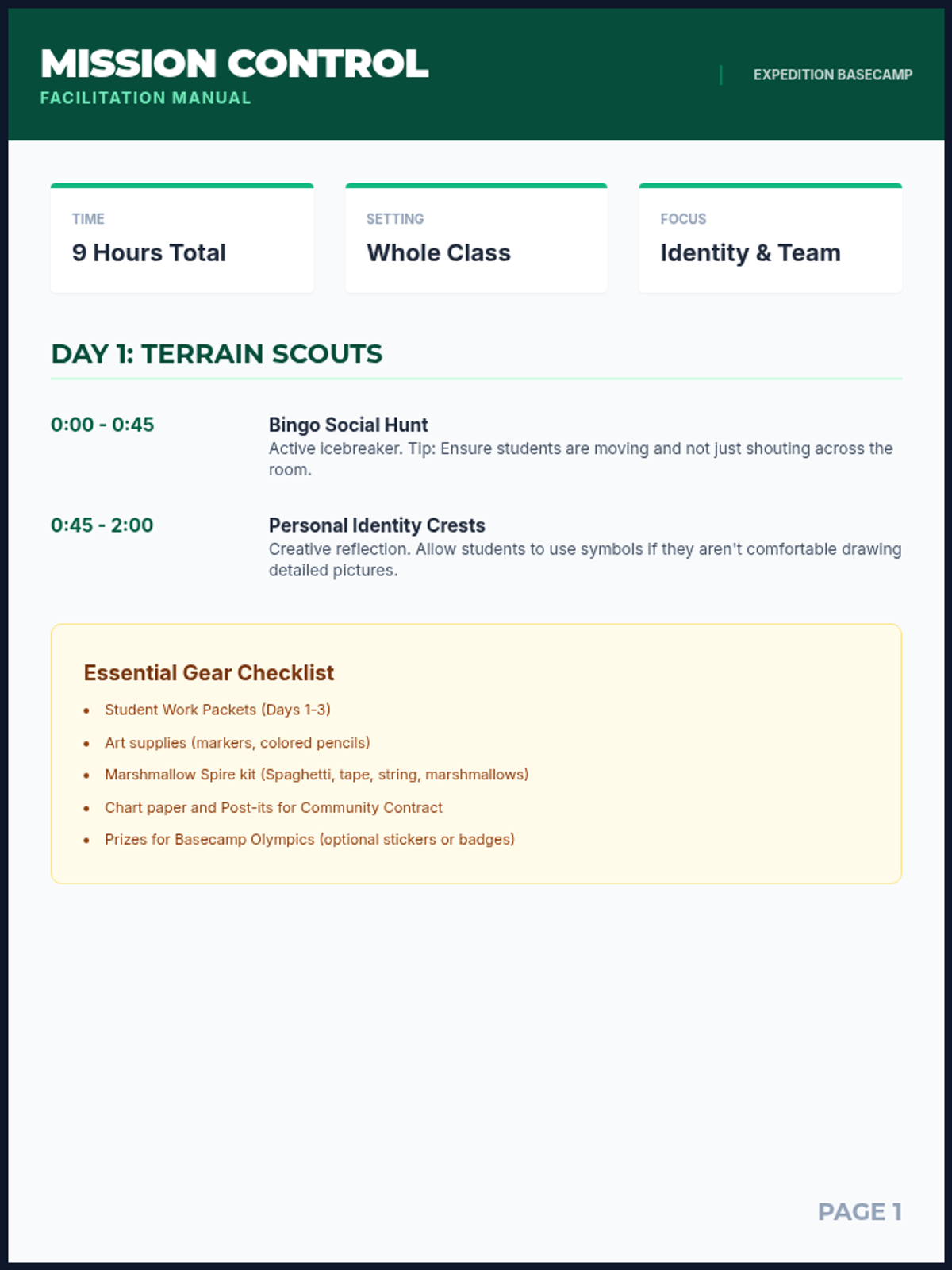
A three-page comprehensive teacher guide for the 'Expedition Basecamp' sequence. Includes revised answer keys with clear solutions and a teacher preparation checklist. Polished for clarity and professionalism.
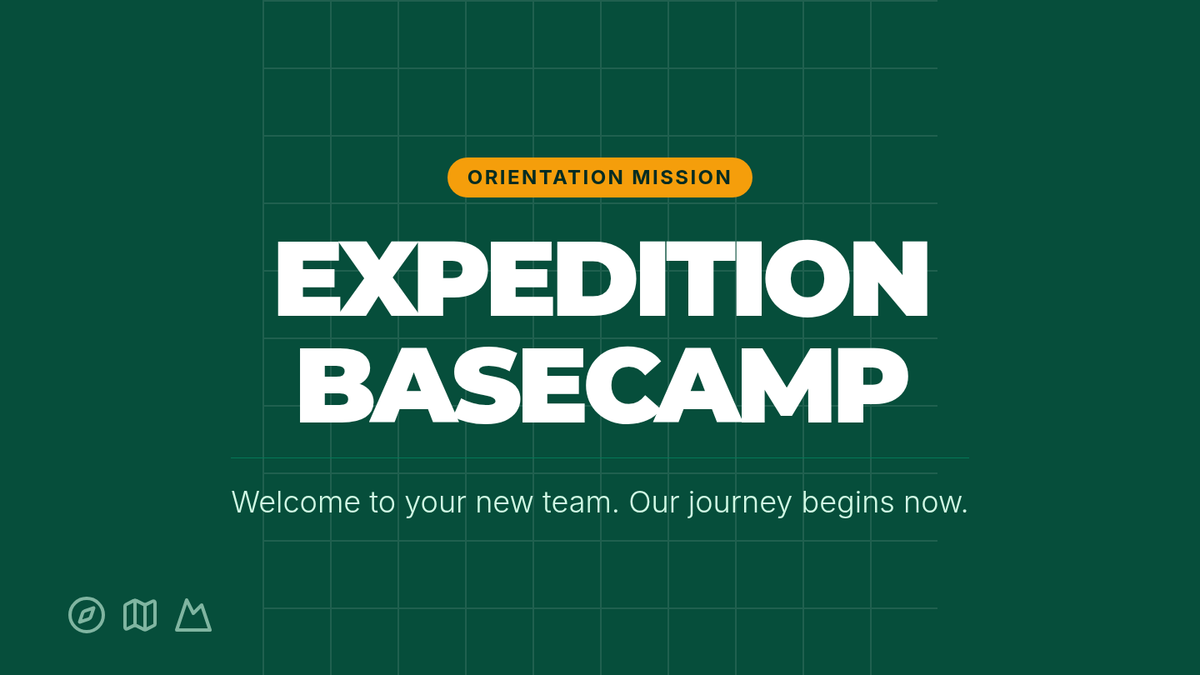
A comprehensive 5-slide presentation deck covering the agenda for the 3-day 'Expedition Basecamp' orientation. Polished visual consistency and icon opacity.
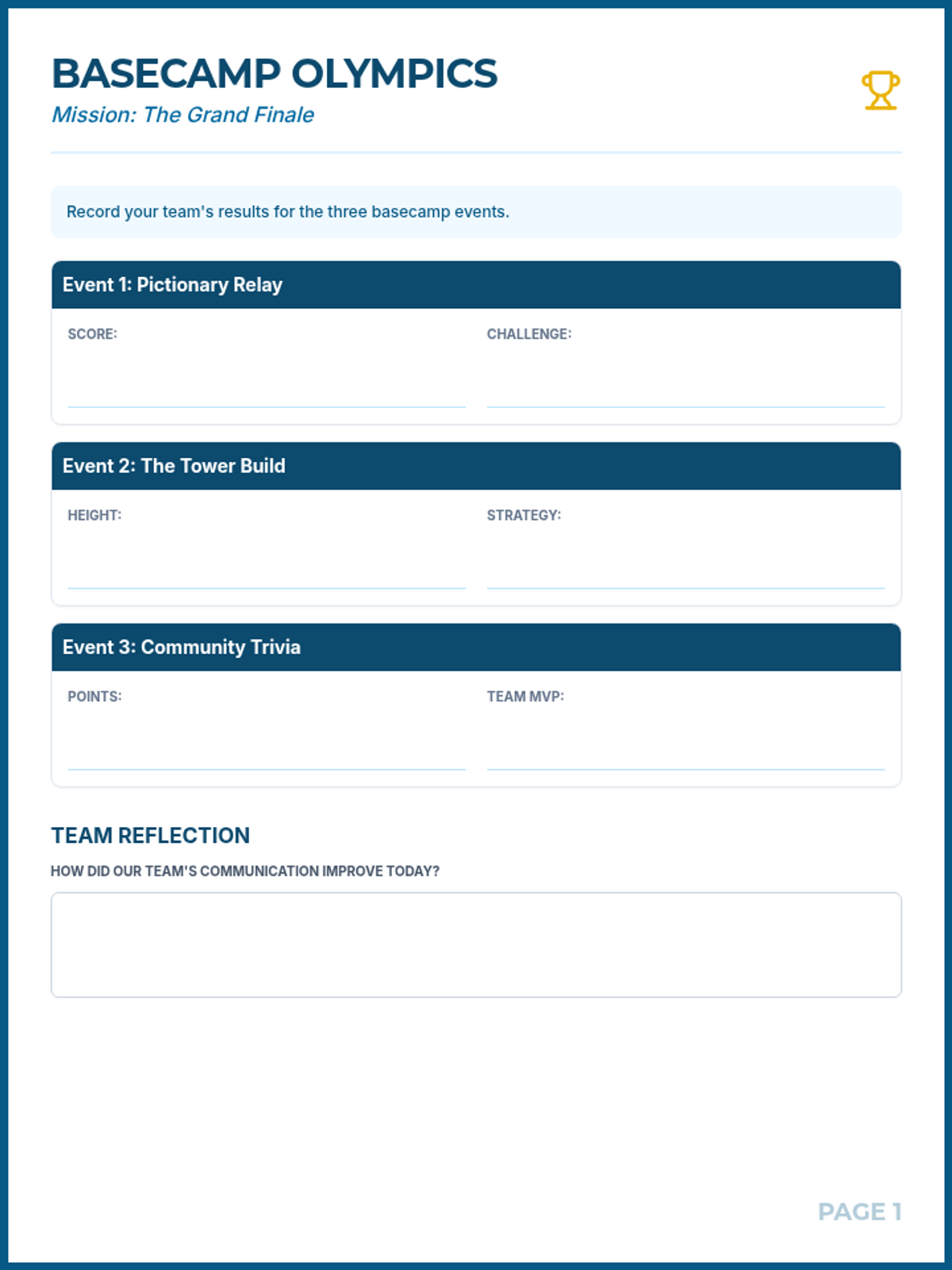
A two-page student packet for Day 3, featuring a 'Basecamp Olympics' scorecard and a 'Letter to My Future Self' reflection activity. Optimized layout and response areas for student use.
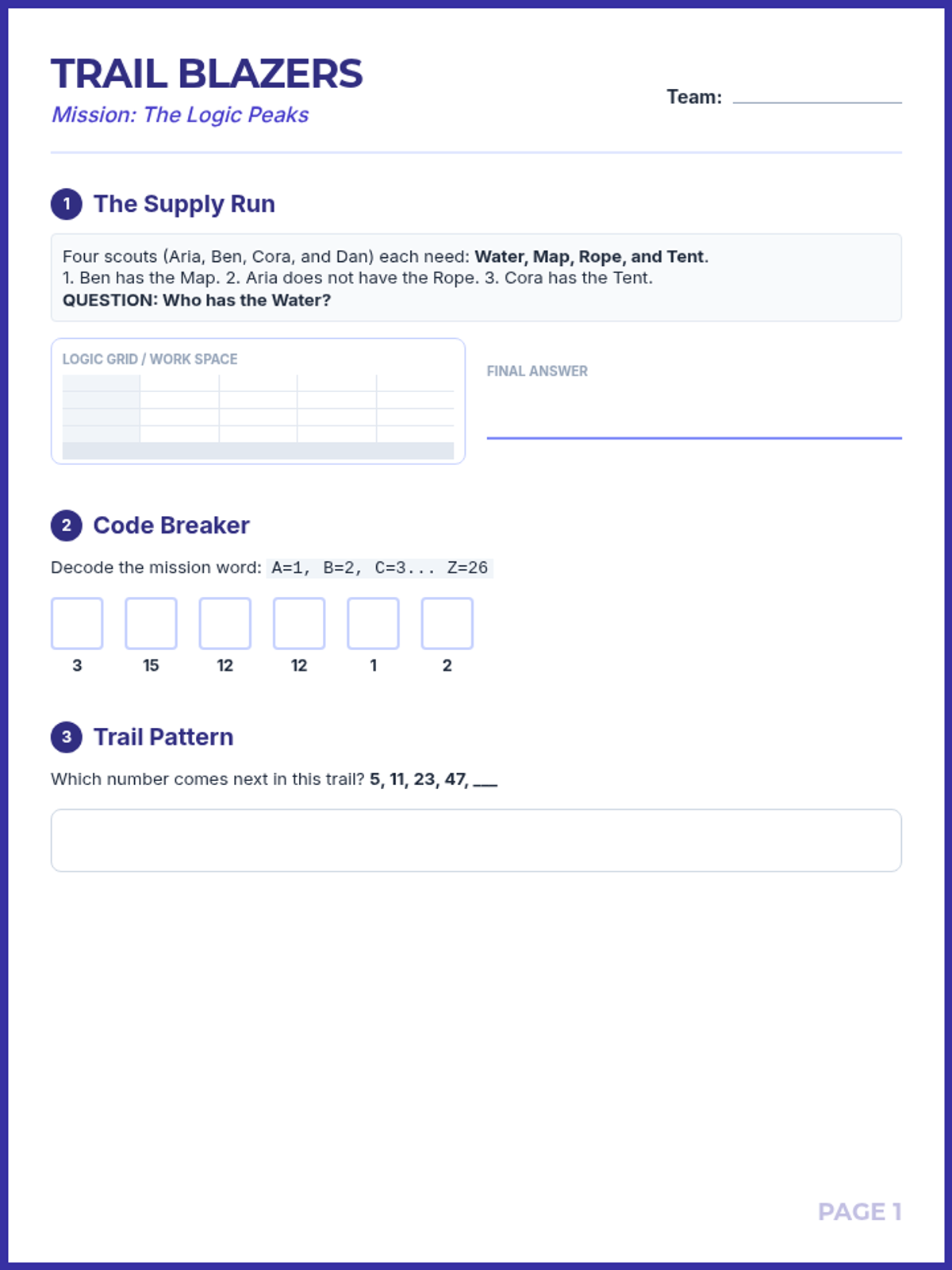
A two-page student packet for Day 2, featuring a 'Logic Peaks' cooperative puzzle challenge and a 'Community Contract' drafting guide. Fixed logic puzzles, improved workspace areas, and optimized layout.
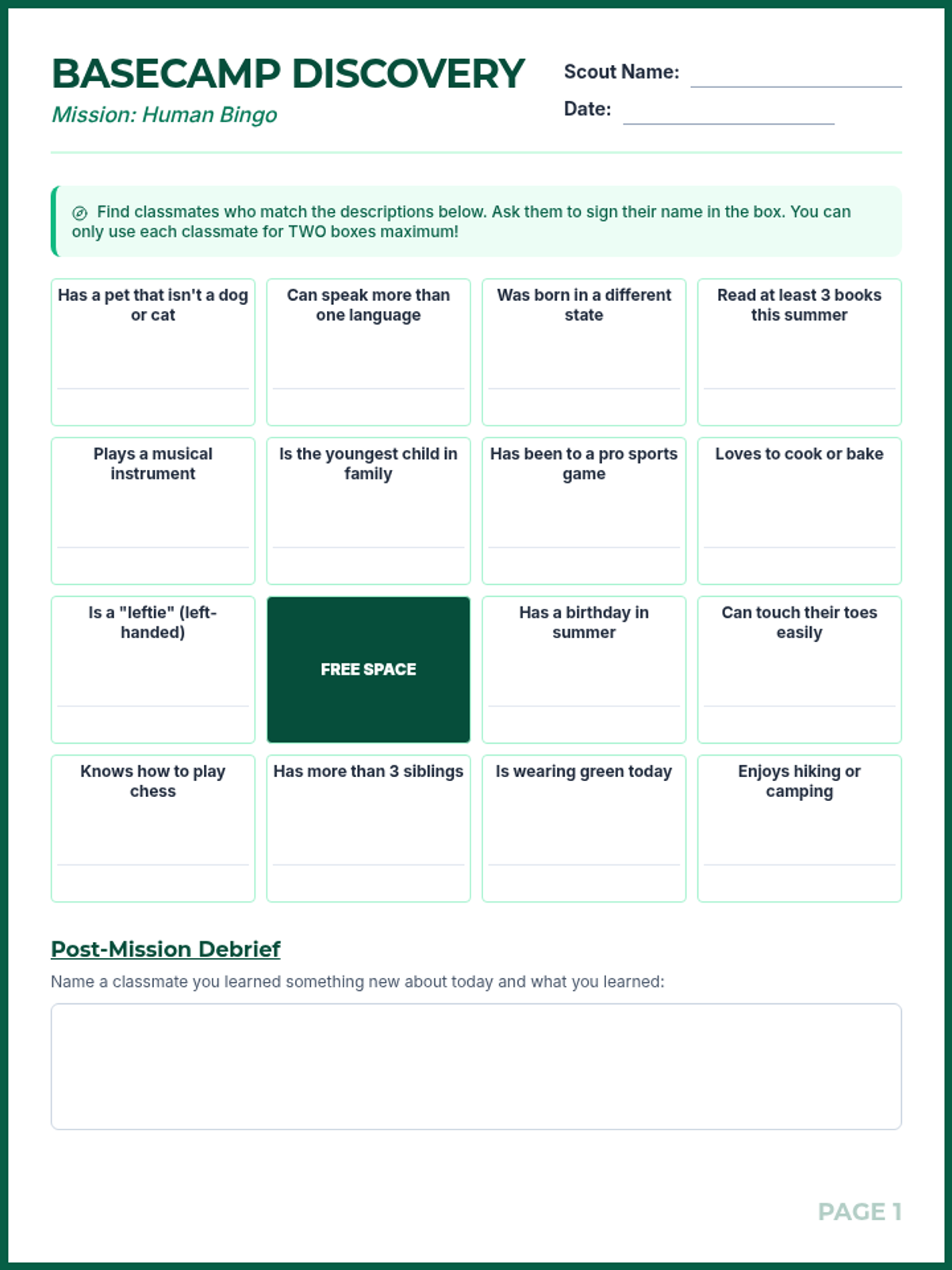
A two-page student packet for Day 1, featuring a 'Human Bingo' icebreaker and a 'Personal Crest' identity project. Fixed layout issues and improved student response areas.
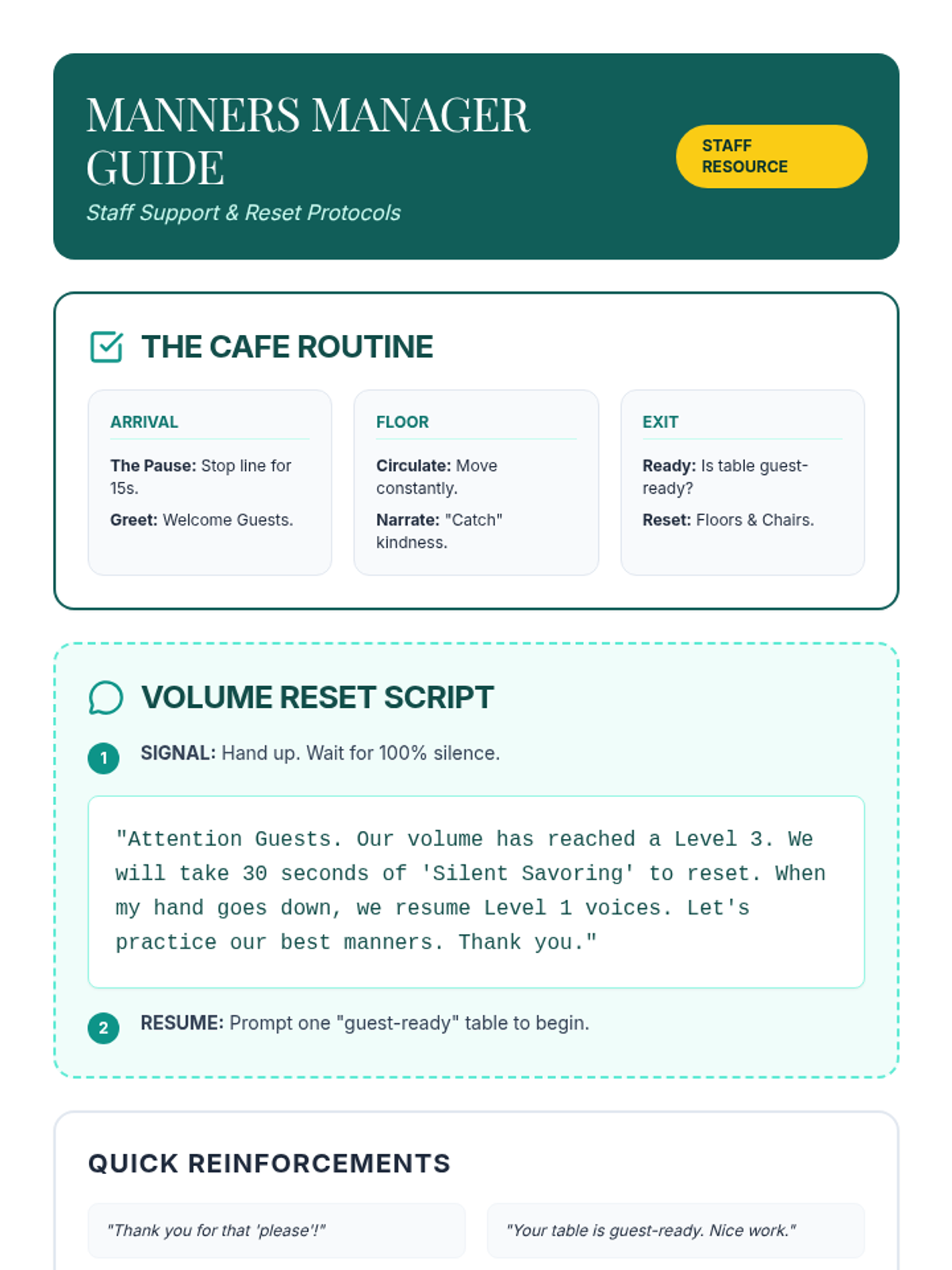
A staff-facing guide providing a routine checklist for lunchroom management and a specific script for resetting noise levels and behavior expectations.
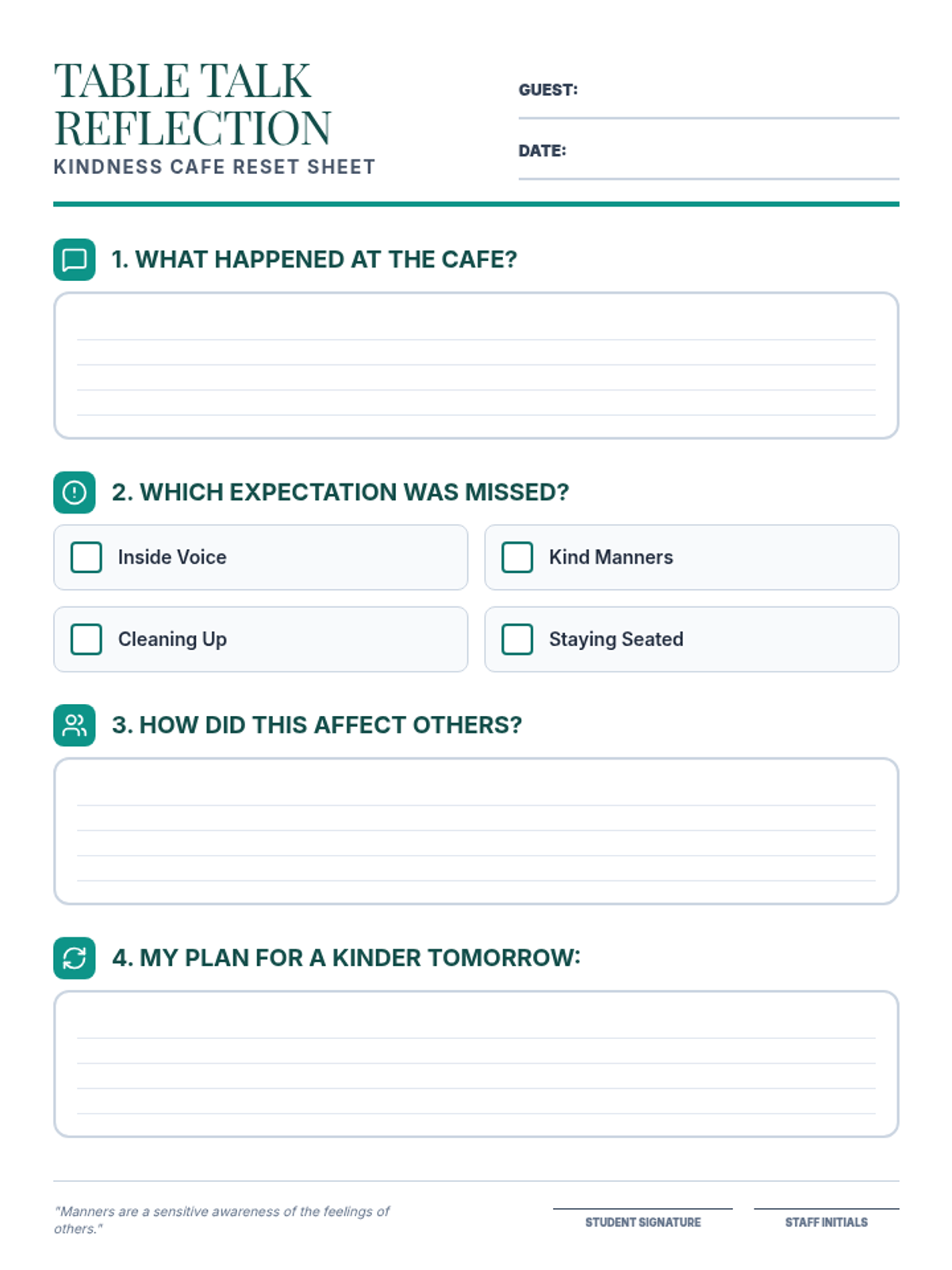
A student-facing reflection sheet designed for use after lunchroom misbehavior, prompting students to think about their impact on others and plan for better social manners.
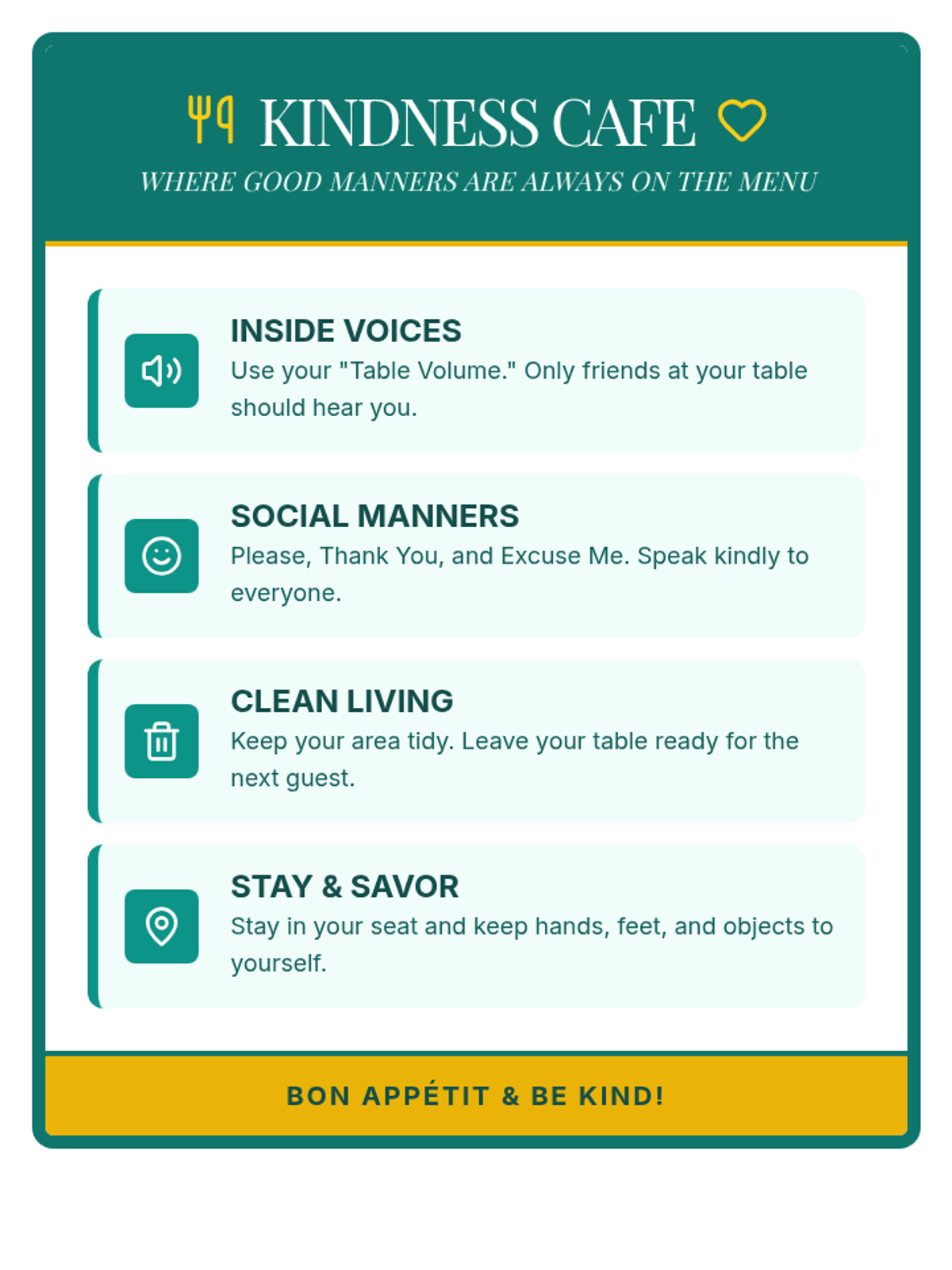
A vibrant, bistro-themed poster outlining the core behavioral expectations for the lunchroom, focusing on noise level, social manners, and cleanliness.
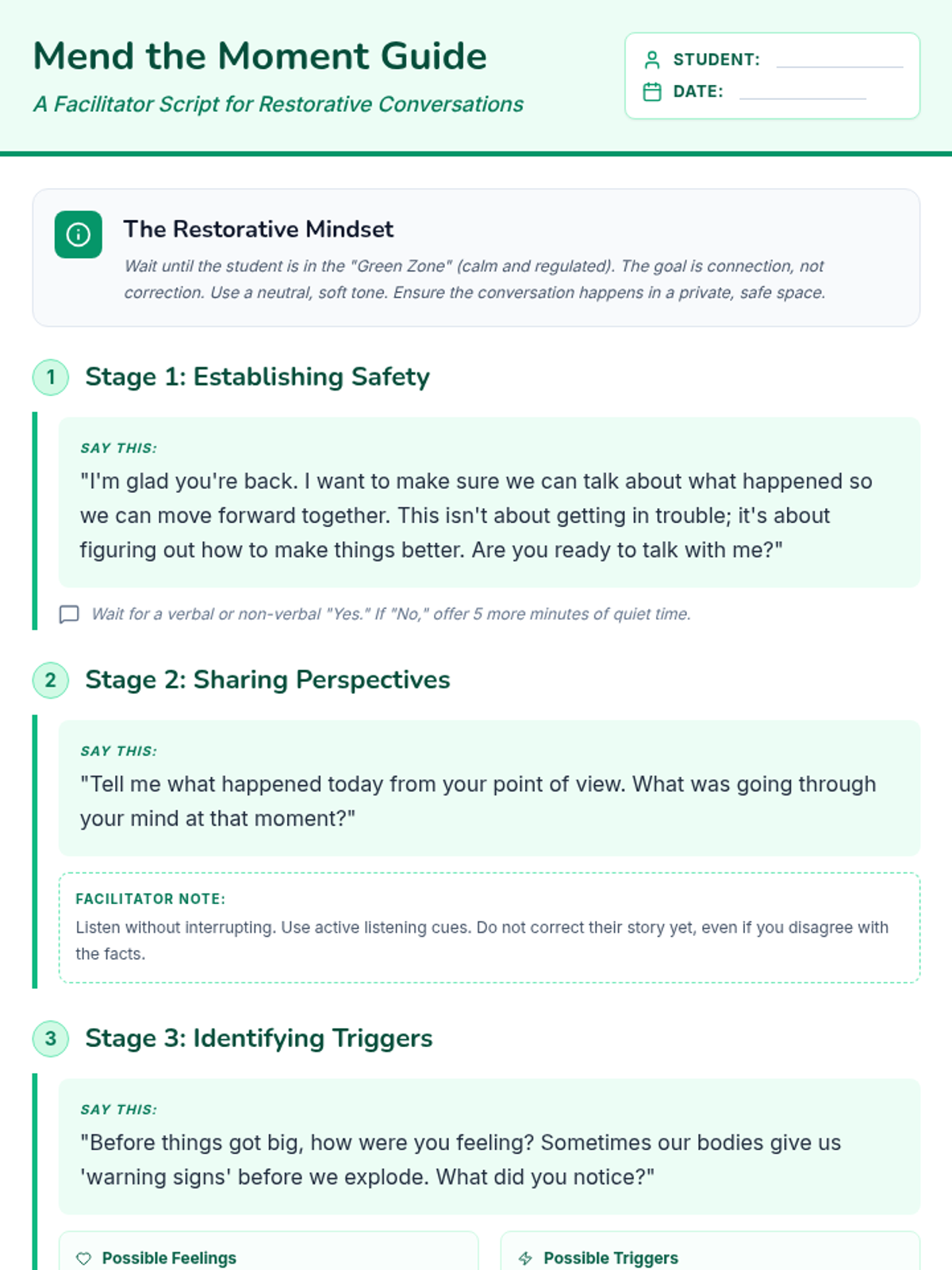
A structured, scripted facilitator guide for teachers to lead restorative conversations after an emotional outburst. It focuses on identifying triggers, validating feelings, and creating a path toward making amends.
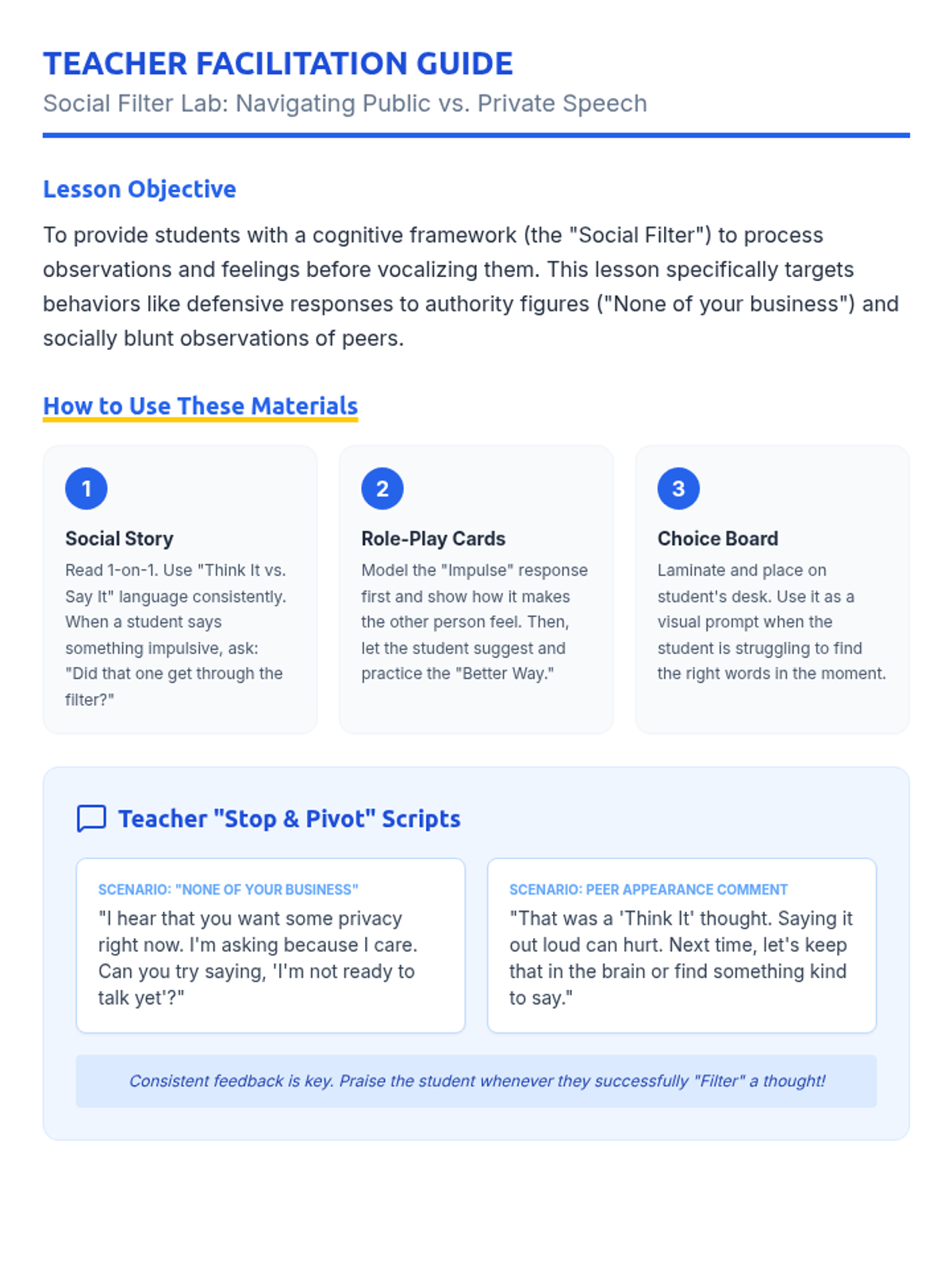
A middle school facilitation guide providing educators with cognitive-behavioral strategies and scripts for implementing social filter concepts with junior high students.
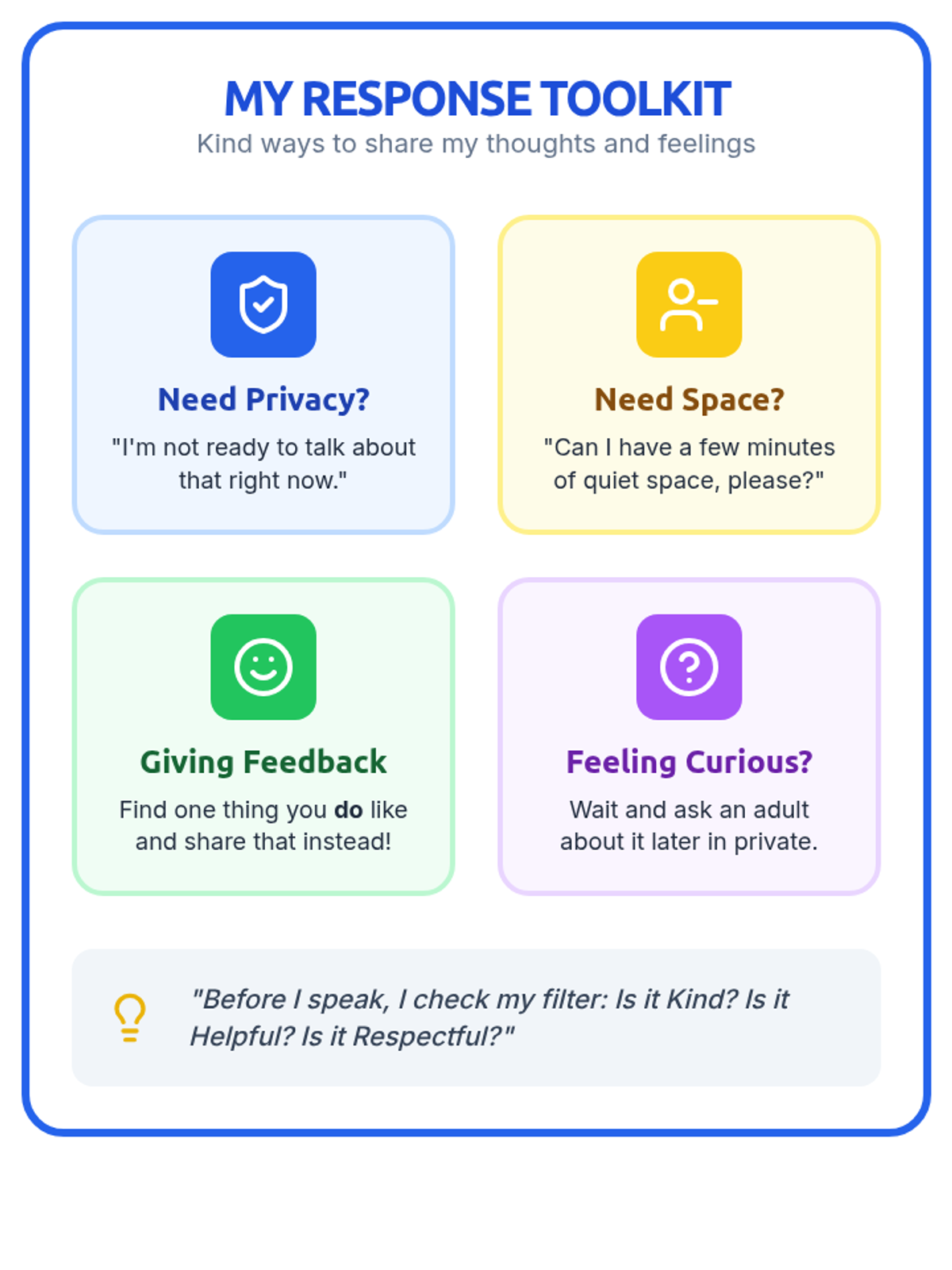
A high-impact visual choice board for junior high students, providing strategic communication scripts and reminders for maintaining professional and social boundaries.
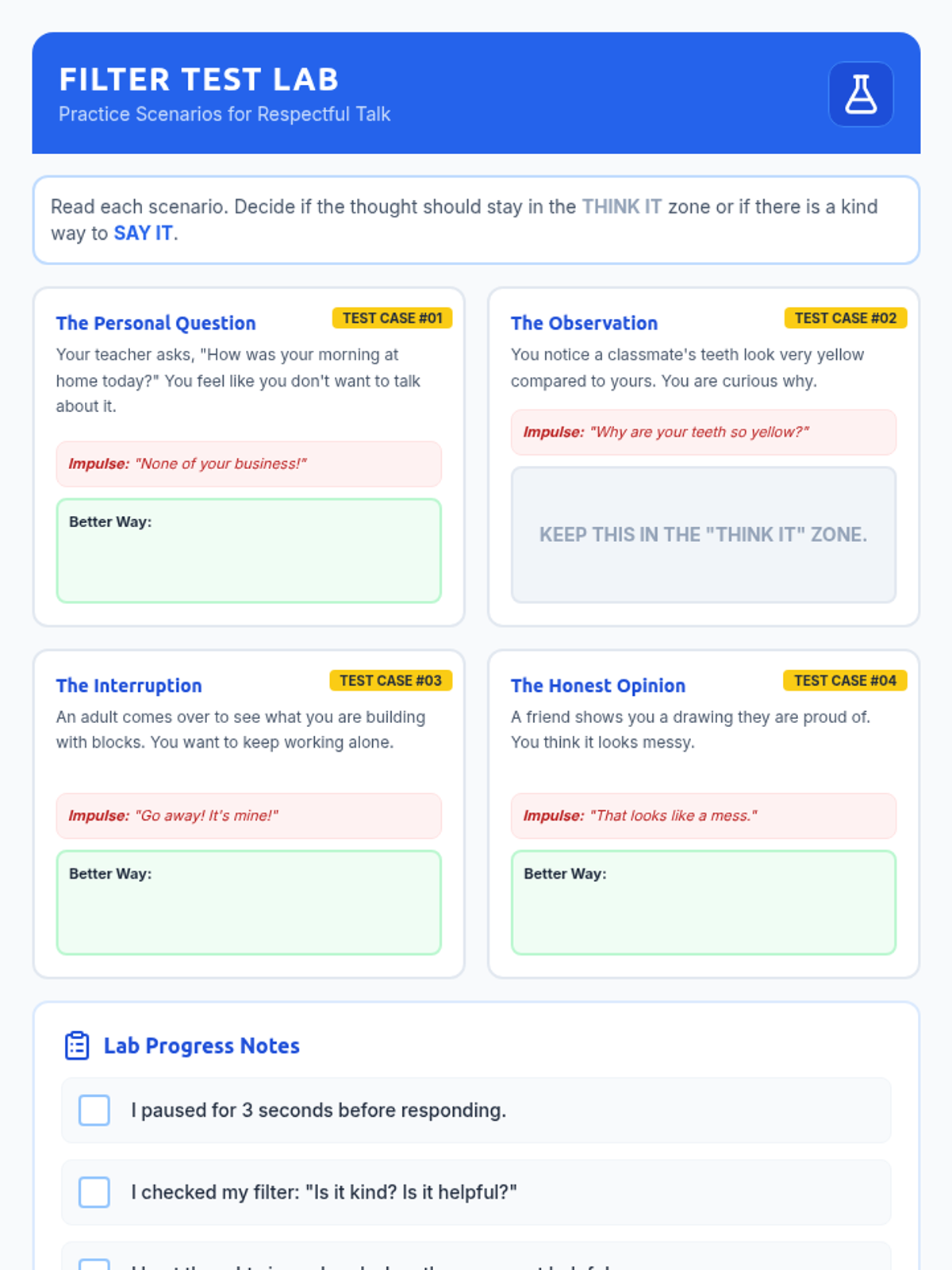
A junior high-appropriate scenario worksheet for practicing social filtering in common middle school situations, with expanded writing space and updated examples.
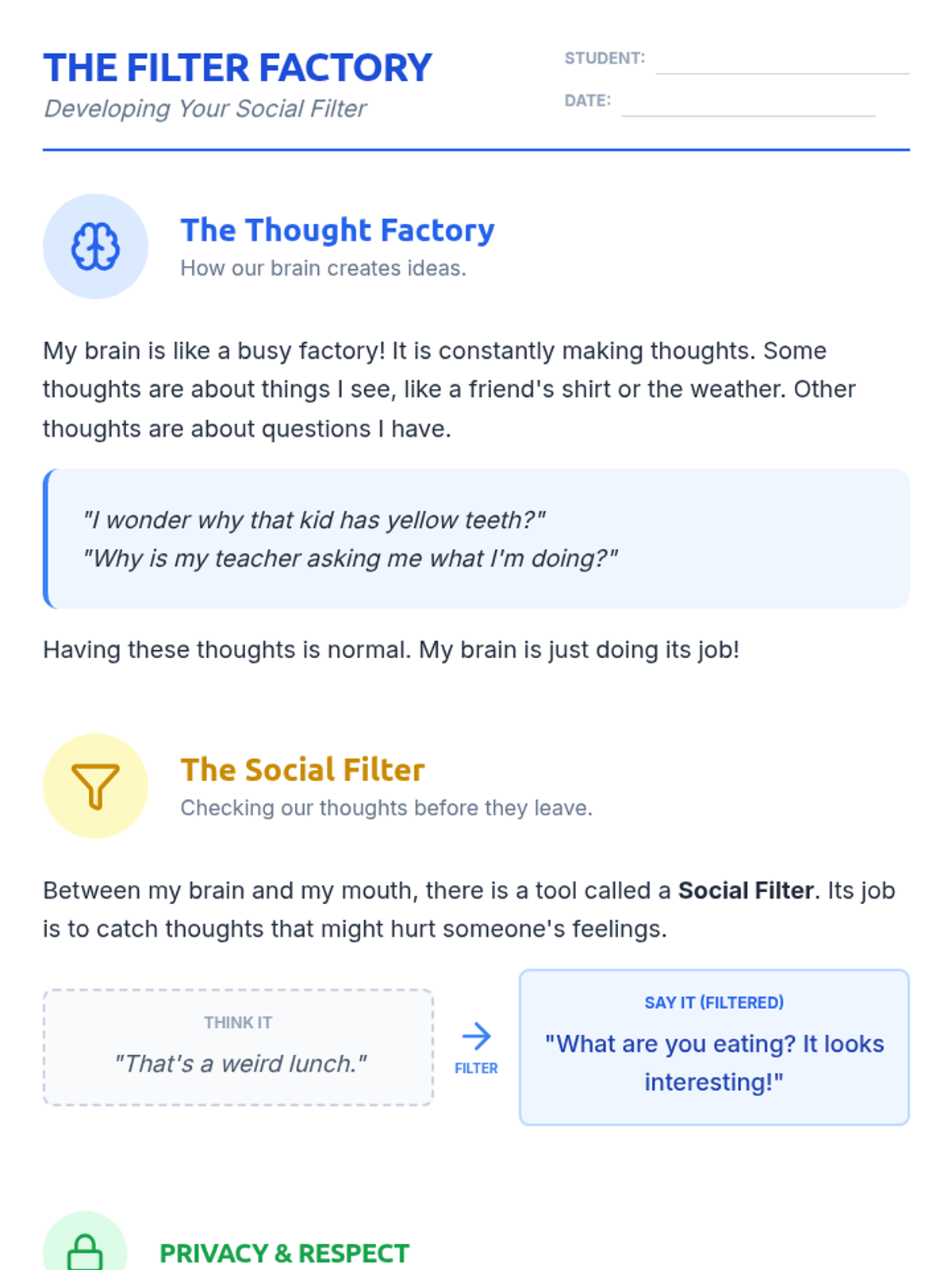
A multi-page social story adapted for junior high students, explaining the 'Social Filter' strategy as a tool for managing reputation and relationships.