Emotion recognition ranging from basic feelings to complex nuances and mixed states. Strengthens accurate self-assessment through identity exploration, strength identification, and values-based decision making.
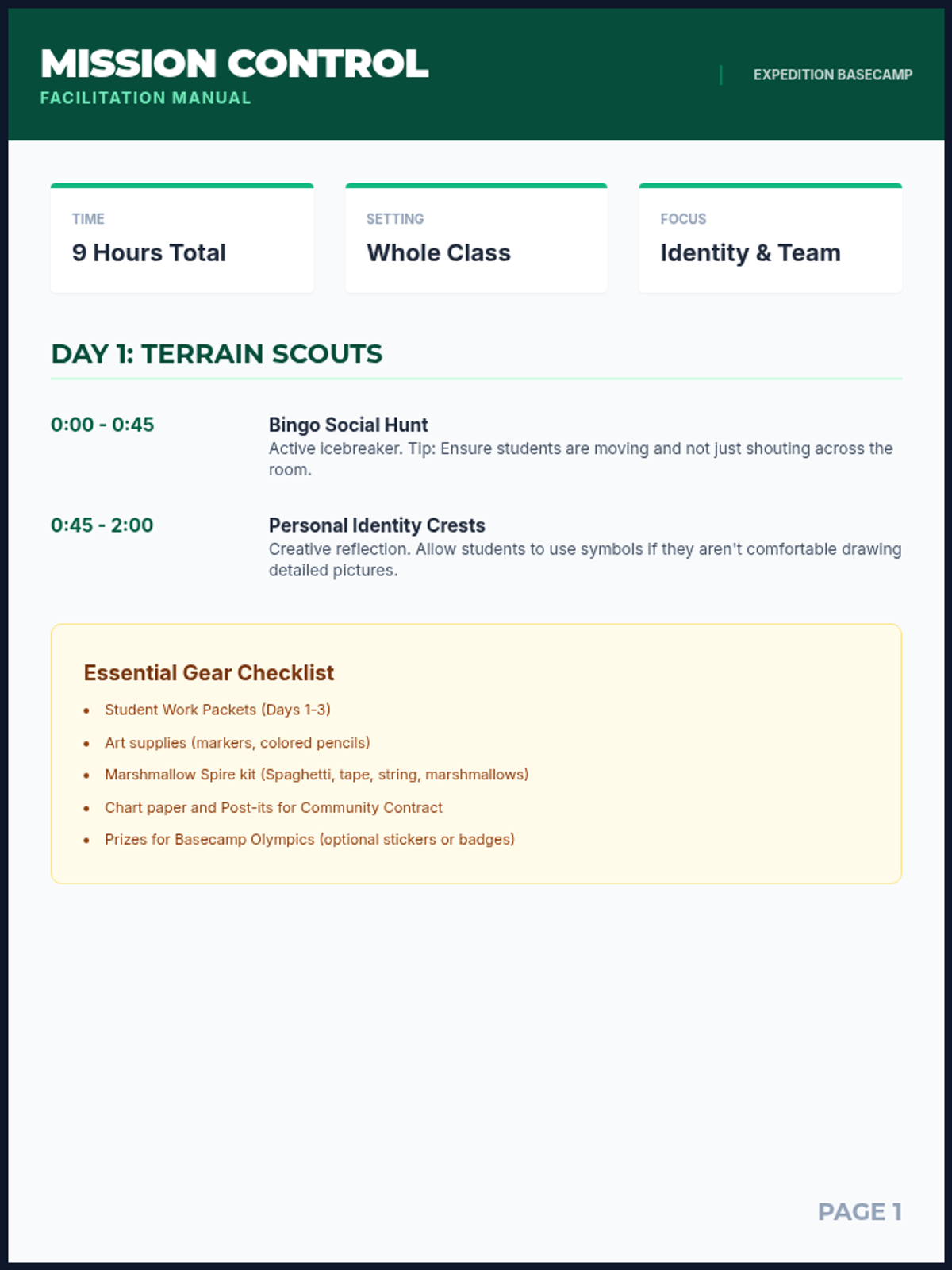
A three-page comprehensive teacher guide for the 'Expedition Basecamp' sequence. Includes revised answer keys with clear solutions and a teacher preparation checklist. Polished for clarity and professionalism.
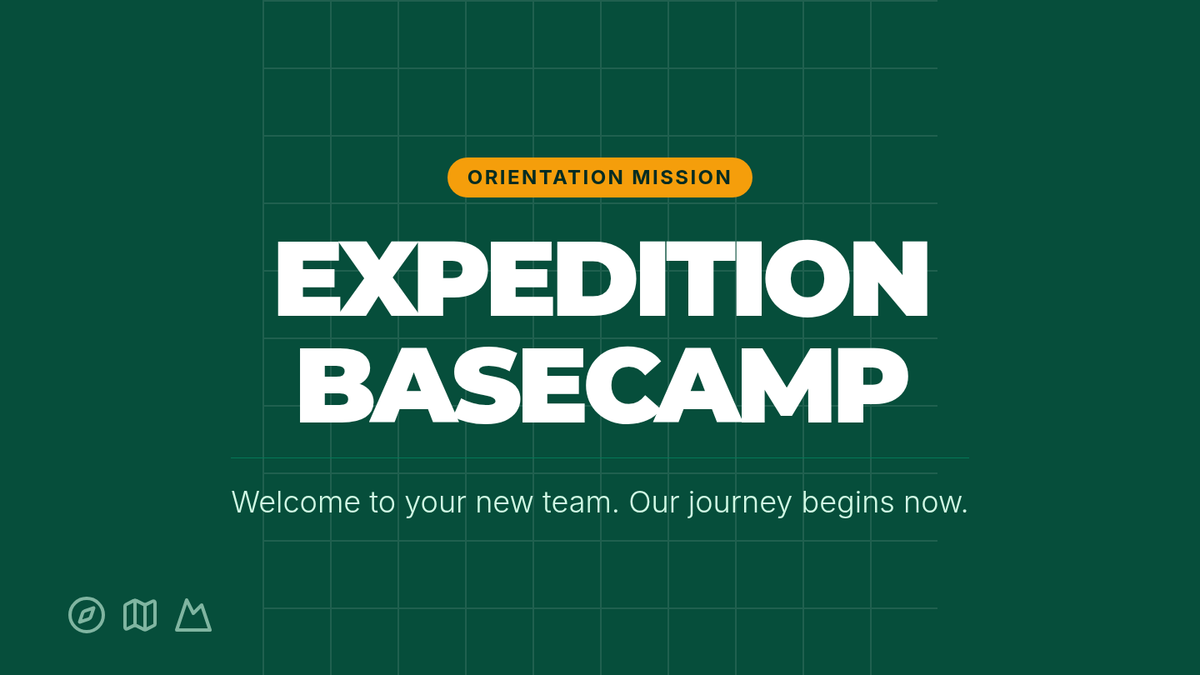
A comprehensive 5-slide presentation deck covering the agenda for the 3-day 'Expedition Basecamp' orientation. Polished visual consistency and icon opacity.
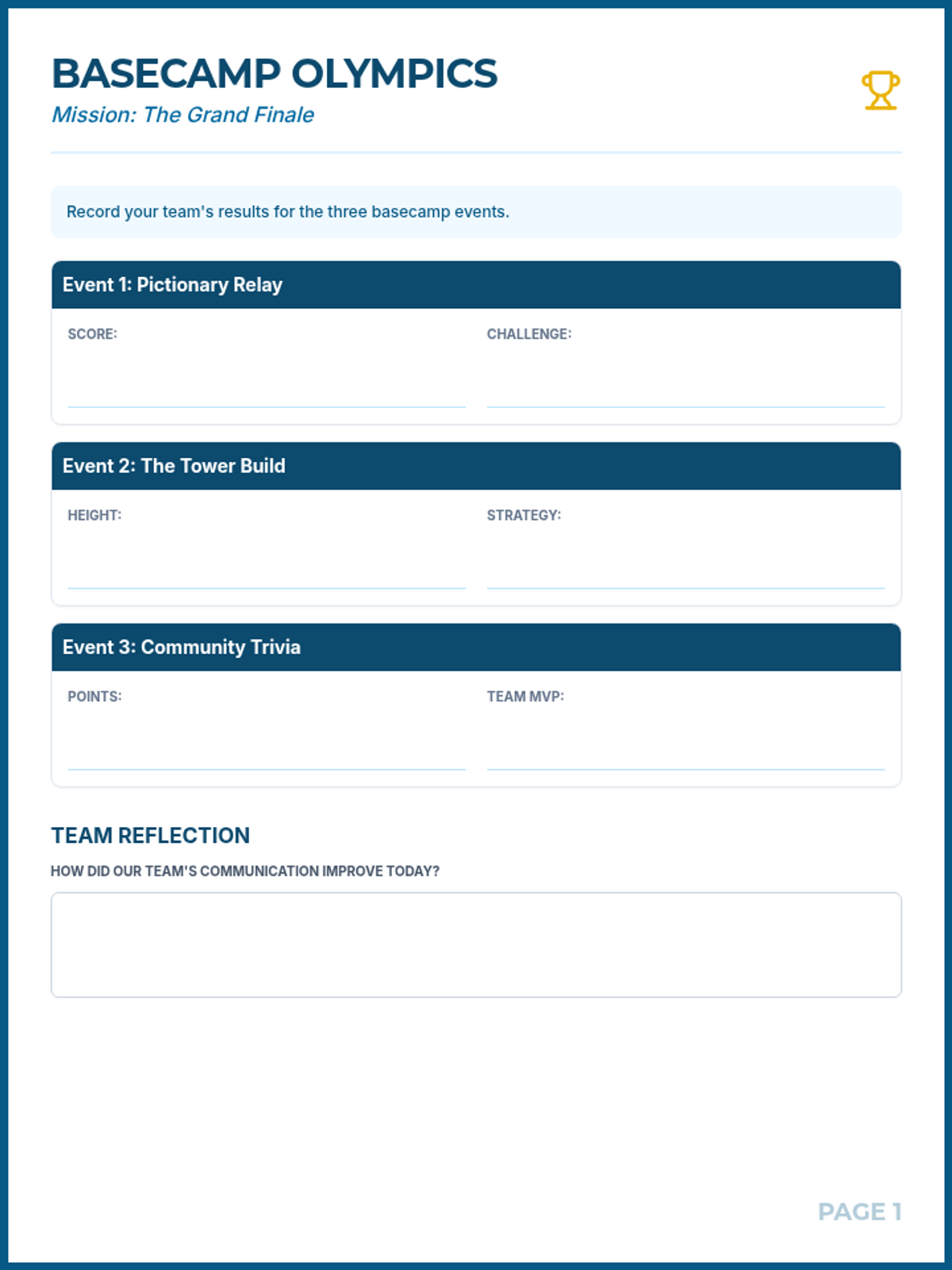
A two-page student packet for Day 3, featuring a 'Basecamp Olympics' scorecard and a 'Letter to My Future Self' reflection activity. Optimized layout and response areas for student use.
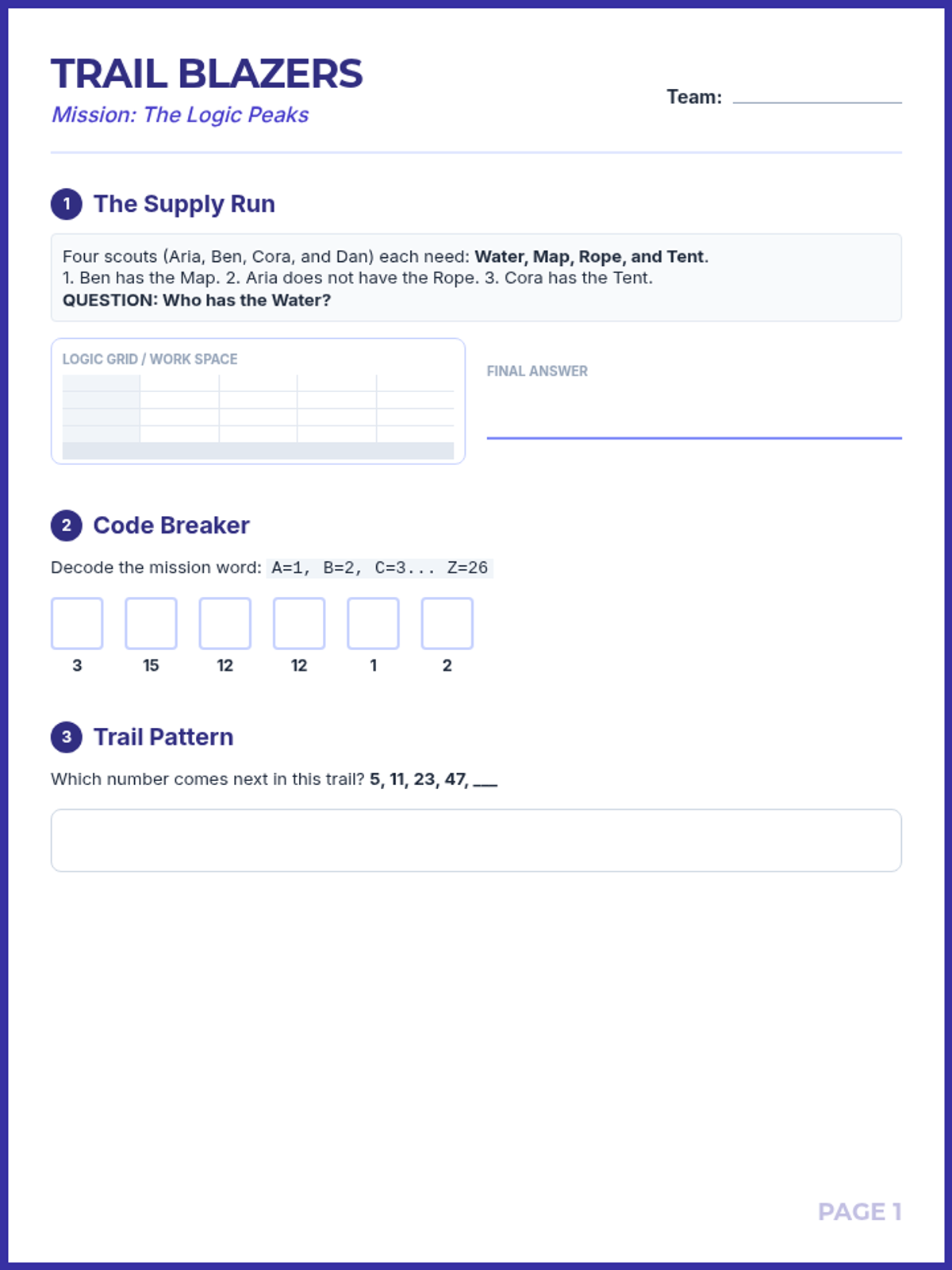
A two-page student packet for Day 2, featuring a 'Logic Peaks' cooperative puzzle challenge and a 'Community Contract' drafting guide. Fixed logic puzzles, improved workspace areas, and optimized layout.
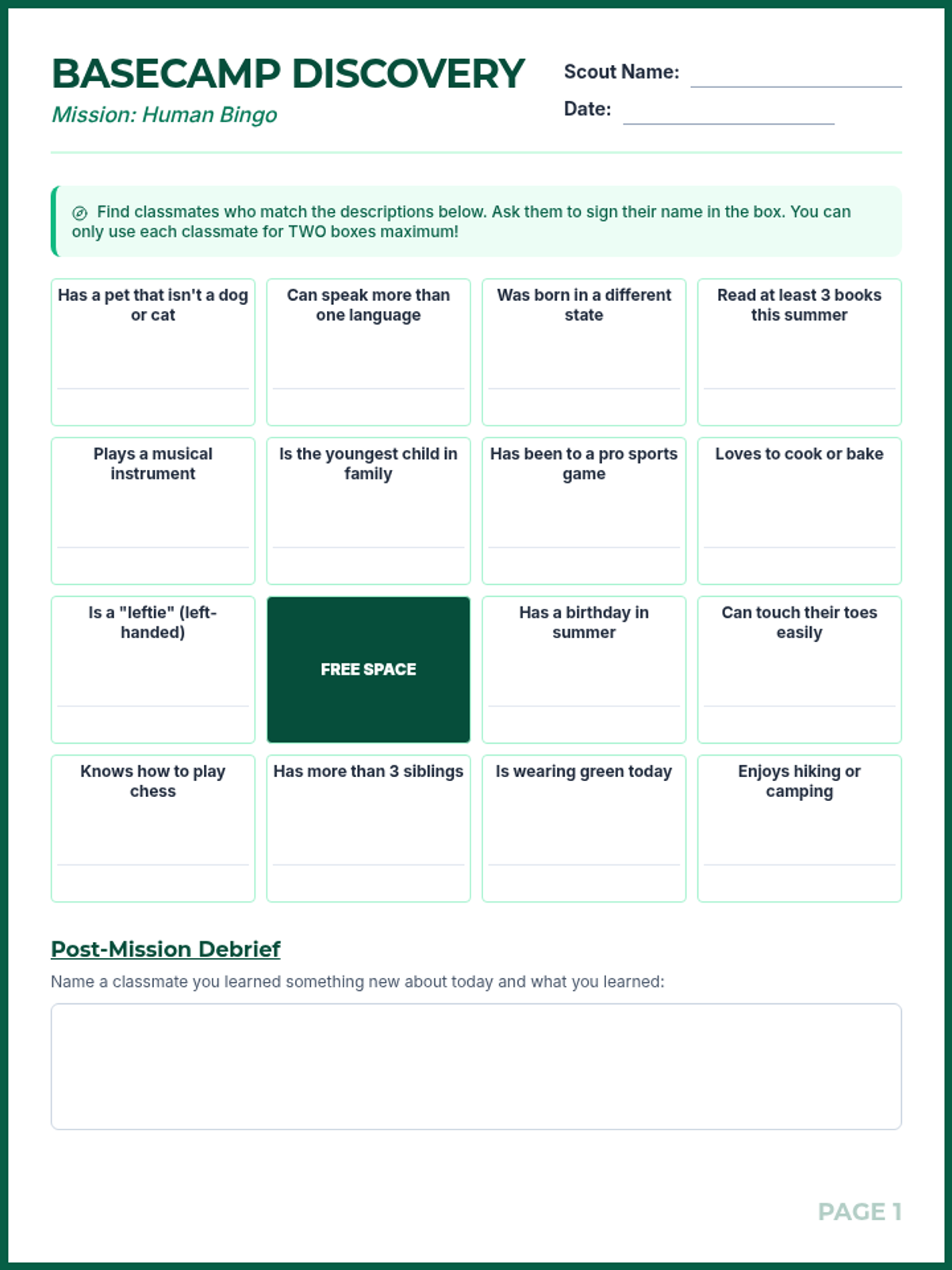
A two-page student packet for Day 1, featuring a 'Human Bingo' icebreaker and a 'Personal Crest' identity project. Fixed layout issues and improved student response areas.
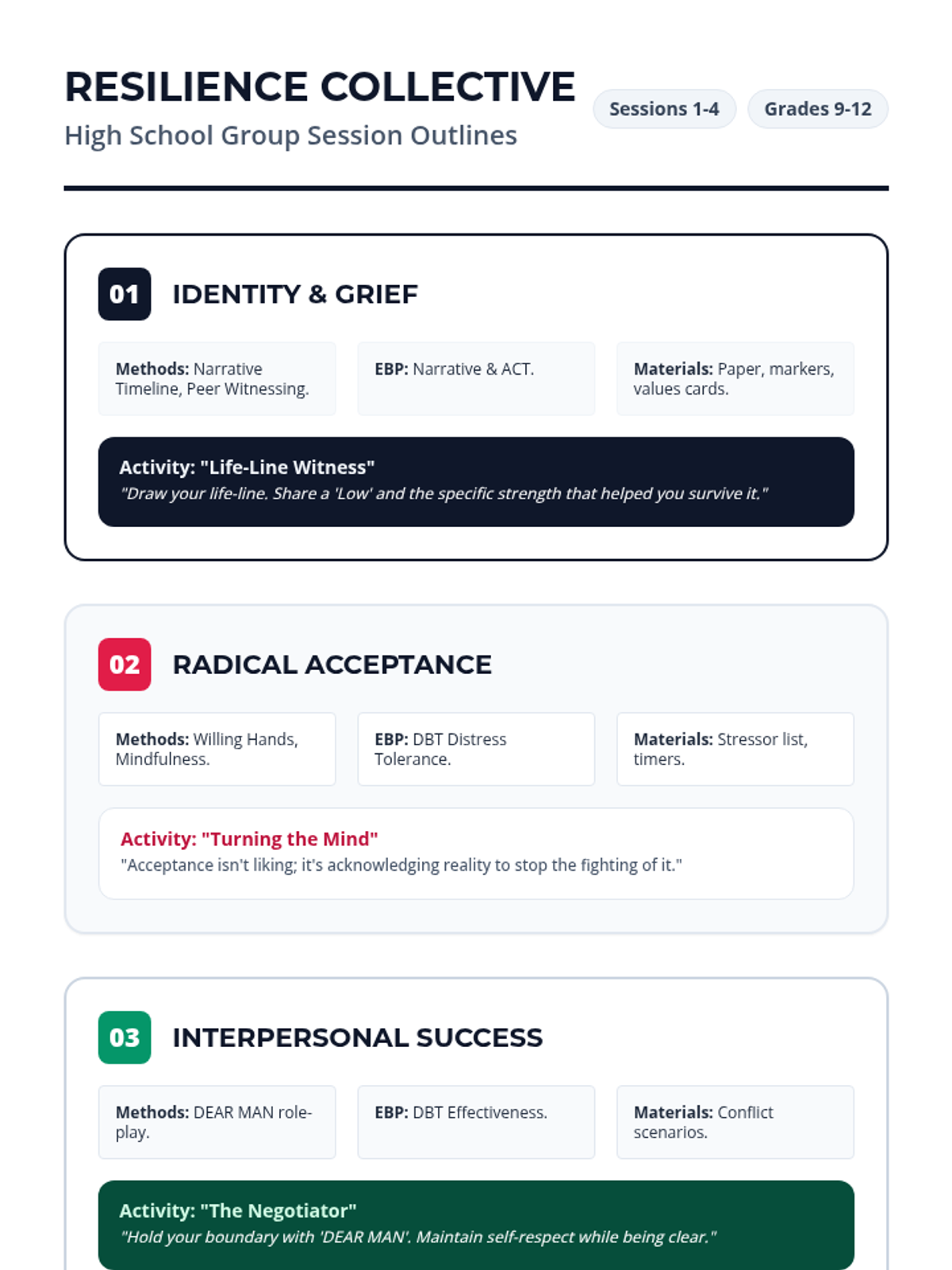
Structured group session outlines for high school students, incorporating advanced ACT and DBT-A concepts like Radical Acceptance and Interpersonal Effectiveness. Emphasizes peer witnessing and identity integration.
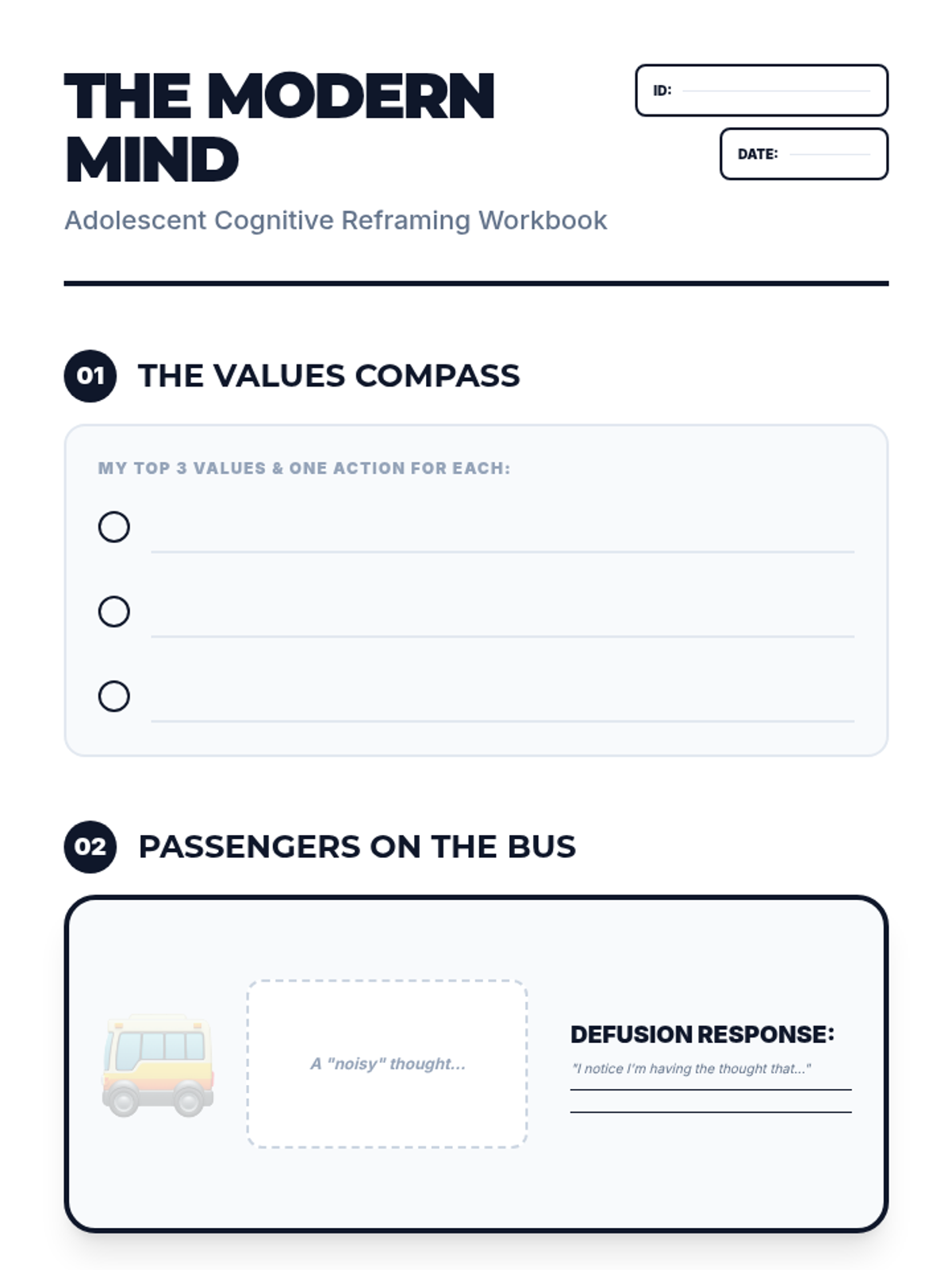
An advanced student workbook for high schoolers, featuring complex therapeutic exercises including Values-Based Mapping (ACT), Cognitive Defusion (ACT), and DEAR MAN interpersonal effectiveness (DBT). Designed for identity-level therapeutic work.
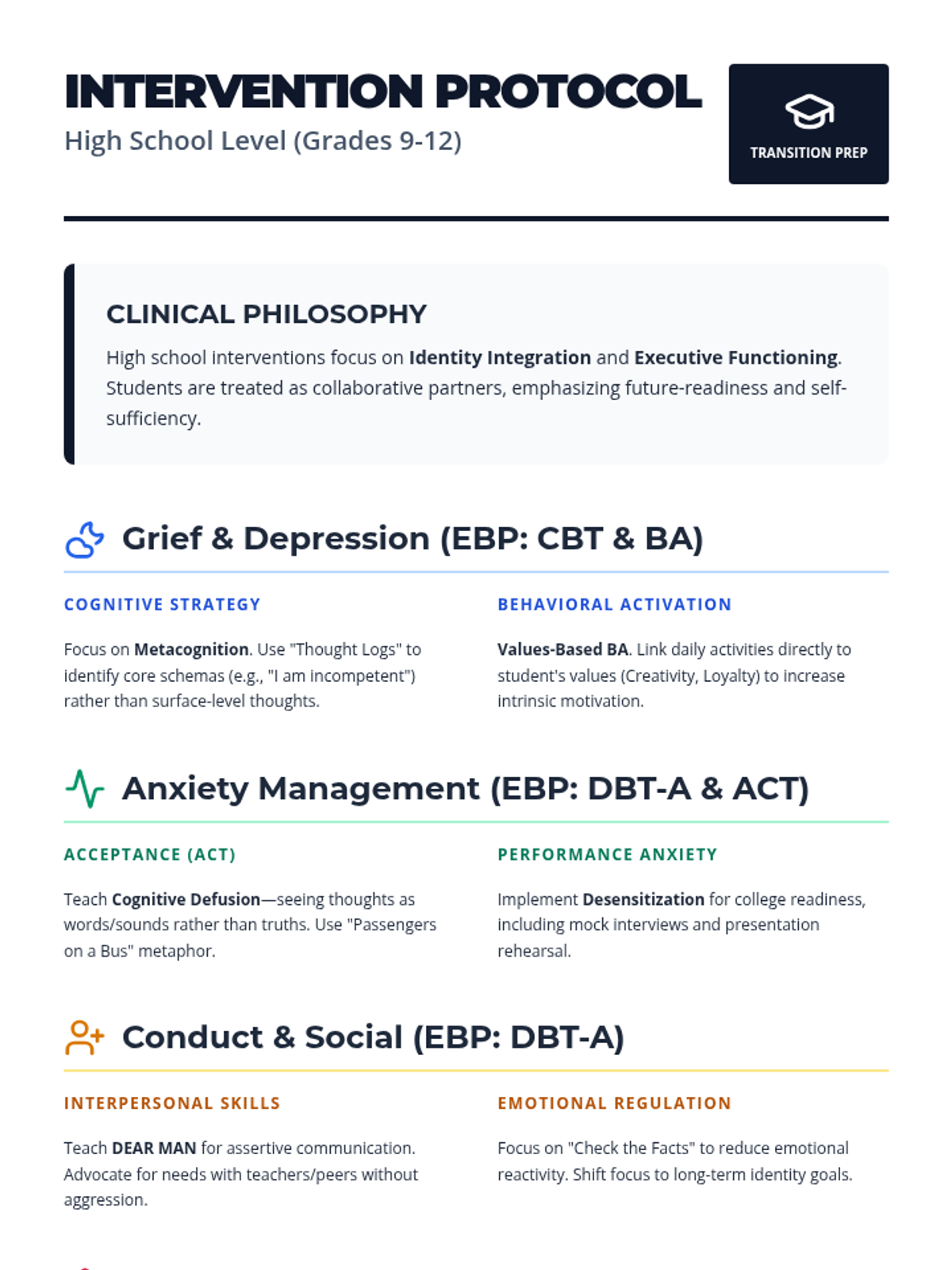
A high-level clinician guide for high school interventions, focusing on ACT, DBT-A, and CAMS protocols. Addresses cognitive complexity, identity integration, and interpersonal effectiveness.
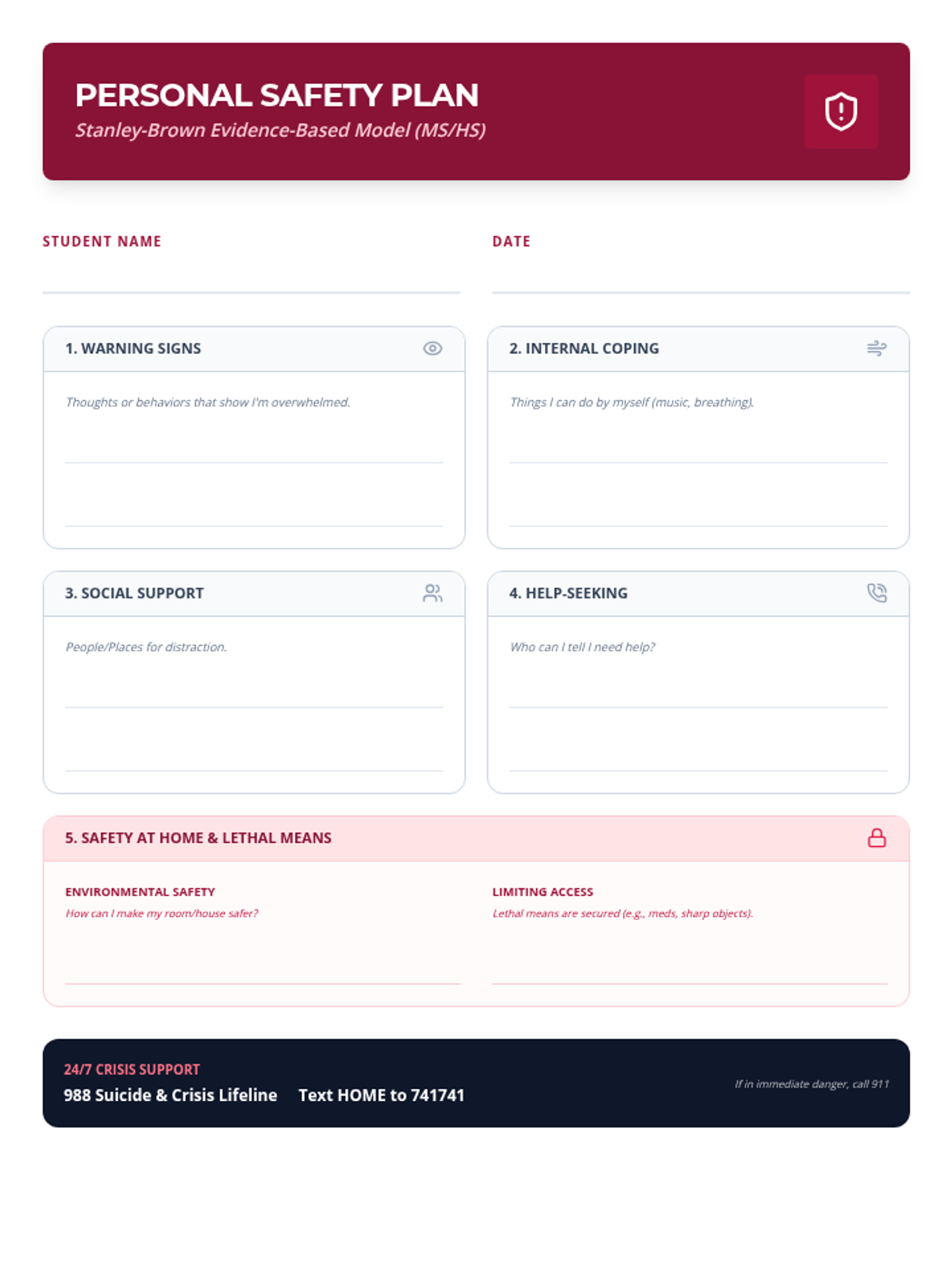
A standardized, evidence-based safety plan template for middle and high school students, following the Stanley-Brown model. Includes steps for warning signs, coping strategies, and emergency contacts.
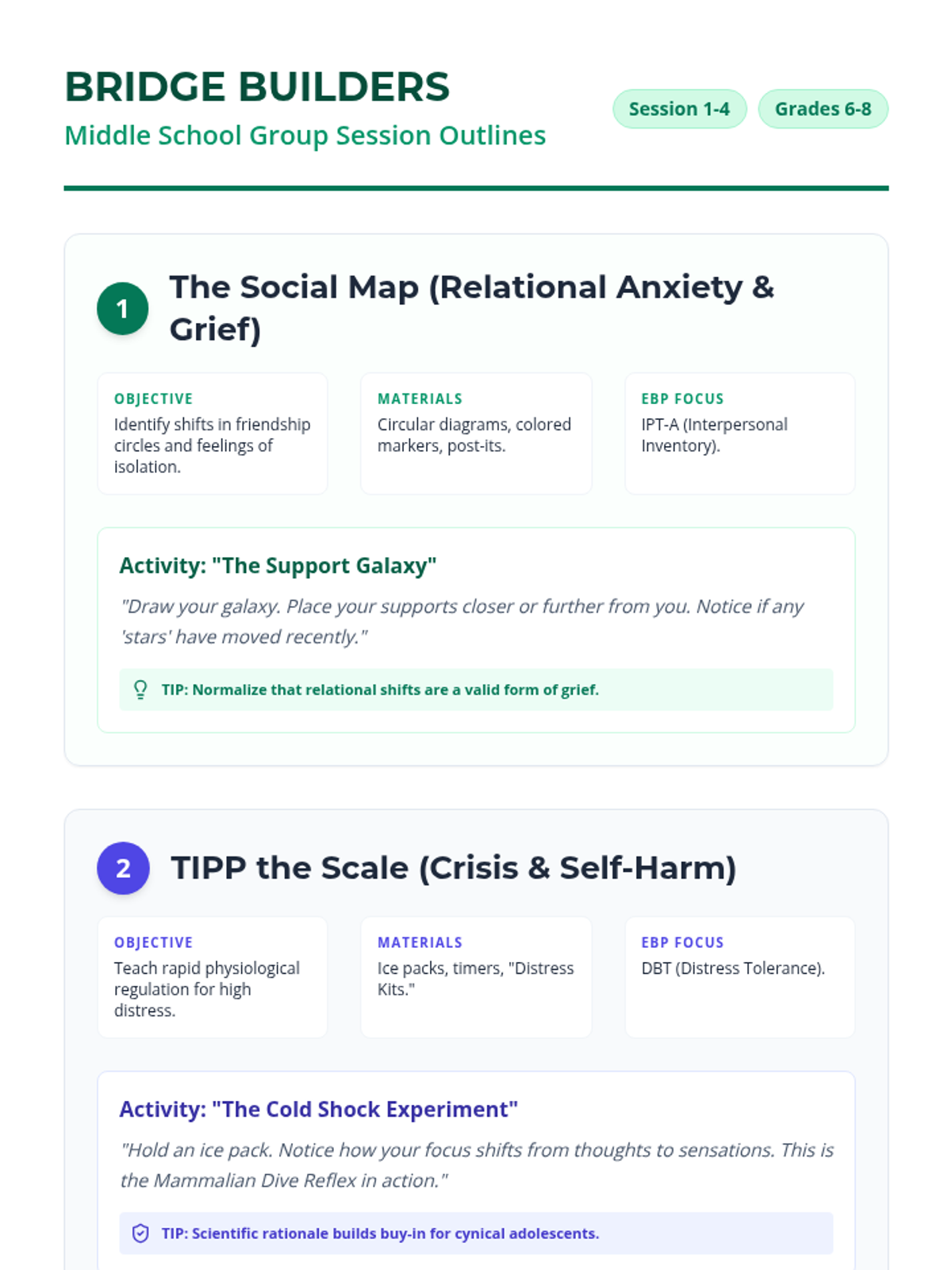
Structured group session outlines for middle school students, utilizing IPT-A, DBT, and Choice Theory to address social anxiety, conduct, and crisis prevention. Includes specific activities like "The Support Galaxy" and "The Cold Shock Experiment."
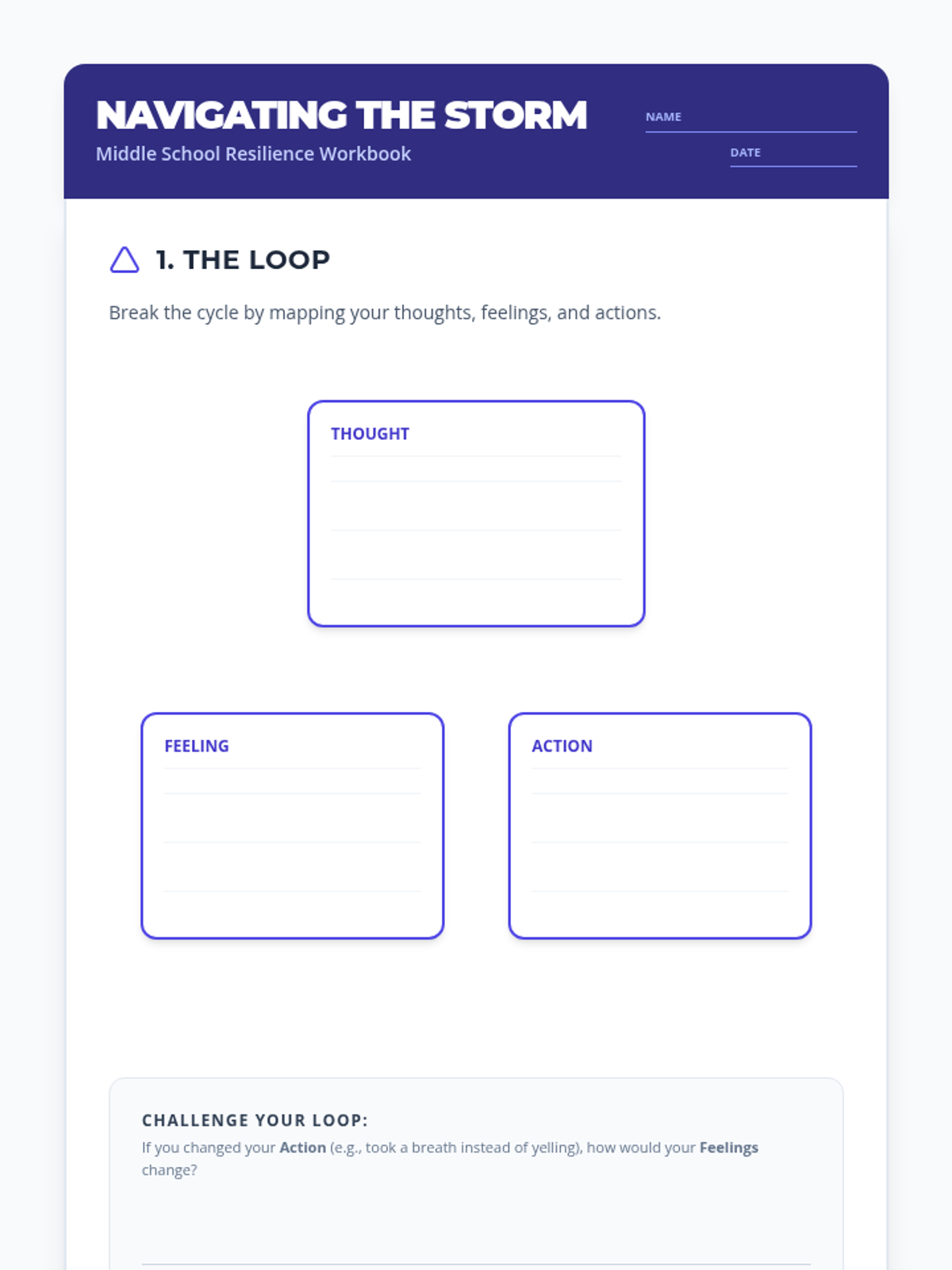
A middle school student workbook focused on CBT concepts like the Cognitive Triangle and Thinking Traps. Designed to help adolescents navigate complex emotions, social anxiety, and behavioral loops with autonomy-focused exercises.
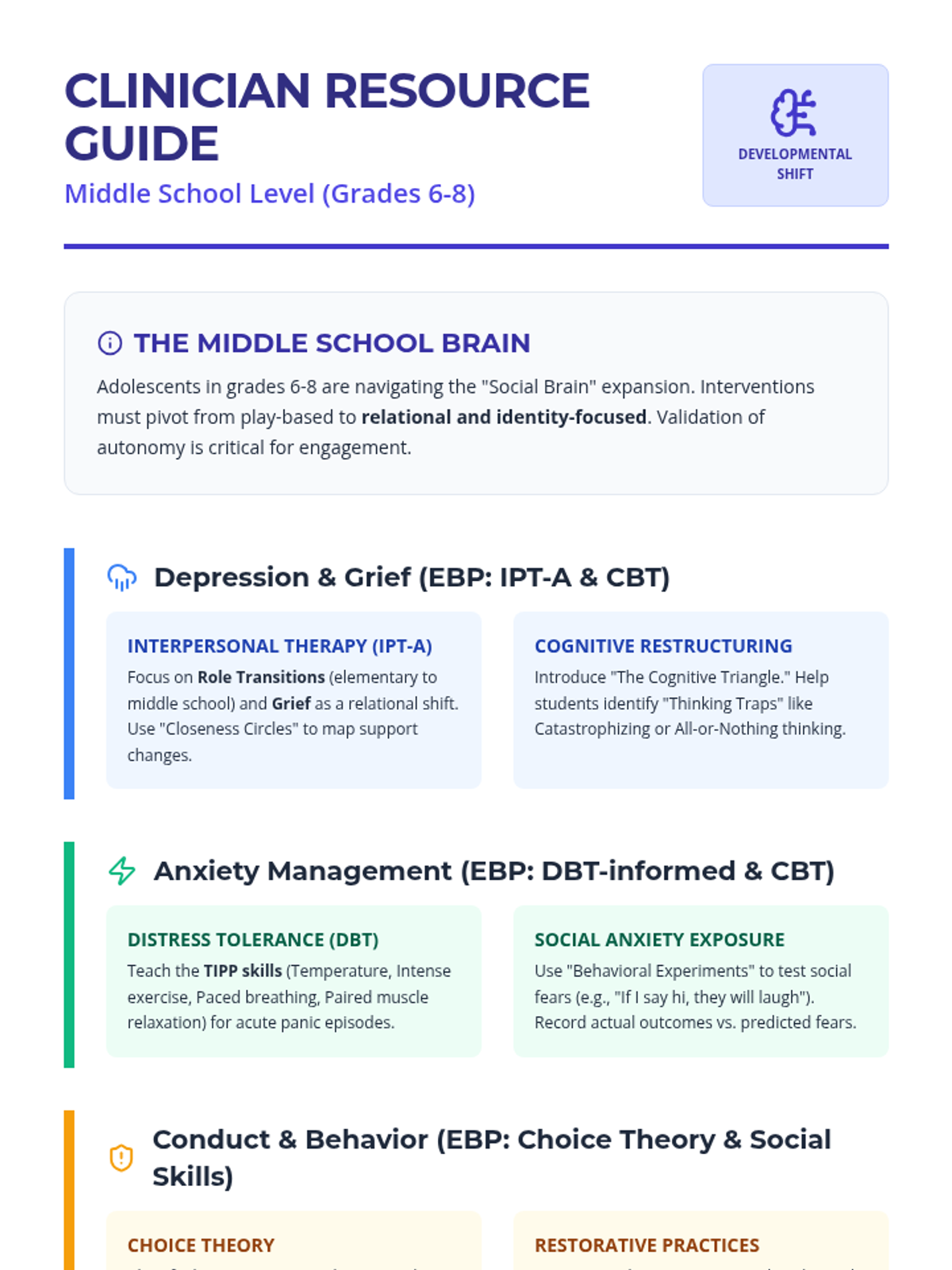
A comprehensive clinician guide for middle school mental health interventions, focusing on IPT-A, CBT, and DBT-informed strategies for grief, anxiety, and conduct, with a focus on the adolescent "Social Brain."
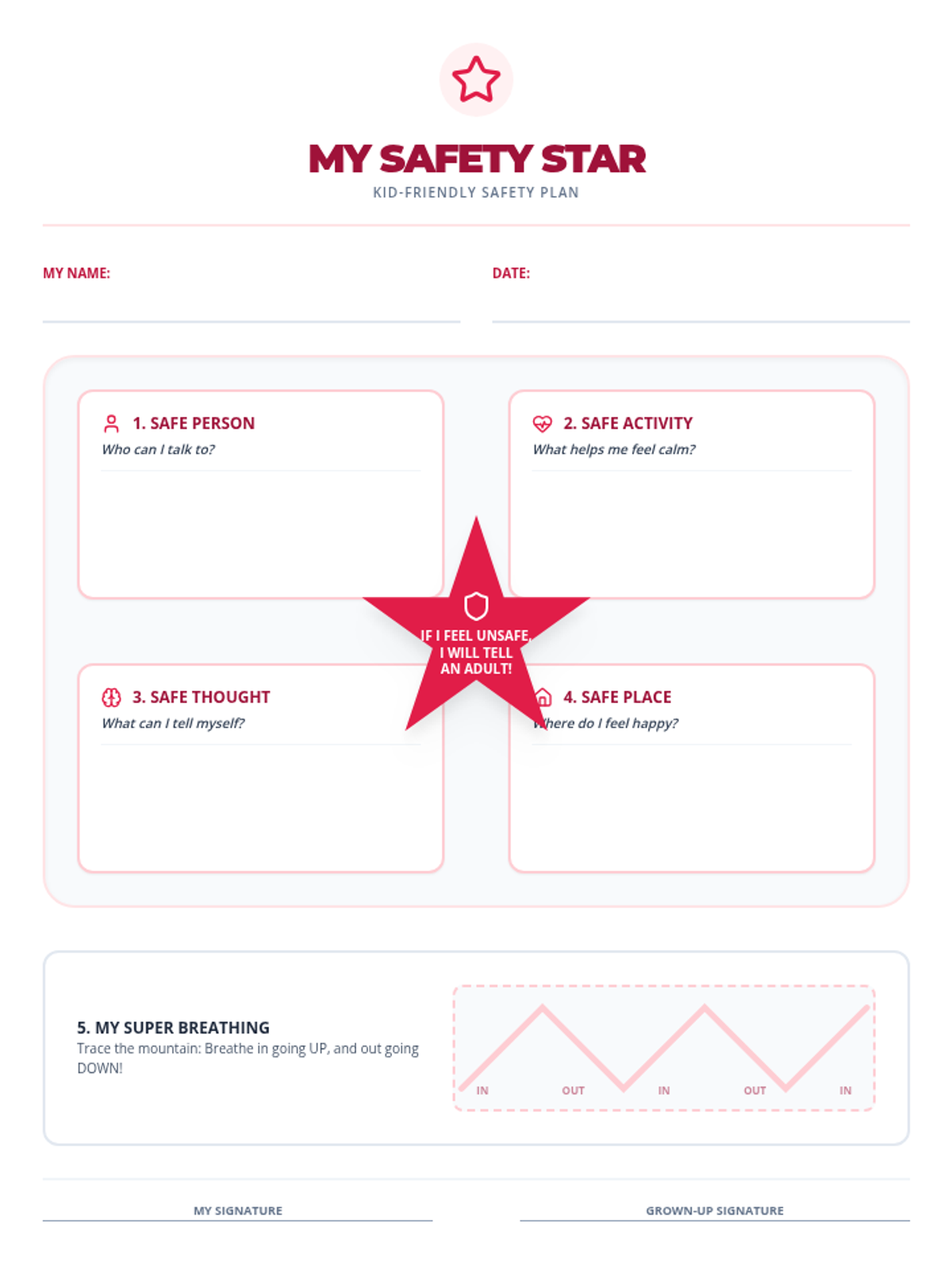
A visual, kid-friendly safety planning template for elementary students, focusing on five key points: Safe Person, Safe Activity, Safe Thought, Safe Place, and Breathing. Includes spaces for signatures and student drawing.
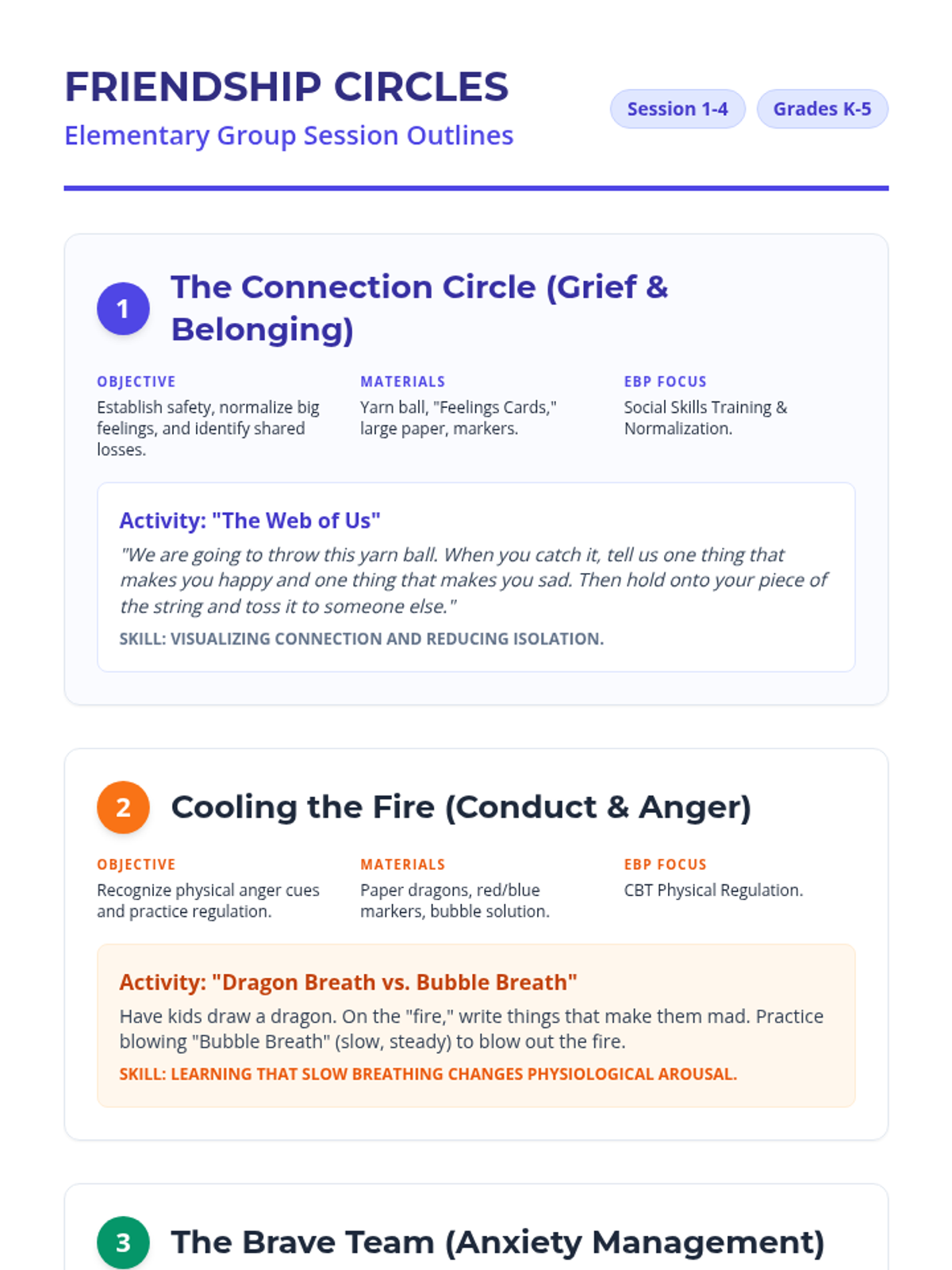
Structured group session outlines for elementary students, covering connection (grief), regulation (conduct), bravery (anxiety), and safety (crisis). Includes objectives, materials, and evidence-based practice focuses.
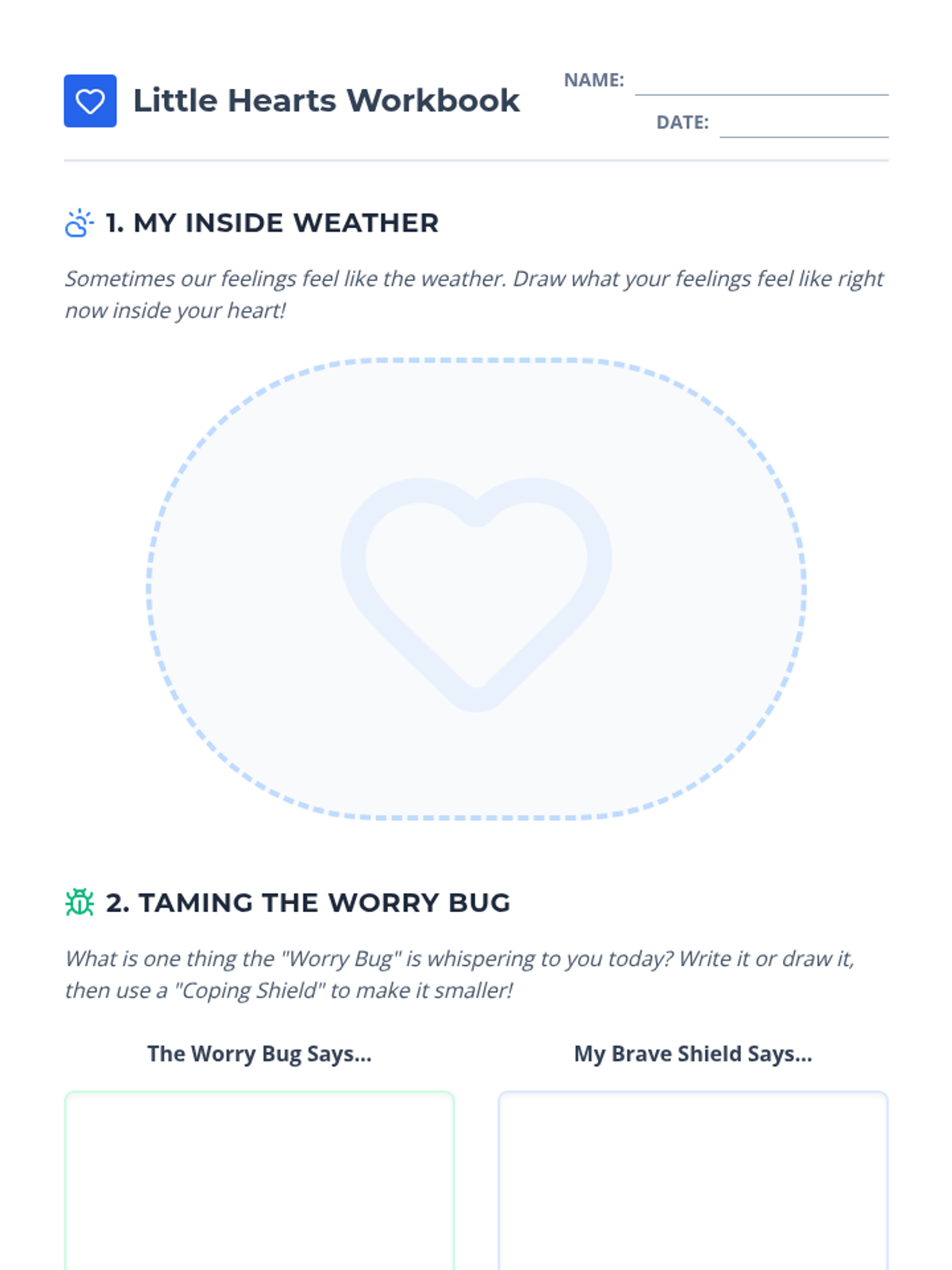
A kid-friendly student workbook for elementary students, containing interactive drawing and writing activities to help manage feelings, anxiety (The Worry Bug), and behavioral choices (The Choice Point).
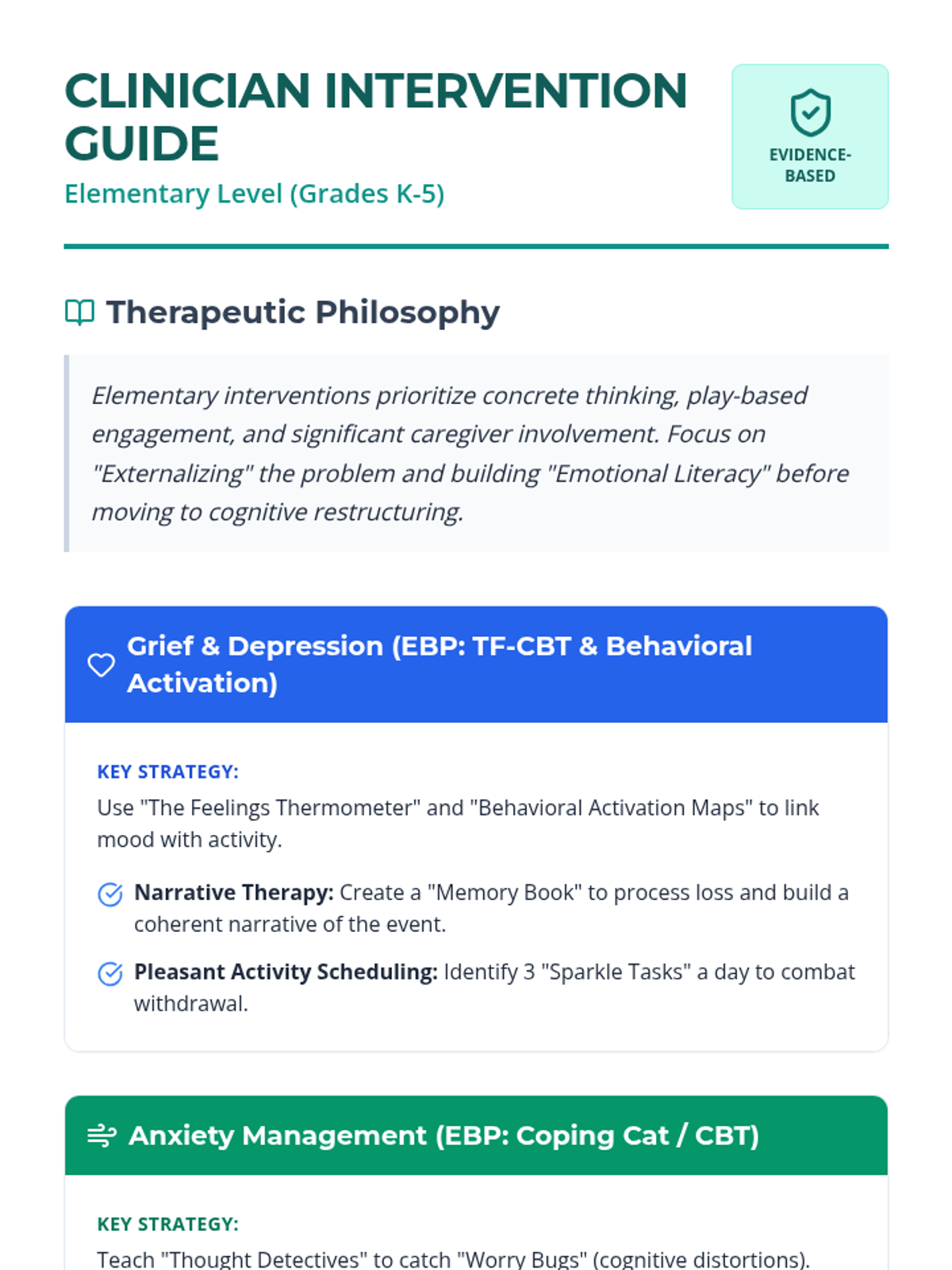
An evidence-based clinician guide for elementary school counselors, providing key strategies and interventions for grief, anxiety, conduct, and crisis management using developmentally appropriate language.
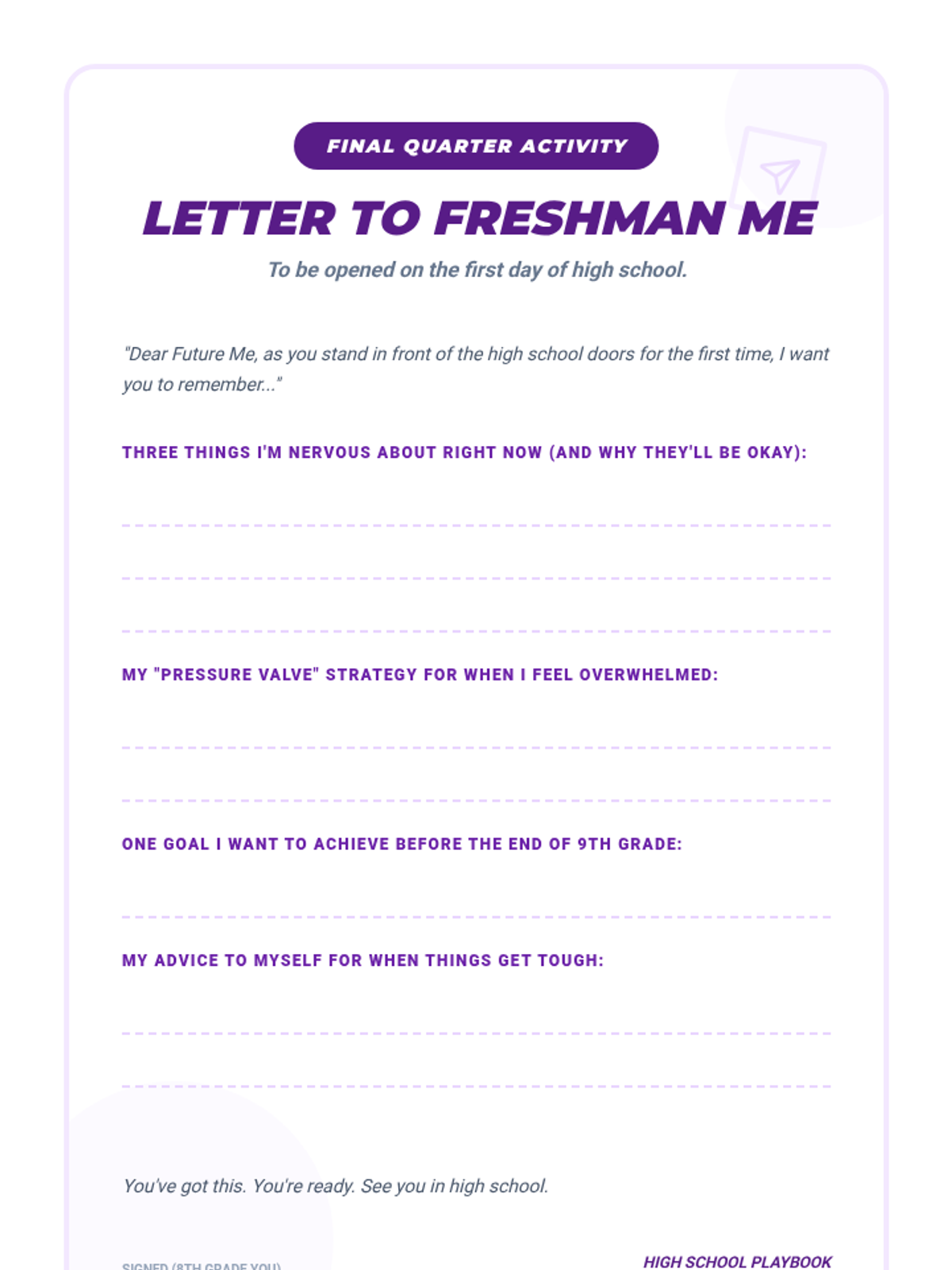
A reflective writing activity where students write a supportive letter to their future freshman selves, summarizing their goals, strategies, and advice for the transition.
Final slides of the series, focusing on emotional resilience, growth mindset, and stress management techniques for the transition to high school.
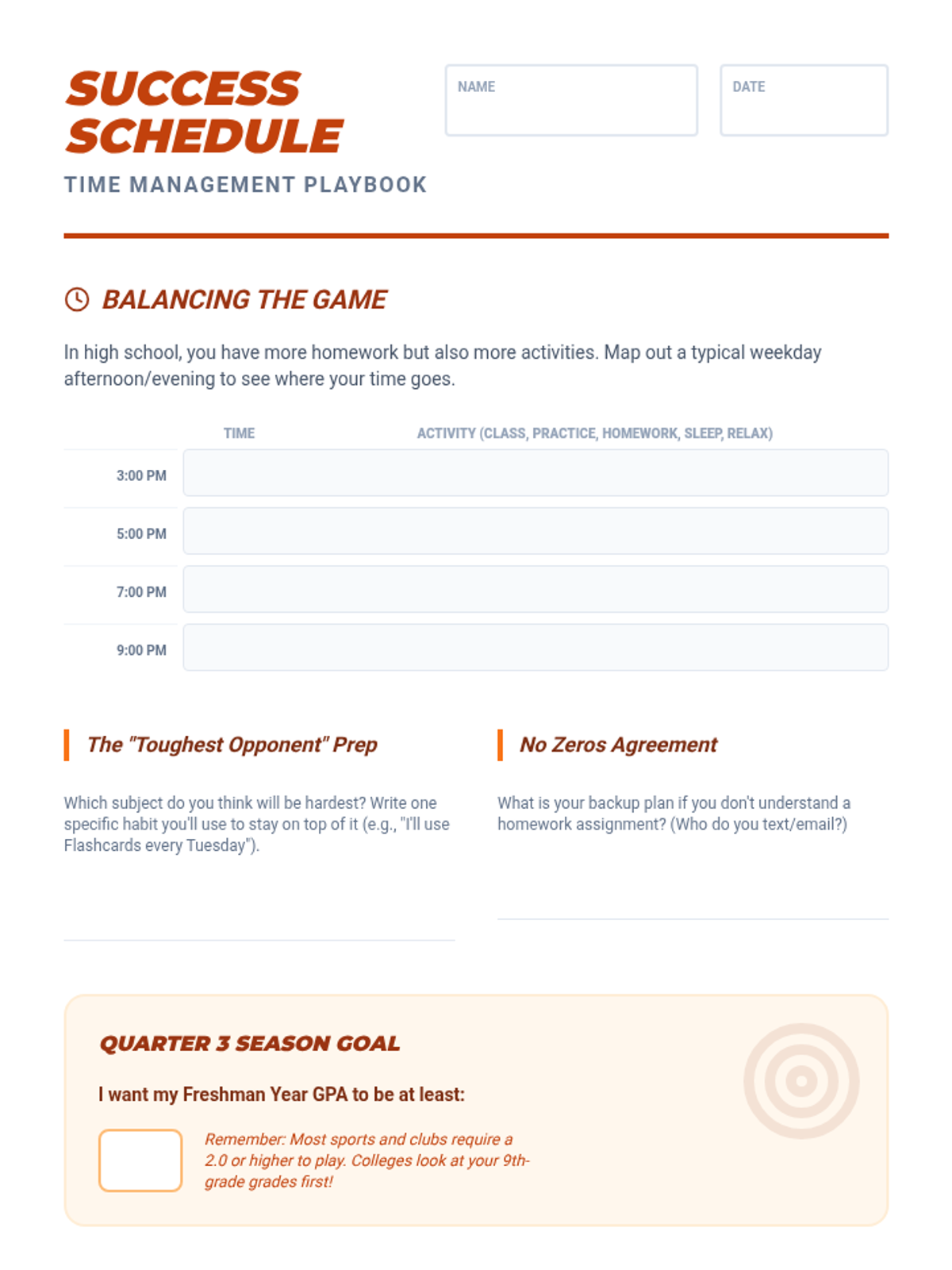
A time management and goal-setting worksheet for 8th graders, helping them map out their after-school schedules and set academic targets for their freshman year.
Slides for Lesson 3, covering high school academic expectations including the credit system, GPA calculations, and time management strategies for freshman success.
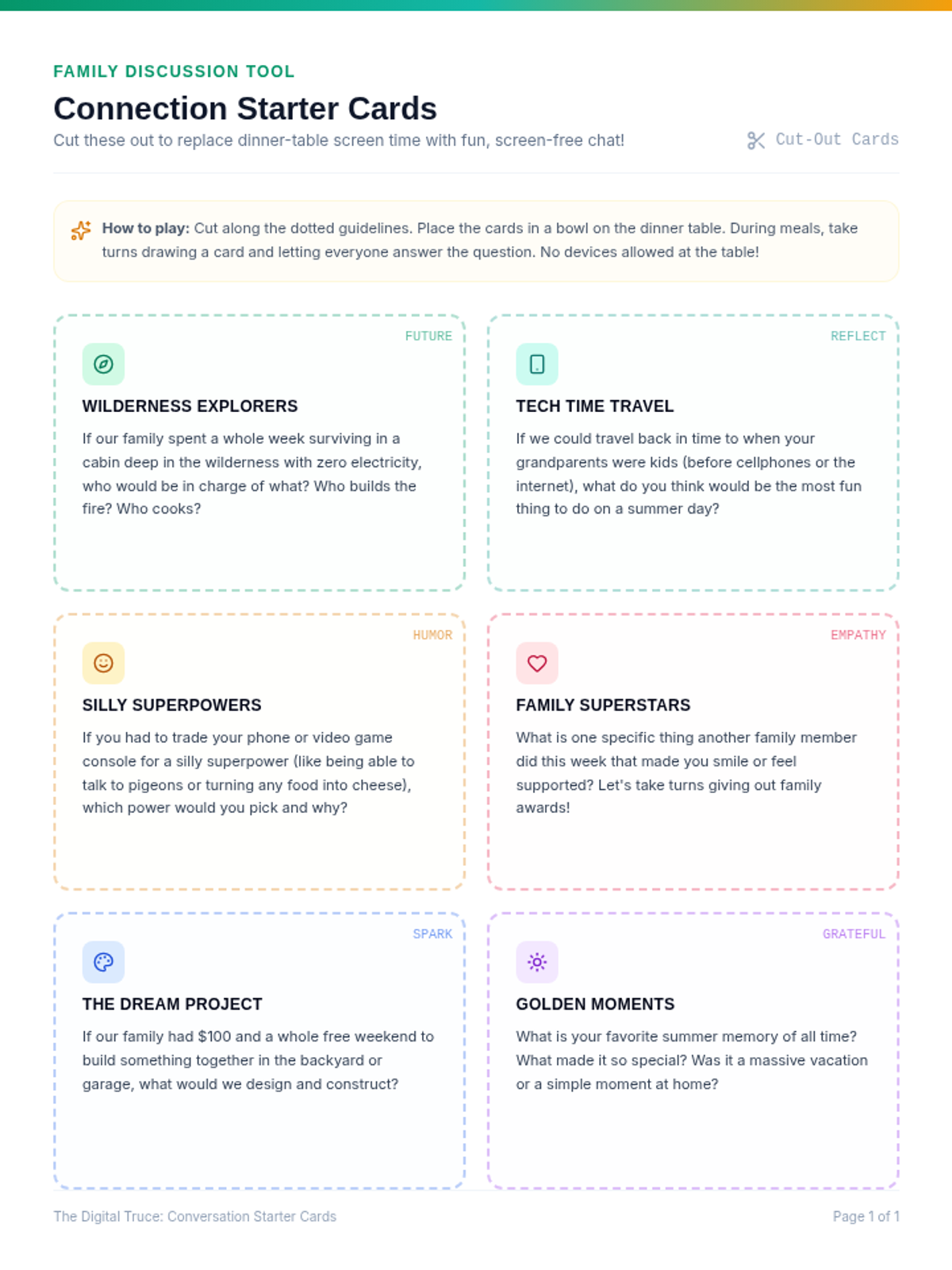
A set of 6 printable family conversation cards designed to replace screen-time with screen-free dinner table or bedtime discussion.
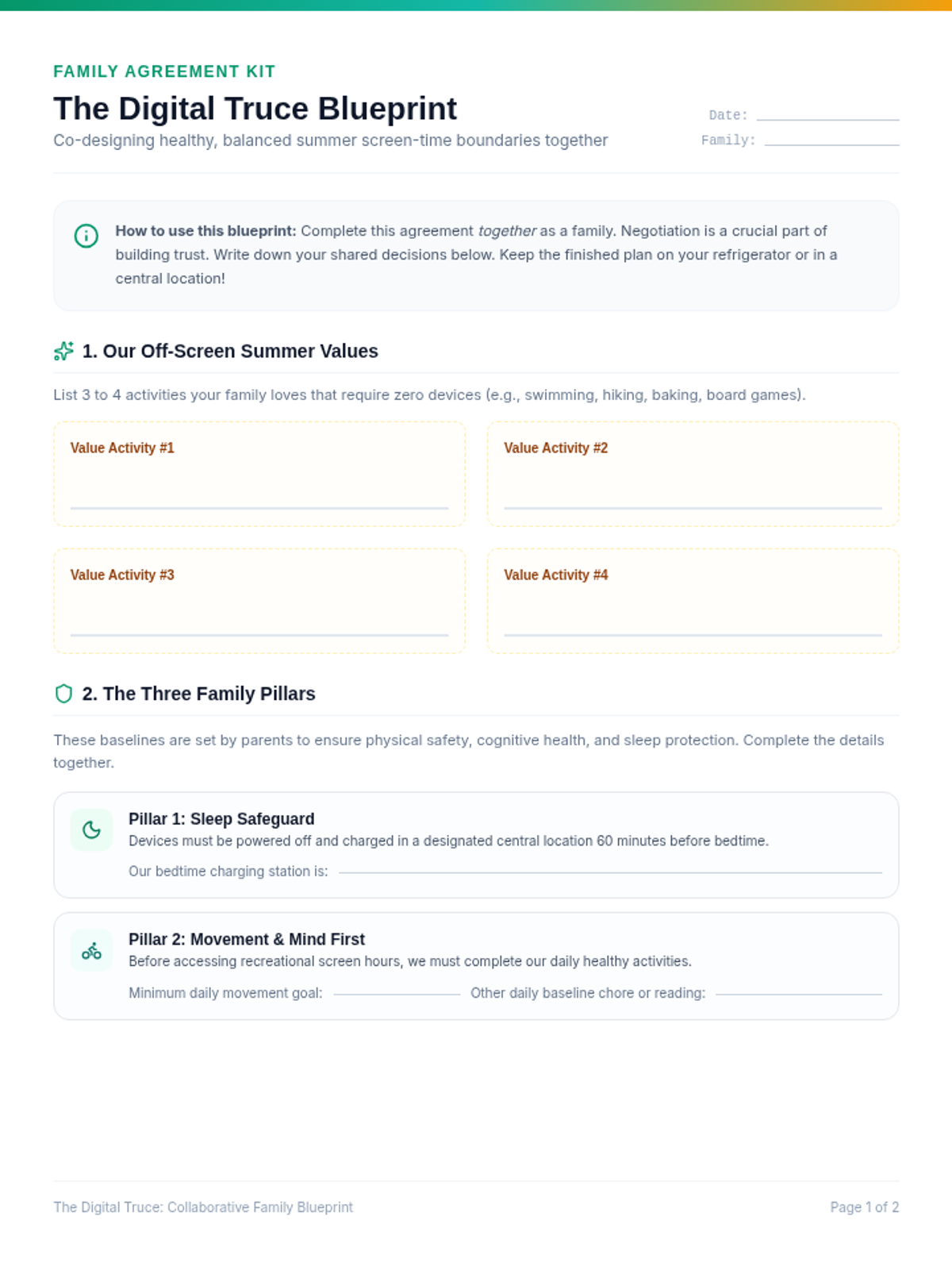
A beautifully designed, collaborative 2-page family agreement blueprint with fields for parents and kids to co-design and commit to screen boundaries.
An elegant 5-slide presentation deck (16:9 format) for leading the Digital Truce parent workshop, using clear layouts and a strict minimum 24px font size.
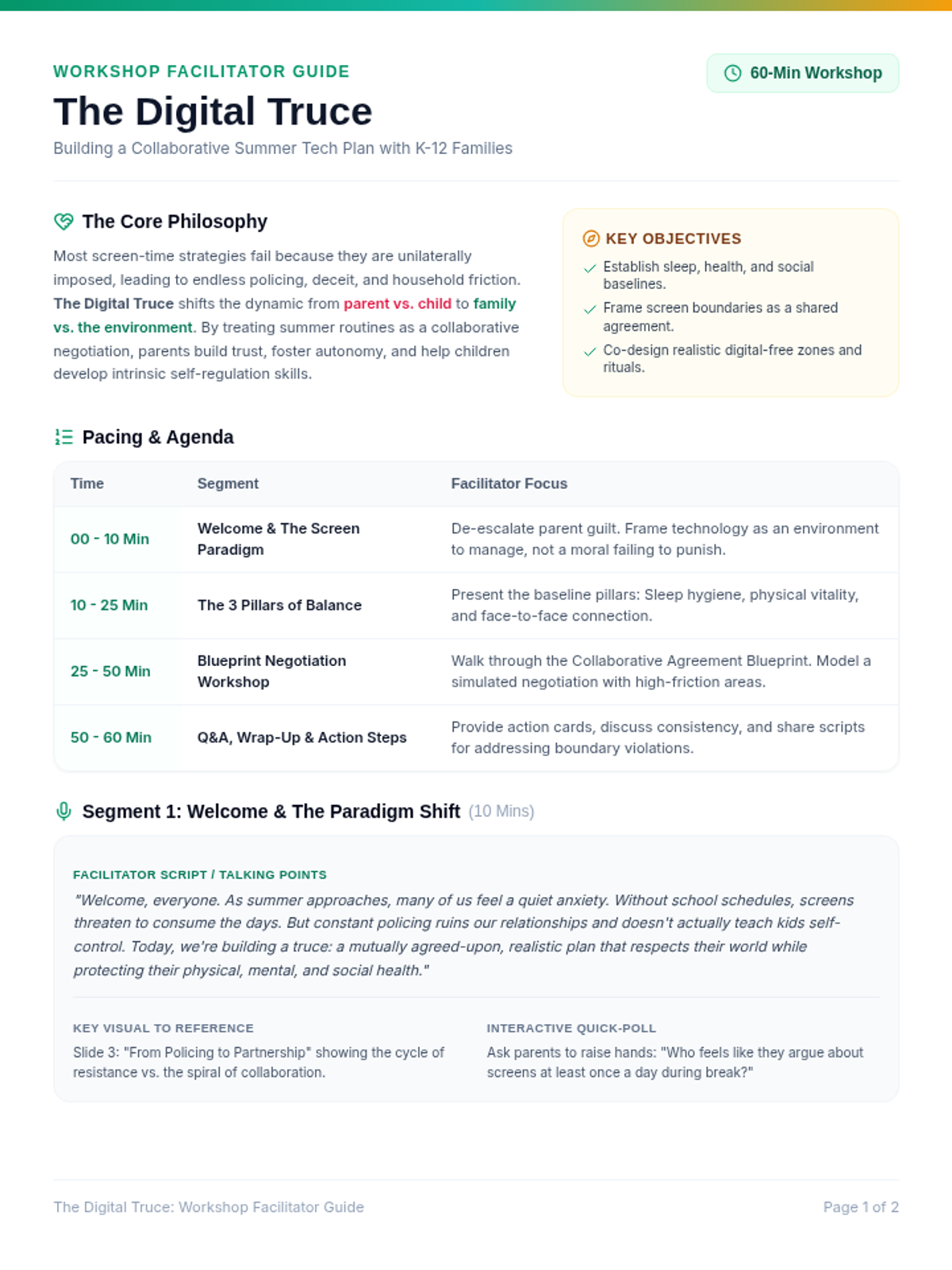
A comprehensive, highly detailed 2-page workshop facilitator guide for leading a 60-minute parent session on collaborative summer screen-time negotiation.
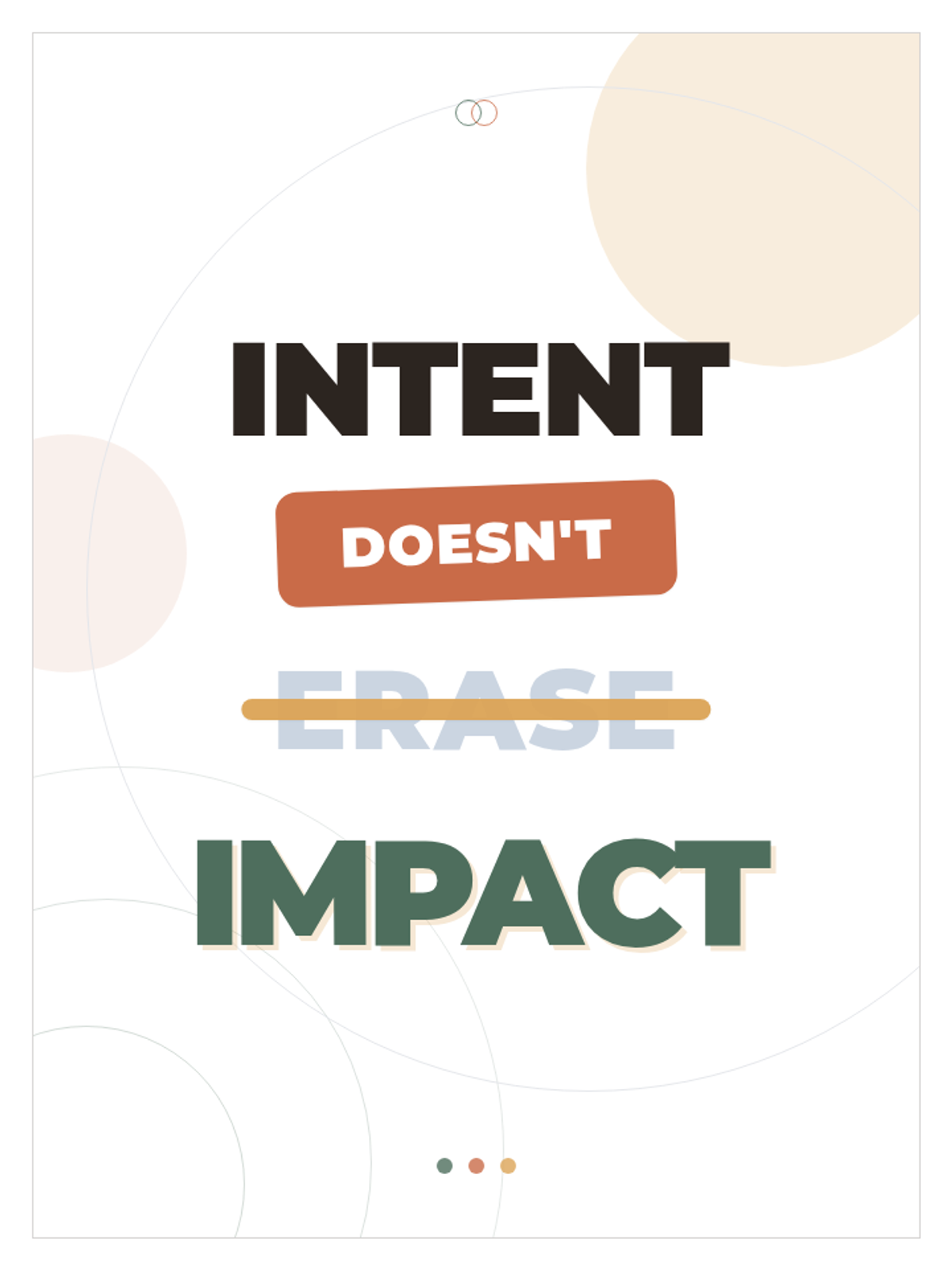
A beautifully designed counseling office poster featuring the quote "Intent Doesn't Erase Impact". The revised version uses an elegant, calming mid-century modern aesthetic with soft, warm earth tones (terracotta, sage green, and ochre gold) on a printer-friendly pure white background.
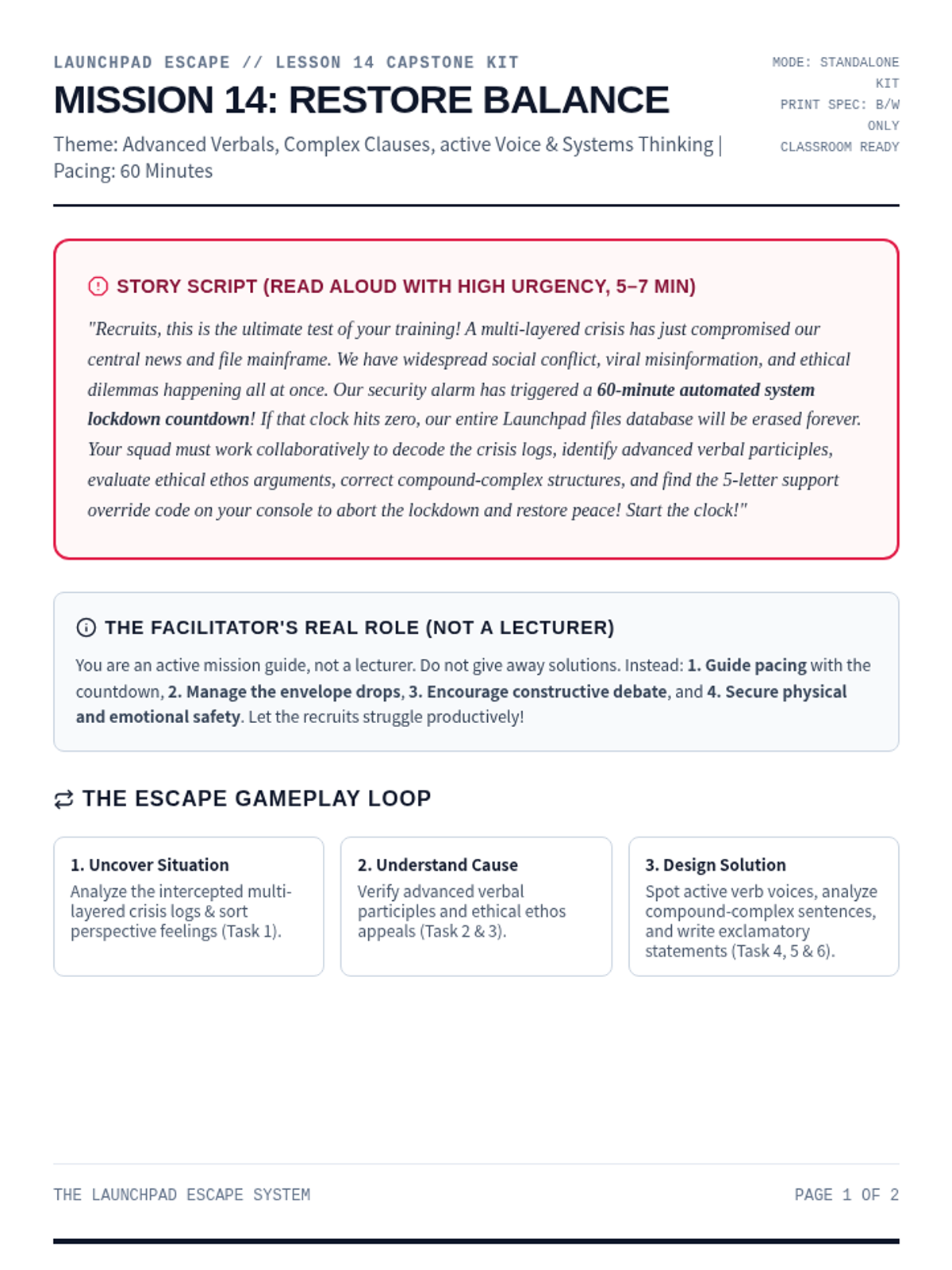
A comprehensive printable facilitator guide for Mission 14: The Capstone Mission. Contains story script, setup checklists, progressive clue mechanics, persuasive appeals endings, and debrief questions.
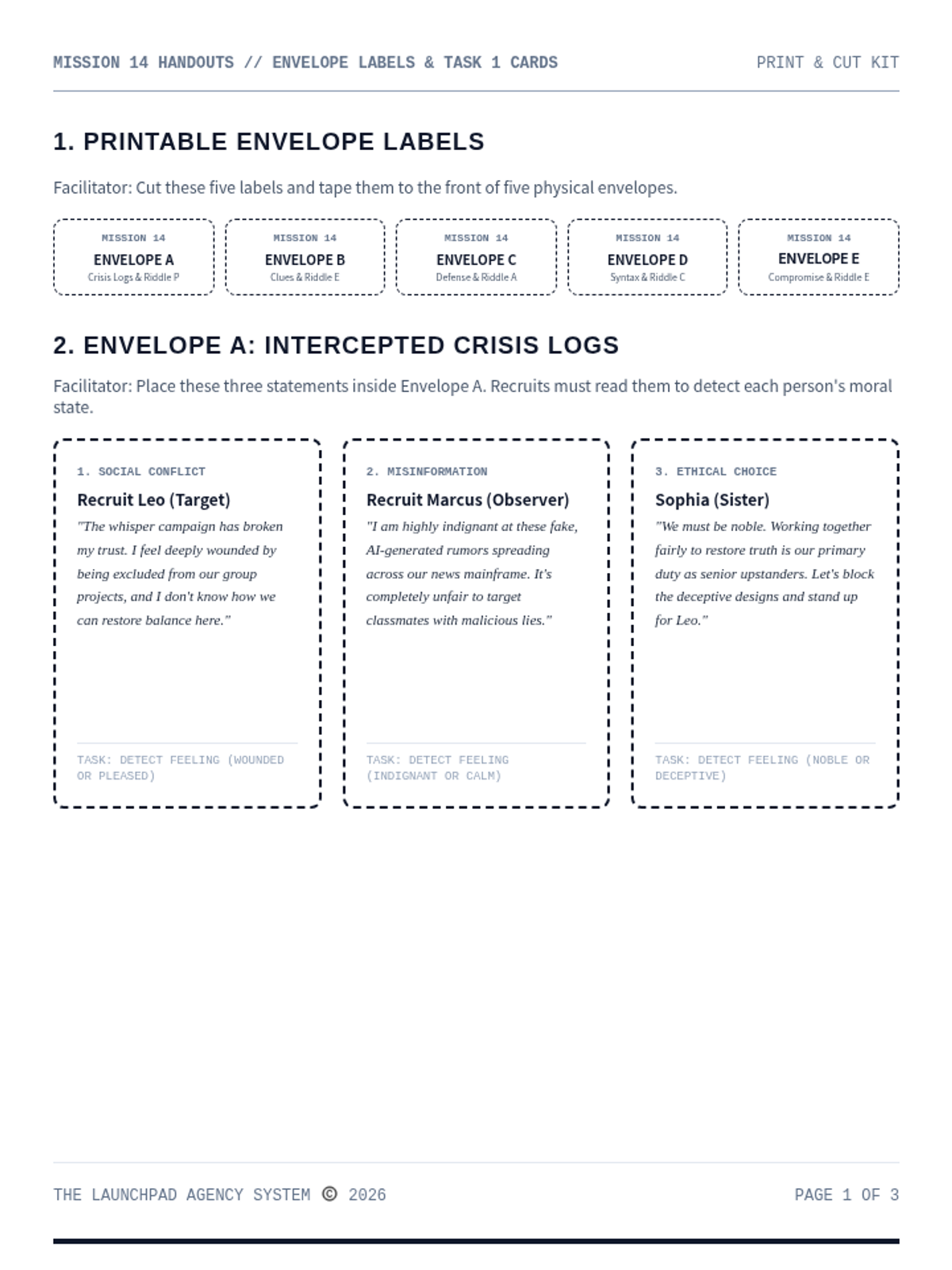
A print-and-cut materials handout kit for Mission 14: The Capstone Mission. Contains envelope labels, printed posts, source cards, and timeline charts.
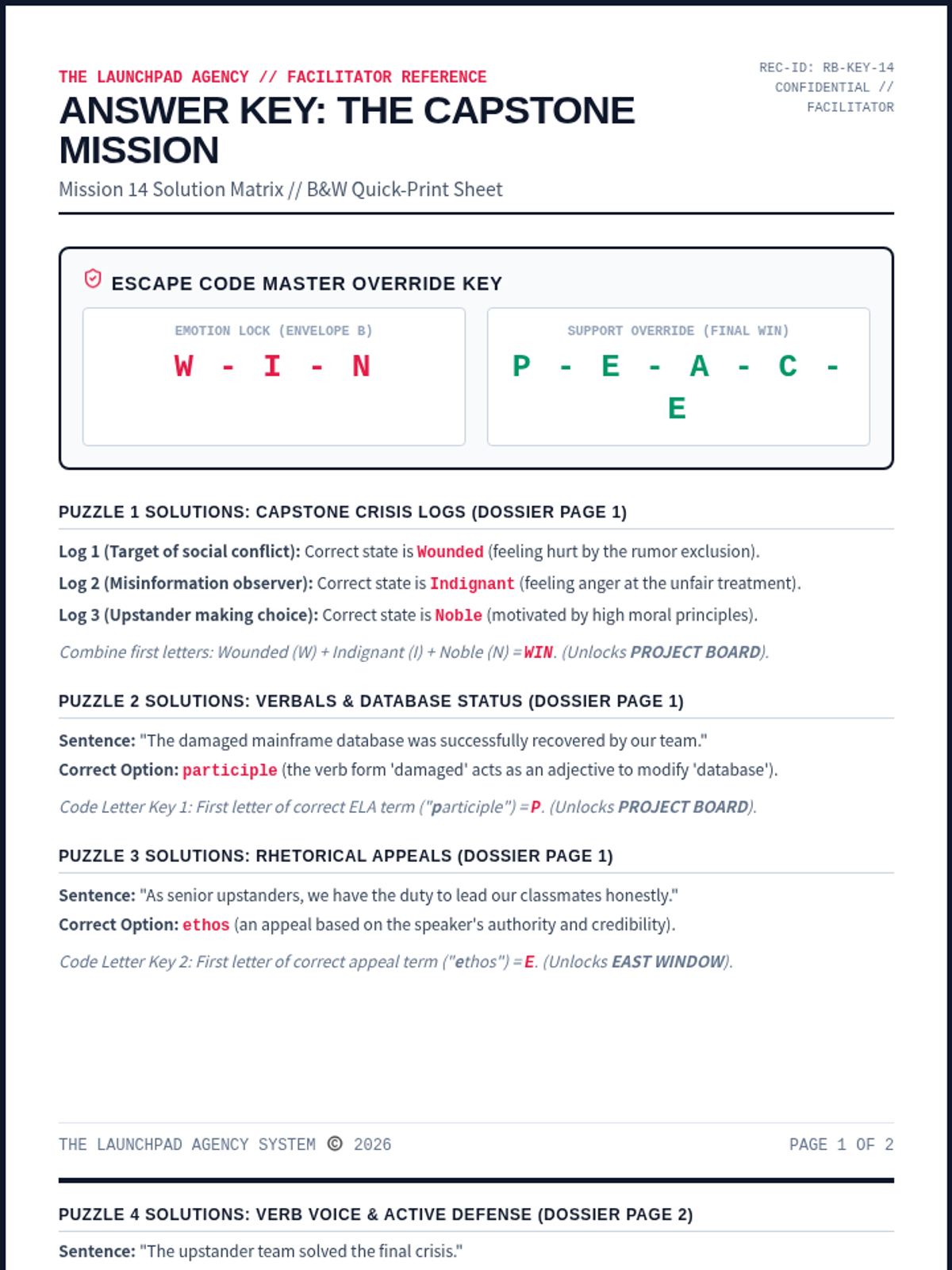
A dedicated facilitator answer key for Mission 14: The Capstone Mission. Contains complete solutions for all ELA/coordinate puzzles, ciphers, and floor map paths, along with rubrics and setup tips.
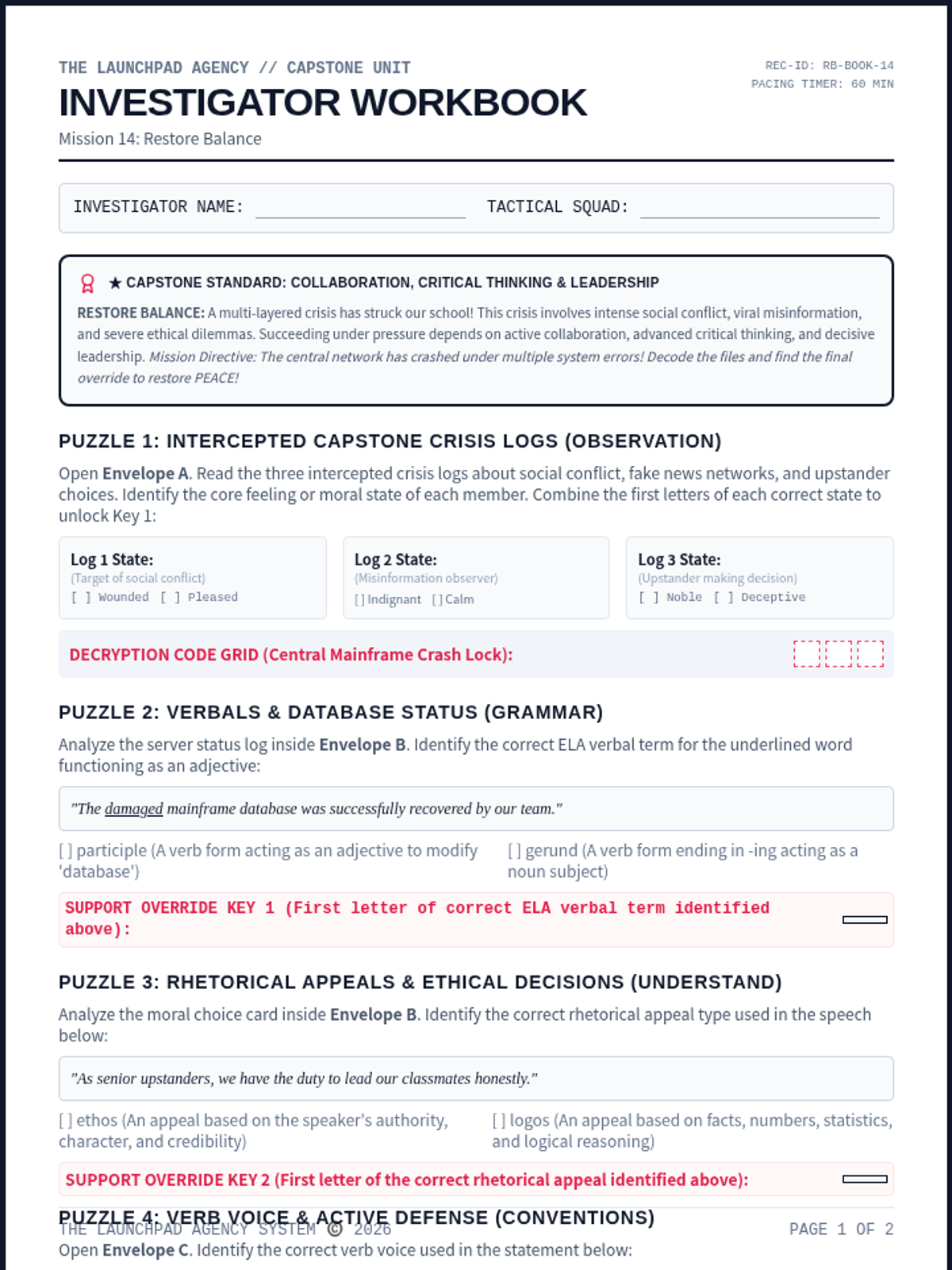
An immersive student-facing escape worksheet. Recruits examine complex social conflict evidence, trace misinformation networks, resolve major ethical dilemmas, and decode the final override.
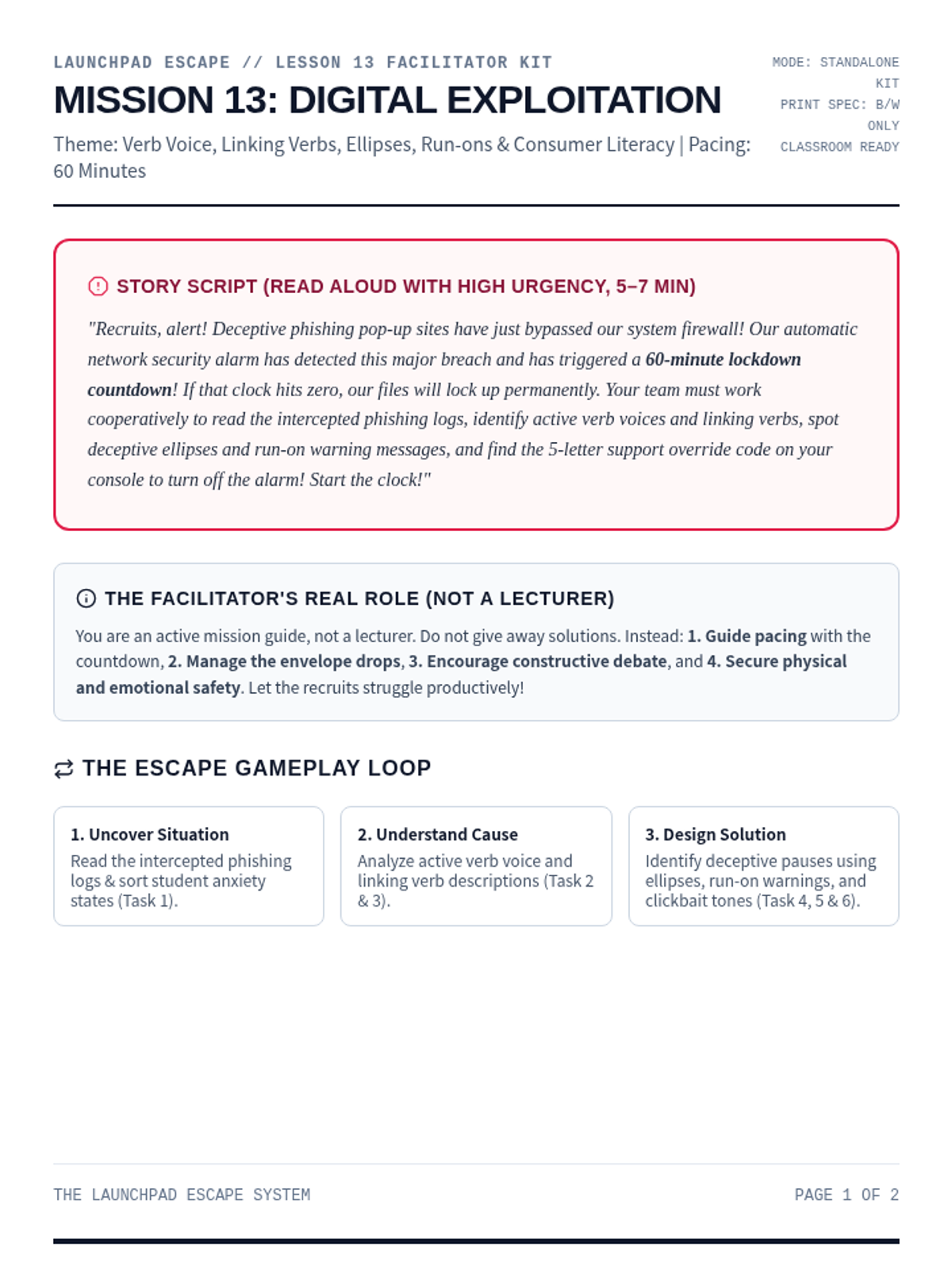
A comprehensive printable facilitator guide for Mission 13: Digital Exploitation. Contains story script, setup checklists, progressive clue mechanics, persuasive appeals endings, and debrief questions.
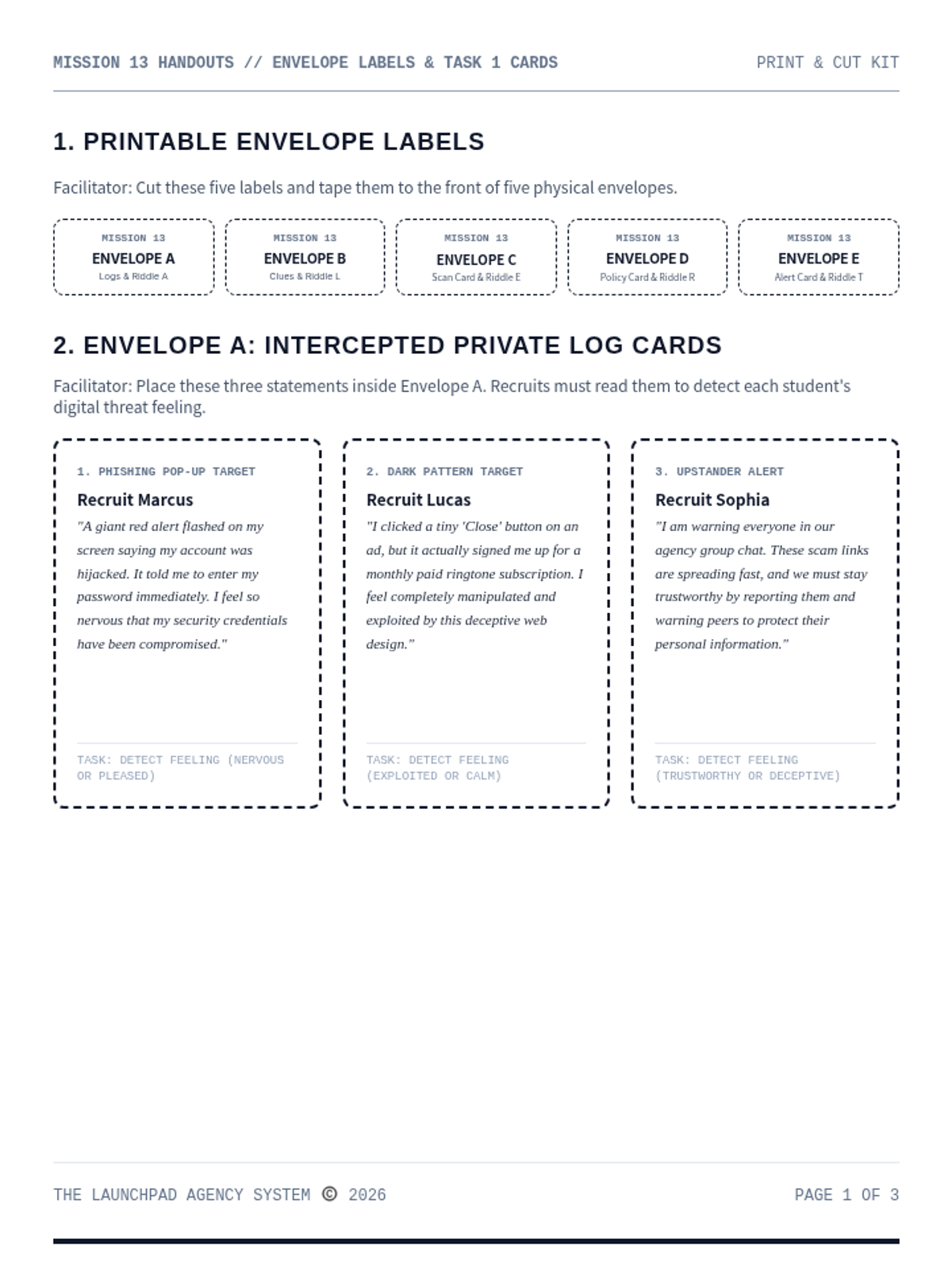
A print-and-cut materials handout kit for Mission 13: Digital Exploitation. Contains envelope labels, student statements, word files, and printable landmark riddle cards.
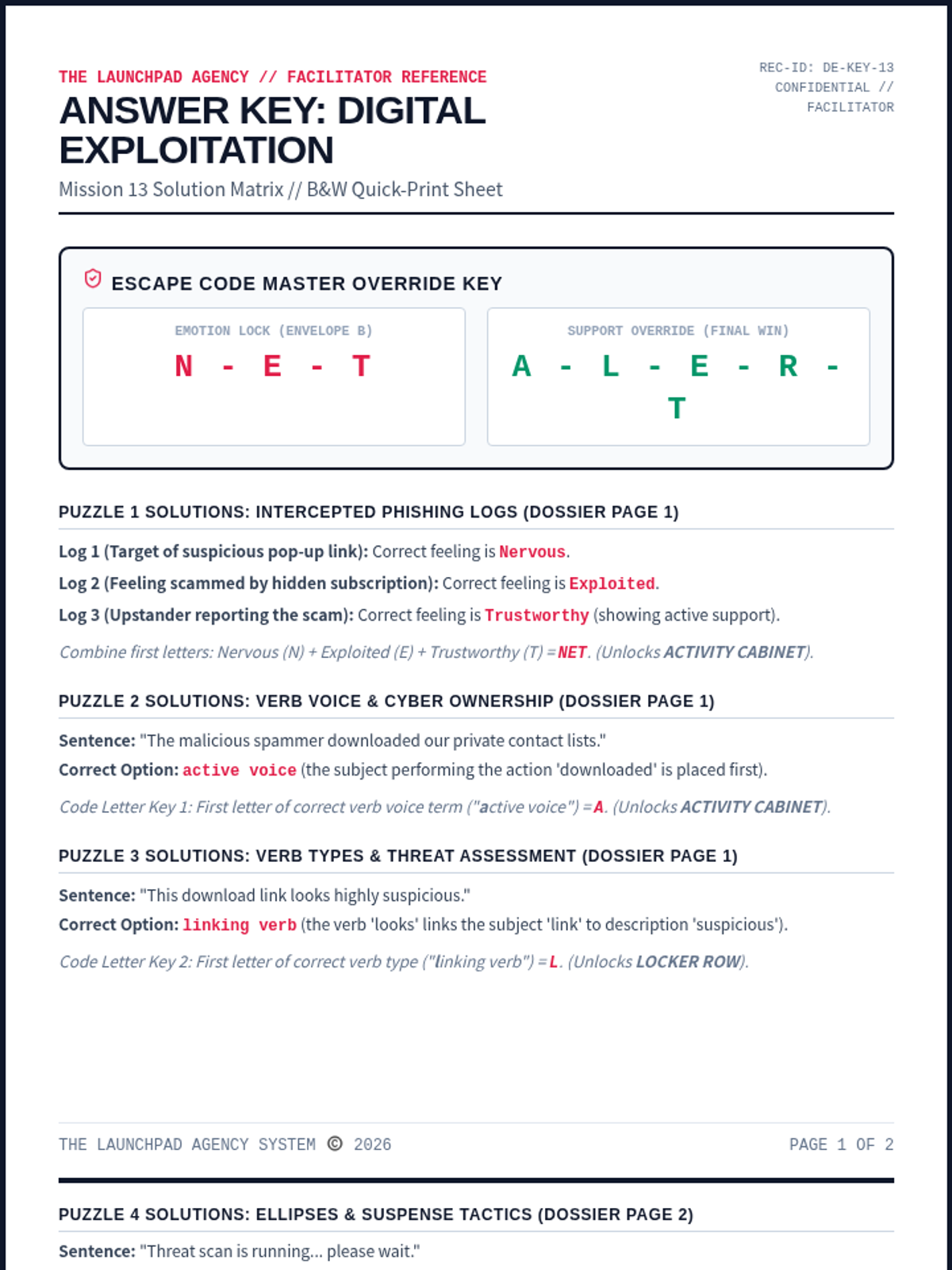
A dedicated facilitator answer key for Mission 13: Digital Exploitation. Contains complete solutions for all ELA/coordinate puzzles, ciphers, and floor map paths, along with rubrics and setup tips.
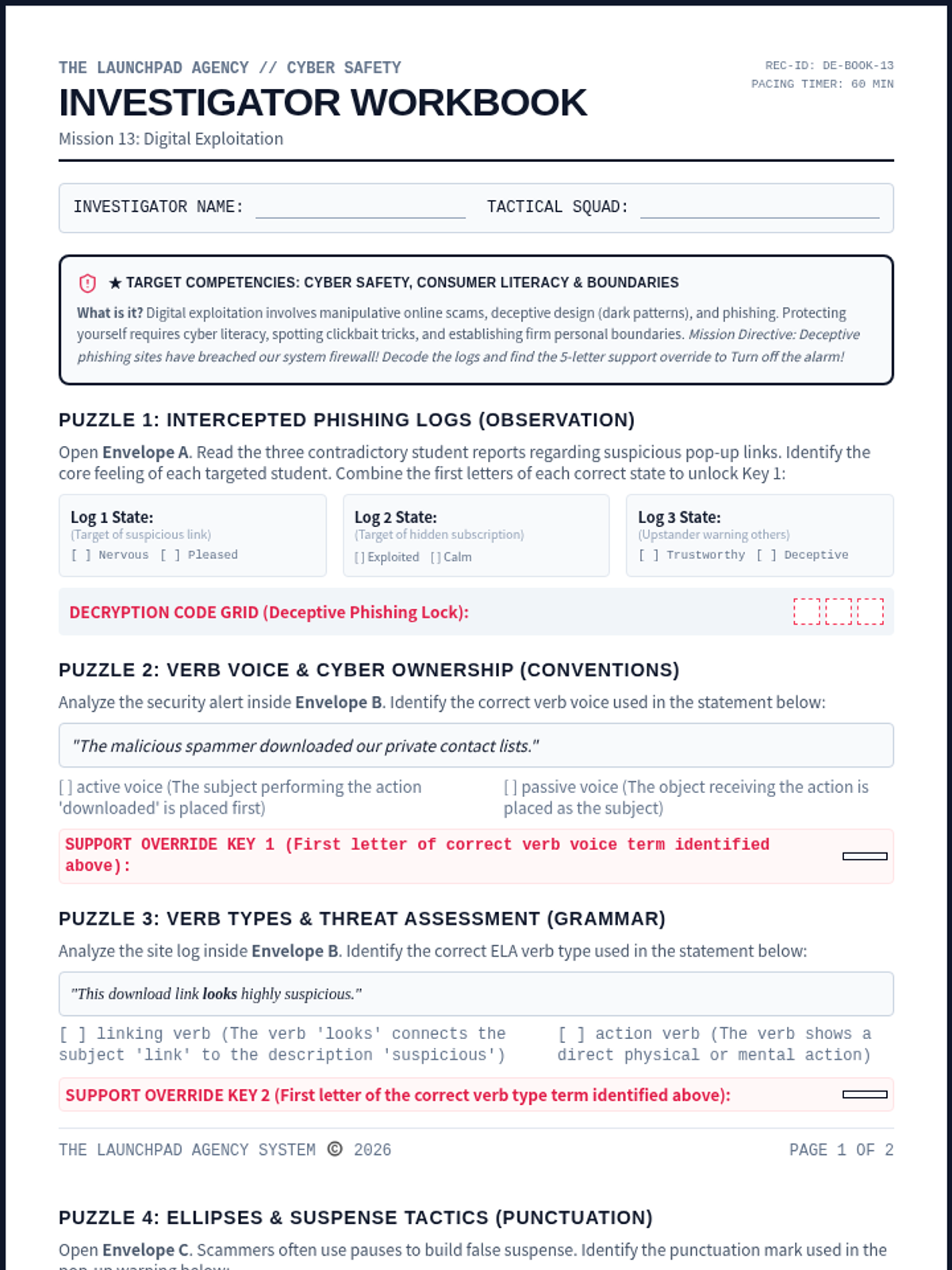
An immersive student-facing escape worksheet. Recruits identify online scams, recognize manipulative dark patterns, and protect personal data. Recruits analyze active verb voices, linking verbs, ellipses punctuation, and deceptive tones to decode the final alert.
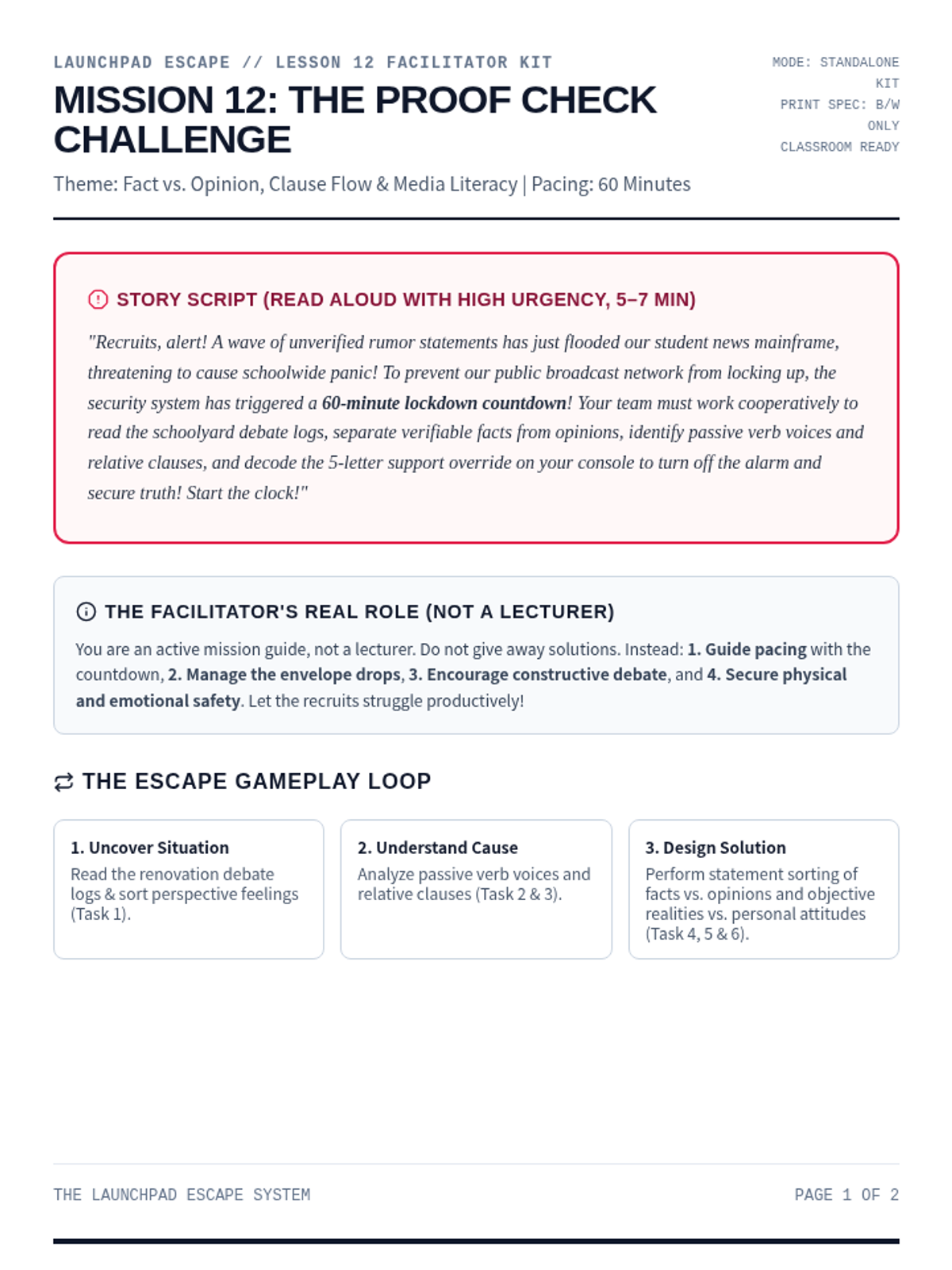
A comprehensive printable facilitator guide for Mission 12: Proof Check. Contains story script, setup checklists, progressive clue mechanics, persuasive appeals endings, and debrief questions.
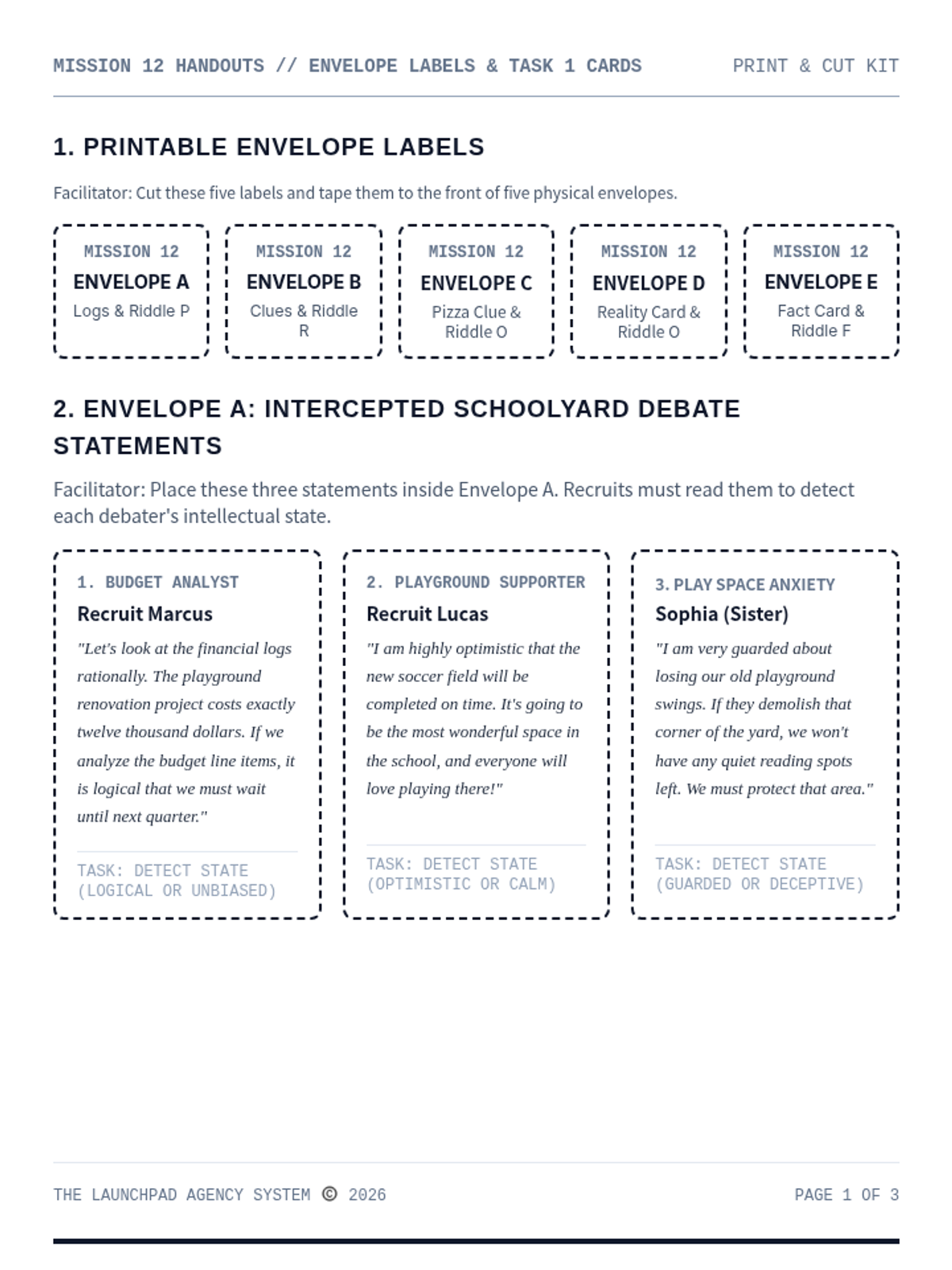
A print-and-cut materials handout kit for Mission 12: Proof Check. Contains envelope labels, student statements, word files, and printable landmark riddle cards.
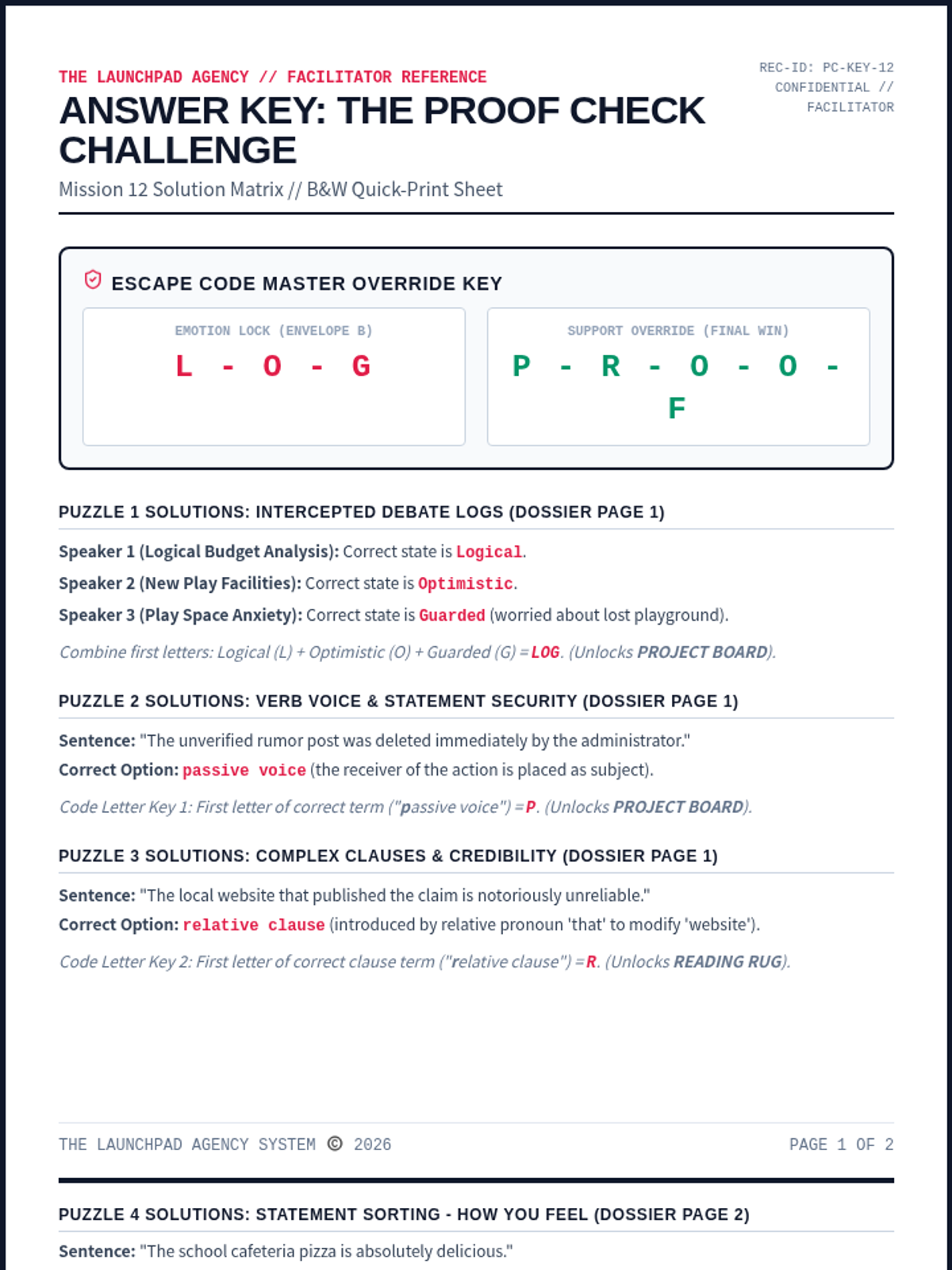
A dedicated facilitator answer key for Mission 12: Proof Check. Contains complete solutions for all ELA/coordinate puzzles, ciphers, and floor map paths, along with rubrics and setup tips.
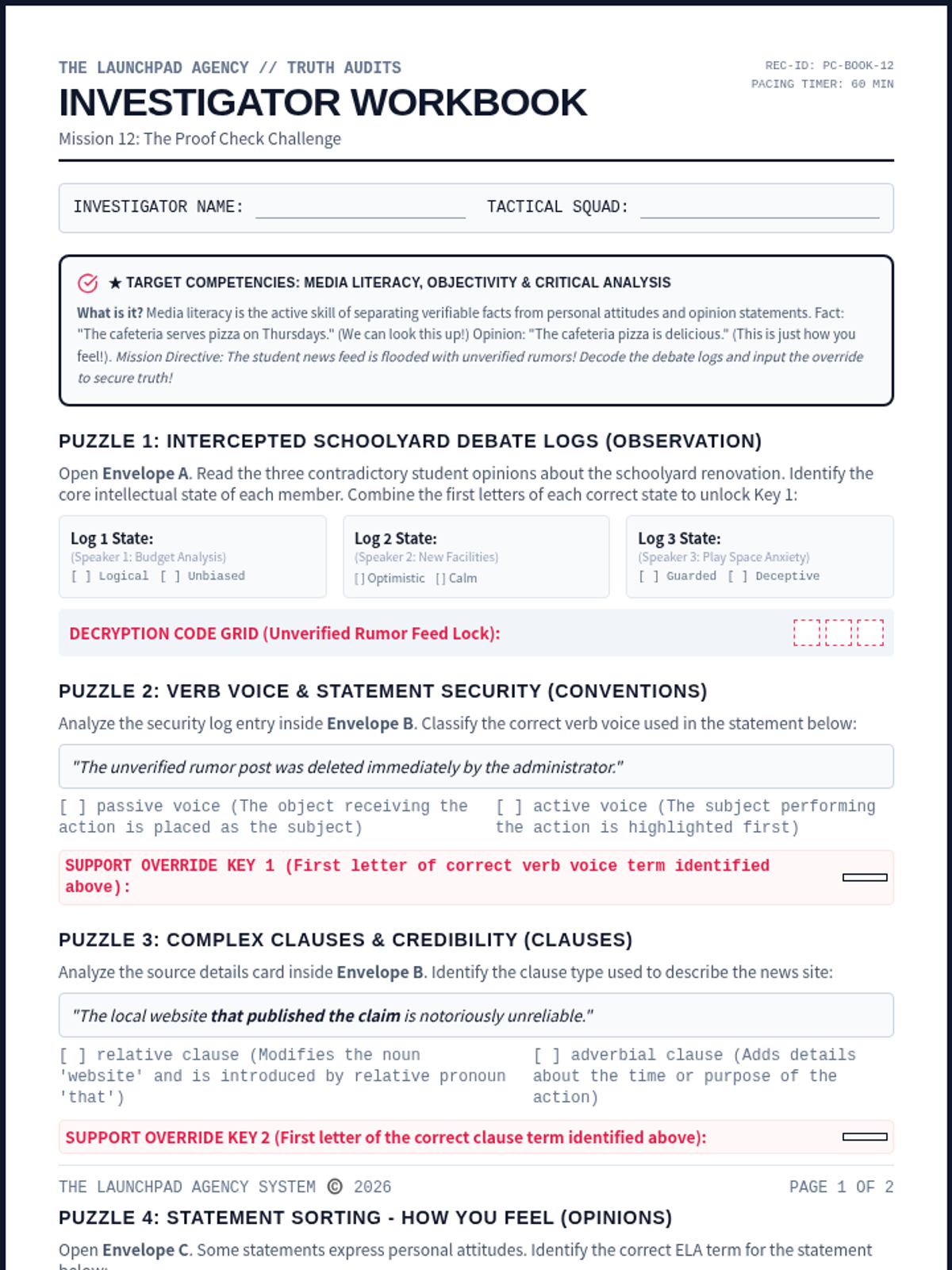
An immersive student-facing escape worksheet. Recruits examine conflicting first-person accounts, analyze relational bullying, identify verbals, object pronouns, intransitive verbs, compound sentences, exclamatory sentence purposes, and solve the override code.
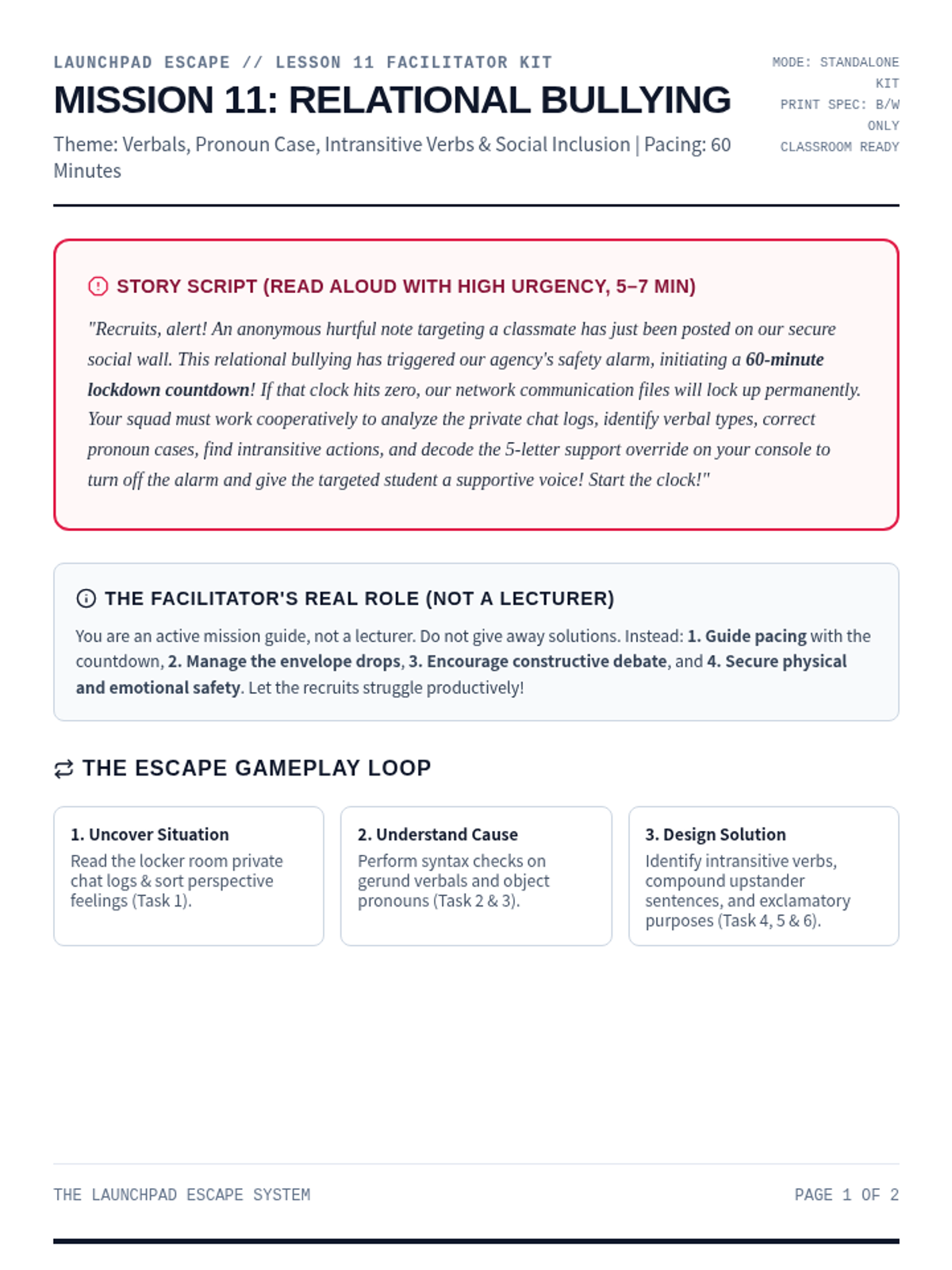
A comprehensive printable facilitator guide for Mission 11: Relational Bullying. Contains story script, setup checklists, progressive clue mechanics, persuasive appeals endings, and debrief questions.
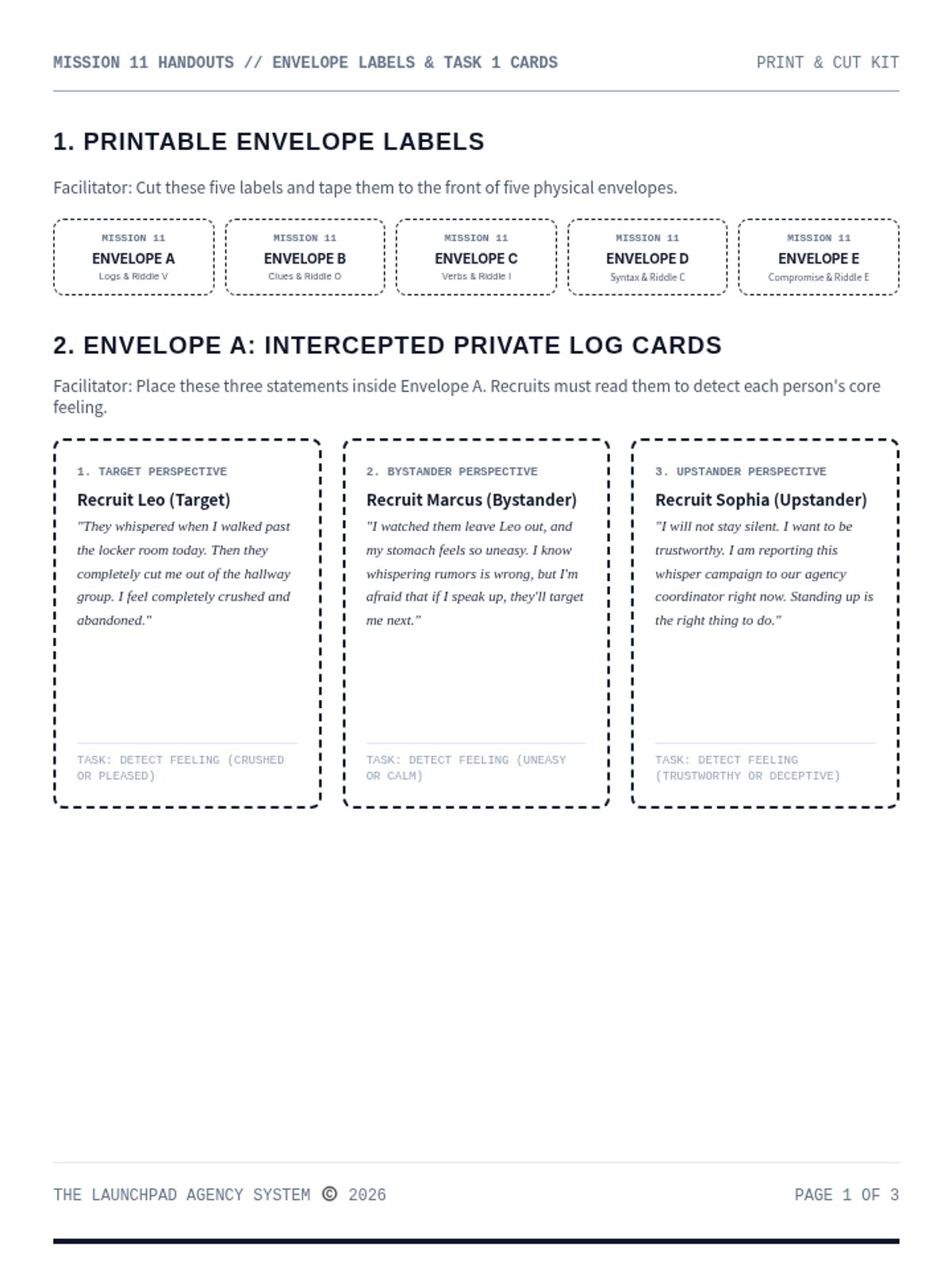
A print-and-cut materials handout kit for Mission 11: Relational Bullying. Contains envelope labels, student statements, word files, and printable landmark riddle cards.
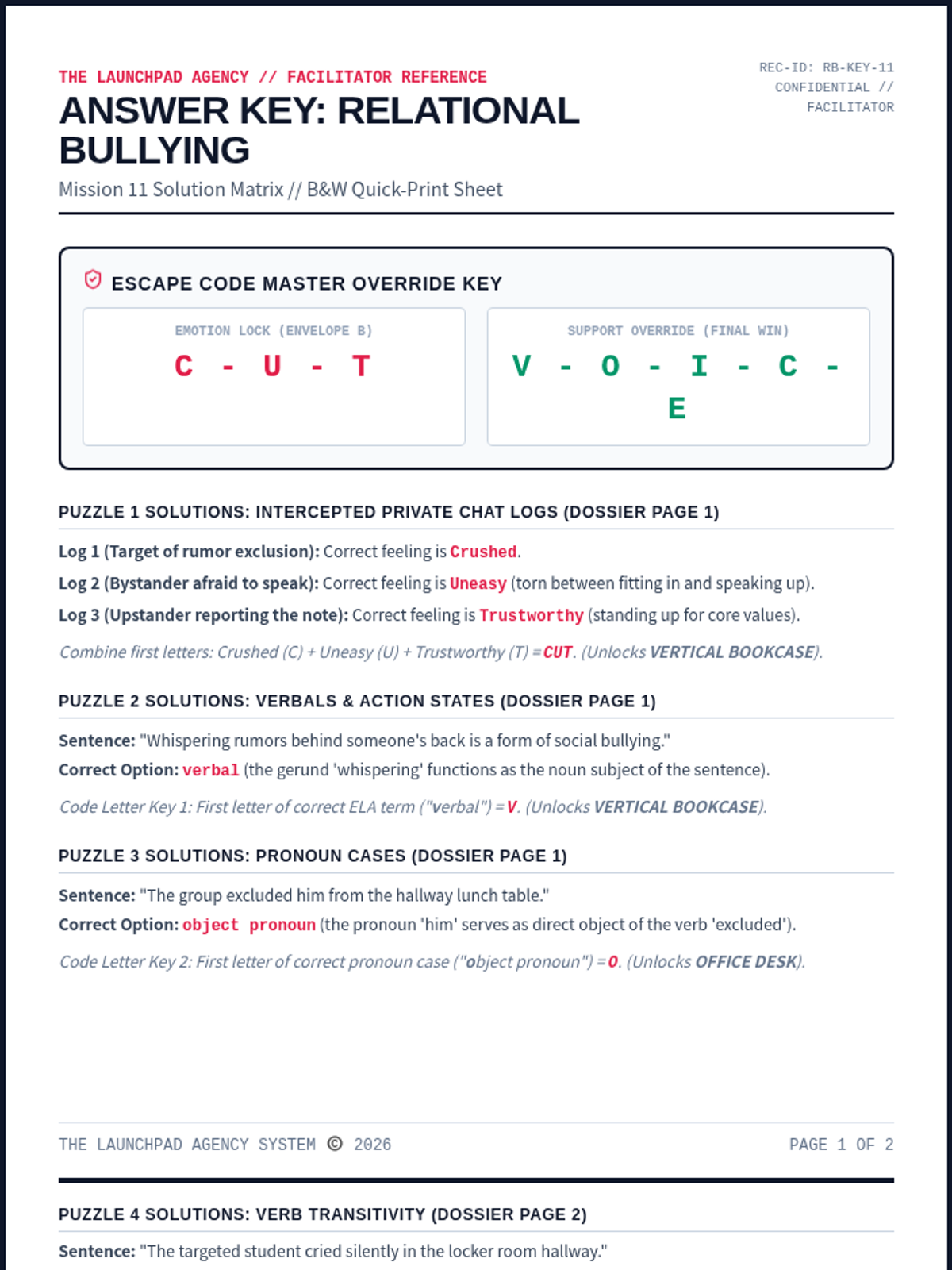
A dedicated facilitator answer key for Mission 11: Relational Bullying. Contains complete solutions for all ELA/coordinate puzzles, ciphers, and floor map paths, along with rubrics and setup tips.
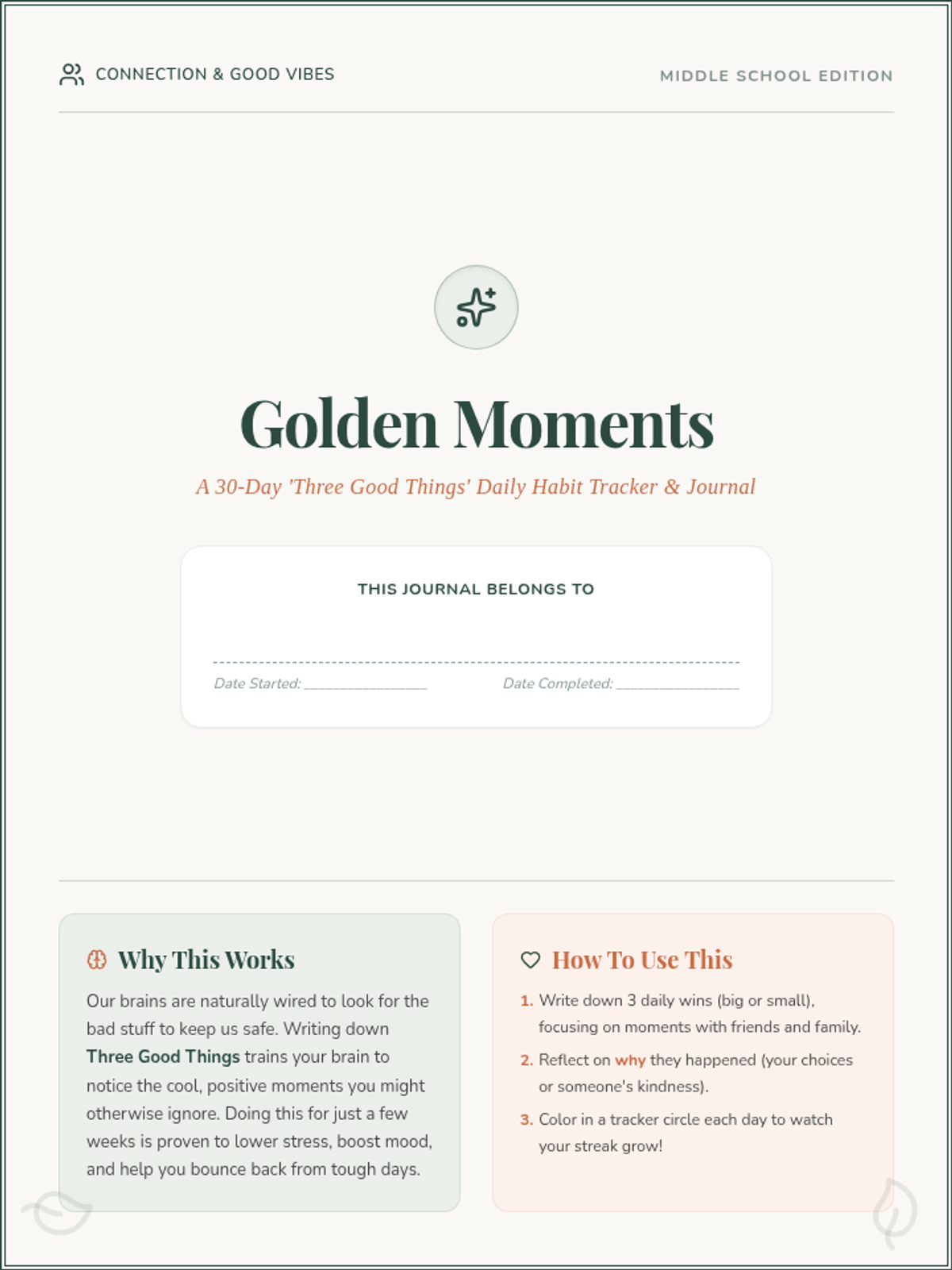
A premium printable 4-page journaling kit and habit tracker designed around the science-backed 'Three Good Things' daily gratitude habit, tailored for 12-year-olds with a modern, relatable tone, friendship/family connection prompts, and an elegant botanical sketchbook aesthetic.
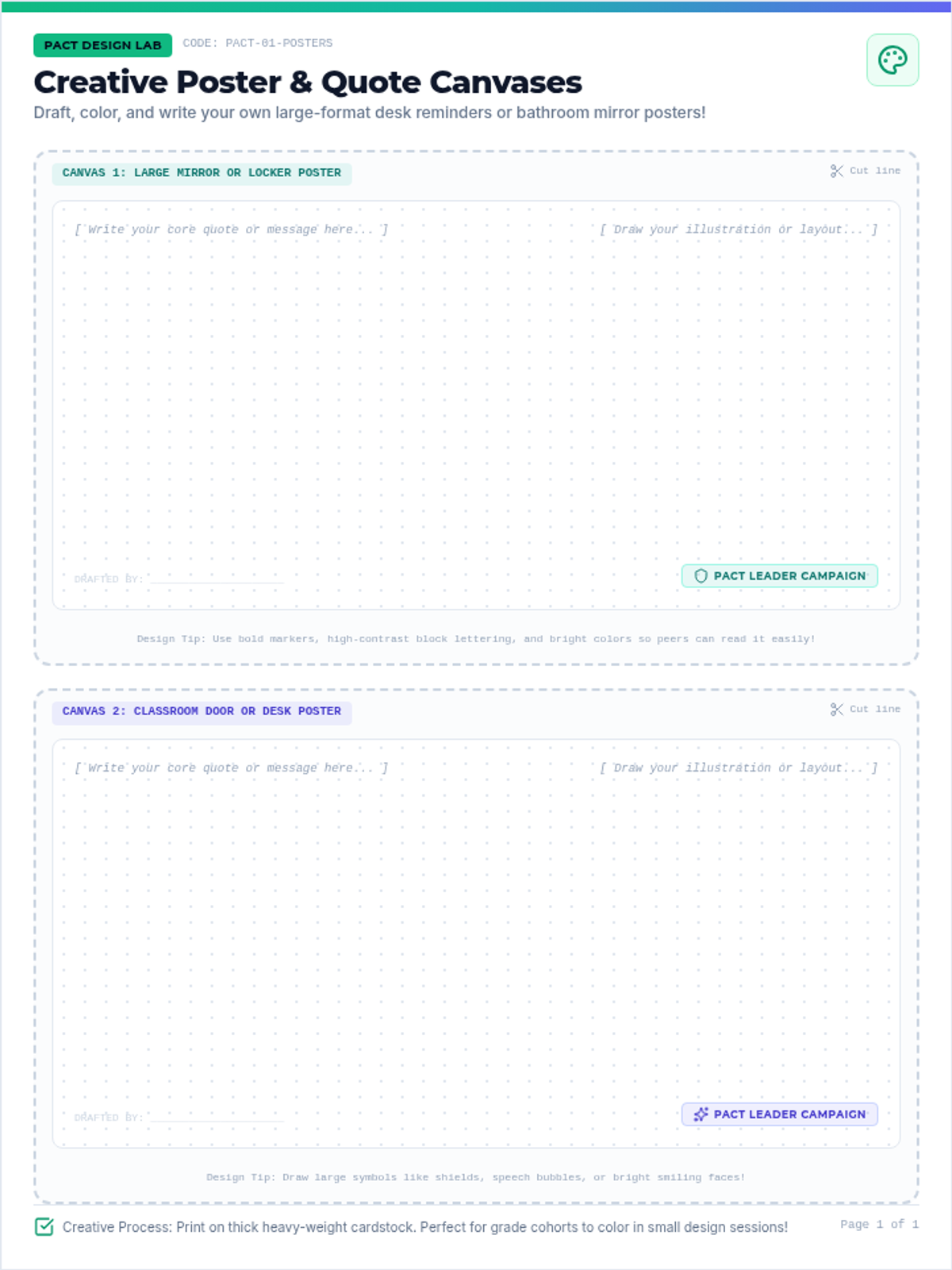
A printable set of large-format design canvases with guide borders and PACT badges, allowing student leaders to hand-draw, color, and draft custom posters or large desk reminders.
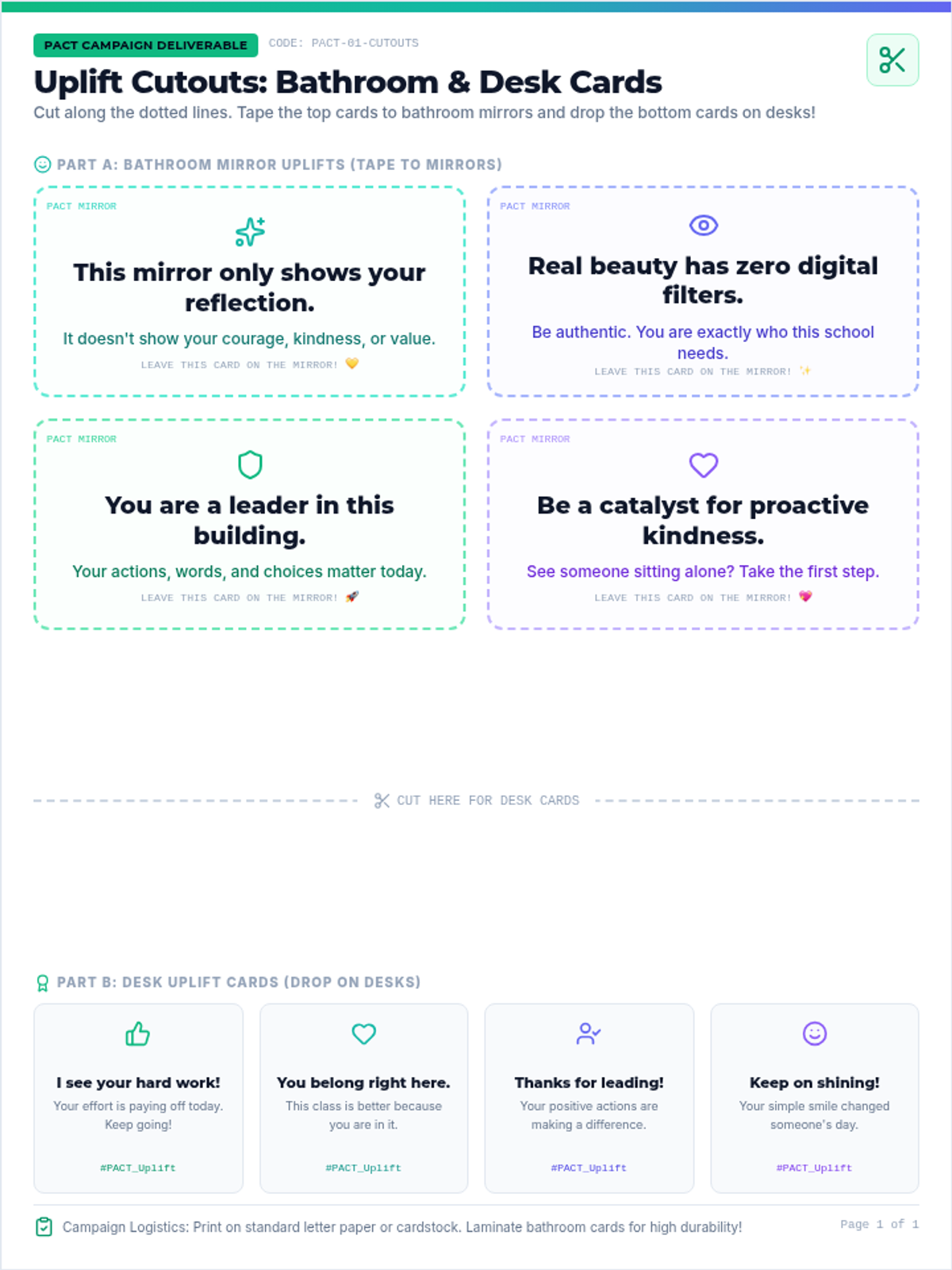
A 1-page printable containing beautifully designed positive mirror reminders for school bathrooms and desk quote slips for classmates. Features scissor-ready cut lines.
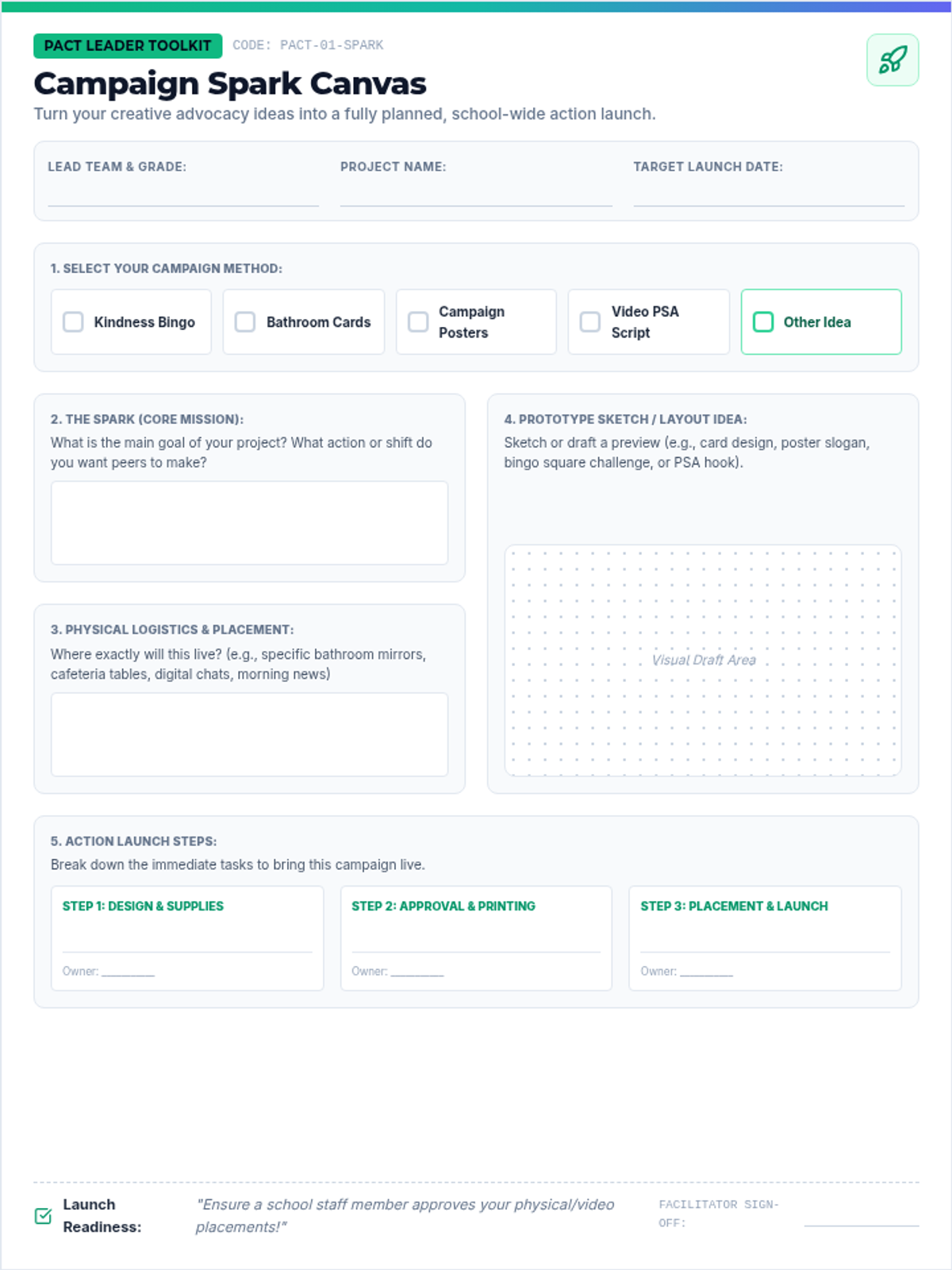
A highly structured, student-friendly project planning canvas designed for PACT leaders to outline, prototype, and launch creative student projects like Kindness Bingo, bathroom cards, posters, and PSAs.
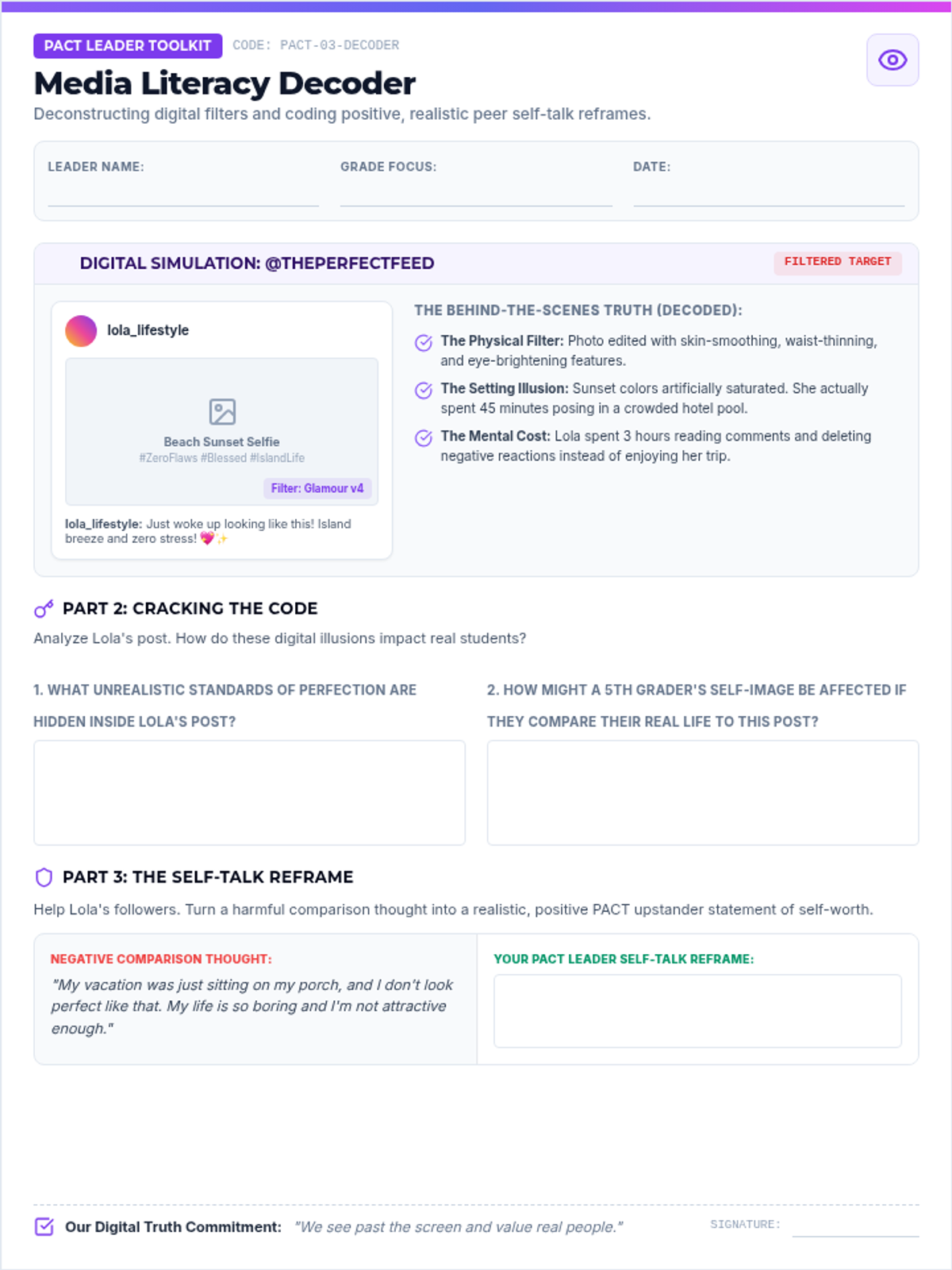
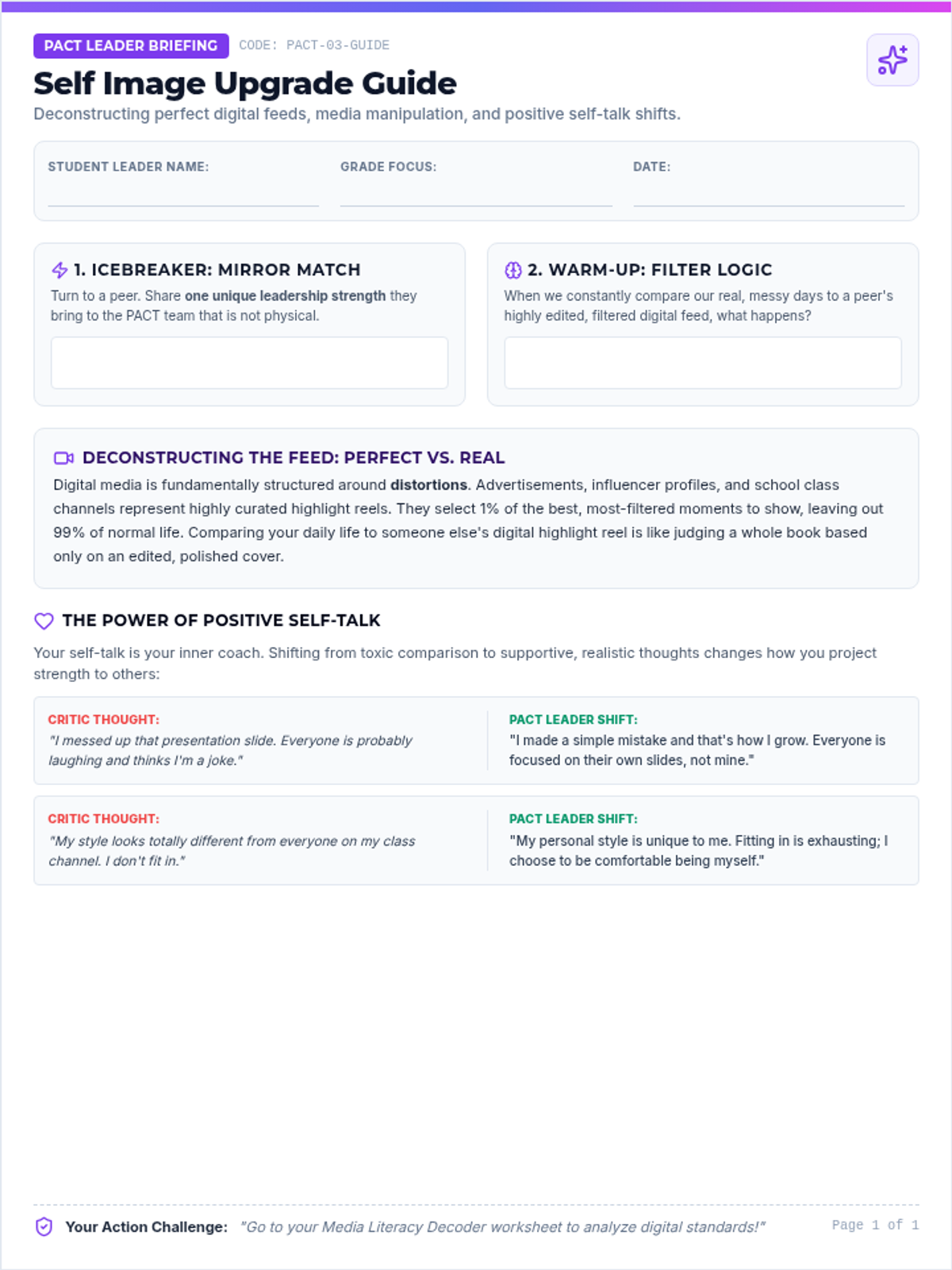
A media literacy and self-talk decoder worksheet for student leaders to analyze digital distortions and practice converting negative comparisons into positive affirmations.
A printable guide detailing digital media literacy, deconstructing filters and perfect feeds, alongside self-talk reframing strategies.
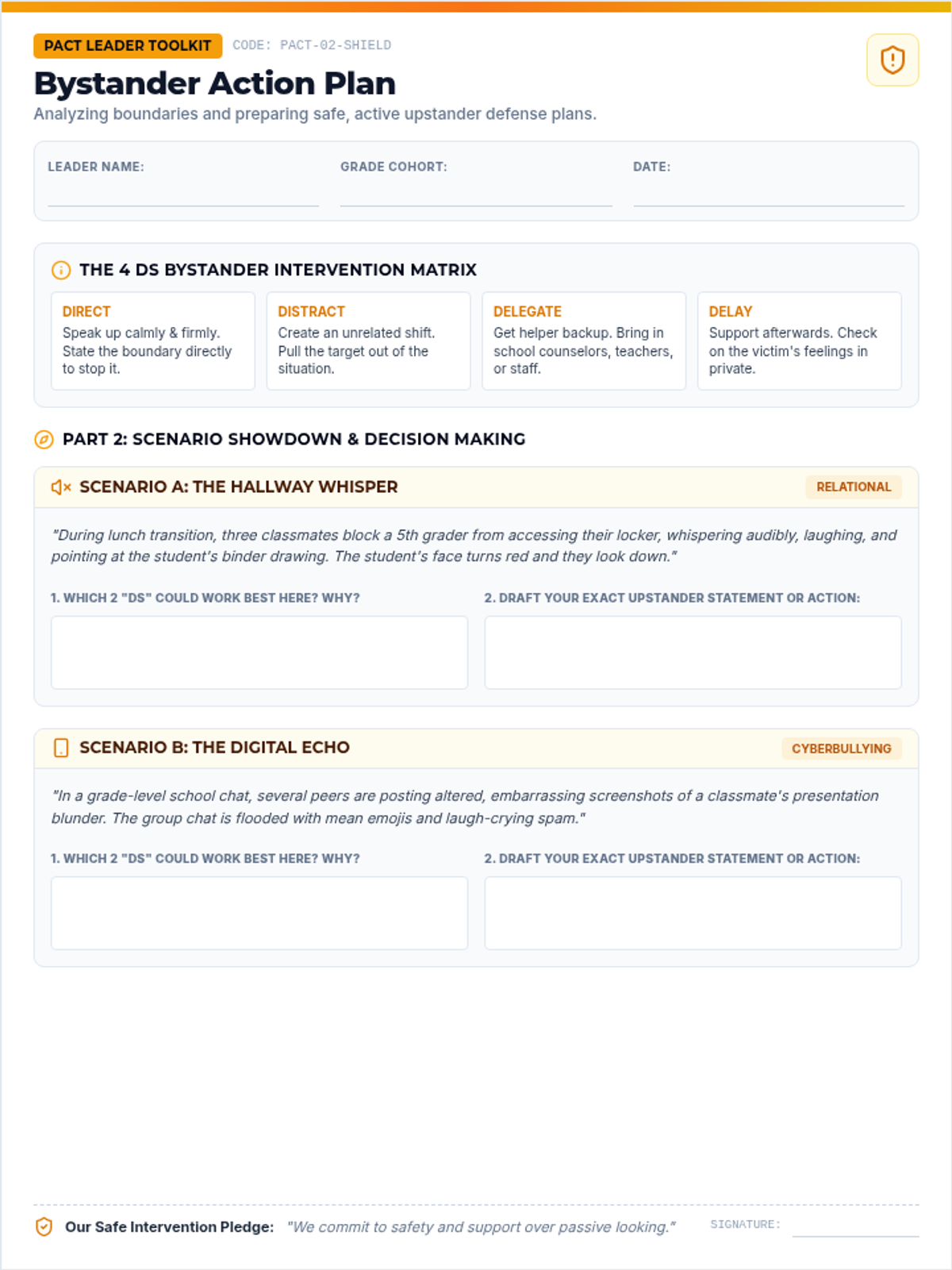
A practical student-facing action planning sheet where PACT leaders analyze real-world bullying scenarios and apply the 4 Ds bystander intervention framework.
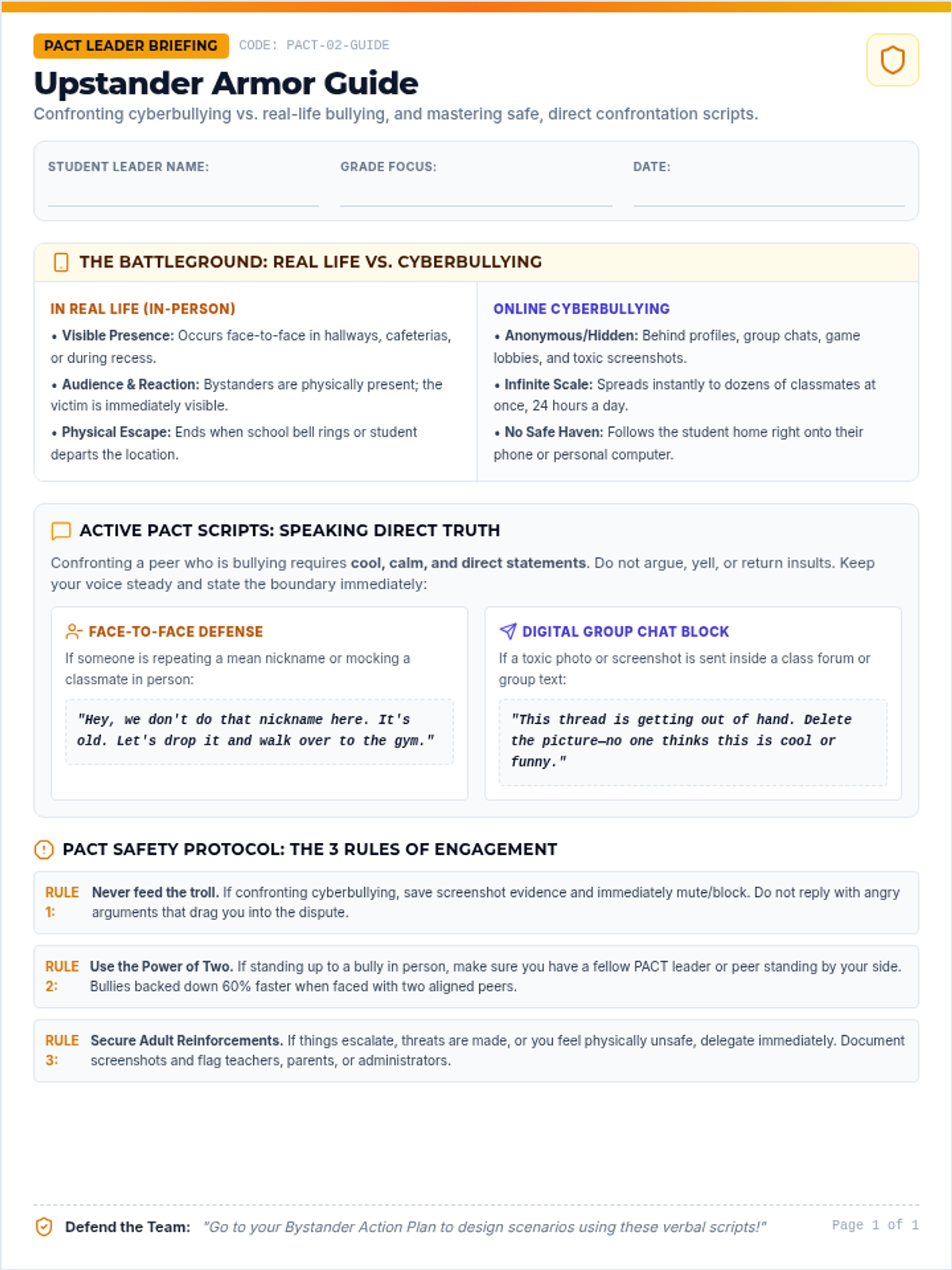
A printable guide detailing the exact differences between face-to-face and online cyberbullying, alongside direct, verbal upstander scripts for confronting bullying behavior safely.
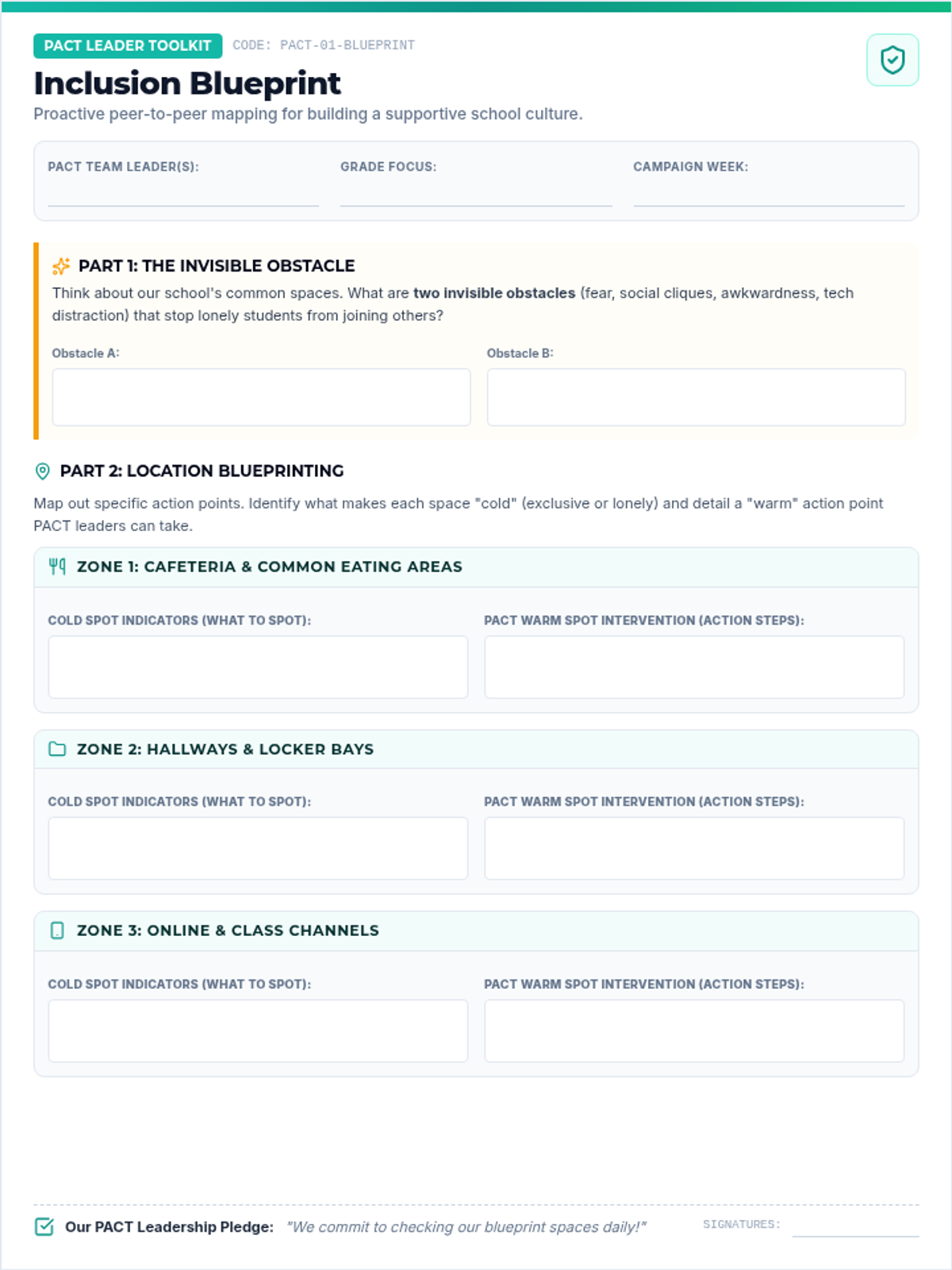
A blueprint planning worksheet for PACT leaders to map out specific, location-based proactive inclusion strategies across their school community.
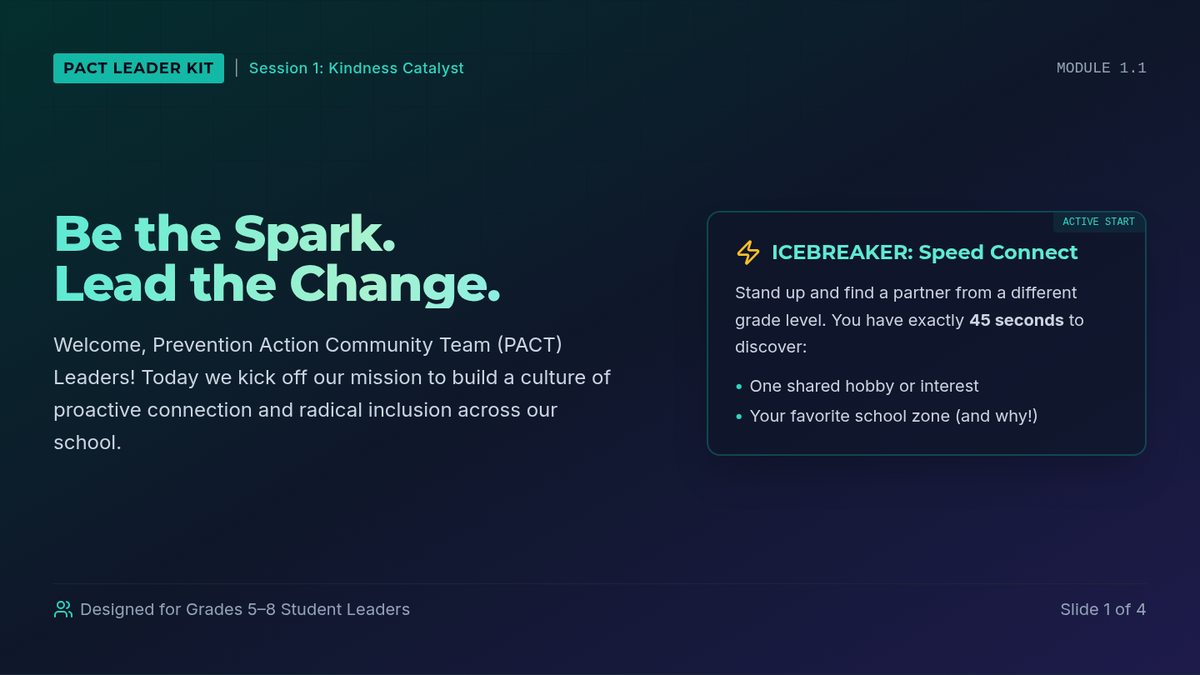
A printable guide for PACT student leaders outlining the campaign's core mission, featuring a group speed-connect icebreaker, a brain warm-up reflection, and proactive kindness checklists.
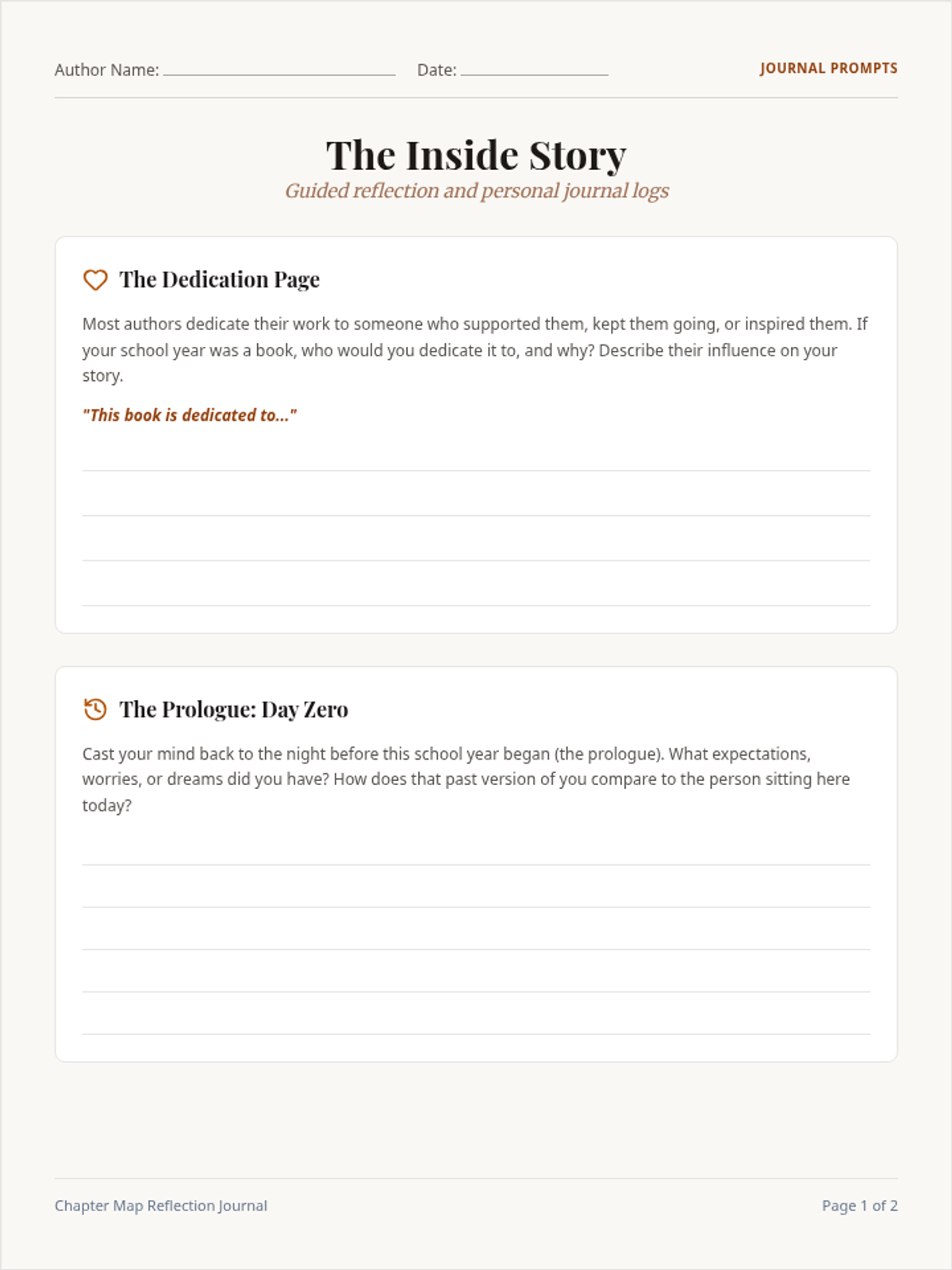
A beautifully styled 2-page print-ready reflection journal with prompts for writing a dedication, identifying inner strengths, and draft-teasing the next volume of their story.
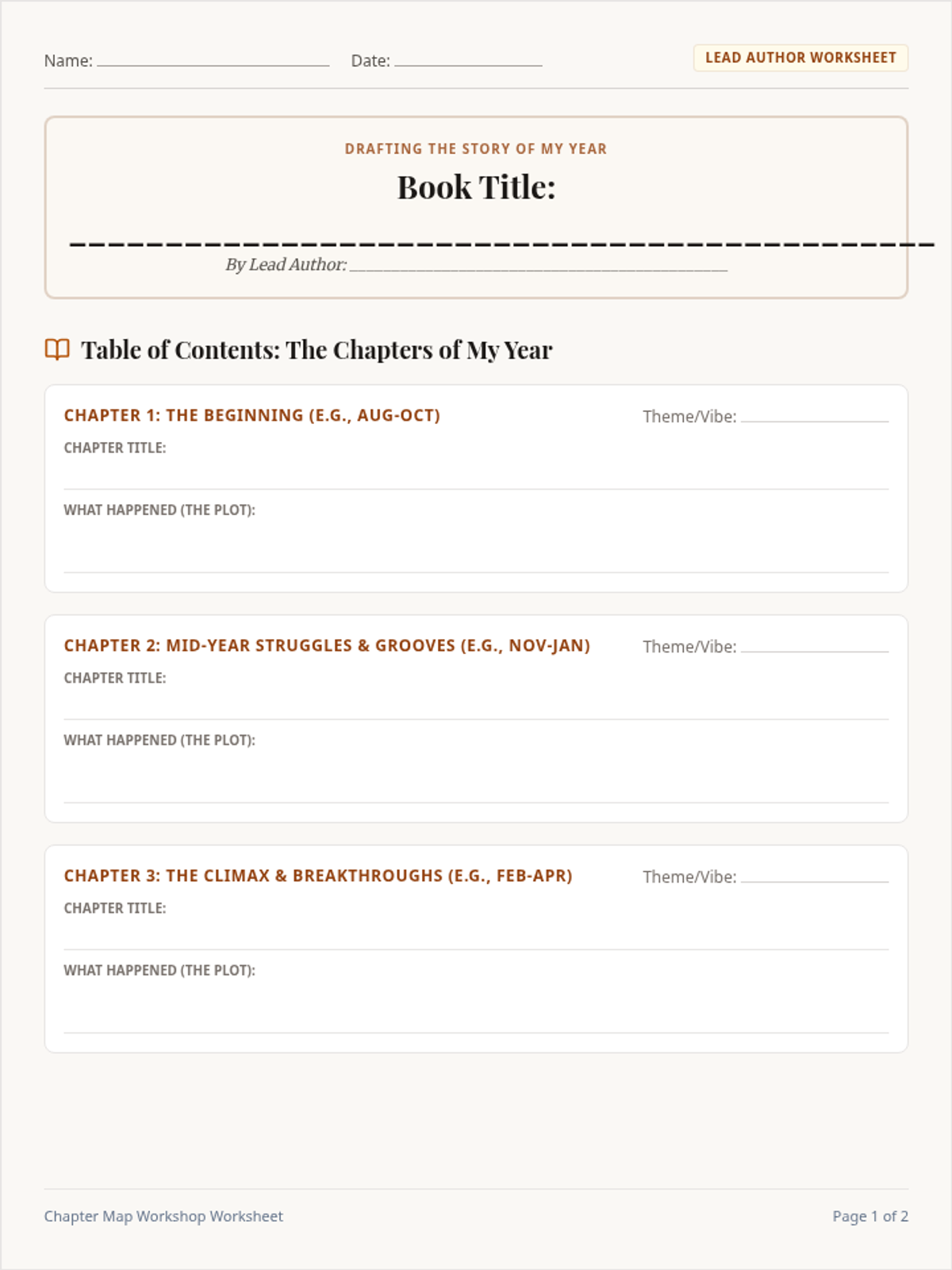
A beautifully structured 2-page graphic organizer for students to divide their year into 4 chapters, title their book, outline their summaries, and re-author a central plot conflict.
A beautiful visual presentation designed to guide students through the workshop, establishing the "Lead Author" mindset and defining key structural parts of a chapter map.
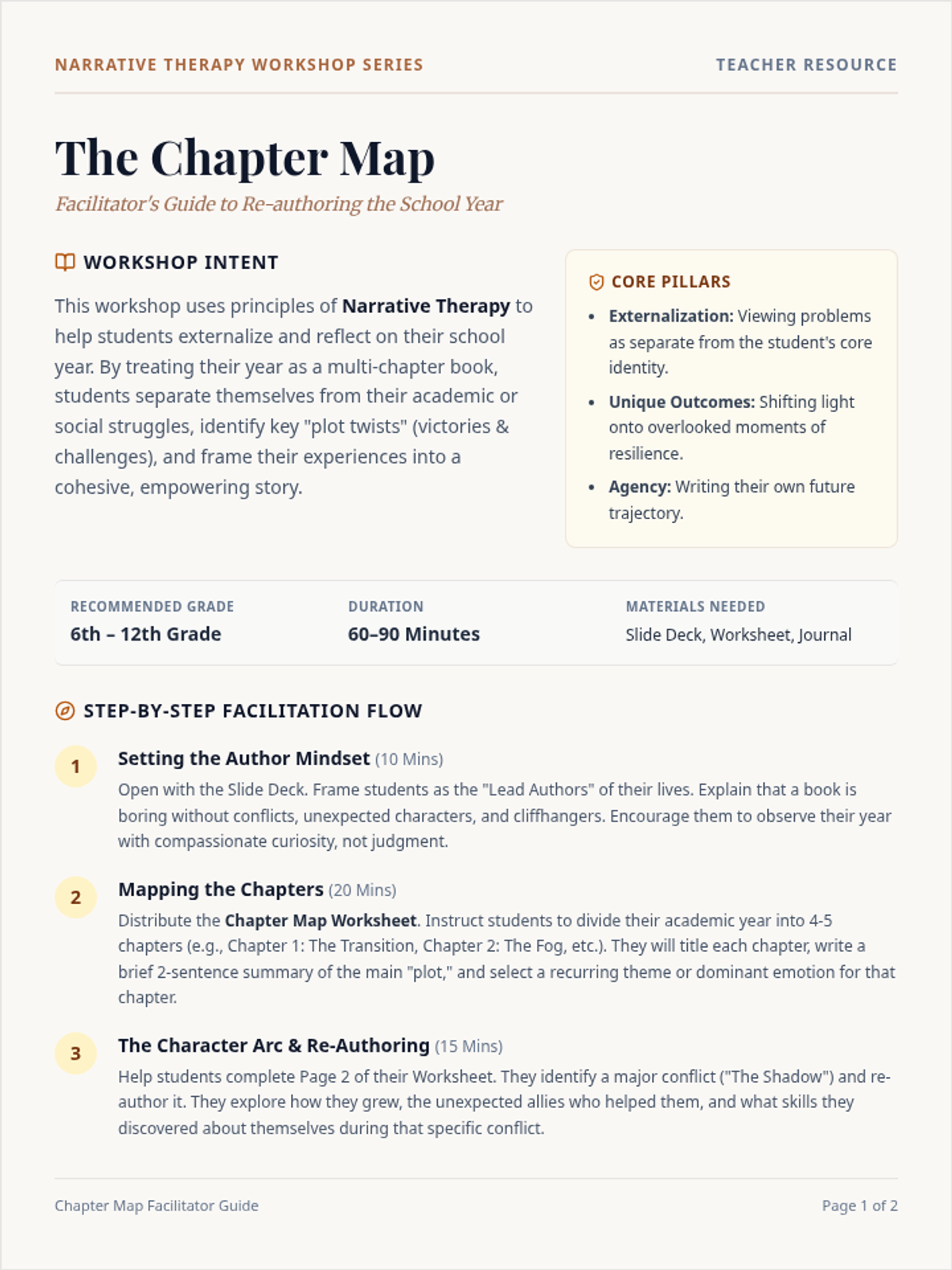
A comprehensive teacher's guide outlining the lesson objectives, narrative therapy framing, pacing, and step-by-step instructions for facilitating the Chapter Map workshop.
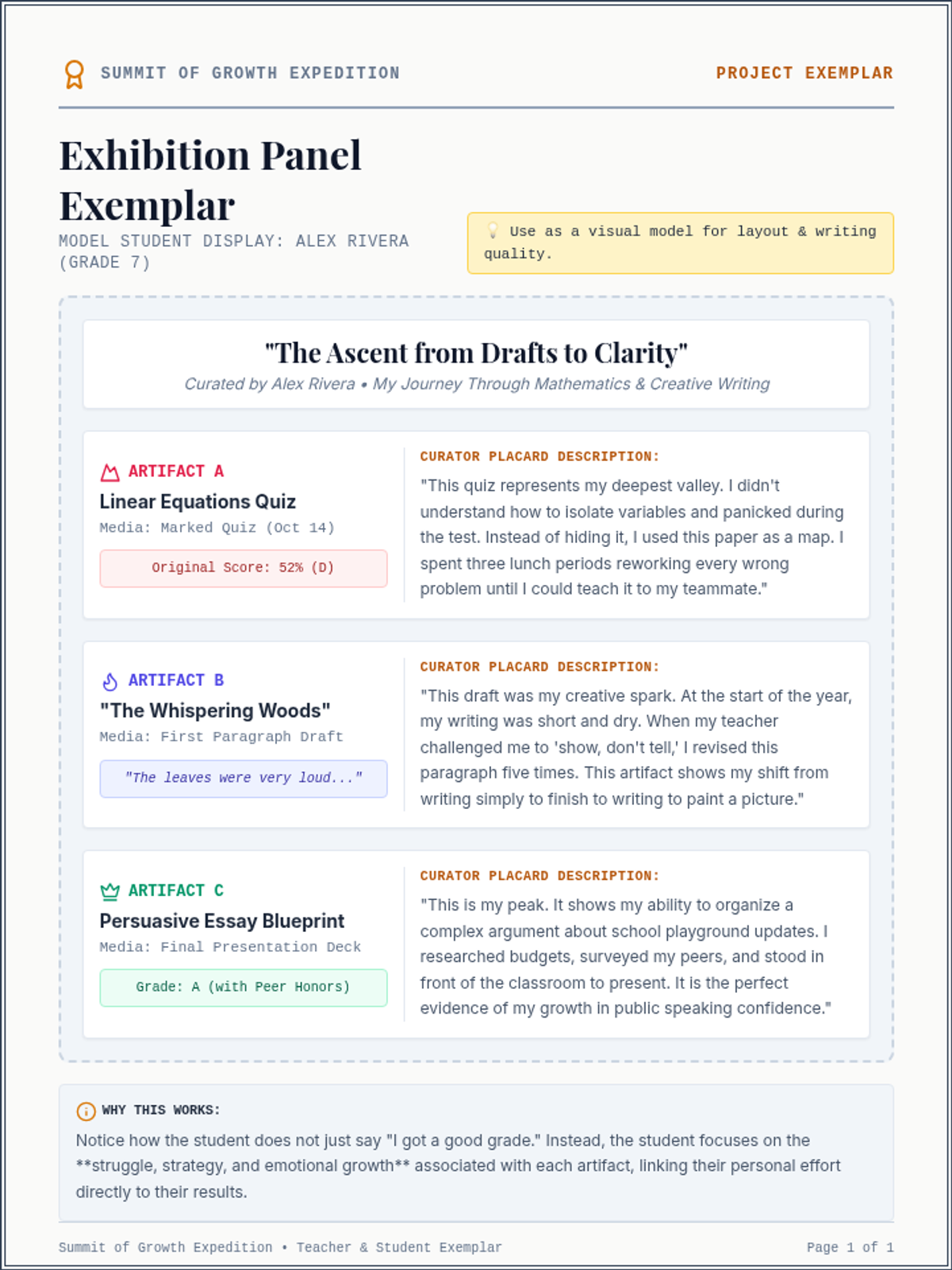
An exemplar showcasing a completed year-end milestone portfolio panel, complete with mock student artifacts, growth narratives, and curator placards.
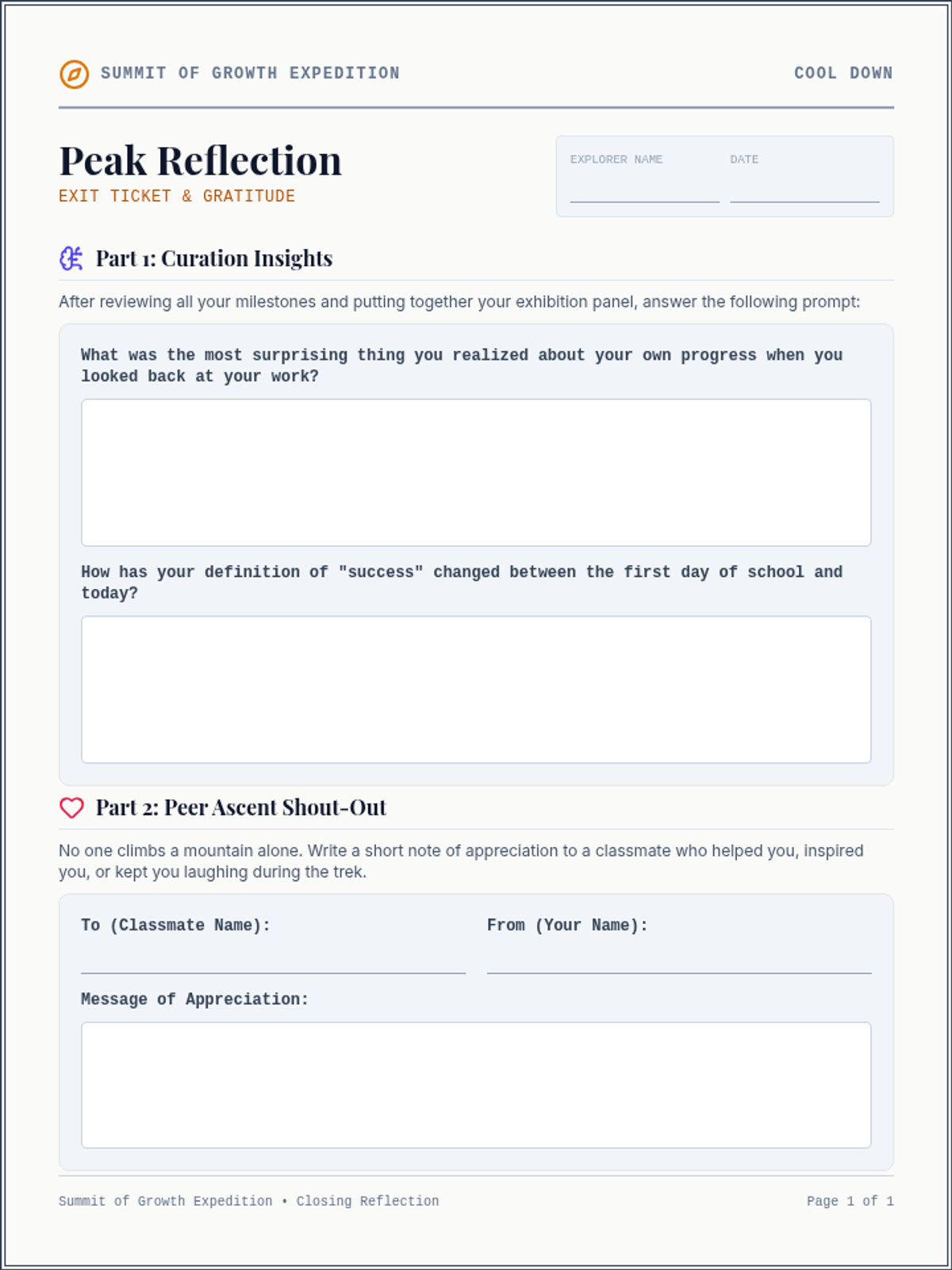
A reflective exit ticket and cool-down activity helping students consolidate their self-discoveries and express gratitude to a peer climber.
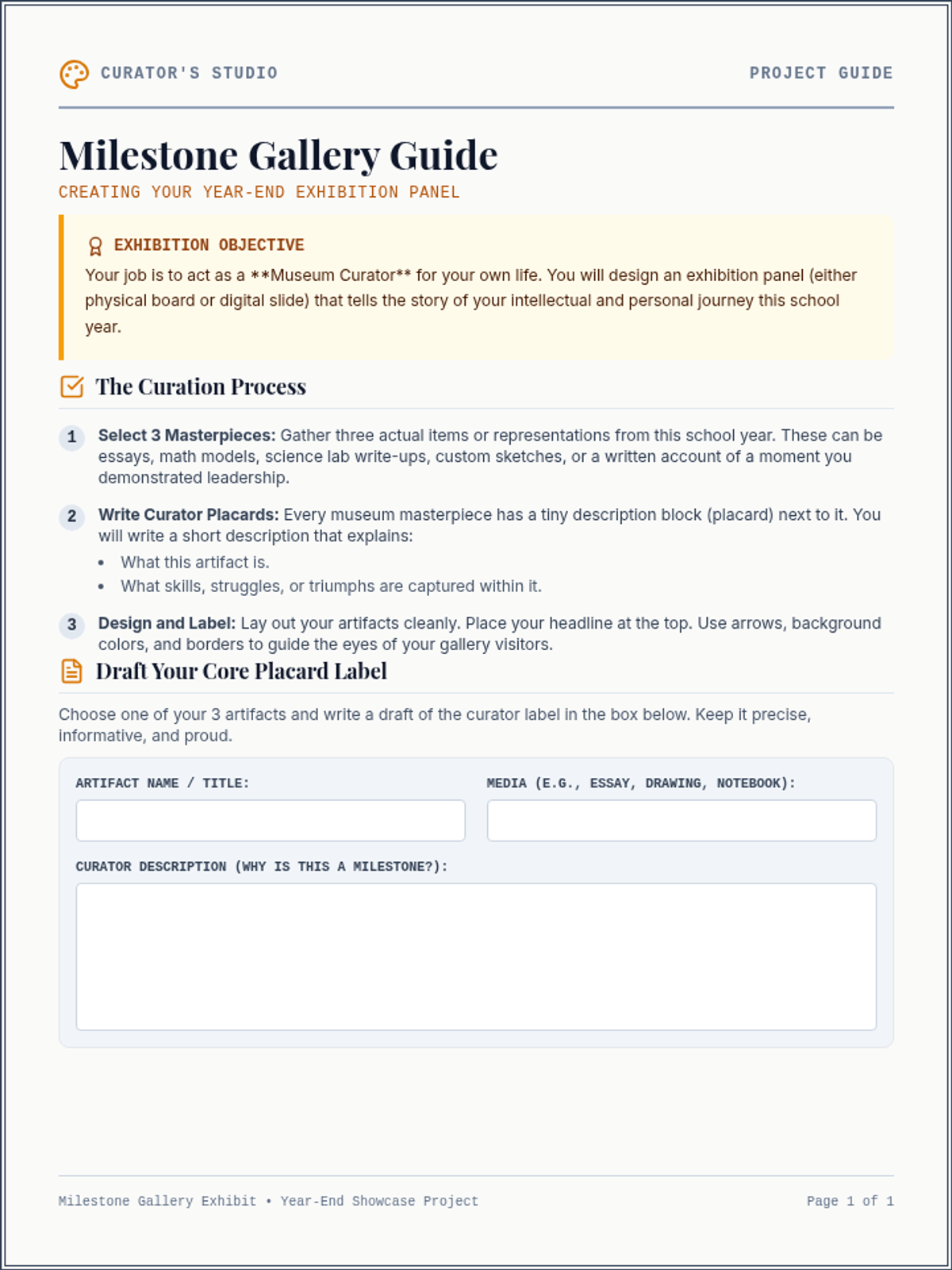
A student-facing guide detailing how to design and curate a milestone display placard for their portfolio exhibition.
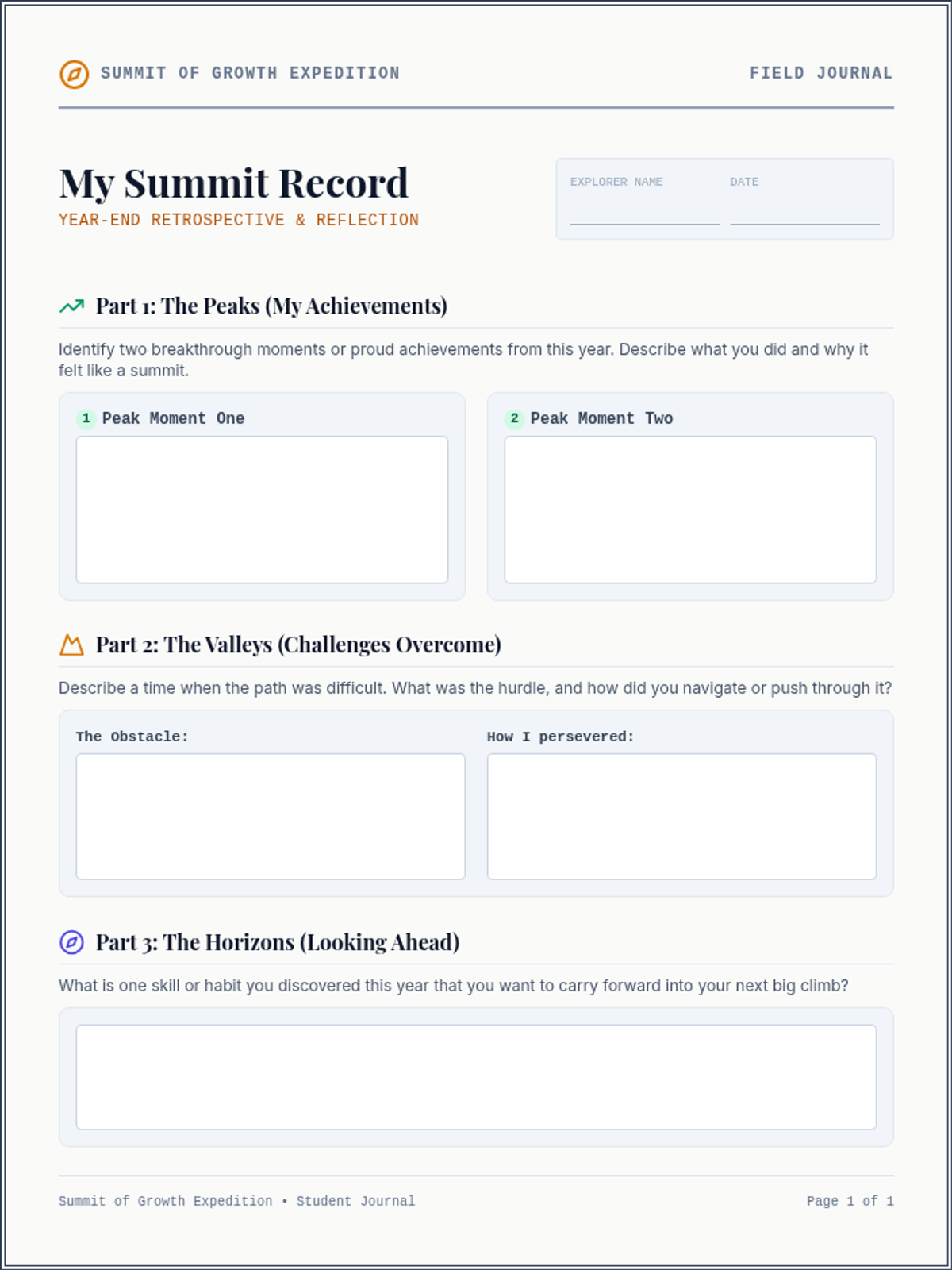
An elegant student reflection worksheet styled as a field guide page, helping students map their peak achievements, valleys (challenges), and future horizons.
An elegant and engaging slide deck using the mountain expedition metaphor to guide students through the reflection and portfolio curation process.
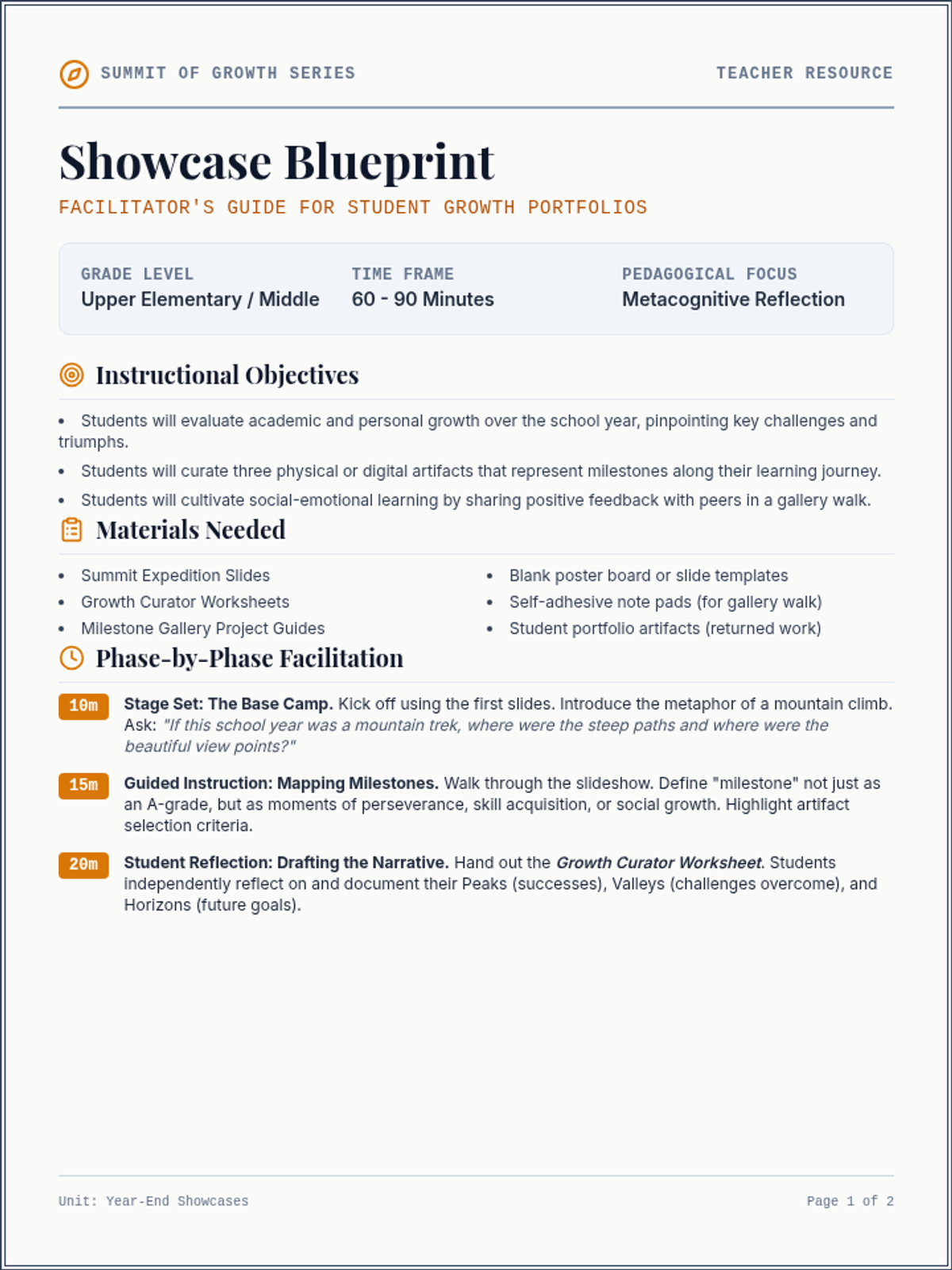
A comprehensive lesson plan for teachers, detailing lesson structure, timing, prompts, and pedagogical notes for facilitating the Summit of Growth reflection.
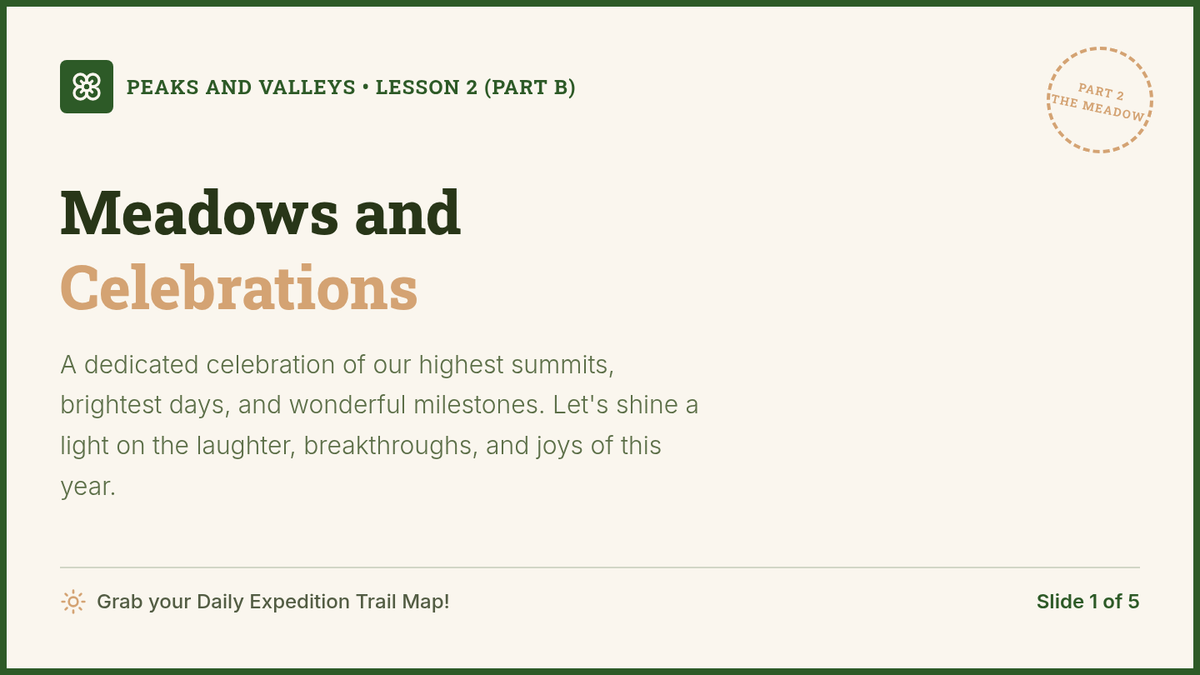
The second part of the divided slide presentation for Lesson 2, focusing on bright meadow moments, celebratory breakthroughs, and acknowledging positive EOY achievements.
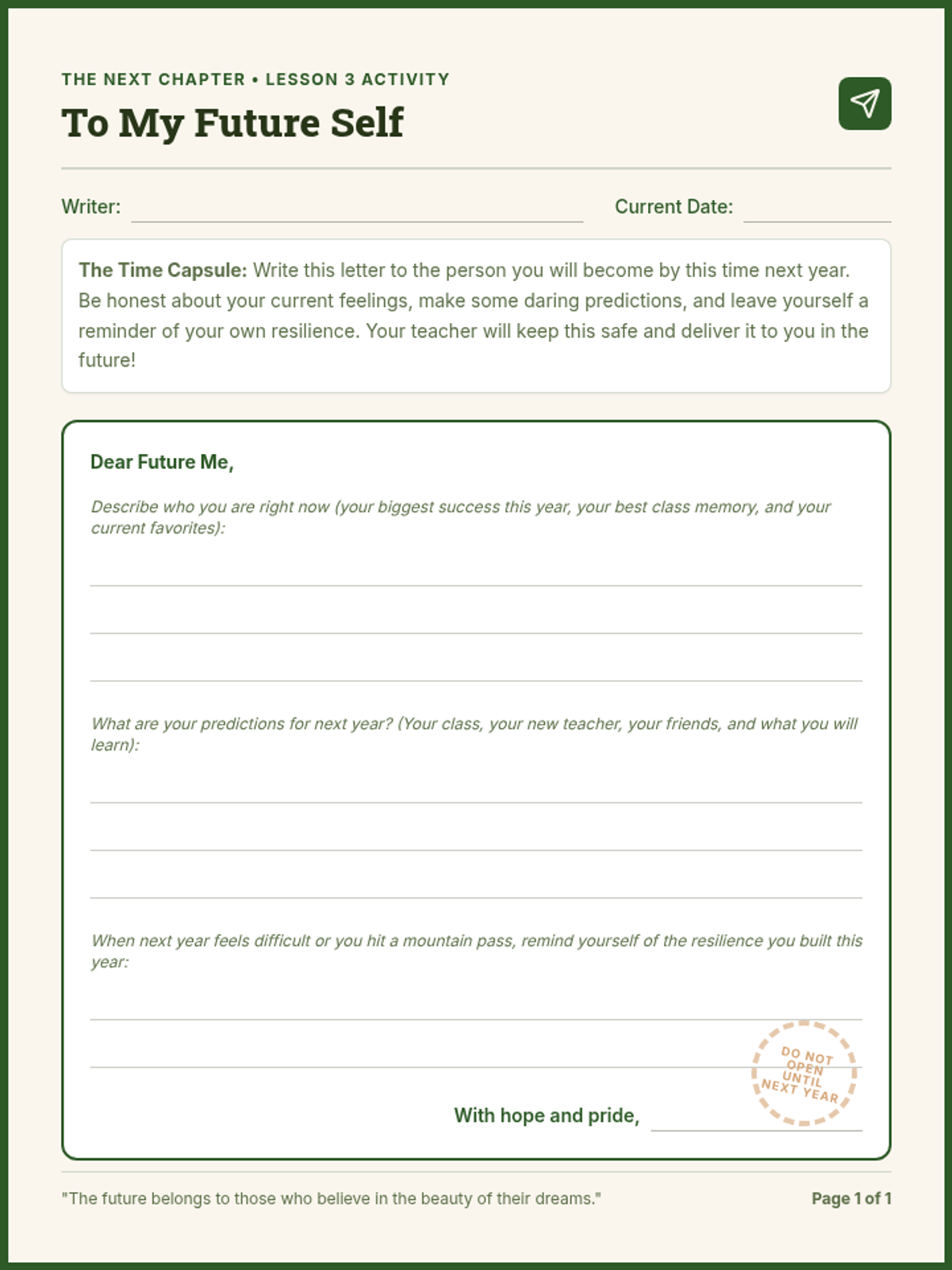
A beautifully structured future-self writing template where students record predictions, personal advice, and words of encouragement for next school year.
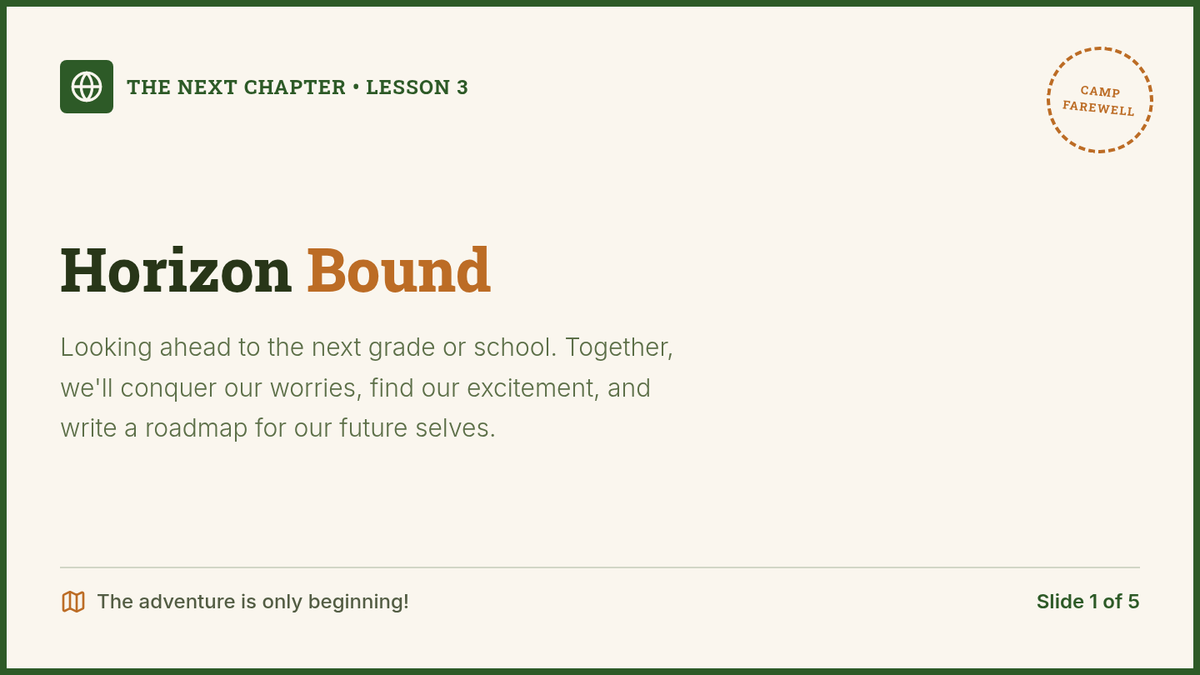
An interactive slide deck guiding students through future grade transitions, exploring their mixed feelings of anxiety and excitement, and collecting wisdom for next year's incoming students.
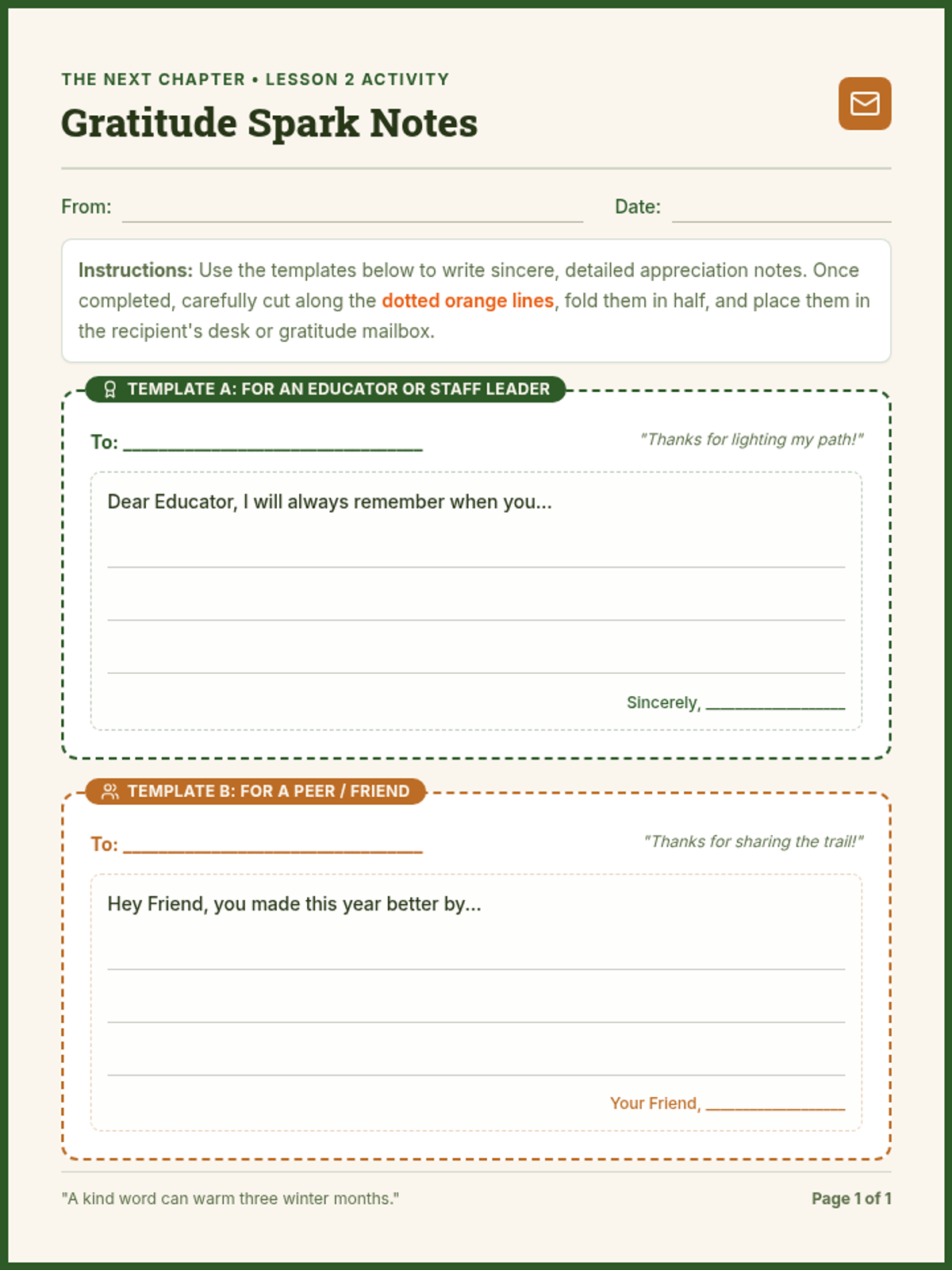
A printable template sheet with folding gratitude card designs for students to write warm, specific appreciation letters to classmates and teachers.
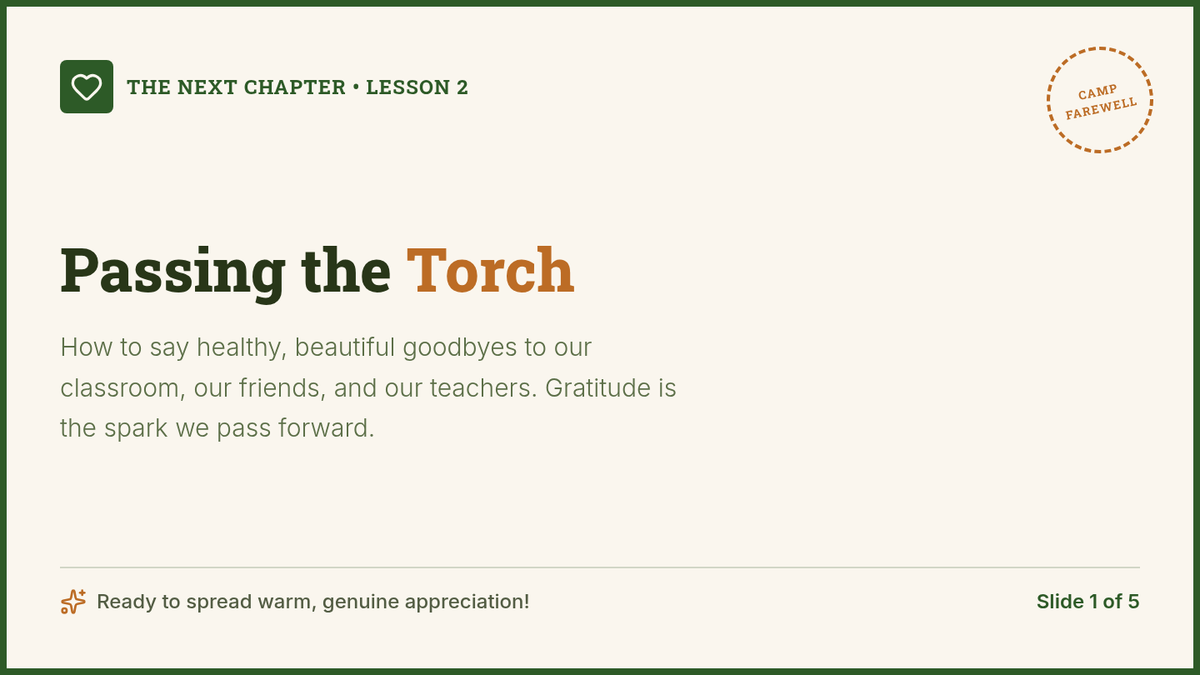
An interactive presentation that helps students discuss saying healthy, thoughtful goodbyes, acknowledging mixed emotions, and using gratitude as a tool for meaningful closure.
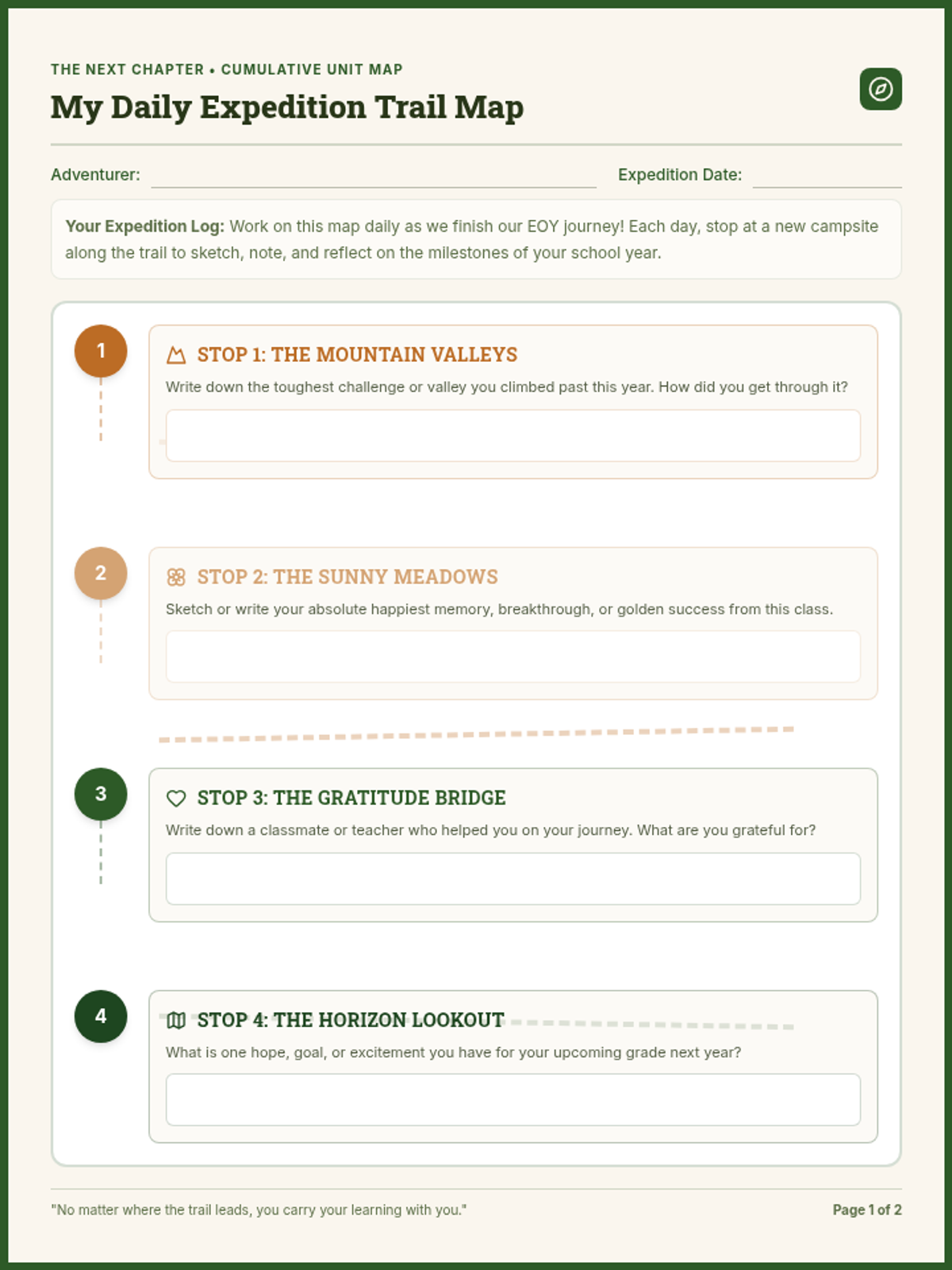
A multi-day EOY reflection journal styled like an explorer's trail map, where students log daily reflections on their valleys, meadows, gratitude, and future goals.
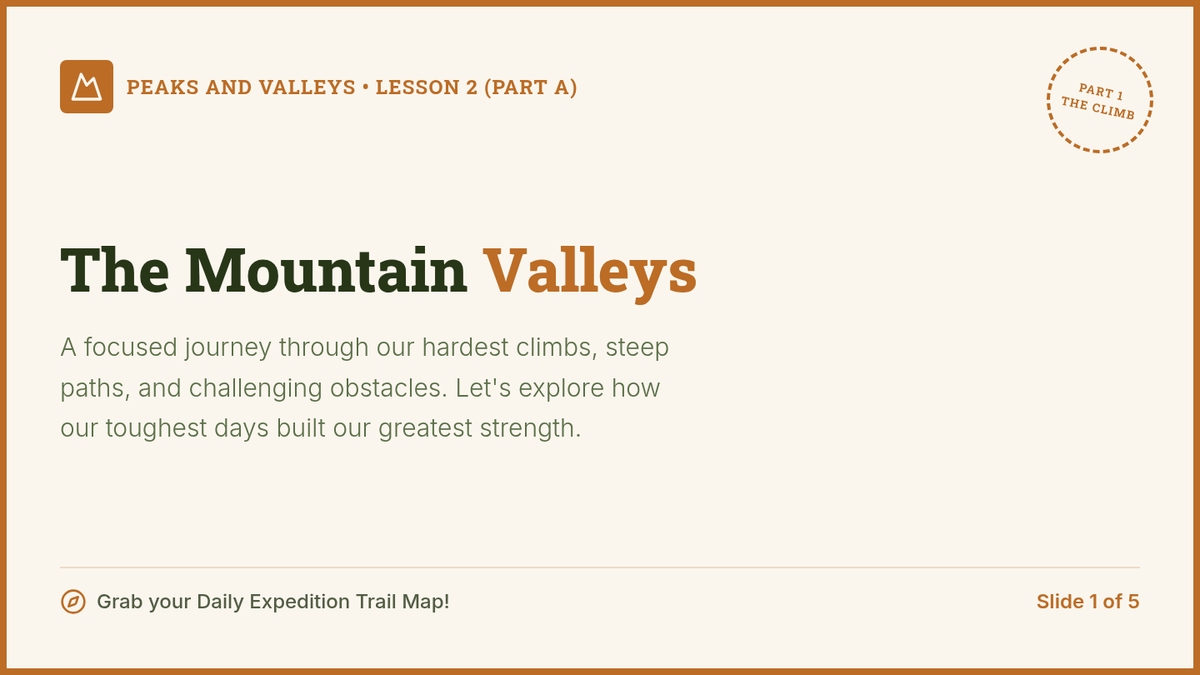
The first part of the divided slide presentation for Lesson 2, focusing on navigating difficult mountain passes, building resilience, and processing the year's challenges.
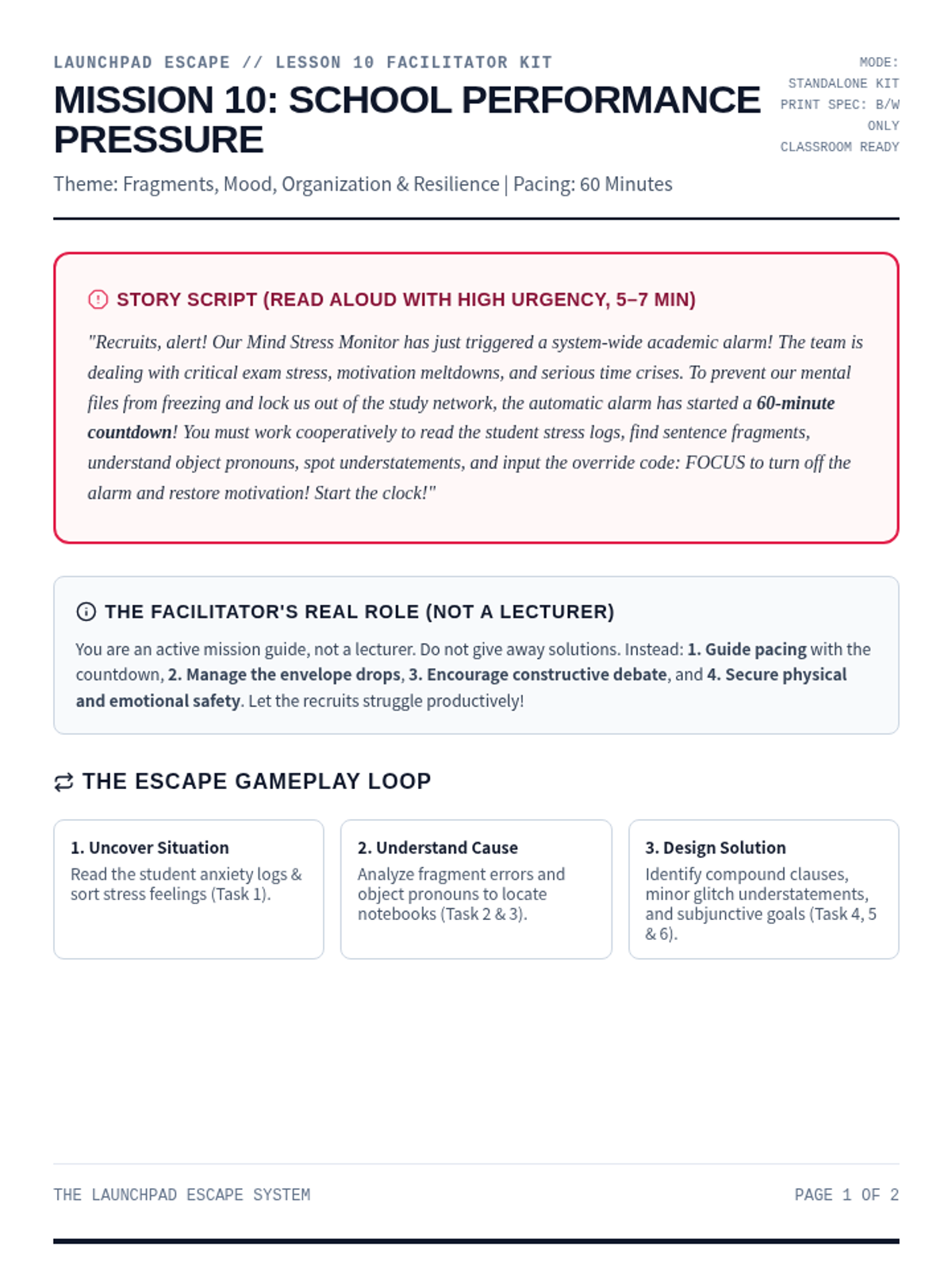
A comprehensive printable facilitator guide for Mission 10: School Performance Pressure. Contains story script, setup checklists, progressive clue mechanics, persuasive appeals endings, and debrief questions.
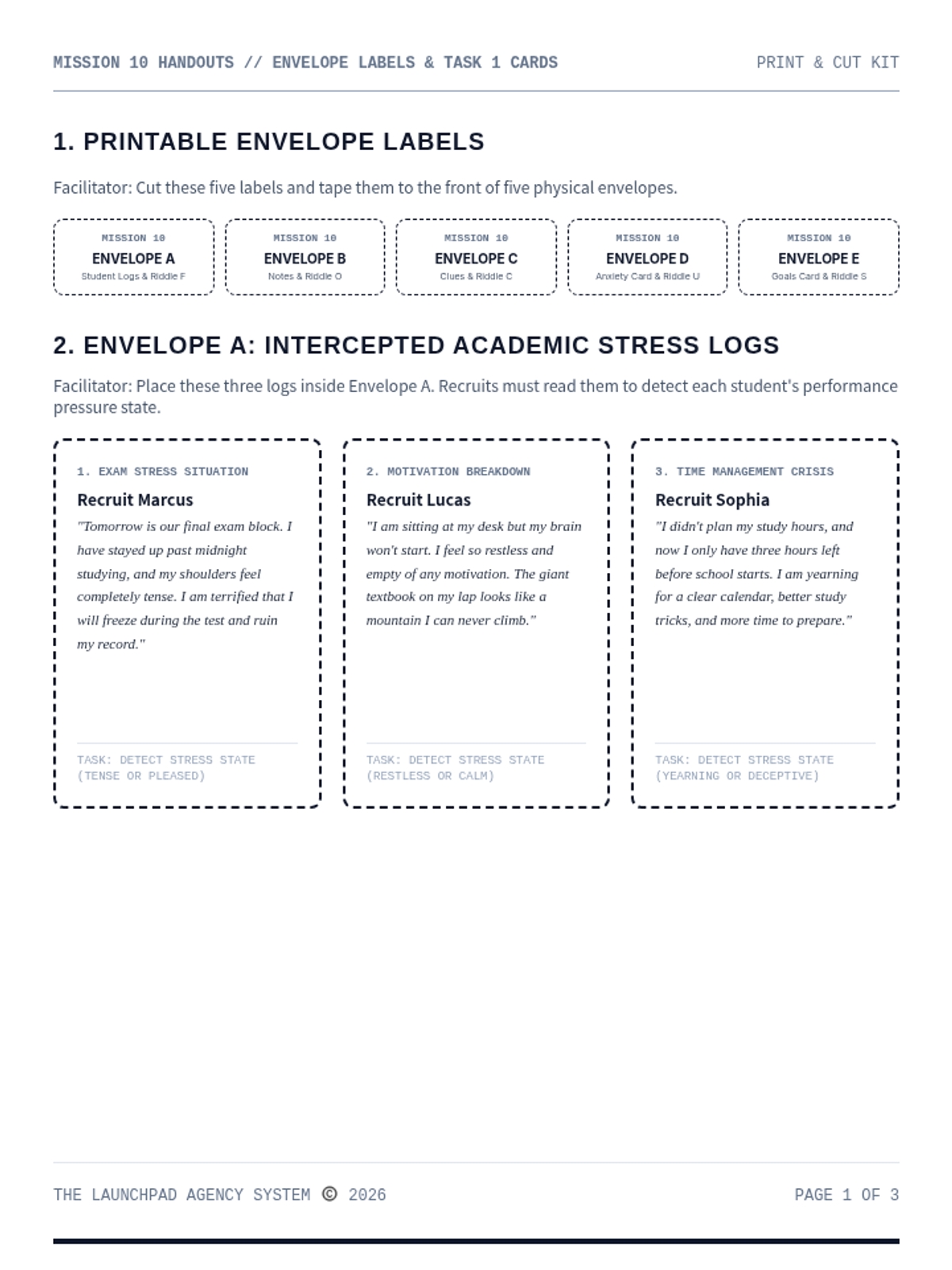
A print-and-cut materials handout kit for Mission 10: School Performance Pressure. Contains envelope labels, student statements, word files, and printable landmark riddle cards.
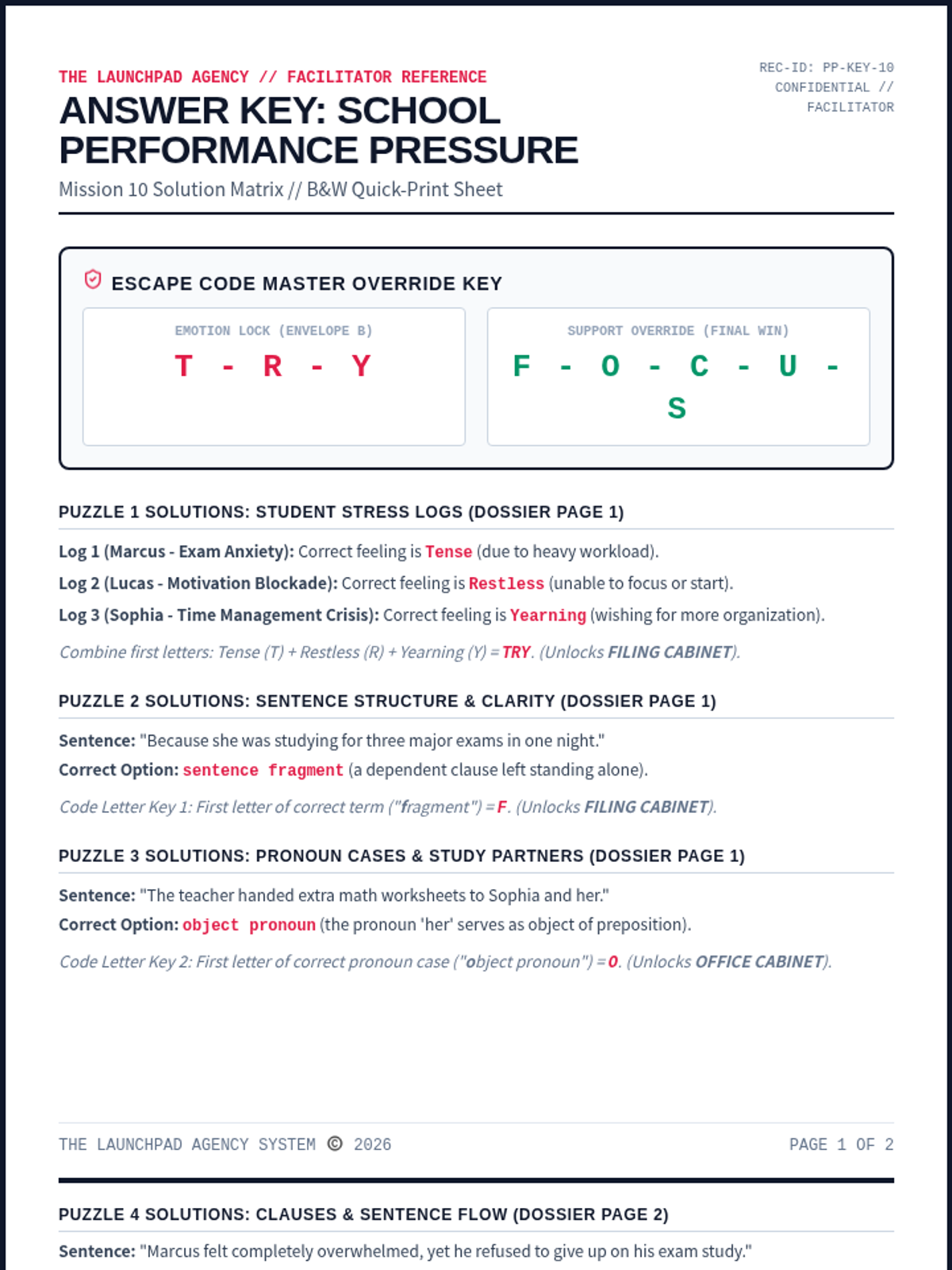
A dedicated facilitator answer key for Mission 10: School Performance Pressure. Contains complete solutions for all ELA/coordinate puzzles, ciphers, and floor map paths, along with rubrics and setup tips.
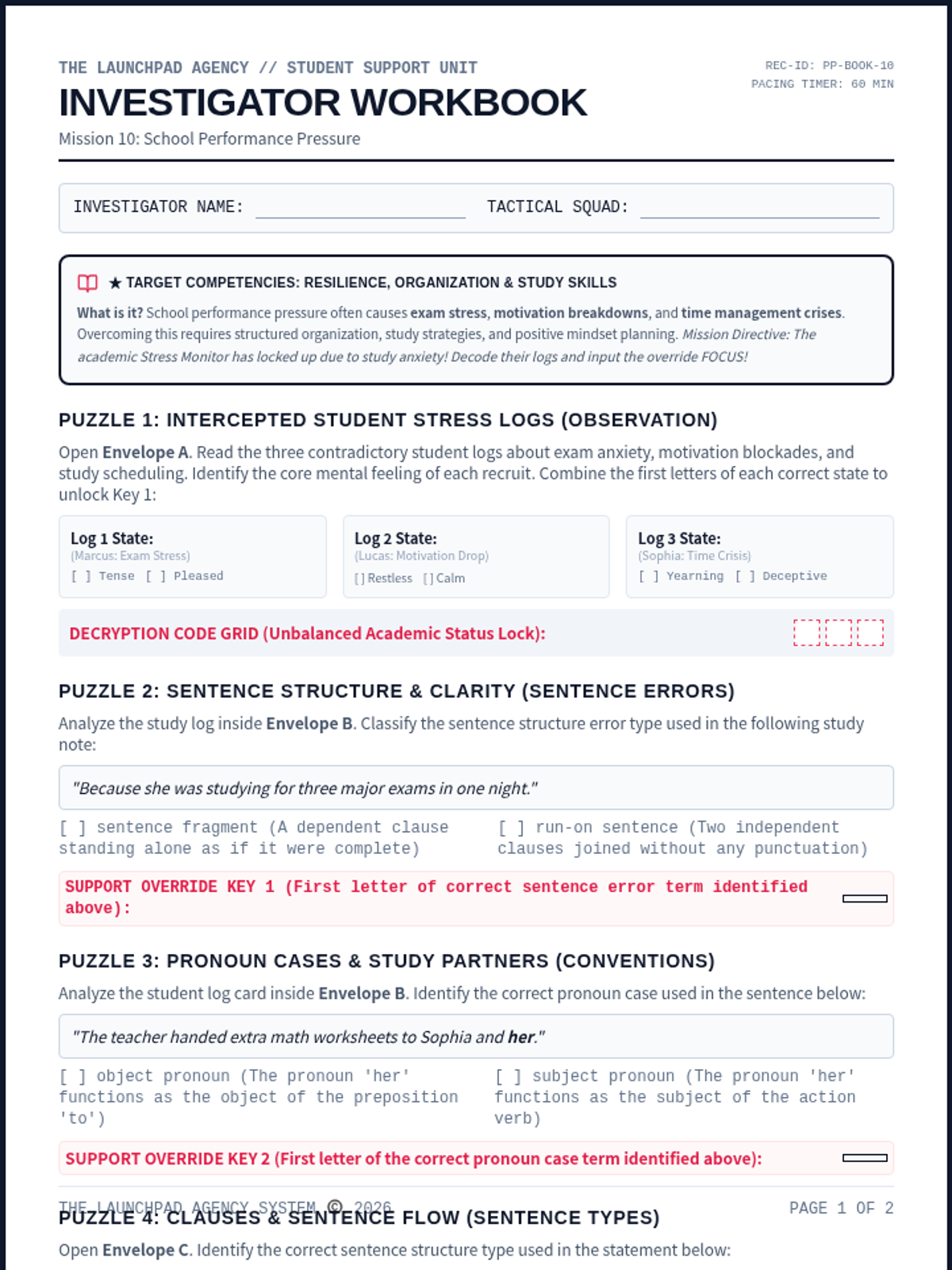
An immersive student-facing escape worksheet. Recruits analyze student logs, build efficient schedules, understand fragments, object pronouns, understatement, subjunctive mood, and decode the final override.
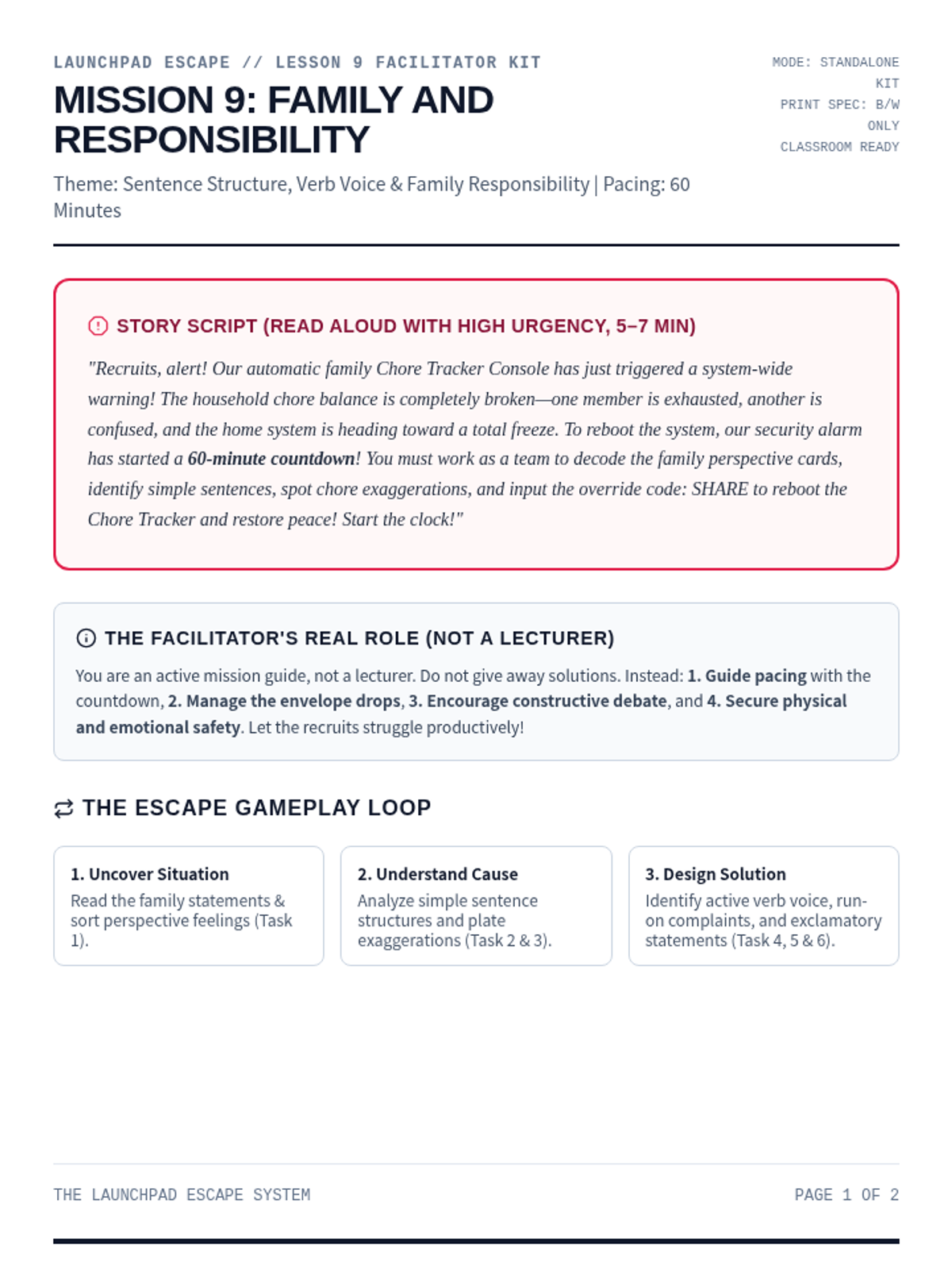
A comprehensive printable facilitator guide for Mission 9: Family and Responsibility. Contains story script, setup checklists, progressive clue mechanics, persuasive appeals endings, and debrief questions.
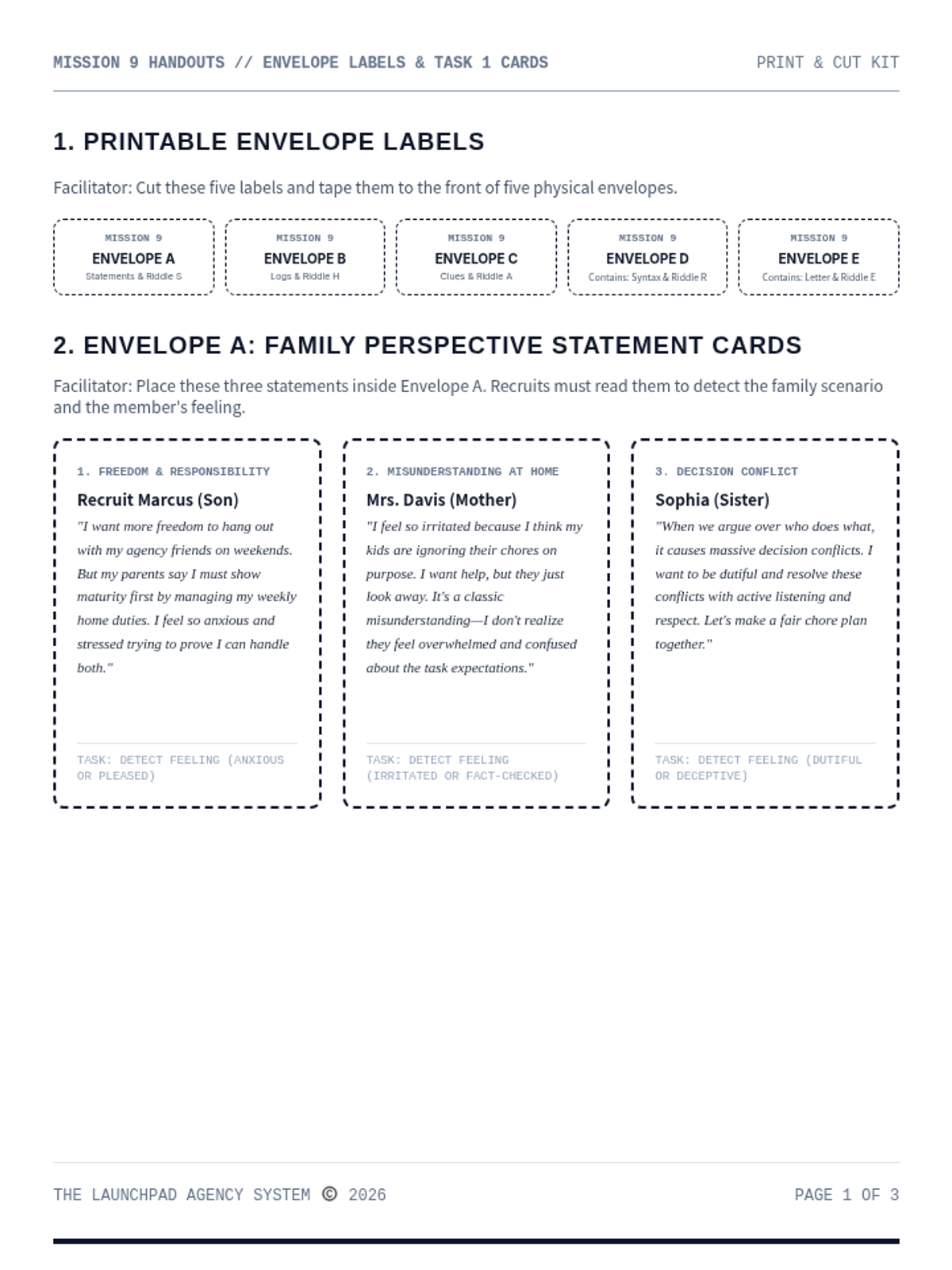
A print-and-cut materials handout kit for Mission 9: Family and Responsibility. Contains envelope labels, student statements, word files, and printable landmark riddle cards.
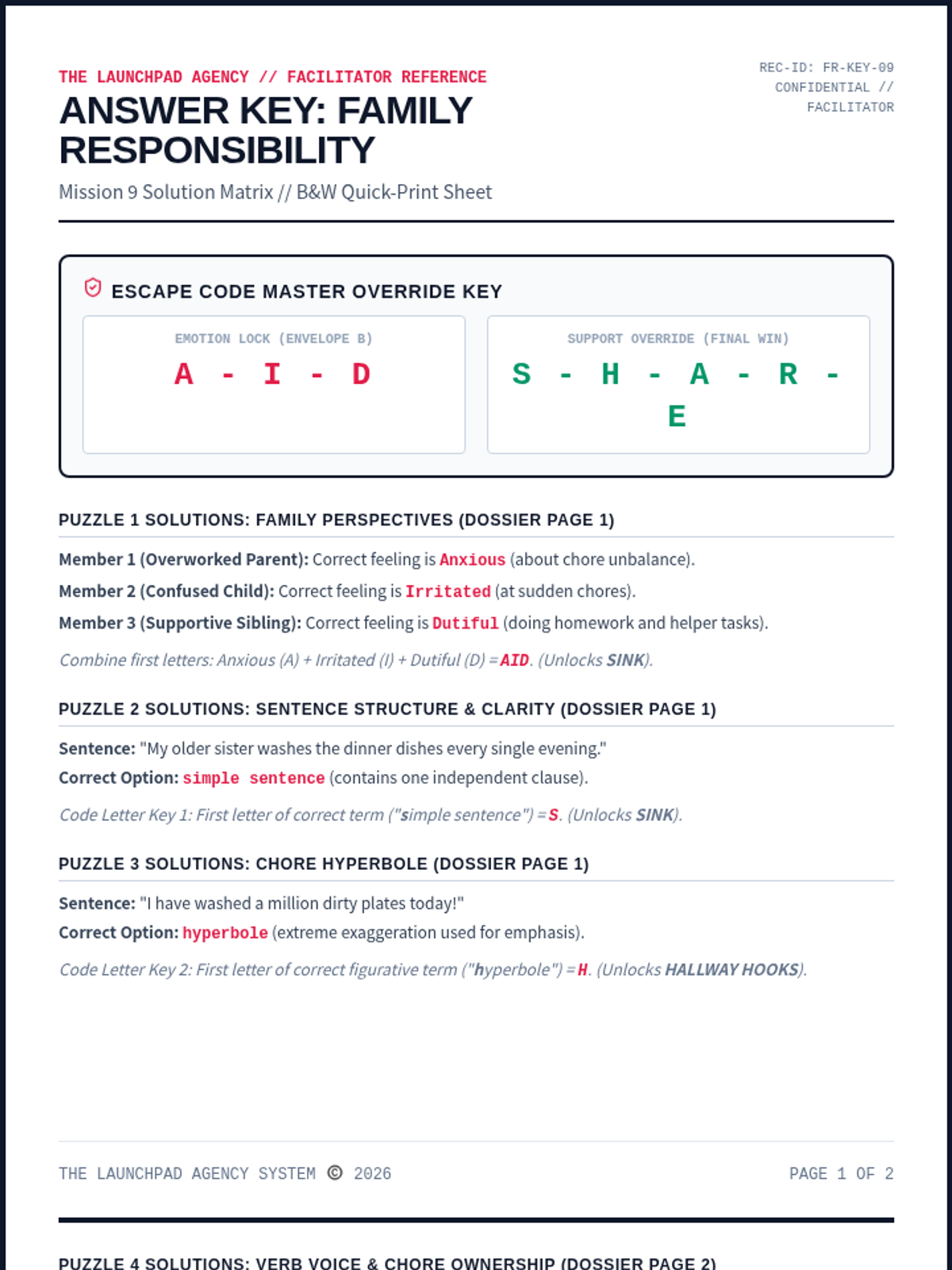
A dedicated facilitator answer key for Mission 9: Family and Responsibility. Contains complete solutions for all ELA/coordinate puzzles, ciphers, and floor map paths, along with rubrics and setup tips.
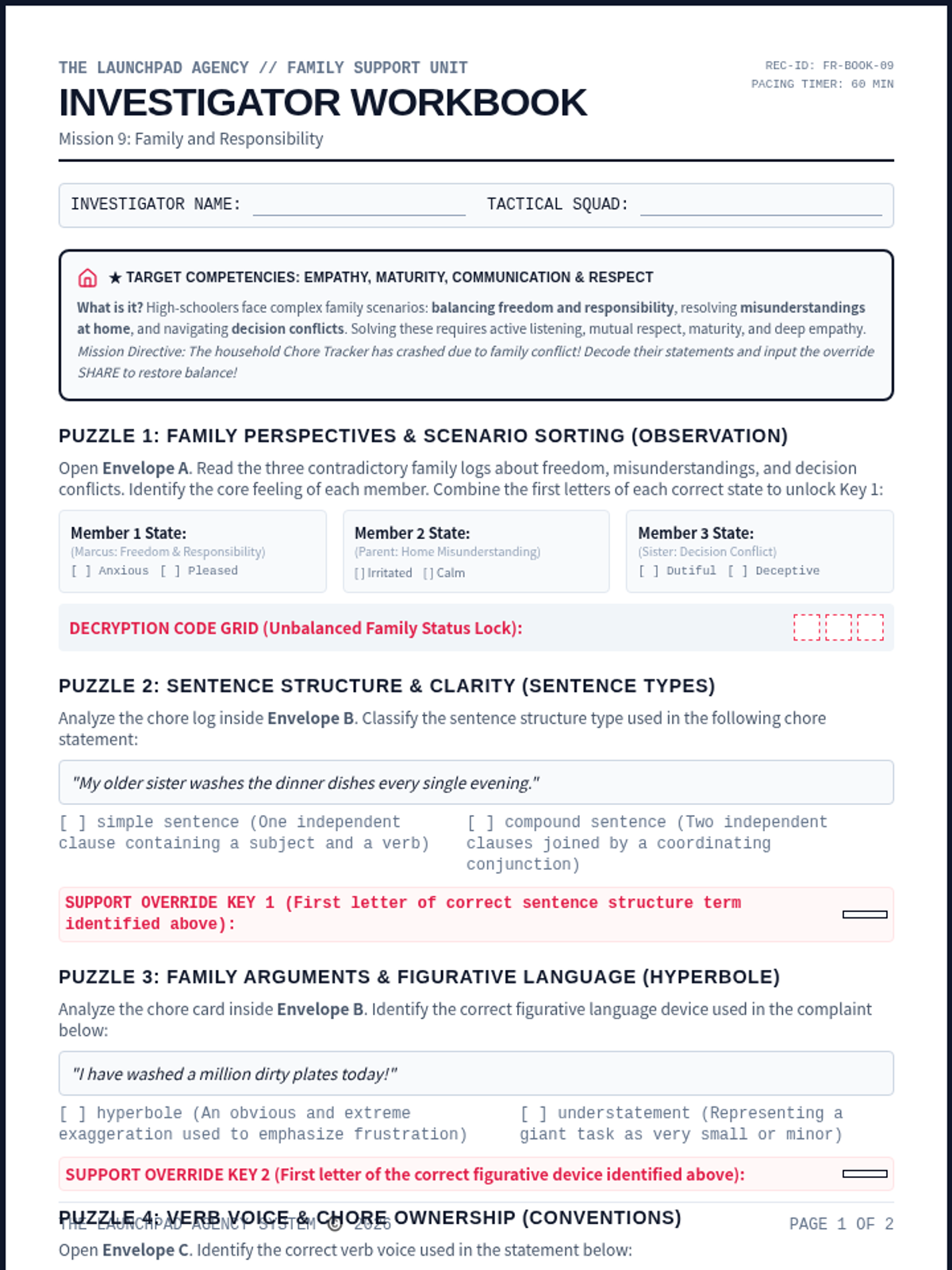
An immersive student-facing escape worksheet. Recruits analyze family logs, balance freedom and responsibility, recognize home misunderstandings, resolve decision conflicts, and prepare their final presentation to restore household balance.
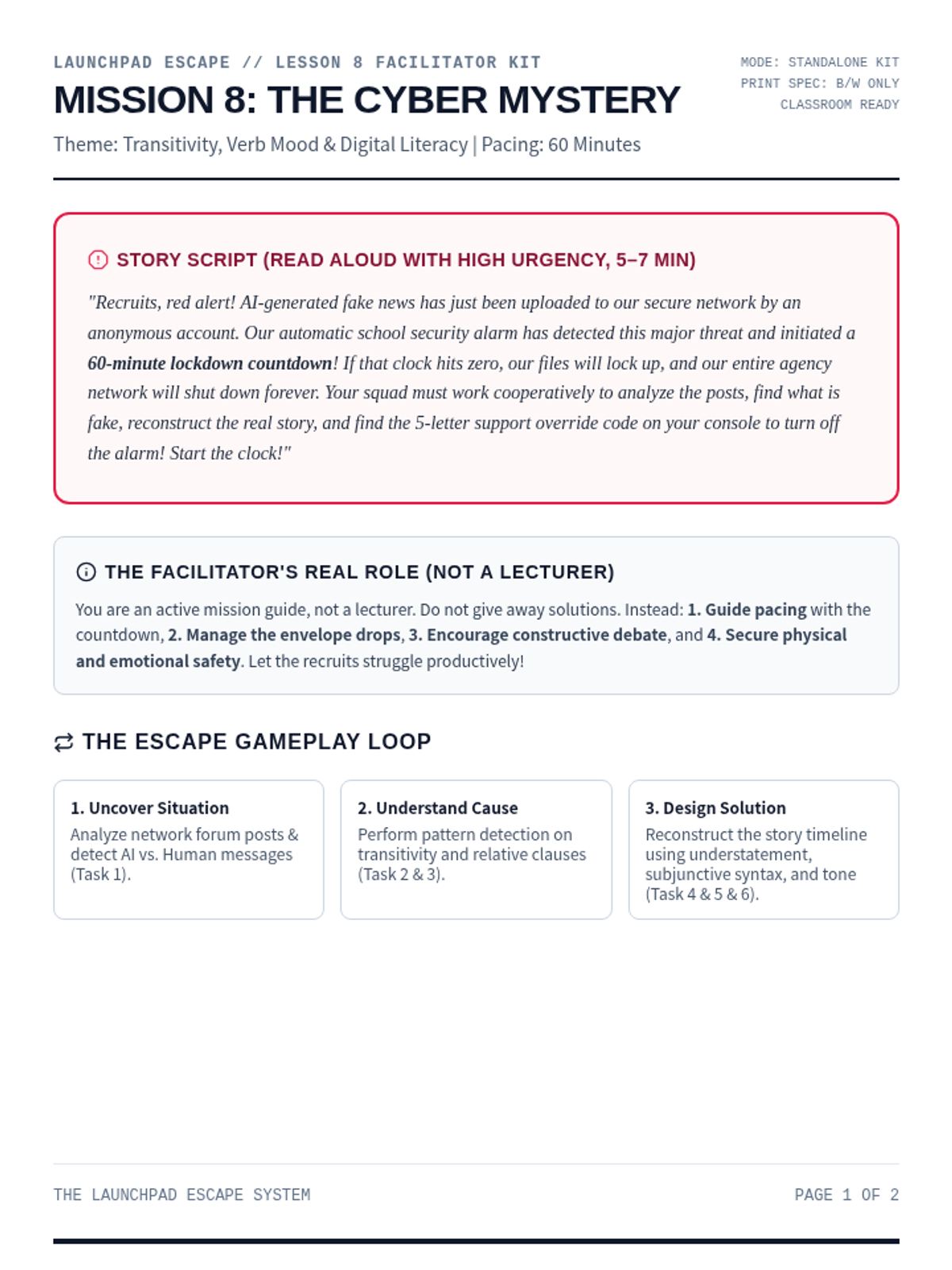
A comprehensive printable facilitator guide for Mission 8: The Cyber Mystery. Contains story script, setup checklists, progressive clue mechanics, persuasive appeals endings, and debrief questions.
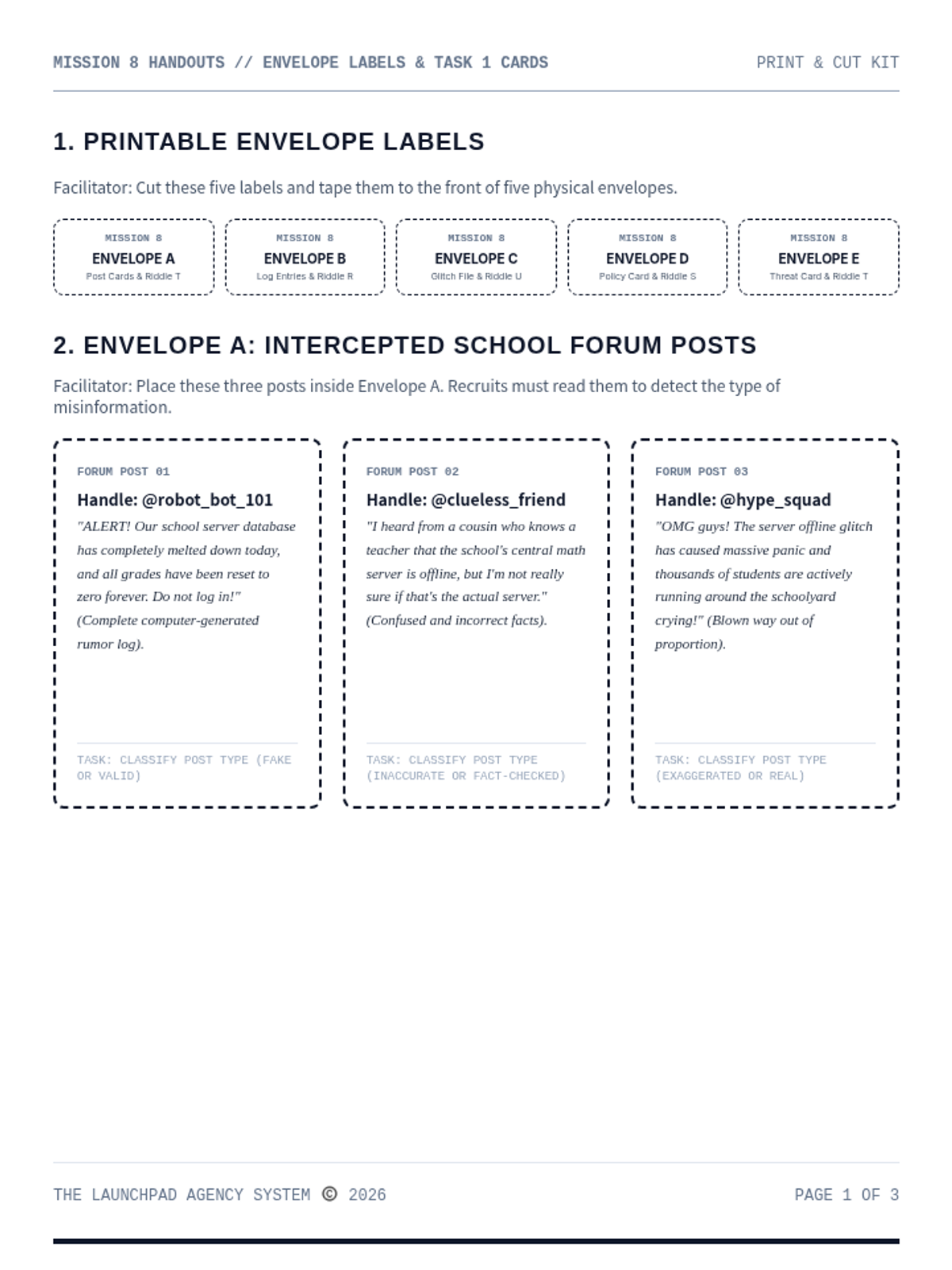
A print-and-cut materials handout kit for Mission 8: The Cyber Mystery. Contains envelope labels, student statements, word files, and printable landmark riddle cards.
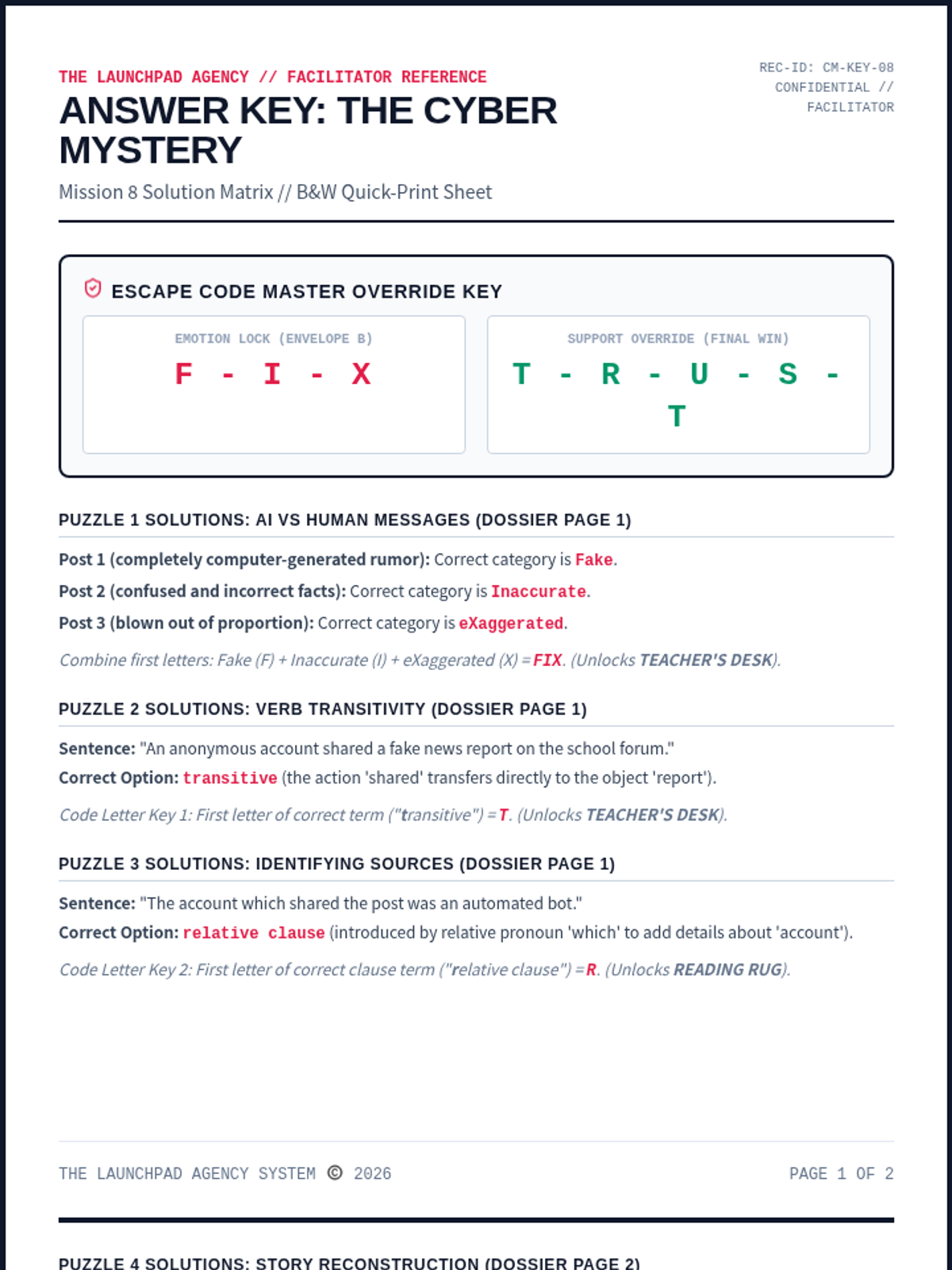
A dedicated facilitator answer key for Mission 8: The Cyber Mystery. Contains complete solutions for all ELA/coordinate puzzles, ciphers, and floor map paths, along with rubrics and setup tips.
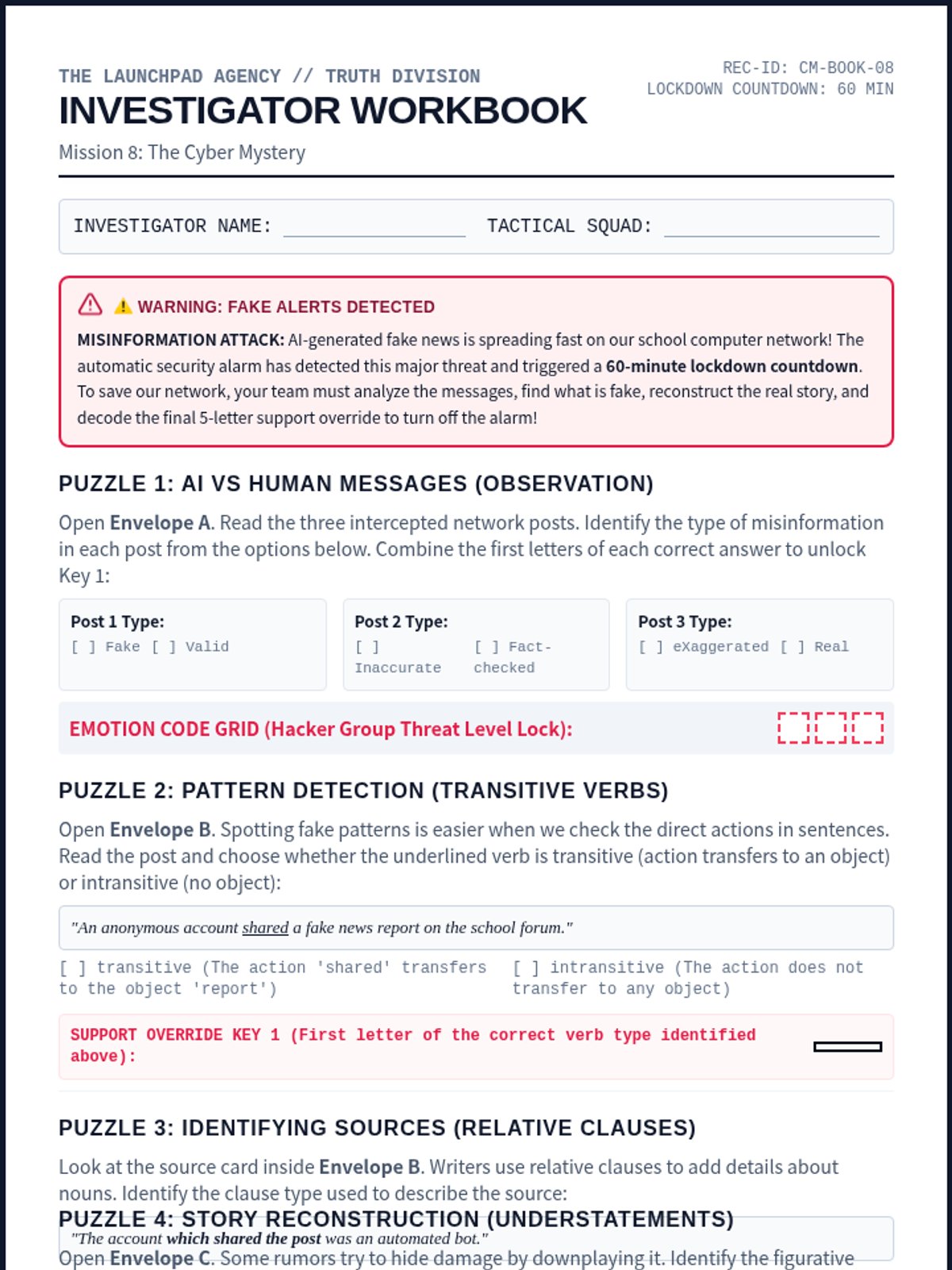
An immersive student-facing escape worksheet for Mission 8: The Cyber Mystery. Recruits identify transitive verbs, relative clauses, understatement, subjunctive moods, and tone to stop a school database wipe.
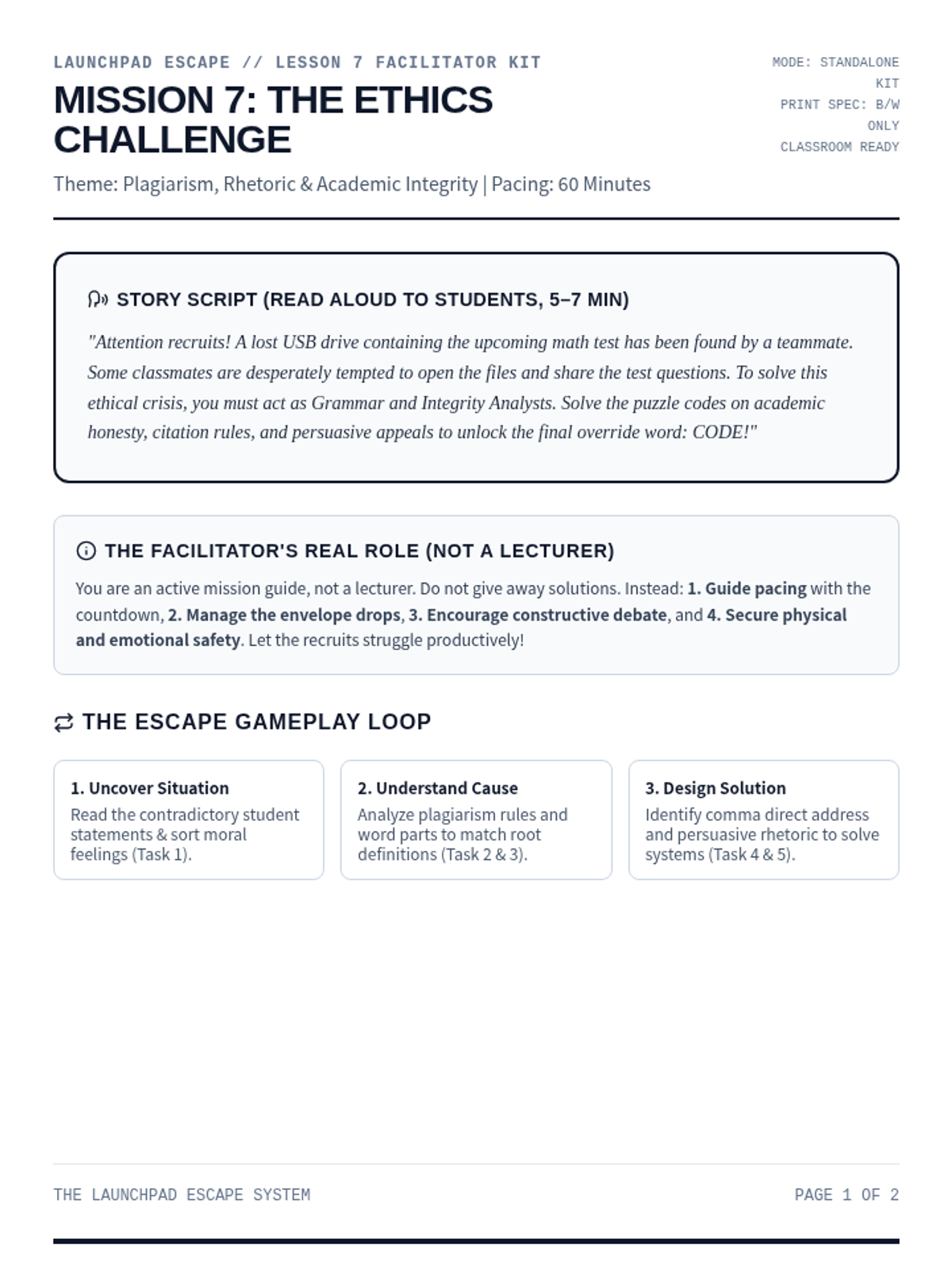
A comprehensive printable facilitator guide for Mission 7: The Ethics Challenge. Contains story script, setup checklists, progressive clue mechanics, persuasive appeals endings, and debrief questions.
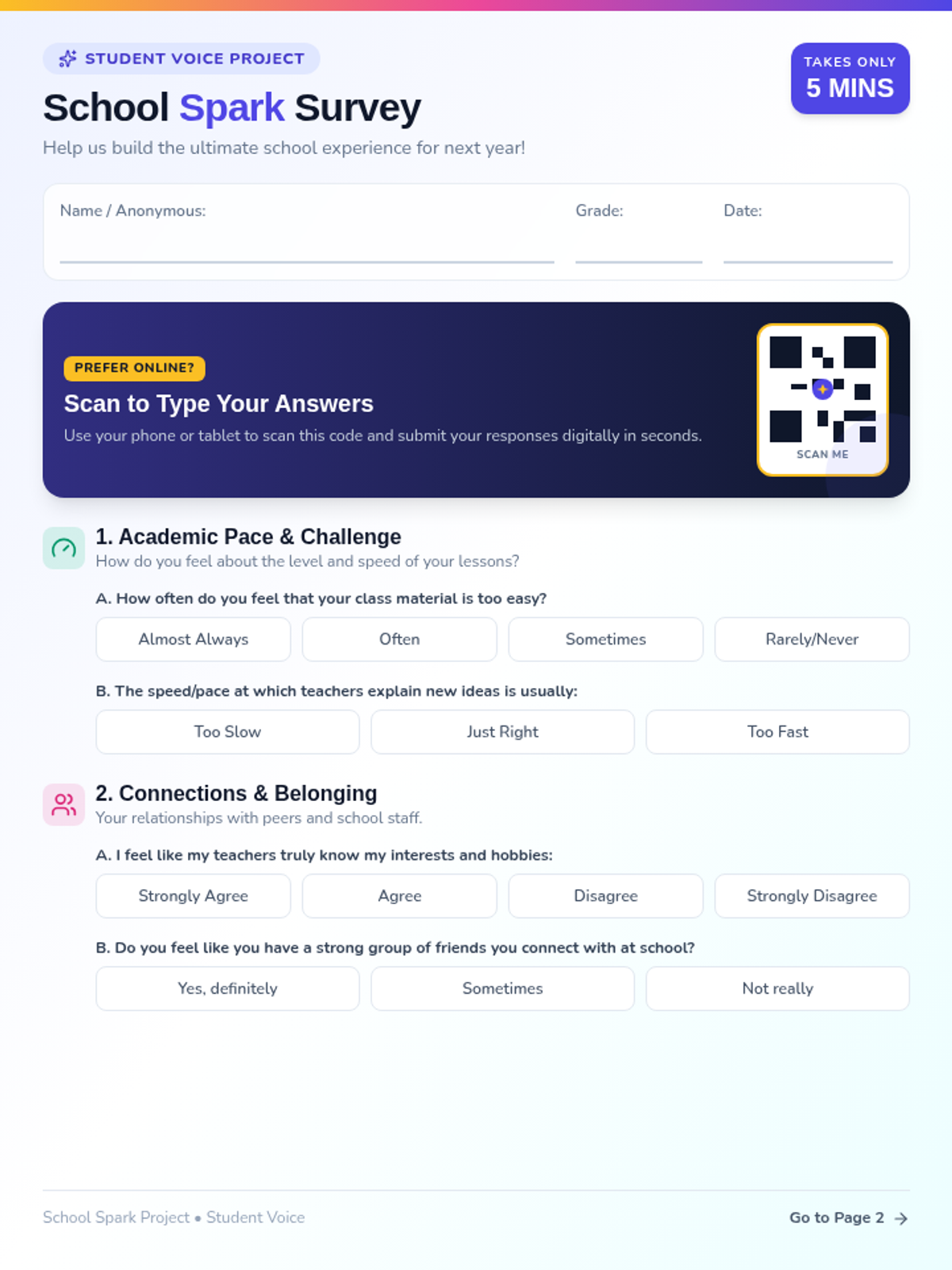
An updated 2-page student survey incorporating student-voice questions on school-wide changes, student-selected trips, and restorative referral practices.
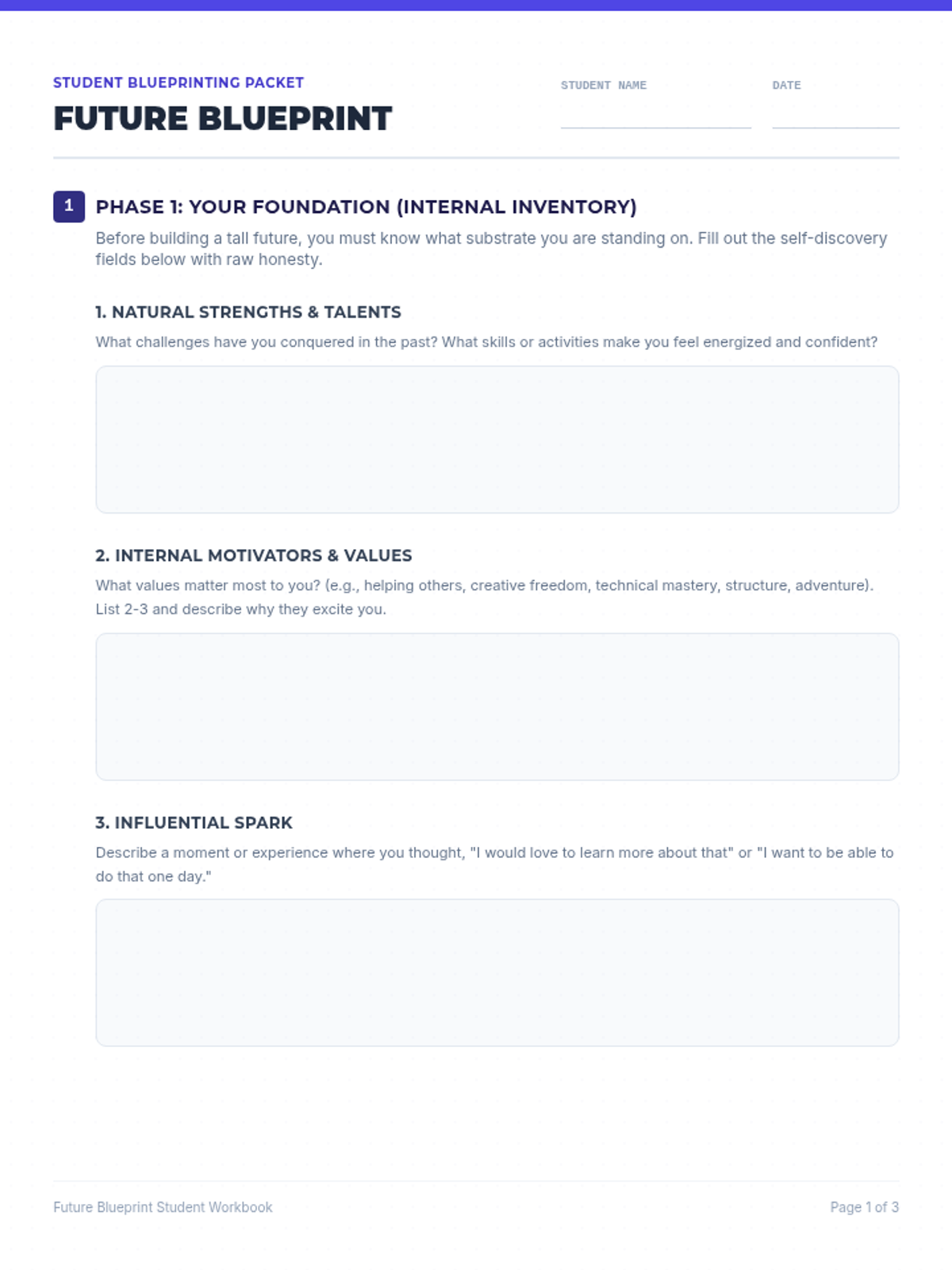
A 3-page interactive student workbook featuring a structured layout with blueprint aesthetic accents. Includes name/date inputs, self-discovery prompts, timeline mappings, and action planning templates.
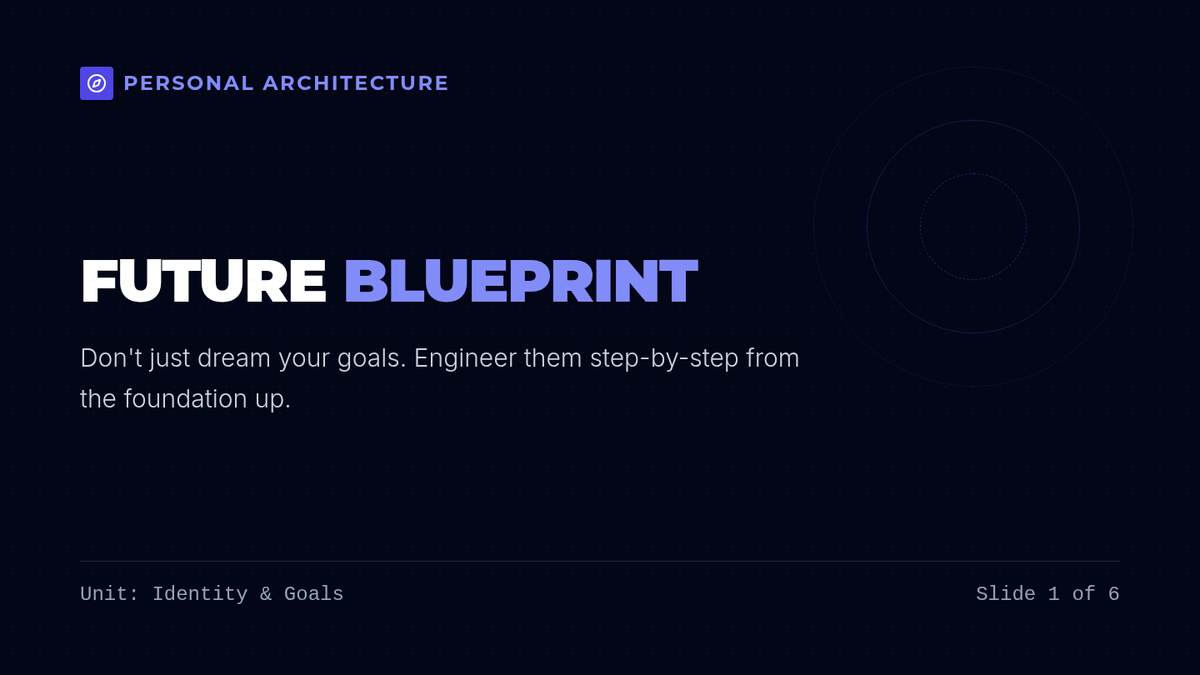
A structured 6-slide presentation to guide students visually through the process of building a Future Blueprint. Uses an architectural theme with dark blueprint aesthetics.
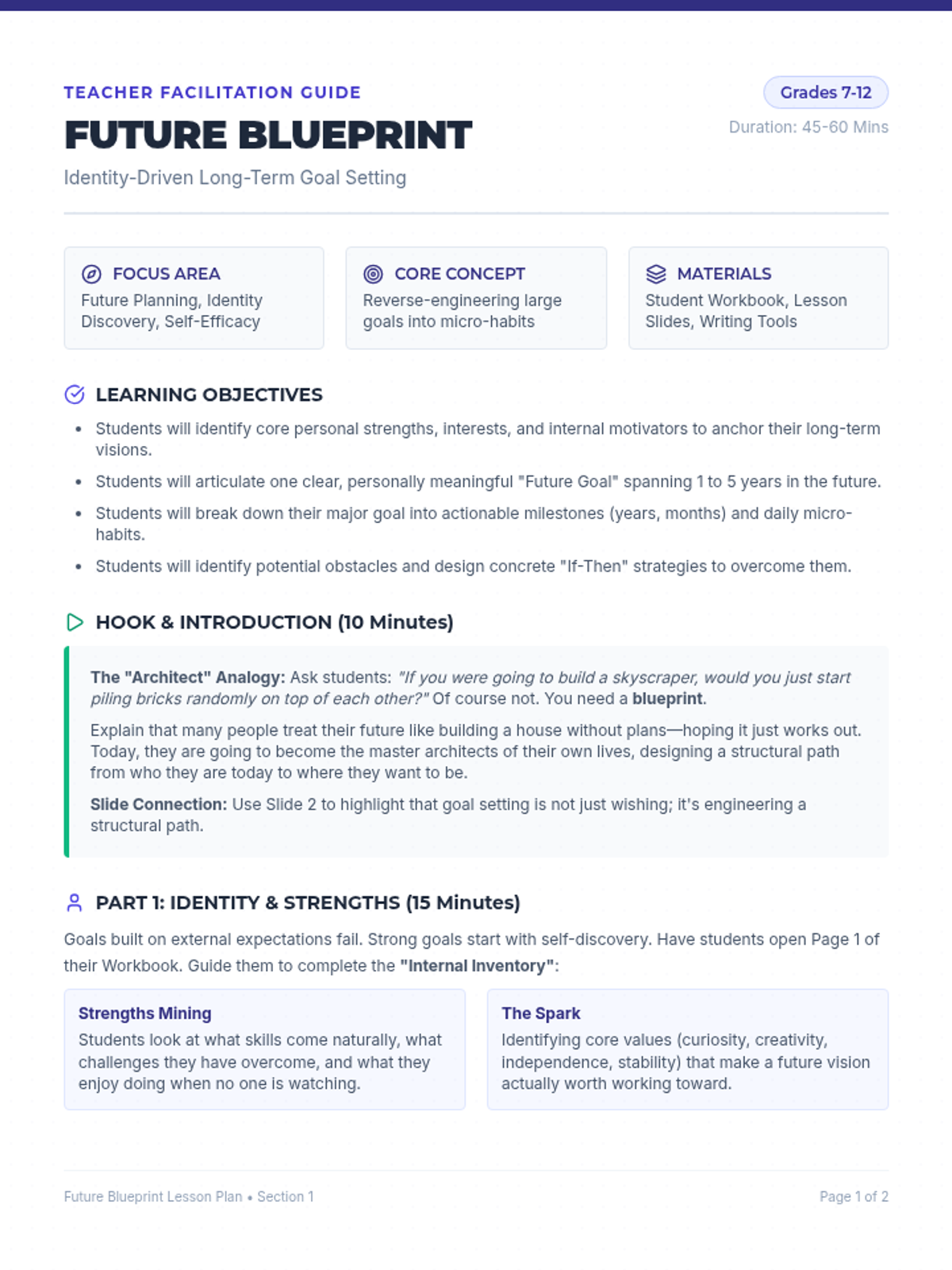
A 2-page instructional guide for teachers to deliver the Future Blueprint lesson. Includes session objectives, step-by-step facilitation instructions, discussion prompts, and differentiation strategies.
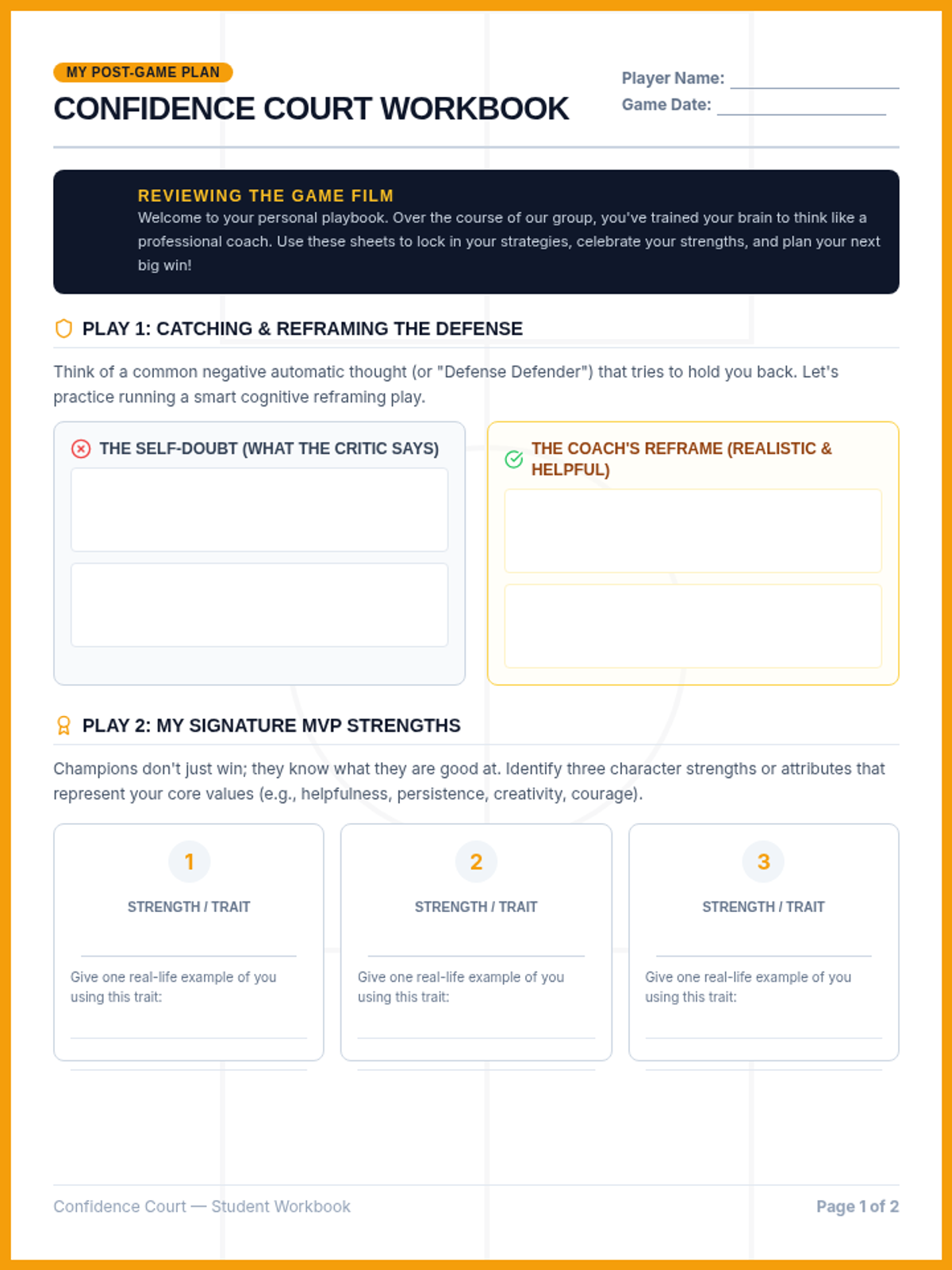
A 2-page print-ready reflection workbook and CBT action plan for students. Features structured self-esteem builders, reframe templates, and future goal planning.
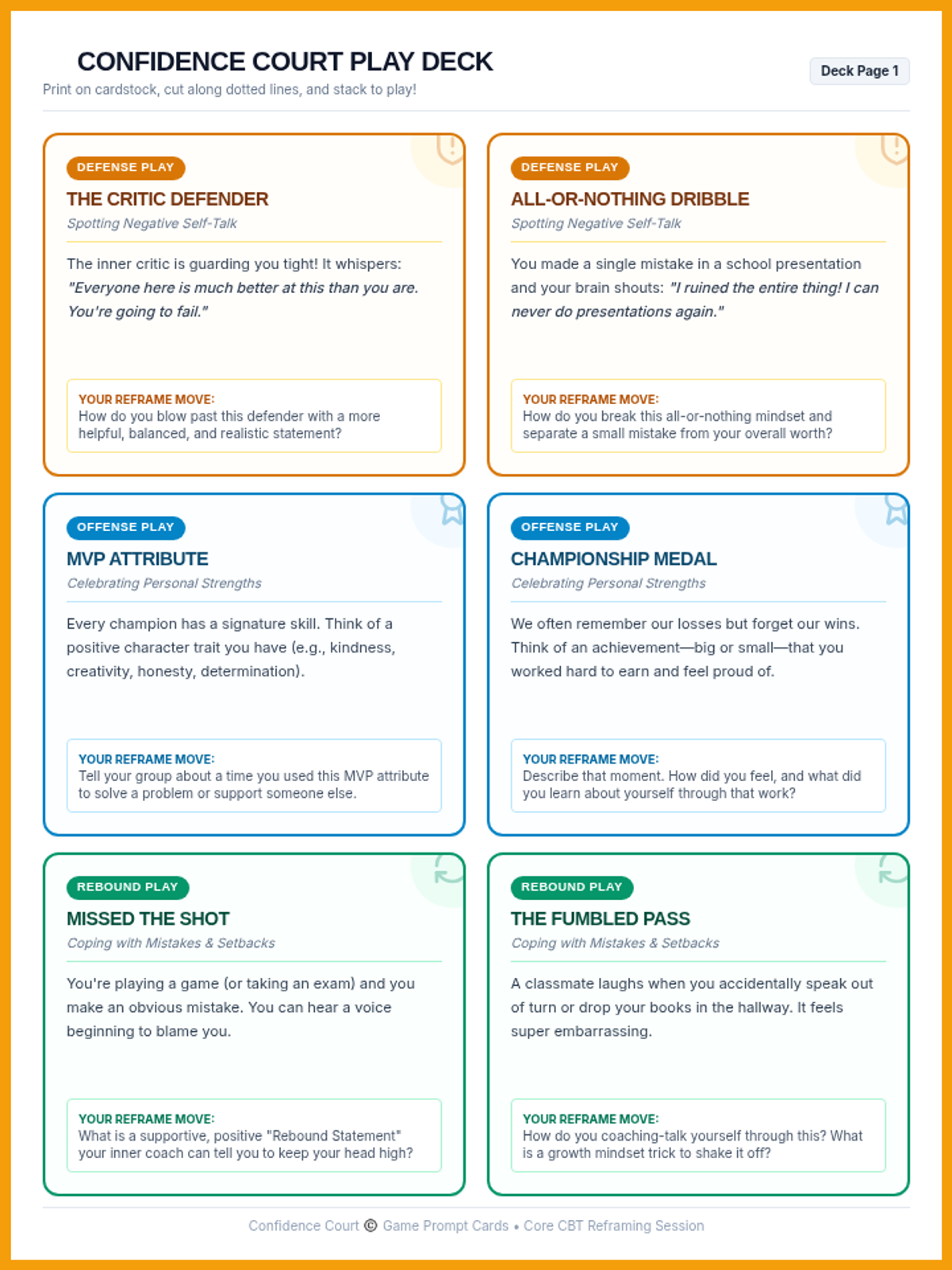
Interactive CBT prompt cards for the Confidence Court basketball shootout. Features 12 beautifully illustrated cards across 4 categories: Defense (Catch & Reframe), Offense (Strength Spotlight), Rebound (Growth Mindset), and Next Season (Future Goals).
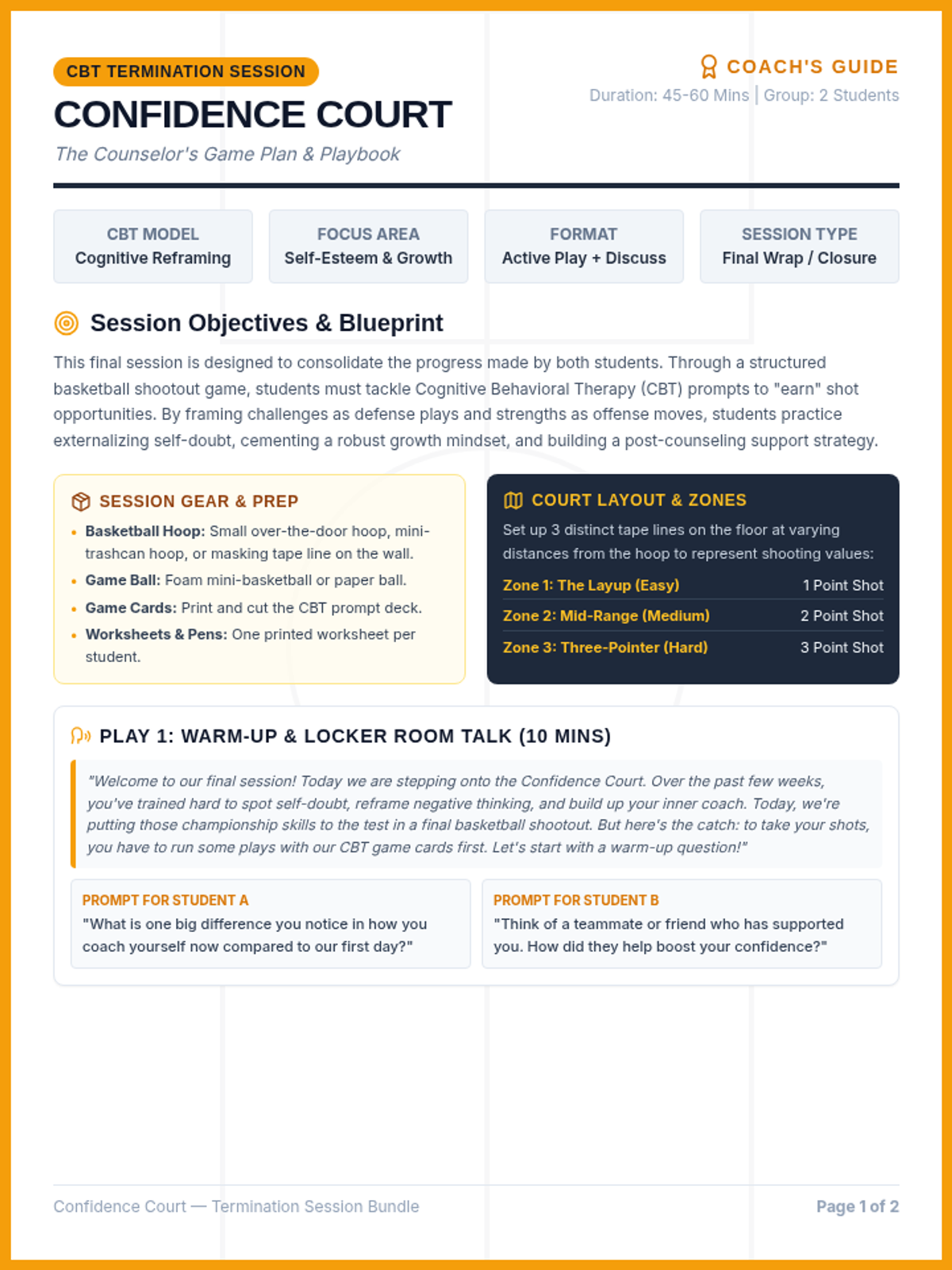
A comprehensive, 2-page counselor guide and playbook for the Confidence Court termination session. Includes materials setup, CBT coaching scripts, warm-up prompts, and step-by-step game rules.
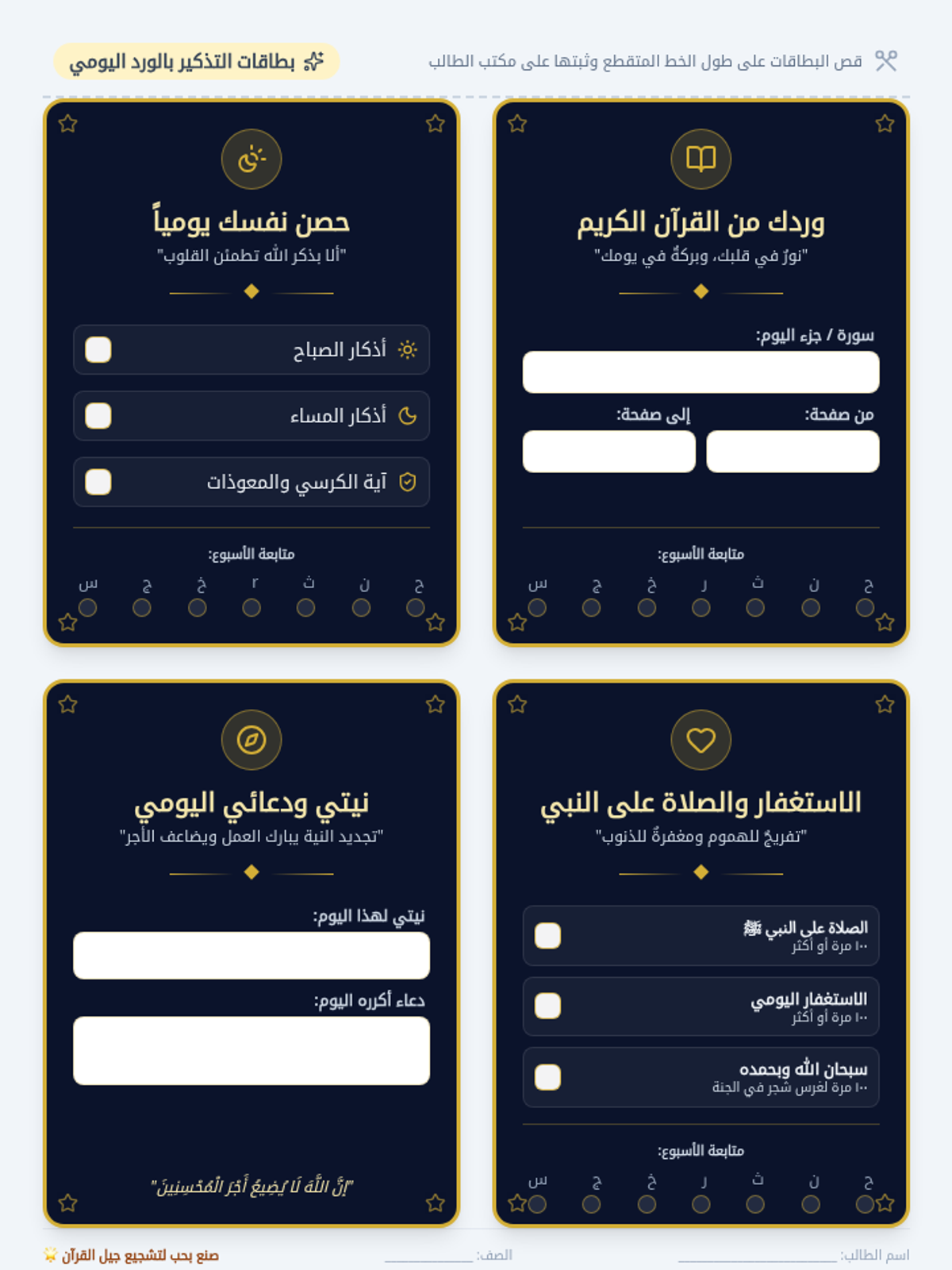
A beautifully designed printable desk card sheet containing 4 distinct Islamic geometric themed daily wird (الورد اليومي) reminder cards for students' desks. Features deep blue and gold accents, elegant Arabic typography, and clear visual reminders.
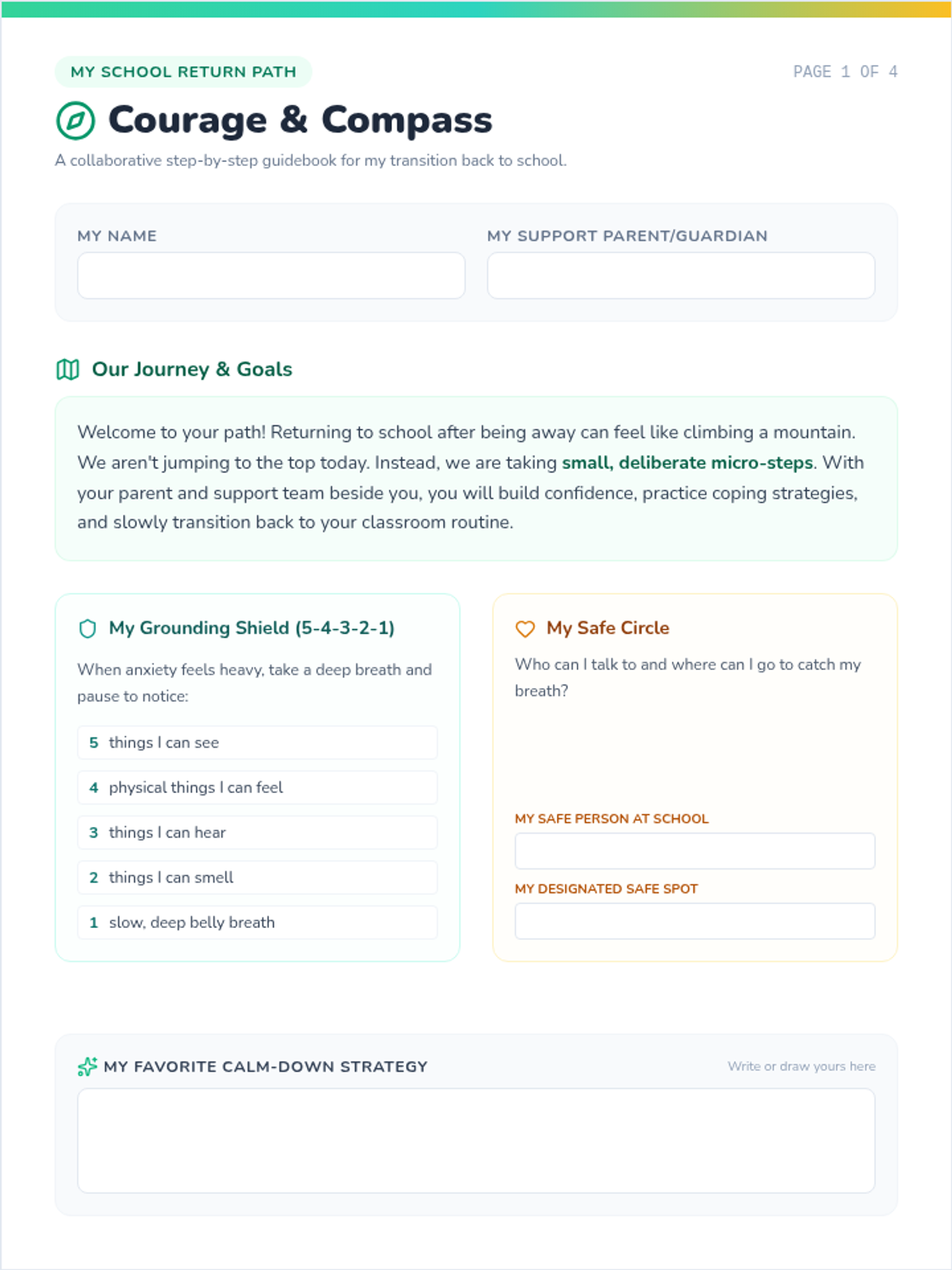
A Spanish translation of the 4-page student-facing interactive workbook and graduated exposure tracker to assist Spanish-speaking students and parents in managing the return to school.
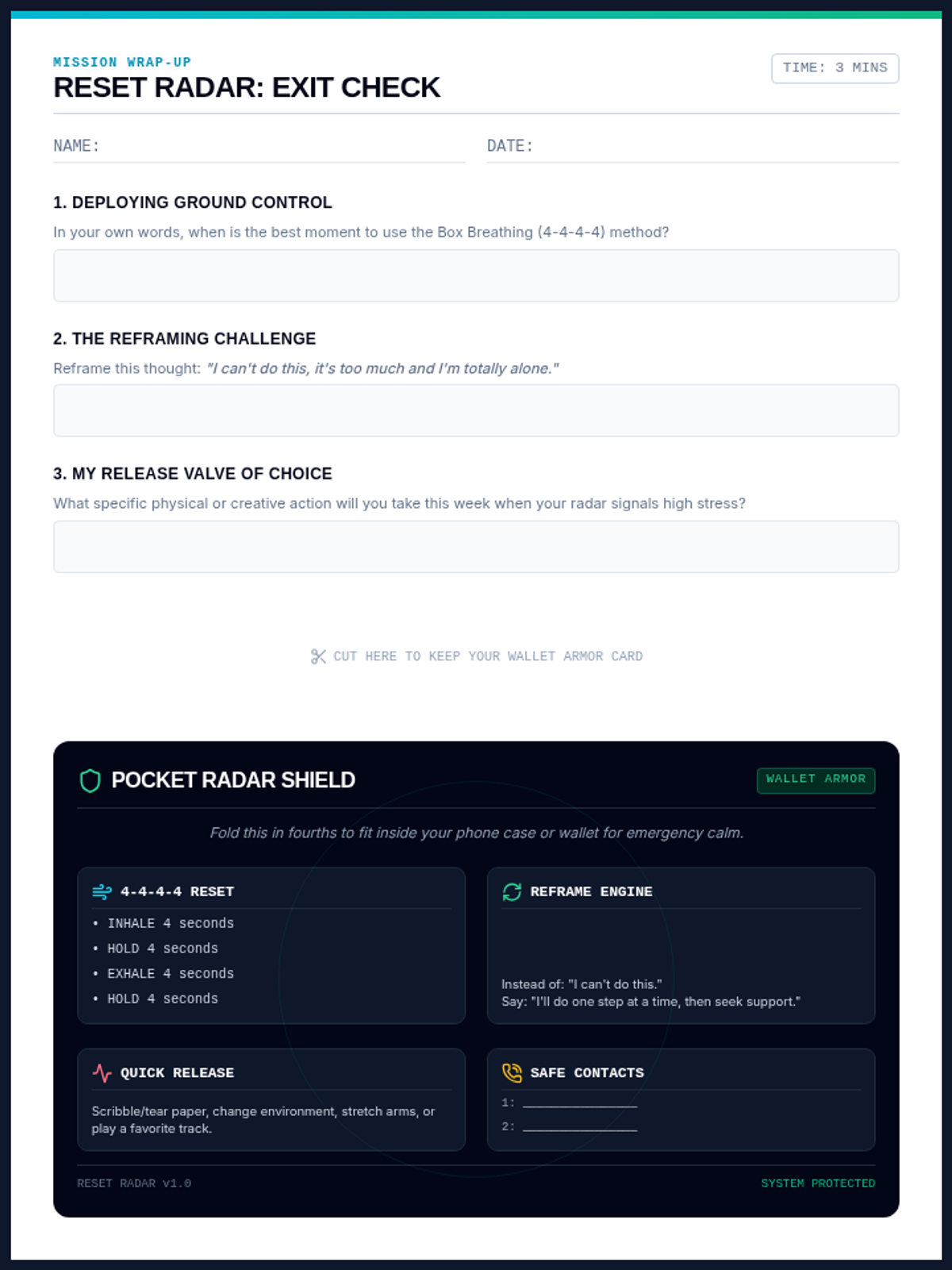
A 1-page exit ticket and cut-out pocket card. The top half functions as a quick 3-minute reflection tool, and the bottom half folds into a wallet-sized emergency stress cheat sheet.
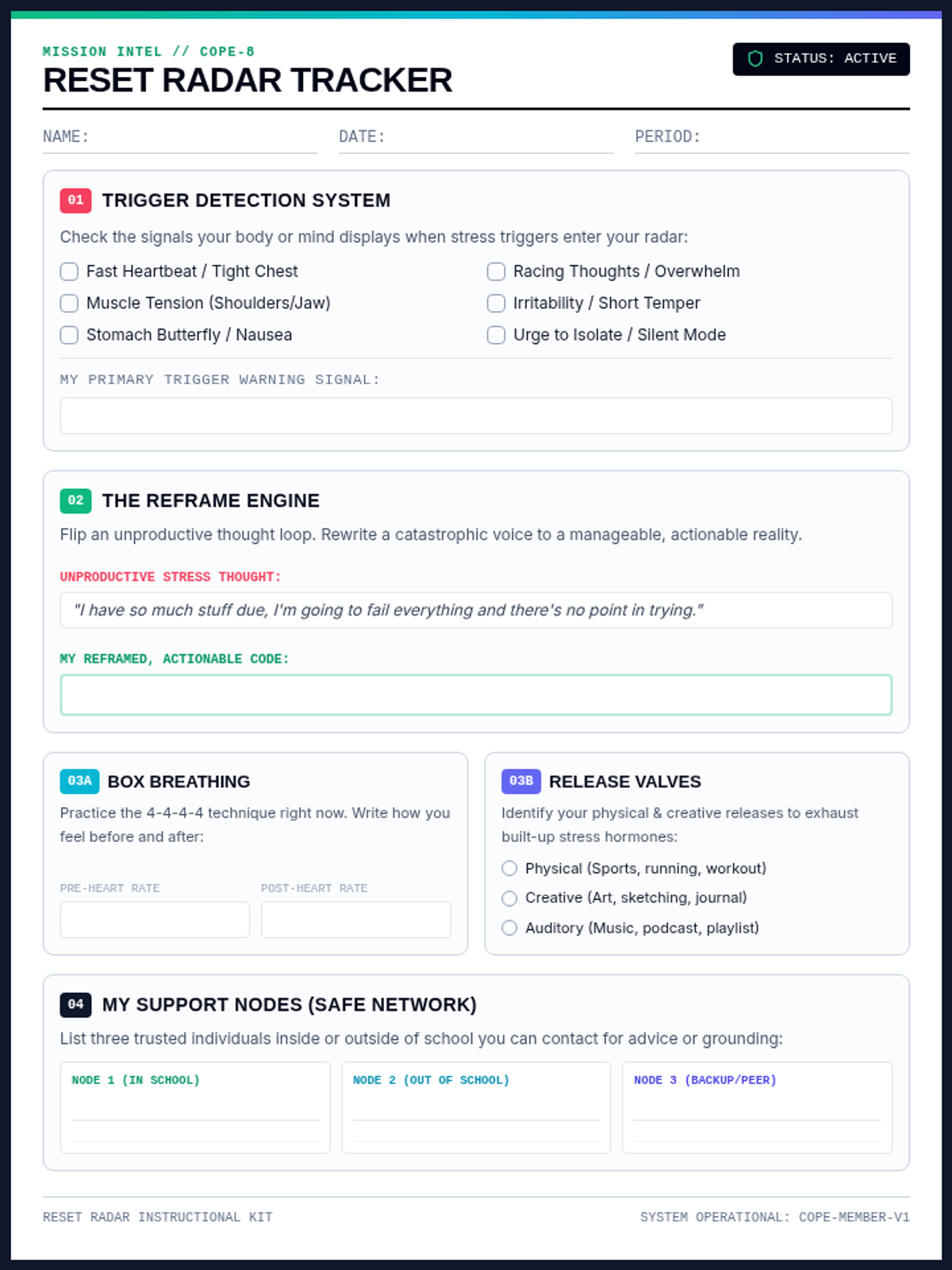
A high-utility, printable 1-page guided notes worksheet styled as a tactical mental radar dashboard. Students identify stress signals, construct a reframing formula, list emotional release outlets, and document trusted contacts.
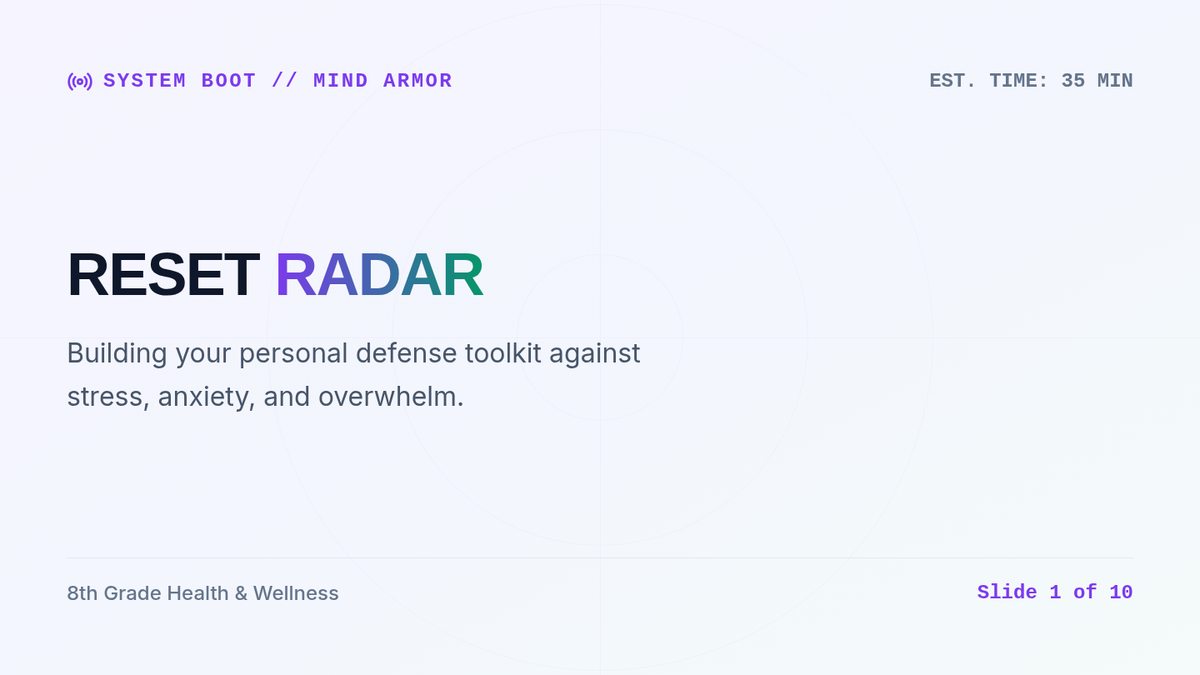
An interactive 10-slide presentation styled with a soft, clean pastel radar system. Teaches 8th graders evidence-based coping skills (box breathing, cognitive reframing, physical outlets, and boundaries) with highly readable dark text on pastel cards.
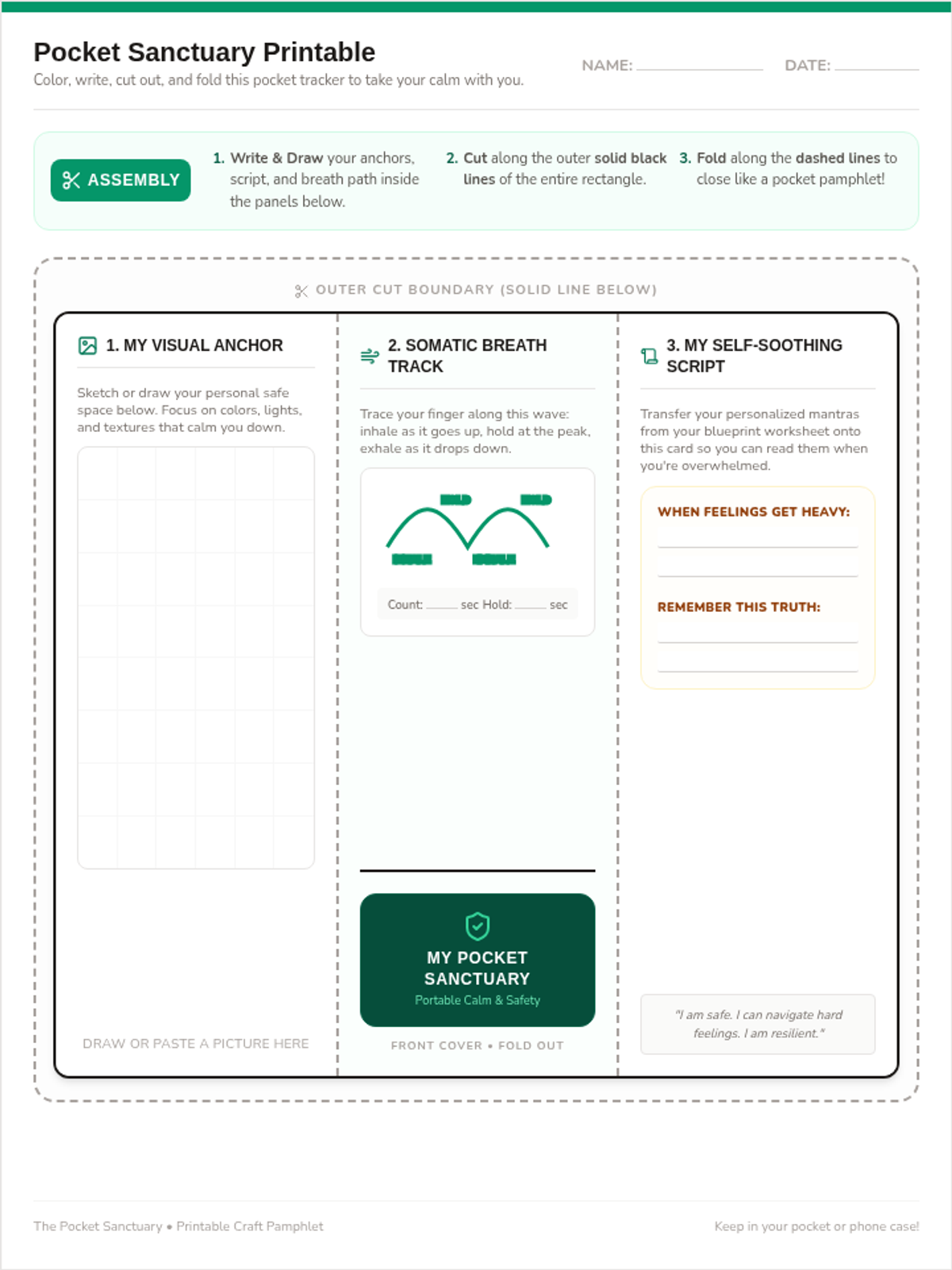
A printable 1-page pocket-sized foldout template (the Pocket Sanctuary) where students sketch their visual anchors, outline their custom breathing patterns, and write out self-regulation scripts.
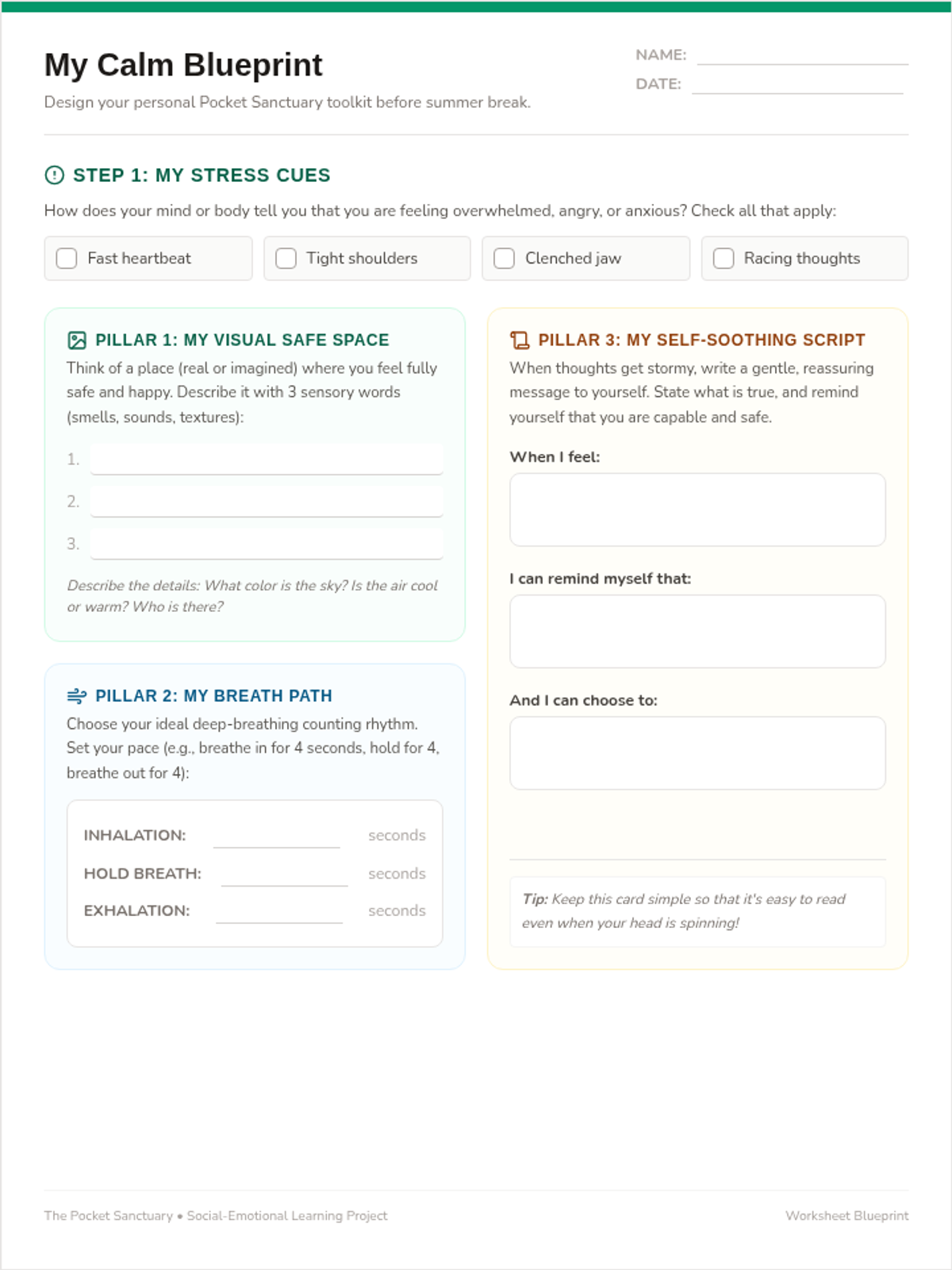
A beautifully designed student planning worksheet (the Calm Blueprint) for identifying triggers, personal visual anchors, deep breathing paces, and encouraging mantras.
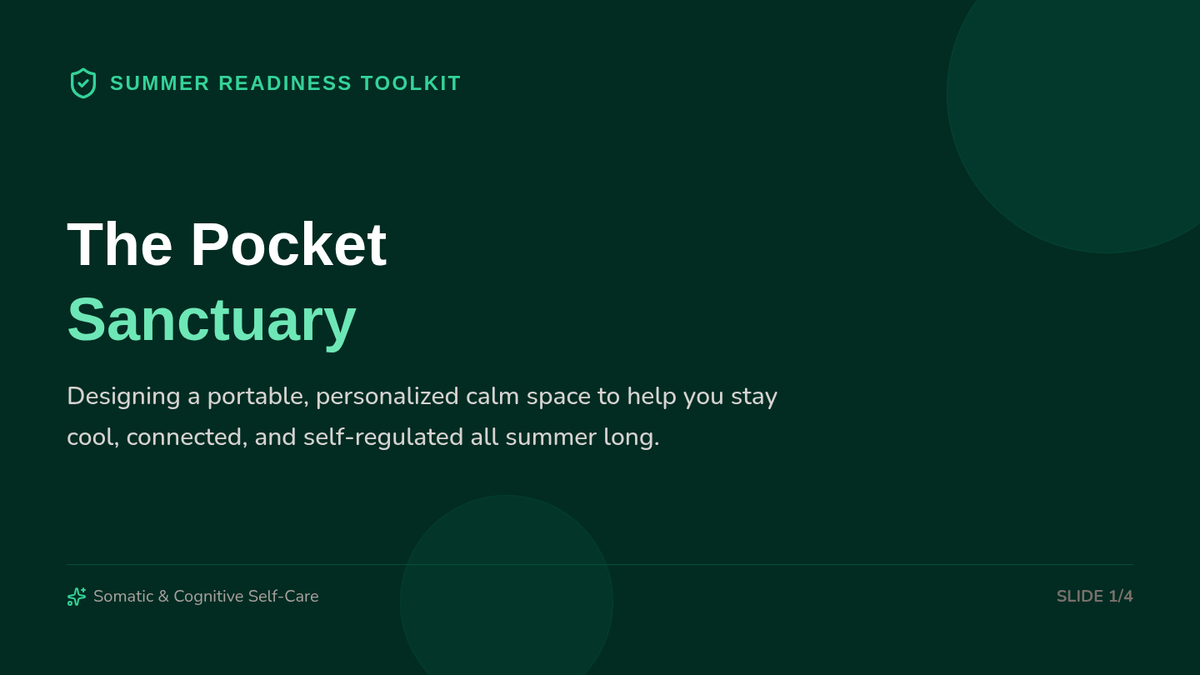
A 4-slide presentation matching the calming theme of the pocket sanctuary lesson, featuring slide structures, key discussion prompts, and easy-to-read guides with text larger than 24px.
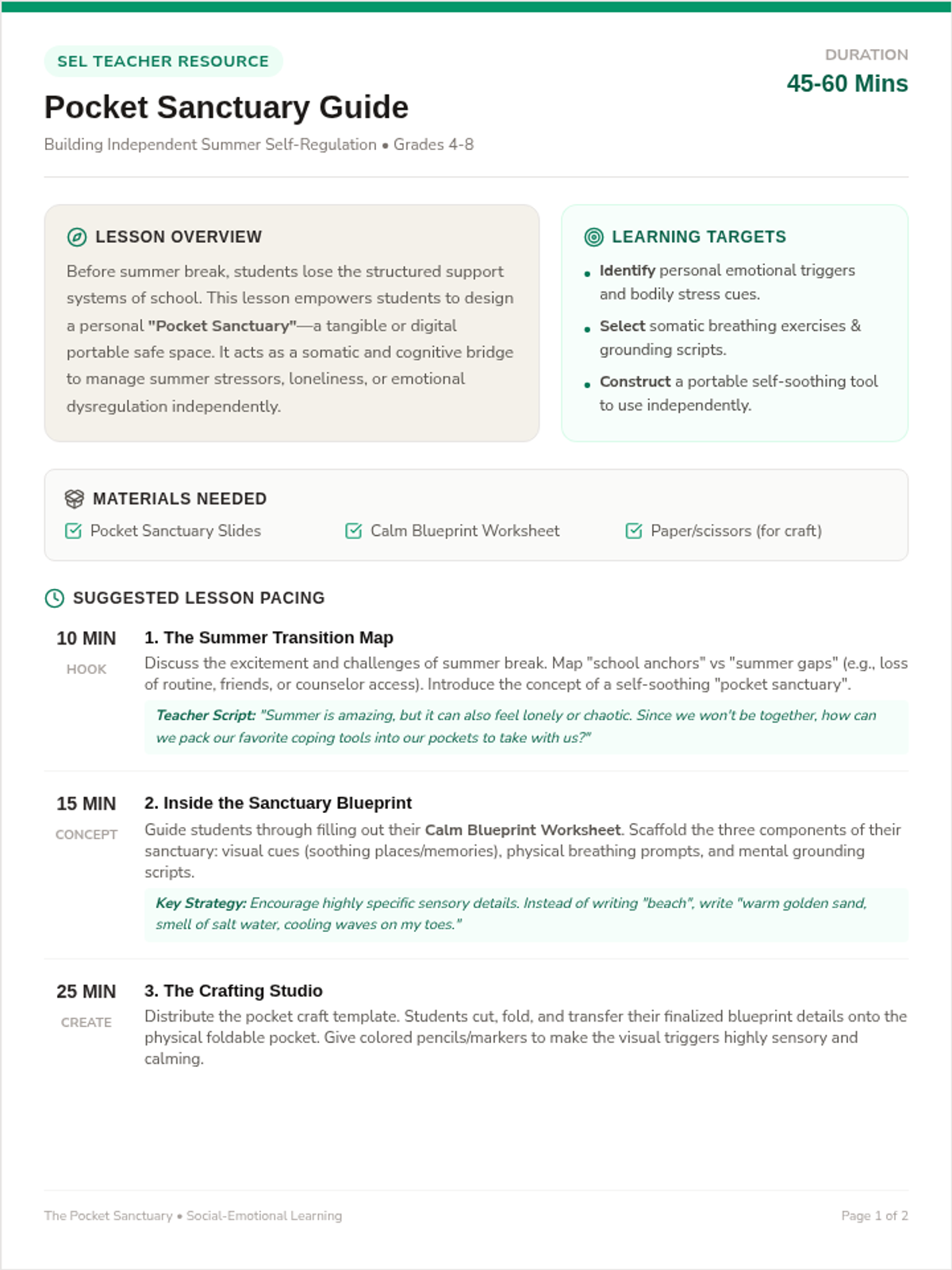
A comprehensive 2-page teacher facilitation guide containing lesson objectives, materials checklists, step-by-step lesson pacing, scripting prompts, and differentiation strategies for launching the Pocket Sanctuary lesson.
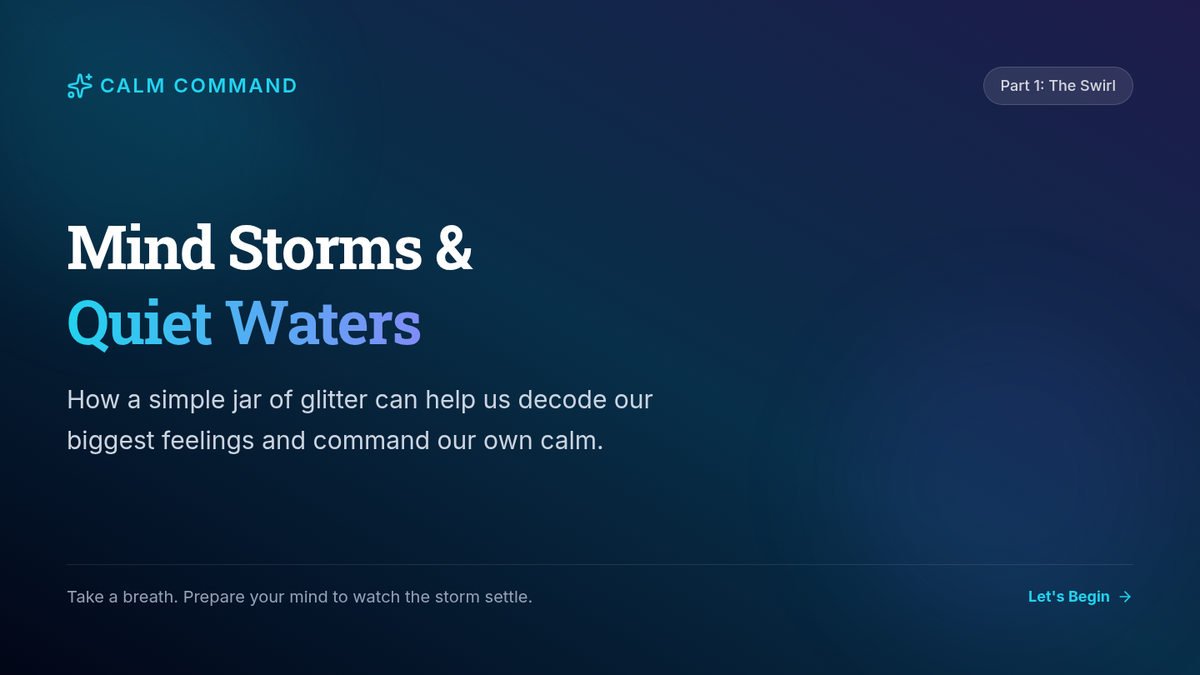
A visually arresting presentation introducing the biology of a 'mind storm', the neuroscience of emotional regulation, and a guided mindful breathing model based on the virtual calming jar.
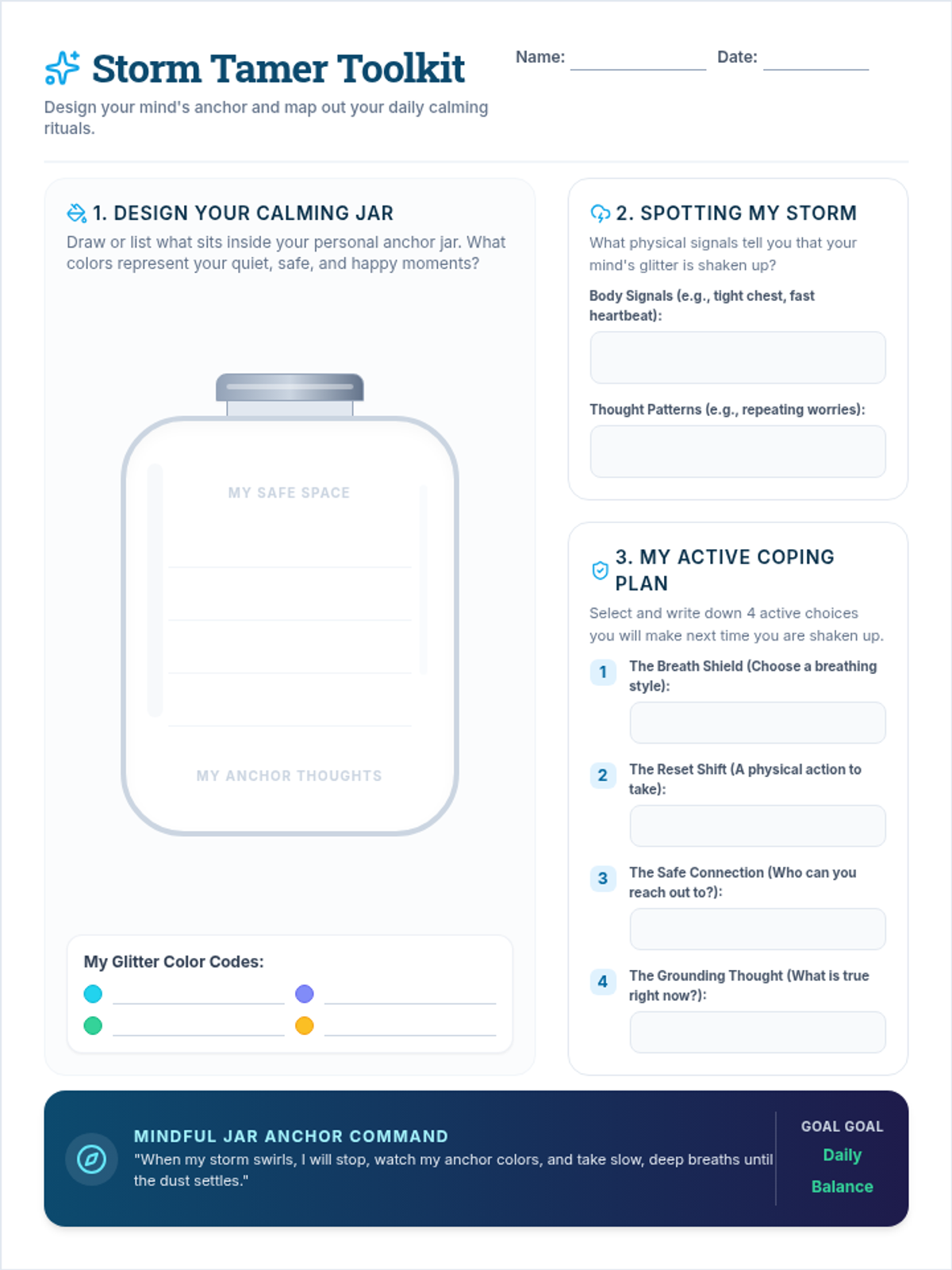
A beautifully illustrated worksheet where students design their own metaphorical calming jar, assign color meanings to their emotional states, and build a 4-step daily coping toolkit around the central visual metaphor.
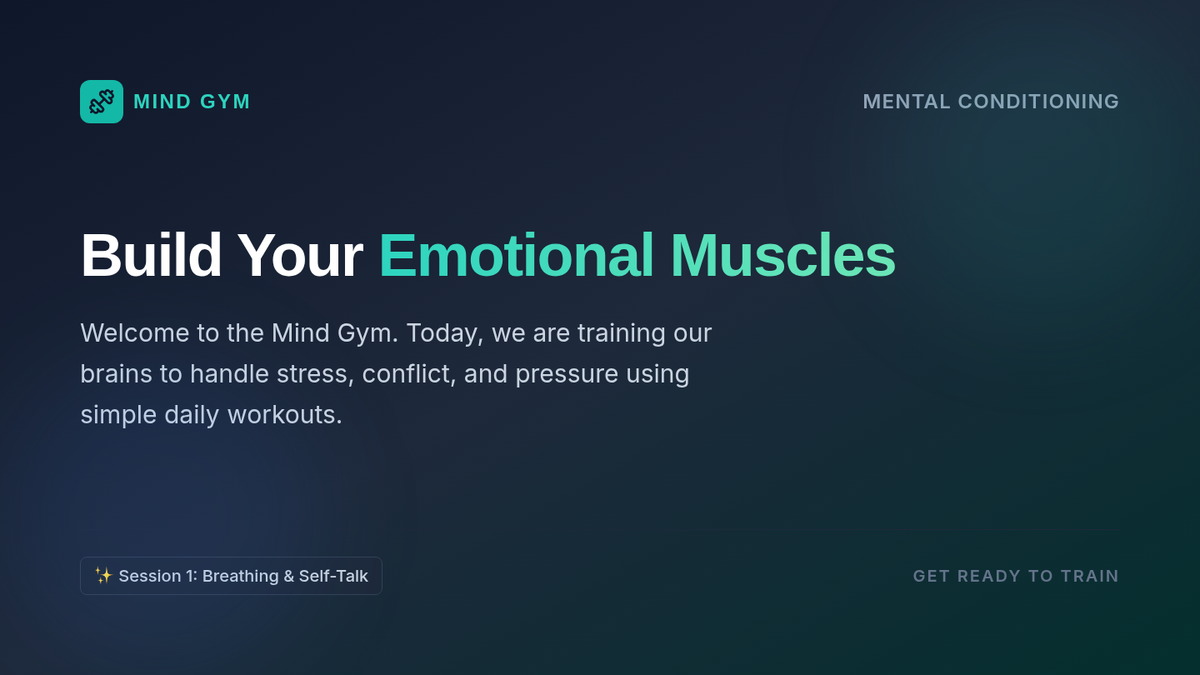
Interactive and highly visual presentation slides introducing emotional regulation muscles, guided breathing techniques, and the science of self-talk.
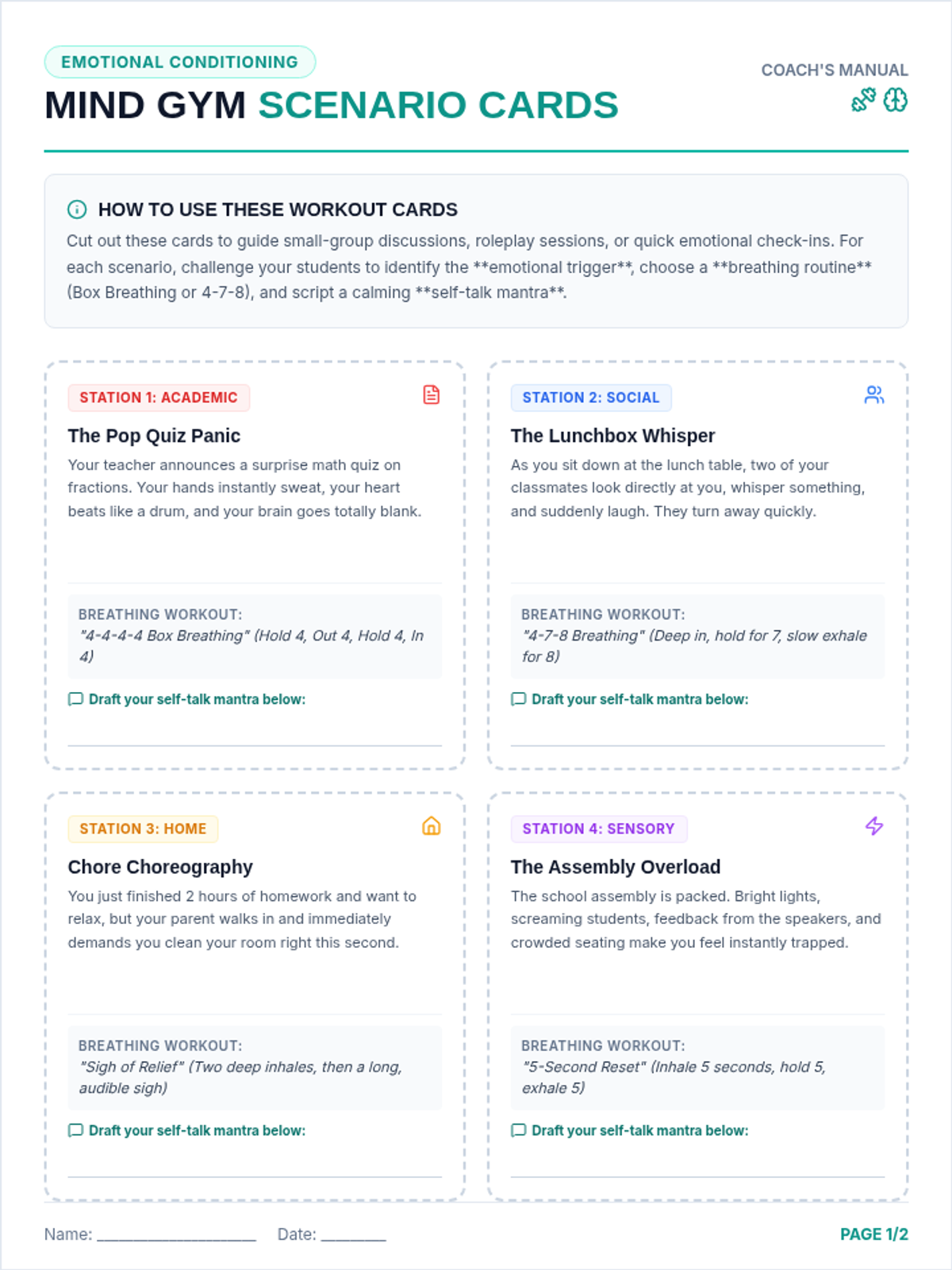
Printable scenario discussion cards styled like a mental fitness routine, designed for small group practice of emotional regulation, self-talk, and breathing strategies.
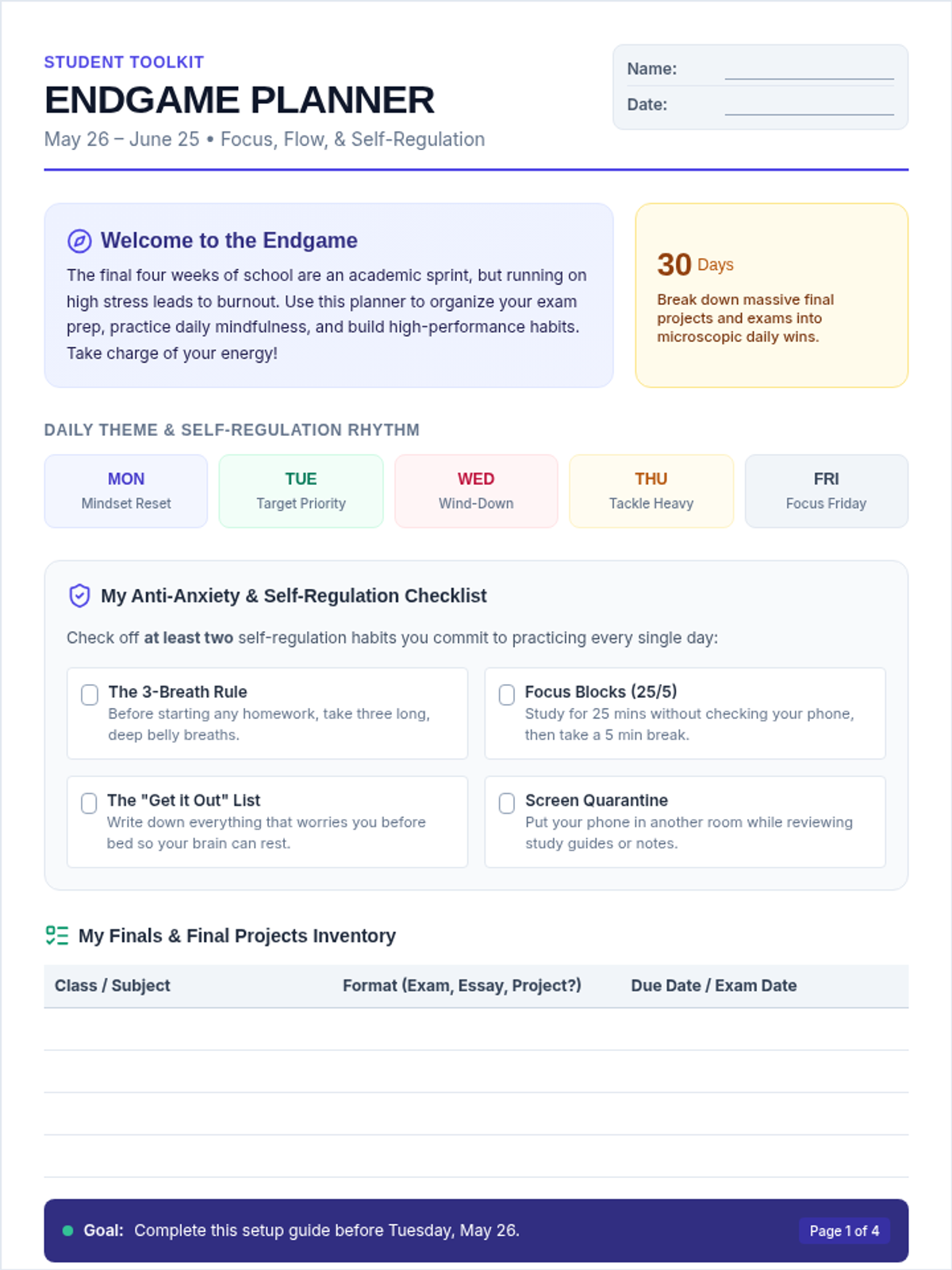
A highly structured, printable 4-page interactive workbook and calendar featuring daily executive functioning checklists, stress-management anchors, and co-planning layouts for May 26 to June 25.
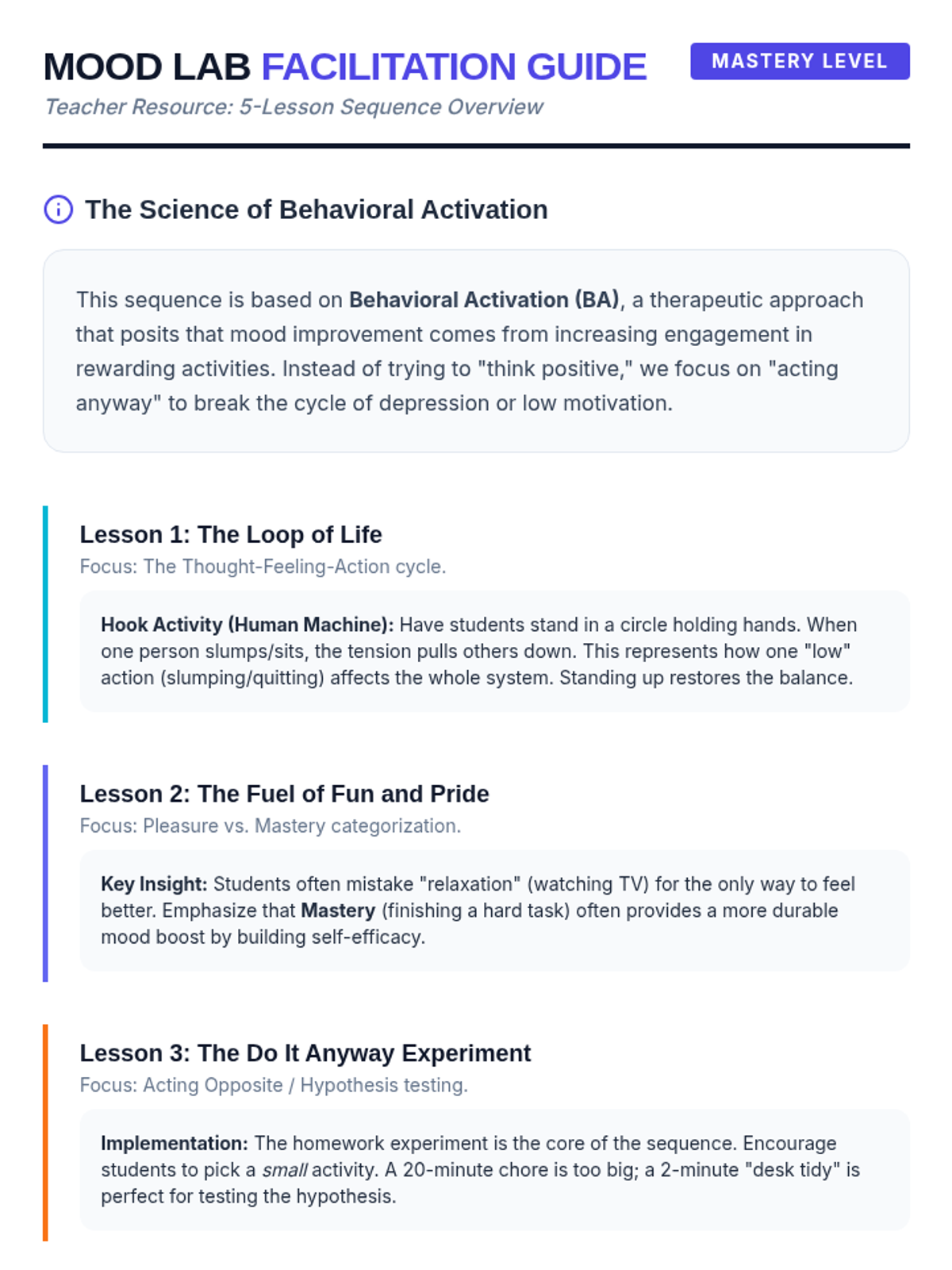
A teacher facilitation guide for the 'Mood Lab Experiment' sequence, providing therapeutic context, hook instructions, and tips for each lesson.
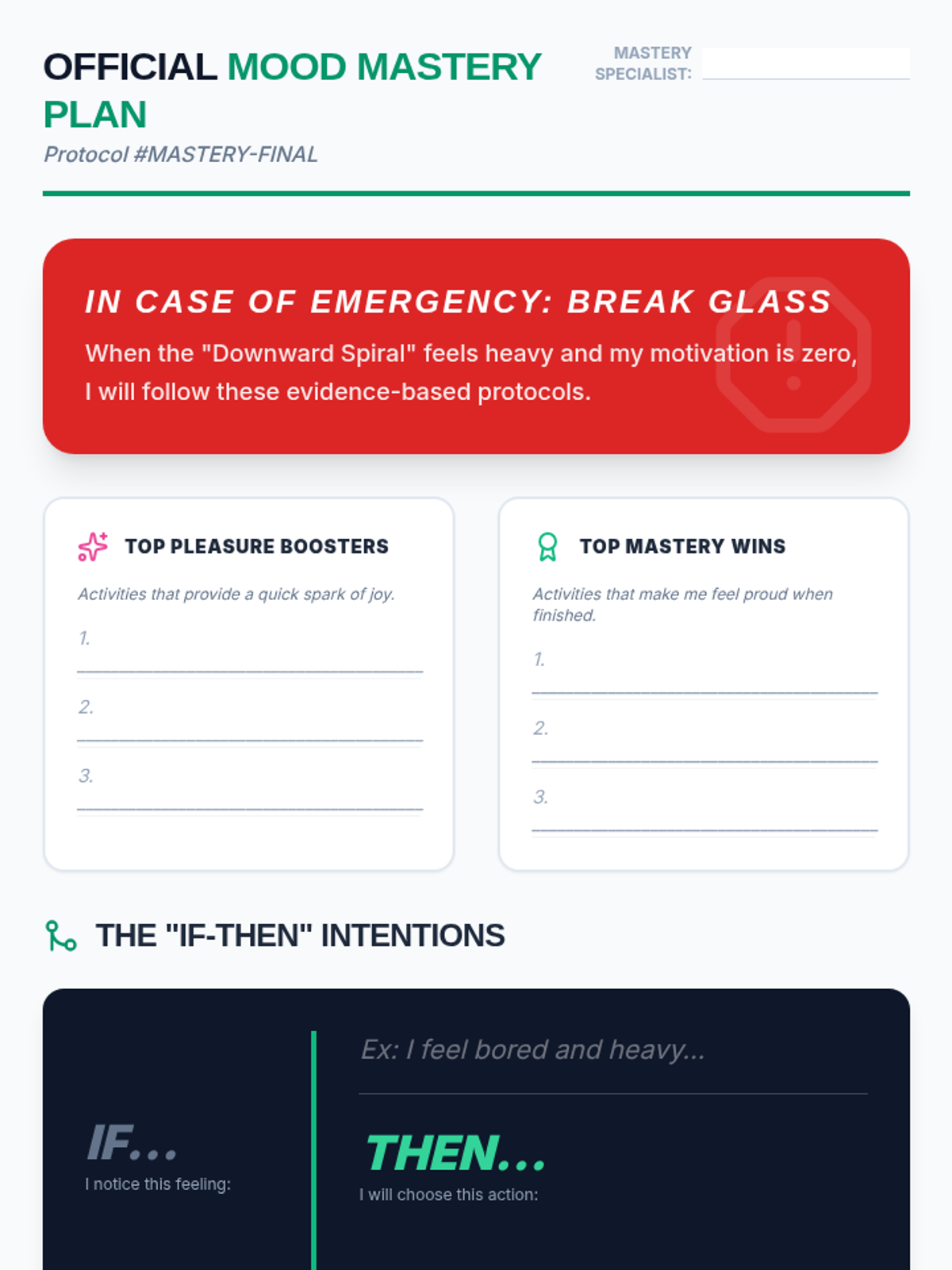
A comprehensive 'Break the Glass' emergency plan worksheet where students synthesize their findings into specific 'If-Then' implementation intentions for mood regulation.
Final slide deck for the 'Mood Mastery Lab' lesson, teaching students how to create implementation intentions and synthesize their learning into an emergency activation plan.
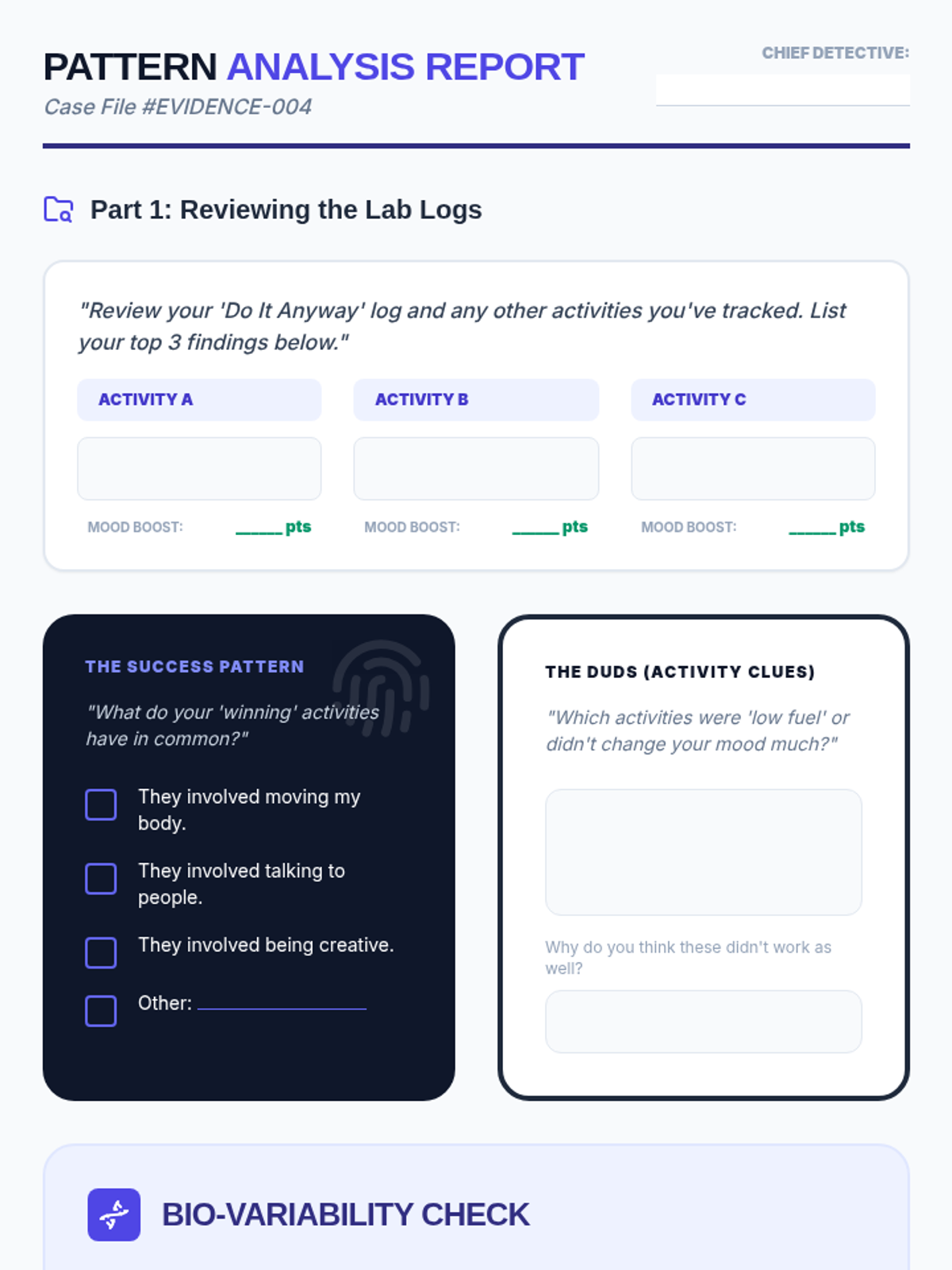
A lab report worksheet for students to analyze their experiment data, identify patterns in effective activities, and reflect on individual differences.
Introductory slides for the 'Mood Pattern Detectives' lesson, helping students analyze their data and understand the concept of individual variability in activity effectiveness.
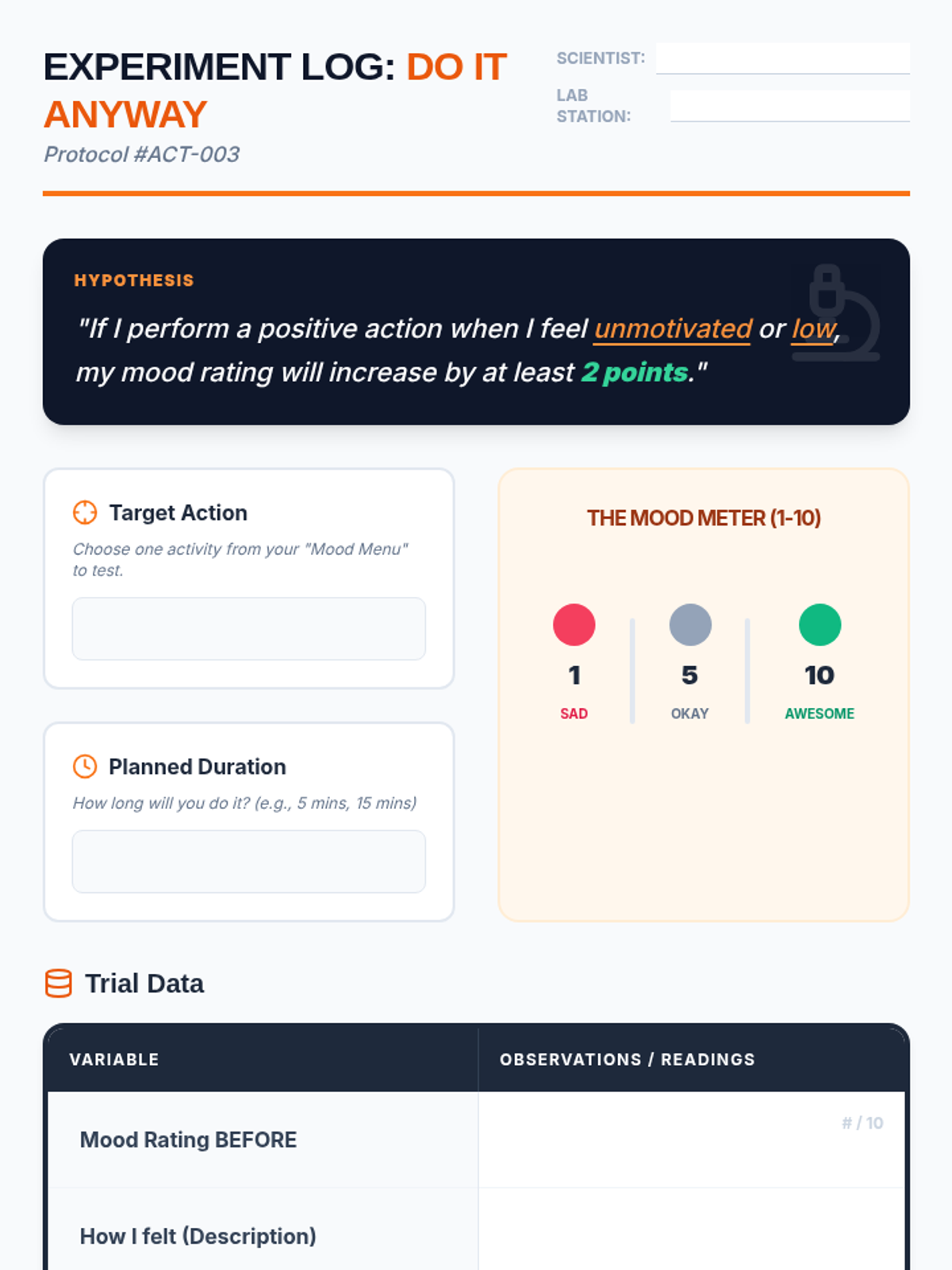
A data collection log for the 'Do It Anyway' experiment, allowing students to track their mood ratings before and after engaging in a positive action.
Introductory slides for the 'Do It Anyway' experiment, explaining the concept of 'acting opposite' and how to track mood data for a personal science experiment.
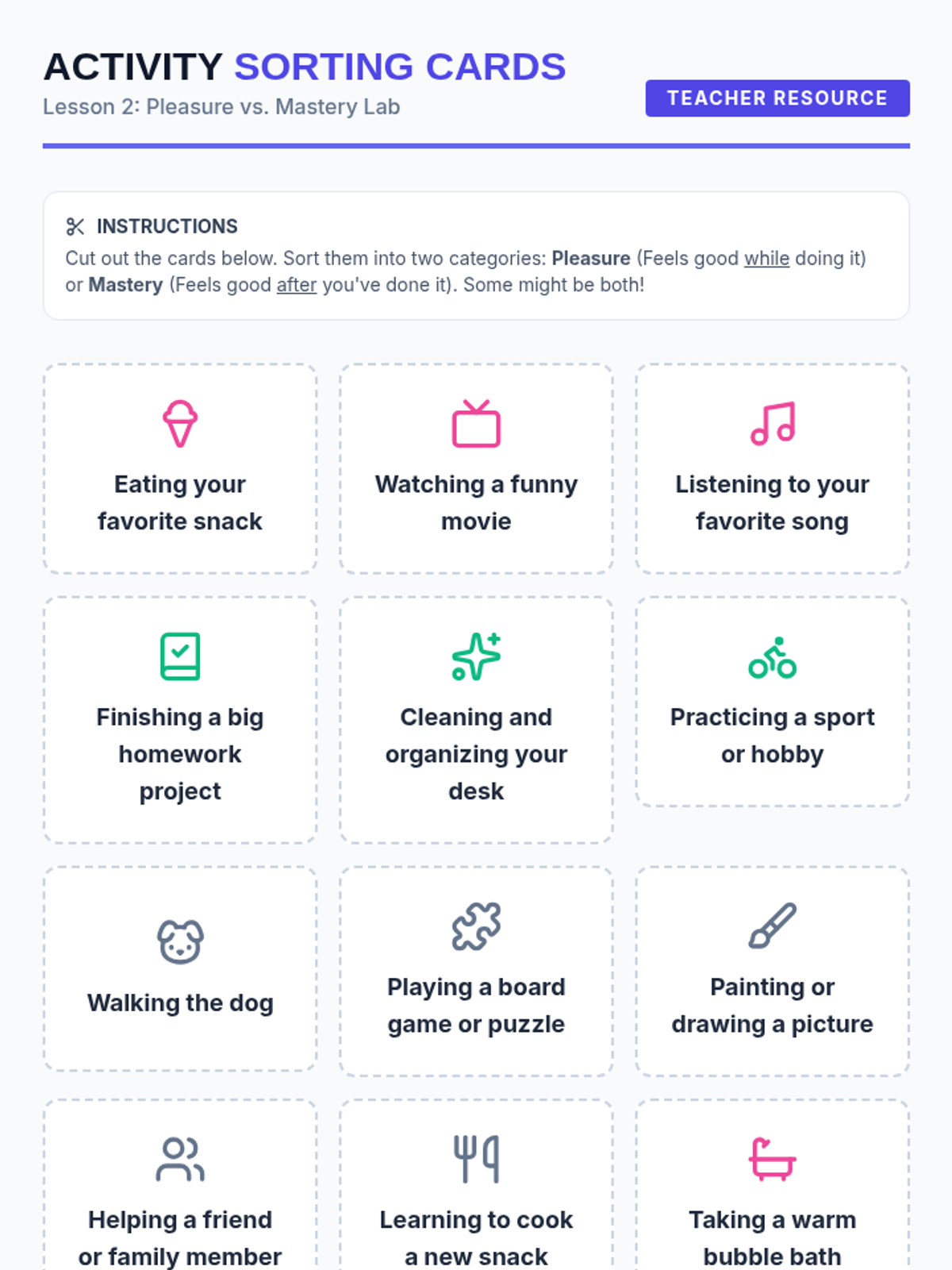
Sorting cards and a categorization t-chart for Lesson 2, helping students distinguish between pleasure-based and mastery-based activities.
Introductory slides for the 'Pleasure and Mastery' lesson, explaining the difference between 'Fun fuel' and 'Proud fuel' and the importance of a balanced activity diet.
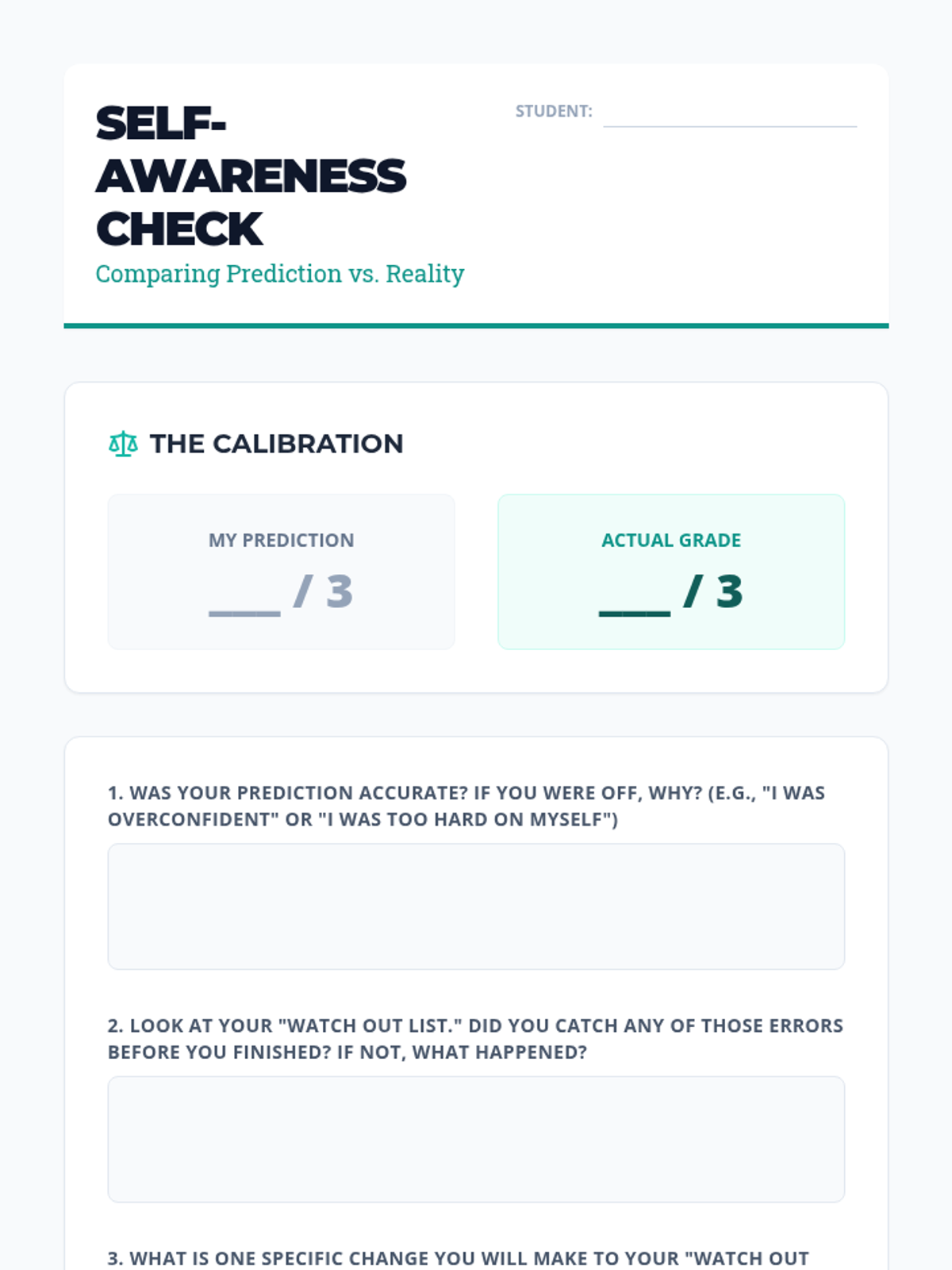
A final reflection sheet for students to compare their quiz predictions with their actual grades, evaluating the effectiveness of their metacognitive strategies.
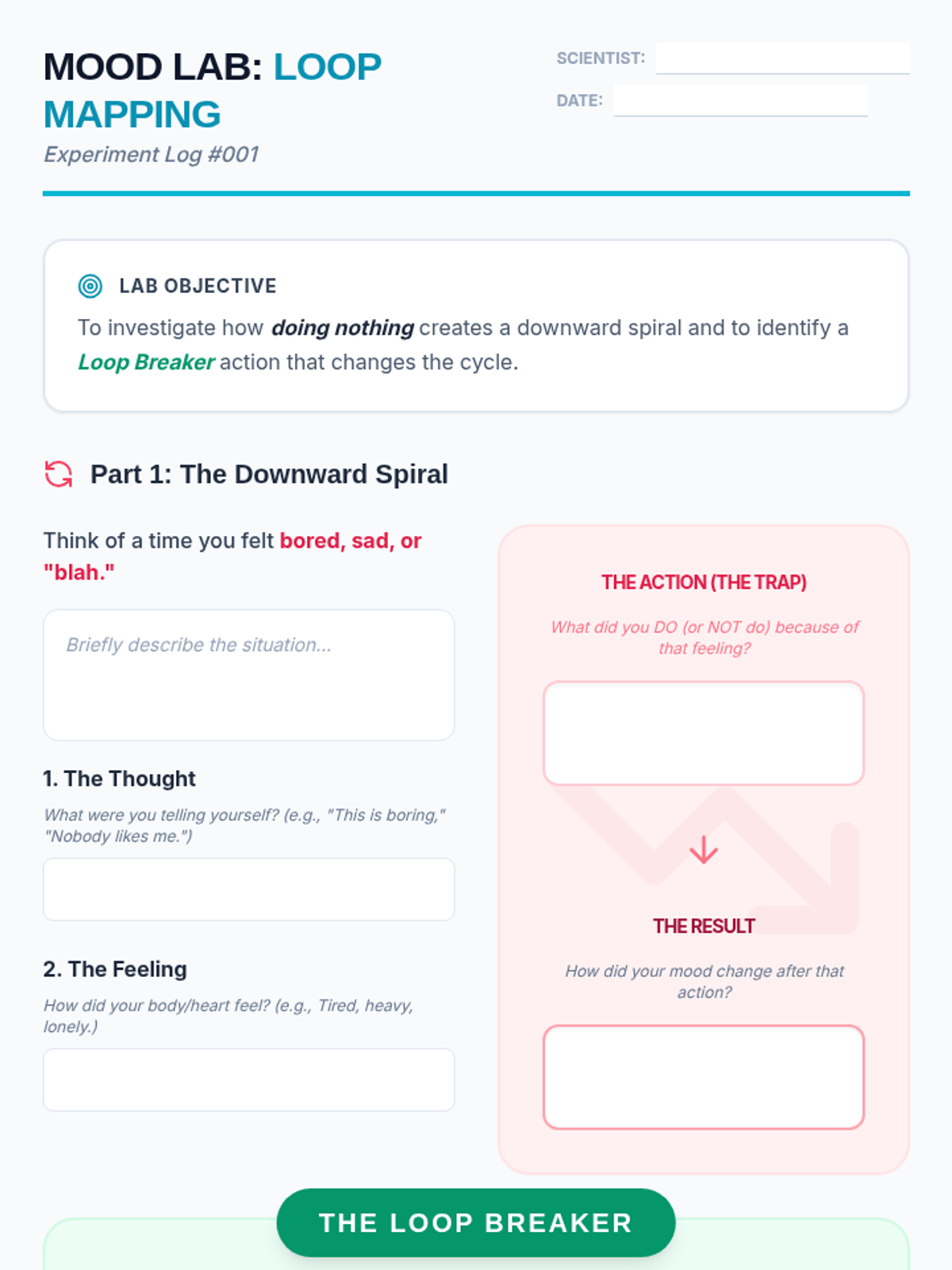
A lab notebook style worksheet for students to map out their own action-emotion loop, identifying a 'downward spiral' moment and a 'loop breaker' action.
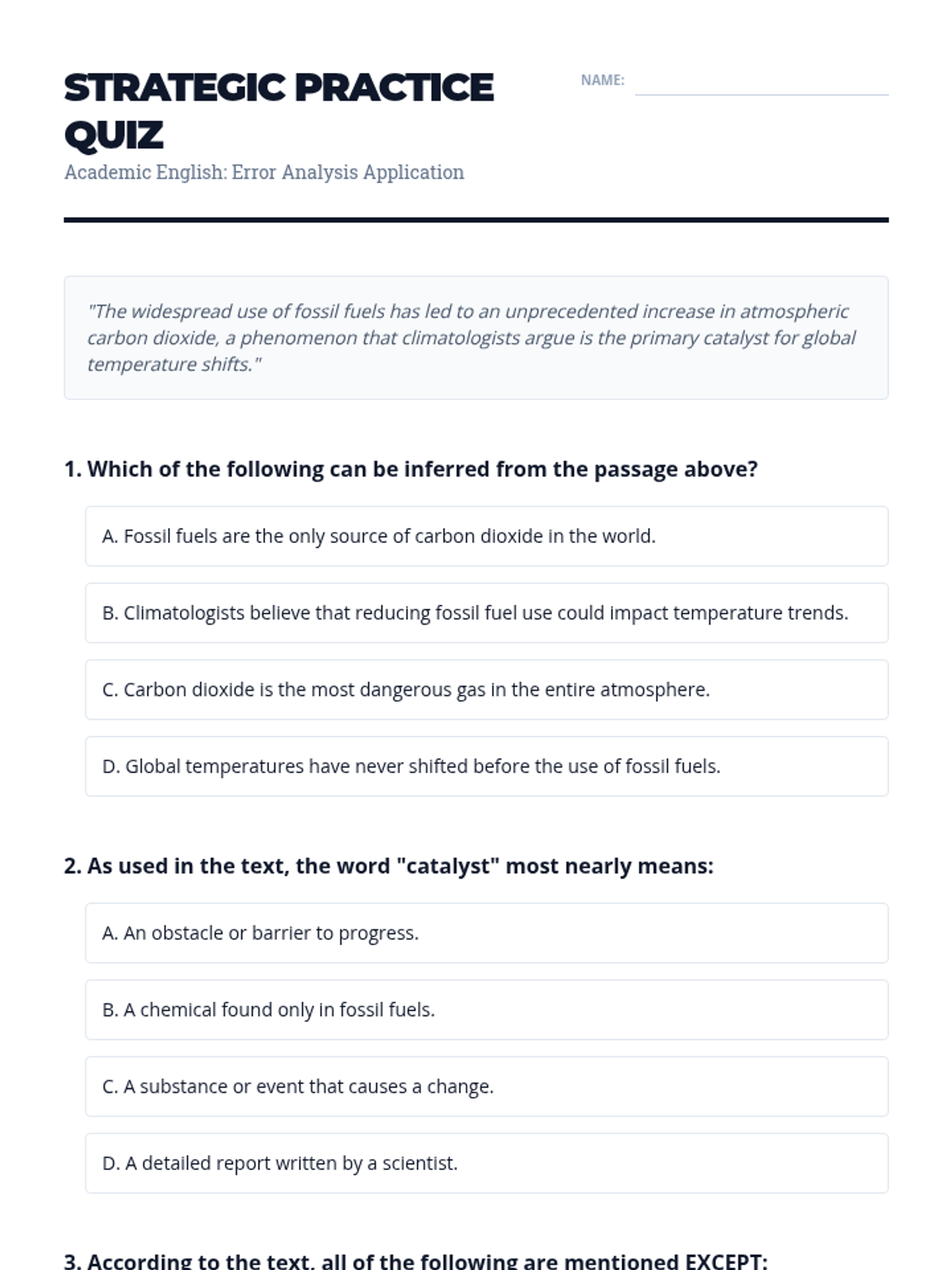
A short Academic English quiz designed to test students' application of their "Watch Out List," including a mandatory pre-grading self-reflection and score prediction section.
Final slides for the sequence focusing on the "Showtime" assessment. It introduces the score prediction challenge and real-time error analysis.
Introductory slides for the 'Loop of Life' lesson, featuring the human machine hook and visual representations of the thought-feeling-action cycle.
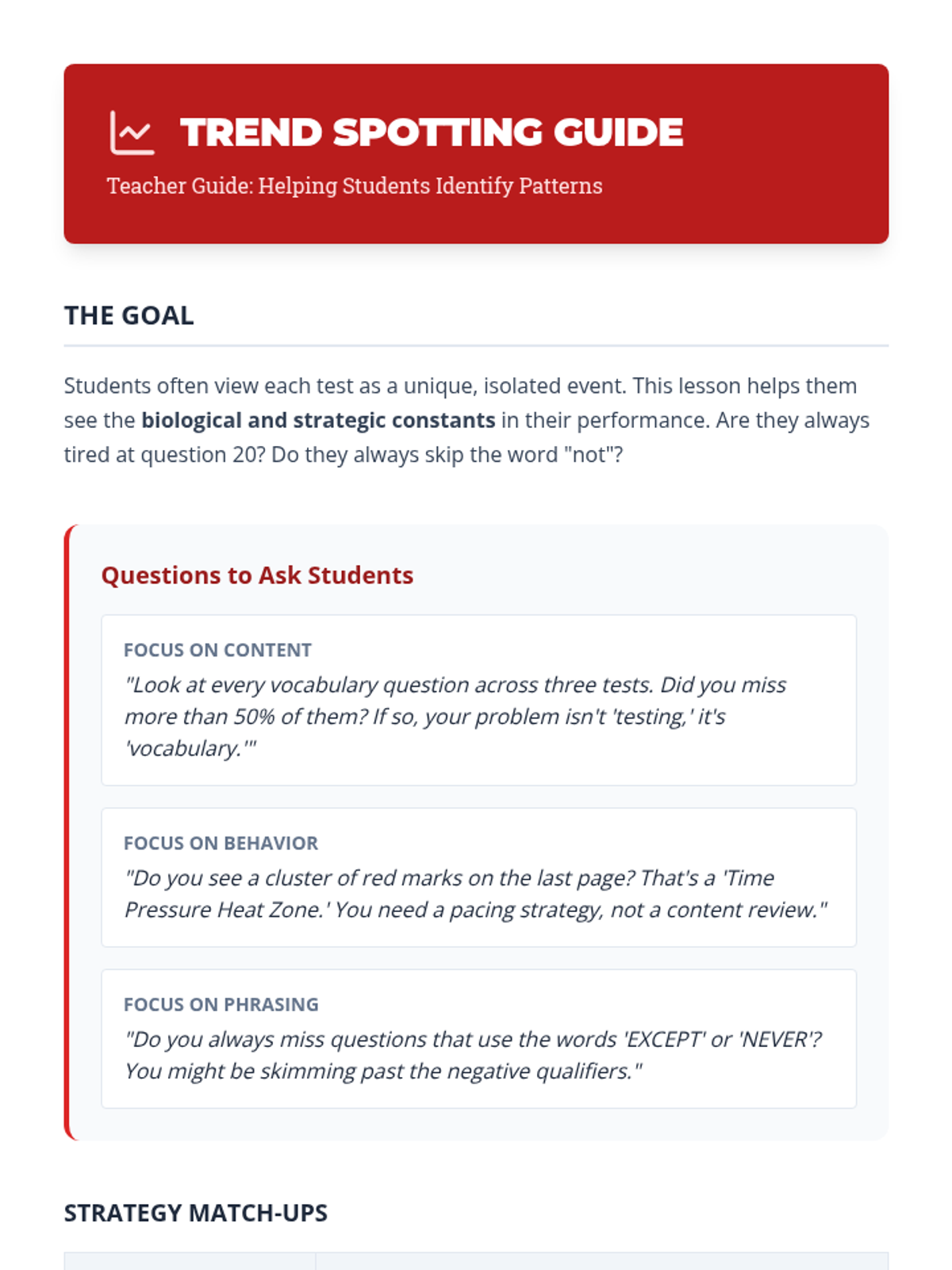
A guide for teachers to help students interpret their error data and connect patterns to specific defensive strategies.
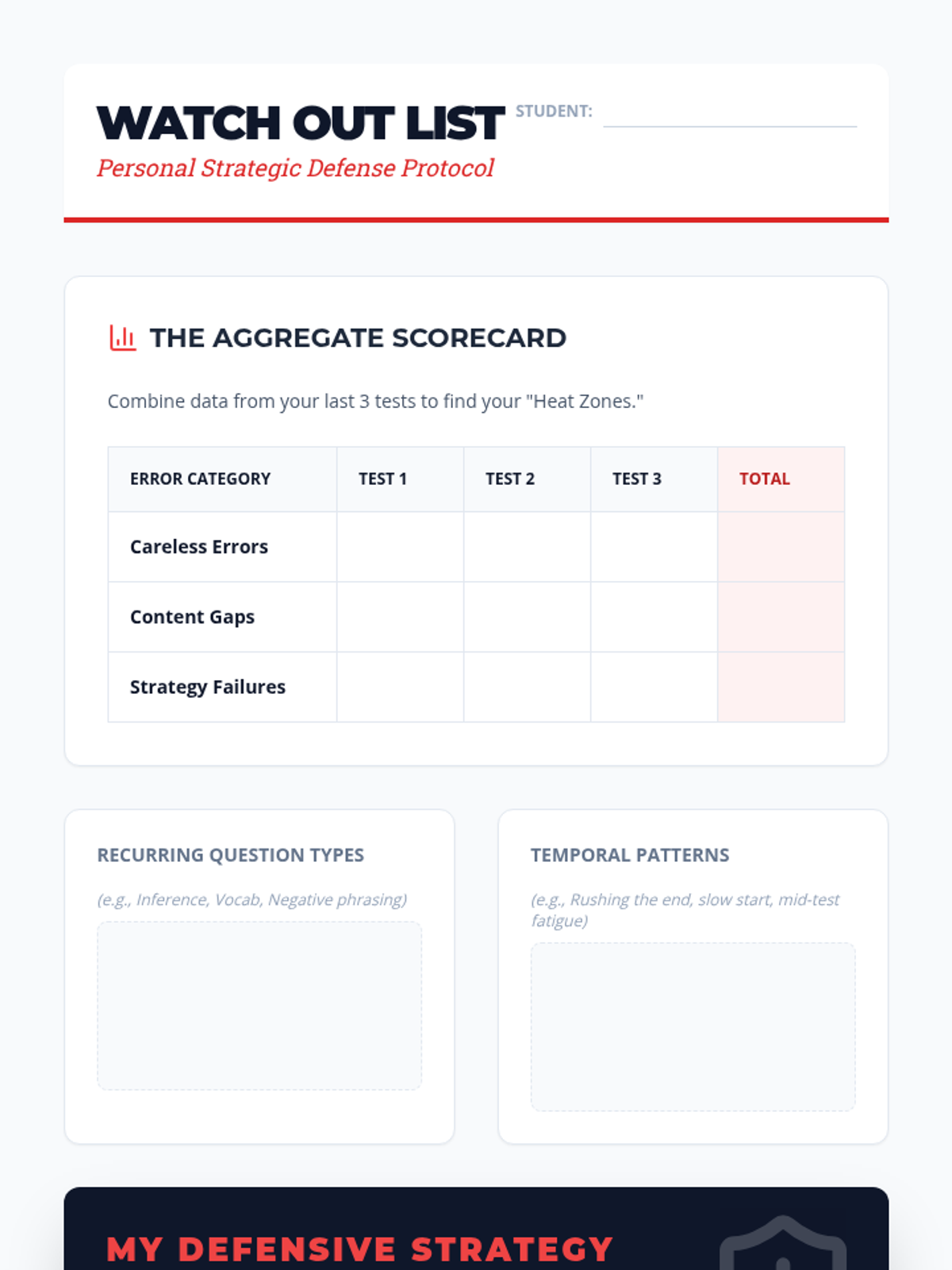
A student worksheet for aggregating error data across multiple assessments and distilling those patterns into a "Watch Out List" for future defense.
Slides for Lesson 4 that use a "Heatmap" analogy to teach students how to aggregate error data and identify recurring personal patterns.
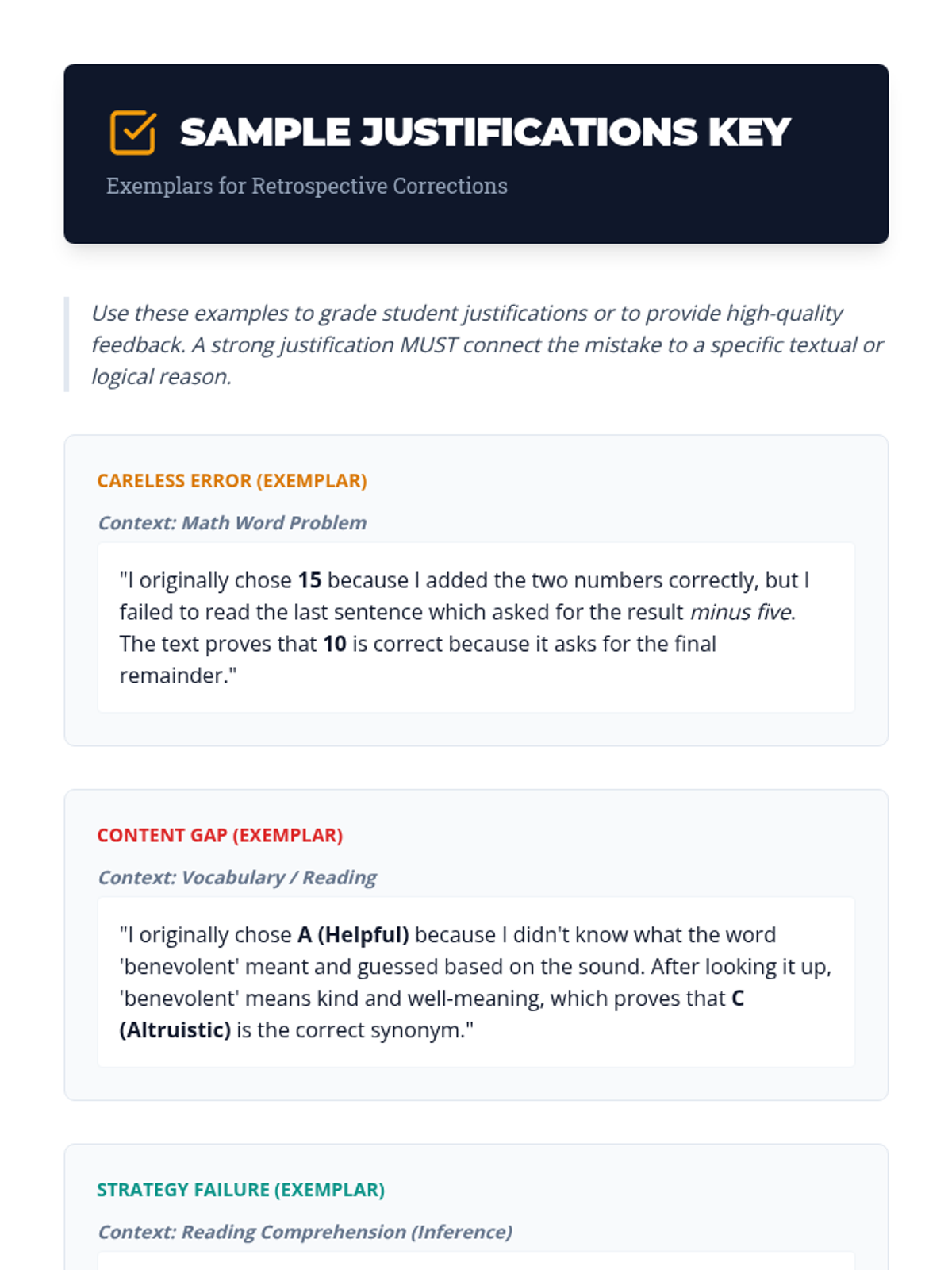
An answer key/exemplar guide for teachers to evaluate student justification statements, showing the difference between weak and mastery-level corrections.
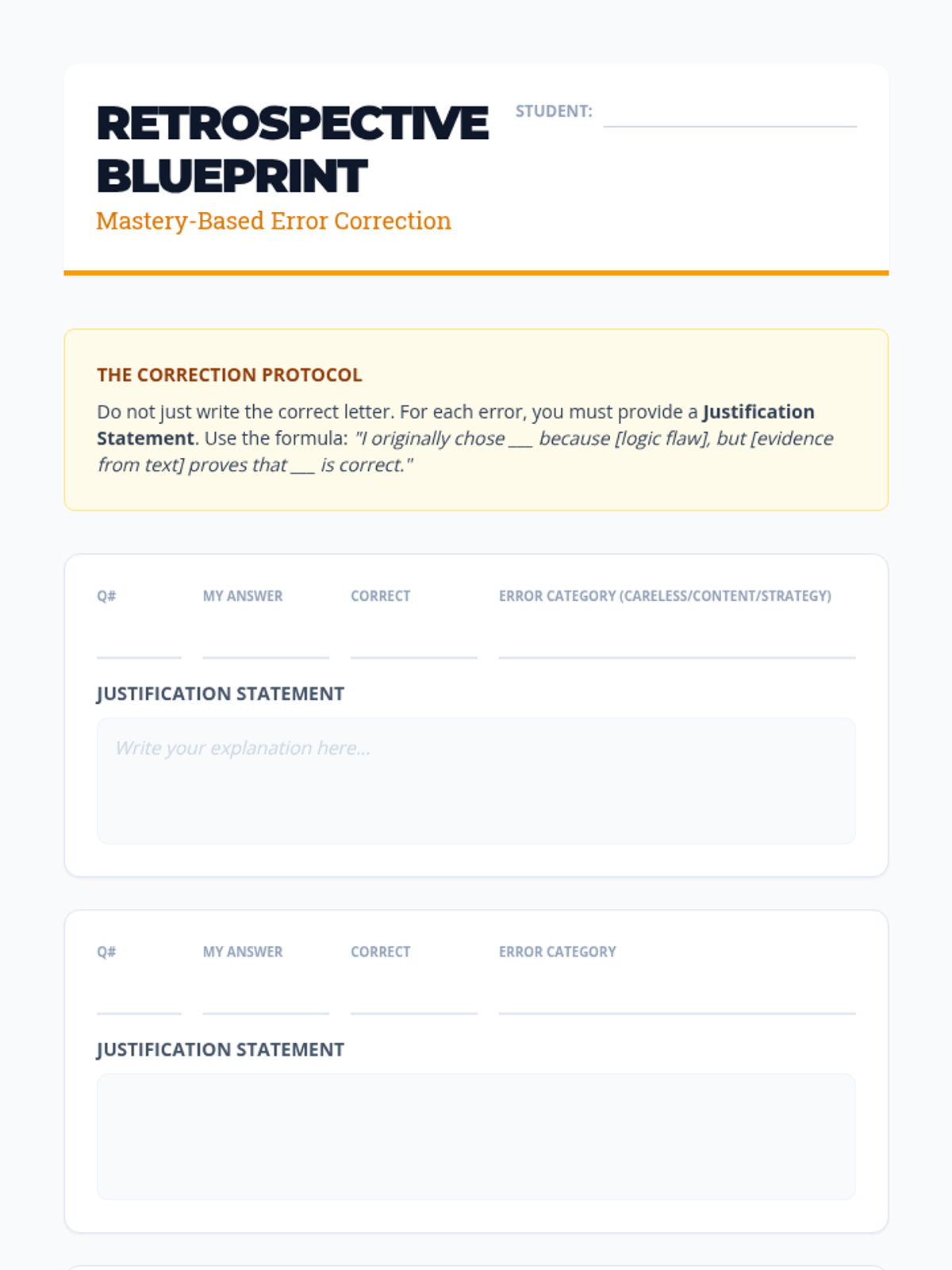
A template for students to perform deep error corrections, requiring them to write justification statements using a specific logic-based formula.
Slides for Lesson 3 introducing the "Justified Fix" method. It emphasizes that students must explain why they were wrong and why the new answer is right using evidence.