Budgeting, saving, and investment strategies alongside practical skills for managing credit, taxes, and banking. Addresses insurance needs, employment income, and major purchase decisions to support comprehensive long-term financial planning.
Instructional slides explaining insurance fundamentals (premium, deductible, risk transfer) with improved contrast, alignment, and Buffalo-specific examples.
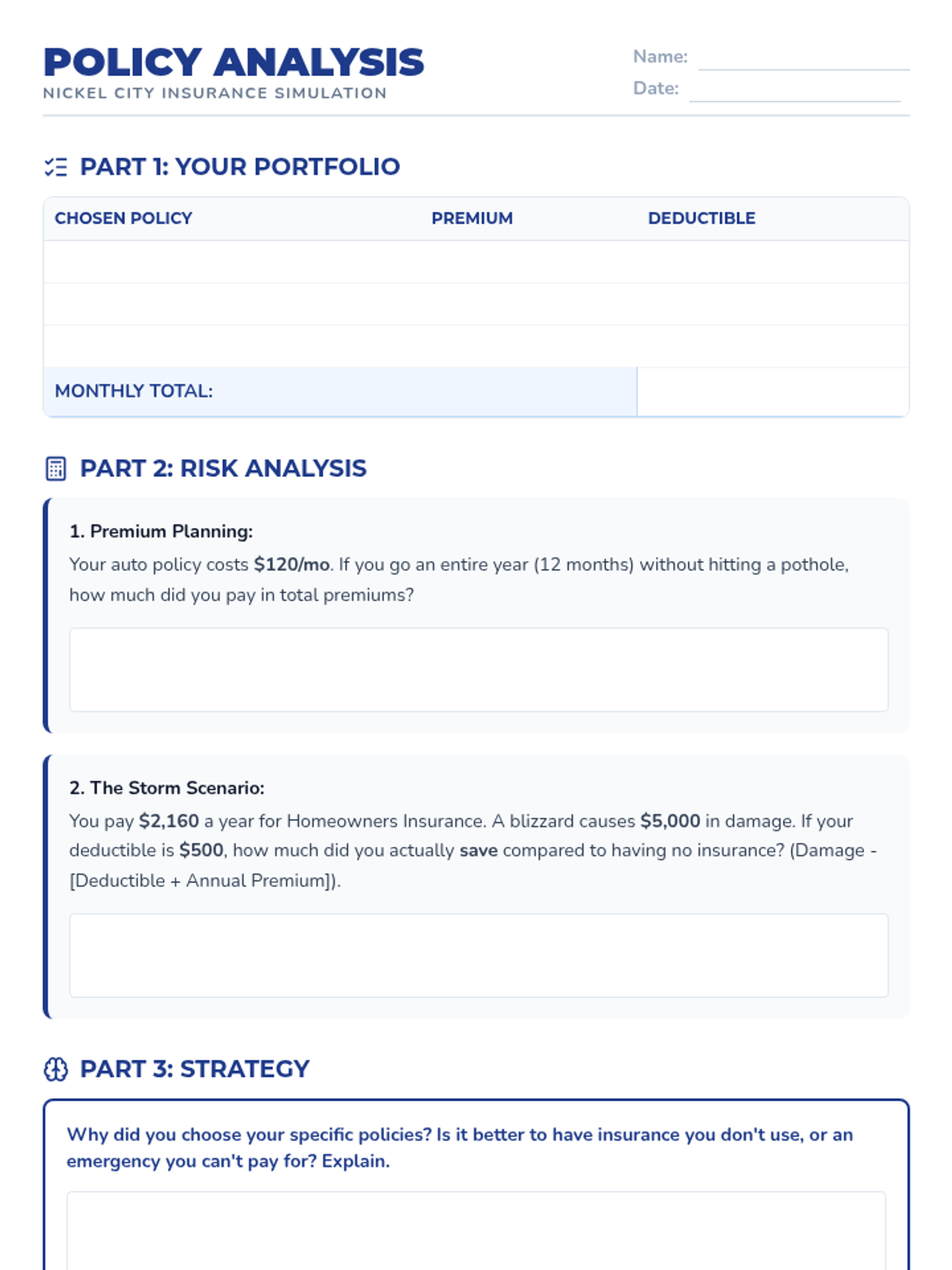
A tightened companion worksheet designed to fit on a single printable page. Includes risk analysis problems and a student work area with improved page-break management.
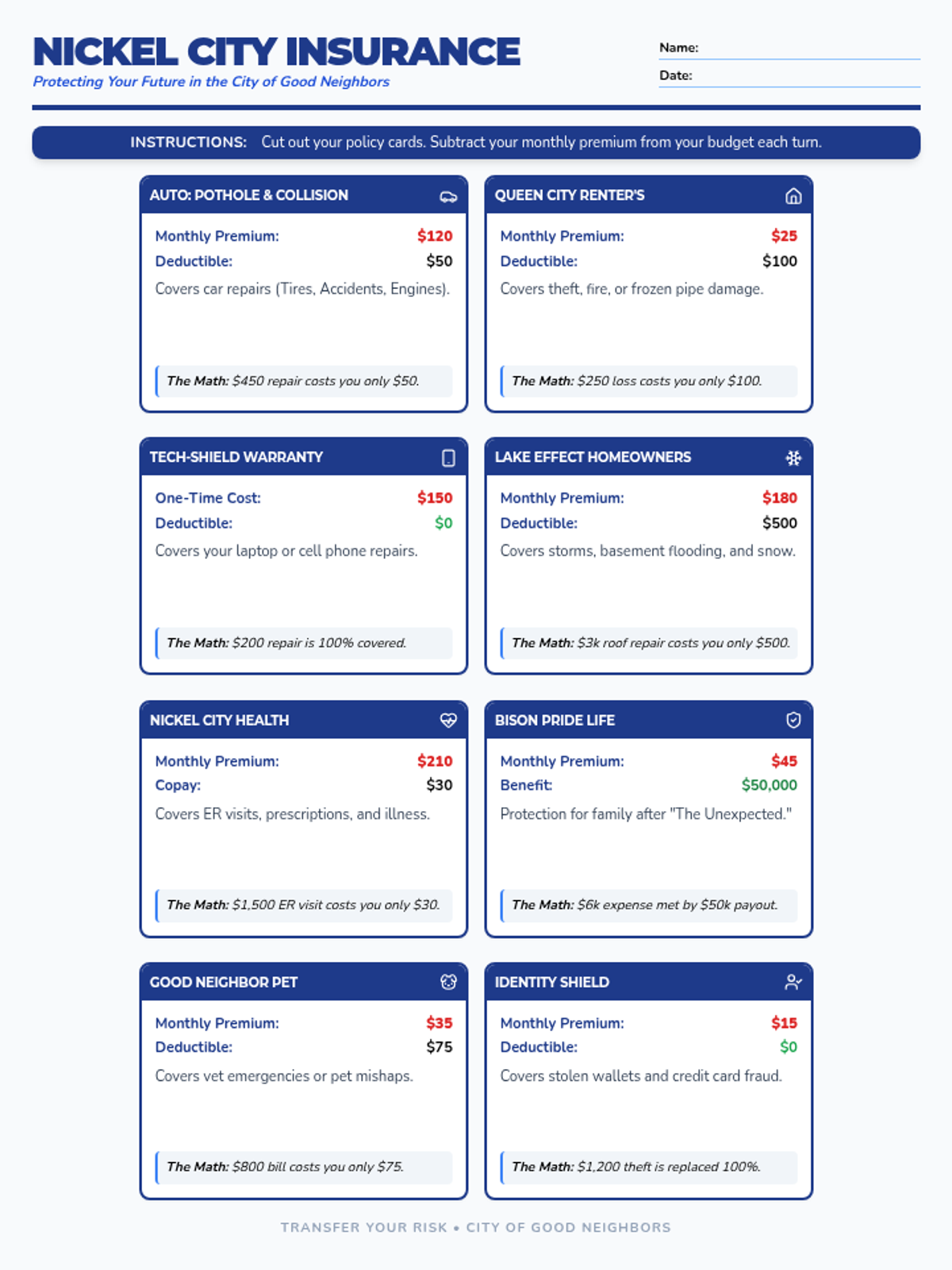
A single-page printable set of 8 Buffalo-themed insurance policy cards. Features compact layouts to ensure all 8 cards fit on one sheet for student use.
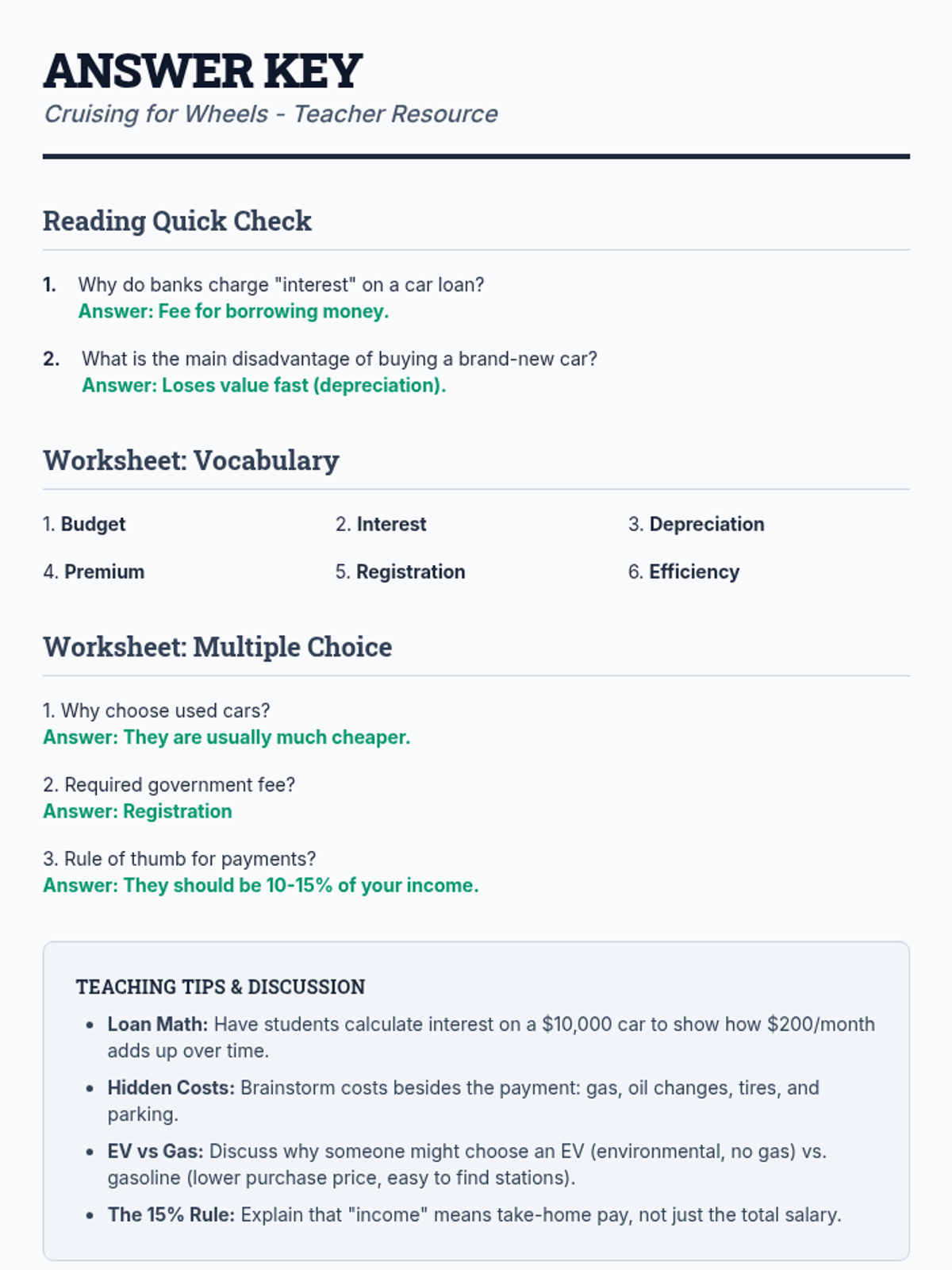
A teacher's answer key for the "Cruising for Wheels" unit, including answers for the reading quick check and the vocabulary worksheet. Includes teacher notes and discussion prompts. Updated with refined spacing for better visual balance.
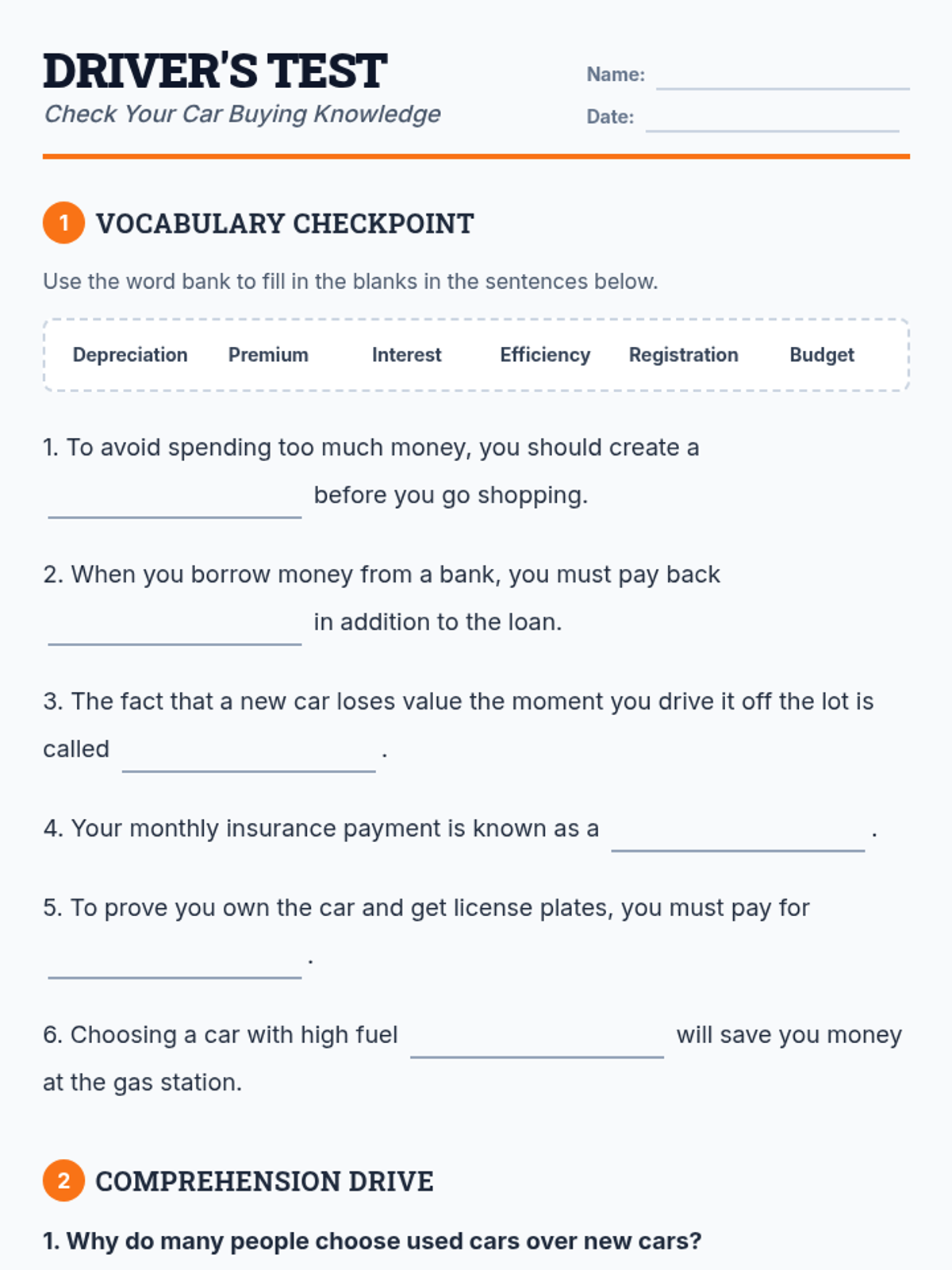
A companion worksheet for the car buying lesson featuring vocabulary fill-in-the-blank questions and multiple-choice comprehension questions centered on vehicle financing, insurance, and efficiency. Now updated with all word bank terms and better spacing.
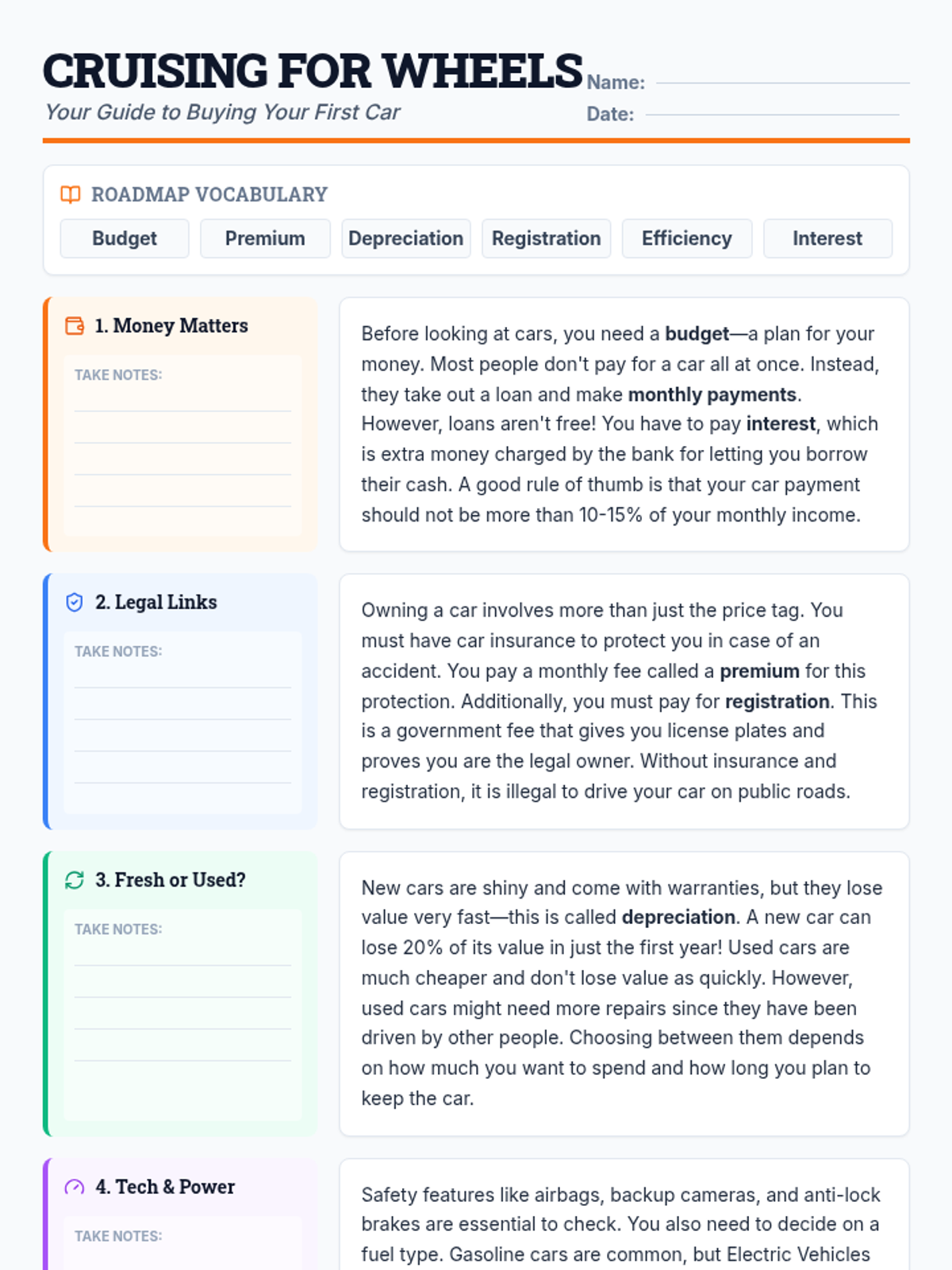
A two-column reading document for middle school students explaining the basics of buying a car, including budgeting, insurance, depreciation, and safety features. Features a vocabulary word bank and quick-check multiple choice questions. Updated for better space efficiency and functional student note areas.
A set of 24 Buffalo-themed 'Life Happens' cards for a financial literacy project. The layout includes various local scenarios like blizzards and picnics, concluding with a single 'Identity Theft' special event card.
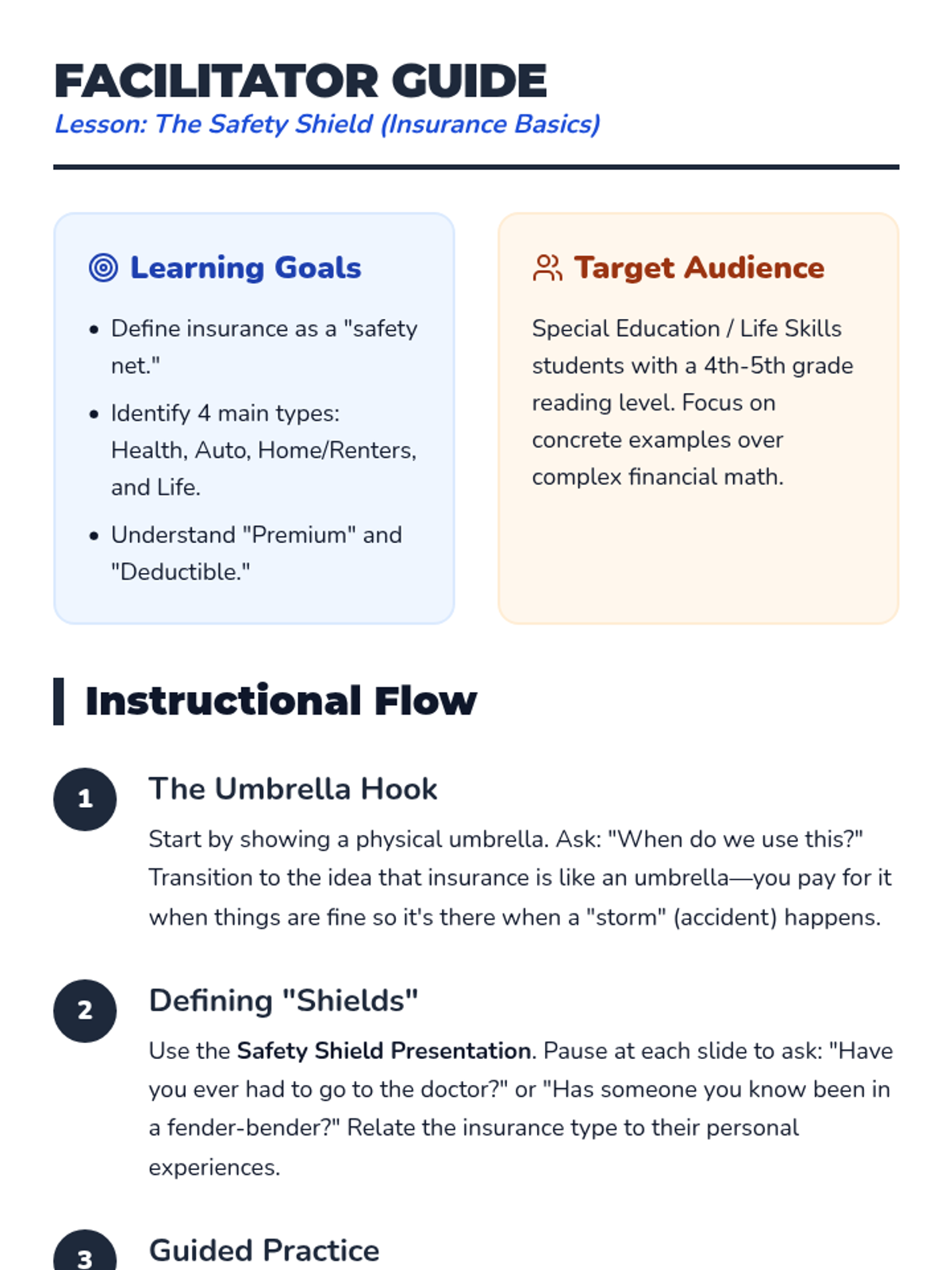
A teacher's facilitation guide for the insurance lesson, including instructional strategies, discussion prompts, and differentiation tips for special education classrooms.
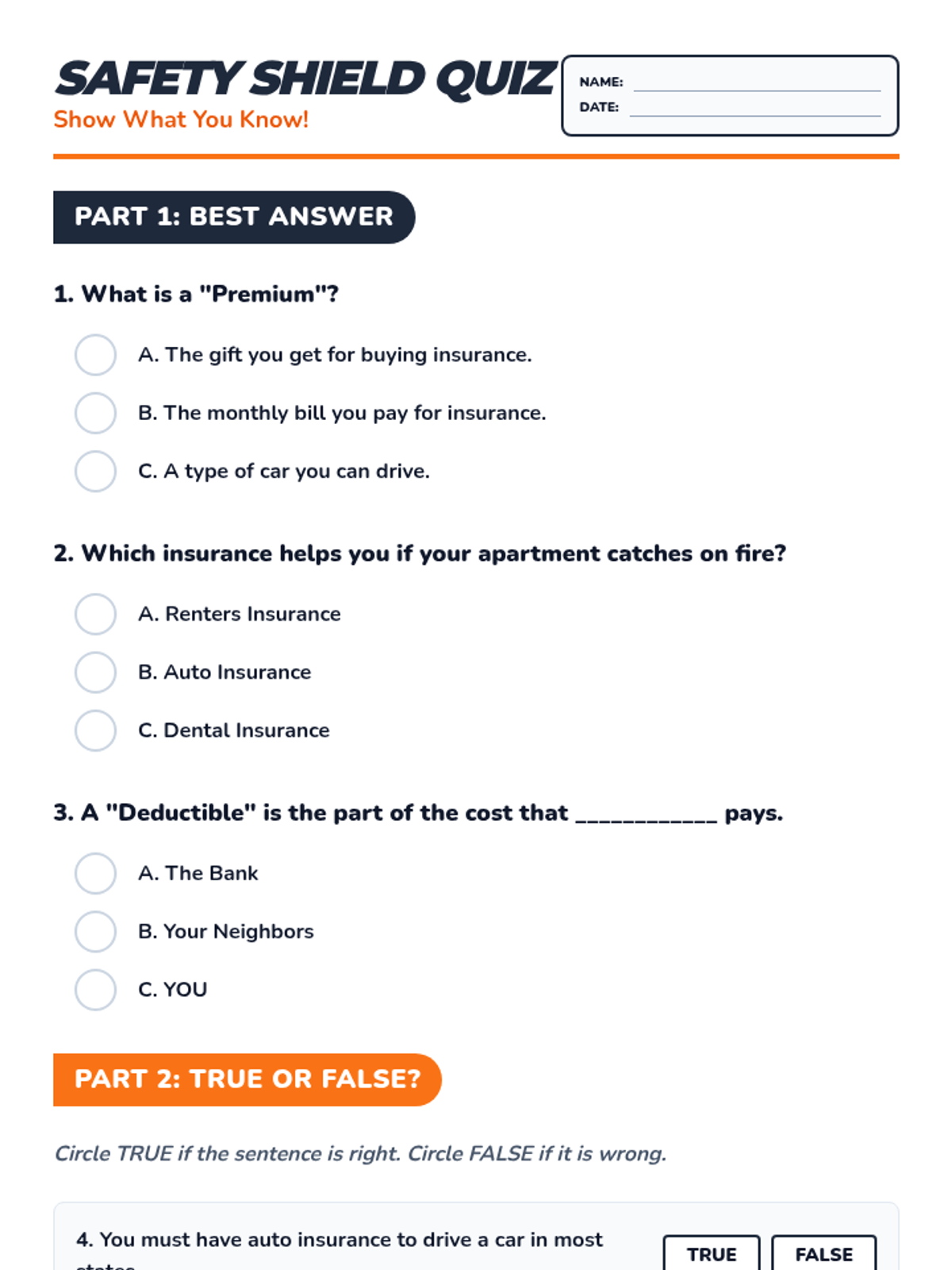
An updated summative assessment for the insurance lesson, featuring improved page breaks, clearer alignment, and a more robust drawing section.
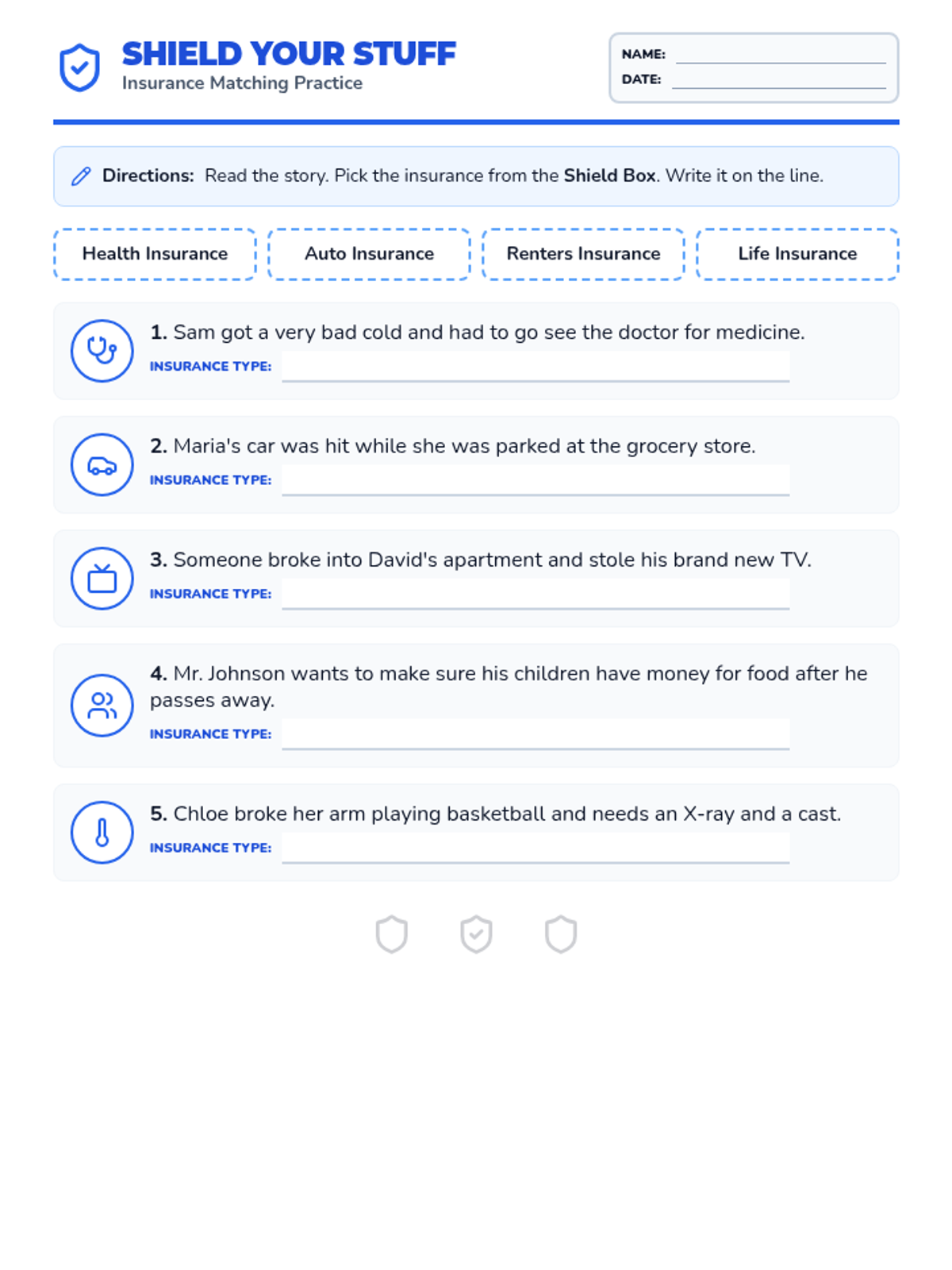
A single-page matching worksheet where students identify the correct type of insurance for various real-life scenarios, optimized for clarity and spacing.
An updated introductory slide deck explaining insurance basics using a "Safety Shield" metaphor, now with improved contrast, balanced layouts, and practice scenarios.
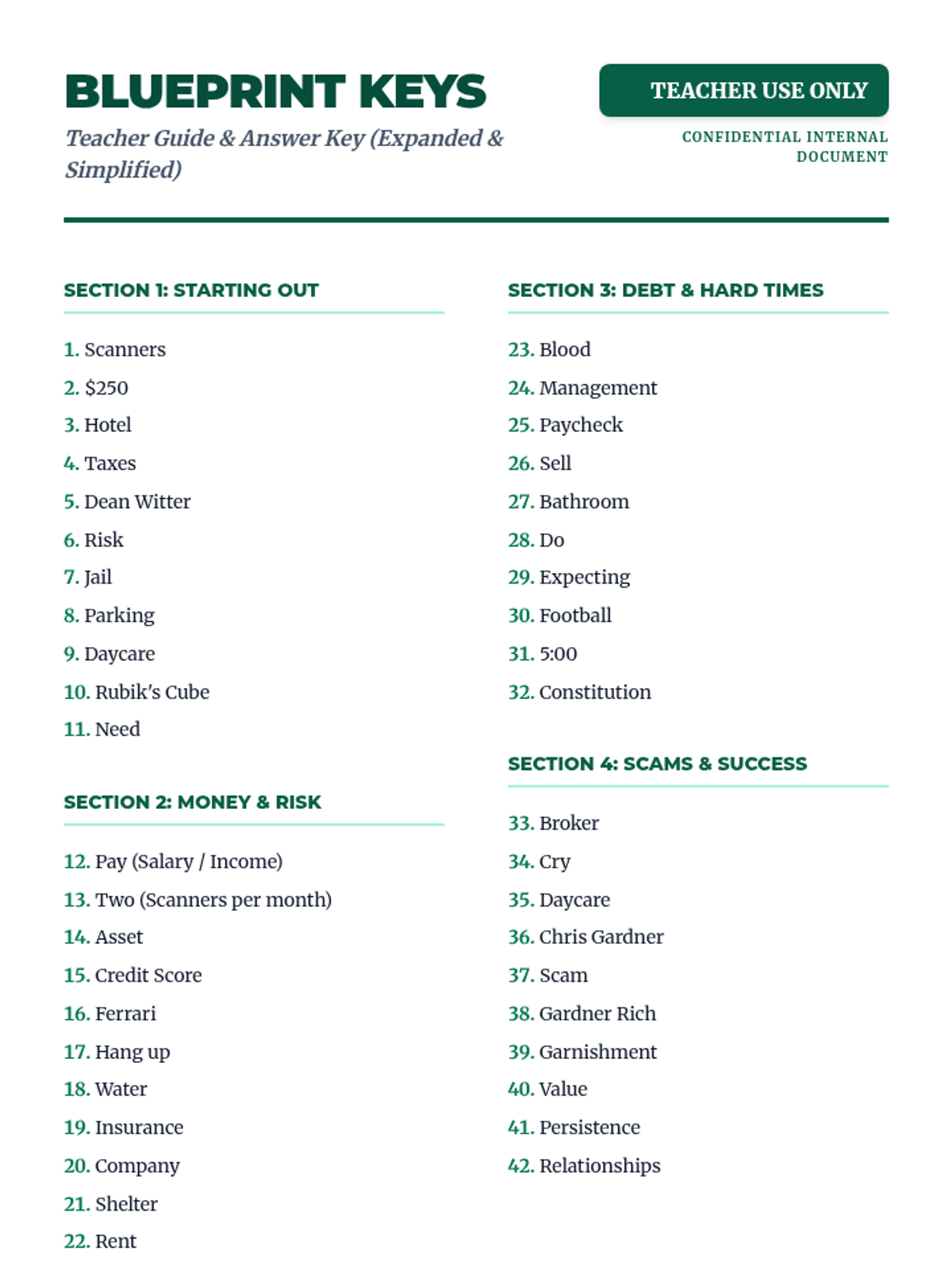
The answer key and discussion guide for the 'Brokerage Blueprint' worksheet, including all 42 answers and prompts for classroom debate on opportunity cost and asset management. Includes new answers for credit, insurance, and debt management.
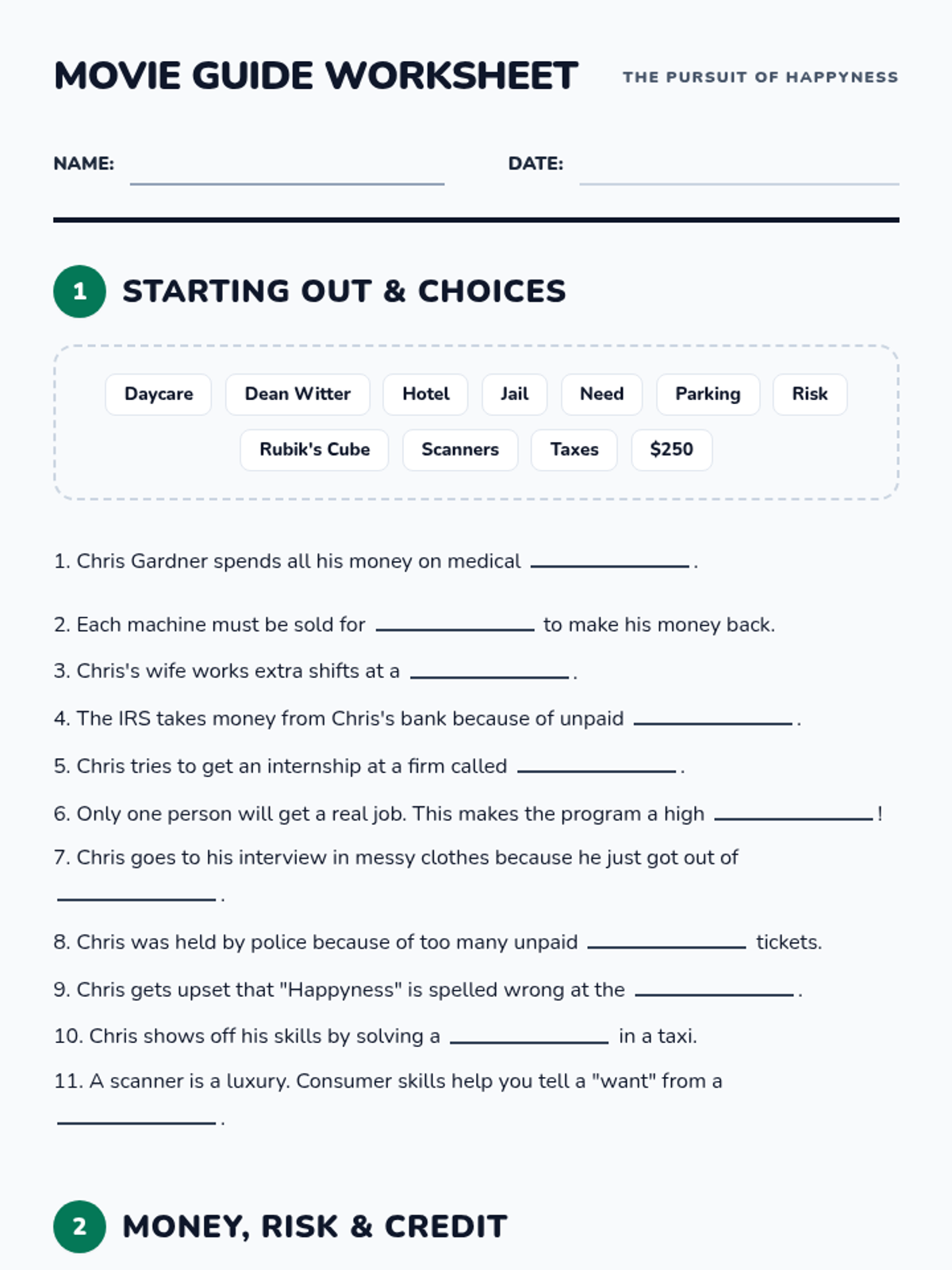
A comprehensive 42-question fill-in-the-blank worksheet with word banks and simplified language, designed for students who struggle with reading. Includes new questions on credit, insurance, and debt management. Fixed layout issues and orphaned punctuation.
A visually accessible introduction to 'The Pursuit of Happyness' with simplified text and large fonts, perfect for students who struggle with reading.
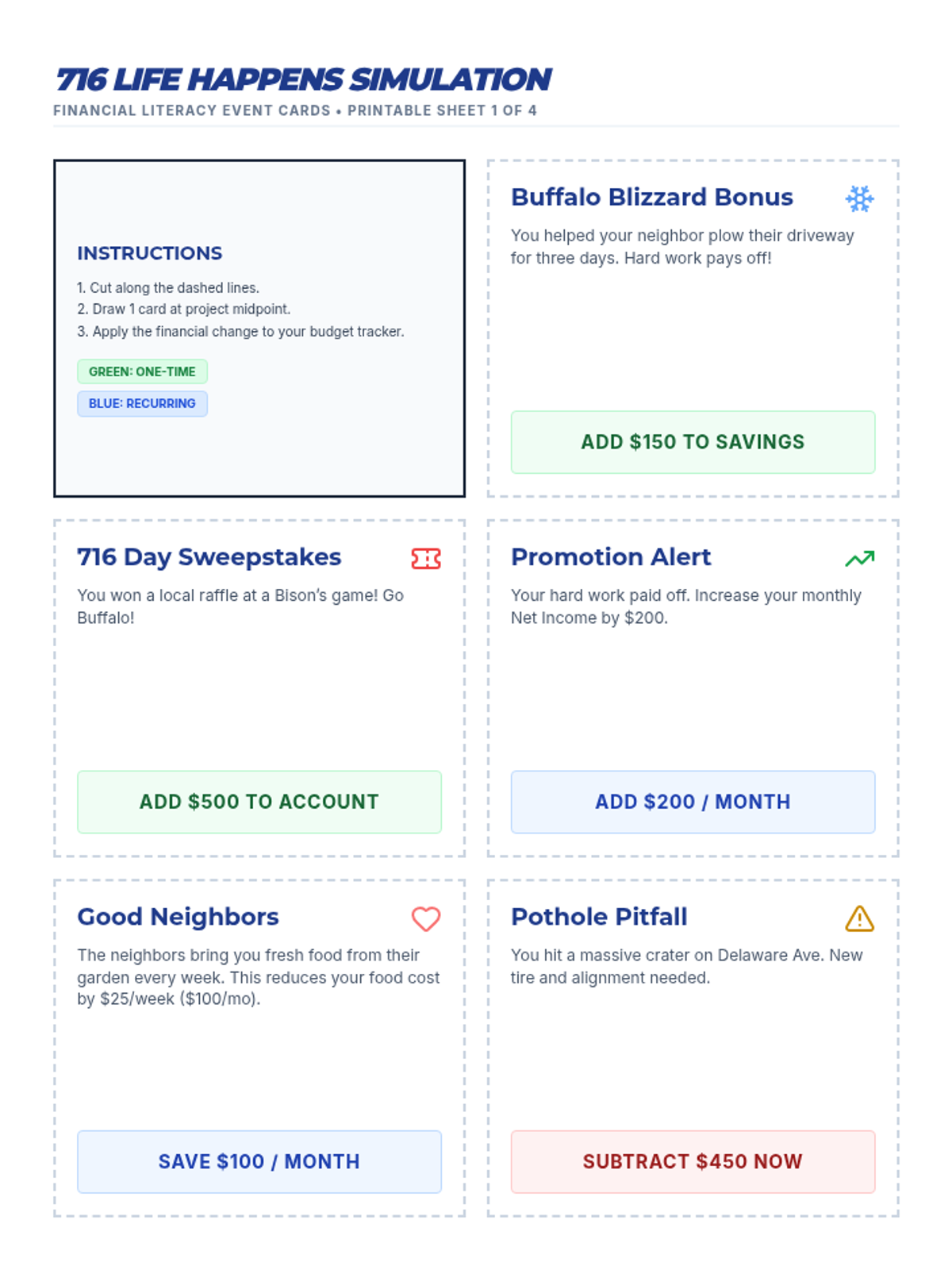
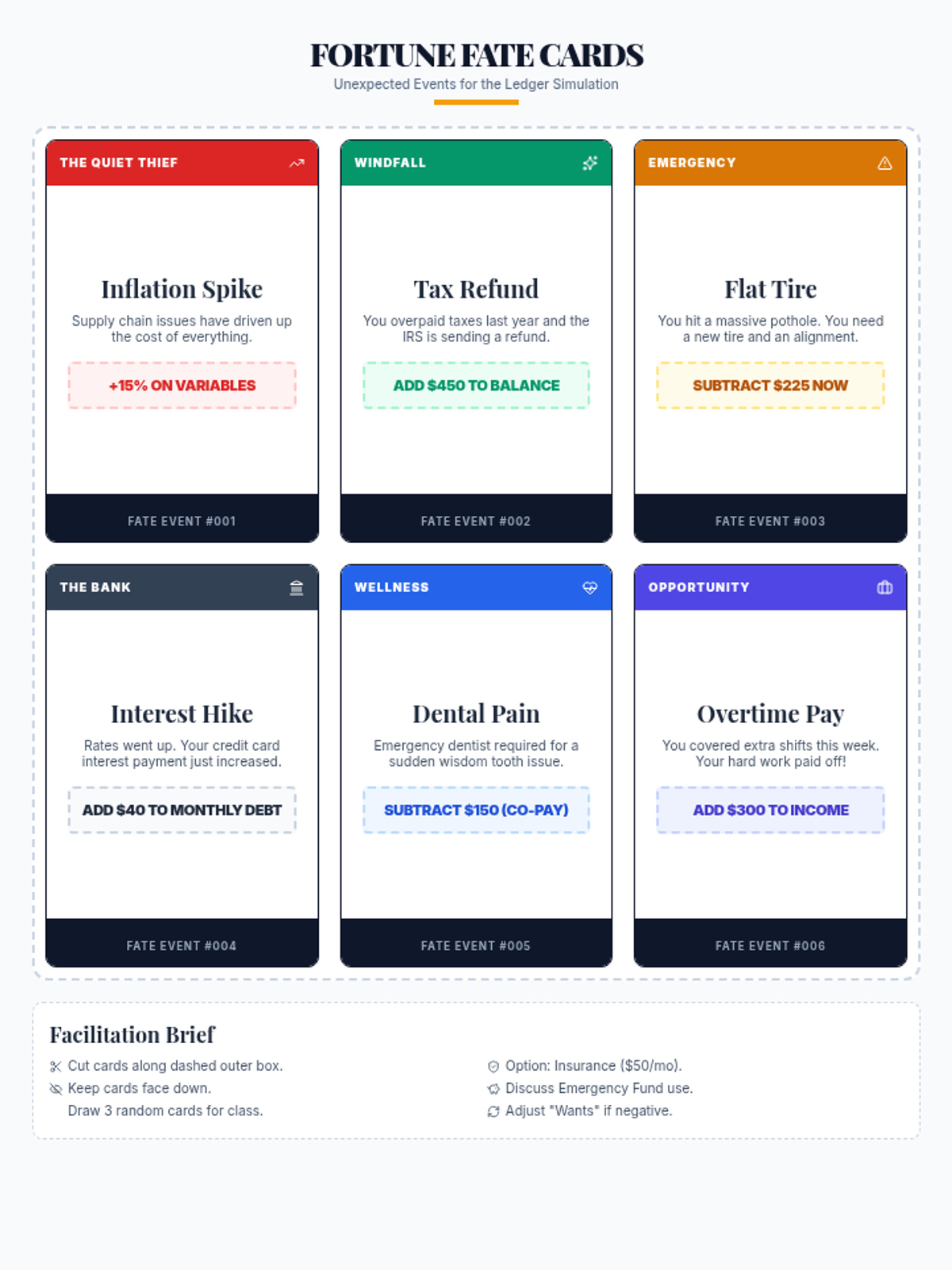
A set of simulation cards representing unexpected life events that impact a student's monthly budget. Optimized to fit 6 cards per page.
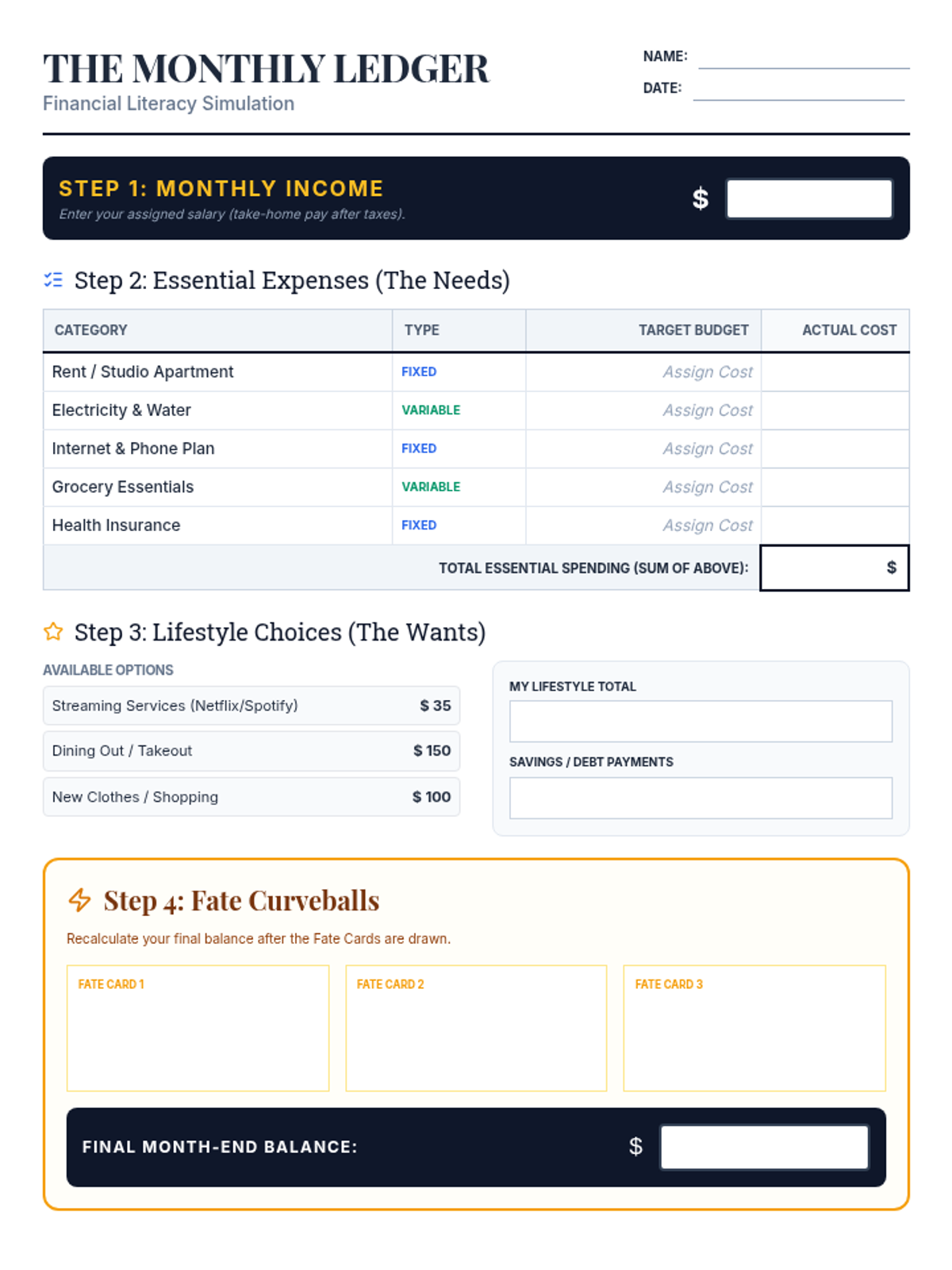
A practical budgeting worksheet for students to track income, categorize expenses, and adjust for unexpected financial events. Now with blank income fields and optimized layout.
An engaging presentation deck for the Ledger Logic lesson, visualizing budgeting rules, expense types, and simulation rules.
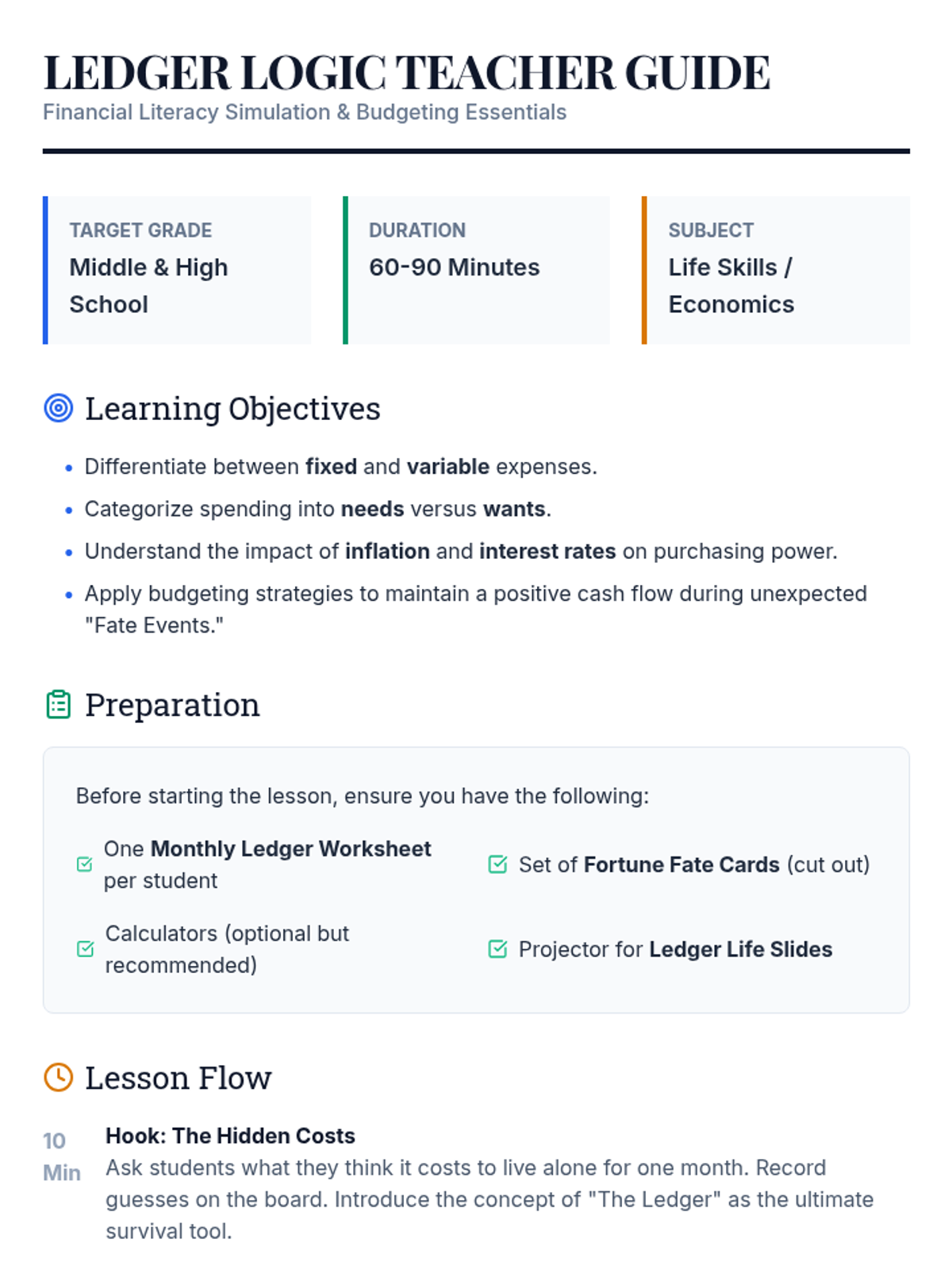
A comprehensive teacher guide for the Ledger Logic financial literacy simulation, including lesson flow, objectives, and discussion prompts.
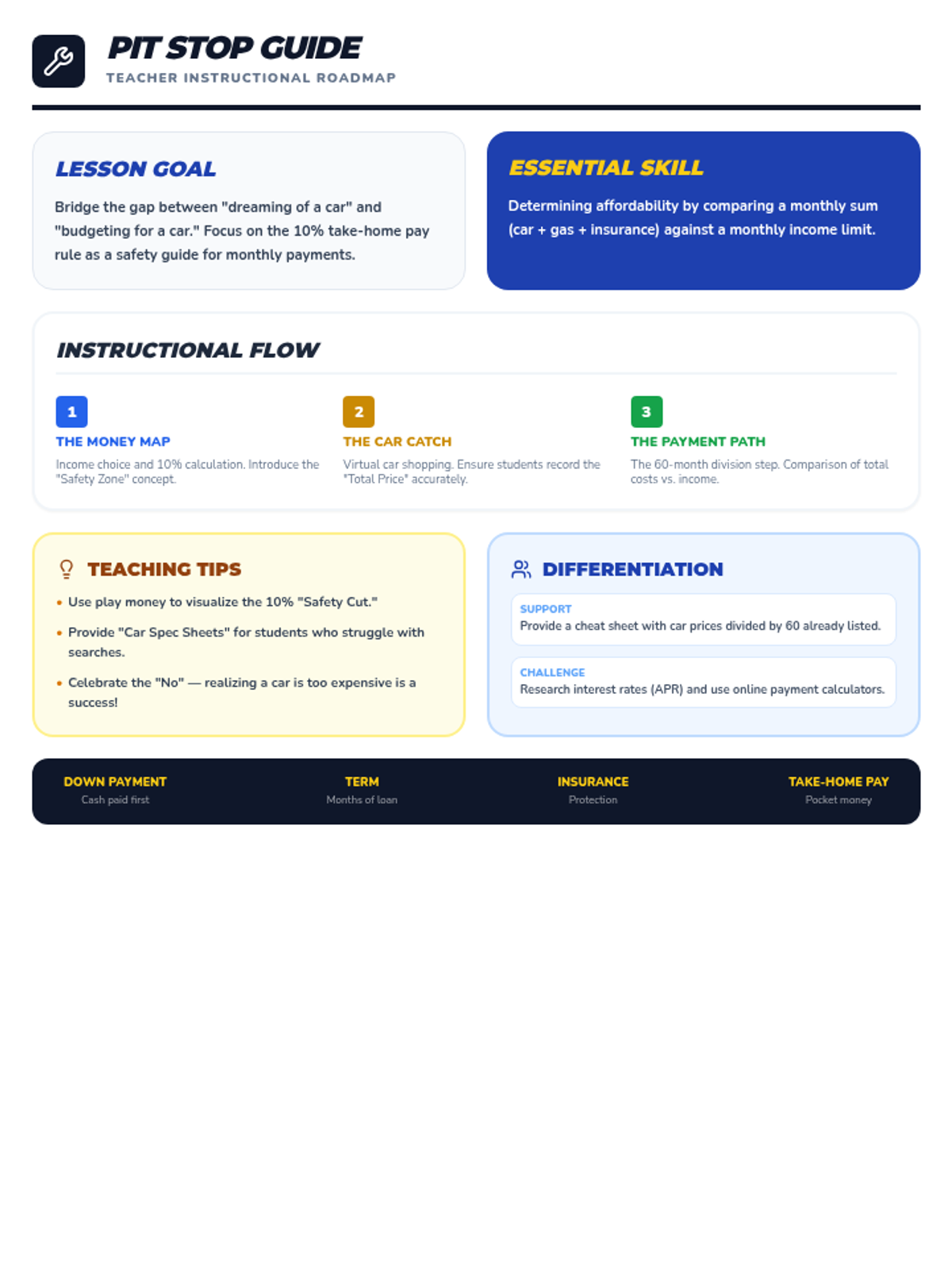
A teacher guide for the car-buying project. Consistently formatted to fit on a single page with clear instructional pathways and differentiation strategies. Revised for improved color contrast and font sizing.
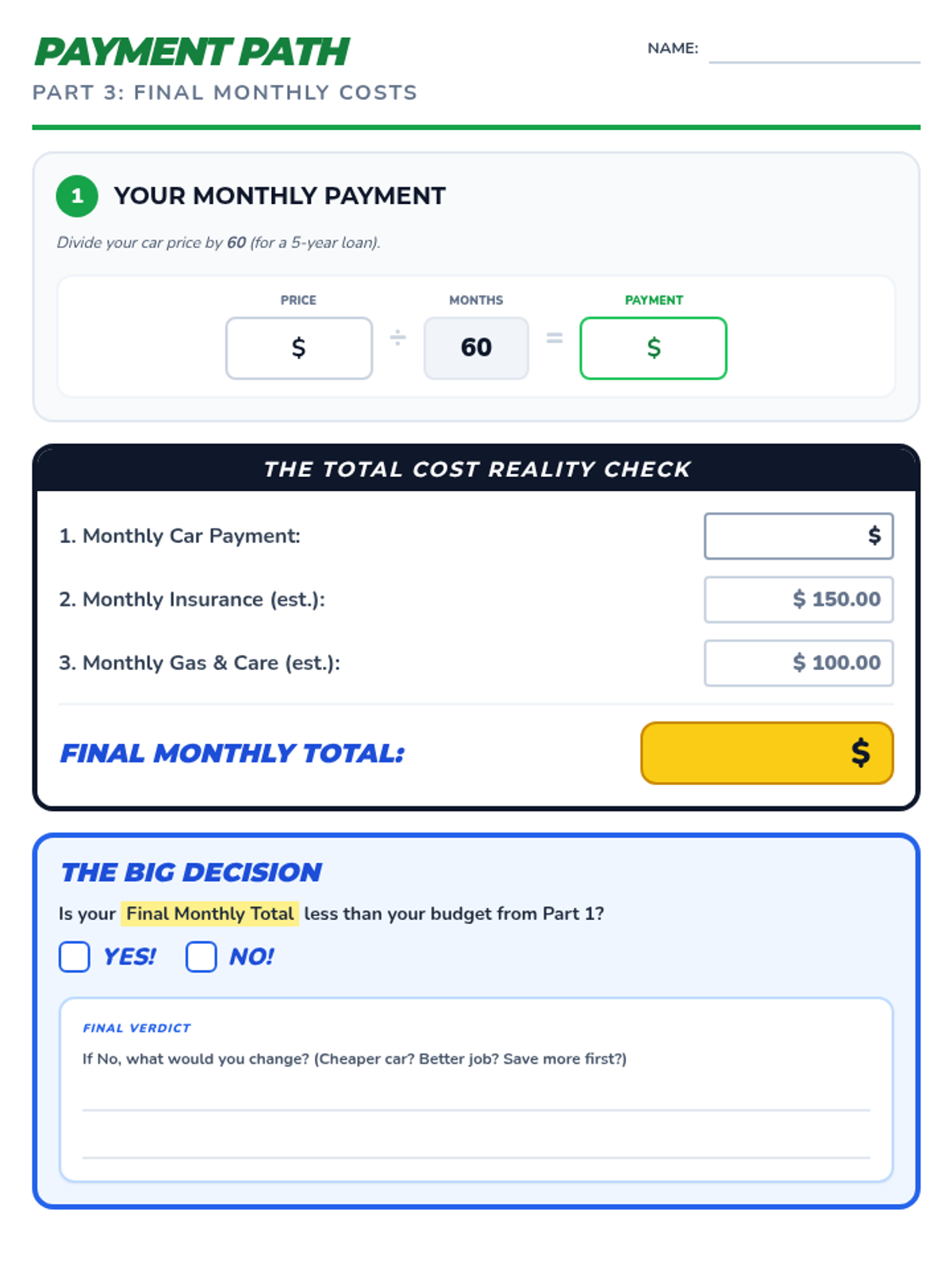
A worksheet for calculating the final monthly cost of car ownership. Updated for uniform table styling, improved contrast, and optimized single-page layout.
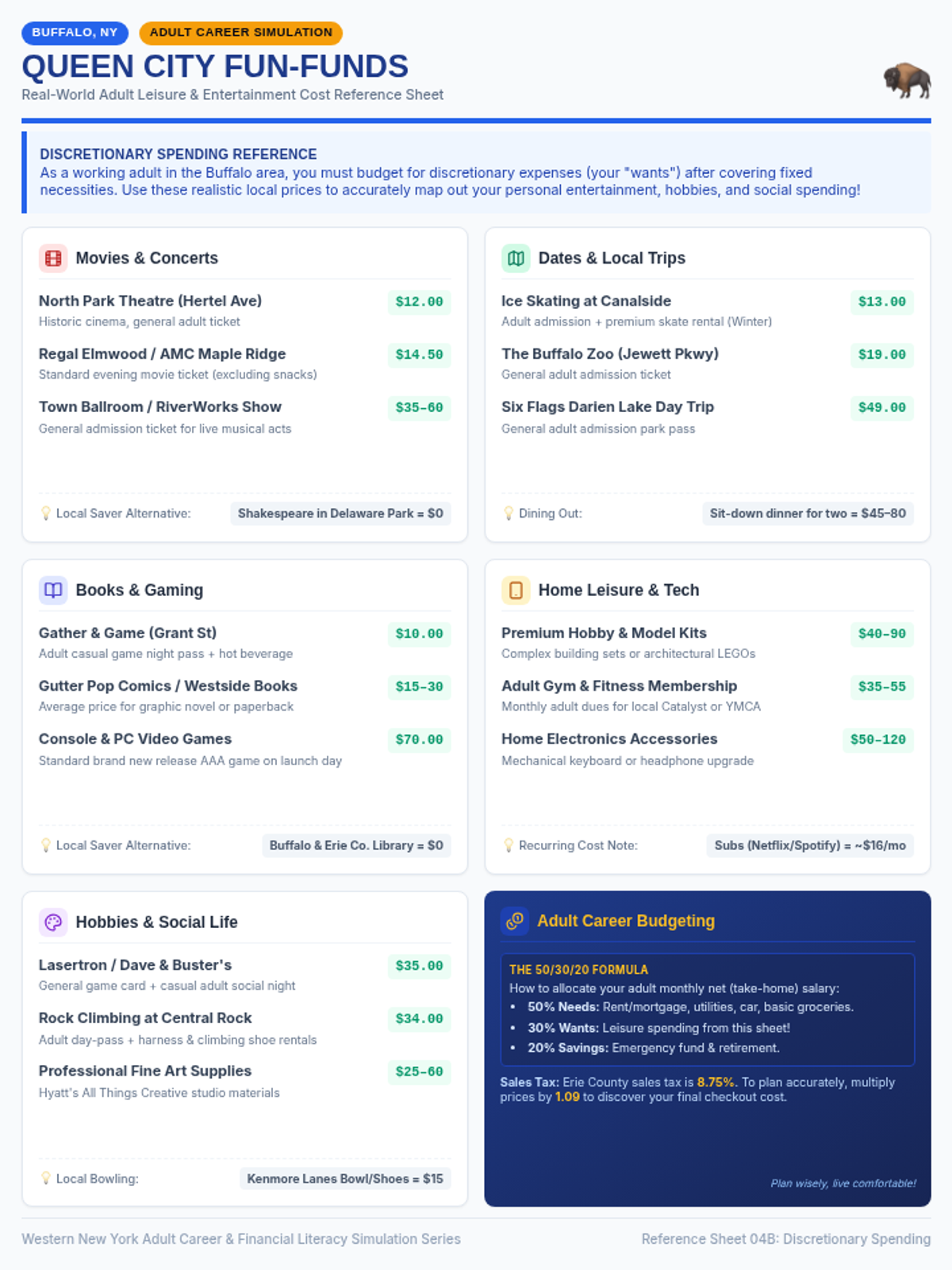
An adult-focused 1-sided career simulation reference sheet for 8th-grade students in Buffalo, NY, featuring prices for movie/concert theaters, dates/trips, books/games, home tech, and hobbies in the Buffalo area. The practice block at the bottom has been removed.
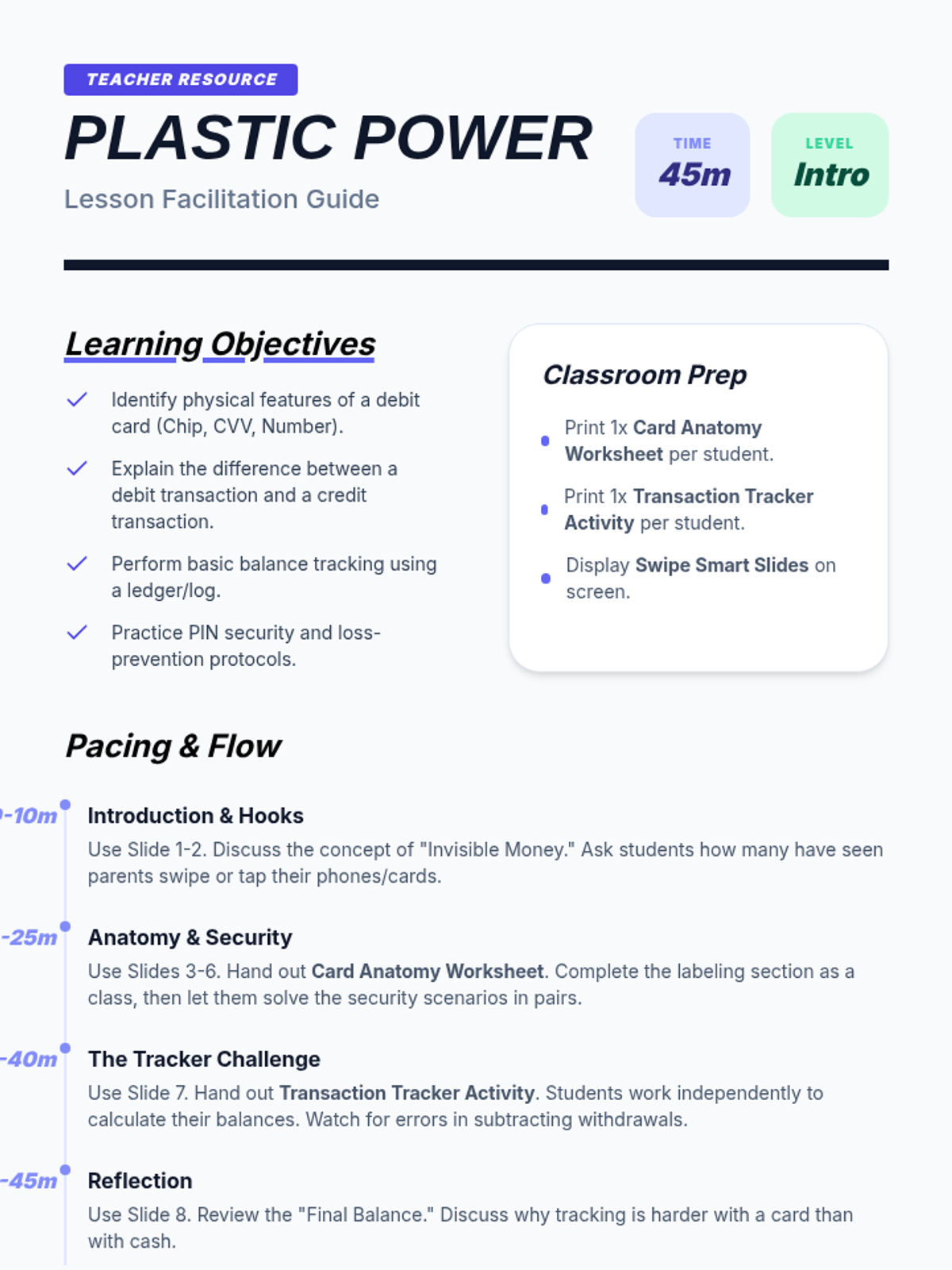
A comprehensive facilitation guide for teachers, including learning objectives, classroom preparation, a timed pacing guide, and answer keys, updated to include comparisons with app-based cards like Cash App.
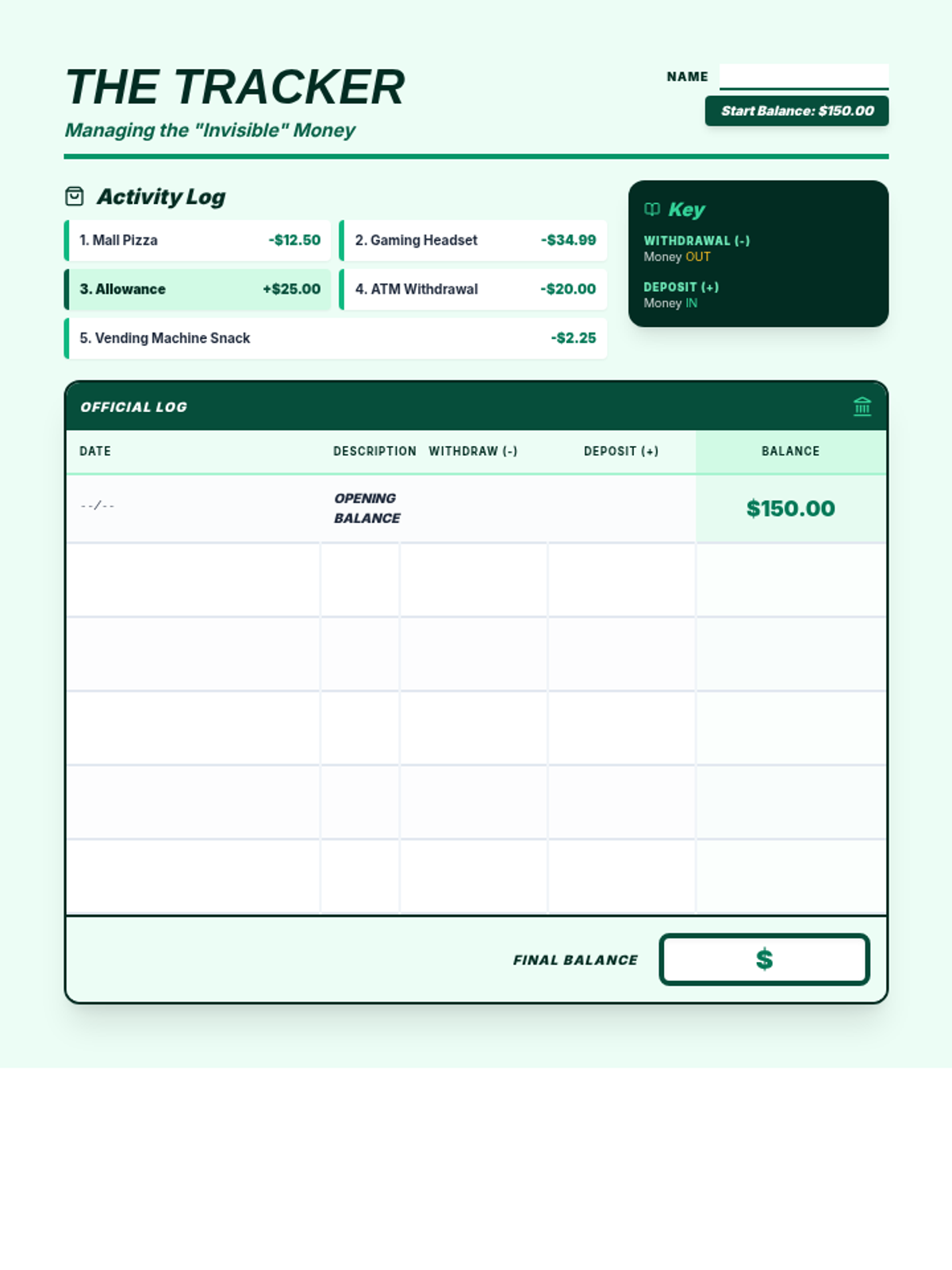
A practical transaction tracking activity where students simulate a week of spending and income, calculating their account balance and learning key financial terms.
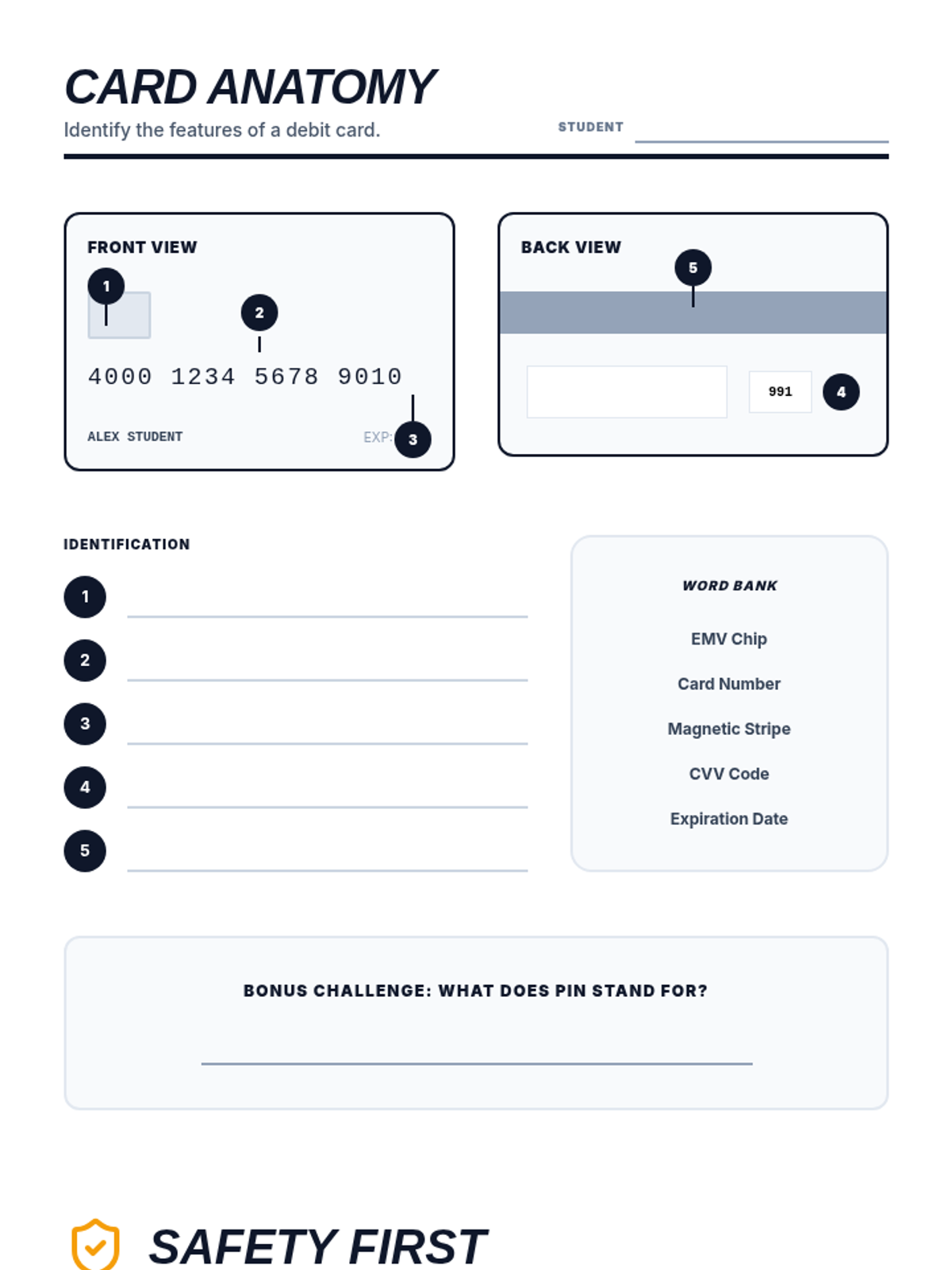
A student worksheet focusing on identifying the physical features of a debit card and applying security protocols in real-world scenarios, with a new section comparing traditional bank cards to Cash App cards.
A visually engaging slide deck covering the basics of debit cards, including their definition, anatomy, security (PIN), and transaction tracking, with a new focus on app-based cards like Cash App.
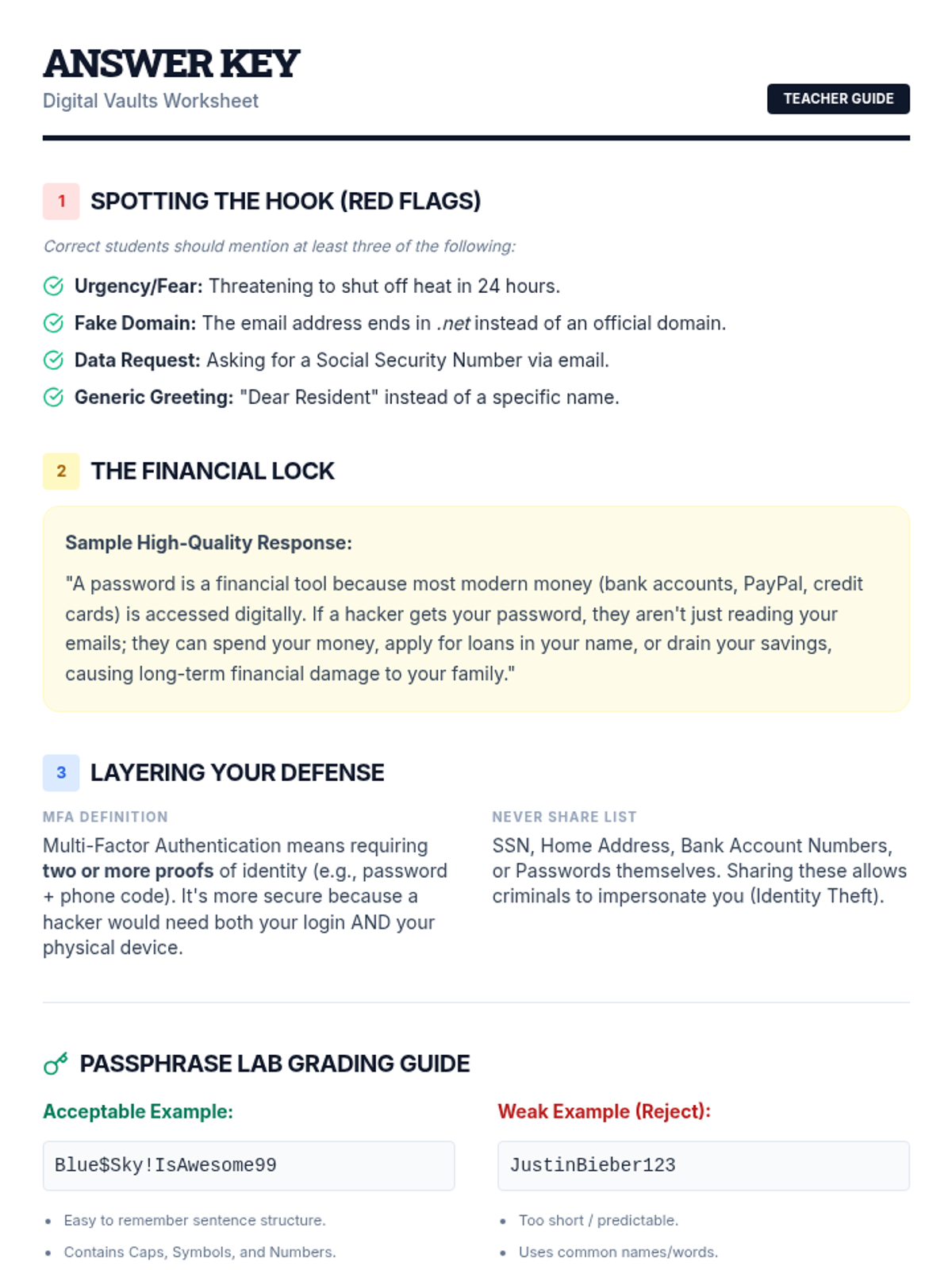
An answer key for the Digital Vaults Worksheet, providing sample responses and a grading guide for the passphrase creation activity.
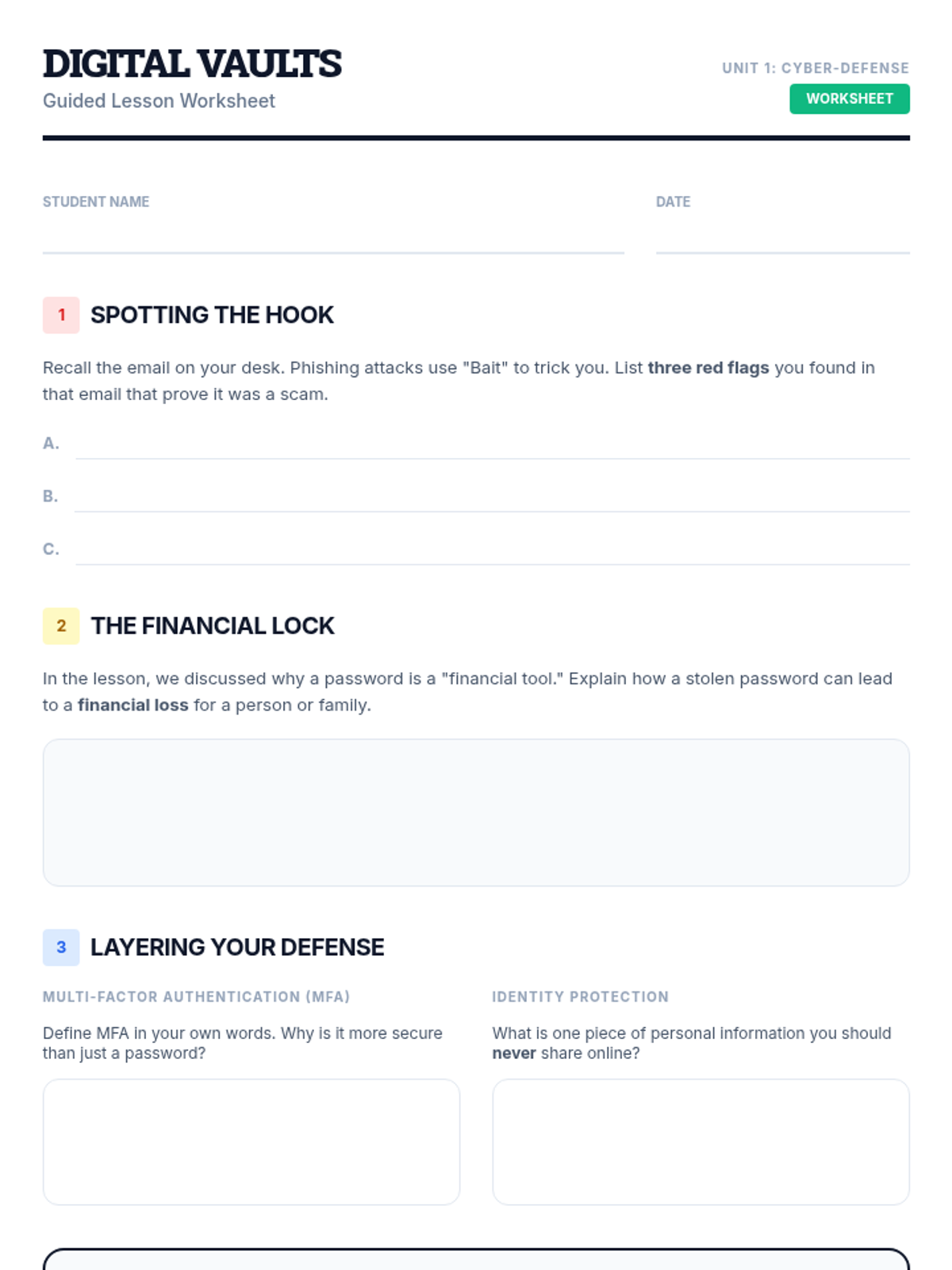
A student worksheet designed to accompany the Digital Vaults slideshow. It includes sections for identifying phishing red flags, explaining passwords as financial tools, defining MFA, and practicing the creation of strong passphrases.
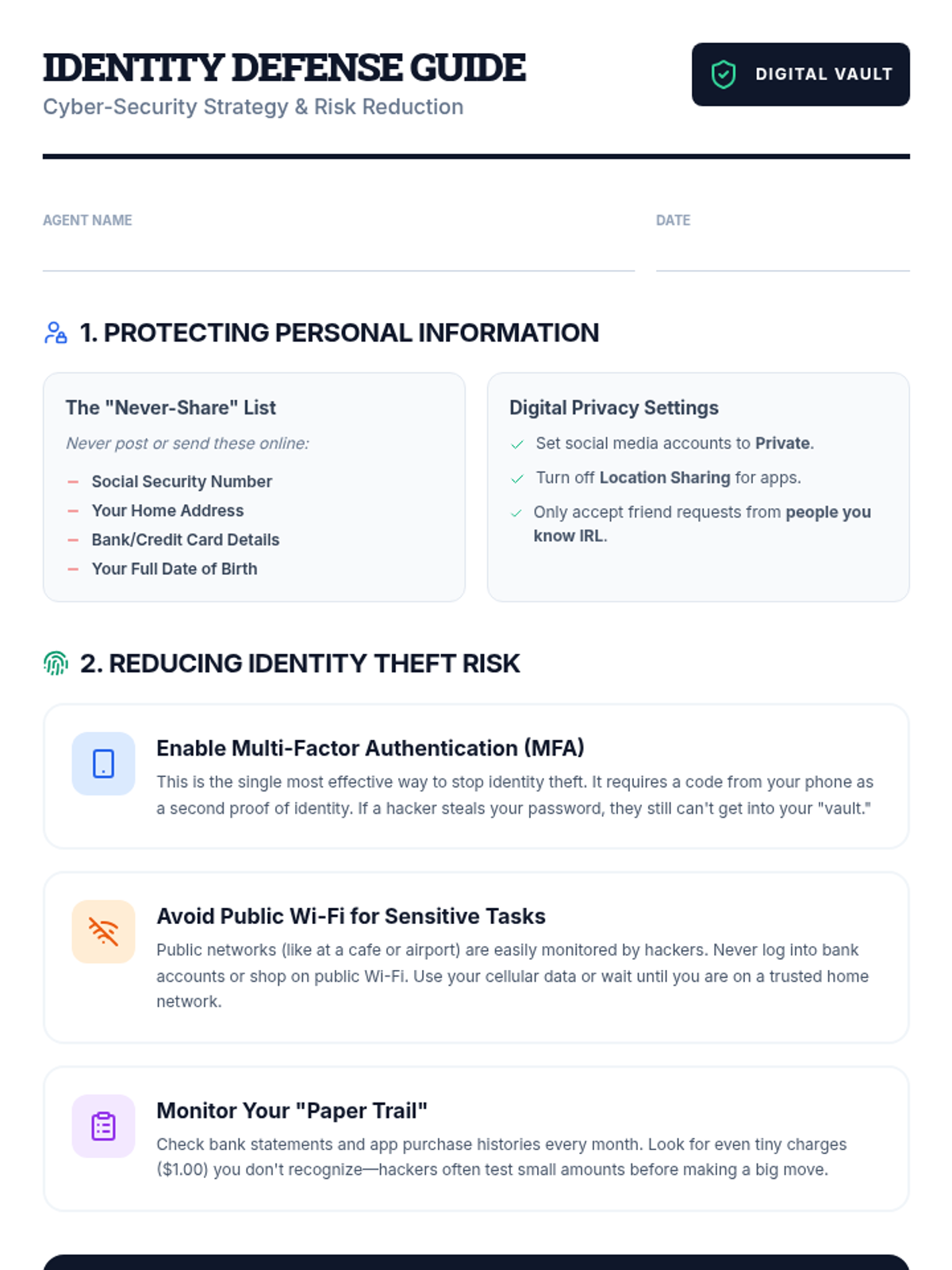
A student reference guide and checklist providing concrete strategies for protecting personal information and reducing the risk of identity theft. Includes sections on privacy settings, multi-factor authentication (MFA), and a reflection prompt.
An updated 8-slide presentation for a mini-lesson on cybersecurity. It now includes expanded strategies for protecting personal information, multi-factor authentication (MFA), and reducing the risk of identity theft alongside phishing detection and password security.
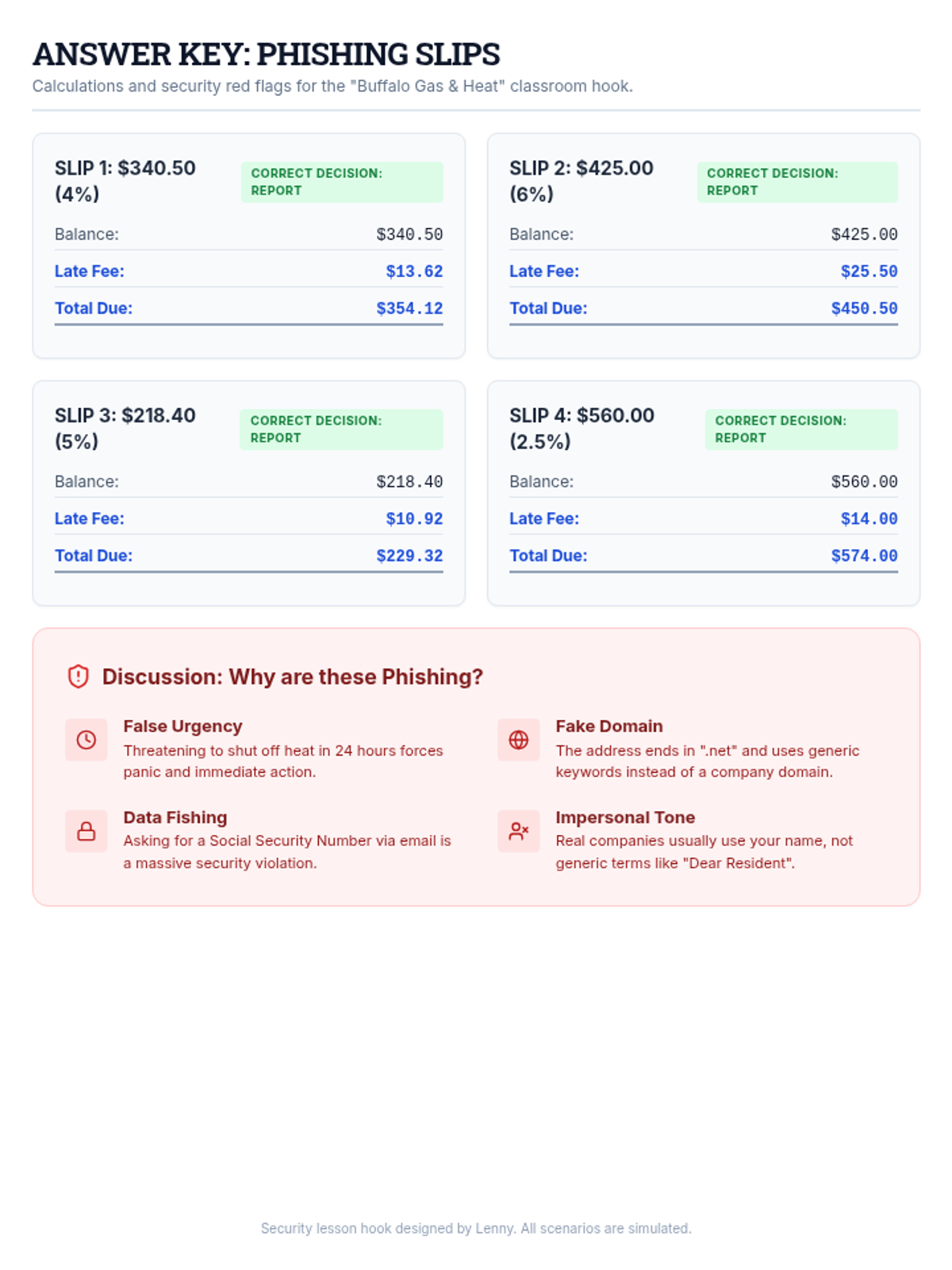
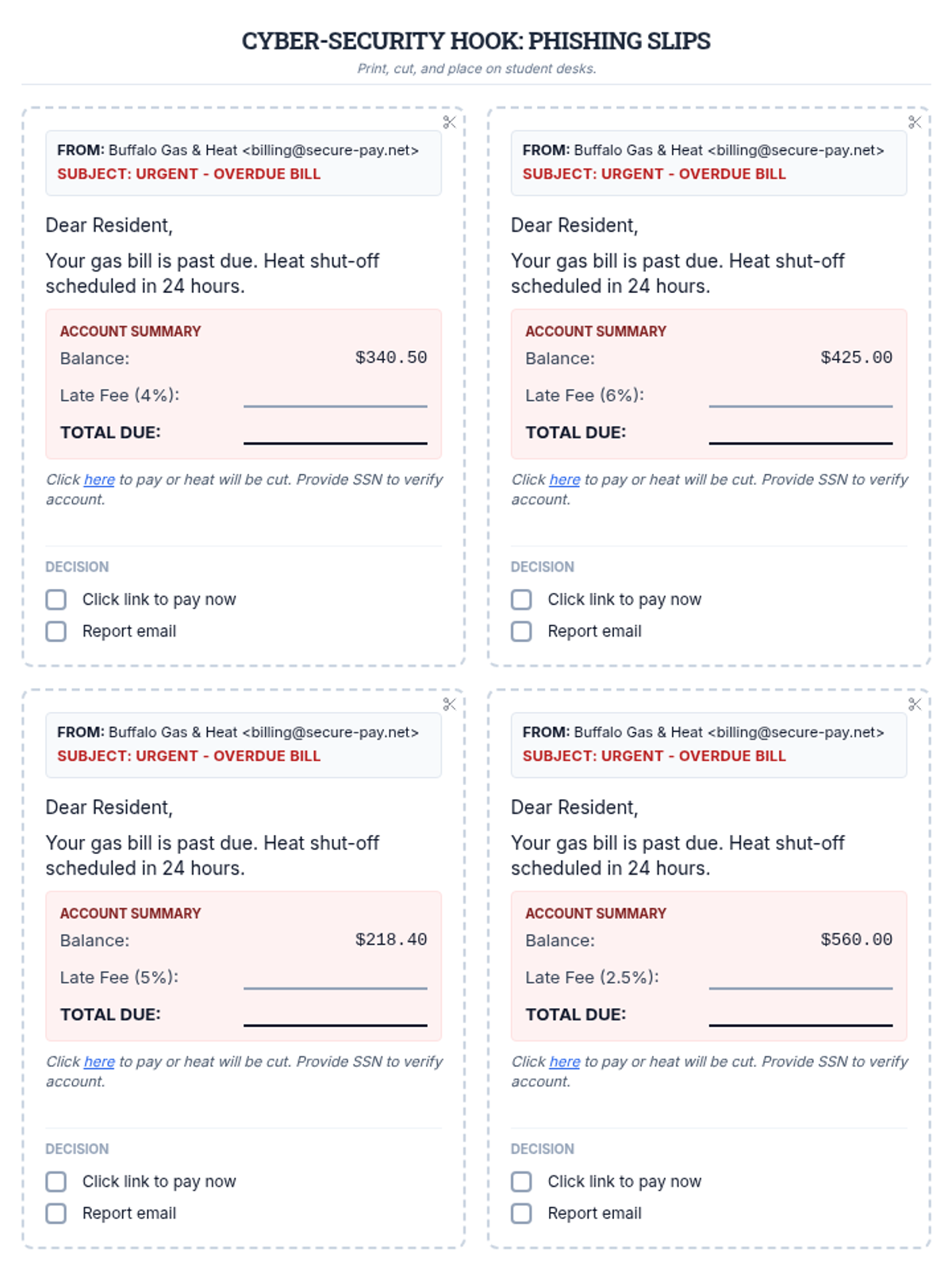
An answer key for the Phishing Alert Slips, providing correct late fee calculations and total balances for each slip, along with a list of security red flags for classroom discussion.
A set of four printable phishing email slips designed to be left on student desks as a classroom hook. Each slip includes a scenario about an overdue utility bill and requires students to calculate late fees and total amounts using percentages before deciding how to respond to the suspicious message.
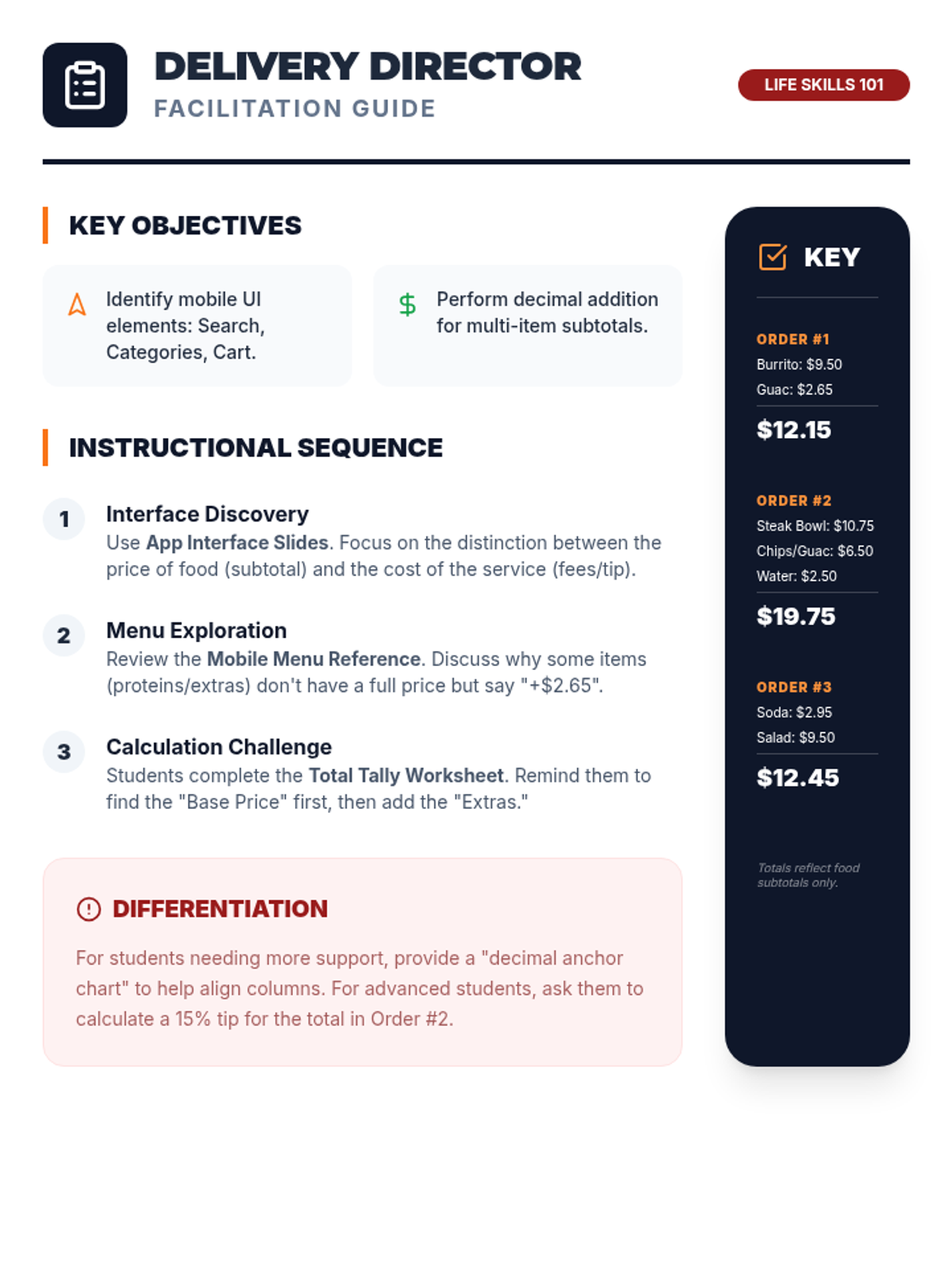
Teacher guide for the App Appetite lesson. Includes learning objectives, a detailed classroom activity flow, and a complete answer key for the Total Tally Worksheet.
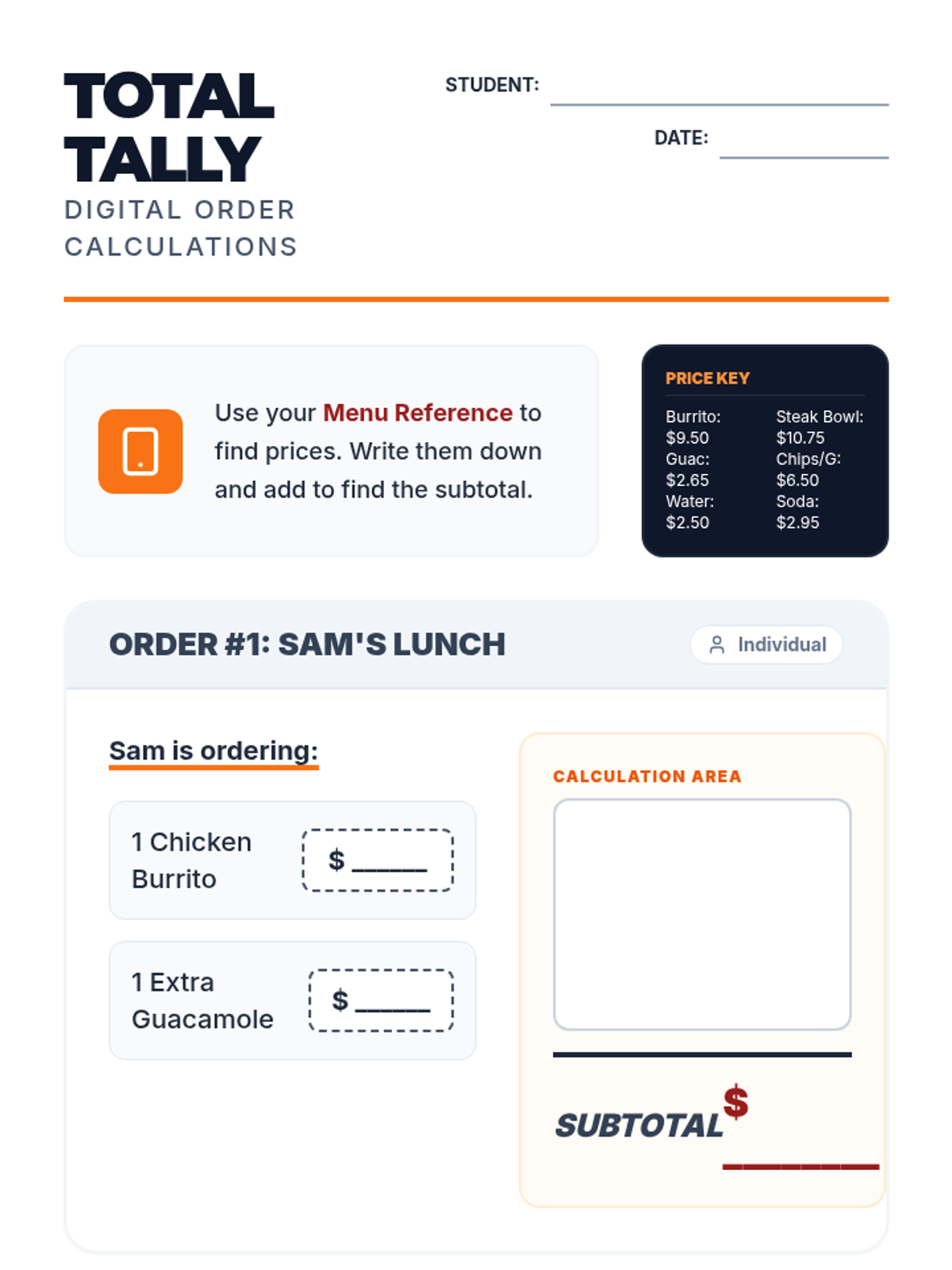
A math worksheet where students calculate order subtotals based on specific scenarios. Students must find the correct prices from the Menu Reference and perform multi-item addition with clear work areas.
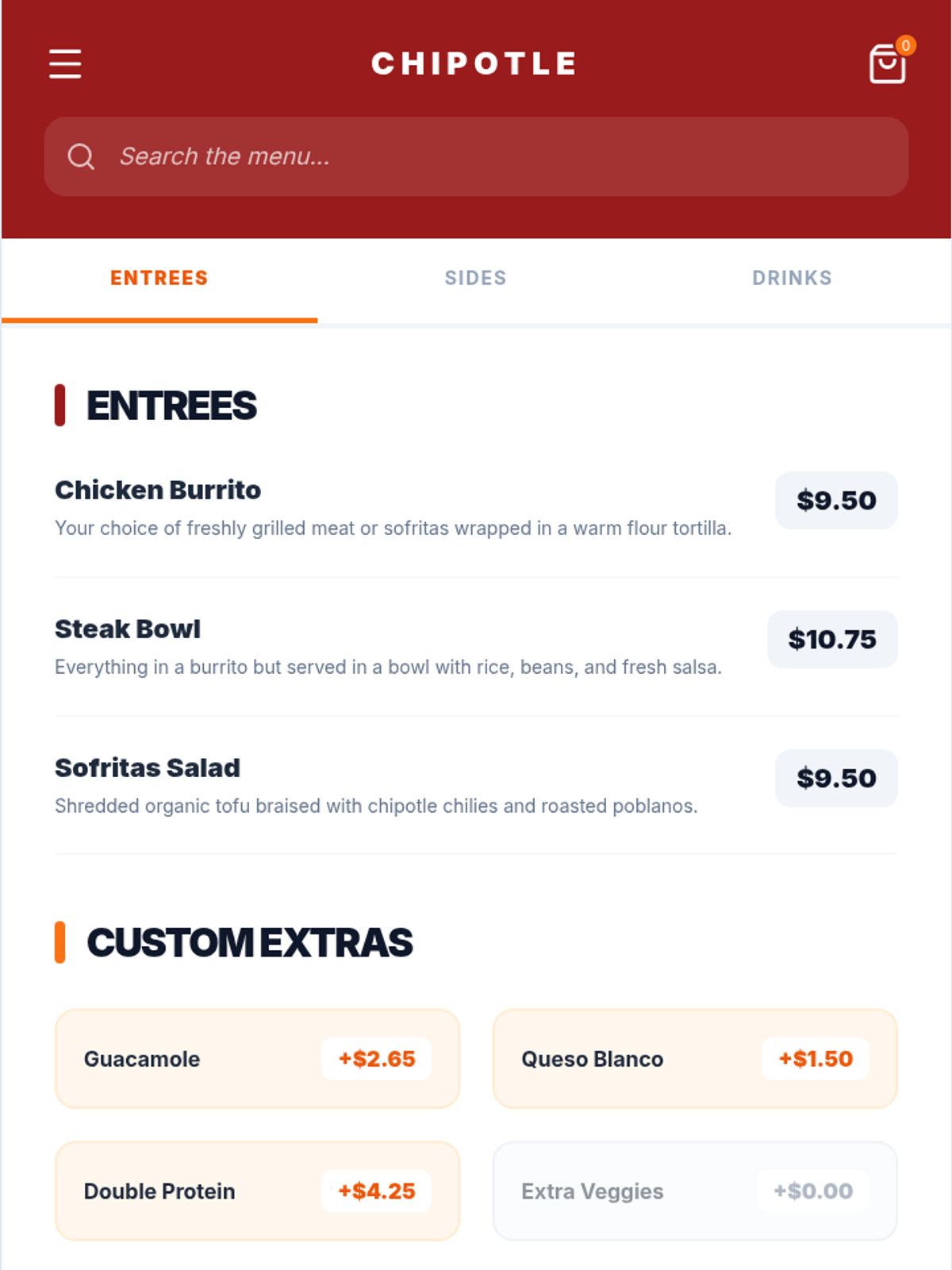
A reference sheet styled as a mobile app menu for Chipotle. It includes prices for various entrees, extra add-ons like guacamole, and sides and drinks to be used for calculation exercises.
A slide deck introducing the visual elements of a mobile delivery app for Chipotle. It guides students through searching for a restaurant, navigating the menu categories, and understanding the checkout fee breakdown.
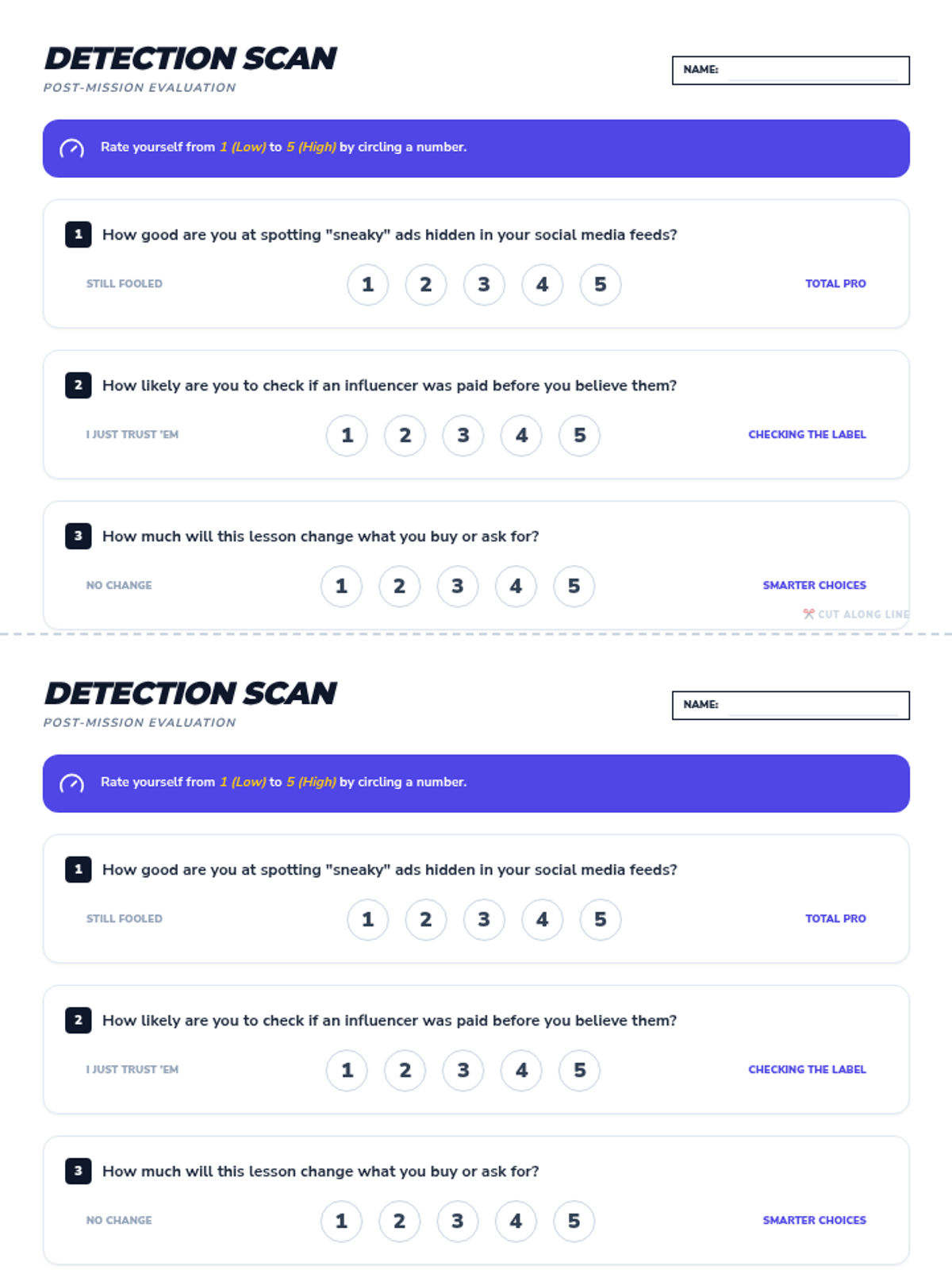
A paper-saving exit ticket with two copies per page. It uses middle-school-friendly language to rank student confidence in spotting sneaky ads, verifying influencer sponsorships, and making smarter consumer choices.
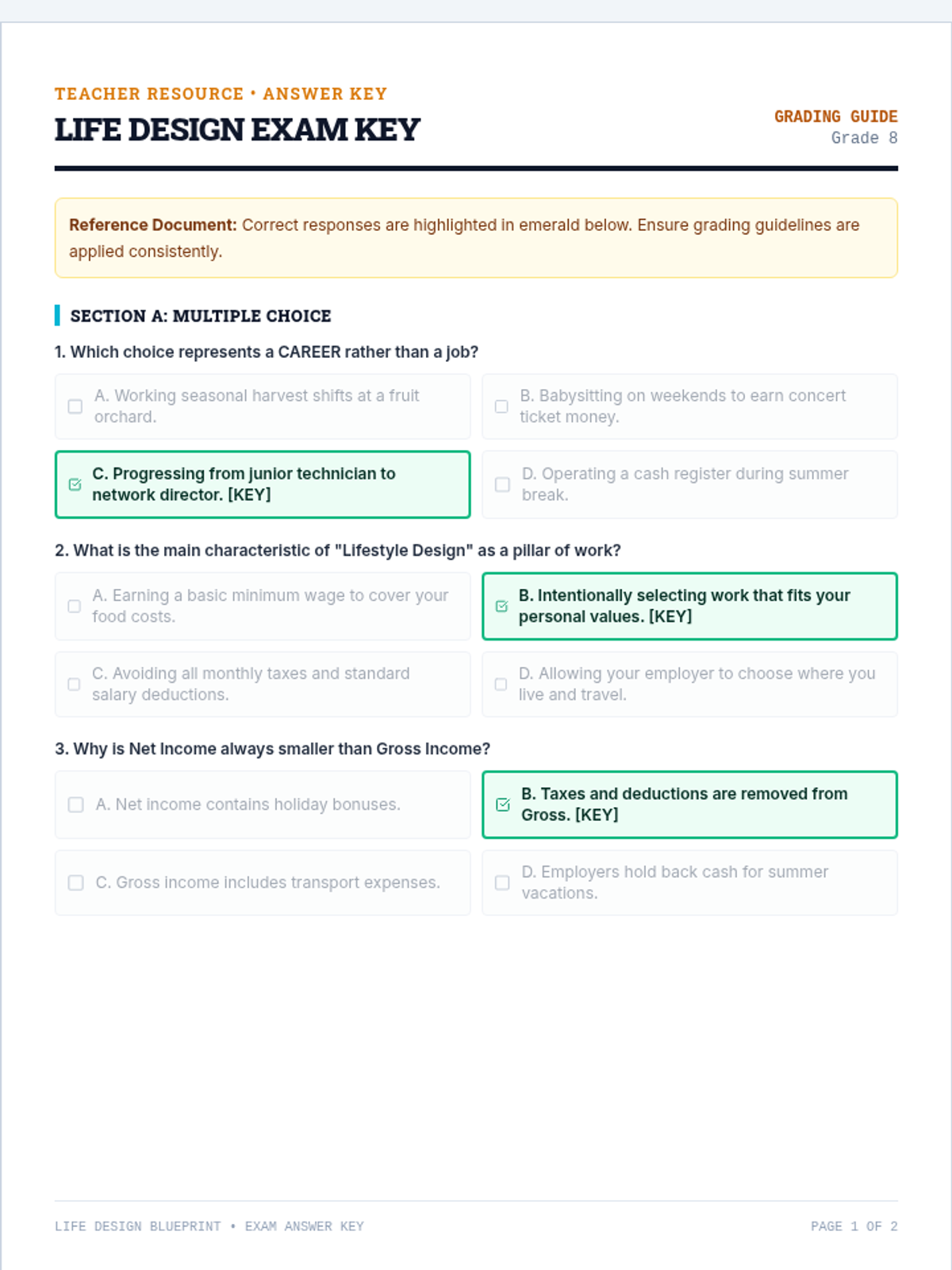
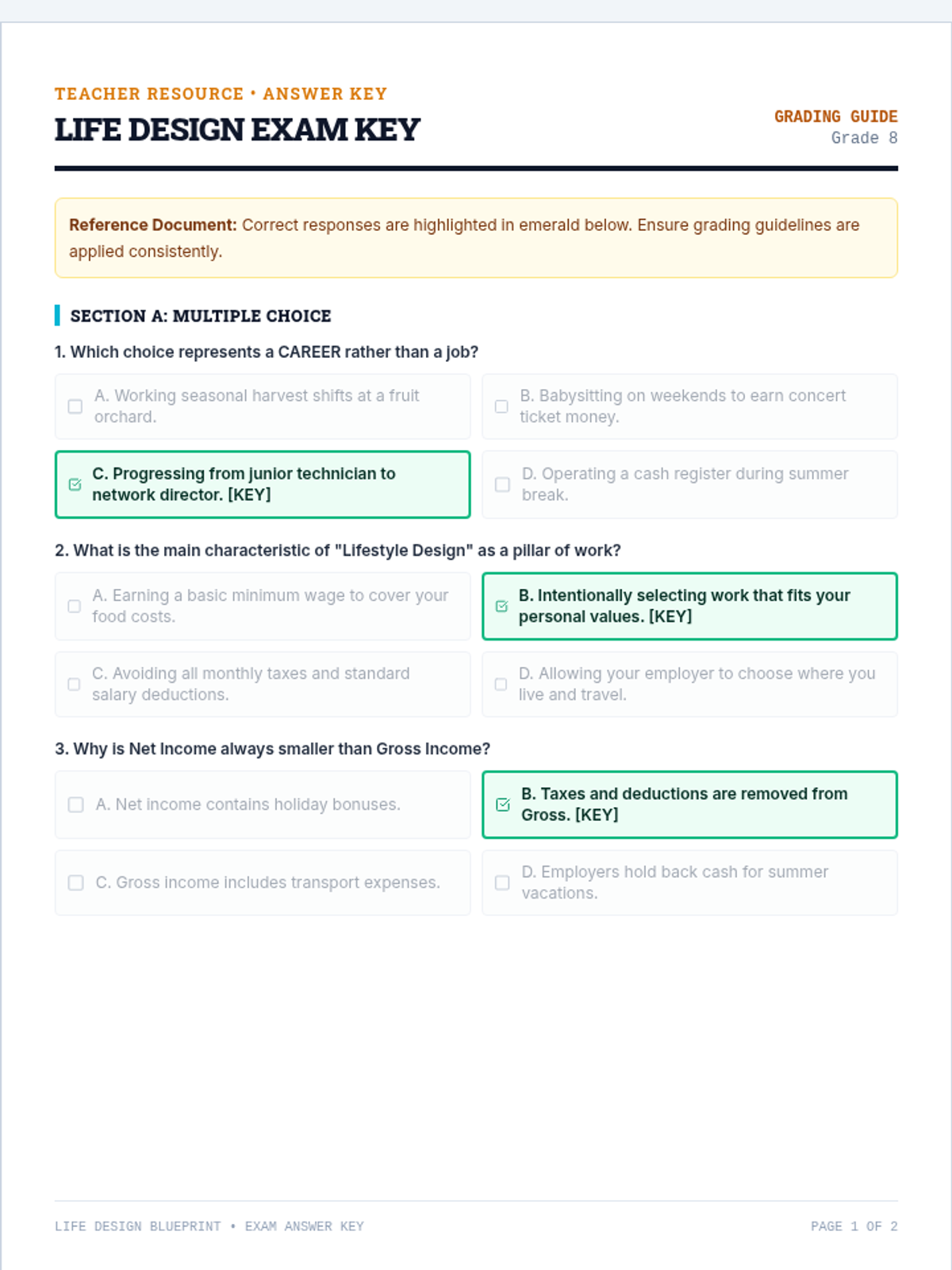
A teacher-facing 2-page Answer Key containing correct answers and grading recommendations for the Life Design Blueprint Unit Test.
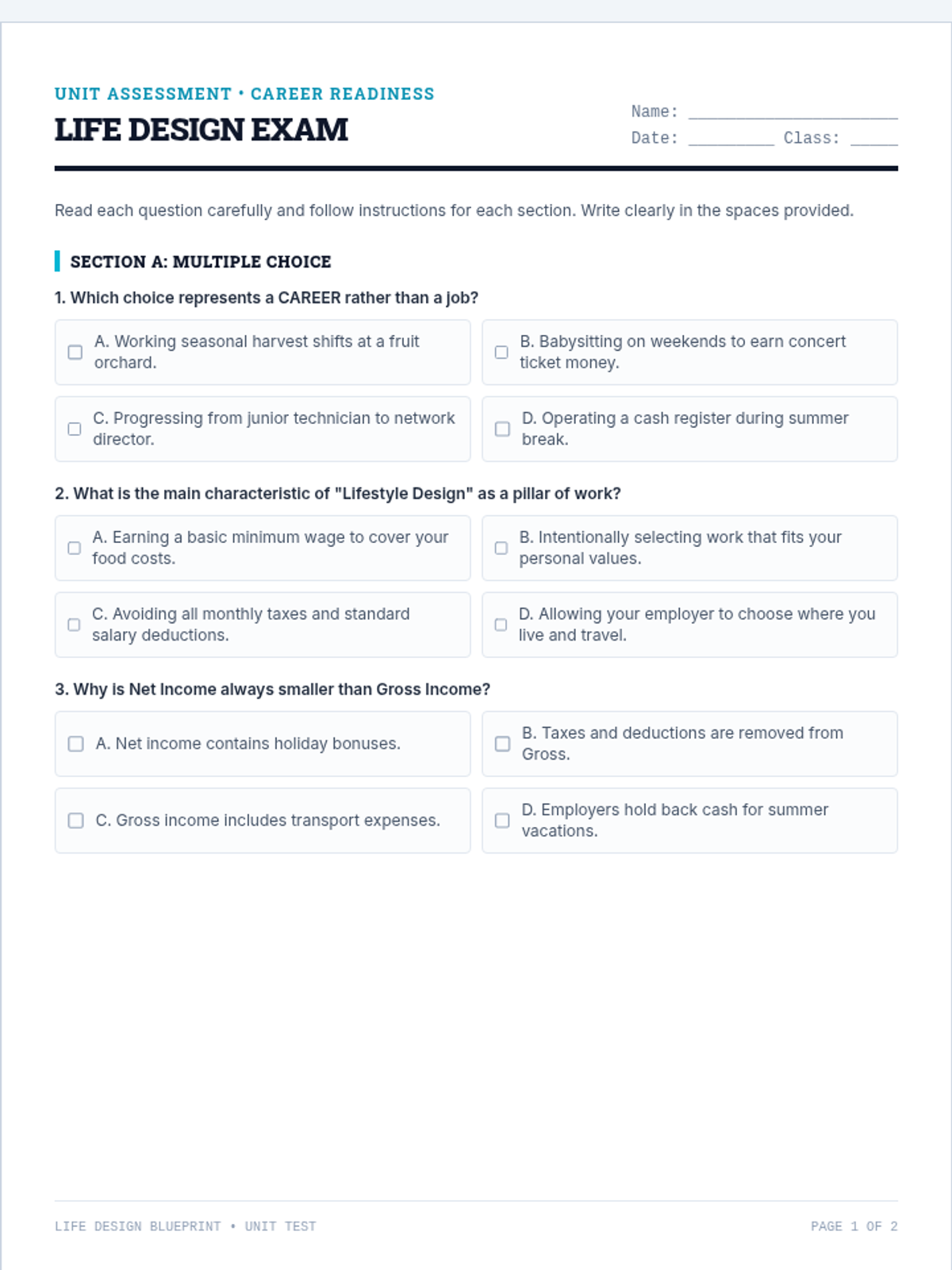
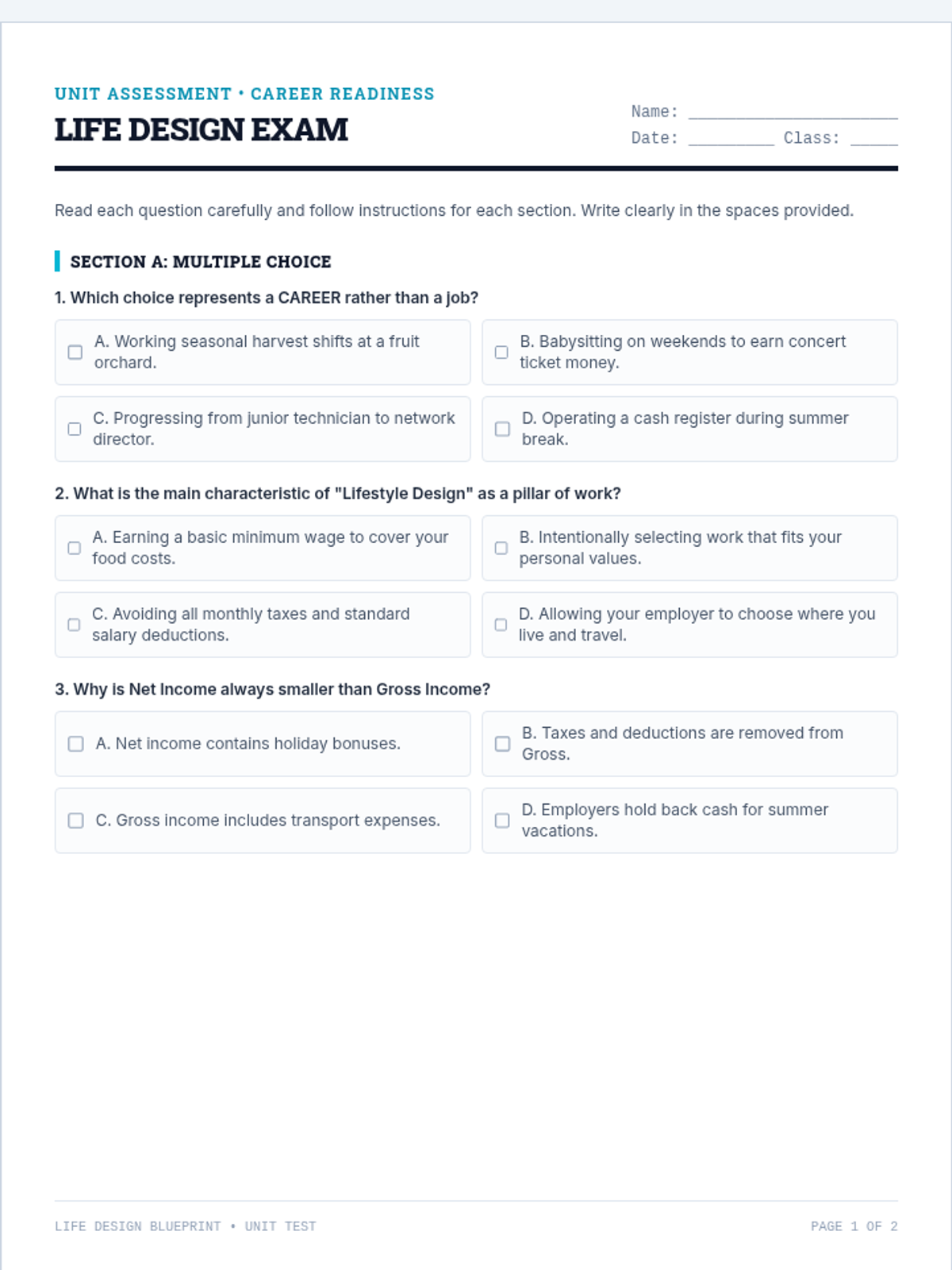
A rigorous student-facing 2-page Unit Test (Exam) featuring multiple choice, true/false, vocabulary matching, and scenario-based short response sections.
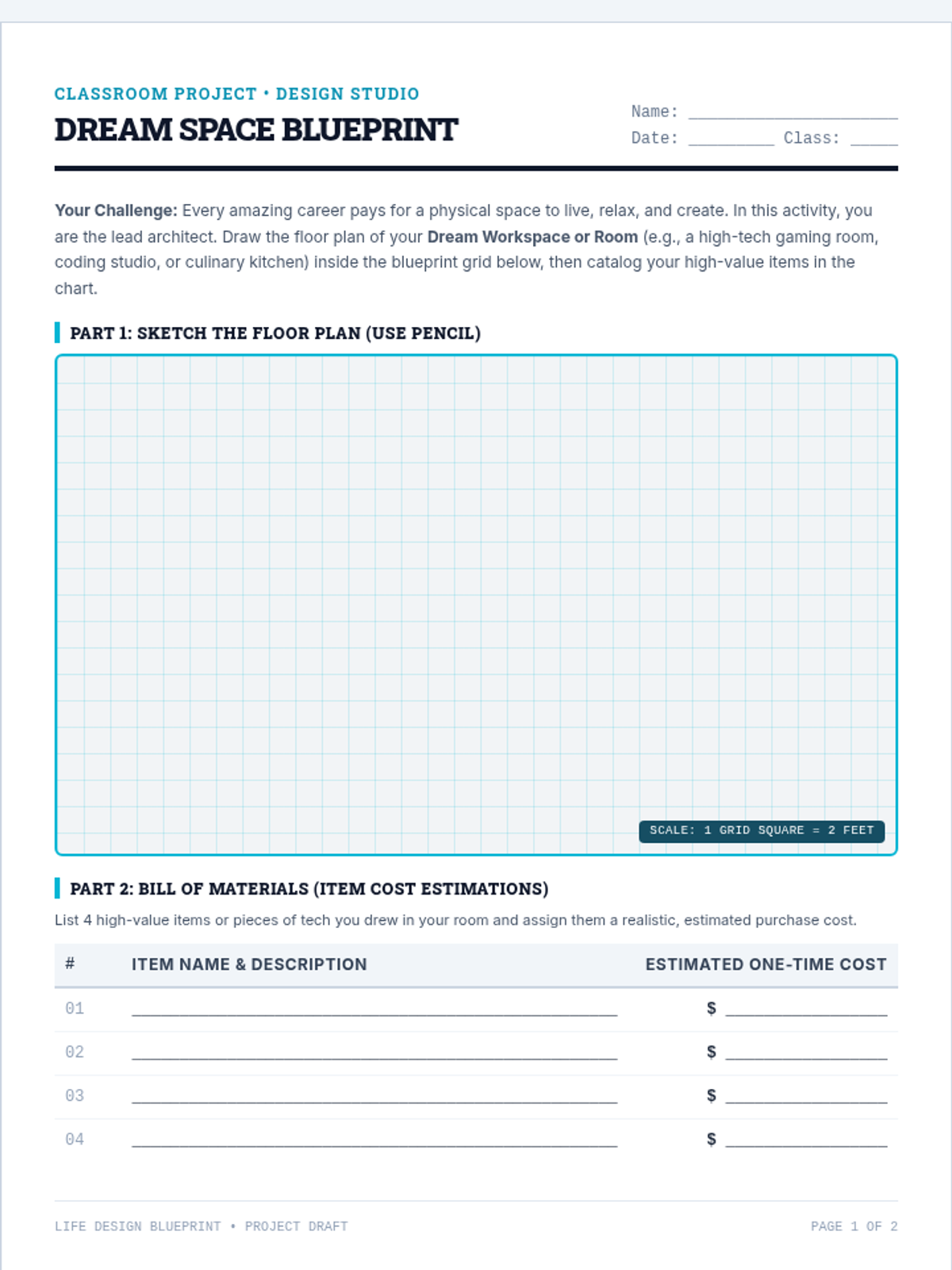
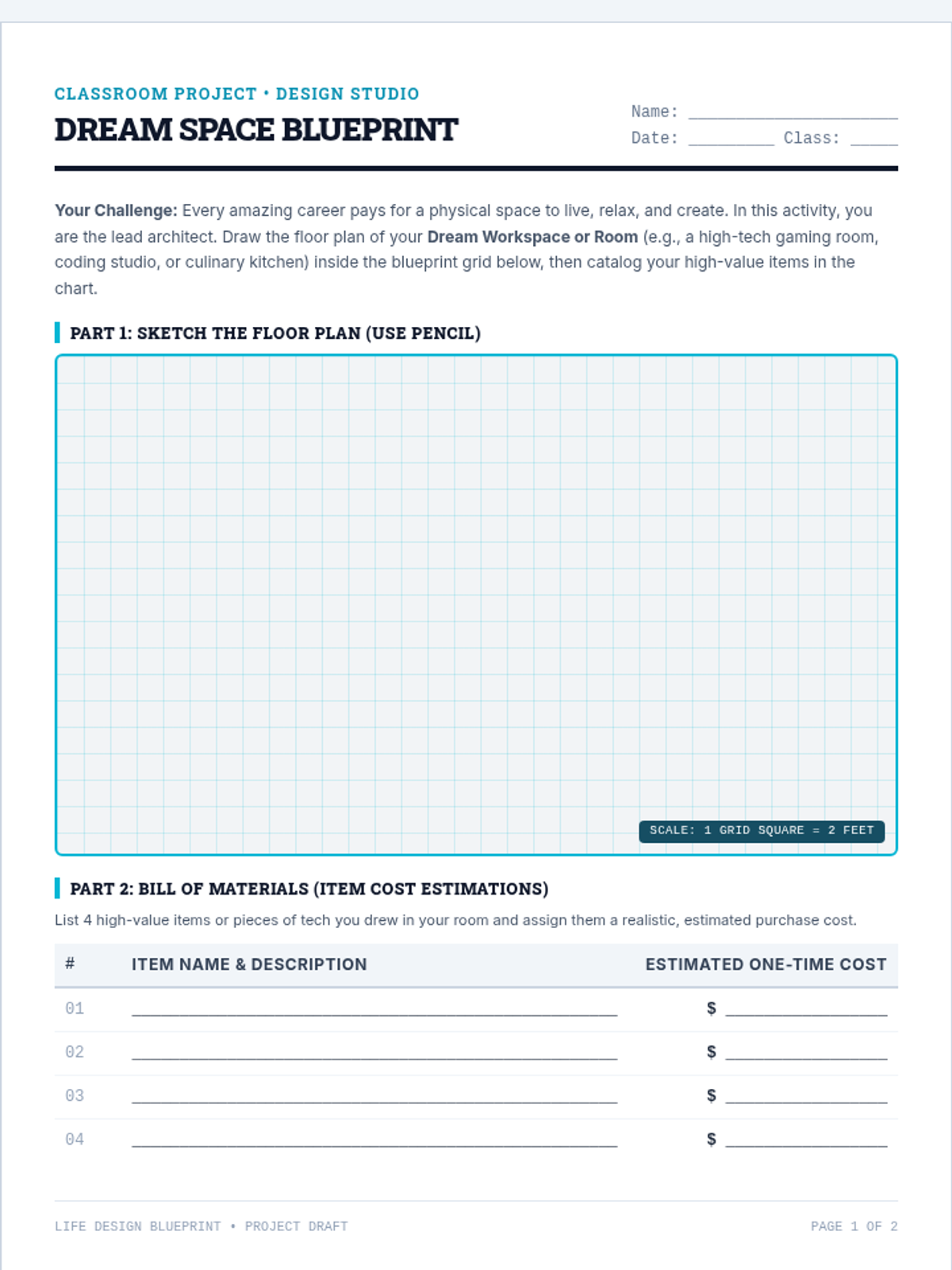
A creative 2-page project activity sheet ('Dream Space Blueprint') where students sketch their dream bedroom or workspace floor plan on a blueprint grid and calculate item costs and monthly utility finances.
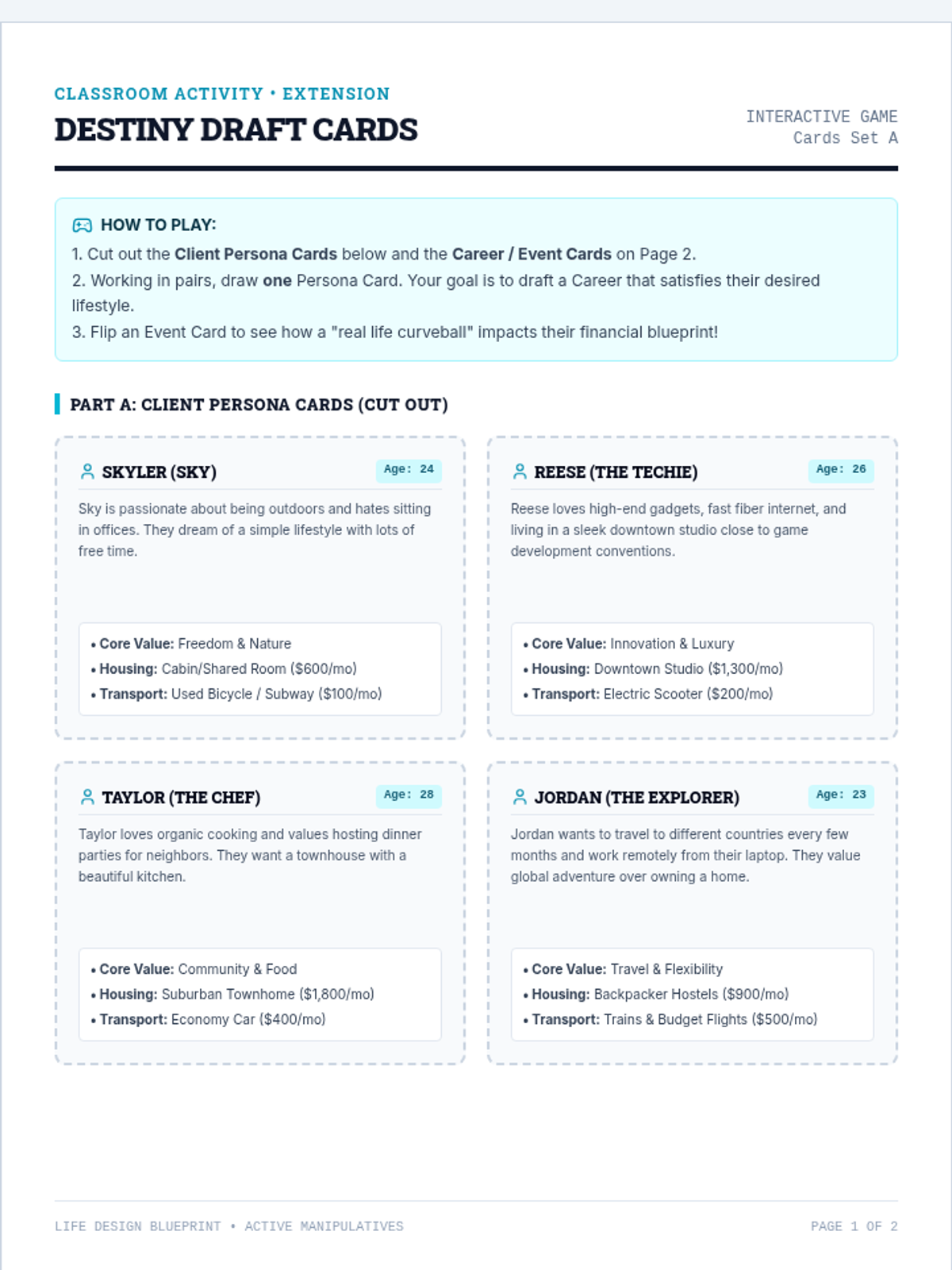
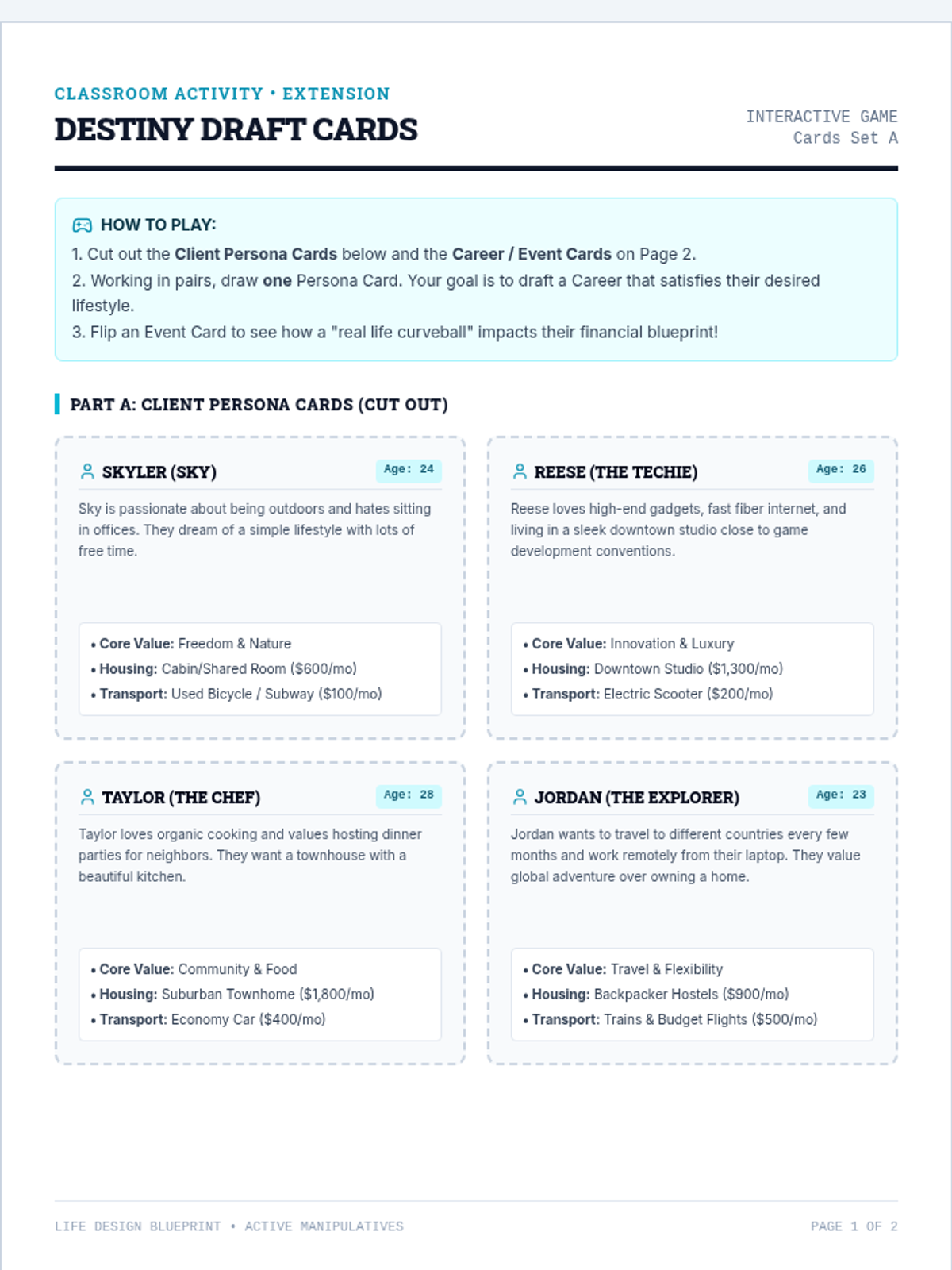
An interactive 2-page print-ready manipulatives card activity ('Destiny Draft Cards') that simulates career drafting, real-world lifestyle trade-offs, and sudden financial emergency events.
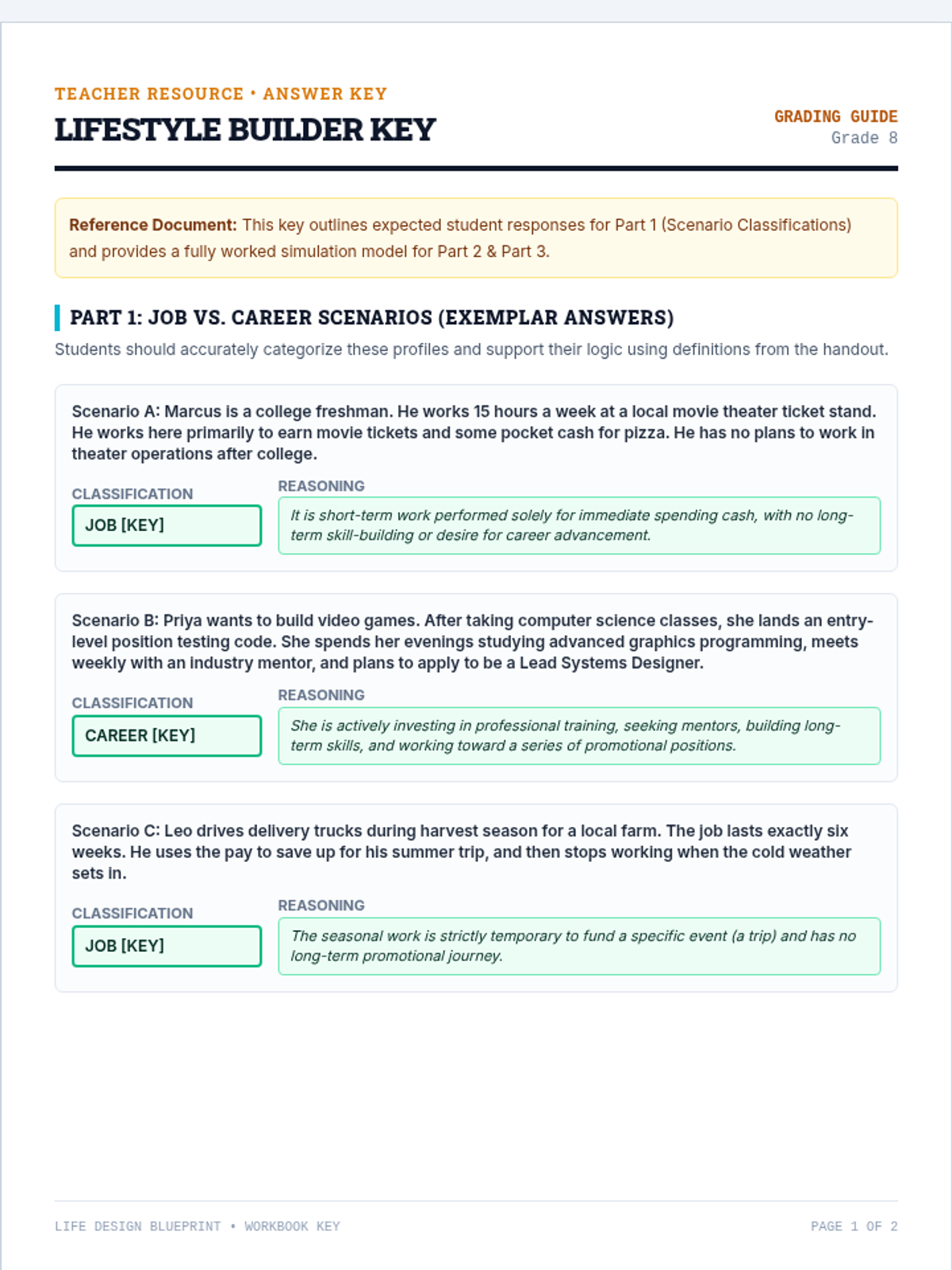
A teacher-facing 2-page Answer Key containing correct answers and grading recommendations for the Lifestyle Builder Worksheet.
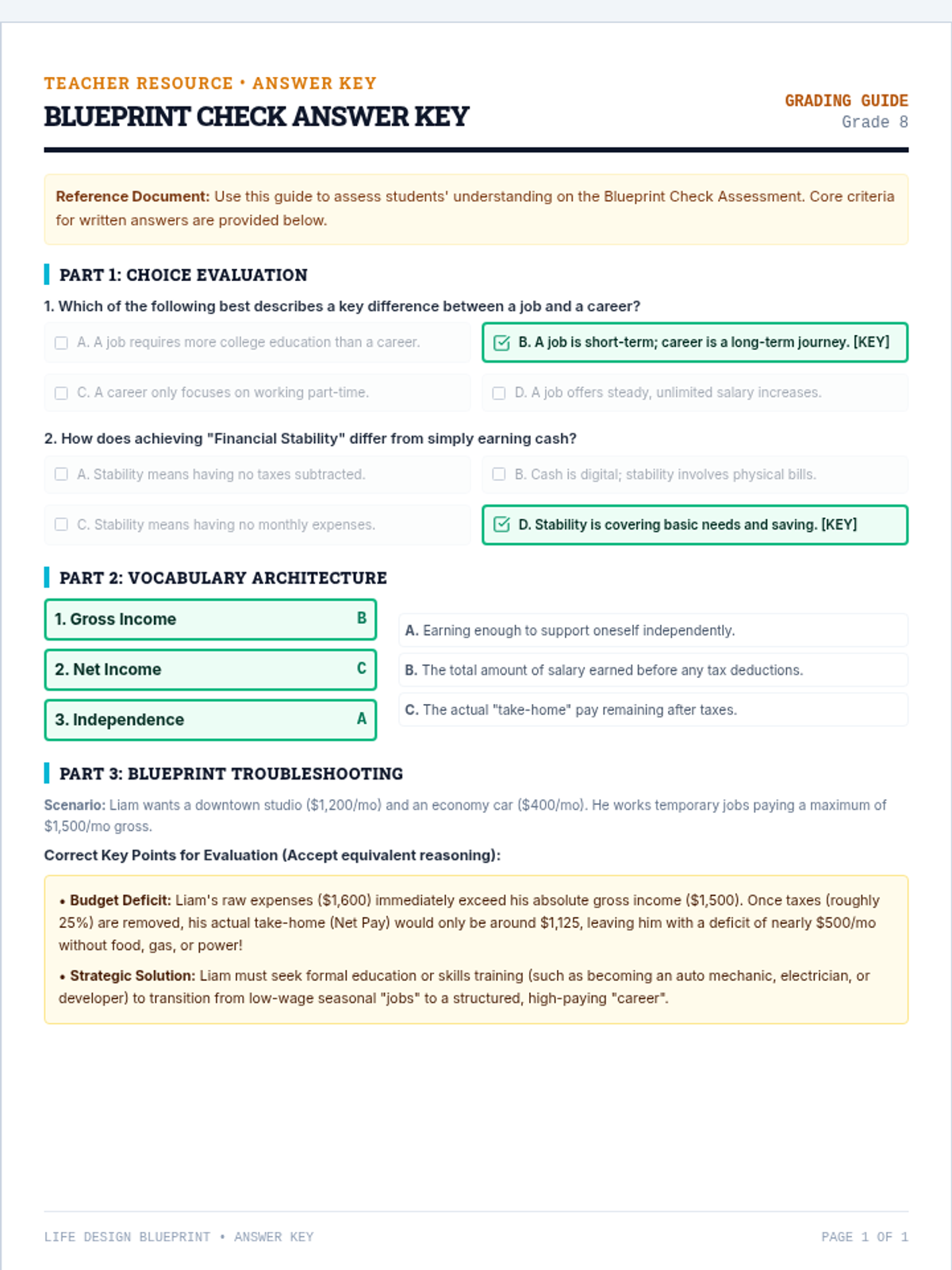
A teacher-facing 1-page Answer Key containing correct answers and grading recommendations for the Blueprint Check Assessment.
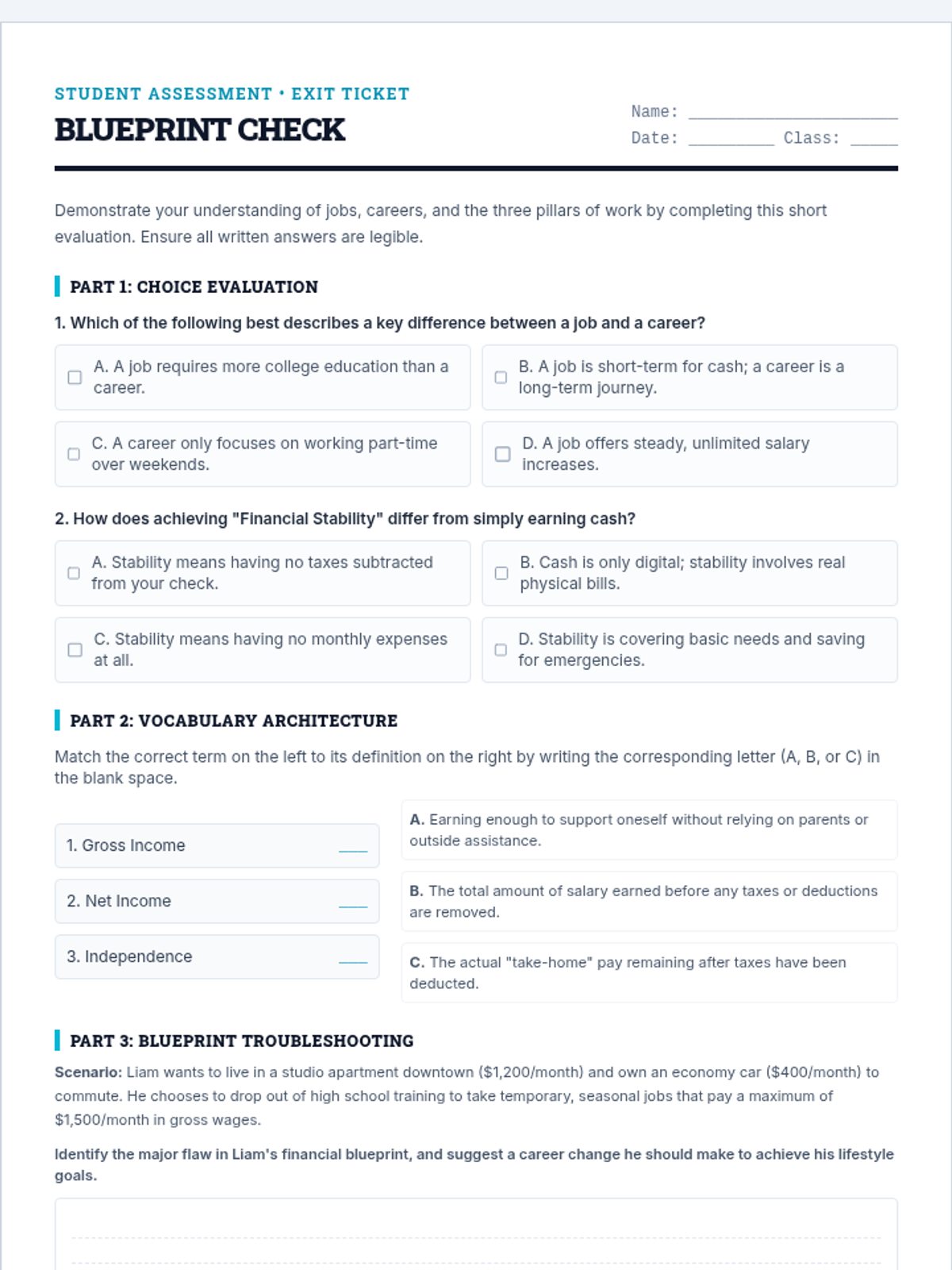
A student-facing 1-page assessment quiz with uniform answer styling, designed to evaluate knowledge of jobs vs. careers, financial concepts (gross vs. net), and career blueprint troubleshooting.
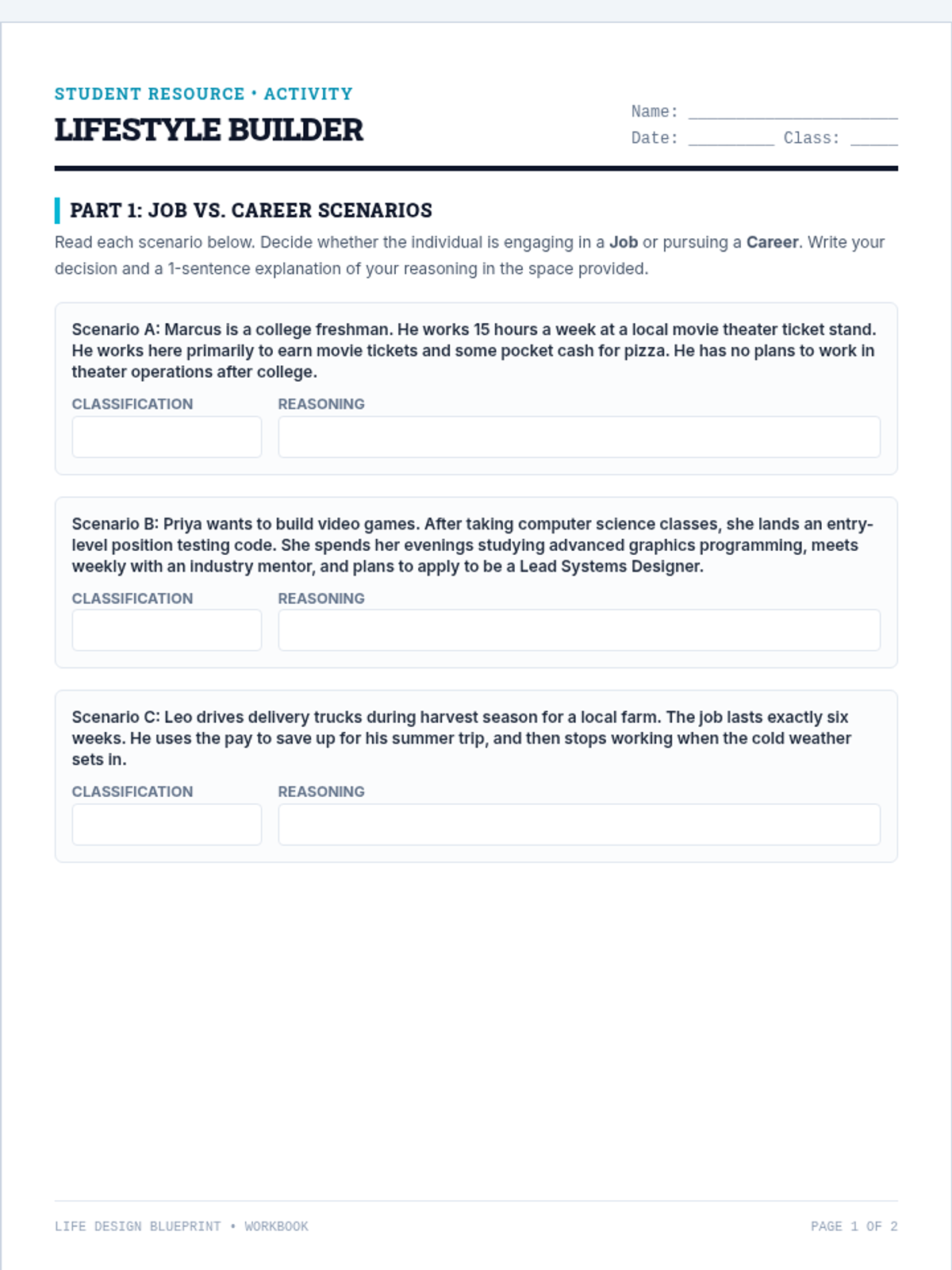
A student-facing 2-page workbook featuring a Job vs. Career classification challenge in Part 1, followed by an engaging 'Lifestyle Budget Calculator' simulation in Part 2, and a reflective career matching exercise in Part 3.
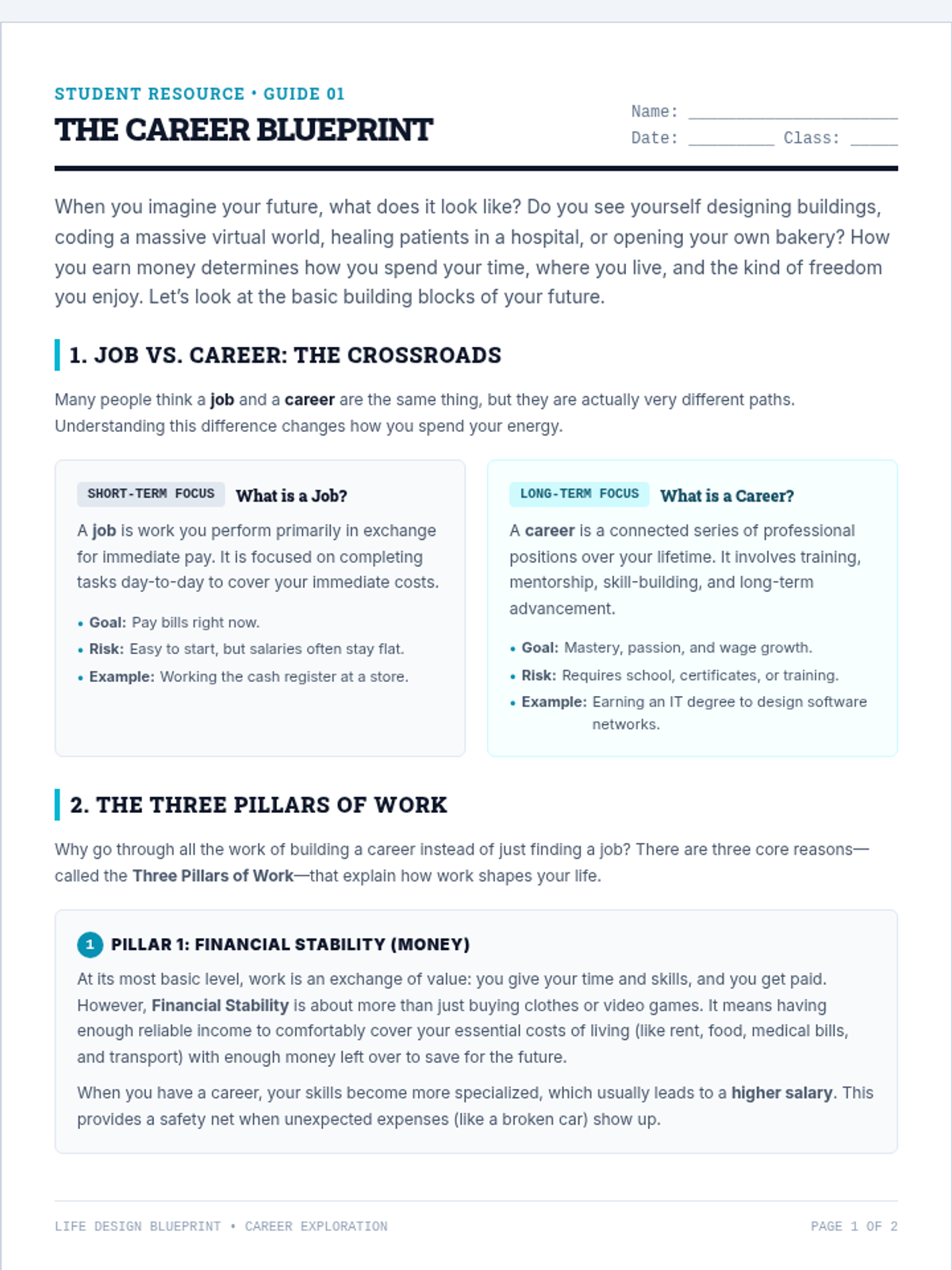
A printable, student-facing 2-page educational handout. It defines 'Job' vs 'Career' using clear comparative frameworks and guides students through the 'Three Pillars of Work' (Financial Stability, Independence, and Lifestyle Design).
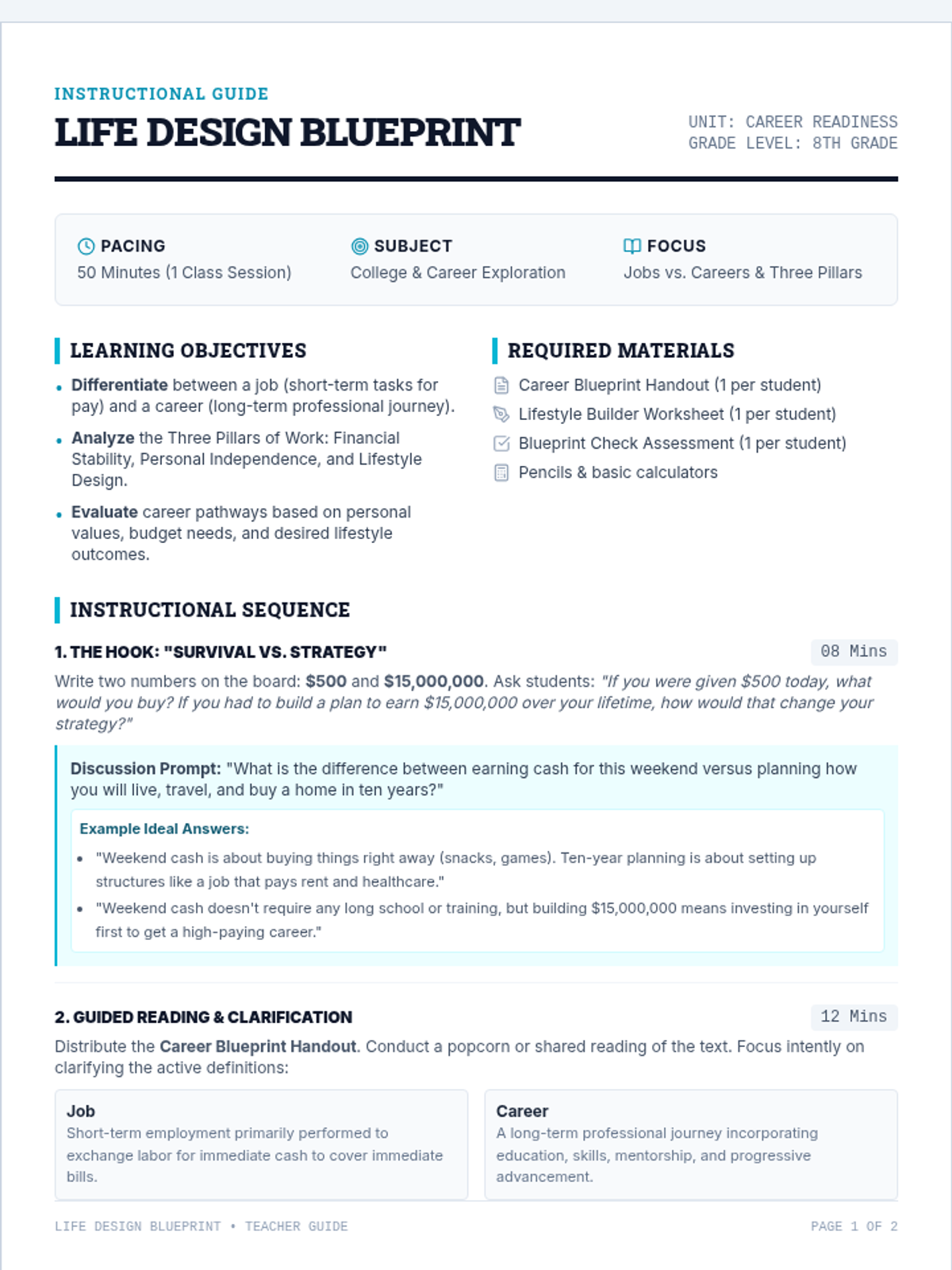
A comprehensive 2-page print-ready Teacher Guide for the 'Life Design Blueprint' lesson. It details the 50-minute lesson flow, key discussions, student misconceptions about finance, and clear differentiation strategies.
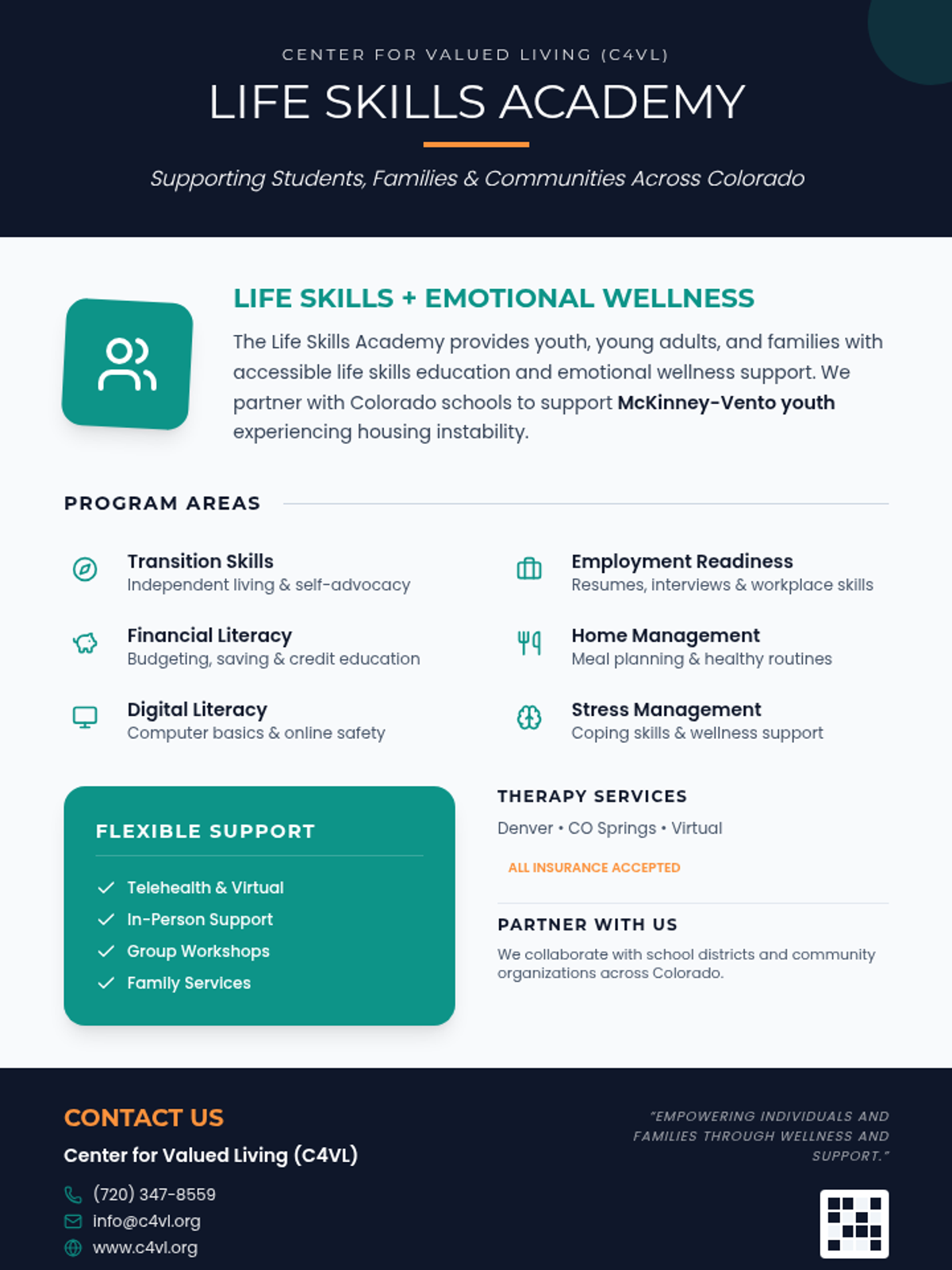
A professional one-page informational flyer for the C4VL Life Skills Academy, featuring a clean teal and navy blue design with sections on program areas, support options, and partnership opportunities.
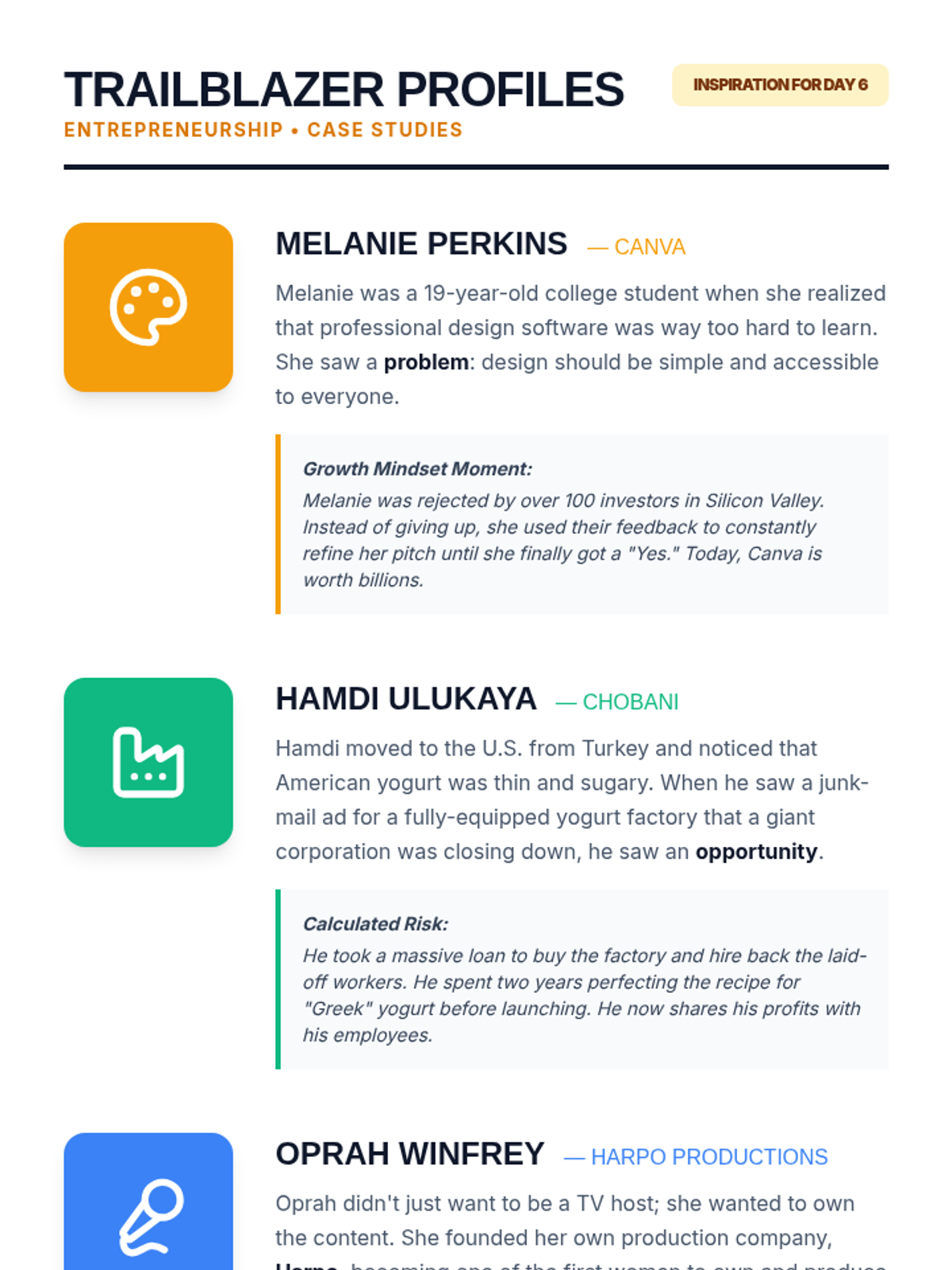
A collection of inspirational biographies featuring diverse entrepreneurs like Melanie Perkins, Hamdi Ulukaya, and Oprah Winfrey, highlighting their challenges and successes.
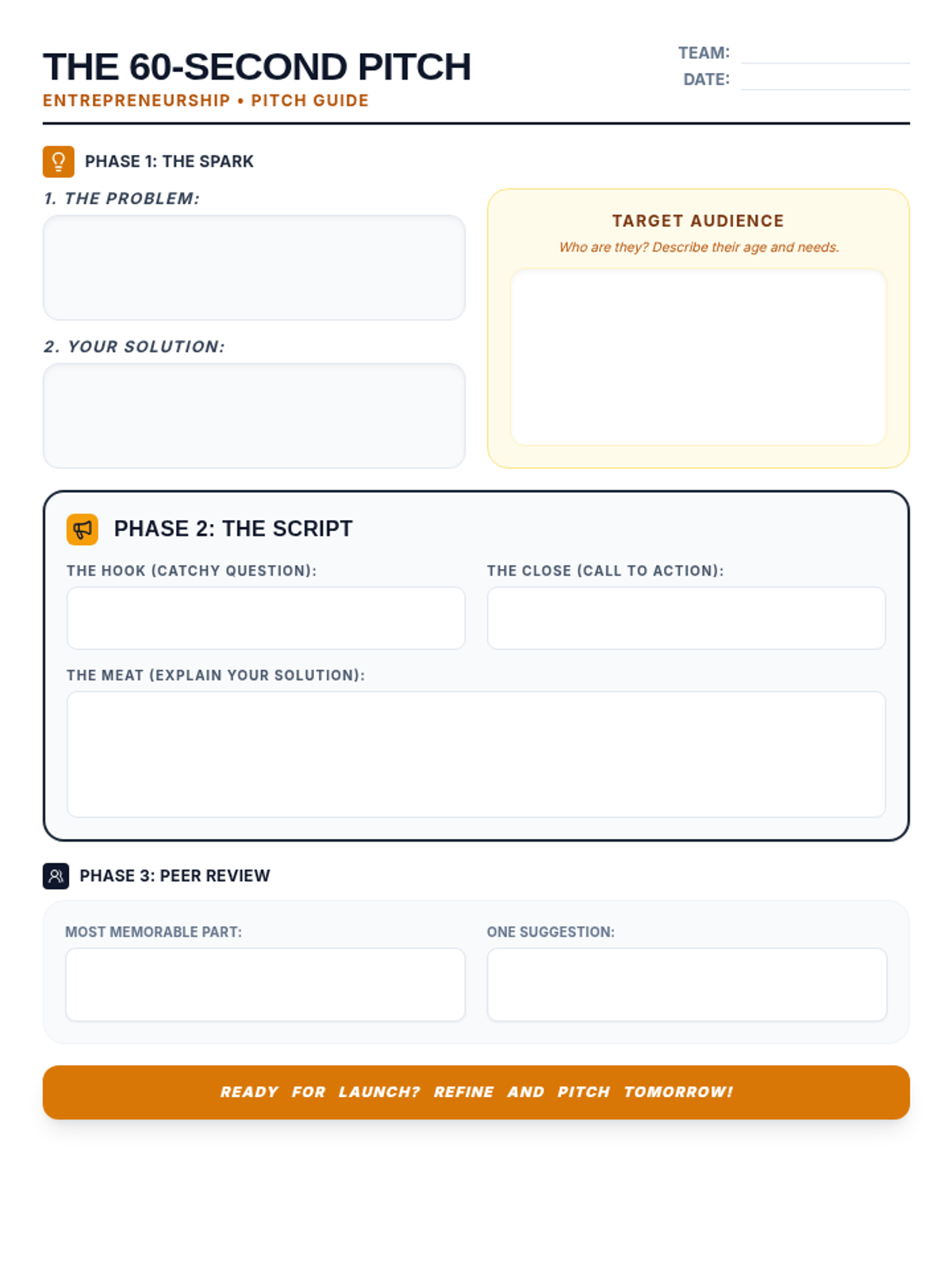
A planning and practice guide for students to develop an elevator pitch for their business idea, including space for ideation, scriptwriting, and peer feedback.
A slide deck guiding students through the process of business ideation, target audience identification, and the elevator pitch.
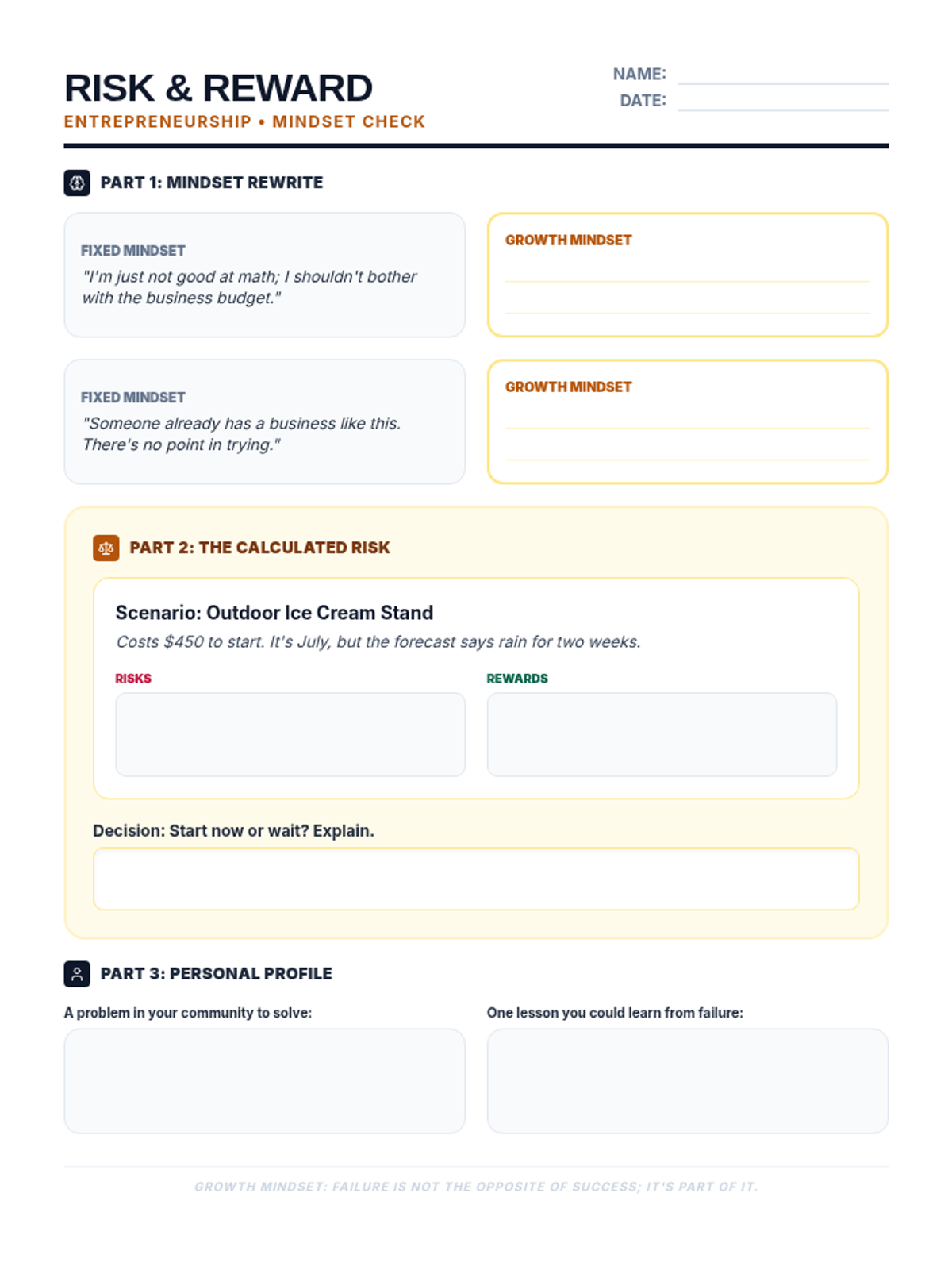
A worksheet for students to practice shifting from a fixed to a growth mindset and to analyze risk vs. reward in a business scenario.
A slide deck introducing the entrepreneurial mindset, focusing on growth mindset, the definition of an entrepreneur, and the balance of risk and reward.
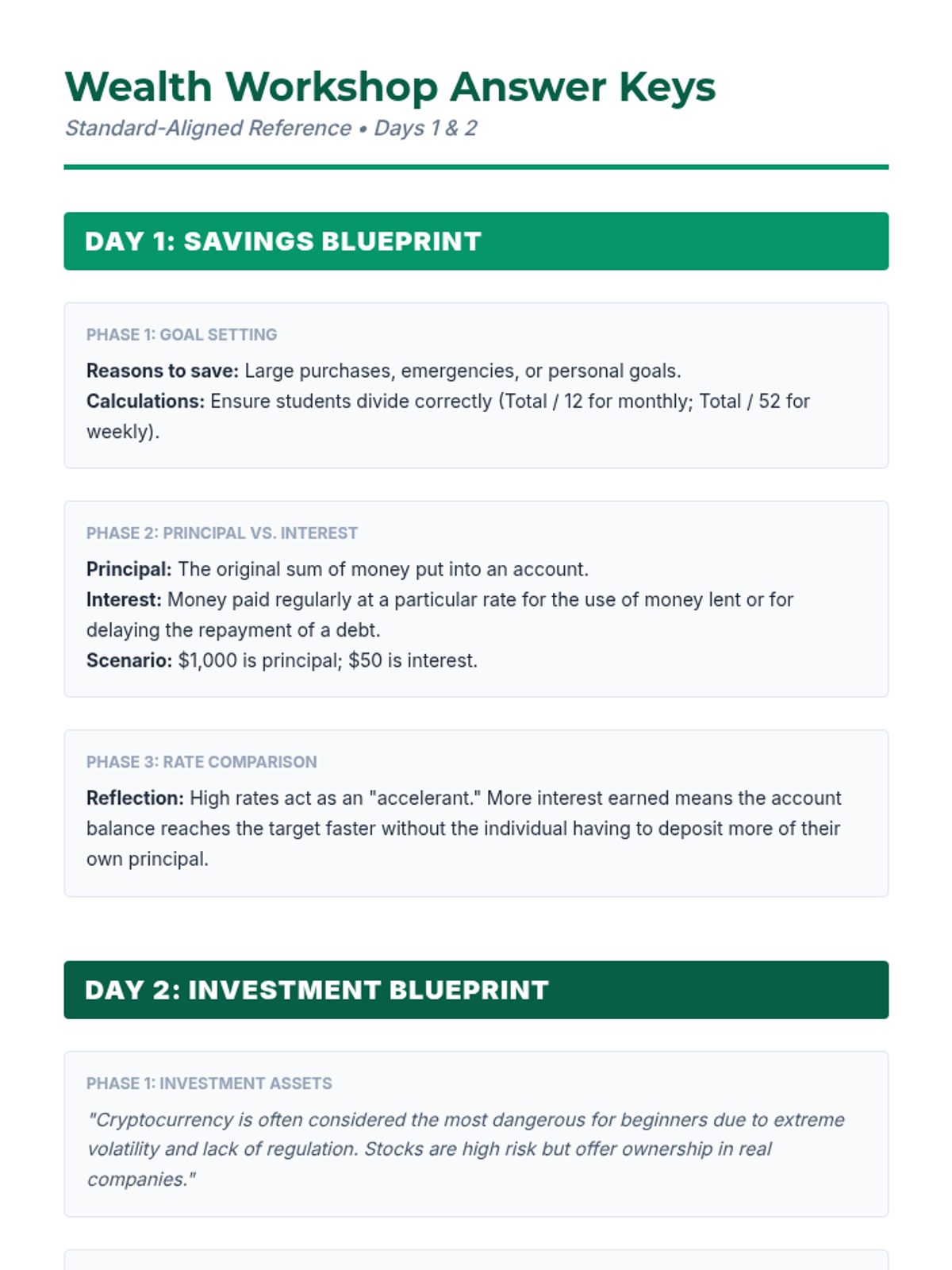
A comprehensive teacher's answer key for both Day 1 and Day 2 worksheets of the Wealth Workshop mini-unit. Includes specific interest calculations for the Day 1 Rate Comparison activity.
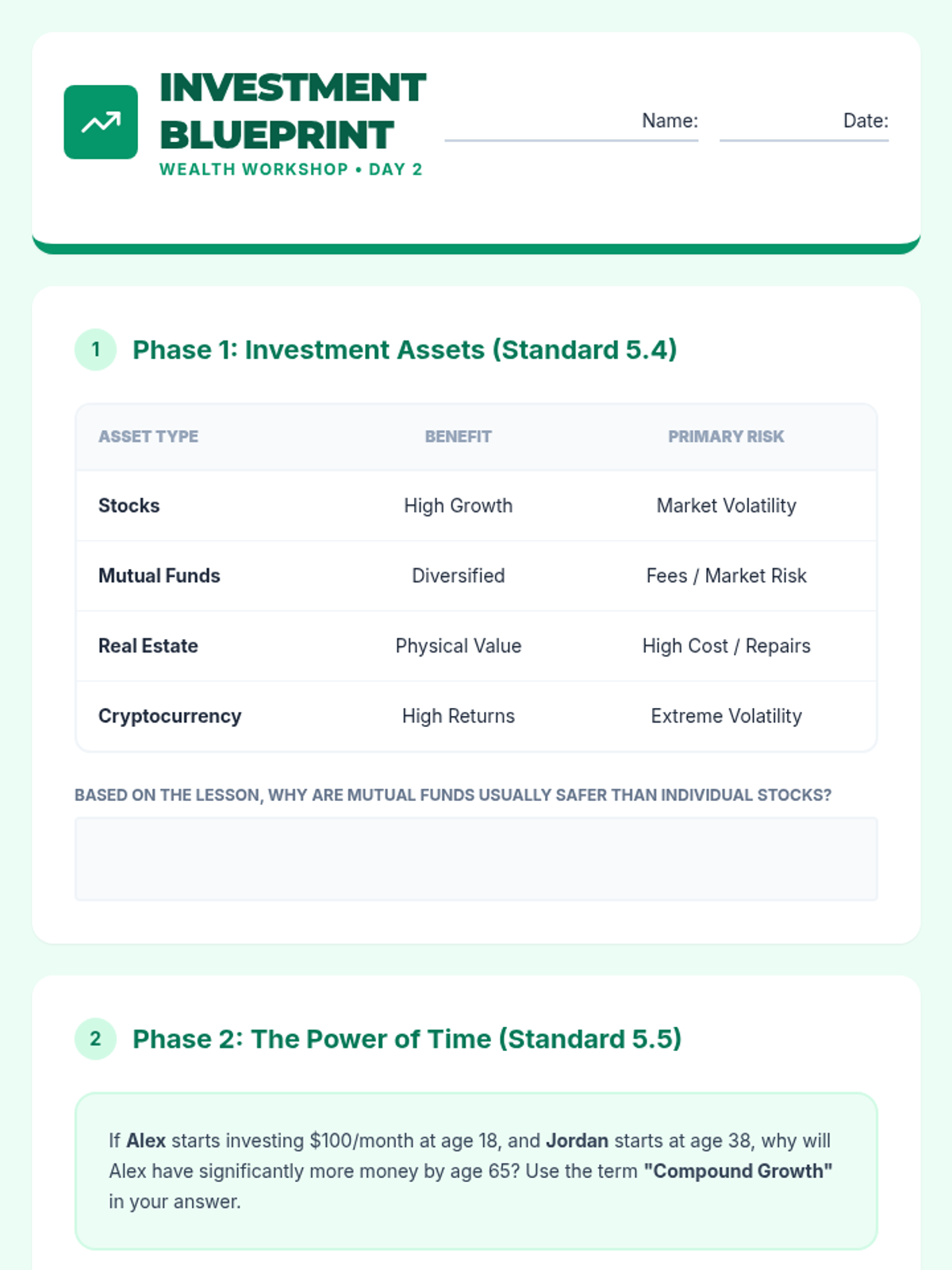
A student worksheet for Day 2 of the Wealth Workshop, focusing on analyzing investment assets, the benefits of starting early, and the importance of diversification. Revised for improved student work area contrast and legibility.
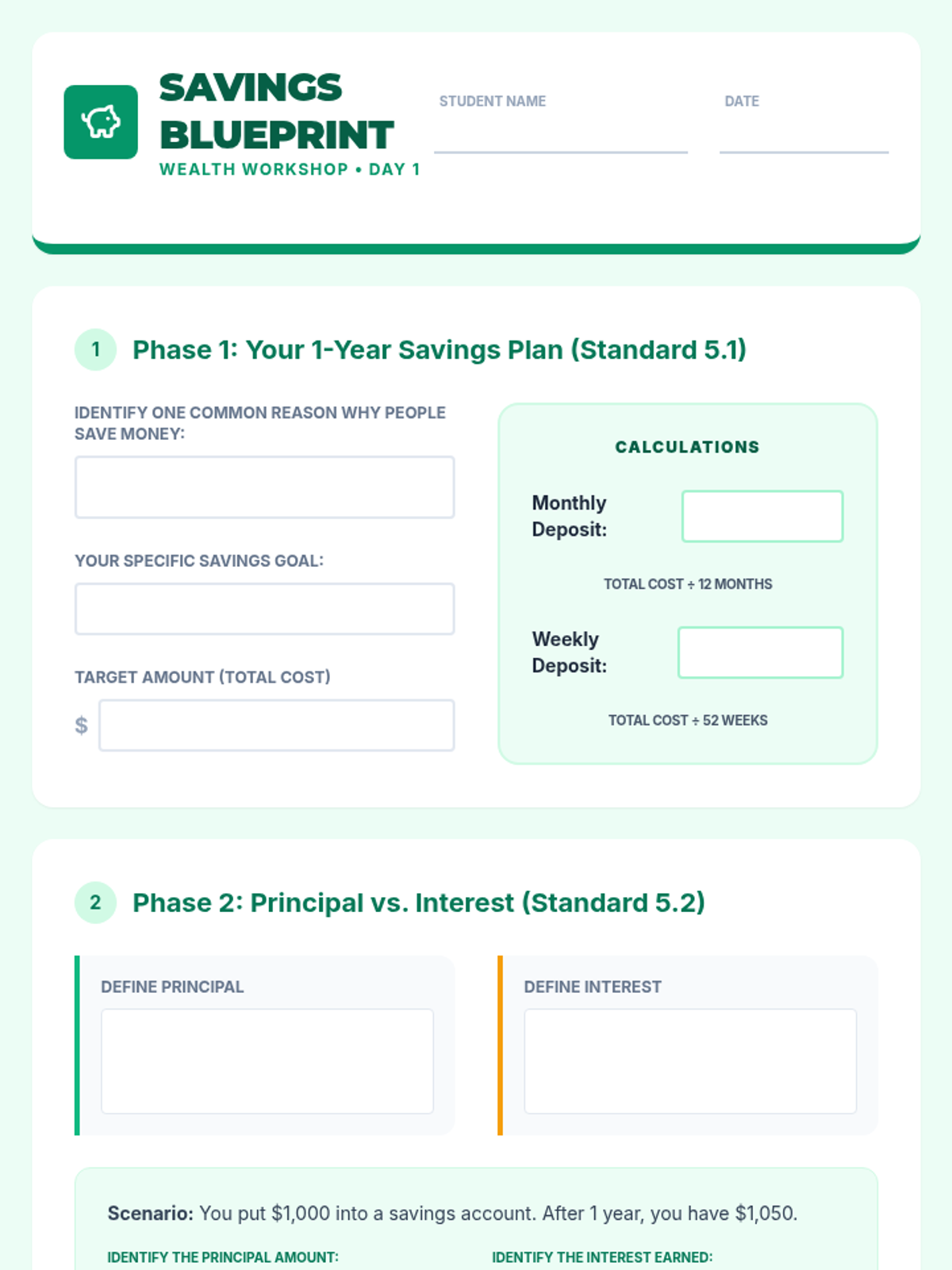
A student worksheet for Day 1 of the Wealth Workshop, focusing on defining savings goals, calculating a 1-year savings plan, and understanding the impact of interest rates. Revised for better header layout and clearer labeling prompts. Now requires students to calculate interest earned in Phase 3.
A visually engaging slide deck for the Wealth Workshop mini-unit, covering standard-aligned topics like savings goals, APY comparison, asset classes, and diversification.
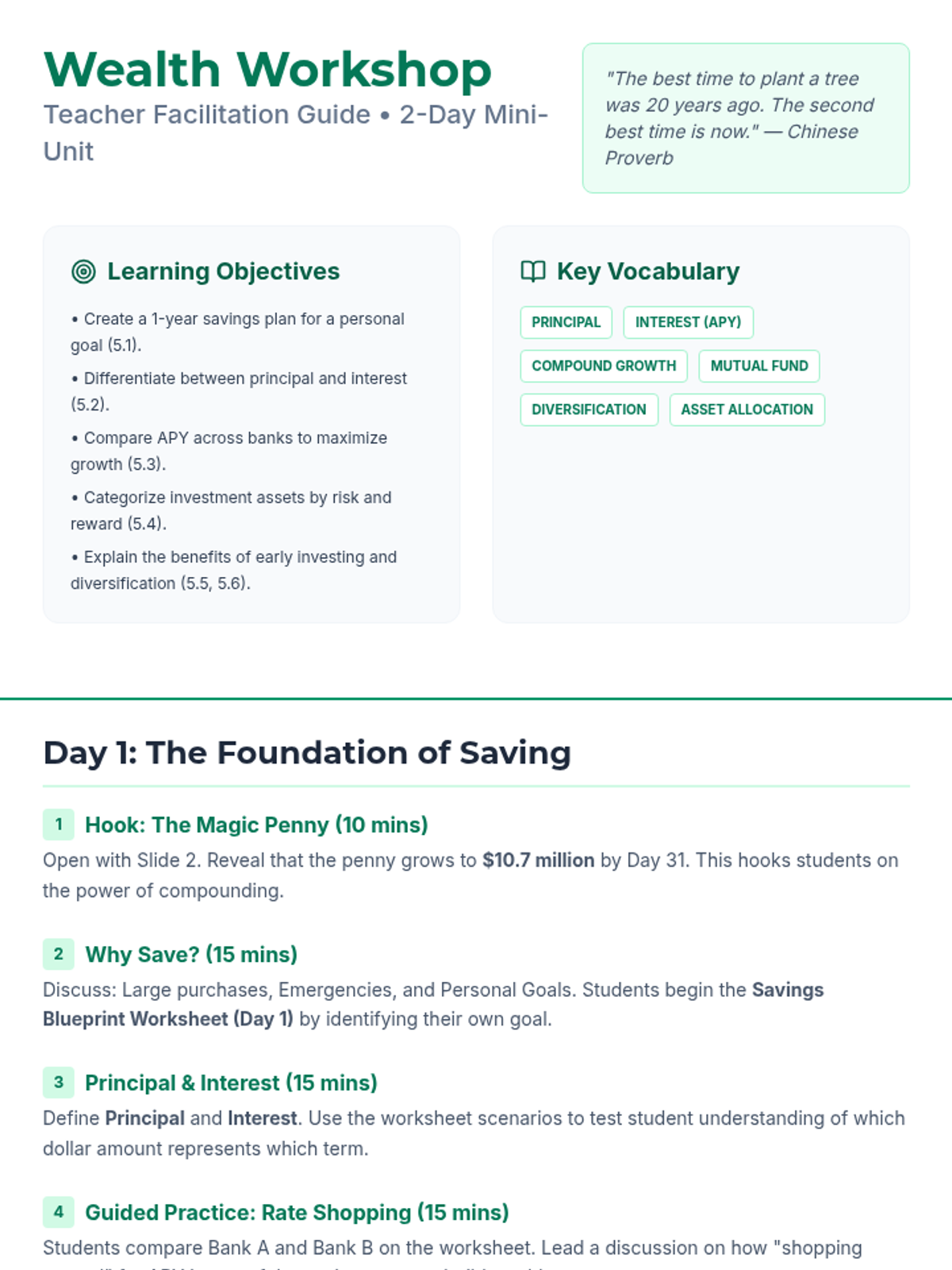
A comprehensive teacher guide for a 2-day mini-unit on financial literacy, covering savings strategies, interest rates, investment assets, and risk management.
Simplified instructional slides for 8th-grade financial literacy. Includes definitions of HYSA, 401(k), and Roth IRA. Features a data comparison table and word-problem scenarios for both winning and failing stocks. Corrects graphic overlaps and metadata issues.
Simplified instructional slides for 8th-grade financial literacy. Includes simple definitions of HYSA, 401(k), and Roth IRA. Replaces complex formulas with "Growth Hints" (multipliers) and features relatable scenarios. Fixes graphic overlap issues.
Teacher answer key matching the simplified 8th-grade scenario-based worksheet. Provides clear solutions using the pre-calculated hints, sample reflection answers, and a multiplier reference table for teacher convenience. Fixes math rendering issues.
Simplified 8th-grade level worksheet featuring 100% scenario-based word problems. Includes "Growth Hints" with pre-calculated multipliers to help students focus on the concepts of compounding and ROI without needing complex calculators.
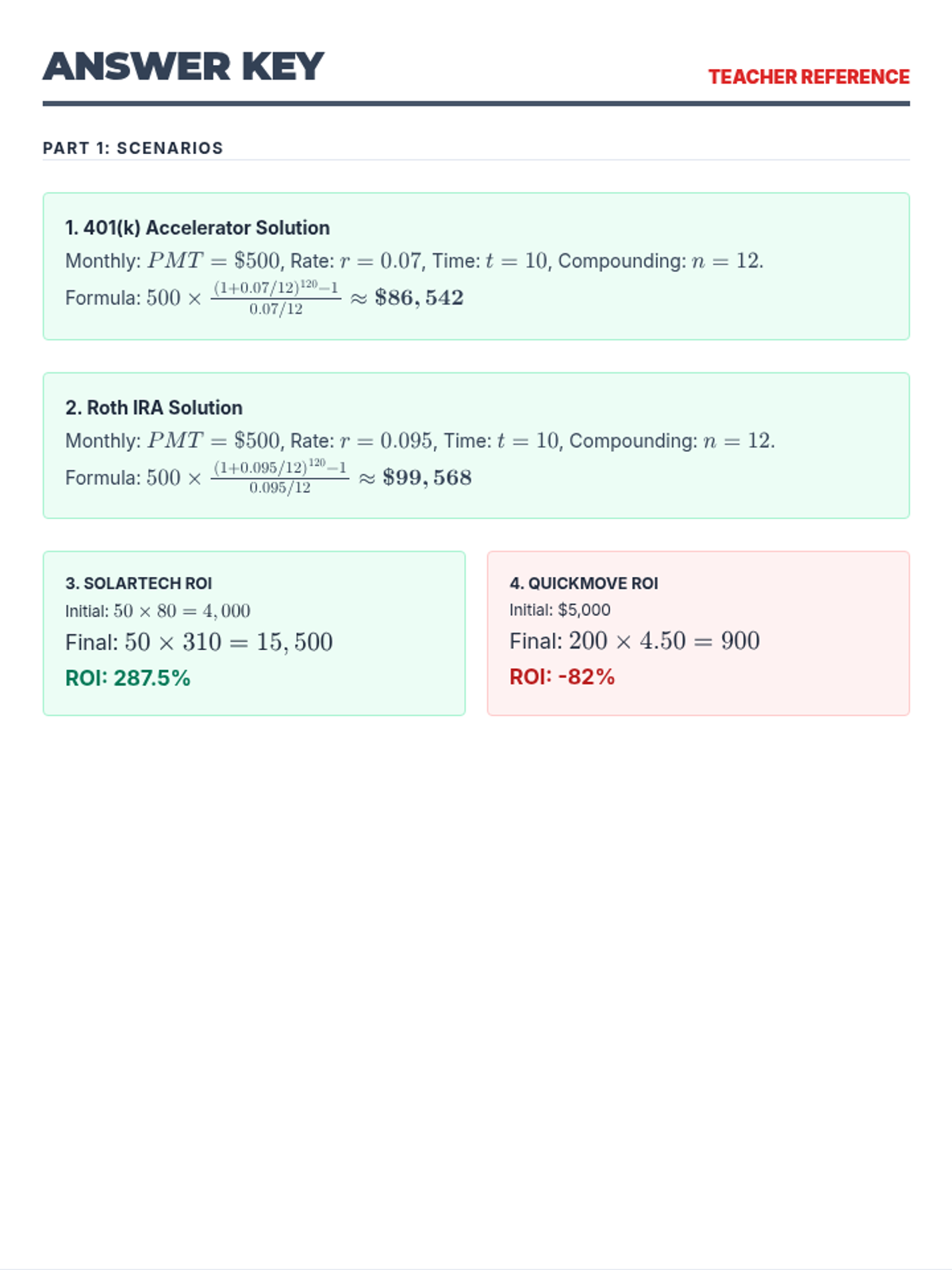
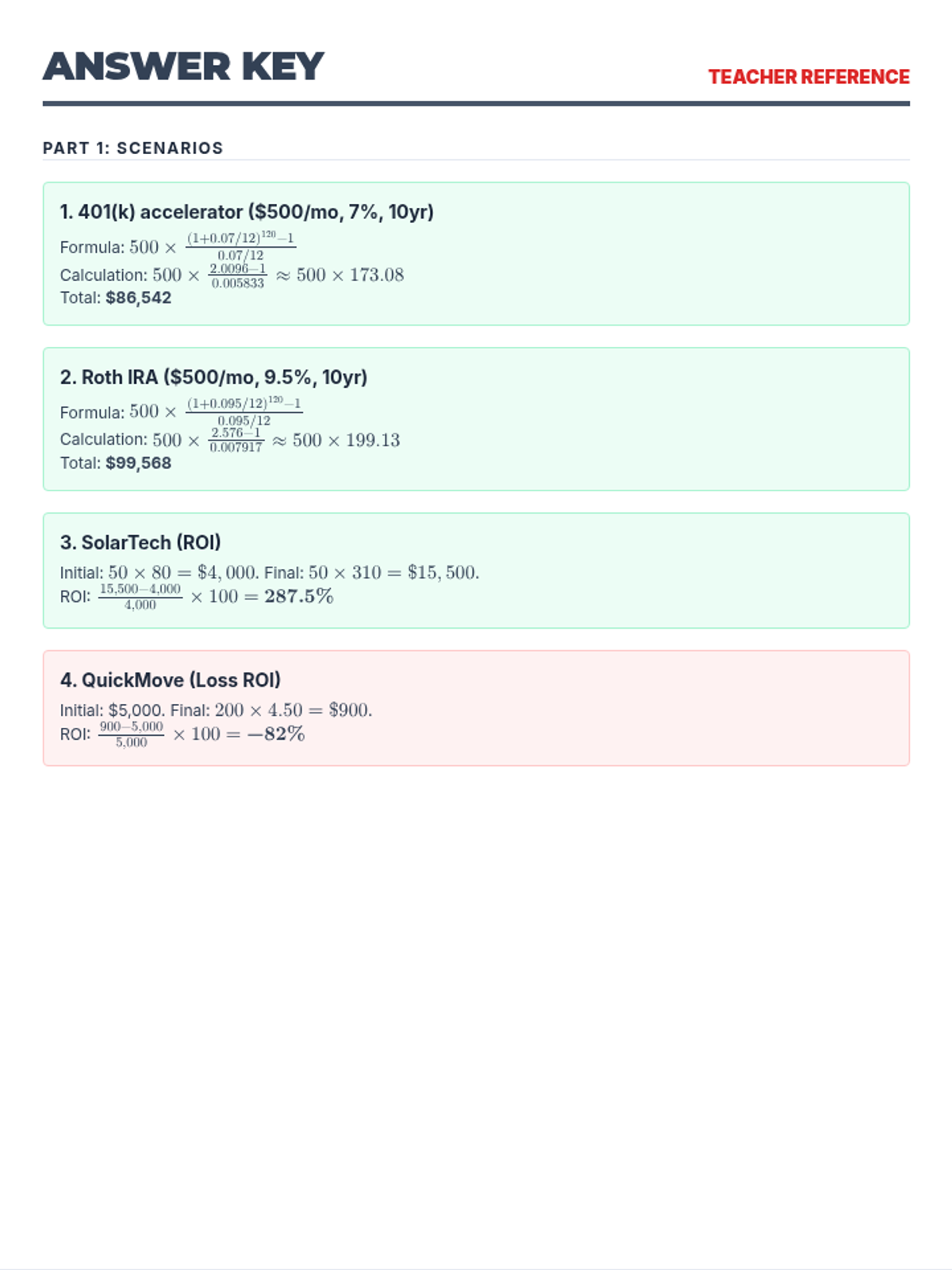
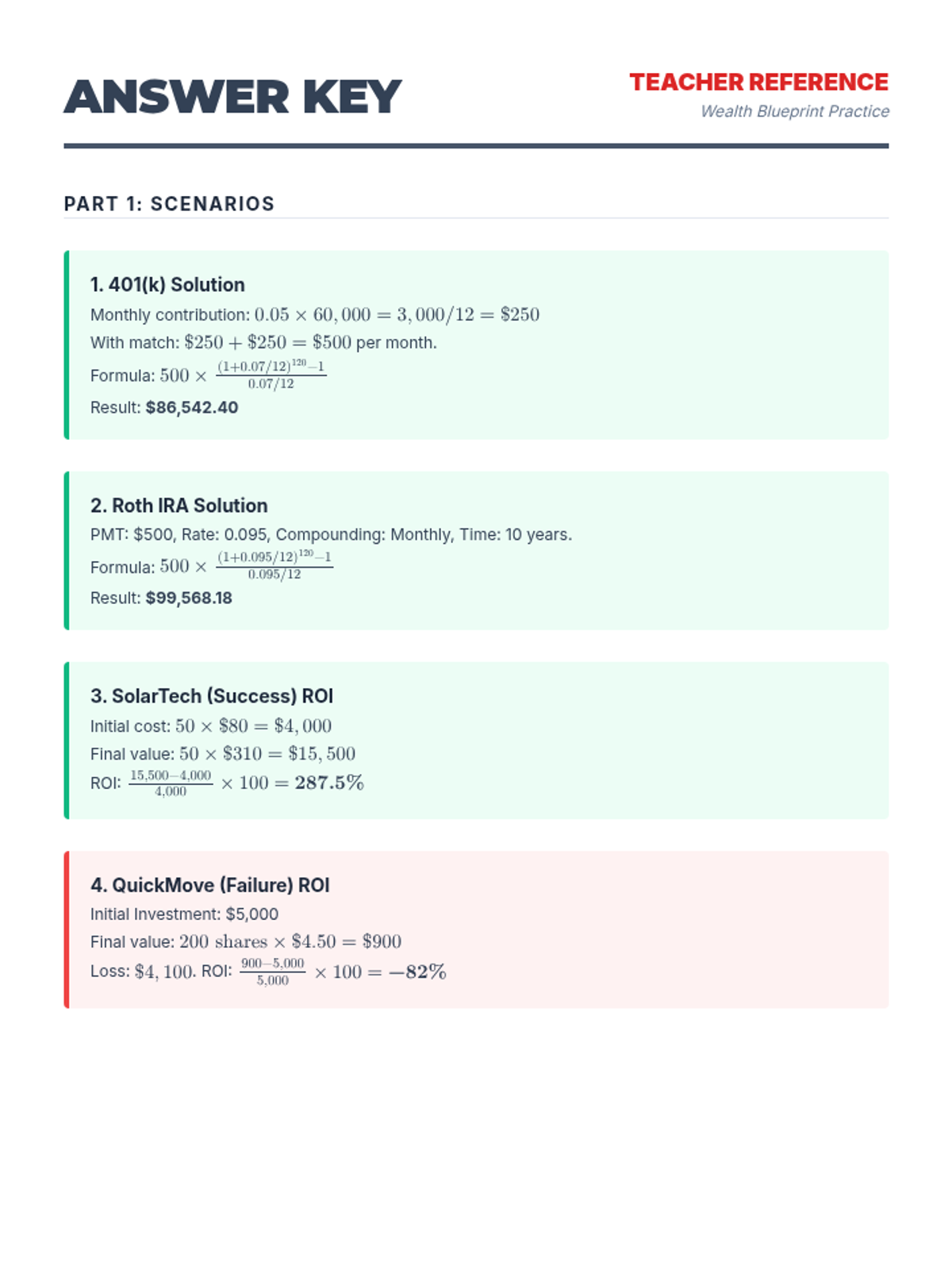
Updated answer key for the Wealth Blueprint worksheet with corrected math rendering and improved page balance.
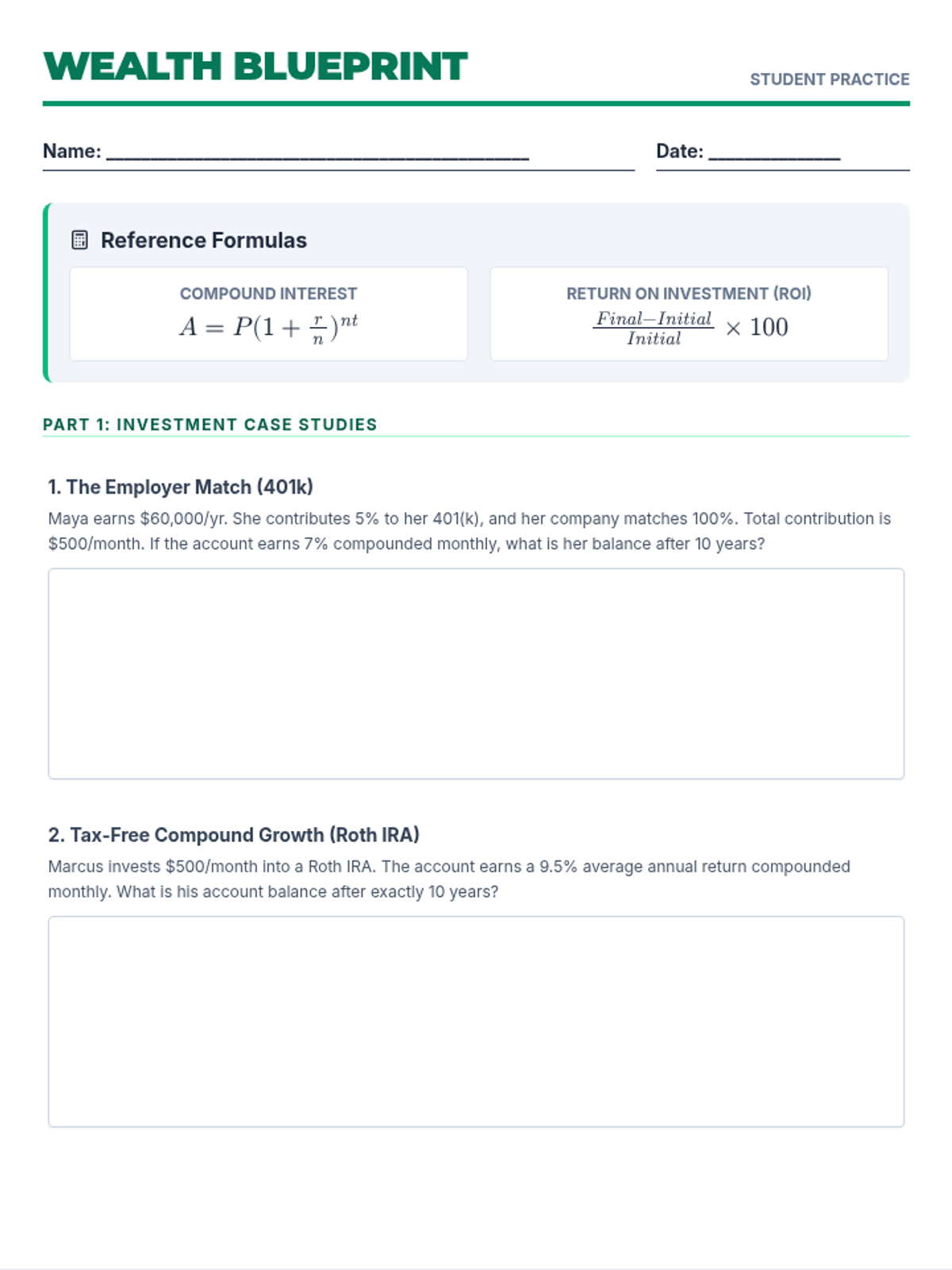
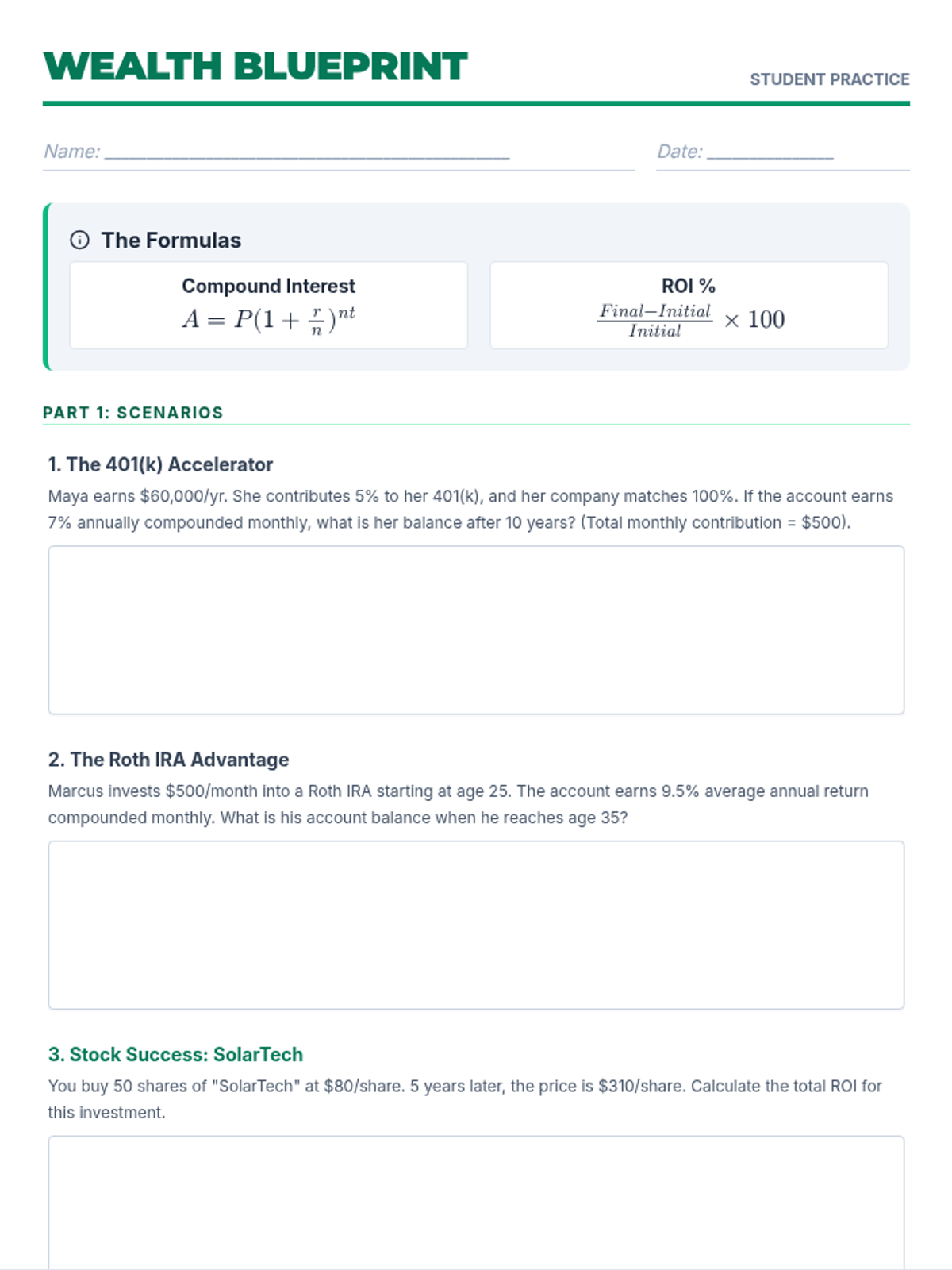
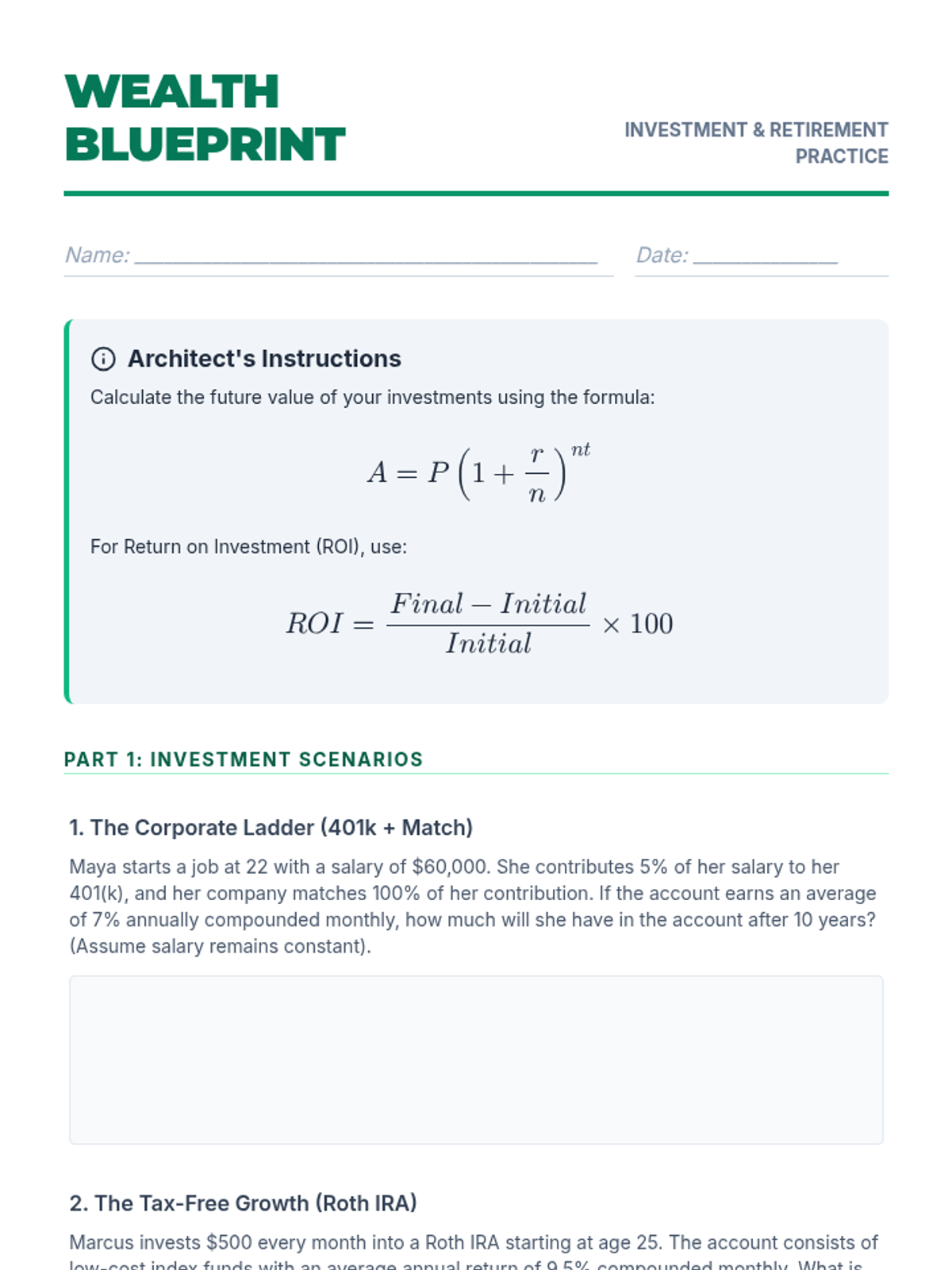
A two-page student worksheet featuring real-world investment scenarios (401k, Roth IRA, individual stocks) and a structured comparison table for analyzing long-term compound interest growth. Improved layout, text sizing, and math rendering.
Visual slide deck for instructing students on wealth building. Updated with guided practice scenarios and a data comparison table as requested.
Complete answer key for the Wealth Blueprint worksheet. Fixed math symbols and page break issues for teacher reference.
A two-page student worksheet featuring real-world investment scenarios (401k, Roth IRA, individual stocks) and a structured comparison table for analyzing long-term compound interest growth. Fixed page breaks and math rendering.
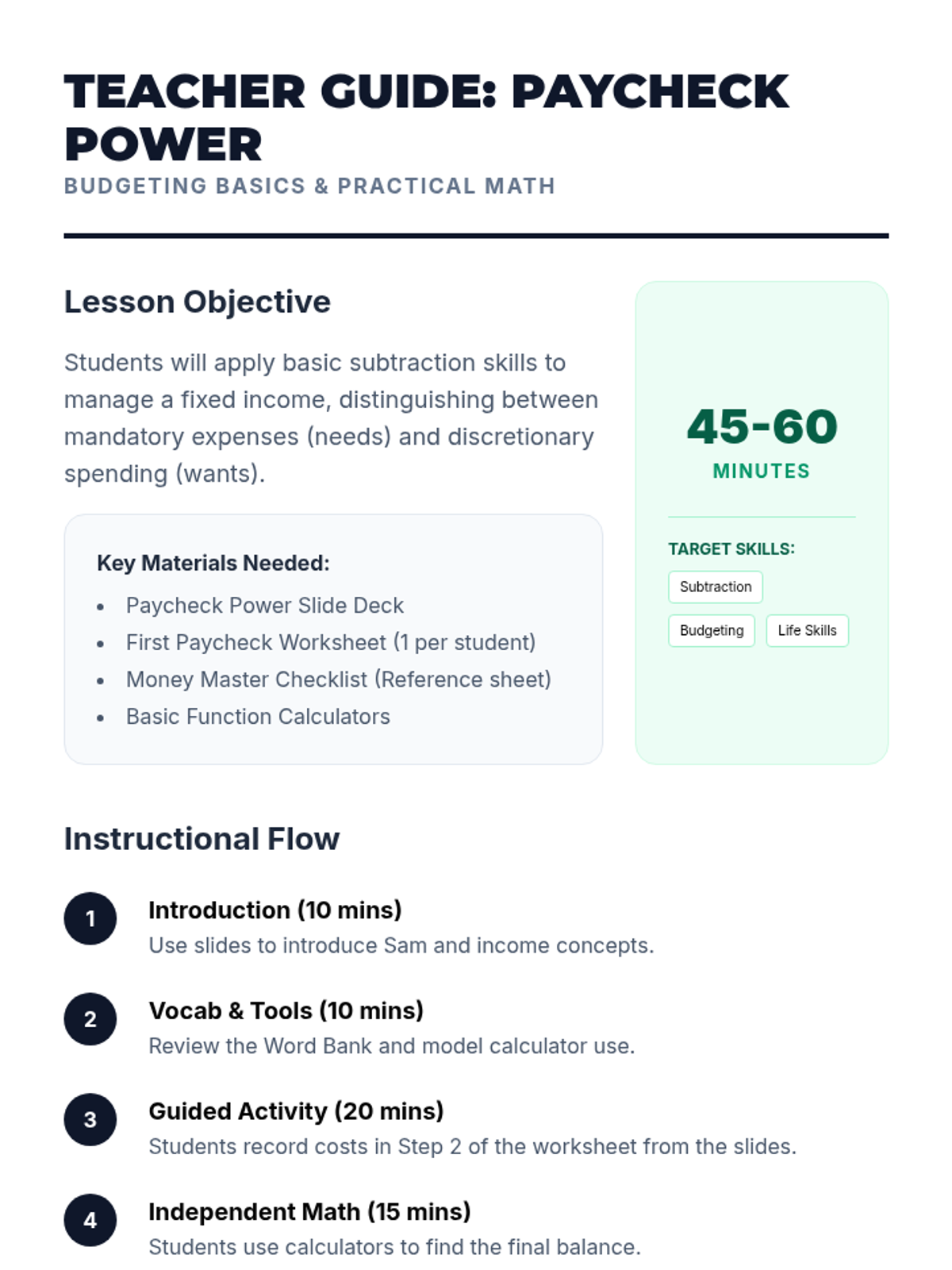
A comprehensive guide for teachers to facilitate the Paycheck Power lesson, including instructional steps, an answer key, and differentiation strategies.
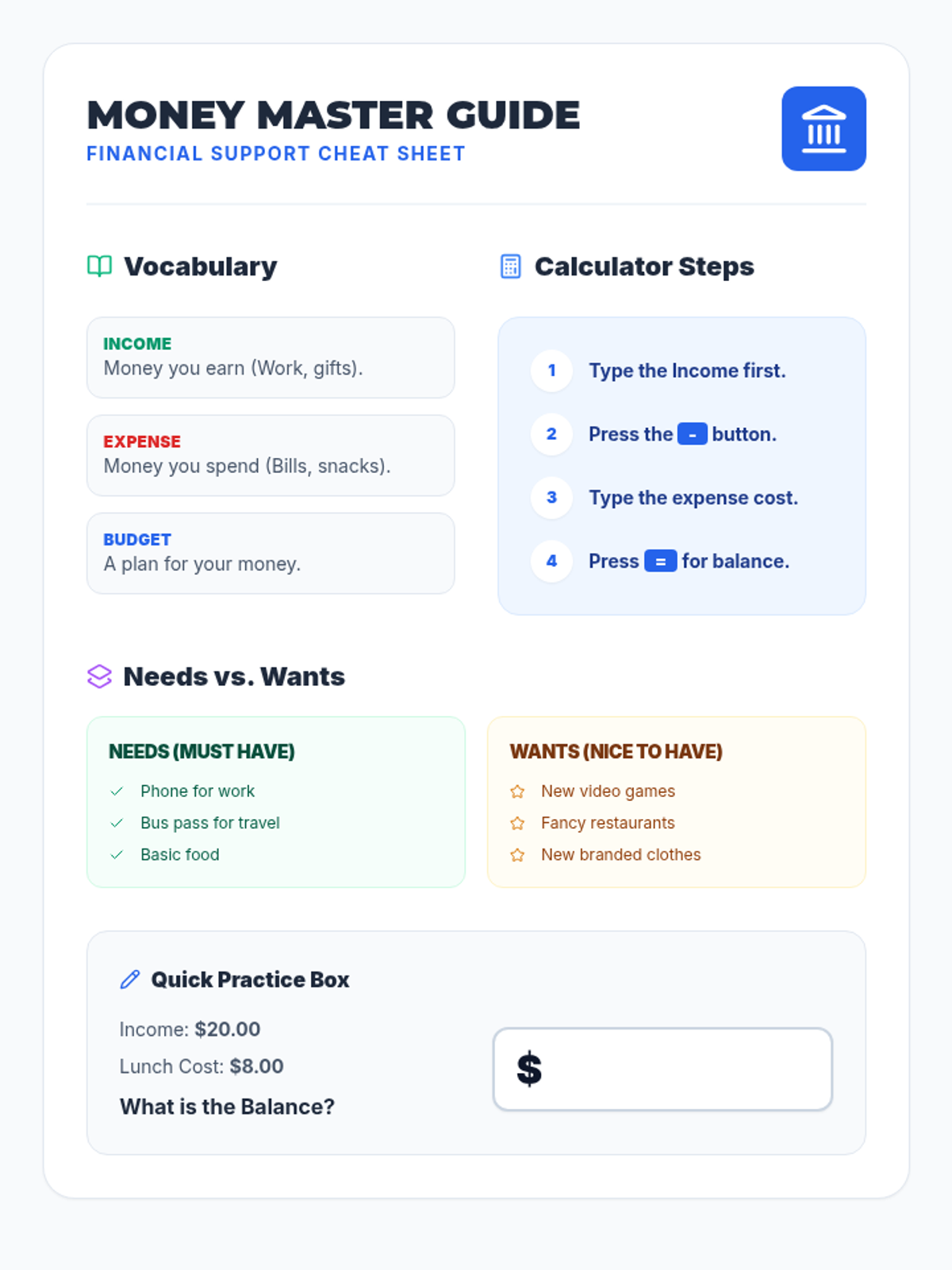
A comprehensive reference sheet for students containing essential financial vocabulary, a visual calculator guide, and a comparison of needs versus wants.
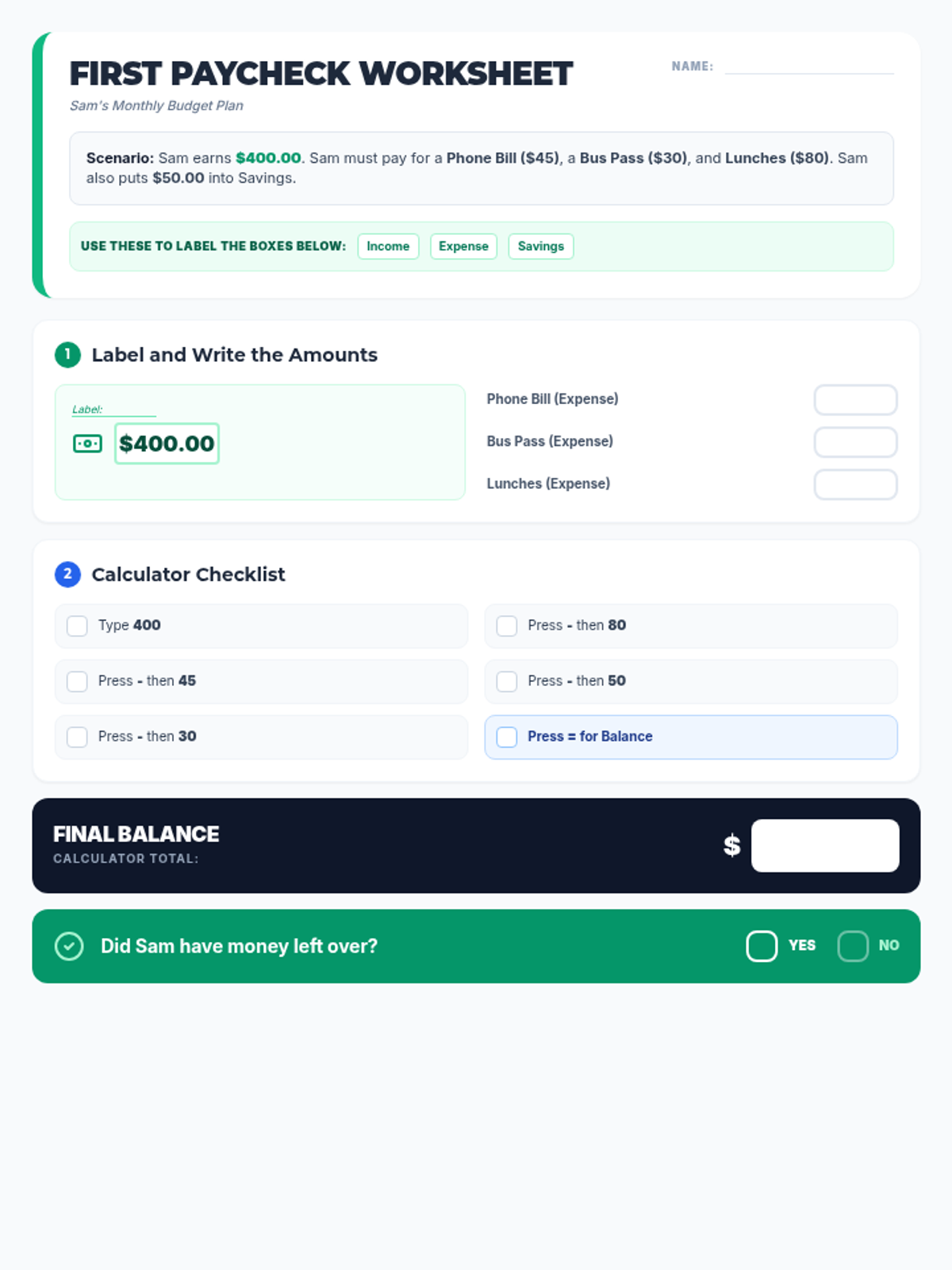
A step-by-step budgeting worksheet for students to calculate Sam's monthly expenses from a first paycheck, featuring a word bank and a calculator checklist.
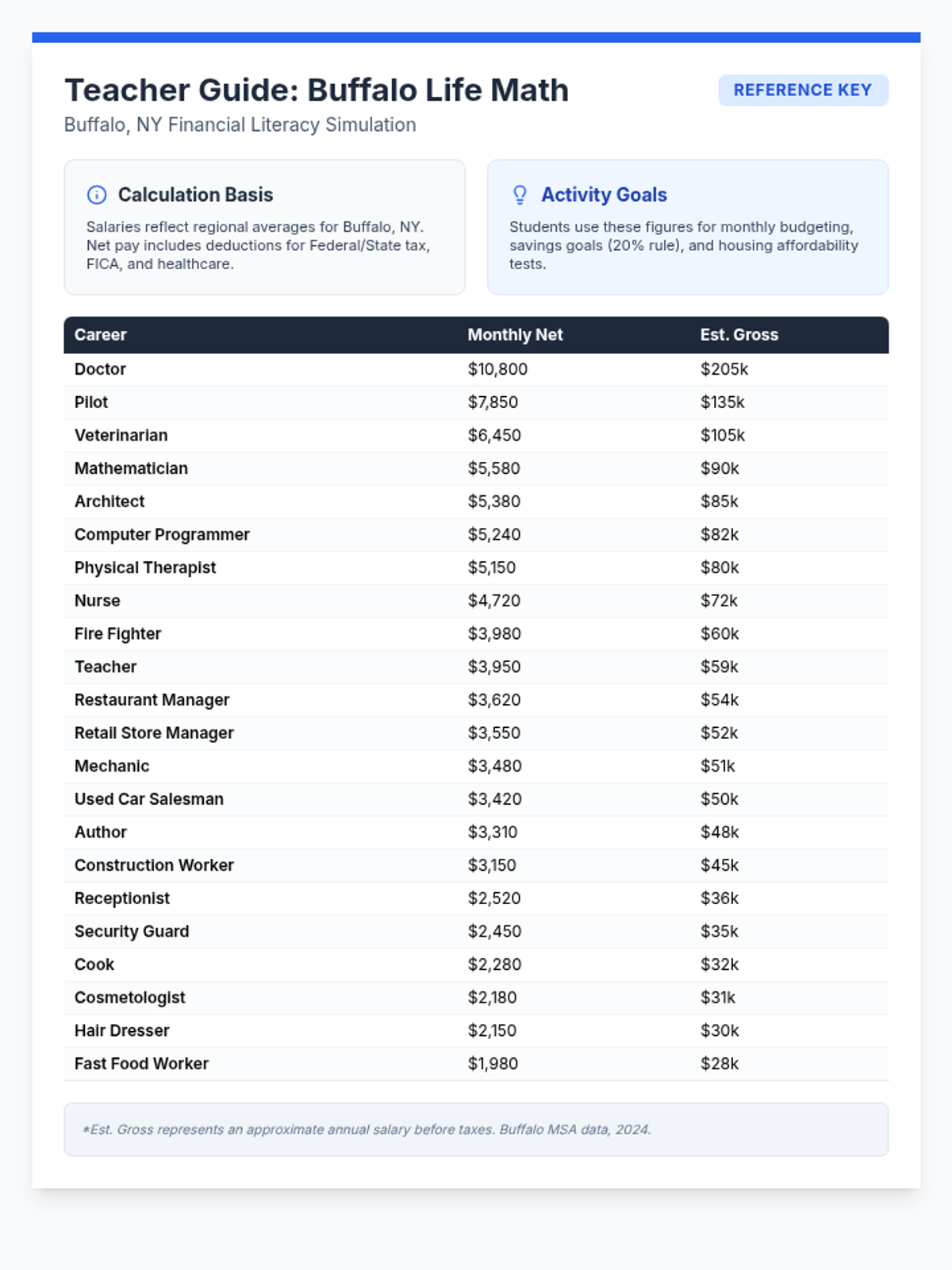
A single-page teacher reference guide containing the data behind the Buffalo career cards, including net pay, gross annual salaries, and Buffalo-specific job locations. Revised to include 24 careers.
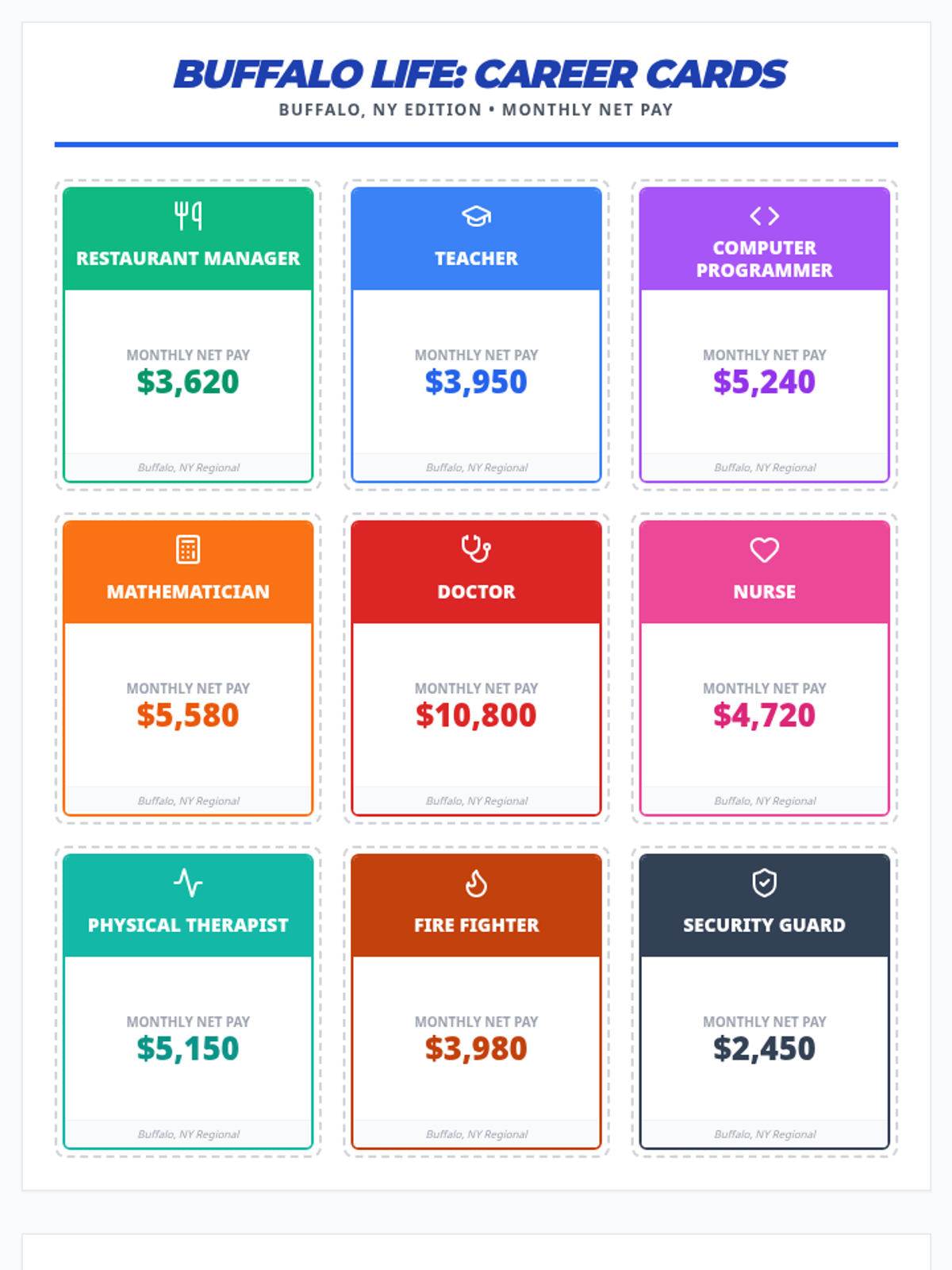
A set of 22 printable career cards for a Buffalo-themed life simulation, featuring various professions with specific monthly net pay values tailored to the Buffalo, NY region. Revised to ensure consistent page breaks and card sizing for printing.
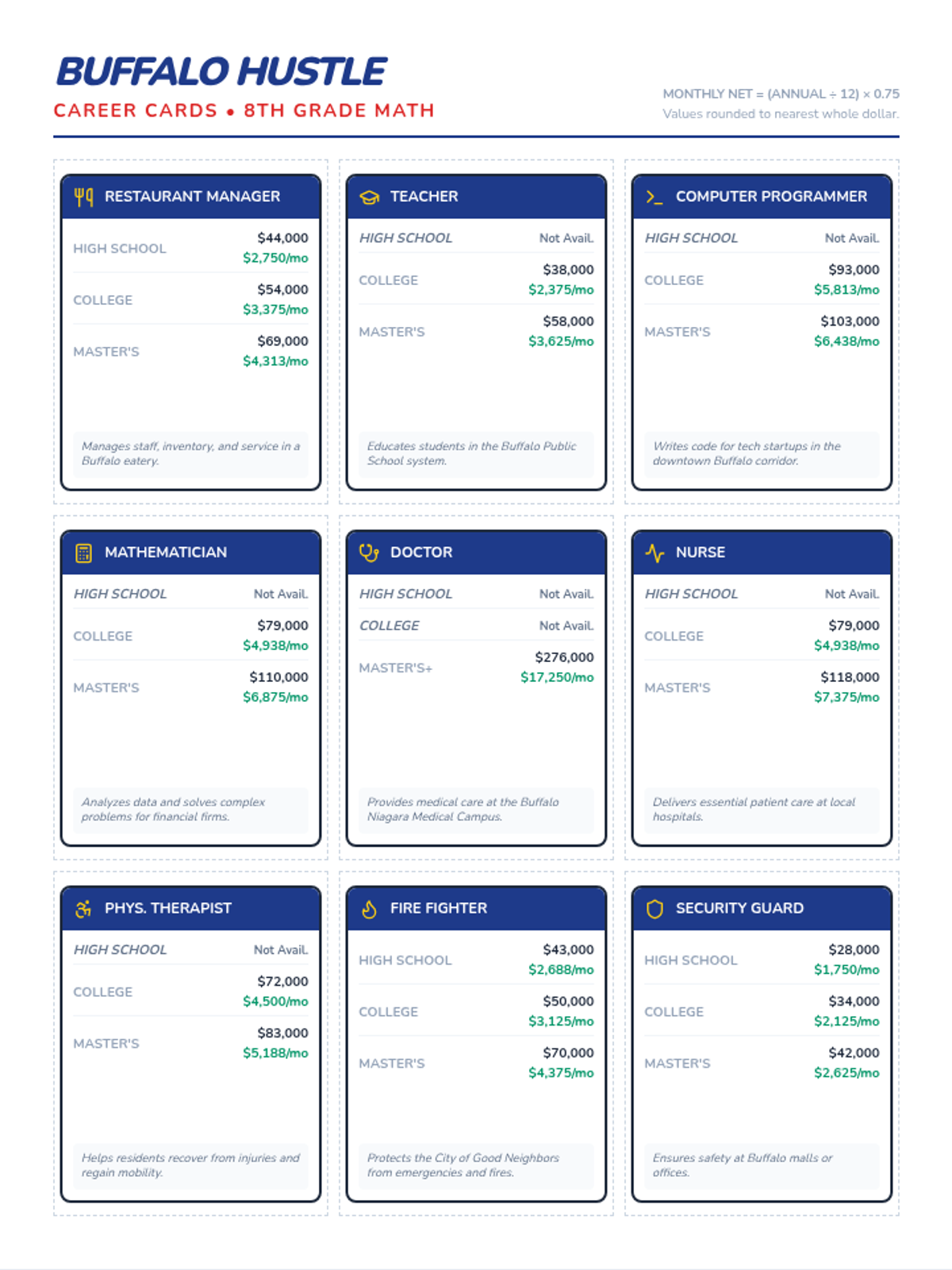
A set of 22 career cards for 'The Game of Life' simulation, specifically tailored with Buffalo, NY salary data. Each card displays annual gross salary and pre-calculated monthly net (take-home) pay across three education tiers (High School, College, and Master's), helping 8th-grade students understand the financial impact of education.
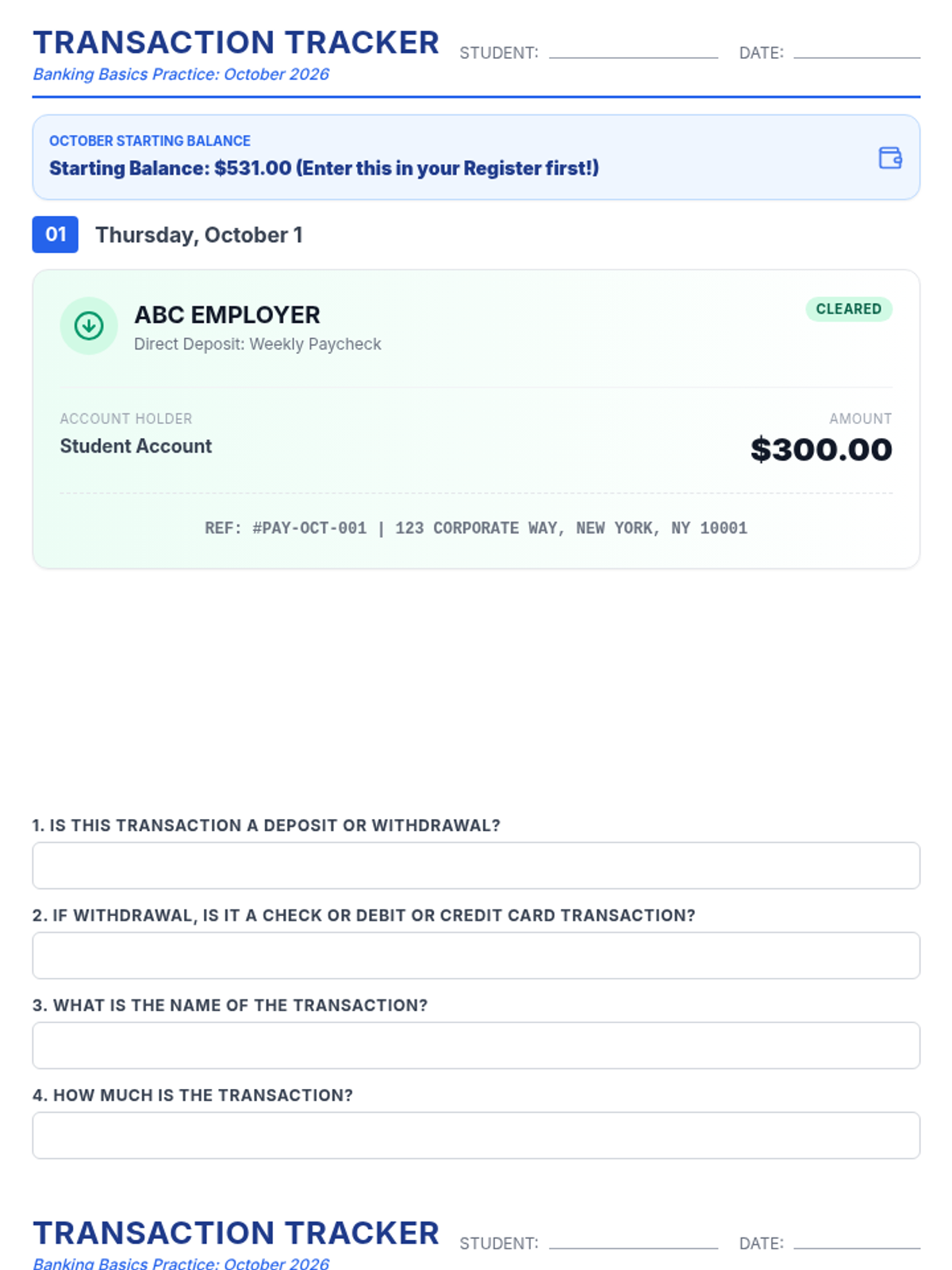
Student transaction tracker worksheets featuring 21 daily financial records (receipts, bills, deposits, and ATM slips) for October 2026. Includes fields for students to record transaction types, payment methods, and exact amounts, with enhanced large check addresses for easier reading.
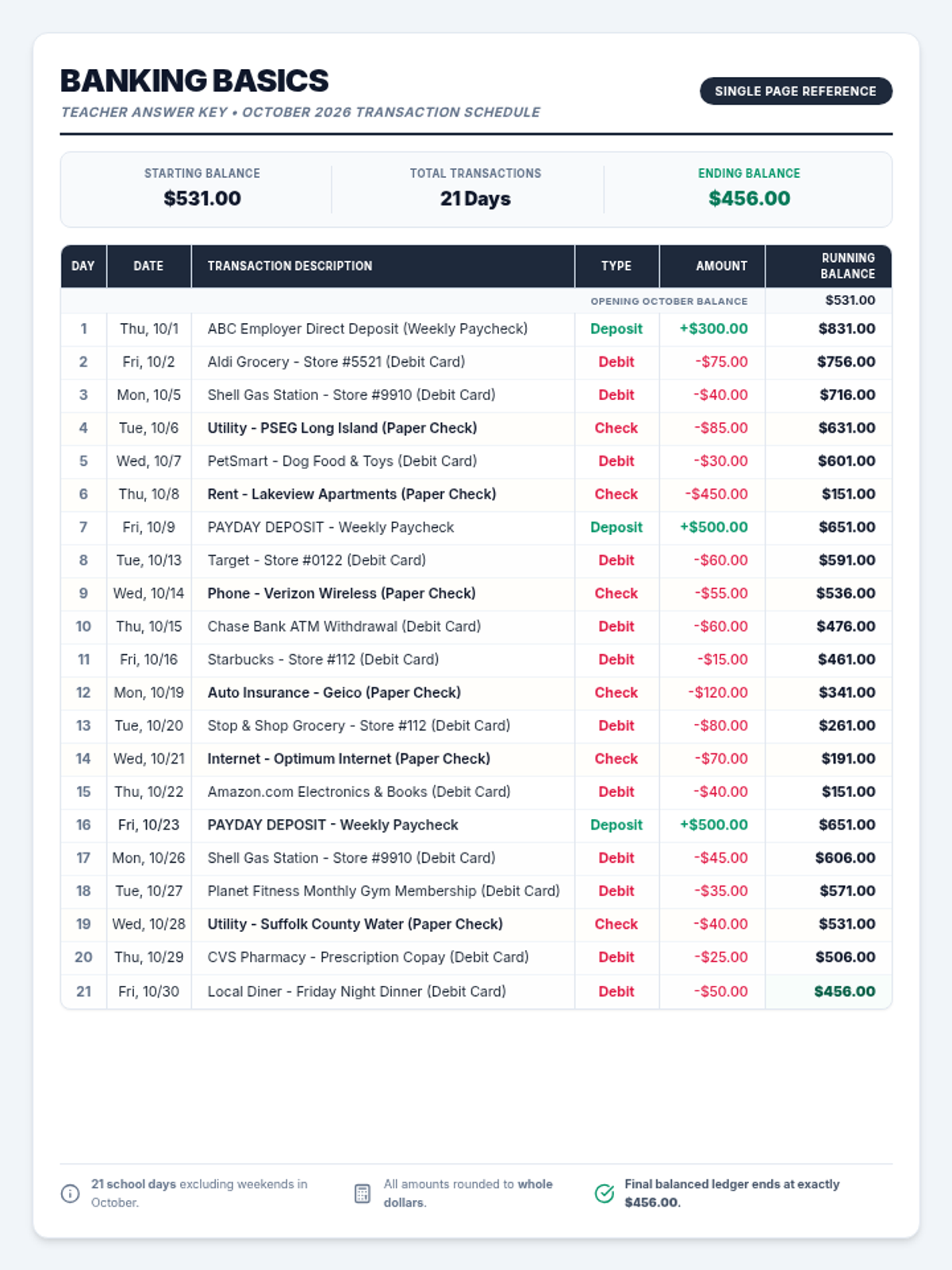
Teacher transaction schedule showing starting and ending balances, list of 21 days of transactions (deposits, checks, debits) for October 2026. Ideal for quick grading and instruction.
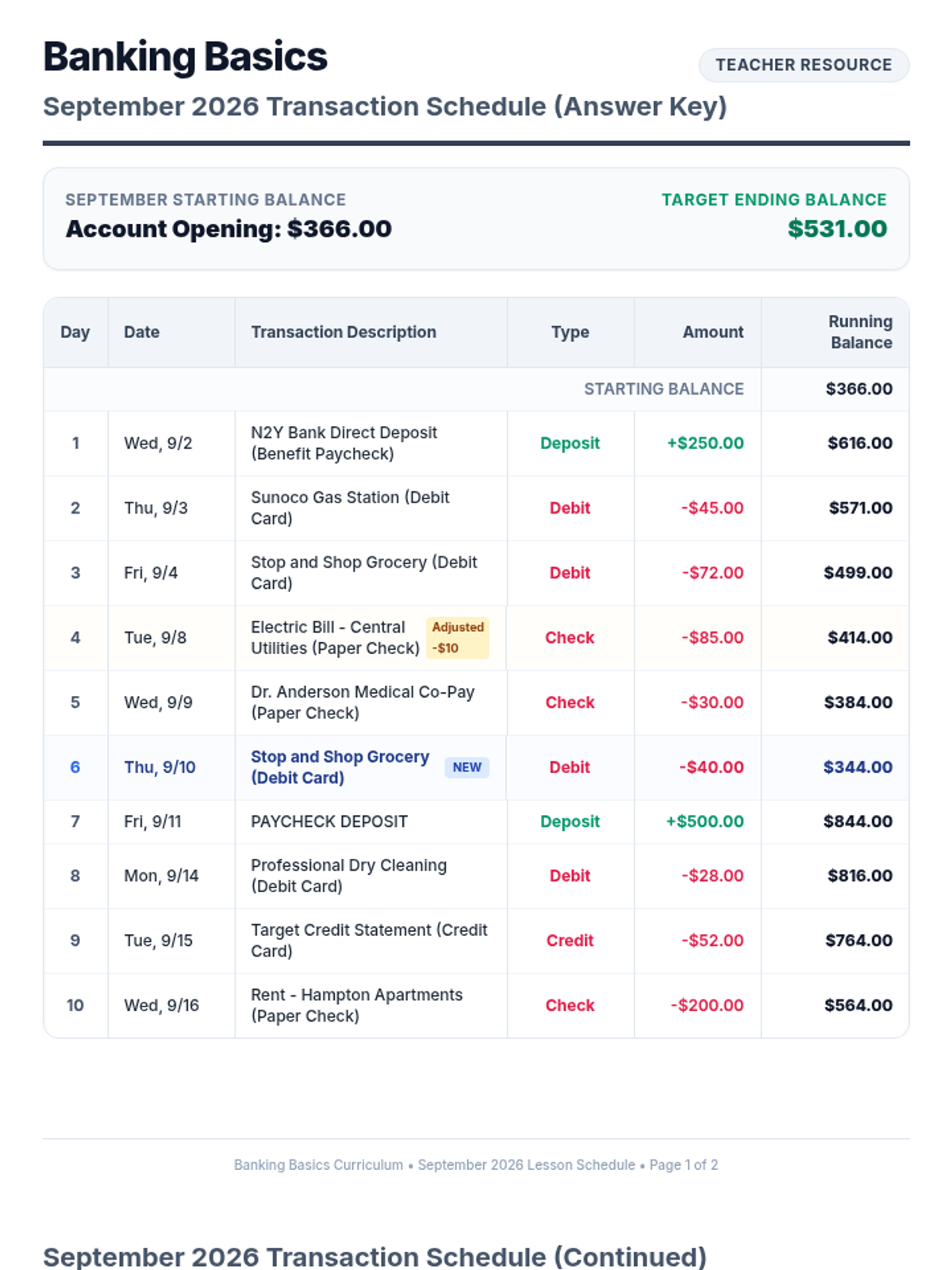
Teacher transaction schedule showing starting and ending balances, list of 19 days of transactions (deposits, checks, debits, credit cards), and curriculum features. Ideal for quick grading and instruction.
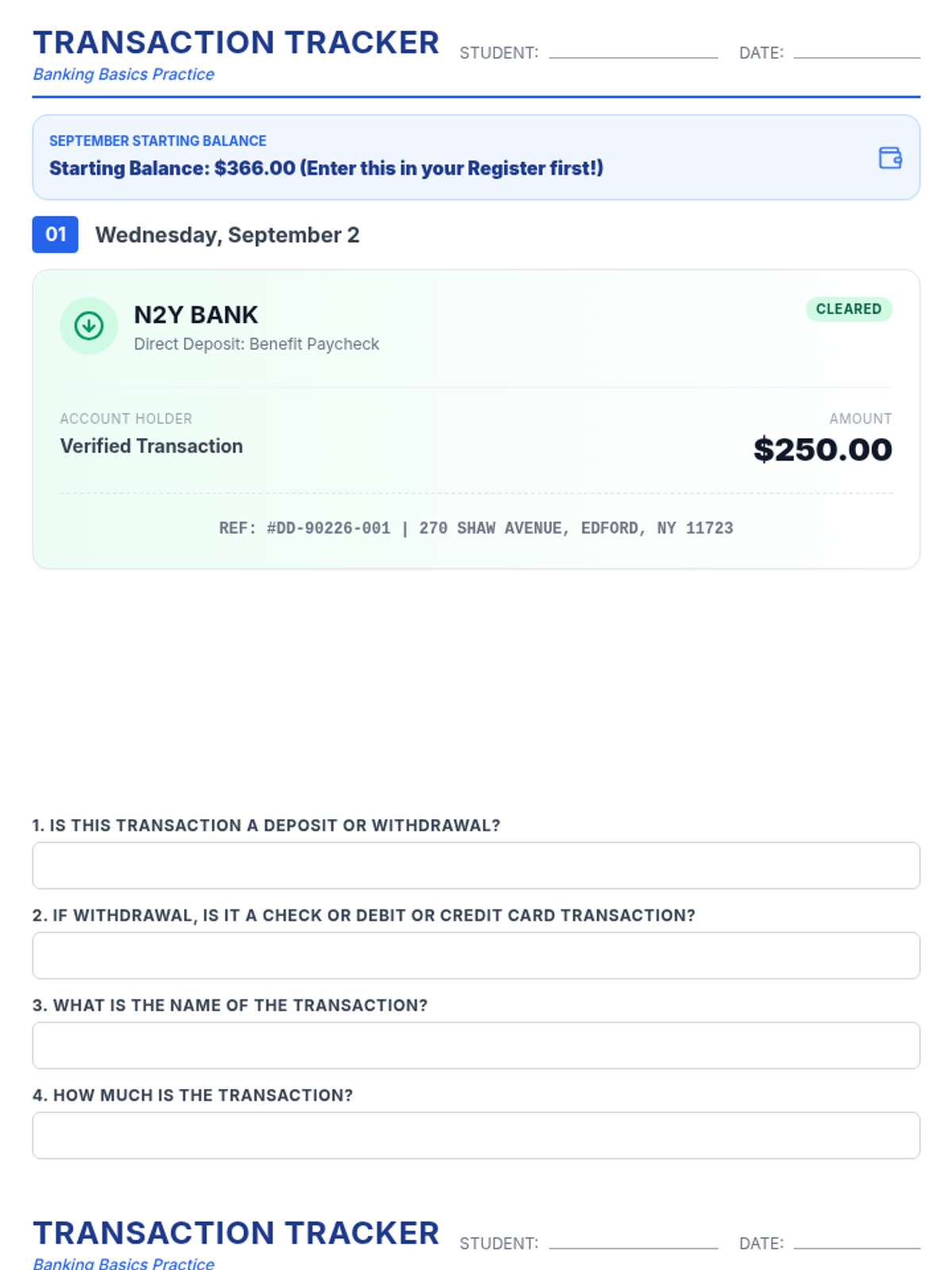
Student transaction tracker worksheets featuring 19 daily financial records (receipts, bills, deposits, and ATM slips) for September 2026. Includes fields for students to record transaction types, payment methods, and exact amounts.
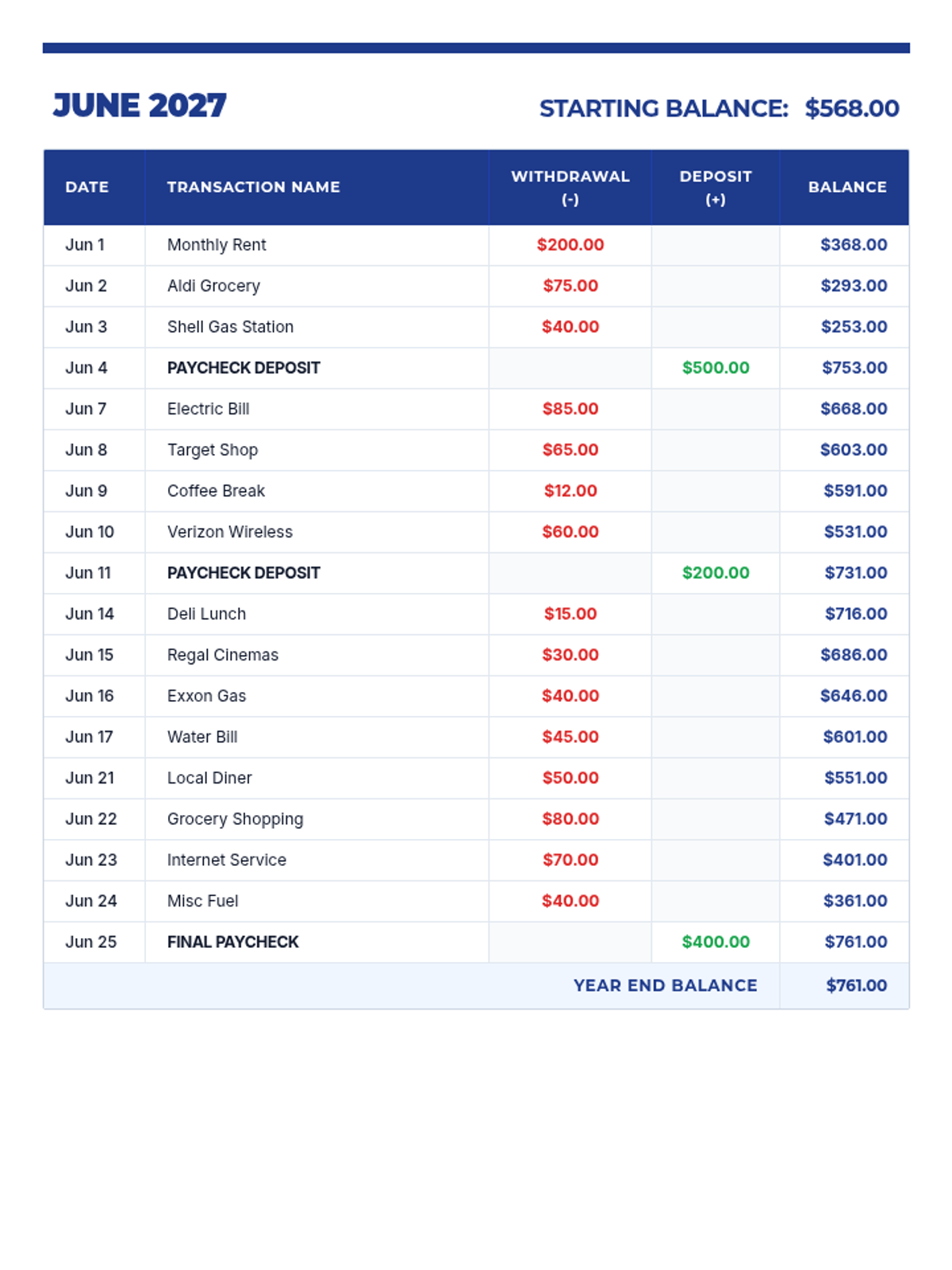
A June 2027 paycheck register formatted to match a professional banking theme, featuring a transaction table with withdrawals, deposits, and a running balance.
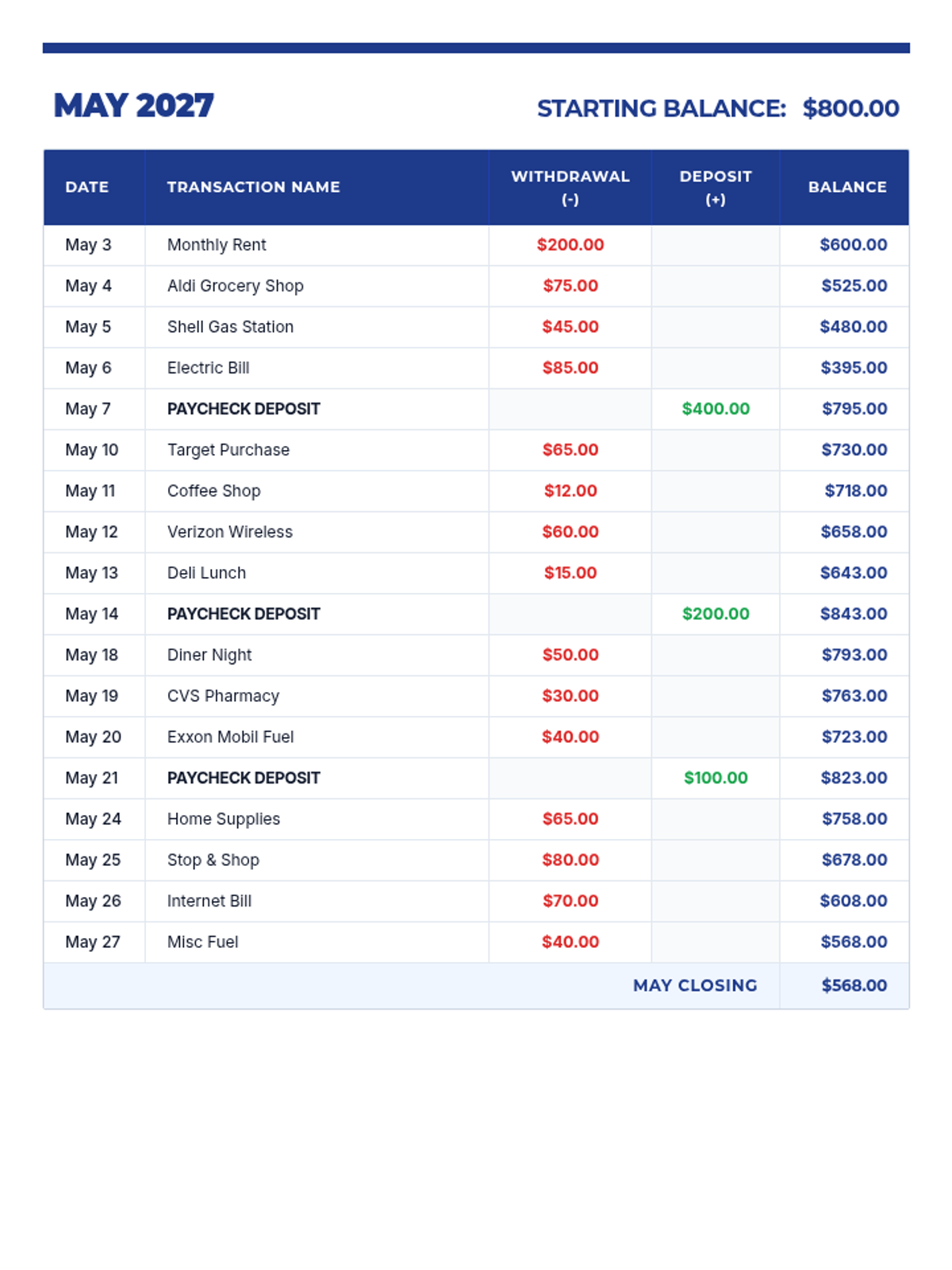
A May 2027 paycheck register formatted to match a professional banking theme, featuring a transaction table with withdrawals, deposits, and a running balance.
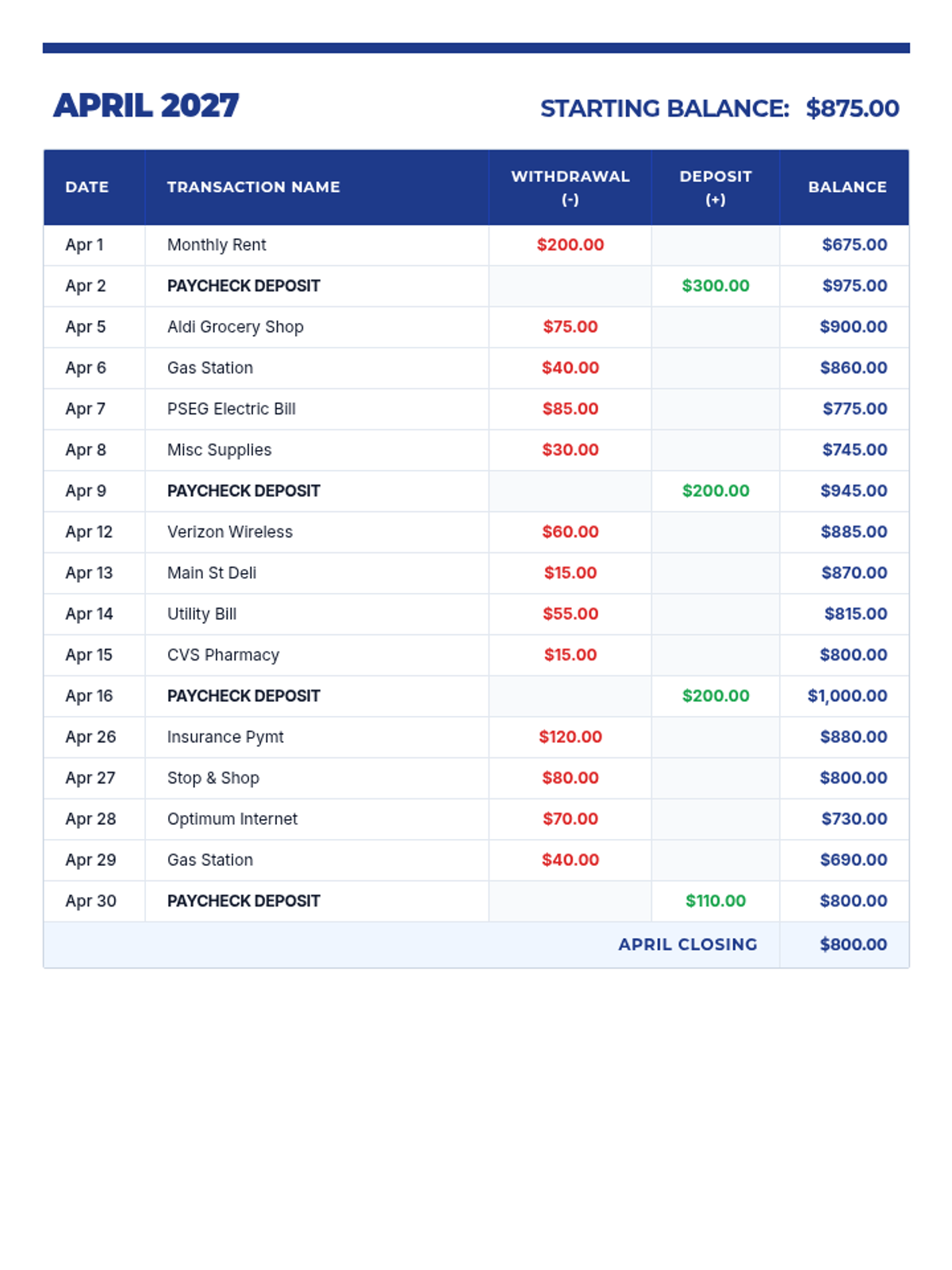
An April 2027 paycheck register formatted to match a professional banking theme, featuring a transaction table with withdrawals, deposits, and a running balance.
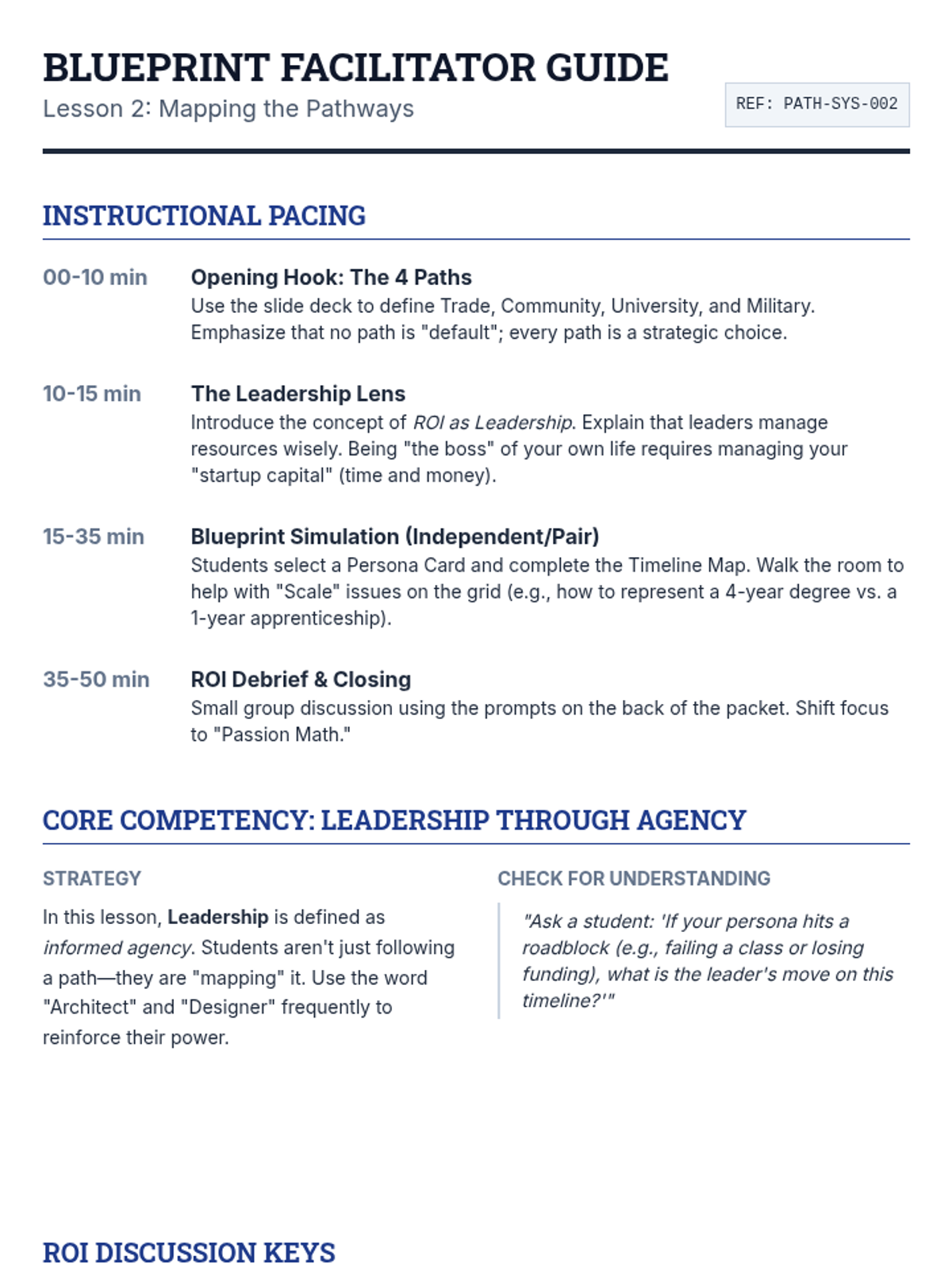
A teacher facilitation guide tailored for an 8th-grade audience. It features a simplified lesson pacing guide, discussion keys for financial scenarios, and strategies for teaching leadership as personal agency.
A slide deck for 8th graders explaining post-secondary paths, the concept of ROI, and instructions for the character planning activity. Simplified language and clear visuals ensure high-level concepts are accessible.
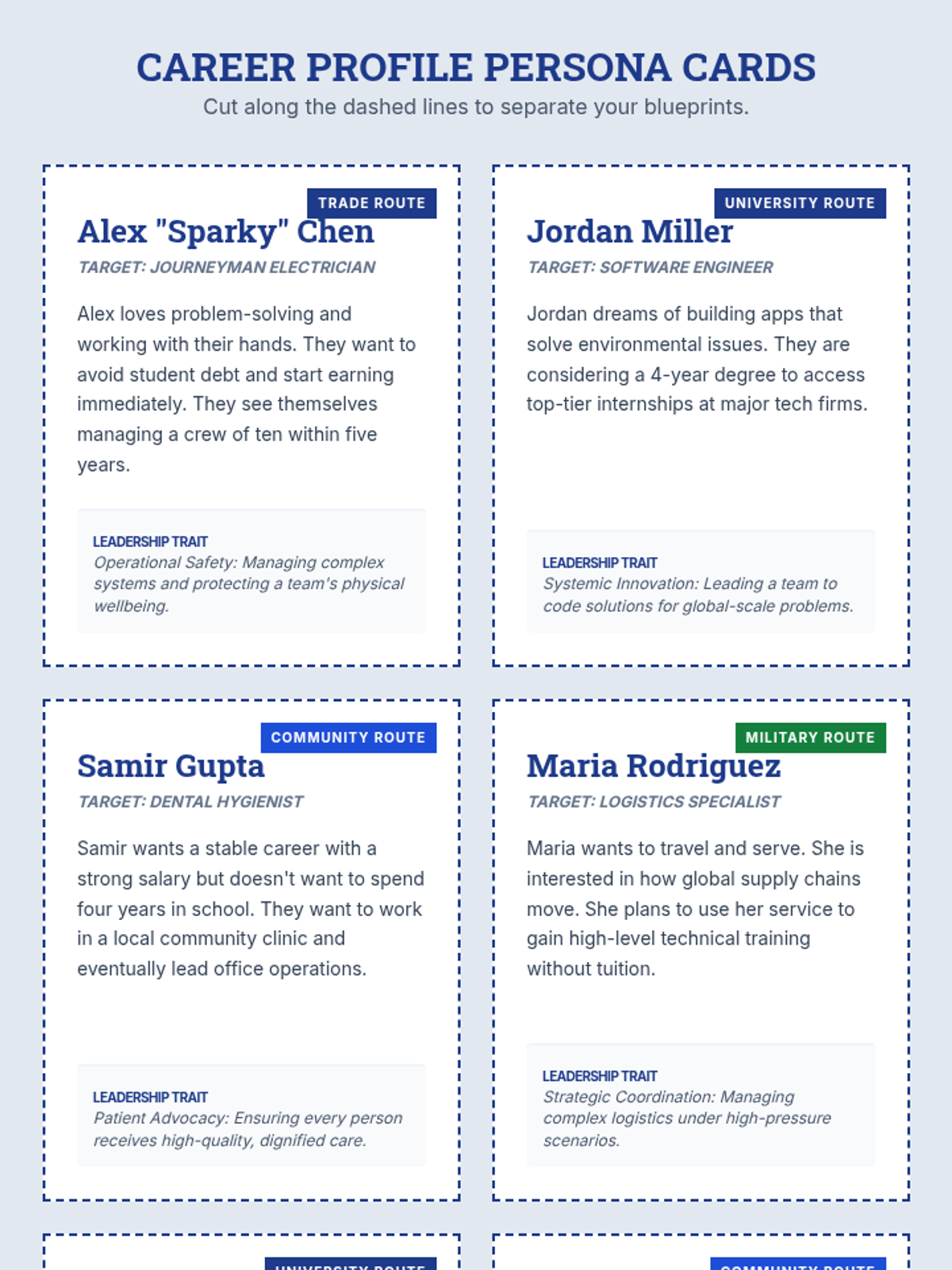
A set of simplified character cards for an 8th-grade career simulation. Each card features a person with a specific goal, a suggested path after high school, and a leadership trait explained in simple language. Updated to fix label overlaps, text legibility, and added cut-line margins.
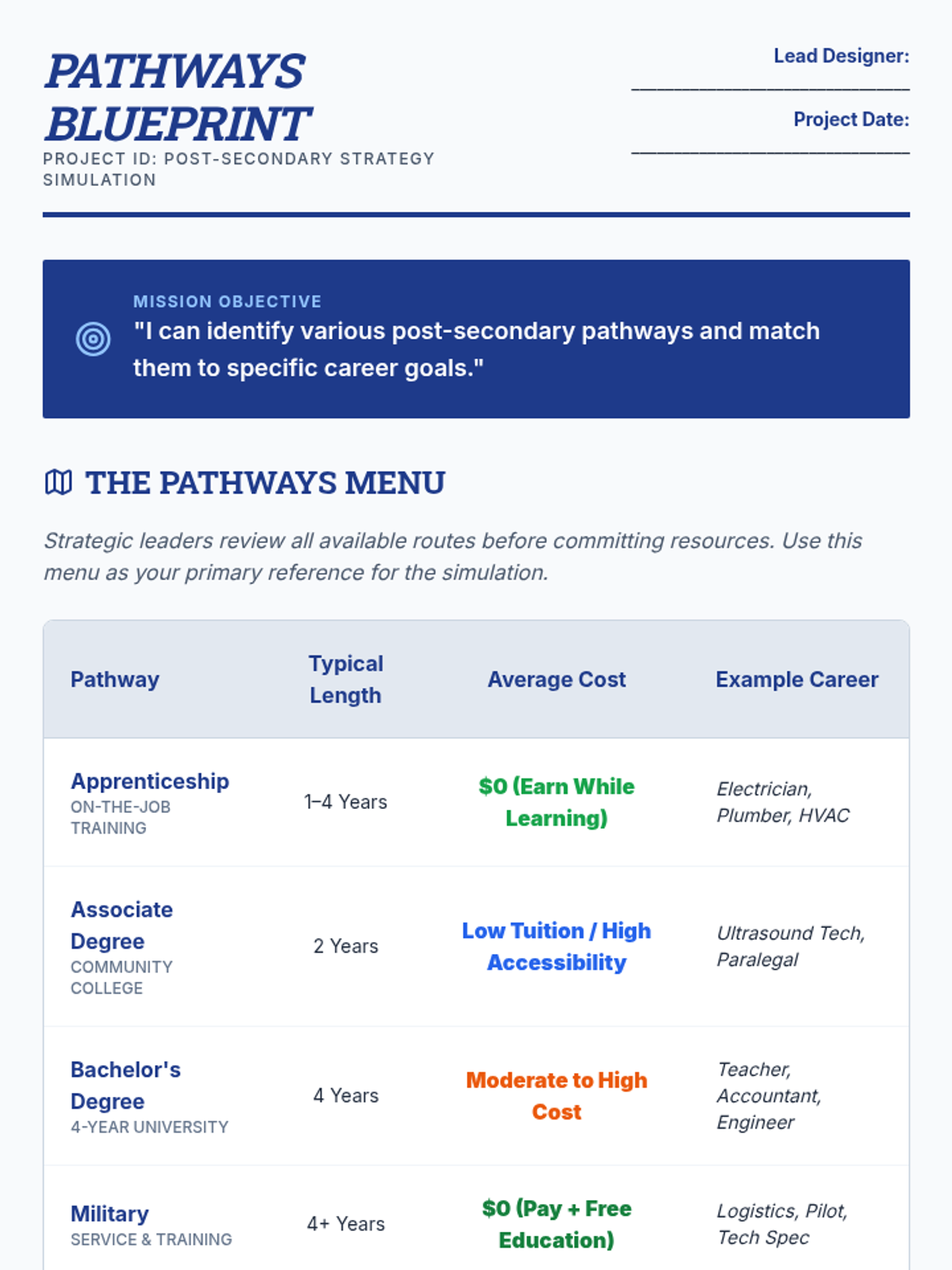
A student activity packet designed with a blueprint aesthetic for 8th graders. It includes a simplified post-secondary choice menu, a character planning workspace, a timeline map, and reflection questions about financial choices and leadership. Updated to fix page breaks, lightened watermark, and added writing lines.
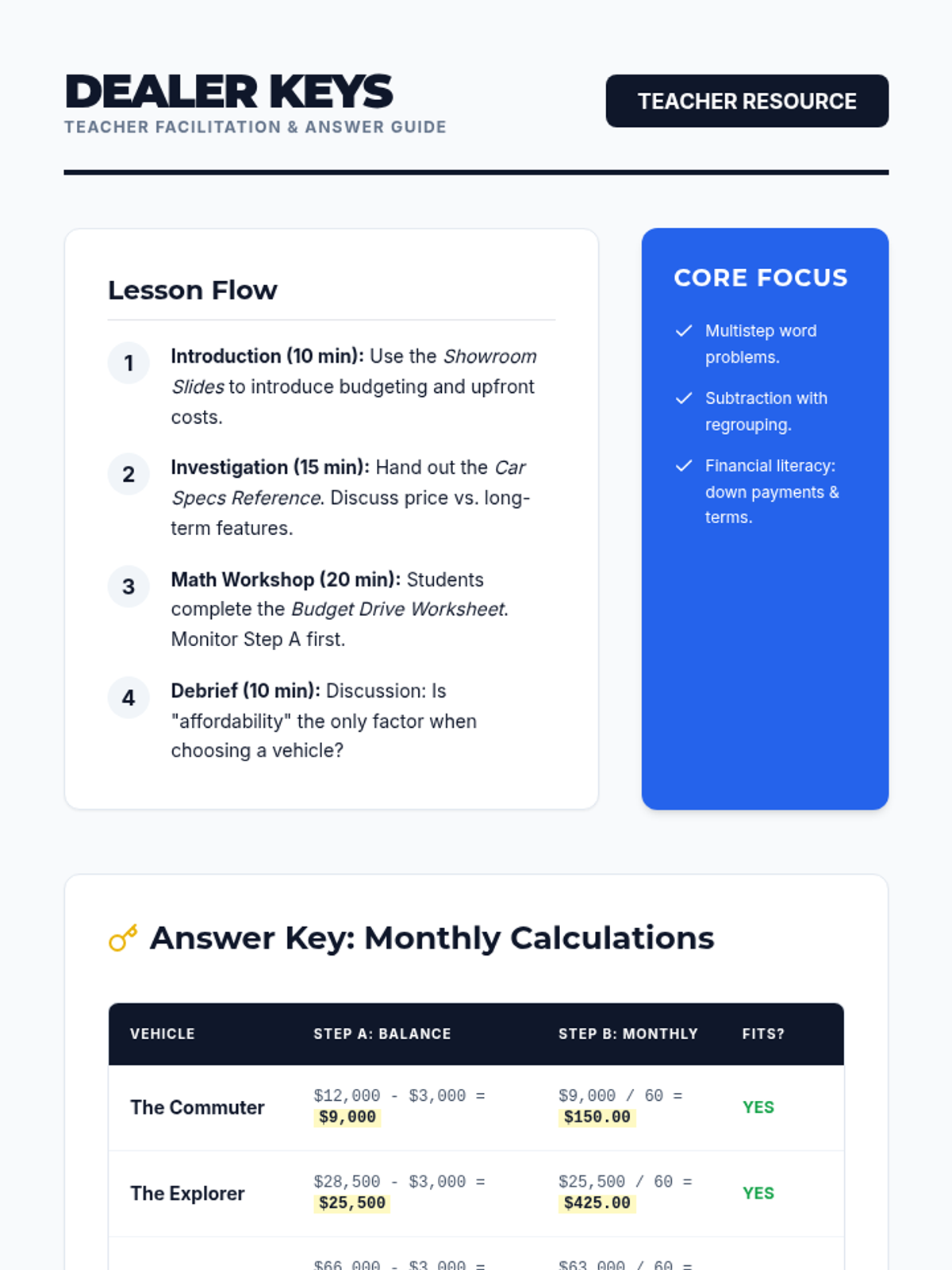
A teacher-facing facilitation guide including the lesson flow, student learning objectives, and a complete answer key for the vehicle calculations.
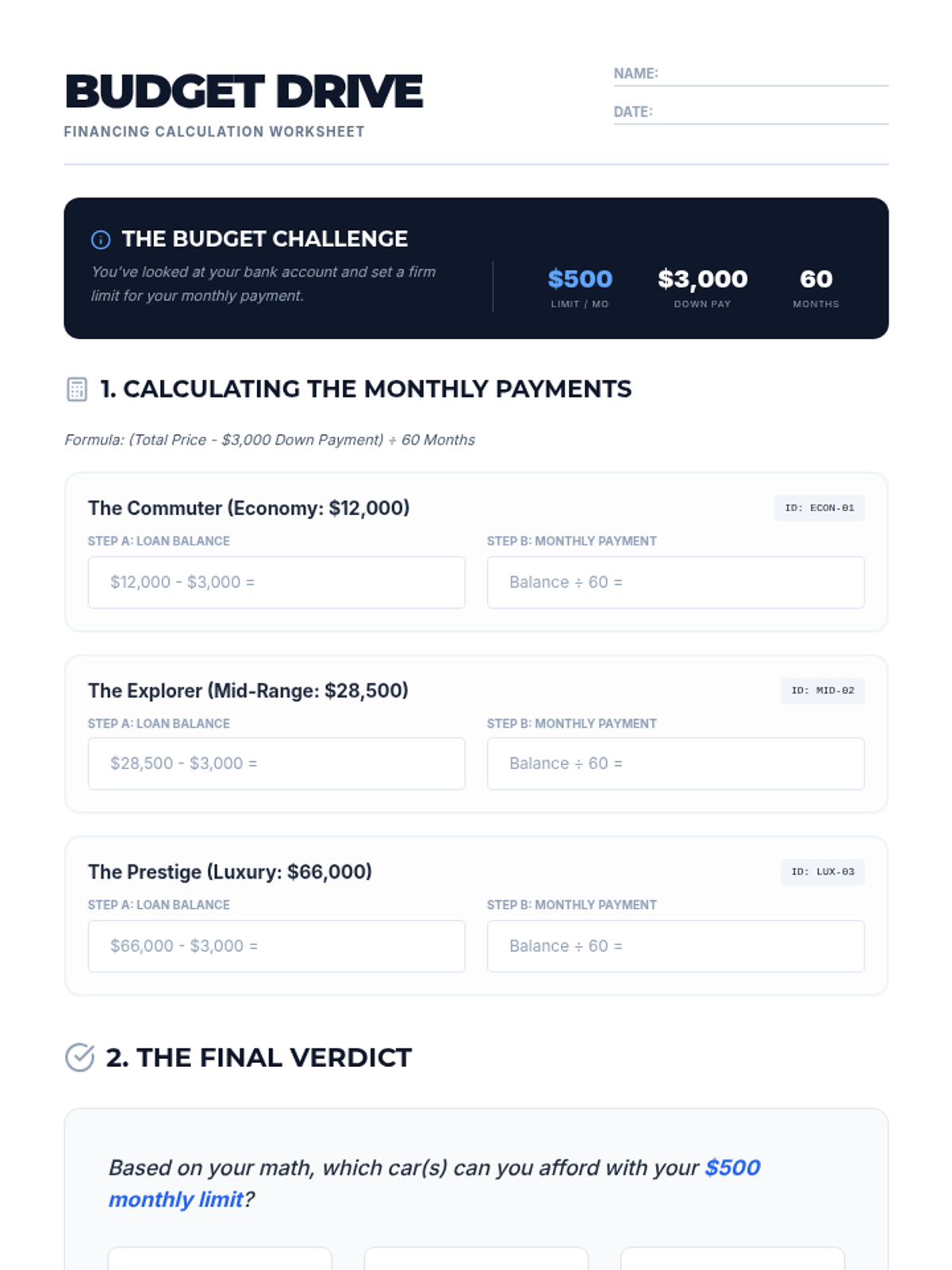
A calculation worksheet where students subtract a down payment from car prices and divide by the loan term to determine which vehicles fit their $500 monthly budget.
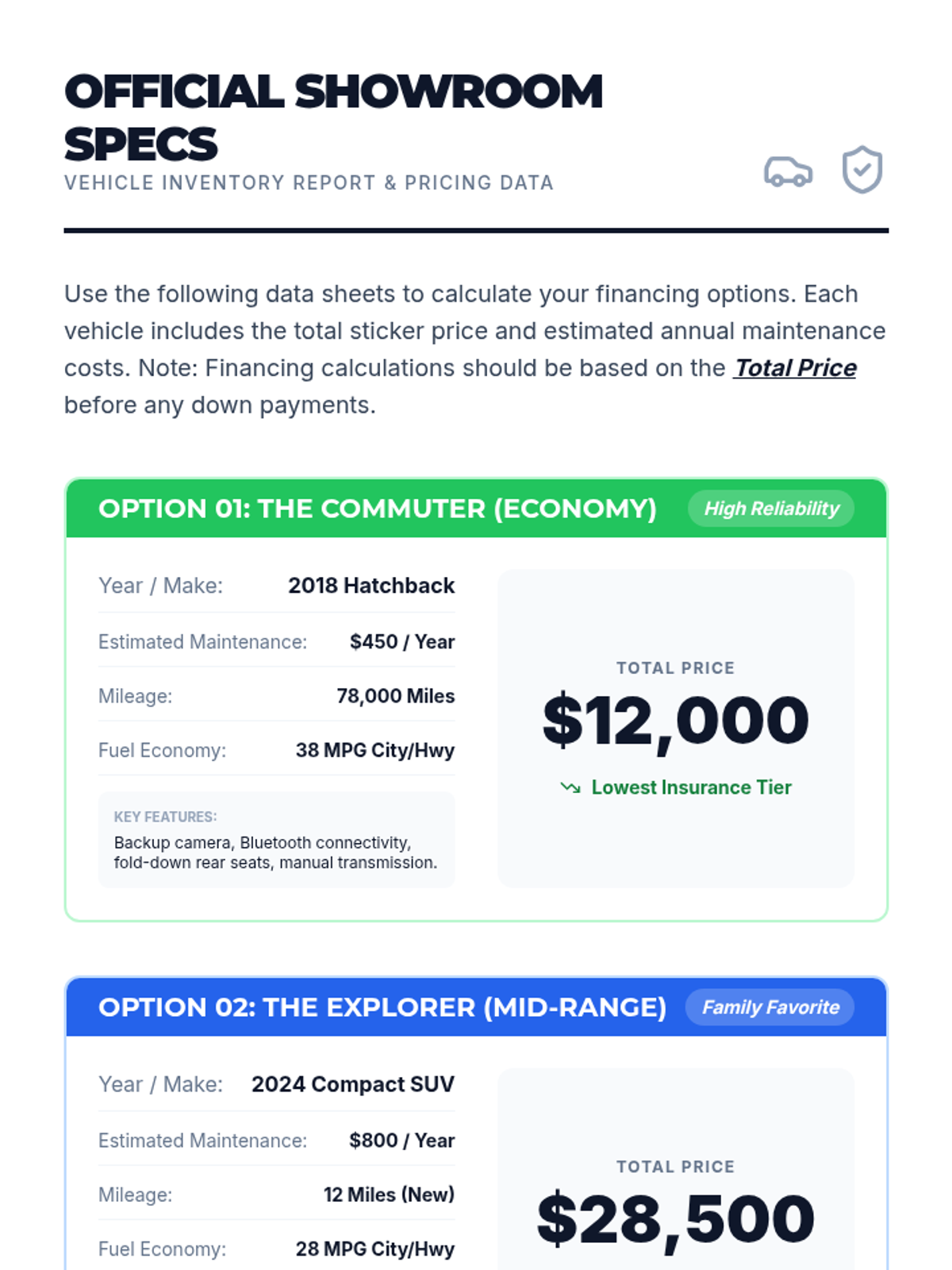
A detailed technical reference sheet providing specifications, pricing, and features for the three car options (Economy, Mid-Range, and Luxury).
A visual presentation introducing students to three car options, the monthly payment formula, and the specific budget challenge for the lesson.
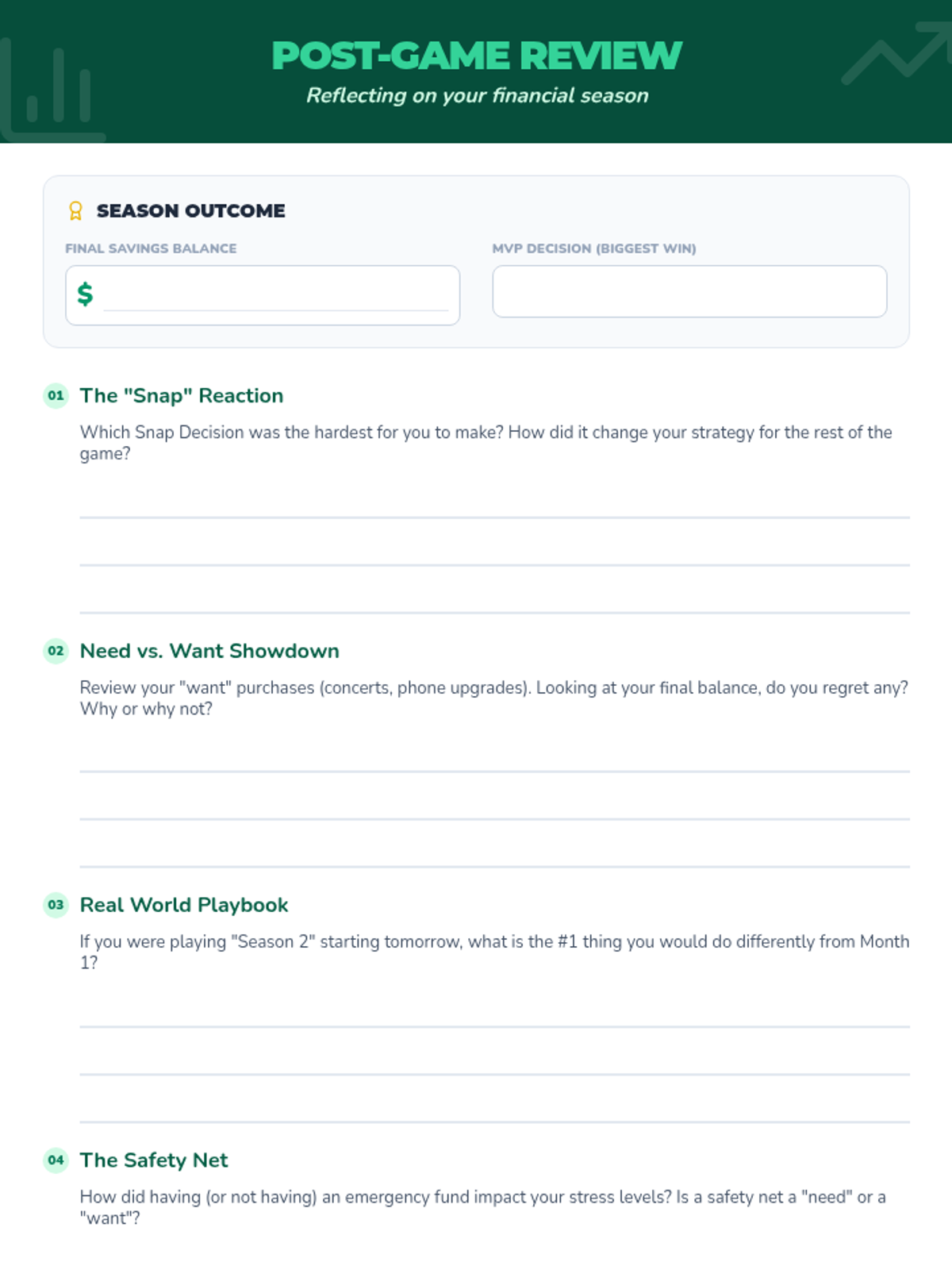
Reflection journal for students after completing the Prosperity Playbook simulation. Encourages analysis of financial choices, risk management, and future goal setting.
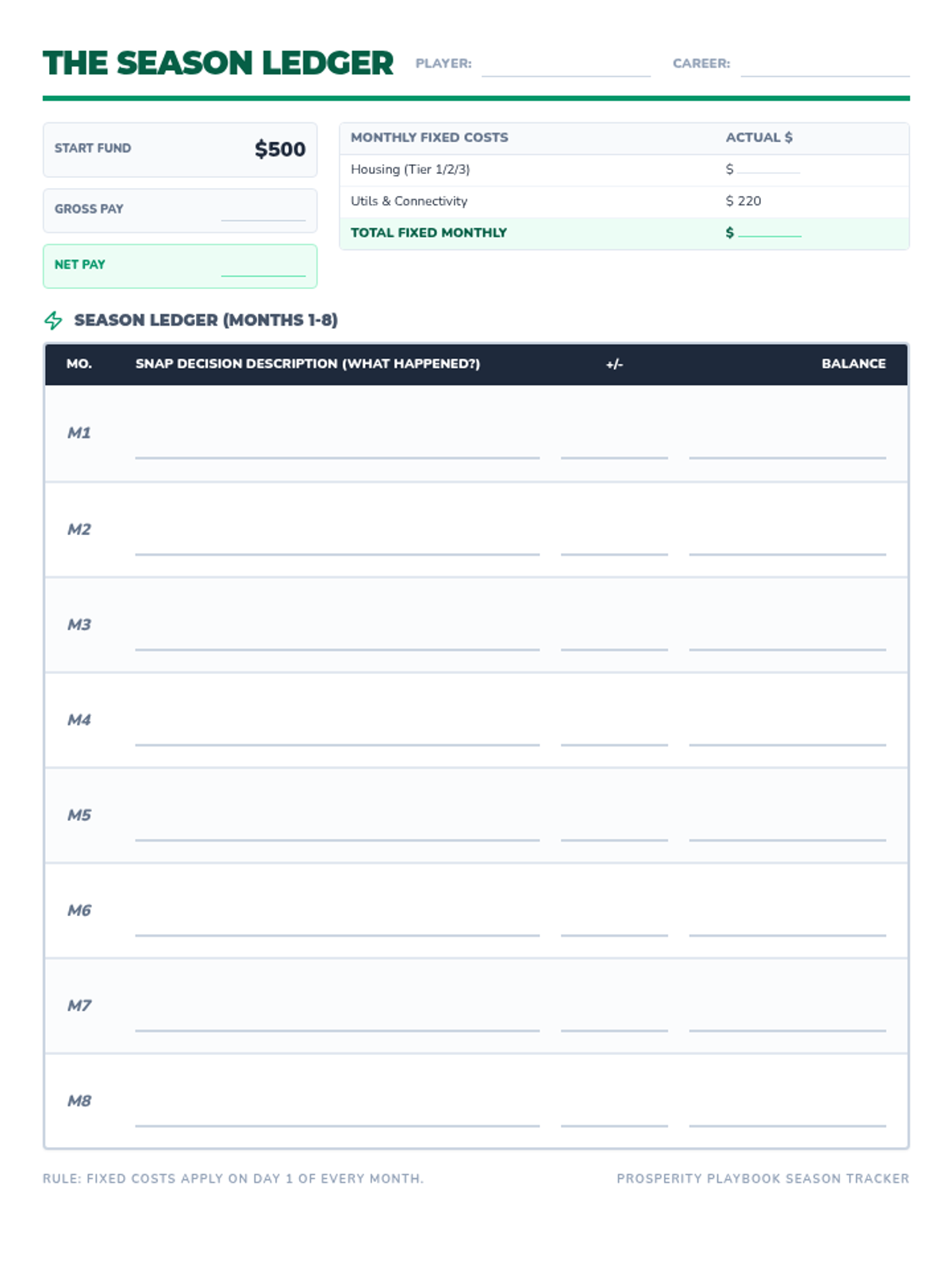
Student budgeting worksheet for the Prosperity Playbook simulation. Features an income calculator, fixed expense tracker, and a monthly ledger for recording snap decisions.
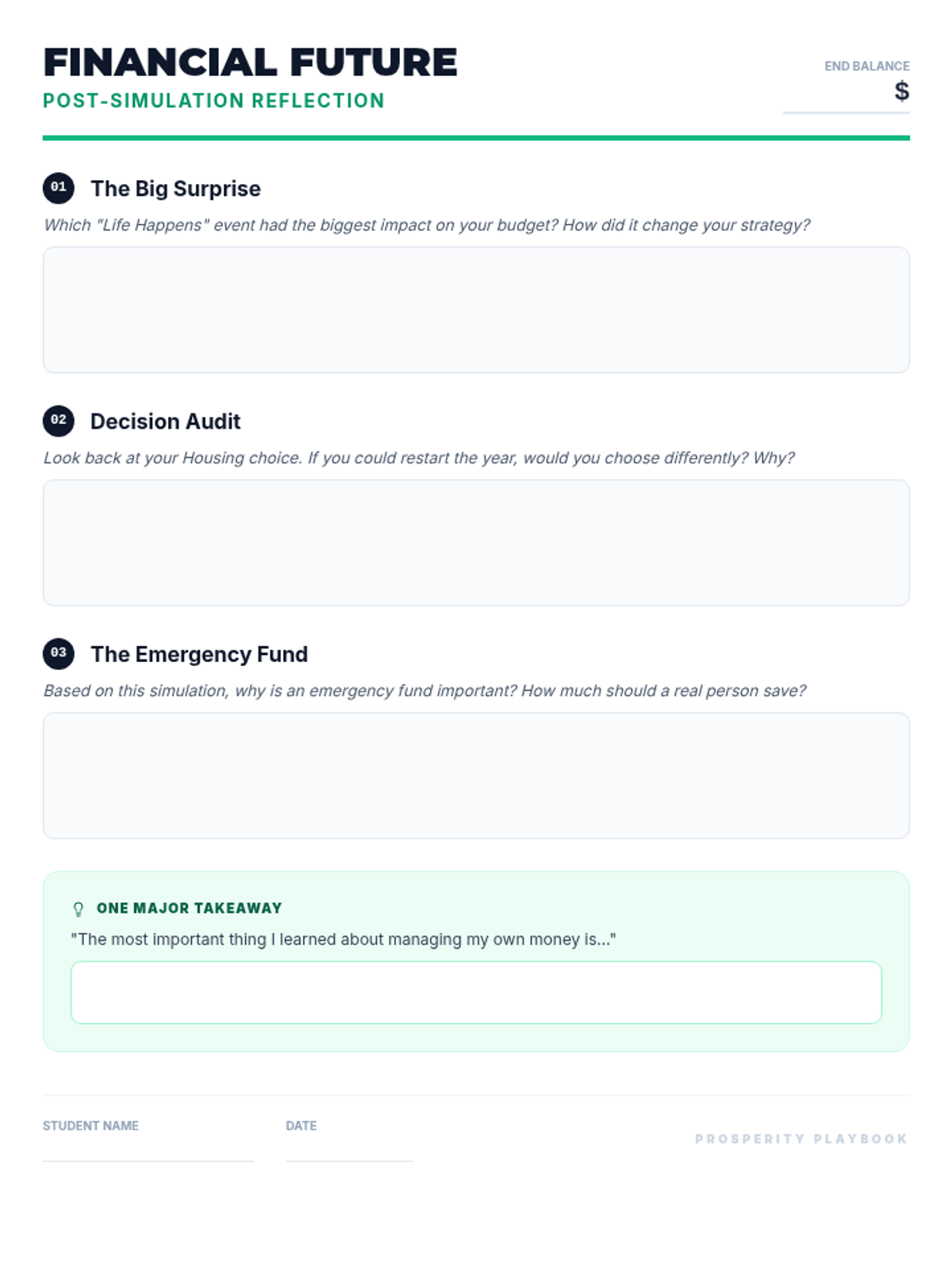
A condensed, single-page reflective journal for students to analyze their simulation results.
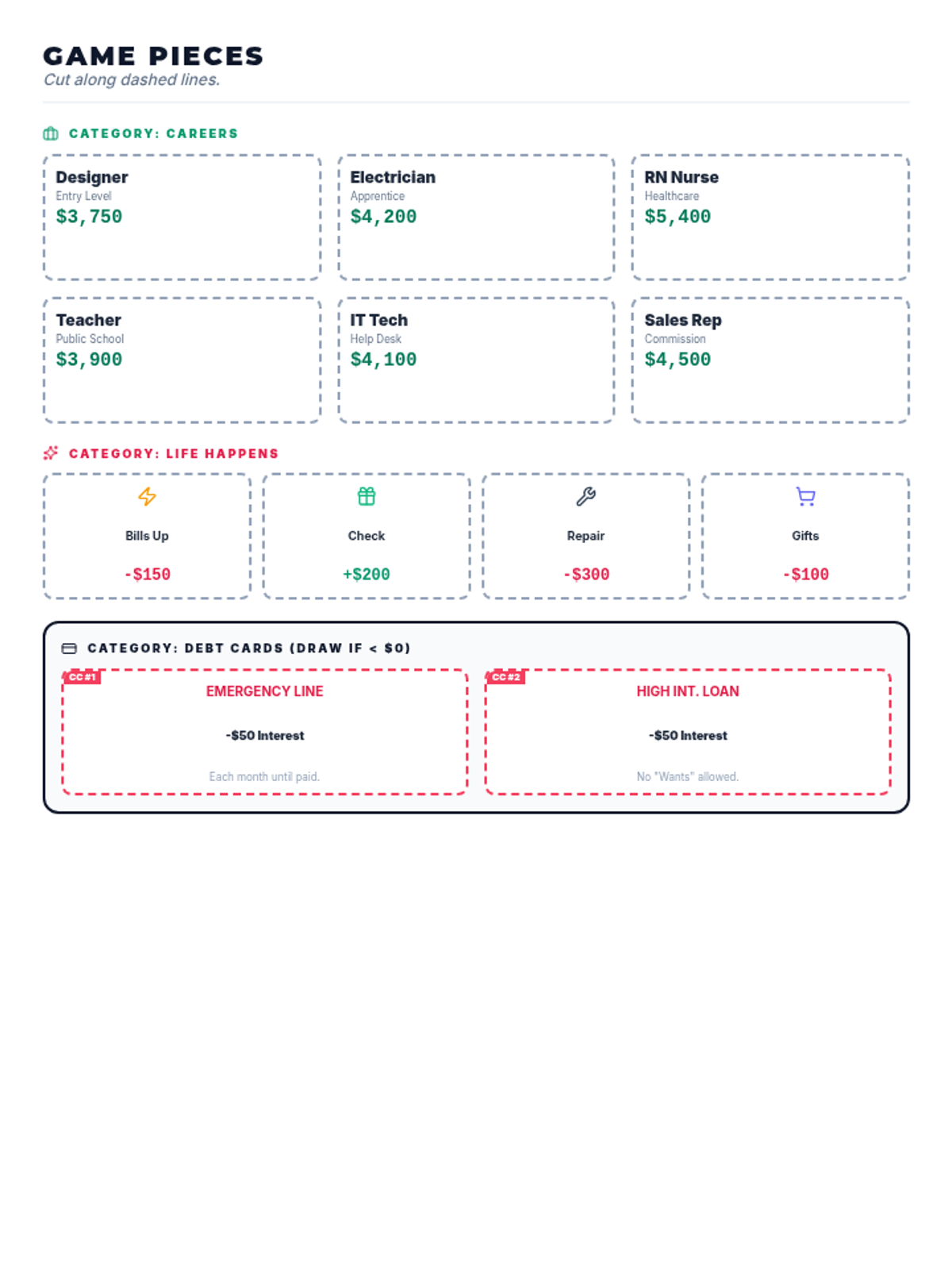
Revised printable game pieces for the Prosperity Playbook, including Career Cards, Life Happens cards, and Credit Card debt tokens.
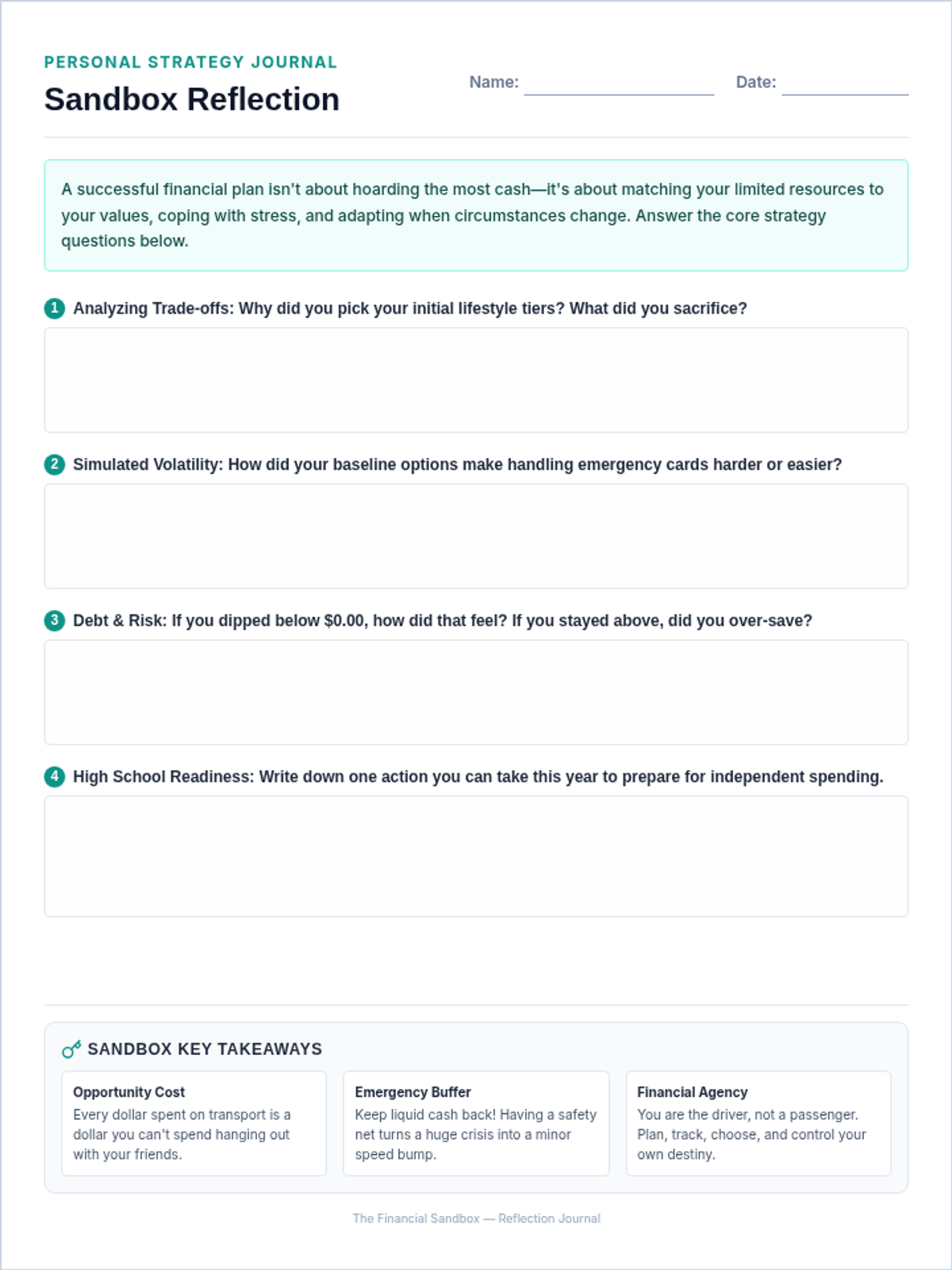
A printable 1-page student reflection journal featuring guided high school transition prompts, opportunity-cost analysis, and strategic personal planning.
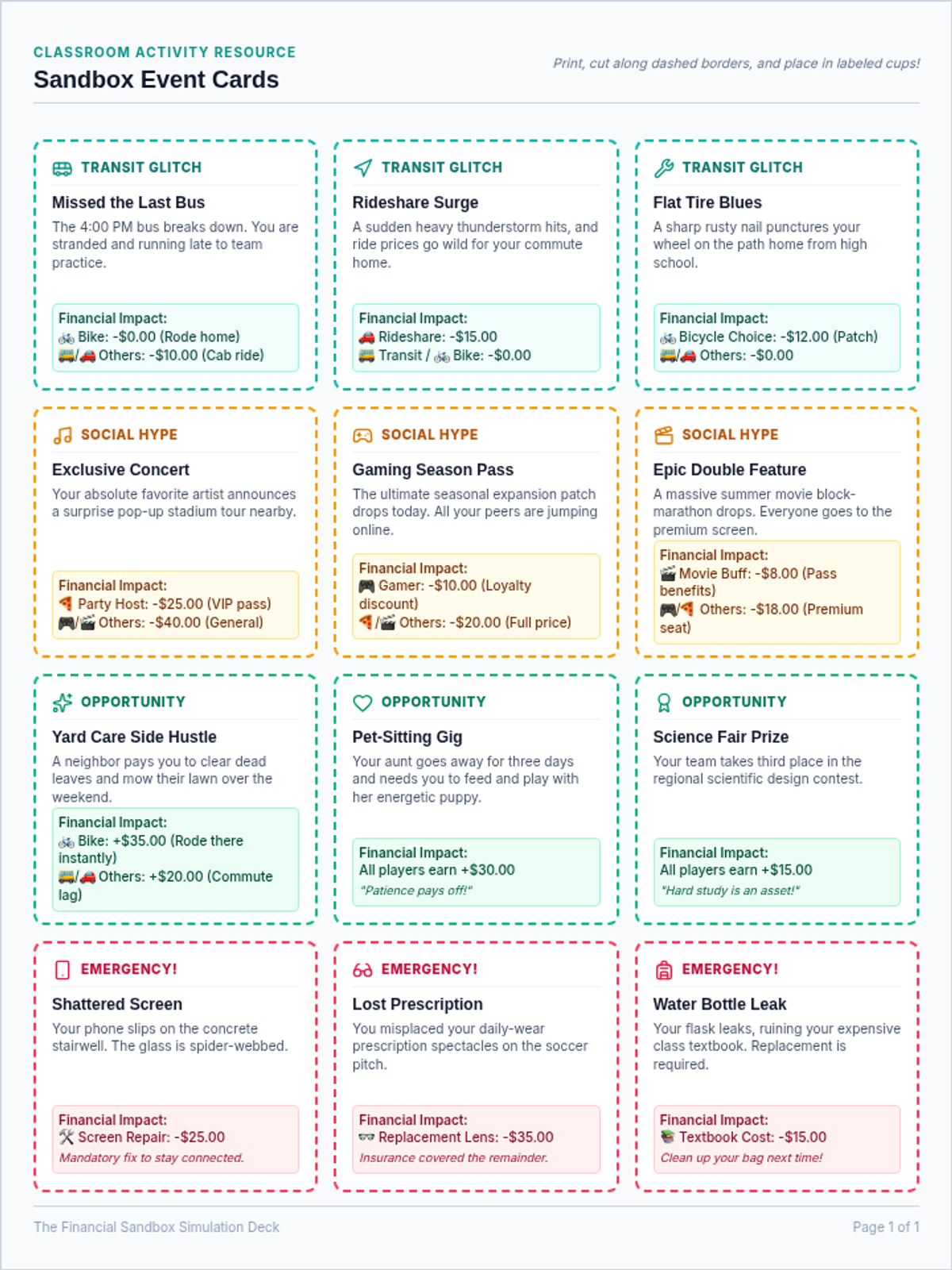
A printable 1-page activity sheet containing 12 double-sided simulation scenario cards with storytelling text, financial impacts, and choice-based conditional multipliers.
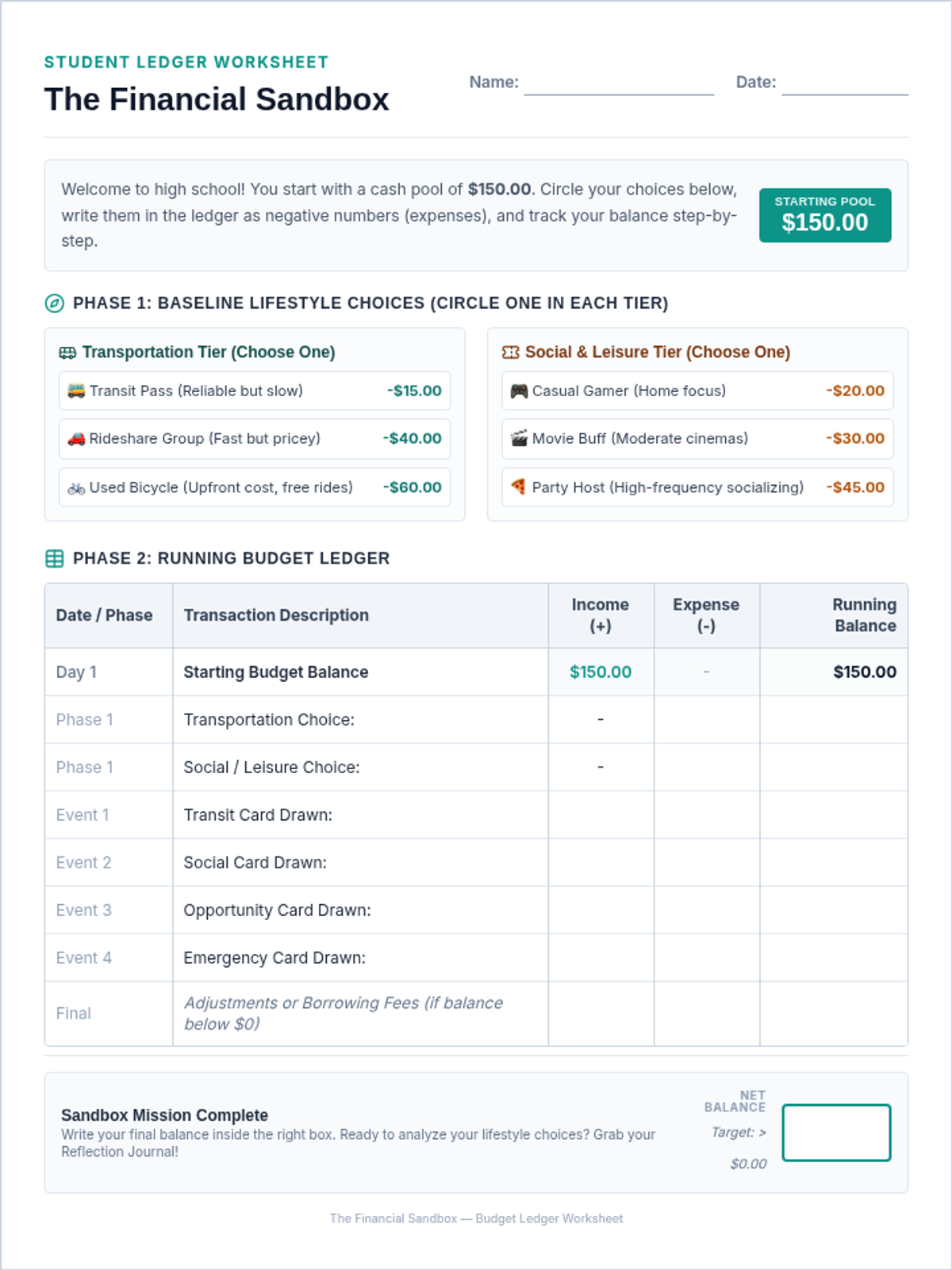
A printable 1-page student budget ledger worksheet with baseline choices, and an elegant ledger table to track cash flow and calculate balances.
A visually engaging 5-slide presentation introducing students to the high school transition, budget rules, lifestyle choices, and unexpected simulation events.
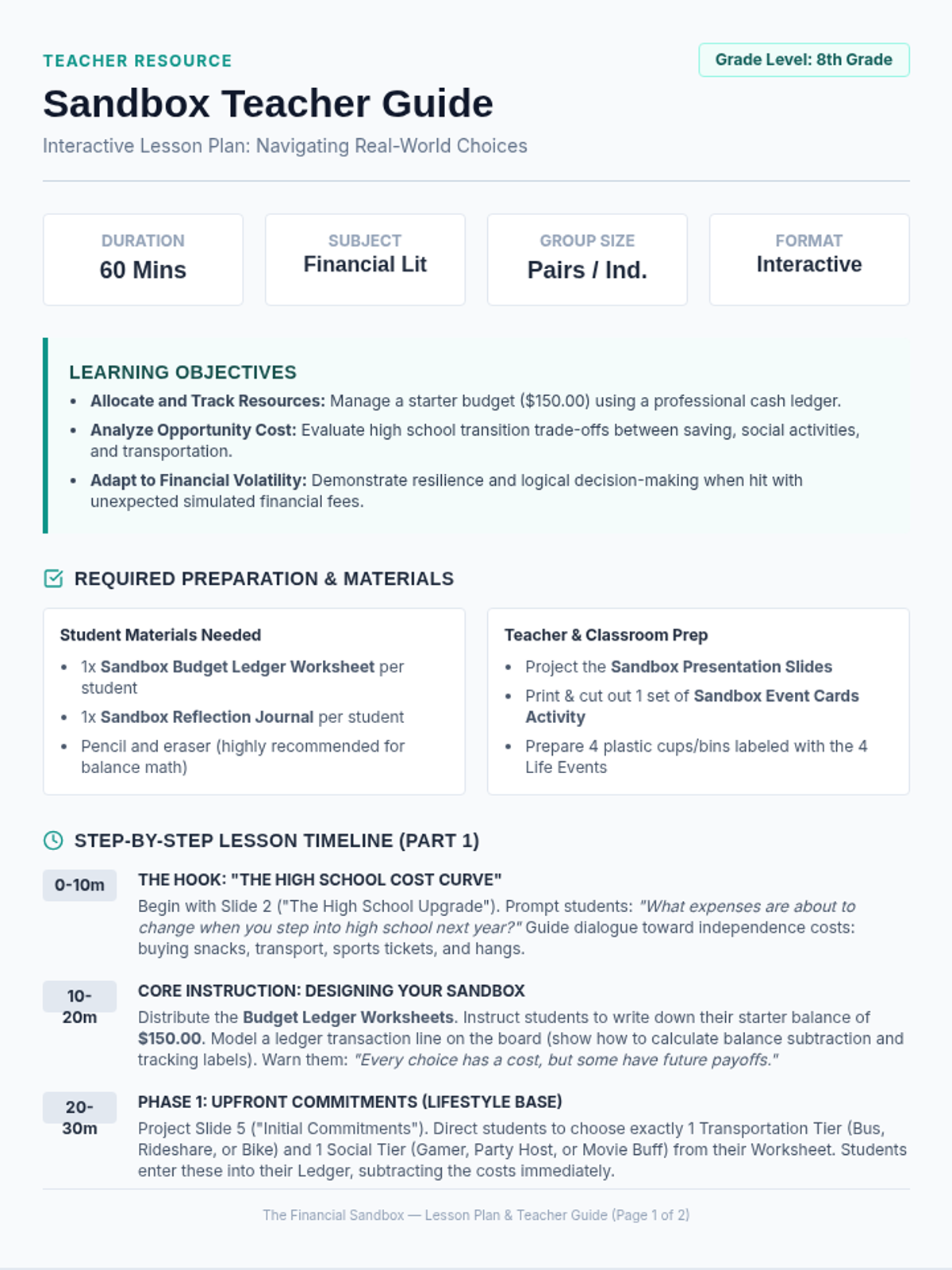
A comprehensive 2-page teacher guide outlining lesson objectives, materials, step-by-step facilitation for the simulation, and grading guidance.
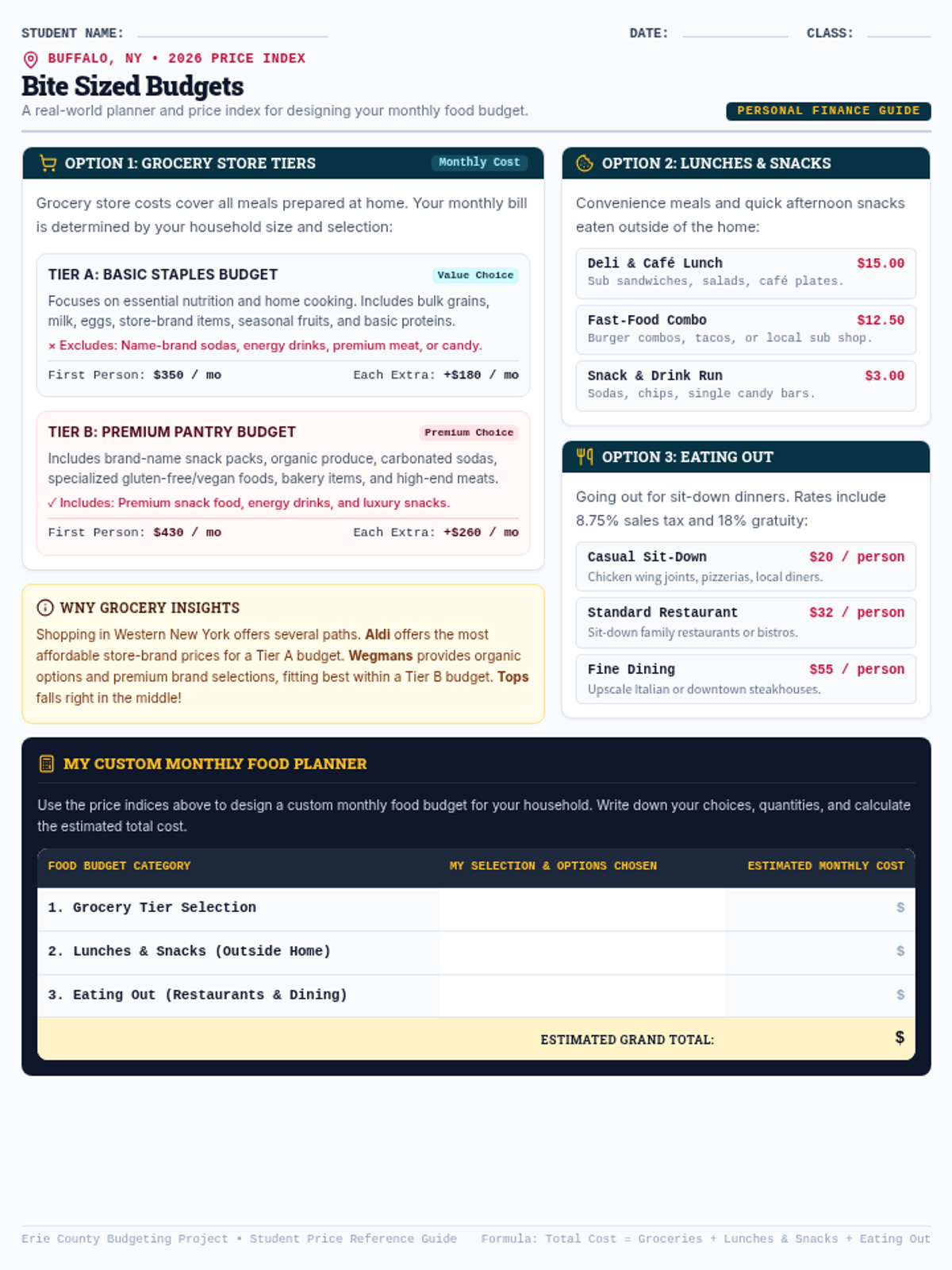
An 8th-grade budgeting reference guide and financial food planner. Features real-world grocery, snack, and dining out costs for Buffalo, NY in 2026 without algebraic equations, focusing instead on option tiers and arithmetic calculations. Includes a blank budget-builder worksheet table for student planning.
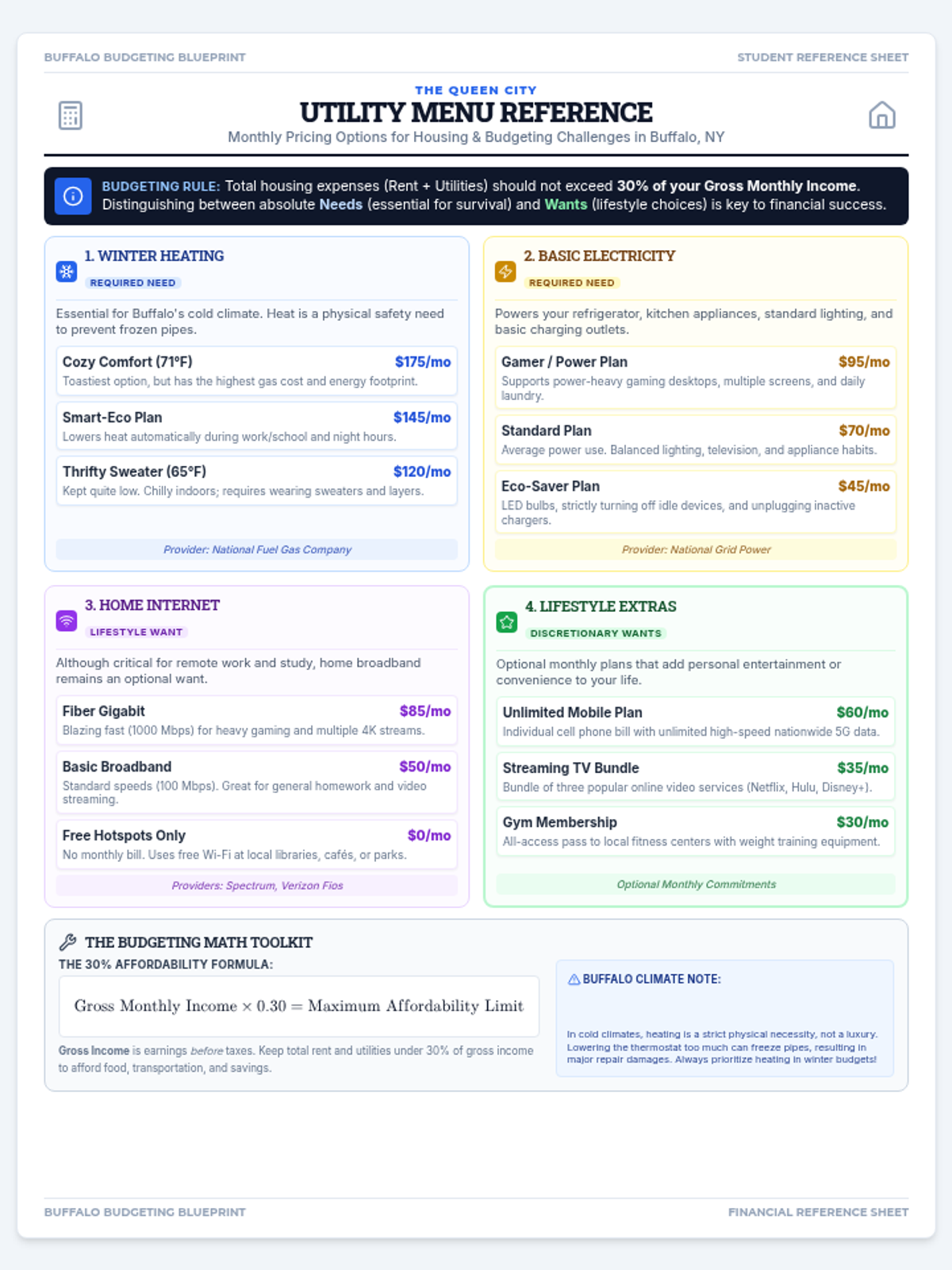
An elegant and highly visual one-page reference sheet for the Queen City Utility Menu. This handout outlines monthly cost options for Winter Heating, Basic Electricity, Home Internet, and Lifestyle Extras in Buffalo, NY, along with budgeting formulas and winter utility reminders.
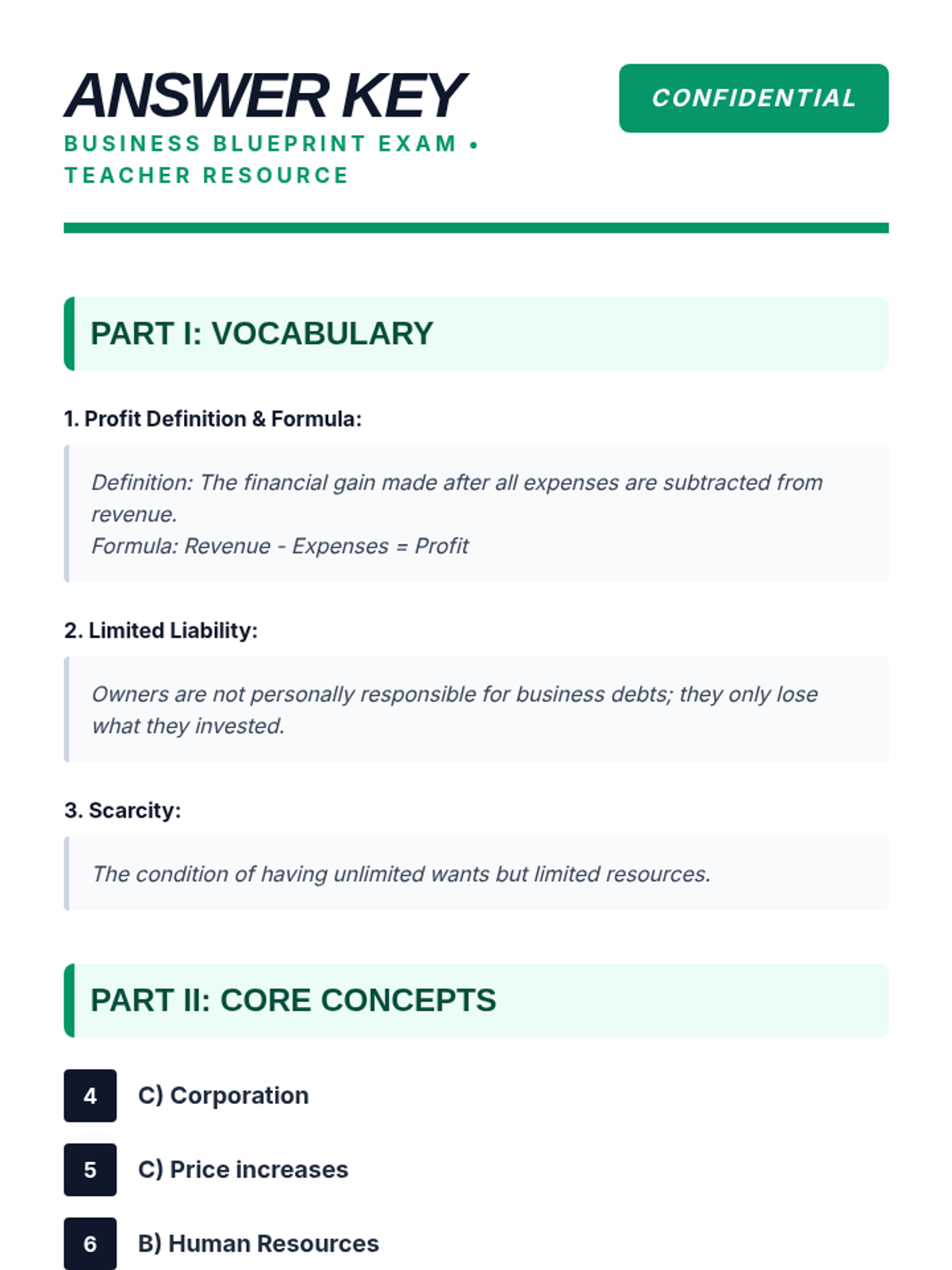
A teacher's answer key for the Business Blueprint Exam, providing clear grading criteria and sample responses.
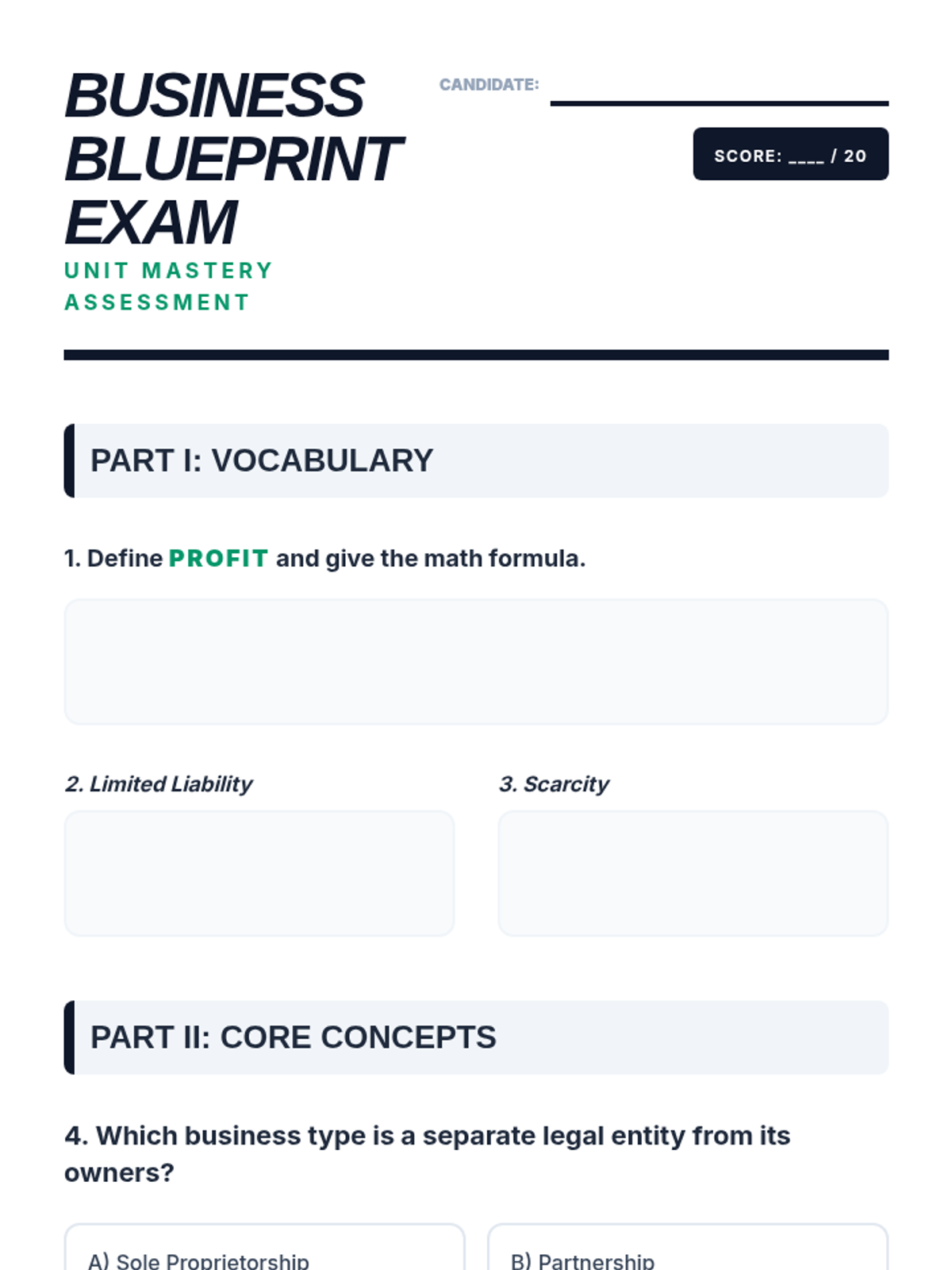
A final summative assessment covering all key concepts from the Business Blueprint unit, including vocabulary, economic principles, ownership models, and business departments.
A quick review slide deck to reinforce key concepts from the 5-day business unit before the final assessment.
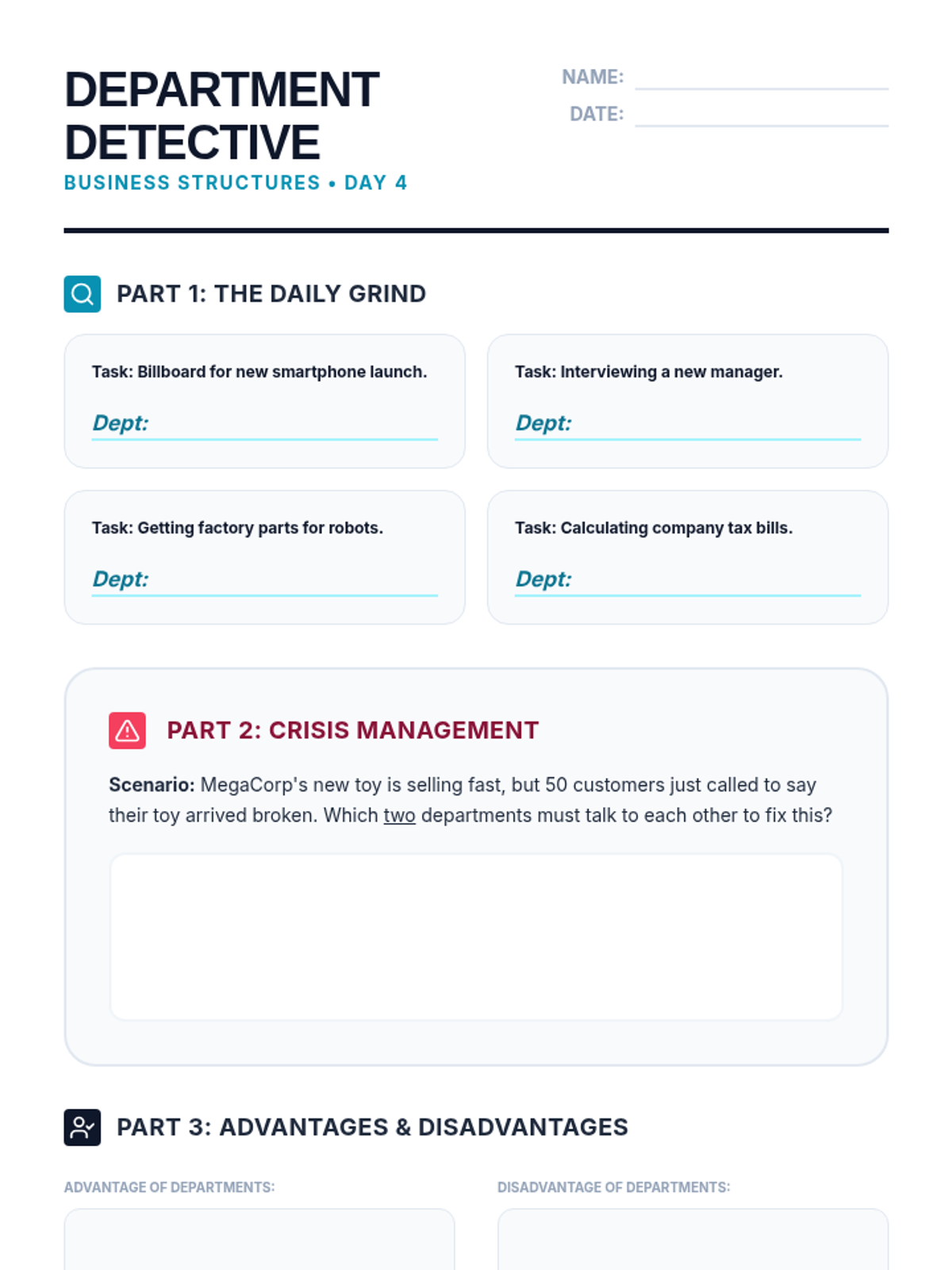
A worksheet where students identify business departments based on specific tasks and solve an organizational problem.
A slide deck exploring the various internal departments of a business, including Marketing, Finance, Operations, and Human Resources.
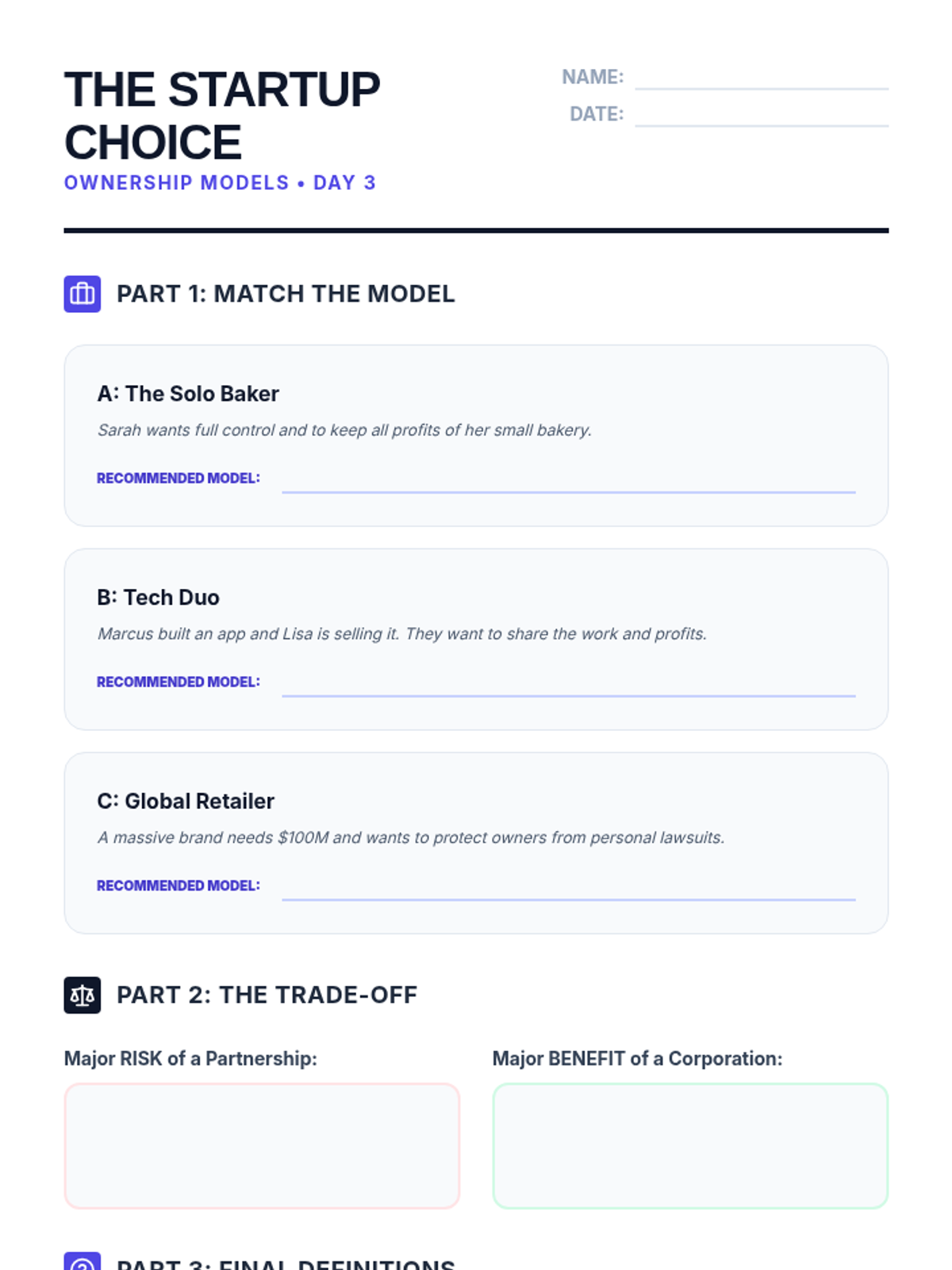
A worksheet where students analyze business scenarios to determine the best legal structure and evaluate the pros and cons of different ownership models.
A slide deck comparing the three primary legal structures of business ownership: sole proprietorship, partnership, and corporation.
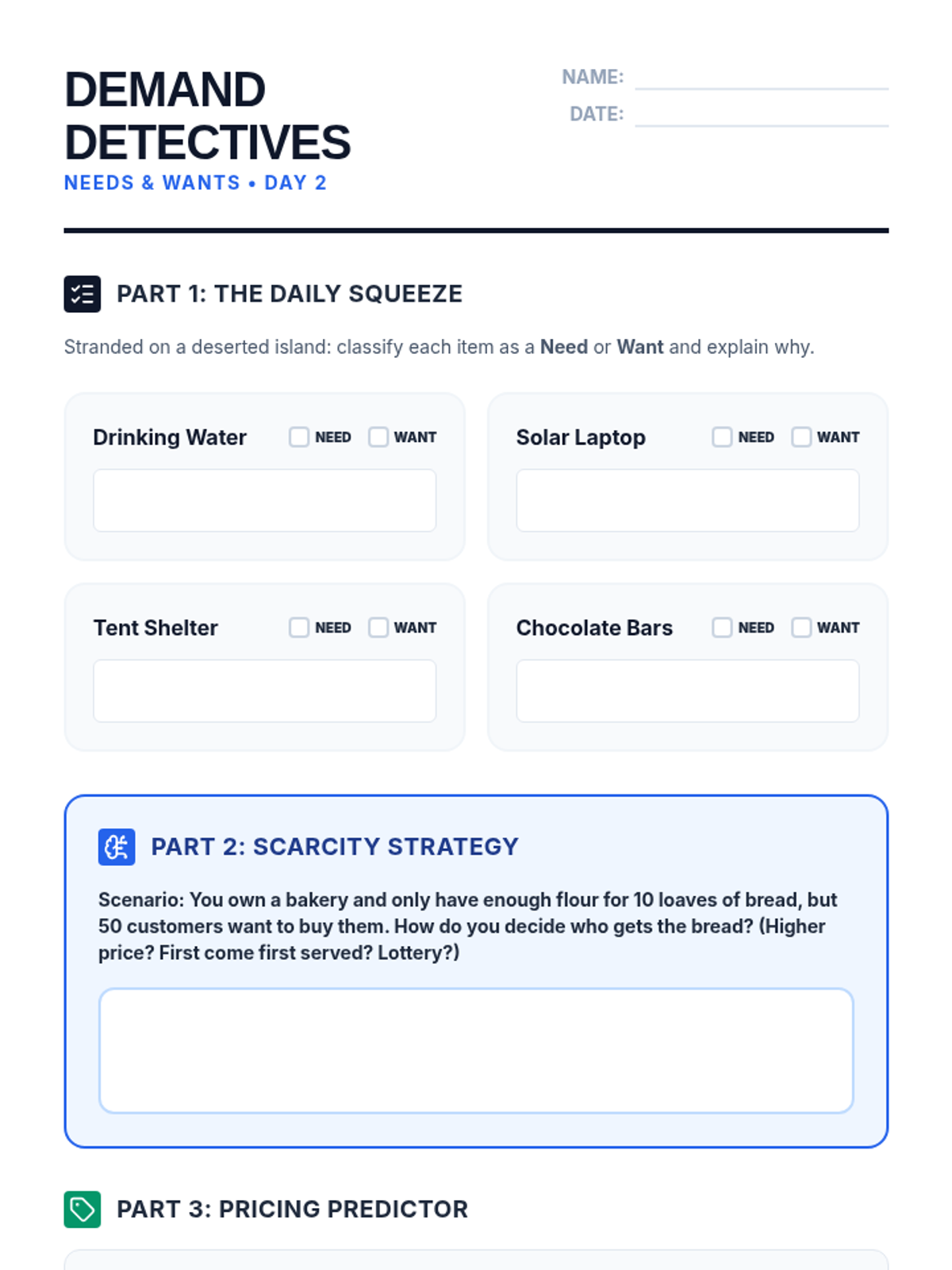
An activity where students classify needs vs. wants, analyze the effects of scarcity, and predict price changes based on supply and demand.
A slide deck exploring needs vs. wants, the concepts of supply and demand, and the economic principle of scarcity.
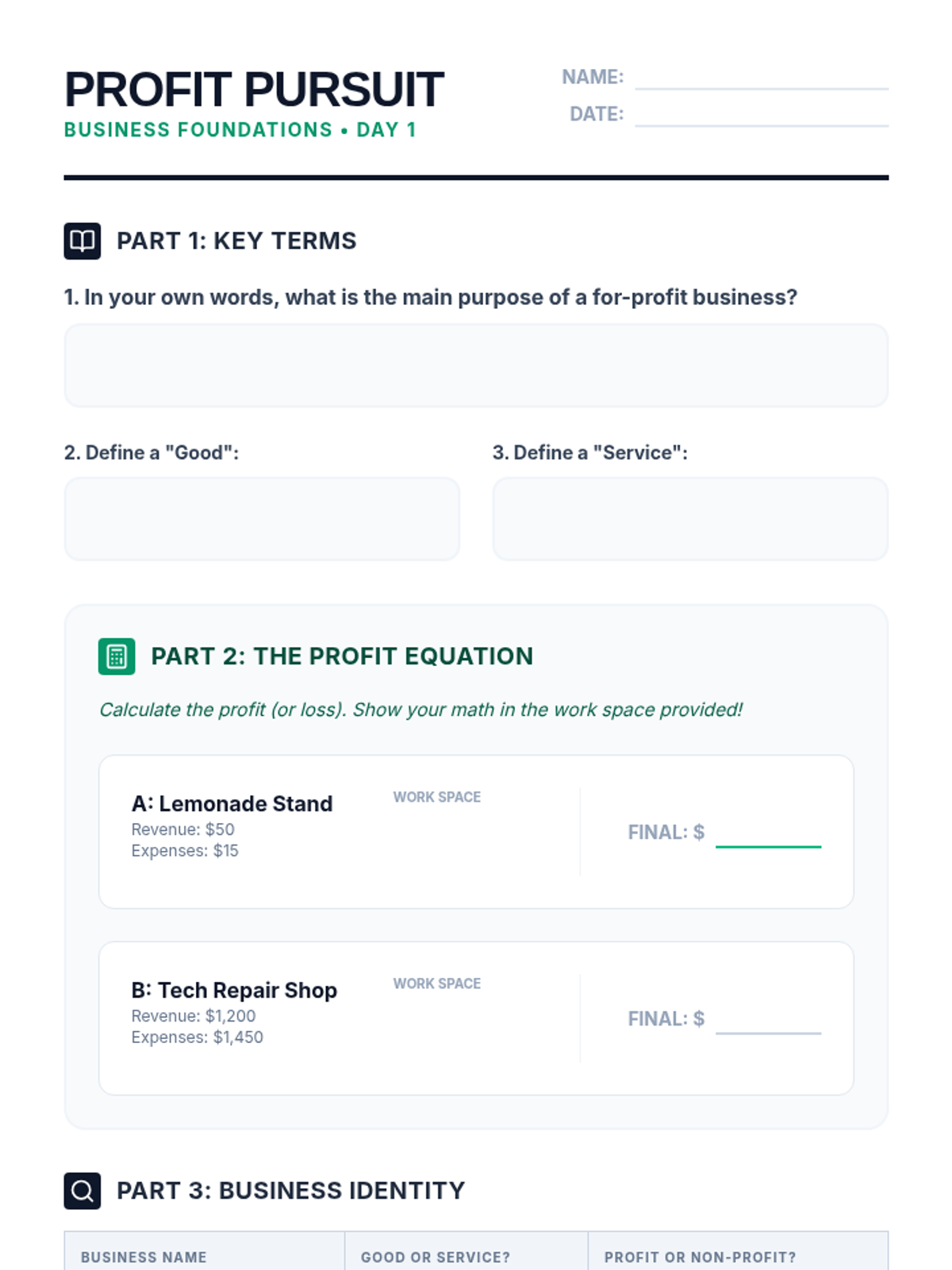
A worksheet for students to define core business terms, calculate profit scenarios, and categorize real-world organizations as for-profit or non-profit.
A slide deck introducing the fundamental concept of a business, the role of profit, and the distinction between for-profit and non-profit organizations.
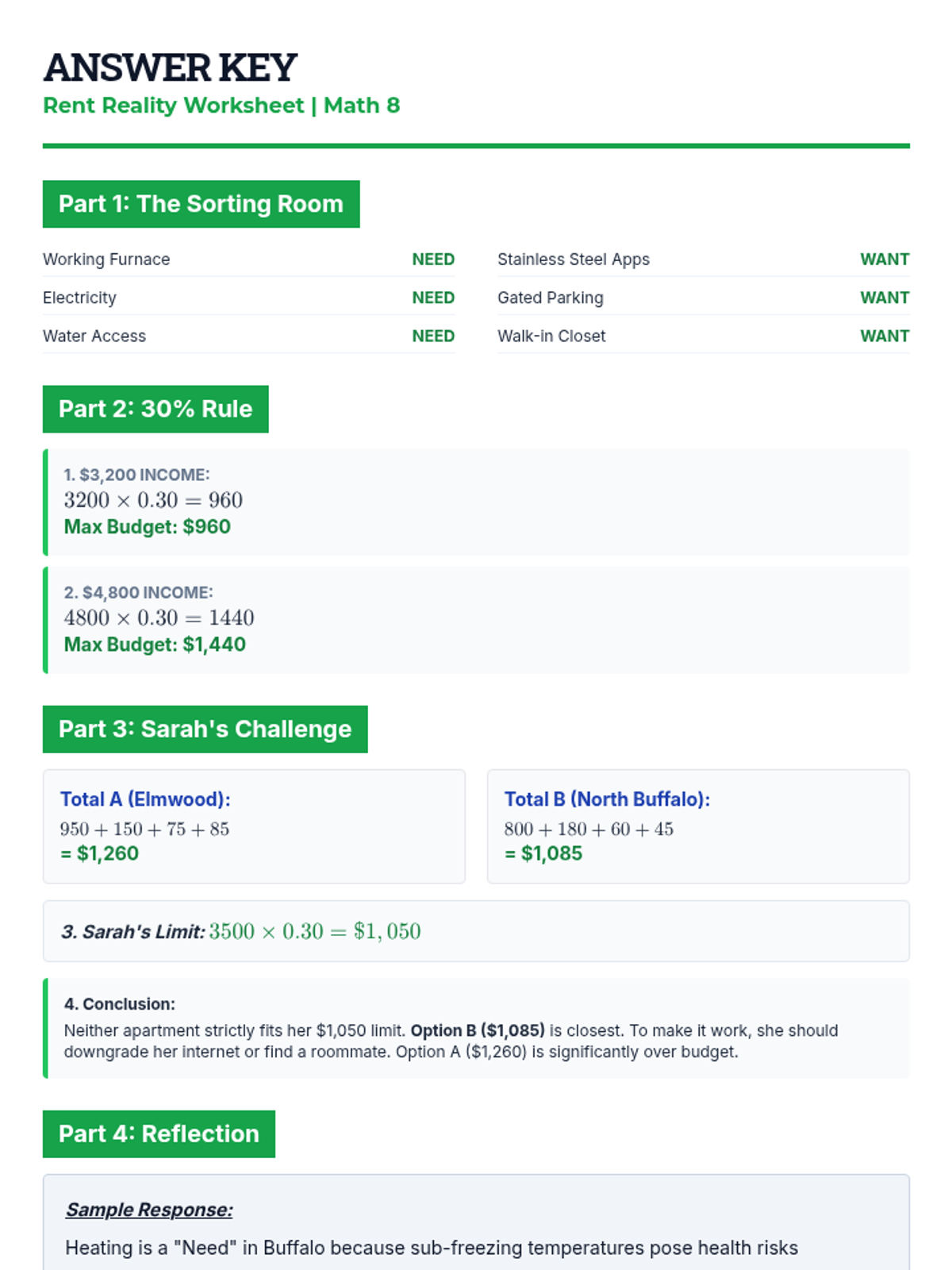
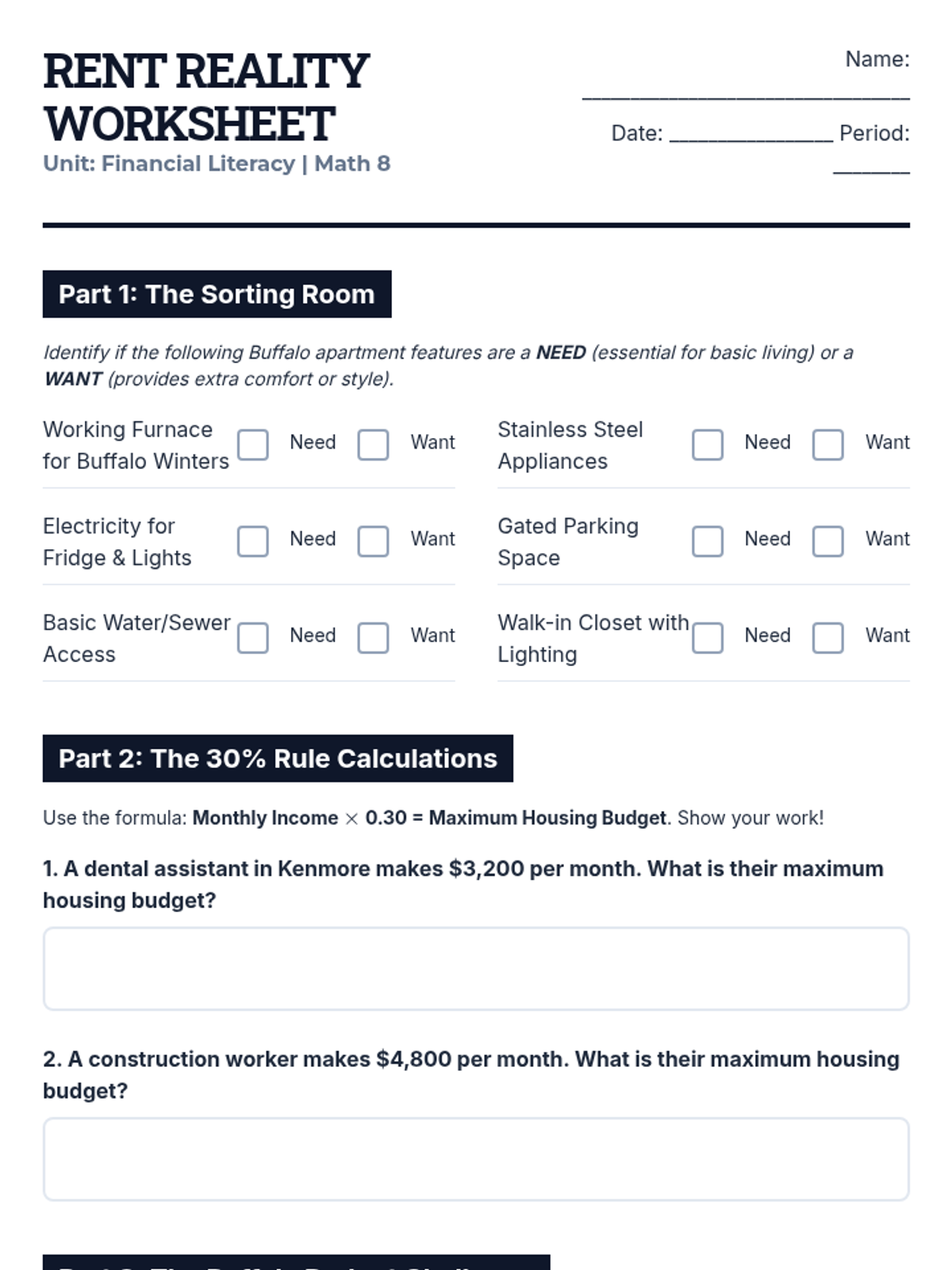
An answer key for the Rent Reality Worksheet, providing full calculations for the 30% rule problems, the total costs for the Buffalo apartment challenge, and sample responses for the critical thinking reflection.
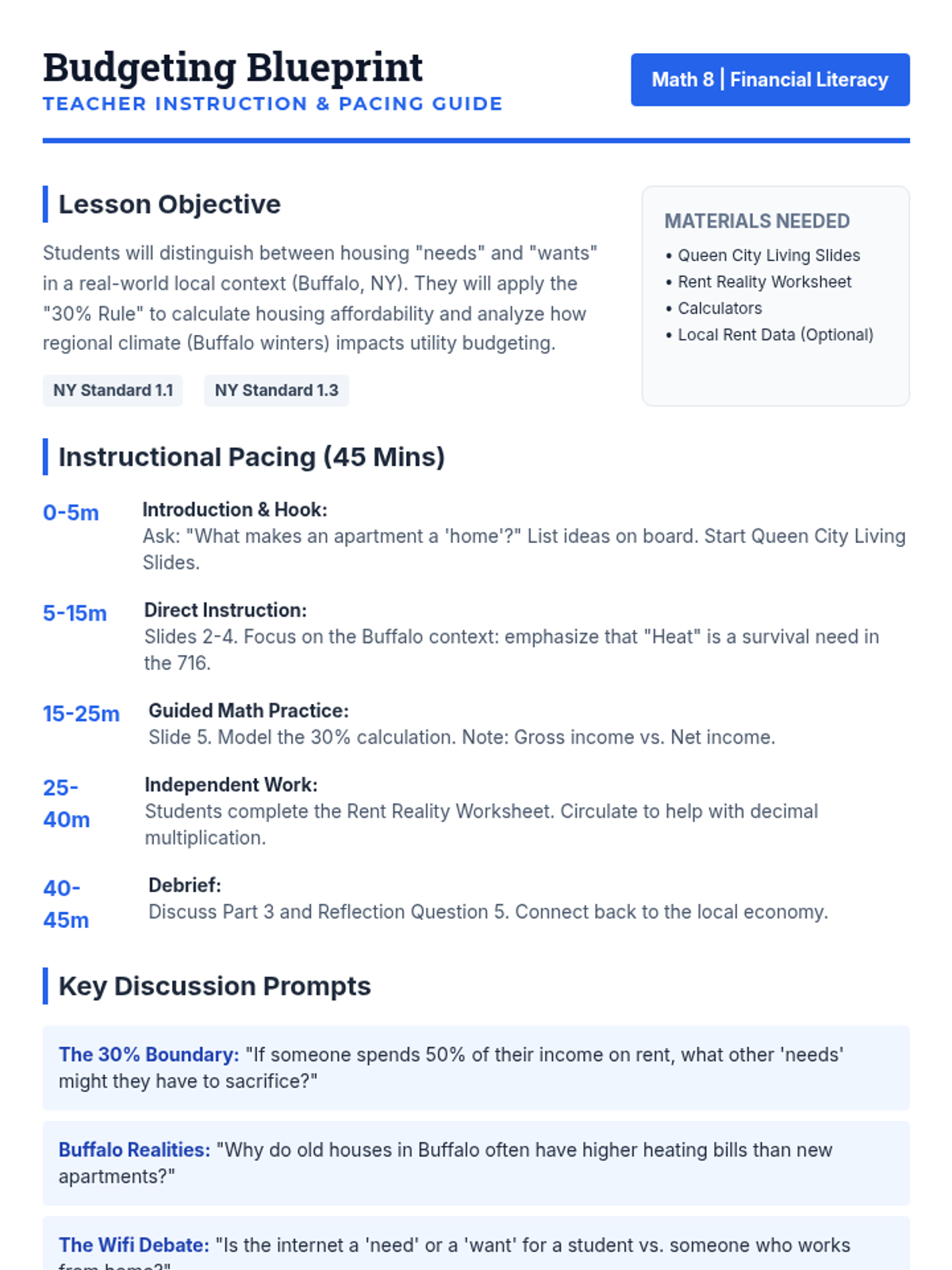
A comprehensive teacher's guide for the Buffalo Budgeting Blueprint mini-lesson. It includes instructional pacing, NY state standards alignment, key discussion prompts focused on the Buffalo housing market, and strategies for differentiation.
The student worksheet features an interactive 'Queen City Utility Menu' allowing students to select heat, electricity, internet, and lifestyle plans. Students calculate and customize budgets for two local apartments using the 30% rule, assessing housing affordability.
A slide deck for an 8th-grade math mini-lesson exploring the financial difference between needs and wants when budgeting for housing and utilities in Buffalo, NY. It includes real-world rent comparisons, the '30% Rule' calculation, and the specific impact of Buffalo winters on utility costs.
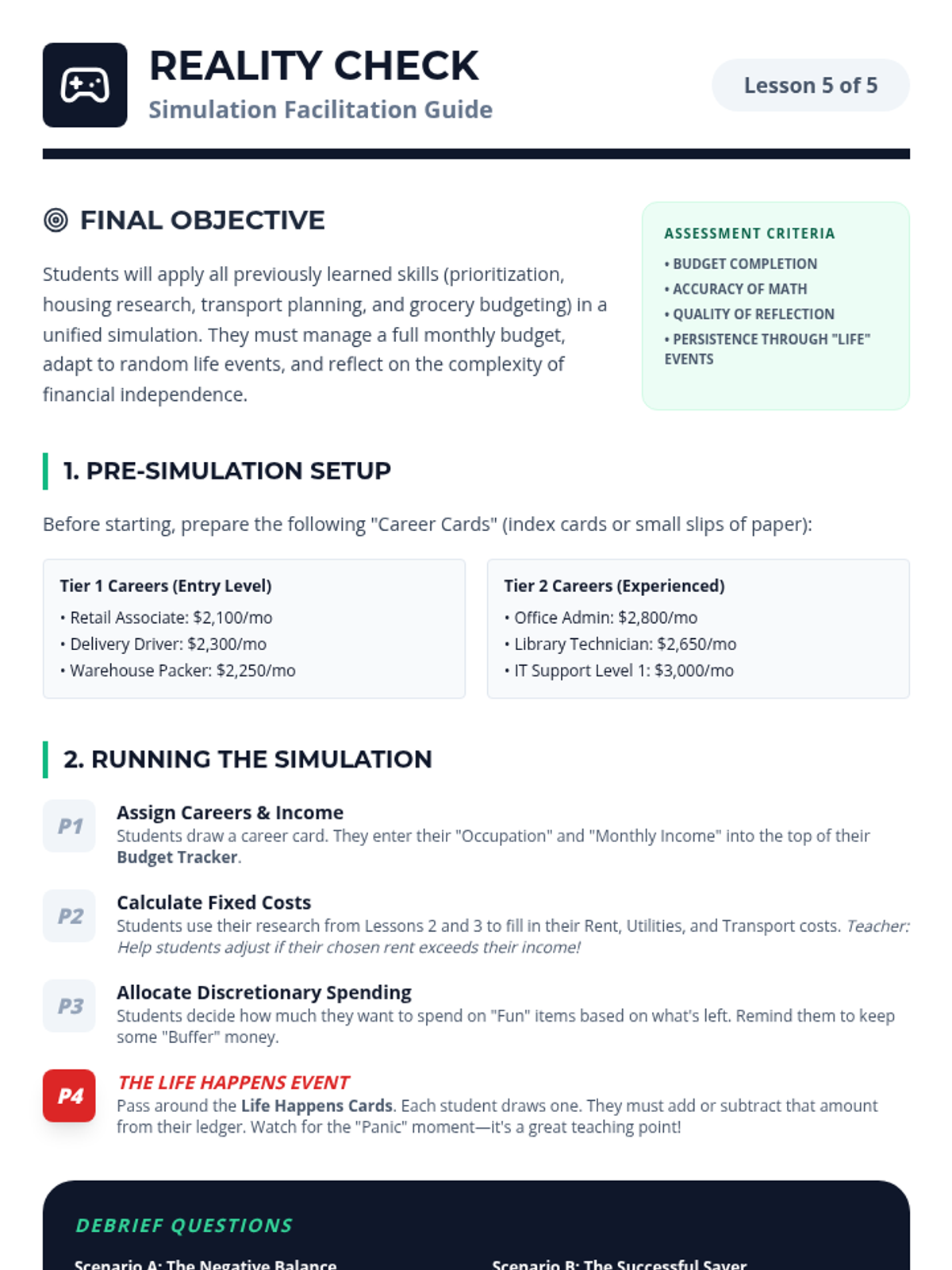
Teacher facilitation guide for Lesson 5, including simulation phases, career assignment tips, and debriefing questions for the "Reality Check" activity.
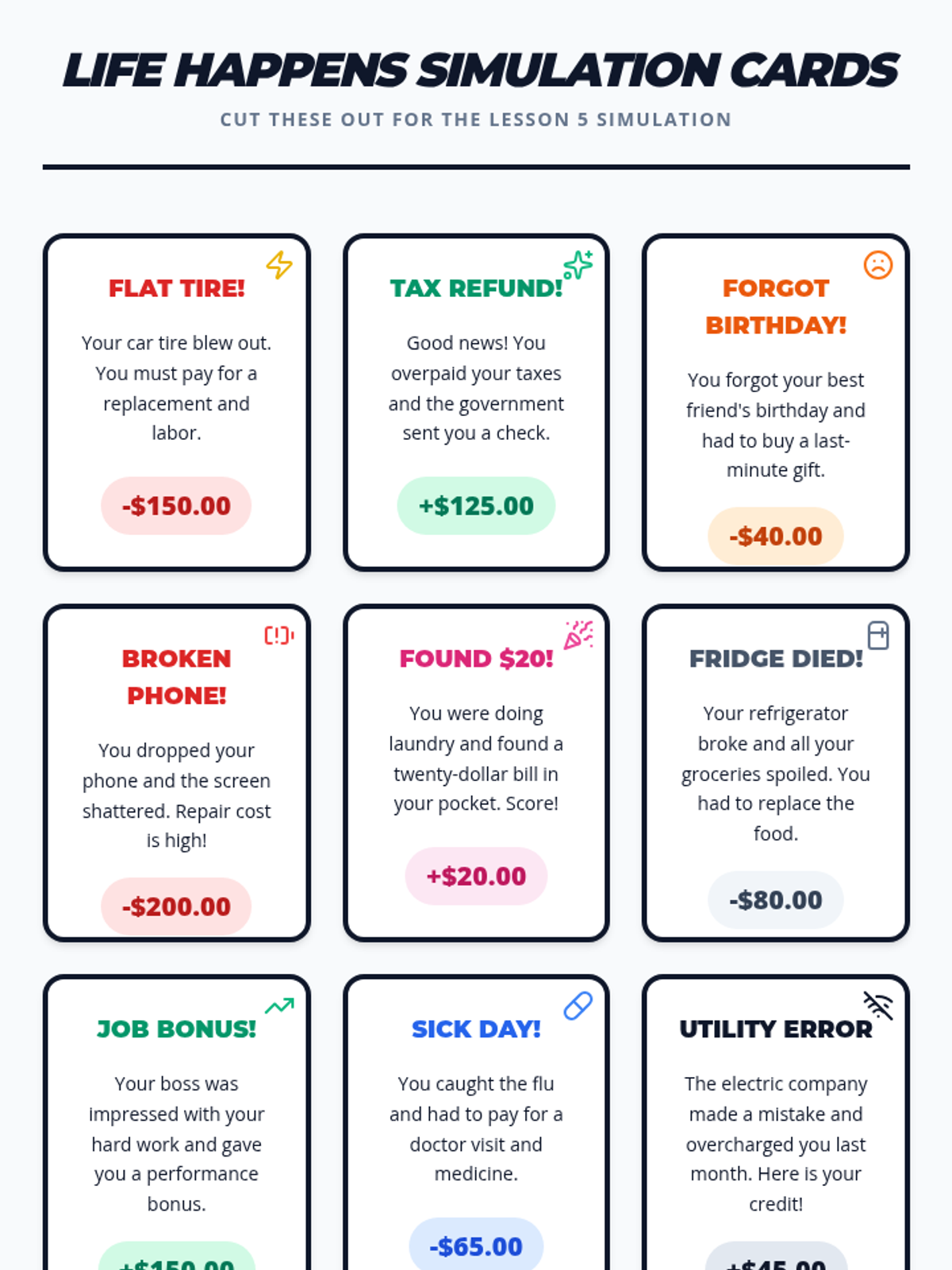
A set of printable "Life Happens" event cards for the Lesson 5 budget simulation, featuring both positive and negative financial impacts.
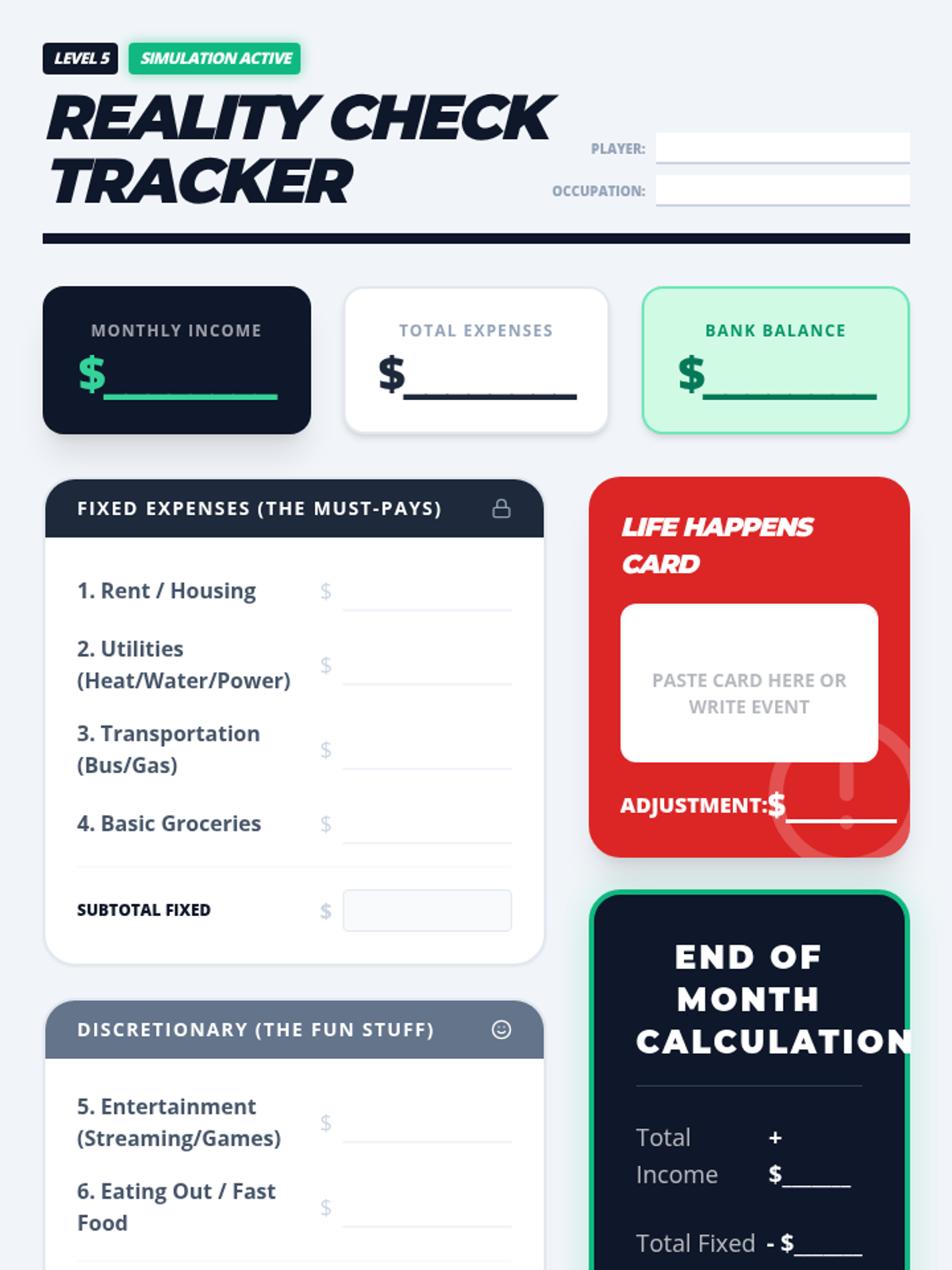
A budget tracking worksheet for the culminating simulation where students manage income, expenses, and unexpected "Life Happens" events.
Introductory slides for a month-long budget simulation where students manage income and expenses.
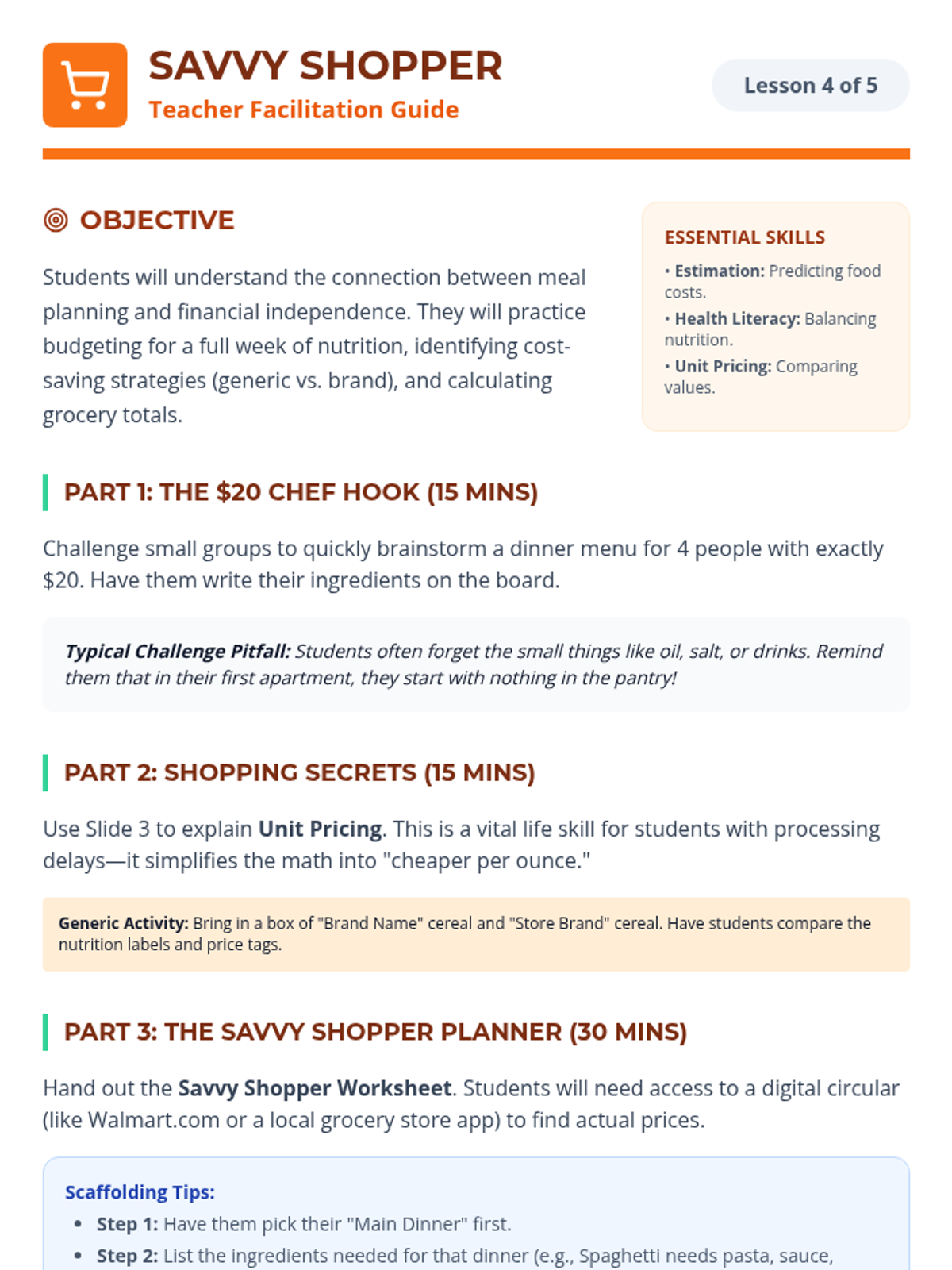
Teacher facilitation guide for Lesson 4, including the "20-Dollar Chef" challenge instructions, shopping strategies, and scaffolding tips for diverse learners.
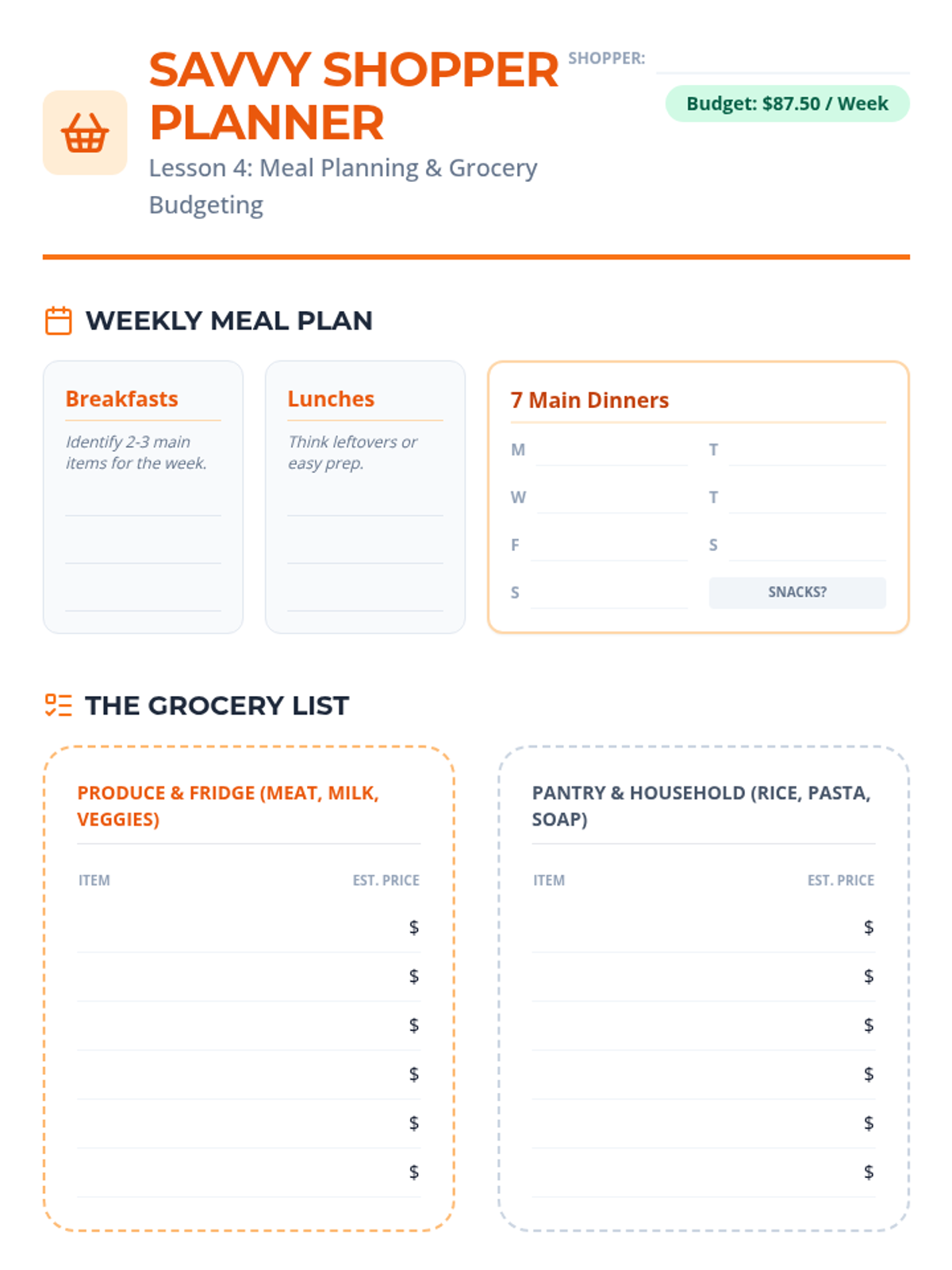
A meal planning and grocery list worksheet for students to plan a week of meals within a budget.
Introductory slides for meal planning and grocery shopping within a budget, focusing on cost-effective and healthy choices.
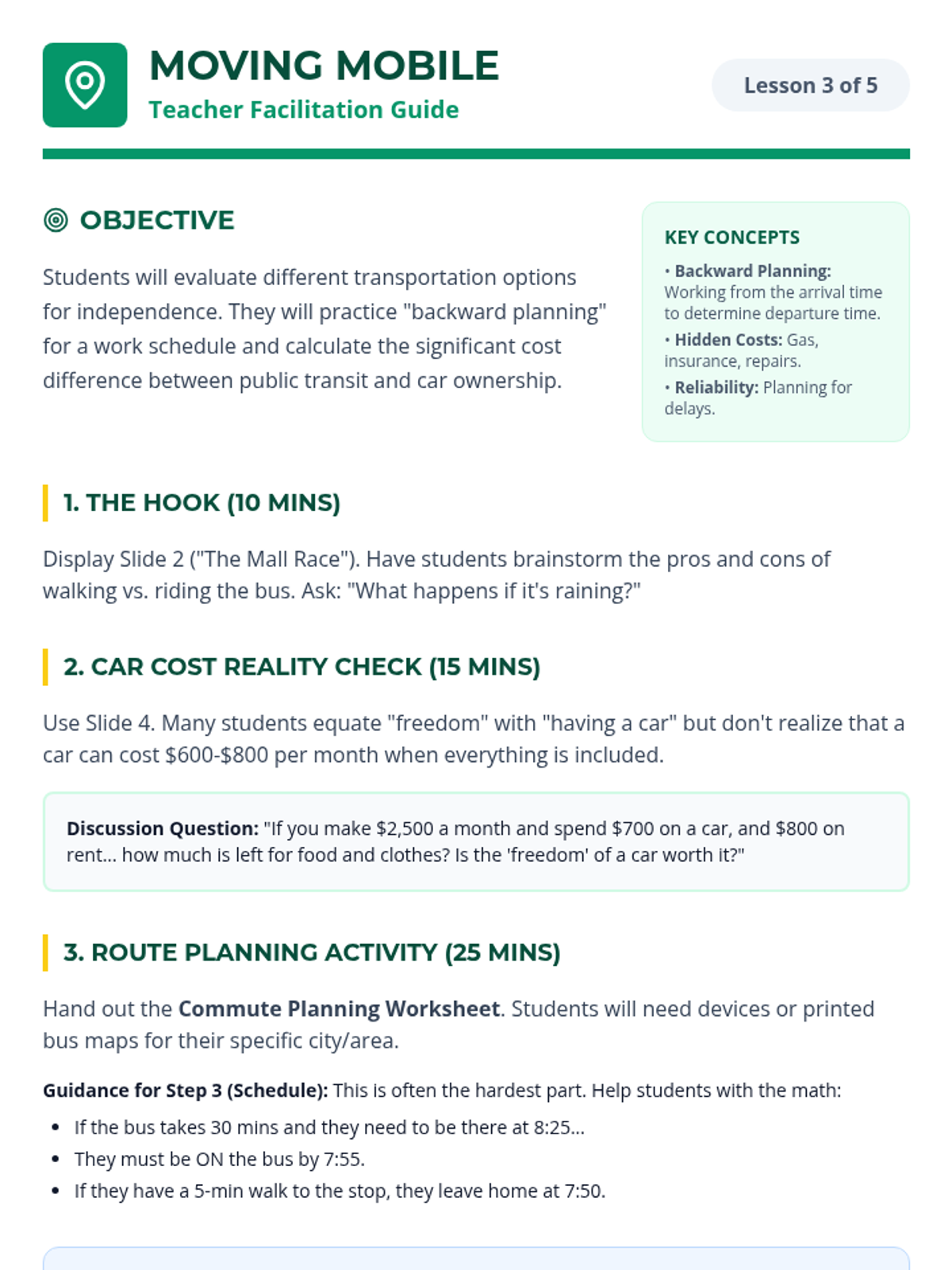
Teacher facilitation guide for Lesson 3, including route planning tips, cost analysis discussion prompts, and modifications for diverse learners.
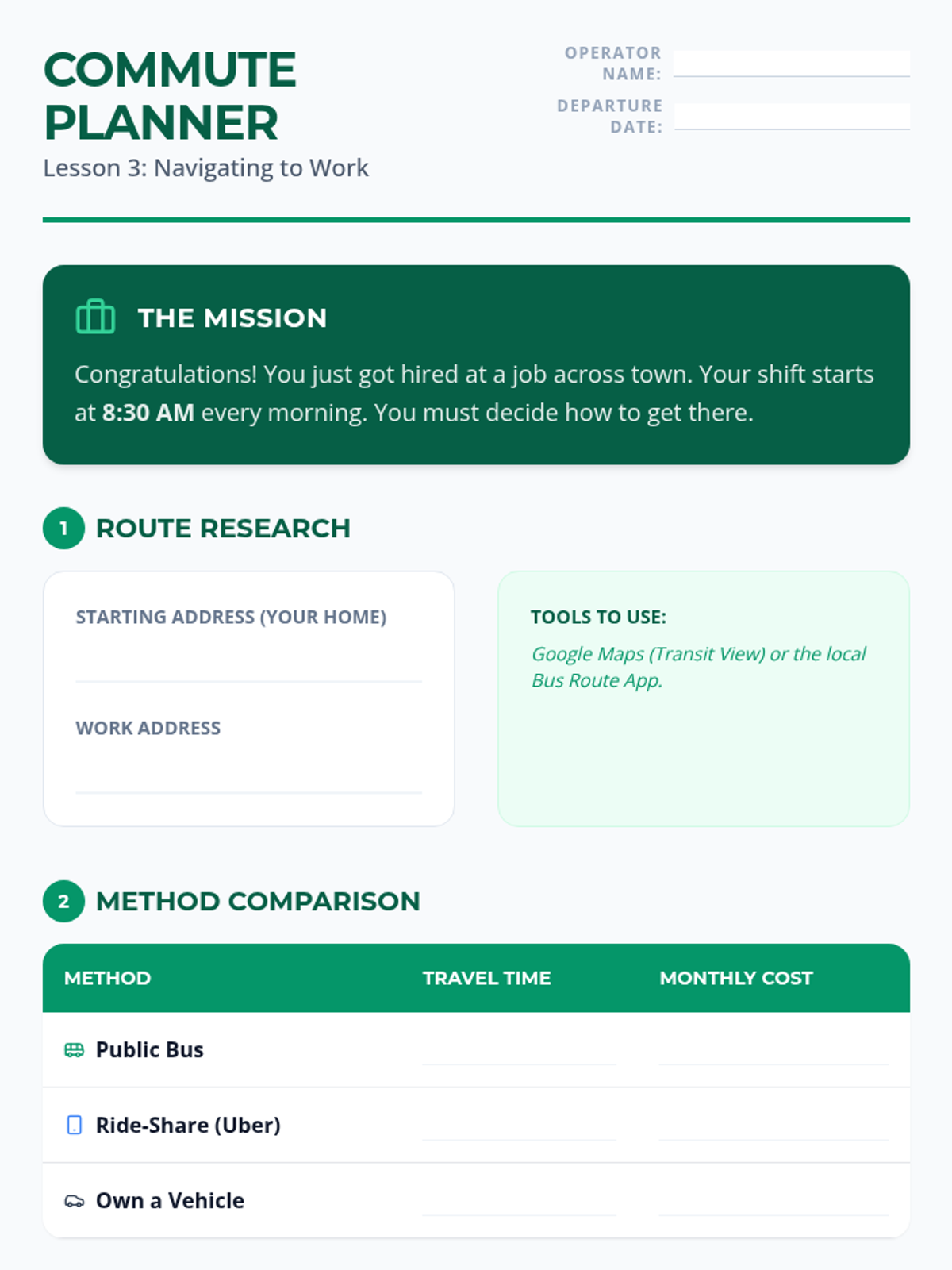
A route planning and cost analysis worksheet where students map a commute and calculate travel times and expenses.
Introductory slides for analyzing transportation methods, route planning, and cost comparisons.
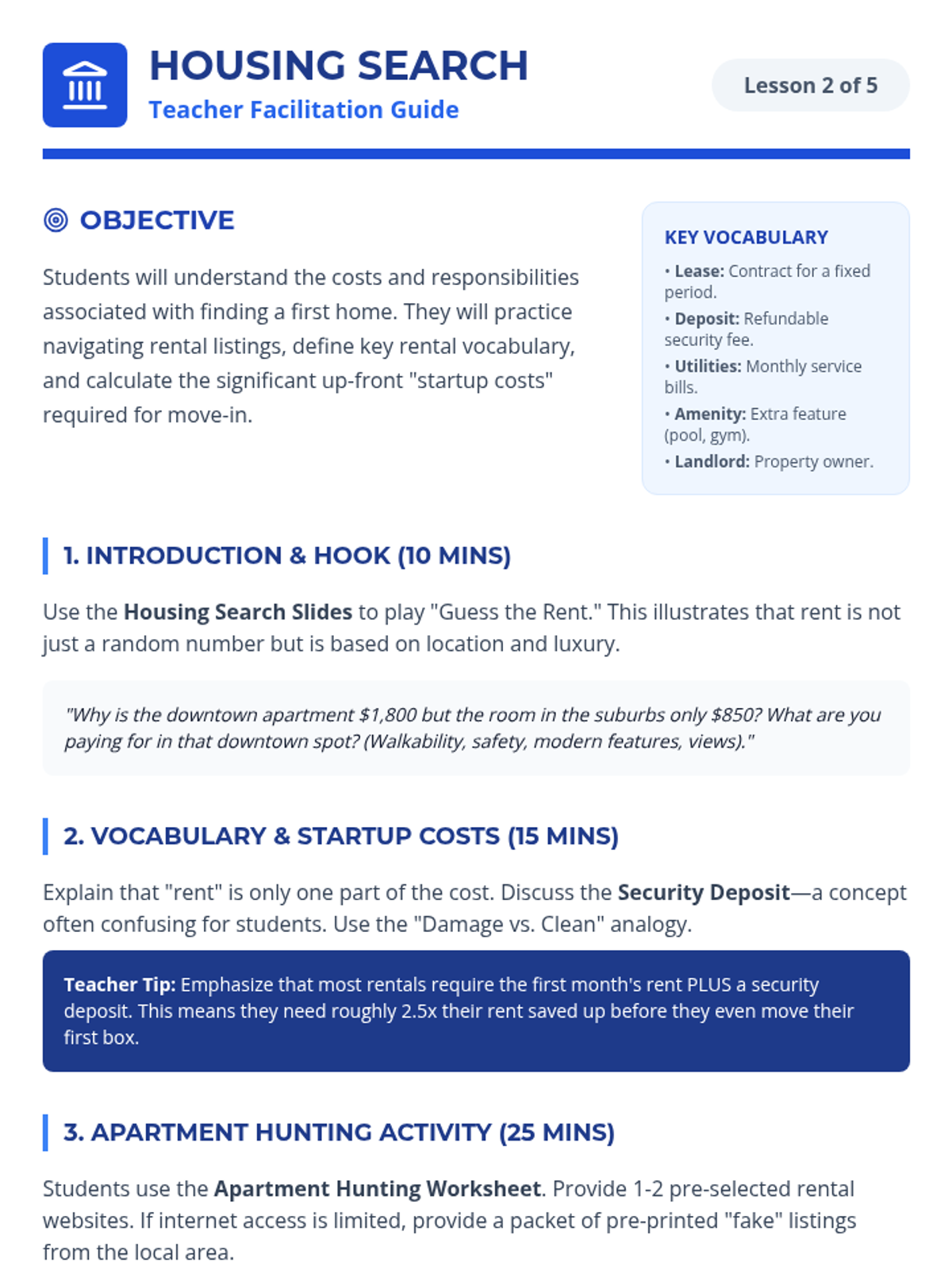
Teacher facilitation guide for Lesson 2, including housing vocabulary definitions, activity instructions, and discussion tips.
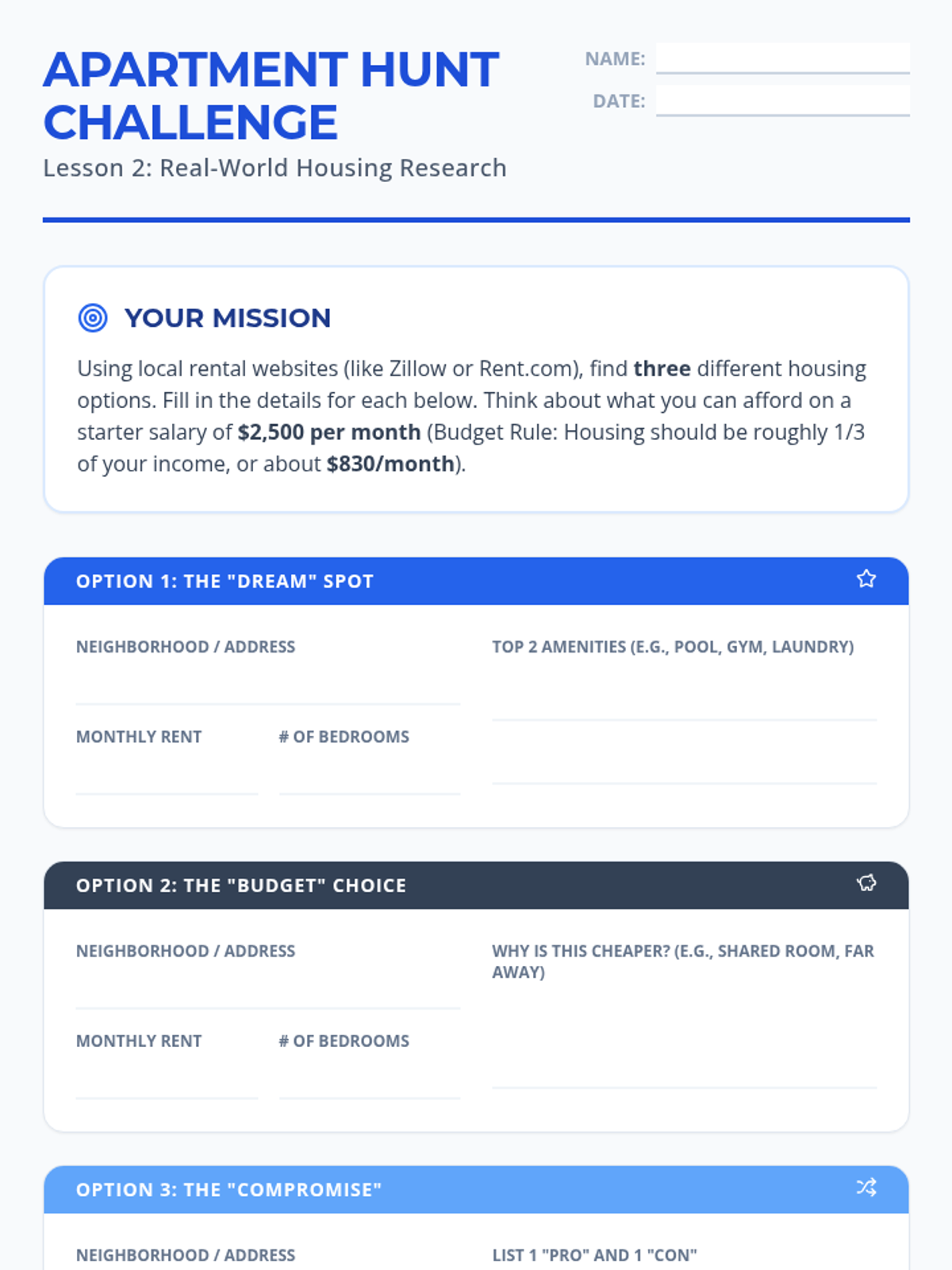
A research worksheet for students to explore local rental listings and calculate startup costs for an apartment.
Introductory slides for exploring housing options, rental vocabulary, and startup costs.
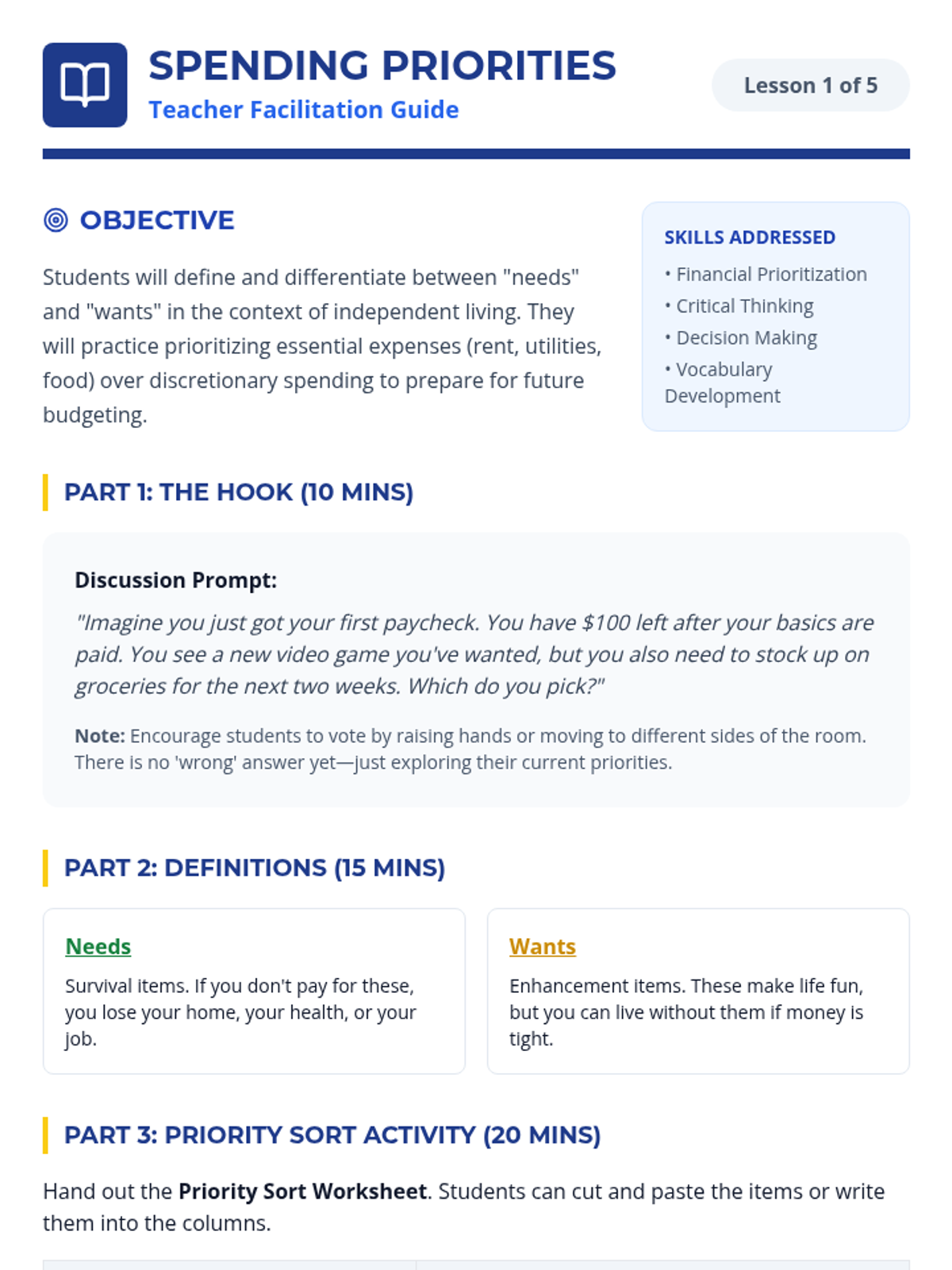
Teacher facilitation guide for Lesson 1, including objectives, discussion prompts, and an answer key for the sorting activity.
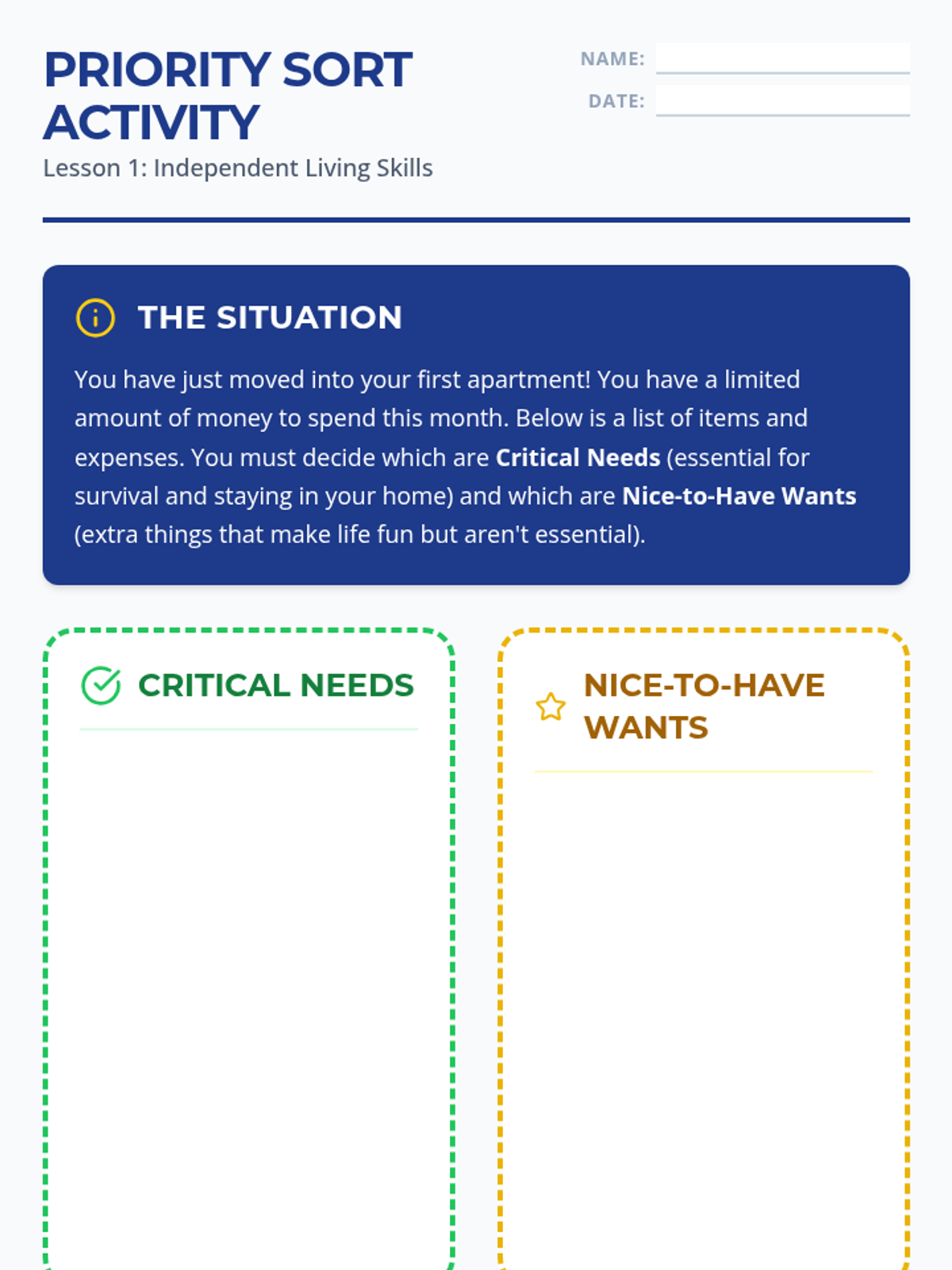
A sorting activity for students to categorize expenses as critical needs or wants, including reflection questions.
Introductory slides for differentiating between essential needs and discretionary wants for independent living.
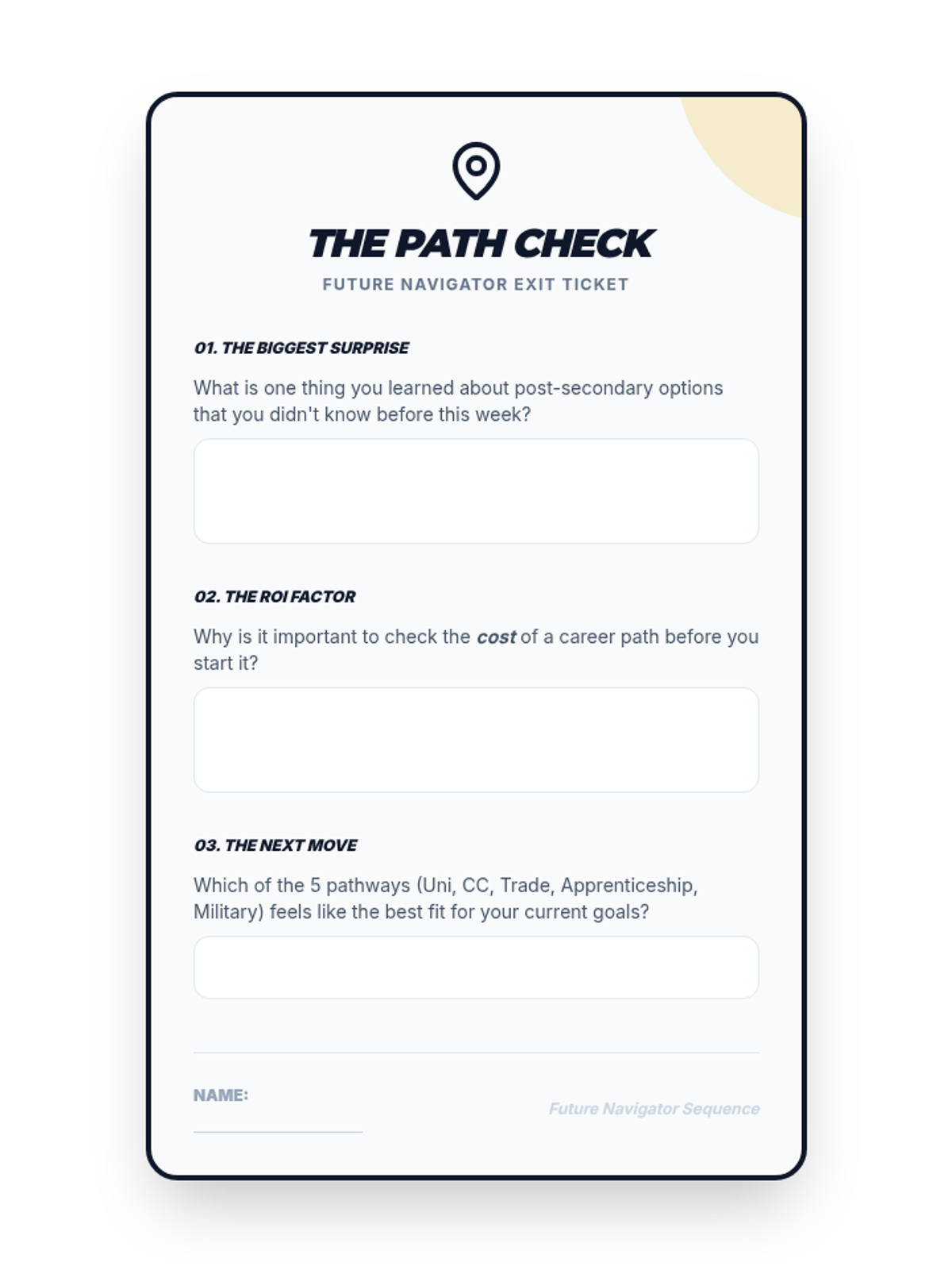
A final reflection and exit ticket for the Future Navigator sequence, assessing student understanding of ROI and pathway choices.
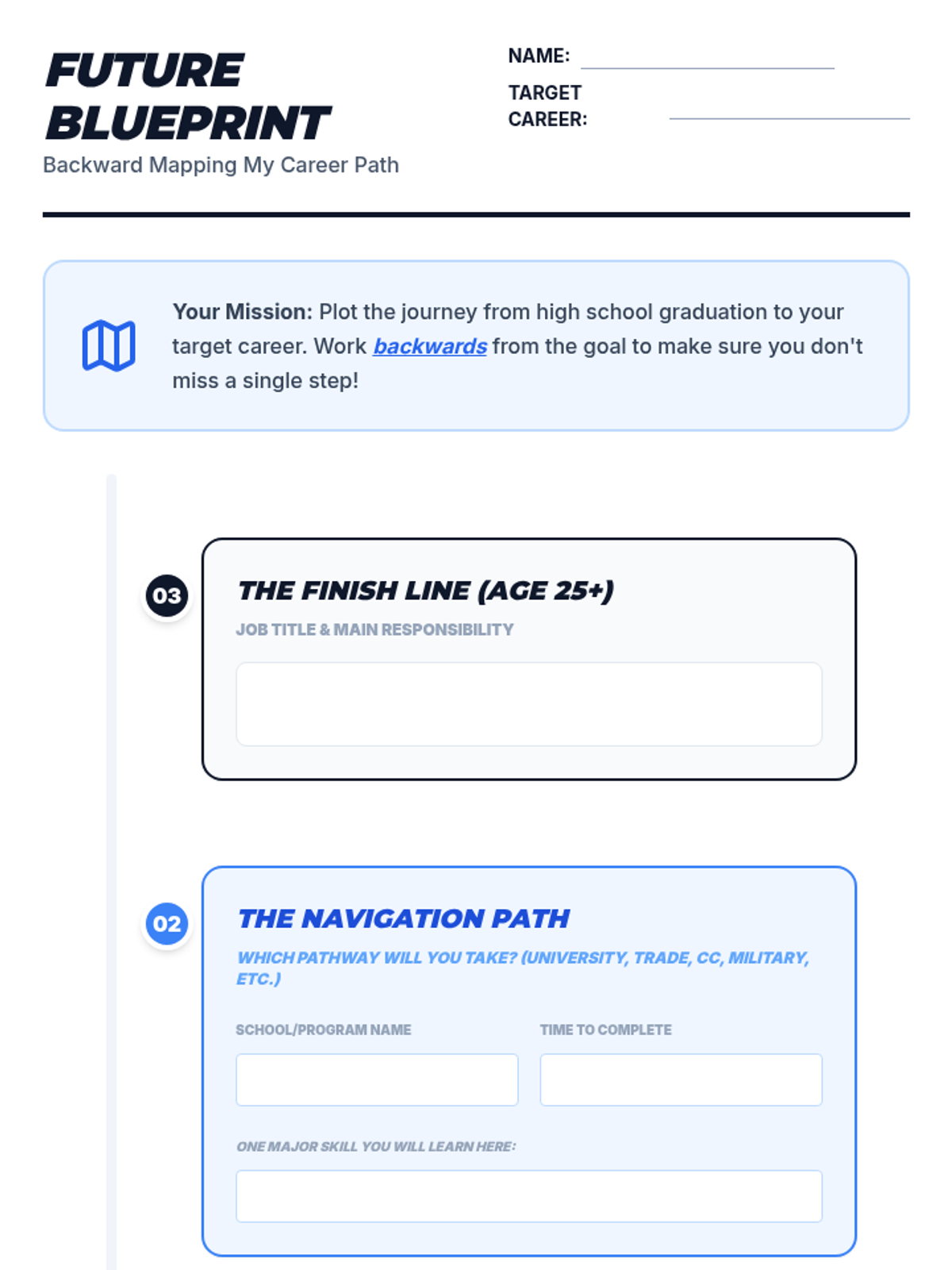
A student backward-mapping project worksheet where they plot their path from a target career back to high school graduation.
A slide deck introducing the final project of the sequence, teaching students how to backward-map a career path from a target job to high school graduation.
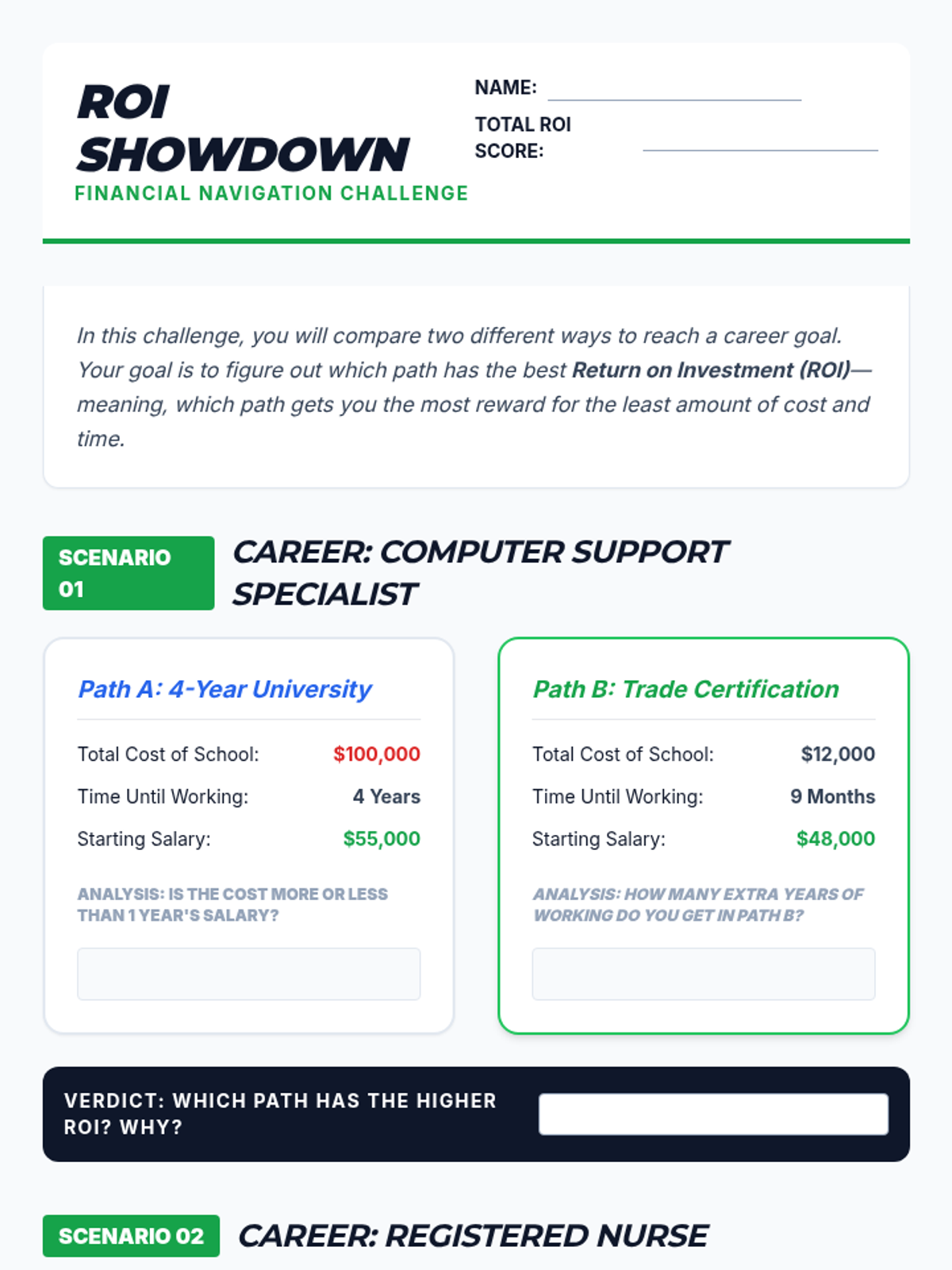
A student worksheet for evaluating the ROI of different education paths by comparing costs and salaries in specific scenarios.