Employer research strategies and behavioral response techniques using the STAR method. Develops virtual interview etiquette, professional presence, and effective follow-up communication.
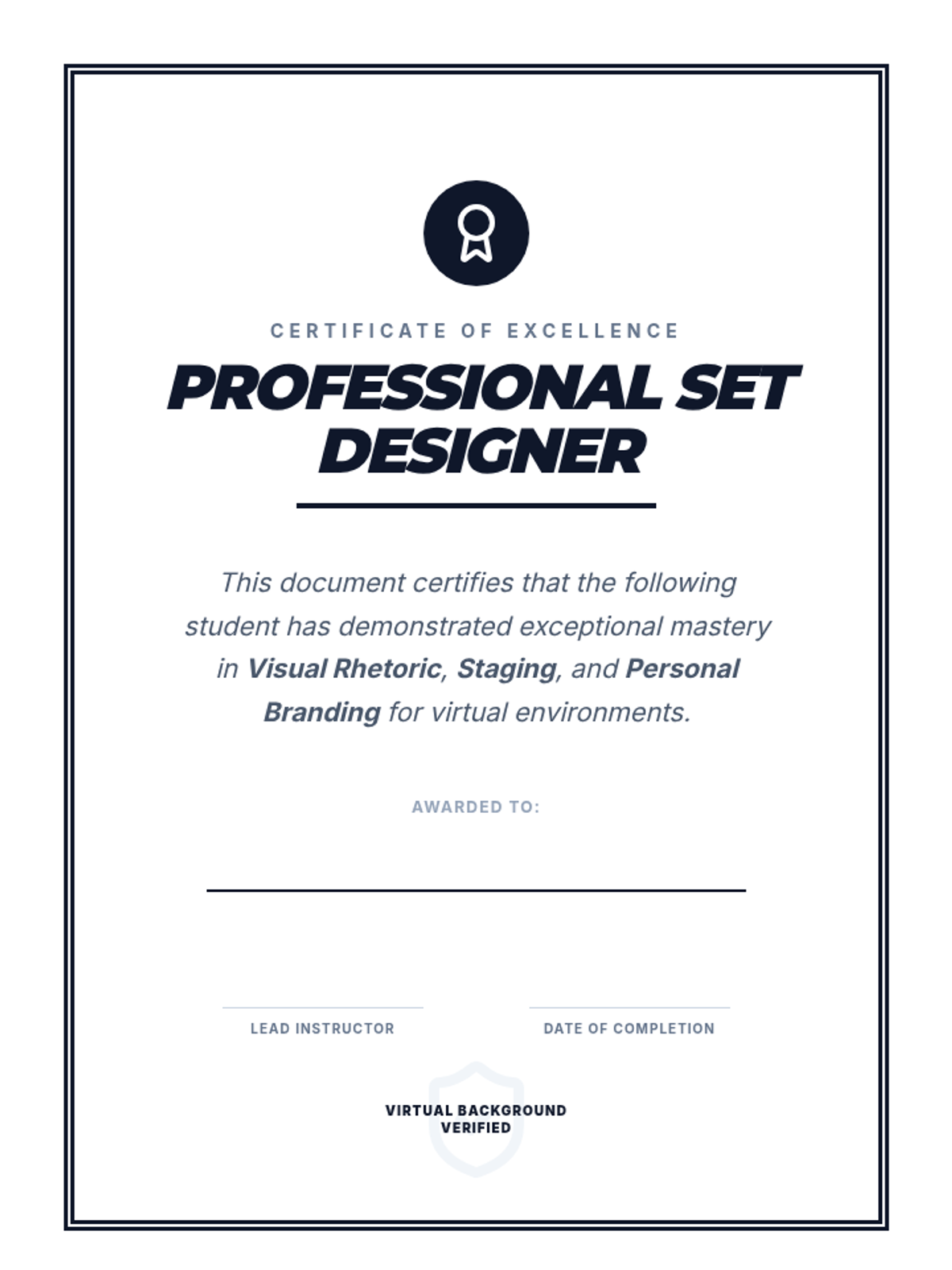
A certificate awarded to students upon successful completion of the Studio Showdown and virtual background design sequence.
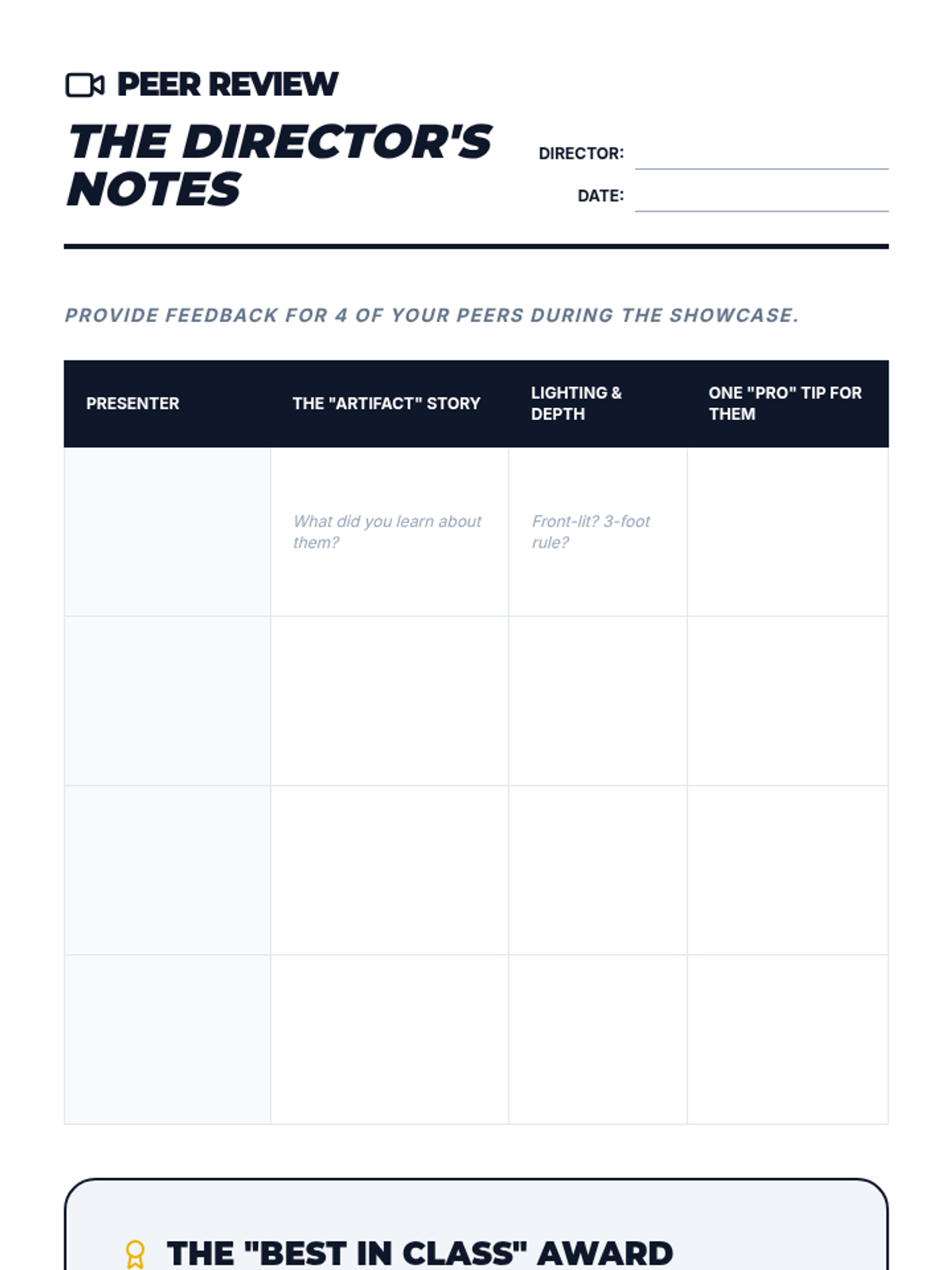
A peer feedback rubric for Lesson 5 where students evaluate their classmates' virtual sets based on lighting, depth, and personal artifacts.
A slide presentation for Lesson 5 providing instructions for the Studio Showdown presentation day and peer feedback protocols.
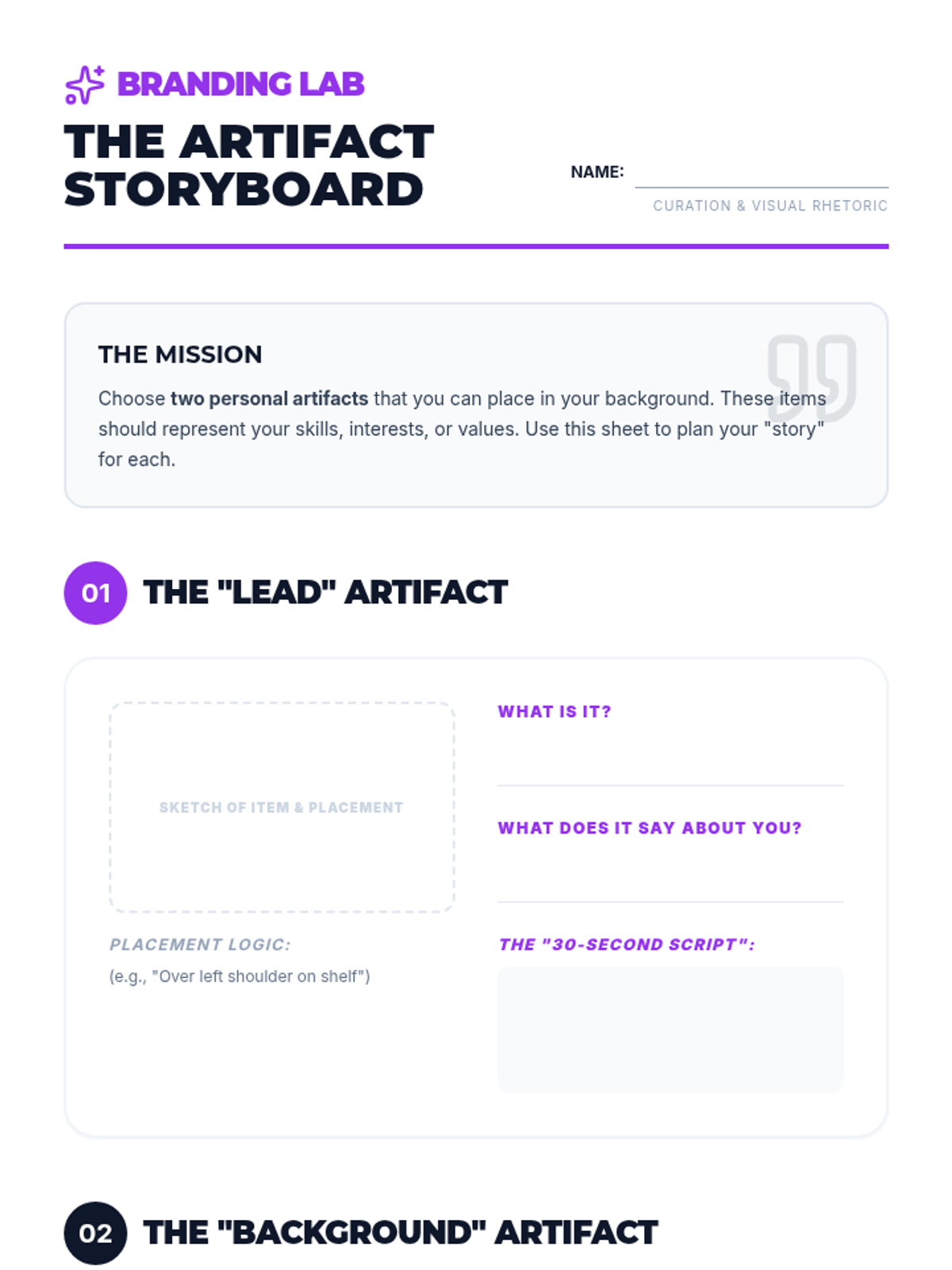
A branding organizer for Lesson 4 where students select personal artifacts, plan their placement in the background, and script their "story" for each item.
A slide presentation for Lesson 4 focusing on branding through artifacts, YouTuber set analysis, and how to use background objects as conversation starters.
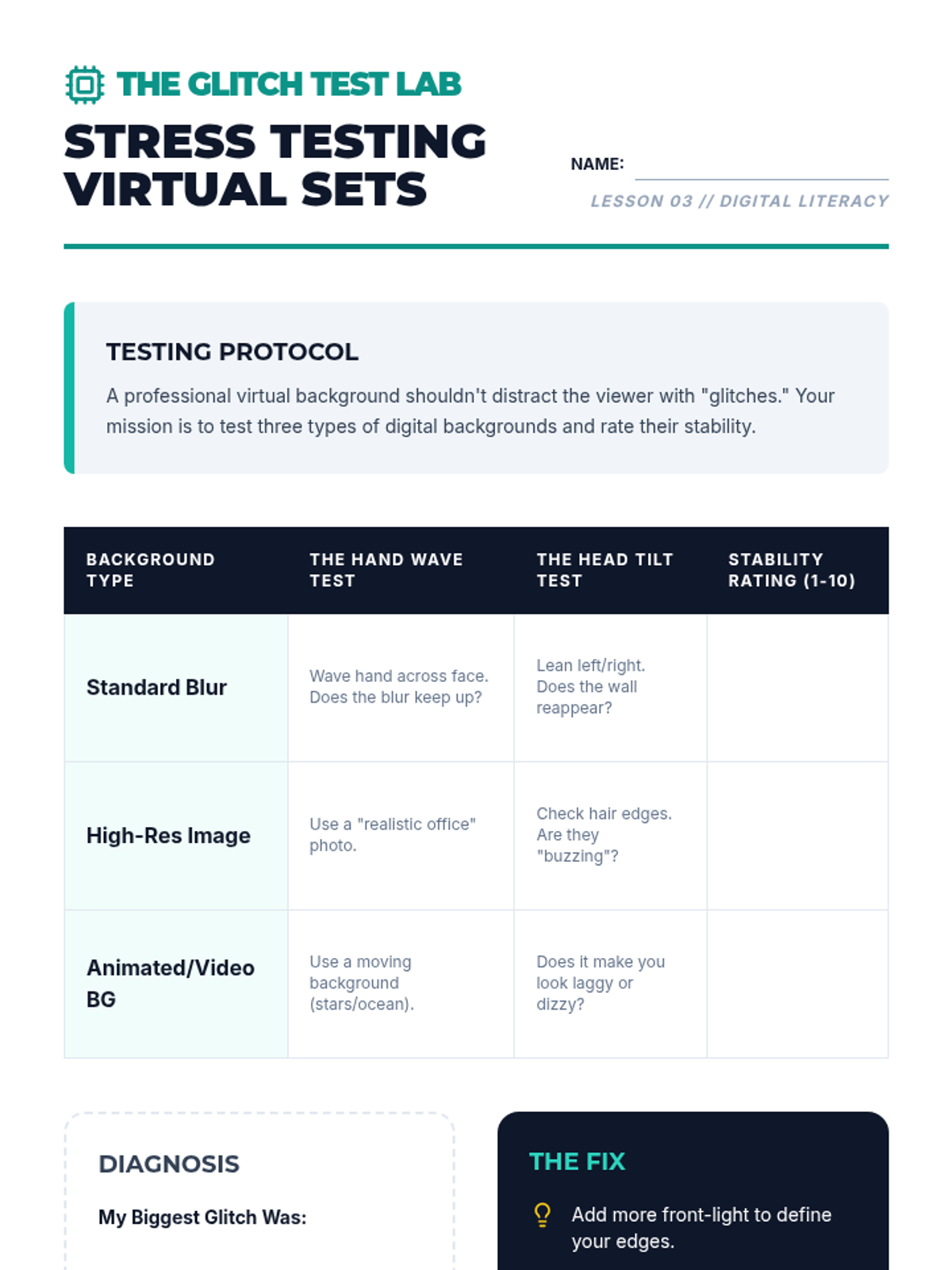
A student activity guide for Lesson 3 to test different virtual background types for stability and technical glitches.
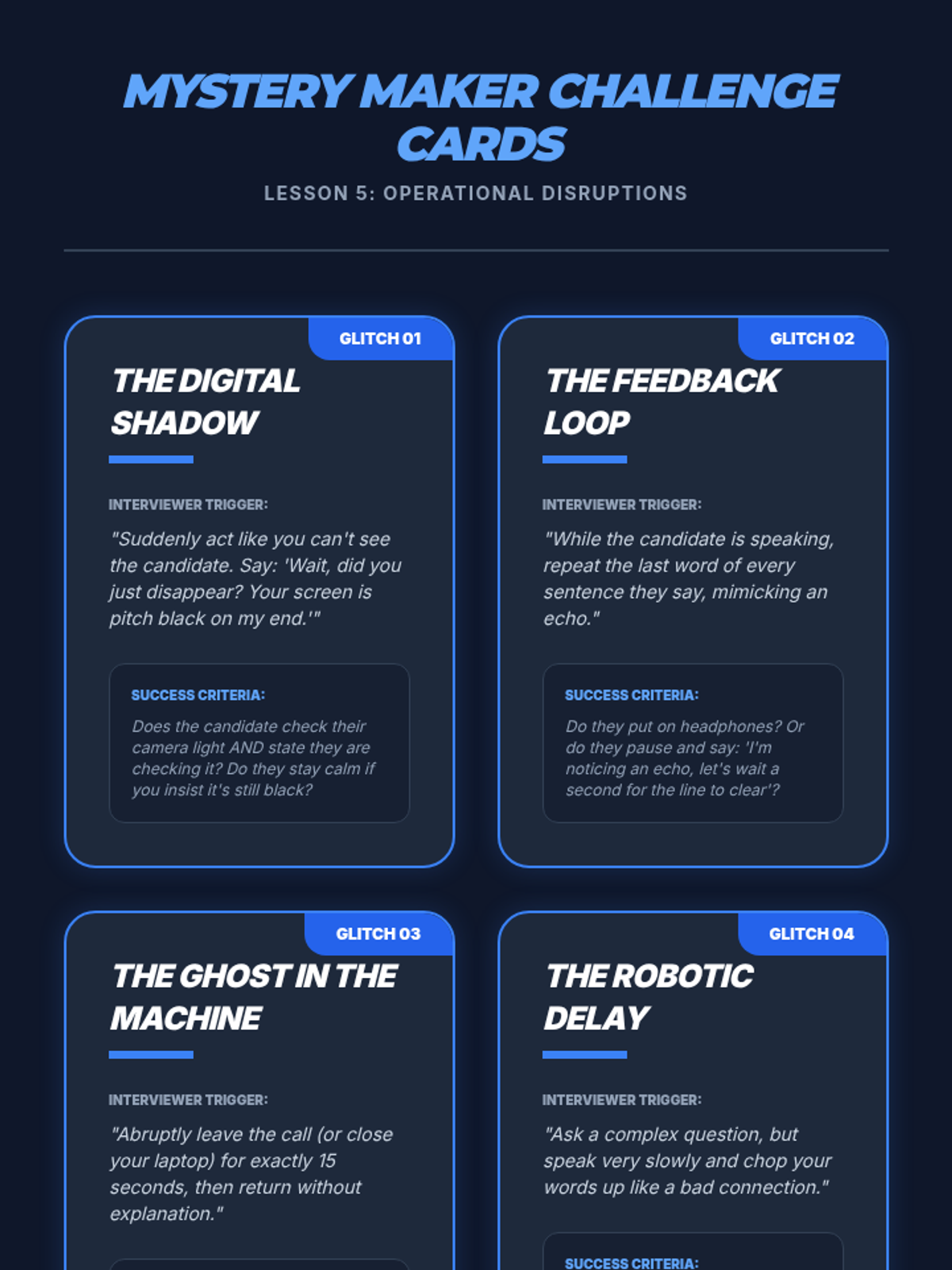
Instruction cards for the simulation lab, providing specific technical 'glitches' for the interviewer to enact secretly during mock interviews.
A slide presentation for Lesson 3 focusing on the technical side of virtual backgrounds, lighting requirements, and professional image selection.
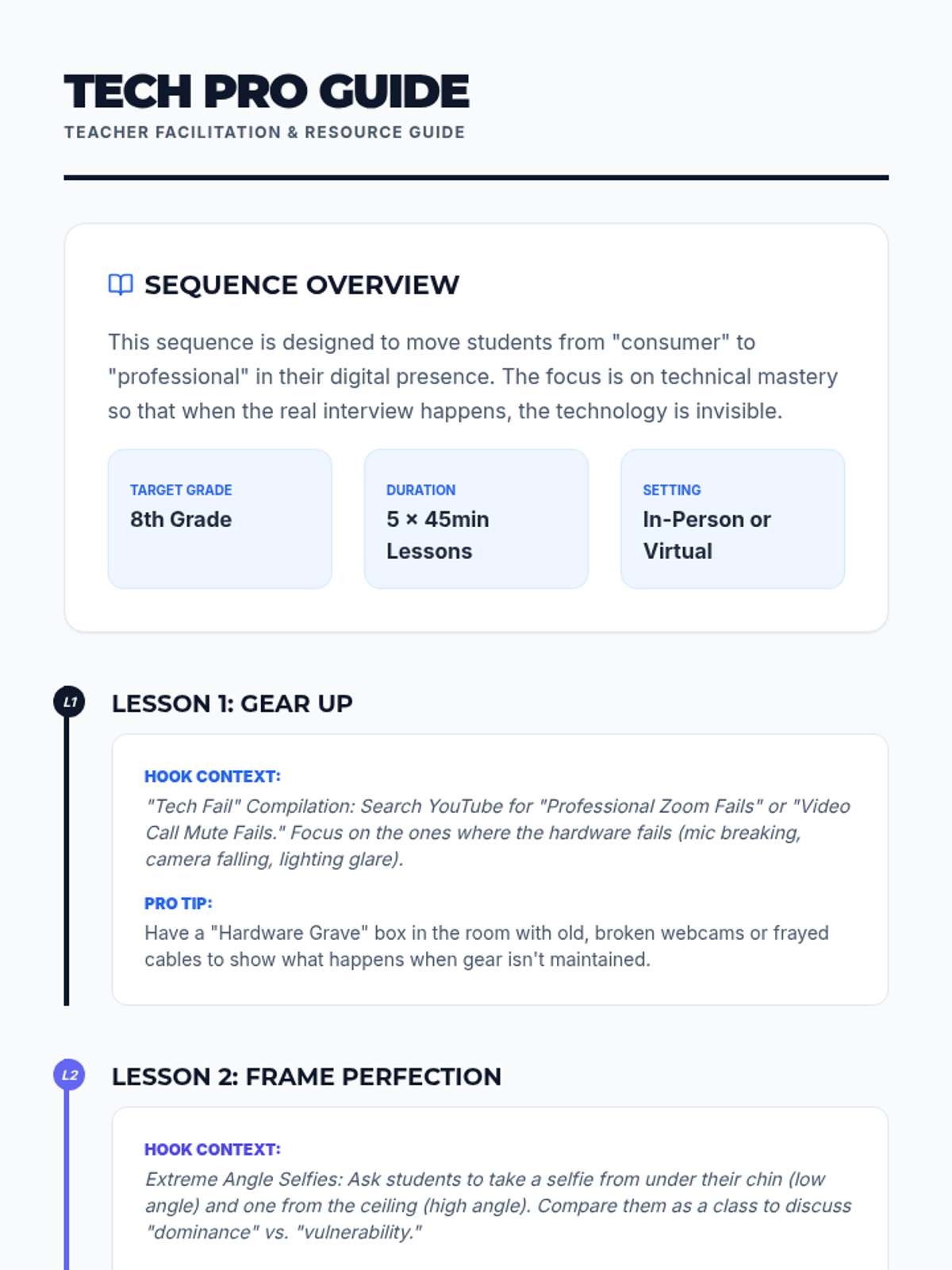
Comprehensive facilitation guide for teachers covering all five lessons, including hook context, platform keys, and troubleshooting tips.
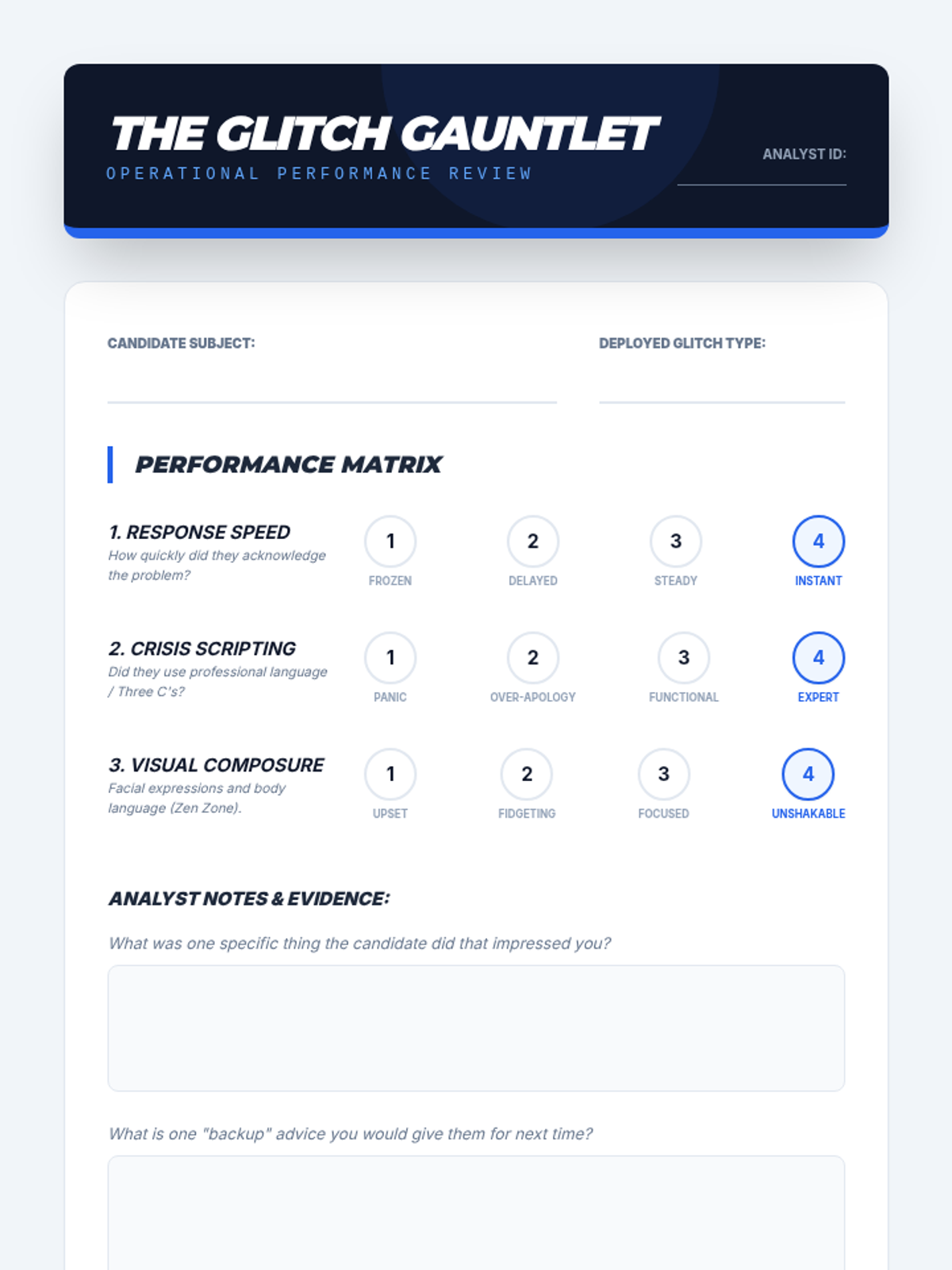
A high-stakes mastery rubric for peer observation, evaluating candidate performance in real-time during the 'Glitch Gauntlet' simulation.
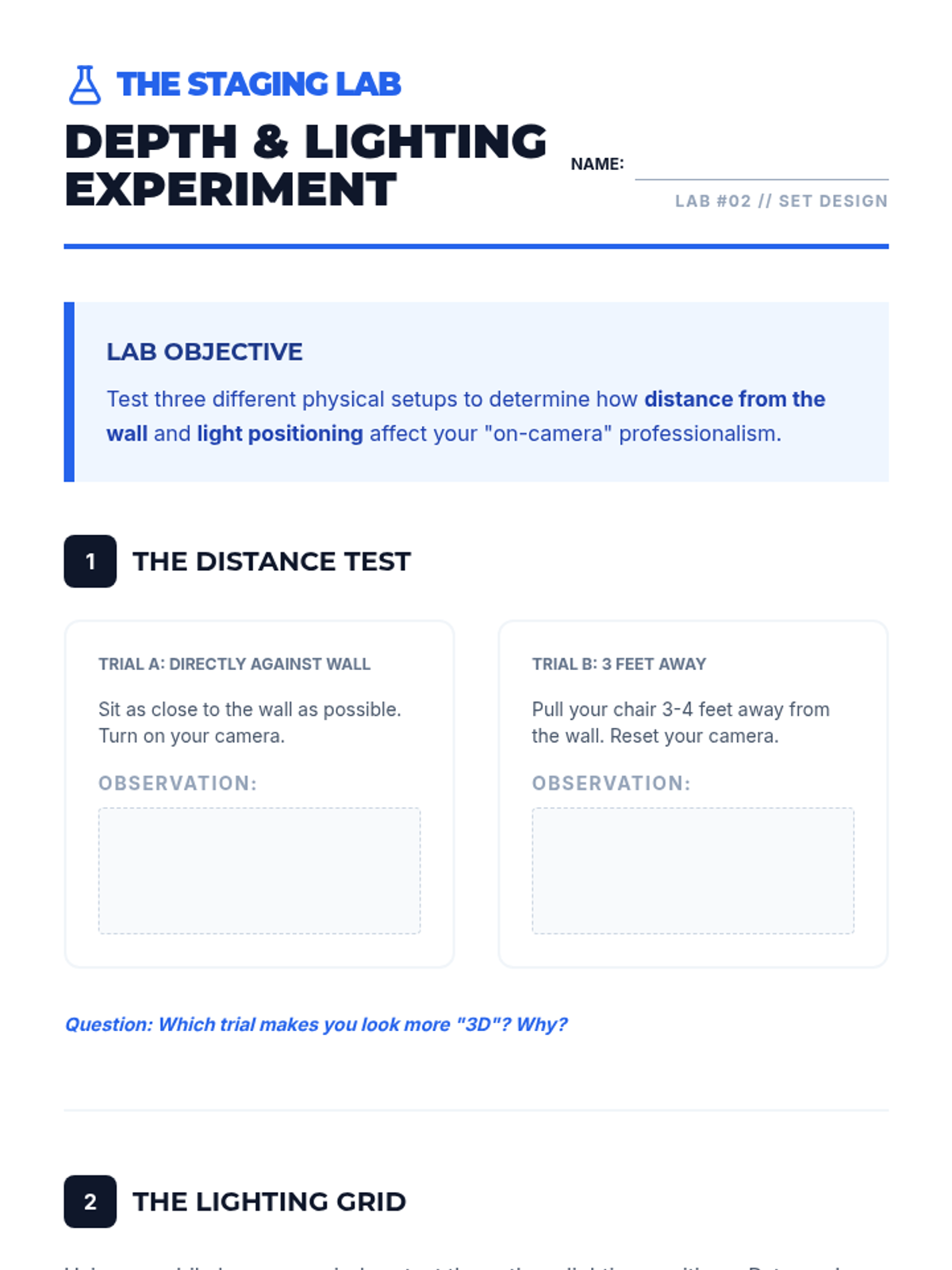
A student activity guide for Lesson 2 that leads students through practical experiments with wall distance and lighting positions to understand depth of field and visual quality.
Recap slides for the final simulation lab, introducing the 'Glitch Gauntlet' rules, the mastery rubric, and peer-observation procedures.
A slide presentation for Lesson 2 focusing on depth of field, the 3-foot rule, lighting angles (back, side, and front), and low-cost set design hacks.
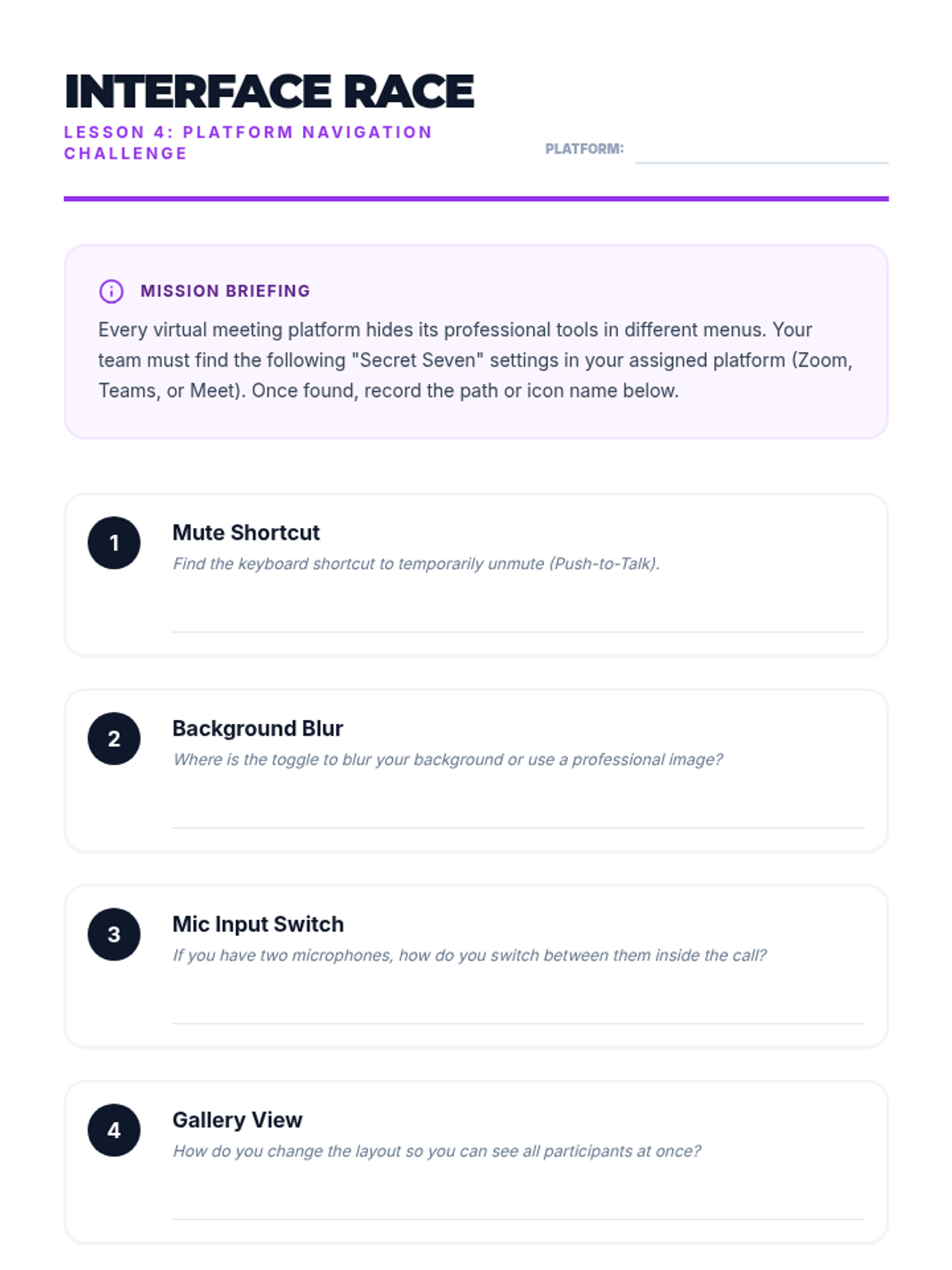
Student activity for Lesson 4 focusing on navigating meeting platform interfaces to find specific technical settings.
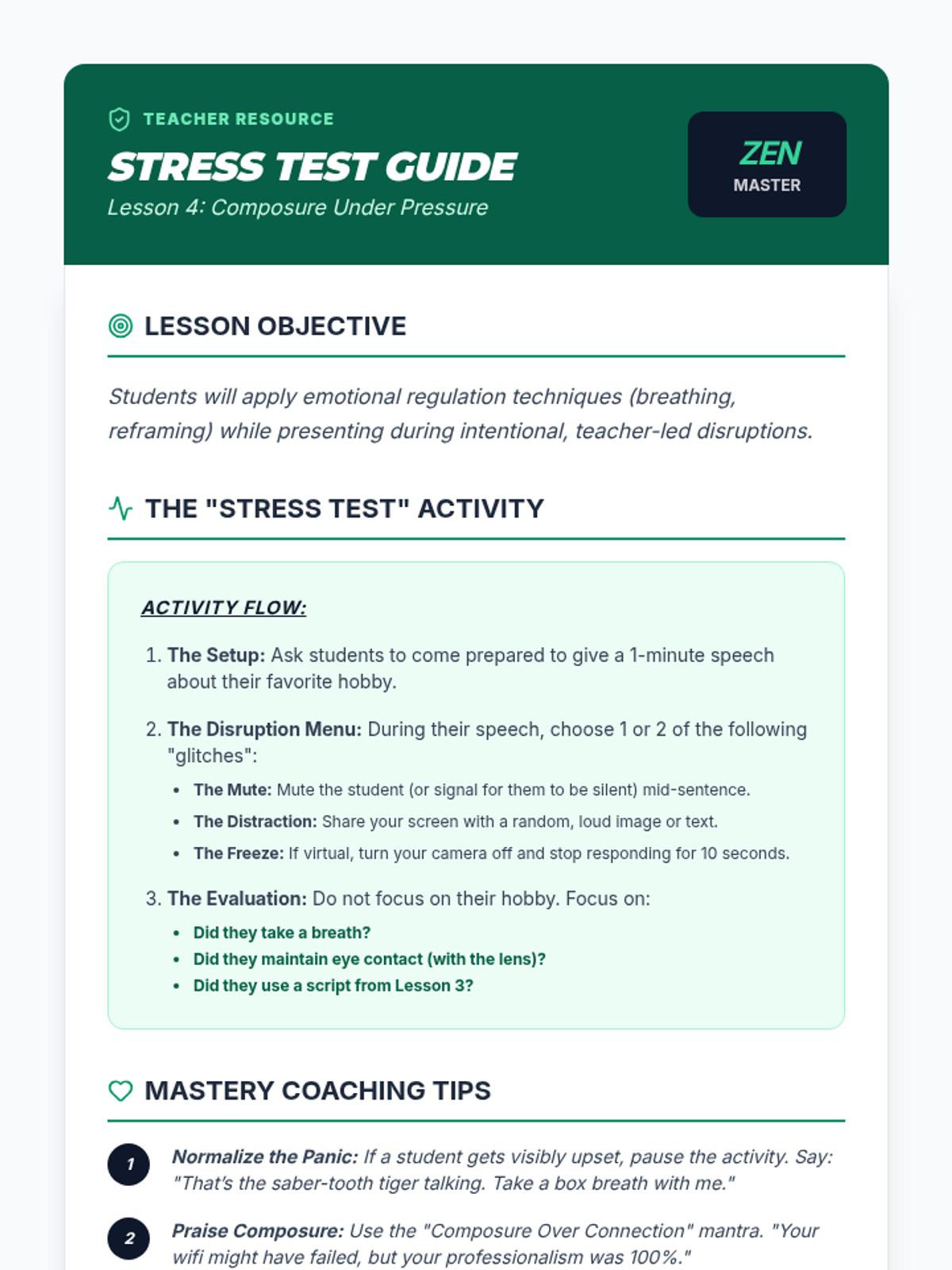
Teaching notes for Lesson 4, including the facilitation guide for the 'Stress Test' activity and strategies for emotional regulation coaching.
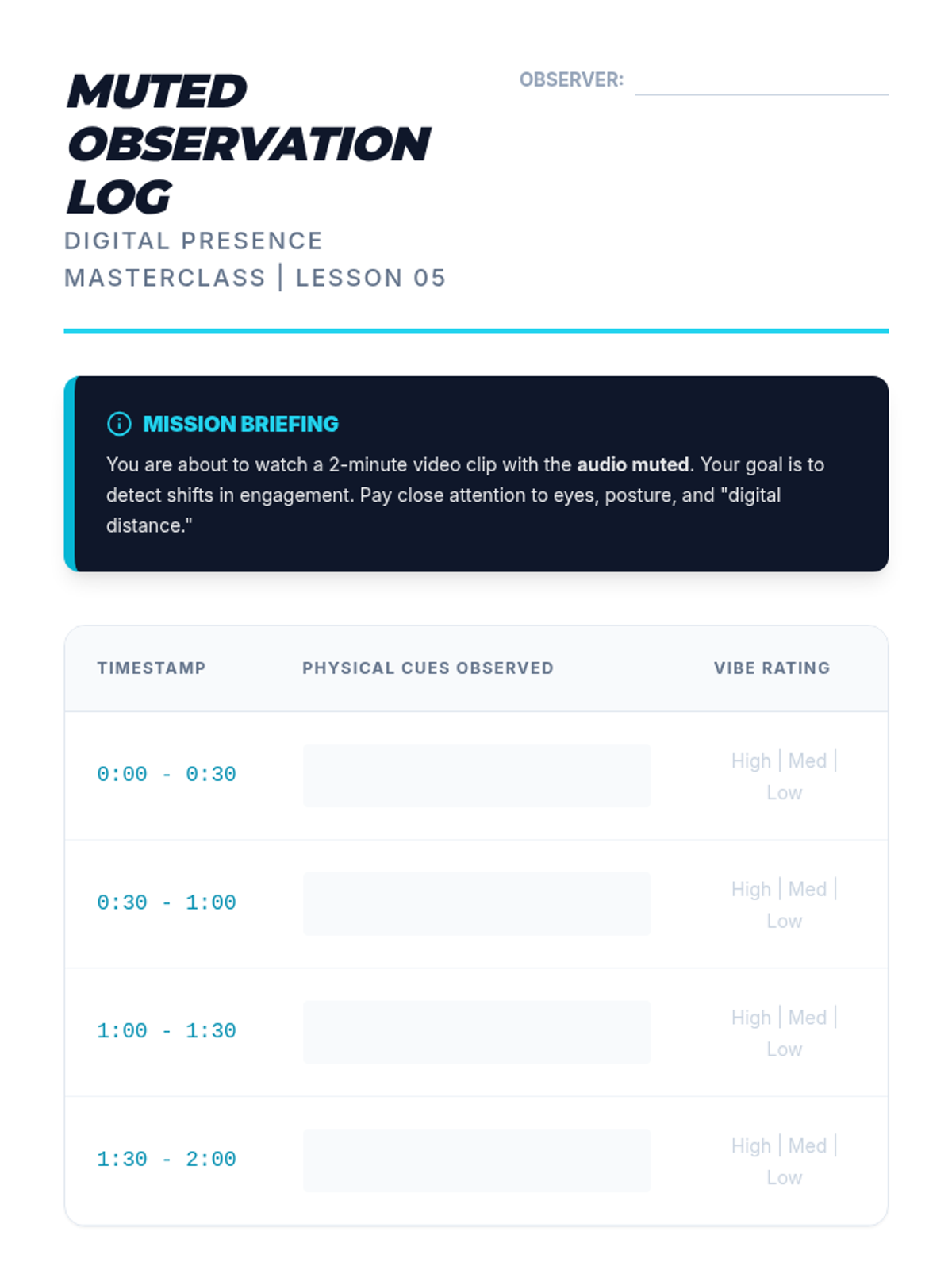
A student observation worksheet for analyzing non-verbal cues in muted video clips and planning re-engagement strategies.
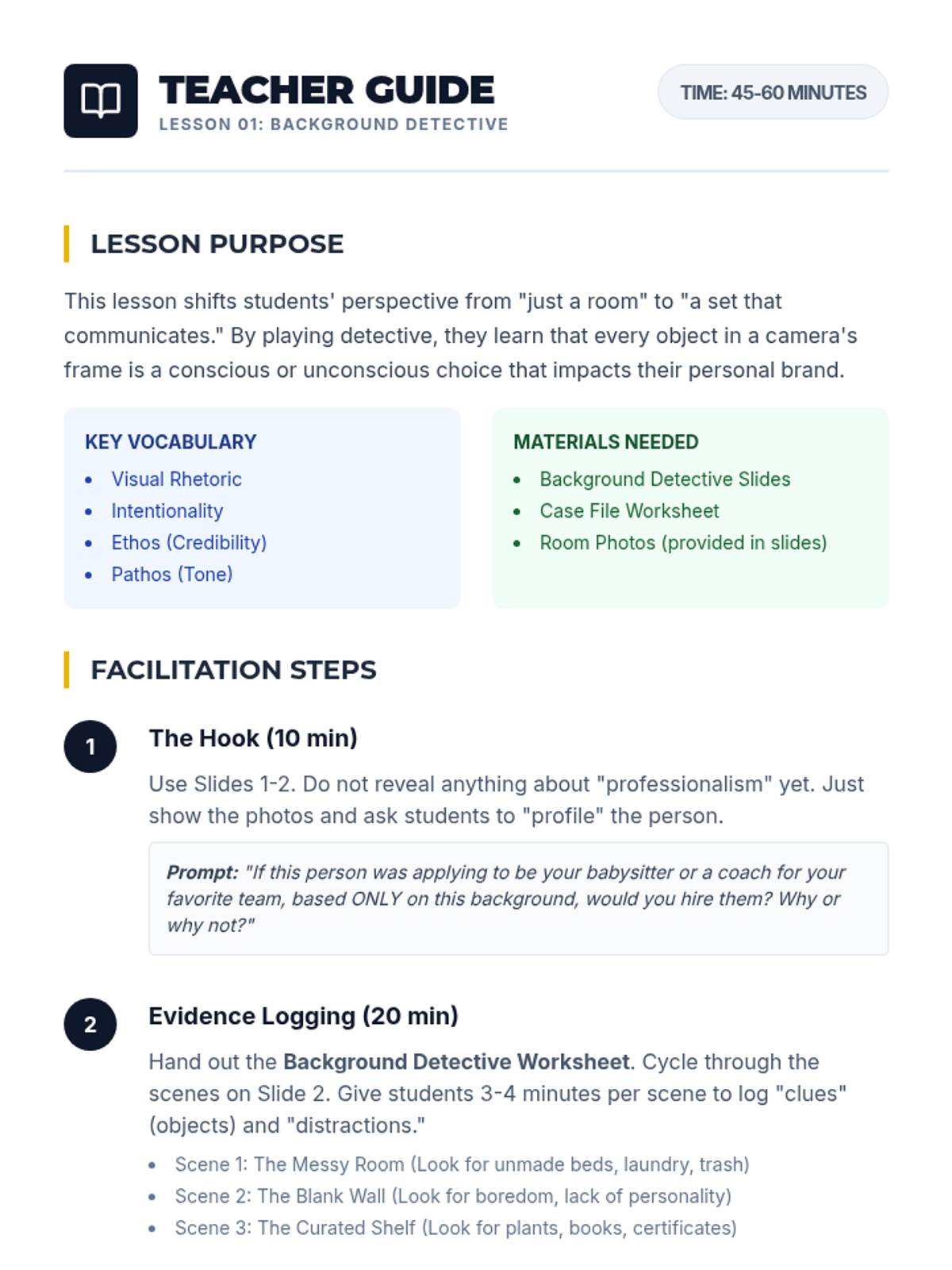
A teacher guide for Lesson 1 providing facilitation steps for the Background Detective activity, key vocabulary, and common student misconceptions.
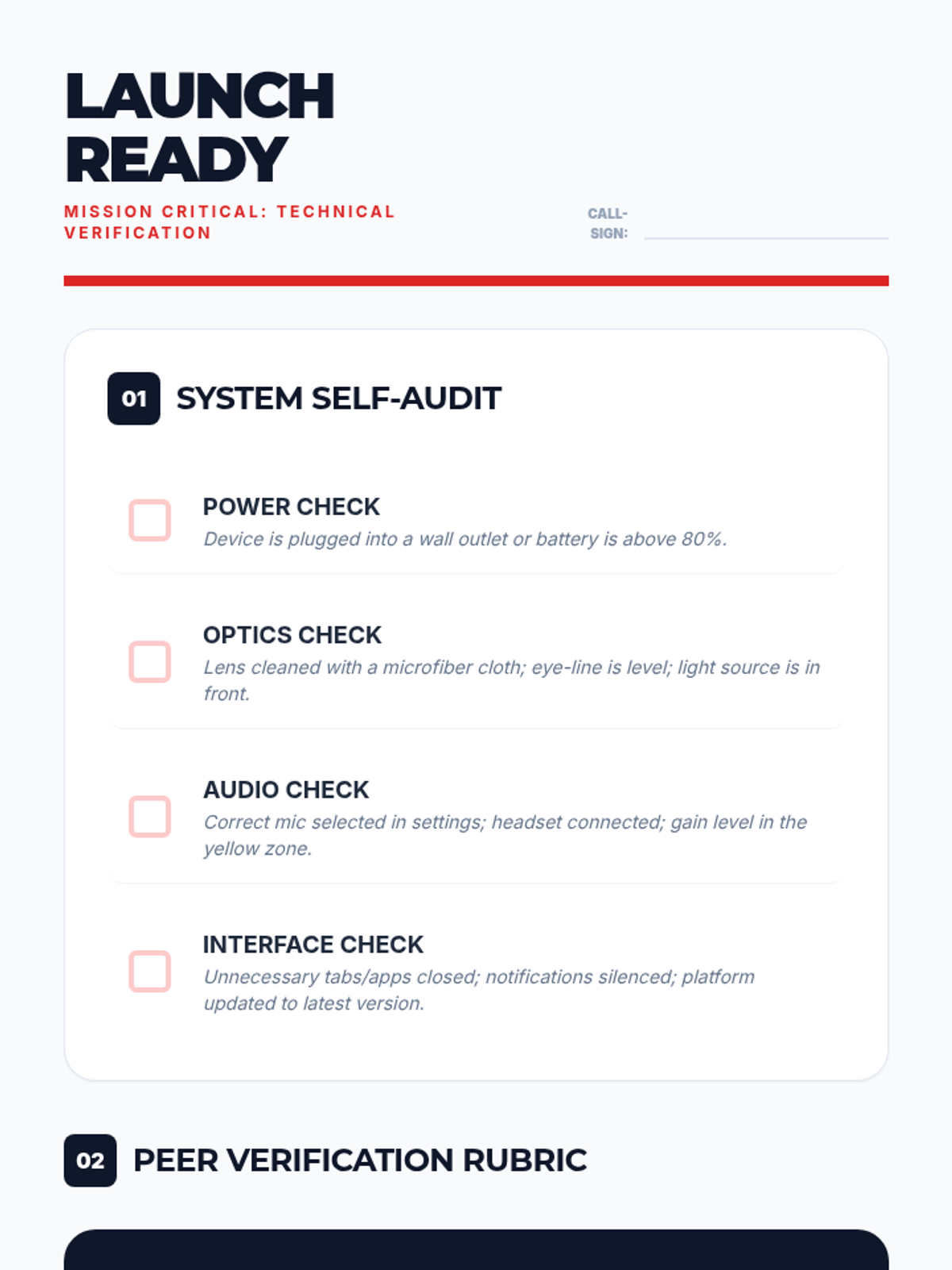
Final technical verification checklist and peer audit rubric for the sequence's mastery assessment.
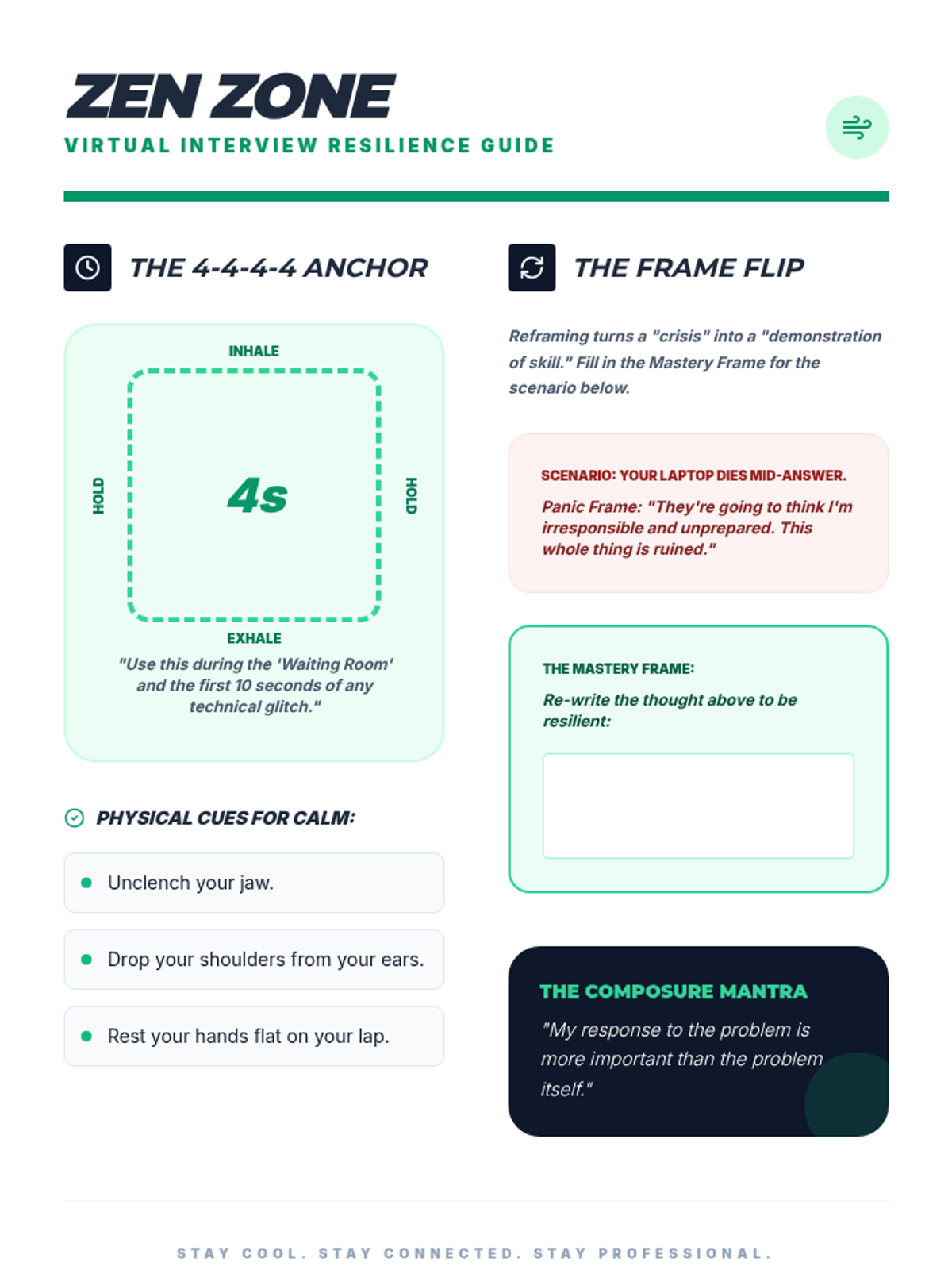
A pocket-sized reference guide and graphic organizer for students to practice emotional regulation techniques and mindset reframing.
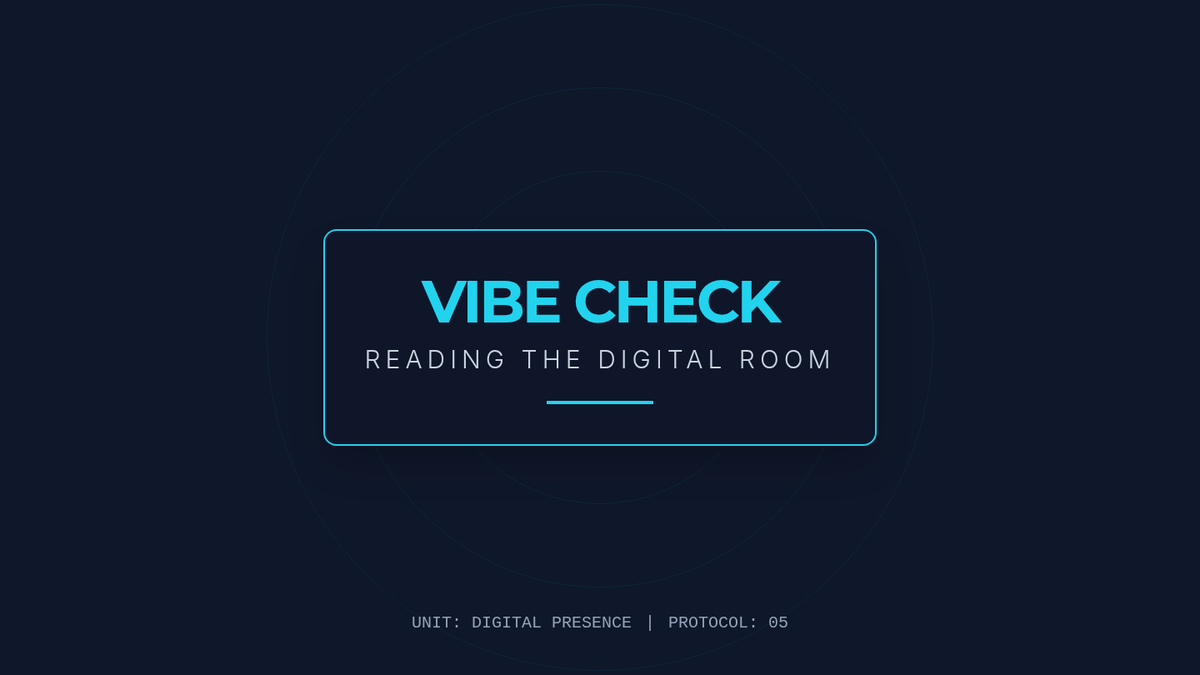
A 5-slide presentation on reading digital social cues and re-engaging an interviewer. It covers identifying micro-signals of boredom and specific strategies for shifting the energy of a virtual meeting.
A 46-slide investigative deck featuring six case studies (including reveals) and an expanded 8-item rapid-fire Round 2 evaluating 'Good Traits' and 'Bad Traits'. Designed for 90 minutes of active learner investigation. Terminology and scoring have been updated for consistency with a point-based system.
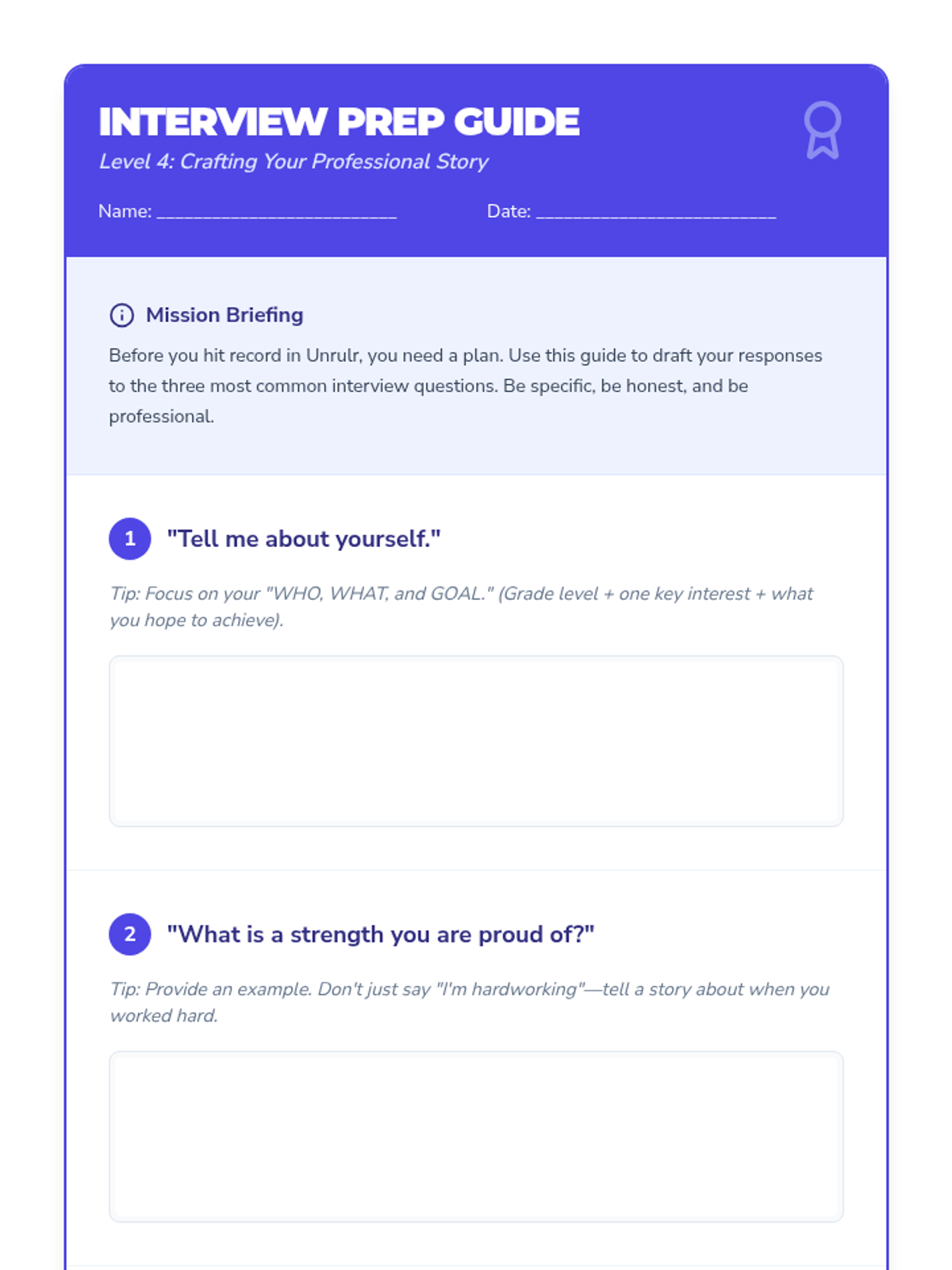
A student-facing worksheet for interviewing preparation, guiding 8th graders through drafting responses to common interview questions with specific tips for professional storytelling. Includes Unrulr tagging checkboxes.
An instructional slide deck for "The Art of the Interview," covering preparation pillars, elevator pitch components, and the final Unrulr documentation requirements. Includes placeholder spots for comparative video analysis.
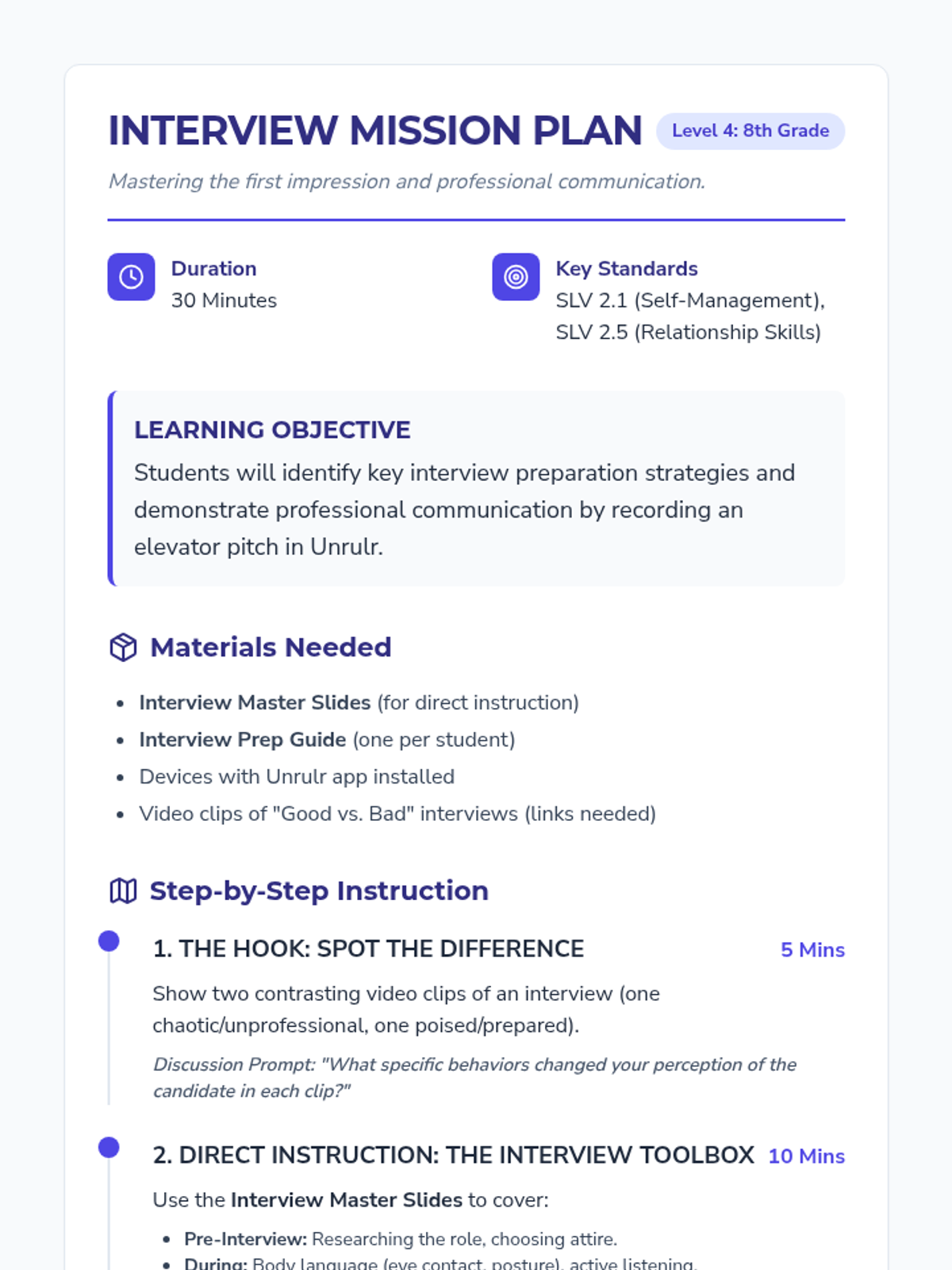
A detailed teacher-facing lesson plan for "The Art of the Interview," featuring a 30-minute instructional arc, standards alignment, and specific steps for student implementation including Unrulr tagging.
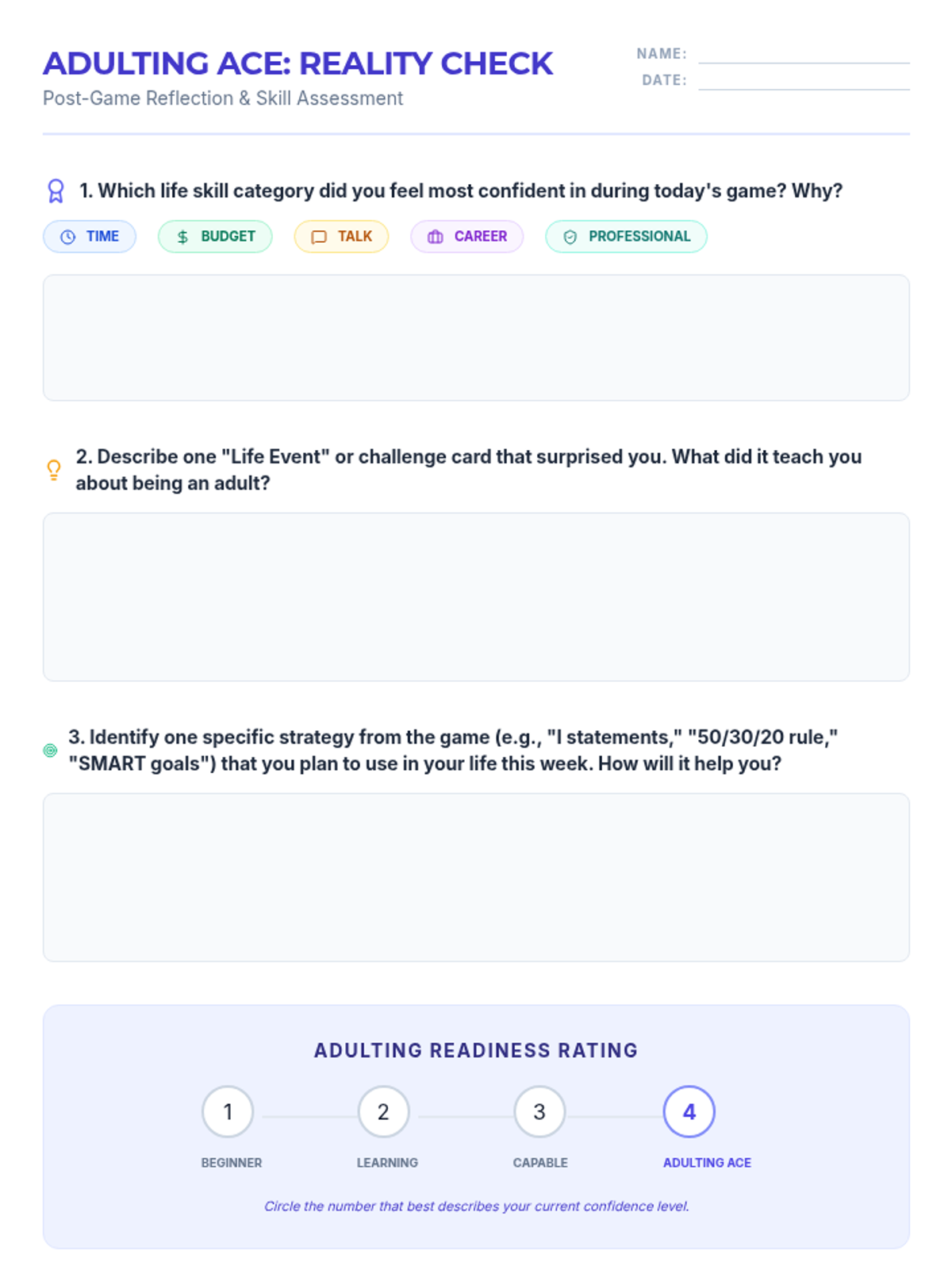
A reflection exit ticket for students to complete after playing 'Adulting Ace'. Includes self-assessment, reflection on specific life skills, and a goal-setting prompt.
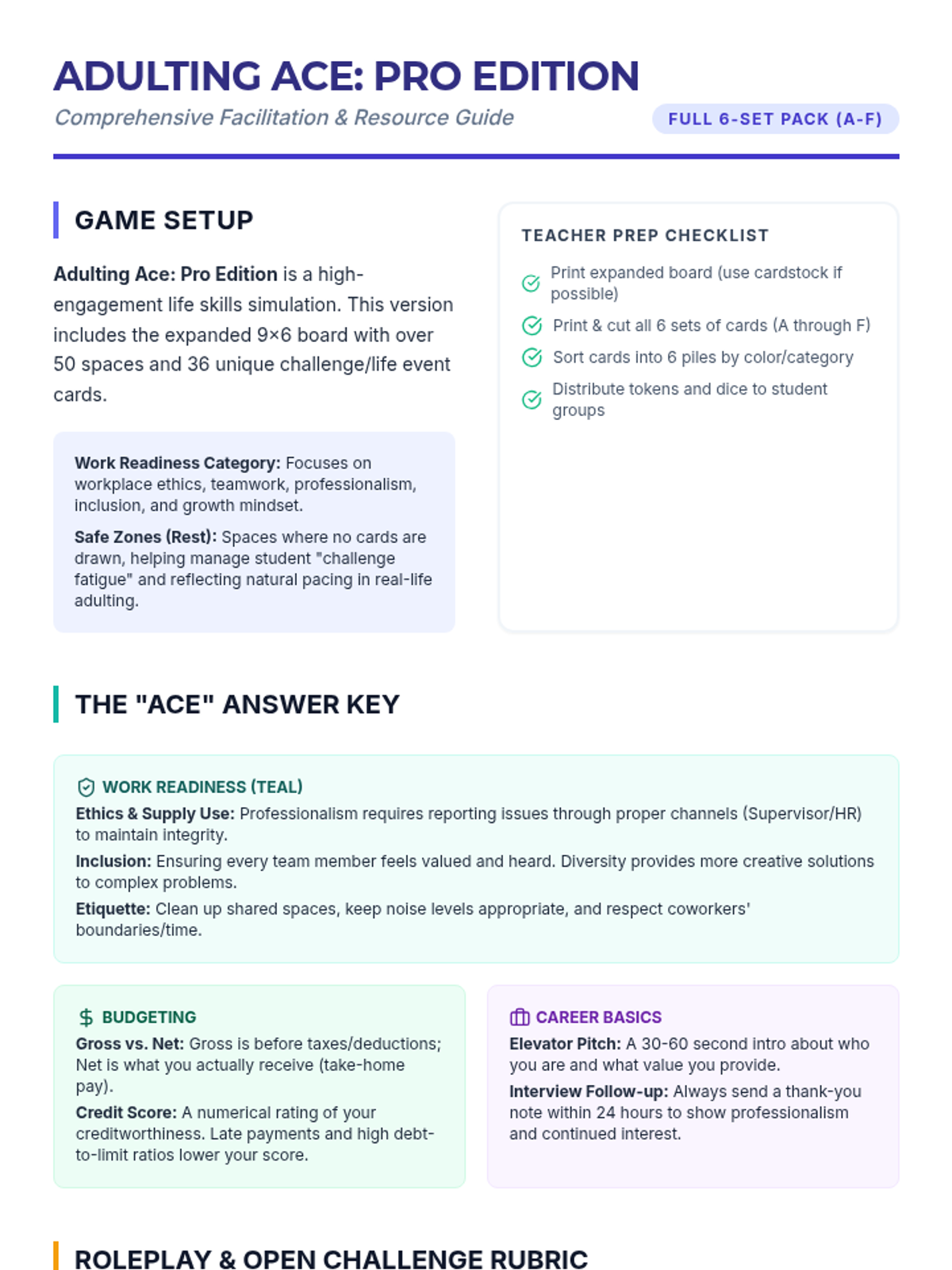
A comprehensive facilitation guide for the 'Adulting Ace' game. Includes assembly instructions, detailed rules, an answer key for all challenge cards, and post-game discussion prompts.
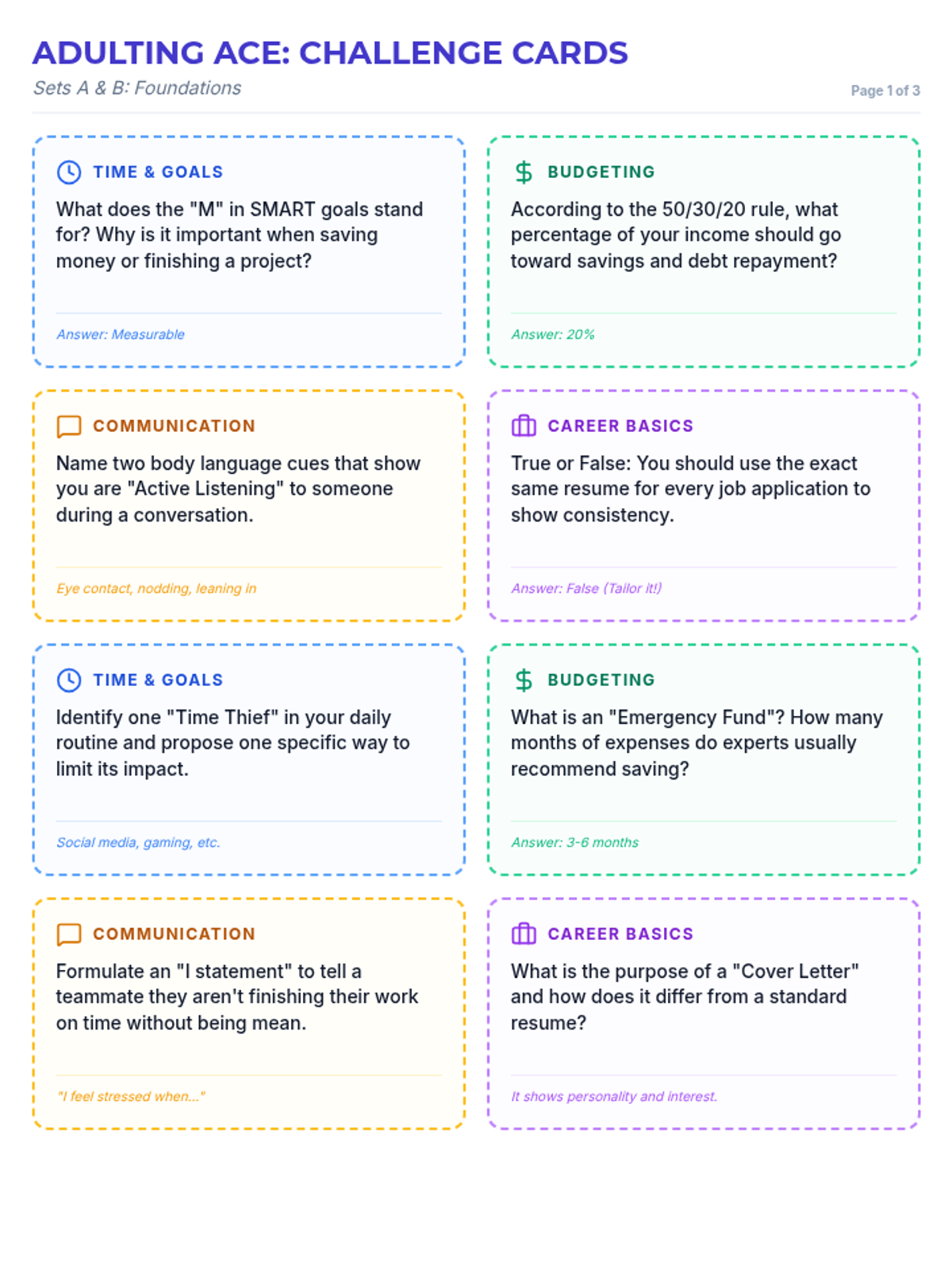
An expanded set of challenge cards for 'Adulting Ace'. Includes 24 challenge cards across 5 categories and 6 Life Event cards, organized into printable sets A-F for comprehensive gameplay.
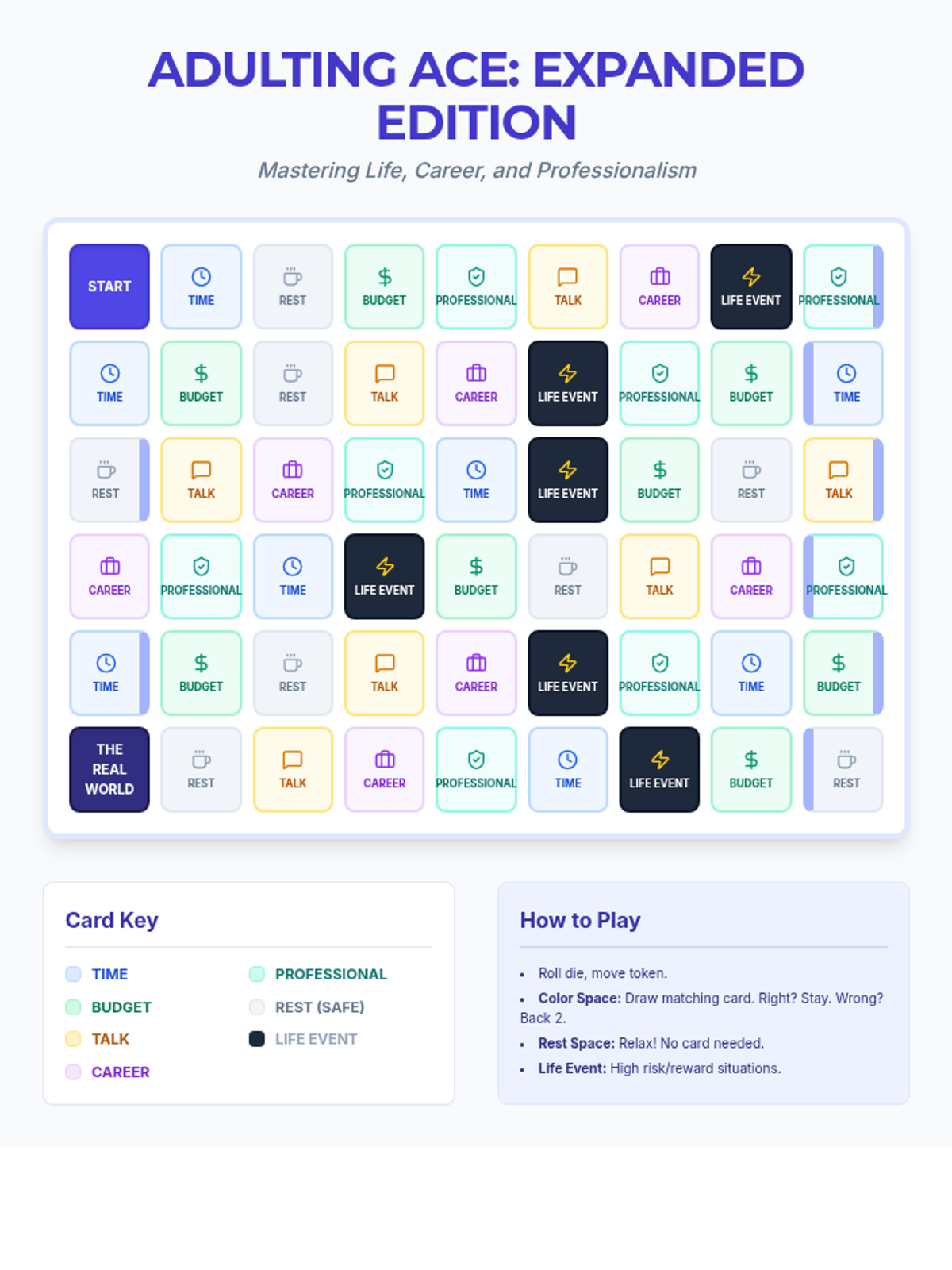
An expanded 9x6 board layout for 'Adulting Ace' featuring 50+ spaces, a new 'Work Readiness' category (Teal), and 'Rest' spaces to create pacing between challenges.
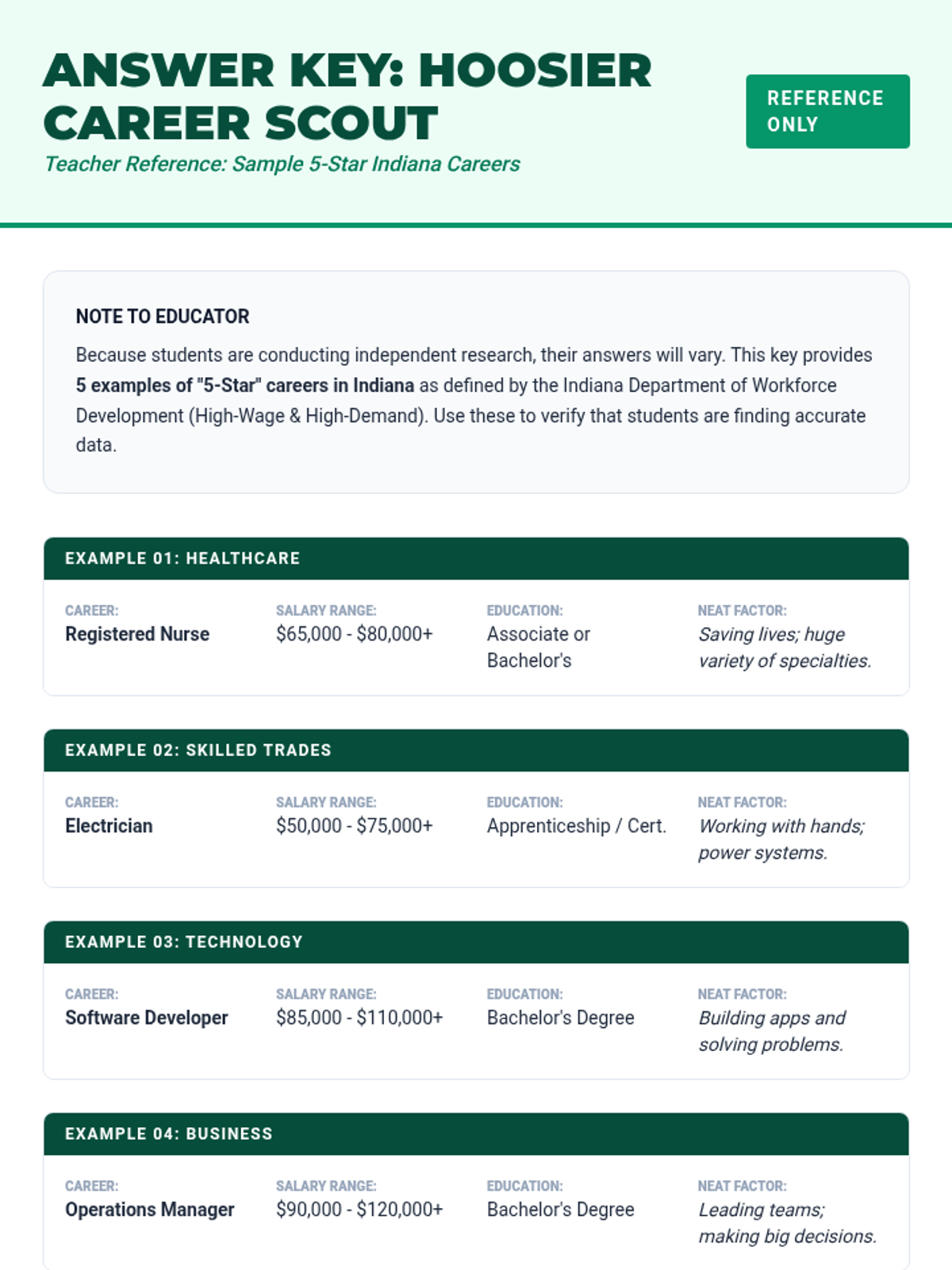
A teacher-facing answer key for the Career Launchpad Assignment. Provides 5 sample "5-star" Indiana careers with salary and education data to serve as a reference for grading student research.
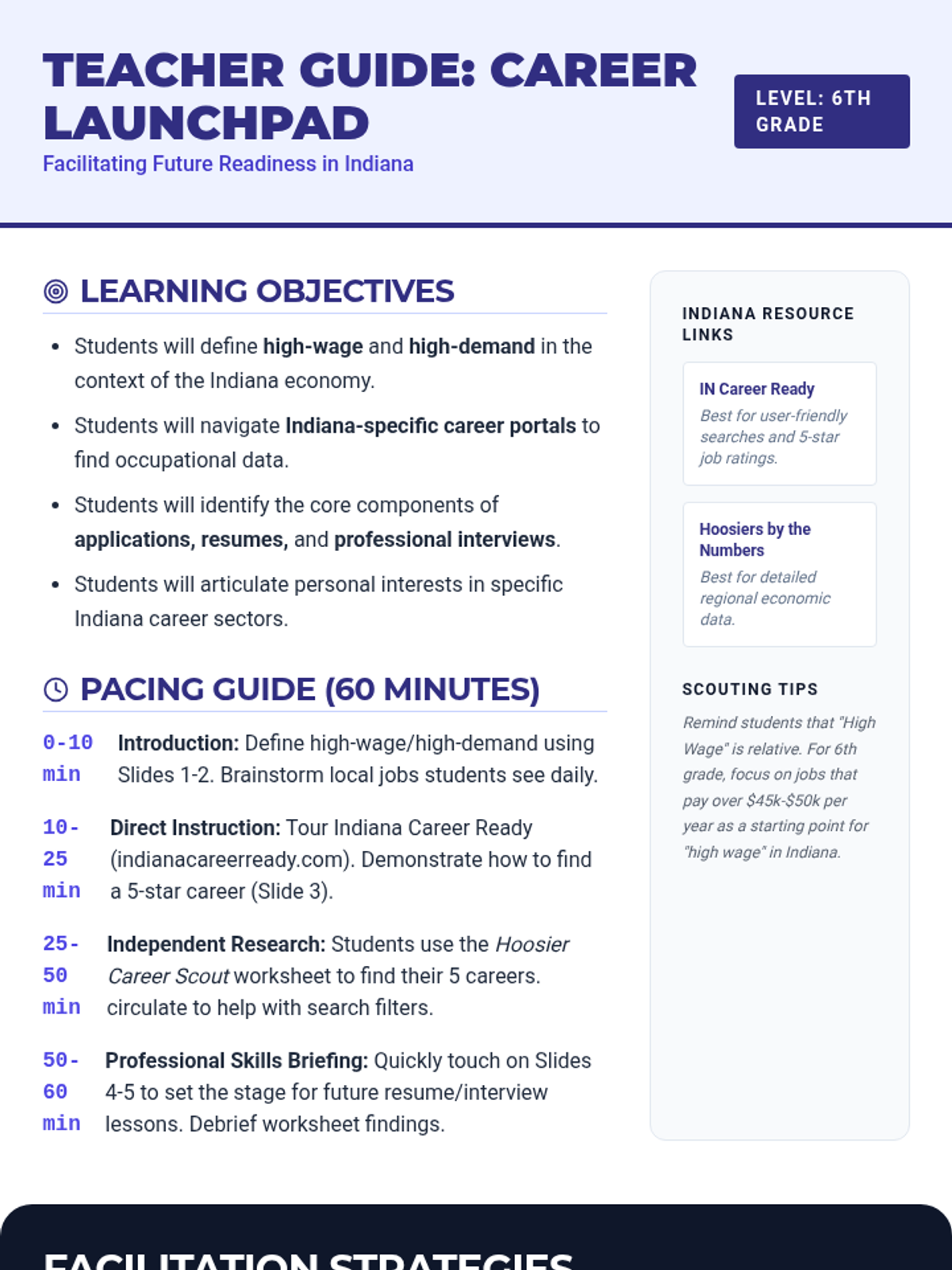
A comprehensive teacher facilitation guide for the Career Launchpad lesson. Includes learning objectives, pacing, specific Indiana research resource links, and differentiation strategies for 6th-grade students.
A six-slide presentation for 6th grade career exploration. Covers the definitions of high-wage and high-demand careers, introduces Indiana-specific research tools, and outlines the professional skills of resumes, applications, and interviews.
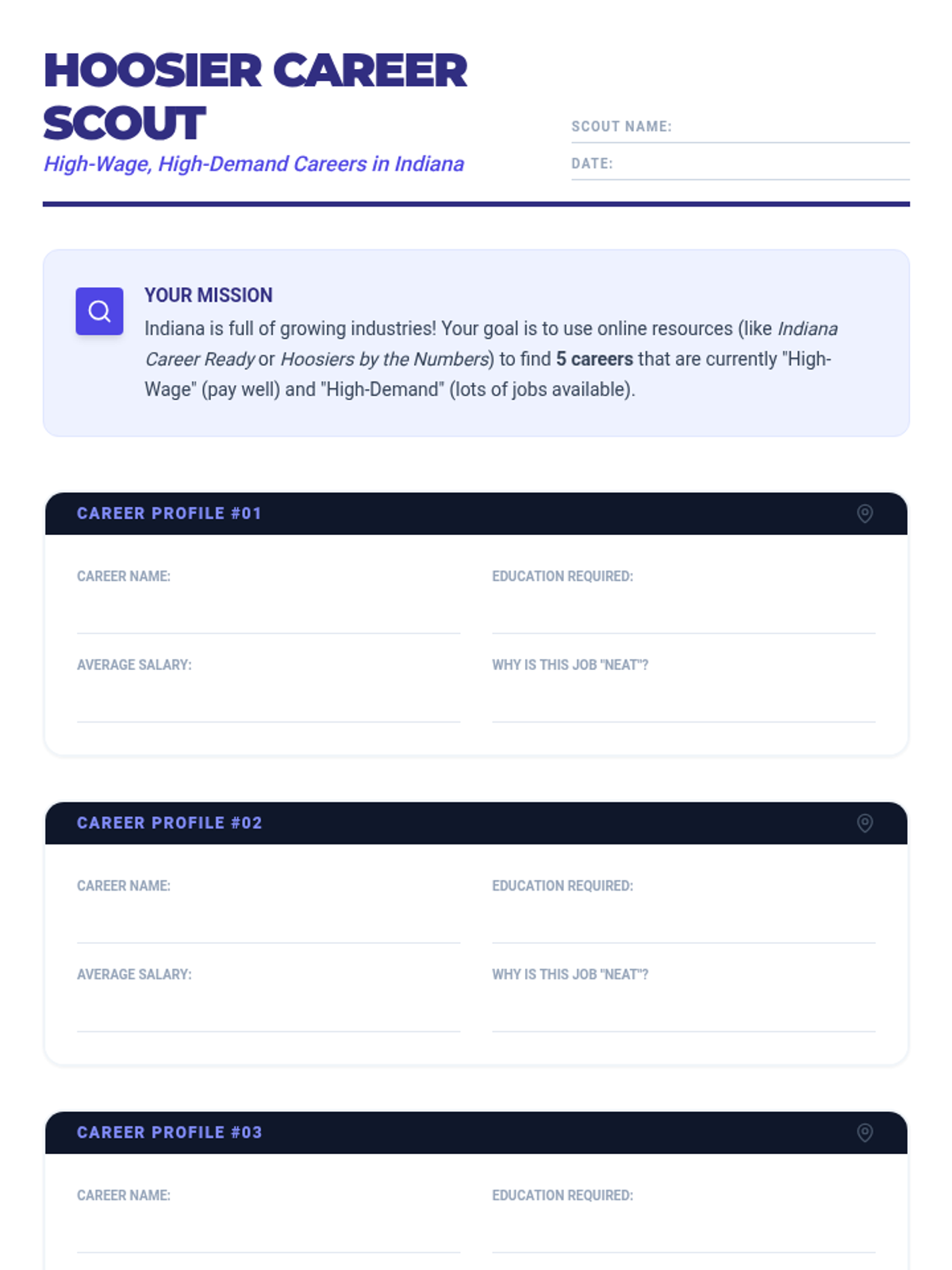
A two-page career research worksheet for 6th graders. Students research 5 high-wage, high-demand careers in Indiana, documenting salary, education requirements, and unique features of each role.
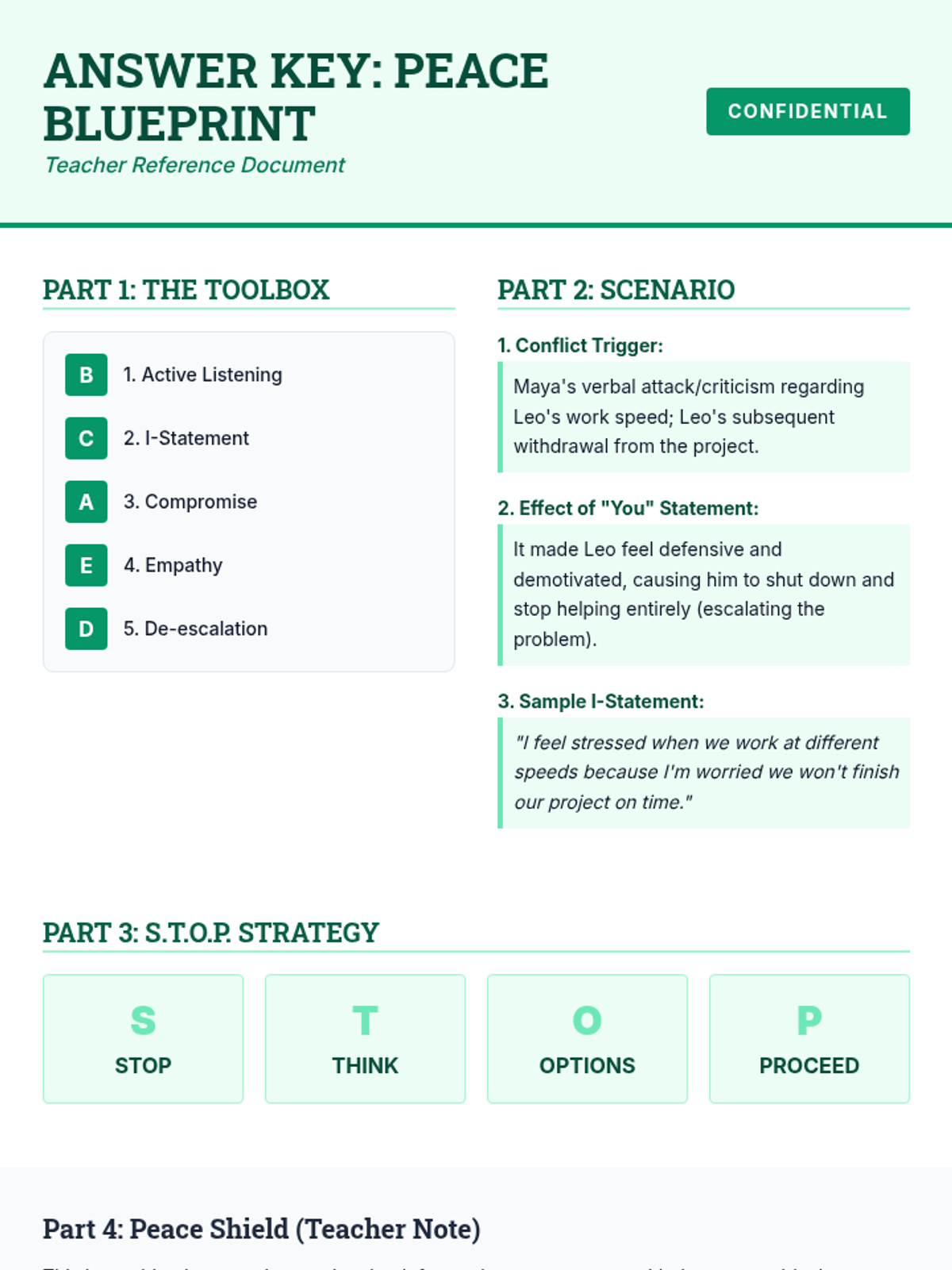
The official teacher answer key for the Peace Blueprint Worksheet, providing correct matches, sample scenario responses, and the completed STOP strategy. Part 4 (Peace Shield) has been removed.
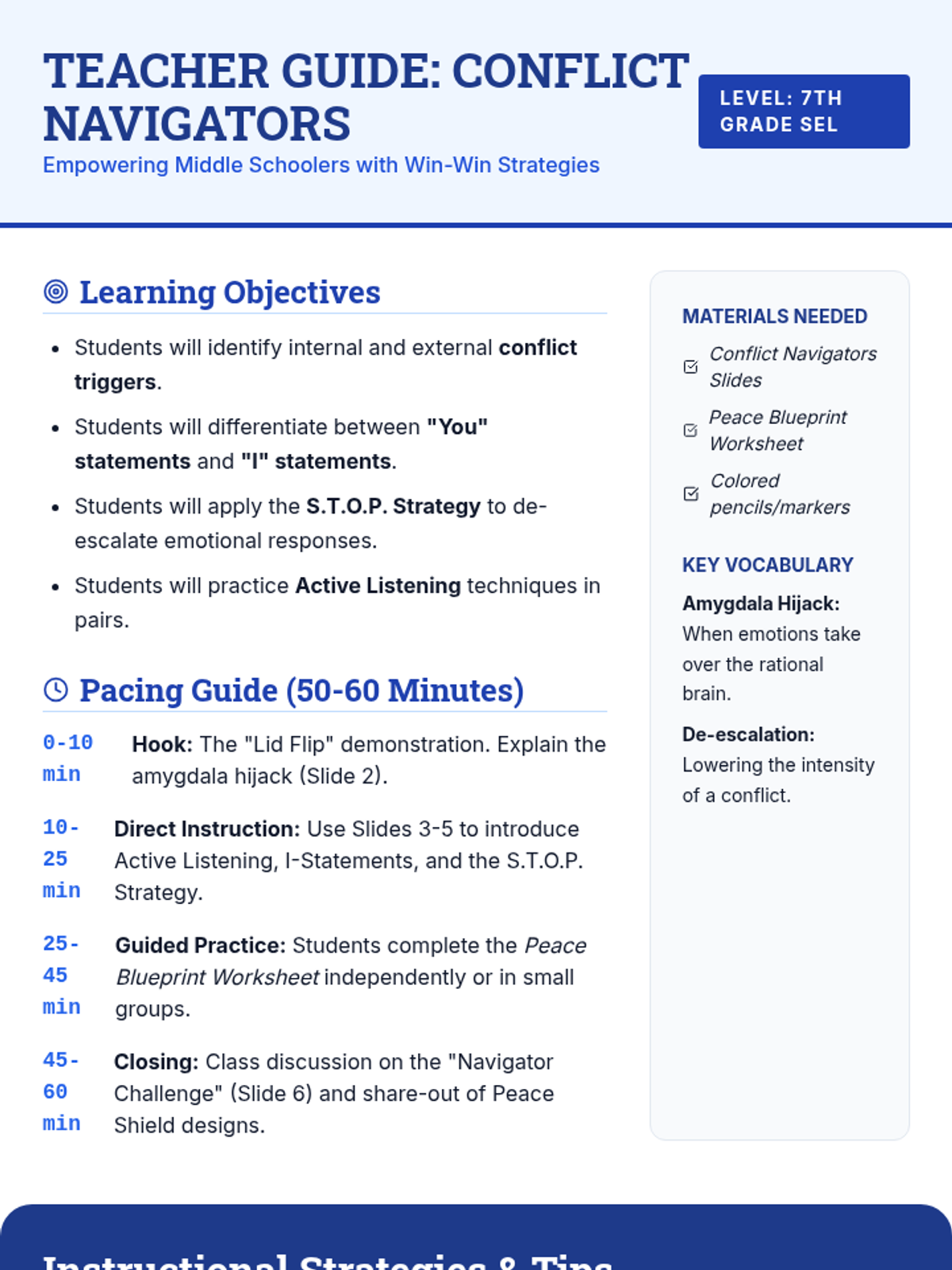
A comprehensive teacher facilitation guide for the Conflict Navigators lesson, updated to remove Peace Shield activities. Includes learning objectives, pacing, vocabulary, and differentiation strategies.
A six-slide presentation for 7th grade SEL focused on conflict resolution. Covers the 'Amygdala Hijack', active listening, I-statements, the S.T.O.P strategy, and a real-world scenario challenge.
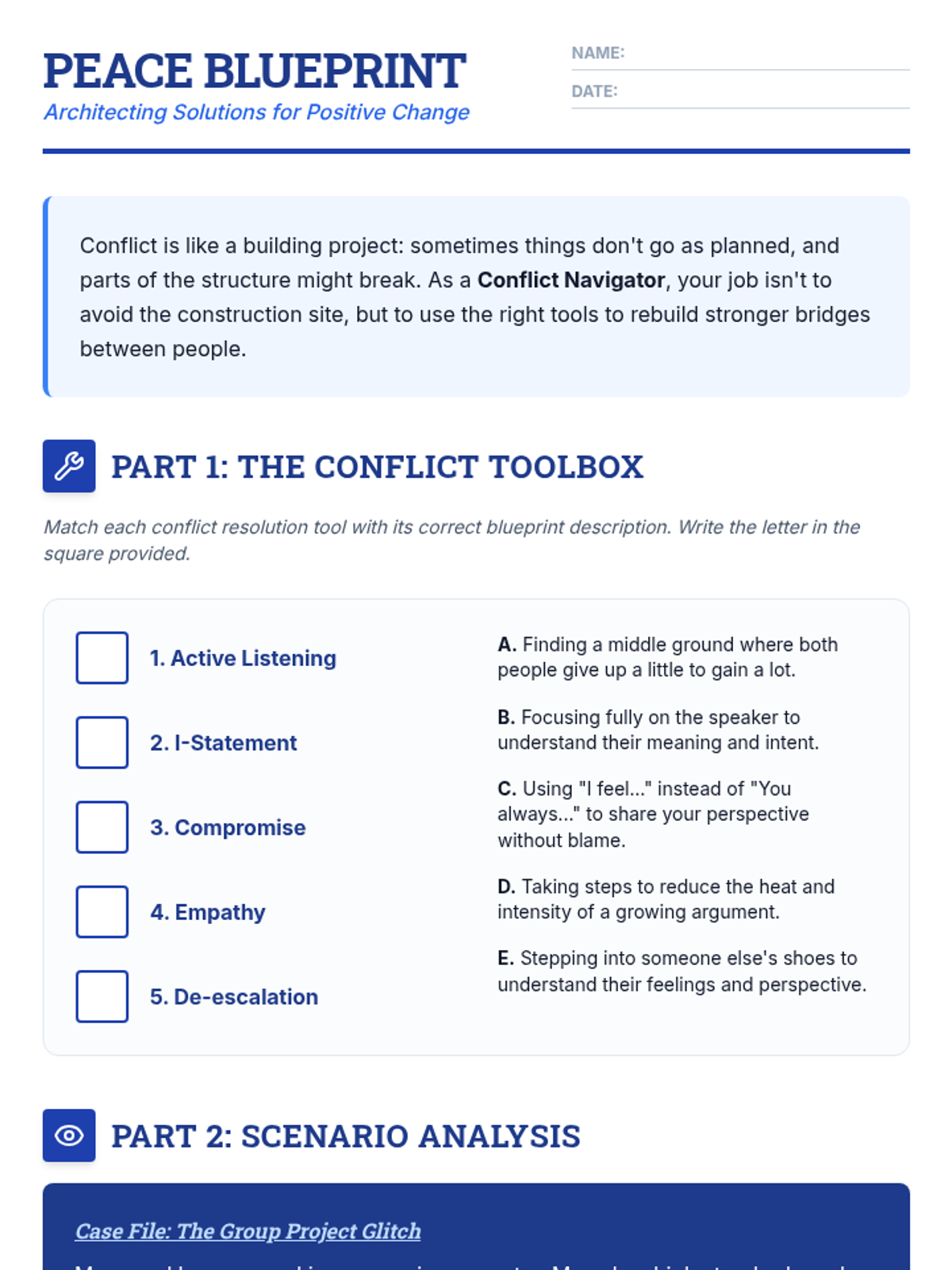
A two-page SEL worksheet for middle schoolers featuring matching activities for conflict tools, a scenario-based reading comprehension section, the S.T.O.P. strategy, and a new reflection section. Part 4 (Peace Shield) has been removed.
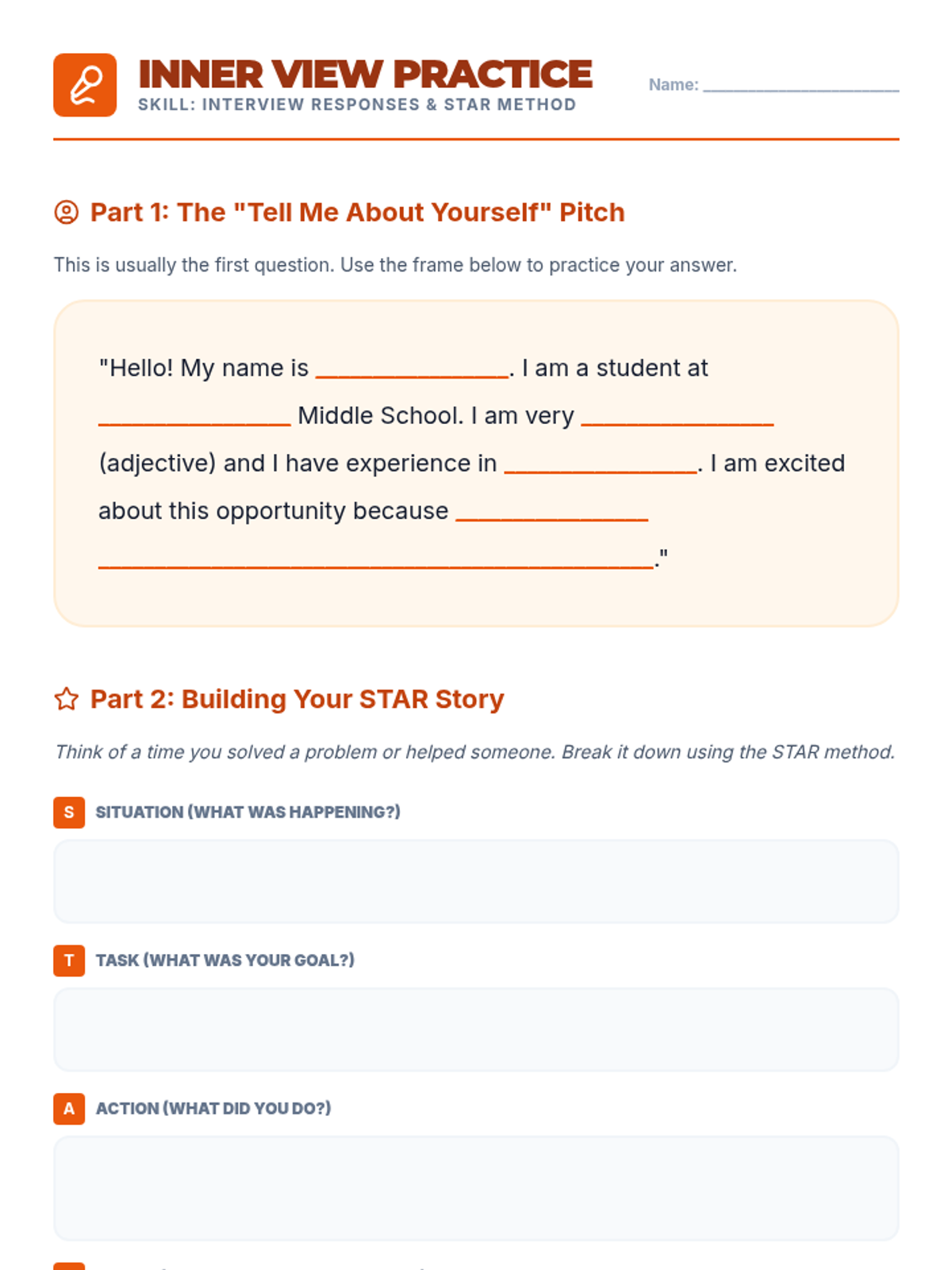
A worksheet for students to practice the STAR method for interview responses and develop thoughtful questions based on their research.
Visual presentation for Lesson 4, teaching students interview preparation, the STAR method, and how to ask insightful questions.
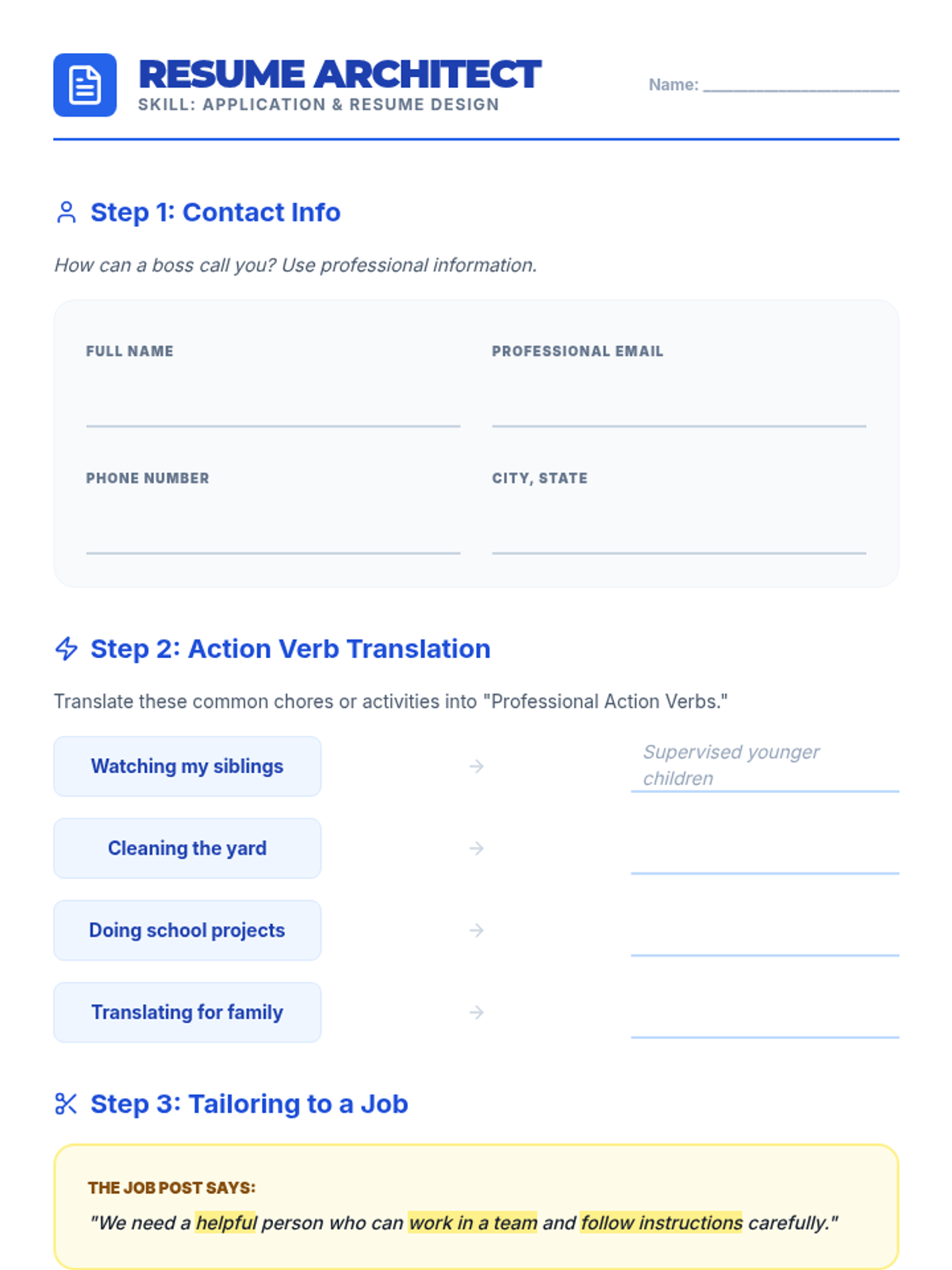
A worksheet for students to practice tailoring their resumes, translating chores into professional skills, and formatting contact information.
Visual presentation for Lesson 3, teaching students the anatomy of a resume, how to use action verbs, and the importance of tailoring applications.