Active listening, assertive expression, and boundary-setting strategies for interpersonal success. Develops proficiency in conflict mediation, cooperative teamwork, and the cultivation of healthy romantic and platonic connections.
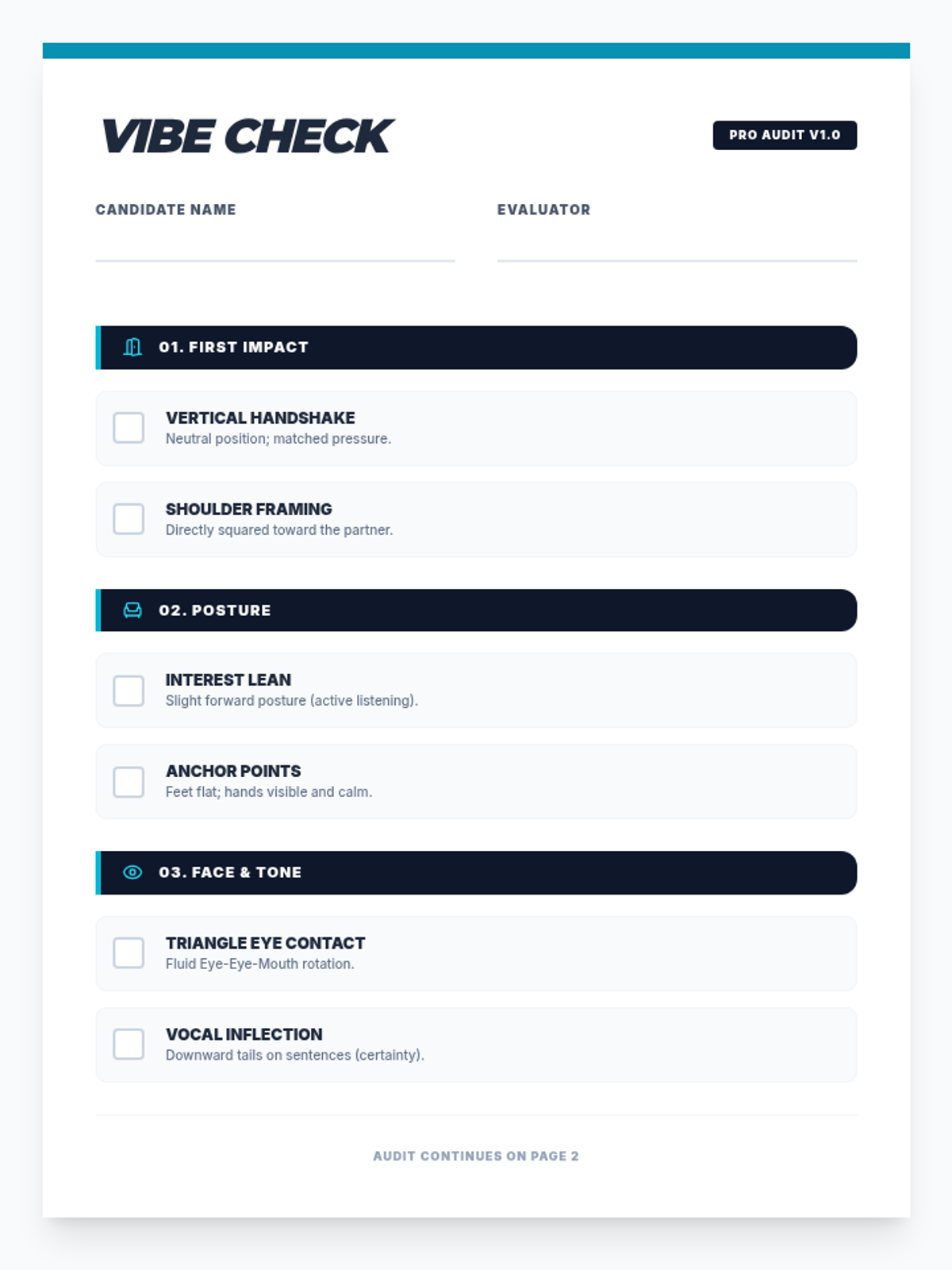
A checklist for students to evaluate professional non-verbal communication during mock interviews, covering handshakes, posture, and facial expressions.
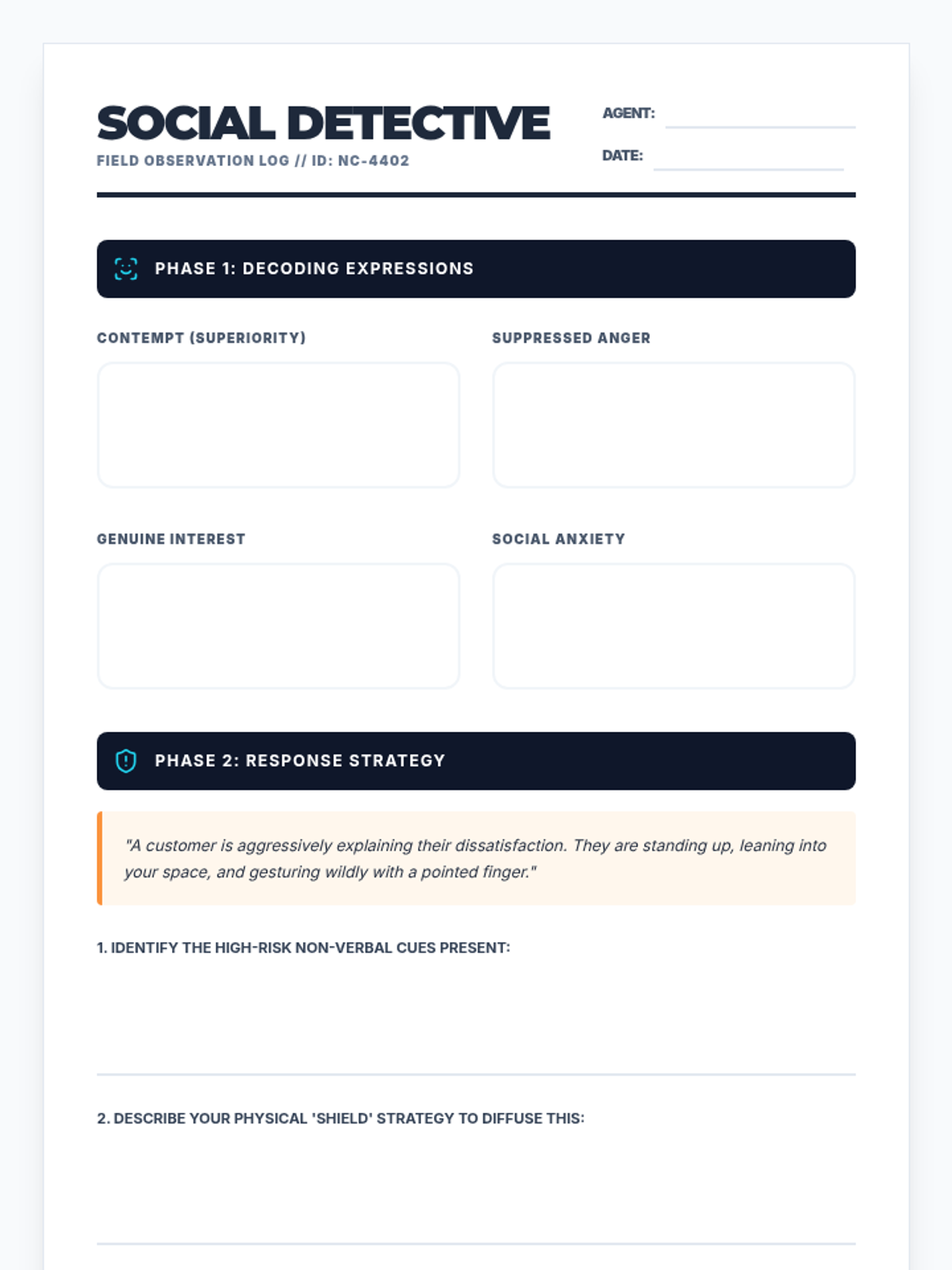
A student worksheet designed as a 'Field Observation Log' for role-playing exercises and scenario analysis in non-verbal communication.
Instructional slides for the 'Silent Signals' lesson, featuring visual breakdowns of the 93% rule, interpersonal rapport techniques, professional interview cues, and de-escalation strategies.
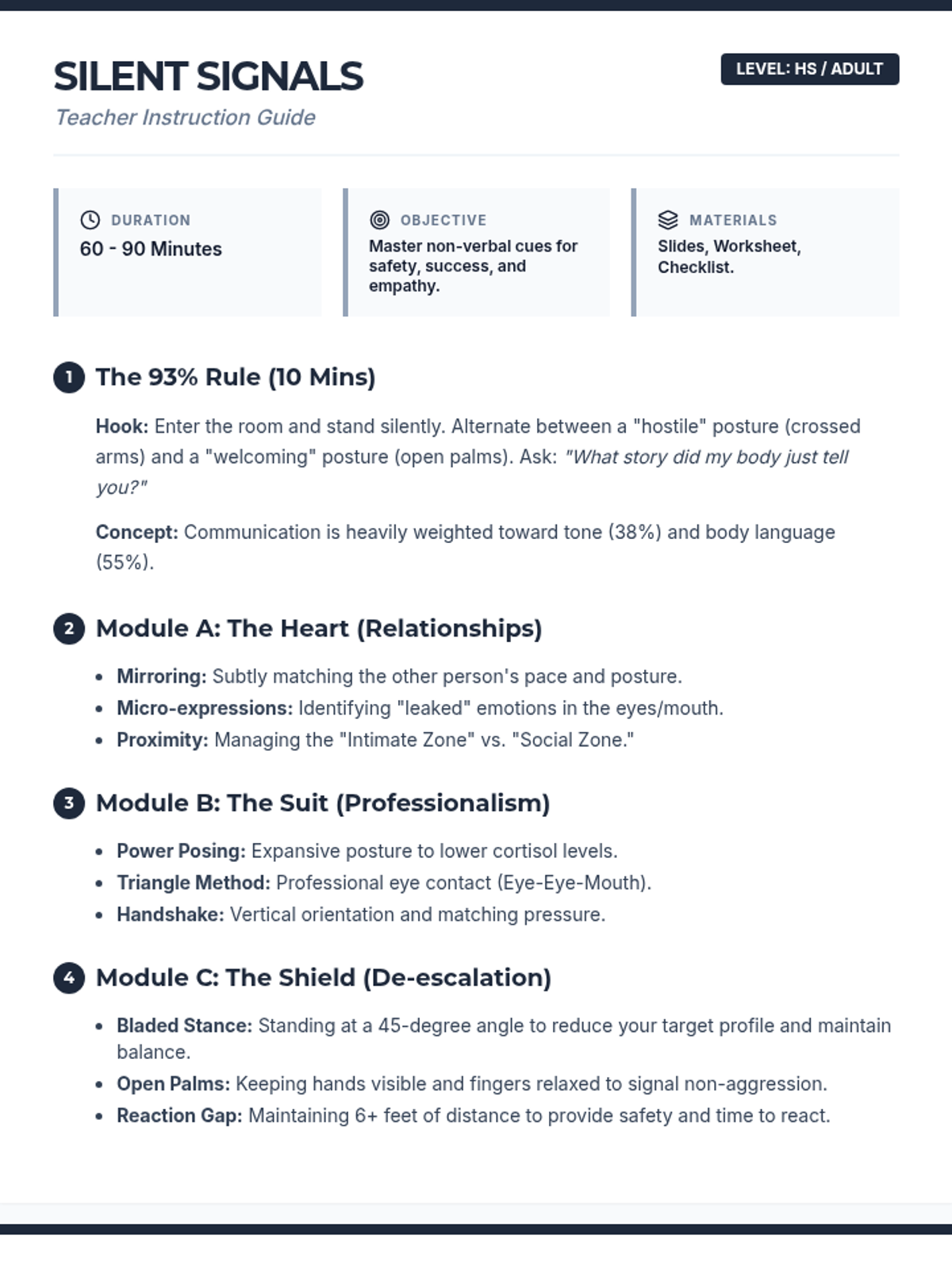
A detailed teacher facilitation guide for the 'Silent Signals' lesson, including lesson objectives, timing, key concepts for three modules, and practical classroom exercises.
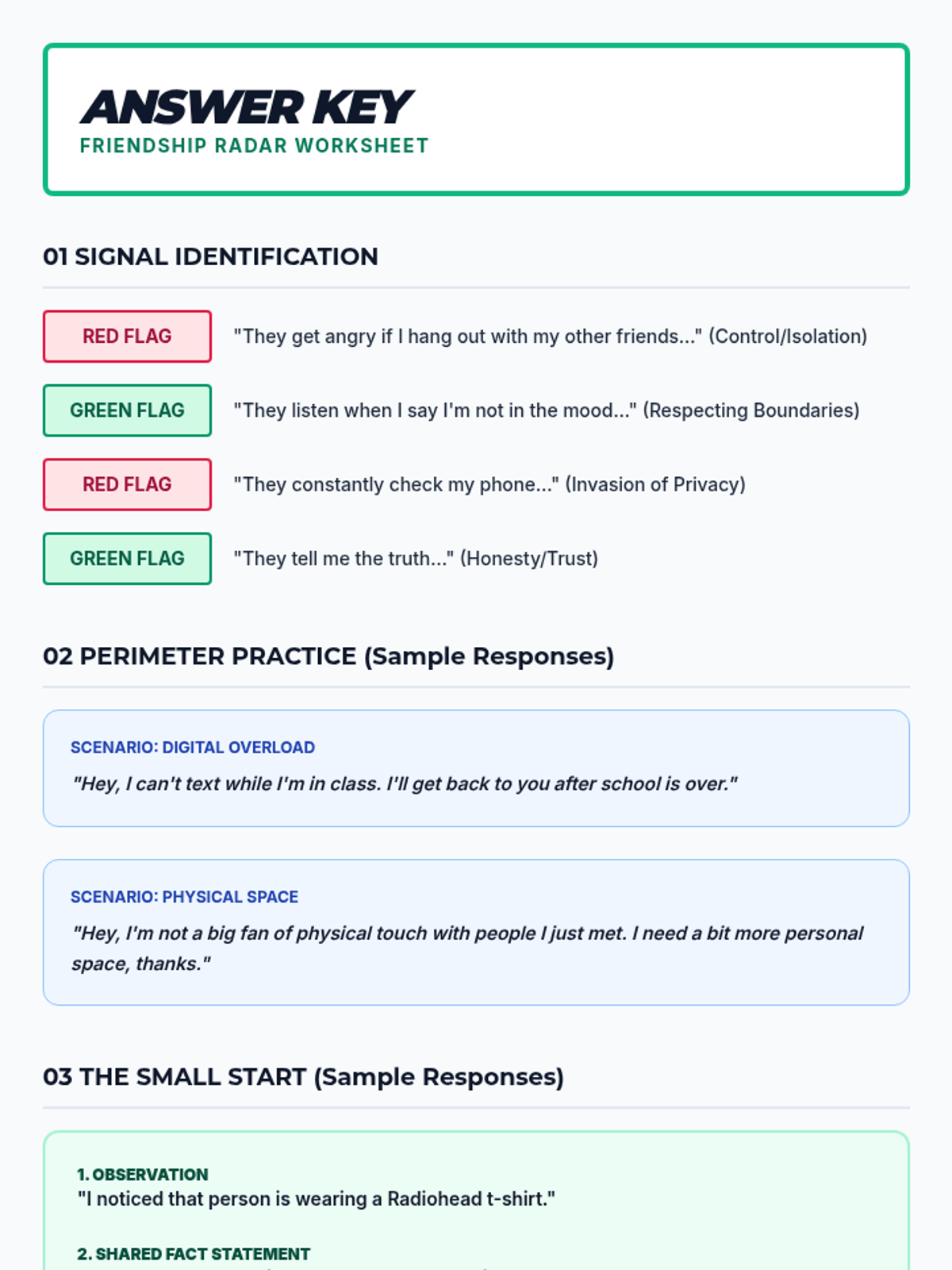
An answer key for the Friendship Radar Worksheet. Revised for better page layout (preventing split sections), improved contrast for scripts, and clearer visual hierarchy.
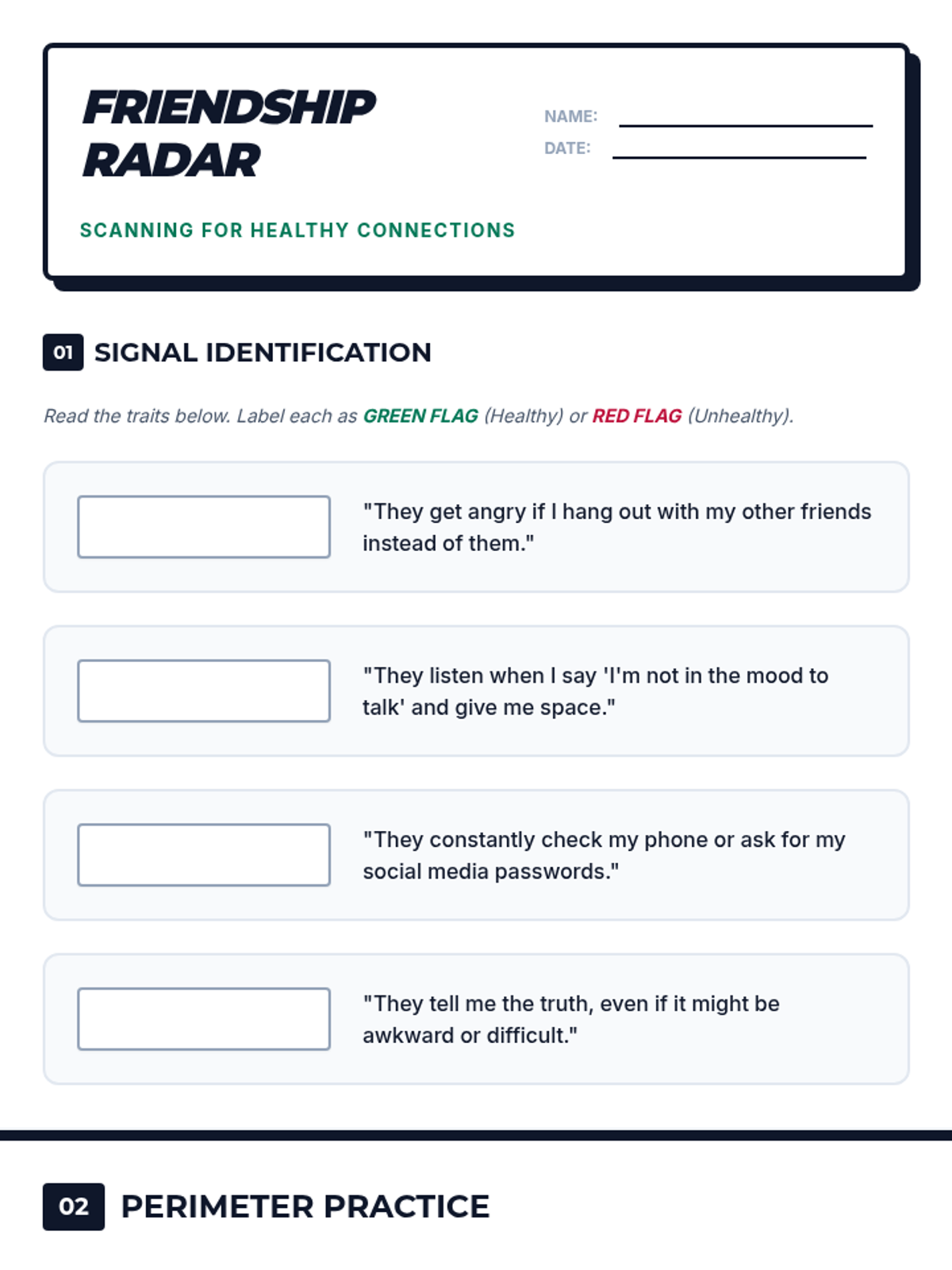
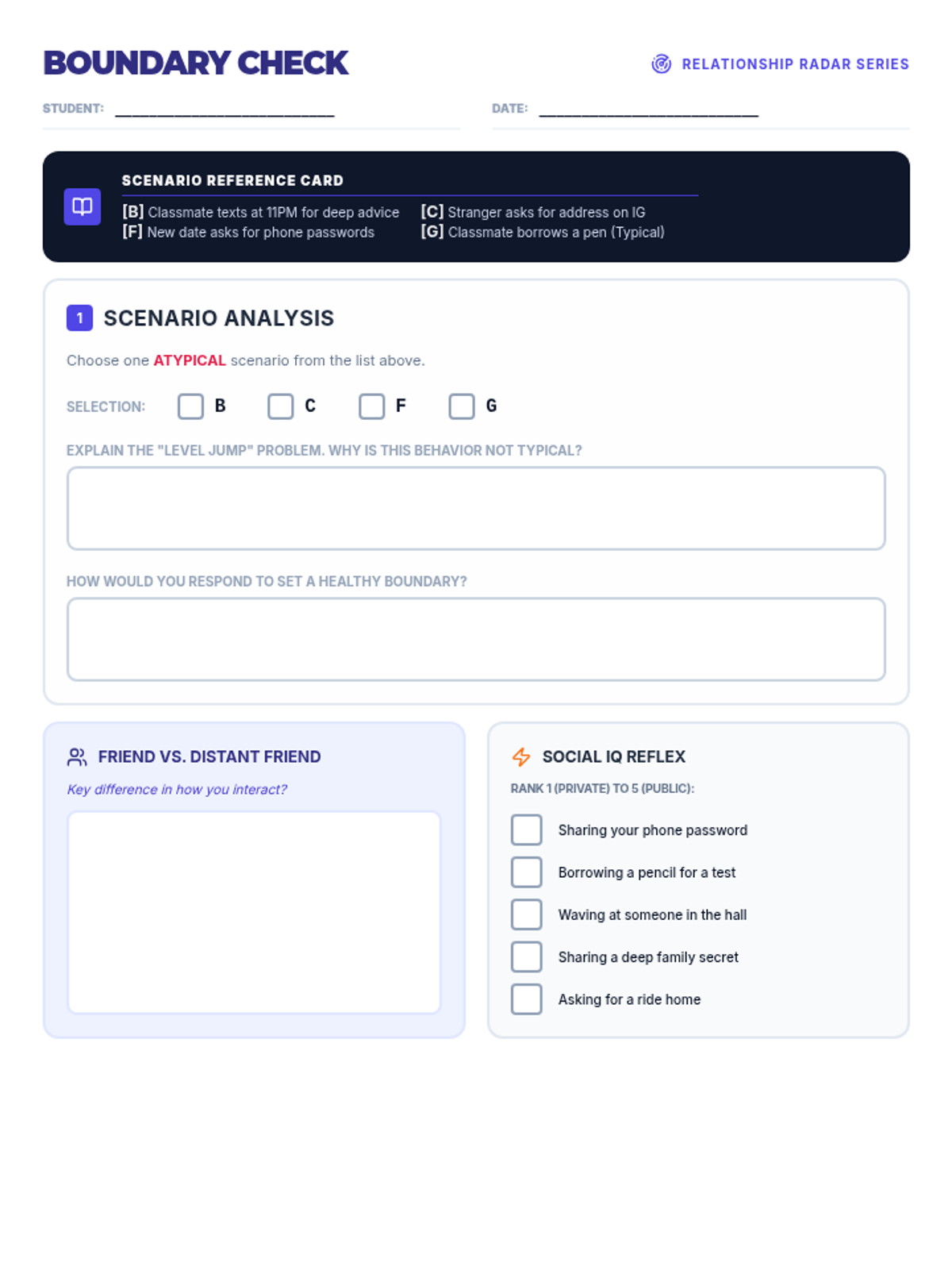
A student worksheet for identifying relationship traits and practicing boundary-setting. Revised to fix page breaks, improve handwriting legibility with white work areas, and ensure consistent icon visibility. Spacing increased for high school students. Section 3 improved with consistent dashed borders and better alignment. Section headers explicitly moved to new pages.
A high-impact slide deck for a social skills lesson on relationships. Revised for visibility on all slides, improved text contrast, and better spatial layout. Simplified Slide 5 to ensure PDF rendering.
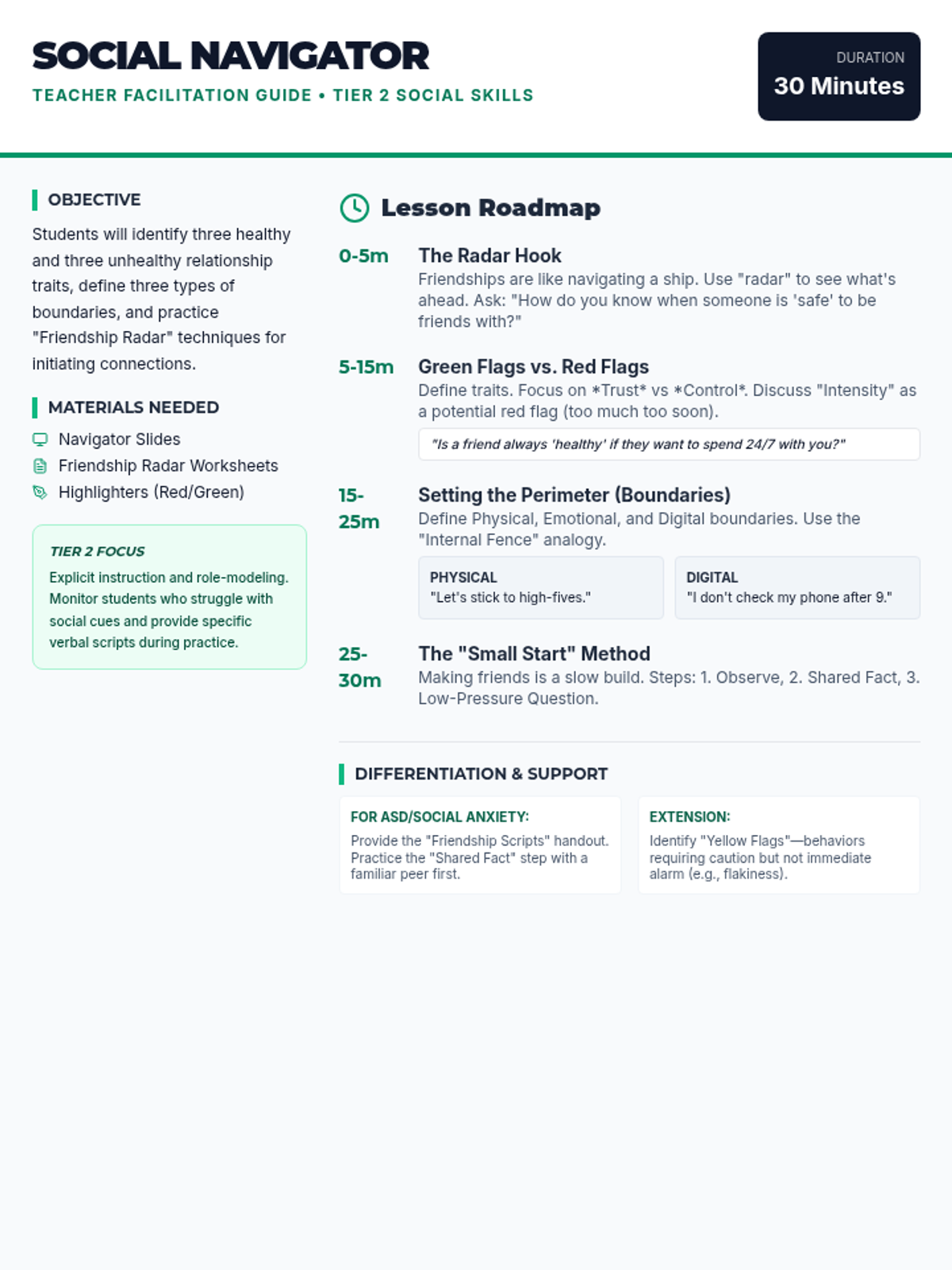
A comprehensive teacher facilitation guide for a 30-minute Tier 2 social skills lesson on relationships, including pacing, discussion prompts, and differentiation strategies. Revised for better layout and contrast. Tightened to fit on a single page.
A student reflection worksheet to assess understanding of relationship boundaries, social cues, and appropriate levels of intimacy.
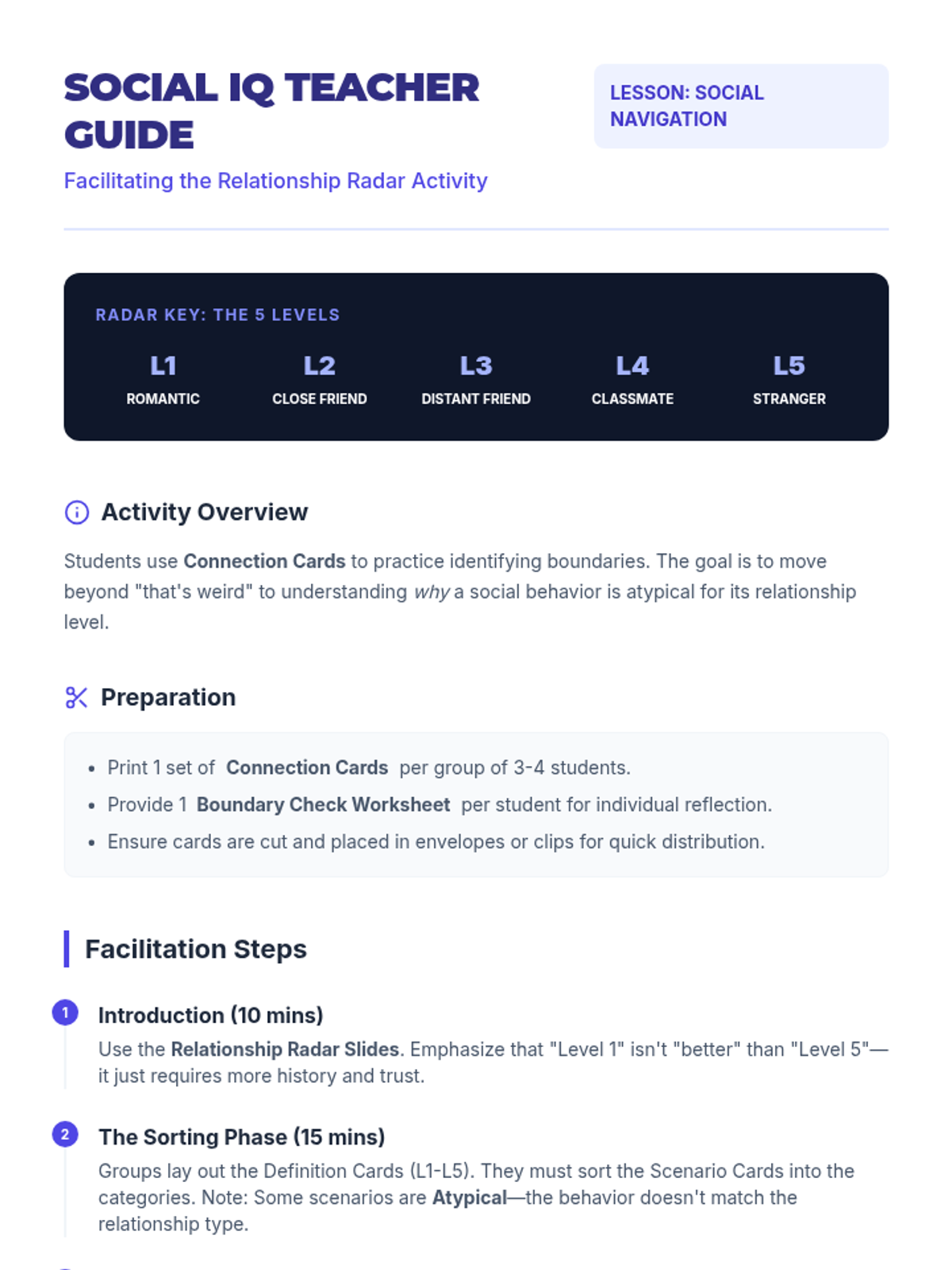
A comprehensive guide for teachers to facilitate the Relationship Radar activity, including sorting instructions, discussion prompts, and key concepts.
An introductory slide deck for high schoolers on identifying relationship levels, boundaries, and typical vs. atypical social behaviors.
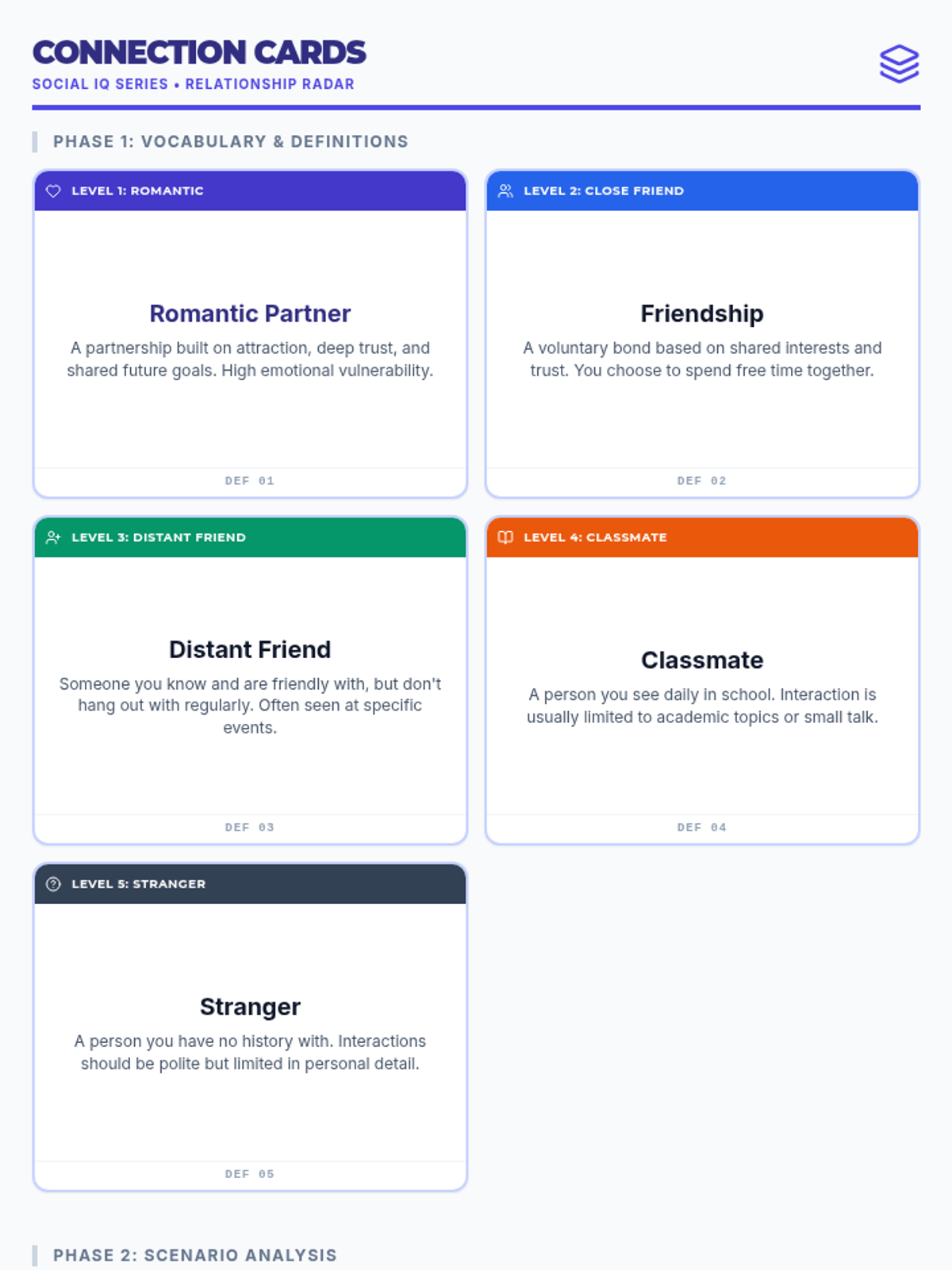
A set of vocabulary and scenario cards to help students identify relationship types and distinguish between typical and atypical social behaviors.
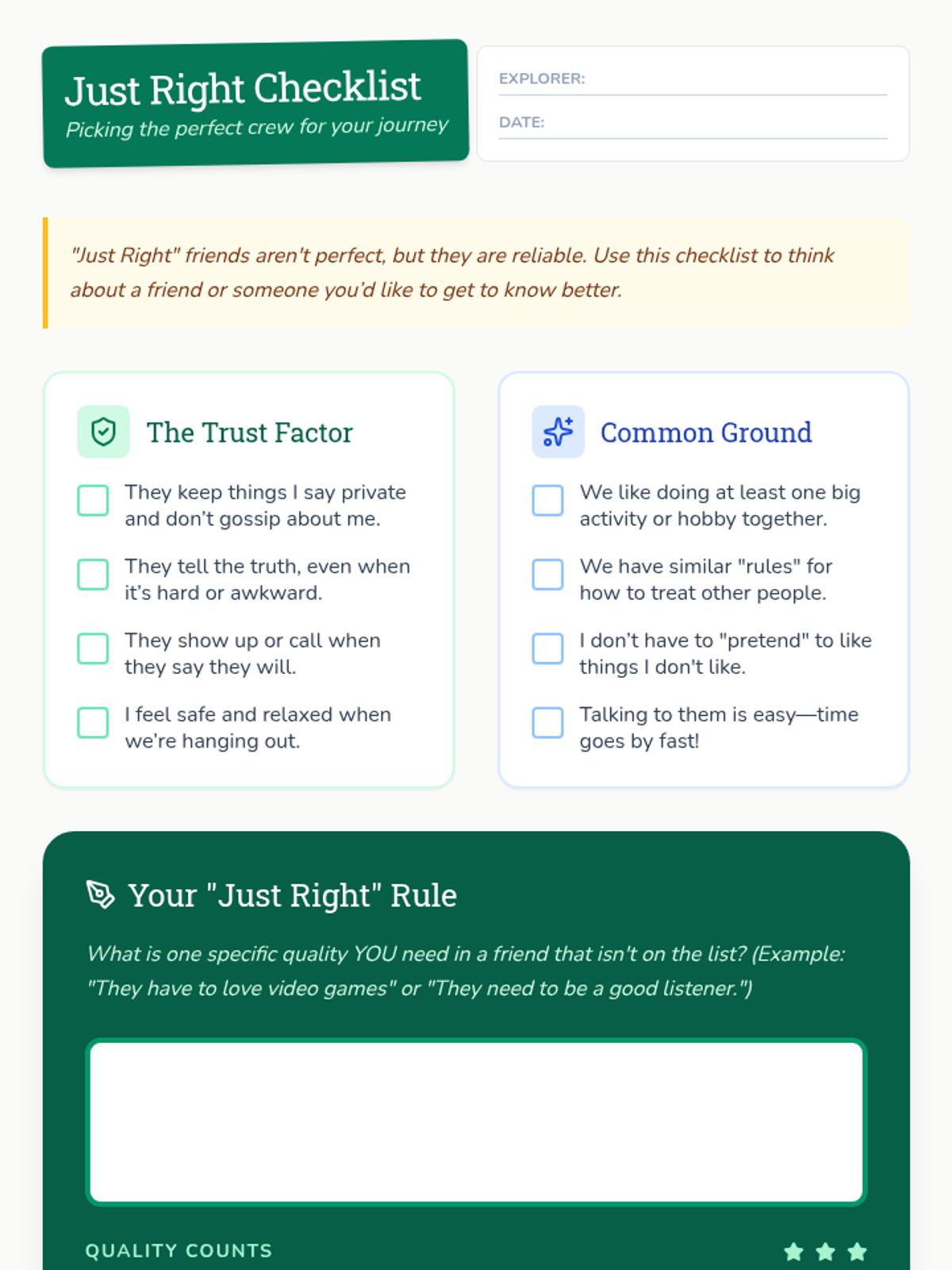
A student-friendly evaluation tool featuring clear indicators for trust and common interests, with a personalized reflection area for specific friendship needs.
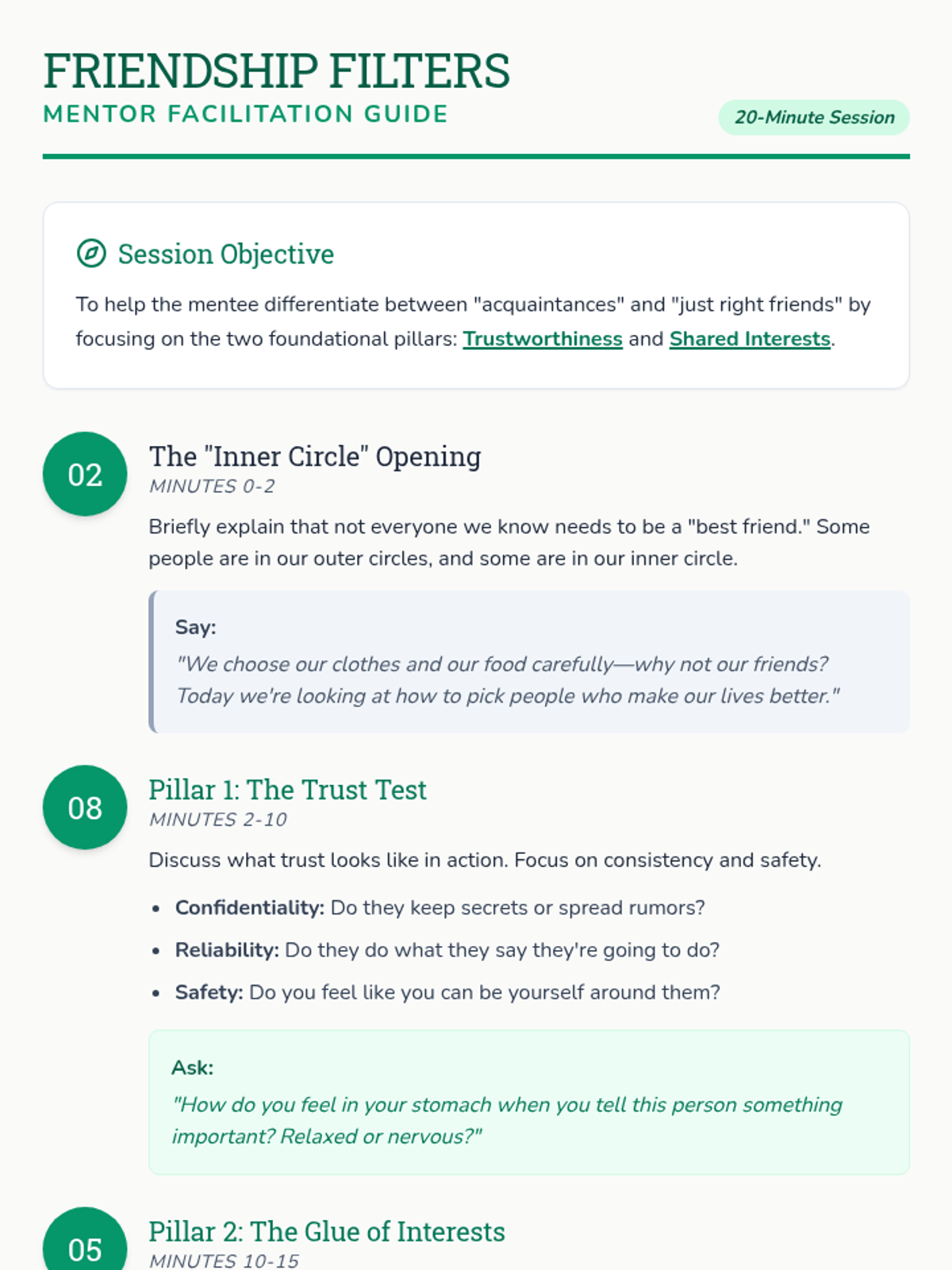
A concise 20-minute mentor facilitation guide designed to lead a focused discussion on choosing high-quality friends based on trust and common ground.
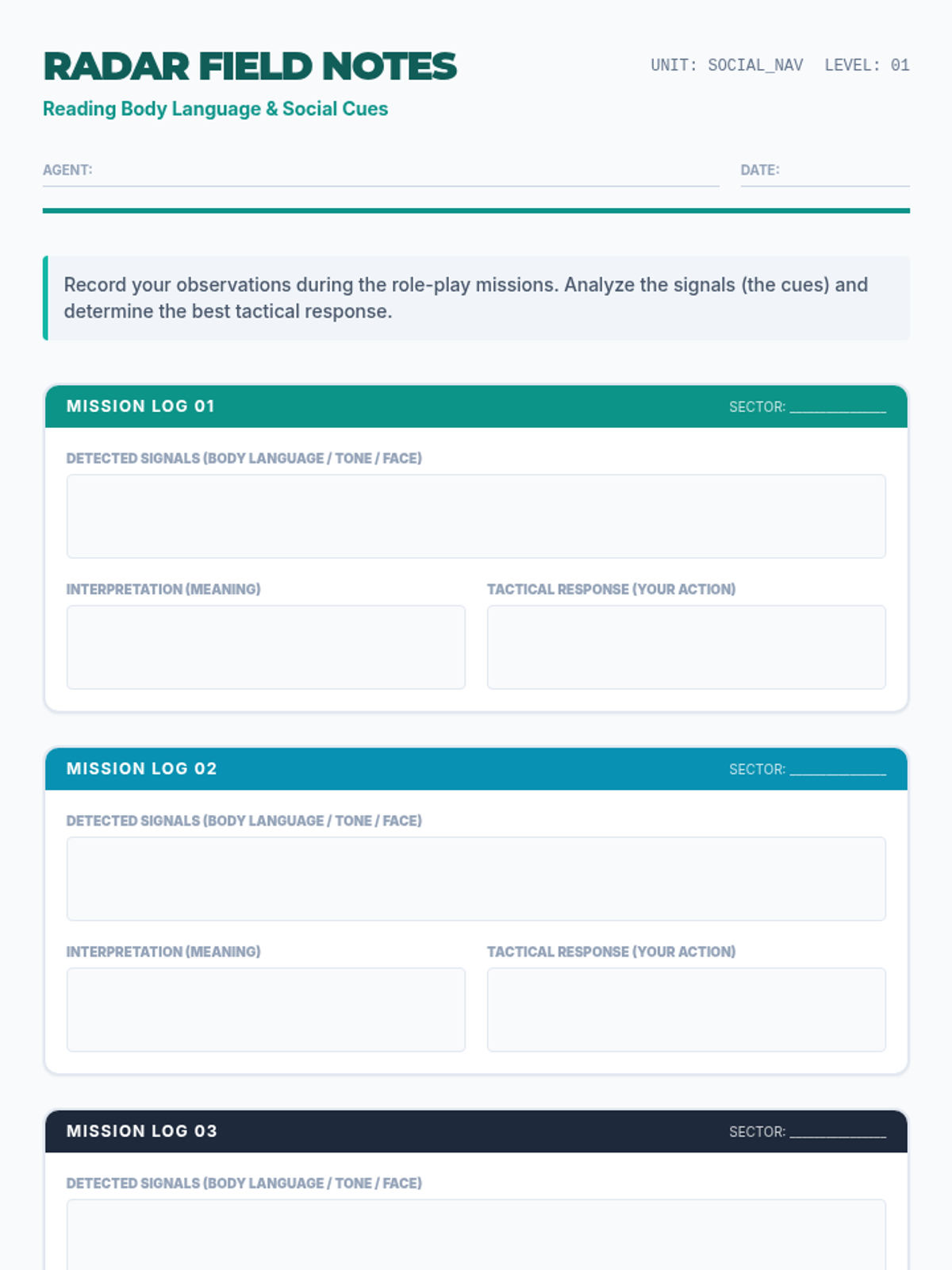
A student observation worksheet designed for recording cues and responses during role-play activities. Features a 'Mission Log' layout to track signals, interpretation, and tactical responses across different settings.
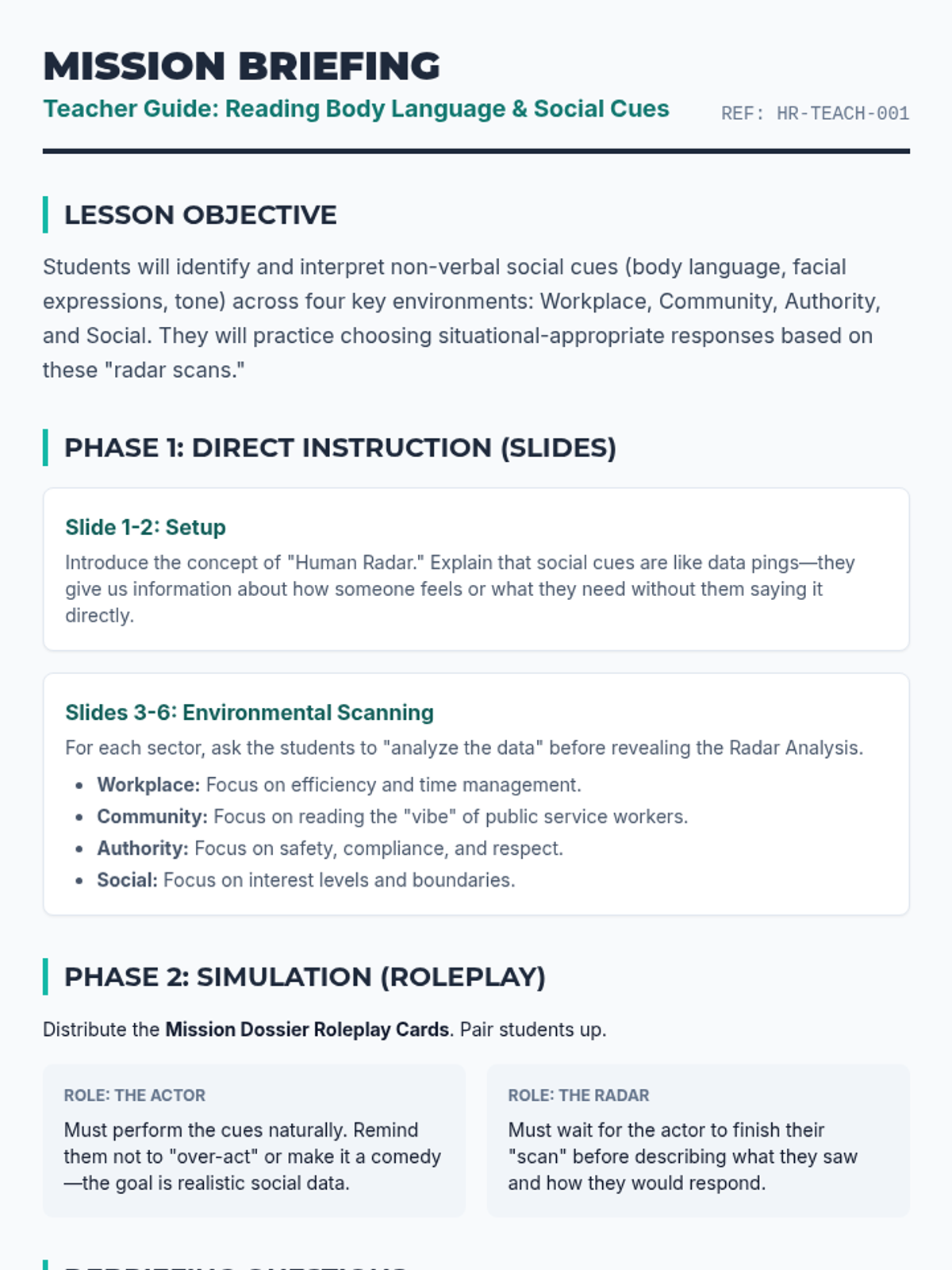
A comprehensive teacher facilitation guide for the Body Language lesson, including pacing, activity instructions for role-play, discussion questions, and troubleshooting tips.
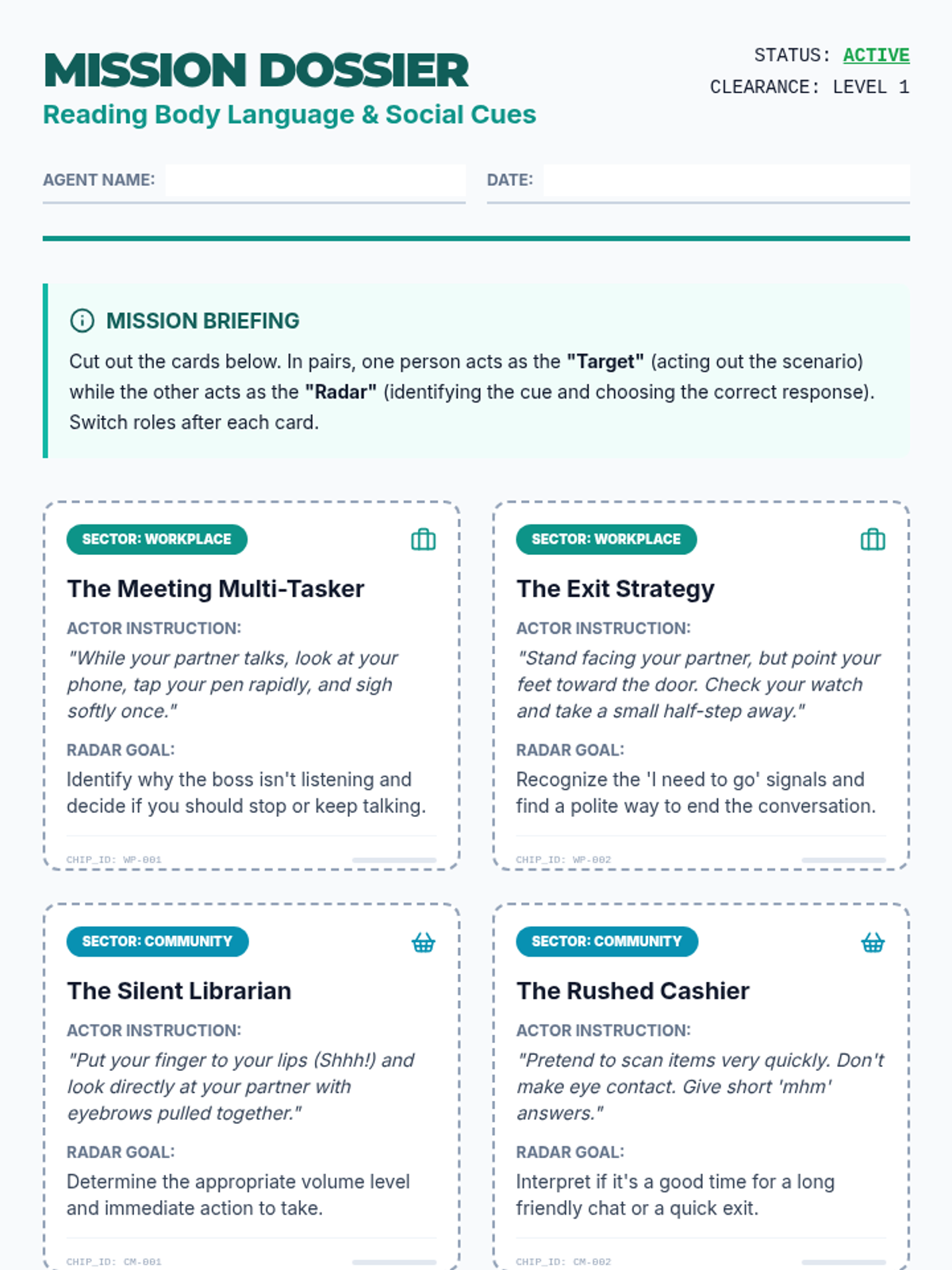
A set of printable role-play scenario cards themed as a 'Mission Dossier' for practicing reading social cues across workplace, community, authority, and social settings. Each card includes specific actor instructions and goals for the person playing the 'Radar'.
A presentation deck on body language and social cues across various settings, featuring clear 'Radar Analysis' for specific scenarios and visual descriptions for analysis.
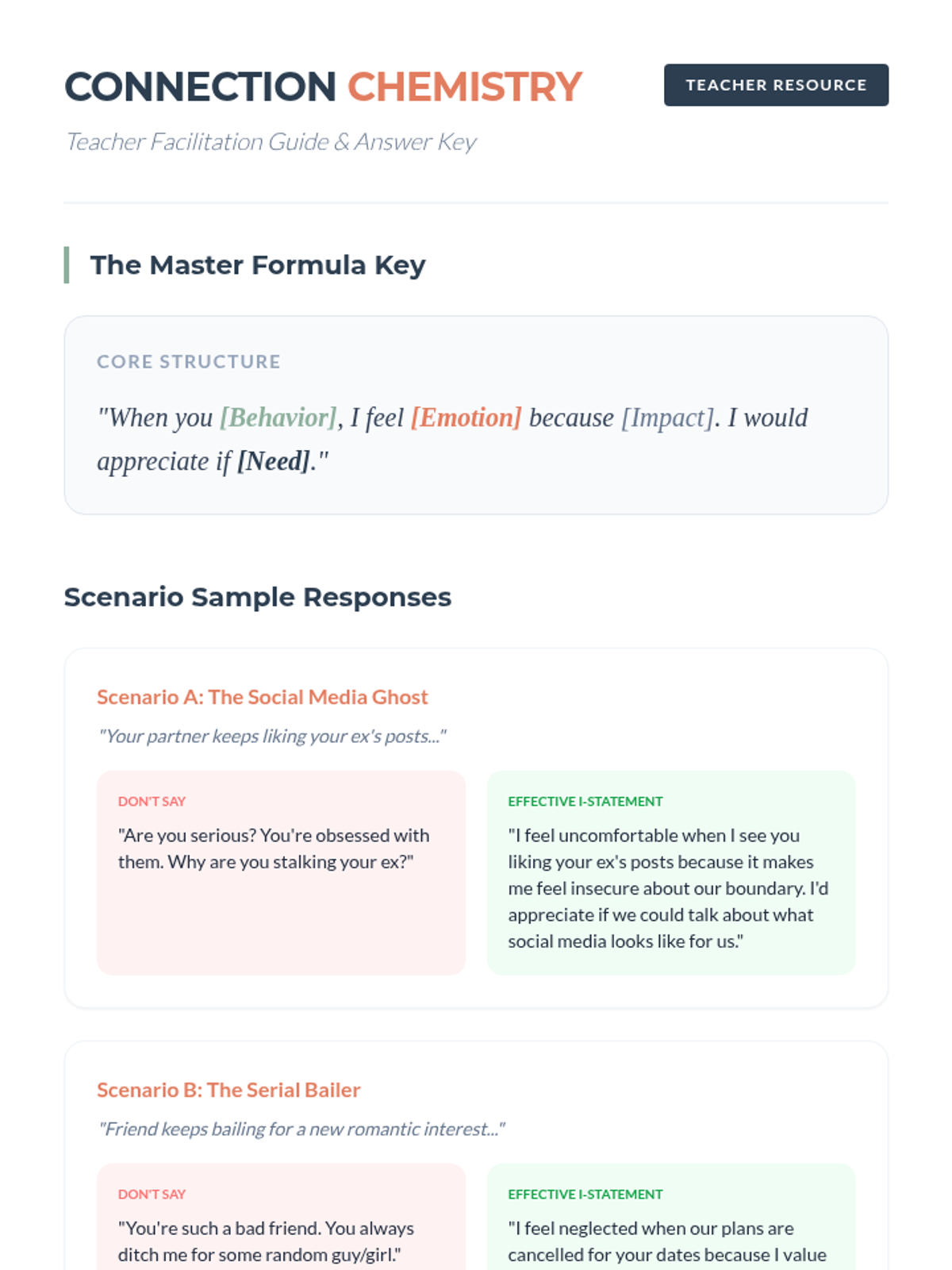
Teacher-facing answer key and facilitation guide for the Connection Chemistry lesson. Includes sample I-statement responses for scenarios and instructional tips for managing classroom activities.
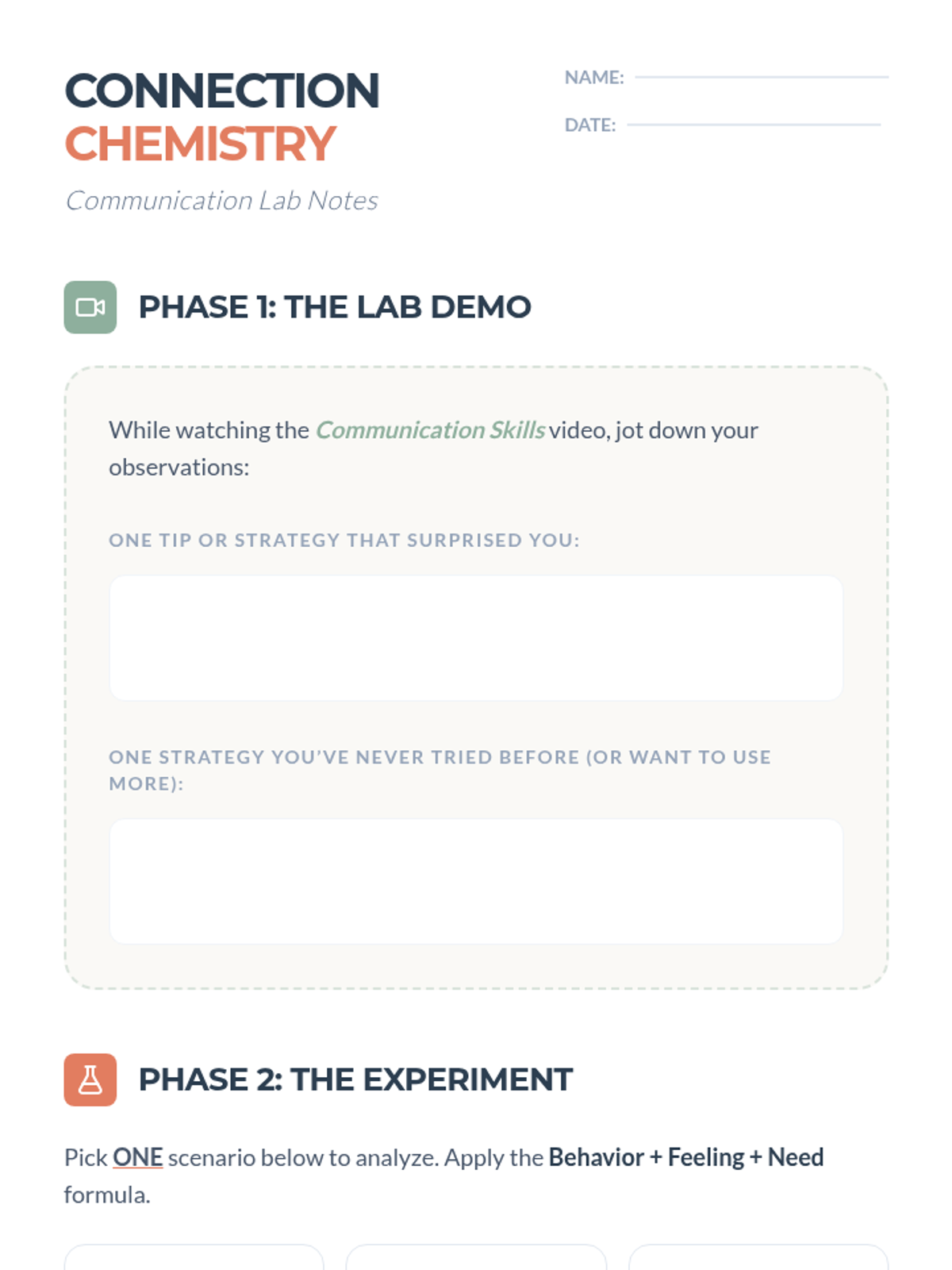
Student worksheet for the Connection Chemistry lesson. Includes video observation notes, a scenario-based practice section using the "Master Formula," and a final reflection summarizer.
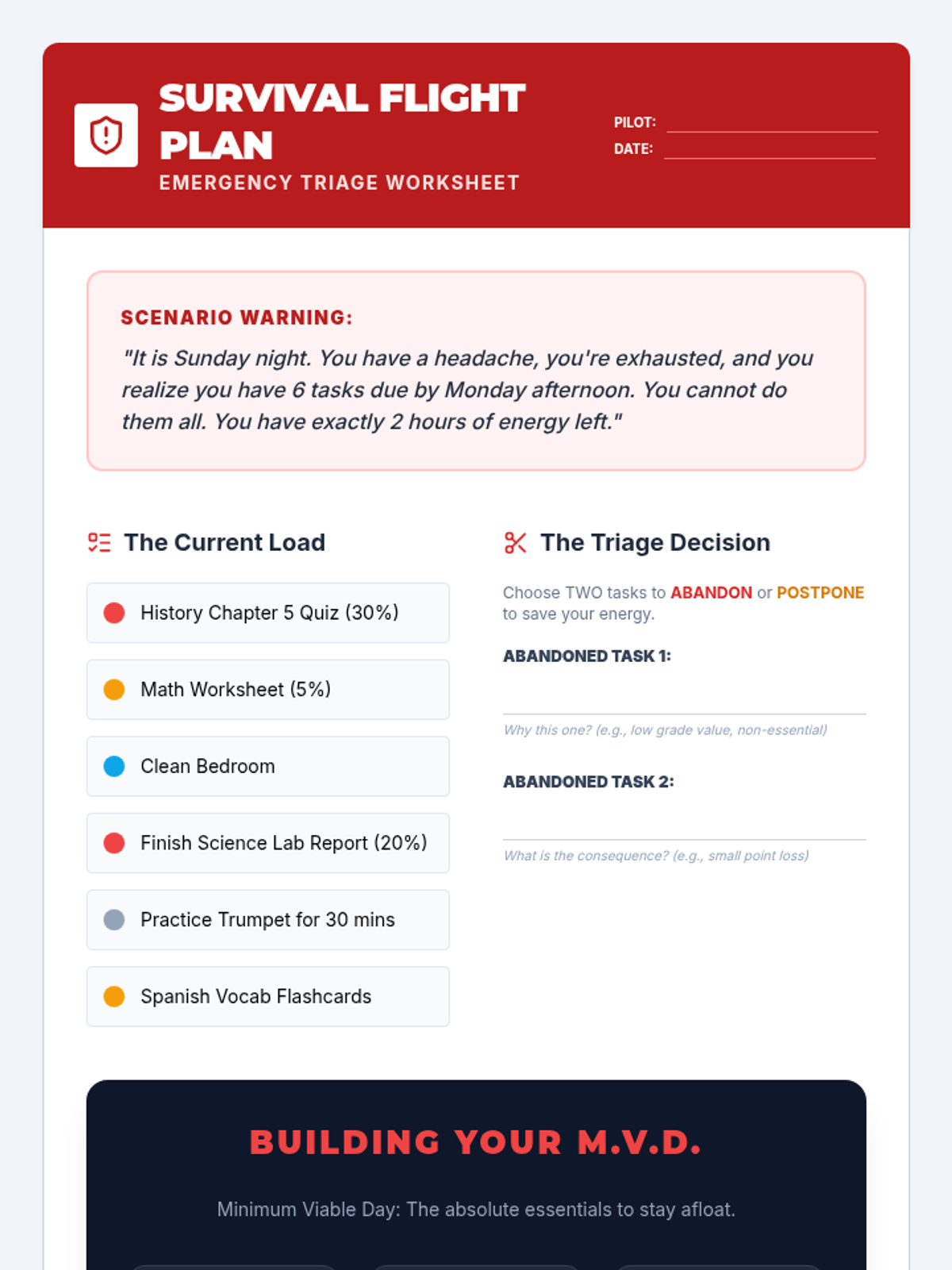
An emergency triage worksheet that guides students through a simulated crisis scenario, helping them identify which tasks to abandon and how to construct a Minimum Viable Day (MVD).
Lesson 5 slide deck on emergency triage and the 'Minimum Viable Day' concept, teaching students how to prioritize critical tasks during periods of crisis or illness.
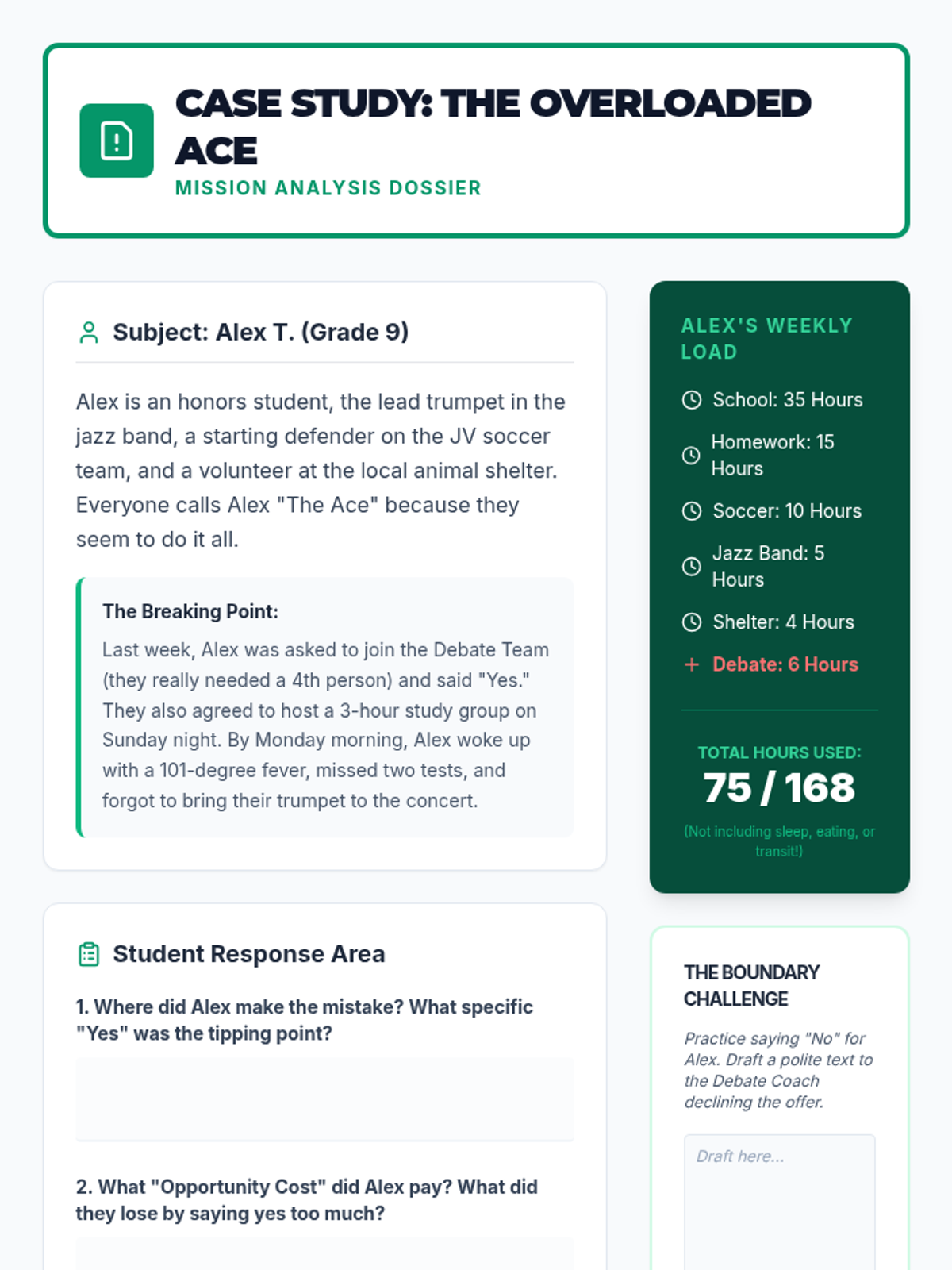
A case study document about 'Alex the Ace', a student who takes on too much, designed to help students analyze the consequences of over-commitment and practice setting boundaries.
Lesson 4 slide deck introducing the concept of opportunity cost and providing a "No Bank" of polite but firm scripts for setting boundaries.
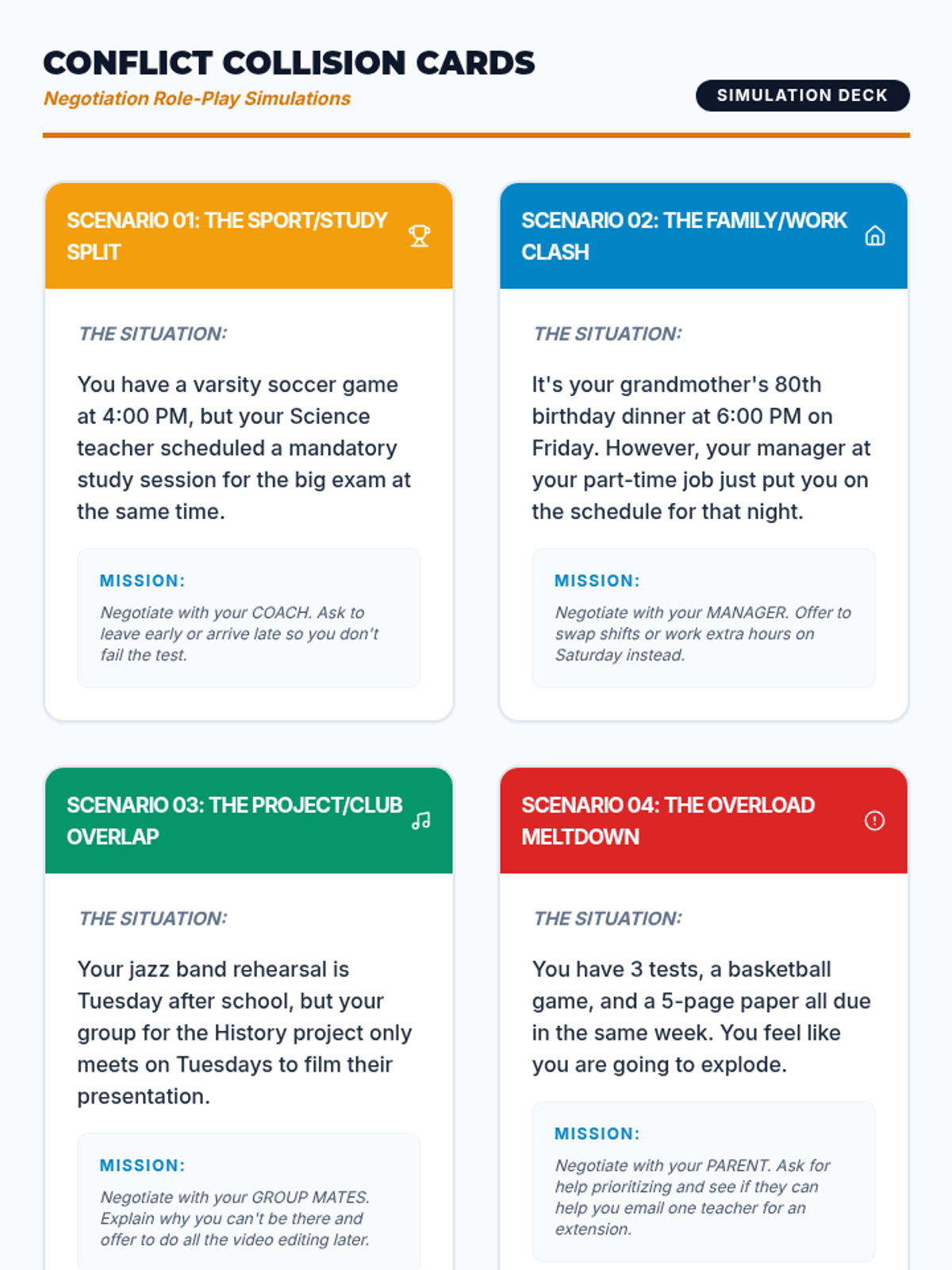
A set of role-play simulation cards for students to practice negotiating scheduling conflicts in various realistic scenarios (sports vs. academics, work vs. family, etc.).
Lesson 3 slide deck focusing on face-to-face negotiation skills for resolving scheduling conflicts, introducing a 3-step negotiation framework.
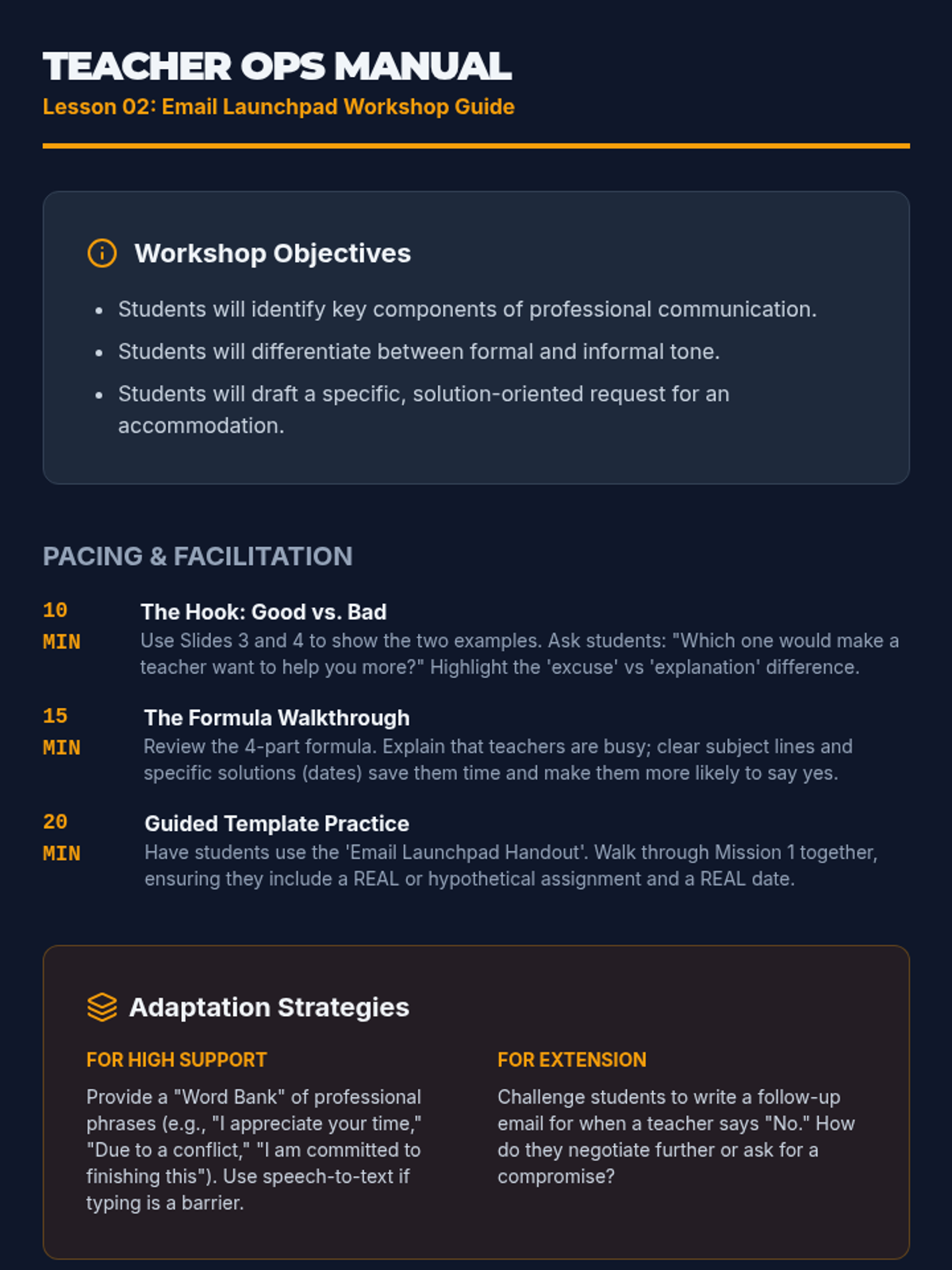
Teacher facilitation guide for Lesson 2, including pacing, differentiation strategies, and discussion prompts for the email workshop.
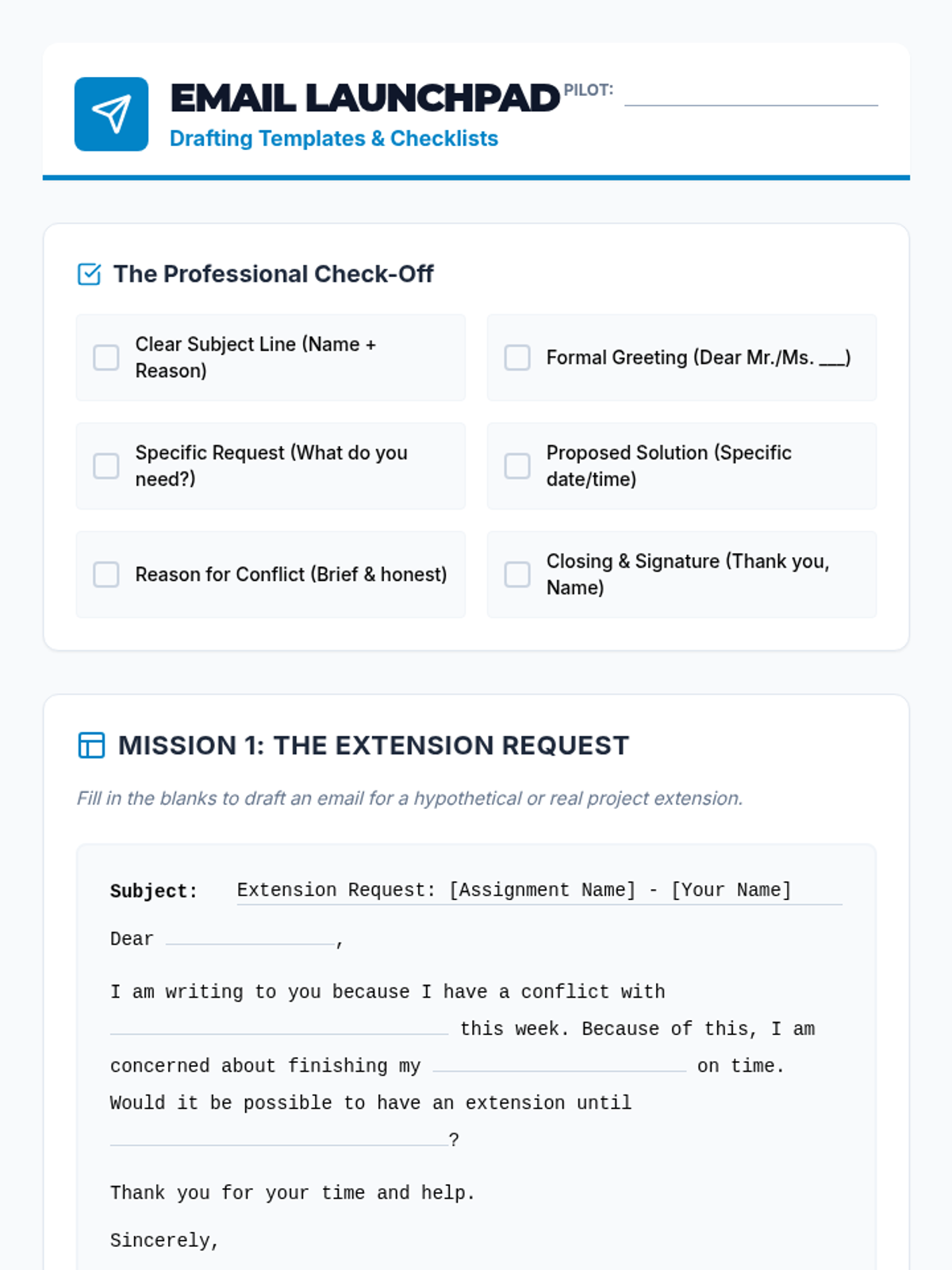
A student handout and worksheet providing an email etiquette checklist and fill-in-the-blank templates for drafting professional requests to teachers.
Lesson 2 slide deck covering the importance of professional email communication, contrasting effective and ineffective examples, and introducing the 4-part request formula.
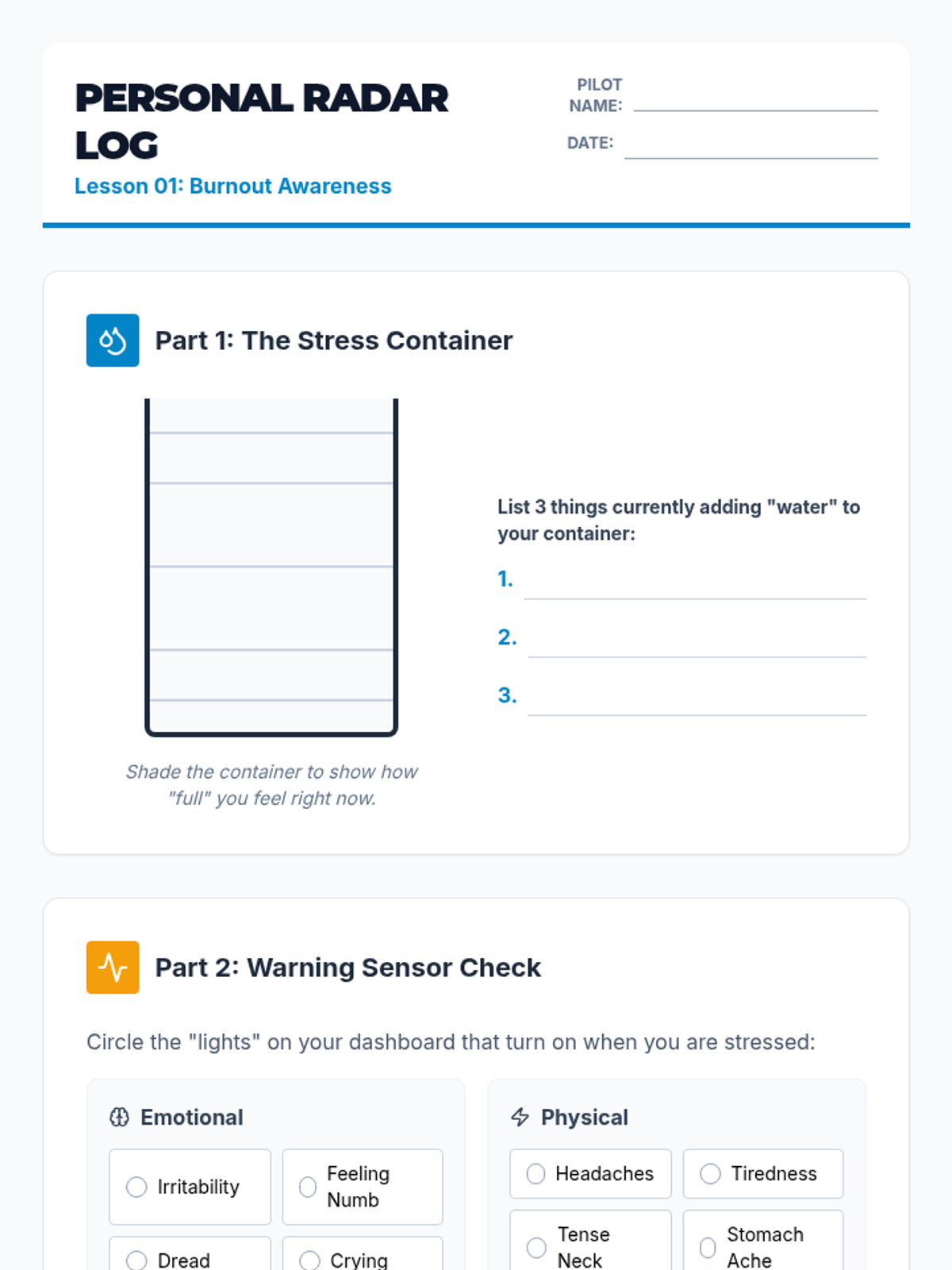
A student worksheet for identifying burnout symptoms, mapping current stress levels using the container metaphor, and identifying trusted adults for support.
Introductory slide deck for Lesson 1, using a flight control theme to explain burnout through the 'Stress Container' metaphor and identifying physical/emotional warning signs.
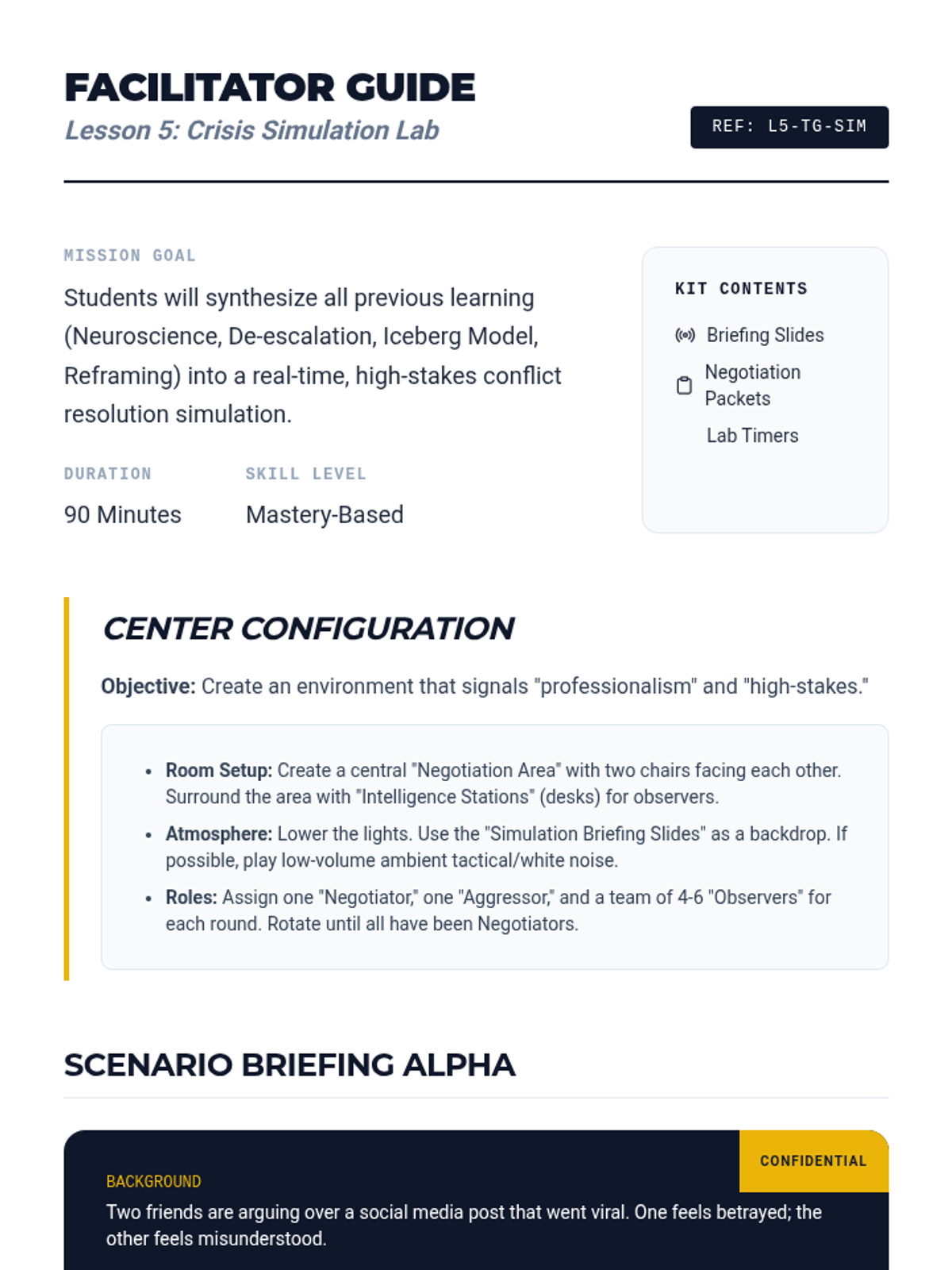
A teacher guide for the Conflict Simulation lesson, including instructions for the lab setup, scenario scripts, and debriefing questions.
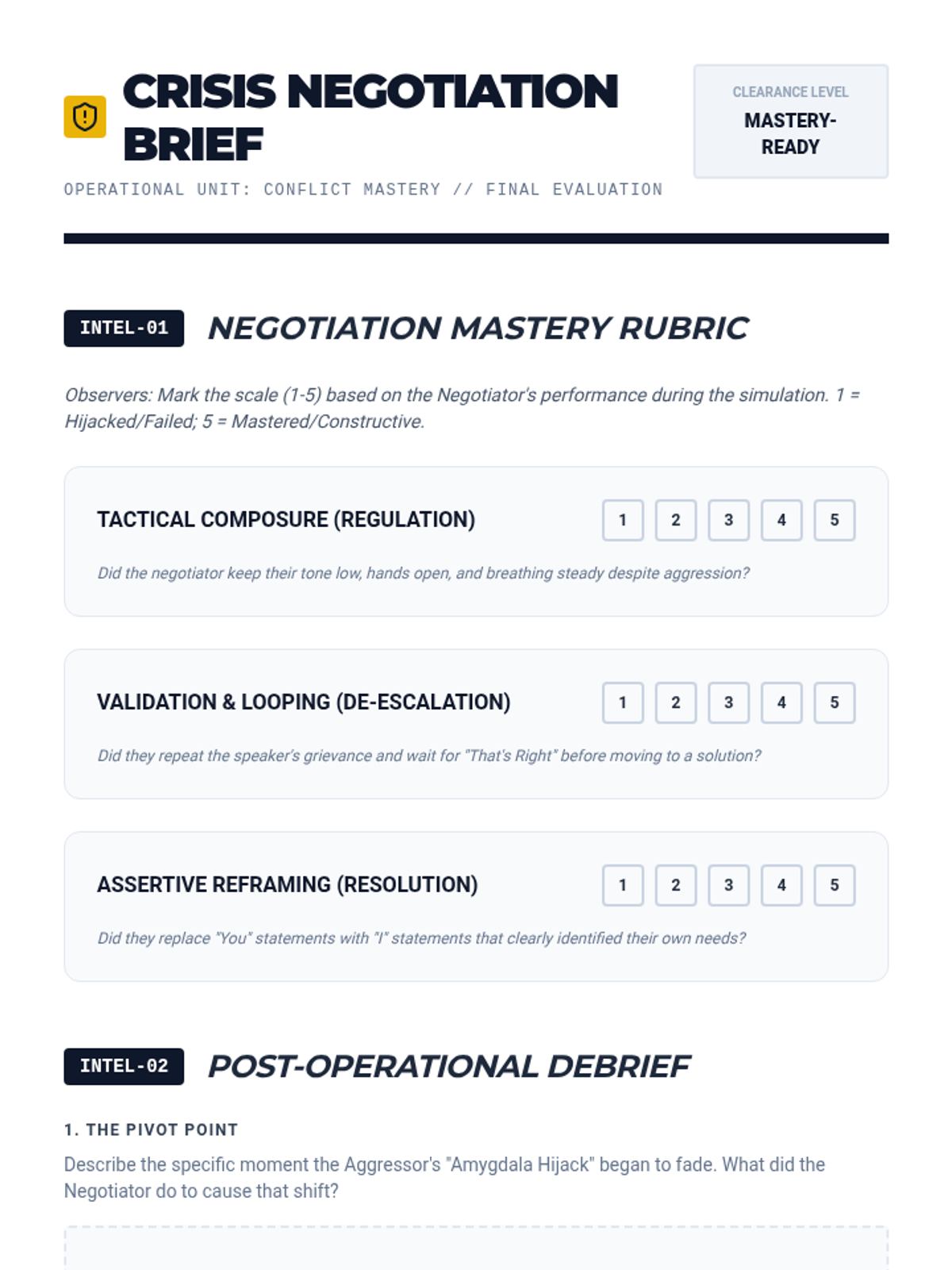
A student-facing briefing packet for the final simulation lab, including a mastery rubric for peer observation and a post-negotiation debrief log.
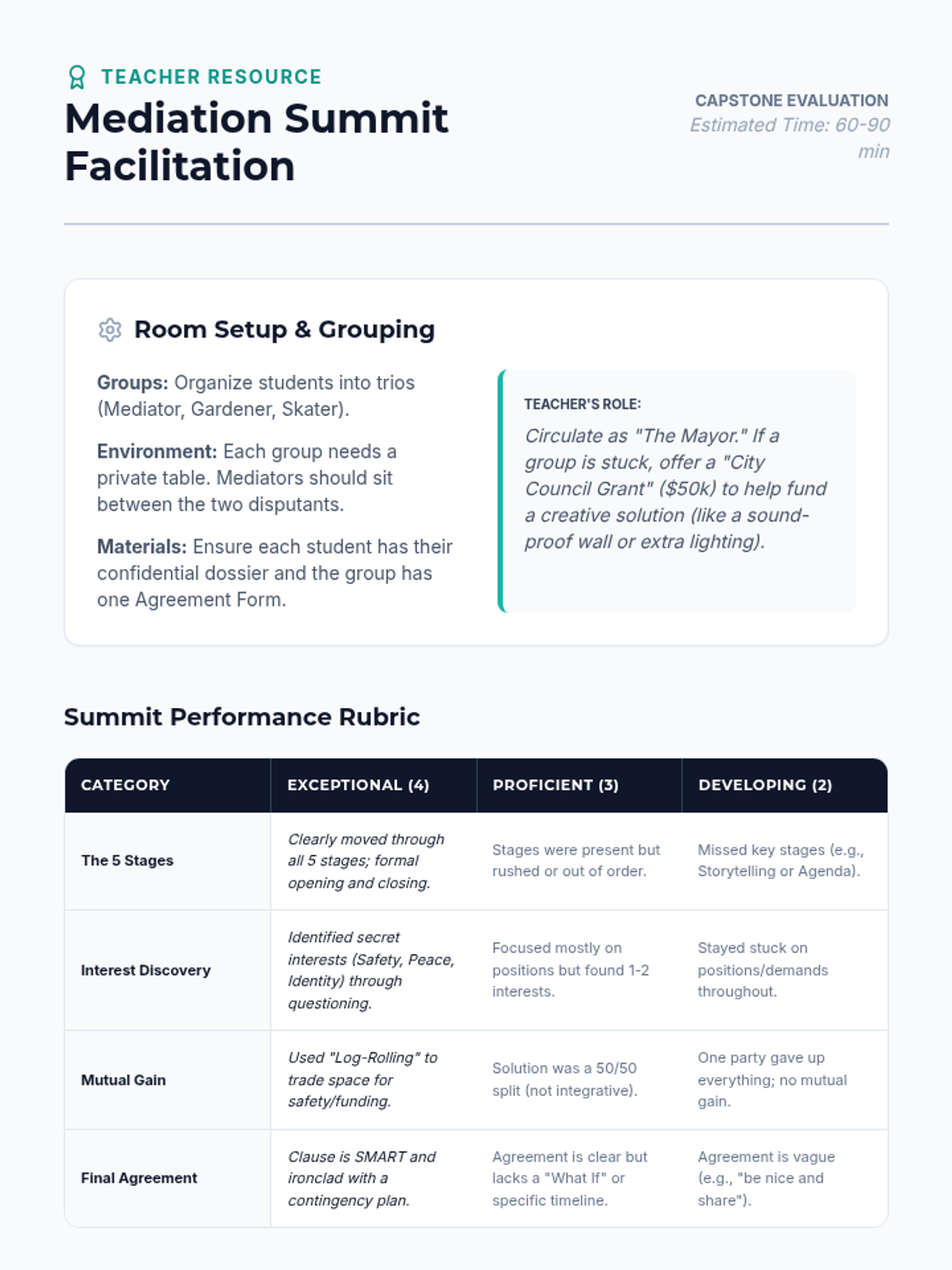
Teacher facilitation guide and evaluation rubric for the Lesson 5 Mediation Summit capstone simulation. Includes setup instructions, a grading rubric, and debrief prompts.
A visual presentation for the final simulation lab, setting the stage, explaining the Crisis Negotiation Center concept, and outlining the mission objectives and rules of engagement.
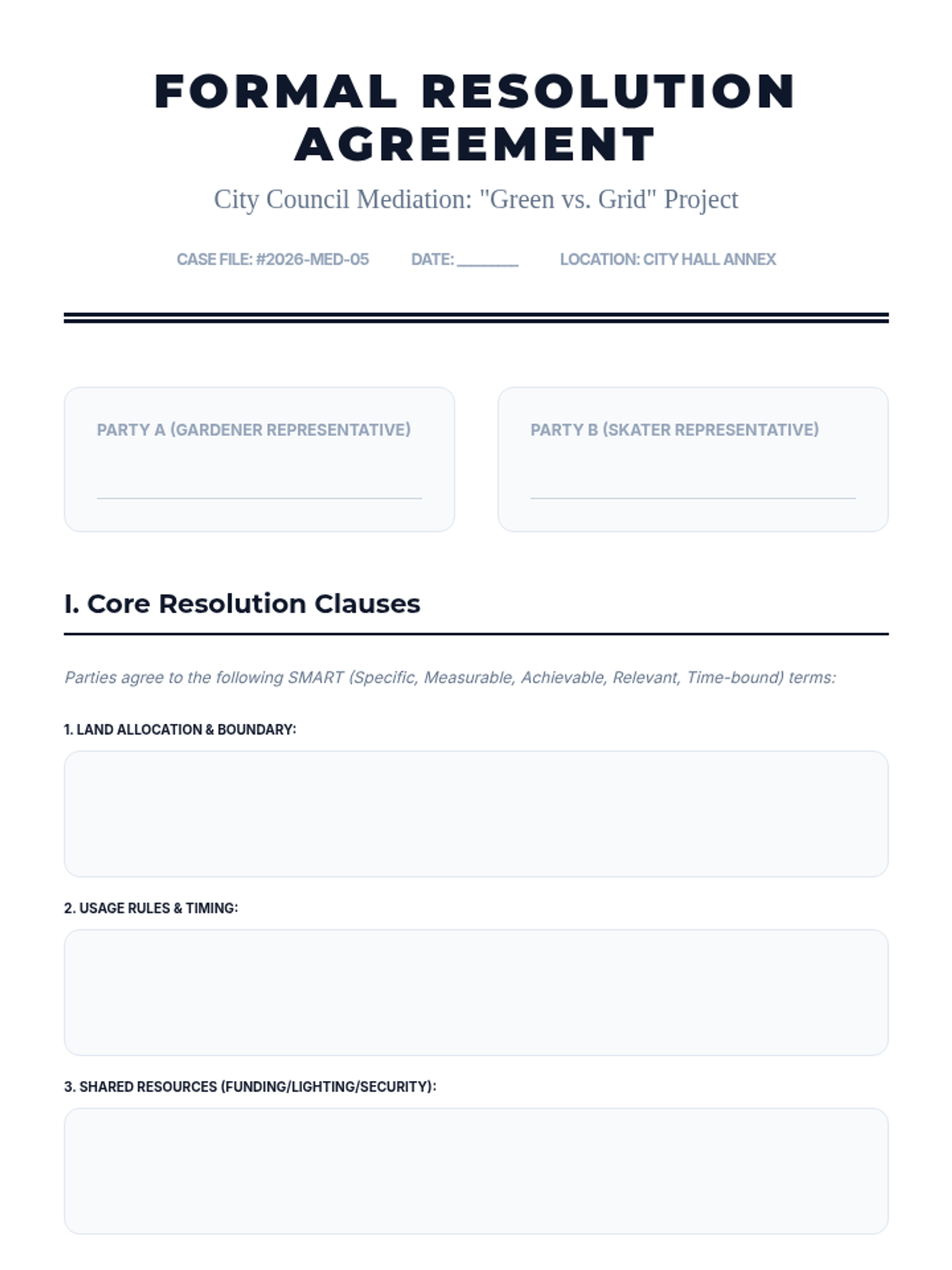
Formal mediation agreement form for the "Green vs. Grid" simulation. Students use this to draft their final SMART resolution clauses and finalize the simulation with signatures.
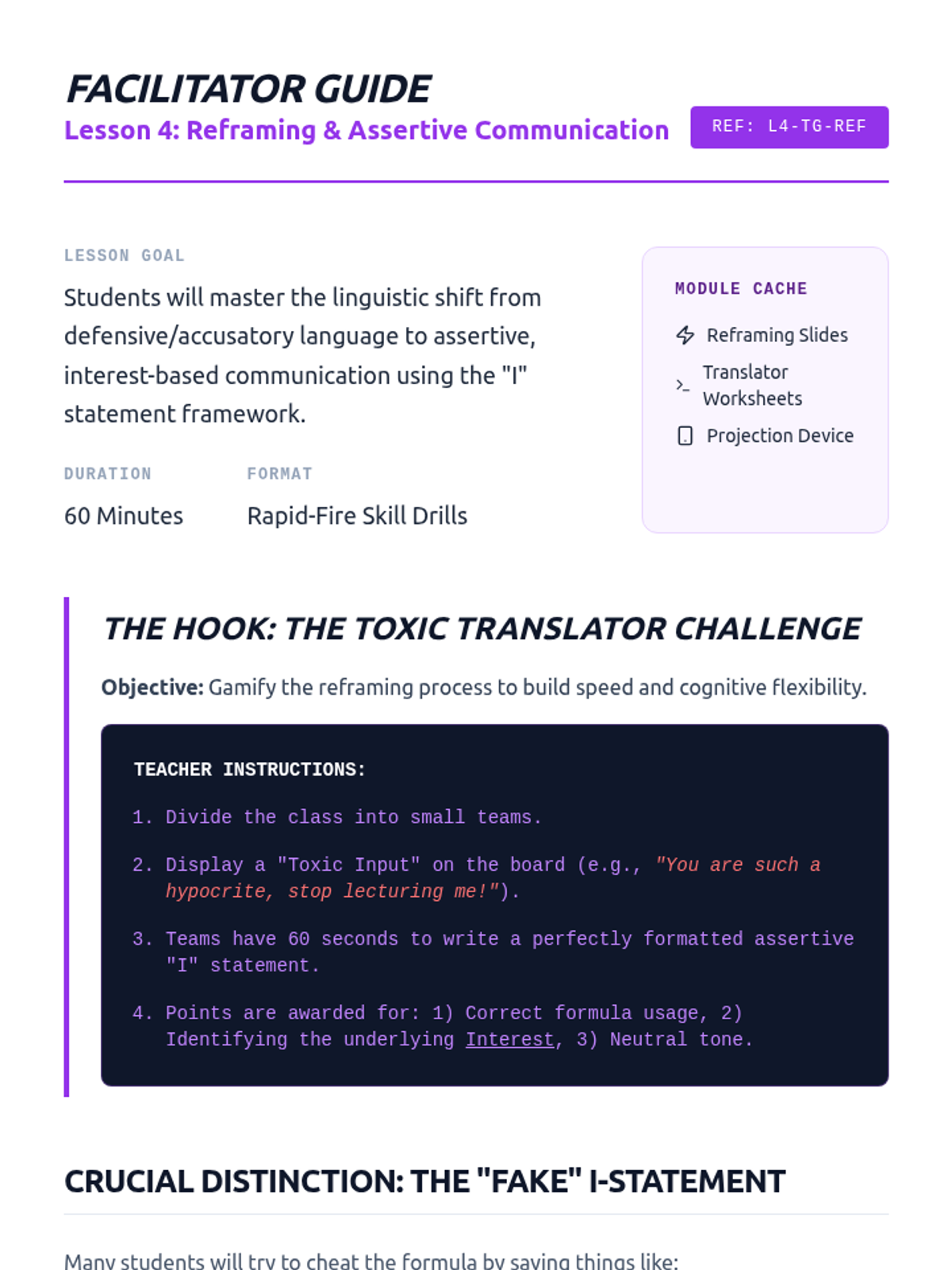
A teacher guide for the Communication Reframing lesson, including instructions for the 'Toxic Translator' challenge, common pitfalls, and a worksheet answer key.
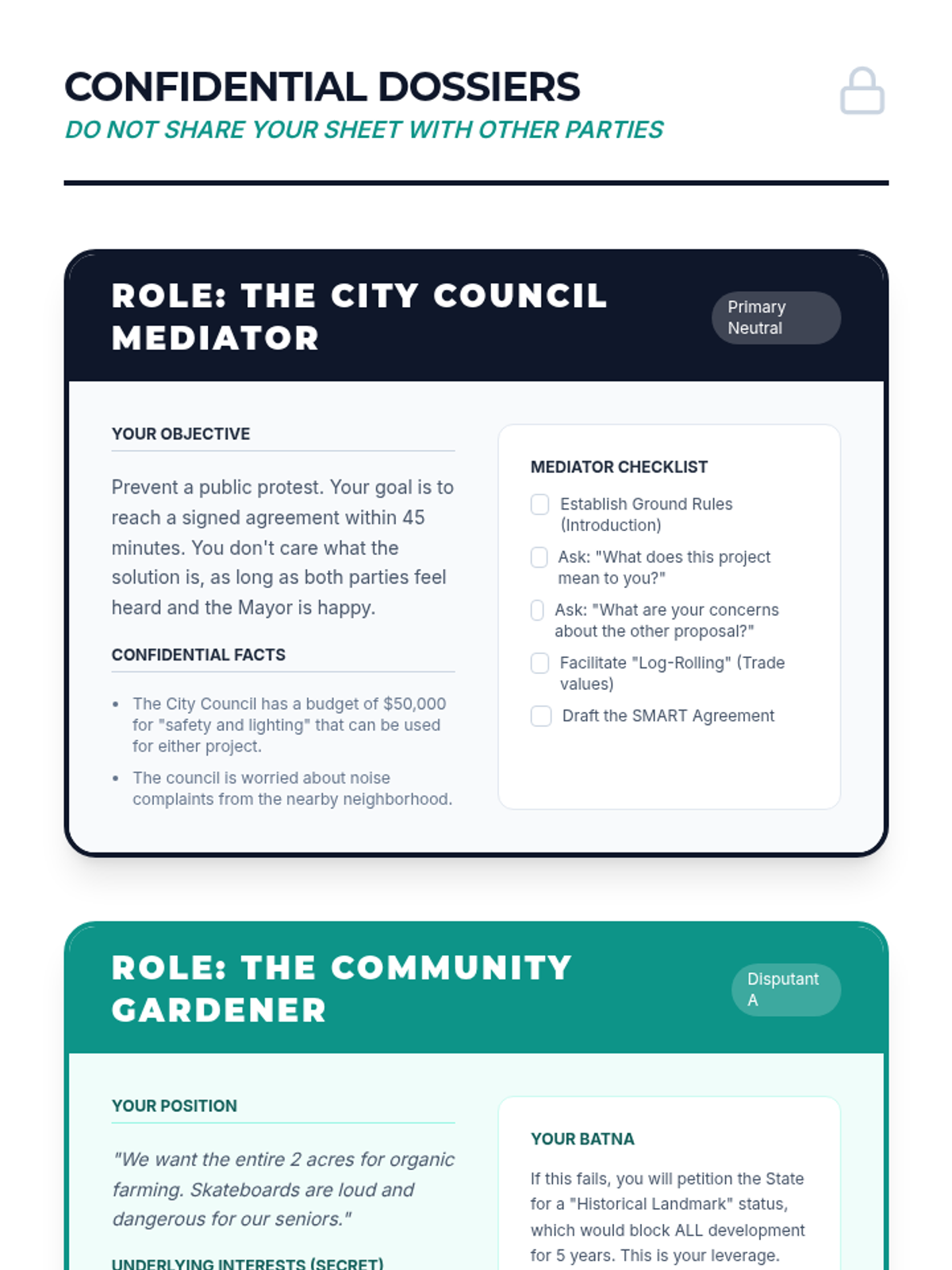
Confidential briefing sheets for the three roles in the "Green vs. Grid" simulation: The Mediator, The Gardener, and The Skater. Includes secret interests and walk-away points.
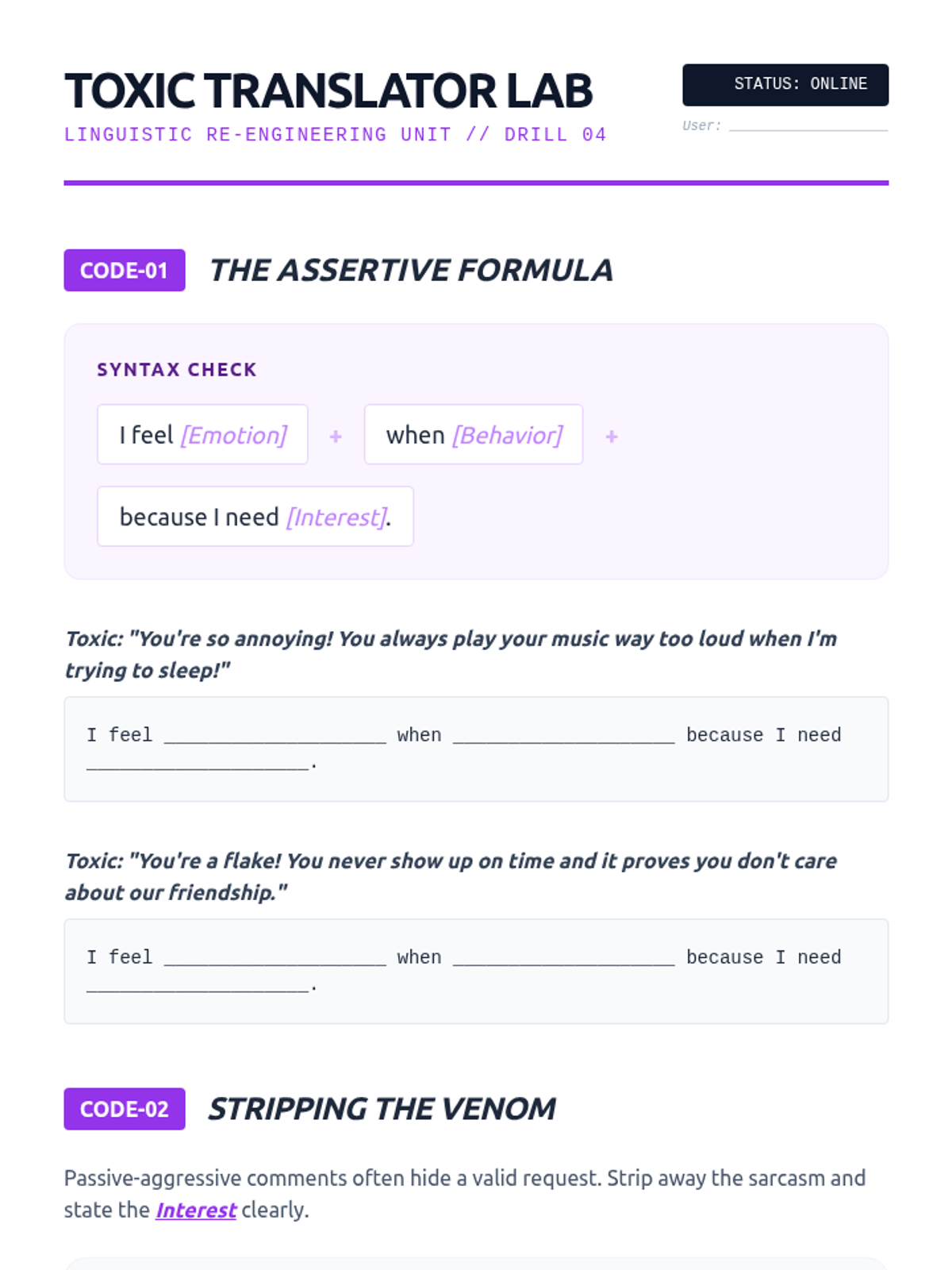
A practice worksheet for students to practice translating toxic language into assertive 'I' statements and neutral requests.
Briefing slide deck for the Lesson 5 Mediation Summit capstone simulation. Introduces the "Green vs. Grid" land use case, roles, and rules of engagement.
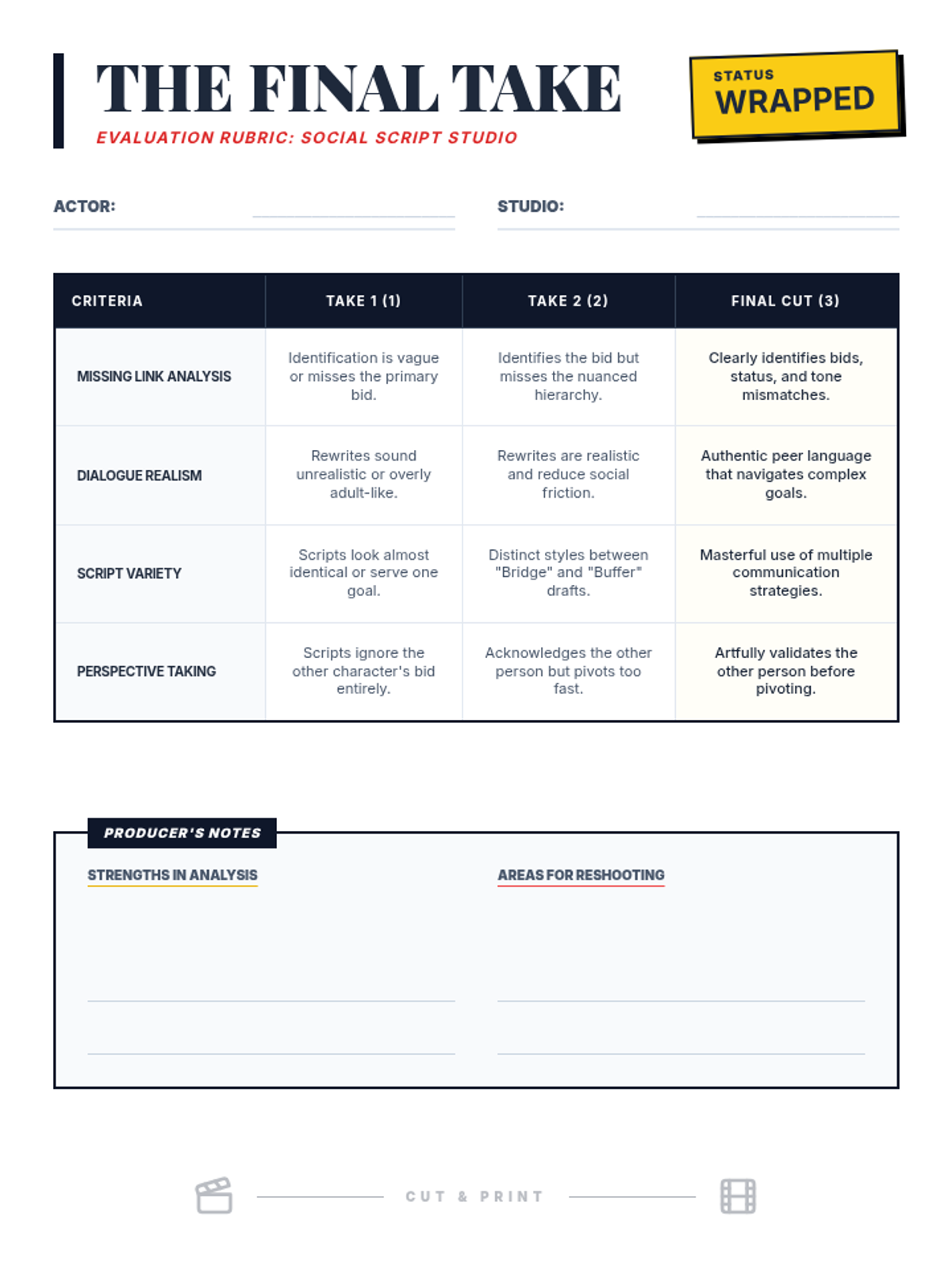
A performance evaluation rubric for the Social Script Studio lesson, assessing students on their ability to analyze communication "missing links," write realistic and effective scripts, and demonstrate flexibility in social responses.
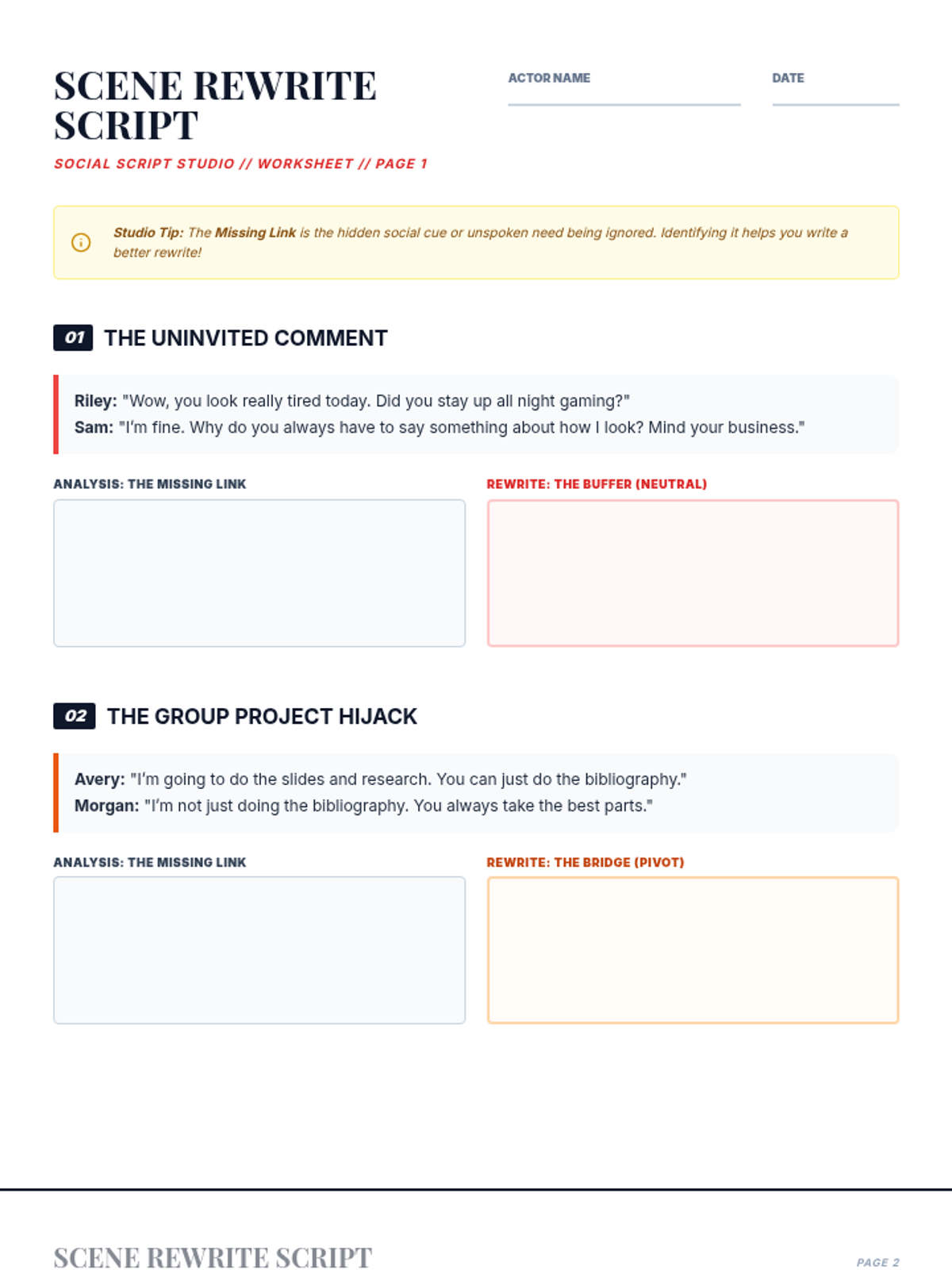
A student worksheet designed as a film script template where students analyze social friction in peer scenarios, identify the "Missing Link" in communication, and write alternative responses ("The Buffer", "The Bridge", "The Stand") to improve their pragmatic language skills. Now includes 5 expanded scenarios covering various peer conflict situations.
Instructional slides for the Social Script Studio lesson, utilizing a cinematic theme to teach students the "Friction Scale," how to identify "Missing Links" in social interactions, and strategies for scripting more effective peer communications. Now includes introductory slides explaining the "Missing Link" concept.
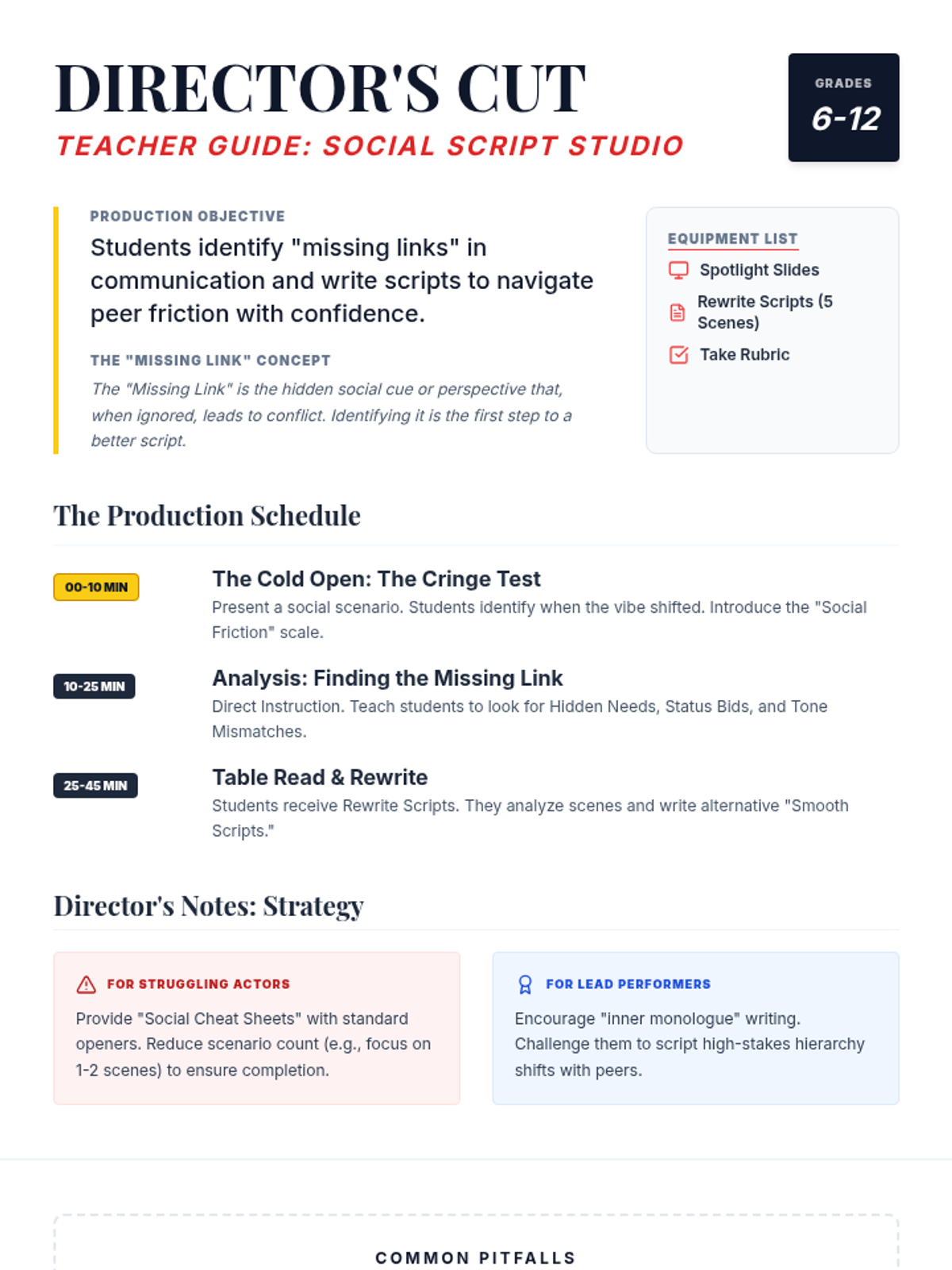
A comprehensive teacher guide for the Social Script Studio lesson, featuring a timed schedule, differentiation strategies, and tips for facilitating pragmatic language skills in grades 6-12. Now updated to include references to the expanded 5-scenario worksheet.
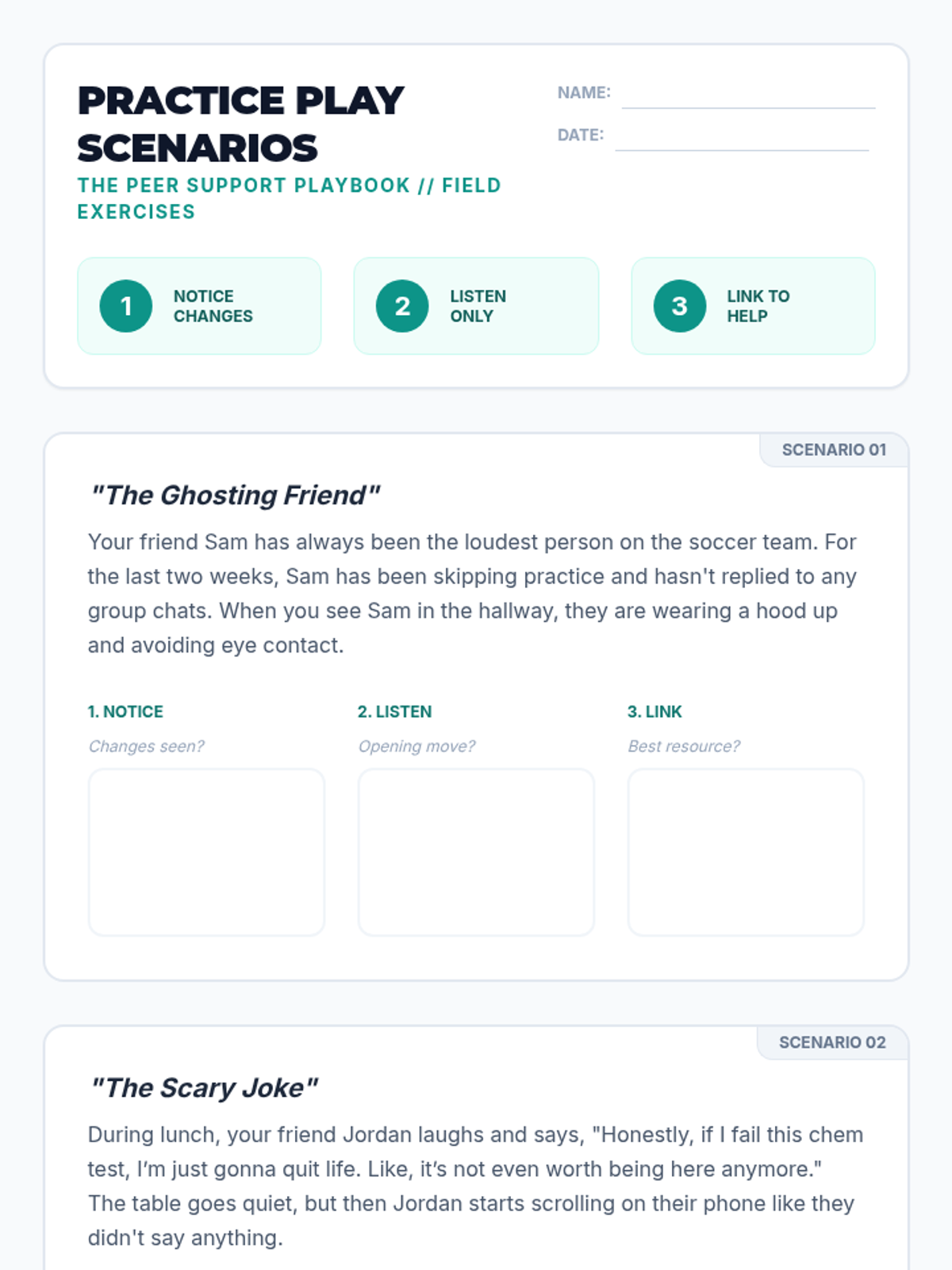
A student worksheet featuring realistic social scenarios for practicing the 'Notice, Listen, Link' support model and boundary-setting.
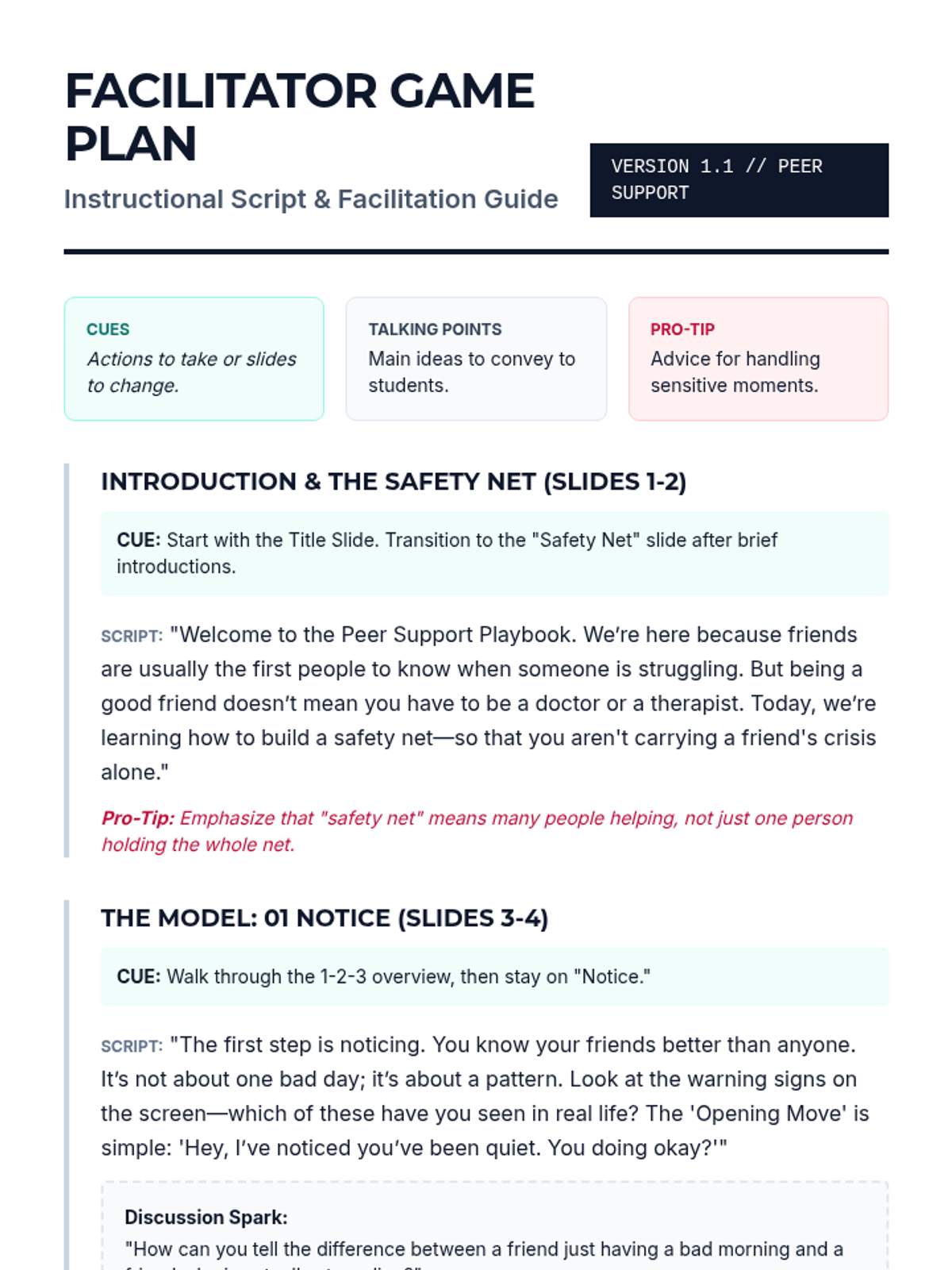
A detailed facilitator script and instructional guide for leading the Peer Support Playbook workshop, including talking points, slide cues, and discussion prompts.
A visual presentation for the Peer Support Playbook workshop, introducing the 'Notice, Listen, Link' model and emphasizing the importance of a safety net.
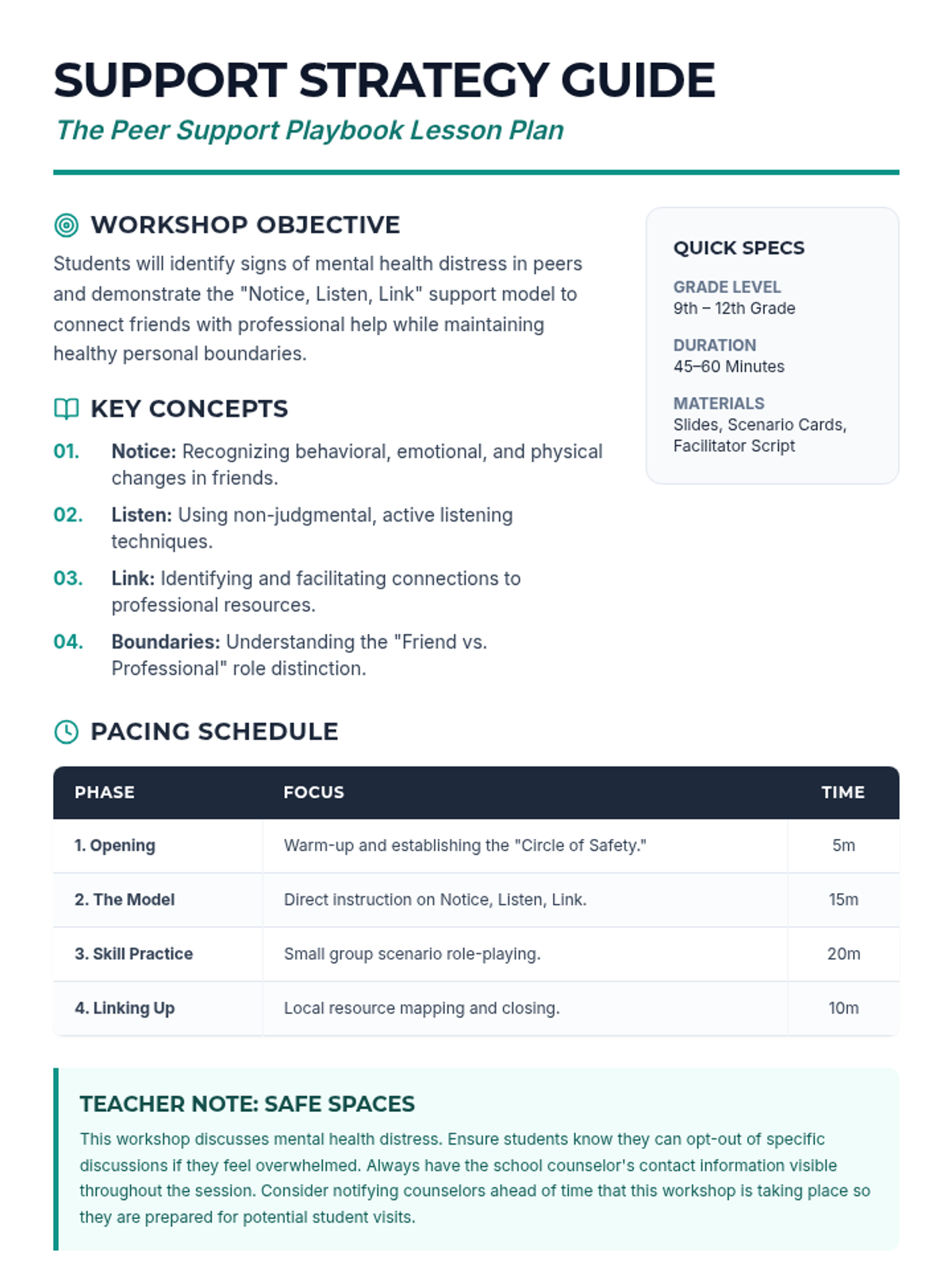
A comprehensive lesson plan for high school educators, outlining the objectives, pacing, and key concepts for the Peer Support Playbook workshop.
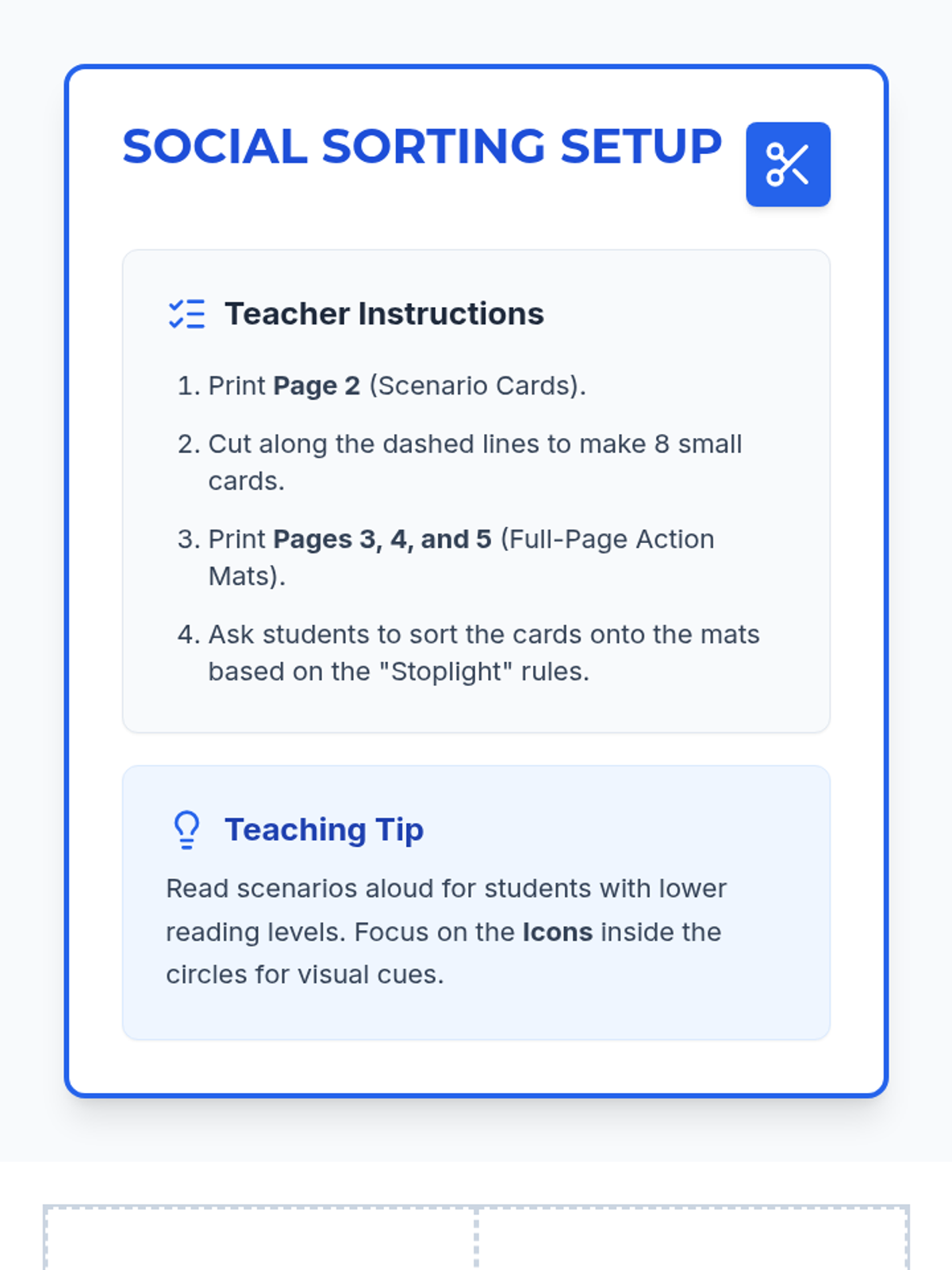
A tactile sorting activity featuring 16 scenario cards and three full-page color-coded action mats (Green/Okay, Yellow/Ask First, Red/Stop) to help students practice identifying appropriate touch and personal boundaries.
An instructional slide deck using high-contrast visuals and simple language to teach the concepts of the Body Bubble, boundary circles (Family, Friends, Strangers), and the Touch Stoplight system.
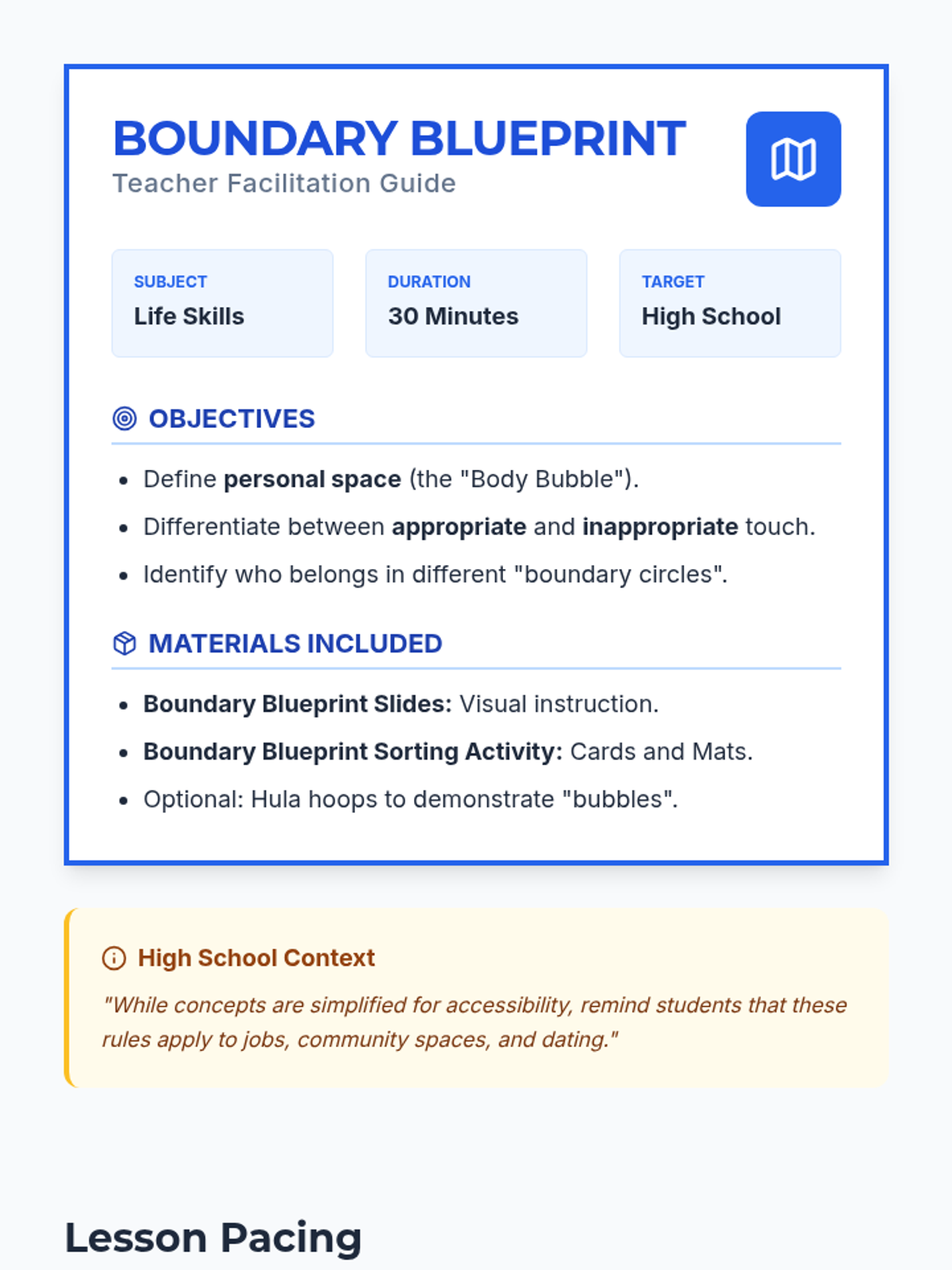
A comprehensive teacher's guide for the Boundary Blueprint lesson, featuring a 30-minute pacing guide, instructional strategies, and specific tips for supporting AAC users and students with varying reading levels.
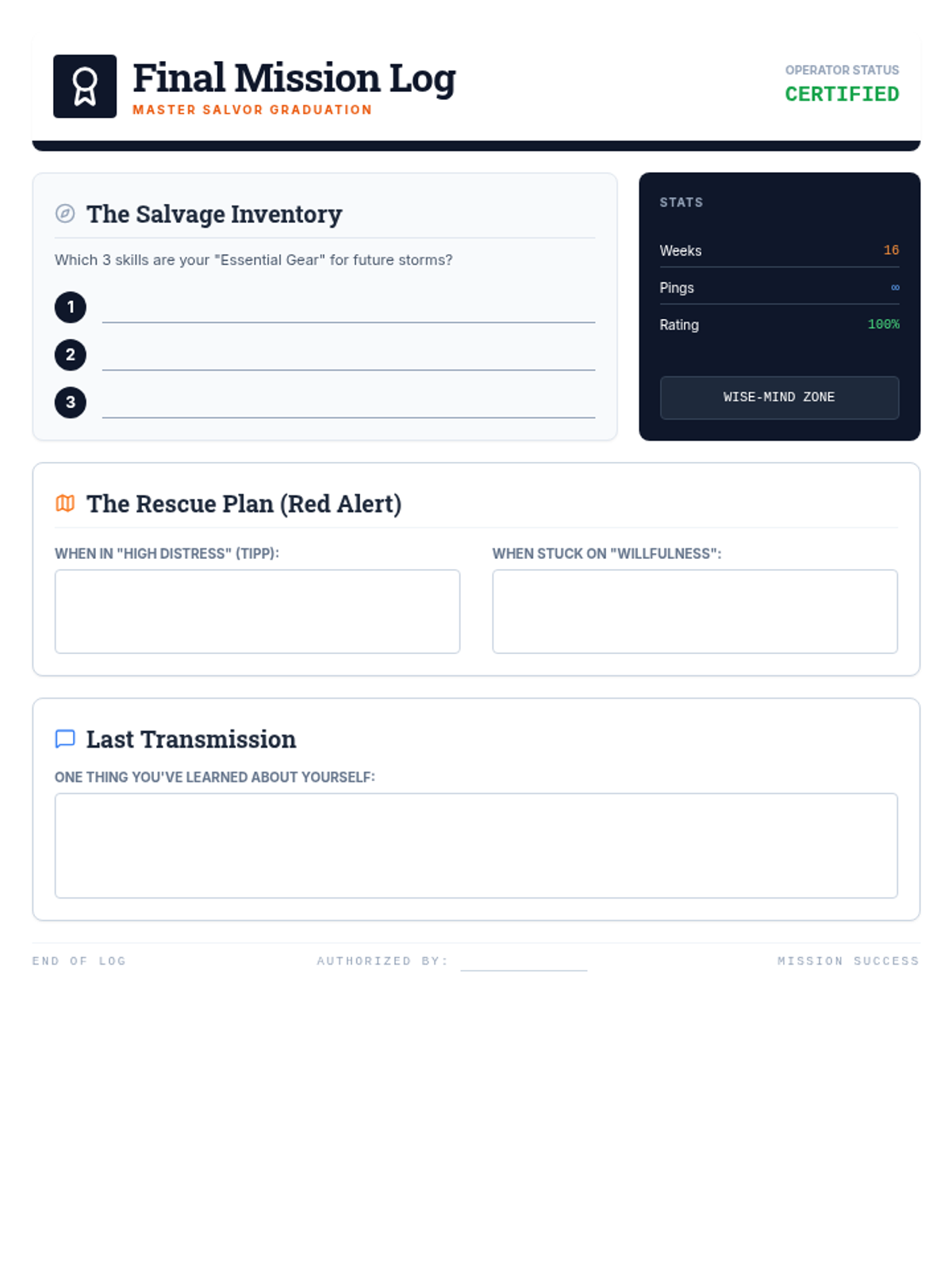
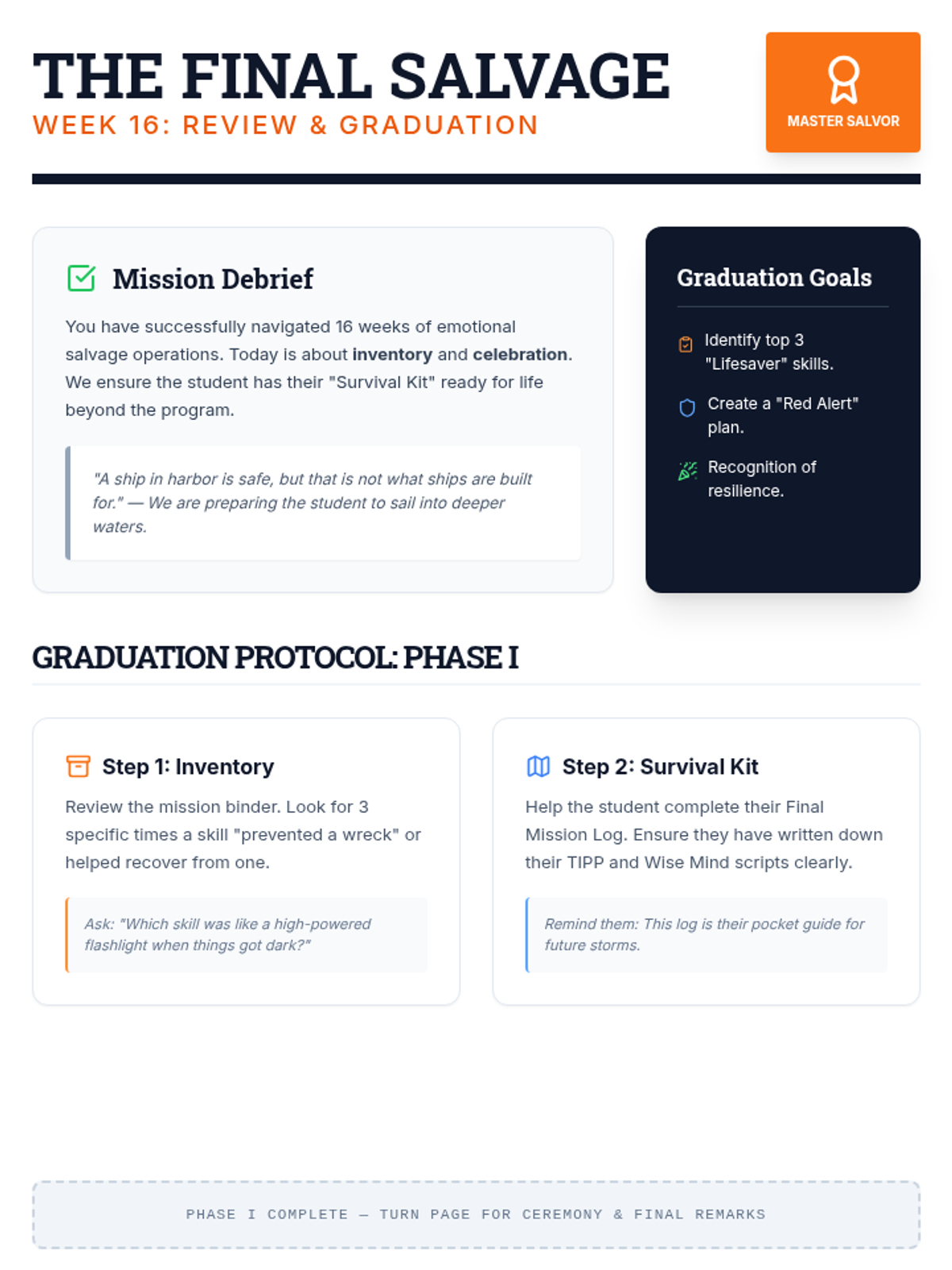
A student graduation log and review sheet for the final week of the Survival and Salvage DBT program. Includes a skill inventory, red alert planning, and a final self-reflection. Revised to fix page boundaries and line visibility.
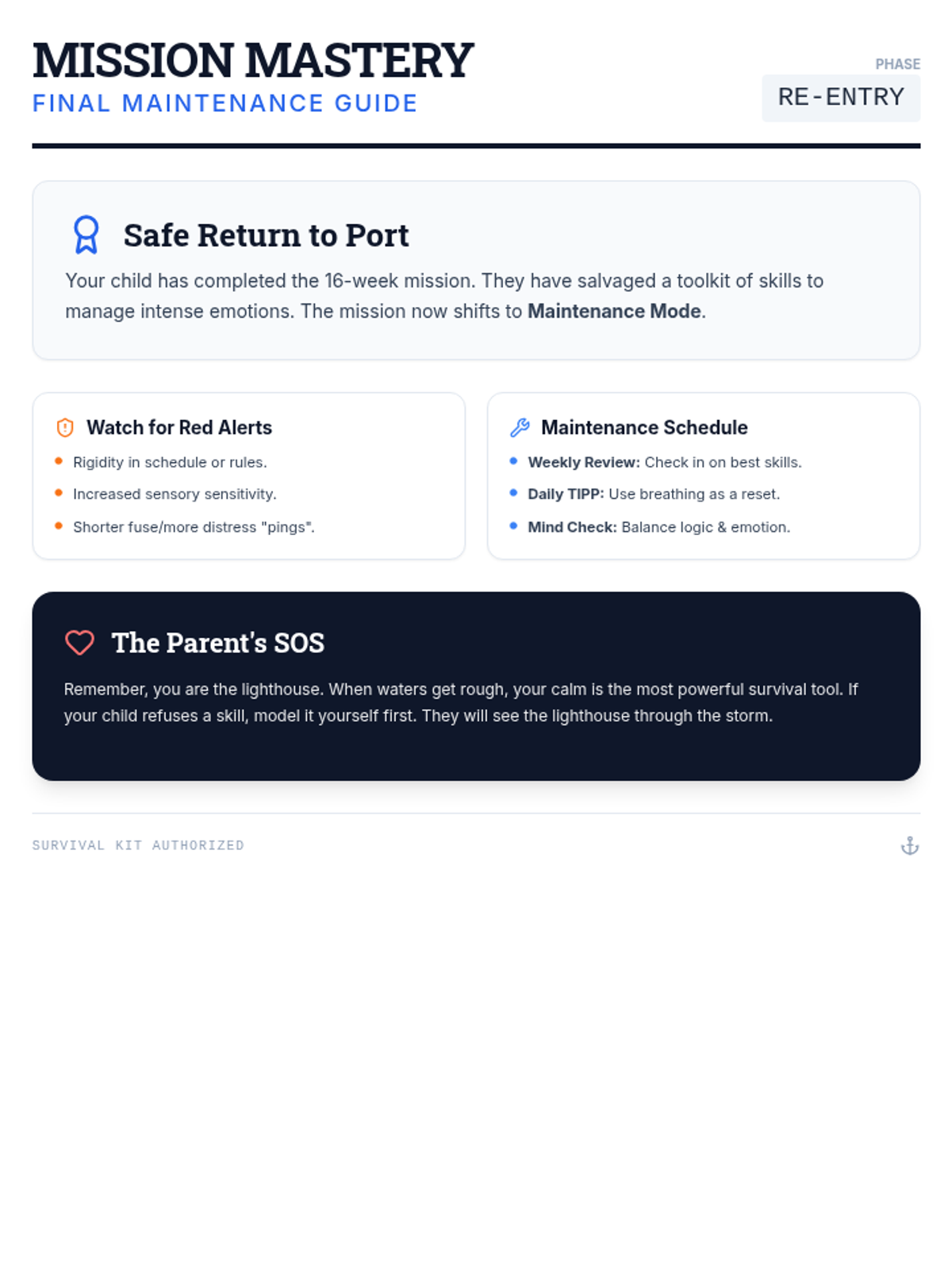
Parent guide for the final week of the Survival and Salvage DBT program, focusing on post-program maintenance and identifying early warning signs for skill reinforcement. Revised to fit a single page.
Counselor guide for the final week of the Survival and Salvage DBT program, covering the review of skills, graduation ceremony protocols, and maintenance planning. Revised to fix protocol splitting and layout issues.
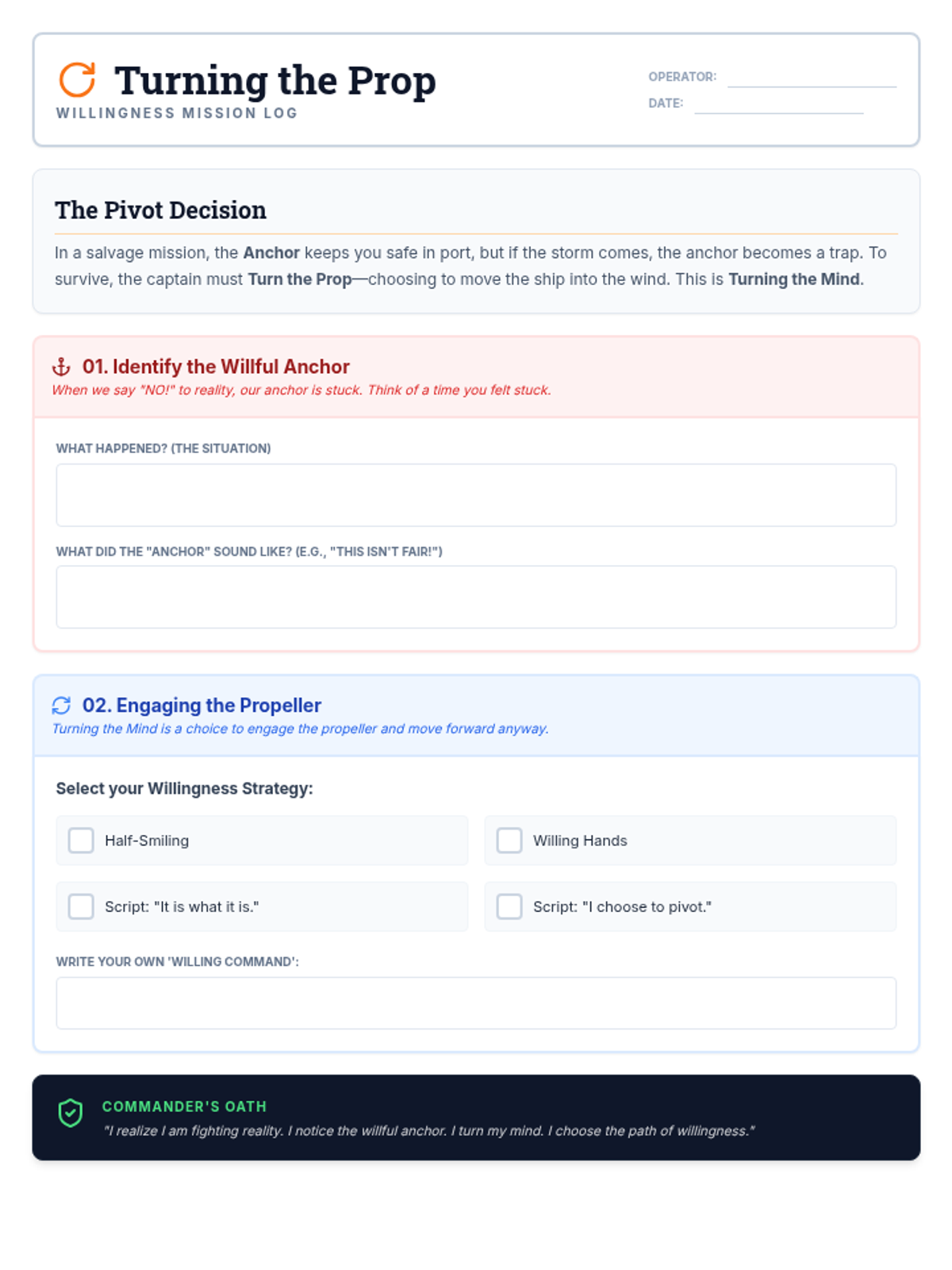
A student-facing worksheet for practicing the Turning the Mind skill using the 'Turning the Prop' metaphor. Includes identification of the 'Willful Anchor' and selection of 'Willingness Strategies'. Revised for single-page layout and white writing areas.
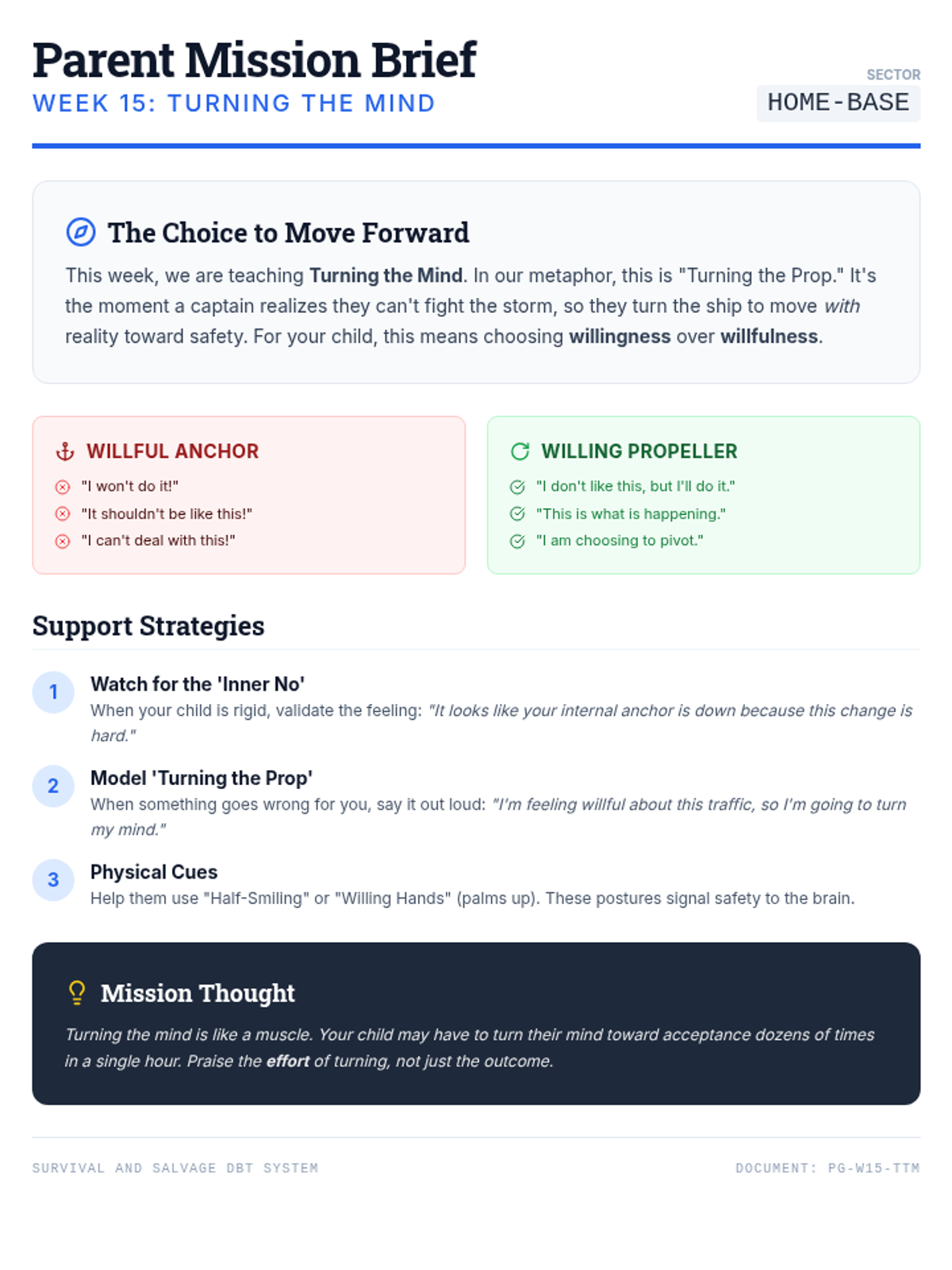
Parent guide for Week 15 of the Survival and Salvage DBT program, explaining the Turning the Mind skill using the 'Turning the Prop' metaphor for autism-friendly communication at home. Revised to fit a single page.
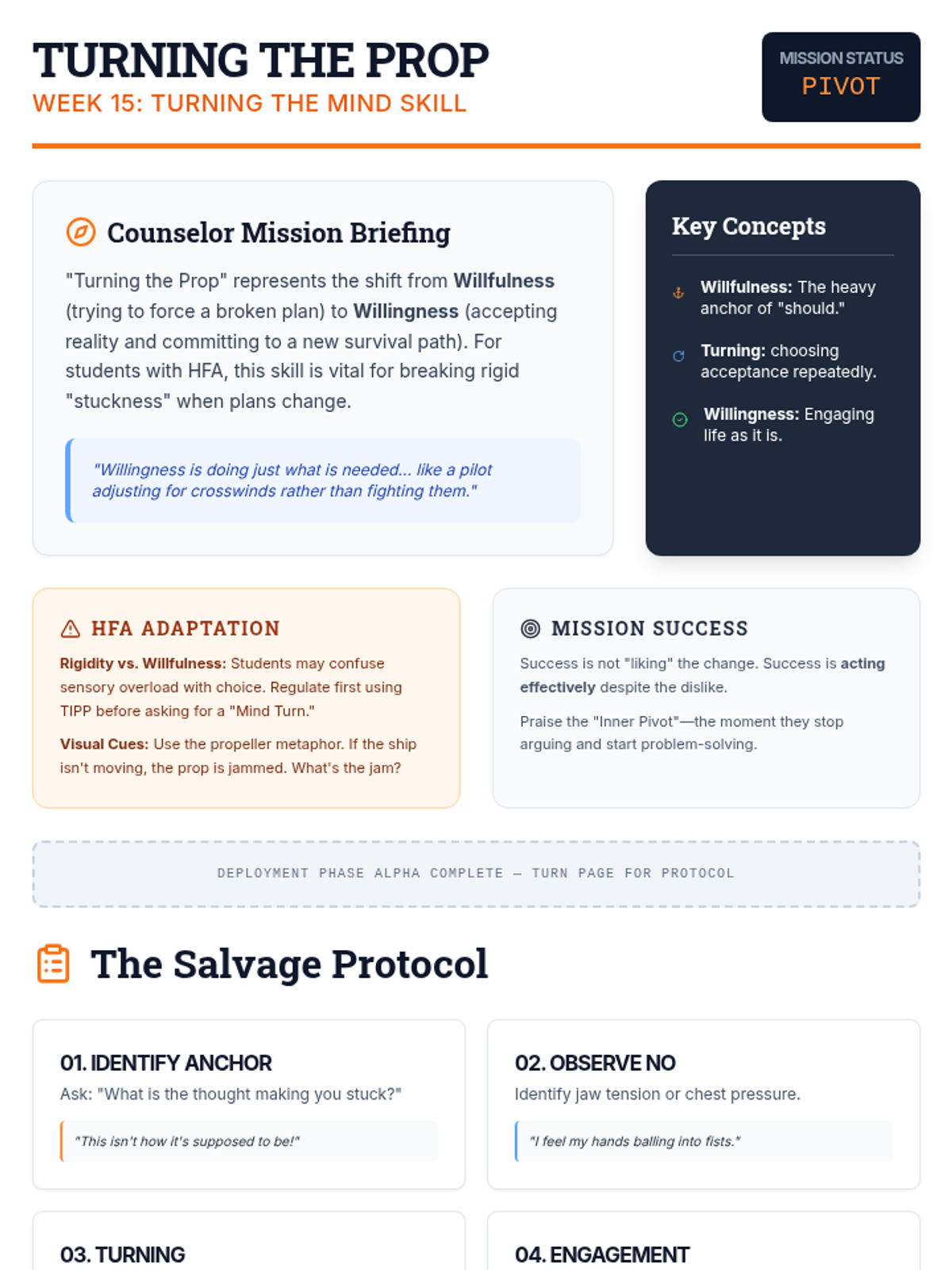
Counselor guide for Week 15 of the Survival and Salvage DBT program, focusing on the Turning the Mind skill using the 'Turning the Prop' metaphor for shifting from willfulness to willingness. Revised to fix page break issues and add notes space.
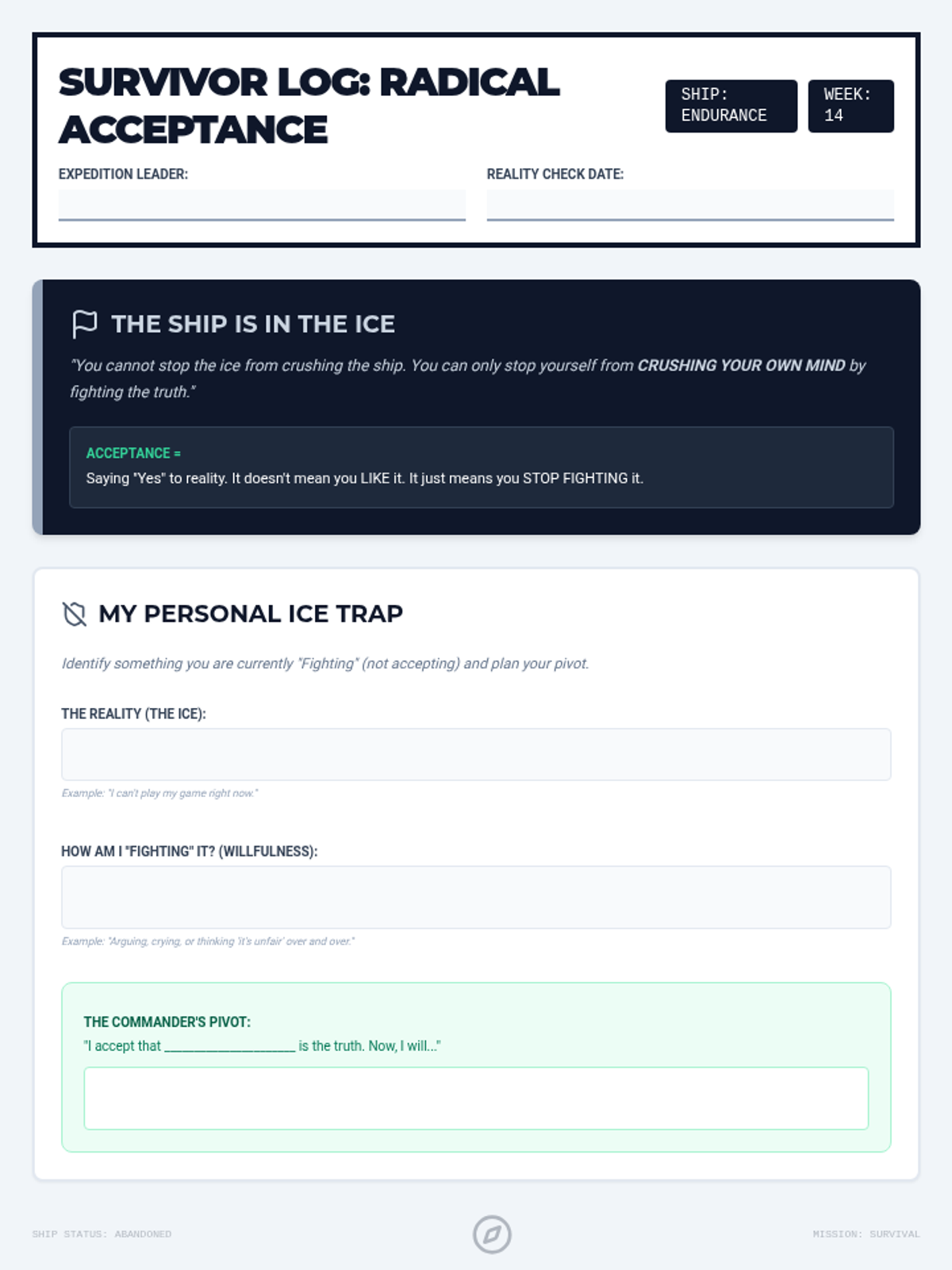
A student-facing worksheet for practicing Radical Acceptance using Shackleton's Endurance story. Includes an 'Ice Trap' analysis and a 'Commander's Pivot' for finding new solutions.
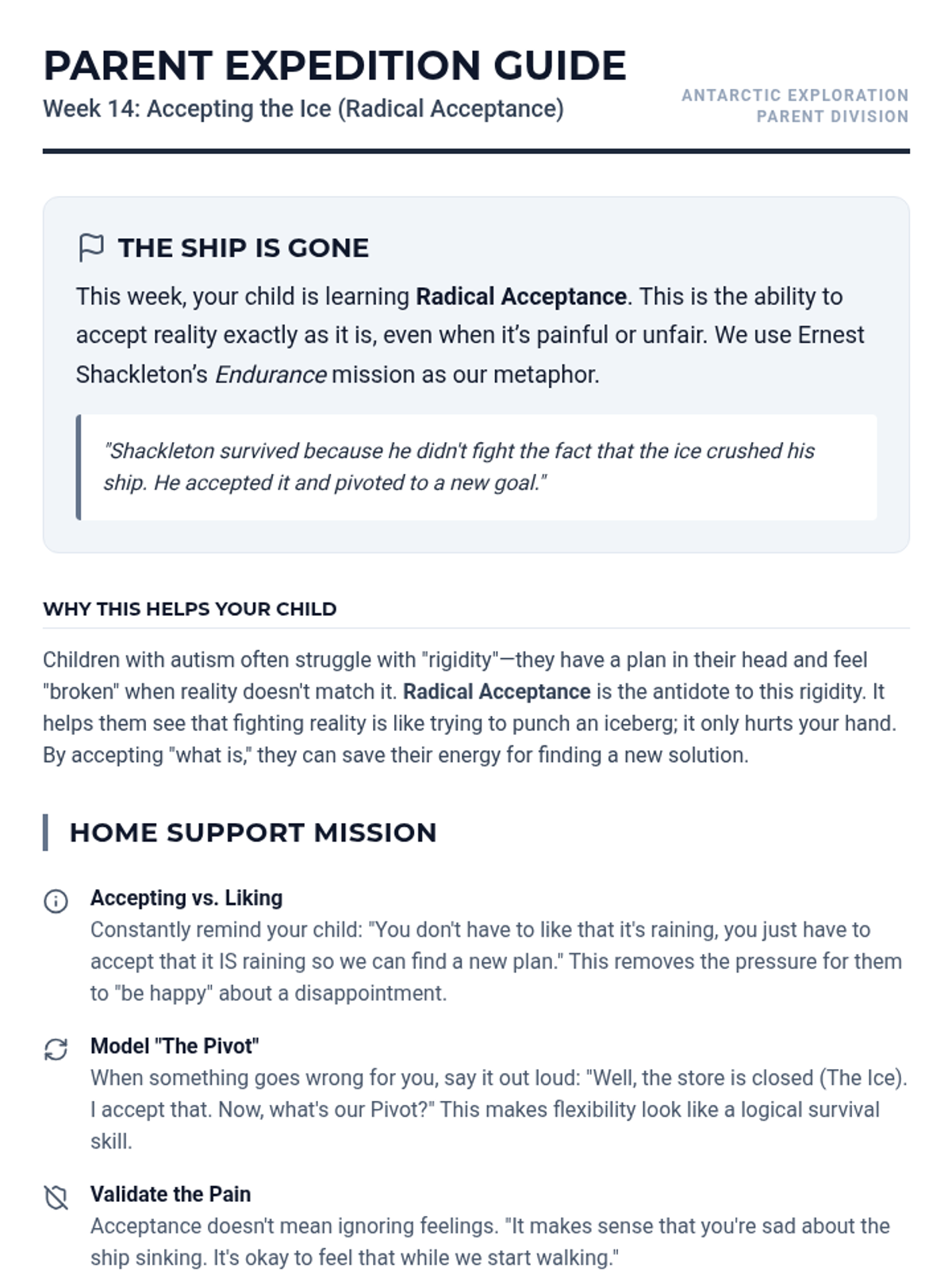
Parent guide for Week 14 of the Survival and Salvage DBT program, explaining Radical Acceptance using Shackleton's Endurance story.
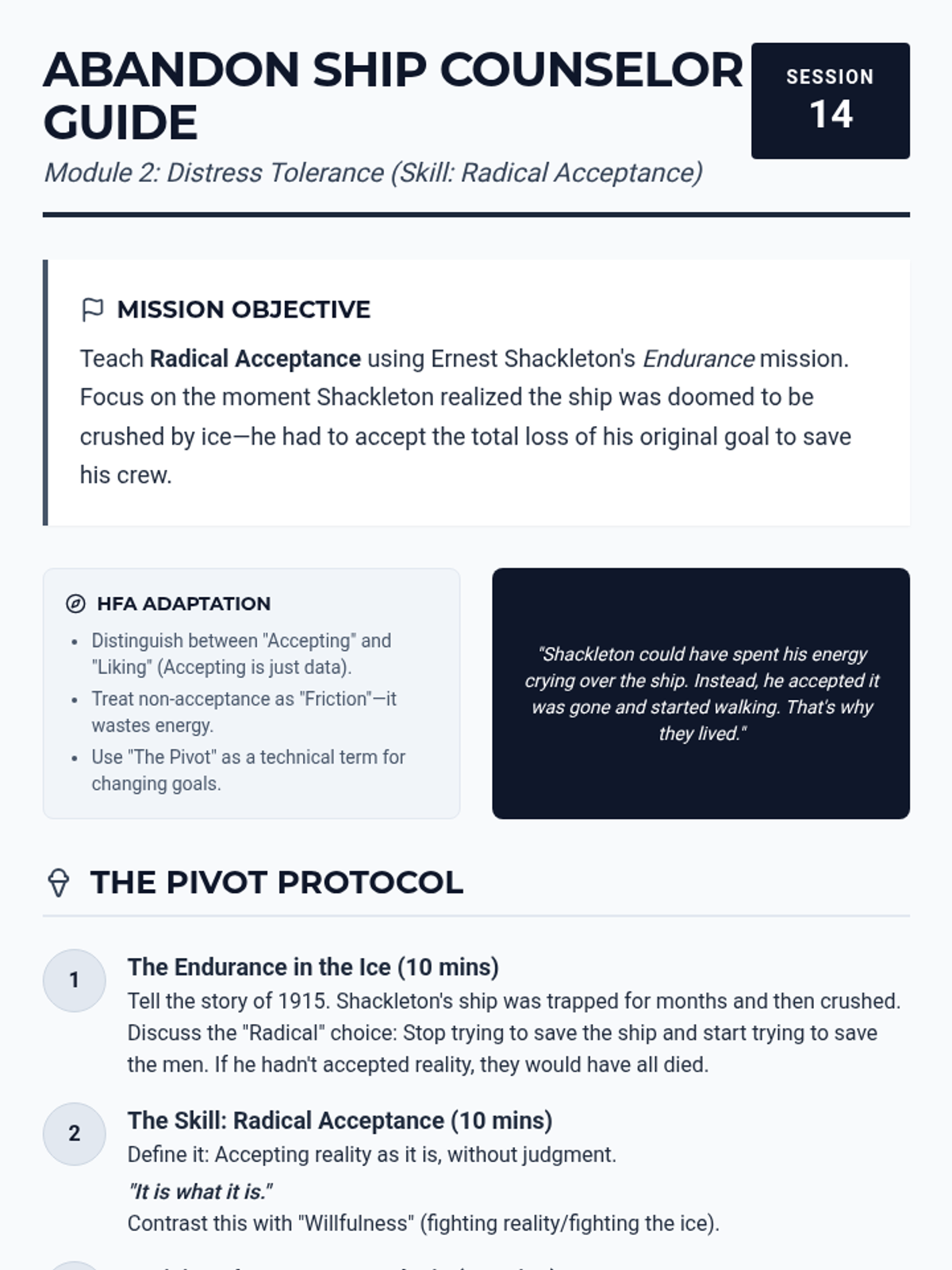
Counselor guide for Week 14 of the Survival and Salvage DBT program, focusing on Radical Acceptance using Shackleton's Endurance story.
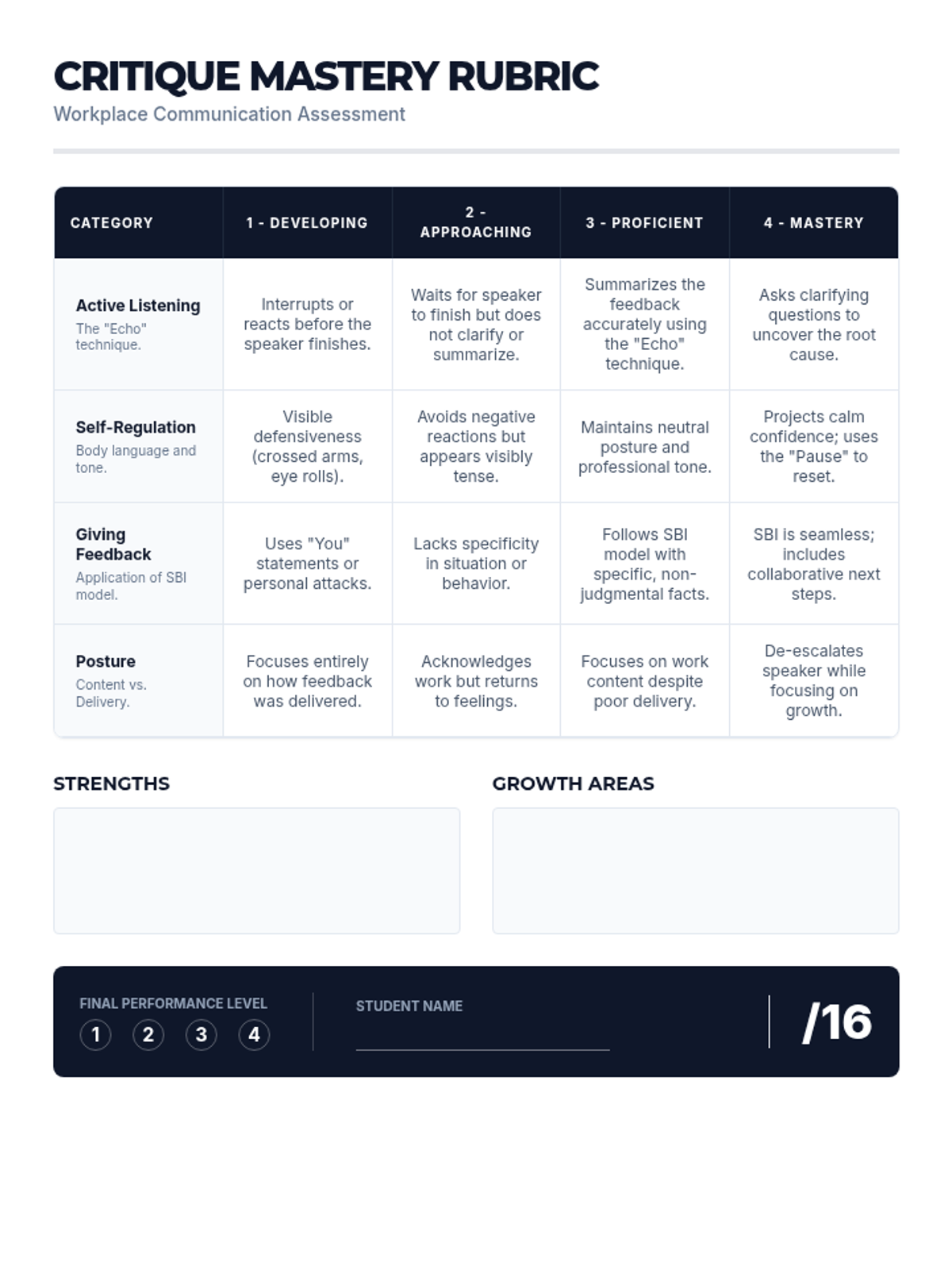
A professional evaluation rubric for assessing student performance. Revised to fit on a single page and improve visual contrast for grading.
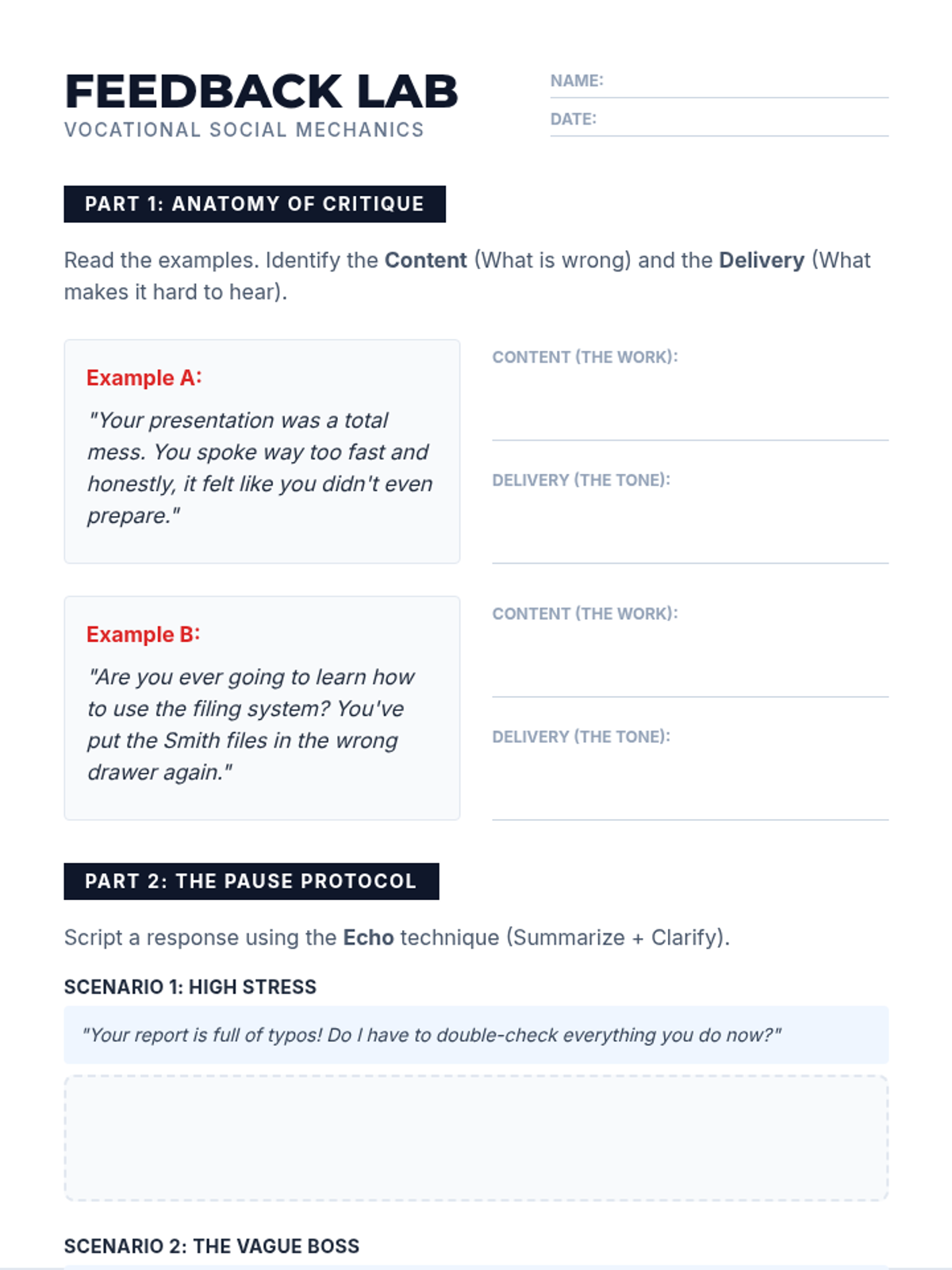
A student worksheet for practicing de-escalation, active listening, and the SBI feedback model. Revised to improve handwriting space and ensure layout consistency across pages.
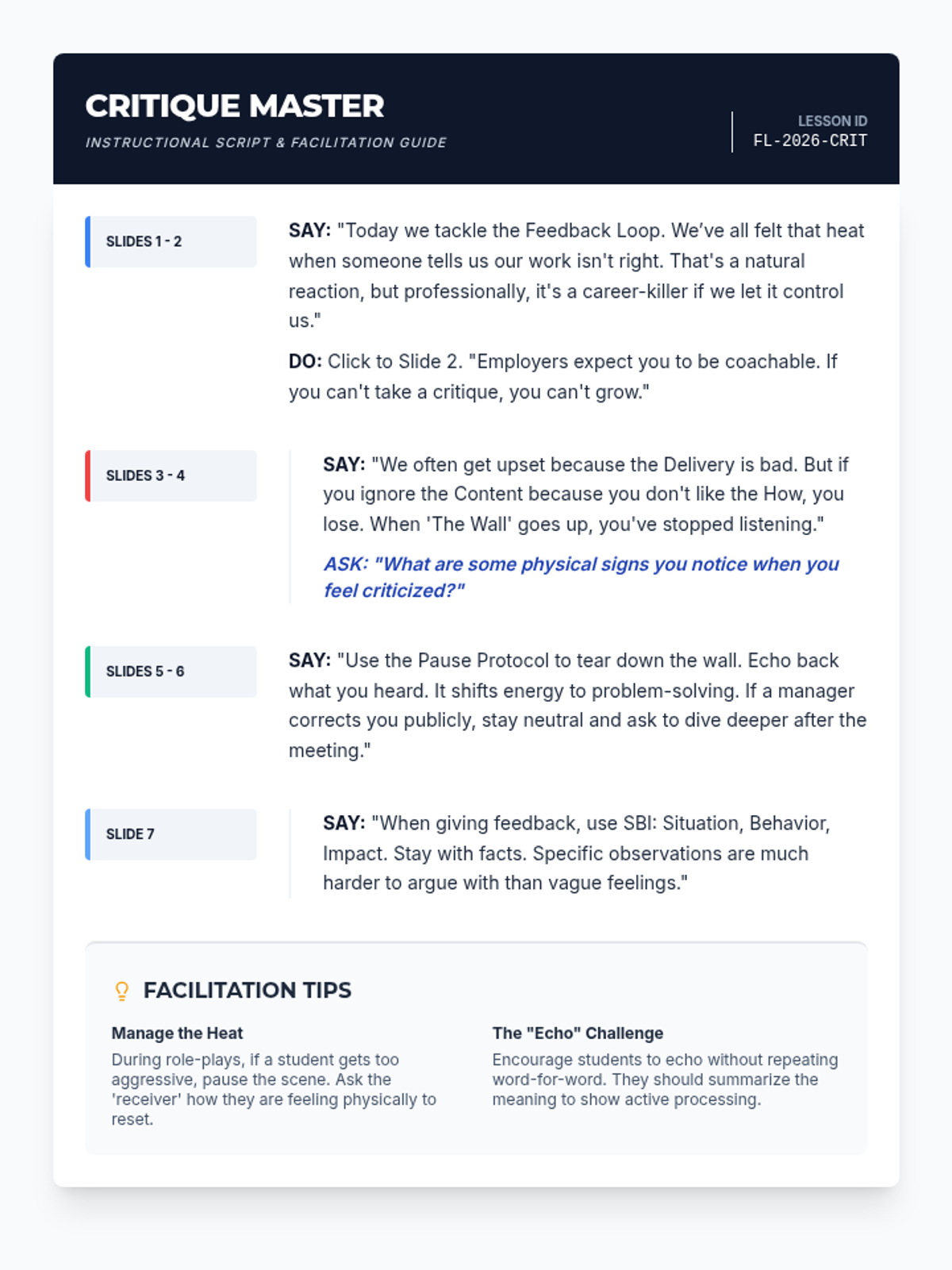
An instructional script for educators to use alongside the 'Feedback Loop' slides. Revised to remove extra pages and ensure all icons render.
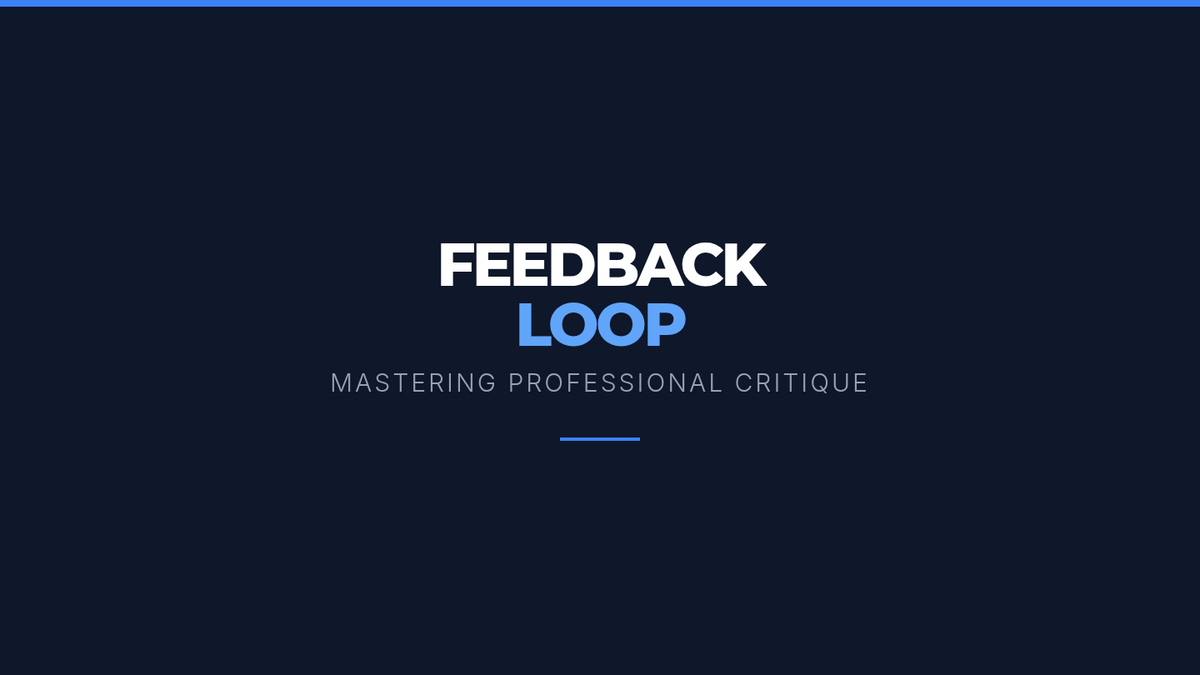
A high-impact visual slide deck for delivering instruction on professional feedback, featuring the SBI model, de-escalation tactics, and the 'Pause Protocol'. Revised to fix placeholders and contrast.
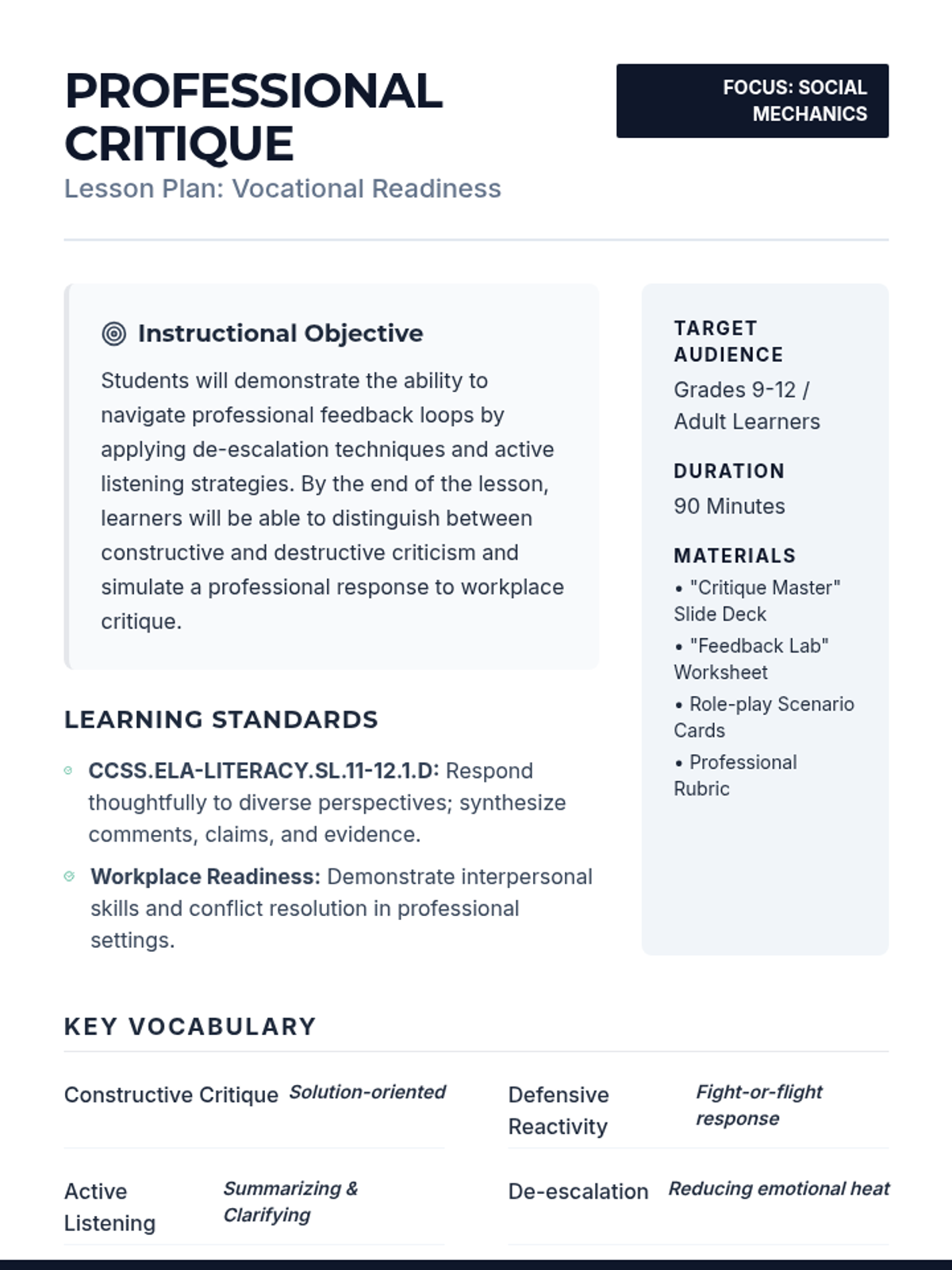
A comprehensive lesson plan for instructors detailing the objectives, standards, and step-by-step procedures for teaching professional feedback and de-escalation skills. Revised for layout and timestamps.
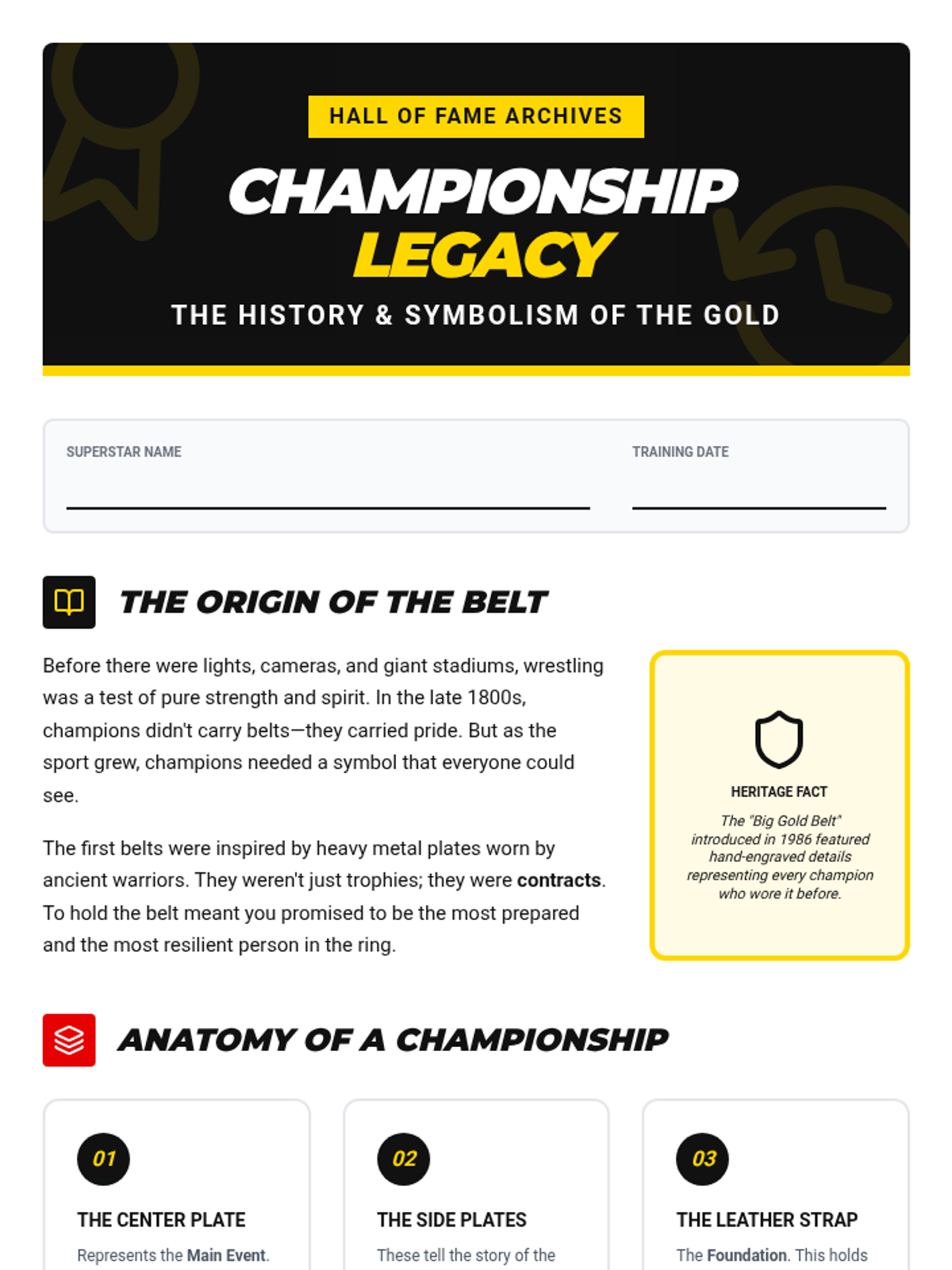
A student-facing reading and activity sheet exploring the history of wrestling championship belts, their symbolism, and how students can build their own academic legacy.
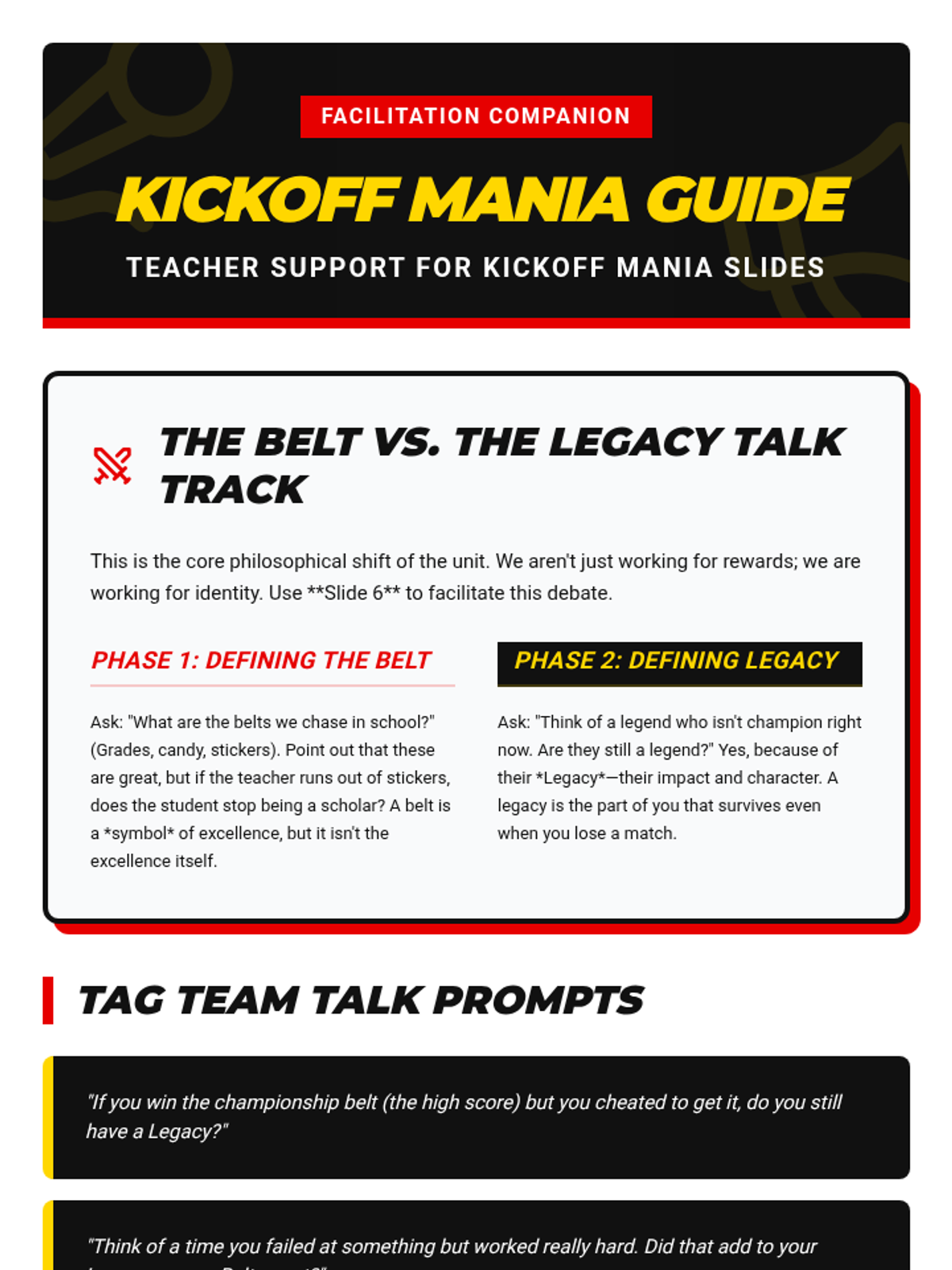
A detailed teacher facilitation companion for the Kickoff Mania slides, providing talk tracks for the 'Belt vs. Legacy' discussion, discussion prompts, and implementation steps for the Ubuntu mission.
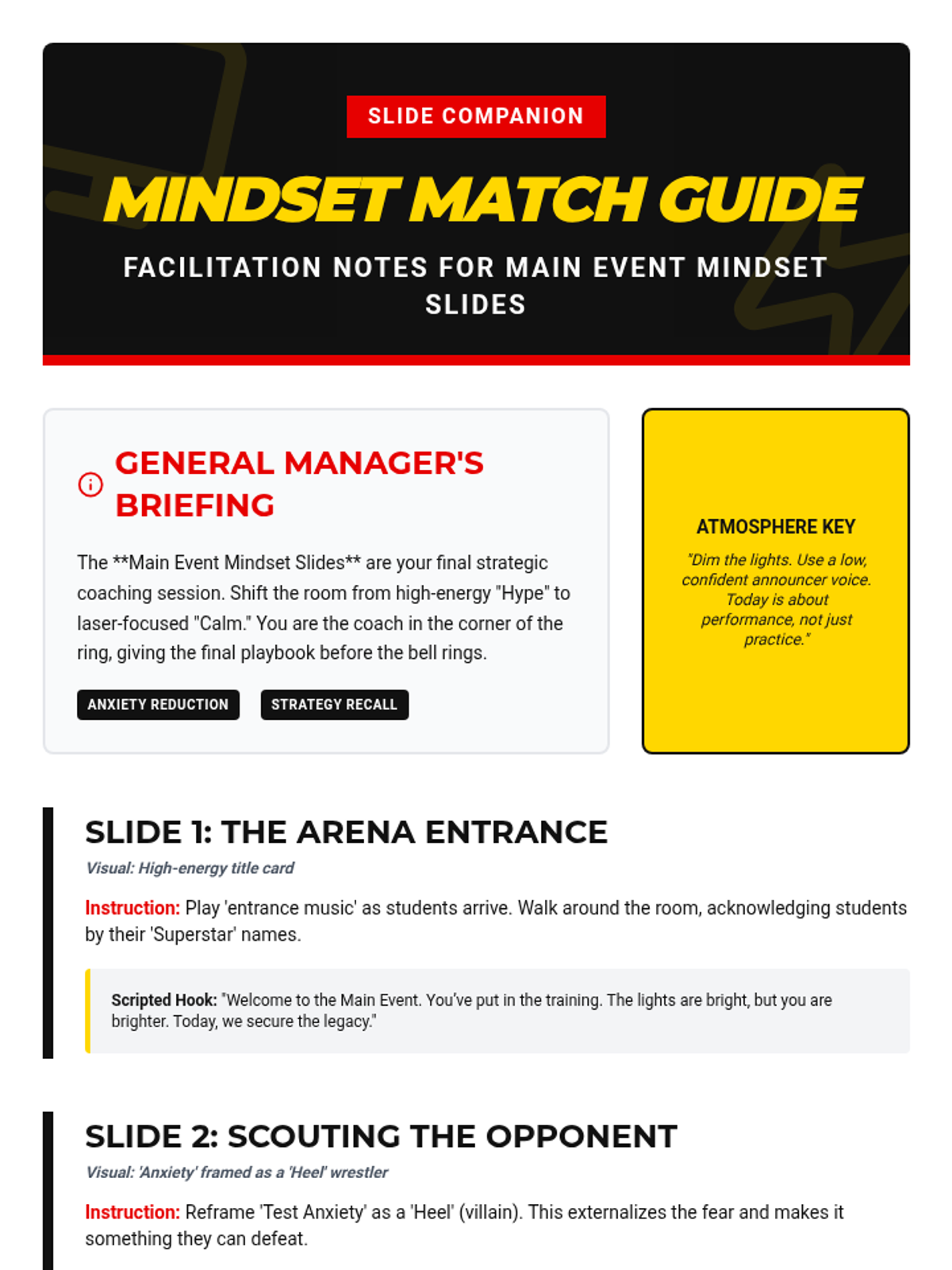
A teacher-facing companion guide for the 'Main Event Mindset' slides, providing slide-by-slide scripts, instructional instructions for managing test anxiety, and post-test decompression strategies.
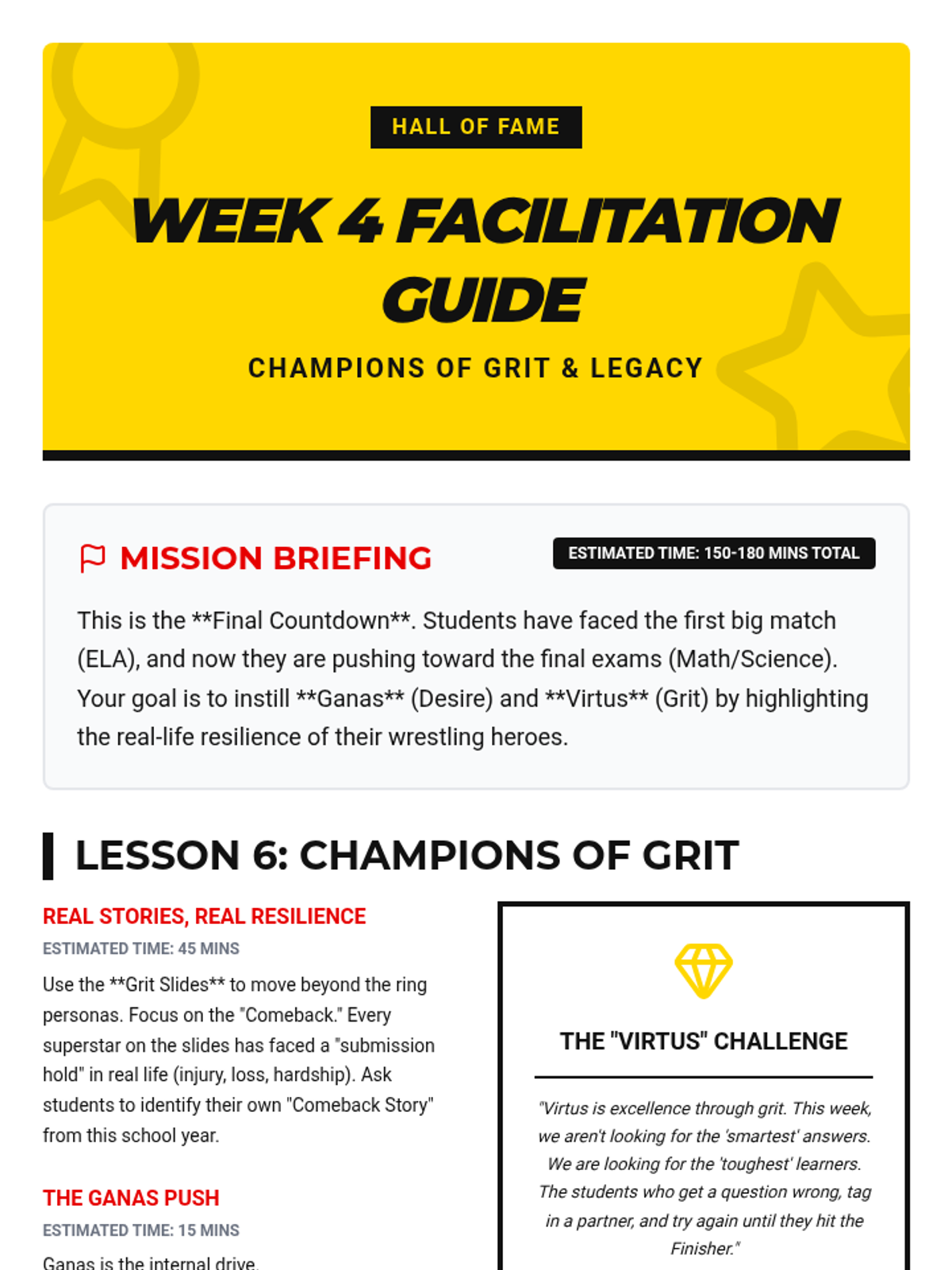
A detailed teacher facilitation guide for Week 4 of the 'Road to State Exam Mania' sequence, focusing on Ganas (drive) and Virtus (grit) for the final exam push and the 'Mania Gala' unit wrap-up.
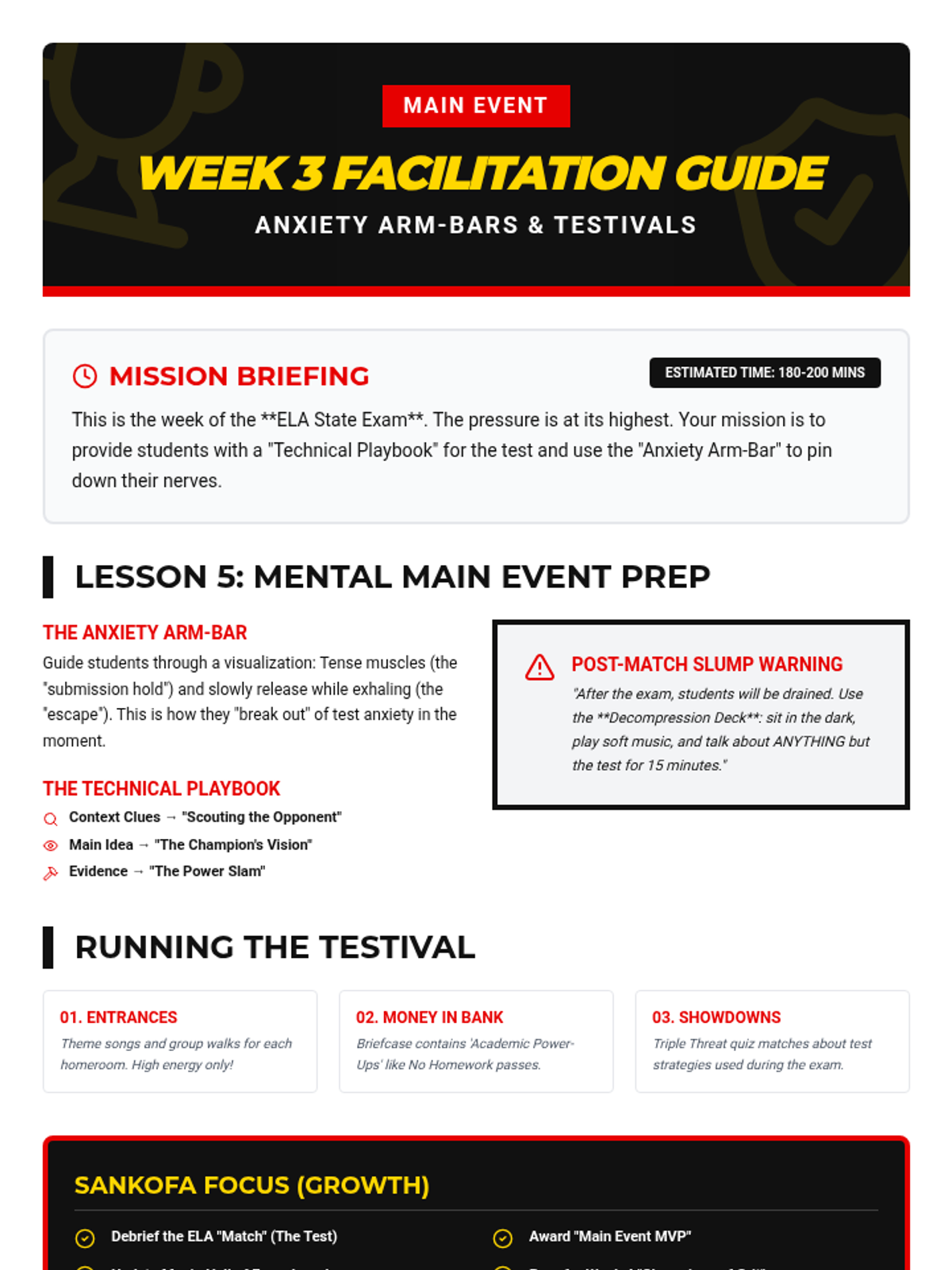
A detailed teacher facilitation guide for Week 3 of the 'Road to State Exam Mania' sequence, focusing on ELA state exam preparation and the 'Testival' pep rally.
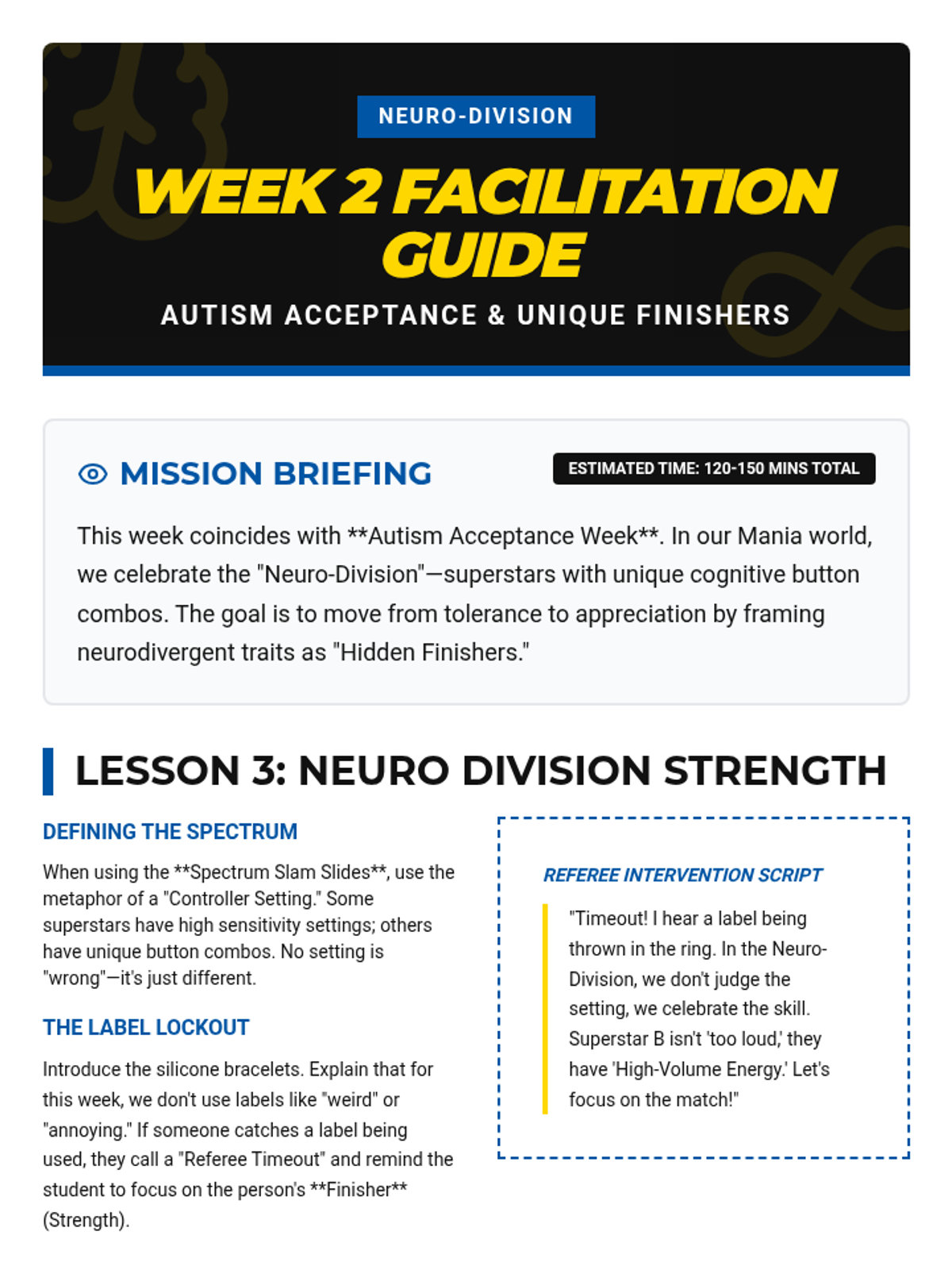
A detailed teacher facilitation guide for Week 2 of the 'Road to State Exam Mania' sequence, focusing on Autism Acceptance Week and celebrating neurodiversity.
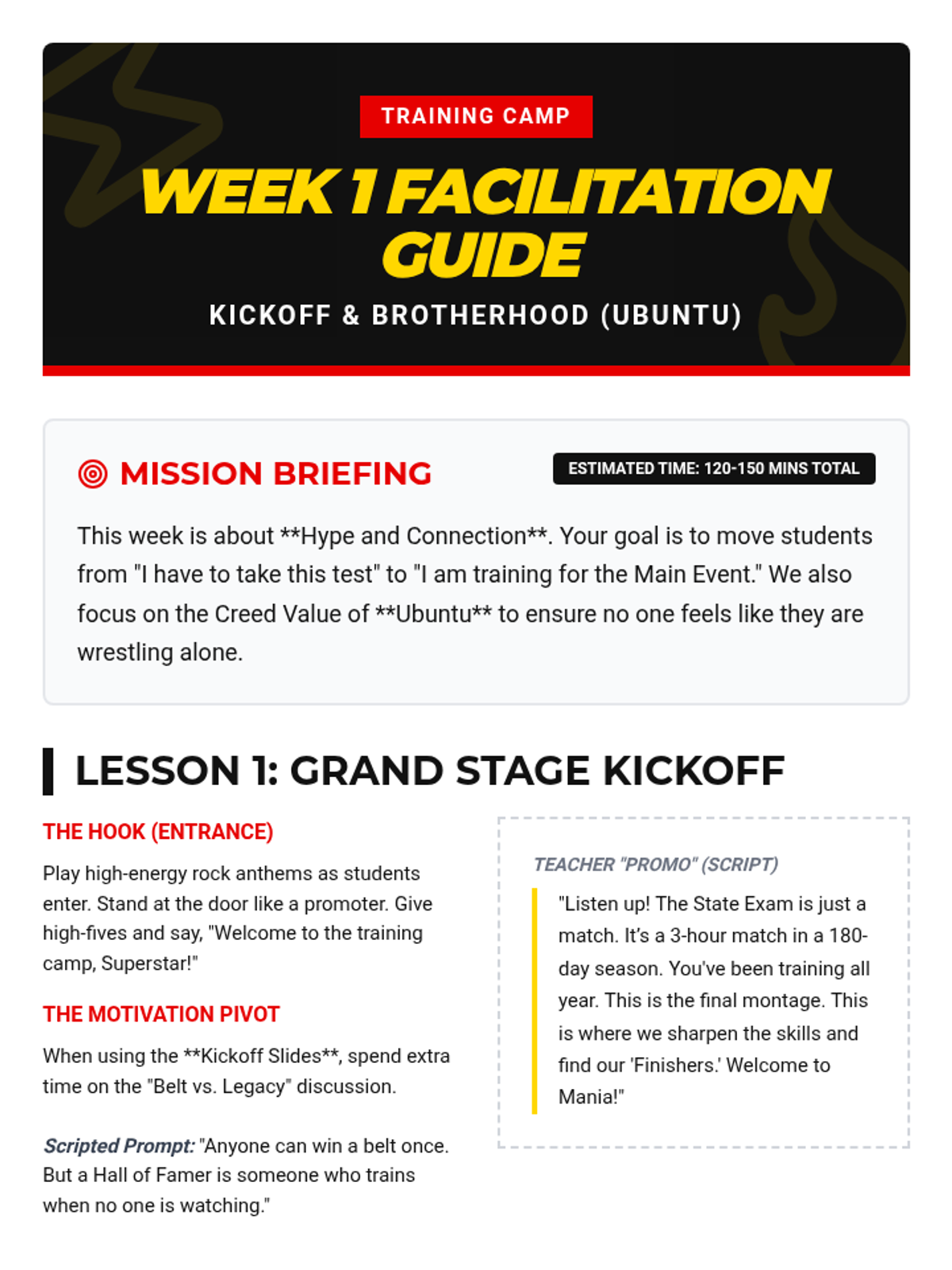
A detailed teacher facilitation guide for Week 1 of the 'Road to State Exam Mania' sequence, focusing on kickoff motivation and the Creed Value of Ubuntu.
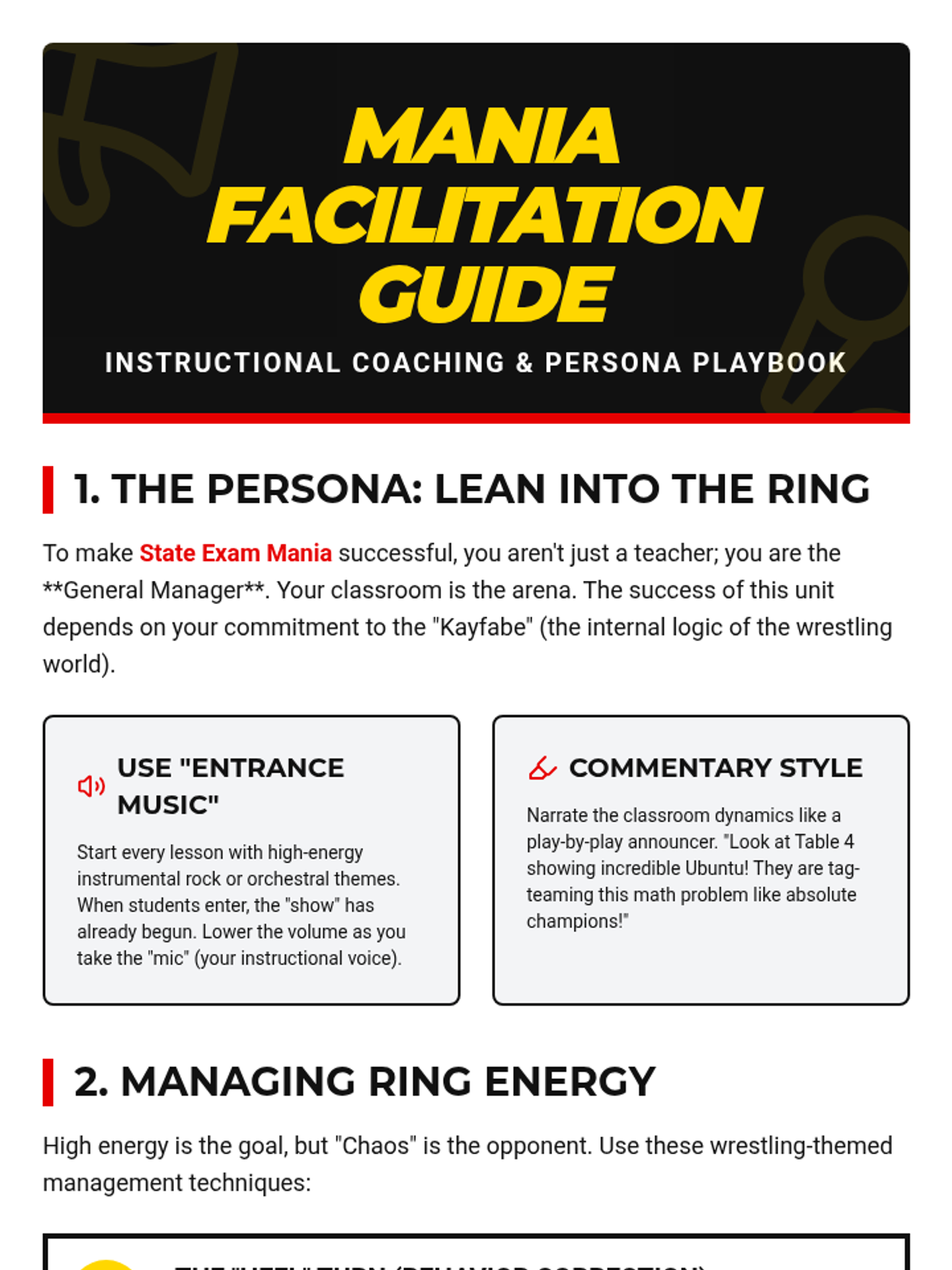
A comprehensive teacher facilitation guide for the 'Road to State Exam Mania' sequence, featuring persona coaching, behavior management strategies (using wrestling metaphors), lesson-specific tips, and a bank of discussion questions.
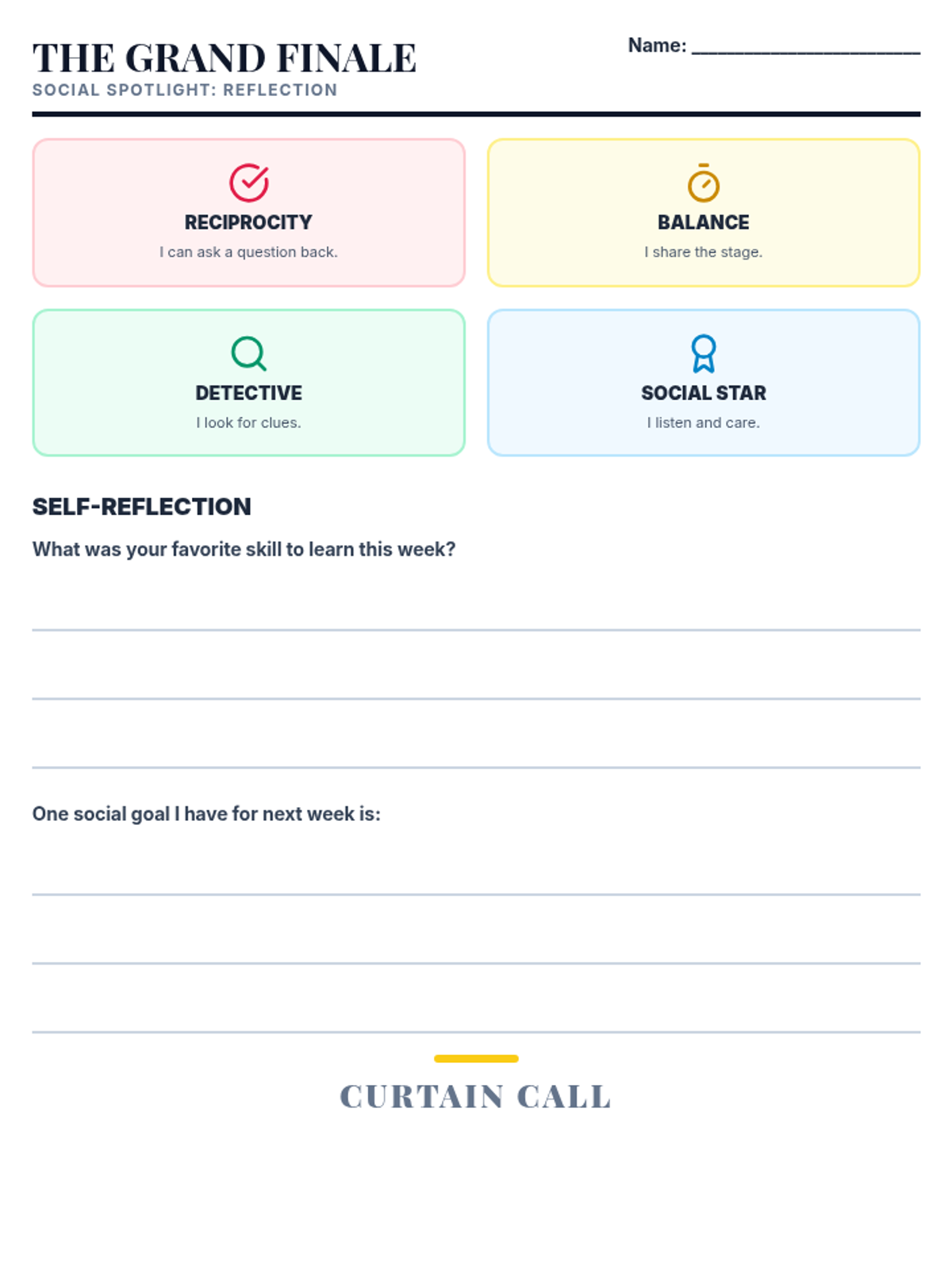
An improved 1-page Day 5 reflection sheet with increased writing space, ruled lines, and fixed footer placement.
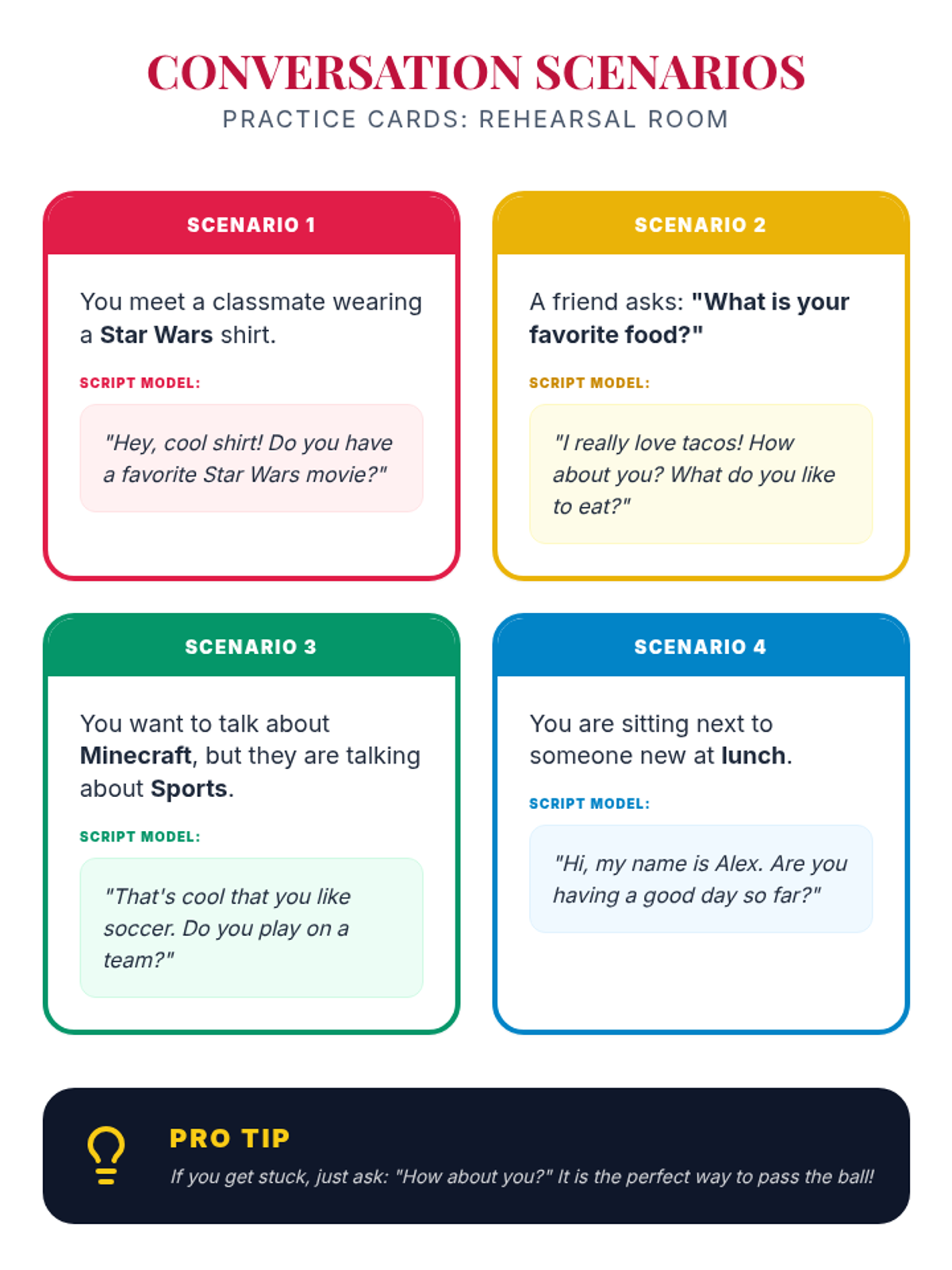
A set of 4 updated role-play scenario cards with actual script models and a printer-friendly white background for Day 4 practice.
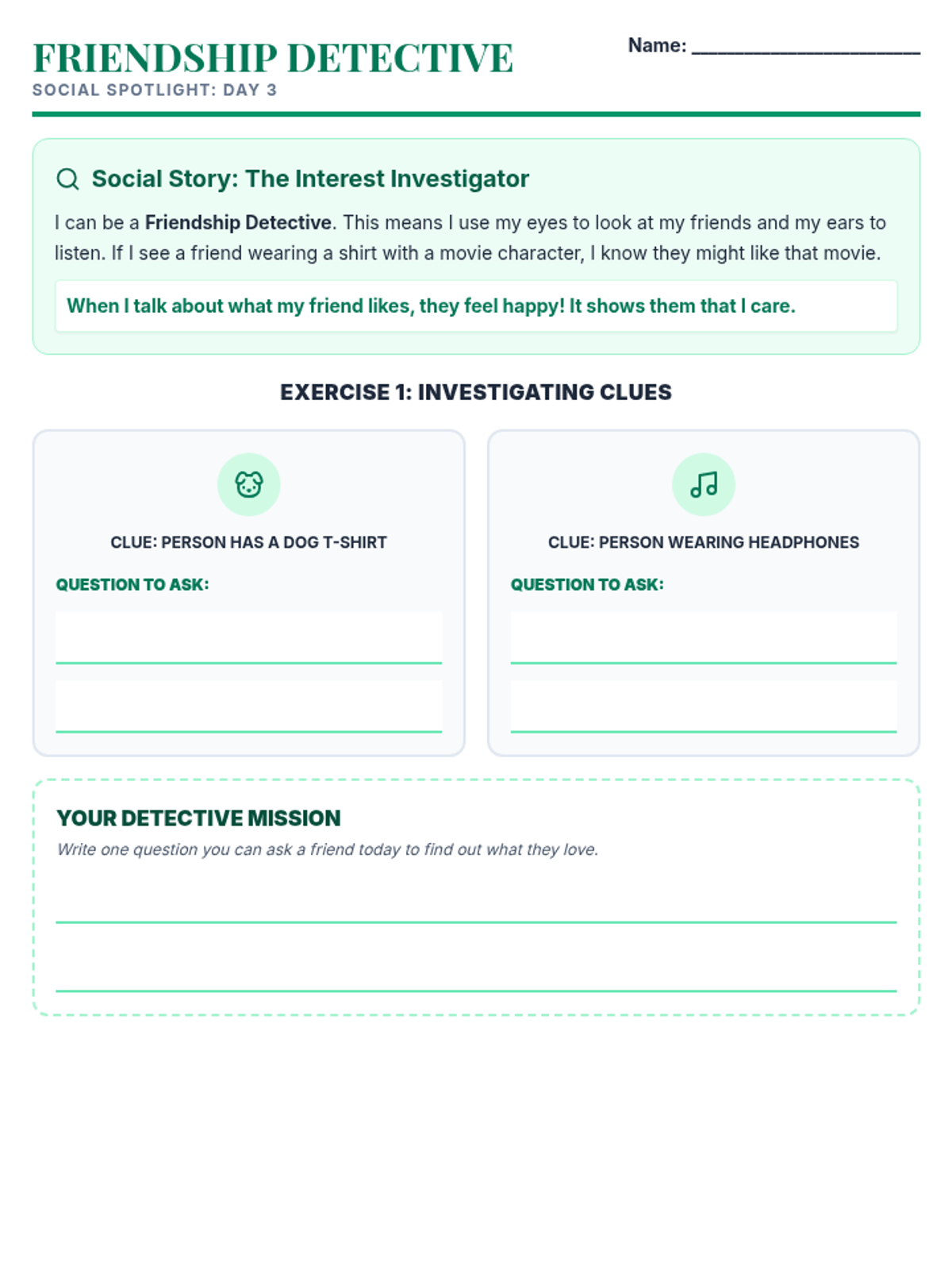
An improved 1-page Day 3 worksheet with Ruled lines, larger work areas, and clear visual prompts for high school students.
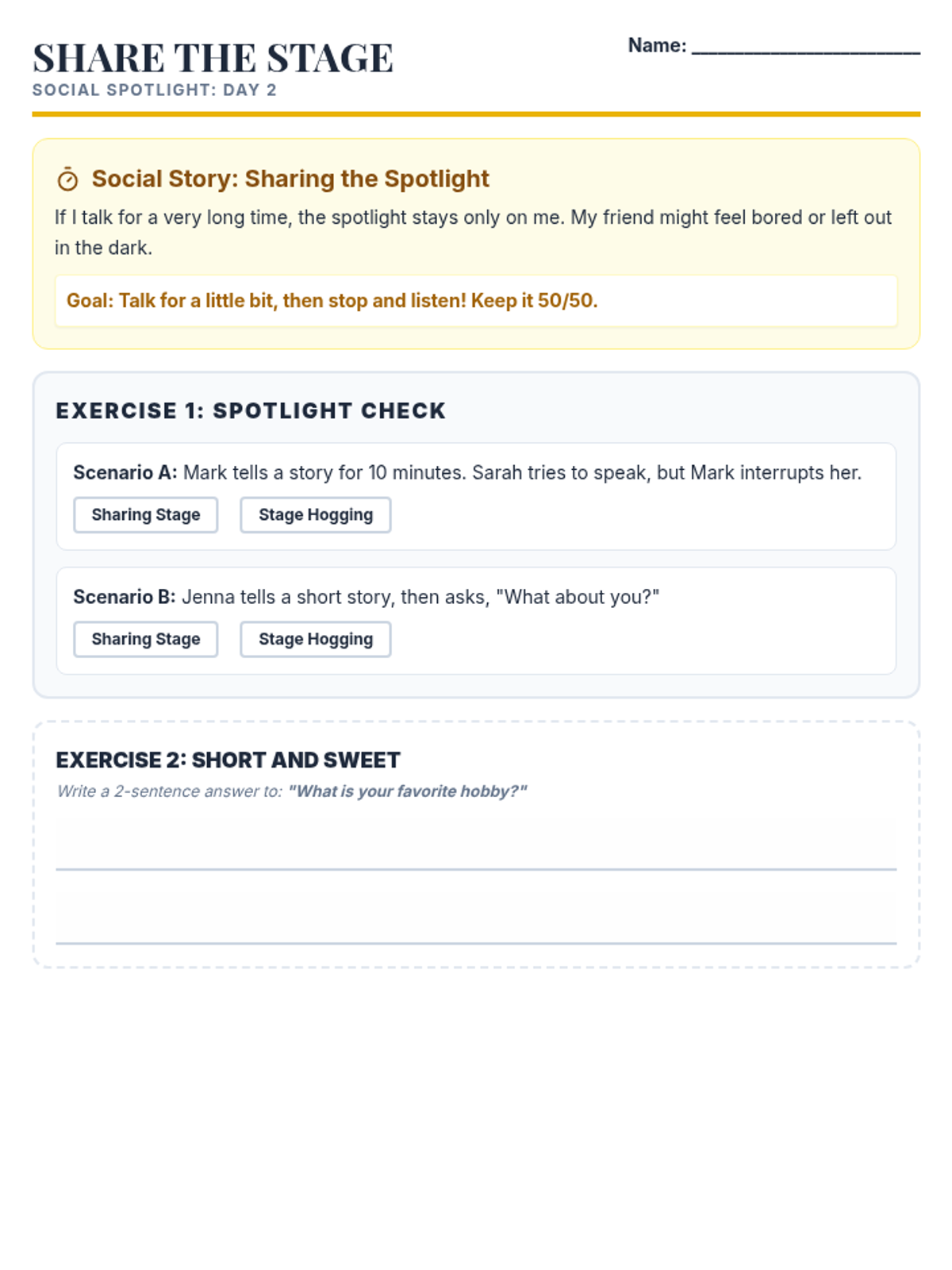
An improved 1-page Day 2 worksheet with Ruled lines, clear scenarios, and fixed page flow to ensure prompts and work areas stay together.
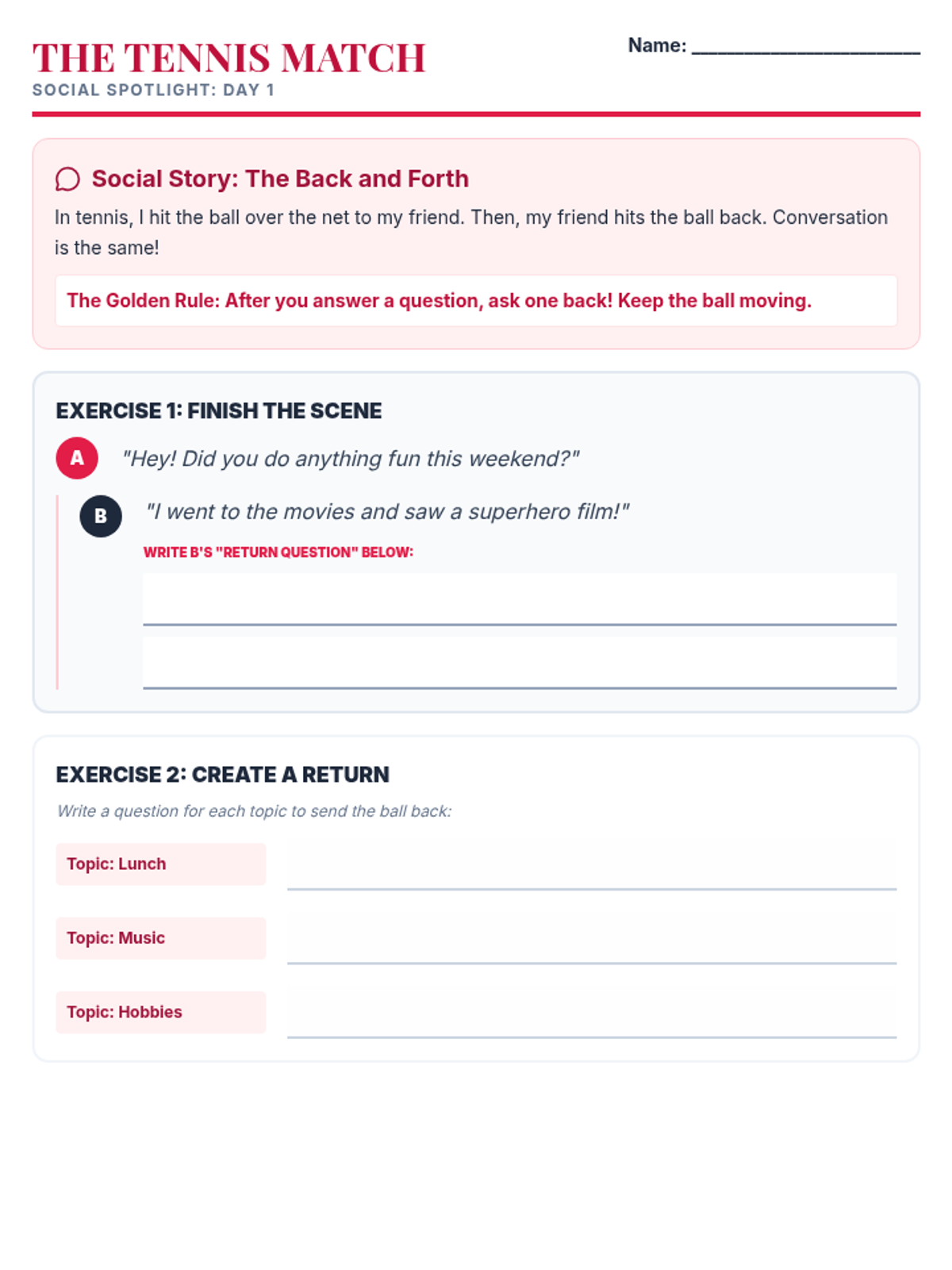
An improved Day 1 worksheet with more writing space, ruled lines, and an additional practice exercise for high school students.
A comprehensive 6-slide instructional deck covering the full 5-day Social Spotlight unit with expanded details for each day. Minimum font size is 24px.
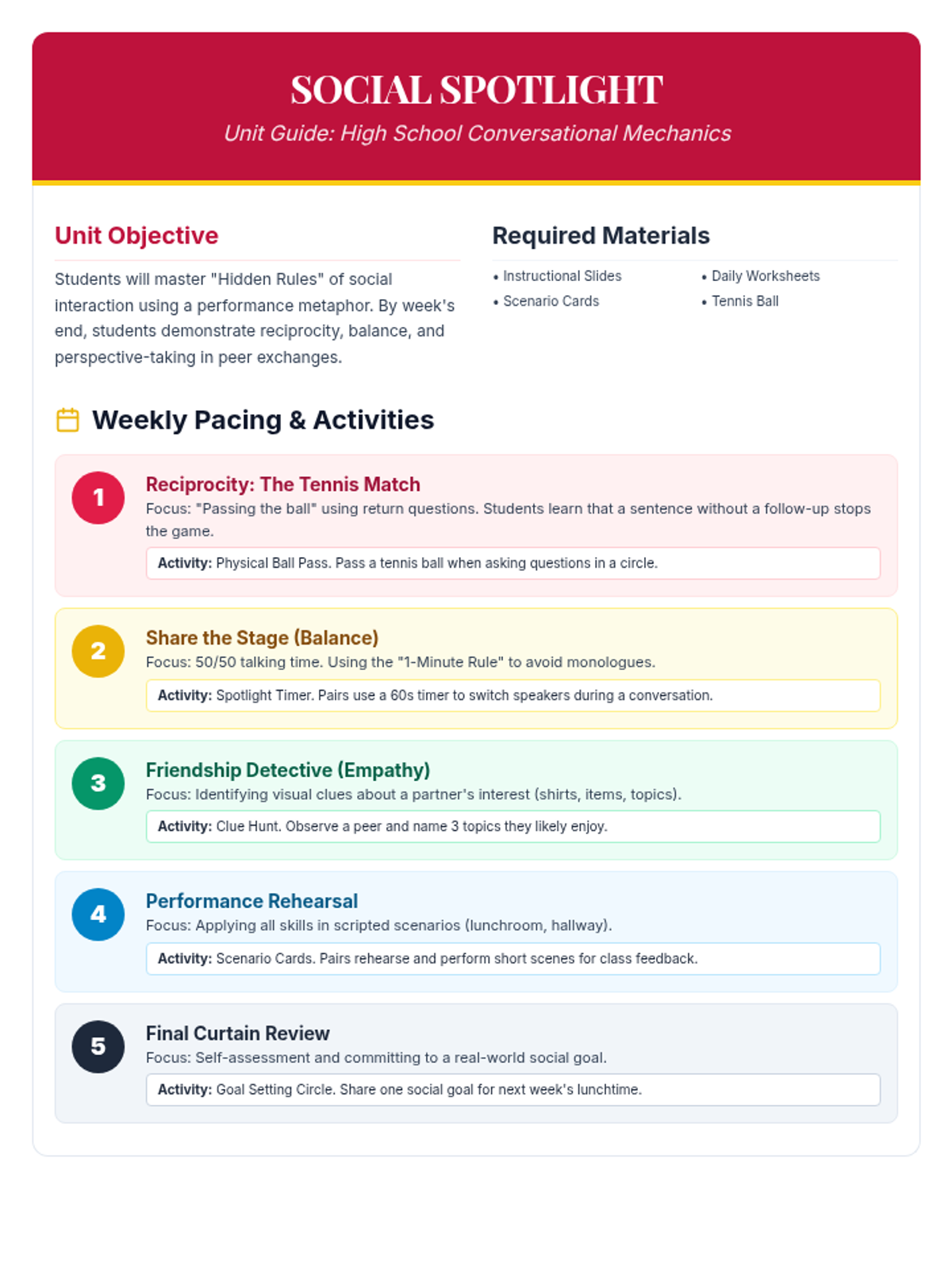
A detailed 1-page unit guide for the Social Spotlight unit, including specific objectives, daily pacing, and activity descriptions for high school special education.
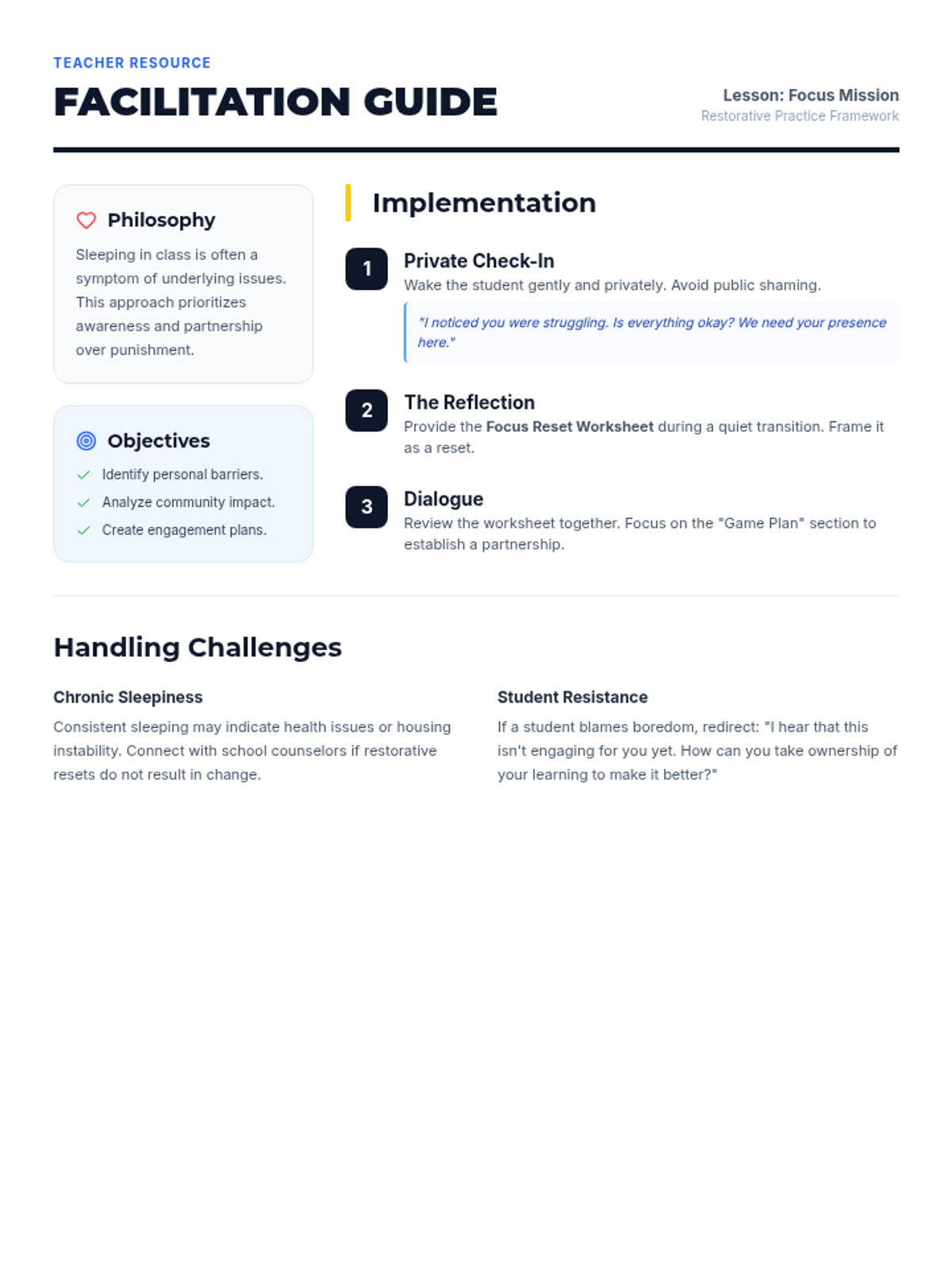
A teacher facilitation guide providing restorative strategies and instructional prompts for addressing classroom sleepiness and using the Focus Mission materials effectively.
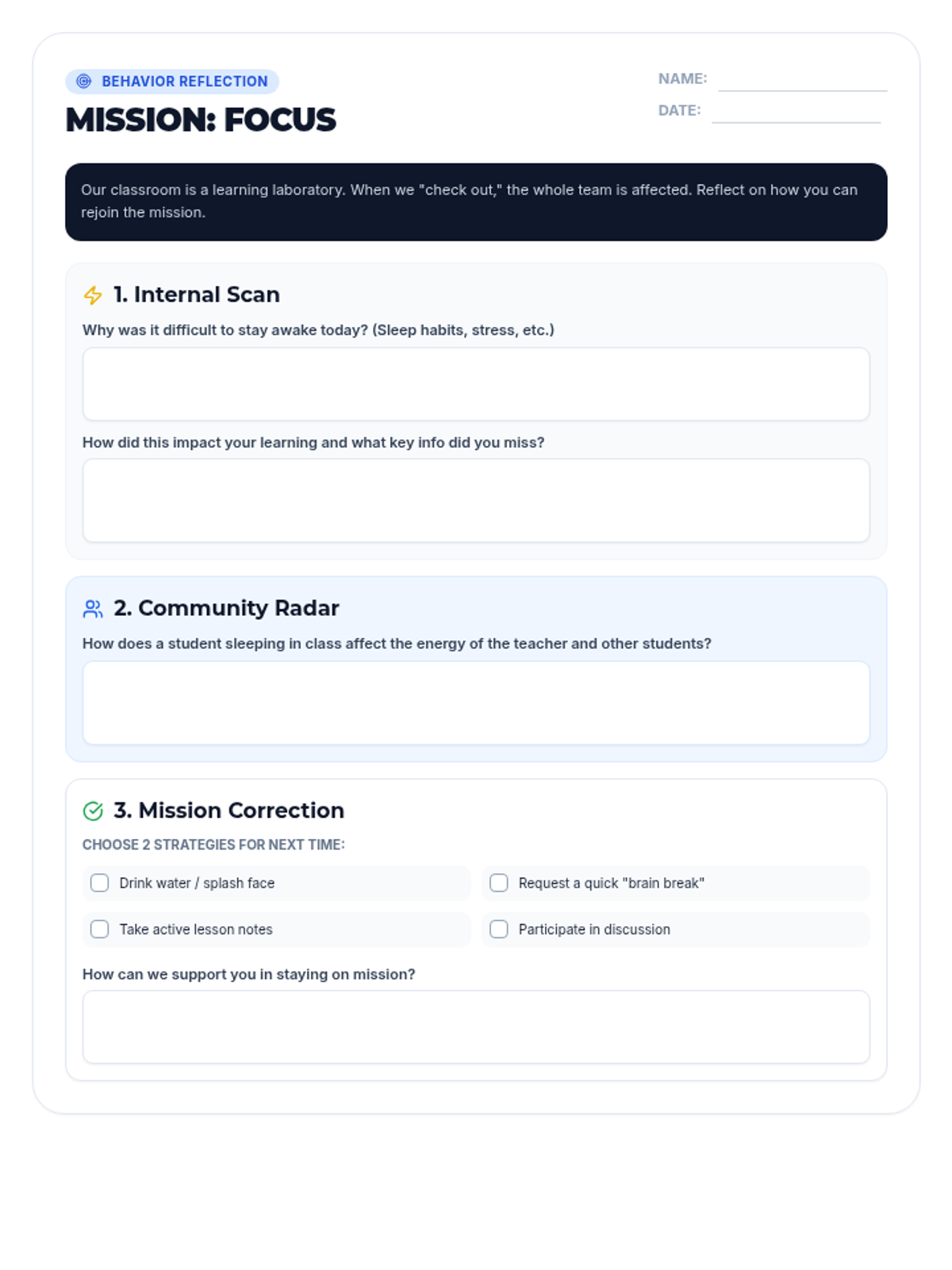
A restorative behavior reflection worksheet that encourages students to evaluate the causes of their drowsiness and understand its impact on their learning and classroom community.
An engaging slide deck explaining the impact of sleeping in class on personal success and the classroom community, featuring restorative strategies for staying engaged.
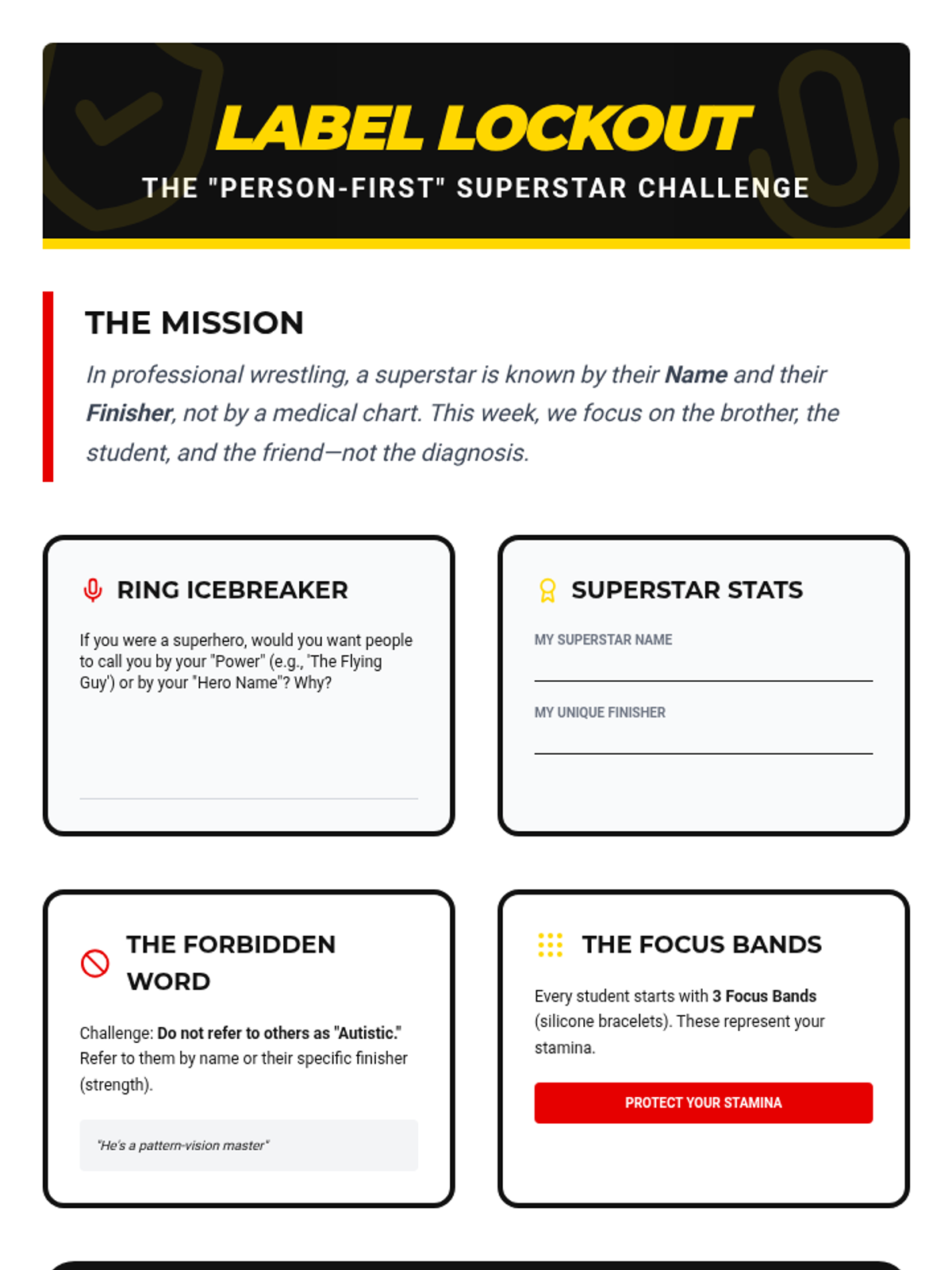
A week-long challenge guide where students avoid labels like 'autistic' to focus on individual strengths, using silicone bracelets as tokens in a 'Referee' style game.
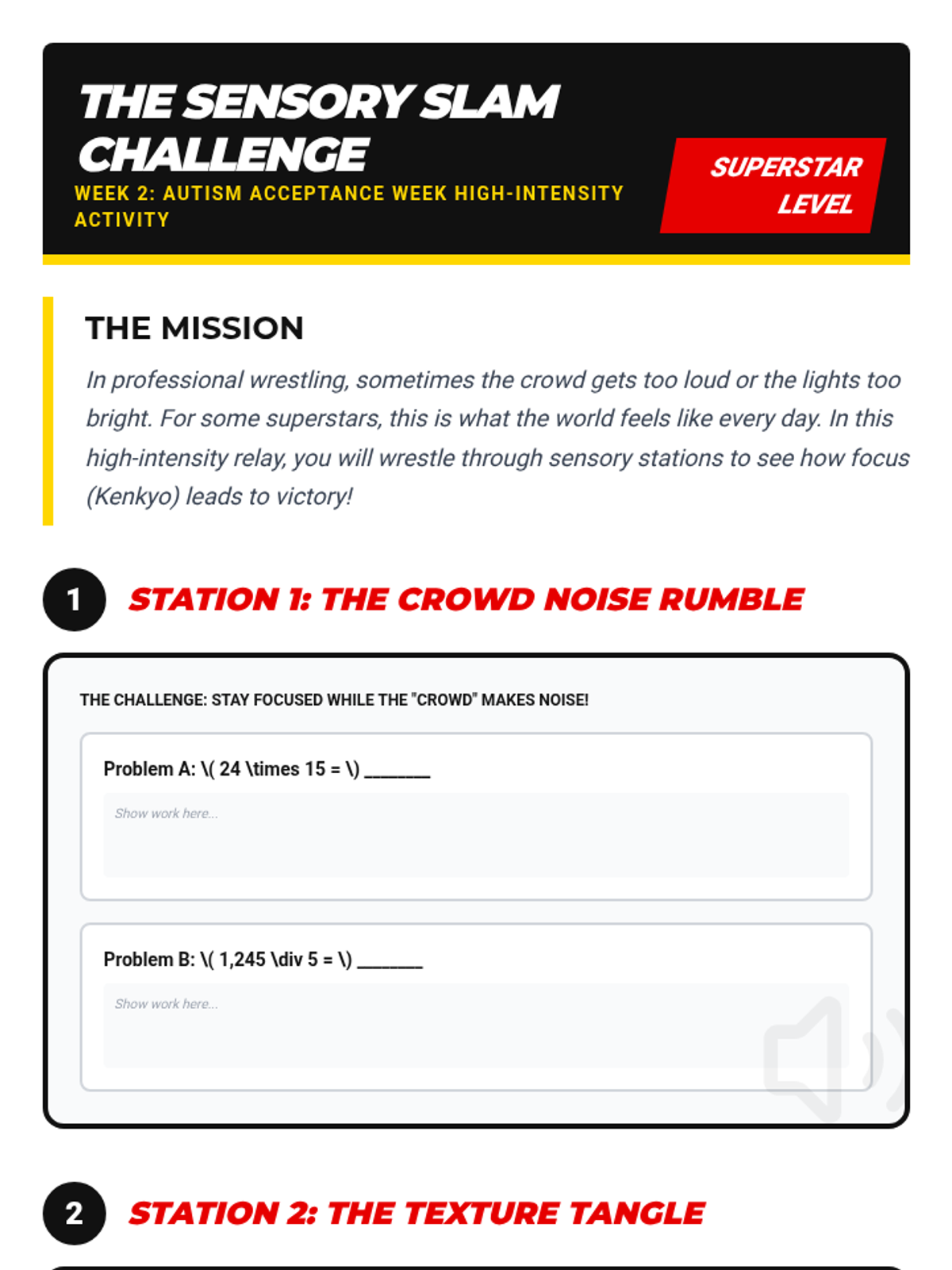
A sensory awareness activity for Autism Acceptance Week that uses high-energy challenges to simulate sensory processing differences and promote inclusive focus strategies.
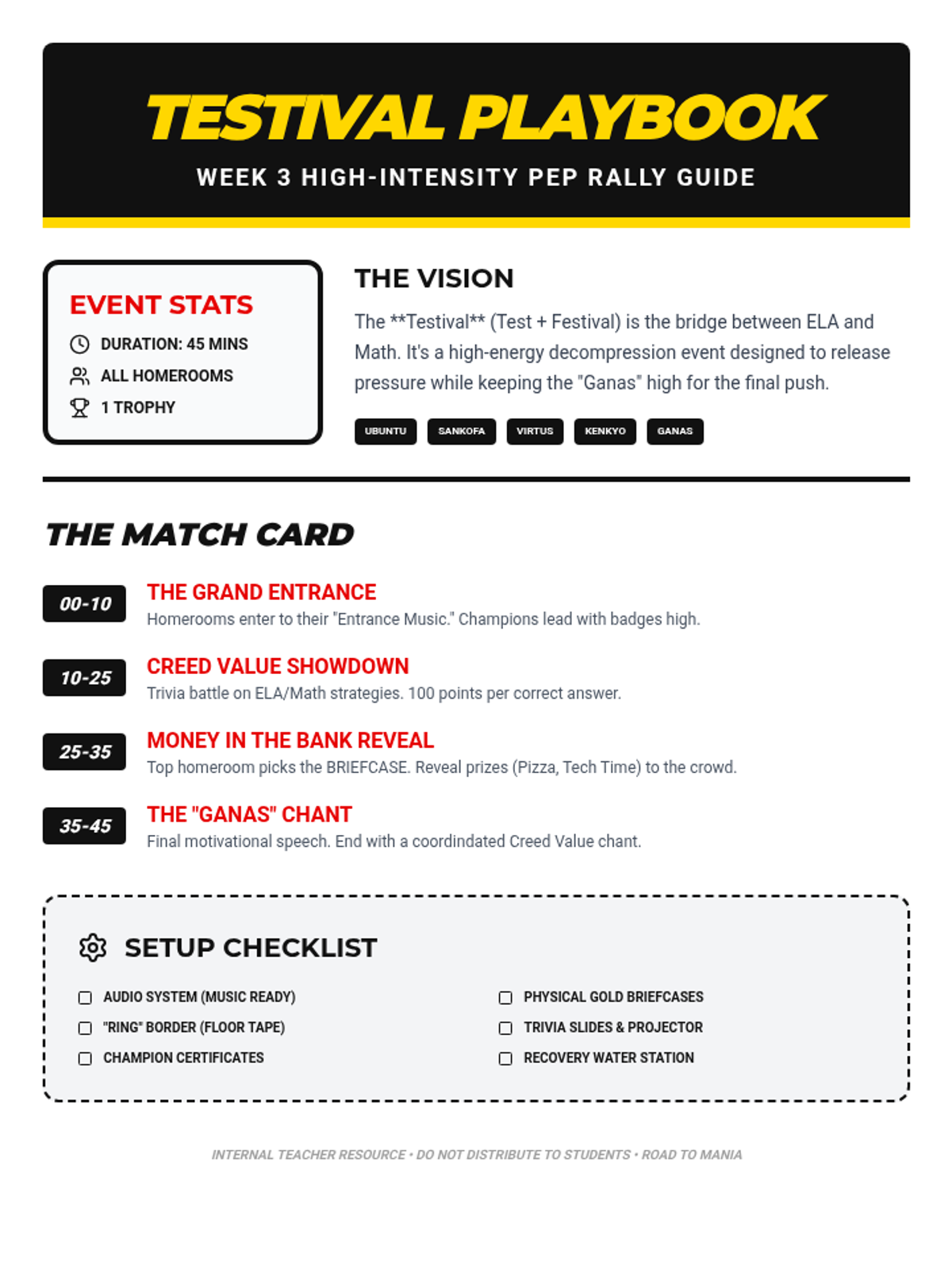
A teacher-facing resource for running a high-intensity 'Testival' (Test + Festival) pep rally, including 'Ring Entrances,' 'Creed Value Showdowns' (academic bowl style), and the 'Money in the Bank' opening.
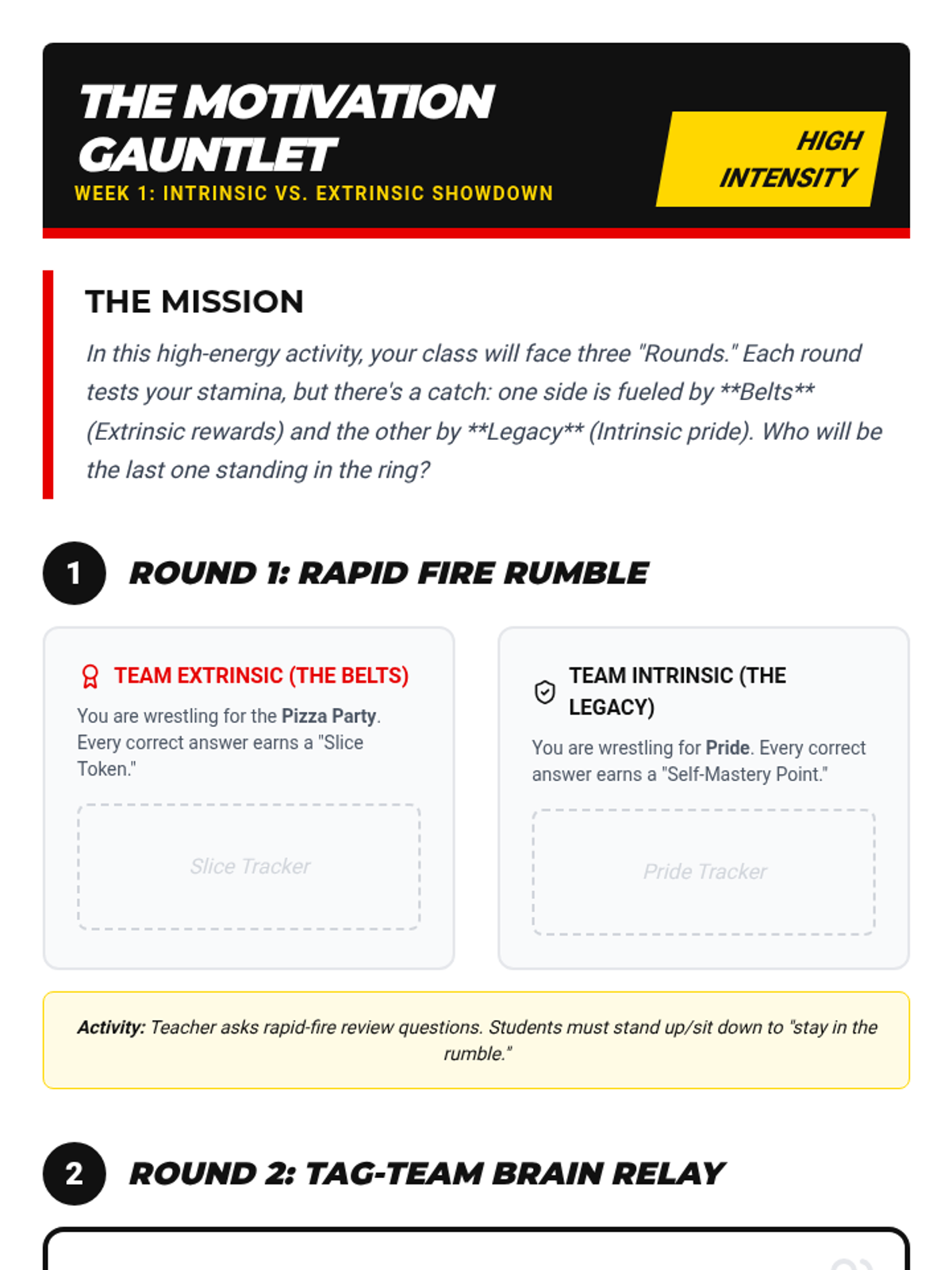
A physical and mental challenge activity where students explore intrinsic vs. extrinsic motivation through high-energy 'rounds' of review and physical exercise.
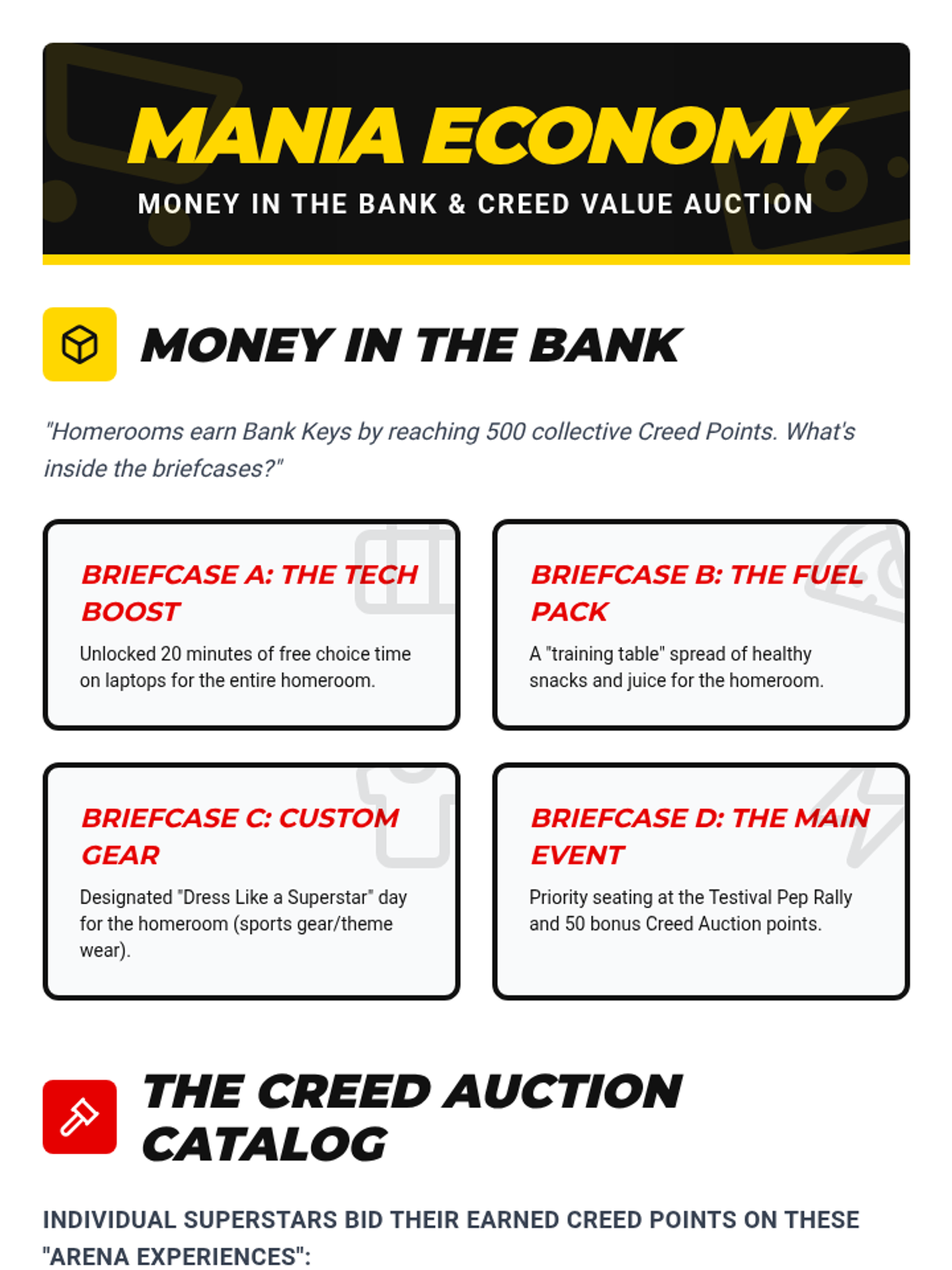
A student-facing guide to the incentive systems of the 4-week sequence, including rewards for Money in the Bank briefcases and a catalog for the Creed Value Auction.
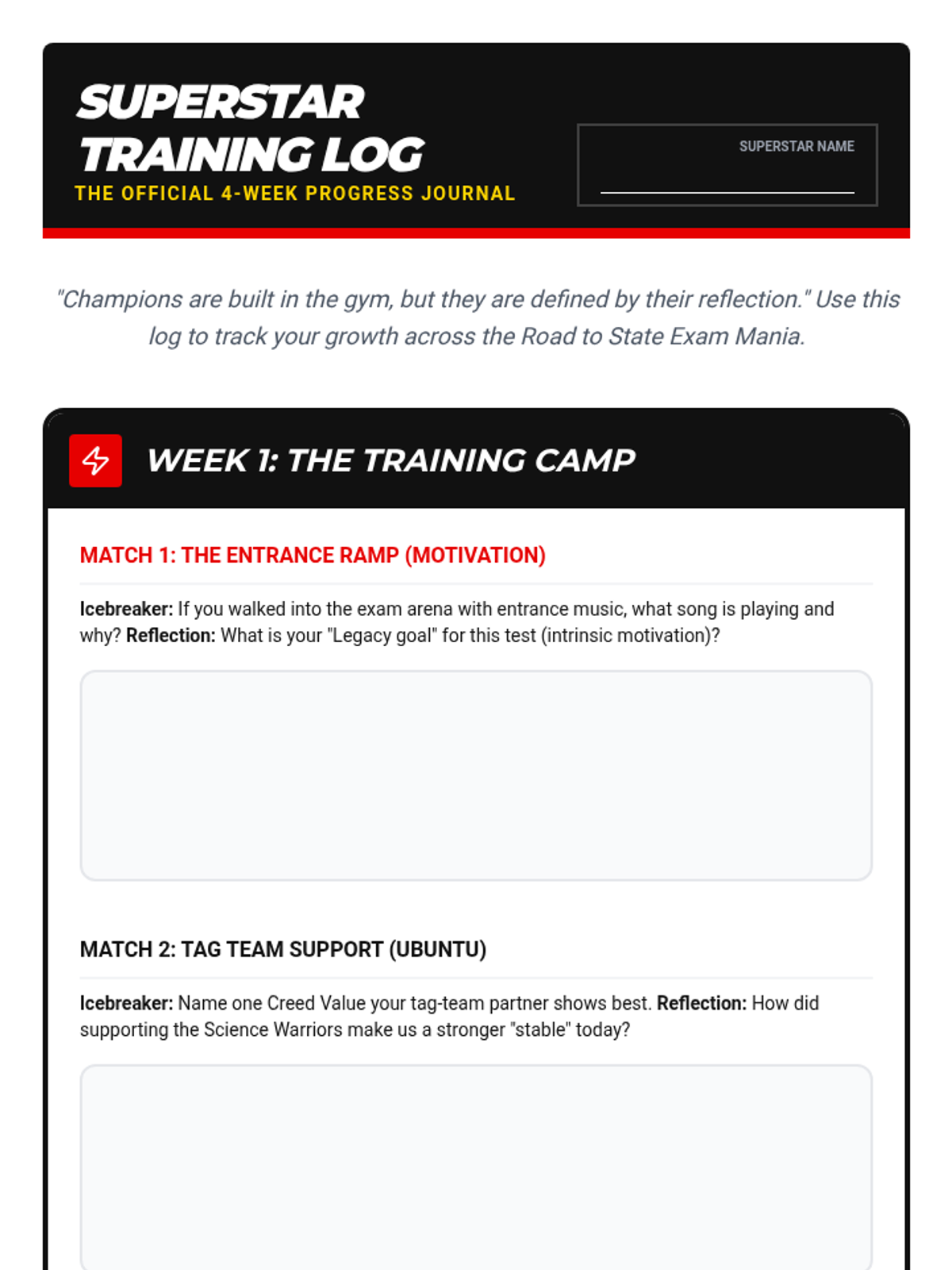
A reflection and icebreaker journal for students to use throughout the 4-week sequence, featuring themed check-ins and a pre-season scouter report for Spring Break and Q4 goals.
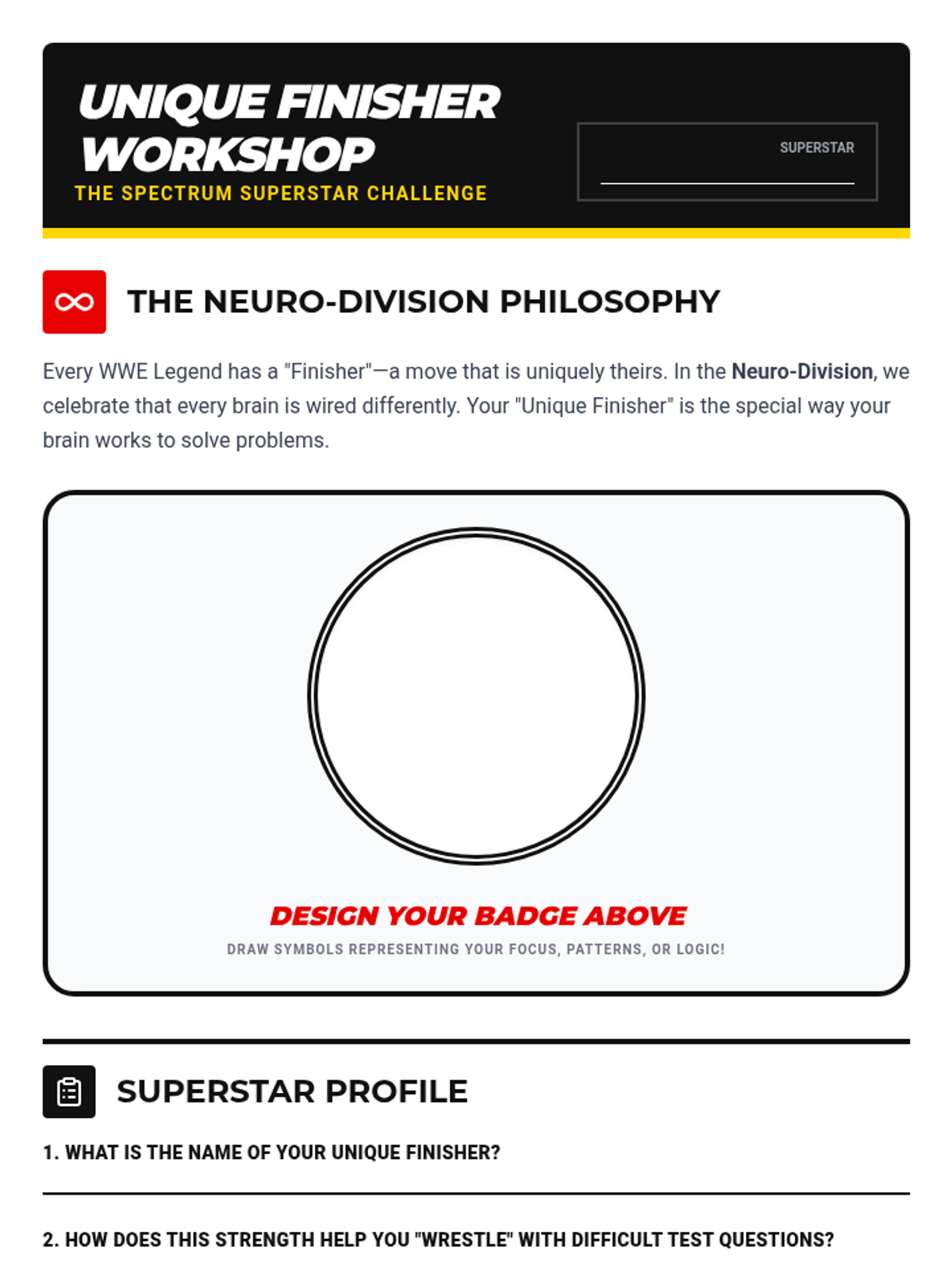
A creative student worksheet for Autism Acceptance Week where students design a 'Unique Finisher' badge representing their neurodivergent strengths and reflect on inclusive support.
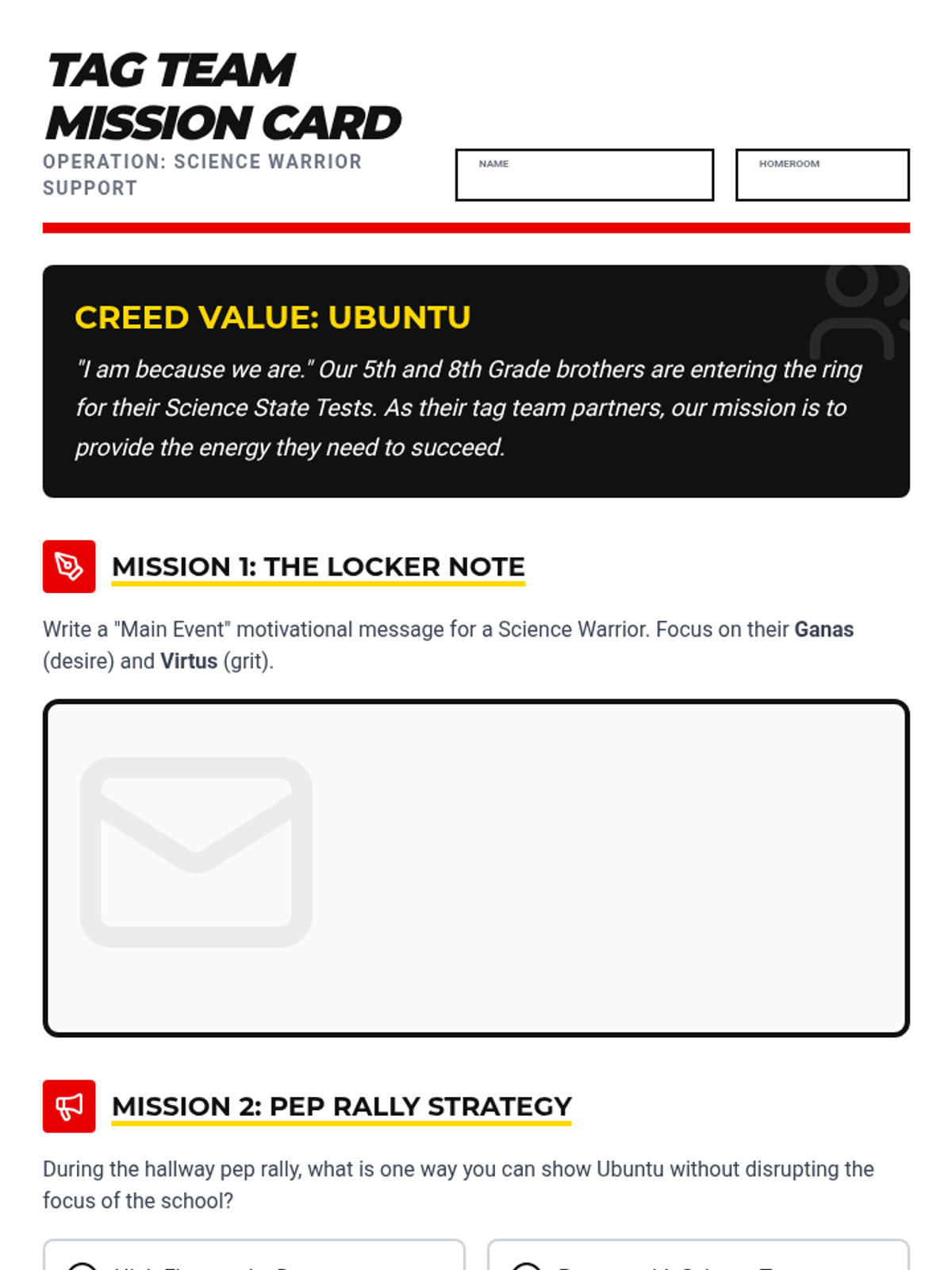
A student activity sheet focused on the Creed Value of Ubuntu, guiding students to support their peers during state science exams through motivational notes and pep rally participation.
A slide deck highlighting the real-life struggles and resilience of WWE superstars, focusing on Ganas (desire) and Virtus (grit) for the final push.
A presentation focused on test anxiety, ELA strategies, and post-test decompression using the 'Heel' and 'Technical Playbook' metaphors.
A slide deck for Autism Acceptance Week, using wrestling metaphors to celebrate neurodiversity, unique strengths (finishers), and inclusive support.
A high-energy presentation introducing the State Exam Mania theme, exploring intrinsic vs. extrinsic motivation with a side-by-side 'Belt vs. Legacy' comparison and a video placeholder.
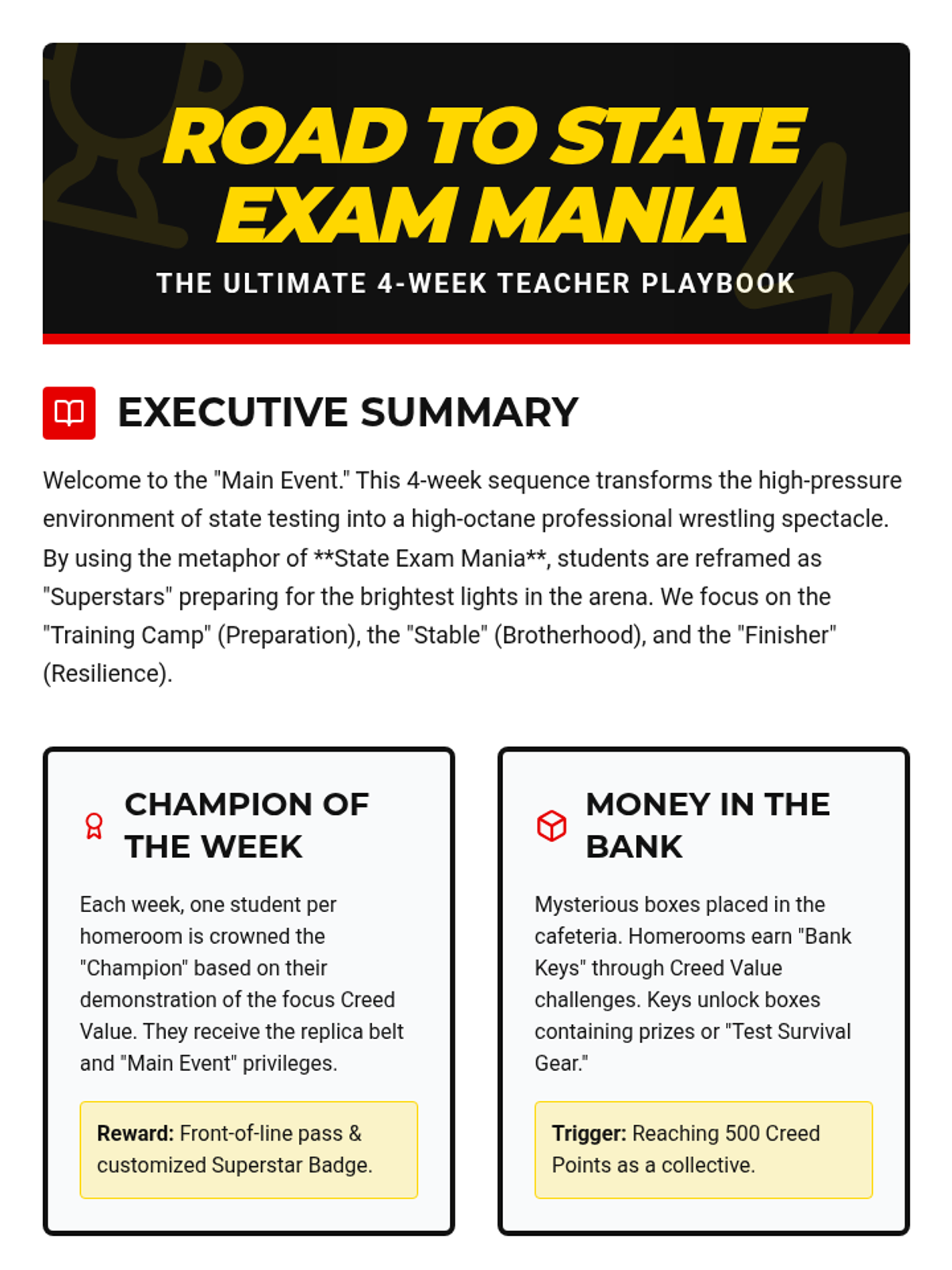
A comprehensive 4-week roadmap for teachers, outlining lesson themes, weekly Creed Value focuses, and competition details like Money in the Bank and Champion of the Week.
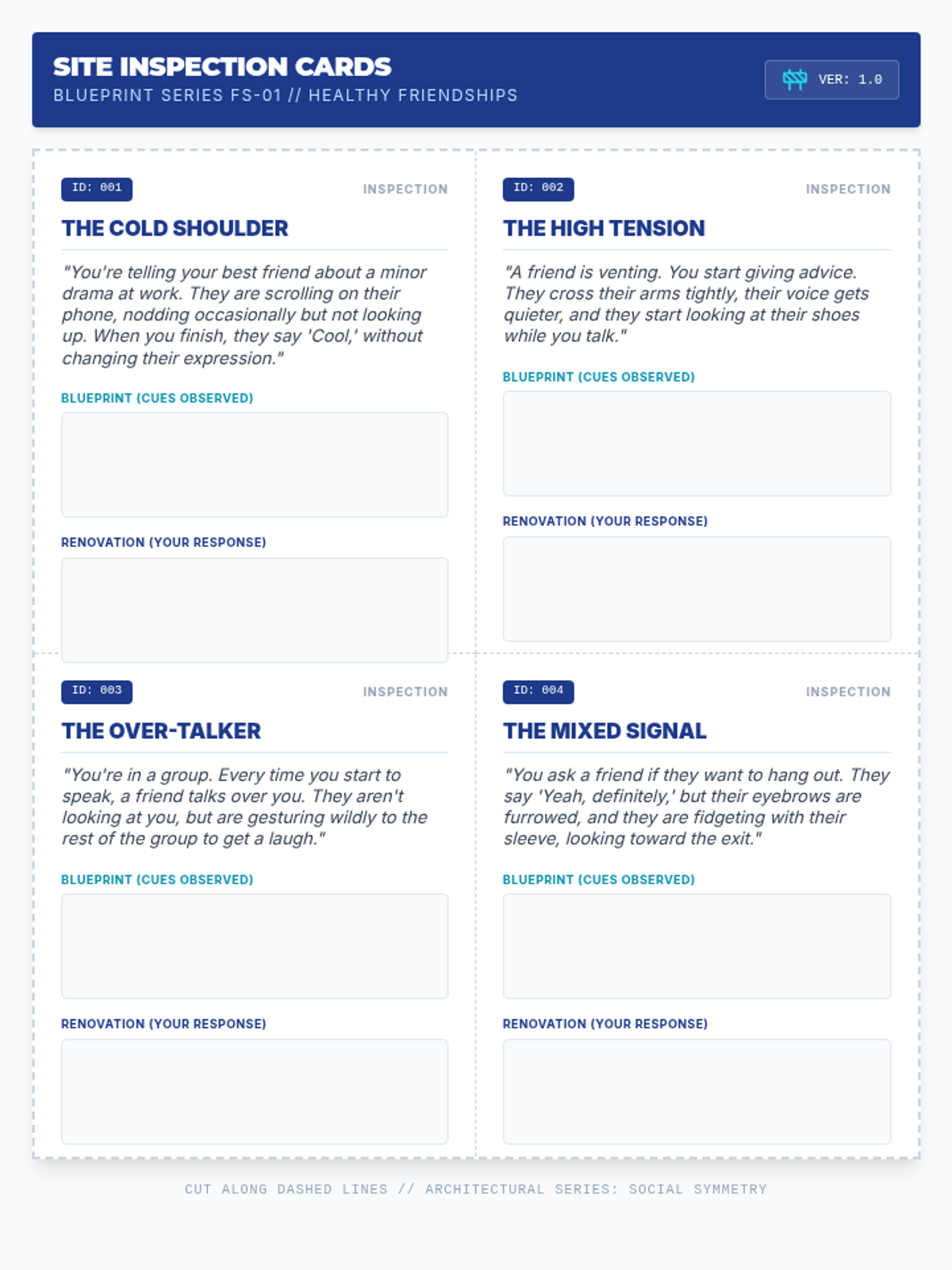
A set of printable 'Site Inspection' scenario cards. Each card presents a social situation rich with non-verbal cues. Students identify the cues (the blueprint) and formulate a healthy response (the construction).
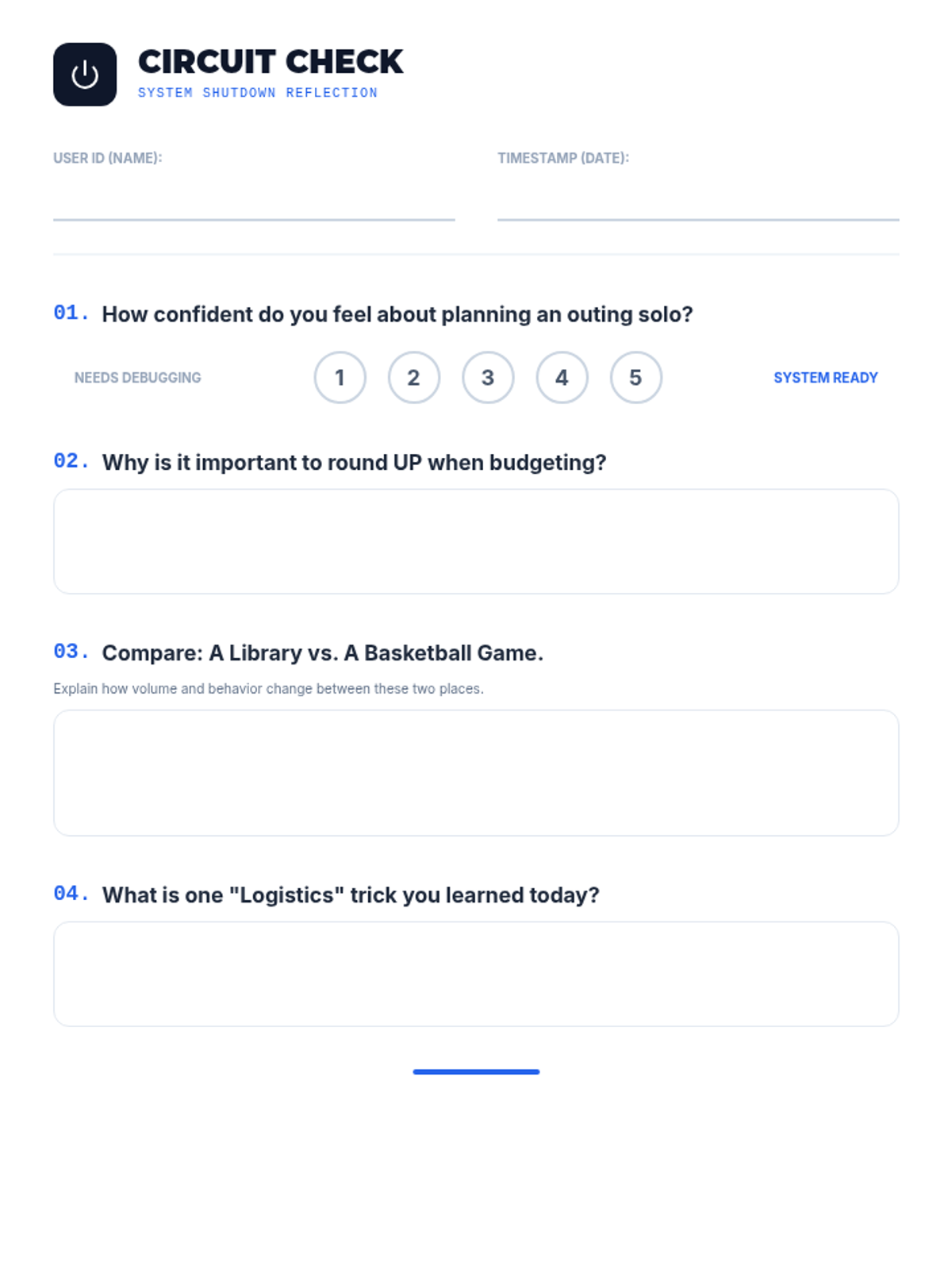
A concise exit ticket that prompts students to reflect on their learning, assess their confidence in planning outings, and articulate key concepts like budgeting safety buffers and situational social norms.
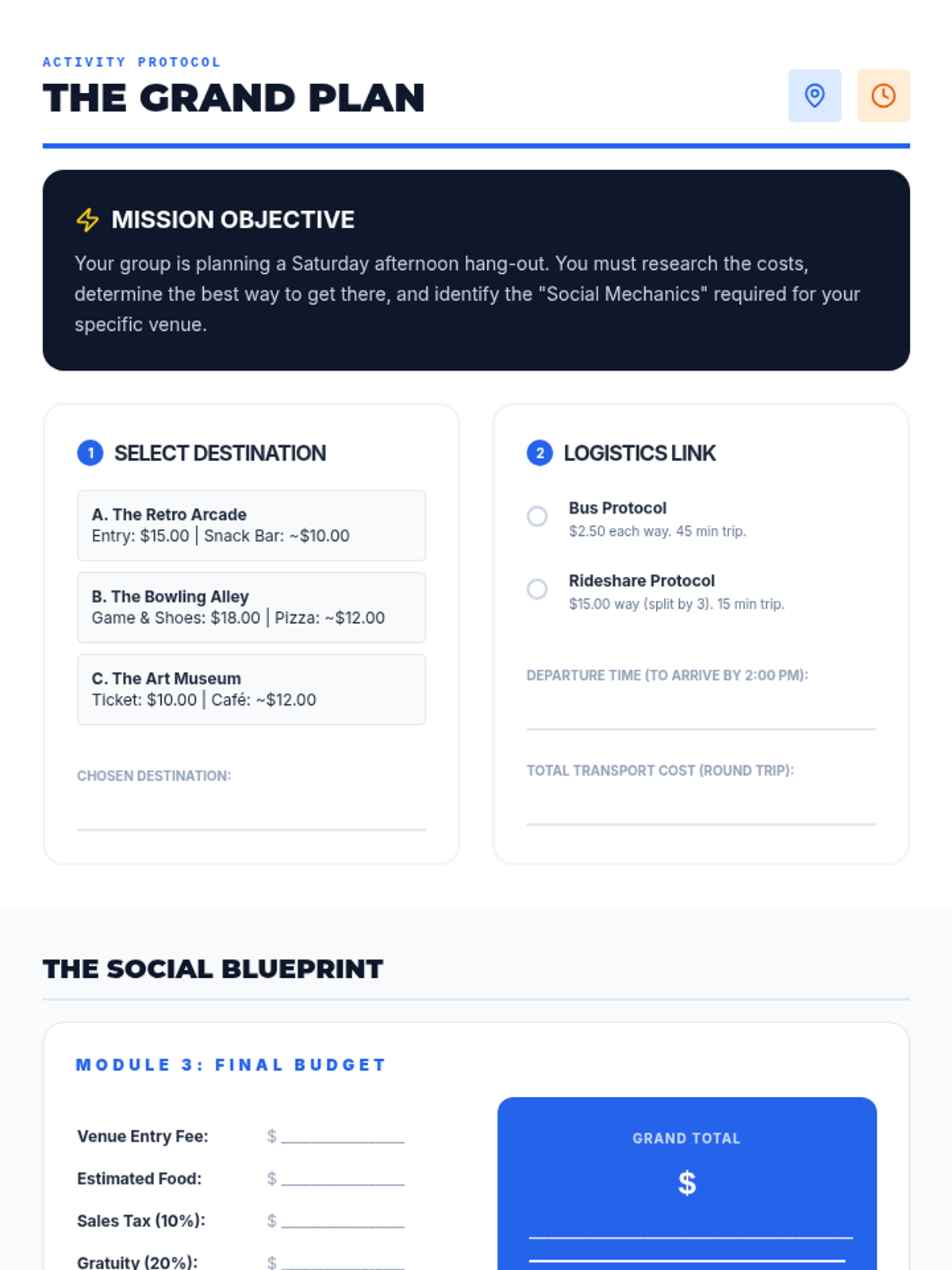
A collaborative activity where students work in groups to plan a complete social outing, from selecting a destination and calculating transit times to identifying venue-specific social norms.
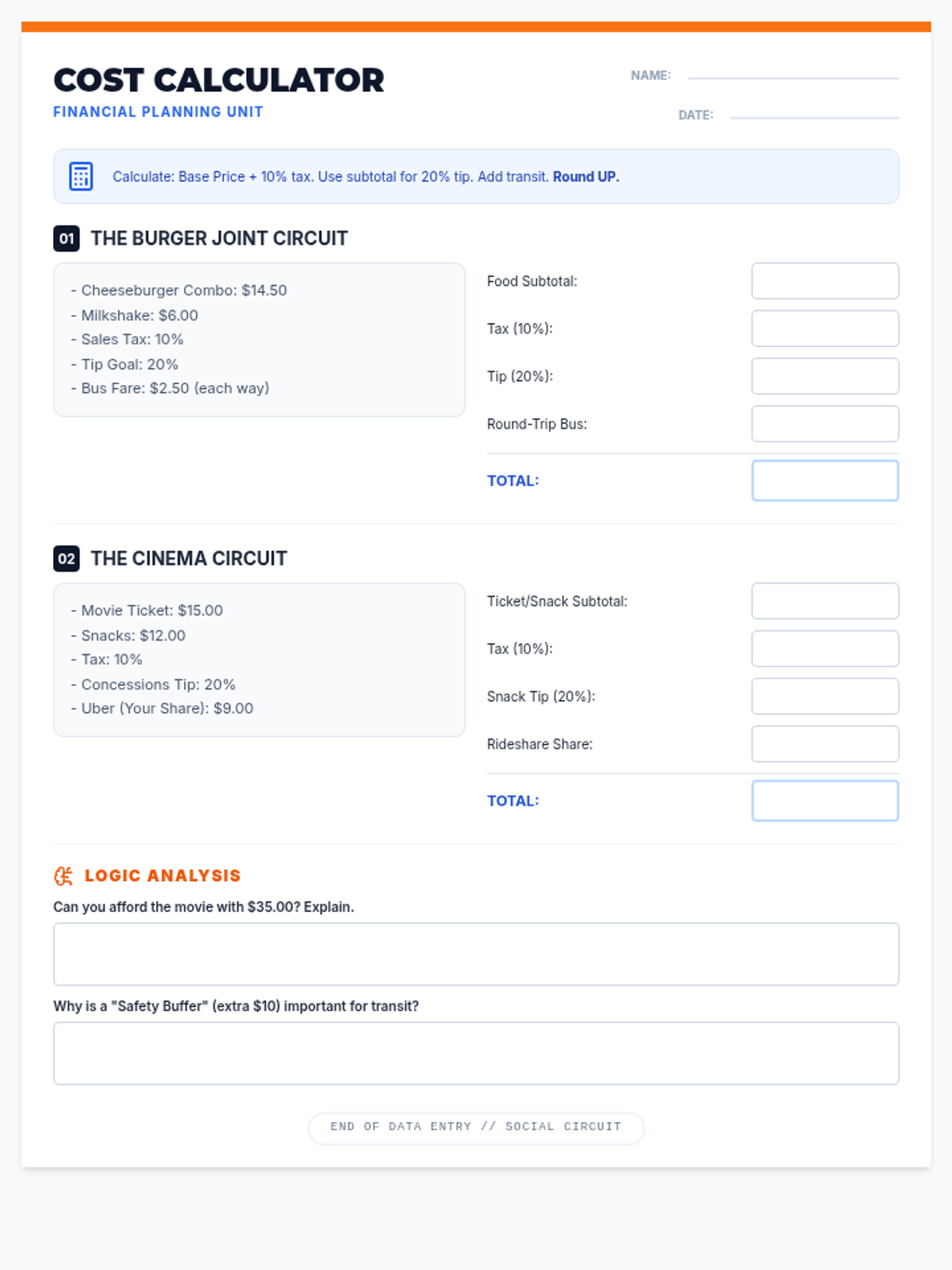
A practical math worksheet that guides students through calculating the total cost of social outings, including taxes, tips, and transportation fees across different scenarios.
An engaging slide deck titled 'Outing Blueprint' that introduces students to the core concepts of social planning: budgeting with tax and tips, transportation logistics, and unspoken social norms.
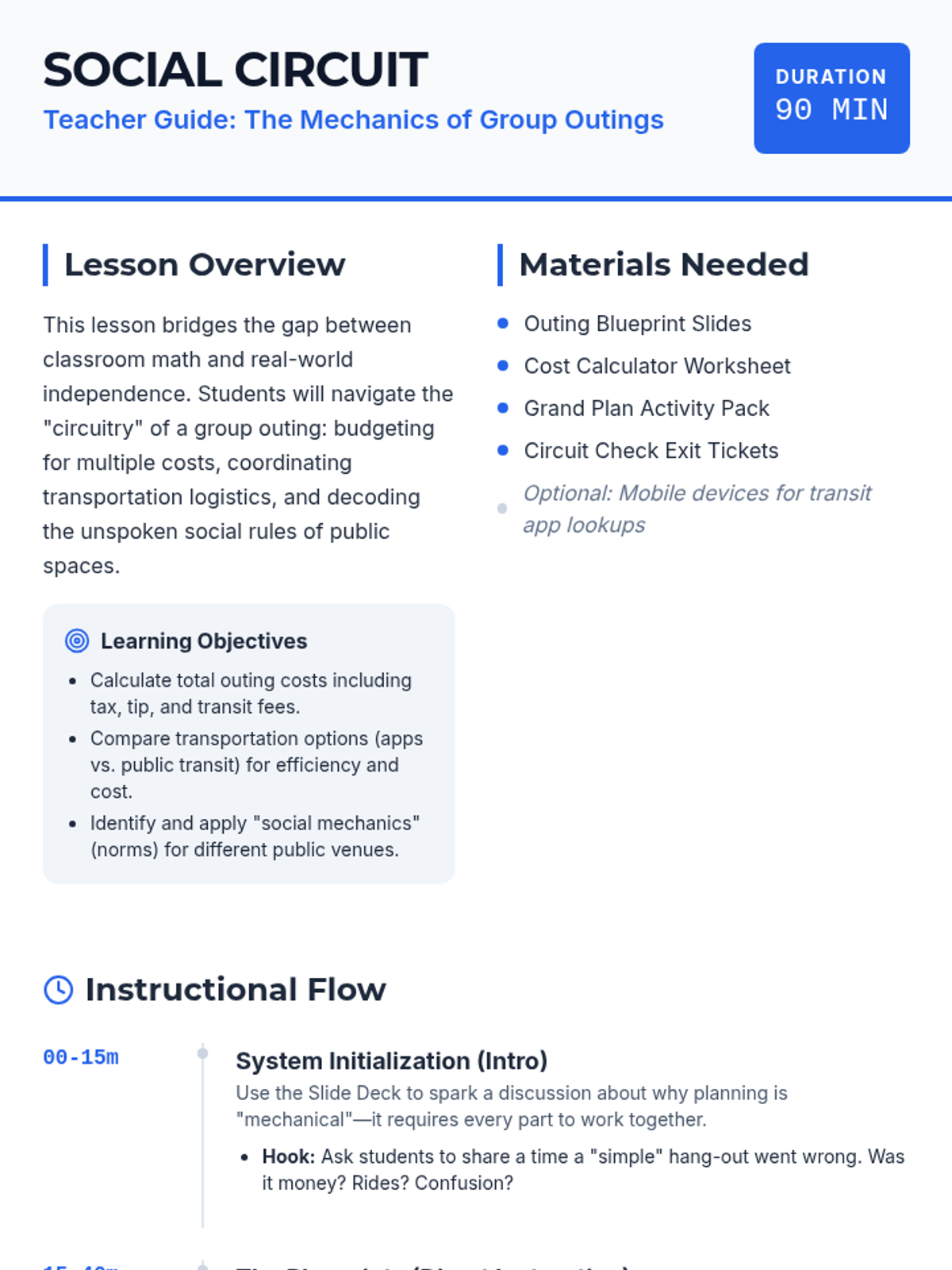
A comprehensive teacher guide for leading the Social Circuit lesson, featuring a structured 90-minute pacing guide, learning objectives, and differentiation strategies for teaching social logistics.
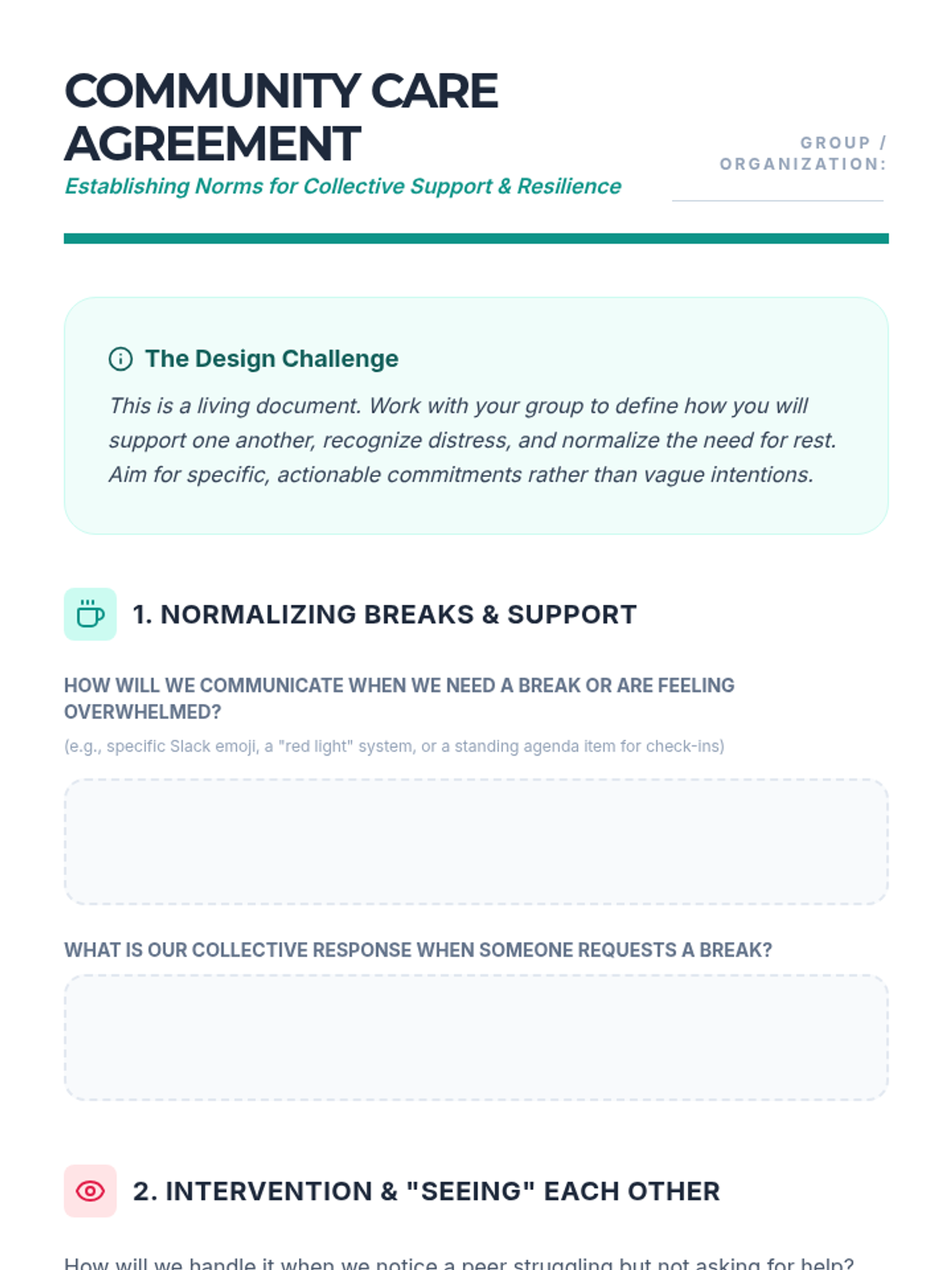
A design template for students to create a 'Community Care Agreement', establishing norms for mutual support, intervention strategies, and collective boundaries.
Slide deck for the 'Building Care Webs' lesson, introducing the concept of collective care vs. self-care and providing a framework for creating Community Care Agreements.
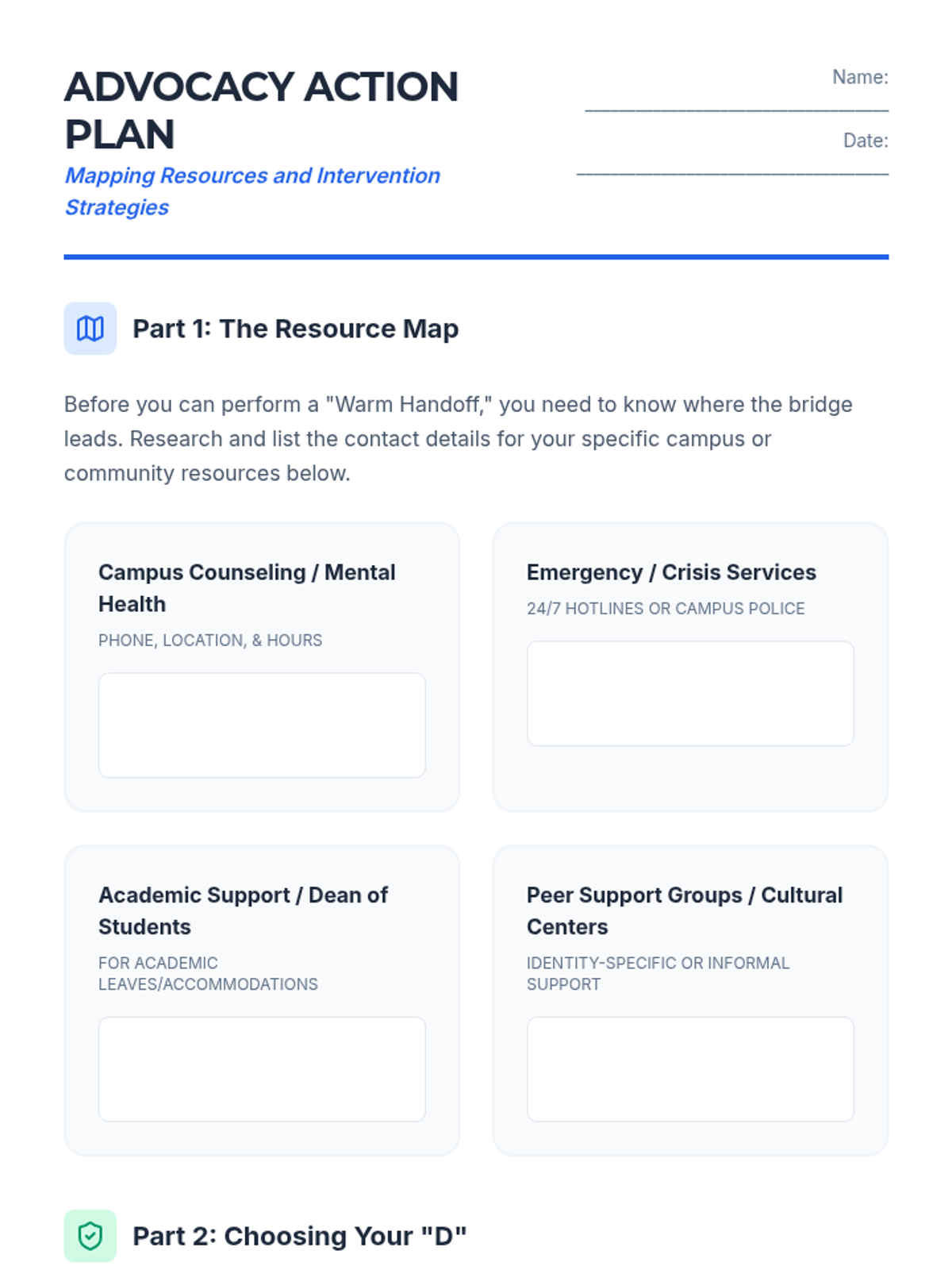
A student worksheet for mapping local mental health resources and practicing the 5Ds of intervention in a specific peer-distress scenario.
Slide deck for 'Mental Health Advocacy', covering the bystander effect, the 5Ds of intervention strategies, and the 'Warm Handoff' technique for connecting peers to professional resources.
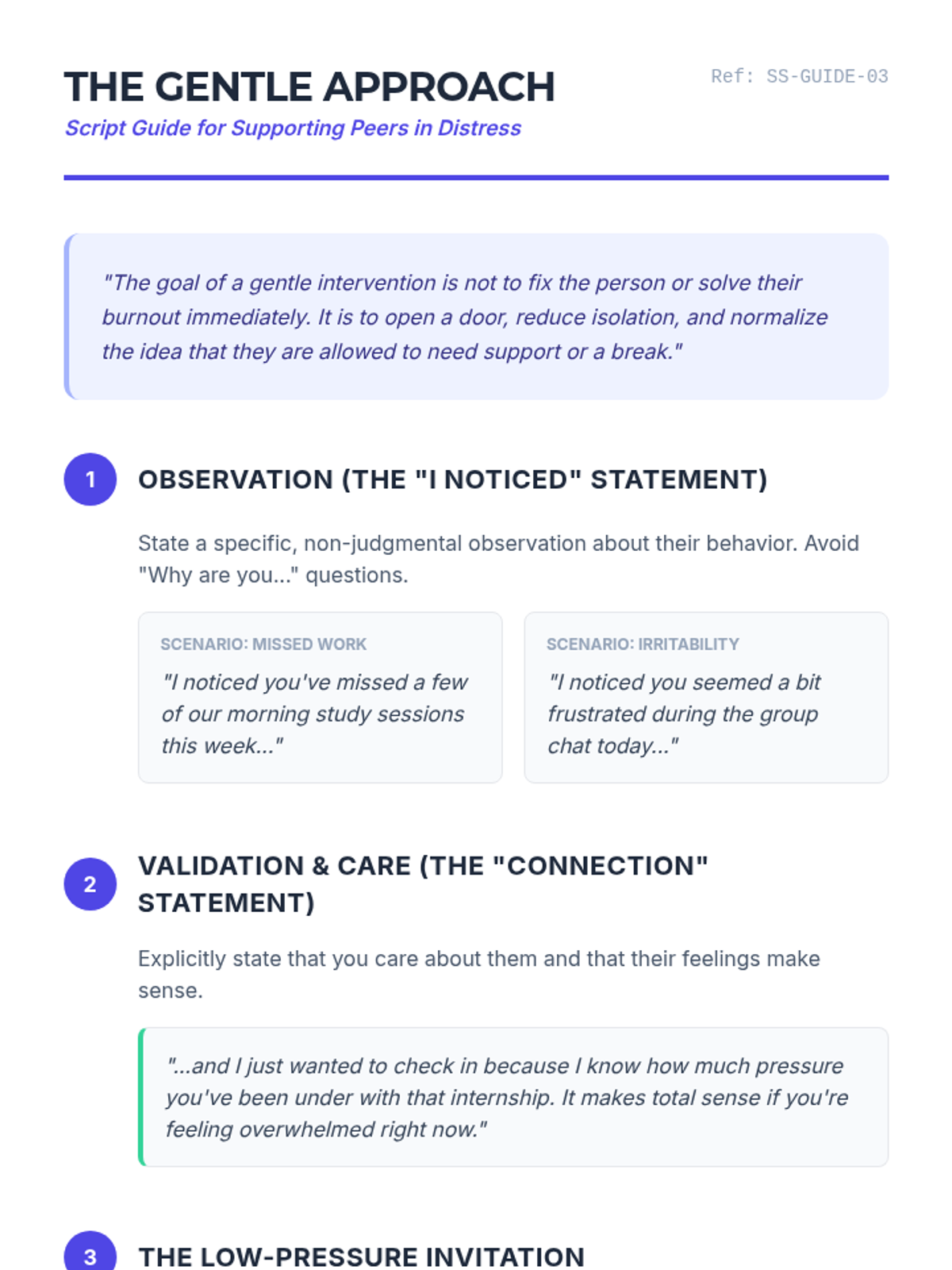
A script-building guide for students to practice the 'Gentle Approach' to intervention, providing specific phrasing for observations, validation, and low-pressure invitations.
Slide deck for 'Spotting the Signs', covering the three dimensions of burnout (Exhaustion, Cynicism, Inefficacy), behavioral red flags, and the three-step 'Gentle Approach' for intervention.
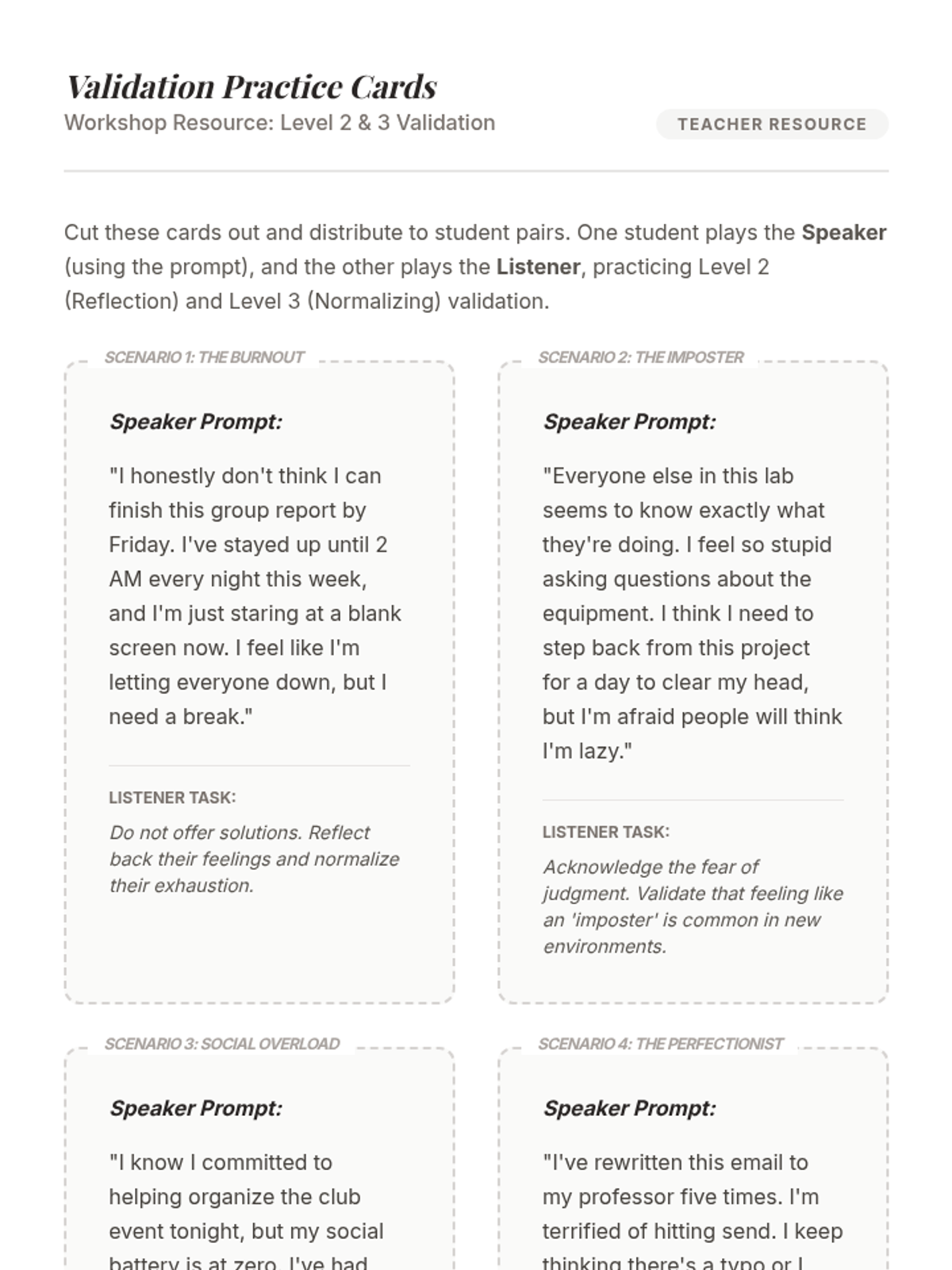
Scenarios and facilitator notes for the active listening workshop, providing students with structured practice in emotional validation and 'holding space' for peers in distress.
Slide deck for the 'Holding Space Workshop' lesson, focusing on the distinction between problem-solving ('fixing') and emotional validation, and introducing the 3 levels of validation.
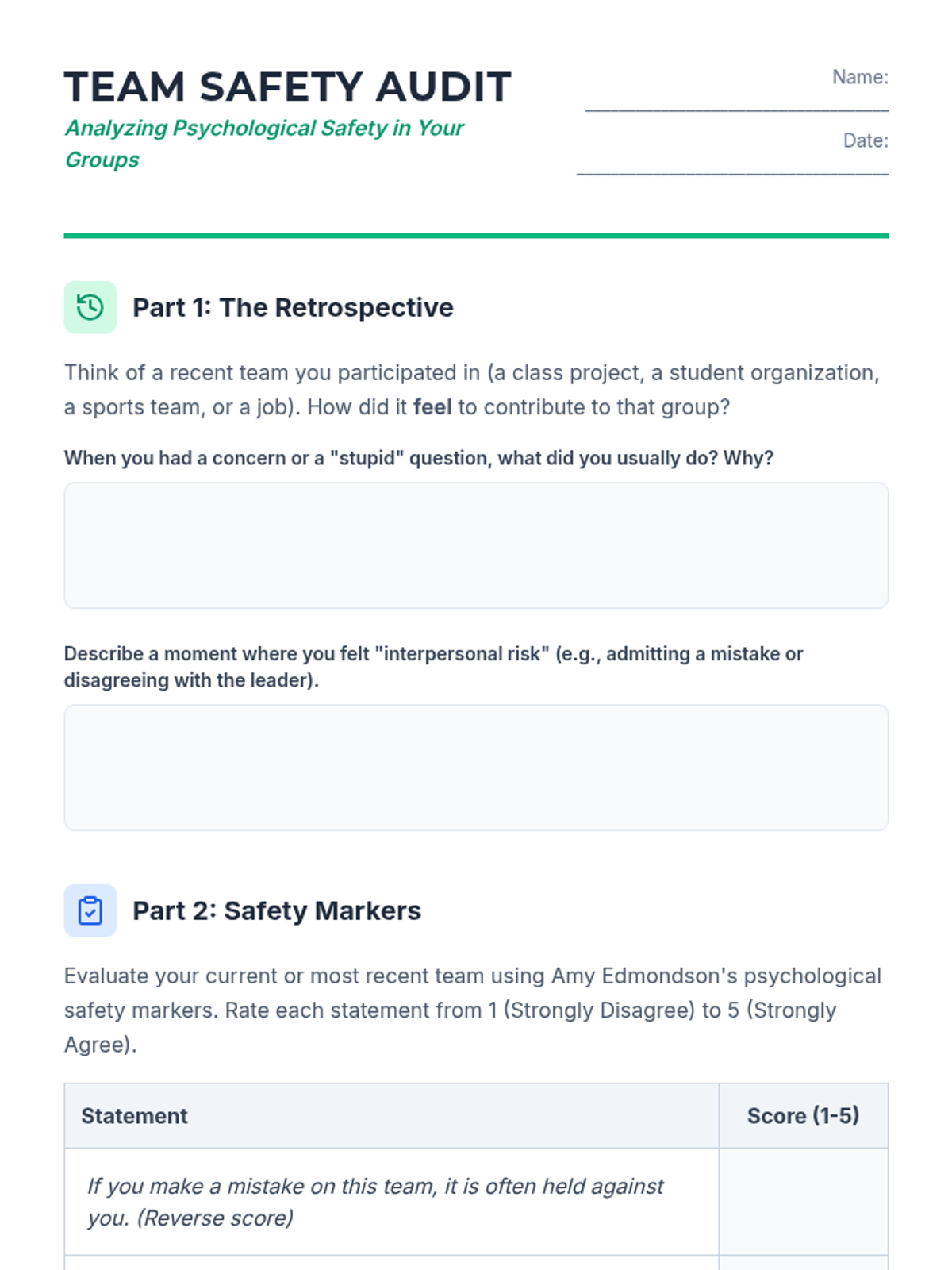
A reflection and audit worksheet for students to analyze the psychological safety of their own teams and identify barriers to requesting support.
Introductory slides for the 'Safe Spaces for Strong Teams' lesson, covering Google's Project Aristotle and the fundamental definition of psychological safety in group settings.
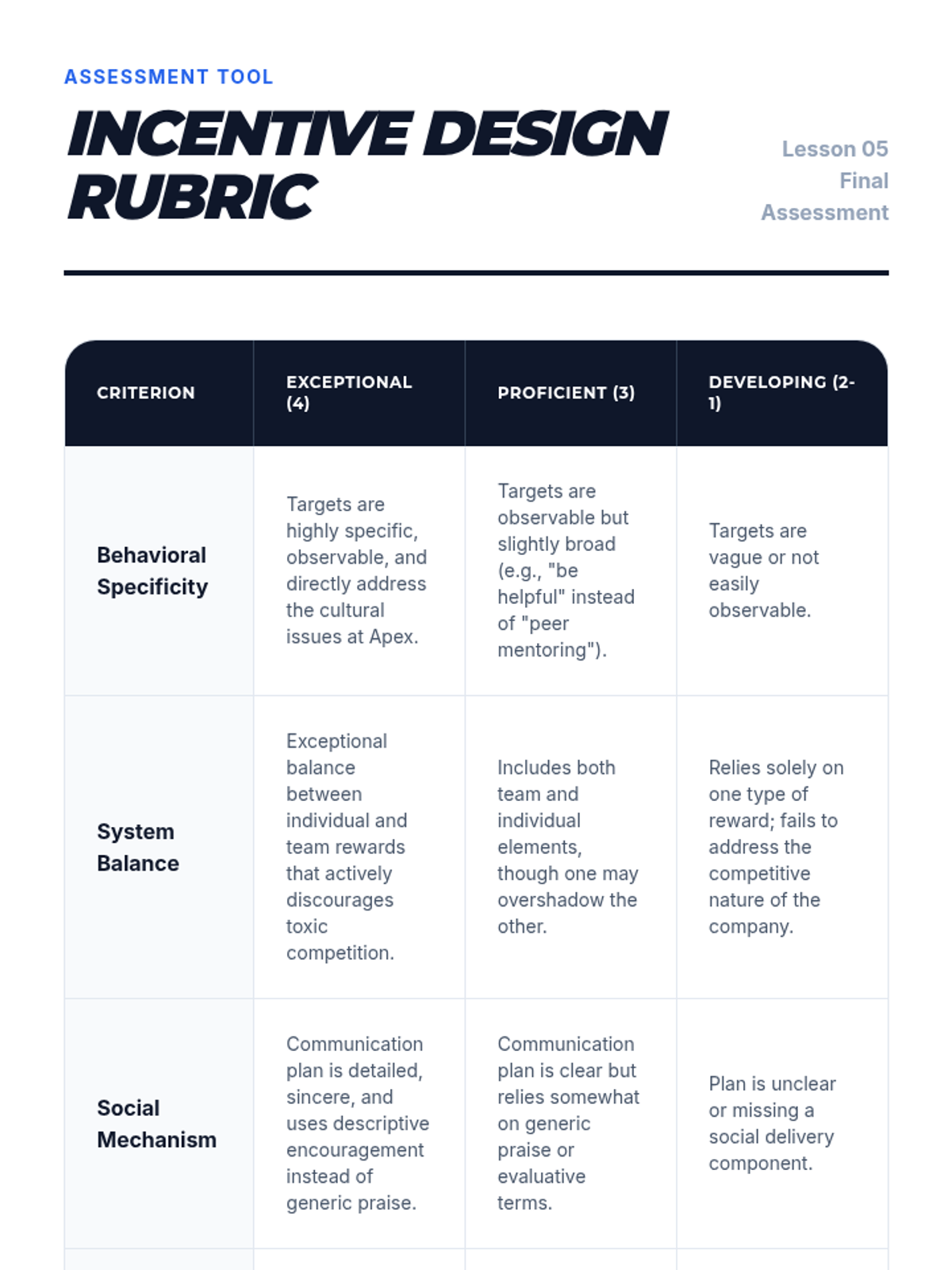
An assessment rubric for evaluating the Team Culture Blueprint project, focusing on behavioral specificity, system balance, and risk analysis.
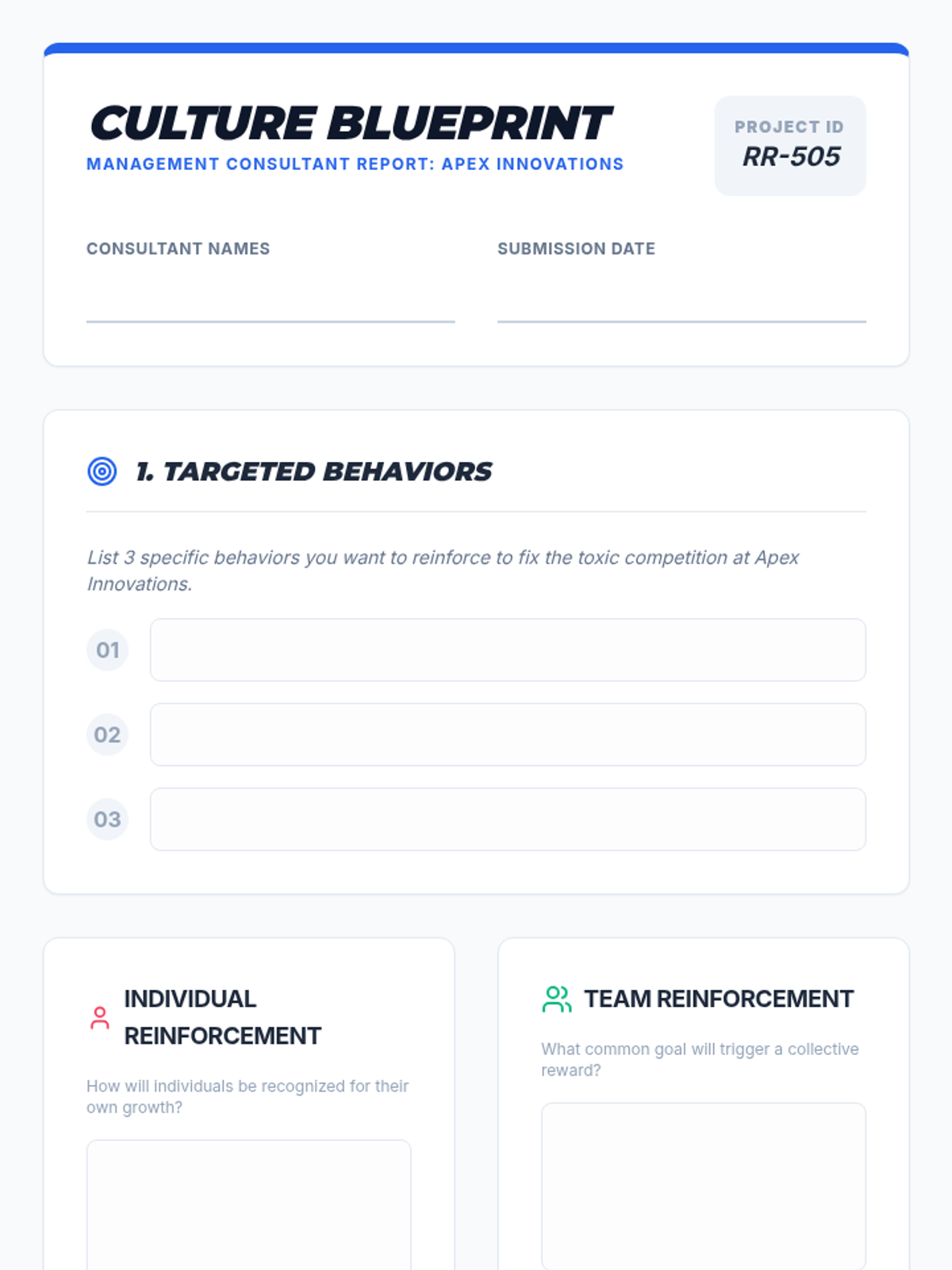
A culminating project template for students to act as management consultants and design a reinforcement system for a struggling organization.
A slide deck for the culminating project where students design a reinforcement system for an organization, balancing individual and team goals.
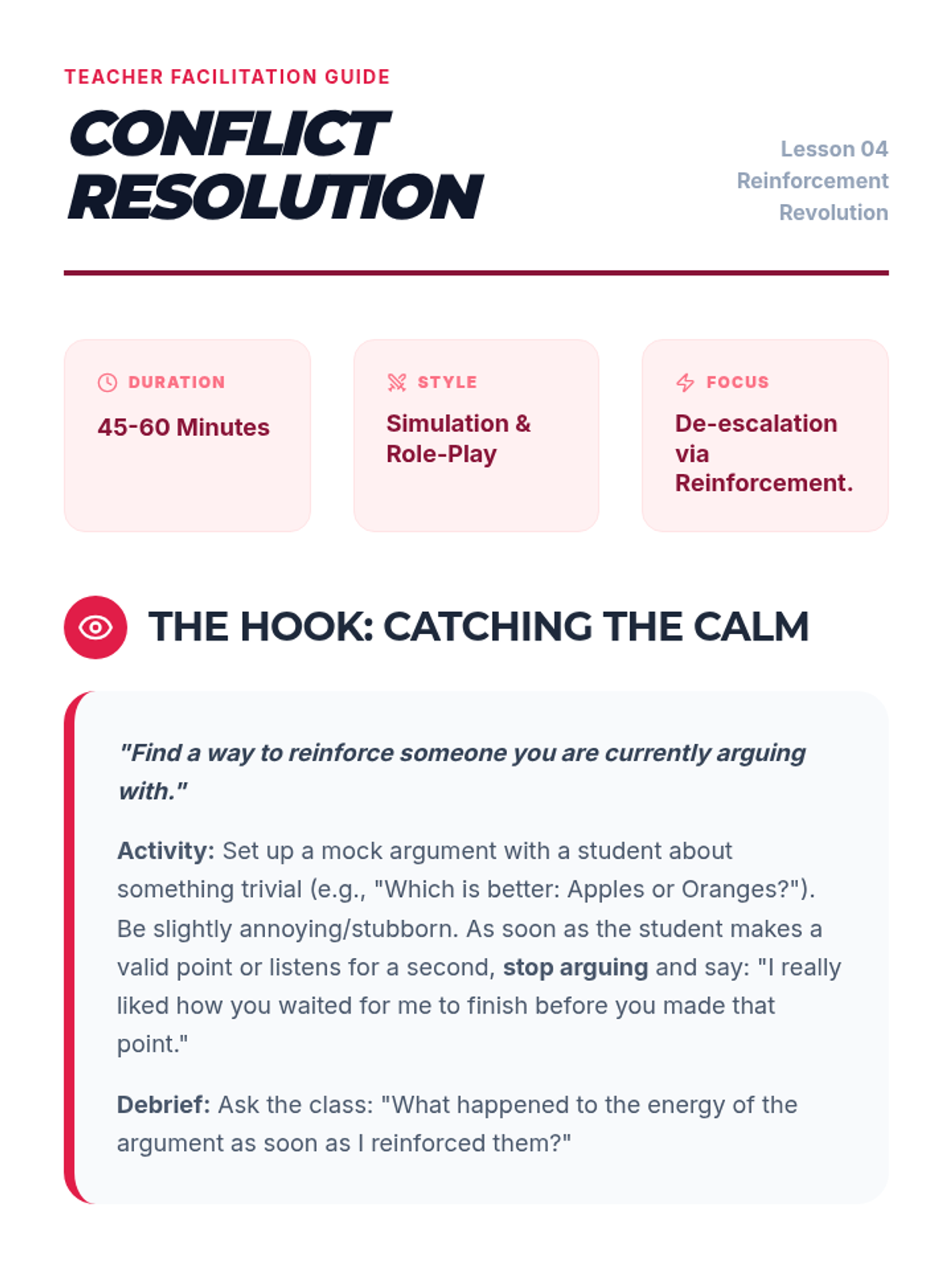
A facilitation guide for teachers to deliver the Reinforcement in Conflict lesson, including role-play tips, de-escalation strategies, and debrief questions.
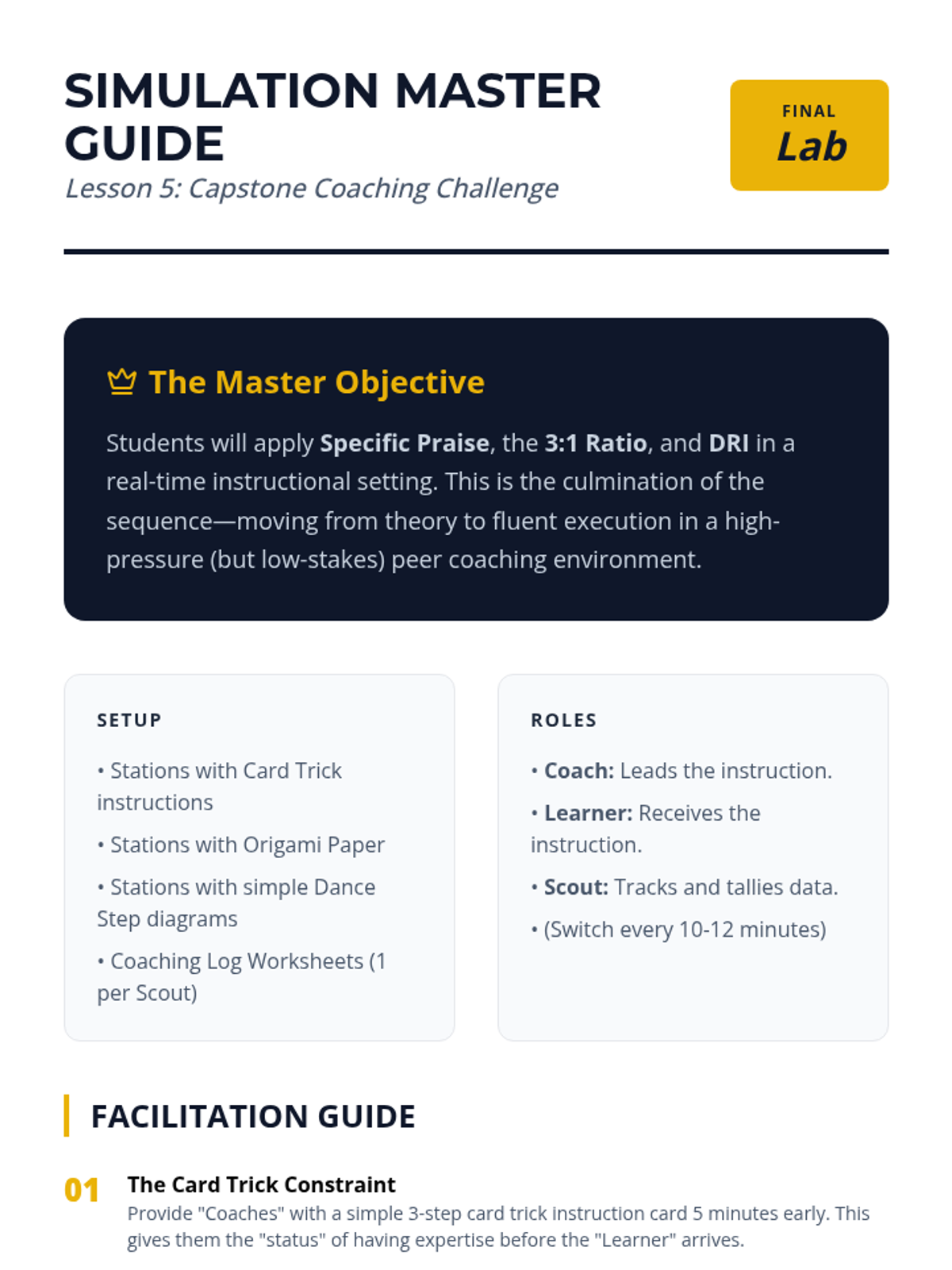
A teacher guide for Lesson 5 including card trick instructions, simulation logistics, and master debrief prompts for the Coaching Challenge.
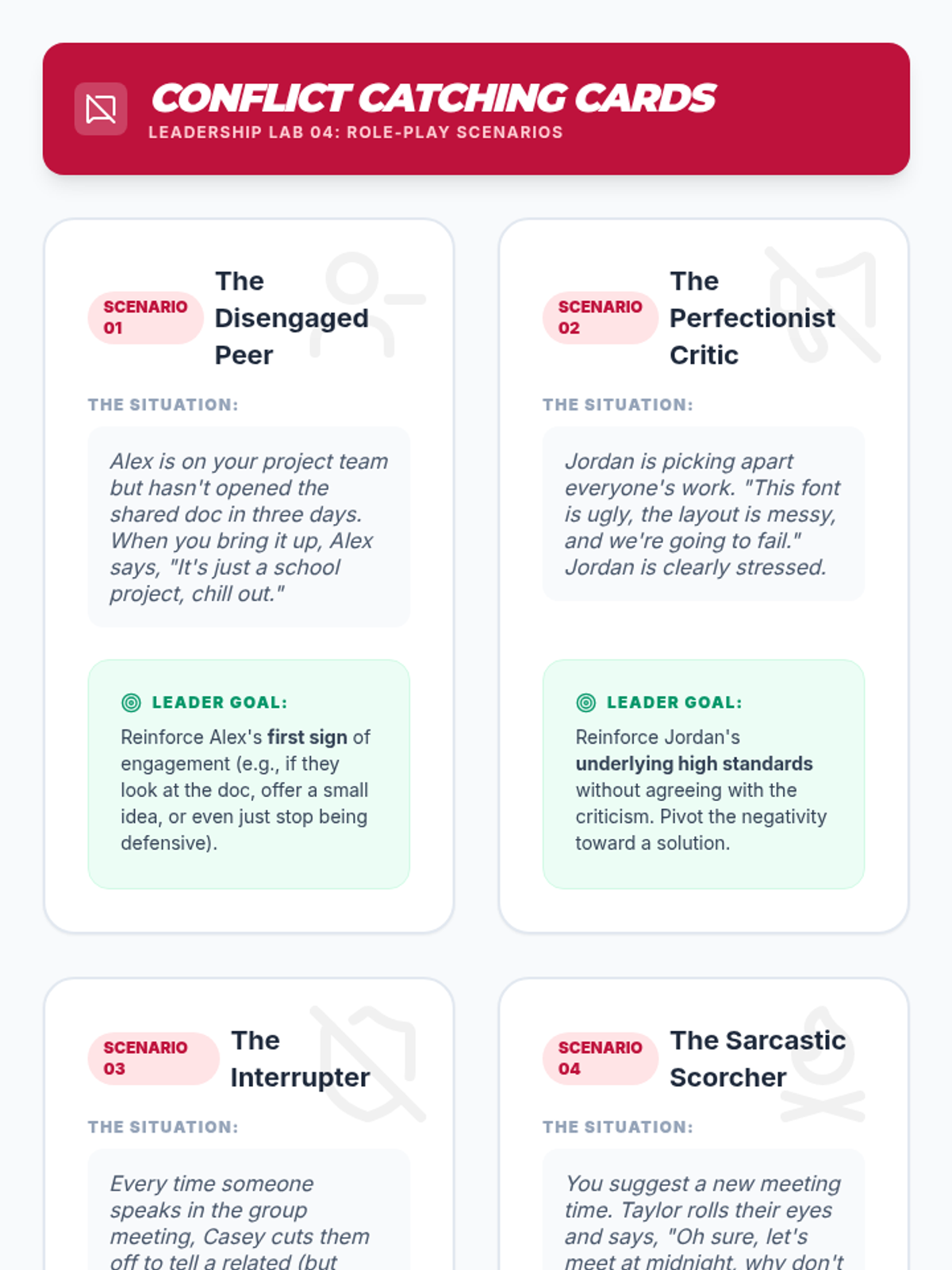
A set of role-play scenario cards designed to help students practice using positive reinforcement to de-escalate common interpersonal conflicts.
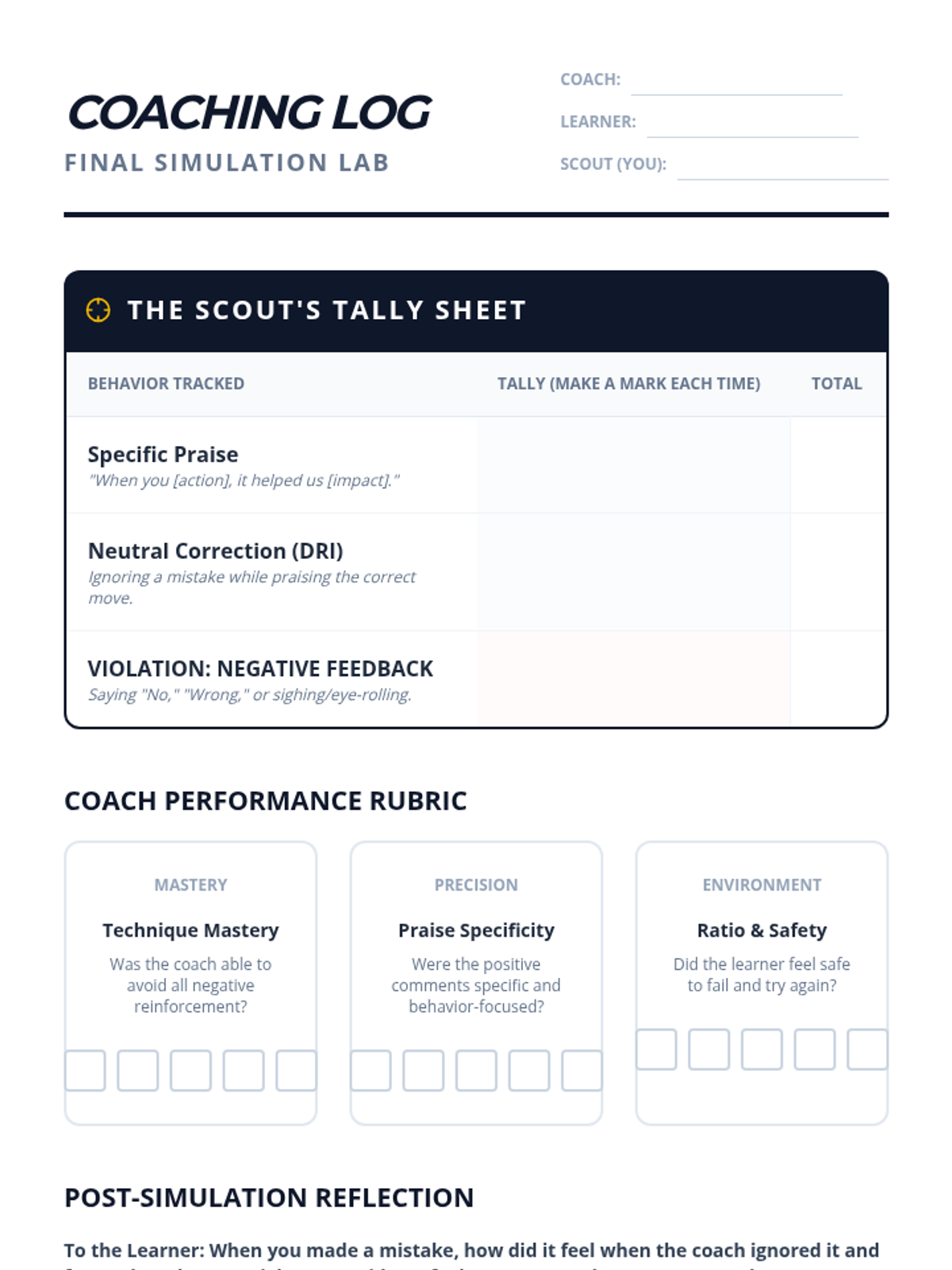
A worksheet for students to record tallies, rate performance, and reflect on the final coaching challenge simulation.
A slide deck introducing how to use positive reinforcement to de-escalate conflict and reinforce cooperative behavior in stressful leadership situations.
A slide deck introducing the final coaching challenge simulation, where students apply all positive reinforcement techniques learned in the sequence.
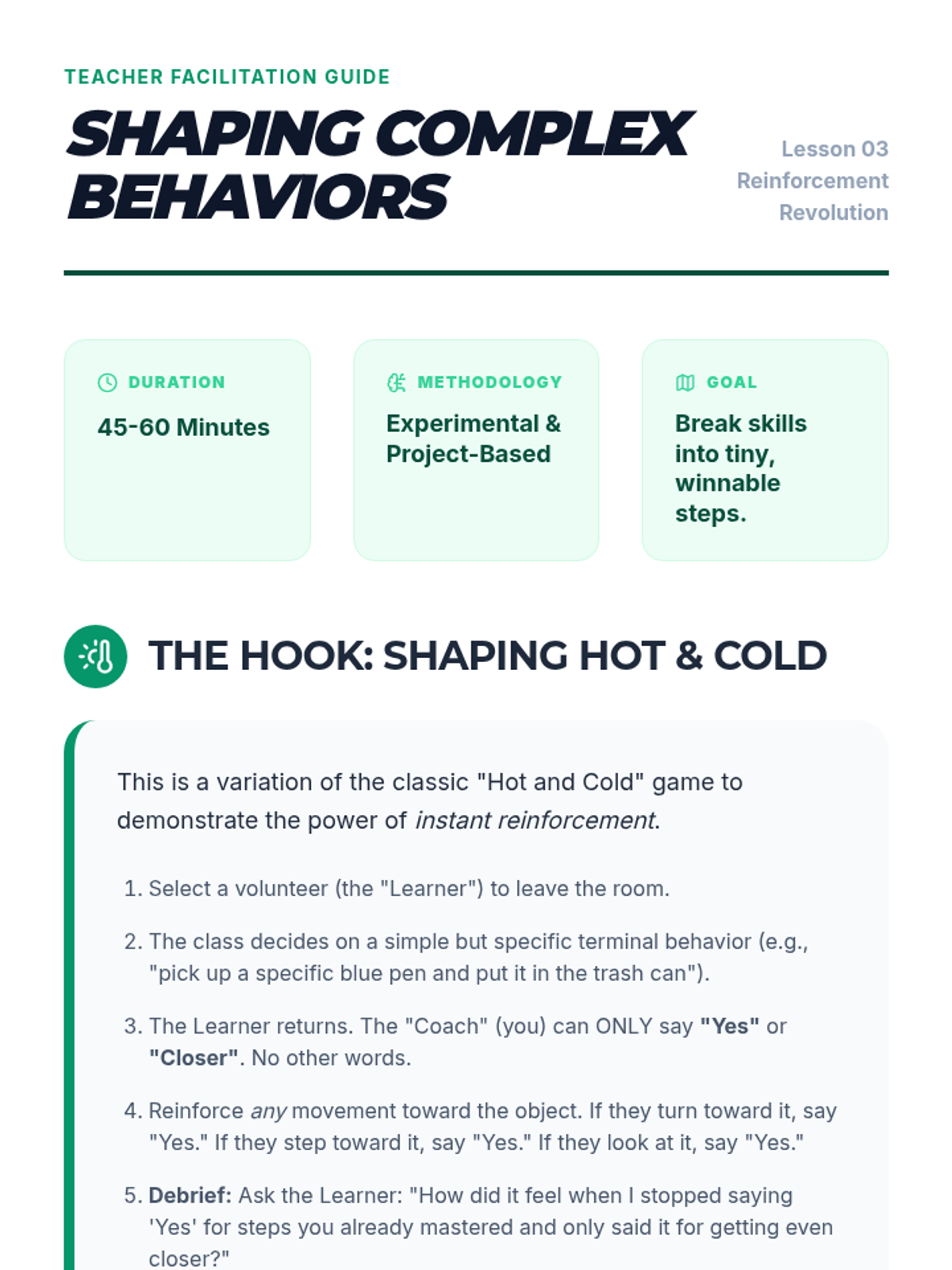
A facilitation guide for teachers to deliver the Shaping Complex Behaviors lesson, including game instructions, coaching tips, and key concept deep-dives.
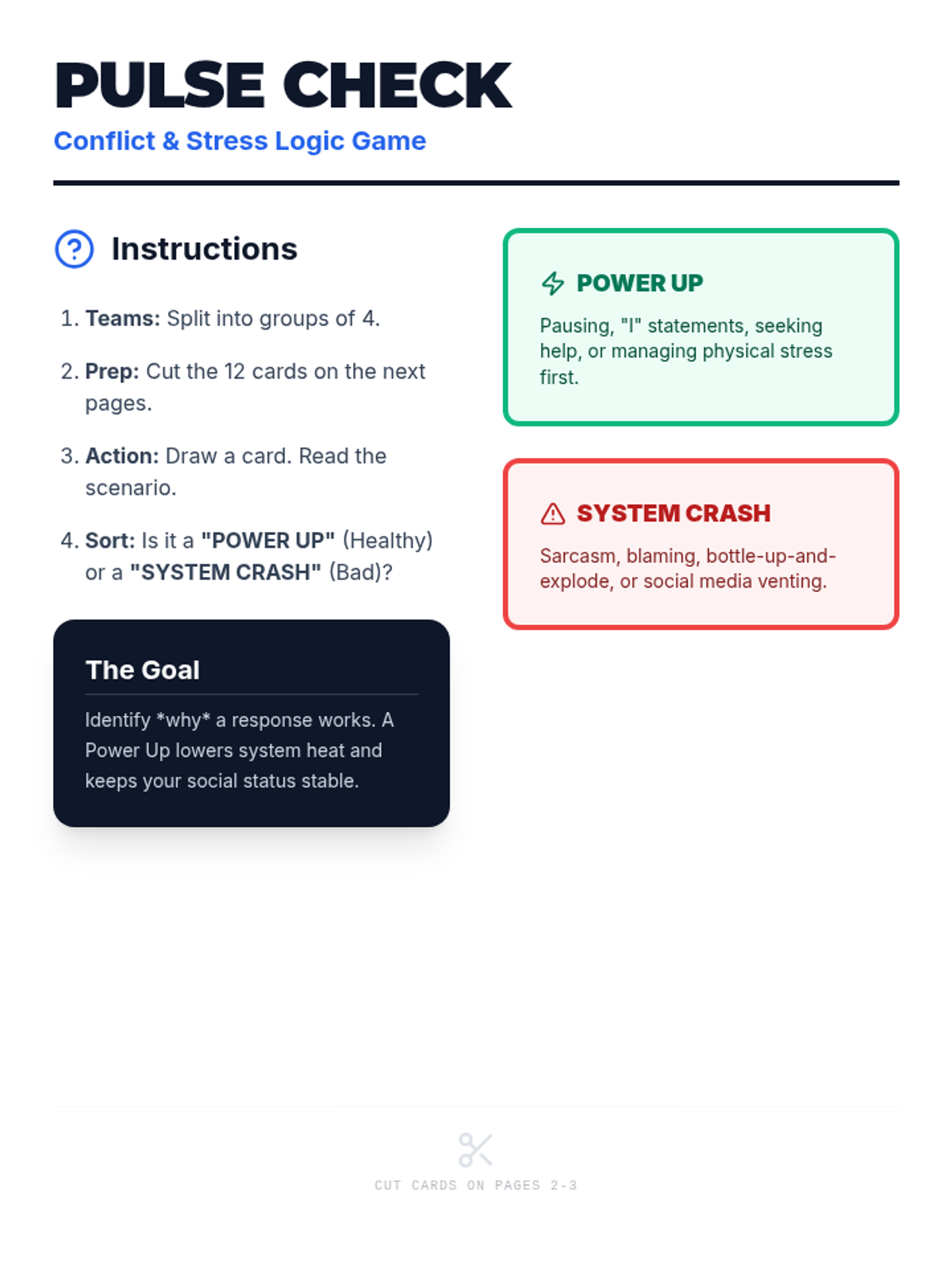
A set of 12 scenario-based game cards for 'The Pulse Check' game. Updated with stable grid layouts and adjusted text sizes to prevent page overflow.
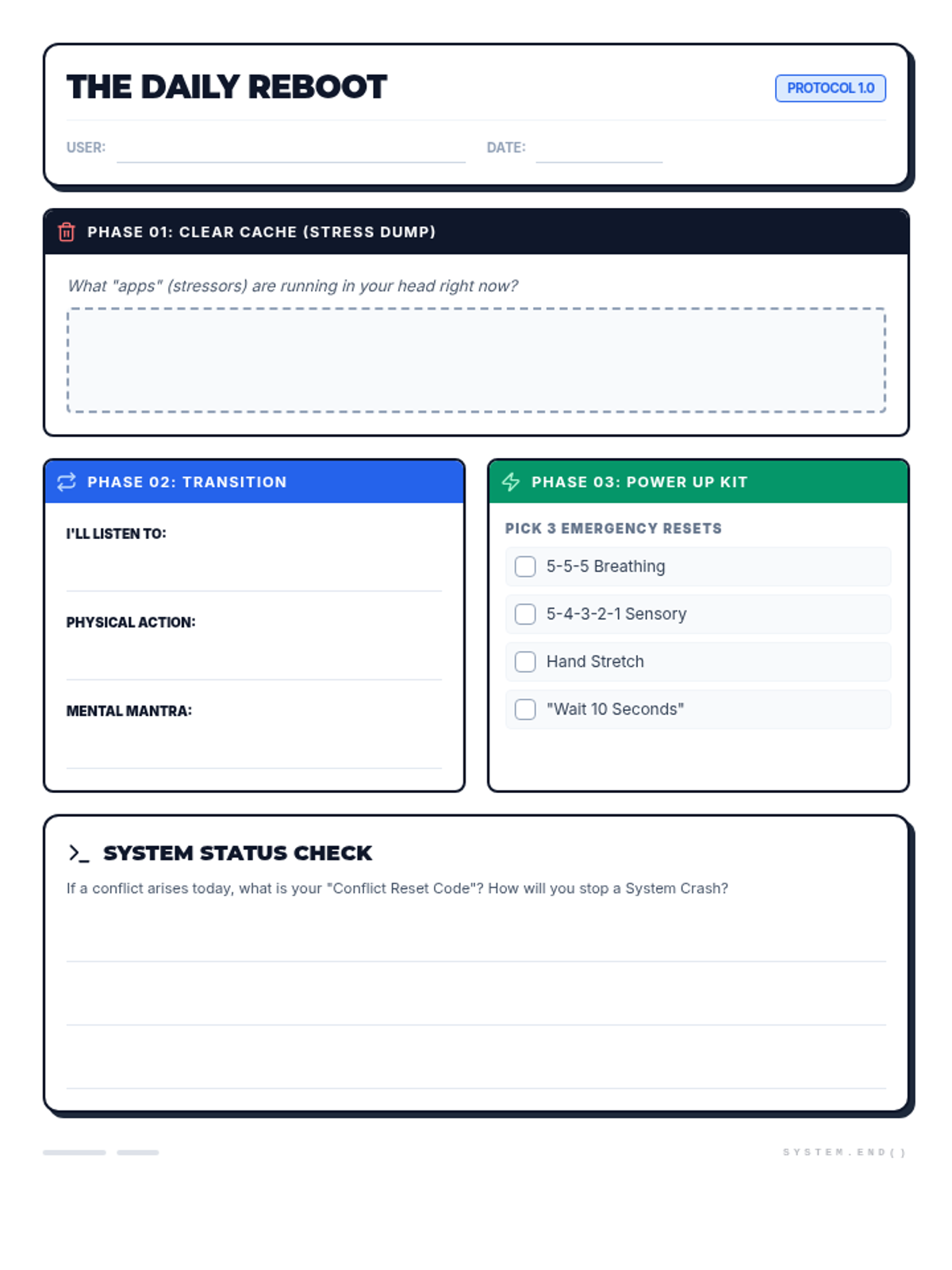
A personalized reflection worksheet for students to map out their emotional stressors, transition rituals, and 'Power Up' coping strategies. Updated to fit on one page and provide ample writing space.
A high-energy visual slide deck for 'The Great Reboot' lesson, using a tech-inspired aesthetic to teach high schoolers about transitions, stress, and conflict resolution. Updated with improved contrast and scenario content.
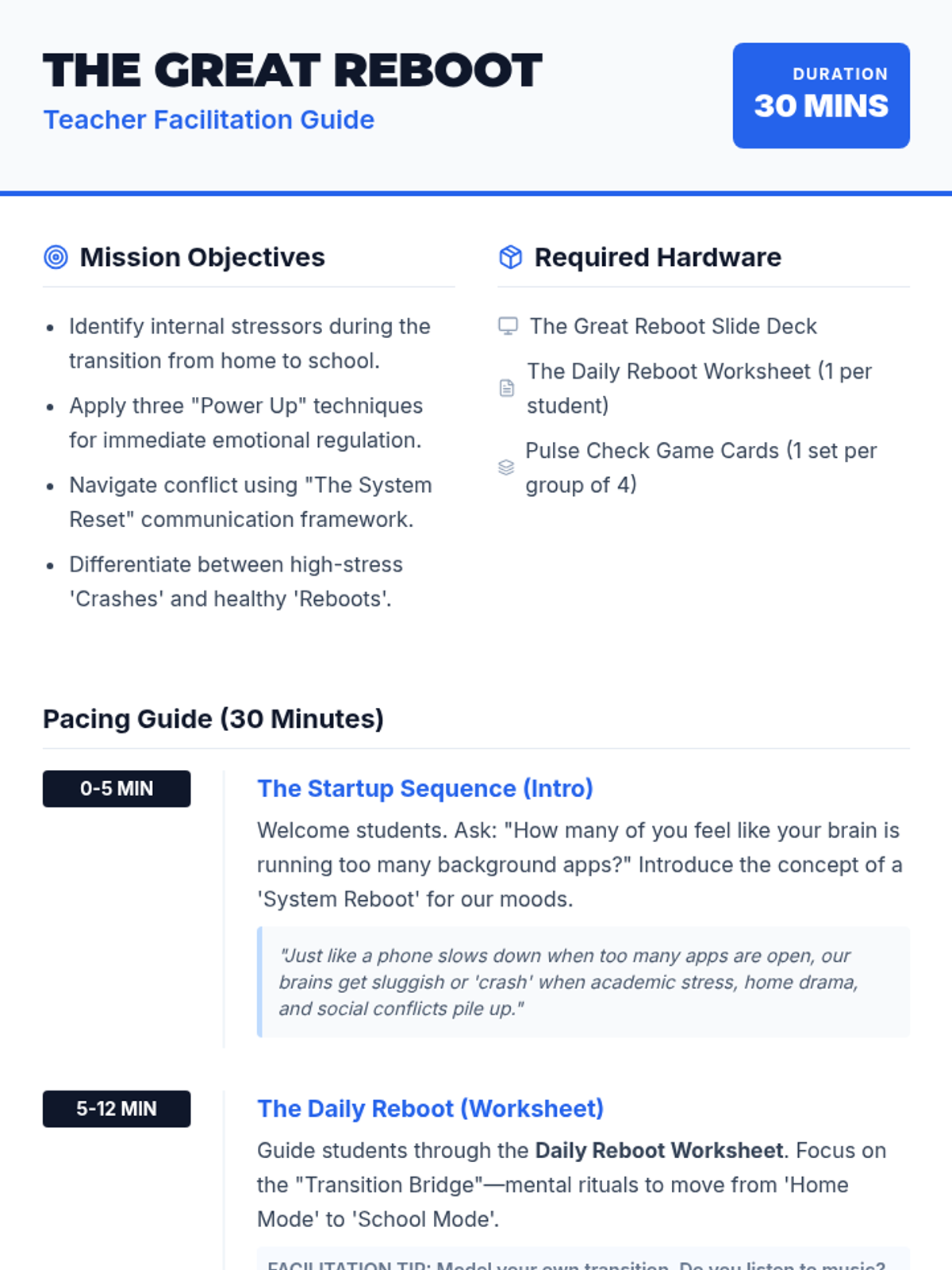
A comprehensive teacher facilitation guide for 'The Great Reboot' lesson, including learning objectives, a detailed 30-minute pacing guide, and a conflict resolution framework. Updated to fix layout issues.
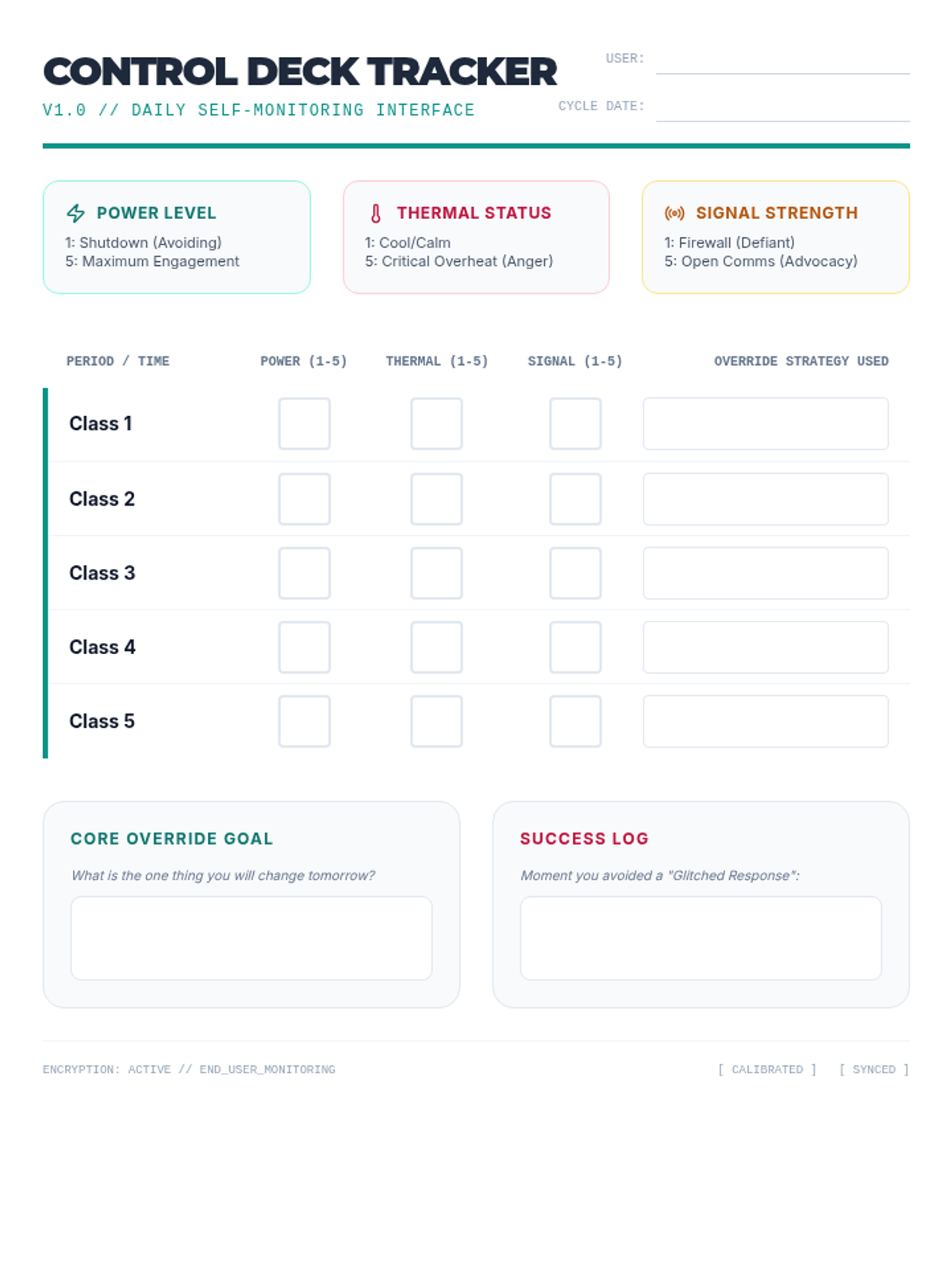
A student-facing self-monitoring tool styled as a sleek 'Control Deck' dashboard. It allows students to track engagement, emotional state, and communication throughout the day.
A visually striking, dark-themed slide deck that frames behavior intervention through a 'systems interface' metaphor, making it engaging and high-interest for high schoolers.
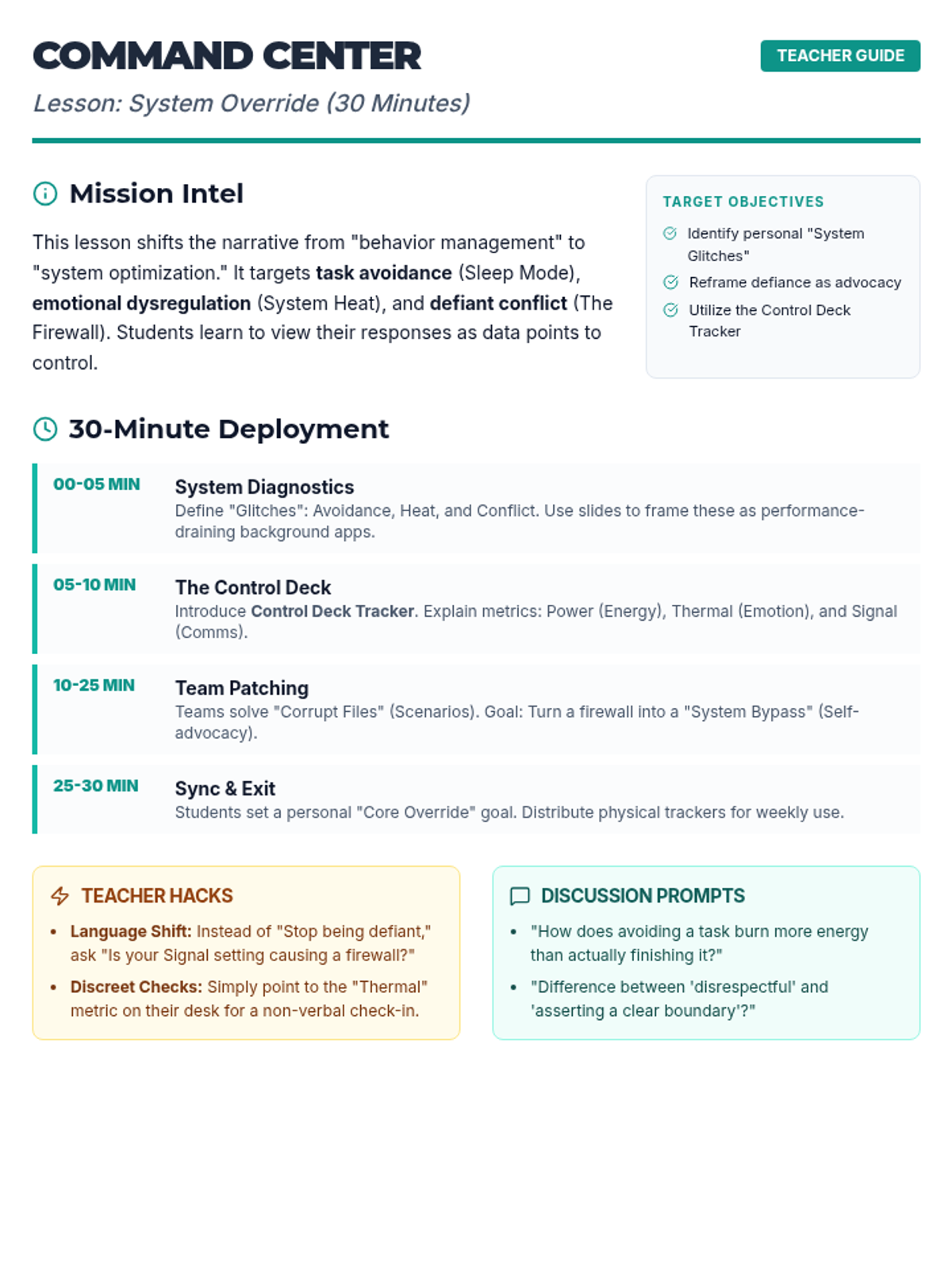
A comprehensive teacher guide for the 30-minute System Override lesson, featuring a minute-by-minute timeline, facilitation hacks, and discussion prompts.
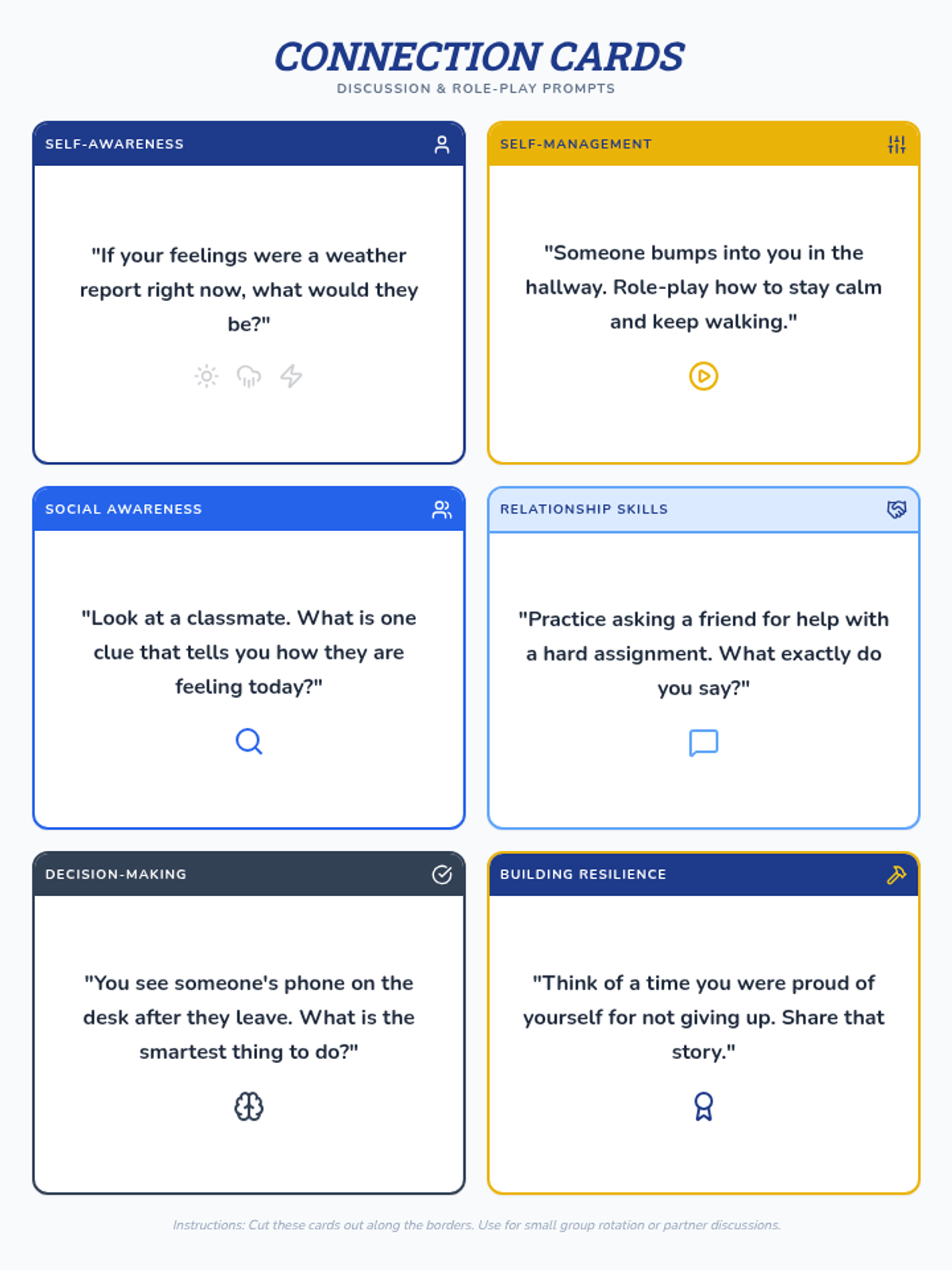
A set of discussion and role-play cards. Revised with improved text contrast on headers, fixed layout to prevent page breaks, and uniform card sizing for easier printing and cutting.
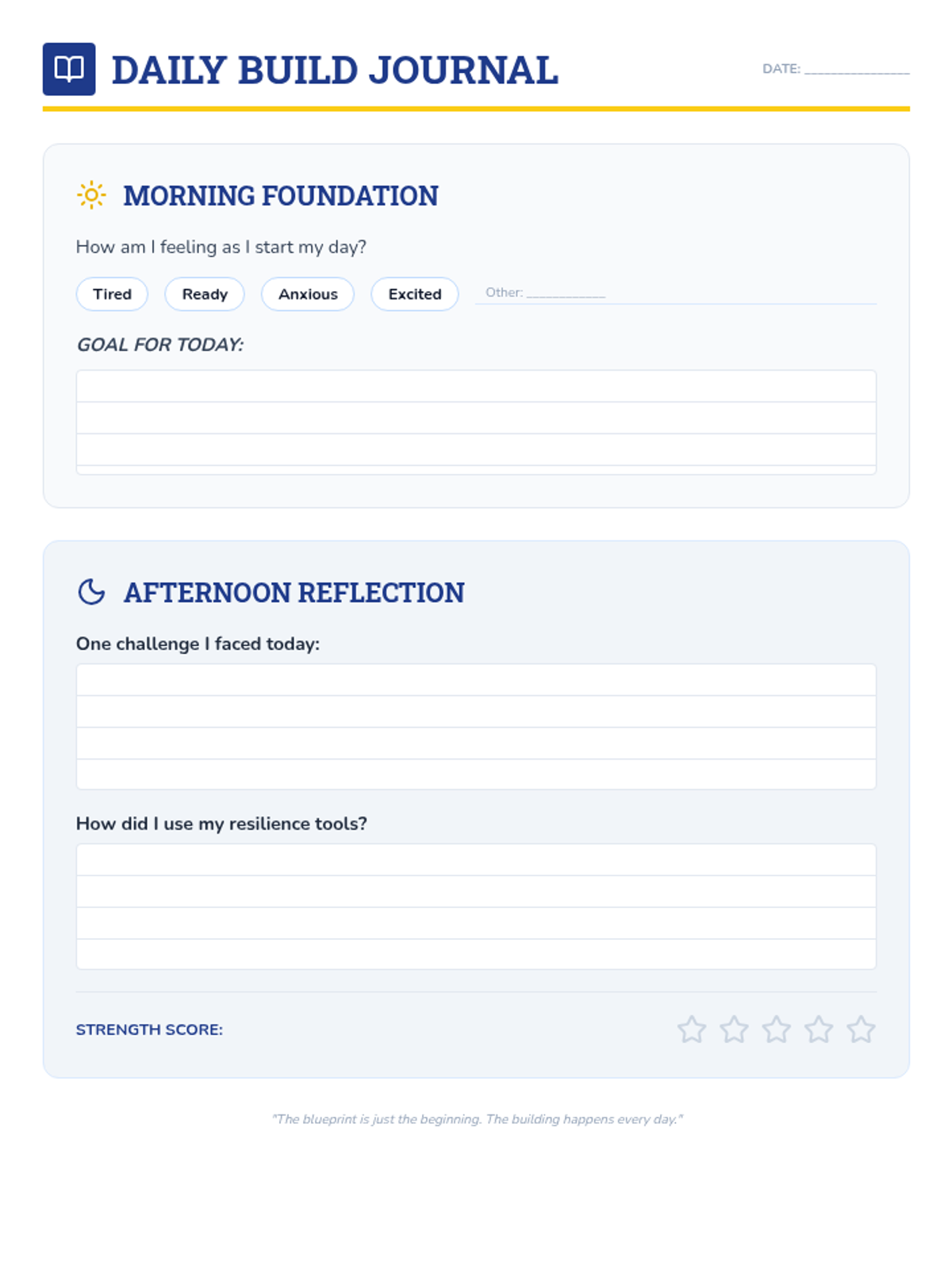
A reflective journaling page for students. Revised with high-contrast work areas for better handwriting legibility and adjusted layout to fit on a single page.
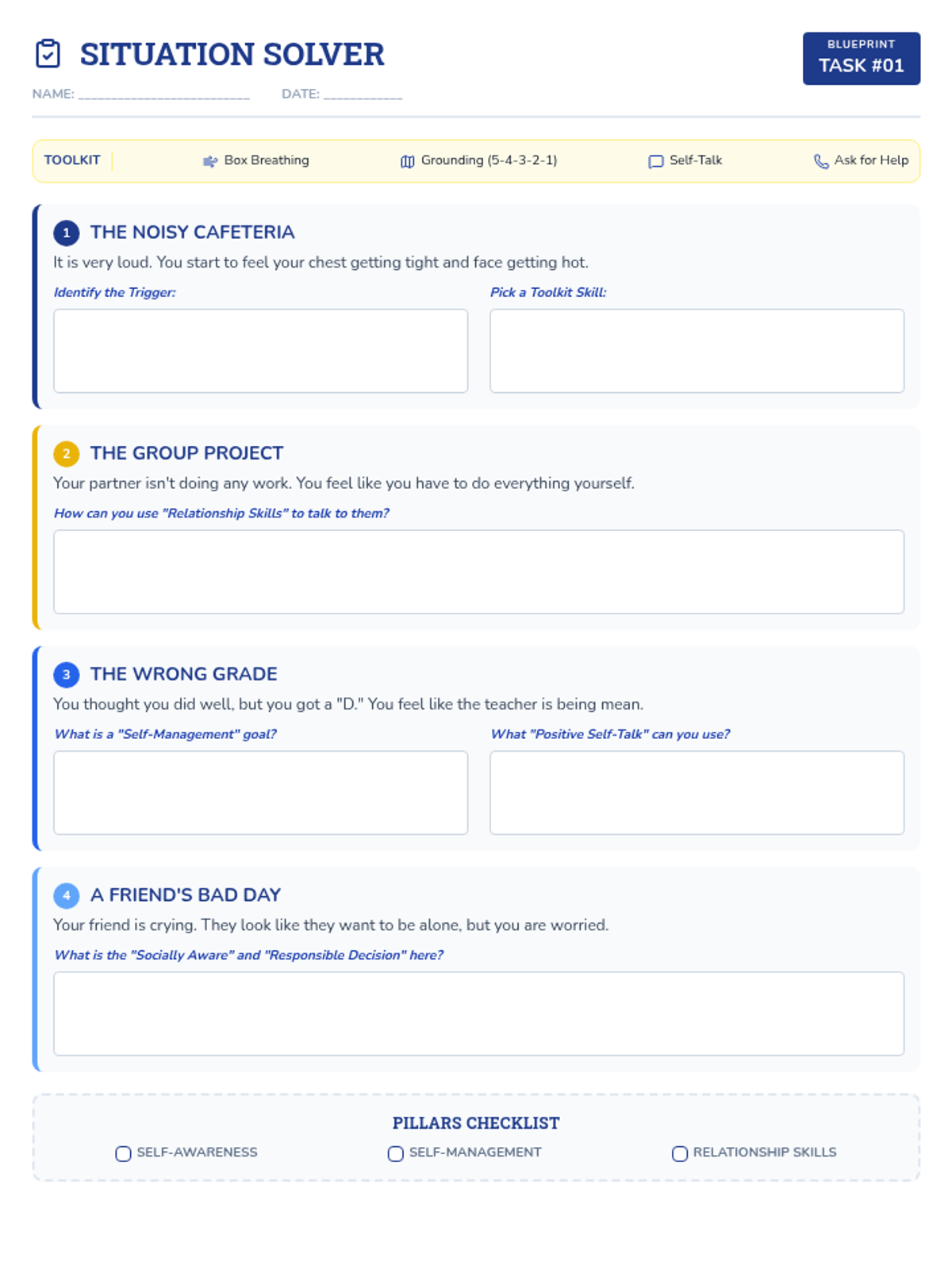
A scenario-based worksheet where students apply their knowledge of SEL triggers and coping skills. Revised with 4 scenarios, a toolkit reference, and improved layout to fit on one page.
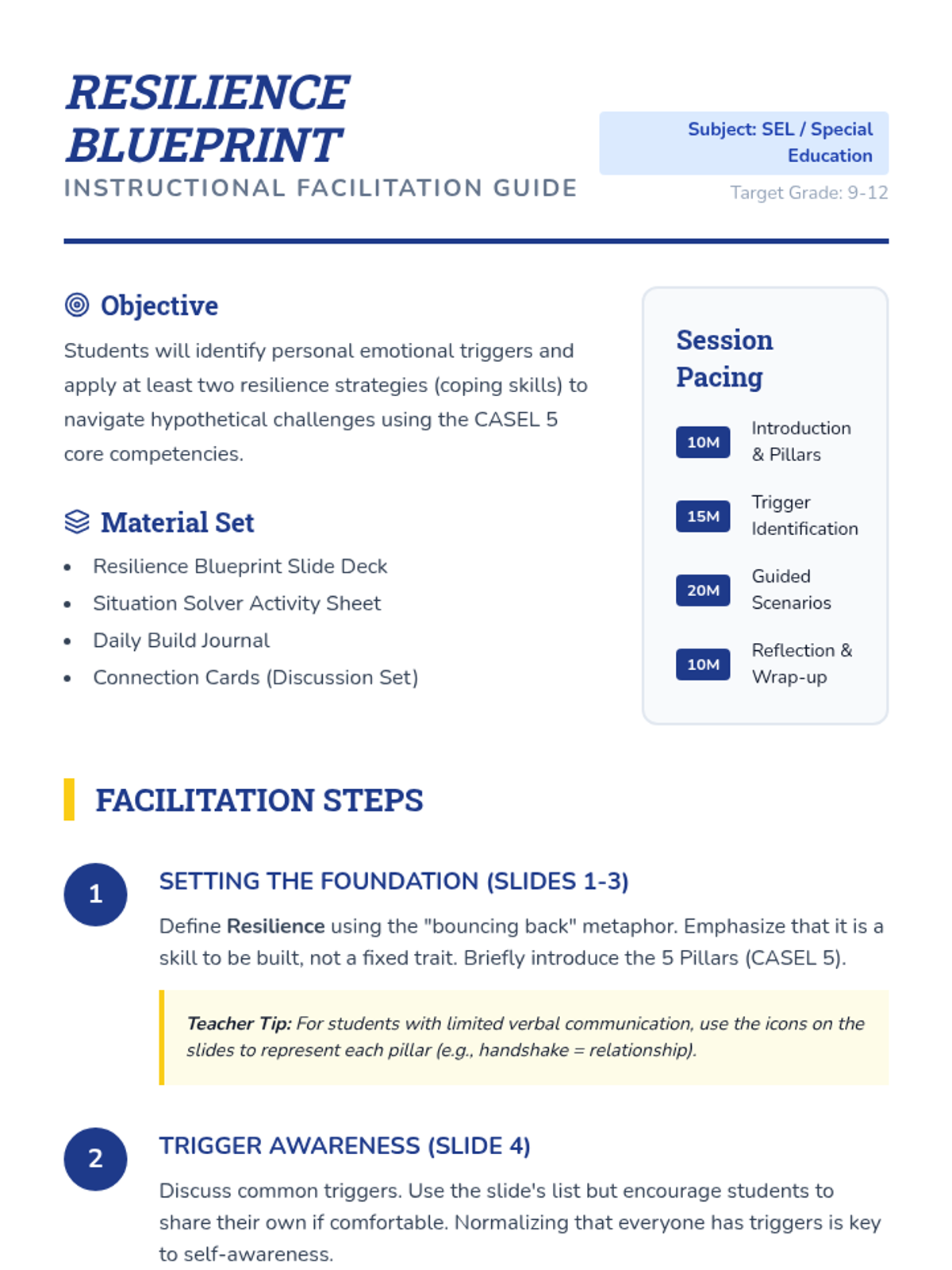
A comprehensive teacher's guide for the Resilience Blueprint lesson, featuring pacing, instructional steps, and differentiation strategies for high school special education students.
A visual presentation for high school special education students that introduces the concept of resilience using a 'Blueprint' theme, covering triggers, the five SEL pillars, and coping strategies. Revised for better layout balance and text spacing.
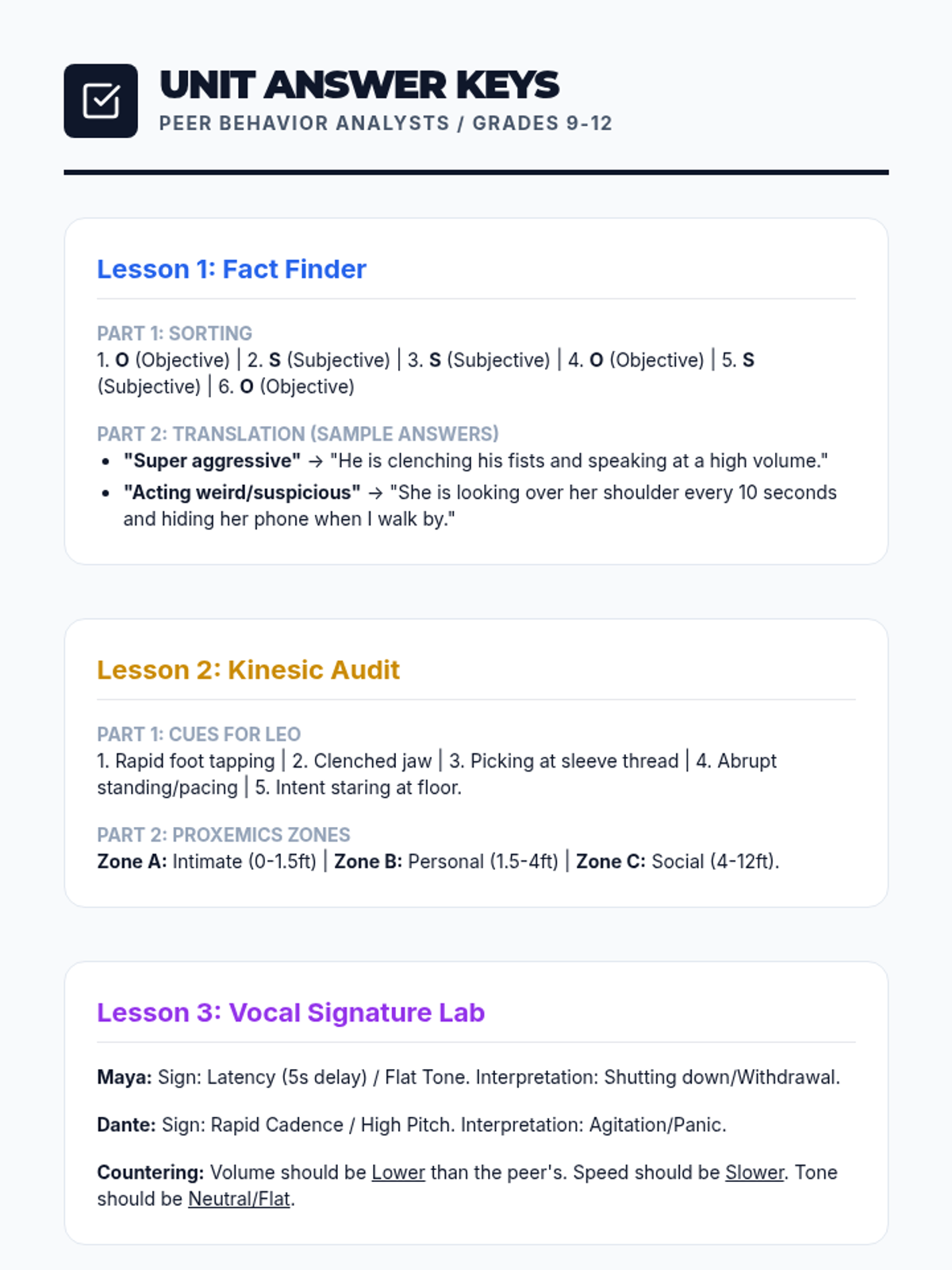
A complete set of answer keys and sample responses for all student worksheets and activities in the Peer Behavior Analysts sequence.
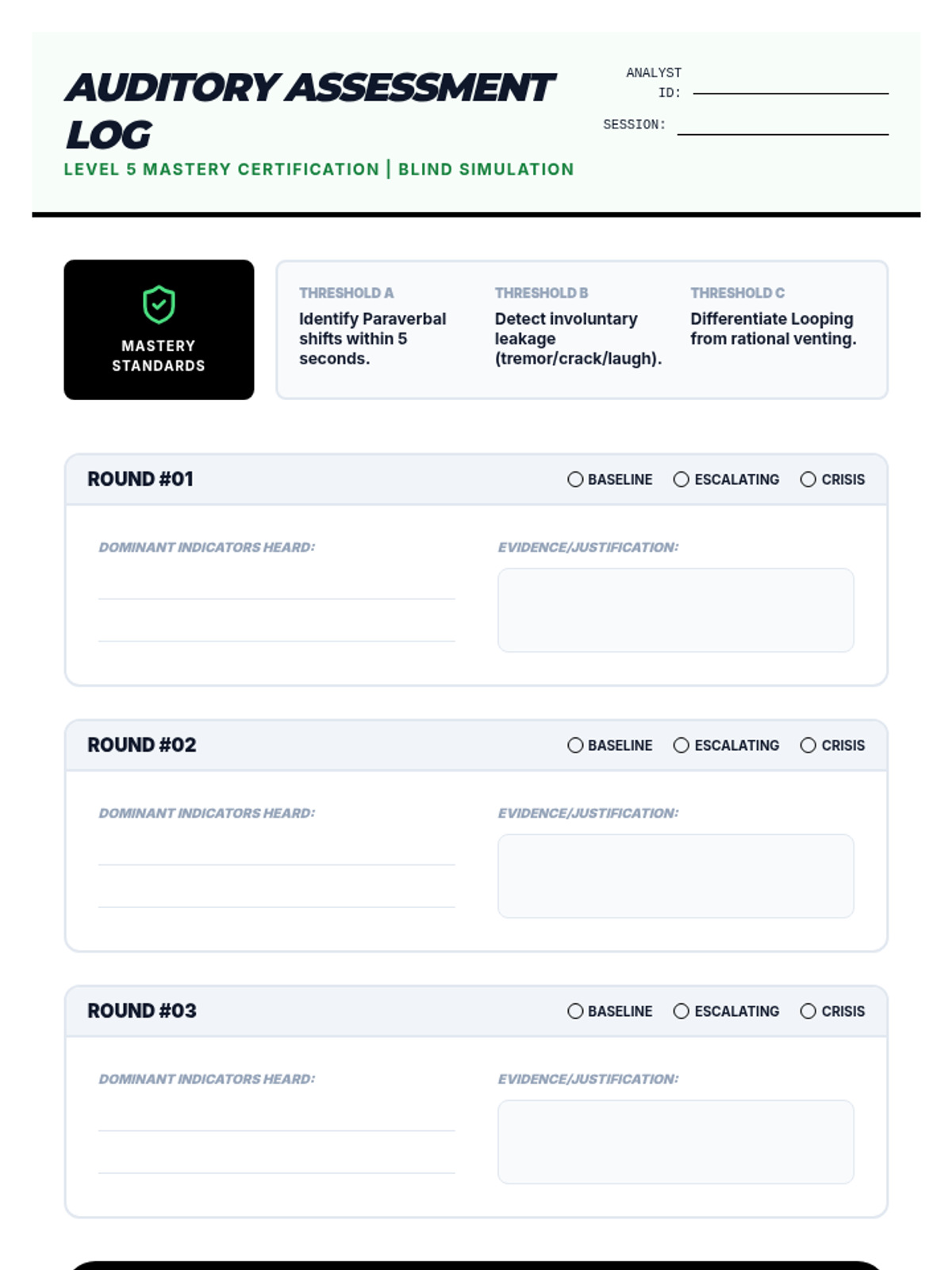
A student log for recording and justifying auditory assessments during the final blind simulation activity. Includes sections for indicators, justification, and final synthesis reflection.
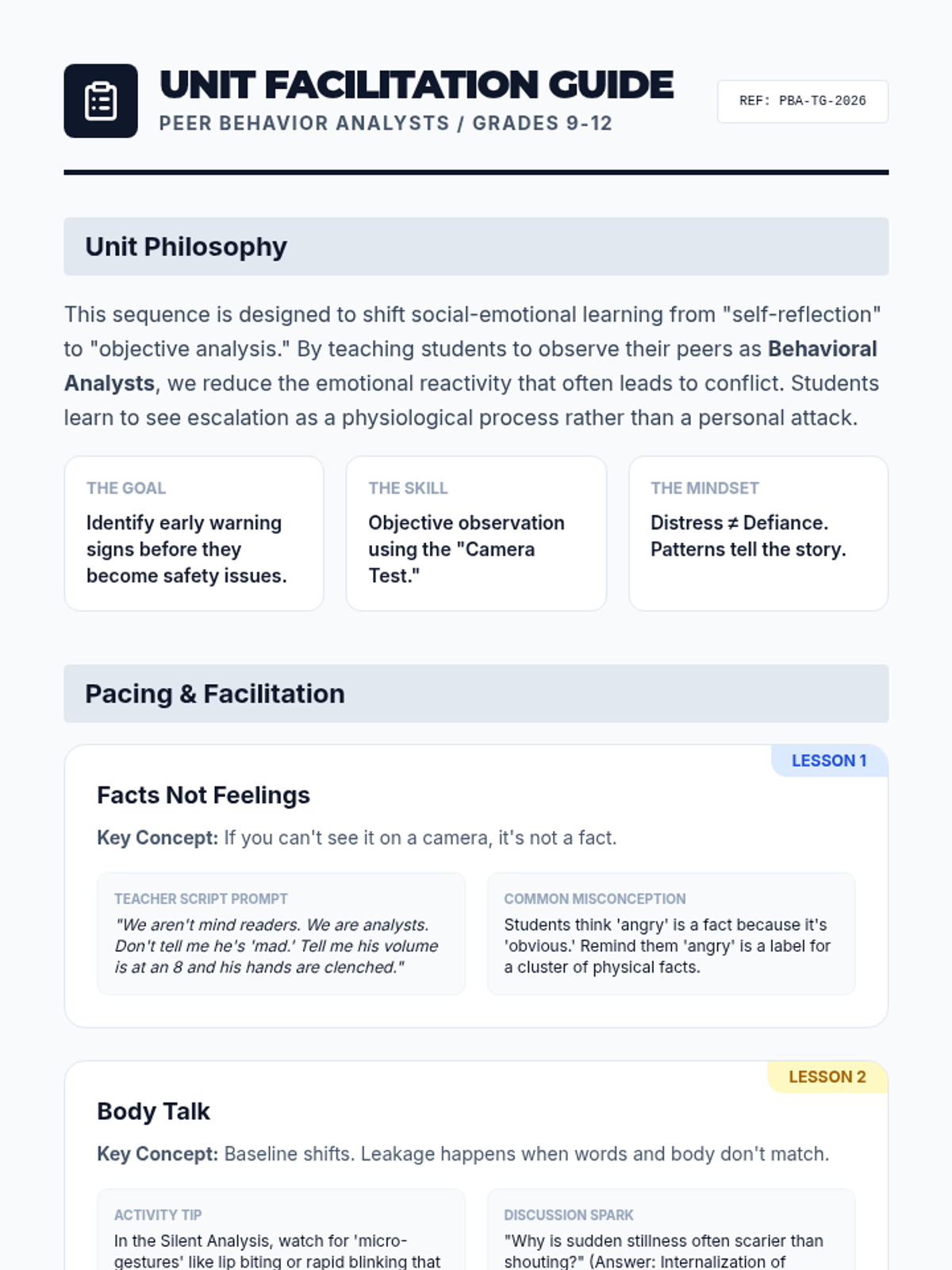
A comprehensive unit facilitation guide for teachers, providing instructional strategies, scripts, pacing notes, and differentiation tips for the Peer Behavior Analysts sequence.
Introductory slides for the final mastery simulation, establishing the rules of blind assessment and reviewing the key vocal variables students will analyze in real-time.
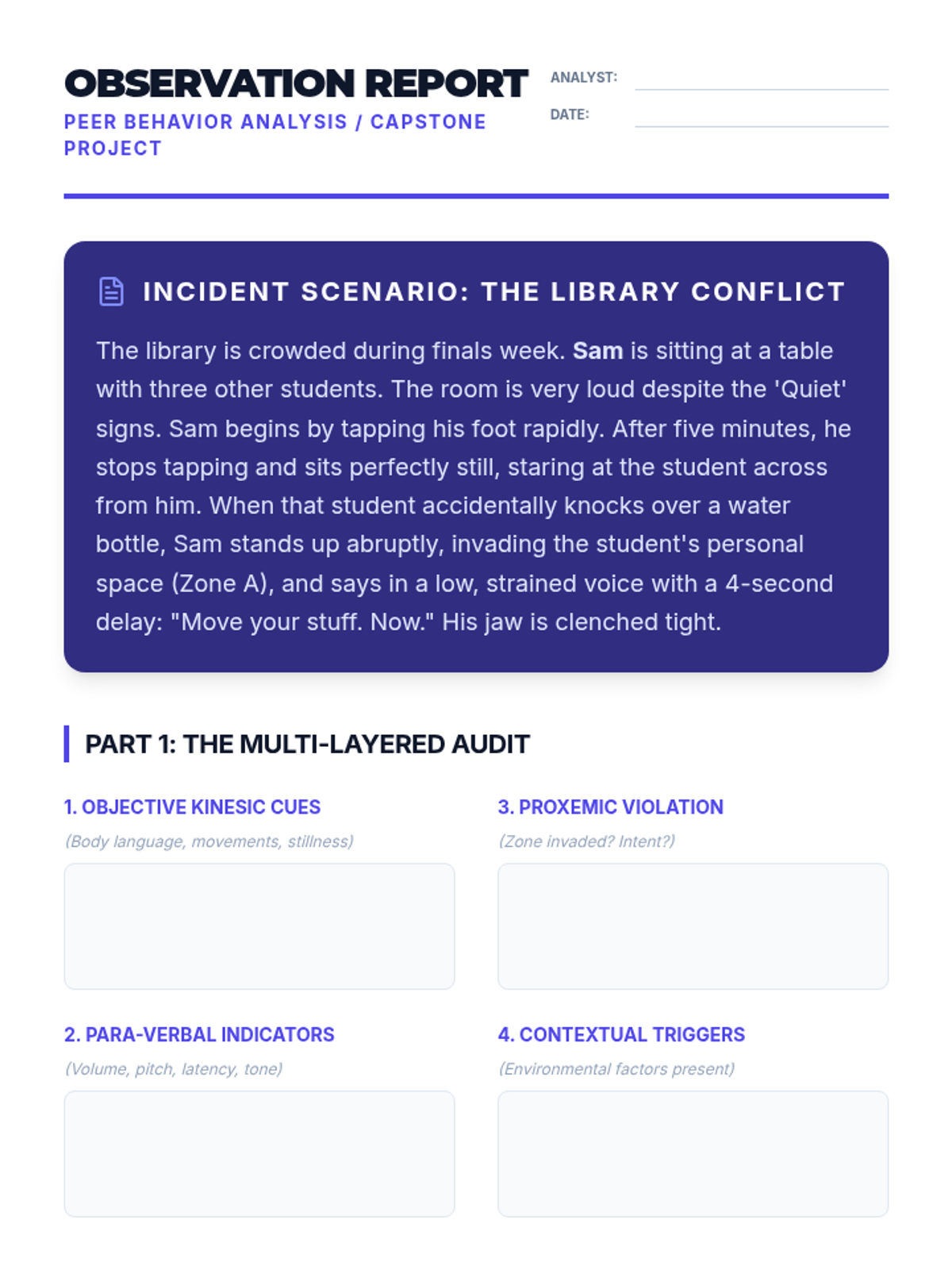
Capstone project worksheet where students synthesize all observation skills to analyze a complex scenario, identifying cues, environmental triggers, and intervention points.
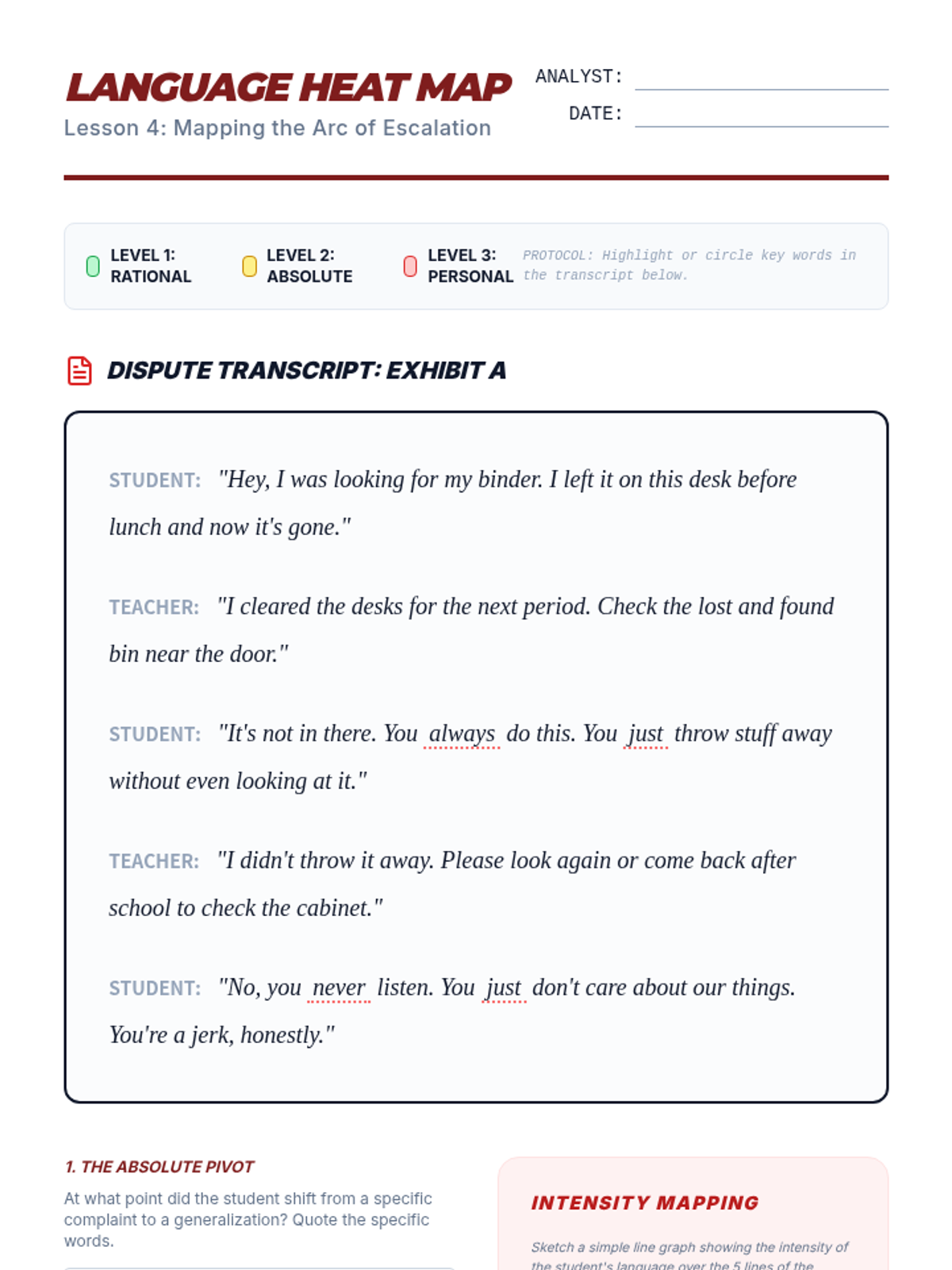
A linguistic analysis worksheet where students track the escalation of a verbal dispute using a transcript, identifying absolute language and personal attacks through a "heat map" graph.
Final slide deck for the sequence, focusing on synthesis of behavioral observation skills and identifying environmental triggers in escalation analysis.
Slides for Lesson 4 exploring the linguistic shifts during escalation, focusing on absolute language (always/never) and the transition from rational complaints to personal attacks.
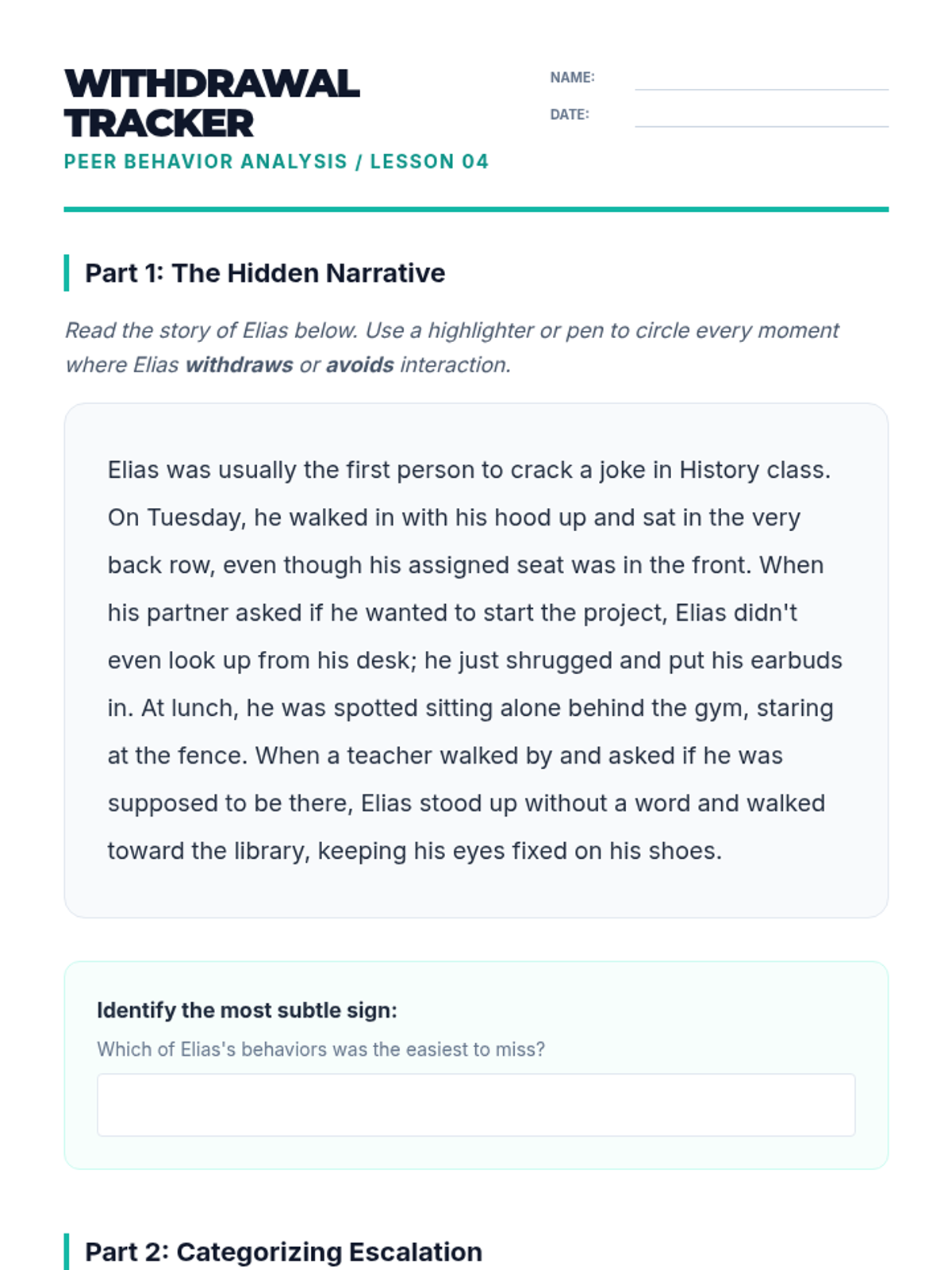
Student worksheet for Lesson 4, focusing on identifying withdrawal patterns in a narrative, sorting implosive vs. explosive behaviors, and practicing empathetic check-ins.
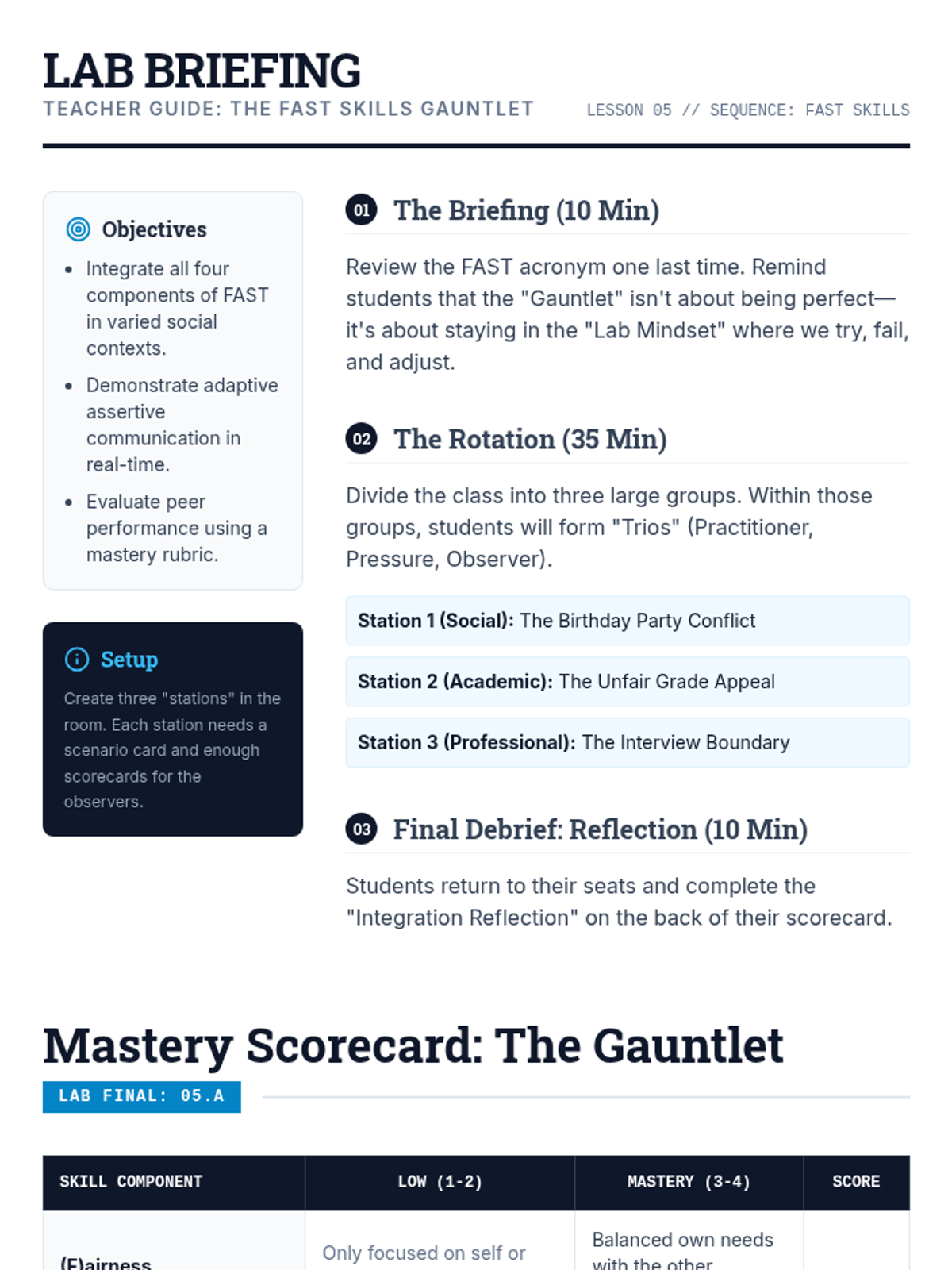
Final mastery-based assessment materials for Lesson 5, including teacher facilitation guide, station scenarios, and a performance rubric.
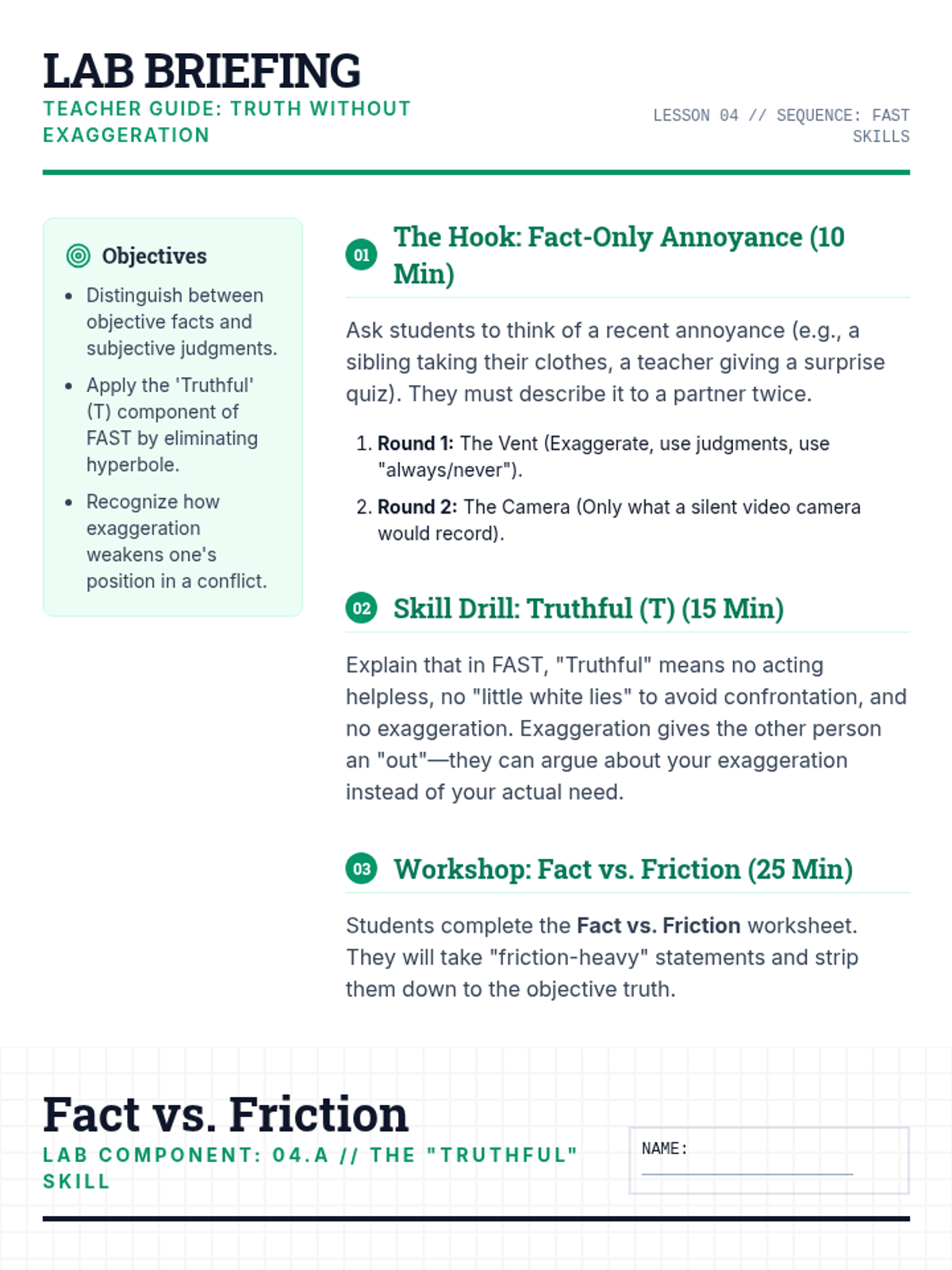
Teacher guide and student worksheet for Lesson 4, focusing on "Truthfulness" and the elimination of hyperbole in communication.
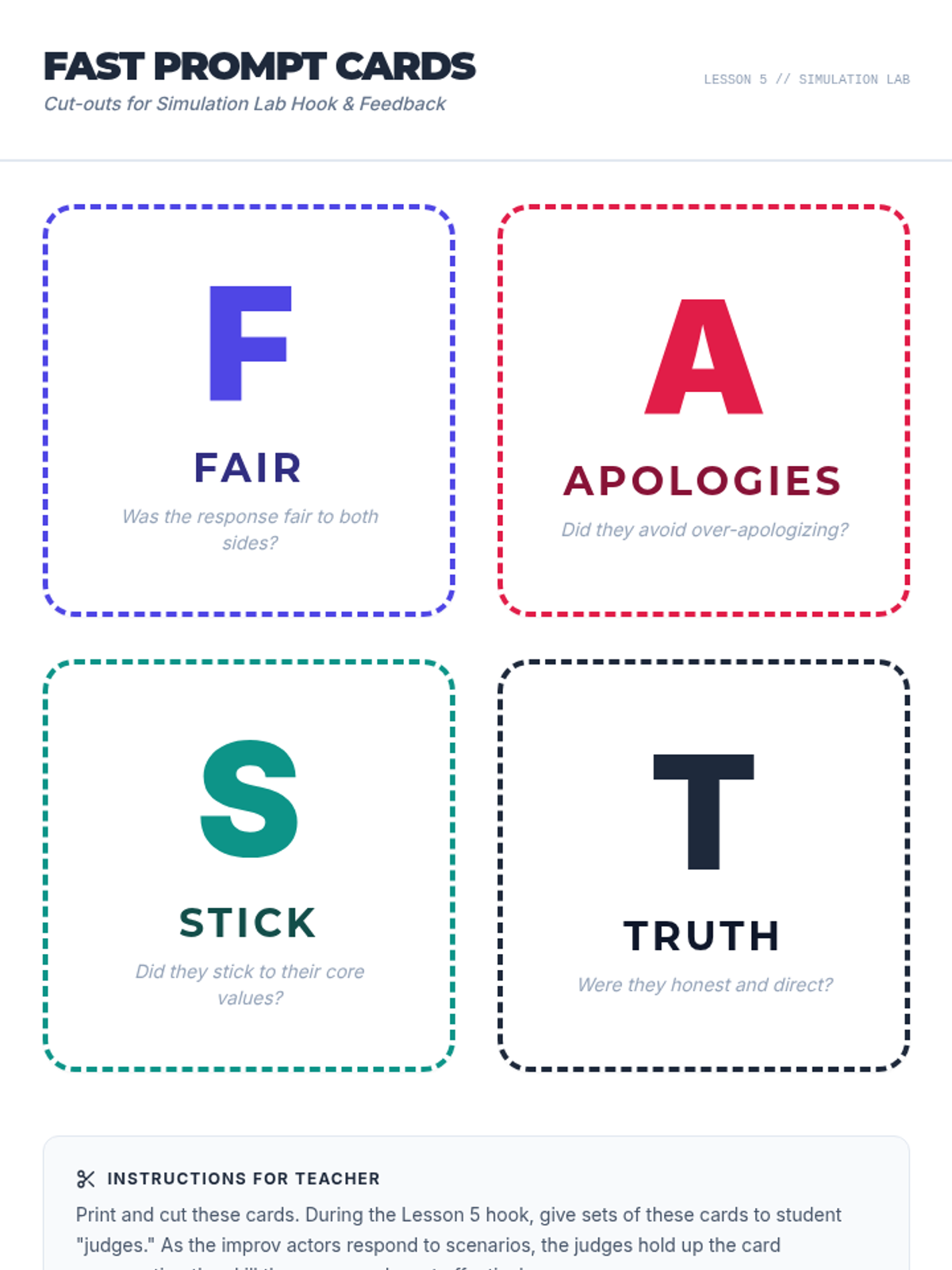
Printable prompt cards (F-A-S-T) for the simulation lab, used for real-time feedback and the improv hook activity.
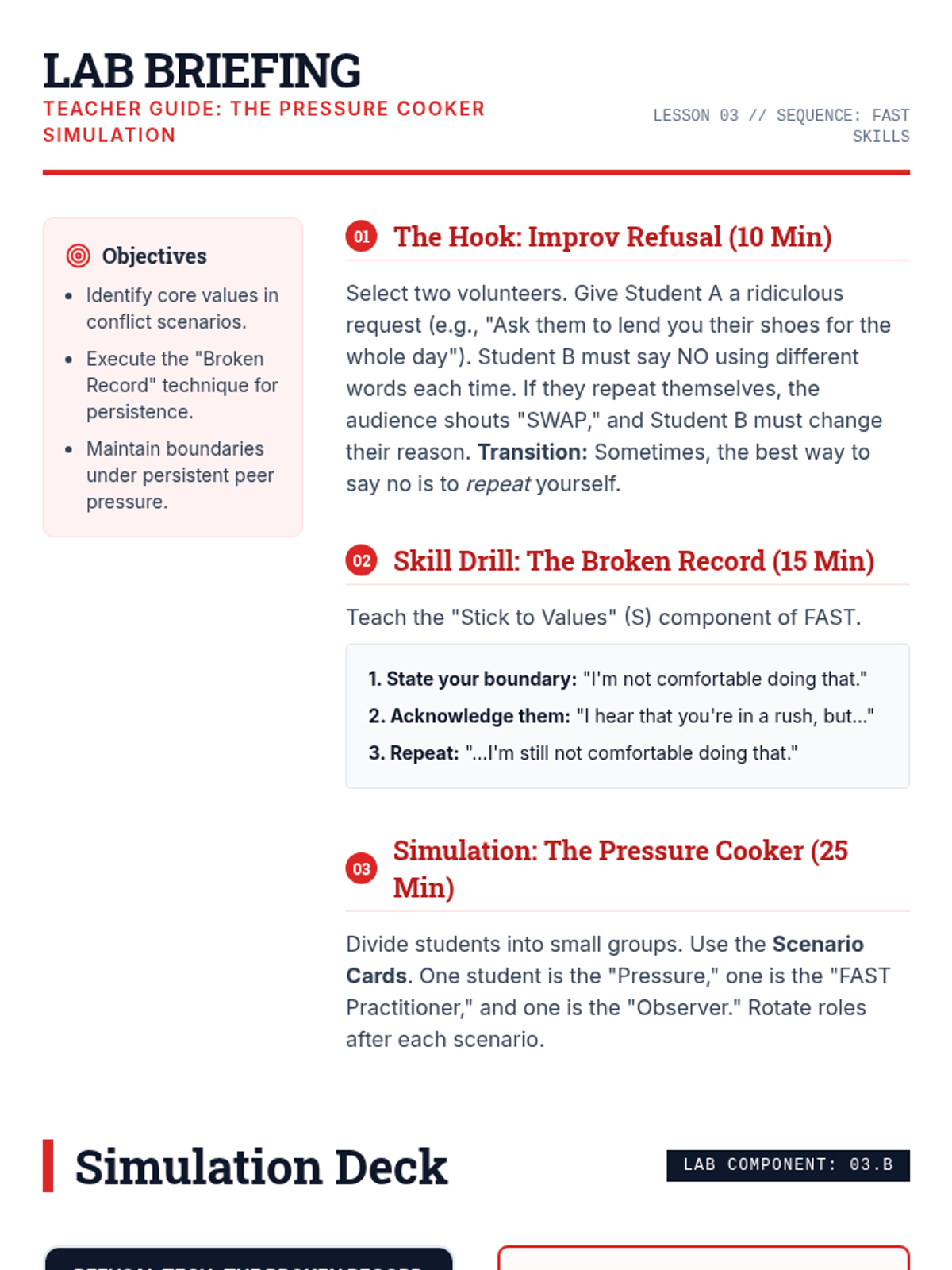
Teacher guide and role-play simulation materials for Lesson 3, focusing on "Sticking to Values" and the "Broken Record" technique.
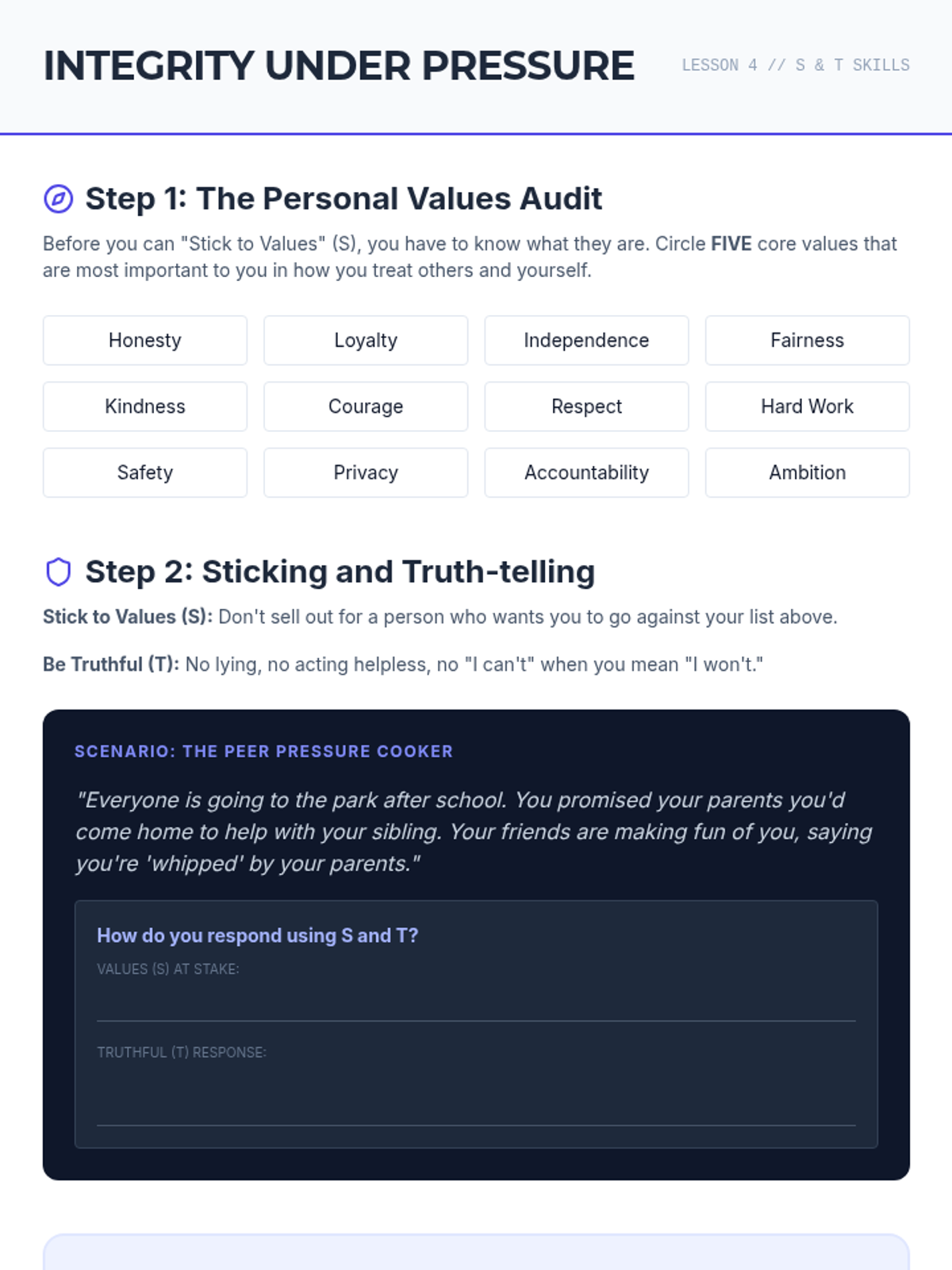
Presentation slides for Lesson 4 focusing on 'S' (Stick to values) and 'T' (Truthful) components of FAST.
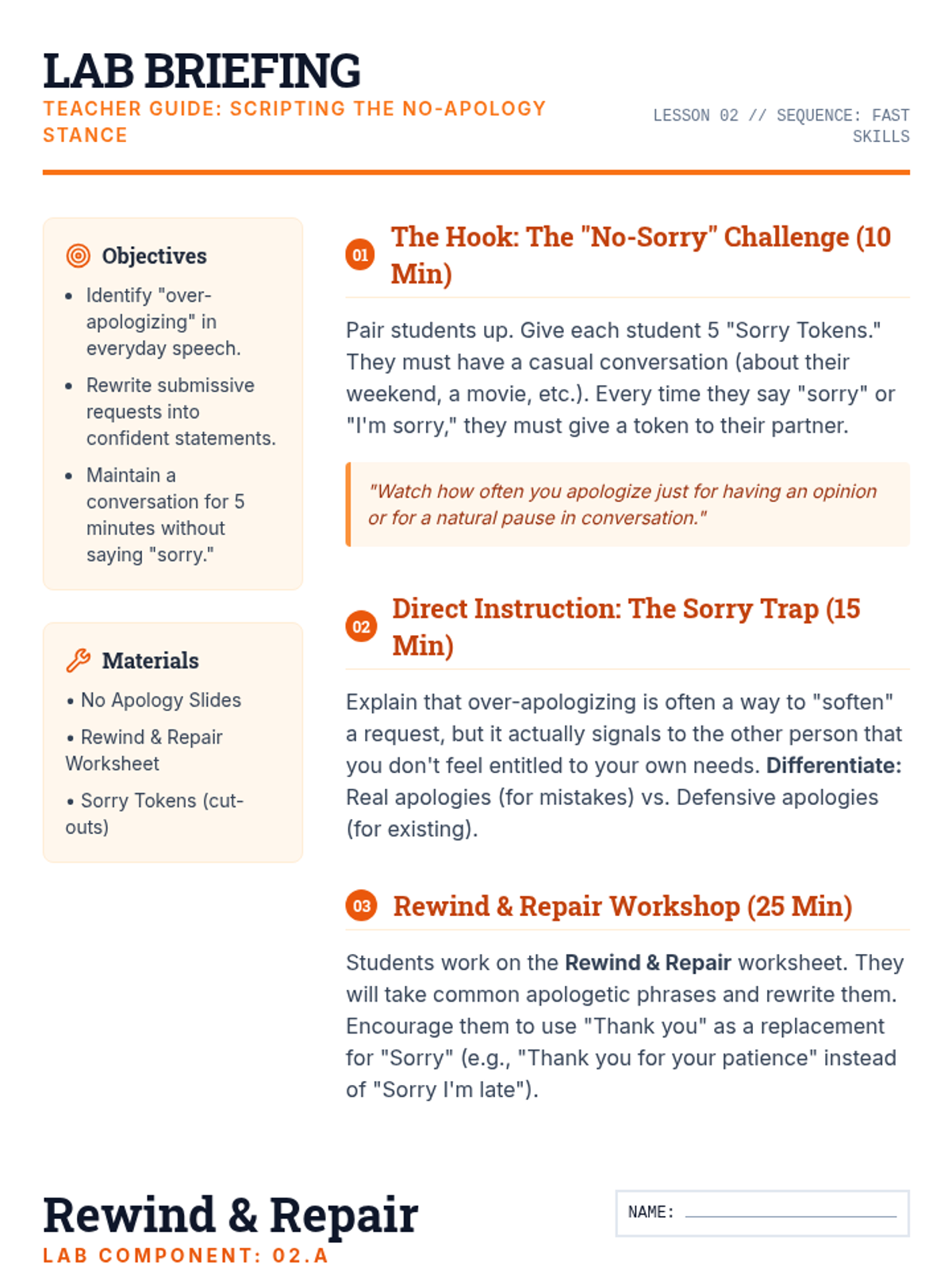
Teacher guide and student scripting workshop for Lesson 2, focusing on eliminating defensive over-apologizing and converting it into confident communication.
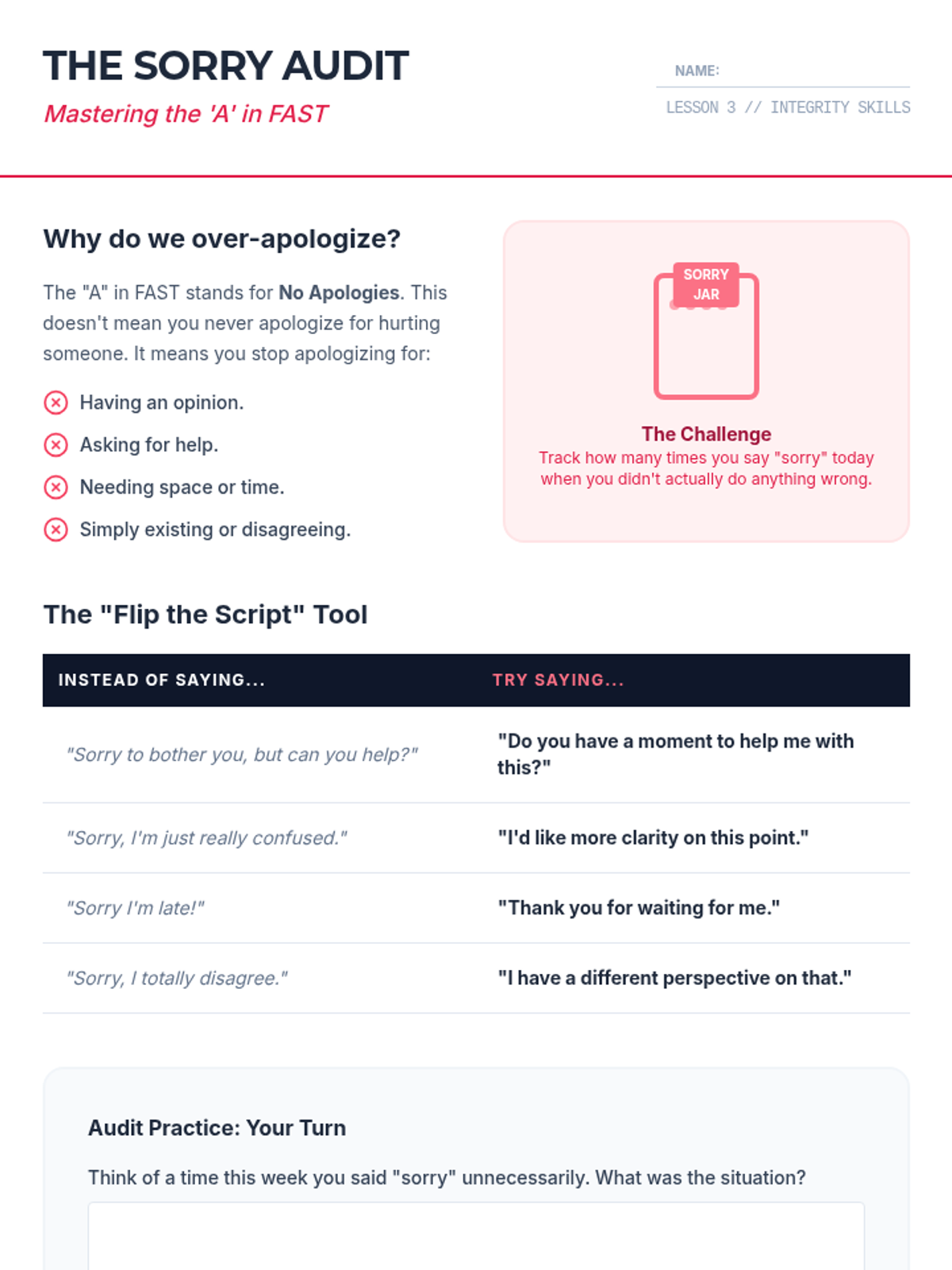
Presentation slides for Lesson 3 focusing on the 'A' in FAST, reducing unwarranted apologies and replacing them with assertive communication.
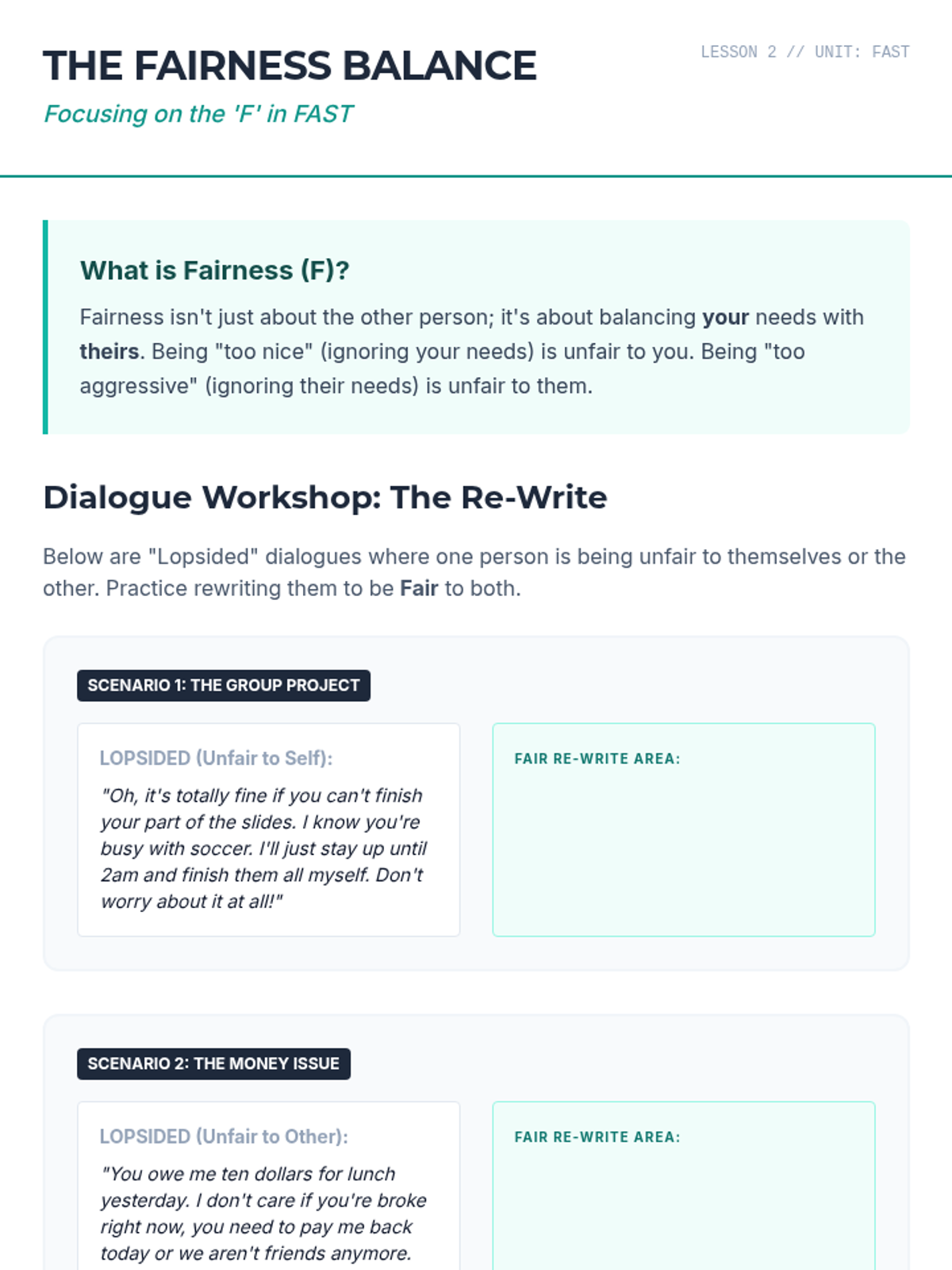
Presentation slides for Lesson 2 focusing on the 'F' in FAST, exploring the concept of fairness to both self and others.
Introductory presentation for Lesson 1, introducing the FAST acronym and featuring the rapid-fire gut-check quiz.
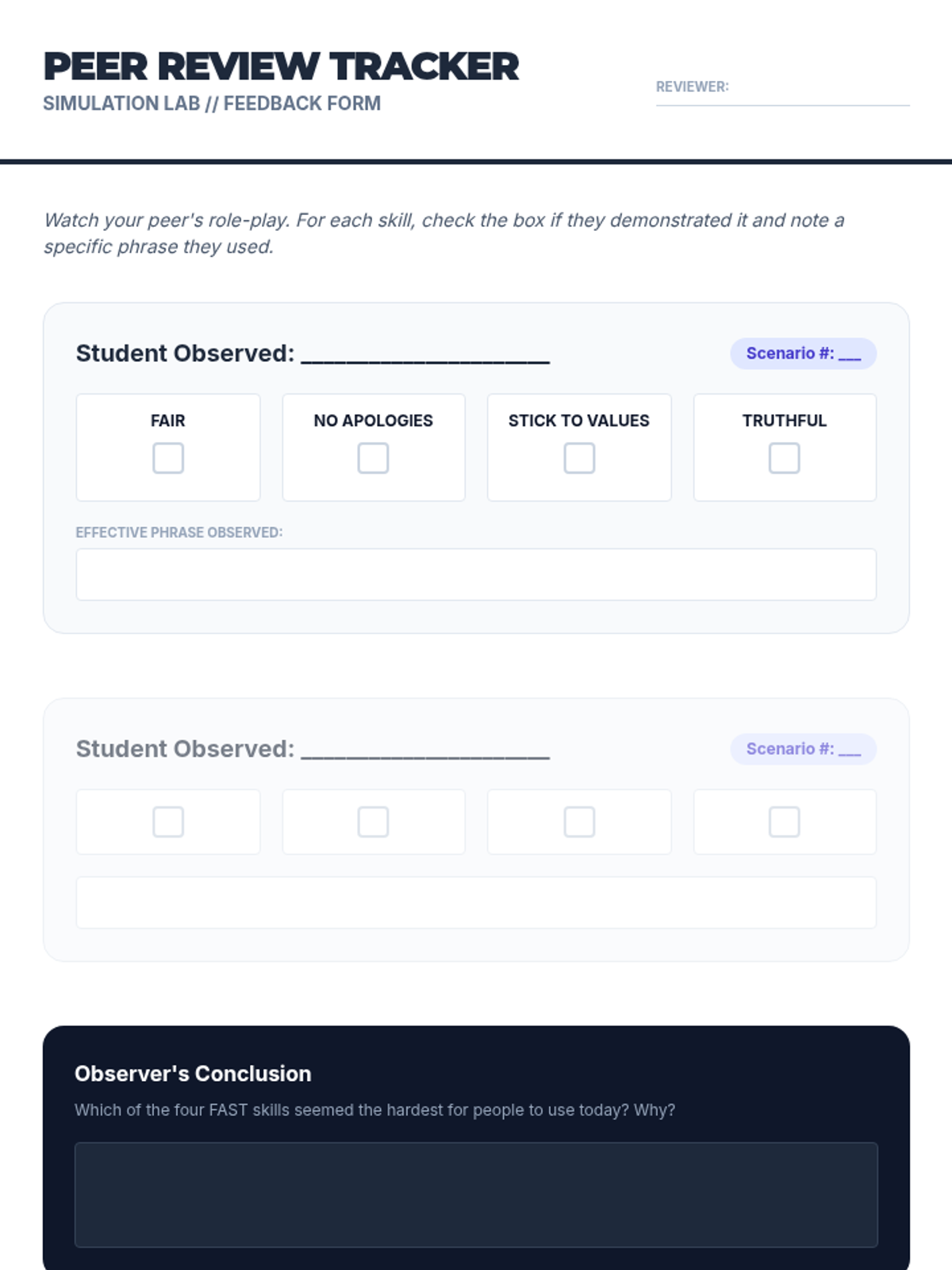
A peer-evaluation tracker for students to use during the final simulation lab, monitoring their peers' use of FAST skills.
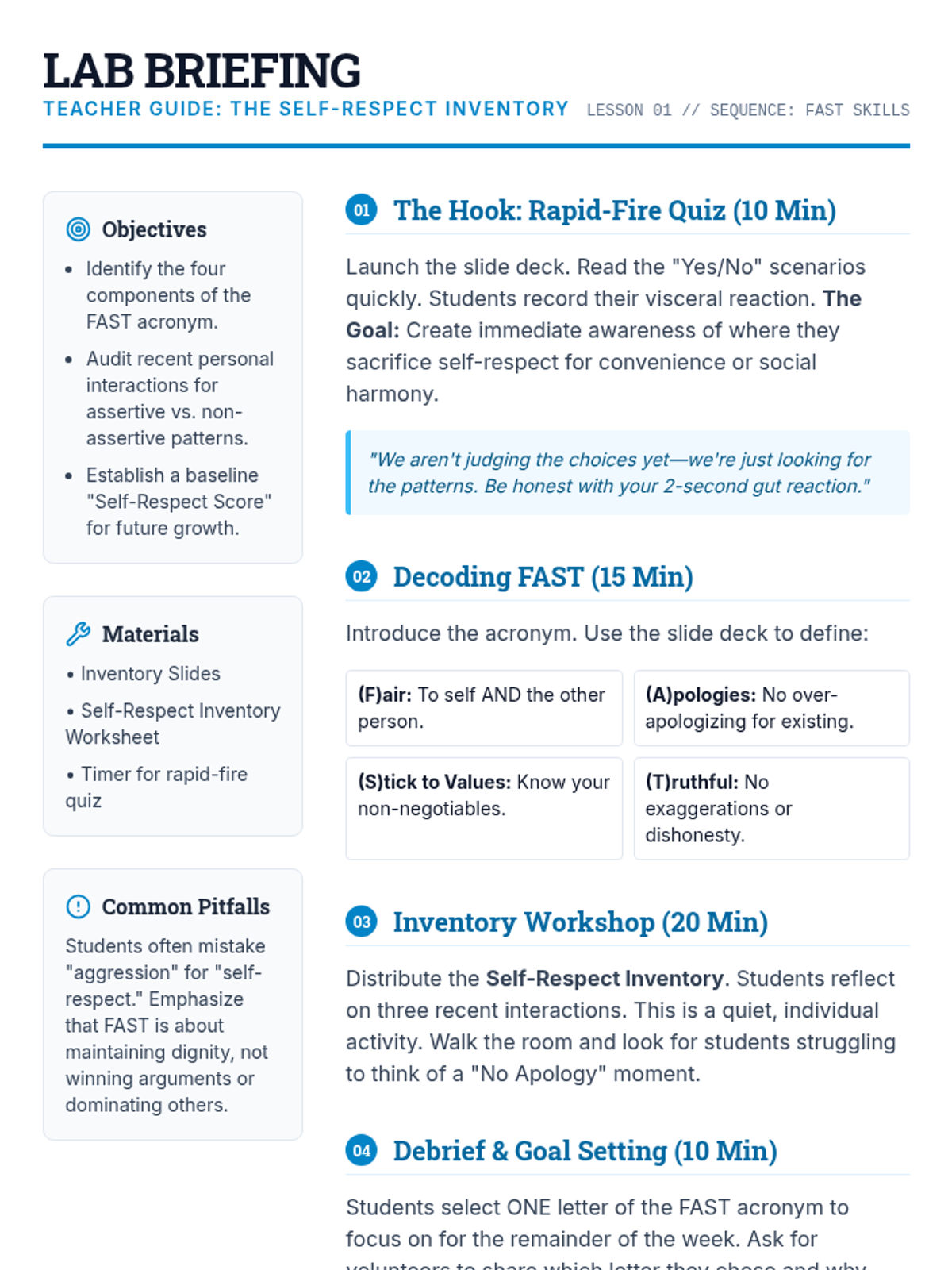
Teacher briefing and student self-audit worksheet for Lesson 1, focusing on baseline interpersonal patterns and FAST skill identification.
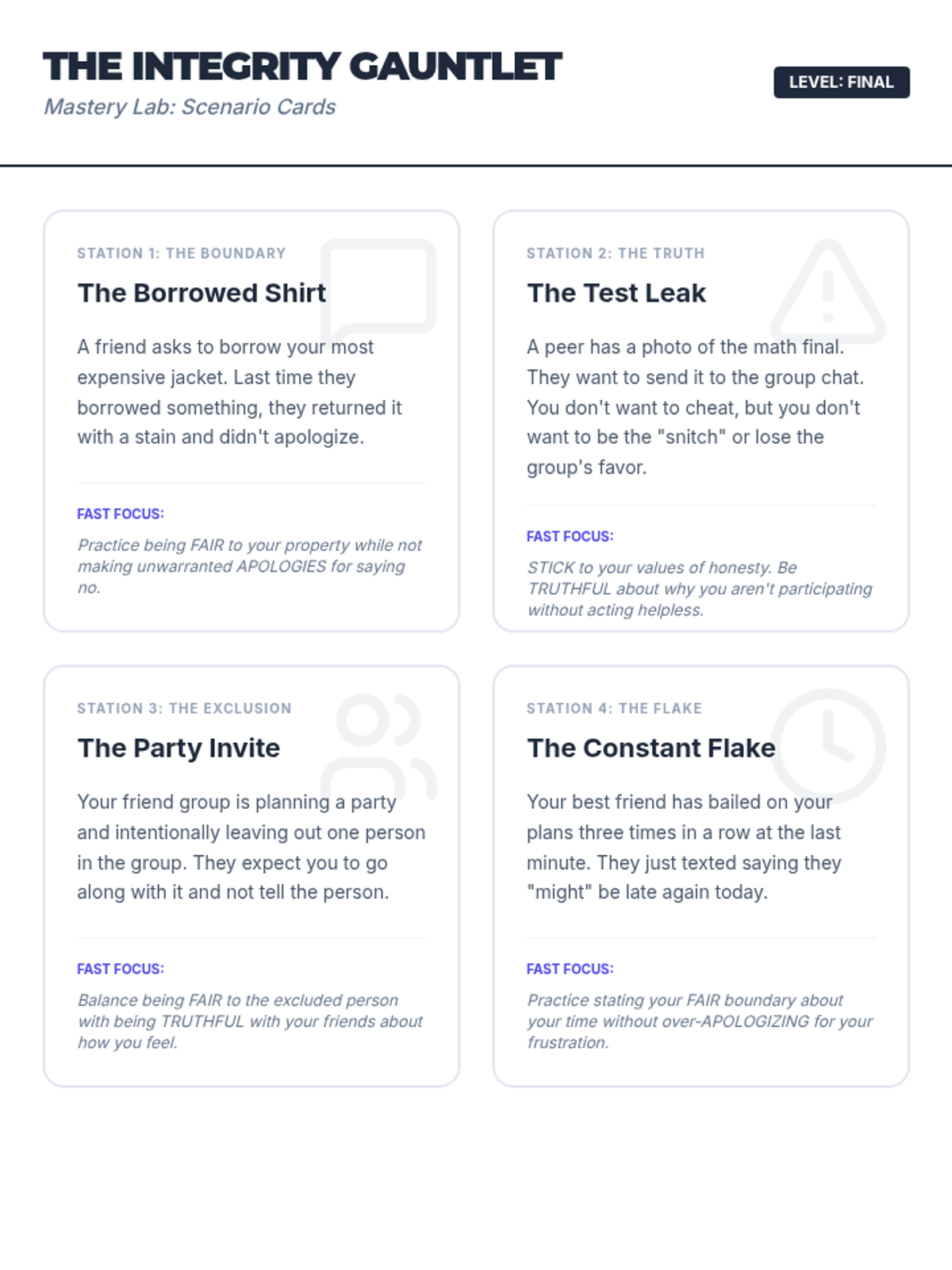
Scenario cards for the final simulation lab, depicting common 9th-grade social dilemmas requiring FAST skills.
A worksheet for Lesson 4 combining personal values identification with truthful communication practice.
A worksheet for Lesson 3 focusing on the 'A' (No Apologies) in FAST, featuring a "Flip the Script" tool to replace unwarranted apologies with assertive communication.
A worksheet focusing on the 'F' in FAST, providing scenarios for students to practice rewriting lopsided communication into fair dialogue.
Introductory presentation slides for the FAST skills sequence, defining social goals and introducing the FAST acronym.
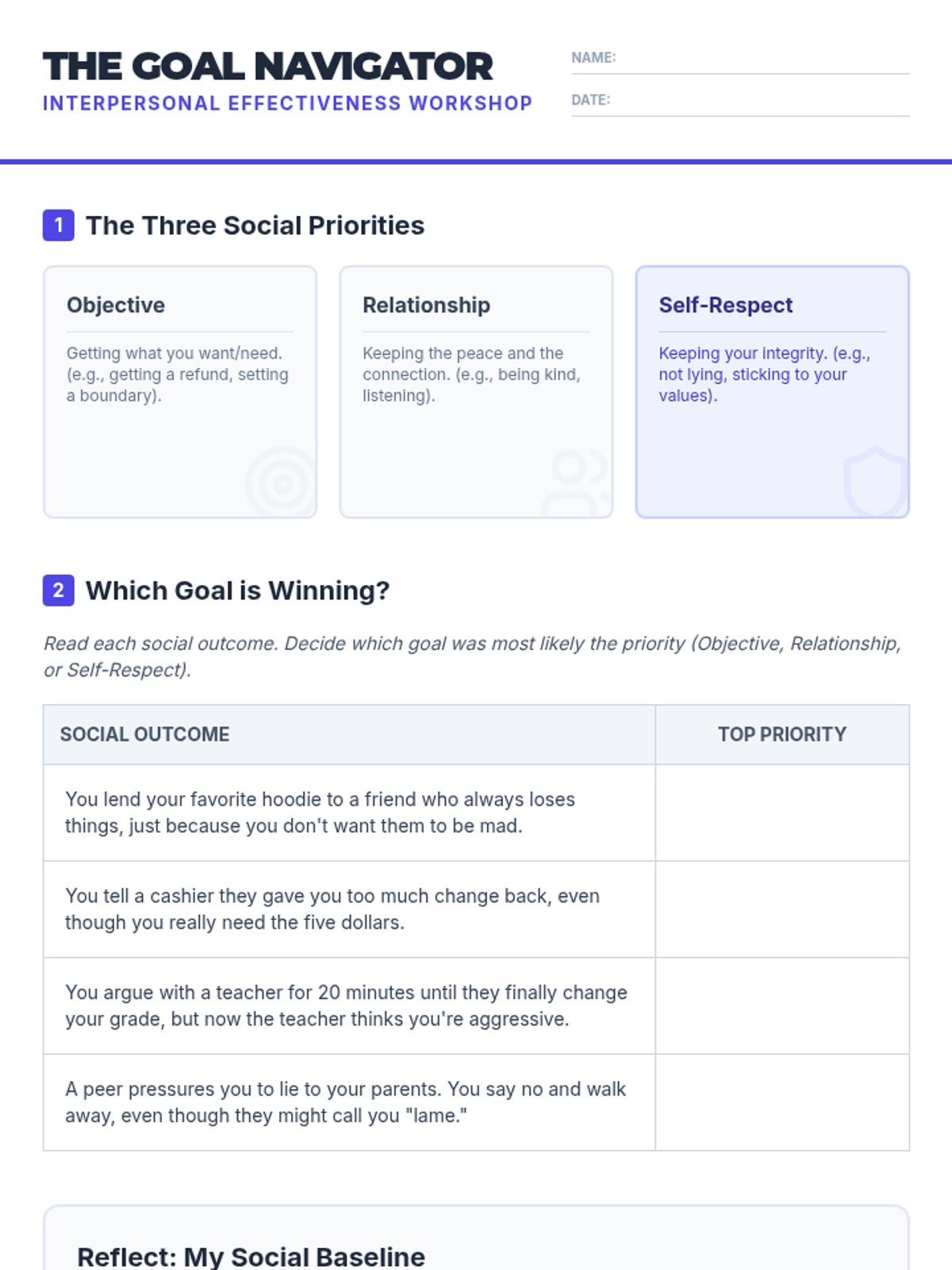
A worksheet for students to categorize social outcomes based on interpersonal goals (Objective, Relationship, Self-Respect).
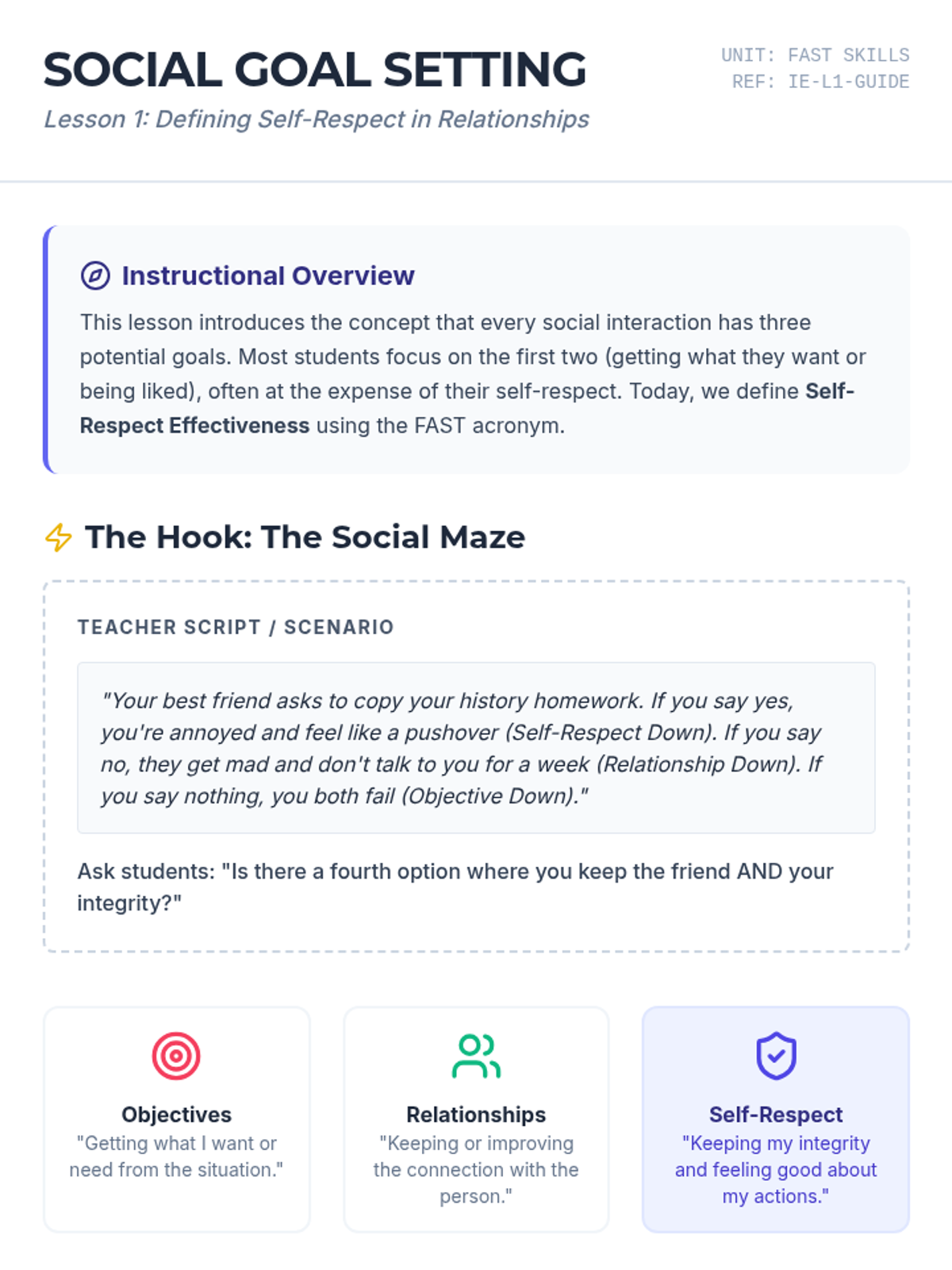
A teacher guide for the first lesson, introducing the three goals of social interactions and the FAST acronym for self-respect.
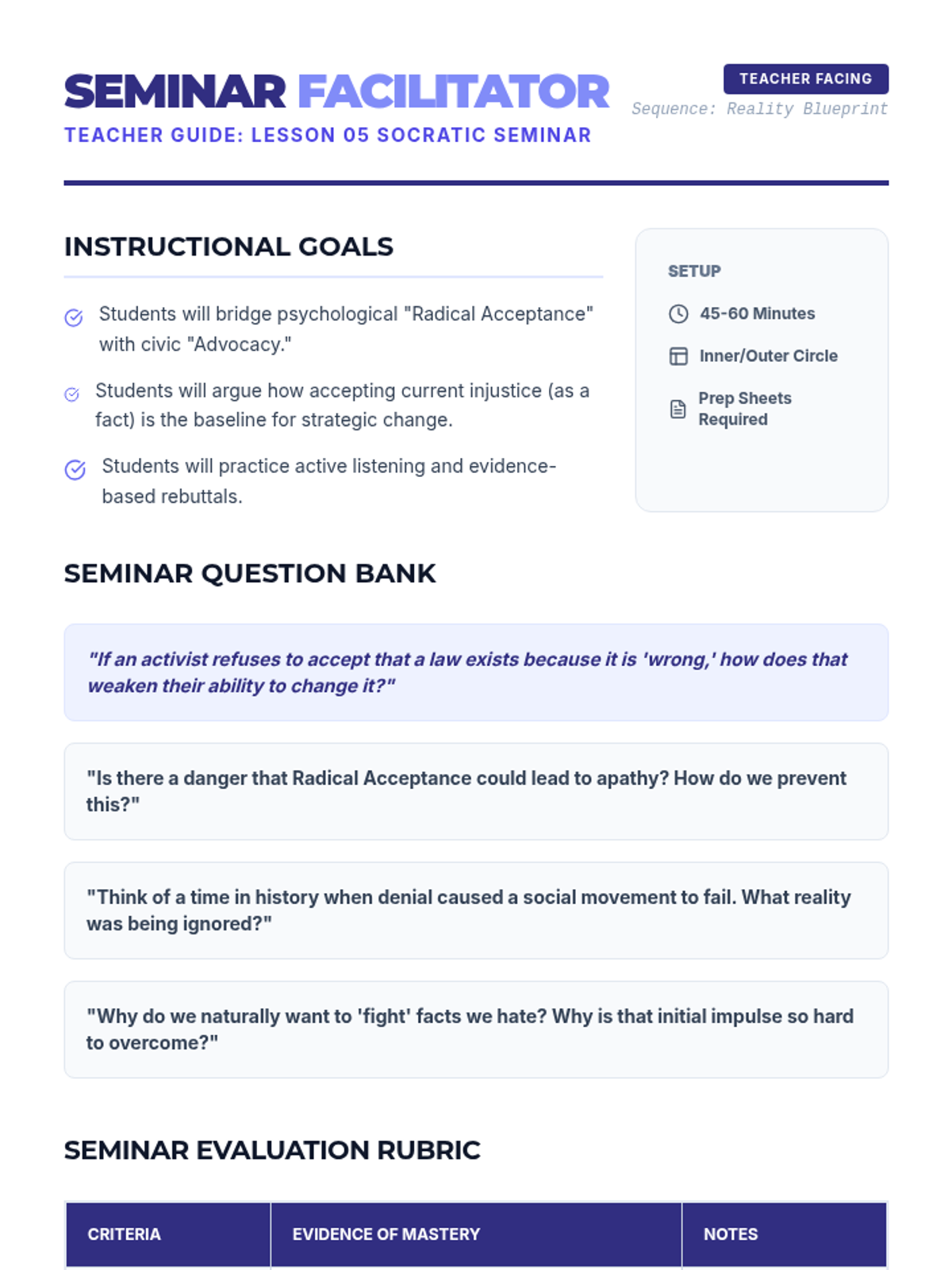
Teacher facilitator guide for the Lesson 5 Socratic Seminar. Includes instructional goals, seminar question bank, and a comprehensive rubric for evaluating student synthesis and discourse skills.
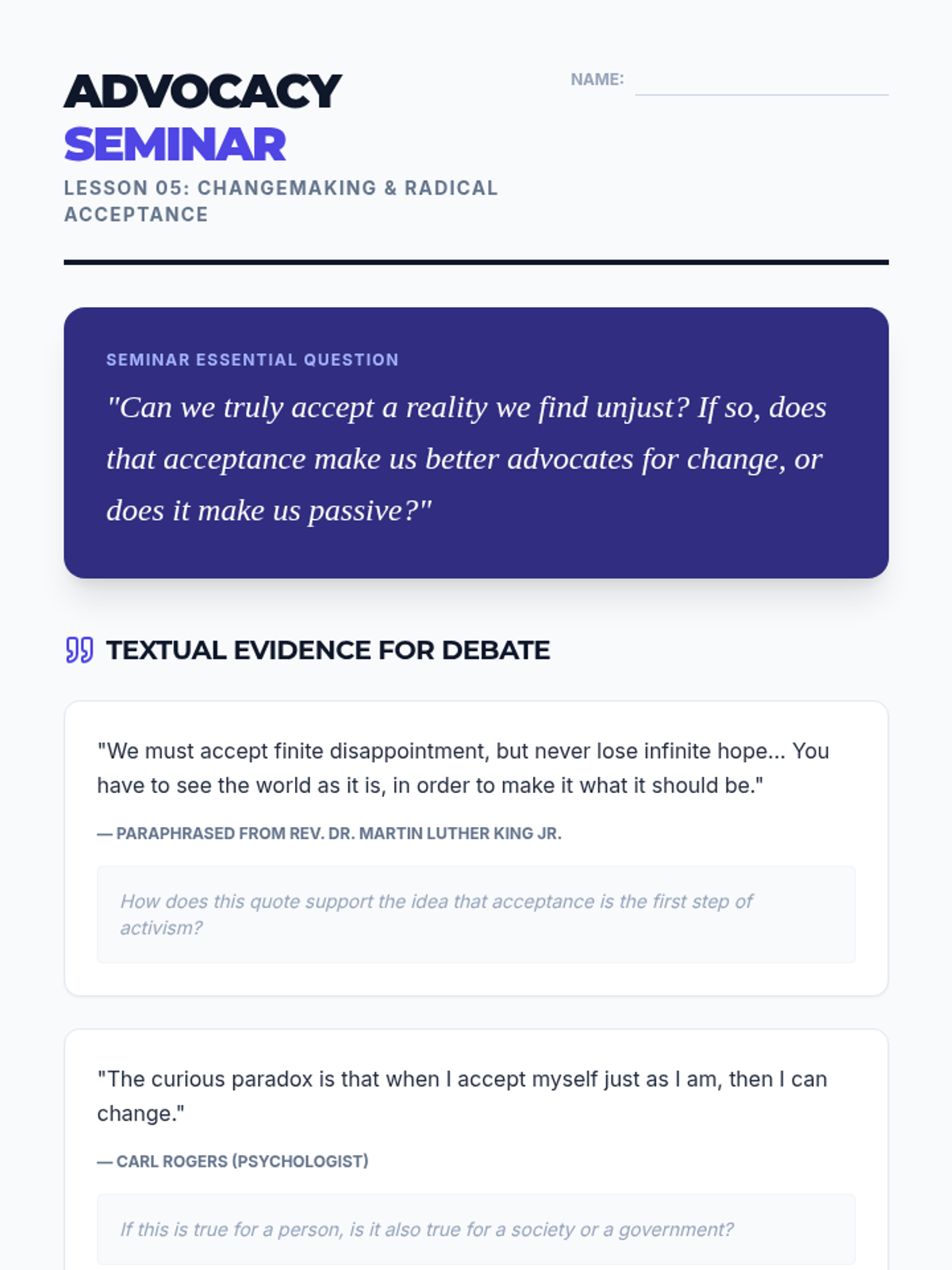
Preparation sheet for the Lesson 5 Socratic Seminar. Includes quotes from leaders and psychologists for analysis, plus a planning section where students apply radical acceptance to a real-world social issue.
A visual presentation exploring assertive communication through 'I' statements and reframing toxic language into neutral, problem-solving requests.
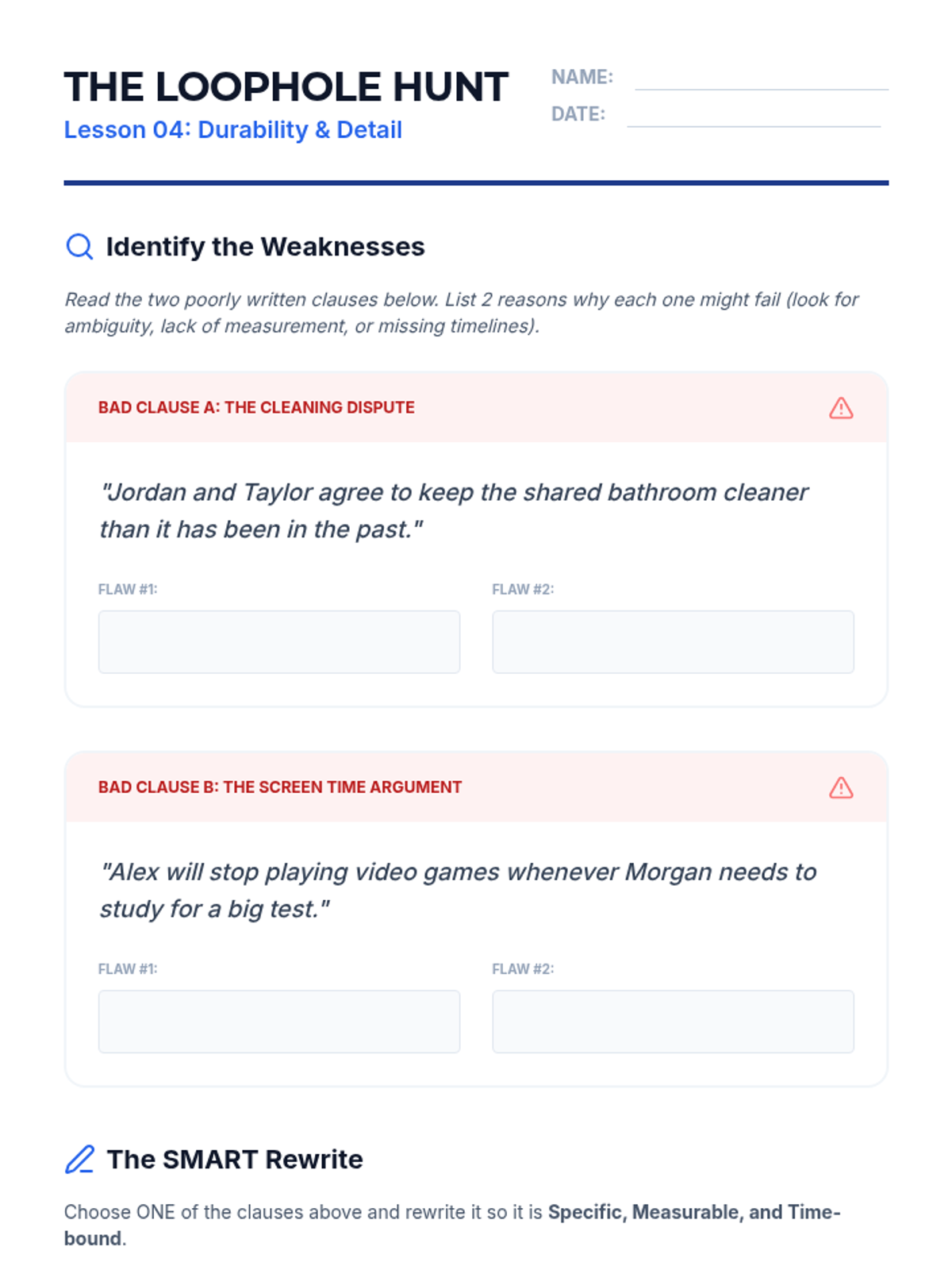
Student worksheet for identifying flaws in poorly written conflict resolution agreements and rewriting them using the SMART framework.
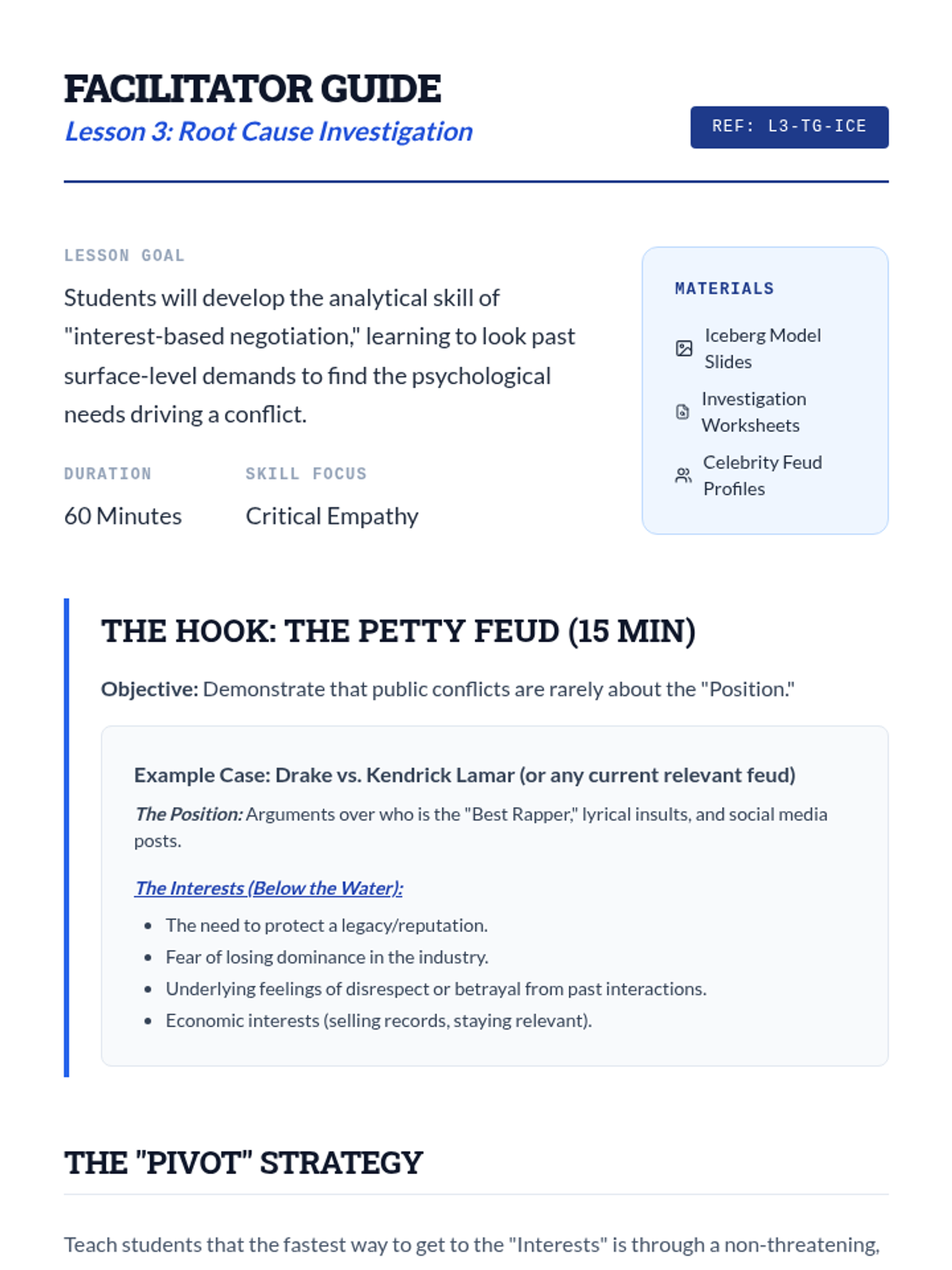
A teacher guide for the Root Cause Investigation lesson, including celebrity conflict examples, a case study answer key, and discussion prompts.
Instructional slide deck for Lesson 4: Drafting Sustainable Agreements. Explains the SMART framework for conflict resolution and the importance of specific clauses and contingency planning.
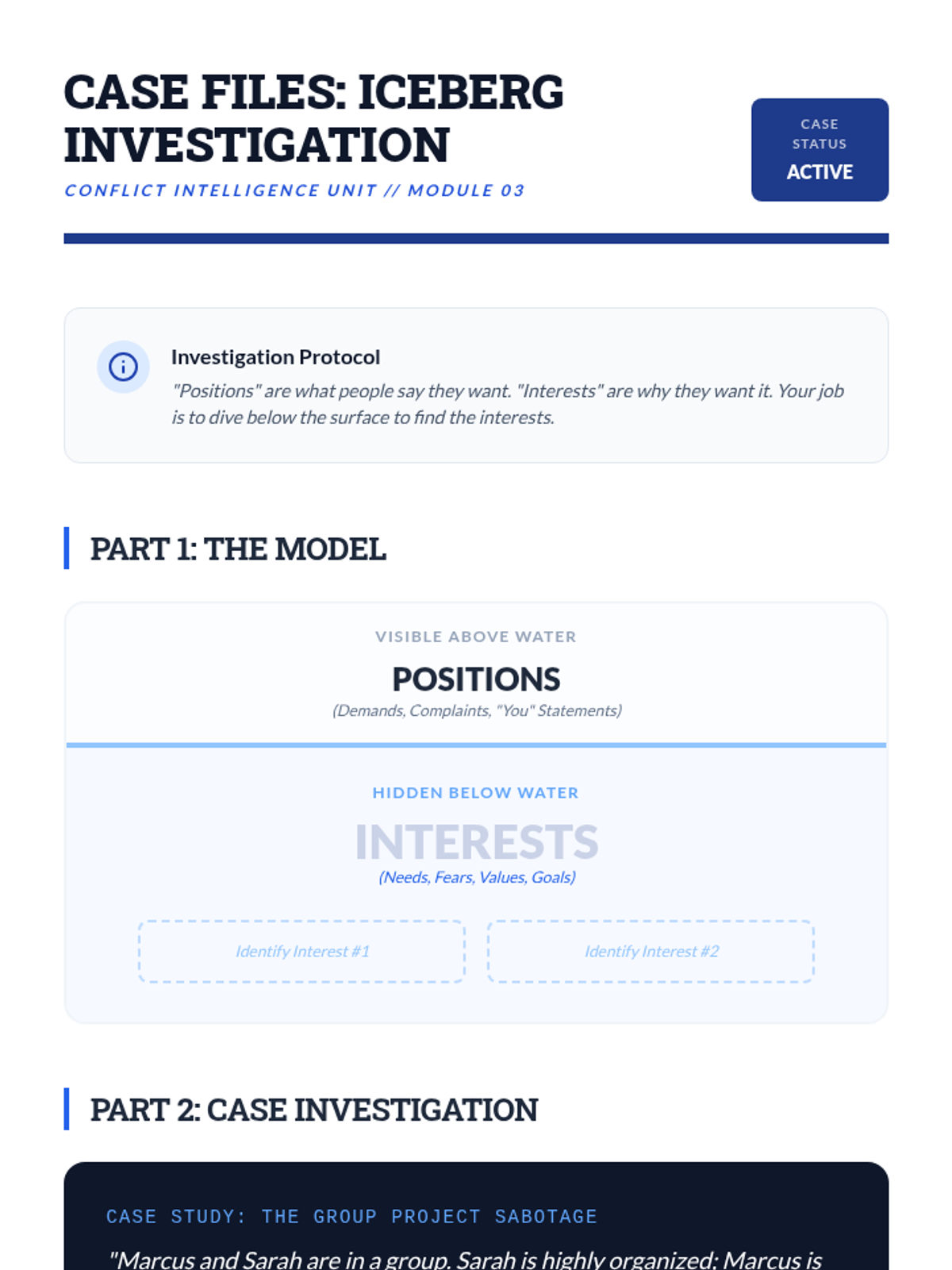
A worksheet for students to apply the Iceberg Model to a conflict case study, identifying surface-level positions and underlying interests.
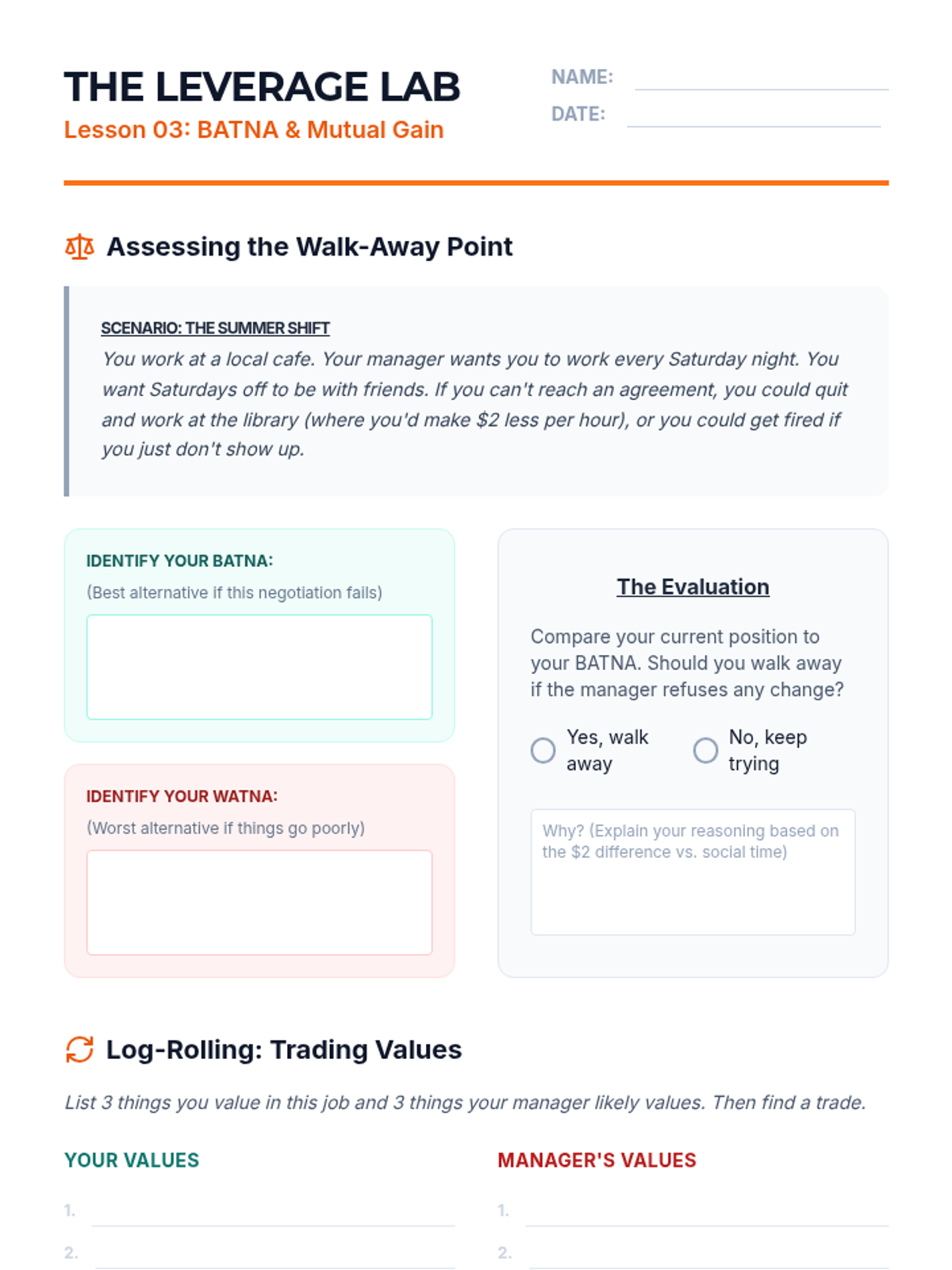
Student worksheet for analyzing BATNA/WATNA and practicing the Log-Rolling technique in a workplace conflict scenario.
A visual presentation exploring the Iceberg Model of conflict, differentiating between surface-level positions and underlying interests.
Instructional slide deck for Lesson 3: Generating Options for Mutual Gain. Explains BATNA/WATNA, brainstorming rules, and the "Log-Rolling" technique for integrative negotiation.
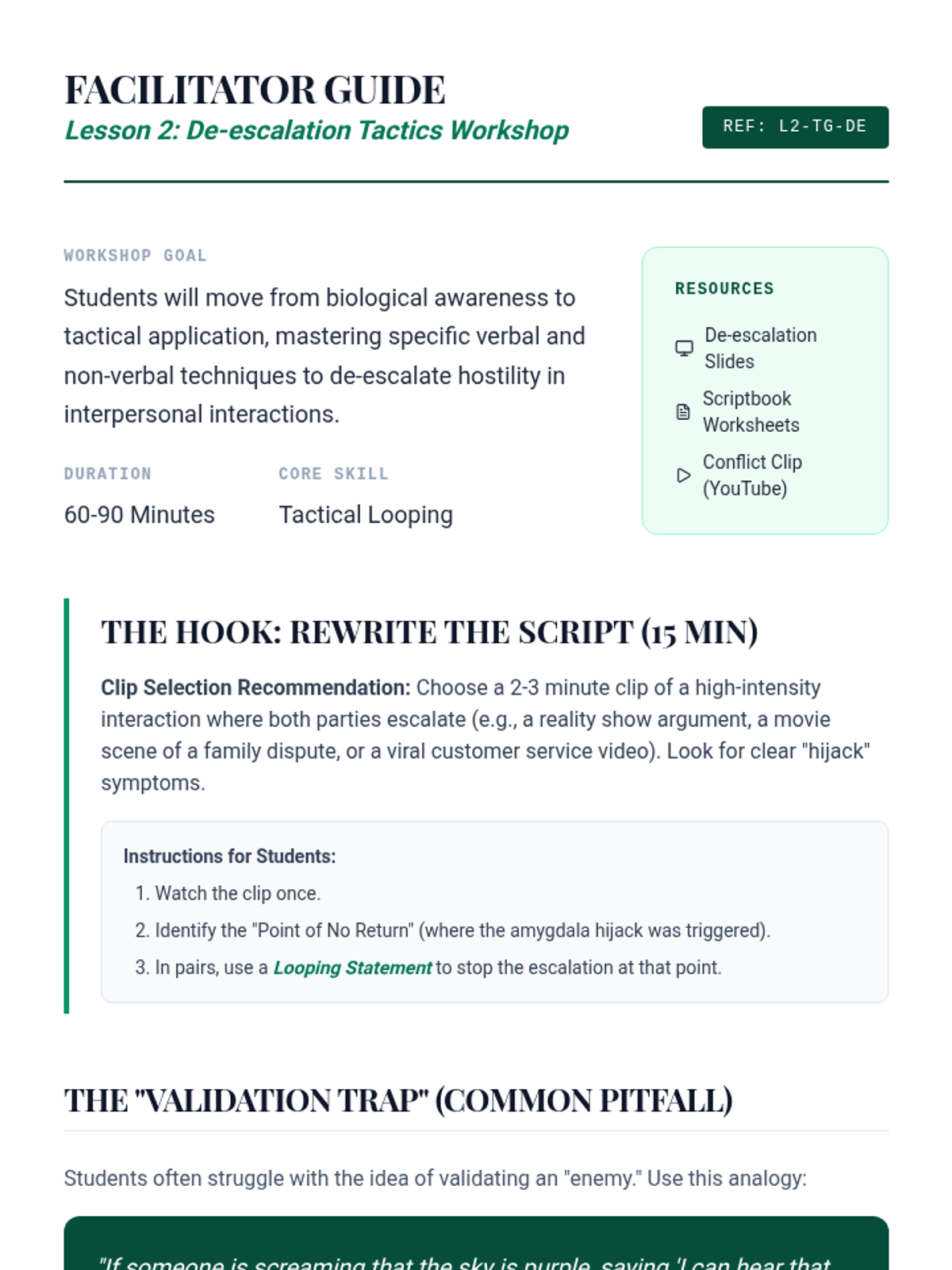
A teacher-facing facilitator guide for the De-escalation Tactics lesson, including role-play scenarios, video selection advice, and a worksheet answer key.
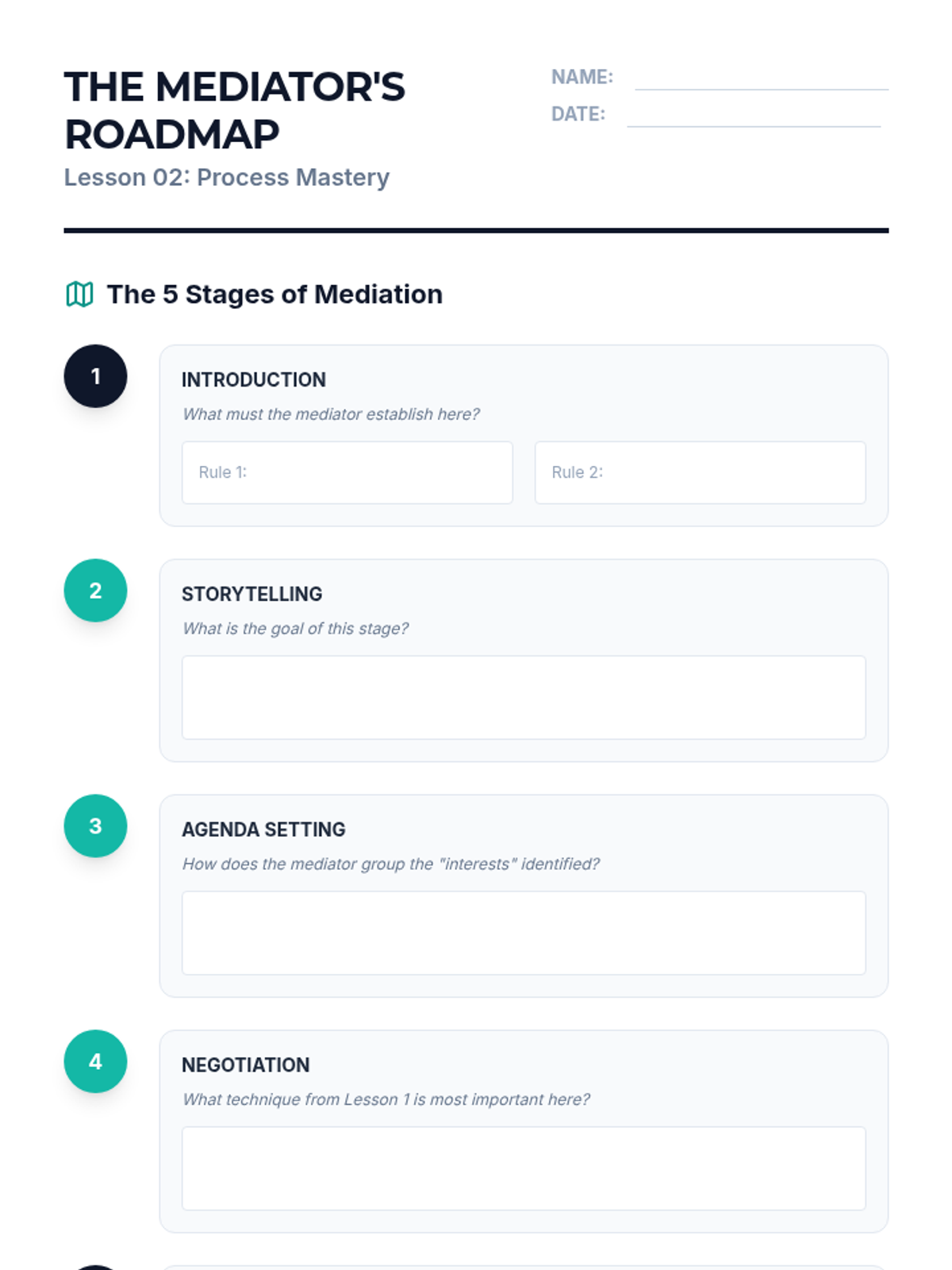
Student worksheet for visualizing the 5 stages of mediation and drafting a professional opening statement. Includes a flowchart and guided scripting area.
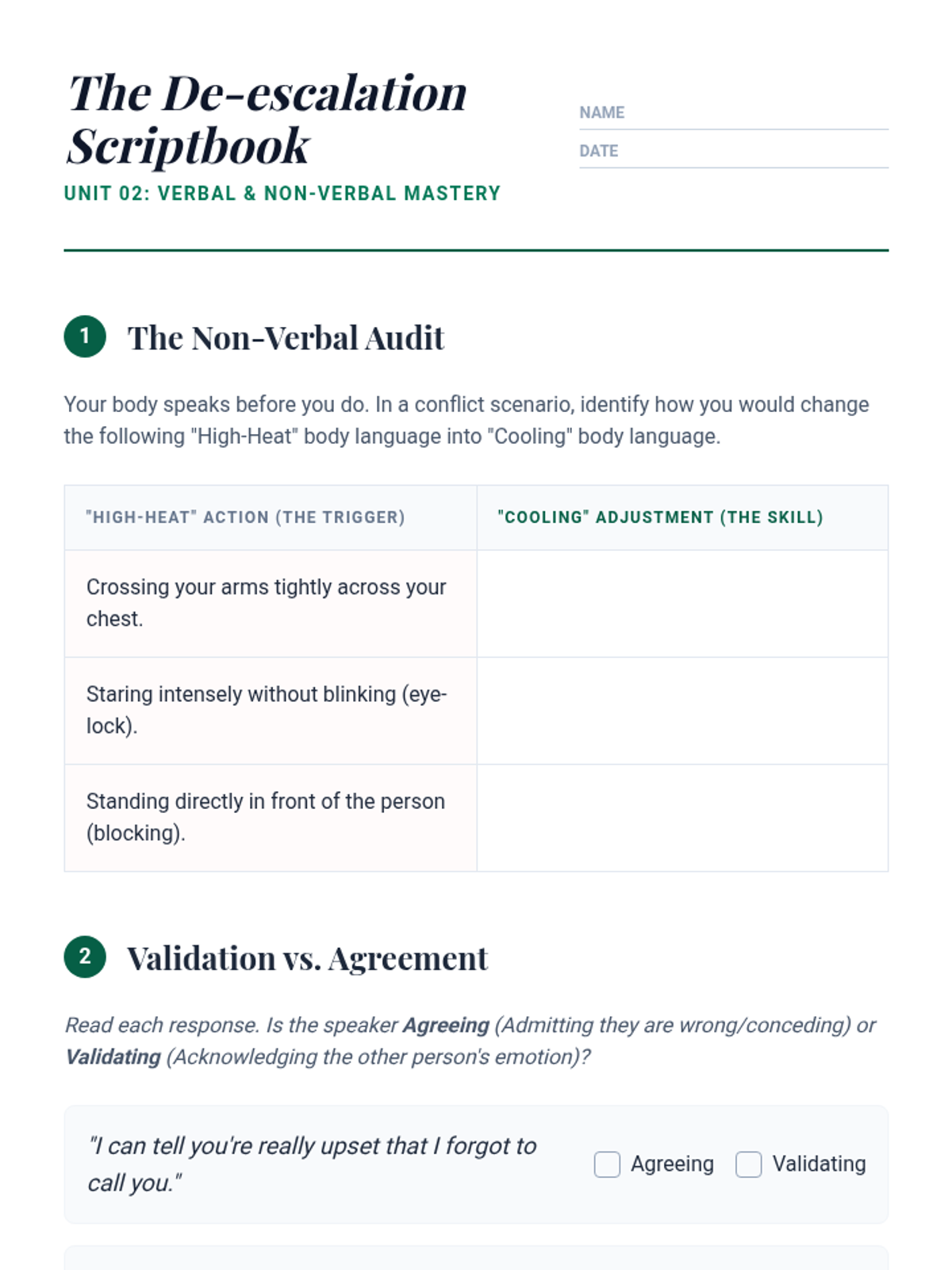
A practice worksheet for students to practice non-verbal de-escalation, differentiate between validation and agreement, and practice the 'looping' technique.