Mindful breathing and body scan meditation techniques integrated with daily self-care routines. Develops strategies for balancing life demands and advocating for personal wellness needs.
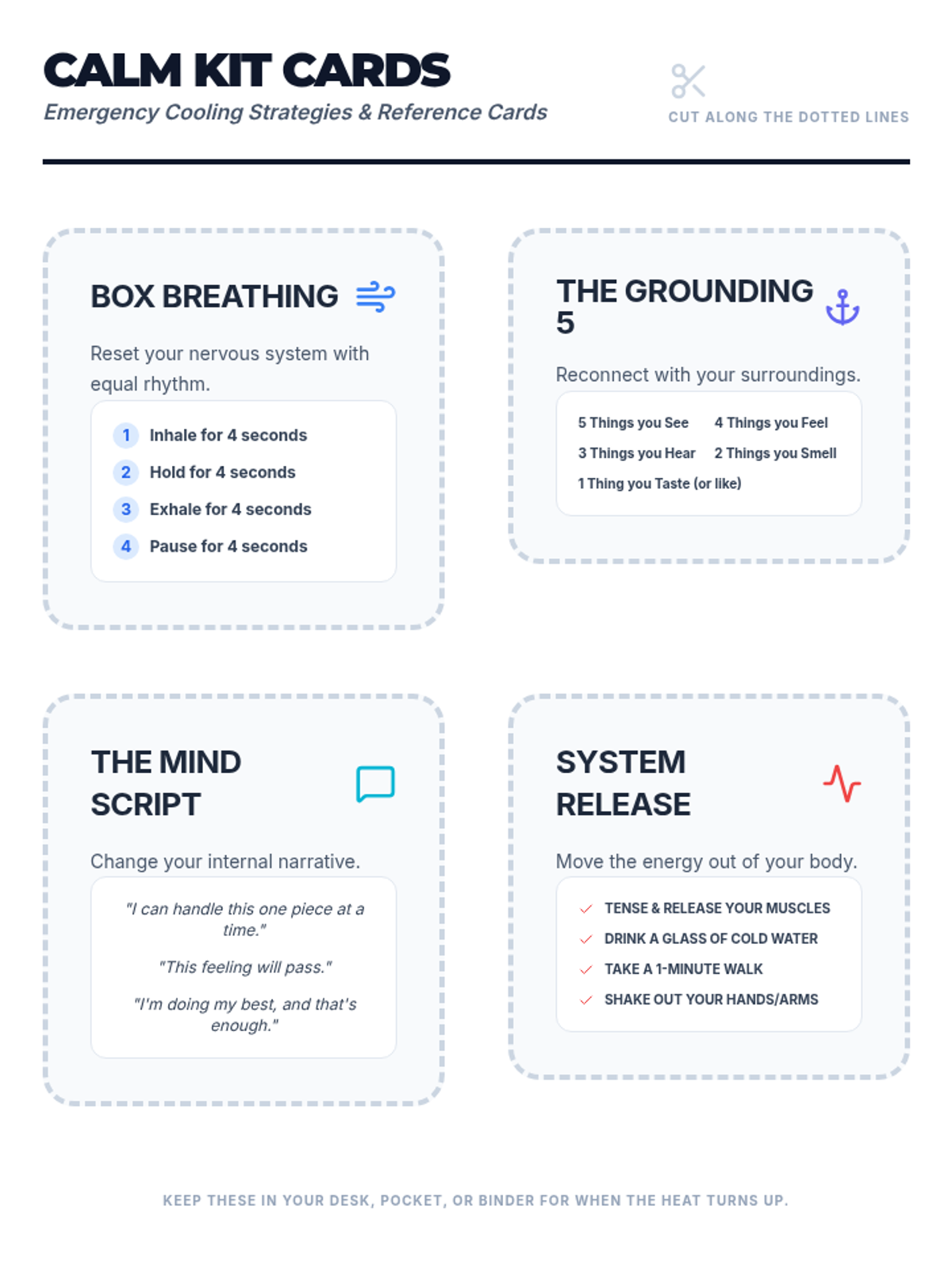
A set of four printable reference cards featuring quick coping techniques: Box Breathing, Grounding 5-4-3-2-1, Mind Scripts, and Physical System Releases.
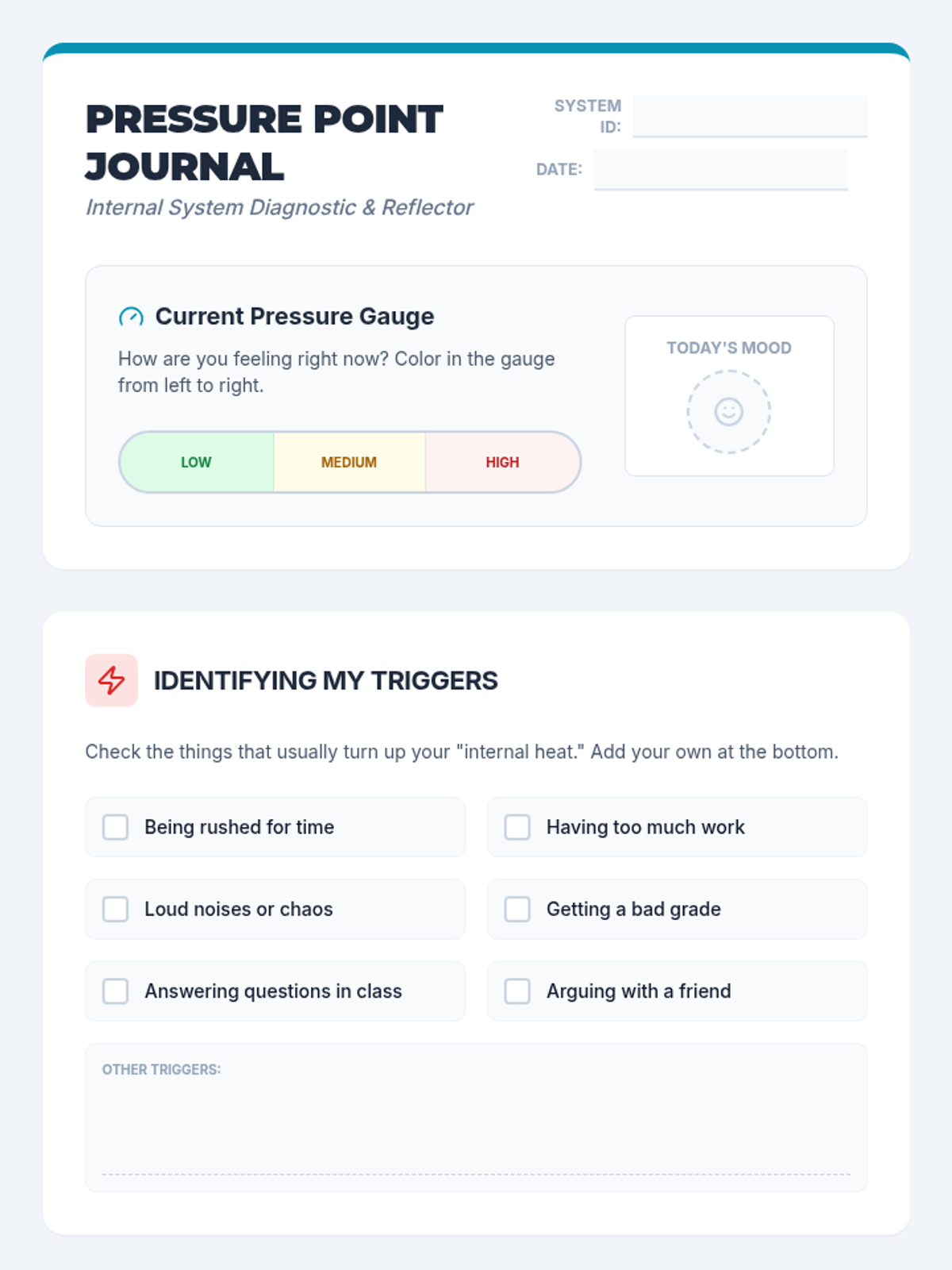
A self-reflection worksheet for students to identify their personal stress triggers, assess their current emotional state using a pressure gauge, and document their preferred coping strategies.
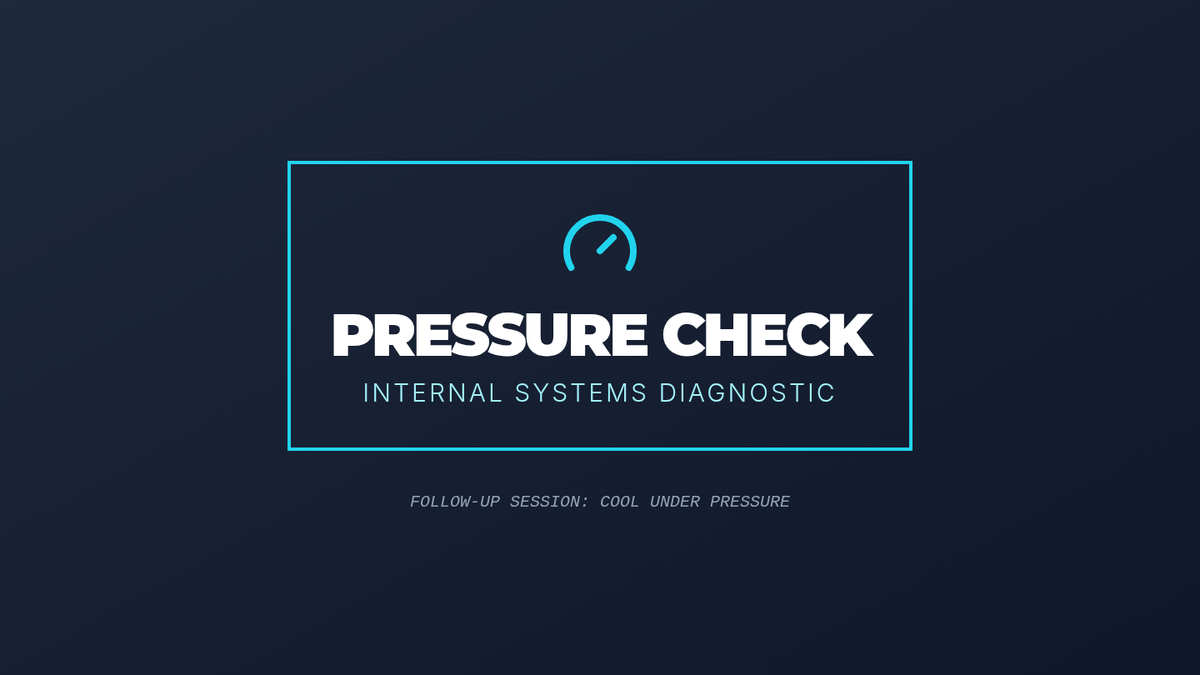
A slide presentation for a check-in session that guides students through identifying current stress levels, recognizing triggers, and reviewing coping techniques.
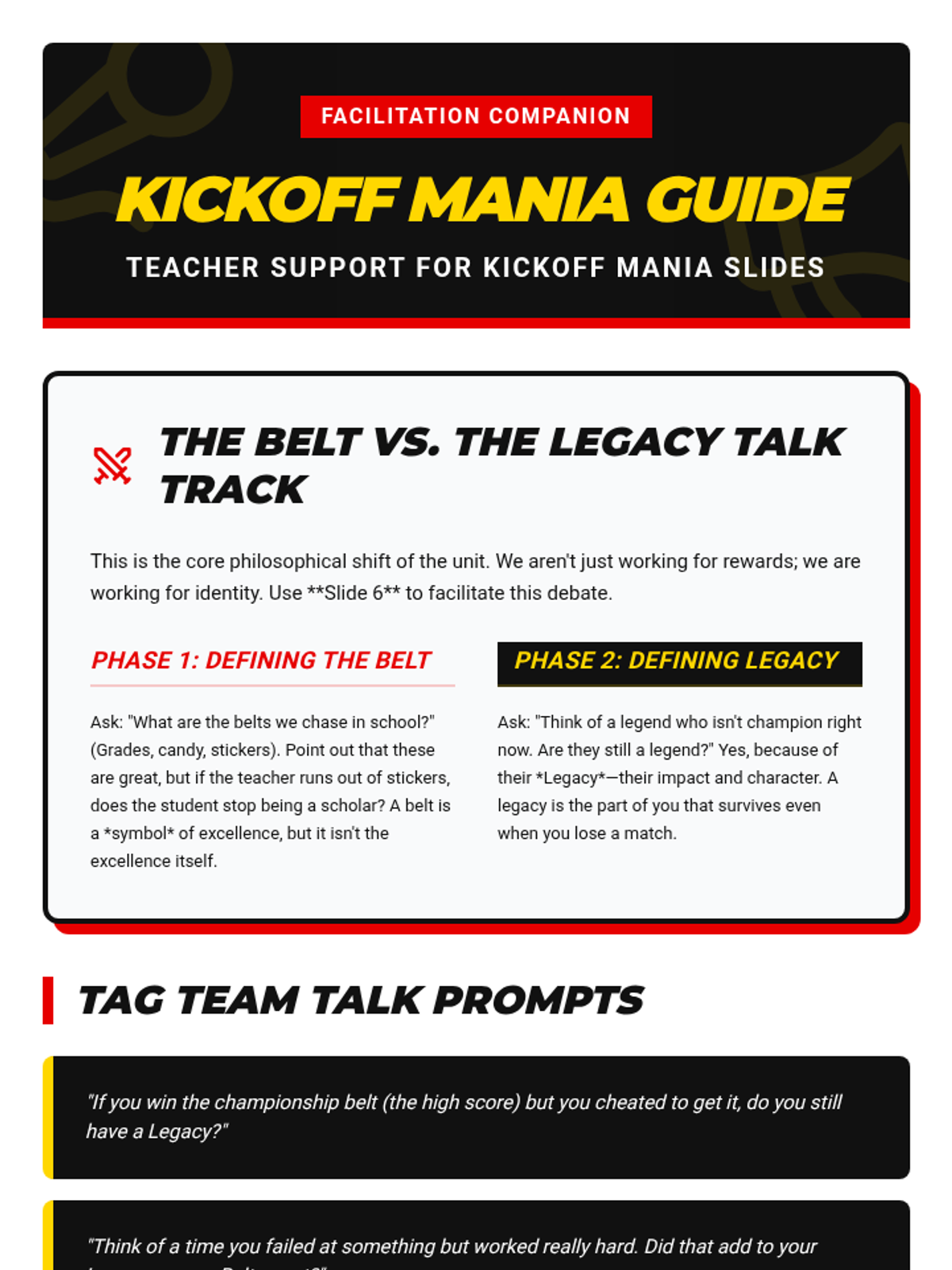
A detailed teacher facilitation companion for the Kickoff Mania slides, providing talk tracks for the 'Belt vs. Legacy' discussion, discussion prompts, and implementation steps for the Ubuntu mission.
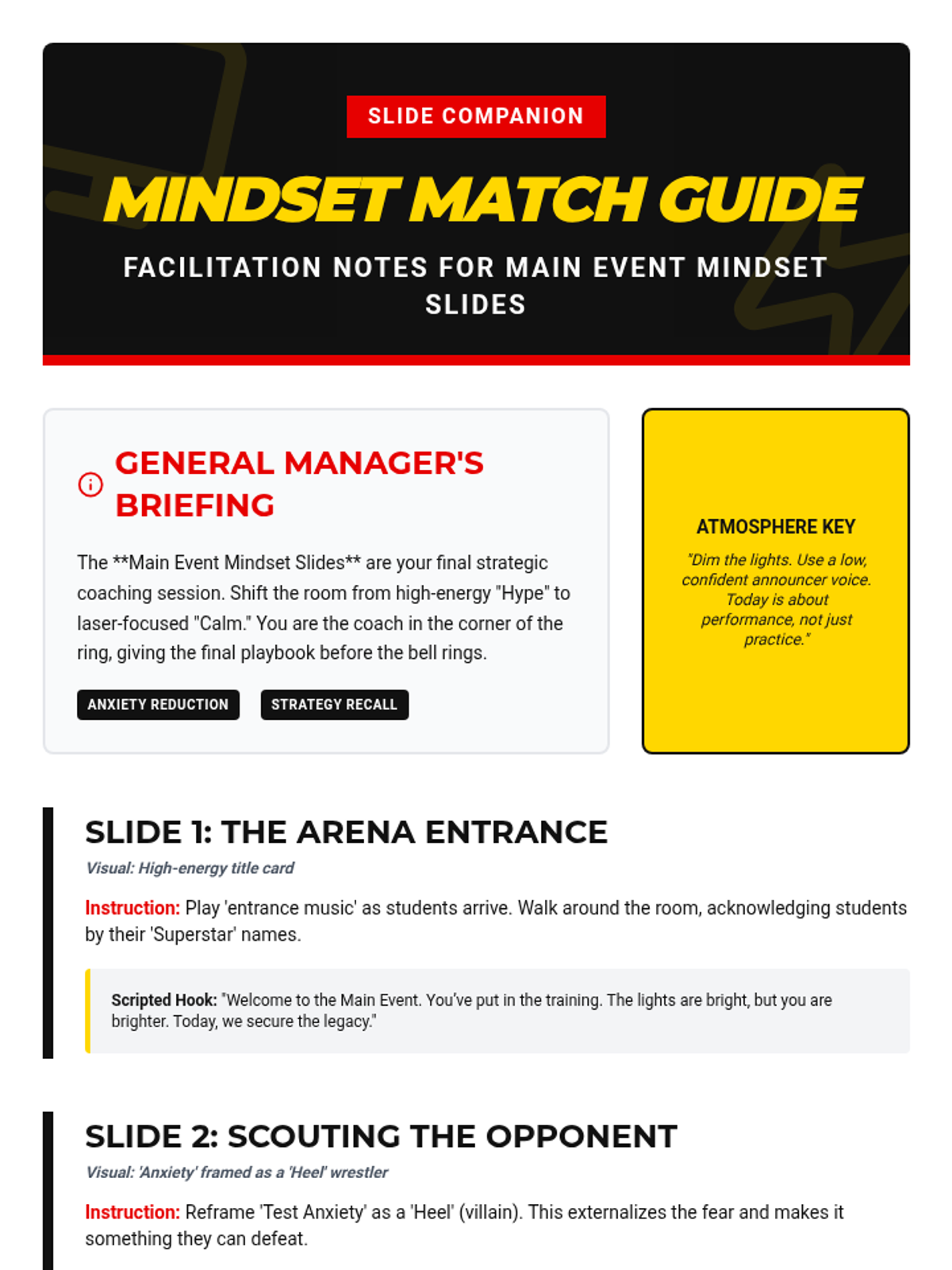
A teacher-facing companion guide for the 'Main Event Mindset' slides, providing slide-by-slide scripts, instructional instructions for managing test anxiety, and post-test decompression strategies.
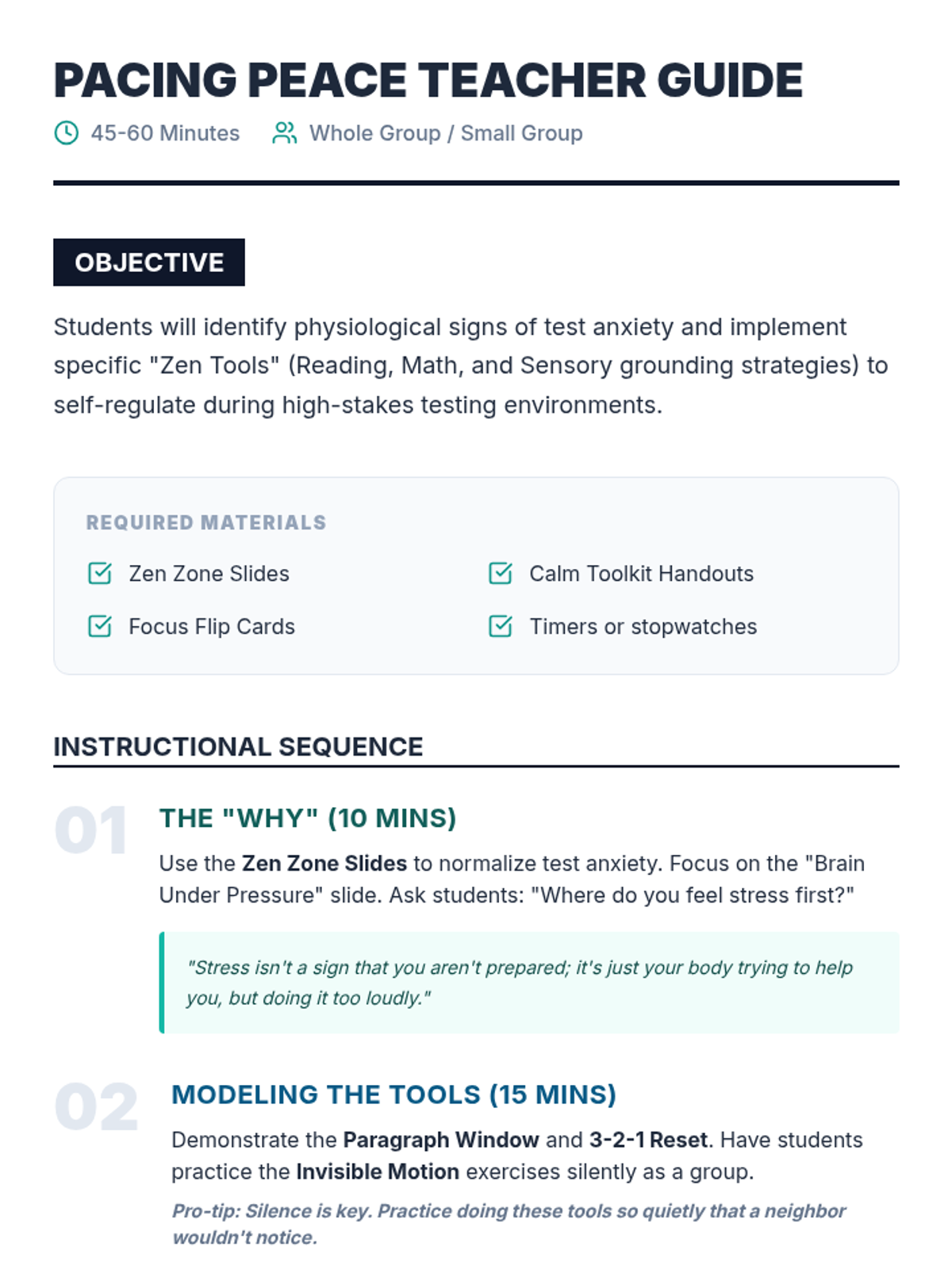
A comprehensive guide for teachers to facilitate the Test Zen lesson, including timing, instructional phases, modeling tips, and differentiation strategies for students with various needs.
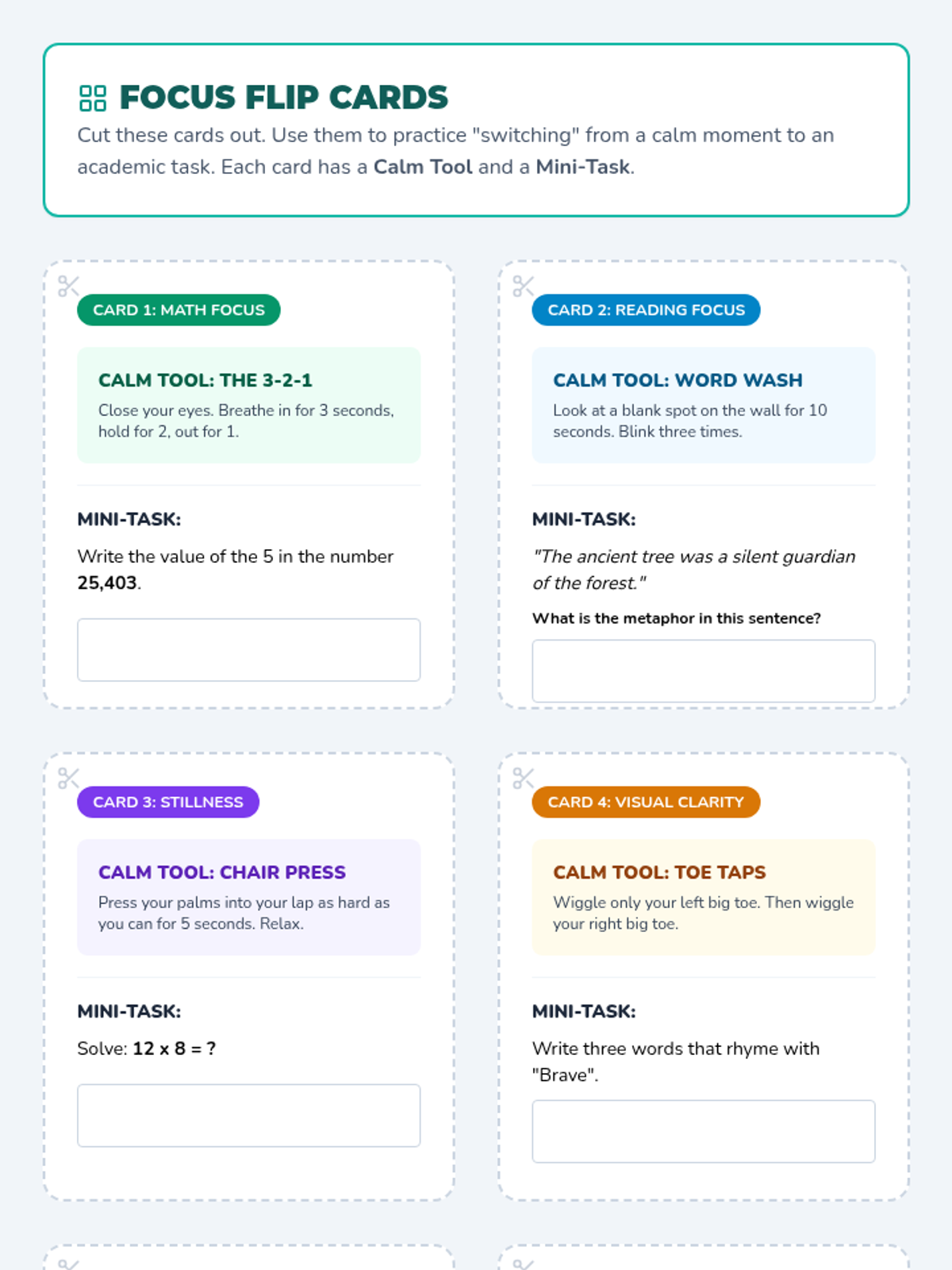
A set of printable task cards that guide students through a mindfulness exercise followed by a brief academic challenge, helping them practice the transition from anxiety to focused work.
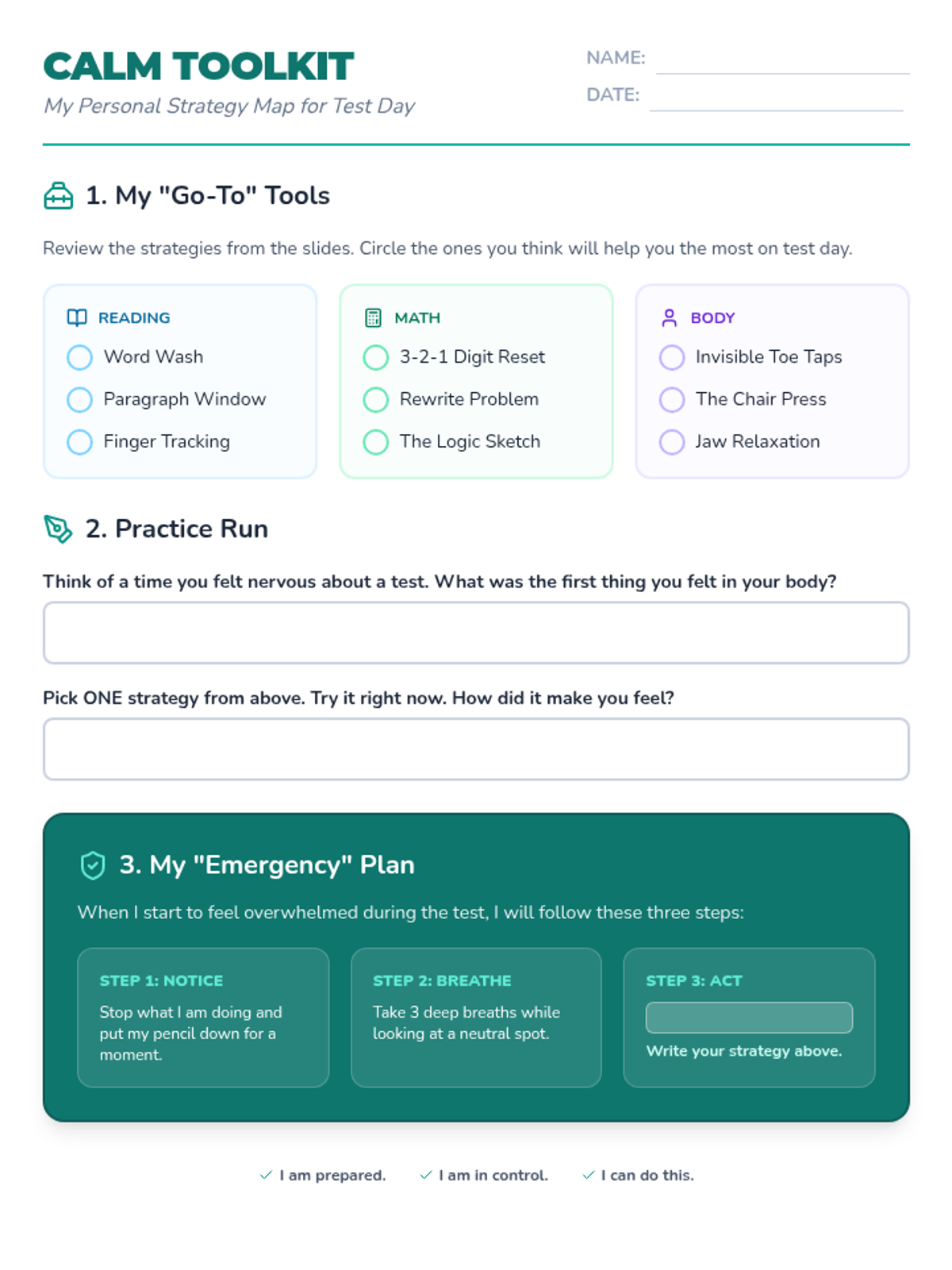
A student worksheet designed to help learners identify and commit to specific anxiety-reduction strategies for testing, including space for reflection and a personalized emergency action plan.
A visually calming slide deck introducing students to specific mindfulness and grounding techniques for testing situations, including strategies for Reading, Math, and physical restlessness.
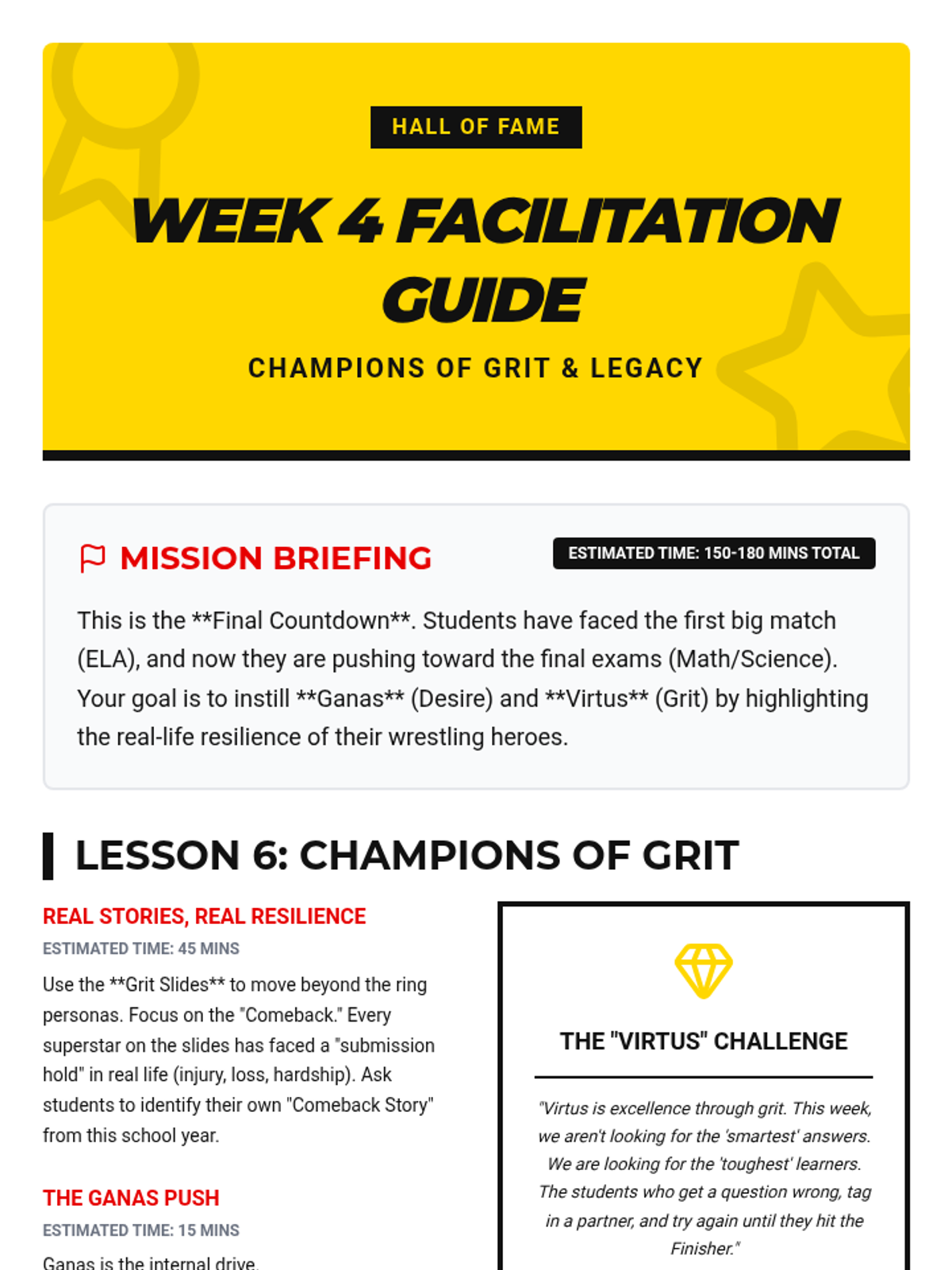
A detailed teacher facilitation guide for Week 4 of the 'Road to State Exam Mania' sequence, focusing on Ganas (drive) and Virtus (grit) for the final exam push and the 'Mania Gala' unit wrap-up.
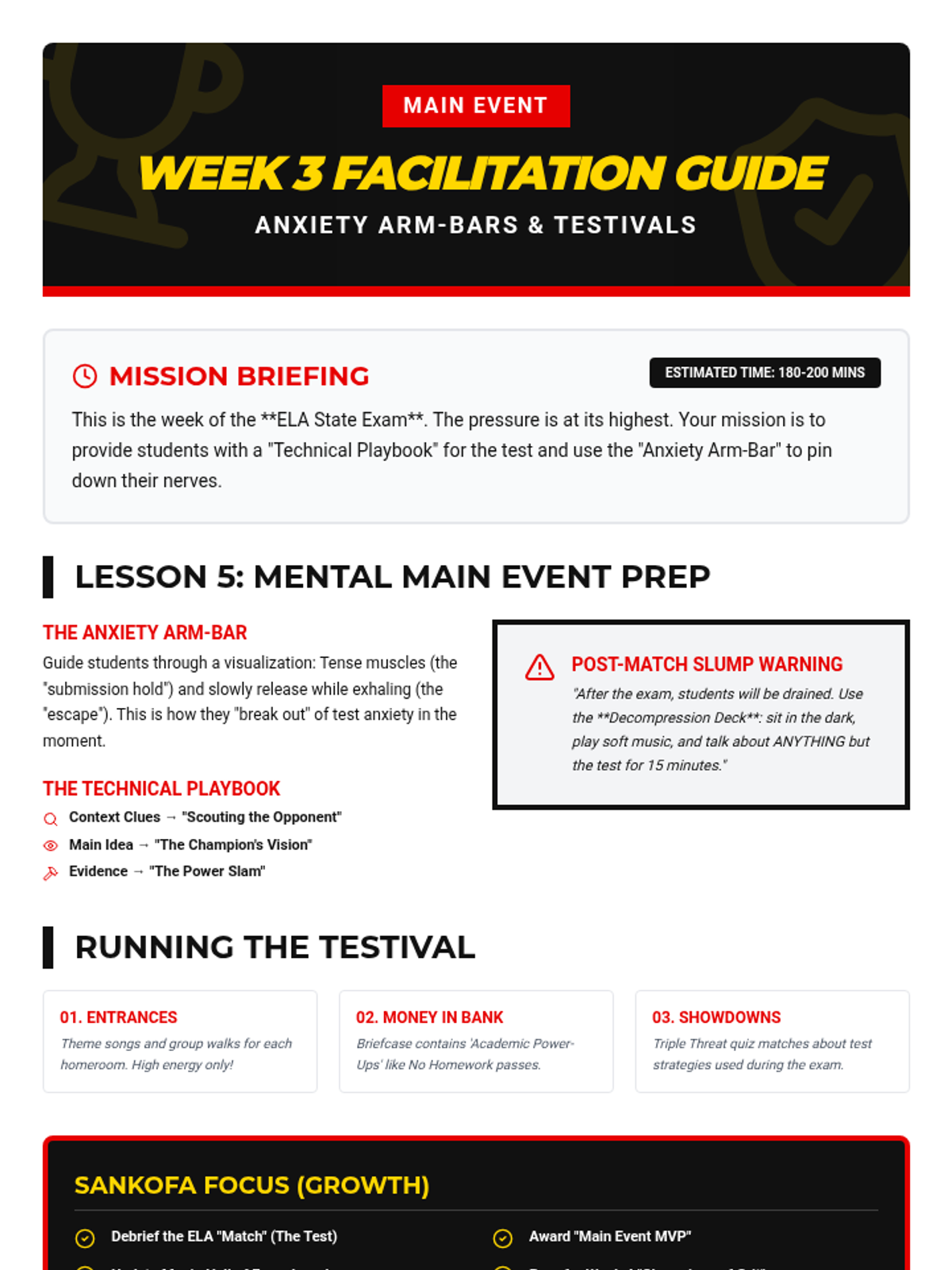
A detailed teacher facilitation guide for Week 3 of the 'Road to State Exam Mania' sequence, focusing on ELA state exam preparation and the 'Testival' pep rally.
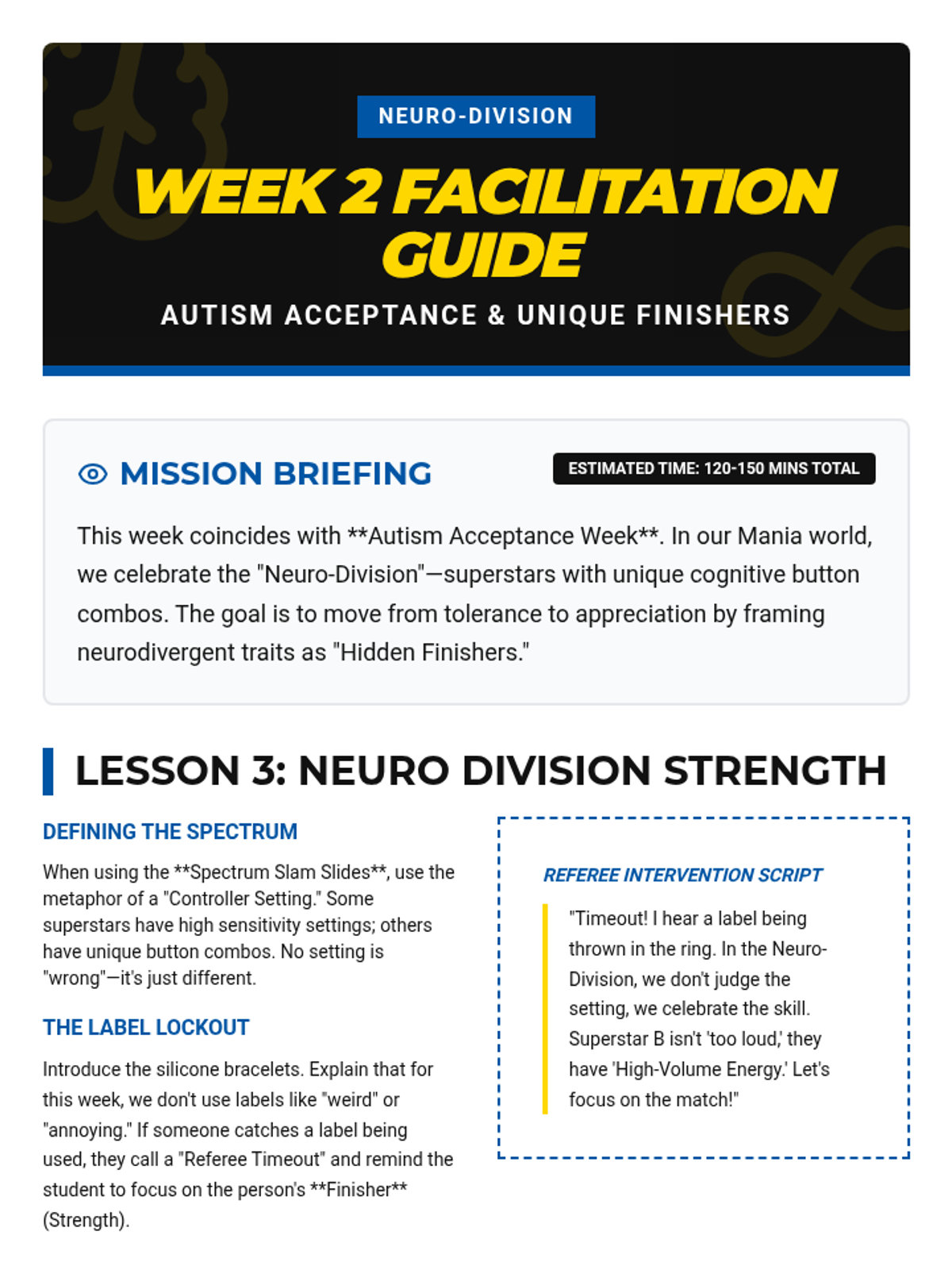
A detailed teacher facilitation guide for Week 2 of the 'Road to State Exam Mania' sequence, focusing on Autism Acceptance Week and celebrating neurodiversity.
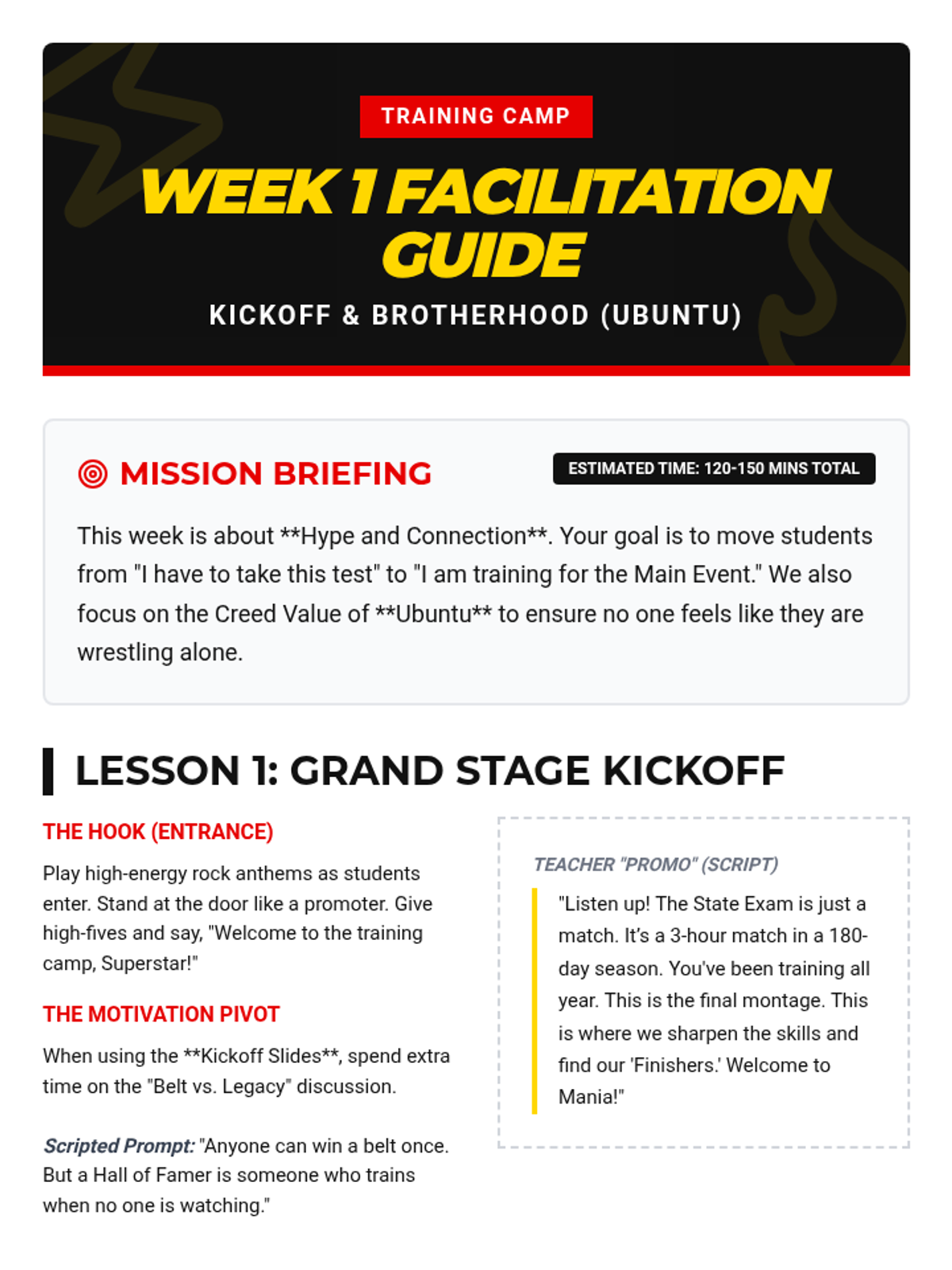
A detailed teacher facilitation guide for Week 1 of the 'Road to State Exam Mania' sequence, focusing on kickoff motivation and the Creed Value of Ubuntu.
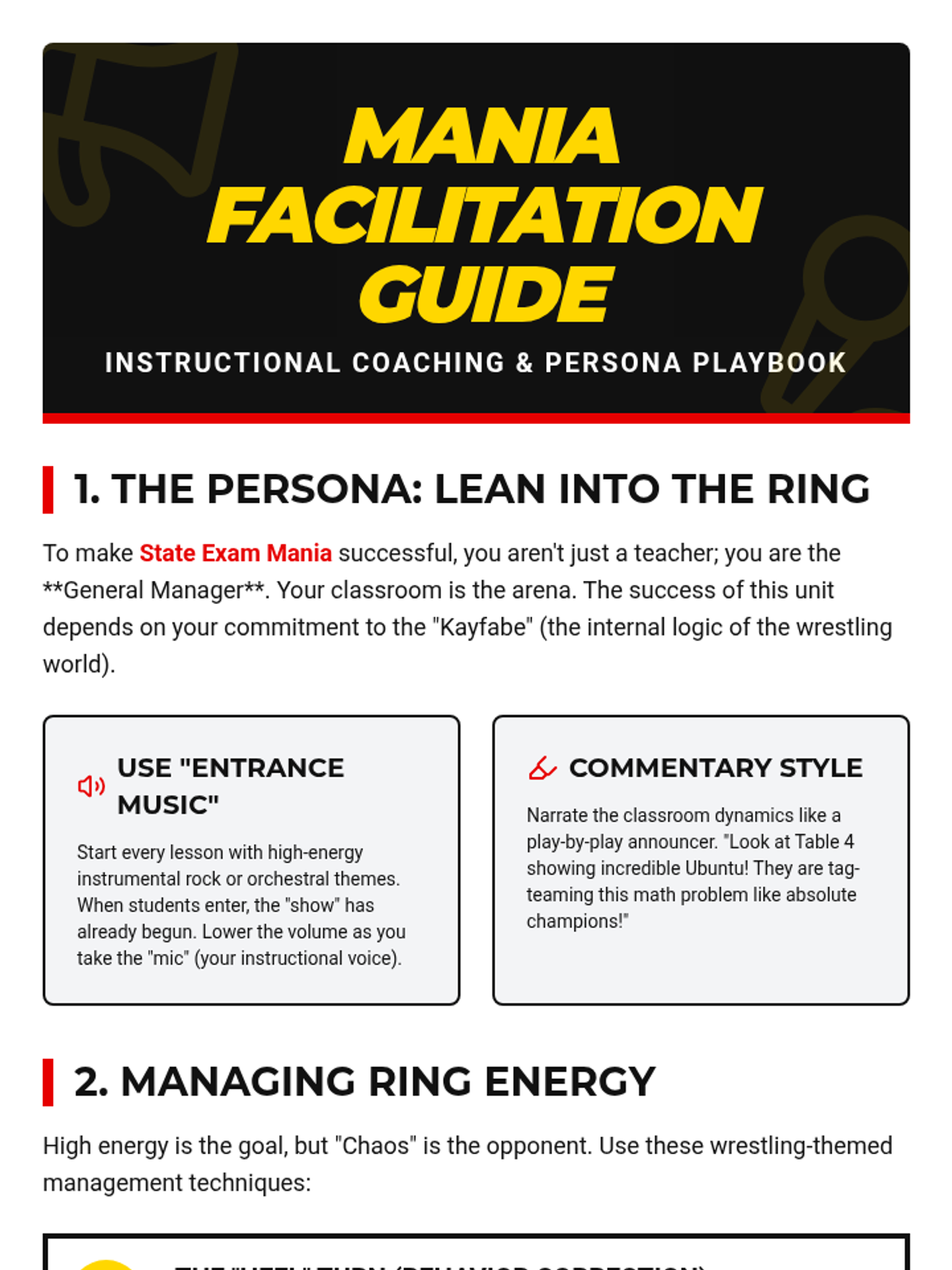
A comprehensive teacher facilitation guide for the 'Road to State Exam Mania' sequence, featuring persona coaching, behavior management strategies (using wrestling metaphors), lesson-specific tips, and a bank of discussion questions.
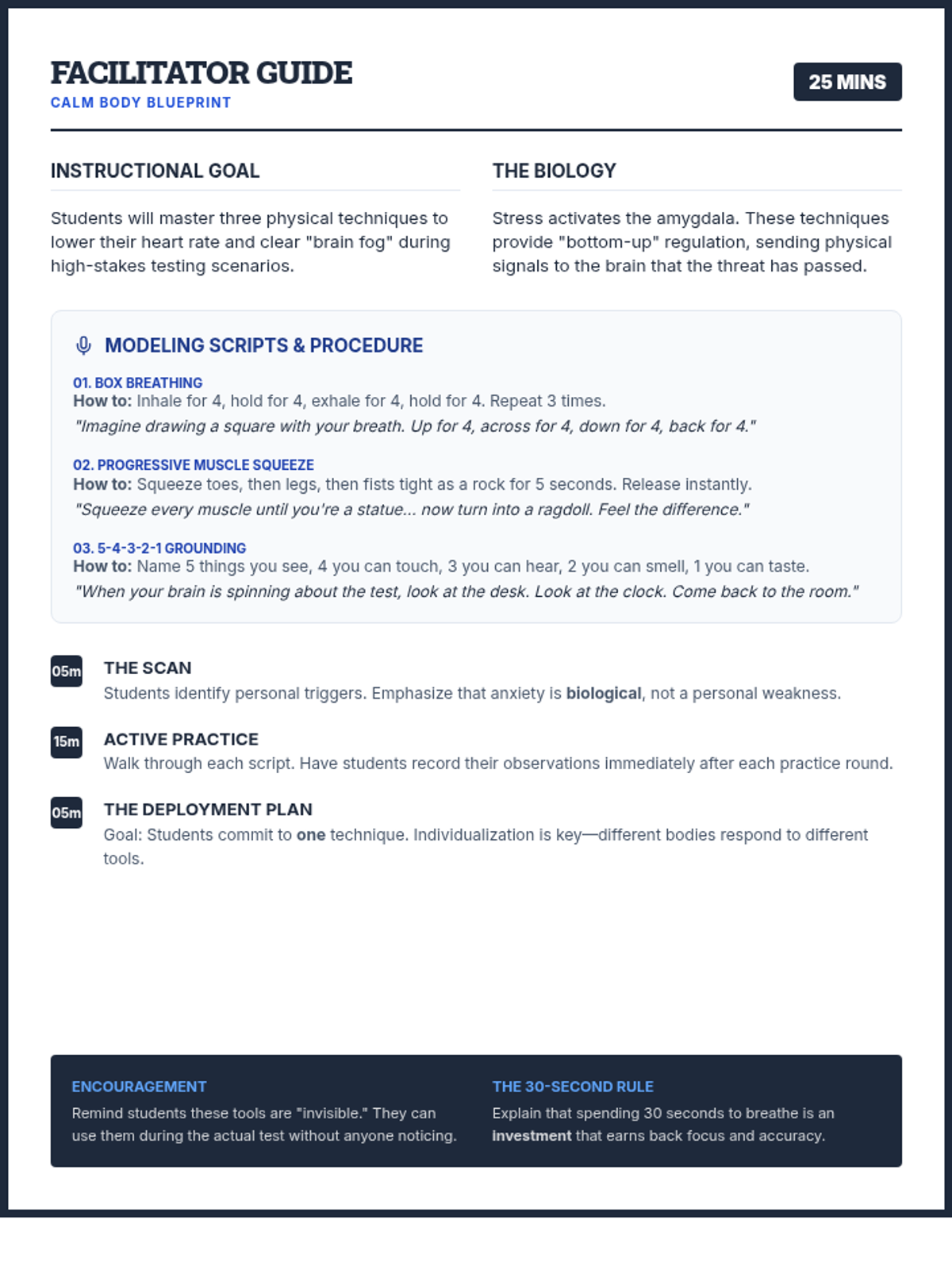
A facilitation guide for teachers to lead the 'Calm Body Blueprint' lesson. Includes scientific background on anxiety, step-by-step instructions for leading physical relaxation techniques, and tips for addressing common student misconceptions.
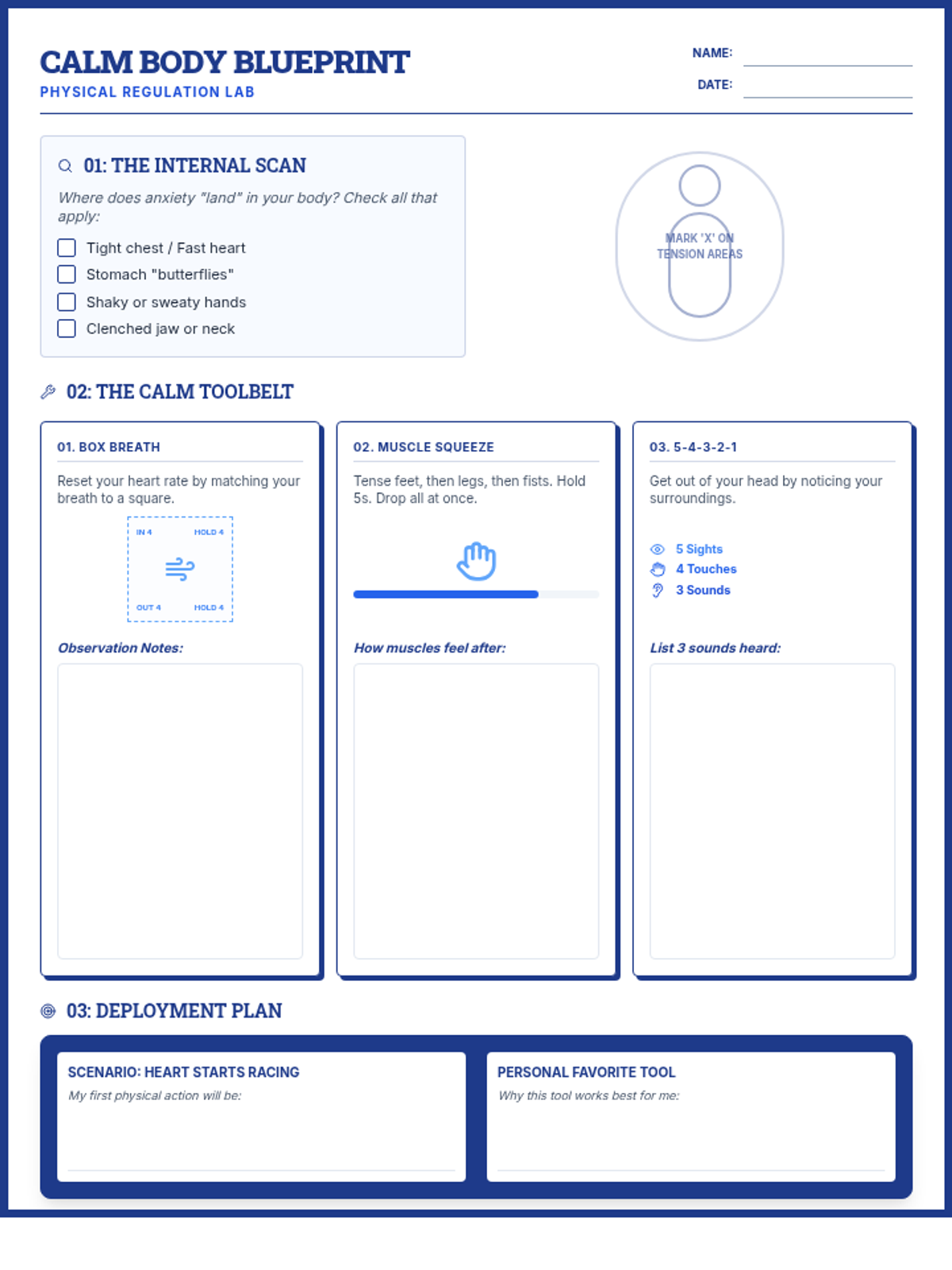
A student worksheet designed with a technical 'blueprint' theme to help students identify physical symptoms of anxiety and practice three relaxation techniques. Includes space for self-reflection and a deployment plan for testing scenarios.
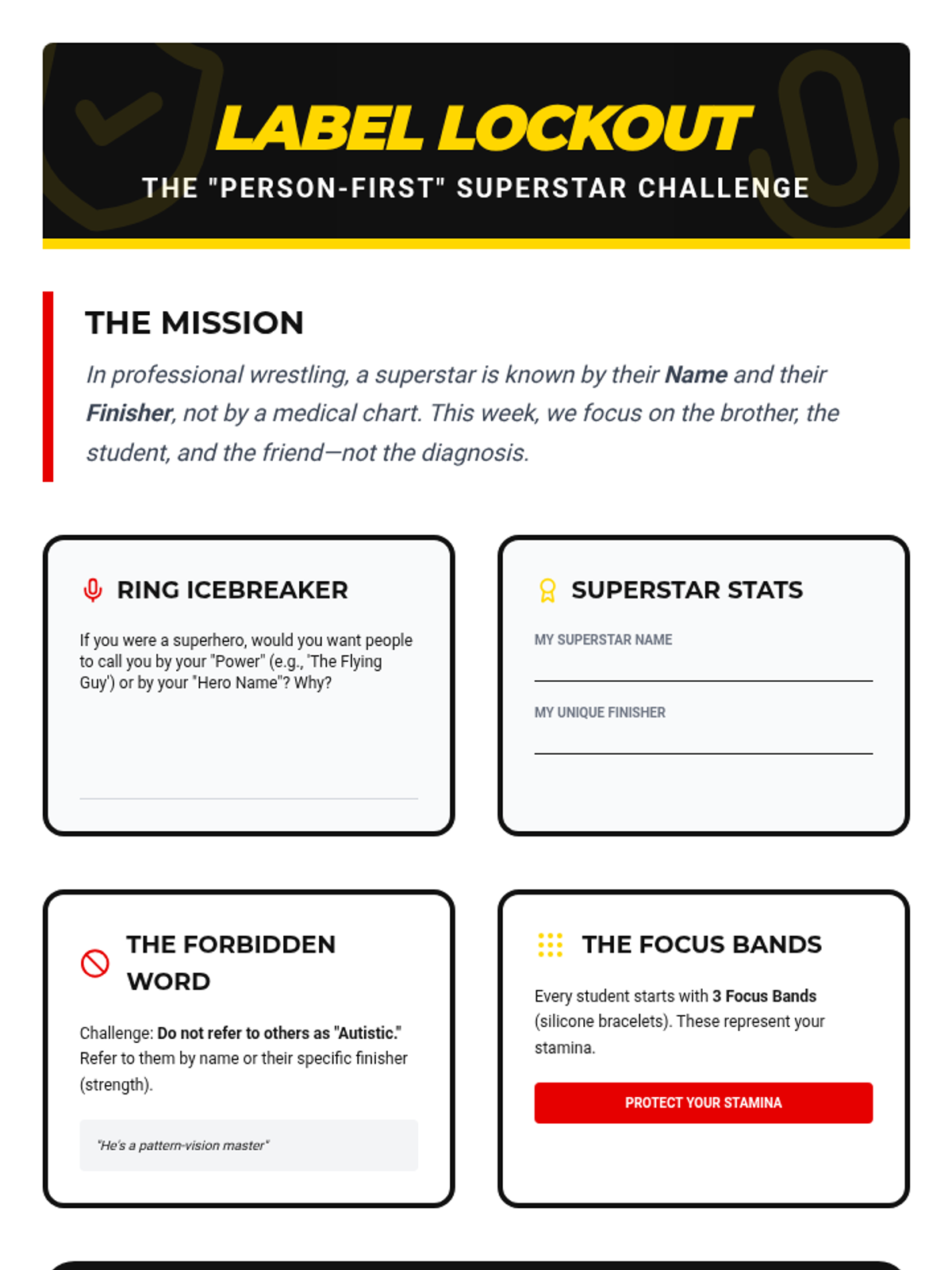
A week-long challenge guide where students avoid labels like 'autistic' to focus on individual strengths, using silicone bracelets as tokens in a 'Referee' style game.
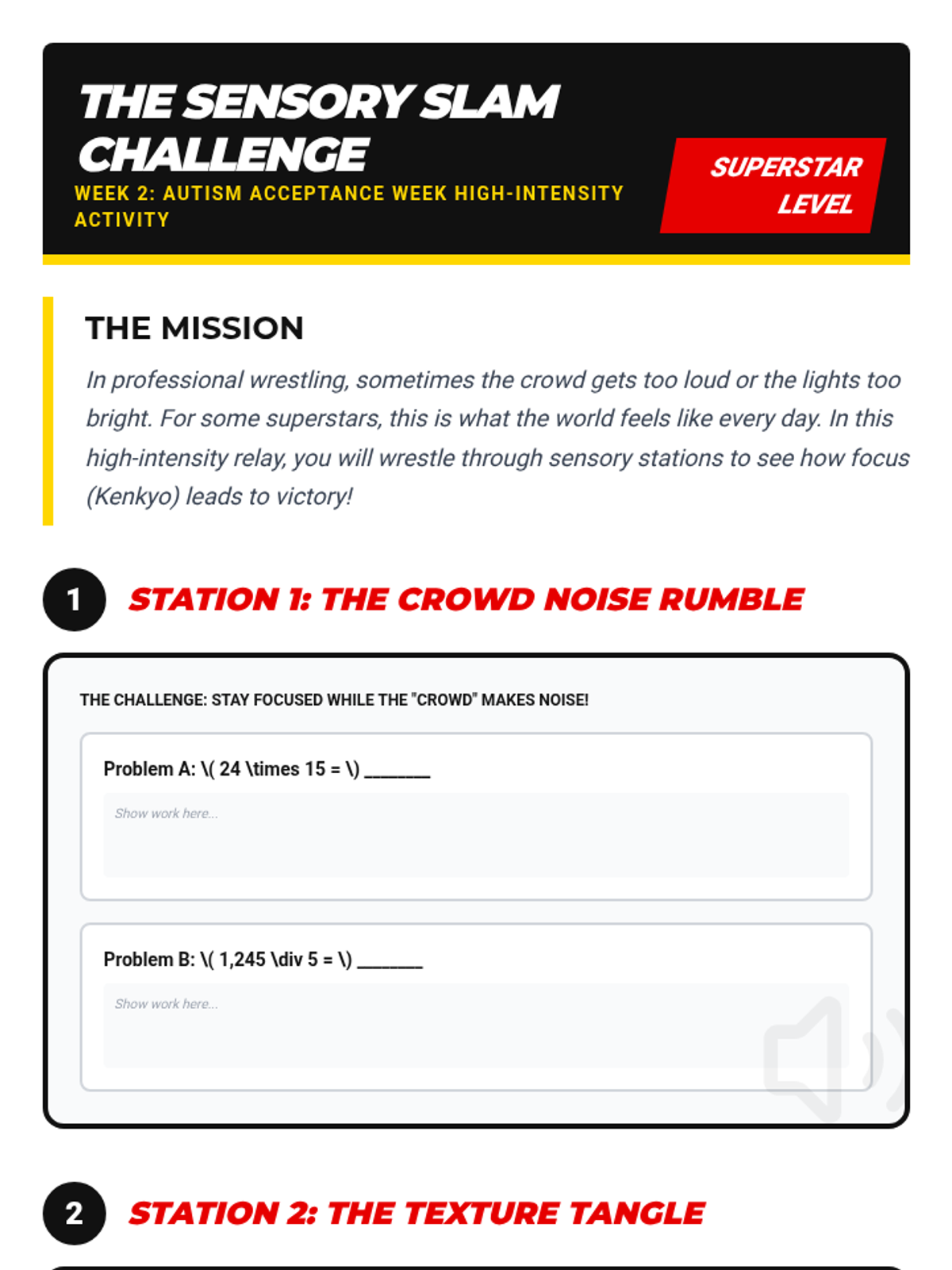
A sensory awareness activity for Autism Acceptance Week that uses high-energy challenges to simulate sensory processing differences and promote inclusive focus strategies.
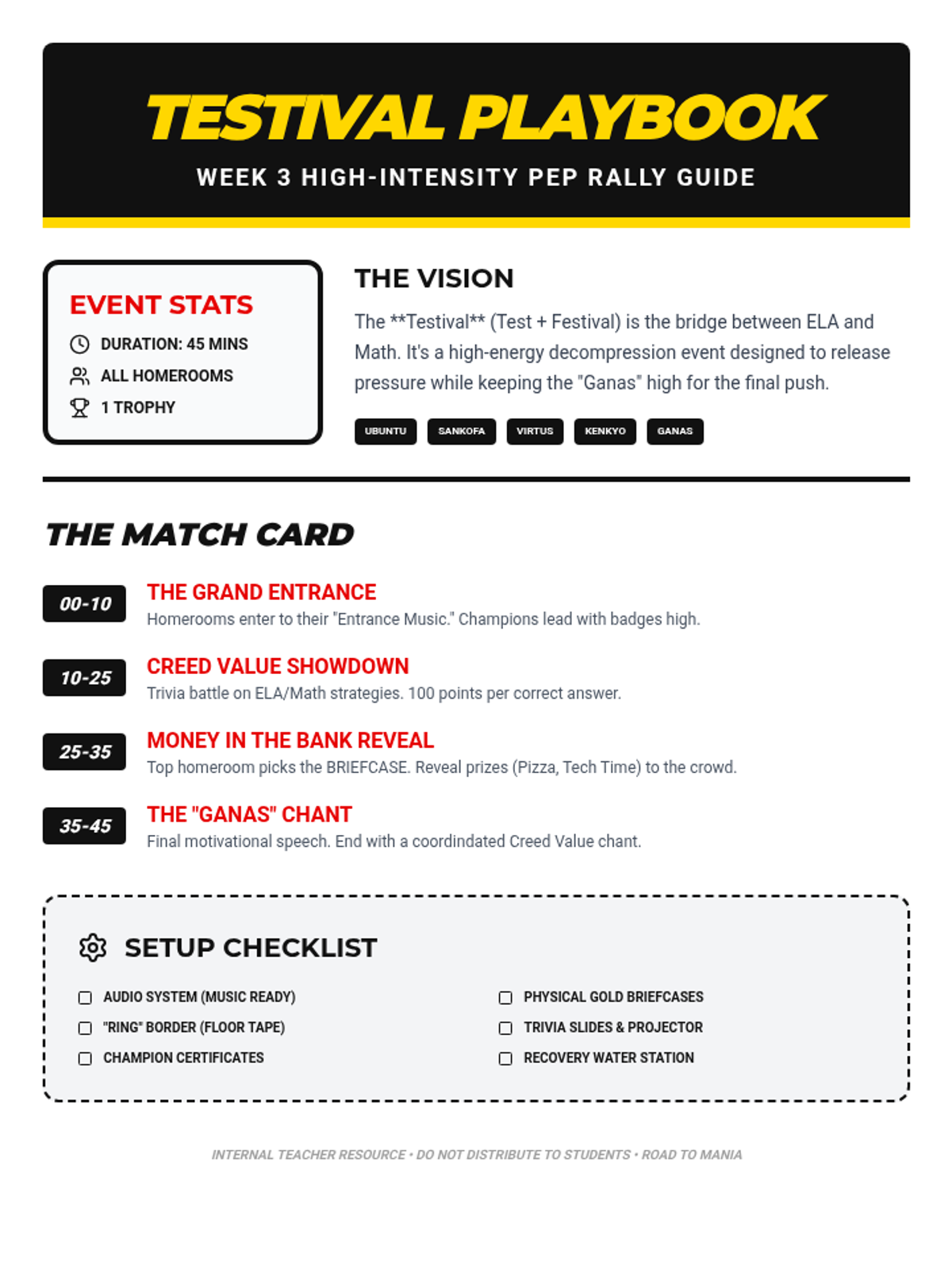
A teacher-facing resource for running a high-intensity 'Testival' (Test + Festival) pep rally, including 'Ring Entrances,' 'Creed Value Showdowns' (academic bowl style), and the 'Money in the Bank' opening.
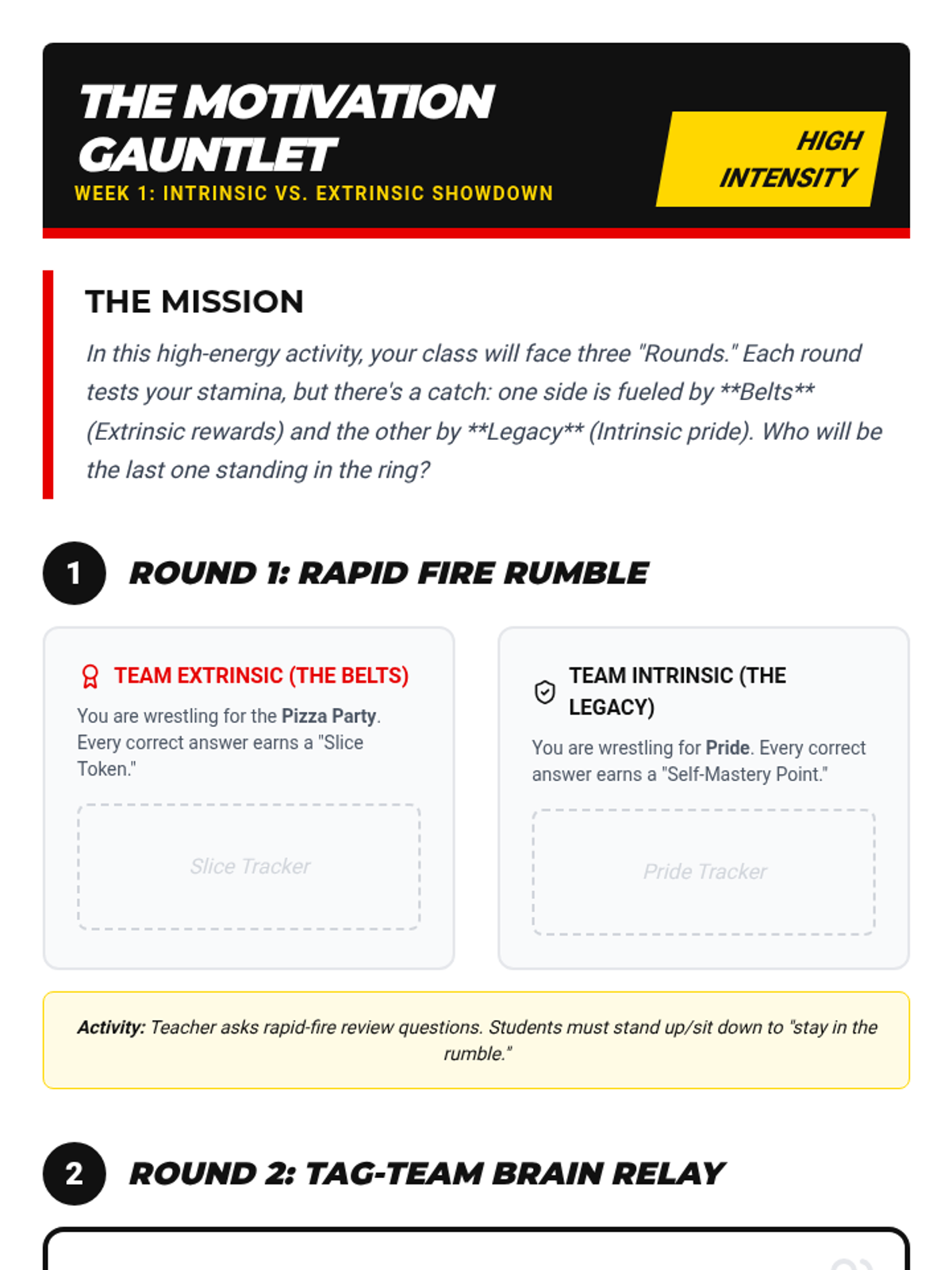
A physical and mental challenge activity where students explore intrinsic vs. extrinsic motivation through high-energy 'rounds' of review and physical exercise.
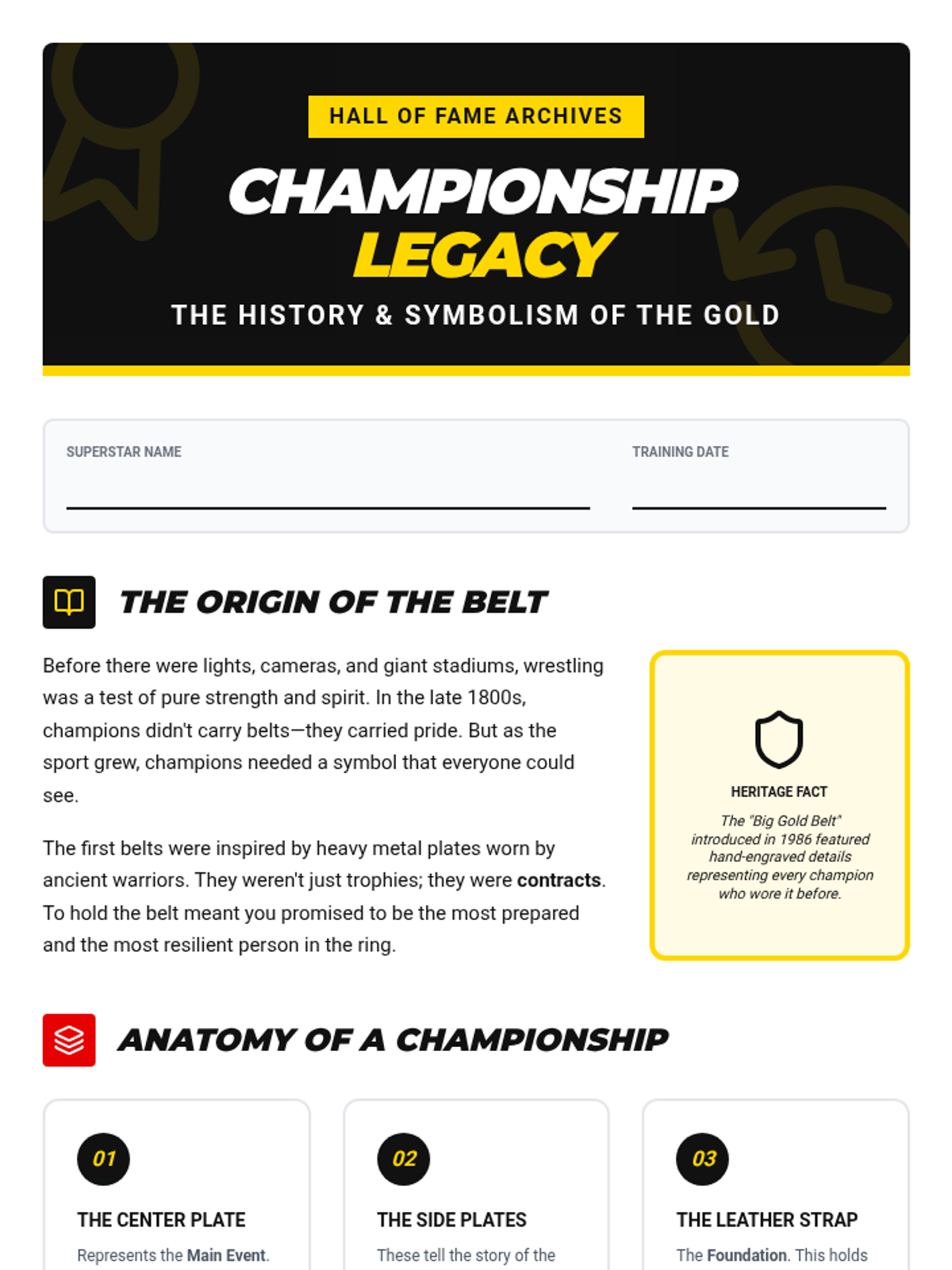
A student-facing reading and activity sheet exploring the history of wrestling championship belts, their symbolism, and how students can build their own academic legacy.
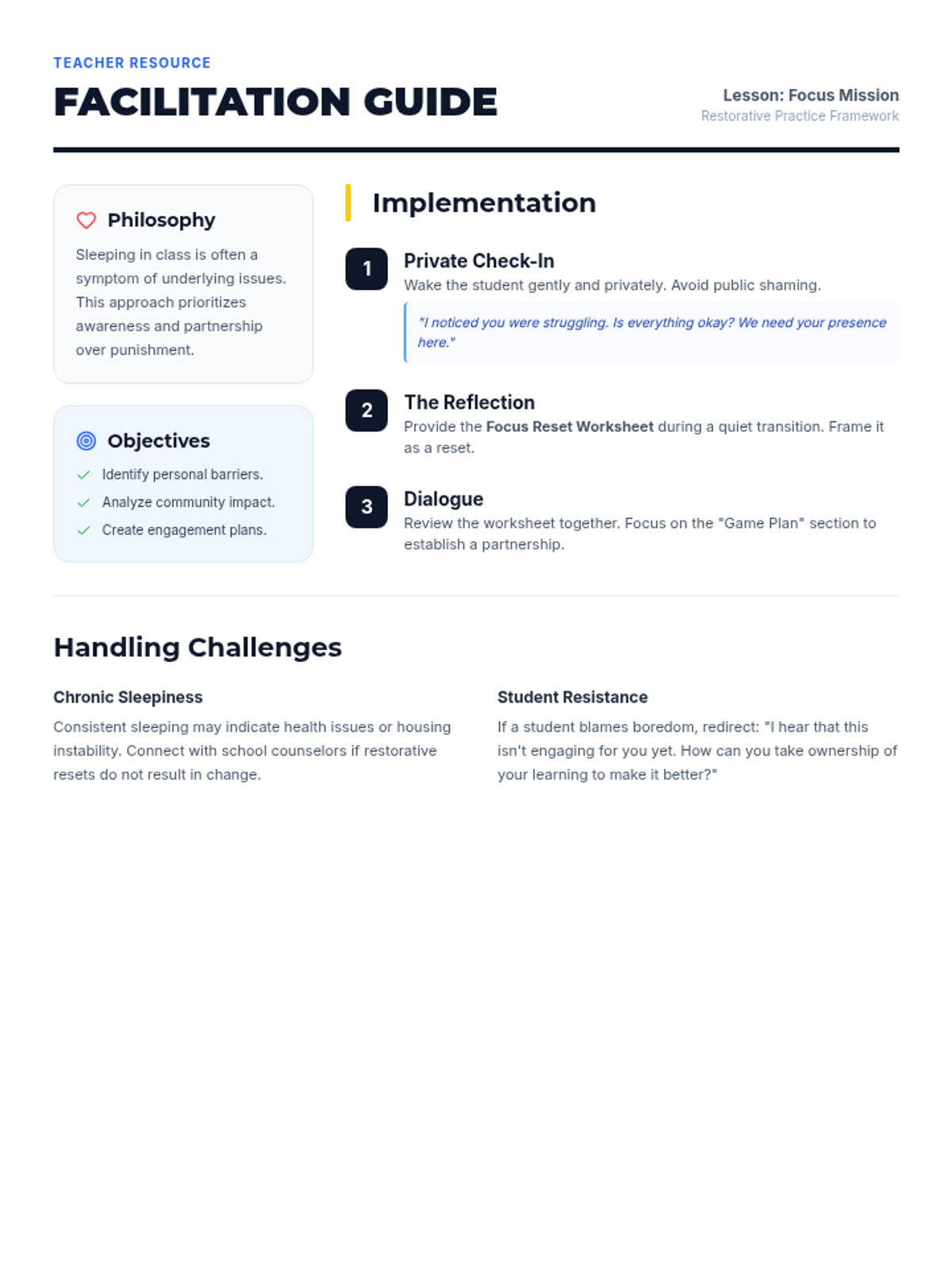
A teacher facilitation guide providing restorative strategies and instructional prompts for addressing classroom sleepiness and using the Focus Mission materials effectively.
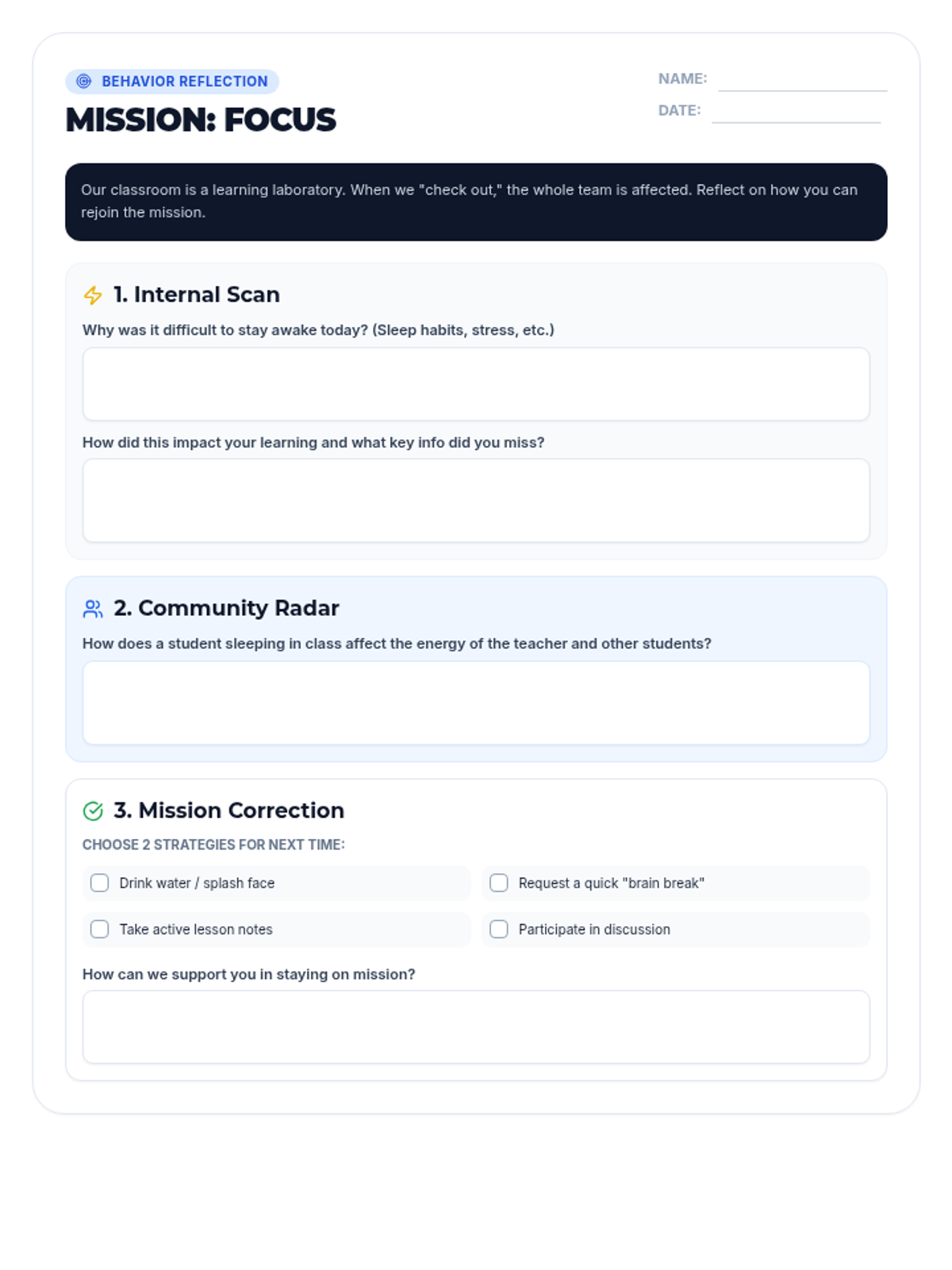
A restorative behavior reflection worksheet that encourages students to evaluate the causes of their drowsiness and understand its impact on their learning and classroom community.
An engaging slide deck explaining the impact of sleeping in class on personal success and the classroom community, featuring restorative strategies for staying engaged.
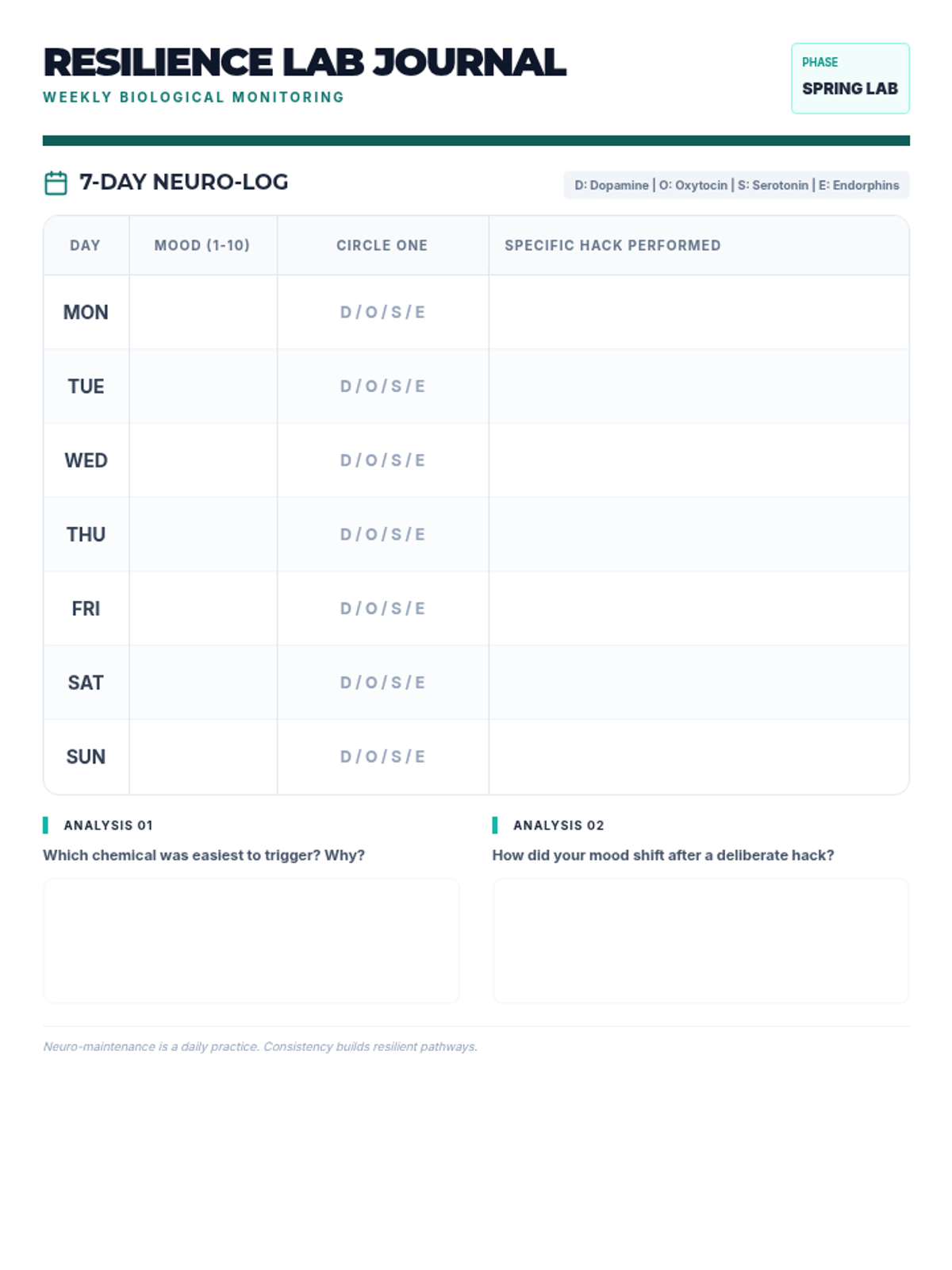
A two-page self-monitoring tool for students to track their mood and the use of 'Neuro-Hacks' over a week, including space for deep reflection and synthesis.
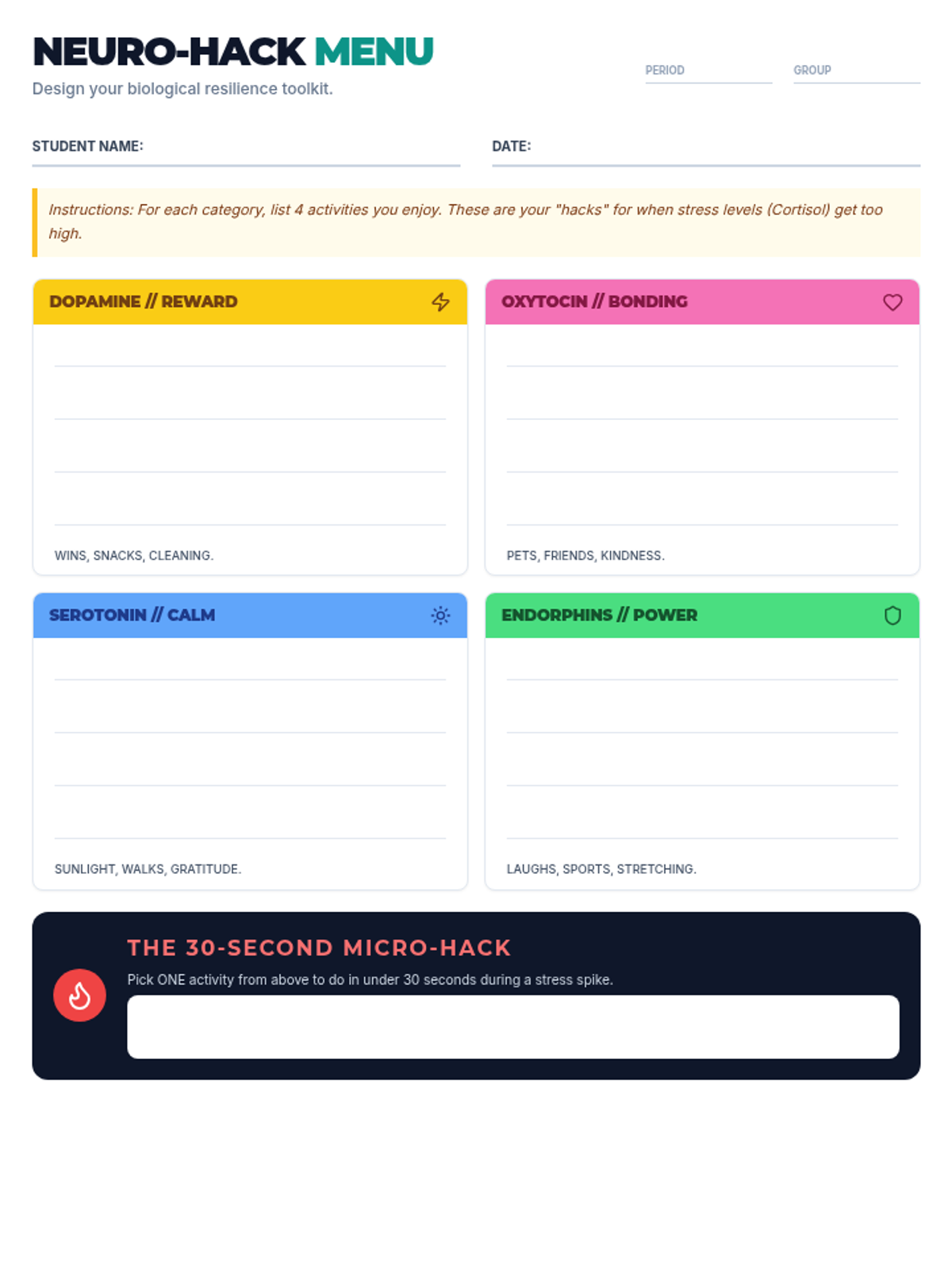
A personalized worksheet where students categorize activities into the four neurotransmitter 'buckets' to create their own evidence-based mental health toolkit.
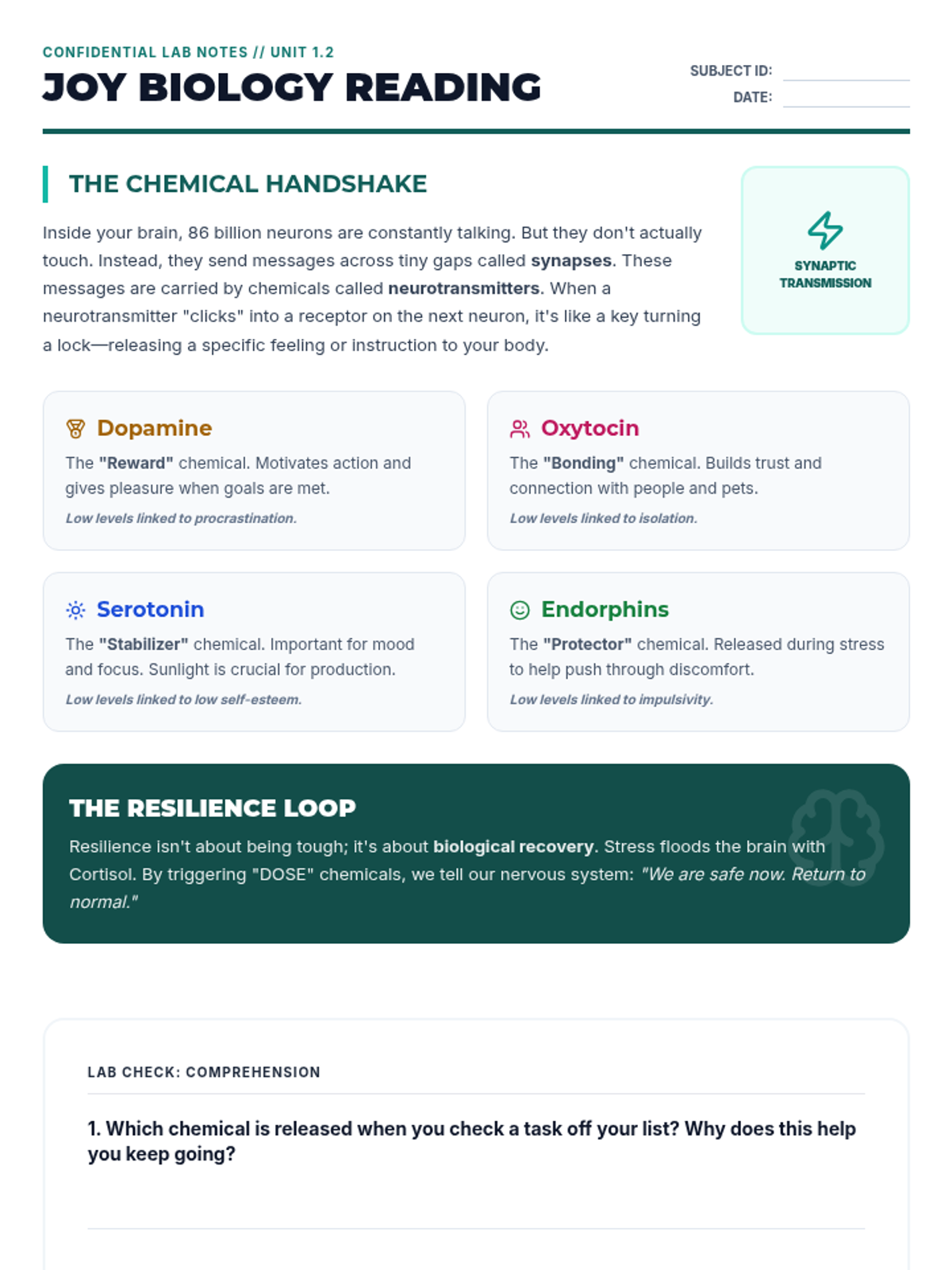
A foundational reading passage that explains the science of neurotransmitters, the synapse mechanism, and the four 'DOSE' chemicals in student-friendly language.
A visual presentation for students that introduces the four main 'DOSE' neurotransmitters, the biological impact of stress, and the concept of 'Neuro-Hacking' for mental health.
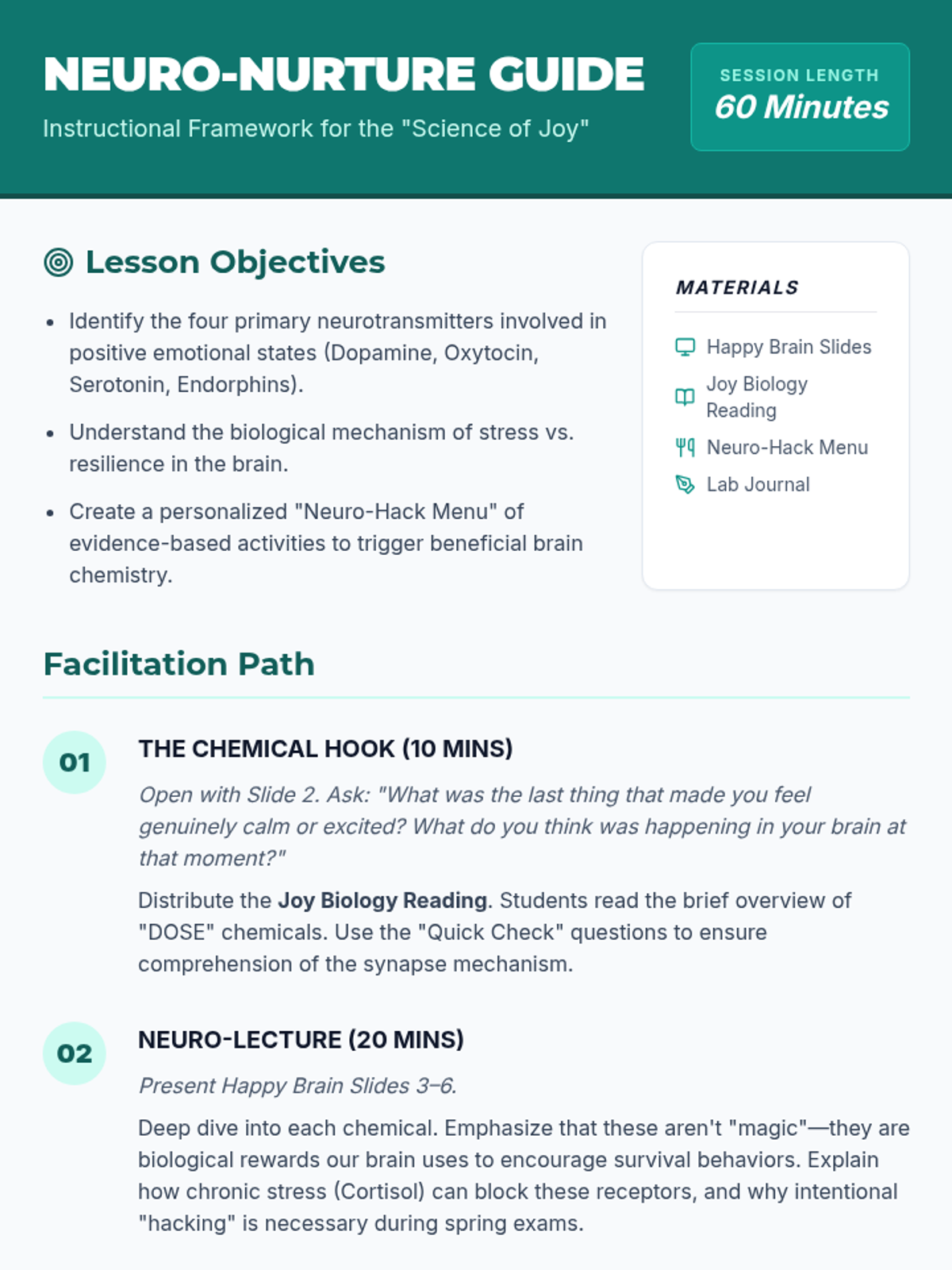
A comprehensive teacher guide for leading the Neuro-Nurture Project, including objectives, materials, a detailed facilitation path, and clinical notes for implementation.
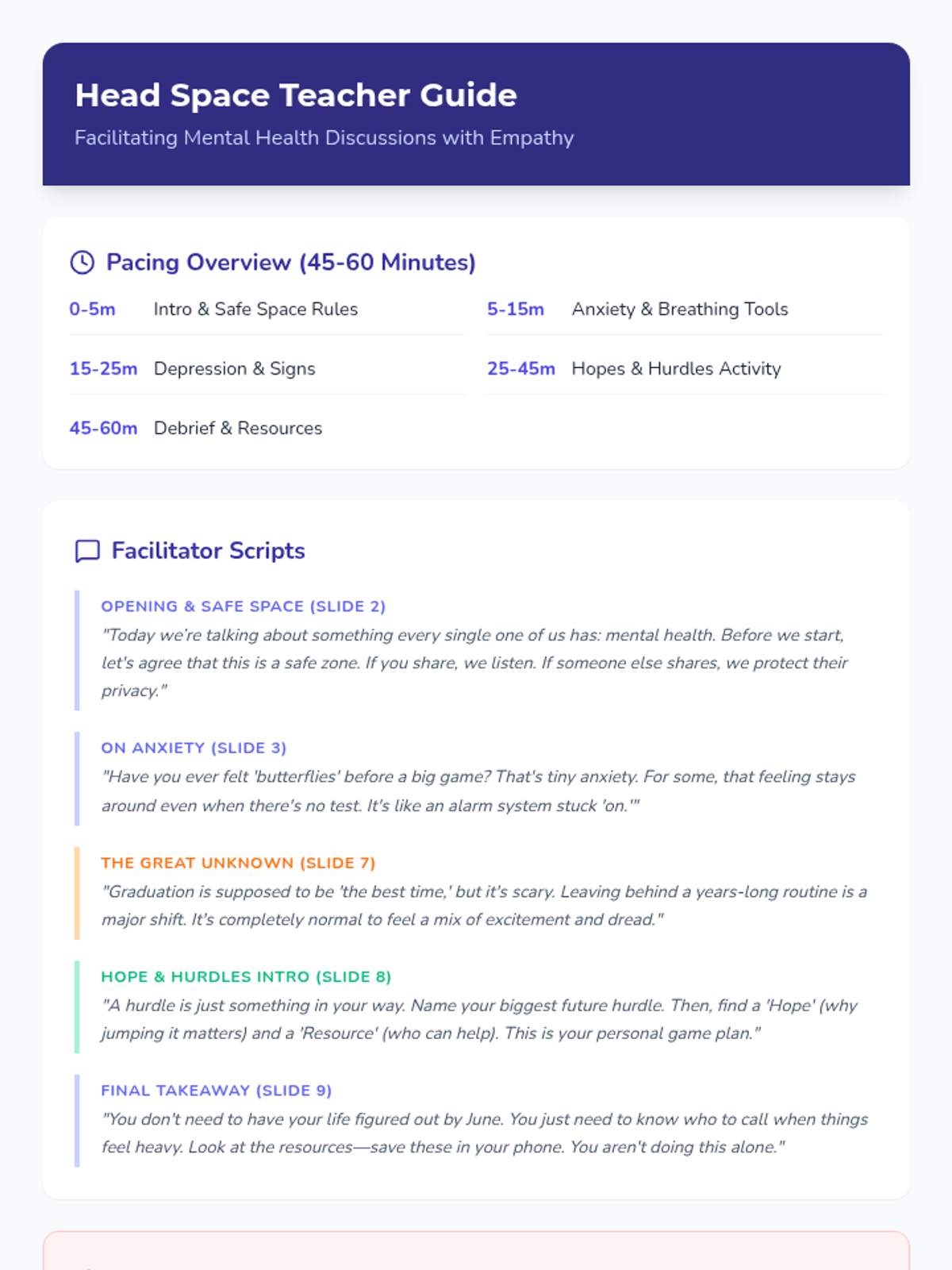
A comprehensive guide for teachers to facilitate sensitive mental health discussions, now featuring detailed scripts for key lesson transitions and safety protocols.
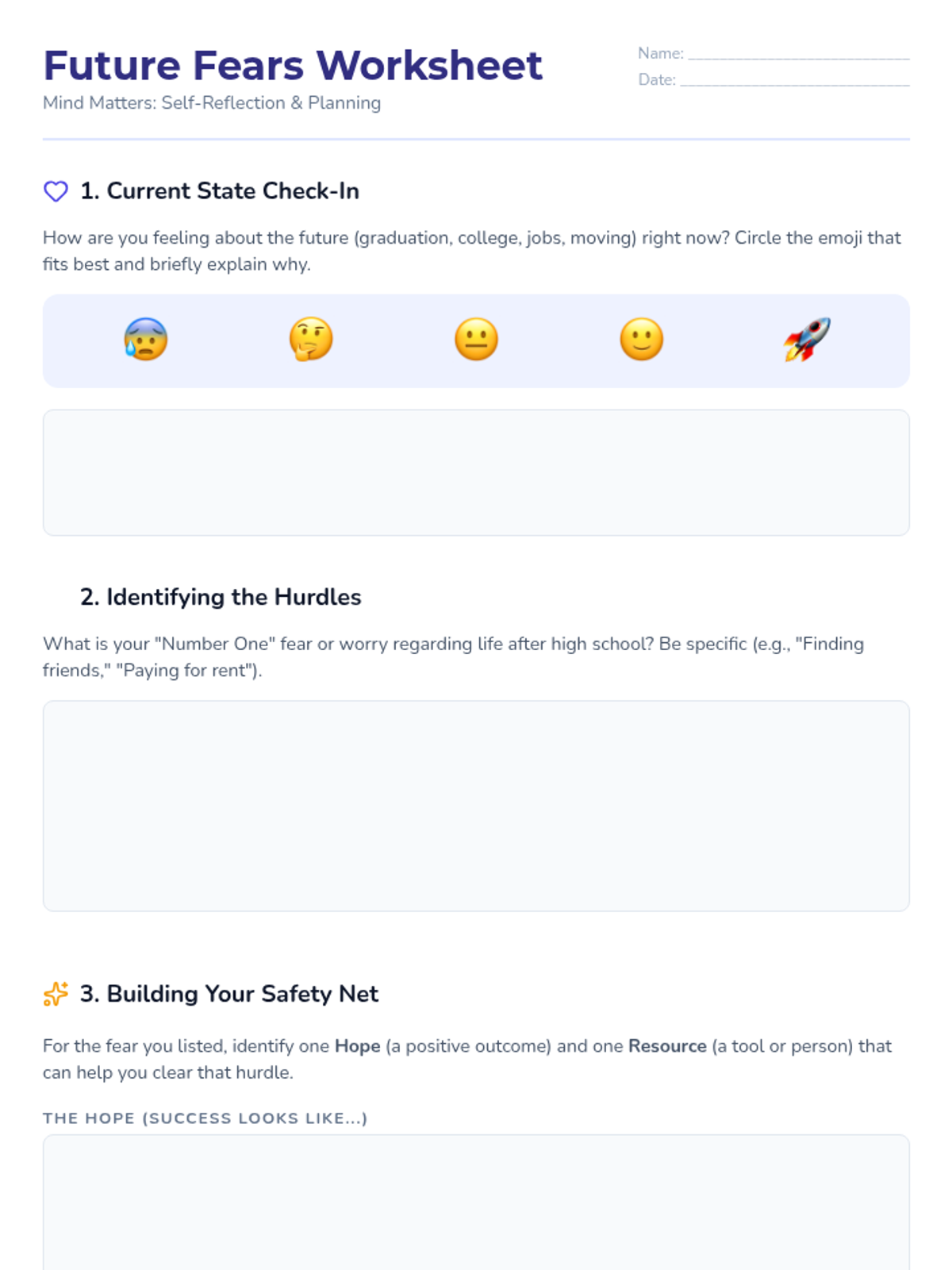
A student self-reflection document designed to accompany the mental health presentation, focusing on identifying personal fears (hurdles) and planning resources and coping strategies (hopes).
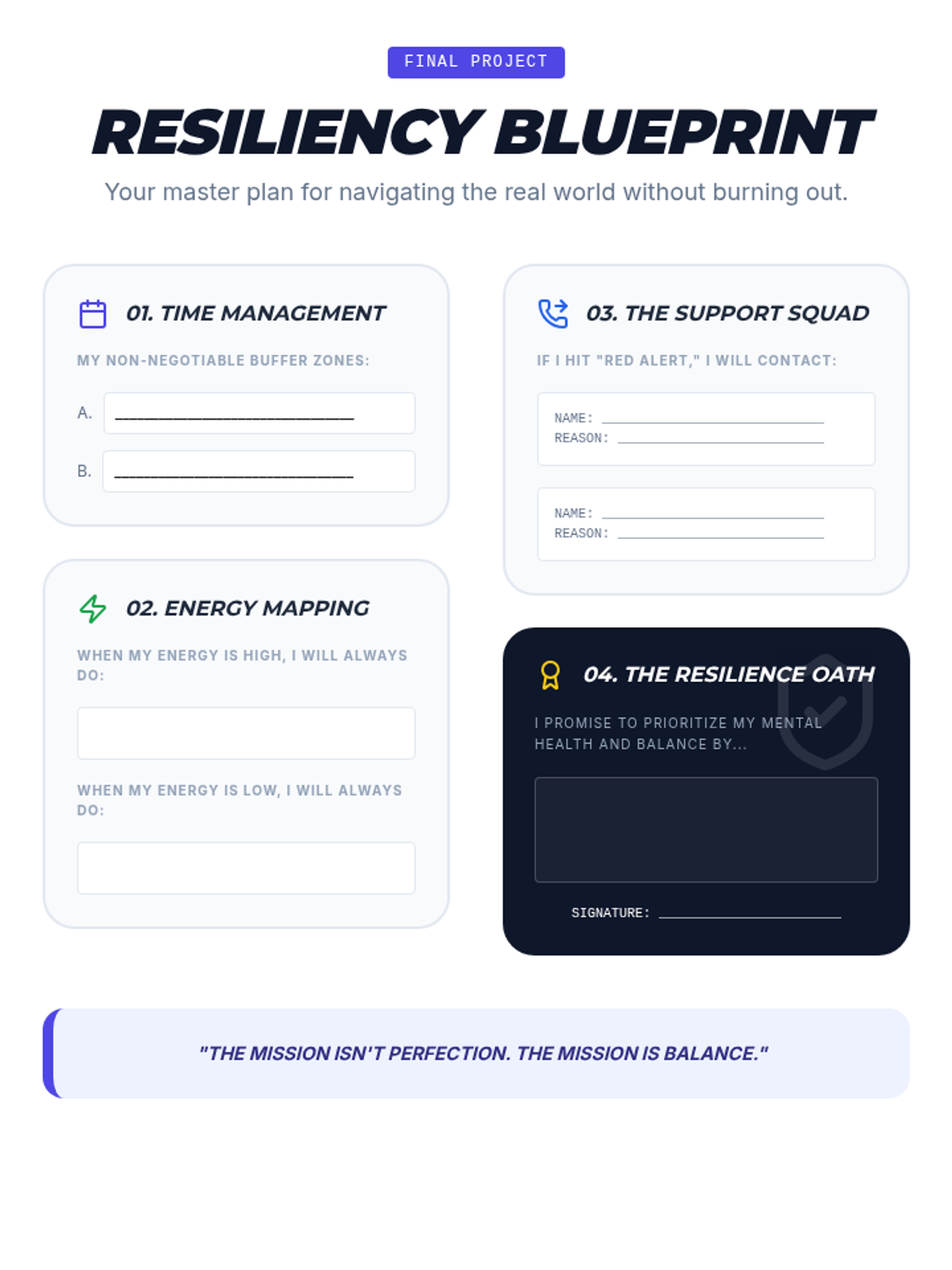
A summative project document where students synthesize everything they have learned into a personal 'Resiliency Blueprint' for real-world application.
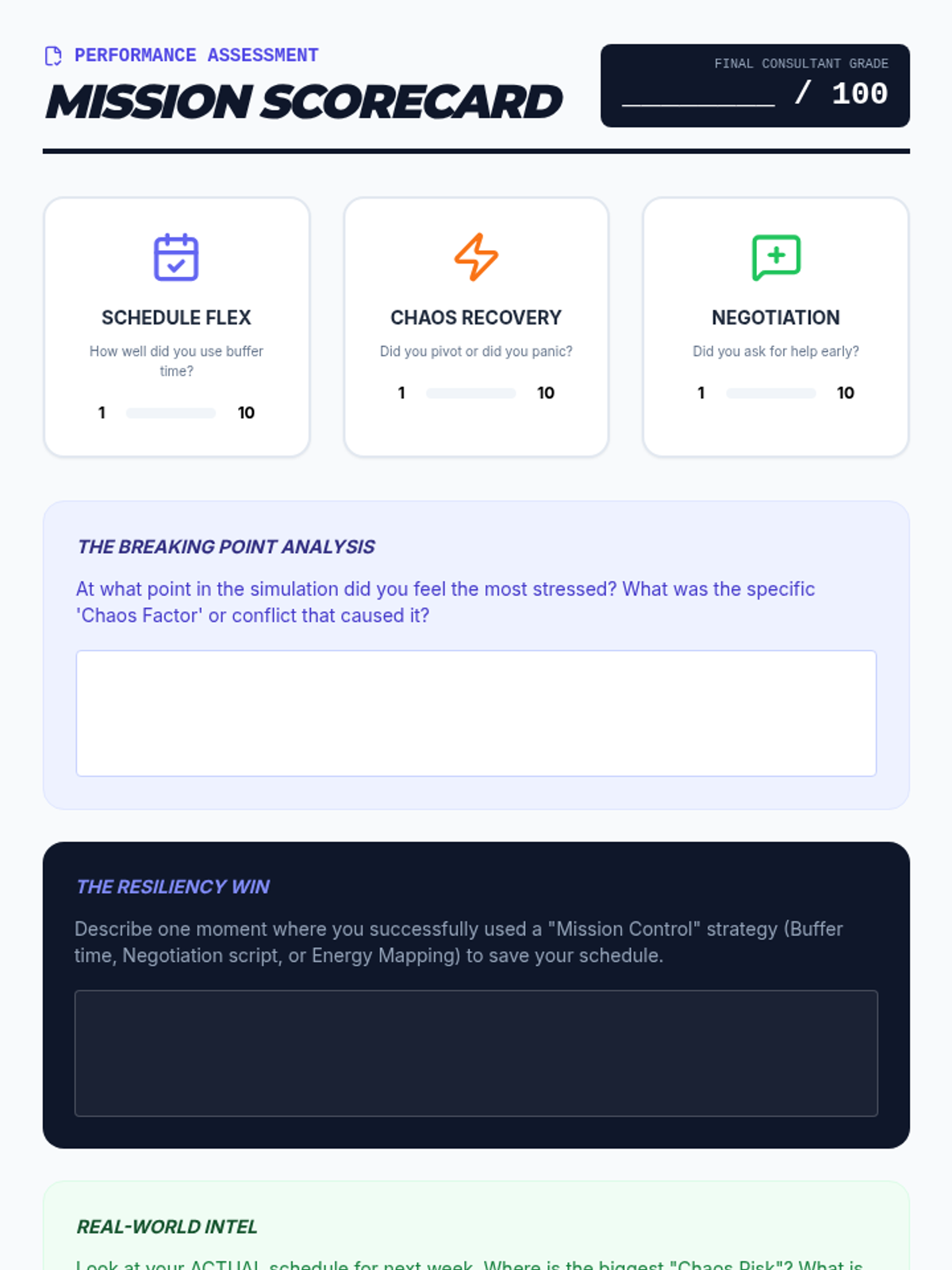
A final self-assessment 'Scorecard' for the Mission Balance sequence, allowing students to rate their performance and reflect on their growth in schedule management and resiliency.
Final presentation for the Mission Balance sequence, reviewing core concepts of chaos management, negotiation, and energy management, and introducing the final scorecard activity.
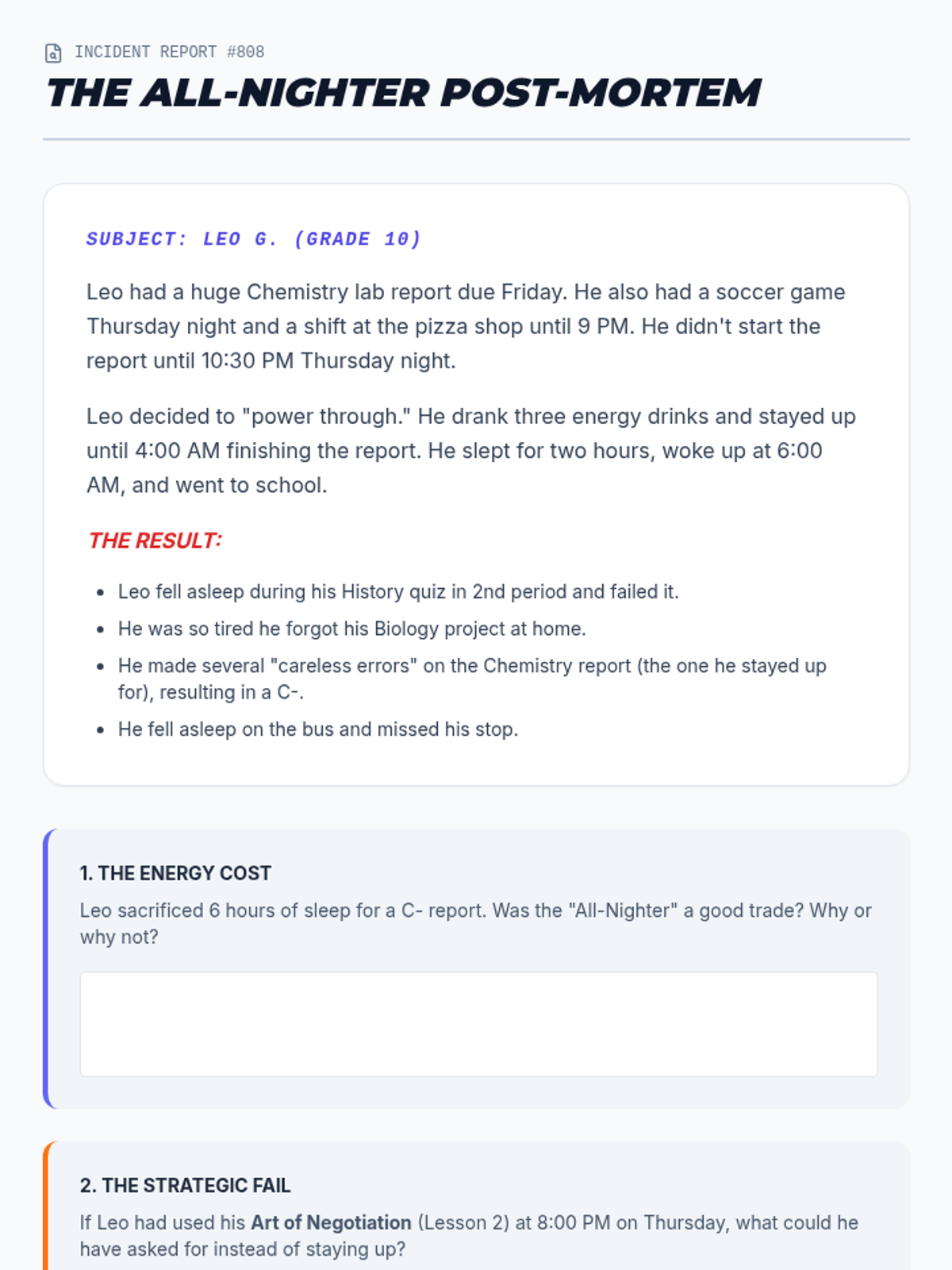
A case study analysis of a student's 'all-nighter' experience, prompting students to evaluate the consequences and identify alternative strategies from the sequence.
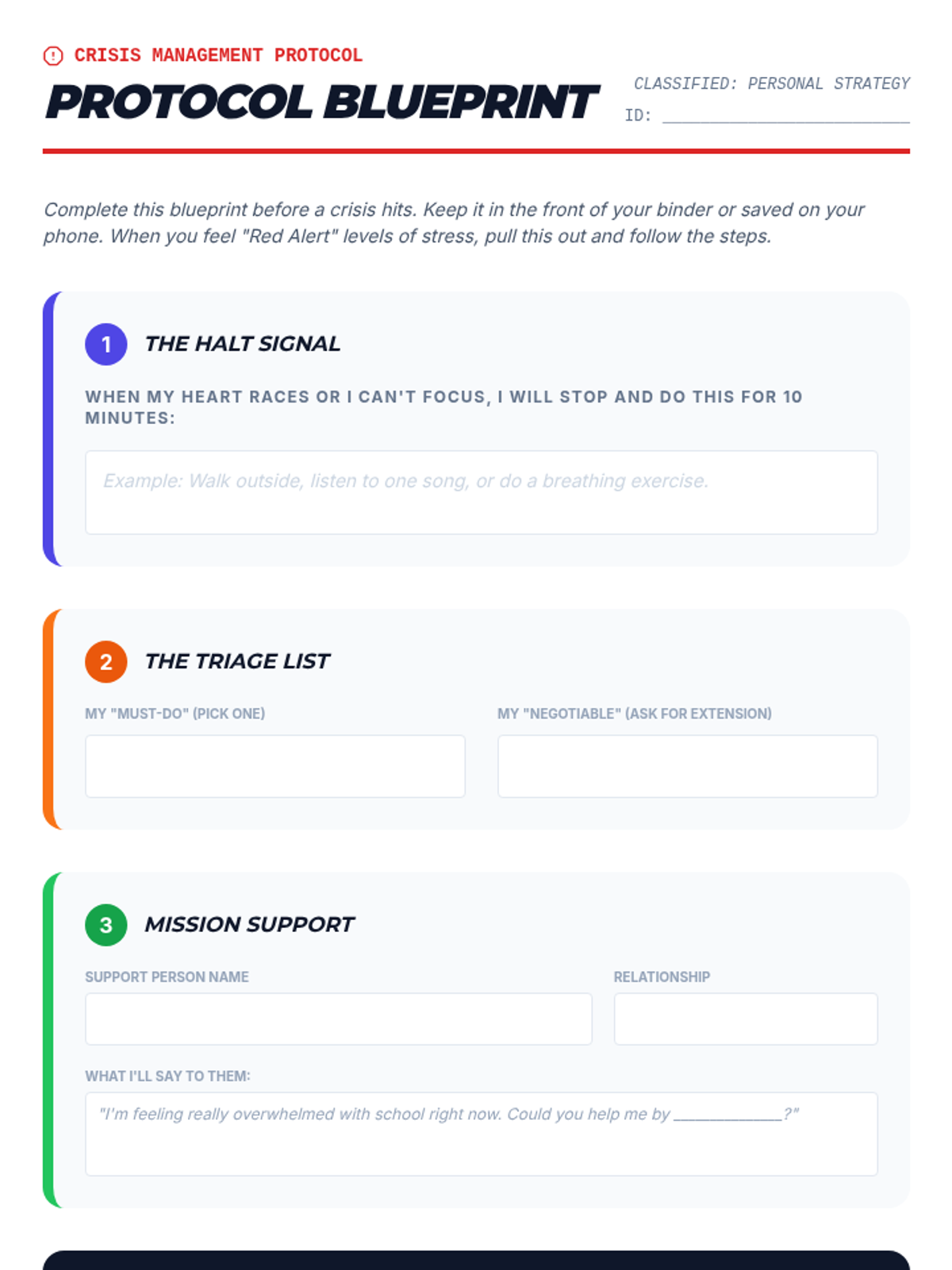
A personal crisis management worksheet where students document their specific 'Red Alert' protocols, including triage strategies, support contacts, and recovery plans.
Lesson 4 slides on crisis management protocols, teaching students how to identify burnout, prioritize tasks during 'Red Alert' scenarios, and activate support systems.
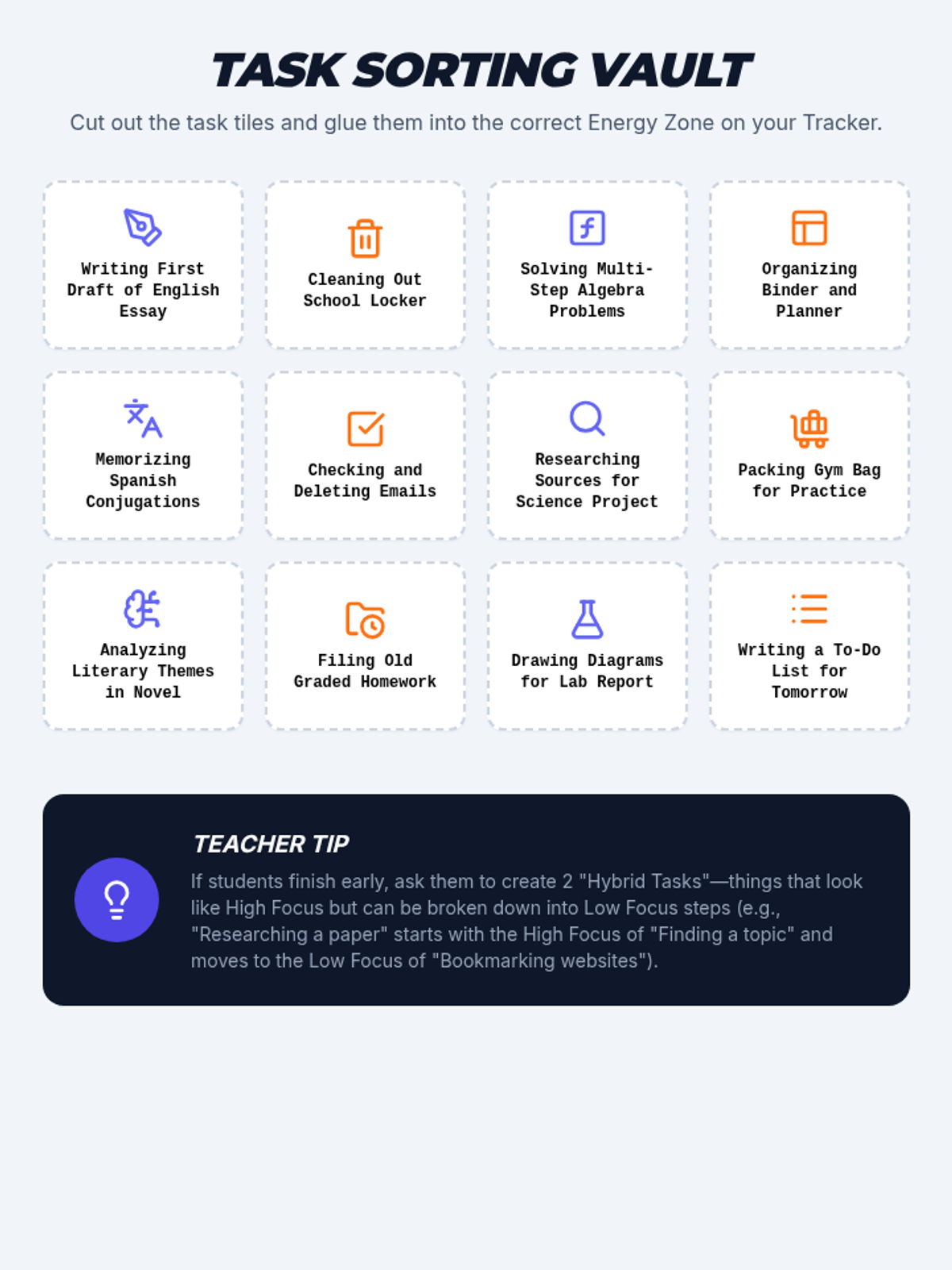
A cut-and-paste sorting activity for students to categorize common school and life tasks as either 'High Focus' or 'Low Focus' energy requirements.
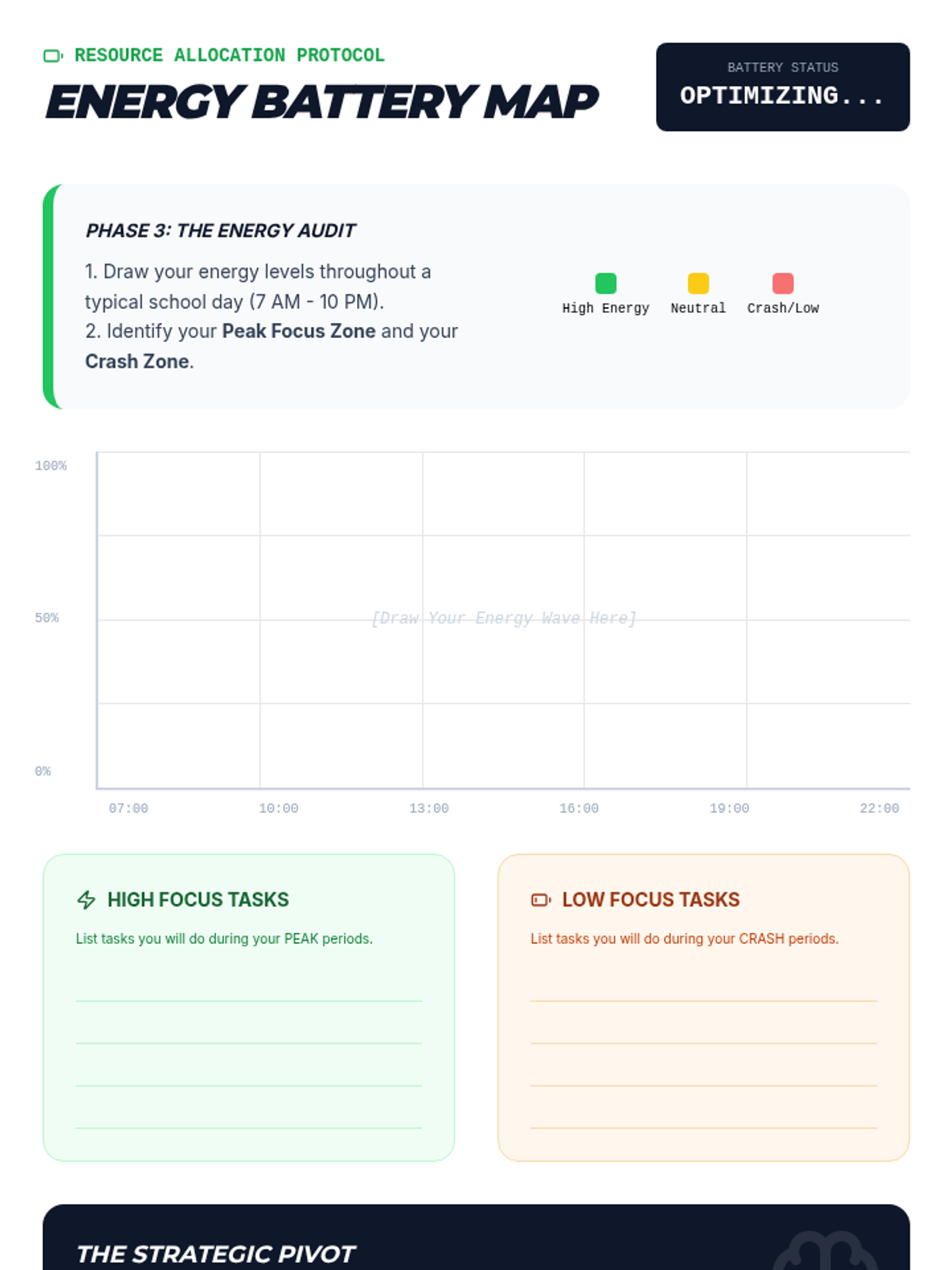
A worksheet for students to map their daily energy levels and strategically assign tasks based on their peak focus periods.
Lesson 3 presentation on energy management, teaching students to differentiate between High Focus and Low Focus tasks and to identify their personal peak energy periods.
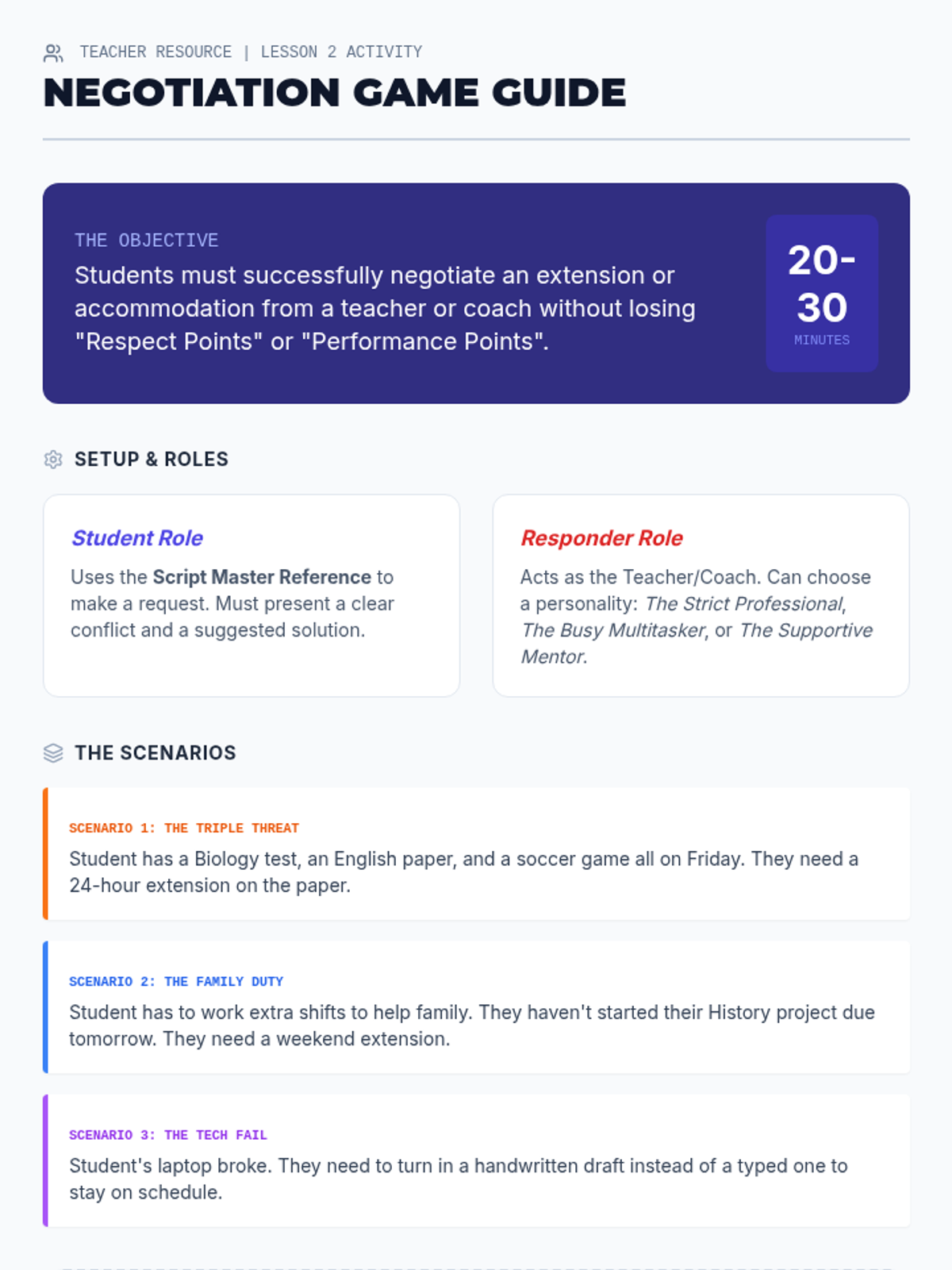
Teacher facilitation guide for the Lesson 2 role-play simulation, providing scenarios, roles, and assessment criteria for student negotiations.
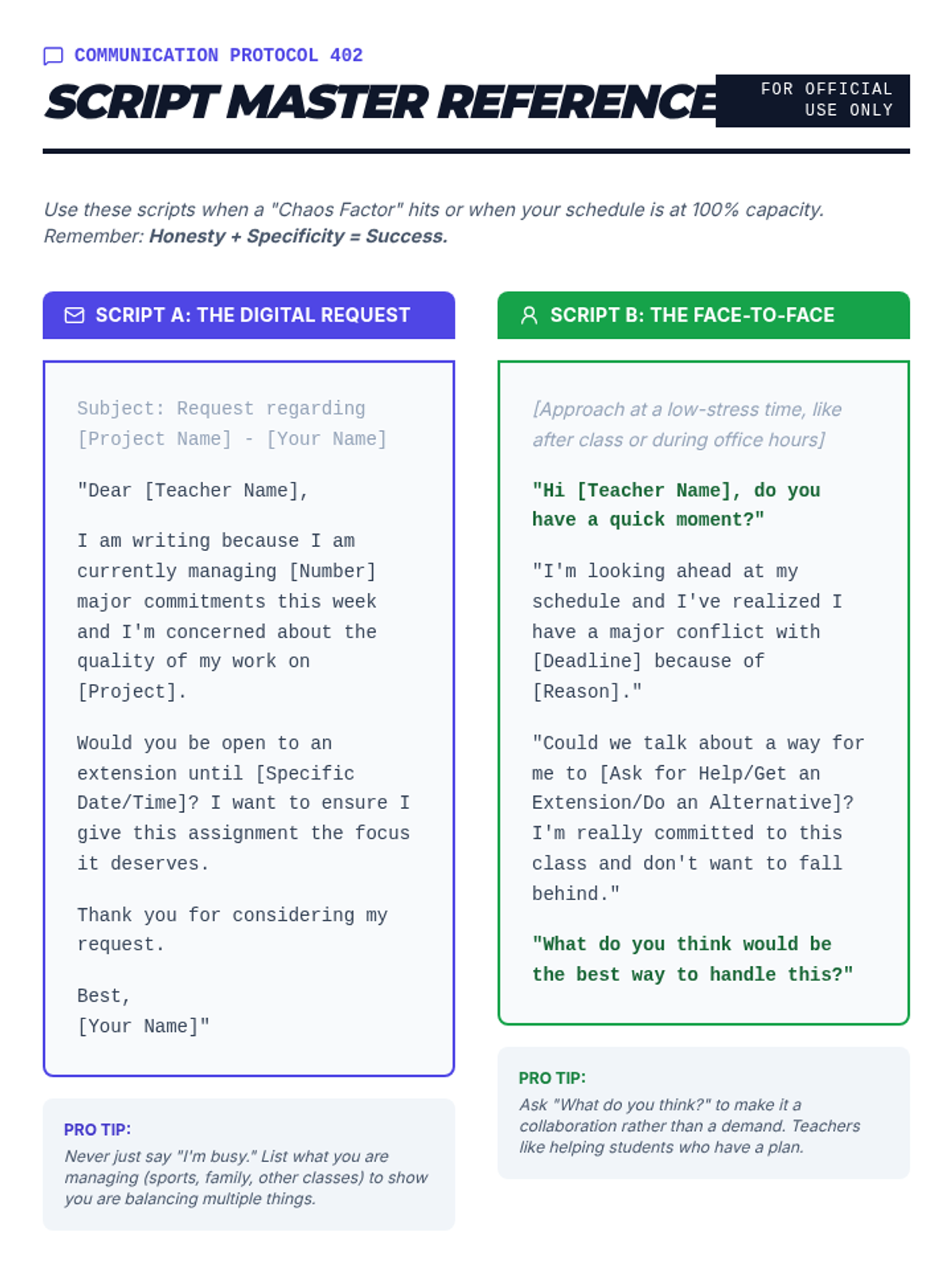
A professional communication guide for students, featuring scripted templates for digital and in-person deadline negotiations, including a practice exercise.
Slide deck for Lesson 2, teaching students the difference between hard and soft deadlines and providing a professional framework for negotiating extensions.
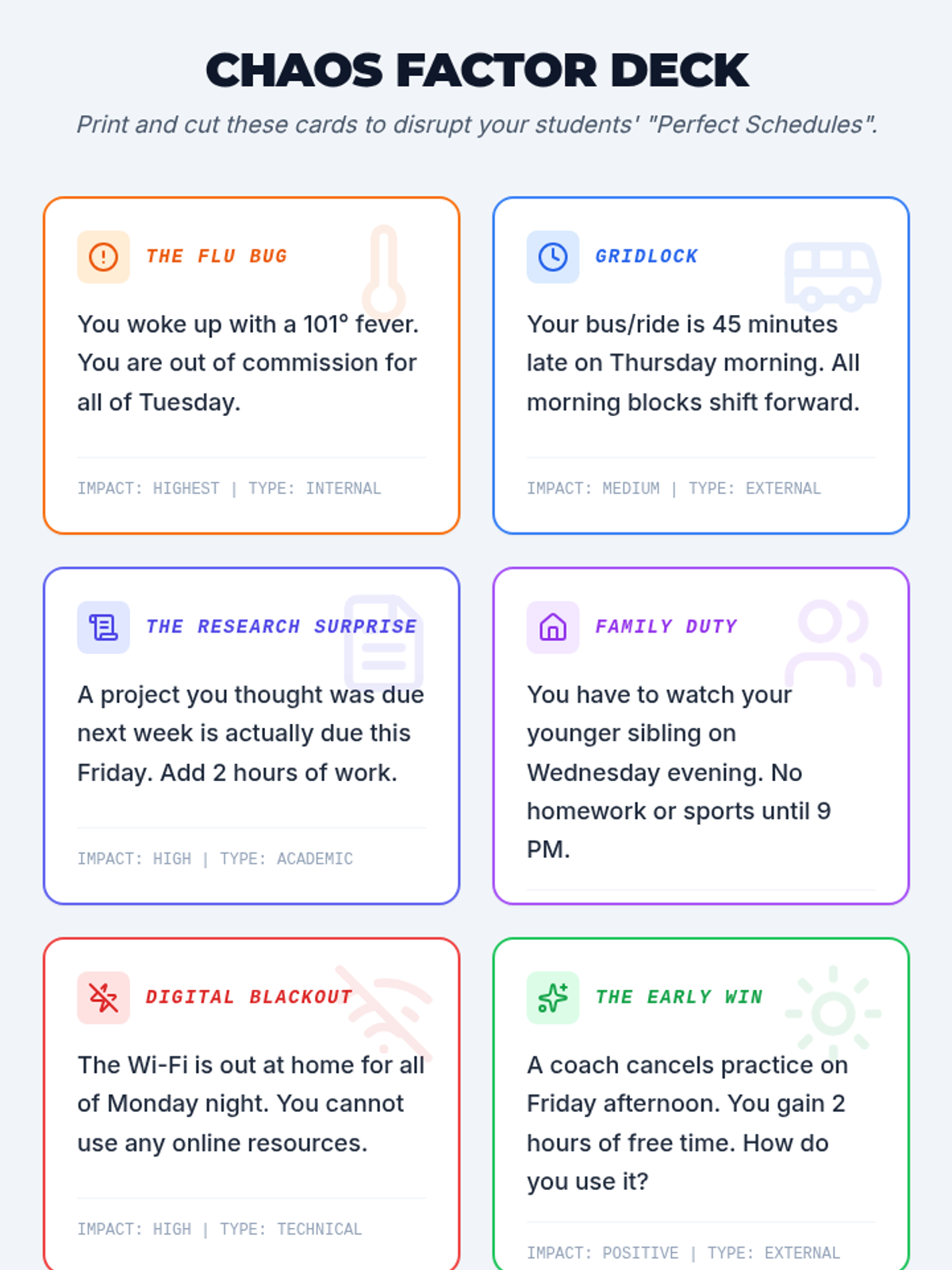
A set of printable 'Chaos Factor' cards for teachers to use in the Mission Balance simulation, featuring various disruptions to a student's schedule.
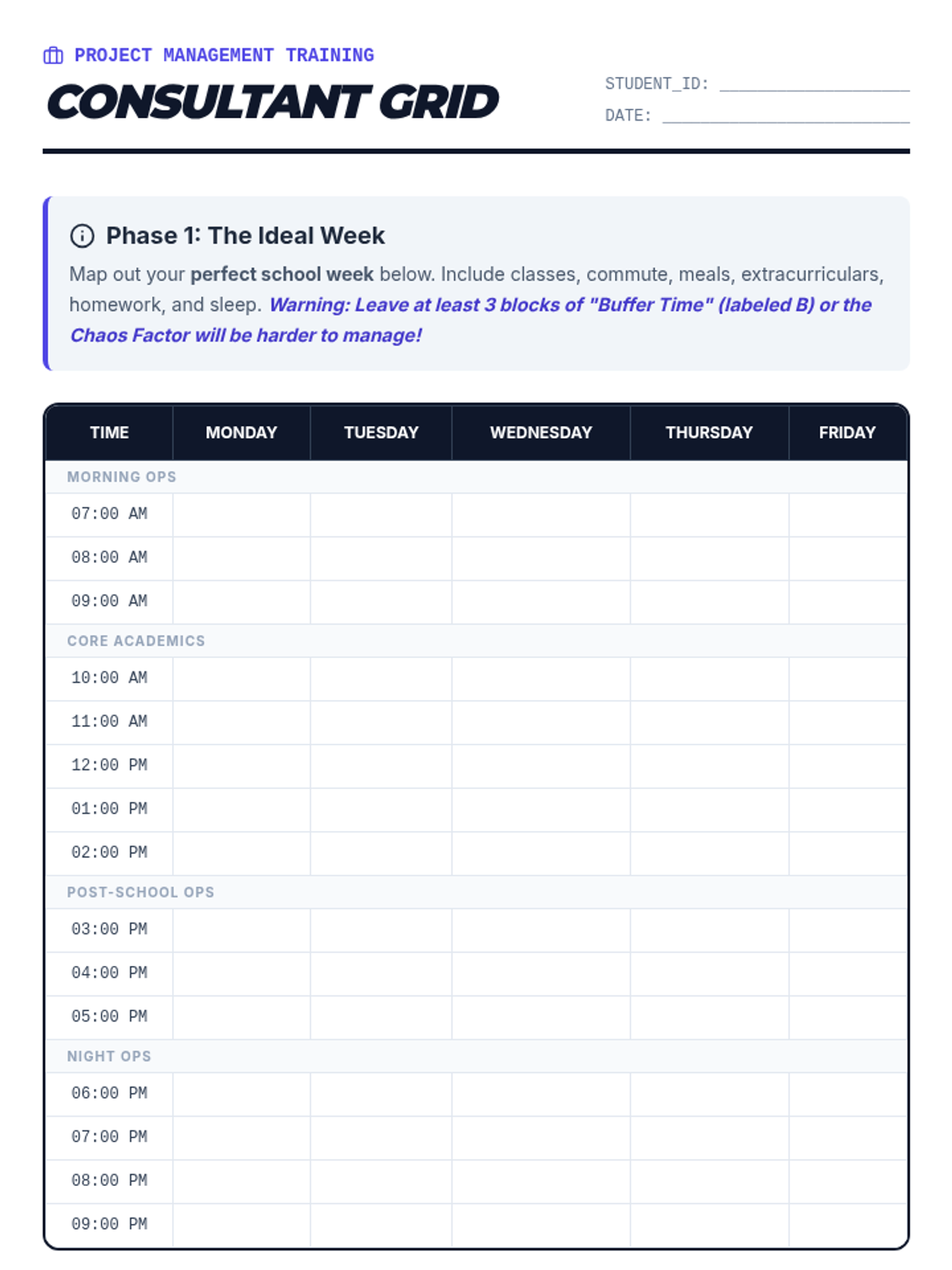
A student-facing weekly scheduling grid designed for the Mission Balance simulation, including a section for analyzing and responding to 'Chaos Factor' disruptions.
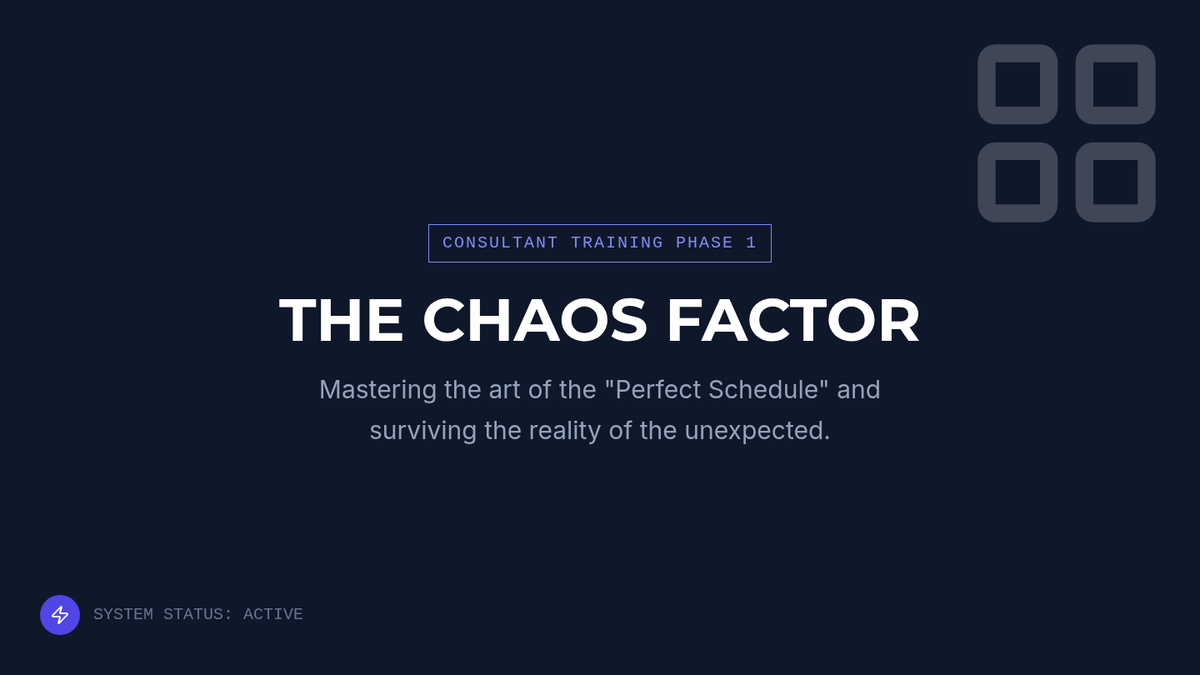
Introductory presentation for the Mission Balance sequence, teaching students about the 'Chaos Factor' and the importance of 'Buffer Time' in scheduling.
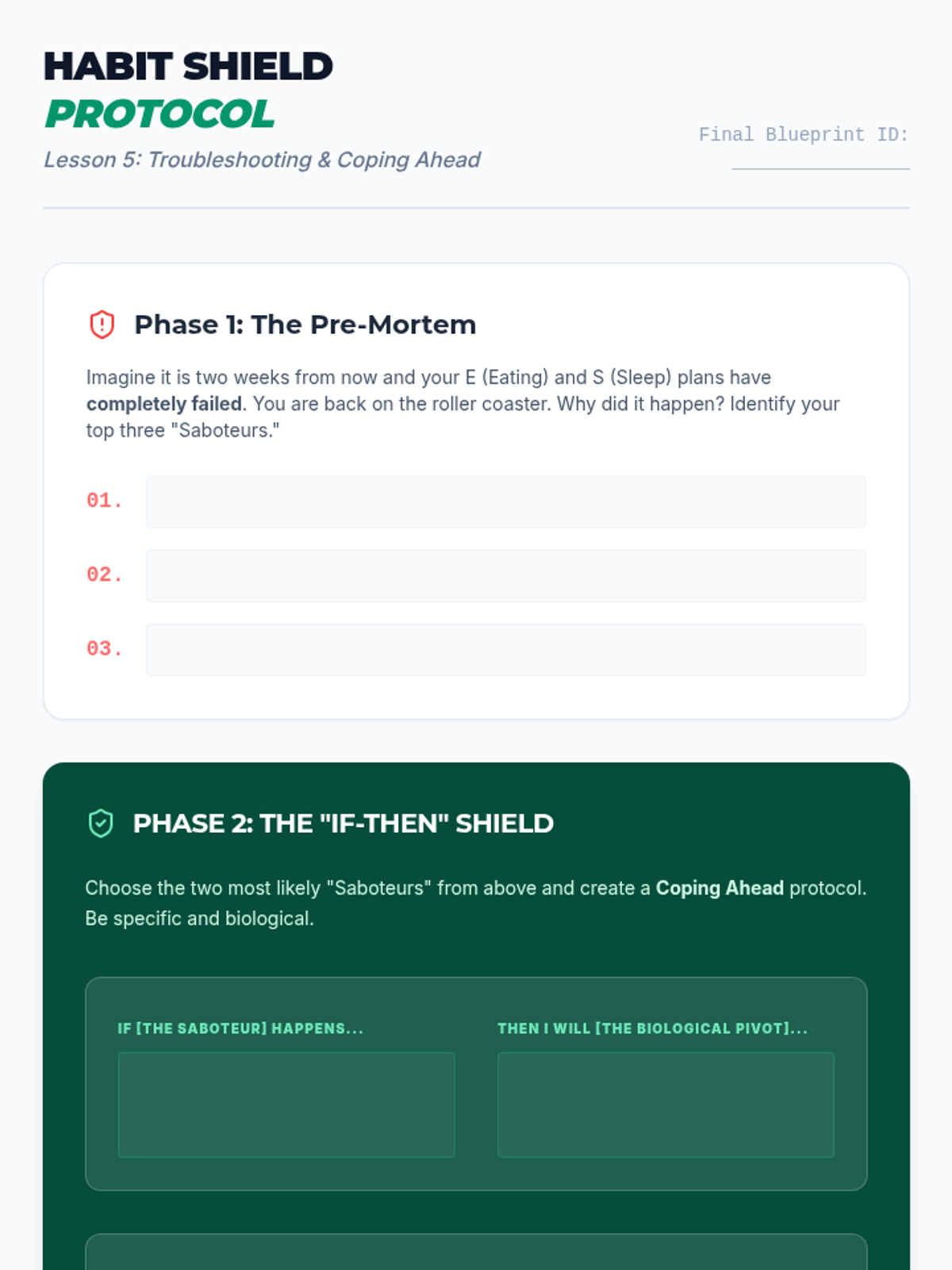
The final troubleshooting and planning worksheet for Lesson 5, where students conduct a pre-mortem on their plans and create "if-then" coping ahead protocols.
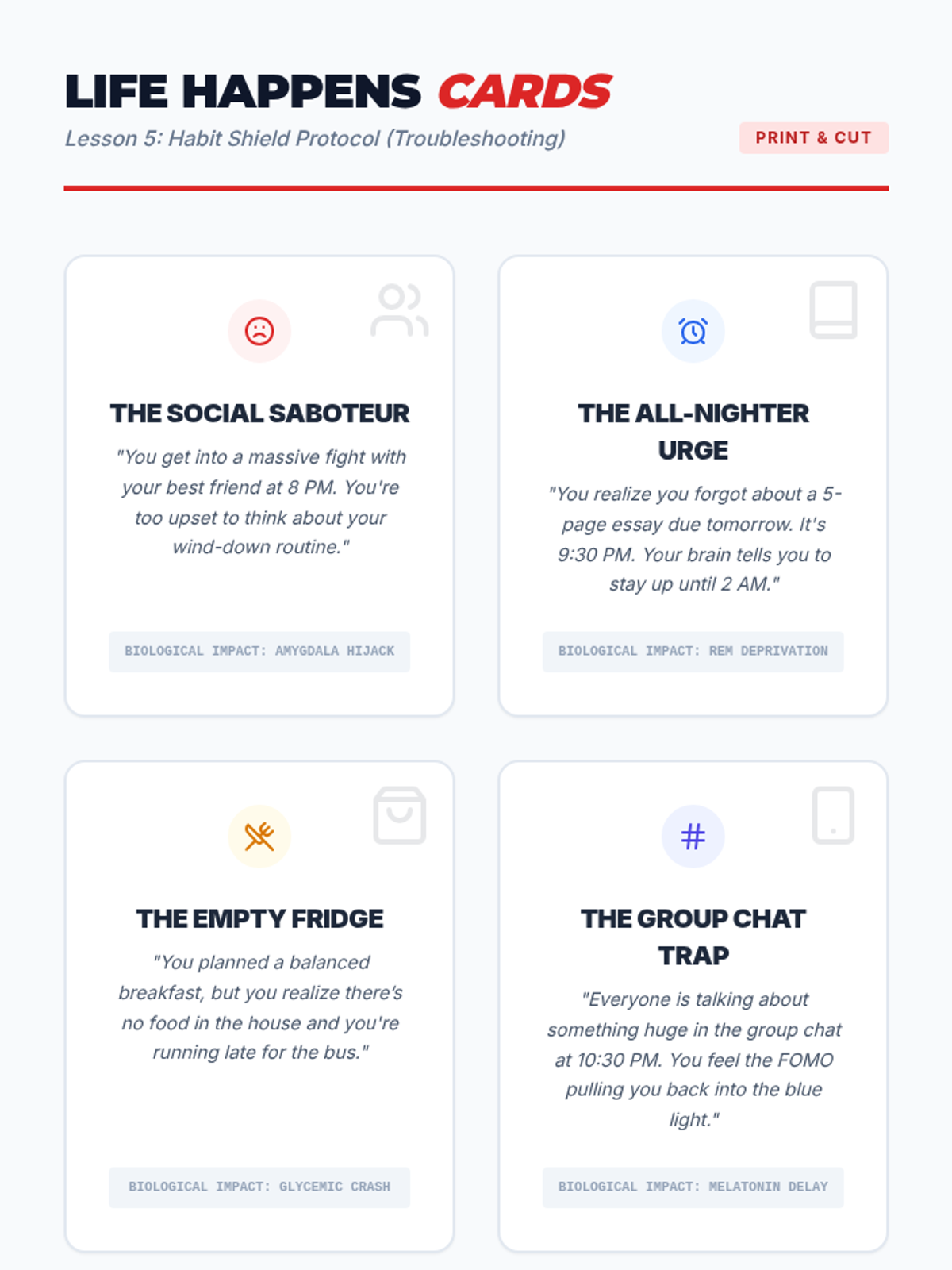
Scenario cards for Lesson 5, presenting real-world obstacles like academic stress or social drama for students to practice troubleshooting their health routines.
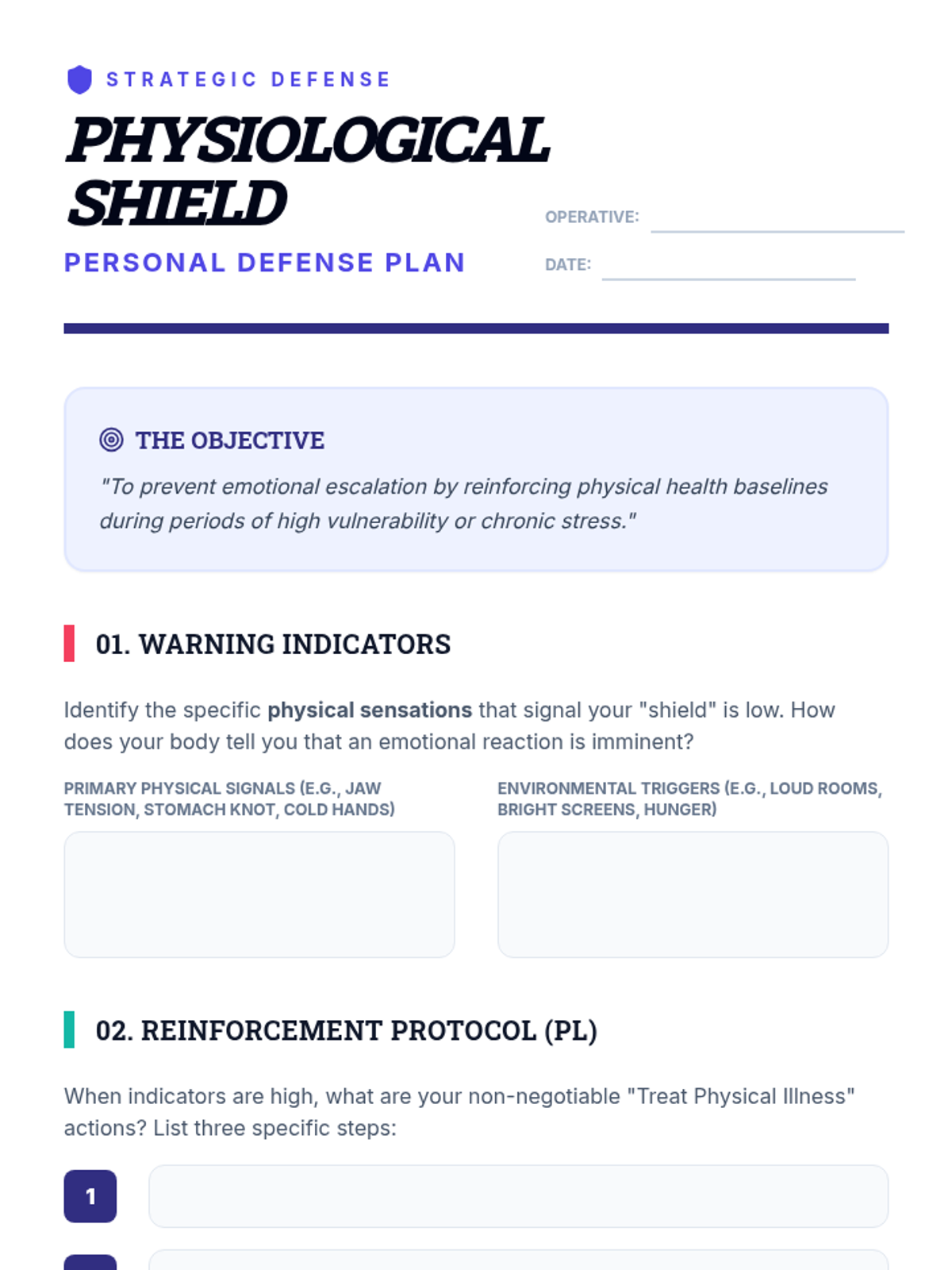
Final synthesis worksheet where students draft a personal protocol for handling days when they are physically compromised to prevent emotional escalation.
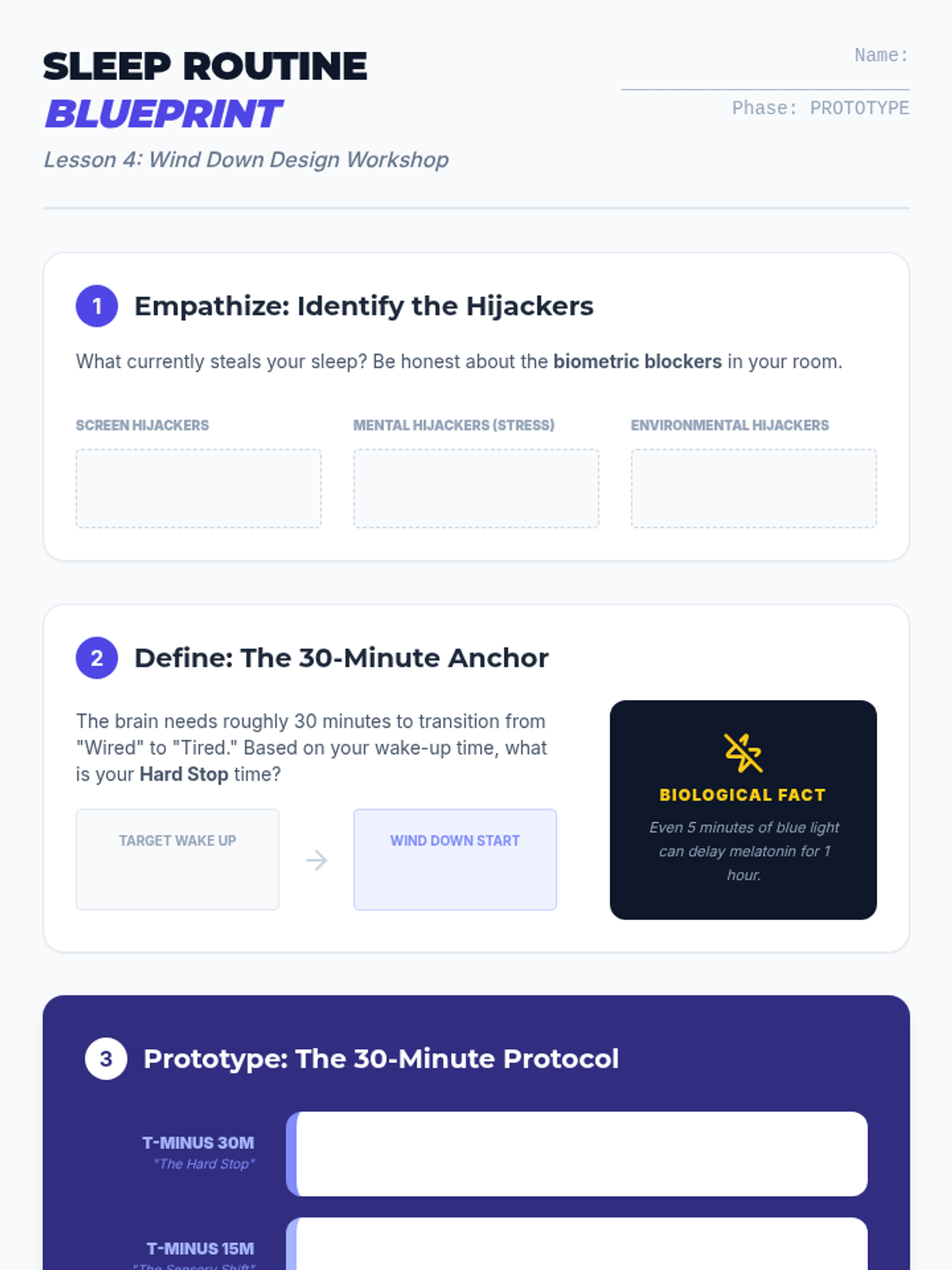
A design thinking template for students to prototype a personalized 30-minute pre-sleep routine, including an environment audit and time-blocked planning.
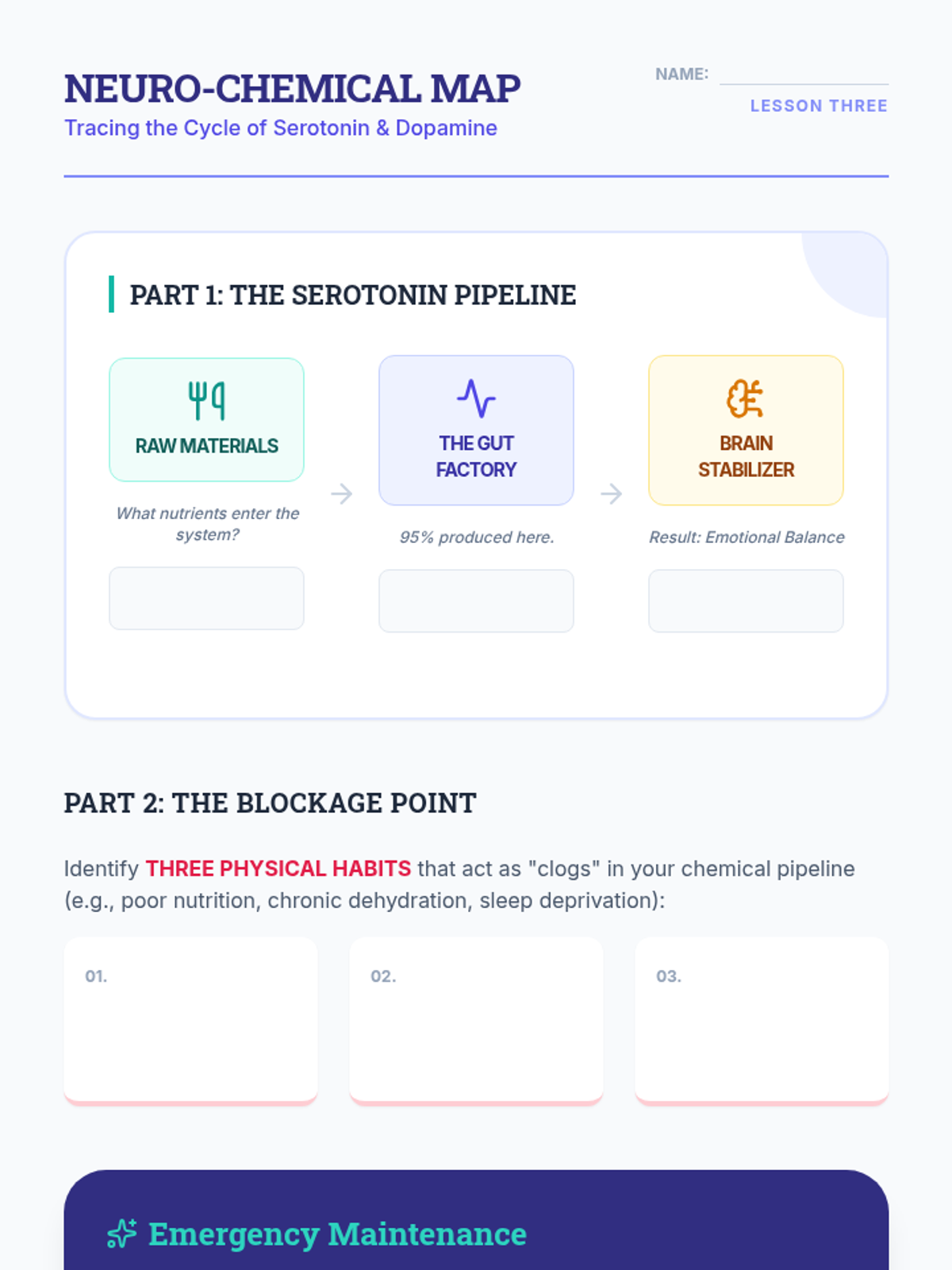
Worksheet mapping the physical production cycle of serotonin and dopamine, helping students identify how specific physical habits support or hinder chemical balance.
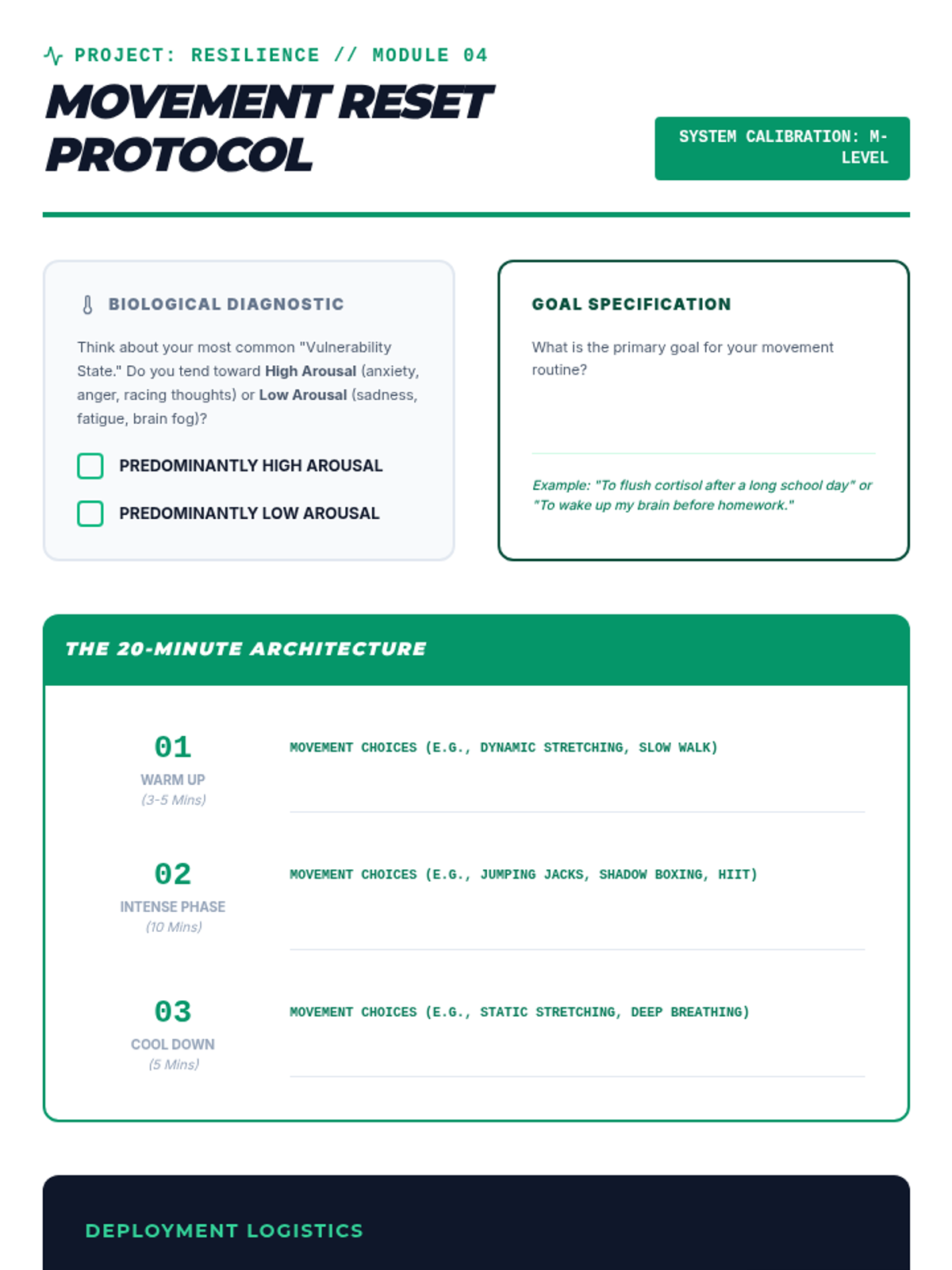
A movement-focused worksheet where students design a personalized '20-minute reset' routine, identifying movements that match their emotional state and identifying barriers to exercise.
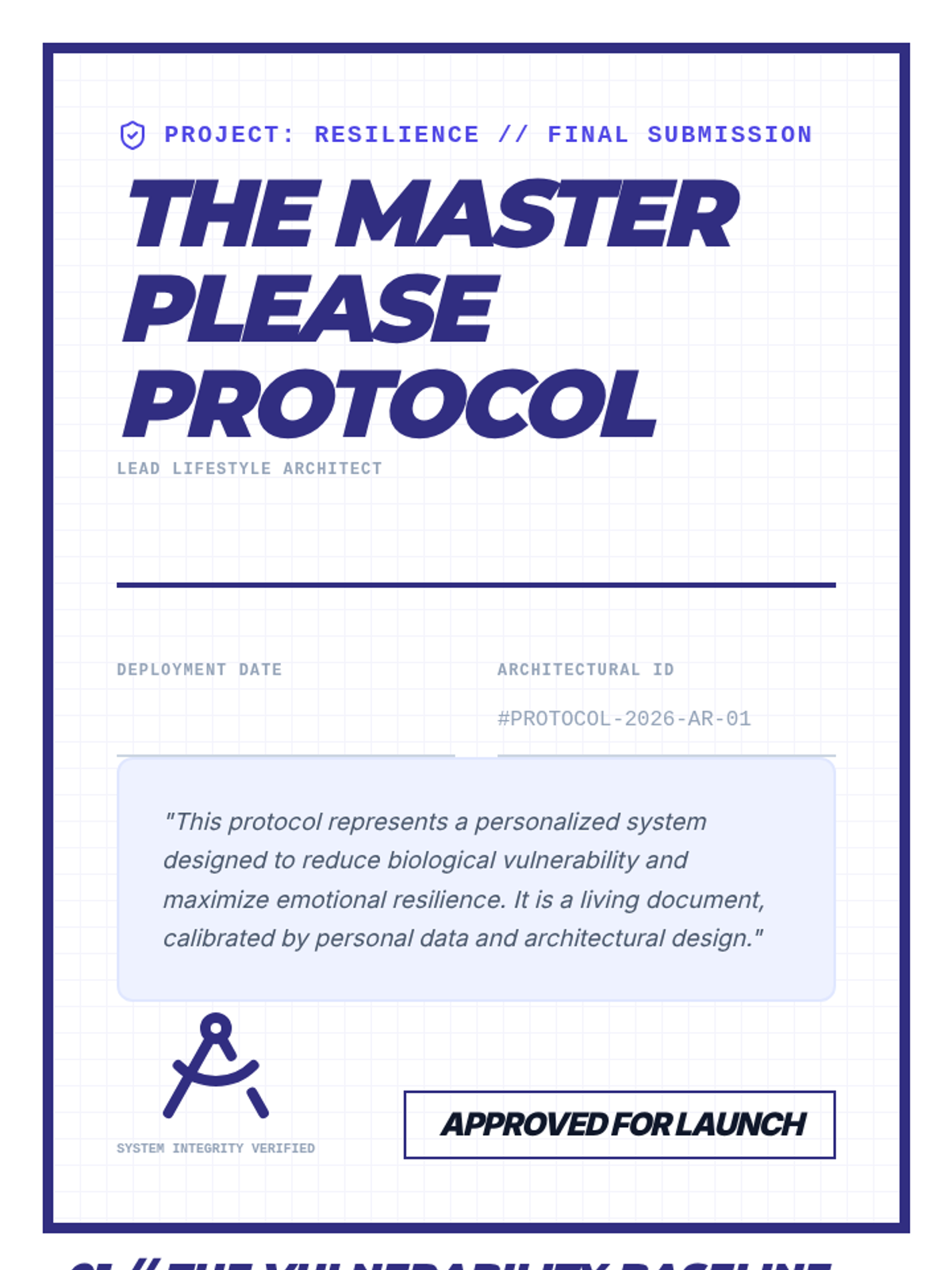
The final project deliverable for the sequence where students synthesize their audit data, sleep blueprints, nutrition plans, and movement routines into a comprehensive personal protocol.
Final slide deck for the Launching the Protocol lesson, guiding students through the synthesis of their PLEASE research and the peer review process.
Introductory slides for the Movement for Mental Clarity lesson, focusing on the biological link between movement and emotional regulation. Introduces the '20-minute reset' concept.
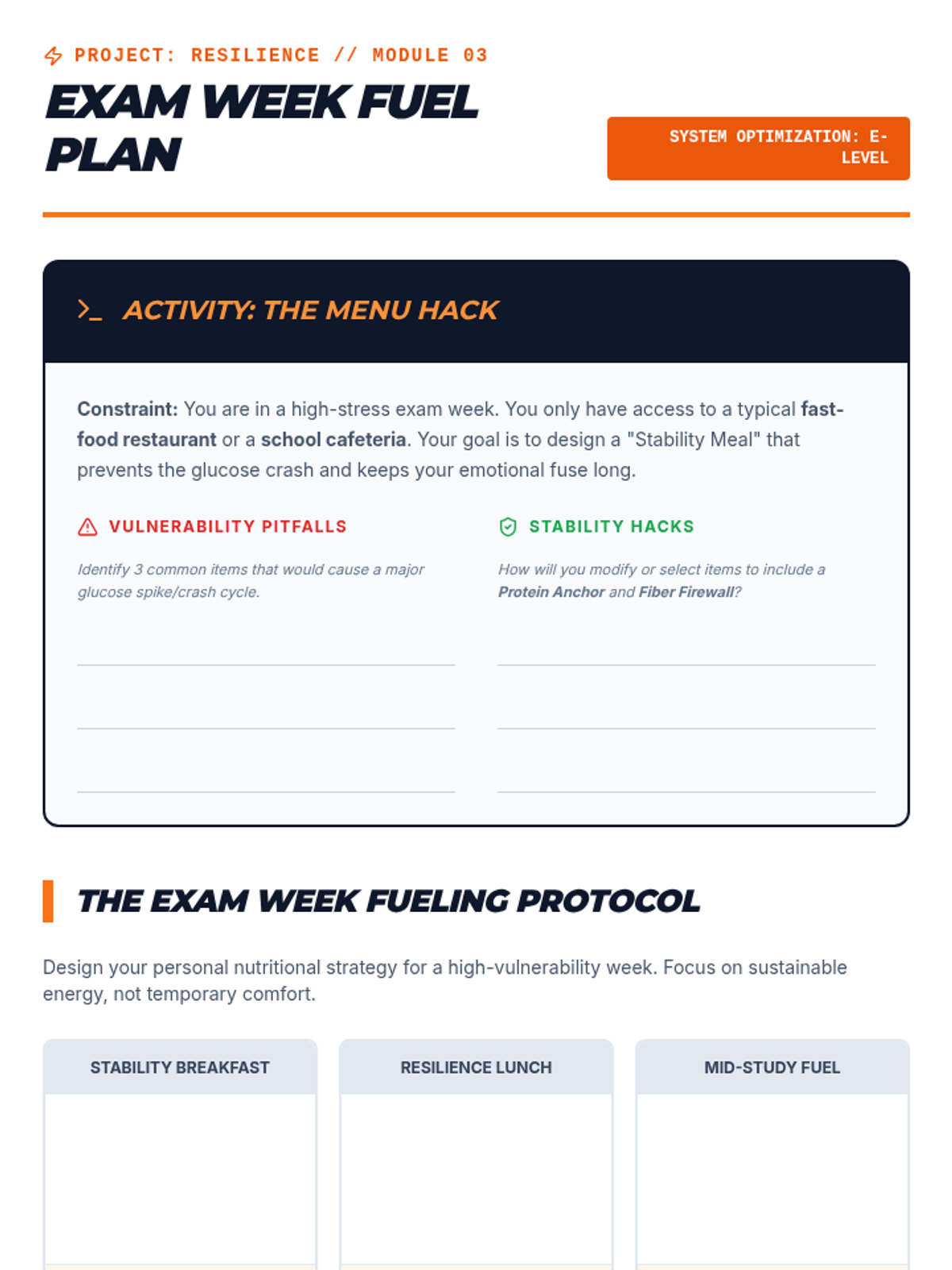
A nutrition-focused worksheet where students analyze cafeteria menus for 'vulnerability pitfalls' and design an 'Exam Week Fuel Plan' to stabilize blood sugar and emotional resilience.
Introductory slides for the Fueling the Machine lesson, exploring the biological link between nutrition, blood sugar, and emotional stability. Includes the 'Menu Hack' challenge intro.
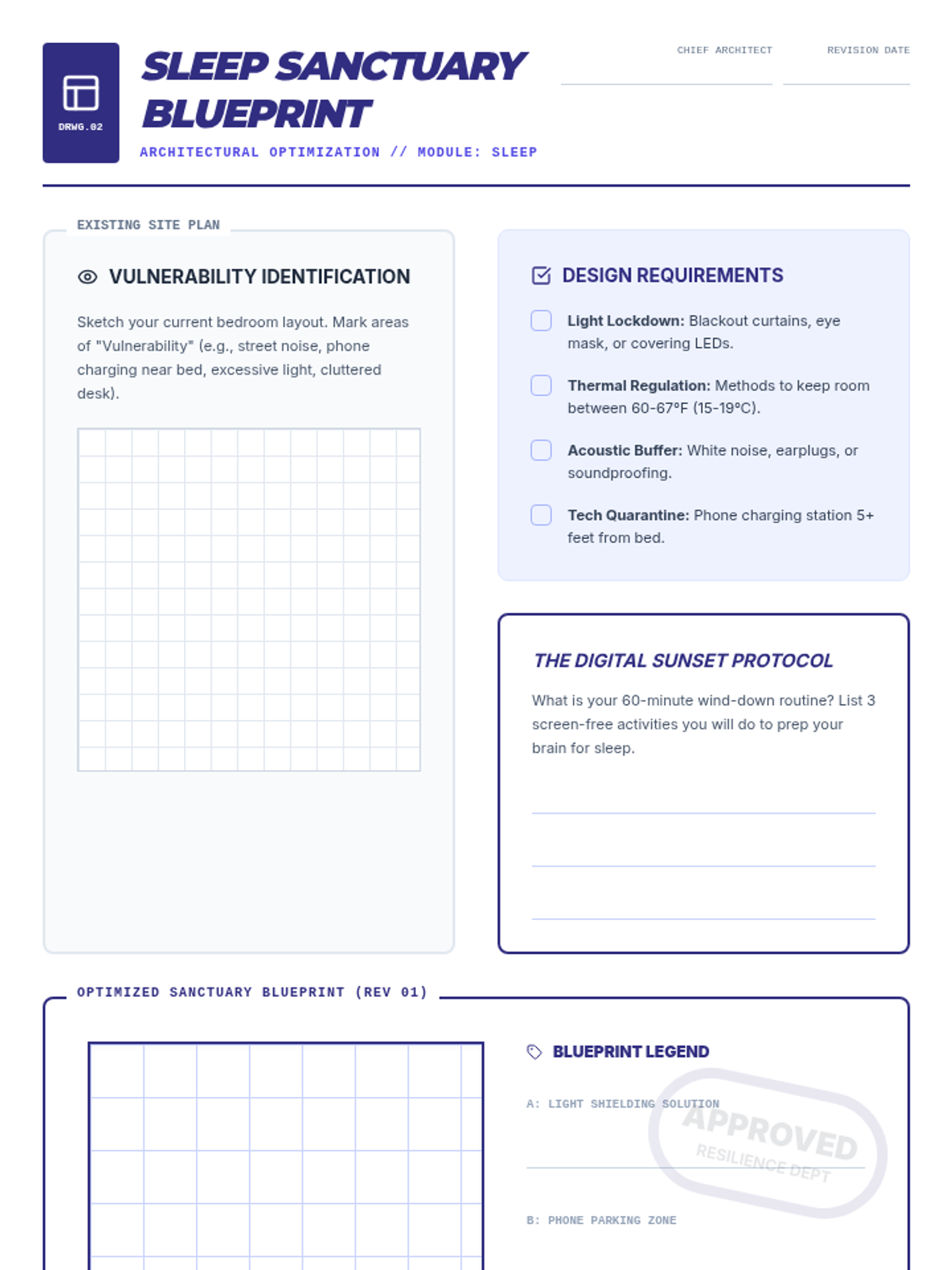
An architectural-themed worksheet where students audit their current sleep environment and design a 'Sleep Sanctuary' using evidence-based sleep hygiene principles.
Introductory slides for the Sleep Sanctuary lesson, explaining the biological importance of sleep for adolescents and introducing environmental design principles for better rest.
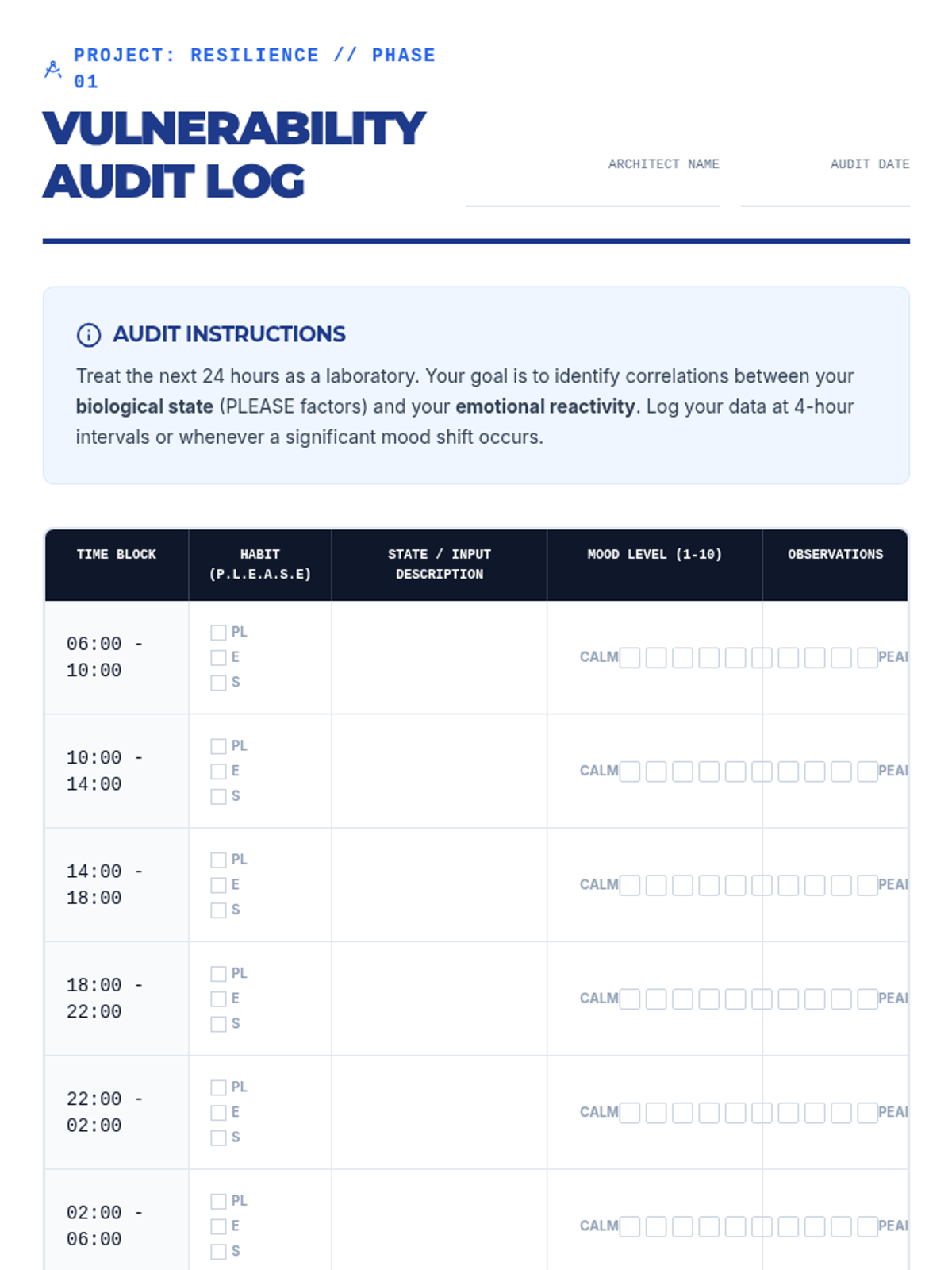
A 24-hour lifestyle and mood tracking sheet for students to audit their PLEASE habits and identify correlations with emotional vulnerability.
Introductory slide deck for the Vulnerability Audit lesson, introducing the PLEASE acronym and the concept of biological emotional regulation using a 'Lifestyle Architect' theme. Updated to ensure all text is 24px minimum.
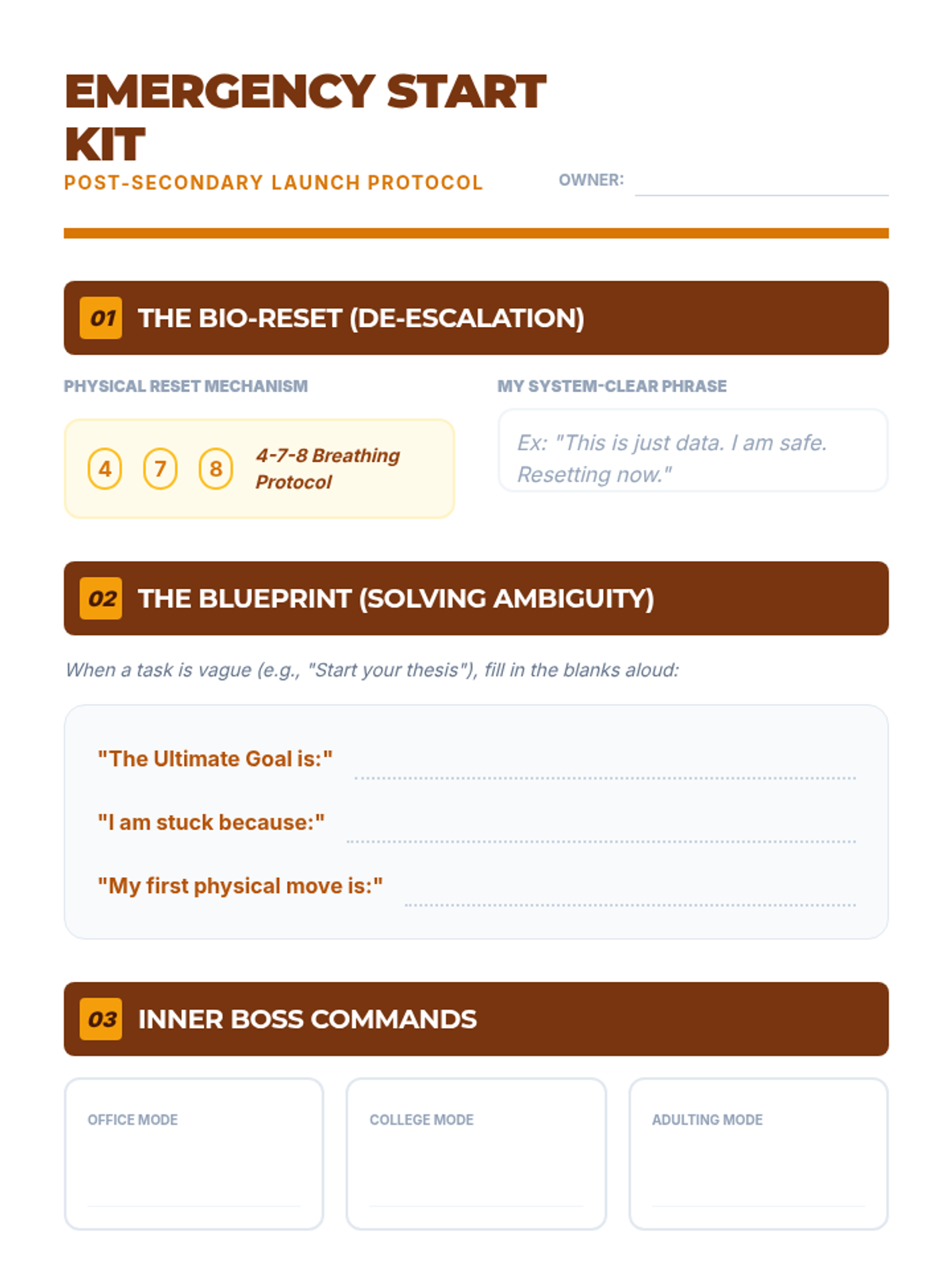
A comprehensive student template for creating a personalized 'Emergency Start Kit' to master task initiation in future post-secondary environments.
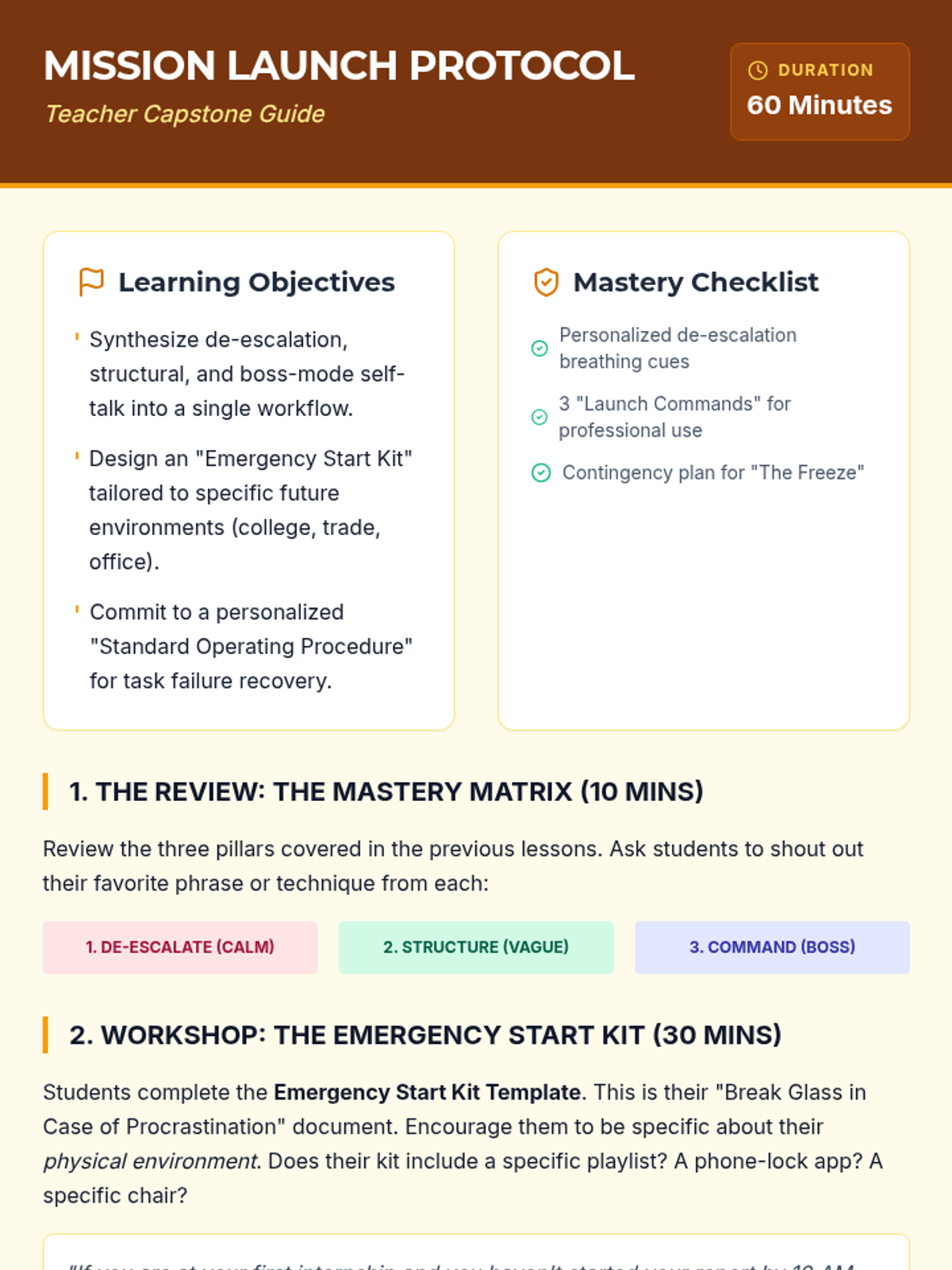
Teacher guide for the final capstone lesson, where students synthesize all self-talk strategies into a personalized emergency protocol for post-secondary success.
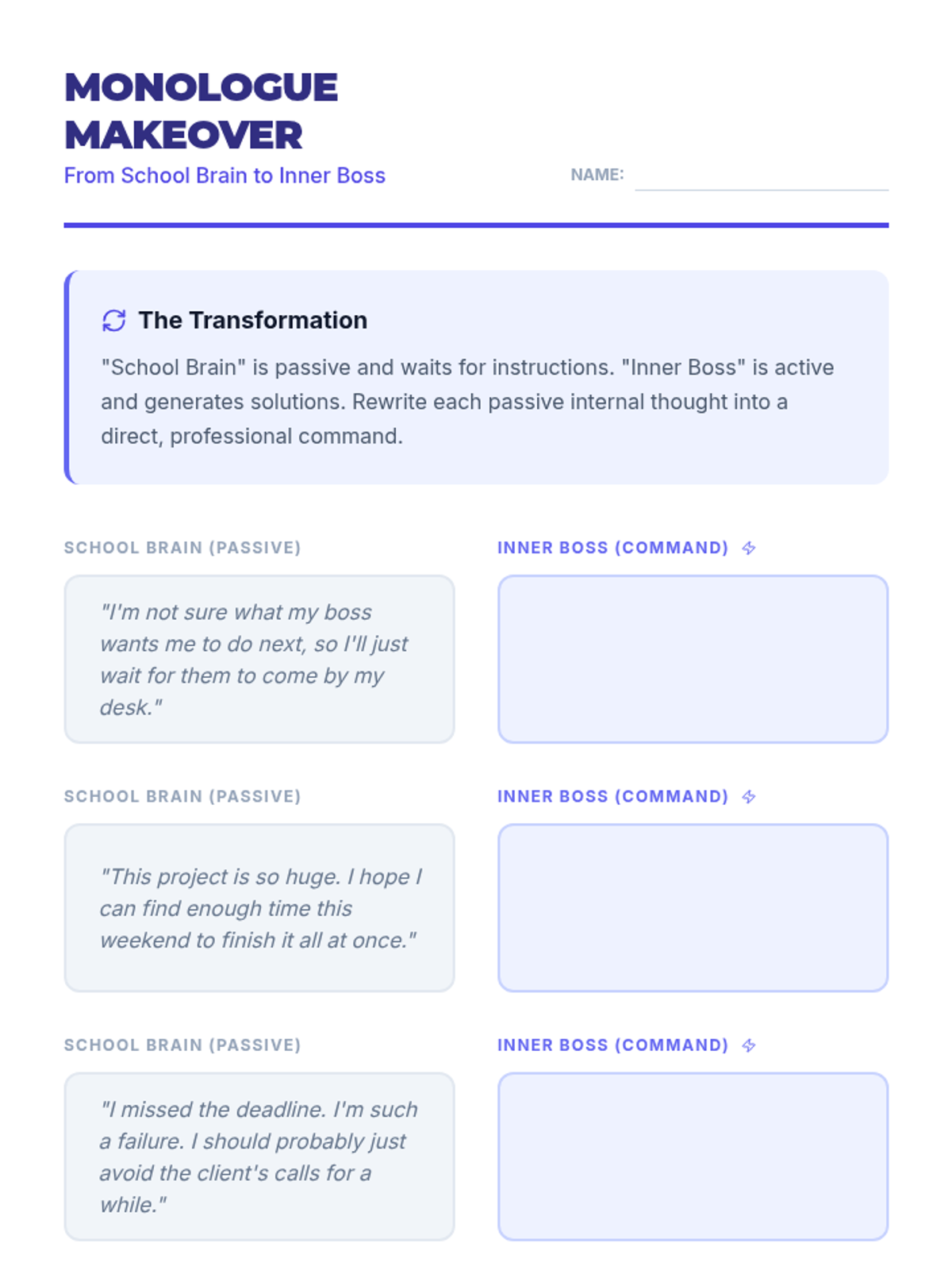
Student worksheet for practicing the transformation of passive 'school-mode' thoughts into active 'professional-mode' commands.
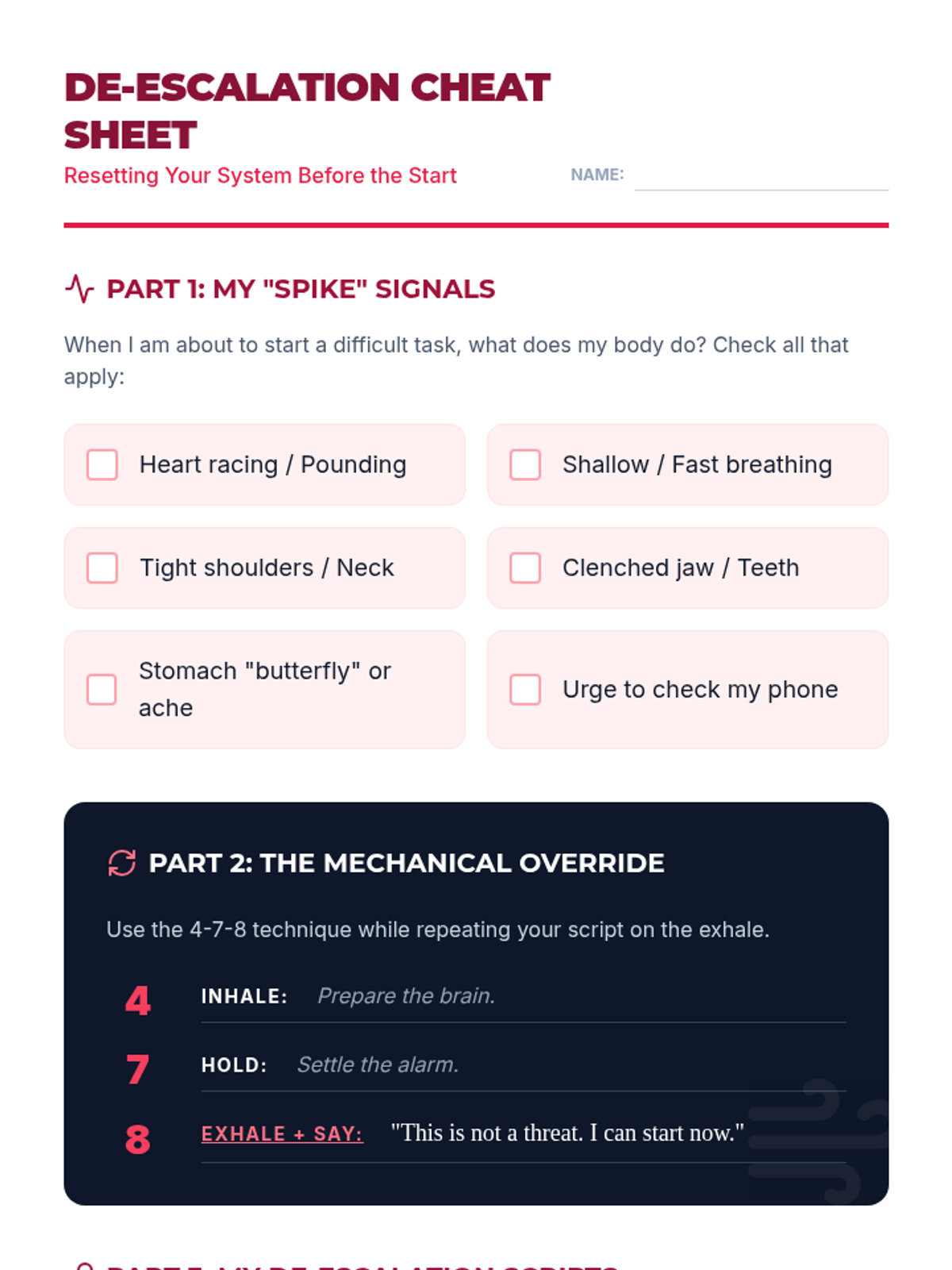
Student worksheet for tracking physiological stress signals and identifying personal de-escalation phrases for task initiation.
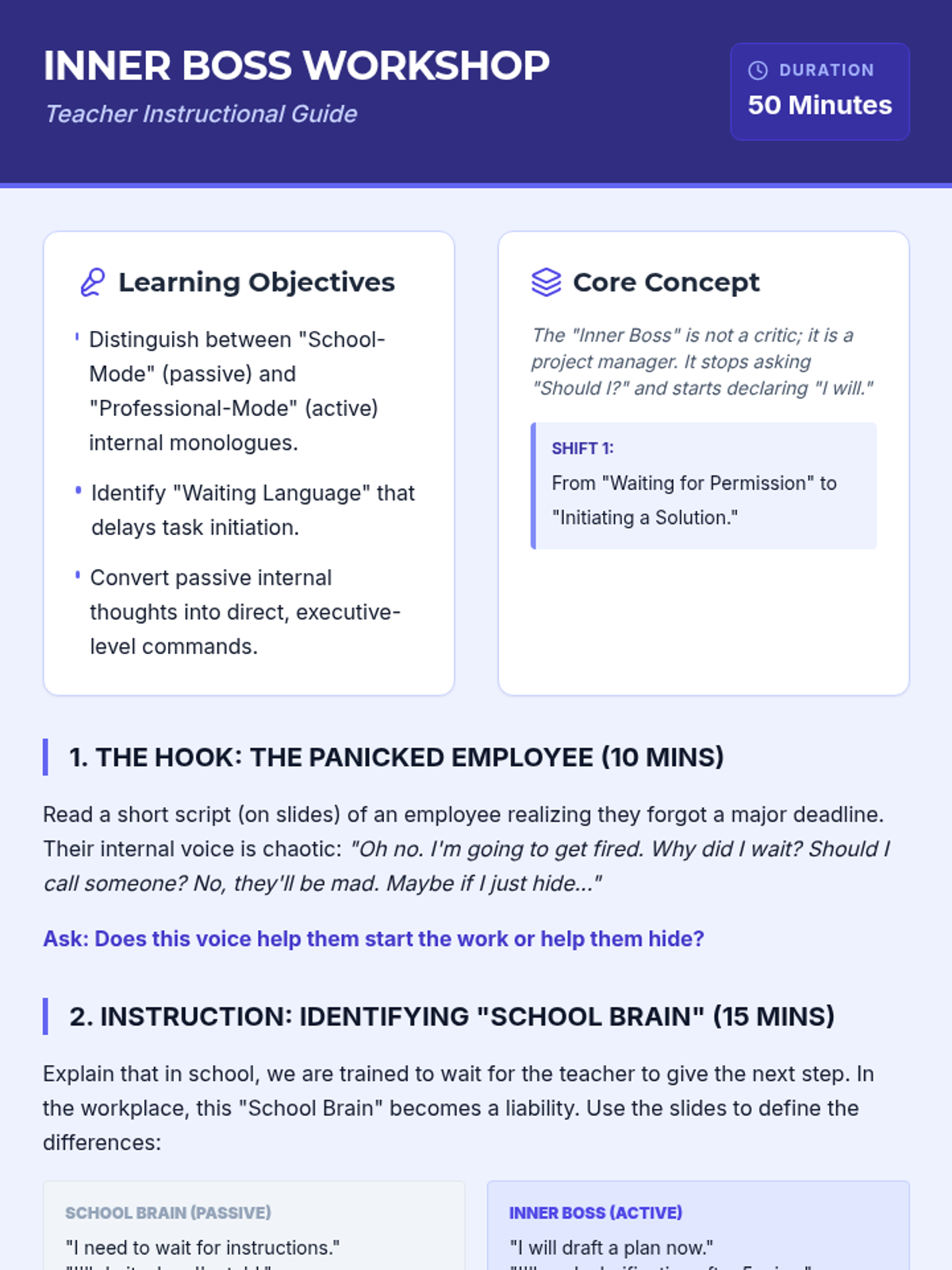
A teacher guide for the fourth lesson, focusing on transforming passive 'school-mode' internal thoughts into active 'professional-mode' commands.
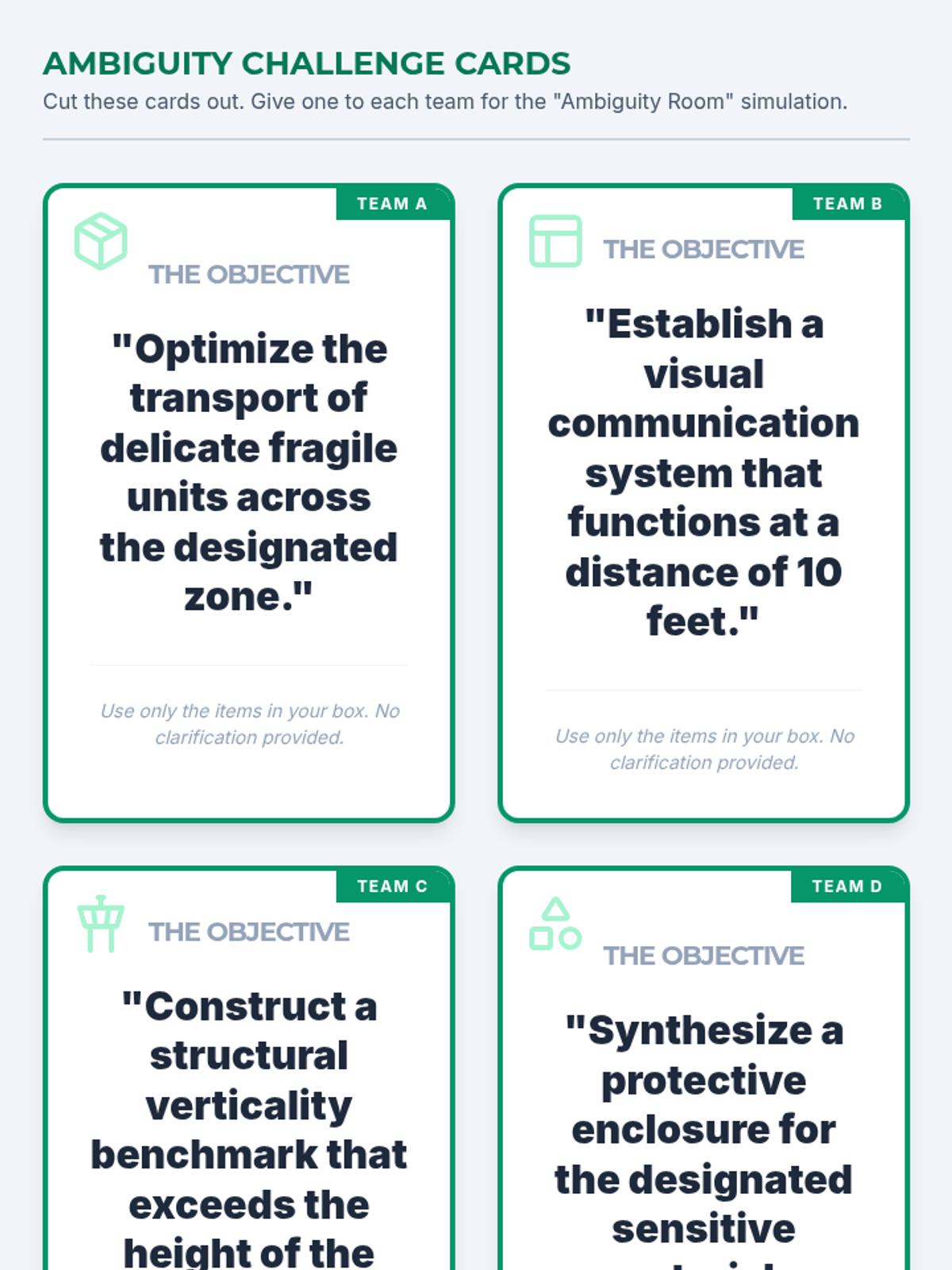
Challenge cards with vague objectives for the 'Ambiguity Room' simulation, designed to trigger task paralysis and necessitate self-talk structure.
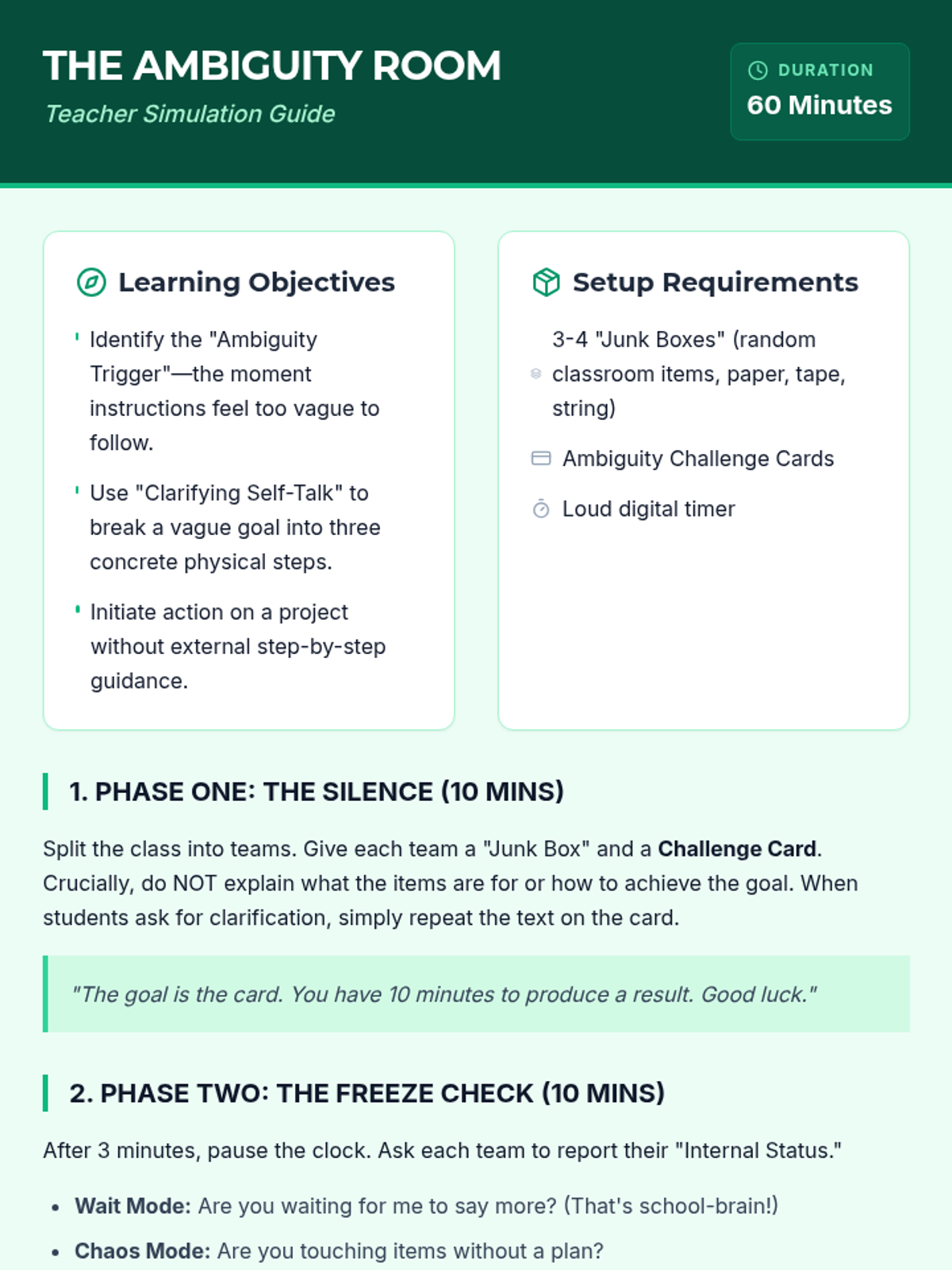
A comprehensive teacher guide for the third lesson simulation, focusing on navigating vague instructions and ambiguity through structured self-talk.
Visual presentation for Lesson 2, explaining the physiological stress response, the avoidance loop, and the 4-7-8 breathing technique for task de-escalation.
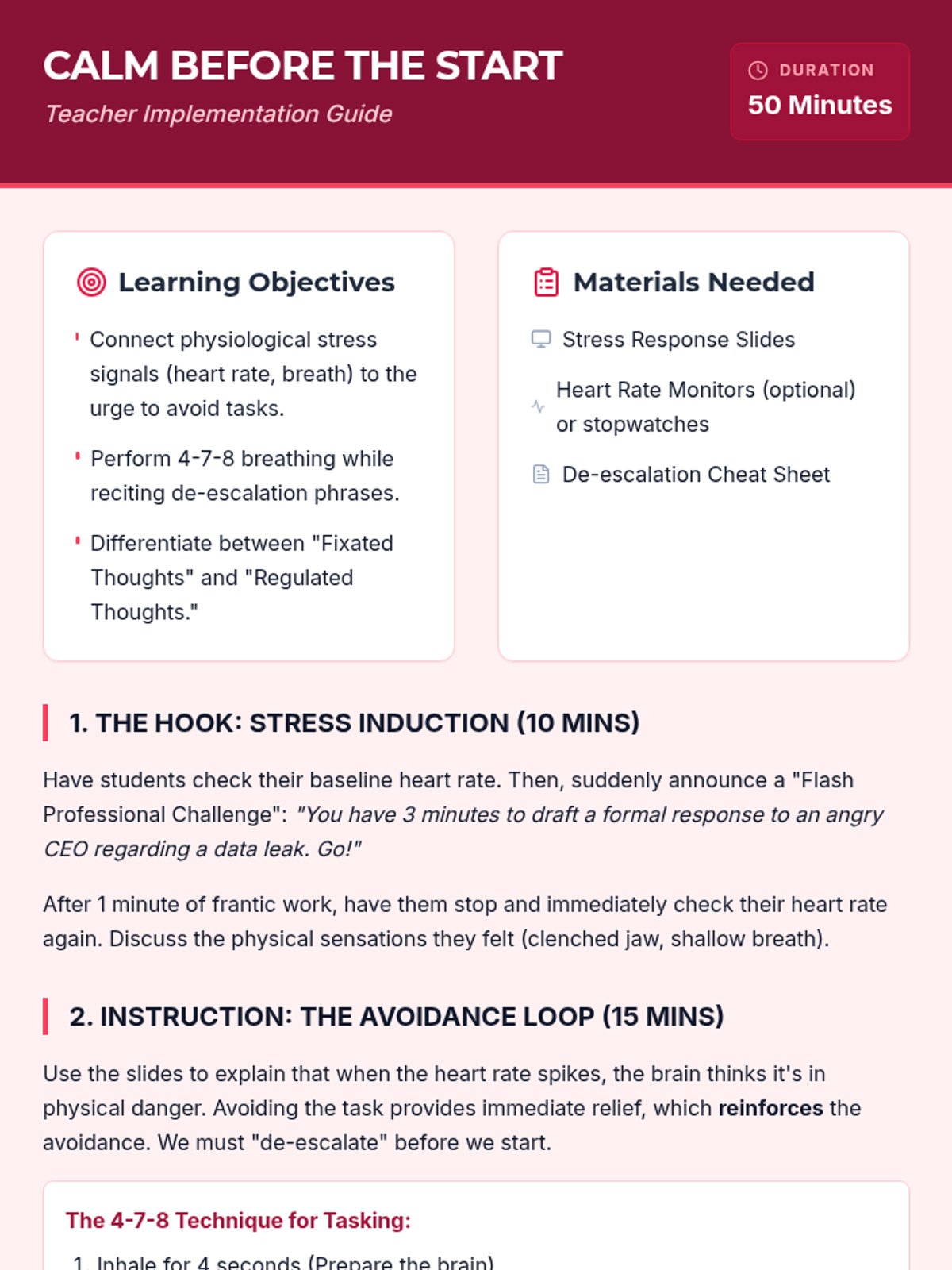
A teacher guide for the second lesson on de-escalating anxiety through self-talk, featuring a stress induction activity and the 4-7-8 breathing technique.
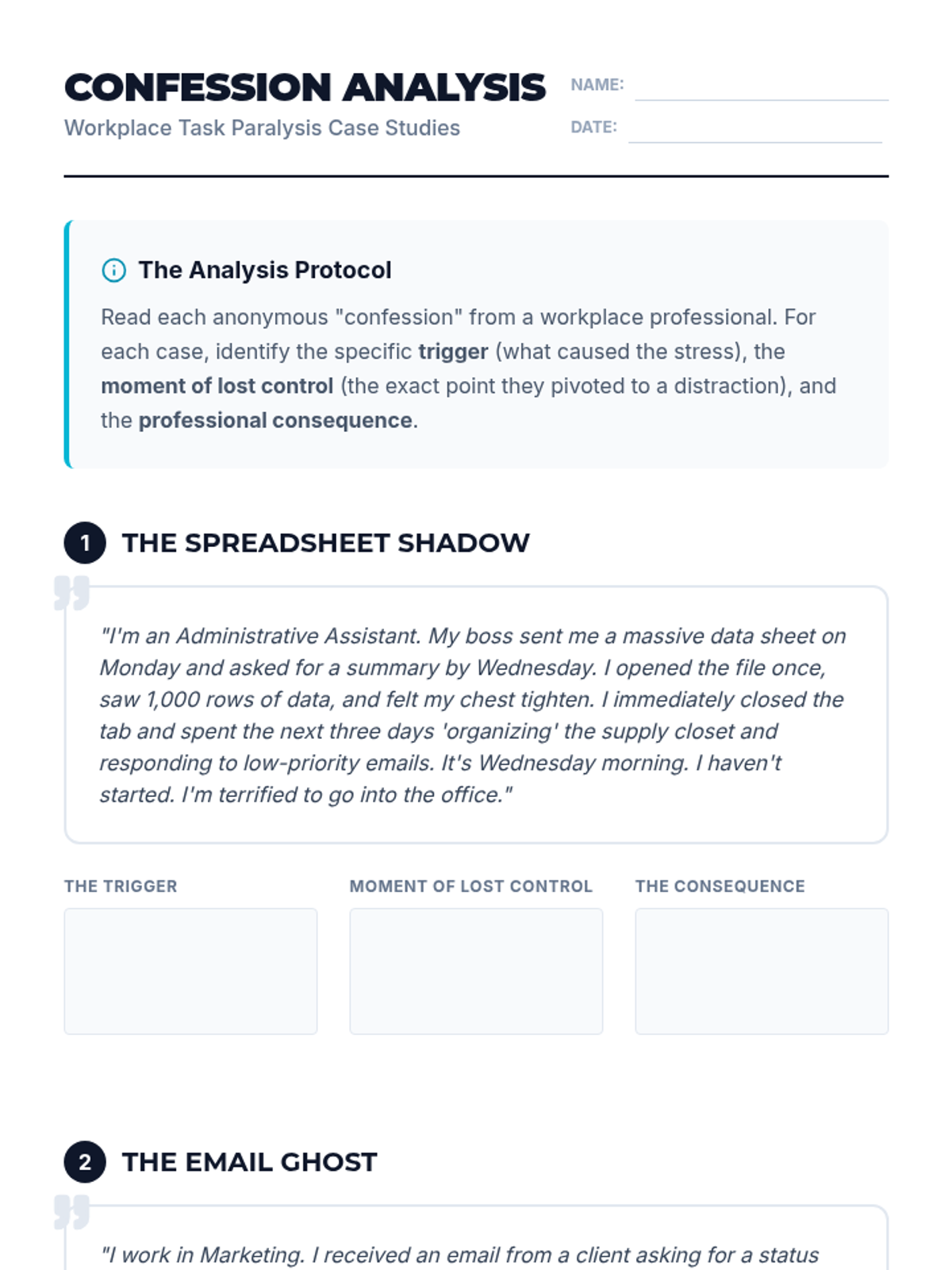
Student worksheet featuring workplace case studies (confessions) for analyzing the triggers and consequences of task paralysis.
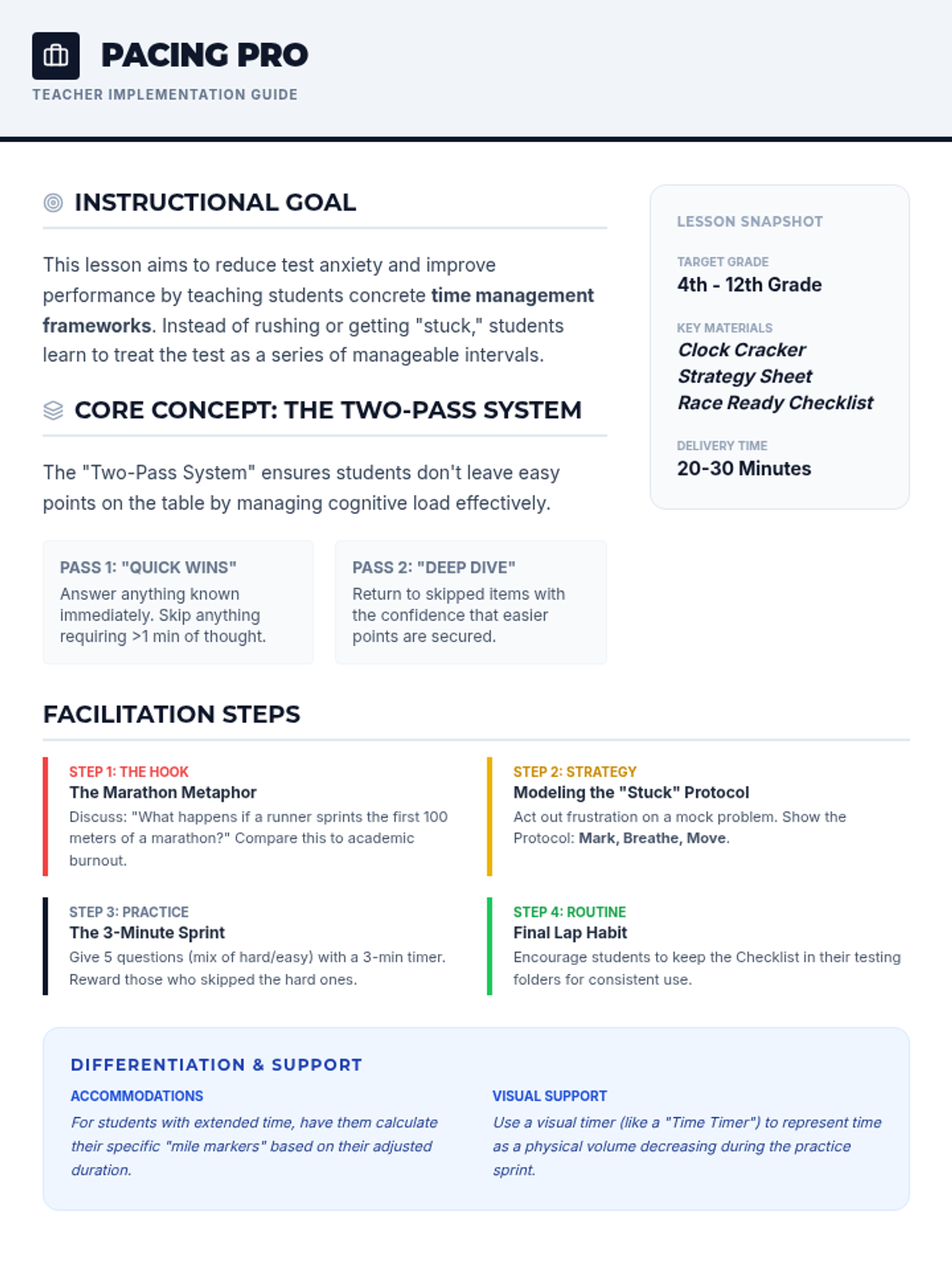
A professional guide for teachers to implement pacing strategies, featuring the 'Two-Pass' system explanation and a 4-step facilitation plan.
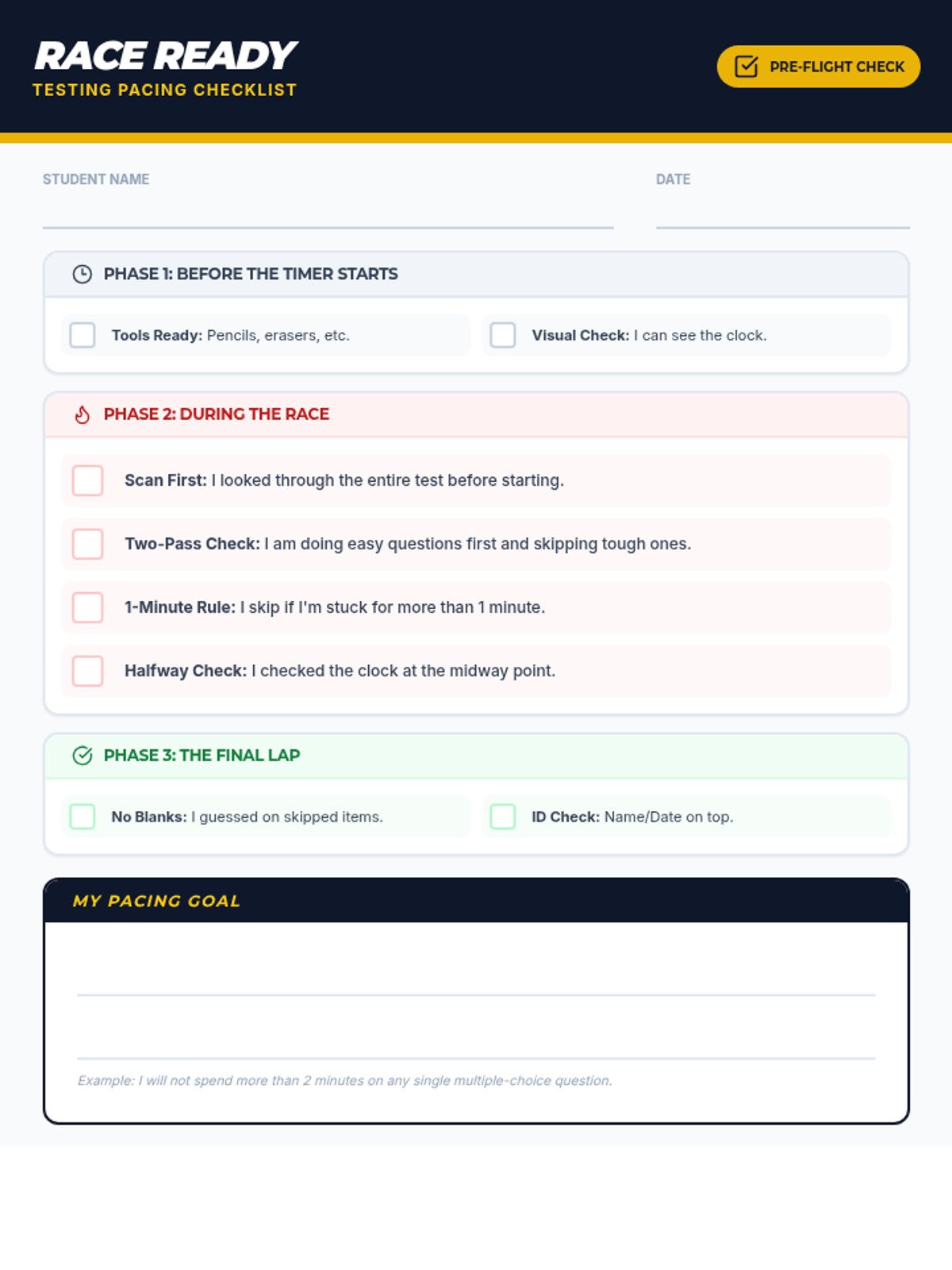
A student-facing checklist for managing time before, during, and after a test, formatted with a racing theme to encourage momentum.
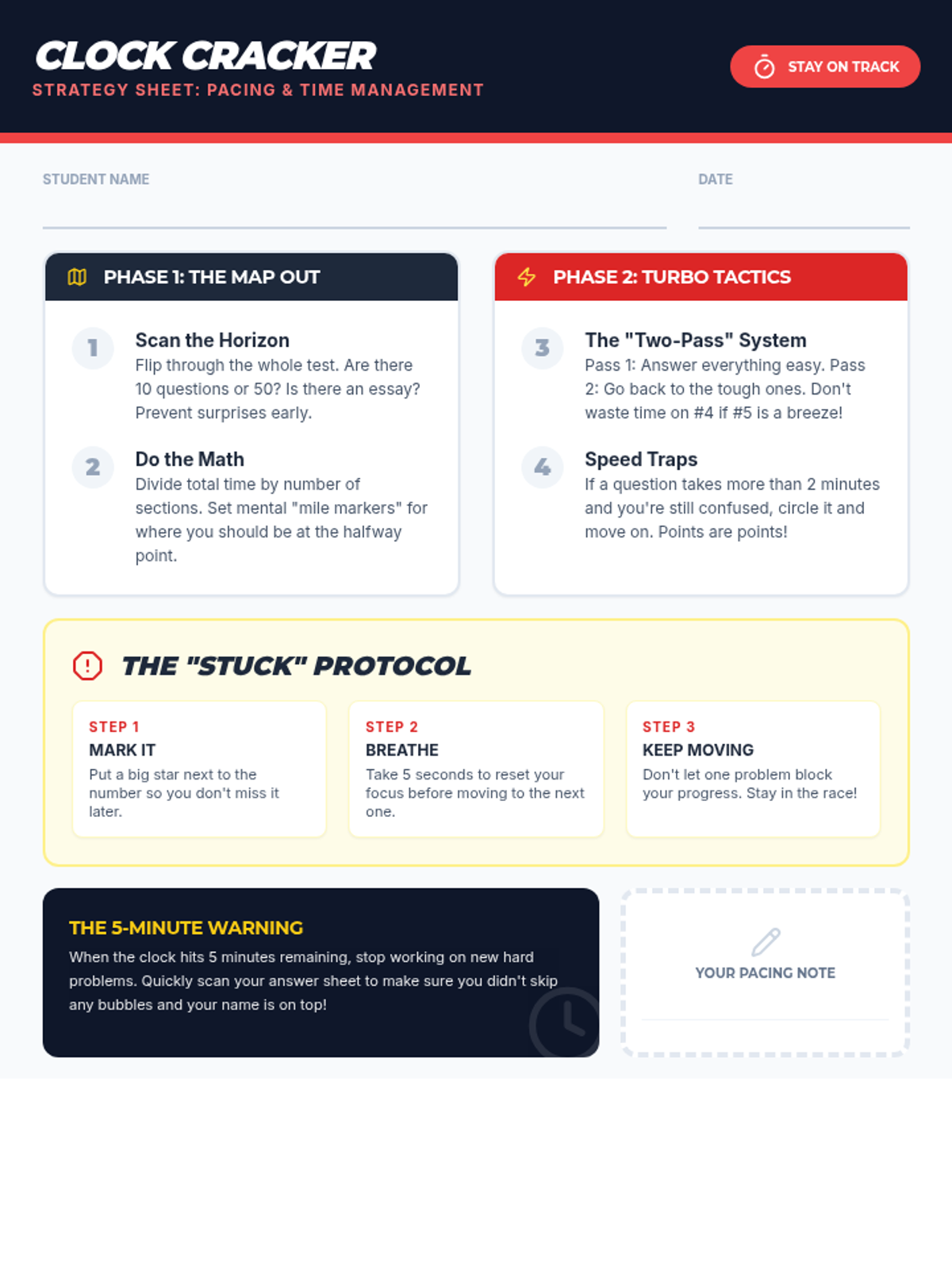
A high-energy student strategy sheet focused on time management and pacing during exams, featuring the 'Two-Pass' system and 'The Stuck Protocol'.