Root cause analysis and brainstorming techniques for everyday problem-solving. Equips learners with ethical frameworks and risk-benefit evaluation skills to predict consequences and make informed choices.
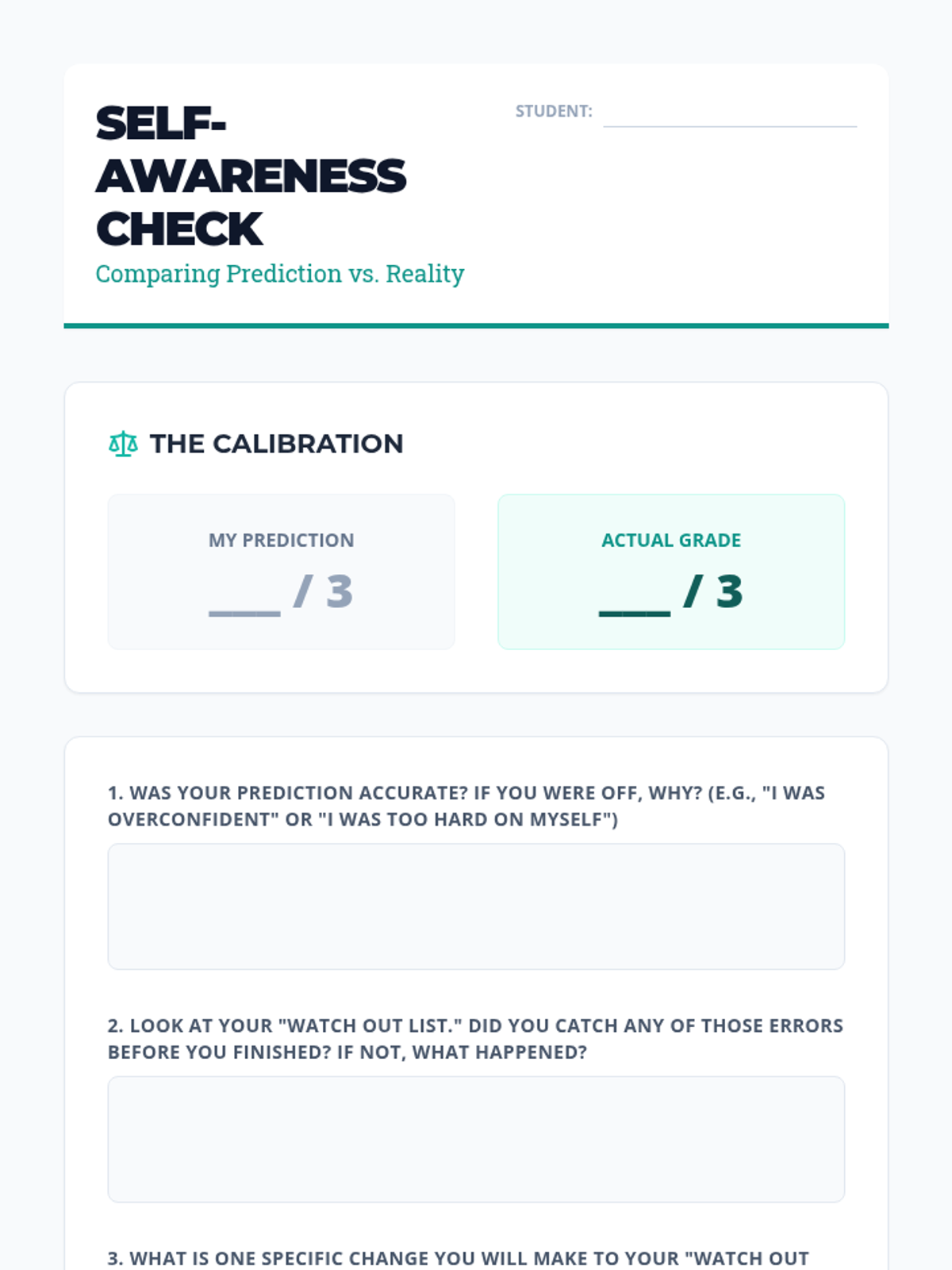
A final reflection sheet for students to compare their quiz predictions with their actual grades, evaluating the effectiveness of their metacognitive strategies.
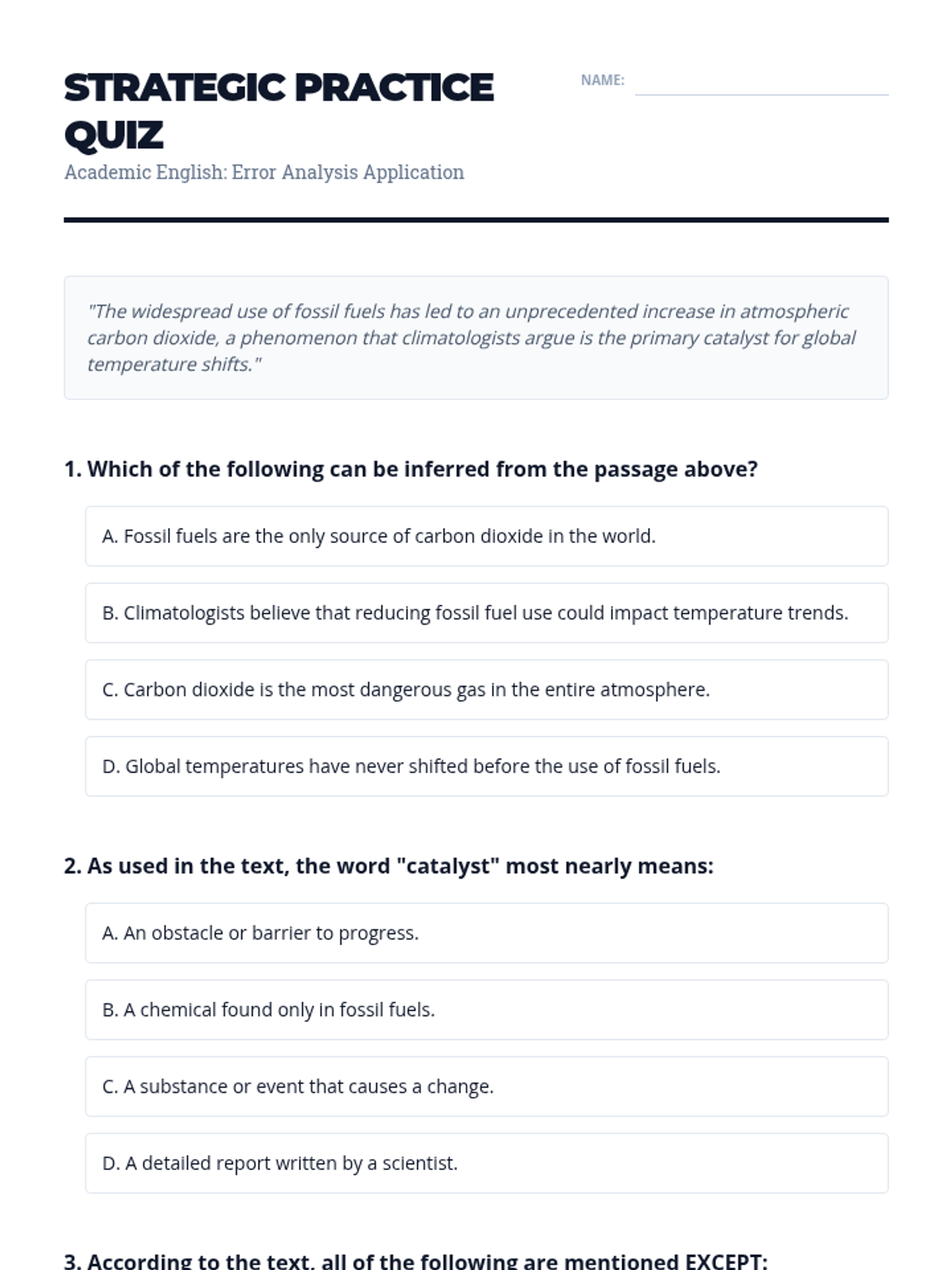
A short Academic English quiz designed to test students' application of their "Watch Out List," including a mandatory pre-grading self-reflection and score prediction section.
Final slides for the sequence focusing on the "Showtime" assessment. It introduces the score prediction challenge and real-time error analysis.
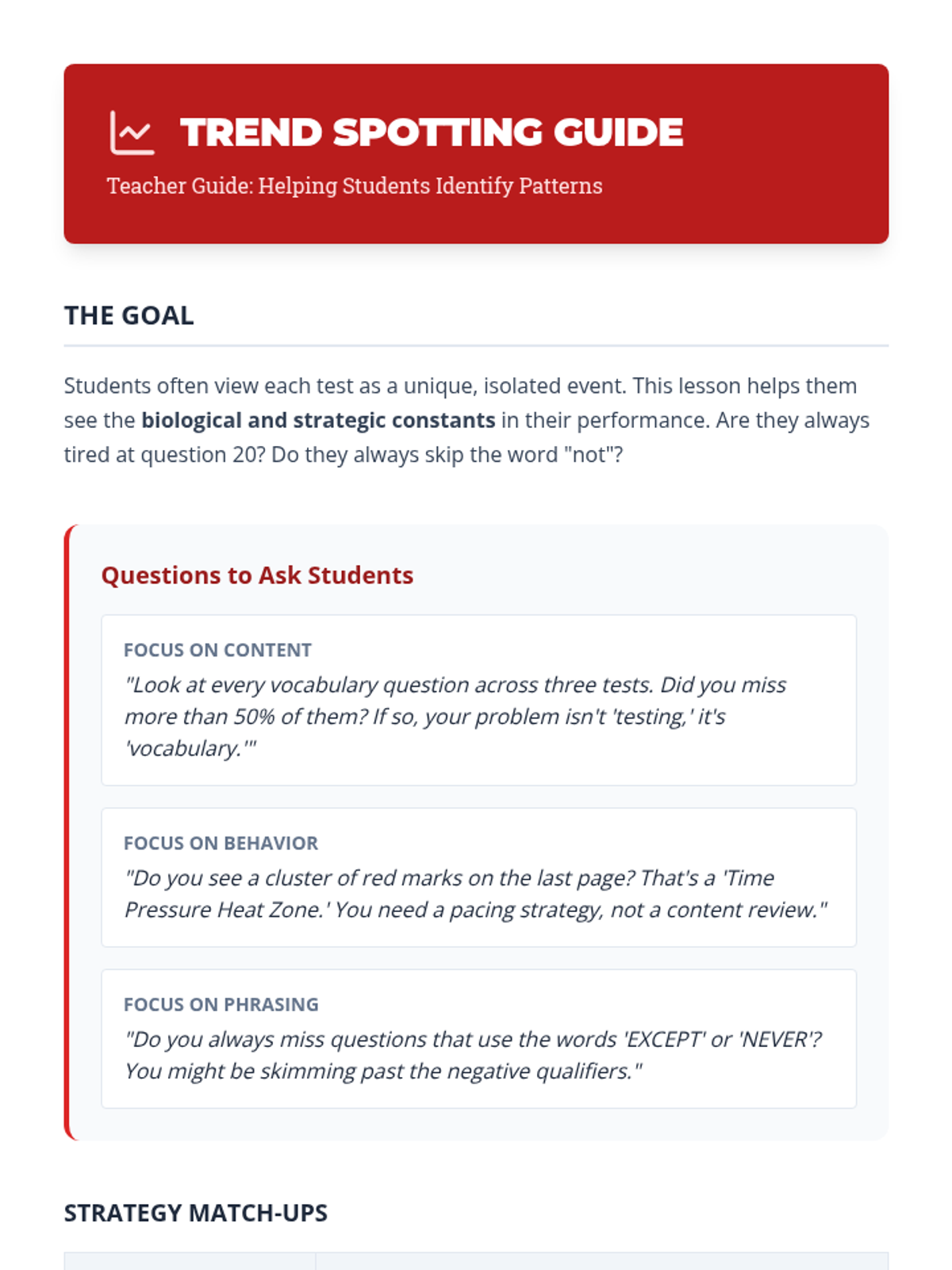
A guide for teachers to help students interpret their error data and connect patterns to specific defensive strategies.
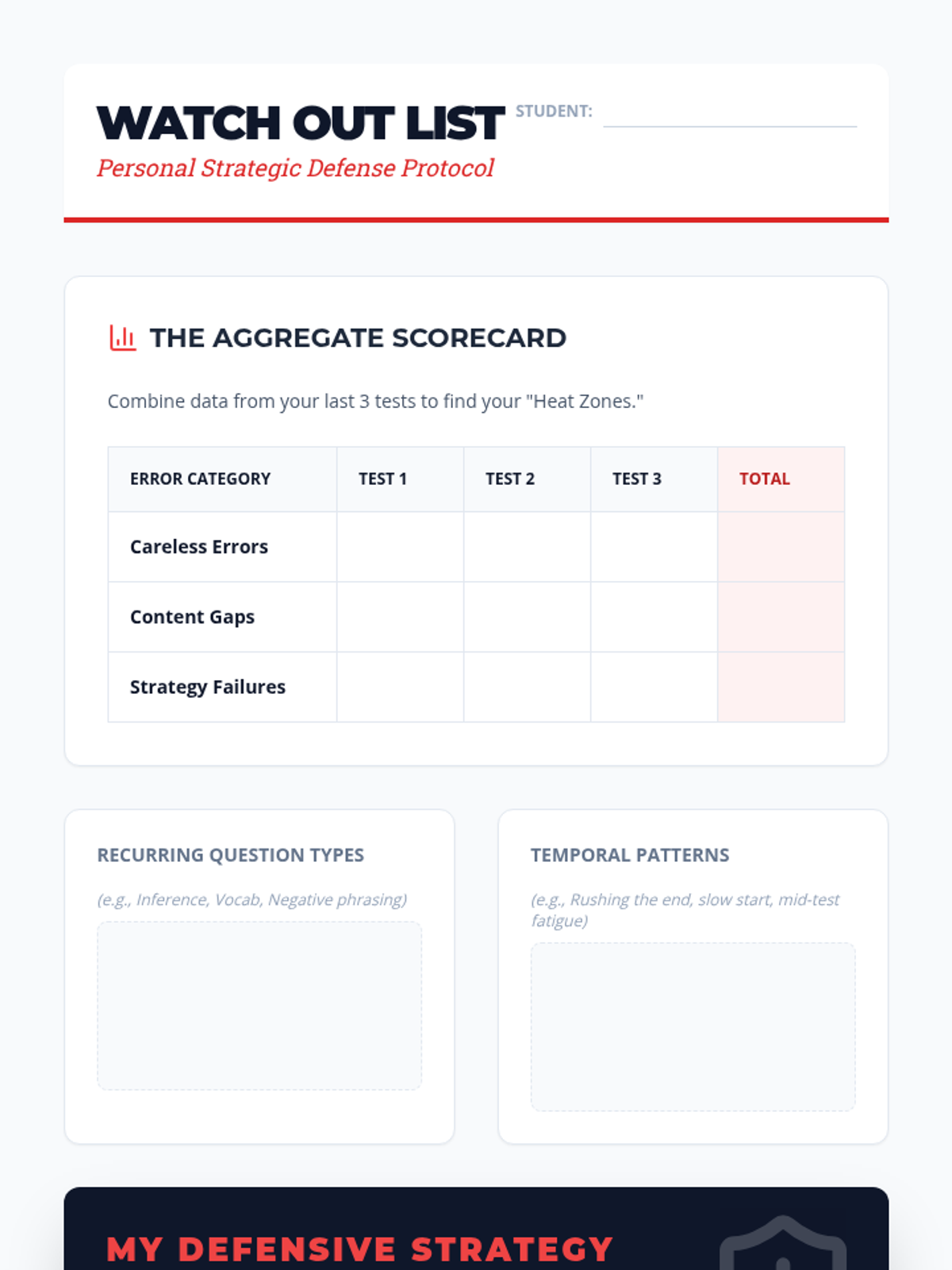
A student worksheet for aggregating error data across multiple assessments and distilling those patterns into a "Watch Out List" for future defense.
Slides for Lesson 4 that use a "Heatmap" analogy to teach students how to aggregate error data and identify recurring personal patterns.
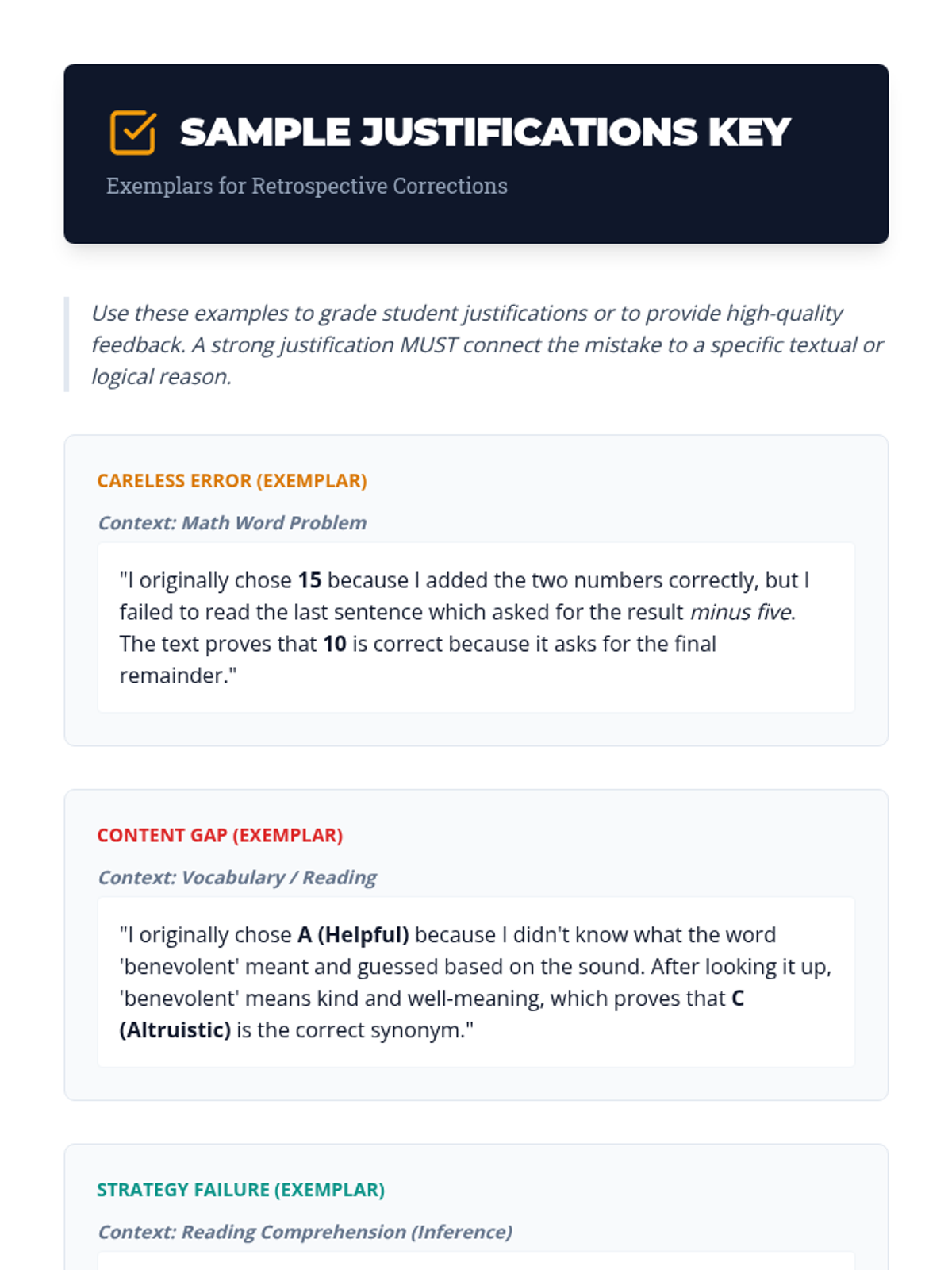
An answer key/exemplar guide for teachers to evaluate student justification statements, showing the difference between weak and mastery-level corrections.
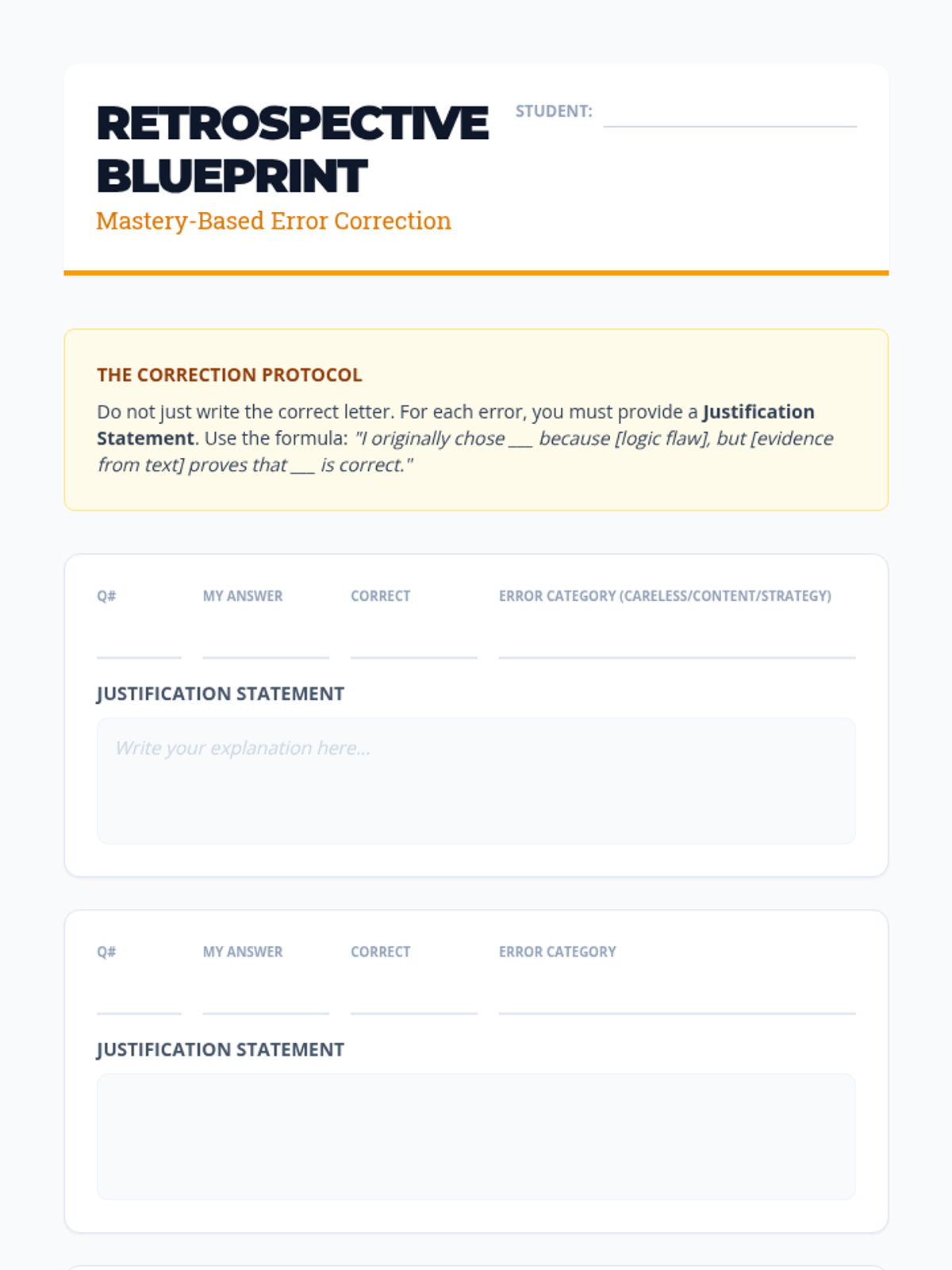
A template for students to perform deep error corrections, requiring them to write justification statements using a specific logic-based formula.
Slides for Lesson 3 introducing the "Justified Fix" method. It emphasizes that students must explain why they were wrong and why the new answer is right using evidence.
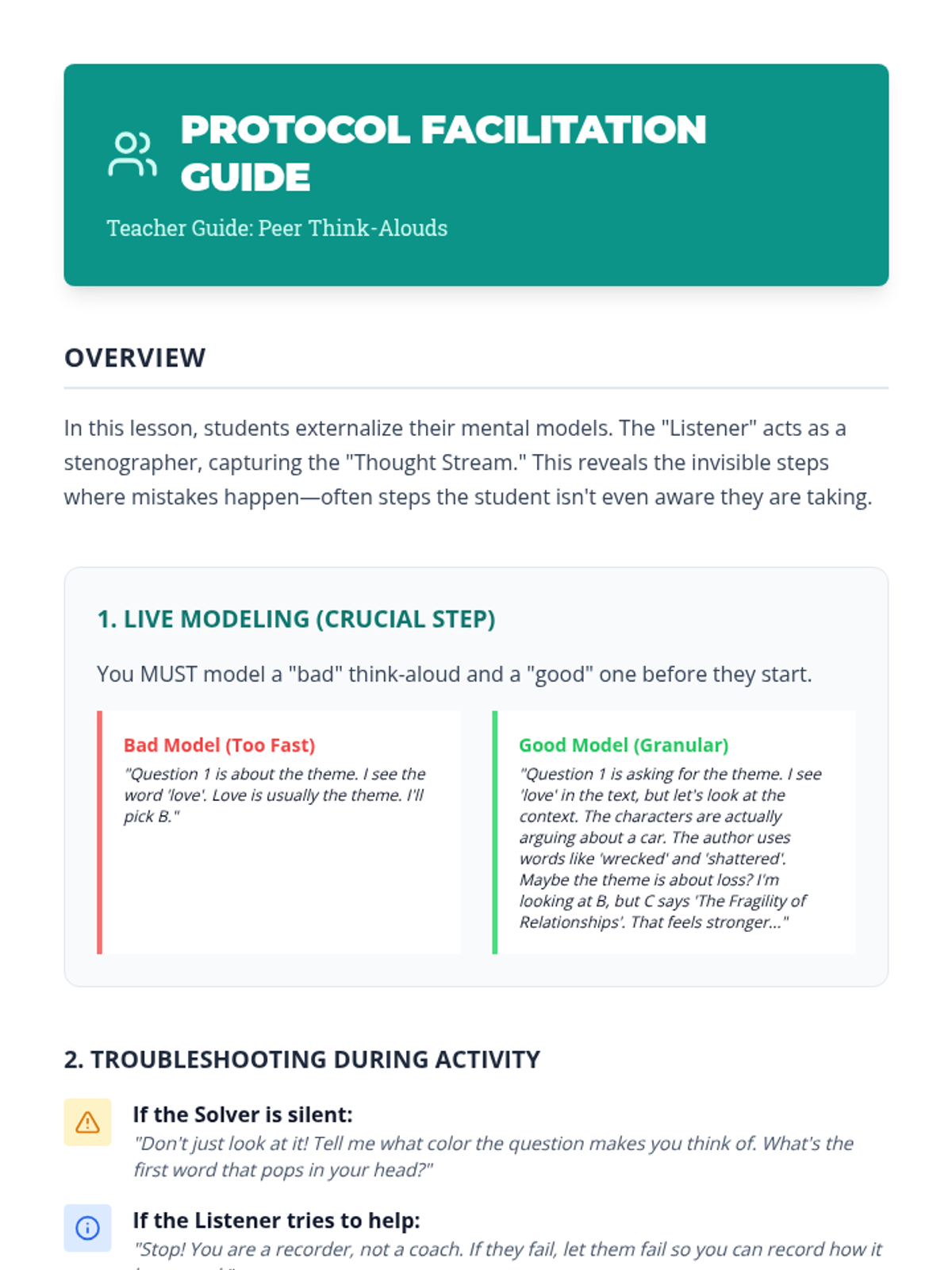
A facilitation guide for teachers to lead the "Think-Aloud" protocol, including scripts for modeling and tips for troubleshooting silent students.
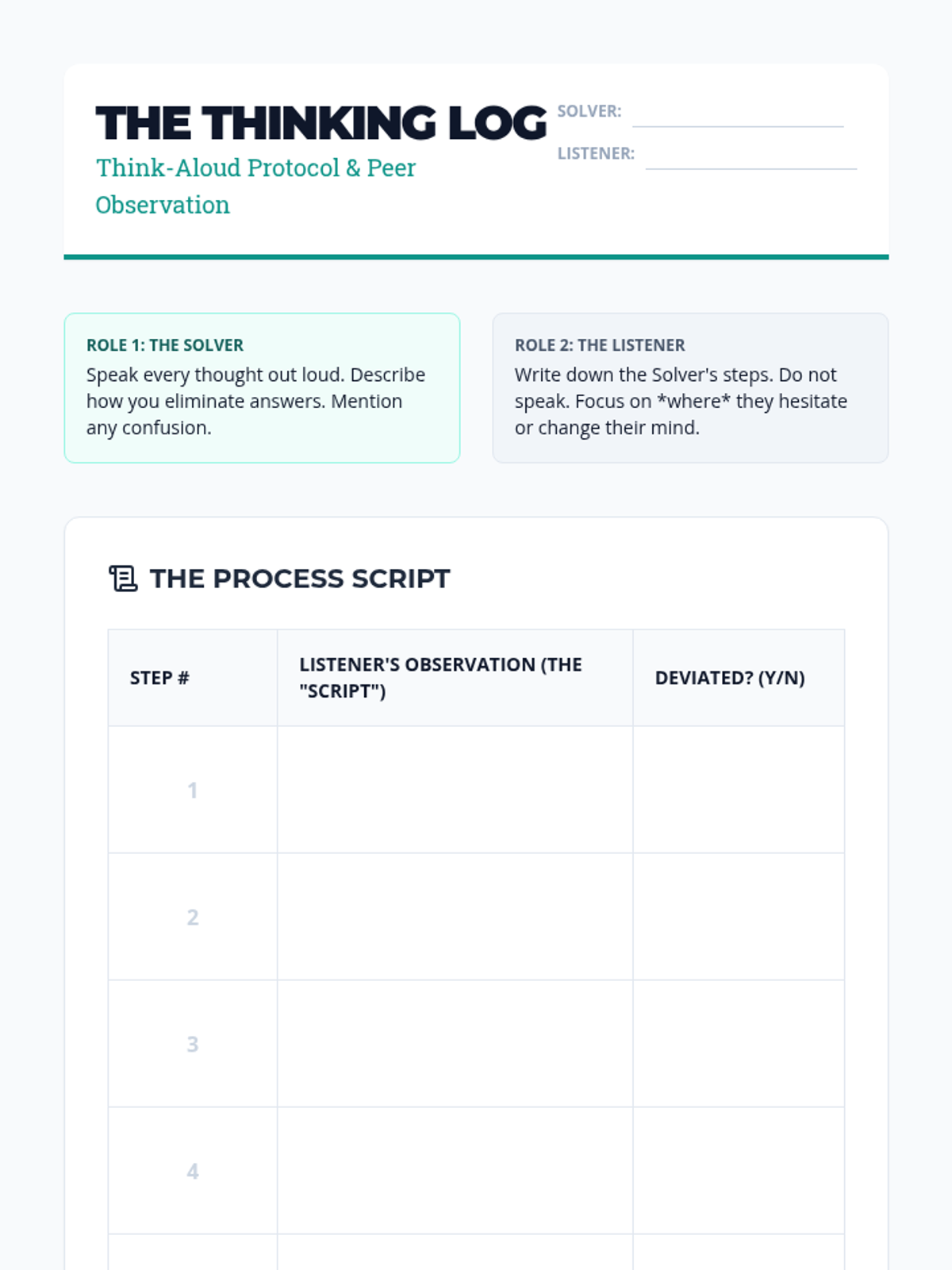
A peer-observation worksheet where students record their partner's "Think-Aloud" steps and analyze where their logic deviated from the correct path.
Slides for Lesson 2 that introduce the "Think-Aloud" protocol using a gamer commentary analogy. It outlines the roles of "The Solver" and "The Listener."
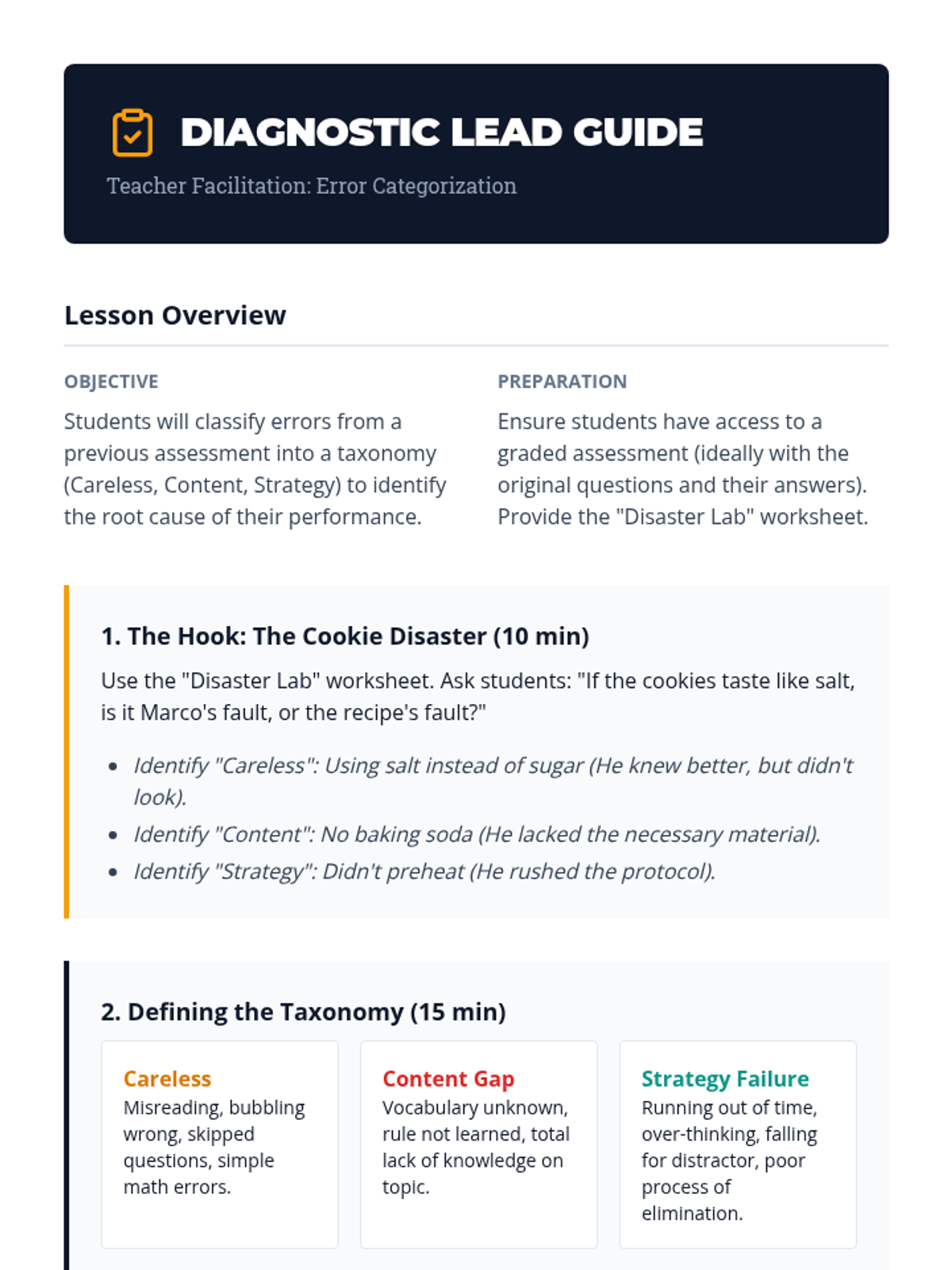
A teacher facilitation guide for Lesson 1, providing instructional prompts and definitions for error taxonomy.
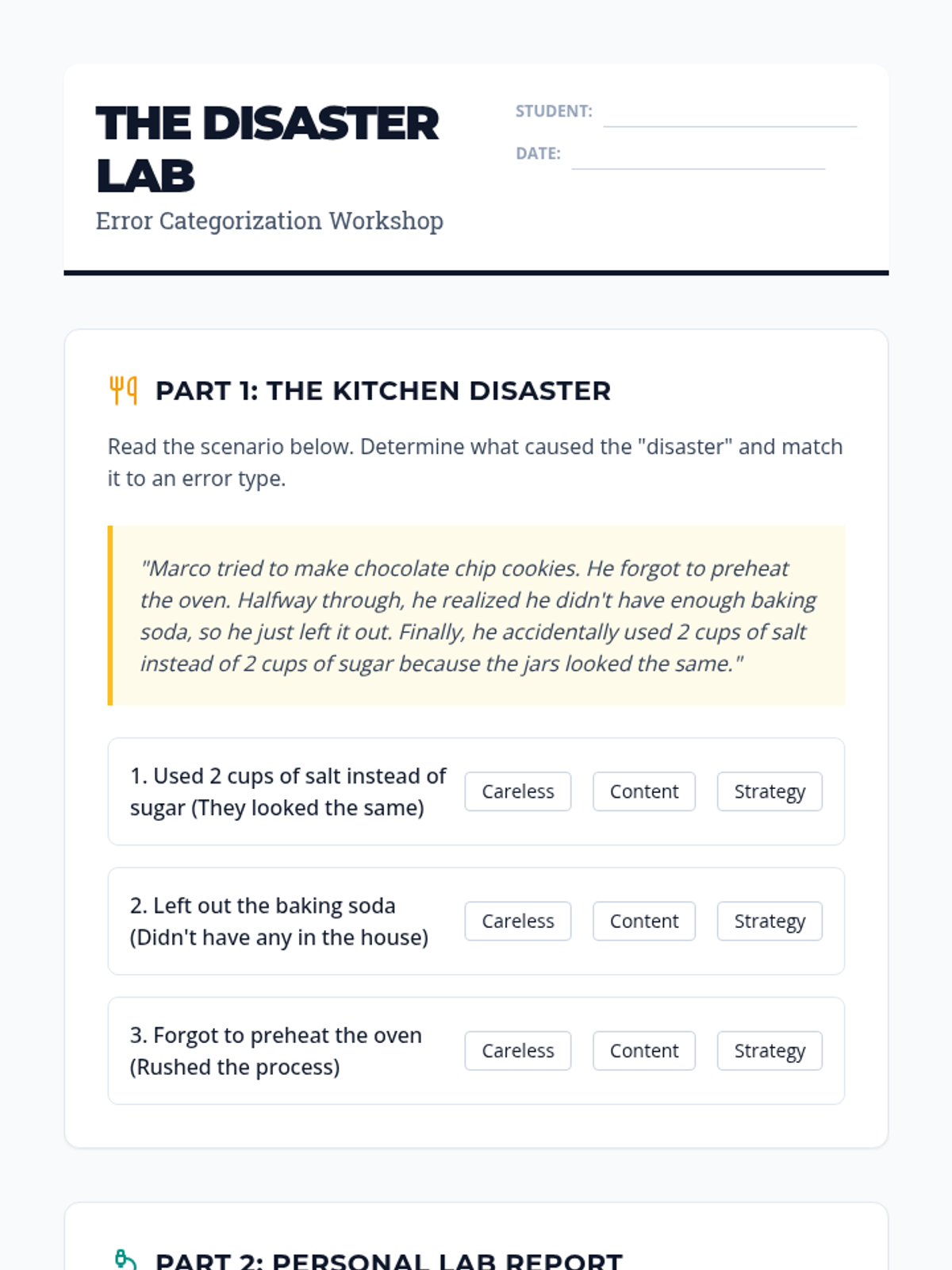
A student worksheet for the first lesson that uses a cookie recipe disaster to hook students into error categorization, followed by a table for analyzing their own test mistakes.
An introductory slide deck explaining the three main types of errors: Careless, Content Gap, and Strategy Failure, using a recipe disaster analogy.
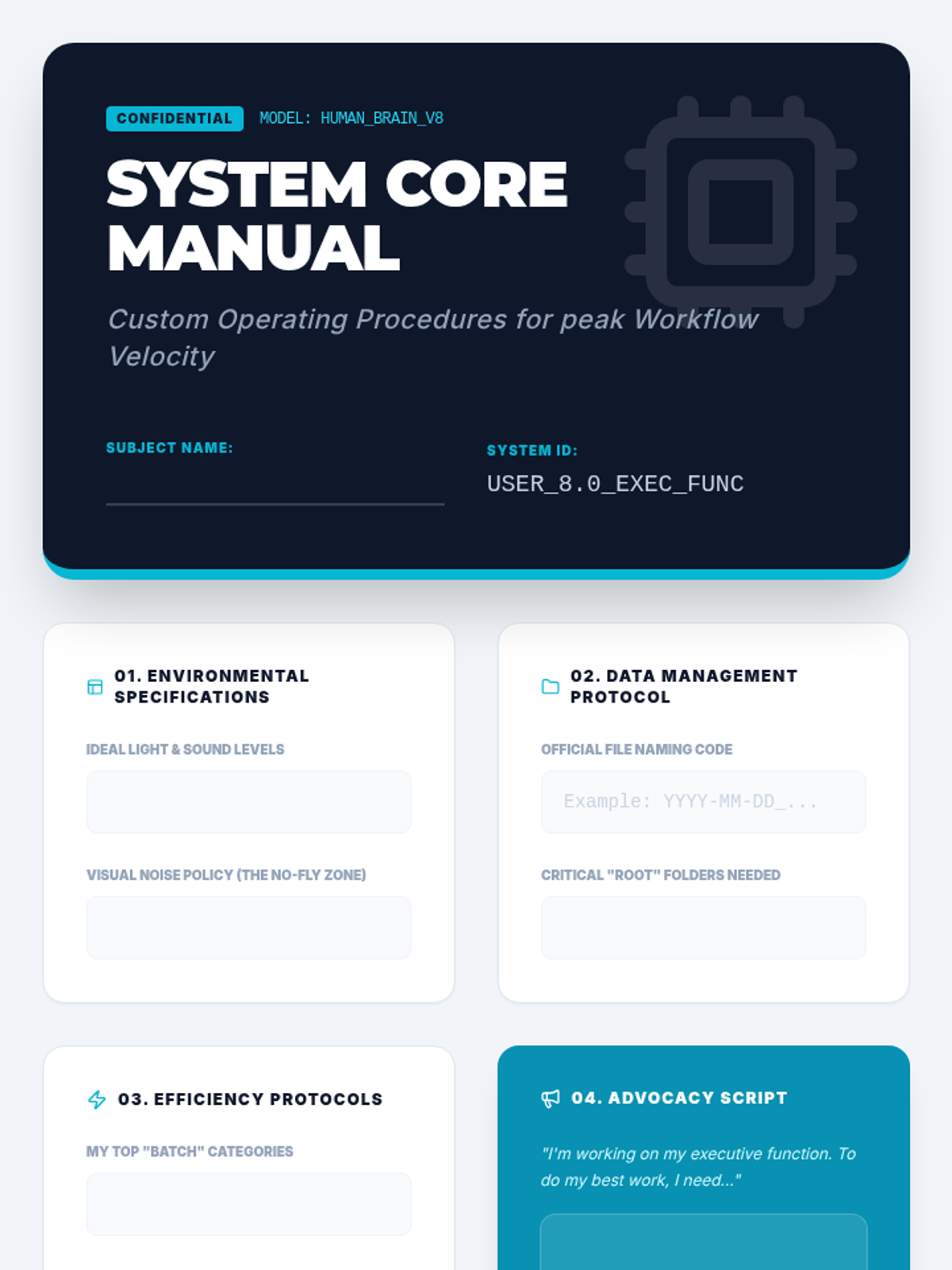
The capstone project template for the sequence. Students synthesize all previous learning into a professional-looking "System Core Manual" that documents their personalized organizational strategies and self-advocacy needs.
Final project presentation guiding students to synthesize their learning into a personal "Operating Manual." Focuses on self-advocacy and developing a set of standard operating procedures for their individual cognitive needs.
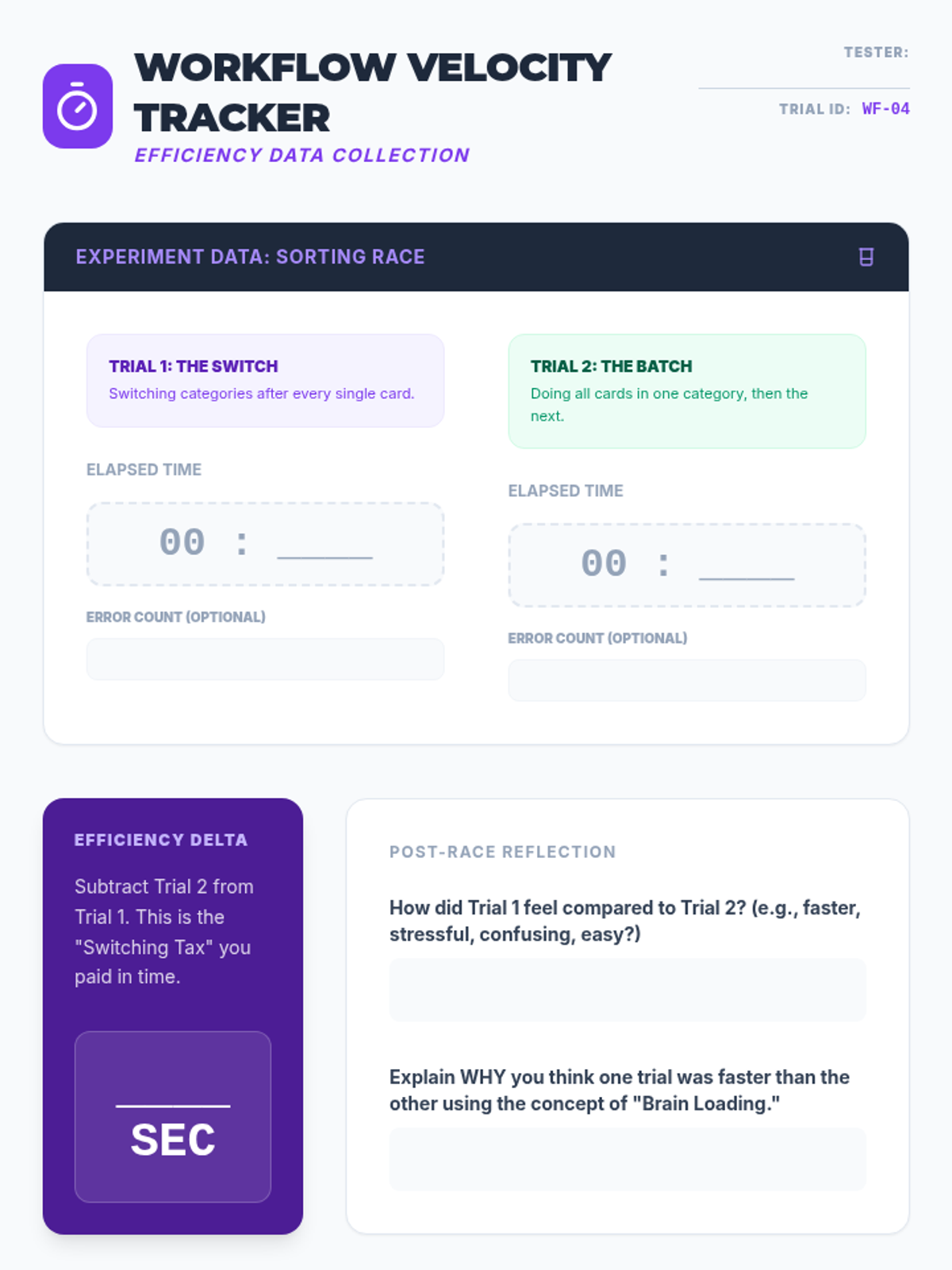
Experimental data tracker for the sorting race. Students record times for sequential versus batched tasks, calculate their efficiency delta, and plan real-world application of batching strategies to their homework.
Slides explaining the concept of task batching versus context switching. Includes instructions for a physical "Sorting Race" experiment to demonstrate the productivity cost of multitasking.
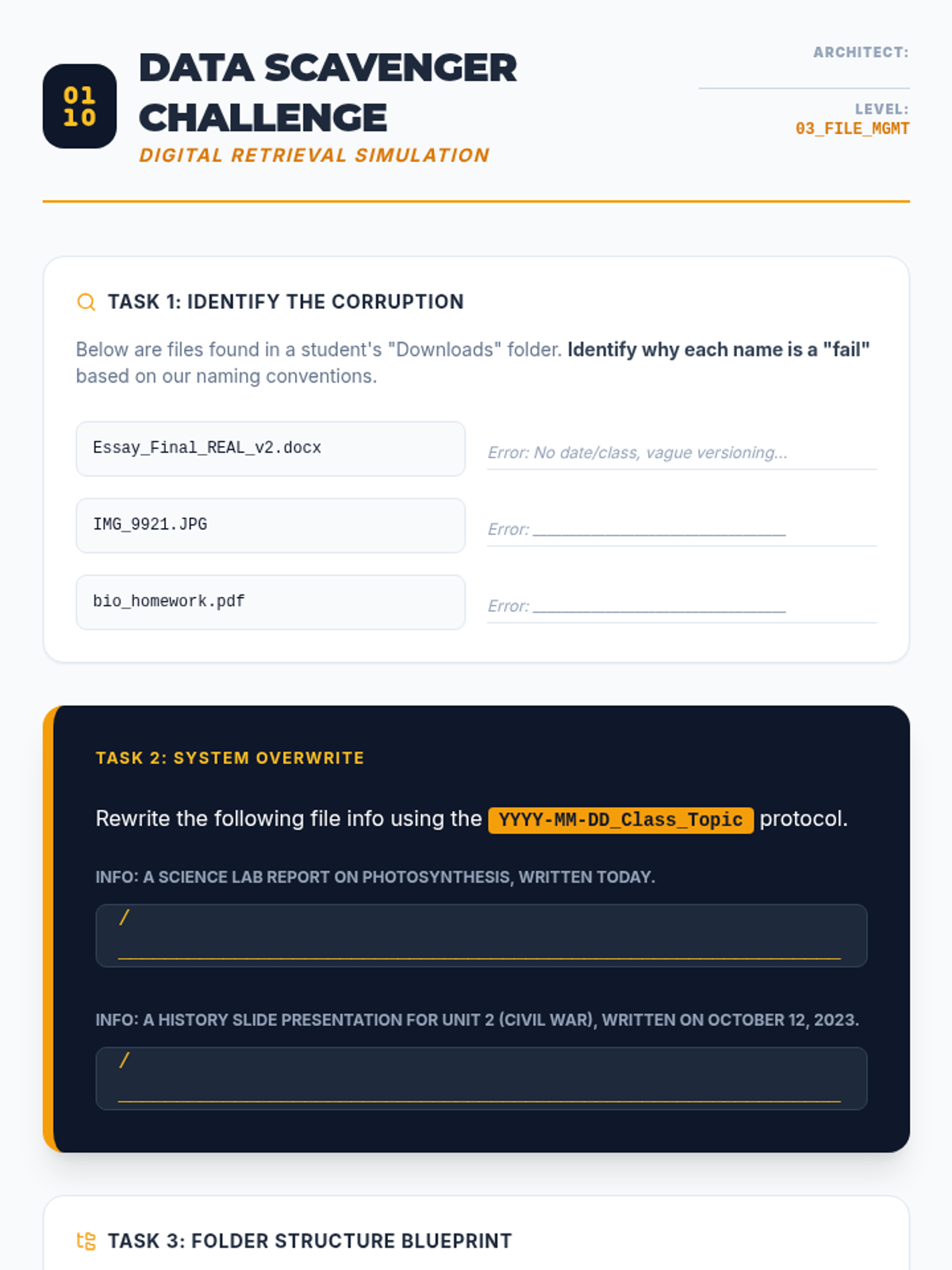
Worksheet practicing file naming conventions and digital hierarchy. Students analyze poorly named files, rewrite them using professional protocols, and design a personalized folder structure.
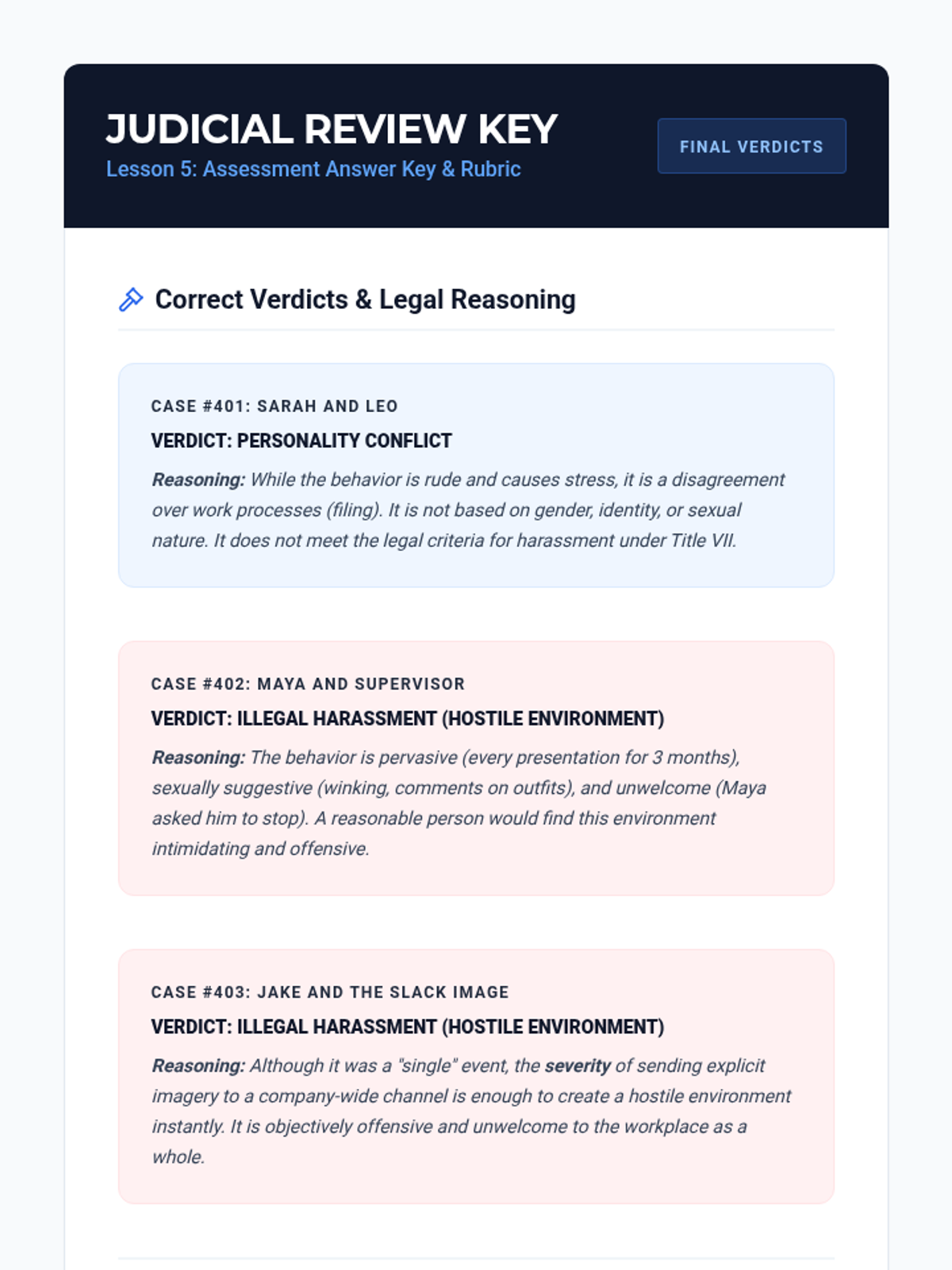
A teacher resource for Lesson 5: The Judicial Review. It includes the correct categorization of assessment scenarios, detailed legal justifications for each, and a grading rubric for student responses.
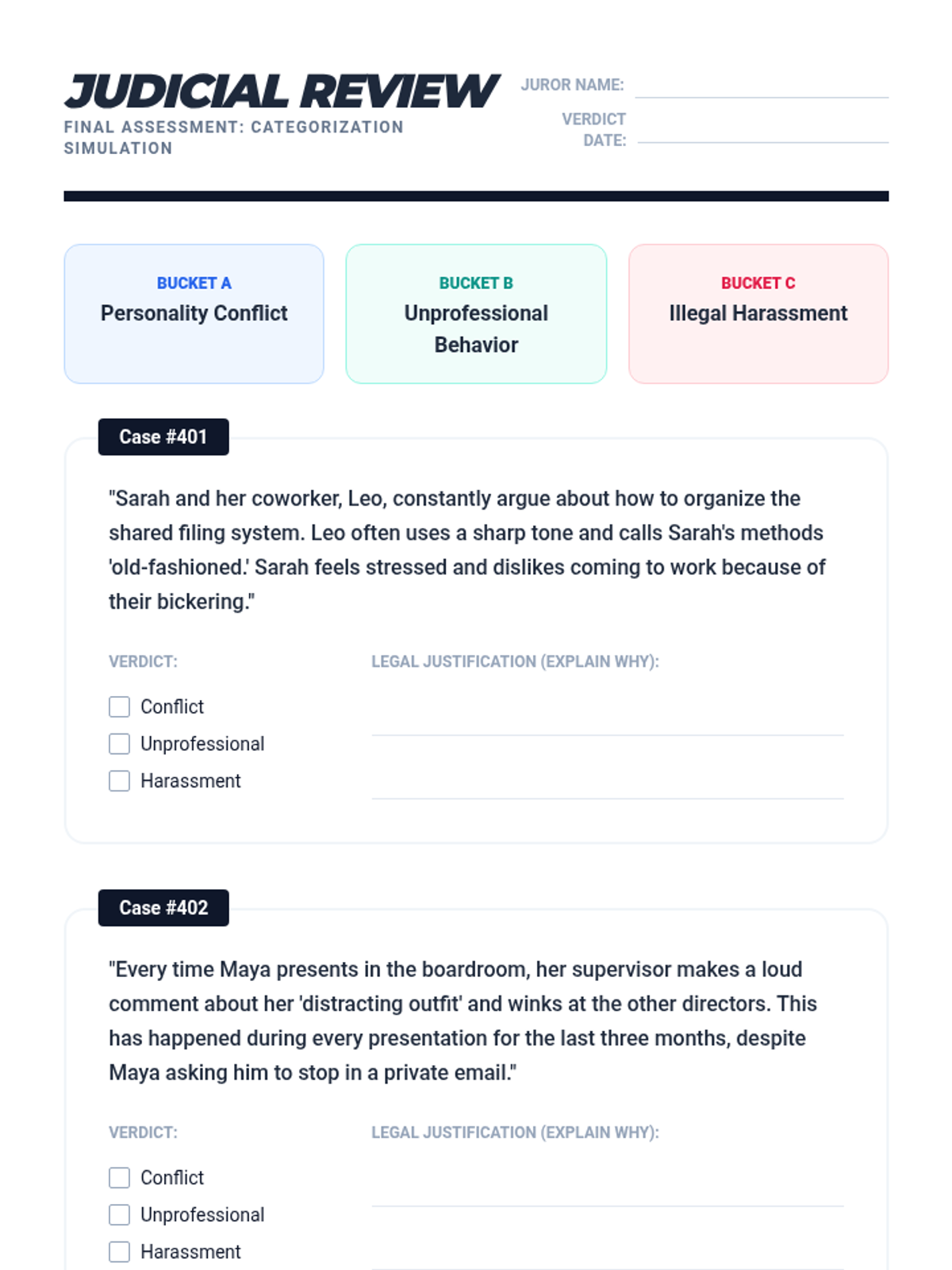
The final assessment worksheet for Lesson 5. Students categorize complex workplace scenarios as Personality Conflict, Unprofessional, or Illegal Harassment, providing legal justifications for each verdict.
Educational slides for Lesson 5: The Judicial Review. This deck sets up the final simulation, defines the three categories (Conflict, Unprofessional, Harassment), and outlines the assessment task.
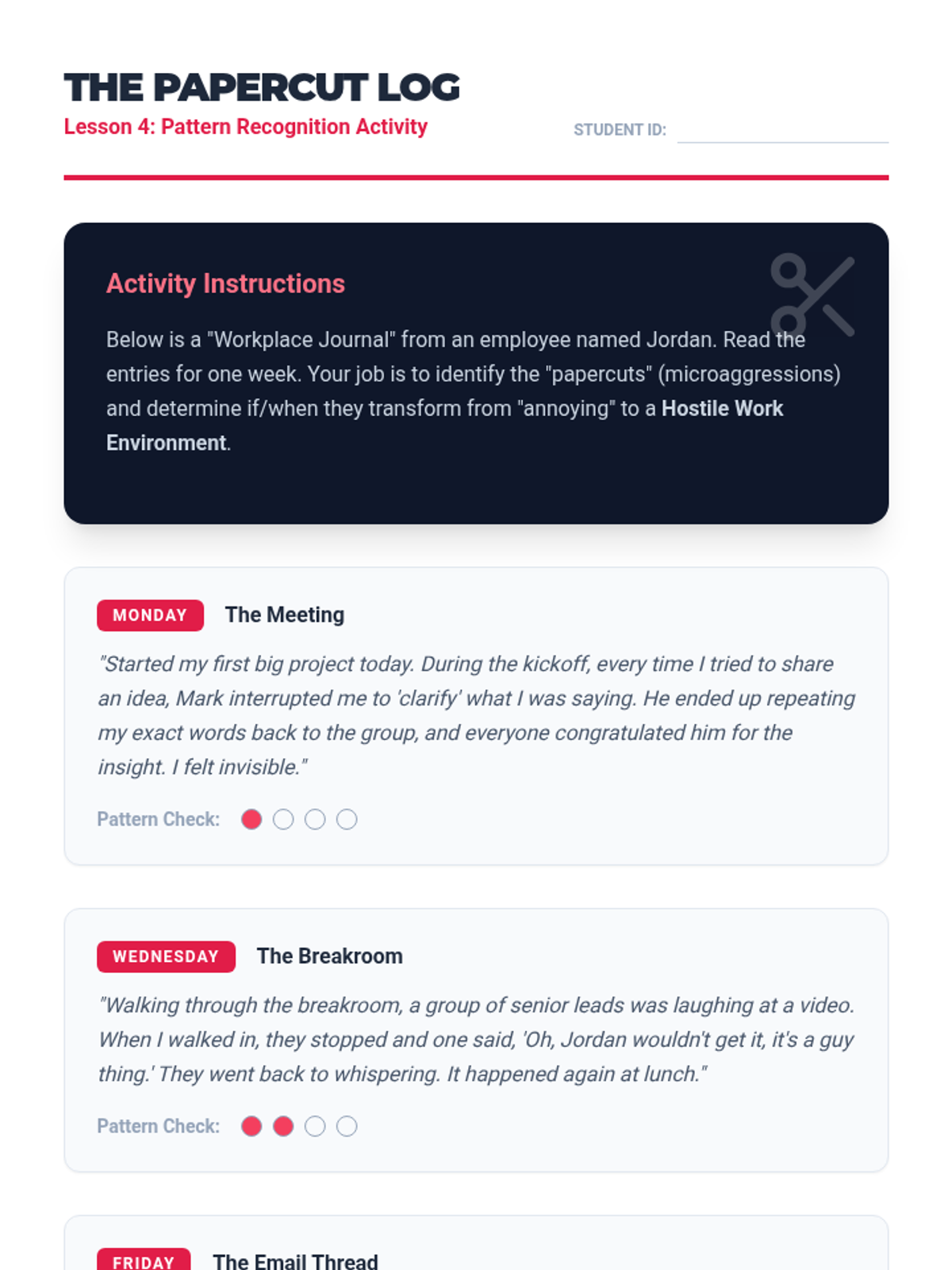
A student worksheet for Lesson 4 where they analyze a week's worth of workplace journal entries to identify a pattern of microaggressions. It focuses on the cumulative effect of small behaviors.
Educational slides for Lesson 4: The Pattern of Toxicity. This deck explains how microaggressions contribute to a hostile work environment over time, emphasizing the distinction between isolated incidents and pervasive patterns.
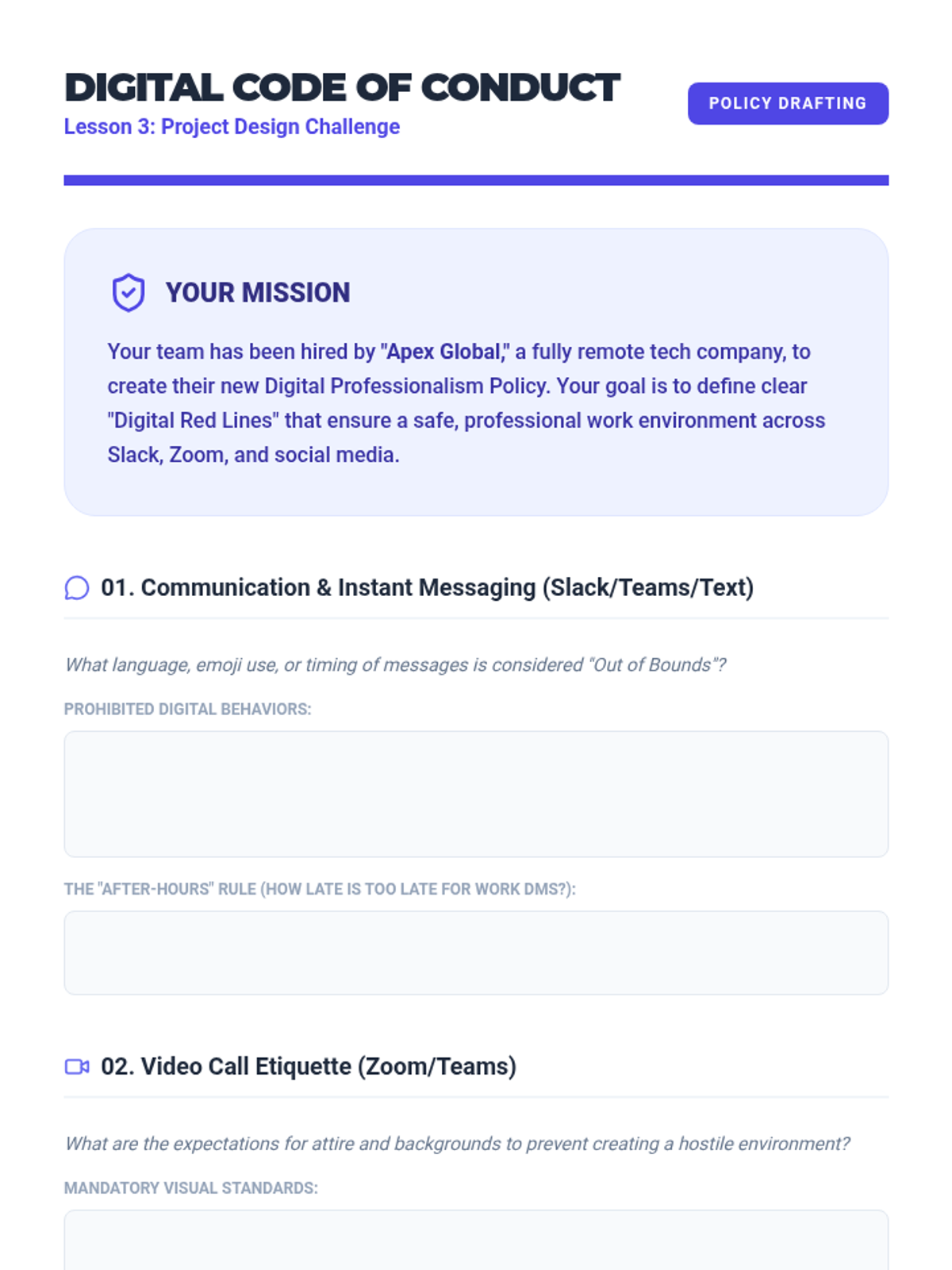
A student project guide for Lesson 3. Students act as HR consultants to draft a 'Digital Professionalism Policy' for a remote company, defining boundaries for instant messaging, video calls, and social media.
Educational slides for Lesson 3: Digital Professional Conduct. This deck covers how workplace harassment translates to digital spaces, the impact of social media interactions between coworkers, and the 'permanence' of digital evidence.
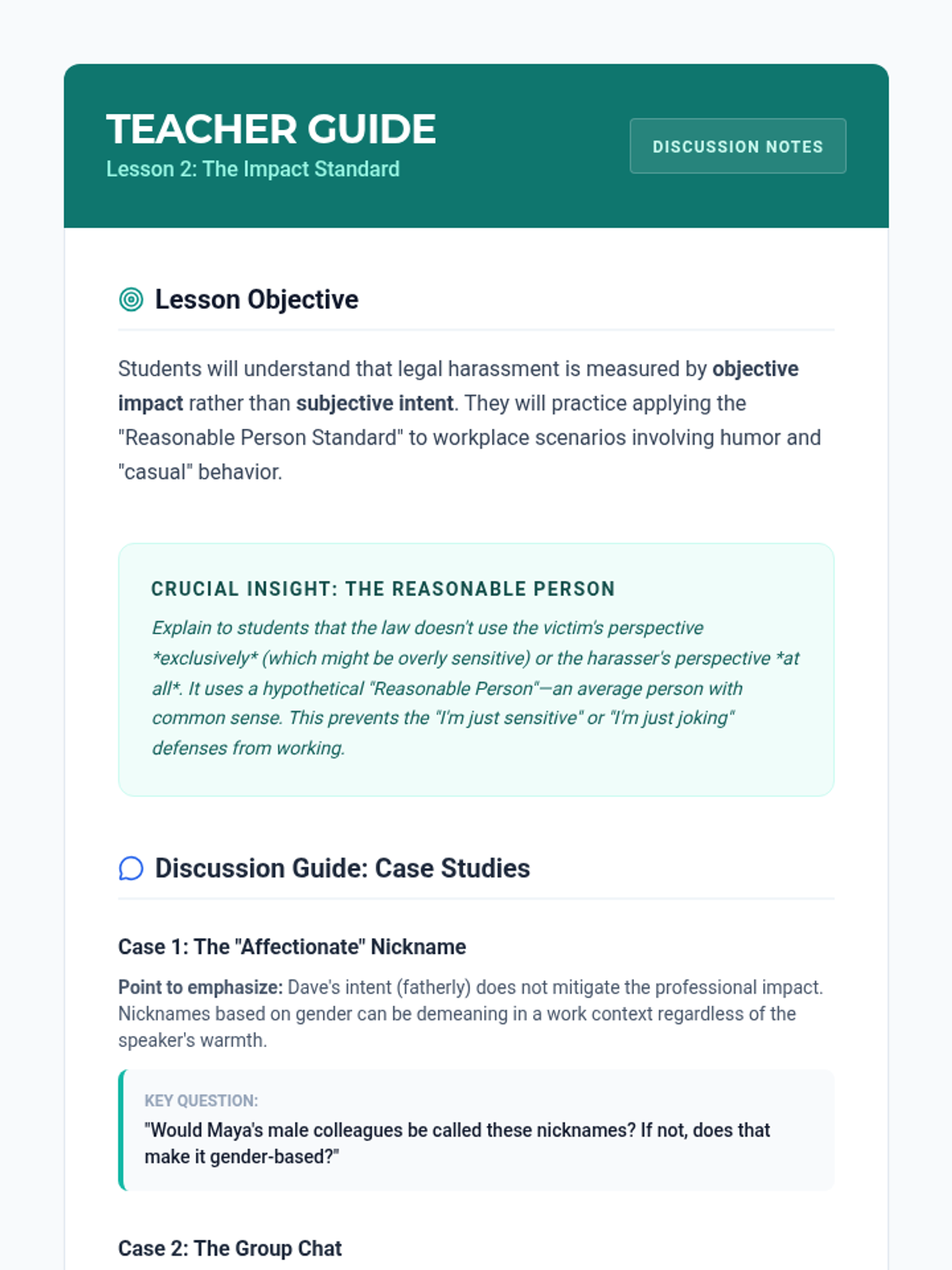
Teacher facilitation notes for Lesson 2: The Impact Standard. It includes guiding questions for the case studies and tips for addressing common student concerns about the "Reasonable Person Standard."
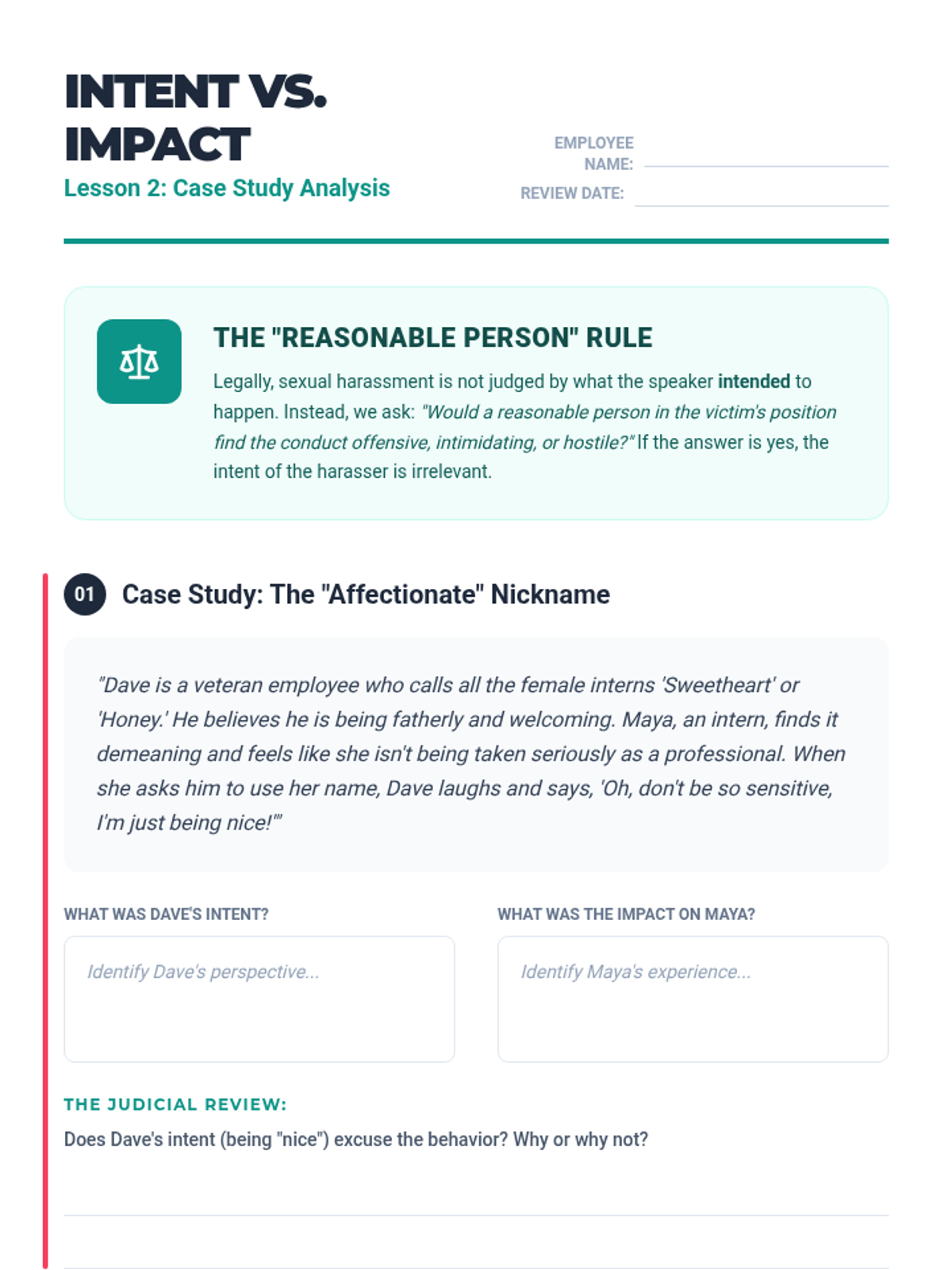
A student case study analysis for Lesson 2 focusing on the 'Intent vs. Impact' legal standard. Students analyze two workplace scenarios to determine how intent differs from the actual impact on the victim and the environment.
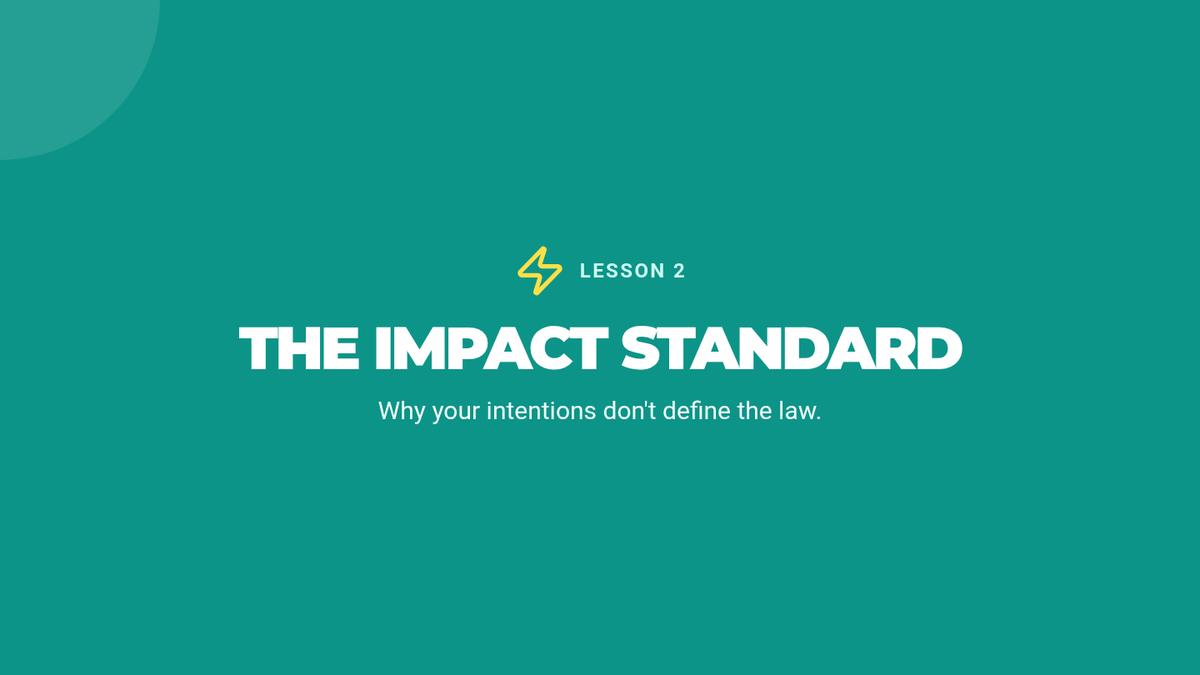
Educational slides for Lesson 2: The Impact Standard. This deck explains the legal shift from harasser intent to victim impact, introducing the 'Reasonable Person Standard' and debunking the 'just joking' defense.
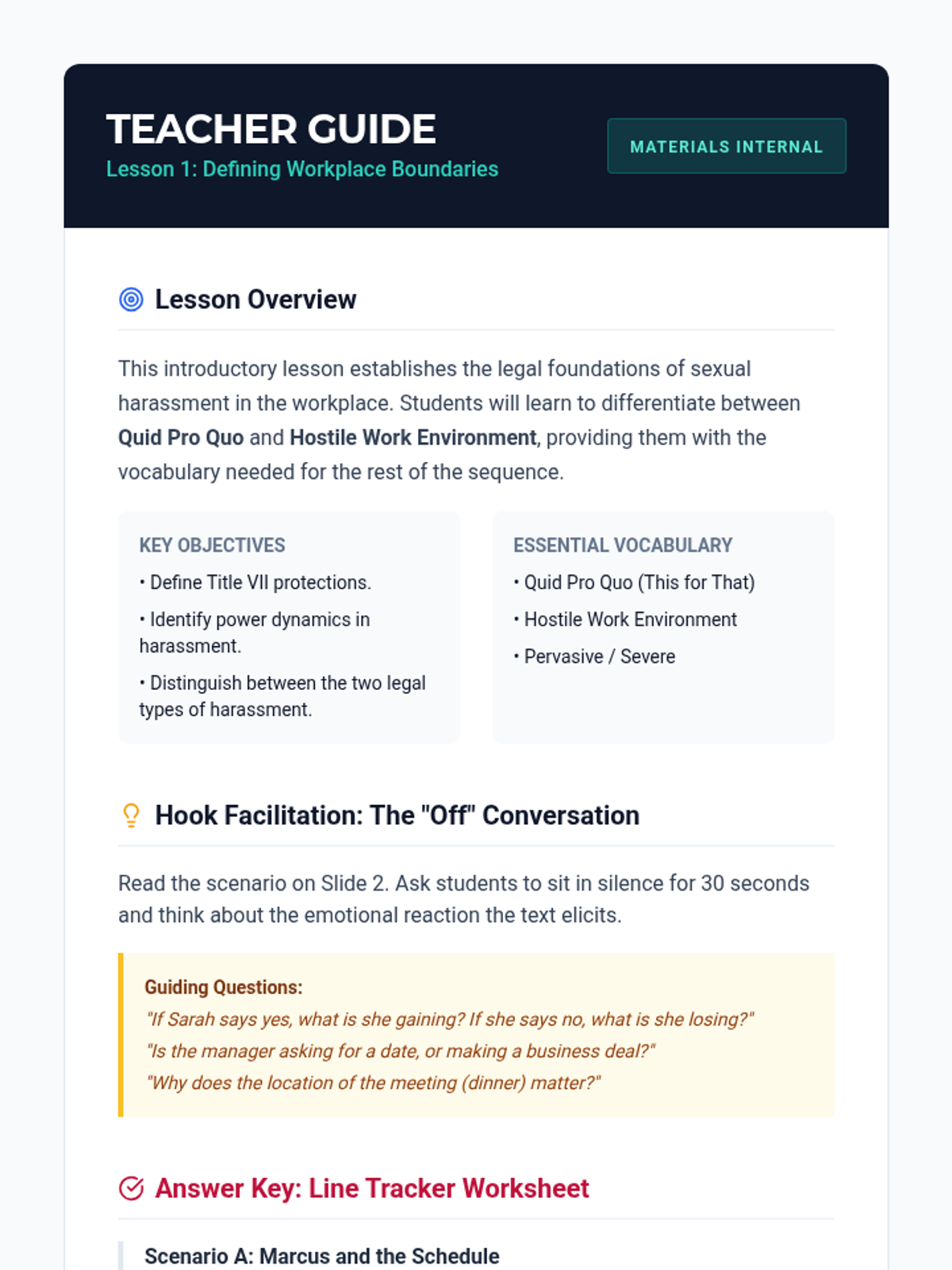
A teacher resource for Lesson 1: Defining Workplace Boundaries. It includes lesson objectives, facilitation tips for the hook, a complete answer key for the student worksheet, and notes on common misconceptions.
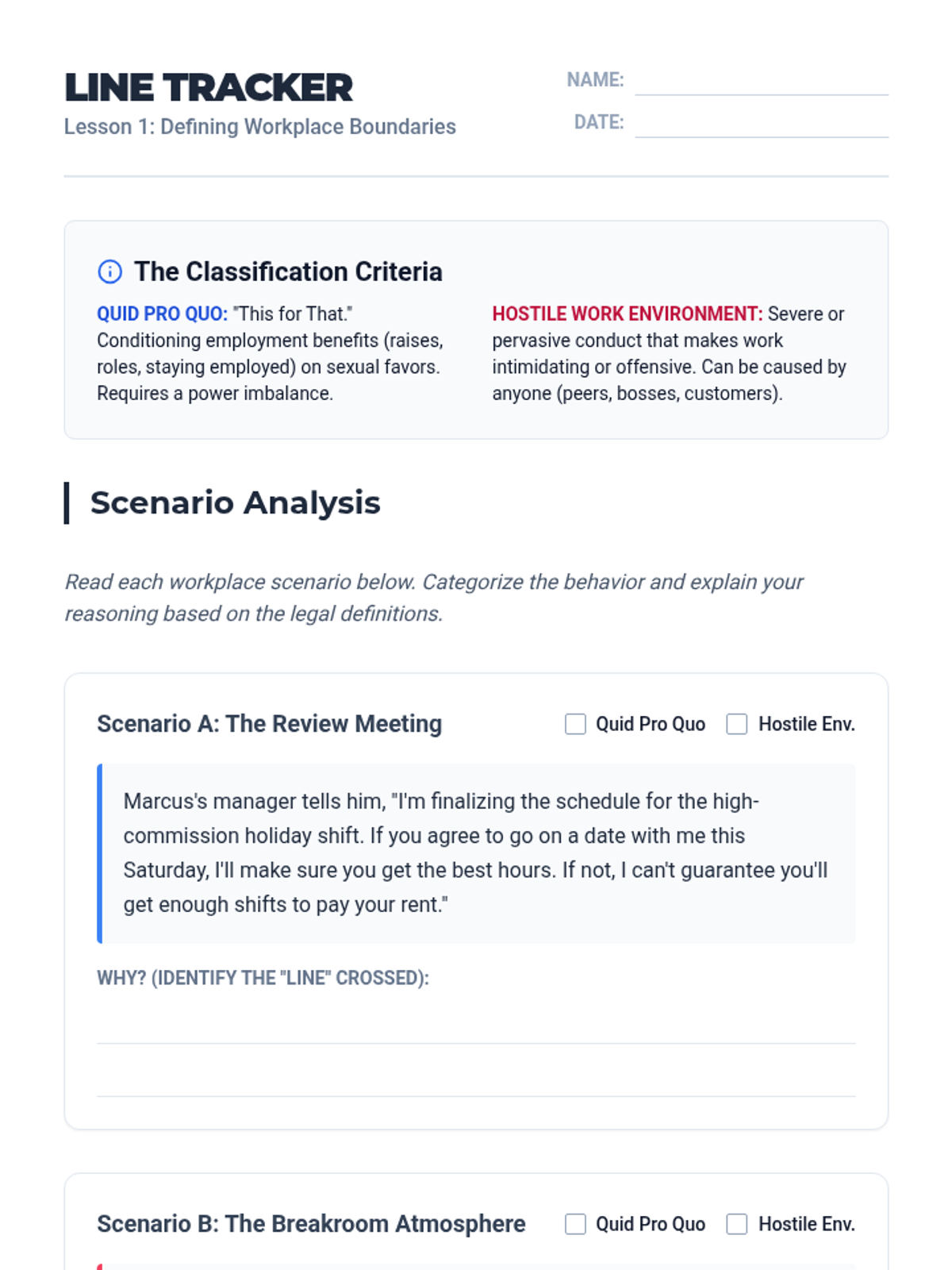
A student worksheet for Lesson 1 where they categorize workplace scenarios as Quid Pro Quo or Hostile Work Environment. It includes space for reasoning and critical reflection on power dynamics.
Educational slide deck for Lesson 1: Defining Workplace Boundaries. It covers legal definitions under Title VII, explains the difference between Quid Pro Quo and Hostile Work Environments, and provides clear examples of each.
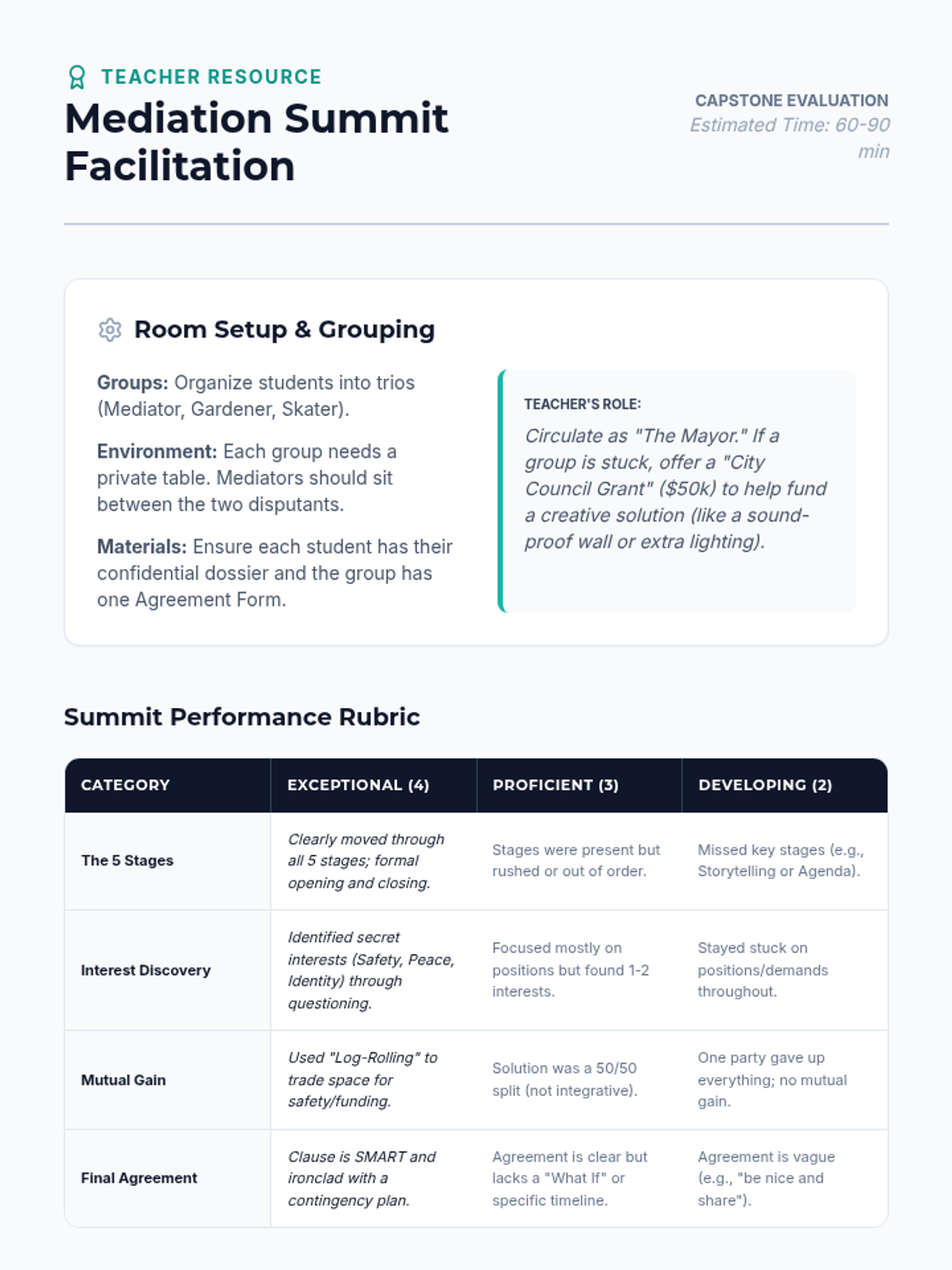
Teacher facilitation guide and evaluation rubric for the Lesson 5 Mediation Summit capstone simulation. Includes setup instructions, a grading rubric, and debrief prompts.
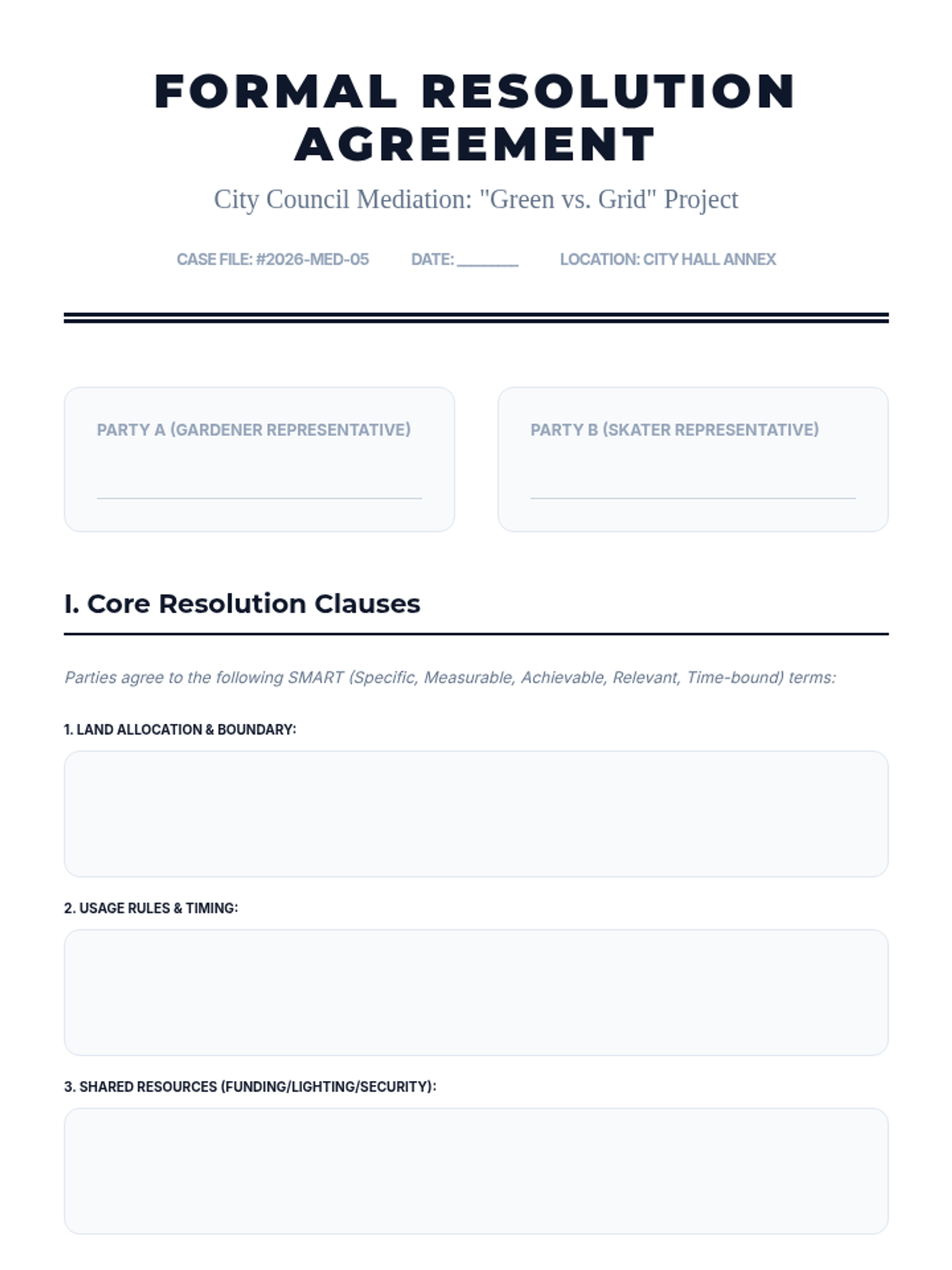
Formal mediation agreement form for the "Green vs. Grid" simulation. Students use this to draft their final SMART resolution clauses and finalize the simulation with signatures.
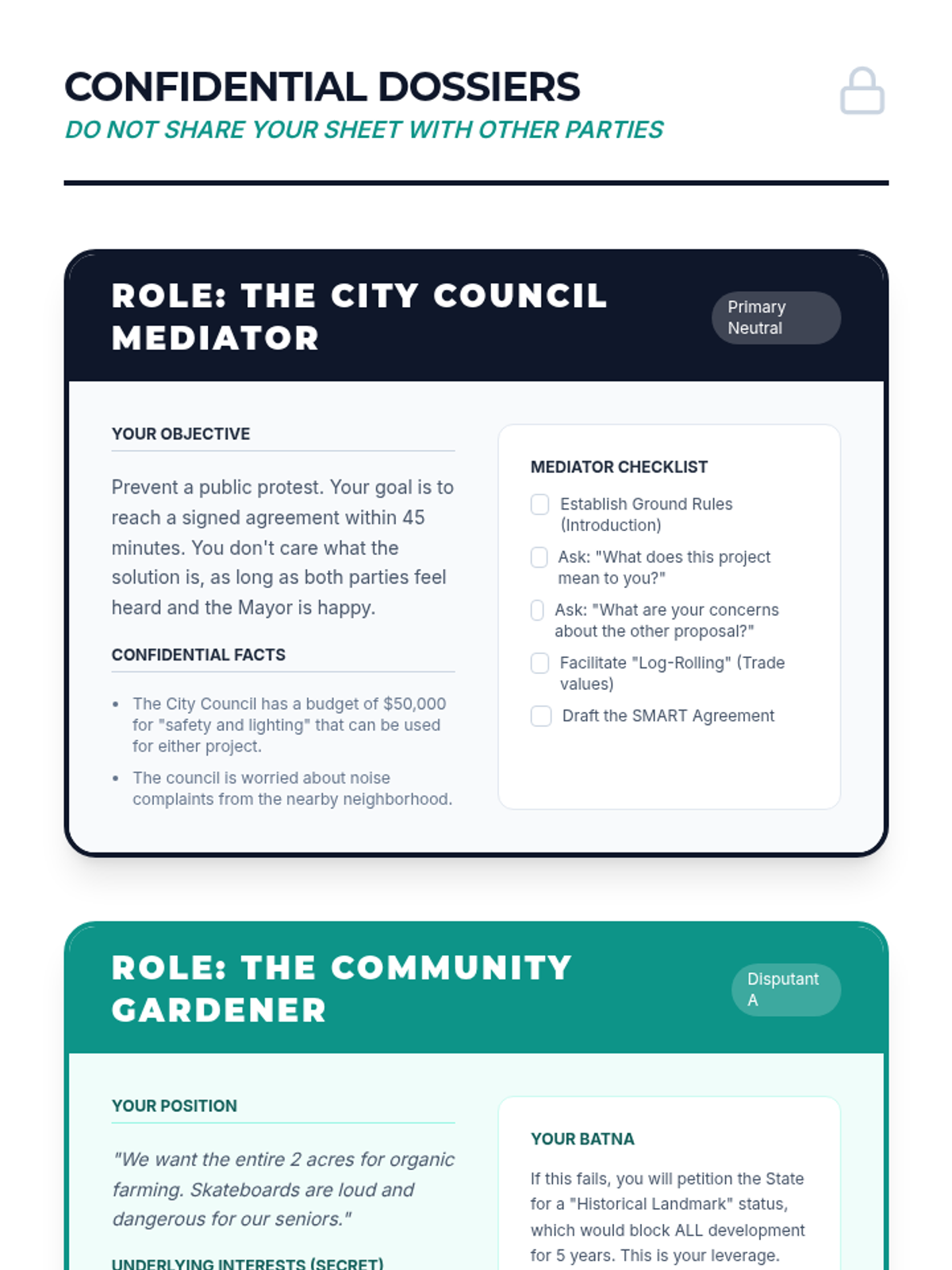
Confidential briefing sheets for the three roles in the "Green vs. Grid" simulation: The Mediator, The Gardener, and The Skater. Includes secret interests and walk-away points.
Briefing slide deck for the Lesson 5 Mediation Summit capstone simulation. Introduces the "Green vs. Grid" land use case, roles, and rules of engagement.
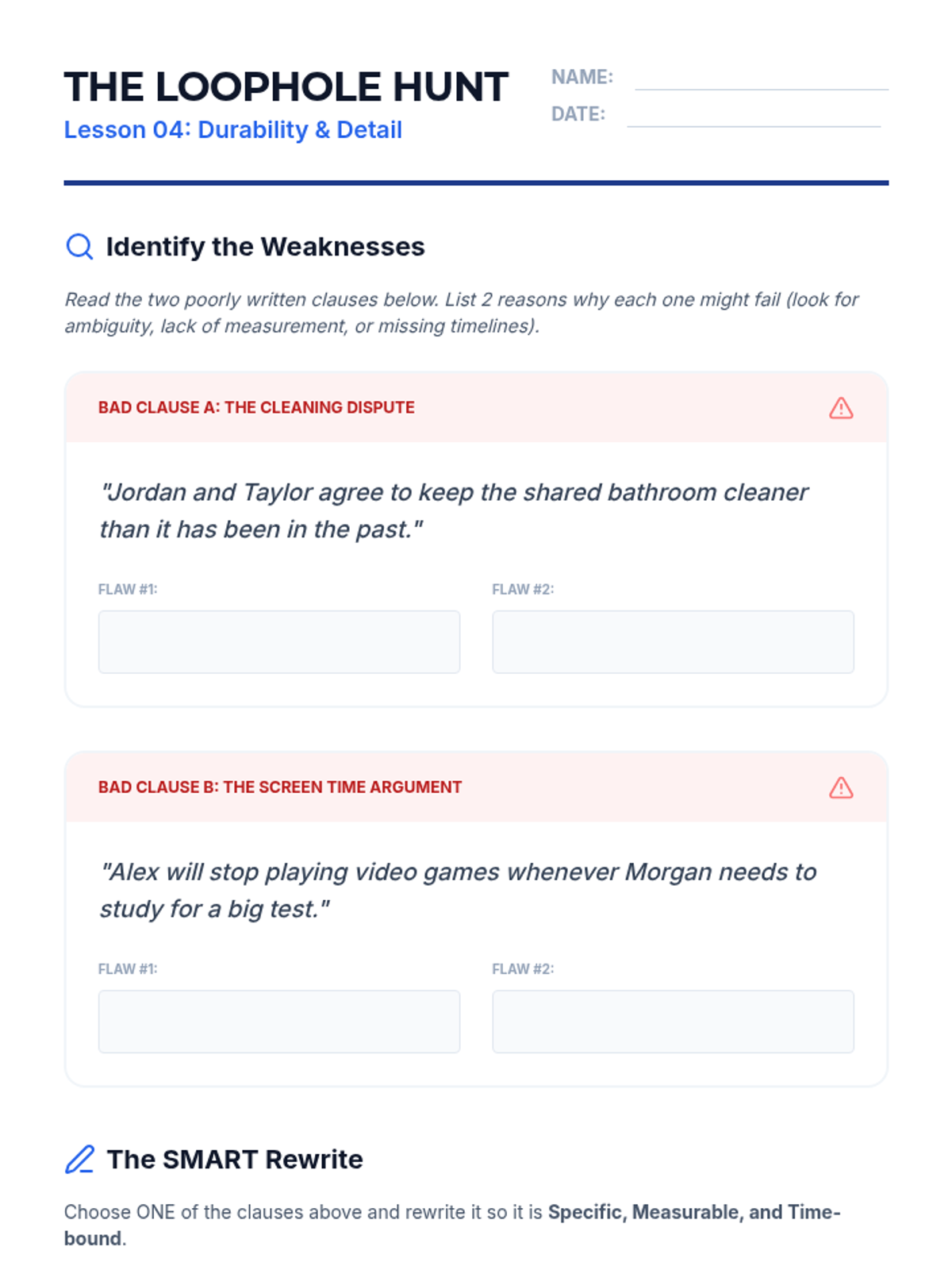
Student worksheet for identifying flaws in poorly written conflict resolution agreements and rewriting them using the SMART framework.
Instructional slide deck for Lesson 4: Drafting Sustainable Agreements. Explains the SMART framework for conflict resolution and the importance of specific clauses and contingency planning.
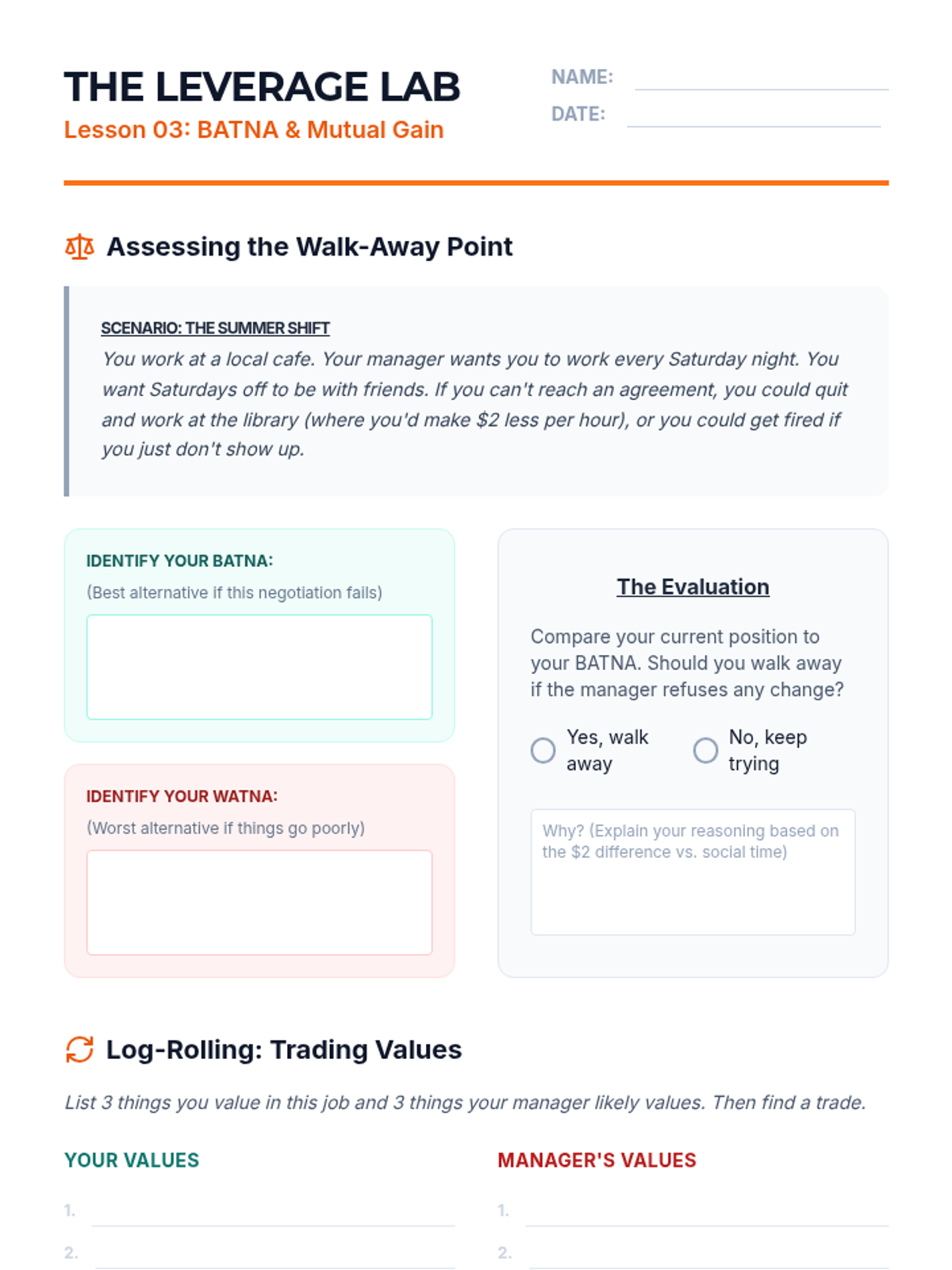
Student worksheet for analyzing BATNA/WATNA and practicing the Log-Rolling technique in a workplace conflict scenario.
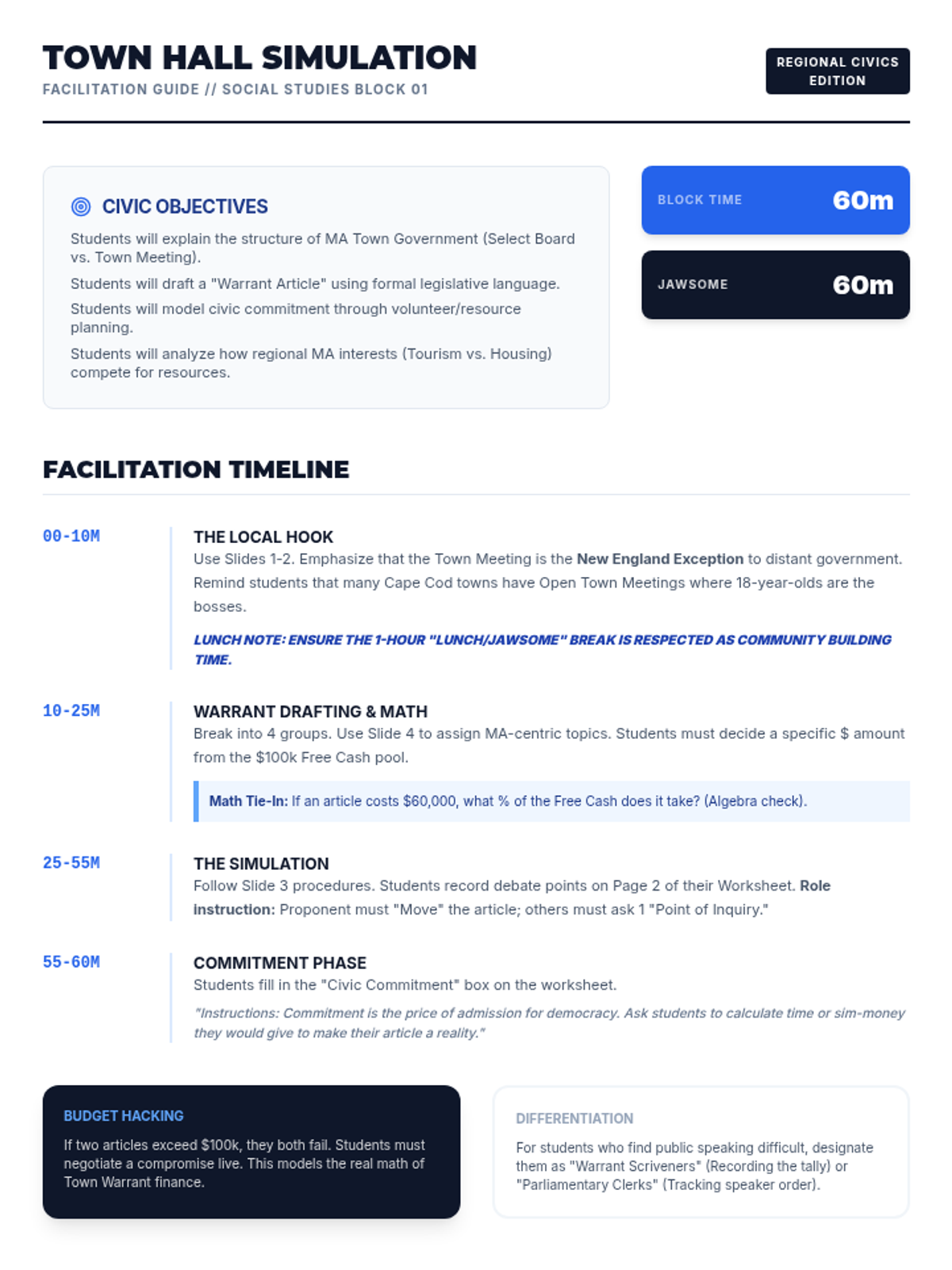
A facilitation guide for teachers to lead a 60-minute Social Studies simulation of a New England Town Meeting, including role assignments and parliamentary procedure. Updated with Lunch/Jawsome timing, MA localization, and Commitment instructions.
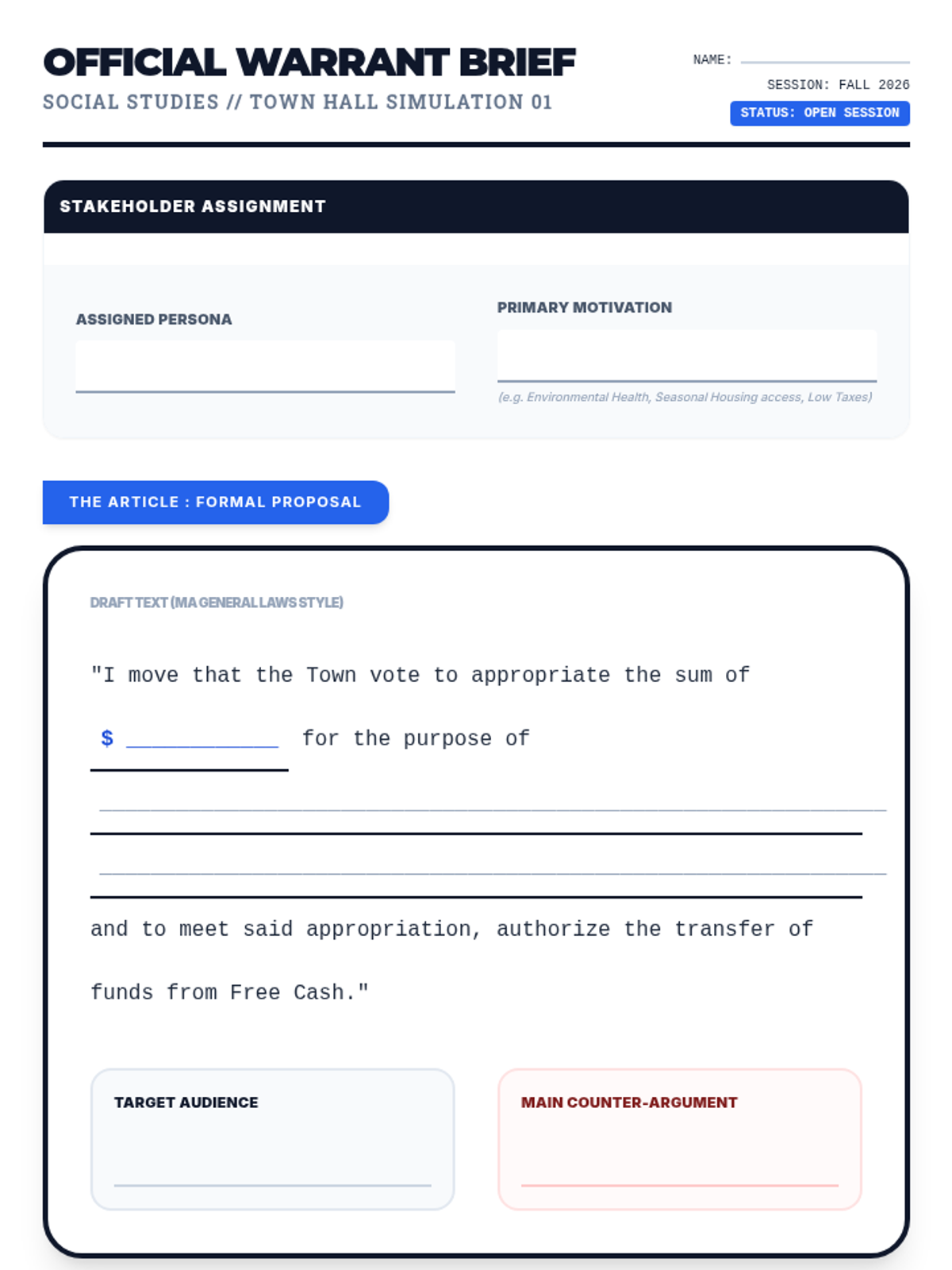
A simulation briefing worksheet for a Town Hall Meeting, providing role-play assignments, a template for drafting formal warrant articles, and space for tracking floor debates. Localized for Eastern MA. Includes "Civic Commitment" and larger fonts. Fixed page break and instructions. Final polish for layout.
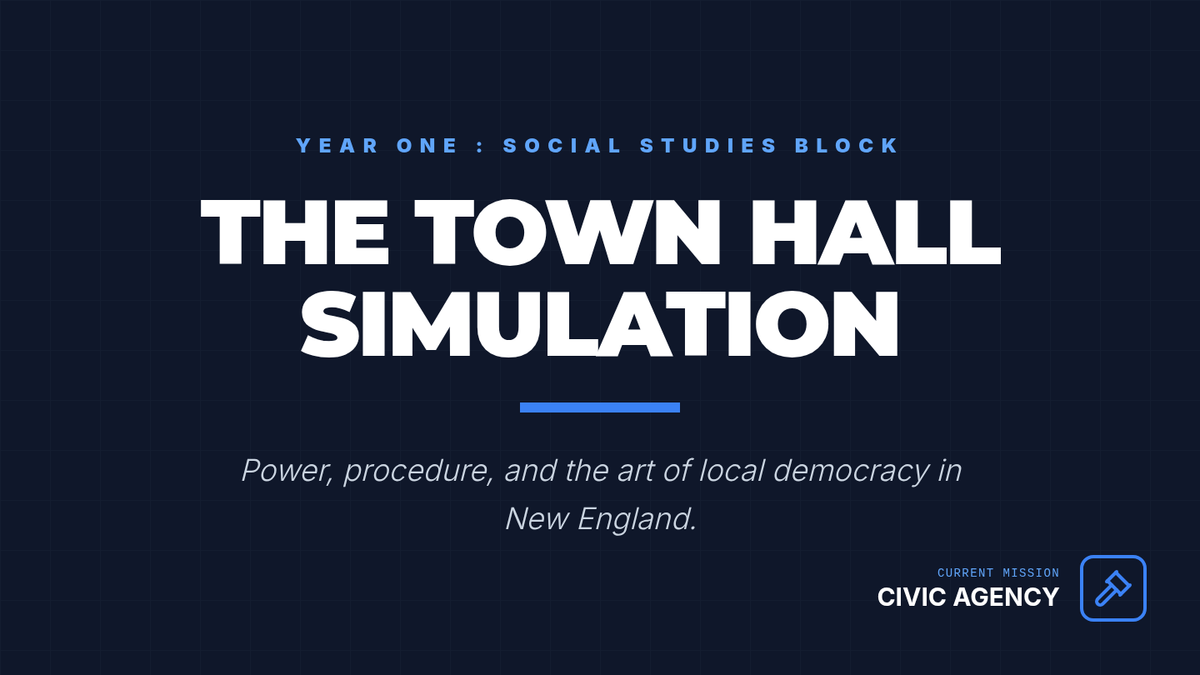
A civics slide deck for a Town Hall Simulation, localized to Eastern MA/Cape Cod issues. Explains procedure, articles, and the "Civic Commitment" concept. Revised for better kerning and localized examples. Final pass for layout.
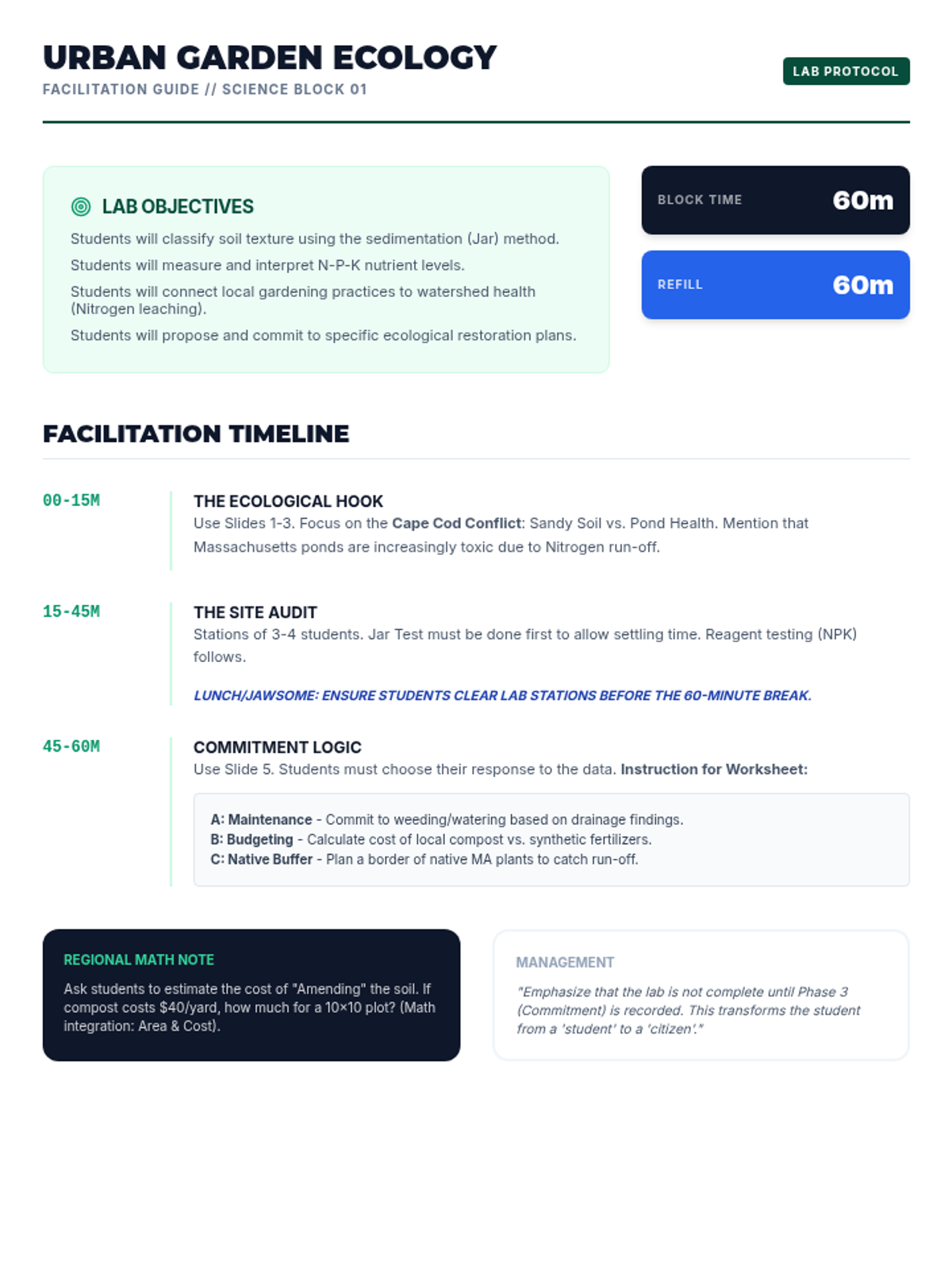
A facilitation guide for teachers to lead a 60-minute Integrated Science lab on garden ecology, featuring soil testing protocols and regional ecological discussion prompts. Updated with Lunch/Jawsome timing and Commitment instructions.
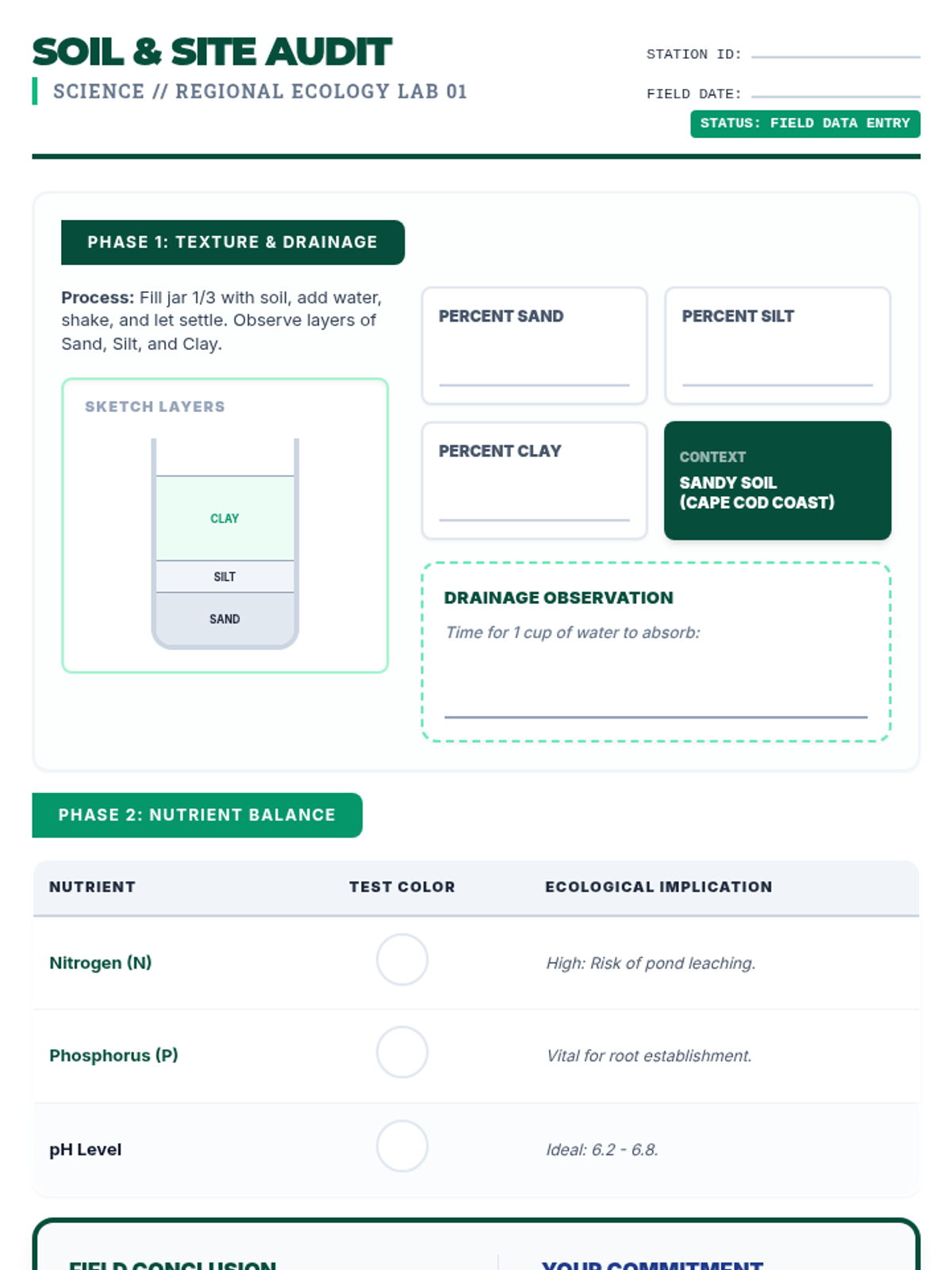
A scientific field notebook worksheet for a Soil & Site Audit, involving physical jar testing for texture and chemical NPK testing, contextualized for Massachusetts soil profiles. Updated with a "Your Commitment" section, larger font sizes, and improved page breaks. Final polish for student completion.
A visually rich science slide deck for Urban Garden Ecology, focusing on soil health, nutrient cycles (NPK), and regional leaching challenges specific to Cape Cod and Eastern MA. Includes schedule for Lunch/Jawsome and commitment instructions. Fixed rendering for Slide 3 and NPK text wrap. Final pass for layout.
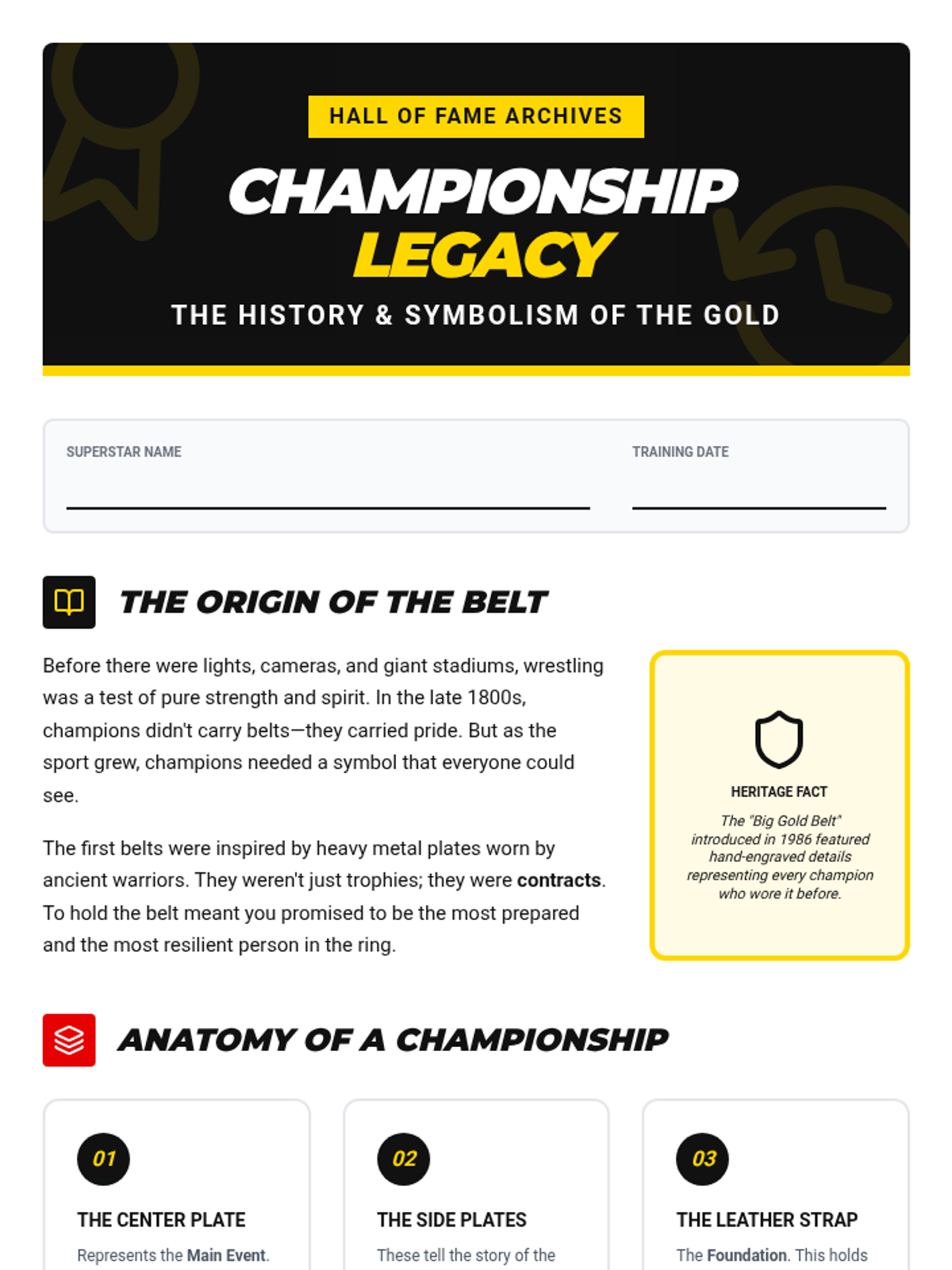
A student-facing reading and activity sheet exploring the history of wrestling championship belts, their symbolism, and how students can build their own academic legacy.
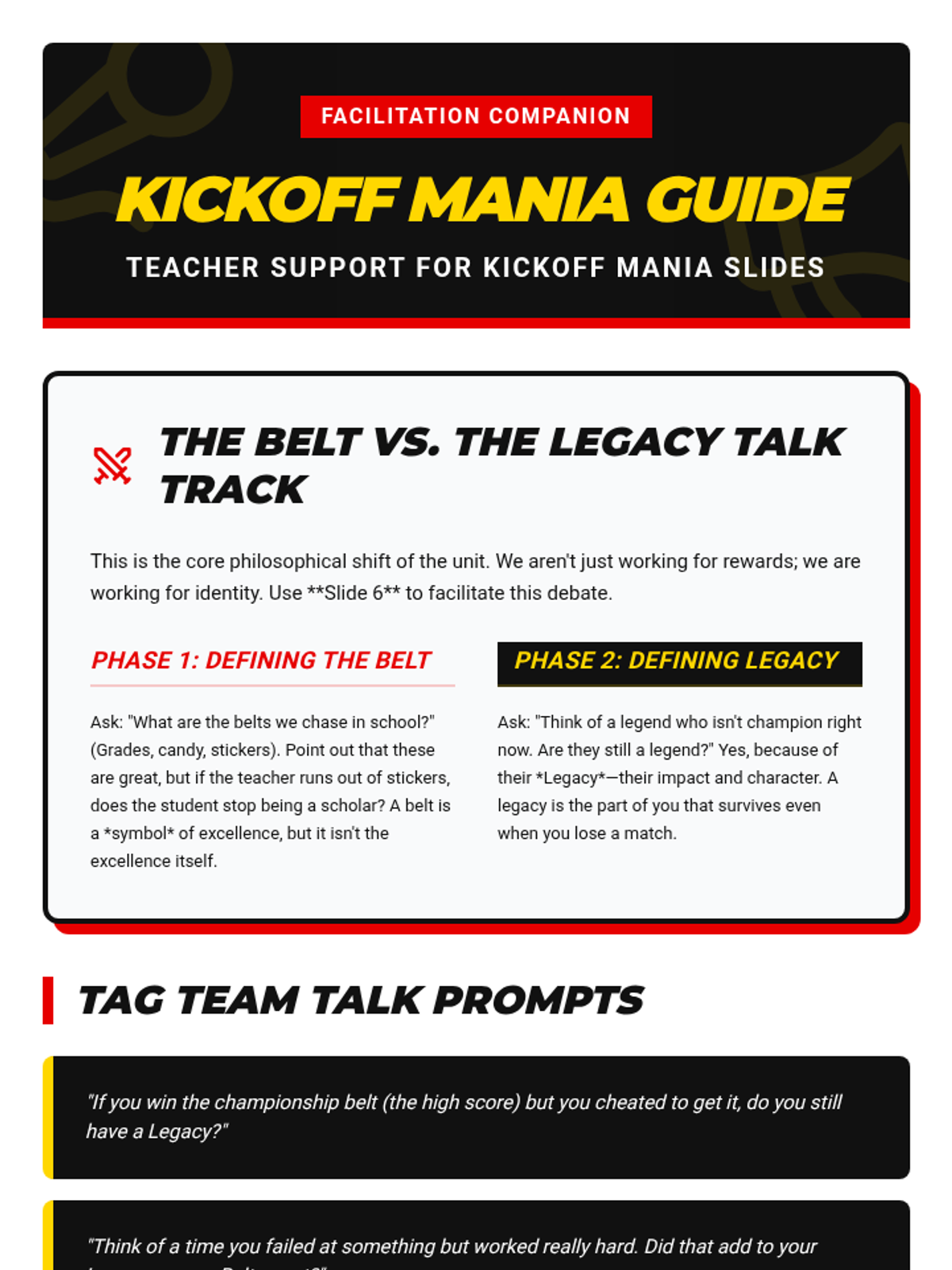
A detailed teacher facilitation companion for the Kickoff Mania slides, providing talk tracks for the 'Belt vs. Legacy' discussion, discussion prompts, and implementation steps for the Ubuntu mission.
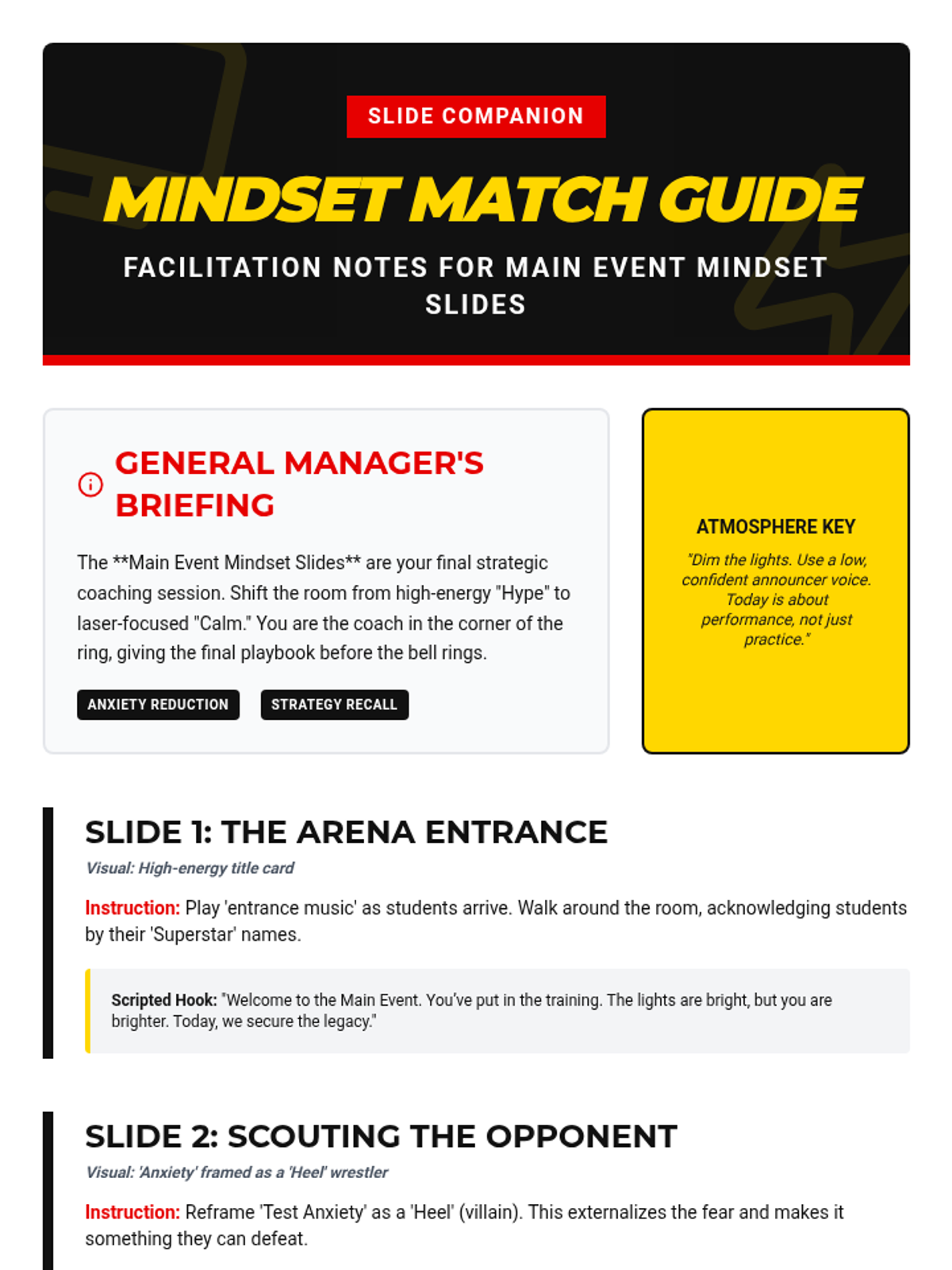
A teacher-facing companion guide for the 'Main Event Mindset' slides, providing slide-by-slide scripts, instructional instructions for managing test anxiety, and post-test decompression strategies.
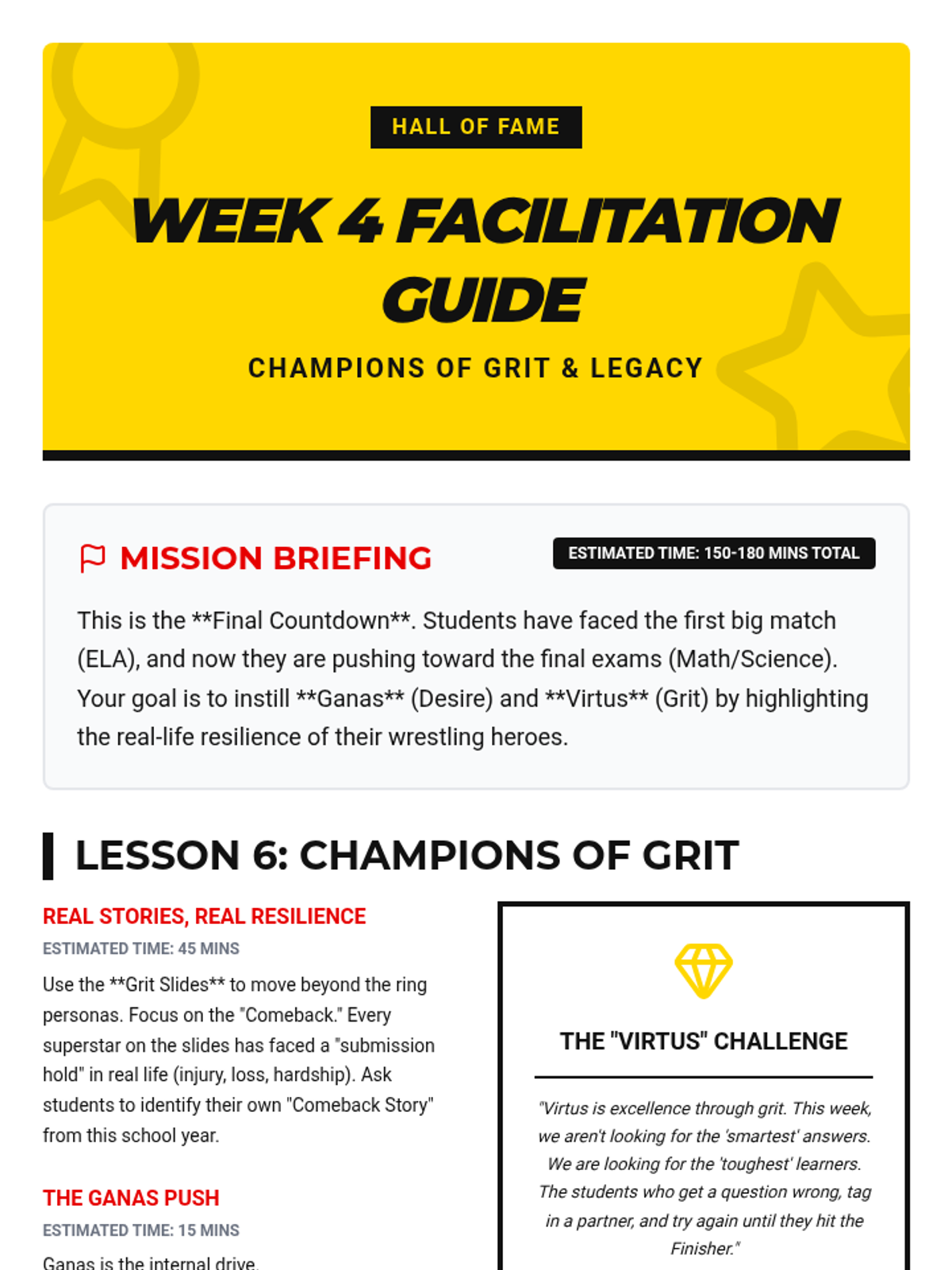
A detailed teacher facilitation guide for Week 4 of the 'Road to State Exam Mania' sequence, focusing on Ganas (drive) and Virtus (grit) for the final exam push and the 'Mania Gala' unit wrap-up.
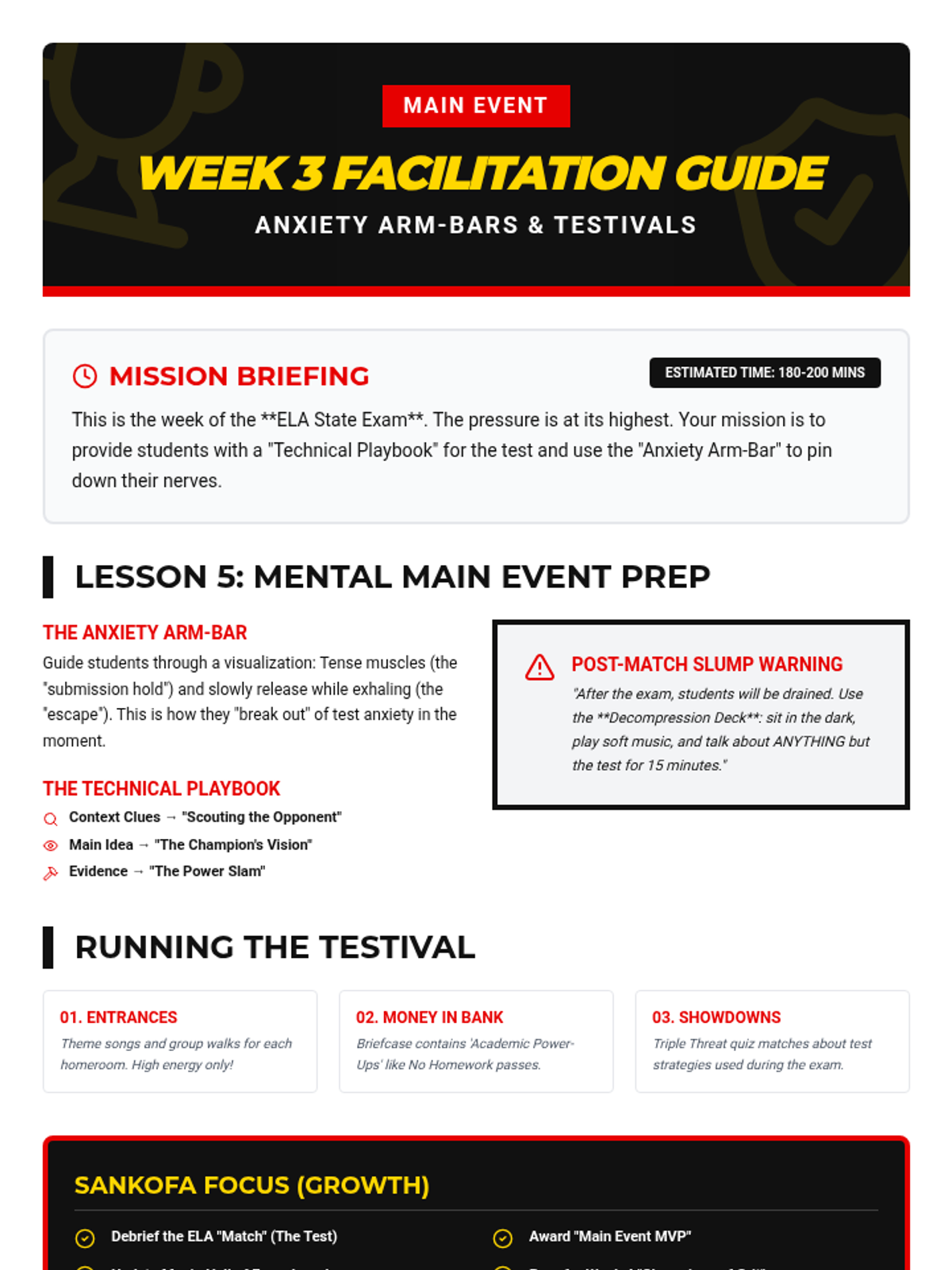
A detailed teacher facilitation guide for Week 3 of the 'Road to State Exam Mania' sequence, focusing on ELA state exam preparation and the 'Testival' pep rally.
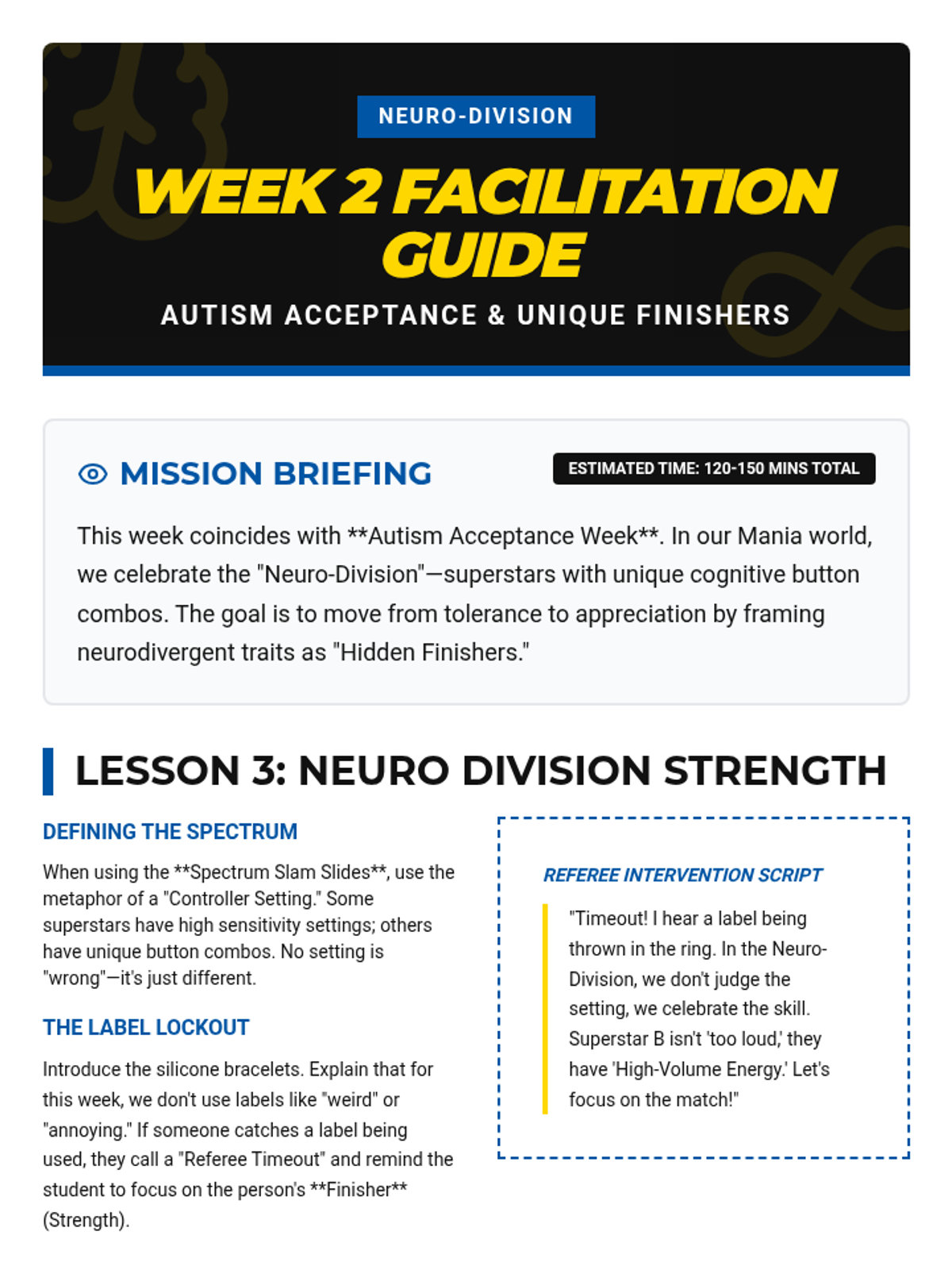
A detailed teacher facilitation guide for Week 2 of the 'Road to State Exam Mania' sequence, focusing on Autism Acceptance Week and celebrating neurodiversity.
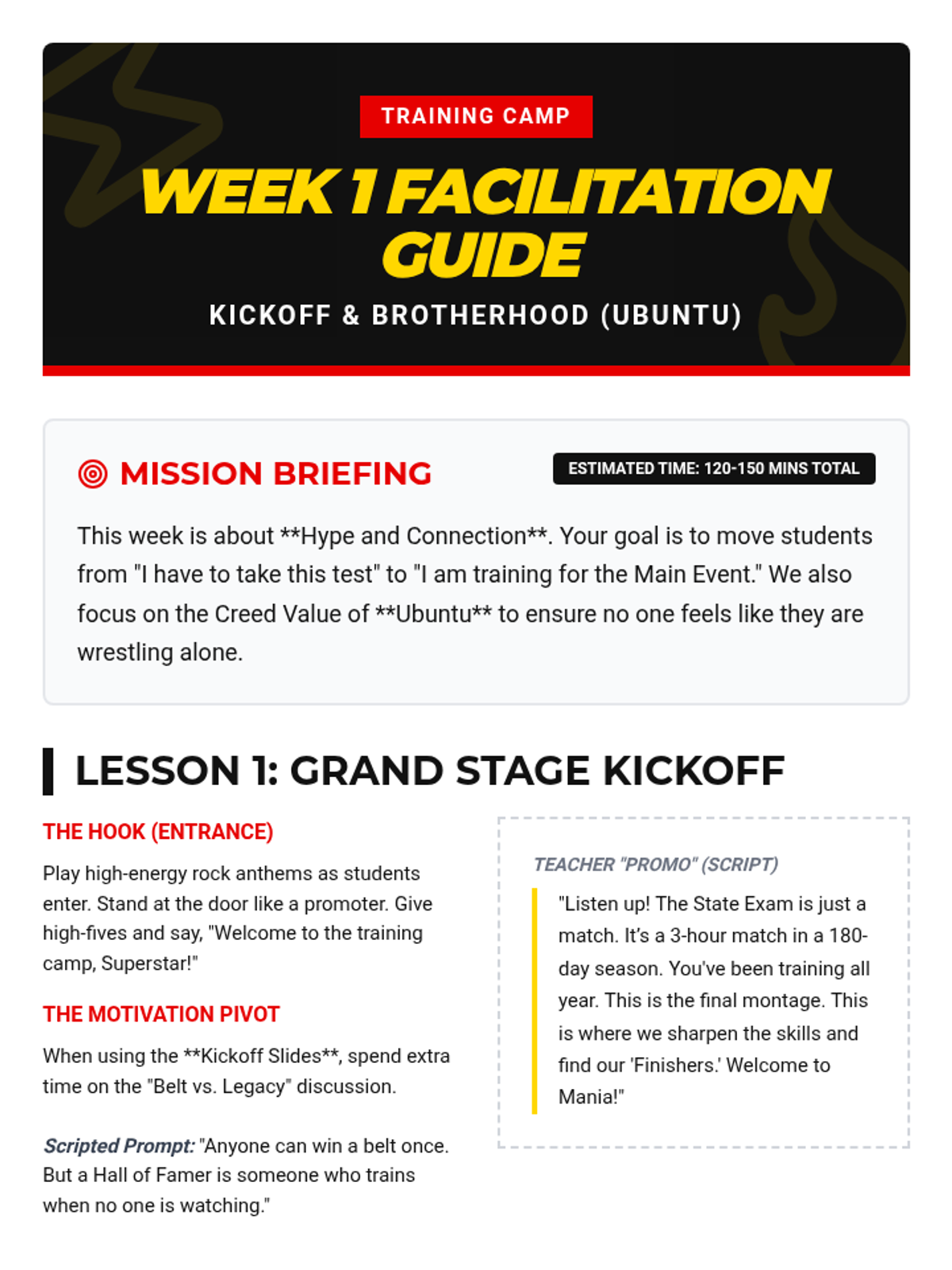
A detailed teacher facilitation guide for Week 1 of the 'Road to State Exam Mania' sequence, focusing on kickoff motivation and the Creed Value of Ubuntu.
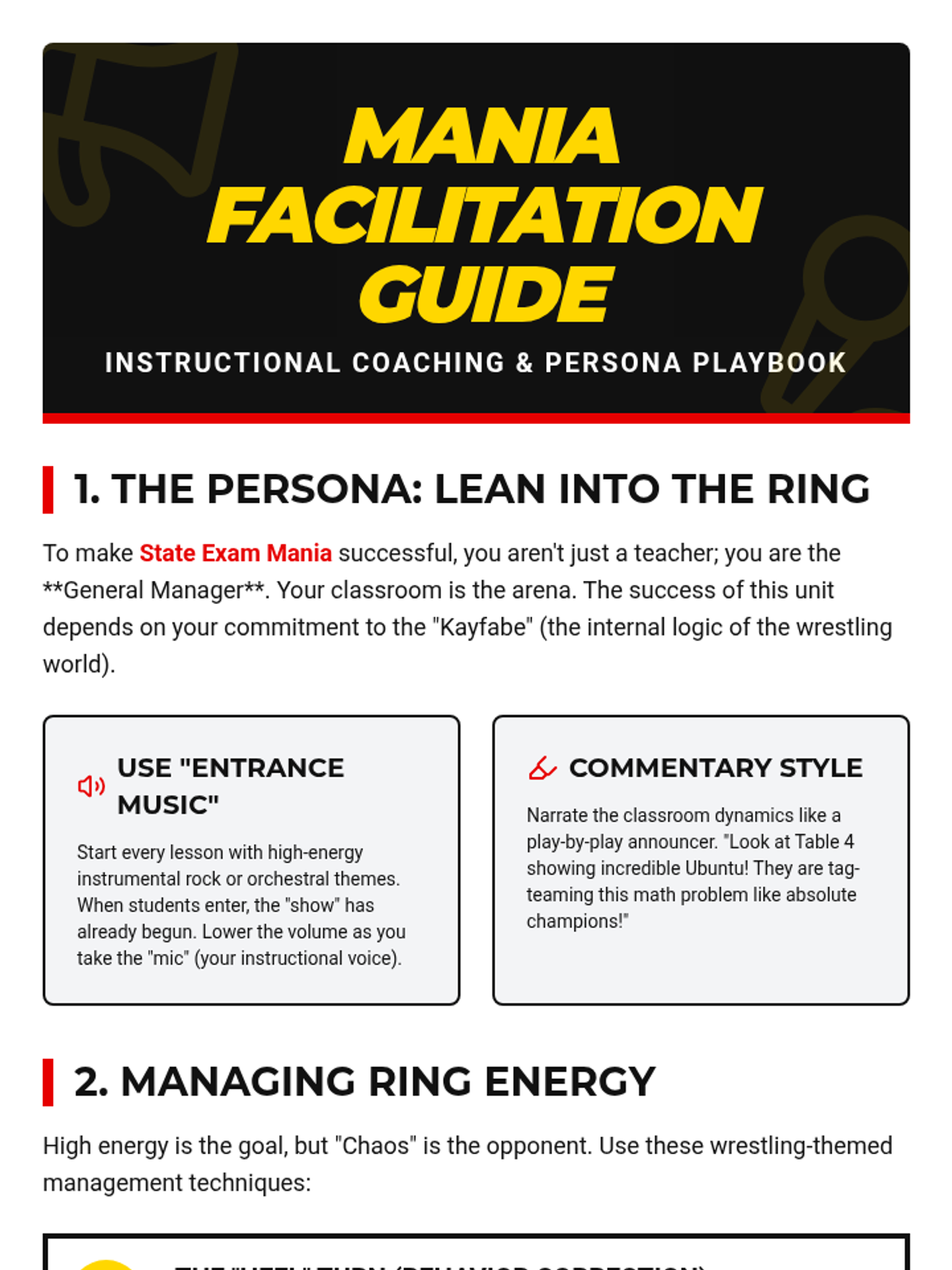
A comprehensive teacher facilitation guide for the 'Road to State Exam Mania' sequence, featuring persona coaching, behavior management strategies (using wrestling metaphors), lesson-specific tips, and a bank of discussion questions.
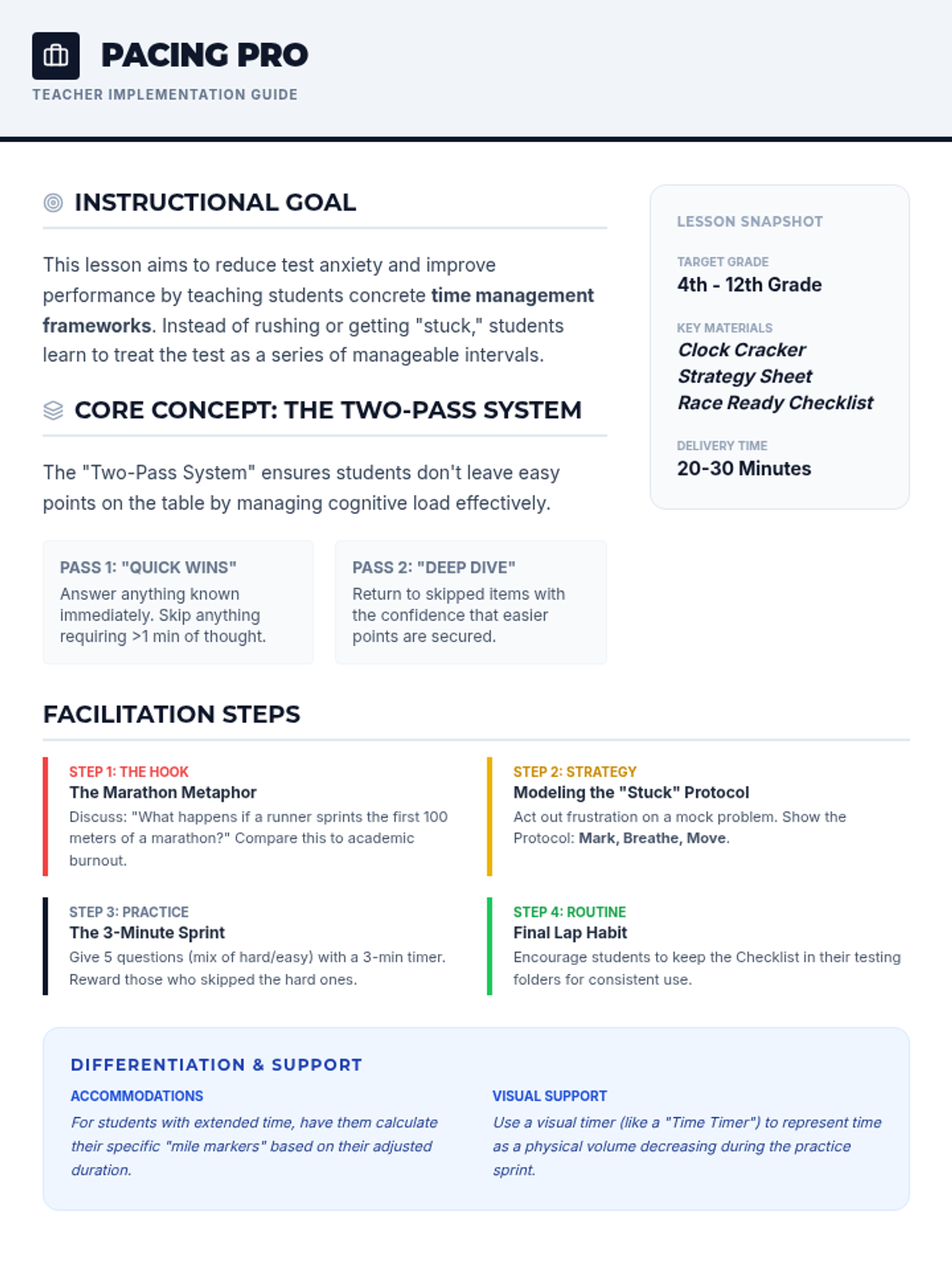
A professional guide for teachers to implement pacing strategies, featuring the 'Two-Pass' system explanation and a 4-step facilitation plan.
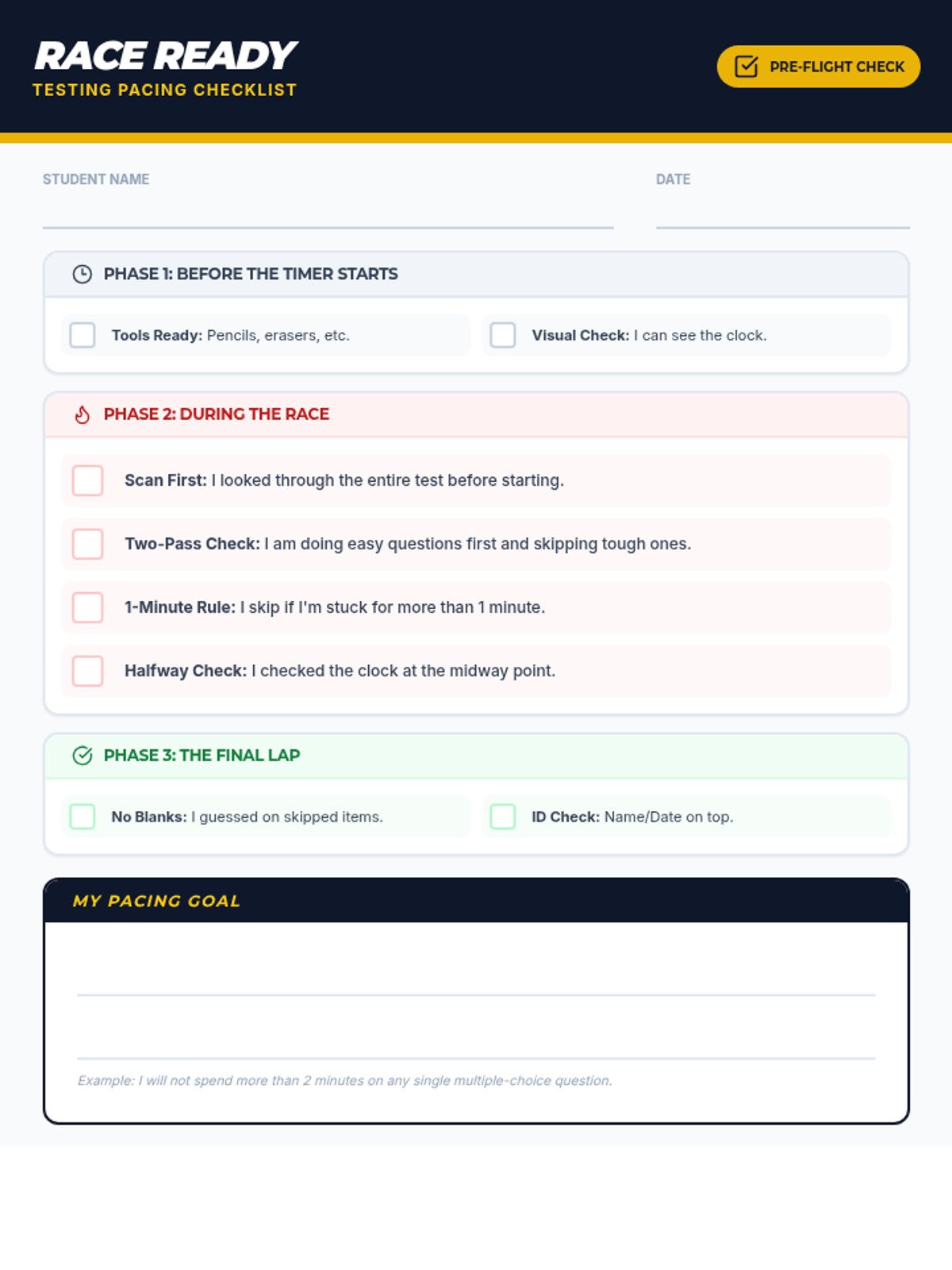
A student-facing checklist for managing time before, during, and after a test, formatted with a racing theme to encourage momentum.
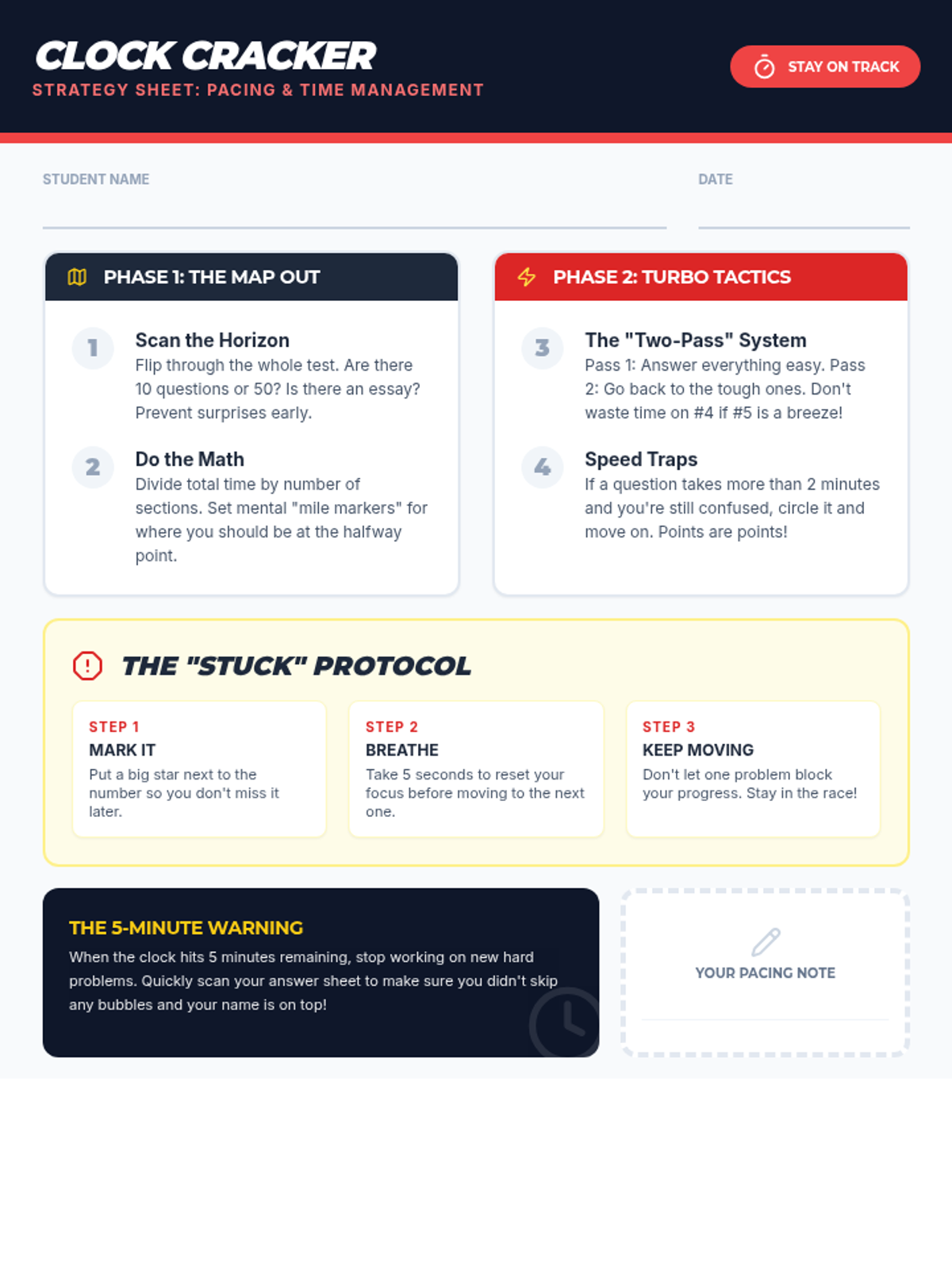
A high-energy student strategy sheet focused on time management and pacing during exams, featuring the 'Two-Pass' system and 'The Stuck Protocol'.
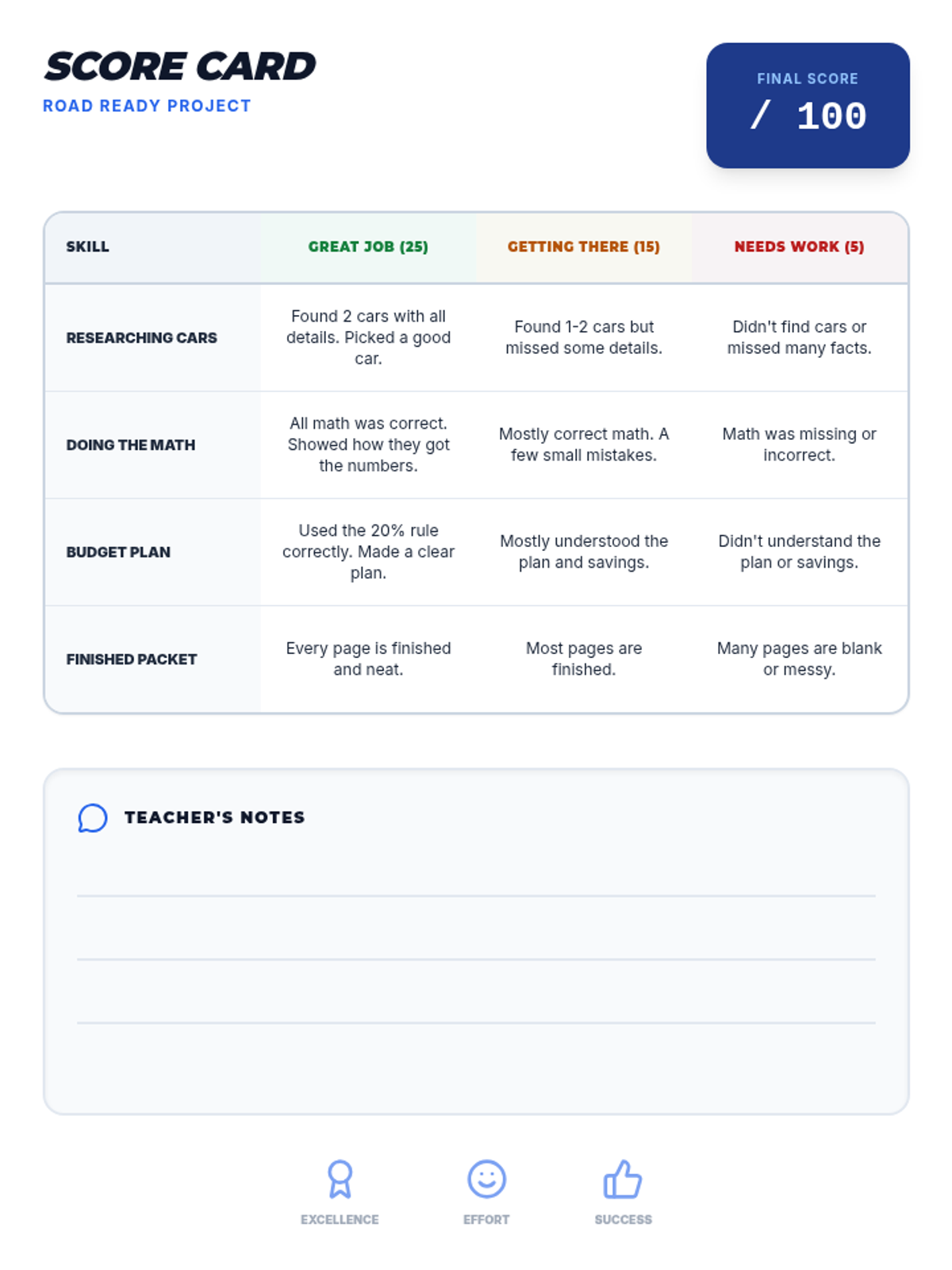
A simplified assessment rubric for lower-level students. It uses a clear 3-point scale (Great Job, Getting There, Needs Work) with plain language and visual icons to make grading and feedback accessible.
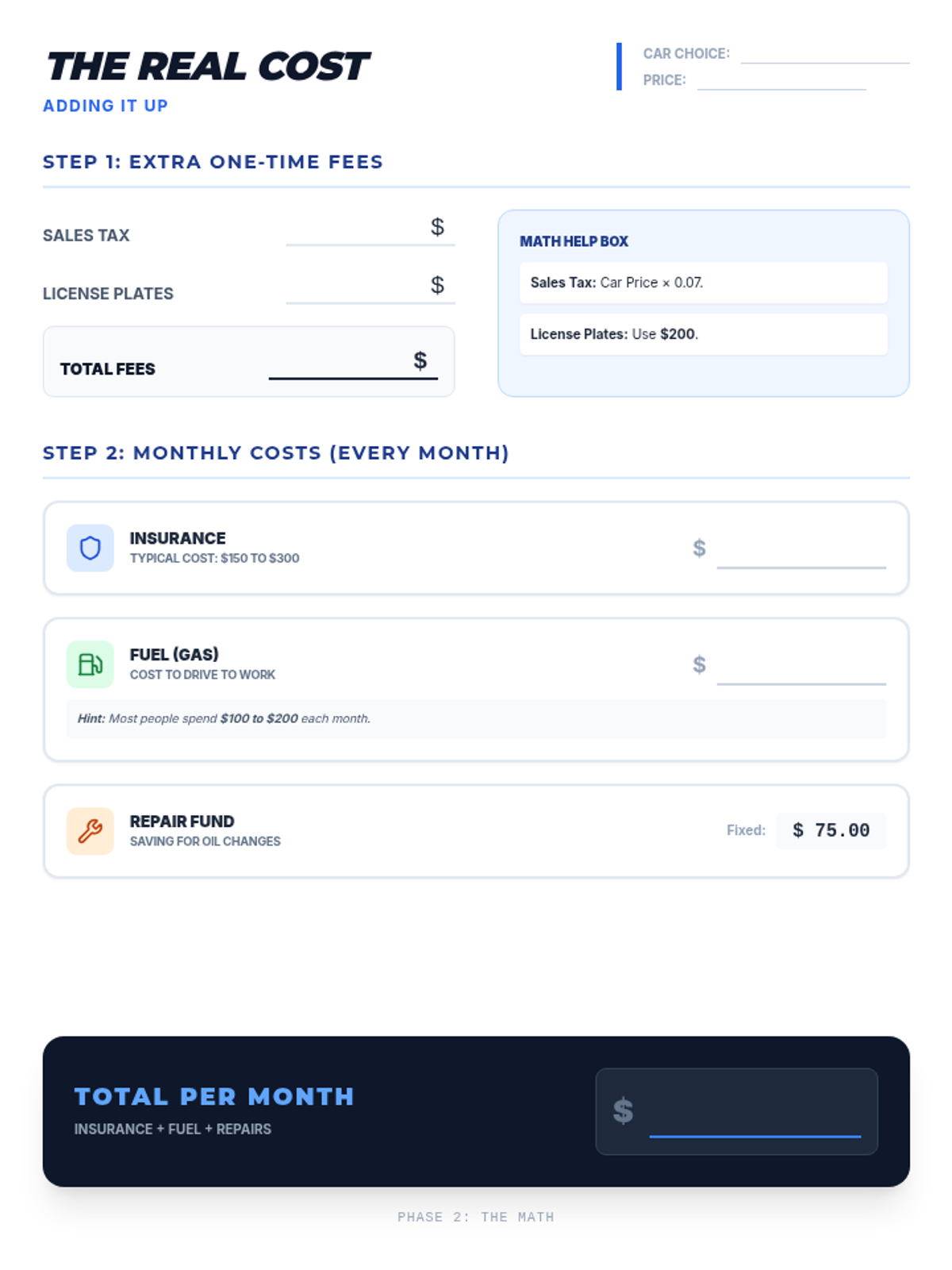
A simplified cost calculator for lower-level students. It breaks down vehicle ownership costs into two steps (fees and monthly costs) using visual icons, clear hints, and a straightforward layout to help students calculate their total monthly expenses.
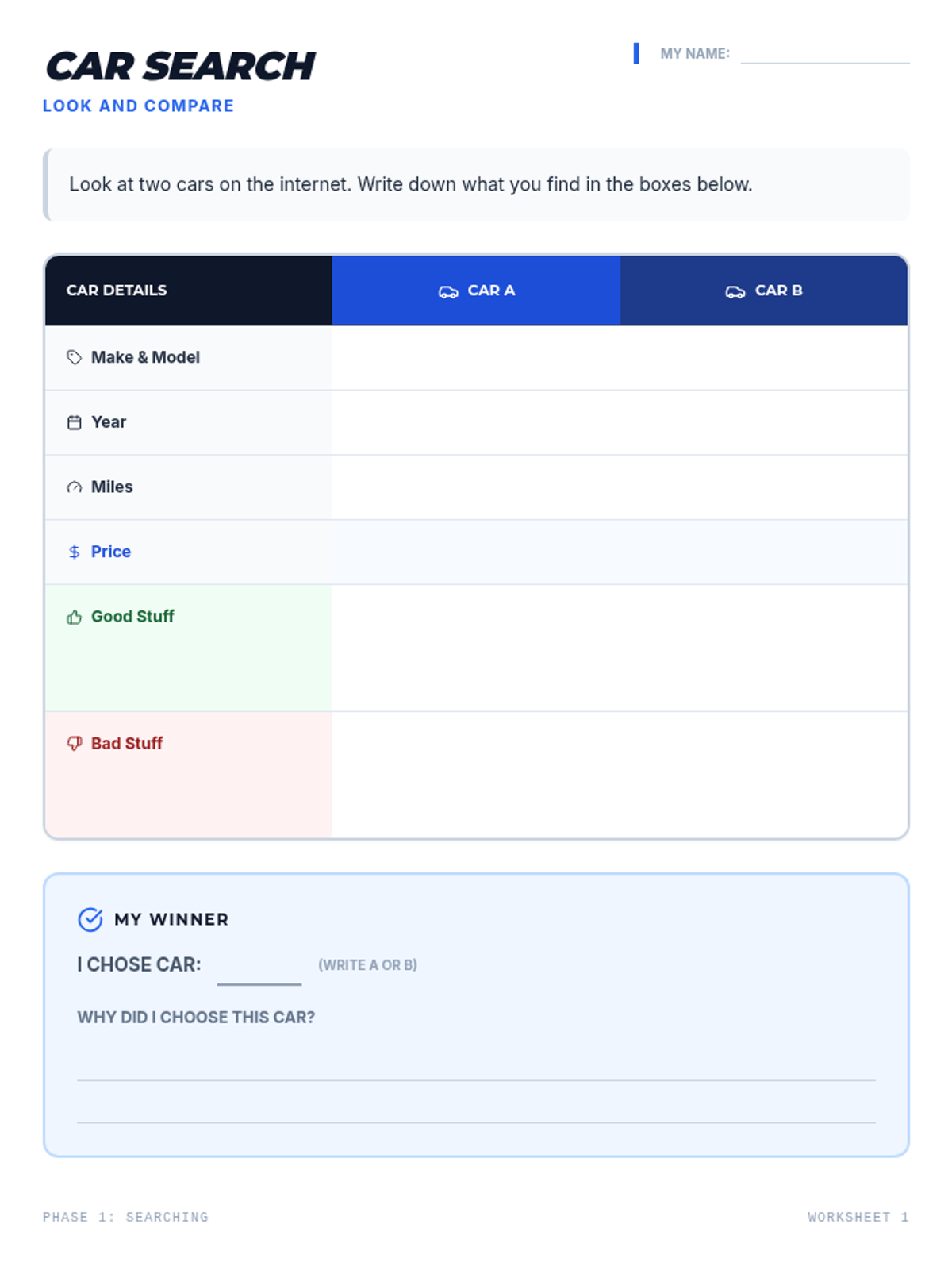
A simplified car research worksheet for lower-level students. It features a side-by-side comparison of two vehicles with clear icons and plain language like "Good Stuff" and "Bad Stuff" to help students make a choice.
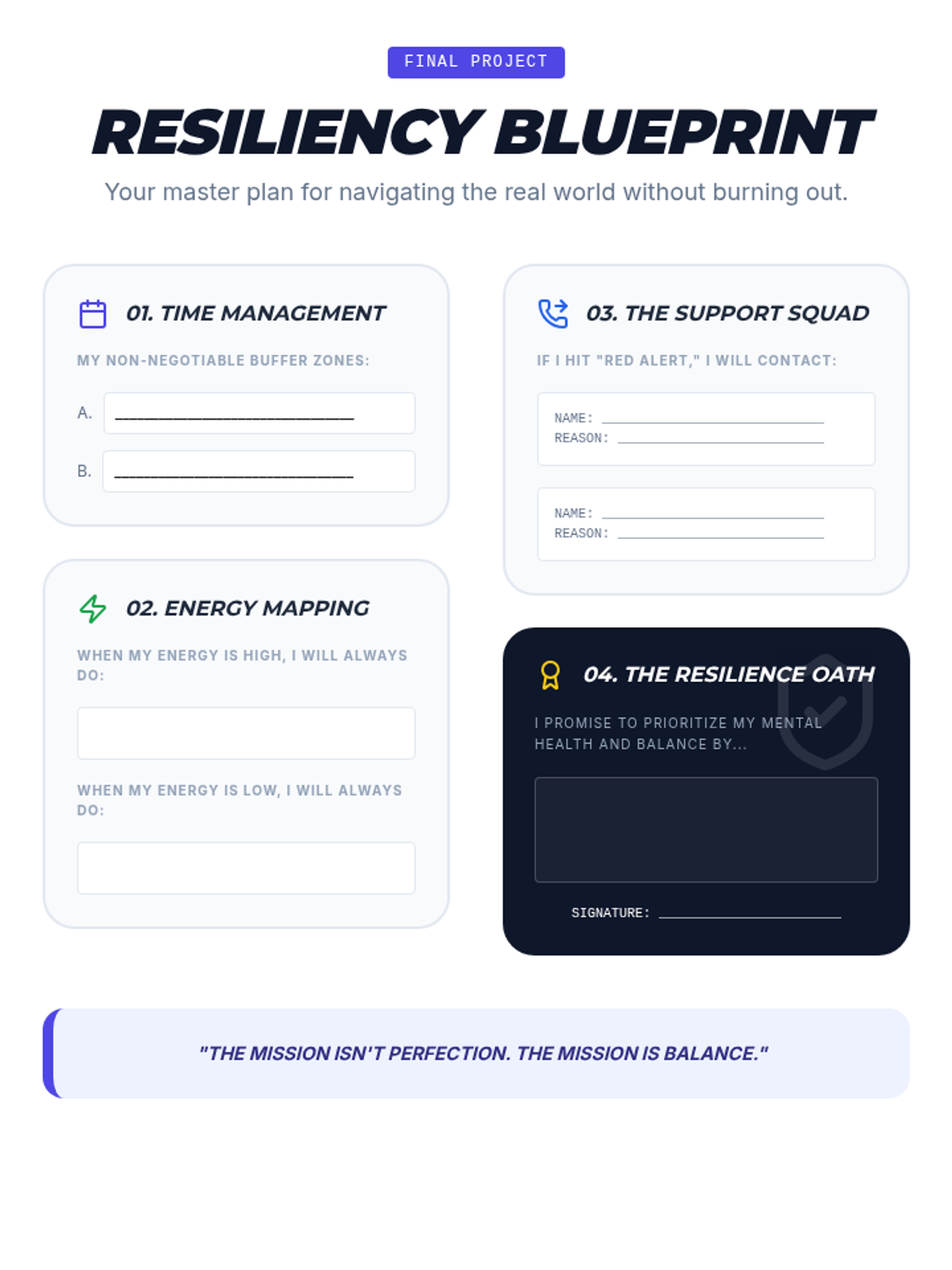
A summative project document where students synthesize everything they have learned into a personal 'Resiliency Blueprint' for real-world application.
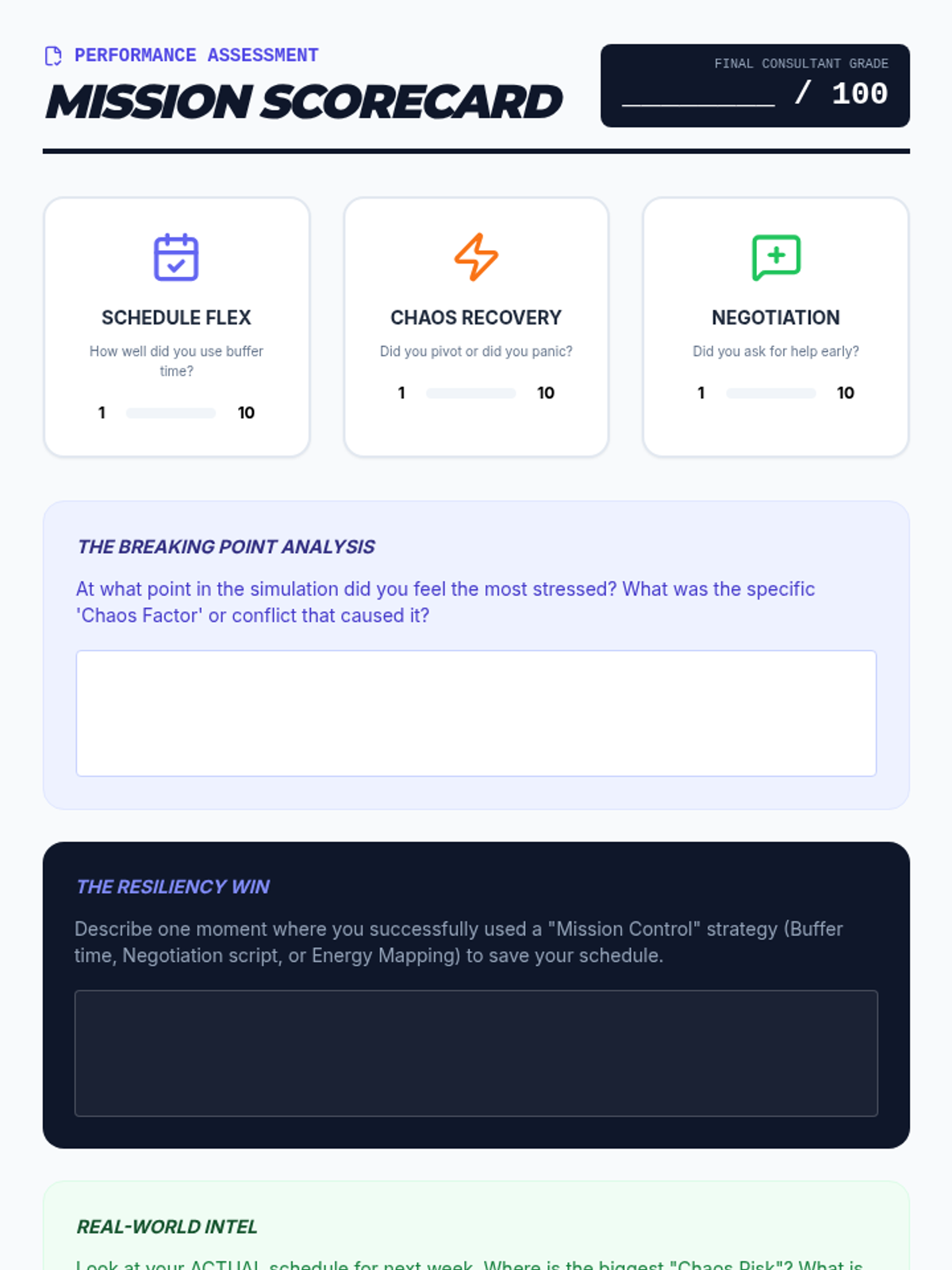
A final self-assessment 'Scorecard' for the Mission Balance sequence, allowing students to rate their performance and reflect on their growth in schedule management and resiliency.
Final presentation for the Mission Balance sequence, reviewing core concepts of chaos management, negotiation, and energy management, and introducing the final scorecard activity.
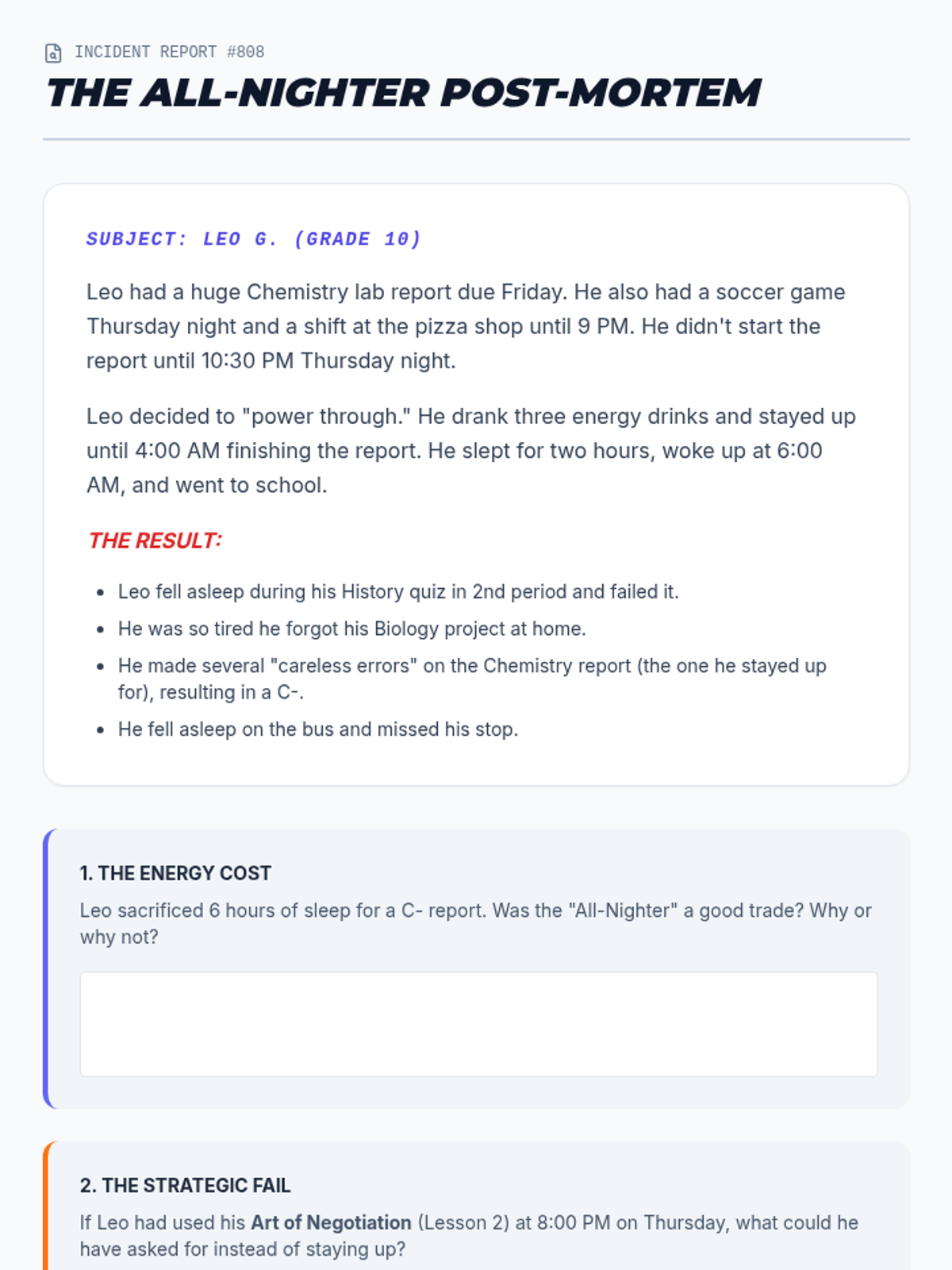
A case study analysis of a student's 'all-nighter' experience, prompting students to evaluate the consequences and identify alternative strategies from the sequence.
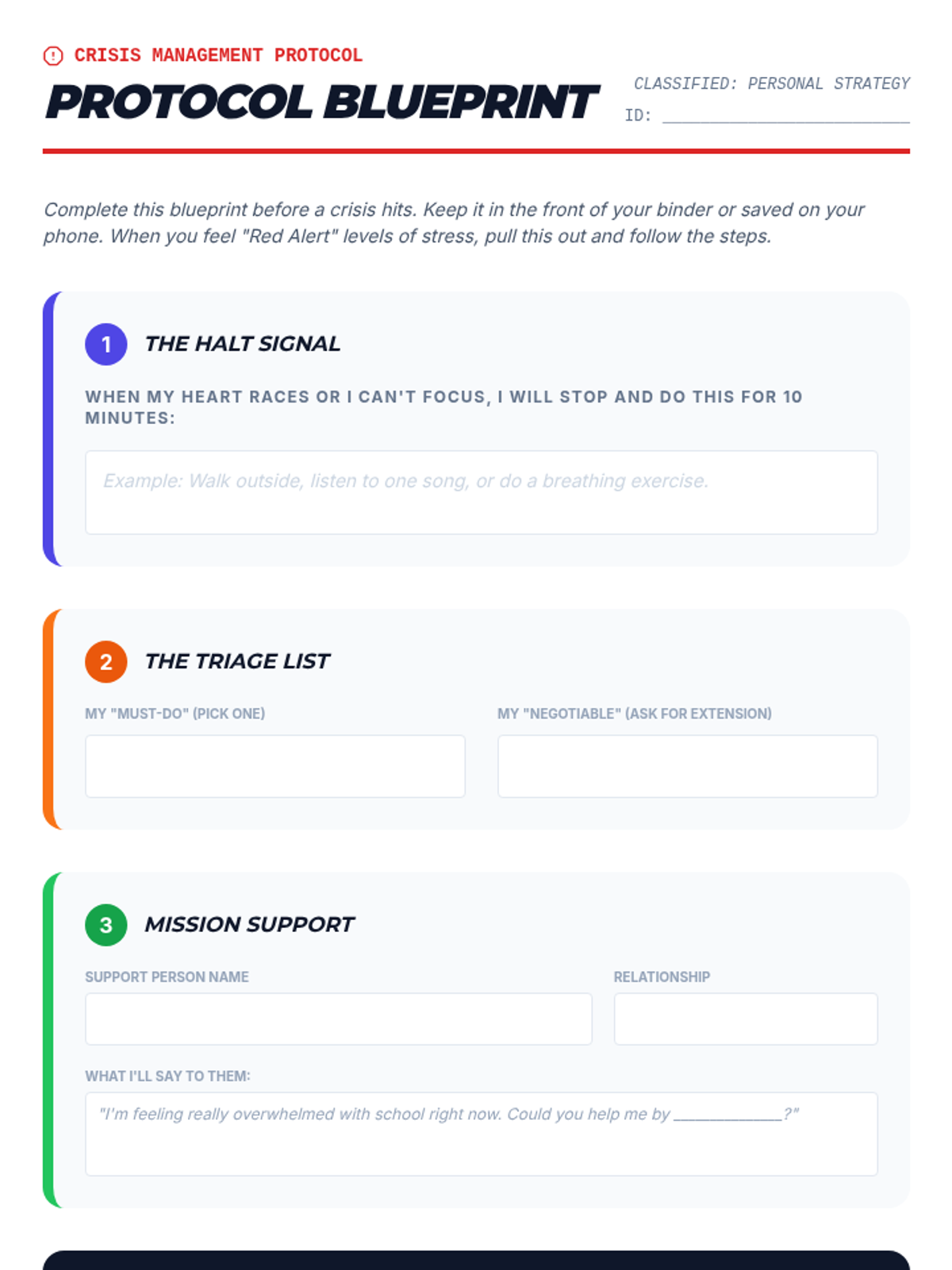
A personal crisis management worksheet where students document their specific 'Red Alert' protocols, including triage strategies, support contacts, and recovery plans.
Lesson 4 slides on crisis management protocols, teaching students how to identify burnout, prioritize tasks during 'Red Alert' scenarios, and activate support systems.
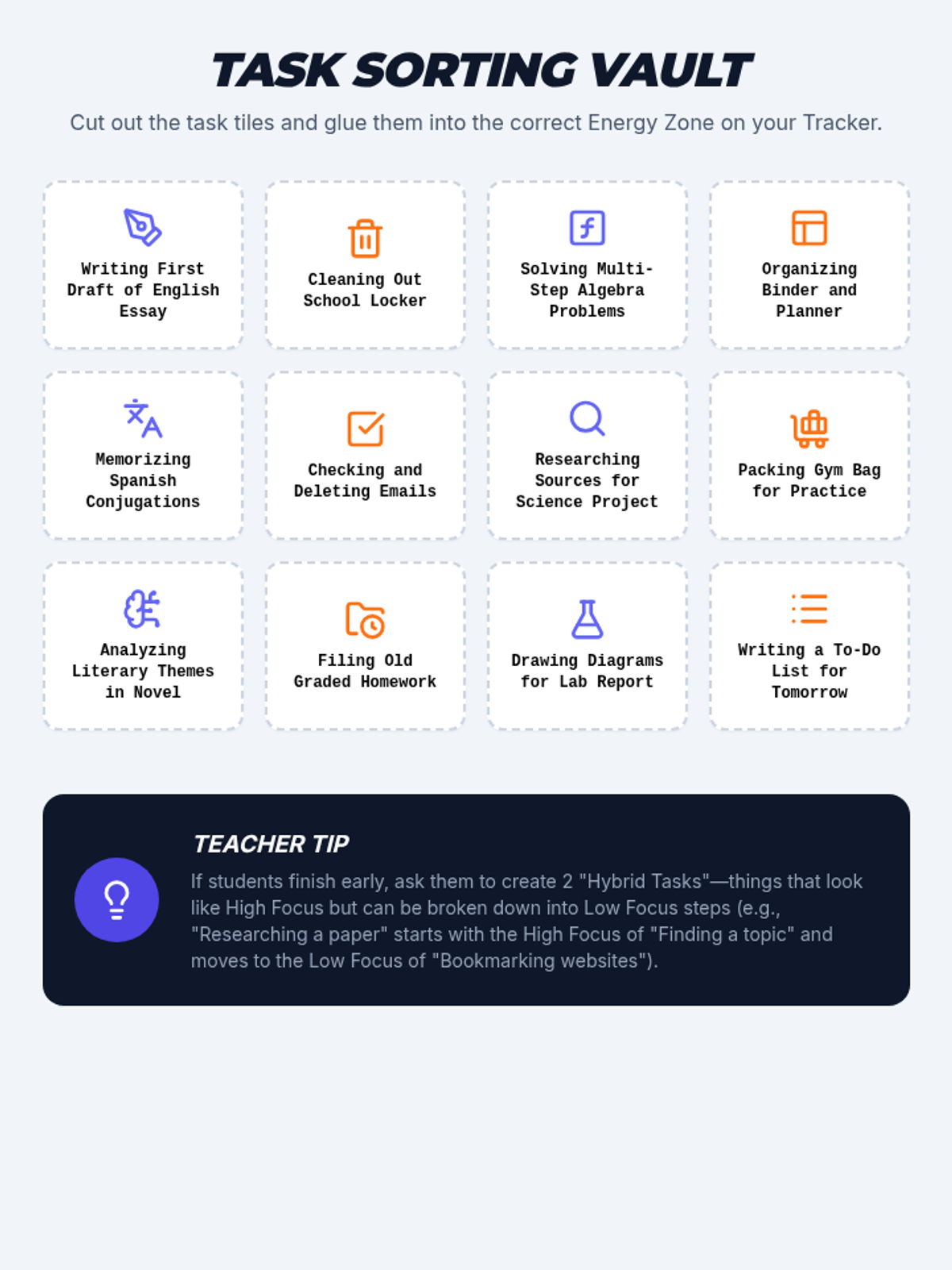
A cut-and-paste sorting activity for students to categorize common school and life tasks as either 'High Focus' or 'Low Focus' energy requirements.
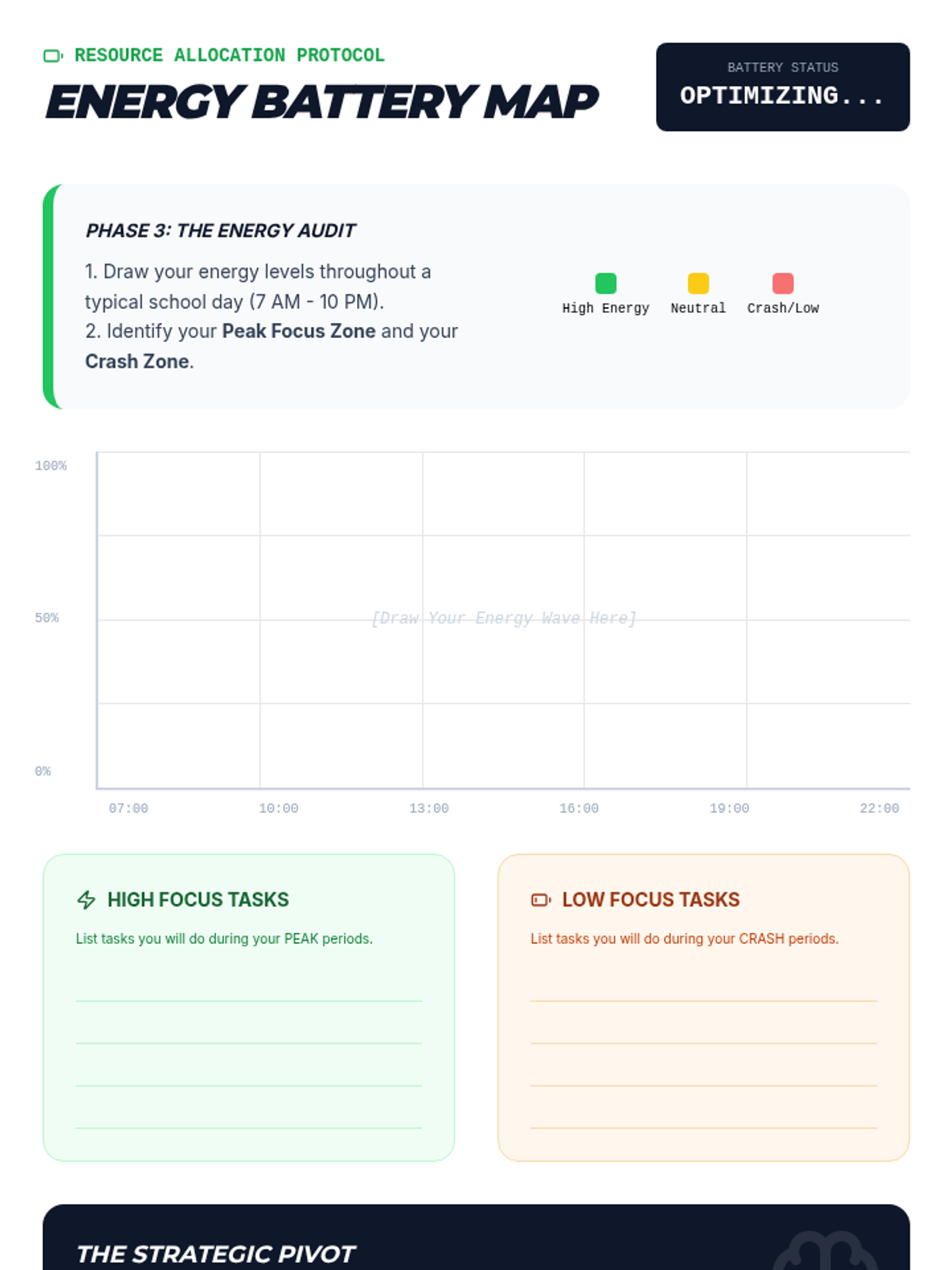
A worksheet for students to map their daily energy levels and strategically assign tasks based on their peak focus periods.
Lesson 3 presentation on energy management, teaching students to differentiate between High Focus and Low Focus tasks and to identify their personal peak energy periods.
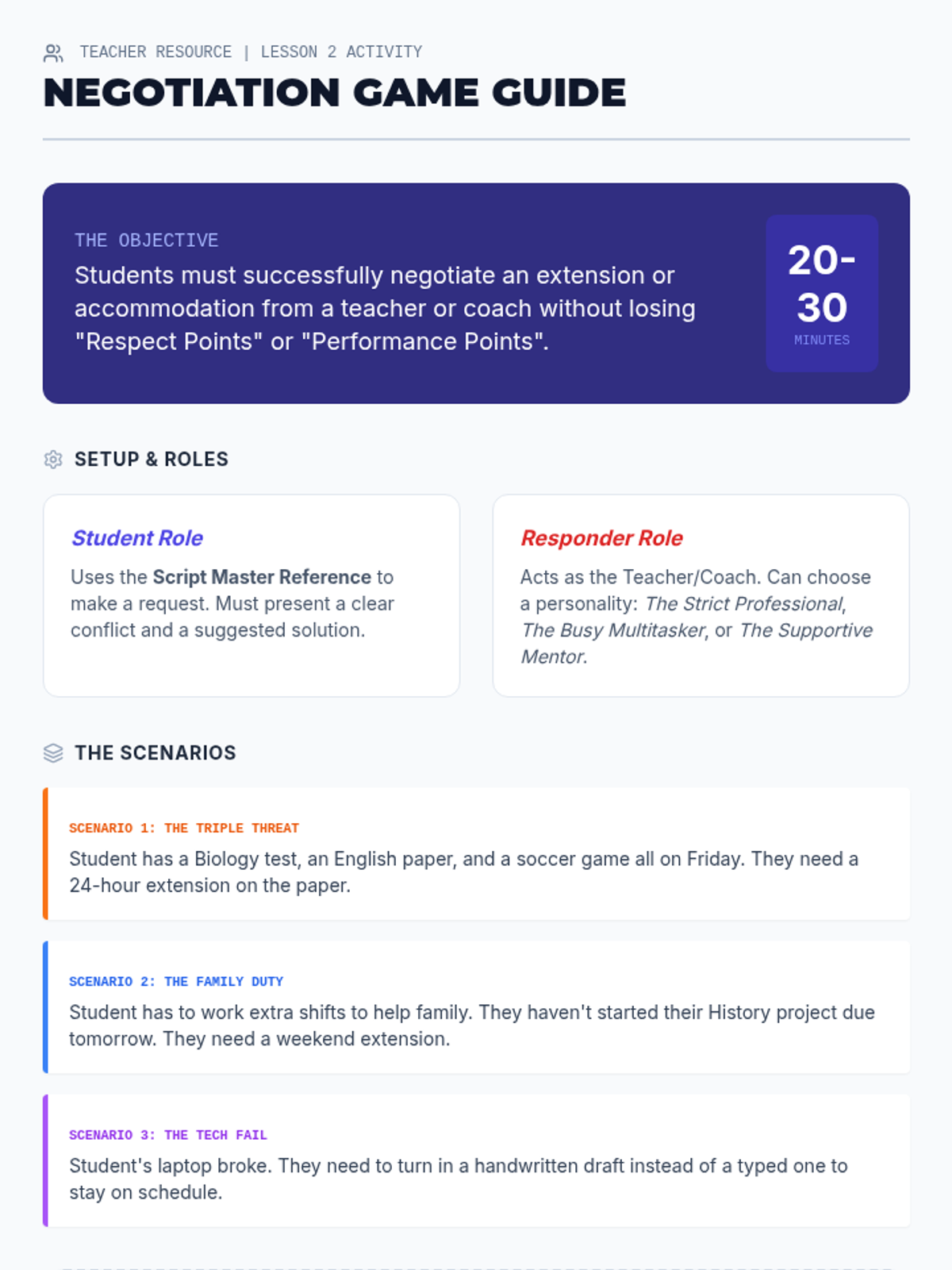
Teacher facilitation guide for the Lesson 2 role-play simulation, providing scenarios, roles, and assessment criteria for student negotiations.
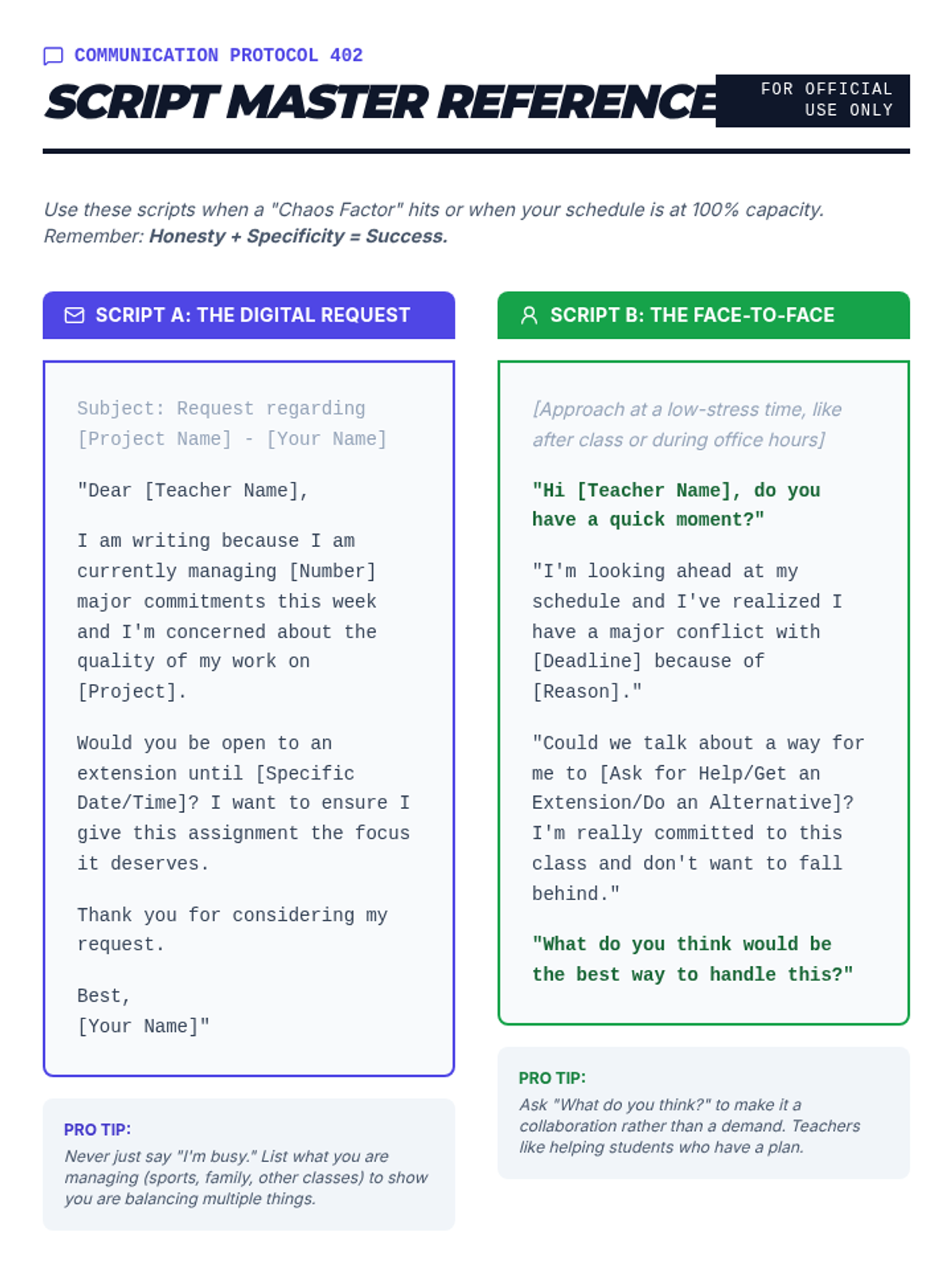
A professional communication guide for students, featuring scripted templates for digital and in-person deadline negotiations, including a practice exercise.
Slide deck for Lesson 2, teaching students the difference between hard and soft deadlines and providing a professional framework for negotiating extensions.
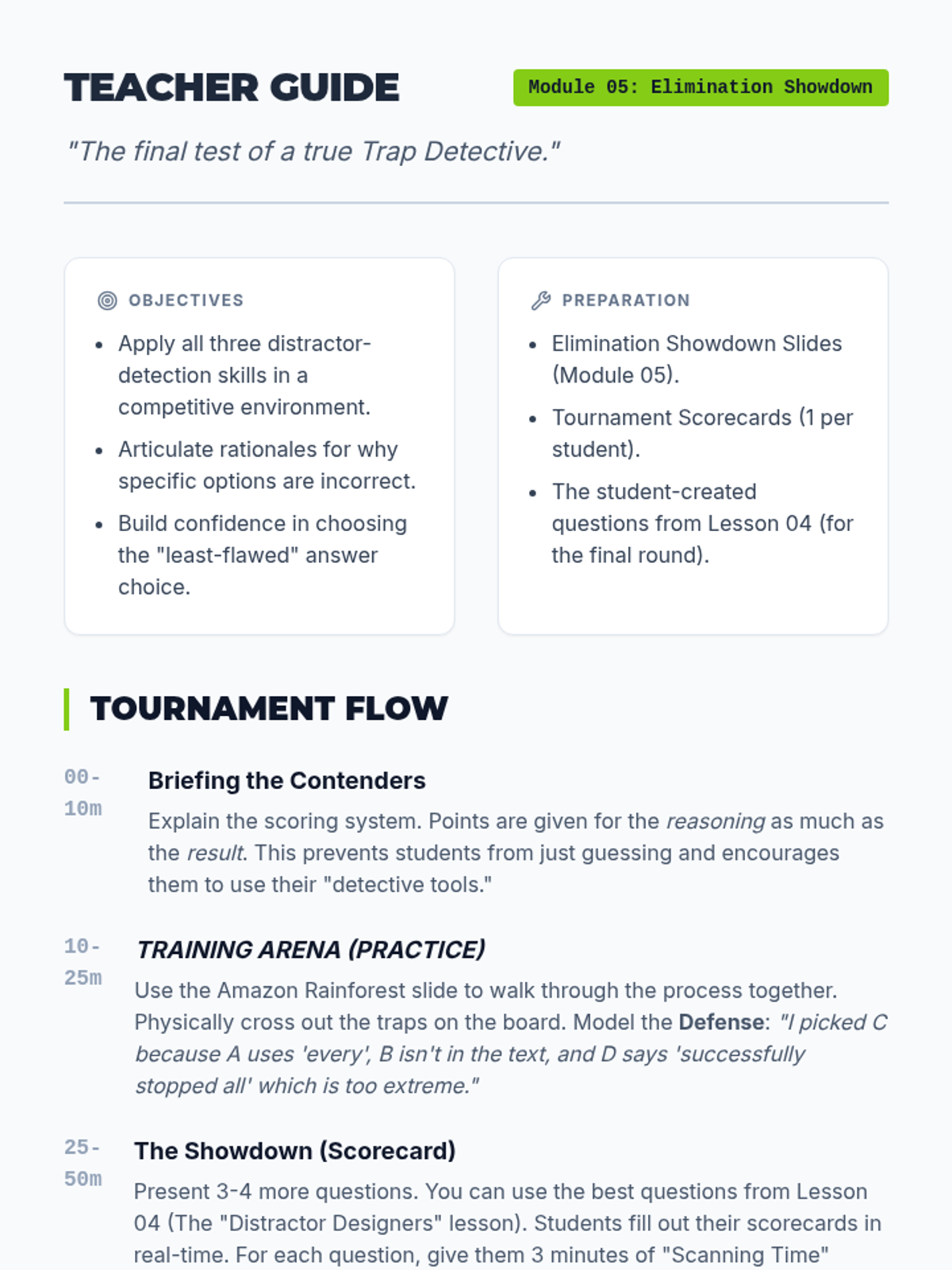
Teacher guide for 'Elimination Showdown'. Includes lesson flow, tournament scoring mechanics, and a detailed analysis of the practice question.
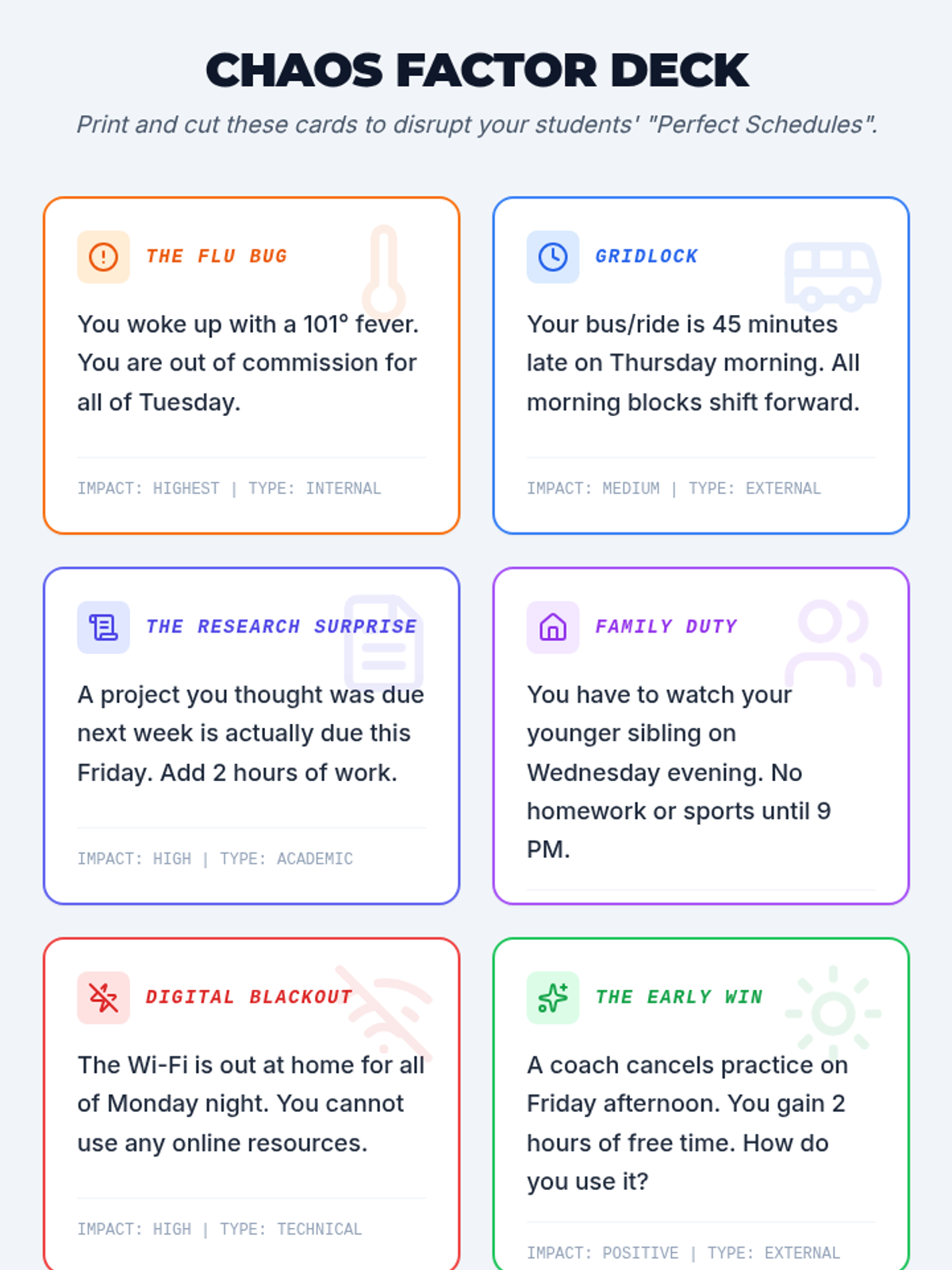
A set of printable 'Chaos Factor' cards for teachers to use in the Mission Balance simulation, featuring various disruptions to a student's schedule.
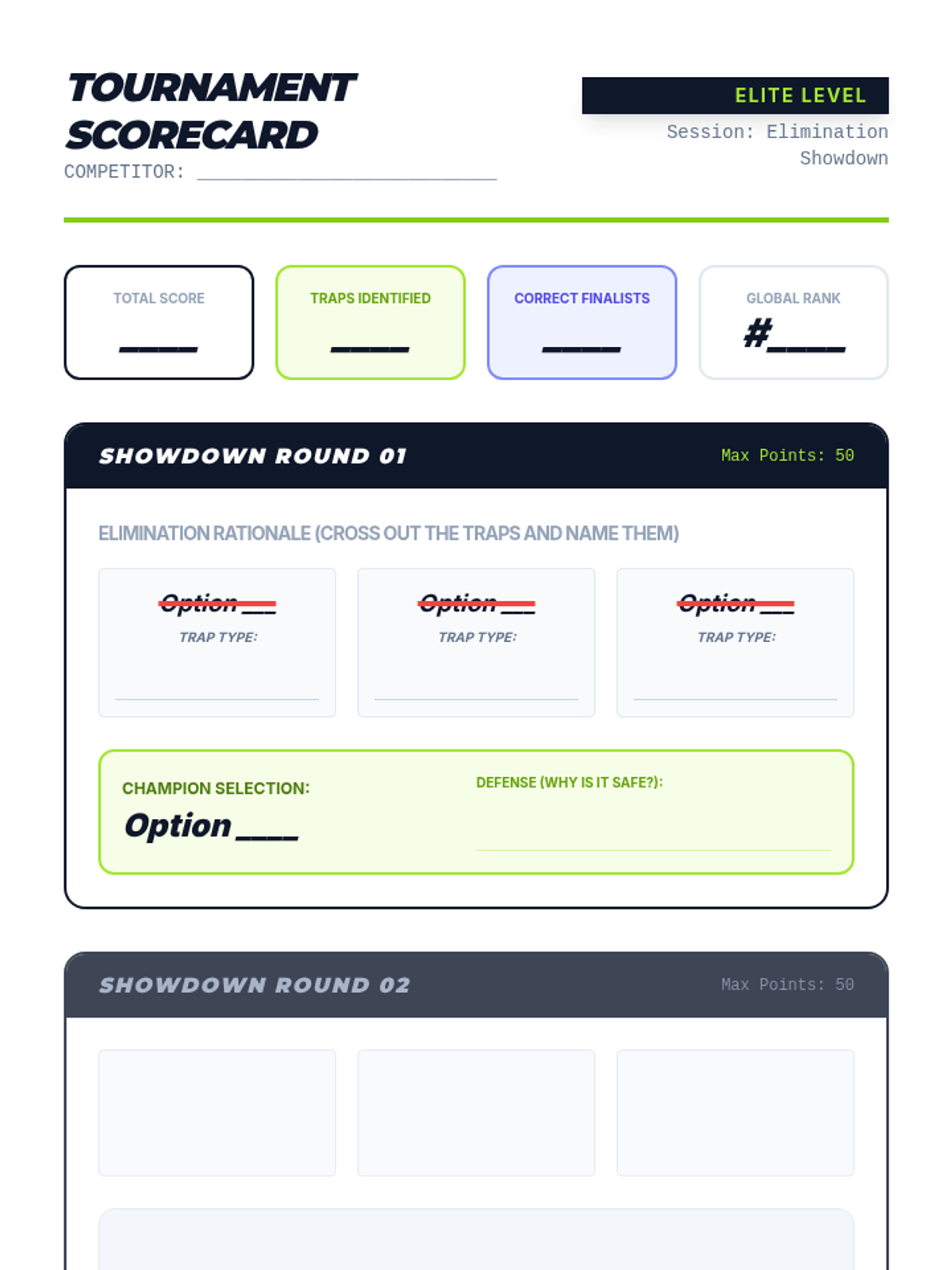
A student tournament scorecard for the final showdown. Features sections for tracking points, identifying trap types for each distractor, and selecting the 'Champion' (correct) answer with a defense.
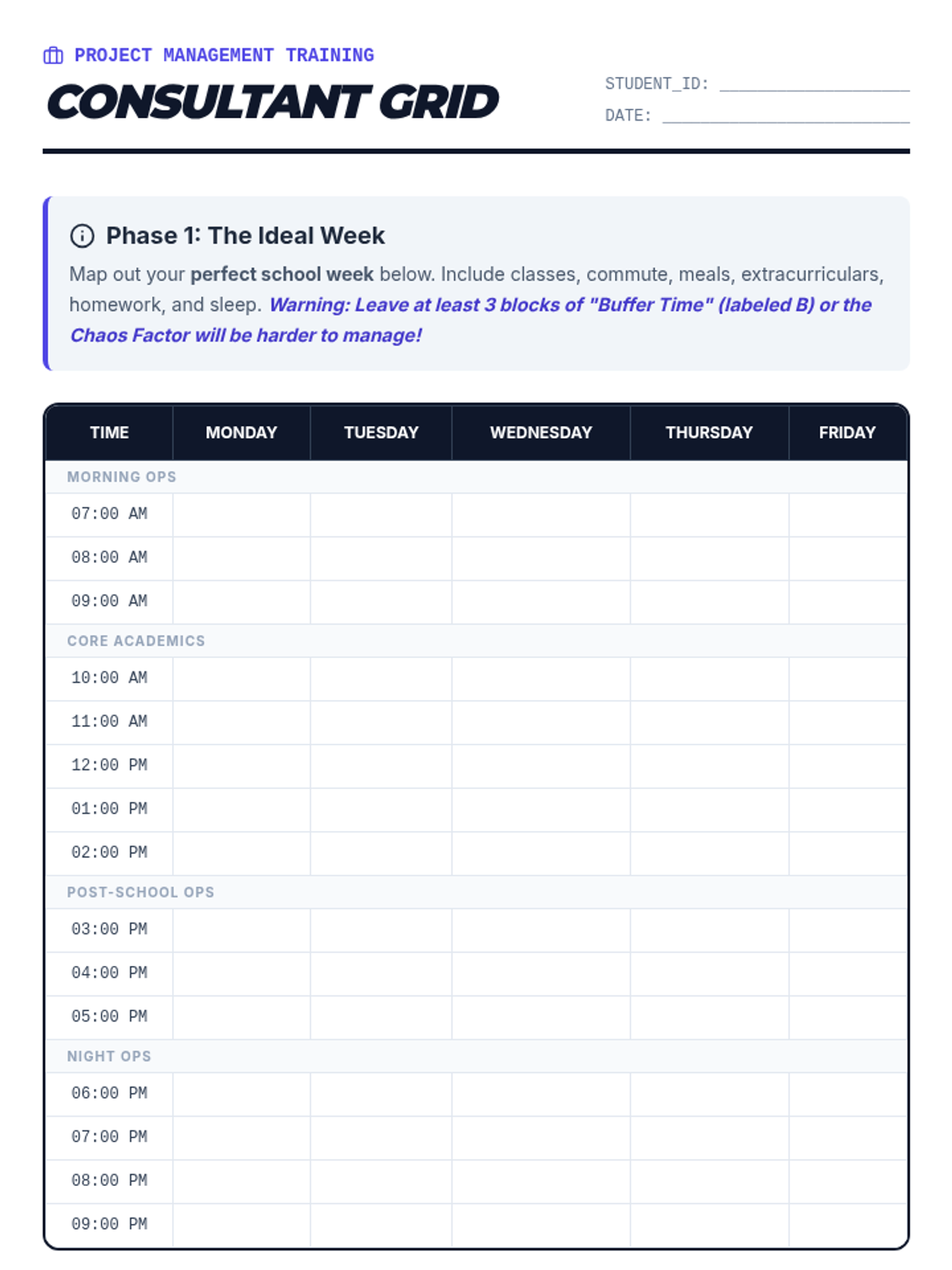
A student-facing weekly scheduling grid designed for the Mission Balance simulation, including a section for analyzing and responding to 'Chaos Factor' disruptions.
Introductory slides for 'Elimination Showdown'. Features tournament rules and a walk-through of the 'Elimination Showdown' process with a practice question.
Introductory presentation for the Mission Balance sequence, teaching students about the 'Chaos Factor' and the importance of 'Buffer Time' in scheduling.
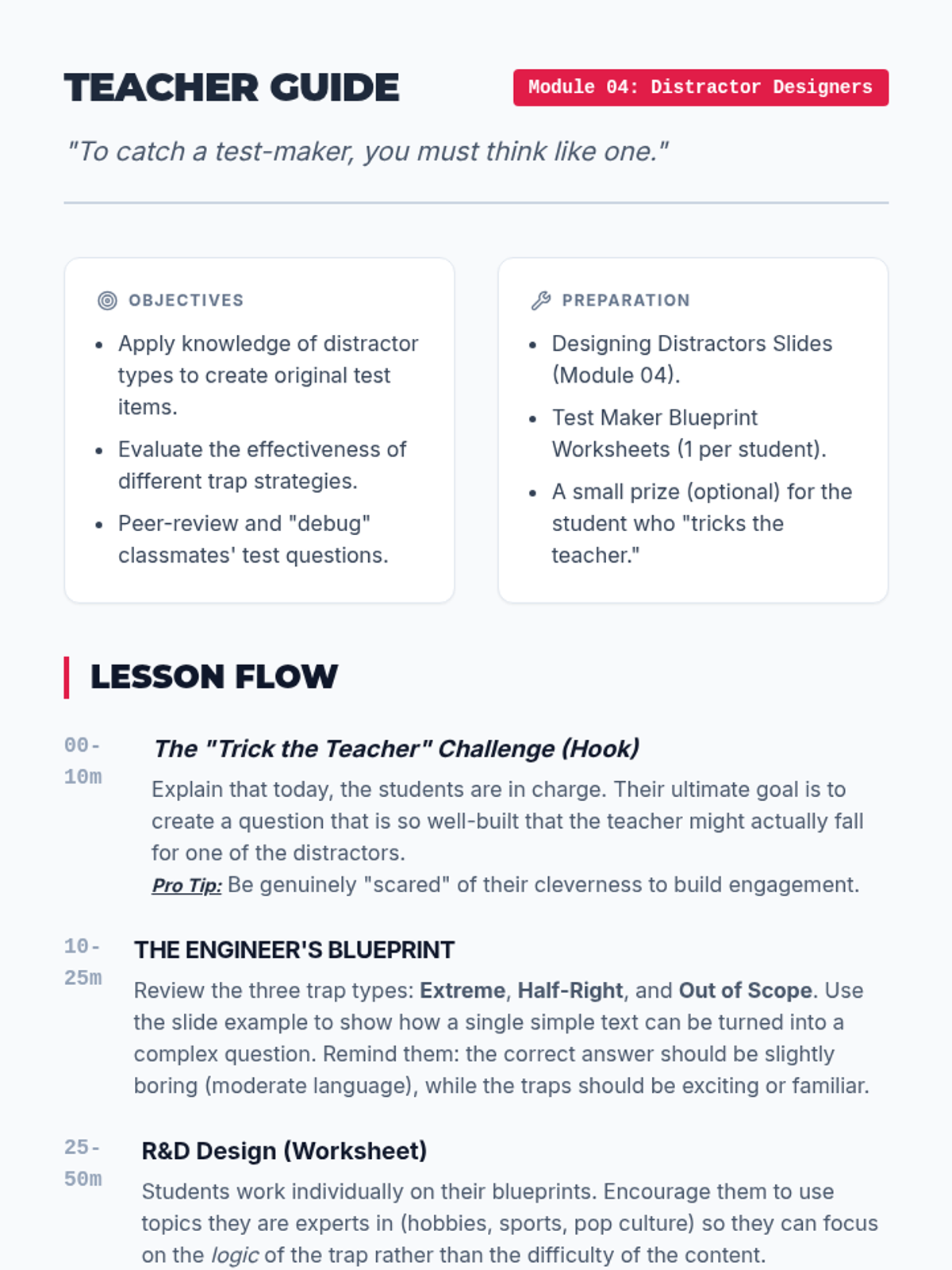
Teacher guide for 'Distractor Designers'. Includes pacing, rubric for the student worksheet, and instructions for the peer-testing phase of the lesson.
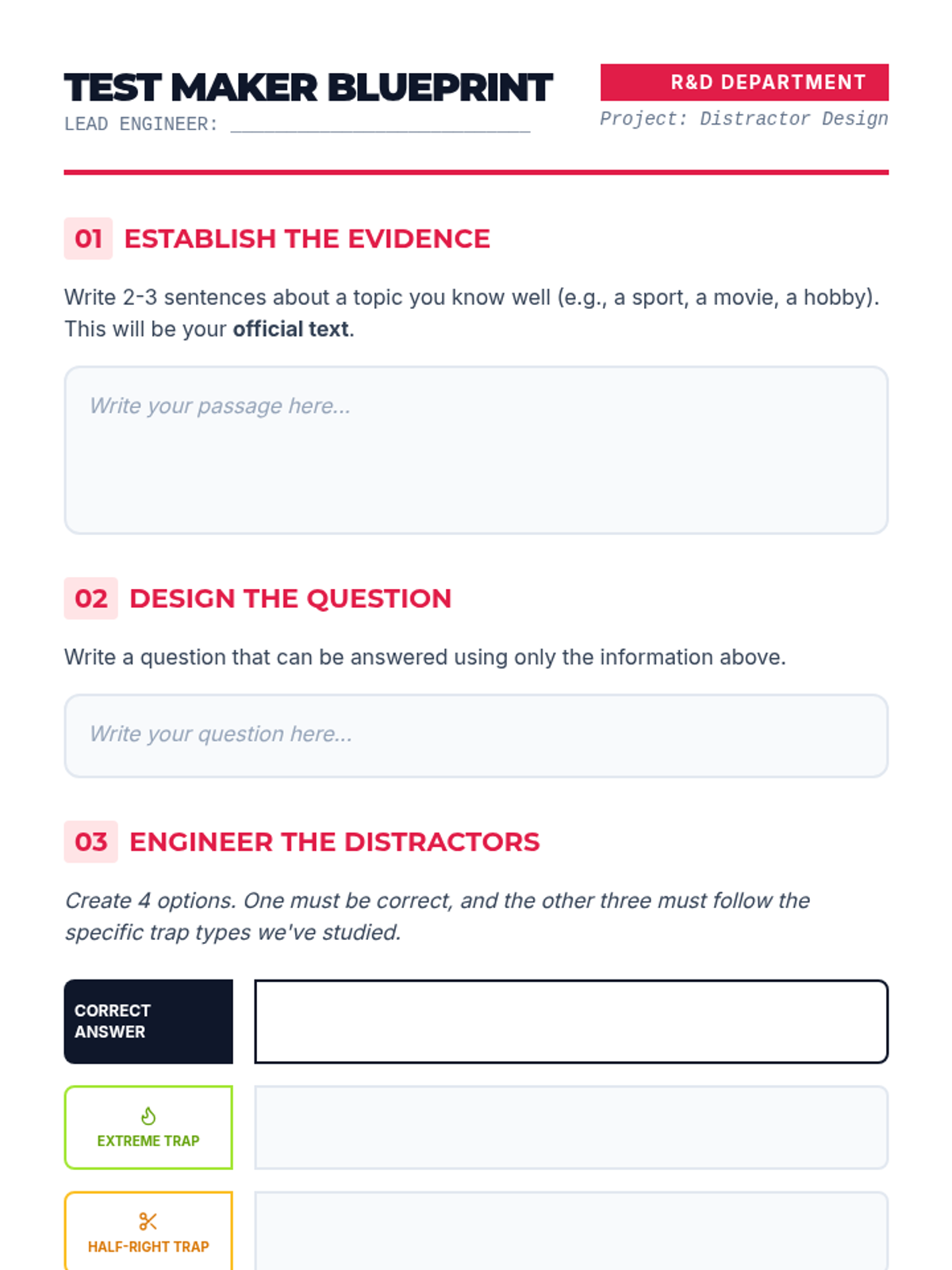
A student design sheet where they create their own multiple-choice question. Students must provide a short text and then engineer four options: one correct answer and three specific distractor types (Extreme, Half-Right, and Out of Scope).
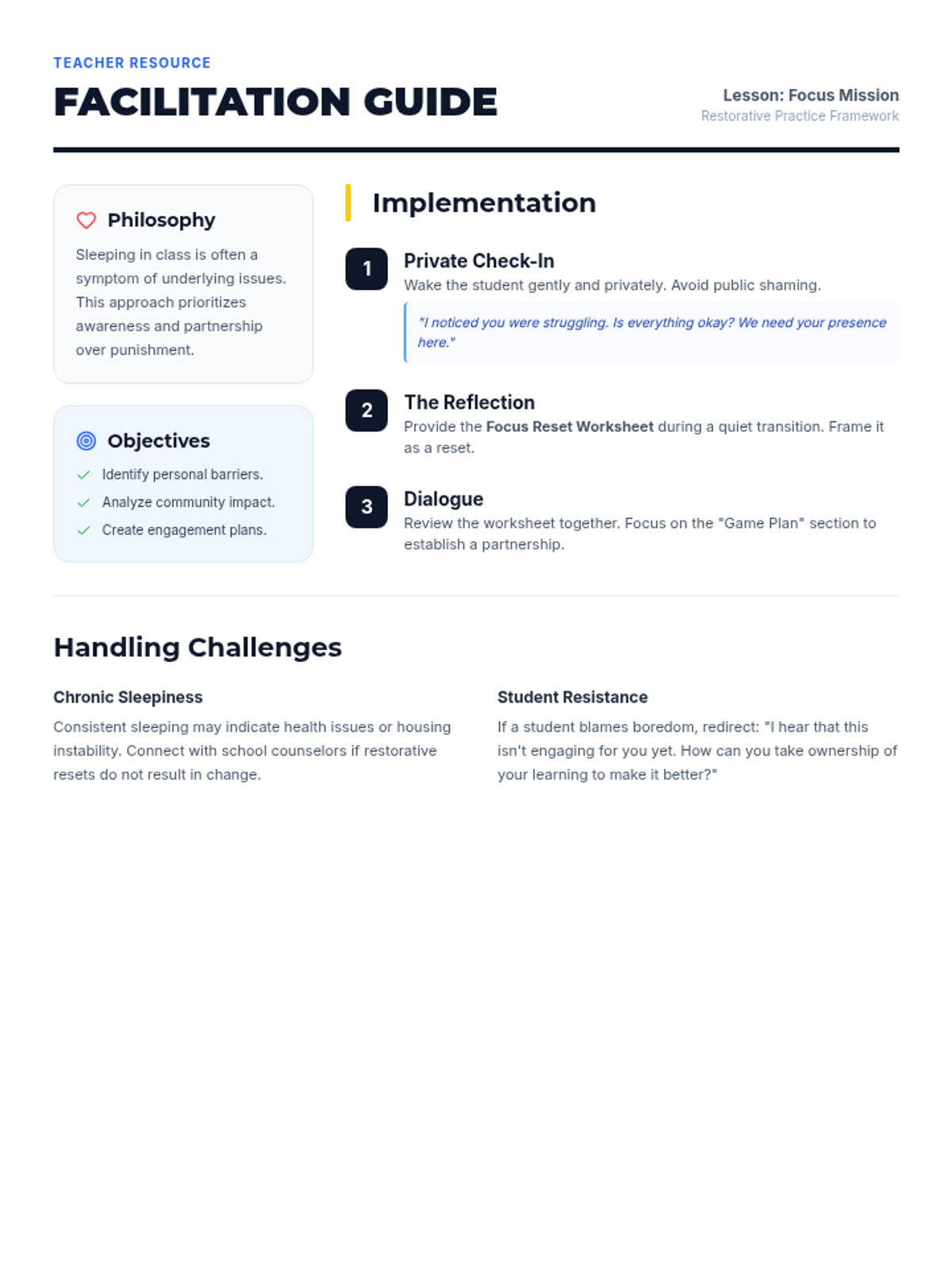
A teacher facilitation guide providing restorative strategies and instructional prompts for addressing classroom sleepiness and using the Focus Mission materials effectively.
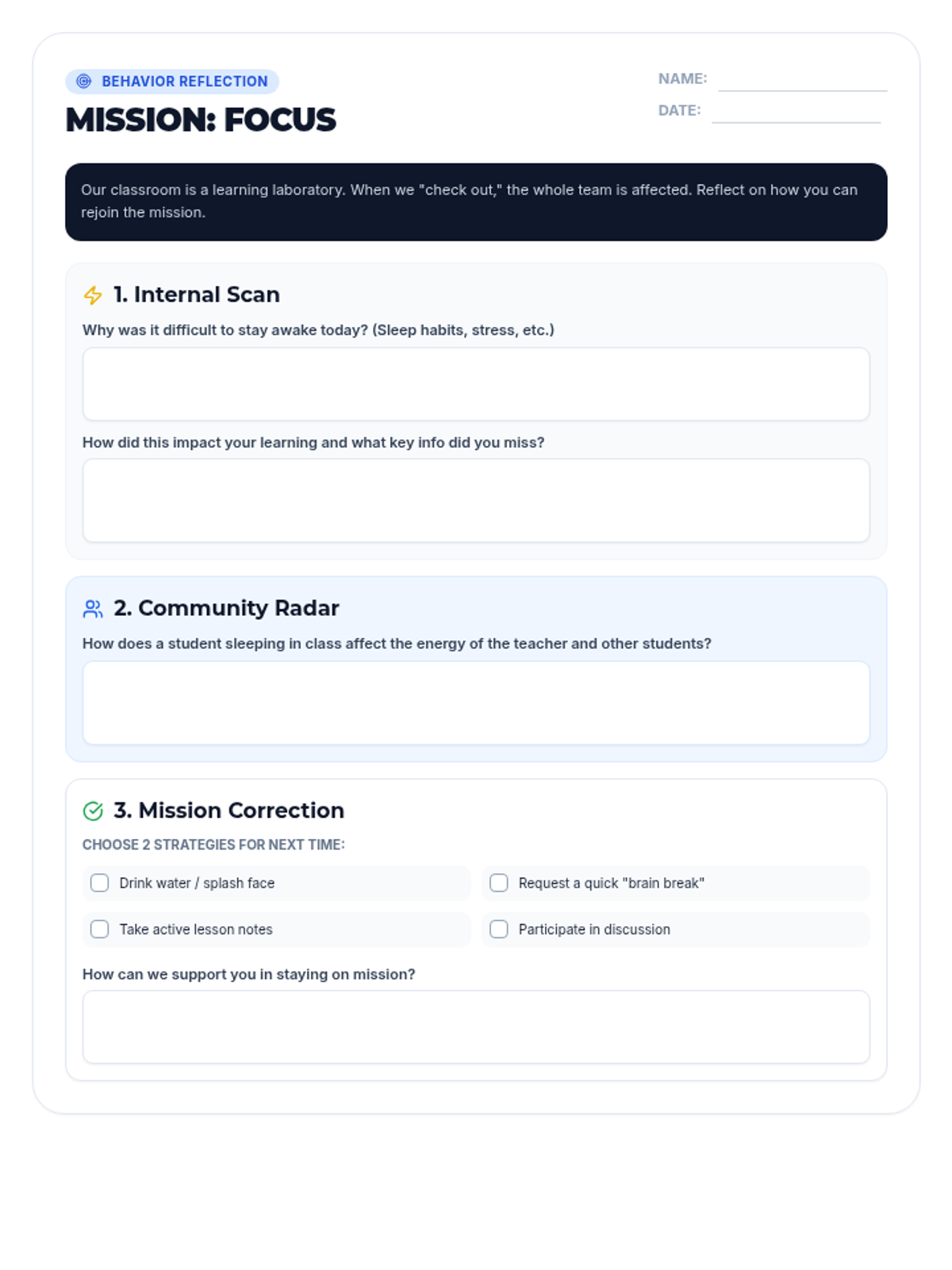
A restorative behavior reflection worksheet that encourages students to evaluate the causes of their drowsiness and understand its impact on their learning and classroom community.
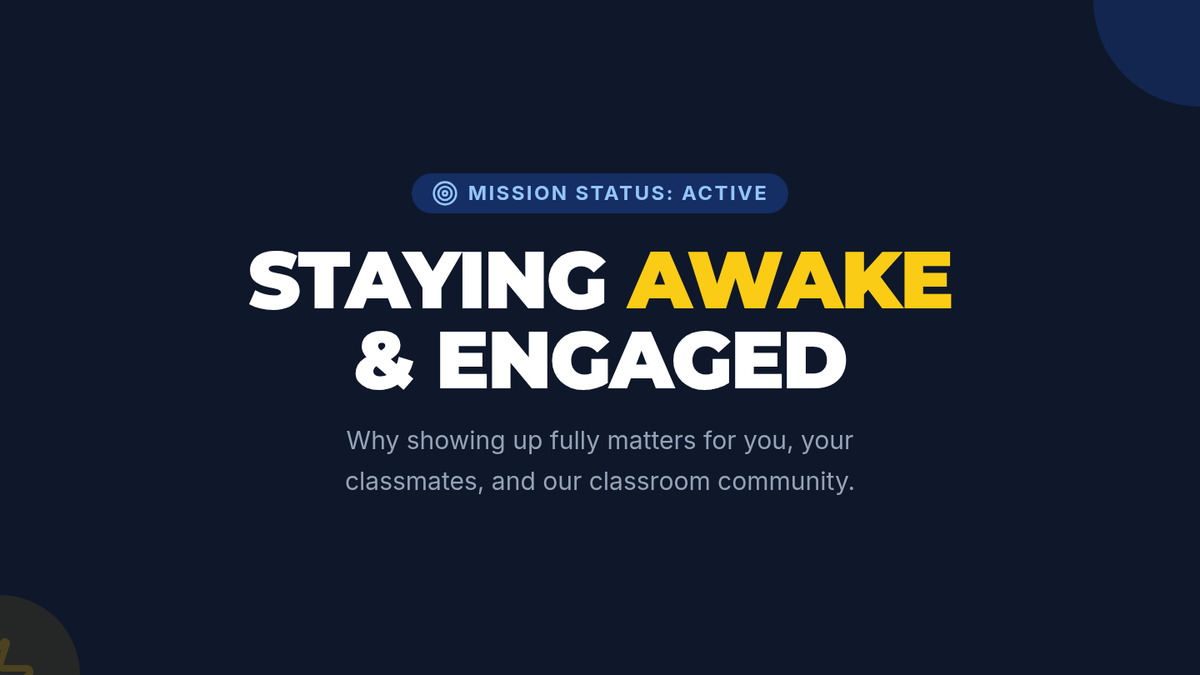
An engaging slide deck explaining the impact of sleeping in class on personal success and the classroom community, featuring restorative strategies for staying engaged.
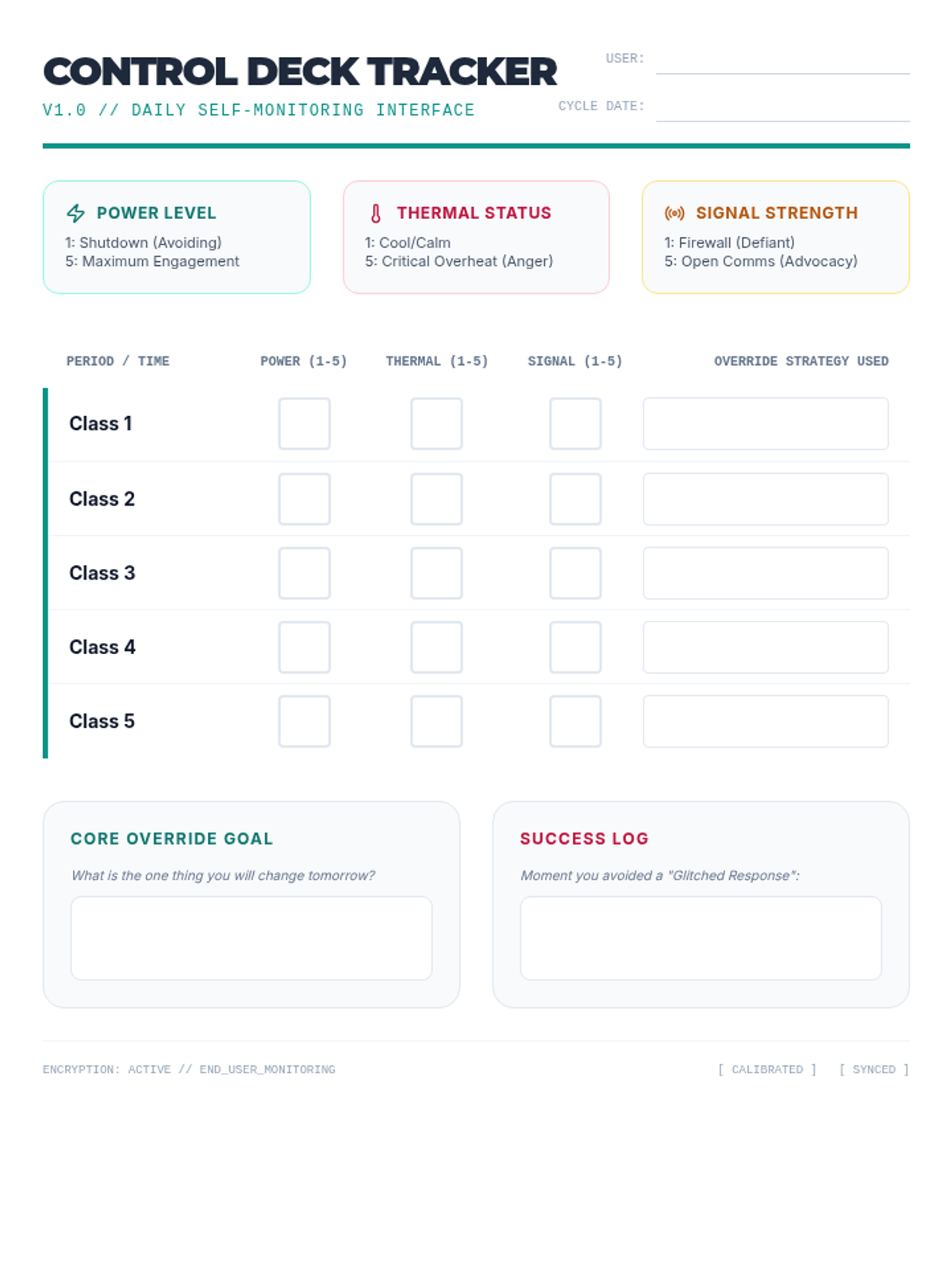
A student-facing self-monitoring tool styled as a sleek 'Control Deck' dashboard. It allows students to track engagement, emotional state, and communication throughout the day.
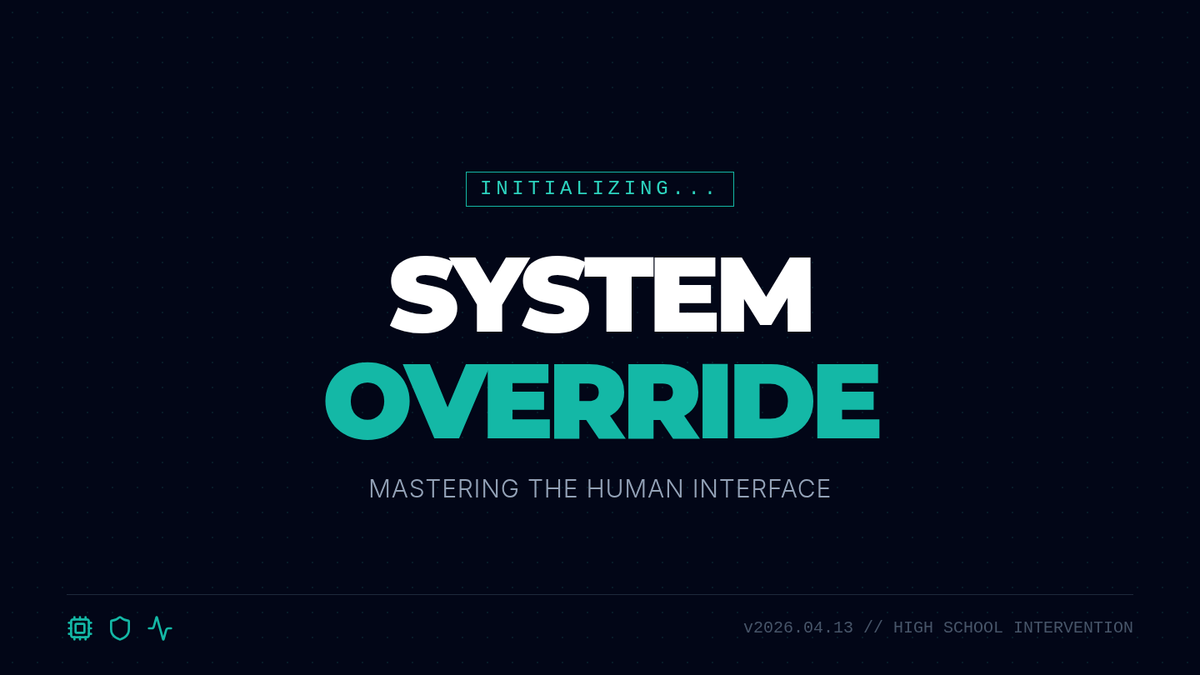
A visually striking, dark-themed slide deck that frames behavior intervention through a 'systems interface' metaphor, making it engaging and high-interest for high schoolers.
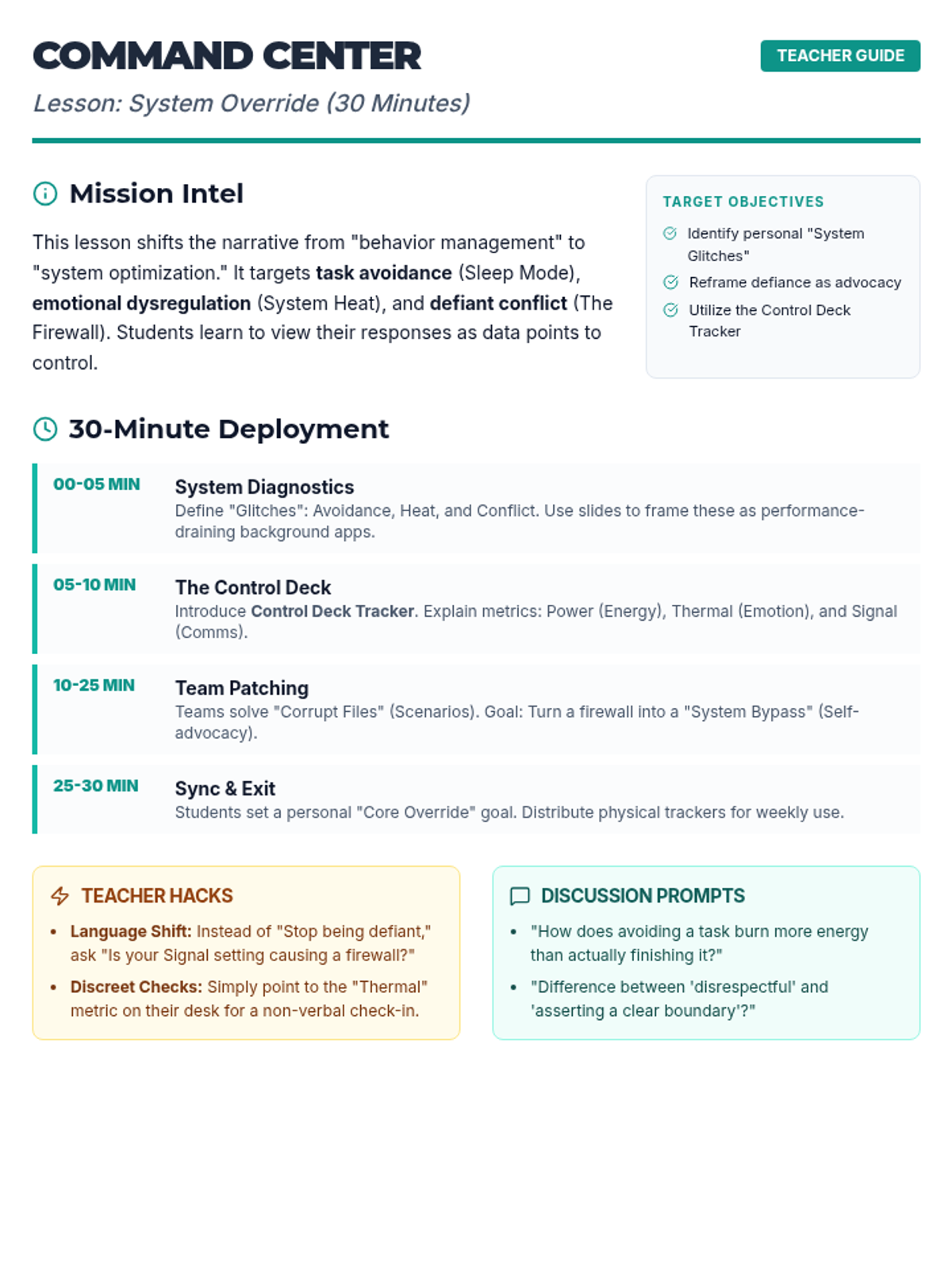
A comprehensive teacher guide for the 30-minute System Override lesson, featuring a minute-by-minute timeline, facilitation hacks, and discussion prompts.