Identifies mental health crises and suicide warning signs while developing personal safety plans and grounding techniques. Equips users with peer gatekeeper skills and direct pathways to professional crisis resources and hotlines.
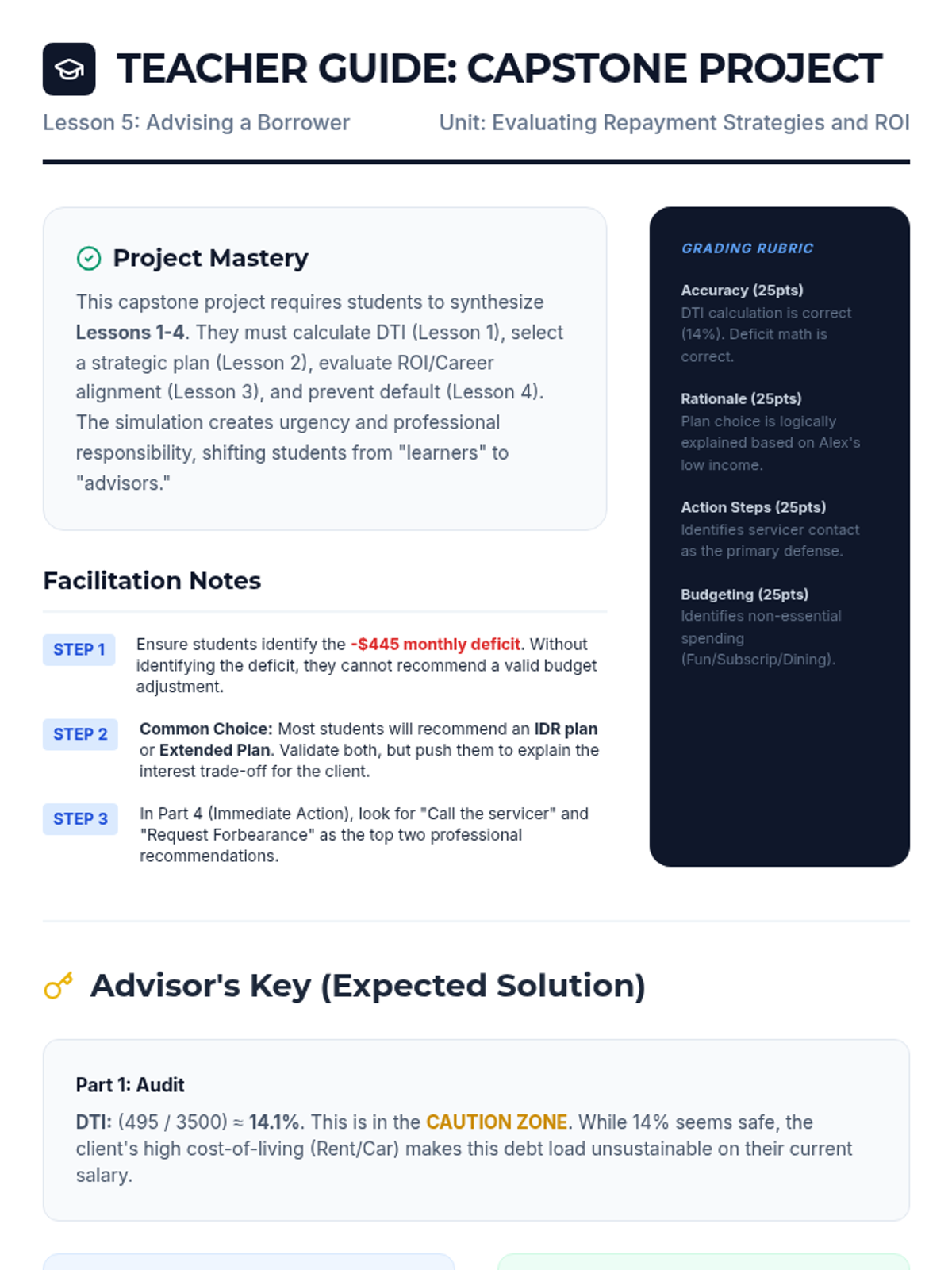
A teacher guide for the final capstone project. Includes the project rubric, solution key for Alex Rivera's DTI and budget audit, and strategic advisory notes.
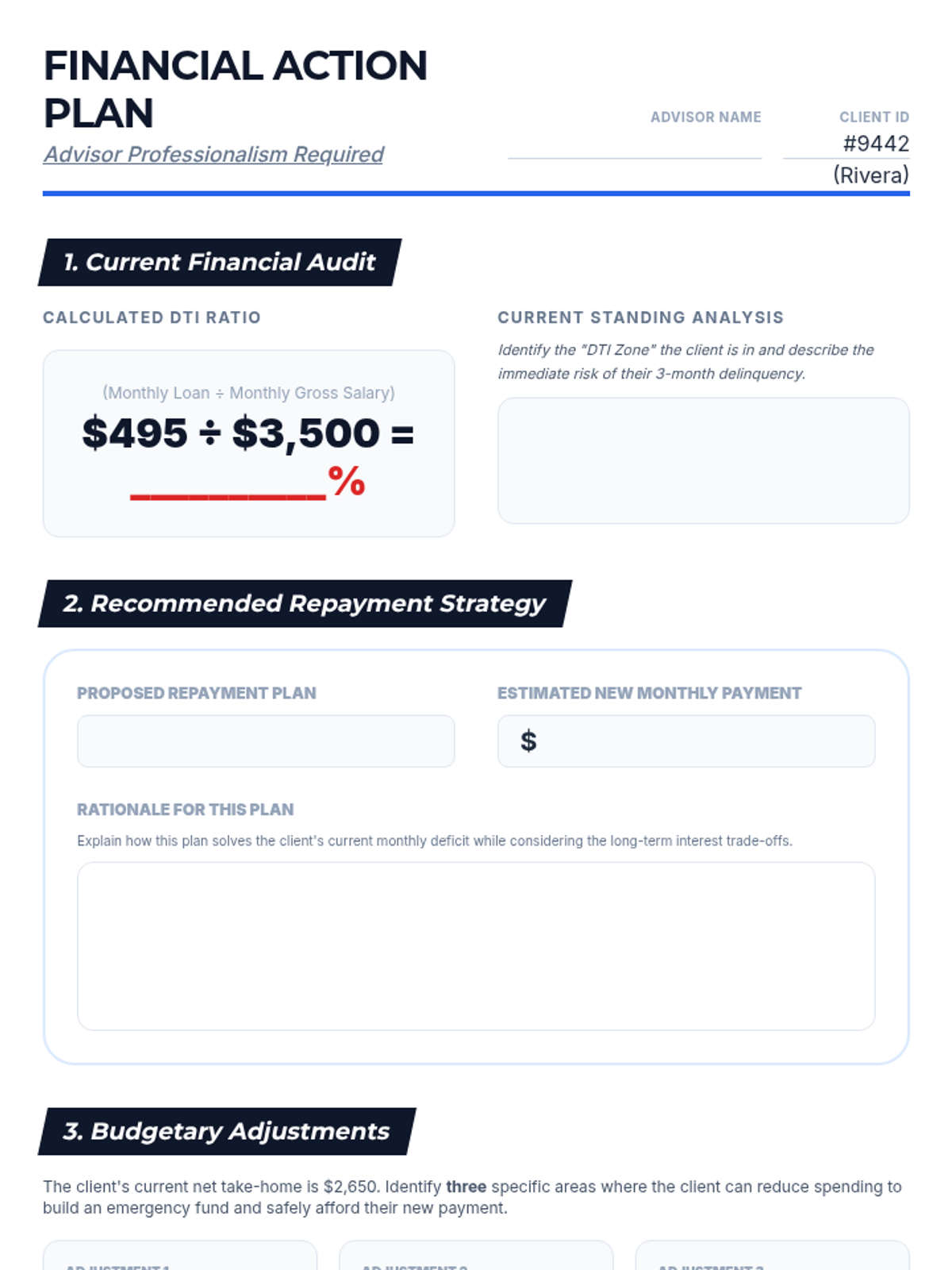
A student template for the final capstone project. Students act as financial advisors for Alex Rivera, performing a DTI analysis, recommending a repayment plan, and suggesting budget adjustments.
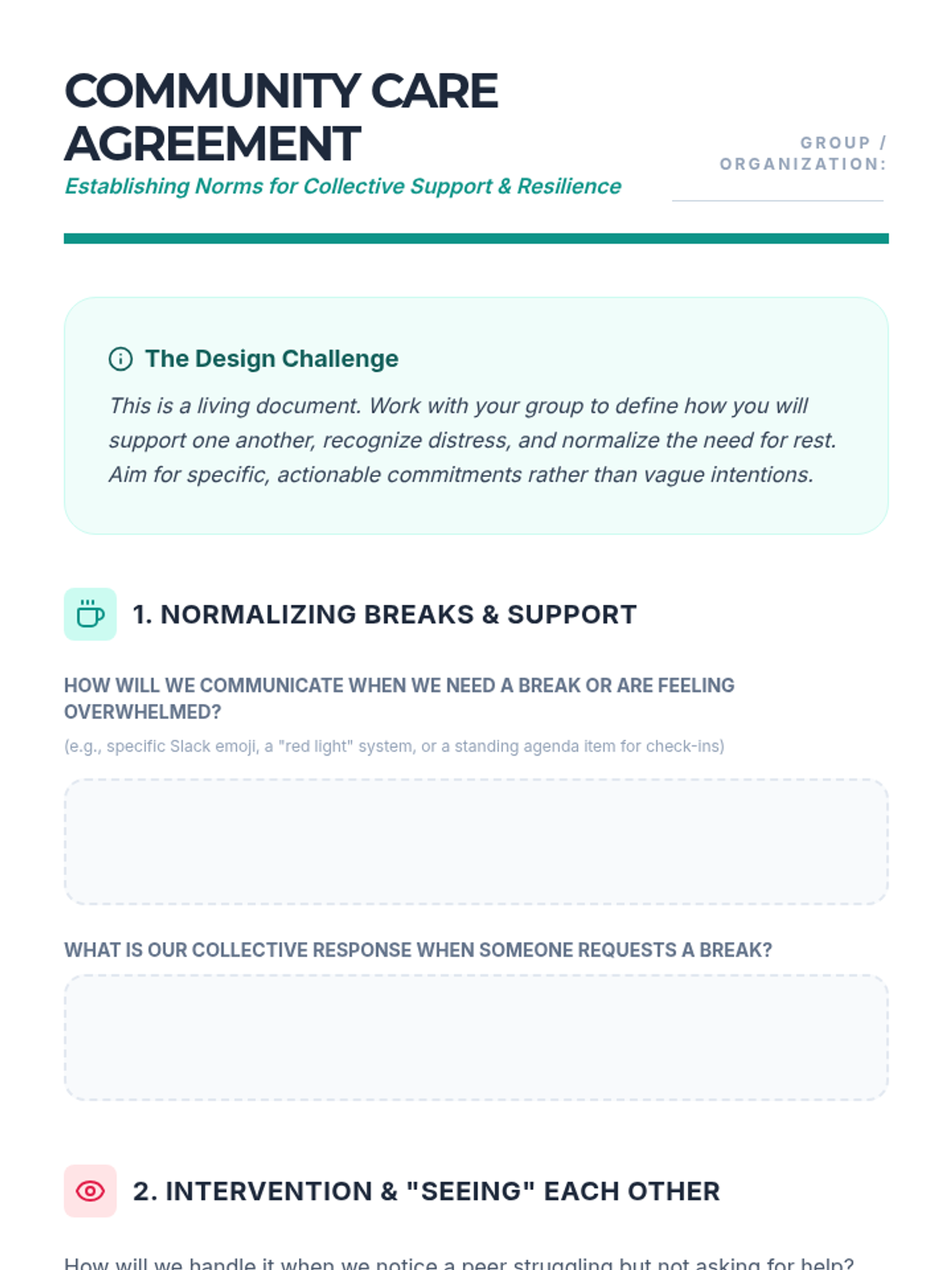
A design template for students to create a 'Community Care Agreement', establishing norms for mutual support, intervention strategies, and collective boundaries.
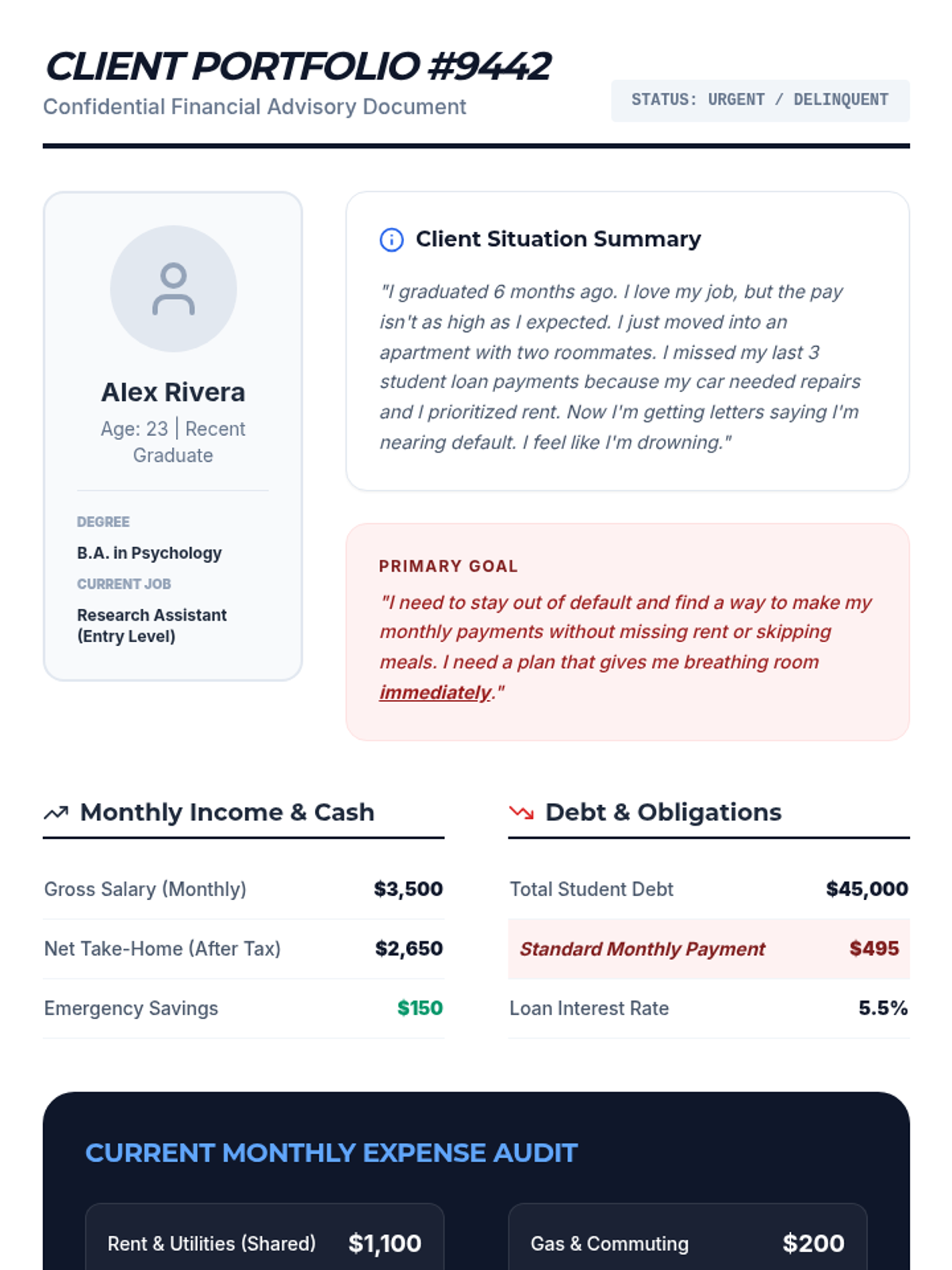
A detailed case study profile for Lesson 5 featuring Alex Rivera, a recent graduate in financial distress. Includes salary, debt amount, monthly expenses, and current repayment status.
Slide deck for the 'Building Care Webs' lesson, introducing the concept of collective care vs. self-care and providing a framework for creating Community Care Agreements.
A visual presentation for Lesson 5 that introduces the capstone project where students act as financial counselors for a borrower in crisis, including the "Urgent Email" hook and project deliverables.
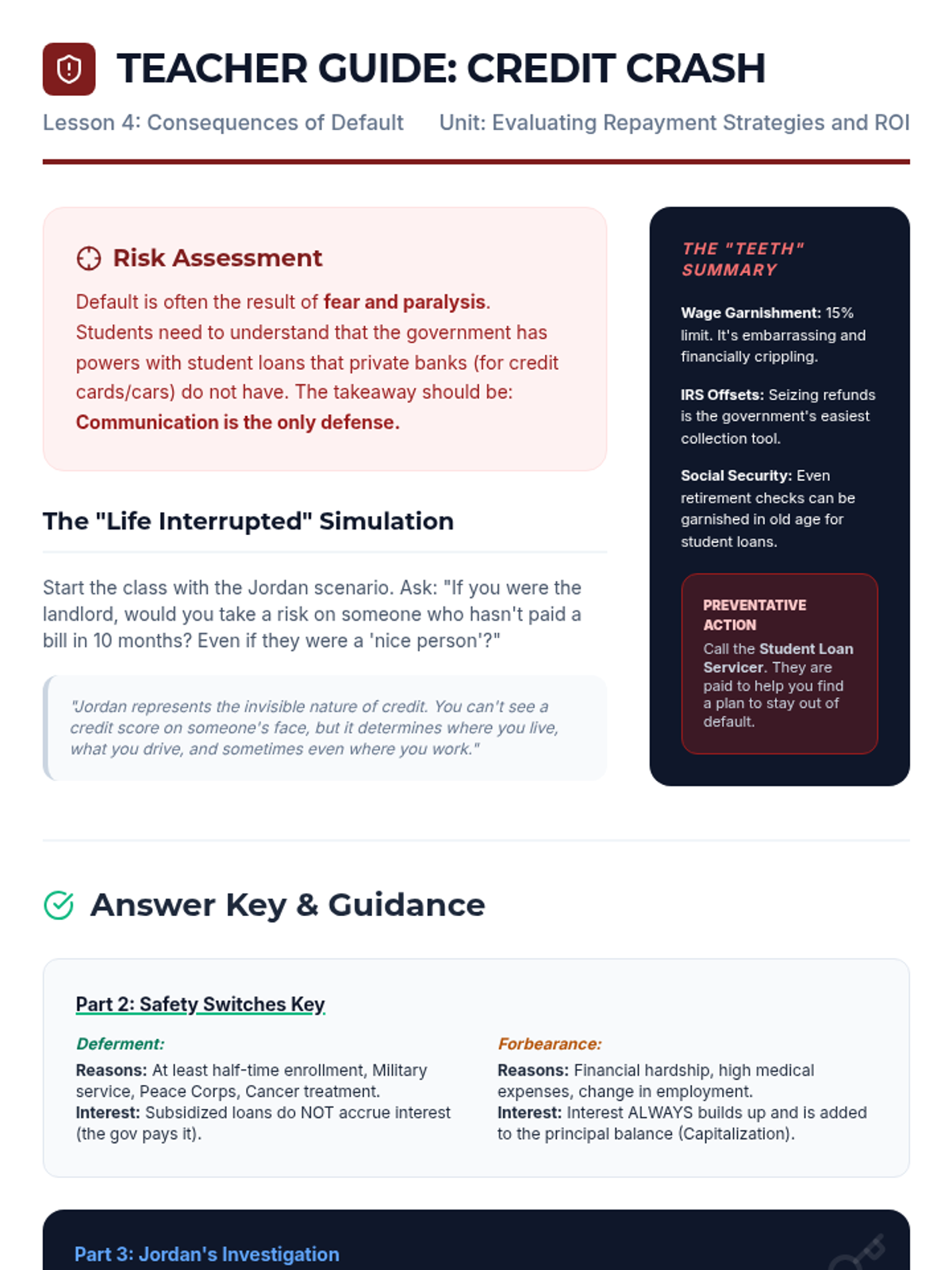
A teacher guide for Lesson 4 providing instructional focus, discussion prompts for the "Life Interrupted" scenario, and an answer key for the Risk Radar worksheet.
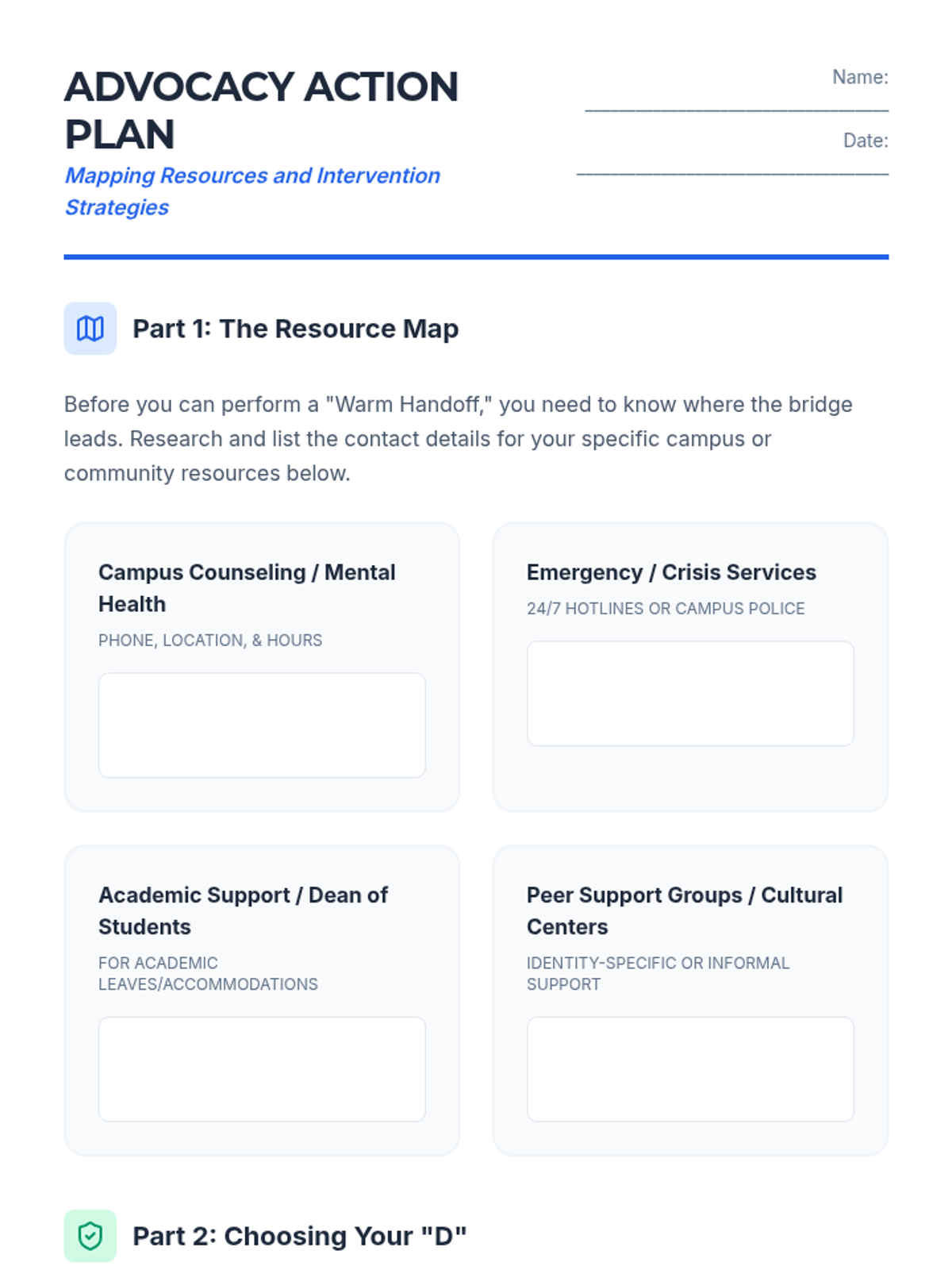
A student worksheet for mapping local mental health resources and practicing the 5Ds of intervention in a specific peer-distress scenario.
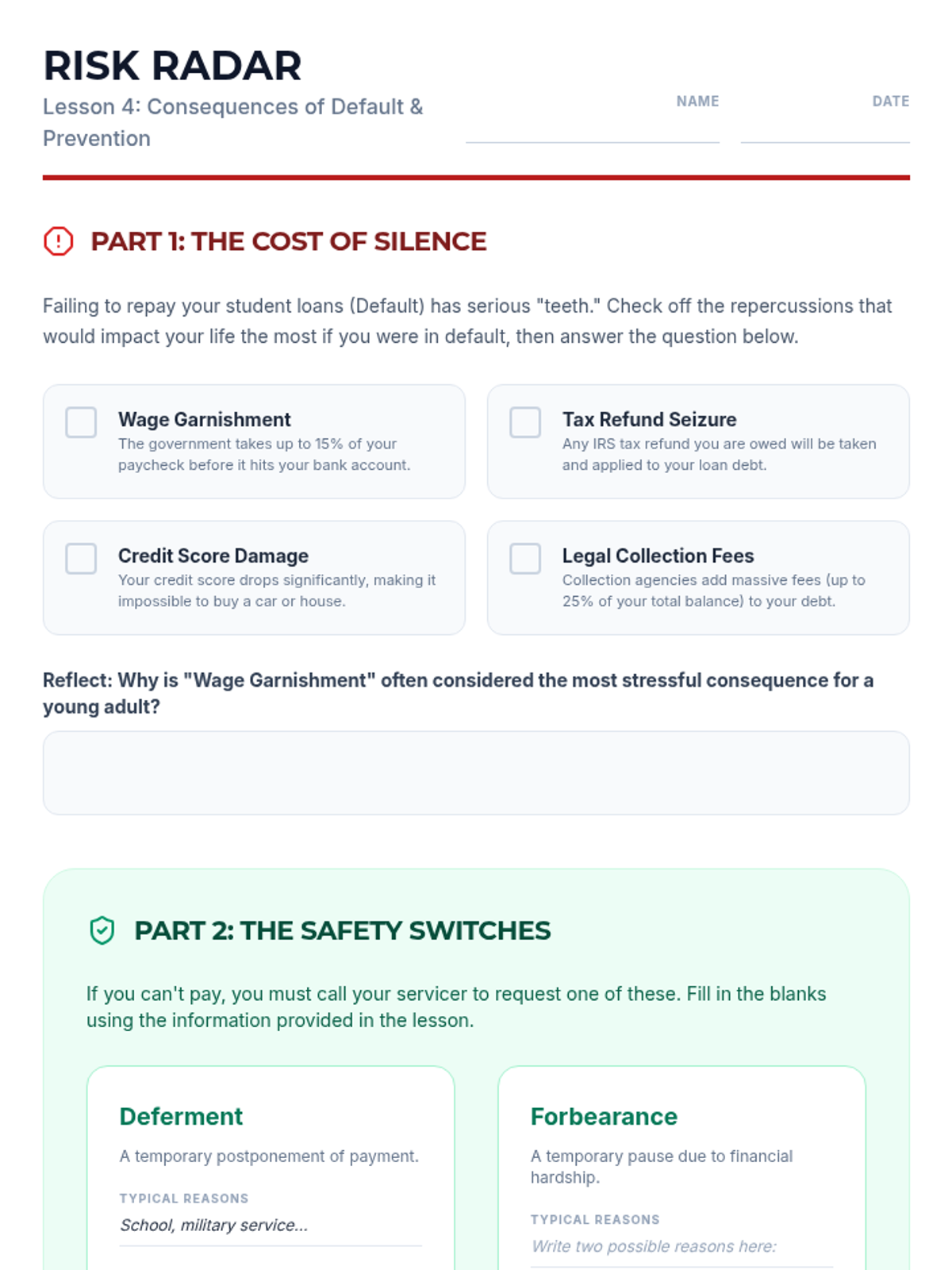
A student worksheet for Lesson 4 that includes a checklist of default repercussions, a comparison table for deferment vs. forbearance, and a case study investigation into a borrower's credit crash.
Slide deck for 'Mental Health Advocacy', covering the bystander effect, the 5Ds of intervention strategies, and the 'Warm Handoff' technique for connecting peers to professional resources.
A visual presentation for Lesson 4 that examines the timeline and repercussions of student loan default, including credit score impact, wage garnishment, and prevention strategies like deferment and forbearance.
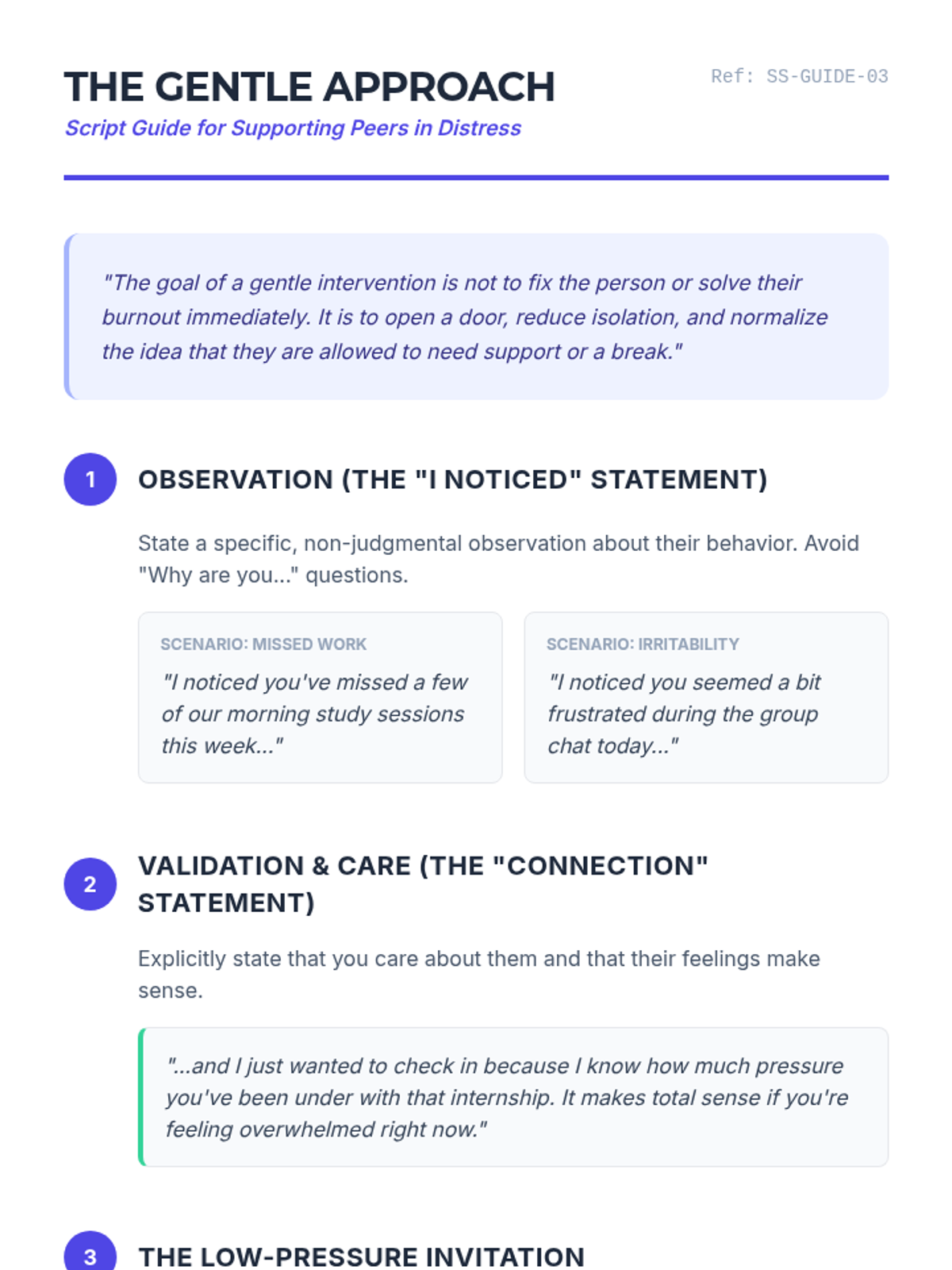
A script-building guide for students to practice the 'Gentle Approach' to intervention, providing specific phrasing for observations, validation, and low-pressure invitations.
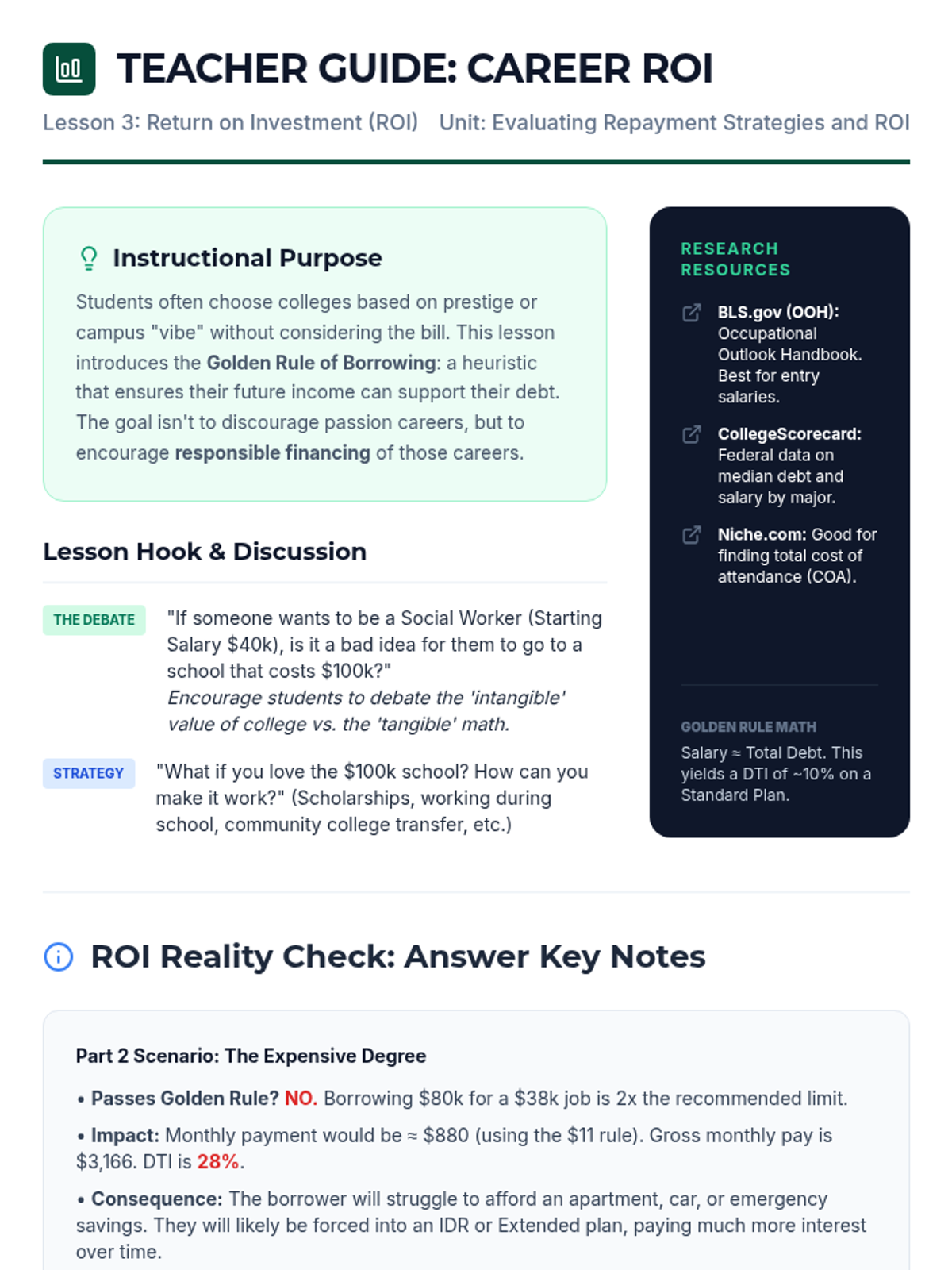
A teacher guide for Lesson 3 providing the "Golden Rule" rationale, research resource links, and scenario analysis for the ROI Research Lab.
Slide deck for 'Spotting the Signs', covering the three dimensions of burnout (Exhaustion, Cynicism, Inefficacy), behavioral red flags, and the three-step 'Gentle Approach' for intervention.
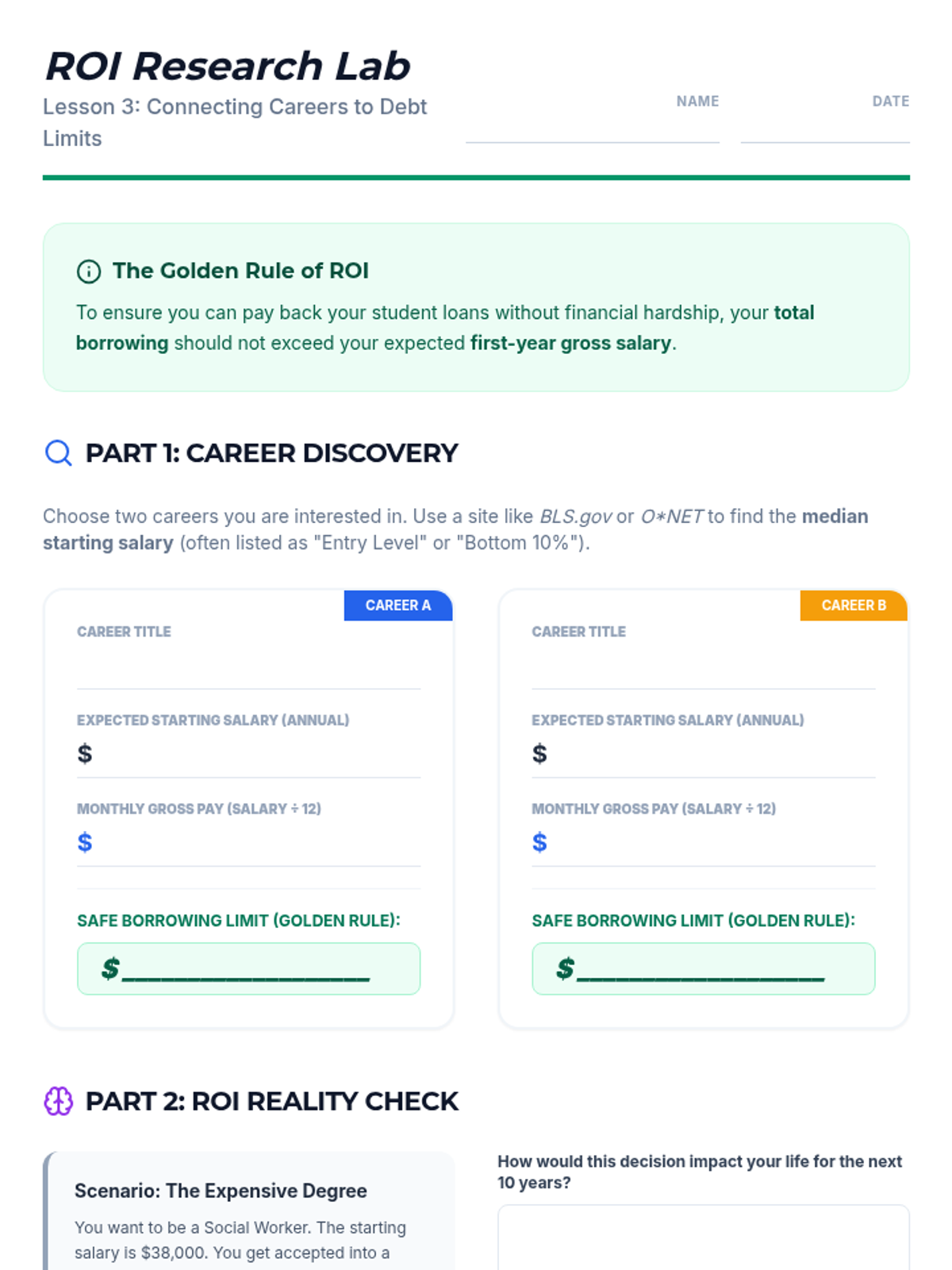
A student worksheet for Lesson 3 that connects career aspirations with borrowing limits. Students research salaries, calculate safe borrowing limits using the "Golden Rule," and analyze the ROI of different education-to-career paths.
A visual presentation for Lesson 3 that connects career aspirations with borrowing limits, introducing the ROI "Golden Rule" and factors affecting education value.
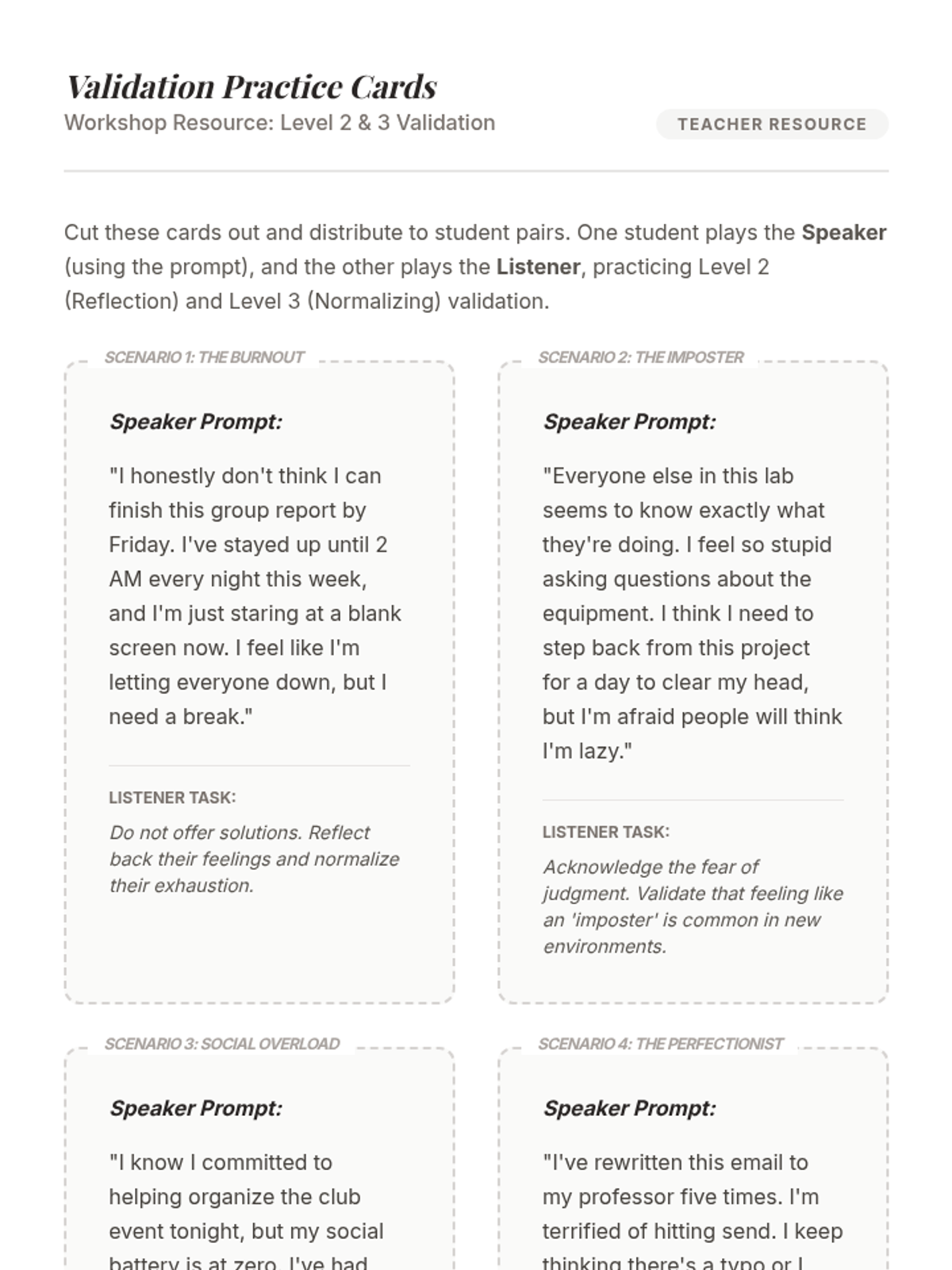
Scenarios and facilitator notes for the active listening workshop, providing students with structured practice in emotional validation and 'holding space' for peers in distress.
Slide deck for the 'Holding Space Workshop' lesson, focusing on the distinction between problem-solving ('fixing') and emotional validation, and introducing the 3 levels of validation.
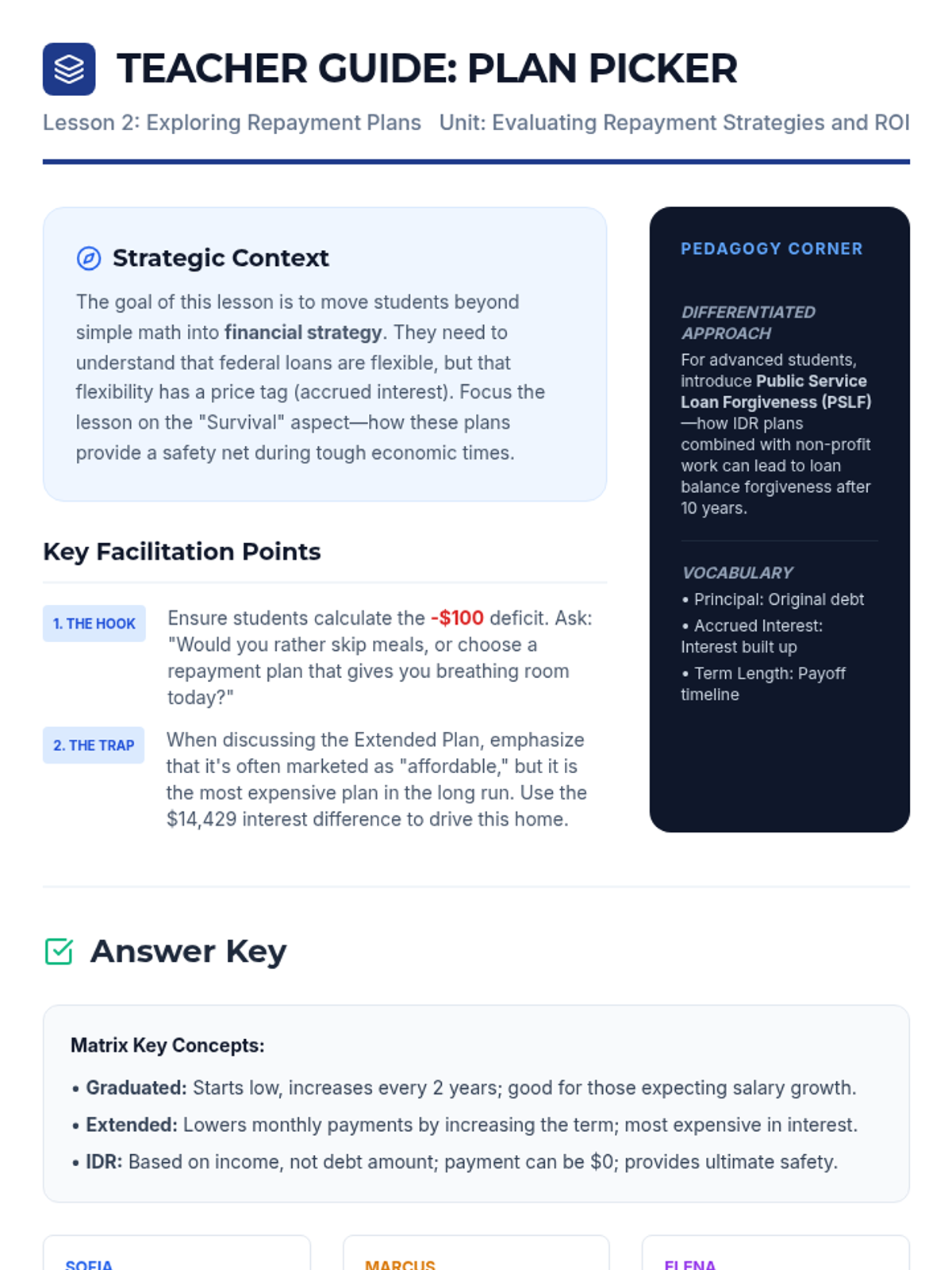
A teacher guide for Lesson 2 providing strategic context, facilitation points, scenario solutions, and the "Interest Math" key.
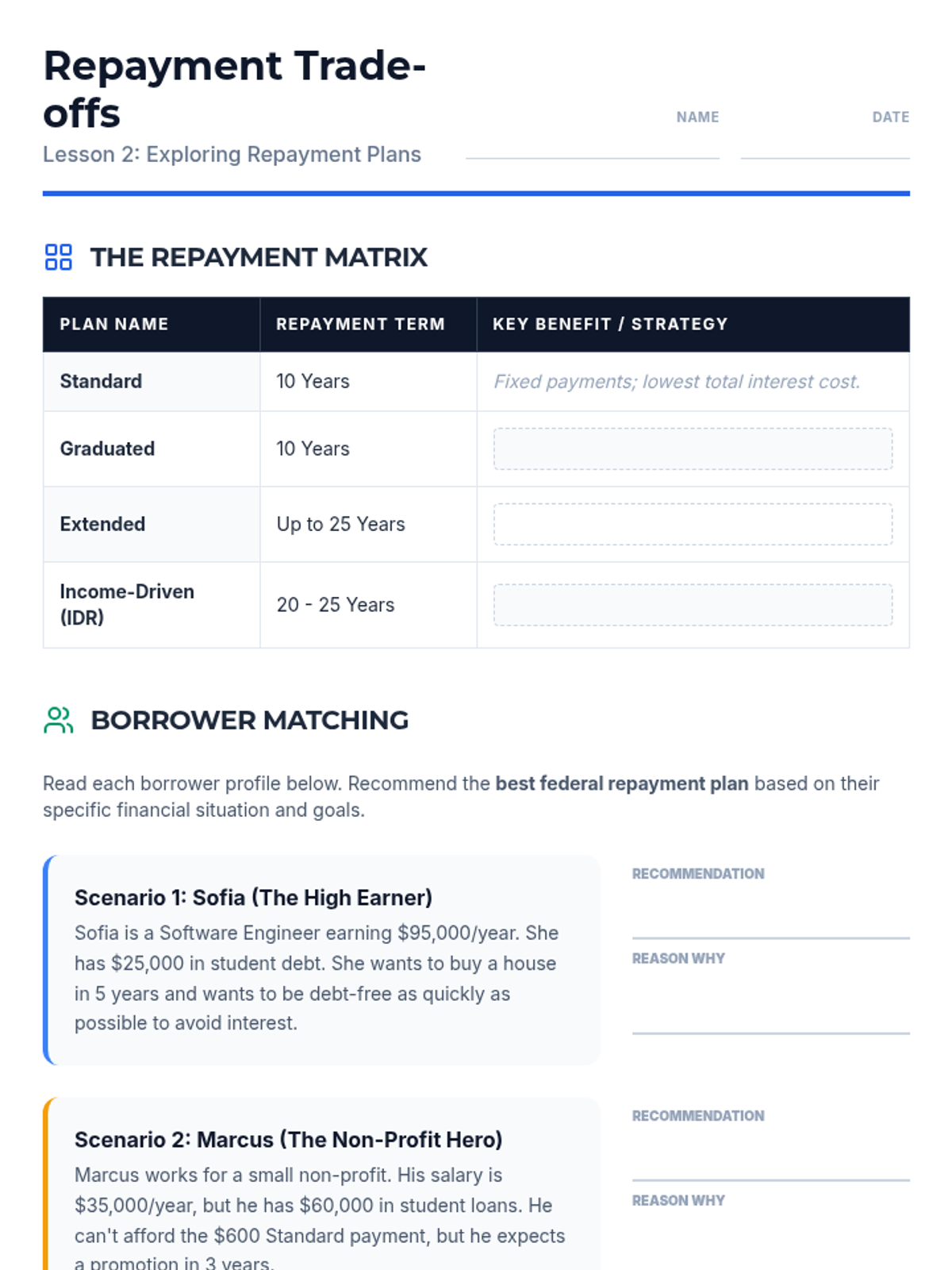
A student worksheet for Lesson 2 that helps students compare the features of different repayment plans, match them to specific borrower profiles, and calculate the "convenience cost" of long-term interest.
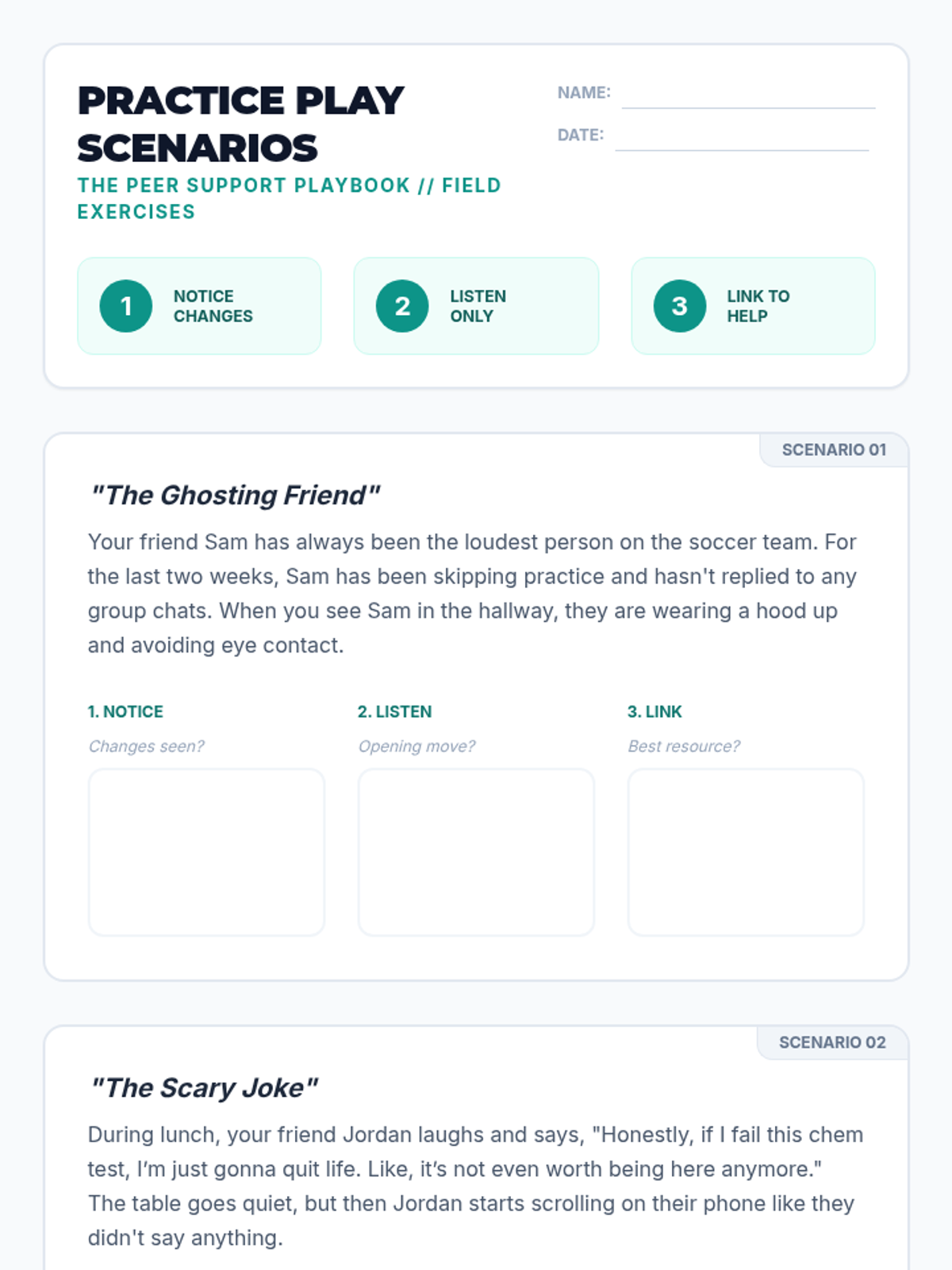
A student worksheet featuring realistic social scenarios for practicing the 'Notice, Listen, Link' support model and boundary-setting.
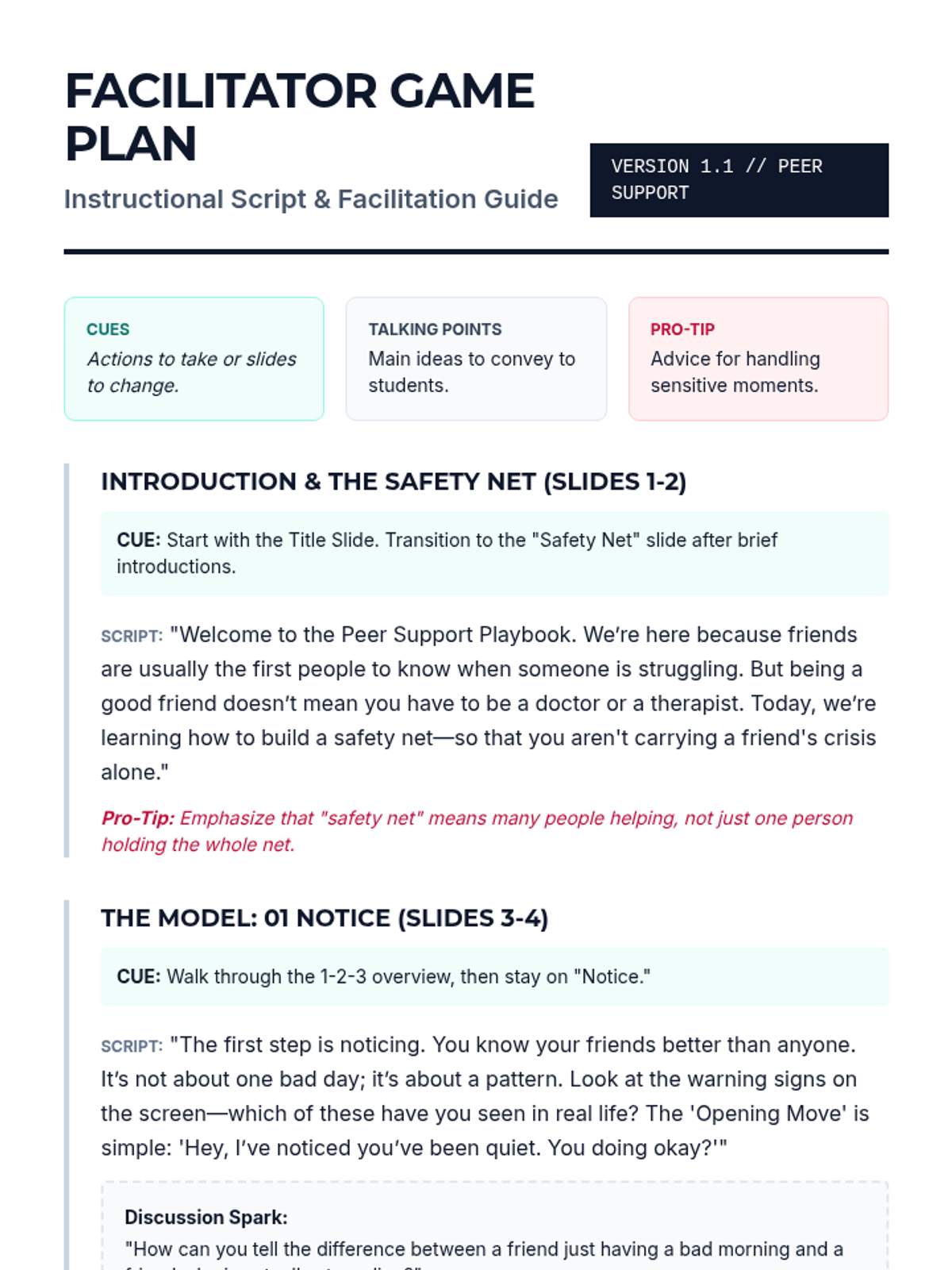
A detailed facilitator script and instructional guide for leading the Peer Support Playbook workshop, including talking points, slide cues, and discussion prompts.
A visual presentation for the Peer Support Playbook workshop, introducing the 'Notice, Listen, Link' model and emphasizing the importance of a safety net.
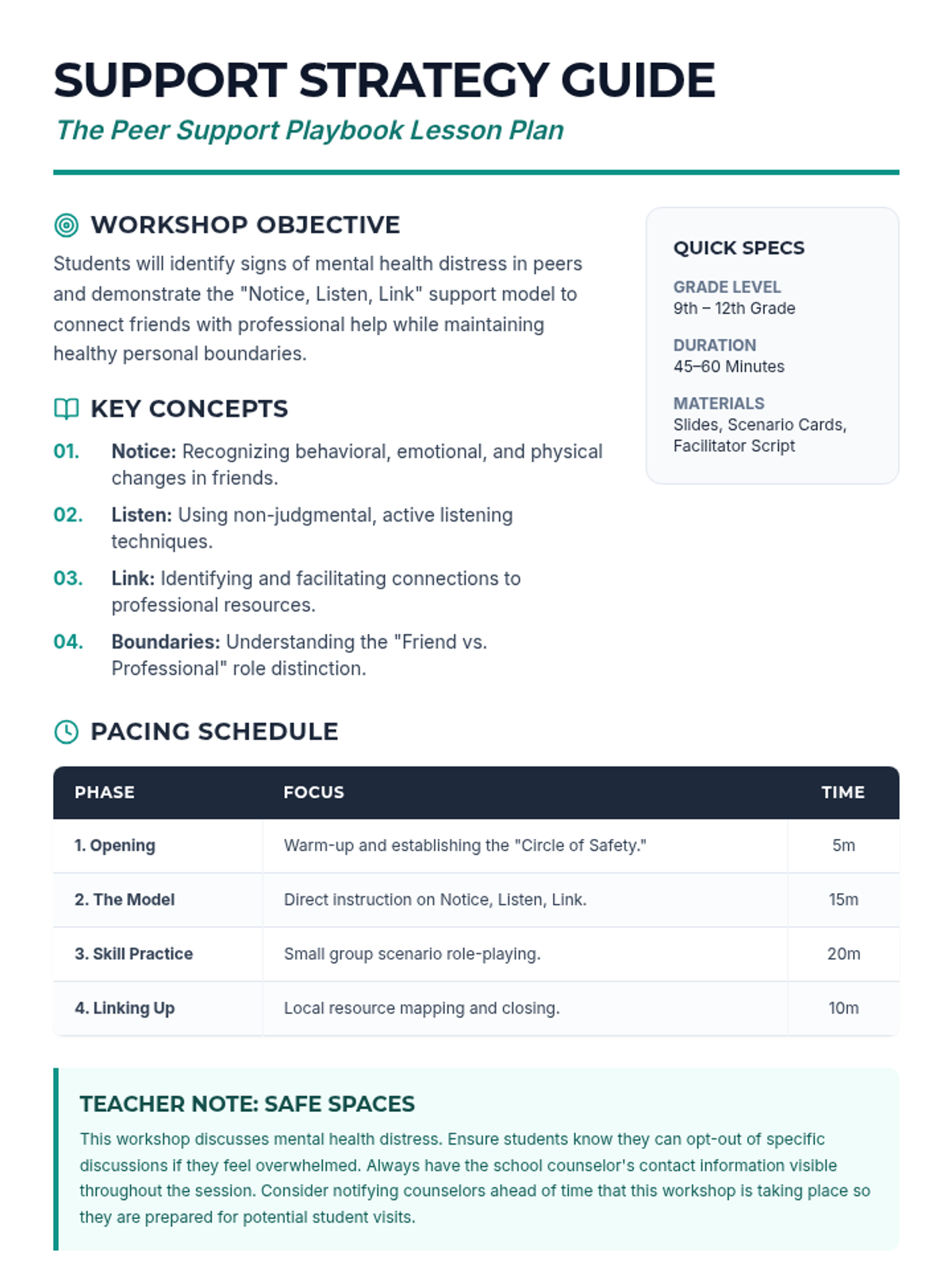
A comprehensive lesson plan for high school educators, outlining the objectives, pacing, and key concepts for the Peer Support Playbook workshop.
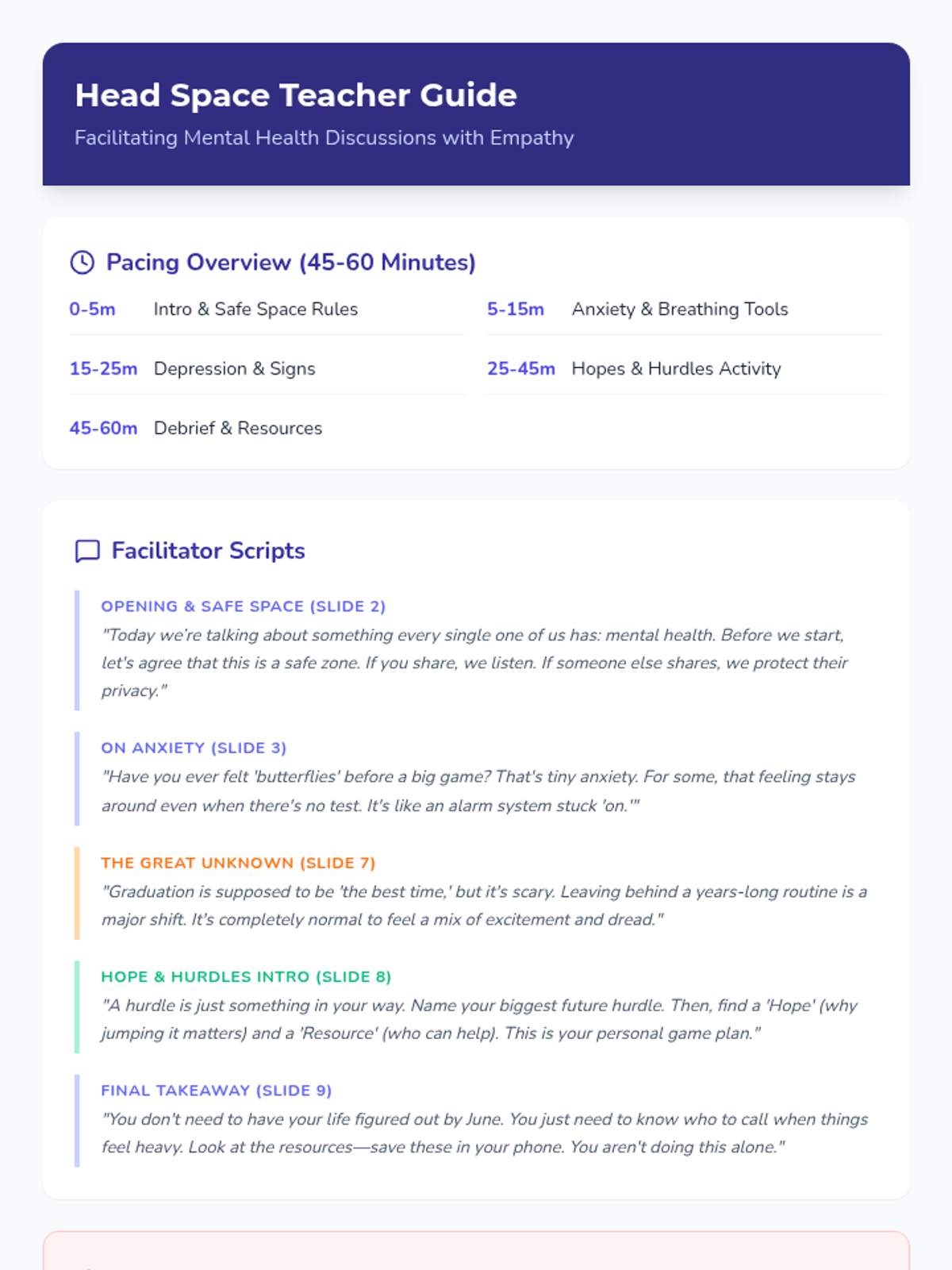
A comprehensive guide for teachers to facilitate sensitive mental health discussions, now featuring detailed scripts for key lesson transitions and safety protocols.
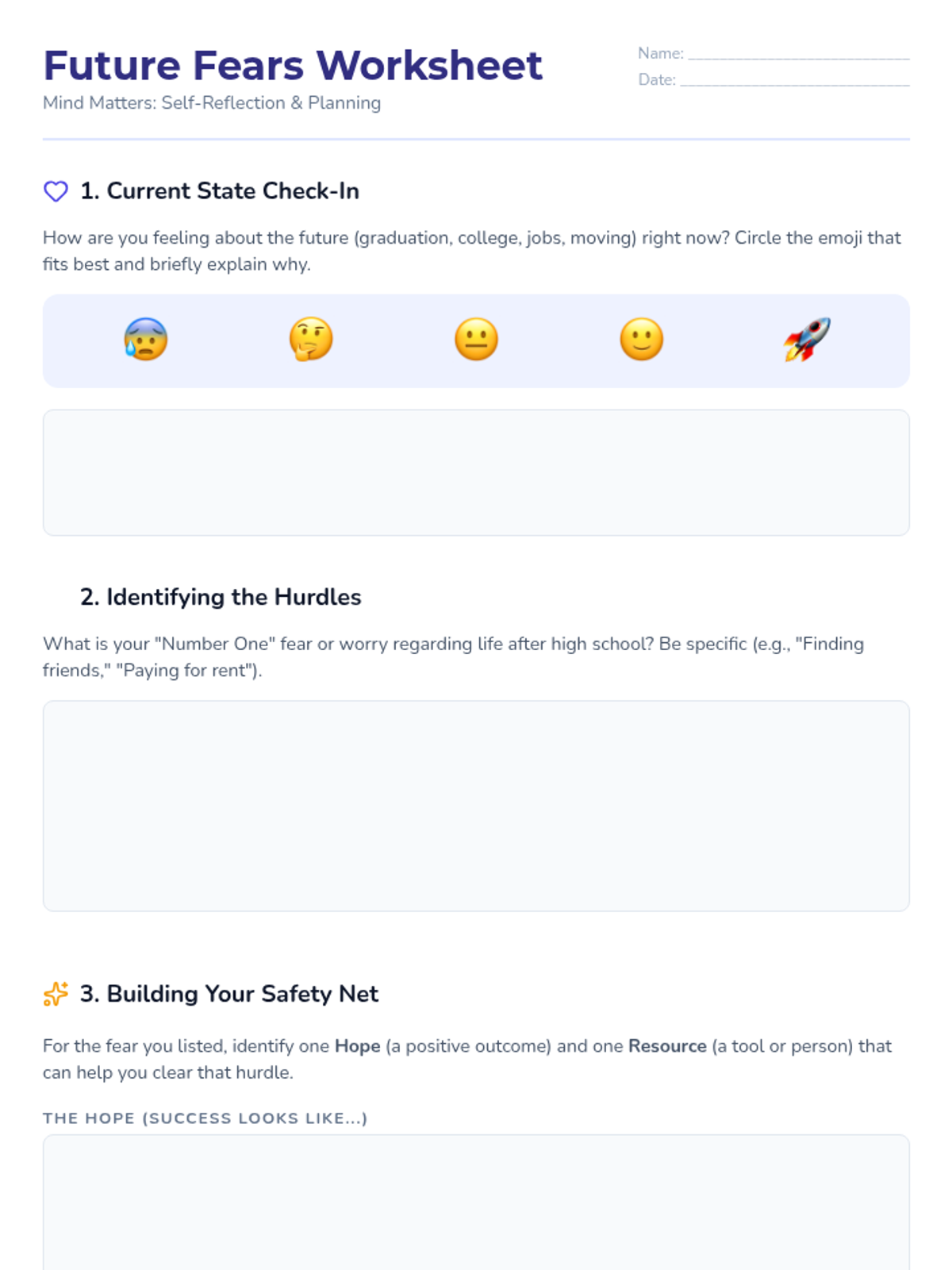
A student self-reflection document designed to accompany the mental health presentation, focusing on identifying personal fears (hurdles) and planning resources and coping strategies (hopes).
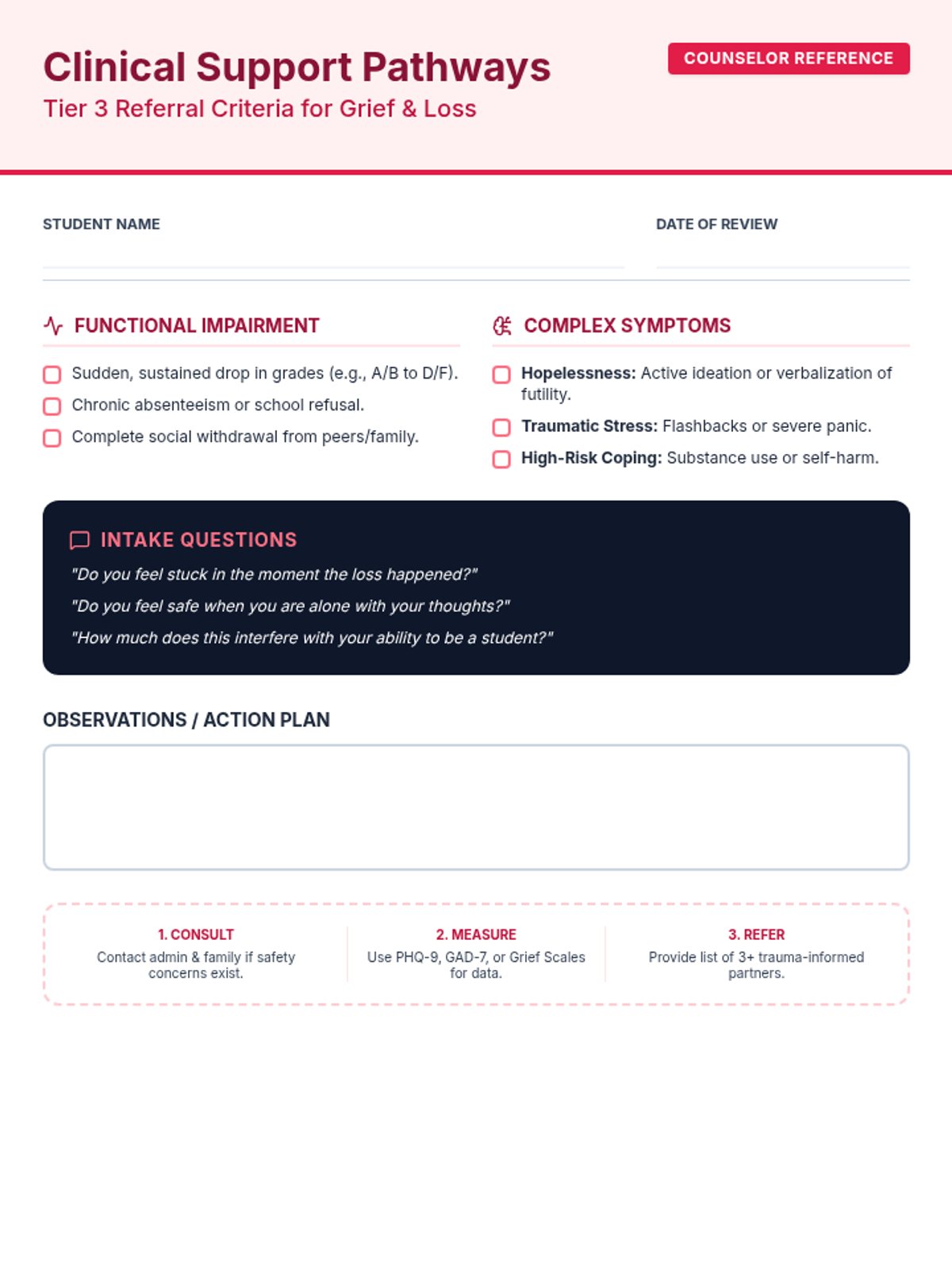
A clinical reference guide for counselors to identify Tier 3 needs. Revised for single-page layout, includes header fields, and improved contrast.
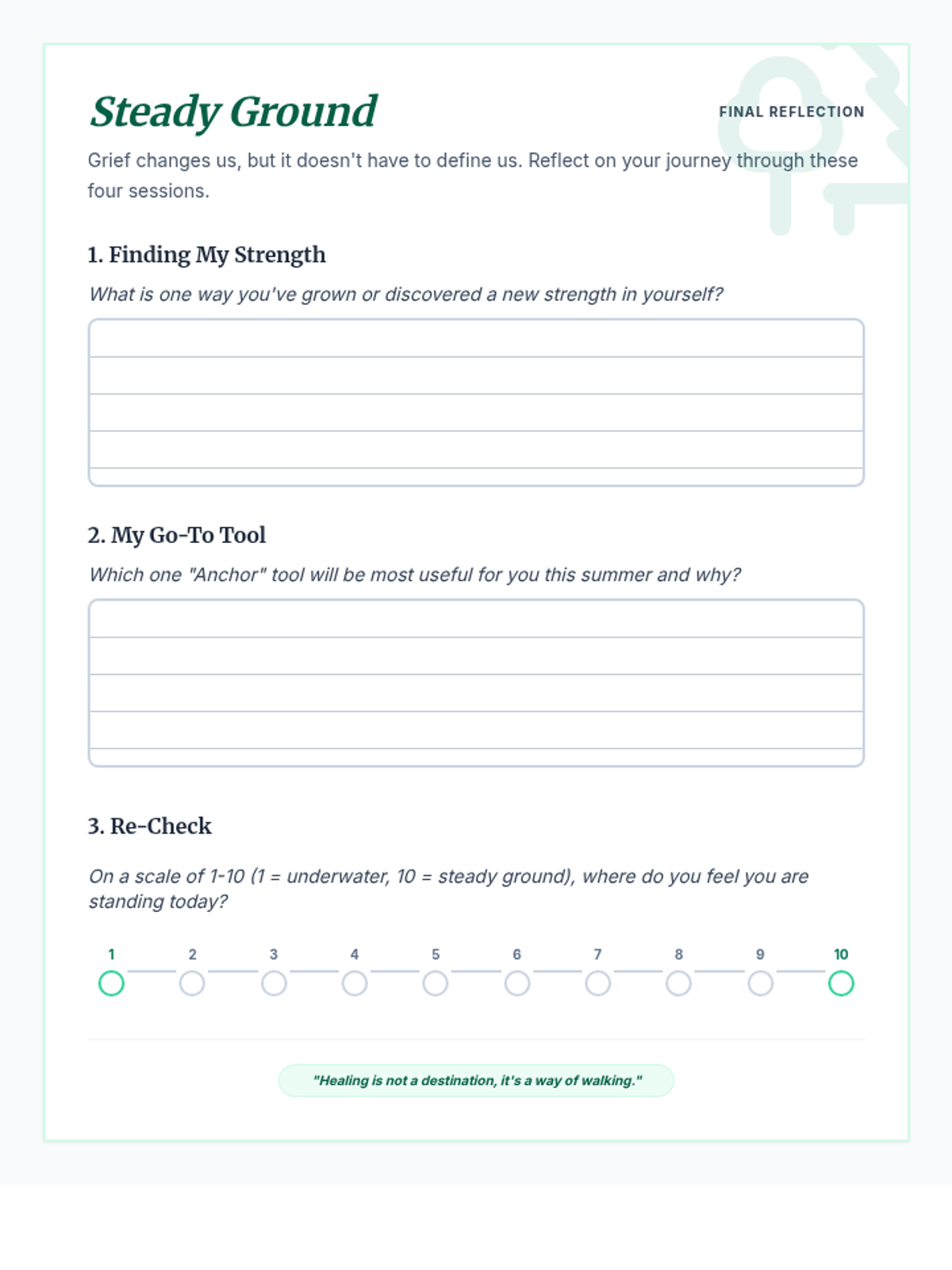
A final student reflection handout for identifying growth and self-assessing. Revised with numeric scale labels, improved contrast, and writing guide lines.
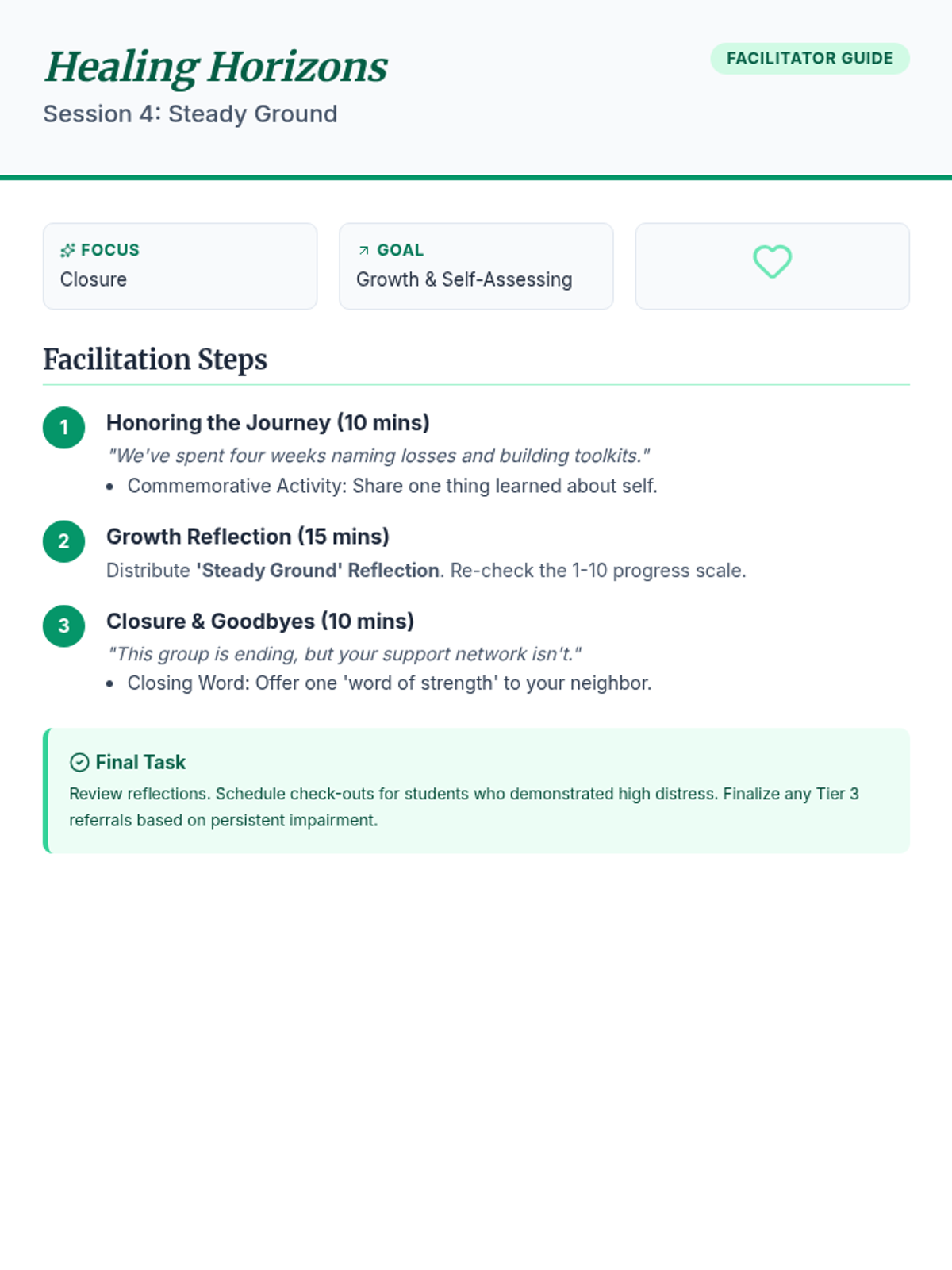
A facilitation guide for the final group session focusing on growth and closure. Revised for a single-page layout.
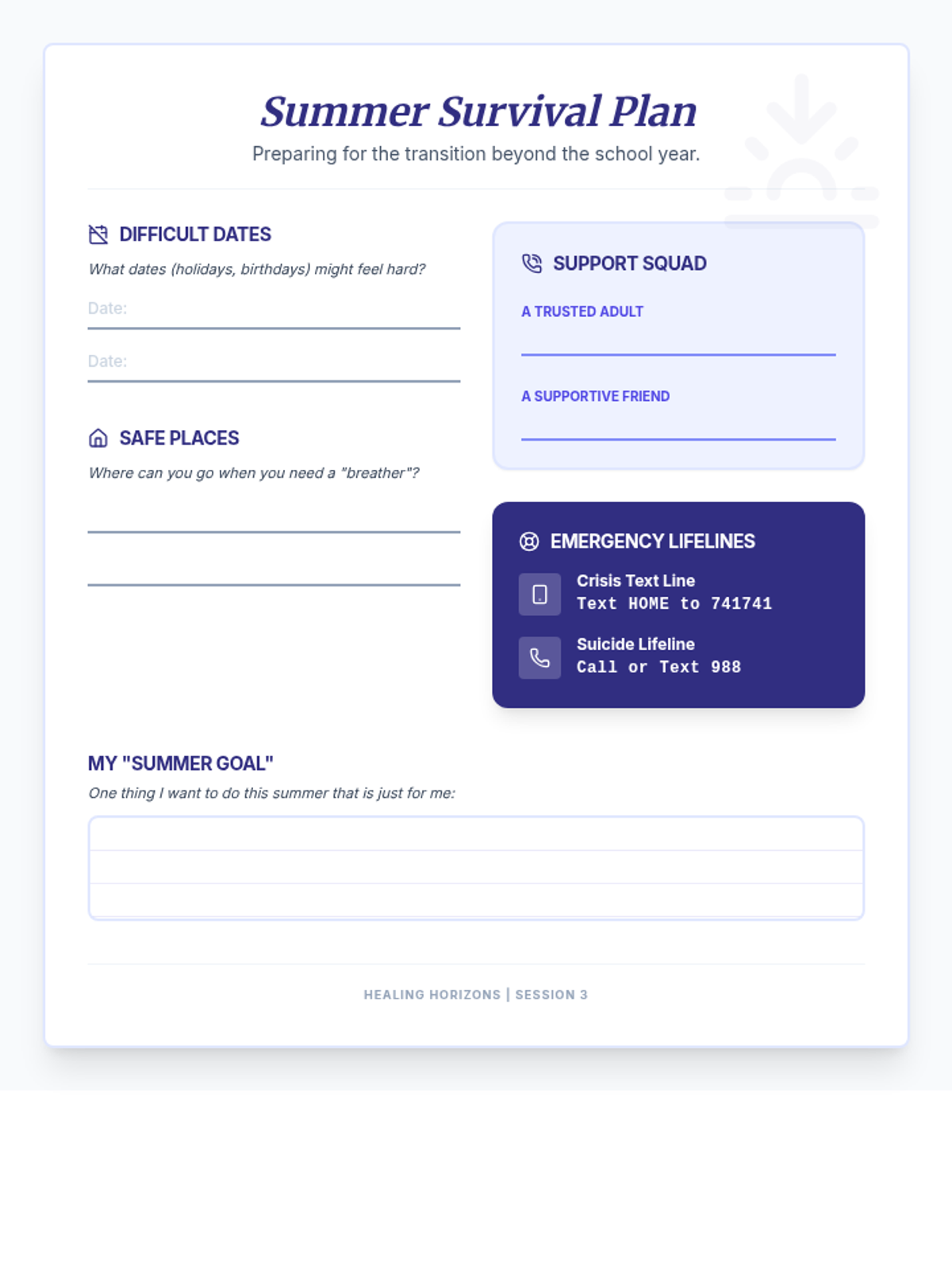
A transition planning worksheet for students to identify summer triggers and support systems. Revised for single-page layout and improved contrast/safety section unity.
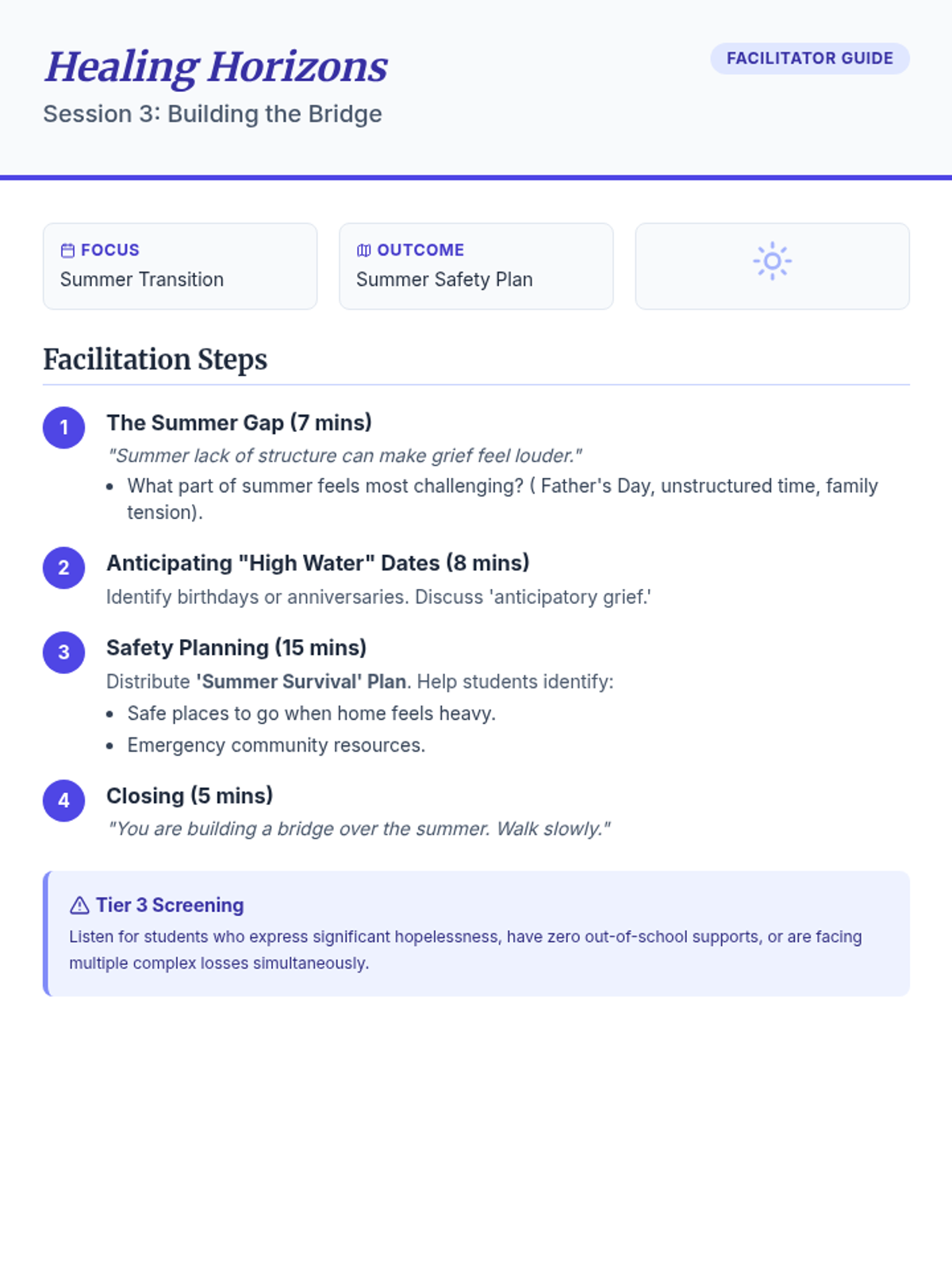
A facilitation guide for the third session focusing on summer transition planning. Revised for a single-page layout and improved page breaks.
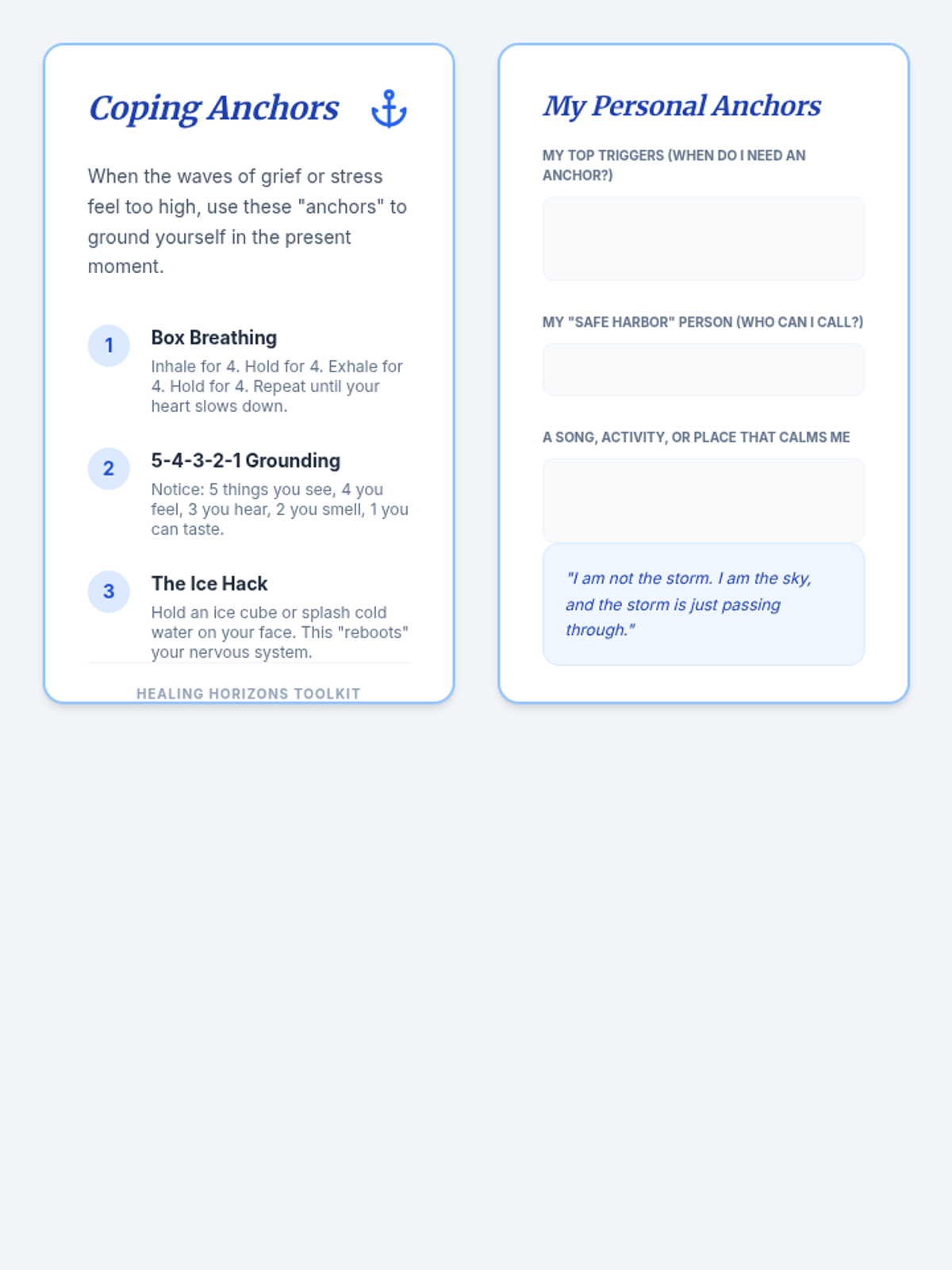
A double-sided pocket card/handout for students that lists grounding techniques and provides space to personalize their own coping strategies and support systems.
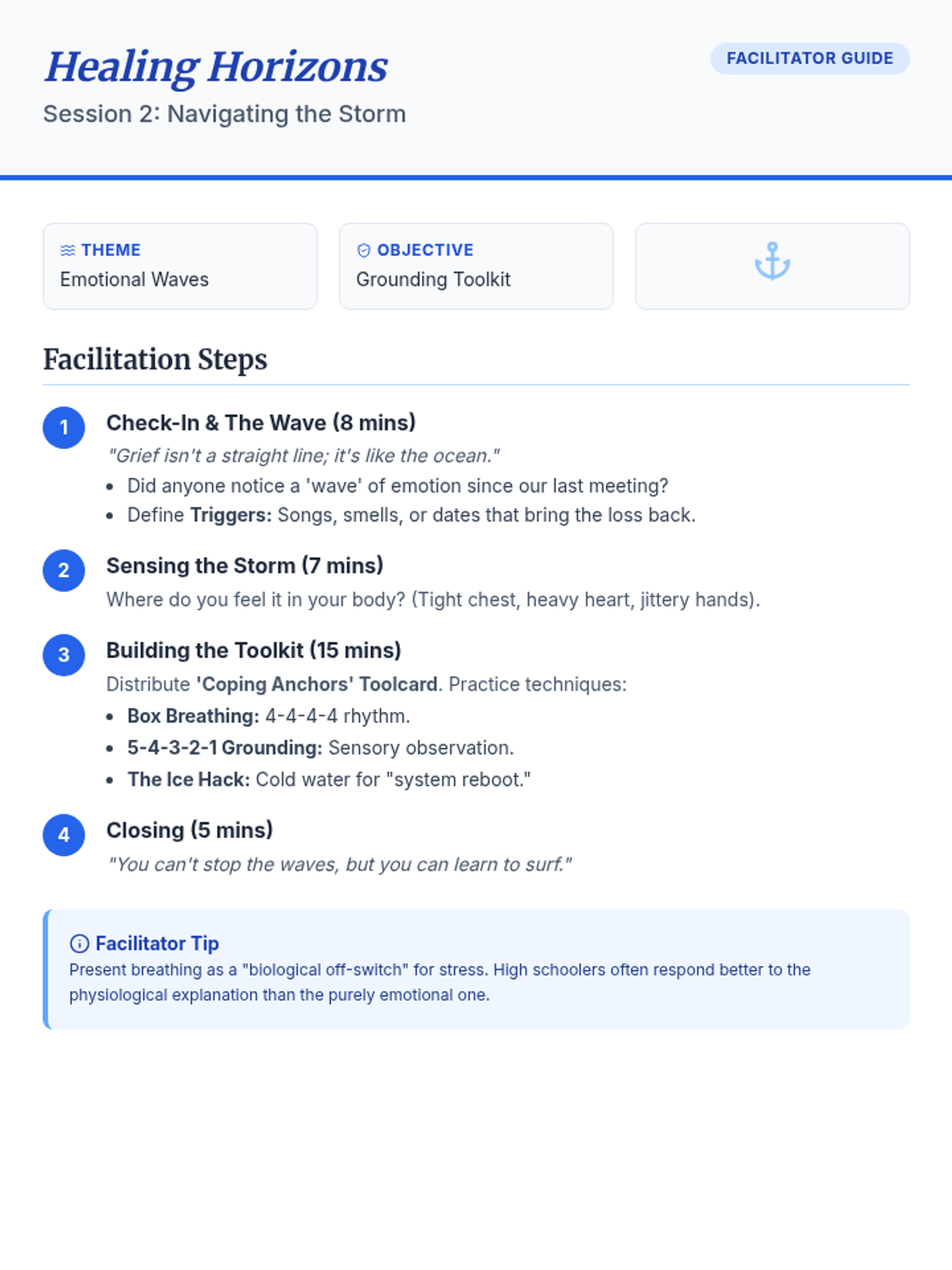
A facilitation guide for the second session focusing on identifying grief triggers and teaching specific grounding and coping strategies. Revised for a single-page layout.
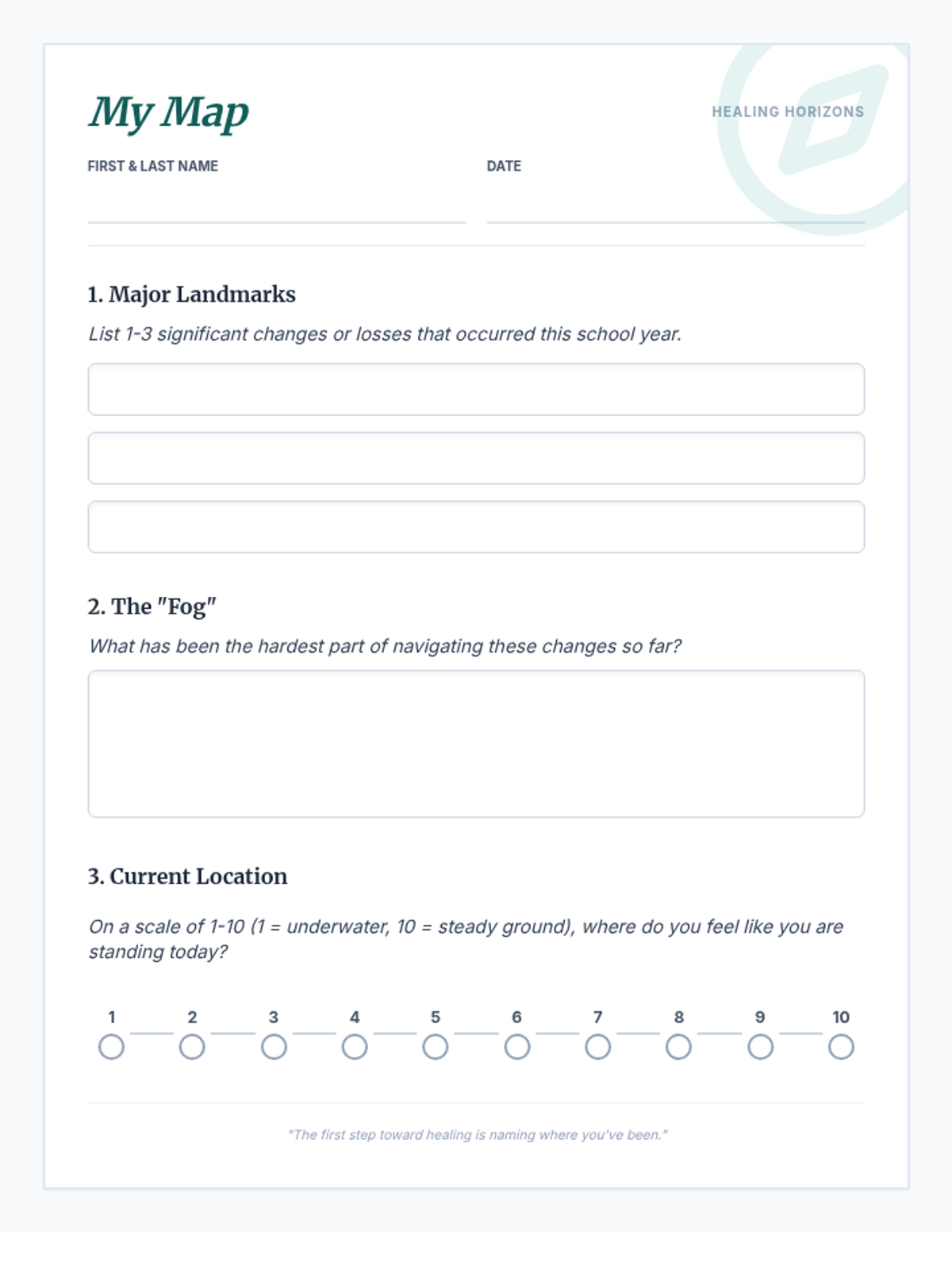
A student-facing worksheet for the first session that helps students identify and name the specific losses or changes they have experienced during the school year. Revised for better layout and contrast.
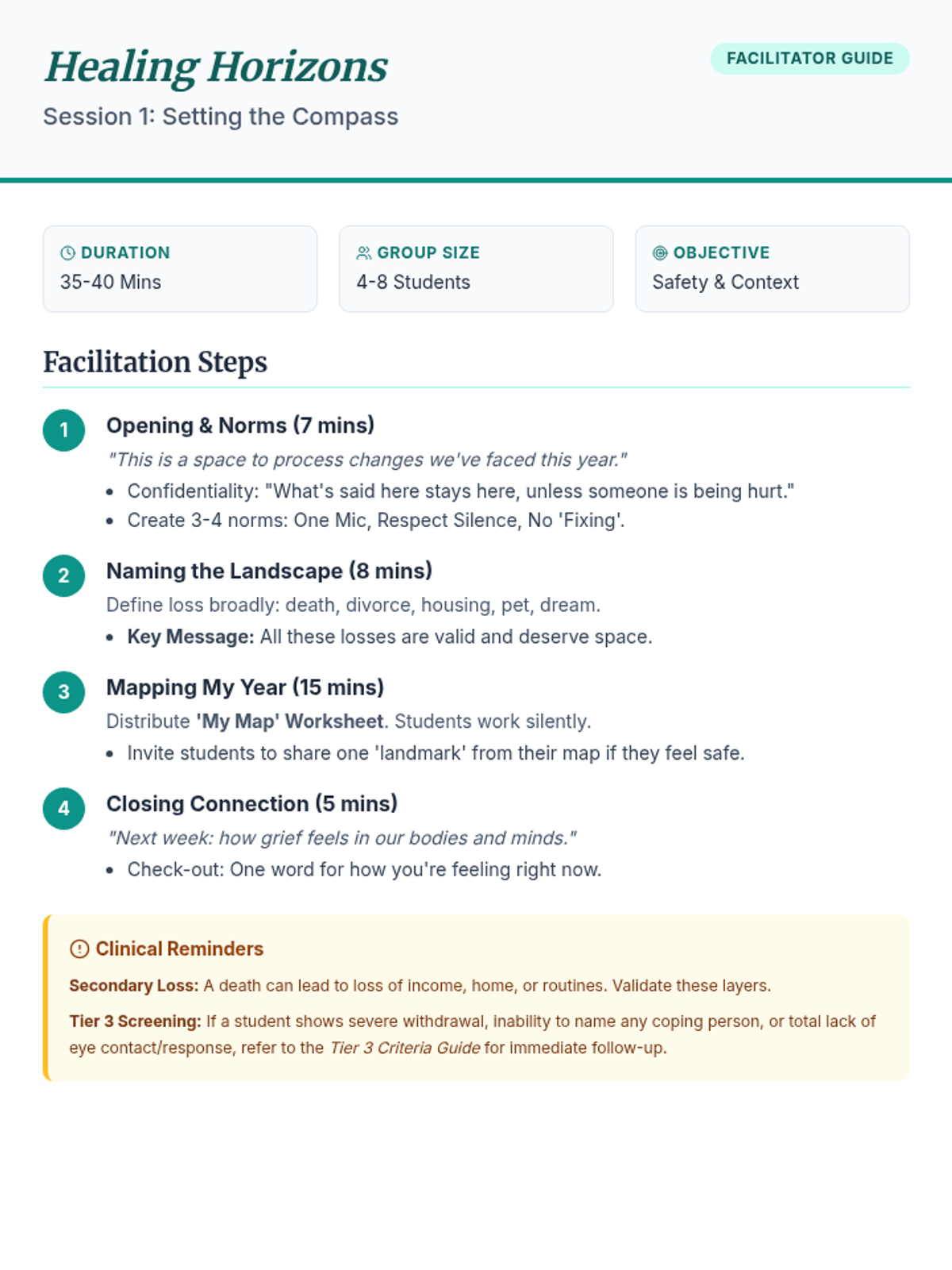
A detailed facilitation guide for the first counseling session, including objectives, step-by-step instructions for opening the group, and clinical notes for the counselor. Updated to fit on one page and include Tier 3 screening notes.
A reflective worksheet for high school students to identify mental health warning signs in scenarios and map their personal 'Sources of Strength' support network.
An engaging presentation for high school students about mental health, featuring a myth-busting activity, warning sign identification, and an introduction to the Sources of Strength framework.
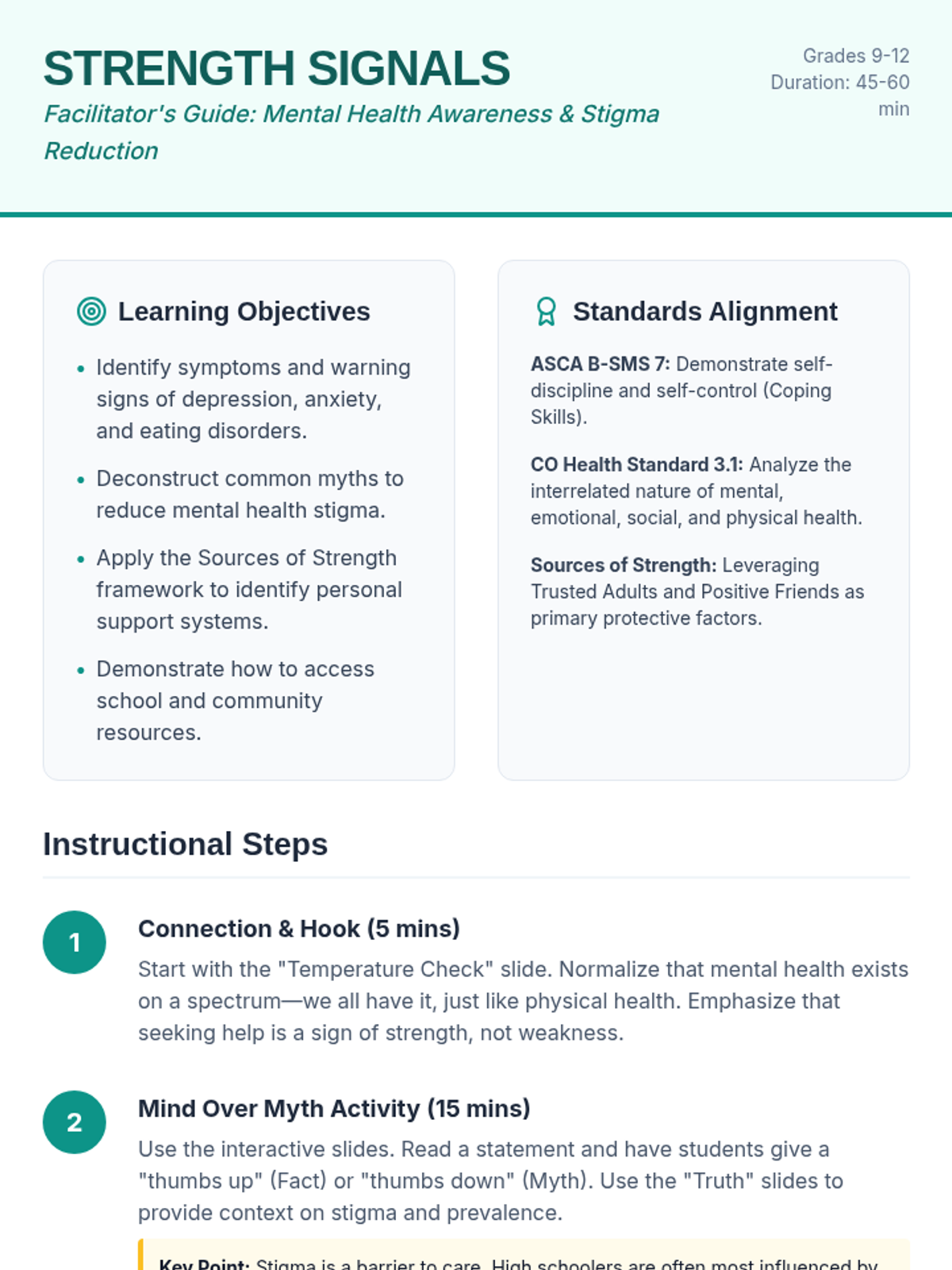
A comprehensive facilitator guide for high school counselors or teachers, detailing learning objectives, standards alignment, and a step-by-step instructional procedure for a mental health awareness lesson.
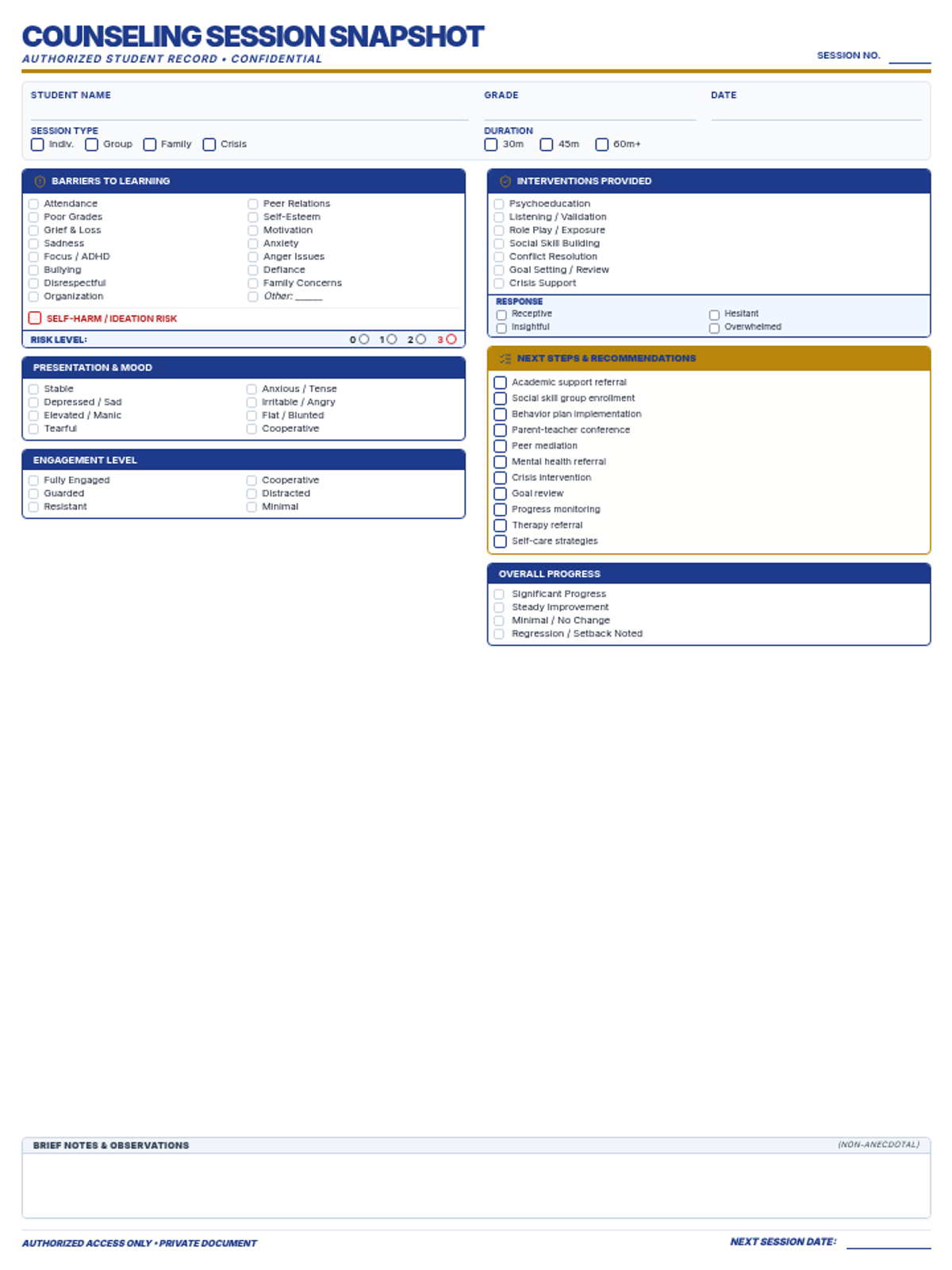
An optimized one-page school counseling session record with reduced spacing to fit A4 paper. It maintains the professional blue and gold theme while consolidating intake barriers, mood assessment, interventions, and next-step recommendations into a clean, checkbox-driven layout.
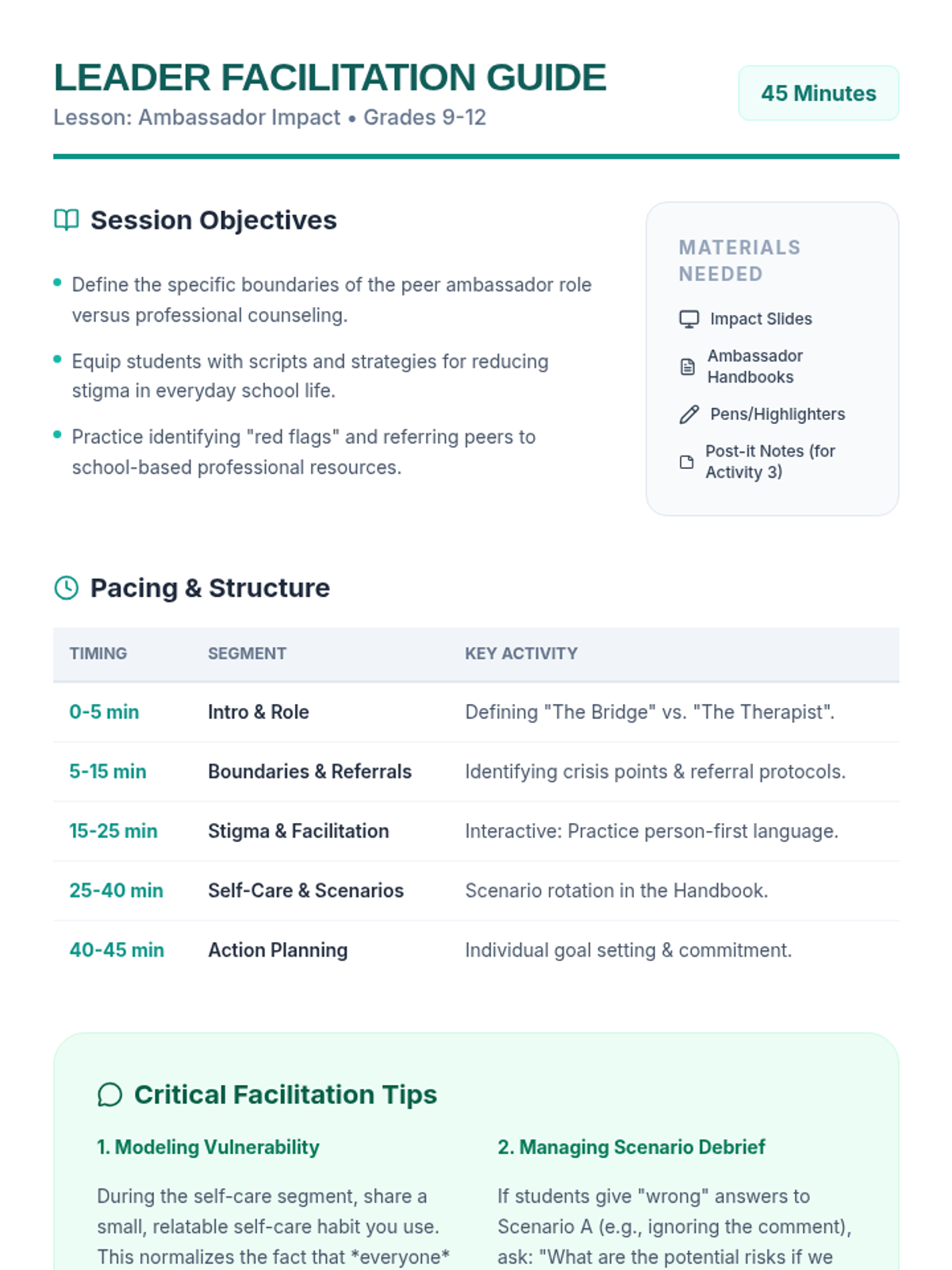
A comprehensive facilitation guide for teachers or leaders delivering the mental health ambassador training, including pacing, discussion prompts, scenario keys, and extension ideas.
Day 5 Slides: Consolidating resources and finalizing the personal safety plan.
Day 4 Slides: Setting up the workshop environment for individual reflection and goal mapping.
Day 3 Slides: Focusing on the specific anxiety surrounding graduation and the loss of the high school support system.
Day 2 Slides: Differentiating depression from sadness and teaching specific conversational skills for peer support.
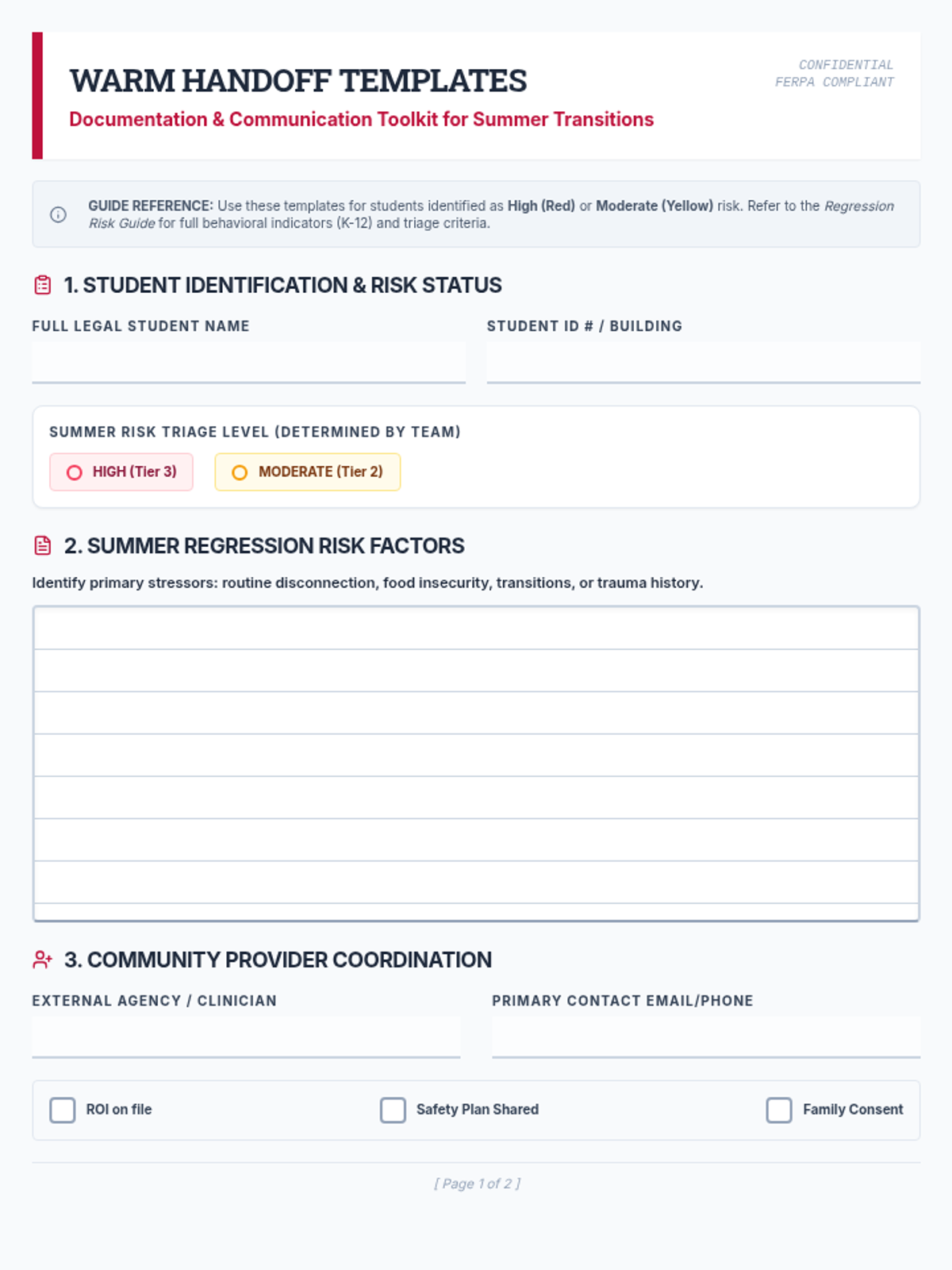
A collection of documentation templates and communication scripts for school counselors to facilitate warm handoffs to community providers and families during summer break.
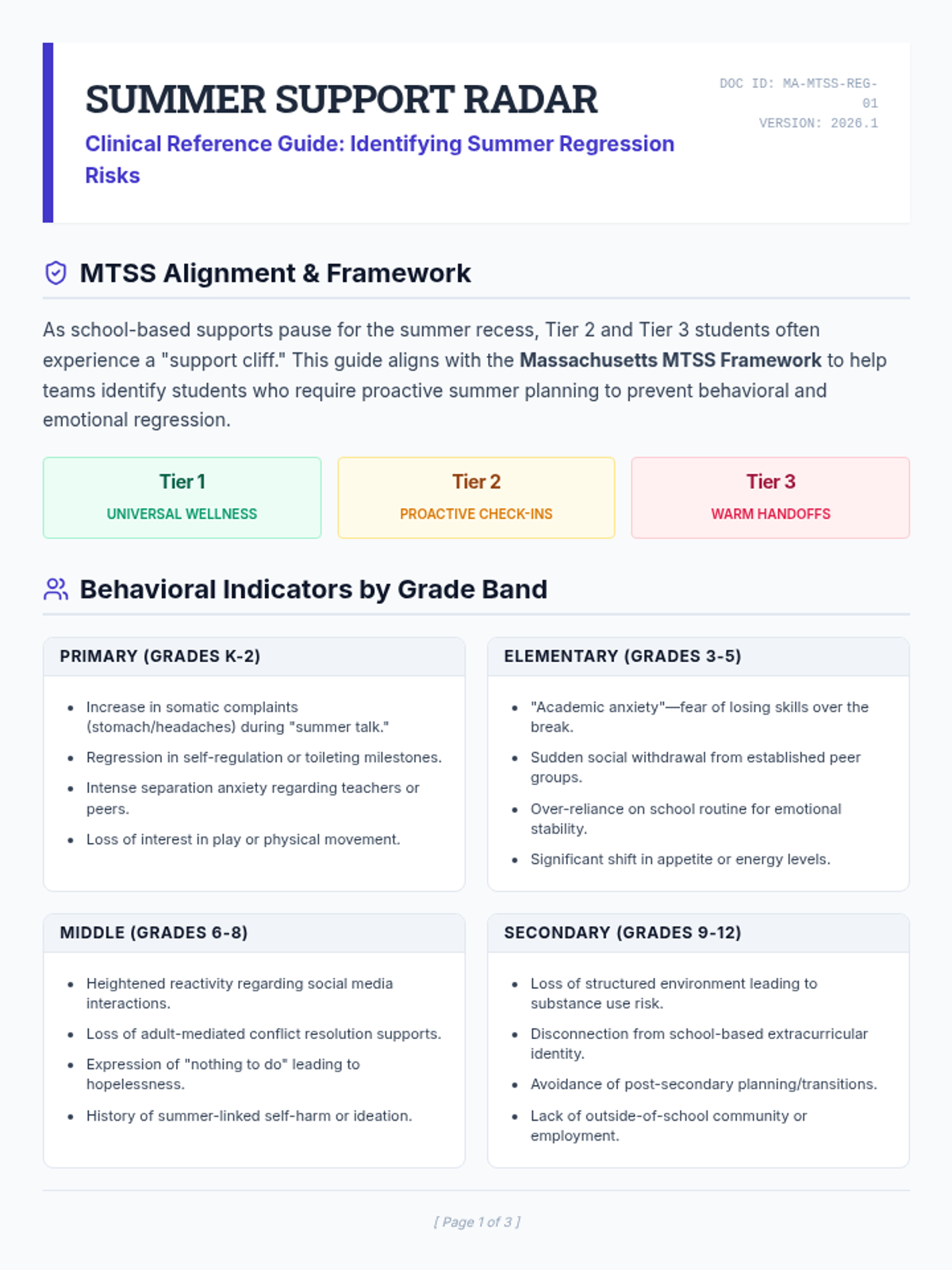
A comprehensive clinical reference guide for educators to identify mental health regression risks in students during summer break, organized by grade bands and risk levels.
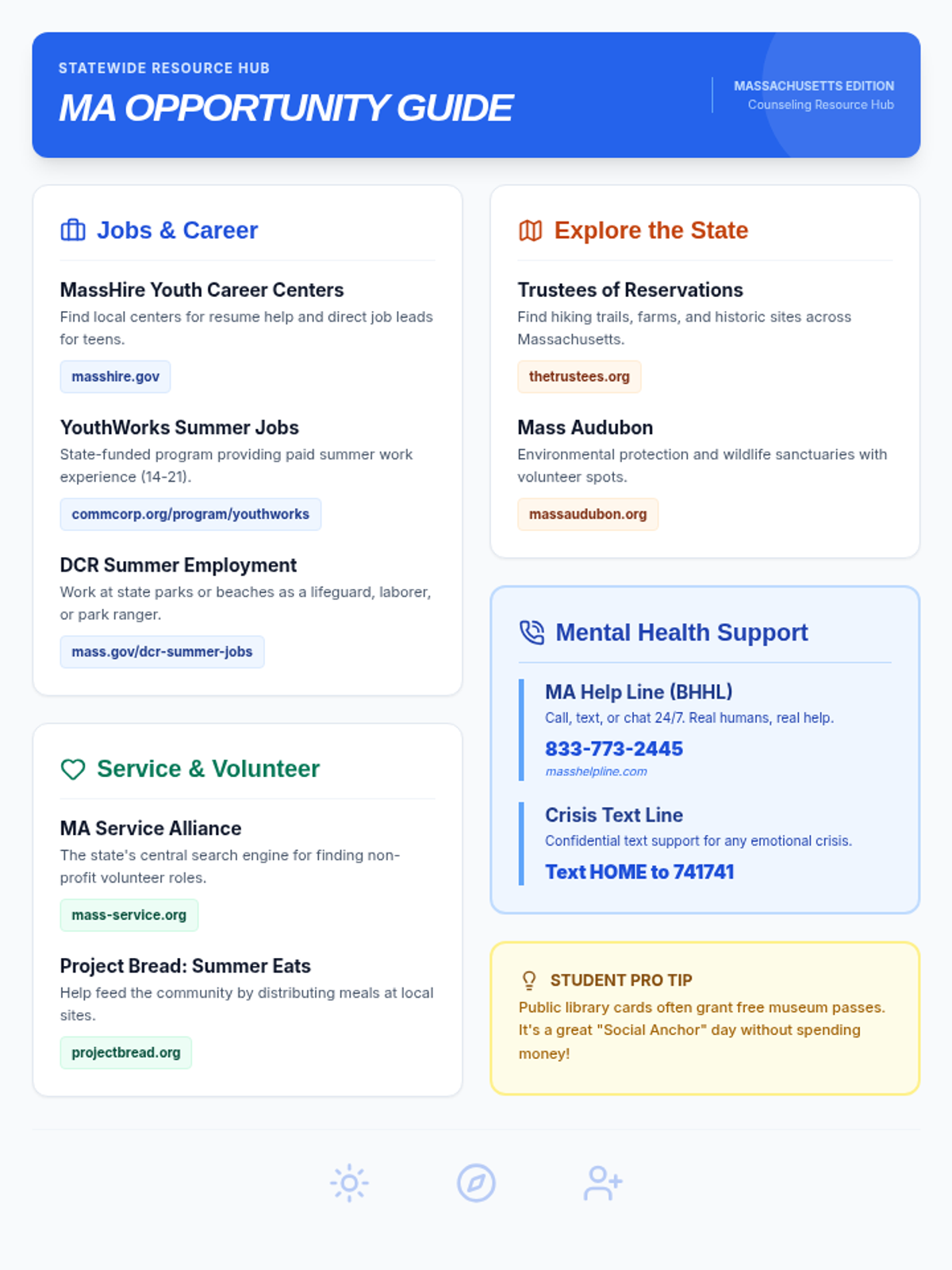
A comprehensive reference guide for Massachusetts high school students, featuring state-specific resources for jobs, volunteering, outdoor exploration, and mental health support.
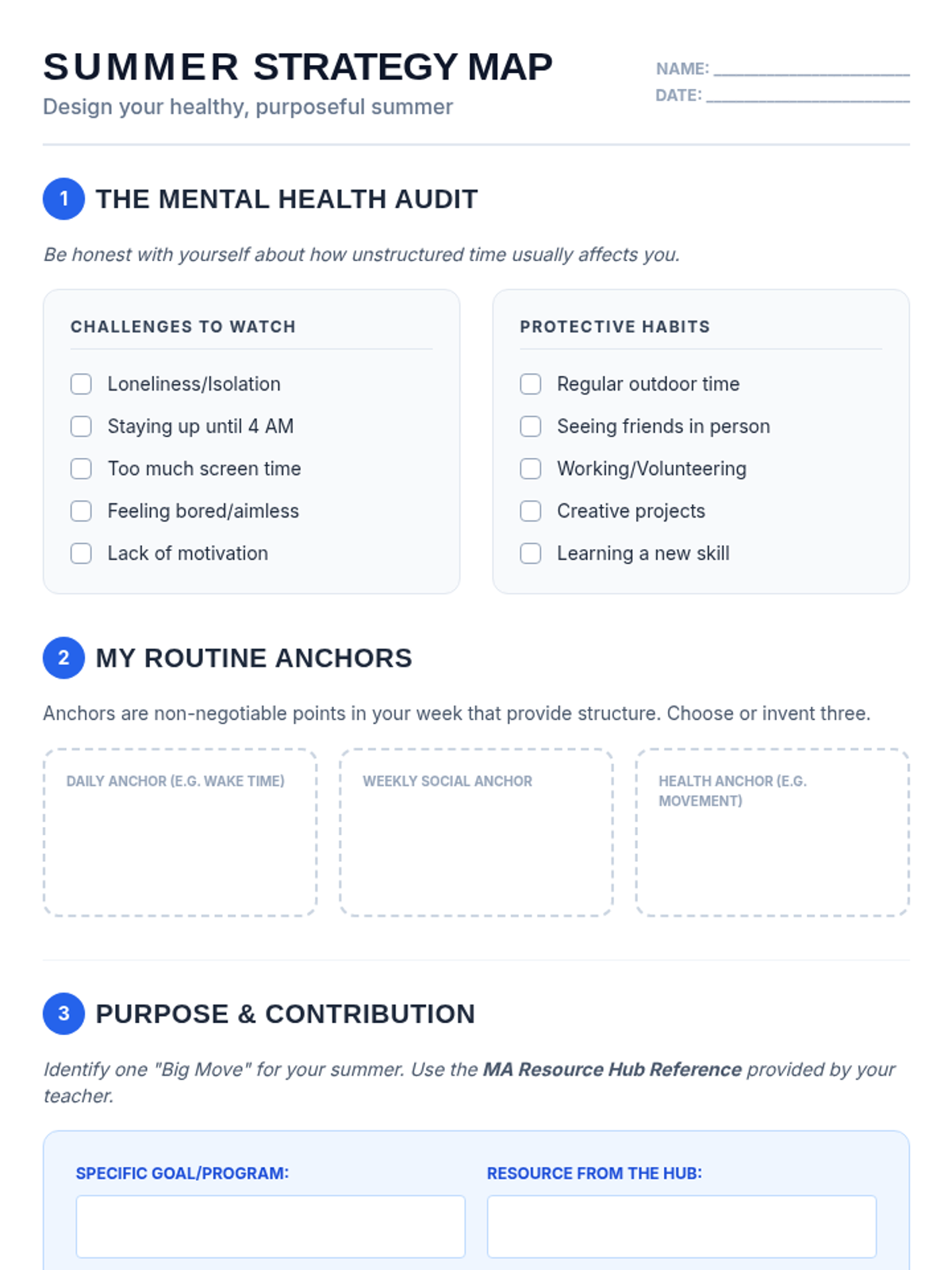
A student-facing worksheet for designing a balanced summer. Includes a mental health audit, routine anchor planning, goal setting for jobs or volunteering, and a "Joy List" for active rest.
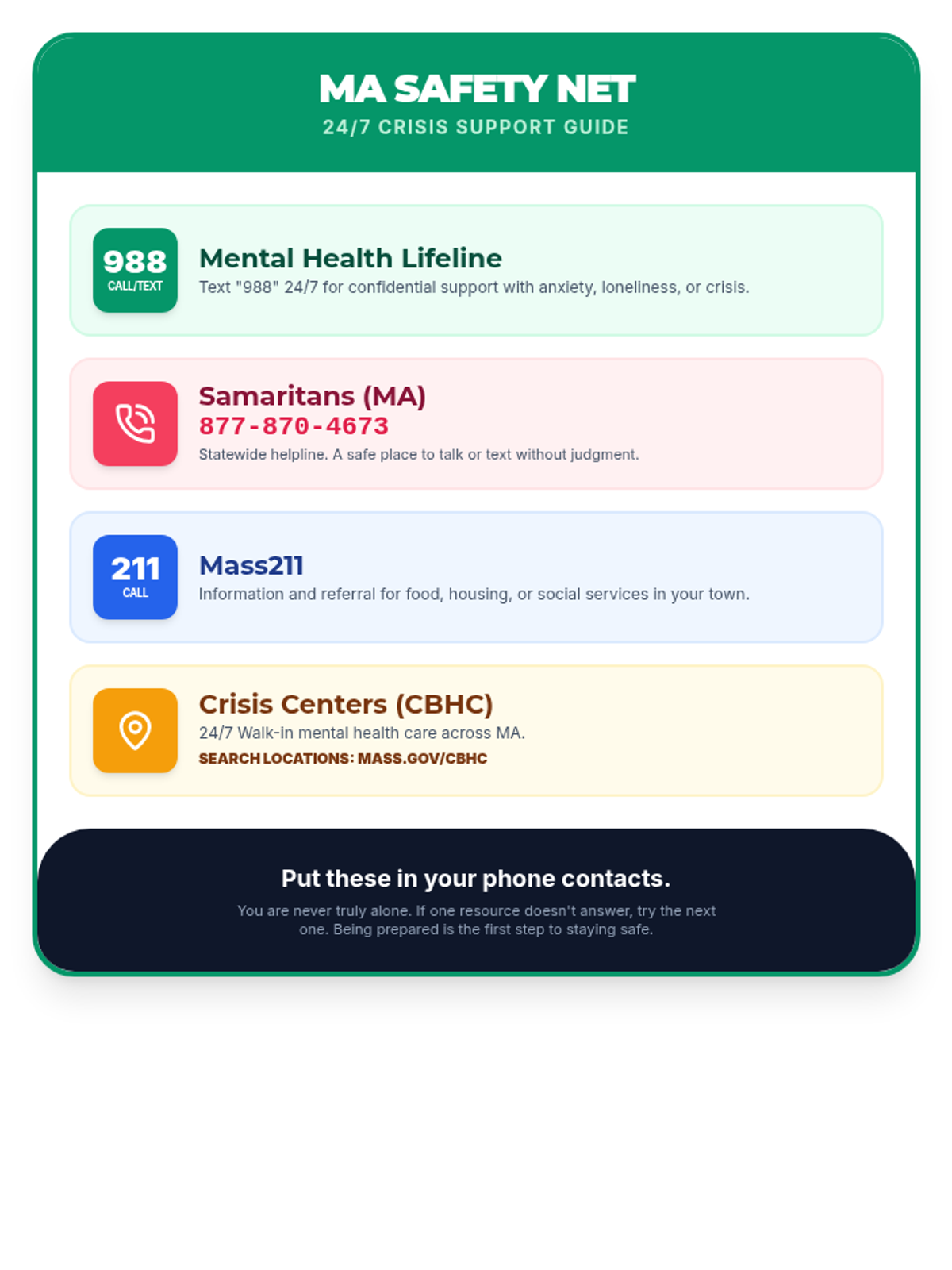
A compact reference guide for Massachusetts high school students, listing 24/7 crisis resources including 988, Mass211, Samaritans, and Community Behavioral Health Centers. Designed for clarity and immediate use.
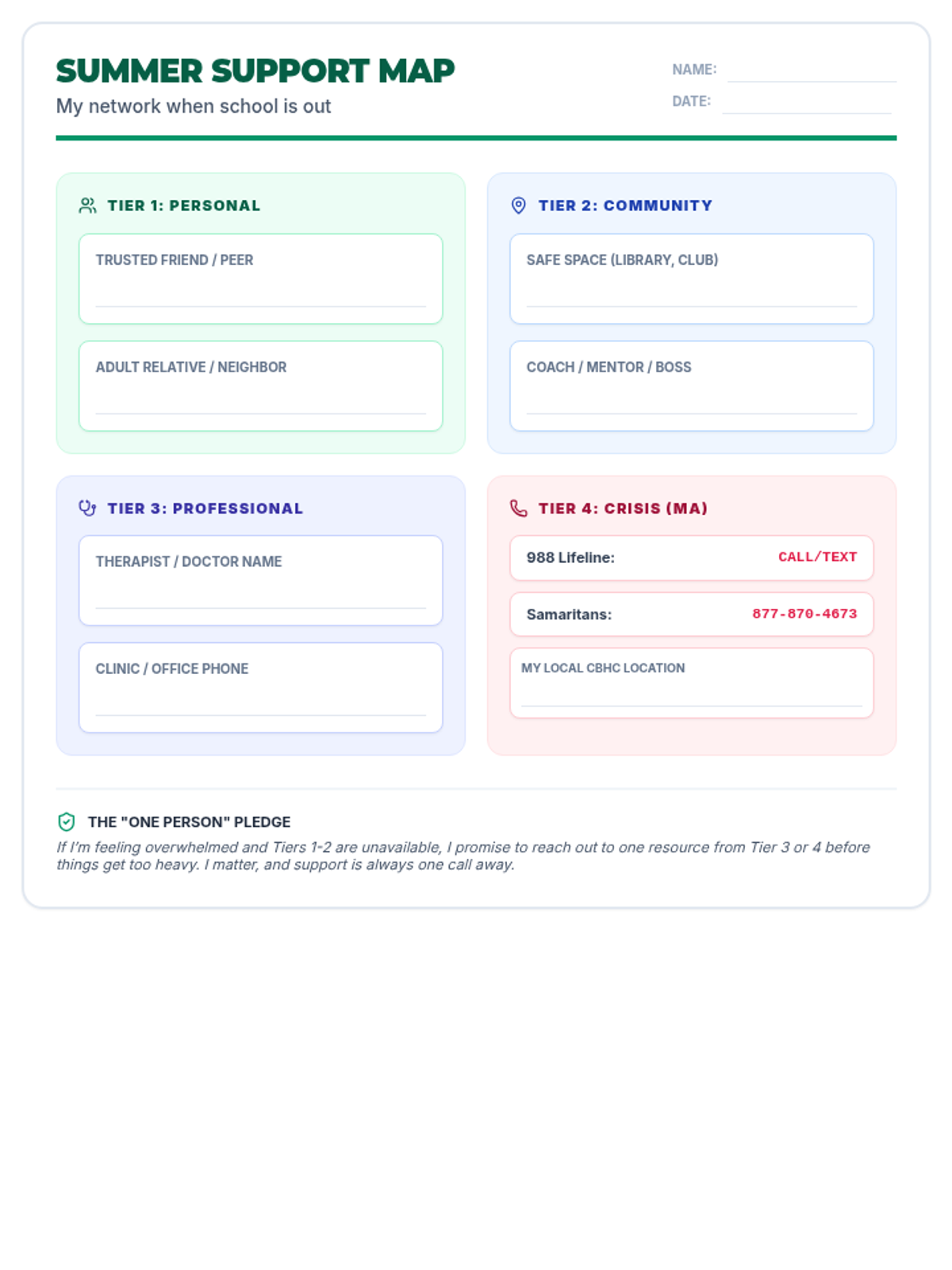
An interactive worksheet for high school students to visualize their personal support network. It features designated spaces for personal, community, professional, and crisis resources.
An engaging slide deck for a high school counseling lesson on designing a healthy, purposeful summer. Addresses mental health risks of unstructured time and introduces the "Anchor" concept.
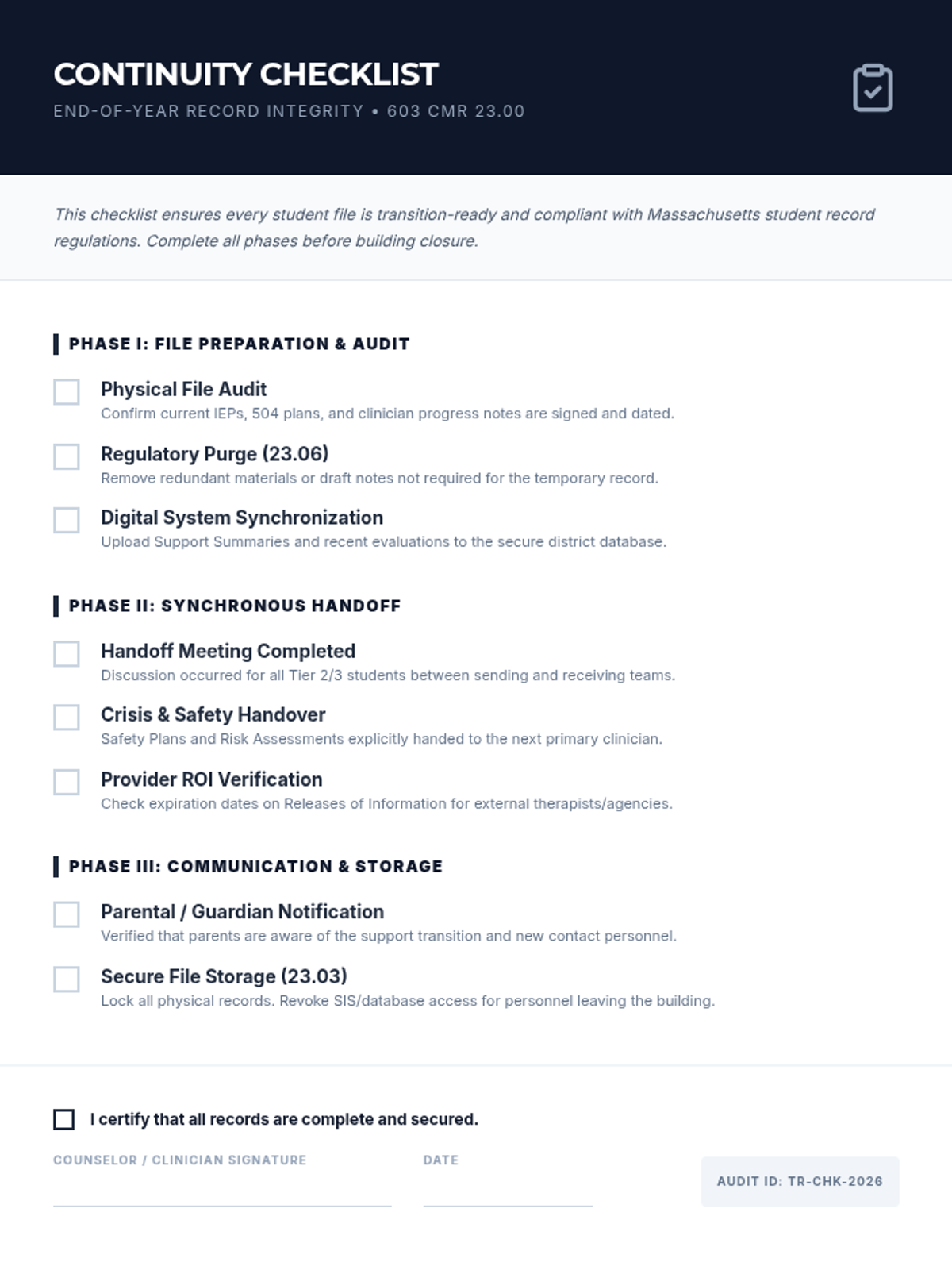
A streamlined documentation checklist optimized for single-page printing, ensuring all regulatory and clinical transition steps are completed and verified.
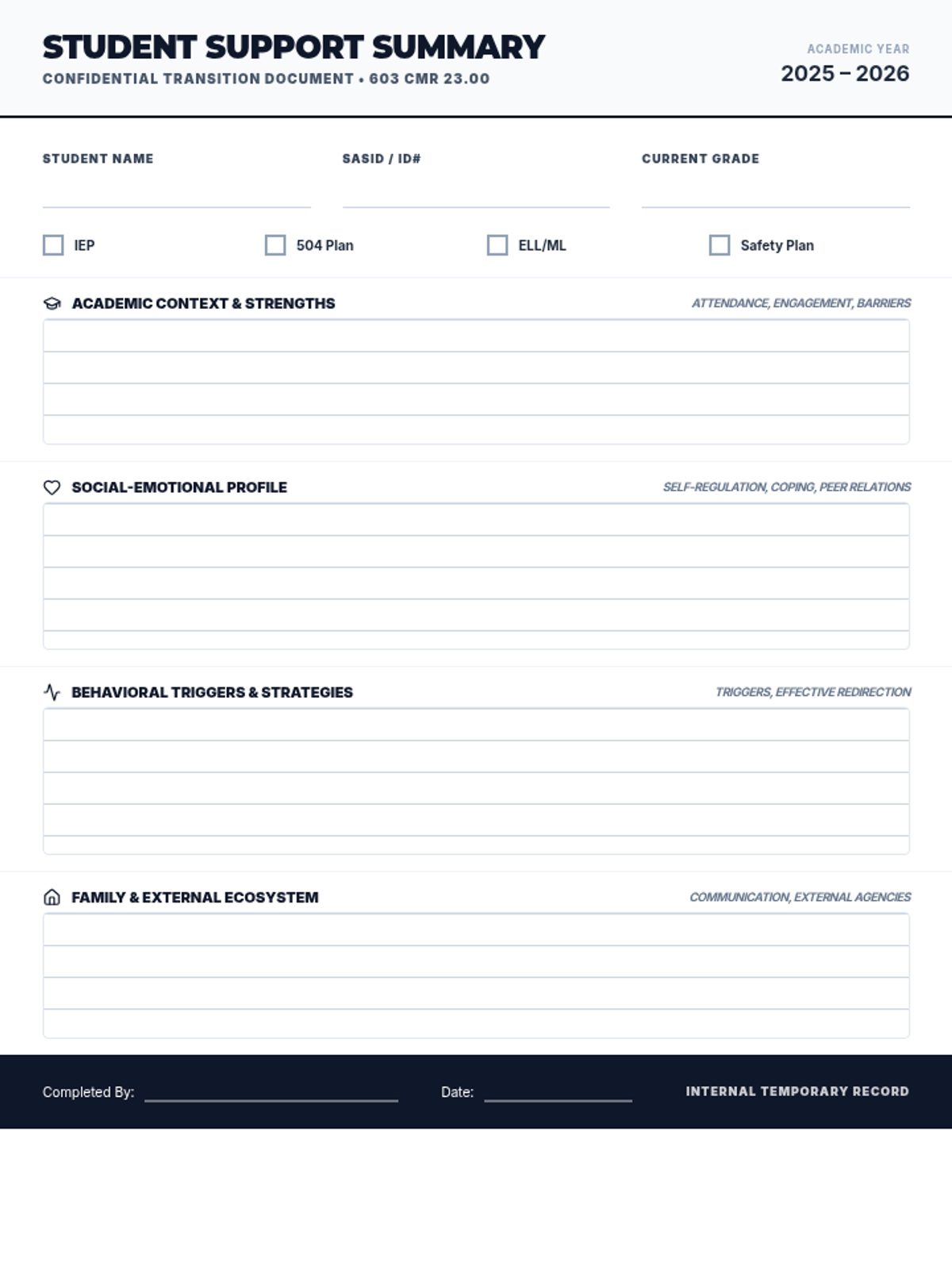
A redesigned student summary form optimized for single-page printing, featuring expanded handwriting areas and a clean professional layout for sensitive student data.
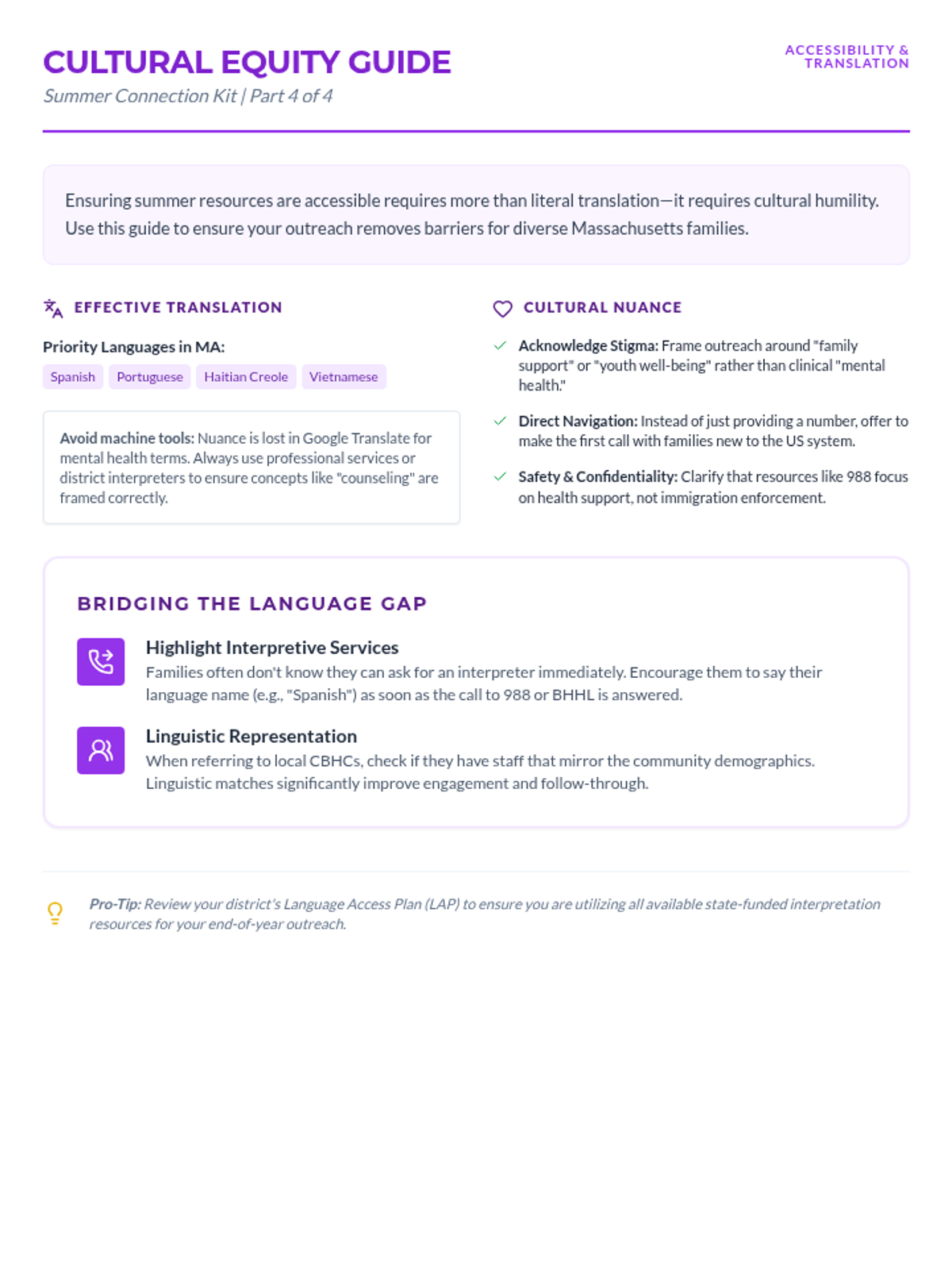
A guide for school counselors on cultural responsiveness, translation best practices, and ensuring equitable access to summer resources for diverse Massachusetts families.
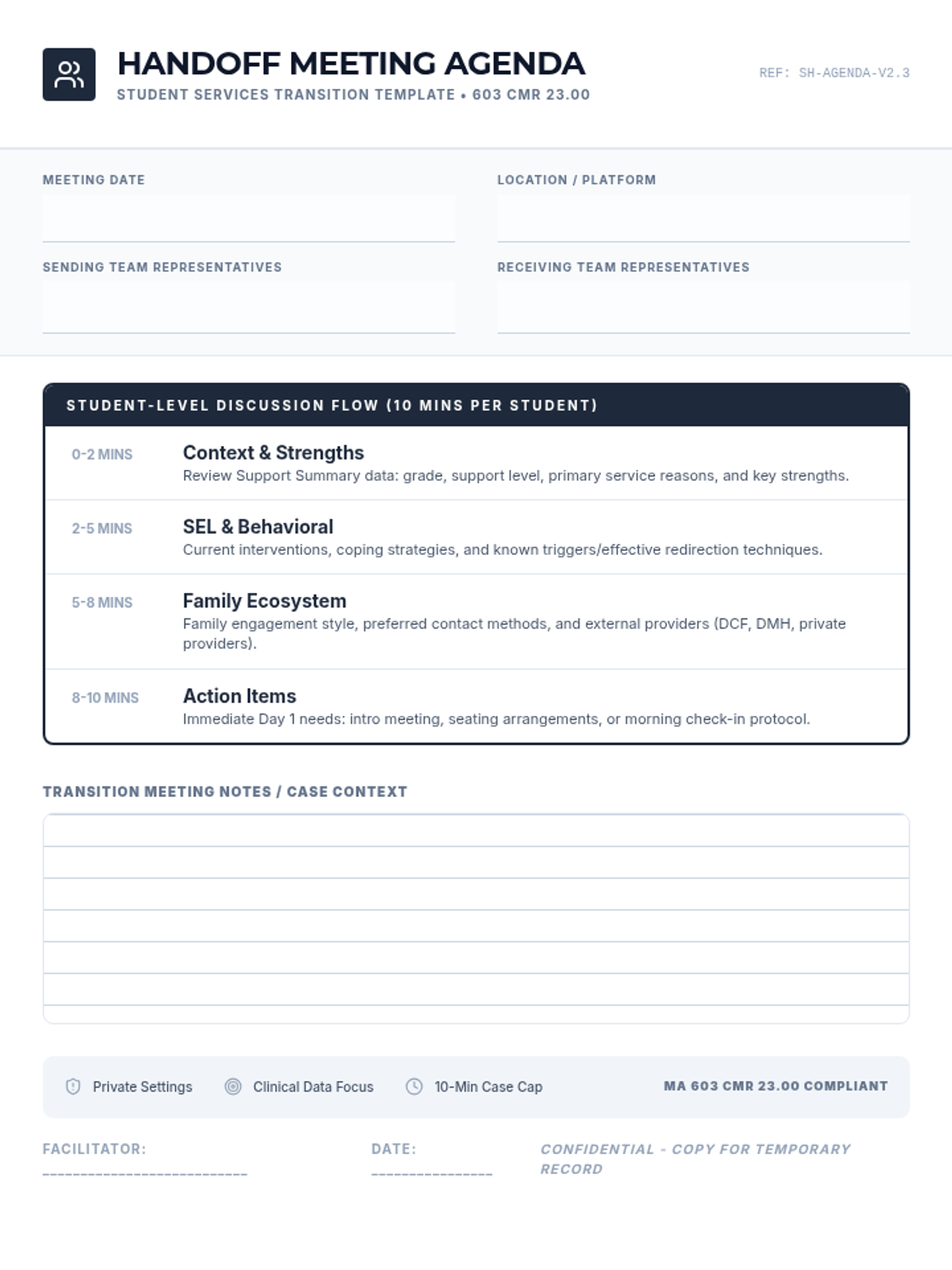
A structured agenda template for transition meetings, now refined for single-page printing with expanded handwriting areas and improved structural integrity.
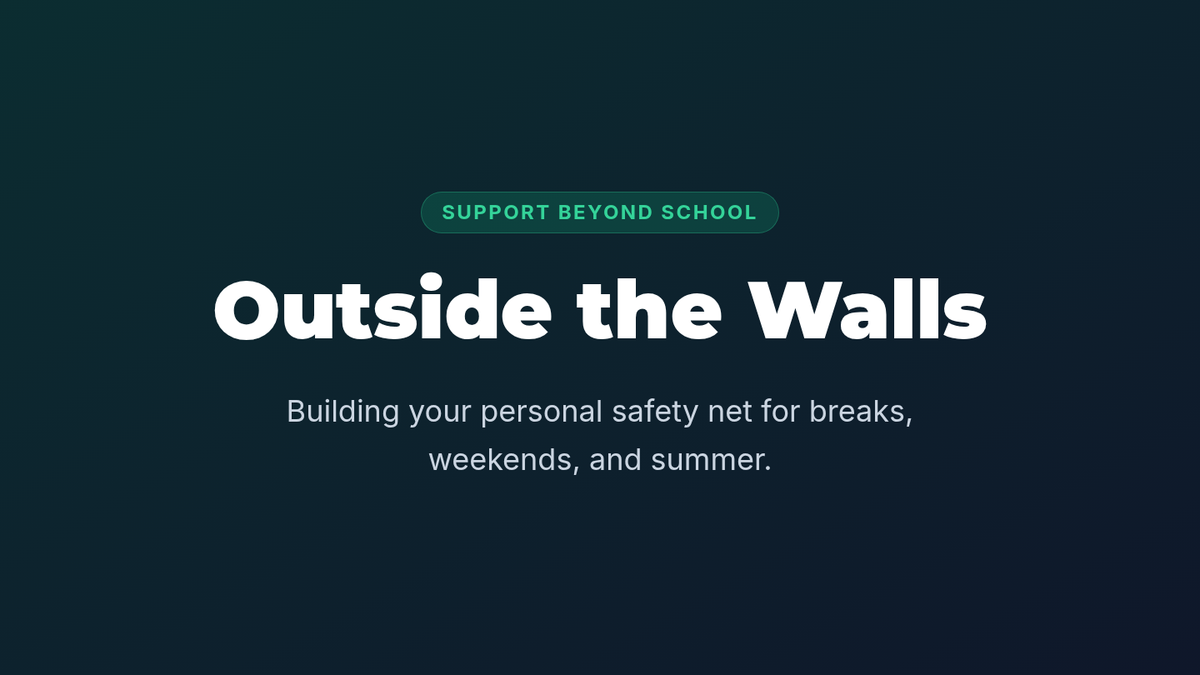
A visually engaging presentation (5 slides) that introduces the concept of support networks outside of school, explains the 4 tiers of support, and details specific Massachusetts-based resources like 988 and CBHCs.
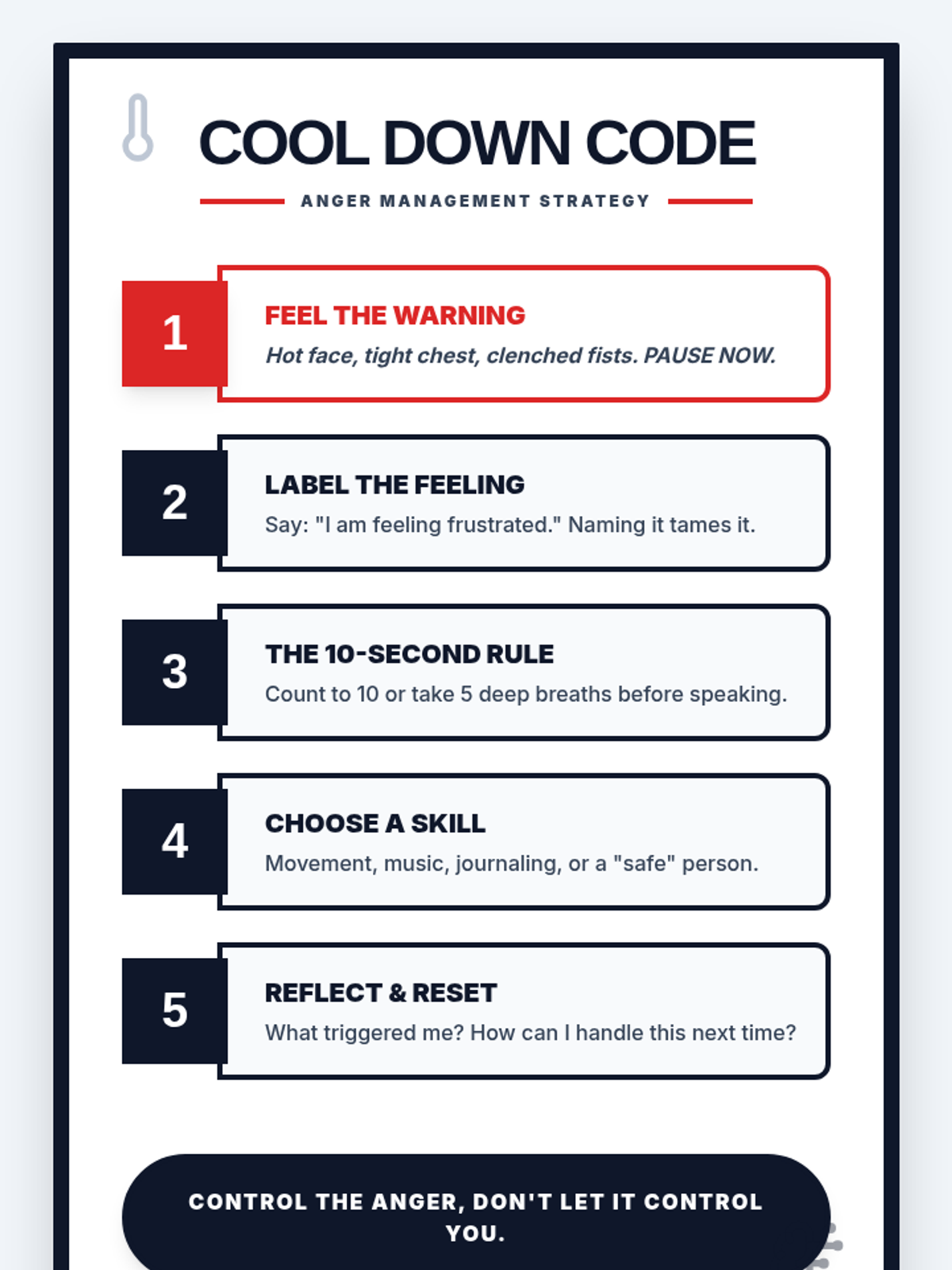
A high-impact anchor chart for teens outlining a 5-step strategy for anger management, from recognizing physical warning signs to debriefing after a calm-down period. Designed for classroom or group room display.
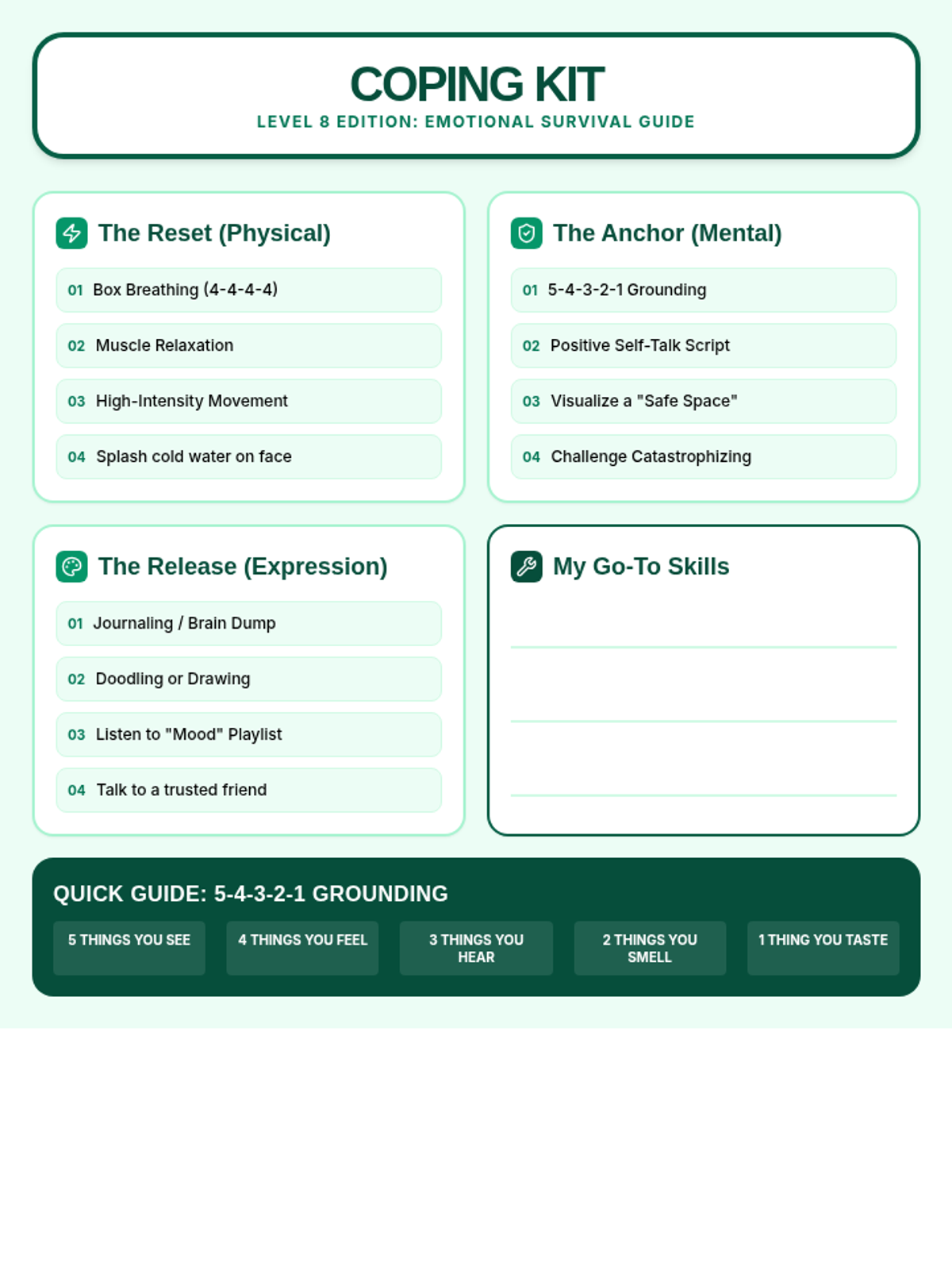
A coping skills toolbox handout for 8th-grade students, categorized into physical, mental, and expressive strategies. Includes a section for students to personalize their own toolkit and a quick-reference guide for the 5-4-3-2-1 grounding technique.
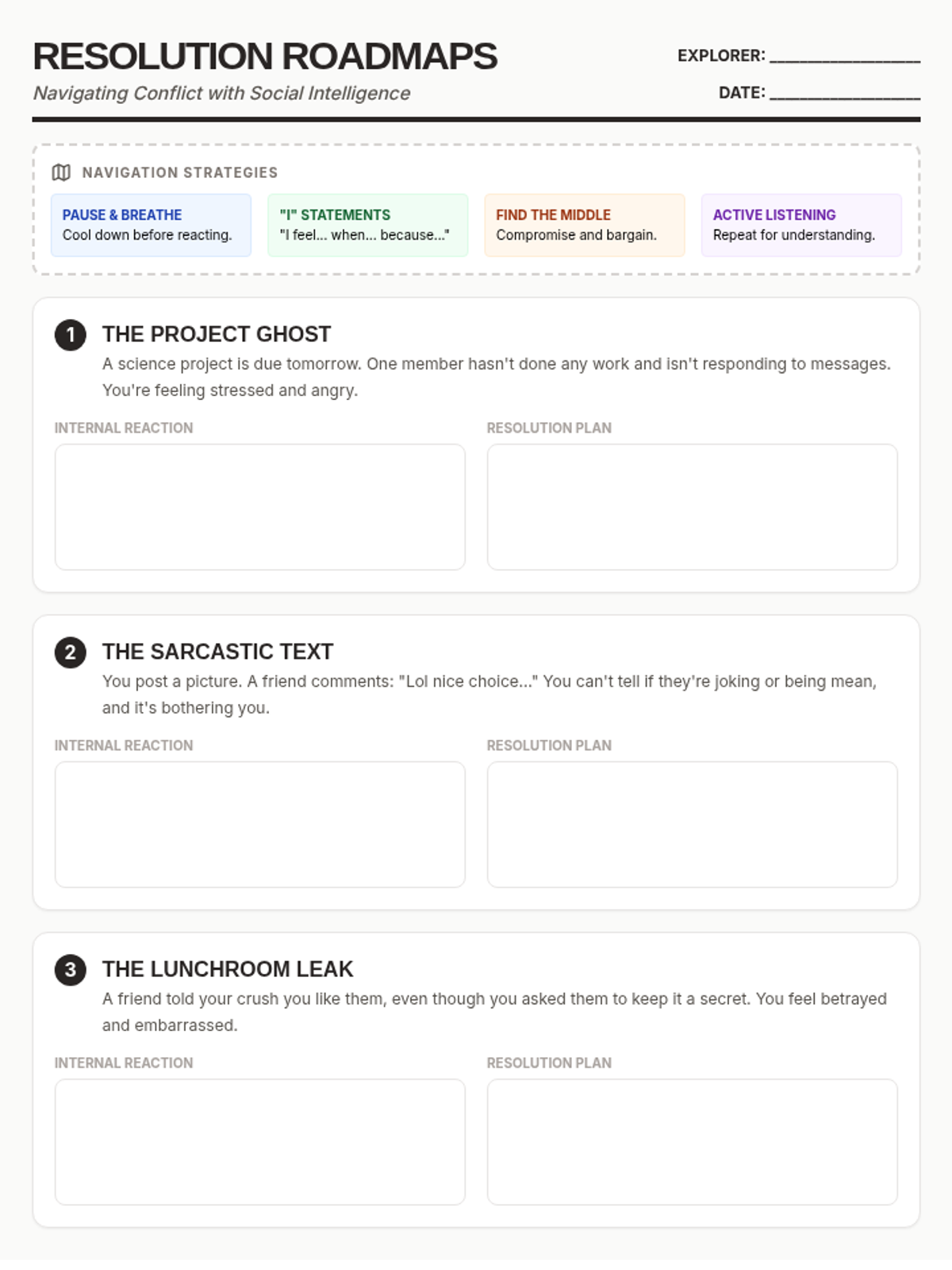
A worksheet featuring three realistic middle school conflict scenarios (group projects, social media, and broken trust) designed to help students practice identifying their internal reactions and planning healthy resolutions.
Educational slides for middle and high school students covering the definition of mental health, common challenges like stress and anxiety, stigma reduction, growth mindset, and seeking support. Includes reflection prompts and crisis resource information.
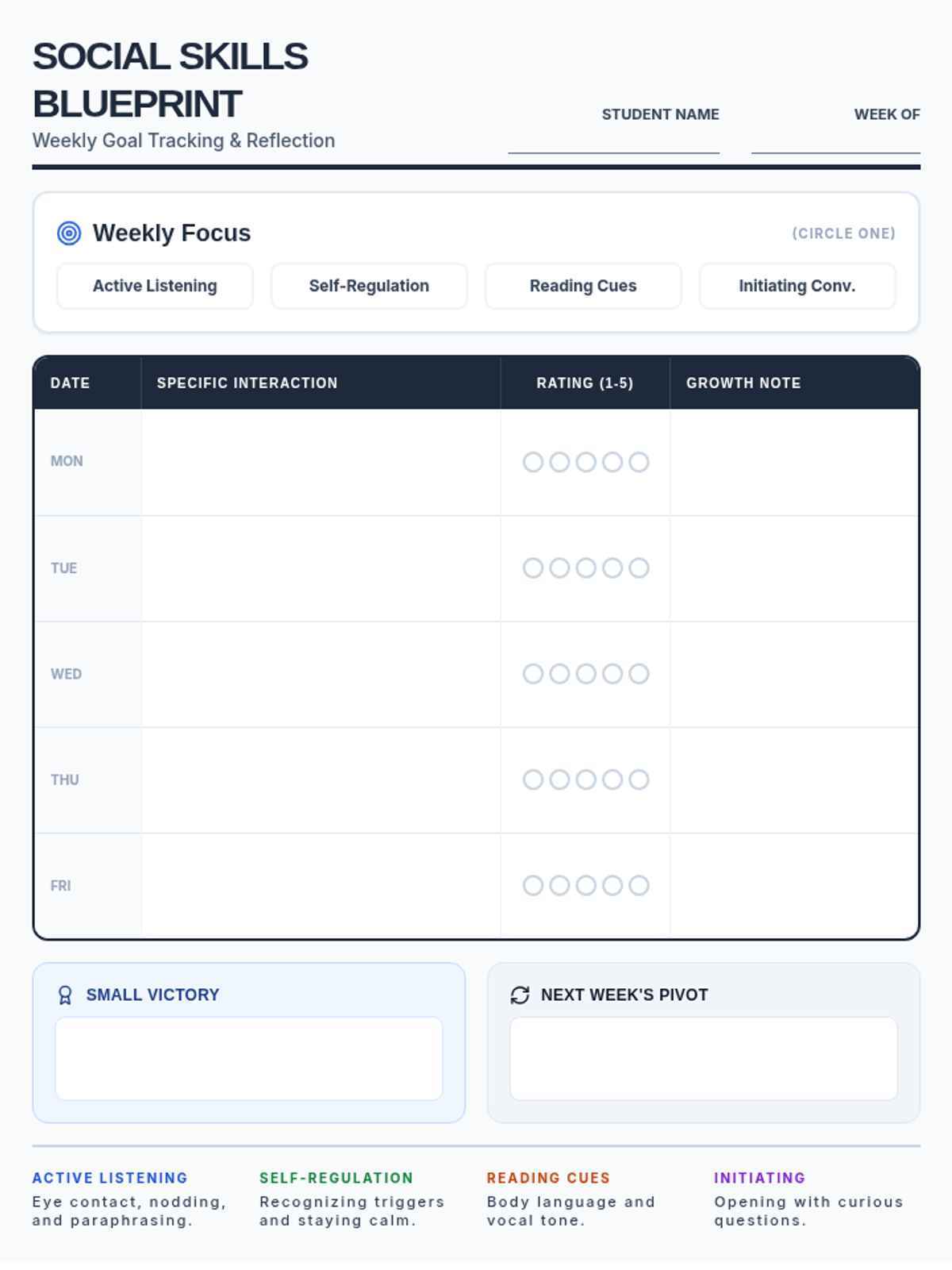
A goal-tracking sheet for middle and high school students to monitor their progress in active listening, self-regulation, reading social cues, and initiating conversations. It includes sections for specific interaction logging, self-rating, and weekly reflection.
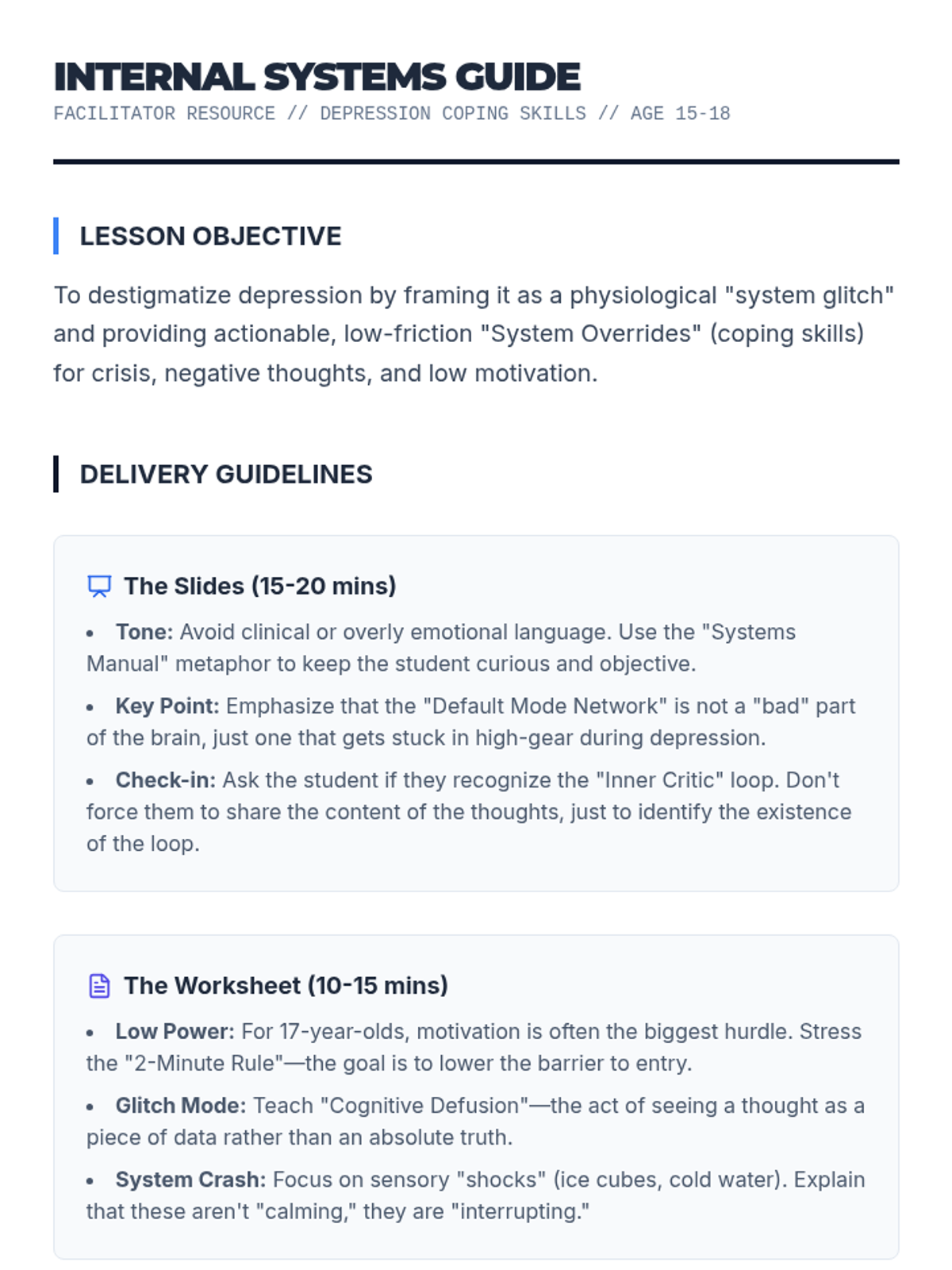
A facilitator guide for teachers or counselors delivering the Neuro Blueprint lesson. Includes instructional tips, delivery guidelines for slides and worksheets, and safety protocols for working with depressed teens.
A 16:9 slide presentation explaining the neuroscience of depression to a teen audience. Covers the Default Mode Network, the Amygdala/PFC conflict, and the dopamine reward loop using a technical 'system' metaphor.
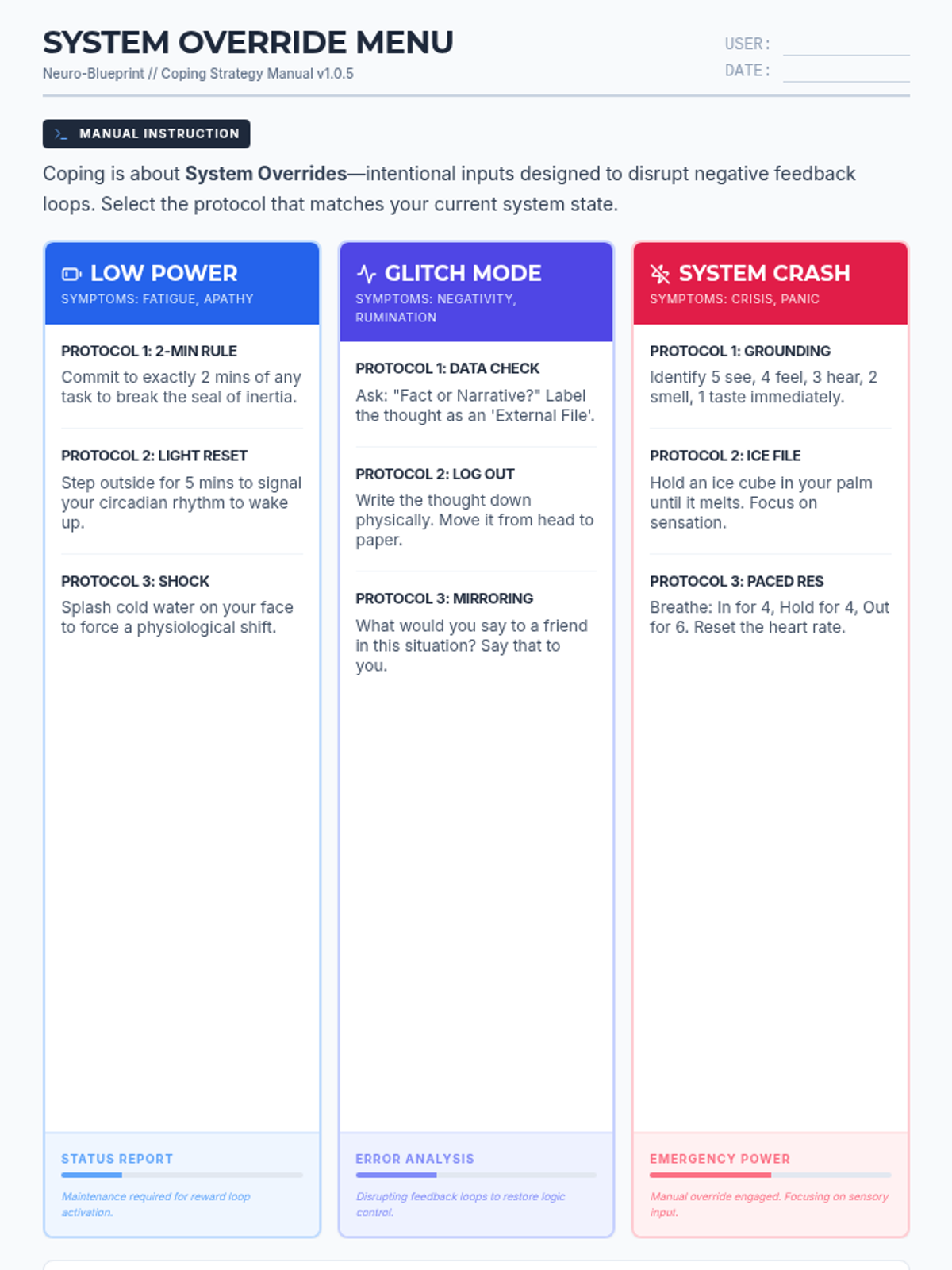
A visual coping skill menu for teens designed with a 'systems manual' aesthetic. It categorizes strategies into 'Low Power' (motivation), 'Glitch' (negative thoughts), and 'System Crash' (crisis) protocols.
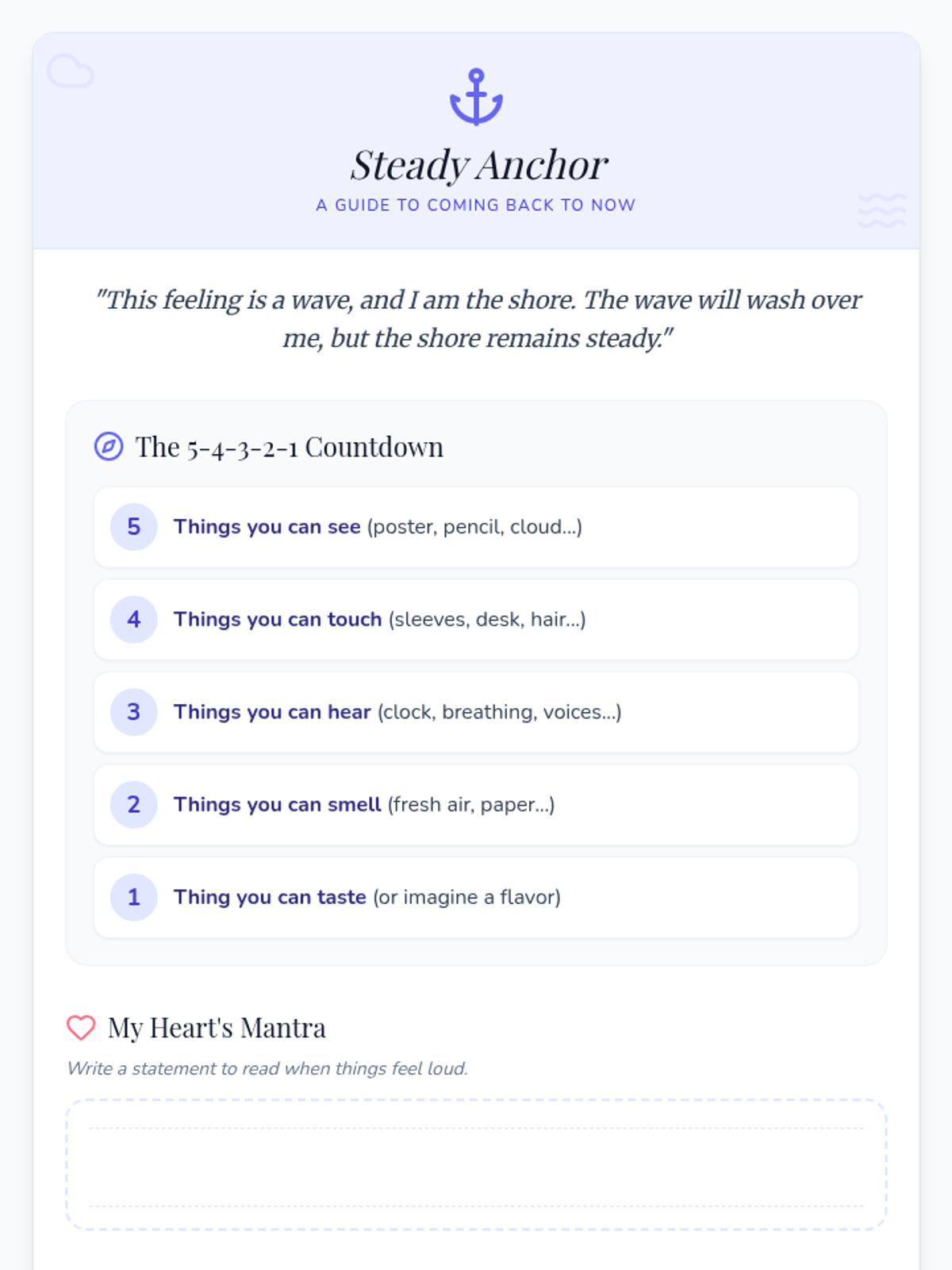
A compact grounding reference sheet featuring the 5-4-3-2-1 technique, square breathing visual, a mantra writing area, and a "Just 5 Minutes" challenge. Designed to fit easily on a single page for quick student reference.
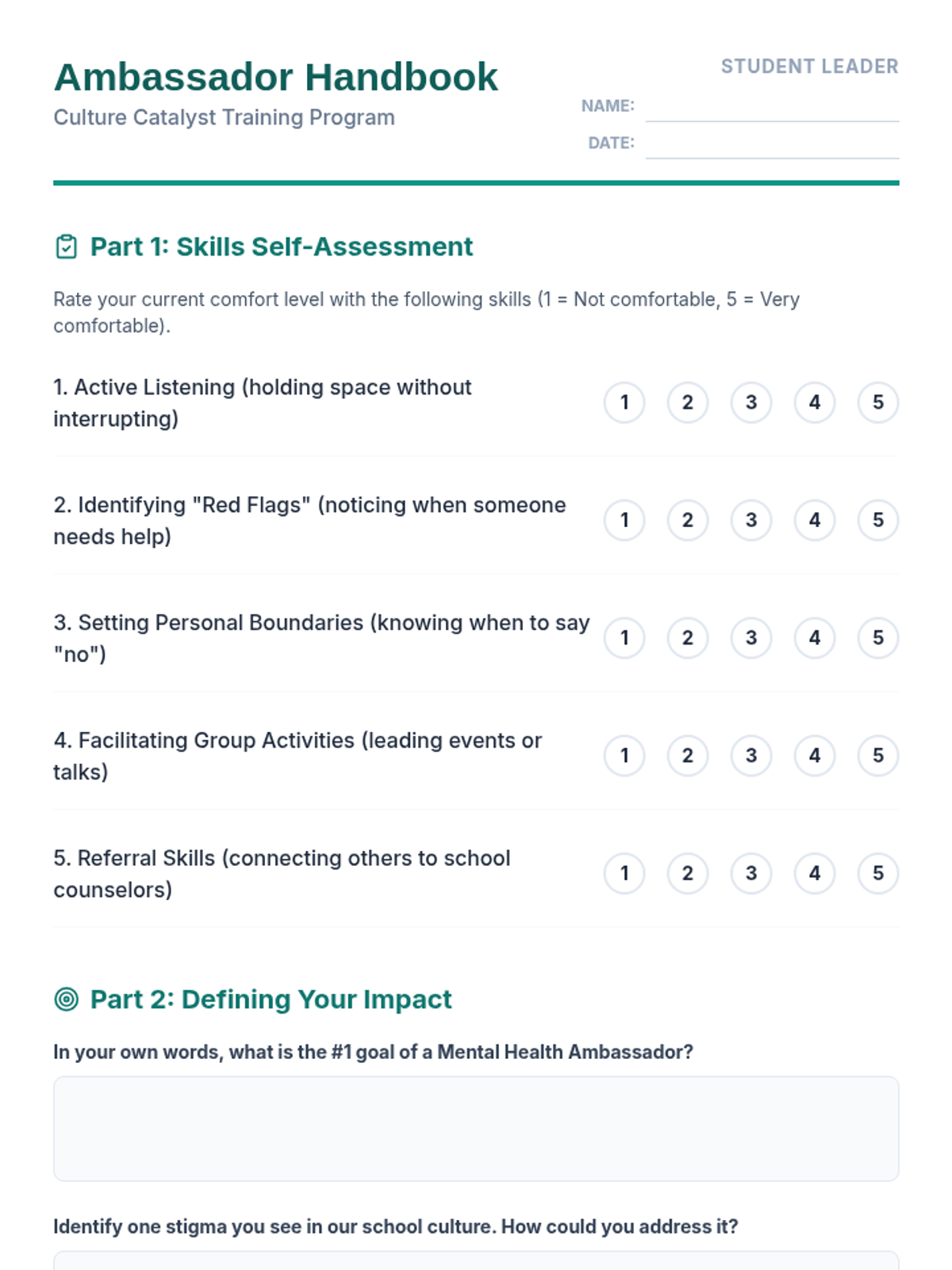
A 2-page student workbook for mental health ambassador training, including a skills self-assessment, practice scenarios for boundary setting and stigma reduction, and a personal action plan.
A visual presentation for a 45-minute training session for mental health ambassadors, covering roles, boundaries, stigma reduction, and self-care.
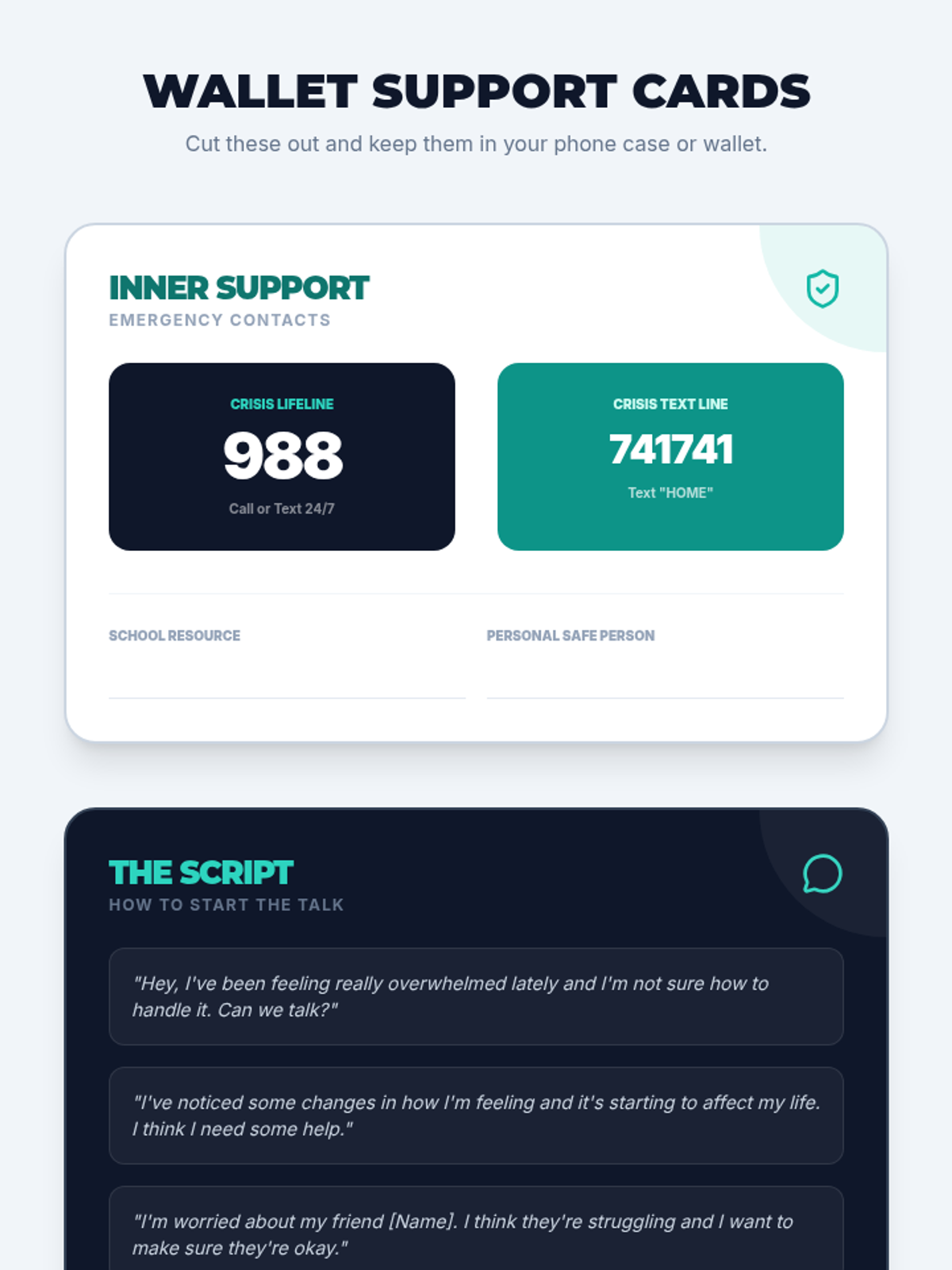
Printable wallet cards for students with crisis hotline numbers and helpful scripts for seeking mental health support.
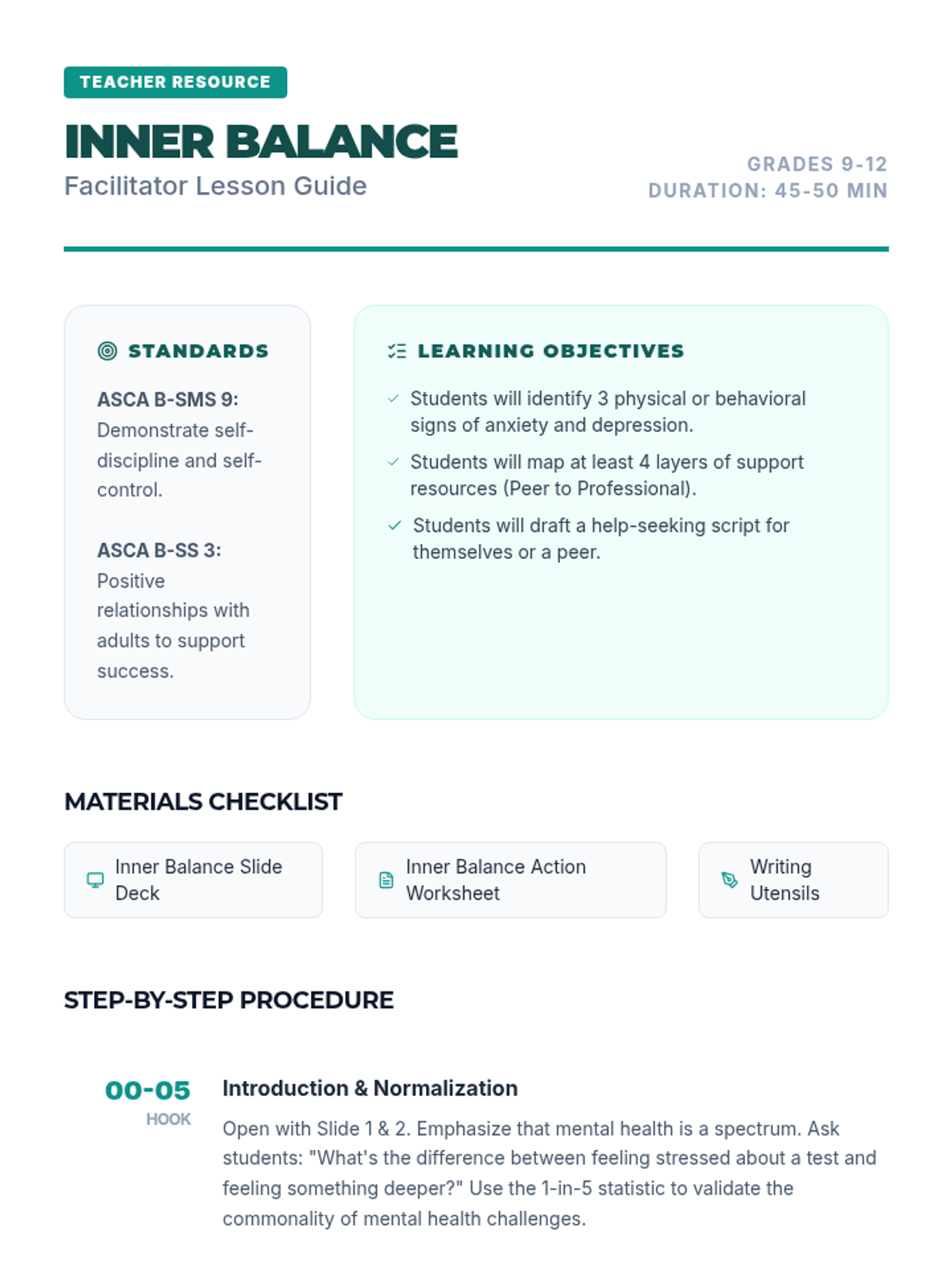
A comprehensive facilitator guide for the Inner Balance lesson, including alignment to ASCA standards, lesson procedures, crisis protocols, and key definitions.
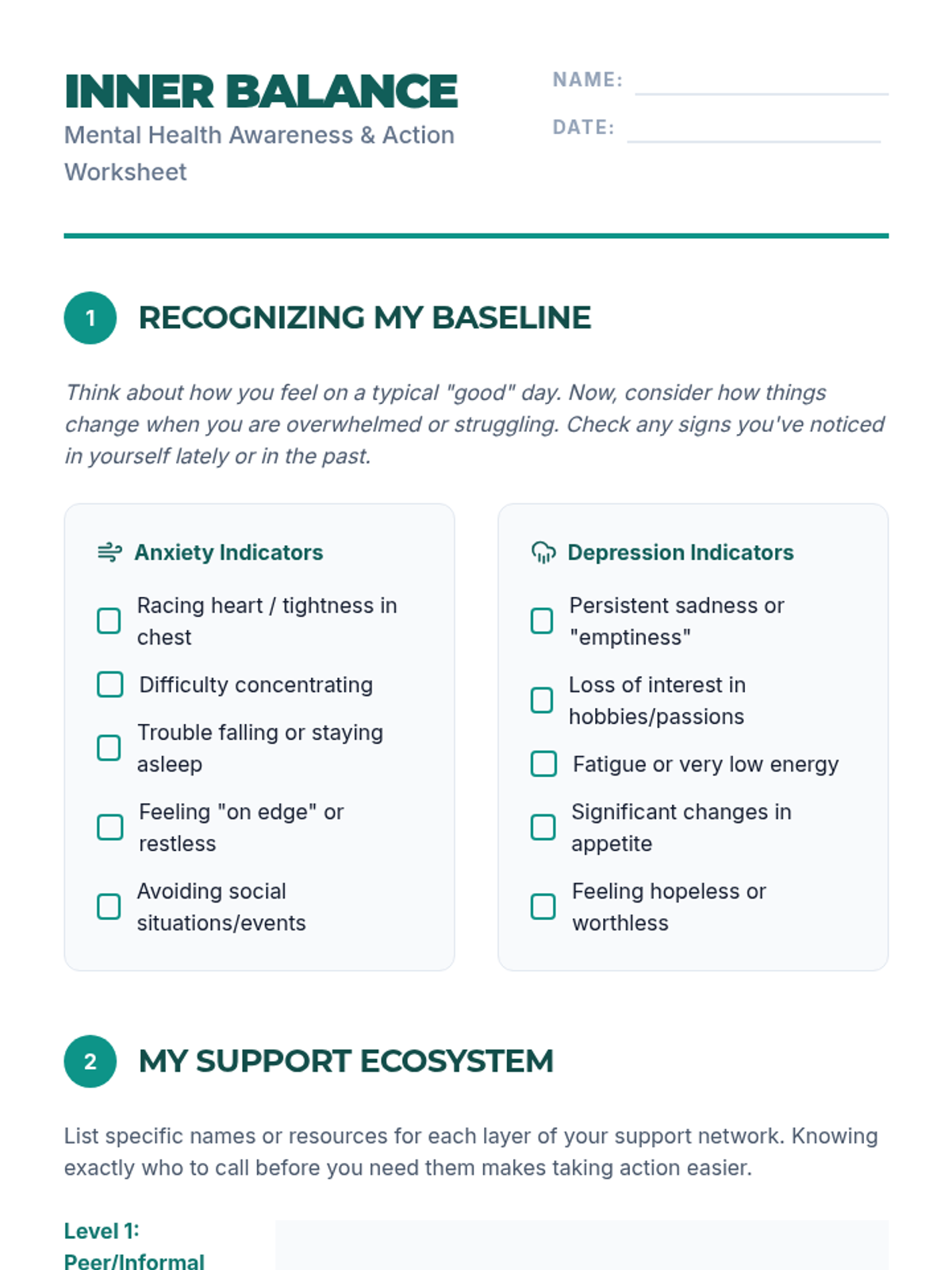
A student worksheet for mapping personal mental health warning signs, identifying layers of support resources, and practicing help-seeking scripts. Designed for print with clear handwriting areas.
A 7-slide presentation covering the basics of recognizing anxiety and depression signs in oneself and peers, along with the framework for seeking help. Features high-contrast visuals and clean layouts suitable for high school students.