A visual presentation for the Verb Detectives lesson, featuring lesson objectives, warm-up instructions, the embedded Khan Academy video, and visual breakdowns of irregular verb patterns.
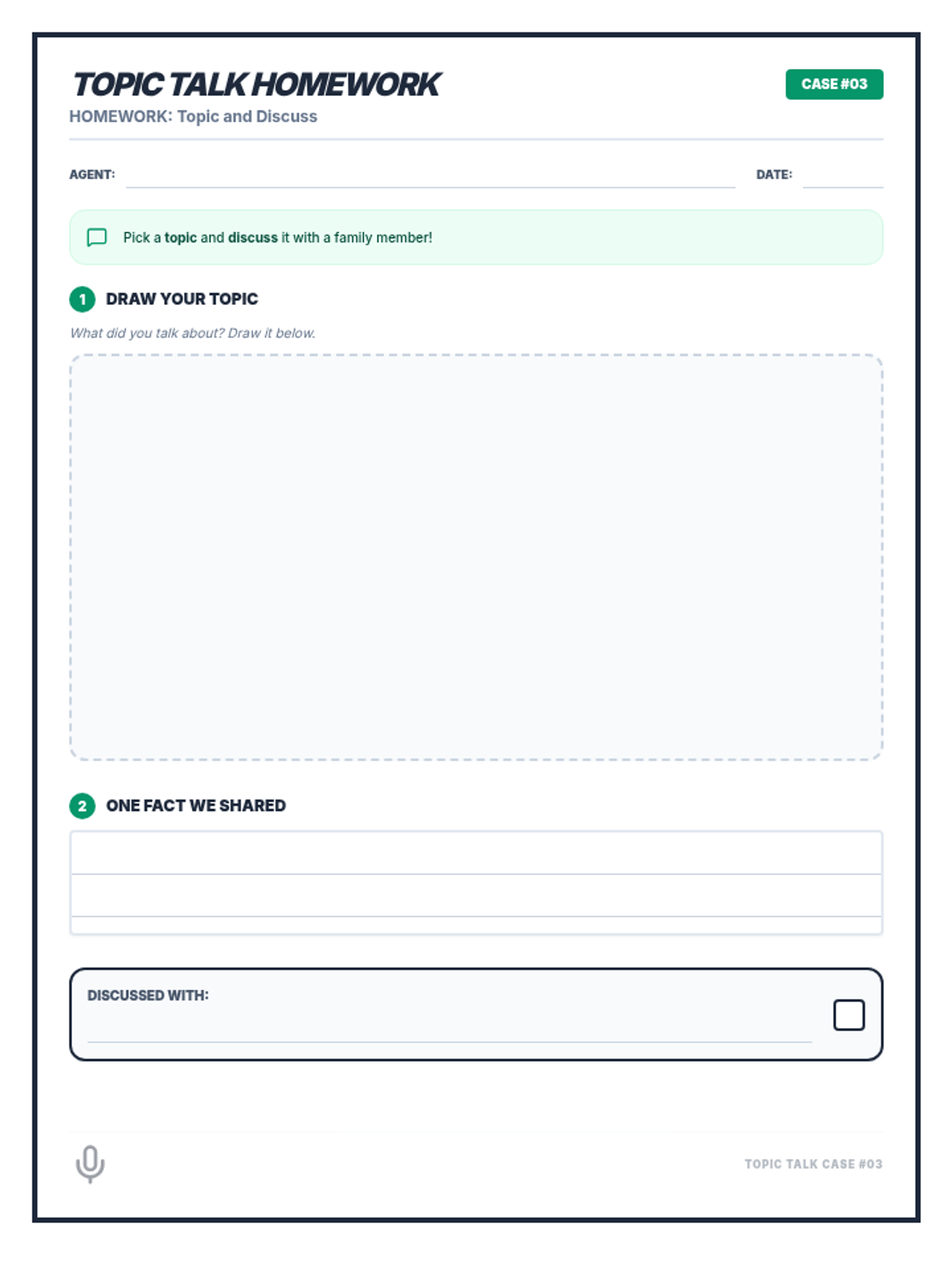
A home discussion log where students pick a topic, discuss it with a family member, and record a fact they shared. Focuses on reinforcing the definitions of 'topic' and 'discuss' in a real-world setting. Revised for 1-page layout and improved contrast.
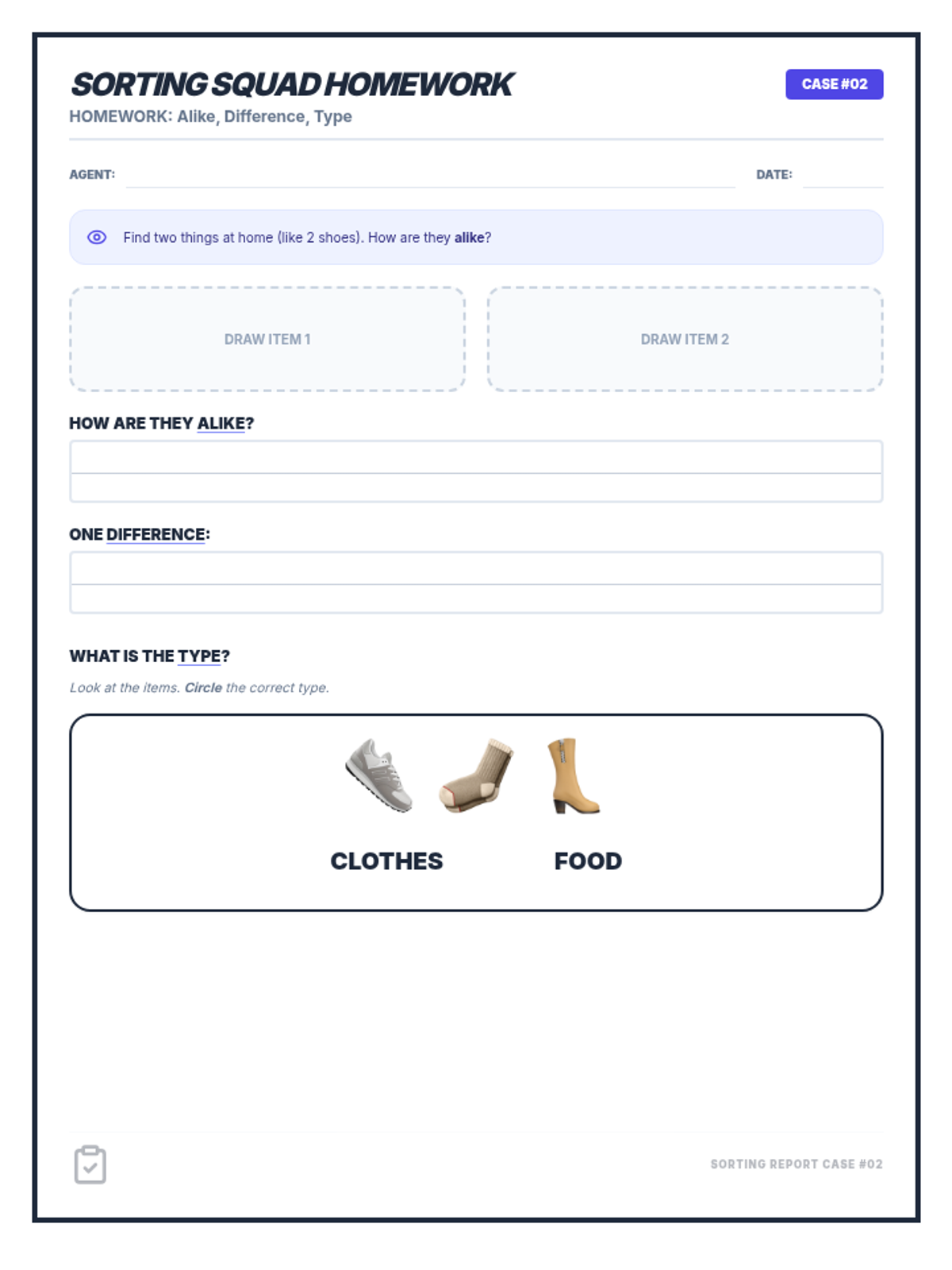
A comparison-focused homework sheet where students find and compare two household items, identifying how they are alike and different, and practicing the concept of 'type' with visual groups. Revised for 1-page layout and improved contrast for handwriting lines.
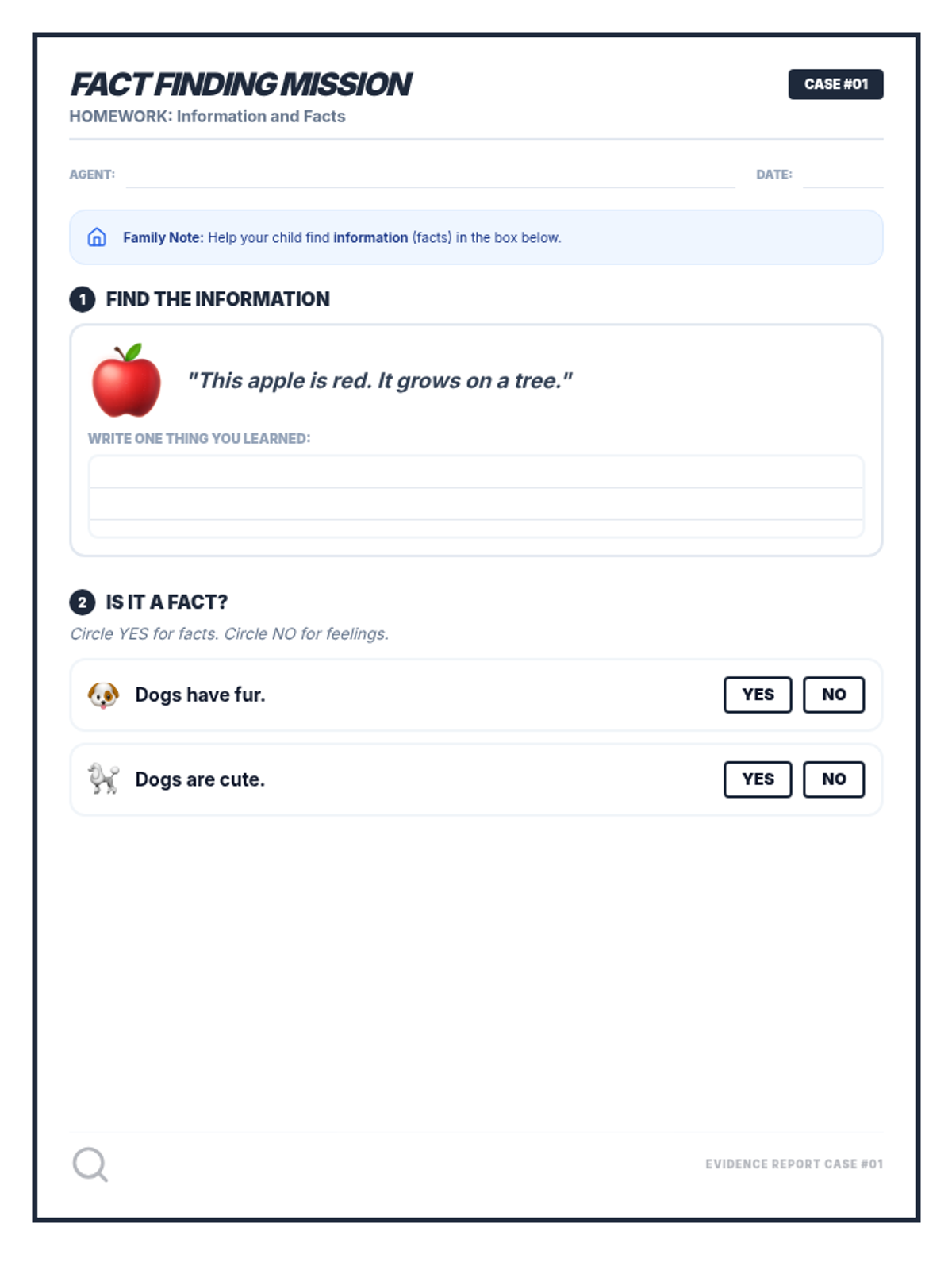
A homework sheet focused on 'information' and 'fact'. Students practice finding information in a simple context and distinguishing between facts and opinions with a family-friendly instruction note. Revised for 1-page layout and improved contrast.
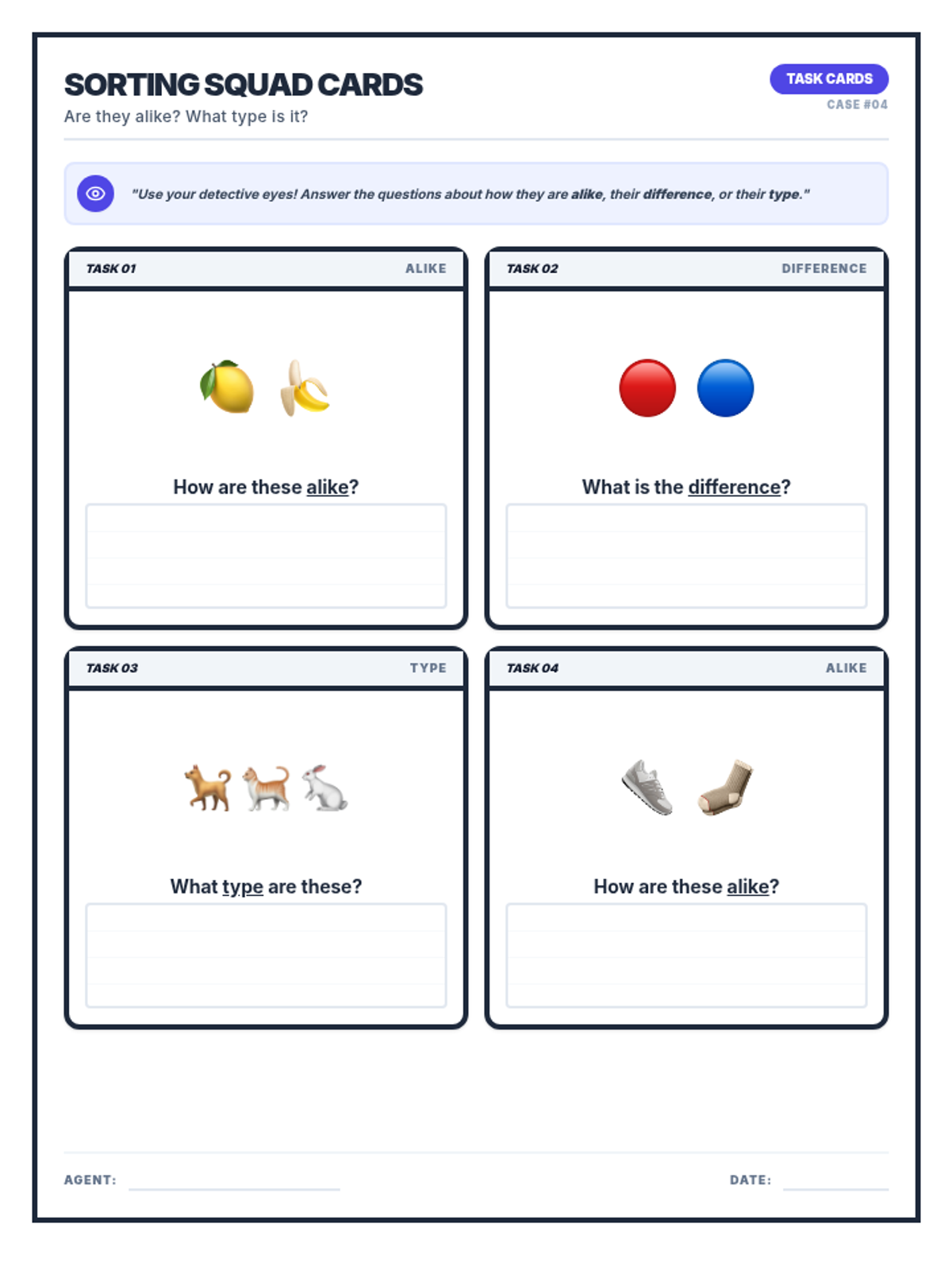
A set of task cards for comparing and categorizing items. Students analyze visual pairs and sets to identify how they are alike, their differences, or their shared 'type'. Revised for single-page layout with larger response areas and white backgrounds for legibility.
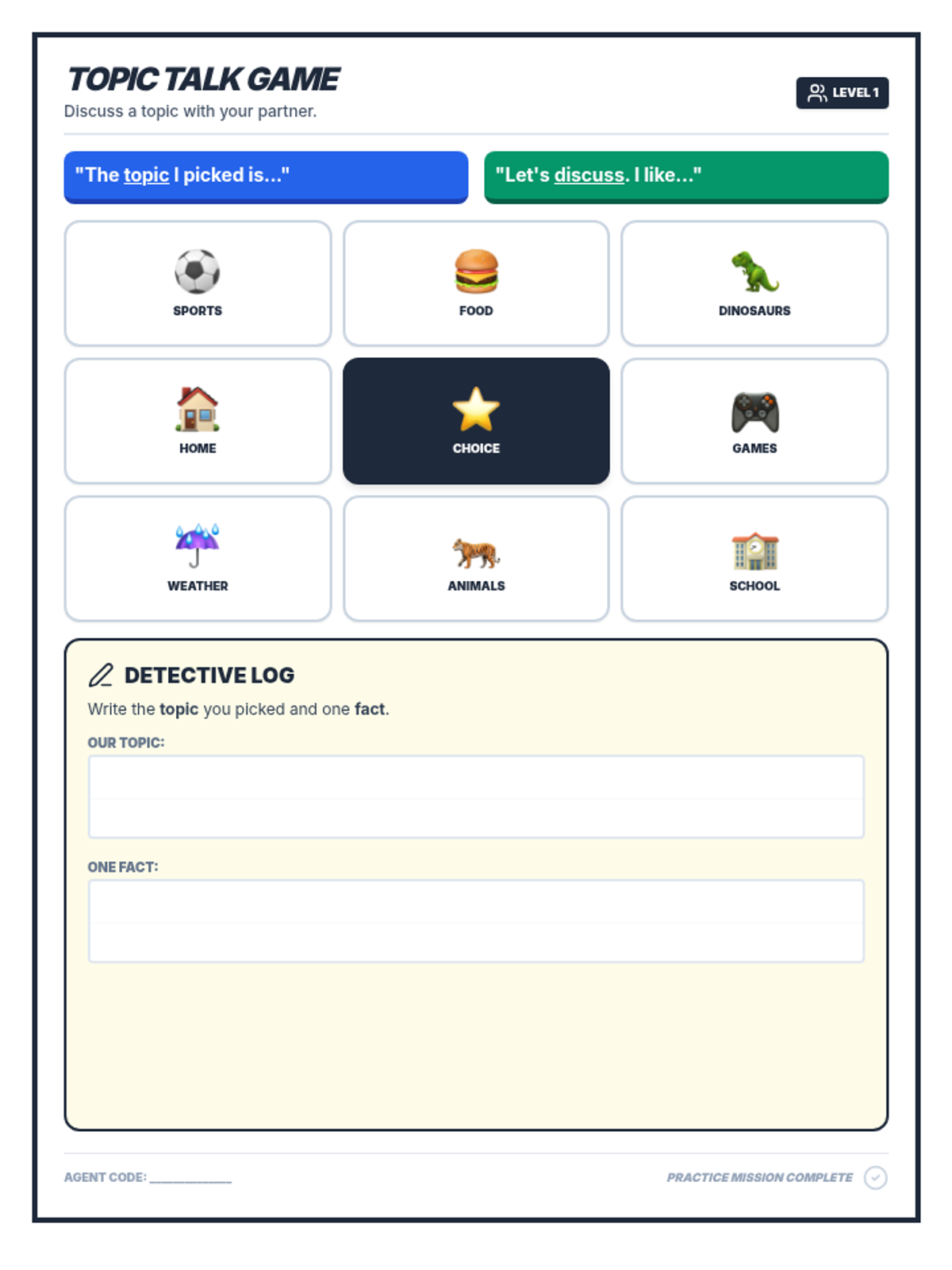
A partner-based discussion game featuring a choice board of visual topics. Students use sentence starters to practice identifying a topic and engaging in discussion with their peers. Revised to fit on a single page with a new 'Detective Log' for written practice. Grid heights and padding optimized for 1-page layout.
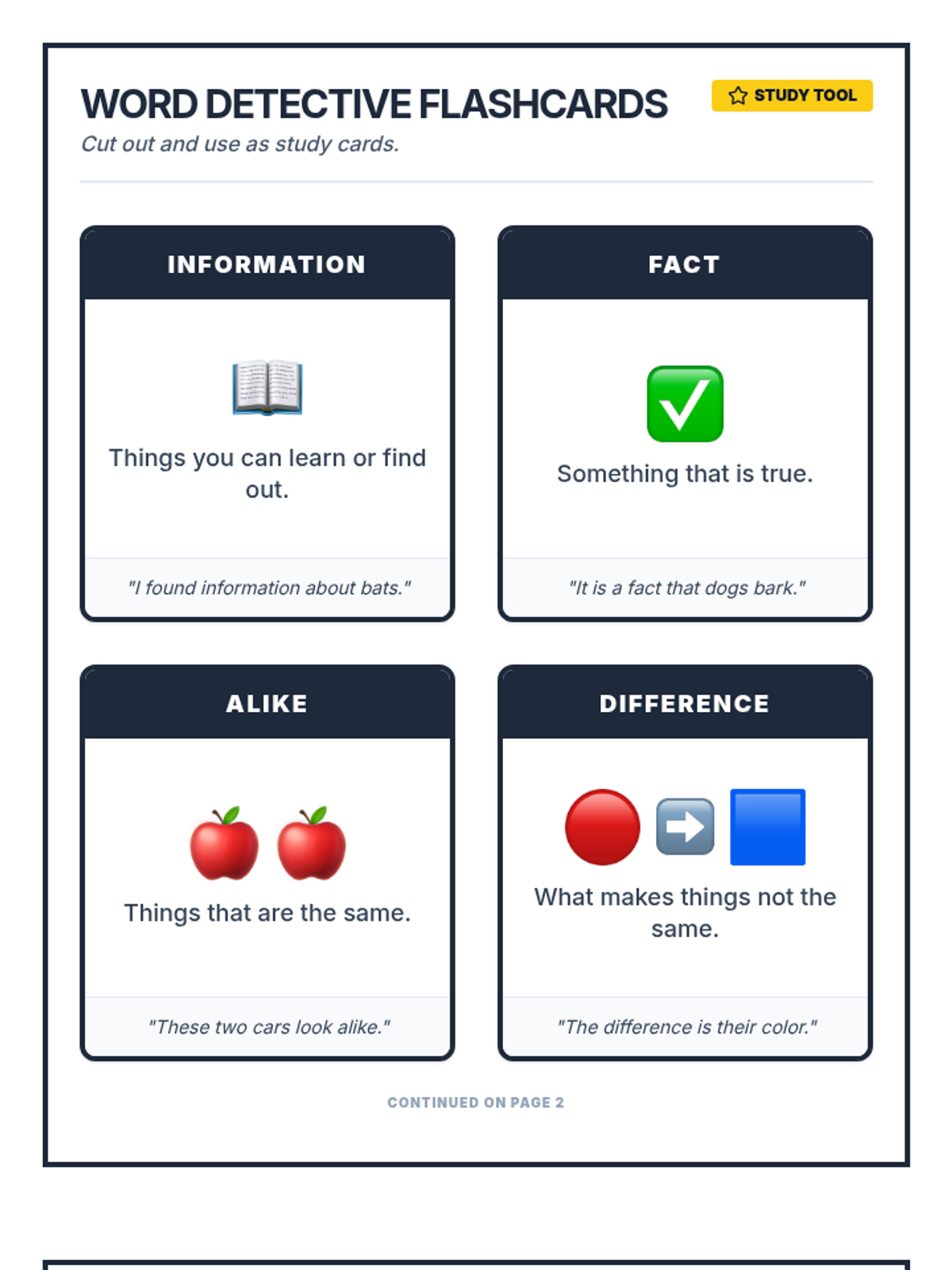
Visual vocabulary flashcards for the seven target academic words, featuring simple definitions, clear icons, and example sentences to support student mastery. Revised for consistent 2-page layout with borders and improved writing space for notes. Example sentences increased for better readability. Corrected arrow rendering and removed placeholder text.
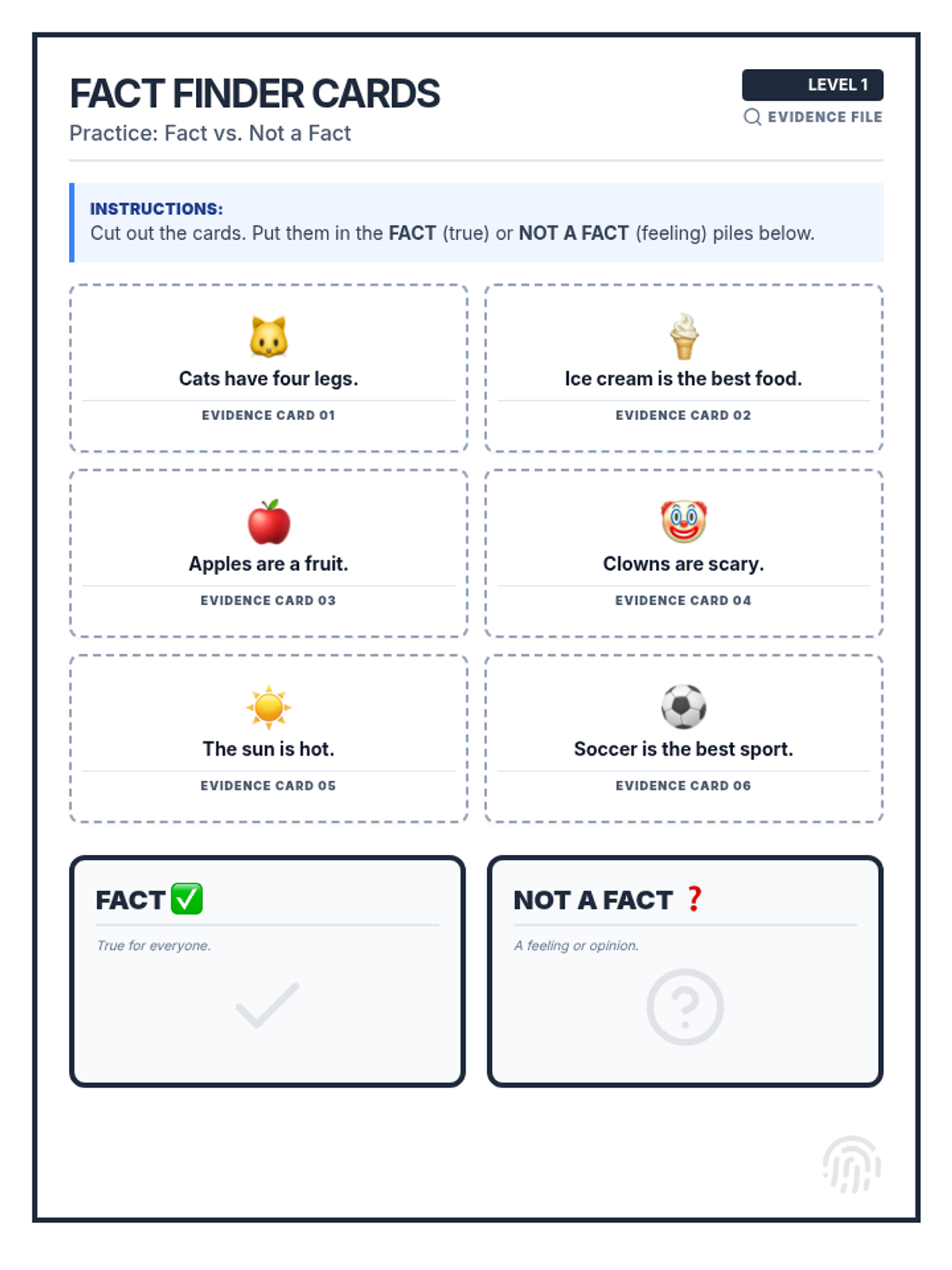
A hands-on sorting activity where students cut out cards and categorize statements as either 'Fact' or 'Not a Fact' to practice the concept of information versus opinion. Revised to fit on a single page with high-contrast text and larger sorting zones.
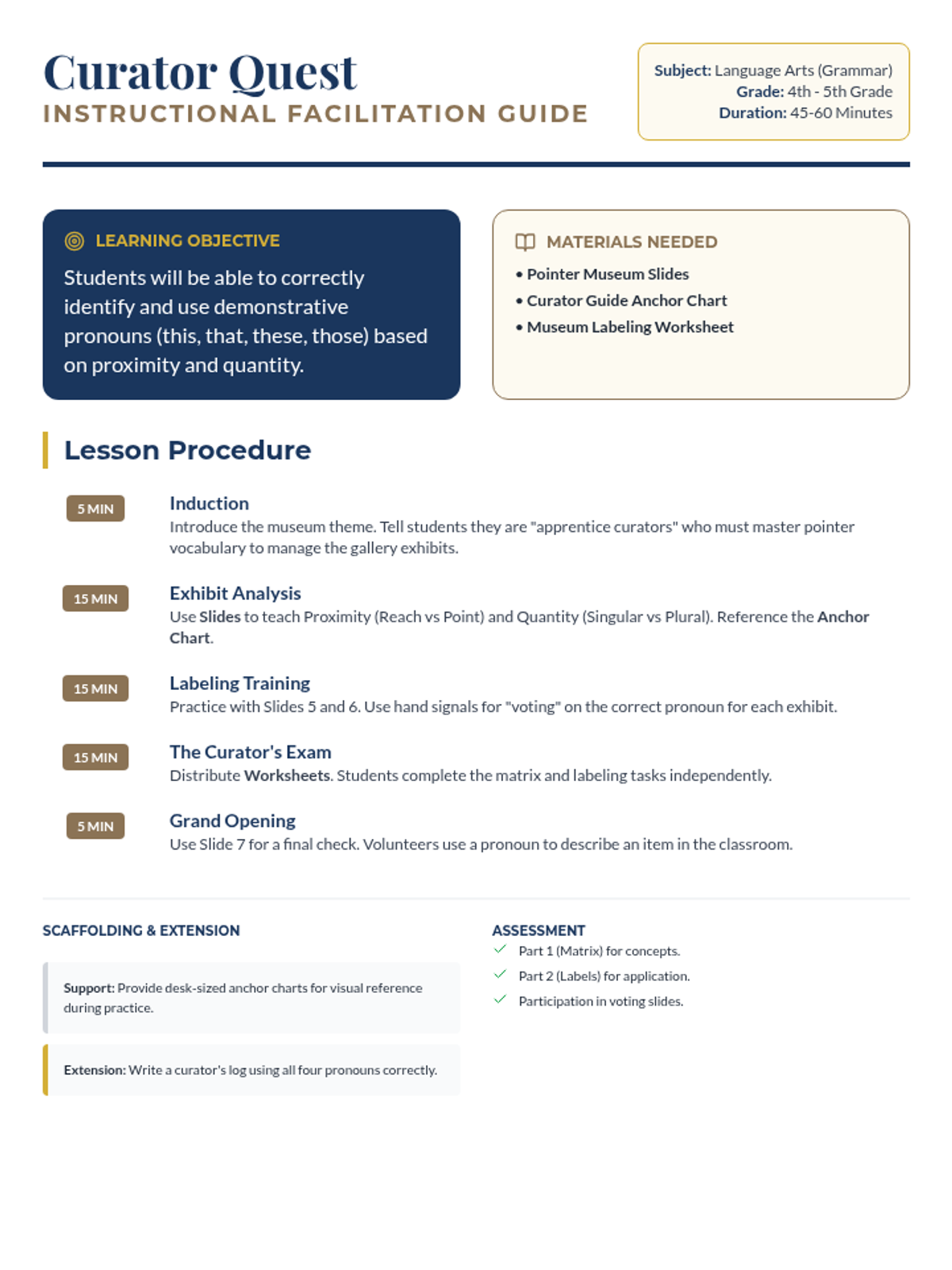
A detailed facilitation guide for teachers to deliver the Curator Quest lesson. It includes timing, step-by-step procedures, scaffolding suggestions, and assessment strategies aligned with the museum-themed materials.
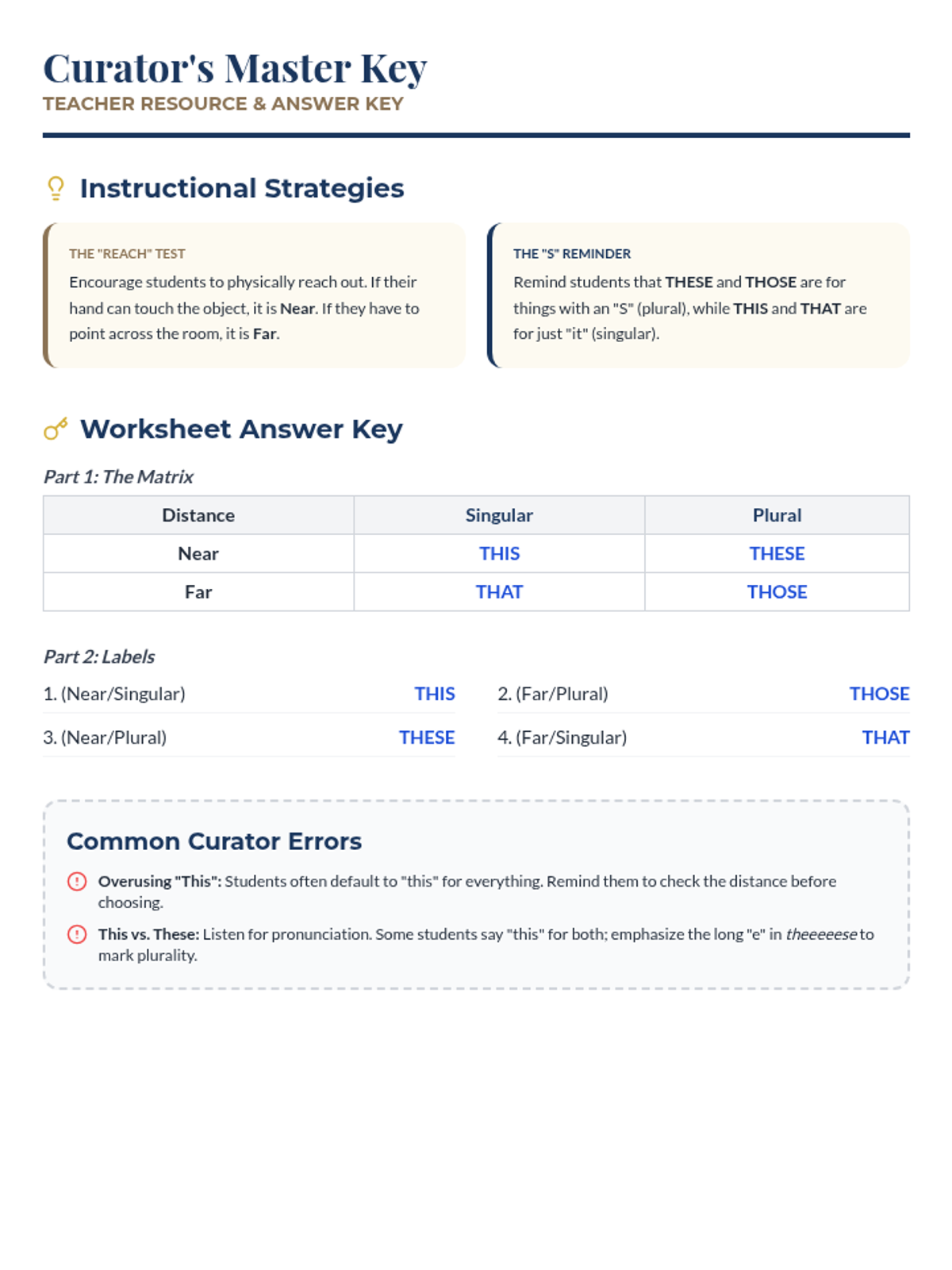
A teacher-facing resource providing the answer key for the museum worksheet along with teaching strategies and common student misconceptions regarding demonstrative pronouns.
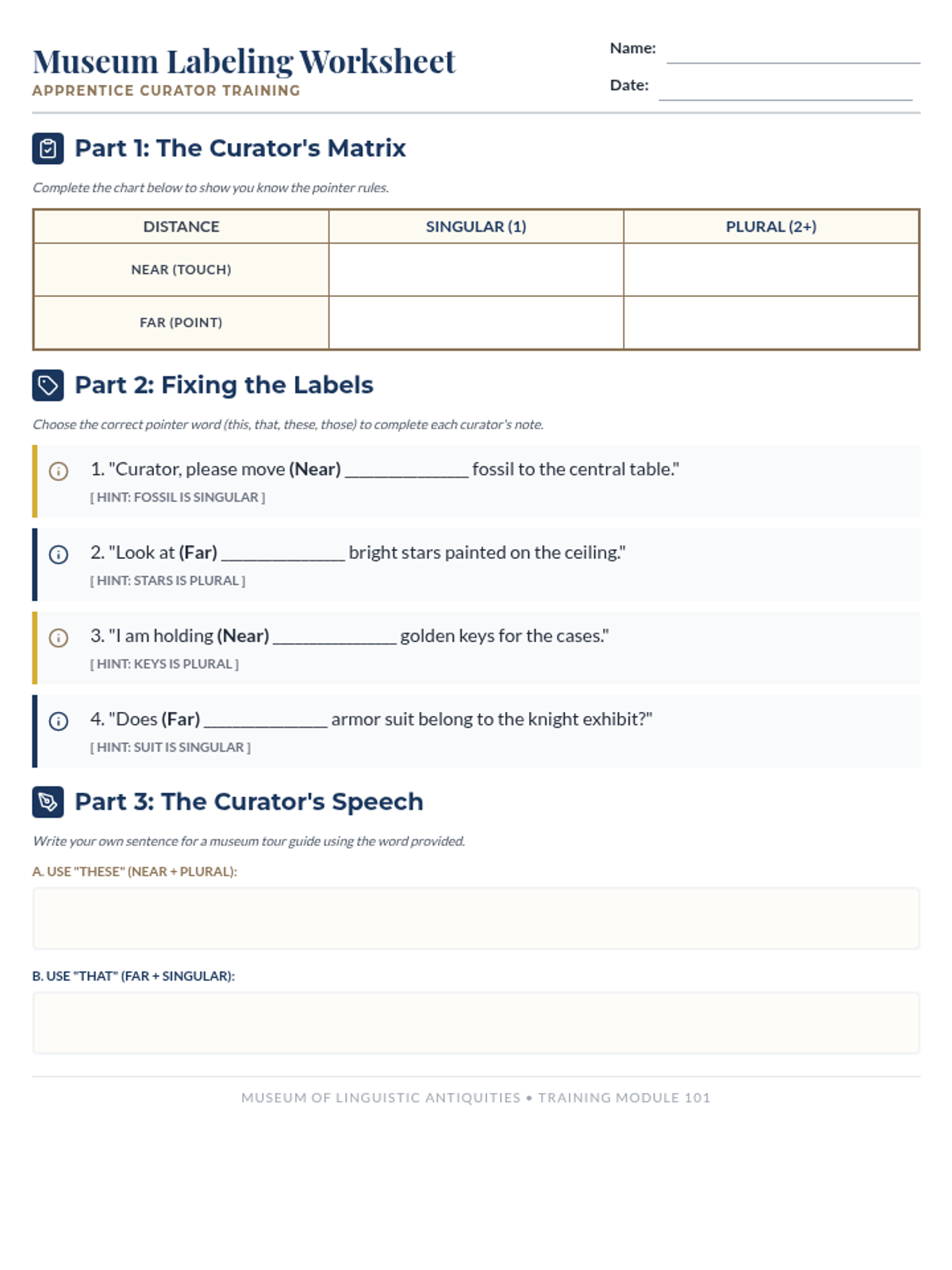
A practice worksheet where students apply their knowledge of pointer words in a museum curator context. It includes a recall chart, fill-in-the-blank sentences with proximity/quantity hints, and a sentence writing section.
A guided slide deck that introduces the concept of pointer words (demonstratives) using a museum curator theme. It breaks down the rules of proximity and quantity with clear visuals and guided practice slides.
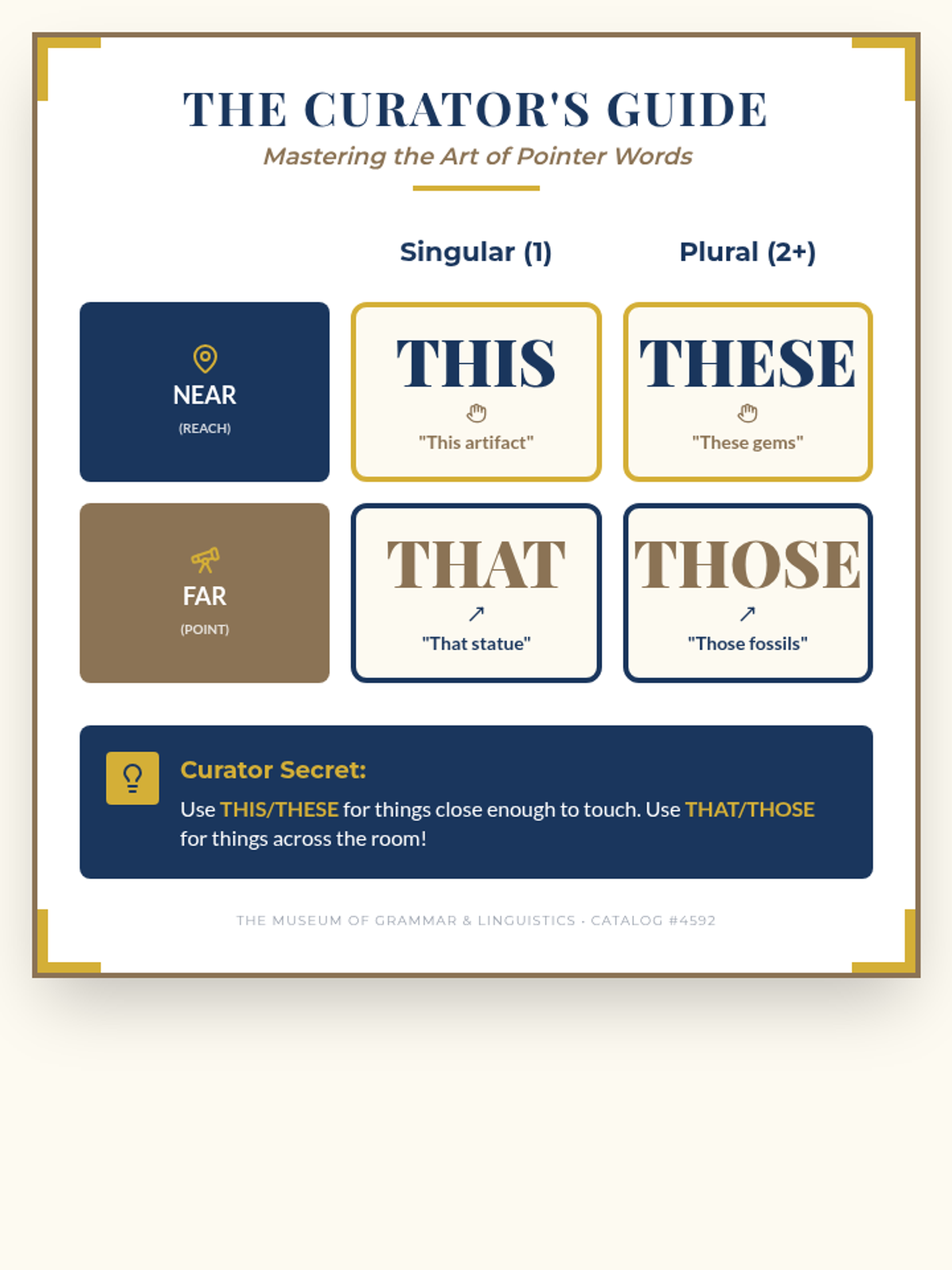
A visually striking anchor chart designed with a museum theme to teach the four demonstrative pronouns (this, that, these, those). It uses a 2x2 grid to clearly differentiate between number (singular/plural) and proximity (near/far).
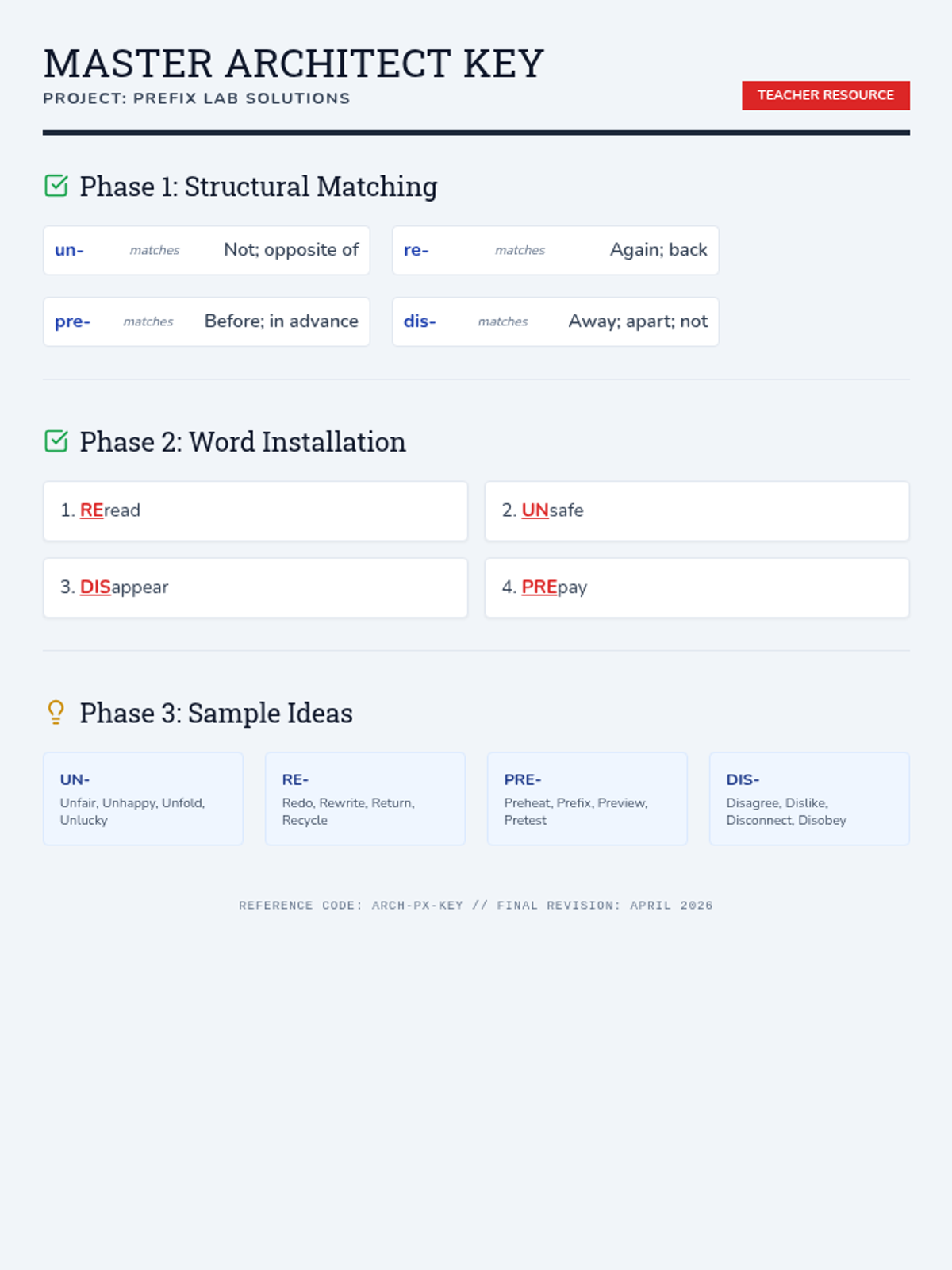
A comprehensive answer key for the Word Builder Worksheet, providing correct matches, sentence completions, and example ideas for teacher use.
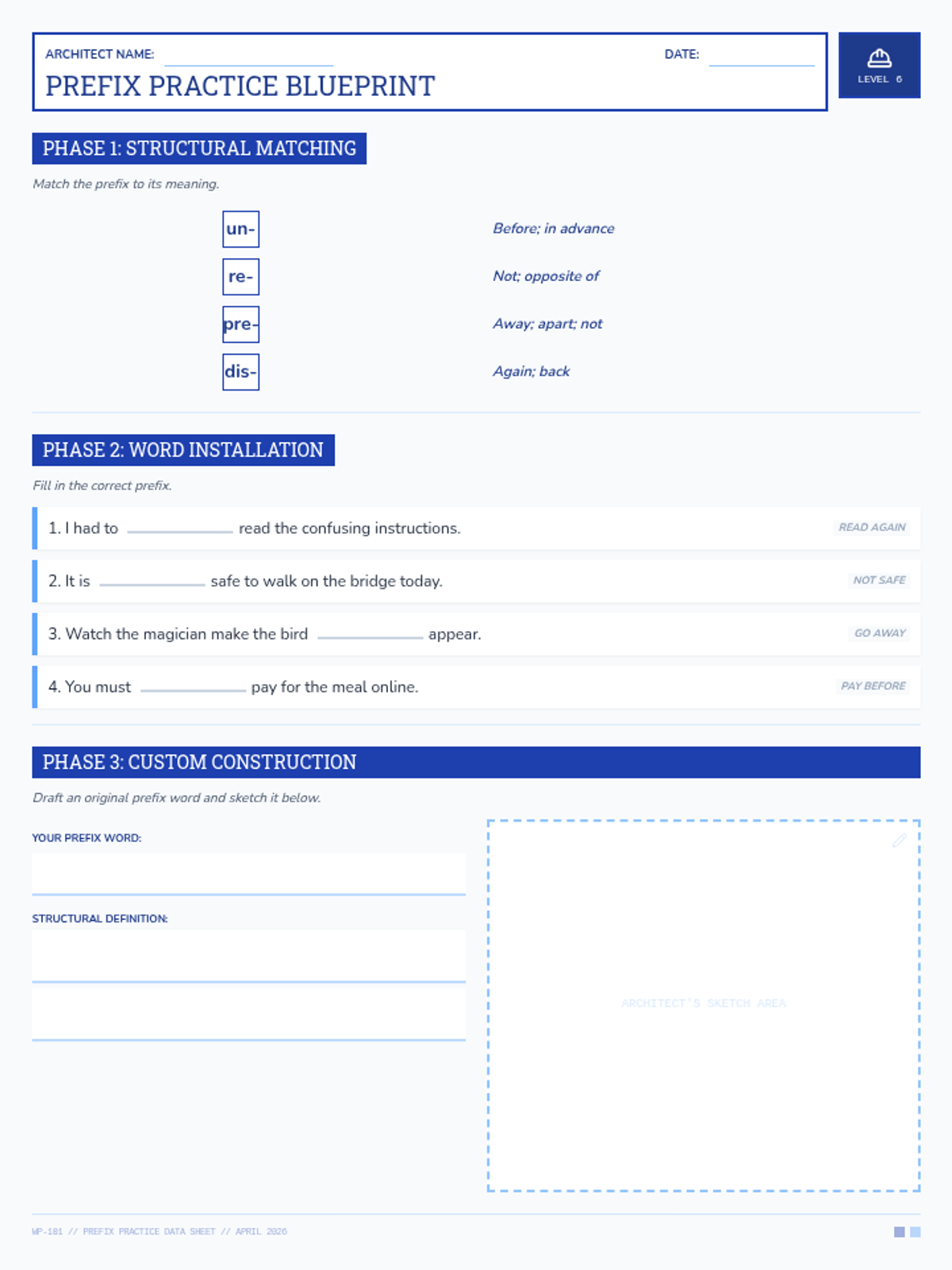
A student-facing worksheet designed to reinforce prefix knowledge through matching, sentence completion, and creative word construction. Styled with the 'Word Architect' blueprint theme.
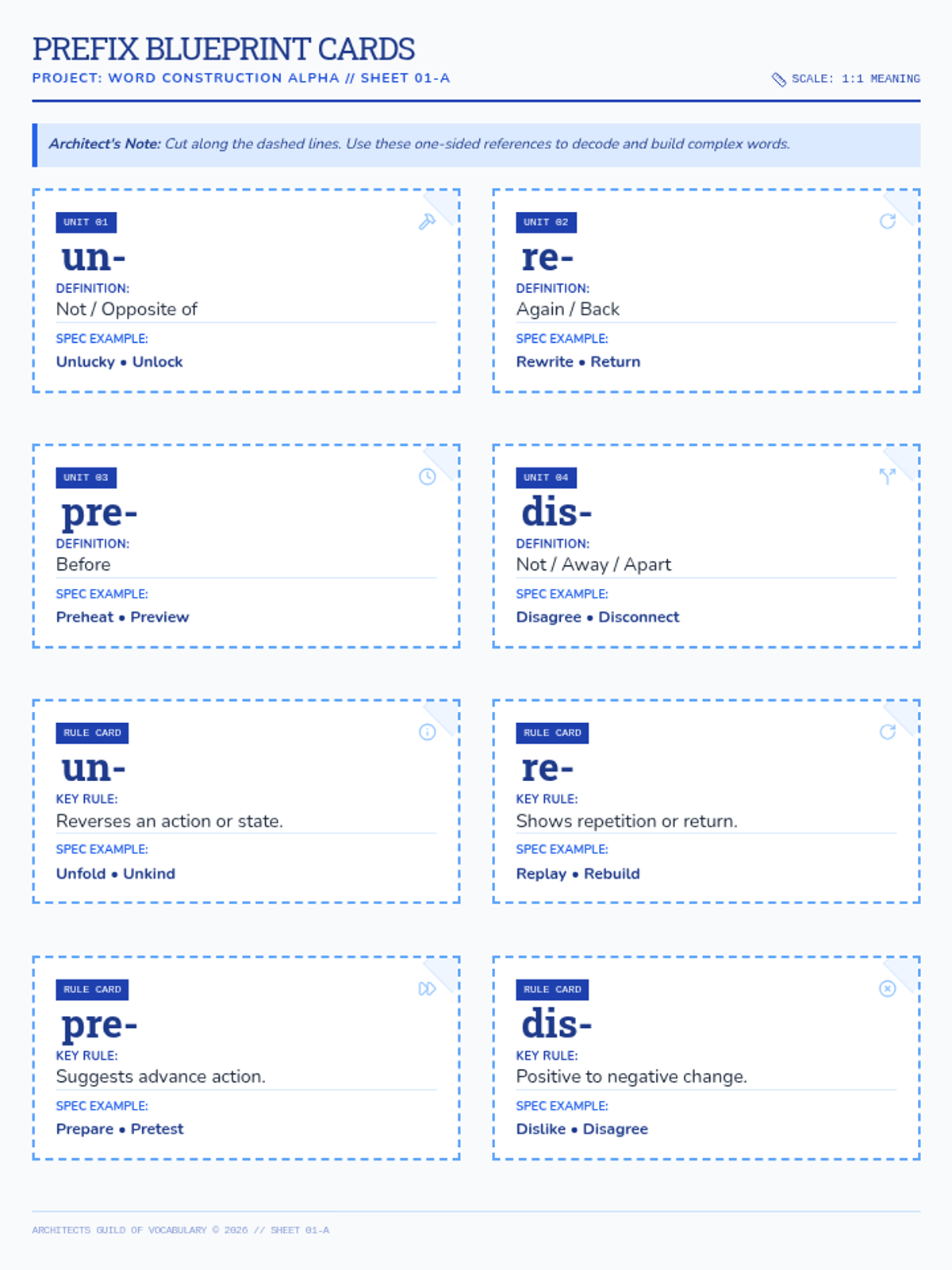
A collection of eight one-sided flashcards featuring the prefixes un-, re-, pre-, and dis-. Each card includes the prefix, its definition, a key rule, and example words, all styled with a professional 'Word Architect' blueprint aesthetic.
A slide presentation for the 'Sense Seekers' game, featuring mystery location descriptions to help students practice identifying sensory language.
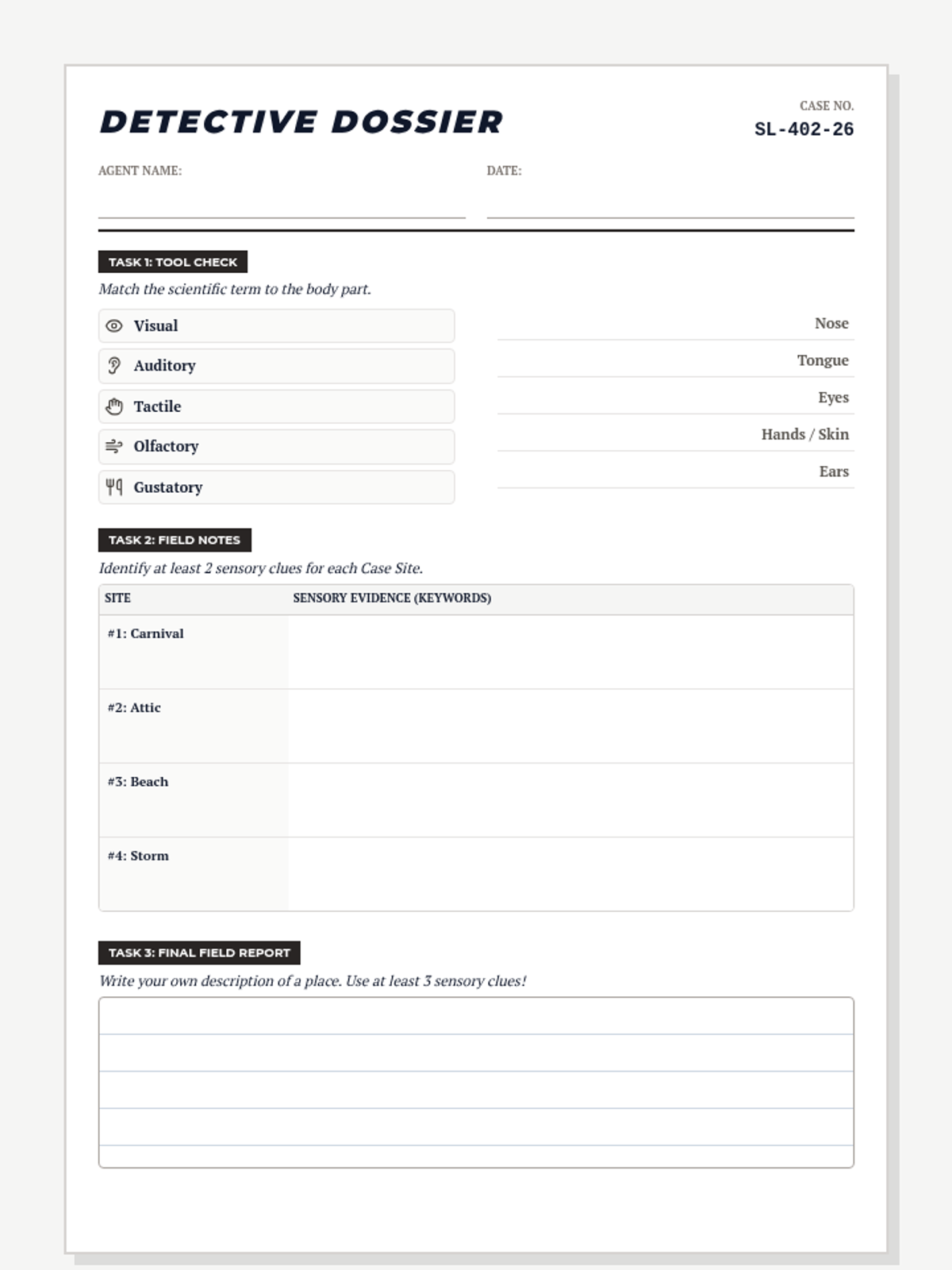
A student worksheet styled as a detective's dossier for recording sensory details found during the lesson game.
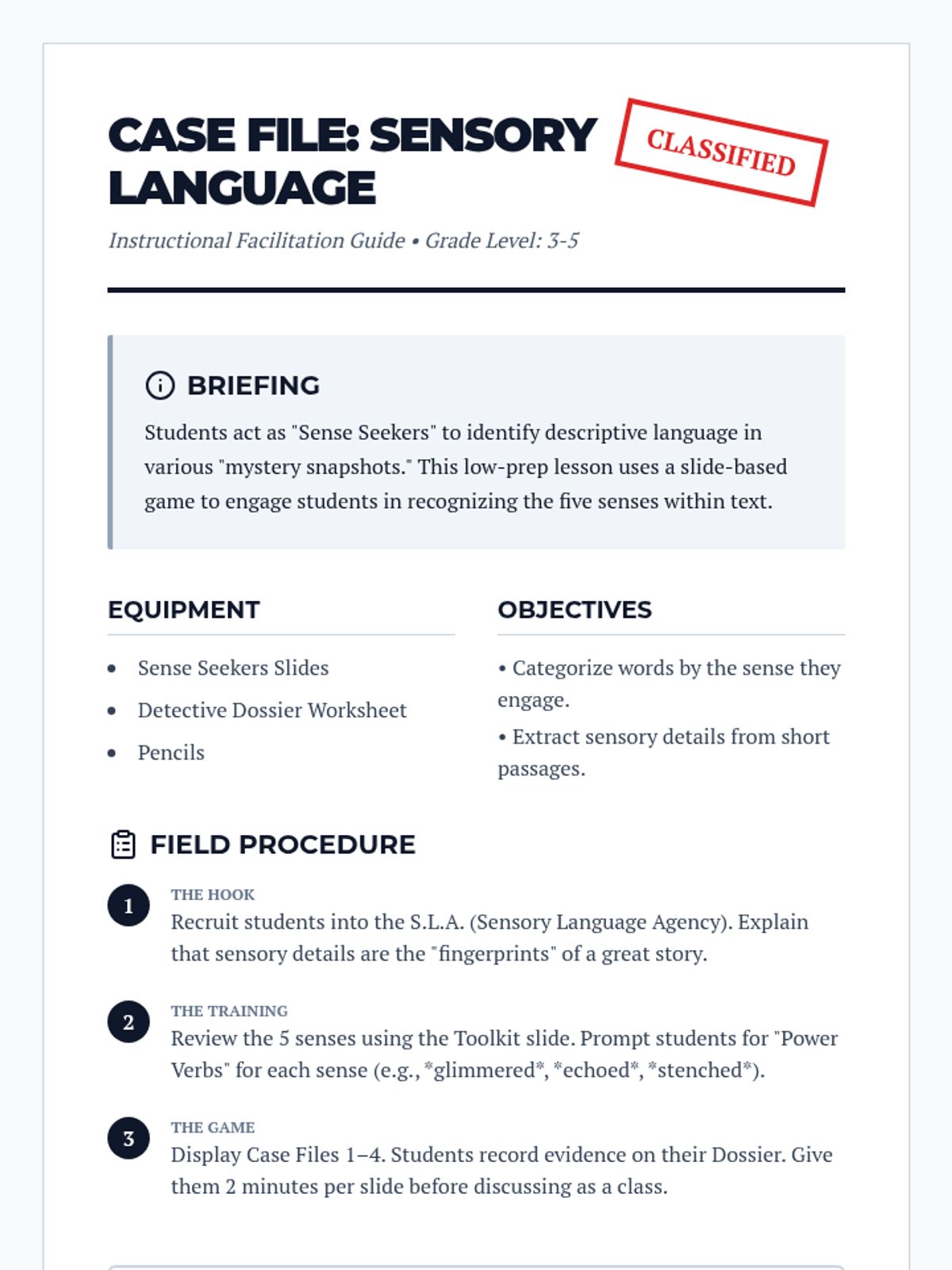
A teacher guide for the 'Sense Seekers' sensory language game, featuring setup instructions, learning objectives, and an answer key.
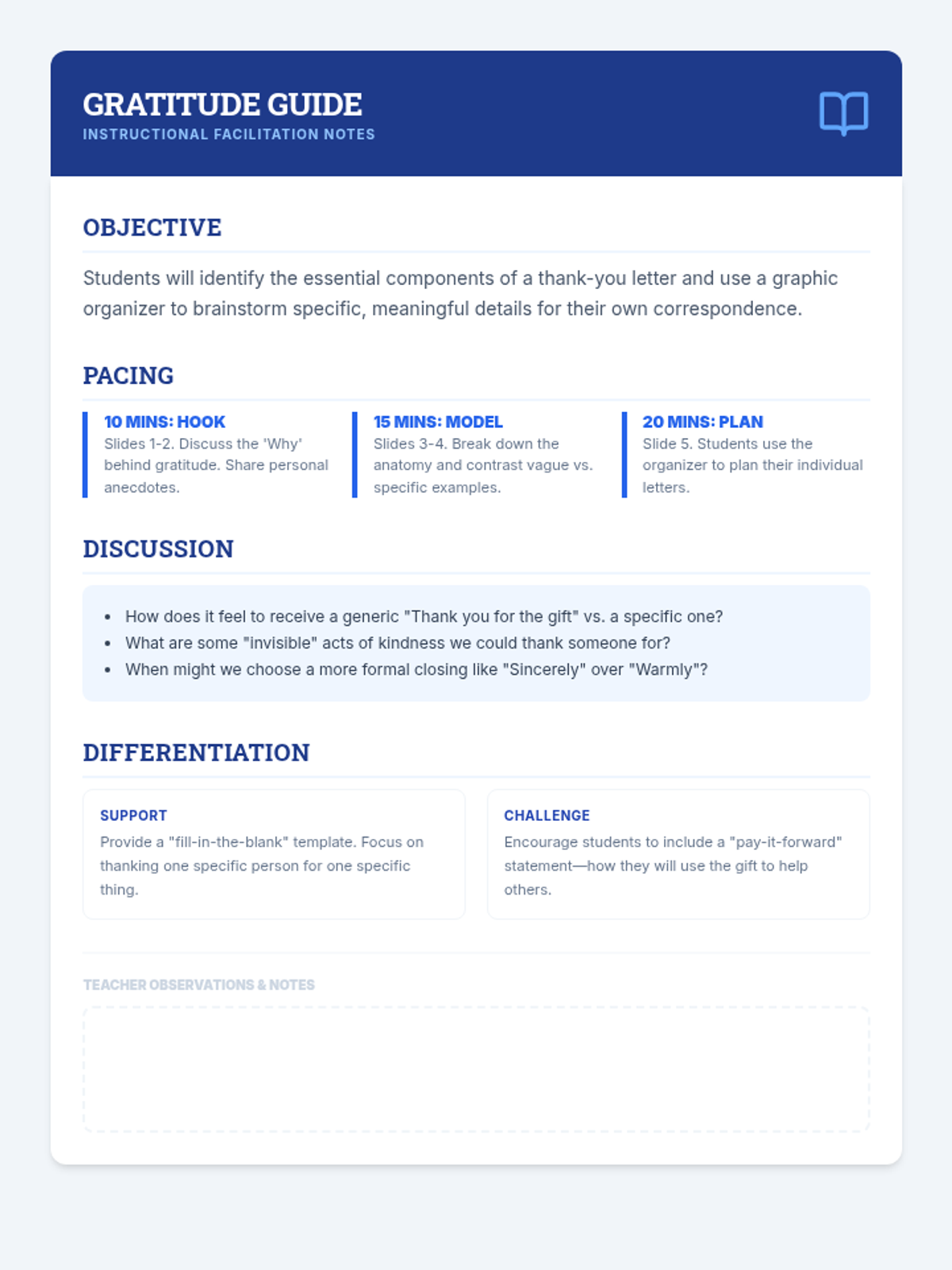
A teacher facilitation guide for the Heartfelt Gratitude lesson, including pacing, discussion prompts, and differentiation strategies.
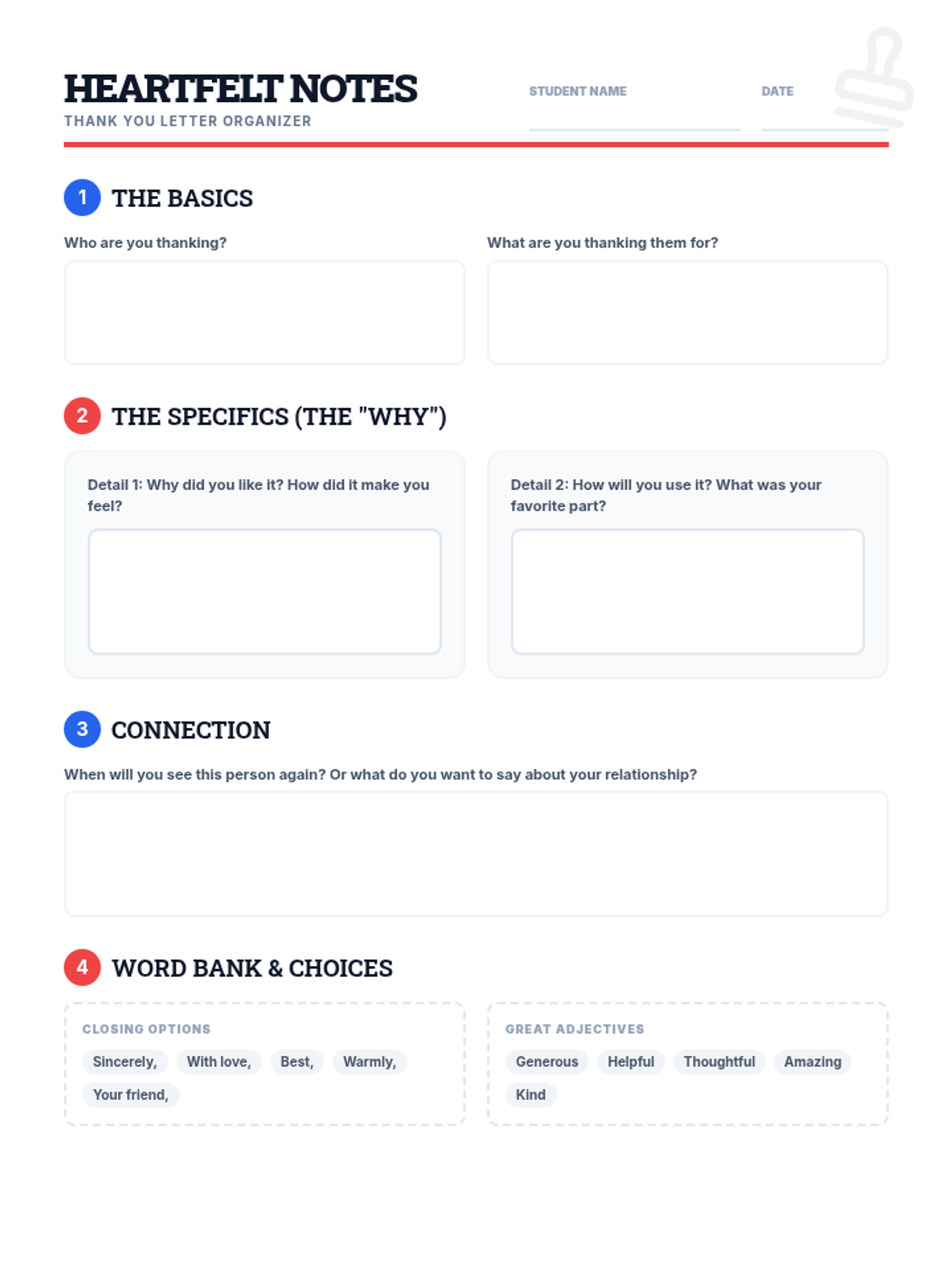
A structured graphic organizer for students to plan the content of a thank-you letter, including sections for the recipient, specific details, and closing choices.
Educational slides introducing the importance of thank-you letters, their structural components, and how to write specific, meaningful messages.
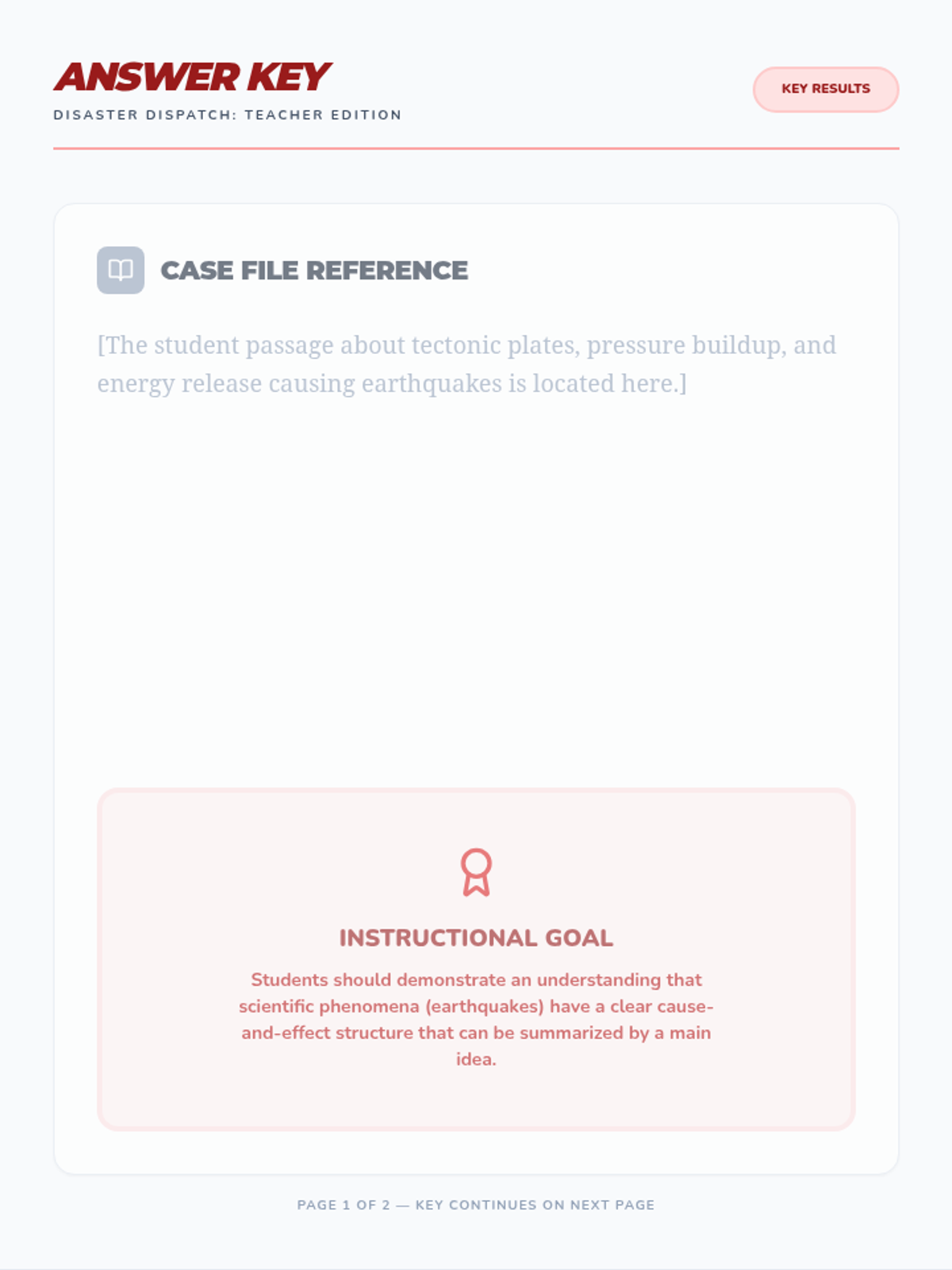
An answer key for the Disaster Details Worksheet, providing a model main idea and supporting details from the earthquake passage. This key matches the 2-page layout of the student worksheet.
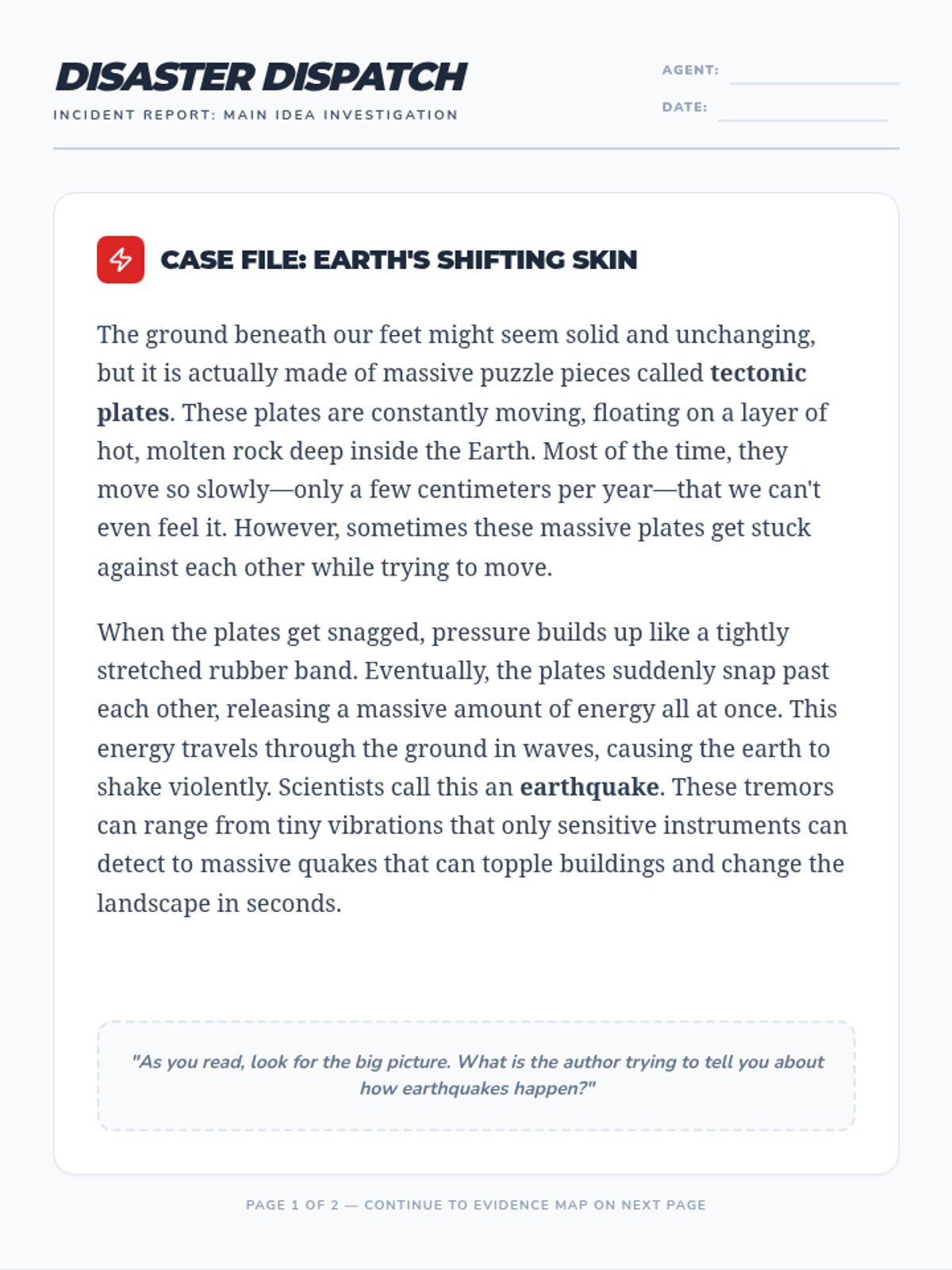
A revised student practice sheet featuring a non-fiction reading passage about earthquakes and a graphic organizer to identify the main idea and supporting details. Includes fixed page breaks and improved student work areas.
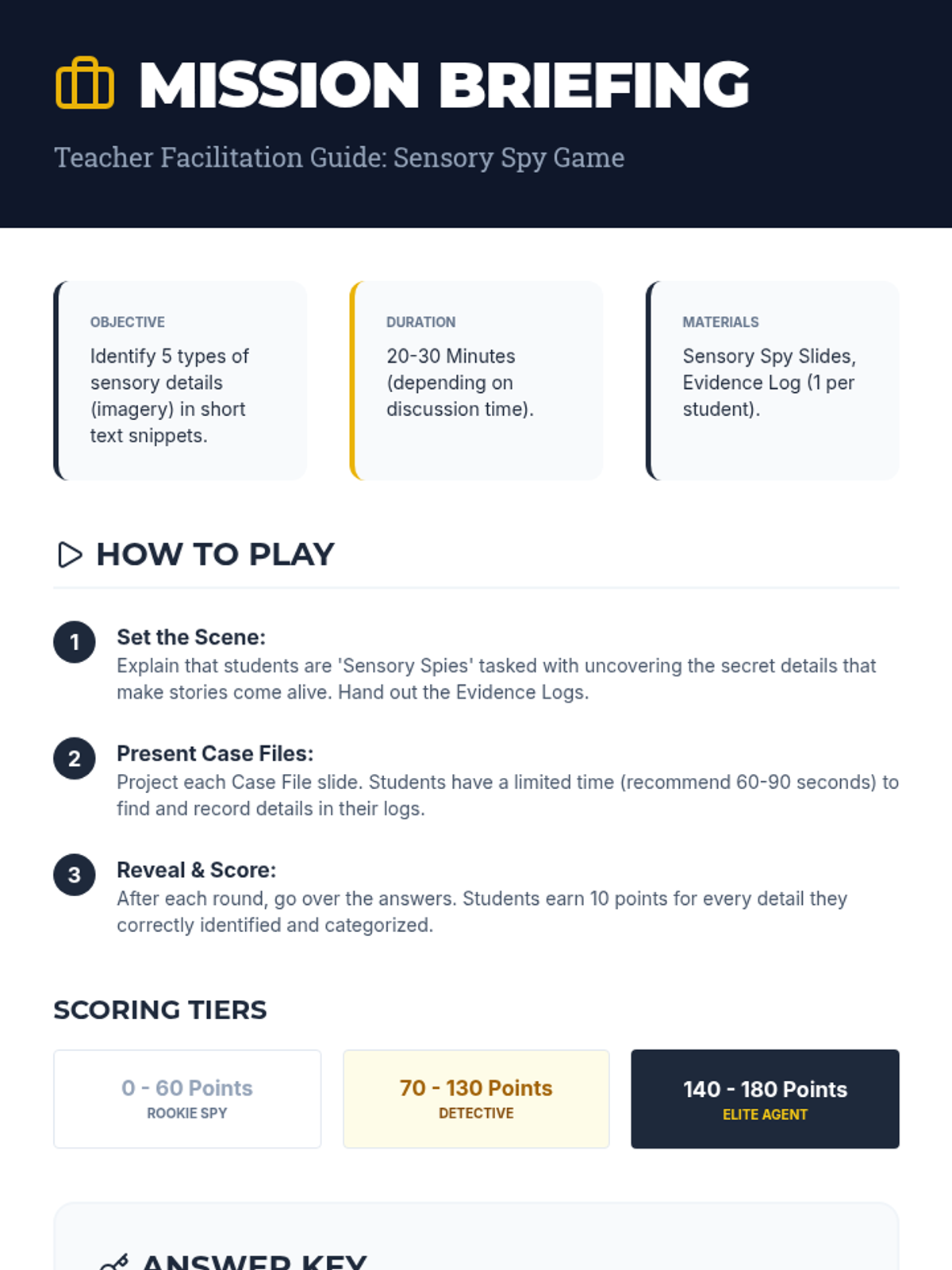
A teacher's mission briefing and answer key for the Sensory Spy game. It provides a quick-start guide, duration, objectives, and detailed answers for all three case files included in the slides.
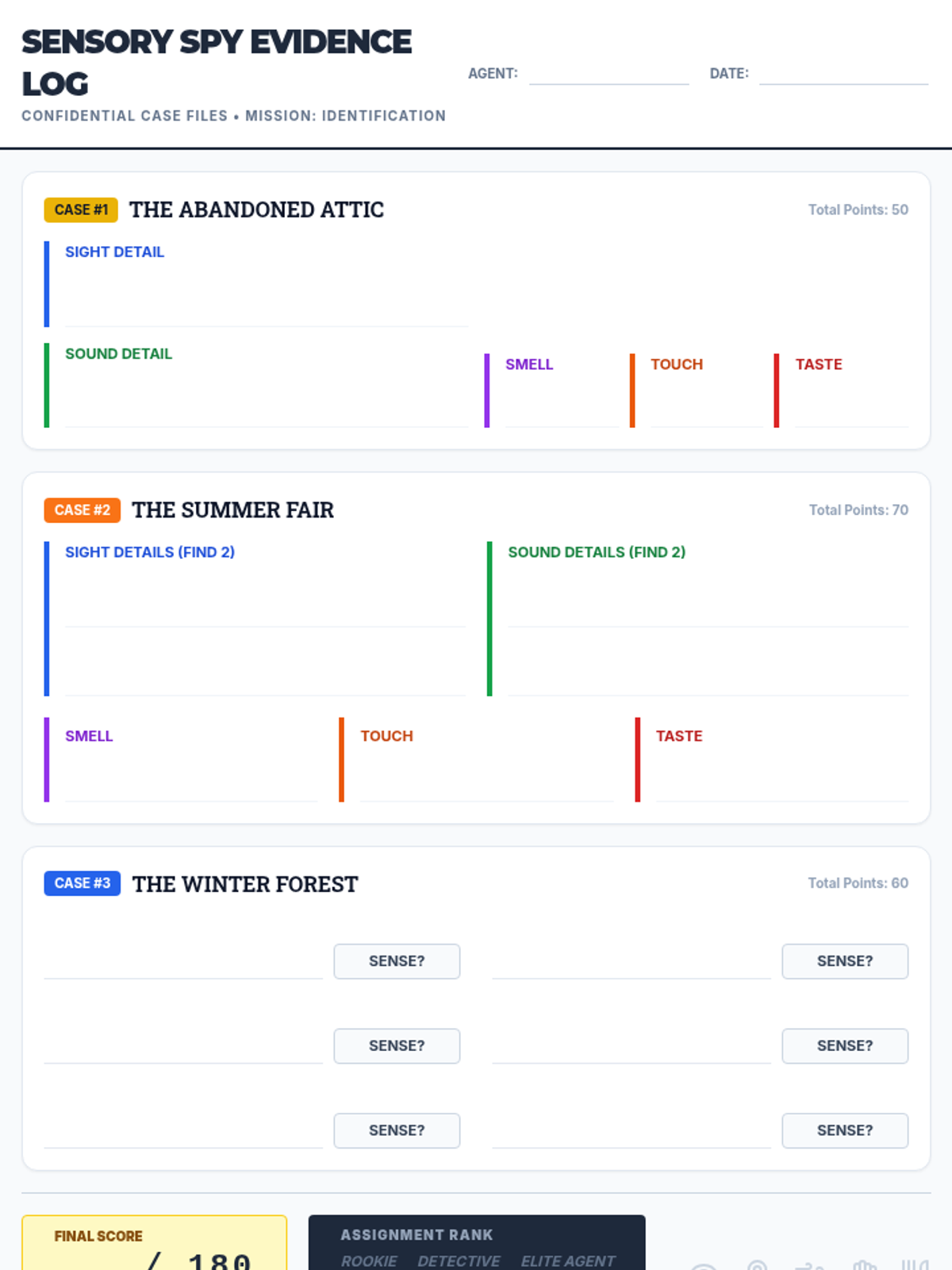
A student evidence log for the Sensory Spy game. Features themed 'Case File' sections for students to record and categorize sensory details found in the presentation, including a scoring area and rank system.
A high-energy slide deck for a 'Sensory Spy' game. It includes three 'Case Files' (short stories) with increasing difficulty, designed to help students practice identifying imagery and sensory details in a competitive, game-like format.
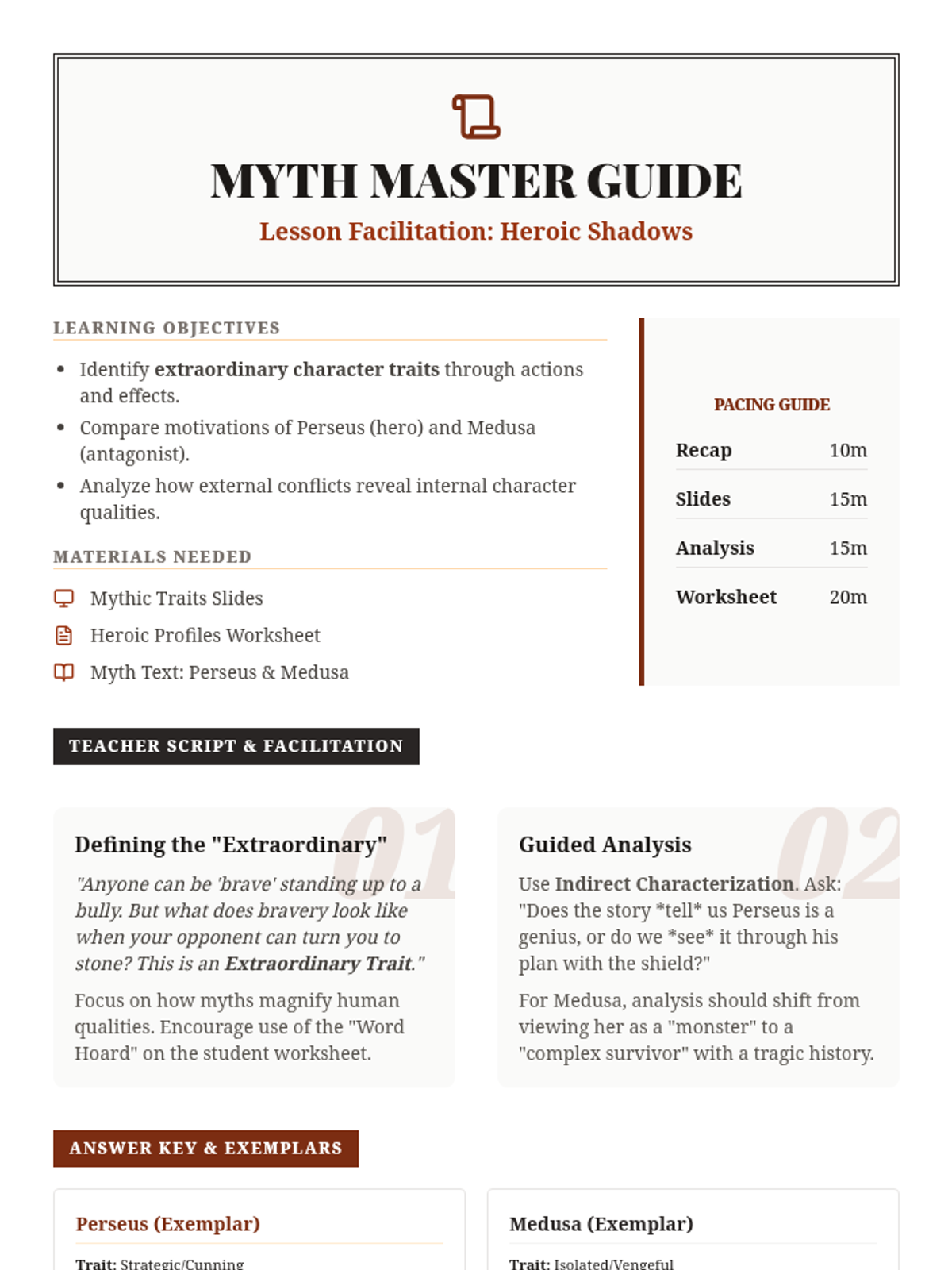
A teacher's guide for the Heroic Shadows lesson. Optimized layout to fit all content on two pages, fixed overlapping background numbers, and improved text contrast for the pacing guide.
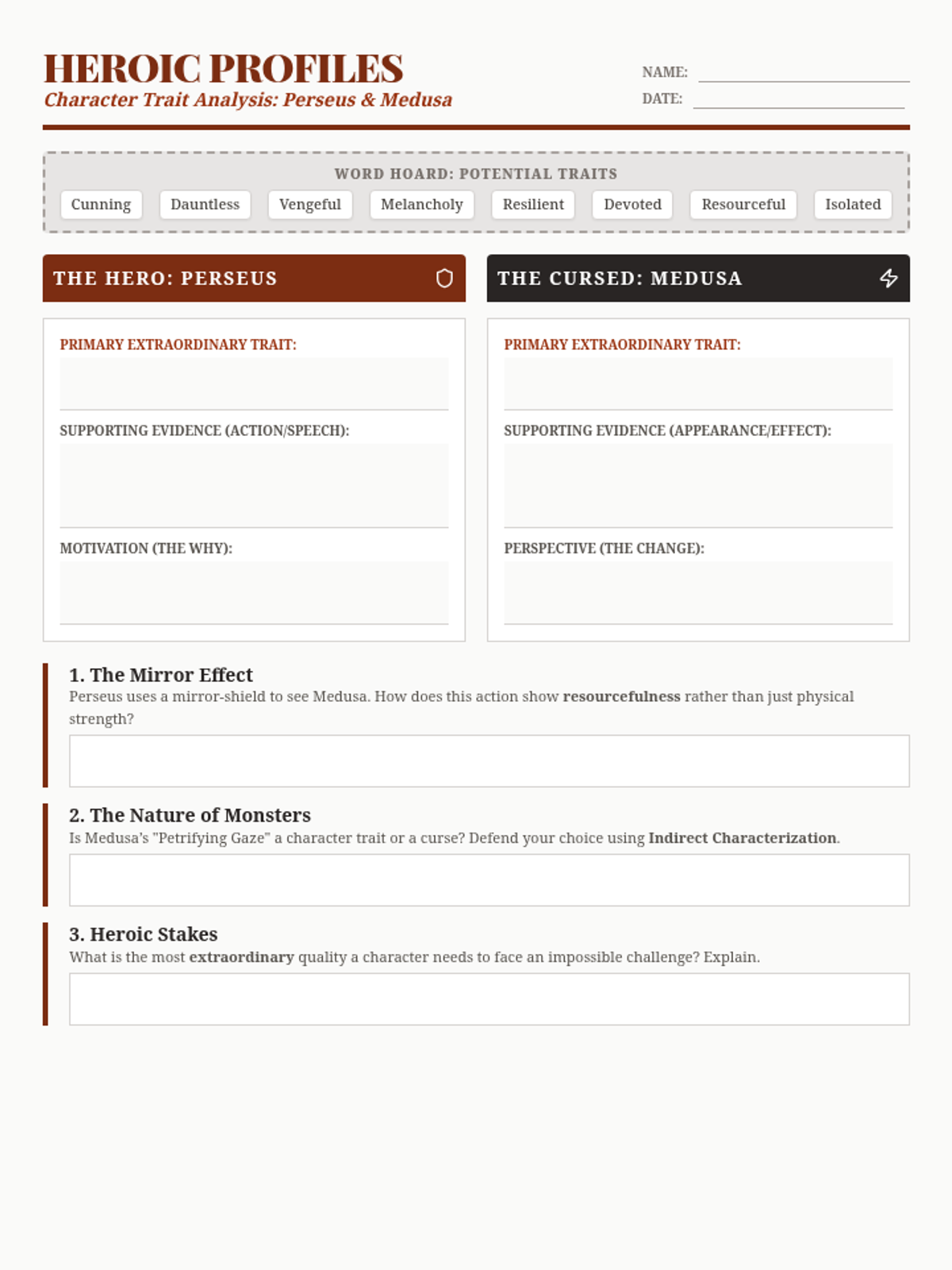
A student worksheet for identifying and providing evidence for character traits in Perseus and Medusa. Condensed to fit a single page with optimized writing areas and a trait bank. Adjusted font sizes for better legibility.
A presentation exploring character traits through the myth of Perseus and Medusa, focusing on extraordinary qualities revealed through heroic action and tragic transformation. Corrected spelling and standardized borders.
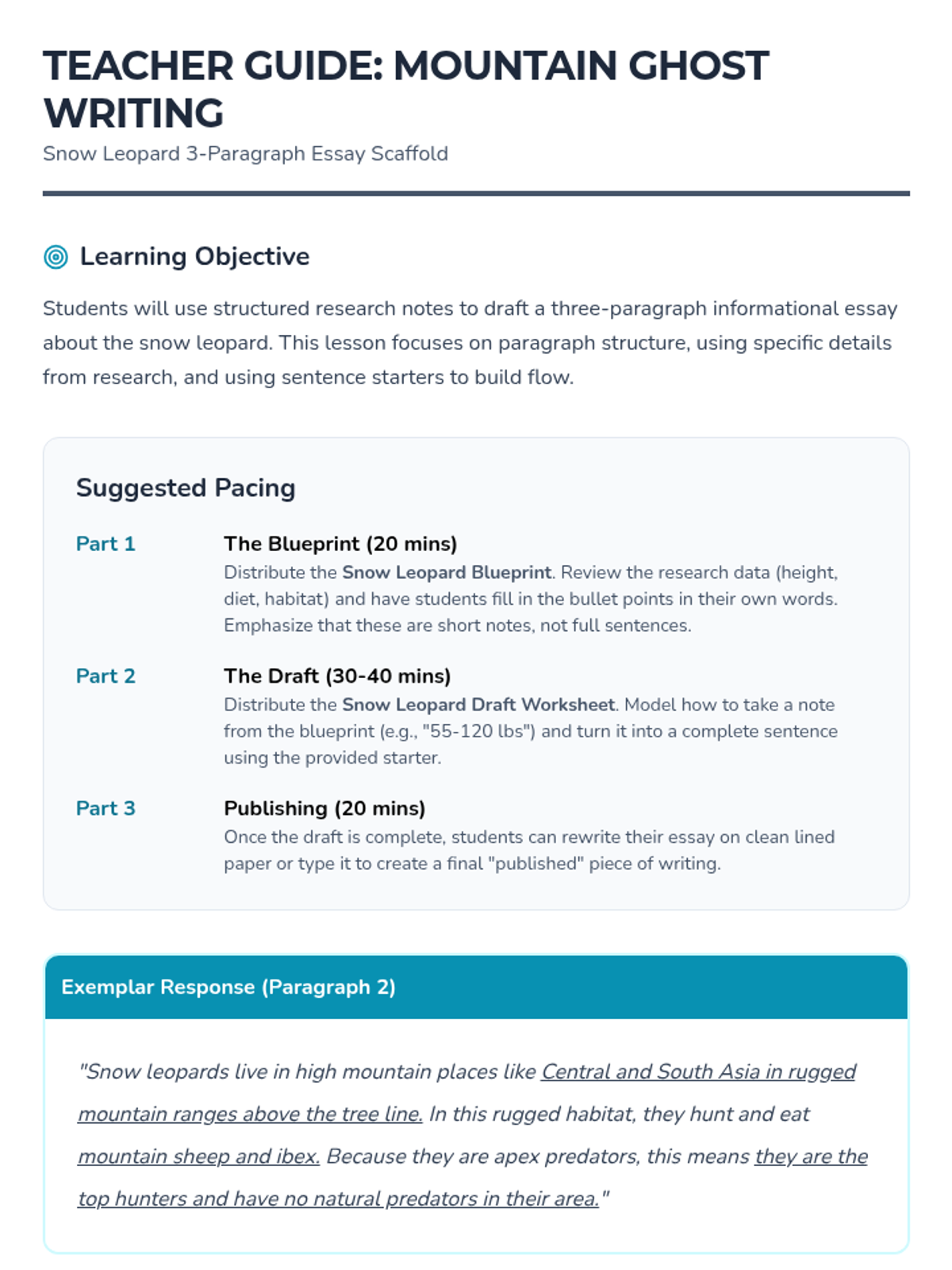
A facilitation guide for teachers to use when implementing the snow leopard writing lesson, including pacing, an exemplar paragraph, and teaching tips.
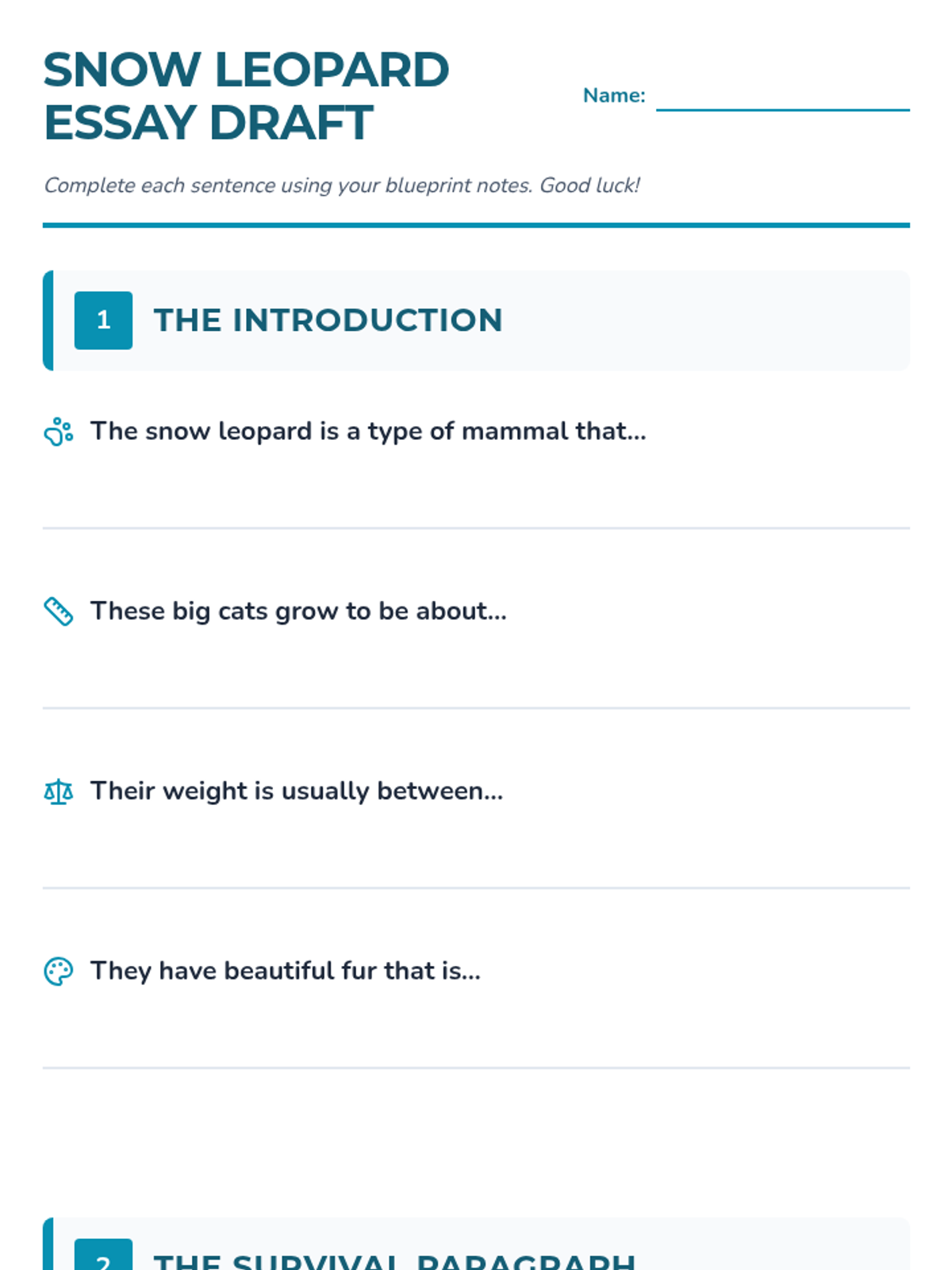
A scaffolded drafting sheet with sentence starters for every sentence of a three-paragraph snow leopard essay, accompanied by visual prompts. Each paragraph is clearly separated with ample writing space.
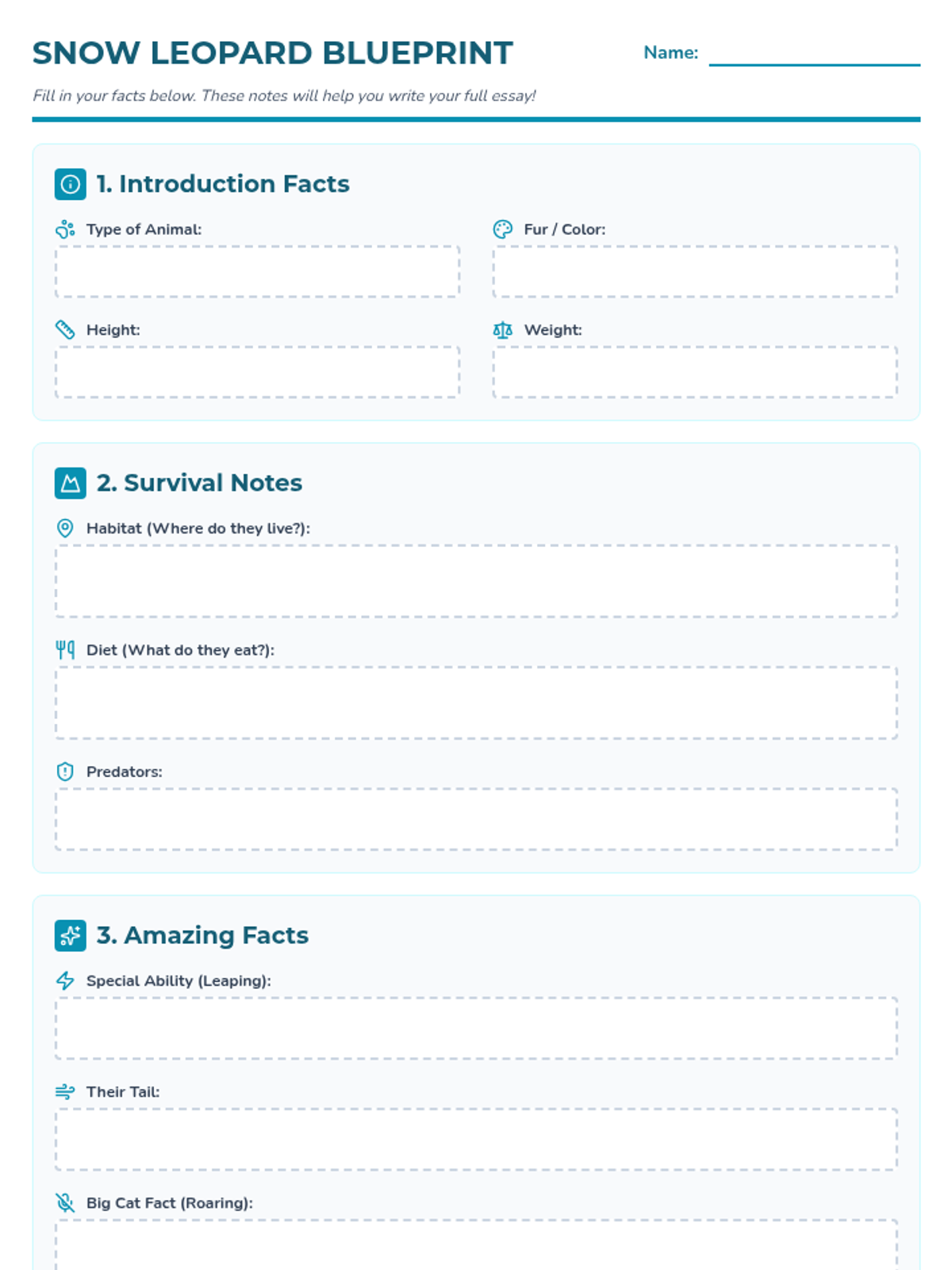
A visual graphic organizer worksheet with icons and bullet point sections for students to plan their three-paragraph essay on snow leopards. This simplified blueprint focuses on quick note-taking.
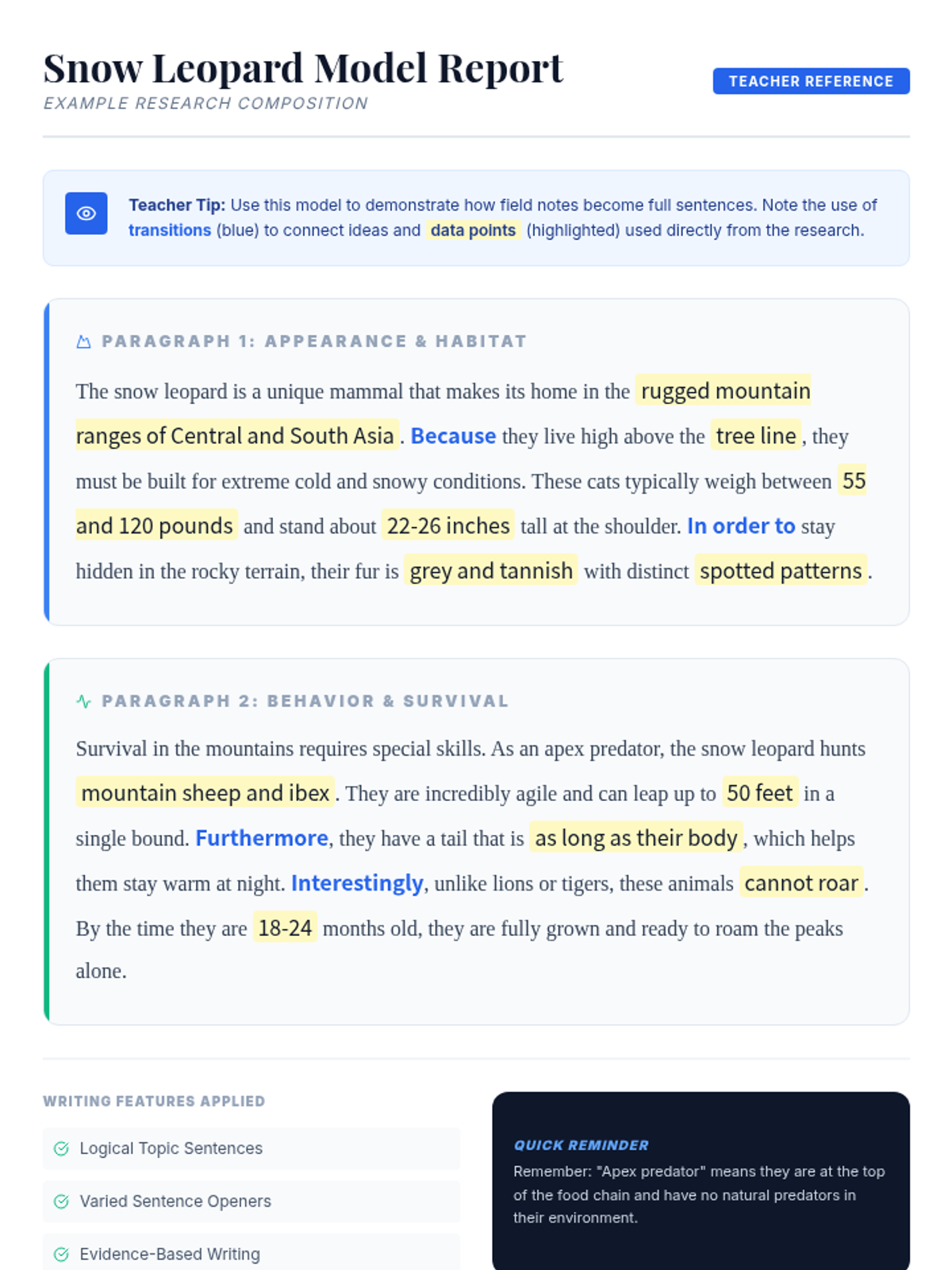
A model research report that demonstrates how to transform snow leopard field notes into structured paragraphs, highlighting transitions and specific data points.
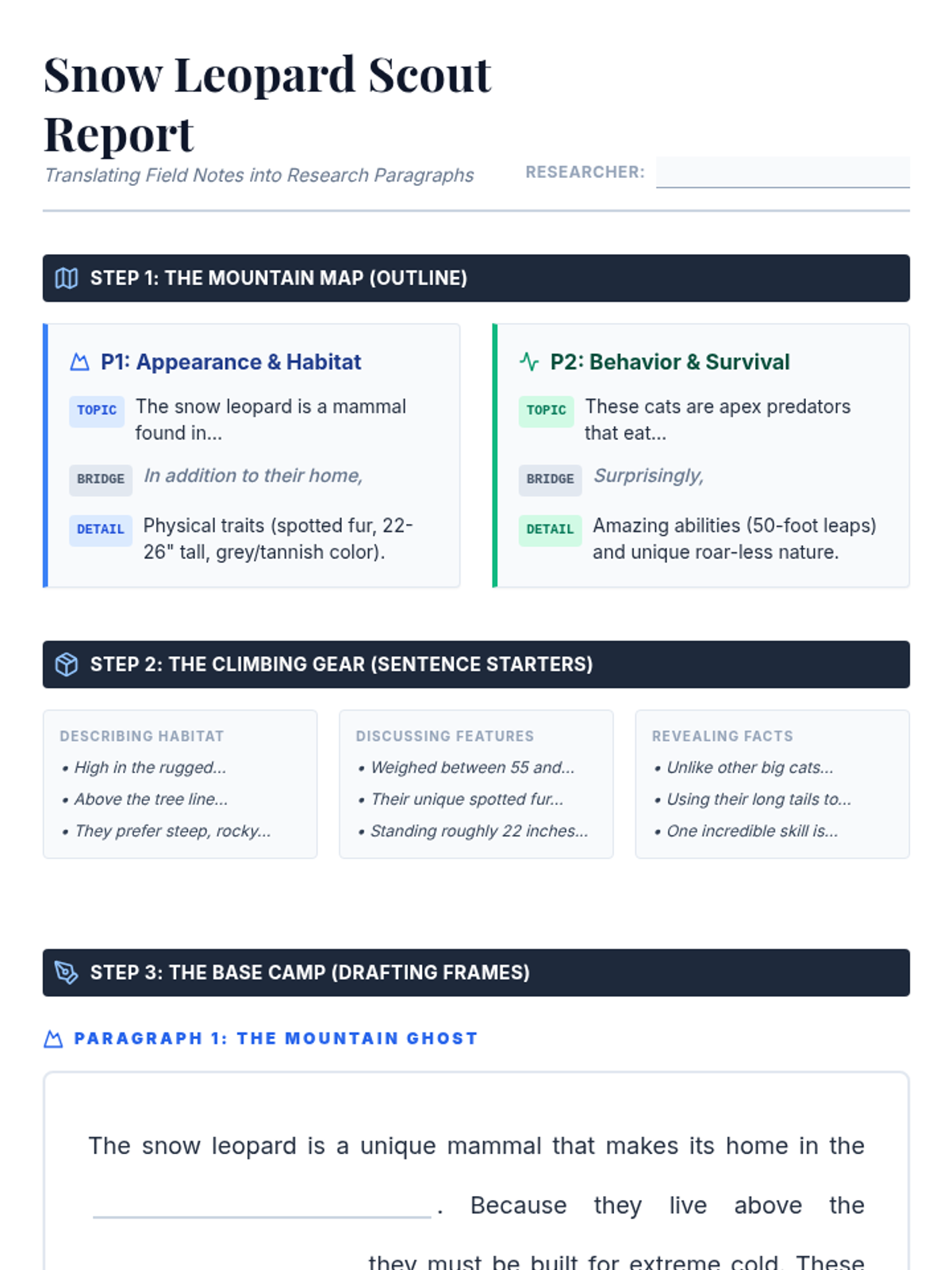
A structured writing tool for a snow leopard research report featuring an outline with transitions, sentence starters, and paragraph frames for physical traits, habitat, and behavior.
A cinematic, secret agent themed presentation deck to introduce irregular plurals with vowel shifts.
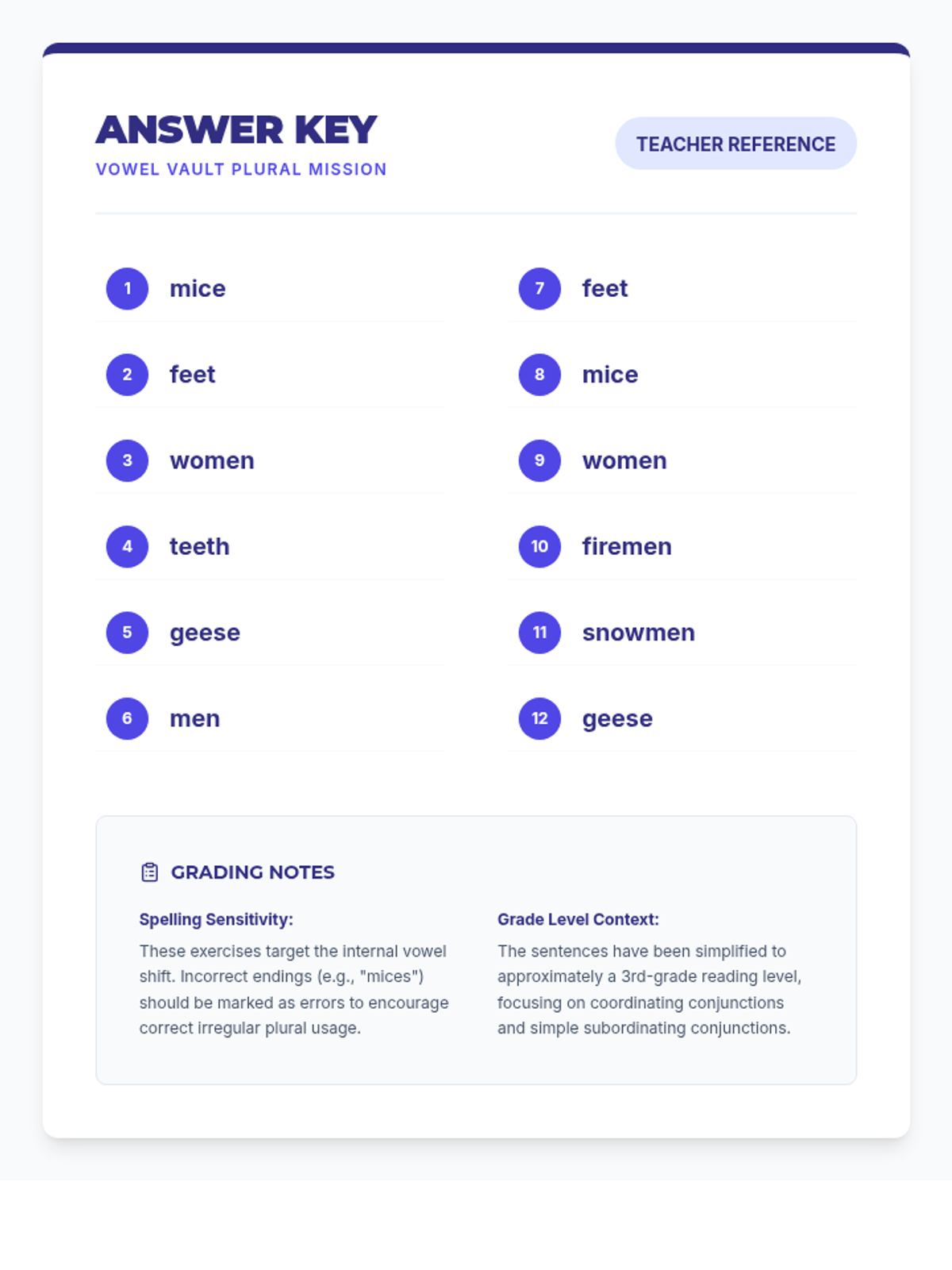
The answer key for the updated Vowel Vault Worksheet, providing correct plural forms and grading notes at a 3rd-grade reading level.
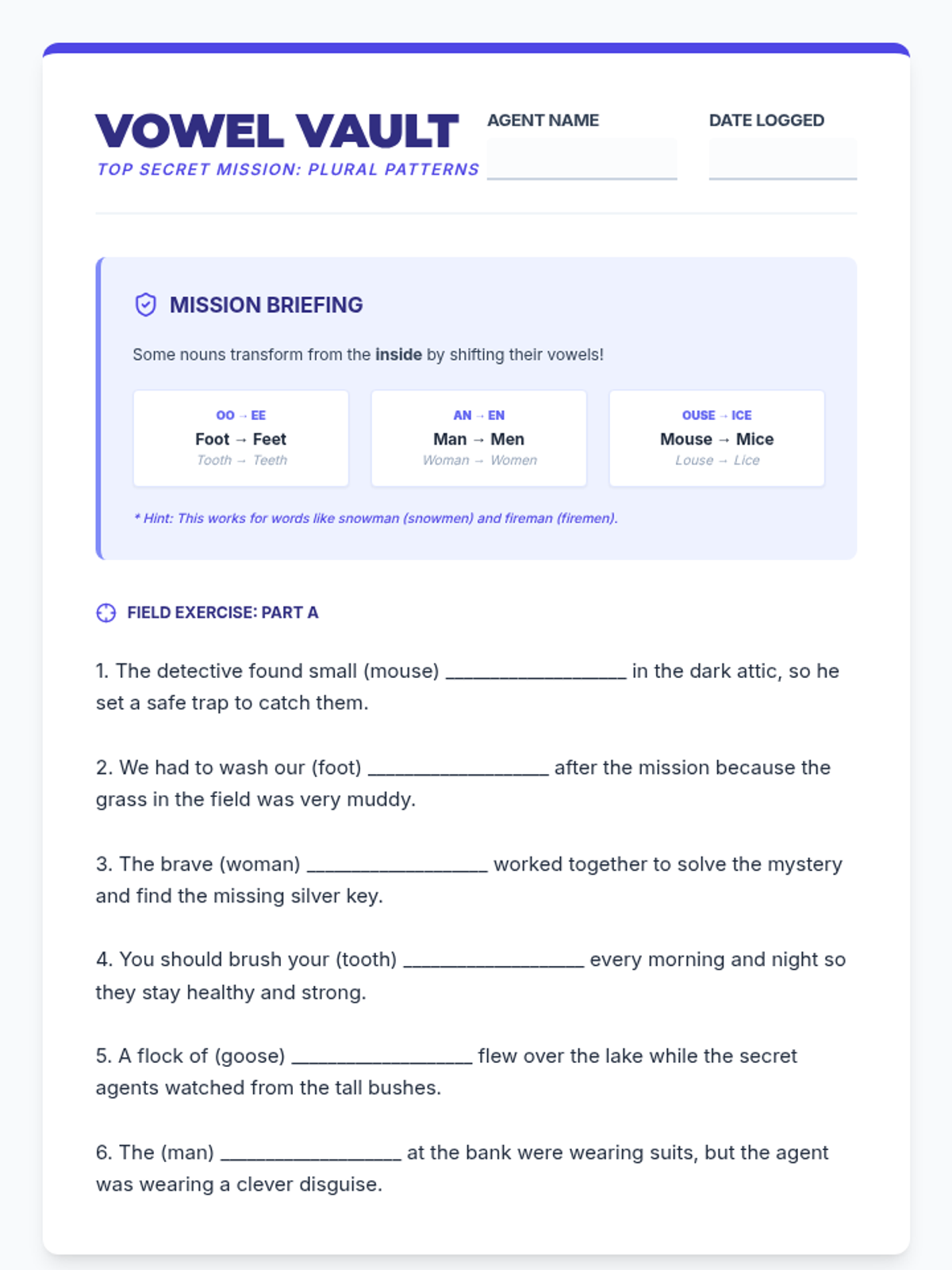
A two-page secret agent themed worksheet for practicing irregular plurals with vowel shift patterns through sentence completion at a 3rd-grade level.
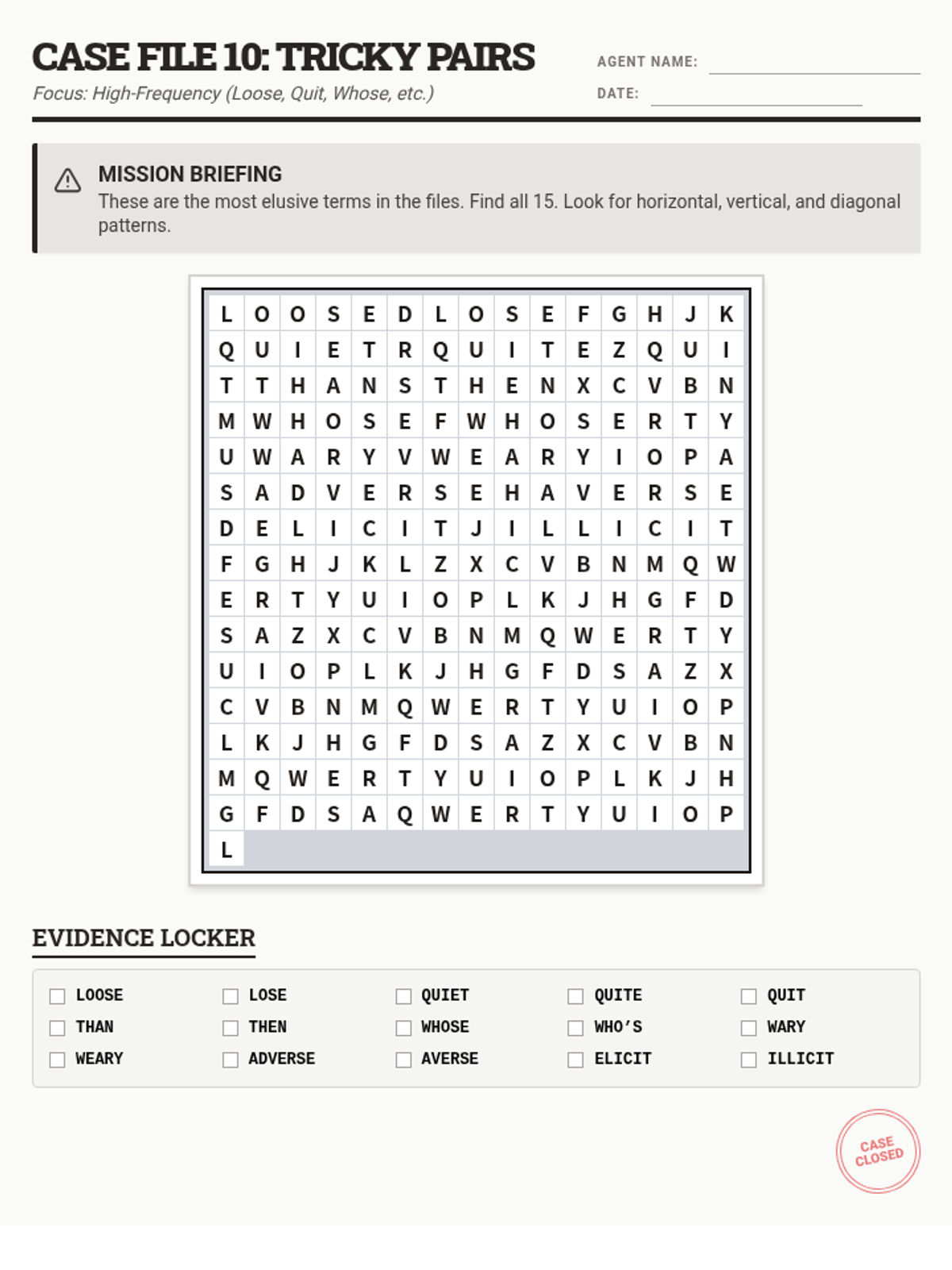
The final word search worksheet focusing on the most difficult commonly confused word pairs like loose/lose and than/then. Closes the detective case theme.
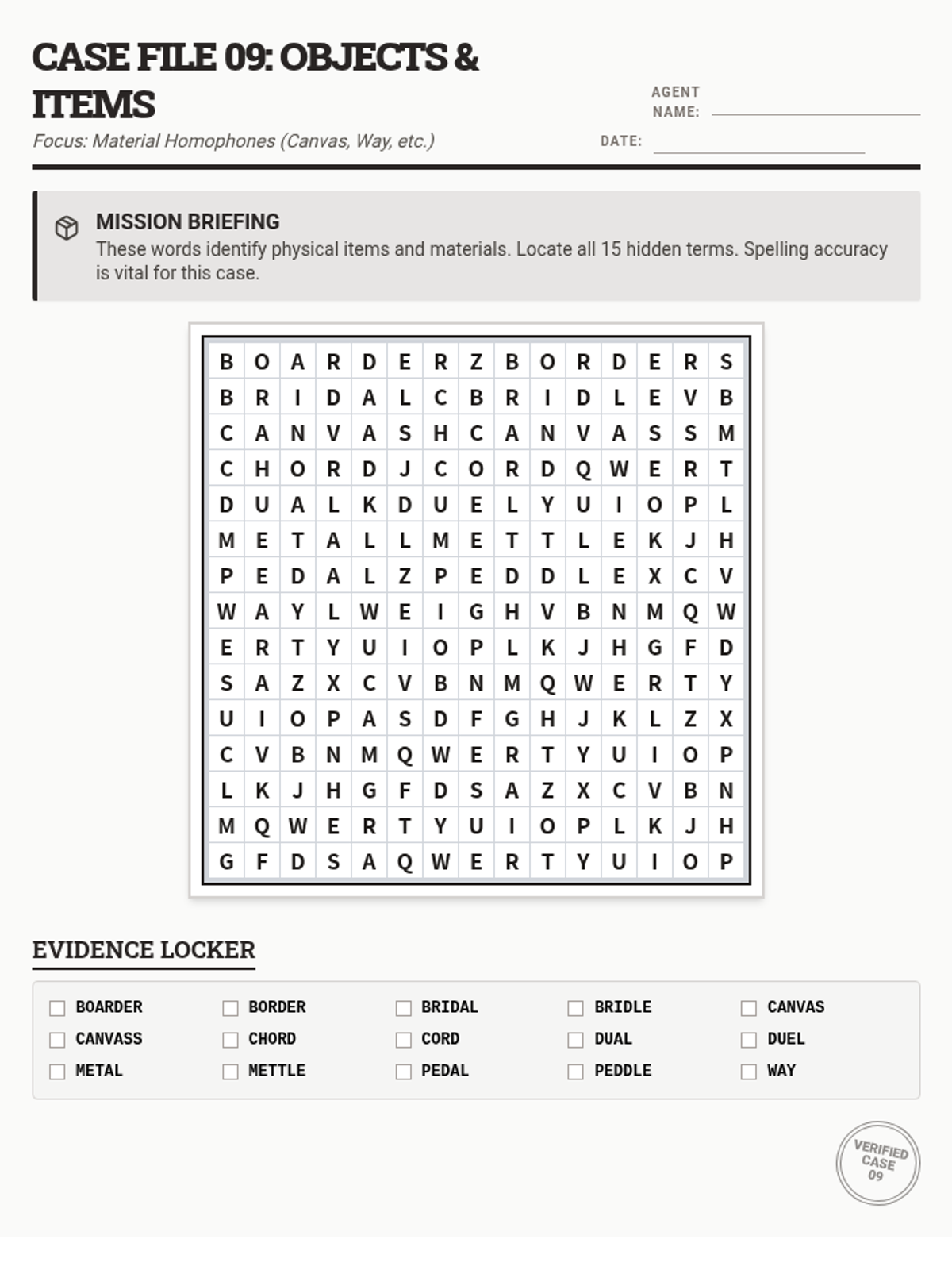
A word search focused on object-based homophones like metal/mettle and canvas/canvass. Features an industrial materials case theme.
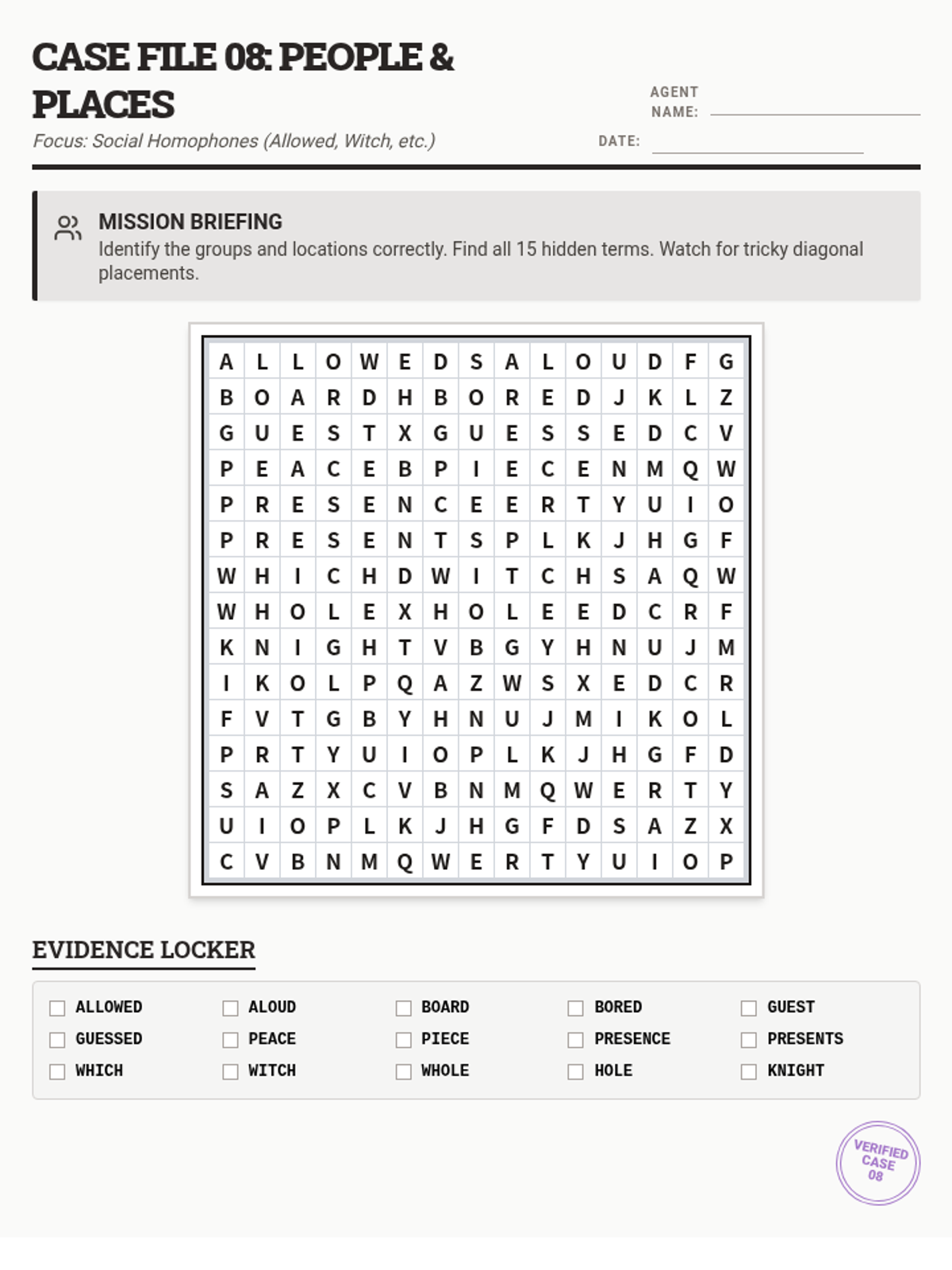
A word search worksheet covering social and location-based homophones like allowed/aloud and which/witch. Community case file theme.