A comprehensive teacher guide for the Sherlock Holmes unit, featuring lesson objectives, key vocabulary, a worked exemplar for "The Red-Headed League," and high-level discussion prompts.
Teacher resource containing the answer key for the analysis worksheet, an exemplar short constructed response, and debate facilitation prompts for 'The Interlopers.'
Student guide and organizer for a formal debate on the thematic conflicts in 'The Interlopers.' Includes instructions, evidence organizers, and a listening log to meet English II speaking/listening standards.
Updated student worksheet with additional advanced multiple-choice questions (Q7-8) and a second, more difficult short constructed response focusing on the shifting motif of the 'interloper.'
Introductory slide deck for English II students covering Saki's 'The Interlopers.' Includes vocabulary focus (connotation/denotation), literary device analysis (irony), and debate prep for the thematic conflict.
Advanced answer key and rationales for the EOC Edit Lab practice, focusing on sophisticated grammar concepts like dangling modifiers and indefinite pronouns.
An advanced STAAR-style revising and editing practice featuring a high-stakes personal narrative about an orchestra competition, including more complex grammar and syntax questions.
Updated instructional slides for English 1 EOC revising and editing, now including advanced strategies for dangling modifiers and complex subject-verb agreement.
Detailed answer key and rationales for the EOC Edit Lab practice, providing skill focus and TEKS alignment for each question.
A STAAR-style revising and editing practice document featuring a personal narrative about a student's first day of school, including multiple-choice questions on grammar, mechanics, and style.
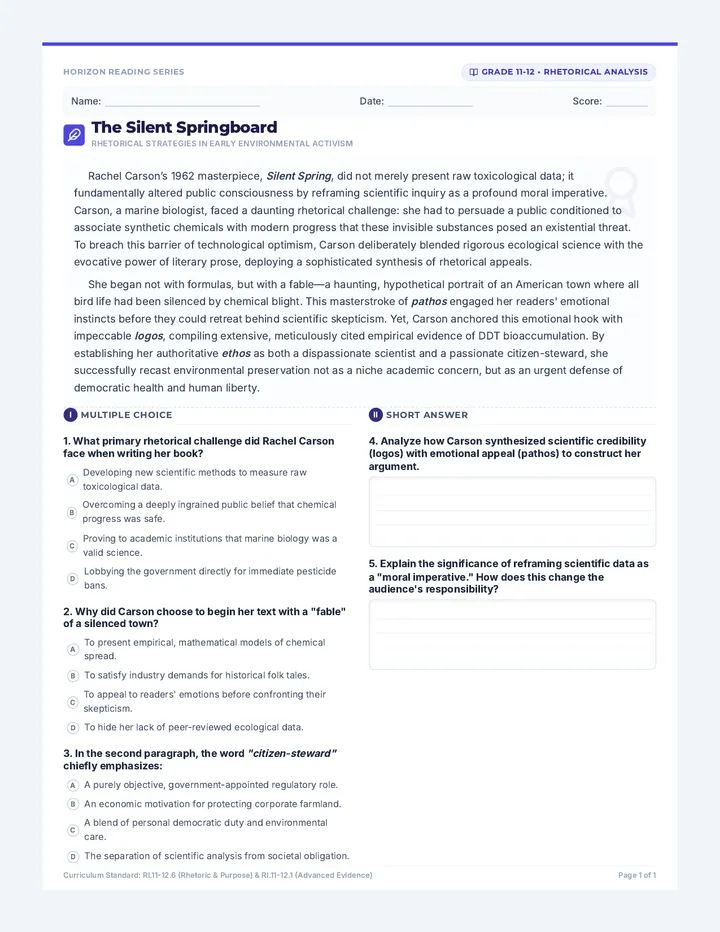
A comprehensive teacher guide for the Persuasion Power lesson. Includes facilitation notes for speaking and listening activities, a detailed answer key for the handout, an SCR scoring rubric, a sample exemplar response, and notes on common student misconceptions.
A student-facing handout including an argumentative text titled "The Price of Convenience," reading comprehension questions mapped to English 1 TEKS, and a Short Constructed Response (SCR) task with a provided writing area.
A set of instructional slides covering rhetorical analysis (ethos, pathos, logos), rhetorical devices, and strategies for EOC-style questions. Includes a title slide, learning objectives, a speaking/listening warm-up, and instructional content for TEKS 8A, 8B, 8F, and 8G.
A teacher resource providing the answer key for multiple-choice questions, a sample short constructed response exemplar, scoring criteria, and instructional facilitation tips for the paired passage lesson.
A visual presentation for English 1 EOC preparation, guiding students through the analysis of paired texts, a Think-Pair-Share activity, and strategies for writing a short constructed response.
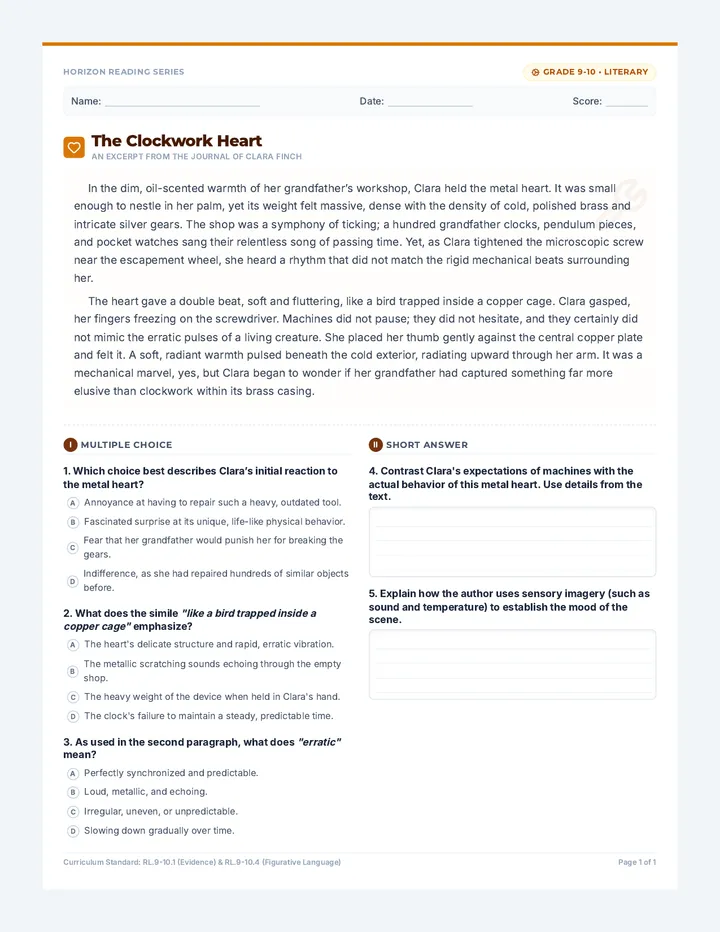
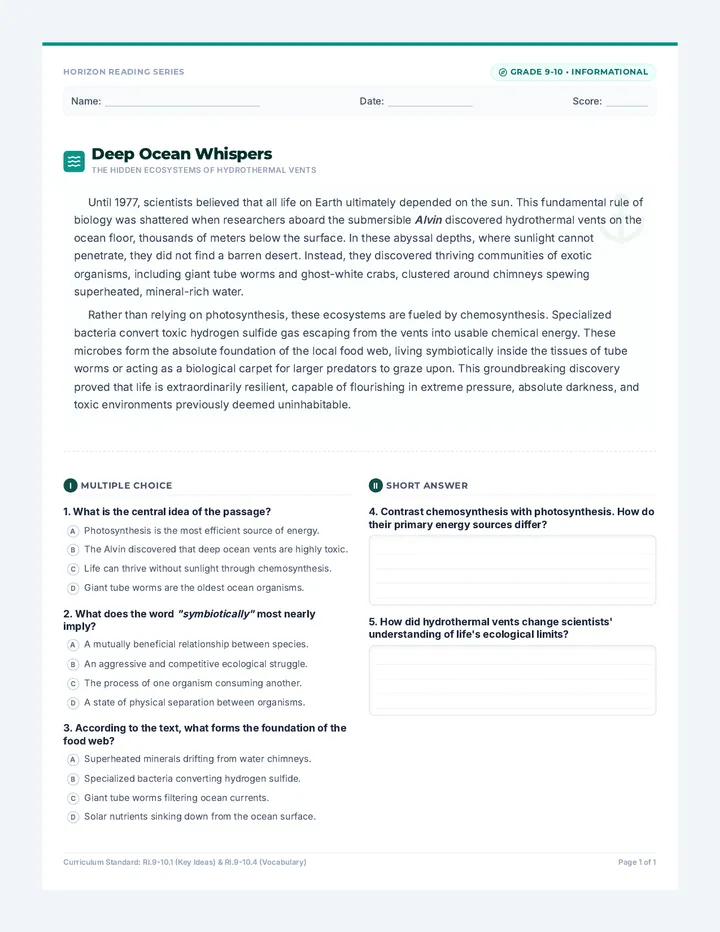
A student reading packet for English 1 EOC preparation featuring a poem and an informational text about ecosystems. It includes multiple-choice questions and a short constructed response prompt with a lined writing area.
A professional instructional guide for teachers, including lesson objectives, pacing suggestions, answer keys for student activities, and differentiation strategies.
A revision checklist and visual mapping tool to help students analyze and improve the sentence rhythm and variation in their own narrative writing drafts.
A sentence-building worksheet where students unscramble sophisticated examples and construct their own varied sentences using specific structural requirements.
A graphic organizer for sentence combining practice, structured as a "lab" where students fuse basic sentences into complex, rhythmic prose using specific strategies.
A vibrant 7-slide presentation introducing the "Robot Problem" (monotone writing) and offering four specific strategies for sentence variation: varied beginnings, conjunction usage, length modulation, and descriptive clauses.
A dedicated teacher pacing and facilitation guide for Lesson 3, focusing on synthesizing point of view and plot in 'The Story of an Hour'.