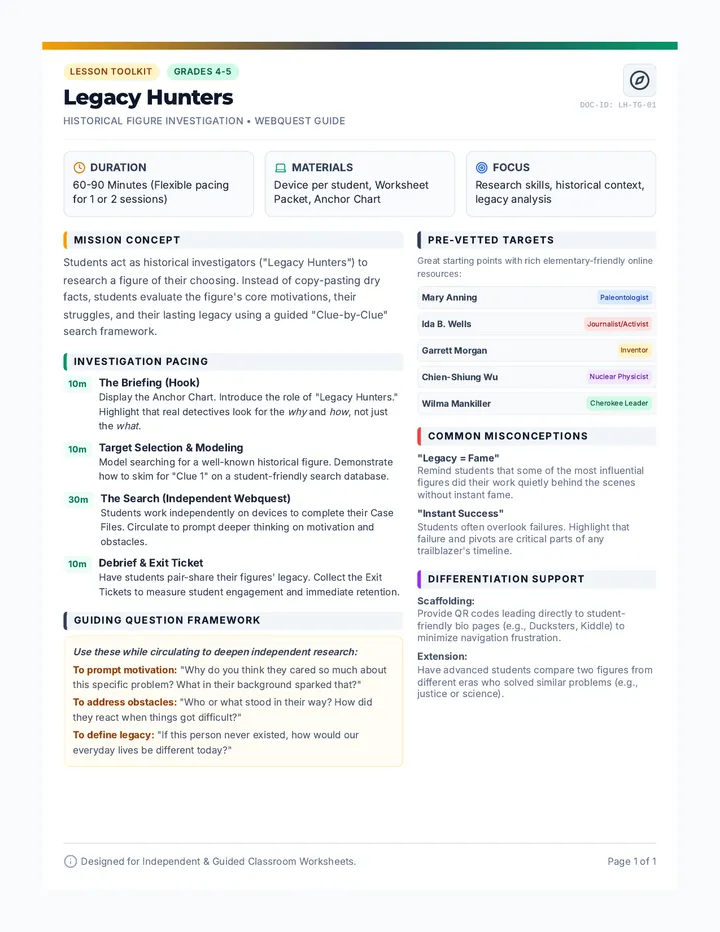
A structured 25-minute lesson plan for Kindergarten teachers, covering the instructional arc from hook to assessment, including differentiation strategies and key discussion prompts.
A matching worksheet where students link state names to their official nicknames. Focuses on states with distinct nicknames or recognizable geography. Revised layout and header.
A printable set of flashcards featuring Alabama, Alaska, Arizona, Arkansas, California, and Colorado. Includes capitals, nicknames, and fun facts. Revised with fixed layout.
A large-print tracing worksheet for learning the names and capital cities of Northeastern states. Features wide spacing for handwriting practice and refined layout. Revised instructions and contrast.
A cut-and-paste activity focusing on state identification through symbols for the Northeast and Southeast regions. Includes a dedicated symbol cut-out sheet. Revised layout for easier cutting.
A colorful introductory slide deck overviewing the 50 US States, their regions, symbols, and fun facts. Revised with a complete 50-state master list and improved contrast.
A classroom poster featuring a stylized graphic of a BIPOC student presenting on sustainable fashion and community impact. The poster includes educational tips on avoiding over-consumerism and the benefits of reusing items.
Modified the Art Corner to be a half-page panel, consistent with the size of the other panels in the reader. It is now positioned at the top of the final page.
A comprehensive teacher's guide for the 'Big Place, Small Place' lesson. Includes objectives, materials list, modeling steps for the nesting task, and multi-sensory differentiation strategies.
A simple visual worksheet for students to identify Texas as a state and the USA as a country by circling the correct high-contrast label. Features map shapes and reinforced visual cues.
A hands-on activity where students cut out and nest a 'Texas' map outline inside a 'USA' map outline. Features simplified, recognizable silhouettes and high-contrast labels to reinforce the state vs. country concept.
A high-contrast, visually simplified slide deck for early emergent learners to introduce the concepts of 'State' (Texas) and 'Country' (USA) using map shapes and clear color coding.
A 12-cell grid of community helpers featuring simplified "coloring book" style people figures with unique uniform accessories (hats, tools, badges). Includes clear handwriting lines and medium-contrast tracing text for early learners.
A polished one-page printout featuring 12 community helpers in a 3x4 grid with realistic photos and clear labels. Reduced padding and adjusted aspect ratios ensure everything fits perfectly on a single page.
An introductory slide deck for kindergarten students exploring different colonial trades, their tools, and their importance to the community. Updated with consistent worker visuals and clearer tool descriptions.
A teacher answer key for the Colonial Trades Matching Activity, updated with correct icons and comprehensive discussion facts. Corrected page breaks.
A colonial-themed cut and paste worksheet for kindergarteners to match tradespeople with their corresponding tools using images and labels. Updated to use person-based worker icons for better matching. Corrected label mismatches.
The answer key for the Colonial Careers matching worksheet, using clear color-coding and labels for the teacher's reference.
A colonial trades matching worksheet for kindergarteners with visual icons for both workers and tools to aid emergent readers.
Final version of the Egypt Writing Reader. The Word Bank now features a Vocab Words section with 'hieroglyphs', 'information', and 'Papyrus', while CVC words and Topic Words have been removed. All sight words and vocabulary terms are consistently highlighted throughout the text. Grammar and sentence updates have been applied to pages 3, 4, and 5.
Final version of the Egypt Writing Reader. The Word Bank now features a Vocab Words section with 'hieroglyphs', 'information', and 'Papyrus', while CVC words and Topic Words have been removed. All sight words and vocabulary terms are consistently highlighted throughout the text.
Updated Egypt Writing Reader with the Topic Words section removed from the Word Bank. Instructional supports for sight words and CVC words remain consistent throughout the narrative and Reading Check pages.
An updated decodable reader with more complex sentences and a new image of hieroglyphs on page 5. The reader now uses the user's specific sentences for pages 2, 3, and 5 while maintaining consistent instructional support. All images are centered and sized to fit.
Updated Egypt Writing Reader with Page 4 removed and content shifted. The reader now features hierarchical story flow from hieroglyphs and scribes to messengers and papyrus. All instructional highlights are consistently applied and images are centered.
Updated Egypt Writing Reader with Interior Page 4 removed and content shifted. Page 2 features two distinct sentences, and Page 3 contains decodable sentences about messengers. Instructional highlights (sight words and CVC words) are standardized throughout the text and Reading Check.
Final polished version of the Egypt Writing Reader. Page 2 features two distinct sentences about scribes and information. Page 3 has been updated with decodable sentences about messengers on a long path. Sight word underlines and CVC highlights are standardized throughout.
Final polished version of the Egypt Writing Reader. Page 2 now features a new image of scribes and describes how people wrote down hieroglyphs to pass on information. Sight word underlines and CVC highlights are standardized throughout the document for consistent instructional support.
Final polished version of the Egypt Writing Reader. Page 2 now describes how people used hieroglyphs to write messages and pass information. Sight word underlines and CVC highlights are standardized throughout the document for consistent instructional support.
Final polished version of the Egypt Writing Reader. Images on pages 1 and 3 are set to fit within their containers, sight word underlines are standardized, and punctuation spacing has been corrected. Contrast for page numbers has also been improved for better readability.
An updated decodable reader with more complex sentences and a new image of hieroglyphs on page 1. The reader covers the importance of writing, messengers, and papyrus in Ancient Egypt. Page 3 has been updated with a new image and sentences about messengers needing writing to remember messages. Spacing and punctuation have been polished.
An updated decodable reader with more complex sentences and a new image of hieroglyphs on page 1. The reader covers the importance of writing, messengers, and papyrus in Ancient Egypt. Page 3 has been updated with a new image and sentences about messengers needing writing to remember messages.
An updated decodable reader with more complex sentences and a new image of hieroglyphs on page 1. The reader covers the importance of writing, messengers, and papyrus in Ancient Egypt. Page 1 sentences were specifically updated to: 'These marks are hieroglyphs. Each mark represents a word.'
An updated 'Nile Is Life' decodable reader with page 6 (summary quote) removed and subsequent content shifted forward. The reader now concludes on page 8.
An updated 'Nile Is Life' decodable reader with Page 5 updated to include a new image and sentences about the Nile being a gift. The Word Bank has also been updated to include 'helps'.
An updated 'Nile Is Life' decodable reader with the previous page 2 removed and content shifted. The reader still features the vitamins/minerals update and a standardized reading check.
A decodable reader for early learners exploring the importance of the Nile River in Ancient Egypt. Page 3 now features a custom image and updated text about vitamins and minerals helping food grow. Styling in the Reading Check has also been standardized for consistency.
Updated the "Babylon Changes Slides" to perfectly align with the finalized reader text. Features the specific sentences requested for pages 1-6, including "The new King made changes" and "Babylon was a grand city." Uses high-impact historical visuals and large, accessible decodable text for classroom instruction.
Updated the "Babylon Changes Reader" Page 6 text from "is" to "was" as requested. Standardized capitalization for "city" throughout and fixed stray spaces before periods. The reader now features 6 narrative pages describing Babylon's history, followed by assessment pages. Removed redundant sheets.
Updated the "Babylon Changes Reader" Reading Check on Page 7 with the specific questions requested. Question 1 asks "How did Babylon change?" and Question 2 asks "What was made?". Maintained consistent decodable styling and fixed all previous typographical issues. Added 'did' to the Word Bank sight words.
Updated the "Babylon Changes Reader" Page 2 text to "The new King made changes." standardized city/City to city throughout the reader for consistency, and fixed stray spaces before periods. Removed redundant blank sheets and corrected a typo in the word bank.
Updated the "Babylon Changes Reader" Page 6 text from "is" to "was" as requested. Maintained consistent decodable styling throughout, featuring narrative pages describing Babylon's growth, landmarks, and conclusion, followed by assessment pages. Removed redundant blank sheets.
Updated the "Babylon Changes Reader" Page 2 text as requested: "The new King made changes." Ensured consistent decodable styling and maintained the 6-page narrative structure followed by assessment. Removed extra blank sheets.