A two-page detective-themed worksheet for students to practice correcting dialogue errors, including quotation marks, capitalization, commas, and dialogue tags. Features 20 practice sentences and a creative writing challenge.
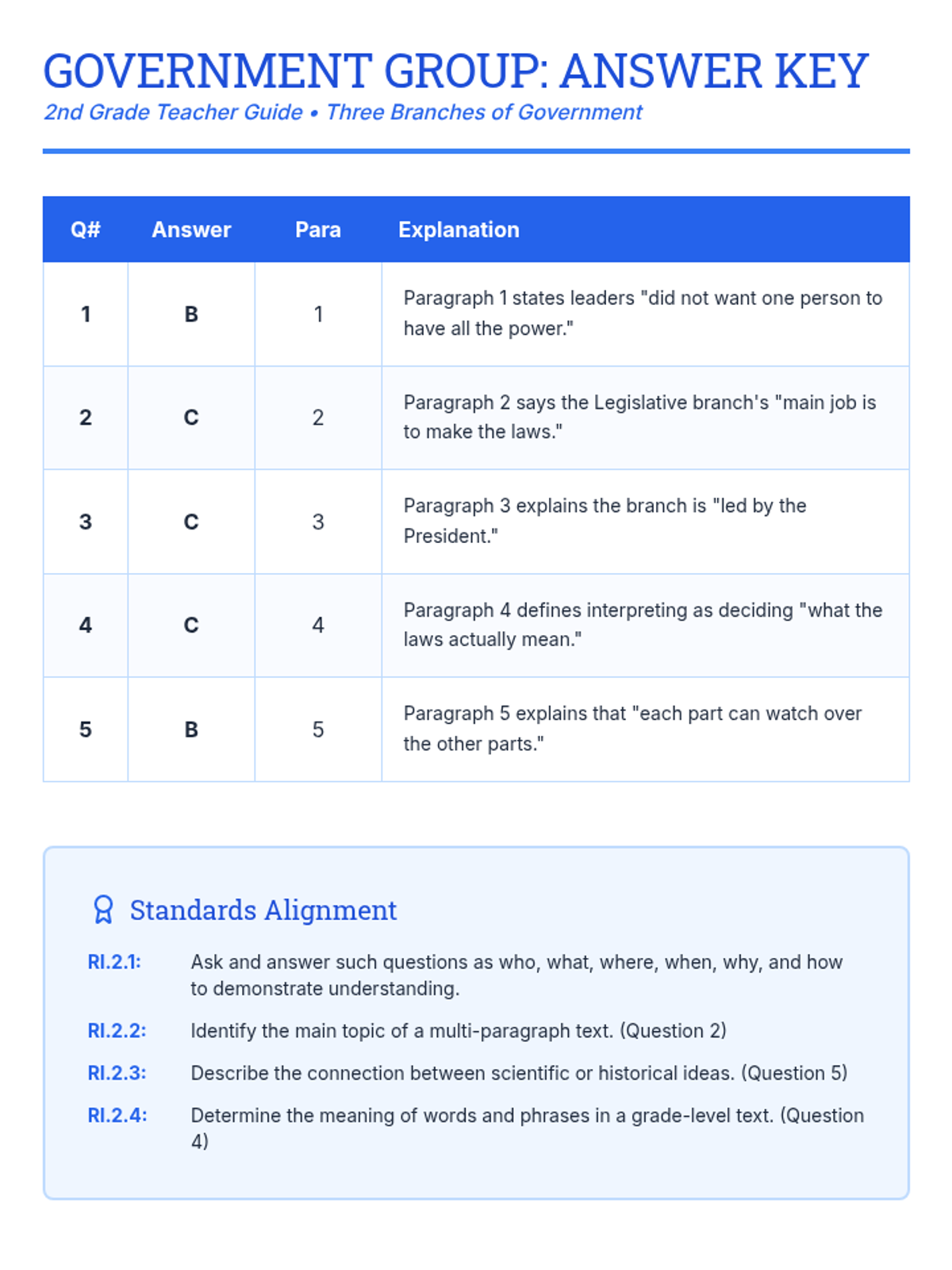
The teacher's answer key for the 2nd-grade Government Group worksheet, including correct answers, paragraph references, and explanations.
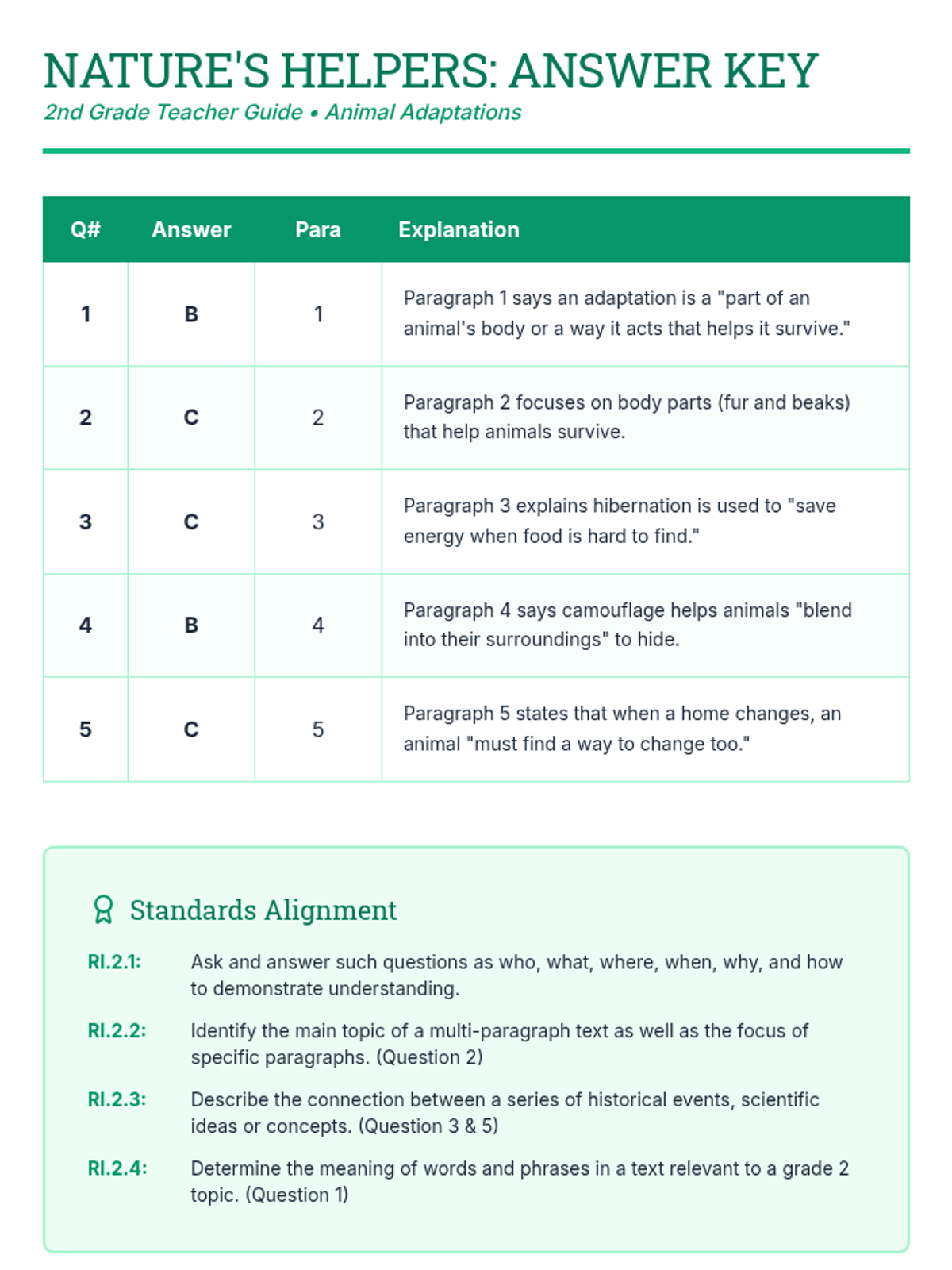
The teacher's answer key for the 2nd-grade Nature Helpers worksheet, including correct answers, paragraph references, and explanations.
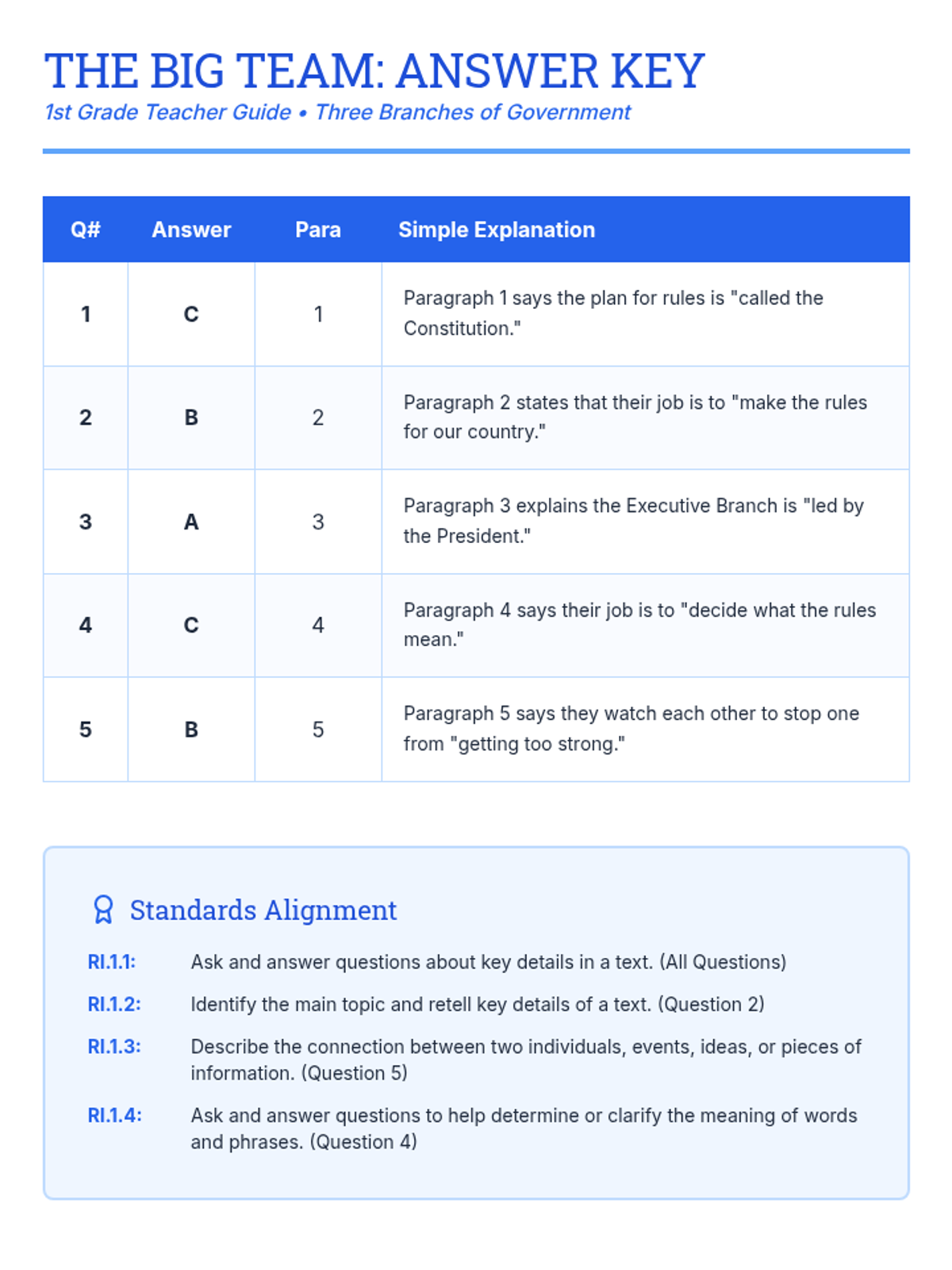
The teacher's answer key for the 1st-grade The Big Team worksheet, including correct answers, paragraph references, and simple explanations.
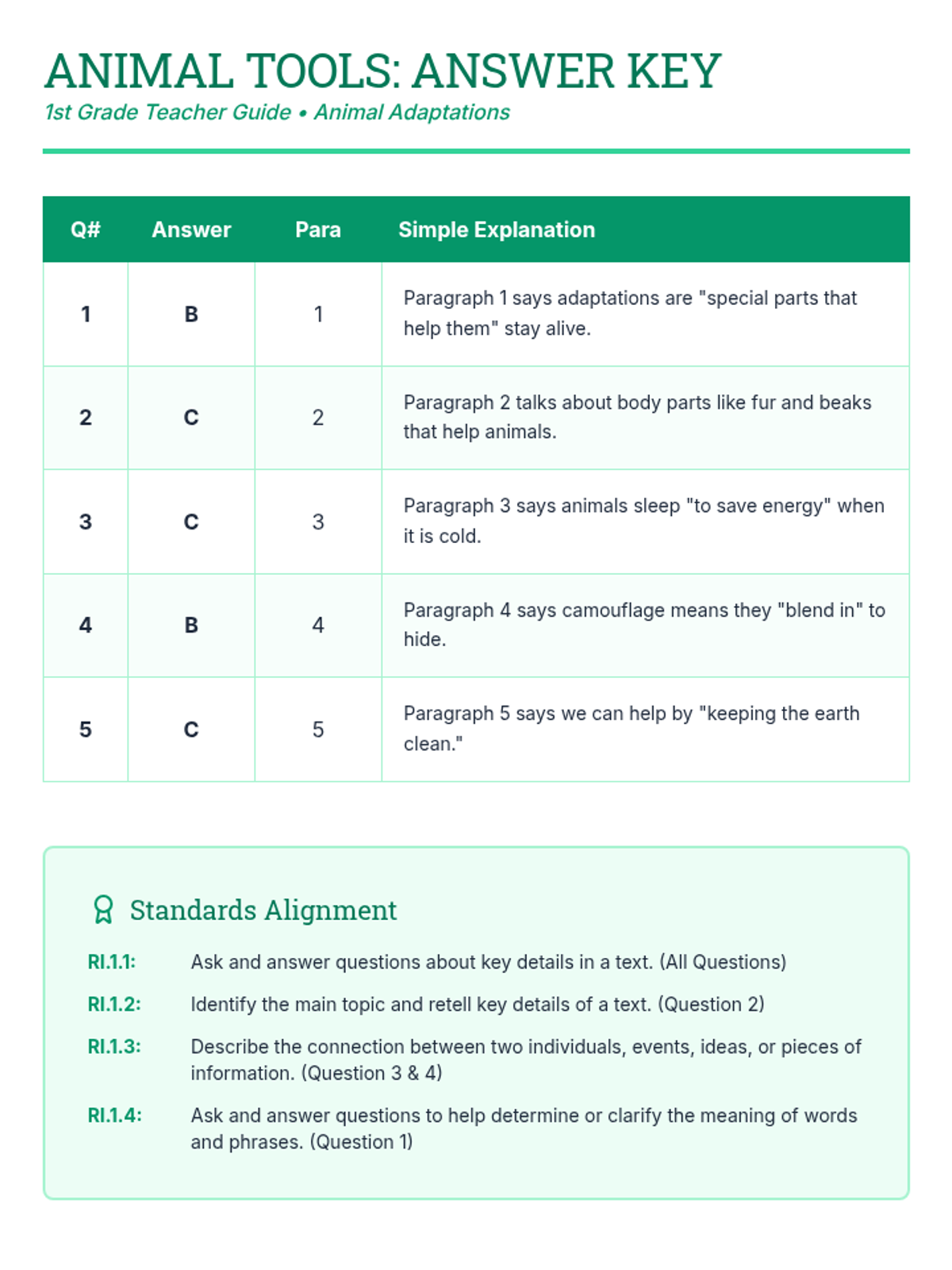
The teacher's answer key for the 1st-grade Animal Tools worksheet, including correct answers, paragraph references, and simple explanations.
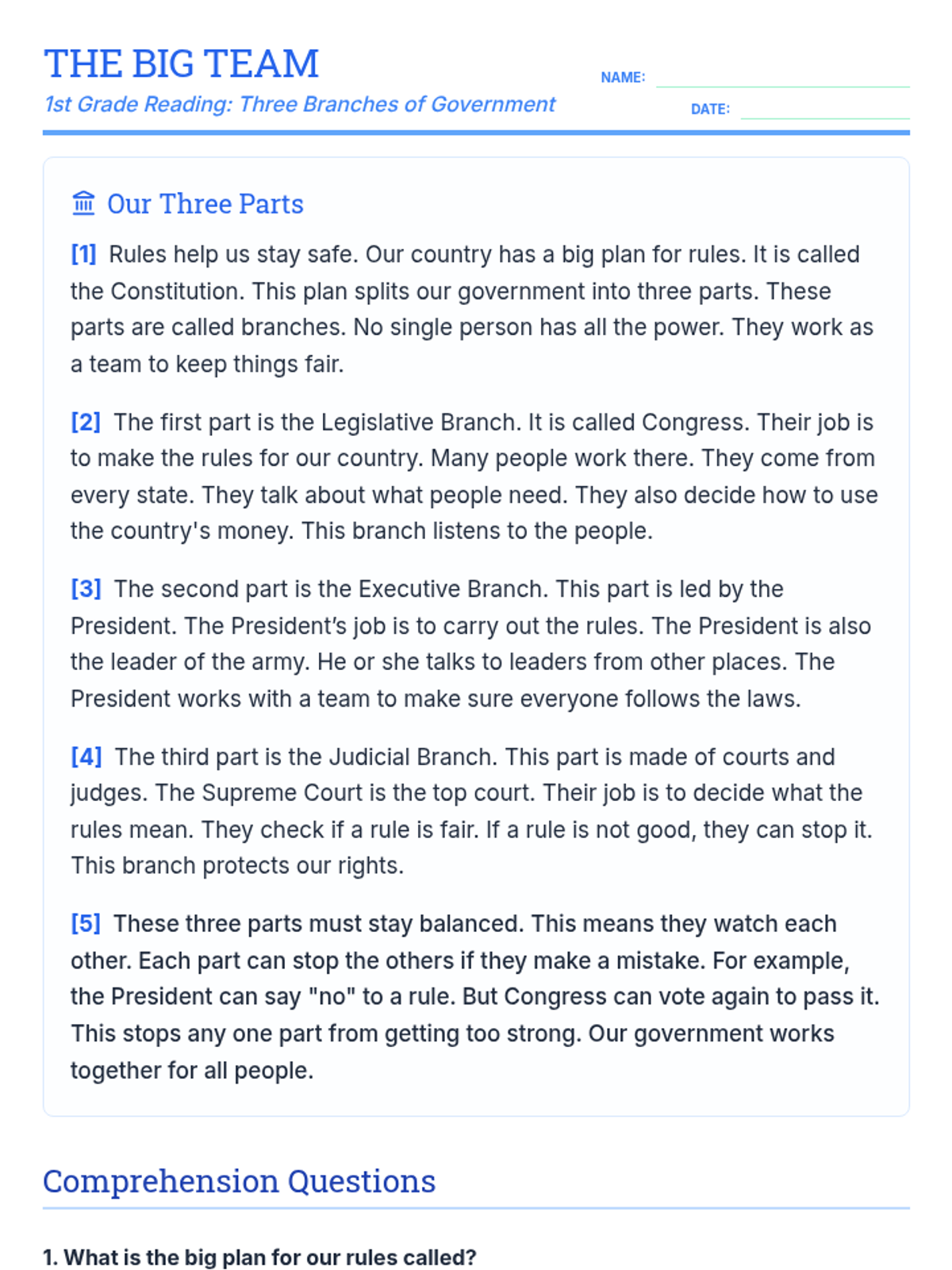
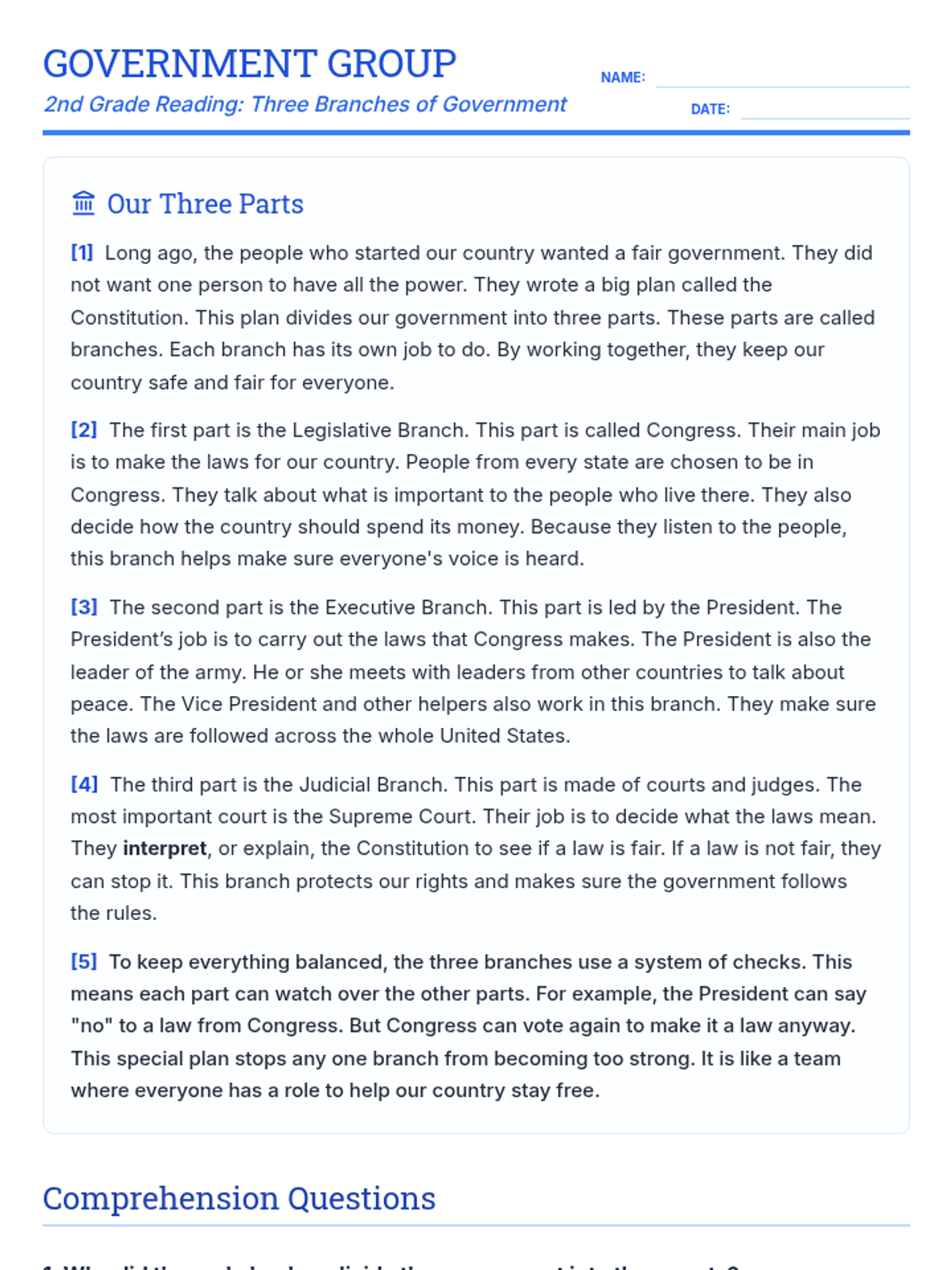
A 1st-grade reading comprehension worksheet about the three branches of government. It includes a 5-paragraph passage with simple text and 5 multiple-choice questions.
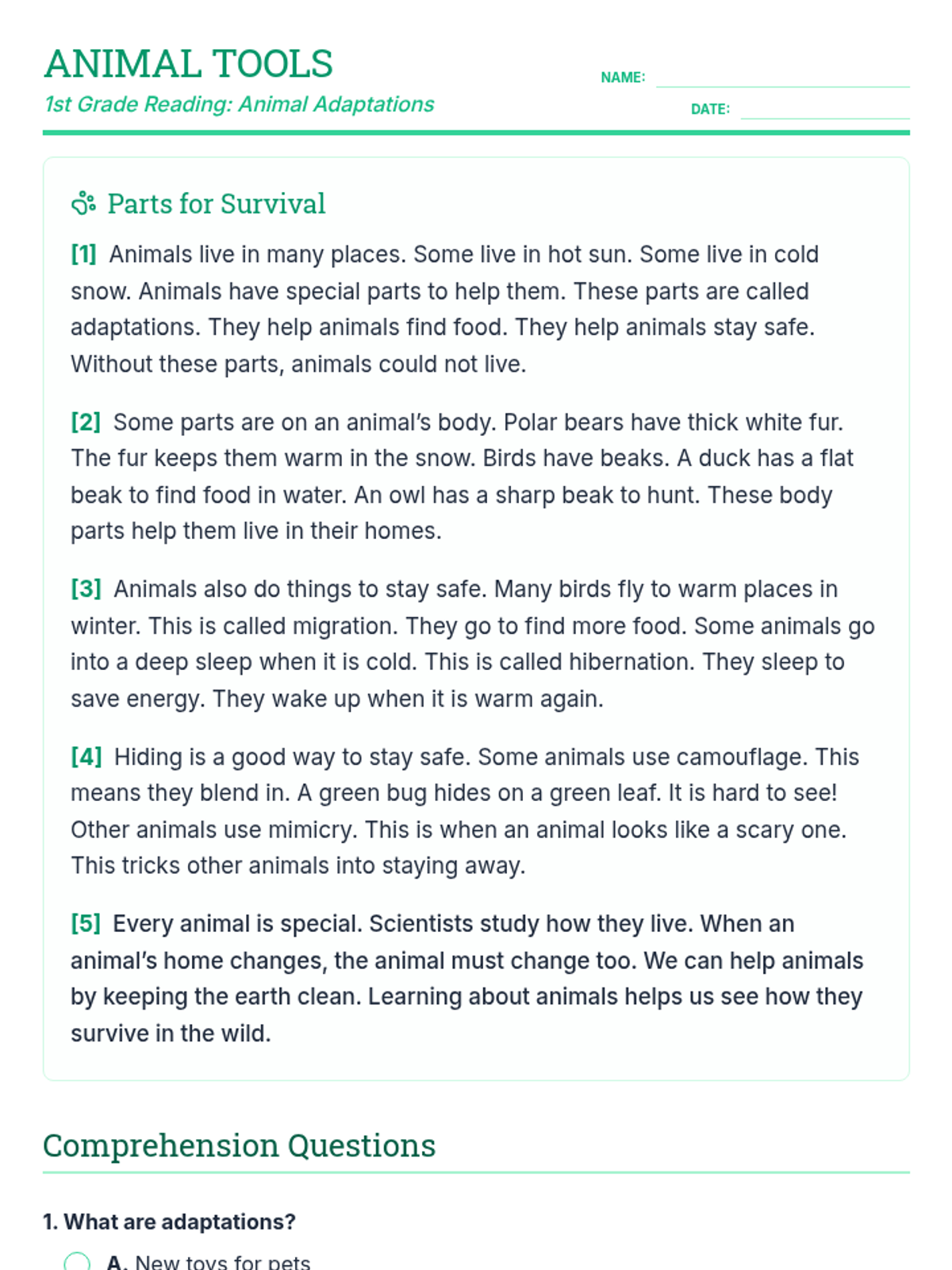
A 1st-grade reading comprehension worksheet about animal adaptations. It includes a 5-paragraph passage with simple text and 5 multiple-choice questions.
A 2nd-grade reading comprehension worksheet about the three branches of government. It includes a 5-paragraph passage and 5 multiple-choice questions.
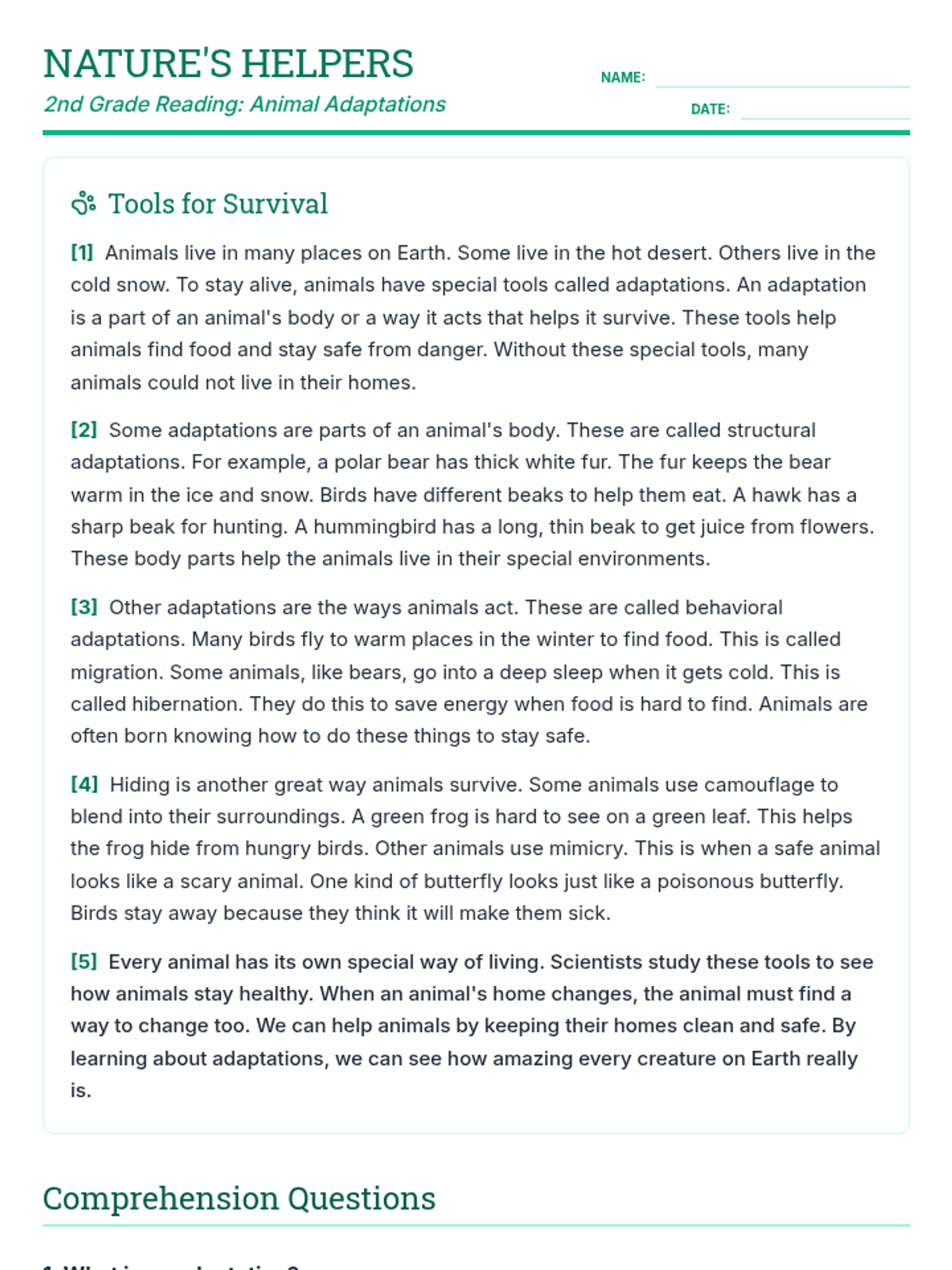
A 2nd-grade reading comprehension worksheet about animal adaptations. It includes a 5-paragraph passage and 5 multiple-choice questions.
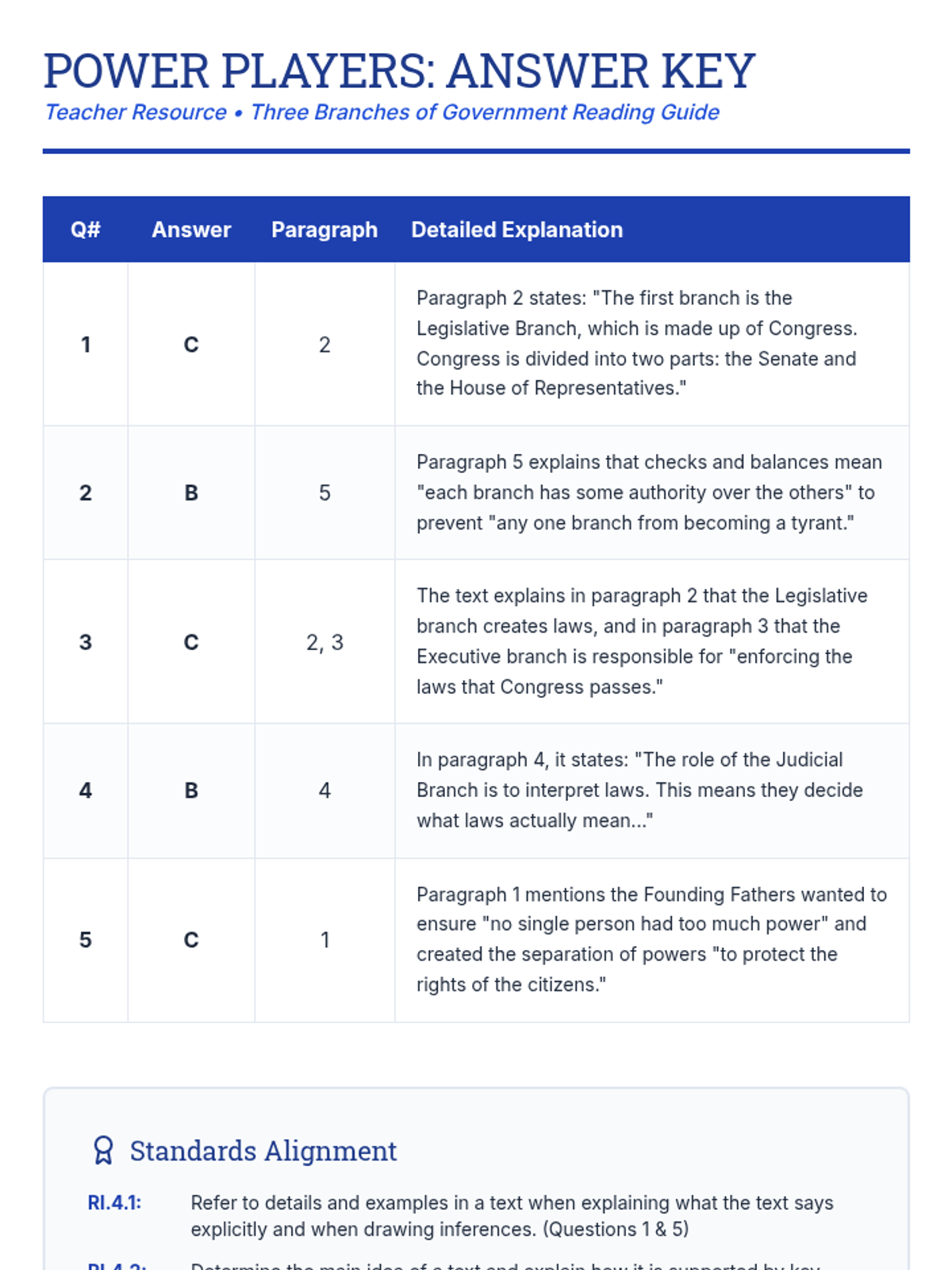
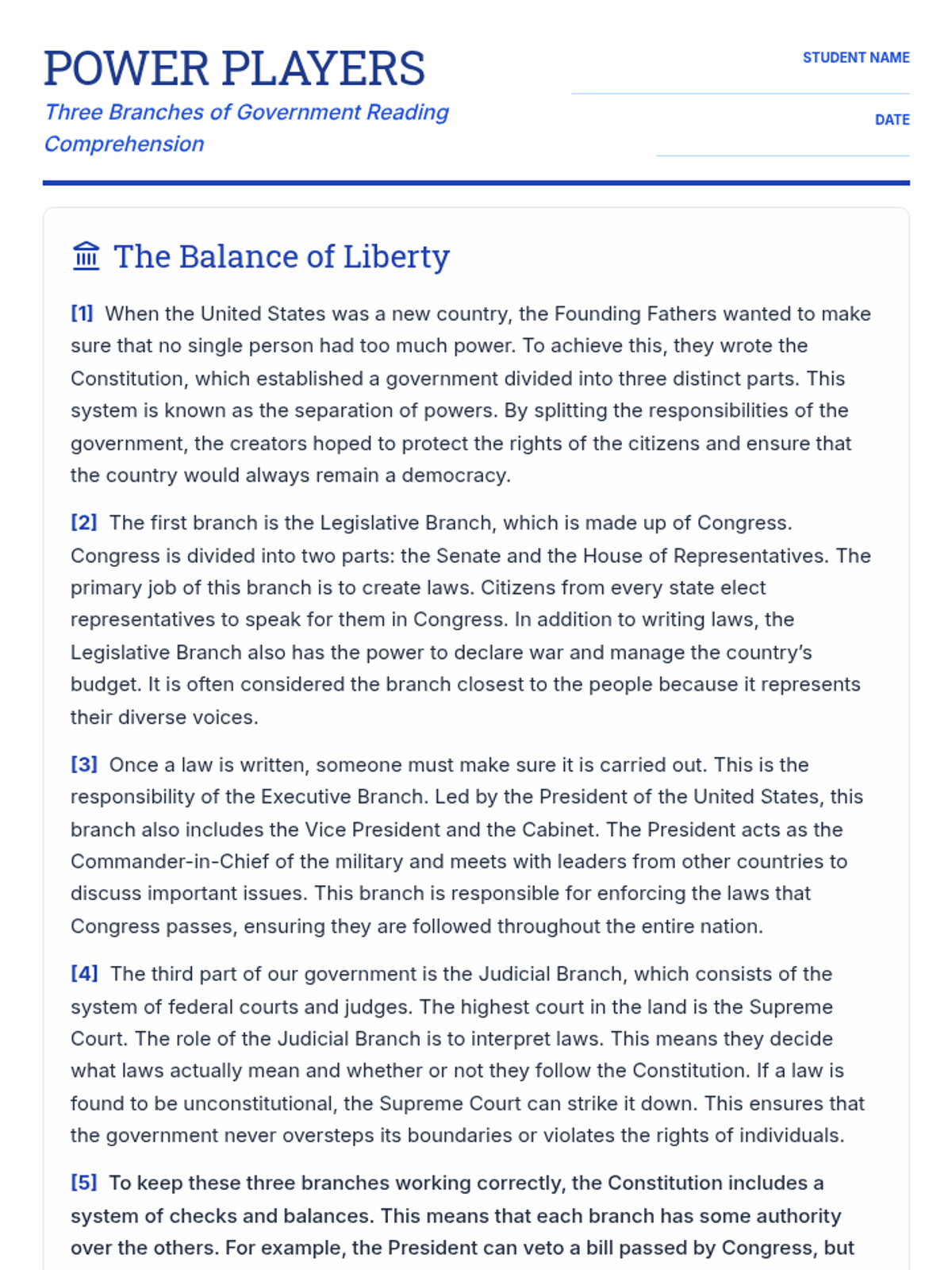
The teacher's answer key for the Power Players worksheet, including correct answers, paragraph references, and detailed explanations for each question.
A 4th-grade social studies reading comprehension worksheet about the three branches of government, featuring a 5-paragraph passage and 5 multiple-choice questions aligned with ELA standards RI.1, RI.2, RI.3, and RI.4. Includes a separate answer sheet page with paragraph references and explanations.
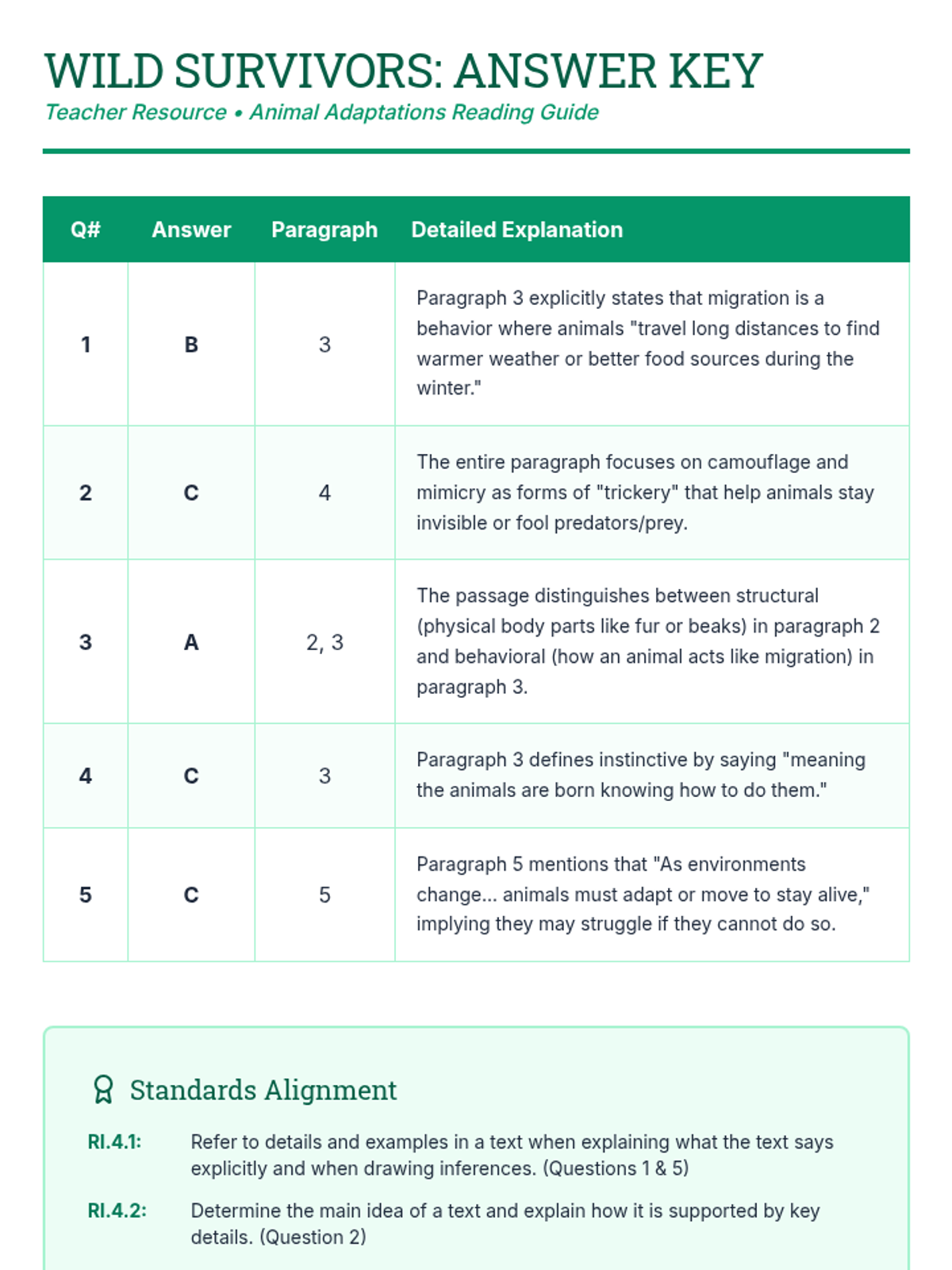
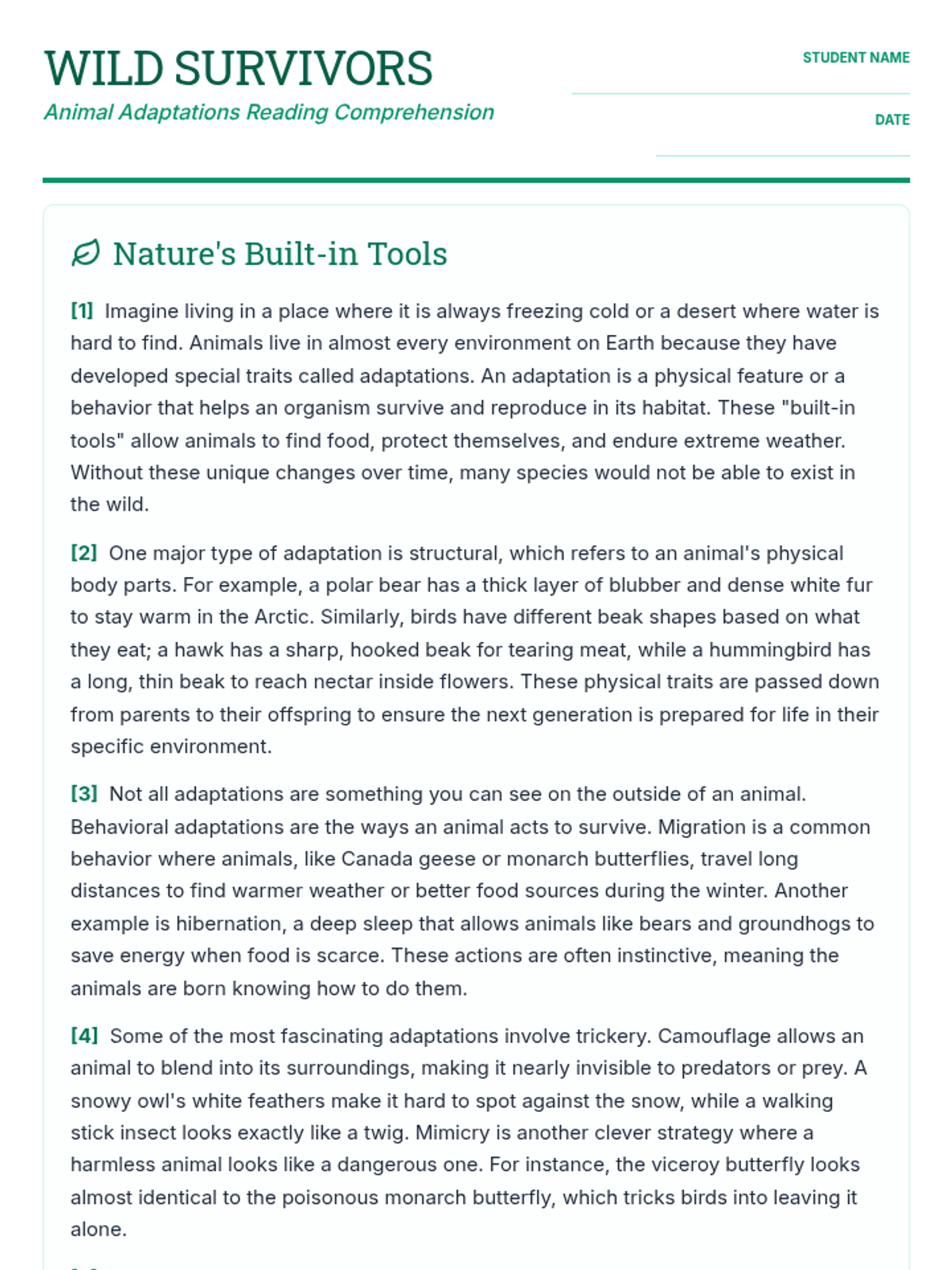
The teacher's answer key for the Wild Survivors worksheet, including correct answers, paragraph references, and detailed explanations for each question.
A 4th-grade science reading comprehension worksheet about animal adaptations, featuring a 5-paragraph passage and 5 multiple-choice questions aligned with ELA standards RI.1, RI.2, RI.3, and RI.4. Includes a separate answer sheet page with paragraph references and explanations.
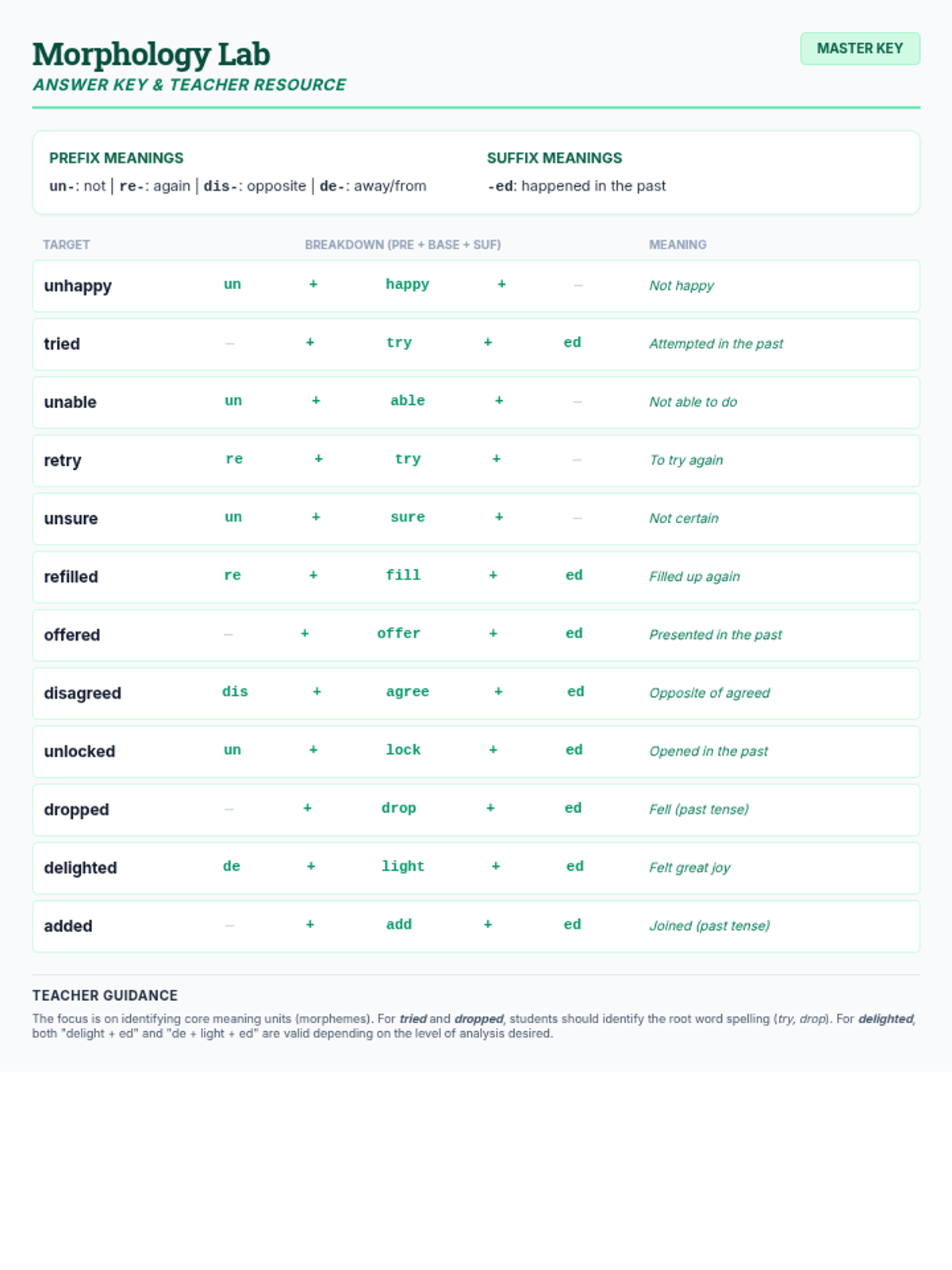
An answer key for the Morphology Lab worksheet, providing the correct deconstructions and example definitions for each word.
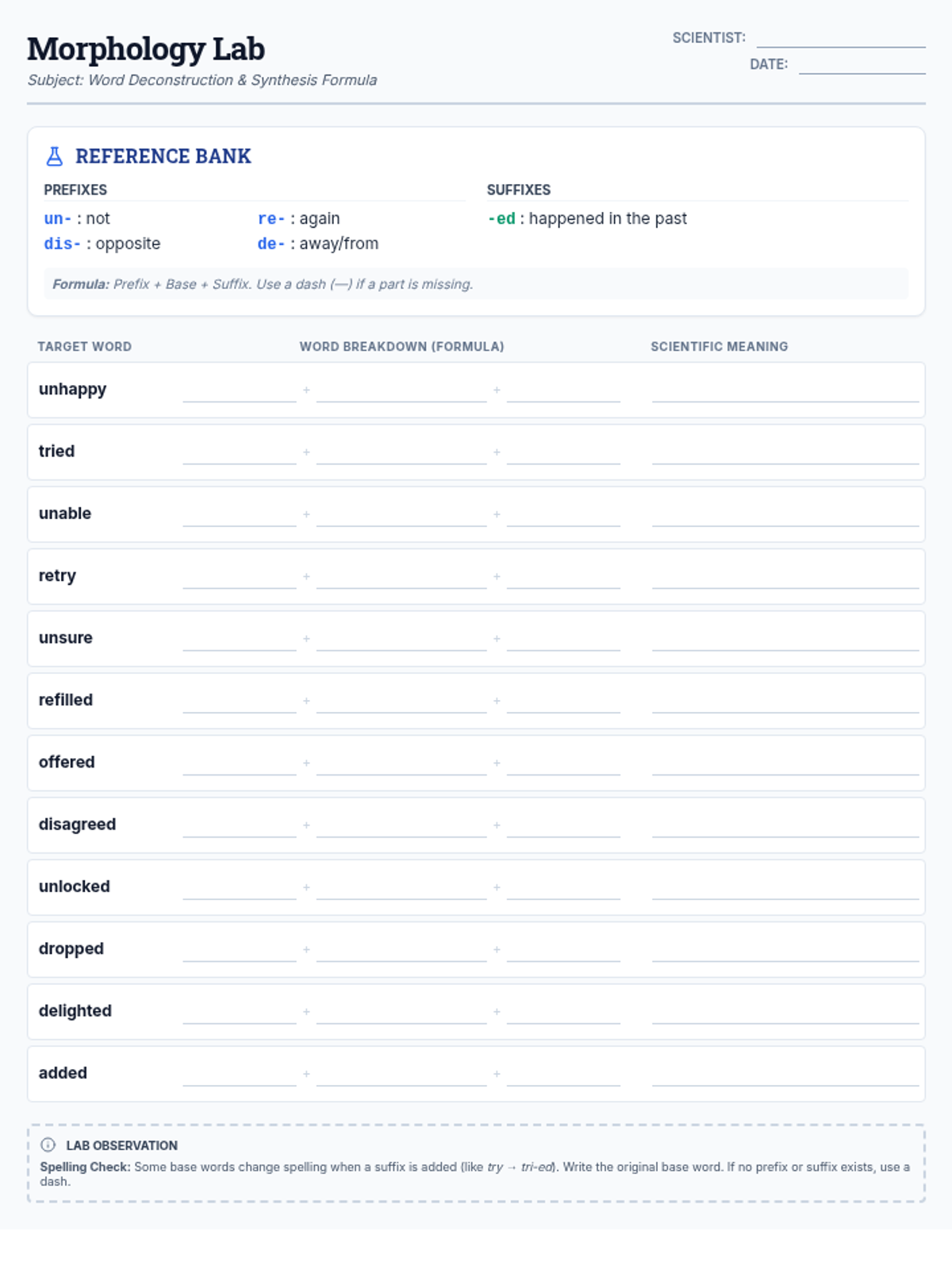
A lab-themed worksheet where students deconstruct a list of words into their prefix, base, and suffix components and provide a definition for each.
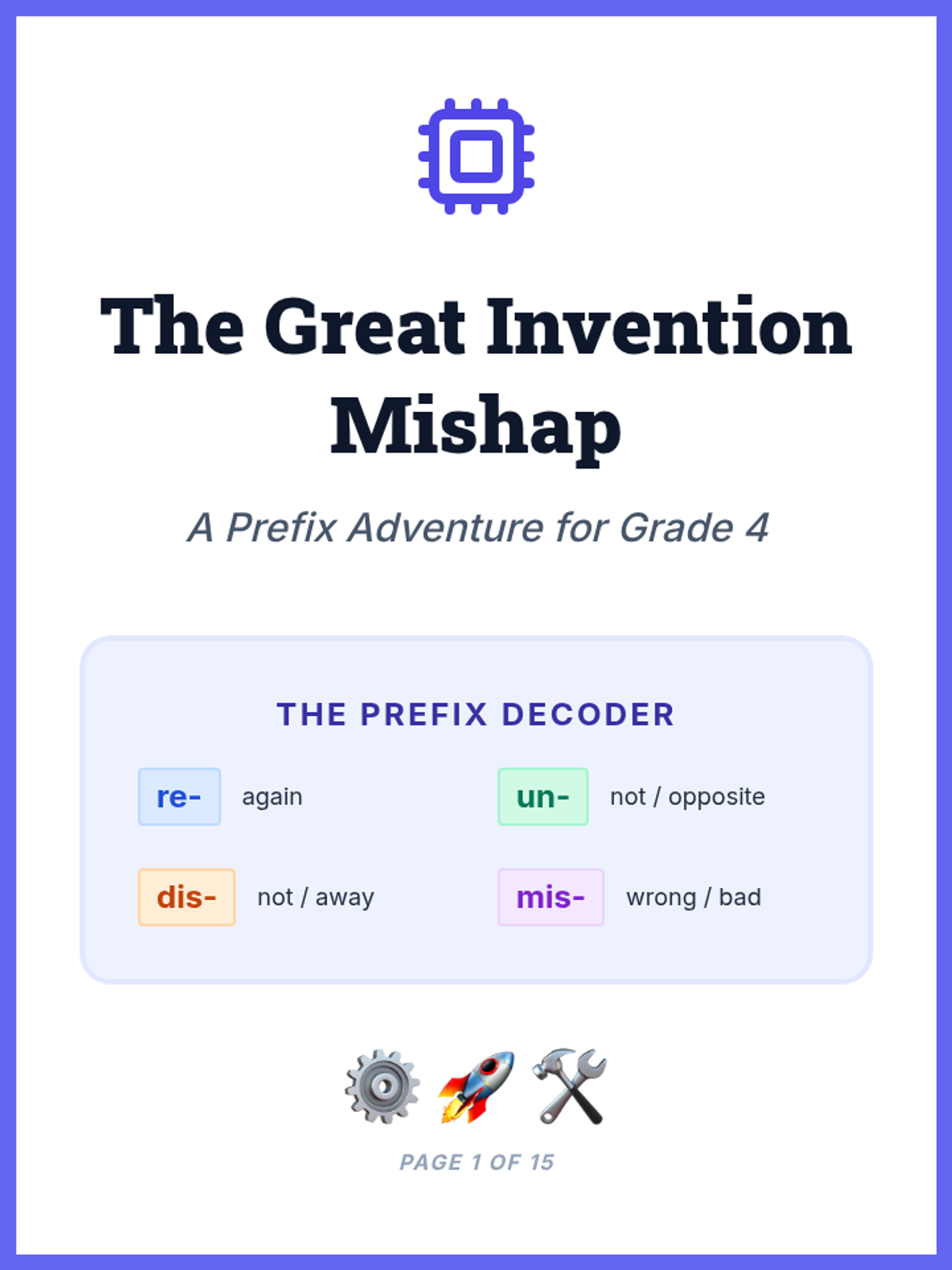
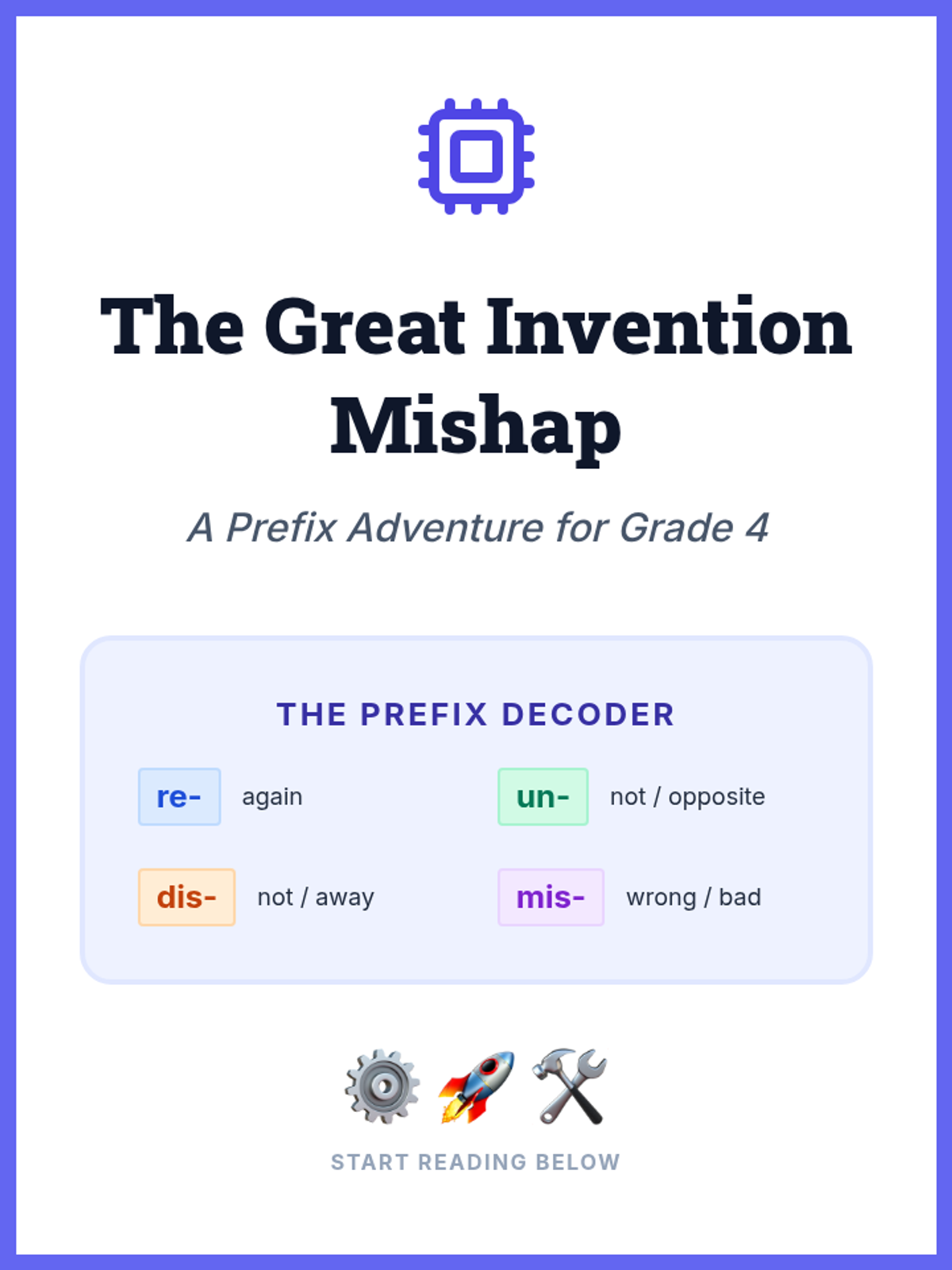
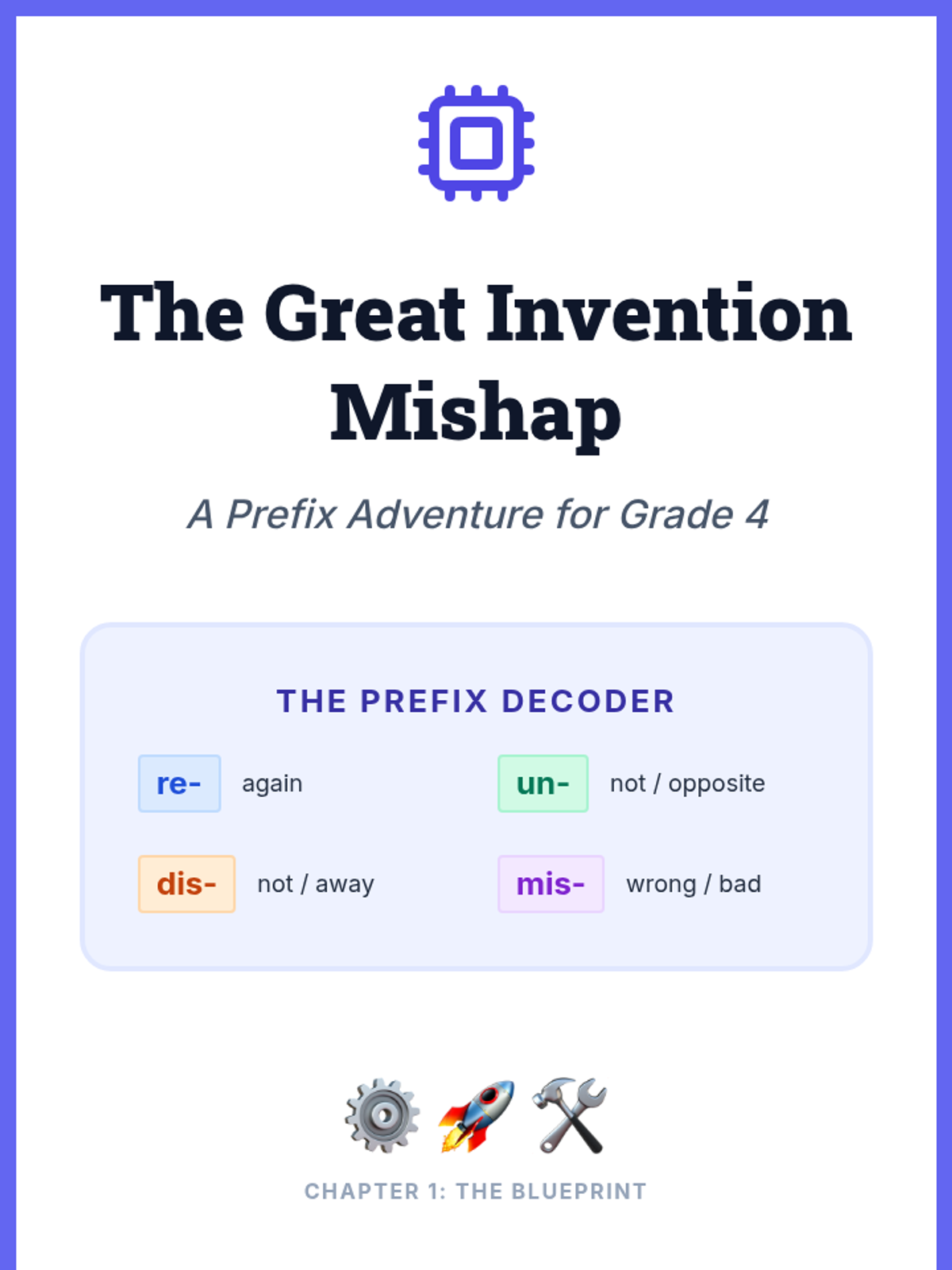
A 15-page phonetically-based reading passage for Grade 4 focusing on words with the prefixes re-, mis-, dis-, and un-. The story, "The Great Invention Mishap," features color-coded prefixes to help students identify structural patterns and a comprehensive word list for review.
A comprehensive student logbook for the novel 'Surviving the Applewhites,' featuring daily word work, literal and inferential comprehension checks for every chapter, and a final summative reflection.
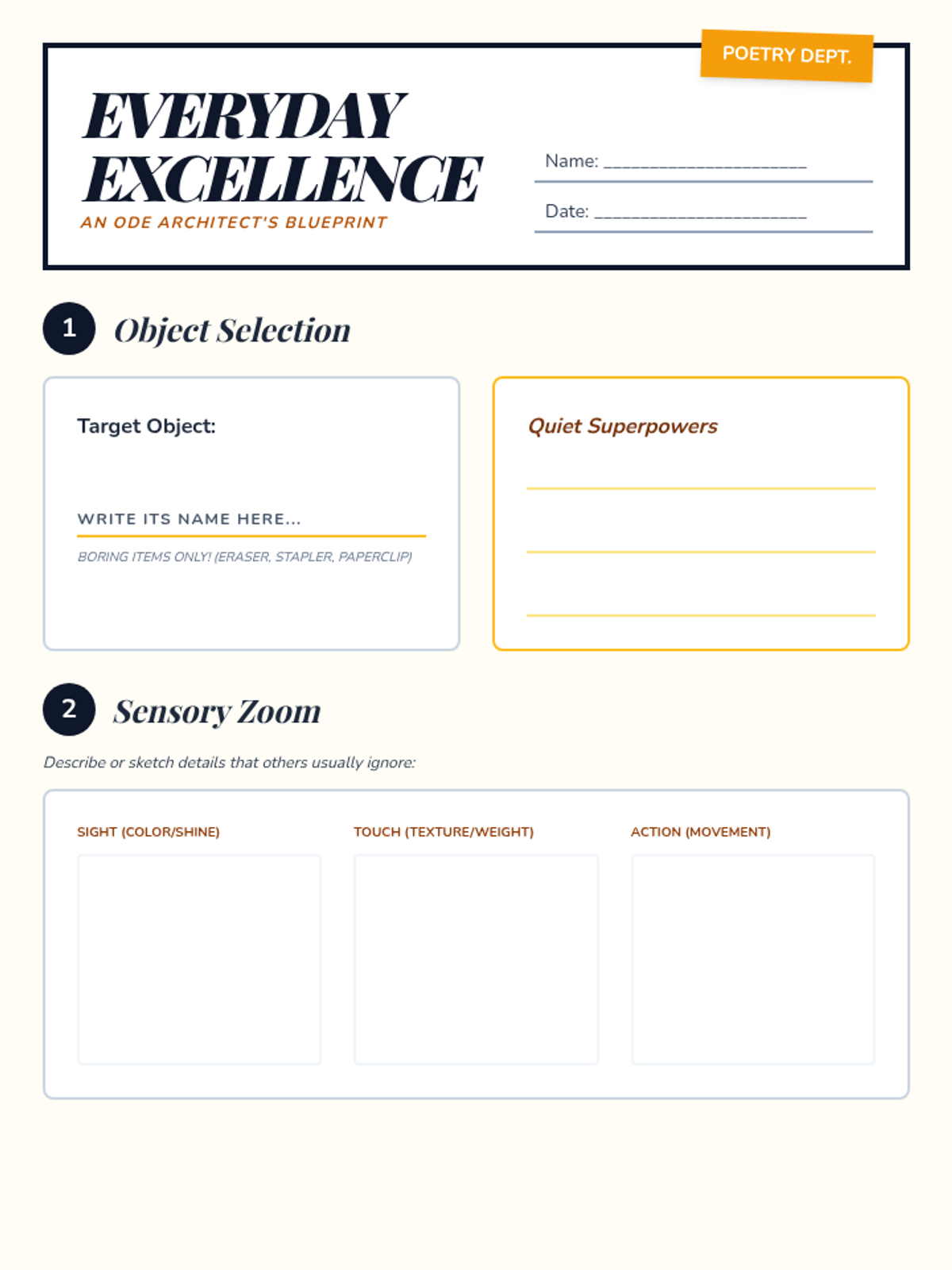
A writing worksheet for 5th graders to brainstorm and draft an ode to an everyday object, featuring structured steps for sensory details and exaggerated praise.
A slide deck for teaching odes, covering definitions, the concept of exaggeration, examples from Neruda, and a prompt for students to write their own.
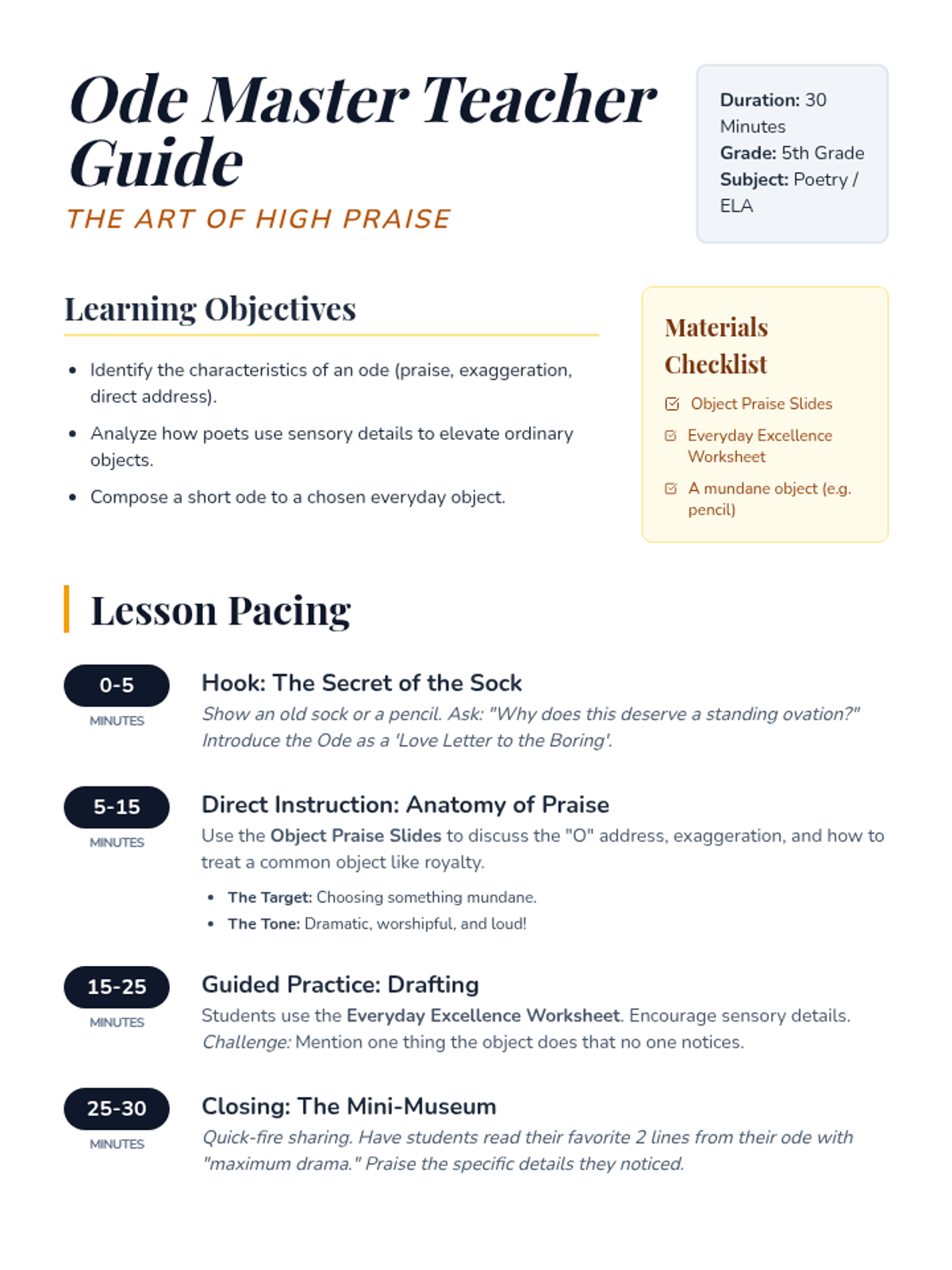
Teacher guide for a 30-minute 5th grade lesson on writing odes to everyday objects, featuring pacing, vocabulary, and differentiation strategies.
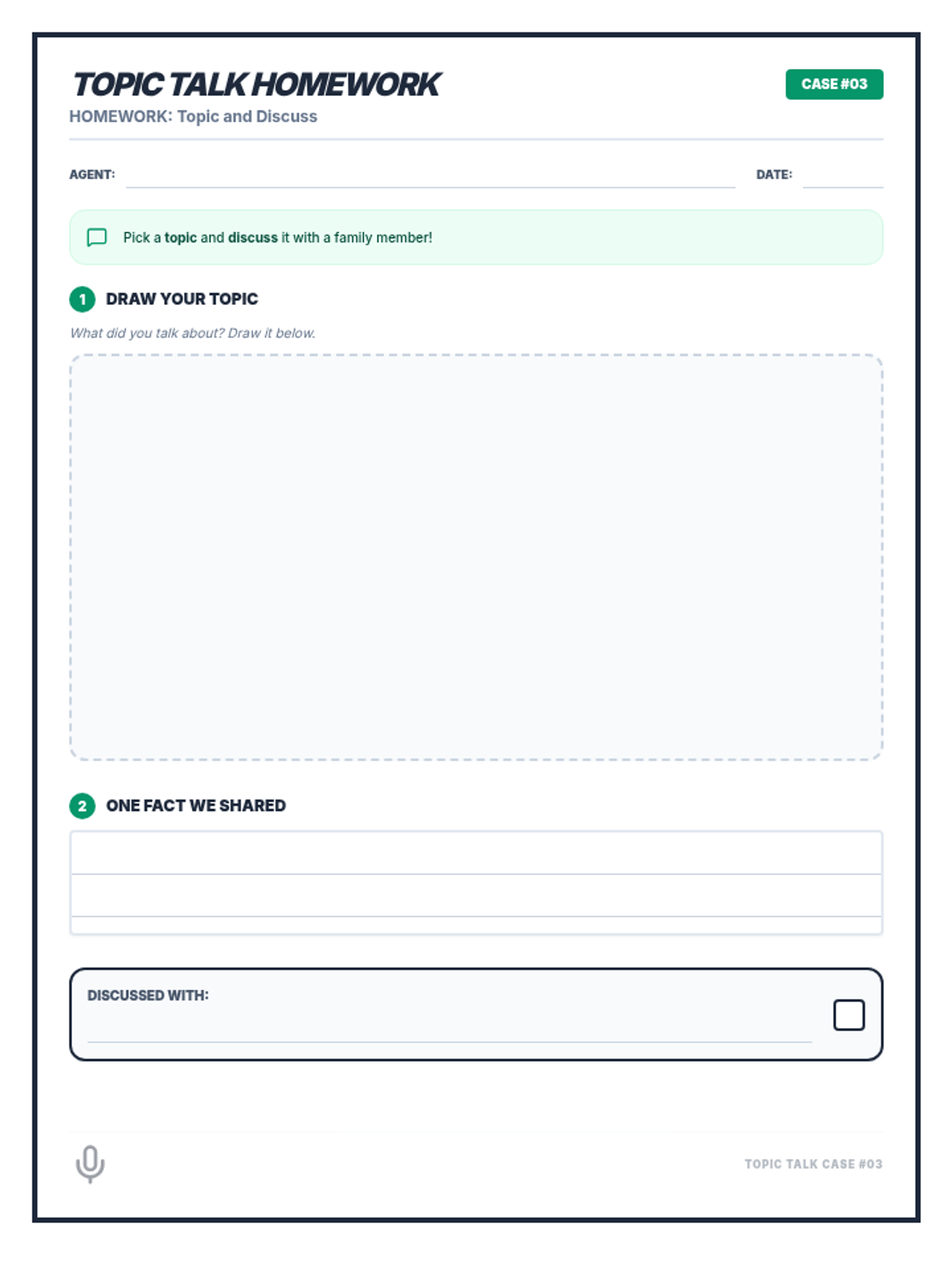
A home discussion log where students pick a topic, discuss it with a family member, and record a fact they shared. Focuses on reinforcing the definitions of 'topic' and 'discuss' in a real-world setting. Revised for 1-page layout and improved contrast.
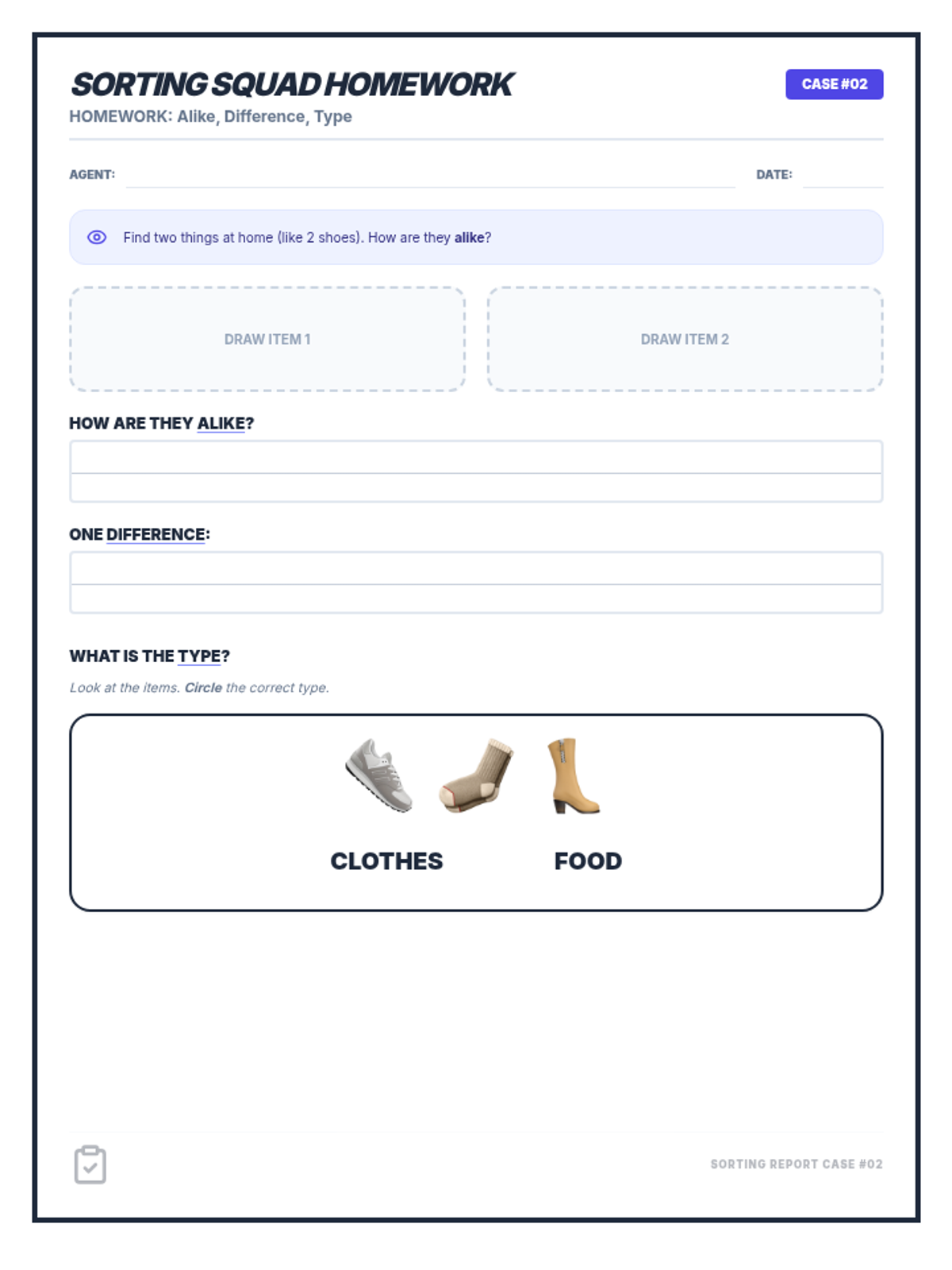
A comparison-focused homework sheet where students find and compare two household items, identifying how they are alike and different, and practicing the concept of 'type' with visual groups. Revised for 1-page layout and improved contrast for handwriting lines.
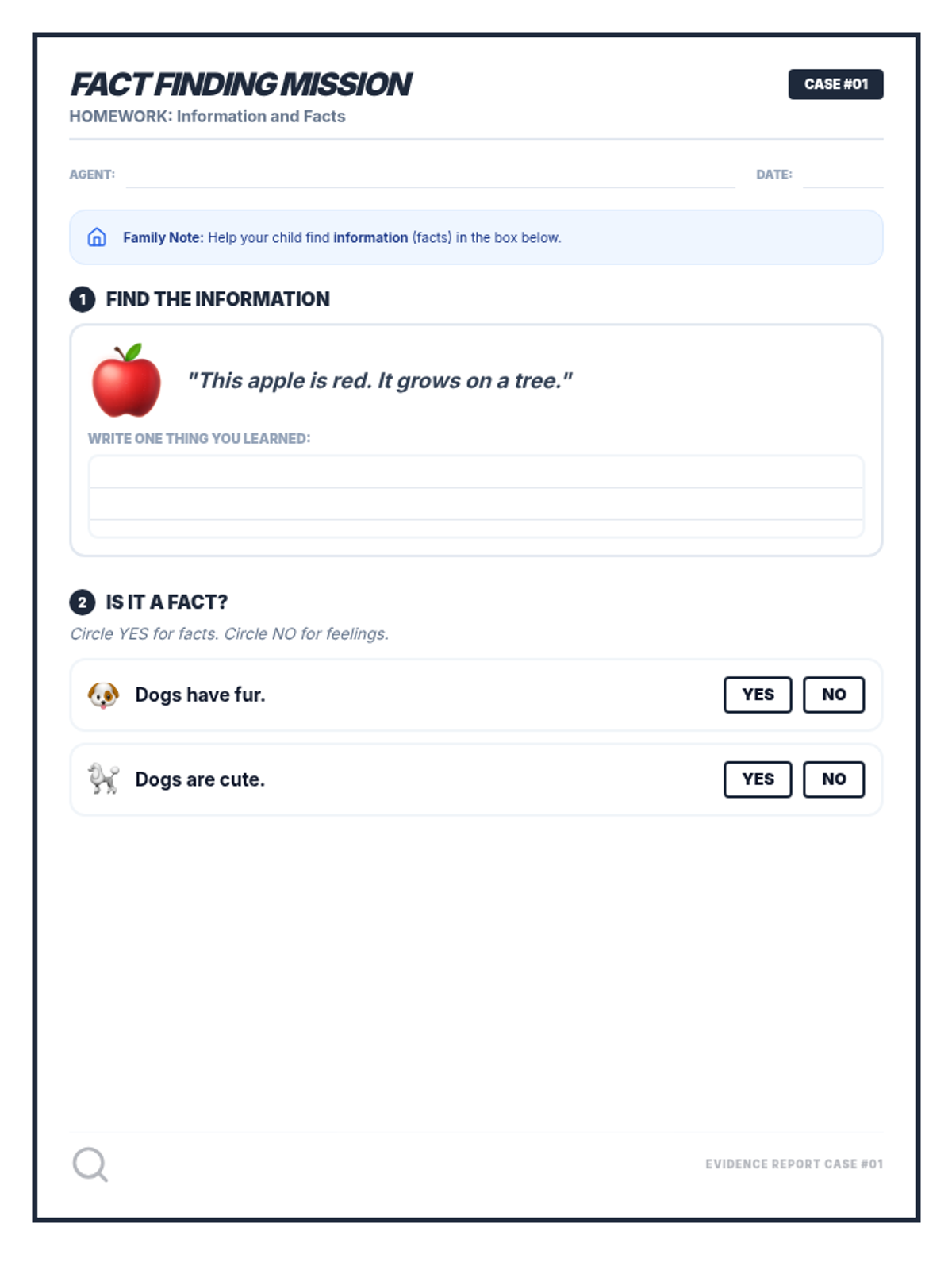
A homework sheet focused on 'information' and 'fact'. Students practice finding information in a simple context and distinguishing between facts and opinions with a family-friendly instruction note. Revised for 1-page layout and improved contrast.
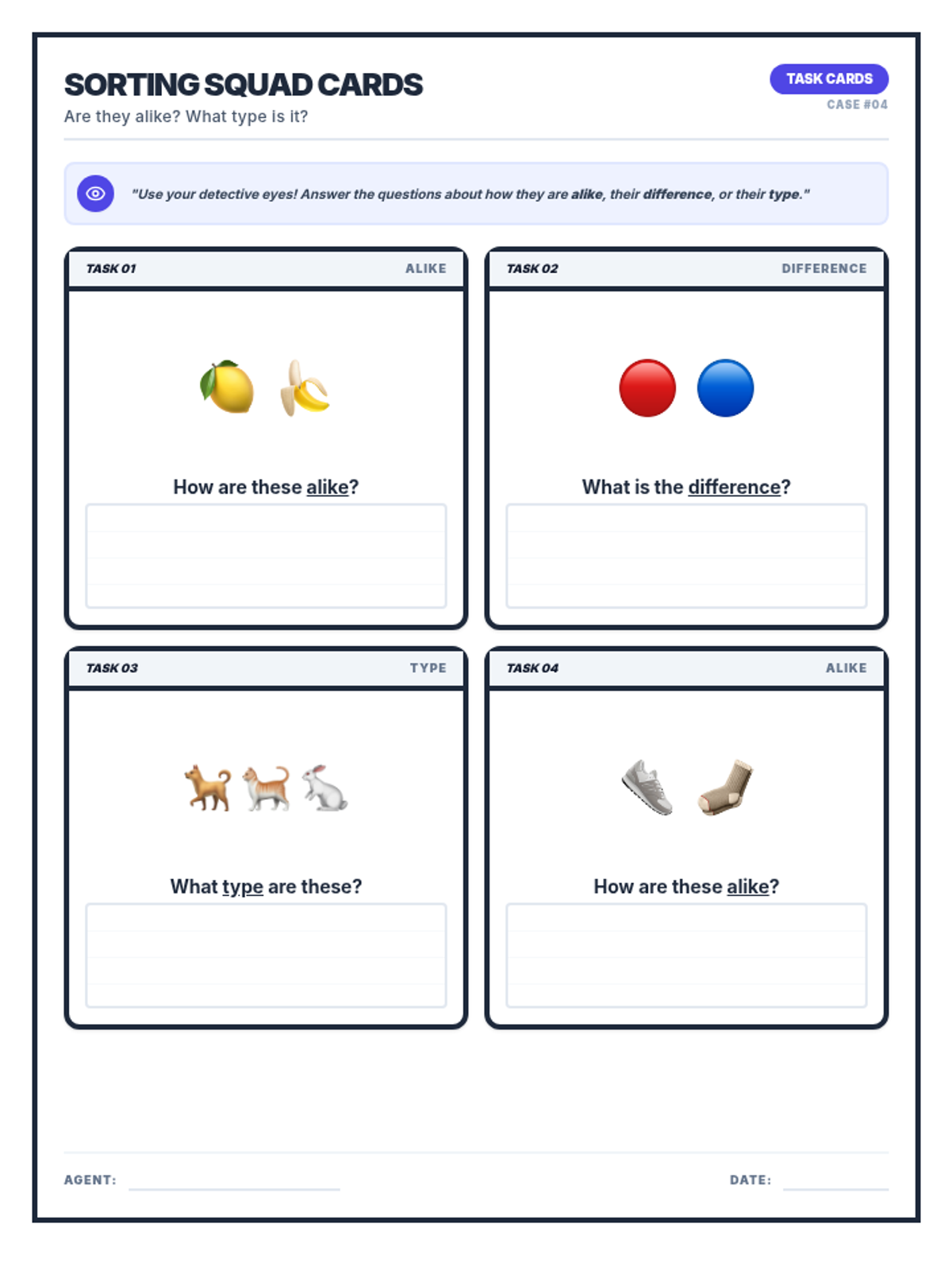
A set of task cards for comparing and categorizing items. Students analyze visual pairs and sets to identify how they are alike, their differences, or their shared 'type'. Revised for single-page layout with larger response areas and white backgrounds for legibility.
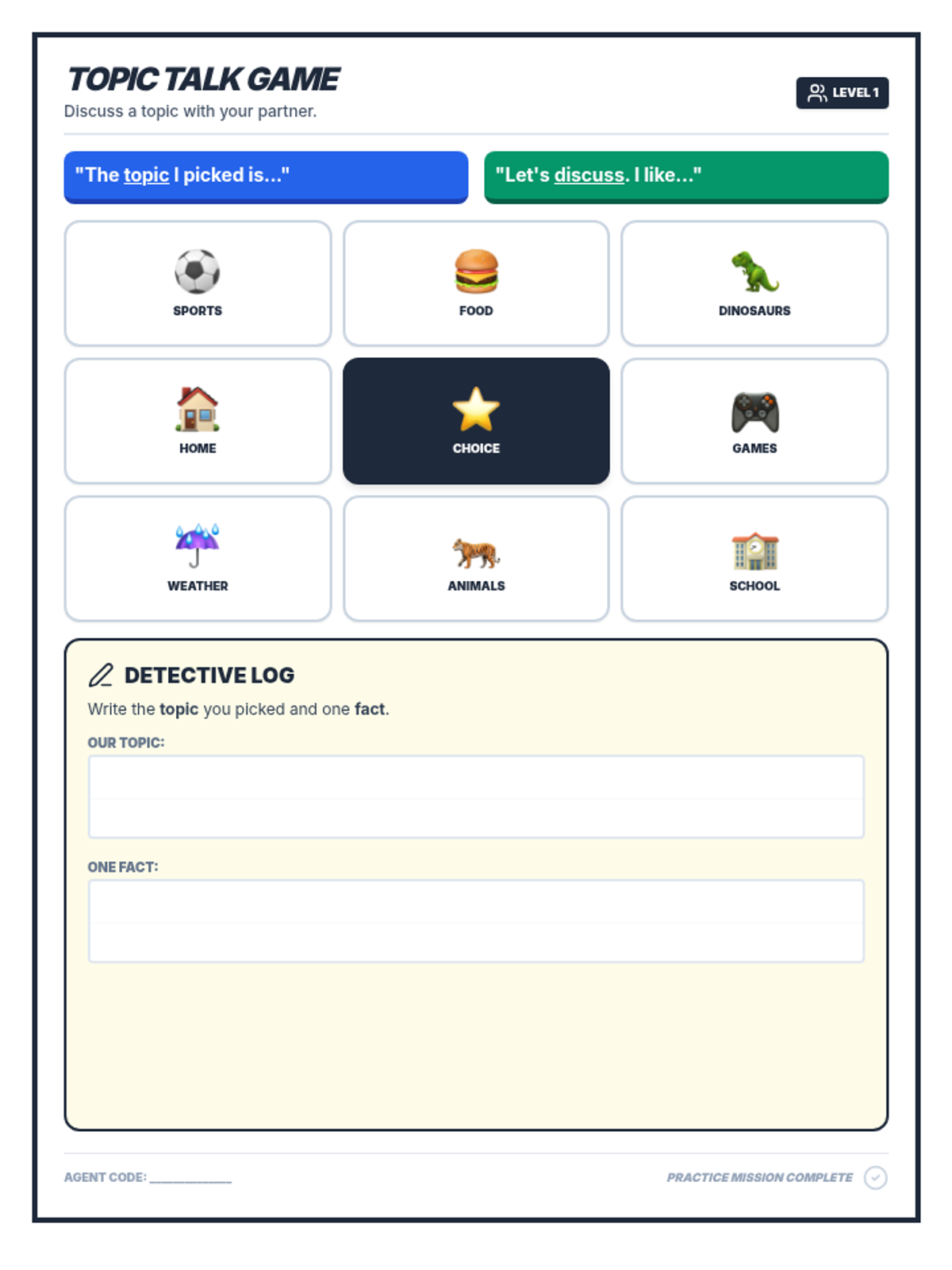
A partner-based discussion game featuring a choice board of visual topics. Students use sentence starters to practice identifying a topic and engaging in discussion with their peers. Revised to fit on a single page with a new 'Detective Log' for written practice. Grid heights and padding optimized for 1-page layout.
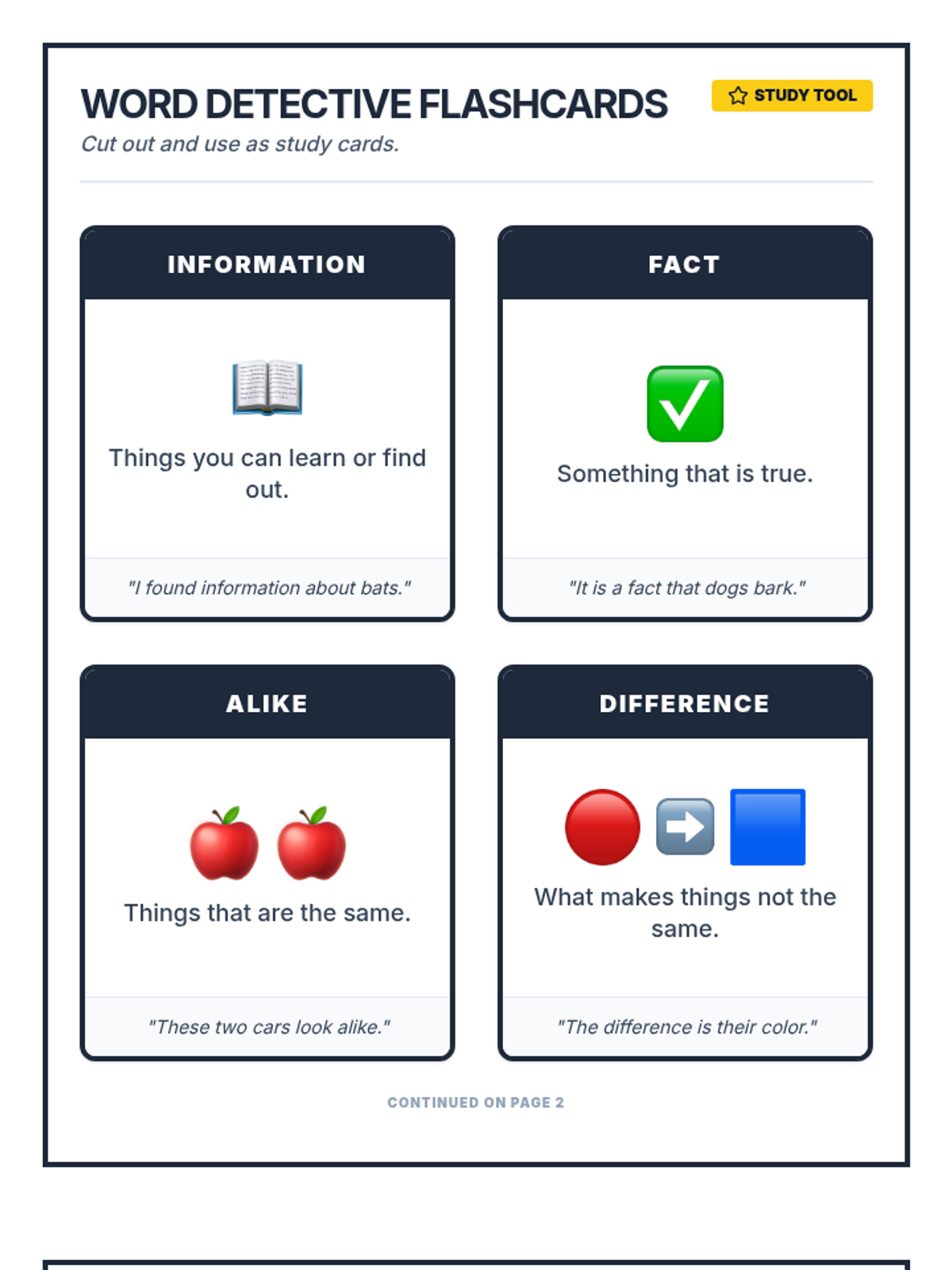
Visual vocabulary flashcards for the seven target academic words, featuring simple definitions, clear icons, and example sentences to support student mastery. Revised for consistent 2-page layout with borders and improved writing space for notes. Example sentences increased for better readability. Corrected arrow rendering and removed placeholder text.
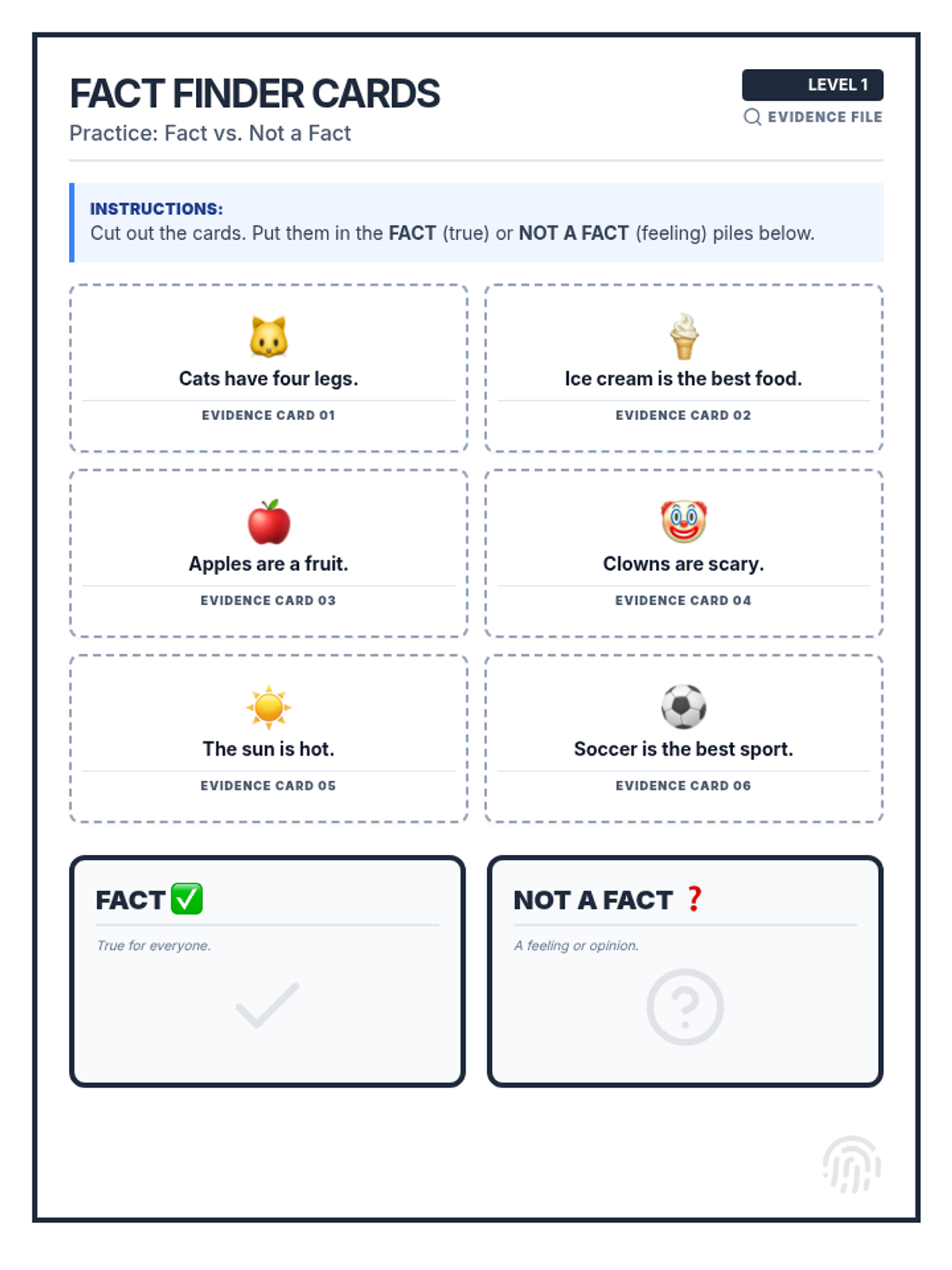
A hands-on sorting activity where students cut out cards and categorize statements as either 'Fact' or 'Not a Fact' to practice the concept of information versus opinion. Revised to fit on a single page with high-contrast text and larger sorting zones.
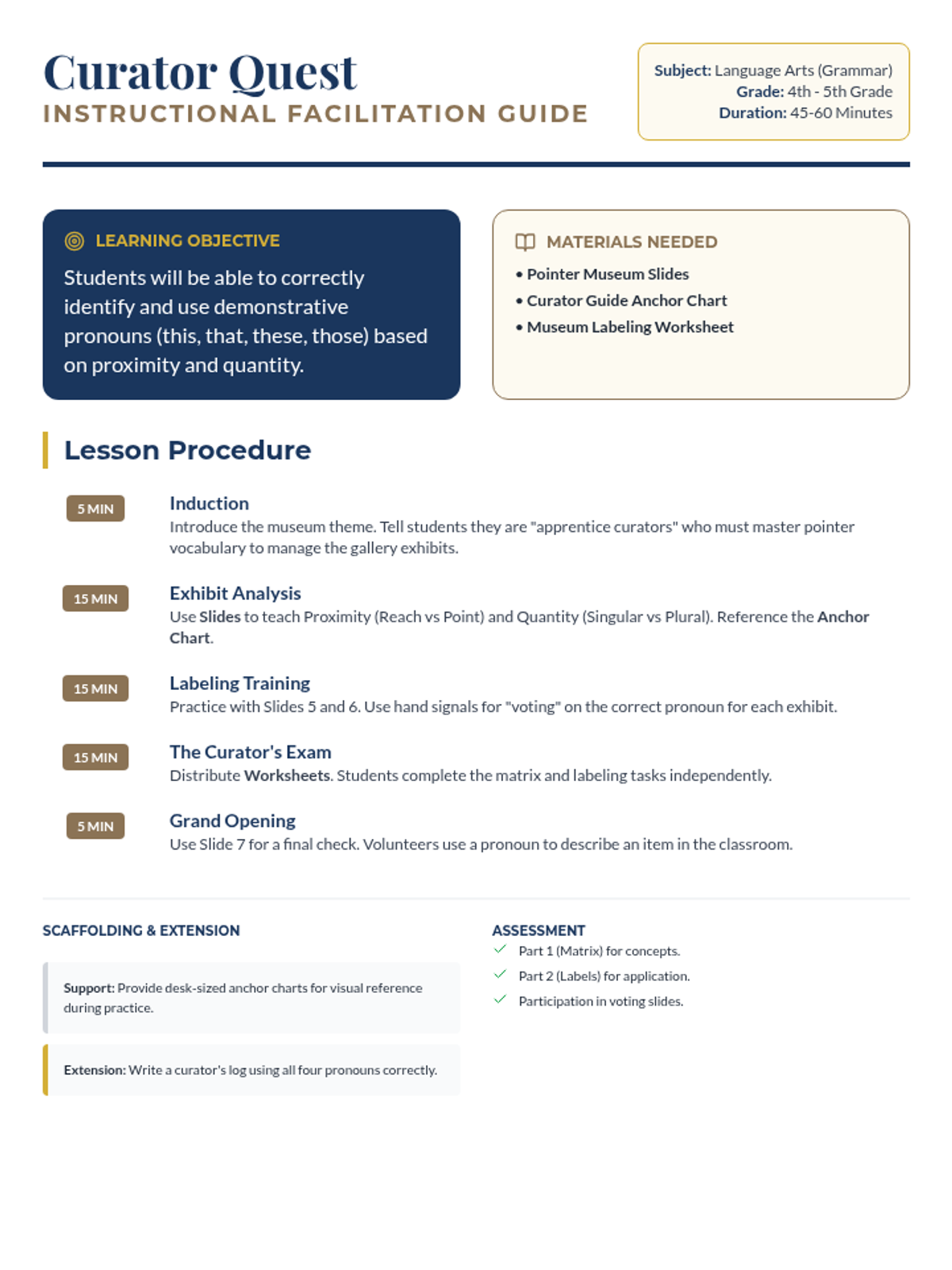
A detailed facilitation guide for teachers to deliver the Curator Quest lesson. It includes timing, step-by-step procedures, scaffolding suggestions, and assessment strategies aligned with the museum-themed materials.
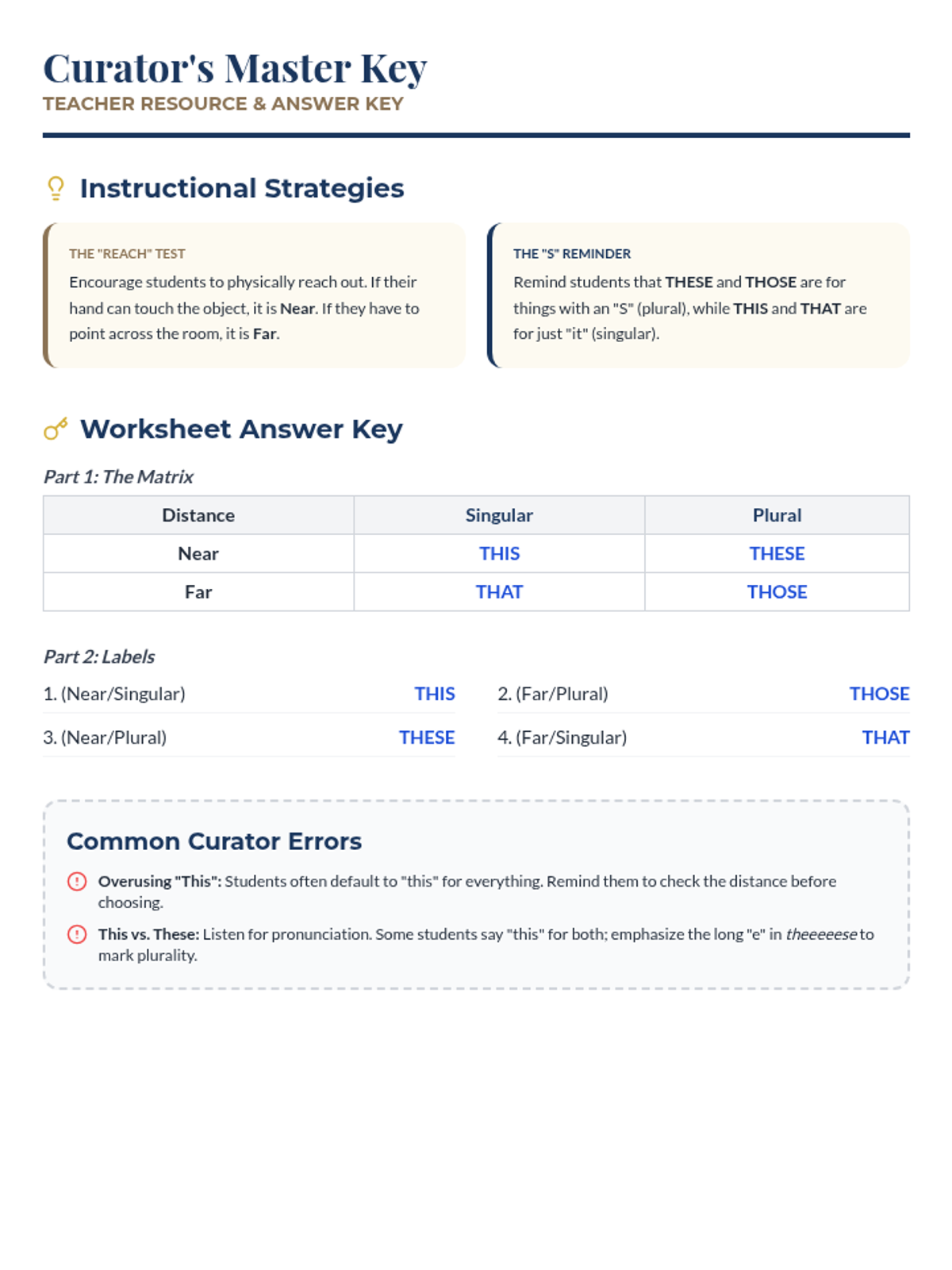
A teacher-facing resource providing the answer key for the museum worksheet along with teaching strategies and common student misconceptions regarding demonstrative pronouns.
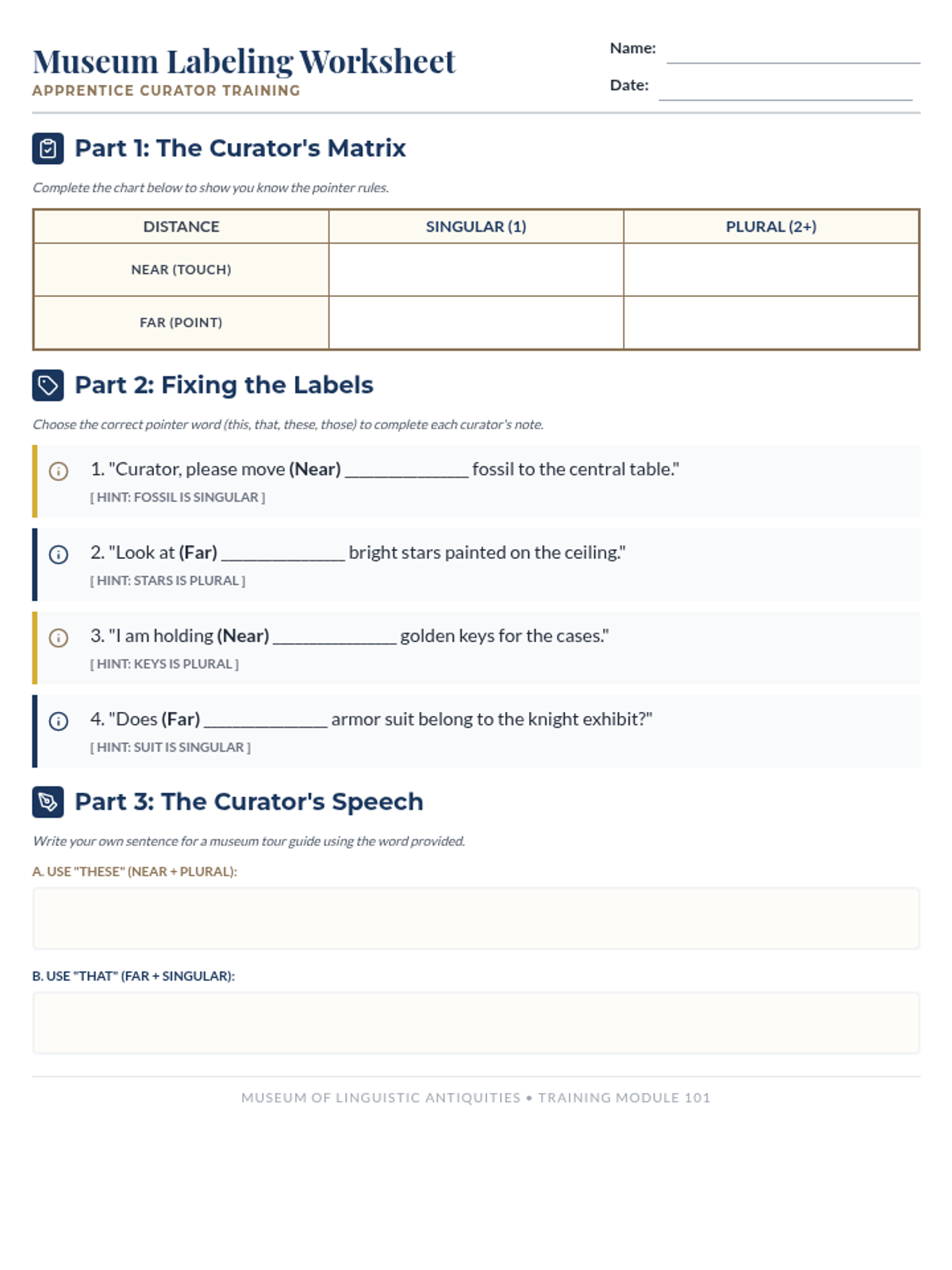
A practice worksheet where students apply their knowledge of pointer words in a museum curator context. It includes a recall chart, fill-in-the-blank sentences with proximity/quantity hints, and a sentence writing section.
A guided slide deck that introduces the concept of pointer words (demonstratives) using a museum curator theme. It breaks down the rules of proximity and quantity with clear visuals and guided practice slides.
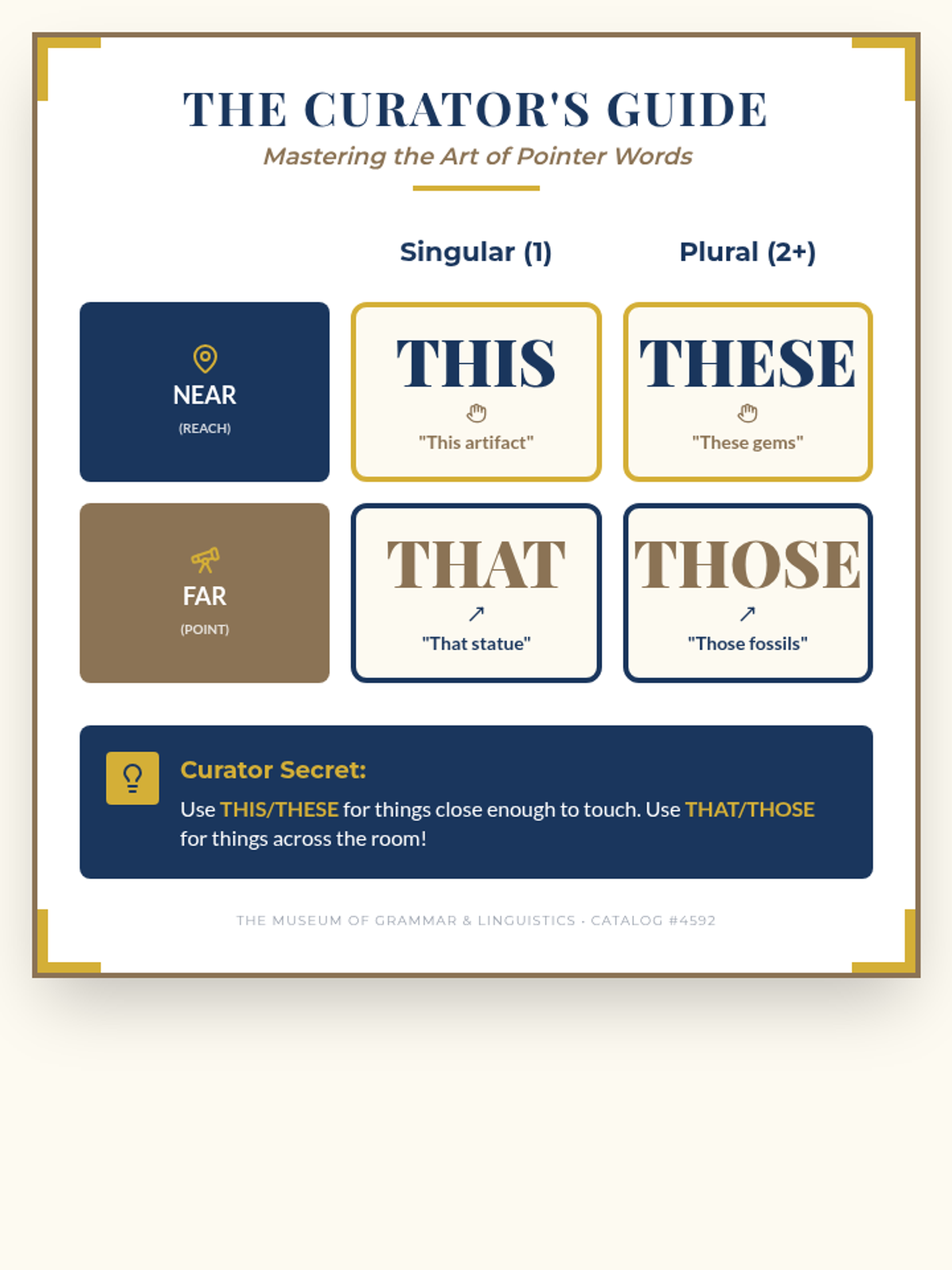
A visually striking anchor chart designed with a museum theme to teach the four demonstrative pronouns (this, that, these, those). It uses a 2x2 grid to clearly differentiate between number (singular/plural) and proximity (near/far).
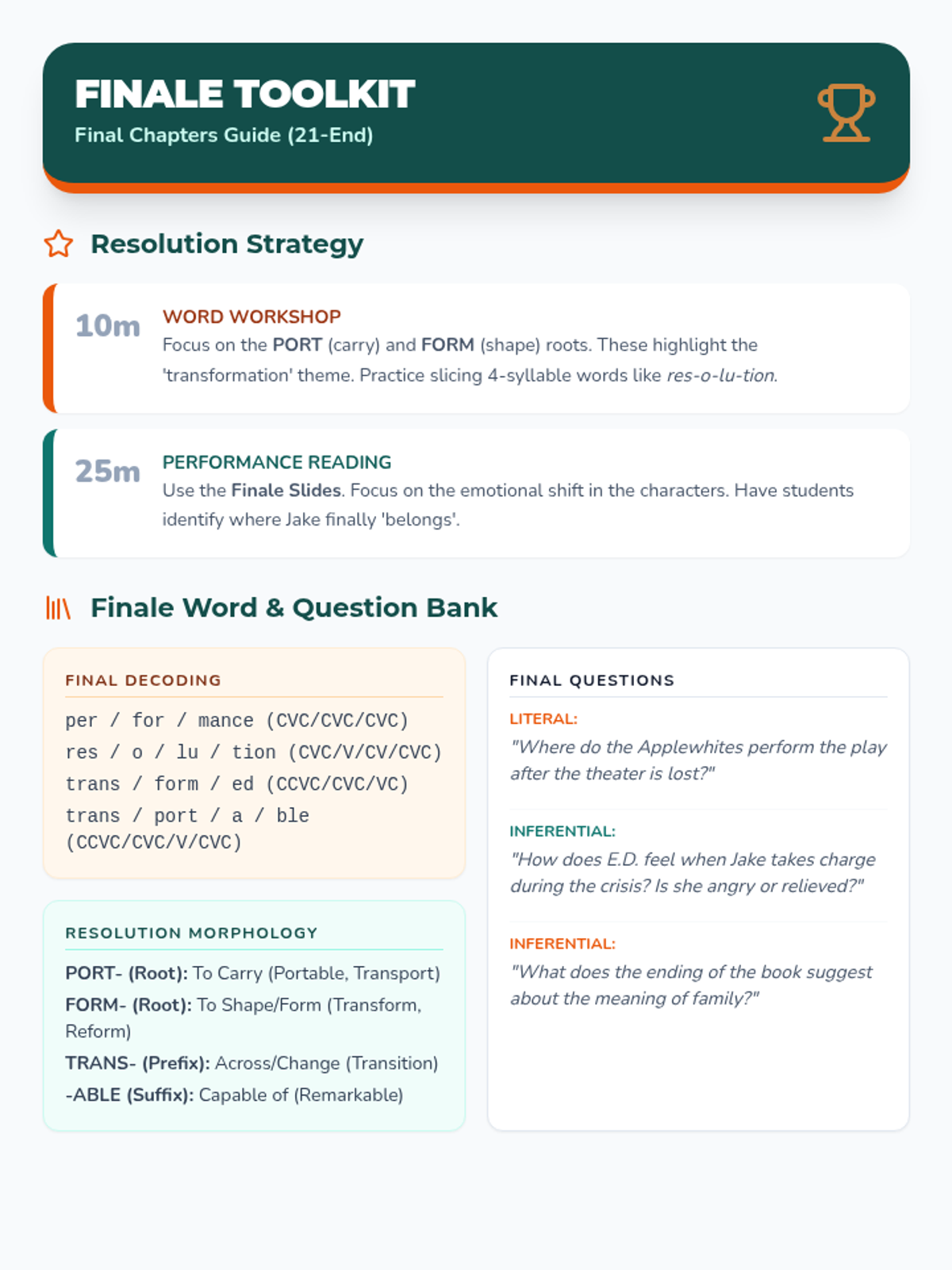
Teacher toolkit for the final chapters of 'Surviving the Applewhites,' featuring resolution-themed word banks and character transformation questions.
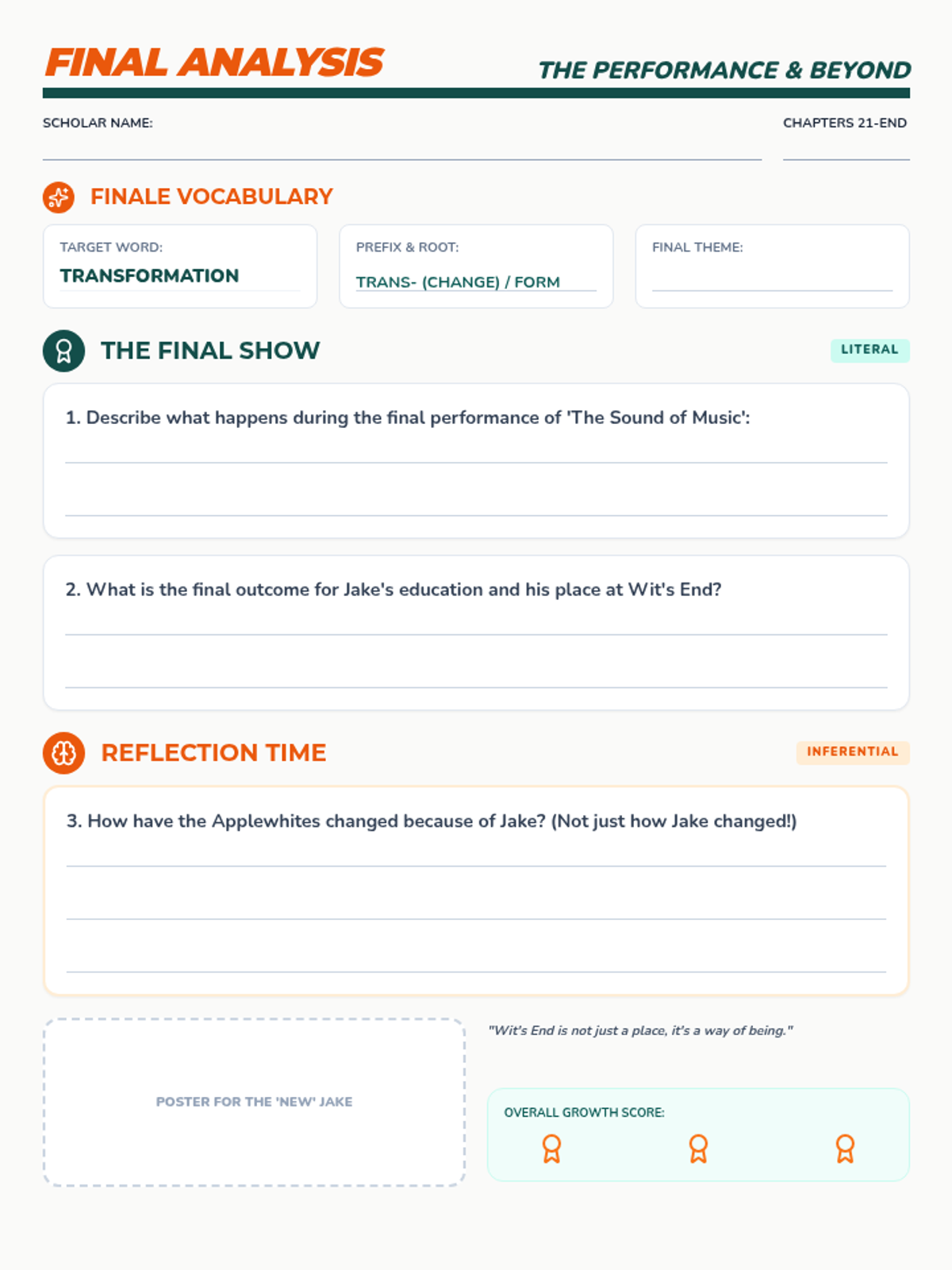
Final-chapter comprehension handout for 'Surviving the Applewhites,' focusing on the story's resolution and character growth.
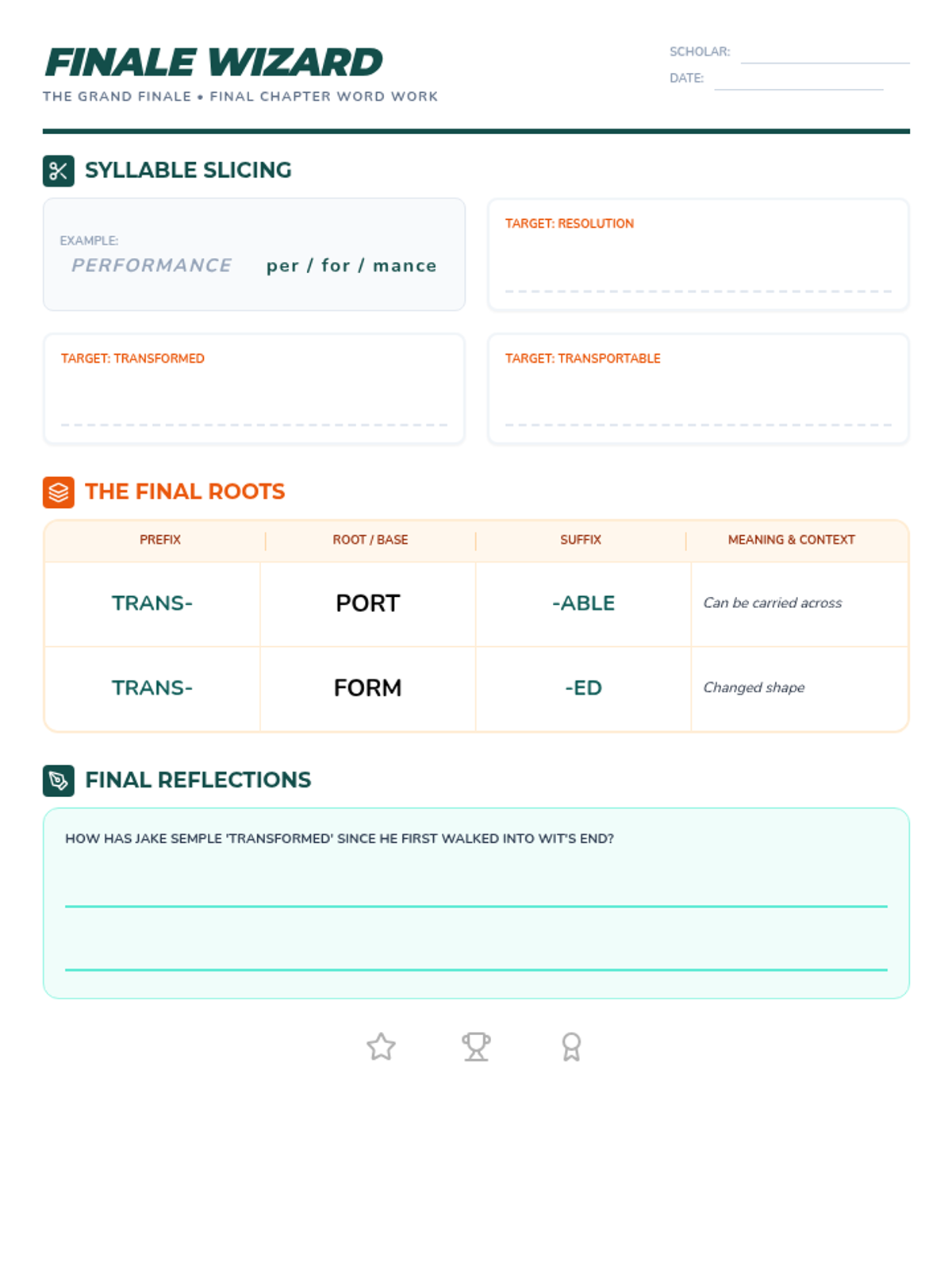
Final-chapter word work for 'Surviving the Applewhites' focusing on resolution, transformation, and roots like PORT and FORM.
Daily routine slides for the final chapters of 'Surviving the Applewhites,' focusing on the theme of 'The Grand Finale' and character transformation.
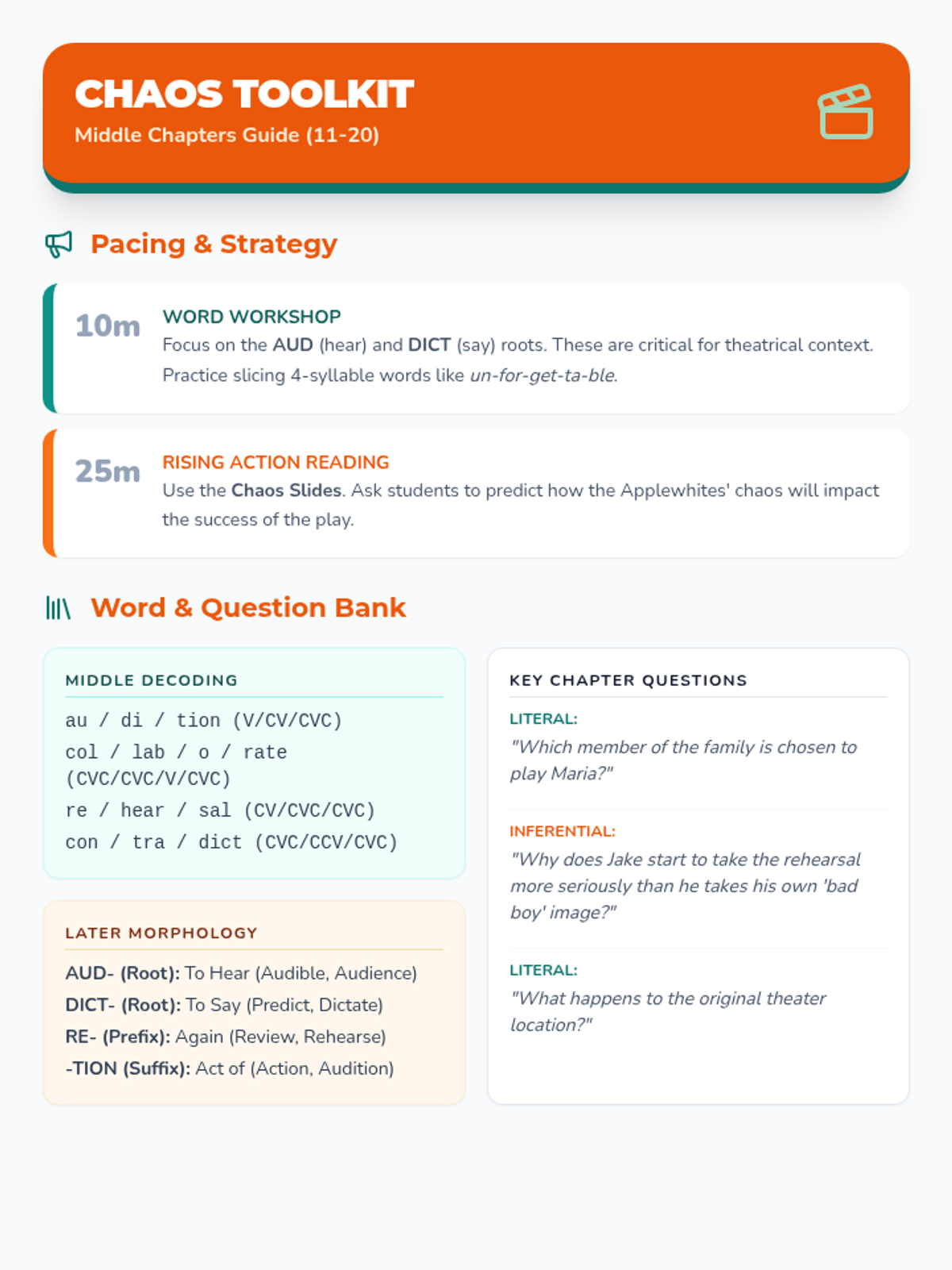
Teacher toolkit for the middle chapters of 'Surviving the Applewhites,' featuring theater-themed word banks and rising action questions.
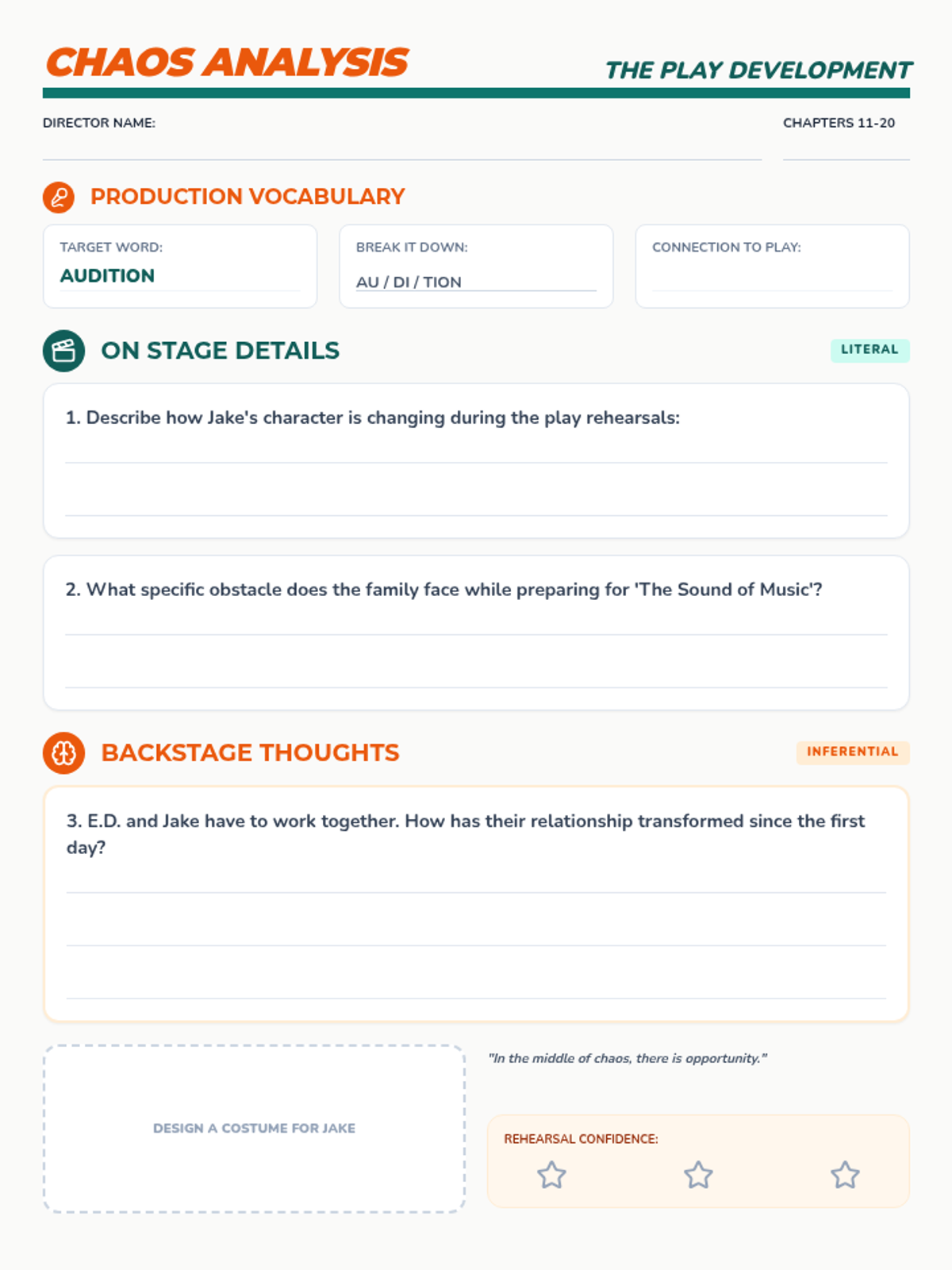
Middle-chapter comprehension handout for 'Surviving the Applewhites,' focusing on character development and the play's preparation.
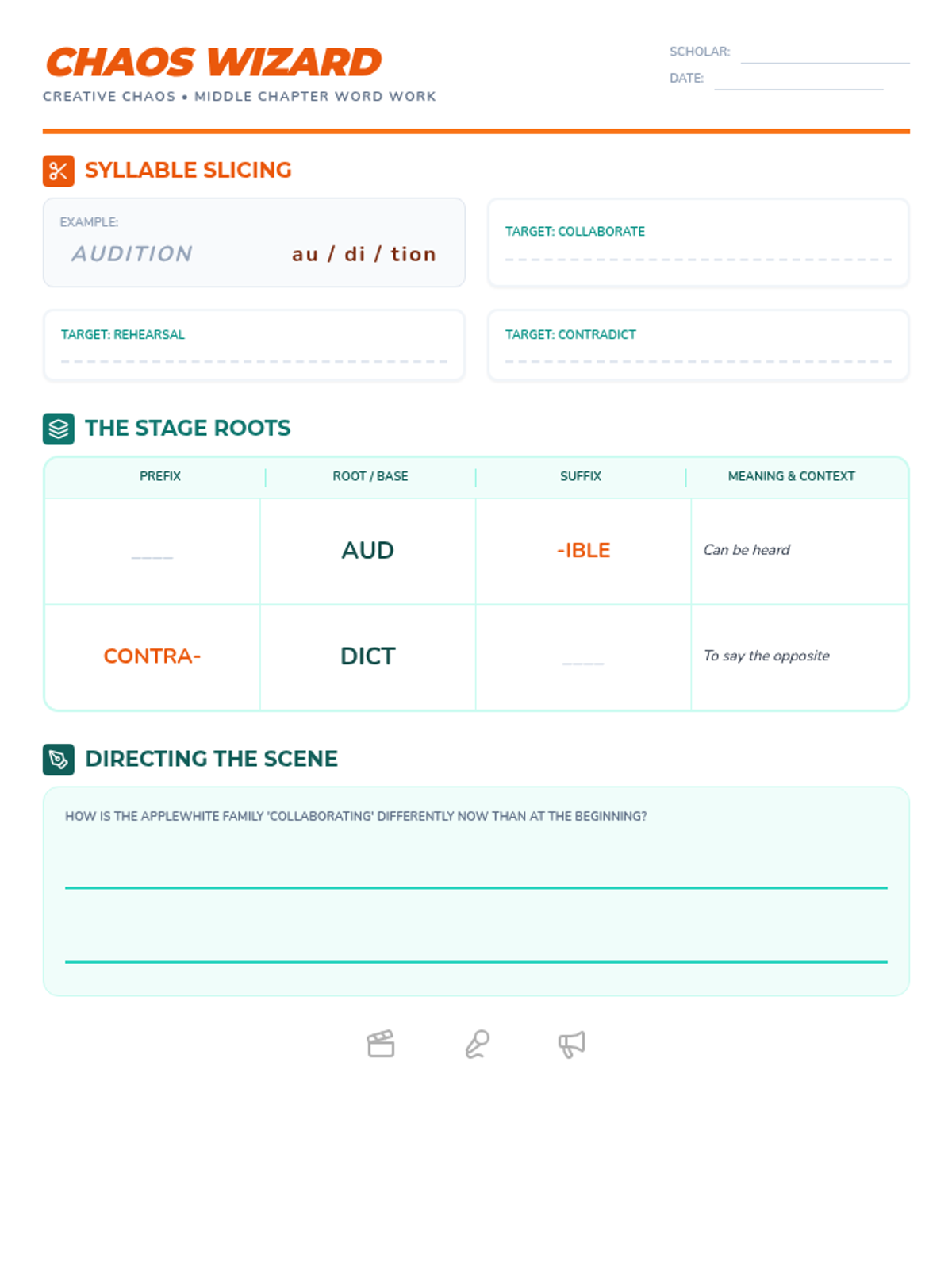
Middle-chapter word work for 'Surviving the Applewhites' focusing on theater-related vocabulary and roots like AUD and DICT.
Daily routine slides for the middle chapters of 'Surviving the Applewhites,' focusing on the theme of 'Creative Chaos' and theatrical vocabulary.
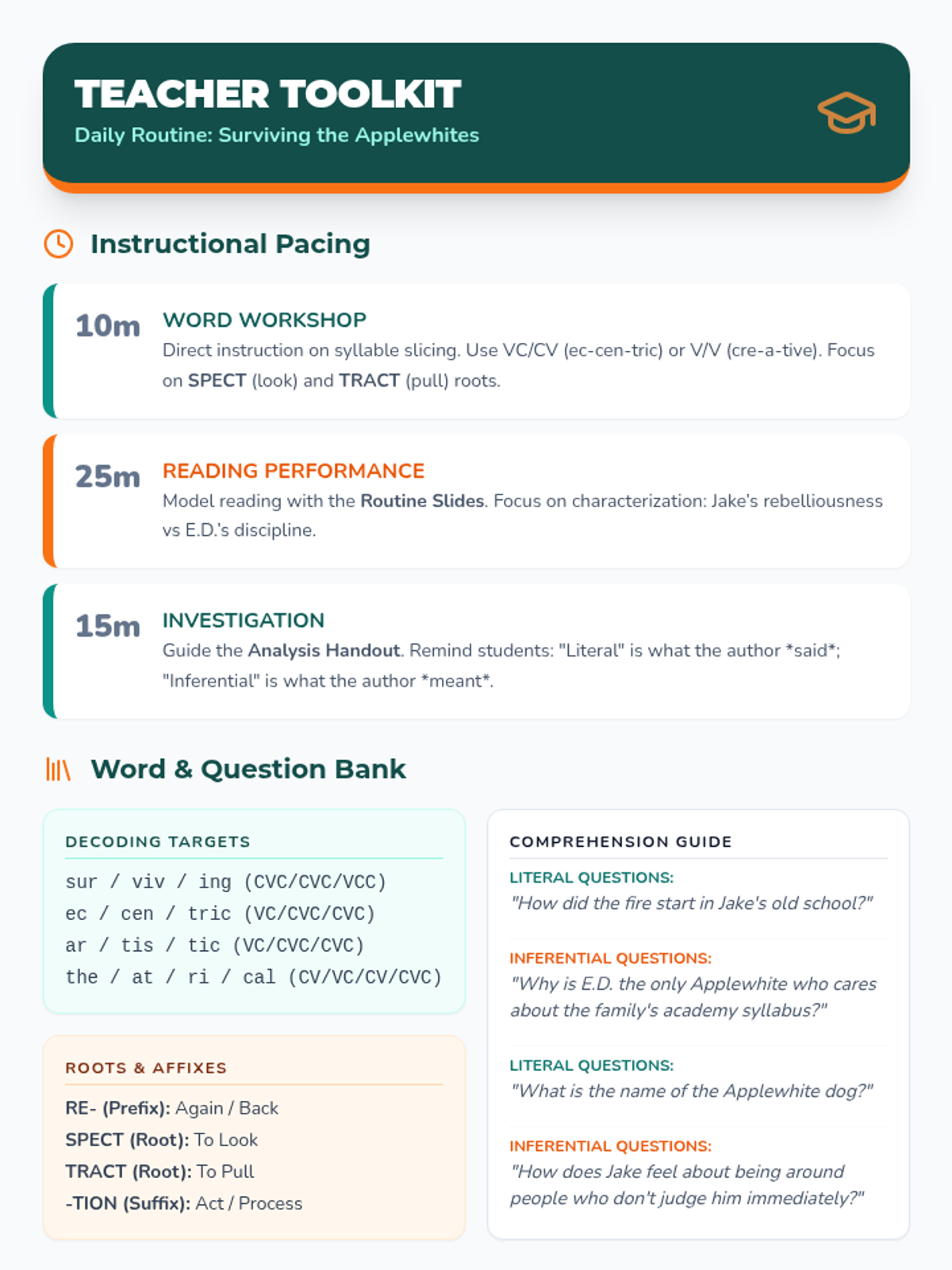
A comprehensive guide for teachers implementing the 'Surviving the Applewhites' daily routine, featuring instructional pacing, word banks for decoding, and sample comprehension questions.
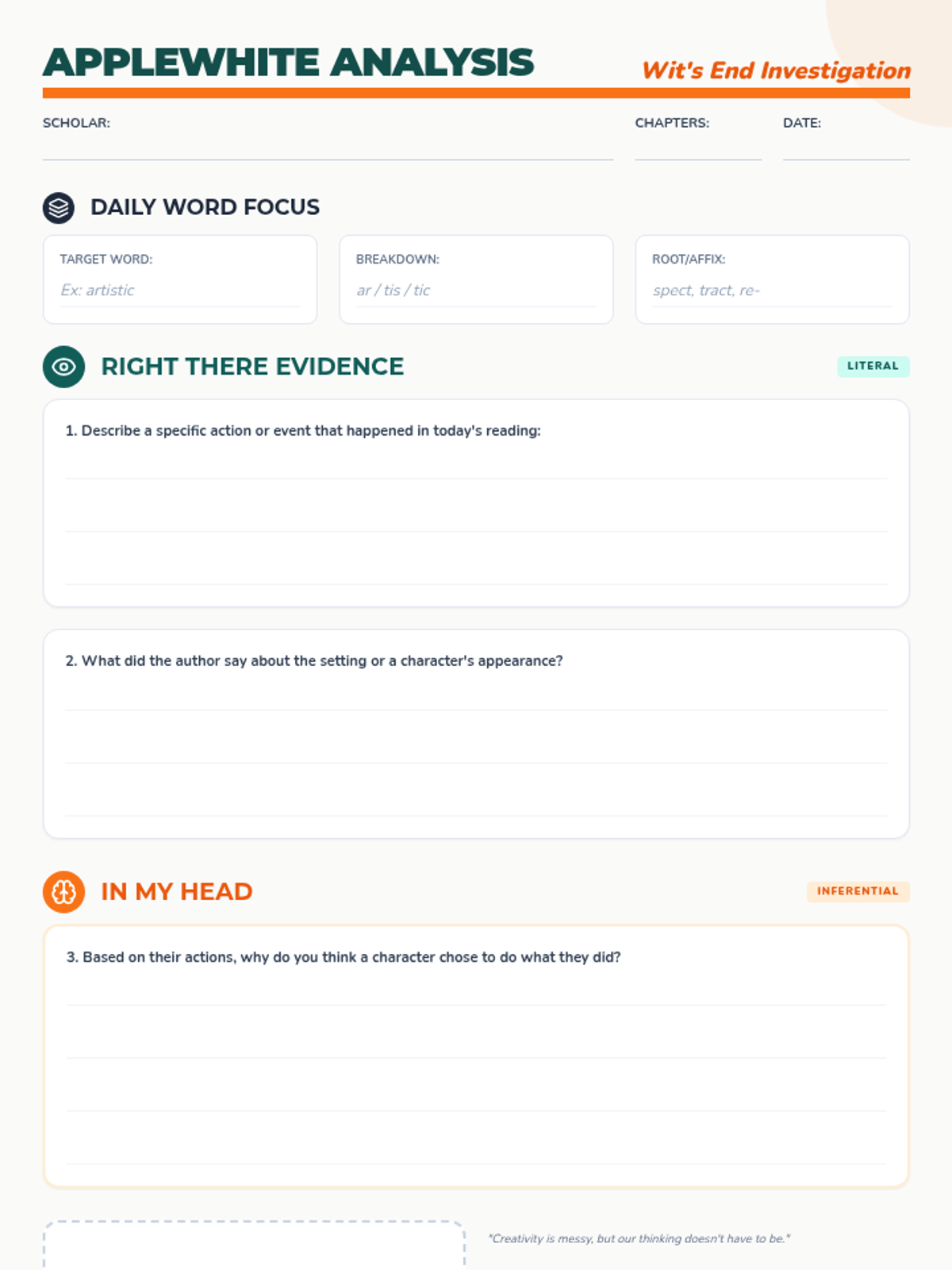
A recurring daily comprehension handout for 'Surviving the Applewhites,' featuring structured sections for literal recall, inferential reasoning, and visual reflection.
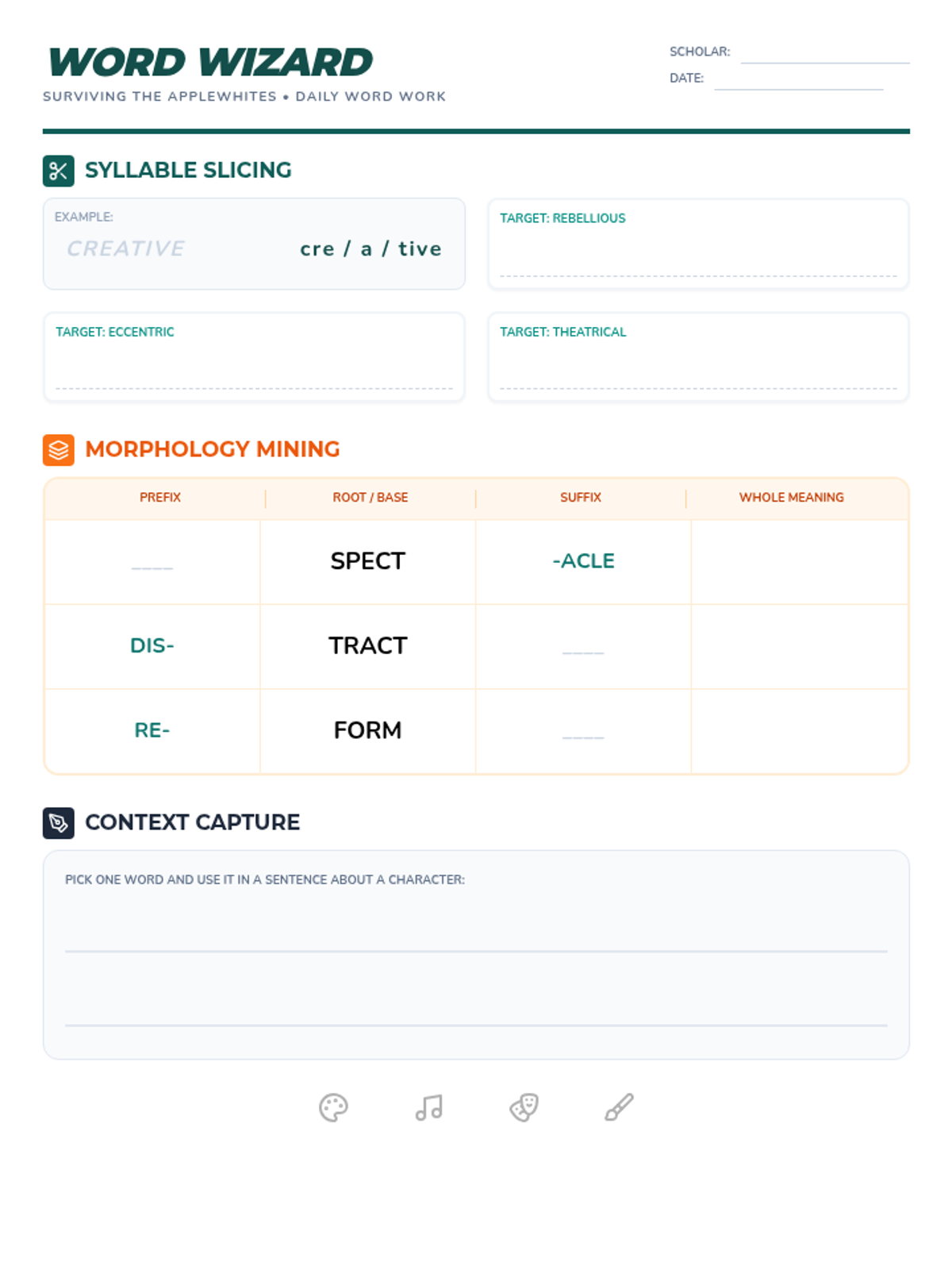
A recurring daily worksheet for remedial readers focusing on decoding via syllable slicing and morphology practice with common roots and affixes.
A visual presentation designed to guide a recurring daily routine for the novel 'Surviving the Applewhites,' including segments for word work, reading strategies, and comprehension investigation.