Students investigate how distance affects electrostatic force, focusing on the inverse square relationship and developing the mathematical intuition for division in the formula.
No materials in this lesson yet.
A foundational lesson focusing on the core science practices of experimental design, data collection, and statistical analysis required for AP Biology.
In this interactive murder mystery activity, students apply their knowledge of covalent nomenclature, Lewis structures, VSEPR theory, and bond polarity to solve 'The Covalent Caper.' Students move around the room to solve chemistry-based clues and eliminate suspects, weapons, and locations to identify the culprit.
A deep dive into the motivations, theories, and psychological challenges of interstellar exploration and first contact.
A comprehensive biology lesson focusing on TEKS 4A, covering viral structure, reproduction cycles (lytic/lysogenic), and comparisons between viruses and living cells. Includes a station-based rotation and a hands-on modeling lab.
A high-energy, game-based lesson where students solve complex DC circuit problems to 'reboot' a failing power grid. Covers simple circuits, internal resistance, efficiency, and energy costs.
A high-energy, 30-minute review session focused on covalent bonding. Students act as secret agents in 'Operation Valence,' solving puzzles related to electron sharing, Lewis structures, and molecular naming to 'unlock' a digital vault.
A series of hands-on, unplugged activities designed to teach Python data types and variables through tactile sorting, logic puzzles, and matching games. Focused on accessibility and clarity for students with diverse learning needs.
A 100-minute hybrid biology and reading lesson focusing on the mechanisms of primary and secondary succession through scientific texts and diagrams. Students analyze a mock scientific journal and a vocabulary-dense lab report to understand how ecosystems recover and evolve.
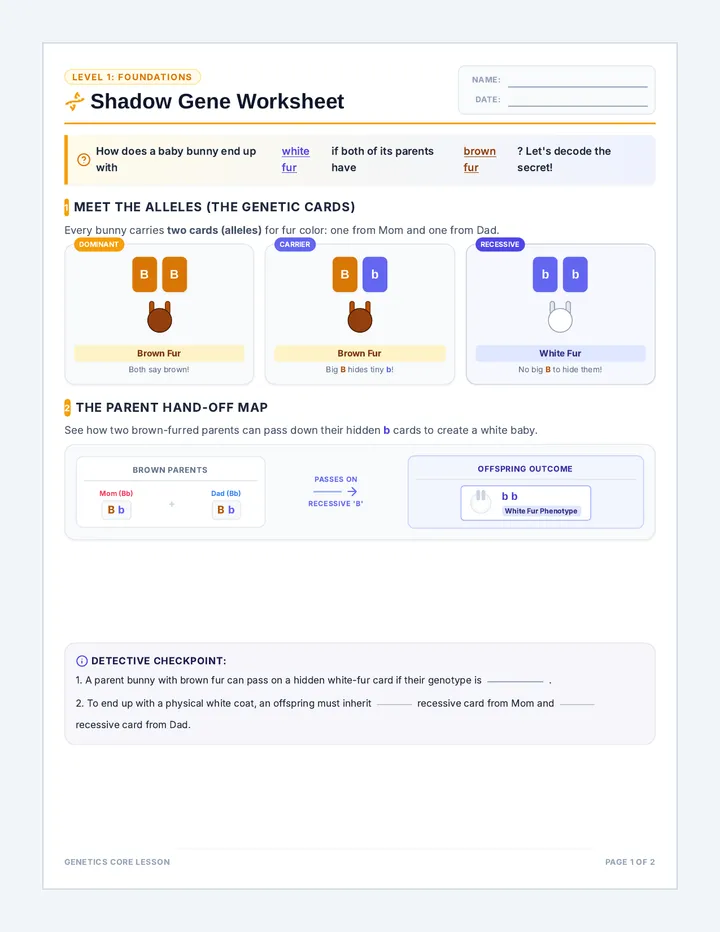
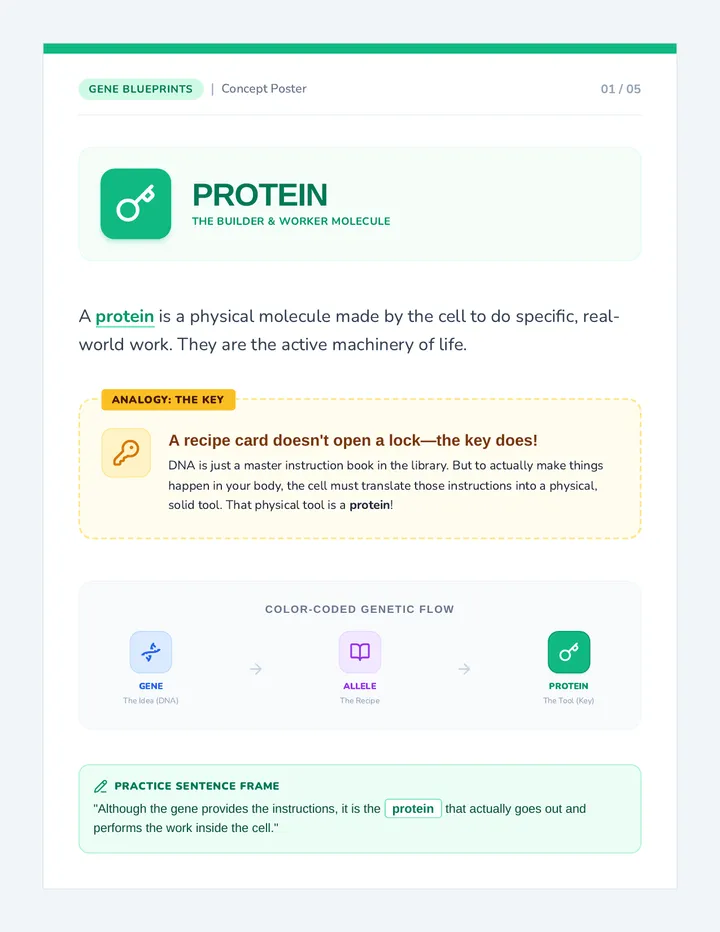
An introductory lesson on the fundamentals of heredity, focusing on dominant and recessive traits, and the distinction between genotype and phenotype.
A station-rotation lesson themed around animal crackers that integrates zoology and conservation vocabulary through reading, writing, speaking, and a STEM challenge. Designed for 6th-grade students to practice multimodal literacy skills while exploring animal ethics and habitat preservation.
Final assessment of the unit through a formal quiz and the final evaluation of the 3D ear model project.
Students examine the social, emotional, and practical impacts of hearing loss on daily life and reflect on their own 3D project creation.
A deep dive into hearing technology, specifically comparing the functions and surgical/non-surgical aspects of hearing aids and cochlear implants.
An introduction to the field of audiology, where students learn how hearing is measured and practice reading and plotting data on an audiogram.
Students explore the anatomy of the ear and begin their journey into the 3D ear model project, learning how sound travels through the outer, middle, and inner ear.
A comprehensive lesson on metamorphic rocks, covering the processes of heat and pressure, regional vs. contact metamorphism, and the identification of foliated and non-foliated rocks.
A comprehensive lesson on igneous rock formation, classification, and identification, focusing on the relationship between cooling rates and crystal size.
A cross-curricular lesson for 9th-10th grade exploring the intersection of Physics and Geometry through reflection, refraction, and ray tracing. Students apply Snell's Law and geometric proofs to understand how light behaves.
Applying Coulomb's Law to explain atomic properties like atomic radius and ionization energy, connecting electrostatic forces to the periodic table.
A deep dive into the mathematical manipulation of Coulomb's Law, focusing on multiplying and dividing variables to predict changes in force.