A high-engagement punctuation and mechanics lesson where students become detectives solving 'crimes' of missing commas and misplaced periods in high-interest narratives.
A focused independent practice session where students analyze short stories and fables to identify themes, summarize plots, and demonstrate comprehension using the RACE writing strategy.
A lesson focused on the final chapters of 'Wonder' by R.J. Palacio, exploring August's character transformation and the overarching themes of courage and kindness during the nature retreat and the end of the school year.
A lesson covering Part 7 (Miranda) and the beginning of Part 8 (August) of the novel Wonder, focusing on Miranda's internal conflict and the transition to the 6th grade nature retreat.
A focused look at Part 5 of 'Wonder', exploring Justin's unique perspective, narrative voice, and his protective role within the Pullman family circle.
Mastering Latin roots related to doing and writing: fac/fic/fact (to make/do) and scrib/script (to write).
Mastering Latin roots related to leading and following: duc/duct (to lead) and sequ/secut (to follow).
Mastering Latin roots related to carrying and pulling: port (to carry) and tract (to pull).
Mastering Latin roots related to writing: graph (to write) and scrib/script (to write).
A comprehensive review of the five informational text structures using an architectural blueprint theme. Students learn to identify structures through signal words and graphic organizers.
Mastering Latin and Greek roots related to writing and drawing: scrib/script (to write) and graph (to write or draw).
Mastering Latin roots related to movement and force: port (to carry) and tract (to pull).
A focused literacy lesson for 5th graders targeting short 'a' and short 'o' vowel sounds through a mystery-themed reading passage and assessment. Students will practice identifying these sounds in multisyllabic words while developing comprehension skills.
Mastering Latin roots related to communication and listening: dict (to say) and aud (to hear).
Mastering Latin roots related to viewing: spect (to look) and vid/vis (to see).
A focused lesson assessing comprehension of Part 6 of 'Wonder' by R.J. Palacio, covering August's experience with hearing aids and the pivotal nature retreat.
A lesson focused on crafting strong persuasive arguments about recycling, specifically helping ELL students develop topic sentences and clear supporting reasons.
A collection of assessment materials covering chapters 9 through 12 of E.B. White's Stuart Little, designed for emerging readers.
A lesson focused on identifying and tracking character habits in the novel 'Two Roads', helping students understand how recurring actions reveal personality and values.
Mastering prefixes for quantity and fractions: multi-, poly-, semi-, and hemi-.
Mastering prefixes for size and distance: mini-, micro-, mega-, and tele-.
Prepares students for their final oral presentation, focusing on slide design, public speaking, and final grammar checks.
Refines the narrative structure and focuses on the precise use of articles (a, an, the) for clarity and flow.
Explores setting and descriptive detail using prepositional phrases to ground narratives in a specific time and place.
Focuses on identifying personal narrative topics and mastering subject-verb agreement to ensure clear story foundations.
A biography research project focused on influential athletes who changed the world. Students use a sports-themed packet to document their subject's career milestones, social impact, and personal mindset.
A focused lesson on identifying nouns, verbs, and adverbs using classroom-themed sentences. Students practice identifying parts of speech through circling and underlining activities.
Mastering number prefixes for four, five, and one hundred: quad-, quint-, pent-, and cent-.
Introduction to number prefixes: mono-, uni-, bi-, and tri-, indicating one, two, and three.
In this sort, related words may have multiple sounds that change. Listen for shifts in both the vowel and the consonant sounds (e.g., produce to production).
Focusing on vowel alternations where adding the suffix -ion shifts the sound from long or short to a schwa.
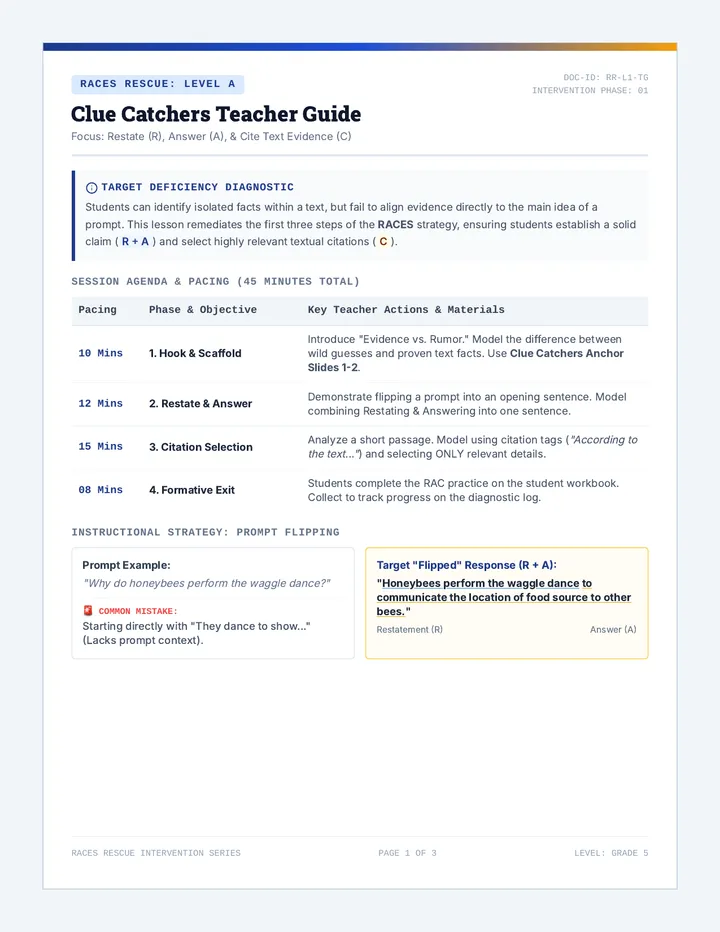
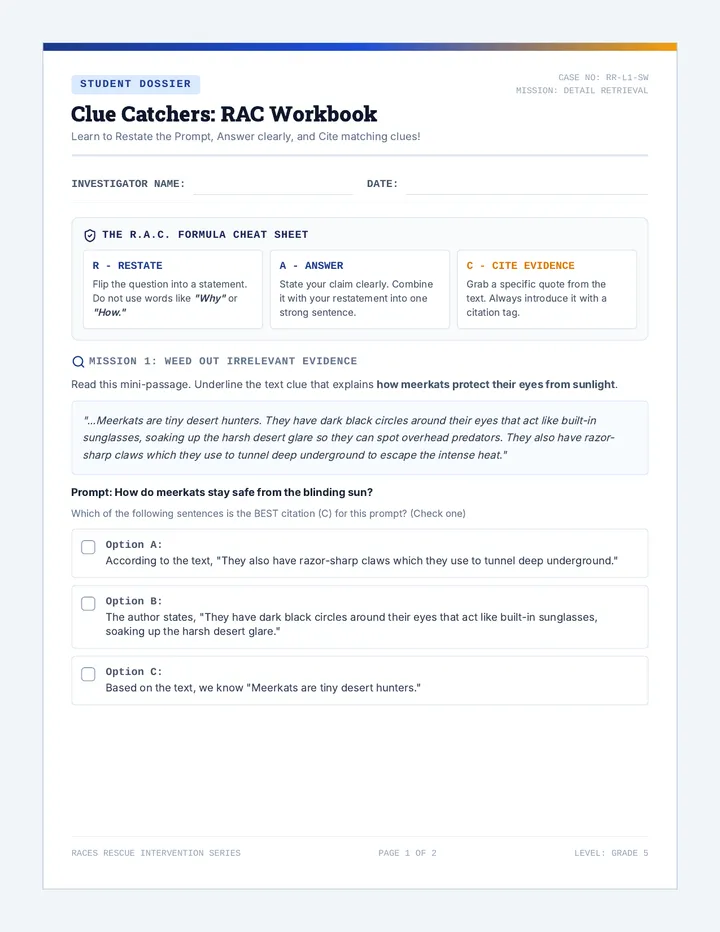
A lesson focused on identifying and citing evidence from functional texts, such as manuals and agreements, to support a specific argument. Students will practice finding two pieces of evidence and explaining their relevance.
Introduction to vowel alternations where vowel sounds shift from long or short to the quiet schwa sound as the stress of the word moves.
A lesson focused on teaching students how to make logical inferences and identify implicit meanings using high-interest sports narratives.
Introduction to vowel alternations where vowel sounds shift between long, short, and schwa sounds (e.g., nature becomes natural).
Focusing on vowel alternations where a long vowel sound shifts to a short vowel or a schwa sound (the "uh" sound) when a suffix is added.
Introduction to vowel alternations where a long vowel sound shifts to a short vowel sound when a suffix is added (e.g., please becomes pleasant).